SALVATI NIST For everyone linked to The Salvation Army
www.salvationarmy.org.uk/salvationist w ww w.salvatio 9 November 2019
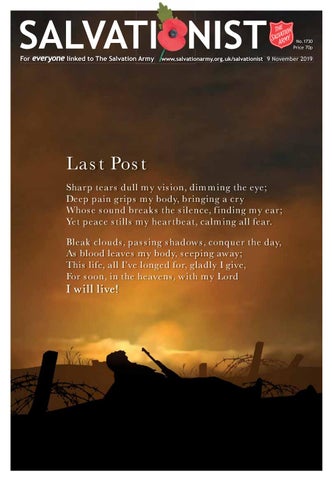
Last Post Sharp tears dull my vision, dimming the eye; Deep pain grips my body, bringing a cry Whose sound breaks the silence, finding my ear; Yet peace stills my heartbeat, calming all fear. Bleak clouds, passing shadows, conquer the day, As blood leaves my body, seeping away; This life, all I’ve longed for, gladly I give, For soon, in the heavens, with my Lord
I will live!
No.1730 Price 70p
‘
QUOTES FROM THE MEDIA
BISHOPS HIGHLIGHT CHURCH’S RESPONSIBILITY TO SHOW SUPPORT AND PRAY AMID BREXIT ANXIETY Anglican Church leaders… have made an appeal for churches to be supportive to their communities amid the uncertainty of how the UK will leave the European Union. The Right Rev Robert Atwell, Bishop of Exeter, and the two suffragan bishops of Plymouth and Crediton, the Right Rev Nick McKinnel and the Right Rev Jackie Searle, have written to all the churches about their responsibility to respond to Brexit anxiety in their… area. The bishops said the letter was in response to the worries of many in the county, particularly in the farming community, and their ‘concern at the deep divisions in our nation’. The bishops said it was not the role of church leaders to take sides over Brexit. Instead, the Pastoral Letter… offers spiritual guidance and suggests practical ways in which churches can help those in their… community, particularly in rural areas. These include making sure local food banks are well stocked and have enough volunteers, ensuring EU nationals are welcomed in each parish, and giving advice on welfare organisations... The letter states… ‘We also have a responsibility to speak out for the most vulnerable in our communities and to help them as best we can.’ Premier
ARCHBISHOP CALLS FOR INCREASED AWARENESS OF TRAFFICKING
The biggest primary school academy trust in England is to give food to parents to prevent ‘family hunger’. The Reach2 trust is going to put ‘community fridges’ in its schools to provide food for families who otherwise would not be able to afford it. The project is being launched in five schools in the east of England, with the aim of expanding to all of the trust’s 60 primary schools. Trust chief Sir Steve Lancashire says it’s ‘heartbreaking’ that it is needed. ‘We often hear about children going to school hungry because their families simply cannot afford to provide them with the food that they would want to,’ says Sir Steve.
The head of the Catholic Church in Ireland spoke… about the ‘horror’ of the Essex migrant deaths warning the faithful that the reality is that human trafficking could be happening ‘right in front of us – in our own parish and in our own town’… Archbishop Eamon Martin offered prayers in St Patrick and Colman’s Cathedral in Newry… He prayed that the identities of the victims would be quickly established and that all those responsible… would be brought to justice… The archbishop urged the faithful to raise awareness about trafficking, to keep their eyes open and cooperate at all levels of society for an end to ‘this evil in our midst’.
BBC News
The Tablet
ARCHBISHOP URGES CHURCHES TO END STIGMA OF MENTAL ILL HEALTH The Archbishop of Canterbury has revealed that he realised he was suffering from depression last year. His revelation, made on BBC Radio 4… came as he told the Faith and Mental Health: A Christian Response conference that he was taking antidepressants… The archbishop said that in the Bible ‘there are people struggling with darkness and depression’. ‘Last year, I realised that I was depressed,’ said the archbishop, explaining that his daughter has helped him see that ‘it wasn’t something to be ashamed of’… He said he was hosting a mental health conference… looking at ways the Church and others can encourage communities of love, support and openness. The Church of England Newspaper
SALVATIONIST (tel) 020 7367 4890 (email) salvationist@salvationarmy.org.uk (web) www.salvationarmy.org.uk/salvationist EDITOR Lieut-Colonel Jonathan Roberts – (tel) 020 7367 4901 MANAGING EDITOR Ivan Radford – (tel) 020 7367 4891 EDITORIAL ASSISTANTS Shanelle Manderson – (tel) 020 7367 4894 Simon Hope – (tel) 020 7367 4892 Melita Day-Lewis – (tel) 020 7367 4887 Major Margaret Bovey ART DIRECTOR Hannah Holden – (tel) 020 7367 4883 GRAPHIC DESIGNERS Mark Knight – (tel) 020 7367 4895 Louise Phillips – (tel) 020 7367 4896 PROOFREADER Chris Horne
2
PRIMARY SCHOOLS GIVE FREE FOOD TO HUNGRY FAMILIES
Salvationist 9 November 2019
ADVERTISING (tel) 020 7367 4883 (email) advertising@salvationarmy.org.uk DISTRIBUTION Salvationist Publishing and Supplies (Periodicals), 66-78 Denington Road, Denington Industrial Estate, Wellingborough NN8 2QH (tel) 01933 445445 (option 1, option 1) (email) subscriptions@satcol.org TERRITORIAL HEADQUARTERS 101 Newington Causeway, London SE1 6BN (tel) 020 7367 4500 (tel) 0845 634 0101 Published weekly by The Salvation Army and printed on paper from sustainable sources by Walstead Roche Ltd, St Austell. © The Salvation Army United Kingdom Territory with the Republic of Ireland. The Salvation Army is a Christian church and a registered charity. The charity number in England and Wales is 214779, in Scotland SC009359 and in the Republic of Ireland CHY6399. ISSN 2516-5909
THE SALVATION ARMY FOUNDER William Booth GENERAL Brian Peddle TERRITORIAL COMMANDER Commissioner Anthony Cotterill SECRETARY FOR COMMUNICATIONS Lieut-Colonel Dean Pallant
Find Salvationist on Facebook www.facebook.com/salvationistonline
Find Salvationist on Twitter @SalvationistUK
CONTENTS
BUILDING ON REMEMBRANCE LAST week 93-year-old Geoffrey Pidgeon became the 6,000th war veteran to receive the highest French military and civilian medal, the Légion d’honneur. A former MI6 officer who played a pivotal role in the D-Day landings, he is one of many who, as the French ambassador said, helped achieve ‘the liberation of France’ and ‘world justice and freedom’. The Salvation Army’s own Commissioner Harry Read OF is among those 6,000, having received the award three years ago. On pages 10 and 11 we remember the recipient of a different award: Harry Andrews, one of four Salvationists to have received the Victoria Cross. Harry was a Salvation Army officer and doctor in India and was called up to the Indian Medical Service during the First World War. That gained him an MBE, but it was his bravery in conflict a year after the war – conflict in which he lost his life – that earned him a posthumous VC. Whether they have received prestigious medals or not, every veteran deserves to be remembered and honoured – and they will be, as Remembrance and Armistice events take place over these next days. But it is not just those who served in the military that deserve our esteem. On pages 14 and 15 Gillian Mawson relays the memories of Second World War evacuees, who pay tribute to the volunteers that helped, supported and accommodated them. It is a reminder that in our world today there are millions of refugees who also need compassion. As well as remembering people from the First and Second World Wars, Salvationist highlights some of The Salvation Army’s work with the armed forces today. Captain Chris Carré was seconded to the RAF Chaplains’ Branch seven years ago. On pages 12 and 13 he and his wife, Captain Paula, describe the incarnational ministry they are able to carry out as they live and serve with RAF personnel. This week’s Bible study on pages 16 and 17 has something to say about how we ought to respond to remembrance. Major Graham Mizon looks at how Solomon and the people responded to the building of the Temple. They could easily have thought the important work was done and that they could rest easy, remembering their achievements. But God called them to pray with humility and to continually seek him and pursue the good. If they did that, he would heal their land. Remembrance needs to be built upon: we can use the lessons learnt and the inspiration gained as foundations for a better future. The international institutions that grew after the Second World War are examples of that. Imperfect as they are, they have helped to build justice and peace. And there is a part for individuals to play. We can help build a better world by loving our neighbours, raising our voices against injustice and, in a few weeks’ time, casting our votes. The best way to honour those who gave their lives is to ensure that the world we build reflects the goodness and grace of God. O shall we never learn The truth all time has taught, That without God as architect Our building comes to naught? Lord, help us, and inspire Our hearts and lives that we May build, with all thy wondrous gifts, A Kingdom meet for thee. (SASB 1010)
From the Editor Lieut-Colonel Jonathan Roberts
Quotes from the media
2
News
4 to 8
Feature Values: Accountability
9
by Chick Yuill
Feature 10 and 11 Remembering ‘The Brave One’ by Lieut-Colonel Jonathan Roberts
Feature A wing and a prayer
12 and 13
by Lieut-Colonel Jonathan Roberts
Feature 14 and 15 The kindness of strangers by Gillian Mawson
Bible study Heal my land
16 and 17
by Major Graham Mizon
Through the week with Salvationist 16 and 17 by Major Freda Benneyworth
New commitments
18
Letters
19
Announcements Adverts
20 and 21 21 to 23
The Salvation Army and me featuring Ivor Rickard ckard
24
FRONT PAGE Design: Hannah Holden n on Words: Stephen Pearson
SCRIPTURE QUOTATIONS IONS Scripture quotations in Salvationist are from the New International Version (2011), unless otherwise stated
Salvationist 9 November 2019
3
NEWS
Tony Daniels (left) with the group that includes Liverpool Stoneycroft officer Lieutenant Sam Tomlin
Celebrating community cohesion LONDON THE Salvation Army-led refugee sponsorship group in Liverpool won Partnership of the Year (Celebrating Alliances and Community Cohesion) at the 2019 Community Sponsorship Awards. The awards celebrate the collaborative work of sponsorship
groups, volunteers, local government and sponsored refugee families in supporting some of the world’s most vulnerable people to successfully build new lives in communities across the UK. In recognition of the Army’s overall contribution to the development of the scheme, Territorial Director for Community Services Tony Daniels was asked to present an award. The group, established by Liverpool Stoneycroft
Corps, comprises organisations and volunteers from across the community, including members of the Church of England, Roman Catholic Church, Coptic Church, an independent evangelical church and a university. – N. C. O To find out more about community sponsorship and whether it might work in your setting email Refugee Response Co-ordinator Major Nick Coke at nick.coke@ salvationarmy.org.uk
Food donations are collected during Ipswich Citadel’s Harvest celebrations for the Families in Need food bank
Harvest weekend at Penrith was celebrated with a meal, a quiz and items presented by the choir and newly formed ‘armchair’ timbrelists.
O
Members of Kilmarnock’s newly formed Ukulele Players group make their debut at the Harvest Festival with a lively rendition of ‘Bringing In The Sheaves’
WORKSOP: The band joined Staveley Band to celebrate band weekend. The hall was full on Saturday with members and friends of both corps. Items included a cornet solo by Worksop Bandmaster Stuart Miskin and an item by Staveley timbrelists. All had a great night. – A. D.
Bourne corps folk enjoy a country and western Harvest supper organised by corps officer Lieutenant Sarah O’Grady; all donations were gifted to the nearby food bank 4
Salvationist 9 November 2019
HULL CITADEL: The Salvation Army Symphonic Wind Ensemble presented a wonderful evening of entertainment with a strong message. Vocalist Mel Page sang, and the ensemble’s musical director, Andrew Mackereth, told some amusing stories from the years he spent in the city when his parents served as corps officers in the area. The festival concluded with ‘Now I See’, a new composition by Andrew. – M. K.
Kenneth Downie shares advice with delegates
Gill Gregory receives a certificate of appreciation from Woking corps officer Major Margaret House for 30 years’ service as luncheon club leader
Encouragement and inspiration at composers day PETERBOROUGH CITADEL
BRADFORD CITADEL: Former corps officers Majors Martin and Michelle Wheeler (Anglia DHQ) led Harvest weekend celebrations. On Saturday the corps held a Tea and Talent night, with corps folk sharing in food and enjoying singing, poetry, gymnastics and plate spinning. During Sunday morning worship the majors explored how the fruit of the Spirit can be shown in people’s lives. In the afternoon, the monthly Messy Church saw new families attend and learn about God’s generosity through crafts, stories and food. – C. W. FAKENHAM: The fellowship band concluded Harvest celebrations with a concert. Items included Les Condon’s march ‘Fakenham Temple’, ‘Our Bountiful God’, and solo items from associate officer Lieutenant Gemma Allen (flute) and Danny Wakefield (piano). The band brought the programme to a close with ‘The Flag Of Freedom’. Divisional Commander Major Derek Jones gave insights into the Army’s Waves of Transformation project providing clean water in Africa. More than £300 was raised for the endeavour. – A. A.
SOME of the Army’s emerging brass composers met to share knowledge, learn and be inspired by each other at Composers Day. Music Editorial Manager Andrew Blyth (THQ) opened the day with devotions before a number of established composers spoke to the delegates. Kenneth Downie (Exeter Temple) shared his knowledge and experience as one of the world’s leading composers for brass bands, concluding his advice with: ‘Pray about your music before you submit it to publication.’ Assistant Director of Music and Creative Arts (brass/choral)
Paul Sharman (THQ) and Bandmaster Andrew Mackereth (Nuneaton) described their journeys as Christian musicians and composers. In a noisy session Callum White (Birmingham Citadel) spoke to the delegates about writing for percussion. During the course of the day each delegate had the opportunity for a 30-minute one-to-one session with Kenneth, Paul or Andrew, where valuable advice and mentoring were gratefully received. The day ended with a workshop, which featured three pieces written especially for the occasion by delegates. An ensemble from Peterborough Citadel Band, augmented by attendees, played through the compositions, with feedback, suggestions and ideas given by the tutors. – A. R.
CHALK FARM: World Homelessness Week got off to a great start with people experiencing homelessness attending a Harvest quiz and pea-and-pie supper on Saturday night. The message of sowing generously was demonstrated by meeting practical need alongside providing spiritual support. The corps offers a fellowship lunch every Sunday and hot meals, shower facilities, haircuts and dental hygiene to those in need during the week. – M. K. POOLE: Divisional Commander Major Gregory Morgan attended the Harvest supper and quiz night on Saturday evening. The DC and Divisional Leader for Leader Development Major Priya Morgan led the Sunday meetings. Produce and toiletries were later donated for people experiencing homelessness. – G. G. Salvationist 9 November 2019
5
NEWS
SOUTH WOODHAM FERRERS: Many people attended the home league’s Harvest Festival celebration, bringing products for the Gateway food bank at Wickford and making items for the Joy in a Box Mission Romania project. Home League Secretary Mary Parker led the meeting, with members presenting vocal solos, prayers and recitations. Major Brian Miller spoke about preparations for this year’s Mission Romania visit and showed a video about past recipients. An offering for the project raised £139. – O. A.
During Harvest celebrations Sleaford corps officer Major Ged Nicoll presents Bandsman Godfrey Lewis with a certificate of appreciation for 67 years’ service; also pictured are BM Neville McFarlane and Major Jayne Nicoll
Ireland Divisional Youth Band leads Harvest celebrations at Bangor
Major Mary Wolfe, who led the Harvest meeting at Tenby, is pictured with produce to be donated to Pembrokeshire food bank
HINCKLEY: On Saturday evening groups connected to the corps presented items at a Harvest of Songs from Around the World event. Marian Mander, the organiser, began with ‘Frère Jacques’. Other contributors included the food bank team, the ladies’ and men’s fellowships, the indoor bowls group and the band. Corps officer Major Carol Evans offered a short thought on how different the world would be if everyone learnt to ‘sing’ in perfect harmony, with each person playing their part. A rousing rendition of ‘Land Of Hope And Glory’ concluded the event. Produce was donated to the food bank on Sunday morning. – B. A. 6
Salvationist 9 November 2019
WORTHING: South East Divisional Youth Band began Harvest celebrations with a concert that thrilled the congregation with its playing and witness. Produce was donated for local families on Sunday, and a harvest of talents included one unusual offering of a basket of knitted fruit and vegetables. – S. H.
Sunderland Millfield Songster Lesley Adams presents Queen Elizabeth Hospital, Gateshead, with a donation of £9,562 raised by taking part in the Great North Run; Lesley was diagnosed with stage three cancer last year and received intensive treatment at the hospital
Kath Durrant receives a certificate of appreciation from divisional mission enabler Major Jenny Forman during Kidderminster’s 139th corps anniversary celebration as she retires from selling the Army papers after 12 years
SUNDERLAND CITADEL: Captains Emma and Les Heal (Kilmarnock) led Harvest weekend, bringing messages of encouragement and blessing to all. On Saturday a supper was followed by a festival of music presented by Sunderland Monkwearmouth Songsters. The highlight was when everyone joined together to sing ‘Bringing In The Sheaves’ during the Sunday evening meeting. All food donations were given to the food bank at Southwick Community Project. – J. J.
TEDDINGTON: The corps focused on people experiencing homelessness during Harvest, donating items to those in the area living on the streets. During Sunday worship guest speaker Daniel, from the charity Spear, spoke about how he became homeless and his experience of living on the streets and relying on others for the basics people take for granted. – R. C.
TǓ GOBAITH LIFEHOUSE: Cardiff South and Penarth Welsh assembly member Vaughan Gething visited the Lifehouse to meet and speak to residents and staff, and to see their services in action. It was his third recent visit to a Salvation Army centre, having been to lunch clubs at Penarth and Cardiff East. – I. R. People experiencing memory loss and their carers enjoy a Harvest lunch of vegetable soup, a cheeseboard and apple pies at Norwich Mile Cross’s Sunshine Café after taking part in a quiz and planting crocus bulbs
FELIXSTOWE: The Fishermen’s Mission, a charity that supports fishermen, chose the corps for its East Anglian Harvest of the Sea celebrations. The Mission’s regional fundraising manager, Andy Malcolm, and senior superintendent, Tim Jenkins, led the service, supported by the band and songsters. A display of locally caught fish was donated by a nearby fish merchant, and more than £330 was raised for the organisation. – D. A. Salvationist 9 November 2019
7
NEWS
Territorial officers councils explores significance of ‘being with’ HARROGATE CONVENTION CENTRE GOD Is With Us was the theme of biennial councils for officers and territorial envoys – a theme emphasised at the start of the first session as Territorial Leader for Leader Development Commissioner Gill Cotterill read from John 1, which included the declaration: ‘The Word became flesh and made his dwelling among us’ (v14). In his keynote address Chief Secretary Colonel Lee Graves outlined some of the opportunities and challenges facing the territory, and encouraged everyone to keep their eyes fixed on Jesus. In two sessions on the second day delegates heard from the Rev Sam Wells, vicar of St Martin-in-the-Fields, London, and author of A Nazareth Manifesto. He made a distinction between ‘doing for’ people and ‘being with’ people, and said the most important word in the Bible is ‘with’. It is ‘the word that describes the heart of God and the nature of God’s purpose and destiny for us’, and characterises the most fruitful way of serving others. In his second session the Rev Wells drew on the parable of the good Samaritan to emphasise the idea of ‘being with’ and explained ten principles of mission. As he spoke, delegates submitted questions by text, which he responded to at the end of each session. His profound and practical insights were received with warm appreciation. A number of officers were featured on video speaking about the work in their setting: territorial chaplaincy officers Majors Keith and Vikki Burr (Older People’s Services), pioneer officer Captain Caroline Heward (Leeds Bramley) and corps officers Majors Emma and Matt Spencer (New Addington). A time of prayer was held for colleagues serving overseas, along with an offering to support them. Feedback from a survey of officers’ well-being was presented as well as an outline of steps being taken in response. There was also an opportunity to recognise the faithful service of retired and active officers who had been promoted to Glory since the previous councils in 2017 and those who were due to enter retirement before the next councils. In the concluding session on the third and final day Territorial Commander Commissioner Anthony Cotterill focused on the healing of the lame beggar in Acts 3, emphasising the importance of ministering with the power and authority of Jesus. ‘His is the only name in which you and I dare to minister,’ he said, adding that when we do, ‘the authority and power of Heaven flow through us’. The TC challenged everyone to reflect Jesus in their actions, decisions and words. In moments of reflection, many came forward for prayer. With opportunities for worship, reflection, fellowship and learning, councils gave delegates the inspiration they needed to return to their appointments and minister with others and in the name of Jesus. – J. R. 8
Salvationist 9 November 2019
Rene Thomas, No 1 on the Gloucester roll, six-week-old Finley, the youngest member of the corps, and his father, Callum West, stand in front of the Harvest Festival donations; they will be distributed to those in need later in the year
Members of the St Mary Cray kids club celebrate Harvest with donations of tinned goods for the food bank
SOUTHAMPTON SHOLING: Harvest celebrations began on Saturday with a coffee morning. Flower arrangements and imaginative displays of produce provided a visual expression of God’s generous provision. Lieut-Colonels Jean and John Pearce-Haydon led Sunday worship; all music sections contributed and Ruth Unwin sang ‘Take Time To Be Holy’ to a new tune. The weekend concluded with a Harvest supper and a sale of produce on Monday. – B. E.
FEATURE I Values
Accountability
Checking up on ourselves In the fourth of our series on the values that shape the work of The Salvation Army in the UK and the Republic of Ireland, Chick Yuill looks at Accountability
I
ONCE heard a story from the days long before smartphones, and even before most folk had a phone in their homes. A young lad made a call to the nearby manor house from the only available public telephone located in a corner of the village shop. He asked a series of questions of the person on the other end of the line: ‘Do you need someone to sweep the steps? Someone to pick up the leaves? Someone to walk the dogs?’ Each of his inquiries was met with the same response: ‘No, we already have a boy who does all that for us. We’re very satisfied with his work.’ The inquisitive shopkeeper, who’d been listening to the entire conversation, was so impressed by the apparent determination of the boy to find employment that he offered him part-time work there and then, since someone else obviously had the job he was after. To his surprise, the lad immediately declined the offer. ‘No, thank you, I don’t need a job,’ he replied. ‘I am the boy who works at the manor house. I was just checking up on myself.’ The story may well be apocryphal, but it highlights three things that lie at the heart of accountability: the awareness that we
cannot take for granted that what we are doing and how we are doing it is right; the willingness to check up on ourselves; and the humility to submit our conduct and character to the scrutiny of those to whom and for whom we are responsible. We are all imperfect people living in a fallen world in which every human enterprise is flawed and must be regularly appraised and evaluated, if we are to become the people we are called to be and complete the tasks we are commissioned to fulfil. Accountability is vital to our spiritual and emotional well-being as individuals and to our progress as disciples of Jesus. All of us are capable of fooling ourselves into thinking all is well with us, when the reality is quite different and sometimes blindingly obvious to those around us. Blessed are those of us who have faithful, honest and critical friends, who will graciously confront us with truth and support us in taking the steps to improve what is good and put right what is wrong. In recent years I have linked up with a ‘discipleship buddy’, a fellow Christian I meet on a weekly basis for prayer, fellowship and mutual accountability. I find it to be of enormous benefit. My one great regret is that I did not look for such a companion on the Christian pathway much earlier in life. Genuine accountability requires the humility to submit ourselves to the examination of trustworthy appraisers, the readiness to hear their questions and heed their counsel, and the resolve to deal with our mistakes and failings. If that is true in our individual lives, it is no less true for every corporate endeavour in which we are involved. Organisations that set out with the highest of motives can be guilty, albeit often unwittingly, of erecting structures and following procedures that
hinder their stated goals, hurt their members and fail their intended beneficiaries. The Christian Church is not exempt from that ever-present danger. Many of us have met people who were once part of a mainline Christian denomination and active in a congregation but who no longer share in the life of the Church because of leadership that was un-Christlike and uncaring, or procedures that were set in place without sufficient prayer, careful thought and thorough preparation. The renewed emphasis on accountability in the international Salvation Army and the UKI Territory in recent years has been good to witness. In any walk of life it is never easy to balance openness and transparency with the need for authority and confidentiality. Perhaps that will always be a challenge for a movement such as ours, with a quasi-military structure and an established system of command. The old saying that practice makes perfect isn’t true. Perfection in this world is impossible. But practice does make permanent. And practising accountability in our own lives, in our corps and at every level of Army life and ministry will mean that eventually it becomes firmly embedded in our culture. Then we will have nothing to fear when, as Scripture reminds us, ‘each of us will give an account of ourselves to God’ (Romans 14:12). O The six values statements are available at salvationarmy.org.uk/our-missionvision-and-values
CHICK IS A FREELANCE WRITER AND SPEAKER Salvationist 9 November 2019
9
FEATURE Harry Andrews
Harry and Gena
Harry Andrews with the Indian Medical Service
Remembering ‘The Brave One’ Lieut-Colonel Jonathan Roberts looks at the life of Harry Andrews, the pioneer of Salvation Army ‘missionary’ medical work, who was posthumously awarded the Victoria Cross following his promotion to Glory 100 years ago
O
NE day in 1873 Bramwell Booth was visiting some members of The Christian Mission, Mr and Mrs Andrews, who lived near the Booths in Hackney. Mrs Andrews had just given birth to a son called Henry, but she was seriously ill and not expected to live. Her dying wish was for Bramwell to look after the boy. He promised to do so, and William and Catherine Booth adopted the baby. The Booths called him Harry, and one of Bramwell’s sisters, Emma, was 10
Salvationist 9 November 2019
responsible for looking after him. She brought him up in the nursery of the training home at Clapton when she was the principal there. Harry always thought of Emma as his mother. In 1888 Emma married Commissioner Frederick Tucker. The newly-weds were due to set sail for India, and 15-year-old Harry begged to go with them. They agreed. Harry soon made himself useful in Bombay (now Mumbai) by getting up early in the morning to prepare
emergency boxes containing drugs for officers to distribute in areas where plague was rife or cholera had struck. But Harry wanted to treat patients himself. Among his treasured possessions were some medical books, which he spent hours studying, and some dental tools that Bramwell had sent from London. An office at the Bombay headquarters became his study, his consulting room and a store for his stock of lotions, powders and remedies for malaria, cholera and other
Painting depicting the events of 22 October 1919
Gena wearing the VC
diseases common to India. He soon became known as the ‘little doctor’. In 1890 a young woman, Georgina ‘Gena’ Smith, arrived in India with her parents. As a child she had spent time in the Clapton nursery with Harry. They met again at the Bombay headquarters, where she had begun working for the War Cry. The two became close. That same year, at the age of 17, Harry became a Salvation Army officer. He was sent to assist Major William Stevens at the divisional headquarters in the southern city of Nagercoil, so Harry and Gena were separated for a number of years. They would eventually marry in 1899. At Nagercoil Harry became an inspector of Salvation Army schools, riding from village to village on a pony. So concerned was he about the health of the children that a bathroom at the end of the headquarters veranda was made available and became the first recorded missionary dispensary of The Salvation Army. Children and adults walked for miles to see Harry, or were carried on makeshift beds and chairs. During a cholera outbreak in 1893 he worked tirelessly to help the sick and dying and became known as ‘Dr Sikundar’ (‘The Brave One’). Bramwell heard reports of Harry’s work and brought him back to London to take a six-month course to qualify as a medical dresser. With his new skills and increased confidence Harry returned to India, where Major Stevens informed him that a friend had given £50 for the Army
to buy land for a proper dispensary to be built. In 1897 a small, oblong building with mud walls and a grass-thatched roof was erected. As the work grew, a larger building was needed. Harry found the site for it, designed the building and helped dig out the foundations. Dr Percy Turner, an officer from England, came to take charge of the hospital in 1900. The following year a new building was erected to become the Catherine Booth Hospital, containing an operating theatre and clinical laboratory. For a year or two Harry assisted Dr Turner, then he and Gena were appointed to Anand in Gujarat. Money had been donated for a hospital there, so Harry found land, became the architect and surveyor, and was foreman of a group of women workers. The hospital opened in 1903. Four years later Bramwell arranged for Harry to go to the University of Illinois in Chicago to receive full medical training, while Gena and their small son, Reggie, moved to England. On returning to India in 1912, the then Lieut-Colonel (Dr) Harry Andrews, with his family, was sent to Moradabad in the north, where he organised the building of a third medical establishment, the Thomas Emery Hospital. During the First World War the hospital was placed at the disposal of the government for wounded Indian troops returning from France and Mesopotamia. Harry was commissioned as ‘temporary lieutenant’ in the Indian Medical Service, and in June 1918 was
appointed MBE and promoted to ‘temporary captain’. After the war Harry’s services were once again called on by the military when tribal conflicts developed on the Afghan frontier. As senior medical officer he was in charge of the Khajuri Post where, on the night of 22 October 1919, news arrived that a convoy was being attacked. He set off to help. Catherine Baird wrote in ‘Little Doctor’, VC: ‘His wiry figure could be seen running here and there, stooping over inert bodies, working swiftly so that, as soon as an ambulance was available, as many as possible could be collected from amid the flying bullets and sent off to safety.’ Harry had attended his last patient and was getting into an ambulance when he was caught by a burst of gunfire and killed. He was posthumously awarded the Victoria Cross for ‘devotedly attending the wounded under heavy fire’ and showing ‘the utmost disregard for danger’. Gena received the VC from King George V at Buckingham Palace on 2 November 1920. It is now displayed in the Ashcroft Gallery at the Imperial War Museum. Major-General Sir Patrick Hehir wrote a tribute in The British Medical Journal (18 September 1920): ‘Dr Henry John Andrews, VC, MBE, IMS, Salvation Army… met his death in the way I believe he would have chosen, in service to others… and we may be certain that he was welcomed into the other world with the words, “Well done, thou good and faithful servant.”’ Salvationist 9 November 2019
11
FEATURE I RAF chaplaincy
In November 2012 Salvationist featured Captains Chris and Paula Carré soon after Chris became an RAF chaplain. Lieut-Colonel Jonathan Roberts touches base with them for an update
S
EVEN years ago Salvation Army officer Captain Chris Carré became the Rev (Flight Lieutenant) Chris Carré, beginning his secondment as a chaplain at RAF Brize Norton. After two years there he and Paula spent three years at RAF Cosford before arriving at RAF Coningsby in 2017. Now a squadron leader, Chris is part of the chaplaincy team at Coningsby, which also includes a Roman Catholic priest and a Methodist minister. ‘We have a worshipping community,’ Chris says, ‘and like any other church they require teaching, feeding and leadership. Our Roman Catholic padre looks after the Catholic church at RAF Cranwell, so the Methodist minister and I share the ministry here. As well as a Sunday service, we provide a weekly house group and run a Christianity Explored course for those who are new to the church.’ Chris is also involved in significant 12
Salvationist 9 November 2019
Picture: MOD CROWN COPYRIGHT 2019
A wing and a prayer
occasions in the life of the RAF, including Remembrance Sunday and Armistice Day. ‘Out in front of the church a remembrance garden will be opened on Armistice Day,’ he explains. ‘We’ll have local dignitaries and schoolchildren attend a service to recognise the Armistice at 11 am, then throughout that week people will be invited to come and place a cross. It’s an opportunity for people to reflect, pause and remember.’ Living and working alongside RAF personnel gives chaplains a significant role, as Chris makes clear: ‘We’re part of the community, we wear the same clothes, we’re part of the rank structure, we live in the same environment and are subject to the same terms and conditions and deployments. That helps us understand some of the problems personnel face. We’re seen as a sounding board for senior officers and a listening ear for the junior ranks. ‘Service personnel are a cross section of society, so they have the same issues as other people, such as relationship problems, financial issues and mental
health issues. But there are the added demands of service life, which have a big impact upon relationships.’ As well as offering pastoral support to those who attend the church on the base, the chaplains are an important part of the RAF’s welfare support team, working alongside doctors, healthcare workers and HR staff. The team meets once a month to share information in confidence about individuals and families with particular concerns, so that co-ordinated support can be given. Chris often finds opportunities to share his faith with those who come to him for support: ‘I was speaking to one chap last week who just could not see any way through his circumstances. He started to talk about hope, the future, trust, and I was able to speak about my own understanding of those things, which was a conversation about faith. That’s not where I was going to take it to start with, but very often God opens doors in these conversations.’ The chaplains are appreciated by others on the base who have pastoral
Picture: MOD CROWN COPYRIGHT 2019 / BEN MAYFIELD
Picture: MOD CROWN COPYRIGHT 2019 / BEN MAYFIELD
Chris and Paula
Chris with Flight Sergeant Pete Shail (left) and firefighters
Chris with Squadron Leader Simon Devenish
roles. Squadron Leader Simon Devenish, who has welfare responsibility within 3 Fighter Squadron, explains his involvement with Chris: ‘We get together for a coffee every now and again just to talk about stuff, the vibes that I might be picking up. If somebody comes to speak to me and gets to a point where I can’t help them, I can point them in the direction of the padres. I might ring Chris and ask him to see them.’ The station fire officer, Flight Sergeant Pete Shail, also values Chris’s help. ‘I have a visiting officer role, which involves providing long-term support for bereaved service families,’ he says. ‘I’d never done it before, so I didn’t know what kind of world I was entering. But Chris was there providing support, which gave me confidence. It allowed me to be more effective and it was better for those I was helping.’ Some of Chris’s most significant ministry has taken place during his two overseas deployments, first to Afghanistan, then to Cyprus and Iraq. ‘I was deployed to Kandahar airfield in
northern Afghanistan for four months,’ he recalls. ‘It was vastly different from here. In some senses, it brought chaplaincy to the fore because we were all out of our comfort zones and reflecting on life. There were far more opportunities to speak into people’s lives as they were often more willing to open up.’ Unlike Chris, Paula is not a commissioned RAF chaplain. Initially they thought that might be possible, but it would have meant them being posted to different bases. Instead, she has found her own role, which includes a Bible study, toddler group and pastoral support for women and families. ‘To all intents and purposes I’m a community chaplain,’ she says. ‘In every base it’s been different. I’ve been able to adapt to whatever is going on and I really enjoy the freedom it brings.’ Paula is part of the military wives choir on the base: ‘It’s been amazing for me and my ministry. We’ve had some outrageous opportunities, from singing with Lulu on stage – and I took the opportunity to pray with her – to singing
on the back of a C-17 military transport aircraft.’ Chris and Paula recognise that being part of the RAF community gives them an incarnational ministry. ‘We’re living the life of a military family, so there’s that first-hand knowledge,’ says Paula. ‘I can understand the challenges of separation during deployments, as well as the risk factors. One day, while Chris was out in Iraq, a car pulled up outside the house and the other padre got out. I immediately thought, “Oh my goodness”. Thankfully it was nothing, but that kind of experience has made a difference in the pastoral support we’re able to give.’ Chris and Paula expect to be moving to another RAF station in a few months, but they know God will use them wherever they are. ‘We recognise that it’s an enormous opportunity and privilege to serve in this environment and to feel fulfilled in doing so,’ reflects Chris. ‘We feel that we’re in the right place, doing what God wants us to do.’ Salvationist 9 November 2019
13
FEATURE I Wartime evacuees
Guernsey evacuees at Edgeley station in Stockport
THE KINDNESS OF STRANGERS
T
HIS year marked an important date for Britain’s surviving wartime evacuees: the 80th anniversary of Operation Pied Piper. The operation, which began on 1 September 1939, saw more than three million civilians evacuated from areas deemed to be at risk of aerial bombing. From May 1940 further evacuations occurred with the invasion of France. One member of parliament stated: ‘None of us knows whether he may not be evacuated from some place which at the moment appears to be quite safe.’ In June 1940 approximately twenty-three thousand civilians fled the Channel Islands to Weymouth, just days before the islands were invaded. When evacuees arrived in reception centres people from various organisations were there to welcome, feed and console them. Pierre Ratcliffe was five years old when his family fled Calais. ‘The organisation on the other side of the Channel was marvellous,’ he remembers. ‘The Women’s Voluntary 14
Salvationist 9 November 2019
Service (WVS) and The Salvation Army were there and these splendid English ladies were dishing out tea and food. We went by train to London and were taken to a large terraced building where more ladies fed us and gave us blankets. We slept in our clothes among lots of other refugees. In the morning we were given breakfast.’ Violet Hatton fled Guernsey with her mother, sisters and six-month-old son, Brian. When their ship reached Weymouth, they were met by volunteers from the Army and the WVS. The exhausted evacuees were taken into a large theatre where cups of tea, cake and sandwiches were provided. Violet was rather offended by the reaction of some volunteers, however: ‘There were several ladies with the WVS who were French interpreters. They thought we Guernsey folk couldn’t speak English. One of them even showed us how to use an electric light!’ The majority of Channel Islanders boarded trains at Weymouth station and were sent to the industrial areas of
Lancashire, Yorkshire and Cheshire, where, just ten months earlier, residents had sent their own children to the countryside for safety. Two thousand Channel Island evacuees arrived in the factory town of Stockport. Joan Le Page recalls her experience: ‘My son and I were met from the train by lovely people from The Salvation Army who gave us tea and biscuits. Once we had been billeted with a local family, we were told that we could visit the Army to obtain clothing; we had left Guernsey with practically nothing.’ When Guernsey teacher Ruby Nicolle arrived in Stockport with her pupils they were taken to the town hall. ‘Volunteers from The Salvation Army and the Girl Guides were waiting to help us,’ she says. ‘Hundreds of camp beds and blankets were laid out in an enormous room, which we later discovered was the ballroom. There were only the cloakroom facilities one gets in a public hall: four wash basins with cold water and a limited number of toilets. The volunteers were so good to us. They
gave us a hot meal and a mug of tea, and comforted the little children who were crying for their mothers.’ In August 1944, when families fled London to escape the flying bombs, the Leek Post And Times advised readers: ‘The Salvation Army will be pleased to receive gifts of clothing, cleaning or cooking utensils, old furniture not in use or any article which will help in providing for the evacuees.’ John Parish has never forgotten the kindness shown to his family when they were evacuated to Cornwall: ‘The Salvation Army ladies were so kind to my mother, sister and me. We had left home at very short notice and my mother was quite distressed about it all. The women welcomed us to their town, told us a little about local life and found us a place to stay. They were always on hand if we had any problems. I will always remember their kind, smiling faces.’ On 8 May 1945 evacuees all over Britain realised that they could soon return home. Many were delighted but others would now have to leave behind the foster families with whom they had formed strong emotional bonds.
Pierre Ratcliffe with his mother, father and sister Giselle
Gillian Mawson hears from evacuees who were helped by volunteers in the Second World War reflects. ‘I think that’s why my mother allowed me to be adopted by them at the end of the war.’ Many evacuees, however, did go back to Guernsey and Jersey. Some found it difficult to bond with the families they had not seen for years, as Irene Hawkins recalls: ‘I had new sisters and brothers who had been born during the war. I felt like a stranger in my own home. My parents allowed me to go back and live on the English farm where I had been billeted.’ Others happily returned and began rebuilding their lives. They and their descendants join with other Channel Islanders on 9 May each year to celebrate Liberation Day.
Evacuees at Stockport town hall
Adelaide Harris, who had lived with Mr and Mrs Wright and their daughter, Renee, was deeply upset at the prospect. ‘I really loved living with them,’ she says. ‘When I returned home I cried for days, which wasn’t very nice at all for my parents.’ The Channel Islands were liberated the next day but their evacuees were not allowed to return home until July. Having
settled into new lives in England, many decided to remain; a number of the children were over 14 by that time and had found well-paid employment or formed romantic attachments. Derek Dorey was adopted by his foster family and became Derek Pilling. ‘I had a better life than I could have had if I had gone home to Guernsey,’ he
Gillian’s books, including Britain’s Wartime Evacuees, are available at amazon.co.uk
O
GILLIAN IS A RESEARCHER AND WRITER Salvationist 9 November 2019
15
BIBLE STUDY
Heal our land Major Graham Mizon remembers the need to pray humbly for God’s forgiveness
STUDY PASSAGE: 2 CHRONICLES 7:11–22
T
HIS weekend, especially, we remember those who have given their lives in the service of their country. Through the Remembrance Day commemorations, we are reminded of the horrors of war that leave young soldiers dead and loved ones distraught. We cannot allow ourselves to forget the sacrifices made to protect our liberty. Therefore, we turn even more fervently to God in prayer.
QUESTIONS What role can Christians play in our communities at this time of remembrance? O What should we be praying for? O
As we continue our study of 2 Chronicles, we find God speaking
Through the week with Salvationist – a devotional thought for each day by Major Freda Benneyworth
16
words to Solomon that are relevant to us. After constructing the royal palace – and with the Temple built and dedicated – Solomon retires to his chambers in the knowledge that his great work is complete. But God is still at work. He appears to Solomon at night and makes a wonderful promise: ‘If my people, who are called by my name, will humble themselves and pray and seek my face and turn from their wicked ways, then I will hear from Heaven, and I will forgive their sin and will heal their land’ (v14). This is one of the big ifs of the Bible. It is only if we pray that God will respond. The if is also an invitation: the Temple is a beautiful, elaborate building, but God calls his people to fill it with prayer. They are invited to commune with God in his dwelling place.
QUESTIONS O To what extent is prayer central to your life? O To what extent is it central to the life of your corps? ‘ The Lord’s Prayer that Jesus gave his disciples can be viewed as a template for prayer. It teaches us about God, his Kingdom, our reliance upon him and that we need to forgive if we want to be forgiven. In the same way, God’s promise to Solomon provides a framework for prayer: we must humble ourselves, pray for forgiveness and healing, seek God and turn from sinful behaviour. Unlike the Tower of Babel, 2 Chronicles 6:10 tells us that the Temple is built ‘for the name of the Lord, the God of Israel’. God’s people are to humble themselves before him. As we pray for our land this weekend, we also do so in an attitude of humility.
SUNDAY
MONDAY
TUESDAY
Lord of Heaven and Earth and sea,/ We would render thanks to thee/ For the blessing thou hast given,/ Joys of Earth and hopes of Heaven./ Grateful for thy loving care,/ We have built this house of prayer,/ And with hearts sincere, we pray/ For thy presence here this day. (SASB 605)
‘May your eyes be open toward this Temple day and night, this place of which you said you would put your name there. May you hear the prayer your servant prays towards this place. Hear the supplications of your servant and of your people Israel when they pray towards this place. Hear from Heaven, your dwelling place; and when you hear, forgive.’ (2 Chronicles 6:20 and 21)
In my life, Lord,/ Be glorified, be glorified./ In my life, Lord,/ Be glorified today./ In your Church, Lord,/ Be glorified, be glorified./ In your Church, Lord,/ Be glorified today. (SASB 593)
Salvationist 9 November 2019
QUESTION O How can pride be a barrier to our relationship with God? God tells Solomon what is required for people to be forgiven and for the land to be healed. God is reflecting the prayer that Solomon himself made when he dedicated the Temple: ‘If they have a change of heart… and repent… and if they turn back to you with all their heart and soul… and pray towards the land that you gave their ancestors… then from Heaven, your dwelling place, hear their prayer and their pleas, and uphold their cause’ (2 Chronicles 6:37–39). The same is true today: our country needs healing, and God’s people need to repent and seek his forgiveness.
QUESTIONS Why do we need to seek God’s forgiveness? O In what ways does our nation need God’s healing?
As we remember all the lives lost in war, the prayer for God to ‘heal our land’ resonates. As our nation faces present challenges, God still calls us to prayer.
‘If my people… seek my face’, God tells Solomon, ‘I will hear from Heaven.’ This promise requires a physical response: to turn from sinful behaviour. It is inconceivable that we can have a new life in Christ if we are still living the old life of sin. Repentance was not only a pre-requisite to forgiveness in Old Testament times, but it is also required under the new covenant: ‘Everyone who confesses the name of the Lord must turn away from wickedness’ (2 Timothy 2:19).
A PRAYER FOR HEALING Father God, as we remember the fallen of the past and the challenges of the present, we pray for healing. Where there is division, bring unity. Where there is hurt, bring comfort. Where there is despair, bring hope. Where there is sinfulness, we pray for forgiveness in Jesus’ name.
O
QUESTION O What does this ‘turning away’ from sin look like in our lives and our communities?
MAJOR MIZON IS ANTI-TRAFFICKING VOLUNTEER DEVELOPMENT OFFICER, THQ
WEDNESDAY
THURSDAY
FRIDAY
SATURDAY
Remember the instruction you gave your servant Moses, saying, ‘If you are unfaithful, I will scatter you among the nations, but if you return to me and obey my commands, then even if your exiled people are at the farthest horizon, I will gather them from there and bring them to the place I have chosen as a dwelling for my name.’ (Nehemiah 1:8 and 9)
I would be thy holy temple,/ Sacred and indwelt by thee;/ Naught then could stain my commission,/ ’Tis thy divine charge to me./ Take thou my life, Lord,/ In deep submission I pray,/ My all to thee dedicating,/ Accept my offering today. (SASB 591)
All the ends of the Earth will remember and turn to the Lord, and all the families of the nations will bow down before him. (Psalm 22:27)
Turn your eyes upon Jesus,/ Look full in his wonderful face;/ And the things of Earth will grow strangely dim/ In the light of his glory and grace. (SASB 445)
Prayer
Lord, forgiveness and healing are available for both nation and people. In humility we confess our arrogance when we have turned from you and gone our own way. Draw us back into the centre of your will. May we know true joy and blessing because we live within your plan. 17
NEW COMMITMENTS
WORKSOP: Divisional Envoy Steven Ripper welcomed Ian Harris as an adherent member. Ian, who plays the cornet, joined Markham Main Colliery Band when he retired. He testified that the decision to help the corps band, which was short of cornet players, changed his life. ‘As soon as I got there, I felt I had come home!’ Ian said. ‘Memories of my family and The Salvation Army in my childhood came flooding back.’ For Ian, becoming an adherent member was the obvious next step. – A. D.
SWINDON CITADEL: Jason Rall, an assistant support worker at Booth House Lifehouse, was welcomed as an adherent member by chaplain Captain Brian Ward. Jason spoke of God’s work in his life in recent years and of Booth House’s positive impact on him, both as a former resident and now as an employee. Also pictured are corps officers Captains Ian and Keely Standley. – B. W. 18
Salvationist 9 November 2019
KEIGHLEY: Laurie Driver regularly attends Sunday worship and is a valued volunteer. He was welcomed as an adherent member by corps officer Captain Josh Selfe. Laurie testified about the importance of putting faith into action, and how he had grown closer to God by doing so. – L. R.
ASHINGTON: Corps officer Major Mark Dooley welcomed Lyn Irving as an adherent member. Lyn has attended the corps for several years and enjoys the fellowship. – M. D. HECKMONDWIKE: Morgan Barber, Sophie Ellis, Bethany Ellis, Katie Ellis and Caitlin Murrey were enrolled as junior soldiers by corps officer Lieutenant Hannah Lee. They each made their junior soldier’s promise in front of their families and friends, and members of the congregation prayed for them. – H. L.
BUCKINGHAM: Lisa Malin and Cheryl Lott were welcomed as adherent members by corps officer Captain Vanessa Coleman. They are excited to have found a spiritual home for themselves and their families, and are throwing themselves into the challenge of becoming spiritually fit, getting to know God more and seeing his transformation in their lives. – V. C.
LETTERS
A VOTE FOR COMPASSION I WAS interested to read the article on preparing for Brexit (Salvationist 26 October). While largely agreeing with the suggestions, I was saddened that this should have been necessary. When I was born, my first visitors were a group of German prisoners of war (PoWs), just prior to their repatriation. At Cirencester, we were privileged at the time to have Janina Pladek (later Major Janina Neale) who, as a young Polish refugee, had put aside any hatred of the ‘enemy’ to help integrate those same PoWs into the local community and the corps. After they had left for home, several kept in touch. One, who became a Lutheran minister in Hamburg, regularly sent my two brothers and me Christmas presents and attributed his later life to the experience of friendship he had at the Army.
STILL SPREADING THE NEWS Having been made aware of this as I Ha grew up, I have always tried to respect people peop for who they are, rather than any label that might be attached to them. the I hope that, whatever the outcome of the current political out situation, we will never allow sit ourselves to be ruled by narrow ou attitudes. a While your article offered positive and a helpful advice, the Army is a Movement without borders, as is Christianity. In this sense, there is no place for Brexit divisions in our thinking. We should always value everyone, regardless of nationality, colour and creed. David Grace Cirencester
A FRIENDLY PROPOSITION COMING home from Bible study, I stopped when I saw a poorly dressed man begging in a shop doorway. Can’t pass these folk by, so I said hello and chatted to him. He said: ‘I think I know you. Mary, isn’t it?’ I smiled and said it was – I was sorry I couldn’t remember him! He asked: ‘Have you got a house?’ I nodded. He paused and said: ‘You got a shed?’ With a smile he added: ‘It’s a pity you’re a bit old, I might have married you!’ I quickly gave him our corps invitation card for a meal on Monday evening. He made me laugh and I am still smiling now. I’m so glad the Lord loves us, whatever age we are! Mary Randell Winton
I AM now 82 years old and have been reading the Army papers since I was 6. My grandfather would bring home The Young Soldier and War Cry from his local public house, which incidentally was the place where he was born. I knew all about The Salvation Army before I ever went there. I became a junior soldier at 13 and it is still my place of worship today. During my time as a Salvationist, I was a pub-boomer, as heralds were called then. No longer able to do that, I have found the people that I sit next to in the congregation, who are from a church background, had never seen the Army papers. I said I thought that they might give them a try, and that I would pass on my copies to them. They are now happy to receive and read them. One of my friends says that he finds the War Cry a timely magazine – bang up to date. Myself, I like the modern graphics and quotes on the back cover, some of which I keep and stick on my fridge door. My visitors often comment on them. I took a taxi home from the meeting recently. I had my papers with me, only when I got home, they had disappeared – I had left them in the taxi, waiting for someone else to discover them. There are all sorts of ways to spread the news. Beryl Hartley Halesowen Salvationist 9 November 2019
19
ANNOUNCEMENTS
ARMY PEOPLE MARRIAGE O Austin Nicholas to Marta Mrozinska at Telford registry office WEDDING ANNIVERSARIES Diamond O Majors John and June Hatcliffe (21 November) Golden O Norman and Colleen Anderson, Sunderland Millfield O Alan and Pat Russell, Redruth (8 November)Â DEDICATED TO GOD O Oscar Thomas, son of Jon Gair and Anice Stephenson, at Thornaby by Gordon Hull RETIRED OFFICERS Birthday congratulations O Major Jean Moore (80 on 18 November) O Major Mrs Lilian Bowes (100 on 19 November)
Lieut-Colonel Patricia Howarth (80 on 21 November) O Major Phyllis Thomas (90 on 23 November) O
BEREAVED O Bandsman/Songster Peter Mannouch, Winton, of his brother Richard O Bandsman Matthew Stowers, Eston, of his mother Songster Rose Stowers O Betty Calleran, Maidenhead, of her husband B/Reservist Trevor Calleran, Susan Young, Slough, of her father PROMOTED TO GLORY O Doris Tucker, Merthyr Tydfil
WHAT’S ON LET THERE BE PRAISE O Coventry City Band on 20 November from 7.30 pm – 9.30 pm This broadcast can be heard live on kitchener.faithfm.org. Previous broadcasts are available on citadelpromotions.com and salvoaudio.com
ENGAGEMENTS GENERAL BRIAN PEDDLE AND COMMISSIONER ROSALIE PEDDLE O Rome (audience with the Pope), Fri Sat 9 Nov O ICO, Sun 10 O Nairobi (Africa Zonal Conference), Sat 16 – Sun 24 O Nairobi (Africa Zonal Women’s Ministries Conference), Sat 23 – Wed 27* O USA National (Red Kettle Kick-off), Mon 25 – Sat 30** O New Zealand, Fiji, Tonga and Samoa Territory (commissioning, retirement of Commissioners Andrew and Yvonne Westrupp), Wed 4 Dec – Mon 9 THE CHIEF OF THE STAFF (COMMISSIONER LYNDON BUCKINGHAM) AND COMMISSIONER BRONWYN BUCKINGHAM O ICO (farewell to session), Fri 15 Nov O Kenya East Territory (commissioning), Th 5 Dec – Tu 10 THE TERRITORIAL COMMANDER (COMMISSIONER ANTHONY COTTERILL) AND COMMISSIONER GILLIAN COTTERILL O Whitehall (Remembrance Sunday), Sun 10 Nov O Strawberry Field (opening), Tu 12 O Glebe Court (reopening), Mon 18 O Gloucester (140th corps anniversary), Sat Sun 24 O Territorial Appointments Conference, Sat 30 O Royal Albert Hall (Territorial Carol Concert), Wed 4 Dec O Westminster (national church leaders’ breakfast), Th 5 THE CHIEF SECRETARY (COLONEL LEE GRAVES) AND COLONEL DEBORAH GRAVES O Whitehall (Remembrance Sunday), Sun 10 Nov O Strawberry Field (opening), Tu 12 O Officers Pre-Retirement Seminar, Wed 13 O East Scotland Division, Th 14 – Sun 17 O Kettering Citadel (ISB weekend), Sat Sun 24 O Anglia retired officers Christmas fellowship meeting, Fri 29 O Territorial Appointments Conference, Sat 30 O Royal Albert Hall (Territorial Carol Concert), Wed 4 Dec INTERNATIONAL STAFF BAND O Kettering Citadel, Sat Sun 24 Nov INTERNATIONAL STAFF SONGSTERS O Louth, Sat Sun 17 Nov *World President of Women’s Ministries only **The General only
20
Salvationist 9 November 2019
TRIBUTES DAVID NEWMAN, SITTINGBOURNE DAVID was born in 1937 to Salvationist parents and spent his early years at Dover. On his marriage to Bernice in 1960 they moved to Gravesend, where he was a bandsman, songster and assistant corps sergeant-major. Moving to Sittingbourne in 1965 with their sons, Paul and Philip, David became YPSM and then, for more than 40 years, was CSM. In 1968 their third son, Andrew, was born. David was a hardworking corps member. For 17 years he organised the Big Collection; donations of more than £2,000 were given in his memory. For the last two years of his life David coped bravely with deteriorating health, but his strong faith and witness continued. He upheld Christian principles in his working life and many of his former colleagues attended his funeral and thanksgiving service. He is sadly missed by his family and friends, but his influence lives on. – B. N. VERA THOMAS, SOUTHSEA VERA was born in 1924 into a Pentecostal family, but started attending Westbourne in her teens. In 1948 she became a Salvationist at Southsea after marrying her husband, Stanley. She was very involved with children’s ministry, including a fruitful time as primary sergeant, a role she continued in 1974 when the couple returned to Westbourne, until the corps closed. Vera was a great worker behind the scenes at both corps, heavily involved with sales of work, jumble sales and the arranging of teas and outings. She also provided loving support to Stanley in his leadership roles, including bandmaster and director of the Joybelles vocal group. Vera’s simple, practical faith and ready willingness to be of service for the Lord is missed greatly by family and corps folk alike. – J. B.
RHODA HALLIWELL, SOUTHPORT A LIFELONG Christian and one of five children, Rhoda was born in Hyde in 1922. After achieving the position of head girl at school she left to become an office worker. The outbreak of war brought about great change and she began work assembling Lancaster bombers until her marriage at the age of 26. Rhoda and her husband moved to Preston, where they had a son and a daughter, and in between caring for her family she worked in the offices of British Aerospace until her retirement. A move to Southport followed, where Rhoda became a volunteer carer, which brought her into contact with The Salvation Army. She soon decided to become a uniformed Salvationist, playing an important role in the life of the corps before her health deteriorated. Rhoda is remembered for her Christian testimony and constant desire to serve others in the name of Jesus. – G. M.
ARTHUR McGARVEY, SUTTON-INASHFIELD ARTHUR was born in 1940 to John and Edna in West Cornforth. He met Jean when they were in the singing company, and they were married in 1960. Arthur joined Essex police, his first position in Harwich, and attended the corps, helping to run the Torchbearers youth club. In 1971 Arthur and Jean moved with their family, Dawn, Denise and Paul, to Harlow and became involved in the corps, before a move to Weymouth in 1980, where Arthur was corps sergeantmajor and treasurer. They later moved to Brixham when Jean was appointed as an envoy there, and Arthur led the songsters and band. In 2016 they moved again and attended Sutton-in-Ashfield until Arthur’s promotion to Glory. He was a faithful soldier, assured that he was going to be with the Father in Heaven. – D. M.
Please note that soldiers’ and adherent members’ tributes submitted for publication should be no longer than 150 words. Good quality pictures will be included with tributes. Please do not send your copy to any individual’s email address as this could delay publication. Copy should be sent to salvationist@salvationarmy.org.uk
Did you know Salvationist is now online? WE UPDATE OUR WEBSITE WEEKLY, GIVING YOU THE OPPORTUNITY TO O Read through archived issues O Catch up on the news you missed O Read the Editor’s comment and our article of the week O Share archived issues with others Like our page at facebook.com/ salvationistonline to keep up to date Find Salvationist on Twitter @SalvationistUK
Salvationist 9 November 2019
21
ADVERTISEMENTS
Salvationist 9 November 2019
22-23
‘
Employees, friends, members, officers, volunteers – we have them all in The Salvation Army! We’ve asked some of them to tell us about themselves. This week… IVOR RICKARD Aylesbury How did you first come into contact with the Army? As a boy during the war years. Leighton Buzzard Band used to come round our village playing carols. What made you want to become a Salvationist? I was a member of the Congregational Church, and when it joined up with the English Presbyterian Church I looked for an alternative. I chose the Army because it was similar in many ways. If you could meet any historical figure, who would you choose? Isambard Kingdom Brunel, so that I could ask about his steam trains and the building of the Great Western Railway.
If you see folk in need, help them if you can and don’t worry about getting paid. Offer your help for nothing
’
What keeps you busy? I spend my time volunteering. I retired as corps sergeant-major after 31 years and have spent many years as chaplain to various organisations. I was a transport sergeant with St John Ambulance for 12 years and a Salvation Army prison chaplain for 31 years – 21 years at one prison and 10 at another. Currently I am the chaplain to my local branch of the Royal British Legion.
If you had to be handcuffed to one person for a day, who would it be? Desmond Tutu. He had to take chances and stick his neck out just to maintain his faith. Do you have any hidden talents? I am a qualified braillist. For 19 of my 26 years in the prison service, I taught it to prisoners so they could transcribe textbooks for schools for the blind.
What is your favourite Bible verse? ‘You did not choose me, but I chose you and appointed you so that you might go and bear fruit – fruit that will last – and so that whatever you ask in my name the Father will give you’ (John 15:16). This verse reassures me that, unworthy as I am, God still knew that in that small baby were the makings of a Salvation Army soldier. Which Bible figure would you like to meet and what would you ask them? Mary, the mother of Jesus. I would ask what he was like with his brothers and sisters and whether he learnt carpentry from Joseph. What is your favourite hymn or worship song? The one I have loved since a boy is ‘Praise, My Soul, The King Of Heaven’ (SASB 55). Once, when I was about ten years old and was pumping a church organ, I sang so heartily that I allowed the organ to run out of wind. Is there something you’ve never understood? Conflict. I see this as the start of so many bad things, such as family break-ups and rows between neighbours. It is how wars start. Did you have a nickname growing up? Policeman, because I was always telling my schoolmates not to do things that I knew were wrong.
If you had a ‘theme song’ that played whenever you walked into a room, what would it be? ‘Happy Days Are Here Again!’ What’s the best piece of advice you’ve ever been given? When I was aged about 12, my dad said: ‘If you see folk in need, help them if you can and don’t worry about getting paid. Offer your help for nothing.’ I guess that’s why I have done so much volunteering. What’s the most valuable thing you possess? My health. It’s not the best, but it keeps me going – although some days I have to take time out and recover a little bit. Something interesting people might want to know about you is… I was appointed MBE for voluntary service in the 2011 new year’s honours list.