Explore faith and belonging together
£1/€1 31 October 2026
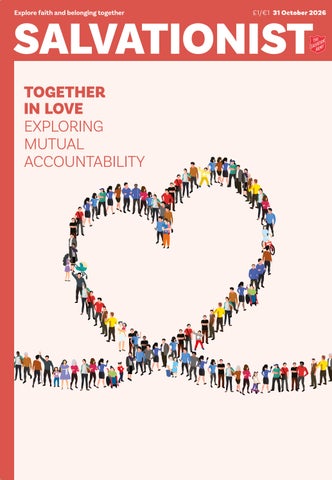
SALVATIONIST TOGETHER IN LOVE EXPLORING MUTUAL ACCOUNTABILITY
How much more HOW do you measure community? Is it by the number of people? The depth of the relationships? In our territory, we have six values – boldness, respect, compassion, passion, integrity and mutual accountability – that we aim for in our behaviour. Like the fruit of the Spirit – ‘love, joy, peace, forbearance, kindness, goodness, faithfulness, gentleness and self-control’ (Galatians 5:22 and 23) – they are signs that we are living out God’s love in our lives. They are also qualities that cannot come fully from ourselves, but are grown in us by the Holy Spirit – our strength to forgive, our courage to try something that might fail, our freedom to let go of fear. This week’s issue of Salvationist explores mutual accountability, the value that helps to hold and develop all six together. It requires security, vulnerability and love – and it begins with contemplating God’s love for us and how it flows into our love for each other. Like God’s love, it’s something that can’t be quantified. It’s immeasurable. John Gowans put it beautifully in song 467 in the Army songbook: ‘If human hearts are often tender, and human minds can pity know ... then how much more shall God our Father in love forgive!’
IVAN RADFORD Editor
EXPLORE MORE ONLINE
Visit salvationist.org.uk/ recommended-content Living out our values
8+9 BEING VULNERABLE
10 PRAYING TO OUR FATHER
11 THE IMPORTANCE OF ACCOUNTABILITY
12 HOW INTERGENERATIONAL ARE YOU?
5
ARTISTS’ CORNER
SALVATIONIST Issue No 2087
EDITOR Ivan Radford
FOUNDERS Catherine and William Booth
ASSISTANT EDITOR Stevie Hope
INTERNATIONAL LEADERS General Lyndon Buckingham and Commissioner Bronwyn Buckingham
EDITORIAL ASSISTANTS Major Margaret Bovey, Major Lynne Shaw, George Tanton, Lyn Woods SENIOR DESIGNER Hannah Holden GRAPHIC DESIGNER Louise Phillips PROOFREADER Chris Horne
NEXT WEEK’S ISSUE £1/€1 31 October 2026
Explore faith and belonging together
SALVATIONIST Remembrance TOGETHER IN LOVE EXPLORING MUTUAL ACCOUNTABILITY
Sunday
Service, faith and peace
CONTACT US 020 7367 4890 salvationist@salvationarmy.org.uk ADVERTISING advertising@salvationarmy.org.uk SUBSCRIPTIONS AND DISTRIBUTION – SP&S 01933 445445 / subscriptions@satcol.org Salvationist Publishing and Supplies (Periodicals), 66–78 Denington Road, Wellingborough NN8 2QH
TERRITORIAL LEADERS Commissioners Jenine and Paul Main EDITOR-IN-CHIEF Major Andrew Stone TERRITORIAL HEADQUARTERS 1 Champion Park, London SE5 8FJ 0845 634 0101 © The Salvation Army United Kingdom and Ireland Territory. ISSN 2516-5909. The Salvation Army is a Christian church and registered charity. The charity number in England, Wales and Northern Ireland is 214779, in Scotland is SC009359 and in the Republic of Ireland is CHY6399.
BACK ISSUES Contact SP&S or visit tsa.link/magazine. Published weekly by The Salvation Army and printed on
paper from sustainable sources by CKN Print, Northampton.
To subscribe, speak to your corps leader or visit sps-shop.com 2
Salvationist 31 October 2026
@SalvationistUKI
SCRIPTURE QUOTATIONS From the 2011 New International Version (Anglicised), unless otherwise stated
@SalvationistUKI
Do you know someone who would enjoy reading this? Scan the QR code to share it via WhatsApp!
TRENDING
Picture: Courtesy of Karl Bushby
A long walk home
Colombia, 2001
As Karl Bushby nears the end of his 28-year walk around the world, Major Lynne Shaw celebrates a story of perseverance
I
T’S said that a journey of 1,000 miles begins with a single step. For Karl Bushby, that journey has been the equivalent of one and half laps of the Earth! In 1998, he set out from southern Chile under two rules: no transport to advance, and no going home until the walk was done. Now, 28 years later, he’s arriving back at his birthplace in Hull. Throughout his Goliath Expedition, Karl has faced many obstacles. In 2004, he wrote of needing to find three log cabins five and a half miles away with no trail and nothing but a compass bearing. He wrote in his journal: ‘I lose
Reflect and respond Read Psalm 142:1–5 and make these verses your own prayer. What ‘Goliath’ expedition could you be facing? How will you need to dig deep? How could you support someone else in their own expedition?
track of time in my own self-pity.’ A more recent hurdle was crossing the English Channel. Unable to access the service tunnel, he had no option but to swim. With support, he endured three days at sea, and a total of 20 swimming hours. Hearing news of Karl’s Goliath Expedition might remind you of another man, born millennia before: David. In 1 Samuel we read of David making many journeys in an attempt to escape the wrath of Saul. In his own self-pity, he turned to Saul’s son, Jonathan, who was his great friend, confidant and support. ‘David … went to Jonathan and asked, “What have I done? What is my crime? How have I wronged your father, that he is trying to kill me?”’ (1 Samuel 20:1). Despite how he felt, in everything, he sought God’s counsel and, along the way, did his own kind of journaling: writing psalms. In Psalm 7:1–10 we read: ‘Lord my God, I take refuge in you… My shield is God Most High, who saves the upright in heart.’ Later, he wrote of God: ‘He reached down from on high and took hold of me; he drew me out of deep waters.
He rescued me from my powerful enemy, from my foes, who were too strong for me. They confronted me in the day of my disaster, but the Lord was my support. He brought me out into a spacious place; he rescued me because he delighted in me’ (Psalm 18:16–19). No matter where he went, David was never alone. God was never distant, and that helped David persist when obstacles and dangers threatened to overwhelm him. Taking inspiration from how Karl was sustained by the support he received when swimming the Channel, may we seek God’s support and counsel to help us persist. Whatever our expeditions look like, and whatever our goal is, may we trust that eventually we will know a ‘spacious place’ and fully feel God’s delight in us.
MAJOR LYNNE SHAW Editorial Assistant Publishing Department
Salvationist 31 October 2026
3
TESTIMONY
seconds with...
Colonel Janet Robson Territorial Secretary for Leader Development
Colonel Howard Russell Chief Secretary
What are you expecting your new roles to look like? Howard I am quickly discovering that The Salvation Army is a highly complex organisation. A bit like a mechanical watch, there are hundreds of cogs all working away. I see a major part of my role as helping to bring all these cogs together and ensure they are working in harmony to lift up the name of Jesus and have the greatest possible impact for the Kingdom. Janet In these early days, I’ll be listening a lot! I have lots to learn. I want to remain people-focused, and supportive of the team I am part of.
What’s your favourite Bible verse? Howard ‘Learn to do right; seek justice. Defend the oppressed. Take up the cause of the fatherless; plead the case of the widow’ (Isaiah 1:17). This is probably the verse that’s shaped the outworking of my ministry up to this point. Janet ‘See what great love the Father has lavished on us, that we should be called children of God! And that is what we are!’ (1 John 3:1). I love what it tells me about who God is, and the nature of his love, and what it tells me – what it tells us – about who we are as children of God.
What’s your favourite hymn? Howard ‘I Then Shall Live As One Who’s Been Forgiven’. The final verse is such a powerful and potentially life-changing prayer: ‘Your Kingdom come around and through and in me.’ Janet ‘How Great Thou Art’. I love how the verses get us to think about who God is, and we sing our response in the chorus.
Give your testimony using only one word. Howard Redeemed. Janet Held!
What can we pray for you? Howard For wisdom and discernment. Knowing my own character, I would add patience, endurance and a daily reminder that ‘God is enough’. Janet That I serve people well in my new role, and that I will have an undivided heart. I want to be so obedient and so focused on God’s will that I don’t get distracted. • Read the full Q&A online at tsa.link/meet-new-leaders. 4
Salvationist 31 October 2026
‘I wanted to learn more’ Kerryn Lewis (Wigan) shares her journey of getting to know God and the Bible
D
URING my first year of university, I attended Gloucester Corps, where I witnessed someone being enrolled as a soldier. This triggered my first thoughts about soldiership. I missed home and the corps community back in Wigan. In that moment, I made a promise: as soon as I returned, I would be enrolled as a senior soldier. However, when my placement year arrived and I was back home, that promise became far from my mind. I found myself consumed by the overwhelming realities of working life. Having never had a job previously, navigating it demanded all my mental and physical energy. The environment at my workplace was a massive culture shock. People’s language, habits and lifestyles were jarring compared to what I was used to. I met attitudes and behaviours that contradicted my values. But seeing these differences further encouraged me not to be tempted into unfamiliar customs, strengthening my resolve. I remembered my promise to myself. I wanted to learn more about God and the Bible. My parents and I organised soldiership classes with Major Marian Henderson, keeping it quiet, as I wasn’t confident what decision I’d make. Shortly afterwards, we went to Together 26, which was an eye-opener. Seeing how many people were in The Salvation Army, listening to the International Staff Band and International Staff Songsters, joining in singing and sharing meals with corps members made it a wholesome, inspiring weekend. One moment that lit me up was hearing the ISB play ‘My Lighthouse’, which I first heard at primary school. A few weeks later, I remembered the God Date Podcast, which I enjoyed listening to live at Together. I started listening during my journeys. When Amelia Burr from Preston was interviewed, I felt I related to her. One question stumped me: What is your favourite Bible verse and why? I realised I didn’t have one and barely knew any verses. My Bible mostly sat untouched, as its size and layout felt overwhelming. Mum gave me Inside Out, a guide to prayer and Bible study that introduced me to the youth edition of the Good News Bible. It’s helping me understand my faith and reflect on my journey with God.
Have you got a testimony to share? We’d love to hear how you’re growing in your relationship with God! Email salvationist@ salvationarmy.org.uk.
ARTISTS’ CORNER
EPHESIANS 3
by Captain Teresa Conway (Tavistock and Liskeard) What does your art depict? The picture is of a person seeking life in Jesus, with humility in his posture. He is kneeling and praying, and becoming rooted in the word while accessing the inner world and communicating with the Godhead. Through the word of God, the roots grow deep and strong. The lower part of the painting shows the universe behind the roots, which are painted like the roots of a tree or the vessels of a heart. Behind, the cross and the city remind us that we are in but not of the world, and we need to carry our own cross daily as we move through our world as little lights bringing our Lord to everyone we meet.
How was it made? The picture is in acrylic. It uses blue to represent God, red to represent Jesus and gold to represent the Holy Spirit.
What inspired it? It was inspired by Paul’s prayer in Ephesians 3:14–21. I had been on retreat and was using the Pause app to do 30 days of resilience, and a picture started to form of the inner world of our soul, the place where we can encounter a personal relationship with the Godhead. In her book The Garden Within, Dr Anita Phillips says our emotions are not problems to overcome, but important signals that help us understand what is happening within us. Like a garden, our inner life needs attention, care and healthy conditions to flourish. She brings together psychology, emotional wellbeing and Christian faith, encouraging readers to tend to what is happening inside rather than simply suppressing difficult feelings. The inner world of the soul is a place where we can meet with God, become rooted in his love and allow that love to shape what grows within us.
Have you made a piece of art, a drawing, a collage or something else inspired by your faith? We’d love to share it in our Artists’ Corner! No matter how big or how small, get in touch with our team at salvationist@ salvationarmy.org.uk.
Salvationist 31 October 2026
5
BIBLE STUDY
A time to protect Captain Jennifer Barker reminds us that protecting vulnerable people requires courage
NEHEMIAH 5:1–19
N
EHEMIAH’S story has involved praying, pleading, planning and pushing on. Next, Nehemiah is faced with the need to protect. However, protection isn’t needed from those outside the walls but those within them. At the gate, Nehemiah is alerted to a great injustice and is determined to set it right. It begins with ‘a great outcry’ from those rebuilding the wall, and their wives, against their fellow Jews (see v1). The situation they are crying out about is very serious. They are struggling to obtain food, they are losing their property, and they are watching their daughters being enslaved. Their words reveal desperation: ‘We are powerless’ (v5). Nehemiah hears their cries (see v6). Listening is often the first step in protecting anyone. He could easily have dismissed this as not his responsibility – after all, he has been charged with rebuilding the walls – but his stopping to listen shows them that their suffering matters more than his schedule. It is easier to hear powerful, confident or familiar voices than the voices of people who feel forgotten. People experiencing poverty, debt, homelessness, loneliness or discrimination may struggle to make themselves heard. Shame and fear can prevent them from speaking out at all. Protecting others begins with listening. It requires creating opportunities for people to speak, and then taking their experiences seriously. It also means asking who is absent from our conversations and decisions. As individuals and churches, are we willing to pause our programmes and plans long enough to hear the cries of people around us – those inside our walls as well as those outside our walls? 6
Salvationist 31 October 2026
Nehemiah tells the lenders to stop charging interest and – perhaps in a foreshadowing of Jesus and Zacchaeus – goes further. He demands: ‘Give back to them immediately their fields, vineyards, olive groves and houses’ (v11). Verse 6 outlines Nehemiah’s response The people have suffered real losses, to the situation: ‘When I heard their outcry so simply ending the wrongful and unjust and these charges, I was very angry.’ practices does not restore to the people He was angry because members of his what is rightfully theirs. In the face of community were exploiting their own such truth, the nobles and officials agree people. to return people’s property and demand Is anger a right response? While anger nothing further. Imagine the sense of can be destructive when it is uncontrolled, liberation and restoration of those self-centred or directed towards hurting who felt powerless at the start! others, Nehemiah’s anger alerts him to the Nehemiah then asks the lenders to seriousness of injustice and shows people make a public commitment, creating that he is not indifferent to their suffering. accountability that would lead to real We are told that Nehemiah does not react and timely action. thoughtlessly to these charges: ‘I pondered Repentance is more than saying them in my mind’ (v7). First, he allows himself time to consider what he has heard. Then he sorry. When our actions – or those of organisations or communities – have decides how to respond. harmed someone, genuine repentance After pondering his right response, requires not only the feeling of regret, but Nehemiah confronts the nobles and also asks what can be done to put things officials who are charging interest and right. This may involve returning what profiting from their people’s hardship. has been taken, correcting something He speaks bluntly to them: ‘What you that has been said, changing a procedure are doing is not right’ (v9). Protecting vulnerable people sometimes or rebuilding trust over time. Certainly, repentance and sacrifice often go requires more than sympathy; it requires together. courage. It requires us to question the norm and to speak truth to power, even when uncomfortable. Love cannot remain PAUSE AND REFLECT silent when people are being harmed. Rather than merely feeling sorry for Compassion is an active state, not a those affected, is there a wrong or passive one. Godly anger does not seek injustice that you can help to put revenge. Rather, it seeks justice, repentance right? and restored and reconciled relationships – as should we as Salvationists. Who or what can you help restore? PAUSE AND REFLECT w Whose voices might God be asking you to hear more clearly?
PAUSE AND REFLECT Is there an injustice about which you feel concerned? Could God be calling you to act?
The final verses of this passage show us some of Nehemiah’s character as a leader. During his 12 years as governor, he did not claim the allowances that were a perk of his position as those before him had done. These allowances
Explore Nehemiah with us This is part five in a seven-part series, running from 3 October to 21 November. Find more at tsa. link/devotions or see page 2 to order back issues. To read the full, unedited Prayer Matters booklet, visit salvationist.org.uk/discipleship.
Saturday 31 October: Care for Creation – Farmers and Mental Health Farming as an occupation has one of the highest suicide rates. Christian love expressed through unjudgemental listening, pastoral care and warm hospitality can be life-saving. God of compassion, as we stand before you in prayer for all who are suffering, grant that your light may shine in their darkness, and that we may bear one another’s burdens. taken from chelmsford.anglican.org
Sunday 1 November: Sabbath Prayer – Season of Remembrance – All Souls Day
placed a heavy burden on the people, so he chose another way: ‘Out of reverence for God I did not act like that’ (v15). Why? Nehemiah did not seek power, status or even people’s good opinion. Foremost, he sought God’s good opinion. He prayed: ‘Remember me with favour, my God, for all I have done for these people’ (v19). Nehemiah reminded those wielding unjust practices in whose name they were doing so. Again, he spoke truth to power and warned: ‘Shouldn’t you walk in the fear of our God to avoid the reproach of our Gentile enemies?’ (v9). Nehemiah challenged them to think about what this looked like to others, and what it told others about God. This reminds me of God’s requirement: ‘To act justly and to love mercy and to walk humbly with your God’ (Micah 6:8). PAUSE AND REFLECT What privilege or resource do you have that could be used to help others? A time to protect is a time to listen, to act, to restore and to sacrifice. As we do so, we reflect the character of the God who hears the cry of the vulnerable and calls his people to become a place of safety.
Loving God, we pause on this day to give thanks for those who have blessed our lives but are no longer with us. We acknowledge the weight of grief, and we welcome your comfort. As we turn towards Remembrance Sunday, we acknowledge, too, the pain of conflict in our world. Prince of Peace, keep us honest about the darkness in our world, and keep us hopeful for brighter days. Lyndall Bywater (UKI Boiler Room team)
Monday 2 November: Sharing the Good News – Yorkshire and Humber Division – Children and Youth We give thanks for all that has happened to engage and encourage our young people. As we continue our work with them, may God anoint them, protect them and journey with them. May they grow in wisdom and stature as Jesus did. Major Lucy Mann (Divisional Mission Officer)
Tuesday 3 November: Serving and Caring – Homelessness Services – Salvation Army Homelessness Strategy Looking ahead, a major focus is homelessness prevention. Too often, help arrives only after someone has reached crisis point. To help change that, we are developing a proposal for a network of homelessness prevention coordinators, who will work alongside corps, divisions and community partners to identify housing issues earlier, strengthen local responses and help people access the support they need before homelessness occurs. taken from Salvationist (3 October 2026)
Wednesday 4 November: Justice And Reconciliation – Financial Uncertainty Pray for people burdened by debt, rising living costs and financial uncertainty. May they feel able to reach out for help. We pray that people will have renewed hope, and that they will feel valued, listened to and supported. Lorraine Cook (Financial Inclusion Development Manager)
Thursday 5 November: International Salvation Army – Papua New Guinea and the Solomon Islands Territory We give thanks for the commitment of Salvationists to be restorers of God’s Kingdom. We pray the Holy Spirit will give them a clear vision of what healing and wholeness might look like in their communities. We pray for the territorial leadership team of Colonels Chris and Tilitah Goa and Lieut-Colonels Garth and Suzanne Stevenson. Lyndall Bywater (UKI Boiler Room team)
Friday 6 November: Growing in Faith – International Commission on Membership, Covenant and Belonging General Lyndon Buckingham appointed the Commission on Membership, Covenant and Belonging to help The Salvation Army become more welcoming without becoming less covenantal, more contextual without becoming fragmented, more accessible without becoming vague and more missionally effective without becoming less holy. We pray that the Holy Spirit will help members of this commission navigate complex issues with wisdom and revelation.
CAPTAIN JENNIFER BARKER Corps Leader Wood Green
PRAYER REQUESTS Do you have something or someone you’d like us to pray for? Email salvationist@salvationarmy.org.uk with ‘prayer request’ in the subject line.
Salvationist 31 October 2026
7
REFLECTION
Becoming vulnerable
Ivan Radford considers how mutual accountability brings us closer in community
W
HEN was the last time you made a mistake? Did you tell anyone? When was the last time you forgave someone? Did you mean it? If either of these rings a bell, you might be withdrawing inside yourself. Beating yourself up for that time you fell short. You might even feel resentment or a determination not to be found out. These are all normal reactions to the knowledge, or reminder, that we are not perfect. And that’s OK – not because we’re going to stay imperfect for ever, but precisely the opposite: we are each being transformed by God, a process of renewal rooted in his love and grace. And one of the ways he helps us to grow is each other. How do we grow together? By being mutually accountable.
Love, not fear Mutual accountability is one of the most challenging of the territory’s six values – and not just because it sounds boring and corporate. We live it out when we ‘willingly and freely give full account for our actions … and expect the same in return’. In other words: when we let go of fear. We are insecure people in a world that tells us we are not enough. That can make it easy to forget that God first loved us, that even while we were sinners Jesus died for us, that nothing we can do can separate us from God’s love, that God himself is love. Written to a divided church, 1 John 4 puts things into perspective. It reminds us that, 8
Salvationist 31 October 2026
ultimately, love comes from God. While human love is flawed, God’s love is perfect – and ‘perfect love drives out fear’ (1 John 4:18). Our love, our communities, should reflect that. The reasons why we can sometimes fail at this are many and complex. But they often stem from the lies we believe about ourselves. This world conditions us to think worth is earned, to value status, possessions and control. We forget our identity in God’s love, and get stuck in a cycle of works not grace. We forget that love, like problems, isn’t pie: there aren’t a finite number of slices to go round. Someone else having some doesn’t take away from your own. The result? As Henri Nouwen puts it: ‘We become … defensive and tend to look at our fellow human beings more as enemies to be kept at a distance than as friends with whom we share the gifts of life.’ We eye others with suspicion and elevate ourselves by putting others down. We compare and measure ourselves by how others perform or perceive us – and then do that to them too. All because we want to hold on to something to defend as ours. Here’s the thing: nothing is really yours or mine. All of life is a gift. And, like all gifts – apart from maybe biscuits – they are for us to share. Our joys, suffering, mistakes and worries are not for us to possess or carry alone. We therefore have nothing to lose, and nothing to fear. When we curl up and stay in this truth, we find the courage to fail, and to encourage others to flourish.
In God’s strength, not yours The two greatest commandments are ‘love the Lord your God’ and ‘love your neighbour as yourself’ (Mark 12:30 and 31). I wonder if we sometimes do those the wrong way round. We try so hard to love each other in our own strength and forget our hearts can’t hold enough kindness or humility for everyone. But God’s does. And God’s love is how we are called to love one another – not by copying him from a distance, but by his love flowing through us. 1 John 4 says: ‘Whoever does not love does not know God’ (v8). It adds: ‘The one who fears is not made perfect in love’ (v18). When we remember to start our relationships with seeking God first, our differences don’t disappear or stop mattering, but they take on a new perspective – they stop carrying fear. God’s Spirit undoes our deepest Babel instincts. We stop trying to hold everything together ourselves and, in the resulting harmony – which can include differences or disagreement – we find strength in God and each other.
Security, not shame James 5:16 tells us to confess our sins and pray for each other, and this is key to how we live together. Note the emphasis on prayer, which is ultimately about intimate communication and relationship. The model for our relationships is our relational God; just as the three parts of
the Trinity are consubstantial, we too are equal in God’s eyes. We are a priesthood of all believers, and any responsibilities we carry are privileges not priorities – in the body of Christ, 1 Corinthians 12 reminds us, every part is valued. Mutual accountability, then, isn’t about superiority. Romans 14:10 tells us not to ‘judge your brother or sister’ or ‘treat them with contempt’ because ‘we will all stand before God’. Galatians 5:26 pleads: ‘Let us not become conceited, provoking and envying each other.’ Accountability begins not when we tell someone they’re wrong, but when we recognise we aren’t any better than them. Mutual accountability requires mutual vulnerability. It’s about creating not just safe spaces but brave spaces, where we can be vulnerable about that truth – where we can confess, repent and share without fear. This requires us to hold on to our security in God’s love rather than being tempted into shame. Galatians 6 says ‘if someone is caught in a sin … restore that person gently’, then immediately adds: ‘Carry each other’s burdens’ (vv1 and 2). Hebrews 10:24 implores us to ‘spur one another on towards love and good deeds’. This is what it means to ‘speak the truth in love’ (Ephesians 4:15). Speaking truth is essential but, without love, it leads to selfrighteousness and division. With love, it brings us together in community. Because anything born of love comes from God. Anything born of fear does not.
When fear does creep in, it often stems from our own doubts, shortcomings or envy, or from hurt and trauma caused by other people’s actions. None of these is simple, but our instinct is often to hide our pain, doubts or shortcomings from others, including God. We fear we might be found out, rejected or hurt again. This tragically leaves us without opportunity to reconcile and heal – with others or with God. Like needing the toilet but pretending we don’t, our actions wind up being driven by a panicked need. We can become hurtful without realising. We act out of fear, rather than out of freedom in Christ. And there is freedom in Christ! That freedom can lead us to seek help, question, learn from each other and make amends. But we must be open about our own shortcomings if we want to break that hard ground and bring hope into our relationships. Matthew 18:15–17 talks about how we might point out faults, but being open does not necessarily mean confronting someone directly. Rather, it is about having a community where you can talk to someone you trust – and our safeguarding protocols, protections and procedures are there to help us build and maintain such communities.
Respond, not react What kind of community are you in? Can you see the fruit of the Spirit in everyone’s actions? Consider the
contribution you make to the culture, including how you can be a person of trust for someone else. One step to take could be trying to respond rather than react. Reacting is unthinking and immediate, but responding involves taking a moment to step back, pray, and choose how you act. Turning to God in that moment can take you from shame to security, from frustration to compassion, from tiredness to rest, from competition to encouragement. Above all, though, be vulnerable with God and with others. A nugget from Nouwen again: ‘In the sharing of my weaknesses with others, the real depths of my human brokenness and weakness and sinfulness started to reveal themselves ... not as a source of despair but as a source of hope... Once I am able to truly confess my most profound dependence on others and on God, I can come in touch with my true self and real community can develop.’ After all, how can you understand or help someone in their mistakes or challenges if you haven’t confronted your own? By supporting others, you allow yourself to be supported too. The vulnerability is mutual.
IVAN RADFORD Editor Salvationist
Salvationist 31 October 2026
9
REFLECTION
Our Father… Ben Still reflects on the communal nature of the Lord’s Prayer
O
UR Father who art in Heaven, hallowed be thy name… I have absolutely no doubt that almost everyone reading will be able to finish Matthew 6:9–13 without hesitation. Personally, I can’t remember a time I didn’t know it. However, God has an amazing ability to teach us new things through the familiar and, for me, the Lord’s Prayer has recently taken on new significance. Why? Let me explain. Do you have a rule of life? You might without realising it. I’m a member of Stepney Corps and, as part of working through John Mark Comer’s excellent Practicing the Way course, we were encouraged to write one. He defines a rule of life as ‘a deliberate, structured plan of spiritual practices that creates space to be with Jesus, become like him, and do as he did’. In other words, it is making an active choice in your spiritual formation as opposed to making the passive choice of letting the world form you. This can often mean stopping doing things to allow space to listen to God rather than taking more on. Inspired to try this, I introduced new practices into my daily routine, specifically focusing on Scripture and solitude. For me, this looks like spending focused time reading the Bible on the way home after dropping the kids off at school, often using a Bible app reading plan. This takes the place of listening 10
to podcasts. I do this alone and, if time allows, in Tower Hamlets Cemetery Park, one of my favourite places. Over the summer, the passages I focused on were Matthew 5 to 7. And what is in the very middle of these collected teachings of Jesus? The Lord’s Prayer. Now, close your eyes. Imagine you’re in the woodland of the cemetery park, the sun filtering through the branches, birds singing, wind rustling the leaves and the words ‘our Father’ running through your head. As I sat there in silence, God brought my attention to a stranger walking his dog. Our Father… In that moment I felt they were no longer a stranger but a dear relation. Then my focus was drawn to the birds singing. Our Father… I felt a deep and profound connection to them and the living world around me. Even the wind in the branches brought a sense that I am one interdependent part of a wide and wonderful creation. A creation that God calls ‘good’. Our Father… In those few minutes of solitude with his word, God taught me that the Lord’s
Prayer isn’t a prayer for me, but a prayer for us. It’s a prayer for a community. For a nation. For a world. Our Father… Our daily bread… Our debts… Suddenly, the Lord’s Prayer took on new meaning. And a new challenge. What does it mean to pray ‘give us today our daily bread’ as part of a community, when I know full well I have everything I need for today? What does it mean to pray ‘lead us not into temptation’, when people in the Lifehouse down the road might be struggling with addiction? What does it mean to pray ‘deliver us from the evil one’ when I feel safe and secure, but others in my community might be full of fear and lacking hope? In my day-to-day work, and as a volunteer in my local corps community refugee sponsorship group and conversation café, I have the privilege of encountering people with all kinds of experiences. Now, when I pray ‘our Father’, these are the people I’m prompted to think about and challenged to respond to in love. When you pray ‘our Father’, who are you prompted to think about?
BEN STILL Refugee Response Manager THQ
Salvationist 31 October 2026
S
INTERVIEW
Valuing trust Vicky Hardman (Director of PR, Messaging and Internal Communications) talks about the importance of accountability as an organisation How does The Salvation Army demonstrate accountability to the public? I am so proud to work for The Salvation Army because we are unafraid to do what it takes to reach the most marginalised people in our communities and there are so many brilliant stories of transformation to tell. However, working with so many vulnerable people in so many different ways also carries risk, and part of my job is working out how to show the public that we are being accountable when things go wrong. In times of crisis, it’s a very common instinct to try and protect the organisation and the people involved by saying very little and waiting for the storm to pass. However, good communications means being honest when we have made a mistake. As well as saying sorry, it’s important to show that we have listened and learnt from what happened and that we are taking action to show that we won’t make that mistake again. Being accountable in this way won’t stop a bad headline in the news, but people will notice how we responded, which is the best way to move the story on. I am sure you can think of lots of stories in the news when big organisations have been slow to be accountable or tried to hide when things have gone wrong; the headlines continue, the hole gets bigger. Being honest and transparent does not mean sharing every detail. We will often liaise with our legal colleagues, as if there is a potential court case or an inquest, this can limit what we can say for quite a
SA 31 Oct p10-11.indd 3
long time and we will always be careful to protect everyone’s privacy. Hearing a genuine apology can also be part of the healing process for anyone directly impacted by a mistake we have made.
Do a few bad headlines really matter? Over time, bad headlines erode trust. Government and local authority contracts are built on trust. People only volunteer or donate to organisations that they trust. Having the confidence to turn up at a corps for worship and walk through the door requires trust. We are a highly trusted organisation, but that can never be taken for granted. It’s an old cliché that today’s headlines are tomorrow’s fish-and-chip paper, but in the digital world that is no longer true. Headlines linger online and can be repeated on social media and reach more people, which impacts levels of trust. Part of protecting our reputation is also about challenging the things circulating online that are not true. But that’s exactly why good levels of trust are important. When the public trust us and they see us being accountable and transparent, they will be more likely to disregard the half-truths and rumours that will always circulate.
Should we be accountable for things that happened a long time ago? Saying sorry and showing how things have changed can feel easier when it’s something current, but it’s also important when it comes to reassessing how things were approached in the past. Societal attitudes and practices change over time, but it’s not good enough to say ‘that was how things were done then’ – we still need to show we are sorry and that we have changed.
Is scrutiny from the public and press a good thing? Media scrutiny is a good thing because it can help lead to change. We use it to our advantage when we challenge the government about social injustices, such as homelessness. Every organisation should be able to show that they are spending money wisely, operating legally and treating people with dignity and care. Our high profile is a double-edged sword; our high levels of trust mean that we can reach more people, but can also mean people expect more from us. Most of our focus in the Communications Service is about telling the many stories of lives transformed rather than reputation management but, when things go wrong, we are here to help. No organisation is perfect, but every organisation should be accountable. Salvationist 31 October 2026
11
26/10/2026 10:37
Hadleigh Temple
Walking together
What is intergenerational church?
Major David Betteridge (Director of Family Ministries) and Liz Hall (Deputy Director of Family Ministries) introduce a new Intergenerational Church Assessment Tool
W
HO do you see or think of when you hear the word ‘everybody’? You might see the congregation within which you worship, but maybe not everyone’s faces clearly. You might see the group you volunteer with or the musical sections you rehearse with once a week. We tend to limit ‘everybody’ to the people we know well, spend most time with or are most like us – perhaps our family, closest friends or a small group? A corps announcement can sometimes reveal the conundrum of the word ‘everybody’: ‘Everybody is invited, including our older people’s ministry and parent and toddler families.’ We seem to have to articulate who ‘everyone’ is, because we are anxious that some people might need to be reminded that they are included. The UK and Ireland Territory defines intergenerational church as nurturing Christ-centred community by intentionally engaging two or more generations to be mutually invested in serving, sharing, worshipping and learning. We believe we are most fully the family of God when we journey together, seeking to love God and love others. Within The Salvation Army, there are so many spaces and places where generations are all in this together, but historically – and with good intentions – churches have become places where learning about Jesus is divided into age groups: primary, children, youth, adults, older adults. 12
Salvationist 31 October 2026
At the heart of the Intergenerational Church Assessment Tool are four foundational beliefs that describe the fruit of a healthy, connected intergenerational community. They shape how we serve, share, worship, learn and care for one another: I belong.
Of course, we do often worship together in a room with people of different ages, but are we connecting meaningfully with each other? Do we really value the experience, the learning about relationships, knowing that each person belongs, is needed and valued, and can add fullness to everybody’s experience and faith journey? During a tri-territorial webinar, we connected with Captain Missy Ditchburn, who is leading the development of intergenerational ministry in the New Zealand, Fiji, Tonga and Samoa Territory. Outreach Mission Partner Rachel Gotobed developed this relationship and, through regular online collaboration, we have shared learning, ideas and resources. Missy describes a growing emphasis on creating communities of belonging, where every generation is valued and able to contribute. Grounded in the biblical image of ‘many parts, but one body’ (1 Corinthians 12:20), corps and settings are being encouraged to reflect on their current ministry models and take intentional steps towards greater intergenerational connection. Storytelling, traditions and shared experiences can help strengthen relationships, and Missy has travelled around the country to lead services themed around flourishing faith communities. In the UK and Ireland Territory, an outcome of this shared learning is the development of an Intergenerational Church Assessment Tool – a way for corps and centres to evaluate how
I am needed. I can learn from everyone. Life is fuller when we journey together with people of different generations. they are doing in creating an authentic intergenerational culture. Designed to help corps reflect honestly and constructively, it provides an opportunity to pause, notice what is already happening and identify areas for growth. This matters because intergenerational church is an expression of the family of God as revealed through Scripture, where generations journey together in faith. It creates opportunities for wisdom, experience and faith to be shared, deepens discipleship and helps cultivate resilient faith across all ages. Ultimately, the tool is about intentional movement rather than achieving a score. Corps and settings can recognise and celebrate strengths, start conversations and identify achievable next steps towards richer, more connected Christcentred communities where everyone has something to receive and give. The resource is being piloted in four divisions so that assessment and evaluation can be a truly intergenerational experience through focus groups where all generations are invited to participate. If you are interested in taking part or would like further information, email us at familyministries@salvationarmy.org.uk.
REFLECTION
Many tongues one voice John Baraza Namunyu reminds us that a community that prays together, draws closer together
F
ROM the pages of Scripture, the people of God are continually drawn together through prayer, story and shared encounter. In the Old Testament, Israel is called as a community to seek God with one heart (see 2 Chronicles 7:14), while in the New Testament the early Church gathers across cultural boundaries – ‘all of them were filled with the Holy Spirit’ (Acts 2:4) – and begins to worship in many languages. Today, this same drawing together continues where prayer is shared, testimony is honoured and trust is deepened. Leaders foster shared prayer not by increasing activity, but by shaping participation. In Acts 1:14, the early believers ‘joined together constantly in prayer’ – a phrase that suggests unity, but not uniformity. They came from different backgrounds but found common purpose in seeking God. Similarly, corps leaders today can encourage shared prayer by creating rhythms where all voices are welcomed. This might mean opening up prayer times within worship rather than holding them at a few, specific times, or inviting individuals from different cultures and generations to lead prayer in ways that reflect their own traditions. Shared prayer also grows through intentional design. Gathering people in mixed groups – across age, culture and experience – helps prevent the formation of silos. When a young person prays alongside someone with decades of faith, or when different cultural expressions of prayer are heard together, the corps begins to experience unity not as sameness, but as harmony.
Within this shared prayer life, testimony becomes a powerful expression of worship. Throughout both the Old and New Testaments, testimony is central. The Psalms repeatedly call God’s people to ‘make known among the nations what he has done’ (Psalm 105:1) while, in the Gospels and Acts, individuals share how their lives have been transformed by encounter with Christ. In an intercultural community, testimony continues this tradition – spoken through diverse experiences. Examples might include someone sharing how faith has sustained them through migration, another reflecting on growing up within a longstanding Salvation Army family, or someone describing how they encountered Christ in a completely new environment. These testimonies are shaped by lived experience – language, history, community and identity. When offered respectfully, such stories create bridges. They allow others to see the richness of God’s work across cultures. They also expand understanding, revealing that, while expressions of faith may differ, the same grace is at work. Offering varied ways to share – spoken reflections, interviews or creative expression – ensures that testimony is accessible and authentic. Yet both prayer and testimony ultimately serve a deeper purpose: building trust. Trust does not emerge instantly; it is formed as people encounter one another in meaningful ways. Prayer is uniquely
placed to nurture this process. When people pray for one another, they move beyond surface difference into shared dependence on God. Barriers begin to soften. Assumptions are challenged. Compassion grows. The New Testament vision of the Church reinforces this. Paul writes that, in Christ, dividing walls are broken down (see Ephesians 2:14). Prayer becomes one of the primary ways this reality is lived out. As a corps prays together – consistently, intentionally and openly – it begins to see itself not as separate groups, but as one body. This unity is not the absence of difference, but the presence of mutual trust. In The Salvation Army, this matters deeply. Mission is not sustained by structure alone – it is sustained by relationships shaped in prayer, strengthened through shared stories and guided by the Holy Spirit. As we are drawn closer, we become a Movement of people who pray together, listen together and grow together. And in that shared life, many voices become one – not in uniformity, but in faithful, Spirit-filled unity.
JOHN BARAZA NAMUNYU Liverpool Walton
Salvationist 31 October 2026
13
ARMY UPDATES
HARVEST FALKIRK Major Susan McFerran (Cumbernauld) led Harvest Sunday. Gifts of food were collected for the local food bank and a Harvest display was arranged by Irene Lumsden. – LH
HARVEST CRADLEY HEATH Harvest weekend began with a scarecrow trail around the corps garden, followed by a quiz and chippy tea. Out of the 17 movie-themed scarecrows made by corps members and groups, Maria from The Sound of Music was voted as the best. More than 150 people attended, with many new families visiting for the first time. Over £280 was raised for the Big Connection, and a generous donation of tinned and packet foods was collected for a local food bank. – LG
HARVEST DUNSTABLE Harvest weekend started with a Saturday night supper, where corps folk enjoyed a delicious meal prepared by two new soldiers. After eating, much fun was had with a beetle drive. On Homelessness Sunday, folk brought items for people who come to the corps for help. Community Mission Secretary Sophia Harris and her team prepared an impressive display of all the goods donated. – RC
HARVEST PAIGNTON Malcolm and Sue Gray (Cardiff Ely) led a joyful and uplifting Harvest weekend. Celebrations began with a lively social evening on Saturday, featuring a series of fun, Taskmaster-style challenges. Sunday’s worship continued the warm atmosphere, with children bringing Harvest baskets as part of the service. The donations will support the work of the nearby Community Larder and the recently established corps Baby Bank. – DW
MUSIC
HARVEST WICK Family and friends joined in celebrating Harvest and 142 years of service in the town as the corps hosted a meal and an all-age quiz. – MS 14
Salvationist 31 October 2026
SHEFFIELD CITADEL The annual open band practice returned as 66 musicians gathered to make music together, some coming to the corps for the first time. During devotions, Divisional Mission Officer Major Lucy Mann reflected on the deep friendships formed through brass banding and how these can reflect the friendship we have with God. Looking around the room, this was evident, as long-standing friendships sat alongside new connections, and musicians of different generations united through their love of music and their faith. The evening was a wonderful reminder that banding is about much more than the notes on the page. It brings people together, creates lasting friendships and provides opportunities to share our faith. – AM
REMEMBRANCE
Memories of Aberfan preserved
HARVEST WATCHET Divisional Mission Officer Captain Mhairi Smeaton led the Harvest festival. The hall was full, as new people entered for the first time to enjoy a ploughman’s lunch and take part in festivities and fellowship. – SS
ANNIVERSARY CANTERBURY Commissioners Anthony and Gill Cotterill led an uplifting anniversary weekend. Bandmaster Yvonne Ferguson and Songster Leader Marjory Watson (both Bellshill) conducted brass and singing workshops and formed reunion sections for the weekend. It was truly encouraging as the corps acknowledged its presence and ministry. – GF
BIRTHDAY
MILTON KEYNES CENTRAL The corps celebrated Mary McKinnon’s 100th birthday! Previously a soldier at Exeter Temple, Mary moved to Milton Keynes and now soldiers at the corps. She was joined at the residential home where she lives by the band, who came to play for her birthday celebrations. – JB
INTERNATIONAL GENEVA The Salvation Army called for greater humanitarian access and stronger protection for displaced women and children across Haiti during an intervention at the United Nations Human Rights Council. Speaking during an interactive dialogue, the Army’s UN representative in Geneva, Markus Hofer, urged the international community to strengthen humanitarian access, support coordinated survivor-centred services and ensure accountability accountability for serious human rights violations. – AR
WALES SIX decades after the Aberfan disaster, two members of The Salvation Army who witnessed its aftermath have shared memories that have stayed with them for a lifetime. At Big Pit National Coal Museum in Blaenavon, Sheila Davies, 94, and Major David Tribble, 75, took part in a recording session organised by The Salvation Army’s International Heritage Centre. Their conversations with International Heritage Centre director Steven Spencer and Big Pit curator Ceri Thompson will be preserved for future generations. The recordings capture first-hand accounts of one of the darkest days in Welsh history, and the response that followed. The Aberfan disaster took place on 21 October 1966, when a coal waste tip above the village collapsed after heavy rain, engulfing Pantglas Junior School and nearby homes. A total of 116 children and 28 adults lost their lives. Members of The Salvation Army were among the first on the scene. Officers worked alongside emergency services, community and voluntary organisations providing practical and pastoral support during the recovery operation and in the weeks that followed. Sheila says her encounters with bereaved parents have remained with her ever since. ‘One mother whose daughter had been killed told me: “We knew no happiness until she came to live here, and now that’s been taken away from us.” While I was asked, “Where is your God now?” by one grieving father.’ David was just 15 when his father, Major Derrik Tribble, took him to help during the recovery effort. ‘I was 15 when Aberfan happened, and I simply had no way of understanding the enormity of what I was seeing. I was just a lad. I do remember my dad returning on the first evening from working in the chapel and the mortuary and, when he saw my two younger sisters, the reality of what he had witnessed suddenly hit him and he burst into tears.’ Divisional Leader Lieut-Colonel Jonathan Roberts said: ‘Today, we remember those who lost their lives in the Aberfan disaster and the families whose lives were changed for ever. We also pay tribute to the emergency services, voluntary organisations and local people who responded with such compassion and dedication.’ – AR
FUNDRAISING WATCHET A weekend of sharing tea and doughnuts at Watchet’s 1940s celebration helped raise £500 for corps funds. – SS Salvationist 31 October 2026
15
NEW COMMITMENTS
COWDENBEATH DURING Harvest celebrations, Derek and Shirley Duncan were welcomed as adherents by corps leader Lieutenant Isabel Flanagan. Derek and Shirley have been associated with the corps for many years, bringing their children and then their granddaughter to the parent-and-toddler group and attending Sunday worship. Although their granddaughter has since gone to nursery, they still assist with the parent-andtoddler group each week. We wish them God’s richest blessings. – IF
LOUGHBOROUGH A full hall gathered to witness the enrolments of Barbara Morris and David Davies as soldiers. This was an exciting day as it has been several years since the corps enrolled new soldiers. Barbara and David testified to the joy they felt on this occasion and how they look forward to serving God through their gifts. Also pictured are corps leader Major Anthony Colclough and Ivor Swann, who is holding the flag. – AC
COVENTRY CITY DURING Harvest celebrations, the congregation was delighted to witness the enrolment of Matthew as a junior soldier. Sharing what he enjoys most about the corps, Matthew spoke about helping his dad on the AV desk and taking part in experiments during junior soldier classes. He explained that he wanted to become a junior soldier because Jesus is his gift and he wanted to give himself back to Jesus as a gift in return. As part of junior soldier preparation lessons, he learnt about William Booth’s ‘I’ll Fight’ speech and read out his own version: ‘While there is pollution in the world, litter on the ground and plastic in the seas – I’ll fight! While there are people who have no food, are starving and have no clean water to drink – I’ll fight! While there are people who don’t have a home – I’ll fight! While some countries are fighting and there is war – I’ll fight! While people are sad and lonely – I’ll fight! While there are people who do not know Jesus – I’ll fight! Tell everyone about him!’ These words provided a practical, meaningful addition to Harvest, and a reminder that young people have an important part to play in the life of the Army. Matthew is pictured with corps leader Major Jenny Forman and Junior Soldiers Sergeant Helen Street. – SW
CLACTON-ON-SEA
STOCKPORT HEATON NORRIS MOTHER and daughter Jennifer Gorst and Wendy Malick were welcomed as adherents by corps leader Major Susan Dean. They are valued members of our church. – SD 16
Salvationist 31 October 2026
GRAHAM Gillings was enrolled as a soldier and Tara Clark was welcomed as an adherent member by corps leader Major David Lennox. Having been a soldier at Manningtree in the past, Graham stopped attending while looking after a relative, and he lost contact after the closure of the corps. Now living in the area, Graham reconnected with the Army. Tara’s first contact with the corps was through one of our older members, who invited her to our meetings. Tara was an atheist, and found faith in God through Jesus Christ and was welcomed alongside Graham. Also pictured is Recruiting Sergeant Patricia Baker. – VR
BIRMINGHAM CITADEL JONATHAN Dixon was enrolled as a soldier by corps leader Major Ian Standley. Jonathan testified, thanking all who had influenced his life and Christian journey so far. Music forms a huge part of his life, and he often feels God’s presence in the music he plays, as well as showing it in his daily life. Jonathan was supported by family and friends. Also pictured are Children’s Ministry Leader Talitha Ruddock and Recruiting Sergeant Helen Mynott. – RO
HINCKLEY A SPECIAL service was held for the enrolment of Nathan Brevitt as a soldier. Nathan was a soldier when he was younger but, in later years, chose to live a different lifestyle. Over the past few years, Nathan has renewed his relationship with God and experienced a growing sense of God’s call on his life. Believing that re-enrolment as a soldier was the next step in responding to that call, Nathan publicly reaffirmed his commitment to Jesus and to serving through the Army, surrounded by family, friends and corps members. We pray that God will continue to guide and strengthen him as he follows where God leads. – CB
ENFIELD WIGAN KERRYN Lewis was enrolled as a soldier by Major Marian Henderson, who saw her through preparation classes. It was great to witness her commitment to God and hear her testimony. Several people in the meeting offered Bible verses of encouragement. Also pictured are corps leaders Majors Alison and Mark Lewis – who are Kerryn’s parents – Hannah Lewis and Corps Sergeant-Major Andrew Picton-Baxter, who is holding the flag. – ML
HARLOW RICHARD Turner, Omolayo Adekoya and Gary and Jan Baugh were welcomed as adherents by corps leaders Majors Alan and Yvonne Frederiksen. All have been attending over the past year. Richard came to the corps through a care group that hires the hall. Omolayo’s children were invited to Sunday school by one of their school friends when they moved into the area. She now attends with her husband and her children, who are now junior soldiers. Gary and Jan brought their mum to the services and have found a place to belong for themselves. – YF
MATTHEW Hill and Koby-Lee Ford were enrolled as soldiers. Matthew spoke about how music has played a vital role in his spiritual development and connects him with God through the associated words. Koby-Lee recalled how he stepped away from the Army for a short time. One night, sat in his bedroom, he felt he needed to pray. As he did, he recalled a power going through him and received the Holy Spirit for himself. Both young men experienced the love of God for themselves in different ways but are now on the same pathway and fully committed to serving God. Also pictured are corps leaders Captains Dawn and Glenn Roden and Recruiting Sergeant Alyson Hicks. – SF
Salvationist 31 October 2026
17
ANNOUNCEMENTS
ARMY PEOPLE Local officers appointed
ASSISTANT CORPS SERGEANT-MAJOR JOSH KIM, Bromley Temple ASSISTANT CORPS TREASURER JENNI DUNGAY, Sittingbourne
ENGAGEMENTS General Lyndon Buckingham and World President of Women’s Ministries Commissioner Bronwyn Buckingham Fri 13 Nov Sunbury Court (ICO)
Territorial Leaders Commissioners Jenine and Paul Main Thu 5 Nov William Booth College (Neurodiversity Conference)* Sun 8 Nov The Cenotaph, Whitehall (Remembrance Sunday) Wed 11 Nov High Leigh Conference Centre (Pre-Retirement Seminar)
Chief Secretary Colonel Howard Russell
ASSISTANT YOUNG PEOPLE’S SERGEANTMAJOR KATE OSEI, Sittingbourne
Sun 8 Nov The Cenotaph, Whitehall (Remembrance Sunday)
ASSISTANT CORPS SECRETARY MORAG WILLIS, Sittingbourne
*Commissioner Jenine Main only
Wedding anniversaries
Golden (50 years) MAJORS EILEEN AND PETER WEST on 23 October
Dedicated to God
JAMIE DANIEL LAWRENCE, son of Katie and Richard Lawrence, at Nuneaton by Major Joy Stephenson
Promoted to Glory
BANDSMAN ERIC SINCLAIR, Clowne, from Sir Robert Peel Hospital, Tamworth ROSEMARY TRINDER, Rugby SONGSTER MARGARET WRIGHT, Sutton-in-Ashfield RETIRED SONGSTER LEADER ROY POWERS, Blackpool Citadel, on 19 September BANDSMAN/SONGSTER KEITH WRIGHT, Chelmsford, on 13 October MAJOR DENISE BARHAMHALL from Darlington Memorial Hospital on 18 October
Bereaved
MAJOR GRACE ARNOTT of her daughter Jaqueline Arnott RETIRED BANDMASTER DAVID TRINDER, Rugby, of his wife Rosemary Trinder SONGSTER ALAN WRIGHT, Sutton-in-Ashfield, of his wife Songster Margaret Wright MAJOR ROBERT BARHAMHALL of his wife Major Denise Barham-Hall
18
Salvationist 31 October 2026
Territorial Secretary for Leader Development Colonel Janet Robson Sun 8 Nov The Cenotaph, Whitehall (Remembrance Sunday)
NOTICES What does hope mean to you?
This Advent and Christmas, we’ll be exploring hope. What does hope mean to you? Send us your answers by emailing salvationist@salvationarmy.org.uk or reaching out to us @SalvationistUKI on Facebook and Instagram. Tell us by 13 November and we can include it in our Advent issue on 28 November.
Territorial Prayer Furnace
Pray with people from across the territory and be part of the UKI Prayer Rhythm in this monthly online gathering. The next prayer meeting will take place on 2 November at 6pm via Zoom. Email saprayernetwork@salvationarmy.org.uk for meeting details.
Care for creation Bible study
An international, hour-long Bible study is led by different people on the first Tuesday of each month, alternating between 8am and 8pm. The next will take place on 3 November at 8am, led by Territorial Environmental Officer Major Heather Poxon on Biodiversity – Our Shared Creation. For more information, email environment@salvationarmy.org.uk.
Ready-to-use Advent resources
More Hope in the Waiting resources are now available at tsa.link/adventresources to support worship throughout Advent and Christmas. Alongside sermon starters, worship and prayer ideas, you can find a ready-to-use service outline for the Sunday after Christmas and a sermon starter for the first Sunday of 2027 to start the new year with hope.
SOUNDS Sunday Worship
Join Salvationists across the territory in worship, with music, prayer and a Bible message from a guest speaker. This week’s message is from Captain Tony Kakande (Gateshead). Can’t join us at 11am on Sundays? Catch up with the weekly podcast of highlights. Each week’s broadcast is repeated in full on Sundays at 6pm, Mondays at 12am and Thursdays at 9am. • Listen online at salvationist.org.uk/radio.
Sunday Lunch
The musical side to your Sunday lunch, featuring your favourite Salvation Army music. This week features Reuben’s Pick and Mix, presented by Reuben Dykes (Leek). Listen at 1pm on Sunday 1 November. • Listen online at salvationist.org.uk/radio.
Sing to the Lord with the ISS
Enjoy favourite recordings from the International Staff Songsters, chosen each month by a special guest. Listen at 5pm on Sunday 1 November. • Listen online at salvationist.org.uk/radio.
Fully Scored
In the latest episode of Music Editorial’s podcast, the International Staff Band’s principal euphonium Jonathan Evans joins Matthew to talk about his life, faith and music. Also, Kenneth Downie takes us on a journey through his fantastic ‘Princethorpe Variations’. • Listen online at salvationist.org.uk/podcasts.
TRIBUTES
MAJOR CAROL KENDALL WHILE studying at the Darlington teacher training college, fellow students openly shared their Christian faith. It was this witness that allowed Carol to accept Jesus as her Saviour. Upon qualifying as a teacher, she returned to Hessle and found her spiritual home at Hull Icehouse Corps, where she received a warm welcome and met her future husband, Peter, entering into a loving marriage that would last 63 years. Just three months after becoming a senior soldier, Carol was commissioned as corps cadet guardian, a responsibility she would hold in three corps. Her brigades had the distinction of winning the corps cadet efficiency banner at Hull Icehouse and Southport, as well as runner-up at Waltham Abbey. Carol could relate to people of all ages and developed both an effective platform and telephone ministry. In 1988, Carol and Peter were warranted as auxiliary-captains and commenced full-time service at Prescot Corps before following their calling to Spain, where they ministered for 10 years. Tributes have been received from people in numerous countries who remember Carol’s care, concern and unconditional love. Carol’s final appointment, along with Peter, was to Leeds West Hunslet, where they also served in retirement. Carol became songster sergeant, a responsibility she maintained until shortly before her promotion to Glory. Many of the songsters recall apt words and Scripture shared at just the right time. A loving mother to David and Graham, and proud Nanna to five grandchildren, nothing was more special to Carol than spending time with her family. All the songs, Bible readings and band and songster pieces for her funeral were specially chosen by Carol, and these reflected a strong desire to give all the glory to God for a life well lived. We are certain she is now in the presence of her Lord and Saviour. – DK/PK
MAJOR DOREEN JAMES DOREEN was born in Hayes, where her parents moved to from Islington, together with her sister Jean. It was here on the newly built estate, still surrounded by fields of wildflowers, that she spent her early years. A few years before the Second World War, the family moved to Kenton, Harrow. Attending Harrow Weald County School, Doreen began to show an interest in medicine. This became a strong calling to the nursing profession, reinforced by a pre-nursing course in her final school year. Doreen’s gap year was spent as an assistant receptionist to an optician, which helped her become more confident in dealing with people in their times of need. Reaching 18, she completed general training at St George’s Hospital, after which she completed her midwifery course at The Salvation Army Mothers’ Hospital in Clapton. Doreen especially loved the ministry of district midwife in what was then the very poor area of Hoxton. Returning to general nursing, she became a staff nurse at St George’s and was active in the Nurses’ Christian Union. Feeling a strong calling to The Salvation Army, Doreen began attending Regent Hall Corps, and it was there that she responded to God’s call to become a Salvation Army officer, entering the training college in 1959 for the Greathearts session. There followed 13 years of faithful and loving service as a corps officer before being appointed to serve on headquarters. Here, she had pastoral roles with younger people and also with Salvationist nurses in the nurses’ fellowship. Retirement brought new challenges as she took charge of corps when there was no leadership. Retirement brought both Major Doreen and Major Jean to Brightlingsea, where they spent many happy years. Doreen spent her final year at Luff House care home, from which she was called Home on 27 August. – JJ
MARY VERRENT SOUTHSEA MARY, born in 1935, came to the Army through the YP corps at Homerton. She entered the International Training College as a member of the Courageous session, becoming a cadet sergeant-major. Following corps appointments, Mary returned to the International Training College as a house officer, eventually serving on social services until she needed to care for aged parents. She then soldiered at Clapton Congress Hall. When personal circumstances changed, Mary moved to Southsea. She was a great encourager and a natural and effective communicator with all ages, including those new to worship. During summer open-air meetings, Mary would come alongside so many people. She was also an enthusiastic member of the Cameo club. Mary was a wonderful, influential Christian lady who shone brightly for the Lord she loved and served. We deeply miss her quiet, positive demeanour, which seemed to make her example and witness so much more powerful. – JB
JOHN QUICK DUNSTABLE JOHN was a Godly man whose faith shaped every part of his life and service. Born in 1942 and married to Eleanor in 1964, he devoted himself wholeheartedly to ministry. Serving at Leighton Buzzard and later at Dunstable, people quickly came to love him. Commissioned as a YP band leader at 17, he went on to hold many commissions over the years, ultimately serving as corps sergeant-major. John set high standards, led by example and inspired those he mentored with his integrity, realism and dependable nature. He worked tirelessly behind the scenes to ensure God’s house was cared for and that every event honoured the Lord he served. Even in his latter years, when poor health made life harder, John’s worship remained sincere and unwavering. A devoted husband, loving father to Johanne and Gregan, and adored by his grandchildren and great-grandchildren, John leaves a legacy of faith, integrity and Christlike example. – RC Salvationist 31 October 2026
19
Help us to build each other up... SASB 815
SALVATIONIST