Explore faith and belonging together
£1/€1 1 August 2026
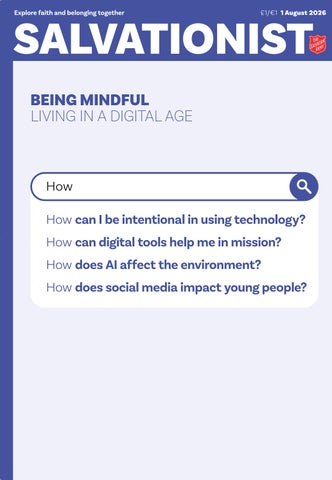
SALVATIONIST BEING MINDFUL LIVING IN A DIGITAL AGE
How How can I be intentional in using technology? How can digital tools help me in mission? How does AI affect the environment? STANDING ALONGSIDE How does social media impact young people? SURVIVORS HELPING-HAND APPEAL 2024
What comes next WHAT’S the next word in this sandwich? Many of us are used to predictive text – software that guesses the most likely word you want to use next. It saves time and, sometimes, it’s incorrect. Artificial intelligence can sound daunting, but the most visible type in our day-to-day lives is in the form of a chatbot assistant. It is, in essence, an advanced predictive text machine. It’s called generative AI, which means it isn’t creative – it looks back at patterns of data and guesses the next most likely word or pixel to generate a sentence or an image. Many of us are also used to social media algorithms, which look back at what you have engaged with and guess the next most likely thing to show you that will keep you engaged. This is what technology often does: reflect ourselves, and our choices, back to us. Whatever technology we use, our choices have an impact – on our time, our planet, our wellbeing, our productivity, our ability to reach new people or be part of a community. This issue of Salvationist is an invitation to be mindful in how we use technology – to consider the opportunities, to be intentional and not simply consume or scroll passively to what comes next. The ability to look forward – to see, imagine and create new possibilities – is part of what makes us human. What comes next is not something inevitable generated by software. We are created with free will. That includes thinking critically and choosing when and how to use technology, to engage with it in a way that helps us draw closer to Jesus, and reflects not ourselves back to us, but God to others. IVAN RADFORD Editor
EXPLORE MORE ONLINE
Visit salvationist.org.uk/ recommended-content Explore online tools, digital reflections and podcasts for discipleship
NEXT WEEK’S ISSUE Explore faith and belonging together
£1/€1 1 August 2026
SALVATIONIST Calling and vocation
Growing leaders How How can I be intentional in using technology?
9–11 USING AI EFFECTIVELY AND ETHICALLY
12 SUPPORTING YOUNG PEOPLE
13 DEVELOPING OUR ONLINE PRESENCE
14 DIGITAL TOOLS FOR MINISTRY
8
WHAT IS A DIGITAL SABBATH?
SALVATIONIST Issue No 2074
EDITOR Ivan Radford
FOUNDERS Catherine and William Booth
ASSISTANT EDITOR Stevie Hope
INTERNATIONAL LEADERS General Lyndon Buckingham and Commissioner Bronwyn Buckingham
EDITORIAL ASSISTANTS Major Margaret Bovey, Major Lynne Shaw, George Tanton, Lyn Woods SENIOR DESIGNER Hannah Holden
TERRITORIAL LEADERS Commissioners Jenine and Paul Main
GRAPHIC DESIGNERS Joseph Halliday, Louise Phillips
EDITOR-IN-CHIEF Major Andrew Stone
PROOFREADER Chris Horne CONTACT US 020 7367 4890 salvationist@salvationarmy.org.uk ADVERTISING advertising@salvationarmy.org.uk DISTRIBUTION AND SUBSCRIPTIONS Salvationist Publishing and Supplies (Periodicals), 66–78 Denington Road, Wellingborough NN8 2QH 01933 445445 / subscriptions@satcol.org
How can digital tools help me in mission? How does AI affect the environment? STANDING ALONGSIDE How does social media impact young people? SURVIVORS HELPING-HAND APPEAL 2024
2
To subscribe, speak to your corps leader or visit sps-shop.com
Salvationist 1 August 2026
TERRITORIAL HEADQUARTERS 1 Champion Park, London SE5 8FJ 0845 634 0101 © The Salvation Army United Kingdom and Ireland Territory. ISSN 2516-5909. The Salvation Army is a Christian church and registered charity. The charity number in England, Wales and Northern Ireland is 214779, in Scotland is SC009359 and in the Republic of Ireland is CHY6399. Published weekly by The Salvation Army and printed on paper from sustainable sources by CKN Print, Northampton. @SalvationistUKI
SCRIPTURE QUOTATIONS From the 2011 New International Version (Anglicised), unless otherwise stated
@SalvationistUKI
TRENDING
Photo courtesy of Pixar. © 2026 Disney/Pixar. All Rights Reserved.
Do you know someone who would enjoy reading this? Scan this QR code to share it via WhatsApp!
Making time to connect As Toy Story 5 plays on our screens, Naomi Blowers encourages us not to be distracted from being present with God
W
HEN Pixar released Toy Story 5, many people expected another nostalgic adventure with Woody, Buzz and the gang. Instead, they gave us something surprisingly relevant. The toys are no longer competing with other toys: they are competing with a screen. Bonnie receives a smart tablet called Lilypad, and gradually the toys become forgotten. The film explores how screens can quietly become the centre of a child’s world. The message isn’t that technology is bad. The danger is not the device itself – it is what happens if the device becomes the thing that captures all our attention. Isn’t that exactly the challenge facing Christians today?
Reflect and respond What captures your attention more quickly than God? When was the last time you sat quietly with God without distraction? Are you consuming more content than you are creating space for God to speak? Before you go to bed tonight, put your phone down 30 minutes earlier than usual. Spend that time reading Scripture, praying, talking with your family or sitting quietly before God.
Our greatest distraction is rarely something sinful. More often, it is something good that has become ultimate. Our phones connect us to thousands of people, yet can potentially disconnect us from the person sitting beside us. We know the latest news from around the world, but might struggle to hear the still, small voice of God. We scroll endlessly, yet rarely stop long enough to pray. Jesus told Martha: ‘You are worried and upset about many things, but few things are needed – or indeed only one. Mary has chosen what is better’ (Luke 10:41 and 42). Martha wasn’t doing anything wrong. She was simply distracted. The Enemy doesn’t always need to make us bad people; sometimes he only needs to make us busy people. In Toy Story 5, the toys slowly realise that Bonnie is missing something far greater than simply playing with toys: she is missing imagination, adventure, faceto-face relationships, wonder, the joy of creating stories as well as consuming them. Jesus understood the importance of childlike wonder. In Mark 10:14, when the disciples tried to keep children away, Jesus said: ‘Let the little children come to me … for the Kingdom of God belongs to such as these.’ Children teach us something adults often forget. They notice butterflies. They ask questions. They laugh loudly. They imagine impossible things. They live fully in the present moment.
Psalm 46:10 simply says: ‘Be still, and know that I am God.’ Notice the order. Be still. Then know. We often reverse it. We want to know God without becoming still. We want deep faith while living distracted lives. We want intimacy with Christ while constantly checking the next notification. Ephesians 5:15 and 16 challenge us: ‘Be very careful, then, how you live ... making the most of every opportunity.’ Time is one of God’s greatest gifts. Attention is one of our greatest acts of worship. Whatever has your attention will eventually shape your heart. So perhaps the real question isn’t how much screen time you have. The question is: Who or what has first place in my heart? Technology can help us read Scripture. Technology can connect churches across the world. Technology can spread the gospel. But technology must never replace time with God, meaningful conversation, laughter, prayer or simply sitting quietly in God’s presence. Maybe today God is gently inviting you to rediscover the joy of simply being present with him. Because the greatest relationship we will ever have is not with a device that says ‘look at me’, but with a Saviour who lovingly says: ‘Come to me’ (Matthew 11:28).
NAOMI BLOWERS Staple Hill
Salvationist 1 August 2026
3
DATES FOR YOUR DIARY Get SET! Conference Saturday 5 September William Booth College
What is it? A day dedicated to celebrating, valuing and equipping everyone involved in parent-and-toddler groups. This ministry has not always been recognised for its missional impact. The conference is about changing that – bringing people together to say thank you, to celebrate what God is doing, and to affirm how essential this work is. The day is rooted in Proverbs 22:6: ‘Start children off on the way they should go, and even when they are old they will not turn from it.’ It will include worship, workshops, a keynote speaker, the launch of Get SET!, a resource for creating welcoming parent-andtoddler groups, and a celebration and thanksgiving service honouring everyone who serves in this ministry.
TESTIMONY
‘I want to put God first in everything’ Mia Gartshore (Eastbourne Citadel) shares how she is figuring out who she is in Christ
I
HAVE been coming to the Army for technically my whole life. My grandma and grandad would bring me on a Sunday morning. Grandma would have some sweets in her handbag for me, usually jelly beans, and I would play with my Barbies under the chairs. My grandparents impacted my life and my faith in many ways and I hope they can see how much I’ve grown, not only in my faith, but as a person. The first time I felt the Holy Spirit was in 2023 at Encounter, which is the Salvation Army summer camp in Bournemouth. During the evening worship, I was overwhelmed with what I can only describe as all the emotions combined into one. From that day, everything was clearer and I started noticing God’s work in my life or in others.
Who is the event for? Everyone who welcomes families, builds community and shares God’s love in powerful, life-shaping ways through parent-and-toddler groups.
Why should you go? To be encouraged, refreshed, inspired and equipped with confidence and practical ideas. To think more deeply about mission and relationships. How can we build stronger, lasting connections with families? How do we stay in touch beyond weekly sessions? How can parent-and-toddler groups be fully embedded into the life and mission of the whole corps?
Book your place Tickets cost £35. A mirror conference will follow on 17 April 2027 at Sale Corps. Visit salvationist.org.uk/ get-set-conference to book, or to find out more email familyministries@salvationarmy.org.uk. 4 4
Salvationist 1 August 2026 Salvationist 1 August 2026
Have you got a testimony to share? We’d love to hear what you are thankful to God for! Get in touch at salvationist@ salvationarmy.org.uk.
I’ve come to love serving in the church and helping others to know the love of Jesus. Through serving God I have grown more confident in myself and I’m figuring out who I am in Christ. I am so grateful to be a soldier today and I can’t wait to work together with the church to glorify God. To be a successful Christian, you have to put God first in everything, and that is what I want to do.
REVIEW
Putting prayer into practice Kathryn Barwise (Dereham) reviews Signal Fire by Martin Saunders
A
GREAT, reflective and widely adaptable resource, Signal Fire is chock-a-block with encouraging stories, teaching from the Bible and encouragement, as you reflect on the wonderful way to communicate with God: prayer. This book constantly gives refreshing insights into how we pray, why we pray and what might need to change about our prayer lives. Written by Martin Saunders, director of innovation at Youthscape, the book is incredibly encouraging and can be used as a helpful starting point, inspiration or exploration for anyone wishing to deepen their understanding of prayer. It is taken at a very simple, but true level: ‘Prayer is just us, calling out to God, anyway we can manage, any time we want.’ Signal Fire starts off with identifying why we pray, which, of course, prompts the familiar Sunday school answer: to communicate with God. Saunders questions the moments in which we pray, suggesting that it’s a gut instinct, an inbuilt reaction that causes us to reach for God and seek him. This kind of stimulating thinking prevails across the book as Saunders explores the different ways we can pray, how we can cope when God doesn’t answer our prayers – explored through a deep and meaningful testimony – and, finally, why we should also pray together, in community. It really is a very deep and challenging exploration of the wonderful and necessary gift of prayer, with God persistently placed at the centre. God wants to be in our lives, and inviting him in leads to the fullest version of every part of our lives. Practically, the book is very accessible to read. Aimed at mid to late teens and also people new to Christianity, there is a very good balance between deep theory on prayer and easily introducing that information. The book is split into three parts called ‘Flare: Lighting a Fire to Let Heaven Know You’re Here’, ‘Glow: Building a Friendship with God’ and ‘Blaze: Praying with and for Others’. Saunders uses an imaginative story that explores the importance of prayer, and how it is life-changing. This is broken up at the start of each section, which helps break down the theory, but also sets the tone for each section.
“
It is a very deep and challenging exploration of the wonderful and necessary gift of prayer.
”
In each chapter, Saunders hits a great balance by using amazing testimonies of prayer – which are very well researched! – to break up the heavier theory of prayer in ways that are incredible and uplifting. There are a few inquiring questions at the end of every chapter, which I found personally very challenging. They are there to help you explore your spiritual prayer growth to whichever level you wish, and could be used either individually or with other people. Signal Fire is an incredibly versatile book. It can be used by individuals to explore their faith personally and as material in a group setting as well, with lots of resources to build from that are also easily broken down. It’s a great read whatever age you are. Although it’s tailored to mid-teens, even in your eighties there will be something new to learn from it. • Signal Fire is published by SPCK Publishing. Salvationist 1 August 2026
5
BIBLE STUDY
Sing of God’s great grace! Captain Marie Karičková believes God is worthy of our trust, even in the hardest times PSALM 89
S
OME days, singing is easy. Life feels steady, prayers are answered and God feels close. Other days are harder. Things go wrong, prayers seem unanswered, and we quietly ask: ‘God, where are you?’ Psalm 89 speaks to both situations; it starts with confidence but ends in struggle. The main truth is that God’s grace never changes. The psalm begins with a statement of faith: ‘I will sing of the Lord’s great love for ever; with my mouth I will make your faithfulness known through all generations’ (v1). This is not just a poem – it is a choice. The psalmist chooses to sing because God is faithful, not because life is easy. The word ‘love’ here refers to God’s covenantal love – a faithful, committed love that does not depend on what we do. The psalmist continues: ‘I will declare that your love stands firm for ever, that you have established your faithfulness in Heaven itself’ (v2). This is the foundation of faith. God’s grace does not depend on our circumstances, but it depends on who God is. God’s promise to David shows this: ‘I have made a covenant with my chosen one, I have sworn to David my servant, “I will establish your line for ever”’ (vv3 and 4). In verses 5 to 13, the psalmist recognises the power and majesty of our Creator – the awesome Lord God Almighty – who rules over the heavens and the earth and is worthy of praise. 6
Salvationist 1 August 2026
There is none like him. God’s rule is righteous and just, and he is known for his love and faithfulness (see v14). He is someone worth keeping close to (see v15). He brings his people joy as they celebrate his provision and protection (see vv16–18). The psalmist remembers God’s grace in choosing, anointing and equipping David to be their king. God promises to sustain him, strengthen him, save him from his enemies, love him, empower him and keep the covenant he made with him because God is always true to his word (see vv21–28). Even when humans fail, God promises: ‘I will not take my love from him, nor will I ever betray my faithfulness’ (v33). God’s grace is strong. It is patient, steady and lasting. We recognise that Psalm 89 also shows struggle. There is a sense that the psalmist feels that the Lord has abandoned the king and the nation (see vv38–45). ‘But you have rejected, you have spurned, you have been very angry with your anointed one’ (v38). The psalmist sees a world that does not match God’s promises. The king is defeated. The nation suffers. God’s covenant seems to fail. We understand this feeling. We know what it is like to pray and not see answers, to hope and be disappointed, to believe but struggle. Psalm 89 shows it is okay to bring these feelings to God. Faith is not pretending everything is fine; it is holding on to God even when life is
hard. The psalmist asks God: ‘How long, Lord? Will you hide yourself for ever?’ (v46). This is not unbelief – it is honesty in relationship. God is not afraid of our questions. He welcomes honesty and heartfelt cries. In his book A Case for the Psalms, theologian NT Wright comments that the Psalms teach us to pray truthfully. They give words for praise and pain; real faith includes both. Perhaps we can identify with the psalmist, who is desperately trying to understand his sense of God being absent in the midst of suffering. He even dares to remind God of his promises: ‘Lord, where is your former great love, which in your faithfulness you swore to David?’ (v49). This is bold prayer, but it is rooted in trust. The psalmist is not rejecting God, but he is appealing to God’s character. In I Believe in Evangelism, David Watson writes: ‘Faith is not the absence of doubt, but the decision to trust God in the midst of it.’ This shows that faith can be quiet. Sometimes, faith is simply choosing to trust, even in struggle. In his book In Darkest England and the Way Out, William Booth wrote about faith that lasts, the kind of faith that ‘does not depend on circumstances but stays firm in conviction’. As we come to the end of the psalm, there is no clear answer. Nothing changes visibly. But the psalmist ends with: ‘Praise be to the Lord for ever! Amen and Amen’ (v52).
To read the full, unedited Prayer Matters booklet, visit salvationist.org.uk/discipleship. SATURDAY 1 AUGUST: CARING FOR CREATION Protecting and caring for God’s creation is a vital part of people experiencing fullness of life. Ask the Holy Spirit to speak through these songs: ‘This is My Father’s World’ (SASB 66) at youtu.be/NwqTvmpnKeE and ‘The Lost Words Blessing’ at youtu.be/Hg1xFYpXuWA. SUNDAY 2 AUGUST: SABBATH PRAYER Reflect on how God forms us and what it means to participate with God on Sabbath. Eugene Peterson wrote: ‘Sabbath is not primarily about us or how it benefits us; it is about God, and how God forms us.’
He chooses to praise, not because it all makes sense, but because God is worthy. This is singing of God’s great grace. Not just singing when we feel happy, but trusting God when life is hard. Holiness teacher Samuel Logan Brengle wrote about faith tested in real life. True faith grows in struggle and is kept by grace. Psalm 89 reminds us: God’s grace is constant, even when life is not; God’s promises remain, even when we don’t understand; faith can include questions without losing trust; praise can be a choice, not just a feeling. Maybe, today, singing is not easy. And that is OK. Singing of God’s grace means holding on to a faithful God. Maybe the song is quiet. Maybe it is simply ‘Lord, I still trust you’. God’s grace does not fail. His love still stands firm. He is still holding us. In Sermons on Several Occasions, John Wesley comments that grace not only brings us to God but also keeps us close to him. Faith starts and continues with grace. This idea shaped The Salvation Army. God’s grace is not only for us to receive, but also for us to live out in faith and service.
CAPTAIN MARIE KARIČKOVÁ Corps Leader Gravesend
MONDAY 3 AUGUST: SHARING THE GOOD NEWS Read 2 Corinthians 4:7. Analyse your motives for talking to others about Jesus. Do you tell them because you feel you should, or because it bubbles up in you in an unstoppable way? To be effective sharers of the good news, we need to be wowed by it ourselves. What might it feel like for you to connect afresh with the good news of Jesus in your own life? TUESDAY 4 AUGUST: SERVING AND CARING God, you are the source of all love. Forgive us when we edit or limit your love because of our own prejudice. Grow our hearts when love feels too difficult. Renew in us your unconditional, unending love, that we might walk others home to your embrace. WEDNESDAY 5 AUGUST: JUSTICE AND RECONCILIATION Prayer activity: Begin a collage or scrapbook journal to help you pray for people who live with the daily realities of injustice. Use images, cuttings, textures or colours, perhaps build it up over time. Making it a physical thing, rather than something you file away in your phone, will help keep those people present in your heart and mind. THURSDAY 6 AUGUST: INTERNATIONAL SALVATION ARMY The vision statement for the Brazil Territory is: ‘A holy people engaged in the mission, who work in unity and passionately as agents of transformation in Brazilian society.’ As you reflect, pray for God to continue to shape his people, that they may see his transformation in the spiritual landscape around them and be refreshed by his Spirit. FRIDAY 7 AUGUST: GROWING IN FAITH Being a disciple of Jesus and seeking holy living is the way to experience fullness of life. Listen to these songs and go where the Spirit leads you: ‘Burning, Burning, Brightly Burning’ (SASB 317) at youtu.be/bDNvodnQGMA and ‘Lord, I Come to You’ (SASB 601) at youtu.be/H9_0jiO5ZRM. PRAYER REQUESTS Do you have something or someone you’d like us to pray for? Email salvationist@salvationarmy.org.uk with ‘prayer request’ in the subject line.
Salvationist Day Month 2026
00
REFLECTION
Being present Lauren Westwood invites us to take a digital Sabbath
S
UMMER has a way of capturing our attention. Holidays interrupt routine. Longer evenings stretch out and invite connection with friends. For me, this is the first summer in years that I have had a garden to simply sit in and let the hours pass. Perhaps that is why summer can be a good moment to do something many of us find surprisingly difficult: put down our smartphones. Technology is not inherently bad for our spiritual lives. Far from it. More than a billion devices have installed the YouVersion Bible app, meaning God’s word is carried into classrooms, hospitals, sports halls and commutes around the world. BibleProject’s videos on YouTube sit at more than 600 million views, opening Scripture for people who might never attend a Bible study or theology seminar. Others have engaged with Scripture in new ways through apps such as Lectio 365. Worship music fills kitchens and car journeys. Podcasts bring teaching into waiting rooms and morning commutes. Prayer apps help us remember the people we’ve committed to pray for and bring us closer to those we love. I used one every day when a friend was expecting her first child. Digital technology can be an extraordinary gift. But it is not our master. Adele Ahlberg Calhoun describes ‘unplugging’ as a spiritual discipline that seeks ‘to be fully present to and uninterrupted in my interactions with God and others’. The ability to unplug, or limit unhelpful noise from our phones, tablets or computers, matters. It is not simply about wellbeing or managing 8
Salvationist 1 August 2026
notifications, but about presence. Choosing this discipline can help us pursue a holy and attentive life, listening more carefully to the voice of God and the needs of others. This summer, we invite you to explore the practice of a digital Sabbath, inspired by the Hebrew shab.bat: to rest, cease or stop. The Sabbath is a gift made for us by God (see Mark 2:27). The practice of Sabbath remains a powerful reminder that we are not machines. We need rhythms that interrupt work, resist the pressure of constant production and help us find our rest in God. In a culture that often measures worth by achievement, Sabbath tells a more radical story: that we are loved not because of what we do, but because we belong to God. St Augustine famously wrote: ‘Thou hast formed us for thyself, and our hearts are restless till they find rest in thee.’ Centuries later, those words ring true. Digital platforms can point us towards good things, but we will not find lasting rest in the endless scroll. Beyond the noise and the algorithms competing for our attention remains a deeper longing for the presence of God. By engaging in a digital Sabbath this summer, we hope rhythms of rest and perspective might create healthier boundaries and deeper connection with God and others. For some, that might mean a day of complete abstinence from screens. For others, it might involve tracking screen time, reviewing downloaded apps or finding a new digital tool to help in their discipleship, and noticing how it shapes their enjoyment of life. There are times when our devices enable and enhance our work,
What is a digital Sabbath? A digital Sabbath is an invitation to unplug from any unhelpful digital noise and intentionally review any habits, to help us go deeper in our relationship with God. It doesn’t necessarily mean complete withdrawal from digital spaces or technology, but embracing a rhythm focused on rest, presence and discipleship. relationships and ministry. Yet the regular practice of stepping back from less helpful digital habits might help us hear God’s voice more clearly. Each swipe, click or scroll can become an opportunity to reflect the life we have been called to live by the Lord we have chosen to follow. For many of us, engaging with digital is neither rejection nor indulgence. It is the self-control to gratefully embrace the gifts of technology while retaining the freedom to set them down when a better thing requires our attention. • Would you like to engage in a digital Sabbath with us? Visit tsa.link/digitalsabbath to access a guide to support you, pointing to how everyday digital choices can draw us closer to Jesus – this summer and beyond! LAUREN WESTWOOD Digital Faith Engagement Manager Publishing Department
INTERVIEW
Finding a balance Amy Quinn-Graham (Research and Development) explains her research into the environmental impact of generative AI Who commissioned the research? The Digital team. When the AI Working Group was first set up, the question came up about generative AI from an environmental perspective.
What does the environmental impact look like? Based on what we are able to measure right now, we can say that generative AI has a considerable environmental footprint because it contributes to increasing carbon emissions and water scarcity. Data is not published by all the relevant companies, so this research is based on ChatGPT-3, which is not the most recent model – the impact will be higher for newer, larger and more complex models. The focus has been mainly on carbon emissions from the use of electricity and water usage.
What are the factors in AI’s environmental impact? We don’t know if there are differences between different models of generative AI, such as ChatGPT and Claude, but the complexity of a prompt is a factor – a simple prompt has less impact than a complex prompt.
How can you put it in everyday terms? On average, an AI search query will release 4.32g of CO2 into the atmosphere, the equivalent of turning on a 60W lightbulb for 6 minutes and 12 seconds. A non-AI query generates 0.2g of CO2, the equivalent of a 60W lightbulb being on for 17 seconds. Generating an image or video is more intensive: one image from a basic AI image generator is the equivalent of running a microwave for 6 seconds. Producing a 2-minute, high-quality video with AI is the equivalent of driving a car 108 miles. AI also requires data centres – large buildings that house thousands of computers – which take up land and require energy 24/7. Water is also needed to cool the data centres, but the majority of the water used cannot then be reused. That means Chat GPT-3 typically consumes a 500ml bottle of water for a conversation of 10 to 50 medium-sized responses, depending on the time of day and the location of a data centre.
Why does caring for creation matter in this context? We only have one planet. God has given us this world and, in Genesis 1:28, responsibility to care for it. That includes humans, which ties into not only our mission priority to care for creation but also to seek justice and reconciliation: data centres are often sitting within poorer communities, while people in the Global South are often the ones hired to sift through potentially harmful content as part of the training and development of AI models. Just as when we talk about wider climate change, the impact disproportionately affects people experiencing poverty. It is possible that greener AI models could be built, or that AI might help with ways to think about tackling climate change, to innovate or mitigate it. But it is important to be mindful of the impact on the environment in the immediate term.
What is the best response we can take? Individually, there are things we already do, such as driving our cars, that we know have an impact upon the environment, so this is about being aware of the impact of using generative AI. If you use it, use it intentionally. Generating an image might seem fun, but do you need to? It might help some people to think about it in terms of offsetting, balancing out using AI with not driving somewhere or not eating meat for a day. It’s about being mindful and finding a balance.
Steps to reduce your AI footprint
It’s easy to think of AI as something non-physical. Do data centres make its impact more visible?
Switch to a search engine that doesn’t automatically integrate AI, for example Ecosia or DuckDuckGo.
Yes. The largest data centre exceeds 10,000 square metres. People can feel removed from the data centres when they’re using an app; it’s not something they have to think about. People might think of these centres as being in the middle of nowhere, but towns near the centres are impacted. And the more we use AI, the more data centres will be required.
Put a space followed by ‘-ai’ at the end of your search query in Google, so that it doesn’t generate an AI overview. Keep any prompts simple and text-based. Consider when to use generative AI and when not to.
Salvationist 1 August 2026
9
INTERVIEW
Unlocking potential Lev and Peter, co-chairs of the AI Working Group, speak to George Tanton about how artificial intelligence is being used by the Army
‘I
T’S very important that we make conscious, informed, clear decisions on how we want to use AI, what we want to use it for and what the red lines are,’ explains Peter Jacobs, interim Head of Digital at Territorial Headquarters. He also is co-chair of the AI Working Group, alongside Head of Enterprise Systems, Data and AI Lev Malinin. ‘Our role involves trying to inform the conversation around AI use and demystifying it so people can apply their own organisational and theological expertise to it,’ adds Peter. Last year, the territory established an AI Policy for all Salvation Army personnel, including staff, corps leaders and volunteers, following the AI Guardrails developed by the Moral and Social Issues Council. The AI Working Group helps ensure that AI is used effectively, ethically and responsibly within the Army. One key use of AI across the territory has been cleaning up the Army’s digital estate by using Microsoft Fabric, an AI-powered tool that brings the organisation’s data into one environment. This enables, for example, quick monthly reporting on the Army’s properties to organise things such as repair needs. ‘We are on a journey of collating all our data systems,’ says Lev. ‘One of the key elements for AI is the need for clear and good data. If you input good data you’ll get good answers. But if you provide bad data, you’ll receive bad answers.’ ‘The challenge The Salvation Army has is that it’s so big and so old,’ adds Peter. ‘It’s grown organically so the systems don’t interlink. Data from various departments and services are in different systems, so it’s difficult to unite. If it can be organised, this will unlock a huge potential for efficient working. For instance, if you can unite the data from different teams, you would have the potential to spot patterns to see where people might be vulnerable or need support. It’s not a silver bullet but, if you apply the right tools, you can unlock that capability.’ ‘From a technology perspective, AI 10
Salvationist 1 August 2026
Lev Malinin
Peter Jacobs
is a tool,’ asserts Lev. ‘We are in a very fortunate place to be able to witness its evolution. AI learning models are based on mathematical formulas and probabilities. There is a logic to it. For example, when talking to Microsoft Copilot, a generative AI chatbot assistant, it doesn’t give you an answer based on what it thinks. There is structure behind its answers and all of that has been engineered.’ ‘Artificial intelligence is not intelligent,’ Peter adds. ‘It’s not sentient; it’s the summation of what it’s been trained on.
It learns from the context of your inputs and your questions to it.’ One thing the AI Working Group considers is whether public trust would be eroded by the Army’s use of AIgenerated material. In the charity sector, there is an ethical debate around using digitally engineered images to tell reallife struggles. The territory’s AI Policy includes not using AI to create or modify imagery of real people. ‘We’ve had conversations around animating a still image,’ says Peter. ‘We’re very aware of maintaining trust with our supporters.’ Both Lev and Peter stress that security is a top priority, ensuring that sensitive data does not leak into the public domain. Lev considers the risks associated with ‘shadow AI’ – the potential use of unauthorised AI tools by employees. This can lead to data breaches and violations of regulatory compliance. ‘Our high-risk departments, such as the Anti-Trafficking and Modern Slavery Unit, have already been blocked from using unauthorised AI applications,’ he says. ‘We are training staff to recognise the dangers associated with shadow AI.’ As the Army continues to navigate the use of AI, Peter argues that it is neither a force for good nor evil, but a tool: ‘If you used it for autonomous weapons, that would obviously be a bad thing but, if you used it to speed up the diagnosis of cancer, that would be a benefit to humanity. Like all technology, it is about the purpose to which it is put.’ • Read more about the AI Policy at tsa.link/ai-policy and the AI Guardrails at tsa.link/ai-guardrails.
GEORGE TANTON Editorial Assistant Salvationist
INTERVIEW
Using AI wisely Moral and Social Issues Council (MASIC) member Captain Mark Scoulding (Stornoway) talks about artificial intelligence It’s been just over a year since MASIC introduced the AI Guardrails. How have things changed since? AI has advanced in that time. I think the key thing now is prioritisation: when is it helpful to use it? Taking into account the environmental impact, what is a good use of resources? Helping someone with a blank page to give them a robust framework to build on can be a good use of AI. Generating a picture of kittens playing snooker is perhaps not. MASIC hosted a panel discussion about AI at Together 26 and there were Salvationists on it with a breadth of experience with AI, including its potential benefits to help with speech therapy and translation. Whatever sphere we are in, we need to remember that the AI Guardrails are there to help us.
How has AI’s place in society evolved? There are two prevalent ideas in society at the minute. One, that AI is irresistible. It’s not. We do not have to engage if we choose not to. Two, that it’s a universal good, which happens with any new technology. It’s the Wild West for a while, and then things settle down. AI is an incredible piece of technology. We have to consider: where does it add value? Where do we use it to do the most good?
People mostly encounter AI in terms of generative AI, typically as a chatbot. How does that shape how we see and use AI? Generative AI – including the large language models and chatbots we are confronted with most of the time – is not the totality of AI. There are many other forms, and an awareness of that is important. An AI chatbot tends to tell you what you want to hear. It also doesn’t really exist. It gives you the impression of a person. When it says ‘I understand’, it doesn’t. It’s like a puppet. But we need to
remain focused on people. There’s still a role, perhaps more of a role, for face-toface communications and relationships. Things can quickly become about what you can produce or the email you can send, rather than relationships.
The AI Guardrails don’t explicitly mention human creativity, but that has value, doesn’t it? The AI Guardrails mention accrediting authorship, in line with our territory’s values of integrity and mutual accountability. But what’s the first thing we learn about God? In the beginning, God created. Our creativity is a mark of us being made in his divine image. There are apps now where you can put in a prompt to generate a song in seconds. I tried putting in a psalm, to see what it could do. If you were musically inclined, you could use that as an initial idea to build off. Is that using your God-given creativity? I don’t know. If I use an auto-rewrite button on an email, it will improve the grammar. Does everything I produce start to sound the same? Is it still my voice?
How do we balance AI helping us do something we can’t do with someone else having the opportunity to use their talents? I think in the Church we need to be mindful of the skills our people have and try to make use of them, even if AI is very convenient. But that’s easier said than done. If we have a small number of people trying to do lots of things, they will inevitably not have the skills to do it all. Is AI’s ability to do some of those things helpful? Does it mask a reality that we need to work together more? These are hard questions to consider.
AI opens up lots of opportunities. Can God work through AI? Theologically, we do need to consider whether we believe God can use these technologies. Personally, I believe God can use anything and everything. However,
we have to be careful when we look to technology as the only answer, or place our faith in AI. Although AI can read a document in seconds, it’s no substitute for God.
What are the social and justice impacts to consider? I don’t see much public discourse about the power big tech companies have. I think regulation is important. What changes would need to be made to the national grid if there are lots of data centres in the UK? How will AI change the economy? The Catholic Church, with the Pope’s statement on AI, is one of the only faith-based groups bringing these questions into major news headlines. AI fundamentally requires land, minerals and water. If we reached a point where people didn’t have water in their taps, because a local data centre had taken most of it, that would become an issue quickly. But until it affects them, most people likely won’t think about it. We’re a worldwide Army with a bias towards the poor and marginalised. What’s the impact on developing nations? Will they have access to the benefits of AI? It’s not just about us in this territory. It’s challenging to raise your head above the day-to-day to think about what’s going to happen. I think the Church has a role in doing that. • Read more about the AI Guardrails at tsa.link/ai-guardrails. Find out more about what MASIC is and does at tsa.link/masic. Salvationist 1 August 2026
11
INTERVIEW
Building resilience Lyn Woods hears from Director of Addictions Lee Ball and Children’s Specialist Tracy Wood (Children and Youth) about the Army’s Digital Rewiring of Childhood training
A
COLLABORATION between the Addictions, Children and Youth and Homelessness teams, Mindset is an online training course and play-based reparative resource. It’s designed to equip leaders to help young people be more resilient and cope with what life throws at them. The Mindset course is delivered at two levels: a short and an enhanced course. Digital Rewiring of Childhood is one of the modules in the enhanced course.
What is Mindset? Lee As people, we interact through a process called serve and return. I’m passing something to you; you’re giving it back to me. Serve and return is a way that children learn to interact with adults. Mindset offers opportunities for building on that serve and return relational dynamic of interacting with each other. Tracy Mindset is open to anyone who works within an Army setting or context with children and young people, whether that is mentoring children in a school environment or being with young people as part of the Army’s street-based youth work, family hubs, day centres or family services. It isn’t open to external candidates at this stage.
What is the Digital Rewiring of Childhood module? Tracy It is a 2.5-hour module that focuses on exploring technology’s role in young people’s lives and its benefits and challenges for their development. Everyone who attends is given a set of training handouts and toolkits.
How did this new element of the course evolve? Lee In a couple of ways. I was doing a lot of training around adverse childhood experiences (ACEs) and began collaborating with Tracy to spread this knowledge. Through training people in adversity, and what happens when people experience poor attachment and trauma, we realised more needed to 12
Salvationist 1 August 2026
be done and so we created and began delivering Mindset. I was also in communication with Deputy Territorial Youth and Children’s Secretary Phil Ball and started to discuss the impact of social media on the very young. There was inadequate research data because it was so new. We started to wonder how digital technology influences and interacts with the attachment process. To put it into context, attachment is the most basic human need. We need to feel connection and safety. We get a real sense of who we are through the eyes of other people. Digital Rewiring of Childhood was an acknowledgement that we have a lot of young people who are starting to develop a real dependence on technology as their main serve and return partner. They’re not getting much return, just scrolls of information and stuff that is not relational. This is not about saying technology is causing harm but, if we don’t understand the impact of technology, it has the potential to cause harm.
How does Digital Rewiring of Childhood help? Lee Through risk reduction strategies. It isn’t shaming a person into understanding something. We all engage in things that soothe us that we know probably are not good for us in the long run, yet we choose to do it anyway.
We’re not looking to stop behaviour, we’re looking to reduce any harm that it causes and compassionately understand what it is that they’re getting from it. We can work with people to hopefully achieve the same response from things that are potentially less harmful to them. This is an expression of Christian mission, an expression of love and kindness.
When are the next Digital Rewiring of Childhood sessions? Tracy A standalone Mindset session of Digital Rewiring of Childhood runs three times a year. The next course is in 2027, with dates available soon. Lee The Salvation Army is in a unique position, because we have the potential to operate from cradle to grave. Desmond Tutu is quoted as saying: ‘There comes a point where we need to stop just pulling people out of the river. We need to go upstream and find out why they’re falling in.’ Mindset is a practical response to stop them falling in. • Sign up for Mindset online at tsa.link/ mindset. For more information, email childrenyouth@salvationarmy.org.uk.
LYN WOODS Editorial Assistant Salvationist
INTERVIEW
‘Being able to evangelise digitally excites me’ Salvationist Website Manager Tim Davis introduces himself and his role What’s your role?
I’ve been working with websites for years, both website development and design. Being able to mix my faith and my work, and evangelise digitally, excites me. I know that the work I do is helping someone make a life-changing decision, the best decision they’ll ever make.
different journey from someone coming to the Explore Faith section. How do we take users who potentially have no knowledge of faith through those early stages? How do we help them get in touch with a Christian community? Scattered through the website are links to Find Your Nearest Salvation Army at salvationarmy.org.uk/map-page. Since November last year, over 1,000 people have used those links. Some will be taking that first step. If someone came to a corps and said the reason they’ve come is because of salvationist.org.uk, that would make my year!
What’s the most popular part of the website?
How does AI impact the site’s visibility in search engine results?
The Resource Centre and the Appointments section. In third place, alongside articles in general, is the Explore Faith section, which has grown out of our Becoming a Christian webpage.
If you search a term, you’ll probably see an AI overview at the top of your results. That means you don’t have to click through to a website, so some website owners have seen user numbers drop substantially. It’s not been terrible for us, but it affects how we optimise content, so that a page answers a person’s question and search engines know the page is trustworthy. We’ve had some of our seasonal content appear in the AI overview on Google, which is good.
I manage salvationist.org.uk. I am responsible for managing all the content and for making sure the website remains functional and live. I also work on making it easier to use and for new users to find.
Why do you do what you do?
How has that developed over the past year? The page salvationist.org.uk/becomingchristian appears at the top of results for searches such as ‘how to become a Christian’ on Google. The page explains what becoming a Christian means, and invites people to download an ebook of Who Is This Jesus Anyway? by Commissioner Robert Street. That’s them taking a step beyond reading what’s on the website and registering interest in finding out more. About 40 to 80 people each month download it. We have also been writing evergreen introductory content to tie in with the Christian calendar, for example Christmas and Easter. When users then search for something, for example things to give up for Lent, our website comes up. This brings in new users interested in finding answers to their questions.
So your job is partly about facilitating those faith journeys? Yes, I would say so. The website is a hub for Salvation Army members and leaders, but they have a
What work is happening at the moment? We finished a piece of user feedback research in April. This was about user
experience and navigation. It’s clear that we have to improve how easy it is to discover content, for example a resource for a small group. We also learnt that a lot of people will click over from social media to an article and then maybe leave the website, but we want to show them relevant content they’ll enjoy. The web agency we use has given us suggestions for improvement and we will be beginning the process of implementing those soon.
What kind of changes will people see? A lot is in the background, including how we categorise content. One change will be filters, so that people can filter through events, browse Bible studies by books, that kind of thing.
What work is going into accessibility of the website for people of different ages or needs? We carried out an accessibility audit before I joined, and we are implementing the suggestions from that. The work isn’t that visible, but it’s in the code, making sure that anyone who uses assistive technology, for example, can use the website in the same way as someone else.
What’s the biggest challenge in your role? Prioritising what’s next alongside day-today tasks. This morning, for example, I was fixing broken links, which is when a link to a webpage doesn’t load – it’s therapeutic in small doses!
What section of the website should more people know about? The podcasts are really good. If you haven’t looked at them, you should give them a listen!
What excites you most? The potential of the Explore Faith section. We’re sowing seeds. It’s exciting that someone might come to learn about what they could give up for Lent and then find out who Jesus is! Salvationist 1 August 2026
13
INTERVIEW
Technology to make your job easier Captain Jon Doyle (Sunderland Millfield) tells Stevie Hope how IT and digital tools have empowered his ministry Who are you and what do you do? I’m a corps leader and I’m also chair of the local mission focus group, which is about getting The Salvation Army across the city – three corps, a hostel, a family centre, three charity shops, Employment Plus, Starfish and the Ukrainian project – to work together more effectively. The next big thing we’re looking to do together is a university freshers fair.
What took you to DigiFest last year? I used to work in industry, where I had a personal assistant and a team behind me; it’s one of the things I miss most. I had a conversation with Regional Digital Manager Paul Nash (THQ) at officers councils about tech to help me keep on top of emails and make sure I’m not missing things. He had a list of possible tools. That continued a relationship of speaking about what I need as an officer and Paul linking me up with services at THQ provided by the IT and Digital teams. He emailed me about DigiFest as an opportunity to set aside some dedicated time to see what’s available. As an officer with a young family, getting away to conferences isn’t easy, so DigiFest being online made it accessible.
How have the technologies Paul introduced you to impacted your ministry? We’re using ChurchSuite to keep track of visits and make sure we know who’s where. If someone is interested in membership, for example, we can log it and it’s not relying on me remembering it. This ensures we’re following things up correctly and in a timely manner. Microsoft Copilot has also been a life-changer. I’ve been resistant to AI, but learning that Copilot is ring-fenced within the Army’s guidelines means it’s as safe as it can be to use. It’s been 14
Salvationist 1 August 2026
trained to understand an officer’s role so, when I ask it to plan out a week, it’ll know I need to put in my Sunday meeting prep. It also points out if I haven’t scheduled a weekly rest day. If I’m meeting an MP, Copilot can look through Army policies to suggest talking points. It’s like a research assistant in that sense. Of course, I double-check the accuracy and sources, but it saves me hours, which gives me more time for other mission and ministry. And then there’s email system Dotdigital. For the freshers fair, we’re setting up a digital welcome pack tailored to students. Hopefully, building those links will give them somewhere to worship. Having this email platform helps our outreach by enabling us to do stuff we haven’t done before.
That’s great, but it sounds like it could get complicated! People might think these tools are confusing – and sometimes it can be hard to get up to speed – but, once implemented, technology can make your job an awful lot easier and ministry more effective. And when I haven’t understood something, the Digital team are really good at getting me where I need to be and signposting when needed. Going to DigiFest meant I saw the people I needed to speak to.
Discover tools at DigiFest DigiFest 2026 takes place on 21 October. Find out more and listen to session recordings from last year at salvationist.org.uk/digifest. To get in touch with the Digital team and learn about how technology could empower your ministry, email digital@savationarmy.org.uk.
Why would you encourage people to go this year? Because you don’t know what’s available unless someone tells you. DigiFest told me what I could be doing and gave me access to some of the people who could show me how to do it. More than anything, the Digital team are as passionate about frontline ministry as I am. They want to use their skills and their knowledge to make sure that I can be as effective as I can be.
STEVIE HOPE Assistant Editor Salvationist
ARMY UPDATES
INTERNATIONAL
Transformed lives EVENT SIR SAMUEL KELLY MEMORIAL HOME Residents, staff, former staff and families gathered in the beautiful, tranquil gardens of the home to give thanks for 62 years of faithful caring and service. Laughter and a few tears ensued as people shared memories of situations and residents over the years. Major Sue Whitla (Ireland DHQ) sang ‘I Come to the Garden Alone’. The message was clear: the amazing caring would continue, but no longer in the guise of The Salvation Army. As we sang ‘Onward, Christian Soldiers’ (SASB 971) the!flag was ceremoniously marched out of the garden signifying the end of an era. Pictured are former manager Sharon Boyd, former chaplain Major Paul Wright, Major Sue, Chaplain Elizabeth McLarnon and Home Manager Sharron Cushley. – PW
EVENT CLOWNE The corps held a summer bake-off and quiz event, attended by 40 people, mostly non-Salvationists. Twelve cakes and tarts were judged, with not a ‘soggy bottom’ in sight. A total of £140 was raised for corps funds but, more importantly, many folk were introduced to the Army. – GH
CHILDREN AND YOUTH PETERHEAD The youth group and some of our tots performed The Robin’s Song by Linda Owen. It was the first time in a while that the corps had done this, and it was well received. A graduation ceremony was also held for our tots who are going up to Primary 1. – RB
FRANCE AND BELGIUM GENERAL Lyndon Buckingham and World President of Women’s Ministries Commissioner Bronwyn Buckingham joined Salvationists and friends for!the territorial congress held in Brussels and Paris. Under the theme Transformed Lives, the five-day congress brought together nearly 1,200 people. Hosted by territorial leaders Colonels Jacques and Claude-Evelyne Donze, it provided an opportunity to reflect on God’s transforming work and to look ahead with renewed confidence. Meetings, conferences, concerts, commissioning of new officers, an anniversary celebration, a flag dedication and a!Sunday marketplace all formed part of a rich and varied experience. Music played a significant role, with bands, singers, artists and worship leaders offering their talents. Two conference sessions invited participants to reflect on!the identity and mission of the Army, and how the Army!has found its place within secular life in the two countries through helping vulnerable people. At the Palais de la Femme in Paris, which celebrates its!centenary this year, Commissioner Bronwyn led an evening titled An Army of Women. With testimonies from!women involved in Army ministry, Commissioner Buckingham encouraged every woman present to be an agent of change within her own sphere of!influence. The strategic reflection currently taking place across!the!territory was also shared with the General. During a!soldiers’ meeting, the territory highlighted the implementation of the international Compass framework, reflecting a shared desire to pursue the mission with discernment, courage and faith. During Sunday’s marketplace, the General was presented!with the scarf of the Porteurs de Flambeau, the Army’s Scouting movement in France, and visited the CrossOver stand in the exhibition space, where he experienced virtual reality through the Army’s gaming ministry. The congress may be over, but its message continues: transformation is still taking place. – AR
MUSIC BEDFORD CONGRESS HALL The corps gathered in the heat!to enjoy worship and praise at its annual Music for a Summer’s Evening concert. Alongside the band, songsters and worship band, the corps was blessed to have Andrew and Hazel Mair (Regent Hall), who contributed joyful and meaningful music. – JM Salvationist 1 August 2026
15
ARMY UPDATES
ANNIVERSARY SHERINGHAM Fishermen from Sheringham once trawled to Grimsby in search of a better catch, where they met the newly formed Salvation Army. So impressed were they with this new expression of Christian witness, the fishermen decided to open a local branch in their boat yard. In 1888, the Army officially opened in the town, and they became fishers of men. In our 138th anniversary weekend, we celebrated those fishermen and the witness that continues today. On Saturday evening, Norwich Citadel Band and the corps songsters blessed the large congregation, including Territorial Leaders Commissioners Jenine and Paul Main, Divisional Leaders Majors Lynley and Stephen Oliver and local guests. Following an inspirational time of Sunday morning worship, led by the commissioners, we enjoyed a time of food and fellowship before a Q&A session, when we heard about the territory’s ‘Blueprint for Better Choices’ and plans for the continuing future of our Army. Commissioner Paul then dedicated a new outdoor flag in memory of Bandsman Peter Hazelwood, whose Christian influence lives on today. – MG
ANNIVERSARY CONNAH’S QUAY A weekend to mark 135 years in the community started with a community barbecue, which was well attended by people who attend on Sundays as well as for weekly activities. The celebrations continued with food and a quiz night, hosted by Majors Kim and Steve Wilson (Wales DHQ). Sunday morning allowed moments of reflection during a meeting conducted by Territorial Leaders Commissioners Jenine and Paul Main, who were the corps leaders at the time of the centenary celebrations. The meeting provided opportunities of thankfulness for the faithfulness of God in the past, recognising God’s work in the present, and praying for God’s plans for the future. The meeting also saw the enrolment of two new soldiers. – DH
SPORTS
FUNDRAISING
OLDBURY The corps celebrated the England versus Ghana World!Cup football match with a gathering of England and!Ghana supporters of all ages from across the corps. The evening started with a shared meal prepared by corps leader Lieutenant Jon Hampton. Although the 0-0 final score was not necessarily a riveting view, both sets of supporters thoroughly enjoyed the match. – RR
DROITWICH Staff and officers completed a 5k run to raise funds to improve the garden at the corps preschool. After taking part in a Couch to 5k programme, the group organised its own event and exceeded its £500 target. – AR
CHILDREN AND YOUTH EVENT SCUNTHORPE The corps hosted a day of celebration and worship with the African Praise Fellowship Zimbabwe ladies. More than 120 people attended for an exciting day of friendship and fellowship. – IC 16
Salvationist 1 August 2026
BEDFORD CONGRESS HALL The corps had a day of celebration when Lighthouse, the corps children’s ministry, led worship. Children’s Ministry Coordinator Amanda Jackson Bailey led with all the children taking part, including teaching the congregation new songs, dramas, prayers and a youthful corps!sergeant-major giving the announcements! – JM
NEW COMMITMENTS
ROCK FERRY
REGENT HALL
DULANJALIE Perera began attending the corps just over a year ago, after coming to the UK from Sri Lanka to study. Having received a warm welcome and deepened her faith in God, she wanted to make a formal commitment to her church and was welcomed as an adherent by corps leader Major Sian Wood (now at Warrington). Dulanjalie testified to God’s faithfulness and shared how the warmth of the fellowship and God’s guidance in her every step have helped her through this part of her journey. She chose Psalm 40:1 and 2 and Jeremiah 29:11 to express what God has done in her life. God has ‘set my feet upon a rock and given me a firm place to stand’, she testified, saying that she is confident that God’s plan and way are best in her life, and she will trust him for all that lies ahead. – SW GWEN was enrolled as a soldier, in a meeting led by Cadet Beth Hollidge, and cheered on by family and friends from the corps. Currently preparing for GCSEs, Gwen hopes to study science at A level and university. In her testimony, Gwen shared that she had wanted to become a soldier for some time, inspired by the Army’s practical work and her desire to be part of it. As her faith has grown stronger, she felt ready to make a public commitment to God and to herself. A key moment in her spiritual journey was attending Territorial Youth Choir in 2023, where she experienced worshipping alongside other young Christians and began to recognise God as present and active in her life today. While still growing in this understanding, Gwen expressed her desire to continue drawing closer to God. Gwen played piano during the offering, and she is pictured with Cadet Beth and Colour Sergeant Robin Moorwood. – MR
NUNHEAD SAMUEL Clemmett was welcomed as an adherent by corps leader Captain Katy Shubotham. Samuel has been a regular at the food bank for a while and struck up a bond with the prayer group, who offer refreshments during food bank. Samuel is the second adherent to come to the corps via the food bank and prayer group team. Samuel thanked the corps for making him feel welcome. – KS
KIRKCALDY
BARROW-IN-FURNESS ALISON, Mandy and Paul were welcomed as adherents by corps leaders Lieutenant Matthew and Captain Sarah Griffiths. They began coming to our weekday programme and joined the carol service at Christmas. They started to attend on Sundays and wanted to become part of the corps. – SG
CORPS leader Captain Andrew Manley welcomed Maggie McDonald as an adherent on Pentecost Sunday. Maggie has had long-standing connections with the Army and recently decided to take this step in her faith journey. Maggie uses her creative gifts to support the corps in many ways, including fundraising, serving soup at our Let’s Connect group and encouraging others, as well as worshipping with us on Sundays. – AM Salvationist 1 August 2026
17
ANNOUNCEMENTS
ARMY PEOPLE
ENGAGEMENTS
Wedding anniversaries
Territorial Leaders Commissioners Jenine and Paul Main
Diamond (60 years)
Chief Secretary Colonel Peter Forrest and Territorial Secretary for Leader Development Colonel Julie Forrest
MAJORS GILLIAN AND KEITH MANNING on 20 August
Dedicated to God DARCY-RAE AND THEO-JAMES MARTIN TEASDALE, children of Kelly Teasdale, at Ripley by Major John Parrott MICAH WILLIAM HERBERT, son of Captains Josh and Vikki Herbert, at Luton by LieutColonels Linda and Mark Herbert
Promoted to Glory BANDSMAN HAROLD EMENY, Felixstowe
Sat 1 Aug William Booth College (Territorial Music School Final Festival)
Sat 1 Aug William Booth College (Territorial Music School Final Festival)
NOTICES
Sharing the good news When has God given you an opportunity to share something of Jesus with someone during your week? Tell us about it by 3 August to be part of our sharing the good news issue! Email salvationist@ salvationarmy.org.uk.
Children and Youth Voice survey: Have your say! The Children and Youth Department are working with Participation People to better understand how children and young people are listened to, valued and involved across The Salvation Army. We are encouraging all adults to complete a 15 to 20-minute survey to share their experiences and insights. Your feedback will help shape future developments and ensure the voices of children and young people are at the heart of everything we do. Complete the survey at surveymonkey.com/r/TSADiagnostic.
Independent Safeguarding Review: We need your help The Salvation Army has commissioned an external organisation to conduct an independent safeguarding review across our territory. We work with some of the most vulnerable people and so it’s essential that we have the most robust safeguarding processes in place, which is why INEQE Safeguarding Group is conducting the review. Safeguarding is everyone’s responsibility and so everyone is encouraged to take part. Responses are submitted directly to INEQE and are anonymous and confidential. Please complete the survey most relevant to you by 4 September at ineqe.com/TheSalvationArmy.
Territorial Prayer Furnace
CAPTAIN JUNE FILBY from Aberdeen Royal Infirmary on 14 July
Pray with people from across the territory and be part of the UKI Prayer Rhythm in this monthly online gathering. The next prayer meeting will take place on 3 August at 6pm via Zoom. Email saprayernetwork@salvationarmy.org.uk for meeting details.
MAJOR RUTH CLARKE from Coloma Court care home, West Wickham, on 19 July
Care for creation Bible study
Bereaved ANDREW EMENY, Edinburgh Gorgie, June Skuse and Dawn Gerrard of their father Harold Emeny JOHN CLARKE, Upper Norwood, of his wife Major Ruth Clarke, Alison Chisholm, Robert Chisholm and Elizabeth ChisholmDriessen, The Netherlands, Czech Republic and Slovakia Territory, of their mother
An international, hour-long Bible study is led by different people on the first Tuesday of each month, alternating between 8am and 8pm. The next will take place on 4 August at 8pm, led by Lieutenant Mariciel Nuyda (Canada and Bermuda Territory) on Sabbath – Our Shared Rest. For more information, email environment@salvationarmy.org.uk.
People’s Emergency Briefing: Host a screening Corps and faith spaces are encouraged to host screenings of the People’s Emergency Briefing, a film that outlines the impact of climate change and biodiversity loss on communities, food systems and the economy. The UK and Ireland Territory has joined a growing coalition of UK denominations and Christian organisations in backing the initiative, led by the National Emergency Briefing (NEB). The NEB is an independent public information initiative working to ensure people are clearly briefed on the scale of the crisis. For more information about how to watch the film or host a screening, visit nebriefing.org.
SOUNDS
Sunday Worship From 2 to 30 August, Sunday Worship will invite us to take a digital Sabbath (see page 8) through a repeated, stripped-back programme that will encourage us to embrace rhythms focused on rest, presence and discipleship. Can’t join us at 11am on Sundays? Catch up with the podcast of highlights. Each week’s broadcast is repeated in full on Sundays at 6pm, Mondays at 12am and Thursdays at 9am. • Listen online at salvationist.org.uk/radio.
Sunday Lunch
MAJOR TONY FILBY of his wife Captain June Filby
The musical side to your Sunday lunch, featuring your favourite Salvation Army music. This week features Reuben’s Pick and Mix, presented by Reuben Dykes (Kidsgrove). Listen at 1pm on Sunday 2 August. • Listen online at salvationist.org.uk/radio.
MARGARET MCALISTER, Belfast Citadel, of her husband David McAlister
Sing to the Lord with the ISS
18
Enjoy favourite recordings from the International Staff Songsters, chosen each month by a special guest. This week’s pieces are chosen by Hilary Bromage (Boscombe). Listen at 5pm on Sunday 2 August. • Listen online at salvationist.org.uk/radio.
PRESENTATIONS
DUNSTABLE TOMMY Spratt was congratulated by corps leader Territorial Envoy Roger Coates as he reached the milestone of 50 years as bandmaster. Corps leader Captain Jacqueline Coates read letters from Paul Sharman (THQ) and Major Lorna Doust, who – as a young lieutenant – commissioned Tommy in 1976. Captain Jacqueline presented Tommy’s wife, Wendy, with a bouquet of flowers in gratitude for her unstinting support for him throughout the years. Tommy thanked the band for their continued backing and reminded everyone about their various specialling engagements from over the years. For Tommy, there was no resting on his laurels and, after a faith lunch, the band – augmented by friends from Luton Corps and former band members – presented a concert as part of the Band in the Park series, organised by the town council. – RC
CRADLEY HEATH HEATHER Norwood was presented with a certificate of retirement after 15 years’ service as corps treasurer. Heather continues to keep busy at the corps by helping to sell the papers and volunteering in our charity shop. – KT
STAPLEFORD BANDSMAN Frank Taylor received a certificate of retirement after 63 years of service at various corps, including Chesterfield, Clowne and Stapleford. Frank is pictured with Bandmaster Neil Wright and corps leader Captain Huw Dutfield. – FT
SHERINGHAM
THE Right Rev Graham Usher invited our parish nurse, Nia Heycocks, and corps volunteers Jane Garry and Stewart and Su Smith to a lunch to celebrate their work and that of wider Norfolk and Waveney charities. Since the Covid-19 pandemic, Jane has delivered medication on her trusty bike to housebound people who would otherwise struggle to get prescriptions. Stewart and Su have also supported the corps for many years, helping with the food club, Christmas appeals and more. Jane, Stewart and Su are all due to retire, and their commitment and hard work will be greatly missed. They remain in our prayers as they embark upon their retirement adventures! – MG
AYLSHAM ACTING Corps Secretary Sue Blackburn was presented with a certificate of appreciation by Divisional Area Officer Captain Katrina Thurlow in recognition of her service leading the corps. Sue has led the corps for three years with unswerving faith, dedication, energy and love. All corps members are so grateful to her for her continuing hard work and devotion. – KT Salvationist 1 August 2026
19
SALVATIONIST
Be inspired. Be encouraged. Be part of our faith community.
Follow us on Instagram @SalvationistUKI
Follow us on Facebook @SalvationistUKI