SALVATIONIST For everyone linked to The Salvation Army
No.1727 Price 70p
www.salvationarmy.org.uk/salvationist 19 October 2019
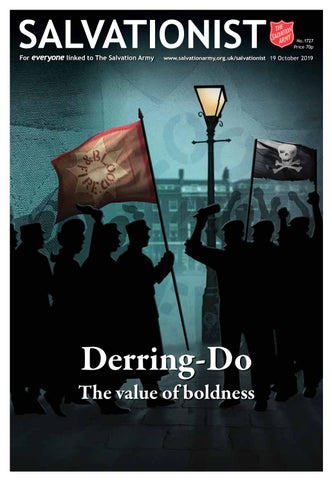
Derring-Do The value of boldness
‘
QUOTES FROM THE MEDIA
TWO HOMELESS PEOPLE DIE EVERY DAY ACROSS ENGLAND AND WALES
NHS OPENS CLINIC TO HELP CHILD ADDICTS OF COMPUTER GAMES
Homeless deaths nationwide have risen by nearly a quarter in a year, according to… new statistics which suggest drugs are largely to blame. The biggest rise in estimated deaths of homeless people in England and Wales since records began saw a 22 per cent increase from 2017 to 2018. It means that on average two homeless people die each day in the country. Two in five of the 726 deaths were related to drug poisoning, according to Office for National Statistics figures, which said the rise in deaths was the largest since data was first collected in 2013… Most of the deaths in 2018 were men – with an estimated 641 deaths – with an average age of 45 for men and 43 for women.
The NHS is opening the country’s first specialist clinic to treat children and young adults who are addicted to playing computer games such as Fortnite, Candy Crush and Call Of Duty. Staff will help those aged 13 to 25 whose lives are being debilitated by spending countless hours playing games… GPs and other health professionals in England can refer addicts to the service… It has been set up because of concern about the growing number of children and young people whose heavy use of computer games is causing problems for them, especially with their mental health. The clinic will be part of the National Centre for Behavioural Addictions in London. Patients referred to it will be able to attend in person or have an online consultation using Skype.
Metro
The Guardian
BAN SALE OF POINTED DOMESTIC KNIVES, SAY CAMPAIGNERS
Local food banks in the Trussell Trust’s network have had an increase in demand of 48 per cent in areas where universal credit has been rolled out over at least two years. The trust is urging the government to end the five-week wait for universal credit and says the longer the new benefits system has been rolled out in an area, the more people are plunged into poverty. The charity says that while the Department for Work and Pensions has attempted to find solutions to issues with universal credit, the wait for a first benefit payment, which is often longer than five weeks, is continuing to cause unnecessary hardship. Director of policy, external affairs and research for the Trussell Trust, Gary Lemon, is asking church members to sign up for the trust’s ‘five weeks too long’ campaign.
Campaigners against knife crime have called on the government to ban the sale of pointed domestic knives. They say that the knives that are easily available on the high street are no longer necessary in kitchens, and that a round-tipped design would reduce their effect as a weapon. The call… was formulated at a conference organised by the diocese of Rochester… to address the rise in knife crime. The signatories, who include experts on gang culture, county lines and violent crime, MPs, church and community leaders, wrote: ‘A five-year study in Edinburgh found that of the sharp instruments used in homicides, 94 per cent were kitchen knives… ‘Historically, we needed a point on the end of our knife to pick up food because forks weren’t invented. Now, we only need the point to open packets when we can’t be bothered to find the scissors.’
Methodist Recorder
Church Times
INCREASE IN DEMAND FOR FOOD BANKS
SALVATIONIST (tel) 020 7367 4890 (email) salvationist@salvationarmy.org.uk (web) www.salvationarmy.org.uk/salvationist EDITOR Lieut-Colonel Jonathan Roberts – (tel) 020 7367 4901 MANAGING EDITOR Ivan Radford – (tel) 020 7367 4891 EDITORIAL ASSISTANTS Shanelle Manderson – (tel) 020 7367 4894 Simon Hope – (tel) 020 7367 4892 Melita Day-Lewis – (tel) 020 7367 4887 Major Margaret Bovey ART DIRECTOR Hannah Holden – (tel) 020 7367 4883 GRAPHIC DESIGNERS Mark Knight – (tel) 020 7367 4895 Louise Phillips – (tel) 020 7367 4896 PROOFREADER Chris Horne
2
Salvationist 19 October 2019
ADVERTISING (tel) 020 7367 4883 (email) advertising@salvationarmy.org.uk DISTRIBUTION Salvationist Publishing and Supplies (Periodicals), 66-78 Denington Road, Denington Industrial Estate, Wellingborough NN8 2QH (tel) 01933 445445 (option 1, option 1) (email) subscriptions@satcol.org TERRITORIAL HEADQUARTERS 101 Newington Causeway, London SE1 6BN (tel) 020 7367 4500 (tel) 0845 634 0101 Published weekly by The Salvation Army and printed on paper from sustainable sources by Walstead Roche Ltd, St Austell. © The Salvation Army United Kingdom Territory with the Republic of Ireland. The Salvation Army is a Christian church and a registered charity. The charity number in England and Wales is 214779, in Scotland SC009359 and in the Republic of Ireland CHY6399. ISSN 2516-5909
THE SALVATION ARMY FOUNDER William Booth GENERAL Brian Peddle TERRITORIAL COMMANDER Commissioner Anthony Cotterill SECRETARY FOR COMMUNICATIONS Lieut-Colonel Dean Pallant
Find Salvationist on Facebook www.facebook.com/salvationistonline
Find Salvationist on Twitter @SalvationistUK
CONTENTS
BE BOLD, BE STRONG IN this week’s Salvationist we begin a six-part series on the values that characterise the life and work of The Salvation Army in the UK and the Republic of Ireland: boldness, integrity, compassion, accountability, respect and passion. On page 9 Captain Stephen Oliver focuses on the early Christians, whose boldness in proclaiming the good news of Jesus was evident. He suggests how we can follow their example. Boldness was not just seen in the Early Church – it was also there in the early Salvation Army. On pages 12 and 13 Major Martin Whybrow introduces us to Captain Robert Johnson who wrote the song ‘Storm The Forts Of Darkness’ in 1884. It was a time of great opposition, when bold Salvationists faced the Skeleton Army, the Destruction Army and the unsympathetic forces of law and order. Bringing us right up to date, Mike French describes the work at Fordingbridge on pages 10 and 11. The Army made the bold decision to allow Mike and his family, all non-Salvationists, to look after the corps and transform it from ‘a state of hibernation’ into a fresh expression. Mike points to the Army’s six values and shows how their work is characterised by them. Boldness shouldn’t be confused with recklessness or rash decisions. Real boldness involves wisdom. It means thinking things through, perhaps looking at what we propose to do or say from different angles and certainly considering what the consequences might be for ourselves, for our work and for other people. This kind of due diligence is important for us as individuals, as well as for the Army at every level. It’s an approach that might actually require greater courage, because we may become aware of potential risks and hazards but decide to press ahead anyway. Bold wisdom – or wise boldness – is needed when it comes to sexual ethics, as John Coutts shows in his article on page 14. He looks at the way society and the Church have handled issues of sexuality over the years and at how matters aren’t always clearcut. He also highlights new discussion materials from International Headquarters that are designed to help us have respectful conversations about such matters. Boldness means not sticking our heads in the sand and hoping controversial issues will go away, but engaging with them openly and honestly. That’s why the work of the Moral and Social Issues Council is so important, as Major David Taylor tells us on page 15. It’s sometimes said that boldness, or courage, is not the same as an absence of fear. Instead, it means overcoming fear – boldly taking a stand or pushing ahead with plans despite our trepidation. As Joshua stood on the border of the Promised Land, he heard God say: ‘Be strong and courageous. Do not be afraid; do not be discouraged, for the Lord your God will be with you wherever you go’ ( Joshua 1:9). Whatever steps we need to take in obedience to the Lord, we can be bold, despite our fears, because of the courage and strength his presence gives us.
Quotes from the media
2
News
4 to 7
Column from the college Embracing new rhythms of life
8
by Cadet Martyn Bellshaw
Feature Values: Boldness
9
by Captain Stephen Oliver
We are The Salvation Army 10 and 11 Not the Army you might expect says Mike French from Fordingbridge
Feature 12 and 13 Storm the forts of darkness by Major Martin Whybrow
Thinkaloud A time to talk about sex?
14
by John Coutts
Interview MASIC: Tackling difficult issues
15
by Major David Taylor
Bible study 16 and 17 God’s everlasting covenant by Major Graham Mizon
Through the week with Salvationist 16 and 17 by Lieut-Colonel Ray Oakley
New commitments
18
Letters
19
Announcements Adverts
20 and 21 21 to 23
The Salvation Army and me
24
featuring John Sandison
FRONT PAGE PICTURE Rodney Kingston, from Blood On The Flag by Nigel Bovey
From the Editor Lieut-Colonel Jonathan Roberts
SCRIPTURE QUOTATIONS Scripture quotations in Salvationist are from the New International Version (2011), unless otherwise stated
Salvationist 19 October 2019
3
NEWS
LEEK: More than 100 people gathered in the park to listen to the band, songsters and timbrel group. The afternoon was an opportunity for outreach and members of the corps shared fellowship with visitors. Refreshments were provided and the music was enjoyed by all who were present. All proceeds went towards the Big Collection. – R. J. Please do not send your copy to any individual’s email address as this could delay publication. Copy should be sent to salvationist@ salvationarmy.org.uk
MERTHYR TYDFIL: Generous staff at the Department for Work and Pensions collected winter clothing and sleeping bags for The Salvation Army, as well as much-needed cash to help those in need. The donated goods, which include toiletries and blankets, are for people experiencing homelessness and other challenges across southeast Wales. The staff also raised £167 to support the work of the corps. – I. R.
HULL ICEHOUSE: Majors John and Teresa Carmichael led Harvest celebrations. The morning meeting focused on the circle of life before everyone shared in a meal. The afternoon took the form of café church. Those gathered listened to the story of Jesus’ life through the majors’ singing. Toiletries were collected to be donated to residents at William Booth House Lifehouse. – H. N. 4
Salvationist 19 October 2019
Linda Roberts, Ruth Herington and CSM Samantha Searle from Watchet give away doughnuts and drinks during a 1940s community weekend; more than £400 was raised for the Big Collection
Grace Cooke receives a certificate of appreciation for more than 31 years of service as Stockton corps secretary; she is pictured with her successor Stephen Clark and corps officers Majors Nicola and Michael Barker
LOWESTOFT: Throughout the year Lowestoft South and Lowestoft Citadel partner churches in the town to provide free meals during school holidays. This summer Lowestoft South worked with Lowestoft Community Church to serve 135 free two-course lunches to families needing support. Corps officer Major Jenny Barwise planned the menus and Lowestoft Community Church provided a team of volunteers to help in the kitchen. – B. G.
Award-winning author supports call to fill Army food banks PRESTON
CARDIFF EAST: Cardiff South and Penarth Assembly Member Vaughan Gething visited the corps and community centre. He spoke to Army staff, volunteers and visitors to the charity shop and Taste of Heaven café. Activities at the centre include a parent-and-toddler group, an over-55 club and an Employment Plus programme to support people looking for work. Vaughan is pictured with John, a volunteer, and corps officers Majors David and Elizabeth McCaw-Aldworth. – I. R. SHOEBURYNESS: Harvest weekend began with a fish-and -chip supper, followed by a quiz. At the Sunday meetings Hadleigh Farm Estate chaplain Captain Heather Alston reminded the congregation to nurture their relationship with God in the same way farmers take care of their crops. The weekend was thoroughly enjoyed by all. – R. C./C. D.
SUSAN Hill, award-winning author of I’m The King Of The Castle and The Woman In Black, has backed The Salvation Army’s plea for more donations to its network of food banks. Susan sent supermarket vouchers to the Preston food bank when she heard that it was dangerously short on food. The Preston food bank experienced an increase in demand for emergency supplies this summer, and found its stocks running low. ‘The summer months can be especially hard for families who usually benefit from free school lunches and do not have the income to cover additional meals,’ explains Secretary for Communications Lieut-Colonel Dean Pallant. ‘I am concerned that other food banks are also struggling. This is especially worrying as we are now preparing for winter and Christmas, our busiest time of the year.’ Lieut-Colonel Dean encourages anyone looking to help a nearby Salvation Army food bank to get in touch before making donations, so that items that will make the biggest difference can be given out to people in desperate need. – B. G. O Suggestions for non-perishable food items to donate include tins of fruit and vegetables, bags of rice and dried pasta, cartons of juice and UHT milk, instant tea and coffee, sugar and biscuits O Other useful items include toiletries, toilet paper, sanitary products, nappies, washing powder and light bulbs Members at Brighouse celebrate with Ben Oken, who received a medal for completing the annual Overgate Hospice Midnight Walk; friends gathered for a photograph after the Harvest Festival meeting Salvationist 19 October 2019
5
NEWS
Celebrating 130 years of ministry FINLAND GENERAL Brian Peddle and World President of Women’s Ministries Commissioner Rosalie Peddle were guest leaders as The Salvation Army celebrated its 130th anniversary in Finland. The main celebration party and music festival took place on Friday evening in Temppeliaukio church in Helsinki – a worldrenowned place of worship built directly into solid rock – with a united band and other Army musicians. Among the packed congregation were the Canadian ambassador and many guests from other churches and organisations. The next day children and their parents gathered in HopLop adventure park for a Family Fun Day Birthday Party. The world leaders attended a youth forum, meeting young people from Finland and Estonia to discuss topics such as the gap between generations, international
CATERHAM: The Knit and Natter group made a dressing gown to donate to Knit for Peace. CS Barbara Milsom is pictured modelling the colourful gown, which comprises knitted squares crocheted together. The charity will pass it on to needy causes in the UK and beyond. – J. B. 6
Salvationist 19 October 2019
The General commissions Lieutenant Bryant-Rönnqvist
relationships between young people and the status of women around the world. In the afternoon a women’s rally led by Commissioner Rosalie and Territorial President of Women’s Ministries Colonel Anne-Dore Naud took the theme On The Way: Valuable And Brave Women Needed. The
commissioner encouraged women to find their value as God’s creation. The day ended with the commissioning of Lieutenant Jessica Bryant-Rönnqvist by the General, who, like Jessica, was born in Canada. The anniversary weekend concluded with a Sunday morning
holiness meeting. In his Spiritfilled Bible message the General told the congregation: ‘We have been called to be holy. It is not an option but a command and a necessity. We bring God to the world wherever we go and the world needs us.’ Many Salvationists and friends responded to the message and to God’s call. – E. K. CIRENCESTER: The hall was opened to the public as part of Heritage Open Days. The building – the first home of the Army in Cirencester – is the oldest temperance hall in the west of England still in existence, and was built on the site of a former brewery. A multimedia exhibition showed the history and development of The Salvation Army, the temperance movement and the hall. Visitors included people from the area, various parts of the UK, Australia and the USA. They received leaflets and copies of the War Cry and Kids Alive! Some visitors also attended a corps singalong on Sunday evening. – M. G.
CHIPPENHAM: The Open the Book team from the corps and Trinity Chippenham donated more than 300 Bible storybooks to Ivy Lane Primary School. The gift was part of Open the Book’s national 20th anniversary, with the books provided by Bibles4Children. The team visits the school every month to read Bible stories, encouraging pupils to act out the parts or join in with sound effects. – D. M.
facebook.com/ salvationistonline @SalvationistUK
Bognor Regis CSM Dorothy Boyes receives her retirement certificate from corps officer Major Matt Butler
More than 100 people respond to gospel challenge UGANDA
A messy Harvest LEIGH-ON-SEA CHIEF Secretary Colonel Lee Graves and Territorial Secretary for Leader Development Colonel Debbie Graves took part in the Harvest weekend. They started Saturday with Messy Music. This new initiative consists of a variety of music-themed activities and workshops with an unusual slant. More than 40 youngsters attended, mostly from the community, and families were invited to an afternoon performance showcasing the day’s work. Two families responded to an invitation to join in the celebrations on Harvest Sunday. These were led by the colonels and included some animals from the Hadleigh Rare Breeds Centre. Tinned produce was donated to benefit a homelessness charity in
the area, and after the meeting a large number of the congregation enjoyed a faith lunch. – P. J. CARNFORTH: Corps leader Territorial Envoy Andy Tonks led the band in an evening of worship and praise at Thornleigh Hotel for Salvation Army week. Territorial Envoy Gay Tonks presented vocal items and a pause for thought. The band has been an important part of corps ministry, playing at civic events in the town and being present in the town square every month, as well as undertaking a busy Christmas carolling programme. – G. T.
SALVATIONISTS and friends experienced exuberant moments of praise and worship during a visit by General Brian Peddle and World President of Women’s Ministries Commissioner Rosalie Peddle. The international leaders dedicated to God a new corps hall and a 28-room hostel to accommodate the growing number of cadets. The packed itinerary also included officers councils and public meetings where the General challenged listeners to consider salvation in Christ. More than 100 people responded positively to this call. In Bukokho the General dedicated to God the largest corps hall in the territory. Ninety per cent of the total cost of the building project was donated by Simon Mulongo. Now the
deputy head of the African Union Mission to Somalia peacekeeping agency, Simon is a Salvationist from a humble background. By constructing this place of worship, he hoped that other people could encounter God. On Saturday morning Salvationists attended men’s and women’s rallies. During the afternoon, more than 900 young people gathered to meet the General. Sunday’s programme began with a march of witness through Mbale, which attracted many people. In a later meeting the General commissioned the first Uganda Territorial Music Brigades, which included a band and songsters. Officers councils concluded the international leaders’ visit. The General urged those assembled to live out their calling. All the officers present responded by moving to the mercy seat to rededicate themselves to God’s service. – A. R.
Corps officer Major Loes Palmer leads the Churches Together service at Ipswich Citadel; many attended from surrounding churches and donated £140 to Lyndon House Lifehouse Salvationist 19 October 2019
7
COLUMN FROM THE COLLEGE
EMBRACING NEW RHYTHMS OF LIFE Cadet Martyn Bellshaw reflects on his early experiences of William Booth College
I
T has been a few weeks since the first year cadets arrived at William Booth College. On moving day it was 33C, just slightly warmer than when I left Glasgow. That’s one of the things I have to get used to while living in London – it seems to be warmer all the time, even when it rains. My fellow cadets and I have experienced lots of other changes as we start our journey together as Messengers of Grace, from finding our way around a new city to living in a community. So far, so good! There have been many highlights in this short space of time. One has been getting to know my session and spending time building relationships that will undoubtedly last a lifetime. Another was our London orientation. Getting to know a new city can be daunting, but when you do it with friends, it’s exciting. The greatest part of the day was our visit to IHQ where we were privileged to spend some time with General Brian Peddle. We also saw the youngest ‘member’ of our session, three-year-old Farrah, sitting in the Chief of the Staff’s chair. She looked very much at home. The biggest changes, though, have been to the rhythms of day-to-day life. Speaking with some of my session 8
Salvationist 19 October 2019
mates this seems to be common for us all. Here are some of the rhythms that I am excited to see grow and develop: RHYTHMS OF PRAYER Even before arriving at college I was surrounded in prayer and spent time praying regularly about my journey to officership. Here at college the rhythm of prayer is so important. We meet every morning for prayer, and our prayer room is a special place at the heart of the Hub. Alongside this is the Assembly Hall. The minute you walk into that space there is a real sense of God’s presence, and we have already spent time there praying and worshipping together. RHYTHMS OF STUDY We have just started our studies, but it is such a privilege to go deeper into God’s word in new ways. I enjoy the challenge of discovering new things, and all the tutors have helped me to make the most of this opportunity to learn. What is also great is the way that our session is supporting one another in our learning. There are many conversations and a lot of help when we need it from within our community. RHYTHMS OF TOGETHERNESS It has been great to get to know each other over these past few weeks, but becoming a session began when we were accepted as candidates and became part of our sessional Facebook group. The fellowship has continued
since, and I have really appreciated having people around me who care and who are journeying with me. The encouragement I have had as I’ve been getting into this new rhythm of togetherness has been amazing – particularly in holding me accountable to make sure I get to the gym! RHYTHMS OF CALLING My calling is what keeps me focused, particularly on days when that might be a struggle or on days when the assignments are coming thick and fast. What has been so encouraging for me, in all the interactions with the staff and my session mates, is the feeling that I am in the right place at the right time. My calling is unique to me but obedience to God’s calling unites us. Everything we learn here at college, as we are trained to be officers, is underpinned by the three integrated headings of Knowing, Being and Doing, and all the rhythms contribute to them; I have already seen how they are taking me deeper in my relationship with God. RHYTHMS OF GRACE Our sessional name is Messengers of Grace and, in these days of change, in leaving behind my ministry in Glasgow and starting a new ministry here at William Booth College, it is my prayer that I will remember Jesus’ invitation: ‘Walk with me and work with me – watch how I do it. Learn the unforced rhythms of grace’ (Matthew 11:29 The Message).
Boldness
FEATURE I Values
Going boldly Salvationist begins a new series focusing on the six values that shape the work of The Salvation Army in the UK and the Republic of Ireland. This week Captain Stephen Oliver looks at Boldness
‘W
E are bold in proclaiming the gospel in everything that we do and in fighting for social justice,’ says the territory’s values statement on boldness. As with all six values, this is an expression of our desire to love God with all our heart, soul, mind and strength, and to love our neighbour as ourselves (see Mark 12:30 and 31). At first glance I find myself wondering about our boldness in ‘fighting for social justice’. Surely, if we are serious about ‘proclaiming the gospel in everything that we do’, that includes social justice? Does social justice need particular emphasis because we don’t automatically see it as part of proclaiming the gospel? To proclaim the gospel is to announce the good news about Jesus and his Kingdom, and Jesus himself was clear that justice is part and parcel of that proclamation (see Luke 4:16–21). So much of Jesus’ earthly ministry was about restoring dignity to people who had none. Healing people of disease wasn’t just about delivering them from illness; it was also about their re-entry into the community. Perhaps this offers a good starting point to think about boldness. The woman who, in desperation, came
to Jesus and ‘touched the edge of his cloak’ (Luke 8:44) reached out in an act of boldness; stopping Jesus on the way to Jairus’s daughter, she risked defiling all she came into contact with and having to explain her situation in front of the crowd There were several unintended consequences from her point of view and, at any point, she could have run away or dissolved into the crowd. It took boldness to see the whole encounter through, as Jesus restored her to society as well as to health. It seems her boldness in reaching out to Jesus resulted in her finding the courage to tell her story (see Luke 8:47). We sometimes sing, ‘Bold I approach the eternal throne’ (SASB 241). I want to suggest that having boldly come into the presence of the God who saves us, we are then required to go back into the world, just as boldly, proclaiming the gospel to all people – good news that touches on every aspect of people’s lives, this side of eternity and the next. Nowhere is this seen more clearly in Scripture than in the very early days of the Church, where the outpouring of the Holy Spirit inspired a bold proclamation of the gospel so powerful that ‘about three thousand were added to their number that day’ (Acts 2:41). You would think that a transformation like that in the lives of Peter and the other apostles would be enough, but we are told that they sought more. Even after their first arrest ‘the members of the council were amazed when they saw the boldness of Peter and John’ (Acts 4:13 New Living Translation), who could not help but tell of everything they had seen and heard (see Acts 4:20). Then, just a few verses later, we see them praying for more courage in the face of promised persecution to come: ‘Now, Lord, consider
their threats and enable your servants to speak your word with great boldness’ (Acts 4:29). The quality of boldness doesn’t appear in any of the classic lists of spiritual gifts in the New Testament but it seems to be a gift that the Lord loves to bestow: ‘After they prayed… they were all filled with the Holy Spirit and spoke the word of God boldly’ (Acts 4:31). The apostles had experienced the courage that the Spirit could give them but Peter also knew that he, like us, had experienced situations where courage failed (see Luke 22:54–62). The difference between the Peter of the Gospels and the Peter of Acts is not just the outpouring of the Holy Spirit. He had a better understanding of Jesus and his mission, a renewed confidence in who he was called to be. If we want to be bold in proclaiming the gospel in everything we do, it may be that we need to revisit our understanding of that gospel, to find a renewed confidence in Christ and what our Salvationist doctrine teaches us about him. It requires us to approach the eternal throne with boldness and ask the Lord to make us even bolder, that all of us might be so convinced of what we have seen, heard and experienced that we, like Peter and John, cannot help but tell everyone about it. The six values statements are available at salvationarmy.org.uk/our-missionvision-and-values
O
CAPTAIN OLIVER IS TUTOR, WILLIAM BOOTH COLLEGE Salvationist 19 October 2019
9
There are hundreds of corps and centres up and down the United Kingdom Territory with the Republic of Ireland, but what makes them The Salvation Army? In this series, Salvationist discovers just that
Not the Army you might expect… says Mike French from Fordingbridge
W
HEN my family and I arrived four and a half years ago, we did so to bring Fordingbridge out of a state of hibernation and into a new beginning. Since then it has grown into a fresh expression corps with a focus on children, youth and families. Fordingbridge is unique in many ways. For a start, my family and I look after the corps – rather than an officer or territorial envoy – and we are currently not soldiers or adherent members. We have a team of seven employees and volunteers from the community, none of whom are soldiers or adherent members either! However, all of us would wholeheartedly say that we are members of Fordingbridge Salvation Army, as would many of those who
attend and belong to the spaces and communities we host. Our goal is to serve the people in our area. This means meeting their needs, developing a support network and nurturing and engaging with everyone. In every aspect of our work, we aim to be relational and discipling. We offer spaces for toddlers and their parents or carers, and for youth and children. We also host support work for young people, parenting groups and adults. We are strongly passionate about the ethos, values and mission of The Salvation Army. Some of the deeprooted traditions, such as feeding those who are hungry while telling them about Jesus, are important to us, but there are other traditions that are not present in Fordingbridge. This has allowed us to really explore what makes us The Salvation Army. We believe our values make us who
we are, and they align with those of the Army. We have integrity in all we do and say, within our hall and outside it. We are accountable to God for our lives, and to each other, to DHQ leadership and to those who are part of our communities. We have compassion for all people, with a focus on children, youth and families – although we don’t discount anyone. We respect all people and the environment, becoming a Fairtrade church, working with charities and families to increase recycling, and developing our green spaces to enhance wildlife. We are bold in proclaiming and displaying the gospel and God’s love wherever we are. Our main weekly worship takes place in an informal evening space alongside another church. It’s aimed at those who are unchurched and those who have been rejected by, or are on the fringes of, other churches. We also have a monthly worship space – which allows
‘
We are asking what God wants us to do, not what expectation dictates 10
Salvationist 19 October 2019
’
‘
Our values make us who we are, and they align with those of the Army
‘
Our parent-and-toddler group is a safe space for families who would not have anywhere to go people to press deeper into God’s presence – and a quarterly youth worship session called Soul Ignite. A member of our team leads contemporary worship with his band. Put up in the Sixties, our small hall originally had a life expectancy of only 20 years, so a recent refurbishment has
’
given the place a relaxed, modern feel. The small kitchen plays a huge role in providing food and drink for all the different communities that meet in the building. Each space we offer is free to attend, with a small charge for refreshments. Our parenting course has enabled
’
parents to better understand their children and begin engaging with them and discipling them in a whole new way. Our support group for parents of teenagers with mental health issues provides a space for them to talk and share without condemnation, fear or judgment, and to receive reassurance, understanding and acceptance. Parents are also able to offer each other support and advice and focus on themselves for just a couple of hours. Our parent-and-toddler space, Tea and Play, is open for three hours on Monday and Friday mornings and provides the only free parent-andpreschool-child space in the town. It is hugely popular and people can come and go as they need to. This has become a safe space for families who would not otherwise have anywhere to go, where fellowship and good friendships have formed. We have a mission to expand the Kingdom of God through The Salvation Army, enabling and developing disciples by facilitating communities that glorify the name of Jesus and creating lifebringing spaces that are open, inclusive and safe. We engage in conversations, build relationships and develop faith. As we began with a blank canvas to create a fresh expression of The Salvation Army, we have never started a group or programme because it’s what we’ve done elsewhere or because that’s the done thing. Many people in the Army and the community have asked whether we have a brass band, or when our lunches for older people will start. There’s not a need for these in our community; they’re just the traditional ‘Salvation Army things’. We are asking what God wants us to do, not what expectation dictates. The effectiveness of Fordingbridge is difficult to quantify. Some of the spaces and sessions we offer only have two or three people attending at any one time. But to those two or three, the session can be life changing. Salvationist 19 October 2019
11
FEATURE I Robert Johnson
St ) $ r$2
* * $ " ( / ' ," % 2 $ 2$ / $ "2 "8 and one man lost his leg as a result. Following the publication of three original songs in the War Cry, Robert wrote another about the need to press on regardless. He sang ‘A Robe Of White’ (SASB 968) at Aberdeen in June 1883. One verse seemed to recall the experiences of Arbroath: Marching on with the flag unfurled, Marching on, I am marching on; Preaching Christ to the dying world, Marching, marching on.
O
N the last Saturday of 1884, William Booth addressed a meeting in Ilfracombe, saying that the object of the Army was to ‘storm the forts of darkness and bring them down’. Booth was quoting from a song that was less than a year old. Today the song continues to encapsulate the character, personality and nature of our mission. It was written by Robert Johnson, who was born in June 1854 in Rothesay on the Isle of Bute. The youngest of four, his father was a painter and his mother worked in the textile industry in Paisley. When his father died his mother abandoned the children to remarry. Robert, aged four, moved to Neilston, a village southwest of Glasgow, where his grandmother raised him. Robert was initially employed in unskilled textile work. However, Thomas 12
Salvationist 19 October 2019
Robinson, a prominent Glaswegian industrialist and a leading Primitive Methodist, became his mentor. Robert obtained semi-skilled work in Thomas’s chemical works and became a lay preacher in his church. Thomas helped William Booth to launch the Army in Scotland in 1879 and his support continued when Major Henry Edmonds took charge in September 1881. Thomas no doubt introduced Robert to the Army. By the time Robert became an officer he and his wife, Mary Ann, had five children (a sixth arrived in 1884). In 1882 Captain Robert joined Major Henry as an aide-de-camp in Glasgow. By May he was accompanying the Founder on his tour around new Scottish corps. About this time the Skeleton Army emerged in Arbroath, opposing Army marches and disrupting Army meetings. The
corps struggled with attacks from ruffians, while the police and magistrates did nothing to help. Corps officers Captain Tomlins and Lieutenant Topping were tempted to stay in their hall and not go outside. However, in April, Major Henry presented them with their first flag and publicly told them that ‘banners were solely intended for open-air work’. The temptation was to keep it in the hall, or to walk along the pavements with the banner furled, rather than to march boldly in the open air. Eventually they unfurled the banner but were arrested and imprisoned. Robert was sent to take charge of the corps until their release. When Robert resumed his usual duties, he continued to face opposition: in Glasgow he faced the Destruction Army; in Greenock glass, iron and stones were thrown; and in Port Glasgow an omnibus was driven into a procession
As a result of Robert’s singing, violin playing and songwriting he was transferred to Clapton Congress Hall in October. This brought him into contact with Richard Slater, Fred Fry and Herbert Booth. The move came with a promotion to staff-captain. He helped lay the foundations of Army vocal music, taking part in the tours of the Salvation Singing Brigade. Playing his violin alongside Richard (viola) and Fred (harp) he made up the core of the accompaniment and also featured as a vocal soloist. Part of his remit was also to introduce new songs using secular tunes. During the brigade’s third tour he introduced two new songs that would take the Army world by storm. At Bath, on an afternoon in February 1884, he sang words he had written to the music hall song ‘Down By The Old Mill Stream’. The words were his testimony. The chorus was a devotional favourite for many years:
d " 22
$ ' $ " $ " )/ "$ )
Down at the Saviour’s feet, Love finds its heaven all complete; Burdens roll away, Darkness turns to day, Down at the Saviour’s feet. In the evening he sang ‘Storm The Forts Of Darkness’ (SASB 980) to the well-known secular melody ‘Drink It Down’. Storm the forts of darkness, Bring them down, bring them down! Storm the forts of darkness, Bring them down, bring them down! Pull down the Devil’s kingdom Where’er he holds dominion; Storm the forts of darkness, bring them down! The song quickly went round the Army world, with many War Cry reports using the phrase ‘storm the forts of darkness’. The transmission of Army songs at popular venues, sung by popular singers, exactly mirrored the way famous artists marketed their best songs on the music hall circuit. Robert was even billed, music-hall-style, as ‘The Scotch Fiddler’. The appearance of Salvationists on the streets of Chicago singing this song made a deep impression on one secular journalist. He reported that residents’ first impressions were that ‘anarchists had “broke loose� and were searching for the capitalists among them’. A few months later Robert,
followed by his family, emigrated to the United States. He died in Jersey City on Christmas Eve 1898. One wonders whether he would have been quite as well received in America if the authorities had realised that he was the author of such militant words. Today the stark language of ‘Storm The Forts Of Darkness’ serves to wake us up to the fact that the gospel message remains radical and life changing – and that we need to do something about it.
Martin Whybrow’s book about Robert, Soldier Of Our God Arise!, is priced £5 (plus £2.30 postage and packing in the UK). It is available by emailing martin.whybrow@ salvationarmy.org.uk or writing to Martin at 51 Friern Gardens, Wickford, SS12 0HD O
MAJOR WHYBROW IS CORPS OFFICER, WICKFORD Salvationist 19 October 2019
13
Thinkalou d b y John Coutts
A time to talk about sex?
M
Y dad kept a glass-fronted bookcase in his study, and when he was away working at International Headquarters I would sneak in and pick out one of the titles. Easy to spot was The Mastery Of Sex Through Psychology And Religion by Leslie Weatherhead, first published in 1931. Weatherhead was a well-known pastor and preacher at the City Temple in London. For some, he was a true shepherd of souls, while others thought that he diluted the gospel with pop psychology. But I’m ever grateful for his now-outdated book. It gave sensible advice on masturbation and said that same-sex crushes were common in adolescence but that most people grew out of them. To me, attending an all-boys school and with little chance to meet potential girlfriends, this news came as a great relief. I still wonder whether my dad left Weatherhead’s book on purpose for me to find, because people didn’t talk much about sex in those days. The Army’s magazine for young people suggested that readers could write in confidence to its young men’s or women’s counsellors. But what on earth for? Of course, one knew the official line: Don’t do it – whatever ‘it’ was – until, and only if, you were married. People who shared bed and board without signing on the marital dotted line were ‘living in sin’. Same-sex practices were ‘unnatural vice’. And we had yet to experience the all-transforming power of television. THE SEXUAL REVOLUTION The poet Philip Larkin once claimed that sexual intercourse began in 1963 – between the end of the Chatterley ban and the Beatles’ first LP. He was referring to the sensational obscenity trial of Lady 14
Salvationist 19 October 2019
Chatterley’s Lover – a novel that included words hitherto unprintable and implied that adultery could sometimes be a good idea. Larkin was wrong in fixing the date at 1963, but he was right to claim that the so-called ‘sexual revolution’ was on the way. The arrival of the contraceptive pill had a lot to do with it. In the United Kingdom the long-contested Abortion Act was passed in 1967, followed by changes in the divorce laws that replaced the idea of ‘fault’ with ‘irretrievable breakdown’. The ‘permissive society’ had arrived. Returning from Salvation Army service in west Africa, I suggested to my dad – then the Army’s General – that you could make a case for traditional polygamy. ‘What is contended for in the West,’ was the quiet reply, ‘is promiscuity.’ LOSS AND GAIN? All this is ancient history to the younger generation. Couples who share bed and board, whether married or not, are known as partners, and same-sex marriage, unthinkable a few years ago, is now widely celebrated. All this has affected the churches. Remarriage after divorce is widely accepted in Christian circles. But on the question of same-sex marriage they are deeply divided. Many believers are left bewildered. Are the churches guided by the Holy Spirit or playing catch-up with social change? Let’s admit that some aspects of our former ‘Christian society’ were based on cultural prejudices rather than religious principles. Women, if not doormats, were usually ‘second fiddles’ in family and society. The Salvation Army led the way in commissioning women preachers, but they were still ‘demoted’ in rank if they married a more junior officer. And there
were deeper evils. I can remember hearing smutty jokes about choirboys, which suggests that the abuse of children was not taken seriously enough, and the old trick question of ‘Have you stopped beating your wife?’ implied that partner abuse was a common – even comical – practice. This granted, Christians shouldn’t surrender to contemporary values, many of which are plain wrong. Young people aren’t likely to find lasting happiness by submitting to televised exposure on Love Island. ‘Every child a wanted child’ was the slogan of the Abortion Law Reform Society. But as the number of abortions has risen, so has the number of apparently unwanted children being taken into care. And blatant online pornography surely does more damage than the reticence of former generations. TIME TO START TALKING Good news! The Army has produced a series of discussion papers called Let’s Talk on the theme of human sexuality and relationships.* It’s meant for worldwide circulation, and topics include issues such as marriage, same-sex relationships and pornography. A quick look suggests that they are neither overly bashful nor embarrassingly ‘in your face’. But what about Scripture? How do we interpret the Lord’s teaching on marriage and the controversial sayings of St Paul? That’s a topic for another article. * Conversations are being facilitated by each divisional headquarters
JOHN IS A SOLDIER AT STIRLING
INTERVIEW
MASIC: Tackling difficult issues Divisional Commander Major David Taylor (Central North) is chair of the Moral and Social Issues Council (MASIC) for the United Kingdom Territory with the Republic of Ireland. He tells Salvationist about the work of MASIC good that people bring professional experience and expertise from a variety of areas.
WHAT DOES MASIC DO? MASIC primarily exists to advise the territory’s leadership on important issues; it reports back to the Chief Secretary and the Cabinet. We might be asked by leadership to look at specific subjects, but we also listen to the concerns of people at grass roots and we’re often asked to discuss questions from divisional leaders or corps officers. A lot of our work involves writing positional statements, but it is increasingly about enabling people to think about issues that are emerging, and there’s a need to provide materials to help with this. MASIC wants to support Salvationists as they think through challenging issues, such as sexuality. We have been asked to identify and help prepare people to facilitate conversations based on IHQ’s human sexuality discussion documents. If it’s the desire of the territory that this material is well used, then good facilitators who can help that conversation are really important. WHAT IS THE BACKGROUND OF MASIC MEMBERS? We try to have a balance of officers and soldiers, with a good spread of roles and experience. Our current membership includes corps officers, representatives from William Booth College, the Homelessness Services Unit and Public Affairs Unit, a GP and people with backgrounds in social work, the civil service and academic health policy. It’s
HOW DOES OUR TERRITORY’S MASIC RELATE TO THE INTERNATIONAL MASIC? In March this year the chair of the International MASIC (IMASIC) brought together representatives from territorial MASICs. We acknowledged that, with IMASIC increasing its work globally, there was a need to build a partnership with other territorial MASICs. All territorial positional statements require the General’s approval, so when a territory produces a draft, the General asks IMASIC to look at it and make recommendations. We live in a world where, by means of the internet, whatever you say in the UK or in Canada or in New Zealand can become known globally. So the General needs to be able to bring the international Salvation Army, as far as possible, around single statements. That doesn’t preclude our MASIC from dealing with issues specific to our territory; on something like alcohol we have an internationally approved position, but that may not be the case for other issues. For example, there isn’t an international statement on disability, so MASIC has just produced one, because we feel that’s a really important issue for us in the UK. The other positional statement that we’ve recently done a lot of work on concerns drugs. Again, there isn’t an international statement, but this is where there’s room for greater collaboration. It may be that the work we have done in the UK can inform IMASIC so that they pick up our work and produce something that’s appropriate internationally. ARE POSITIONAL STATEMENTS BINDING ON INDIVIDUAL SALVATIONISTS? It’s important that a territory and the international Army can state clear positions on issues, but individuals can differ. A positional statement is a strong guideline but it would not necessarily
mean that every Salvationist had to fall in line with every part of it. Ultimately, these statements are not binding on the individual conscience. For example, our position on alcohol clearly says that Salvationists model an alcohol-free lifestyle. But it also recognises that in working with people who are alcoholics there is a nuanced position of harm reduction rather than total abstinence, which pragmatically is appropriate. What might be open to interpretation for Salvationists is not whether they’re able to drink alcohol but how the Army works with alcoholics and whether Salvationists agree to a harm reduction policy as opposed to a total abstinence policy. DO POSITIONAL STATEMENTS VARY IF CULTURAL UNDERSTANDINGS DIFFER, FOR EXAMPLE ON GAMBLING OR SEXUAL ETHICS? There is an international positional statement on gambling, but if practice within a territory differs because of the culture that’s not the same as the territory creating a different statement. Similarly with concerns about sexual ethics. These vary from territory to territory: so polygamy would be a significant issue for some and not for others, whereas same-sex relationships are an issue that’s more current in some territories than in others. The situation is that, being in an information and global social media age, the General wishes to publish statements on important issues that unite the Army world, based on a clear theological perspective, irrespective of local cultural differences. Inevitably there is the need for a territorial MASIC to put a local face on global issues. However, where significant cultural differences exist, there is room for territories to develop statements on issues that are not currently covered by international statements. O Positional statements for this territory can be viewed at salvationarmy.org.uk/ positional-statements. International positional statements can be viewed at salvationarmy.org/isjc/ips Salvationist 19 October 2019
15
BIBLE STUDY
God’s everlasting covenant Major Graham Mizon traces the unbroken promise of God’s faithfulness to us STUDY PASSAGE: 2 CHRONICLES 6:12–20
T
HE UK’s vote to leave the European Union has led to the negotiation of a complex and controversial deal between two parties. At the time of writing no deal has been reached. Can the two sides agree an exit strategy that will benefit all involved? QUESTION In any negotiation, what needs to happen for two parties to reach a deal?
O
In the Old Testament, a covenant existed between God and his people: ‘On that day the Lord made a covenant with Abram and said, “To your descendants I give this land”’ (Genesis 15:18). The covenant pointed initially to land and then, later, through Moses, to laws (see Exodus 24:7–9; 34:27;
Through the week with Salvationist – a devotional thought for each day by Lieut-Colonel Ray Oakley
16
Salvationist 19 October 2019
Deuteronomy 5:2). However, it was also about God being present for that generation and for generations to come: ‘I will establish my covenant as an everlasting covenant between me and you and your descendants after you’ (Genesis 17:7). This covenant was a promise that God would be faithful. It was the serious business of God at work with his people. QUESTIONS O Can you recall a time when a promise someone made to you was broken? O How did that affect you and others? Our study passage focuses on a time when the Temple was to be dedicated to God. David had established Jerusalem as the nation’s spiritual centre. Then it was left to his son, Solomon, to build what became known as Israel’s First Temple.
God had previously given his people a portable tent called the Tabernacle or ‘the Tent of Meeting’. The Tabernacle signified God’s presence with his people. God gave building instructions to Moses during their years of wandering in the wilderness (see Exodus 40:1-11). Later, the Tabernacle moved to Shiloh (see Joshua 18:1), where it gave God’s people a physical place to come and meet with him. The inner tent – the Holy of Holies – was separated and deemed to be the place that housed God’s presence. The most sacred item of furniture in it was the Ark of the Covenant, which had a lid called the mercy seat and contained the two tablets (the Ten Commandments). Then, as a new era dawned, the Temple replaced it. The Ark had a new home and the Temple became the spiritual focus for Israel. However, neither the Tabernacle nor
SUNDAY
MONDAY
TUESDAY
‘Lord, the God of Israel, there is no God like you in Heaven or on Earth – you who keep your covenant of love with your servants who continue wholeheartedly in your way.’ (2 Chronicles 6:14)
God’s love is as wide as creation,/ God’s love is as boundless and free,/ God’s love, it can never be measured,/ God’s love is sufficient for me. (SASB 24)
For God so loved the world that he gave his one and only Son, that whoever believes in him shall not perish but have eternal life. ( John 3:16)
Prayer Lord God, we find it amazing that you, the creator of the whole universe, should wish to dwell among mankind. Thank you for sending your son, Jesus, to live and die on Earth and your Holy Spirit to live within us.
the Temple defined God’s covenant. The cement that held the relationship together was not found among bricks and mortar but in the deep love of God.
thanks to the Lord Almighty, for the Lord is good; his love endures for ever’ (Jeremiah 33:11).
QUESTION O If we now understand that we can encounter God anywhere, is it still important that we come to a physical place to meet with him?
O
In 1 Chronicles 16, David leads a psalm at the Tabernacle, with the covenant as its central theme: ‘He remembers his covenant for ever… the covenant he made with Abraham’ (vv15 and 16). Later, when the Ark was brought to the Temple, the worshippers sang: ‘He is good; his love endures for ever’ (2 Chronicles 5:13). Much later still, after the Temple was ransacked, Jeremiah spoke to the exiled Jews, saying: ‘Give
QUESTIONS Can you testify to God’s love in this way? O How has God’s love been the cement in your relationship with him? In our study passage, Solomon kneels before the people to dedicate the Temple to God. He stretches his hands heavenwards and petitions: ‘Lord, the God of Israel, there is no God like you in Heaven or on Earth – you who keep your covenant of love… You have kept your promise… with your mouth you have promised and with your hand you have fulfilled it’ (vv14 and 15). The covenanted love of God was fulfilled when he gave his one and only Son and, after that love was expressed
on a Roman cross, when the Holy Spirit came down. God’s people continue to be beneficiaries of this everlasting covenant. The Hebrew word hesed is often translated as ‘steadfast love’, as seen in the story of Ruth or in the beauty of Lamentations. Hesed is at the heart of God’s covenant of love. It is a love that is more about action than feeling; it is faithful, enduring and reliable. In his book A Loving Life, Paul Miller explains that hesed combines love and loyalty. It is ‘love without an exit strategy’.
MAJOR MIZON IS ANTI-TRAFFICKING VOLUNTEER DEVELOPMENT OFFICER, THQ
WEDNESDAY
THURSDAY
FRIDAY
SATURDAY
God’s love brought his Son down from Heaven,/ God’s love let him die on the tree;/ God’s love, it has bought my salvation,/ God’s love is sufficient for me. (SASB 24)
‘But will God really dwell on Earth with humans? The heavens, even the highest heavens, cannot contain you. How much less this temple that I have built! Yet, Lord my God, give attention to your servant’s prayer and his plea for mercy. Hear the cry and the prayer that your servant is praying in your presence.’ (2 Chronicles 6:18 and 19)
I would be thy holy temple,/ Sacred and indwelt by thee;/ Naught then could stain my commission,/ ‘Tis thy divine charge to me./ Take thou my life, Lord,/ In deep submission I pray,/ My all to thee dedicating,/ Accept my offering today. (SASB 591)
Don’t you know that you yourselves are God’s temple and that God’s Spirit lives among you? (1 Corinthians 3:16)
Salvationist 19 October 2019
17
NEW COMMITMENTS
STOCKTON: On his enrolment as a soldier, Thomas Barker challenged the congregation to talk to people in their everyday lives about faith and what it means to them. – M. B. BRANKSOME: Audrey Jones, Thelma Gilliver and Jean Dennis, after spending time together in preparation, decided to confirm their belief in Jesus and make it known that The Salvation Army is their place of worship. They were welcomed as adherent members by corps officer Major Gaynor Mulryne. Each mentioned the welcome they had received and the feeling of being part of a family. Also pictured is Colin Bright, who led the meeting. – C. B. CANTERBURY: Corps officer Major Mandy Sands enrolled Ruth as a junior soldier. Ruth has been attending since she linked up through Messy Church a couple of years ago. She has joined the First Things First music programme, and in her testimony said that she likes coming to meetings ‘because it’s fun’. – K. C.
GOVAN: Family and friends gathered to support Ruth Hammerton as she was enrolled as a junior soldier. Ruth read her promise with conviction and had the privilege of being enrolled by her grandfather, Lieut-Colonel Bob McIntyre. They are pictured with corps officers Majors Mark and Tracy Bearcroft. – D. G.
RUTHERGLEN: Divisional Commander Major David Burns (North East England) welcomed William Dobbie as an adherent member during Harvest. William first linked up through the lunch club and then attended on Sundays. He has now decided to continue his faith journey. Major David and William are pictured with corps officer Major Catherine Wyles. – D. M. 18
Salvationist 19 October 2019
WILLIAMSTOWN: Samuel Parry was enrolled as a junior soldier by his mother, corps officer Captain Helen Parry. Samuel was excited to reach seven years of age and become a junior soldier for God, whom he loves most of all. He is pictured with his sister, Christine, Captain John Parry, and his prayer partner, Carrie-Ann. – J. P.
WELLINGBOROUGH: Supported by friends and family, Nancy Treadwell was enrolled as a soldier by corps officer Major Michelle Woodhouse. In her testimony Nancy spoke about how she linked up with the corps through the over-60 club. The next step was to attend worship, where she experienced a warm welcome. Nancy is now an active member of the corps. – M. W.
SOUTHAMPTON SHIRLEY: Gareth Morgan linked up with The Booth Centre Lifehouse about four years ago. He was a physical wreck and suffering from depression. After settling into the Lifehouse he attended reflections meetings on Tuesdays. The Spirit began to work in his life, and he started attending the corps. He said that he would only go once a month but enjoyed it so much that he kept coming back and was eventually welcomed as an adherent member. Attending Summer College at William Booth College for the past two years made a big impact on Gareth and he felt that God was asking more of him. Supported by friends from the Lifehouse, the summer college and the corps family, Gareth was enrolled as a soldier by associate officer Commissioner Alex Hughes. They are pictured with Recruiting Sergeant Kevin Unwin, corps officer Major Teresa Harris and The Booth Centre Lifehouse chaplain Major Clive Shead. – C. S.
LETTERS
ONCE A ROCKER, ALWAYS A ROCKER
TAKING RESPONSIBILITY
Solid Rock Band IT was with interest I read the feature about Solid Rock Band (Salvationist 5 October). It took me back nearly 60 years to the spring of 1961 when my friend Dave Truscott got me interested in playing the electric guitar. He was enthusiastic about the Shadows, especially Hank Marvin. We were at Mansfield and we formed a group called the Heralds (later the Gospel Heralds). Soon after we moved to nearby Sutton-in-Ashfield where we were encouraged in our endeavours by the corps folk. The Army, at the time, was not very appreciative of guitar groups so, apart from our corps, we were regarded as a loud disturbance. That all changed two years later. When General Coutts was elected in 1963, he was asked how the Army could respond to the pop explosion of the early Sixties, such as the Beatles. His reply was that the Army must use guitars and songs in the modern idiom to proclaim the gospel. This statement caused a flurry of activity, especially in the training college, to find anyone with a guitar that could play the three basic chords. Under the leadership of Joy Webb, the Joystrings were formed. There were other groups in the territory that started about the same time as ours. One I can think of was the Messengers at Carlisle Citadel. As with the Solid Rock Band, we had negative comments, but they were few in number: the reception on the whole was positive. We disbanded in the early Seventies. All in all it was a great experience of Christian music making. I dusted off my bass guitar again a year ago and now play along with the piano on Sunday in the meeting. Once a rocker, always a rocker! Keith Lawson Sutton-in-Ashf ield
AN EARLY CHRISTMAS PRESENT THE ISS recently released a CD entitled A Gowans Legacy Volume 2. It is a brilliant album featuring 23 songs written by General John Gowans and with accompanying music by General John Larsson (Retired) and five other composers. The singing is wonderful with very clear diction and an almost unavoidable spiritual uplift. I hope it becomes a bestseller internationally; I found it to be one of the best Army CDs and it does so much to promote the Christian message. With Christmas approaching, this could make a wonderful gift for loved ones and friends. Arthur Thompson Commissioner Worthing
LETTERS Readers’ letters are a popular and well-read section of Salvationist. Many years ago General Frederick Coutts said letters for publication in the Army’s press should be ‘carefully thought out, logically presented and charitably expressed’. Letters may be edited and should ideally be no more than 300 words.
Hadleigh Farm Estate THANK you for the emphasis on Christians’ responsibility to care for God’s creation in the 7 September issue of Salvationist. It is often when some issue affects us personally that we are prompted to act. In the 1990s I was suffering from rheumatoid arthritis when a specialist allergy consultant made me aware that I was being affected by certain foods, or rather by the additives and pesticides used during the food’s cultivation. My appointment at the time was Director of Research and Development, THQ, so I was in the process of preparing a strategic plan for Hadleigh Farm Estate. This experience reinforced my strong belief, now echoed in the above issue of Salvationist, that Christians individually and the Church corporately should set an example in caring for the environment. I prepared a document entitled Vision For The Millennium, which set out the Army’s environmental responsibility. The Cabinet and Commissioner John Gowans, who was the territorial commander at the time, adopted the document. He set up a working group under the chairmanship of Colonel Gordon Becker, which included property consultants Strutt & Parker, to implement the practical recommendations for Hadleigh Farm. This included viewing the land as being a sacred trust from God, so that the Army would set an example as Christian stewards in ensuring it was restored to a ‘green’ environment, free from artificial fertilisers and pesticides. By the time I retired in January 2003 the implementation of this vision had started. Sadly, over the years, the impetus has diminished and that vision appears to have been lost. Ray Oakley Lieut-Colonel Leamington Spa Salvationist 19 October 2019
19
ANNOUNCEMENTS
ARMY PEOPLE The following appointments and promotions, decided upon by the General, have been announced by the Chief of the Staff Effective 1 February 2020 O Colonels Mark and Julie Campbell, officers of the Australia Territory currently serving respectively as Chief Secretary and Territorial Secretary for Women’s Ministries in that territory, are appointed as Territorial Commander and Territorial President of Women’s Ministries, New Zealand, Fiji, Tonga and Samoa Territory. They will take up their new appointments with the rank of commissioner, Colonel Julie on 1 February and Colonel Mark on 2 February. They succeed Commissioners Andrew and Yvonne Westrupp who will be retiring from active service. O Lieut-Colonel Winsome Merrett, officer of the Australia Territory currently serving as Assistant Chief Secretary in that territory, is appointed as Chief Secretary, Australia Territory. She will take up her new appointment with the rank of colonel. O Colonels Man-Hee and Stephanie Chang, officers of the USA Western Territory currently serving respectively as Chief Secretary and Territorial Secretary for Women’s Ministries, Korea Territory, are appointed as Territorial Commander and Territorial
President of Women’s Ministries, Korea Territory. They will take up their new appointments with the rank of commissioner, Colonel Man-Hee on 3 February and Colonel Stephanie on 4 February. They succeed Commissioners Kim, Pil-soo and Choi, Sun-hee who will be retiring from active service. O Lieut-Colonels Lee, Choong-Ho and Kim, Sook-Ja, officers of the Korea Territory currently serving respectively as Territorial Secretary for Programme and Territorial League of Mercy Secretary in that territory, are appointed as Chief Secretary and Territorial Secretary for Women’s Ministries, Korea Territory. They will take up their new appointments with the rank of colonel. O Colonels Kenneth and Paula Johnson, officers of the USA Southern Territory currently serving respectively as Chief Secretary and Territorial Secretary for Women’s Ministries, USA Eastern Territory, are appointed as National Chief Secretary and National Secretary for Women’s Ministries, USA National Headquarters. They succeed Colonels Jeffrey and Dorothy Smith who will be retiring from active service. O Lieut-Colonels Philip and Deslea Maxwell, officers of the Australia Territory currently serving respectively as Programme Secretary and Assistant Programme Secretary, USA Central Territory, are appointed as
ENGAGEMENTS GENERAL BRIAN PEDDLE AND COMMISSIONER ROSALIE PEDDLE O Democratic Republic of Congo, Th 10 Oct – Sun 20 O Asbury University and USA National Headquarters, Mon 21 – Fri 25 O ICO, Th 7 Nov O Rome (audience with the Pope), Fri 8 – Sat 9 O ICO, Sun 10 THE CHIEF OF THE STAFF (COMMISSIONER LYNDON BUCKINGHAM) AND COMMISSIONER BRONWYN BUCKINGHAM O ICO (farewell to session), Fri 15 Nov THE TERRITORIAL COMMANDER (COMMISSIONER ANTHONY COTTERILL) AND COMMISSIONER GILLIAN COTTERILL O Cardiff Canton, Sat Sun 20 Oct O Harrogate International Centre (Territorial Officers Councils), Wed 23 – Wed 30 THE CHIEF SECRETARY (COLONEL LEE GRAVES) AND COLONEL DEBORAH GRAVES O Harrogate International Centre (Territorial Officers Councils), Wed 23 Oct – Wed 30 INTERNATIONAL STAFF BAND O Carlisle, Sat Sun 27 Oct
20
Salvationist 19 October 2019
Chief Secretary and Territorial Secretary for Women’s Ministries, USA Eastern Territory. They will take up their new appointments with the rank of colonel. O Major Tilitah Goa, officer of the Papua New Guinea and Solomon Islands Territory currently serving as Territorial Secretary for Personnel in that territory, is appointed as Chief Secretary, Papua New Guinea and Solomon Islands Territory. She will take up her new appointment with the rank of lieut-colonel. She succeeds Lieut-Colonel Dina Ismael who will be retiring from active service. MARRIAGES O Cadet Joshua Herbert to Cadet Victoria White at Doncaster by Majors Chris and Lin Herbert O Alexander Chittenden to Laura Griffiths at Cardiff Canton by Majors Robert and Zena Peppiatt WEDDING ANNIVERSARIES Diamond O Kevin and Jean Garratt, Hinckley (10 October) Golden O Majors Howard and Judy Webber (1 November) DEDICATED TO GOD O Leonardo Fraser McLean, son of Fraser and Caitlin Smith, at Boscombe by Lieut-Colonel David Phillips O Esme Anne, daughter of Rupert and Becci Keating, at Redruth by Major Lisa Goble O Evie Grace, daughter of Stuart and Rachel Harper, at Ipswich Bramford Road by Lieutenants Jonathan and Lottie Heward BEREAVED O Myrtle Rogers, Wollaston, of her husband Rtd BM Godfrey Rogers, Lorraine Strevens-Taylor and Deane Horne, both Wollaston, of their father O Major Janet Bishop, Sheringham, of her father Gordon Southern O HLFS Bonnie Purchon, Scarborough, of her mother Rtd S/Sgt Marjorie Foster O CS/Songster Lindsey Barker, Scarborough, of her mother Jean Crosdale O Stuart Webb, Reading Central, of his wife Margaret, Alison Short and Melanie Ryden of their mother
PROMOTED TO GLORY O Captain Margaret Peacock from Ratheane Private Nursing Home, Coleraine, on 8 October OFFICIAL GAZETTE UKI Territory LONG SERVICE 35 years O Major Douglas Back, Leighton Buzzard 30 years O Major Angela White, Burgess Hill O Major Lois Town, Driffield ANTHONY COTTERILL Commissioner Territorial Commander Please note that soldiers’ and adherent members’ tributes submitted for publication should be no longer than 150 words. Good quality pictures will be included with tributes. Please do not send your copy to any individual’s email address as this could delay publication. Copy should be sent to salvationist@salvationarmy.org.uk
facebook.com/salvationistonline @SalvationistUK
TRIBUTES JOHN JONES, SNETTISHAM JOHN was a quiet Christian gentleman who served his Saviour in the band. He linked up with the Army in Falmouth after an invite from a school friend, and learnt to play cornet. After the Second World War he moved back to Swindon with his parents and attended Swindon Citadel, playing in the YP band, corps cadet band and then the senior band. He met his wife, Mavis, at the corps, and they married in 1963. They had two children, Stephanie and Alan. John moved around in his career and worshipped at several corps including Bristol Horfield, Pill, Southsea, Hadleigh Temple, Wisbech, Downham Market and Snettisham, holding various commissions throughout his soldiership. He was very proud of his family and is greatly missed by his wife, children, grandchildren and great-grandchildren. He is now at peace with the Lord, whom he served faithfully. – M. J.
CHRISTINE CARPENTER, SOUTHPORT CHRISTINE was born into a Salvationist family. After attending Kensington (Liverpool) Corps, they eventually settled at Southport, where Christine was commissioned as a songster at the age of 15. She married Andrew Carpenter in 1975 and they went on to have four children. The family served the Lord at Wigan and Oldham Lees Road before returning to Southport and, in the midst of this, Christine qualified as a nurse. Tragically, Christine was diagnosed with motor neurone disease in 2017, and thus began her long battle with the illness, during which her outstanding faith shone through. Always keen to testify to her love of Jesus – even when she lost the ability to speak – she was a tremendous inspiration to all, including her doctors and nurses. Christine’s celebration party, attended by all her family and a huge congregation of admirers, was conducted by her long-term friend Major Gladys Ljungholm. – G. M.
Salvationist 19 October 2019
21
ADVERTISEMENTS
Salvationist 19 October 2019
22-23
Employees, friends, members, officers, volunteers – we have them all in The Salvation Army! We’ve asked some of them to tell us about themselves. This week… JOHN SANDISON Buckie How did you first come into contact with the Army? I was invited by friends to the meeting at which they became adherent members.
‘
Be still, for the presence of the Lord, The Holy One is here; Come bow before him now With reverence and fear
(SASB 353)
If you were to create a slogan for your life, what would it be? I did my best. If you were in the Olympics, what sport would you compete in? Tiddlywinks! I have never been athletic. If you could have an unlimited supply of one thing, what would it be? Food – to share with others.
What made you want to become an adherent member? I continued to worship at the Army and liked the friendly, family atmosphere. I wanted to show a formal attachment to the corps.
What is your favourite food? Mince and tatties.
What do you do in your spare time? I’m retired, so I’m free to help at the corps food bank, lead meetings occasionally and entertain residents in care homes. I also present a gospel music show on Keith Community Radio (KCR).
If you could bring back any fashion trend what would it be? Flared trousers.
What are the positives and negatives of retirement? On the positive side, I have time to do many things I had planned. On the negative side, pension limitations and the aches and pains of old age hinder many of them. What is your favourite kind of holiday? Touring in my camper van. If you could be in a film, which would it be and what character would you play? I would like to play John, who first recognised the Saviour in The Robe. If you could meet any historical figure, who would you choose? Winston Churchill. He was bothered with life’s frailties and often depressed, yet he rallied our nation.
’
If you had to be handcuffed to one person for a day, who would it be? I have been joined by the vows of marriage to my wife, Helen, for nearly 60 years. There is no one I would rather be with. If you could invent a gadget, what would it be? Something to control global warming. Do you have any hidden talents? I dabble with watercolour paints. I have, in the past, played bass guitar in folk and gospel groups.
What languages do you speak? Latin at dusty-schoolboy standard, French poorly and Doric fluently.
What was the first record, tape or CD that you ever owned? It is hard to recall, but one early purchase was a record of Rosemary Clooney singing ‘This Ole House’. What is your favourite Bible verse? ‘When they had finished eating, Jesus said to Simon Peter, “Simon son of John, do you love me more than these?” “Yes, Lord,” he said, “you know that I love you.” Jesus said, “Feed my lambs”’ (John 21:15). What is your favourite hymn or worship song? ‘Be Still, For The Presence Of The Lord’ (SASB 353) would rank highly on my list. Is there something in life or in the world that you’ve never understood? Hatred, greed… There are so many things I do not understand. If you could rid the world of one thing, what would it be? Inequality.
Which book would you want on a desert island? War And Peace. I read it many years ago. It was a slow and heavy read, so it could help pass away many a lonely hour. If you had a ‘theme song’ that played whenever you walked into a room, what would it be? ‘Turn Your Radio On’, my signature tune for The Gospel Hour on KCR. What’s the best piece of advice you’ve ever been given? Respect people and be honest with them.