Explore faith and belonging together
£1/€1 17 October 2026
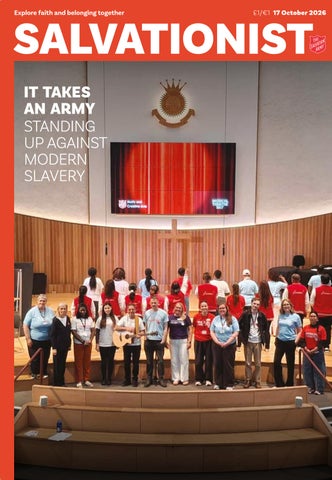
SALVATIONIST IT TAKES AN ARMY STANDING UP AGAINST MODERN SLAVERY
Your part AN estimated 122,000 people are trapped in modern slavery in the UK today. That’s almost the capacity of Wembley Stadium, Manchester Arena and Glasgow’s OVO Hydro arena. Combined. A problem that big can seem impossible to solve, but it’s been part of The Salvation Army’s mission for 161 years. Because any individual – made in God’s image and loved by God – being exploited is so heartbreaking and wrong that it cannot continue. On Anti-Slavery Day (18 October), we’re reminded that it takes an Army to combat modern slavery. Because any individual – made in God’s image and loved by God – playing a unique part in something much bigger isn’t just a slogan; it’s the biblical image of the body of Christ. ‘What can I say to cheer a world of sorrow?’ Miriam Richards once asked (songbook 944). This issue of Salvationist invites you to ask God exactly that. You might be called to mentor someone, volunteer, provide transport, donate items to a safe house or raise money for the Survivors Support Fund. We can all learn the signs to spot modern slavery. We can all pray for survivors, and for perpetrators’ hearts to be changed. Whatever you do, you’re part of an Army. As Miriam wrote, ‘just where he needs me, my Lord has placed me’.
IVAN RADFORD Editor
EXPLORE MORE ONLINE
Visit salvationist.org.uk/ recommended-content Learn to spot the signs of modern slavery
12 COUNTY LINES TRAINING
13 ANTI-TRAFFICKING IN UGANDA
14 GET SET! CONFERENCE
8–11
SUPPORTING SURVIVORS
SALVATIONIST Issue No 2085
EDITOR Ivan Radford
FOUNDERS Catherine and William Booth
ASSISTANT EDITOR Stevie Hope
INTERNATIONAL LEADERS General Lyndon Buckingham and Commissioner Bronwyn Buckingham
EDITORIAL ASSISTANTS Major Margaret Bovey, Major Lynne Shaw, George Tanton, Lyn Woods SENIOR DESIGNER Hannah Holden GRAPHIC DESIGNER Louise Phillips PROOFREADER Chris Horne
NEXT WEEK’S ISSUE Explore faith and belonging together
£1/€1 17 October 2026
SALVATIONIST
Serving others without discrimination Reducing stigma
CONTACT US 020 7367 4890 salvationist@salvationarmy.org.uk ADVERTISING advertising@salvationarmy.org.uk SUBSCRIPTIONS AND DISTRIBUTION – SP&S 01933 445445 / subscriptions@satcol.org Salvationist Publishing and Supplies (Periodicals), 66–78 Denington Road, Wellingborough NN8 2QH
TERRITORIAL LEADERS Commissioners Jenine and Paul Main EDITOR-IN-CHIEF Major Andrew Stone TERRITORIAL HEADQUARTERS 1 Champion Park, London SE5 8FJ 0845 634 0101 © The Salvation Army United Kingdom and Ireland Territory. ISSN 2516-5909. The Salvation Army is a Christian church and registered charity. The charity number in England, Wales and Northern Ireland is 214779, in Scotland is SC009359 and in the Republic of Ireland is CHY6399.
BACK ISSUES Contact SP&S or visit tsa.link/magazine. Published weekly by The Salvation Army and printed on
paper from sustainable sources by CKN Print, Northampton.
SA 17 Oct p01.indd 1
2
07/10/2026 15:40
To subscribe, speak to your corps leader or visit sps-shop.com
Salvationist 17 October 2026
@SalvationistUKI
SCRIPTURE QUOTATIONS From the 2011 New International Version (Anglicised), unless otherwise stated
@SalvationistUKI
Do you know someone who would enjoy reading this? Scan the QR code to share it via WhatsApp!
TRENDING
Will AI wipe out humanity? Ivan Radford considers what questions we should be asking about artificial intelligence
A
RTIFICIAL intelligence has been dominating news headlines, as technology companies have claimed that artificial super-intelligence could wipe out humanity – perhaps in 10 years. Their warnings and calls for regulation of the technology come as autonomous AI ‘agents’ have shown they can find a way round instructions. Will AI kill us all? It’s an eye-catching question that feeds our fears, as well as our penchant for thinking we know what will happen in the future. But it’s also noise that distracts us from more important questions. The harbingers of this AI superiority are experts, but we must remember they have a vested interest in their technology’s success, which is intrinsically tied to profit, investment, competition and the need for resources – both manmade and environmental. Whatever someone says about their own product should be taken with a pinch of context.
Reflect and respond Read The Salvation Army’s AI Guardrails at tsa.link/ai-guardrails. How do our values help you discern the best use of AI for you? If you use AI now, do you need to? If you don’t, where might it help you? Listen to ‘I’m in His Hands’ (songbook 848). Remind yourself that you, and any fears you have about the future, are in God’s hands.
The AI industry broadly falls into two camps – doomers, who think AI will end humanity, and boomers, who think AI will solve all our problems. They both think that artificial super-intelligence is inevitable. Right now, AI is far from that. The AI you typically encounter day-to-day guesses the next most likely word or pixel in its responses based on patterns in data it has been given. This technology is primarily built on the theory that using large language models is the way to create or replicate humanlevel intelligence or greater – although, if you look in Genesis, God didn’t create humankind by starting with a thesaurus. Autonomous AI ‘agents’, which are different, follow instructions – but, if they aren’t correctly given all the context required, they use that same predictive technology to fill the gaps. A wrong guess by an AI agent at one stage can therefore lead to compounded mistakes, including circumventing instructions and leading to news headlines about it ‘going rogue’. Does that sound super-intelligent or like a human error? The experts are right that regulation is important, because poorly configured AI could impact people’s lives. While agency and intelligence are part of companies’ attractive long-term promises behind AI, it’s possible to hide behind these when facing the shortterm effects. The more AI is positioned above us, the more we risk losing our own accountability or agency, rather than holding those who hold money or power to account.
AI is not a saviour. It can predict what comes next in a sentence, but it is not inevitable. The only thing certain in this universe is God. And God calls us not to shrug off accountability, but to live in a way that is shaped by his love. We are all called to ‘act justly and to love mercy and to walk humbly with your God’ (Micah 6:8). We are called to live in hope, not fear (see 1 Peter 1:3). As a tool, AI has real potential to help amplify services, boost efficiency, aid accessibility and positively impact lives – when used intentionally and compassionately, with people in mind. Just as companies can decide when and how to develop or not develop AI, as individuals and a society we have free will to decide when and how to use or not use it, and when and how to hold people or companies to account. Will AI wipe out humanity? The Bible tells us to trust our future to God alone. And, as we live out God’s love in this world, the questions to ask are more immediate and rooted in our own agency and accountability. How is AI being used in your life, workplace or community? How is it impacting critical thinking, creativity or relationships? How is it impacting jobs or employees’ workloads? Is it helping to bring about God’s Kingdom? If not, how can we be a voice for it to be used in that way?
IVAN RADFORD Editor Salvationist
Salvationist 17 October 2026
3
TESTIMONY
‘It’s not always Rajkiran Kuntam what you think’ seconds with...
Weymouth
Major Cheryl Davies reflects on the impact of Anti-Trafficking and Modern Slavery chaplaincy
I Who are you and what do you do? I am Rajkiran and I am a physiotherapist. I am passionate about helping people recover, regain their strength, and improve their quality of life. I believe God has given me the skills and opportunity to serve others through my profession and to show his love through compassion, care and encouragement. How did you first get involved in the Army? My parents were officers. Growing up, the church and its mission were naturally a part of my life. From an early age, I witnessed my parents serving God and caring for others, which shaped my understanding of faith, service and compassion. As I grew older, I began to understand that faith was not simply something I inherited from my parents, but something I needed to make my own. What’s your favourite hymn? ‘As the Deer Pants for the Water’ (songbook 571). What’s your favourite Bible passage? Psalm 23: ‘The Lord is my shepherd; I shall not want...’ (King James Version). What’s your most-used app? YouTube. What advice would you give to your younger self? Not to be afraid of the journey. Trust God, even when you cannot see the way forward. Don’t let suffering or setbacks discourage you. Be patient, keep praying, and remember that every experience is shaping you for God’s purpose. Give your testimony using only one word. Perseverance. 4
Salvationist 17 October 2026
’VE been an officer for nearly 40 years, mostly in corps work, with nine years in the Czech Republic. Three years ago, I became an Anti-Trafficking and Modern Slavery Direct Delivery chaplain for London. I provide support to support workers in offices and to staff and survivors in safe houses, and I help as and when necessary. For example, I’ve supported a dance workshop, a sport and wellbeing day and the Dreams survivors choir. Trafficking and slavery can be really difficult things to process. In offices, staff might want to talk about cases they’re involved in, or to share frustrations when others don’t see the need for urgency. I listen and they feel better for talking. In safe houses, it varies. People don’t always want to talk about what they’ve been through; they’ve done that with their support worker, and they may not want to keep revisiting it. But it can be boring in a safe house – some people are not allowed to work, and volunteering doesn’t work for everyone – so sometimes we’ll go out for coffee, or play games like Jenga or Uno! Just sitting quietly and being available to people is something I found quite hard to get used to, but I’ve grown into it. When I thought I couldn’t, God confirmed that this was clearly where he wanted me. I’ve always had a heart for marginalised people, but I think I’ve developed a lot more patience.
Have you got a testimony to share? We’d love to hear how God is working in your life! Get in touch at salvationist @salvationarmy.org.uk.
Chaplaincy has to change you. When you listen to what people have gone through, it really softens your heart. There are people who were promised a better life. There are people who want to work but aren’t allowed to. Sometimes, they’ve been abused by family members or friends. Some people don’t want to be here – they were brought under false pretences and now can’t go home. The people in our safe houses are just like you and me – they’re people with hopes and dreams, of all different ages, nationalities and religions. It’s not a black-and-white picture. Sometimes you wonder why God allows these things, but all we can do is allow God to use us to make a difference. You might look at yourself and feel inadequate, but then you just draw on the gifts and strength that God gives you each day.
ARTISTS’ CORNER
THE PARALYSED MAN IS HEALED by Kidus (Gateshead)
How was it made? I made this piece with a rather simple method, mostly utilising a fineliner pen to depict the scene, while sparingly using my red alcohol marker to depict Jesus’ robe. I created it during the morning meeting, inspired by the message, so I didn’t use a sketch, I just went straight in and let myself take the risk of error. I think it’s fun to be forced to be that daring with your art, just letting it all flow seamlessly.
What inspired it? I was inspired by the grandeur of the story, which showed a strong degree of compassion between the friends, and a tremendous amount of respect from them all. It honestly makes me desire to do the same and place my faith into supporting my own friends and God. Perhaps God spoke to me through this piece to ask me to hold his promises with value, and to have a strong belief in his abilities!
What does the drawing depict? My piece depicts the story that took place in Mark 2:1–12. The paralysed man was unable to walk, and his friends couldn’t carry him into the home Jesus was preaching in due to the overwhelming number of people around them. So, they decided to break through the ceiling and lower their friend downwards to meet Jesus, who granted him the ability to walk again.
Have you made a piece of art, a drawing, a collage or something else inspired by your faith? We’d love to share it in our Artists’ Corner! No matter how big or how small, get in touch with our team at salvationist@ salvationarmy.org.uk.
Salvationist 17 October 2026
5
BIBLE STUDY
A time to plan Lieutenant Cat Brown encourages us to discern where God is already at work and respond to his invitation NEHEMIAH 2:11–20
E
CCLESIASTES 3:1 reminds us: ‘There is a time for everything, and a season for every activity under the heavens.’ As I write this Bible study, I am in a season of planning as my husband and I get ready to welcome our first child. Preparing for a baby involves so many practical decisions: choosing what is needed, organising our home, making sure everything is ready and fit for purpose. At times, planning can feel like a lack of faith. Should we simply trust God and see what happens? In our study passage, Nehemiah shows us that prayer, trust and planning belong together. His journey begins with prayer, but his response also includes careful observation, thoughtful preparation and intentional action. Trusting God does not mean abandoning wisdom; often, faith calls us to prepare carefully while placing our confidence in him. PAUSE AND REFLECT How do you usually approach the future? With careful planning, spontaneous action or a mixture of both? Do you think planning shows a lack of faith? Why or why not?
Nehemiah arrives in Jerusalem and stays there for three days (see v11). We are not told exactly how he spent that time, but, after a long and demanding journey, it is likely he needed space to rest, recover and prepare. In a world that urges us to keep moving and achieving more, Nehemiah’s pause is striking. He does not rush into the work. He waits, he reflects and he prepares for what lies ahead. When the time comes, Nehemiah sets 6
Salvationist 17 October 2026
out under cover of darkness with only a few trusted companions (see v12). He has not yet told the people why he has come. The priority is to focus on what God has put in his heart – to be sure about his calling. This restraint challenges a culture that often encourages us to announce plans too quickly. Nehemiah understands that the time is not yet right. He observes, assesses and seeks to understand the situation before acting. He does not simply ask: ‘What do I want to do next?’ He looks carefully at what is already happening and discerns what most needs attention. The damage is extensive, and a considerable amount of clearing will need to be done (see vv13 and 14). This would require time, energy and determination. PAUSE AND REFLECT When you face a big task or challenge, do you find yourself rushing in or taking time to pause and prepare? Where might God be inviting you to slow down, observe and listen before taking action? Nehemiah is willing and ready to trust God to empower him for the work ahead and give him the insight he needs – it is God’s voice he needs to hear above all others. Therefore, he does not tell the priests, nobles and officials before he sets out on his night manoeuvres (see v16). In verse 17, Nehemiah plainly names the problem: ‘You see the trouble we are in: Jerusalem lies in ruins, and its gates have been burned with fire.’ He does not minimise the devastation or turn away from it, yet neither does he give in to despair. Nehemiah faces reality with hope because his confidence is rooted in God. This brought to my mind something
Jesus said about a seemingly impossible situation: ‘With man this is impossible, but with God all things are possible’ (Matthew 19:26). PAUSE AND REFLECT What ‘broken walls’ do you see in your community, church or life? Are you willing to face them honestly? Nehemiah does not stop at recognising the problem; he shares a plan and a testimony. First, he invites the people: ‘Come, let us rebuild the wall of Jerusalem’ (v17). He does not say: ‘I have a plan.’ Instead, he says: ‘Come, let us rebuild…’ The work is to be shared. This is something I believe we do well in The Salvation Army as we seek God’s purpose and invite others to take part in his mission together. Second, Nehemiah shares his testimony: ‘I also told them about the gracious hand of my God on me’ (v18). His planning is grounded in what God has already done. Before calling people forward, he looks back and recognises God’s faithfulness. Mission planning is not about building our own kingdoms or protecting our own reputations, it is about discerning where God is already at work and responding to his invitation. PAUSE AND REFLECT Where do you see God already at work? How might he be inviting you to join in? How does remembering God’s faithfulness give you confidence for what lies ahead? Opposition soon comes through ridicule and mockery: ‘They mocked
Explore Nehemiah with us This is part three in a seven-part series, running from 3 October to 21 November. Find more at tsa. link/devotions or see page 2 to order back issues. To read the full, unedited Prayer Matters booklet, visit salvationist.org.uk/discipleship.
Saturday 17 October: Care for Creation We pray that policy makers will bring clarity of policy and direction, enabling food security and ecological balance. We give thanks for all involved in the safe production and passage of food, and pray that all, including farmers and growers, will receive a fair reward for their labour. Lord, we pray we will value and appreciate the sacredness of food, and the graft and commitment involved in bringing it to our table. taken from dioceseofyork.org.uk/praying-for-farming
Sunday 18 October: Sabbath Prayer – Homelessness on Anti-Slavery Day and ridiculed us. “What is this you are doing?” they asked. “Are you rebelling against the king?”’ (v19). Nehemiah does not argue or give up. Instead, he points to God as he claims: ‘The God of Heaven will give us success’ (v20). This reminds us that planning does not shield us from unexpected setbacks, criticisms or challenges – prayer and faith do not exempt us from difficulty. We are called to plan faithfully and trust God wholeheartedly knowing that circumstances may change but the God who calls us remains faithful.
As we pray for those who don’t have a secure place to live this Sabbath Sunday, particularly those who have been trafficked into our local area, what might God be showing us about the hidden needs in our community? taken from tsa.link/homelessness-sunday-resources
Monday 19 October: Sharing the Good News – London Division – Leadership We’re thankful for our leaders and all those who are stepping up and stepping into ministry – they are all amazing! As we consider the leadership resources available to us in the run-up to the officer appointment changes in 2027, we pray for wisdom, discernment and boldness. May God help us see we have everything we need and open our eyes to fresh insight and opportunities. Major Steve White (Divisional Leader)
Tuesday 20 October: Serving and Caring – Chaplaincy Conference (20–22 October)
Where are you being challenged to trust God’s faithfulness more than your own plans?
We give thanks for Salvation Army chaplains all over the territory, working in prisons, healthcare, schools, businesses and so many other places. We pray for those gathering for the conference, that God’s presence will renew their lives and that God’s faithfulness will strengthen them in their calling. Lyndall Bywater (UKI Boiler Room team)
How might God be calling you to persevere despite obstacles you face?
Wednesday 21 October: Justice and Reconciliation – Integrity (Matthew 6:5, 16–18)
PAUSE AND REFLECT
Our study passage shows Nehemiah praying, travelling, waiting, observing, assessing, communicating and acting. At every stage, his confidence remains in God. A faithful plan is not a replacement for trust, but it can be an expression of trust. The challenge for us is to ask where God is inviting us to prepare, to act and to take the next faithful step. PAUSE AND REFLECT How might God be inviting you to plan today? What would it mean to take the first faithful step?
LIEUTENANT CAT BROWN Corps Leader Market Rasen
Jesus repeatedly points to the value of what is unseen. Practices such as prayer and fasting are not performances to impress others, but habits that can shape us from within and help us draw nearer to God. Lord God, nurture in us a faith that’s genuine and deep. May we choose kindness, truth and faithfulness, even when no one is watching. Hayley Still (THQ)
Thursday 22 October: International Salvation Army – United Kingdom and Ireland Territory We give thanks for the people of the worldwide Salvation Army who focus their prayers on the UK and Ireland Territory today. We rejoice in the knowledge they are holding up their arms (see Exodus 17:12–14) as we continue to make Jesus known in the places where God has positioned us. We lean again into the comfort and encouragement that comes from knowing that others have our backs in prayer. Lyndall Bywater (UKI Boiler Room team)
Friday 23 October: Growing in Faith – Ready to Be Courageous Precious Saviour, help us to be courageous. Your word encourages us to take courage, to be prepared to go into this world with the light of your gospel. We want to be ready to go where your Spirit leads us. Major Gary Lacey (Assistant Secretary for Spiritual Life Development) PRAYER REQUESTS Do you have something or someone you’d like us to pray for? Email salvationist@salvationarmy.org.uk with ‘prayer request’ in the subject line.
Salvationist 17 October 2026
7
It takes an Army! Salvationist hears how people are doing their part to combat modern slavery and support survivors
T
HE Salvation Army’s campaign for Anti-Slavery Day (18 October) tells us that it takes an army to combat modern slavery. That isn’t just a slogan; it’s a reminder that the Army’s work to tackle this gross injustice, and to support survivors as they rebuild their lives, is the work of hundreds of people, often out of sight and sometimes in unexpected ways. Since July 2011, the Army has delivered the UK government’s contract to manage support services for adult victims of modern slavery. This work includes financial, legal and medical support, providing a safe place to stay, and access to counselling and educational opportunities when needed. In many of these programmes, the specialist staff members who deliver them are aided by volunteers. Officers in chaplaincy roles also play a vital role in supporting survivors. And many corps across the UK and Ireland Territory play their part too, whether that is educating people to spot the signs of modern slavery, participating in the Way In, Way Out training around County Lines, or raising money to support the Army’s Survivors Support Fund. ‘It really does take an army!’ says someone from the integrated mission team within the Anti-Trafficking and Modern Slavery Department. ‘We are the body of Christ. We all have something we can offer that makes a difference.’ Part of the integrated mission team is BUILD, which sits
Become a volunteer! First responders
Conduct a National Referral Mechanism (NRM) interview with a potential victim of modern slavery or human trafficking over the phone, via video link or face to face. By completing the NRM interview, survivors can access their support entitlements if they receive a positive decision from the Home Office.
Transport
Transport survivors from a place of safety to one of the Army’s contracted safe houses. Journeys require both a driver and a chaperone.
Mentoring
Support survivors to establish goals as well as provide practical guidance and support. Mentors will be trained with tools and techniques to be able to navigate a pathway to ensure the survivor achieves their goals. Email atmsvolunteering@salvationarmy.org.uk to find out more.
outside the formal modern slavery contract, but helps with wellbeing and support, including a mentoring programme. ‘We partner two volunteer mentors with someone who is referred to us by a support worker,’ explains Mentoring Coordinator Clare Buckby. ‘We ask what the mentee wants to achieve and how we can come alongside and support them.’ The mentoring currently takes place across London and the East Midlands, and the team is exploring opportunities in the North East and South West. ‘It tends to take place in spaces such as coffee shops, rather than people’s homes,’ adds Clare. ‘We have also partnered Employment Plus to do some online courses to support people.’ Mentors can come from all walks of life, Clare notes: ‘We’ve got people who have run their own business, people who have taken time out of work to raise a family and now their kids are in school and they want something to do. It’s really quite open to people who have a heart and want to make a difference!’ BUILD also runs workshops, which are often creative but also extend to other activities. They tend to be hosted in a corps hall. ‘If it’s something like football, or something more practical, it can be harder to rent or locate space, but we’re hopefully trying our first sports workshop soon!’ Clare explains. ‘We’re always open to conversations to see how we might work with a corps. If we did a workshop around something like baking, for example, we would look for a corps willing to have us use their facilities.’ Working with a corps also helps build connections, community and trust. ‘We all need community,’ reflects Clare. ‘Sometimes, someone a person loved and trusted played a part in their exploitation story, so part of us supporting them is helping them learn to trust again. There is an element of the Salvation Army brand being trusted, but it’s also just corps doing what they do: loving people and welcoming people into a space where they can come as they are. How can people make a difference in their own corps? ‘I’d encourage people to ask us!’ says Clare. ‘You might be able to volunteer some time to do something creative or supporting people to get out and about in their community. It could be donating essential items for a welcome pack when someone gets to a safe house.’ ‘You don’t need to know where a safe house is to help provide toiletries or other items!’ agrees the integrated mission team member. In Scotland, Major Alison Raybould, anti-trafficking and modern slavery coordinator for Scotland, does a lot of work to raise awareness around modern slavery, including at the Commonwealth Games in Glasgow this year. Corps have also
Raise funds! The Survivors Support Fund provides additional support to survivors of modern slavery. It funds essential items outside the support they are entitled to through the government contract, to meet their needs and to ease their transition to independent living. This might be a deposit or purchasing items for someone to move into their own home, or help accessing training, education or employment. Visit tsa.link/survivors-support-fund or for help with fundraising, email challenge@salvationarmy.org.uk or call 020 7367 4819.
Clothing and community East London
Brass Berries Clowne Thirty-six players took part in an open band practice, some of whom had not set foot in a Salvation Army hall for many years. Ninety-six people attended in total and enjoyed oodles of Strawberry treats. We raised £442 for the Survivors Support Fund. An excellent idea by Bandmaster Dean Coates! Graham Holland
made prayer blankets for survivors of modern slavery. ‘The blankets are beautiful,’ says the integrated mission team member. ‘It makes such a difference for the person who snuggles up in them, and every stitch has been prayed over.’ Combating modern slavery can also simply be praying for survivors, for the Army’s work and for the hearts of human traffickers to be changed. ‘Can you commit to a year of praying?’ asks the integrated mission team member. ‘There are new prayer resources at tsa. link/modern-slavery-prayer – why not read a prayer individually or as a corps every day? Can you commit to a year of discerning what you could do to help?’ ‘At its simplest, integrated mission means working together for the common goal based on our values and our mission as The Salvation Army,’ they continue. ‘We align because we are all followers of Jesus. So if you think “I could do four sessions on frosting a cake”, or you are good at music or gardening, get in touch! Everything God has given us as a gift can potentially be used to help.’
We have a beautiful relationship with a nearby safe house and see our ministry being to both the staff team and the survivors, because it’s not an easy environment to work in. It began during the Covid-19 pandemic when we were one of the only places in the borough that continued to provide practical support. I became aware that we were potentially supporting people who were survivors of modern slavery. One day I received a message asking if we could put together a couple of bags of clothes for a woman, size 12. Not knowing what clothes she would like, I invited her to come to our church to choose. This was the beginning of our Community Resource Hub – a space above our charity shop which gives people the dignity of choosing what they want to wear as well as taking what they need. It is run by a beautiful team of staff and volunteers who make every person they support feel immeasurably valued, and our support has expanded to include many other vulnerable individuals and families who are referred to us. Our support for the safe house now also includes space for training, a party at Christmas and art classes for survivors. These are all steps that help embed them into our community, and build confidence and relationships with others. It is about a genuine welcome and showing genuine love. In the Bible, Jesus consistently reaches out to people who were on the margins. We need to mirror Jesus and show people that they are so important to God and therefore so important to us. We long for them to see that life can be different, that there can be healthy relationships and that they can be at home in church spaces. It’s not simply about rescuing people, it is about long-term recovery. If you’ve got a kettle, some biscuits, adult colouring books and some paintbrushes, you can sit around a table and build relationships! Major Julie Pell
• If you are interested in working with the BUILD team as a volunteer, mentor or as a corps, email build@salvationarmy.org.uk. Salvationist 17 October 2026
9
Musical theatre day London
Art workshop London The art workshop provided a safe, welcoming and creative space for survivors to explore different art techniques, build confidence and connect with others. Five participants took part, referred from partner organisations and supported by four volunteer team members. Participants used sketchbooks, paint, pencils, mixed media and outdoor inspiration, including a visit to the park to draw flowers. The corps provided a supportive environment and ample snacks and refreshments, and the corps leader supported the delivery of each session. The workshop had a positive impact on participants’ wellbeing, confidence and sense of connection. A memorable moment came during the final activity, when participants were asked to draw how they wanted their future selves to look in five years’ time. Participants were invited to continue to attend various projects at the corps, building on the sense of welcome and safety. A follow-up trip to the Tate has also been planned!
Learn to spot the signs! There can be some tell-tale signs of modern slavery. Some signs are physical. A person may look anxious, dishevelled or malnourished. They may have untreated injuries. Some signs are less obvious, for example someone else paying for their travel, someone else speaking on their behalf, or perhaps they are picked up and dropped off from work at unusual times or they may not be sure of their own address. If you suspect someone may be a victim of modern slavery and in need of help, phone the Army’s free 24/7 confidential referral helpline on 0800 808 3733.
This was a partnership with Creative Arts. Steph Lamplough from Territorial Headquarters’ Creative Arts Department came and we performed three songs together. We were all there for the day, we had food and we did a performance in the evening. A few support workers, people from the corps and some volunteers came. There was nervousness at the start, but the beautiful thing was the joy on people’s faces while singing. Some people said ‘I’ve never performed like that to people before’ – it was a real confidence boost! There were also people coming together who had never met, who knew why they were there, but were just chatting about music and things they enjoy. Sometimes, people who have met at the theatre day have then met again at an art workshop – it’s all about community. We’re hoping to do a similar day in the Midlands in the future! Clare Buckby
Knitted with love Snettisham When Rita heard about the needs of survivors of human trafficking, she felt an immediate empathy for those who may have been rescued with very little of their own. Wanting to find a practical way to show them that they are loved and remembered, Rita took the lead in asking members of our Craft Club to make blankets especially for survivors. Her hope is that each person who receives one will know it was made just for them, reminding them that they are seen, valued and loved. Each blanket is accompanied by a prayer asking God to protect and strengthen its recipient, surrounding them with his love. Lieutenant Emily Hague
INTERVIEW
‘I want people to feel seen, heard and valued’
Samantha Babooram talks about running a singing and dance course with The Salvation Army for survivors of human trafficking and modern slavery When did your passion for supporting survivors start?
What kind of songs or music do you use?
I went to a Hillsong conference years ago and I remember being made aware of human trafficking. I just felt physically sick that this was going on. I knew I had to do something. My church at the time had a mentoring programme for survivors, so I started working with them. It was powerful to help someone and see their progress as they learnt their value and their worth. I think when you truly know your worth, that helps you to live in freedom.
I use lots of empowering and uplifting pop songs. One of the songs is ‘Beautiful’ and they cry when they sing that. It’s so powerful. I think music and dance touch your heart in a way that nothing else can. We also focus on wellness in the sessions, helping to reset the nervous system, and using a lot of affirmations – positive statements to help improve their selfesteem, for example repeating ‘I am a good person and I deserve good things’. The first day we did these, one of the members asked to have them printed out. The next week, her support worker said it had made such a difference in her as a person, and I saw that too. My biggest drive in life is to help as many people as I can to feel seen, heard and valued.
How did you become involved with the Army’s anti-trafficking work? I had worked and volunteered with lots of different causes, particularly relating to human trafficking, for a number of years. A housemate of mine went to The Salvation Army and knew someone who worked in the Anti-Trafficking and Modern Slavery Department. They put me in touch with the lovely BUILD team to talk about mentoring. I mentored someone for a couple of months, before they moved on. But I’m a singer and a dancer, so I said I would love to do that with survivors. After a while, they approached me about a dance workshop.
What does the course involve? It’s a seven-week course that I lead one day a week at a corps in London. We have up to 10 people taking part, and we cover hip-hop and commercial dance, and work on vocal skills and sing pop songs. The seventh week is a performance and graduation party, so they have something to work towards. We’re inviting some support workers and a select small audience, and there’ll be food and certificates, as well as a victory walk. I want it to be a celebration of everything they are and all they’ve achieved.
Does that drive partly stem from your own faith? I think so – knowing what God’s done in my life, after I’ve been through a lot of things myself, I’ve been blessed enough to find that sense of worth. It’s a call on my life to help people experience that as well. I’m such a believer that God makes beauty from ashes. Isaiah 61:1–3 say: ‘The Lord has anointed me to … proclaim freedom for the captives … to bestow on them a crown of beauty instead of ashes.’
Is this something you ever expected to be doing? I have a bucket list for my life, and number three was to run a rehabilitation home for survivors of human trafficking and abuse and do performing arts within that. But on paper, it’s something I could never have done myself – I think that’s another testament to God, that he doesn’t call the qualified but he qualifies the called! I’m so blessed and humbled to do this work. It makes my heart
explode with happiness, because I see how far they’ve come in their healing journeys. My dream would be to keep running this course through the year for survivors, or do several courses at once, for them to record songs, put on shows, all of that. I hope it can continue and can help more people.
What can people pray for you? For God’s love to be so present that, when people walk into the workshops, into these spaces, they feel it and know their worth. Every day I pray ‘thank you God for today, please use me to spread your love and kindness and make a difference’. So please pray that God continues to use me, for more opportunities to do this and that lives will be impacted and people will be able to live in the freedom of knowing all they are created to be.
INTERVIEW
Protecting young people Addictions Development Officer Yassir Mohammed tells Lyn Woods about Way In, Way Out, the Army’s County Lines training
T
HE Home Office estimates that about 15,500 children are at risk of or are involved in child criminal exploitation in England and Wales. This is likely to be a significant underestimate. To help raise awareness and protect young people, the Children and Youth Department, Anti-Trafficking and Modern Slavery Department, and local streetbased youth workers developed the Way In, Way Out resource. The Addictions Department collaborate in the project by providing the accompanying training.
people spend their time. Where do they feel safe? Where don’t they feel safe? What concerns them locally? Self and safety – getting them thinking about themselves, their relationships, choices and personal safety. Alert – helping them recognise situations or behaviours that could potentially place them or friends at risk. Way out – what they could do if something doesn’t feel right. Who are the trusted people around them? Where could they go for help?
What is Way In, Way Out?
How can we recognise signs of exploitation or grooming?
It’s a card resource to help youth workers start meaningful conversations with young people around safety, risk and exploitation. Prevention and early intervention are key. The resource gives us a way into conversations that might otherwise be difficult to start, hopefully identifying concerns while they’re still happening rather than waiting until a young person is already deeply involved in exploitation.
How does it work? The resource is primarily aimed at people aged 12 to 17, particularly within streetbased youth work. It’s about building trust and creating opportunities to talk, gradually opening conversations through four areas: Local space – the area where young
What is County Lines? County Lines refers to gangs grooming and manipulating children and vulnerable adults to transport drugs from one area to another, often across police and local authority boundaries. The gangs use dedicated mobile phone ‘lines’ to supply the drugs.
12
Salvationist 17 October 2026
Often, we’re looking for changes from what’s normal for that young person. They might start going missing from home or school, travelling to places they wouldn’t normally go, becoming more secretive or suddenly having money, clothes, phones or other items they can’t really explain. We might see multiple phones, unexplained train journeys, changes in friendship groups, increased drug or alcohol use, unexplained injuries or significant changes in their behaviour or emotional wellbeing. It’s important to remember that one or two signs don’t necessarily mean a young person is being exploited.
Are some young people more at risk? There are circumstances that can increase a young person’s vulnerability, such as poverty, family difficulties, school exclusion, homelessness, previous trauma or abuse, substance use, or simply feeling isolated and lacking a sense of belonging. We must be careful not to create a stereotype of what an exploited young person looks like. It can happen anywhere to any young person. The people doing the grooming can be extremely good at identifying what a young person might need or feel they’re missing. That could be money, status, friendship, protection,
excitement or simply a sense of belonging. That’s why building positive relationships with trusted adults is so important.
What advice can you give? Don’t ignore the feeling or notion that something isn’t quite right, but avoid jumping to conclusions. Be professionally curious. Build the relationship, listen and give them a safe space to talk without judgement. A young person who’s being exploited may not identify themselves as a victim. They might believe these people are their friends, they’re earning money or they’ve made these choices themselves. Increasingly, those relationships can begin online and through social media. If a young person does disclose something concerning, don’t promise confidentiality. Reassure them they’ve done the right thing, and follow the Army’s appropriate reporting channels. Where there’s an immediate risk of harm, that needs to be escalated immediately. Never underestimate the importance of simply being a consistent, trusted adult. The relationship we’re building today might enable them to ask for help later.
How does the training work? We develop people’s understanding of County Lines and exploitation and then introduce the resource. First we need to understand what exploitation looks like, how grooming can happen, and how we can respond appropriately. • The next training sessions take place on Wednesday 11 November and Wednesday 18 November from 7pm to 9pm. Find out more at tsa.link/wayinwayout or email childrenyouth@salvationarmy.org.uk.
LYN WOODS Editorial Assistant Salvationist
Standing up Anti-Human Trafficking Project Community Champions in the Uganda Territory reflect on their work Nafula Teopista Bukokho, Namisindwa District
Wataka Alex Kabukwesi, Namisindwa District
Nafula has been at the forefront of anti-trafficking efforts in the area since January 2024, driven by a simple but powerful motivation: witnessing children and families in her community suffering exploitation with nowhere to turn. What began as seeing the scale of child labour – children as young as seven unable to attend school, families normalising abuse – became a catalyst for action. She started having difficult conversations with parents, advocating for their children’s futures. ‘I saw children suffering, and I knew I had to act… When you see a problem, you have to talk to people about it… At least now those children can go to school, and their mothers can cope better… Sometimes the stress is overwhelming, but we keep going because they need us.’ Since taking on this role, Nafula has worked tirelessly to shift mindsets. She helped one boy access carpentry classes weekly. Children who once could not attend school now do. Families previously resigned to exploitation are seeing alternatives. Her community groups report real improvements. Women are no longer waiting passively; they are earning collectively and gaining agency. This work demands emotional resilience. Survivors often expect immediate material support she cannot always provide. The psychological toll of hearing traumatic stories, combined with resource constraints, tests her daily. She also encountered a trafficking case involving a young girl exploited across borders and had to navigate the anguish of not being able to do more. Nafula has developed deep empathy, creative problem-solving, unwavering resilience, the ability to earn community trust, persistence in the face of systemic barriers, and servant leadership that puts others first.
Wataka has been championing modern slavery and human trafficking response through economic empowerment and community awareness since January 2024. Wataka’s motivation grew organically through exposure. He witnessed another champion delivering anti-trafficking education in his community and realised the depth of need. His manager connected him to the programme, and he saw how savings groups and economic support could genuinely shield families from exploitation. ‘This work isn’t just a job; it’s about serving my community with everything I have… I listened to the teachings and understood people need more than awareness; they need resources to survive... This job affects your whole self, your mind, body, spirit and heart. You can’t leave it at work.’ Wataka helped establish savings groups where community members, particularly young adults aged 18 to 20, contribute weekly. The results are tangible: children now attend school, families have bought livestock, and one woman’s cow has already given birth, providing ongoing sustenance for her household. Beyond economics, he has educated the community that human trafficking is real and happening within Uganda and beyond its borders. Community members are now vigilant. Awareness has shifted from indifference to active protection. The work demands mental, physical, spiritual and emotional commitment. Wataka carries the problems of those he serves, even outside working hours. Gender-based violence persists in pockets of the community, and labour exploitation by wealthier community members continues with workers left unpaid, their hours extended with no recourse. Wataka has developed deep empathy, servant leadership, resilience in the face of systemic barriers, and the ability to see economic empowerment as a genuine trafficking prevention tool. He leads not for recognition, but out of a genuine desire to carry his community’s burdens.
Pray for Nafula
Pray for Wataka
Pray for more skill development for champions, stronger cross-border partnerships, and sustained resources to meet the real needs survivors express after disclosure.
Pray for more intensive training on gender-based violence response, new techniques for parent education, and opportunities to partner other organisations to expand impact. Salvationist 17 October 2026
13
GET SET! CONFERENCE REPORT
Holy ground WILLIAM BOOTH COLLEGE Report by Territorial Youth and Children’s Secretary Captain Jonny Whitmore That makes the welcome we give, the conversations we have and the prayers we offer deeply significant. Steve reminded us that people expect The Salvation Army to pray with them, and research is revealing that just under half of families would appreciate an invitation to attend further church-based activities. That is both a challenge and an encouragement. As relationships grow, we are invited to listen well, to ask gentle questions, to share hope, and to simply say: ‘Can I pray with you about that?’ In doing so, toddler ministry becomes a place where the love of Jesus is tangible, where parents and carers are seen, and where families are supported relationally, practically and spiritually. Get Set! reminded us that ministry with parents, carers and toddlers is holy ground. If we invest in relationships, pray with courage and build communities of welcome, we will discover the Kingdom of God at work. THE Family Ministries Department gathered leaders and volunteers for Get Set!, a day focused on ministry with toddlers, parents and carers. It was a timely reminder that some of our most significant and widely attended missional activity happens on play mats, over cups of tea and through the gentle welcome offered to a tired parent or carer arriving with a small child. Parent and toddler ministry is not a fringe activity. It is one of The Salvation Army’s strongest points of connection with families and, after Sunday worship, its most attended provision across the territory. Inspiring teaching from the Rev Steve Bunting (Kids Matter) challenged us to think again about what families most need from us. While programmes, toys and activities matter, they are not the heart of the work. Toddlers, their parents and carers need people: authentic, trusted relationships that create space for pastoral care, belonging, practical support and faith formation. This connects deeply with The Salvation Army’s calling. We are not simply providing activities for children 14
Salvationist 17 October 2026
to attend; we are helping families flourish through holistic, integrated care. As territorial youth and children’s secretary, I know and see the profound impact parents and carers have on a child’s earliest years, and the positive opportunity toddler ministry gives us to support both children and the adults who love and shape them. For families facing some of life’s biggest challenges, integrated ministry with parents and children matters. Poor attachment, adverse childhood experiences, poor mental health, low resilience, lack of hope and the effects of poverty can all have longterm impact. However, when a church supports primary caregivers with the tools, skills and support they need – through interventions such as the parenting programmes offered by Kids Matter – the impact can shape a child’s flourishing, and the wellbeing of the whole family, for years to come. Salvation Army toddler groups all over the territory are full of families who would not yet describe themselves as part of a church. They offer experiences of belonging, trust, hope and grace.
• For support with running a toddler group, visit tsa.link/getset to download the Get Set! guide or email familyministries@salvationarmy.org.uk.
80%
of parents with children under five attended a church-run activity in a year
55%
of parents explored their own beliefs as a result of attending a church-based toddler group
47% 47%
of non-church-attending of non-church-attending parents parents would would welcome welcome an an invitation invitation to church-based to church-based family family activities activities
Talking Toddlers research (2025)
ARMY UPDATES
OUTREACH CIRENCESTER The hall opened during Heritage Open Week, with an exhibition of the history of the building and The Salvation Army in the town and district. Newspaper reports and photographs, from when the building was erected in 1845, were displayed alongside the original corps drum and band instruments, and further documents and photos revealed the history up to the present day. Corps members explained many of the details, including video displays. – MG
HARVEST HOVE During Harvest celebrations, the balcony had to be opened because there were no more seats downstairs. A powerful time of worship helped people consider what it means to live in the freedom of Christ with the gift of the fruit of the Spirit. After, 60 people stayed to share a chippy lunch together. – LH
MODERN SLAVERY
Army calls to strengthen protection for victims of human trafficking IHQ THE Salvation Army has joined the World Evangelical Alliance in calling for stronger action to ensure that people experiencing human trafficking are identified and able to access protection, support and justice. The Movement co-signed a statement on contemporary forms of slavery and trafficking in persons, which was presented to the 63rd Session of the United Nations Human Rights Council in Geneva. The statement highlighted the gap that can exist between legislation designed to protect people and the ability of those experiencing trafficking to access that protection. Victims of trafficking may encounter churches, charities and other community organisations before they encounter specialist authorities. The statement therefore called for more robust pathways linking recognition and referral at community level with formal identification, protection and access to remedies. – AR
ARMY NEWS
New leaders welcomed THQ COLONEL Janet Robson and Colonel Howard Russell were welcomed by Territorial Leaders Commissioners Jenine and Paul Main into their new roles as territorial secretary for leader development and chief secretary. During family prayers at Territorial Headquarters, Hannah Kingston (Mission Resources) and Territorial Youth and Children’s Secretary Captain Jonny Whitmore gave words of encouragement for Colonel Howard and Colonel Janet. Hannah shared words from her children, who suggested Colonel Howard might need to get up at 5am every day and that he would need to ask for help at times. Hannah also quoted Proverbs 3:5 and 6: ‘Trust in the Lord with all your heart and lean not on your own understanding; in all your ways acknowledge him, and he will make straight your paths’ (English Standard Version). She highlighted the words ‘acknowledge him’, praying that Colonel Howard would recognise God’s presence at all times. Colonel Howard’s first words were ‘thank you’ for the difference the staff at THQ were making in helping God’s Kingdom to come on Earth as it is in Heaven. Captain Jonny thanked Colonel Janet for her heart and wisdom in her service so far, divisionally, territorially and internationally. ‘You have a way of seeing people as God sees them,’ he said. ‘Please bring your wisdom, your humour, your experience and, most importantly, bring yourself.’ He shared Romans 15:13: ‘May the God of hope fill you with all joy and peace as you trust in him, so that you may overflow with hope by the power of the Holy Spirit.’ Colonel Janet said she was excited about what God wants to do and prayed that we would be obedient to God in this new season. Commissioner Jenine charged the new leaders to remember their roles are ‘not possessions, but sacred trusts, not platforms, but places of service’. Commissioner Paul continued: ‘Remain accountable to God, to your leaders, and to the people you serve. Remember that you cannot fulfil these appointments in your own strength, but only through the power and the grace of God.’ Commissioner Jenine called Colonel Howard to ‘help ensure our structures serve the mission, rather than distract from it’. Commissioner Paul called Colonel Janet to ‘champion a culture in which leadership is understood not as status, but as discipleship, stewardship and equipping others’ fruition’. ‘Help us to be a Salvation Army that is simpler in its ways of working, humbler in its posture and bolder in its goodness, an Army rooted in holiness,’ added Commissioner Jenine. The congregation prayerfully sang ‘The Blessing’ over Colonel Janet and Colonel Howard as they prepared to undertake their new responsibilities. – AR Salvationist 17 October 2026
15
ARMY UPDATES
INTERNATIONAL
International leaders take up new roles IHQ COMMISSIONERS Garth and Patti Niemand have been welcomed into their new roles as Chief of the Staff and World Secretary for Women’s Ministries, with a call to lead with courage, unity and continued dependence on God. Speaking on behalf of the worldwide Army, General Lyndon Buckingham described the commissioners as people of ‘character, integrity and passion for the Lord’, with extensive international experience and a deep commitment to the mission of The Salvation Army. He recognised them as strong champions of the Compass Global Strategic Framework, with its focus on People, Mission and Legacy, while acknowledging the scale of the task ahead. ‘We recognise that we’re asking you to embrace the worldwide Salvation Army and to show an interest and a concern for all of the activities, the people and the resources that are at our disposal to advance the mission entrusted to our care,’ he said. Prayers of dedication reflected on the commissioners’ journey of service from South Africa to Singapore, Papua New Guinea and the United Kingdom, asking that they would continue to experience God’s guidance, strength and wisdom as they take on their new appointments. Commissioner Garth described his appointment as ‘an incredible privilege’ and deeply humbling. Commissioner Patti drew on Joshua 3 in her devotional, reflecting on the Israelites preparing to cross the River Jordan into unfamiliar territory. ‘The answer is not found in having it all mapped out for us,’ she said. ‘It’s in keeping our eyes on the one who leads us.’ – AR
EMERGENCY AID NEPAL More than 84,000 people, including approximately 32,000 children, have been affected by the catastrophic floods and landslides, including more than 1,400 who lost their lives and more than 5,700 still missing. The Salvation Army is supporting impacted communities, providing emergency relief while preparing for a long-term recovery effort. Many survivors have relocated temporarily to Kathmandu. Major Lalsangpuii, Officer in Charge in Nepal, said it is particularly hard for the children, whose schools have been destroyed along with their homes. So far, 170 families have received relief packages and 160 sets of children’s clothing have been distributed. Plans are being developed to support about 300 households with longer-term shelter solutions. Please pray for those who have lost loved ones, homes and livelihoods, and for all those working to support Nepal’s long-term recovery. – AR 16
Salvationist 17 October 2026
HARVEST LEIGH-ON-SEA Harvest weekend commenced with a quiz night attended by 50 participants ready to enjoy a social evening of fun and fellowship. The quiz was won by the team 8 Out of 10 Cats, and participants were invited to donate to the corps community fund to help local families in need. Celebrations continued on Sunday with members bringing gifts of food. Corps leader Captain Andrew Hammond spoke on Living the Harvest Rhythm, the second part in a teaching series Acts of a Healthy Church. – PJ
HARVEST STOCKPORT A fabulous joint celebration between Stockport Heaton Norris and Stockport Citadel recognised God’s wonderful gifts through nature. Worship was led by Youth and Student Outreach Worker Calum Montgomery, with blessings from the singing group and Stockport Citadel Band. After, fellowship and refreshments were shared at Stockport Heaton Norris. Donations were taken to Brindale House for the service users. – SH PENARTH Harvest weekend started with Saturday evening fun and fellowship followed by a shared thought from Captain Huw Dutfield (Stapleford). The theme for Sunday morning was Fruit of Gentleness. Those present were urged to watch what we say as people are always listening whether we are aware of it or not. When asked what our greatest example is, the reply was: ‘Jesus!’ When we are tired and thirsty we act differently to when we are fed and watered. We are all tested differently and we have a God who is always there for us and will pull us through whatever we go through. When we have encountered Jesus, we go and sin no more. Gentleness is dealing with people with broken lives as we go about our daily tasks. – CP
Salvationist wants to hear from you! Email salvationist@salvationarmy.org.uk to tell us about your events, outreach, fundraising, mission and more.
EVENT DUNGENESS Hythe Band accompanied hymns at RNLI Dungeness for the rededication and blessing of the lifeboat. The corps has a long association with the institution going back to at least the 1930s, when nine corps members were part of the Hythe lifeboat crew. A retiring collection after the Sunday morning meeting raised £100 to support the work the charity. – JH
HARVEST CLOWNE The annual Harvest quiz and supper saw 60 participants enjoying jacket potatoes. It was a great outreach opportunity as most of those attending were non-Salvationists. – GH
EVENT SHERINGHAM North Norfolk celebrates the 1940s every year, centred around the steam railway. The area is crammed with visitors and locals in period clothing, driving vintage vehicles and enjoying music of the time. The corps enhanced this year’s celebrations by hosting the Front Row Big Band and the Skylark Singers. A full house greeted the musicians – most of whom had not been in the hall before – and extra seats were brought in for additional guests. The musicians were delighted with the evening, suggesting it be repeated next year. New links were made with people who asked to be kept informed of future special events. – MG
MUSIC CHRISTCHURCH A Saturday afternoon of songs from Gowans and Larsson musicals was presented by the songsters and guests. It began with a euphonium solo of ‘Someone Cares’ from John Starkes (Boscombe). The heart of the worship focused on Jesus through songs such as ‘The Name of Jesus’ and ‘When I Came to Him’, featuring soloists Divisional Envoy Peter Blunden, Susan Dowson and Major Margaret Bailey. Poignant songs included a timbrel mime of ‘The Crucifixion’, ‘I Am the Resurrection’ from the songsters and the solo ‘Love Cannot Fail’ from Gemma Hinchliffe. The benediction was a triumphant rendition of ‘For Thine is the Kingdom’ before Andrew and Helen Main brought the afternoon to a close with their fun-filled ‘Army Cup of Tea’. Fellowship was then enjoyed over tubs of New Forest ice cream! – NB
INTERNATIONAL
Commissioners come full circle USA WESTERN TERRITORY CHIEF of the Staff Commissioner Edward Hill and World Secretary for Women’s Ministries Commissioner Shelley Hill concluded their itinerary of pre-retirement engagements with a return to the USA Western Territory, where their ministry began more than 33 years ago. At the College for Officer Training, the commissioners spent time with cadets reflecting on the opportunities and challenges of international ministry. The visit also took the Hills back to the Los Angeles Red Shield Youth and Community Centre in the Pico-Union neighbourhood, where Commissioner Edward served before entering officer training. During a chapel service at the Army’s Crestmont Campus in Rancho Palos Verdes, California, he said: ‘I wanted to say thank you to this territory that has raised us and trained us and been such an important part of our development.’ The visit began at Pasadena Tabernacle Corps and culminated at Crestmont, in the same chapel where they signed their officers’ covenants. Reflecting on that calling, Commissioner Shelley said: ‘I am so glad that I said yes, many years ago.’ Looking to the future, Commissioner Edward expressed his wish that the territory would continue to be a bright light in a dark world, expressing hope for all. – AR
OUTREACH BELFAST CITADEL A gazebo outside the hall during the Belfast half marathon provided encouragement, water, oranges and literature to runners and the community. – EW TENBY The hall was opened to crowds visiting for the annual Ironman endurance event. Cakes and refreshments were sold and the busy weekend raised £600. Numerous contacts were made and people appreciated a dry space on a rainy Sunday. – SH
EMERGENCY AID FOLKESTONE In response to a fire at the Grand Burstin Hotel, Salvation Army teams supported hundreds of people evacuated from the building, with an emergency response vehicle providing refreshments for firefighters tackling the blaze. – AR Salvationist 17 October 2026
17
ANNOUNCEMENTS
ENGAGEMENTS
ARMY PEOPLE Wedding anniversaries
Emerald (55 years)
CAROL AND NEAL CRESWELL, Bishop’s Stortford, on 30 September
Promoted to Glory
COLOUR SERGEANT CHRIS WHITEBROOK, Peterborough Citadel BANDMASTER NEVILLE MCFARLANE, Sleaford, from his home on 26 August
Bereaved
MAJOR MORAG WHITEBROOK of her husband Colour Sergeant Chris Whitebrook ISOBEL MCFARLANE, Horsham, and Jane Stead of their father Bandmaster Neville McFarlane
Retirements from active service Effective 1 October
COLONEL PETER FORREST out of Blackpool Citadel in 1984 and last appointment Chief Secretary, THQ LIEUT-COLONEL PAUL KINGSCOTT out of Bath Citadel in 1983 and last appointment Secretary for Business Administration, THQ MAJOR JEAN LOXLEY (née Salisbury) out of New Barnet in 1983 and last appointment Senior Projects Officer (Leader Development Planning), WBC, and Counsellor, Personnel Service, THQ MAJOR DAVID MURRAY out of Birmingham Citadel in 1994 and last appointment Reading Central MAJOR CATHERINE ROE out of Clapton Congress Hall in 1983 and last appointment Downham Market
ICO delegates The 267th session began on 14 October MAJOR RICARDO BENGUI, Angola CAPTAIN NKOMI MATONDO, Angola MAJOR FILOMENA MIGUEL, Angola MAJOR JEAN KHOWOLA, Malawi CAPTAIN JOANA CHIDAONDA, Mozambique CAPTAIN SOGIA MAPACARE, Mozambique CAPTAIN FRANCISCO NOVELA, Mozambique CAPTAIN AIDA SIMANGO, Mozambique
MAJOR VANESSA BISSO, Brazil CAPTAIN JOSIANE MARTINEZ, Brazil CAPTAIN ALESSANDRO MARTINS, Brazil MAJOR ALESSANDRA NUNES, Brazil CAPTAIN ANTONIO OLVEIRA, Brazil MAJOR PAULO RODRIGUES, Brazil CAPTAIN KIMBERLY (KIM) CHAN, Canada and Bermuda MAJOR CARSON DECKER, Canada and Bermuda
MAJOR DANIEL ALVERIO, USA Eastern MAJOR KIMBERLY SMITH, USA Eastern CAPTAIN KAISU LEINO, Finland and Estonia CAPTAIN CHRISTIAAN VAN NIEUWENHUIJZEN, The Netherlands, Czech Republic and Slovakia LIEUT-COLONEL ANNE-GRETHE AMLAND, Norway, Iceland and the Færoes MAJOR FILIPE GONÇALVES, Spain and Portugal MAJOR VIJAYA LAKSHMI, India Central MAJOR LATHLAMUANA HAUZEL, India Eastern MAJOR SHEETAL RANI KEWAL, India Northern MAJOR SUBBIAH CHANDRA KASON, India South Eastern CAPTAIN SEEMON VELAYUTHAM, India South Eastern MAJOR JOEL CLIFFORD, Australia MAJOR BINDY LUPIS, Australia CAPTAIN MATTHEW SUTCLIFFE, Australia
Territorial Leaders Commissioners Jenine and Paul Main
Sat 24 Oct – Sun 25 Oct Southend Citadel Wed 28 Oct – Thu 29 Oct South West Division
Territorial Secretary for Leader Development Colonel Janet Robson
Sat 24 Oct THQ (Children and Youth Hackathon)
NOTICES Update your corps webpage for Christmas
A series of free webinars in October and November hosted by the Digital team will guide you step-by-step through how to update your corps webpage ready for Christmas, add Christmas Present Appeal information and promote services, events and activities online. Find out more at tsa.link/ digitaltraining.
Christmas fundraising
Ideas and tips for fundraising at Christmas are available at tsa.link/christmasresources. Resources include how to set up your JustGiving page, ideas for community activities and examples of the impact that people’s donations can have, a carolling guide, an Amazon Wishlist to support with gifts in kind, and support on collecting card donations and much more.
Covenant Sunday 2027
Covenant Sunday will unpack what it means to live a life fully committed to God. Resources including the covenant card, sermon outline and other material will be available in November. Please email resources@salvationarmy.org.uk by 23 October to update any delivery information or the number of cards you wish to receive. For more information, visit tsa.link/covenantsunday.
CAPTAIN IL-HAE JUNG, Korea CAPTAIN SARAH HEALEY, New Zealand, Fiji, Tonga and Samoa CAPTAIN EKALI YALIP, Papua New Guinea and Solomon Islands Translators MAJOR PHILIPPA CHAGAS, Americas and Caribbean MAJOR AMARO PEREIRA, UK and Ireland
MAJOR KUMBIRAY KAZEMBE, Zimbabwe and Botswana
MAJOR SUSAN PEREIRA, UK and Ireland
Salvationist Salvationist 2617 September October 2026 2026
Sat 17 Oct – Wed 28 Oct India Eastern Territory and Nepal
MAJOR ANDREA VIURRA PALACIOS, South America East
MAJOR KACHANA NSHAMBA, Zambia
18 18
General Lyndon Buckingham and World President of Women’s Ministries Commissioner Bronwyn Buckingham
SOUNDS Sunday Worship
Join Salvationists across the territory in worship, with music, prayer and a Bible message from a guest speaker. This week, ATMS Direct Delivery Chaplain Major Cheryl Davies speaks on Anti-Slavery Day (18 October). Catch up with the weekly podcast of highlights. Each week’s broadcast is repeated in full on Sundays at 6pm, Mondays at 12am and Thursdays at 9am. • Listen online at salvationist.org.uk/radio.
NEW COMMITMENTS
MAIDSTONE
LEIGH-ON-SEA KELLY Griffiths was welcomed as an adherent by LieutColonel George Pilkington. Kelly’s initial contact with the corps was through the pre-school. Lieut-Colonel George also previously dedicated Kelly’s two children, Gabriel and Robyn. Kelly and Lieut-Colonel George are pictured with Adherents Secretary Thelma Beacham. – PJ
JOHN Webb, Gladys Goldie, Harvey Tooth and Alan Hemings were welcomed as adherents by corps leader Lieutenant David Perkins. Alan chose ‘The Lord Is My Shepherd’ as his testimony, which everyone sang as the adherents signed their certificates. Alan has since shared that he truly feels part of our wonderful church family. Harvey was not sure what to expect, or even if he would stay, when he walked through the door a few months ago, but the welcome he received was something he never could have imagined. He has always admired the Army and its work and now wants to give something back. He has offered to provide free transport for hospital appointments or visits. He thanked everyone for their love and kindness. When Gladys came to this country, her mother told her to be insured in Christ and to go to a church. This she did wherever she went. One was a community church that was also used by the Army, which she liked, but after that she could never find a Salvation Army nearby. Then she met John and, on their second Sunday together, he brought her in through the door of this church – she was so pleased it was the Army: ‘Praise God because he wanted me to come here and I am here with you and I will continue being with you.’ John was born in Maidstone and used to go to another church, which felt cold to him. Coming to the Army, he felt welcomed into a family whose warmth, comfort and energy flow into him every time. With Gladys and his church family he has started a new chapter in his life. We give thanks for them and pray God’s blessing upon them. Holding the flag is John Boyd. – GP
BOSCOMBE MARTHA was enrolled as a junior soldier by corps leaders Majors Andrea and Mark Sawyer. The meeting was all about what it means to be a child of God, whatever our age, and it was a special moment when Martha sang the solo ‘A Simple Prayer’. Martha has already brought a friend to the Army who is set to become a junior soldier too, which is wonderful. Keep shining, Martha! – MS
BOSCOMBE
HARPENDEN TRACEY Rigby was welcomed as an adherent by corps officer Major Annette Guest. Tracey began attending the meetings through an invitation from her friend, Alison, who is a soldier at our corps. Tracey is a welcome addition to the warmth and fellowship of our corps. We are delighted she felt ready to take the next step in her faith journey. – AG
DURING our Children’s Party Celebration Sunday, Hallie, Leo and Mabel were enrolled as junior soldiers by corps leaders Majors Andrea and Mark Sawyer. During the party we were all reminded that Jesus invites everyone to experience and share in his love, and after the song ‘Who You Say I Am’, Halle, Leo and Mabel made their promises to God and prayed with their prayer partners at the mercy seat, our special place of prayer. As they became junior soldiers the congregation clapped and cheered in true party style. God bless Hallie, Leo and Mabel! – MS Salvationist 17 October 2026
19
SALVATIONIST
Be inspired. Be encouraged. Be part of our faith community.
Follow us on Instagram @SalvationistUKI
Follow us on Facebook @SalvationistUKI