The Salvation Army International Trust and The Salvation Army Retired Officers’ Allowance Scheme are charities registered in England and Wales with respective numbers 1000566 and 1153681. Their sole trustee is The Salvation Army International Trustee Company, a company limited by guarantee and registered in England and Wales (no. 02538134) at 101 Queen Victoria Street, London EC4V 4EH.
From the Editor Major Lynn Gibbs
As I welcome you once again to The Officer, I do so with a deep sense of gratitude and reflection. This edition marks the conclusion of my appointment as Editor, as my husband Raelton and I prepare to enter retirement from active service on 1 August 2026. After 42 years as officers –commissioned as Servants of God – we step into this new chapter with thankful hearts.
May I commend to you the new Editor, Major Amy Reardon. She brings a wealth of editorial experience from the USA Western Territory and USA National Headquarters, alongside corps and divisional leadership within USA Western. Her gifts, insights and commitment to mission will be a blessing as she serves in this new role.
In this, my final edition, we continue exploring the ‘12 Calls’ affirmed by the International Spiritual Life Commission which shape our identity, our mission and our spiritual formation. As the General reminds us, they are ‘our calls to mission and our spiritual life development –both as individuals and as an Army’. These Calls remain as relevant today as when they were first written, perhaps even more so as we navigate the complexities of ministry in a rapidly changing world.
Captain Callum McKenna offers the third instalment of our Bible study series, inviting us to reflect on our approach to worship and to consider what God truly requires of us. His questions challenge us to examine our posture before God and to rediscover the heart of worship as an offering of obedience, humility and love.
This issue highlights another four of the Calls, each explored by an officer from around our global movement, which are thoughtful and deeply rooted in our shared calling: Call to Soldiership; Call to the Inner Life; Call to Our Life Together; Call to Our Life in the World I encourage you to read them, allowing the Holy Spirit to speak afresh into your ministry. We also celebrate God’s enduring presence as we mark 140 years of ministry in Germany and 55 years in both Spain and Portugal. These stories remind us that God continues to raise up people and places for his purposes.
Serving as Editor of The Officer has been a privilege and a joy. Throughout my years of active service, my appointments have taken me through corps ministry, social services, divisional and territorial headquarters, including editorial roles both at International Headquarters and also overseas, while based in the then Singapore, Malaysia and Myanmar Territory. Some appointments were challenging to understand at the time, yet God knew the journey we had accepted. Each experience became preparation for what lay ahead, shaping us in ways we could not have anticipated.
People often say that, as you grow older, you tend to look back more than you look forward. I have found that reflection, when done with purpose, becomes a source of learning, gratitude and renewed vision. We have walked a varied path and God has been faithful at every turn. As we step into this new season, we do so with a desire to embrace fresh goals and interests –choosing not to live in the rear-view mirror, but to remain attentive to the new things God may yet invite us into.
I am not someone who naturally embraces change. Why then choose the path of officership? I did not choose it – God chose me. And I am grateful for the lessons learnt, the people who prayed faithfully for us and the sustaining grace that has carried us through every appointment. When we each signed our Officer’s Covenant on Tuesday 22 May 1984, at the mercy seat in the Assembly Hall at the training college in London, we could not have imagined the journey ahead. The people we have met, the opportunities shared and even the challenges faced have all been guided by the presence of the Holy Spirit.
To the team who have supported me in this appointment, and to all who have written, contributed and shared resources for the magazine and The Officer SharePoint site – thank you. Your partnership has enriched this ministry and strengthened our shared mission.
To my fellow officers: remain open to the guidance and direction of God in your lives. Even when the path is unclear, stay obedient to his call. He knows the way you take, and he will journey with you.
To live and love like Jesus – as officers, this must be our deep desire. A hope, an aim, a creed – a commitment to Christlikeness. Scripture reminds us of this over and over: to pray continually, to guard your heart and seek first his Kingdom, and in all your ways acknowledge him. And God promises that when we do our part – when we make that choice – he will act: ‘You will seek me and find me when you seek me with all your heart’ (Jeremiah 29:13); ‘…being confident of this, that he who began a good work in you will carry it on to completion until the day of Christ Jesus’ (Philippians 1:6).
Spiritual life development is one of the central tenets that drives Compass. It is the starting point, the foundation of all we are and everything we do. As officers, our lives must be fully given over to the Lord’s will. Our plans, priorities and preferences must be in tune with God’s way. Our souls must be deeply connected with our heavenly Father.
It is our own growing spiritual maturity that enables us in our calling. Spiritual leaders must be spiritual followers. We disciple as we are discipled. We feed as we are being fed. My friends, please look to your own spiritual life. Make it a priority. We are all busy with work, yet there is nothing more important – indeed, there is nothing that will benefit your work more – than spending time with Jesus. If we are called to serve, we are called to pray.
Ours is an army of community. The International Spiritual Life Commission’s Call to Our Life Together is about living in community. The calling to engage in one’s own spiritual life development has its natural continuance in our desire to support and encourage others in their spiritual journey.
General Albert Orsborn wrote a beautiful poem that has become a classic confession of faith:
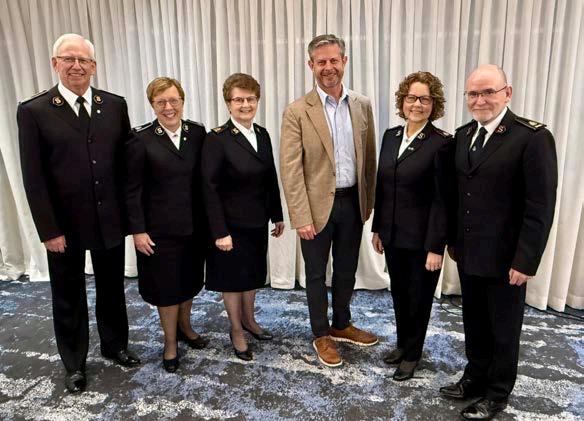
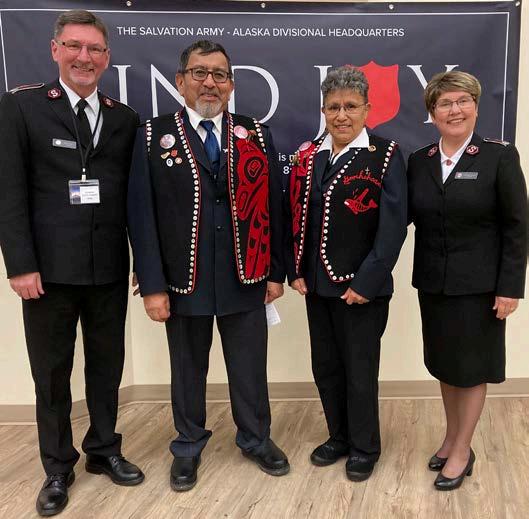
Above left: An historic moment in Toronto, Ontario, as three Generals – General Lyndon Buckingham, General Brian Peddle (Rtd) and General Linda Bond (Rtd) – along with Commissioner Rosalie Peddle (Rtd) and the grandson of General Arnold Brown, Neil Hetherington, share time together
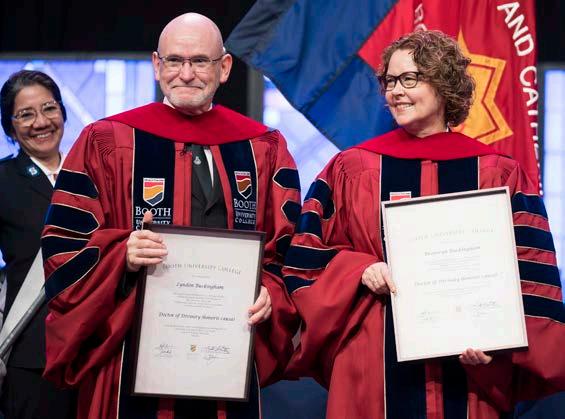
Above: Honorary doctorates of divinity are conferred upon the General and Commissioner Bronwyn Buckingham during Booth University College’s graduation celebrations in Winnipeg, Manitoba
My life must be Christ’s broken bread, My love his outpoured wine, A cup o’erfilled, a table spread Beneath his name and sign, That other souls, refreshed and fed, May share his life through mine.
(SASB 610 v 1)
Corps and other faith communities are the heart and soul of our movement. It is where people find belonging, connection, support, nurture, affirmation and challenge. Ours is a participatory faith – living, growing, worshipping in community. Ecclesiastes 4:12 reminds us, ‘A cord of three strands is not quickly broken.’ Paul said, ‘Therefore encourage one another and build each other up, just as in fact you are doing’ (1 Thessalonians 5:11). God designed us to support one another.
I am reminded of the five friends that Mark introduces us to in chapter two. One was paralysed, so the other four carried him to Jesus. They had faith, which they put into dramatic action – the result of which was their friend received both forgiveness and healing. That’s discipleship, that’s life together and it’s being Christ’s broken bread. It’s also being his outpoured wine and sharing his life through mine.
And we are an Army that is out to change the world! Our call is to be in the world; not of it, but certainly in it. We are citizens of Heaven, but
What does God want?
The act of worship: Romans 12:1-8
CAPTAIN CALLUM McKENNA Mission and Ministry Formation Coordinator and Tutor at William Booth College United Kingdom and Ireland Territory
Captain Callum McKenna is sharing a selection of Bible studies entitled ‘For thy mission make me holy: a series exploring missional spirituality and the spirituality of mission’. In this, the third of four parts, the content includes a number of questions to consider, which we hope will help you when exploring this Bible study in your local context.
In my culture, children write letters to Santa Claus each December, listing the gifts they hope will appear on Christmas morning. One year, aged seven, I decided to simplify matters. Instead of a long list, I asked for just one thing: a bicycle. I even told Santa I was not particular about the details, though if he could arrange for it to be a red one I would be particularly grateful. Christmas morning arrived and my expectations were high. My brother and I hurried into the living room to see what had appeared overnight. There was a formidable pile of presents, but none of them looked remotely bicycle-shaped. As I opened the gifts, I realised I had received many thoughtful and generous presents. I was genuinely grateful. Yet alongside that gratitude sat disappointment. Despite all the wonderful gifts, I had not received the one thing I really wanted.
I sometimes wonder whether our worship can be somewhat like that. We offer God many things in our gatherings: music, preaching, testimony, prayer. These are sincere and heartfelt offerings. But we should still ask: are these the things God most desires? Worship is a familiar word, but familiarity can dull our understanding of it. The English word derives from the Old English weorthscipe – literally ‘worth-ship’. Worship is about offering God what reflects the full scope of true worth. It is about bringing God what he really wants. When we consider the things we commonly bring in worship, we might ask ourselves: are these the things God truly seeks? Could it be that, at times, our worship is sincere and yet still missing the very thing he most desires?
The question of what God really wants lies at the heart of Romans 12. The city of Rome was something of a melting pot for the Roman Empire at large, and the five house-churches that received this letter were likely reflective of this: immigrants, freed slaves, Jewish believers, philosophers, labourers and some high-status Roman citizens.1 To this varied community, Paul writes what Martin Luther called ‘the true masterpiece of the New Testament and the very purest Gospel’. 2 After 11 chapters unpacking the significance of Jesus’ life, death and resurrection, chapter 12 turns theology into practice.
2 Luther, Martin, ‘Preface to the Letter of St Paul to the Romans’, Luther’s Works (1522), volume 35, p365
William M. Greathouse describes Romans 12:1 as containing ‘the most important “therefore” in the New Testament’. 3 Paul urges believers to respond to God’s mercy with ‘true and proper worship’. According to these verses, the worship God desires is sacrificial, sanctified and serving.
QUESTIONS: What does the word ‘worship’ usually mean in your context? How does Romans 12:1-8 affirm, expand or challenge that understanding? As an officer, what pressures can lead worship to become routine, rather than an expression of God’s worth?
Sacrifice: Worship that is heartfelt
The Christians in Rome are instructed to ‘offer your bodies as a living sacrifice’ (verse 1). This is something of an oxymoron, because in the ancient world sacrifices weren’t living: they were killed and placed on the altar. Yet Paul explains that because of the once-and-for-all sacrifice of Jesus, what once took place at the temple altar now takes place in the lives of believers. Unlike pagan and Jewish worship, the early Christians had no need for literal sacrifices, temples or priests. However, while Christ’s sacrifice does away with temple offerings, it does not dispense with sacrifice. Instead, Christ’s self-giving life becomes the pattern for Christian living. As Nijay K. Gupta describes it, ‘The bottom line is this: the early Christians took engagement with the divine out of the traditional realm of altar and sacrifice’ and into the ordinary context of their life together.4 The kind of worship God desires is not simply ritual offering.
3 Greathouse, William M., Romans 9–16: A Commentary in the Wesleyan Tradition, 2008, Kansas: Beacon Hill Press
“What does the word ‘worship’ usually mean in your context? How does Romans 12:1-8 affirm, expand or challenge that understanding?”
Ironically, an Old Testament altar may help to illuminate this. In Genesis 22, Abraham leads Isaac up the mountain where his own sacrifice is scheduled to take place. Noticing the altar, Isaac innocently asks his father, ‘The fire and the wood are here…but where is the lamb for the burnt offering?’ (verse 7). In other words: the altar is prepared but the sacrifice is missing. Isaac’s question should challenge us. There may be times in our corps when we have built the altars – the outward mechanisms for worship – but neglected the ensuing personal offering.
Songwriter Matt Redman reflects further on this episode: ‘Sometimes, in our worship meetings, everything seems to be in place and we think we’re set for great worship – a skilled music team or above-average songs or an enthralling preacher. But something is missing: where is the sacrifice? There must be times in our worship meetings when we cease to say, “Please give me more, Lord” and start to say, “It’s time I gave you more”…where we journey from “Here I am, meet me here” to “Here I am, send me”.’5 In Romans 12:1-8, Paul shows us that the kind of worship God really wants is characterised by sacrifice: where our lives become the altar on which love, devotion and reverence to God are expressed.
“Sanctified worship is not merely intellectual or emotional or lip service. It involves our whole personhood: mind, heart, actions.”
John Wesley made this point well when he wrote, ‘“Holy solitaries” is a phrase no more consistent with the gospel than “holy adulterers”. The gospel of Christ knows no religion but social, no holiness but social holiness.’6 It might sometimes seem easier to peruse holiness alone, away from the frustrations and tensions of community life, but according to Paul that is simply not possible. Paul imagines worship emerging from a diverse body of believers learning to live together in Christ. The churches in Rome were culturally mixed and socially diverse. Differences in background, experience and perspective could easily have produced division. Yet Paul insists that holy worship comes from a holy people learning to belong to one another.
QUESTIONS: Why is it important that Paul speaks about ‘bodies’ in the plural rather than the singular? How does worship shape a community, not just individuals? In what ways might God be calling you to deeper holiness within community rather than apart from it?
Service: Worship that looks outwards
QUESTIONS: What do you think Paul means by a ‘living sacrifice’? How is this different from Old Testament sacrifice? Isaac asked, ‘Where is the sacrifice?’ What are some signs that worship can become well-organised, but spiritually costly sacrifice is missing?
Sanctified: Worship that is holy
Paul goes on to describe this living sacrifice as ‘holy and pleasing to God’ (verse 1). Two details matter here. First, Paul speaks of offering our literal ‘bodies’ as being holy and pleasing worship. Sanctified worship is not merely intellectual or emotional or lip service. It involves our whole personhood: mind, heart, actions. Holy worship is embodied. Second, the word ‘bodies’ is in the plural. Indeed, throughout Romans 12 whenever Paul refers to ‘you’ or ‘your’ it is always plural, in reference to the whole Church collectively, not just individuals. The assumption from Paul is that holy worship is one sacrifice, made up of a whole group of people. In cultures that encourage us to think of faith as private and personal, those who are called to holy worship are never called to offer it alone. The kind of worship that God desires is not a solo performance but a symphony, replete with a choir and a band of saints. Sanctified worship arises from a sanctified people.
The formula laid out in Romans 12:1 tells us that worship that is both sacrificial and sanctified equates to ‘true and proper worship’. One of the challenges in understanding this is that English Bibles tend to translate around half a dozen Greek words as ‘worship’. Here, Paul could have used the word proskuneo, which means ‘worship’ in the sense of bowing down in homage. He could have used the word sebomai, which denotes worship as an act of reverence or awe. Instead, he uses latreuo, a word sometimes translated as ‘service’ and a word connected with ministry, priestly work in the temple and serving others.
This reminds us that Christian worship is not confined to gathered meetings, citadels or sanctuaries. In Christ, believers themselves become both temple and priesthood. Worship, therefore, includes lives of service that enable others to encounter the presence of the living God. The kind of worship God really wants happens when Christians gather together in community, but it also continues when we scatter into our ordinary lives and when the praise that has flowed from our lips on a Sunday flows from our lives on a Monday. True worship certainly has a vertical dimension directed towards God, but it
6 Wesley, John, and Wesley, Charles, The Poetic Works, page xxiii, 1870, London: Wesleyan Methodist Conference
also has horizontal implications. Worship changes how we relate to others and how we serve the world. For Salvationists, this connection between worship and service should sound familiar. Our tradition has always resisted separating devotion from mission. Worship that never leaves the meeting hall is incomplete.
QUESTIONS: What does Paul’s use of the word latreuo teach us about the relationship between worship and service? How can Salvation Army ministry guard against separating worship from mission?
Our life together: Practising our faith If the kind of worship God really wants is sacrificial, sanctified and serving, then we must think carefully about what happens when we gather as a Christian community in our corporate times of worship. At the Together 2025 Congress in the United Kingdom and Ireland Territory, General Lyndon Buckingham reminded Salvationists that our gatherings are places where we ‘practise our faith’ on one another. In many corps, each week there will be rehearsals to prepare for participation in Sunday meetings. At the same time, Sunday meetings are also, in a sense, rehearsals for Christian participation in the world. We get to practise, and test out, the implications of our faith on each other, in preparation for our life in the world.
We sing God’s praises in community to strengthen our faith – and each other – so that we might still be humming its sounds and be reminded of its truths when we are apart. We share our testimony with believers to edify them, but also so that we might be better practised at testifying to our neighbours about God’s faithfulness and work in our lives. We give our cartridges to express our gratitude to God for his generosity, but also so that we might learn to be generous at all times and with all things. We listen to God’s Word preached so that we might learn and hear his voice when we need to make ethical
decisions in a noisy world. We respond to the Holy Spirit at the mercy seat so that we might also encounter God’s presence in supermarkets and at hospital beds. We learn how to be in fellowship with our corps family so that we live as agents of reconciliation in the world.
QUESTION: How could the next act of worship you lead prepare people to participate in the world?
If our view of our life together – and by extension our worship – has become about singing some songs to God and listening to a sermon then, lamentably, it has become remarkably impoverished. Romans 12 calls us to a big vision of worship: sacrificial from the heart, sanctified in community and serving outward to the world. As The Message puts it in Romans 12:1: ‘So here’s what I want you to do, God helping you: Take your everyday, ordinary life – your sleeping, eating, going-to-work, and walking-around life – and place it before God as an offering.’
May our prayer today join with that of the Founder’s:
O see us on thy altar lay Our lives, our all, this very day, To crown the offering now we pray, Send the fire!
(SASB 326 v 4)
That’s the kind of worship God really wants.
THE CALLS: 5
Call to Soldiership
The call to radical obedience to Jesus
COMMISSIONER JULIE CAMPBELL
Area Officer, Sydney Wide 2 Divisional Governance
Australia Territory
‘We call Salvationists worldwide to recognise that the swearing-in of soldiers is a public witness to Christ’s command to make disciples and that soldiership demands ongoing radical obedience.’ (introduction to the fifth Call, the ‘Call to Soldiership’, from Called to be God’s People by Commissioner Robert Street, about the International Spiritual Life Commission meetings of 1996 and 1997)
This quote is a challenge and reminder to me and all Salvationists that we are more than members of The Salvation Army. Our enrolment as soldiers is the way we witness and declare our faith in Jesus to make disciples for Jesus and live in ongoing radical obedience to Christ.
I am reminded of the commitment and motivation of the disciples of Jesus following his Ascension and the empowering of the Holy Spirit at Pentecost. Despite their fear and uncertainty, they were all in and wholeheartedly committed to continuing the mission of Jesus. This was a radical step in obedience and faith, regardless of the danger they faced.
The picture of members of the Early Church in Acts 2:42-47 is a model of The Salvation Army corps that I want to be a part of! Passionate soldiers and adherents meeting together for meals, prayer and studying God’s Word. They motivated each other in the power of the Spirit and in the name of Jesus to live for him, to share his love and compassion, and to make disciples. I love the promise that every day the Lord added to their number, the people who were being saved.
Belonging
In 2025, after 20 years of holding divisional and territorial headquarters appointments, I was excited to be appointed as corps officer to lead alongside corps leader Natalie Kistan at Auburn Corps in Sydney, in addition to being an area officer in the Western Suburbs of Sydney.
These two appointments have provided many opportunities for me to witness the transforming power, love and hope of Jesus in the lives of our people, through corps and community centre ministries and the vital work of our officers, soldiers and adherents within our local communities. People are being saved and the Lord is adding to our number!
Auburn is a vibrant multicultural corps, called to be a house of prayer for all nations with a mission to make disciples from all nations. Most days, the corps building is filled with people from across the world, seeking assistance, buying low-cost food from our food market, having lunch or attending a craft group or English conversation classes. On Sundays, individuals from various nations and life experiences travel from many different suburbs to worship the Lord at the place where they see and hear his love declared and experienced, and to meet with others from their homeland. Auburn Corps is a place where people know they belong and love to invite their friends to.
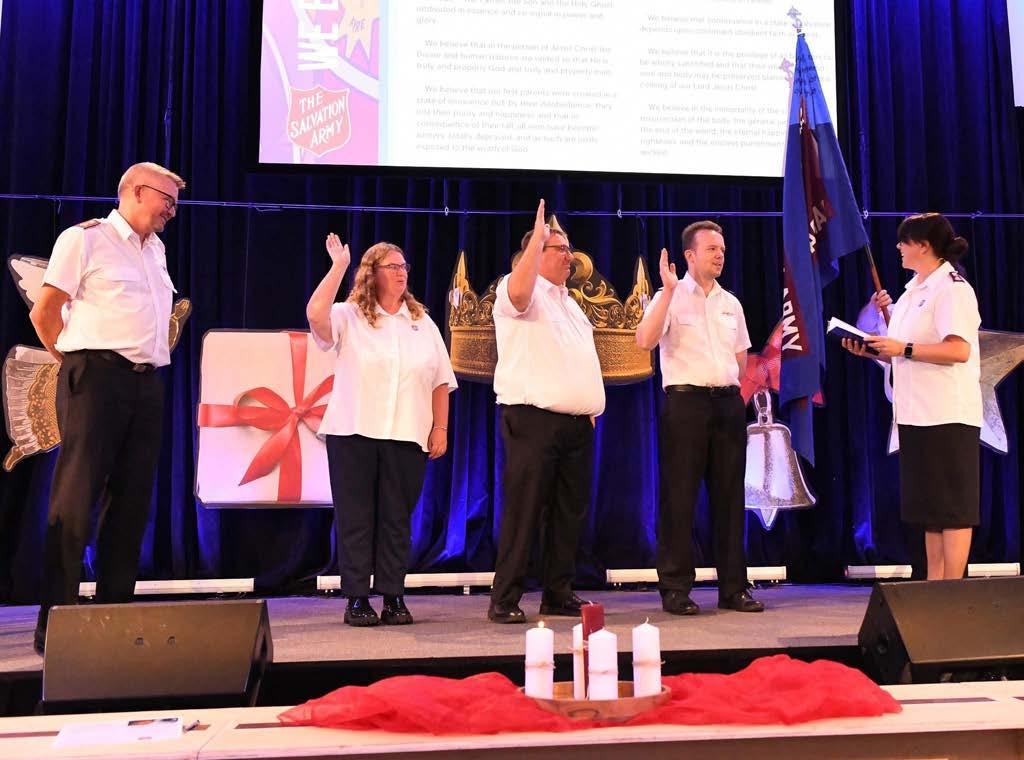
Right: New soldiers in Auburn Corps
‘Exploring Soldiership’
Last year, I was privileged to lead a group through ‘Exploring Soldiership’ (a course produced by the Australia Territory to explore what it means to be a soldier). There was a diverse selection of people, from different cultures, ages and backgrounds.
We met regularly to discuss our history and mission, our doctrines and what we believe, using a recorded series presented by Major Peter Farthing (a retired officer), and worked our way through the Soldier’s Covenant.
I watched in amazement and thankfulness as each person grew in their knowledge, understanding and willingness to sign this Covenant as a symbol of their love and gratitude to God and commitment to live for him in radical obedience. They might have commenced the course wanting to be members, but they discovered the signing of the Covenant was a witness to their relationship with Jesus and their desire to love and serve him as active disciples.
‘The promises of the Articles of War are described as a “sacred covenant”. This shows that Salvation Army soldiership is more than merely being added to the “soldier’s roll” and more than opening the opportunity to be part of Salvation Army activities and service. It is an integral part of our relationship with God and our calling to follow in active discipleship, as we make lifestyle
choices that are consistent with what we believe and the covenant we make’ (Called to be a Soldier, p10).
As the soldiership classes progressed, every person in the group shared their moving and incredible stories of the transforming work of Jesus in their lives and their desire to make the lifestyle choices that demonstrated their belief and love for Jesus. They believed that God had called them to become soldiers of The Salvation Army and enthusiastically saw this as the way to witness to all that God had done for them, to follow the command of Jesus to make disciples and to be radically obedient to him. They all chose to be enrolled in uniform, which they proudly wear as an ongoing public witness of the covenant they have made with God.
When I consider the ongoing commitment and impact of their public witness through the enrolment, the signing of the Covenant, service within the corps and community, and their desire for spiritual growth, I see radical, active and authentic disciples of Jesus.
God continues to use authentic, missional and spiritually active soldiers to assist in growing his Kingdom within The Salvation Army. It starts with you and me as leaders – men and women committed to living like Jesus, growing in our
relationship through prayer and our knowledge of God’s Word, and being passionate about making disciples who lead others to him.
Developing relationships
The leaders and soldiers of Auburn Corps are passionate, authentic, missional and spiritually active, and have had a positive impact and influence which has helped to lead other people to Jesus, including a number of people who became soldiers.
One of our soldiers is a caseworker at the women’s refuge where Geeta was living with her two boys. She invited Geeta to attend the service at Auburn on a Sunday. Geeta was warmly accepted and quickly found friendship, a place to belong, and she discovered how much Jesus loved her and her boys. This motivated her to seek to grow in her understanding and relationship with Jesus, and led her confidently to become a soldier. Geeta saw the joy and love of Jesus initially through a soldier of The Salvation Army and now the joy of the Lord radiates in her life, as she shares this same love with others.
Then there are Jessica and Joseph, who saw the strong and authentic faith of their grandparents
and parents, who had come to Australia to escape conflict and build a new life for their family. This family had always known the love of God and, despite fear and uncertainty, they experienced the faithfulness of God in so many ways.
Soldiers from Auburn Corps had assisted the family with settling into Australia and eventually obtaining visas. Jessica and Joseph are now thirdgeneration soldiers of The Salvation Army, as they witnessed the robust faith and commitment of their grandparents and parents who had become soldiers many years before them. Jessica and Joseph could see that soldiership for their family was more than membership; they acknowledged they were signing a covenant with God, in response to their own deepening relationship and understanding of Jesus, and their desire to live and serve him wholeheartedly as soldiers. They are leaders in our children’s programme and are influencing the next generation for Jesus.
William has also had a very challenging life and made unwise choices that led to a drug addiction. One night, while he was sitting outside a shopping centre, he listened to a man speaking about the love and forgiveness of Jesus, and this resulted in him accepting Jesus as his Lord and Saviour.
“I am so thankful and hopeful because, throughout The Salvation Army internationally, there are many examples of authentic, missional and spiritually active soldiers who live for Jesus and lead others to Jesus.”
A few weeks later, he met a soldier from Auburn Corps who invited him to a Sunday service. He was amazed that people accepted and welcomed him, and he loved attending the service every Sunday to hear more about the love, salvation and hope of Jesus. As he grew in his understanding and saw the radical changes in his choices and lifestyle, he wanted others to know what Jesus could do for them. William likes wearing his uniform, volunteering in the food market, attending Bible study and the weekly online prayer meeting. He enjoys sharing what Jesus has done for him with others.
Soldier’s Covenant
In my role as an area officer, I have also witnessed commitment to the Soldier’s Covenant at Parramatta Corps (where corps officer Major Kylie Collinson and corps leader Jonathan Browning are based). This corps has a busy weekday community programme and many of the soldiers are keenly involved in the various activities. As a result of the friendship and care shown by the soldiers and adherents, many people from the community have started attending the service on a Sunday, as well as our other small groups.
Late last year, 10 people were led through the soldiership course, with three of them enrolled as soldiers and seven as adherents of The Salvation Army. One of the new soldiers, Troy, shared that he had been attending the corps for many years and continued to come every Sunday because people took the time to speak with him
and encouraged him in his faith journey. Troy saw the love of God demonstrated in the lives of authentic, missional and spiritually active soldiers of Parramatta Corps, which motivated him to be actively involved in the mission as a soldier.
During our 40 years as officers, although my husband Mark and I have met a few soldiers who have been passive members of the Army, we have also been privileged to serve alongside many soldiers who have answered the call to live in radical obedience to Christ.
I am so thankful and hopeful because, throughout The Salvation Army internationally, there are many examples of authentic, missional and spiritually active soldiers who live for Jesus and lead others to Jesus.
People are being saved and the Lord is adding to our number.
Left: New soldiers are enrolled at Parramatta Corps
THE CALLS: 6
Call to the Inner Life
The foundation of all Christian living
MAJOR (DR) SALEEM YOUSAF
Territorial
Secretary
for Communication Pakistan Territory
The Call to the Inner Life is a call that God has given to his people from the beginning of time and is a call for us as Christians to cultivate fellowship with him, to nurture a spiritual depth and to live from a place of inward transformation. In our busy and demanding ministry responsibilities, God invites us to join him within a holy, quiet, inner place where his voice can be heard and his presence is able to renew us.
The inner life is the foundation of all Christian living. Without it, ministry becomes mechanical, worship becomes routine and our service becomes unfruitful. But when the inner life is alive, refreshed and filled with the Holy Spirit, everything we do flows with power, grace and fruitfulness. In this article, I would like to share with you eight points, as listed below.
God’s call to the inner life
In Psalm 46:10, God says, ‘Be still, and know that I am God.’ This is not merely an instruction to remain salient, it is a divine invitation to come closer to God, to stop striving, to quieten our anxieties and to rediscover the God who speaks in stillness. The inner life begins with learning to be still. The Salvation Army, although known for its active ministry, also strongly emphasises the depth of personal holiness and inner fellowship with God.
Without an inner walk with God, we have nothing to give. The Salvation Army’s mission may be outward, but its power is inward. Inspired by 1 Thessalonians 5:23, the 10th Salvation Army
doctrine asserts: ‘We believe that it is the privilege of all believers to be wholly sanctified, and that their whole spirit and soul and body may be preserved blameless unto the coming of our Lord Jesus Christ.’
Jesus himself practised this. In the Gospel of Mark, chapter 1 verse 35, we read: ‘Very early in the morning, while it was still dark, Jesus got up, left the house and went off to a solitary place, where he prayed.’ If the Son of God needed solitude with the Father, how much more do we?
The inner life is the source of strength
The apostle Paul writes in Ephesians 3:16: ‘I pray that out of his glorious riches he may strengthen you with power through his Spirit in your inner being.’ Inner strength does not come from leadership positions or years of ministry, degrees, money or personal abilities – it comes from the Holy Spirit who works within us:
• G od strengthens weak hearts
• peace replaces anxiety
• courage replaces fear
• w isdom replaces confusion
• holiness replaces sin.
In Salvation Army teaching, the doctrine of holiness is central: a life wholly sanctified to God, purified by the Spirit and empowered for service. But holiness does not begin with outward change, it begins with our hearts.
“In our busy and demanding ministry responsibilities, God invites us to join him within a holy, quiet, inner place where his voice can be heard and his presence is able to renew us.”
The inner life requires discipline Paul wrote to Timothy and advised him to ‘train yourself to be godly’ (1 Timothy 4:7). The inner life does not grow accidentally. It requires discipline and Salvationists are encouraged to practise:
Daily prayer – Prayer is the breath of the inner life. Without prayer, the soul suffocates. Philippians 4:6-7 teaches that prayer brings peace that guards our hearts and our minds.
Daily Scripture reading – The Word of God nourishes our spirit: ‘Your word is a lamp for my feet, a light on my path’ (Psalm 119:105).
Quietness and solitude – The Holy Spirit often speaks in the silence, and in the quietness we can hear correction, receive guidance and experience renewal: ‘After the earthquake came a fire, but the Lord was not in the fire. And after the fire came a gentle whisper’ (1 Kings 19:12).
Self- examination – The Mother of The Salvation Army, Catherine Booth taught the importance of heart-searching; ‘I have pledged myself to seek until I find the holiness of heart.’ King David prayed in Psalm 139:23: ‘Search me, God and know my heart.’
Obedience – Spiritual growth is impossible without obedience; this discipline helps shape and protect the inner life. As Jesus explained: ‘Anyone who loves me will obey my teaching’ (John 14:23).
The inner life produces outer fruit
Jesus Christ said: ‘A good tree cannot bear bad fruit’ (Matthew 7:18). Fruitfulness in ministry is a result, not an effort. When the inner life is healthy:
• our attitudes change
• our relationships heal
• our service becomes joyful
• our preaching gains power
• our leadership becomes Christlike
• our decisions become wise.
Salvation Army ministry is built on this principle. As General William Booth said, ‘Work as if everything depended upon work and pray as if everything depended on prayer.’ Without the inner life, our work becomes a human effort and not of God. However, when the inner life is alive, the Holy Spirit works through us and our outward ministry becomes effective.
Barriers
to the inner life
Just as God calls us inward, the enemy tries to pull us outward into noise, distraction and spiritual dryness. Some common barriers include:
• busyness – being busy for God is not the same as being close to God
• d istraction – phones, social media and other outward noises steal our quietness
• u nconfessed sin – sin clouds the soul; Psalm 66:18 warns us that sin blocks prayer
• spiritual passivity – a lazy spirit cannot grow
• emotional wounds – bitterness, anger or fear choke our intimacy with God.
To answer the call of the inner life, we must remove these barriers through confession, surrender, forgiveness and fresh dedication.
The inner life and holiness
The Salvation Army teaches us that holiness is at the heart of our Army doctrines. Holiness is not merely moral behaviour; it is Christ living within us. In the Book of Galatians, chapter 2 verse 20, it is written: ‘I have been crucified with Christ and I no longer live, but Christ lives in me.’
Holiness means:
• a heart fully surrendered
• f reedom from the power of sin
• t he indwelling of the Holy Spirit
• love that flows from a purified heart
• a l ife that glorifies God.
The inner life is the place where holiness grows. The Salvation Army teaches that entire sanctification is a deeper cleansing and empowerment of the Spirit that transforms our inner being. This is not optional but essential for a Salvationist life.
The inner life leads to compassionate service
The Salvation Army is a holiness movement with a mission to the world. As quoted earlier in this article, ‘We believe that it is the privilege of all believers to be wholly sanctified, and that their whole spirit and soul and body may be preserved blameless unto the coming of our Lord Jesus Christ’. But we cannot serve the whole world effectively without a deep inner life. As recorded in Matthew’s Gospel: ‘When he saw the crowds, he had compassion on them, because they were harassed and helpless, like sheep without a shepherd’ (9:36). Here, we witness the compassion shown by Jesus. Compassion flows from a heart touched by God. The stronger your inner life, the more the things listed below will happen:
• you will love the unloved
• you will serve the broken
• you will show grace to the difficult
• you will reflect Christ in your community.
The inner life fuels outward service.
“The inner life is the place where holiness grows. The Salvation Army teaches that entire sanctification is a deeper cleansing and empowerment of the Spirit that transforms our inner being. This is not optional but essential for a Salvationist life.”
A call to renew our inner life today God is calling you personally into deeper fellowship with him. Not just to work for him, but to walk with him. We read in the Book of Joel, ‘Return to me with all your heart’ (2:12):
• your ministry begins in your inner life
• your strength comes from your inner life
• your holiness grows in your inner life
• your fruitfulness flows from your inner life.
Conclusion
To summarise, the Call to the Inner Life is:
• a call to stillness
• a call to holiness
• a call to intimacy with God
• a call to spiritual strength
• a call to renewed service
• a call to walk in the power of the Holy Spirit.
As Salvationists, we must cultivate an inner life that fuels a world-changing ministry. The Salvation Army marches forward only when its soldiers kneel before God. May we answer God’s call today and say, Lord, take me deeper into your presence. Renew my inner life, fill me with the Holy Spirit and make me holy, strong and fruitful for your glory. Amen!
THE CALLS: 7
Call to Our Life Together
Getting outside of my comfort zone
MAJOR (DR) RAELTON GIBBS
Under Secretary, Europe Zone International Headquarters
Over the years, I have often considered the question: ‘Why do people come to church and, specifically, to The Salvation Army?’ My conclusion, rightly or wrongly, is that it is all about relationships. Firstly, our relationship with God, but this must be reflected in our relationship with each other. We are called to our life together.
My own spiritual growth did not happen in isolation; it happened in relationship. Throughout my life, I was helped by people to come to know God, and that support, in turn, enhanced my ability to develop relationships with others.
I grew up in a small, inner-city corps in Coventry, England. It was so small that, at one point, my father was the Bandmaster, Songster Leader and Young People’s Band Leader, and my mother was the Singing Company Leader. And yet in that environment, which was made up of people from all walks of life, I began to understand that, despite our differences, we all had a contribution to make and we were in this thing that we called ‘life together’.
I remember so many individuals who, at the time, I probably didn’t take seriously, and yet they shaped me and my faith. I recall an old widower called Arthur, for whom life was clearly very difficult. His uniform was not pristine and yet his hunger for the Word of God radiated from him. I knew that if there was ever a Bible quiz, I needed to be on Arthur’s team.
As teenagers, the young people in the corps were ‘spirited’, and yet a soldier named Jack would
often borrow a minibus from a local company and take us out for the day, whether on a mystery tour or to a football match, all the time taking the opportunity to talk to us about life and faith.
I remember Doug, the Corps Sergeant Major, who would take me fishing in the middle of nowhere –so I could not escape! – and who always took the opportunity to guide me and perhaps point out where I was going wrong.
The Early Church was always relevant. We read in Acts how those who struggled were brought into the fellowship (Acts 2:42-47). I see that the corps I grew up in was relevant to how it served the community, what it taught and how it worshipped. We found God in real life, but most of all I learnt I am not meant to do this alone. As a member of Christ’s Body, this experience showed that we are all bound together; we cannot intentionally follow Christ alone (1 Corinthians 12:12-20).
Today, however, I live in a society which is considered shallow; it is about self and is a place where truth is seen as subjective or relative, and there is a danger that the concept of ‘life together’ could be regarded as superficial. If this is not something we have a real understanding of, we will move on to something else rather than continuing to develop our faith within the concept of the Call of Our Life Together.
Perhaps we do not truly understand what Acts 2:42 says – ‘They devoted themselves to the
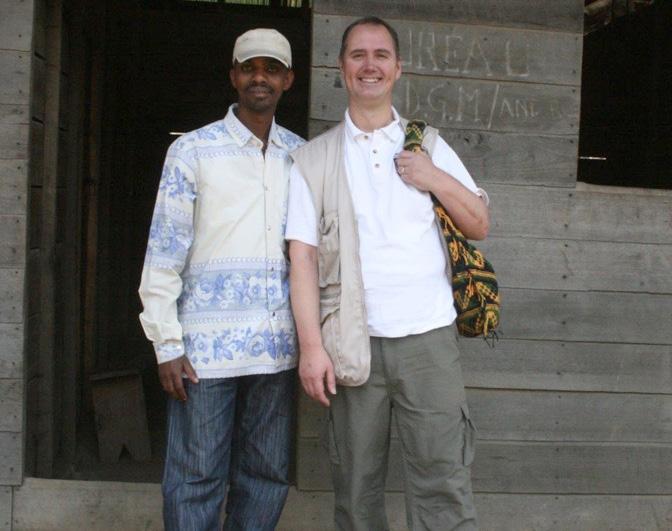
Right: Major Raelton meets the chief of a local village in the Democratic Republic of Congo (DRC), January 2010
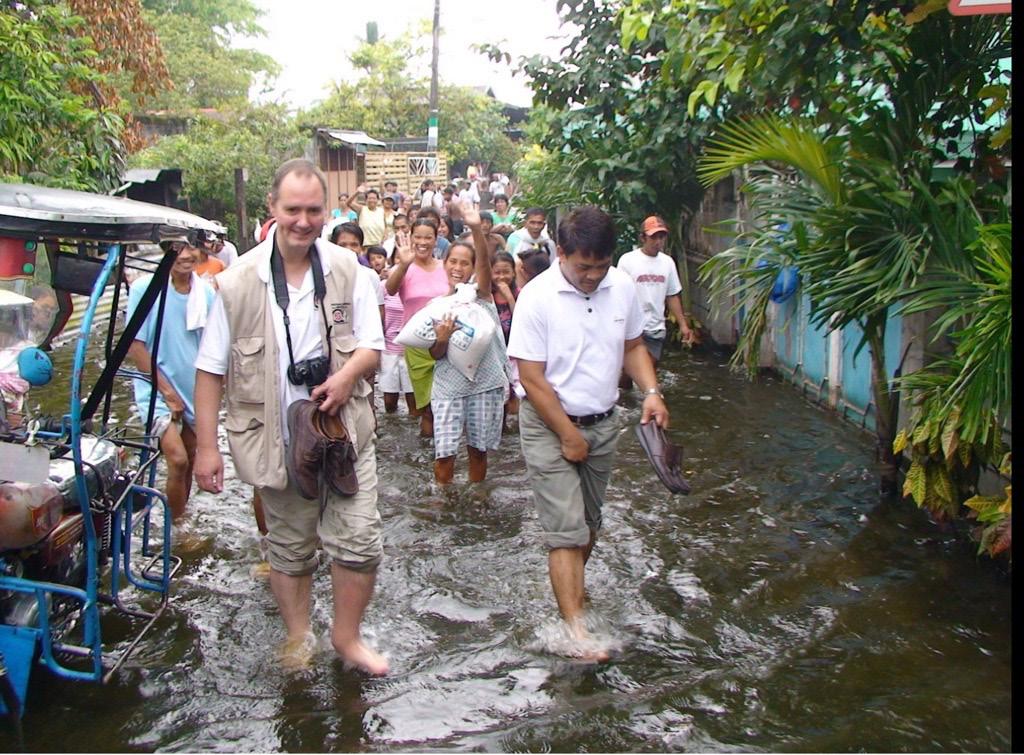
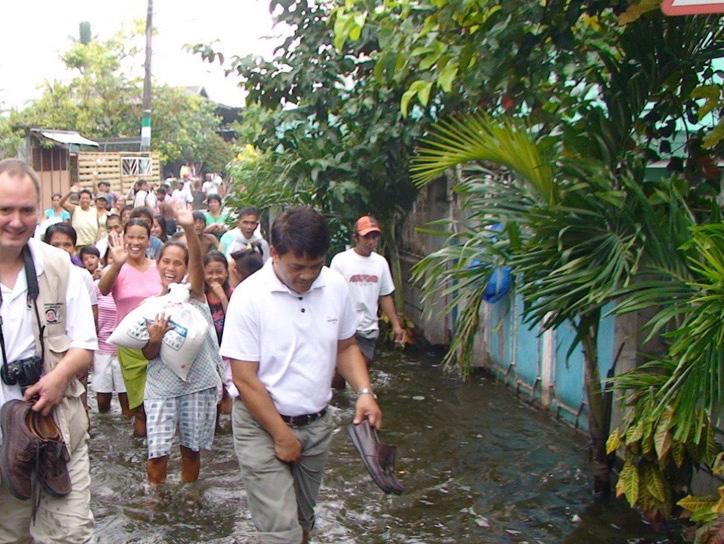
Below: Providing support as part of the International Emergency Services (IES) team following Typhoon Megi in the Philippines, November 2010
“For me, the Call to Our Life Together is about getting outside of my comfort zone. There is a risk of me becoming quite insular and only living life with people who look and think like me...”
apostles’ teaching and to fellowship’ – as other societies in the world do. Life together is not only about programme, but the coming together to get to know Jesus and how we can reflect him. It is about building up and not knocking each other down, which at times happens within the Church. It is about developing a Christian life shaped by the Holy Spirit as written: ‘…the fruit of the Spirit is love, joy, peace, patience, kindness, goodness, faithfulness, gentleness, and self-control’ (Galatians 5:22-23 NET ).
For me, the Call to Our Life Together is about getting outside of my comfort zone. There is a risk of me becoming quite insular and only living life with people who look and think like me, so I must question my faith and what Jesus is calling me to do.
One of my favourite stories in the New Testament concerns the woman at the well, where Jesus took his disciples through Samaria to people and places they did not want to be, and they discovered who their neighbour should be (John 4:7-30). Philip Yancy illustrates it well: ‘Grace gets put to the test when we find ourselves confronted with people who are different from us. Do we welcome them and treat them with respect? I think of the people attracted to Jesus: “heretics” (Samaritans), foreigners (a Roman officer), outcasts (prostitutes, tax collectors, the ritually unclean, those with leprosy). Remarkably, Jesus found a way to treat them with dignity and respect without compromising his beliefs or his character’ (Getting Along, November 2022, https:// philipyancy.com).
This speaks to me that we are comfortable in many ways, but I am not sure this is what God wants of me. Because I do not know or understand those outside of my comfort zone, there is a danger that they can be perceived as a threat, and yet in reality they could become my teachers and mentors in areas where I have no experience. It is easy to live in my secure
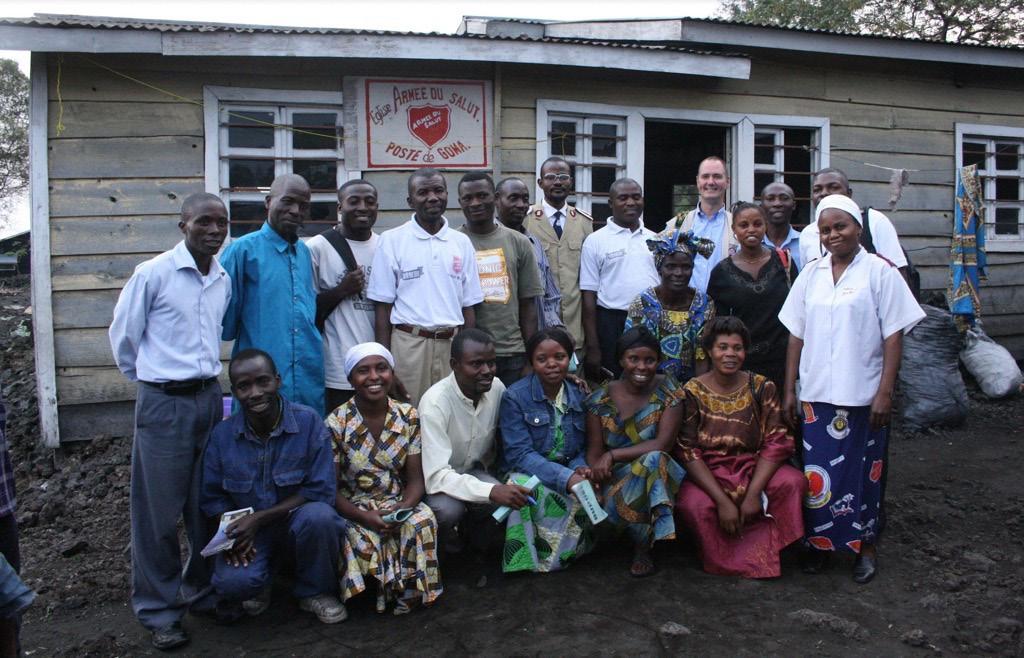
Above: With the team in Goma, DRC, during Major Raelton’s IES appointment, January 2010
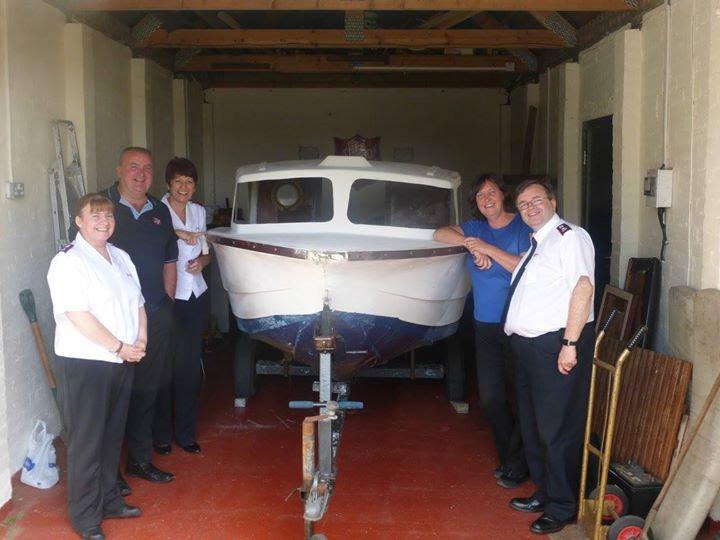
Right: The Easterhouse Corps boat project in Glasgow, February 2018
Below: Meeting with a local political leader in Pakistan following a food distribution, September 2010
little world, and it can be hard to make myself vulnerable and to intentionally cast my net wide enough to begin to understand the full riches of the Kingdom of God.
Sharing moments with others is so important in many areas of our lives. As a football supporter, having the chance to gather alongside people with a mutual interest – experiencing the group dynamics of supporting a team through the highs and lows, the unity, the wearing of colours, the singing of the club’s anthems – is so infectious. But how much more positive are the opportunities to come together in the presence of the Holy Spirit before God? As Salvationists, we unite under the flag and identify ourselves through the wearing of a uniform, expressing to other people who we follow.
The occasions we are given for sharing in fellowship together within The Salvation Army are so important, whether at local corps, music schools, territorial or international congresses, the International College for Officers or the Brengle Institute (holiness teaching). These allow us to add to our sense of belonging. Listening to testimonies has moved and influenced me, as people have recounted what God is doing in their lives. People change when they see change. In recent times, I had the privilege of attending EYE (European Youth Event) 2025 and witnessing the coming together of young people from around the zone to worship, pray and play together. God was present and together we rediscovered the plan and purpose of God revealed in Christ’s prayer for unity: ‘…that they may all be one, just as you, Father, are in me, and I in you…’ (John 17:21 ESV ). We are called to our life together.
With my wife Lynn, our journey as officers has been varied and we have been given the chance to experience the Call to Our Life Together in a range of different appointments. We have served both internationally and in our home territory (United Kingdom and Ireland). Each context has revealed to us the uniqueness and beauty of the international Salvation Army. Whether worshipping in Goma (Democratic Republic of Congo), Bishan Chinese Corps (Singapore) or Banting Eratchippu Corps (Malaysia), or having the privilege of being present in Yangon (Myanmar) for worship in the children’s homes, each is unique, and yet, despite the words being communicated in languages that I have
not understood, there have been elements of universal understanding, beauty and blessing. Currently, while serving as the Under Secretary for Europe at International Headquarters, I work in a microcosm of the international Army, which is a family.
Lynn and I had the privilege of being the divisional leaders in West Scotland and sharing in ministry with Community Corps Mission Manager Tom Mitchell and his wife Pamela, Corps Leader, at the Easterhouse Corps and Community Centre in the Scottish city of Glasgow, within an area that had a poor reputation and a high level of poverty and drug abuse. As part of the programme, they started a ‘boat-building’ project. Although the corps is some way from any water, they bought, rebuilt and renovated a boat in the garage at the back of the hall. This brought together men with various social issues to develop skills while they experienced life together.
Out of this came a community that included worship, Bible study, fishing, walking and singing, which enabled the men to be part of the unique Salvation Army fellowship. From this, they held each other accountable, and the physical work carried out on the boat demonstrated that God was also seen working in the spiritual, with lives being transformed. It was never about the boat, but about a group of people supporting one another while their lives were being radically changed through Jesus. In the words of the psalmist, ‘How good and pleasant it is when God’s people live together in unity!’ (Psalm 133:1). Life together opens up the way to God and to each other.
The Call to Our Life Together is not about Salvationists who are really nice to their friends and those at the corps; it is not even about sharing and supporting each other as we do life together. The genuine Call is to become a movement of Jesus people who have been set free from the restraints of today’s world to pursue radically different agendas through their God-focused life and lifestyles. Now that is something I want to be part of!
THE CALLS: 8
Call to Our Life in the World
Called to radical holiness
United Kingdom and Ireland Territory
‘We call Salvationists worldwide to commit themselves and their gifts to the salvation of the world, and to embrace servanthood, expressing it through the joy of self-giving and the discipline of Christlike living.’1
Boundless salvation
The Salvation Army was raised to bring God’s salvation and transformation to the whole world. This is what the language of John 3:16 means. God loves the world, the kosmos, the whole created order. Not just us as individuals but everything that exists, including our communities, societies, and the systems and structures that create and sustain our life in the world. We recognise that just as individuals need to be saved and redeemed, so do those systems and structures.
For the Army, this means salvation must include everyone and it must involve their life in this world. Salvation is not primarily about getting into Heaven. It is about the transformation of the world into something that expresses and lives out the Kingdom of God. This is made possible through sanctification.
Holiness is the foretaste of the future new creation. Habakkuk 2:14 promises that in the coming Kingdom, the presence of God will fill the world as the waters cover the sea. This is what our holiness now, the indwelling of the Holy Spirit, makes into a present reality in anticipation of that future reality.
1 Street, Robert, Called to be God’s People, 2008, p65, London: Salvation Books
That means salvation must be truly boundless. Jesus came not for the righteous, but for those in need of grace. We see that in Luke 4:16-21, where Jesus explains what his mission was. To bring good news to the poor, freedom to prisoners, sight for the blind and to set the oppressed free.
The Call says: ‘We affirm that commitment to Christ requires the offering of our lives in simplicity, submission and service... This leads to service which is a self-giving for the salvation and healing of a hurting world, as well as a prophetic witness in the face of social injustice.’ 2
Salvation and sanctification is not abstract. It has a direction and purpose. It is liberative. It is restorative. It creates shalom. This is why we can say that God has a preference for the poor. This is the truly radical reality of holiness.
The radical demand of holiness
Genuine holiness is not personal purity and separation from the world, but rather the radical commitment to loving our neighbour. The perfect love of Christ perfects our love as we are indwelt by the Holy Spirit.
Holiness is the result of the perfect love of God perfecting our own finite and fallible love by uniting it, through the Holy Spirit, with Christ’s love for the world. Because of Jesus, holiness is no longer about ritual separation. Instead, holiness is love. This means holiness is directed towards
2 Ibid.
CAPTAIN (DR) CHRISTOPHER BUTTON* Corps Officer, Stroud Corps
“The call to love our neighbour is always worked out in the messiness of concrete life. We love people in their ordinary, everyday complexity. Not people in the abstract, but people you see, the people you walk past and try not to see.”
the other. This is because love requires another to love. But far too often, our holiness has become privatised.
Holiness that remains only in the inner life of the believer is no holiness at all. If being holy means to be like Jesus, then it must mean committing ourselves to loving our neighbour. 3 God is always a nd eternally committed to that which is not God. God is by nature love, and God’s holiness is an expression of God’s love. When God commands us to be holy as God is holy (1 Peter 1:16), we are being commanded to be people whose nature is love. That is why Samuel Logan Brengle was able to say: ‘Do you want to know what Holiness is? It is pure love.’4 Pure and perfected love is always d irected outwards. We are made holy to love our neighbour.
Who is my neighbour?
The Call to Our Life in the World is the Call to become a neighbour. Being a neighbour is not just loving people and being kind. In Luke 10:2537, the lawyer asks Jesus who his neighbour is. This is an act of self-justification. He wants to avoid having to love his neighbour. He wants to justify his behaviour. Jesus cuts away his moral certainty and replaces it with the radical demand to love people who are different and dangerous.
3 Coutts, Frederick, The Doctrine of Holiness, 1955, London: Salvationist Publishing and Supplies
4 Brengle, Samuel L., Helps to Holiness, 1927, p8, London: Salvationist Publishing and Supplies
Holiness is the command to love our neighbour. This is the practical demonstration of Micah 6:8. God has told us what is required of us. To act justly, love mercy and walk humbly. This is what it means to follow Jesus. This is what it means to live our life in the world.
The call to love our neighbour is always worked out in the messiness of concrete life. We love people in their ordinary, everyday complexity. Not people in the abstract, but people you see, the people you walk past and try not to see. It is easy to love people who are the same as you or to love the idea of people. It is much harder to love people in all their complexity and difficulty, and those who challenge our assumptions. This is the foundation for the deeply radical demands of holiness which is the call to solidarity. This is rooted in taking Matthew 25:31-46 seriously.
The Call to Worship says: ‘When we turn to Matthew 25:31-44 we are asked to do more than see Christ in our relationships with other Christians. We are to see Christ in the person who comes knocking at the hall door and interrupts with his need. It might be someone wanting clothes or food or shelter. It might be someone released from prison.’5
When we love and show mercy to the person in need, we are loving and serving Christ. Jesus doesn’t say it will be like we are doing those things to him. He says we are doing those
5 Street, Called to be God’s People, p13
things to him. To love our neighbour is to love Christ. The Call to Our Life in the World means we must ask ‘Who is our neighbour today?’. For the German theologian Dietrich Bonhoeffer, this question could be framed in a different way. It meant asking who Christ is for us today. We find Christ in the world, in the suffering, in the poor and in the oppressed. Christ is present with them, and when we lovingly serve them, we meet Christ. To find Christ in the world, we need to first find our neighbour.
Understanding who our neighbour is requires discernment. Not everyone is our neighbour. It is the person in need of mercy. Discerning who our neighbour is means asking who are the poor, the suffering, the broken, the oppressed and the abused, and then loving them. And loving them looks like justice, mercy and solidarity, which is practical holiness.
Holiness, justice and solidarity
The Call to Our Life in the World is the call to holiness, which is the call to love our neighbour, which is the call to solidarity. Not solidarity as empathy or performative identification, but genuine solidarity that disrupts our life and which demands aligning ourselves in such a way that our own life is changed.
We need the stranger and the other if we are to properly know Christ. The other person is a barrier to me. I encounter them as someone beyond me, who confronts me with a reality of Jesus that I would not be able to know without them.
Their otherness makes a demand on my attention which prevents holiness from collapsing into self-interested piety. We encounter people who challenge every assumption we hold of what it means to be Christlike. It is easy to love people we agree with. The discipline comes with committing to love the people we struggle with.
The biblical prophets did not separate holiness from justice. The violation of justice is the violation of holiness. In Isaiah 58, we are told that the religious fast that is not holy is the fast that ignores the hungry and the oppressed. God rejects our religious behaviour when it doesn’t lead to justice. This is picked up in Amos 5:21-24, where God despises religious worship that is not accompanied by justice.
“God desires all people to be saved. But while there are people being abused ...oppressed by unjust systems and structures of coercive power, then our first call is to the ones who are suffering, not the ones inflicting that suffering.”
For St Augustine, love and justice go together because love means desiring the best for the one who is loved.6 Love in public, and especially in corporate life, looks like seeking justice. It is a cruciform love, devoid of glory, which reveals that God suffers and bleeds with us. In practice, this means us as individuals and as a church standing in solidarity with the people who Christ identifies with. God is on the side of, and present with, the poor and oppressed. When we stand with the poor, and when we are in solidarity with them, we share in that blessing.
Saying that God has a preferential option for the poor is not a statement about who deserves God’s grace. It is a statement about where God’s transforming presence is most urgently at work. For what other reason than this was The Salvation Army called into being? Why else do we exist than to demonstrate God’s preference for the people who are most in need?
G od desires all people to be saved. But while there are people being abused, living on the streets, imprisoned by drugs and alcohol, oppressed by unjust systems and structures of coercive power, then our first call is to the ones who are suffering, not the ones inflicting that suffering.
The Call to Our Life in the World is the call to holy solidarity. Not only for the Army, but for each one of us as individual disciples of Jesus. Let us remember the warning of Isaiah and Amos, that unless we are seeking justice our worship will not be accepted.
*Captain (Dr) Christopher Button holds a PhD in Divinity from the University of Aberdeen.
6 St Augustine, De Doctrina Christiana (On Christian Doctrine), 1.27
OUR STORY
A privilege and a sacred calling
Our lives have been enriched
COMMISSIONERS EDDIE AND GENEVERA VINCENT
International Secretaries, Americas and Caribbean Zone International Headquarters
When we stood on the platform at our ordination and commissioning meeting on Saturday 21 June 1986 in the Canada and Bermuda Territory, as members of the Proclaimers of the Gospel Session, waiting with bated breath for the announcement of our first appointments, we could never have imagined then where our officership journey would take us. While most of our appointments surprised us and many of them scared us, we embraced each one with the assurance that we were living in the will of God and that he would go before us in all things and supply what we lacked. Through more than 40 years of ministry, we testify that God has been faithful, his grace is always amazing and his presence has been with us, guiding our every step!
We are both fourth-generation Salvationists; Genevera sensing a call to officership as a child and Eddie in his teenage years. Stepping into life as an officer was not a difficult decision for either of us. It was, in fact, an act of obedience to a God who was speaking very clearly to us both. We entered the college for officer training in 1984 as single cadets and got married on 3 July 1987, one year after our commissioning.
When we said our ‘Yes’ to God, we expected it would lead us from one corps appointment to the next, not thinking of doing anything different. Our 19 years as corps officers were filled with joys and challenges, highs and lows, great fulfilment and moments of discouragement. While there were some experiences as corps officers that we would not want to do again, we are grateful for
the learnings along the way. We are humbled by those who invited us into their lives, whether during joyful or difficult seasons. We viewed our journey of pastoral care to our people as both a privilege and a sacred responsibility. We know we didn’t always get it right as corps officers, but we discovered that if our people felt loved and cared for, they were most forgiving of our mistakes. We learnt, as we were once told, that ‘people don’t care how much you know until they know how much you care’. Those times as corps officers will always stand as a most rewarding period of our officership journey, for which we are grateful.
Nestled between our years as corps officers were two appointments as divisional youth secretaries, totalling seven years. These too were stretching and rewarding times for us. Journeying with youth through their formative years brought with it some tender moments that we will not forget. During our summer camping season, we welcomed many young people from very dysfunctional and challenging circumstances. It was most difficult when, at the end of the camping experience, we couldn’t send them back home after discovering stories of abuse which we had to report to the authorities. The joy, however, of watching so many children and teenagers come into a relationship with Jesus and/or deepen their relationship with him confirmed our belief in a faithful God.
In 2012, after spending 26 years in ministry as corps officers and divisional youth leaders across Canada, we took up appointments in the Personnel Department at THQ: Eddie as Officer Personnel Secretary and Genevera as Assistant Officer Personnel Secretary. While we initially grieved the loss of a congregation, we soon discovered that officers had become our new congregation. As we journeyed through joy and heartache with so many, we relied heavily on the wisdom of God and those around us. The four years we spent in that department, learning from the Secretary for Personnel the value of grace and truth conversations, was a time of great learning and development that has been invaluable for us in the roles that followed.
Then, in June 2016, we received new appointments as the divisional leaders in our home province of Newfoundland and Labrador. By this time, we had been away from there for 18
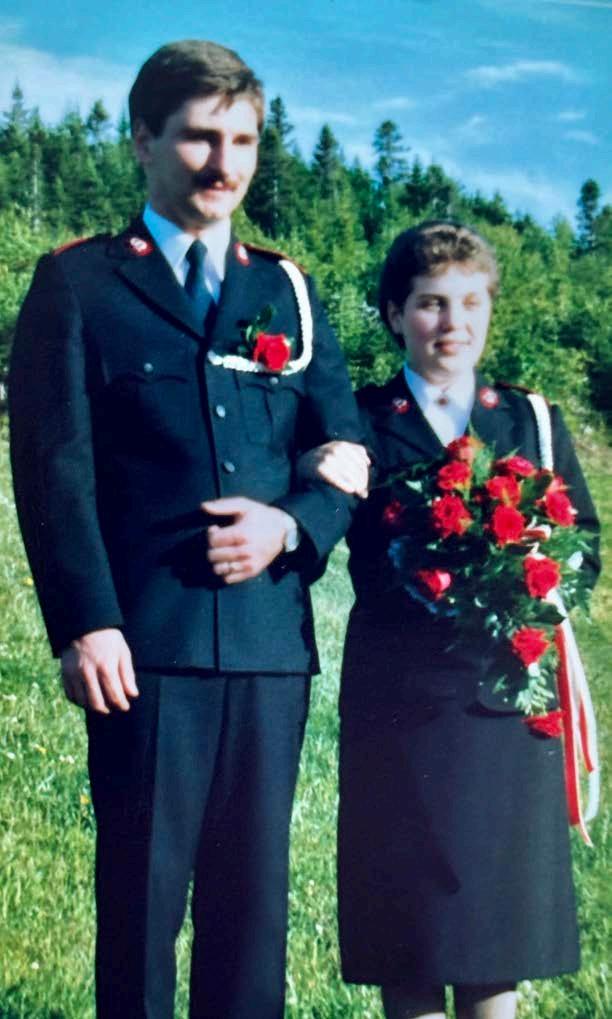
Left: The couple were married on 3 July 1987
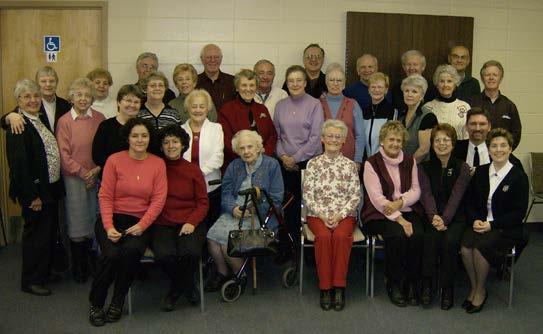
Above right: The Vincents with their seniors group while serving as corps officers at Woodroffe Temple in Ottawa, Canada
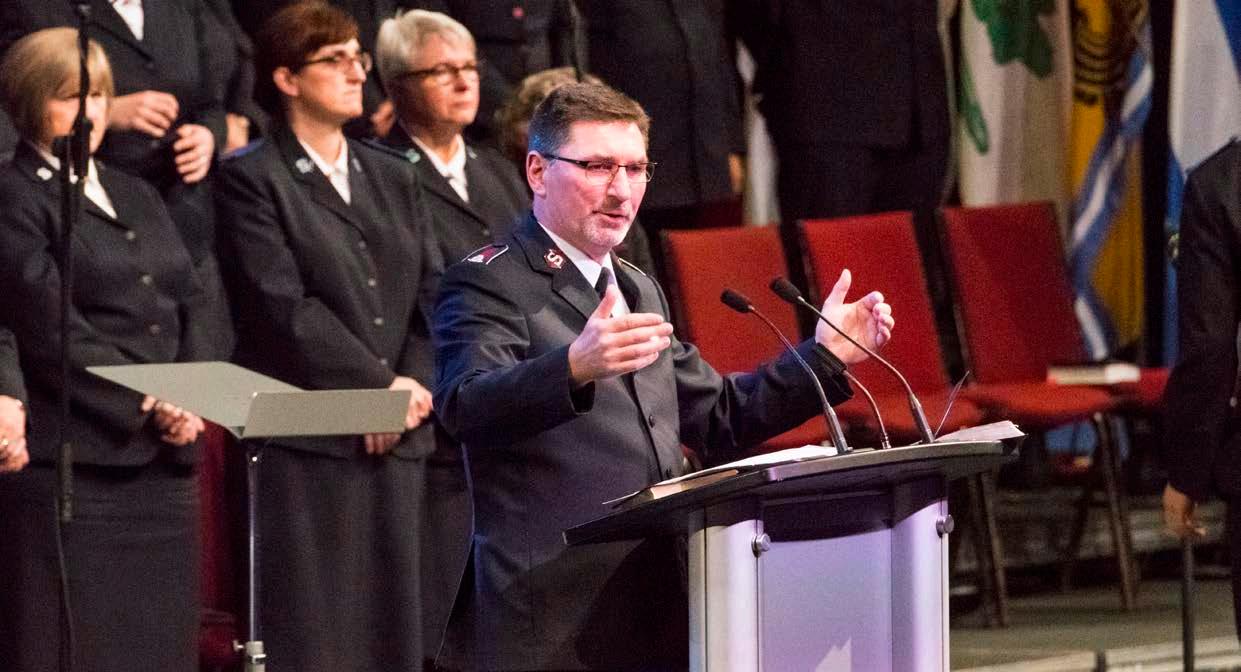
Above: Leading a congregational song at the Newfoundland and Labrador Congress in 2017
years and were thrilled to be going back home. The initial announcement of the appointment, however, brought an overwhelming feeling of inadequacy. We love our homeland, but we were highly aware of the challenges around officer shortages and restricted financial resources, leaving us to think we were not equal to the task. Despite the limited officer personnel and financial resources, we knew the division was rich in people resources who were deeply committed to the Army and its mission, so there was a mixture of excitement and anxiety.
On the night following our appointment announcement, Genevera found herself lying awake until about 3 am with a multitude of thoughts racing through her head and feelings of inadequacies. Suddenly, she began to pray the Serenity Prayer…or at least the first portion of it: ‘God, grant me the serenity to accept the things I cannot change, courage to change the things I can and wisdom to know the difference.’ Praying that prayer brought such a sense of peace. She went to sleep and carried that prayer into the new appointment and each one since. The six years spent in the Newfoundland and Labrador Division was a very rewarding period, where God confirmed repeatedly that ‘when we have exhausted our store of endurance, our Father’s full giving is only begun’!
Another move came in 2022, this time away from our home territory of Canada and Bermuda to the USA Western Territory, where Eddie became the Chief Secretary and Genevera the Territorial Secretary for Women’s Ministries. We went to this appointment as we have gone to all our previous ones – in fear and trembling. We soon discovered that God had gone before us! We quickly settled into our new roles and responsibilities, and, despite a steep learning curve, we felt from day
one that we were home. That appointment took us to the 13 western states, including Hawaii and Alaska. We found a an exceptionally strong and diverse Salvation Army in the USA Western Territory, and will be forever grateful to God and the Army for the privilege of serving there alongside so many wonderful officers, soldiers and employees. Our lives have been enriched through that experience.
In keeping our story up to date, in January 2026 we farewelled from the USA Western Territory and took up appointments at International Headquarters as the International Secretaries for the Americas and Caribbean Zone, where we continue to trust in the faithfulness of God. Our travels around the zone have begun and we are already blessed to see what God is doing there.
Our journey of officership has been filled with rich learnings:
– We have learnt that on our most difficult and trying days, remembering our Covenant keeps us grounded in our faith and officer calling.
– We have learnt the value of living in our present appointment and not concerning ourselves with our future. We believe that we are in God’s hands and he has our future planned, so we don’t need to mess with it!
– We have learnt that our ‘Yes’ to God means sacrifice for our two sons, daughter-in-law and grandson, who understand and support our calling which often takes us far away from them. We are grateful to God for them.
Now into our 41st year as officers, we continue to trust in the faithfulness of God and constantly keep our eyes on him.
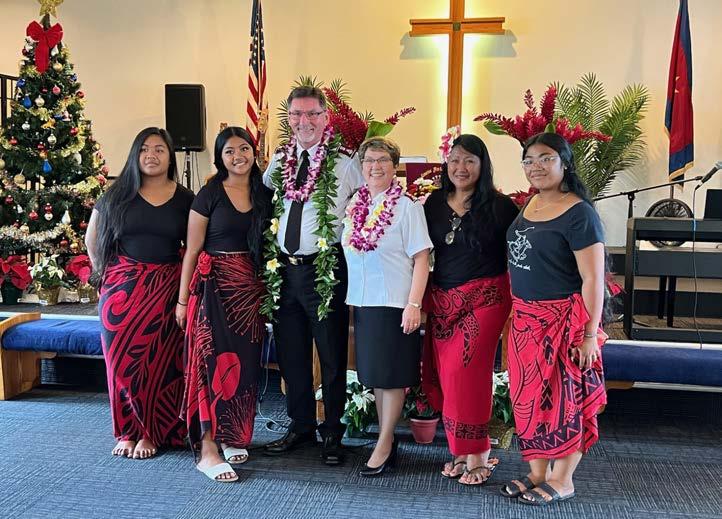
At Kona Corps in Hawaii, December 2022
At the divisional congress in Ketchikan, Alaska
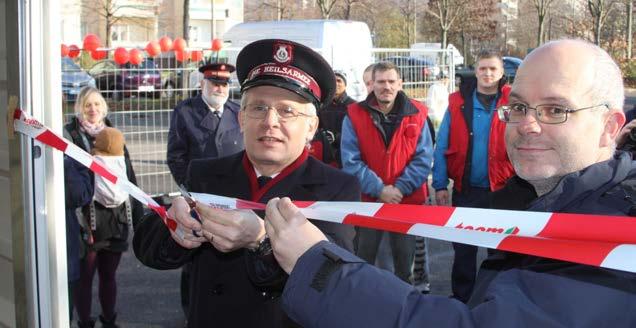
Nestled in Berlin’s artistic hub, The Limelight Collective aims to introduce individuals to the gospel through artistic expression
The Salvation Army in Germany
Listening to the heartbeat of a 140-year-old Army
MAJOR ANNI LINDNER Corps Officer, Chemnitz Germany, Lithuania and Poland Territory
It is risky to ask a first-generation Salvationist to write an article celebrating 140 years of The Salvation Army in Germany. Should it not be written by someone who loves to dig into the archives and has a knowledge of events and traditions of the Army in Germany?
Regardless, I accepted this challenging task and here I reflect on the heartbeat of The Salvation Army in Germany as I see it, 140 years after it was heard for the first time.
HEARTBEAT 1: Mission in ‘forbidden terrain’
When Staff-Captain Fritz Schaaff prepared to ‘open fire’ in Stuttgart in 1886, German authorities did not welcome The Salvation Army. Saxony, the federated German state in which I currently serve, warned the Army to ‘keep well away from our borders’. The first Salvationists ignored the warning and swept in and flooded the area in the power of the Holy Spirit. Even though open-air meetings were not allowed, indoor meetings were restricted and police controlled the activities of the Army, the work in Germany grew widely.
When reading about the numbers of people attending services at the beginning of the 20th century, I realised that The Salvation Army makes the current megachurches look like pale imitations. Critics would ask today: Was it all
about the gospel or was William Booth a religious superstar? Whatever the reason, more than a century ago people were enthusiastic about spreading the gospel in a radically new way, with zeal and passion. People who found Christ were transformed and on fire to spread the gospel and meet human needs, no matter the cost.
HEARTBEAT 2: Practical help
During the next 60 years, The Salvation Army witnessed and reacted to immense political events and catastrophes in Germany. Two major wars – in 1914–18 and 1939–45 – led to destruction and unbelievable misery. Even today, Die Heilsarmee (The Salvation Army) is remembered as a group of people who helped, recalled in statements such as: ‘They gave me food’; ‘I found a home in their orphanage when I lost my parents’; ‘The Salvation Army gave me a bread roll when I came home from war captivity’. Elderly people have shared these experiences with me when carolling in Cologne and Berlin. They are deeply thankful for the engagement of Salvationists in times of hunger and forced migration, through the so-called ‘Feldzug der Liebe’ (‘Campaign of Love’).
HEARTBEAT 3: Authentic belief
Conversely, you would not hear such memories in East Germany. While in western Germany The Salvation Army remained known and active The
after the Second World War, in the east – known as the German Democratic Republic (GDR) and controlled by the Soviet Union – the Army’s work was forbidden. No meetings were held. There was no possibility of doing practical work under the Army flag. No Army literature was allowed to be published or spread. ‘There is no Army except for the Red Army’ was the mantra in those days.
The GDR regime did not tolerate the Christian faith. Although there was no open persecution of believers, people still had to face consequences if they chose to go to church. The communist mindset tried to erase spiritual truth, but it could not be eliminated. Salvationists in this part of Germany joined other Christian communities and waited patiently for their time to rise again.
HEARTBEAT 4: Tradition and faithfulness
While everything was on hold in the GDR, in the rest of Germany The Salvation Army continued to work steadily and faithfully, establishing social centres and corps with a rich musical tradition.
The 1950s up to the 1990s seem to me to have been ‘the golden years’ – that’s what I’ve heard from Salvationists who experienced those decades. There was great work among young people and everybody seems to have been involved at a high and dedicated level. ‘We did not have time for friends outside the Army,’ an elderly Salvationist said to me, when I asked her how they invited non-Christian friends to their services or programmes. ‘We spent every afternoon in the corps, with band practices, home league and prayer meetings.’
There were holiness meetings for Salvationists and open-air meetings followed by a Heilsversammlug (salvation meeting) in the evening. People would follow the band from the marketplace to the hall. People gave their lives to Christ. These were great times, when officers and Salvationists seem to have given every waking minute in Army service.
IRREGULAR HEARTBEAT 1: Overwork
When did the power of authentic zeal to reach souls for Christ and meet the needs of suffering humanity turn into hard work that caused burnout in its people? A whole generation of officers’ children walked away, because they witnessed their parents overworking and not being treated well by their superiors. Although people were serving the Lord with all their might, somehow bitterness and frustration sneaked in. When life in Germany got better and more comfortable for everyone, the attractions of the world started to drown the attention of the non-believers. What did these developments do to the passion of the Salvationists to reach Germany for Christ?
IRREGULAR HEARTBEAT 2: Burn-out
When my husband and I first got to know The Salvation Army in East Germany, ‘the golden years’ were already over; indeed, the movement was nearly unknown. In 2006, which was 120 years after the Army ‘opened fire’ in Germany, my husband and I entered the officer training college. ‘I think the days of the Army are over,’ a beautiful old lady from our first corps said to me. ‘The numbers of soldiers and adherents go down every year. The fire is gone, we are about to die out.’ Her disappointment was understandable.
Having felt the vibrant life of a strong and motivated ministry in her younger years, she had since witnessed how people had lost their interest in faith. At least one generation was almost totally lost for The Salvation Army: would this be the end of the Army in Germany? It was not the only conversation of this kind that we had. As cadets, we started to discuss the life of an organisation; we were sure that the gospel, the heart of The Salvation Army, would never be outdated. Every officer and Salvationist we met had this burning heart for Christ – the mission was still clear. But the heartbeat seemed irregular.
DIAGNOSIS:
Life crisis
In the Old Testament, it is recorded that God decided to limit a human life to 120 years (Genesis 6:3) and Moses died when he was 120 years old (Deuteronomy 34:7). Would The Salvation Army in Germany really die after 120 years – or did it have children and grandchildren to live on?
We were sure that the work of officers and Salvationists following God’s special mission in Germany was worthy and efficient. God would continue to build on their foundations. The purpose of the Army was still relevant: to preach the gospel in a simple and understandable way to people who would not volunteer to set foot into a
– from top to
The
‘normal’ church. Struggling with small numbers of visitors and believers in our corps caused the Army in Germany to have an identity crisis. We learnt that tradition alone would not carry us into a glorious future. Today, we still see other organisations being better at creating attractive programmes than us.
William Booth famously saw the potential of the motor car to travel more quickly to new areas in order to preach to crowds in cities, towns and villages, using thought-provoking words to evangelise and inspire his listeners. Are we bold enough to emulate the Founder’s innovative approach to mission and his confident vision, and move forward to try again in Germany?
CONVALESCENCE: Focus on destination
In Germany, we are now trying to focus on what is the right way to fulfil our mission as The Salvation Army. We are trying not to get lost in discussions about how to wear our uniform or which music to use in the congregations. We long to hear God’s commands for our current battles. While we work hard to serve our communities with few but faithful officers in small corps, with a limited number of local leaders, we believe in revival. We believe God still wants his Army to fight the good fight, stand boldly for the gospel and reach out to people – whether it may be one or two or even a million. Everything is possible.
My conclusion, on celebrating our 140th anniversary, is an optimistic one. More than reBoot(h)ing our system, we trust in God that the heartbeat of the Army in Germany is still there, and it is strong.
We are still ready to hear, understand and dare to follow Jesus’ battle cry for Germany.
Opposite
bottom:
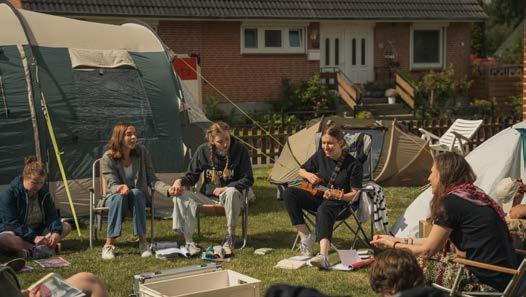
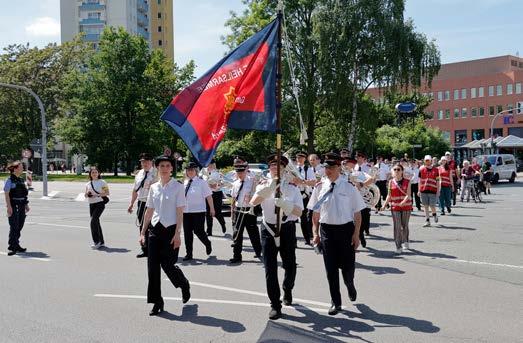
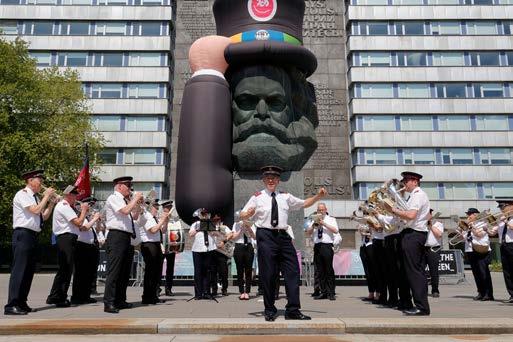
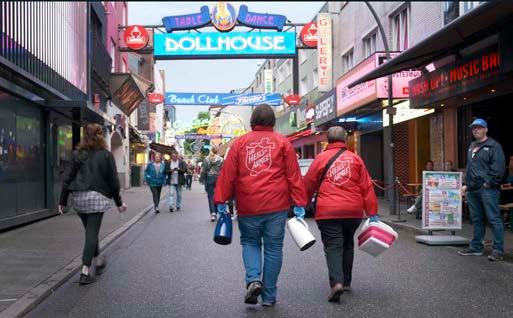
Salvation Army Chemnitz Corps youth camp on the island of Fehmarn in 2024; the German Staff Band marches in Chemnitz in 2025; pictured in front of a statue of Karl Marx in Chemnitz, the German Staff Band performs at the Hutfestival, 2025; Salvationists at work in the red light district of Hamburg
Above left: Lieut-Colonel Marsha Bowles (left) chats with the cadets who are to be ordained at the congress in 2024
Above right: The Salvation Army in Leipzig, eastern Germany, set up a small ‘light-build’ warehouse to use as a base for work with refugees
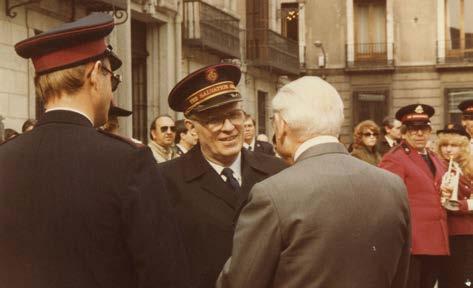
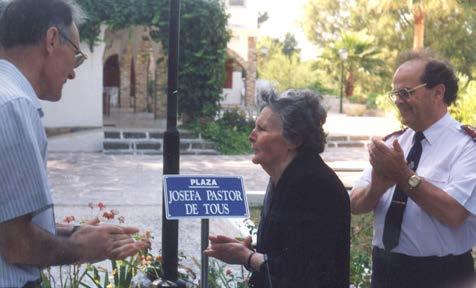
Opposite – top left: General Jarl Wahlström during a visit to Madrid, 1983 Opposite – top right: The opening of Camp Saron, donated by Vicente Tous Pastor, early 1990s
The Salvation Army in Spain and Portugal
History, mission and service to the community
Spain
KARINA GIUSTI*
Territorial President of Women’s Ministries
Spain and Portugal Territory
The Salvation Army took a pivotal step in its history by officially beginning its work in Spain in May 1971, establishing a ministry that, for the past 55 years, has sought to transform lives through faith, compassion and service. Although the country had a deeply rooted Catholic tradition, the arrival of the Army introduced a new evangelical perspective, based on social action and the proclamation of the gospel. Since those early days, the work has experienced both joys and challenges, reflecting the complexity of maintaining faith and relevance in a constantly changing society.
The fi rst corps in La Coruña, north-west Spain, officially opened in June 1972, marking the beginning of a vibrant ministry. The fi rst openair meeting drew thousands, and hymns and marches echoed through the city, capturing media attention and creating a landmark in local religious history. Those early years were fi l led with enthusiasm, with young people and adults coming to faith, building a community that sought to live out the Christian message in a context where most of the population was Catholic or, later, leaned toward agnostic or atheist positions.
One of the greatest sources of joy during these years has been seeing how many people, despite secular traditions or a loss of trust in political and religious institutions, have found in the movement a space for spiritual growth. Every conversion, every young person who joined the ministry,
every family touched by the social outreach has been a reminder of the relevance of faith in people’s lives, even in a country that increasingly identi fies less with formal religion. The perseverance and commitment of those who have served in the ministry have allowed the work to expand to different cities and regions, offering not only spiritual support but also help through social initiatives, such as centres for vulnerable people, training and mentoring programmes.
These years have not been without challenge. A lack of resources has been a constant concern, sometimes limiting the capacity for expansion and responsiveness to community needs. Maintaining relevance in an increasingly secular and post-modern country has demanded creativity, perseverance and a deep sense of mission. In a context where traditional values are losing in fluence and faith is not a priority for most of society, we have had to redefi ne strategies, focusing on practical service, solidarity and an active presence in the communities.
Throughout its history in Spain, The Salvation Army has consolidated its structure, opened new locations, created training programmes, and established camps and activities that strengthen the community. The 2013 merger with the Portugal Command (which became the Spain and Portugal Territory 10 years later) allowed for greater coordination and mutual support, broadening the regional vision and facilitating the exchange of experiences. Every evangelistic campaign, every youth gathering
LIEUT-COLONEL
and every social action has been a step forward in strengthening a ministry that seeks to remain faithful to its original mission: to bring the message of hope and transformation.
It has demonstrated that faith is not only manifested through meetings, but also in concrete action: accompanying people experiencing social exclusion, offering spaces that contribute to the well-being of the community. These achievements, attained with limited resources, are a cause for celebration and gratitude. They are also a testimony to the power of perseverance, prayer and dedication of those who have served for more than five decades.
Looking to the future, we face the challenge of remaining relevant in a society that increasingly values the immediate, but often neglects the
Portugal
The history of The Salvation Army in Portugal is marked by pioneering spirit, faithfulness to its Christian mission and a strong commitment to social action.
Ever since work commenced in Portugal in the early 1970s, the Army has been continuously active in its evangelisation and humanitarian support, remaining faithful to the principles laid down by its Founder, William Booth.
The establishment of the movement in Portugal took place under the leadership of Major Carl Eliasen. The initiative occurred following contact
fundamental principles of compassion, solidarity and faith. The mission remains challenging, but full of opportunities to grow, innovate and reach new generations seeking meaning and purpose with a story of resilience and hope. A reminder that faith can flourish even in the most testing environment and leave a lasting mark on society.
As we celebrate this 55th anniversary, we recognise all those who have contributed to its work and have demonstrated that faith practised with love and dedication continues to have a profound and lasting impact. As the story unfolds with each new step, The Salvation Army reaffirms its commitment to serving and transforming lives, remaining faithful to the values that inspired its arrival more than half a century ago.
with Portuguese Christians who were deeply influenced by Salvationist literature and who expressed a desire for the Army’s presence in the country. In 1971, the first corps was inaugurated in Porto, in the north of Portugal, followed in 1972 by the start of the work in Lisbon.
Major Eliasen brought with him the fundamental principles established by General William Booth based on active evangelism, personal holiness, Christian discipline and practical service to the poorest and most marginalised. From the very beginning, it affirmed that the proclamation of the gospel and the response to human need should go hand in hand.
However, the political and religious context of the Estado Novo (the dictatorial regime in control of Portugal at the time) posed a considerable challenge. As a Protestant denomination, the Army faced institutional distrust, legal restrictions and surveillance by the authorities.
General Brian Peddle celebrates the young people when visiting the Spain and Portugal Territory in 2022
“We feel blessed by God that we can celebrate 55 years of deep and meaningful work alongside those who suffer most.”
The legislation then in force required a high number of Army members for legal recognition, which compelled the movement to undergo a long and complex administrative process.
Despite the difficulties, corps maintained their activities, often making use of improvised premises and relying on the cooperation of other evangelical churches. The perseverance demonstrated during this period proved decisive for the consolidation of the work and for its subsequent expansion within a democratic context.
The Carnation Revolution of 25 April 1974 marked a turning point. The fall of the dictatorial regime brought genuine religious freedom and opened new possibilities for public action. Shortly after, the country was confronted with the arrival of around one million returnees from the former Portuguese colonies in Africa.
The Salvation Army responded promptly and in an organised manner to this humanitarian crisis. According to the work described by the now Commissioner Eliasen, thousands of people received support through spiritual and practical assistance. This effort was carried out in coordination with the Portuguese Government and other organisations.
Following this intense period of social support, a Salvation Army social centre was founded in 1981. It quickly became the central pillar of Salvationist social intervention, providing structured social services to address the population’s ongoing needs, particularly among disadvantaged families, the elderly, children at risk and people experiencing homelessness.
In February 2013, The Salvation Army in Portugal and Spain merged to become the Spain and Portugal Command (later receiving territorial status in March 2023), which brought with it new social and institutional challenges for the leadership and the corps in both nations.
The Army in Portugal was celebrated in a special way when its founding was commemorated at a congress held in Lisbon in September 2022. The event brought together the entire Salvationist family from both countries within the command
and was attended by General Brian Peddle and Commissioner Rosalie Peddle. This symbolic moment reflected international recognition of the maturity and significance of the work carried out in both countries.
Today, the Army continues to carry out a broad and diverse range of work. Its social responses include projects supporting children at risk, caring for the elderly, assisting disadvantaged families, working with people experiencing homelessness and combating human trafficking. These services are delivered through corps and social centres, always guided by the values of human dignity, hope and inclusion, and grounded in the command that Jesus Christ left to all Christians: ‘Love one another. As I have I loved you, so you must love one another’ (John 13:34).
We feel blessed by God that we can celebrate 55 years of deep and meaningful work alongside those who suffer most. As we supported the communities affected by Storm Kristin in January 2026, local corps were mobilised into action to ensure the distribution of essential goods and human support, in coordination with local authorities.
The culmination of these celebrations will take place in October 2027 in Spain with a congress, where the Spain and Portugal Territory will have the honour of welcoming General Lyndon Buckingham and Commissioner Bronwyn Buckingham.
From its foundation to the present day, the Army in Portugal has played a significant role in spiritual and practical ways. Faithful to the motto ‘Saved to Serve’, it continues to respond to today’s challenges, keeping alive the principles inherited from the Founder, William Booth, and the spirit of service that marked the pioneering work of Commissioner Carl Eliasen – born from a group of Christians who saw in The Salvation Army an opportunity to serve God and the community.
*Lieut-Colonel Karina Giusti will be taking up a new appointment in the Brazil Territory as Territorial President of Women’s Ministries with promotion to the rank of colonel (effective 1 July 2026).
COLUMN FROM NOMFUNDO
Lasting impact
LIEUTENANT
NOMFUNDO MHLONGO Corps Officer, Estill Circuit; Divisional Children’s Ministry Officer, Eastern KwaZulu-Natal Division Southern Africa Territory
‘How, then, can they call on the one they have not believed in? And how can they believe in the one of whom they have not heard? And how can they hear without someone preaching to them? And how can anyone preach unless they are sent? As it is written: “How beautiful are the feet of those who bring good news!”’ (Romans 10:14-15).
These two verses both emphasise the beauty of those who actively share good news and also question the ability to call on God without belief.
As a Church, we are accountable for sharing God’s message of salvation, faith and action with our communities, and that involves actively working to transform lives by helping people know Christ. During a sermon about faith, an officer once posed the question: What we are doing as a Church to change people’s lives so they know Christ and the world becomes a better place? Our faith is useless if it does not make a difference.
As I read about the Compass concept, this led me to reflect on our identity as The Salvation Army and the Church’s fundamental role in saving souls for Christ. It got me thinking about whether, in our communities, we are known as the Church that saves souls for Christ or if we are seen as the charity that helps those who are in need.
A compass guides one to orient oneself or to examine one’s actions and purpose. When I have completed a task in my daily work, what does it
mean for the Kingdom of God and what does it mean for The Salvation Army? This calls for intentionality in mission programmes and keeping in mind that the mission is inspired by the Word of God. The mission is about the people we are serving. It affects people and is driven by God. Without mission, people have no purpose and a legacy cannot be left for the next generation.
Someone once said that if you love God, show it through the way you do things, the way you give and the way you speak. Our actions send a message about who we are as a Church in the community. While we may not be able to change the whole world at once, we can influence society by informing and bringing people into knowledge of Jesus Christ. This goes beyond meeting needs or being known for the social services we offer to our people. In the words of 2 Corinthians 5:20: ‘We are therefore Christ’s ambassadors, as though God were making his appeal through us. We implore you on Christ’s behalf: Be reconciled to God.’ We are ambassadors of Christ sent to bring a message to all people, a message of reconciliation of God’s people with God. Yes, we are ambassadors of Christ.
Life lived with purpose, guided by unwavering faith, aims to create a significant, memorable and enduring mark on the world, as well as in people’s hearts.
‘If you’re going to live, leave a legacy. Make a mark on the world that can’t be erased.’ Maya Angelou
“The Calls are our calls to mission and our spiritual life development – both as individuals and as an Army. Our world needs the light of God and it needs us to reflect that light – within our hearts, within our Army and within our world.”