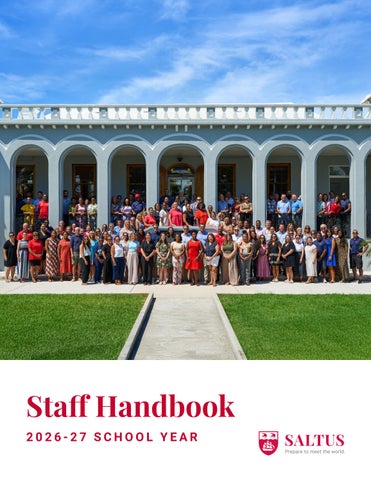
Staff Handbook 2026-27 SCHOOL YEAR
2026
27 SCHOOL YEAR
The Staff Handbook The Staff Handbook is a summary of Saltus’ employment policies and procedures for all members of staff. It revokes and supersedes any prior policies and procedures and will govern in case of any inconsistency with other written materials except legislation or employment agreements. The Staff Handbook is not intended to form part of your employment contract unless expressly stated in the handbook or your employment contract. The Staff Handbook is an evolving document that will be revised and updated from time to time. We will keep you advised of changes in policies and procedures covered in this Handbook through notices, employee meetings, e-mail, and/or circulation of revised pages or a later edition. The Staff Handbook is not your only source of information on employment-related issues. Although this handbook will probably always be the best place to start in finding answers to questions, you may, from time to time, have questions that it does not answer. In those situations, you should talk with the Director of your department or with the Human Resources Department.
1
Table of Contents Click titles and subtitles to jump to page 4 - HISTORY 5 - CAMPUS DESCRIPTIONS 5 - HOUSE SYSTEM • 5 - Number 4 6 - THE SALTUS ALUMNI NETWORK: CONNECTING PAST, PRESENT, AND FUTURE 7 - CAIS & NEASC ACCREDITATIONS 7 - OUR VISION 7 - OUR MISSION 8 - NEW: OUR 2026-2031: COMPASS 8 - NEW: PORTRAIT OF A GRADUATE 10 - BOARD OF TRUSTEES 11 - LEADERSHIP 12 - SCHOOL CALENDAR ACADEMIC YEAR 2016-27 13 - EQUAL OPPORTUNITY AND NON-DISCRIMINATION 13 - RECRUITMENT AND SELECTION 14 - BACKGROUND CHECKS 14 - EMPLOYEE ORIENTATION 15 - STATEMENT OF EMPLOYMENT 15 - STANDARDS AND BOUNDARIES FOR TEACHING AND WORKING WITH STUDENTS 16 - TERM CONTRACTS FOR OVERSEAS STAFF WHO REQUIRE A WORK PERMIT • 16 - Relocation • 16 - Airfare • 17 - Relocation Allowance • 17 - Reimbursement 19 - WE ARE A BC OFFSHORE SCHOOL • 20 - BC Teacher Certification Requirements 23 - OUR COMMITMENT TO STUDENT SUCCESS 24 - OUR APPROACH: MULTI-TIERED SYSTEM OF SUPPORT (MTSS) 24 - THE ROLE OF THE LEARNING STRATEGIST 24 - WHEN EXTERNAL AGENCIES ARE INVOLVED 2
25 - LEARNING SUPPORT COMMUNICATION WORKFLOW 25 - INDIVIDUALIZED LEARNING PLANS (ILPS) 26 - PARENT INVOLVEMENT 26 - ATTENDANCE AND MISSED WORK 27 - DRESS CODE AND EMPLOYEE APPEARANCE 28 - PERSONAL CALLS AND MAIL 29 - SMOKING 29 - MEETING PROTOCOL 30 - EMPLOYEE PERSONNEL RECORDS 31 - PROMOTIONS, TRANSFERS AND EXTRA POSTS 31 - PROFESSIONAL LEARNING 32 - MANDATORY TRAINING AND CERTIFICATION 32 - STAFF GROWTH AND EVALUATION • 32 - Teaching Staff Probationary Period • 33 - Additional Posts of Responsibilities • 33 - Non-Teaching Staff Probationary Period 33 - CONFIDENTIALITY 33 - UPDATED: PRIVACY AND THE STAFF PRIVACY NOTICE 34 - RELATED EMPLOYEES/CONSENSUAL RELATIONSHIP 34 - PARTICIPATION IN POLITICS 34 - EMPLOYEE COMPLAINT/ GRIEVANCE PROCEDURE 35 - OUTSIDE EMPLOYMENT 35 - FINANCIAL PROCEDURES 36 - ANTI-CORRUPTION AND ANTI-BRIBERY POLICY • 36 - Individual Responsibility • 36 - Definition of Bribery • 36 - Whistleblower Policy • 36 - Gifts and Hospitality • 37 - Record-keeping • 37 - Reporting 37 - SECURITY 40 - HEALTH AND SAFETY
42 - ALCOHOL AND DRUG POLICY 44 - DISCIPLINARY ACTION POLICY 44 - DISCRIMINATION, HARASSMENT, BULLYING AND VIOLENCE POLICY 44 - NEW: RESPONSIBLE USE OF TECHNOLOGY & AI POLICY 52 - CONTACT WITH THE MEDIA (INCLUDING ADVERTISING AND PUBLIC RELATIONS) 52 - PUBLIC SPEAKING AND PUBLICATIONS 53 - SALTUSLIVE • 54 - Profile Updates 54 - EMAIL COMMUNICATION GUIDELINES • 54 - Expectations for Faculty and Staff • 55 - No right of privacy • 55 - Personal use Devices and Supplies • 55 - Responsible e-mail use • 56 - Right to access e-mail • 56 - Deletion of messages by user • 56 - Password and encryption key • 56 - Responsible internet use 57 - STORAGE OF PERSONAL FILES 57 - NEW: CLASSLIST 58 - NEW: STOPIT: SUPPORTING STUDENT VOICE AND WELL-BEING 59 - COPYRIGHT INFRINGEMENT 59 - SCHOOL PROPERTY 59 - STAFF ATTENDANCE 60 - PUNCTUALITY AND UNAUTHORIZED ABSENCES 60 - PRO-RATED PAY FOR TEACHING STAFF 61 - LOSS OF PAY AND INCREMENTS 61 - HOURS OF WORK 61 - HOURS OF WORK: TEACHERS 62 - NON-TEACHING STAFF 62 - NON-CONTACT TIME 62 - SCHOOL TRIPS 65 - SALARY PAYMENT 65 - SCALE OF TEACHING SALARIES 66 - INCREMENTAL INCREASES 66 - DEDUCTIONS FROM SALARY 66 - LONG SERVICE ALLOWANCE
67 - INSURANCE COVERAGE • 67 - Health Insurance • 67 - Life Insurance • 67 - Long-term Disability Insurance • 67 - Pension Plan 67 - EMPLOYEE ASSISTANCE PROGRAM 68 - STAFF FEE DISCOUNTS 68 - AFTER-SCHOOL PROGRAM FOR STAFF 69 - GYM AND POOL USAGE 69 - STAFF ADMINISTRATION DAYS 70 - ANNUAL VACATION ENTITLEMENT • 70 - Full-time non-teaching staff • 71 - Term-time administrative staff • 71 - Teaching staff • 71 - Public Holidays • 71 - Leave of Absence: Illness • 71 - Leave of Absence: Caring for a sick child or spouse • 72 - Extended Sick Leave • 72 - Earnings recoverable from a Third Party 72 - MATERNITY LEAVE 73 - PATERNITY LEAVE 73 - ANTE-NATAL CARE 73 - OTHER TYPES OF LEAVE 75 - PROCEDURE FOR STAFF LEAVE REQUESTS 76 - PROBATIONARY PERIODS 76 - NOTICE PERIODS 77 - PAYMENT IN LIEU OF NOTICE 77 - RETIREMENT 78 - PROFESSIONAL EMPLOYMENT REFERENCES 78 - CERTIFICATE OF TERMINATION 79 - UPDATED: TERMINATION FOR SERIOUS MISCONDUCT 80 - UPDATED: TERMINATION FOR REPEATED MISCONDUCT 80 - TERMINATION FOR UNSATISFACTORY PERFORMANCE 80 - TERMINATION FOR REDUNDANCY 81 - EMPLOYEE DEPARTURE CHECKLIST 81 - FINAL SEPARATION MEETING / EXIT INTERVIEW 3
SECTION 1.
Introduction To Saltus
History Saltus Grammar School was founded in 1888 thanks to a generous gift from Samuel Saltus who bequeathed the funds for the building of a boys’ school in Bermuda. The school thrived for decades and evolved to include Cavendish Hall in 1972, a second campus devoted to young learners. Many facility enhancements were added over the years, including science labs, libraries, music and art facilities, and a 25-metre swimming pool.
4
In 1966, post-desegregation in Bermuda, Saltus widened its mandate for diversity and became one of the first multi-racial private schools in Bermuda. In the 1990s Saltus became fully coeducational. The result has been that students enjoy a diverse, real-world learning environment that elevates all. Visit our website to learn more about the history of Saltus.
Campus Descriptions Our Lower Primary (Junior Kindergarten, Kindergarten, and Grade 1) is located at our Devonshire campus. There are three main buildings that are all connected to the Hall. Junior Kindergarten has its own separate wing with two outdoor playgrounds overlooking the farmlands of Devonshire. The Kindergarten and Grade 1 classrooms overlook the main field and playground which is a beautiful open space for the students’ PE, recess, and lunch times. On our St. John’s Road campus, the Upper Primary (Grades 2 - 5) is located on the Western side while the Middle grades (Grades 6 - 8) and Senior grades (Grade 9 - SGY2) are located on the Eastern side. At the heart of the campus is the beautiful Woodlands Administration Building, which dates back to the 1800s. The Upper Primary campus has classrooms surrounding an open courtyard with a large Gymnasium/ Hall, Library, well-equipped Music Room, and Art Studio. The Middle and Senior campus boasts a state-of-the-art Design Technology Department, a Music Audio Visual Suite with cutting-edge technologies and software, a Black-box Theatre, a large Gymnasium with Fitness Centre, and six fully equipped Science labs. Both departments share the use of the 25-metre pool along with the large two-acre field.
House System In 1931, when Henry C. Cox was Headmaster, he instituted the ‘House System’ using the names of Trustees who had a long association with the school. To this day, Saltus students are still divided into these four Houses: Butterfield (green), Darrell (blue), Watlington (yellow) and Saltus (red). Siblings are placed in the same House and if a parent is an Alumni of Saltus their children will be placed according to the parent’s House. The students will earn points for their House and represent them in House related events and friendly competition.
Number 4
In Bermuda each school is assigned a school number by the Bermuda School Sports Federation. At Saltus, our number is 4. At all inter-school events, each school is required to wear their school number for identification purposes.
5
The Saltus Alumni Network: Connecting Past, Present, and Future Saltus alumni represent an important connection between our school’s proud history and the future success of our students. From the moment students join Saltus, they become part of a lifelong community that spans generations and extends across the globe. Alumni regularly engage with the school by sharing their experiences, offering career insights, and inspiring current students through guest lectures, mentorship opportunities, and networking events. This connection helps students envision the many possibilities that a Saltus education can unlock, both during their time at school and beyond. We greatly value the role our alumni play in supporting and promoting Saltus. They serve as ambassadors in their communities, advocates for the school, and mentors for future generations of Saltus graduates. We are committed to keeping our alumni engaged and involved through regular communications, reunions, volunteer opportunities, and special events. Their ongoing participation strengthens the Saltus community and ensures that our students benefit from a network that is both deeply rooted in tradition and focused on future possibilities.
6
CAIS and NEASC Accreditations Saltus Grammar School is an accredited member of CAIS (Canadian Accredited Independent Schools) as well as NEASC (the New England Association of Schools and Colleges). The Canadian Association of Independent Schools (CAIS) was established in 1981 as a national network for member schools supporting collaborative initiatives in leadership, education, management, and governance. Its key activities included organising, coordinating, and facilitating conferences, benchmarking, senior management compensation surveys, and advocacy. Today, CAIS comprises over 90 schools, all of which commit to undergoing a reflective and collaborative school improvement process, meeting National Standards, and participating in research and professional learning. The New England Association of Schools and Colleges (NEASC) is an independent, voluntary, nonprofit organization whose membership represents a broad array of diverse educational institutions unified in their commitment to improvement and growth. More than 1500 public, independent, and international schools in the United States and in over 90 countries around the world are NEASC Members, Candidates for Accreditation, or have achieved Eligibility for Accreditation. A globally recognized standard of excellence, NEASC Accreditation attests to a school’s high quality and integrity. Saltus Grammar School also maintains memberships with NAIS, College Board, and the NCAA.
OUR VISION
Inspiring students to lead us to a more just, fair and sustainable world.
OUR MISSION
To inspire a passion for learning and independent thinking through a commitment to academic excellence, personal integrity and service to others.
OUR VALUES
A school’s unique culture is expressed through values that guide the actions, interactions, and communication of our community including students, staff, and parents. Our values provide shared and consistent expectations for all while also uniting our school. At Saltus, we seek to teach and model our shared values throughout the school community creating a caring learning environment, building character, and promoting positive relationships. BELONGING
We create a welcoming community where everyone feels included, valued, and connected. RESPECT
We treat ourselves, others, and the environment with dignity and kindness. INTEGRITY
We are honest, responsible, and do what we know is right. COURAGE
We do not let fear prevent us from exploring new opportunities or facing difficult situations. EMPATHY
We seek to understand how someone else feels and see things from their point of view. 7
NEW: OUR 2026-2031: COMPASS
Navigating with purpose. Guided by excellence. Compass is more than the name of a strategic plan. It reflects a way of thinking, one that values clarity of direction, thoughtful decision-making, and the confidence to move forward with purpose. Like a compass, it does not dictate a single path. Instead, it provides orientation, requiring individuals to interpret their surroundings, think independently, and make informed choices. This new strategic plan mirrors our purpose at Saltus. Our goal is not to provide predetermined answers, but to develop the confidence, judgment, and independence students need to navigate complexity and shape their own futures. At Saltus, we equip students with the knowledge, character, and judgement to make thoughtful, informed decisions about their learning and their future. We invite you to review Compass, where you will see where we have clearly outlined the four distinct strategic directions that will guide us over the next few years along with some of the key programs that will continue to set Saltus apart in Bermuda.
NEW: Portrait of a Graduate The Portrait of a Saltus Graduate serves as the North Star of our strategic plan, Compass, guiding the development of the knowledge, skills, and character we seek to nurture in every student. A Saltus graduate is prepared to meet the world with confidence, integrity, and purpose, equipped to think critically, communicate effectively, and contribute meaningfully in a complex and changing world. These attributes are developed through learning, relationships, and real-world experiences, reflecting our enduring values and ensuring alignment between our strategic priorities and the student experience. Together, these attributes define the Saltus graduate. Grounded in Our School Values Acts with integrity and courage, respects the dignity and perspectives of others, and contributes to a community where everyone feels valued and included. 8
A Critical and Adaptive Thinker Demonstrates thoughtful inquiry, explores complex ideas, considers multiple perspectives, and applies learning creatively to solve problems. A Resilient and Reflective Learner Approaches challenges with determination, learns from both success and setbacks, and grows through reflection, feedback, and experience. An Engaged and Skillful Communicator Listens actively, expresses ideas clearly and thoughtfully, and builds meaningful connections through dialogue and collaboration. A Responsible Global Citizen Respects diverse cultures and perspectives, contributes positively to community and the wider world, and engages thoughtfully with local and global challenges.
9
Board of Trustees Saltus Grammar School is governed by a Board of Trustees. In the CAIS Governance Guide, the Board of Trustees has five principal duties: • Fiduciary Duty – to act honestly and in good faith in the best interest of the school. • Duty of Care – to exercise the same care as a reasonably prudent person in comparable circumstances. • Duty of Loyalty – to act without conflict of interest. • Duty of Confidentiality – to maintain absolute confidentiality regarding Board discussions. • Duty of Solidarity – once a vote is taken and a decision is made to speak as a Board with one voice.
10
Michael E. Leverock
Chair, Chair Risk Assessment Committee, Finance Committee, DEI Committee
Ian Cook
Chair Building Committee, Risk Assessment Committee
Kevin Dallas ‘96
Advancement Committee Chair, Risk Assessment Committee
Alexander Green ‘96
Member at Large
Amy Jagoda
Saltus Association President, Ex-Officio
Liam Moloney
Finance Chair, Risk Assessment Committee
Sacha Simmons
Building Committee
Colm Singleton
Advancement Committee
Leadership Team The Leadership Team supports the academic and business operations of the school. This team is led by the Head of School – Julie Rousseau, who in turn reports to the Board of Trustees. Head of School
Julie Rousseau
6222
Julie.Rousseau@saltus.bm
Deputy Head
Nadia Robinson
6291
Nadia.Robinson@saltus.bm
Director of Advancement
Katie Kostiuk
6264
Katie.Kostiuk@saltus.bm
Director of Enrolment Management
Amanda Skinner
6269
Amanda.Skinner@saltus.bm
Director of Finance and Operations
Paull Davis
6224
Paull.Davis@saltus.bm
Director of Facilities & Maintenance
Lionel Cann
6252
Lionel.Cann@saltus.bm
Director of Communications & Marketing
Stacey Sellars
6242
Stacey.Sellars@saltus.bm
Director of Lower Primary
Jeanne Bean
6324
Jeanne.Bean@saltus.bm
Director of Upper Primary
Elizabeth Dowdell
6301
Elizabeth.Dowdell@saltus.bm
Director of Secondary
Gary Godkin
6246
Gary.Godkin@saltus.bm
Assistant Director of Secondary (Middle Grades)
Shayne Scott
6232
Shayne.Scott@saltus.bm
Assistant Director of Secondary (Senior Grades)
Lorne Nannini
6279
Lorne.Nannini@saltus.bm
Director of Technology & Innovation
Allwyn Bryner
6171
Allwyn.Bryner@saltus.bm
Director of Curriculum
Jesse Sheppard
6294
Jesse.Sheppard@saltus.bm
11
School Calendar Academic Year 2026-27 Please note that the dates provided below are subject to change. Please consult the events calendar at www.saltus.bm for updated information as needed.
FALL TERM 2026 Monday, 31st August Tuesday, 1st September Tuesday, 1st September Wednesday, 2nd September Friday, 4th September Monday, 7th September
New student induction (Grades 6-11) Grade 6 Connection Day (Offsite) New Primary Student Drop-in (9:00-11:00 am) Classes Begin Back to School BBQ (4:00-6:00 pm) Labour Day (School closed)
Monday, 19th – Friday, 23rd October
Half-Term Break
Monday, 26th October Tuesday, 27th October Wednesday, 11th November Wednesday, 16th December
Professional Learning Day (No students) Classes Resume Remembrance Day (School closed) End of Term (Early dismissal)
Thursday, 17th December – Monday, 1st January
Winter Break
WINTER TERM 2027 Monday, 4th January Tuesday, 5th January
Professional Learning Day (No students) Classes Resume
Monday, 8th – Friday, 12th February
Half-Term Break
Monday, 15th February Thursday, 25th March Friday, 26th March
Classes Resume End of Term (Early dismissal) Good Friday (School closed)
Monday, 26th March – Friday, 9th April
Spring Break
SPRING TERM 2027 Monday, 12th April Tuesday, 13th April Friday, 23rd April Thursday, 27th May Friday, 28th May Thursday, 3rd June Monday, 21st June Wednesday, 23rd June 12
Professional Learning Day (No students) Classes Resume AG Day (School closed provisionally) Professional Learning Day (No students) Bermuda Day (School closed) Graduation National Heroes Day (School closed) End of Term (Early dismissal)
Equal Opportunity and Non-Discrimination Saltus is committed to treating all employees with dignity and respect, and to be fair and just at all times. As an equal opportunity employer, we will not tolerate discrimination of any kind, and we are dedicated to a policy of non-discrimination in every aspect of employment. Every staff member has the right to work in surroundings that are free from all forms of unlawful discrimination. We will
not engage in or condone unlawful discrimination on any basis prohibited by law. Recognizing the value of diversity, Saltus endeavours to encourage and support an inclusive work environment that benefits from the skills and abilities of staff from diverse range of cultures, traditions, perspectives, and world views.
Recruitment and Selection Saltus is committed to a consistent approach to the recruitment and selection of staff and to ensuring compliance with all legislative requirements. We are committed to recruiting and selecting individuals who are the most qualified to perform the requirements of each position available. Candidates for vacancies may be from existing staff or from outside sources. Where qualifications and experience are deemed equivalent, preference will normally be given to Bermudian candidates first in accordance with the Bermuda Immigration and Protections Act 1956. All recruitment requires prior approval of the Head of School. 13
The successful applicant(s) for a job vacancy shall be given a written offer of employment that outlines all the terms and conditions of employment. The applicant(s) must accept the offer by signing it before commencing work and in circumstances where the vacancies are filled by a nonBermudian; a work permit must be approved before commencing work. All offers of employment must be approved by the Head of School. Offers of employment are only to be made by the Head of School.
Background Checks As a condition of employment background checks will be conducted on all final candidates (part-time and full-time) which include a minimum of three employment references also a digital footprint check and a police report. A past performance evaluation document or lesson observation will also be required for a Teaching position.
Employee Orientation New employees will participate in an induction and orientation session to Saltus and their respective roles and responsibilities within the first month of employment. A member from the Human Resources Department, in collaboration with the designated Director/Manager and/or Head of Department, will provide a comprehensive induction program for new staff to familiarize them with all aspects of school-wide and departmental policies and procedures, safeguarding practices, curricular programs and to facilitate a positive experience and transition to the school community. In addition, we will respond to questions, facilitate access to resources and discuss the expectations of the position and other relevant specifics.
14
Statement of Employment In accordance with the Employment Act 2000, all new employees will be given a Statement of Employment confirming the terms and conditions of employment as offered to you. The Statement of Employment will be signed by the employee and the Head of School as to the agreed terms. The Staff Handbook will outline the policies and procedures as an integral part of employment.
Standards and Boundaries for Teaching and Working with Students At Saltus, we are committed to providing a safe and secure learning environment for everyone in our school community. It is therefore imperative that our relationships with students are professional and beyond reproach. We expect employees to interact with students in a professional, safe, respectful and compassionate manner maintaining the integrity of the teaching profession not only in the classroom but outside of class as well. All employees are held to a code of professional standards and boundaries.
BC Teachers’ Professional Standards
Being a part of a BC Offshore School means that all faculty must adhere to the BC Teacher’s professional standards, which outline the principles and responsibilities of educators in promoting a high-quality, ethical, and inclusive educational environment. These standards include: 1. Educators value and care for all students and act in their best interests. 2. Educators are role models who act ethically and honestly. 3. Educators understand and apply knowledge of student growth and development. 4. Educators value the involvement and support of parents, guardians, families, and communities in schools.
5. Educators implement effective practices in areas of planning, instruction, assessment, evaluation, and reporting. 6. Educators have a broad knowledge base and understand the subject areas they teach. 7. Educators engage in career-long learning. 8. Educators contribute to the profession. 9. Educators respect and value the history of First Nations, Inuit and Métis in Canada and the impact of the past on the present and the future. These standards and a detailed explanation of each can be reviewed in complete detail at the BC Teachers’ Professional Standards. Adhering to these standards ensures that our teaching practices align with the expectations of professionalism, continuous improvement, and commitment to students’ learning and wellbeing. Please refer to the Standards and Boundaries for Teaching and Working with Students for further information. This is located on SaltusLive on the Human Resources tile. These standards communicate the knowledge, skills, attitudes and values that define educators’ work.They communicate the responsibilities that educators have in fostering our community’s confidence and highlight the complex and varied nature of educators’ work.Through the 15
application of these standards, educators advocate for student needs and contribute to
a safe and inclusive learning environment that reflects the diversity of all students.
Term Contracts for Overseas Staff Who Require a Work Permit Subject to permission being granted by the Bermuda Department of Immigration, where appropriate, if the job is a permanent contract and a non-Bermudian is selected the contract shall be for a period of one to three years in the first instance. At the conclusion of the contract period, the position occupied by a non-Bermudian staff shall be advertised in accordance with Bermuda Work Permit policy and, in the event that no qualified Bermudian, PRC Holders or Spouse of Bermudian applies for the post, the contract may be renewable following mutual agreement, subject to permission being granted by the Bermuda Department of Immigration.
•
•
Relocation
This part of the handbook (especially the sections entitled “airfare”, “relocation allowance”, and “reimbursement”), is intended to form part of the terms and conditions of employment of staff who are recruited from overseas to join Saltus.
Airfare
An employee recruited by Saltus from overseas shall on first appointment be entitled to receive passage at the school’s expense from their country of residence to Bermuda for himself/herself, his/her partner, and children (who have not then attained the age of eighteen years or become married) subject to the following: • Passages shall not exceed four adult passages in respect of any one appointment. • Passages shall be by the most cost-effective or most direct route; passages will include 16
•
•
•
•
one extra luggage. The employee shall be required to refund the cost or part of the cost of the passages in certain contingencies, as detailed herein. An individual who is the dependent of a staff member employed by Saltus and who is entitled to passage under his/her own employment contract will not be entitled to a passage through Saltus. Upon completion of service at the school, staff members on contract from overseas will be provided with a return passage including one extra piece of luggage to the place from which the staff member was originally engaged or equivalent cost of airfare if travelling to a new destination (this includes return passage or family if applicable). Overseas staff who gain employment in Bermuda with another employer during their contract with Saltus will not be provided with return passage to their country of residence upon completion of their contract. Overseas staff that gain Bermudian status as a PRC Holder or Spouse of Bermudian during their employment with Saltus and does not intend to permanently depart Bermuda will not be eligible for a return passage. Return passages shall be granted for the spouse and children of contract staff members appointed from overseas in cases where the contract staff member has died during their contract of service. Staff members recruited from overseas whose service is terminated on grounds of ill health shall receive return passage and one extra luggage (this includes return passages
for family if applicable). • In circumstances where a staff member recruited from overseas terminates their employment without providing the requisite contractual notice or without communication of intent with the Head of School, the employee will be solely responsible for the cost of return airfare to their country of residence.
Relocation Allowance
Full-time and permanent (over 35 hours per week) staff members appointed from overseas are eligible for a relocation allowance in accordance with the following scales: Staff with family partner and/or child (ren)
Staff - Single
$1500 on arrival
$750 on arrival
$1000 on departure
$500 on departure
• Arrival Allowance is included in First Pay. Departure Allowance is included in Final Pay. • Staff with a partner, both of whom work at Saltus, are considered as two single staff for the purpose of the relocation allowance. • A non-Bermudian staff member engaged by Saltus who, at the time of their engagement was dependent and attached to a spouse’s work permit, shall be deemed to be the responsibility of the primary work permit holder i.e., the partner’s employer and shall therefore not be entitled to a relocation allowance. • Relocation departure allowance will not be provided to overseas staff who gain employment with another employer in Bermuda during their contract with Saltus. • In circumstances where a staff member recruited from overseas terminates their employment without providing the requisite contractual notice, the employee will not be provided with the departure relocation allowance.
• Overseas staff terminated for cause and/ or serious misconduct will not be eligible for departure relocation allowance. • Overseas staff who do not complete their initial contract will not be entitled to relocation departure allowance. • Overseas staff that gain Bermudian status as a PRC Holder or Spouse of Bermudian during their employment with Saltus and do not intend to permanently depart Bermuda will not be eligible for departure relocation allowance; in this circumstance proof of departure may be required.
Reimbursement
Staff members recruited from overseas if provided with a three (3) year initial contract who do not complete their contract shall be required to refund the cost or part of the cost of their passage (including passage for partner and dependents if applicable), work permit fees (including fees for the partner and dependents if applicable), and relocation allowance in accordance with the following schedule: Before the conclusion of the first year of service: the total cost of passage (both outward and return), the cost of any accommodation secured by the school on behalf of the staff member for the first month of the staff member’s contract, relocation allowance and work permit fee and card fee (including cost and fees incurred by the school for spouse and dependents), such fees may be deducted from the final salary payment. After the first year of service but before the conclusion of the second year of the contract: two thirds of the total cost of passage (both outward and return), arrival relocation allowance and work permit fee and card fee (including cost and fees incurred by the school for the partner and dependents), such fees may be deducted from the final salary payment. After two years’ service but before the conclusion of the final year of the contract: 17
one-third of the total cost of passage (both outward and return), arrival relocation allowance and work permit fee, and card fee (including cost and fees incurred by the school for partner and dependents), such fees may be deducted from final salary. The ‘total cost of passage’ means the outward and return cost to the place from which the staff member (including spouse and dependents if applicable) was originally engaged and includes additional luggage costs. Staff members who are NOT recruited from overseas but who require a work permit if provided with an initial three (3) year contract shall be required to refund the cost or part of the cost for their work permit in accordance with the following schedule: • Before the conclusion of the first year of service: the total cost of the work permit fee and work permit card fee (including spouse and dependents), such fees may be deducted from final salary. • After the first year of service but before the conclusion of the second year of the contract: two-thirds of the total cost of the work permit fee and work permit card fee (including spouse and dependents), such fees may be deducted from final salary. • After two years’ service but before the conclusion of the final year of the contract: one-third of the total cost of the work permit fee and work permit card fee (including spouse and dependents), such fees may be deducted from the final salary.
18
SECTION 2.
Saltus: A BC Offshore School
In 2025, Saltus proudly became a certified BC Offshore School, signifying our adherence to the high standards of British Columbia’s educational system while operating internationally. As a BC Offshore School, Saltus follows the BC Curriculum, ensuring our students receive a globally recognized education that meets rigorous academic requirements. We now offer the BC Curriculum from Kindergarten to Grade 11, with plans to expand to subsequent senior years, culminating in our first BC Dogwood Diploma recipients in 2027-28.
Annual BC Offshore School Inspection: This designation requires us to undergo an annual inspection by the British Columbia Ministry of Education. These inspections ensure that we maintain compliance with BC’s educational standards, provide quality instruction, and foster a learning environment that promotes student success. The staff’s commitment to upholding these standards is crucial in sustaining our accreditation and delivering exceptional education to our students. 19
A BC Offshore School Inspector plays a crucial role in maintaining the quality and standards of BC Offshore Schools. Their primary responsibilities include conducting annual inspections to ensure that the school adheres to the educational standards set by the British Columbia Ministry of Education. These inspections involve evaluating the curriculum delivery, teaching practices, student assessments, and overall school administration. The inspector provides feedback and recommendations for improvement, ensuring that the school maintains compliance with BC’s educational requirements. Additionally, the inspector supports the school in addressing any issues related to certification, accreditation, and professional development of the staff. Through their oversight, BC Offshore School Inspectors help to guarantee that students receive a high-quality education that meets the rigorous standards of the BC Curriculum. A BC Offshore School Representative acts as a liaison between the BC Ministry of Education and the offshore school. Their key responsibilities include ensuring that the school meets and maintains the educational standards and requirements set by the British Columbia Ministry of Education. This includes overseeing the implementation of the BC Curriculum, monitoring teaching practices, and ensuring the quality of education provided to students. Our BC Offshore School Representative coordinates with the school administration to facilitate our annual inspection process, addressing any areas of concern and implementing recommendations for improvement. They also assist in the certification process for teachers, ensuring that faculty members are appropriately certified and comply with professional standards. Additionally, the BC Offshore School Representative provides ongoing support and guidance to the school, helping to navigate any challenges related to curriculum delivery, teacher certification, and regulatory compliance. Their role is essential in maintaining the integrity 20
and quality of the educational experience for students at the BC Offshore School. BC Teacher Certification: As a BC Offshore School, it is essential that faculty members are eligible for BC Teacher Certification. This certification ensures that our educators meet the professional standards set by the British Columbia Ministry of Education. New faculty members will be provided with guidance and support to apply for BC Certification, facilitating a smooth transition into our teaching community.
BC Teacher Certification Requirements
Not all teaching positions require BC teacher certification. Teachers assigned to core academic subjects, such as English, Mathematics, Science, and Social Studies, are generally required to hold appropriate BC teacher certification. Some specialist, locally developed, cultural, language, elective, support, and administrative positions may not require certification, depending on the teaching assignment and the requirements of the BC Offshore School Program. Faculty members are responsible for obtaining and maintaining any certification, authorization, or professional documentation required for their position and teaching assignment. Faculty Teaching Under a Letter of Exemption A Letter of Exemption is a temporary authorization and does not replace the requirement to obtain appropriate BC teacher certification. Faculty members who have been granted a Letter of Exemption must actively and consistently work toward completing all outstanding certification requirements. Faculty members teaching under a Letter of Exemption are responsible for: • regularly reviewing their application status and personalized document requirements through their online BC teacher certification account; • promptly uploading all documents they are permitted to submit directly;
• arranging for educational institutions, regulatory bodies, or other third parties to submit documents directly when required; • completing any required courses, assessments, applications, or other conditions; • responding promptly to requests for additional information or documentation; and • providing the Head of School and Director of Curriculum with updates and evidence of progress when requested. Certification applications must not be allowed to remain inactive or incomplete. Faculty members must notify the Head of School and Director of Curriculum promptly when additional requirements are identified, documents are submitted, their application status changes, or certification is granted. Failure to demonstrate reasonable and timely progress toward certification, submit required documentation, or respond to the Teacher Regulation Branch may affect a faculty member’s eligibility to continue in their assigned teaching position and may have employment consequences. Provisional Teacher Certification Faculty members who receive provisional teacher certification must promptly inform the Head of School and Director of Curriculum and provide details of any required coursework, documentation, deadlines, or other conditions identified by the Teacher Regulation Branch. Faculty members are responsible for completing all conditions within the timeframe established by the Teacher Regulation Branch, maintaining evidence of their progress, and submitting required documentation through the appropriate certification channels. This information is required to support the school’s compliance obligations during annual inspections by BC Offshore School inspectors. The school will seek to support and advocate for faculty members, where appropriate, and will work with its Offshore School
Representative when assistance or clarification is required. BC Certification Teacher Professional Development Fund: In 2024, a fund was created to support additional coursework for faculty needing to upskill to meet certification requirements. Faculty needing to complete coursework for the purposes of certification will be able to apply to the Pro-d fund to obtain partial funding to complete required coursework. Please refer to the BC Certification Professional Development policy on SaltusLive on the Human Resources tile for details on how to apply. BC Teacher Certification - Reimbursement of the Application Fee: Application Reimbursement: Teachers requiring BC Certification are asked to complete their application process and pay the required fee. The school will reimburse this fee. Please refer to the Professional Development policy found on SaltusLive under the Human Resources tile for complete details. Newly hired teachers should complete the BC Certification application process as soon as possible once hired. This requirement will be part of your application package. New teachers receiving confirmation of their BC Certification, are asked to forward their BC Certification confirmation email to hr@saltus.bm and to take note of their BC certification number. BC Teacher Certification Confirmation: Once new teachers receive their BC Teacher certification confirmation, we ask teachers to forward their confirmation email their BC certificate to hr@saltus.bm and to take note of their BC certification number. Note: Should a newly hired teacher leave their position within one year of employment at Saltus, they will be required to reimburse the certification fee. Reimbursement will not be sought by the school if a new teacher does not successfully complete their probation period. 21
Certification Renewal: As a BC Offshore School, returning teachers must obtain an renewal of their BC Teacher certification as well as their Bermuda Educator Council (BEC) license. This is an operational requirement. The BC Teacher certification renewal must be completed by teachers annually before May 30th. A reminder email will be sent to all teachers requiring certification renewals. Teachers are asked to submit their annual fee receipt for reimbursement to the Director of Curriculum. The school will reimburse this annual fee. The BC Ministry of Education will charge a late fee for those applications received past the due date. Please note that late fees will not be reimbursed. Failure to Renew Teacher Certification: Teachers who fail to renew their certification status on an annual basis (by May 30th) may put their employment status in jeopardy.
Employment Relationship and British Columbia Offshore School Certification Saltus Grammar School is a British Columbia (BC) Certified Offshore School, authorized to deliver the BC curriculum in Bermuda. All teachers employed by Saltus Grammar School enter into an employment relationship directly with the School, as the Owner/Operator, governed by their individual employment contracts and the applicable laws and regulations of Bermuda. The Province of British Columbia is not a party to any employment contract between Saltus Grammar School and its teachers. The Province is not responsible for employment matters, contractual obligations, or disputes arising from this employment relationship. Furthermore, the Province of British Columbia shall not be held liable in any instance where Saltus Grammar School, as the Owner/Operator, is found to be in contravention of the laws, regulations, or requirements of Bermuda. Saltus Grammar School, as the employer and Owner/Operator, is responsible for fulfilling its contractual obligations, complying with applicable Bermuda laws and regulations, and meeting the requirements of the BC Offshore School Program. 22
SECTION 3.
Learning Strategies and Support Services at Saltus
Our Commitment to Student Success At Saltus, we believe every student learns differently, and we are committed to supporting individual pathways to success. Our Learning Strategies team works closely with teachers, families, and students to ensure academic, social-emotional, and behavioural growth through proactive, personalized, and inclusive support systems.
23
Our Approach: Multi-Tiered System of Support (MTSS) Saltus uses a Multi-Tiered System of Supports (MTSS)—a tiered, school-wide approach that provides varying levels of academic, behavioural, and social-emotional support based on student needs.
What is MTSS?
MTSS integrates: • High-quality, differentiated classroom instruction • Targeted small-group interventions • Intensive, individualized supports • Systematic use of student performance data • Team-based planning and family collaboration Tier 1: Universal support for all students Tier 2: Targeted interventions for students with emerging needs Tier 3: Individualized, intensive support for students with significant or ongoing challenges
The Role of the Learning Strategist Our Learning Strategists serve as key members of the Learning Support Team across Primary, Middle, and Senior Schools. They: • Develop and implement Individualized Learning Plans (ILPs) • Deliver small group and 1:1 instruction in or outside of classrooms • Support teachers with differentiation and accommodations • Coordinate testing accommodations and monitor student progress • Liaise with internal teams and external agencies as appropriate • Participate in MTSS and case review meetings
When External Agencies Are Involved At times, Saltus Learning Strategists may recommend or collaborate with external professionals when a student’s needs exceed the scope of school-based support. This may include: • Psychoeducational assessments to diagnose learning disabilities or attention challenges • Speech and Language Therapists for communication-related concerns • Occupational Therapists for sensory or motor planning needs • Educational Psychologists or Mental Health Professionals for emotional, behavioural, or executive functioning challenges Engagement with these services is typically coordinated in partnership with families and may inform or update ILPs. All external documentation is handled confidentially and shared with consent. 24
Learning Support Communication Workflow To ensure effective collaboration and timely support, Saltus follows this communication workflow for learning-related concerns: •
Step 1: Initial Concern By: Parent or Teacher Action: Raise concern with Classroom Teacher (Primary) or Subject Teacher/Advisor (Middle & Senior)
•
Step 2: Teacher Response Action: Implement classroom strategies; communicate with home; monitor for 2–3 weeks If further support is needed Refer to Learning Strategist
•
Step 3: Referral to Learning Strategist Action: Observation, informal assessments, strategy recommendations If sustained challenges exist Proceed to ILP development
•
Step 4: Case Meeting / ILP Development Led by: Learning Strategist With: Teachers, Parent(s), Student (as age-appropriate), Advisor, and relevant specialists Action: Formalize supports and accommodations; set progress review schedule
•
Step 5: Monitoring and Communication Action: Ongoing check-ins, teacher collaboration, termly family updates Adjust ILP or refer to an external agency if progress is insufficient
•
Step 6: Escalation to Head of Learning Strategies Trigger: Complex needs, unresolved parent concerns, multi-agency coordination Action: Department Head leads case review and next steps
All steps involve confidential documentation and regular communication with families.
Individualized Learning Plans (ILPs) Students receiving Tier 2 or Tier 3 support may have an ILP that outlines: • • • •
Areas of strength and need Goals and accommodations Roles of staff, student, and family Evaluation and review timeline 25
“Your child’s Individualized Learning Plan (ILP) may include learning goals such as: ‘Student will use graphic organizers to structure writing assignments,’ or accommodations like: ‘Extended time on inclass writing tasks.’ These plans are reviewed each term in collaboration with families.”
Parent Involvement Saltus values the partnership with families in supporting student learning. Parents can: • • • •
Raise concerns early with classroom or subject teachers Participate in ILP planning and review meetings Support the implementation of strategies at home Communicate with Learning Strategists about observed progress or concerns
Attendance and Missed Work Families are reminded that extended absences may impact access to interventions, assessments, or support services. This absence reflects time away from school initiated by the family for personal reasons. It is recorded as non-school-sanctioned leave. Students remain responsible for missed work in alignment with school policies. ILP-related supports may not be rescheduled during family-initiated absences. For students with ILPs, staff will work with families to ensure continuity of essential support where possible, but certain interventions may not be rescheduled.
26
SECTION 4.
Employment Conduct
Dress Code and Employee Appearance At Saltus we expect professional demeanor and appearance from all employees. This demonstrates our commitment to professional standards and being positive role models for students, parents, and the broader community. Our appearance should represent a positive and professional image of the school, and employees should maintain an appearance of neatness and professionalism. Since the school has set uniform expectations for students, the attire of faculty and staff should be “business casual”.
Footwear
Dress shoes, sandals, or loafers may be worn. Casual ‘beach type’ flip flops or slippers, Crocs, and athletic attire (except for PE faculty) are not considered appropriate business casual attire.
Business Casual Attire
The following are considered business casual attire: • Suits, appropriate dresses and skirts, slacks, Bermuda shorts or dress shorts, sports jackets, dress shirts, turtlenecks, 27
or sweaters. (Denim and t-shirts with “messages” are not considered acceptable).
Formal Attire for #1 Dress Days
The following guidelines are considered more formal attire for #1 Dress Days: e.g., on Assembly Days, Parent-Teacher Conferences, when in the role of guest speaker, when representing the school during special field trips. Any of the following are suitable for #1 Dress Days: • A jacket, dress shirt, and tie • A dress shirt and tie • A suit • A skirt/dress/tunic with appropriate hemline & neckline • More formal footwear
Active Wear
Yoga pants can be worn as activewear for the duration of engaging in physical activity. e.g., coaching, working out at the school gym. Yoga pants are not considered business casual attire unless worn as an accessory e.g., under a tunic/ long dress shirt. Staff (other than PE staff) who are coaching or refereeing and need to change into relevant clothing are to change at a suitable time in keeping with this staff ethos for dress.
Saltus Branded Wear
IT, PE, and Maintenance staff should wear Saltus branded wear as appropriate to their departments.
Rule of Thumb:
As a good rule of thumb, the manner in which employees dress should not be detrimental to their role, deemed to be unsafe or inappropriate.
We encourage employees to reach out to their Direct Supervisor if they are unsure or have concerns regarding the dress code.
Grub Days:
For ‘Grub Days’ or certain field trips, staff may wear casual clothing including denim, but it must be in keeping with the expectation of neatness and professionalism. Upon commencement of employment, Saltus will provide two branded polo shirts. Any Saltusbranded clothing is acceptable. Exceptions to this dress code can be made at the discretion of the Head of School with respect to the needs of employees. Such accommodations may be related to cultural or religious needs, body type needs, medical requirements, and/or disability. Members of staff are expected to use their professional judgement and “common sense”, keeping the safety and security and duty of care for students top of mind. Members of staff having questions regarding the dress code are invited to speak to their Director and/or Manager for additional clarity. At all times the school wishes to preserve the dignity and respect of all employees while maintaining a professional standard for dress and a duty of care and safety for students. Where there is doubt on the appropriateness of dress, the Director of the relevant department or Head of School reserves the right to determine whether the dress is reasonable and address the matter with the employee in a discreet manner.
Personal Calls and Mail We receive many calls on a daily basis. Therefore, the use of school telephones for personal telephone calls should be limited and brief. You may not use school telephones to make longdistance calls for anything other than legitimate school-related purposes. 28
With the exception of emergencies, use of personal cell phones and electronic devices should only be made or received during breaks and other rest periods. Staff should not use the school address as a personal mailing address.
Smoking Saltus is a smoke-free school (this extends to the use of e-cigarettes and related products). This includes classrooms, offices, public spaces, and school grounds. All staff members are expected to abide by this policy while at work and on school-related events and trips.
Meeting Protocol It is expected that employees are engaged and attentive during meetings. For all meetings and presentations staff should not be using phones, laptops, and/or other electronic devices (except when explicitly asked to bring or use them). Meetings are not a time for marking work or other such activities not related to the focus of the meeting. Meetings or presentations are not to be recorded without the knowledge and verbal consent of all parties in the meeting.
29
SECTION 5.
Employment Policies and Procedure
Employee Personnel Records Employee personnel files are maintained by the Department of Human Resources and contain personal, job, and performance-related information. In order to ensure that both personal and electronic files are kept up to date, employees are responsible to advise the Department on any changes in their address,
30
telephone numbers, name, marital status, dependents, or emergency contacts. All of the information in your personnel file is considered confidential to the extent allowed by specific circumstances and by the law. Employee file information will be disclosed only to those with a legitimate need to know.
In addition, information may be released in accordance with court orders, litigation-related discovery requests, and government inquiries. Subject to applicable law, upon request and reasonable notice, you may review your personnel file. The Head of School or designate
will be present during such a review. If you disagree with anything in your file, you may add a statement to the file reflecting your position on the issues. Employee personal records will be kept for ten (10) years post-termination or longer if deemed necessary by the school.
Promotions, Transfers, and Extra Posts It is our policy to promote or transfer employees when deemed suitably qualified and it is in the school’s and the employee’s best interest to do so. Whenever possible, notice of employment opportunities will be circulated internally prior to any external advertisement. Appointed extra posts of responsibilities will be limited to a maximum of two (2) extra posts per employee. Appointment of more than two (2) extra posts is at the discretion of the Head of School.
Professional Learning The staff of Saltus is without a doubt the greatest asset the school possesses. It is firmly believed that Saltus will grow and continue to respond successfully to the needs of both its students and the wider Bermudian community in this time of rapid and continuous change only if wise investment is made in these resources. To this end, the school undertakes to provide a variety of opportunities for Professional Learning which will not only enable the school’s philosophy and the objectives outlined in the school strategic plan to be met but also ensure that all staff receives appropriate training to contribute to the success in achieving those objectives, as well as to further their own personal and professional needs and goals. Professional Learning is, therefore, an integral part of school policy and practice, in which institutional and personal growth are interrelated.
Professional Learning is a much broader activity than attendance on courses. Rather, it provides a framework whereby staff can improve the effectiveness with which they can fulfill existing responsibilities or prepare themselves to undertake new tasks and roles. Funding for Professional Learning is budgeted annually as part of the regular budget process. Since total funding is limited and subject to change, the school’s priorities in determining the allocation of the professional learning budget will therefore be directly aligned to the school’s strategic priorities as outlined in the Strategic Plan. All staff are encouraged to participate in inservice training and certain in-house courses that require attendance by all or specified staff. Staff must notify their Director or Manager, as appropriate, in advance if they are unable to attend any professional development session where their presence is required.
31
Attendance at Professional Learning sessions will be taken to provide faculty with a record of sessions attended to fulfill Bermuda Educator Council (BEC) certification requirements. All teaching staff and teaching assistants must complete a minimum number of hours of Professional Learning per academic year in accordance with the requirement set forth by the Bermuda Educators Council (BEC). Requirements for the number of professional learning hours per academic year can be found
on the Bermuda Educators Council website at: www.educators.bm. Records of Professional Learning hours must be kept and submitted to your appropriate Director, by the end of May each year who in turn will submit all records to the BEC. Please refer to the Professional Learning Policy and Procedure for further information, this is located on SaltusLive on the Human Resources tile.
Mandatory Training and Certification Staff are required to attend training or certification that the school deems mandatory due to the position and/or to maintain the high standards of duty of care for our students which are paramount. The school will make every effort to have these trainings conducted during working hours; however, in circumstances where this is not possible, staff will be required to attend. Mandatory training/certification outside of working hours will not result in time in lieu or additional compensation upon approval by the Head of School. Mandatory training and certification include but are not limited to: • SCARS Training • CPR/First Aid Training • Basic Water Safety Training • BC Teacher Certification • Bermuda Educators Council (BEC) • Other specialized training and/or professional certification or upgrade dependent on the employee’s position
Staff Growth and Evaluation The school has implemented a Growth and Evaluation Model for Faculty, for those who have completed their probationary period of one (1) academic year. Please refer to Growth and Evaluation Process for further information. This is located on SaltusLive on the Human Resources tile. In the interim, the school uses a goals-setting appraisal model for all non-faculty and includes 32
Classroom Assistants who have completed their probationary period.
Teaching Staff Probationary Period
All newly appointed teachers shall serve a probationary period of one (1) academic year. During the probationary period, the performance of the teacher will be evaluated through a series of scheduled and unscheduled lesson observations and evaluated against the essential expectations.
Additional Posts of Responsibilities (this includes Head of Department responsibilities)
All appointed staff (teaching and nonteaching) who have been newly assigned to an extra post of responsibility will be subject to a probationary period and evaluation of the performance of the extra responsibilities.
Non-Teaching Staff Probationary Period
All newly hired staff members shall serve a probationary period of six (6) months. During the probationary period, the performance of the staff will be evaluated through the use of a probationary review form.
Confidentiality School policy requires that all staff members protect the integrity of Saltus’ proprietary and confidential information as well as the proprietary and confidential information of others. All staff members must complete a confidentiality agreement to be kept on file. Staff members are expected to treat Saltus’ confidential information in accordance with all applicable laws. Saltus’ confidential information includes but is not limited to: • School information not generally known by members of the public, anything marked “Confidential”, • Patented and copyrighted materials, • Compensation information, • Information about students, their families, and staff members. Failure to comply with this policy is a serious offence which may result in disciplinary action, up to and including dismissal.
Updated: Privacy and the Staff Privacy Notice Saltus Grammar School is committed to protecting personal information and handling it responsibly in accordance with applicable privacy and data protection laws, including Bermuda’s Personal Information Protection Act 2016 (PIPA). Our Privacy Policy sets out the school’s overall approach to the collection, use, protection, retention, and disclosure of personal information across the Saltus community. The Staff Privacy Notice provides information specific to members of our staff community, explaining what personal information the school may collect and use in connection with employment or engagement, why it may be needed, how it is protected, who may have access to it, and the rights available to individuals under applicable privacy legislation. The Staff Privacy Notice is intended to provide transparency about how personal information is handled throughout the employment relationship and does not form part of an individual’s contract of employment or contract for services. 33
Related Employees/ Consensual Relationship The school has no objections to the employment of an employee’s relative or consensual relationships between employees, provided that they do not result in a conflict of interest or disruption in the school. The employment of a relative, partner, or close personal friend will not be permitted where one may be required to supervise, approve, or otherwise affect the other’s work without prior approval from the Head of School.
This includes influencing promotion or compensation. During employment with Saltus, if a consensual relationship develops that may be viewed as a conflict of interest, it is the responsibility of the employees to inform the Head of School of the consensual relationship. The Head of School reserves the right to determine if a conflict of interest exists.
Participation in Politics Staff members shall have unrestricted freedom to undertake, in their private capacities, national and local political activities provided that they shall undertake no form of political activity whilst on duty on school premises. Any such activities must not interfere with the performance of the employee’s duties.
Employee Complaint/Grievance Procedure There may be an occasion when a staff member needs to present a complaint or grievance related to his/her employment. To this end, the following procedure should be followed in cases where there is a complaint on an employment-related matter. • If an employee has a grievance that involves another member(s) of staff, he/ she should, where appropriate, first of all endeavour to resolve the matter amicably by direct approach to the person(s) involved and, where helpful, in discussion with the appropriate line manager. This allows for problems to be resolved quickly and for normal working relationships to resume. • Employees should be able to clearly demonstrate, where appropriate, that they 34
•
•
• •
have made every effort to discuss the issue(s) informally as a first step. In cases where it has not been possible or appropriate to resolve grievances informally as described above, or if such efforts have not been successful, they should be referred to your line manager or Director of the relevant department. If the problem cannot be resolved at this level, the next step will be to request a meeting with the Head of School to discuss the issue and to seek resolution. When deemed appropriate and when both parties are agreeable, the employer may offer mediation between parties. Should there still be no resolution, the staff member should put their complaint in writing to the attention of the Head of School.
Your complaint will be reviewed by the HR Manager and Head of School. • A meeting may be required to gain additional insight and to gather facts related to the grievance. • After a fair process of review of the grievance, findings will be communicated and a resolution will be sought.
Employees must not retaliate against or victimize another person who has made a complaint or who participates in any investigation in good faith. Anyone found to have retaliated against or victimized someone in this way will face disciplinary action.
Outside Employment Outside employment should not conflict with the performance of your duties and responsibilities at the school. All staff members are required to seek pre-approval from the Head of School for any outside employment. Outside employment (any approval obtained) will be subject to review if it is considered that outside activities may be impacting the performance of school duties and/or may pose a conflict of interest with students, parents, colleagues and/or the school. When considering engaging in outside employment, all staff are advised to take into
account the nature of the employment and the potential conflict of interest or impact that such employment might have upon his/her efficiency in the performance of his/her school duties and upon the reputation of Saltus. Any outside employment should not interfere with a staff member’s regular working days or Professional Learning/Administration days nor should it require the use of Saltus resources/ materials. Work permit holders are reminded that permission will be required from the Bermuda Department of Immigration for any outside employment.
Financial Procedures If in doubt about proper financial procedure, always consult the Director of Finance and Operations or Head of School. Employees are expected to lease adhere to the following procedures: • Never commit Saltus to expenditure that has not received prior approval. • All orders and purchases require a written purchase order and the approval of the Director/Manager responsible for the budget to be used. • Reimbursement for cash purchases requires both prior approval and relevant receipts; under no circumstances should a staff member initiate a purchase with the
•
•
• •
expectation that reimbursement will follow. If prior approval has not been obtained, the school reserves the right to decline to reimburse the staff member concerned. If you organize an event requiring expenditure, always first present an estimate of income and expenditure to the Director of Finance and Operations. All cash received must be secured and delivered to the finance office at the earliest opportunity; staff members are responsible for all cash received. Budget allocations should not be exceeded. No unauthorized bank accounts should be kept for school funds. 35
Anti-Corruption and Anti-Bribery Policy It is our policy to conduct all our business in an honest and ethical manner. We take a zerotolerance approach to bribery and corruption and are committed to acting professionally, fairly, and with integrity in all our dealings and relationships. Any employee who breaches this policy will face disciplinary action, which could result in dismissal for serious misconduct. Any non-employee who breaches this policy may have their contract terminated with immediate effect. This policy does not form part of any employee’s contract of employment and we may amend it at any time. It will be reviewed regularly.
Individual Responsibility
This policy applies to all persons working for Saltus or on our behalf in any capacity, including employees at all levels, volunteers, interns, agents, contractors, external consultants, third-party representatives, and business partners.
Definition of Bribery
Bribe means a financial or other inducement or reward for an action that is illegal, unethical, a breach of trust, or professional standards in any way. Bribes can take the form of money, gifts, loans, fees, hospitality, services, discounts, the award of a contract, or any other advantage or benefit. Bribery includes offering, promising, giving, accepting, or seeking a bribe. All forms of bribery are strictly prohibited. If you are unsure about whether an act constitutes bribery, raise it with the Head of School or a member of the Leadership Team. Specifically, staff must not give or offer any payment, gift, hospitality, or other benefits in the expectation that an improper advantage will be received in return, or to reward any business received; • accept any offer from a third party that you know, or suspect is made with the expectation that we will provide an improper advantage for them or anyone else; or 36
• give or offer any payment (sometimes called a facilitation payment) to a government official in any country to facilitate or speed up a routine or necessary procedure. Retribution or retaliation against another person who has either reported and/or refused to offer or accept a bribe will be subject to disciplinary action up to and including dismissal.
Whistleblower Policy
The Whistleblower Policy has been designed to ensure a safe, ethical, and transparent environment at Saltus Grammar School in keeping with CAIS Standards. This policy encourages reporting of known wrongdoing or suspected wrongdoing without fear of retribution. This policy and reporting procedure is not intended for reporting of day-to-day matters, such as student disciplinary issues, employment issues, general complaints or other matters, general complaints or other matters that are regularly handled through other policies or procedures. The complete Whistleblower Policy can be found here as well as on the Human Resources tile on SaltusLive.
Gifts and Hospitality
This policy does not prohibit the giving or
accepting of reasonable and appropriate hospitality for legitimate purposes such as building relationships, maintaining our image or reputation, or marketing ourselves. A gift or hospitality will not be appropriate if it is unduly lavish or extravagant or could be seen as an inducement or reward for any preferential treatment. Gifts must be of an appropriate type and value depending on the circumstances and taking into account the reason for the gift. Gifts must not include cash or cash equivalent (such as vouchers) or be given in secret. Gifts must be given in the school’s name, not your name. Promotional gifts of low value such as branded stationery may be given to or accepted by existing customers, suppliers, consultants, presenters, and business partners.
Record-keeping
You must declare and keep a written record of all hospitality or gifts given or received. You must also submit all expense claims relating to hospitality, gifts, or payments to third parties in accordance with our expenses policy and record the reason for expenditure. All accounts, invoices, and other records relating to dealings with third parties including suppliers and customers should be prepared with strict accuracy and completeness. Accounts must not be kept “off-book” to facilitate or conceal improper payments.
Reporting
If you are offered a bribe, or are asked to make one, or if you suspect that any bribery, corruption, or other breach of this policy has occurred or may occur, you must inform the Head of School or member of the Leadership Team as soon as possible.
Safeguarding and Security on Premises All employees play an important role in ensuring the safeguarding and security of others in our community. It is our expectation that employees will adhere to the following guidelines: • Always close and lock windows and doors in your classroom or work area at the end of the day. • Secure valuable equipment. • Ensure school property in your possession is kept securely. • Immediately report lost access cards to your Manager. • All visitors must be pre-approved and have a purpose for their visit. If you see strangers or unauthorized visitors, challenge them politely but firmly and escort them to reception so they sign in and obtain a visitor’s pass. • Always report unusual activity immediately to a member of the Leadership Team or Security. • Ensure to lock any electronic equipment when not in use.
• It is our expectation that staff members will adhere to the responsible use of technology policy as outlined here. • Safeguard your passwords. Do not share passwords or have them visibly accessible and/or written down in any area.
Guest Speaker Policy
We encourage teachers to invite speakers from our wider community to enrich our students’ experience at school. Both the school and our community greatly appreciate the time and effort involved in bringing in a speaker. Together, we need to ensure that the information being shared with our students aligns with the mission, vision, and values of Saltus Grammar School. Additionally, as part of our safeguarding responsibilities to our students, it is important that speakers who present to our students or members of 37
the community are properly vetted, that the content they will share is age-appropriate, connected to the curriculum or program and has clear and identified learning goals. Any and all guest speakers presenting in a class, at assembly or any school sanctioned function, must be approved prior to their visit. Faculty are expected to obtain approval for all guest speakers to the school. Please follow the steps outlined in our Guest Speaker Policy which can be found on SaltusLive under the Forms & Policies tile.
Visitors Policy
Maintaining a safe and secure school environment is the responsibility of every employee. Consistent vigilance and respect for visitor procedures help protect not only our students, but also faculty, staff, families, volunteers, and all other members of the Saltus community. Knowing who is on campus, why they are present, and where they are expected to be allows the school to respond effectively in an emergency, protect confidential information and school property, and reduce the risk of unauthorized individuals gaining access to students or restricted areas. Even when a visitor appears familiar or well intentioned, established procedures must be followed consistently. Familiarity should never replace proper authorization and identification. Personal Visitors Personal visits from individuals who do not have legitimate school business should be kept to a minimum. Any such visit must be confined to reception or another designated area and must not disrupt the employee’s duties or the operation of the school. Signing In and Visitor Identification All visitors must report to the appropriate reception area immediately upon arrival, sign in, and obtain a Visitor’s Pass: 38
• At the St. John’s Campus, visitors must sign in at the reception desk in the Senior School building. • Visitors to Upper Primary must sign in with the Upper Primary clerical assistant. • Visitors to the Cavendish Campus must sign in with the Cavendish clerical assistant. Visitor’s Passes must be worn visibly at all times while on campus. Before leaving, visitors must sign out and return their pass. All visitors conducting school-related business must have a legitimate purpose for their visit and must be expected or approved by the appropriate employee or department. Employees arranging a visit are responsible for ensuring that the visitor understands and follows the school’s sign-in procedures. Responding to Unidentified or Unauthorized Visitors Employees must remain attentive to individuals on campus who are not wearing a Visitor’s Pass or whose presence or purpose is unclear. Do not assume that someone else has verified the individual. Approach the person politely but firmly, ask whether they have signed in, and direct or escort them to the appropriate reception area. For example: “Good morning. May I help you? All visitors are required to sign in at reception and wear a Visitor’s Pass. I will show you where to go.” Employees should not place themselves at risk or attempt to physically confront or restrain anyone. If an individual refuses to cooperate, behaves suspiciously, or causes concern, contact Security or a member of the Leadership Team immediately. Any unusual, concerning, or unauthorized activity must be reported promptly. When there is an immediate risk to the safety of a
student or another member of the community, employees must seek assistance without delay and follow the school’s emergency and safeguarding procedures. Protecting School Information and Property Employees must also take reasonable steps to protect school information, equipment, and property from unauthorized access. Computers and other electronic devices must be locked whenever they are left unattended, even for a brief period. Confidential documents, student information, keys, access cards, and electronic equipment must be stored securely and must not be accessible to visitors or unauthorized individuals. By applying these procedures consistently, employees help create a culture in which safety is visible, shared, and taken seriously. A courteous challenge or timely report may prevent harm and helps reassure students and colleagues that everyone at Saltus is committed to protecting the community.
Personal Items and the Maintenance of Workspaces
All employees share responsibility for maintaining classrooms, offices, workrooms, storage areas, and other school spaces in a safe, clean, orderly, and professional condition. Personal Appliances, Furniture, and Equipment Employees may not bring personal appliances, furniture, or equipment into school spaces without prior approval from the appropriate member of the Leadership Team or Facilities Department. This includes items such as coffee makers, kettles, toasters, microwaves, heaters, lamps, extension cords, rugs, shelving, and personal furniture. Unauthorized items may be removed if they create a fire, electrical, hygiene, accessibility, or safety risk.
Clean and Orderly Workspaces Employees are expected to keep their assigned spaces clean, uncluttered, and appropriately organized. Waste, food, packaging, outdated materials, and broken or unused items should be removed regularly. Entrances, exits, walkways, electrical panels, fire equipment, and ventilation systems must remain clear. Food must be stored safely and must not be left where it may attract pests or create a hygiene concern. Avoiding Excessive Accumulation School spaces must not be used for the long-term storage of unnecessary materials or personal property. Employees should retain only those items that have a current educational or operational purpose. School-owned furniture, equipment, books, resources, or other materials must not be sold, donated, discarded, or removed without prior approval. Before any school item is disposed of, reasonable steps must be taken to determine whether it can be reused by another employee, department, or area of the school. Where a workspace becomes excessively cluttered or presents a safety or operational concern, the employee may be required to remove, reorganize, or dispose of items within a specified timeframe. Use and Assignment of School Spaces Classrooms, offices, desks, and storage areas remain the property of the school and are assigned according to educational and operational needs. Employees should not regard or describe an assigned space as belonging permanently or exclusively to them. From time to time, employees may be asked to move to another classroom, office, desk, or work area. Employees are expected to cooperate professionally and complete the move within the timeframe communicated by the school. 39
Shared Responsibility Employees are responsible for the condition of the spaces they use. Facilities and cleaning staff support the care of the school, but their work does not replace each employee’s responsibility to maintain an orderly environment.
When vacating a space, employees must remove personal belongings, dispose of unwanted materials, organize school resources, and leave the area clean and ready for its next user.
Healthy and Safety Within the authority and responsibilities of all those concerned, and so far as is reasonably practical, the aim of this policy is to: • comply with all applicable legal and regulatory requirements; • establish and maintain a safe and healthy working and learning environment for all students, employees, and visitors; • establish and maintain safe working practices and procedures; • promote a culture in which health and safety are understood as a shared responsibility; and • ensure that safety considerations are embedded in decision-making and day-today operations across the school.
• Publishing and communicating this policy, • Maintaining procedures (below) for reporting safety concerns and deficiencies, • Maintaining incident, accident, and near-miss reporting procedures; • Identifying health and safety training needs and ensuring these are communicated and addressed; • Encouraging safe working practices among employees and students; and • Reviewing health and safety practices regularly and whenever circumstances require.
All employees share responsibility for maintaining safe working conditions. Employees must take reasonable care of their own health and safety and that of others who may be affected by their actions or omissions. They are also expected to follow established policies, procedures, instructions, and reporting requirements, provided it is safe and reasonable to do so.
Directors, managers, and employees responsible for particular areas, activities, or groups of students must, so far as reasonably practicable: • Brief members of staff and/or students in their care about relevant health and safety expectations; • Identify and communicate any training required to implement this policy effectively; • Ensure that safe working procedures and practices are established and maintained within their area of responsibility; • Report actual or potential hazards promptly through the appropriate channels; • Take reasonable care for their own health and safety and that of others affected by their work;
Responsibilities of the Head of School
The Head of School, for the Trustees, will support these aims by: • Having regard to all statutory requirements applicable to Saltus, • Establishing and supporting a health and safety committee, 40
Responsibilities of Directors, Managers, and Employees in Charge of Areas or Students
• Ensure appropriate supervision of students and activities at all times; • Take prompt action when unsafe conditions or practices are identified; and • Cooperate with the Head of School, Trustees, Facilities, and colleagues to maintain a safe environment for all members of the school community. No employee should assume that a health or safety concern is someone else’s responsibility. Concerns must be addressed where possible and reported promptly so that appropriate action can be taken.
Responsibilities of the Health and Safety Committee
The Health and Safety Committee will: • Conduct workplace inspections and safety walkabouts as required; • Identify actual and potential health and safety hazards across the school; • Provide a forum for employees to raise and discuss health and safety concerns; • Receive concerns and complaints relating to health and safety, ensure they are documented, and refer them to the appropriate person or department for action; • Promote effective communication and awareness of health and safety matters with the aim of preventing accidents, injuries, and work-related illness;
• Maintain health and safety noticeboards and share relevant information and guidance; • Review reported accidents, incidents, near misses, and recurring areas of concern; • Participate, with the Committee Chair and appropriate school personnel, in investigations of significant incidents to identify causes and recommend measures to prevent recurrence; • Ensure that investigation findings and recommendations are documented and that required incident or accident reports are completed; • Meet monthly, or more frequently when circumstances require; • Maintain accurate records of meetings, inspections, recommendations, and other Committee activities; • Monitor the progress of agreed health and safety actions; • Submit regular reports and recommendations to the Head of School; • Provide health and safety information and advice to the school community; and • Support the development, implementation, and ongoing review of the school’s health and safety program. The Committee has an important advisory, monitoring, and consultative role. Responsibility for addressing identified hazards and implementing corrective action remains
41
with the appropriate member of Leadership, manager, department, or operational area. Please refer to the Crisis Management Manual and the Pandemic Guidelines for further information, this is located on SaltusLive on the Human Resources tile.
Personal Injury at Work
If an employee is involved in an accident or incident at work, the appropriate Occupational Health and Safety form must be completed and submitted to the Head of School within 48 hours. The required form depends on the circumstances: • OHS 06 – Incident/Accident Report: Use when no time away from work or hospitalization is required.
• OHS 01 – Incident/Accident Report: Use when the employee requires time away from work and/or hospitalization. These forms are required to meet the school’s Occupational Health and Safety reporting obligations and to ensure that appropriate follow-up, investigation, and corrective action can be taken where necessary. Other incident forms will not be accepted in place of the required employee OHS form. If an incident involves both a student and an employee, two separate reports must be completed: the appropriate student incident report and the appropriate employee OHS report. Both forms can be found on the Human Resources Tile.
Alcohol and Drug Policy Employees must not consume alcohol or use illegal, controlled, or unauthorized substances during working hours, while supervising students, or while participating in school trips or activities. Employees must not report for work or remain at work while impaired by alcohol, drugs, medication, or any other substance in a way that may affect their judgment, conduct, performance, or ability to work safely. Employees must not bring, store, distribute, sell, or supply alcohol or illegal or controlled substances on school property, at a school worksite, or during a school trip or activity, except as expressly permitted under this policy.
Approved School-Sponsored Events Alcohol may be consumed at a schoolsponsored event only when:
42
• The event and the service of alcohol have been authorized by the Head of School; • The alcohol is provided or formally approved by the school; and • The employee is not responsible for supervising students, driving, operating equipment, or performing any duty for which alcohol consumption would be inappropriate or unsafe. Employees who choose to consume alcohol at an approved event must do so responsibly and in moderation. Professional standards of conduct continue to apply at all times. Employees must ensure that they are able to travel home safely and must not drive while impaired. Employees may not bring their own alcohol to a school-sponsored event or onto school property unless expressly authorized in advance by the Head of School.
Medication
Employees may use legally obtained prescription and over-the-counter medication as directed. Where medication may impair an employee’s ability to perform their duties safely, the employee should seek medical advice and notify the appropriate school representative where a workplace adjustment or temporary restriction may be required. Employees are not required to disclose unnecessary medical details. The misuse, unauthorized sharing, sale, or distribution of prescription medication is prohibited.
Suspected Impairment or Substance Misuse
Where the school has reasonable grounds to believe that an employee is impaired at work, has misused substances, or has breached this policy, the school may take immediate steps to protect students, employees, and others. This may include removing the employee from duty, arranging safe transportation, conducting an investigation, and requiring an appropriate medical assessment or substance-screening test, subject to applicable law and school procedures. Any testing will be conducted by an appropriately qualified independent provider, and information will be handled confidentially and shared only with those who need it for legitimate employment, safeguarding, or legal purposes.
A refusal to comply with a lawful and reasonable direction relating to assessment or testing may be treated as a disciplinary matter. Where a test result is positive or a substancerelated concern is substantiated, the school will consider the circumstances, the nature of the employee’s role, any safety or safeguarding risk, and whether treatment or other support is appropriate. The employee may be required to participate in an approved treatment or rehabilitation programme and may be subject to further monitoring where lawful and reasonable.
Possession, Supply, or Distribution
The possession, supply, distribution, or sale of an illegal or controlled substance on school property or during a school activity is considered serious misconduct and may result in disciplinary action, up to and including dismissal. The school may notify the police or other appropriate authorities where required by law or where the circumstances warrant it. An employee suspected of supplying or distributing illegal substances may be suspended in accordance with the school’s disciplinary procedures while an investigation is conducted. Any breach of this policy may result in disciplinary action, up to and including dismissal.
43
Disciplinary Action Policy Please refer to the Disciplinary Action Policy for further information; this is located on SaltusLive on the Human Resources tile.
Discrimination, Harassment, Bullying, and Violence Policy Please refer to the Harassment, Bullying, and Violence Policy for further information, this is located on SaltusLive on the Human Resources tile.
NEW: Responsible Use of Technology and Artificial Intelligence Policy Saltus believes that technology and Artificial Intelligence should enhance teaching, learning, professional practice, productivity, communication, and human connection. Technology must support, rather than replace, human thinking, professional judgment, meaningful relationships, and the development of essential knowledge and skills.
• Used in a manner that identifies or associates the employee with Saltus.
This policy establishes the expectations governing employees’ use of electronic communication, digital systems, devices, online services, social media, and Artificial Intelligence.
All employees must use technology and AI legally, ethically, responsibly, transparently, and in accordance with Saltus policies, professional expectations, data-protection obligations, and the school’s values.
It applies to technology and AI that are:
Employees are responsible for the content of communications they send, receive, create, store, or share, as well as the information accessed or stored using school-owned devices or school systems. School technology and systems must not be used for commercial or business activities unrelated to the school.
• Accessed on or from school premises; • Accessed through school-owned equipment, accounts, networks, or systems; • Used for school-related teaching, learning, communication, administration, or operations; or 44
The policy applies to both school-owned devices, including laptops, phones, tablets, cameras, and printers, and personal devices used to access school networks, email, Google Drive, systems, or information.
Saltus uses technology to protect, filter, secure, and monitor its networks, devices, and systems. Information transferred or stored through school systems may be accessed by the school where there is a legitimate operational, safeguarding, security, legal, or compliance reason to do so. The school may also use technology to track the physical location of school-owned equipment. Employees should not consider their use of school-owned equipment, accounts, networks, or systems to be private. Failure to comply with this policy may result in the restriction or withdrawal of access to technology resources and disciplinary action, up to and including dismissal. Saltus may also report matters to law enforcement, regulatory bodies, or other authorities where required or appropriate.
General Use
School technology should be used primarily to support teaching, learning, professional practice, productivity, communication, and school operations. Limited personal use of school technology is permitted, provided that it: • Does not interfere with the employee’s responsibilities; • Does not disrupt school operations; • Does not create additional cost, risk, or liability for the school; • Does not compromise network security or performance; and • Is consistent with this policy and all other school expectations. Employees must not use school technology or systems to create, access, store, send, or share material that is unlawful, discriminatory, harassing, threatening, sexually explicit, offensive, harmful, or otherwise inconsistent with Saltus values and policies.
This includes, but is not limited to: • Discriminatory or harassing messages, images, jokes, or comments; • Sexual, explicit, or pornographic content; • Threatening, intimidating, or abusive communications; • Ethnic, racial, religious, gender-based, or other slurs; • Unwelcome propositions or communications; • Personal gossip or confidential information about others; • Messages intended or likely to embarrass, humiliate, or harm another person; and • Content that may bring the school or members of its community into disrepute. Electronic communication should not be used for impulsive or emotional responses to workplace concerns. Employees are expected to pause, exercise professional judgment, and use appropriate channels when addressing sensitive or contentious matters. Employees are responsible for their conduct when using technology and may be personally accountable for any legal or professional consequences arising from improper use. Employees must comply with copyright, licensing, intellectual property, and fair-use requirements. Educational use does not automatically permit unrestricted copying, distribution, or adaptation of protected material. Additional software, applications, browser extensions, platforms, or equipment must not be installed or connected to school systems without approval from the Technology Department. Employees must treat school-owned devices, systems, and equipment with care, keep them clean and secure, and report damage, defects, loss, or other concerns promptly to the Technology Department. 45
School-owned technology assigned to an employee may be used off campus, subject to this policy. Employees are responsible for transporting, storing, and using equipment safely and securely.
Artificial Intelligence
Artificial Intelligence may be used to support teaching, learning, administration, communication, creativity, and professional practice only in accordance with the Saltus Artificial Intelligence Policy, AI Use Guidelines, and Endorsed AI Tools List. AI must support, rather than replace, human judgment, relational learning, ethical reasoning, professional accountability, or the authentic thinking of employees and students. Employees remain fully responsible for all work, communication, recommendations, decisions, and materials they create or share, regardless of whether AI contributed to them. Saltus’ AI Policy requires AI use to be humancentred, transparent, accountable, respectful of privacy, and subject to appropriate review and oversight. Employees must: • Use only AI tools that have been approved or endorsed by Saltus; • Follow all conditions, restrictions, age requirements, and guidance associated with approved tools; • Never enter confidential, sensitive, personal, or personally identifiable information relating to students, families, employees, applicants, or the school into public or unapproved AI tools; • Verify the accuracy, relevance, appropriateness, originality, and potential bias of AI-generated content before using or sharing it; • Exercise professional judgment and maintain meaningful human oversight of all AIassisted work;
46
• Disclose the use of AI when it has materially contributed to professional, instructional, administrative, or published work, in accordance with the AI Use Guidelines; • Respect copyright, intellectual property, attribution, and academic-integrity requirements; • Ensure AI use does not misrepresent the employee’s own knowledge, expertise, judgment, or work; • Follow established expectations regarding when students may or may not use AI; • Promptly report privacy breaches, harmful content, misuse, inaccurate outputs, or other AI-related concerns to their supervisor and the Director of Technology; and • Participate in required professional learning relating to AI literacy, privacy, safeguarding, ethical use, and responsible practice. Employees must not independently introduce, subscribe to, pilot, purchase, or require students or colleagues to use a new AI-enabled platform, application, feature, or service without completing the school’s approval process. All proposed AI tools must be reviewed through the appropriate technology and AI governance process before adoption or pilot use. Highimpact or sensitive applications, including those involving assessment, admissions, employment, analytics, safeguarding, or personal data, may require additional review and approval. AI-generated information must never be treated as inherently accurate or authoritative. Employees must independently verify important information and must not rely solely on AI when making decisions affecting: • • • • • •
Student learning or assessment; Safeguarding or student well-being; Discipline or behaviour; Employment or recruitment; Admissions; Health or safety;
• Access to programmes, opportunities, or support; or • Any other matter with a significant impact on an individual. AI must not be used to create or distribute misleading, harmful, deceptive, discriminatory, or inappropriate content. Any AI-related privacy breach, safeguarding concern, academic-integrity concern, or significant misuse must be reported promptly through the appropriate school channels.
Employees must protect the confidentiality of information relating to students, families, colleagues, applicants, and school operations. Confidential information must not be sent, stored, discussed, recorded, or shared through unapproved systems or personal accounts. Employees must not make audio or video recordings, broadcast live feeds, photograph individuals, or distribute recordings or images without appropriate authorization and consent, except where otherwise permitted by law or school policy.
Privacy and Confidentiality
Information transferred or stored through school systems may be accessed by the school where there is a legitimate operational, safeguarding, security, legal, investigative, or compliance reason.
Employees must:
Documents, messages, records, files, and other information created, received, or stored through school technology and systems remain the property of Saltus. This information remains school property after an employee’s employment ends.
Employees are responsible for protecting passwords and access credentials used to enter school systems or access confidential information.
• Use secure passwords; • Follow multi-factor authentication requirements; • Keep passwords private; • Never leave passwords visibly displayed or written in an unsecured location; • Lock or log out of devices whenever they are left unattended; • Store devices and confidential information securely; and • Report suspected unauthorized access, phishing, security breaches, or compromised accounts immediately. School accounts, including email, Google Drive, learning platforms, and administrative systems, are created for individual users and should only be accessed by the person to whom the account has been assigned. Employees must not access another employee’s files, messages, accounts, or information unless access has been explicitly authorized or the information has been intentionally shared with them.
Employees must return all school-owned devices, files, records, passwords, access cards, and other technology resources when requested or when their employment ends.
Data Storage and Information Management Employees must store school records and information only in approved school systems.
School information must not be transferred to: • • • • • •
Personal email accounts; Personal cloud-storage accounts; Personal messaging platforms; Unapproved applications; Personal external drives; or Any other location not authorized by the school.
Employees must use appropriate file names, folders, permissions, and access controls so that records can be located, protected, 47
and retained in accordance with school requirements. Access to student, employee, financial, health, safeguarding, or other confidential information must be limited to those who require it for a legitimate professional purpose. Employees must follow all school requirements relating to records retention, deletion, archiving, privacy, and data protection.
Insurance, Loss, and Liability
The school will insure school-owned technology in accordance with its insurance arrangements, including approved use of school property. Employees must take reasonable care of school-owned equipment in their possession. Where school-owned equipment is damaged, lost, or stolen because of negligence, unauthorized use, or a failure to follow reasonable security precautions, the employee may be required to pay the applicable insurance deductible or replacement cost where insurance coverage does not apply. Loss, theft, or damage must be reported immediately to the employee’s supervisor and the Technology Department. Theft may also need to be reported to the police. The school will take reasonable measures to maintain the integrity and availability of information stored on school-owned devices and systems. Employees remain responsible for saving work in approved locations and following backup and information-management procedures.
Electronic Communication
Employees must communicate with students, families, colleagues, and members of the school community professionally, ethically, respectfully, and through established school platforms. 48
School-related communication should normally take place through approved channels, including: • • • • • •
Saltus email; SaltusLive; Approved learning platforms; School Google Drive; Approved communication applications; and Other platforms formally authorized by the school.
Communication must be courteous, clear, professional, and appropriate to the employee’s role. Employees should not use personal email accounts, private messaging applications, or personal telephone numbers for routine communication with students. Employees who use a personal device or personal contact information for school-related communication must understand that doing so may create professional, privacy, safeguarding, and record-keeping risks. Wherever practicable, employees should use their Saltus email account, SaltusLive, or another approved school platform. Employees must maintain professional boundaries at all times and must not: • Initiate or participate in private or secret communication with students; • Communicate with students through disappearing-message services; • Use personal social media accounts to communicate directly with students; • Exchange inappropriate, overly familiar, or personal messages with students; • Ask students to conceal communications from parents, colleagues, or the school; or • Use any platform in a way that bypasses school safeguarding and communication expectations.
Where communication outside approved systems is necessary because of an emergency, trip, activity, or other authorized circumstance, employees must follow the procedures established by the school.
current students may also be members.
Social Media
Employees responsible for school-related social media accounts must have the approval of the Head of School and must follow the expectations established by the Communications Department.
Employees must model the responsible online behaviour expected of students. Personal use of social media should not be considered private. Online conduct may affect an employee’s professional standing and the reputation, safety, and trust of the school community. Employees must take reasonable care when posting, commenting, sharing, liking, or participating in online groups or discussions. Employees must not: • Post confidential or identifying information about students, families, colleagues, or school matters; • Post images, recordings, or information about members of the school community without appropriate permission; • Communicate privately with current students through personal social media; • Add current students as personal contacts or “friends” on social media; • Create online content that is discriminatory, harassing, threatening, harmful, or inconsistent with professional expectations; • Present personal opinions as those of Saltus; • Create social media accounts using the Saltus name, crest, logo, branding, or other identifying marks without approval; or • Establish school-related social media or online accounts without authorization.
Employees must make clear, where appropriate, that personal views expressed online are their own and do not represent Saltus.
New communication platforms must not be used with students or families without prior approval from the appropriate school leaders, Technology Department, and Communications Department. The school must retain appropriate access and administrative control over school-related accounts. Employees who are uncertain about appropriate online conduct should seek guidance from the Director of Communications, Director of Technology, or their supervisor before posting or communicating.
Professional Boundaries and Digital Conduct
Technology must never be used in a manner that undermines safeguarding, professional boundaries, trust, or respectful relationships. Employees must ensure that digital communication with students:
Employees should use privacy settings appropriately but must understand that privacy settings do not guarantee confidentiality.
• Has a legitimate educational or schoolrelated purpose; • Takes place through approved channels; • Is capable of appropriate school oversight; • Uses professional language and tone; • Occurs at reasonable times, except in emergencies; • Does not create secrecy or exclusivity; and • Could be reviewed by a parent, supervisor, or school leader without concern.
Employees should exercise particular caution when joining online sites or groups where
Employees must not use technology to form inappropriate personal relationships, 49
show favouritism, exchange confidential personal information, or engage students in conversations that are inconsistent with their professional role. Any concerning, inappropriate, or accidental digital communication involving a student must be reported promptly to the appropriate school leader.
• Harmful or misleading AI-generated content; • Unauthorized AI or technology tools; • Suspected copyright or academic-integrity breaches; and • Any other technology-related concern that may affect safety, privacy, safeguarding, security, or school operations.
Care and Security of Equipment
Concerns should be reported to the employee’s supervisor and the Director of Technology. Safeguarding concerns must also be reported immediately through the school’s safeguarding procedures.
Employees must:
Employees should not attempt to investigate serious incidents independently or delete relevant records, messages, files, or evidence.
Employees must protect school technology from damage, theft, loss, and unauthorized access.
• Lock devices when unattended; • Transport devices securely; • Avoid leaving equipment visible in unattended vehicles; • Use protective cases where provided; • Keep food and liquids away from equipment where practicable; • Report damage or malfunction promptly; • Install updates and security software when directed; • Avoid disabling security controls; • Avoid connecting unauthorized devices or storage media; and • Return shared equipment promptly and in good condition. School equipment must not be loaned to another person without authorization.
Reporting Technology and AI Concerns Employees must promptly report: • • • • •
Suspected data breaches; Lost or stolen devices; Phishing or fraudulent messages; Malware or unauthorized access; Accidental disclosure of confidential information; • Misuse of school accounts or systems; • Inappropriate communication involving a student; 50
Monitoring and Access
Saltus reserves the right to access, review, preserve, restrict, or disclose information held on school-owned devices, accounts, networks, and systems where there is a legitimate reason to do so. Such reasons may include: • Protecting students or members of the school community; • Investigating suspected misconduct; • Responding to a privacy or security incident; • Maintaining systems and business continuity; • Meeting legal, regulatory, insurance, or accreditation obligations; • Locating school information during an employee’s absence; • Responding to litigation or law-enforcement requests; and • Protecting school property, information, and reputation. Monitoring and access will be undertaken only by appropriately authorized personnel and handled in accordance with applicable law and school procedures.
Annual Professional Commitment
All employees are required to review and sign the Professional Commitment to Ethical Use of Technology and AI for Saltus Employees annually. By signing the commitment, employees affirm that they will: • Use technology and AI in a manner consistent with Saltus’ values; • Protect privacy and confidentiality; • Use approved digital platforms and AI tools; • Verify AI-generated information; • Disclose material AI assistance where required; • Maintain human judgment and professional accountability; • Report mistakes, breaches, or concerns promptly; • Use technology to strengthen, rather than replace, human relationships and thinking; and • Participate in ongoing professional learning. The Professional Commitment applies to teaching and non-teaching employees and forms part of the Saltus AI Policy Framework and the school’s professional expectations. The current commitment requires all employees to review and sign it annually.
Non-Compliance
Failure to comply with this policy may result in: • Additional guidance or training; • Removal or restriction of access to school technology;
• Removal of unauthorized applications, tools, or accounts; • Requirements to correct, remove, or disclose content; • Investigation under applicable school procedures; • Disciplinary action, up to and including dismissal; and • Referral to law enforcement, regulatory authorities, professional bodies, or other agencies where appropriate. The school’s response will take account of the seriousness of the matter, the employee’s responsibilities, any risk or harm caused, whether the conduct was intentional or repeated, and the employee’s cooperation in addressing the concern.
Related Policies and Documents
This policy should be read in conjunction with: • Saltus Artificial Intelligence Policy; • AI Use Guidelines; • Professional Commitment to Ethical Use of Technology and AI for Saltus Employees; • Endorsed AI Tools List; • Academic Integrity Policy; • Privacy and Data Protection Policy; • Employee Code of Conduct; • Safeguarding and Child Protection Policies; • Social Media and Communications Guidance; • Records Management requirements; and • Applicable employment, privacy, copyright, and human-rights legislation
51
Contact with the Media (including Advertising and Public Relations) Positive media and public relations can strengthen the reputation of Saltus and help communicate the achievements of our students, employees, and wider community. To ensure that information is accurate, appropriate, and consistent, all external communication must be coordinated through the school’s authorized channels. Employees are expected to: • Direct all media inquiries to the Director of Communications, the Head of School, or the Deputy Head in the Head of School’s absence; • Maintain the confidentiality of school matters and raise workplace concerns or professional grievances through the appropriate internal channels rather than through the media, public forums, or social media. • Avoid discussing confidential school matters, internal concerns, or professional grievances in public or through social media; • Obtain approval from the Communications Department before placing advertising, issuing promotional material, or using the Saltus name, logo, crest, or branding; • Share positive news, achievements, events, and stories with the Communications Department for possible inclusion in newsletters, press releases, social media, or other school communications; and • Inform the Head of School and Director of Communications promptly of any incident, concern, or emerging issue that could attract media attention or cause reputational harm to the school. Employees must not assume that a conversation is “off the record.” Any contact from a journalist or media representative should be referred immediately without comment. Only employees specifically authorized by the Head of School may speak publicly on behalf of Saltus. Employees expressing personal views must ensure that they do not suggest or imply that they are representing the school.
Public Speaking and Publications Employees are encouraged to contribute thoughtfully to professional and public discussions. However, they must maintain confidentiality, professional boundaries, and a clear distinction between personal views and official school positions. Employees who have concerns relating to their employment or the operation of the school should raise them through the appropriate internal channels, including their supervisor, the Head of School, Human Resources, or another designated process. 52
Employees must obtain prior approval from the Head of School before speaking, presenting, publishing, or participating publicly on behalf of Saltus, or where the subject matter relates specifically to: • • • •
Saltus operations, decisions, policies, or internal affairs; The Board of Trustees, Head of school, employees, students, or families; Confidential, sensitive, or unpublished school information; or Matters that could reasonably be understood as representing the official position of Saltus.
This requirement applies to public presentations, articles, interviews, books, blogs, podcasts, webinars, panel discussions, social media content, and other forms of publication or public commentary. Employees may express personal views on matters of general public or educational interest, provided that they: • Make clear that the views expressed are their own and do not represent Saltus or the Board of Trustees; • Do not disclose confidential or identifying information; • Do not imply that they are authorized to speak on behalf of the school; • Do not use the Saltus name, logo, crest, or branding without approval; and • Ensure that their comments remain consistent with their professional responsibilities and do not bring the school or members of its community into disrepute. Employees may publish or speak about matters of general educational policy or professional practice without prior approval where the content addresses broad principles and does not disclose, criticize, or comment upon specific Saltus matters, decisions, employees, students, families, or internal circumstances. Where an employee is uncertain whether approval is required, they should consult the Head of School or Director of Communications before speaking or publishing.
SaltusLive SaltusLive a single ‘sign-on’ education portal located at www.saltus.bm. Each member of the Saltus community (parents, students, alumni, etc.) has an existing record in SaltusLive. Information such as class schedules, school holidays, permission forms, emergency contact details, grading and report cards, and other resources can all be accessed through this portal. Once log-in/access is established users have control over updates to contact information and system settings for email and notifications.
53
To log in click on SaltusLive in the top right corner of the screen at www.saltus.bm. Guidance is available via a link entitled ‘Forgot login or First time logging in?’ if needed. Should you experience any problems with accessing your account, or need support from our IT Team please email service.desk@saltus.bm.
Profile Updates
It is critical that we have up-to-date contact details for all employees. To ensure the integrity of our school database, personal profile data fields, including phone numbers, addresses, etc. in SaltusLive are locked. If you need to make changes to your personal profile at any time, please send an email request to live.profile.changes@saltus.bm and provide the information to be updated.
Email Communication Guidelines Communication within our community takes place in many forms but a prevalent source of communication is email. As part of our commitment to clear communication with students, staff, and parents, we have developed this guideline to ensure that we can meet and manage the expectations of our community. This email communication guideline is meant to be used in adherence with our family, staff handbooks, Professional Standards and Boundaries document, as well as the IT Responsible Use Policy already in place.
Expectations for Faculty and Staff
• When communicating via email, employees will adhere to the Responsible Use of Technology Policy when communicating with members of the community (parents, students, other employees, and professional networking). • Signatories must conform to the IT Department guidelines and if an identification picture is used, it is to be a professional Saltus picture. • Faculty and staff may never share personal phone numbers or text with students. If a school ‘trip’ phone is being used, it is acceptable to share this number for safety and security reasons, while on the trip. • Emails should be brief and if the topic is of a sensitive nature, the email should simply acknowledge that there may be an issue and set up a face-to-face meeting or a telephone call. • Always think and read over emails before you send them. If you think there may be a 54
•
• • •
•
concern, ask your Year Coordinator, Head of Department, or Director to review it. Use a neutral and professional tone in your communications. Avoid the use of inflammatory language and CAPS LOCKS AND EXCLAMATION POINTS as these tend to project a heightened tone. Avoid using email ‘chains’ whenever possible as it can lead to confusion and possible misinterpretation. Avoid ‘reply to all’ unless absolutely necessary. All staff group emails are not to be used to locate students except from the IT staff for IT purposes. If a teacher is looking for a missing student, they are to inform their Direct Supervisor and/or their Administrative Assistant. Sending such messages can have a negative effect on the student(s), can cause a breach of privacy, and/or cause undue alarm. Remember the use of ‘cc’ is a carbon copy and the recipient of cc is not expected to
• • •
•
reply. Think before you determine if you really need to include another recipient in this way. ‘Bcc’ should not be used unless you have a group email and don’t need all emails displayed in the send line. Turn off your notifications when using your laptop for instruction purposes (for confidentiality purposes). Faculty and Staff are not required to answer parent or student emails immediately, rather it is within a 24-hour period or after a weekend. However, it is a requirement to check emails at regular intervals throughout the day and if a particular email seems pressing, acknowledge that you have received the email and that you will respond within 24 hours. At all times, use your own professional judgement regarding the best time to respond.
No right of privacy
The electronic mail system, electronic files, Internet access, and other electronic systems both on-premise and cloud-based have been installed by Saltus to facilitate business communications. Although employees have individual passwords to access this system, it belongs to Saltus. Saltus reserves the right, in its discretion and without staff permission, to review any employee’s electronic files, e-mail messages, and Internet usage to the extent necessary to ensure that electronic systems are being used in compliance with the law and with school policies. Saltus respects the individual privacy of its staff members. However, employee privacy does not extend to the employee’s work-related conduct or to the use of school-provided equipment or supplies. Therefore, employees should never assume electronic communications on school systems are totally private and/or confidential.
Personal use Devices and Supplies
Limited, occasional, or incidental use of electronic media for personal, non-business purposes is understandable and acceptable. However, employees need to demonstrate a
sense of responsibility and may not abuse the privilege. Saltus reserves the right to access and disclose all messages sent over its e-mail system and to monitor Internet activity without regard to content. Since your personal messages can be accessed without prior notice, you should not use email to transmit any messages you would not want to read by a third party. You should not use these systems for such purposes as soliciting or proselytizing for commercial ventures, religious or personal causes, outside organizations, or other non-jobrelated solicitations. Any employee found to be abusing the privilege of school-facilitated access to electronic media or services will be subject to disciplinary action and/or risk having the privilege removed for him/herself. Personal devices cannot be used to store school data or as a primary work device. Personal devices can however be used to access cloud data via approved applications for purposes of reading or uploading data related to school work. Employees are asked to conduct their personal phone calls and/or communications at appropriate break times during the course of their day. Exceptions can be made for emergency purposes, but even in this instance, it is best for the employee to seek a private area for communication purposes.
Responsible e-mail uses
The e-mail system often feels like a less formal method of communication than paper, and because it is not a face-to-face mode of communication, users may feel free to be less cautious or more candid in the contents of messages. Please remember that the e-mail system is not a private mode of communication, and defamatory or harassing material distributed through the e-mail system is prohibited and could expose the user to liability, as well as disciplinary action. Saltus email should not be used for personal registration as it is for business purposes only. 55
Right to access email
Should employees make incidental use of the email system to transmit personal messages, such messages will be treated no differently than other messages, and may be accessed, reviewed, copied, deleted, or disclosed by Saltus at any time without the employee’s permission. Accordingly, when sending a message, always remember that the email system is not a private communication system (even though passwords are used for security reasons), and you should not expect that a message will never be disclosed to or be read by others beyond its original intended recipients. Email messages may be read by other school employees or outsiders under certain circumstances, similar to the circumstances under which Saltus may need to access your other business files and information. While it is impossible to list all of the circumstances, some examples are the following: • During regular maintenance of the e-mail system, • When Saltus has a business need to access the staff member’s mailbox, • When Saltus receives a legal request to disclose e-mail messages from law enforcement officials or in legal proceedings, • When Saltus has reason to believe that the staff member is using e-mail in violation of school policies, including the unauthorized loading of software.
Deletion of messages by user
Saltus discourages the storage of large numbers of email messages. Email messages can contain confidential information related to the school; it is desirable to limit the number, distribution, and availability of such messages. As a general rule, if a message does not require specific action or response on your part, you should delete it promptly after reading it. If the content of the message needs to be saved for longer than a week, it should be placed in a folder, archived to a local hard disk or diskette, or printed out and saved in the appropriate file. Please review your messages every week and delete those that are not needed. 56
Password and Encryption Key Security and Integrity
Employees are prohibited from the unauthorized use of the passwords and encryption keys of other employees to gain access to the other employee’s device access (computers, printers, phones), security access, e-mail, and document files. It is strictly to share any password or encryption key with anyone including other Saltus staff no matter what the circumstance. Password reset by time (90-120 days prompted change) must not be bypassed in any way. All System passwords and encryption keys must be available to school management, and you may not use passwords that are unknown to the IT Systems Manager or install encryption programs without turning over encryption keys to the IT Systems Manager. No e-mail or other electronic communications may be sent that attempt to hide the identity of the sender or represent the sender as someone else or from another company.
Responsible Internet Uses
Network services and World Wide Web sites can monitor access and usage and can identify which entity (and often which specific individual) is accessing their services. Thus, accessing a particular bulletin board or website leaves company-identifiable electronic “tracks” even if the employee merely reviews or downloads the material and does not post any message. Any messages or information sent by an employee to one or more individuals via an electronic network (e.g., bulletin board, online service, or Internet) are statements identifiable and attributable to our school. While some users include personal “disclaimers” in electronic messages, it should be noted that there would still be a connection with Saltus, and the statement might still be legally imputed to Saltus. All communications sent by employees via a network must comply with this and other school policies and may not disclose any confidential school information.
Storage of Personal Files The use of the Saltus network for personal file storage, including, but not limited to documents, photos, music, etc. is not allowed. These may be deleted without advance warning by the IT Department.
NEW: ClassList The Saltus Association uses the ClassList platform to communicate directly with families about Saltus Association events, activities, and opportunities. ClassList also serves as our preferred platform for parentto-parent communication, providing families with a secure and user-friendly way to connect and share information with one another as an alternative to class WhatsApp chats. Designed specifically for school communities, ClassList allows parents to choose what contact information they share, manage the type and frequency of notifications they receive, and connect through features such as event coordination, volunteer sign-ups, and social group planning. ClassList is intended solely for parent-to-parent and Saltus Association communications and does not replace official school communication channels, including SaltusLive and The Week Ahead.
Guidance for Staff Who Are Also Saltus Parents
Staff members who are also Saltus parents are asked to use ClassList in their capacity as parents for parent-to-parent communications and to encourage its use within the parent community rather than establishing or participating in class-based WhatsApp groups. This helps maintain clear boundaries between staff and parent communications while supporting a consistent, inclusive, and appropriate communication platform for all families. For more information, please review the ClassList Quick Start Guide. 57
NEW: StopIT: Supporting Student Voice and Well-being What StopIT Is
As part of our commitment to fostering a safe, inclusive, and caring school community, Saltus provides students in Grades 6–12 with access to StopIT, a secure and anonymous reporting tool. StopIT provides an additional way for students to seek help for themselves or raise a concern about someone else when they may not feel comfortable speaking directly with an adult. Students can submit a report through the StopIT mobile app or web app 24 hours a day, 365 days a year. Reports are reviewed by StopIT’s Incident Response Centre and verified reports are shared confidentially with the Saltus Response Team for appropriate follow-up while maintaining the student’s anonymity.
When Staff Must Intervene
Faculty and staff are trusted adults and have a professional responsibility to respond when they become aware of a concern. Staff should not refer a student to StopIT instead of intervening when: • • • •
a student makes a direct disclosure; a staff member witnesses concerning, harmful, or unsafe behaviour; there is an immediate or potential risk to a student’s safety or well-being; or the concern may require action under the school’s safeguarding, bullying, harassment, or studentsupport procedures.
In these circumstances, the staff member should listen calmly, ensure the student is safe, avoid promising confidentiality, and promptly share the concern with the appropriate school personnel in accordance with Saltus policies and procedures.
When to Recommend StopIT
StopIT may be recommended when a student wishes to report something they have experienced or witnessed but is not yet comfortable speaking directly with an adult. Staff may also remind students that StopIT is available for future concerns or for situations in which they believe someone else may need support.
StopIT Does Not Replace Staff Responsibility
StopIT is an additional avenue for student voice and reporting. It does not replace the responsibility of faculty and staff to intervene, report, or seek assistance when they are aware of a concern. Students should continue to be encouraged to speak directly with a school counsellor, teacher advisor, member of the administration team, or another trusted adult whenever they feel comfortable doing so.
Accessing StopIT
Information about StopIT, including how students can access the app and web platform, is available through the dedicated StopIT tile on SaltusLive.
58
Copyright Infringement The ability to attach a document to an e-mail message for distribution increases the risk of copyright infringement. A user can be liable for the unauthorized copying and distribution of copyrighted material through the e-mail system. Accordingly, you should not copy and distribute through the e-mail system any copyrighted material of a third party (such as software, database files, documentation, articles, graphics files, and downloaded information) unless you have confirmed in advance from appropriate sources that Saltus has the right to copy or distribute such material. Further, you should not store any copyrighted materials on equipment owned by Saltus. Any questions concerning these rights should be directed to the Head of School.
School Property During the course of employment with the school employees will be provided with resources and equipment that are deemed to be required to perform the responsibilities of the position. Any items or resources provided or purchased by the school or reimbursed to an employee are considered to be the property of the school. The school reserves the right to request that such items be handed in for any reason with or without notice. Employees are expected to exercise care of school property while in their possession. School property includes but is not limited to: • Keys, • Access cards,
• • • • •
Credit cards, Laptops (bag, mouse, power cord, keyboard), Cell phones and cords, iPads, Books, and printed materials.
Return of School Property
Upon completion of your employment contract, the employee is expected to return Saltus technology and resources to the Human Resources Department within 48-hours or within a mutually agreed upon time/date. Please see the “Employee Departure Checklist” in this Staff Handbook for a complete list of items to be returned to the school.
Staff Attendance The School Year
The school year normally consists of 200 days, including the two half-terms, the Agricultural Show holiday, and public holidays. In addition, employees can expect to be required for Professional Learning and administrative duties at school no fewer than five and no more than ten days in the year. These days are usually at the end of the summer term and before the fall, winter, and spring terms.
59
Punctuality and Unauthorized Absences Your reliability is important to the success of Saltus. Reporting for work on time is important. If you are delayed or unable to be at work at your designated time you must inform your Manager prior to your commencement time. Excessive tardiness or absenteeism may be cause for disciplinary action up to and including dismissal.
Pro-Rated Pay for Teaching Staff Teachers in regular full-time employment, paid on a monthly basis, who either take up an appointment after the commencement of the academic year or who resign their appointments before the end of the academic year, or both, shall receive an amount which, when added to the salary received up to and including the last day of the summer term or to the date of their resignation, if this is earlier, will equal the difference between the salary so received and the salary proportioned to a sessional basis of 210 teaching and administration/Professional Learning days 60
(less employees’ contributions to health insurance, contributory pension, social insurance, hospital levy over the whole period concerned) pro-rated as follows: No. of days x entitled salary and responsibility allowance 210 The salary of a staff member who has taken unpaid leave during the year will be pro-rated.
Loss Pay and Increments All employees are to request a leave of absence prior to their absence through their direct supervisor following the Leave of Absence request procedures. Teachers absenting themselves without permission shall be liable to forfeiture of pay for the period of absence as well as for loss of increment in the subsequent year and may be liable to disciplinary action, up to and including dismissal. Non-teaching staff absenting themselves without permission shall be liable to forfeiture of pay for the period of absence and may be liable to disciplinary action, up to and including dismissal.
Hours of Work Your schedule and hours of work will have been agreed with you upon appointment as a condition of your employment. These have been confirmed in your Statement of Employment.
Hours of Work: Teachers Teaching staff are expected to be at school by 8:15 am and present in school for the duration of the normal school day as appropriate for and stipulated by the individual Department.
Responsibilities for Outside Classroom/ Teaching Time
The success of the school depends on staff involvement. Teaching staff may be required to perform their duties outside of the regular school day hours without additional compensation or time off, including and not limited to school trips, sports, and other activities, parent/teacher evenings, etc. It is recognized that a teacher’s regular working day may include non-teaching duties and that he/ she may be involved in marking, preparation, and other instruction-related and professional activities which are necessary for the physical, mental, and emotional growth of the students.
Teachers are expected to be actively involved in planning, supervising/chaperoning, field trips, student and school events and co-curricular programs. In addition, faculty presence at performing arts and athletics events is strongly encouraged to promote a positive school culture. Faculty may choose to contribute in different ways to co-curricular programs based on their experience, expertise and/or area of interest.
Faculty Leaving Campus During Work Hours
Faculty who leave the campus during hours of work must sign out and sign back in upon return to campus. This is necessary for legal compliance in the event of an emergency response.
61
Non-Teaching Staff Your schedule and hours of work will have been agreed with you upon appointment as a condition of your employment. These have been confirmed in your Statement of Employment.
Leaving Campus During Work Hours
Non-teaching staff who leave campus during work hours must inform their supervisor when they leave and when they return.This is necessary for legal compliance in the event of an emergency response.
Non-Contact Time Departmental requirements and daily schedules outside of class teaching times will be outlined by the Director or Manager.
School Trips School trips are an extension of the school and the workplace. While participating in any local or overseas school trip, employees must comply with the Staff Handbook, the School Trip Protocols found on SaltusLive on the School Trips Resource tile, and all other applicable school policies and procedures.
Duty of Care and Supervision
Employees participating in a school trip involving the supervision of students are expected to provide continuous and appropriate supervision as part of their duty of care for the duration of the trip. Supervision responsibilities may extend beyond normal school hours and include travel time, meals, excursions, evenings, overnight periods, and emergencies. Employees acknowledge that, by participating in a school trip and accepting the school’s payment of all or part of the costs associated with the trip, they forego their entitlement to meal breaks in the ordinary sense—that is, a break during which they are not required to 62
perform any work—because of the requirement for continuous student supervision. Employees may also be required to work without a 24-hour rest period during each week of the trip and will not be entitled to time off in lieu.
Professional Conduct
Employees remain representatives of Saltus throughout the trip and must maintain professional standards of conduct at all times. Employees must not: • Consume alcohol while responsible for supervising students; • Possess, use, distribute, or be impaired by illegal, controlled, or unauthorized substances; • Report for duty while impaired by alcohol, medication, drugs, fatigue, or any other condition that may compromise judgment or safety; • Leave students unsupervised contrary to the approved supervision arrangements;
• Use personal time in a manner that compromises their ability to resume duty safely and promptly; or • Engage in conduct that compromises safeguarding, professional boundaries, student safety, or the reputation of the school. Where employees attend a hosted event during a school trip and alcohol is offered by the host, limited consumption may be permitted only where the event has been approved by the Head of School and appropriate studentsupervision arrangements remain in place. Employees must exercise professional judgment, consume alcohol responsibly and in moderation, and remain fit to carry out any duties that may arise. Employees must not consume alcohol where they are the designated person responsible for student supervision, transport, emergency response, or overnight duty.
Personal Coursework, Training, and Certification
Employees participating in a school-sanctioned trip as chaperones are present first and foremost to supervise students and fulfil the duties assigned to them by the school. Employees must not undertake personal coursework, training, lessons, examinations, or certification activities during the trip where these are unrelated to the approved purpose of the trip or may distract from, reduce, or conflict with their supervision responsibilities. This includes enrolling in or completing external instructional, coaching, technical, safety, or professional certification programmes offered at the trip destination. Any exception must be approved in advance by the Head of School and must form part of the employee’s assigned role on the trip. Approved training must not compromise student supervision, duty of care, emergency coverage, or the employee’s availability to respond when required. Employees must not assume that
personal or off-duty time during a trip may be used for coursework, lessons, or certification without prior authorization.
Personal Visitors and Contact with Family or Friends
Employees participating in a school-sanctioned trip as chaperones must not invite family members, friends, or other personal guests to join any part of the trip, stay in staff or student accommodation, use school-arranged transportation, attend trip activities, or participate in meals or events without prior approval from the Head of School. Employees may meet family members or friends during approved personal time only where: • The meeting has been discussed in advance with the Trip Leader; • The employee has been formally released from supervision and other assigned duties; • Appropriate student supervision and emergency coverage remain in place; • The meeting does not disrupt the trip itinerary, accommodation arrangements, transportation, or school-funded activities; • The employee remains contactable and fit to resume duty when required; and • The meeting does not create a safeguarding, confidentiality, reputational, or conflict-ofinterest concern. Family members, friends, or personal guests must not be given access to students, confidential information, staff-only areas, or trip accommodation unless this has been expressly approved as part of the official trip arrangements. Employees must not use school funds, transportation, accommodation, tickets, meals, or other trip resources for the benefit of family members, friends, or personal guests. The Trip Leader or Head of School may refuse or withdraw approval where a personal visit 63
could interfere with student supervision, employee responsibilities, trip operations, or the safety and well-being of participants.
Safeguarding and Professional Boundaries Employees must:
• Maintain appropriate professional boundaries with students at all times; • Follow approved rooming and accommodation arrangements; • Avoid being alone with a student in a bedroom or other private space except where necessary to respond to an immediate health, safety, or safeguarding concern; • Use approved school communication channels; • Protect confidential student and medical information; and • Report safeguarding concerns immediately through the school’s established procedures.
Health, Safety, and Medical Responsibilities
Employees must follow all approved risk assessments, emergency procedures, medical plans, and instructions provided by the Trip Leader. Employees must promptly report: • Accidents, injuries, illnesses, and near misses; • Missing or unaccounted-for students; • Safeguarding or behavioural concerns; • Security issues; • Medication errors or medical concerns; • Breaches of school policy; and • Any change in circumstances that may affect the safety or viability of the trip. Student medication may only be stored, carried, or administered by employees authorized to do so.
64
Communication, Photography, and Social Media
Employees must comply with the school’s Responsible Use of Technology and Artificial Intelligence Policy, privacy requirements, and communication procedures throughout the trip. Photographs, recordings, student information, live locations, or trip details must not be posted or shared through personal social media accounts or unapproved platforms. All public communications relating to a school trip must be authorized through the appropriate school channels.
Direction of the Trip Leader
Employees must follow the reasonable directions of the Trip Leader and cooperate with agreed supervision schedules, rooming arrangements, transportation plans, emergency procedures, and any changes required in response to unforeseen circumstances. Any concern about safety, supervision, fatigue, workload, staffing, or an employee’s fitness to continue performing their duties must be raised immediately with the Trip Leader or a member of the Leadership Team.
SECTION 6.
Salary and Benefits
Salary Payment Salary payments are made directly to your bank account as per our direct payroll deposit plan on or before the second to last day of the month. You will receive an itemized pay statement to your email on or after the payment of your salary. Staff are required to have a local bank account for payroll purposes.
Scale of Teaching Salaries It is the intention of the Trustees that, so long as circumstances permit, the basic remuneration of teachers (excluding special allowances) shall not be less than that paid by Government to public school teachers and remain competitive with local private schools. 65
Incremental Increases Teacher’s compensation pay scale placement is based on years of classroom teaching experience up to a maximum of nine (9) years. Recognition is also provided for Masters, PhD qualifications, and Head of Department responsibilities based on the size of the department. Employees will be eligible for incremental increases or payment each year based on performance and percentage approved by the Trustees and at the discretion of the Head of School. There is no guarantee to an increase in any year and any increase in one year does not guarantee an increase in another.
Deductions from Salary Deductions from salary shall be made at the appropriate rate to provide for the following: • Social insurance contributions under the Contributory Pension Act 1940, • Health insurance premiums, • Long-term disability insurance, • Bermuda Government Payroll Tax, • Contributions under the Saltus contributory pension scheme, • Any amounts due to be refunded by the employee under the provision of his/her contract or as agreed.
Long Service Allowance Effective October 1, 2013, the long service allowance has been grandfathered out for all teaching and non-teaching staff with a start date after October 1, 2013. This also applies to employees who leave the employ of Saltus and subsequently return after October 1, 2013.
Completed Years of Service at Saltus
Allowance
7-10 years
$750 p.a.
11-14 years
$1,000 p.a.
For employees in employment with Saltus on or before October 1, 2013, the following long service allowance is paid to all staff members.
15-18 years
$1,250 p.a.
19+ years
$1,500 p.a.
Payment will be made in December of the year that the staff member attains the appropriate number of years served. To be eligible to receive this allowance the staff member must be employed in December of that year on the date this allowance is paid and must not be under notice of termination whether such notice is given by the school or the employee.
66
Insurance Coverage All benefits below are subject to the terms and conditions of the applicable plans.
Health Insurance
Hospital, surgical and dental insurance, as well as full health benefits, are covered by CG Insurance Ltd. Please contact hr@saltus.bm for further information regarding Health Insurance.
Life Insurance
Saltus provides life insurance at its own expense to staff members. The benefit payable is one year’s gross salary at the rate current at death. This policy is effective for employees who work twenty (20) hours or more per week. Entitlement based on Coralisle Group Ltd. (CG) policy.
Long-term Disability Insurance
Saltus provides Long-term Disability Insurance for eligible employees. The cost of the provision is shared by the school and by the employee. The benefit is payable after ninety days of continuous disability. Disability must be certified
by a physician. The benefit payable is 66.67% of the staff member’s salary and is payable up to a maximum of five years. This policy is effective for staff members up to the age of 65.
Pension Plan
Saltus has its own registered contributory pension scheme, which is mandatory for Bermudians and Spouses of Bermudians. Saltus also has its own non-registered contributory pension scheme which is mandatory for Non-Bermudian staff members. If an employee’s employment is terminated before completing one year’s employment with the school, (Bermudian and Non-Bermudian), the employee will only be entitled to withdraw his or her pension contributions and not the school’s. Please contact hr@saltus.bm for further information.
Employee Assistance Program Saltus offers access to the Employee Assistance Program (EAP). The EAP covers all staff members and their immediate families. It is confidential, professional, and at no cost to you. It can be used to resolve problems that affect your personal life or your job performance, including financial counselling, legal, marital, emotional, physical, or substance abuse issues. It provides the opportunity for you and your family to seek help on a fully voluntary and totally confidential basis. The request for help may be initiated by you or by a member of your family simply by telephoning 441-292-9000.
Employee Health and Wellness
Saltus recognizes the importance of providing its employees with opportunities and initiatives that promote employee health and well-being. Well-being is a result of complex interactions among many dimensions that, when nurtured in harmony, improve health and quality of life. At Saltus, we endeavour to promote holistic dimensions of well-being through a variety of offerings related to: physical well-being, mental well-being, financial literacy, social interactions, access to wellness related information and resources, on-site training.
67
Each year, the school will outline the health and wellness offerings for its employees. Employees will be provided with registration information and any other relevant information. The Saltus Wellness and Activities Group (SWAG)
will also coordinate employee social events throughout the year for the purpose of building strong community and connections within the workplace.
Staff Fee Discounts Saltus offers tuition discounts to active staff to a maximum of two children who meet admission requirements based on the schedule below: • Full-time permanent staff working over thirtyfive (35) hours per week, the discounted amount of the reduction for such employees is thirty (30%) percent of the annual fee. • Accommodations which had been established with staff members employed prior to 1 January 2006 who had students
enrolled in the school, shall remain at the pre-existing rate i.e. 50% (Full-time staff member) and 25% (Part-time staff member). • Full-time active staff are exempted from the student enrolment fee. The Board of Trustees and Head of School will review this provision from time to time. Staff fee discounts will cease upon termination of employment with Saltus for any reason.
After-School Program for Staff Saltus provides After-School Program care free of charge to staff to a maximum of two children who meet the eligibility below:
• Students enrolled in the After-School Program can attend the program when the parent is off work due to illness.
• Full-time permanent staff working over thirty -five (35) hours per week. • Students must be within Junior Kindergarten to Grade 5. • Students should be signed up for the AfterSchool Program on a part-time or full-time basis during the year. • After-School care will be provided to students of staff provided that the staff member is working onsite or offsite on school-related business/activity.
Excluded from the free-of-charge structure are Saltus camps that are held during school breaks and Professional Development Days. If a camp is offered, the discounted amount for eligible staff will be fifty (50%) percent.
68
The Board of Trustees and Head of School will review this provision from time to time. Staff fee discounts including the no-charge fee for AfterSchool Program will cease upon termination of employment with Saltus for any reason.
Gym and Pool Usage Staff are entitled to use the gym and pool facilities; however, staff are prohibited from using the gym or pool while classes are being conducted with the students. Staff must register with the Director of Athletics and sign a waiver. Employees use these facilities at their own risk and are expected to conduct themselves in a responsible and safe manner. Individuals not employed by Saltus are prohibited from using these facilities.
Staff Administration Days During the year the school will be closed for the Agriculture Show, three days before or after the Cup Match Holiday, and for three (3) days before or after December 25 and 26. Non-faculty employees would not be required to report to work unless determined as necessary by the Head of School.
69
SECTION 7.
Paid and Unpaid Leave
Annual Vacation Entitlement Full-time non-teaching staff
The vacation year is from 1st August to 31st July of the subsequent year. Full-time administration staff are encouraged to take all their vacation days in the year which it is earned. In circumstances where this is not possible full-time administration staff can carry over a maximum of five (5) vacation days, additional vacation days earned not used will be lost if not used by 31st July.
70
Vacation approvals are at the discretion of the Director or Manager. Employees must submit their leave of absence request ahead of time for approval. Full-time non-teaching staff members are eligible for three (3) weeks’ vacation in their first year of service unless another vacation entitlement is stated in the employee’s Statement of Employment, in which case,
the vacation entitlement as stated in the employee’s Statement of Employment will govern. Vacation eligibility for full-time nonteaching staff will go up to four (4) weeks after five (5) years of service unless otherwise stated in the employee’s Statement of Employment.
Term-time administrative staff
Total vacation is to be taken in accordance with the statement of employment.
Teaching staff
Teaching staff are required to take vacation during school holidays.
Public Holidays
Employees are eligible for paid public holidays, and any other day declared by the Governor to be a public holiday. The public holidays are found in the Public Holidays Act of 1947. To be eligible for public holiday pay, you must work the working day before and the working day after the public holiday with the following exceptions: the working day before or the working day after is a normal rest day, prior permission to be absent has been granted, you were on vacation, or you can verify that you were sick by providing a certificate from a registered medical practitioner.
Leave of Absence: Illness
A staff member who is absent due to illness must submit a leave request through the school’s designated leave management system to their Director or Manager, recording the absence as sick leave. Where the absence is for two or more consecutive days, the employee must also provide a medical certificate from a qualified physician who examined them at the relevant time. The certificate should be submitted to the appropriate Director or Manager in accordance with the school’s established process. Where an employee is absent for more than two weeks, updated medical certificates must be
provided weekly for the duration of the absence, unless a leave of absence for a defined period has already been approved. Any staff member who is prevented from attending work because of contact with an infectious disease (such disease being a notifiable disease under the Public Health Act 1949) shall notify their Director or Manager immediately and seek advice from the Government Medical Officer or a registered medical practitioner. In any case of contact with other infectious and contagious diseases, a staff member should not stay away from duty if he/she feels well but should report the fact of his/her contact to the Director or Manager. Annual sick leave entitlement for staff members is to be found in each staff member’s individual Statement of Employment. Annual sick leave entitlement for faculty is per academic year and for non-faculty from 1st August to 31st July. Sick leave not taken will not be carried over. Any leave taken in excess of this amount will be unpaid.
Leave of Absence: Caring for a sick child or spouse
A staff member may use a maximum of five (5) days of his/her sick leave yearly entitlement to care for his/her sick child or other dependent person provided that a medical certificate from a qualified physician who has examined the patient at the relevant time is submitted for any period of two (2) or more consecutive days. This is to provide employees flexibility in the use of their paid sick leave days, to the extent that such days are not required for the employee’s own sickness or injury. By using paid sick leave days to care for a dependent, the employee acknowledges that they will not be entitled to any additional paid leave in excess of their annual entitlement for their own sickness and injury, or, alternatively, that the days used for the care of dependents will be or will be deemed to have been unpaid.
71
When a staff member has exhausted his or her annual sick leave entitlement for personal sick leave or to care for a dependent any further sick time for the entitlement year will be unpaid.
Extended Sick Leave
A staff member who is required to be absent for an extended period as the result of an identified medical condition and who has provided satisfactory evidence in the form of a medical statement of the incapacity from a qualified physician who has examined him/her at the relevant time, shall be eligible for paid sick leave without regard to public holidays, in accordance with his/her years of service at Saltus Grammar School, as follows: Years of Service at Saltus
Full Pay
1-2 years
3 weeks
3 weeks
More than 2 years
4 weeks
4 weeks
Half Pay
Less than one year of service staff will be entitled to the annual sick leave entitlement only. Staff who work less than thirty-five (35)
hours per week are not eligible for extended sick leave benefits. Note: The extended sick leave benefit is not to be confused with the staff member’s annual sick leave entitlement as these are two separate benefits and are not interchangeable. Upon receipt of documentation, if a staff member is required to be off work due to medical reasons beyond five (5) consecutive working days, he or she may qualify for the extended sick leave benefit; in these circumstances, annual sick leave entitled will be used first. When a staff member exhausts his/her annual sick leave entitlement, any further sick leave for the entitlement year will be unpaid unless he/she provides documentation as per the above to qualify for the extended sick leave benefit.
Earnings recoverable from a Third Party
Where a staff member suffers injury in circumstances where compensation for loss of earnings (as distinct from compensation for pain and inconvenience) may be recoverable from a third party, the staff member shall be required to provide a written undertaking to refund to the school any damages or settlement received from the total amount of the salary paid by Saltus during his/her sick leave or such other amount as is in the opinion of the school seems reasonable, having regard to the extent to which the claim is successful.
Maternity Leave Staff members who have completed at least twelve (12) months’ continuous service at Saltus by the expected date of delivery are entitled to thirteen (13) weeks of maternity leave with pay. Staff members who have not completed twelve (12) months of continuous service shall be entitled to take up to thirteen (13) weeks of maternity leave without pay. Approved maternity leave shall be paid at the recipient’s normal rate of pay and shall include any responsibility allowance held by the staff member.
72
Staff are asked to provide as much notice as possible to allow arrangements for a replacement to be made, and in any event, no less than five (5) months prior to the date of the anticipated delivery and such notification shall be supported by a medical certificate. Staff who have taken a period of maternity leave must provide notice to the Head of School at least two (2) weeks in advance of their return to work date. Failure to provide notice shall be taken as termination of her employment. Maternity leave shall not be treated as sick leave. Absence on account of illness due or attributed to pregnancy outside the period of maternity leave shall be treated as absence on sick leave provided that it is covered by a medical certificate (if the absence is two or more consecutive days). Such absence not covered by a medical certificate shall be treated as leave without pay.
Paternity Leave The employee is entitled to five (5) days of paid paternity leave with pay. An extension of unpaid leave can be requested and may be granted at the discretion of the Head of School.
Ante-Natal Care If you are pregnant and have made an appointment to receive ante-natal care on the advice of a registered medical practitioner, you are entitled to take paid time off during working hours to attend the appointment. You are not entitled to take the time off unless, if the school requests, you produce a certificate from a registered medical practitioner confirming that you are pregnant, and an appointment card or some other document showing that the appointment has been made. Appointments should be made when possible during non-contact hours.
Other Types of Leave Bereavement Leave
Saltus wishes to support staff members who suffer the loss of an immediate family member (i.e., spouse, child, parent, parent-in-law, grandchild, grandparent, great-grandparent, great-grandchildren, or sibling). In such circumstances, the staff member will be
entitled to three (3) days off with pay (or five (5) days where the funeral is overseas) as Bereavement Leave. To attend a funeral for an extended family member (non-immediate) the staff member will be entitled to one day with pay.
73
A staff member requesting for additional time off will be at the discretion of the Head of school and will be unpaid. A special leave request can be submitted to the Head of School.
Special Leave
At the discretion of the Head of School, special leave with pay may be granted on compassionate grounds for a period of up to five (5) working days. Special leave may be granted to a staff member when the circumstances necessitating the leave are deemed to be non-discretionary. To request special leave the Leave of Absence form must be submitted to your Director/Manager, he/she will submit the request to the Head of School for consideration. For circumstances for special leave requests by a staff member, the staff member will be required to use personal days first. If a staff member does not want to use personal days, the request for special leave will not be considered. Upon approval of the special leave request, the staff member will receive an email from the school’s designated leave management system. The Leave of Absence form can be located on SaltusLive on the Human Resources tile.
Unpaid Leave
Requests for unpaid leave must be submitted to the Head of School, approval of such request is at the discretion of the Head of School. To request an unpaid leave, the Leave of Absence form must be submitted to your Director/ Manager. He/she will submit the request to the Head of School for consideration, if approved the staff member will receive an email from the school’s designated leave management system. Upon approval, the appropriate rate of pay will be deducted from the monthly salary of the staff member. The Leave of Absence form can be located on SaltusLive on the Human Resources tile.
74
Personal Days
Employees are eligible for two (2) paid personal days in any one academic year. All requests for personal days should be submitted for approval by your Director or Manager. One personal day must be taken before the February break and the second personal day must be taken before May 31st. Personal days cannot be carried over and may not be requested to add on to any school breaks, approved vacation, approved administration/Professional Learning days, public holidays, and/or long weekends.
Sporting & Cultural Events
Staff members requesting leave to participate in a sporting event or a cultural event as a representative of Bermuda may be granted such leave. We understand and appreciate that employee participation is such events that can be an asset to the school. However, minimizing the impact on student learning should be the first priority when consideration is given for an employee’s request to participate in an extended sporting and cultural leave. The terms of such leave shall be at the discretion of the Head of School.
Public Duties
Staff members shall be granted leave with pay for the purpose of fulfilling public duties in connection with the Bermuda Regiment or its Reserve, the Reserve Police, a Government Board, or the Senate and House of Assembly. If the employee receives any payment from external parties for the performance of these duties, the school will deduct the equivalent amount from the staff member’s salary.
Jury Service & Court Appearance
A staff member who receives a summons to serve on a jury or to attend a court of law as a witness shall report this fact to the Head of School and shall be granted special leave with full pay, less any amounts paid as a witness
or jury fees. Staff must submit proof of court attendance to the Head of School.
Voting leave
Staff are entitled to the necessary time off to vote in a parliamentary election as described
under the Parliamentary Election Act 1978. Employees will be paid their normal hourly wage for the time taken. Upon completion, employees must report back to work.
Procedure for Staff Leave Requests All leave requests should be submitted on the school’s designated leave management system, your Director/Assistant Director/ Manager will receive the request via email. Your Director/Assistant Director/ Manager will review and consider the request and accept or deny your request. The staff member will receive an email confirming the decision. Requests should be submitted no less than four weeks in advance and staff are not expected to make leave requests during any critical school times, particularly at the start of any term or other key periods. Medical, dental, or other private appointments should be arranged for after school and not during working hours except in case of a real emergency. If a staff member will be absent from work for medical reasons and knows in advance, he/ she must alert his/her Director or Manager, and request permission using the leave form. In the event of sickness or emergency, the staff
member must telephone the relevant Director or Manager by 7:30 am giving reasons for and likely duration of absence. Wherever possible, teachers should inform their classes that they will be absent should endeavour to set work for them and ensure that their schedules are available for the supervisory staff member appointed. Teachers should ensure that the work set: • Can be easily supervised and demands the minimum distribution and collection of equipment • Can be undertaken by students on the basis of past instruction and does not demand a detailed explanation or introduction • Will occupy the students for the whole period of each lesson • Homework and cover should be set appropriately.
75
SECTION 8.
Termination of Employment
Probationary Periods Teaching Staff
All newly appointed teachers shall serve a probationary period of one (1) academic year. During the probationary period, the performance of the teacher will be evaluated. At any point either during or at the end of the probationary period, a decision will be made as to whether to confirm the teacher in his/her position or to extend the probationary period. In the event that the teacher is not confirmed in his/her position, he/she may be released immediately and without notice.
Non-Teaching Staff
All newly hired staff members shall serve a probationary period of six (6) months, which may be extended at the discretion of Saltus. During the probationary period, the
performance of the employee will be evaluated. At any point either during or at the end of the probationary period, a decision will be made as to whether to confirm his/her position or to extend the probationary period. In the event that the staff is not confirmed in his/her position, he/she may be released immediately and without notice. Upon successful completion of the probationary period, the employee will meet with the Head of School to formalize the completion of the probationary period. Additionally, the employee may be asked to participate in a new hire interview either online or in person, which will provide an opportunity to share their experience and provide suggestions for possible improvements.
Notice Periods Teaching Staff
Either Saltus or the teacher may terminate the contract by giving two terms’ written notice either to the other. Termination would normally be at the end of the summer term in any academic year. For this purpose, the Summer Term shall be taken to end on 31st August each year. Notice of termination must be submitted by either party by 15th December of the same 76
academic year. In the event that a staff member might be considering termination at some time other than the end of the academic year, the staff member must communicate such intention to the Head of School and provide the requisite period of notice. For teachers from overseas on fixed-term contracts the provision for two terms’ notice
applies in the third year of the initial contract period, if granted. Written notification of intention to terminate must be given to each other. A teacher on an overseas contract who wishes to seek a renewal of contract must indicate this intention in writing by the 15th of December in the third year of his/her contract period. The provisions of the above are without prejudice to the power of Saltus to terminate a contract without notice for misconduct or unsatisfactory performance in accordance with the provisions of the Employment Act.
Non-Teaching Staff
Either Saltus or the employee may terminate employment by giving one (1) month’s notice in writing, unless another notice period is stated in the employee’s Statement of Employment, in which case, the notice period as stated in the employee’s Statement of Employment will govern. This provision is without prejudice to the power of Saltus to terminate employment without notice for misconduct or unsatisfactory performance in accordance with the provisions of the Employment Act.
Payment in Lieu of Notice In lieu of giving notice of termination, the school may at its discretion pay you a sum equal to the wages/salary and other remuneration and benefits that would have been due to you up to the expiry date of the appropriate period of notice. If you should terminate your contract of employment without the appropriate notice period, and where notice is required, or has not been waived by us, you will only be entitled to your wages/salary or other remuneration that accrued at the date of your termination.
Retirement The normal retirement age for all staff members is 65. Retirement will take effect on the 31st of August of the year in which the employee turns 65. Retirement counselling to review financial planning and other issues is available through the Saltus Pension Administrator (BF&M), and staff members approaching retirement are encouraged to take advantage of this benefit. In appropriate circumstances, post-retirement term appointments may be considered by Saltus on terms and conditions to be determined by Saltus on an individual basis. Staff members may choose to take early retirement at any time after reaching the age of 55. Employees considering this option should consult Saltus’ Pension Administrator (BF&M) to determine the impact on their pensions. Staff members with more than ten years continuous service may elect to continue Health Insurance coverage on retirement (the “Retirement Health Benefit”) provided that he or she pays the full cost of the premiums in accordance with the terms of this policy. Saltus reserves the right to terminate a Staff member’s Retirement Health Benefit in the event that the premiums are not paid to Saltus promptly when the full monthly premium is due and payable. Saltus will be at liberty to terminate this benefit within 30 days of any unpaid premiums being due and payable and unpaid. 77
The Retirement Health Benefit is not available to Staff members who have or will have entered into a contract of employment with the school after 31st December 2019.
Professional Employment References Professional employment references stand as a representation of Saltus Grammar School. In the event that staff members receive a request from a past and/or current member of staff to provide a professional reference, such request should be brought to the attention of the Head of School. Individuals authorized to provide a professional employment reference on behalf of the Saltus is the Head of School. It is within their discretion to provide approval for a reference request to be performed by another member of staff. Copies of references provided will be kept on the employee’s file. At the discretion of the Head of School professional employment reference request may be denied if the required contractual notice period is not provided to the school.
Certificate of Termination On the termination of your contract of employment, and should you so request, we will provide you with a certificate of termination as follows: a) the name and address of the employer b) the nature of the employer’s business c) the length of the period of your continuous employment d) the capacity in which you were employed e) your (wages/salary) and other remuneration payable at the date of the termination of the contract of employment f) if you should request, the reason for your termination of employment.
UPDATED: Termination for Serious Misconduct Certain forms of misconduct may constitute serious misconduct and may justify summary dismissal without notice or severance pay where the conduct is directly related to the employment relationship,
78
or has such a detrimental effect on the School that it would be unreasonable to expect the School to continue the employment relationship. Examples of serious misconduct may include, but are not limited to: • dishonesty, fraud, falsification, theft, or misuse of School property or information; • serious misuse of technology, data, systems, or AI, including impersonation, falsification, unauthorized access, or serious confidentiality/privacy breaches; • possession, use, or distribution of illegal substances, unauthorized alcohol use, or working while materially impaired; • serious insubordination or refusal to follow a lawful and reasonable direction; • serious inappropriate, abusive, exploitative, or unprofessional conduct toward students, parents, employees, volunteers, or others in the School community; • serious breaches of professional boundaries; • serious or deliberate breaches of safeguarding, supervision, health and safety, or emergency procedures; • bullying, harassment, discrimination, violence, threats, intimidation, or abuse; • possession or use of a firearm or weapon in circumstances prohibited by the School or law; • conduct constituting a criminal offence or other serious violation of law; • conduct that fundamentally breaches trust and confidence or seriously harms the school’s operations, safety, interests, or reputation. Serious misconduct may result in summary dismissal without prior corrective action. In such cases, the school is not required to issue a Verbal Warning or Letter of Warning before dismissal. Any decision will be made in accordance with the Employment Act 2000 and having regard to the circumstances of the particular case.
UPDATED: Termination for Repeated Misconduct Where an employee engages in misconduct that is directly related to the employment relationship but does not constitute serious misconduct, the School may issue a written warning setting out the misconduct and appropriate instructions as to how the employee is expected to improve their conduct. Where further misconduct occurs following a written warning, the School may take further disciplinary action, including termination without notice or severance pay where the requirements of the Employment Act 2000 are met. The school will follow the applicable statutory requirements and timeframes in determining the appropriate action.
79
Termination for Unsatisfactory Performance Where an employee’s performance is unsatisfactory, the School may issue a written warning that: • • • •
Identifies the areas of unsatisfactory performance; Sets out the standard of performance required; Explains the improvements that must be demonstrated; and Provides appropriate instructions as to how the employee is expected to improve.
The employee’s performance will be monitored and reviewed during the six-month period beginning on the date of the written warning. Where the employee does not demonstrate during that period that they are able to perform their duties satisfactorily and are doing so, the school may terminate the employee’s contract without notice or severance pay, subject to the Employment Act 2000 and any applicable statutory requirements and timeframes.
Termination for Redundancy Should it become necessary for the school to terminate your employment due to a reduction in the workforce as a result of the reorganization of the school operating structure, the reduction in business caused by economic conditions, contraction in the volume of enrolment, or other circumstances that affect the school operations or such other conditions set out in the applicable legislation you will be entitled to a severance allowance as follows: Years of Service at Saltus
Pay
Less than one year of service
Nil
One to ten years of service
2 weeks’ pay for each completed year of continuous Employment up to the first 10 years
Over ten years of service
3 weeks’ pay for each completed year of continuous employment over 10 years
A severance allowance payment is confined to a maximum of 32 weeks. The appropriate notice period will be given to you in writing, and if this is not possible payment in lieu of notice will be given.
80
You will not be entitled to a severance allowance payment under the following conditions: a) Where you resign or retire from the school b) Where you are terminated for serious misconduct, repeated misconduct, or unsatisfactory performance c) Where you unreasonably refuse an offer of alternative employment under no less favourable or better terms and conditions than your position held prior to the redundancy.
Employee Departure Checklist All staff who are departing from the school must complete/return the following upon termination: • Keys, access card, and any other Saltus property must be returned, • Any remaining tasks and responsibilities completed to a satisfactory level per Head of Department/Director of School Department (i.e., Reports, etc.), • IT equipment returned (i.e., Laptop, cell phone, iPad, etc.),
• School credit card (if applicable), • Resources and materials, and • Work permits including permits issued for dependents. School property must be returned in good working condition, in circumstances where school property is returned damaged or not in good working condition, Saltus may seek payment from the departing employee for any irrecoverable costs.
Final Separation Meeting/Exit Interview Prior to leaving Saltus the employee will meet with the HR Manager to review all final separation matters, such as final pay, health insurance and pension, etc. Additionally, staff may be asked to participate in a voluntary
exit interview either online or in person, which will provide an opportunity to share their observation, experiences at Saltus, and suggestions for possible improvements.
81