FALL | 2026
SALK’S YEAR OF BRAIN HEALTH
From platitude to practice
CONTENTS
10 FRONTIERS Salk’s Year of Brain Health— From platitude to practice
20 IN MEMORIAM Suzanne Bourgeois— Gene regulation pioneer and unofficial Institute historian
24 OBSERVATIONS Jamie Blum— Three to five pounds of immune decisions every day
28 INSIGHTS Tim Ball and the Facilities Services Team— Maintaining the life of the Institute
32 NEXT GEN Adam Farsheed— Growing brains, shaping minds
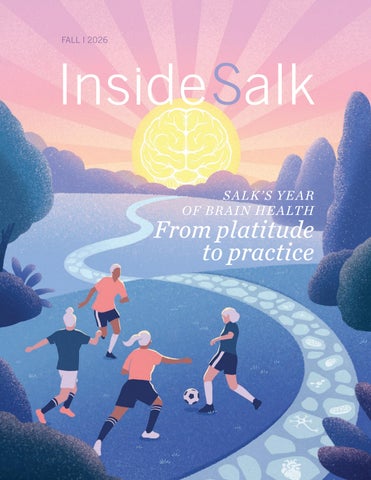
ON THE COVER: The Salk Institute has declared 2026 “The Year of Brain Health.” With help from soccer-playing “Over-80 Ladies,” Salk scientists are explaining the foundational science behind familiar advice. Together, they explore how exercise, cardiovascular health, immune health, metabolic health, and mental health converge to support a healthy brain.
02 DISCOVERIES 22 COMMUNITY 36 SPOTLIGHT 40 EVENTS 42 ASK A SCIENTIST
Dear Friends of Salk,
PRESIDENT’S LETTER
I have been thinking about what it means to truly understand how the brain works, both when it is functioning well and when something goes wrong, and how the brain changes over a lifetime. These questions sit at the heart of Salk’s Year of Brain Health, which I am pleased to say has galvanized research efforts across the Institute. Fittingly, brain health is the central theme of this issue of Inside Salk. Nearly everyone reading these pages has been touched by a brain-related condition such as cognitive decline or Alzheimer’s disease in someone they love. These are all too common and unsolved challenges in human health. And while there are no simple answers, there is a path forward: foundational science that starts with a question and, over time, builds the knowledge base from which real solutions emerge. What makes Salk uniquely suited to this work is our ability to bring together scientists from different research fields and give them the freedom to work and think alongside one another. This issue features Jamie Blum, whose research asks a question most of us have never considered: What does what we eat have to do with how well our brains tolerate inflammation? The connection between diet, the immune system, and brain health is a relatively new area of inquiry, and Dr. Blum’s work is helping to map that territory. These are the kinds of early-stage, curiosity-driven questions that private philanthropy makes possible—questions that may not yet fit a federal grant template but could point toward new ways to protect cognitive health. You will also meet Adam Farsheed, a postdoctoral researcher in the lab of Rusty Gage, one of the world’s foremost neuroscientists and a pioneer in Alzheimer’s disease research. Dr. Gage’s lab has fundamentally changed how scientists study the human brain by devising techniques that allow researchers to examine living brain cells derived from transformed skin cells obtained from actual patients. Dr. Farsheed’s work builds on that platform, pushing further into questions about how brain cells age and what might slow that process. Seeing the next generation of scientists take those tools and run with them is one of the most gratifying parts of leading this institution. This issue also carries a note of loss. We mourn the passing of Suzanne Bourgeois, a founding scientist of the Salk Institute whose many contributions to molecular biology exemplify what rigorous, curiosity-driven science looks like. Her legacy is inseparable from Salk’s own, and she will be deeply missed by all who knew her.
“And while there are no simple answers, there is a path forward: foundational science that starts with a question and, over time, builds the knowledge base from which real solutions emerge.”
None of the work described in these pages happens without you. Federal funding has grown less reliable, and the gap between what our scientists need and what traditional grants can provide continues to widen. Your support is what allows us to take risks, ask bold questions, and give early-stage ideas the time and space they deserve. Thank you for being part of our community. With deep appreciation,
Gerald Joyce, MD, PhD Salk Institute President Irwin M. Jacobs Presidential Chair
WWW.SALK.EDU
INSIDE SALK FALL 2026
1
DISCOVERIES
WHAT IT TAKES TO BE
2
VISIONA INSIDE SALK FALL 2026
WWW.SALK.EDU
Salk scientists are visionaries. And being a visionary means frequent encounters with the boundaries of what we know. Oftentimes, they find themselves asking questions so novel that existing technology cannot even answer them. Answering their questions means building new tools to break existing boundaries—bringing life’s blurry mysteries into sharper focus each time. Axel Nimmerjahn, PhD, is used to building boundary-breaking tools. He has already built microscopes that fit on the tip of your finger, and his latest endeavor is bringing cellular life into a precise, detailed, colorful view.
RY WWW.SALK.EDU
VISUALIZING CELLULAR LIFE WITH GREATER PRECISION Fluorescent proteins have revolutionized science, enabling researchers to tag and visualize 04/2026 individual molecules in living cells, tissues, and animals. Using these tools, researchers have watched viruses infect cells in real time, observed cellular waste collection, and tracked the signaling that spurs tumor growth. Nimmerjahn worked with collaborators at Albert Einstein College of Medicine to advance this visualization technology. NATURE METHODS
Their new technology, called visible-spectrum antigenstabilizable fluorescent nanobodies (VIS-Fbs), was validated across multiple mammalian cell types and provides a powerful tool for a wide range of life science research applications. Scientists can now gain more accurate, timely insight into cellular activity—even in complex environments such as living brain tissue.
“This work establishes a versatile platform for imaging proteins with high specificity and minimal background. It opens new opportunities to study how molecular and cellular processes unfold in real time across diverse biological systems.” AXEL NIMMERJAHN
Left: Mouse brain tissue showing inhibitory neurons labeled with a red fluorescent VIS-Fb that binds to the green calcium biosensor. Neurons are highlighted in blue. Credit: Barykina et al., Nature Methods. Right: Mouse brain tissue showing astrocytes labeled with a red fluorescent VIS-Fb that binds to the green calcium biosensor. Astrocytes are highlighted in purple, while neurons are shown in blue, illustrating cell-type-specific labeling. Credit: Barykina et al., Nature Methods.
INSIDE SALK FALL 2026
3
DISCOVERIES P L ANT B IO LOGY
What keeps thirsty plants alive during drought? For more than 25 years, the American Southwest has faced the severe social and economic consequences of a megadrought, including a $1.1 03/2026 billion agricultural loss in California in 2021 alone. New research led by Joseph Ecker, PhD, provides a roadmap that could help researchers engineer crop varieties that get us out of this agricultural rut. NATURE PLANTS
The team profiled nearly a million cells from the leaves of Arabidopsis thaliana, a small flowering plant that serves as a laboratory stand-in for important crops like corn, wheat, and rice. They measured changes in gene expression in these cells across different drought levels and leaf developmental stages and compiled the data in a public atlas. The atlas revealed that drought conditions accelerate leaf aging, but a specific gene could be used to rescue leaf growth during drought.
37-day-old Arabidopsis thaliana grown under either well-watered conditions (left) or subject to nine days of drought (right).
Joseph Ecker (left) and Joseph Swift (right).
How do plant roots grow in unpredictable temperatures? NATURE COMMUNICATIONS 03/2026
Lucia Strader Seedlings grow longer stems under warmer conditions in a process dependent on auxin and the activity of the Auxin Response Factors (ARFs).
4
INSIDE SALK FALL 2026
Plants can’t move to escape the heat like humans can—they are forced to adapt. As temperatures fluctuate, one key survival strategy is the ability of roots to keep growing, allowing plants to access water and nutrients farther away in the soil. Lucia Strader, PhD, asked how plants sense temperature and translate it into growth. She found her answer in a familiar plant hormone: auxin.
Auxin is at the center of plant growth, governing everything from cell elongation to root and stem development. But it’s not the center of this story—instead, the latest research found auxin’s partner proteins serve as internal plant “thermostats.” These partner proteins directly sense temperature, then change genetic programs to direct root growth accordingly. The findings could be used in future efforts to engineer plants that can withstand more extreme temperatures.
WWW.SALK.EDU
I M M U N O B IO LOGY
Why does the body deem some foods safe and others unsafe? In little moments like when sipping coffee or licking an ice cream cone, it doesn’t seem like your body is pulling off a biological miracle. 03/2026 But it is. That ice cream is not you—yet when you put it in your mouth, your body is able to tolerate it and process it without any detriment to your health in a process called oral tolerance. SCIENCE IMMUNOLOGY
Jamie Blum
Jamie Blum, PhD, is an oral tolerance expert, and her latest research identified new bits of food proteins that tell gut immune cells when to tolerate certain foods. They found three of these protein segments, called epitopes—one each from soybean, corn, and wheat. These epitopes interact with specialized immune cells called regulatory T cells to inform that tolerance-orrejection decision. The findings are an enormous step forward in understanding food tolerance and may inform future immunotherapies for people with food allergies.
Corn is one of the three foods, alongside soybean and wheat, that contains a protein that helps regulate oral tolerance.
Can naked mole rats peacefully hand over power?
Salk scientists watched a colony of naked mole rats for six years to find that the rodents are capable of peaceful queen succession, demonstrating unappreciated flexibility in their social order.
Janelle Ayres (left) and Shanes Abeywardena (right).
WWW.SALK.EDU
Naked mole rats keep kingdoms underground. One queen bears all the children, while other mole rats maintain complex subterranean tunnels, forage for food, take care 04/2026 of newborns, and perform other necessary upkeep. This society hinges on the central pillar of a singular queen. For years, the prevailing view has been that succession in naked mole rat colonies is violent and chaotic. SCIENCE ADVANCES
New research led by Janelle Ayres, PhD, suggests it does not have to be that way. Her team found that when reproduction is impaired in an established queen, peaceful succession is possible within an established naked mole rat colony. The study illuminates a new layer of social complexity for naked mole rats, which are important models in biomedical research on socialization, aging, adaptation, fertility, and more. The findings also help answer broader questions about biological resilience, potentially revealing principles that can explain human health and disease.
INSIDE SALK FALL 2026
5
DISCOVERIES M E TABO LI S M
How do GLP-1 drugs affect gene expression? GLP-1s are building a reputation as “wonder drugs.” First characterized for their ability to improve insulin release and treat diabetes, the drugs were later found to promote weight loss and improve 03/2026 cardiovascular health. In addition to those bonus benefits, GLP-1 drugs can improve pancreatic beta cell health. But how, exactly, are they doing that? PROCEEDINGS OF THE NATIONAL ACADEMY OF SCIENCES
In the lab of Marc Montminy, MD, PhD, scientists are burrowing into the mechanistic details behind how GLP-1 drugs promote viability and stress resistance in pancreatic beta cells. Since cellular performance adaptations arise from gene expression changes, the team screened for regulatory proteins that can switch on gene programs responsible for the beneficial effects of prolonged use of GLP-1 therapeutics. They identified a protein called Med14— part of a larger protein complex called Mediator—that enables the GLP-1-dependent changes in gene expression that lead to pancreatic health benefits.
Small (left) and large (right) condensates of the Mediator complex inside nuclei of a pancreatic beta cell-derived cell line.
Sam Van de Velde (left), Marc Montminy (center), and Reuben Shaw (right).
An internal liver clock orchestrates fat secretion Metabolic dysfunction-associated steatotic liver disease (MASLD) is among the most common chronic liver diseases and, when untreated, can 03/2026 progress to cancer, cardiovascular disease, and diabetes. A new study led by Ronald Evans, PhD, found that production of the protein FGF1 in the liver varies throughout the day to regulate the timing of fat release from the liver into the bloodstream, acting as a circadian pacemaker for liver fat metabolism. NATURE COMMUNICATIONS
Jocelyn Torres (left), Benan Pelin Sermikli (center left), Ronald Evans (center), Sihao Liu (center right), and Weiwei Fan (right).
6
INSIDE SALK FALL 2026
This liver clock ensures fat enters the bloodstream on a precise daily schedule and prevents fat accumulation seen in MASLD. The findings may also help explain why circadian disruption, from shift work to chronic sleep loss, has been linked to metabolic disease. Each mechanistic step uncovered brings scientists closer to therapies grounded not just in symptom management, but also in the fundamental biology of how the body regulates fat.
WWW.SALK.EDU
A playful representation of a mitochondrion moving into a larger cell, bringing with it the “baggage” of mutated mitochondrial DNA Credit: Amy Cao, Salk Senior Illustrator
Mitochondrial DNA can impact human health and disease Some of your most important life partners are the mitochondria that power all your cells. You and these little cellular powerhouses are in a 1.5-billion-year-old evolutionary relationship— 04/2026 but mitochondria brought some baggage. Mitochondria brought their own DNA with them when they joined with our bigger, more complex cells so long ago, and today, that mitochondrial DNA influences human health. PROCEEDINGS OF THE NATIONAL ACADEMY OF SCIENCES
“The majority of human diseases come with or cause mitochondrial dysfunction. Progress in this field has been limited, but this new platform is going to fuel so much important research that points to therapeutic approaches to combat mitochondrial diseases, as well as diseases or conditions associated with mitochondrial dysfunction like cancer or aging.” RONALD EVANS
WWW.SALK.EDU
Ronald Evans, PhD, is asking what those influences are, and the latest study from his lab unveils a new biological platform for studying mitochondrial DNA in physiology, adaptation, disease mechanisms, and therapeutic development. They have already used the platform to generate a library of 155 mitochondrial DNA mutant cell lines and to reveal correlations between mouse development and mitochondrial function. The platform, library, and findings will accelerate therapeutic development for mitochondrial disorders and help scientists treat mitochondrial dysfunction in other diseases and conditions, such as cancer and aging.
INSIDE SALK FALL 2026
7
C AN C E R B IO LOGY
From Salk Institute discovery to patient care: Vitamin D analog shuts down pancreatic cancer’s shield in clinical trial
NATURE CANCER
05/2026
A small clinical trial led by the Dana-Farber Cancer Institute put a Salk Institute idea to the test in patients: that activating the vitamin D receptor can help reshape the protective environment surrounding pancreatic tumors in ways that could make the notoriously difficult-to-treat cancer more vulnerable to therapeutic treatments.
In the study co-authored by Ronald Evans, PhD, patients with previously untreated metastatic pancreatic cancer received standard chemotherapy with or without paricalcitol—a vitamin D analog that is already FDAapproved for other uses. In patients who received paricalcitol orally or intravenously, the combination was found to be safe and to reduce activation of fibroblasts in the tumor microenvironment, validating Salk’s preclinical findings. The trial was not intended to measure how well the approach works in treating pancreatic cancer, yet the researchers noted improved chemotherapy responses and increased progression-free survival at one year among patients who received paricalcitol plus chemotherapy. In addition, they found that patients with high vitamin D receptor expression and who received paricalcitol had the longest overall survival rate.
8
INSIDE SALK FALL 2026
Pancreatic cancer cells (red) are surrounded by a dense fibrotic shield made of activated fibroblasts and connective tissue (purple). Immune cells (green) are prevalent in the tumor microenvironment. Healthy pancreatic cells (orange) are outside of the tumor. Credit: Amy Cao, Salk Senior Illustrator
“This study really takes a novel approach for cracking therapeutic resistance in pancreatic cancer. By using vitamin D analogs to engage the body’s own natural system for dampening fibrotic and inflammatory responses, we can enable other therapies to do their job.” RONALD EVANS
WWW.SALK.EDU
N EU ROSC I E N C E
What changes happen in the aging brain? Neurodegenerative diseases affect more than 57 million people globally. Though scientists CELL know that aging is a major risk factor for 03/2026 neurodegenerative diseases, the mechanisms underlying its impact remain unclear. But a great place to start is epigenetic change—the way small chemical tags on top of our base genetic code shift over time to alter gene expression. Joseph Ecker, PhD, Margarita Behrens, PhD, and colleagues have created the most comprehensive single-cell atlas of epigenetic changes in the aging mouse brain to date. The new atlas represents eight brain regions and 36 distinct brain cell types, with more than 200,000 single cells profiled across methylation and chromatin conformation assays, plus nearly 900,000 cells captured with spatial transcriptomics. The contents have already revealed clear epigenetic differences across age groups and enabled the researchers to develop novel deep-learning models that predict age-related gene expression changes.
Salk researchers used spatial transcriptomics to map where different cell types reside in the mouse brain. Shown are excitatory neurons (left, blue), inhibitory neurons (middle, red), and non-neuronal cells (right, green), color-coded by cell type.
Margarita Behrens (left) and Joseph Ecker (right).
How do astrocytes contribute to fragile X syndrome? Fragile X syndrome (FXS) is an inherited genetic developmental condition that strongly impacts brain development. Its symptoms 04/2026 are broad and highly variable, and there is currently no cure. Existing treatments are limited to medications and therapies to help manage symptoms. Nicola Allen, PhD, and team recently discovered how star-shaped brain cells called astrocytes contribute to some FXS symptoms. They found that a protein pathway commonly upregulated in FXS astrocytes could be suppressed to lessen those symptoms, meaning less severe seizures and restored molecular balances in a mouse model of FXS. The findings validate the importance of studying astrocytes in FXS research and represent a promising step toward future therapeutics for FXS and other developmental conditions, such as Down syndrome and Rett syndrome. NATURE COMMUNICATIONS
Left: A single astrocyte imaged to showcase the star-like branching of the cell. Right: Nicola Allen
WWW.SALK.EDU
INSIDE SALK FALL 2026
9
FRONTIERS
SALK’S YEAR OF BR AIN HEALTH BY ISABELLA DAVIS
10
INSIDE SALK FALL 2026
WWW.SALK.EDU
e are living longer than ever. W Today, the average US citizen
lives to 79. But as the years roll on, cognitive decline can creep in—one sixth of adults over 65 and one third over 85 will get Alzheimer’s disease. These statistics are why the increase in lifespan is accompanied by a new attention to healthspan—our ability to not just live longer, but also to maintain health in those extended years. The question is: How? How can we extend our healthspan, especially in the brain to avoid aging-related cognitive decline? The San Diego Women’s Soccer League may have some answers. “I fell in love with the sport. I fell in love with the camaraderie. And here we are 40-some years later,” says Nancy Petit, an 81-year-old league player. “We can laugh on the soccer field, and we can get serious on the soccer field.” But never too serious. Petit laughs as she shares that the players have so much fun on the field, they sometimes leave wondering, “What was the score?”
We have heard a lot of tips for maintaining health in old age, like eat well, exercise, and get a good night’s sleep. At Salk, we want to know the mechanisms behind those beneficial habits. G E R A L D J OYC E
“And afterward, we always go out for coffee—that’s become part of the tradition,” says Jo Matthews, one of Petit’s teammates, who is also 81. Matthews plays a few other games throughout the week, too. “Four days a week, I’m out playing soccer, and it keeps me moving. And I know how important that is, especially at my age,” she says.
WWW.SALK.EDU
INSIDE SALK FALL 2026
11
While the brain constitutes only 2 percent of the volume of the entire body, it consumes 20 percent of the energy, this really demonstrates that the brain is connected to the rest of the body, and the rest of the body affects the brain. RU ST Y GAG E
Beneath these anecdotes from the field are real biological mechanisms supporting the brain health of these “Over80 Ladies,” as these soccer players call themselves. Salk scientists are unraveling those mechanisms to outline exactly which cells and molecules are at play. “We have heard a lot of tips for maintaining health in old age, like eat well, exercise, and get a good night’s sleep,” says Salk President Gerald Joyce, MD, PhD. “At Salk, we want to
12
INSIDE SALK FALL 2026
know the mechanisms behind those beneficial habits. Why are they beneficial? How, on a mechanistic biological level, do they improve your healthspan?” These are the types of questions foundational researchers at Salk are especially well-suited to tackle. Foundational science searches for the underpinnings of biological phenomena that, once described, can be used to develop better therapeutics or inform better habits that can protect you long term. When foundational discoveries reveal the mechanisms and molecules our bodies use to keep us healthy, scientists can determine what lifestyles support those mechanisms and molecules, and find ways to supplement or repair them when they dysfunction. This year, Salk is focusing those foundational research powers on brain health. How do exercise, cardiovascular health, immune health, metabolic health, and mental health converge to support a healthy brain? And what actionable tips can be gleaned from understanding the foundational biology of brain health?
WWW.SALK.EDU
HOW DOES EXERCISE CONTRIBUTE TO BRAIN HEALTH? Exercise is energy intensive. But it’s not just your muscles gobbling up energy. “While the brain constitutes only 2 percent of the volume of the entire body, it consumes 20 percent of the energy,” explains Rusty Gage, PhD, a neuroscientist at Salk. That energy is used to fuel the tens of billions of neurons that zap information back and forth to facilitate running, scoring, jumping, playing, and everything else the body needs. For years, it was believed that the neurons you are born with are all you get. Gage discovered that this is not true; Neurogenesis can occur throughout life, and exercising can boost it. This can help stabilize the brain in later years, when neurons and the connections between them get lost, leading to age-related neurodegeneration. Recently, scientists have pinpointed two exercise-related proteins that encourage neurogenesis. One is BDNF, a protein that increases during exercise and helps neurons make more connections with one another. What causes this increase is still under investigation, but Gage suspects something begins circulating in the blood during exercise that tells brain cells to make more BDNF.
The other is GPLD-1, a protein that gets made in the liver and sent through the bloodstream up to the brain. “This really demonstrates that the brain is connected to the rest of the body, and the rest of the body affects the brain,” says Gage. Exercise stirs up these proteins and encourages connectivity in the brain that keeps it healthy, longer. One day of exercise once a month will not produce these benefits, though, explains Gage. While one exercise session is good for you, a long-term, sustainable exercise routine is better. But routine does not mean boring. “Personally, I like to mix things up,” says Gage. “Every day I stretch and do some light lifting, I run. Anything that is moving your body counts as a form of exercise.” And the soccer ladies agree. “You have got to keep your body moving, keep those muscles active,” says Jany Staley, an 82-year-old teammate of Petit and Matthews. Staley runs the Sunday morning league, is the president of another league, and dabbles in pickleball and the card game canasta. A mix of strength, agility, aerobics, and, most importantly, fun can keep exercise feeling doable and the brain feeling energized. And starting now can set the stage for healthier aging.
Petit, Matthews, and Staley —who are all over 80—demonstrate that being active, laughing often, and staying connected to a vibrant community aren’t just good habits. For the brain, they may be the most powerful medicine of all.
From left: Nancy Petit, Jo Matthews, and Jany Staley.
WWW.SALK.EDU
INSIDE SALK FALL 2026
13
HOW DOES CARDIOVASCULAR HEALTH CONTRIBUTE TO BRAIN HEALTH? A major benefit to exercise is improving circulation, the continuous stream of blood through the heart, arteries, and veins that constitute the cardiovascular system. Good circulation ensures that oxygen and nutrients reach the brain efficiently, and a consistent exercise regimen can improve circulation. In fact, with routine exercise, the body can increase its energy-making capacity by making more of the little cellular engines, called mitochondria, that turn oxygen and nutrients into usable fuel. This ability to make more mitochondria in response to exercise and healthy circulation is especially important in the energy-hungry brain, where mitochondria power the connections between neurons. Loss or dysfunction of mitochondria in the brain has been linked to neurodegeneration, as the brain lacks the power it needs to function normally. Salk scientists are curious about why and when this happens, and whether therapeutic or lifestyle interventions exist that can prevent or remedy mitochondrial dysfunction.
One major source of mitochondrial dysfunction is overeating. When energy consumption exceeds energy expenditure, fat cells storing excess energy can grow in both size and number. While some excess storage is manageable, too much can cause fat deposits to accumulate around the body, which leads to whole-body inflammation and organ dysfunction. Alan Saghatelian, PhD, a chemical and molecular biologist, has been on the hunt for new therapeutic targets for obesity and related metabolic conditions. He has been looking in the “dark side” of the human proteome—the parts no one else has found or studied. In these mysterious waters are a class of molecules called microproteins, and Saghatelian found dozens that regulate fat cell proliferation and lipid accumulation. Saghatelian is one of many Salk researchers taking a unique approach to studying mitochondrial function. Identifying molecules involved in obesity can help inform future development of therapeutics that could prevent cardiovascular dysfunction, ensuring that circulation and nonbrain organs contribute to the whole-body health ecosystem that supports a healthy brain.
Eating too much and exercising too little can cause an excess of fat cells. This accumulation disturbs the body’s energy balance, robbing brain cells of power.
Illustration by Charlotte Griffiths
14
INSIDE SALK FALL 2026
WWW.SALK.EDU
One single astrocyte can support up to 1 million neuronal connections, but when these cells misbehave with age, the brain’s entire communication net work begins to quietly unravel.
HOW DOES IMMUNE HEALTH CONTRIBUTE TO BRAIN HEALTH? The immune system does not just come to the rescue when you have the flu or after you get a cut. It is always around, scouring the body for intruders and cleaning up threats before they turn into problems. And in the brain, immune surveillance and maintenance are carried out in part by specialized non-neuronal cells called glial cells. Neurons make up half of the cells in the brain, and glial cells the other half. There are billions of glial cells in the brain, including star-shaped cells called astrocytes. Nicola Allen, PhD, has championed a movement in neuroscience to prioritize astrocytes in research. “When neurons communicate, they use chemical messengers that one neuron releases and another neuron responds to,” says Allen. “But that is a messy process. The first neuron releases way too much of this chemical to make sure the second one gets activated. Astrocytes come in, pick up, and recycle those chemicals to keep communication precise.” One single astrocyte can support up to 1 million neuronal connections in the human brain. As with neurons, age brings dysfunction of these cells, changing their properties to reduce neuronal support. If we can figure out how to recover dysfunctional astrocytes, it is likely their renewed strength would promote renewed neuronal strength, renewed connections, and a healthier brain.
WWW.SALK.EDU
Microglia are another promising glial target for future therapeutics. Microglia are resident immune cells in the brain that also carry out the important work of pruning unnecessary or redundant connections in the developing brain. As the brain stabilizes in adulthood, microglia reduce pruning. In old age, microglial dysfunction can prompt these cells to resume pruning. Figuring out what turns microglial pruning back “on” could help scientists keep them “off”, preventing unwanted activity that leads to lost connections and cognitive decline. Microglia and astrocyte dysfunction are so significant in neurodegeneration that scientists have found that much genetic predisposition to diseases like Alzheimer’s are linked to these glial cells. And the transcriptional state of microglia and astrocytes tends to change the most of any brain cells during neurodegeneration. “There are two main changes that happen in these glial cells,” explains Allen. “First, they stop doing their regular jobs. Second, they start misbehaving.” Keeping these brain-resident glial cells healthy ensures healthy brain activity. Immune cells that live elsewhere in the body are important to brain health, too, as inflammation anywhere in the body—from another organ, or an injury or dietary issue—sends immune signals through the bloodstream to the brain, where they can impact neurons. Supporting a healthy immune system by treating injury and sickness appropriately, even small things like gingivitis, can, in turn, support a healthy brain.
INSIDE SALK FALL 2026
15
HEALTHY HABITS TO START TODAY “Everything in moderation. Extreme diets can cause diseases rather than cure them.” Christian Metallo, metabolism expert
“Stretching and breathing exercises are wonderful. Keep a balanced portfolio of exercise—stay consistent, and do not wear yourself out.” Rusty Gage, neuroscience expert
“As simple and silly as it may sound, floss your teeth every day to reduce inflammation.” Gerald Joyce, medical biology expert
“Exercise to reduce inflammation and improve circulation.” Nicola Allen, neuroimmunology expert
“Live an adventurous life. Seek out new experiences to build new neural connections.” Kay Tye, behavioral neuroscience expert
“Try deliberate breathing methods, like in meditation or yoga practices, to calm yourself down in stressful times.” Sung Han, neuropsychology expert
16
INSIDE SALK FALL 2026
HOW DOES METABOLIC HEALTH SUPPORT BRAIN HEALTH? “The best way to begin talking about metabolic health is by defining metabolism,” says Christian Metallo, PhD. “Metabolism is the set of biochemical reactions that occur in our cells, in our tissues, throughout our bodies. This concept encompasses physiology and drives how nutrients get from the food we eat to our various tissues, where we use them for fuel.” Metallo is a biochemical engineer and metabolic scientist. He applies the same tools used to study chemical processes in plants to study biochemical processes in humans. His approach allows him to ask questions like, what, when, and where are biochemical reactions happening in the human body? All the energy brains consume cannot come directly from the food we eat. Those nutrients must be processed in a series of biochemical reactions that turn food into usable cellular fuel. Typically, glucose is the nutrient of choice—an abundant sugar the body extracts from fruits, vegetables, and starchy foods like bread or pasta. During a fasting state, however, the brain can switch from glucose as the primary fuel to ketone bodies. Between snacks and meals, glucose levels decline, and the body begins converting stored fats into ketone bodies. These little molecules are critical in keeping the brain and heart running when glucose gets low during fasting. But Metallo thinks this important switch between glucose and ketone bodies may malfunction in aging. “The human body is a beautifully designed machine that has this exquisite flexibility and can sense different nutritional environments and change the way it fuels itself,” explains Metallo. “But that ability to flex between nutrient sources can go awry in metabolic disease and aging. Now, we are trying to figure out how different disease states or genetic backgrounds influence the nutrients your body favors.” Answering this question starts with tracking nutrients as they move through the body. Metallo tags different nutrients with (nonradioactive) isotopes, or little flags, feeds those tagged nutrients to a person or a cell in a petri dish, then uses instruments to track where they go, what tissues they end up in, how they are metabolized, and how fast they are converted to other biochemicals.
WWW.SALK.EDU
Metallo is particularly interested in tracking the metabolism of amino acids, which are the building blocks of peptides and proteins, and, relatedly, sphingolipids—bioactive fats that are present in specialized cells throughout the body. Curiously, sphingolipid-related genes and molecules have been linked to neurodegeneration and neurodevelopmental defects. Metallo wants to know why. “These systems are all intertwined,” he says. “That is why I take a systems approach as an engineer, looking at not just one tissue but the whole sum of the body’s parts working together.” A systems approach appears in Metallo’s advice for healthy metabolism, too: Ensure the whole body is healthy by exercising, maintaining an appropriate body weight, and supporting your mental health.
HOW DOES MENTAL HEALTH SUPPORT BRAIN HEALTH? Retaining memory, attention, language, and problemsolving is key to extending our cognitive healthspan. With age-related cognitive decline, these systems can begin to fail, and vulnerabilities from social isolation, anxiety, and mental health disorders can exacerbate that decline.
[A yoga pill] may sound silly... but we now have a potentially targetable brain circuit for creating therapeutics that could instantly slow breathing and initiate a peaceful, meditative state. SUNG HAN
Sung Han, PhD, is a behavioral neuroscientist and expert in tying molecular cues to psychological responses. Han pays special attention to a class of brain communication molecules called neuropeptides and how they transduce environmental stresses into changes in physiology, metabolism, behavior, and emotion.
worked in the brain,” says Han. “By uncovering a specific brain mechanism responsible for slowing breathing, our discovery may offer a scientific explanation for the beneficial effects of practices like yoga and mindfulness on alleviating negative emotions, grounding them further in science.”
Dysfunctional neuropeptides can trigger overreactions to nonthreatening situations, causing hypersensitivity characteristic of neuropsychiatric disorders like post-traumatic stress disorder (PTSD) or other panic and anxiety conditions.
Han even envisions a future where this circuit could be triggered by a drug—a so-called “yoga pill.” “It may sound silly,” he laughs, “and the translation of our work into a marketable drug will take years, but we now have a potentially targetable brain circuit for creating therapeutics that could instantly slow breathing and initiate a peaceful, meditative state.”
One easy-to-act-on discovery that Han has made is identifying the brain circuit used to consciously slow breathing to reduce anxiety and negative emotions. “The body naturally regulates itself with deep breaths, so aligning our breathing with our emotions seems almost intuitive to us, but we didn’t really know how this
WWW.SALK.EDU
Taking deep breaths, slowing down, and utilizing practices like yoga and mindfulness can keep your nervous system regulated, helping prevent chronic anxiety that can harm your body by spiking blood pressure and flooding your system with stress hormones.
INSIDE SALK FALL 2026
17
You can never say you can’t learn new things just because you’re older. I think any older person can learn anything if they want to. JA N Y S TA L E Y
Above: Staley, far right, receives a passed ball from a teammate.
In addition to breath-related practices, people can benefit from connecting with each other. Over-80 Ladies Petit, Mathews, and Staley say that camaraderie keeps them coming back to soccer. “Playing in this soccer league has convinced me how important not only the physical activity is, but the interactions with people,” says Staley. “Everybody has had different things, whether it’s injuries or loss of a family member, and the soccer community pulls together to assist them during those tough times. I love that.” “We’re talking about what is going on in the world or with our friends and families,” says Mathews. “It makes you empathetic to what is happening outside of yourself, to our group, or the rest of the world. I think it is important that you establish those kinds of relationships.” The science behind socialization is a special interest for Kay Tye, PhD. After first identifying a cluster of neurons in mice that were associated with a drive to socialize after isolation, Tye found similar results in a small human cohort. Humans crave social contact when lonely in a similar way to craving food when hungry, and Tye identified the circuit responsible for that craving. Social isolation, like anxiety, can cause stress or disorder. Maintaining both the quantity and quality of social interactions can keep your brain from craving connection and falling into disorder over time.
18
INSIDE SALK FALL 2026
FROM PLATITUDE TO PRACTICE Eat healthy! Exercise! Make new friends! Get good sleep! This advice, though repetitive and ubiquitous, is true. “We hear this good advice all the time,” says Joyce. “At Salk, we try to figure out the mechanisms behind each of these ‘Do good’ statements. Because if we can understand the mechanism, then we know the bull’s-eye of what ‘Do good’ really means. It is no longer a platitude— it is a more specific thing. And each mechanism we define is an opportunity for future prevention strategies or therapeutics that address early cognitive decline.” Salk scientists are continuing to explore the mechanisms behind why and how exercise, cardiovascular health, immune health, metabolic health, mental health, and other factors support a healthy brain. And it is all about teamwork. Whether in the lab, in the body, or on the soccer field, nothing happens in isolation. No one scientist or discipline can understand life by themselves; no singular part of the body can be untangled from the rest; and no one soccer player can win a game alone. Supporting brain health can happen at any age, and it never has to stop. “You can never say you can’t learn new things just because you’re older,” says Staley. “I think any older person can learn anything if they want to.” The same goes for Petit. “My kids go, ‘Oh my gosh, Mom, don’t you think it’s maybe almost time to hang up your cleats? And I’m like, ‘No! No! I’m not ready for that!’”
WWW.SALK.EDU
Listen to and watch all-new episodes of Salk’s podcast, Beyond Lab Walls 2026 is Salk’s Year of Brain Health. To explore what brain health really means, Salk President Gerald Joyce is sitting down with different Salk experts in a special Beyond Lab Walls video podcast series. The episodes take a closer look at how factors like exercise, metabolism, and immune health impact brain health long term, each conversation offering a window into how foundational science turns familiar advice into real, evidence-based understanding.
Beyond Lab Walls is a production of the Salk Office of Communications and can be heard on Apple and Google podcasts, Stitcher, Spotify, or anywhere you listen to podcasts.
Scan the QR code to visit www.salk.edu/podcast
IN MEMORIAM R EMEMBERING
SUZANNE BOURGEOIS She cracked one of biology’s earliest codes, then made sure the story of how Salk came to be was never lost
Suzanne Bourgeois, PhD, had a knack for finding things that others had overlooked. In the 1960s, when the molecular machinery behind gene regulation was still largely a mystery, she identified something no one had proved before: that the protein responsible for switching a gene off was real, measurable, and could be studied in precise detail. As the founder of Salk’s Regulatory Biology Laboratory, Bourgeois studied the regulation of gene expression—the process cells use to turn genes “on” or “off”—using the bacterial lactose (lac) operon as a model system. In the 1960s, when little was known about the circuit, Bourgeois demonstrated that the lac repressor was a protein. She used the system to characterize, for the first time, the interaction between a regulatory protein and DNA. She later studied gene regulation in animal cells and eventually identified compounds that could help reverse multidrug resistance in cancer. From that foundation, Bourgeois went on to ask bigger questions, eventually identifying compounds with the potential to help overcome one of cancer treatment’s most stubborn problems: the ability of tumors to resist multiple
20
INSIDE SALK FALL 2026
drugs at once. Her National Institutes of Health research grant funding continued through 1994, a telling measure of how seriously the scientific community regarded her work across three decades. Two of the Institute’s founders, Bourgeois and her husband, Melvin “Mel” Cohn, PhD, arrived in La Jolla in the early 1960s. Bourgeois spent the rest of her long life—she died on March 14, 2026, at 94, at her home in Del Mar, California—bound up with the place she had helped build. She held the title of Professor Emerita at Salk, an honor that reflected not just her years of service, but also the lasting mark she left on the Institute. “We are deeply saddened by Suzanne’s passing, but I am so grateful for having known such an inspiring scientist and a wonderful person all these years,” says Salk President Gerald Joyce, MD, PhD. “The scientific community has lost a brilliant mind, and Salk, a link to the founding of the Institute. She will be greatly missed.” Bourgeois was born in Brussels, Belgium. She moved to Paris in 1961 to work at the Pasteur Institute with biochemist Jacques Monod, PhD, with whom she also completed her doctoral thesis at the University of Paris/ Sorbonne in 1966.
WWW.SALK.EDU
In 2014, Bourgeois chronicled the Institute’s founding story in Genesis of the Salk Institute: The Epic of Its Founders. It was at the Pasteur Institute that Bourgeois met Cohn. They married in 1963 and moved to La Jolla to help build the Institute at the request of Jonas Salk, who developed the first effective polio vaccine. Cohn died in 2018.
Carol Bodas, Salk’s librarian, who had the unique opportunity to work closely with Bourgeois, recalls her conversations with Cohn and Bourgeois about their decision to become part of Jonas Salk’s vision to create a world-class research institution. “They had many offers, and instead of accepting a position at a university with an already established research program, they recognized that they made the right decision to be part of Salk and scientific freedom, together with other distinguished scientists in that area,” Bodas says.
After retiring from her laboratory, Bourgeois realized that she was one of the last witnesses to the amazing founding of the Salk Institute, and she made it her mission to document that history. In many ways, Bourgeois became the Salk Institute’s unofficial historian with her personal account of the origins and early years of the Institute. At one point during her research, she discovered several forgotten filing cabinets tucked away on Salk’s campus. After taking a closer look, she realized she had struck gold. Filed away in the old cabinets were the Salk Institute’s early archives, which she saved from being destroyed. Her papers are now part of the UC San Diego library archives.
Opposite page: Bourgeois in her study at the Salk Institute, 2018. This page: Bourgeois and Mel Cohn at the Chihuly at the Salk event in 2010 (left). Bourgeois at the Salk Institute, 2018 (above).
In addition to her scientific, archival, and narrative contributions to the Institute, Bourgeois established the Suzanne Bourgeois Women & Science Fund. “This fund continues to be a critical resource for fueling discovery and building scientific careers,” says Salk Chief Science Officer Jan Karlseder, PhD, who had the privilege of being recruited to Salk to work in the Regulatory Biology Laboratory that Bourgeois had founded.
In 2014, Bourgeois published a book, Genesis of the Salk Institute: The Epic of Its Founders, chronicling the dynamic history of the Institute and the key players who took part in its creation. She told the story of how and why, although born far apart, the founders of the Salk Institute eventually gathered in La Jolla in the early 1960s to create an exceptional institution. WWW.SALK.EDU
“Salk is forever grateful for Suzanne’s support over the years. Her commitment to enabling the training of the next generation of scientists reflects her forward-thinking vision for the Institute.” In quieter moments, Bourgeois loved nature— specifically greenery, flowers, and trees—and spending time in Del Mar.
INSIDE SALK FALL 2026
21
ROOTED IN COMMUNITY
PLANT SWAP IN THE GROVE The Grove was buzzing with conversation, greenery, and community spirit as employees gathered for Salk’s recent plant swap.
22
INSIDE SALK FALL 2026
WWW.SALK.EDU
COMMUNITY
From fig trees to succulents and Venus flytraps from Salk’s Harnessing Plants Initiative (HPI), staff from across campus exchanged plants, cuttings, propagations, pots, soil, and gardening tips, transforming the space into a vibrant hub for connection and collaboration. Participants from longtime plant enthusiasts to first-time growers shared stories, traded advice, and expanded their collections while building new relationships across departments. Cold-pressed juice courtesy of Engagement & Wellbeing and sunny weather made the afternoon a refreshing pause in the workday and a reminder of the strong community that continues to grow across campus. The swap emulated the spirit of HPI, which explores how plants can help address global challenges through innovative science. Founded in 2017, the initiative is rooted in the idea that enhancing plants’ natural abilities can support healthier ecosystems, more resilient agriculture, and longterm environmental sustainability. By creating space for informal connection and knowledge-sharing, the plant swap fostered a sense of belonging and encouraged employees to learn from one another outside of the lab.
WWW.SALK.EDU
INSIDE SALK FALL 2026
23
OBSERVATIONS
JAMIE BLUM 24
INSIDE SALK FALL 2026
WWW.SALK.EDU
THREE TO FIVE POUNDS OF IMMUNE DECISIONS EVERY DAY Jamie Blum, PhD, has always been curious about what we eat and why it matters. Now, as a Salk assistant professor, she’s asking the question at the molecular level, and the answers could one day change how we think about food allergies.
Inside Salk sat down with Blum to talk about her research asking how the body tolerates the things we eat and why that sometimes goes wrong.
WWW.SALK.EDU
INSIDE SALK FALL 2026
25
Growing up in rural upstate New York, Jamie Blum wasn’t thinking about immunology. She was mostly thinking about snacks—specifically, the ones she wasn’t allowed to have. Her parents kept a strict household when it came to food: no high-fructose corn syrup, no hydrogenated oils. While her friends got the fun stuff, Blum got curious. Why did those ingredients matter? What were they actually doing inside the body? That early question, as it turns out, set the course for her career. Today, Blum runs a lab at the Salk Institute that sits squarely at the intersection of nutrition, plant biology, and immunology. She joined Salk in the fall of 2025, drawn by the Institute’s collaborative culture and its rare willingness to support foundational, open-ended science that most research institutions overlook. After all, before the right treatments can exist, someone must ask the right questions.
How did you wind up here, as a scientist at Salk? JB: It has been a winding road, which I think is actually what makes the work interesting. I did my undergraduate degree at Cornell and then stayed there for my PhD in molecular nutrition, where I was studying how nutrients affect muscle stem cells. Then I went to Stanford for my postdoc, working in a chemical engineering lab focused on how the immune system reacts to food proteins. That combination—nutrition, plant chemistry, immunology—is a little unusual, but it maps almost perfectly onto what I’m doing now. What drew me to Salk specifically was the interdisciplinary environment. My research touches plant biology, metabolism, and immunology all at once, and Salk has real depth in all three of those areas. It’s also genuinely collaborative. That’s rarer than it sounds.
26
INSIDE SALK FALL 2026
Your lab focuses on food allergies. Can you explain what’s actually happening in the body when someone develops one? JB: Your immune system is constantly making decisions. It screens everything entering your body and asks: Is this safe, or is it a threat? That process happens most intensely in the intestine, because most of us are eating three to five pounds of food every day. There’s always a chance something harmful is in there, so the immune system has to stay vigilant. When things go well, the immune system recognizes food proteins as safe and mounts what we call a regulatory response—essentially, it stands down. When things go wrong, it decides those proteins are dangerous and launches an immune attack. That’s a food allergy. What we don’t fully understand yet is exactly what tips the scales one way or the other. That’s the question we’re trying to answer.
What’s the current scientific thinking on how food allergies develop, and what advice do you give to parents who ask you about it? JB: The field has actually gone through a major shift on this. For years, the clinical guidance was that parents should avoid giving young children major allergens, like peanuts and tree nuts, until they were around three years old. The
WWW.SALK.EDU
“My research touches plant biology, metabolism, and immunology all at once, and Salk has real depth in all three of those areas. It’s also genuinely collaborative. That’s rarer than it sounds.” JAMIE BLUM
You mentioned that diet has emerged as a predictor of health more broadly. What don’t we know yet about the connection between what we eat and conditions like Alzheimer’s disease? JB: We have pretty good evidence that certain dietary patterns, a Mediterranean diet, for example, are associated with lower levels of systemic inflammation and some protection against chronic diseases, including Alzheimer’s. But “associated with” is not the same as “we understand why.” idea was that an infant’s immune system wasn’t ready. We now know that was exactly backwards. The earlier a baby is exposed to an allergen, the less likely they are to develop an allergy to it. So my advice to any parent who’s worried: Once your baby starts eating solid foods, that’s the time to start introducing those foods. Early and often, not avoided.
The honest answer is that we don’t yet have a clear, mechanistic explanation for how specific foods or molecules in those diets produce those protective effects. That’s exactly the kind of foundational question that needs to be answered before anyone can develop a targeted intervention. You can’t engineer a solution to a problem you haven’t mapped yet.
So what’s missing from our understanding? What is your lab actually trying to figure out?
What are you most excited to learn in the next five to 10 years?
JB: We know that the proteins in food are what the immune system directly recognizes. But we think proteins alone aren’t enough to drive a full allergic response. There seem to be other molecules—what we’re calling adjuvant molecules—that act as a kind of amplifier or trigger alongside the proteins. We’re trying to identify what those molecules are and how they work. A lot of those molecules likely come from plants. I did my postdoc in a plant chemistry lab, so I’ve spent a lot of time thinking about the compounds plants produce and what they do once they’re inside us. That’s a big part of what makes our approach at Salk distinctive—we’re bringing plant biology into a question that most immunology labs wouldn’t think to look at from that angle.
WWW.SALK.EDU
JB: Within my own lab, I’m hoping we can build a fairly complete picture of what those adjuvant molecules from food actually are and start to understand the rules governing when the immune system decides to tolerate something versus react to it. More broadly, I’m excited about the possibility of connecting specific molecules in our diet to specific changes in the body—a particular immune cell responding to a particular compound, for instance. As the tools for large-scale biological data analysis get better, those kinds of precise relationships are becoming possible to see for the first time. We’re at a moment where the questions people have been asking for decades are finally answerable. That’s a remarkable situation to be doing science.
INSIDE SALK FALL 2026
27
INSIGHTS
Tim Ball and the Facilities Services Team
Maintaining the Life of the Institute BY KATHLEEN HART
E
very day, soft morning light washes across Louis Kahn’s concrete walls as the Pacific fog lifts over the courtyard.
teams and custodians complete their final rounds before researchers begin arriving for the day.
From above, the campus appears still, its laboratories quiet beneath the steady rhythm of the River of Life water feature flowing toward the horizon.
Tim Ball, executive director of Facilities Services and Operations, describes Salk as a living organism.
But beneath that calm exterior, the Institute is already awake. At Salk, discovery never truly stops. Neither do the systems nor the people that sustain it. Air-handling systems circulate air through laboratories with microscopic precision. Chilled water moves through underground infrastructure. Engineers monitor temperatures critical to sensitive experiments. And the overnight watch 28
INSIDE SALK FALL 2026
“Power. Water,” Ball says. “That’s the life of the Institute.” THE CENTRAL PLANT AND THE CENTRAL MEANING Ball wasn’t actively looking for a new job when he was recruited to Salk nearly 18 years ago. At the time, he was working in Long Beach, commuting from Oceanside, and raising his young son. A former colleague encouraged him to consider the opportunity. Before arriving at Salk, Ball had spent years working in higher education facilities operations, developing expertise that extended far beyond building maintenance.
WWW.SALK.EDU
Top row (from left): Lloyd Austin, Michael McClelland, Thomas Bauer, and Adam Ames. Bottom row (from left): Pilar Reyes, Alma Fernandez, and Tim Ball.
He had experience managing complex campus infrastructure systems, long-term capital planning, and utility operations, and served on a statewide team negotiating power procurement strategies for California institutions. But there is nothing like Salk’s intricacies and high-stakes maintenance. That’s what ultimately drew him in. Maintaining Salk’s campus and its underground labyrinth is a unique task for a uniquely skilled team. Deep beneath the campus, the central plant—the mechanical heart of the Institute—distributes cooling, heating, steam, air, gas, and power across Salk’s laboratories and research facilities. As head of Salk’s Facilities Services team, Ball stewards one of the world’s most iconic research campuses and its 1960s infrastructure, preserving its history while preparing it for the future. “It’s like restoring an old ’57 Chevy,” Ball says. “You get excited about it, it means something to you, and it’s a part of history… that’s an opportunity to make it better.”
Years ago, as Ball sat with his father during the final stages of cancer, he remembers hearing him say, “My son works for Salk. They’re gonna find a fix for this someday.” “That’s why I’m here,” Ball says. The moment shaped the way he sees his role at the Institute today—not simply overseeing operations, but also helping create the conditions for discovery.
“It’s more than just taking care of the place. It’s basically inspiring the science, creating the envelope where miracles can happen.” TIM BALL
But what does that look like?
But for Ball, the work has never simply been about maintaining buildings or upgrading infrastructure.
WWW.SALK.EDU
INSIDE SALK FALL 2026
29
DAY-TO-DAY COMMITMENT Facilities Services consists of 48 team members supporting the campus around the clock. On average, the department receives roughly 15,000 work orders each year—everything from urgent infrastructure repairs to the day-to-day operational needs that keep research moving uninterrupted. “We have 756 work orders in process currently,” Ball explains. Tom Bauer, assistant director of Facilities Services, has spent 36 years working inside the Institute’s mechanical core. “Most of my time is in the shadows trying to make sure everything that everybody appreciates is still working,” Bauer says. Over the decades, Bauer has responded to storms, floods, power outages, and infrastructure failures. He remembers moments spent managing floodwater while also restoring electrical systems and protecting laboratory freezers holding years of scientific work. “Science doesn’t stop,” Bauer says. “They need it, they need it now.” A burst pipe or mechanical failure can happen in any building. At Salk, however, the stakes are different. A seemingly routine facilities issue could jeopardize experiments, specimens, years of potentially life-saving data, or historic infrastructure. For Facilities Services, every response carries that responsibility.
When Facilities Services is not working around the science, they’re working with the science, setting up labs, ensuring new technology can be supported, and collaborating with scientists on sustainability initiatives.
“It’s about striking the balance between understanding the old and incorporating the new, while preparing Salk for further innovation and expansion.” TIM BALL
SUSTAINABILITY AND STEWARDSHIP For Facilities Services, sustainability is as much about stewardship and efficiency as it is about honoring the Institute’s long history of innovation and forwardthinking design. Many of Salk’s sustainability principles, Ball notes, were embedded into the campus long before sustainability became standard practice.
Mike McClelland, trades supervisor, has spent roughly 17 years at Salk, beginning as a central plant watch engineer responsible for monitoring laboratory freezers, incubator temperatures, mechanical systems, and equipment alarms while most of the campus is asleep. “I’d have around seven miles under my belt on an average day,” McClelland says of his overnight rounds through the campus. Ball’s experience is similar. “I go through three pairs of work shoes a year,” he says. Even after decades at Salk, the Institute can still surprise McClelland. “The other day, I went into a little closet shaft and thought, ‘I’ve never been in this room before,’” he says. “I don’t say that very often anymore.” Facilities Services knows Salk inside and out and understands not only the systems, but also the rhythms of the researchers working around them. “Sometimes we’ll adjust our schedule and come in at 4 a.m., if that’s what’s needed,” McClelland says.
30
INSIDE SALK FALL 2026
WWW.SALK.EDU
Salk’s iconic River of Life water feature, bisecting the Courtyard, is sustained through a 250,000-gallon underground cistern that captures rainwater from across the campus watershed. Louis Kahn’s original design also incorporated large light wells that allow natural sunlight to reach deep into the laboratories below to reduce the need for artificial lighting. Even the Institute’s orange groves and grassy areas serve a dual purpose, functioning as landscape features and natural cooling elements for infrastructure beneath the campus.
And the Institute’s LED transition has already saved roughly $350,000 annually in electricity costs, along with an additional $27,000 in yearly lamp replacement expenses. Solar arrays above the laboratories generate approximately 500 kilowatts of electricity, offsetting an estimated 10 to 15 percent of Salk’s total energy demand while helping power the systems that keep the Institute operating around the clock. Through a combination of operational efficiencies, renewable energy production, and carbon offset procurement, the Institute has also achieved carbon neutrality.
Today, Facilities Services continues building on that forward-thinking foundation through modern sustainability initiatives designed to improve efficiency, maintain uninterrupted research, and reduce operational costs.
“It’s about striking the balance between understanding the old and incorporating the new,” Ball continues, “while preparing Salk for further innovation and expansion.”
“If you can get enough savings out of it but not affect the research, that’s the key point,” Bauer says.
THE PEOPLE
In an ongoing multiyear project, Facilities Services has installed motion-sensor LED lighting systems that reduce unnecessary energy use without disrupting researchers as they move between experiments.
For Facilities Services, sustaining the Institute is about more than just maintaining the infrastructure. They also preserve the knowledge and culture required to keep those systems running for the long term.
“People are doing their science, holding their samples,” McClelland says. “They’re not worried about turning the switch off.”
As older equipment is modernized and new technologies are introduced, Facilities Services faces another responsibility: passing decades of institutional knowledge on to the next generation of employees. That philosophy echoes one of Jonas Salk’s guiding beliefs: “Our greatest responsibility is to be good ancestors.” Together, Ball, Bauer, and McClelland represent nearly 80 years of institutional knowledge at Salk. Bauer now spends much of his time mentoring earlycareer Facilities staff. “You can’t train caring,” Bauer says. “That’s got to be ingrained in that person.” Bauer describes his role as part of something much larger than himself. “I am part of the shoulders that other people stand on to make life better for everybody else,” he says. For Ball, sustainability ultimately extends beyond infrastructure upgrades or energy savings. “This isn’t your everyday facilities job,” Ball says. “You’re here for the inspiration, the meaning, and the longevity.” At Salk, that longevity depends on people quietly sustaining the systems that breathe life into the campus and set the stage for discovery.
Thomas Bauer, Michael McClelland, and Tim Ball.
WWW.SALK.EDU
INSIDE SALK FALL 2026
31
Adam Farsheed Growing brains, shaping minds Adam Farsheed, PhD, is a problem solver. His curiosity about the world is clearly that of an engineer, driven by mathematics and physics. But Farsheed is not all brains—he also leads with his heart, caring deeply for people and allowing those relationships to shape and inspire his path. “My dad has a crazy life story,” says Farsheed. “In his freshman year at the University of Southern California, he became stranded with no money when his government back home in Iran—which his dad worked for—was overthrown.” Farsheed’s father’s story broke his world open at an early age, pulling him away from the typically small world of adolescence. With time, his father dug himself out of the hole he had been dropped in, eventually starting his own software company. “My dad’s story showed me a lot of life is luck. I just got luckier than people who did not have my starting point,” he says. “And because of that, I always try to help people as much as possible.” This lesson from his father’s life collided with another lesson from his mother, a psychology professor: Do not immediately go from undergraduate to graduate school. With his mechanical engineering degree nearing its end, a Teach for America representative reached out, and Farsheed’s detour from academia was decided then and there.
32
INSIDE SALK FALL 2026
Farsheed spent two years teaching seventh-grade math—years he still recalls as “probably the most impactful thing that I have done in my life.” Midway through year two, Farsheed knew he wanted to return to school himself. But before he left, he had a devastating obligation; to let his students know their school would be shutting down. “It was baffling,” he shares, “and, from then on, I knew I wanted to make large, systematic changes to our education system. And the best way for me to do that is to become a university professor.” This goal made Farsheed especially excited to work for Rusty Gage, PhD, at Salk, “because one thing you learn very quickly about Rusty is that everyone who works for him says he is an amazing mentor. I knew he could teach me the skills to flourish in his lab, then also can teach me how to be a good professor.” Farsheed made his way to San Diego from Houston, where he completed his PhD in bioengineering. He hadn’t expected to be so lucky as to wind up back in California for his postdoctoral years. “My wife is from San Diego, and I have her to thank for pushing me to explore options here,” he says. “Without her, I probably would have never found Rusty.” Gage is a neuroscientist who has pioneered the use of organoids, miniature 3D models of organs that can be used to study their real-life counterparts. The lab’s endeavor to build and improve brain organoids reeled Farsheed in. WWW.SALK.EDU
My biggest motivation is to mentor, teach, and make positive change in the world. I love my research endlessly, but giving back is where I find the most fulfillment. If I’m not doing that, I’m not doing enough.” ADAM FARSHEED
WWW.SALK.EDU
INSIDE SALK FALL 2026
33
3D
I PR
NTE
R “I had developed this technology to 3D print hydrogels, which are a Jell-O-like class of materials that cells like to grow in,” explains Farsheed, “and I thought there was a really great use case for them in neuroscience.” Farsheed has lots of creative ideas for how his hydrogels can help neuroscientists ask and answer new questions.
3D
BIO P RI
NT
ER
Once his new and improved models become a reality, Farsheed wants to hand them over to his neuroscientist lab mates for questioning.
E
"
RO
EL
"LO G
PIL
IN A PET
RI DIS H
RO
EL
LS
HYD
G
W IT H C
ABOVE: A 3D bioprinter is a specialized 3D printer used to create hydrogel scaffolds that support cell growth. The printed hydrogel logpile shown above was seeded with green fibroblasts, which can be seen growing on the entire surface of the scaffold.
34
Second, he is working to recreate the circuitry of the brain. Rather than a big ball of cells that represent a “general brain,” Farsheed envisions growing specific brain regions one at a time, then connecting them to create a much more accurate human brain model. And finally, he is attempting to make a vascularized brain organoid. “There is a big interest in creating blood-brain barrier models,” says Farsheed. The blood-brain barrier is a special feature of the brain vasculature that acts as a filter between the blood stream and brain, gatekeeping everything that goes in or out. “I am trying to create a human blood-brain barrier model using my bioengineering techniques.”
HYD G
First, he is trying to grow much larger brain organoids. Current brain organoids are often on the cubic millimeter scale—just a fraction of the size of a mouse brain. Using 3D printed hydrogels, Farsheed is creating brain organoids on the centimeter scale, striving to match the size of primate brains.
INSIDE SALK FALL 2026
EL
“One thing I learned is that my engineering brain and the biologists’ brains work very differently—I’m trying to build solutions, whereas they are much better at discovering what problems are worth solving,” says Farsheed. “And actually, it is kind of a superpower to have a different background than everyone else, because I feel like I can see things that no one else can see, and vice versa.” This interdisciplinary exchange of ideas is especially prevalent at Salk, where scientists collaborate constantly to answer life’s biggest questions. Farsheed says that Salk’s commitment to science, as seen in its cutting-edge core facilities, and emphasis on education, as seen through programs like the Heithoff-Brody High School Summer Scholars Program, remind him that Salk and San Diego were the right choice. “My biggest motivation is to mentor, teach, and make positive change in the world,” says Farsheed. “I love my research endlessly, but giving back is where I find the most fulfillment. If I’m not doing that, I’m not doing enough.”
WWW.SALK.EDU
MAKE A LEGACY GIFT TO SALK Together, we can build a healthier, brighter tomorrow, one discovery at a time. By including Salk in your estate plans or designating the Institute as a beneficiary, you empower long-term, risk-taking research and innovation that will drive breakthroughs to improve human health and wellbeing for decades to come. Many gifts have financial and tax benefits, and all allow for naming opportunities to honor your family or a loved one. We invite you to become the newest member of Partners in Research, Salk’s legacy society, and enjoy exclusive invitations to events, early access to major discoveries, VIP tours of Salk’s iconic architecture and labs, and so much more!
Partners in Research To learn more about including Salk in your estate plans, please visit www.salk.edu/plannedgiving or contact: Dacia Samilo (858) 453-4100 x2068 dsamilo@salk.edu
SPOTLIGHT
Strengthening Salk’s faculty in the fields of cancer, Alzheimer’s, epigenetics, and AI
36
E
very medical advance begins with a question no one has yet answered. This spring, the Salk Institute welcomed several new faculty members and recognized a key promotion, and each scientist brings a distinct set of questions that will deepen Salk’s foundational research in cancer, Alzheimer’s disease, epigenetics, and artificial intelligence.
INSIDE SALK FALL 2026
Thales “PapaG” Papagiannakopoulos, PhD, will join Salk as a professor in September 2026, coming from the NYU Grossman School of Medicine. His central question: How do tumors adapt when threatened? In addition to multiplying, cancer cells shift how they use energy, reshape the immune environment around them, and even communicate with the nervous system in ways that drive symptoms like fatigue and weight loss. In two recent studies published in Nature, PapaG’s team showed that disrupting specific proteins reduced lung and pancreatic cancer in laboratory experiments, pointing toward promising new therapeutic strategies. At Salk, PapaG will add momentum to the Institute’s National Cancer Institute-Designated Cancer Center and forge new collaborations across the Institute’s cancer, metabolism, immunology, and neuroscience programs.
WWW.SALK.EDU
Julie Law, PhD, has been promoted to full professor in recognition of her discoveries in epigenetics, the chemical modifications that organize DNA and regulate which genes are active without altering the genetic code itself. Her most recent work revealed that certain proteins and DNA sequences can direct entirely new epigenetic patterns, a significant conceptual advance. Law also explores how plants can be engineered to better withstand environmental stress, contributing to Salk’s Harnessing Plants Initiative. Ian Guldner, PhD, will join Salk as an assistant professor later in 2026, with his recruitment made possible by a gift from the Ray and Dagmar Dolby Family Fund. His question has profound implications for an aging population: What goes wrong inside brain cells years before Alzheimer’s disease becomes apparent? Guldner studies the cellular machinery that keeps neurons healthy over a lifetime and investigates how the brain’s immune cells change as we age. In a first-author paper published this year in Nature, he described how aging causes certain proteins from neurons to accumulate inside the brain’s resident immune cells, a finding that opens a new window onto the earliest stages of cognitive decline.
WWW.SALK.EDU
Talmo Pereira, PhD, has joined the faculty as an assistant professor after serving as a Salk Fellow. A computational neuroscientist, Pereira builds AI tools that analyze how living things move as a window into how they work. His open-source software, SLEAP, is now used by tens of thousands of researchers in more than 90 countries studying everything from organelles to whale sharks.
Together, these four scientists embody what makes Salk unique: a community where curiosity drives the work, collaboration is the default, and the most fundamental questions are always worth asking.
INSIDE SALK FALL 2026
37
SPOTLIGHT
Salk Welcomes Sarah Wolf Hallac to Board of Trustees Sarah Wolf Hallac has joined the Salk Institute’s Board of Trustees, bringing extensive experience across technology, finance, and philanthropy. Hallac is an advisor to VectoIQ and consultant to BlackRock on major philanthropic initiatives and has built a career supporting innovation-driven organizations and emerging technologies. Her leadership and commitment to advancing strong institutions will help support Salk’s mission to drive transformative scientific discovery.
SARAH WOLF HALLAC
“Sarah understands that enduring discovery depends on strong institutions, and that makes her an exceptional addition to Salk.” GERALD JOYCE, SALK PRESIDENT
Gerald Joyce elected to the American Philosophical Society
GERALD JOYCE
38
INSIDE SALK FALL 2026
Salk President Gerald Joyce, MD, PhD, was elected to the American Philosophical Society, the nation’s oldest learned society, founded in 1743 by Benjamin Franklin. Joyce, a pioneer in evolutionary and molecular biology, has spent his career exploring the origins and evolution of life while advancing technologies that continue to shape modern medicine and biotechnology. His election recognizes both his scientific leadership and the global impact of Salk’s foundational research.
WWW.SALK.EDU
Gerald Shadel and Tatyana Sharpee elected as 2025 AAAS Fellows Salk molecular biologist Gerald Shadel, PhD, and neuroscientist Tatyana Sharpee, PhD, were elected as American Association for the Advancement of Science (AAAS) 2025 Fellows. The honor recognizes scientists with distinguished scientific and social accomplishments, and AAAS Fellows become national and global science spokespersons for the rest of their lives. Shadel and Sharpee are among nearly 500 scientists, engineers, and innovators who have been elected as 2025 Fellows. At Salk, they join the ranks of seven other faculty members who are also AAAS Fellows.
GERALD SHADEL
TATYANA SHARPEE
Terrence Sejnowski honored by World Digital Technology Academy for pioneering AI
TERRENCE SEJNOWSKI
WWW.SALK.EDU
Salk scientist Terrence Sejnowski, PhD, has received the inaugural Scientific Breakthrough Award from the World Digital Technology Academy alongside Nobel Laureate Geoffrey Hinton for their foundational work on Boltzmann machines, an early architecture that helped pave the way for modern artificial intelligence and machine learning. Sejnowski’s decades of research have shaped fields ranging from brain science to deep learning, reinforcing Salk’s role at the forefront of transformative scientific innovation.
INSIDE SALK FALL 2026
39
EVENTS SPRING 2026
Science Can’t Wait Webinar Series In January, Salk launched its partnership with the Del Mar Foundation and started the inaugural Science Can’t Wait: A Discovery Series, a three-part webinar program that brought new and familiar faces for an inside look at Salk and conversations about the science shaping our future.
Daniel Hollern presenting on his cancer research in the third and final webinar of the series.
EMILY MANOOGIAN
DANIEL HOLLERN
40
INSIDE SALK FALL 2026
LUCIA STRADER
Scan to watch past webinar recordings and register for upcoming events.
The series featured Salk scientists Emily Manoogian, PhD, Lucia Strader, PhD, and Daniel Hollern, PhD, and explored how foundational research is driving breakthroughs in human health, agriculture, and cancer treatment. Along the way, we welcomed nearly 600 new attendees to engage with Salk science and, thanks to the Del Mar Foundation’s generous 1:1 match, raised more than $100,000 to advance discovery at the Institute. Across all three webinars, one message remained clear: foundational science matters. Whether studying biological clocks, plant roots, or immune cells, Salk scientists are pursuing bold questions that could shape the future of health and medicine for generations to come.
WWW.SALK.EDU
APRIL 26
Joan Jacobs Science & Music Series The Joan Jacobs Science & Music Series is a one-of-a-kind experience that weaves groundbreaking scientific ideas with live musical performance, creating an evening that inspires both the mind and the senses. In April, the Salk Institute welcomed more than 240 guests from the Discovery Society, Partners in Research, and more for an engaging evening of discovery, conversation, and jazz. The program featured a presentation from Deepshika Ramanan, PhD, who shared insights into how maternal immunity, gut microbes, and breast milk interact to shape long-term health in both mothers and offspring, by showing how early-life microbes and milk-derived prebiotics can regulate inflammation, support healthy neurodevelopment, and potentially reduce the risk of neurological diseases. As we continue Salk’s Year of Brain Health, Ramanan’s research shows the connection between gut health and brain health, reinforcing the concept that brain health begins elsewhere in the body. Attendees also participated in microscope demonstrations, offering a hands-on glimpse into the tools scientists use to investigate the microscopic world. The evening concluded with a vibrant performance by internationally acclaimed jazz pianist and vocalist Champian Fulton, whose energetic style brought the event to an unforgettable musical close.
Deepshika Ramanan brings the science with a presentation on maternal immunity (top). Champian Fulton brings the music with her piano and vocal performance (center). Attendees gather to discuss the evening’s program with Ramanan (bottom).
WWW.SALK.EDU
INSIDE SALK FALL 2026
41
A SK A S C IE N T IS T
How can friends support my brain health?
Advice from Salk neuroscientist Kay Tye, PhD
S
ocial interactions are among the most stimulating and important forms of engagement that the brain can experience. When we communicate and socialize with one another, our brains release oxytocin, often called the bonding hormone, which activates reward centers and helps build trust and emotional connection. Because humans are naturally social, these interactions play a key role in maintaining brain health and cognitive function as we age. In 2020, my lab conducted a study on a small brain region called the substantia nigra because of its role in social interaction. This region helps control dopamine production, which affects motivation, emotions, reward, and the ability to connect with others socially. During the study, we found that humans crave social interaction when they are lonely in much the same way they crave food when they are hungry. That finding showed me just how deeply social connection is built into human biology. Meaningful social experiences also help create new neural pathways by exposing the brain to unfamiliar ideas, emotions, and problem-solving situations that keep the mind active and healthy.
On the other hand, social isolation can seriously affect both mental and physical health. Without enough social interaction or emotional support, people often feel disconnected and unhappy.
42
INSIDE SALK FALL 2026
Maintaining strong social relationships may slow cognitive decline and support long-term mental health throughout life. KAY TYE, PHD Over time, isolation can increase stress levels while reducing mental stimulation, which may weaken memory and thinking skills and increase the risk of dementia. Isolation has also been linked to anxiety, depression, heart disease, and strokes, showing that the effects extend far beyond emotional wellbeing alone. Maintaining strong social relationships may slow cognitive decline and support long-term mental health throughout life. Keeping our brain healthy is not simply about being around other people, but also about having meaningful and diverse interactions that challenge the mind and create new experiences. Just as we need healthy food to support our bodies, we also need strong social connections to support a healthy brain as we age.
WWW.SALK.EDU
THANK YOU The Salk Institute is grateful to all sponsors and attendees of the 30th Annual Symphony at Salk on August 15. Your support gives Salk scientists the freedom to dream big as they explore the foundations of life and address major global challenges such as Alzheimer's disease, cancer, and aging.
ZENITH Sarah and Jay Flatley Irwin Jacobs Rita and Brian Kaspar Fred and Adrianna Luddy Terry Rosen Ann Tsukamoto-Weissman and Irv Weissman
GOLDEN SUN Frederick and Cassandra Dotzler
GALAXY Anonymous Foundation Dr. and Mrs. Richard and Priscilla Balikian Cooley Dr. Emmett Cunningham East End Advisors, LLC Carol and John Gallagher Helix Electric, Inc. Richard Heyman and Anne Daigle Amy and Adam Jacobs Sanjay and Fiona Jha Rodeki Foundation
SUPERNOVA BioMed Realty Debbie and Alan Gold
Gerald F. Joyce and Nancy McTigue Eric and Jane Sagerman San Diego Football Club Harry Scherr and Cynthia Strauss
Innovative Industrial Properties
Norman Schultz
IQHQ
Andrew and Noni Senyei
La Mer
Haeyoung Tang
The Auen Foundation
Amy and Horacio Valeiras
Discovery Society
Your invitation to Salk begins here The Discovery Society is Salk’s premier community for supporters who believe in the power of bold science. Members help fuel bold research while receiving exclusive access to the Institute through special events, early discovery updates, and personalized opportunities to connect with Salk’s scientists, architecture, and mission. This September, Salk will host the inaugural An Equinox Sunset for Discovery Society. Members
Become a Discovery Society member today to receive your invitation to this first-ever gathering and other one-of-a-kind Salk experiences throughout the year.
will gather for an intimate evening at the River of Life as the setting sun aligns with the water feature and the Pacific Ocean, creating one of Salk’s most iconic and breathtaking views, visible only twice each year.
Learn More www.salk.edu/Discovery-Society or email giving@salk.edu.
Gerald Joyce, MD, PhD President Michelle Chamberlain Vice President, Advancement Heather Buschman, PhD Head of Communications Amy Cao Senior Science Illustrator Isabella Davis Science Communications Specialist Alex Endsley Graphic and Digital Designer Stephanie Harada Manager, Digital Communications Kathleen Hart Communications Manager Aaron Howard Manager, AV and Video Communications Mike Jeffs Media Systems Specialist Victoria Johnson Media Relations Manager Elizabeth Shepkin Marketing Communications Manager Bhaswati Sinha, PhD Manager, Scientific Communications Kara Sjoblom-Bay Communications Administrator Oliver Yambao Senior Graphic Designer Janet Bark Contract Photographer Joseph Galascione Intern Charlotte Griffiths Intern
Visit the Salk Institute at www.salk.edu.
Inside Salk is published by the Salk Institute for Biological Studies. Please send comments to communications@salk.edu or contact the Communications Department at (858) 453-4100 x1371. Inside Salk is printed on recycled paper.
NONPROFIT ORG. U.S. POSTAGE PAID PERMIT NO. 611 SAN DIEGO, CA
Salk Institute for Biological Studies 10010 N Torrey Pines Rd La Jolla, California 92037-1002 Telephone: (858) 453-4100 www.salk.edu
THERE ARE MANY WAYS TO SUPPORT SALK
For more information on opportunities, please email giving@salk.edu, call (858) 453-4100 x2068, or visit www.salk.edu/donate. VISIT US ONLINE AT inside.salk.edu Follow us on: @salkinstitute