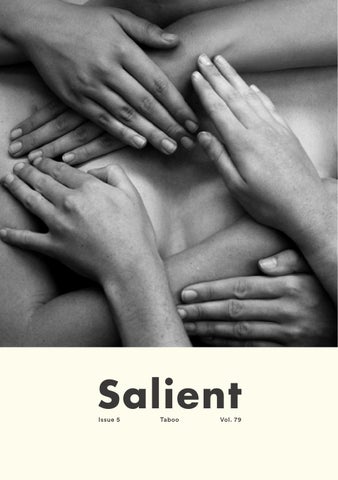
Salient Issue 5
Taboo
Vol. 79
JOIN US AT OUR INITIAL GENERAL MEETING AND
THURSDAYS IN BLACK CAMPAIGN LAUNCH
Wednesday 6 April at 1pm The Hub, Kelburn
We’ll be presenting our 2015 Annual Report and Statement of Accounts, appointing an auditor and independent arbitrator.
YOUR STUDENTS’
ASSOCIATION
vuwsa.org.nz
EE ! FR ZA PIZ
BOOK NOW PAY LATER! Layby your flight With just a $99 deposit
*Terms and conditions apply, valid on selected flights only
STA TRAVEL Victoria University Easterfield Building, Kelburn Parade victoriauni@statravel.com 04 499 5032
Contents Features
14
The First Bad Woman
18 Toy Story
22
Trapped in a Prison of Flesh
26 Bathroom Etiquette
News
7
PSA Recylce or you will destroy our planet
8
Bussing at the seams
10
Eye on University Council
Content Regular
12 Māori Matters 12 One Ocean
13 Gee-mail
35 Digitales 37 Visual Arts
14
VUWSA Exec
28
Letters & Notices
29
33
Reaching Out
34 Fiction
38 Music
Being Well
30
Dr Feelgood
42 Games
31
Brodie Helps You Figure It Out
43 TV
31
Token Cripple
44 Books
32
Single Sad Postgrad
45 Theatre
33
Women’s Space
46 Puzzles
40 Film
Editors: Emma Hurley Jayne Mulligan
Editors’ Letter in cinemas. The books writers take on a similar mission, reviewing books that challenged the reader by including explicit language and imagery. In the One Ocean column, Laura Toailoa describes how her experiences at university have led to her to question and consider aspects of Samoan culture that are often not talked about. In Token Cripple, Henrietta discusses how disability legislation has changed over the past century, as the barriers to the participation in society for people with impairments are slowly being removed through voices speaking up and people with power listening. We have been inspired by our writers this week for bravely sharing us a glimpse of their thoughts and feelings that they are tempted to keep hidden. Often when we share the thoughts and feelings we were reluctant to expose, we learn that they are in fact very common and normal, and often others will feel grateful and privileged that we have shared these parts of ourselves with them. We all feel things, sometimes, that we want to keep to ourselves even though that might often make us hurt more. But we strongly feel that pushing this boundary has great rewards, and finding people, whether they be friends, family, co-workers, or at the end of a phone help line, to talk to about these things makes them seem a little less dark and scary. It’s never a good time to talk about a lot of things, so sometimes you just have to boldly push through—you’ll feel better for it. We hope that throughout the year, Salient can continue in its tradition of being a voice for the topics that are often silenced, ignored, or avoided.
This week’s issue looks at the varying shapes and colours of the taboo. It’s been a bit of a struggle to bring into words all the things that we’ve been taught not to say or discuss. In our minds, things that are taboo are the things that remain unsaid; that we are not comfortable talking about, or the things that tend to happen behind close doors and within small circles. Taboos are learnt—they’re rules we absorb from society, and they differ between each culture, and even social group. As humans, we spend a lot of time in our own minds applying different filters, making choices about what thoughts and feelings we express, and what we choose to keep silent. It reminds us of stigmas, surrounding sex, and illness, mental health, and emotions. As Chrissy explains in her column this week, we often feel so much pressure to be ‘ok’—as though it was all of our duties to be 100% okay, and fully functional, all of the time. Sometimes we try to hide the dark sides of ourselves, we make sure that thoughts and feelings we’re worried won’t be acceptable or that make us feel weird about having won’t see the light of day. These thoughts, the ones locked away could be anything. They could being unsure about your sexuality and who you are attracted to, feeling lonely and not wanting to express that to anyone, feeling like you’re on the wrong path in life but not knowing what to do about it. Jess looked at the idea of taboo in regards to women’s bodies and the ways they use their clothing to express themselves. Cassie explored the life and works of Miranda July, an artist who bravely covers taboo topics and pushes social boundaries. Sarah focussed on sex toys and the importance of women taking pleasure into their own hands. Our film writers have discussed notable films that have pushed the boundaries of what is acceptable to screen
Emma & Jayne xo
05
Going Up
*Interview* with Taika Waititi •
Instagram account @ tasteofstreep - go on, you know you want to.
•
MASSIVE called Salient cowards in Vice. Sorry for being badass and cool.
•
Gelato.
•
Gloria Steinem is coming to New Zealand.
•
Autumnal produce.
Going Down What’s the best part of your job? I have 52K+ Twitter followers, I’m more popular than Regina George. What’s the worst part of your job? People always try talk to me when I go to the Aro Valley bakery for a custard square. Kendrick or Kanye? Dame Kiri Te Kanawa. So many bangers. Who’s the best person in New Zealand? Michael Murphy (runner-up in the first ever NZ Idol). Ben Lummis is my nemesis. What is the best movie in the world? It’s not a movie but I love the Big Save furniture ads. Lily is a great actress and I hope one day she’ll work with me.
Humdingers Pope Francis has joined Instagram and it’s every bit as weird as it sounds. So far many of his grams feature Francis giving out kisses and hugs, with short captions such as “If you want to be forgiven, forgive others”. Follow @franciscus to be truly #blessed.
It’s only taken 50 years, but a male contraceptive pill is on the horizon. It’s still a wee way off, but researchers at the University of Minnesota have found a nonhormonal method that appears more promising than any previous attempts. It is however still in development stages with possible side-effects being a major concern. Sigh. 06
•
Mouldy bread.
•
Getting mud on your good Nikes.
•
Easter Egg-induced breakouts.
•
Sleeping on a mostly deflated air bed.
•
Flashmobs.
Keen to kōrero Kei te hiahia koe ki te kanikani Do you want to dance? Hiainu Thirsty ;) Matatahi Selfie
04.04.16
News
PSA: Recycle or you will destroy our planet
A petition signed by more than 6500 people has been presented to a number of key members of the Auckland central community following an increase in violent attacks against international students. The meeting was organised by the New Zealand Chinese Students’ Association (NZCSA) and involved representatives from the police, University of Auckland, Auckland Council, and the Consulate General of the People’s Republic of China. This follows last week’s attacks in which six Unitec and University of Auckland students found themselves the target of two violent robberies in central Auckland. One man and five women were punched, kicked, and robbed by the offenders who are still at large. These attacks are just one example of the increasing violence directed at international students. Labour party ethnic affairs spokesperson Phil Goff said the violence was “frightening.” He was concerned about the “savage” nature of the attacks, saying “the injuries were significant and they have been inflicted with little empathy about the pain they were inflicting.” NZCSA vice-president Rosa Guo said they expected around 250 people to attend the public meeting. “People are feeling a lot of fear and we want to help them feel safe and teach them how to protect themselves,” she said when speaking of the event. President of the VUW Asian Law Students’ Association Juha Kim said what was happening in Auckland was really sad and that he wasn’t aware of any such incidents happening in Wellington - something he said was “probably due to a smaller population of Asians in Wellington”. Police have advised students to avoid flashing expensive technology, walk on well lit streets at night, and walk in pairs or groups when possible. 07
Alex Feinson
Hundreds of homes repeatedly failing to recycle properly have been blacklisted by the Wellington City Council (WCC) from receiving the free green recycling bags. Those affected are in the most areas of the city heavily populated by students such as Kelburn, Aro Valley, Newtown, and Mount Cook. Many streets around the Kelburn campus have been affected, including 90 homes on the Terrace, 87 houses in Aro Street, 34 houses on Kelburn Parade, and five houses on Fairlie Terrace. These houses will no longer be receiving free green recycling bags. The blacklisting has arisen from the mixing of recyclables and non-recyclables in the green bags, or using the green recycling bags for regular rubbish disposal. This has resulted in it becoming a longer and more costly process for the WCC to sort and dispose rubbish and recycling. One resident who used to live on Stoke St. in Newtown told Salient the problem was so bad that decomposing and rotting food would be left on the street for weeks. The waste then wouldn’t be collected because it wasn’t in a Council bag, and would only be disposed of when residents in neighbouring houses found the smell to become unbearable and got rid of it themselves. Non-recyclable material should be disposed of in the yellow bags, but these are not subsidised by WCC, costing $15.00 per pack of five bags, an expense that many students often struggle with. Plastic supermarket bags can be used as a substitute and are often free, but WCC advise people to only use this as a way of disposing their rubbish if they cannot afford the bags. Those in the blacklisted homes can still get the green recycling bags if they go to the offices on Wakefield St. in person and request them. When speaking of the situation, VUWSA President Jonathan Gee said “given that many student tenants are on 12 month lease agreements, it’s likely that those currently living in the blacklisted houses weren’t the ones who have not recycled properly.” He added that VUWSA are looking into ways of raising awareness around the proper recycling procedure and identifying the causes of illegal dumping. “We don’t believe there’s been a broad education campaign around using the right bags for recycling, so it would’ve been good if this happened prior to taking the measure to blacklisting homes” he said. Greens at Vic co-convener, Mona Oliver, told Salient that “blacklisting houses denies them the ability to learn how to recycle properly,” and that it will “not solve the problem” for WCC. The WCC have a guide on their website outlining what to and what not to recycle.
International students targeted in Auckland CBD
Kate Robertson
news@salient.org.nz
04.04.16
A special new graduate school Victoria University is set to open their new Information and Communications Technology (ICT) Graduate School in trimester two of this year. The establishment of the graduate school is a collaborative effort between WelTec, Whitireia, and the University to launch the third program of its kind in New Zealand. The school will offer four different postgraduate courses including a Master of Software Development and a Master of Engineering Practice. The university website is touting Wellington as the best place to study ICT, labeling the capital city as the “heart of IT in New Zealand,” with “more than 13,000 fulltime ICT jobs in the Wellington region, producing over a quarter of all NZ’s ICT related GDP.” Tertiary Education Minister and dildo javelin enthusiast Steven Joyce, said the school would incorporate local businesses to “provide industry focused education to equip graduates with the technical skills” necessary in the industry. The three schools are expected to collectively train upwards of 350 students each year in single year graduate and postgraduate courses. Students interested in joining the graduate program should contact Pro Vice-Chancellor Mike Wilson to enrol in the first intake in trimester two.
As the cost of living in central Wellington continues to rise, students are becoming frustrated with the lack of subsidised transport in the region. One such student is Byron Oosthuizen who set up an online petition calling for student fares on Metlink transport. The petition currently has over 3500 signatures. Oosthuizen, who lives in Mount Cook, said the time it takes to walk to Kelburn Campus leaves him with no choice but to bus. The bus costs him $25.00 per week, a figure which if subtracted from student loan living costs, would leave him with just $151 for rent and expenses. VUWSA President Jonathan Gee said the organisation had been lobbying for subsidised student fares for four years. The high price of transport in the Greater Wellington region concerned Gee, who believes students are already “paying so much to attend university, but they can’t afford to get there.” Compared to other cities housing major tertiary institutes, Wellington transport is falling behind. Auckland Transport’s tertiary concession provides a discount of up to 30%, and Dunedin, Whanganui, and Palmerston North providing similar discounts. According to the Greater Wellington Regional Council, Dunedin’s tertiary transport discount is funded with the fares of other public transport users. For students at Massey University and UCOL in Palmerston North, public transport is free. Deputy Mayor and 2016 mayoral candidate Justin Lester, and Green MP Gareth Hughes, have asserted their support for a tertiary discount on Wellington public transport in response to Oosthuizen’s petition. Lester said, “if we really want to call ourselves a student city, then we need to walk the talk.” He also acknowledged that driving was significantly cheaper than using public transport, adding that he looks forward to continue working with VUWSA in advocating the cause. With cheaper fares not expected until 2018 at the earliest, both Lester and Hughes believe it’s a wait that’s far too long. Hughes said delays were the result of the council wanting to find other ways to fund the scheme, and that “the council just needs to step up and fund it.” In an effort to address the problem, the Green Party have proposed a Student Green Card. This would provide free off-peak transport to students nationwide. According to the NZUSA, the number of students experiencing financial hardship has doubled since 2012. Students are also the only group in society that live off borrowed money.
Jennie-Louise Kendrick
Daniel Leask
Bussing at the Seams
UC wins engineering prize again, shock
08
McKenzie Collins
Four University of Canterbury (UC) mechanical engineering students have been awarded the Ray Meyer Medal for excellence in student design by the Institute of Professional Engineers New Zealand. 2016 marks the tenth (yes, tenth) time in the last 12 years Canterbury has taken out the medal. The award asks students to solve real life problems. International technology company Trimble, together with Fulton Hogan, proposed a need for avoiding dangerous encounters between road milling machines and underground utility structures. With a budget of $1800, the UC team created a unique prototype that relied on the use of low frequency radio wave (VLF) technology. Attached to a Fulton Hogan milling machine, it was successfully able to detect metal up to 0.25m deep. Their success was achieved with the help of senior lecturer of Mechanical Engineering Dr Geoffrey Rodgers who said of the win, “we are all excited about the win, it is a great recognition of the work the students did and a great reflection on UC.”
04.04.16
McKenzie Collins
Crossing with Carmen Rupe
Salient Quiz
Carmen Rupe, the late transgender activist, is to be honoured with four pedestrian crossing lights in central Wellington. Rupe arrived in Wellington in 1967 with little more to her name than a past of prostitution and stripping. It was in the capital that she established herself as an entrepreneur, drag performer, and gay rights activist who sought to rid prejudice against the transgender community. Wellington mayor Celia Wade-Brown remembered Rupe saying she, “shook the foundations of Wellington’s conservative society ... Carmen was a fighter for equality, and one of the most colourful fighters we’ve ever had.” While not all of Rupe’s campaigns were successful (they were notorious for provocative images and text, and even strippers in the streets), Rupe was perseverant for change until the day she died (2011, aged 75). According to Wade-Brown, putting in lights of the woman who aided in curating Wellington’s accepting environment was the least the city could do. True to form, Wellington will be the first city in the world to display a transgender figure as the crossing symbol. The other frontrunner to be featured on crossing lights was the father of Wellington—John Plimmer, whose statue sits at the bottom of the Plimmer Steps.
Joshua James 1.
2. What year was consensual sex between men decriminalised in New Zealand? 3. In which three EU countries is zoophilia (bestiality) legal? 4. What is the only country that prohibits women from driving based on their gender? 5. Sharp objects, shoes, handkerchiefs, clocks, pears, cut flowers, umbrellas, and mirrors are all taboo gifts to give on what celebration? 6. True or false: Incest between consenting adults is legal in France.
RIP Media Studies Cloob
7. What is Helen Clark’s middle name?
The Media Studies Cloob have rebranded themselves to the VUW Media Studies Society. The name change emerged from their AGM and the Facebook group name was officially changed by reelected co-president Becca Hawkes at 8:25pm that night. Like the flag referendum, a single transferable vote method was used, with VUW Media Society coming out on top. This came as a shock to some as it was later revealed the inclusion of “society” was a last minute decision. Second place was taken out by the option, Media Studies Club, third by the previous name, and last place by, Bonanza. Co-president Bronwyn Curtis told Salient she was slightly disappointed by the winning name, saying she had “already purchased a golf club full of jellybeans” to accompany the many “club” puns that could have been made from the name VUW Media Studies Club. Despite this missed opportunity, Hawkes said it was worth noting that “VUW Media Society” created a fun play on words with the MDIA102 paper—titled, Media, Society and Politics. Hawkes and Curtis are now seeking new puns to accompany the new name, telling Salient, “puns are important.” Anyone with suggestions can attend a meeting at 4:00pm on Thursdays in SU219.
8. In which country do religious figures put their dead out to be eaten by vultures in what is called a “sky burial”? 9. If I had climacophilia I would be sexually attracted to what? 10. What percentage of the New Zealand population had been diagnosed with chlamydia in 2014?
1) Tonga. The Tongan word is tabu. Captain Cook introduced it into the English language in the late 18th Century 2) 1986 3) Hungary, Finland, Romania 4) Saudi Arabia 5) Chinese New Year 6) True. It’s also legal in China, Israel, the Ivory Coast, the Netherlands, Russia, and Spain 7) Elizabeth 8) Tibet 9) Falling down stairs 10) 0.63% or, 629 people in every 100,000
Kate Robertson
The word taboo was taken from which Pacific Island?
09
04.04.16
Kate Robertson
Eye
On the University Council
A few of weeks ago the power trio (Emma, Jayne, and I) attended the second University Council meeting of the year. University what? I hear you asking. Let me elaborate. The University Council is the governing body of the university. The members are very ‘important’, and make lots of grown-up decisions at a fancy grown-up table. Taking place in the beautiful council chamber (much swag, very class), the public part of the meeting was kept to a civilised 45 minutes. Upon arrival, uncle Grant (Vice Chancellor) was the only council member to greet us. Chancellor Nev didn’t say hello, but it was noted that he seemed in a significantly chirpier mood than last time. True to form, we spent most of the meeting live tweeting and playing on our phones like the naughty school kids we are, but we did walk away with some fun facts for you all that prove we are at least trying to fulfill our role as the Fourth Estate on campus. 1. The crazy microphones council members speak into sometimes drop a sick beat when turned on, as demoed by DJ Rog (Roger Taylor). 2. The university had a $19.1 million surplus last year, generating a return of just over 4%. 3. The Victoria University foundation received a very generous $7 million donation at the end of 2015 which helped. 4. There was less debt than anticipated. 5. Just as we BA grads were starting to drown in a sea of numbers, budgets, and seven digit figures, Neil (just a dude) came out with the quote of the meeting, reminding those getting into incredibly fine detail about businessy things that “some of us are newer to financial reporting than others.” Thx Neil.
6.
7. 8. 9.
10. 11.
12.
13.
14.
The number of students enrolling overall has decreased, but international student enrollment has increased. An underwhelming motion was passed awarding degrees to graduates in absentia. Nev went to an International Women’s Day breakfast at parliament. At said breakfast the university council was praised for their gender balance (half women, half men), a first, apparently, in all its history. The Chancellor had several MPs and mayoral candidates wanting to “get in his diary.” Editor in Chief of the Dominion Post, Bernadette Courtenay, was appointed as a trustee of the Victoria University Foundation. The interior of the Hunter Building (for the peasants who haven’t ventured there) is like Hogwarts, and the council chamber has a fantastic stained glass window. A motion was passed to “exclude the public,” so we left and took selfies on the steps of Hunter building. The meeting then continued for, as sources have confirmed, over three hours. What happened in the secret chamber? We’ll never know.
*At time of print minutes had not been uploaded to the university website so we can neither confirm nor deny any of these fun facts are wholly truthful and/or accurate.
10% off keep cups
sale on 4 - 16 april only!
use a keep cup at Vic Books and get 50c off the cost of a takeaway coffee
Easterfield Building, KELBURN CAMPUS / Rutherford House, PIPITEA CAMPUS
Why are gay and bi guys more prone to getting HIV? Find out your risk factors at hivfacts.org.nz You can now get a free rapid HIV & syphilis test at Victoria University Student Health On the third Thursday of the month between 1-4 pm Call 0800 80 2437 or visit nzaf.org.nz to book an appointment Results in 20 minutes
Maori Matters Taylor Wanakore
One Ocean
The closest equivalent to taboo in Māoridom is the concept of tapu. For people who have had the fortune of being raised with tikanga and whakaaro Māori, the meaning of tapu is far broader and deeper than what English definitions entail. Tapu exists everywhere and many things are intrinsically tapu, whether it be a living thing, an object, or even certain events or occassions. Ki te ao Māori, ko te taboo he āhua rite tonu ki te tapu. Mā te hunga kua taipakeke mai i te ao Māori me ōna tikanga, kua mārama kē ki ngā mea me ngā whakaaro tapu, heoi ka pōkaikaha ki tōna te whakamāramatanga.Ko te tapu kei ngā wāhi katoa, mai i ngā mea ora, ki nga taputapu, tae rawa ki ētahi kaupapa, hui rānei. Tapu goes hand-in-hand with the concept of noa. Many mistake noa as something which cancels out tapu, however they are more relatable to the concept of yin and yang where both are necessary and, when applied appropriately, they balance each other out. Certain things or situation like tangihanga are set in a realm of heightened tapu and when people remove themselves from the area of tapu, a process of whakanoa is appropriate (usually by sprinkling water on oneself or indulging in kai) so that they do not carry the tapu with them. He mea haere-tahi te tapu me te noa. Ko te pōhēhē a ētahi, ko te noa he mea whakakore i te tapu, heoi anō he mea taurite kē. He tata tōna momo ki te tikanga o te yin me te yang, arā, ki te kore tētahi, ka kore tērā atu. Ki te nui anō te tapu, pērā i ngā wā o te tangihanga, ka whāia he rautaki whakanoa (hiki tapu ranei) kia mawehe te tinana o te tangata, te tapu o te tangata ki te tapu o te mate. Much of tikanga Maori is governed by the concept of tapu and many Maori live their lives in accordance with tapu. From not sitting on tables or pillows to doing karakia to open and close hui, tapu dictates our behaviour in accordance with the teachings of our tipuna for the purposes of lifting negativity and clearing the way for future activities. He tokomaha te hunga ka whai i ngā tikanga hāngai ki te tapu. Ko ngā tikanga pērā i te whakatika i te hunga noho ki runga tēpu, pira ranei me te tuku karakia i ngā hui, he mea whai i ngā akoranga a kui mā, a koro mā kia hiki i ngā tapu kino, kia whakapapa pounamu anō hoki i te huarahi kei mua. Na Taylor Wanakore.
Laura Toailoa University has opened up discussions about aspects of Samoan culture that seemed too disrespectful or inappropriate to bring up in everyday social situations. Gender, religion, politics, social hierarchies, sexuality, colonisation and whether or not it changed fundamentals of Samoan culture (some people stand by the saying “e sui faiga ae tumau fa’avae”). Samoans often ask me the question, “what church do you go to?” rather than asking me “are you religious?” Religion is synonymous with Christianity because really, what Samoan is Buddhist, Muslim, or heaven forbid Atheist? What does it mean to be Samoan? Who gets to decide what is authentically Samoan? Matai? The general public? The educated? Only those living in Samoa? Okay then, what about the stuff that seems to be quintessentially Samoa but is problematic? Are we allowed to change it? Question it? Do we dare defy our elders? We, the young fiapoko English-speaking New Zealand citizens who have been educated by the white man? So. Many. Questions. Questions that Samoan adults are quick to dismiss because asking questions was the single most discouraged thing growing up (or was it to not laugh too loud, wear longer skirts, be a doctor… I can’t remember now…). I want to know why we are happy to have our fa’afafine in the centre of our social lives, in comedic entertainment; but their sexuality is forbidden (even from conversation). I want to know how gender roles have changed over time and what their relevance is now. But, I don’t want to question fa’asamoa for controversy’s sake, or be contrary to tradition for the sake of being modern. What I appreciate about my Samoan and Pacific studies papers (and even my English literature ones) is that they forced me not only to ask these questions, but to ask them from a respectful angle. What university has allowed for me, was a safe place to explore these questions with care, fervour, and a critical eye. It is especially comforting seeing that the academics too are Samoan; that they understand the constant tension of wanting to pursue a deeper and wider understanding of things that could discomfort or offend the people we love. So while you’re here, ask the hard questions—the ones you get told off for bringing up at home. 12
Gee-mail
VUWSA Exec
Jonathan Gee VUWSA President
Chrissy Brown Equity Officer
In my last few columns I’ve written a lot about issues facing Vic students. From the push for student bus fares, to the misrepresentation of student behaviour in the media, I’ve talked to you about my work as your student president to make your university experience the best it can be. The other side of my job is leading an organisation which delivers services and provides advocacy on student issues, and looking long-term at how that works in the best interests of our members, the students. This week, I want to tell you a bit about the story of VUWSA and where we are heading. VUWSA is independent from Victoria University, and has several full-time staff: including a general manager, advocate, student representation coordinator, and event manager—just to name a few. VUWSA started in 1899, and has had a colourful history of fighting for students and affirming our place in the social and political life of the capital. Over the last five years we’ve had a radical shift at VUWSA as a result of a law change which meant that we no longer had guaranteed funding through universal student membership. We’ve been busy over the last few years trying to keep afloat and reaffirming our place as the primary representative student body in the eyes of Vic. All this internal work has meant that we didn’t do enough work to talk to you and talk about your needs. This year, we are changing that. We’re currently in the process of producing our strategic plan, illustrating our goals for the next ‘chapter’ of VUWSA. We want to reconnect with you, and make sure that we’re getting the best deal for you in all that we do. How can we make your experience at university better? Do you want us to fight for student bus fares and warmer flats? What other services can we provide to make your life a bit easier? We’ll be having these conversations with you over the next few months. I’ll be launching the start of these conversations at our Initial General Meeting on Wednesday. Come along to the Hub at 1.00pm to hear what we’ve been up to and also to discuss the national Thursdays in Black campaign. There will be pizza. I’ll see you there!
Writing this is very sad and hard. Taboo is everything that’s really hard to talk about. It’s usually a topic we don’t dive into at all. There are topics which are considered taboo like periods and stuff, but I really want to discuss something else. Something that is the nitty gritty essence of a taboo subject; something that makes us all feel a bit weird inside. A lot of us don’t like ourselves. We feel like we just aren’t good enough. We aren’t making enough money, we don’t see our friends enough, or we aren’t ‘improving’ our lives enough. We feel like we aren’t good enough and we don’t really talk about it because we don’t want to seem like we are struggling. This can circulate into a feeling of loneliness within ourselves and we don’t talk about it because we don’t want to acknowledge it. We don’t want to dive into a sensitive topic because acknowledging it makes it too real and that is terrifying. I think that from being at university and onwards, there is a huge pressure to seem like you “have your shit together.” If you can’t seem to find that perfect work, study, and social life balance—then you’re a failure, or life just sucks. This may not strictly be studying the right degree and getting the right job, but looking after yourself too. I think it’s important for me to say that looking after yourself is actually not easy for a lot of people. Sometimes I don’t go to the gym for weeks, I forget to pack myself a healthy meal, and might not have the mental energy to go to a party. It’s funny that we all seem to feel this way at some point in our lives but don’t express it with others or we simply don’t know how. Sometimes talking about these things can be comforting, because you’ll find that you aren’t the only person to feel like this. The process of building a life as a student, and emerging as an adult is not easy. Let’s try not be silent about this. How we feel about our lives shouldn’t be taboo.
13
Cassie Richards
As an artist, Miranda July doesn’t just dabble in taboo, she dives right into it, taking her audience with her. Cassie Richards went along to her debut appearance in Wellington, and takes a look at a woman blowing social norms out of the water.
The First Bad Woman - Miranda July and the power of taboo
that July wrote when she was seven years old. It begins: “One morning Jenny woke up. She said to her little brother ‘I’m going.’ ‘You’re what?’ ‘I am going.’” It is charming and precocious, a glimpse into the mind of a young July, and I would have been quite happy if she had read us the whole thing. (The show could just have easily been called Surviving Discomfort, she tells us). But this was just the starting point for a talk that spanned her creative life and influences. July grew up in Berkeley, California, the daughter of writers. She began challenging her audience with taboo subjects early on: at 16, she wrote and staged a play titled The Lifers, based on her own correspondence with a man incarcerated for murder. After following a girl to Portland, Oregon, she started a video project called Joanie4Jackie, collecting short film submissions from women and compiling them on VHS. She also made her own short films, fulfilling all production roles as well as starring in them, and sometimes playing all the characters. She performed ‘live movies’, and staged one-woman shows at a punk club in between bands. Alongside these creative pursuits there were some regular (and not so regular) day jobs, which July shares with us at intervals: cashier at a Goodwill Superstore (fired for stealing a pink blouse); car door unlocker for Pop-A-Lock; stripping, because it made more money in less time. “If these job interruptions are annoying and jarring, then good, so were the jobs”, she quips. Then she tells us, more seriously, “I was fighting every day to be able to do what I wanted to do.” Sitting in the audience, listening to her share these parts of her life, I am transfixed by her candidness, and the wry humour she injects into her anecdotes. She is not uncomfortable to be on a stage speaking about these things to a crowd of strangers; most importantly, she is not humiliated or ashamed by sex or
A woman walks onstage to applause. She is tall, slender, wide-eyed, with brown curls coiffed artfully atop her head. She wears a coral orange blouse, a thin belt around her waist, flared leather pants, expensive looking heels that accentuate her stature. I normally hate leather pants, I think. But they look good on her. It wasn’t simply that she looked stylish, and I’m loathe to objectify anyone, but seeing somebody whom you admire for the first time in the flesh can be a transformative experience. You notice every little thing, and they all feel significant. Standing at the podium, face softly lit by the glow from her Macbook, July is poised and graceful and I am eager to decode her, as is everyone else in the room. We are gathered at Wellington’s Opera House on a March evening to see Miranda July present Lost Child!, her one-woman, one-off show that is here as part of the 2016 New Zealand Festival. Despite scouring the festival brochure and website for clues, I didn’t really have any idea what to expect from the evening. The show is described as “part artist lecture, part interactive performance.” Mysterious. This probably fits July, however, for as an artist she is hard to pin down. She has two feature films to her name; a collection of short stories and a novel; an interactive art installation which appeared at the Venice Biennale; even an app called Somebody, where your text messages are verbally delivered to the recipient by a total stranger. She stands both at the fringes of popular culture and firmly at the centre of it (last year she interviewed Rihanna for the New York Times—the two instantly hit it off in a conversation which touched on, among other things, “deep vaginas”). She challenges norms and fraternises with the taboo. Her work intrigues, repels, and shares secrets. As it turns out, the title Lost Child! comes from a book
15
Cassie Richards
July’s fascination with human complexity, and perversity, is found in all her work, in one form or another. Her characters are often exaggerated, but never move totally out of the realm of plausibility. challenge to her audience to keep the experience sacred and preserve the intimacy that they shared, so as to ensure the show was fresh and surprising for others. This desire for mystery and the unknown is evocative of July herself; as an artist, she is elusive and impossible to plot, which is part of her appeal. July included an interactive segment in her show for us: a script of a phone call was displayed on the screen, all of the men in the audience reading as all of the men in the world, all of the women in the audience as all of the women in the world. Reading our lines, an atmosphere of inclusivity was created in the room. The exercise also revealed something about our groups: as the men struggled to stay in sync, the women’s voices were fluid and unified. As with most things she does, July is concerned with cutting to the quick of human nature and showing us as we really are. It’s a mark of her talent that she can achieve this in a film or a book as well as in a theatre full of people.
her own sexuality. Eventually, she gave up the day jobs in order to focus on her art full time (she was able to do this, she mentions, because her rent was dirt cheap). As July lists off her creative projects she accompanies them with footage of her in front of the camera, or on stage, inhabiting wildly different personalities. Her characters are not ‘ordinary’ people. In one movie she plays both a child Olympic swimmer, and the child’s intense, hyped-up mother. She is drawn to people in their most extreme forms, and the most bizarre situations. To call her characters ‘quirky’ doesn’t seem right, is too obvious and cliche; but their idiosyncrasies are a feature, and she plays upon this. The most revealing portion of the show is the first half, as we are shown July’s first steps as an artist, her experimentation, and the honing of her craft. What comes next is her move into the slipstream that would bring her to a wider audience. After relocating to Los Angeles, July set to work securing funding for her first feature film. Me and You and Everyone We Know was released in 2005, and won the Caméra d’Or (best first feature film) award at the Cannes Film Festival. A second film, The Future, was released in 2011. July wrote, directed, and starred in both films. Despite the transition into studio-funded filmmaking, live performance is a form which July keeps returning to. Her most recent iteration of this is New Society, in which she collaborates with the audience in the creation of, well, a new society. Interactive and immersive (July showed us footage from a performance, featuring the construction of a national anthem), while the show was in season it was asked of participants that they not share details of their experience, requesting “a quiet absence of information about the show online.” In an age of constant sharing and updating on our personal lives, July’s request was a
— July repeatedly made it clear that for her, the road to creativity was never smooth. Stuck in a rut while writing the script for her second film, July began to obsessively read the local PennySaver newspaper. She was enthralled by the items for sale, the innocuous listings behind which lurked a real person. She began to call the numbers on the listings, asking if she could meet and interview the people who picked up. These interviews, and the accompanying photographs, became the book It Chooses You (2011). The stories told here are surprising, heartwarming, alarming, sad—in essence, utterly human. The ordinary items for sale—a leather jacket, a hair dryer—are the door into these people’s lives, and nothing is ever as it first appears.
16
Cassie Richards
and hilarious and fucking weird, all at once. The First Bad Man features a relationship between a man in his sixties and a sixteen year old girl. Pondering their attraction, the man asks Cheryl, “Is it real or is it just the power of the taboo?” That’s a question that could be asked of a lot of July’s work. How we should think of July? A sexual liberator? A voyeur? Just another crazy artist? She never attempts to tell us how we should feel about these scenes, or her part in them, leaving interpretation up to the audience—if we want to feel weird about it, that’s on us. Explaining her approach, July tells us that “at a certain point I realised that I was willing to be vulnerable [...] It’s like a super power.” And her work is powerful, challenging us to think outside of what is normal and acceptable. Human behaviour isn’t rigid, and July’s characters, while they live in a recognisable world, don’t subscribe to our usual rules. Of course, July faces plenty of criticism for her style. Descriptors like ‘quirky’ and ‘hipster’ are deployed against her like missiles; there is an ‘I Hate Miranda July’ tumblr, and various enraged blog posts. Reading these comments, I can’t help but feel like these people have got it all wrong. July’s work doesn’t seek to exclude anyone, like the ‘hipster’ accusation implies. By exploring fears, fantasies, and perversions, she is speaking to the weirdness in all of us; the things we won’t admit out loud, or even to ourselves. What we usually think of as taboo, July shows, isn’t something to necessarily shy away from. Then again, perhaps that’s too confronting for some. Personal taste aside, I think David Sedaris got it right when he said, “people who don’t like her are just jealous.” There is a daring and an openness in her work I can’t help but admire.
July’s fascination with human complexity, and perversity, is found in all her work, in one form or another. Her characters are often exaggerated, but never move totally out of the realm of plausibility. Through It Chooses You, July deals with a creative block by going out into the world and connecting with real people. Breaking down barriers so that people can connect clearly holds massive appeal for July, and is central to the narratives she creates. Her story collection No One Belongs Here More Than You was released in 2007 to wide acclaim, and some discomfort. The New York Times described it as “a series of vignettes in which lonely, disconnected characters try to find communion with others, often by acting out in bizarre ways. Reading it is less like taking a narrative journey than undergoing a sort of occult experience.” In “Majesty”, a woman becomes obsessed with Prince William following a sex dream and concocts far-fetched plans for their meeting; in “Ten True Things”, a woman joins a beginners sewing class in order to get close to her boss’s wife; the frustrated, disparate couple in “Mon Plaisir” reconnect by becoming film extras, miming passionate conversations in the background of a movie set. I could go on, as the book is filled with characters and situations like these. The stories are undeniably bizarre, and yet they also touch upon something recognisable to all of us—loneliness, and the ways in which we circumvent it. As you watch and read her stories, it is easy to transpose July onto a lot of her characters. Whether deliberate or unintentional, she creates the illusion that she is sharing secret parts of herself with her audience. In the story “Something That Needs Nothing”, the narrator and her girlfriend move to Portland and become specialised sex-workers; the narrator eventually ends up working in a peep show, similar to July. In her novel The First Bad Man, the protagonist Cheryl Glickman, an isolated and obsessive woman, becomes a mother following a bizarre series of events involving her boss’s daughter. Her inspiration for the story, July tells us, was her pregnancy and the deep connection she felt with her newborn son. Throughout her work July stretches and morphs the boundaries that separate self and art. In what is probably the most confronting and taboo element of her work, July is fascinated with how adult sexuality intersects with the sexuality of the child. In one of her early short films, a couple in a living room give each other horny looks while a young girl watches television, totally oblivious as the man pulls his dick out. She shares this clip in her presentation, and the audience emits awkward laughter. July assures us that the child was never in the room at the same time, making it clear she knew how powerfully taboo this clip is, but nevertheless, it’s an uncomfortable watch. In Me and You and Everyone We Know, a young boy engages with an older woman in a chat room. Attempting dirty talk, the boy tells the woman that he wants to “poop back and forth, forever.” It’s innocent
— At the close of the show, after a Q&A session, July requests that we all turn to the nearest stranger and place a hand on them. There is some nervous laughter from the audience, but most people oblige. I turn to the woman next to me and gingerly, politely, place my hand on her bare arm. Behind me, somebody leans forward to touch my shoulder. The theatre is hot and I worry that my hand is leeching sweat onto a stranger’s bare skin. As we bashfully touch one another, July offers commentary: you may never meet this person again, years later you might pass each other in the street and not recognise that you once touched this person at a Miranda July show. She asks us to imagine what we might say to this person if we were with them on their death bed. I got the feeling that this was the part of the show she looked forward to the most, creating these connections in her audience, however fleeting. It’s incredibly awkward, and yet oddly moving. Kind of like July herself.
17
Sarah Batkin
Toy Story Though I didn’t really understand how much of a maverick Missy was for singing about female pleasure and sexual satisfaction until I was older. Her subject matter still has gravitas today, which is actually kind of depressing. I bought my first sex toy a few years after this, when I was sixteen; to be honest I was more nervous about buying a vibrator with a fake ID than I was about losing my virginity. By this time I’d had a few one-night-stands and I thought it was time I took my ability to orgasm into my own hands (no pun intended). I had never been into an adult store before, though I’d always been curious as to
I revere Missy Elliott for several reasons. Not only is she one of the greatest living rap artists, she is also inadvertently responsible for my obsession with sex toys. I won’t go so far as to proclaim she’s my spirit animal, but getting her album This Is Not a Test! for Christmas was a momentous occasion. More specifically, it was because of the track “Toyz” that features as number nine on the album. The catchy verses had me singing quietly in my room, “I got a bag full of toys and I don’t need none of ya boys.” Of course I knew she wasn’t talking about teddy bears, I may have only been eleven but I wasn’t that naïve.
18
Sarah Batkin
Evolved Diamond Princess: RRP $101.99
what exactly went on behind the mannequins in negligées, and signs advertising sex pills and poppers (Rush wasn’t something I became aware of until a year later, but that’s another story). One night two girlfriends and I collectively decided that we should make a trip to K’ road. It’s safe to say we were all extremely nervous but I was hell-bent on coming out of a shop with something; a testament to my womanhood, my maturity—I was sexually evolved! I was quite obviously deluded. I’m twenty-two and I still don’t understand the rules of casual dating (is it even a thing?), and I’ve never used Tinder. Anyway, once inside I tried to pretend like I knew exactly what I was doing. The man from behind the counter approached us and asked if there was something in particular we were looking for; “vibrators please,” I said, trying to contort my lips in a subtle way so that my braces didn’t show. He pointed us in the direction of a wall on which vibrators of all shapes, sizes, and colours hung in their packages. I am so fucking smooth, I thought to myself. We spent the good part of an hour listening to him talk about the different functions of each toy: g-spot stimulation, clitoral stimulation, waterproof toys, high intensity vibrations, low intensity vibrations, which lubricants to use, and so on and so forth. To say it was an educational experience is not an overstatement, I learned that most women cannot orgasm from vaginal penetration alone (around 80% apparently), something I was never told in sex education. The night was a success, but after a few weeks I wanted to go back. I missed the clandestine thrill of perusing through double-ended dildos, nipple clamps, and butt plugs. Going to D.VICE and spending an entire paycheck is now probably my favourite pastime. I’m aware I need to be more fiscally responsible but I can’t help it. Of course I’ve made some pretty terrible purchases in the past, Ben Wa balls (?!), ribbed anal beads (?!?!), it was doomed from the start but I liked the colour and they were on sale. I like to think, though, that I’m doing humanity a favor by testing out bad sex toys so the rest of you don’t have to. I know not to buy anything from the adult section on grabone.com, I generally avoid the bargain bin and 50 Shades of Grey merchandise—c’mon ladies we can do better. With sex toys, like anything, what you get is what you pay for. Just because it’s cheap doesn’t mean it’s good! However, it’s possible to buy something that’s good quality for under $150.00. Here are some toys tested and recommended by yours truly that won’t ruin your bank account:
If you’re new to sex toys and feeling tentative, this is good starting point. I know the thought of searching through quivering, girthy dildos and toys that look more like they belong in the kitchen than the bedroom can be daunting, especially if you want something pretty and discreet. But how cute is this little vibrator? It’s also waterproof; in other words it ticks all my boxes, and it’s small enough to use for clitoral stimulation during sex. I know a lot of companies are making beautifully engineered, ergonomically designed couples toys, like those soft c-shaped vibrators where one half rests on your clitoris and the other half is inserted inside. But, I personally find a lot of them get in the way and a regular vibrator does the trick, as long as some extra clitoral stimulation is what you’re after. Available at www.peachesandcream.co.nz
19
Sarah Batkin
D.VICE Pendant Silicone Butt Plug: RRP $43.99
System JO Cool H2O Water-based Lubricant: RRP $21.99
You didn’t honestly think I’d skip over butt stuff now, did you? I think we’re all grown up enough to recognize that anal play can be fun for both sexes (I hope you’ve seen the Broad City episode where Abbi pegs a guy… YAS KWEEN!). But, if you’re new to this realm it’s good to start off slow and that’s what makes this toy perfect, whether you want to prepare for anal sex or you just want to try a little extra something during masturbation. Yes, I’ll admit butt plugs do look a bit scary but as long as you get a size that you’re comfortable with and use plenty of lube, you’ll be just fine! Inserting a butt plug for the first time can be a little uncomfortable but the more you use it the more you’ll get used to the sensation. The important thing is to relax. I’m aware I’ve now made this sound about as fun as a pap smear but just trust me on this one. Play some music, light a scented candle and lay down on the bed. If you don’t want to get lube all over the sheets it’s best to have a towel handy. The easiest way to insert it is to lay on your back and bring your knees toward your chest. Otherwise you can get your partner to insert it for you. This is also another toy that you can use easily during sex.
I was skeptical about cooling lubricant for a long time before I used this particular brand. I once used Durex cooling lube, and let me tell you, it was not an enjoyable experience to say the least. It stung and it sort of felt like someone had put toothpaste on my vagina. Suffice to say I stuck to regular lube for a few years after that. Until a friend, and fellow toy aficionado, recommended me this. It changed my life. Ok, maybe that’s a slight hyperbole but it feels awesome. Kind of like having an ice-cube inserted into you but in an enjoyably erotic way, and it goes perfectly with the Icicles Glass Massager below. I also highly recommend this brand’s H2O line, even if you just want a standard lubricant because it’s water based which means it is safe to use with all sex toys. Although water based lubricants dry up faster than silicone based ones, silicone based lubricants can cause some women irritation if they are allergic, and are not compatible to use with silicone sex toys. Available at www.peachesandcream.co.nz
Available at www.dvice.co.nz
20
Sarah Batkin
Icicles Glass Massager 08: RRP $84.99
And there you have it, a few of my personal favorites. Now that you’re acquainted with the gear, let’s discuss care and storage of your toys. As someone with a growing collection, the easiest place to keep them is in an unused shoe bag, in a drawer, or basically anywhere they’re not visible but I’m sure you know all of this already. Caring for your toys is important if you want them to last and cleaning them after each use keeps things hygienic, which is equally as important. Most silicone and glass toys can be cleaned with warm water and mild soap, other synthetic materials may require you to use toy cleaner which can be bought from any adult store. Also—don’t put your toys in the dishwasher! If using a waterproof battery powered toy, make sure it’s totally dry before putting it away again. It’s all pretty straightforward. I’d just like to reiterate that none of this information came from my school sex education, and it wasn’t until after I hit puberty that I realized female and male pleasure are approached differently. Why is it that not getting pregnant seems to always be at the epicenter of sex education for young girls? Masturbation was something that I had to figure out for myself, it was mostly trial and error at the beginning. Like it was learning how to communicate with my sexual partners about what made me feel good. In the beginning all I cared about was whether or not I could make them cum. Women, especially, are so accustomed to measuring their worth in how much pleasure they can give a man. Or how much they are willing to do with their sexual partner. When I was thirteen I went to Christmas In The Park with some friends, at this point in time everyone thought they were pretty cool and mature. Not long into smoking my first joint, some small, pimply fellow asked me “are you frigid?” before I even had a chance to introduce myself to him. “No,” I scoffed, but after a while I felt annoyed I’d even answered the question. I sat in silence philosophizing to myself, why is that the only thing he cares about? Does he not have any goddamn respect? Would it really matter if I were ‘frigid’? Sometimes, even now, I find myself asking the same questions. What I do know, however, is that my pleasure is equally as important as my partner’s and I also know that if I see one more article dedicated to “Twenty Ways To Drive Him Wild” I’m going to hurt someone… or write the editor a letter.
I never thought I’d hear glass and dildo in the same sentence, but this toy is amazing with a capital A. I take it everywhere with me; to my boyfriend’s house, to foreign countries—hell, I’ll probably start putting it in my handbag soon. These massagers are hand-blown and made to last a lifetime if they are looked after properly, and no, it won’t break inside you. In fact, glass makes some of the best sex toys. It is non-porous which makes it easy to clean, and hypoallergenic so it can be used by those who are allergic to silicone. But wait… there’s more! You can warm these babies up by running them under hot water or cool them by putting them in the freezer, for an entirely different sensation. I highly recommend freezing and using in conjunction with the aforementioned cooling lubricant, then letting your sexual pleasure transcend to a higher plane. Available at www.peachesandcream.co.nz
21
Jess Scott
Trapped in a Prison of Flesh A remnant from an outdated moral framework with origins in the religious basis of Western society, the female body is as a canvas upon which these ideas about sex and sexuality are imposed. Female nudity is perceived as inherently sexual, positioning women as the passive objects of the (assumed) male gaze, to be consumed at the visual pleasure of the active male subject. Certain segments of our flesh prisons are deemed to be more socially acceptable than others, with those deemed inappropriate for public display idolised, demonised, and sexualised; with the human condition simultaneously compelling us to feel both shame and desire. Case in point: Kim K, a woman in possession of a body with its own global following and a multi-million dollar social media empire, posts a (censored) nude selfie on Instagram. The public is even more scandalised, horrified, and outraged than when a sex tape she filmed with her
In an industry seen to be one of the most progressive, one that cultivates individuality, innovation, and creativity, taboo in fashion is more to do with the body of the wearer than with the garment itself. Certain aspects of the human anatomy carry specific connotations, with the female form often intrinsically sexualised. This idea of bodily censorship is dictated by the social world, through notions of acceptability and appropriateness. Within any given society, a framework of regulations as to what is deemed ‘acceptable’ for public display, and what is not, guide the ways in which we dress. In Western society this is largely governed by the notion of modesty, an inherently gendered social construct that assigns moral connotations to various parts of one’s flesh prison. Body parts considered unacceptable for public display are demonised and idolised through the process of sexualisation—the more off-limits they are the more they are desired.
22
Jess Scott
teachers the wrong idea,” and “you’ll distract the boys.” Through the school’s victim-blaming justifications for this manner of treatment, we were being instilled with the idea that even in a seemingly safe space (in a fucking educational environment designed to benefit its students!) we were reduced to nothing but our bodies. The comfort of these men in positions of authority over us, who were supposed to be supporting and facilitating us, and who we were supposed to be able to trust, was being prioritized over our education. The possibility that some ragingly hormonal fifteen year old boy, so fuelled by testosterone that simply seeing a shoulder or section of leg more than three centimetres above the knee would turn him on so violently that he simply could not pay attention in class, was prioritized over our education. In an environment supposed to foster equal opportunity for its students, we were told that the educations of our male counterparts were more important than ours. Yes, you are a scholarship student taking a university paper in high school, yes we let you skip year ten because you’re a fucking child prodigy, yes you’re in the top one percent of students in the country; but sorry, that skirt is more than three centimetres above your knee, so you are going to have to leave class, arrange your own transport home, get changed, and then come back. Your education is less important to us than the way you look. It got to the point where this became so disruptive, objectifying, and humiliating that it was easier not to bother showing up to school—I was only going to be sent home in the middle of class to get changed. (No joke: I actually took the entire last term off in favour of staying home to paint. When I showed up on the very last day after two months of absence half of my graduating class had assumed I wasn’t coming back). This level of bodily censorship exists not only in the physical world, but extends to the virtual, to the media, literature, and art we consume. Instagram, considered to be the epitomal art form of the millennial, despite its extensive creative capacities imposes a rather controversially conservative censorship policy, banning images of the female nipple. Instagram, however, considers the male nipple to be inoffensive and perfectly acceptable to be displayed in public, due to its sexless status. This blatantly gendered censorship is a virtual manifestation of the sexualisation of women’s bodies, while the same body part on a man is simply that—a body part.
former boyfriend was leaked against her will. As a society, we are less upset about someone being sexually abused in the public eye, than a woman feeling comfortable and confident enough with her body to publish an image of it on the internet. Intimate-wear, lingerie, or fetish-inspired garments (such as chokers, harnesses, corsets, fishnets, garters, and visible or statement lingerie—think Lonely bras) are deemed to be inappropriate outside of the bedroom, due to their sexual connotations. Like the female nude, these objects are associated with sex, and subsequently carry the same polarising stigma of taboo, or tinges of immorality. Notions of acceptability are dependent upon the specific social context, with certain garments or anatomical aspects having their place in some social spheres, but not others. Whilst tottering about in a lace robe, lingerie, and six-inch heels; your dorkiest, fluffiest flannelette pyjamas with built-in leg warmers; or a decrepit band tee, matted hair and slept-in makeup (smudged brows optional), are perfectly acceptable options within the comfort of your own apartment, it would not be advised to leave one’s abode and enter the public sphere in any of the aforementioned ensembles. For the entirety of my secondary schooling existence, the absolute crowning highlight (aside from graduation and subsequently being unleashed upon wider society) was being granted the exclusively year 13 privilege of wearing one’s own clothes to school (both demarcating one’s dominance over their younger peers and making it about a billion times easier to nip out on a coffee run during your lunch break). Accompanying this supposed privilege was the implementation of a misogynistic, oppressive, and frankly Draconian dress code, which honestly made me miss our heinous polyester nightmare of a uniform. My most vivid memory of the trauma that was my high school experience* is the daily routine which consisted of literally being followed around campus by my principal, every single day of my final year, as he avidly SEARCHED for something to be wrong with my adherence (or lack thereof) to the rampantly sexist, painfully conservative, dress code. Although this may not sound excessively emotionally scarring, even to the most devout sartorial enthusiast, this man was truly the thing of nightmares. Without a shred of hyperbole; if Voldemort and Slenderman were to have prospered a bald, 6’7’’ love child, he would have been it. Once I actually witnessed an ex-student print out a photo of his face to make a Halloween mask. If someone were to direct a horror film with him cast as the antagonist, it would be scarier than Texas Chainsaw Massacre. His complaints about how I adorned my body ran along the lines of: “you don’t want to give the male
*Disclaimer High school wasn’t actually all that horrendous; I was blonde, booby, and got invited to an average of three parties a weekend. I am now hilariously as far as one could deviate from either of these things and my social life revolves solely around the bar I work at.
23
Patrick Hickley www.patrickhickley.com
m o o r h t Ba e t t e u q Eti gi naya otha G a ank Prey
We need to talk about urination. No, seriously. Think about it. Everyone does it, but no one never taught you how to do it properly, besides your first few trips to the big-person-toilet when you were three. Mum and Dad taught you to pull your pants down, sit on the seat, wipe your ass and flush. Good to go, right? But then you went to school, and all of a sudden you were expected to navigate these toilets that all the other kids used, and the other kids weren’t as highly skilled or as hygienic as you. Trips to the loo turned into an obstacle course of filthy lids, unmanageable toilet paper dispensers that would only let you use TWO SHEETS (HOW?!), highly questionable stenches, and pee EVERYWHERE. So you’d hike up your gingham dress, pull down your stupidly thick tights, and pray that you didn’t feel the tell tale wet-patch that meant that you’d just sat in someone else’s urine. What a nightmare. From there, things only got worse. In came puberty, out flowed the blood and gore of your very first period— and everyone else’s. Now public toilets stalls had the added fear factor of maybe containing used pads and tampons not properly disposed of, or even blood on the seat. Do you wipe it away? Do you crouch over the bowl European-style? But oh shit, you just shaved, and now the stream is going to go everywhere so you HAVE to sit (yes, this is a thing for some) but... ew... let’s find another stall. But now your peeing neighbour is on a phone call to some gal-pal about something that couldn’t wait till she was out of the toilet, such as
dinner options or dream getaways. It’s not that you mind listening to a Hawaii-vs-Tuscany debate, it’s that you don’t want to serenade her with the symphony of your excreta, which will no doubt be twice as loud as usual because you have an audience and your bowels love to perform. Better suck it up, and let it out... but you accidentally fart really loudly, and there’s a pause in the conversation next door mid-sentence and you KNOW they smelt it. Shit. Then after all this, you go to wash your hands, and there’s the girl with blue hair who peed in your stall before you. But now she’s hogging the centre mirror, doing her make up. Do you make eye contact? Do you mention the dirty tampon sitting on top of the bin instead of in it? Do you ask her about her foundation and complement her flawless skin, or is that just creepy? And why did she have to go and pick the CENTRE mirror... now everyone has to awkwardly shuffle around her, pretending that they didn’t just take a massive dump half a minute ago... or, during a rowdy night out, that they didn’t just puke their guts with varying degrees of neatness into the porcelain receiver-of-all. Honestly, sometimes, it’s better just to hold it until you get home. But friends, colleagues, proud owners of vaginas everywhere, it is time for us to open the conversation and proudly accept that we’re not always neat, we’re not always tidy, and we can’t always hold it. It is time to talk about public toilets and agree on some rules that will help improve everyone’s experiences, not just our
26
own. Let us rise up from the depths of our own waste and realise, nay, embrace the idea that public toilets are not our enemy, but a shining beacon of hope and relief. 1. Urine is sterile Yes, it smells. Yes it did come out of someone else’s urethra. But urine, ladies and gentlemen, is nothing to be afraid of—it’s entirely harmless. All urine is, in fact, is water mixed with waste from the bloodstream, including ions and trace metals, proteins, sometimes blood cells (depending on various things). So if you get it on you, as icky as it is, just wipe it off and you’re good to go. Promise. 2. Menstrual blood less so Period blood is as harmless as regular blood. So unless the person who left it behind has a bloodborne illness, you’re probably safe. The problem is that you have no way of knowing whether or not aforementioned person does or not and in any case, it’s a tad gross to be covered in someone else’s period. Use another toilet if there’s blood left behind, or spare the cleaners and wipe it (hero!) 3. That being said, CLEAN UP Everyone has accidents, honestly, don’t feel embarrassed! But if you leak, spill, overflow, miss, whatever, CLEAN IT UP. Yes, even off the floor. Use that toilet paper they denied us in the early 2000s with those stupid wooden dispensers and wipe it all away. Try to leave the toilet seat dry as a courtesy to the next person. Follow the easy instructions on the
provided bin and DISPOSE OF YOUR BLOOD-SOAKED PRODUCTS. This isn’t your personal bathroom where you can not give a shit (or shit as much as you like). Be a tidy kiwi and a role model to women everywhere. You’ll be thankful when the person before you cleans up for you. 4. Don’t give a shit about shits Look, everyone shits, ok? There’s no point worrying about other people judging your number twos. So what if you think yours are the splashiest in the world? Or the biggest? Or the runniest? On second thought, if your waste is alarmingly different, go see a doctor, but the point is everyone poops. It’s a fact of life. So go loud and proud, and respect the person in the next stall who does the same. 5. Just like a theatre Think of the public bathroom as a sacred space, where people of all colours and creeds come together as one to relieve themselves. It’s a meeting point of plot-lines and dramas, an intersection of all sections of humanity, and a safe place to be your best while doing your worst. That being said, respect the performers. Find somewhere else to take your phone call. Unless you just found out a relative is dying, or your best friend is giving birth, all business can probably wait until you’ve finished your business. No one else wants to hear about your life while they’re pooping, they just want to poop. 6. Share the space Sometimes, you have to touch up your face. Or give yourself a little pep-talk in the mirror. Or even rehearse facial expressions for your upcoming audition where you have to act enthusiastic about laundry powder. Whatever it is, it’s all good— but not if you’re right in the middle of the bathroom, and in everyone’s way. It’s not that you shouldn’t be confident, it’s just that people don’t want to shuffle around you with pee on their hands, trying to find a free sink. Take the corner mirror. Do it for all womankind. 7. Conversation time...? If you bump into your best mate, feel free to have a yarn. But strangers?
That’s tricky. The bathroom is sometimes the best and worst place to strike up a conversation because some people might really be feeling it, some might not. The rule of thumb here is the stages of the restroom. If someone looks open to a quick chitchat while waiting in line for the loo, go for gold. But after they’ve come out of a stall? Probably not the best time. During the hand-washing-anddrying phase, talking is still a bit iffy. But on the way out, people will be more open and receptive to whatever it is you want to impart—assuming you wish to impart anything at all. Silence can be golden too. But if someone talks to you, be receptive! You never know what might happen. The bathroom is a mysterious place.
HOW TO PEE The safest, most hygienic way to use a public toilet is not the European squat-and-go, surprisingly. It’s actually covering the seat with toilet tissue and sitting down. The idea behind this is that if you squat over the bowl, your urine will hit the toilet water hard and splash back up to your bare butt. The risk of this happening is reduced if you take a seat. Futhermore, pee is harder to control if you’re crouching. For some women, the flow is impossible to control right after shaving themselves bare, or getting a Brazilian wax. Pubic hair can help direct the stream, whereas once removed, your urethra may decide to imitate a sprinkler. Whatever the case, wet wipes or baby wipes are your best friend here— keep them in your bag or purse, use them for a quick, refreshing clean up and feel like a Goddess in control of your life. IN A ONE-PIECE SWIMSUIT According to an ex-competitive swimmer and swimming instructor: Pull the bottom to the side and hold it there firmly while you go. Once you’ve finished, use the other hand to wipe up, and only release your swimsuit back into place after you’re done. If you’re just about to jump in the pool and the pool is highly chlorinated, just go through the material. Who cares?
27
IN FANCY UNDERWEAR According to a professional stripper: If you’re wearing a teddy/leotard, take the whole thing off. Some teddies and leotards come with butt flaps you can undo, use these. If you’re wearing a garter, wear your underwear over the garter—easier to take off (to pee and to strip, actually). Whatever you do, do NOT just pull everything to the side, fancy underwear is too fancy to risk! IN A ONESIE According to a wannabe professional onesie model: If the onesie has a butt flap, use it. If not, undo the buttons or zip all the way, take it off from your upper body, then tie the sleeves around your thighs. This should keep your onesie out of the way, but also stops you from having to take it off. Magic! IN A BALLGOWN According to an ex-debutant: Pull all the fabric—make sure it’s ALL the fabric—up around your waist. Triple check that none of it is in the way before you go. IN A WEDDING DRESS According to the movie 27 Dresses: Get a friend to hold the excess material out of the way. Seriously, this is one item of clothing you do NOT want pee on. Unless it’s after the fact and you’re a kinky vixen. No judgement. IN A SARI (OR ANY LONG DRESS WITH AN UNDERSKIRT) According to a girl who has attended many Indian functions: Pick up the bottom of your petticoat, then use it to hold up the sari material—like the petticoat is a doughnut and the sari is the jam filling. Ta-da! IN A WETSUIT According to some dudes who surf: Get yourself into the ocean, and then just go. Yes. Just go. Good luck, friends. Go forth and pee with your new-found knowledge. Your vagina is now in safe hands.
Letter of the Week receives two coffee vouchers and a $10 book voucher from Vic Books.
Letters
It’s not a letter, but… John Campbell faved our tweet The tweet was: “It’s getting super real right now....” In regards to the performance of Action Bronson at Auckland City Limits.
Finn would love a spam date with you Hi Salient,
Twitter testimonials about feature writing for Salient: “Got complained about to the Race Relations Commissioner” and “Got a job’. Matt Nippert “The pizza was good” , “I got to meet Jermaine Clement”. Rob Kelly “From the press gallery to the Olympics, my entire career is thanks to @salientmagazine A++ would recommend” Laura McQuillan “ate baby food for a week & got diarrhea” Sharon Lam
I really enjoyed reading about Finn’s ordeal. However, I cannot help but think that he cooked Spam wrong. It’s a lovely food when done right. Have you heard anything about Korean obsession with Spam? I believe it has a rich history in relation to WW2 and my lovely Korean mother always has some Spam in her pantry. I’m sure I can change Finn’s opinion on Spam, if I can be bothered to cook for him. Kindly, Proud Spammer
Long time fan, first time letter writer Praise be for your IBS article is this week’s Salient, honestly never felt so empowered. ‘Got me’.
Notices
Love, Fellow troubled tummy.
We fucked up lmao Dear Salient,
Victoria Abroad – Attend an Exchange Information Session!
Your article about the Trans-Pacific Partnership published on March 14th contained a number of factual errors. Below are seven I managed to pick up: *Editors note: proceeds to list our errors and cast shame on our families*
Why not study overseas as part of your degree?! Study in English, Earn Vic credit, Get Studylink & grants, explore the world! Information Sessions: Every Wednesday at 12:50pm, Level 2, Easterfield Building. Drop-in hours: Mon-Wed 1-3pm, Thurs & Fri 10:30-12pm Website: http://victoria.ac.nz/exchange
I know that pointing out errors in a two week old article might reek of pedantry and, frankly, I don’t think it matters whether you say there were 11 signatories instead of 12. But if a publication can’t be trusted get the basics right, what good does it serve?
Windows of the East belly dance Festival Fri 22 – Mon 25 April 2016 Whitireia Performance Centre MEDANZ festival is a celebration of all things belly dance! Featuring 4 days of dance/drum Workshops, an amazing Show, plus Open Day market, performances, and even a free class! We have workshops for beginners through to advanced dancers, run by NZ teachers, and two brilliant international tutors, Alice Knox from Queensland, and Leila Haddad from Paris. Tickets available from EventFinda. Discounts available for MEDANZ members – see our website for details. Join us for the largest gathering of belly dancers from all over New Zealand!
Journalism requires a meticulous approach to fact finding because the facts matter. Getting them right is what makes a publication worth the paper it’s printed on. Good journalism goes further. It demands that reporters assume the responsibilities of journalistic integrity. This means, at a bear minimum, interviewing sources from both sides of an issue. It’s not enough to regurgitate a Wikipedia article. This isn’t stuff.co.nz. Yours truly, Abraham Coombs 28
Being Well Cathy Stephenson
Sex—the last taboo? Although we live in an era when just about anything is an acceptable topic for debate or discussion, I think conversations about sex are still taboo. We seem happy to talk about all sorts of other things, but when it comes to what happens between the sheets, we are often strangely silent. I am not proposing that we should feel the need to openly discuss every detail of our bedroom encounters, but being brave enough to ask for help or advice when you’re not sure, or when things are going wrong, is definitely to be encouraged.
haven’t been “turned on” enough during foreplay, in which case you need to talk to your partner. Some people never get much natural lubrication, so using a lubricant such as KY jelly is a really good idea, especially if you are having anal sex. If trying different positions or using extra lube doesn’t help, you should probably talk to a doctor or nurse. They can help rule out certain conditions such as infection, endometriosis, or ovarian cysts that can cause painful sex.
Here are some things you might want to know, but were too afraid to ask, whatever your gender or sexuality:
What happens when you can’t get an erection? Every now and then, all men will experience this. Our bodies are sensitive to many different factors, and any of these can lead to erectile failure or impotence. Alcohol, drugs, stress, tiredness, depression, diabetes, and anxiety all contribute, and unfortunately the more men worry about it, the worse the problem can get. Nip it in the bud is my advice—talk to your partner, explain and reassure them, then book an appointment with your doctor. They will be able to advise you, rule out anything serious, and provide you with helpful medication if needed.
What is virginity? Being a virgin means you have never engaged in consensual sex. So if you have been assaulted or abused (when someone has forced you to have sex against your will), you can definitely still consider yourself a virgin until the time you choose to have sex on your own terms. Physically, it is not possible to tell when someone has “lost their virginity,” so the ageold practice of “testing virginity” before marriage in certain cultures is a load of rubbish!
Why don’t I enjoy sex? Sex should always be fun for both parties. No matter what gender you are or what type of sex you enjoy. That doesn’t mean that it has to reach a Hollywoodtype, rip-roaring orgasm every time, but it should certainly feel pleasurable. If it doesn’t, I would ask yourself the following questions. Are you having sex with the right person? Are they checking you are having fun, or are they just worrying about themselves? Are there other positions you could try that might feel better? Do you need more lubrication? Are you engaging in plenty of foreplay? Are you taking any medications that might interfere with your libido or enjoyment? Are you ready for sex—if you feel pressured in any way, stop. Sex needs to be entirely consensual. All the time. Every time.
What is a hymen? People often think that the hymen is a membrane that effectively covers the entrance to the vagina. It’s not! The vagina is a stretchy opening, and the elasticised hymen surrounds it, much like a scrunchy you might put in your hair. This means that you can use tampons, have sex, and give birth without damaging your hymen. It also means that the first time you have sex, there is usually no bleeding or pain. Why is sex sometimes painful? There are lots of reasons why sex can be uncomfortable, but the most common is when there isn’t enough lubrication. This might be because you
29
Dr Feelgood Porn for Ladies Porn is primarily designed for a male audience, and correspondingly, men comprise a large percentage of viewership stats. Generally, it is presumed that all or most men regularly watch and enjoy porn, whereas it is unusual for a woman to freely admit the same thing. Women who watch porn are branded as kinky or dirty (not necessarily a bad thing, but still, who likes labels?), or sometimes, are judged as being “bad feminists.” The porn industry has come under fire from women’s rights groups for perpetuating the objectification
and exploitation of women. For the most part, this is true. It’s obvious to see how females are reduced to tits, ass, orifices, and conquests in heterosexual porn, with studies that demonstrate how viewers become ‘desensitised’ to the progressive extremes of pornography. As a woman and a feminist, I wanted a way to enjoy porn without feeling like I was perpetuating a dangerous and unhealthy sexual culture. Alas, Rule 34 came to the rescue and I discovered feminist porn. Filmed from a different perspective to regular porn, feminist porn portrays women as active, consenting participants in sex, rather than passive receptors. Male actors are given real screen time, instead of being disembodied penises. It shows sex in a more realistic way, showing all the fun and extreme elements of regular pornography (think: orgy/double penetration/cream pie), while allowing the actress to express her desires as a respected equal. The differences are fairly subtle, but it changes the overall tone of the scene significantly. Feminist porn perpetuates the idea that women have healthy libidos like men do, and it’s a whole lot more satisfying as a viewer to see an accurate and genuine depiction of that. It’s not angry. It’s not boring. It’s just a good fucking time. And believe me, you won’t miss the fake moans.
Brodie Helps You Figure it Out
Token Cripple
Brodie Fraser
Henrietta Bollinger
There’s a label in my medical notes that says I have depression. I’ve cried in more public places than I can count: the reading room of the library, on buses, in taxis, walking down the street, in the supermarket, on a plane, during a walk, in the botanic gardens. You name it, I’ve probably cried there. We’ve come a long way in regards to discussing mental health, but it’s still a relatively taboo issue. Mental illness affects a large number of us—be it ourselves or our loved ones that struggle with it. Despite this, a lot of people tend to get uncomfortable when you discuss the realities of various mental illnesses. Experiencing a mental illness is tough and scary for a number of reasons, so it’s important that we open up a healthy, informative, and supportive dialogue about it. This makes us feel less alone in our struggles, and can help us be more understanding and compassionate. Mental illness is very isolating; I know from my own experience that you can feel completely alone and terrified about what you’re experiencing. On top of all that, there’s a lot of romanticisation of mental illness that occurs. Depression can often be portrayed as something that ~tortured creative souls~ go through, or whatever other bullshit people come up with. But fuck that, my mental illness isn’t pretty. Noone’s is. A few years ago I suffered bad anxiety, that was anything but pretty. We’re talking adrenaline induced Irritable Bowel Syndrome for about three years straight. Gross. Less gross, but still uncool, was my need to be early wherever I went—I’m talking half an hour to an hour early for things. But hey, that’s weird and not normal, so we can’t talk about it. Mental illness is a reality of life for so many of us, so let’s stop it from being a taboo issue. When I first started my meds, my Mum called me up worried because I’d posted something on Facebook about it. She wasn’t that comfortable about me doing so, but after having a chat about it she agreed that more open dialogue can be beneficial. Plus, it always helps to have friends who can support you and know what you’re going through. We are getting a bit better though. We have media such as television show Please Like Me, which handles mentally ill characters in a sensitive and informative way. It doesn’t romanticise mental illness, nor does it demonise it. It can be a tricky balance to portray (perhaps because writers often don’t seem to have encountered a visibly mentally ill person in their life?), but there are people who are opening up this dialogue.
Oh yeah, that time I was stopped in a shopping mall to have the demons prayed away from my soul. True story. Probably my favorite if I’m going for shock value. There is a few more of a similar ilk. Part of the cripple job description. Being different can often make you a public curiosity, and people interacting with you as in the above somehow seems permissible. Partly because, I think, the concept that disabled people should lead a ‘normal’ daily life, not segregated from able-bodied society, is still fairly new in the scheme of things. And it hasn’t been something we like to talk about. If I’d been born 100 years ago it’d have been into a world experiencing disability en masse for the first time—the fittest and most revered of their citizens returning from war disabled and embittered—and scrambling to cope with what that meant. If I’d been born in the 1950’s my parents would have faced pressure to institutionalize me. Only in 1989 would the Education Act enshrine (with certain restrictions) my right to an education. Luckily, I’m a 90’s baby—there is a photograph of three-year old me in a multi-colored jumper and denim dungarees yelling along to a cassette Walkman that proves this unequivocally. While I played Barbies, learnt to write my name, and saw in the millennium disability policy shifted. In 2001 the New Zealand Disability Strategy further supported my right to live in the social world. To paraphrase, disability is a process that happens when, as a person with impairments, there are barriers to my participation in society. Progressive legislation when I was seven. Now? Well, we’re getting a chance to talk about that. Us crips and any of our people. Through April and May there will be a campaign around revisions to the strategy and the government will be inviting our input, through online surveys and submissions largely. So, let’s speak up. And then, let’s go out in force and live with our lives, give curios able-bods something to gawk at. More information at:z http://www.odi.govt.nz/ nzds/2016-revision/index.html or email disability_ strategy@msd.govt.nz
31
Single Sad Postgrad Sharon Lam
Love At First One Night Stand off, many relationships have started as a drunken romp between strangers. In fact, in coy-until-five-standarddrinks New Zealand, probably 90% of relationships have started this way. So just from pure statistics we are already off to a good start. Furthermore, we have had absolutely zero contact since that fateful night and remain in separate cities. While this may appear to the general layperson as “not promising,” it is actually the opposite. For you see, the lack of contact and physical sighting has allowed me to build up an impossible fantasy of what this person is like, making them very lovable. In my head he now looks 100% like James McAvoy, is hilarious but thinks that I’m funnier, and cooks the perfect moussaka. His hair, pubic included, consists of perfect wispy coils of 24 karat gold and he also craps out cold hard cash. But above all, he has a fetish for people who harbour overdue crushes founded upon absolute delusion. Finally, fantasies aside, he really did have very kind eyes and was polite, warm, witty. At least I think he was. There are some accuracy issues with pinning hopes and dreams upon one hazy night of something that resembled sex. But in a world where polite, warm, witty, kind-eyed James McAvoy lookalikes are few, I believe it is not entirely insane to do so. Some of us just simply cannot get wet, unless our heart is wet.
In the absolute bleakness of my current romantic wasteland, I have come to realise that I am almost definitely in love with a one night stand from six months ago. While I often try to convince myself that I’m hardcore enough to engage in casual sex, this column, written half a year after spending less than 24 hours with some guy, strongly suggests that I’m not. Either I’m a huge creepy sap, or he really was my soul-mate in which case my longing for him is perfectly normal, albeit very delayed. Although most definitely the former, its interesting to ponder: in 2016, love at first sight still remains a myth, but what about love at first one night stand? This potential soulmate and I met by chance, as people often do. He was a lovely young man who was actually a lovely young man about ten years older than I thought, and looked like James McAvoy but also like the tall bad guy from Home Alone. Visiting town, he was here for one night and one night only. I, a modern woman, embraced my inner Samantha Jones and leapt at the opportunity of a single-serving lover. He would leave in the morning and we’d never see each other again. No worry of awkwardly bumping into each other after awkwardly bumping each other. No fuss, no muss. The perfect one night stand. Or so it would have been, had I not then fallen in love with him. Is this really so creepy? Well, yes, but also, no. Not really. Only ever so slightly. Please let me explain. First
32
Women’s Space
Reaching Out
Lily McElhone
V-ISA
On Tuesday I was wandering through the Student Union building, suppressing the coughing fit building inside me, when I was confronted, or rather, lightly tapped on the shoulder, by a Pro-Life club poster, advertising a meeting that day at 3.00pm. I say “lightly tapped on the shoulder” because it took me a good 15 seconds to work out what club the poster was for. Damn, when your image is already screwed by your laughable presence at clubs week, at least try to get your branding right. So I did what any good millennial feminist would do, I took a photo of the poster and put it on Instagram. Then wrote a Facebook status. Then ate a baked oaty slice and watched the likes pour in. But I was still hungry, and the poster had advertised free pizza at the meeting… so I began forming my master plan. I would go to the meeting, hope no one recognised me as a Women’s Group exec member, eat their pizza, and get information about, like, whatever the Pro-Life club actually does. Then I started expanding my plan, and imagined organising a big group of feminists to arrive at the meeting and heroically shut it down. I was so excited I even texted my mum. It wasn’t until another exec member noted that the meeting’s Facebook event page had a grand total of two attendees. So I figured protesting wouldn’t really have any impact, because the group is so irrelevant there isn’t much to actually have impact on. So I decided to give this one a miss, and get Krishna for lunch instead. And, I can’t say I felt let down. I was more stoked that I could save my feminist energy for some actually relevant issues. Also - Thank you so much to all who donated last Thursday as part of the Wellington Rape Crisis Annual Appeal. It was great to see so many people donating to an important cause. Appeals like this are important because we’re seeing many charities and victim support services become chronically underfunded. Heaps of businesses like The Hangar, Moon, and Vic Books, joined in and donated to the cause. The VUWSA Women’s Group, and Feminist Law Society had their bake sale which was a huge success.
What? I don’t have to say “professor” and I can refer to my lecturers by their first name? Why do people say thank you all the time? These are some of the many questions I had when I experienced culture shock. Honestly I did not believe that culture shock was real until I experienced it myself. Culture shock is the mix of emotions you feel when you experience an unfamiliar place and culture. Those who experience culture shock can feel conflicted, confused, depressed, and lonely. There are three stages of cultural shock: excitement, disillusionment, and adaptation. In the beginning, I was excited to start a new life, make new friends, and explore New Zealand. Then my cultural shock got quite nasty. I felt out of place, I didn’t understand the locals and they didn’t understand me. I was pessimistic about everything. I questioned everything. Where aren’t there any malls in Wellington city? Why do the shops close so early? How am I supposed to live without 7-Eleven? Why is it so quiet? I felt uncomfortable and unhappy. As time went on, I learned to appreciate the differences and make the most out of what is here. For example, instead of going to the mall, I take walks on the waterfront. Culture shock is normal when living in a new environment but it can be really difficult, especially for those who have not had much experience living abroad. My advice to those experiencing culture shock is to find the things that you are comfortable with to make you feel at home, such as food or activities. Then try to get to know the local culture better by going out and exploring; find something new to eat, watch a New Zealand film, and talk to the locals. A better understanding of local culture and practices helps you to draw similarity between your culture and kiwi culture, as well as to appreciate the positive aspects of the local culture. Also come and talk to V-ISA! Our ‘V-ISA hour’ is in the VUWSA meeting room (Student Union building) every Wednesday 2.00-4.30pm. We want to get to know YOU better! Pop by to have a chat, a rant, or to laze around. We’re pretty cool with that. Facebook: V-ISA (VUWSA International Students’ Association) Instagram: @vuwvisa Email: vuwvisa@gmail.com 33
My Iron Cervix Claudia Jardine
Whilst muttering all for my sexual prime, I lay on the bed and tried not to faint. The doctor was having a hard time so the nurse held my arm, a pre-emptive restraint. I lay on the bed and tried not to faint, fought the urge to give doctor a kick. Nurse held my arm, a pre-emptive restraint, frowned as my pulse and consciousness slipped. Fought the urge to give doctor a kick, but the fucking bit of plastic wouldn’t go in! Frowning, as my pulse and consciousness slipped, she stopped, and said your cervix is iron. The fucking bit of plastic wouldn’t go in, and the doctor was having a hard time so she stopped, and said your cervix is iron. All the more for my sexual prime!
Salient wants your words to fill this page. Email your submission to editor@salient.org.nz Word limit - 800 words 34
Digitales Matt Plummer
“Honey, what reveals you is what you try and hide away.” St Vincent—“Save Me From What I Want”
‘seagulls’ for some interesting research which, taken to it’s full extension, might explain why 30,000 years ago hundreds of female figurines with exaggerated sex organs were sculpted across Europe; and why 30,000 years later Kim Kardashian is as likely to ‘break the internet’ as any hacker. In our modern liberal society sex isn’t really taboo though, right? Sure, we might not want particular search histories popping up in certain situations, but that’s not truly transgressive. Those who feel a need delve further into the dark depths of the anonymised web, into sites such as Silk Road, the world’s most notorious (now defunct) darknet market which supposedly pedalled everything from hard drugs to assassination services. (And in case you get ideas about becoming your own darknet underlord, last year Silk Road founder Ross Ulbricht received a sentence of life without parole for his troubles). Let’s not forget, though, that what’s taboo is always relative, always context-dependent. A liberal parent may have no issues with their child coming out, for example, but might have conniptions if that same offspring voted right-wing. Prior to the last election I overheard someone talking about ‘auditing’ all their friends on Facebook: anyone who liked the page of a particular political party they loathed was immediately excommunicated. We tend to befriend others with similar values and views; couple this with blackbox Facebook algorithms designed to keep giving us what we want, and it’s no wonder there’s talk of a social media echo chamber effect, in which we only get presented with views in keeping with our own. Which, you know, sure—until you start thinking that’s the whole picture and that view ends up distorted and disconnected. In fact, I’d argue that in a university context it’s important to have ideas challenged, and to welcome that challenge, although this must always be in a safe environment of mutual respect. Being able to effectively justify an opinion in the face of an opposing viewpoint, yet retain the ability to acknowledge when that other viewpoint has superior merit—these are skills that shouldn’t be underestimated. So I’d say don’t defriend someone just because their politics, say, might be taboo in your circle. I’d say do the opposite.
Given the choice between exposing the contents of every email you’ve ever written, or every query you’ve ever typed into a search engine, which would you choose? Think carefully. How you answer this question amounts to a litmus test on what you believe reveals more about your private self: what you say to others in the (apparent) secrecy of your emails, or what you seek in the (also apparent) secrecy of a faceless search engine. The decision might not be as clear cut as first appears. When we communicate with others we’re aware of being judged and appraised, even by our closest friends. In the searches we conduct for ourselves, however, there’s a perceived privacy and intimacy. Google doesn’t judge, right? I’d argue a fair amount of our actions are motivated by either fear or desire, and that the notion of taboo sits at the nexus of these two forces (so does advertising). I might even go as far as to say taboo can be characterised as fear of desire. So, with this in mind, I think it’s worth asking what our internet searches and click-bait detours reveal about what we really want: from bikini fails to celebrities who’ve aged terribly. So much of the guilty-pleasure crap we’re drawn to reduces down to sex and death, to what we want and what we fear. In May 2005, way back when 50 Cent was still topping the charts and MySpace was the world’s largest social network, Mac’s Safari browser incorporated for the first time a privacy mode, enabling internet navigation minus the automatic indexing of browsing history. Since then private or incognito searching has found its way into most modern browsers. There are a number of uses this mode is suited to, ranging from website testing to avoiding accidental storage of passwords and personal details, but the most commonly associated use... Navigate to the Privacy Mode page on Wikipedia, scroll down to the references, and you’ll see that four out of the first five citations include porn in the title. A quick google reveals a number of articles with some variant on, “Five uses for private mode (that don’t involve porn)”. The parentheses are always there. A preoccupation with sex is as old as the hills, and arguably links us pretty closely with our prehistoric forbears. Try a joint search for ‘Venus of Willendorf’ and 35
The Arts Section 37
Visual Arts
38
Music
39 Music 40 Film 41 Film 42
Games
43 TV 44
Books
45 Theatre
The Arts Section is sponsored by:
Thanks to the New Zealand Festival for providing tickets to many events for us to review and write about.
Thanks to Vic Books for providing copies to review.
Thanks to Reading Cinemas Courtenay for providing two complimentary tickets this week.
Thanks to Gordon Harris for providing a $100 gift voucher for the centrefold submission.
Hiding In Plain Sight
Ruby Joy Eade
Photo from vernacularlandscape.com
What’s on: Te Whare Hēra Wellington International Artist Residency presents an exclusive screening of Tales of a Sea Cow (2012) by Etienne de France, and A Journey That Wasn’t (2005) by Pierre Huyghe. April 6, The Pit, Te Ara Hihiko, Massey University. Drinks provided, arrive at 5.30pm for 6.00pm screening.
37
Visual Arts
places, and an accompanying narrative about the history and specifics of these potentially dull spaces and things (chapters include Handrails, Local Materials and Skills, Walls), there is something intensely human and alive about the whole thing. Smith is constantly making reference to the authors of so called “authorless design” and the people who use these spaces. From the Oriental Parade bench and “the countless conversations that must have taken place,” to the individual hands that stretched the wire across the fence… this book is just as much about people as it is about landscape and architecture. Although the images are void of figures, their traces are everywhere. Reminding us of the unseen labour behind our environment, the layers of history and individuals behind a single handrail, the power of things and spaces to connect us with the people around us. Vernacular: The Everyday Landscape of New Zealand, by Phillip Smith and David Straight, was awarded Highly Commended (Trade Published) at the inaugural New Zealand Photo Book of the Year Awards, 2016.
Creeping slowly down The Parade during the construction of the Island Bay cycleway, we passed a group of road workers who were about to finish up for the day. It was hot and sunny, and the men were leaning against the sides of trucks, on brooms and spades, surveying the day’s work. The road beneath their feet sparkled with green stones. White painted lines stretched taut across the hot asphalt, wrapping the sparkling emerald pathway, containing it perfectly. The new bike lane. It was beautiful. The guys in their high-vis and steel caps thought so too. As we picked up speed and left this scene behind I noticed several of them had their phones out, snapping pics. This is the moment I thought of when I first opened Vernacular: An Everyday Landscape of New Zealand, a photographic anthology of the more modest and ordinary aspects of urban, suburban, and rural space. Landscape designer Phillip Smith and documentary photographer David Straight travelled the country focusing on the details of a landscape overlooked. This book eschews the ‘memorable’ moments in civic design—the City to Sea Bridge, the Beehive, the Wellywood sign—focusing on the small parts of the world that we often don’t notice. Page after page of elegance and beauty found in the most modest of places, moving beyond the cliché Kiwi icons: the bach, the woolshed, number eight wire. The objects and places featured, as well as the writing and design of the book, project sensitivity and a quiet strength. Nothing overwhelms, and you find yourself very quickly making your way through the chapters, from urban benches, to suburban gates, a rugged rural fence, and the curve of an open road. The writing and images connect us with these places and objects, whilst celebrating the “aesthetic sensibility” of the people who make the places we live in. And this is what surprised me the most about Vernacular. For a series of photographs depicting lonely
Untitled Unmastered Kendrick Lamar 4/5
Music
Review by Justin Kim
Perhaps this is why the album suffers. The second half of “untitled 07” is an unnecessarily long skit with Kendrick and the bassist. “untitled 04” is needlessly avant-garde, and is clearly filler material. With a mere runtime of 34 minutes, we have to ask, is Kendrick stalling? Yet if we’re asking this question, we’ve missed the point. Untitled Unmastered intends to show that TPAB still has something to offer. If polished, none of these demos would sound out of place in that record. “untitled 01” is a spitting image of “Wesley’s Theory”, “untitled 06” could be played in elevators without a hitch, and “untitled 05” absolutely belongs on the final release of TPAB. You can hear bassist Thundercat dominating “untitled 08”, a constant that can be heard in Kendrick’s previous release. In fact, this compilation provides a unified set of ideas derived from hood politics. We saw this theme being played out in his last album, but that political and social message is just as strong. Kendrick is still unhappy with the government (“Justice ain’t free, therefore justice ain’t me”), has the self-awareness of his success (“A rapper chasing stardom, how can I fast forward? My accolades better than all them”), and even manages to include a repeated catchphrase like he did in TPAB—all while celebrating that very album: “pimp, pimp, hurray.” For a compilation album, this is a fairly cohesive final product. I’m not going to argue that the raw sound quality of the album was intended to reflect the raw political message of the album—I’m not your damn high school English teacher. However, I can say that Untitled Unmastered is an enjoyable collection of demos which somehow ends up being a more polished product than The Life of Pablo. Sorry Kanye, jazz isn’t dead—not in the slightest.
During his My Beautiful Dark Twisted Fantasy studio sessions, Kanye West told producer Statik Selektah that jazz was dead. Statik responded with the jazz-inspired album What Goes Around, with features from Snoop Dogg, Joey Badass, and Action Bronson. It was met with widespread critical acclaim. A year later, Kendrick Lamar dropped the super-jazzy To Pimp A Butterfly (TPAB). Ever heard of it? Album of the year from Billboard, Complex, Pitchfork, Rolling Stone and Vice. Eleven Grammy nominations. I have friends who think that TPAB “transcends hip-hop.” People simply have not stopped jerking off to it. Enter Untitled Unmastered. Some say that NBA star LeBron James requested this body of work to be released. Like so many records in recent times, it was ‘leaked’ on Spotify earlier in March (Top Dawg Entertainment CEO blames Interscope Records for “fucking up [their] release”). Hype sells, and we’re all buying. It is difficult to talk about this release without reference to TPAB, as the former is a culmination of the demo sessions from the latter. You can certainly hear it. We have heard some of it before. Kendrick performed “untitled 03” on The Colbert Report, “untitled 08” on The Tonight Show, and “untitled 05” at the Grammys. All of those tracks were met with praise, and it turned out that this was because they were excellent representations of the socially conscious, jazz-inspired hits that we would hear in TPAB. With Untitled Unmastered, we have the funky leftovers from that album. But they certainly are leftovers, and they’re not quite ready for us to eat. None of the tracks have actual titles. They aren’t mixed or mastered either. Never has an album title been so literally accurate since the Talking Heads’ The Name of This Band is Talking Heads. 38
Harri Robinson
Not expecting the world leads to better-than-expected results
Photo credit: Kate Robertson
•
•
•
•
The National, seasoned indie-rock pros, put on a set with out of this world lighting, that made the experience much better than I thought. The sun was just setting, the crowd were drunk and free, and then these huge lasers came shooting from the stage. It was pretty wild. I’d heard rumours about the stage set of Girl Talk, the remix and sampling DJ, being one of the coolest things around. He played in twilight, with a crowd of people dancing alongside onstage as he grooved smugly from behind a huge set-up. On either side of the stage, huge inflatable legs with red converse sneakers loomed above an adoring crowd, while beautiful women shot streamers into the crowd. It was, again, pretty wild.
For some reason there were a few theme park-esque rides hanging around the festival. It seems weird to me that people would go to a music festival to ride brightly coloured spinning deathtraps, but there you go. This one doesn’t really count as it’s my favourite thing about any festival, but the videographers at ACL perfectly picked people in the crowd to film for the jumbotrons on the side of the stage— those who were singing along to an artist without necessarily knowing the words. It was honestly the most hilarious thing, trust me. It’s kind of important to mention the music right? That’s generally why people want to go to festivals in the first place. The music was a smooth mix of current rappers, indie rock bands, and New Zealand hometown-heroes. It was an interesting combination, one that allowed for a mellow day filled with killer percussion and lots of beautiful harmonies. Oh, and of course I have to mention Kendrick. But I’m sure you could already guess it was incredible.
So, after putting any expectations aside I managed to have a wonderful time at this colourful and beautiful festival. I discovered some amazing artists and caught up with some blasts from the past (“Misty Frequencies” by Che-Fu definitely brought me back). I’m not sure whether my theory or the festival were to be celebrated, but I’m going to assume it’s a bit of both: is it possible to surpass no expectations?
39
Music
•
Expectations are funny. I tend to avoid them wherever possible, as I feel I’m one of those awful people who always expects the world and ends up with… not quite that. I might end up with an island or a continent, but I seem to always set myself otherworldly expectations (ha). So, I decided before I went to check out the Auckland City Limits festival (ACL) that I would go into it without any preconceived expectations. Despite having experienced Big Day Out in it’s almostglory days, I let ACL wash over me. I took it upon myself to write the first-person account of ACL for you—the good, bad, and ugly of the newest festival to sweep New Zealand’s shores. The music was not my sole focus, I concentrated on the entirety of the festival, these are my findings:
Isaac Brodie
Film
What is Taboo?
A man sits beside you on the bus. There are plenty of other seats, but he takes that one right next to you. This is annoying, but most of us have been there. He’s not breaking any laws, just unspoken social rules. But what if he smells bad? Or what if he’s shirtless? No laws have been created around scent standards yet, once again only social rules protect you here. What if this shirtless man then proceeds to get completely naked? The more liberal of us may suggest that even this should not need to be prevented by law. But, say this naked man then begins enthusiastically masturbating right there next to you. Forget the fact that this is indeed illegal, most of us would agree that this is simply not okay. And for those who don’t, I don’t imagine this analogy should have to be pushed much further to get you there too.
The point is, although we may not all agree on where the line should be drawn, there is most definitely a point at which something goes from uncomfortable, to completely inappropriate. Throughout the decades cinema has constantly experimented with this line: testing audience’s tolerance for violence, depravity, and overt sexuality. As audiences became increasingly over-saturated with the sheer abundance of borderline inappropriate films, some films that were once shocking have now begun to seem tame. However, even by today’s standards there are some films that manage to engage with cultural taboos in ways that some of us may believe goes too far. And yet others will completely disagree. That’s exactly what makes these films so interesting.
American Psycho (2000)
Love 3D (2015)
Directed by Mary Harron 4/5
Directed by Gaspar Noé 4.5/5
Review by Henry Bennison
Review by Henry Bennison
This film is infamous for its depiction of a depersonalized, yuppie stockbroker who mutilates and murders as many women as he can, perhaps as an expression of his disillusionment with modern life. American Psycho shows us what objectification truly means. Under Harron’s direction American Psycho’s protagonist Patrick Bateman (Christian Bale), is an object; a flawless, muscle-bound shell. Throughout the film Bateman obsessively sculpts his appearance, from his morning crunches (“I can do over 1000 now”), to the carefully chosen fonts of his business cards. Vanity and appearances drives Bateman. However, there is a darker side to Bateman, and it’s from here, this place of darkness, that this film earns the taboo status. The darkness lives in Bateman’s relationship with women. We are witness to a number of Bateman’s ‘romantic’ relationships, where women are not only sex objects to Bateman, but also objects onto which he inflicts brutality and harm. There’s a terrifying suggestion raised by this film that blurs the lines of objectification—where does the boundary lie between fucking her and cutting her up into lots of little pieces?
Despite it’s popularity, for better or worse, sex is still pretty taboo, and especially so in the world of film. Traditionally sex has been something that couldn’t appear graphically or explicitly in film. This was at first largely due to issues of censorship, but now more due to audience expectations. Sex is treated covertly, making it seem strange and alien, and not something we’d ever do. With this in mind Gaspar Noé’s Love 3D came as something of a relief. It is an unusual experience to wander into a film screening and be greeted by a wellkempt male sex organ, but by the end, an enjoyable one. This isn’t because Love 3D was French, intellectual, and something only the chosen would ‘get’; but because it was a film that projected in glorious Technicolor exactly what loving someone looks like. If you or I were in the position of Gaspar’s characters (an American film student living in France passionately in love with Elektra—someone who also loved me) there’s every chance we would act the same. Sex, after all, is a natural part of adult relationships. And if these things happen to us in the real world, why shouldn’t they happen in the cinema? Overall Love 3D is a masterfully shot romance in which people who look like they’re naked actually are; and after watching it I would defy you to say that the conservative, mute, dry-humping of Hollywood’s superstars is anything close to real love. People are messy and gross, but what would a taboo film be if not one that just accepts that’s how we are? Maybe it will even show you how beautiful we are. 40
Film
Secretary (2002) Directed by Steven Shainberg 4/5 Review by Isaac Brodie
However, it is actually the other taboos in this film that make it so significant. One of the other great taboos of cinema has always been the depiction of mental illness. Both of the film’s main characters suffer from their own form of mental illness; most significantly Gyllenhaal’s character, having been recently released from a mental institute after a long history of self-harm. Throughout the film both characters find solace from their respective difficulties as they come together in their non traditional relationship. This is what grounds this film in the romance genre. Ultimately—as uncomfortable as some parts of it may be for those viewers less inclined to such expressions of affection—this film simply acts to remind us that it doesn’t matter who you love, or how you love them, so long as you both are happy. And really, what is so taboo about that?
A full decade before we learnt that every single shade of grey is in fact equally dull, Steven Shainberg’s Secretary gave us a highly underrated insight into the world of S&M. One that no piece of Twilight fan fiction could hope to compete with. First and foremost this film is a part of the romance genre, following the emerging relationship between James Spader as Mr. Grey (no relation) and his new secretary Lee Holloway (Maggie Gyllenhaal). However, the romantic aspects of the plot may be lost on some viewers as this relationship quickly progresses from workplace flirtation, to workplace spankings, to whips and chain, and just about everything else. As the other reviews have already discussed, the expression of any form of sexuality in cinema has for the most part been approached with extreme caution, let alone the expression of alternative sexual preferences. It would be easy then to focus on this aspect on the film, that being the most obviously taboo. 41
Medusa’s Labyrinth Developer: Guru Games Publisher: Superhot Team, IMGN.PRO Platform: Windows PC
4/5
Games
Review by Wellington Tremayne
on Medusa as critique comes in. Guru hopes to refine the project to realize its full extent as they originally conceived. Medusa’s Labyrinth draws from various Grecopagan myths. First is Daedalus’ Labyrinth, which was an impossible maze fashioned by the master inventor Daedalus. His son was an idiot, and fell to his death after flying too close to the sun. That aside, Daedalus is primarily known for the labyrinth he constructed for King Minos: which, awkwardly, was to house the Minotaur; a half-man, half-bull creature, born to Minos’ wife and the white bull of Poseidon. But hey, it was Minos’ fault. He’s the one who kept the bull instead of sacrificing it to Poseidon like he was supposed to. That’s the general law of Greek deities—they’re just like humans, lustful, easy to anger, and vengeful. So, piss off a God? Get cursed, possibly for eternity. It’s this law and this particular instance of it which Medusa revolves around. Medusa is one of the Gorgon sisters and has a head of snakes for hair. If you see her horrible visage, you turn to stone. This terrible creature is also terribly beautiful; transformed from a fair-haired, roseate-cheeked priestess of Athena after allowing herself to be wooed by Poseidon, she was doomed to have her best assets turned into her worst. How’s that for karma? Well, it’s a pity for Medusa, but at least we can start to see where the two tales might coincide. Medusa’s Labyrinth creatively intertwines the concepts inherent in these legends, creating a unique story that speaks to history. I haven’t included everything from the two stories, so there’s a lot more for classics buffs to discover; you’ll have fun putting those pieces together.
Here’s a rule of thumb to live by: don’t lock your daughter in a catacomb. Otherwise, she may turn into Medusa. Medusa’s Labyrinth is a Steam Greenlight game, released this year. The game is a short first-person journey through a dilapidated, supernaturally-ransacked Ancient Greece, where monsters now roam in the darkened pits of catacombs, and at least one ancient temple rests in ruins. A path of parchment documents lead you straight to the said temple. These you continue to find as you go deeper into the tunnels. Through them, we learn the story of a young girl trapped by her worried father in the catacombs, and just what has happened to destroy this place. When the game begins, you’re outside. The sky is purple-blue, the moon emanates, big and pale, above a temple complex. There’s an unearthly choir singing in the background, a bunch of broken amphora, and a bunch of still-burning lamps strewn about—but nothing particularly scary afoot. Sure, it’s a bit creepy and awe-inspiring casually walking through a deteriorating courtyard, past a blackened man, frozen where he stands, but that’s cool. It’s a build up to fear. When you get into the tunnels however, you become constantly aware of your surroundings, moving deliberately with accord to strategy. So what’s the goal? Get out alive. Granted, this is difficult when you’re being tracked by monsters in meandering tunnels, armed only with a few arrows and a torch that you keep having to replace. You have no HUD display, which means you get full immersion. This is, of course, typical of the best stealth games on the market. It’s rather astonishing that Medusa’s Labyrinth is available free on Steam, its design is spectacular for its budget, even with some bugs. It has earned fantastic feedback from players, resulting in Guru Games continuing work
42
Aquarius, Season One 3.5/5 Review by Katie Meadow
My bags are packed / I am ready for my flight / wanna put an end to my daydream days and sleepless nights / sitting like a mindless clone / wishing he would tap my phone / and just to hear the breath of the man / the myth / the monotone —Bree Sharp, “David Duchovny, Why Won’t You Love Me?”
RETRACTION In the Orientation issue of this magazine, I gave a reasonably positive review of The X-Files reboot. I would like to issue a retraction, to say that the last two episodes of the mini-series could possibly have been two of the worst episodes of television I have ever seen (bar David Duchovny tripping on mushrooms dancing to Billy Ray Cyrus). Please watch at your own risk.
43
TV
get a little lost in itself. While only a season in, the show’s production and writing team have already planned out a six season run, which is exciting but also means there are some filler episodes that are frankly pretty dull. Maybe I’ve been spoiled by the spate of anthology shows and miniseries lately, but I went into Aquarius hoping for crazy Manson madness throughout and the first season ends not even close to delving into the LaBianca and Tate murders. There are some weird liberties taken with the “historical fiction” idea, including a confusing subplot where Manson is straight up banging someone’s dad. I don’t think that happened but I guess it was the 60s. The show touches on racial issues and the Black Panther movement, but does little to connect that to Manson, who believed the Beatles’ White Album predicted a racial uprising by the black community that would lead to a full out race war. Faults aside, Aquarius is a good show with a lot of promise, and with only 13 episodes it’s an easy binge watch on a sick day. Luckily the show was picked up for a second season by NBC in June 2015, and I have a lot of hope and faith that it will find itself and dish out some juicy, gruesome true crime. And, shirtless David Duchovny.
I am a David Duchovny fan. Completely head over heels. Or maybe that just means I am a Fox Mulder fan for he is intrinsically linked to the brooding FBI agent of my dreams. It is hard to allow him to become any other character, though it would seem Duchovny doesn’t mind too much; he’s just as dry and sexy in Californication, and even in his Sex and the City cameo he played a paranoid dreamboat. Aquarius sees him again playing a law enforcement role, as detective Samson Benedictus (Sam) Hodiak, though compared to Mulder he is a lot less thoughtful and shy than he is short tempered and prone to face smashing. Billed as “historical fiction,” Aquarius details the rise of Charles Manson (Gethin Anthony) and his ‘family’, while interwoven with fictional characters and stories to flesh out the series. Duchovny’s Sam is contacted by an ex-girlfriend when her daughter goes missing, and it is soon found that she has been living on the hippie commune of the part-time pimp, part-time musician, fulltime batshit Manson. Sam and his team of fairly corrupt law enforcement officers find that the family may be more trouble than they first thought, as more and more connections to the commune are made apparent when undercover narcotics officer Brian Shafe (Grey Damon) investigates a local drug cartel. Charlie is a subjectively charming sociopath and has a growing number of followers who believe him to be the second coming of Jesus Christ, and as he exerts his hypnotic control over them with tales of fame and an excessive amount of LSD, they find themselves deep in a life of increasing debauchery to please their charismatic leader. The show is very ambitious and has a tendency to
This week, Salient’s books section is scandalised by two racy texts that dwell on perhaps the biggest taboo of all—sex! Both are available as Popular Penguins; both will make you feel dirty when reading them in public.
Lady Chatterley’s Lover D.H. Lawrence 4/5
Books
Review by Kimberley McIvor
High-spirited lass marries intellectual sort with a title, who lacks a certain ‘physicality’ being philosophically against it, but also paralysed from the war. She gets sick of him and falls madly in love with a working-class bloke. They bang like gifted rabbits until everything gets complicated. There is nothing in this novel that will shock any modern reader with a liberal education. Nothing here is as comparatively stimulating as a quick glance over HBO’s line-up, and there are no words surmounting the vulgarity of five minutes eavesdropping in any high school classroom today (notably, the publisher, Penguin Books, was placed on trial in 1960 on charges of obscenity). Yet, the mastery of this book is in its execution of the taboo beyond easy sensuality or erotica. The adulterous sex is extraordinary because it is divorced from social condemnation by the author. It feels cool and real and okay. No one is punished or shamed or ruined, except that they fear the threat of ruination, but that never really happens. I found this refreshing. Not that I can personally endorse adultery—in fact, the contrary is true—but in a world that judges the sin without justifying its own judgment, finding a little written space where people get theirs and enjoy it is unexpected, and consequently rather nice. It was written by a man, and guess what? You can tell. Those passages of intoxicated phallic worship are hilariously inane, stretching the limits of imagination beyond what is reasonable. It’s definitely the cynic in me, but surely, no self-respecting lady would be that boldly descriptive? Anyway, underpinning the sex were the intersecting problems of class and wealth. The eponymous Lady Chatterley is repeatedly scolded about not her ‘intrigue’, but the resulting ‘scandal’ that would come from everybody knowing she took it up with a mere groundskeeper. Would that happen today? The funny thing is that the most taboo idea, that a man and a woman could be open about sex, is the least of our contemporary problems. The bigger fears we face are about wealth disparity, and real intimacy, and to be facing a future we aren’t sure we like. Read this book if those are some things you need to mull on, or if you like the 1920s, but mostly if you like books that are fast and loose with fun words like ‘fuck’ and ‘cunt’.
Delta of Venus Anais Nin 5/5 Review by Sarah Batkin
If feminist porn (not to be confused with female friendly porn) was created in the 1940s in the form of literature this is what it would look like. My crude attempt at describing Nin’s ability to write sex, however, falls short; it is a subject that even poets like Morrissey cannot master and yet Nin makes it look so easy. This anthology consists of fifteen short stories that were written by Nin for a private collector but were published posthumously in 1977. Each story invites us into the private world of a different woman: think orgies in opium dens, Sapphic encounters, and even some pegging. I had no idea that strap-ons existed in the 1940’s until I read this book. The current climate of mainstream pornographic film and fiction caters to our tastes for the violent and exploitative. In a time when the Fifty Shades of Grey Trilogy exists, I don’t think it would be far-fetched to say Delta of Venus is still ahead of its time. Not because Fifty Shades is lowbrow erotica, and we can all enjoy gratuitous and indulgent fiction from time to time, but because Nin’s narratives are complex and also sexy without being crude. The stories are believable, in the best sense of the word. Her female protagonists have not been infantilized— they know what they want and when, and they know how to get it. They are women of all shapes and sizes, and the stories focus on their pleasure and sexual exploration as much as the men they are sleeping with. Nin has written other erotic fiction such as A Spy in The House of Love, and also explored her own sexual experiences and relationships, most notably with Henry Miller and his wife June, in a collection of four memoirs titled A Journal of Love. 44
Small Metal Objects
Review by Ophelia Wass and Ruby Hansen
Review by Adeline Shaddick
Sinister, twisted, and unsettling—these are the three words that come to mind when I think about Tim Barcode’s Wolf. The poster for the play is a striking image; a pair of wolf eyes plastered across a young man’s face. Yet the posters hardly served as a hint for what was to come. Hosted at Bats, Wolf is performed in a set resembling a one-room house. It is, at best, ‘kitchen sink realism’, nestled in a crumbling Christchurch flat during the aftermath of the 2011 earthquake. The narrative structure was startlingly old-fashioned. In fact, you could slot the characters into an 18th century melodrama very easily. The nuclear family; an unlikely group of stock characters comprise of fair maiden Cushla, villain Lee, the drunk Ali, and hero Mike. The show interrogates several taboo subjects, namely domestic violence, jealousy, and distrust. The dialogue saw a surge of insults. Words like bitch and slut were flippantly thrown around, particularly during climatic, shocking ending which reinforced the melodramatic storyline. Mike (Ryan Mead) heroically runs onstage in order to save Cushla (Talia Carlisle), who is heard screaming behind her boyfriend Lee’s strangling hands. Cushla’s damsel-in-distress character was directed and written under a blatant male-gaze, and I would seriously question this in the context of a contemporary New Zealand drama. Regardless of whether the staging sought to evoke shock-factor or suspense, it became prevalent was the heightened sense of heteronormative characterisation in the script. The disconcerting rumble of the earthquake soundscape seemed to snarl angrily like a wolf, reinforcing the play’s premise of “an evil that lurks.” The sound technician should be applauded for the sense of uneasiness created when presenting the audience with the energy and atmosphere of a natural disaster. A confrontational recording of Christchurch resident’s reactions to the 2011 earthquake blare through the speaker system; the gasps and screams accentuating the turmoil of the on-stage family relationships. Some stand out performances grounded the show. In particular Cassie (Susannah Donovan), the steam-punk next-door neighbour, who offers an earnest eccentricity to the ensemble’s dynamic. The lead Mike (Mead) offered a mature, energizing embodiment of an ex-lawyer in amongst the total disorder. For a show that promised us wolves and earthquakes, what remained was something much more terrifying.
If you managed to see Small Metal Objects by the Australian company, Back to Back, as part of the NZ Festival you were one lucky person. This production has toured the world, and has been performed in a range of public spaces including railway stations and in the middle of streets. I arrive at TSB Bank Arena at peak lunchtime with no idea as to how the performance was going to pan out. Nevertheless, I spot a pop-up seating arrangement on Queen’s Wharf (the stage). The audience are equipped with quality headphones, ready to watch a performance featuring not only the actors with microphones but the general public doing their daily 12.00pm lunchtime routine. It was like an audience watching another audience. Small Metal Objects is a simple narrative about two best pals, Gary and Steve (Sonia Teuben and Simon Laherty), doing their regular drug deal. The performance begins with a random conversation we hear through the headphones of the two boys: the audience sit there searching for them in between all of the public walking around. Gary is interrupted by a phone call from Allan (Jim Russell) wanting to buy some “top shelf” drugs. The searching for characters between the public became a fun game for the audience. The drug deal does not go to plan, as Steve decides he does not want to proceed with the deal. Gary stands by him. This causes frustration for Allan and he becomes more and more desperate. He calls up his psychiatrist ‘friend’ (Genevieve Morris) to help do some ‘professional’ convincing. Again we are sitting there trying to match the woman’s voice to character. This game never gets old. What I found most powerful was the loyalty in the friendship between Gary and Steve, and the use of public in a strong but subtle way. In a way, the public’s reaction to the performance creates a second level for the audience to enjoy. There were moments where the actors were so natural the public could just walk past without noticing there was something happening or feeling they were interrupting a performance.
45
Theatre
Werewolf or Why Wolf?
Puzzles
Made by Puck Target Make as many words from the nine letters below as you can. Each word should be three or more letters, and contain the letter in the middle of the grid. There is at least one nine-letter word. Good: 32, Great: 38 Impressive: 45
Hard
‘Category Five’ Each of the words or phrases listed below contains a hidden member of a category, missing a letter. Identify the members of the category (each of which is four or more letters long), and figure out what letter is missing from each. The missing letters, in order, spell out the name of the category.
Easy
BLAKE LIVELY STRANGE TEMPURPEDIC INDIGNANT MAVERICK CARRAGEENAN IL VERO AMICO Last week’s ‘Category Five’ solution: FRUIT BOWL - (f)eijoa, che(r)ry, d(u)rian, ol(i)ve, (t)amarillo, (b)anana, mang(o), ki(w)i, (l)emon.
~ Taboo colour me in ~
46
Contributors
About Us Salient is published by, but remains editorially independent from, the Victoria University of Wellington Students’ Association (VUWSA). Salient is a member of the Aotearoa Student Press Association (ASPA). Salient is funded in part by Victoria University of Wellington students through the Student Services Levy. The views expressed in Salient do not necessarily reflect those of the Editor, VUWSA, or the University. Complaints People with a complaint against the magazine should complain in writing to the Editor at editor@salient.org.nz and then, if not satisfied with the response, to VUWSA.
Editors Emma Hurley and Jayne Mulligan editor@salient.org.nz Design and Illustration Ella Bates-Hermans designer@salient.org.nz News Editor Kate Robertson news@salient.org.nz Chief Sub Editor Tim Manktelow Sub-Editors Ali Kaye Distributor Joe Morris News Reporters Alex Feinson Daniel Leask Jennie-Louise Kendrick McKenzie Collins
Feature Writers Cassie Richards Jess Scott Preya Gothanayagi Sarah Batkin
Contributor of The Week Sarah Batkin, for a wonderful and informative feature, and a great book review.
Section Editors Cassie Richards (Books) Dana Williams and Isaac Brodie (Film) Harri Robinson (Music) Ophelia Wass (Theatre) Ruby Joy Eade, Lucy Wardle, Louise Rutledge, Robbie Whyte (Visual Arts) Cameron Gray (Games) Katie Meadows (TV) Other contributors Brodie Fraser, Dr Feelgood, Lily McElhone, V-ISA, Cathy Stephenson, Henrietta Bollinger, Joshua James, Claudia Jardine, Matt Plummer, Sharon Lam, Jonathan Gee, Chrissy Brown, Taylor Wanakore, Laura Toailoa, Justin Kim, Kimberley McIvor, Sarah Batkin, Henry Bennison, Wellington Tremayne, Ruby Hansen, Adeline Shaddick, Puck.
47
Read Salient online at salient.org.nz Contact Level 2 Student Union Building Victoria University PO Box 600, Wellington 04 463 6766 Printed by SMP, Wellington. Advertising Jason Sutton jason.sutton@vuwsa.org.nz 04 463 6982 Social Media fb.com/salientmagazine T: @salientmagazine I: @salientgram S: salientmag
HOW CAN WE MAKE YOUR TIME HERE EVEN BETTER? Complete the Student Experience Improvement Survey in your email Inbox NOW and tell us what you think.
You could WIN one of these great prizes: A Samsung Galaxy Tab S2 OR an iPad Pro wifi 128GB!
SS0149
Plus there are 20 x $100 supermarket vouchers up for grabs!
SURVEY CLOSES 9AM MONDAY APRIL 18
For more information go to:
victoria.ac.nz/studentexperiencesurvey