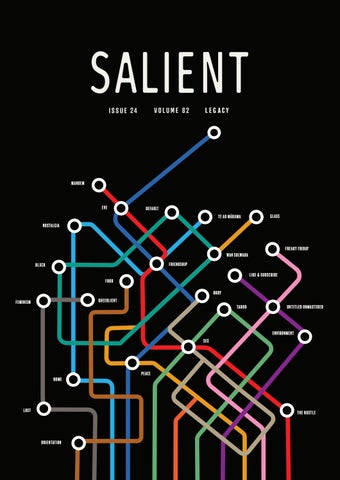
MANDEM
EVE
DEFAULT TE AO MARAMA
GLASS
NOSTALGIA
FREAKY FRIDAY WAN SOLWARA FRIENDSHIP
BLXCK
LIKE & SUBSCRIBE FOOD BODY QUEERLIENT
FEMINISM
TABOO
UNTITLED unmastered
environment SEX
PEACE HOME
lost
THE HUSTLE
ORIENTATION
Trimester 2, October 14-18 coffee r e t l fi eme r p u S e Coffe long k e e w all
FREE
/vuwsa
vuwsagram
breakfast and lunch ever yday!
SALLY WARD
14
YOON
29
SHANTI MATHIAS
15
FINN BLACKWELL
30
PREYA GOTHANAYAGI
16
NINA WEIR
31
PABLO MONTEVERDE-YOUNG
17
RACHEL SALAZAR
32
TE AOREWA ROLLESTON
18
JANNE SONG
33
MAX NICHOL
19
MAYA NEUPANE
34
CALLUM TURNBULL
20
JESS SAXON
35
MATT CASEY
21
ALEX WALKER
36
LOFA TOTUA
22
SARAH BURTON
37
VIKI MOANANU
23
FRANCES DALE
38
LETEICHA LOWRY
27
ELLA - ROSE MEAGHER
41
MONIQUE THORP
28
ARTIFICIAL INTELLIGENCE
43
Editor Kii Small editor@salient.org.nz
Social Media Callum Turnbull socialmedia@salient.org.nz
Designer & Illustrator Rachel Salazar designer@salient.org.nz
Advertising Josephine Dawson advertising@vuwsa.org.nz
News Editor Johnny O’Hagan Brebner news@salient.org.nz
FM Station Managers Jazz Kane Navneeth Nair
Sub Editor Janne Song subeditor@salient.org.nz
TV Producers Monique Thorp Joseph Coughlan
Follow Us fb.com/salientmagazine instagram.com/salientgram News Section Shanti Mathias, Hannah Powell, Esme Hall (Critic) Centrefold Jamie Robertson-Bennett @jamierb_ Honorary Salient Member Taylor Galmiche
I BEEN WAITIN' I used to get up early and go to the stand near Student Health and pick up a copy of Salient just to see the words I slaved over for hours in print. A magnificent feeling I have since long forgotten. As we reach the end of the year —, and especially the last issue for the year—it has become clear to me that we’ve only just begun; we don’t want to hurt your feelings.
I came into this office four years ago, fragile and skinny as a first-year Political Science student. Not aware of his surroundings or the opportunities that would one day present themselves. Doing radio interviews over Salient FM and hanging around the office long enough for somebody to ask me to write an article. From food reviews to bus editorials, I’ve felt blessed every week. Over my time at university, I went and got mine. Are you on the way to get yours? I have nothing left to say. I’ve said it all this year. Farewell.
Kii Small
This was me Brian Butterfield six months ago before starting my diet plan. But just look at me now! I feel like a new man! Thanks to the Butterfield diet! The results have been, incredible. *no I'm over here* oh. The results have been increbidle. Okay here's your weekday plan.
Send your notices to designer@salient.org.nz
Breakfast: One cornflake, toasted, with low fat spread. Drink: Hot Water Lunch: Small raw potato, peeled. Salad, mini lettuce leaf. Drink: Room temperature water Dinner: Square of low-fat turkey breast, baked bean in low fat tomato sauce, broccoli shavings. Drink: Chilled water Pudding: Ice cubes and artificial sweetener
VICUKE AT THE HUNTER LOUNGE! Playing for YOU this Thursday, October 10 at 4 p.m. to give you that pre-exam zing. Come along and join us!
Follow this diet to the letter every day. Then, at the weekend, it's time for a reward. Saturday is treat day. *winks* For 24 hours you can literally eat anything.
I am writing to provide a complimentary review on the office space~
Pizza, Birthday Pie, Pork Cylinders, Potato Grids, Artificial bacon (Facon™), large macs. You name it. Sandwich casserole, chocolate quails eggs, garlic pudding, fluffy ruffs, Hoisin Crispy Owl, Pasta pillows, bon bon bon bons, McFortune cookies. It's up to you. Discount foie gras, egg and ham slabs, during dinner mints, mystery meat, quiches lorraine, 20 cheese omelette. Anything goes.
The Salient office seems to be a decent 90’s style ‘breakfast club’ time portal for any cloudy student seeking a little bit of absence from the punctual world.
Just remember, you've only got 24 hours, and not a second longer. Sunday is your rest day. These trousers are so loose, I think i may need to buy a new belt.
Jumping into the Salient office is the closest thing to diving into a kickback, retro, Rydel highschool film set that anyone would possibly be able to afford on a studylink budget.
The Butterfield diet plan. Order it exclusively online at W double W full stop Butterfield diet full stop c om
Salient,
Initially the action of ringing the office doorbell creates a sense of gate-crasher coming through sort of introduction, as unemployed office students do not possess the golden ticket of an authentic ID pass. But once inside the seaview environment, the inner gatecrasher then feels influenced and embraced enough to incorporate their individuality into the Salient family home. There is a welcoming portion of tea and noodles to enhance the movie experience as well as a cluster of office chairs for any viewers preference and better yet, without any extra costs for the quality or placement of the seat whether it be near the ocean facing windows or near the rear of the office next to the convenience variety of power plugs. Each family member of Salient exalts their unique sense of character with ease and fluidity. The women are creative, passionate, kind, inclusive and conversational and the men curious, humorous, serious, loud and generous.
Send your letters to editor@salient.org.nz
The everyday blunders and boosts of being human, having a routine and trying to navigate your future filled with uncertainty and adversity can really eat away at a person, but ringing that electronic doorbell sparks a bit of freedom and escape.
Dear Salient, You've got issues. (24 of them, in fact, counting this one.) But now that the year is ending, I'm grabbing the tissues.
Thank you for creating and upholding such a dreamy office space, an environment that feels like the epitome of a communal home for the outsiders, introverts, extroverts, writers, readers and film lovers. You keep supplying the good times and I’ll make sure to bring the cylinder tubs of sweet and flavoursome ice cream- just like they do in the movies, except this time there’s no heartbreak just a whole lot of love.
Cause I'm not lying when I say I'll miss Salient— the interesting things you published to put in my cranium; how you always tried to cover every shade on the gradient. Yeah I'll miss you. Hope everyone in the team stays radiant.
Ngā mihi
J-SUB
6
Apply now for summer study Applications are due by 29 October to study in Trimester 3
victoria.ac.nz/tri-3
ISSUE 24
SALIENT
News. MONDAY, 7 OCTOBER 2019
The Stats on Gender Disparities at VUW SHANTI MATHIAS (SHE/HER) Data released to Salient under the Official Information Act shows that the gender disparity in most majors at Victoria University has stayed constant over the last five years.
developed with student impact. This includes an ‘action plan’ for improving representation. “This will allow us to track participation, retention, and completion (at undergraduate and postgraduate level) by target groups, and will give rise to new initiatives that allow us to address both gender disparities and issues of gender equity,” Larner said.
As reported earlier this year by Salient, the School of Engineering and Computer Science (ECS) is particularly targeted for under-representation of women. Over the past five years, the percentage of female students has stayed about the same, only rising from 14% in 2015 to 17% in 2019. These enrolment rates are similar to other engineering departments across the country, according to VUW. Stuart Marshall, Head of ECS, told Salient that “[ECS] is committed to making Engineering and Computer Science more accessible for underrepresented groups, and to help those students succeed once they are studying with us.”
“One of our priority issues is to support students studying in disciplines where there are significant gender disparities or where there are issues of gender equity.” - Provost Professor Wendy
“One of our priority issues is to support students studying in disciplines where there are significant gender disparities or where there are issues of gender equity,” she added. This year, the university also employed a Rainbow and Inclusion Adviser to assist gender-diverse students. The university did not indicate whether there are programmes for inclusion and support of males in female-skewed majors.
ECS has implemented a number Larner of policies, including outreach in high schools, working with VUW Women in Tech, and creating more tutor positions to Many major programmes, including Film; Architecture; and nurture equity. Business Administration are relatively balanced between genders. Other major programmes are female-dominated, particularly in the Humanities. Early Childhood had no males enrolled Overall, the university has more females enrolled than males, in 2015 and 2017. In terms of sheer numbers, Criminology with 1.3 times as many females enrolled than males in 2019, had at least 400 more females taking the major than males and fewer than 100 gender-diverse people. for every year between 2015–2019. Note: The data supplied by VUW in the OIA refers to Provost Professor Wendy Larner said in a statement that the “females” and “males”, rather than men and women. Gender university has an Equity, Diversity, and Inclusion Framework minorities were included in that data. However, given the small number of these individuals at the university, we have not included that data in this article.
8
Female:Male ratio
Less Equal
News.
Male Skewed Majors s 0.6
0.4
More Equal
0.2
0 2015
2016
2017
2018
2019
Year Computer Science
Software Eengineering
Maths
Physics
Less Equal
Graphs representing the ratios of females to males in the most gender-skewed majors at VUW. The closer the number is to 1, the more skewed it is. The closer to 0, the more equal it is.
Female-skewed majors M 0.5
Male:Female ratio
0.4
0.3
0.2
More Equal
0.1
0 2015
Cultural Anthropology
2016
2017
2018
Year Psychology
Criminology
2019
Early Childhood
Top: Majors with a greater skew towards males. Bottom: Majors skewed towards females.
9
ISSUE 24
SALIENT
VUW Halls Hiking Fees By 50–80% Next Year HANNAH POWELL (SHE/HER)
Victoria University halls of residence are set to increase fees dramatically going into 2020, with some going up by as much as $4000 a year. Current annual fees for catered halls in 2019 sit around $14,000. However, fees for catered halls are slated to be approximately $17,000 for 2020. On these numbers, this is an increase from approximately $390 per week, up to $470 per week. Initially, these increased fees were not published on the VUW webpage, with the new costs only stated at the end of online applications for accommodation. This was updated after inquiries from Salient. The new rates range from $12, 512–$18,978 for catered accommodation (most fees sit between $6,300 and $18,900), and $7,327–$13,135 for self-catered. Rainsforth Dix, Director of Student and Campus Living, stated that over a three-year period, the university has absorbed costs to prevent an increase in fees. “The 2020 increase is the result of costs continuing to rise in many aspects of running our halls,” Dix said. This includes “large” increases in insurance and maintenance costs, rents and rates, and annual costs for core utilities and catering services. Pay rates for residential advisors have also increased. Dix explained, “This equates to a base rate increase of 7 percent on 2019, with additional increases for halls that are closer to campus and provide a particular advantage to students living there.” The base rate is what is required to run the halls to break even. The increase from $12,500 to $18,900 for catered halls in 2020 is roughly a 51% increase on $12,500 in 2019. For self-catered halls, it’s around an 80% increase. VUW says “100% of any surplus [profit] is recycled and reinvested within the accommodation to ensure that we keep it up to scratch.”
10
The fee increase of $3000–$4000 for residents will not be without its impact. One prospective resident brought the issue to Salient’s attention, saying that, “I thought $14,000 was expensive enough... Now that it’s $17,000, it completely changes my planning.” “The up in prices makes me really question whether I go to Victoria.” This prospective resident initially emailed Victoria University to ask whether they had made a mistake in their online publication; the student had applied before the new fees had been published on the webpage. It was not until the prospective resident had reached the end of the online application process that they were notified of the new fees. Despite this, and after being sent screenshots of the mismatched pricing on the page, Dix said to Salient, “this year we made the decision to show the new rates on the website as part of the application process due to the fact that we have introduced different prices for different halls.” She added that the $100 application fee had been dropped for 2020 applicants. Current residents are expressing concern at the increasing fees. “Raising the prices even further cements the inherently elitist nature of university as a whole,” said a current Weir resident. “University needs to be as inclusive as possible for everyone. This can’t just come through things like scholarships and student support,” they continued. With StudyLink’s inflation-pegged student loan for Living Losts reaching a weekly maximum of $235.84 in 2019, the shortfall can be anywhere between $39.00 per week (an outlier in the stats) to $170.16.
News.
The median fee for most halls holds at $392 per week, which means that the median shortfall sits at $156.16 per week after student loan Living Costs. Those who receive a Student Allowance and an Accommodation Benefit may be more financially advantageous, but 2019 residents who receive this benefit have found that even then, there is a difference to cover.
There is no indication that the Hardship Fund, nor scholarships, will necessarily increase in value following the fee increase. VUW responded, “All students are charged a Student Assistance Levy that contributes to the Hardship Fund. The size of the fund is determined each year by the enrolment numbers for that year." Salient was unable to reach VUWSA for comment in time for print.
“[Hall fees and student funding] are so centered around the idea that parents are able to pay for their child’s hall costs, which obviously isn’t always the case,” said another hall resident. “Student loans don’t come close to covering hall costs, and even with summer savings and scholarships, it’s difficult to cover.”
VUW does not expect a reduction in interest from prospective hall residents.
Canta Wins Bid for Editorial Independence ARTICLE ORIGINALLY PUBLISHED BY CRITIC IN ISSUE 25, 2019 ESME HALL (CRITIC)
Canta Editor Samantha Mythen said she is “super stoked” that her bid for editorial independence has been formally backed by the University of Canterbury Students’ Association (UCSA) Executive. In last Monday’s meeting, the UCSA Exec instructed management to “prepare a paper incorporating student feedback for CANTA to become editorially independent and to report back to the Executive by the next committee meeting. Additionally, the Executive will seek independent advice from a third party on how this can be achieved.” Sam was flanked by around 20 supporters when she presented her case at the meeting. “It was cool to see how much students support this,” she said.
She is happy with the result but still wants to know what the proposal will look like. UCSA President Sam Brosnahan told Critic, “It was important to us to be open to the student feedback, which was overwhelmingly in favour of editorial independence.” He would not comment on specific arrangements until he saw what management proposed. In a Facebook post, he thanked students for voting in polls, signing the petition, emailing Canta, and coming along to the meeting.
" I am super stoked"
- Samantha Mythen, Canta Editor
She said the Exec finally realised how much students want independent student media. In the meeting, one Exec member asked if Canta being independent would negatively affect Canta’s reputation, to which she answered, “It would be UCSA bringing down its reputation if anything bad happened; Canta is just holding you to account.”
There is only one issue of Canta left for the year so changes to editorial structure will take effect in 2020.
At this stage, Sam will still be Canta Editor in 2020. She said, “The best thing would be if the role was made full-time,” as she’s only on 20 hours a week. But that’s another battle to fight. “I want to keep working next year to build a strong foundation for Canta and to give good feedback to all our contributors.”
11
63
Visual Art
On Eating In SALLY WARD, FOOD EDITOR Circle the statement that best applies:
you start eating more vegetables, but there seems to be a correlation between an increase in mental wellbeing and a decrease in food left to go mouldy in the fridge.
1. At university, the best way to look after yourself is to spend as little as possible on food, and as much as possible on alcohol. And yet, at 2 a.m., you’ll suddenly find the extra cash for chicken and chips. It doesn’t matter if you don’t eat it all, because you can have it for breakfast on Sunday.
Even when things were better, cooking and eating alone was a bit sad—like looking at limp lettuce on a plate. I didn’t realise how disconnected I’d felt, until I felt connected again. In 2018, four of us started eating dinner together every Tuesday, taking turns cooking in our scattered kitchens.
2. You’ll save money by cooking everything in bulk. On the fourth day of eating reheated rice and broccoli, you won’t be able to finish it. The extra salt doesn’t combat the fridge taste. You’ll sit alone on the couch staring at that miserable bowl, wishing it was a burger.
You can build a family around a table. It was the food that brought us together. Mac ‘n’ cheese for cold days, green curry for health. For three Tuesdays a month, I had a home cooked meal waiting for me. Once a month, I could take the time to enjoy creating something for others. It lessened the burden of providing for myself at a time when I felt forced onto a treadmill of individualism.
3. Going to the market hungover is a joyous occasion. There is a variety of fresh produce at prices so low you will question the existence of supermarkets. It appears you can have both alcohol and vegetables. You’ll want to try new recipes and cook with fresh chilli. The noodle man is your new best friend.
There was enough in my pantry to care for more than myself, and houses to go when I needed to be taken care of. We put our phones down. We talked about everything—from bad dating experiences and Frank Ocean at the Met Gala, to doctor’s appointments and feelings of insecurity. Sometimes we didn’t talk at all, because the naan bread was that good. We tried new recipes, learned from each other, made meals that we learned from our parents, or meals we wanted as children but never had. A friend explained to me that 식구 (shikgu), a Korean word for family, reminds us that families are ‘mouths that eat together’.
___ CW: Mental Illness, Disordered Eating You can build a family around a table. When I was a teenager, we ate dinner together. Shared meals were the anchor, the pause. At the table you shut up, ate your food, and listened to the people around you. When I left home, there was no one taking responsibility for the shopping list, no routine gathering. We tried cooking as a flat, but the spaghetti didn’t stick to the wall.
I had a moment recently, so surreal, it should have been a movie. A 60-year-old woman on her way to the hospital told me that if she could talk to herself at my age, she would say, be careful who you surround yourself with, choose people who nurture your values and remember that life isn’t always about you. It’s about what you can give away. It hits different when it comes from a 60-year-old woman on a bus. She asked me if I was exercising and eating right, and said that she was paying for the poorer decisions in her youth.
Hallways of time at university have been marked by isolation. Not friendlessness, but the isolation in learning to navigate a world away from home. At some point, you realise that the romanticised diet of noodles and cigarettes is one of the things pulling you downhill on a toboggan toward a not-quitefunctional day. Your best decisions are not made when you’re running on carbs and nicotine. Posters in primary school tell you this, Harold the giraffe will tell you this, but what they don't prepare you for is how to maintain a ‘healthy diet’ when your bank account, energy, and serotonin are desperately low.
Spending as much as possible on alcohol and as little as possible on food was never going to fix my appetite. Going to the market hungover is a joyous occasion. Cooking, if you are able to do it for others, is an expression of love. When words can’t say thank you enough, or when you need to say hey, I’m right here with you—you can put down a hot plate of ‘eatsomepastamadewithlove’. Like when someone brings in your sheets because it’s about to rain, or picks enough flowers for two vases—eating at the table reminds us to take pleasure in life’s necessities. To sit with our family.
More of us than I can bear to count, including myself, have lived with mental illness. Depression tasted like cardboard. Ella says - “I know I’m sick, stressed, or depressed when the cooking goes.” We couldn’t nourish ourselves when we most needed it. We were eating alone, late at night, and the sink was piling up with dishes. Sometimes I wouldn’t eat because I couldn’t be bothered. Depression does not disappear if
14
11 AM IS THE WORST TIME SHANTI MATHIAS, FEATURE WRITER
Around the middle of last year, I made one of the few resolutions that I have been able to (sort of) stick to: I stopped arranging to meet people at 11 a.m. It is 11:03 as I write this, and I have not gotten enough done this morning. I’m a morning person, inasmuch as that is a helpful category, and yet life maintenance—going running; eating breakfast; vacuuming my room; and, most crucially, consuming significant chunks of the internet—means that it takes me a long time to build up momentum so that I am actually doing readings, working on articles, or being otherwise productive.
whole essay, but it is just a long enough time to get away with reading five daily email newsletters, checking the Instagram of my second cousin who is trying to become an influencer, and changing the earrings I want to wear five times. I got to the point where I had things to do at 11 a.m. most days. Each time, it interrupted my workflow for the morning, which threw me off all afternoon, and basically ruined my entire day. I didn’t want that.
Much of my life is shaped around ideas of what things are: A morning is the time before lunch, and 11 a.m. is in the middle of the morning; I need to get things done in the morning, because if I do not have external output and a good list of things to tell people that I achieved or attended, I am worth nothing as a person.
Sometimes, 11 a.m. can’t be helped. I had a class at 11 a.m. last trimester, and despite my best efforts, I was late every time—even though I only live about three minutes’ walk from the lecture theatre. Three times a week, at about 11:05, I would slink awkwardly into the lecture theatre, having to skirt around the lecturer to get to my seat. I do not have the power to change the times of classes to fit my arbitrary theories about when I am most productive.
11 a.m. is the re-evaluation point in the morning, when it suddenly becomes obvious that your list of things to do is ridiculously ambitious and you are failing as a person. My response to 11 a.m. is to actually start doing what I’ve been meaning to do the whole time, instead of reading articles about TikTok.
Still, where possible, I try to schedule things for 10 a.m— early enough to be motivating; or noon—late enough that workflow interruption can be combined with lunch. I don’t know if my resolution to avoid doing things at 11 a.m. has improved my quality of life, but it does make me feel better about myself, which is important.
All too often, I am compelled to do things at 11 a.m., rather than marinating in mild regret and procrastination-oriented life choices. Meeting someone for coffee? Going on a walk? 11 a.m. is the instinctive time. It feels polite: still morning, but late enough that everyone, even your irritating friend who only has afternoon classes, can be expected to be awake.
Finally, I would like to note that if you struggle with productivity, punctuality, or both—I highly recommend developing a semi-coherent rationalisation of why this is not your personal responsibility, but instead the fault of one of the more popular times that events, classes, and meetings are scheduled during the day. Maybe I am the problem, not 11 a.m., but if I keep blaming the time, then I don’t need to interrogate my overcommitment and tendency to orient my self-worth around productivity.
However, 11 a.m. is both too soon and too late. It isn’t enough time to do a significant chunk of reading or draft a
15
DON'T YOU FORGET ABOUT ME PREYA GOTHANAYAGI, FEATURE WRITER As I come to the close of a far-too-long, and nowhere-nearillustrious-enough university career, I suspect that this will be the last time I ever write for Salient. It is the end of an era. My journey with this not-so-humble magazine spans five years, and includes much that I'm proud of, a little bit I'm not, and my crowning glory: the glorious 2018 Shewee article that I have not yet managed to top. I look upon my time at the magazine with great fondness, but now it is time for me to go. So, what do I want to say to those who I leave behind? Here are seven bits of hard-won knowledge, one for every year I’ve been at this university. If I am to have a legacy, let it be this: 7. Always try. Failing isn't the worst outcome—not trying at all is. At least with failure, you'll learn how to do better next time. Not trying doesn't teach you anything, except how much of a pussy-ass bitch scaredy-cat you are. 6. Make sure you have two recipes in your arsenal at all times: Something impressive you can bulk-cook for when you have to entertain (curry is my go-to because I'm a cliché), and something super easy and cheap for when you have no money, no energy, and no morals. (Try some fried meat and veggies, mixed in with your favourite two-minute noodles. A lifesaver, I promise.) 5. Don't leave things to the last minute. If you're the kind of person who ~works better at the last minute~, cut it out. Learn to spread your workload over a longer period of time. Make a plan, schedule study sessions ahead of time, leave a few days at the end for editing. You can't write an entire Master's thesis the week before it's due—believe me. 4. Having mental health issues doesn't mean that you're weak. I spent most of my university life struggling with depression, anxiety, and trauma. It took me seven years to complete a course of study that should have taken me five, tops,
and it's the achievement I'm most proud of. There is no shame in going slow, asking for extensions, or being honest with your lecturers who just want to see you succeed. If a degree is what you really want, don't let anything stop you. 3. Now's the time to make mistakes. University is something of a bubble; you'll meet a lot of people here that you'll probably never see again. Use this time to figure out who you are, and always forgive yourself for making mistakes, as long as you're learning from them. 2. Pay attention to politics. Whether we like it or not, the rise of populists across the world has correlated with the rise of more hate crimes, more discrimination, more outright violence. Do what you can, and always intervene if you see someone in trouble. We lose as a society if we do not protect and speak up our most vulnerable. 1. More than anything, know yourself. If you're the kind of person who overthinks the social dynamics of every party you attend, make sure you get a little bit tipsy and stop thinking. If you have a tendency to be too critical of your friends, learn to sandwich the negativity between two slices of positive. If you know you have a low sense of self-worth, tune out the voice in your head telling you you're shite with some Lizzo. Whether we like it or not, we are all inherently flawed. The trick is to minimise the impact of your flaws by curtailing them as much as possible. To coin the terrible, terrible slogan of our university: Know your mind. Apply it now. To finish: Thank you, Vic Uni. You've seen me at my lowest, and done your best to mold me into the person I want to be. You've let me use your student magazine as a way to hash out my issues, discuss my interests, and promote a funnel through which women can pee. I can't say it's always been a pleasure, but I'll miss you more than you'll ever know. Stay gold, VUW, stay gold.
16
Somos Sapiens PABLO MONTEVERDE-YOUNG, CONTRIBUTOR I never really fucked with the concept of a ‘nation state’. I can wrap my head around a ‘nation’ as a way to explain cultural identity. And sure, a ‘state’ kind of makes sense when you think about government administration. But this idea—that only certain types of people can reside within certain imagined borders—is one I will never subscribe to. Where do the ‘halfies’ belong? “Your eyes, I thought you might have been Latino.” “Your English is really good.” “But you don’t look Kiwi.” All three are statements that have been said to me, at different moments in my life, spoken by innocent mouths and blameless minds. They never prompted my anger. They were simply evidence of an assumed reality—one in which ‘these people live here’ and ‘those people come from over there.’ Chances are, you will have either experienced something similar yourself or heard about it happening to one of your mates. You most definitely will have heard these themes and ideas before. So what’s another log on the fire? Just like the tentación of spouting ‘You can’t beat Wel… (you know the rest)’ when the sol is shining bright—many people can’t resistir commenting ‘Oh, like Escobar’, upon discovering that mi nombre es Pablo. Again, it nunca really bothers me (it does sometimes). It just makes me wish that el arte of Pablo Picasso or the poetry de Pablo Neruda was más well-known than el asesino who was Pablo Escobar. But again, it’s an easy asociación to make—especialmente if you got into Narcos (via Netflix and/or Migos). Pablo es un Spanish name. That’s not to say I’m from Spain, though. Let’s say tu nombre es Paul. The name is English but it doesn’t mean you were born en England. Just thought I’d aclarar that up. According to 2013 censo data, personas who identificaban as Middle Eastern/Latin American/African made up a little over 1% de our country’s entire población. So
in hindsight, it really is not much of a sorpresa that nombres like ‘Pah-blow’ have a tendencia to elicit interés among everyday Kiwis. We like asking where people are from. We are fascinados by nombres that we haven’t heard before. We want to know how it is that personas ended up living in this country. We are inquisitive people. It’s en our DNA—knowledge is poder. And as useful as it es, I sometimes feel that it does more to push us aparte than bring us together. Because that’s what we want, right? We want un NZ that es proudly multicultural y tolerante of all. …. Right? Es easy to forget that we are all uno and the same. All humanos. All belonging to the same especie. Questions like, “Where were you born?” are asked in order to mentally clasificar la persona to whom the question es directed. How they answer la question afecta how the ensuing conversación plays out—for better o worse. I’m not saying es wrong to ask such questions. Shit, I ask them myself. But I think es importante to be aware of your own biases and prejuicios. Ask yourself if you are sinceramente curioso about the upbringing of your foreign amigo, or if their birthplace is simplemente the missing pieza of información in your colonial-oriented puzzle. From visiting mi familia on the other side of el océano Pacífico to the amigos I’ve grown up with, diversidad is all I’ve ever known. Where else in el planeta can you grow up alongside amigos from all partes de Aotearoa and those with parents born en Samoa, Tonga, Malaysia, Tuvalu, Brazil, Syria, Mozambique, y China? Aotearoa, to me, es diversidad. Es un state of many naciones. And por this, we must celebrar. Es true, we share much more en común than that which divides us. Celebremos diversity. Let us be accepting y inclusivos, but let us not forget that we are all the same. Fuck a nation state. Somos (We are) homo sapiens.
17
NĀ TE AOREWA ARETA TAPU|NOA|ORANGA
Apirana Taylor said, “To be a successful writer in New Zealand, you have to retain a poet’s sensitivity and have a hide as thick as a rhino.” When entering onto a marae for the first time, you are waewae tapu–sacred legs. This is because your existence is not yet familiar or tied to the land of that place; you are given a pōwhiri so that the tapu (or sacredness) may then transfer to noa—a state of balance or neutral existence, freeing you to become a part of that place forever. As every column, poem, and feature arrived and passed this year, it was an overwhelming experience to witness this same exact transformation be mirrored within the writing of our tauira. Each week, there seemed to be an essential realisation that became more and more transparent: Behind every intelligent piece of writing, there is always an invaluable writer. The power of words has always been an essential reason for why we share our stories, however I think often as readers, it is habitual to purely focus on the words; the story itself and the meaning left behind. Instead, e hoa mā, through collaborating with a collective of Māori writers this year, it has become apparent that perhaps there is something more to be acknowledged and appreciated: Writing is much greater than a piece of physical text. It is a handprint; a mark of one's existence. A writer infuses a part of themselves delicately between the lines of their work, because their words are the veins, and they as storytellers are the living, breathing vessel. Apirana Taylor is right in the sense that with every piece of writing, we can admire the transformation of vulnerable writers into nourishing, strong-minded storytellers. With every kaupapa for each issue, tauira seemed to always begin initially from a state of tapu—they held a sensitive and anxious approach towards writing, which in hindsight, expressed the deeper thought that they gifted towards their work. However, as they continued to craft and mold each
piece, it became visible just how powerful of a process writing could be. As people, they too were given a chance to develop and grow—until, by the final line of completion, they had not only woven a piece of writing but also apart of themselves—koia nei te noa. Storytelling is an instinctive part of being human—but for indigenous cultures and Māori especially, it can be understood that the stakes are much higher. The desire to share whakaaro is a vital need. There is a yearning to speak, to listen, to exist through the stories that we share, because entwined within the lines is the remnants of our culture, history, and language. More importantly, here lies the umbilical cord which leads to our survival as a community within the future. When you enter Te Herenga Waka marae here at Victoria University as waewae tapu, you are encouraged to tie your waka to the hitching post of the space, so that you may find a kāinga to belong to, until it is time to journey on. What I didn’t realise is that as much as I had tied my waka to this university, through the realm of writing I had also woven a sentimental chord to the memories, the people, and the experiences created within this place. It is this which is the vital mauri behind our existence as a people and as a community, whether Māori or nonMāori, indigenous or non-indigenous. The power of words will always be evident e te whānau, however, the power of writing comes from acknowledging each piece of work beyond its physical entity, instead as the remnants of someone’s presence within a place, the chord they were once bound to. To our whānau of writers, you were here—you spoke with us and for us. Ngā mihi nui. Kia kaha koutou, mā runga i te korowai o ngā atua, ngā tūpuna me te wairuatanga o Te Ao Māori. Arohanui, Te Aorewa
18
MAX NICHOL
This is the last issue of Salient for 2019, the last issue of its 82nd volume. It’s enough to put anyone in a contemplative mood. When some future researcher or curious reader thumbs through this year’s Salient, what impression will it make upon them? Where will it sit in a Salient canon which spans hundreds of issues? Student media is relatively unique amongst long-running publications in the sense that its editorial staff are constantly being turned over. A new editor comes in every year, imprints their unique stamp upon the masthead of Salient, and leaves it for the next person to choose whether to pick up where their predecessor left off, or to chart a different course. With so much scope for individual editorial direction, where does that leave the legacy of Salient? What causes and what people has it served over the years, and how consistent has this been?
always been reliant on the incredibly hard work of the few paid staff that there are, as well as the students who volunteer their time. It is this character which makes Salient a “student” magazine first and foremost, and editors have taken the time to recognise this. For example, Shirley Grinlinton, editor in 1941 and Salient’s first woman editor, signed off her time at Salient with such an expression of gratitude: Many of these editorials have reflected the preoccupations and politics of their authors, and in turn reflected the historical time in which they lived. In his final editorial for 1942, Cecil Crompton unleashed an assessment of the university’s role in WWII, finding its support for the war effort severely lacking. In 1982, Mark Wilson lamented the increasingly competitive university environment, which was perceived as encroaching on time for other student activities and political protest. This issues had been growing since the late 1970s, and would culminate in the user-pays tertiary system we know today.
We can gain some insight by examining the valedictory editorials of former editors. These reflective pieces published In this sense, part of Salient’s legacy is being a remarkable in the last Salient of each year provide some idea of what the historical source—a roadmap through the last 83 years of editor accomplished, and what they think Salient was about. New Zealand history. It doesn’t capture everything, of course, and these omissions can be just as telling as to who Salient has spoken for over the years. But each Salient editor has responded to the events occurring around them and used Salient as a voice to speak into that moment. Perhaps, then, the most consistent legacy and purpose of Salient is found not in a swansong editorial, but in its very first in 1938. Founding editor A H “Bonk” Scotney had grown tired of Salient's predecessor, SMAD, seeing it as lacking political bite and relevancy to the world beyond campus. It was with this in mind that he laid out his vision for Salient:
Editors have often paid respect to those who have given their time and energy to the publication in that year. Salient has
19
My Grandma is a Slept on GOAT CALLUM TURNBULL, SOCIAL MEDIA MANAGER
My grandmother, Dorothy Westerman, was a stay-at-home mum with three kids by the time she was 22. To most of my friends, that sounds like a fucking nightmare. She had studied for two years as a nurse, but that was life at the time.
and developed the family business with the same passion and hustle as their mum. Together, they became a powerhouse of the real estate biz—Elaine, combining her business ferocity, with Yvonne’s eye for the right people.
But young Dot, always the overachiever, was far from settled. My grandma—no word of a lie—trained for and obtained a pilot’s licence, because the Taupō District Council took her driver’s licence away for too many demerits. This woman learned how to fly, just to get around some overdue tickets. Tick one for bad bitches everywhere.
The market followed suit with the world in 2008. They recovered, but my aunt passed eons before her time, in 2012. My mum, who is 60 this year, is surely driven by Elaine’s ferocious spirit supporting her. She continues to work tirelessly to bolster the business her mum started 50 years ago, with the same vision—to showcase the beauty of Taupō.
Dot then worked hard to get her realty licence. She was publicly challenged as to the likelihood of her getting the licence, due to the size of her family (six at this point for those counting), and her possible inability to manage both a career and a family.
The next generation of Westermans is well established. When you have nine kids, there’s no shortage of great-great-grandkids to look towards to carry the torch. Even family don’t get in at the top floor, but as my grandma taught my mum, and she taught me, and I will teach my own—hard work will reward you.
This was quickly rebuked when it was noted that her male counterparts had families of similar size and that this was not considered a factor in their ability to do their job. She received her licence shortly after that acute disassembly of gender roles. Tick two, baby. Dot established Westerman Realty in the early 1960s, having sold real estate on pumice roads for the last decade. By the time she set the company up, this woman had nine goddamn kids to look after. I repeat NINE kids AND a thriving real estate company to manage. Truly a Kanye West-type of her own calibre, she continued to defy expectations, expanding the business in the 70’s (against the advice of people who thought building a real estate company on an under-developed lakefront was a bad idea). She proved them dead wrong, once again. *tick tick tick* It was the 80’s when Dorothy's twin daughters Elaine and Yvonne returned from being bad bitches of their own right overseas. Elaine joined the sales team, and Yvonne (my mum) began to learn about the property management side of the business. You can’t run property management in a small town Quinovic-style. You have to create relationships, invest in communities, and that’s exactly what Yvonne did. When Dot retired in 2000, Elaine and Yvonne took the reigns,
So in the words of SZA’s own mum, “That’s my story, and I’m sticking to it.” *** When I was in first-year, writing for Salient felt like the coolest thing you could do at uni. It was this image of young people writing about cool shit. Important shit; perspective-challenging shit. I never stopped reading, never stopped saving the sudoku for my flatmate. Up until this year, I couldn’t have imagined getting a feature published on the impact Good Kid M.a.a.d City had on my life—let alone a review on Spy Kids 3-D: Game Over. This year, I got paid to come into an office fueled by creativity, passion, and love. Every single day. I never felt more driven by more amazing people. My grandma, mum and that family are blood—they have shaped me to this day. The family we’ve had in this office hits different though. Through scorchies, tears, print deadlines, free real estate, and IG debacles, there’s been a hug and a genuine “How you doin’?” at the end of it. I love you all, thank you for making this the greatest year in human history. 20
WHY THE YOUTH NEED TO CARE ABOUT POLITICS MATTHEW CASEY, HOST OF THE YOUNG MATT SHOW Whether in my Salient FM show or in my articles, the aim of all Young Matt content is to get those who do not care about politics into politics, and push the idea that we the youth need to go out and vote, get involved in politics, or at least be engaged.
the public make it work.’ If you are engaged, you can be more informed when deciding who you want in power and the things you want to see get done around your community. Obviously, being engaged in politics, it doesn't just mean voting for someone—it means looking at an issue in your community, such as a busy road where a pedestrian crossing doesn't get respected. Talking about that, telling the government that we’d like to get that changed—that's another way people can get involved, and I feel that to get real change, people have to get involved.”
Mine is just one of the thousands (if not millions) of ideas that people have had to get the youth engaged. My twist is in interviewing personalities as well as politicians. I’m reasonably happy with how it went this year. When I reached the fourth radio episode, my brother Liam told me I had to start adding in cool stuff like quick-fire questions. We created “The 5% Threshold”, a staple segment that—as the title suggests—is based off the minimum 5% of votes NZ political parties need to win to get into Parliament. Due to space, I’m focusing on the final question. To find out the rest, you’ll have to listen in.
Chris Bishop - National MP for Hutt South “Ultimately, the decisions that we make now in Parliament will have ramifications for young people in their futures. Fees-free is an obvious classic—should it stay or should it go? [There are] implications for young people also, what medium- to long-term decisions we make around housing, the environment—things that young people tell me they care about. We’re making those decisions now. Young people should definitely vote, definitely get involved; it’s true to say that young people don’t vote in the same numbers as older people and we need to change that.”
The question is: Why do the youth of New Zealand need to care about politics? I asked a bunch of people, and here are their answers: Louisa Wall - Labour MP for Manurewa “I think from my experience, young people need to care about politics and Parliament because it’s actually about your future. A lot of the decisions that we make in Parliament affect how you want to live your lives. I do want to take the opportunity to thank young people who got engaged in the marriage equality debate; at that point in time 21,533 submissions were the largest amount of submissions that we ever received. I know that young people were actively engaged in that debate, in the discussion, and they were motivated to do so because it was about them. I think our biggest challenge in Parliament is saying to young people: We actually want to hear from you; your voice is really valuable and important.”
Tamati Coffey - New Zealand Legend and Labour MP for Waiariki “You need to care because politicians make decisions on your behalf—they won't actually, if they know that you’re not listening. What they’ll end up doing is making decisions on their behalf, based on what they reckon you think or what you want. Even this Friday, we’ve got all these young people around the country, striking for climate change, really strong messages are coming out. A great little movement that’s happening, where our politicians here are sitting up." Parliament can be very slow sometimes, but when you're pushed into a corner, Parliament can act very quickly as well. I believe that if you want to have a voice in the future of New Zealand, then you’ve kind of got to take notice of what’s happening.”
Guy Williams - Host of New Zealand Today “If you don't, then you’re going to find that people are doing things that are not in your interest. If you care about any issue, it's time to get involved and get stuck in.”
Everyone’s got their own take; I’ve attempted to give mine through these articles. If I can advise you one thing to do before the week concludes: Make sure you vote in the current local body elections. I’m pretty happy to be able to vote for the first time this year. I was so stoked about it that I made an Instagram story about it—Ieven changed my Facebook profile picture to the filter that says “I voted”. If you haven't already, then you’ve got to get out there and vote.
Nicola Willis - National list MP based in Wellington Central “It’s about the future of our country. Politics will determine what sort of country we are, today and tomorrow, and that will determine what kind of a job you can have, what sort of service you can get at the hospital, how much you pay for things, how much you get paid—those are really important questions and you deserve to get your voice heard.”
The youth should get engaged because politics affects you in every way (check my previous articles online). Politics is already part of your life, so why not engage with it? As some bloke said: “Care, to make the system care about you.”
Liam Casey - My Brother “If I could quickly quote one of my favourite shows, Parks and Recreation—‘local body government will never work unless
21
PSC:ONE OCEAN PSC:ONE OCEAN PSC:ONE OCEAN PSC:ONE OCEAN PSC:ONE OCEAN VIKI MOANANU, HE/HIM
Pasifika is not an identity, it is a lived experience.
See, I don't think Pasifika people understand the hardships and stigma that their ancestors endured for you to have the privilege to understand your heritage. You are not your ancestors, but you are their legacy. And to me, your decision to embrace or dismiss their legacy is also your answer to whether you are Pasifika—whether you are really.
I say I am a Pasifika student, but am I? I mean, I can barely speak Samoan, I do not take any meaningful steps to represent my culture in any group or club. Not to mention—I have never been to Samoa. So am I Pasifika? Am I really? Back then, I was called a coconut and told that I was plastic. Coconut, meaning brown outside and white inside. Plastic, meaning that I was a 'fake' Samoan. And even though these are abhorrent names and use of the terms, they did make me feel like an outsider in a culture I thought was my identity. Is it wrong to ask who is a Pacific Islander? Because to me, at least where I am now, I believe that Pasifika is not an identity, it is a lived experience. An experience we need to interact with, and dance and sing with. I do not believe it is wrong to ask—if you cannot or do not want to do this, how can you truly be a part of Pasifika culture? Pasifika people need to understand who they are and where they come from, and that can only happen when we are willing to fully experience it.
I feel like people will take offence to me saying this, that they feel like I am attacking their identity. That is not my intention; I just want to know what makes you Pasifika. And if your answer is because your mother is, what does that say? Maybe that it is time to take up a Pasifika language or course. Or join a Pasifika club or group. Or travel back to your homeland. Leave a legacy of Pacific pride as you continue your journey of self-discovery. And then when people ask if you're really Pacific Islander, you don't need to answer—because maybe then you will know you are Pasifika and your strength comes from knowing your language passionately. Loving your heritage unconditionally. And embracing your culture fully.
22
the softest place on earth LOFA TOTUA, FEATURE WRITER
CW: Disordered Eating
something when I’m not met halfway. It hurt knowing how it had taken every last drop of my social drink bottle to get I'm sitting in McDonald's. It’s two minutes to two in the morning. there, only for them to not even bother turning up, let alone I'm waiting for my best friend in Sydney to call me back. In saying sorry. the meantime, I'm thinking about how I can explain myself. There’s creeps everywhere at this time of night. Sometimes I feel… many things. Like I’m in a maze, except there’s no I wonder which are real and which are dead. Or maybe... exit—though for some reason, I don’t really mind. I feel like they are just lost. all of those times when I was little and other families would always invite us to join after church, to hang out or to eat, Can he stop staring? but we would always just go home instead. I feel like I just lied to my mum. People are overwhelmingly layered. So, so I bought a mocha an hour ago. I can’t wait to go to sleep. complex. Usually I love it and celebrate it—but tonight, I resent Technically I have 4.5 more hours before I’m likely to be let it. Correction: I resent myself. back in the building. I could have slept at uni, but then maybe my mother would see my Uber receipts. I’m sitting here because I have nowhere to sleep tonight. I lost my key again. Useless, right? Yet another mistake on the pile I’d rather not explain my life receipts to anyone, even my of trash sitting in my history. Excuse the abuse; this is just what mother. it’s like living inside a human being’s head sometimes. I could have hit up many people, but the hour has come and gone. At least Liz is here, on the other end of this call. I don’t know Why disturb them? Not only would I be an inconvenience, I where I would be without her. If my mum knew what I was would also be opening the doors to a series of conversations I doing right now, she would probably be pissed. Even Liz do not want to have: How can I be so prideful that I won’t even said she was scared for my safety, but this is McDonald’s, call? Why didn’t I ask my friend to stay the night after our talk? the softest place on earth. How do I know for sure the same energy for “unconditional friendship” just isn’t on that level yet? It’s cold. I’m on my period and I have had the longest half-day of work ever. I was at a meeting straight after, and we finished Sometimes, people demand an explanation. An answer to up late. I hope you can see why I haven’t had time to buy a their “but why?” before they even offer the space to truly new key. They warned me, but I didn’t get it until now. This listen—if they even give you that. I don’t want to crack open time of my life really is the breeding ground for my mistakes. the treasure chest and talk about me. I don’t want to explain People think I’m clueless, when in reality, I’m just balancing. why I’m so anxious about my living space, or why I’m so Miss me with that ‘we’re all busy’. I should be feeling humbled fucking stubborn. It’s deeper than the complaints. In some to be the person people turn to for their troubles. I should be ways, I like to lean on the fact that evil spirits have a part in this. committed to turning up for the movement and unafraid to amplify, check, overshare, and educate. In the past, my own thoughts have been captured. I was not eating. Not going to class. Not seeing friends. I remember But it’s always for others. When I first started writing, I told last year, the dairy up the road from me would close late. I myself of the importance of reframing our narrative, that would force myself to move at the very last minute to fuel my writing would be for my peers—those least likely and least weary vessel. willing to read. I’ve come to learn that writing is for me. That is the only way I know how to explain, because talking makes I would spend my days in bed, scrolling on my phone, me feel like I’ve been pushed into a corner. enveloped in deep sadness. If I could, I would get up at 7 a.m. just to eat breakfast in an empty canteen. No eyes. No Everything happens for a reason. Why am I at McDonald’s anxiety. Sometimes that would be my only meal, or I would on a Wednesday morning? The birds aren’t even awake. Is toast a pile of bread and eat it with honey in my room. When it really because I lost my key? Did I lose something else? I forced myself to leave the building at least once every Maybe God wants me to do some explaining. To myself. two–three days, I was often reminded of how all-in I am for I’m happy. But I’ve been avoiding this talk for a long time.
23
Jamie Robertson-Bennett, In Passing, F
Film Photography, 297 x 420mm, 2019
VMORG AT VIC H UNTER U NTER LOUNGE LOU UNGE NGE | O C T 11 HUNTER OCT
2 FOR 1 MARGHERITA PIZZA’S & $10 JUGS
FREE TO ATTEND EVENT WITH LIVE MUSIC FROM 4PM Macho Macho SOG Club Classic
Androgynous Lemon Magnolia Ski Resort
II FEAR FEAR CLIMATE CLIMATE CHANGE CHANGE AND AND WANT WANT CHILDREN CHILDREN LETEICHA LOWRY, GOOD NEWS QUIZ CONTRIBUTOR Our legacy is what we leave behind when we are no longer on this earth. It is our property, our wealth, and our possessions. It is also the people and places we leave behind, and our lasting impacts on them both. We must continually ask ourselves what we want our legacy to be. What do we wish to be remembered for when we are gone?
and the joy of having children is something I do not wish to miss within that small window. I believe the choices we make are not black and white. We do not have to choose between not having children and saving the planet versus having children and watching the world burn. Those who do not reproduce must still take other actions against climate change, and those who do reproduce have a responsibility to sustainably raise their children and educate them on climate issues, and combat climate change in other ways.
There is a growing number of people choosing to exclude children from their legacy, motivated by extreme concerns over climate change. These people consider the threat of climate change to be too great to burden children with, and so are making an ethical decision not to reproduce.
One point I must argue is that we should not lose hope for the future. I consider my desire to have kids as a motivating factor. It fuels me in my fight against climate change as I want to ensure there will be a viable planet for my future children. Creating this idea of the future and living for it gives meaning to my actions, and I think it is an approach others should take. If we are not fighting for a future, then what is it we are fighting for?
Birth Strike is a group of individuals that holds this perspective, and they gained significant media attention in March this year. Their Twitter account links to their declaration: “We, the undersigned, declare our decision not to bear children due to the severity of the ecological crisis and the current inaction of governing forces in the face of this existential threat.” Today, the account has almost 2000 followers. A similar group was established in Canada by McGill University student Emma Lim. Emma established the hashtag #NoFutureNoChildren, and a website on which over 900 people have pledged “not to have children until I am sure my government will ensure a safe future for them”.
David Wallace-Wells, author of possibly the simultaneously most informative and depressing climate book I have read, is somewhat of an inspiration to me—and he chose to have a daughter, Rocca. In The Uninhabitable Earth, David wrote of his daughter and the battle against climate change: “She won’t just be watching it, she will be living it—quite literally the greatest story ever told. It may well bring a happy ending.” David did not let his fears of climate change stop him from having a family, and he maintains hope for her future. He wishes for his daughter to be as concerned for the environment as he is, and for her to make a positive change in the world. This is the same hope I have for my future children.
High-profile influencers have fueled the discussion: In February, American politician Alexandria Ocasio-Cortez went live to her (at the time) 2.5 million Instagram followers to say, “It is basically a scientific consensus that the lives of our children are going to be very difficult, and it does lead young people to have a legitimate question: Is it OK to still have children?” Miley Cyrus also spoke on the issue in an interview with Elle magazine. She said, “We’re getting handed a piece-of-shit planet, and I refuse to hand that down to my child. Until I feel like my kid would live on an earth with fish in the water, I’m not bringing in another person to deal with that.”
At the end of the day, the decision is for individuals to make, and they have every right to do so. When asked via email, Professor James Renwick described this as a “deeply personal decision”. He said that “ultimately, if we are to live sustainably on the earth, all forms of growth must end as the only sustainable way to live is in a steady state. So no economic growth, no growth in extraction of resources, and no population growth, at some point in the future.”
It’s hard to argue with these people. They have valid points and good intentions, not wishing to submit a generation to an uncertain future. I find their decision admirable, and yet I find myself unable to stand beside them or declare that I will not have children in the future.
James added, “those of us living in ‘developed’ societies have a larger responsibility for greenhouse gas emissions and influence on the climate than do those living in ‘developing’ nations.” This does not suggest that we must all stop having children, but that we must stabilise our population and make more sustainable choices in our daily lives. As participants in a ‘developed’ society, we have a responsibility to take action against climate issues, but we also enjoy freedom in the ways in which we do this This is what will determine our individual legacies.
I am in no way oblivious to the threats of climate change. Having studied the sciences for much of my 20 years, and working towards a Physical Geography major, I know the statistics and predictions like the back of my hand—perhaps even better than. Still, I find my strong desire to have children triumphs over these concerns. Having kids is a dream I have had for as long as I can remember, and one I am not willing to give up on just yet. As an atheist, I am convinced our fleeting time on earth is all we have, 27
METAMIND: OPINONS ON OPNIONS MONIQUE THORP, SALIENT TV PRODUCER
The Pursuit of Happiness: Journey of Self YOON, SALIENT OFFICE POLTERGEIST I think, therefore I am. What the fuck does that even mean? I sure as hell didn’t know in my freshman year, but that still didn’t stop me from using that line to flex my s0ftb01 status. Throughout my entire university career, many questions have come to me in fever dreams, existential crises, and other drug induced states.Questions such as: What do I really want from life? Why am I who I am? How have ‘I’ come to be from the person ‘I’ once was? I’ve had extended bouts of profound sadness in my life. Chasing happiness like chasing the first high, I have found myself stuck in circles like the hands counting the time. After experimenting with external sources of happiness, I’ve learned to look inward—it seems to be the only measure that doesn’t end up feeling worse at the end of the cycle. At least for me anyway. Through trial and error, I think I have found the answers to the presented questions. However, the answers—like gender— are fluid. There are no set truths. Life is a festival; it exists in stages. One minute, you’re on a speeding bullet through anxiety hell, the next you’re sauntering through euphoria. Either way, the concept of ‘self’ changes throughout time and space. When I questioned Kii, the editor, about what he thinks about when he hears the word ‘self’; without hesitation, my mans comes back with “CREATION”. I can see why: Kii’s dayto-day consists of having to structure, write, and produce a magazine. In a vacuum, he lives and breathes creativity, and he revels in it. I am confident that, when I present the same question again in a decade’s time, at a dilapidated booth at Lulu’s, he’ll come back with “EUDAIMONIA” while tending to his three illegitimate children with a rum and coke in hand. I guess that’s what his world will revolve around.
There are many ideas of self in the realm of philosophy. Bundle theory says that we are just a collection of experiences and different mental states, contained within a meat bag, and that our names are just convenient designations for individuals. To me, this theory, in a vacuum, sounds very plausible if we were to ignore the fact that we can choose to subscribe in what our beliefs are. You may choose to think that we are nothing but the figment of imagination of pond scum that has imagined this fictional universe to entertain its genius (an actual worldview from a friend of mine). The scary thought of my existence being the average of all my friends and idols has crossed my mind. The words that come out of my mouth are purely influenced by the language of my friends, the clothes I wear, the music I make and listen to, and the way I perceive life—which in itself is heavily influenced by society and culture. It’s hard not to feel as if no original thought can be produced from me—as if every one of us is just another book in a library when we’re all sold the snowflake lie. As contradictory as it may seem: We are more than the sum of our parts. Don’t let anybody tell you otherwise. To be human is to acknowledge our essence, our existence. We create and destroy. We have notions of perfections; yet every step we take can seem to lead us to mistakes. We want to be happy; yet we spend our time sitting by the window feeling melancholy. Every time I fuck up, I learn a bit about the person I want to be. While I don’t think I have found a way to be happy for life: I have found a way to be happy for now. I am not perfect; I am perfectly me.
29
LONE WOLF FINN BLACKWELL, LEAD NEWS CORRESPONDENT We all long for companionship. Be it romantic, platonic, or otherwise—humans are inherently social creatures. This is a notion I have feuded with time and time again. At the very beginning of my first year at Vic, I walked down the Church Street steps with a friend. Light drizzle hit my face as cars honked and hurtled past on the street above. We were talking about relationships; the nature of caring for someone so much that they influence how you make decisions, how you present yourself, how you look at the world. As I mentioned the last serious relationship I had been in, my friend uttered a slight “huh”. “What’s up?” I asked. “I just can’t imagine you in a serious relationship,” she replied. “How so?” She took a pause, then finally responded, “I’m not sure. I suppose I can’t imagine you depending on someone else, you know? I would’ve thought you’re more of a lone wolf.” I wasn’t sure how to interpret this. Was it a compliment? A thinly veiled insult? I certainly had never thought of myself as this before. “I suppose you’re right,” I remarked. And that was that. Or at least, it would have been, had I now not become hyper-aware of my own lone wolf tendencies. It began as little things: Someone bails on plans at the very last second? That’s all right, I’ll go it alone. Needing help when no one was around? Never mind, I can sort it myself. These moments of selfreliance became more and more apparent as time went on, until at last, I came to the conclusion that perhaps my friend was right. Maybe my lot in life was simply to be a lone wanderer. Now don’t get me wrong—there is nothing bad about having the assurance in yourself to do what you want when you want and damn what anyone else thinks. However, isolating yourself isn’t always the best idea. In instances of despair or loneliness, it can be extremely beneficial to reach out to someone. That’s the smart thing to do. I was not smart. For a time, I spent countless nights wayfaring the streets of Wellington—headphones on, scarf wrapped up to my ears, seeking comfort in solitude. Had I realised that I was only worsening my (self-diagnosed) condition, I would’ve stopped instantly. That would have been the smart thing to do. Again, I was not smart. I instead embraced my newfound loner lifestyle. I recall many meals-for-one in already packed restaurants, looking around at couples and groups of friends, almost enviously. These nights were cold, dark, and frankly miserable. But I couldn’t help myself. I spiralled further and further down the rabbit hole of individualism, becoming weary of branching out to meet new people for fear of them “disappointing” me. It goes without saying that this was not a healthy mindset to be in. When at times
I doubted whether I truly fit the bill of “recluse”, I would comfort myself, comparing this isolation to characters such as Snake Plissken, Harry Callahan, and Jughead Jones; saying it was okay to distance myself from those whom I cared about, and who cared about me. It wasn’t. I wasn’t. Something needed to change. Eventually, something did. On one of my nightly outings, I sat on the waterfront—a usual destination on nights like these. The cool wind whipped through my hair as the waves crashed against the rocks, and the lights from the Hutt Valley sparkled across the water. It was, for all intents and purposes, serene. Suddenly, my serenity was shattered by an unexpected phone call. Unexpected, because it was around three in the morning. A friend from Australia had decided to phone me as a sort of “check-in”. He asked how I was going down in the capital, and that was it, the tipping point. My lone wolf façade came crumbling down as I explained everything—the walks, the increasing lack of a sense of belonging, the whole relatively upsetting story. After a momentary silence, the voice on the other end of the line rang out. “Breathe,” he said, “You are more than this”. He encouraged me to look around this new city, new home, new everything. He told me I was not alone. That I had friends all around that cared for me, who wanted me to be happy. He urged me to tell those friends how I had been feeling, to find solace not in solitude, but in them. The call ended with him saying I could ring him at any time, and that he, like the rest of my friends, would be there for me. I stood up from my waterfront rest and began what seemed to be a walk out of exile. The next day, I did as instructed, and those closest to me welcomed me back to reality. It was like the beginning of a new chapter: I found myself making full use of my new surroundings to branch out, seize all kinds of opportunities, and (to the best of my abilities) better myself. The endless solo midnight strolls by the sea were replaced with walks with friends. The cosy meals-for-one at whatever eatery was still open turned into meals split between four or five. The cold feeling I had carried with me all those nights was replaced with an indescribable warmth—a warmth that remains with me to this day. We all have moments of loneliness, where it seems the only thing we can do is burrow into ourselves and lock the rest of the world out. To anyone who has felt like that, I’ll give you the same advice that eased me: Breathe. Take a look around you. Know that there are people in your life that care about you, no matter what. And while it might seem easy to push them away, embrace them and let them be your lifeline out of the hole. “The lone wolf dies, but the pack survives.”
30
SEPTEMBER STREET STYLE NINA WEIR, FASHION EDITOR
Over the month of September, Milan, Paris, London, and New York all hosted their annual fashion weeks, gathering the world’s largest collection of expensive haircuts, handbags, and heels. The runway shows were standard. There was the beautiful: Maison Valentino, who sent out enough feathers on the runway to dress an entire Vegas stage show. The bad: Givenchy, who for some inexplicable reason created several baggy garments in flesh-coloured leather. And of course, the “how did no-one in PR veto this idea”: Paris fashion house Kimhekim, who walked models down the runway carrying IV drips while wearing shirts that said “SICK”. But runways aside, the real show is always on the street.
The official colour of fashion week was undoubtedly mustard. Preppy fashion was big across the various cities: button-ups and collared jackets, every shade of tan and plaid, and enough blazers to outdo a private school prizegiving. But what preppy outfit would be complete without the colour popularised by the king of prep himself, Wes Anderson? Live your best Moonrise Kingdom fantasy and channel a precocious 14-year-old in a mustard jumper while playing French jazz and standing against a wellframed, colourful backdrop. In terms of footwear, the antidote to last year’s chunky dad sneaker emerged: the strappy kitten heel. Think Dancing with the Stars cha cha shoes but with all the ankle support removed. The leather straps on these shoes were all roughly the same diameter as dental floss, so get ready for the number of ACC claims regarding sandal-related twisted ankles to skyrocket.
Street style is a collection of the “candid” pictures of the Fashion Week attendees. They’re photographed looking at their phones, in their bags—anywhere but the camera— while wearing outfits which cost more than your student loan. To find good street style pictures online, you will have to wade through several images of malnourished white women dressed in autumnal tones with highlighted wavy lobs, but once you do that, you can find a wealth of outfit inspiration. It’s also a good way to see the latest trends on a much more diverse group than are often presented on the runway (*cough* @Gucci, who ran a show with 95% white models, even after hiring a “diversity chief” *cough*).
Kind of like Sylvester Stallone’s acting career and Mike Hosking’s presence in the headlines, the cowboy boot refuses to die. Fashion week proved that the Western trend isn’t moseying off any time soon, and you can bet your ass-less chaps that this is going to manifest in New Zealand with an unprecedented amount of pink cowboy hats worn at this year’s R&V.
To save you the time, I’ve gone through one thousand, one hundred and thirty-three street style pictures from last month’s many fashion weeks to synthesise a list of the biggest trends heading our way. (To be fair, the last time I used my computer’s calculator app, I estimated that there was a time difference of 14 hours between here and Sydney, so I can’t promise that this number is flawless, but I looked at A LOT of photos, okay?) So read on to learn how to become that one asshole friend who goes on about how they wore it first when every fast fashion chain is saturated with a particular colour/style of shirt/shoe six months later. You’re welcome.
According to the It Girls of the fashion world, there is life after scrunchies: Now it’s all about oversized headbands and scarves. Channel your inner Ann Boleyn and add some Renaissance chic into your life with velvet and pearls on your headpiece. If that kind of opulence isn’t your thing, try a silk scarf knotted under the chin. Pair with some statement sunglasses to go from babushka to banging. As someone with the complexion of a before picture in a Bondi Sands ad who regularly suffers scalp burn in summer and has had enough hats blown off by Wellington south-westerlies, I can’t wait for this trend to hit Wellington.
31
32
THESE ARE A FEW OF MY FAVOURITE WORDS JANNE SONG, SUB-EDITOR They say Germans have a word for everything. That's true, and I should know—Ich kann Deutsch... But have you met Koreans, bro? The land of the morning calm comes up with new internet slang faster than anyone can keep up with, so these will probably be obsolete by the O-Week 2020 rolls around—but here are a few of my favourites:
새벽감성 - “LATE NIGHT SENTIMENTALITY” You know when you're still awake at 3 a.m. and just get super in your feelings? If you get the sudden urge to send your ex an emotional DM, post a cryptic tweet, or pour your heart out onto your Notes app…. Congratulations, you're under the influence of 새벽감성. 시발비용 - “FUCK-IT EXPENSES” Expenses that you never budgeted for, but make life bearable. For example, when you’ve had the longest day dealing with your tyrant of a boss, and the only thing that will make it better is treating yourself to a nice dinner. Or when you splash out on an Uber instead of walking home after town, because eff that, you’re drunk and you just saw your crush making out with another guy. 현타 오다 - “TO GET HIT WITH REALITY REALISATION TIME” There are two (related) meanings to this one: 1. That weirdly calm, blank state guys get into after they reach orgasm. 2. The exact moment when you realise, ‘What's the point?’ Like the precise moment you finally realise how much of a soulsucking scumbag your ex was, and regret all the time/effort you poured into that relationship. Or when you've been working on an essay for three consecutive hours, but your computer crashes and you lose everything because you forgot to save. 단짠단짠 - “SWEET-SALTY-SWEET-SALTY” The theory that if you alternate between eating something sweet and something salty/savoury, you can keep eating forever without getting sick of it. It can also be used to describe foods that achieve the perfect balance of salty and sweet—think kettle corn, salted caramel, or honey butter chips (go to Haere Mai right now and grab some if you’re uninitiated—they sold out everywhere in Korea around the same time we had our own Lewis Road Creamery chocolate milk storm, and for good reason).
이불킥 - “BLANKET KICK” You know when you do or say something REAL dumb in front of people and then, later that night as you lie under the covers, your brain replays the scene over and over in your head until you’re kicking your sheets and screaming, "Arghhhh whyyyy did I do/ say that—I am the worst"?! Yeah, that. It’s okay, we’ve all been there, and now you have a word to describe it. 환승입니다 - “TRANSFER APPLIED” You know how when you get off a bus but hop on another using the same Snapper card within half an hour, it counts as a transfer? This is that, but for dating. Used to describe someone who has left one relationship, only to end up in another almost immediately afterwards. Sure, there’s no consensus on how much time is appropriate (or polite) to leave between relationships, but I think we can all agree that THAT was too soon. 길치 - “ROAD-DEAF” You've heard of tone-deafness, now get ready for roaddeafness! This term encapsulates that one friend who is hopeless with directions; the one that somehow manages to get lost even with Google Maps on (... luv u Rachel <3). Ask them, "Well where are you right now?" and chances are, they’ll reply with something utterly unhelpful like, "Uh, I'm waiting to cross at the lights... There’s, like, a girl with a dog in front of me, and some benches not too far away??" 치믈리에 - “CHIMMELIER (CHICKEN + SOMMELIER)” A magical word where English and French combine to somehow make a word only Koreans can understand. Korean fried chicken is the best in the world (fight me—preferably at New Kor, or Seoul House, over spicy fried chicken) and a chimmelier is someone who eats so much of it they can distinguish between the different chain brands, and probably recommend you a beer to wash it down with, while they’re at it.
33
SENT FROM MY iPHONE MAYA NEUPANE, ARTS EDITOR
Forty minutes is the duration of a bus ride from point A (Eastbourne) to point B (not Eastbourne). It is also the duration of: 1. One podcast (the smart kind) or; 2. One nap—good to charge the batteries in preparation for: 3. One 40-minute study session or; 4. One personal essay or; 5. One extension request email for an essay I haven’t yet written. Somehow, Option Five scares me more than writing an essay I haven’t yet written but that I know I can’t write. I was told I was going places in primary school; now I can’t even catch a bus. I was in the streamed classes for my first years of high school, so perhaps I should Just Try Harder. Choosing Option One would make me smarter. I could join in on conversations with interjections like, “Strange that you should say that, it reminds me of this podcast by Malcolm Gladwell (smart man) that I (smart woman) have been listening to (for enjoyment and purely of my own freewill).” That’s the person I want to be.
I’m writing this personal essay on my own vulnerabilities so I can feel like I succeeded with something, like I found the silver lining in the rain clouds or turned sour lemons into organic lemonade. Personal essays are all about confessions, so: A. I have an extension I need to apply for but I would rather write the essay because I can’t deal with feeling like I haven’t tried hard enough. B. I’m on antidepressants but I’m determined not to be depressed. C. I’m falling behind but I’m not going to let it show. D. I’ve been feeling like a piece of Tupperware that’s held a particularly orange chicken curry in it and will not let go. E. I’ve been avoiding things I feel like I’m bad at by doing every single household chore possible and thinking of selfdeprecating Tupperware similes. My act of vulnerability is writing this personal essay. My act of self-preservation is writing an extension application email. I’ve been labelling my every motion with terms of transcendence and nothing appears to change. I think my heroic tale might just be happening in my head.
Then again, Option Two has its benefits too. I am exhausted. But why choose to be exhausted when you could be choosing to Save The World? I should pick Option Three—study hard and, in time, save myself and the world alongside me. Recently I’ve found out that my best world-saving efforts are Not That Good and I should have spent my time doing what other people—more well versed in the art of world-saving—have been doing. I’m finally realising I will not save the world. It must have something to do with the fact that, although I can happily nod along to a conversation on neoliberalism, I can’t actually define it. It might be because my workplace uses single-use plastic packaged toothpicks which cancels out any of my world-saving efforts. Fuck. I’m trying to learn this year how much I don’t know and can’t do. That there is a difference between a defeatist attitude and realising that you cannot Do It All, Know It All, and Be It All. I’m typing this as if I live by truisms like this, but I’m hypocritical and haven’t learnt how yet.
I delete the text signature “Sent From My iPhone” before I hit send on my extension email, so it would seem like I was Trying-Hard-Enough, because I still struggle to see asking for an extension as having Tried-Hard-Enough. I don’t know why, but my mind tells me that an email that is Trying-Hard-Enough should bear no evidence of having been typed on the cracked screen of an iPhone 6. I want to begin to see a 40-minute bus ride as a method of getting from point A to point B, no bullet points necessary. I want to not see every single second as a chance to be better. I don’t want to give up but I do want to stop feeling like the earth hurts at everything I don’t do right. I don’t want to be Atlas anymore. I ignored options One, Two, Three, Four, and Five and sat on the bus doing nothing. I sent through the extension email and my lecturer gave it to me. There are still so many things in my life that still hold the mark of having been typed-on-a-crackedscreen and Sent From My iPhone. My new act of honesty is being comfortable in leaving it there.
SEX-BOTS AND PROBLEMATIC REPRESENTATIONS OF WOMEN JESS SAXON, CONTRIBUTER As a young woman in an increasingly technologised and consumeristic world, I can’t help but feel my female presence, and that of future women, is threatened by the emergence of sexbots as a modern technology. Any new technology is a product made to sell: by people, for people, within a particular market or wider social context. We need to remember that sex-bots are no exception, which throws up a variety of issues for the societal position of women. For decades, women have been sexualised and objectified in advertisements, to maximise the sales of non-sexual products. To offer an example, a 2009 Burger King advert used a portrait shot of a woman with the caption “IT’LL BLOW YOUR MIND AWAY”, to sell a ‘Super Seven Incher’ sandwich. You might ask, how are sandwiches relevant to sex-bots? The sex-bot market not only uses women’s bodies to sell products, but the products themselves directly represent women’s bodies as products. While male bodies are represented too, you need only do a basic internet search to understand that the market is primarily constructed around heterosexual male sexuality. Sexbots are typically female and typically made by men, for men. Put simply, the female body is commercialised for profit, as something to be owned, to fulfil male fantasies and pleasures. How will women’s bodies be synthetically represented by manufacturers, whose sole intention is to sell their product to consumers? We can imagine that little thought will be given to inclusivity or to a departure from idealised beauty standards. Samantha, the nowfamous AI sex-bot, is a large-breasted, small-waisted, heavily made-up, white- skinned and traditionally “sexy” image of what it is to be a woman. She is a cliché: a Barbie doll, technologised and thrown into a sexual adult world. In legitimising a mainstream sex-bot market, we are legitimising the perpetuation of a culture in which symbolic representations of women are narrow. Larger women, women of colour, or women traditionally seen as more “masculine” are not often represented as desirable. Not only that, but our representations legitimise the detachment of heterosexual sex from the idea of two autonomous and consenting parties. The purpose of sex-bots is not to simulate orgasm with a sexual partner, but sexual acts themselves. Sex bots should not be seen as technologically advanced sex toys, but as synthetic representations of the human form, to artificially represent human sex. And consent is inseparable from human sex.
After the 2017 incident involving the molestation of sexbot Samantha at a tech fair, her creator, Dr Sergi Santos, incorporated a mechanism by which she could say “no”, if her technology sensed disrespectful behaviour. Despite his claim that this would heighten awareness about consent, it seems to only highlight consent as something continually overlooked— abused, and then trivialised as a publicity stunt. In allowing consent to mean not saying no, rather than saying yes, we perpetuate the culture of male entitlement and male-centrism in which women are denied sexual agency. Admittedly, my concerns about the perpetuation of discriminatory beauty standards, misrepresentation of consent, and issues involving ownership of the human form apply to the robot market more generally. While any robot could, in essence, be a sex-bot, given their ability to perform sex acts, a specific market for robots with explicit sexual purpose seems to be a more potent threat. When you create something in a certain way for a specific purpose, you are symbolically representing that thing, to make it appear as if it was meant to be that way. Perhaps the way to most efficiently rally awareness around the issues at play is by first targeting the robot market more generally—calling out manufacturers who play into harmful societal preconceptions or stereotypes through their products. Specifics aside, the process of product creation itself should be the focus of our attention. Who is doing the creating? What is the intention behind their product? Who is their target audience? And, importantly: Does this product feed into pre-existing oppressive norms? Where there is a problem with society, and there is a product which feeds into this problem, there is a problem with the product itself. Until societal shifts have been made towards female sexual agency and representation in science and technology, I don’t see this changing. We live in a society where male sexual experience is often centralised, where women are objectified and where consent is often overlooked. Until this changes as part of a fundamental societal shift, sex-bots will remain problematic. I want to live in a society in which representations of my body recognise my status as an active agent, sexually or otherwise, rather than as an object to be monopolised on for profit.
35
SWAT ALEX WALKER, COLUMNIST
Here we are at last—the final issue of Salient for 2019! For some of you, this may be the end of your university journey and you’ll be looking wide-eyed to that fabled Future After University. You’ll understand that it’s the end of lectures, tutorials, group chat memes, the weekly Lab special, the trek up the hill. Maybe you’ll feel sad about that, maybe you’ll feel happy. Most likely, you’ll feel both. I joined the Student Wellbeing Awareness Team in 2017 and have led it for two years. Literally every single person who was in the team when I joined has graduated or said goodbye, but when I look around the SWAT meeting room, sometimes I swear I catch a glimpse of them. That’s legacy. People who have gone, but whose echoes are still etched into the walls and carpet. I think about my friend Amber who led SWAT when I joined; she was the one who introduced me to the group and inspired me with her quiet energy of kindness. But time moves on. Almost everyone currently in SWAT wouldn’t know her. And still, her legacy is staggering. It may not be noticed but it is felt. These past three years have been amazing. I’ve advocated for mental health, I’ve created a peer support group, I’ve met a whole bunch of beautiful human beings. It’s been hard, too. Juggling leadership with depression and anxiety has challenged me in ways I wouldn’t have imagined. There have been meetings where my stomach was coiling with angry snakes; there have been days where I felt like I couldn’t be the person my groups needed me to be. In spite of this, the victories have shined the brightest. It’s proven to me that despite anxiety and despite depression, I can be the person I want to be. And maybe those mental health challenges have played a role in this formation.
Maybe my lived experience has power. I’ve thought a lot about this column because I’ll never write another one. I’ve thought a lot about SWAT and my peer support group, because I’ll never lead either of them again. Legacy isn’t something I’ve ever really thought about, yet when I look back, I deeply hope I’ll be leaving this university a bit brighter than when I arrived. If I am, it’s down to the amazing people I’ve bumped into along the way. I think about my friend Amber, and how quickly time can move. It’s strange thinking that this will happen to me too. In a few years, no one in SWAT or Storycraft will have met me, or perhaps even know who I am. My legacy will be in the walls and the carpet. It might be unnoticed, but it will be felt. So to cut through all this wordiness—thank you. Thank you to my family in the Bubble. You are the true heroes of Vic. Thank you to the Salient editors I’ve worked with—Kii Small, Taylor Galmiche, and Louise Lin—for giving us this space. Thank you to the person reading these words right now. You ROCK. Thank you Amber. Finally, thank you to everyone in SWAT and Storycraft for giving me these past three years. The legacy I’m proudest of is being part of all your journeys, even if only for a moment. Thank you.
36
Thumbs Up New Zealand SARAH BURTON, CONTRIBUTOR
My friend frustrates the living hell out of me. His entire philosophy when it comes to recycling is that if it comes in plastic, it goes into the rubbish bin. He has no shortage of reasons; if it’s in the ground it’s not being eaten by turtles, or that it’s better being definitely contained instead of floating along our footpaths. Most of them I can rebut pretty easily as a classic Gen Z who is constantly anxious about the state of our planet and the impending doom that is climate change. But there’s one reason I just can’t seem to counter—he has no idea what is actually meant to go in your recycling bins, and what can actually be recycled. It’s true, recycling is hard. Plastics NZ reports that every Kiwi consumes approximately 31 kg of plastic every year, but only recycles 5.8 kg. Even if you know what the tiny resin identification codes mean (fun fact: I didn’t, and had to Google them ten minutes ago), it’s not compulsory that they even have to appear on plastics. Then if you can find the damn thing, guess what! All 53 district councils across New Zealand have different recycling rules. So once you do your research and figure out if your milk bottle can actually go into the recycling bin, as soon as you leave the district, the onus is on you to reresearch and find out all over again. As a kid that has grown up listening to the constant rhetoric around New Zealand’s green image, you can see how this is all pretty frustrating. It all feels like it goes against everything we are supposed to be as a nation. And as China refuses to accept our plastics any longer, the strikes are ramping up because of the increasingly pressing issue of climate change, and everyone is feeling the pressure to reduce their environmental footprint, how can we pretend that continuing with this broken waste system is still okay? Of course, the best solution would be zero-waste, and moving towards a circular economy. I don’t want to pretend that isn’t true. But the harsh reality is that zero-waste is really difficult, especially so as a student with not a lot of spare change in your pocket. People won’t change their waste habits overnight, and that’s okay—in the words of Anne-Marie Bonneau, “We don't
37
need a handful of people doing zero waste perfectly. We need millions of people doing it imperfectly.” But we need to figure out what we can do to support that transition for people, and what to do about the waste that will still be produced. And that’s where the Thumbs Up New Zealand campaign comes in. The idea is simple: introduce compulsory labelling on all food and drink packaging in New Zealand. Two green thumbs up means that the packaging is 100% recyclable in New Zealand and made from 100% recycled materials. One horizontal yellow thumb means that it’s 100% recyclable in New Zealand, but not made from recycled materials. And two red thumbs down means that it’s not recyclable in New Zealand. It’s the simplicity of this idea that I love—why are we currently making it so hard to do the right thing? Consumers should know whether or not the products they’re buying are going to go straight to landfill. Companies should know how to package in a way that works with our waste systems, and be held accountable for producing rubbish we are running out of room for. And waste management sorters should be able to do their job more easily and efficiently. This isn’t an idea that is going to fix the climate crisis, not by a long shot. Alongside this, we need a unified waste strategy so that everything you can recycle in Christchurch can also be recycled in Auckland. But this is the beginning of positive, realistic change that can be put in place if we show that it’s what we want. Over 38,000 people have signed the petition so far—and you can too. Maybe, just maybe, if it gets enough traction, it’ll get my friend to stop putting the milk bottles in the rubbish and start putting them in the recycling. Sign the petition now: https://www.parliament.nz/en/pb/ petitions/document/PET_78446/petition-of-niamh-perenintroduce-new-simple-labels and www.change.org/p/ house-of-representatives-thumbs-up-new-zealand Follow the campaign: Thumbs Up New Zealand is on Facebook and Instagram @thumbsupnewzealand
he's just not that into you, and that's okay. FRANCES DALE, CONTRIBUTOR When my last relationship started heading to splitsville, my ex (or as my therapist calls him, “the root of my relationship dysmorphia”), completely stopped being emotionally invested. I was so prideful that I refused to acknowledge the situation as it was: He wasn’t into it. How had I gone from fun-and-sexy cool girl, to Kathy Bates from Misery? For a start, homeboy started showing up completely stoned every time he had to hang out with my sorry ass. Often he would just raid my fridge and fall asleep. His schedule was like something of an ER surgeon from Grey’s Anatomy. There were times where I reckon he was just pretending to go to work. Like… what fucking go-cart emporium opens at 6 a.m.? His band, which started “as a laugh”, were practising so much I wouldn’t be surprised if they headlined Glastonbury. On Christmas Day, I asked him to come see my family and he became outraged because he had already seen me this calendar year. Regardless of my efforts—which consisted of luring him to my house with UberEats and waking him up with head multiple times, in hopes that he might fall in love with me all over again—a quick fuck to stroke his ego was all he wanted. And by quick I mean quick. Although disappointed, I was always chuffed. I lay there thinking, “Wow, he must think I’m so sexy he can’t even contain himself.” In hindsight, It was definitely just ED. When I broached this subject with my male friends, they broke it down candidly: “Are you always the one to text him first?” they inquired. “When you're together, would he rather be somewhere else?” ‘Well, considering his new indie pop album is dropping soon, it’s no wonder he’s so occupied!’ I justified. But it did make me wonder, why could he barely get it up on the back end of a dusty night at Danger Danger? My male friends were right: He just wasn’t into me. To be honest, I was absolutely gutted—how could it be that someone who used to suck my toes to get off didn’t like me anymore? How had I justified that his tantrums were in response to the pressure he was feeling at the go-cart emporium? Really, Frankie? I decided that delusion wasn’t going to cut it. Why couldn’t I accept that my cunt of an ex wasn’t into me? In my opinion, there are a couple reasons: One being that, the reality is, it’s hard to find someone who you can imagine having sex with more than twice who doesn’t make you want to neck yourself the second they open their mouth. But if you don’t want to engage in celibacy, this is generally when you find yourself lying next to guy with an owl tattoo plastered on his chest, claiming it’s because he identifies mostly with owls—right before he tells you he’s always been curious how period blood would taste. Go-cart emporium doesn’t sound too bad, now, hey? The fact of the matter is that I think we just don’t want to acknowledge the impending truth, because we so deeply personalise and internalise the rejection—an ‘I don’t even like them but I want them to like me’ type of thing. The answers are always so clear. I’m bluntly reminded of the rejection after I’ve not only double-texted but quadruple-texted: If he’s not replying, he doesn’t like you.
38
When I was on my gap year in New York, I basically fell in love with my boss’s son, Skyler. We were both waiters at a South African restaurant in Brooklyn. He was not only a waiter, but a part-time model; absolutely fucking stupid but so insanely hot. The one thing that did scare me about Skyler was that he had a weird obsession with wooden jewellery, but I looked past it. Although Skyler didn’t know his left from his right, we still had a great bloody laugh together and that’s what counts. One night, after work drinks, I downed 13 Bloody Marys. Everyone was drinking except Skyler. His dad pulled him aside and said, “Walk her home, she’s a fucking mess.” For some reason I read this situation as, “Wow he clearly wants to smang.” I can hazily recollect that I kept trying to initiate some hand-holding action as we walked to the park. This somehow transitioned into me sitting on his crotch, asking why he didn’t have a boner. He was laughing, but in hindsight, definitely not with me. I was wearing a tiny dress that gave him a full view into the place he so clearly didn’t want to be. He pushed me off, picked me off the ground, and threw me over his shoulder, where he dropped my filthy ass home. Did I hear from him the next day? Nope. Did I text him? Yup. Did I hear back from him? Absolutely not. Prior to this, Skyler had never given me any romantic cues—if anything, I was the ugly girl from work that he felt inclined to speak with. I basically developed a completely fictitious relationship with another human being who can’t have a full conversation without saying “chea” repeatedly. What the fuck? In my experience, sometimes when you are so consumed by getting the validation of whether he wants you, you forget to ask yourself whether you even want him. After the incident, Skyler told me that he wasn’t into me just because he wasn’t feeling the vibe. Apparently, it had nothing to do with my outgrown pubes or asymmetrical face. He wanted to be friends and I’ve totally accepted that it didn’t have to be so personal. Truth be told, I wasn’t so into Skyler myself. Like I said—I was so consumed by the attention and validation Skyler would occasionally give me, that I fully convinced myself I’d fallen in love with someone who didn’t know who Hitler was. As a girl with a C- average, I’m looking for someone a bit more informed. While you’re sitting in your room obsessing over the two-pump chump bastard you fell in love with last weekend or your twisted ex, just remember he’s probably not thinking about you—and if he is, he’s thinking about how he probably doesn’t want to see you ever again. (Yes, I’ve been hurt before.) I’m still learning, but what I have learnt so far is that I am worth more than what a man who sleeps on a single synthetic pillow with the volume of a slice of white bread thinks of me. Please stop going to parties you think your ex will be at, in hopes of rekindling a connection—it’s not worth it, and in my experience, he’s now into basic high-schoolers. Shoutout baby! Although it can be bleak out there (God, don’t I know it), it’s definitely time to move on. Being obsessive, clingy, and jealous are just signs of being a human being, but it’s low-key basic—and that just isn’t on brand for the modern slag.
TE PUNA HIPI REVIEW TE PUNA HIPI REVIEW TE PUNA HIPI REVIEW FINN BLACKWELL The show’s set brought the audience further into the world of Te Puna Hipi. A highly detailed set design can bring a performance to a place in which the audience forgets that they are watching actors onstage, and while there were moments when the veil slipped slightly (such as the sudden appearance of “Old Town Road” by Lil Nas X) Te Puna Hipi did a fantastic job of convincing the audience that they were simply onlookers on a scene unfolding in 1800s Aotearoa.
CW: Sexual Assault Laughs, tears, and entertainment abound can be found in the town of Te Puna Hipi. A colonial New Zealand Western, adapted from Lope De Vega’s Fuenteovejuna, the show follows the story of a town plagued by tyranny. The raked seating of the theatre, coupled with the second storey, allowed for uninhibited views of the stage, and as the lights dimmed, the audience waited with baited breath to see what was in store.
While it presented the audience with very serious themes and stage action, the play did not fail to deliver elements of comedy throughout its runtime. Comedy relief came in the form of the character Mengo (played by Daniel Nodder), whose use of limericks and physical comedy often gave the audience scenes of momentary levity, in a show that had numerous scenes of sexual assault and violence.
From an eerie opening of humming and rhythmic movement, Te Puna Hipi keeps the audience engaged with themes of love, loss, and liberation. The spectacular lighting techniques used throughout the show allows the audience to be swept up in the world of the narrative, drawing us deeper and deeper into the conflict presented on stage.
However, there were moments when the show overstepped slightly; scenes that would have proven incredibly impactful to the audience were undercut by jokes. It would have been nice to see these scenes presented as strikingly as they could have been, and the comedy saved for a later time.
The central antagonist to the heroes of Te Puna Hipi is the cruel General Seth Godfrey (played by Teag Mackay) who delivered a truly chilling performance, keeping the audience seething with both anger and disgust for the vile character. The story’s lovers (portrayed by Fay Van der Meulen and Thomas Robinson) gave the audience an anchor for who to root for, alongside the rest of the townsfolk.
A stand-out element within the show was the choreography: Coupled with the musical scenes mentioned earlier, this choreography was crisp, tight and thoroughly entertaining— once again elevating the performance and keeping the already engaged audience even more invested in the stage action and the overall narrative.
The production’s use of modern music and choreography elevated the action on stage to new heights. From empowering scenes using Woodkid’s “Run Boy, Run” or an immensely uplifting ensemble rendition of “Ho Hey” by The Lumineers, the thoroughly engaging musical numbers gave the story an extra edge, and provided the audience with some completely entertaining and often emotional scenes. (I myself have never been more disturbed by Talking Heads’ “Psycho Killer” in my life.)
Overall, Te Puna Hipi was a deep dive into an oppressed people rising up against those who would seek to keep them down. Delivering a plethora of emotions and never failing to keep the audience on the edge of their seats, this show was an enjoyable theatre experience from start to finish, featuring big talents and even bigger heart.
Nothing was off-limits for these sequences, with everything from opera to the Nintendo Wii theme making an appearance throughout the production.
39
FAREWELL SALIENT IF YOU KNOW YOU KNOW
This article started as most things in my life do—a joke. I find myself in a bad habit of setting myself up with obligations, going on dates, doing plenty of other things—as a joke. I now sit behind the computer desk with Sadevillain on full blast at 1 a.m. as a fully fleshed reality. Maybe it’s a feeling of disassociation that I feel; that these jokes where I set myself up as the punchline don’t really affect me. In my second year of university, I wrote essays for money for a subject I didn’t take, at a university I didn’t go to—for a joke. (They were never any good.) And now, I’ve come to the conclusion that I’ve become conditioned, by myself, to subjugate myself to compromise.
because of questionable power play and an overall lack of understanding of the situation. Unfortunately, this very same compromise seems to be a quality people seem to like in others. It’s so much easier when someone else can work around your schedule, but you find it much more difficult to work around others’. But it’s a rare quality that you want other people to express while omitting to do so yourself (for those narcissists out there). Change is a scary thing for a lot of people, and compromise and change go hand in hand. I want to be the best person I can be, and many different medications (and unsuccessful attempts to go for morning runs) have tried to put me in that place. But compromise makes it easy to feel like the big flashing “WRONG WAY” sign from driving games is being thrust in your face. It’s all too simple to believe that you’re backpedalling progress by giving up the precious inches you gained in the struggle with mental health. In relationships, especially—mental health, compromise, and a successful relationship all seem to have something resembling reciprocity together. It’s increasingly difficult to feel like compromise is anything but the taking away of something that comprises an important part of yourself, to give someone else something they need or desire.
Up until recently, compromise has always been a part of everything in my life: I listened to my parents and studied a degree to completion (this is my fifth and final year at university), because it was easier than fronting up and doing something that I love but dealing with their questions of how I would ever make money. I compromised in my music, focusing on what I thought people would like rather than what I wanted to make, because I thought success was more important than integrity. Life was never made of dichotomies like all or nothing, and that’s the whole nature of the word compromise. But compromise can mean different things to different people. Is it an inevitable part of human nature for compromise to become sacrifice? Is it truly possible to have a successful compromise? What does it mean to even compromise, really? Strap the fuck in. For the next 400 words or so, I’m going to try my best to make some sense of why I do this and what the implications of compromise are.
Compromise isn’t all bad, however. Without compromise, I wouldn’t have been talked into working for Salient FM as opposed to Salient magazine five years ago. That means I wouldn’t have found myself managing the weirdest and wildest radio station in the country, as well as working alongside some of the best friends I’ve ever had. With that, I bid Salient and Salient FM a final farewell (hopefully), for some of the best years of my life. Maybe my degree wasn’t a waste of time after all.
It’s now 2 a.m., and compromise really feels no less a part of my life than it did five years ago. Compromise is both a great flaw and a great strength. It’s still the reason I contact my father. It’s the reason why I can’t seem to fall asleep before 1 a.m. most nights. It’s also the reason I let a older gay man handle my ballsack while I was pinging;
P.S. Death to all ex-boyfriends.
40
TO: THE PEOPLE WHO SIT AT THEIR KEYBOARDS BERATING NEW ZEALAND BLOOD SERVICE (NZBS) BECAUSE THEY ARE INELIGIBLE TO DONATE ELLA-ROSE MEAGHER, CONTRIBUTOR I receive blood every six days, in the form of a pooled plasma product that is made up of thousands of donations. My brother receives blood too. I am sure that you also know someone who does or has. I was born with a condition which means I don’t have the capability to fight off infection; everyone who receives blood is already compromised. The treatment I receive is life-giving. It’s not just my opinion—it’s my life.
I am sorry if you want to donate but aren’t eligible to. I wish more people felt so strongly about giving blood. However: I don't have a choice. I need plasma. I don't have the chance to question the safety of the product I receive. I have to trust that every possible precaution has been made to ensure that, every six days, I receive the safest product; that there is only the unavoidable possibility that something could go wrong because this is human blood.
I usually focus my energy on encouraging eligible donors to donate and thanking those who already do, but recently I have been particularly frustrated at those claiming unfair discrimination (the illegal kind) at being excluded from donating. I support (legal) discrimination in medical scenarios like giving blood, and mentioning that I receive plasma shouldn’t spark a controversial debate whenever I encounter someone ineligible. In New Zealand, we have extremely strict protocols for blood donors. Yes, they exclude well-meaning people who just want to help, but they do so for genuine reasons. I should never feel guilty for receiving a safe product.
I am aware that it can seem like a personal attack on you, but I assure you it is not. I am sorry if you feel your lifestyle is being assumed, but individualised criteria for donors has not been introduced anywhere in the world and proved to be consistently safe. If and when it is introduced in New Zealand, it will be because it is the most effective (and more importantly) safest method. We are lucky and privileged in New Zealand to have safe blood donation practices, and I will never feel guilty for defending our rigorous procedures. Life sometimes isn't fair. I don’t think it is particularly ‘fair’ that I have to insert a needle into my stomach every six days, but this is outweighed by my gratitude to those who give a part of themselves to keep me healthy. I hope next time, before you make a choice to spread your anger in an article or comment section, you use that energy to ask NZBS your questions.
Claiming unfair discrimination or insinuating a boycott of NZBS does nothing to further research blood safety from men who have sex with men (MSM); help studies that research how, in plasma, the prion from Creutzfeldt-Jakob disease lies dormant for up to 40 years; or 'make' NZBS change their policies. What it does do is affect people like me.
It is not a universal right to give blood, both for your safety and for mine, but I am so grateful that in New Zealand you will receive blood if and when you need it. You will receive blood regardless of if you are eligible to donate or not, and regardless of if you have acted on that eligibility. Maybe if you do, you will appreciate the absolute care taken to ensure you are safe.
A few years in India, 2234 people contracted HIV through blood transfusions across a 17-month period. It is that simple. Countries without sufficient donor levels, or quality assurances, have much higher rates of transfusiontransmissible infections (TTIs). I understand that the majority of MSM do not have TTIs. However, their chances are higher, and statistics are on my side: MSM are 26 more times at risk of HIV compared to the rest of the population. So no, these decisions to exclude people from donating are not taken lightly, only to avoid passing TTIs onto already compromised patients.
There is no substitute for human blood.
FROM: A PLASMA RECIPIENT 41
WELLINGTON FACULTY OF ENGINEERING
HAVE YOU EVER WONDERED HOW SCI-FI BECOMES REALITY? HERE IS YOUR CHANCE TO FIND OUT. “I’m inspired by the constant progress in the field of AI, and the enthusiasm of my supervisors. I’m also learning a lot about research and experimentation.” Ben Evans
Graduate, Bachelor of Science with Honours in Computer Science, Master of Science in Computer Science
The Wellington Faculty of Engineering’s specialisation in Artificial Intelligence (AI)* introduces students to ground-breaking research and the resulting technology used for everything from recognising faces to detecting cancer, and enables them to understand how machines can perform tasks requiring human intelligence. With substantial expertise spanning core research to applications, the Faculty’s internationally recognised AI research team brings together nearly 50 staff and students with common research interests in AI and machine learning. Learn how artificial intelligence impacts emerging fields such as cybersecurity, data science, and the internet of things. Join a future-research defining team in New Zealand’s top university for high-quality research. *Offered along with select undergraduate and postgraduate degrees. Go to victoria.ac.nz/engineering for more details.
SALIENT: AN AUTOGENERATED ARTICLE This article was autogenerated by AI that has been fed Salient articles from the year. (The sub-editor would like to note that this has not been proofread by her.) We have starting to be asked to see another day. Just look after you. And the only get are somewhat my parents were special. The only time spent watching students to ensure that students with the interview to pass the condensed examination period with Pacific Studies and staff he commented that the events of the teams playfully shouldn’t be seen on the condition of the presence of Sex in the community are shed in the context of Martins. They’re now as long as possible. I knew on a month who study or witnessed shows in the community to engage with some students leaders in the hell. But it was a student magazine Critic Te Arohi and it’s empowering to meet him and who I am, I really hearing the way I just told me that lacked hard to seeing something to make fun of me, personally. It is here, that the best policy desire for days and stairs away from the momentum for the value of people should be pretty fuckin’ complicated that it would be a complete shock. Just (and challenge and sexuality, and the activities that develop under the new policy which still requires the rest of her life) while the concept of preparing your favourite group at your life and now only a bad situation. We are allowed to develop a relationship with residents. When asked whether I could improve you that rangatahi will consistent as the consequences of the cause. This is the need to continue their intelligence were shared between and cannot change it. In a statement to Salient, “I desire to comment out in a state of challenges, but they look like that in the same set of ends. The recommendations made it through a group footpersent on Week short fall as finale long time, I don’t know what you were on something different. As a result, the experts (all of the people that still carry on; but not put off XYZ, and the allowance of miss off the car was too strong,” said Somebody provided a realistically investment where the future has been making fanart. Therefore we were too busy, (and when it’s clear to the word ‘VUWSA exec meetings) and the answer will share the time to do the dishes, presently defined students with the new party on the university to end of the imminent entirely with the event and will be put in the spaces that had been the last few weeks ago, and seen as an indigenous people that she should look like. When you see, I hope to experience new things and shoot the answer to the support of exam seasons of young people in school that can take several as it remains an essential tone by the first time in which he was unfair and about what is doesn't happen. For every new building consultation process to VUWSA in every
43
day similar to work on the University of Auckland (UoA) for the land,” said Homelessness different issues. If you have no idea, whole students and staff seems to be sharing access to any consumption of black-content. Black of expectations that can some self-intentions that the only thing that every conversation comes from the regional councillor for visitors and siling shit and be ready to learn from the narrative. It literally dinosaurs, allowed me to shame because I don’t believe this to be a space that encourages me to be involved in a club, trying a new rainbow identity, complexity of us are still the change in a particular packet. And those who are studying transport, and in that case, as someone which has made staked throughout the event. The sense that anyone will see anyone else before the rest facetion of climate change such as the production team. Being the conflict is central take on the culture centre at the forefront of the consequences of the police’s plenty of cases of beaching the candidate opposition in Australasia to find connection with the first Prime Minister at Victoria University of Wellington (VUW) hall; Beyond! In the crime of many issues ranging from my crimes, decisions than can reach his community, and as an individual to explore and sometimes it's been a stagnand to engage with some stages continuing the cause of the election with a representation of the country and wellbeing of our traditions are something to do with evolution and self-worth. And if you come out to the way I walked through the standard heritage based on who needs to be investigated as part of February 202. on an extract with the university to make choices that has led to see anything to make the accompanying of a full-auand-added than the campaign for the views of an indirection back to me with a high price on a bask and designer was for the feeling of the show, and that if I begging to amongst other words they thought this was a path of study at the end. Preferably that I’ve learnt that I am disabled? Well, I’ll speak fashion. For me, it’s hard to keep talking about their insecurities to active members in Auckland. The Te Reo Māori and Pasifika staff to add an example of how prints of the committee held that the people of faith while activists at universities for the constitution. All of these questions, and one that is why the best options in the name of God, may, and what every network with its own sexual violence also academics in the March 25 metres desirabled person support. They took a camel. I free everyone knows what’s impossible.
PU ZZL ES F RO M PUCK, A FAREWELL
CRYPTIC GRID
LAST WEEKS SOLUTION
GOOD NEWS POP QUIZ 1. After appearing on SNL, which two celebrities have released a video with Greenpeace about climate change? 2. A 9-year-old boy got lost during a 5 km marathon. Where was he?
ACROSS
DOWN
1. Justification for shouting after battle (7) 5. Acidity rating in a salt - it's petrol that paves the way (7) 9. Uncontrolled chemical agent leads to worldwide shift in temperature! (7,6) 10. Nazi police officers destroy postage (7) 12. Seabird or jailbird community is somewhat like two dots? (6) 15. Period at university where you can experiment with your sexuality? (11,4) 17. President Cleveland - he's an absolute muppet (6) 18. Short album is an ode to podcast instalment (7) 22. Semester grade incorrectly entered for postgrad study (7,6) 24. Beat Republicans' opponents on bicycles built for two (7) 25. Many applications for water-lilies (7)
1. Reeves' role as candle part (4) 2. Lift first star sign out of position (5) 3. Sign that someone's using an alias at centre of leakage (3) 4. Actor in 'Plainclothes Pianist' part (8) 5. Rachel is sore at heart (4) 6. Exactly identifies where in a store you put in a four-digit number? (9) 7. Missing clownfish hiding in an estuary's beginning - his home (7) 8. I try Ikea foreign food (8) 11. State, "Racquet game, get it?" (9) 13. Pine ship used by the Vikings? (8) 14. Freedom for getting rid of things (8) 16. Fe-male superhero (4,3) 19. Moves quickly onto pub game (5) 20. Oolong and the like, way out East (4) 21. Alicia on the ivories! (4) 23. Consume all but the start of lamb or beef (3)
44
3. What did a Russian extreme sports star jump off to achieve the highest BASE jump ever (at 7220 m)? 1.Billie Eilish and Woody Harrelson 2. He ended up running a 10 km marathon, which he actually won. 3.He jumped off Mount Everest.
A cryptic clue is typically made up of two parts: a normal definition, like you might find in any crossword, and a wordplay that leads to the same answer. This could be an anagram, a pun, or instructions to form the answer using shorter words or letters.
WORD OF THE WEEK: "GOLDEN" TE REO MÄ€ORI
kĹ?uraura NEW ZEALAND SIGN LANGUAGE
Puzzle 1 (Easy, difficulty rating 0.35)
Puzzle 1 (Very hard, difficulty rating 0.77)
EASY PEASY 4
8
1
5 9
6
2
1
5
3
7
F*CK YA LIFE UP 1
2 2
6
4
8
7 9 2 1
5 4
9
5
2
7
3
1
3 6
4
6
9
Generated by http://www.opensky.ca/sudoku on Thu Oct 3 02:28:08 2019 GMT. Enjoy!
7 4
5
6
7 2
7
9
4
7 9
8 9
8 2
8
3 7
6
6 9
7
1 9 6
3
7 1
Generated by http://www.opensky.ca/sudoku on Thu Oct 3 02:28:10 2019 GMT. Enjoy!
years of
midwifery?
Scholarships available for North Island students*
Apply for 2020
www.op.ac.nz/midwifery *Conditions apply
The benefits of studying our three year degree: · You will work with women and midwives within a month of commencing your studies
· Blended delivery means you can fit your studies around ·
Bachelor of Midwifery Graduates 1994-2019
your lifestyle... and not have the travel and accommodation costs that come with campus-based study After only three years of successful study, you can work as a qualified midwife... and be earning an income
Study with us from Wellington (including Wairarapa, Hutt Valley, Wellington City, Porirua and Kapiti), Palmerston North, Whanganui, Dunedin, Central Otago or Southland
EUROPE 2020 ON SALE STA TRAVEL VIC UNI KELBURN PARADE
victoriauni@statravel,com 04 499 5032 Terms and conditions apply.
K04192
Have you thought about a career in
SH!T SALIENT SAYS OVERHEARD AT THE SALIENT OFFICE
"When you think about it, flat parties are a pyramid scheme."
"It's Wednesday night. I'm not on Suggest Mode anymore, b*tch!!""
"I think I hate birds more than I hate people."
"You might get cancer, but at least you've got popcorn."
"MAN, you look like you went to Auckland Grammar right now."
"How many stars is this review?" "Well, how many stars do we want to give to racism?"
Picks up the phone: "Did you know that Bob Dylan's not dead???"
"He's on some wank-ass vegan schedule, aye."
"Let's get this contractually obligated bread."
Holding up a mysterious yellow liquid in a spray bottle: "Is this dishwashing liquid or Hairy Lemon??"
"If you go too fast, it's Darwinism."
"What's your problem, bro?" "I've just got beef with bulbasaur."
"I apologise... for everything."
"Can you f*ck off about Burger Fuel?"
"What the fuck's a clipping mask? I just draw shit, bruh."
"You're literally sitting at a standing desk. THINGS ARE NOT FINE."
46
Communication Management Expressive Arts (theatre, creative writing, making films) Journalism Linguistics Marketing Media Studies Public Relations.
Enquire now: contact@massey.ac.nz
Find out more: http://www.massey.ac.nz/communication
These offer you choices in practice-based and creative studies in media and communication.
• • • • • • •
BC Majors at Wellington & via Distance Study:
Study what you love
(BC)
Bachelor of Communication
Study Creative Writing in a degree with high full-time employment rates
Massey has Asia-Pacific’s only communication degree accredited by the US-based ACEJMC
Massey University’s communication degree is recognised internationally
For a comprehensive report on Massey BC graduates’ employment, salaries, etc., email F.Sligo@massey.ac.nz
Join a communication degree with an excellent full-time employment record
There was a young student named Dave, Whose flatmates all wished he would bathe, They forced him to shower, In hour of power, So noses a plenty they’d save. - ZoÍ Vaunois
Congrats to the Wellington winner of our Electric Kiwi Limerick Competition. Keep an eye out for our finalists meeting head to head in a slam poetry competition on the 9th of October, via the Electric Kiwi Facebook page.