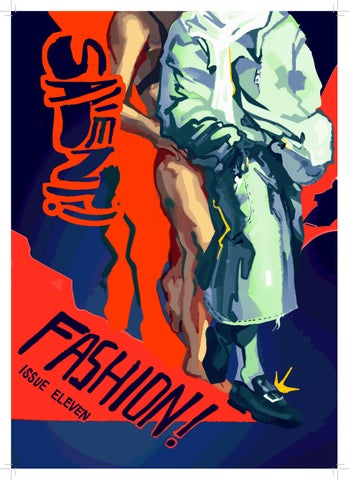
FINDING YOUR UNIFORM As I looked through the issue you’re about to read this week, one problem kept coming up: overproduction, and by extension, overconsumption. 21st-century capitalism’s emphasis on continually evolving new consumption habits has one objective: the continued sustenance of commodity production. Western imperial economies, like our own, are completely dependent on the continual production, fetishization, and consumption of commodities. Commodities, especially in fashion, are objects that exist not as material resources to the user, but as abstracted signals of virtue and wealth. Obviously, the West’s manufactured needs for more and more wreak havoc on our planet, especially in the developing world. In places like Bangladesh and Malaysia, clothing plants dump litres of dye into the waterways, destroying centuries-old ecosystems in the name of Western consumption. In the Western world, this takes its toll too. Alienation is the process by which commodities are stripped of their relation to real productive relations. Who made the pants you’re wearing right now? How much were they paid? In capitalist alienation, this relationship is totally stripped of any meaning, and likewise, so is one’s personal relationship to the product itself. This is completely at odds with the way people have lived throughout history, including in historical Te Ao Maori, where thanks is given constantly to the combination of human mahi and the natural world to produce the things we enjoy so much. How can you carve out space in your life for clothes that matter -- clothes that connect you to the people around you? One option is finding a friend with a sewing machine, and learning how to make clothes yourself. Another is finding treasured pieces from op-shops, donating to their cause, and wearing them to the point of exhaustion. Of course, there are always local collectives, and while they’re expensive, it can be worth it to spend a little more money on something that’s going to last you a long time. Cheap clothes come at a cost, and often that cost is exploitation. The truth is, it’s actually really fucking cool to have a uniform. Nobody’s going to come at you for outfit repetition. You’re not Zendaya, and nor should you have to be. I never leave the house without the second-hand leather jacket I got from a Salvos in Naarm, or the jeans I bought from a garage sale in my hometown. When you know where your clothes come from, when they have a story, that makes them all the more valuable.
Ētita • Editorial
Thursday
Friday
Keegan Lewis w/ Selohrae
Xfm's Jurassic Gig w/ Scarlett Crush, Screenburnt and Harris
Radioactive Fm | Live To Air At San Fran
Following the release of his bittersweet debut EP 'An Ocean Of Violets', indie-pop artist Keegan Lewis will take the stage for a special headline show on May 21st, bringing his signature alternative, captivating sound to Valhalla's iconic venue.
SCARLETT CRUSH Wellington Shoegazers
Live on RadioActive FM and in person at San Fran! Star Time ensemble is an epic live Afrobeat explosion for the soul. Bazurka are a seven piece Balkan fusion ensemble.
8PM - Valhalla - $10
7PM - Valhalla - $15
3:30PM - San Fran - FREE
Saturday
Saturday
Saturday
SCREENBURNT- digging up the nu-metal sound of the 90s cos nu-metal is back so get out your razors and tats and go hard. HARRIS (Solo) - the enigmatic Harris opens with a solo set of alternative rock, the genre that never seems to get old!
Star Time Single Tahini Bikini Tour Fundraiser Release Party
Mundi w/ Bazurka
Tahini Bikini have emerged as regular faces on the festival scene and in venues across Aotearoa with their signature neo-soul funk inspired sound.
Te-Whanganui-A-Tara Afrobreat Club-Jazz band Star Time have been VERY busy melting faces on the dancefloor… and they now have an immortalised recording to prove it, with their debut single “Moto Moto”.
Get set for an evening of scintillating melodies and intoxicating rhythms, played with tenderness and precision by two of Aotearoa’s most fearsome and revered world music ensembles.
8PM - Rogue & Vagabond - $15
8:30PM - 13 Garrett Street - $15
7:30PM - Vogelmorn Upstairs - $25
Stand up for pay equity!
As the corrupt Coalition government unleashes their Budget, join VUW staff and students to protest the chopping block of pay equity legislation!
Salient // Page 1
THURSDAY, MAY 22 - 1PM Parliament Grounds
Salient // Fashion // Ētita • Editorial
Wednesday
News headlines from the week Will Irvine (he/him)
A Green New Deal for Aotearoa? US Accepts “White Genocide” Survivors As Refugees Salient Te Ao Maori editor Taipari Taua and I were lucky enough to attend the launch of the Green Party’s alternative budget, pitched as a vision for developing a climate-centred, economically viable Aotearoa. The proposal, which is relatively moderate in comparison to past Green policy proposals, includes provisions for a “Ministry of Green Works”, which would be a state agency dedicated to developing green energy infrastructure. The proposal hearkens back to the First Labour Government, which used state-sponsored works bills to stimulate economic revival amid the Great Depression. Similar plans have been proposed in the US under the moniker of a “Green New Deal”, and in the UK under Jeremy Corbyn’s Labour leadership. Seemingly in response to the Green’s budget, the National government released a plan to invest $190 million in social spending, most of which would go to advocacy NGOs. Comparatively, the more comprehensive Green proposal includes free GP visits and childcare. Winston Peters described the budget as “Marxist”. We can only dream…
This week’s winners of the “how can I make this about me” contest are, once again, White South Africans. Last week, the Trump administration accepted 59 Saffas into the USA under refugee status, claiming that they were victims of a genocide. Instead of indulging these claims, Salient will give you a run-down of the history of racism in South Africa. After Apartheid ended, a regime in which Black South Africans were treated as subhuman by their white oppressors, many of the aforementioned oppressors moved to Australia, Israel, and New Zealand, fearing “persecution” (read: consequences of their actions). Whilst the African National Congress that has ruled South Africa since the end of apartheid has been corrupt and inefficient, there has been no documented evidence of widespread persecution of white Saffas. Indeed, the average income of a White South African is still nearly 6x that of a Black South African. White Saffa farmers continue to be a powerful force of reactionary violence in the country’s rural areas, and there is increasing support both among expats and the remaining population for a return to apartheid-style policies.
Law School Switches Course on Exams For Eyes on Exec this week, Academic Vice President Ethan Rogacion gave Salient an update on the law school’s controversial changes to exams. Law students taking 300 level courses can relax a little: the Ethics and Equity courses will be switching to using 50% handwritten multi-choice and 50% typed exams.
Salient // Page 2
He says VUWSA sees the move as a “really good pragmatic compromise” which will “hopefully lessen the strain on disability services.” However, he says that the Student Union is really keen on the University utilising exam ‘lock-out’ software, similar to the software used in NZQA exams. VUWSA hopes to see this software available in time for Trimester 2 exams, because “we can’t have this kind of uncertainty again”.
Rogacion says that while both VUWSA and VUWLSS have been pleased with the engagement from the law school, particularly Dean Geoff McClay, the focus is now on how they can prevent a similar situation from happening again. “Consultation with students is really important and we wish that there had been more robust consultation done before [the decision]”, he said. With other faculties exploring assessment options, VUWSA wants to make sure that the University is properly funding exam solutions so handwritten exams can be avoided.
Kawepūrongo • News
households coming to Powerswitch, discover they are paying more than they might need to. For example, 93% of users could find savings of more than $100, 73% could be saving more than $300 and 61% of users could potentially save more than $400” says Damen. Victoria University has also confirmed to Salient that it will run its Winter Energy Grant this year, giving flats the chance to apply for a grant in order to warm their whare over the colder months. In Parliament, Green MP Fransisco Hernandez has lodged a member’s bill in the ballot that adds students to the list of beneficiaries that receive the Winter Energy Payment. “While pensioners and beneficiaries rightly receive the Winter Energy Payment to help cover the winter power bills, students on low incomes aren’t afforded the same support” says Hernandez. “Students are struggling to pay the bills, and living in cold, damp housing. That’s not good for students – it’s bad for their health, their education, and their quality of life. My bill fixes that”. Salient asked Energy Minister Simon Watts…yes Watts, if he believed students should be included in the payment. “[The payment] is currently targeted at individuals over 65, we don’t have any plans to change that,” said the minister. There are actually ten types of beneficiaries who can receive the payment currently, of which only two require you to be over 65. Josh Robinson, Welfare Vice President at VUWSA, is helping to champion Hernandez’s bill. Robinson told Salient that VUWSA will re-launch its petition calling on the New Zealand Government to extend the Winter Energy Payment eligibility to include tertiary students. Though Robinson says negotiating with the current government can be like talking to a rock, he told Salient that students have the potential to be a bargaining powerhouse with opposition parties, ensuring student welfare is a solid part of their policy when the next election comes around. Winter is coming, so take a look at Powerswitch, buy a hottie, and brace yourselves. Link to Powerswitch: www.powerswitch.org.nz Link to Toast Electric: www.toastelectric.nz
Salient // Page 3
dishwasher, stovetop, showers, and washing machine; all appliances Contact recommends you use during your free power hours! The fact that gas is excluded is mentioned at the very bottom of the page. Students got in touch with Salient regarding painfully expensive power bills. Most of them were with Contact on the Good Nights plan. One flat was paying $376 for just three tenants. Another bill clocked in at $286 for four people, who had not been using heating throughout the whole billed month. Last but not least, a group was hit with a whopping $513 tally. “Not using heating means our cold, damp flat gets colder and damper,” said one student. “I can’t afford hot showers longer than a minute,” said another. This is energy poverty, fuelled by exorbitant energy prices. Salient reached out to Contact Energy with these grim stories. Contact said they couldn’t comment on individual household’s bills. When asked if they were misleading customers about the Good Nights plan, they said they believed their pricing to be transparent enough. Regarding whether they were exploiting the April 1st revenue expansions by the Commerce Commission, Contact told Salient that the cost of supplying energy and strengthening energy infrastructure would be reflected in their pricing, unfortunately. “We know things are tough for Kiwis right now” said Michael Robertson, Acting Chief Retail Officer at Contact, “so we’re doing everything we can to limit the impact to customers by not passing on the full cost of electricity.” Thank the lord! Contact Energy’s underlying profit for the 2024 financial year was $675 million dollars, up $100 Million from the previous year. In 2023, the big four gentailers were earning a combined $7.4 million a day. Phil Squire, Fair Energy Manager at Toast Electric, Aotearoa’s first nonprofit energy company, says the gentailers main goal is to maximise profit. “Structuring themselves to provide lower prices as an industry wouldn’t please their boards or shareholders”. Womp womp for us. There is a fight to be had though, and ways to cushion the energy blow. Powerswitch, a website created by Consumer NZ, allows you to compare power plans for your exact address. “We find most
Fergus Goodall Smith
Does it seem like winter came early this year? Your power bill might make you feel like it did. The Commerce Commission recently completed a review into the revenue limits for power companies. They expanded these limits for energy retailers to deal with ‘greater transmission and distribution costs’. The Commission indicated that households would see a $10$25 increase at the bottom of their power bill. Vector, an Auckland lines company, announced an average increase of 21% to its charges. Eye watering, I know. These changes came into effect on April 1st, right as Aotearoa stands on the precipice of winter, where energy use generally goes up. Abby Damen of Consumer NZ told Salient that the problem lies with only a select few companies generating the energy and therefore having more control over what they charge. These companies are called ‘gentailers’. “We’ve been concerned for years that a chronic lack of investment in the new generation has seen us lurch from energy crisis to energy crisis” says Damen. “While we have about 30 electricity retail ‘brands’ to choose from, around 85% of New Zealanders are with one of the original, large gentailers - Contact, Meridian, Mercury or Genesis.” Damen says that the market is not as competitive as it could be, and new companies get squashed by the big players. Just last week it was announced that Flick Electricity, a small power retailer, would be swallowed up by one of the big four, Meridian Energy. These players can make their deals seem far more appealing than others, when in actuality, for your particular situation, they could be costing a heck of a lot more than other plans. One such option is Contact Energy’s ‘Good Nights’ plan, which gives your household free power from 9am to midnight. There are hitches though. The plan doesn’t work on weekends, and the fixed daily charges and the charge per kilowatt hour (kWh) when the power isn’t free are significantly higher than plans that have a more standard flat rate throughout all times of the day. If those free three hours aren’t used to maximum effect, you’ll be broke next time your bill comes round. It’s also important to note that the free power hours do not cover gas usage. If you do use gas, that’s your
Salient // Fashion // Kawepūrongo • News
Winter is Coming, But It’s Not White Walkers We Should Be Worried About
Government Protects Mining Interests with License to Kill By Darcy Lawrey (he/him)
Resources Minister Shane Jones and the rest of his government have struck a blow against nature in what is a seemingly personal vendetta against “blind frogs”. An amendment to the Wildlife Act, rushed through Parliament under urgency, has enabled the Director-General of Conversation to authorise the killing of kiwi, endangered frogs, and other vulnerable wildlife when they’re in the path of new mines or roads. The law change has come without an impact statement or any consultation. Only weeks into this parliamentary term, Jones told the house that it’s “goodbye Freddie” to any frogs who get in the way of mining opportunities. “We won’t allow humans to play second fiddle to Freddie the frog” he said. A small group of humans seem particularly ready to benefit from the law change – the mining and associated consulting firms who donated $132,680 to New Zealand First, Jones’ party, at the last election. He told Newsroom that any donations from mining companies
are “their call” and have no bearing on ministerial decision making. A self-described ‘growth apostle’, the minister thinks that the public should be “extraordinarily thankful” for his presence in the government. Said government has certainly been quick on the trigger to protect mining companies from any legal liability for killing our native species. The law change has been triggered by a High Court judgement in March which found that DOC retrospectively authorising wildlife deaths was unlawful. Conservation Minister Tama Potaka, who introduced the bill, argues that the law change keeps safeguards to protect wildlife. “It’s important Aotearoa New Zealand’s wildlife continues to be protected, and that species can thrive”, he said in a press release. However, in the Coromandel Peninsula, the site of the mining operation challenged in the High Court, the Archey’s Frog species has not recovered from an 88% decrease since the early 2000s. Not exactly thriving.
Green Party Co-Leader Marama Davidson says that the bill protects profits and corporate greed, not our native wildlife, “you can’t claim to value our biodiversity while forcing through law changes to make it easier to destroy it.” She called the bill “cynical, calculated, and utterly, utterly devastating.” Meanwhile, Greenpeace is calling the move “Trumpian style environmental vandalism”. Spokesperson Gen Toop calls the amendment the latest entry onto the list of “anti-environment initiatives” passed by the current government. Other examples they point to include the Fast Track Approvals Bill, the dismantling of freshwater protections, and the removal of the RMA requirement for councils to identify biodiverse areas. Toop says that the amendment will “go down in history as the moment the New Zealand Government decided that roads and coal mines needed protection from skinks and kiwi, instead of the other way around”.
How will DoC protect native birds from bird flu? By Dan Moskovitz
Salient // Page 4
H5N1 bird flu has caused devastation in equal part both to poultry birds and wild birds. Only Australia, Aotearoa, and the Pacific remain H5N1 free - for now. Which gives us the luxury of time to figure out how to protect our taonga species. So the Department of Conservation is in the process of drafting up avian protection plans for 49 of our at most risk birds. These include species such as the Kākāpō, Takahē, Wrybill, Whenua Hou diving petrel, and Weka, among many more. But unlike most biosecurity incursions, the challenge with bird flu is unique. As the spread is in wild birds outside of NZ, there’s no prospect of elimination So what can DoC actually do to protect them? “We’ll be doing business as usual on steroids,” said Kate McInnes, a senior science advisor at DoC working on bird flu. “Take predator control - if the population shrinks because of bird flu then losing a couple birds per year to predation has a larger impact. “So a lot of our response will be to try and take away those other threats to give the population the best chance to bounce back from bird flu.” Another option McInnes suggests DoC is removing some bird feeders for endangered birds. If the birds can already feed themselves
effectively, then having a feeder is just going to make birds congregate and transmit the virus. DoC has also successfully trialled a vaccine to H5N1 in five separate species. The issue is, vaccinating a bird against H5N1 requires two doses, four weeks apart. Birds fly, and the ones which don’t walk, meaning ensuring every wild bird gets two doses is impractical for a lot of species. So DoC’s task there is to figure out which ones it's conceivable in. “We’ve drafted up species where we think we could potentially do vaccinations, but we haven’t given it a reality check yet,” said McInnes. “We still need to talk to our stakeholders, treaty partners, and experts.” Alongside birds, DoC is also making plans for five of Aotearoa’s native marine mammals, which are also susceptible. These are the New Zealand fur seal, New Zealand sea lion, southern elephant seal, Hector’s dolphin and Maui dolphin. When asked how the equation changes when it comes to dealing with marine mammals, McInnes says it’s “really, really, difficult” “We don’t have a vaccine for marine mammals. So it’s essentially just restricting access to them so people aren’t spreading disease, and cleaning up if we’ve got sick and dying animals.” “We won’t be able to prevent them from getting infected and there’s not really a lot of interaction we can do.”
While H5N1 hasn’t caused extinctions overseas, it’s another stressor on many of Aotearoa’s native fauna. “We have threatened species programmes which have had a lot of effort and resources put into them. And they’ll go backwards. And they’ll have to work their way back up. “The combination of bird flu and other pressures coming together might just tip things over the edge. We’re busting a gut to prevent that from happening. But we just can’t predict at this stage which animals will be affected and how badly.” McInnes says the most important thing the public can do is follow the messaging coming out of the government, and under no circumstances pick up sick birds.
If you encounter a bird showing symptoms of avian influenza, please take a video and call Biosecurity New Zealand on their hotline: 0800 80 99 66. Symptoms include falling over, twisting their neck to look upwards, lethargy, and drooping heads. Finding three or more dead birds in one area is also a reason to contact Biosecurity. Transmission of bird flu to humans is uncommon but not impossible. However, its mortality rate in humans is 52%. Do not touch any bird showing symptoms.
Kīwaha o te wiki/Phrase of the week: Taiea ana - Slaying, looking good, etc
Kua whakawerewere e toru ngā mema o te Pāti Māori i pāremata, ko Debbie Ngarewa-Packer, ko Rawiri Waititi, ā, ko Hana-Rawhiti Maipi-Clarke. Kua puta te karere nō te Kōti Pāremata, e 7 ngā rā werewere tā Hana-Rawhiti, ā, e 21 ngā rā mā Debbie rāua hoki ko Rawiri. Ko ngā whiunga o tēnei werewerenga, kāore rātou e taea ana te whai wāhi ki a rātou mahi ki pāremata, ā, kāore rātou e whai moni nō te kāwanatanga i tērā wā nōki. I mea mai te Pāti Māori ko tēnei te whiunga nui rawa o tērā momo whiunga kua puta mai i te pīka.
Salient // Fashion // Māori
Te Pāti Māori MPs Temporarily Suspended from Parliament
I tau mai ēnei tāmitanga i te haka a Hana-Rawhiti, a Rawiri, a Debbie, a Peeni mā i te mutunga o tērā tau, porotēhi, whakahē marika ana i te pire mō ngā mātāpono o te Tiriti. I mea mai te Kōti Pāremata i pēnei te whiunga nā tā rātou mahi whakawehi mema o te whare i tā rātou haka. I mea mai a Mariameno, “E taea ana rātou te werewere i ngā mema, hoi, kāore rātou e taea and te werewere i te kaupapa.” E rua kē ngā hui ki te Kōti Pāremata, ā, kāore rātou i tae atu ki ērā tokorua ā tinana i te whakahē o ngā whakaherenga o ēnā hui. E ai ki te Pāti Māori, kāore rātou i te aro tika ki ngā tikanga Māori I te hia rātou kia hui tahi te mātanga tikanga rā, a Tā Pou Temara, ki te Kōti Pāremata kia whakamārama i ngā āhuahanga tikanga, nā, i whakahē te Kōti ki tērā tono me te kore take. I mea mai te Kōti Paremata ehara ko te haka te raru, ko te wā me te kawenga o te haka te raru ki a rātou. Nā te haukati a ngā mema rā i te kawenga o ngā pōti i te whare pāremata, i raru ai rātou ki te Kōti Pāremata. Ko tā te Pāti Labour, e whakaae ana ki te Kōti Pāremata i te takahi a Te Pāti Māori i tētahi ture, heoi, i meatia rātou he taikaha rawa te whiunga. Ko tā te pāti Kākāriki, e whakahē marika ana ki te Kōti Pāremata. E ai ki a te pāti Kākāriki, kāore rawa tā rātou kupu whakatau i te taurite ki ngā ture ā te whare. I mea mai a Rawiri Waititi ko te haka he mea whakarākei, he mea taunaki, he mea tautoko i tōna tautohetohe. Ehara i te mea aukati, he mea whakapuaki i tōna Māoritanga. Ki tōna whakaaro, me panonitia ngā ture a te whare kia wātea ia, otirā ngā mema Māori, te whai tikanga Māori i roto i te whare Pāremata. Nā ēnei whiunga, kāore a Hana-Rawhiti, a Debbie, a Rawiri e āhei ana te whai wāhi ki ngātautohetohe tahua, ngā āhuahanga timatanga o te Regulatory Standards Bill, me ngā tini kaupapa hirahira o te wā nei. Hei tēnei wiki te toenga o Pāremata ka pōti kia whakaae, whakahē raini i te kōwhiringa nei, ā, ko te āhua nei ko ngā mema kāwanatanga ka whakaae. Te Pāti Māori members Debbie Ngarewa-Packer, Rawiri Waititi, and Hana-Rawhiti MaipiClarke will be temporarily suspended from Parliament for their haka during the first reading of the Treaty Principles Bill. Maipi-Clarke will be suspended for 7 days, with Ngarewa-Packer and Waititi being suspended for 21 days as well as being heavily censured. The MPs also will not be paid for the time they are suspended. These are the longest suspensions in the history of Parliament. These are recommendations made by the Privileges Committee and will be voted on by the rest of Parliament on Tuesday. There were multiple meetings held before the most recent one where the three MPs did not show up in person and had lodged a written submission in their absence. The recent hearing found that each MP had committed a ‘contempt of the House,’ meaning they had disobeyed an order of the house. The committee stated that the issue wasn’t necessarily about the haka itself, but rather the “time and manner in which it was performed.” The issue taken was that the haka disrupted the voting process and considered it “intimidatory.”
MPI song of the week: I Would Look Good on You - Maoli
Taipari Taua (she/they, Muriwhenua & Ngāpuhi)
Salient // Page 5
Rawiri Waititi explained in an interview with Te Auraki Media that the haka was not a disruption, but rather another form of speech in the eyes of tangata whenua. It elevates the kaupapa, the subject at hand. It is something that has been used in that way for Māori for thousands of years. Waititi expressed that the standing orders should reflect the tikanga of this land to “allow tangata whenua to express themselves freely using [tikanga].”
Kawepūrongo • News
Interviews with 3 tauira on their fashion feelings By Maia Berryman-Kamp (Te Arawa, Mataatua)
Skinny jean this, frosted lips that, Bratz chic mother-core serve scale. Kāo – what are the pre-colonisation garms that you want to see back in the ao? Ahinata Kaitai-Mullane (Kai Tahu, Kati Mamoe, Waitaha:
I feel like so many of our kākahu now are reserved for special occasions like grads. Though it’s not technically kākahu, I’ve been loving seeing folks coming to uni with all their stuff packed into kete.
Tanith (see over the page):
I’d like to see it all return: the kōkowai, the kāhu kurī, the uhi moko, the weaponry – all of it. I have worn a patu pāraoa as a tie on a few official occasions. I’ve also carried my mere pounamu to many different places. I’ve had more problems with colonised people than I have with the coloniser.
Anonymous:
I've been seeing some ātaahua examples on Tik Tok of wāhine Māori making raranga strapless tops. Such beautiful and meaningful creations I want to see more of!
We are a very fashion forward people - who’s your personal Māori style icon (nannies in the children's beanies and coats from 1934 excluded). 100% Marlon Williams. I think fashion is about expressing your identity through clothing, and the way that he moves and wears kākahu embodies a relationship between who he is and the joy of experiencing his world through style and music. Also love Kāi Tahu representation! Controversial person, but highly agreeable. I have always liked the way Winston Peters dresses. He was definitely the benchmark of my late teenage years. Now – I don’t know. I think I’d rather look forward and become the style icon. I’d say the great rangatira Te Kani Te Ua is one of my all-time favourites. He carried himself with equal confidence and grace—whether dressed in a suit or a rāpaki. I grew up hearing stories about him, especially about his distinctive rei mako. I actually made a pair recently, using teeth gifted to me by the tohunga whakairo Tiopira Rauna. I looooove watching @tuihana.ohia and her outfits o te rā. She's such a bright and positive kuini & makes kākahu fun.
What’s a piece of kākahu that you love, and why? It’s so cold atm, I’ve been living in my @kiriinc ‘kei aku moemoeā’ hoodie. I love picking up comfy everyday clothes that support Māori artists.
Salient // Page 6
I’ve always been a fan of overcoats and greatcoats—especially earthy tones, and academic fashion, both light and dark. When I was 12, all I wanted to do was wear overcoats—every day, all the time. It’s a look I’ve always felt at home in, and when I was younger, I could outdress a Crown prosecutor. Unlike now, I copped a lot of flak. People would say things like, “Where does he think he is? Parliament?” “Whakahīhī,” et cetera. So, I’d say to people: “Go inside the wharenui—find me a single person not wearing a suit.” When my grandmother was alive, she wouldn’t even go to the dairy in less than her best—and most of her generation was like that. I adore the knitwear made by Aorangi @crochet_bae. Her tino rangatiratanga jumpers + vests have been on my shopping list for months and months. Be sure to check her out, e te whānau xx
reflections from a Māori postgrad on style and politics
In Te Wairoa – we say “he ao te rangi ka uhia, me he huruhuru te manu ka rere ai” (or ka tau). The great ancestor Tama-te-rangi was called upon to lead an ope taua. However, he hesitated to perform the tohi ceremony over the ope as he lacked the proper kākahu and mana to lead. In response, his younger brother gave him his kākahu, the appropriate rituals were performed, and Tama-te-rangi proceeded to lead his people to victory.
Salient // Fashion // Māori
Muka, manu, and mana
Sir Apirana Ngata once said: “I whiua e aua rangatira ki te tahuaroa te kahu-kiwi, te mahiti, te paepaeroa, te koroai: kei ngā whare whakakite-kite e iri ana, hei mātakitaki mā te pakeha, hei whakatauki mā rātau “koia ēnei ko ngā taonga a te Māori i te wā e whai-mana ana ratau”; hei titiro atu mā te Māori, ka mapu ai, ka tātaku ai i tana tataku. “Haere rā e Waro ki Ingarangi ki Rēhia ra.”
“The chiefs gave away to the common weal the kiwi cloak, the dog skin cloak, ornamental cloaks to hang in Museums for Europeans to view, and to expound the virtues of the Maori. “These were the treasures of the Maori while they had authority”: now the Maori looked on, sighed, recited and uttered "Farewell to the abode of death, to England the abode of pleasure”
The waiata oriori of the Te Whanau a kai tohunga Tūpai Whakarongo Tarāwhare: Ka noho Wainui, ka noho i a Rangi, Puta mai ki waho rā Moananui a Kiwa; Ka maringi kai raro ko Parawhenuamea, Nā Moananui, e, nā Moanaroa, e. Nā tuiterepo, nā Tuitewao, Nā Tutehemorere, nāna Rangitahuri; Nāna te whitau, ka rōia hei kaka, Ka mahana i ahau
Wainui, dwelled with Rangi, From them emerged Moananui-a-Kiwa; Down below was poured forth Parawhenuamea, By Moananui and by Moanaroa. By Tuiterepo and Tuitewao, By Tūtehemorere, who brought forth Rangitahuri; This drew out the fibre, softened it into garments, To give warmth to me.
I once wore a British red coat to a pōwhiri for the British High Commissioner, Her Excellency Laura Clarke. I conducted wānanga in that coat as well, and once, I wore it to rage-quit a contract, where I told a government department they were colonised. One comment I once received was: “I should slap you for wearing that.” My reply was: “Its name is Te Kooti Toto—the blood coat. It is named in deference to the blood of the victims who were slaughtered at Ngātapa in 1869. It is also a reference to the red serge coat given by Cook to the children he kidnapped—known to Rongowhakaata as Te Mākura and Te Hinu a Tūhura, respectively.”
by Tanith Wirihana Te Waitohioterangi (Rongowhakaata, Te Whānau a Kai, Te Aitanga a Māhaki, Ngāi Tamanuhiri, Ngāti Rakaipaaka, Ngāti Ruapani, Rongomaiwahine.)
Salient // Page 7
All of these kōrero prove one point – that it is not just the ability to wear traditional clothing that is a sign of tino rangatiratanga, but also the ability to produce it and say – “Pēnei ana i ōku tīpuna i mua i au, kua kākahuria ahau i ngā puāwai o ngā maunga tiketike, o te ngāhere, o te repo, o te taiao, nareira me kī au – he tangata whenua.”
Jia Sharma (She/Her)
Being Indian is something I haven’t always embraced. Like many Indian girls growing up in New Zealand, I tried hard to assimilate, blending into the culture around me while distancing myself from the one I came from. I wouldn’t talk about it, I wouldn’t let anyone see me wearing Indian clothes. I was ashamed. People already hated Indians, there were jokes about us smelling like curry, being scammers, being too loud, too much. I didn’t want to be a punchline. So I hid. And I wasn’t alone. Among the many brown girls I knew growing up, we all carried that same fear. At cultural events, we’d watch the crowd with anxious eyes, silently praying we wouldn’t run into anyone from school. I’ve only recently come to love my culture and see the outstanding beauty in it. I not only started embracing it, but protecting it. It sounds strange to say now, but I used to not want my culture to define me. But it does. And it should. So I began slowly. I wore jhumkas with my jeans. I stopped scrubbing my mehndi off before school. I posted photos of myself in Indian clothes during Diwali. And nothing happened. No backlash. No ridicule. The world didn’t end. I wasn’t being "cool" by rejecting my roots, I was only hurting myself. Now I love wearing clothes that represent where I come from. I love giving them new life and flair and spinning them in different ways. Diwali is one of my favourite times of the year. I get to dress in heavy jewellery and beautiful outfits that would seem overdressed to anyone else but is the norm for us. I’ve reached a place where I dress the way I do to make myself feel good, and to show the word the beauty in where I am from. And yet, people always find a way to ruin it. This time it was different. They weren’t making fun of the clothes we wear or how we look. They were taking it and playing it off as their own. I’ve already heard the cultural appreciation arguments, but that’s not what this is. I believe in the importance of sharing and learning from other cultures. But there’s a difference between appreciation and appropriation—and the line is drawn in how it’s done. We all remember Coachella-era appropriation: bindis, feathered headdresses, "boho-chic" outfits from celebrities like Vanessa Hudgens and Kendall Jenner. Today, it’s a little more insidious. It comes wrapped in rebrands. Take the recent ‘Scandinavian scarf’ discourse. If you’re not as chronically online as me, I’ll give you a run down. There’s recently been a large amount of people on social media and clothing companies referring to the South Asian dupatta as a ‘Scandinavian scarf’.
Salient // Page 8
Western designers have for a long time been inspired by South Asia and its culture and designs, sometimes unknowingly so. I only recently learned that even the paisley pattern originates from India. But what we’re seeing now is more than inspiration, it’s erasure. Most recently, the clothing brands Oh Polly and Reformation have been found guilty of this. In March, Oh Polly posted a Tiktok of their new “Galia convertible gown”, a baby pink bejeweled bodice with matching pleated wide leg trousers. After thousands of commenters accused them of appropriation they stated that they will “be more mindful in ensuring that cultural elements are honoured with respect in our designs moving forward”. They proceeded to use this excuse to battle the comment section in the numerous other posts they made of this ‘convertible gown’. A few days later Reformation dropped their collaboration with model and influencer Devon Lee Carlson which featured a blue top, skirt, and scarf set that bore a remarkable resemblance to a ghagra choli. Reformation has not acknowledged the backlash it has since faced.
Ahuatanga • Features
In many religions, the dupatta is introduced to girls during puberty or a coming of age ceremony. Removing it from this context and labeling it "classy" only when stylized for Western runways is seen by many as a deliberate act of cultural dilution. However, the dupatta is not just an accessory. For centuries it has been a symbol of resistance for South Asian women. Dupatta were notably used as a symbol of resistance during the Mughal conquest. When Mughal warlords ravanged Indian civilisations they killed all the men, meaning that the women of these civilisations would be left at the hands of the Mughal men to rape and brutalise them. The story goes that the women left behind would then participate in an act of self sacrifice in a group by walking into a fire. They would much rather choose death than what could happen to them in the power of men. Before they walked into the fire they would cover their head with a dupatta as their final act of dignity and defiance, reclaiming their agency even in death. They could kill our men, but they couldn’t take our bodies from us.
Salient // Fashion // Ahuatanga • Features
To give some context, a dupatta is a traditional shawl worn with Indian dress with deep historical and cultural roots. It is traditionally worn with a salwar kameez or lehenga choli. It is particularly important in religious or ceremonial contexts. Whether it was used during prayer to cover the head or draped across the chest for modesty, it has both functional and symbolic purposes.
The dupatta was also used in the fight for freedom against British colonialism. Sarojani Naidu and many other Indian women would only wear hand spun Indian fabric dupattas and rejected any British textiles as resistance. Rani Jind Kaur was an important figure of resistance who the British called ‘the only woman in India with the guts and brains to take on the Empire’. Because of the threat she posed to the Empire, they stripped her of all her political rights and power and imprisoned her. Throughout all of this, she kept wearing her dupatta. In 1984 in post-colonial post-partition Karachi, Pakistan, the women’s action forum staged a protest outside of the Karachi press club where they burned dupattas to condemn the increasing amounts of rape in their city. The dupatta is so much more than just a piece of clothing that can be altered and rebranded. Hundreds of women have fought to wear it. Calling it ‘the Scandinavian scarf’ is not only deeply disrespectful, but overthrows the massive cultural and historical importance of this garment. The issue here is not that people of other cultures are wearing traditional Indian clothing. It’s the fact that a large portion of people will only accept South Asian features and aesthetics and deem them desirable, or even acceptable, when it’s portrayed from a western lens. The word European is the selling point. It’s chic when they do it, but dirty when I do it. If these garments were marketed as what they are — dupatta, lehenga, ghagra choli — they wouldn’t be called elegant. They wouldn’t be high fashion. They’d be “foreign.” The dupatta is not the only instance. For years, I have seen companies like Sherri Hill market Indian formal attire like lehengas as ‘two-piece prom dresses’. Younger me would never even think about wearing Indian clothes to the school ball, but watching white girls do it and get praised for it hurt. After centuries of colonisation and dehumanisation, it’s painful to watch the very things once used to mock us become marketable. Brands like Oh Polly and Reformation take these parts of our culture without acknowledging the history behind these pieces, and target them towards a different demographic. One they deem as worthy. Right now, anti-South Asian sentiment feels more intense than ever. I’ve seen comment sections filled with hatred. I’ve heard boys laugh at elderly women in saris. But when a white girl wears the same thing on a runway, it’s “elegant.” The message this sends is clear: it’s not that people hate our culture. They just hate our culture on us.
If you want to wear South Asian-inspired fashion, great. But know what you're wearing. Learn its name. Learn its history. Wear the dupatta. But call it a dupatta.
Salient // Page 9
I don’t want this to be the case. I want people to embrace my culture and I want to share it. I want them to see the full beauty in it that I do. But more than that, I want them to respect it. I want them to know what it means, what makes it important and why it is important.
Ahua
My friends will find it deeply hilarious that I’m writing this piece, because (full disclosure) I have no idea what I’m doing. My fits aren’t fire, and I’m not what the kids call ‘steezy’. I love fashion, and have a lot of interest in the industry, but when I look at my wardrobe I feel a vast and indescribable sense of dread. What on earth was I thinking when I bought all this stuff? In my dreams, I’m staring at racks full of the latest JW Anderson menswear drops, but when I look at what I actually own (or could afford to own) all I see is a handful of lumpy shirts and a pair of Levi’s 501s. Often we think of fashion as having to do with ‘standing out from the crowd’; ‘being yourself’. But for the boys, fashion tends to serve a regulatory purpose: it fits us into boxes. Jocks wear sports shirts and trainers; festival-goers have the jorts and dad shirts on lock; indie street poets are swamped by baggy pants and blazers; and the rest of us stumble out the front door as inconspicuously as possible in jeans and sweaters. Another Hallensteins hoodie that says COLORADO SPRINGS 1989 on the back? Come on, lads.
It’s a struggle to dress well for uni, a hyper-public space where you’re clocked by hundreds of peers, friends, and classmates daily. Rather than standing out, isn’t it so much easier to fit in to preconceived archetypes of style? Clothes have a social language, after all: they’re a form of communication, signalling to others which groups we fit into in the vast fabric of social life. A chore jacket, for instance, has a particular class association attached to it, as does a pleated pant, a cable-knit turtleneck, or a cardigan. It’s so much easier to wear something generic than it is to take a risk on sending the wrong social signal, feeling embarrassed in clothes that don’t vibe with your vibe or resonate with how your friends have come to see you.
Salient // Page 10
Though it might be a struggle, I do think it’s important to be interested in fashion. We all wear clothes, so it’s worth paying attention to who’s making them and whether or not they’re being fairly compensated. It’s not like there’s any such thing as an ethical corporation, but if you (like me) can’t afford to spend big at local ateliers, it’s good to do your research on a company when purchasing new. The B Corp Certification is a pretty solid indicator for companies that have shown commitment to labour and environmental concerns. And, of course, op-shopping is probably the most ethical way to buy clothes. But really, buying less clothes is the most sustainable option: choosing well-made clothes and taking care of them for years, disentangling yourself from fast fashion’s nasty cycles of overconsumption and quick disposal. It’s important to be interested in fashion for aesthetic reasons as well as ethical ones, though.
Clothes, like food, are at the intersection between human need and aesthetic pleasure — so having an ‘interest’ in fashion is also about keeping an eye on the latest trends and designs coming out of the big fashion houses. On the world stage, Jonathan Anderson’s masterful tailoring, androgynous silhouettes, and economy of colour have been revolutionary in contemporary menswear; Maison Margiela’s relaxed shape-and-drape Parisian swag has been a delight to see develop, too; similarly (but conversely), it’s hard to look past what Hedi Slimane did at Celine for the skinny fit in the mid-10s; and I’d be remiss not to mention Richardo Tisci’s stint at Givenchy, or Virgil Abloh’s Off-White, both of whom largely defined what we call ‘streetwear’ these days.
Honestly, it’s not that I own a single piece of clothing from any of these high fashion houses, it’s that just being aware of their work on a very surface level, sorting the genuinely beautiful from the slew of images we see everyday, means that when I walk into a store I can actually afford, I know what I like and what style I’m after. Locally, things are much more affordable, but feeling a bit dire — the amazing Thom Morison just closed up shop, a designer rare even among Aotearoa’s brands for manufacturing locally, designing thoughtful, simple collections slowly and with intention (is there anyone else in this country doing menswear like he did?). But there are some brilliant people holding out for our ready-to-wear menswear scene: Porter James Sports is really taking off, their trendy dart-knee pants formalising the opshopped baggy look with real verve and eloquence, among a range of goofy business shirts and kitschy tees — and with a Melbourne pop-up under their belt, it’s exciting to see where this brand might take us; meanwhile Dayne Johnston, who designed dark, groovy menswear at Zambesi for twenty years, has just jumped ship to Kowtow, where this writer holds out hope he’ll bring a bit more range to that brand’s offering; and Checks Downtown have this kind of blokey ‘she’ll be right’ thing going on that belies genuinely quality fabrics and finish at a very reasonable price point.
t c s f c a o h a
D s T d t a U i
OP-SHOPPING - Boys, we have it hard. Op shops don’t really display a great variety in their mens sections, either in size or in style, and it can get boring pretty quickly browsing an endless supply of size large oxford shirts. My advice is to go for fabric fabric fabric — tweed, cashmere, wool, velvet, corduroy — anything that stands out for its quality and grandpa swag. You might need to compromise on fit when op-shopping, but never compromise too hard. One size too big or too small is probably as far as you should go, I reckon. DOWNSIZING - Welcome to uni, bitches. Overconsumption isn’t cool anymore — it’s time to grow up. This is the opportune moment to get all those random pieces you never wear out of your life. Keep only the garments that you love and make you feel hot, and buy only things you’ll actually get wear out of. Use your best judgement, be decisive, and trust your instincts.
BASICS - Nothing beats a good basic. I get literally all of mine from AS Colour, a local brand that specialises in blank, coloured, cotton garments. Don’t gawk at the prices — well-made basics cost a bit, but they do last; I’ve had the same handful of tees for about four years and running. They don’t just have to be complimentary, either, longing to be layered under a jacket or sweater — for our more stylistically conservative boys, a crisp, fitted white tee could be the centrepiece of a great look. DETAILS - As important as basics are, details can really make or break an outfit. Embroidery is cool, personal, and personable. Accessories and jewellery add a lot, even if minimal: a scarf, a watch, and a ring, for instance. Striking the right between basics and details is probably key to the essential ‘steez’ factor in menswear — it should look effortless. And don’t forget that the right bag could be a chance to compliment the colours and textures of the fit, too. DAD’S WARDROBE - Inherit any good clothes, shoes, and accessories from parents and siblings where possible, even if a bit worn. Pieces with family history and sentimental value are always worth taking to the tailor or the cobbler for a bit of mending. You’re the inheritor of your parents’ jeans, not just their genes, and it’s your duty to wear them well. Dad’s old dancing boots from the 80s? Indescribably cool. A WOMAN’S TOUCH - Whether she’s a girlfriend or a girl-space-friend, we’ve all got that one stylish diva in our lives. Ask her to take you shopping, and listen to her opinions. The womens’ section is worth a browse, too — playing with gender has always been a hallmark of the well-dressed man.
Salient // Page 11
g t , f o d e m n , d y e r g , y r t d , r t s t y
Ok, so, there’s plenty to chew on in the menswear industry, and plenty of ideas to pontificate, even if we don’t have wardrobes full of designer clothes. And if we’re gonna cast fast fashion aside, too, both for the obvious ethical reasons, and for the fact that the cuts of the garments are just so ugly, generic, and boxy, then where’s the kiwi bloke supposed to shop? Let me know if you find out. But for now, here are some things to do and think about. And, for what it’s worth, I hope you know that I’m in the muck of it with you, grasping around in the dark for mother dearest. Won’t somebody tell us what to do?
Salient // Fashion // Ahuatanga • Features
; t e o , ’
Ahuatanga • Features
All flash on this page is by Alice, whose work can be found on instagram at @wroughtinks
Everyone is guilty of making some questionable fashion choices in an attempt to distinguish themselves from the masses. Self-expression was my first form of rebellion, from my parents, my peers, my teachers. It isn't hard to rebel in a conservative Christian school in Christchurch; smear on a little eyeliner, opt for black clothes over colour- extra points if you have “woke snowflake” sociopolitical affiliations. In Wellington, it’s a little harder. You stand out more if you don’t have an eyebrow piercing.
The spectrum of self-expression is pretty vast, ranging from temporary, day-to-day changes like clothing, jewellery, to permanent body modifications such as piercings and tattoos. I discovered the latter pretty early in my youth, but mostly in terms of appreciation. Generally, studios require the client to be at least 16 for piercings and 18 for tattoos, and my Christian Chinese mother would be more likely to grow an extra limb than sign a parental consent form for me.
Now, as a tattoo artist, I’m very appreciative of that boundary. Tattoos are an extremely liberating form of self-expression, but when you’re hardly a fully formed human, how are you supposed to know who you are and how you want to express that? Once the age requirement is met, most turn to the internet to draw inspiration for our expressive aspirations. Unfortunately, tattoos and social media don’t always mix super well. It’s not uncommon for a tattoo artist to see their flash being stolen and tattooed by another artist with no credit, let alone monetary gain. Most people with tattoos are guilty of getting a pinterest tattoo or two, which leads me to encourage one of two options: 1. Find the original artist and ask for permission and be ready and willing to pay an amount for a tattoo ticket or 2. Let your artist redraw the design, to make it much more personal and unique.
Microtrends come and go, tattoos come and, uh… don't go. Microtrends pose a risk to authentic self-expression, but my job is to make the client feel safe and heard during the tattoo experience, not question if they have thought hard enough about the design.
Salient // Page 12
Tattoos don’t always have to be serious and have meaning; just do enough research to know you’ll still like the tattoo when your skin is weathered and worn and your mind has aged and matured. There’s an important balance with tattoos; don’t get cultural designs unless they align with your whakapapa, make sure that text in another language actually says what you think it says, make sure you genuinely want the tattoo and would still want the tattoo regardless of external influence, and so on. On the flip side, tattoos are such an incredible way to wear parts of your personality on your sleeve (literally). Tattoos can be conversation starters. They can be silent and subtle indications of protest, interests, pride, experience, allyship, the list goes on. I remember before my first tattoo, I was playing around with the thought that I would never see this patch of skin without ink ever again. The thought didn’t bother me; the concept of forever is pretty unfathomable. This body will rot anyway, may as well cover it in art. Self expression is a reflection of the soul, and tattoos are a mirror.
Ahuatanga • Features
As a broke student in Wellington, one of my greatest ongoing dilemmas has been this: how do I create the sickest fits Eyegum Wednesday has ever seen, whilst existing within a cost of living crisis? I’ve tried it all, whether it be cutting up existing clothes, wearing them in new ways, and straight up making my own. My new favourite solution to this issue has been bleach painting. As all good ideas start, I saw a TikTok of a girl bleach painting this crazy-as dragon onto a hoodie and thought “I can do that”. Being a veteran op-shopper, I always have had no shortage of blank tees that were fairly good quality but also fairly boring (thank you AS Colour for your services!).
Salient // Fashion // Ahuatanga • Features
by Eliza Williams
I started taking these and painting on them with the $3 bottle of bleach I already had under the sink. After a lot of trial and error, I’ve ended up developing a list of tips for bleach painting that I wish someone had told me before I started.
My top tips for bleaching clothes at home: Be safe – it goes without saying, but bleach is highly toxic and you should avoid inhaling or touching it directly at all costs. Either work outside or open all your windows in your flat and potentially piss all your flatmates off – up to you.
Use protection
– newspaper on surfaces, and a piece of cardboard put inside whatever clothing item you are painting on should be enough to stop the bleach from getting anywhere you don’t want it to.
Use shitty brushes that you’re not worried about messing up: bleach will fuck up everything it touches; this includes the brushes you use to paint with it. Spend as little as possible on brushes so you don’t cry when they start to dissolve. If you don’t have some kind of fabric safe chalk or pen, start with a 50/50 dilution of bleach to lightly sketch out your design first. This can easily be covered up later with a more concentrated layer of bleach. If you’re a bit of a perfectionist, work in layers, handwashing the item in cold water and a dash of laundry powder between each one. I find this makes it easier to have more control over the different shades of light and dark. Less is more – load your brush with too much bleach and you’re going to cause splotchiness and spreading. To get smooth clean lines, you have to go over the same lines several times with a microscopic amount of bleach on your brush. It takes ages, but is worth it in the end! I promise! If you finish painting and hate what you’ve made, get a big brush, dip it in your bleach, and add a bunch of splatters. This is best done outside with eye protection - unless you don’t mind risking blindness. It can be a great way to disguise mistakes, as well as adding texture and interest to your clothes.
(If you’re keen, feel free to check me out on Instagram @lizoomay where I post my own bleach designs, among other art and creations!)
Salient // Page 13
The most important tip, though, is to enjoy yourself. The thing I love most about bleach painting is how easy it has made it for me to customize my clothes to cater to my own interests and style. Think of a design you wish you could get on a t-shirt, take matters into your own hands and make it yourself. GLHF!
Oh, you really thought? Sorry, there are no tips on ‘passing’ in this article. Passing is a stupid concept that I no longer give any time to. The barriers for us to access hormone blockers and hormone replacement therapy and top surgery and any other forms of gender affirming healthcare are only increasing, and yet people still expect us to present ourselves perfectly and appear as though we are cisgender. If we fail at this in any way, then we are obviously not trying hard enough, and are consequently treated like shit. I despise all of the rules that are imposed on us when it comes to being trans. We are held to impossibly high standards of perfection, and punished if we fall short of these. We are never allowed to simply exist as we are. No, I don’t hate my body. I love the way it transcends preconceived ideas about gender, how I can be both masculine and feminine at the same time. I love being trans and I would never want to change this. When I say this, people are confused. They seem to think that I should hate myself and lie awake crying every night, disgusted with my body; that I must need surgeries so that my body can look like a cis man, and only then can I be happy. And maybe not even then. I am sick of people acting as though my identity is contingent on how much pain I feel. God forbid I actually like myself.
TW: Discussions of transphobia and sexual violence
People treat our bodies as something that is disgusting, monstrous. Many people can only conceive two genders in the traditional sense, and anything that falls outside of this is alien. This difference can scare them, and this fear and misunderstanding warps into hatred towards us. In some cases it makes us enticing. A lot of the people I have sex with are attracted to me out of pure curiosity, and because I can fulfill some of their secret desires and fantasies. They objectify me, and because I am trans I am not even a human in their eyes. Trans people experience sexual violence at disproportionalty high rates, and this is a consequence of the way society views our bodies. Even people who claim to be accepting of trans people often treat us strangely. I have had people go out of their way to tell me that they would not date me because I am trans, despite me never having expressed interest in them.
Salient // Page 14
I am a bit of a people pleaser — a term which must be a misnomer because I widely disappoint most of the people who have the misfortune of speaking with me. However, I have always felt a very crushing desire to fit in. I want people to like me; as a bare minimum, I want to be treated as normal. This need to be liked — something so simple and yet so complex when all of society seems to hate you so much — is what has caused me to spend many agonising hours hurting myself in various ways for an ounce of approval. I embraced the term ‘twink’ for a while, because it seemed more widely accepted and likeable. I never felt that this was a term that actually fit me, more that it was placed onto me by other people. This
Ahuatanga • Features
Salient // Fashion // Ahuatanga • Features
was a label that I squeezed myself into, changing myself to embody it. I shaved various parts of my body because to be seen as a hairless, feminine gay boy was easier than being seen as trans. The way that I presented myself was a little more palatable, and very easily fetishized. I have allowed others to objectify me more times than I can count. I have objectified myself. It is hard for me to believe that anyone would like me or be attracted to me if I existed in my natural state. It wasn’t lost on me that people only started calling me a twink after I’d lost weight. Being skinny is often treated as though it is a form of fashion in and of itself, and I felt this deeply when people started calling me a twink. I viewed twink as being synonymous with skinny, and so (deep in the clutches of my eating disorder) I wore tight, revealing clothing and behaved more promiscuously. It is so deeply ingrained in us to view fat = bad, that skinniness is seen as something good, moral. Being trans, I faced even more challenges navigating body image issues. Trans bodies are already so far away from the ‘ideal body type’, and I was desperate for people to find me attractive and to like me. My own self-worth was defined by how I was viewed by other people. I relished in the many compliments I would receive almost daily, because I passed as a cis boy and everyone wanted to let me know that I was ‘slaying’ and that I was ‘absolutely gorgeous’ in my skirt. Nowadays I dress more for myself. I’m not quite so concerned with other people’s perceptions of me, and I wear whatever fits my mood of the day. Some days this is my long black dress and corset gifted to me by a friend; other days it’s simply pants and the branded Victoria University t-shirt I got for free on O-week. It is not easy to be trans, but it is easier now that I am older and have had access to the hormones I need for almost three years. It is also a lot easier being a trans man, because the hatred towards trans people is primarily directed towards trans women. Nobody is accusing me of being a predator or debating which bathroom I should be using. Most people don’t care at all. To every trans person reading this: Who you are right now is already gorgeous. Whether you’ve had surgeries or hormones, or not. If you want to have surgeries but can’t afford it right now. If you are trans but haven’t told anybody yet. There is no right or wrong when it comes to your gender and the way that you present yourself. The rise of fascism is terrifying, and we must continue to resist. To fight and survive and support one another. Our transness is a taonga, and must be treated as such.
Salient // Page 15
FASHION
FUCK
No seriously fuck fashion. I am tired enough as it is having to get up every single day and put clothes on let alone make them look good or even attempt a chic effortless combination of textiles and statement pieces. But before I can illustrate the exhausting, consumerist culture cult of fashion I have to admit that I do love clothes. I browse The Real Real during my morning yoga and have a very strong, persistent shopping addiction. I am, however, always buying and very rarely wearing. My wardrobe drawers are overflowing with clothes, designer, second-hand, thrifted, consignmented and yet every morning I grab the same mid-rise jeans, a plain top and platform sneakers. 70% of my wardrobe is unworn, I’ve brought outfits for events and ended up hating them, I’ve brought heels I can’t be fucked walking in, and niche beautiful pieces that I’ve worn once and probably will never reach for again. I’m the perfect consumer, but it seems like the perfect consumer is someone with nothing to wear. When I went through my seasonal closet clean out I realised that a lot of these unloved pieces were thrifted. Secondhand shopping is far more sustainable than buying brand new, however, combing through aisles and aisles of clothes you think are ugly has the same effect as scrolling on tinder. What you would have never normally picked out suddenly becomes a lot more appealing.
That y2kish tee you found after digging up pile upon pile of polyester shein garbage looks cool but it’s not your style, doesn’t go with the rest of your wardrobe, doesn’t fit quite right or doesn’t serve your lifestyle but you pick it up after all you’ve just spent two hours looking, leaving empty handed would be failure. And what if you left it behind and then realised you loved it only to go back and it's gone. This is your one time opportunity to have it so you buy it, try to style it, maybe forcibly wear it out once or twice and then it ends up in your donate pile ready to start the cycle again. Online thrift stores are also part of the problem, the inflated prices and one time opportunity to own something encourages quick impulse purchases. Consignment stores often rush through sorting and pricing items and miss broken zippers, holes and price items too high so the racks are bulging, difficult to look through and item turn over decreases. Unfortunately, the only way to develop a strong personal style and decrease overconsumption is to buy less and buy higher quality. There actually isn’t a lot of resale value in clothes, I’ve spent $1,000’s on clothes only to be told a year later I could probably only sell it for around $150. Fashion is a never ending cyclical machine, what was once new and cool becomes old and ugly then new and cool again. Every spring, summer, fall trend is predicted, overdone and then discarded. It’s no longer good enough to wear your clothes, you should be styling them, have an overflowing drawer of claw clips, banana clips, skinny scarfs, leg warmers, gloves, hair clips, chunky bohemian bangles and minimalistic fine line pendants. Pant waists go ribcage high then y2k low, styles you thought might be flattering aren’t and the trend experts that sold you on the shape will include them in their next declutter, antihaul, regrettable purchases list. One of the reasons we delude ourselves into thinking clothes are so important is part due to influencers and corporations brainwashing us so we click their affiliate links and continue to passively consume. And during a chaotic political and real world climate it’s a cheaper and easier thrill to just buy. Its escapism, retail therapy, to own things, something tangible in exchange for your hard earned labour.
Salient // Page 16
I’ve tried to give up but I can’t. Throw my entire wardrobe out and start from scratch, dress in the simplest most basic template outfit but I can’t, the pressure to cheat my way to mysterious coolness is too tempting. Be able to chuck a couple random layers on, add some unironic fake glasses and shortchange my way to a halo-effect. Afterall who do you want to be friends with, who do you feel drawn to without saying a single word to them? The stranger in the fly as fuck fit. But it’s all pretend, dressing up as someone who can tailor approachability, eventually you’re running late because you can’t find the one top that goes with this skirt you’ve squeezed yourself into and it all falls out, that you're just not as interesting as your clothes. That these tactile things we strap on ourselves are just stuff…cheap, plastic keychains clipped to excess on a Kmart birken don’t quite sell the personality we think it does. This stuff won’t save us, it won’t even look good in two years.
Words by Georgia Wearing (clothes, begrudgingly)
Ahuatanga • Features
Whether it’s a black puffer jacket, grey track pants, or a cringe-inducing Victoria University merch hoodie, winter fashion at VUW isn't about looking cool, it's about trying not to freeze to death. This ‘winter collection’ isn't just seen on campus, but in every student flat. One reason for this is the absence of a Winter Energy Payment for students. A benefit that is granted to every single beneficiary group during winter months, except students. This is despite students being disproportionately likely to live in damp, cold and moldy living conditions. Two-thirds of students regularly do not have enough money to buy food, clothing, pay bills, get the health care they need or other basics. Annual electricity prices have risen by $120, just since April this year. Meanwhile, Aotearoa’s top four biggest energy companies recorded a staggering 2.7 billion dollars of profit in 2024. In one year alone, they earned more profit than the New Zealand government’s projected investment in primary, community and public health over the next four years, as per Budget 2024. Victoria University's annual ‘Winter Energy Grant’ saw nearly 1000 desperate students get money to pay for their winter energy bills in 2024. The most common topic amongst applications was financial burden, and the second most was cold accommodation.
It is safe to say that students are dressing in layers not for style, but survival. It is worth noting that intrinsic to this struggle is a tension between dressing for warmth, and dressing for expression. Many students in Pōneke (whether through an active effort of their own or just an attempt to fit an aesthetic) shop sustainably for their day-to-day clothing. However, insulating, high-quality second-hand clothing is exceptionally more expensive, even in op-shops. Thus, many students still rely on fastfashion monoliths like Shein and Zara to provide for their winter clothing. Fast fashion poses catastrophic outcomes to the natural environment, and is an industry which single handedly releases the microfibre equivalent of 50 billion plastic bottles into the ocean, each year. This is whilst 85% of all textiles end up in landfill.
Salient // Fashion // Ahuatanga • Features
Josh Robinson (He/Him)
Winter is the season when the cutesy, wellarticulated collage of Pinterest board outfits that scream “I go to the Newtown op-shops and I am going to keep telling you about it” are thrown out for an age-old archival outfit that screams “Fuck it’s cold”.
With all this being said, you can see why a Winter Energy Payment for students would have disproportionately beneficial flow-on effects. The stories on the ground support this. Last year, a Victoria University student was hospitalized after getting a chest infection from a flat that boasted mushrooms growing out of the walls, punch holes in the walls, and cold drafts. One student told VUWSA that they were hospitalized with hypothermia after not being able to afford to keep the heater on. Last year after several health issues, I was diagnosed with Black Mould Exposure after living in a cold, mouldy flat. The Winter Energy Payment could eliminate all of these problems, for all students. However, this story does not exist in isolation. This is part of a larger story of historical neglect from the government. One which saw the removal of statefunded tertiary education, resulting in a collective 15.6 billion dollars of student debt. One which saw the overlooking and denial of student living conditions, and one which saw a student union that is looking to do something about it. VUWSA - Te Aka Tauira, is calling for the Winter Energy Payment eligibility to be extended to all tertiary students in Aotearoa. Furthermore, we are calling for energy corporations to curb their record breaking profits which are made at the cost of students and other marginalized communities. This will not only allow students to have the dignity to be able to study, but provide long overdue visibility to a community that deserves better, because no one should have to choose between heating and looking hot.
Salient // Page 17
About the Centrefold Artist:
Hey I’m Bee Wilson (they/them), a Communication Design student here at Te Herenga Waka. My illustration work is inspired by fashion subcultures, especially styles like goth and decora kei. To be honest, I just like to draw cute girls in cool outfits. I usually work in Procreate, but I also crochet, DIY clothes, and make
jewellery. I’m hoping to start making more comics. This piece I made for Salient is more detailed than my usual work. Recently I’ve been trying to improve my skills, and I used this opportunity to focus on drawing a detailed background. I wanted to capture an afternoon out and about with friends. Find more of my work at @ bee_does_art_ on Instagram.
Taurus
Gemini
Get into your inner diva this week. There’s a lot to be said for the power of a nice dress. Think Cher, specifically in the Sonny and Cher Show Era.
Embrace the bold classics. Think interesting prints and styles with solid tailoring. Break out from your regular look and try something with angles. Major Thom Browne vibes
Let your personality shine through your clothes, not from your clothes, if you get my drift. Focus on fit and feel, rather than trends. Emulate that confident effortlessness of Alexa Chung.
Cancer
Leo
Virgo
You just want to see the world, and honestly, I’m all for international inspiration. Let your travel dreamboard be your guide. Bianca Jagger could be a great model for your suitcase wardrobe.
Don’t isolate your wardrobe. Consider sharing that cute top with a friend, and perhaps you’ll gain a cool jacket. Think of the great work between Elsa Schiaparelli and Salvador Dali
Clear out your wardrobe. Keep what you need, and what you wear, obviously, but be brutal. Then, start afresh. Look to the works of Vivienne Westwood and Andres Kronthaler for something exciting.
Libra
Scorpio
Sagittarius
Calm down, Anna Wintour. Start appreciating fashion for what it is – self-expression and aesthetics. That person on the bus may not dress well, but remember, Audrey Hepburn was a humanitarian, not just a fashion icon.
You’re looking camp right in the eye. Is it on theme? Perhaps not. Does it look good? Kind of. Will it leave an impression? Yes. Harry Styles for Vogue energy.
You’re going to realise things about your closet. You may hate everything in there for a while. But gradually, you will transform into something beautiful. Consider the simplicity of Jane Birkin while you adjust.
Capricorn
Aquarius
Pisces
That piece isn’t working. You know the one. I’m really sorry. But don’t despair. Try getting a handy-seamstress friend to tailor them a little, and suddenly you look like you’re dressed in The Row.
Your wardrobe is simply brimming with possibilities. Gorgeous colours and textures, statement pieces, ugh, gorg. I’m jealous, and can I borrow some things? Celebrate by going full out, Wisdom Kaye style.
It’s time to let go of that shirt. You’re never going to wear it; it’s taking up space. Coco Chanel said take off one thing before leaving the house — let’s apply that to your wardrobe.
Aries
Ahuatanga • Features
by TEDDY (he/it/whateva)
There’s an unspoken intimacy in wearing someone else’s clothes. The fit might be a little off, (shoulders too wide, sleeves too long), but it doesn’t matter. You wear them anyway. We don’t often talk about clothing as a language of love, but it’s one of the sweetest ways to carry someone with you. Before we ever speak it aloud, we learn love in the ways of borrowing. Your flatmate’s hoodie on a cold night, your sister’s dress you “forgot” to give back, your mate’s sunglasses on a dusty Sunday. Clothes passed between hands, hung over the backs of chairs, folded sneakily into suitcases. Not bought, but chosen. Not taken, but offered. Somewhere in all that vague property theft is a kind of affection: I trust you. I want you to be warm. I want you to feel beautiful.
Salient // Fashion // Ahuatanga • Features
Brotherhood of the Travelling Puffer Puffer Jacket The
In the small flats and crowded bedrooms of student life, we learn how to live alongside each other intimately: sharing space, clothes and whatever bathroom mirror that hasn’t steamed up yet. Sharing a wardrobe becomes a kind of quiet collaboration. It’s easier to feel confident when your friends are sitting on your floor helping you pick an outfit for town, rather than doing it alone. It’s easier to feel like you belong when someone says, “You’d look great in this, try it.” Our bodies, our styles, our tastes don’t exist in isolation. We mirror and reflect the people we love. We lend and borrow, not just garments but style, personality, and presence. In doing so, we build soft, fabric-bound versions of each other; layered and warm and stitched with sentiment. Case in point: the North Face puffer jacket I have indefinitely borrowed from my partner. Thick, expensive, far nicer and newer than anything I’ve ever owned (I’ll always be a thrifting girly). The kind of thing designed to weather real storms. I wear it when I walk home through the wind-tunnel streets of Wellington, where the gusts hit sideways and seem to know exactly where to find your skin. In this jacket, I’m protected. It’s cosy like the duvet on our bed. And it still smells like him, faintly, like skin and detergent and safety. The fact that clothes can do that, can hold all of that kindness and memory and warmth, proves my point. Wearing someone else’s clothing, (particularly someone you’re close to), often goes beyond convenience or taste. It becomes a way of holding on. Their hoodie, their jacket, their too-big boots you limp in along Courtenay Place, all of these garments become small, portable gestures of connection. Sometimes you start dressing like someone else entirely, and that’s part of the magic. Maybe it’s a Liverpool jersey when you’ve only just realised the team exists, (sorry babe!), or sweatpants you wouldn’t have chosen on your own. Maybe it’s a scent that lingers on the sleeve. You wear it anyway. Not to look like them, but to feel close to them. Clothes remember things. They hold the shape of bodies, the heat of moments, the trace of someone who wrapped themselves around you and said, “here, take this.” They become shields in wind tunnels, duvets on cold walks home, evidence of kindness made tangible. Identity arrives in borrowed ball dresses and shared puffer jackets, in hand-medown jumpers and communal piles of going-out tops. The people we love help dress us, literally and figuratively. I can’t help but think about how the Queer community uses fashion as a statement, and as an identifier: I’m here, I’m Queer, and I thrifted this jacket that my friends helped me to sew my badges on to. It’s a group effort.
In the end, maybe that's why it matters: not because of how we look in the clothes, but because of how we feel in them. Safe. Seen. Closer. A little more like ourselves, and a little more like each other.
Salient // Page 21
We rarely give clothing enough credit for its emotional weight. But it’s there: in the muscle memory of zipping up someone else’s coat, in the warmth of a scarf tied by another’s hands, in the soft theft of a t-shirt that somehow never made it back. These small acts aren’t just practical. They’re relational. Proof of a world stitched together by shared fabric and shared care.
Z I G GU RAT : Something Old, Something Fabulous When I walked into Ziggurat for the first time, I knew it was different from the thrift stores I had been to. The racks filled with dresses that Hitchcock would put Grace Kelly in; shelves of bags and shoes in such good condition, you’d think they were new; a wall of hats; vintage furs and hand-made knits. This is the cornerstone of second-hand clothing stores in Pōneke. I’m standing by the counter, still the same original art-deco glass counter from when the store first opened, and talking to Kate Bryant, the owner. She tells me how it first opened in 1979 as an Art Deco furniture store, on Cuba Street, where Naumi Hotel is now, and then moved to Ghuznee Street, where the Puffin Wine Shop is now. “It was first owned by Linda Boyd, and I think another person, but I can’t remember their name. I bought it in 2006, after working here for two years when I came back from England. Linda was wanting to sell it, and the timing worked.” She pauses to ask if a customer is okay just browsing. “I know I own it, but I don’t feel like it’s my store. I feel like the custodian of a piece of Wellington’s history.” Before working at Ziggurat, Kate had studied Textile Design, and had her own label with a friend, Ripe Clothing. “We would sell at the Wakefield Market. Lazulé and Iko Iko also sold there. It was a really cool place. I think that’s what Wellington is missing now, a space like that for artists and creatives.” She moved to Auckland and worked as a freelance stylist, and then moved to London in 1999. “I worked at Frockbrokers at Spitalfields Market, selling second hand designer clothes, doing styling on the side. It was in 1999, when the East End was really happening. Then I moved back to Wellington in 2004 and worked here, and then bought it in 2006.” I ask what caused the change from a furniture store to the fashion emporium it is now? “Trends changed. People wanted to buy Art Deco furniture back then, and people want to buy second-hand clothes now. People also care more about sustainability in their clothing now, but it wasn’t always the case. Buying second-hand clothes used to mean that you couldn’t afford new clothes. Then celebrities, like Kate Moss, I think, started wearing ‘vintage,’ and suddenly ‘vintage’ didn’t mean second-hand, it meant something else. It meant fabulous and unique.” That ‘something else’ strikes a chord. I think of all the signs of coolness now, with the increased popularity of thrifting, the abundance of 2000s styles, and all the jokes I’ve heard over recent years about people buying fast-fashion. It’s good, of course, that signs of coolness are rooted in things that, at the very least, suggest sustainability. But you can get those things from other stores. This place is different. The clothes were made before 2000. Last week, someone bought a dress from the Edwardian Era. Kate loves that ‘you can find something that fits you perfectly, that once was fitted to someone else, an odd seventy years ago.’ The store has layers of history in chiffon and brocade.
Salient // Page 22
Ziggurat works as a second-hand store in two parts, with one side of the store being designer clothes, and the other side being vintage. They’re bridged by a shelf filled with shoes and purses. I ask if Kate has a preferred side of the store. “Of course both, I love both, but I do a lot on the preservation side of things. I like bringing dead clothes back to life. If I can fix it, then that’s more memories, more photos, more life. That makes me happy. I love bringing things back to life so they can be worn again.”
Ahuatanga • Features
Salient // Fashion // Ahuatanga • Features
Preservation seems to be the ethos of the store — not just to maintain these pieces of art in fabric form, but also for the prospective wearer of the clothes. It’s not enough to just sell an old dress, the dress needs to be in “the best quality, the best condition that I can give to a customer.” And the clothes are. You don’t buy a dress here with an additional plan on how to fix a hole or a button, or how to get a stain out. It’s already been done. Kate laughs, “I didn’t think I’d be spending my life doing other people’s laundry. But I want people to be able to buy something and walk out wearing it.” The store has something for everyone. The range of customers go from small children who want to hold a vintage brooch, or try on something from the kids section, to older folks who bought clothes from Ziggurat in its early years. Although I care more about the dresses, there is a fair amount of menswear, with jackets, pants, knit jumpers and shirts. Another thing that sets Ziggurat apart from the rest is the care and energy Kate and her team have for the customers. Throughout our conversation, Kate darts back and forth between answering my questions and helping her customers. She talks to me about bringing dead clothes back to life, and then helps someone with a pair of dark red boots. I ask her about who her dream person to style would be, dead or alive, and while she thinks of her answer, she checks in on someone else picking out a red sweater. “Katherine Hepburn, but she would be hard to dress, because she knew what she liked.” Then, a few minutes later, after talking to another person looking at the jewellery cabinets, “actually, not to style, but just to meet, and I think she’d find something here, Isabella Blow would’ve been amazing. She discovered Alexander McQueen. She lived in a big castle. She was pretty fabulous.” Shopping at Ziggurat is like shopping in a museum that you can touch, and the team is there to help you find that perfect artefact. When I bought my art-deco-esque, pear-green beaded gown, it wasn’t just bought from the rack after I tried it on. I hadn’t even fished it out from a rack. The girl working had found it for me, after she had helped me find the right size, and had brought out even more dresses for me to try on, just in case I had missed them. It was a quieter day, so I went out of the changing room in each dress, to see them in the full light, trying to decide which one I loved the most. Trying clothes on in Ziggurat is like trying on clothes with your close friends, except it’s a group of friends with a deep understanding and appreciation for fit, fabric, and style. Kate says that “people think I do this because I love clothes, but it’s the people finding their special thing that I enjoy the most. It’s nice when people let you help.” A part of that care for the customer is also in the care for the clothes. The clothes need to go to the right home, to the person who will wear it and love it, who will hold it onto it, even when it doesn’t fit them anymore.
By Maya Field
Salient // Page 23
Kate understands “the empowerment clothes can give you.” I tell her about the orange and white dress from the 1970s that I bought from Ziggurat two years ago, and that when I wear it, I just feel better about everything. She knows what I mean — “it’s all about finding something fabulous.”
Ahuat
It’s so confusing sometimes, to be a girl. If my 20s have taught me anything so far, it’s that love is my friends. Or, as Dolly Alderton writes, “Nearly everything I know about love, I’ve learnt from my longterm friendships with women.” Through books and film, I want to explore how these bonds have been celebrated across time and culture. Stories matter because, to quote Anaïs Nin, “we write to taste life twice.” And at our core, I believe stories are all that we are. So, let me begin with two of mine. In our all-girls flat, there’s an electric blue wig tucked away in the towel cupboard. We call her the “menty b wig.” The rule is simple: if you’re spiralling, you put it on. Tears, breakdowns, existential dread - all happen under a party wig that makes you look like Joy from Inside Out. You get our full attention, but you also get perspective. The absurdity makes everything feel a little lighter. We always end up laughing. Other times, some feelings need more than a wig. Last summer, we wrote out all our rage onto cheap ceramic plates. No one asked what the others had written - not out of secrecy, but understanding. We drove to our go-to spot and, one by one, smashed our plates to pieces. Screaming was mandatory. To an outsider, we probably looked unhinged. But that’s the point. I loathe when films show women suffering silently, a single elegant tear rolling down her cheek. That’s not real. We get MAD. Afterwards, we felt lighter, louder, and freer. We went home and ate pavlova. Our friends are the truest loves of our lives - but we forget to tell them. So, this is my love letter. Reader, welcome to your syllabus on female friendship. Our Secret Language I love having friends who can switch effortlessly between offering sound advice and fully entertaining my delulu logic, depending on the day. Female friendship has a secret language developed through shared experiences and unspoken understanding. Like when someone assumes I’m smiling at my phone because of a boy - but really, it’s just me and my besties, because to each other we’re the funniest people on earth. You see it in Lena Dunham’s Girls, when Hannah, after a thoroughly shit day - diagnosed with HPV and discovering her ex is gay - just types: “All adventurous women do.” It’s strange, it’s oddly poetic, and somehow, it’s exactly enough.
Girlhood to Womanhood Long before HBO and indie films captured the magic of girlhood, Louisa May Alcott already knew its power. Little Women made the ordinary lives of girls feel epic - just by taking them seriously. Alcott reminds us that growing up doesn’t mean growing out of bravery, ambition, or wildness. Alcott didn’t get to choose Jo’s ending - but we can choose ours. As Erin says in Derry Girls, “There’s a part of me that doesn’t really want to grow up. I’m not sure I’m ready for it. I’m not sure I’m ready for the world. But things can’t stay the same, and they shouldn’t. No matter how scary it is, we have to move on, and we have to grow up, because things... well, they might just change for the better. So we have to be brave. And if our dreams get broken along the way... we have to make new ones from the pieces.” Seeing and Being Seen Jane Austen got it, too. In Northanger Abbey she wrote, “There is nothing I would not do for those who are really my friends. I have no notion of loving people by halves, it is not my nature.” That’s what it means to show up. It’s going to town when you’re absolutely shattered and dancing with a random so your bestie can meet up with her Hinge date – I think Austen would approve. Frances Ha, co-written by Noah Baumbach and Greta Gerwig, gorgeously captures the intimacy of female friendship. The opening shows Frances and her best friend Sophie play-fight, run through New York, cook dinner, smoke, read to each other, and fall asleep in the same bed - everyday moments that shine with the kind of closeness often reserved for romance. Though Frances jokes about being “undateable”, she’s not chasing a boyfriend - she craves genuine connection. At a dinner party, she articulates this yearning: “It’s that thing when you’re with someone... and you look across the room and catch each other’s eyes... not because you’re possessive, or it’s precisely sexual, but because that is your person in this life... it’s this secret world that exists right there in public, unnoticed... That’s what I want out of a relationship. Or just life, I guess.” At the end of the film, Frances looks across the room and meets Sophie’s gaze. I think back to beach days that stretched on forever, playing mermaids in the shallows, lying on the field at lunch with the sun kissing our skin, and late summer river swims. We giggled through volleyball tournaments, memorised every line of Angus, Thongs and Perfect Snogging, and ruined Māia’s mum’s iron by imprinting the Adidas logo onto it during our “brands phase” (sorry, Lisa). Our biggest concerns? Tanning progress, weekend trips to Supré, and what to read next. Sleepovers became road trips. Then festivals. Then passport stamps and hostel dorms. Still, all these years later, our secret world remains intact. Toni Morrison beautifully expresses this same recognition in Beloved: “She is a friend of my mind. She gather me, man. The pieces I am, she gather them and give them back to me in all the right order.” This is the essence of being truly seen by another person. We weren’t meant to be nonchalant. Womanhood is everyone in the ladies’ room knowing your life story in two minutes. It’s us explaining our chaotic lore to the Uber driver because we chronically cannot STFU.
Ahuatanga • Features
Salient // Fashion // Ahuatanga • Features
Sorrow and Bliss Perhaps female friendships reach profound depths because of the shared pain women often carry. In Fleabag, Belinda observes, “Women are born with pain built in. It’s our physical destiny: period pains, sore boobs, childbirth, you know. We carry it within ourselves throughout our lives, men don’t. They have to seek it out, they invent all these gods and demons and things just so they can feel guilty about things, which is something we do very well on our own. And then they create wars so they can feel things and touch each other and when there aren’t any wars they can play rugby. We have it all going on in here, inside.” Speaking of rugby: love is lying to your friend’s boyfriend and saying you watched his whole game - when really, you watched the wrong one and didn’t realise until after halftime, when you turned to her and said, “I know he’s your boyfriend so I’m probably wrong, but I swear I haven’t seen him once.” Love is chiming in with a bold opinion about the ref when he asks your friend what she thought. We support women’s rights - and women’s wrongs. And of course, meaningful friendship isn’t gender exclusive. We see this in Derry Girls when James Maguire declares “I AM A DERRY GIRL!” - as being one is a “fucking state of mind.” I hope my inner monologue is always four girls from Derry and a wee English fella. Love Without End I know real love exists because even through my most harrowing heartbreaks, love was all around me. It’s being told: “You handled that really well,” when I didn’t - my besties did - they watched me crash out approximately 108 times. This extends to the friends I grew up with whom I now rarely see. We never console ourselves with false promises that nothing will change. We understand, as Alderton observed, “Everything will change. The love we have for each other stays the same, but the format, the tone, the regularity and the intimacy of our friendship will change forever.” Long-distance friendships are precious because they don’t happen by convenience - they require strength. As Hot Priest reminds us in Fleabag, “love isn’t something that weak people do,” - amen, Father. Virginia Woolf wrote, “I would never re-write you. You are by far my most complete and greatest novel.” That’s how I feel about my friends. In Fleabag, Claire tells her sister, “The only person I’d run through an airport for is you.” I’d run through an airport for you guys, you know who you are. If you’re looking for romance, you might not realise you’re already surrounded by an abundance of meaningful love. It won’t give you butterflies, but this love helps you laugh through terrible days and knows exactly when to show up with flowers and a hug. Cherish these friendships. Hold on to them for as long as you can.
Salient // Page 25
TREND REPORT POETRY
Amelia Kirkness
in: raincoats as formalwear. glitter glue. mismatched shoes. sheer capelets. dragon-themed jewelry. large mammals. fluffy socks. the cello. side bangs. children’s battery-operated fairy wands. slightly burnt toast. brackish water. crushed velvet. coffee stains. purple leopard print (specifically). borrowed corduroys. bubblegum icecream. double digits. badly mended pants. fish-themed apparel. socks under fishnets. casual fairy wings. brocade fringe. the nintendo 2ds. pink sharpies. capri leggings. jousting. neon tank tops. visible nipples in controversial locations. storing a bike in your living room. artpop by lady gaga. mice. toolbelts. out: wearing a normal amount of socks. men’s chino shorts. push doors. spiral-bound. crushing cans against your forehead. x-ray vision. carrying crystals in your bag for ambiguously spiritual reasons. knowing what time it is. colour-coordinated bookshelves. glad wrap. matte eye shadow. buying shoes from the same place you got your dress. graph paper. dolphins. the french. strawberry toothpaste. cobalt blue. the concept of a binary afterlife. large spoons. owning a skateboard you don’t ride. biopics. snakes on book covers. peachflavoured alcohol. digital receipts. unsentimental ceramics. nail polish remover. trampoline parks. asking for an encore.
Ahurea • Arts + Culture
ESSAY
Sarah Peters (she/her)
In Wellington, style isn’t just an aesthetic — it’s a lifestyle. You don’t just wear clothes here; you become them. Fashion isn’t about seasons, it’s about being the season. While the rest of the world wonders what’s hot for spring, Wellingtonians are layering like their lives depend on it, asking, “How many layers can I throw on without my body temperature hitting a crisis point?” We don’t dress to impress — we dress to express; to be someone. Maybe today, that someone is a grunge poet who only drinks long blacks. Maybe tomorrow, a Y2K pop princess in a micro-mini and knee-high boots. Maybe next week, it’s a floor-length fur coat found in a bin outside an op shop, because sustainability is hot, but free stuff is hotter. They say that style is something you’re born with. Like good bone structure or cooking something that isn’t two-minute noodles. In Wellington, this theory is put to the test every day I walk into campus, surrounded by people who seem to have effortlessly emerged from the womb in perfectly-curated outfits, looking like the love child of a 1970s rock star and an off-duty model. Wellington’s fashion gods didn’t stop there. They’ve blessed this city with people who can throw on a vintage op shop jacket and still look like they stepped out of the pages of a high-fashion magazine. Every day, I walk down Cuba Street, where the line between fashion-forward and fashion-obsessed blurs faster than the boundary between “artsy” and “I just woke up and threw this on” (which, in Wellington, is usually the same thing). No one here is simply wearing clothes — they’re embodying an ethos. Everyone is a walking Pinterest board, and honestly, it’s a little intimidating, but also incredibly inspiring. We’ve all agreed to use fashion to express everything. The good, the bad, the “I’ve got my life together” vibes, and the “Help, I’m just trying to look put-together in between lectures” ones, too. But somehow, we make it work.
Salient // Fashion // Ahurea • Arts + Culture
The Docs That Got Away
Here’s the thing: Vic students do it best. Every time I see my friends, I’m in awe — they’re walking Pinterest boards and Depop dreams. Seriously, I’m obsessed with how they effortlessly pull off looks like they just stepped out of a fashion magazine. They make me want to upgrade my whole wardrobe. Gosh, I love them. And then, there’s me. Op-shopping queen. Soy-iced latte enthusiast. Perpetual fashion pretender. The Docs. Red. Leather. Scuffed in a way that whispered, "I’ve seen gigs you wouldn’t survive.” My size. The ones. I’ve searched high and low. Haunted every second-hand store in Te Aro like a Victorian ghost. I’ve swiped through Depop like a 21st-century Cinderella looking for her glass slipper. But every pair I found was either the wrong size or priced like I was buying them and the performance rights to Docs: The Musical. Then, one fateful day, it happened. There they were. The Docs. The Holy Grail. Red. Leather. Perfectly scuffed. Just. My. Size. My hands trembled. My heart skipped. I could already see myself wearing them with ripped jeans and floral dresses, walking like someone who listens to Phoebe Bridgers and owns at least three poetry books. I looked like a girl who writes poetry in dive bars and owns a first-edition Bukowski. And then I saw the price tag: $350. More than my rent. Way more than my grocery budget. More than my dignity could handle. I stared at the price tag, then at my bank balance, then back at the shoes. This was the moment my life could change. For the price of a decent second-hand couch, I could be a Wellington style icon. Or, you know, one pair of shoes and a life of never buying groceries again. Torn between fiscal responsibility and fashion destiny, I did the maths. If I wore them every day for a year, that’s only 96 cents per wear. But reality hit me like forgetting to do the readings for class and still trying to pull off a “put together” look. I had to walk away. Well, stumble away. Emotionally broken. Rom-com protagonist energy. Staring at the shop window like the boots might chase me down the street. So I left them behind — sort of. I lingered, stalking them through the op shop’s window like a tragic character in an indie film.
Salient // Page 27
Sure, I’ve got cowboy boots. They’re kinda cute. They make me look like a country singer lost on her way to a uni tutorial. They’ll never make the cover of Salient’s fashion issue. But they’re mine. They’re me. And gosh, I love them. So no, I don’t have the Docs. But I’ve got thrifted jackets, a tiny bit of delusion, and a soy-iced latte that tastes like student debt and ambition. I sip it because, at my core, I’m someone who willingly enjoys a beverage that tastes like regret, and I wonder: Can I ever truly call myself a Wellington fashion girlie without them? And if I never get those Docs? Well, at least I’ll always have my coffee, a questionable amount of thrifted jackets, and the knowledge that the real secret to Wellington fashion isn’t what’s on your feet — it’s how you walk like you belong in the city’s perfectly-curated chaos.
Un-Savvy Shopper SHORT FICTION Jacinta Pattison
The thrift store is cool and slightly musty when she steps inside. It’s reminiscent of a library, a hushed silence hanging over the shoppers as they mind their own business. There’s a crisp twenty burning a hole in her pocket. Like a moth to a flame, she approaches the first rack and feels up the delicious textures, while her eyes hungrily assess the item’s potential place in her already full-tobursting wardrobe. Eventually, having drunk her fill, she admits that this piece would suit her friend much better than herself, and moves onto the next. And so she continues. For her, a stressed and broke student, shopping like this is a sensory experience. The radio is set to an obscure talk show station, and the elderly volunteers are nodding in agreement with the rambling bass tones. She vaguely feels nostalgia for the time when radio was as important to everyone as it is to those who grew up with nothing else. The thrift shop is filled with history and nostalgia. Items that were fleetingly trendy decades ago — gaudy print leggings, pleather pants, leopard print anything — catch her eye and she smiles quietly. Distracted, she fumbles with a hanger and the garment goes tumbling to the floor. Sighing, she ducks down to retrieve it, pressing into the musty smelling clothes. As she feels around, she leans too far forward and falls. She keeps on falling. There is nothing but the clothes around her, pushing her down. She is sinking further and further. She can’t scream; the fibers are battling to enter her mouth and wear her skin like a onesie. After what feels like an eternity, she is birthed into a strange new world.
Salient // Page 28
There is no earth beneath her. No sky above. Instead of land, stretching as far as the eye can see, and beyond, she’s trapped in a textile dome. Shadowy figures drift and sway lethargically, just out of focus. She steps forward. She needs to know what they are. Everything in this strange new land is potentially deadly. The journey to get here was certainly no picnic. She furiously itches at the fiber burn on her face and neck. As one of the figures comes into focus, it immediately stops swaying and stands stock-still. She can make out a full beard and askew tortoiseshell-rimmed glasses. The man stares at her, mouth slack and eyes empty. Approaching him slowly, she snaps her fingers at him. And again. No response. His mouth opens, revealing a black and white houndstooth print bunched inside. Recoiling in horror, she slaps a hand over her own mouth. Her skin crawls and itches. Looking down, she realises, with a strangled scream, that her own clothes are inching closer to her face, scrunching and crawling like a creepy carpet of caterpillars. Screaming bloody murder, she rips her clothes off and flings them far away. Exposed and trembling, she withdraws into a fetal position. Huge eyes peek through her fingers. A small cluster of clothes break off from the larger group and approach her. They hum, like a human clearing their throat, and her head shoots up. “Do you remember us?” they rasp. She peers at them cautiously. There’s something familiar about them, but her memory is fuzzy. “We’re what you abandoned when you reinvented yourself again and again,” they accuse. “I...” she hesitates. “Yes, I remember you. “The leather jacket is from my rocker phase. “The corset is from when I tried princess-core. “The leather shoes that gave me blisters are from my stint as an eco-warrior. “I remember all of you. You gave me such joy. Why are you doing this?” The clothes advance on her, menacingly. “You looked like you were having so much fun. We want to express our inner selves too.” “No, no,” she shakes her head emphatically. “That’s only for us.” “Why?” they hiss, “Why can you wear our lifeless bodies when we can’t wear yours?”“Just because,” she insists, backing away. “We’re alive and you aren’t.” “Don’t we look alive to you? Don’t we move and talk and feel?” She doesn’t respond, just turns and runs. To where, she doesn’t know. They surge after her, a multi-coloured tidal wave rushing over the ground and gaining quickly. As they envelope her, she screams until fabric fills her mouth and cuts off her airway. The wave of clothes settles into a puddle. From it rises a tiny pink onesie. It starts getting dressed, one tiny pink fleece arm at a time. Draped in the image of the un-savvy shopper, it looks at its mother and cries; “Mum, it’s way too big!” “Don’t worry darling,” she adjusts the drapery affectionately, “You’ll grow into it.”
Ahurea • Arts + Culture
Tēnā koutou! I’m Dan, Salient’s News Editor. When I’m not on the beat looking for ways to hold systems and people accountable, I look at bugs. That’s because I’m a part one Master’s Student in Ecology. Next year, I’ll be writing a big scary thesis. Other than Salient and bugs, I like board games, running, and for my sins, the Wellington Phoenix.
Soul Shack Since Ekim’s prices started skyrocketing, Soul Shack has become my favourite hospitality joint. The fried chicken served there is second to none in the city, and each meal gives you a mean feed for a reasonable price. There was some trepidation among fans when it switched owners, but fear not. The quality remains the same, and there’s a cheap-as lunch deal from Monday to Wednesday.
The Death of Stalin (Armando Iannucci, 2017) When my mate recommended we watch this while on holiday, I was initially sceptical. However, The Death of Stalin makes light of the tyrannical Stalinist regime and the scramble for power following the dictator’s death. It’s one of the funniest, most irreverent films I’ve watched in a long time, and it had me laughing out loud the whole way through. Also, Jason Isaacs gives the performance of his life.
Salient // Fashion // Ahurea • Arts + Culture
DAN MOSKOVITZ (he/him)
The Expanse (James S. A. Corey, 2011; adapted by Syfy/Prime Video, 2016) There’s a lot of sci-fi set in the near future. There’s a lot of sci-fi set in the far future. But there’s not that much sci-fi set in the medium future. It’s the 2300s, and humanity has colonised the solar system but not the stars. Earth might be united, but the same old problems persist in its rivalry with the upstart Martian colony and its oppression of those working in the asteroid belt. Neither hopeful nor grimdark, The Expanse, in both book and TV form, is one of the most interesting visions of humanity’s future.
Conservation kōrero at Zealandia
Salient // Page 29
I’d be remiss not to talk about something ecology-related. Each month, Zealandia, for ten dollars, provides cake, tea, and an interesting talk. The last one I went to was all about dragonflies and New Zealand’s native species, while the next one discusses the role Zealandia’s fence plays now and in the future. Yummy treats, comforting tea, and supporting the sanctuary doing some of the best work in Wellington right now. What’s not to love?
Superfine 1
2
3
4
SUPERFINE
5 6 7
8
9
10
11
12 15
16
20
21
24
25
19 23
27 29
31
14
18
22
26
28
13 17
30
32
33
34
35 36
37
38
39
40
ACROSS 2. Girlfriends club of NZ fashion 41 4. Kind of bag, or it-girl wife of Gainsbourg DOWN 7. Wellington street and MP 1. Queen of drag; fracker 10. Kind of bag, or sports team leader 2. Alter ego of Eminem Down Across 11. Fashion brand, Greek messenger 3. of Circle-necked 1.13. Queen drag; in fracker 2. Girlfriends club NZ fashion sweater, or rowing team Theof"Mad" Mad Men 5. it-girl Ran up that hill, did 9/11 2.15. Alter ego of Eminem 4. Kind of bag, or wife of Gainsbourg Rebellious son of Hanks 6. Phrase found on Swarbrick shirts Abbreviation said or to rowing alligator 3.22. Circle-necked sweater, team 7. Wellington street and MP 8. Red-soled heels that appeared on cover of 5.23. RanMagazine up that hill, didArdern 9/11 10. Kind of bag, or sports team leader 9. Collective led by Kevin Abstract 24. Sheepish coat material 6. Phrase found on Swarbrick shirts 11. Fashion brand, Greek messenger 12. House of ____, fashion movie with Gaga and Driver 26. Singer with album "Ctrl", or improbable sex act 8. Red-soled heels 13. The "Mad" in Mad Men 14. Hallensteins streetwear imprint 27. Happy singer who led Met Gala 9. Collective led by Kevin Abstract 15. Rebellious son of Hanks 16. "Lone Star" US State 28. Shahrukh who made his first Met Gala appearance 12. House of ____, fashion movie with Gaga and Driver 22. Abbreviation17. said to alligator Running in circles 29. Father of Draco 14. streetwear imprintGotye's "Somebody That I Used To Know" 23. Magazine that appeared on like cover of 18.Ardern Reason to kneel, Madonna 31.Hallensteins Rapper who interpolated 19.material Scarf that's South Asian, not Scandi 16. Star" State 24. Sheepish coat 32."Lone Friend of US Capt. Kirk Muscles include abs, obliques 33.Running Lily-Rose Depp's fully-buttoned fashion choice 17. in circles 26. Singer with 20. album "Ctrl", that or improbable sex act 21. NZled singer who underwent major gastro surgery 36.Reason The kind of games that only one survives 18. to kneel, like Madonna 27. Happy singer who Met Gala 25. Like Twigs, Prince, or X/Twitter 37.Scarf Māori for South hat Asian, not Scandi 19. that's 28. Shahrukh who made his first Met Gala appearance 30. Insult one might "serve" 38. Bogan capital of NZ or 2000s-era alternative to 5-down 20. Muscles that include abs, obliques 29. Father of Draco 34. Islands, home to Moriori people 39. The kind of girl David Beckham and Aminé like 21. NZ singer who underwent major gastro surgery 31. Rapper who interpolated Gotye's "Somebody That I Used To Know" 35. Kate who appears on crossing lights 40. Rebellious son of Key 25. Like Twigs, Prince, or X/Twitter 32. Friend of Capt. Kirk 41. Where you might find a cat with a silver spoon 33. Lily-Rose Depp's fully-buttoned fashion choice
30. Insult one might "serve"
36. The kind of games that only one survives
34. Islands, home to Moriori people
37. Māori for hat
35. Kate who appears on crossing lights
SUDOKU
38. Bogan capital of NZ or 2000s-era alternative to 5-down 39. The kind of girl David Beckham and Aminé like 40. Rebellious son of Key
41. Where you might find a cat with a silver spoon
QUIZ
1. What is the papal name of the newly elected Pope? 2. Sex was a boutique run by which influential English fashion designer and her then-partner Malcolm McLaren in the mid 1970s? 3. Which Hawaii born actor often refers to New Zealand as home and is now a shareholder in The Bunker, a restaurant and bar in Queenstown? 4. Which Danish author wrote the fairytale The Little Mermaid? 5. “Out, damned spot, out, I say!" Is a line said by which Shakespeare character?
Salient // Page 30 1. Pope Leo XIV, 2. Vivienne Westwood, 3. Jason Momoa, 4. Hans Christian Andersen, 5. Lady MacBeth
Making Mobility Stylish Hope Cotton (She/Her)
How do you picture disability aids? Going on to google images and searching for users of wheelchairs, canes, walkers, braces or hearing aids paints a rather elderly picture. Amongst the grey hair and loose sweater vests, it’s hard to imagine these tools being used by the young and the fashionable. This image of disability is a lot easier for some to accept. If it only affects the elderly, then people are not as confronted by the fragility of their own health and bodies. If people can perceive disability as something far off into the future, then it can’t happen to them. When these disability aids become associated with old age, it’s understandable that the rest of the population are more reluctant to use them. It's rare to see disabled bodies strutting (or wheeling) down the lastest runways. Rather than embracing fun, fashion and colour, most disability aids advertise the benefits of being subtle, hidden and plain. Boring! Around 20 percent of the population is disabled. We have nothing to be ashamed of, and we deserve colour, sparkle, and creativity. We have a community, a shared strength and a collective resilience that we can be proud of. We shouldn’t be made to feel like we have something to hide. It’s time to embrace our disability aids. If we have them, we should embrace them. To celebrate our disability pride, the VUWDSA held a disability fashion contest. Here are our winners:
Literally glowing, and giving elven princess vibes, Micheala uses her chair and feeding tube to slay her way into first place.
Looking very dapper in this black and white number, we have Elliot in second place. In third place, we have Mal, giving it their all with a convincing Dr House cosplay.
Salient // Page 32
Tīwae • Columns
I'm 20 and I'm currently doing my honours in philosophy. I'm a notorious yapperin both literary and verbal senses (I love making zines), I like boygenius, ocean swims, religious imagery, Simone de Beauvoir, befriending stray cats and skulking around at the Newtown opshops.
Lily* I'm a 19 year old queer girl - in my spare time you'll find me reading lots of books, listening to music (live laugh love Billie eilish, Spacey jane and TV girl), and finding cats to pet in my neighborhood :)
s *alia The bus ride to this date took an embarrassing toll on my google search history. I sat there, picking my nails and reading over “Brides magazine’s ‘Top Tips for a Great First Date”. Applying for this date was one of those unfortunate times when I allowed the version of myself who signed up for the highschool debating team some small control over my decisions. Of course after hitting ‘send’ on the application email she promptly left, and the version of me who was now trying desperately to retain some semblance of the ability to speak like a normal human, was left to brave the date all on her own. I arrived, characteristically late, and looked around for my date. Just as I was trying to find a noncreepy way to bring up her picture on my phone so that I could check it against the faces of the various people in the cafe, she walked in. I introduced myself, asked if I could give her a hug, and silently wondered if that was weird. She hugged me, stepping on my feet, and explained that her arrival had been delayed by a friendly, and very fat, neighbourhood cat. She was wearing green converse, the kind I coveted on Facebook marketplace. I immediately relaxed. To my great relief, I had not lost the ability to hold a conversation, she was easy to talk to, and we had lots in common. We talked about uni, our flatmates, the diagnostic process for ADHD, and the tendency of psych students to overshare in class. She was warm, funny and energetic. An hour and a half later we both had to leave for classes at Kelburn campus, so we decided to walk up the Allenby terrace steps together (Brides magazine, pro tip: don’t walk up the Allenby terrace steps together on a first date.) We parted ways, still slightly breathless, on Kelburn parade. After my lecture I opened my phone to an email saying she’d emailed Salient saying we forgot to exchange contact info; I replied with mine. So, though I can’t as of yet, make a statement about our twin flame status (or lack thereof) I can say we are now instagram mutuals - which is, arguably, the core of any great friendship, or relationship in this day and age.
Salient // Fashion // Tīwae • Columns
Portia*
*alias In my last two years at university, I've discovered two key things. One, I will indeed sign myself up for silly fun things such as this blind date just for the fun of it. And two: I should never ever wear a long white skirt while on my period. (even if I think it's over) I found myself a month earlier, sitting at my computer at 12:07 am after finishing another essay just in time. Executing a 2,500 word essay in 2 days was not my smartest move, but alas, my ADHD ass never does learn. To celebrate, I signed up for a Salient blind date (yay). I intended to prove to myself that I can indeed make a friend all by myself, although there was the alluring possibility of finding my one true love. The day arrived, and I found myself standing in front of the coffee shop at 11 am on a monday morning. The conversation quickly started, and it didn't really stop. She was really sweet and was cool as fuck! We had heaps in common, and it was so fun to meet someone new who had similar interests to me. The topics ranged everywhere from Florence Pugh being stunning asf, to our mutual dislike of non-consensually trauma dumping in class. We ended up talking for 2 hours, and I had a great time with her. Here's where the drama begins, however. When I got to uni for my class after, I went to the bathroom to find that my period had indeed not finished, and wearing a white skirt was perhaps not my smartest cookie move. Despite my panic, the issue was quickly resolved (shoutout to the people in the bathrooms, you guys are my guardian angels.) But I digress - I may not have found my one true love, but I did make a cool friend and got a morning adventure to start my week lol :)
Salient // Page 33
Every week, we send two anonymous strangers on a blind date at Wellington’s hottest coffee shop. Evil Twins was founded by Natalie and Stephanie Chin, and is open on Willis St from Monday to Saturday every week. Think you could be next? Apply by scanning this QR code!
State of the Union The Government’s War on Women Workers
By Hannah Jenkin & Ti Lamusse
Two weeks ago, the government rushed through a law that amounted to the biggest assault on women’s rights in decades. The legislation made it much harder for women workers to take and win a pay equity case against their employers. It rolled back progress that workers and our unions have been making to close the gender pay gap, and ensure equal pay for work of equal value. Currently, workers in women-dominated industries, such as teaching, social work and libraries, are paid considerably less than men with similar levels of skills and education in male-dominated industries. Women in affected industries, including tertiary institutions, have been fighting to end this inequity. The Tertiary Education Union had two pay equity claims for library and clerical workers in our universities. However, under the new pay equity rules, our claims are halted and have to start again. We may not even qualify to restart it. Our library workers at Victoria University may not meet the 70% female staffing threshold to be able to make a claim, despite library work being overwhelmingly female-dominated. This means that four years of work and good faith negotiations between our employer and staff is in the bin. We will have to start back at zero with huge uncertainty around being able to progress claims. Completed Pay Equity Agreements have had a massive impact on the lives of the workers affected. Hospital Nurses won their Pay Equity Agreement back in July 2023. It led to a massive pay increase for these workers. It meant that nursing became an attractive and properly-compensated profession. Although there are still massive issues in our health system, pay equity meant that these essential workers got the pay and recognition they deserved. Many library and clerical workers at VUW were working for a similar kind of agreement. These workers fought for four years, with the hope of achieving financial security.
They deserve the confidence of knowing they can meet their basic living costs like rent, transport, and groceries. They deserve being able to see a future for themselves, like having a family or saving up for a new car. They also deserve to know that the wage they get is based on the skills and knowledge they have, not their gender. As a union, we often have a tense relationship with our employer. We want our members to have better pay and conditions. The employer wants to pay us as little we agree to. However, on pay equity issues, even VUW management saw the problem here. They were willing to work with us on the pay equity claims. Now, the government has undone all that hard work. Pay equity is also crucially important for students. Clerical workers are the ones that make sure you have lecture theatres, tutorial rooms and labs to learn in. They do all the background mahi that keeps the entire university functioning. Librarians make sure that your reading lists are up to date and properly functioning. They’re the ones you go to when you need research help or to find a source for an essay you’re working on. But the problem is: when librarians and clerical workers aren’t paid what they’re worth, they start to look elsewhere. People who love their jobs end up leaving, because they need more money in order to look after themselves and their families. And for women graduating from VUW: you don’t deserve to be paid the way your grandma was paid. Our women graduates, going into women-dominated industries, will still be paid far less than they’re worth. It’s absolute bullshit, but this government has just made it harder for women workers all around Aotearoa to stand up for their rights. But we don’t have to accept this. Women have fought and won rights in difficult circumstances and can do it again.
Salient // Page 34
The battle has only just begun. If you want to lend your support, come along to the rally at Parliament on May 22nd at 1pm. VUW workers and students will meet at the Hunter Courtyard at 12:30pm and walk down together to the rally. See you there.
Dr Ti Lamusse is a lecturer in Criminology at Te Herenga Waka and the Vice-President of the Tertiary Education Union’s VUW branch.
Byline: VUW International Socialists / ISO
For revolutionaries in the past, wearing red was how you showed your solidarity; a symbol of hope and resistance representing the blood of fallen comrades. Now red is less political and I find myself identifying comrades by patches, badges, keffiyeh.
Salient // Fashion // Tīwae • Columns
SOC 101 What you choose to adorn yourself with gives others an instant read into your social and ideological position. We can name items of clothing and picture the type of person that would wear it. However, this rubs against one of the biggest contradictions in fashion; while it claims to be a mode to express individuality and uniqueness, it is also homogenising, encouraging everyone to dress in a certain way. The fashion industry thrives on illusions. Everyone knows that the fashion industry relies on the exploitation of workers. You can see on any media platform proof that “luxury” brands are being made in China/Bangladesh/Taiwan but tagged as “Made in Italy/France/America”. This fragmented web ties marginalised communities and industry exploitation together, and creates distance between brand and production allowing space for lies. The fashion industry doesn't just produce garments, but a visual and material culture that creates meaning, pleasure, and desire. Garments are transformed literally through the manufacturing process and symbolically through media. Clothing becomes “fashion” by processes of “spectacle” to make trends comprehensible to the consumer. Brands want us to focus on consumption and not production. This ensures rapid turnover of goods and profit to continue its unnatural growth. This mystifying of production means the value of an object is seen as inherent to the garment, rather than the conditions the garment was made under. Pitiful pay, horrible working conditions, child labour - we’ve heard it all before. As Marxists, we understand that such conditions are not a side effect of capitalism, but are essential to capitalism and its supporting ideologies. To have ethical fashion we must overthrow capitalism. Marxists advocate for commodities to be exchanged for their use value and not be separate from the labour and social relationships that created them. We must organise ourselves and use the lessons of the past and adapt to the new. Help us fight for a better world and spread the word that workers do have power and the ability to take the means of production into the hands of the majority. It is not enough to interpret the world; the point is to change it.
Salient // Page 35
Header image photo by Joachim F. Thurn. Used and modified under the Creative Commons Attribution-Share Alike 3.0 Germany license.
Students for Climate Solutions Incorporated v Minister of Energy and Resources (SC 55/2024) was heard in the Supreme Court on Tuesday 6th of May. If you read our article back in Week 5 (Sex Edition) you would know just how much of a sexy case this actually is. In case you missed it, Students for Climate Solutions (SfCS), Climate Clinic’s sister organisation challenged the Minister’s decision to approve new onshore oil exploration permits in Taranaki. SfCS’ argument is that the Minister should have considered climate change when granting those permits, but the evidence shows that this was not done! The basis of the legal dispute hinged on whether climate change is a mandatory or permissive (non-mandatory) consideration for the Minister.Under the Crown Minerals Act, decisions must be for the “benefit of New Zealand”. Whether this means climate justice or “drill baby drill” is, unfortunately, a matter of perspective. Te Hunga Rōia Māori o Aotearoa — The New Zealand Māori Law Society voiced their perspective on the case as intervenor (interested party). Natalie Coates (eloquent queen) beautifully laid out the Crown’s obligations under Te Tiriti, including the duties of consultation and active protection. Natalie cited the recent Waitangi Tribunal report WAI716 that confirmed the management of petroleum does not currently meet the Crown’s obligation of active protection and highlights the disproportionate impacts of climate change on Māori. At the Supreme Court on Tuesday, the Crown’s lawyers claimed that the government had undergone the correct processes of consultation with manawhenua. But SfCS suggested the exact opposite: this consultation was limited and inadequate and did not take into account te Tiriti obligations specific to climate. The judges’ decision was strictly confined to determining whether the Minister undertook the correct procedure. The Supreme Court does not have the ability to decide the merits of the Minister’s decision (this power is left to elected officials). The annoying consequence of this is that if SfCS wins, the Minister can make the exact same decision again, re-grant those exploration permits, and say that this time, they did consider climate change. Sound unreasonable? Well that might just be our next argument. But even if SfCS loses, having climate implications considered in the highest court in Aotearoa is groundbreaking. Ministers may think twice before committing to further fossil fuel prospecting for fear of being dragged through the whole rigmarole of being sued by students. You can bet that fossil fuel execs will have been watching this case and others (like Smith v Fonterra) closely. It is unknown when the Supreme Court will release its judgment, but if it’s anything like the Court of Appeal decision, it can take a year or more. Stay tuned.
Salient // Page 36
Law and Disorder is a regular column by the VUW Climate Clinic.
Salient // Fashion // THANKS!!!!
Will Irvine Editor in Chief
Maya Field Sub-Editor
Cal Ma Designer
Nate Murray Junior Designer
Jia Sharma Music Editor
Taipari Taua
Dan Moskovitz News Editor
Darcy Lawrey News Writer
Fergus GoodallSmith News Writer
Georgia Wearing Columns Editor
Te Ao Māori Editor
Teddy O’Neill Works here
Jackson McCarthy Arts + Culture Editor
Saad Aamir Contributing Writer Walter Zamalis Contributing Writer
COMPLAINTS: Complaints regarding the material published in Salient should be first brought to the CEO in writing (ceo@ vuwsa.org.nz). Letters to the editor can be sent to editor@salient.org. nz. If not satisfied with the response, complaints should be directed to the Media Council (info@mediacouncil. org.nz) WRITE FOR US Our magazine is run by students for students. If you want to help us put out the world’s best little student magazine, send us a pitch at editor@ salient.org.nz
Salient // Page 37
Te Urukeiha Tuhua Features Intern
Mauatua Fa’araReynolds Contributing Writer
ABOUT US Salient is published by, but remains editorially independent from, the Victoria University of Wellington Students’ Association (VUWSA). Salient is funded in part by VUWSA through the Student Services Levy. Salient is a member of the Aotearoa Student Press Association (ASPA).
SUSTAINABILITY WEEK
SCHEDULE 1
11 - 2pm The Hub Come along to hear from local and sustainable community organisations.
k 11am - 1pm
Got bike troubles?
1 ree
and other delusions LB T 18 Guest lecture Civilisation is in crisis and climate change is but one symptom of Earth exceeding its planetary boundaries.
11 The Hub
1 The Hub
pm
Plant microgreens and pot up houseplant babies with the
o er Guest lecture Humanity is almost certain to overshoot the Climate Goals.
Learn and practice some essential activist skills with
hat are implications and what are the possible responses?
S Week
rts & 11am - 2pm Come along and express your appreciation for the environment through arts and crafts.
you some funky fresh and pre-loved outfits for this winter.
to ershoot
1
10am - 11am
Climate Clinic are running their annual Clothes
1
How are delusions such as ‘net-zero’ distracting us from the real changes that are needed?
space team is here to give a lesson and hands-on help on how to fix your own
Clinic
ith
1 Hand Crafted Sustainable Market & Food Trucks 11 The Hub Support your emerging
Hand Crafted is our Market on campus for students by students.
Council
C
Fund Stall 1 The Hub
The Hunter knowledge? Sustainability Week Quiz to see if you can guess your way to the top.
Come engage with opportunity to receive funding that could support you and your community undertake
19-23 MAY 2025