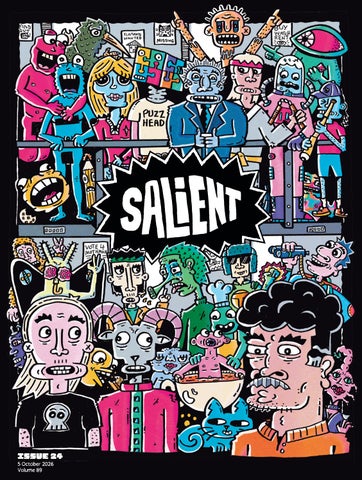
ISSUE 24 5 October 2026 Volume 89
ISSUE #24 5 October 2026 Volume 89 Editor Phoebe Robertson Designer & Cartoonist Jim Higgs Sub-Editor Holly Rowsell News Writers Dan Moskovitz Martha Schenk Otis Whinney Ali Cook Columnist Guy van Egmond Critic-at-large Jackson McCarthy Comic Artists Grace Elzenheimer Jack Graham Contributing Writers Tamanna Amin Zia Ravenscroft Christopher Curtis Ryan Cleland Social Media Manager Will Tickner Photographer Sophie Spencer Centrefold Artist Isabel Doyle Advertising advertising@vuwsa.org.nz Read Online salient.org.nz issuu.com/salientmagazine Follow Us @salientgram
Want to get published? To contribute to Salient, you can submit poetry, creative writing, artwork, comics, puzzles, features, and other ideas. Feature articles must be pitched to the Editor before writing; send pitches to editor@salient.org.nz. Artwork should be sent to designer@salient.org.nz. Creative writing submissions are accepted through the form on our website. All other contributions, including puzzles and general ideas, should be emailed to the Editor. Submissions are welcome from first-time and returning contributors.
scan here to find out more!
Phoebe Robertson Listen, I have a couple of quotes for you. When I asked designer Jim Higgs what I should say, he told me not to make too much of a big deal about leaving Salient this year, “in case I come back.” I also found an ominous note buried in the unfinished Google Doc for this editorial: “The Salient craves you, Phoebe. You cannot escape no matter how much you scream for others to free you. They won't come. — Will Tickner” Joyful. But, seriously, I’ll say my piece properly in a feature this week titled Everything I Learned Editing Salient for Three Years. For now, I want to focus on this issue. I think it is a pretty good example of what Salient can be at its best: a place where students can tell stories about where they come from, how they got here, and the people and places that shaped them.
When Will put a call out on our social media asking for final letters to Salient, people sent in messages that were so lovely they genuinely made me cry. So I figured I would put some of them here, too. Editing Salient has been an enormous privilege. I have spent three years watching people walk into this office with an idea, a complaint, a joke, a story, or occasionally confusion, and turn it into something that thousands of students get to read. I will miss that dearly. But Salient was here long before me, and it will be here long after. Someone else will take the lead, then someone after them, and they will inevitably make the magazine into something I could never have imagined myself. That is how it should be. Goodbye. I’ll miss this place very much.
In The Mountains We Inherit, Susannah Crawford writes about her grandfather, Lynn Crawford, and the history she inherited from him. Angela Ipock reflects on how something as ordinary as the dinner table can become a way of making a home when you have crossed continents to study at Te Herenga Waka. Hanadi Hammad Al Bakhas writes about coming to Wellington from Syria, becoming a student here, and eventually becoming President of Vic Without Barriers. They are very different stories, but that is sort of the point. Salient has always been at its best when it gives students the space to tell stories that might otherwise never make it beyond a conversation with a friend, a family dinner, or a half-finished Google Doc.
About the centrefold artist - Isabel Doyle Ever since I came to Wellington last year, I have loved reading the weekly Salient. There is so much talent at Te Herenga Waka that deserves to be celebrated! I wanted my centrefold to commemorate my love for student led art, and the community built throughout the university. If you like my work and enjoyed my comic from issue 27, please come check me out at the Wellington Zinefest on October 31st! Go to the centrefold on page 24, rip it out and put it on your wall!
02
Editorial
03
Letters
04
Gig Guide
05
News
Dear Editor Queen Phoebe,
Dearest Editor,
Your time at Salient concludes. Having decided that you're done, 23 issues later (not including last year's) I can say you are the one winner. Speed. You are speed. Rolling out some of the best issues of magazines I've read in all my glorious years, you will be sorely missed. Crying sadly into my McSad MealTM, I will mourn your departure, waiting for your return, as thunder waits for lightning.
As you finish up this season of your life, you may be wondering ‘what impact did I have on the readers of salient?’. And boy, do I have a solution for you as you enter your next stage of existentialism and quarter life crisis.
Farewell dear editor, Ka-chow!
13
Strictly 4 The Islands
16
The Dinner Table is Where Identity Gets Made
19
The Mountains We Inherit
22
Everything I Learned Editing Salient For Three Years
24
Centrefold
26
From Homs to Wellington
28
Creative Writing
30
Comic Corner
34
An Eye For Arovision
35
Salient Weekly Challenge
36
Munch
37
Critic-at-Large
38
Lessons on Life, Love & Other Stuff
33
Oh Yes! Oh No!
34
Puzzles
38
Horoscopes
PS: there are six Lightning McQueen references elaborately written way to convince your subconscious to pass the crown jewel that is the Ka-chow shirt to Eloise... you are feeling veryyyyy sleepy.
Provide this letter with the free pizza. Why? To provide me with an excuse to take my uni crush out to lunch. Why do I deserve it? Well, my uni crush is one of your staff, and so if not for me, then for them. And if that doesn’t work for you- think of all the future monetisation and content we could all make from this potentially epic fail. Yours sincerely, Just a lover girl, trying to find her lover girl.
Dear the one and only awesome editor of the Never trust an Ed Sheeran fan. Honestly, I could salient. have gone about it better, but I honestly do not care. I must say I am a massive fan of your magazine and am at campus Monday morning 8am to Now imagine to everyone's surprise (not mine, receive a copy. i knew he was evil), when not long after, the Ed Sheeran and Macklemore situation happened. Anyway, onto the subject of my email. SO a Now, I don't think I need to explain what hapfew weeks ago, I sent through a mini tea time pened of course because this is welly and we story about how I blocked a girl I was talking to are all (mostly) politically aware—you would because she listened to Ed Sheeran. Yes, that was be surprised at how many homophobic white me. I have screenshots to prove it, if requested. suppremists i know here. Unfortunately, I was ill the week that issue came out so I did not get my own physical Seeing everyone be like omg! I never thought copy (only knew it was published because I Ed Sheeran (and pink!) was pro-israel! was got a message from my friend with a photo of genuinely so funny because how did you NOT it saying omg it's u!) see it????
WINNER A few days later, a few of my friends and I were yours sincerely, discussing the confessions and tea time stories, wellingtons biggest ed sheeran hater and my lovely friend PETER said that he thought whoever sent that story in was an asshole. ps. Peter has given permission for me to name drop. pss. Also, Hinge girl, if you're seeing this, please LMAO NO. It was valid and I was 100% correct. get better music taste.
12-18 October: Te Wiki o te Hauora Hinengaro—Mental Health Awareness Week Join your Te Herenga Waka community as we celebrate Mental Health Awareness Week across Kelburn, Pipitea, and Te Aro campuses. This year's theme, Belonging Matters, highlights how connection and community can help you thrive. Activities include: • Belonging Matters Expo – celebrate hauora across cultures with kai, music, karaoke, and more! • Paw therapy and wellbeing activities – connect with your community across Kelburn, Pipitea, and Te Aro campuses. • Free group exercise classes – take time for your wellbeing at the Kelburn and Pipitea gyms. • Body-doubling study session – prepare for assessments in a supportive environment. Scan the QR code or visit wgtn.ac.nz/wellbeing-events to explore the full programme. For wellbeing tips and updates, follow @vuwequitywellbeing on Instagram and Facebook.
Salient is published by, but remains editorially independent from, the Victoria University of Wellington Students Association (VUWSA). Salient is funded in part by VUWSA through the Student Services Levy. Salient is a member of the Aotearoa Student Press Association (ASPA) and the New Zealand Media Council. Complaints regarding the material published in Salient should first be brought to the VUWSA CEO in writing (ceo@vuwsa.org.nz). If not satisfied by the response, complaints should be directed to the Media Council (info@mediacouncil.org.nz).
Week of Oct 5 - Oct 11, 2026 Wed 7/10 A Night To Dismember: An Early Halloween Gig - Featuring Landlord Special, Lucy Dibble, and Synthia x Ghanjee - 8pm @ Valhalla Thurs 8/10 Violet Hirst and Michael Llewellyn: Spring Duet Acoustic, Alternative, Country/Folk 7.30pm @ Hataitai Bowling Club Fri 9/10 B3B: Lazarus, Oaf, Max Mcgovern Electronic Dance Music, Dj 8pm @ The Graveyard Fri 9/10 Grove With Ben Kenny Folk/Country 7.30pm @ The Undercurrent Fri 9/10 Pool House “Foreign Films” Album Release With Fine Wine Social Club Alternative, Pop, Rock 8.30pm @ Parrot Dog Fri 9/10 Flamingo Pier - Woven Together With Christopher Tubbs and Bonetempo Dj, Soul/Funk - 8.30pm @ Meow Nui Sat 10/10 Cuba St Tavern Presents: Spring Seasons - Benny Balance & Shush, Bontempo, Coda, Jen Kyle, Jewel School, Tempo Schmempo - 3pm @ Cuba St Taver
Gig guide and photography by Sophie Spencer
4
Gig Guide
The Splinters are a Pōneke-based five-piece rock band known for their intense sound and high-energy live shows. They released their debut single, “Fickle Creature,” and four-track EP “Slank” in early 2025, recorded with awardwinning New Zealand engineer and producer Lee Prebble. They followed this with “Unfuckingbelievable” in August 2025 and two singles in 2026: “Boogie Dipstick” and “Curriculum Vitae.” After performing at Rhythm and Vines and Outfield Festival, and playing soldout shows in Wellington, The Splinters took their live set on a New Zealand tour, with stops in Auckland, Wellington and Christchurch. The band has built a reputation for their stanky chaotic freaky fkn gigs.
Meet the Pres: Charlotte Lawrence Martha Schenk Elected 2027 VUWSA President Charlotte Lawrence is excited to make the position her full-time gig next year after she finishes studying in only a weeks’ time. The history major brings a huge sense of enthusiasm for community orientated events, protests, and campaigns to the role, and looks forward to mobilising student action to bring about change. “I think it’s going to be a really monumental year,” she told Salient. Lawrence grew up in Upper Hutt, where she attended St Orans College, the same high school as 2022 president Jessica Ye. At Te Herenga Waka—Victoria University of Wellington, she became a passionate member of the Tramping Club and the Latin American and Spanish Club. After being elected as Engagement Vice President in 2026, Lawrence founded the Student Action Hui as means of introducing the organising model into the way that the VUWSA executive operates. At its first action, the Hui drew nearly 100 people.
A challenge she does foresee in the coming year is conflicting perspectives on the Executive distracting from serious issues and “getting lost in things that aren’t as important.” To ensure the big stuff is being addressed, Lawrence plans to reiterate the team's shared vision and keep them on the path to result. To hold VUWSA accountable in 2027, Lawrence wants to prioritise face-to-face time with students over time spent on policy and reports, and emphasise practical systems and logistics for spending. Lawrence says being elected in a service role is an enormous privilege, and most looks forward to building relationships and working with incredible people and groups. If there’s one thing she wants students to do next year on campus, it’s get involved. “Nō te katoa tēnei wāhi. This place belongs to everyone,” she told Salient.
Her three campaign promises for 2027 president offered to build student power, build community, and reduce the cost of living. While specific actions will have to wait until next year and be decided amongst the whole executive, Lawrence provided examples of projects she has in mind. These include training students for organised movement and entrenching this into VUWSA’s structure, stocking the community pantry, raising menstrual product supplies, pushing to expand free public transport services, co-working and building relationships with non-university organisations, incorporating reo into VUWSA social media channels, and putting an emphasis on partnership and collaboration in the university environment to platform student voices. Foregrounding approachability, Lawrence hopes to be “a really friendly face that people can come and talk to.” “I want people to know they can come into the office and have a cup of tea,” she said. Lawrence thinks that 2027 will present a unique opportunity to focus on campaigns and building means of student organisation, as it is not a general election year and therefore will not be spent predominantly urging students to vote.
Charlotte Lawrence - VUWSA President
Kawepūrongo | News
5
A $6 Pill or a $1000 Diagnosis: Inside the Student ADHD Access Gap New ADHD rules were supposed to broaden access to diagnosis. But Te Herenga Waka’s planned free assessment pathway never opened, private assessments still cost around $1000 or more, and publicly funded care remains limited. Salient investigates the gap—and the student market in prescription stimulants growing around it. Phoebe Robertson In several Signal group chats shown to Salient, prescription ADHD stimulants are advertised with the casual shorthand of any other marketplace sale. One seller posted “10mg Rits,” 15 to a tray, for $100 alongside a photograph of the box and pills. Another advertised dexamfetamine for $6 a pill, with “deals on 25+,” beneath a picture of a prescription bottle. A separate post offered “dexies $8pp,” its photograph showed five tablets beside a label clearly marked “controlled drug B1.” Another listing advertised “20mg ir ritz $90 Drops,” accompanied by a photograph of a cut blister tray. The listings were not all from people presenting themselves simply as stimulant sellers. One account advertising Rubifen 10mg immediate-release trays for $50 also offered “Morphine Promethazine Lean” for between $120 and $200. In a Wellington-based group seen by Salient, another seller advertised prescription stimulants alongside cannabis and ketamine. Ritalin 10mg was listed for $10 a tablet and Vyvanse 50mg for $20 a capsule. The post included photographs of the medication and described Vyvanse as “slow release adhd medication,” alongside listings for “ketamine shards” and three strains of cannabis. The seller advertised Ritalin LA and IR, both 10mg, and Vyvanse 50mg. Salient was also shown messages from a second-year student who sells medication from their own ADHD prescription through Signal for extra cash. Jamie, a third-year undergraduate student, has bought ADHD medication without a prescription before, usually through people they know and most often around exams. When their usual sources were unavailable, they bought from somebody on Signal instead. The pills arrived loose in a heat-sealed plastic bag. “I felt really off: like I was high,” Jamie told Salient. They did not know what they had actually taken. “I never bought from that person again. It was pretty scary.” Jamie did not go to a doctor or hospital afterwards for fear of repercussions having bought the medication illegally. That fear is worth separating from what Medsafe—New Zealand’s Medicines and Medical Devices Safety Authority—actually says about reporting harm: anybody can report a suspected adverse reaction even when a medicine was obtained illegally, and Medsafe does not prosecute people for making those reports. The experience did not stop Jamie from continuing to buy stimulants. They receive StudyLink and work a casual job, and said they usually pay between $15 and $30 for a pill, or $60 to $90 for a sheet. They believe they may have ADHD but have never been formally assessed, largely because they cannot afford it. “With rent, food costs, and transport, and an insecure job, I’m always scraping by, there’s no room to save that much money,” they said. Jamie also said they do not have the parental financial support that could cover a private assessment.
6
News | Kawepūrongo
At Te Herenga Waka—Victoria University of Wellington, private providers on a list previously supplied through Student Health generally charge between $900 and $1800, depending on the assessment. At Jamie’s usual illicit price, $900 would buy between 30 and 60 pills; $1800 would buy between 60 and 120. That price difference sits at the centre of the market Salient found. We interviewed current and former university students who had bought, sold, or shared prescription stimulants and reviewed several Signal chats where the medicines were advertised alongside other drugs. All student names in this story (including Jamie’s) are pseudonyms. New Zealand has just made one of its largest changes to ADHD treatment access in years. Since 1 February, vocationally registered specialist GPs and nurse practitioners working within their area of practice have been able to assess adults with ADHD and initiate stimulant treatment, reducing the system’s previous reliance on psychiatrists and paediatricians. But the reform changed who can provide ADHD care, not how that care is funded. Ministry guidance explicitly states that ADHD services are not covered by core general-practice capitation, meaning patients still face significant out-of-pocket costs. It also notes that a comprehensive ADHD assessment cannot be completed in a standard 15-minute GP appointment. Instead, an assessment may take one to two hours across multiple appointments, followed by regular review appointments. Documents released to Salient under the Official Information Act show that Mauri Ora’s proposed pathway was more resourceintensive still. The University estimated that assessments would take four to six hours per student, followed by regular appointments to ensure any prescribed medication was effective and safe. Minister for Mental Health and Associate Minister of Health Matt Doocey told Salient that Healthpoint listings showed an 82 percent increase in providers offering adult ADHD assessment and diagnosis and a 44 percent increase in providers offering medication initiation since 1 February. He said those figures were likely to underestimate the increase because not every general practice is listed on Healthpoint. Salient analysis of Pharmac data provides another measure. Adult Special Authority approvals (enabling a GP to diagnose ADHD) found primary-care clinicians accounted for 66.7 percent of approvals in February, 67.8 percent in March, 68.1 percent in April, 67.6 percent in May, and 67.4 percent in June. By July, that proportion had reached 69.5 percent. That represents a substantial increase from January, immediately before the new rules took effect, when primary care accounted for 53.3 percent of adult Special Authority approvals. The figures do not show how many people received an ADHD assessment, however, and should not be read as a count of individual patients. Pharmac said Special Authority approvals may be
an indicator of access to ADHD medication; its data counts approvals rather than assessments or unique people. The dataset was held as at 30 August and Pharmac cautioned that it remains subject to change. The Royal New Zealand College of General Practitioners told Salient there was no additional government funding for practices to train in or offer ADHD assessments. It identified workforce shortages, already-heavy workloads, the time needed to upskill, and the lack of additional funding as barriers to more practices taking the service on. The College does not collect data on how many specialist GPs or practices are now offering adult ADHD services, but said it expects the number to increase as more clinicians upskill. Asked whether dedicated funding could increase the number of specialist GPs providing ADHD care, Medical Director Dr Prabani Wood said: “Potentially, yes,” but cautions New Zealand needs a sustainable GP workforce first. Student Health had planned to introduce free ADHD assessments from trimester two this year. The same OIA documents show the proposal had progressed well beyond an initial idea. By February, an internal operational plan listed an “ADHD Pathway (Assess, Diagnose, Prescribe)” as a service objective. All Mauri Ora GPs and its nurse practitioners were undertaking ADHD training, one GP was preparing to begin assessments with several students, and another had expressed interest in running a dedicated weekly ADHD “session” if funding could be secured. Associate Director of Mauri Ora Dr Kevin Rowlatt had previously told Salient the service would require additional clinical staff and cost an estimated $200,000 to $300,000 a year. The intention was for students not to be charged, but on 7 April Rowlatt told staff the business case had failed to secure additional funding from the Student Services Levy pool. “Therefore, we will not be proceeding with the establishment of an ADHD pathway,” he wrote. The University has since told Salient there remains “lots of interest” from students in an ADHD assessment pathway, although it could not provide meaningful numbers. Internal planning documents give some indication of demand: Mauri Ora said its former psychiatrist, who worked 0.5 FTE, routinely had a six-to-nine-month wait, largely because of increased requests for ADHD assessments. At the time the document was prepared, the nurse assessment pathway used to support GP referrals for diagnosis also had a six-month wait. The University said it explored funding through its Primary Health Organisation, Tū Ora Compass Health, but “there is no extra funding to support this pathway.” The decision not to establish an in-house pathway may not be permanent. Minutes from an August Student Services meeting say Mauri Ora had been unsuccessful in securing additional funding and could not provide the service within existing staffing without increasing waits for other appointments. But the minutes add that “the door is not closed.” Student Health plans to review its approach in the new year, once there is a clearer picture of how ADHD services are developing in primary care. In the meantime, Student Health can still help students access external assessment. Rowlatt previously told Salient Mauri Ora can provide a list of psychiatrists and telehealth providers, while students who require a referral can receive a nurse pre-assessment before seeing a GP. Others can approach private providers directly. The ADHD assessment itself, however, remains external and is not subsidised by Student Health.
paid about $1000 for a Te Wheke assessment on 1 September, after completing questionnaires with their partner and parents and being asked for old school reports. Te Wheke charges $1000 including GST and says its adult ADHD assessment can involve up to three hours of interviews and questionnaires, including consideration of other possible explanations for symptoms. Samantha’s assessment itself lasted about two and a half hours, “which was very hard because I became disinterested very quickly,” they told Salient. They were told a diagnosis would normally take around two weeks. At the two-week mark, however, their doctor went on holiday. “They say it takes two weeks for diagnosis, but my doctor went on holiday at the two week mark, so I’ll have to wait about a month.” The delay left Samantha racing to secure disability support before their October exams. The University advises students seeking exam accommodations to contact Disability Services “as early as possible,” with the 2026 end-of-year assessment period beginning on 16 October. Two days before this piece went to print, Samantha received their ADHD diagnosis, more than two months after first approaching Student Health. Under Te Wheke’s published process, assessment findings are shared with a student’s GP or nurse practitioner, who can then formalise the diagnosis and discuss treatment. Samantha’s Māori Ora appointment is now booked for the week beginning 12 October, leaving them only a short window to organise treatment and any disability support before the end-ofyear assessment period begins on 16 October. For students who cannot find $1000 or more for that process, the alternative can look very different. Alex, a first-year living in a hall, first took unprescribed ADHD medication during a week when five assignments were due and their procrastination, as they described it, was “at an all time high.” Friends had repeatedly suggested they might have ADHD, and Alex had already struggled with concentration before university. They have since used both Ritalin and dexamphetamine for study, preferring dexamphetamine because they find it “smoother” and less jarring. “I don’t want to rely on it,” they said, but when their mental health is poor and university work piles up, they use it for the “extra push.” Asked whether their finances affected that decision, Alex said: “I can’t afford a diagnosis to ‘go private’,” and described the alternative as waiting “years for a cheaper alternative. This is affecting me now.” Alex said stimulants make them feel clearer-headed and more deliberate in conversation rather than jumping between thoughts. But feeling calmer or more focused after taking a stimulant cannot establish an ADHD diagnosis. The Ministry says a proper assessment considers a person’s history, gathers information from people who know them, uses standardised questionnaires, and checks for other explanations for their symptoms. Health New Zealand acknowledges that cost and waiting times can be barriers, but the publicly funded alternative is not a single queue available to every adult who suspects they have ADHD.
Article continues on next page.
Samantha, a postgraduate student, went through that external process after first contacting Student Health in mid-July. They
Kawepūrongo | News
7
Health New Zealand National Chief Mental Health and Addictions Dr Leeanne Fisher told Salient that people seeking ADHD assessment through publicly funded services are assessed according to clinical need, and not everyone referred will meet the threshold for publicly funded specialist assessment. Referrals may be declined or redirected where a person’s needs can be more appropriately managed through primary care or other services. There is no single national eligibility standard. Health NZ said access is influenced by whether somebody has other mentalhealth conditions indicating enough severity or complexity to meet the threshold for specialist mental-health services. It also cannot say nationally how many adult ADHD referrals are accepted, declined, or redirected, or provide a reliable national measure of waiting times. That leaves some students in an awkward middle ground: concerned enough about their concentration or functioning to seek medication, but not necessarily eligible for public specialist care and unable to afford private assessment. For Alex, the illegal route came through people around them and was free or available at “mates rates.” For Jamie, it could cost $15 to $30 per pill. On the Signal chats viewed by Salient, dexamphetamine was advertised for $6 or $8 per pill, while Ritalin and Rubifen products were sold by the tray. Morgan, a former master’s student, began sharing their prescribed medication about a month after receiving it while working in a nightclub. They described coworkers finishing tenhour shifts, studying during the day, then returning for another nine or ten hours at work. Morgan sometimes worked 30 to 40 hours a week alongside full-time study and remembered trying to finish readings while club music and lights continued around them. “There are so many things demanding focus out of us,” they said. Morgan initially gave pills to coworkers who said they had taken ADHD medication before, then sometimes sold them to customers, at times for $50 a pill. They estimated they had supplied their medication around 20 times and could receive anywhere from $50 to $300 depending on how much they handed over. Money was not the main reason, they said; they were financially comfortable. Instead, their prescribed dose felt too high to take consistently, leaving spare medication that became easy to circulate. Morgan said the process of changing medication or adjusting dosage could be slow, and believed that if the prescription had worked better for them they would not have had an “abundance mindset” about the excess. There had also been consequences. Morgan recalled selling medication to a couple who “started freaking out when it kicked in,” leaving Morgan trying to calm them down. Riley, a third-year undergraduate student, initially offered tablets to flatmates and now occasionally supplies them when somebody is overwhelmed by an assignment or planning a big night out. Because Riley does not take every tablet in their monthly prescription, they have leftovers; as they put it, if they have spares and can make a little money from friends, “then why not?” Asked why students might want the medication recreationally, Riley’s answer was simple: “drugs are fun and it’s fun to try new ones.” For study, they described students as stressed, overloaded, and perpetually close to burnout.
8
News | Kawepūrongo
Morgan and Riley also described pharmacy-dispensed stimulants as feeling safer or more ordinary than other illicit drugs. Morgan said there was “more trust that what's on the bottle is what's in the bottle.” Riley said they rationalised sharing their medication partly because their friends knew the stated dose and contents had originally come from a pharmacist. Medsafe told Salient there is no assurance that medicines obtained online are safe, effective, or free from contamination. They may be poor quality, counterfeit, or contain something other than what they claim. Medsafe also said clinical assessment is important because stimulants affect the cardiovascular system and other body systems, while Health NZ said ADHD medicines can interact with other medications or health conditions and require baseline physical assessment and monitoring. Mauri Ora’s prescribing pathway shows what that oversight can involve: baseline cardiovascular observations, medical and mentalhealth histories, substance-use screening and, where clinically indicated, blood tests or an ECG, followed by ongoing monitoring. Rodger Wright Harm Reduction Network occasionally receives suspected methylphenidate and dexamphetamine for testing. National Harm Reduction Lead Jason George said the organisation uses Fourier-transform infrared spectroscopy alongside reagent testing and test strips, and that most samples believed to be pharmaceutical methylphenidate or amphetamine have been broadly consistent with what clients thought they had. But not all. One sample presumed to be methylphenidate— provided in a pharmaceutical capsule—was found to contain MDMA, and other testing remained inconclusive. KnowYourStuffNZ’s said in the 2025–26 testing year, 12 samples were presented as dextroamphetamine/Adderall/Dexedrine or methylphenidate, compared with seven in 2024–25, five in 2023–24 and seven in 2022–23. The latest year covers testing only through the end of March 2026, and those figures record what clients believed they had—not a “consistent with presumed” rate. KnowYourStuffNZ told Salient it has seen an increase in ADHD medication being brought for checking, but its anonymous service does not collect demographic information that could show whether those people are students. That leaves a broader problem: no single agency appears to collect enough information to show how widespread the illegal use of ADHD medication is, who is obtaining it, or what harm may be resulting. Pharmac can measure dispensing and Special Authority approvals, but told Salient it has no role in monitoring diversion of funded medicines. Health NZ cannot provide a consistent national count of adults seeking public ADHD assessment or how long they wait. Medsafe maintains an adverse-reaction database, but did not provide Salient with a trend showing how frequently illegally obtained or counterfeit ADHD medicines are causing harm. There is another unresolved access problem in the legitimate market: the Ministry says global stimulant shortages are expected to continue because of high demand and constrained manufacturing. Pharmac is managing those shortages, but did not answer Salient’s question about whether supply constraints themselves could contribute to people seeking medication outside pharmacies. When Salient asked Minister Matt Doocey about the link between costly ADHD assessments and illicit stimulant use, his office did not answer the question.
Instead, Doocey pointed to the increase in Healthpoint-listed ADHD providers, the widened prescribing rules, the removal of the old two-year Special Authority renewal requirement, and the funding of another ADHD medicine. His office said it would take around 12 months for official data to provide a clearer picture of the effects of the February changes. Two of those measures pre-date the February 2026 prescribing reform: Pharmac removed the two-year Special Authority renewal requirement and began funding lisdexamfetamine from 1 December 2024. Labour mental-health spokesperson Ingrid Leary said affordability remained a barrier, describing the February changes as welcome but saying widening who could diagnose ADHD “does not, by itself, make assessment affordable or accessible.” She said lengthy appointments and training costs could still be passed on to patients without extra funding. Leary did not commit Labour to funding adult ADHD assessments, instead pointing to its broader primary-care policies. Labour’s 2026 platform promises three free GP visits a year through Medicard and free prescriptions from July 2027, but no dedicated adult ADHD assessment programme. None of this means cheaper ADHD assessment would eliminate the illegal stimulant market on campus. Riley describes recreational demand as well as study use. Morgan shows how legitimately prescribed medication can become available because somebody has excess tablets. The Signal groups place stimulants in a wider drug economy where the same accounts advertise other substances. For Samantha, the formal route has meant finding $1000 and waiting while October exams move closer. Alex says they cannot afford that route in the first place. Jamie has continued buying pills for a fraction of the cost despite already having one frightening experience with a tablet whose contents they could not verify. The alternatives are not equivalent. One involves clinical assessment, an individualised treatment decision, and ongoing medical oversight. The other can mean a free tablet from a friend or a message to a Signal seller, without any assessment of whether the medicine or dose is appropriate—and sometimes without certainty about what is in the pill at all. As this article was being finalised, more listings appeared in a Signal chat. One advertised “20mg ir ritz.” Another user offered to trade “1.5 of ket” for a sealed bottle of 20mg long-acting Ritalin, while another listed “ritalin 10mg and concerta 54mg” for “bud+cash.” Dexamphetamine was again advertised for $6 a pill.
Where to Go for Help If you are worried about your own or someone else’s drug use, support is available. If someone is seriously unwell or in immediate danger, call 111. For free, confidential alcohol and drug support, call the Alcohol Drug Helpline on 0800 787 797 or text 8681. The service is available 24/7. The Māori Helpline is available on 0800 787 798, and the Pasifika Helpline on 0800 787 799. You can also call or text 1737 at any time to speak with a trained counsellor about mental health or addiction concerns. For Te Herenga Waka students, Mauri Ora—Student Health and Counselling offers counselling for issues including stress, mental health, and addiction. Complete the online counselling intake form and call 04 463 5308 to make an appointment. For information about drugs, their effects, and ways to reduce harm, visit TheLevel.org.nz. The Level also has information about drug checking and links to local support services. KnowYourStuffNZ provides free, confidential drug checking at clinics and events around Aotearoa, including Wellington. It can test many pharmaceuticals and other substances and provide harm-reduction advice, although drug checking cannot guarantee that a substance is safe or determine its exact purity. Visit knowyourstuff.nz to find an upcoming clinic. The Rodger Wright Harm Reduction Network also provides free, confidential and non-judgemental drug checking, including services in Wellington, as well as broader harm-reduction information and support for people who use drugs. Visit rwharmreduction.org.nz for clinic information. For official information about prescription medicines— including known side effects, consumer medicine information and safety alerts—visit Medsafe at medsafe.govt.nz. If you are experiencing side effects or are concerned about a medicine you have taken, Medsafe recommends contacting a healthcare professional or Healthline on 0800 611 116; call 111 in an emergency. For support with drug use, Narcotics Anonymous Aotearoa New Zealand offers free, anonymous meetings and peer support. Visit nzna.org or leave a message on 0800 NA TODAY (0800 628 632).
Jamie’s explanation for continuing to buy after their own bad experience captures why those posts still find customers. “It can be dodgy/scary buying from online servers, but I don’t really have an alternative if I want to keep up academically.”
Kawepūrongo | News
9
Dan Moskovitz
election interviews
In the run-up to the 2026 election, Salient is interviewing all of the major parties to understand their responses to the issues students face. Here, Qiulae Wong, leader of the Opportunity party, pitches Opportunity.
Why Should You Vote Opportunity? What is the biggest challenge facing students in New Zealand in 2026? I think it’s the real lack of vision for this country. Things are tough, cost-of-living is tough, all of it is really challenging, and it doesn’t feel like there is much hope on the horizon either. I think we need an aspirational vision for the future to get through the tough times, and I think it’s what we're really lacking as a country right now.
So what is Opportunity proposing to support students? We have proposed free public transport, which would make a big difference to students. We have our competition policy: we estimate New Zealand households could be saving $30 a week on simple things like groceries, electricity, and banking fees if we tackle competition in this country. Longer term, our tax reset would support students in particular. Essentially it would mean everybody studying would have a student allowance with no hoops to jump through, which would massively decrease debt and support people to study. We also want to invest in the jobs, industries, and business for the future so young people can see the jobs they want to have and the world will be looking for will be in here in 20 to 30 years.
Can you talk us through your tax reset? So we want to have a land tax and a citizens income, which come together and attempt to shift the burden of tax off income and onto property. So the land tax is a 1.75 percent tax annually paid only on the value of the land and 0.5 percent for rural land. We’re also one of the few countries in the world which don’t have some type of tax on property and I think a land tax is the most effective way to do so. It means rather than putting their money into property, people instead invest in the productive economy, like business and shares. The challenge we're trying to solve with this is how housing affordability has gone through the roof in New Zealand. It's currently around 7 times the household income to buy a house in New Zealand. In my parents' generation, it was three times. If we continue on the current trajectory, it could be ten to fifteen. That’s unsustainable and we can’t have it continue. The other side is the citizens income. It’s essentially like a universal basic income, where each week all adults are paid $370. The idea there is to address our tangled and complex welfare system which is undignified for those receiving it, overly burdensome and expensive for us to administer, and traps people in poverty. A citizen's income gives people financial security; they know they’ll be able to put food on the table and pay rent, but $370 a week is not enough to live on, so you’re still going to want to go out and work.
10 News | Kawepūrongo
In 2023, a two-zone trip on Metlink cost a tertiary student $1.13 at peak time. Currently it costs $2.63, an increase of 132 percent. 50 percent of students get to Vic by public transport. You’ve already said you want to make public transport free; do you want to talk us through the mechanisms and reasoning? We already subsidize public transport in this country quite heavily; the government pays for 90 percent of the cost of public transport. And we've already spent over a billion dollars on a national ticketing system which we haven't even implemented. So we could just give people public transport for free and not have to spend that money on consultants implementing a ticketing system! There would be so many positive flow-on benefits from free public transport. Young people being able to get to university and that not being a barrier to studying, people being able to get to the hospital, reducing emissions, reducing congestion on our roads. Obviously, there would be a small increase in cost due to maintenance and running of a system with more people using it, but we think considering the benefits I just mentioned, that it’d be a good use of public funds.
Between 2014 and 2024, the amount course fees could rise each year was between 2 and 2.8 percent. In 2025 and 2026, course fees were allowed to rise by 6 percent. If elected, what would your policy on course fees be? We don't have a policy on this, so I can't set out a number for you. But I think looking at the level to which the government supports tertiary education to make it affordable for people is really critical. The main way we're tackling it is through the citizens' income to reduce the debt burden on students.
Is reducing those course fee rises something you'd be open to investigating? Yeah, definitely. I wasn’t aware of the changes which have been made.
These course fee increases have come as finalyear fees-free was removed; is this something Opportunity would return? The removal, we think, was done hastily and unfairly. To remove it when students have gone into studying under the expectation they would get a year free is incredibly unfair. We would prefer to see the citizen's income implemented rather than the fees free. If you're a student, getting 19,500 a year as a citizen's income is going to have a much bigger financial impact than one year of free course fees. It will drastically reduce student loan debt much more than that fees-free scheme would, and we think has much bigger, broad follow-on effects.
Wellington’s unemployment rate is at 6.3 percent, but for those aged between 15 and 24 it is 8.4 percent. There are ten thousand fewer jobs in Wellington than there were last election, and the government is looking to remove 8700 public sector jobs, which would disproportionately affect Wellington. Right now, what incentive is there for a graduate to stay in Wellington? It sounds pretty grim, and I don’t blame those people for leaving. These are big economic problems which are not new, and yes, there have been a lot of increased job cuts under this government. But our economy has been stalling for a long time. We've had really low productivity growth—about 0.2 percent compared to the OECD average of 0.9 percent—year on year, meaning we work harder and get paid less. In those terms, we are a third poorer than Australia. So we need to change these big economic settings, and that’s where our policies around competition, innovation, investing in small business, and the tax reset come in to set our economy up for success in the long term. Obviously, a citizen's income would go a long way to supporting those people who find themselves out of work suddenly or unable to get a job, and with the growth of AI joblessness, it’s going to become even more of an issue. But the challenge is here and now, we need to do something about it, and we need to make sure we’re making good long-term decisions, rather than sticking plasters on things. I feel like I can't give you a satisfactory answer to say it's going to be all better in the next couple of years. We need the bravery to make some big, big changes to our economy.
Looking at the microscale of Wellington, how do you make people stay here? I think if people saw the government was setting a really clear agenda around how it's going to grow the economy, by supporting our creative sectors, our tech sector, our entrepreneurs, and startups, then people might be more people willing to stick it
Sounds Unheard
out and try and start a business of their own or get involved in some of those initiatives. But without that direction, without the government saying that this is where we see the future of Wellington's economy, then I don't blame people for wanting to leave.
Doesn’t Opportunity also want to shrink the size of the public sector? Not as a goal itself, but as an outcome of our tax reset. The complex welfare system I mentioned costs a lot of money for us to administer. Staff who are constantly having to check up on people, making sure they still meet the criteria. Those are the roles which we think would be lost potentially through this transition. But we would do so carefully, and not make people redundant overnight. We’re talking about losing 2000 jobs over 10 years rather than National’s announcement of 9000 jobs overnight. Because if we can reduce the public sector because we don’t need to check up on children in poverty, then I think that’s a good thing.
Access to mental health addiction services for young people has declined-there are 5000 fewer people receiving care than five years ago. How would Opportunity address the gap between demand for mental health care and the services available? Mental health is just a crisis point for many age groups and population groups in New Zealand. We only really have enough funding to support people when they're at the very acute end of needing mental health support—which is a problem across all of healthcare. So we would like to see more of a share of GDP going to health. Currently it’s at 7.5 percent; we’d like to see it get to 9 percent, and for that funding to go into primary and community care, so there are mental health services for people who aren’t necessarily at crisis point but still need that support.
Thank you so much for taking the time to chat to me, Q. Thanks, Dan.
Read the full article
Martha Schenk News Writer Martha has done a run down of all of our summer festivals, unfortunately, she got too carried away and overdid the word count. Check out the North Island festivals below, and read the rest by scanning the QR code at the top of this article. Everyone knows about Laneway, has been stuck in the mud at R&V, or has missed out on a ticket for Electric Ave in the online queue. If you’re real hard-core, you might even have been a part of the annual Wellingtonian migration down to Twisted. But what about all the festivals happening this summer that you haven’t heard about yet? Luckily, the independent festival scene in Aotearoa is alive and well, and these top picks have got you covered. Festival: Matakanarama Date: 29th - 31st December, 2026 Location: The Hill, Matakana. Vibe: Chill small-town three-day camping festival with a focus on fun, live music, good community, and touching grass. Line-up: AROHA, ASHEZ, Bella Claxton, Christopher Tubbs, DOCJOC, Flamingo Pier, Fletchy Boy, GiGi, Kumi, Lady Shaka, MESSIE, Mikeyy, PARK RD, Ruby Du, There’s a Tuesday, Troy Kingi, Young Gho$t, yung singh, Yurt Party. Cost: Third release tickets $201 - $328 depending on how many days you go. Camping passes an additional $53 - $85.
Festival: Kiwiburn Date: 27th January – 1st February, 2027 Location: The Paddock, Hunterville. Vibe: Aotearoa’s very own Burning Man festival, where all acts and activities are provided by the attendees themselves. A sort of social experiment where no money is exchanged for the five day festival and everything is volunteer run. Line-up: There are no paid performers at the event, acts are entirely contribution based. Cost: $250 Festival: Rock the Bowl Date: 29th December 2026 Location: Bowl of Brooklands, New Plymouth. Vibe: A single day festival with a fantastic line-up in Taranaki, offering lots of road trip potential between the mountains and the sea. Line-up: Fat Freddy's Drop, Ocean Alley, Carl Cox, No Cigar, Coast Arcade. Cost: Starting at $171 (Third Release)
Kawepūrongo | News
11
Everyone Wants to Break the Supermarket Duopoly-But What Would Actually Work? Ali Cook
[OPINION]
If there is one thing New Zealand’s political parties can apparently agree on this election, it is that something has gone very wrong at the supermarket. What they cannot agree on is what to do about it. ACT wants to make it easier for another supermarket chain to enter the country. Labour wants to prise open the wholesale networks controlled by the existing giants. National and New Zealand First want to split Foodstuffs in two. The Greens would go further still, forcing both major supermarket groups to sell stores to create a publicly owned competitor called KiwiMart. Of those proposals, KiwiMart is the most direct attempt to deal with the structural problem everyone is complaining about: New Zealand does not have enough serious supermarket competitors. After years of trying to coax more competition out of one of the most concentrated grocery markets in the developed world, most of the alternatives still rely on some version of the same hope: change the conditions and eventually somebody will come along to challenge Foodstuffs and Woolworths. The Greens start from a more bold conclusion: if nobody is coming to break the supermarket duopoly, perhaps we actually have to break it ourselves. New Zealand does not literally have two supermarkets; it has two dominant supermarket groups. Foodstuffs operates PAK’nSAVE, New World, and Four Square, while Woolworths operates its namesake supermarkets and the FreshChoice franchise network. Together, the two groups still account for more than 80% of the grocery market. This is hardly a new discovery. In 2020, the Labour Government asked the Commerce Commission to investigate the grocery sector. Its resulting market study found competition was not working well for consumers and identified access to suitable land and competitively priced wholesale groceries as major barriers facing prospective competitors. Successive governments have consequently spent years looking for supermarket number three without finding it. So there is a useful question for evaluating the policies being offered this election: does the proposal actually create another competitor capable of challenging the duopoly, or does it create conditions in which we hope one eventually appears? ACT has the simplest answer: make New Zealand easier to enter. It wants to coordinate government approvals and council consents for prospective supermarket chains, allow alcohol licensing issues to be resolved earlier, and recognise food labels approved by trusted overseas regulatory systems.
decide that establishing a nationwide New Zealand operation is worth the enormous investment. Perhaps one will. But after years spent trying to attract another chain, “perhaps Aldi will come” is starting to look less like a supermarket policy and more like insanity. Labour’s proposal goes substantially further. Instead of waiting for an international competitor, it wants to weaken one of the advantages protecting the existing supermarkets: wholesale supply. Labour would separate the wholesale operations of Foodstuffs and Woolworths from their retail stores. Independent grocers would be guaranteed access to a core range of products on fair terms, while restrictions preventing retailers from sourcing cheaper products elsewhere would be removed. There is a strong logic behind this. A small supermarket cannot meaningfully compete with PAK’nSAVE if it has to buy the same products for substantially more. Opening wholesale supply could give independent supermarkets a better chance of growing. But after all that restructuring, New Zealand still would not actually have another major supermarket. Foodstuffs and Woolworths would remain the dominant retailers. Labour’s policy instead bets that smaller competitors, newly freed from their wholesale disadvantage, will grow until they exert meaningful pressure on them. They might. But Labour creates the conditions for a third competitor rather than the competitor itself. There is also a question about whether forcibly separating wholesale and retail could introduce inefficiencies of its own. Grocery distribution benefits enormously from scale. Creating standalone wholesale businesses only works if those businesses retain enough volume to operate efficiently. Labour’s policy attacks a real structural problem. But it leaves consumers waiting to see what grows in the space it creates. National and New Zealand First have reached a more interventionist conclusion: if New Zealand cannot attract a third supermarket, split one of the existing two. Both propose separating Foodstuffs so PAK’nSAVE operates independently from New World and Four Square. National would first require the Commerce Commission to determine that doing so would produce a net benefit for consumers. It is a much more direct response than hoping another international supermarket eventually arrives. Instead of two dominant groups, New Zealand gets three.
However, recognising an American nutrition label does not give Aldi 100 supermarket sites. A faster liquor licence does not build a national distribution network. Streamlining resource consents does not give a new entrant Foodstuffs’ purchasing power.
But there is an obvious question: why only Foodstuffs? Woolworths remains intact. We decide supermarket concentration is sufficiently serious to justify extraordinary government intervention, then leave one half of the original duopoly largely as it was.
ACT may remove some barriers, but leaves the biggest decision to somebody else. An international supermarket still has to
There is another potential problem. Foodstuffs’ size is not only giving it market power. It's also giving it purchasing power.
12 News | Kawepūrongo
Shared distribution and enormous collective purchasing volumes can reduce costs. Divide those operations badly and New Zealand could theoretically end up with more competition between supermarkets that are each more expensive to operate. Three competitors should exert more pressure than two. But three more expensive supermarkets are not necessarily better for consumers than two. This is what makes the Green proposal different. KiwiMart starts from the conclusion the other policies keep circling: New Zealand needs another supermarket with enough scale to compete immediately. The Greens would require Foodstuffs and Woolworths to divest at least 120 stores and distribution capacity to create KiwiMart, a publicly owned supermarket chain with around 15 percent of the grocery market. The clever part is that KiwiMart avoids the chicken-and-egg problem that has frustrated attempts to create supermarket competition for years. ACT’s hypothetical entrant needs to find supermarket sites. KiwiMart gets existing ones. Labour’s independent retailers need to grow until they have meaningful purchasing power. KiwiMart starts at scale. National creates another major player by dividing one incumbent. KiwiMart takes assets from both. Price also matters. Private supermarkets ultimately exist to generate commercial returns. That is not a moral criticism; it is what businesses do. In a competitive market, the desire for profit can work remarkably well for consumers. If one supermarket charges too much, another can undercut it and steal its customers. The problem comes when consumers have too few realistic alternatives. Creating a third private competitor should strengthen that pressure. KiwiMart goes one step further because the Greens propose giving it an explicit mandate to prioritise affordability. That does not mean ignoring costs. KiwiMart would still need to buy food, pay staff, operate trucks, refrigerate stores, and maintain buildings. Public ownership does not magically make a $5 block of cheese cost $3 to supply.
the difference, food has not really become cheaper. Part of the bill has simply moved from the checkout to the tax system. KiwiMart therefore has to stand on its own feet. But every proposal contains a gamble. ACT gambles that removing regulation finally attracts an international competitor. Labour gambles that wholesale reform allows smaller competitors to grow. National and NZ First gamble that splitting Foodstuffs increases competitive pressure without destroying efficiencies that currently keep costs down. The Greens gamble that a publicly owned competitor can operate efficiently enough to remain commercially viable while accepting lower returns in exchange for lower prices. None is guaranteed. But only one starts with 120 supermarkets. After years of reports, reforms, and attempts to entice overseas chains, perhaps the strangest thing New Zealand could do is continue designing supermarket policy around the possibility that somebody eventually decides to compete with our duopoly. KiwiMart tackles the obstacle the others cannot guarantee they will overcome: actually getting another large competitor into the market. There are legitimate questions about its $2.8 billion price tag, its governance, and whether it could maintain lower margins without becoming a taxpayer-supported money pit. Those questions deserve scrutiny. But New Zealand does not have a shortage of supermarkets because nobody has thought of opening one. It has a market where becoming a nationwide competitor requires stores, land, distribution infrastructure, and purchasing scale that the existing giants already possess. The Green proposal is the most direct attempt to change that structure. Instead of hoping another supermarket assembles those things eventually, KiwiMart would take some of them from the companies whose dominance created the problem in the first place. After years spent waiting for supermarket number three, there is a certain appeal in simply building it.
The interesting possibility is much less magical: KiwiMart could remain commercially sustainable without attempting to maximise the return extracted from every trolley. Suppose a supermarket can sustainably sell something for $4 but weak competition allows it to charge $5. Another profit-seeking competitor may constrain that price. A competitor explicitly instructed to prioritise affordability potentially constrains it further. If KiwiMart can sustainably sell an equivalent basket for less, then Woolworths, PAK’nSAVE, and New World suddenly have a problem. They can lose customers or lower their prices. There are nevertheless good reasons to be sceptical. A government-owned supermarket could become inefficient. Political interference could produce terrible commercial decisions. A future government could demand dividends rather than lower prices. And $2.8 billion invested in supermarkets cannot simultaneously be spent somewhere else. Most importantly, there is a huge difference between accepting lower profits and losing money. If KiwiMart sells groceries below their sustainable cost while taxpayers continually cover
Kawepūrongo | News
13
4 STRICTLY
THE ISLANDS Weekly Pacific Politics with Otis Whinney Don’t Mine the Moana? A Final Word on Our Climate Conundrum On September 26, Greenpeace activists occupied an Earth Sciences New Zealand-owned ship named Tangaroa. One was dressed as President of the USA Donald Trump, while the rest waved various signs carrying messages opposing seabed mining in the Pacific. By early afternoon, Police had removed them without much hassle. Spokesperson Juressa Lee stated that the ship had been used to survey deep sea minerals in the Pacific, and that their protest was aimed at those using state-owned vessels for these purposes. Our Minister for Resources, Shane Jones, dismissed the protest as he usually does. He was quoted in RNZ as saying that Greenpeace are “trying to scare and catastrophise and intimidate Kiwis,” arguing that Greenpeace was interfering with the livelihoods of those aboard. Shane Jones has made no bones about his love of resource extraction for economic gain, bringing the “drill, baby, drill” mentality to the environmental portfolios he holds as a part of our current government. Unlike his opposition in the left bloc, Shane and New Zealand First see our untapped sources of oil and gas and our untouched seabed as the perfect vehicles for kick-starting the New Zealand economy, and through our Foreign Minister Winston Peters, they’re bringing this mindset to the Pacific at large. But it’s not just NZF who have an agenda when it comes to how the Pacific leverages its resource wealth in the modern day—every political party in Aotearoa, and every state with an interest in our region has something to add to the conversation. But is anyone even worth listening to these days? One of the protesters aboard the Tangaroa held a sign reading “don’t mine the moana,” and while Shane Jones was quick to dismiss this whole affair, these words have been echoed by several leaders and organisations based in that very Moana. For example, the mayors of the Commonwealth of the Northern Mariana Islands (CNMI) have joined forces to issue a
14 News | Kawepūrongo
statement in opposition to the proposed mining of their seabed by their higherups in the USA (the CNMI remains an unincorporated territory of the USA). In a letter to Jennifer Miller (of the Bureau of Ocean Energy Management-Pacific Region), the group voiced their opposition to the progression of the proposed mining, arguing that there was a “serious lack of clear and reliable information” available to them regarding the potential environmental, social, and economic impacts. Another large concern was the actual material benefit for the CNMI, considering that is another piece of information the islands have yet to receive. Another one of the US territories, American Sāmoa, has also come out against these plans. Governor Pulaali’i Nikolao Pula has formally opposed a proposed US lease sale that would open up over 31 million acres of their seabed, which could lead to the setting up of further mining operations. The reasoning he gave to the US Department of the Interior and Bureau of Ocean Energy Management (BOEM) echoes the leadership of the CNMI fairly closely: “There remain too many unanswered questions about the potential effects of large-scale mineral extraction on deep-ocean ecosystems, fisheries, and the broader marine environment. Until those questions are better understood, moving into commercial mining would be premature.” At the United Nations General Assembly, several Pacific leaders made known their views on how the UN is responding to the climate crisis. Prime Minister of Papua New Guinea James Marape and Prime Minister of the Solomon Islands made it clear that definitive action is long overdue, with Marape stating that “if we destroy this planet, we pass a ruined world to our children. Sea-level rise is here amidst us, and we must act now.” Naoero also took to the stage in part to announce the change of the country’s name, and to emphasise the vulnerability of small island nations in an increasingly volatile geopolitical landscape. On the topic of seabed mining, however, Naoero has a markedly different view from those in the CNMI and other areas. President of Naoero, David Adeang, has been trying to open up Naoero’s seabed for business for quite a while, with appeals to the International Seabed
Authority to grant Naoero the consents needed to begin the scheme having led nowhere in the past five years. Naoero is small, even for a Pacific nation, so using the resources available to the nation isn’t outlandish. Adeang has also argued in the past that seabed mining can be used to power the transition away from fossil fuels, but the barriers in place have yet to be lifted. Naoero also took a moment to declare its withdrawal from the International Criminal Court (ICC), after Donald Trump declared his hatred for the institution in his own speech. Adeang described the ICC as “of increasing irrelevance” to Naoero, perhaps as their relationship with Israel (whose president is currently wanted for arrest by the ICC) becomes more and more relevant with the planned opening of an embassy for Naoero in Jerusalem. This may paint Naoero as a state simply following the wants and needs of the US, but just recently Naoero also joined Kiribati in blocking the Pacific Islands Forum from releasing a joint statement condemning the nuclear missile test China conducted in Pacific waters a few months ago. Adeang wrapped up his speech by emphasising that Naoero remains “a friend to all and an enemy to none,” a sentiment that may be contradicted by his nation's stance on these polarising issues I’ve just described. But in a geopolitical environment such as this, where your relationships determine who supports you and how, it’s hard to argue that Naoero is acting irrationally. A more apt description, perhaps, would be that Naoero is looking out for Naoero first and foremost.
The climate remains the largest existential threat for the Pacific region, so the trepidation felt by those who oppose these mining proposals is more than understandable. And the fact that they believe they have no concrete evidence for how this mining will actually benefit the people of the Pacific is a cause for concern. The fact that this move is being pushed largely by the Trump administration—who have shown through their violent belligerence in South America and the Middle East that they have little respect for the sovereignty of countries they don’t respect—should also be of concern. The fact that politicians in our government are following in lock step with this administration is also not irrelevant. And, of course, this back and forth fuels the intensification of competition with China, who have also shown they like to swing their size around to get themselves what they want. The Pacific remains disunited on the climate front, and while those in opposition have made their voices heard, whether they’ll be able to stop what’s coming is for us to find out. One thing the Pacific will remain united on, however, is that whatever happens to the climate, it will be us who feels it first. While that may be a terrifying thought, it does mean that this region remains the most aware of what’s to come, and thus remains the most able to do something about it.
Kawepūrongo | News
15
The Dinner Table Is Where Identity Gets Made A Constructivist Case for International Dinner Parties Angela Ipock International Relations spends a lot of energy debating what states want and why they fight. But one of the field's more interesting insights—one that constructivist theory puts at its center—is that neither wants nor identities are fixed. They are built. States, like people, come to understand who they are and what matters to them through interaction with others. Identities and interests are not given in advance; they are constructed through repeated social contact, shared norms, and mutual recognition. I think about that more at my dinner table than I ever expected to. I'm a first-generation Mexican American studying International Relations here in New Zealand. For the past six months, I've been hosting dinner parties with a rotating group of fellow international students: friends from China, Russia, and elsewhere, all of us far from home and studying at the same university. What began as homesickness cooking—Taco Tuesdays, dumplings and noodles, hokey pokey ice cream, and vegetarian/pescatarian meals—became a way of introducing each other to the cuisines, languages, and cultural norms we grew up with. In the process, these dinners have made it harder to sustain the idea that our national loyalties somehow prevent us from getting along. They have turned into something resembling an ongoing seminar in constructivist theory, except none of us call it that. Applied constructivism is not part of our discussions. The many ways to cook rice are. Constructivism argues that actors—states, but also people— do not walk into a room with completely fixed identities. They develop them through the room: through repeated interaction, through norms that get negotiated in real time, and through the process of being seen and understood by people different to themselves.
For us, this is not a TED talk on abstract IR theory. It is just Tuesday night’s dinner with friends. Every time we sit down, something gets negotiated that none of us planned: whose food gets served first, which jokes land and which need explaining, how directly we're allowed to disagree with each other. None of that is written down anywhere. It's built, dinner by dinner, the same way constructivists argue that international norms are built—not because anyone imposed them, but because a group of actors kept interacting until something durable took shape.
Conversations around the table I sat down with Kang, one of the steadiest voices at our table and a fellow international student originally from Hong Kong, to talk about what these dinners have meant to him. I asked him what he thought dinner parties with people outside his own culture do. "It's a very important activity," he told me. "It helps me make new friends, and it makes my English more natural—more friendly. And I find new things to think about." I asked whether this kind of friendship has real depth, or whether it fades once people scatter after graduation. Would he keep in touch? "I like to keep in touch with you guys," he said, "because I want to build a global friendship." When I asked if he'd host any of us in China one day, he did not hesitate: "Yes—I think I'll make friends all over the world when I travel to other countries. We can go places together." I asked him directly: is this the family he would choose?
16 Features | Ahuatanga
He paused. "I want to choose this, because I think it's important to build friendship.”
"These are precious people in your life," she said. "A second family."
When I asked what he would say to people back home who might criticize him for spending so much time with foreigners, his answer was the most unguarded of the conversation.
On criticism—what she would say to people back home who were sceptical of foreigners abroad, or of her being one herself—Nina was candid about her own early fears. Before arriving, she worried about discrimination: that people would not treat her impartially, or that they would read her directness as rudeness. Those fears did not disappear entirely, but they were not borne out either. She was quick to push back on the idea that cultural difference and rudeness are the same thing.
"Every person has their own thinking. It's none of your business." Then, simply: "It's my life." I also asked what he thought immigration policy should look like, given his own experience moving across the world to study. His answer was less about paperwork than about people: he thought immigration should be open, with reasonable rules, because so much of what gets debated as policy ultimately becomes a question of whether someone belongs somewhere they weren't born. There is something quietly constructivist in all of that. Kang is not describing a fixed Chinese identity meeting a fixed New Zealand identity and remaining separate. He's describing an identity in motion—one being shaped into something that did not exist before any of us sat down together.
Her thoughts on immigration policy were the most detailed of the conversations. She argued for simplifying the path to citizenship, improving visa access, and providing practical support for international students, migrants, and refugees navigating unfamiliar systems, from housing regulations to financial guidance. Her point was narrower—and, in a way, more constructivist—than a purely security-driven argument: a nation’s relationship with immigrants does not end at the border. I also talked with Oren, a friend from Shenzhen, China and another regular at our table, about what these dinners have given him.
I also talked with Nina, a friend from St. Petersburg, Russia, and another regular at our table. From the start, she framed the dinners as something bigger than socialising.
"Dinner parties are good," he said, "because you get to know people from the other side—not from your own country. You learn about other cultures, make friends."
"It's a great opportunity to familiarize yourself with a culture and a language," she told me. "You unite people—you're getting closer with everybody, because you exchange jokes, you exchange insights. It broadens your horizons, because people share the traditions and habits from their own countries. You should organize dinner parties as often as you can."
When I pushed him on what, specifically, he had picked up from our table, he struggled to put it into words at first.
I asked her the same question I'd asked Kang: would she keep in touch once all of us finished our studies and scattered? "Of course I will keep in touch," she said, "because after all these dinners, all this time we spend together, sharing memories and emotions—it creates very close bonds. You have to appreciate and cherish those bonds." She credited modern technology and social media—video calls, group chats, shared photos—with making that possible across distance: a way "to be in the know about their lives" even after everyone's gone home. When I asked whether she'd choose this group as her own kind of family—two Chinese friends, her as the Russian, me as the Mexican American, a Kiwi, and a Japanese Korean friend rounding out our table—her answer was immediate. "Definitely I would choose it as a family," she said, "because family isn't about who brought you into this world. It's about taking care of each other, about showing all your feelings—negative and otherwise—without masks, without prejudice." She was honest that it is not always easy. Different upbringings and traditions create real friction sometimes. But to her, that friction is part of what proves the bond is real.
"It's hard to describe," he admitted. "There's just something I don't know how to explain—but I feel grateful." He was confident these friendships would outlast our time here. "We'll definitely keep in touch," he said, crediting technology as a genuine assist rather than a substitute—a tool that makes staying close across distance easier, not a replacement for the dinners themselves. I asked him whether he thought AI might eventually surpass this kind of in-person connection. He did not. "You still need real human interaction," he said. "It could never fully replace it." On whether he'd count our group as family, he pointed to something specific: the presence of people slightly older or more experienced who will tell you honestly when you're off track—what he called, half-jokingly, "auntie level" guidance. "That's a good thing," he said. "Helping you navigate, get back on the right path." Asked what he'd say to critics of foreigners living abroad, he shrugged the question as beside the point and turned instead toward what he had gained. Story continues on next page.
Ahuatanga | Features
17
He hopes, one day, to go backpacking through China with friends from our table, teaching us the cultural and historical significance of the places we’d visit.
common. We're all being idiots together, within reason." She was the most visibly affected by the question about criticism of foreigners.
"I think there's a symbiotic relationship there," he said. "I feel far more fortunate to have foreign friends now."
"I feel really heartbroken," she said, "that people are insulting other people. Why can't we all just be friendly to each other?"
His thoughts on immigration policy were shaped by what he saw as gaps in enforcement back home—cases where visa rules exist on paper but are not consistently applied, and where "expat" carries a different, more loaded connotation in a Chinese context than it does in English, implying privileges locals do not have. His core argument was about fairness: whatever the policy, foreigners and citizens should be held to genuinely equal standards, backed by consistent background checks, so that the system is not merely simple in theory but reliable in practice. He eventually circled back to language—and how learning to think in more than one language at once has changed the way he thinks. Him and I frequently speak Spanish to one another, just as I speak Russian with Nina.
Her instinct is not confrontation—she said she'd rather pull someone aside quietly than make a scene—but she was unambiguous about her belief that everyone deserves a safe place to call home. Her view on immigration policy was shaped less by problems than by a sense of opportunity. She sees New Zealand as welcoming, but argued that welcome has to work both ways: locals learning from newcomers, and newcomers learning things about New Zealand that locals themselves take for granted. That exchange, to her, is what makes the "global infrastructure" of friendship work. She finished by half-joking about the group's long-running plan to backpack through China together one day, with Kang and Oren as our built-in guides.
"There's a kind of training for the brain," he said, describing the shift as something close to becoming a polyglot. "That's a good thing for me."
"You wouldn't have to pay for an expensive tour guide," she said. "They'll know the hidden gems—the places the standard tours miss."
Last, I talked with Jacqui, our Kiwi friend from Invercargill— the one member of the group who did not have to cross an ocean to reach the table, but who has ended up on her own kind of journey anyway.
If Kang, Nina, and Oren each showed a different part of what it means to build identity through contact with difference, Jacqui's answers showed something else: this process does not require crossing a border. Even someone who never had to leave her own country can be changed by the table, simply by paying attention to who is sitting at it.
She loves what these dinners do precisely because New Zealand's multiculturalism, in her experience, doesn't always show up on restaurant menus. "We can have authentic food, made from the soul," she said, "and we get to participate in making it. It's a whole learning experience—learning about the customs, the things people do that we might call normal, that other people don't." For her, the value is not abstract: it's cheese rolls, homemade pumpkin soup, and hokey pokey on one side of the table, foreign dishes on the other—all of it teaching her things about her own country as much as everyone else's. She was just as certain as the others that these friendships would last. "I'd love to stay in contact," she said, pointing out that the internet only goes so far. A headline about a country tells you far less than an actual friend from that country reacting to the same news. "There's a whole other side of the story we don't always know about," she said. "It's an opportunity to see how everyone is handling the same news, differently." On the family question, her answer leaned into the group's chaos rather than away from it. "Everyone is unique, and that's half the fun," she said. "The same life would be boring." She described their group chat— the running joke pile of nonsense from every culture at the table, some of it needing explanation, all of it, in her words, building camaraderie. "It's nice having a spiritually connected family," she said, "not just your blood family—because we all have things in
18 Features | Ahuatanga
The table as a blueprint None of this is groundbreaking political theory, and I am not claiming our dinner table is a stand-in for the international system. But constructivism's basic wager—that identity, interest, and even norms are made through interaction rather than handed down in advance—plays out in miniature every time we sit down together. At times, we joke we are a mini-UN: a collection of different backgrounds and points of view, working out who we are and how to get along. Kang, Nina, Oren, and Jacqui's answers are personal anecdotes, but they also give ordinary, lived form to a theory that can otherwise remain trapped in the abstract. For now, I know this table—plates passed hand to hand, English and Spanish practiced over various renditions of rice, identities quietly renegotiated over second helpings and Jacqui’s desserts—is doing something that matters. It is building the kind of understanding that policy papers can gesture towards but never fully capture. Maybe that is the real, unglamorous argument for the dinner party: in International Relations, as in life, you do not just study how understanding between people is built. Sometimes you must cook it.
The Mountains We Inherit
Susannah Crawford
In the dining room of my family home in Christchurch, a black‑and‑white photograph hangs on the wall. Four men stand on an icy Himalayan ridge, their tents pitched on what looks like a forty‑five‑degree slope. The ridge is on Thamserku—a steep, fluted giant rising 6608 metres above the Khumbu in Nepal. Every Everest Base Camp trekker sees its dramatic profile from Namche Bazaar, but almost none will ever stand on its summit. Only six confirmed ascents have been made. On 4 November 1964, New Zealanders Pete Farrell, John McKinnon, Richard Stewart, and 27-year-old Lynn Crawford made the first of these ascents, as part of Sir Edmund Hillary’s Himalayan Schoolhouse Expedition. The summit team described the climbing as exceptionally difficult. To this day, the 1964 route has never been repeated in its entirety. This photograph hangs in our dining room as a reminder of my paternal grandfather, Lynn. I never got the chance
to meet him, but, like most grandparents, he was still a significant presence in my childhood. Photos just like the Thamserku image are scattered across the house. Since I was born, my family has spent most holidays at a little green bach that Lynn and his father built in the late 1950s at Arthur's Pass, a township in the Southern Alps. I knew of him as a great mountain climber, someone who had done expeditions with Hillary, and travelled in some of the world’s harshest conditions. What I understood less well was how someone I had never met could still shape the lives of the people around him. “He was quite adventurous,” my dad said when I brought him up on the phone that week. That was an understatement. At twenty‑two, Lynn was invited to travel to Peru with five other New Zealanders to attempt the unclimbed Nevado Cayesh in the Andes, an 18,770-foot peak in the Cordillera Blanca. Story continues on next page. Ahuatanga | Features
19
Although this seemed to be his first international foray into mountain climbing, Lynn had already built an impressive climbing résumé across the Rakaia, Arrowsmith, and Darran ranges by his early 20s.
Yet the expedition still left something behind. The following year, a Japanese climbing team completed the route on Jannu using the fixed ropes left by the New Zealanders.
Lynn and his close friend Peter Farrell climbed year‑round. In winter, they would forge their own ice pitons from mild steel and weld homemade front points onto crampons. According to his friend Anton Coberger, “Lynn and his contemporaries were to seek direct routes on the great faces and go on to make their mark further afield in the highest ranges of the world.”
These stories of Lynn’s are documented in the diligent records of the New Zealand Alpine Journal. In August, I had been going down a research rabbit hole for an environmental law essay on the Antarctic toothfish when I drifted off track and stumbled across an Otago Daily Times article about a group of climbers who had planned to climb mountainsw in Antarctica, only for their seats on an American transport to be taken by the New Zealand Government. One of those climbers was Lynn, which sent me down a different rabbit hole.
The Nevado Cayesh expedition was just that. But it was far from straightforward. The team battled deteriorating weather, avalanches, injuries, and difficult snow and ice conditions. During the ascent, Lynn became seriously ill with altitude sickness. He would have died on the mountain had it not been for an oxygen tank retrieved from a welder set in a nearby mine workshop. Despite this setback, he returned two weeks later and, alongside Don Stewart and Dal Ryan, reached the summit on 21 July after a long, technically demanding ascent. The three spent the night in an ice cave on the descent before making it back to base camp. It was a remarkable display of determination from someone who had every reason to leave the mountain behind.
It felt strange to be getting to know my grandfather backwards: not through memories of my own, but through expedition reports, yellowing photographs, and the stories other people had chosen to preserve about him. As I followed these traces through old journals and family anecdotes, I found myself thinking less about the mountains he conquered and more about the legacy he had left to those who came after him. The picture forming of the man I never knew became a lot clearer. At the same time, there was still plenty the Alpine Club journals did not document.
As the years went on, Lynn became a guiding presence in the Mount Cook scene. He was not only part of the first expedition to complete the Eastern Face of Mt Cook, but also one of a small group of Christchurch climbers who recognised that New Zealand needed a more professional approach to mountain instruction.
In his later years, Lynn’s life shifted from high, cold faces to quieter work. After years of guiding, he moved into the travel business, first with Guthrey’s Travel and Stars Travel, and later running his own small firm in Christchurch that catered to climbers and skiers who knew him from the mountains.
Australian climbers were arriving in increasing numbers in the Southern Alps, often strong on rock but inexperienced on snow and ice, while the informal courses run by local clubs were no longer enough.
He still went to the mountains, but in a more relaxed capacity—whether for easy “day walks” or to watch his two teenage sons “crash spectacularly" in their ski-racing events, according to his friend Anton Coberger.
In 1966, Lynn, Peter Farrell and Don Mackay founded Alpine Instruction Ltd., refurbishing the old Ball Hut on the Tasman Glacier and turning it into the country’s first dedicated base for guiding and instruction. What began with basic courses soon expanded into intermediate and advanced high-climbing programmes, and the company became the nucleus of modern guiding in Aoraki Mt Cook National Park.
In the final part of his life, he lived in a rest home. His outdoor days were over. It was a stark contrast with the decades he had spent on ridges, glaciers and summits. Lynn died just under a year before I was born. I am twenty-one now, soon I will be the same age my grandfather was when he was traversing the Andes.
In 1975, Lynn joined Limbo Thompson’s expedition to Jannu’s North Face in Nepal, led by Peter Farrell. It was one of the more serious climbs of Lynn’s career. The face was dominated by unstable ice formations known as dablams, one of which hung directly above the team’s intended route.
It is difficult not to compare sometimes. His adventures seem much larger than the life I am living now: stressing about grad jobs, worrying about whether I am doing enough, and trying to finish an essay about Antarctic toothfish. But the more I have read about him, the clearer it became to me that his legacy was never really measured by the mountains he climbed.
The climbers fought their way up a partition of ice known as the Wall of Shadows. Although they established camp in a crevasse above the wall, frostbitten toes, failed stoves, and nights without water forced them to eventually retreat without reaching the summit.
His legacy is in the little green bach by the creek that Lynn built with his father all those years ago. It is still owned by my family and acts as a physical point of connection, drawing new people in and encouraging them to fall in love with the hills.
20 Features | Ahuatanga
Just as Lynn spent years introducing strangers to the mountains through guiding, the little bach continues to do the same in its own way. Friends arrive for a weekend and leave planning their next tramp. A few years ago, Dad hired a tradie to do some much-needed roof work on the place. He enjoyed being there so much that he bought a bach down the road with his wife and young children. New people are folded into old traditions. Long after Lynn's climbing days ended, the house he built decades ago is still bringing people into the mountains and into our family’s orbit. His legacy does not only survive in places. It survives in unfinished things, too. Jannu was one of the mountains Lynn never summited, yet his efforts still helped make the eventual ascent possible for someone else. And perhaps most of all, I see his legacy in my dad. He never inherited Lynn’s love of excursions that require bringing your own oxygen tank, but he did inherit a love of the mountains. He became an avid tramper, spending his weekends exploring New Zealand’s ranges on foot. It was through a tramping club that he met my mum. Together, they have been the best mountain guides my sister and I could have had. All this to say, I never met Lynn. There are still sides of him that I will never get to know. In a moving 2004 obituary, his late friend Anton Coberger remembered
him less for his prominence as a New Zealand mountaineer than as a great companion: “reliable, competent, uncomplaining, cheerful, and the very best sort to have on the other end of the rope.” That description stuck with me most of all. My challenges will look very different from his. My mountains might be a difficult piece of uni work, a career I am yet to begin, or simply the next thing that scares me a little. Amongst all the stories of Lynn’s expeditions and achievements, he represents to me the beauty of being passionate about something, of challenging yourself and finding ways to pass that passion on to other people. He represents continuing when things do not go to plan, whether that means retreating from a mountain, recovering from illness, or simply getting through a difficult period of life. The mountains we inherit aren’t always icy ridges or towering faces. I hope that whatever mountains I choose to climb, I can do it with the same curiosity, determination, and passion Lynn had—and that, one day, I might be remembered less for how high I climbed than for who I brought with me.
Lynn Crawford on the summit of Thamserku (6630m), 1964. Crawford Family collection.
Ahuatanga | Features
21
EVERY EVER YTHING I LEARNED
EDITING FOR THREE YEARS Phoebe Robertson
Students who started university in 2024 and are graduating this year probably don’t know this, but you’re not really supposed to have the same Salient editor for three years. The last person to edit the magazine for more than one year did so in 2000 and 2001. So, yes, it has been a while. And, thanks to a slightly strange series of circumstances that brought me back to the job in 2025, you very nearly got rid of me. After three years in this job, I have learned a lot about journalism: how to deal with lawyers, deadlines, angry emails, anonymous tip-offs, university communications teams, and the peculiar psychology of people who send 1400-word letters to the editor. But the thing I have probably thought about most is politics, and what it means for a student magazine to be “political.” Saying journalism should not be political sounds sensible until you try to work out what that means. If Salient investigates mold in university accommodation, we are writing about housing regulation and institutional responsibility. If we cover bus fares, student allowances, rent, sexual violence, international students, graduation rules, or cuts to university courses, we are writing about decisions made by institutions with power over people’s lives. Politics is not confined to Parliament; it is also about who makes decisions and who has to live with them. That does not mean a newspaper should become a party pamphlet. There is an important difference between being political and being partisan. Journalism should still be accurate, fair, sceptical, and willing to make powerful people uncomfortable regardless of which colour tie they wear. But pretending there is some perfectly apolitical place from which journalism can operate makes less sense to me now. Deciding what deserves coverage is a choice, as is deciding whose complaint is worth investigating, which institution deserves another question, and when an answer is not really an answer. The wider news industry makes those choices under increasingly difficult conditions. In New Zealand, the number of people employed in journalism fell from around 4000 in 2006 to around 2000 in 2018, while between 2000 and 2020 the number of newspaper-publishing enterprises dropped by almost a third. Globally, only 18 percent of people pay for online news. Journalism costs money, and increasingly few people are willing—or able—to pay directly for it. The result is an industry trying to produce journalism with fewer reporters, less money and more competition for
22 Features | Ahuatanga
attention. A journalist with three stories due by 5p.m. has less time to spend six weeks requesting documents from a university. A newsroom fighting for advertising revenue has to care about audience numbers. A publication behind a subscription wall can produce excellent journalism while still being inaccessible to someone who cannot afford another $20 a month. Those are the conditions under which modern journalism operates, and student media gets to operate under slightly different ones. Salient is free. You pick it up outside a lecture theatre, flick through it while pretending to study in the library, then leave it underneath an Auraki cup somewhere. I think being free is one of the most important things about this magazine. A first-year student living on a student allowance should be able to read the same investigation as someone whose parents are paying their rent. An international student should not need three news subscriptions to understand decisions made by the university they are paying tens of thousands of dollars to attend. Accessibility is not a side benefit; it shapes who journalism is for. Our funding model also gives us the unusual privilege of spending time on stories because they matter to students, even when they will never attract an enormous audience. Over the past few years, Salient has reported on an Everton Hall resident becoming seriously ill while living with mold; students waiting weeks for counselling and days for GP appointments; the University removing its advanced-graduation option; and the institutional response when a student was sexually assaulted by visiting foreign officials. These stories are different, but they share something important: they are about what happens when institutions make decisions students have to live with, and when somebody keeps asking questions after the first answer. There is a tendency to describe student journalism as a training ground for “real” journalism. I have never particularly liked that description. Student journalists are often inexperienced. We make mistakes. Sometimes our writers are learning how to interview someone for the first time while conducting the interview. But the journalism itself is real. Student media can also see things larger outlets cannot because we live inside the institutions we cover. We hear about the course cancellation because our friend is taking the course. We know the mold problem is not an isolated complaint because three people at the same hall have emailed us. National media has later picked up stories originally reported by Salient, not because we have resources
they do not, but because proximity is itself a journalistic advantage. Our reporters are already here. The challenge is making sure proximity does not become complacency. Being a student publication does not mean automatically siding with students, just as reporting critically on the University does not mean assuming the University is always wrong. Sometimes the most useful thing we can do is discover that the story everyone is repeating is not quite true. Our obligation is not to validate our audience. It is to report for them, and that distinction has been one of the hardest and most useful things I have learned. It has also taught me that institutions are not monoliths. I have spent a lot of time reporting critically on this University, but some people inside it have also been among Salient’s strongest supporters. Kristina in University Communications has worked with me for all three years, through more media requests, follow-ups, and last-minute phone calls than either of us should count. Kevin from Student Health not only spent an unreasonable amount of time answering my questions, but gave me a rental reference so good that my landlords offered me my flat almost immediately, which may be the most materially useful outcome of investigative journalism I have experienced. Kent and Jackie from Legal, and really the entire University legal team, have endured my endless OIA requests with considerably more patience than I deserved. The current communications team, including Fee and Sarah, and the many people behind the scenes, have repeatedly found documents, tracked down answers, and dealt with questions that often arrived with tight deadlines. I also owe a huge thank you to Baker at Touchprint, who for three years has been absolutely bulletproof when it comes to the fairly important final step of getting the magazine printed and onto stands. Producing a weekly magazine involves enough opportunities for disaster before the files leave our hands; knowing that once they reached Baker, they would somehow become a thousand physical copies of Salient has been one of the few parts of the process I never had to worry about. And then there is VUWSA. Over the years, different executives and staff have backed me, disagreed with me, been investigated by me, argued with me, funded the magazine investigating them and, when I actually needed it, stood behind Salient’s independence. Not always, obviously. But enough that I learned something important from that relationship too: independent journalism does not require everyone you cover to like you. It requires the structures around you to tolerate being scrutinised when scrutiny is uncomfortable. I cannot thank VUWSA, though, without thanking Matthew Tucker, despite the fact he will absolutely hate being included. Across the past three years, Matthew has been, unequivocally, my rock. He has helped me navigate managerial problems, talked me through being attacked by TERFs on Twitter, and sat beside me in not one but two lawyers’ offices—which is probably two more lawyers’ offices than most friendships should require. He also eventually convinced me to buy a motorbike, advice I will consider vindicated once he fixes the broken moped I subsequently dumped on him.
with family: unconditional, practical, and there before I had worked out how to ask for it. There are people who support the work you do, and then there are people who support you while you are doing it. I have been extraordinarily lucky to have both. That is probably what gets lost when we talk only about “holding power to account.” Journalism sometimes has to be adversarial—but most reporting is also built on relationships. It depends on someone returning an email, finding an old document, explaining how a process works, pointing you toward the person who knows the answer, or trusting that even if they dislike the eventual story, you will represent what they said accurately. You can scrutinise an institution without assuming every person inside it is your opponent. Good journalism often depends on knowing the difference. Student media often talks about “amplifying the student voice.” It is a nice phrase, but there is no single student voice. Te Herenga Waka has thousands of students with different politics, incomes, cultures, degrees, and experiences, and they disagree with each other constantly. The job of student media cannot simply be to decide what “students think” and print it louder. It is to give students the information necessary to argue with each other intelligently. That means publishing things some readers will dislike. It means scrutinising VUWSA even though VUWSA funds us, and scrutinising the University even though we work on its campuses. During an election, it means asking uncomfortable questions of politicians we agree with as readily as politicians we do not. Fairness requires us to check facts, seek responses, represent disagreement properly, and correct ourselves when we get something wrong. Neutrality, if it means pretending every exercise of power is none of our business, would prevent us from doing journalism at all. After three years, that is probably the biggest thing editing Salient has taught me. We are living through a period in which trust in journalism is fragile, newsrooms are shrinking, and people increasingly receive completely different versions of reality depending on which corner of the internet they inhabit. Student media will not solve that. But it can do something smaller and more tangible. It can tell a student why their graduation disappeared, ask why someone waited seven weeks for counseling, find out what happened inside a moldy hall room, and give someone with less institutional power the ability to put a question to somebody with more. It can do that while remaining free, because dozens of people—reporters, editors, student representatives, university staff, and people whose names never appear in print—keep making it possible. I’ve spent a lot of time wondering whether doing those things made Salient “political.” I think I was asking the wrong question. Of course student media is political. Students’ lives are political. Housing is political. Healthcare is political. Education is political. Who gets listened to is political. The better question is whether we do that work well: whether we are accurate, independent, curious, willing to admit when we are wrong, and prepared to ask the same difficult questions regardless of who is answering them. Three years is much longer than anyone is supposed to spend learning that lesson. I am very grateful I got to anyway.
I call Matthew my dad, partly because it annoys him, but mostly because his support has been the kind I associate Ahuatanga | Features
23
From Homs to Wellington:
The Taste of Belonging Hanadi Hammad Al Bakhas
In Syria, water was never just water. It carried the taste of belonging. I was five years old in my grandfather’s garden in Homs. Summer wrapped the day in warmth. Butterflies wandered through the air, flowers leaned towards the sun, and my little cat followed me wherever I ran. I was the first grandchild in my mother’s family, and everyone treated me like I was something precious. I grew up surrounded by love, convinced that childhood would always feel that safe. After hours of playing, I became thirsty and walked to the old water pump beside the garden. I held my cup tightly and pushed the heavy metal handle with all my strength. Nothing happened. I tried again. Still nothing. My uncle, who was only eleven years old, saw me struggling. He smiled, pulled the handle down with both hands, and suddenly clear, cold water rushed into my cup. Later, my grandfather washed grapes and fed them to me one by one. Years later, I can still remember the taste of that water. It tasted of earth, summer, and home. Not long after, my father began building our new family house. My mother would tell me about the bedroom she wanted to make for me—a room fit for a Disney princess. I believed her. I imagined every colour, every corner, every dream waiting for me there. Life had a different plan. My family left Syria and spent six years in Lebanon before arriving in Aotearoa—New Zealand in 2018. Those years in Lebanon were difficult. Living somewhere you do not always feel welcome teaches you how complicated the idea of belonging can be. Then we arrived in Aotearoa. I remember looking
26 Features | Ahuatanga
around the airport and seeing people welcoming us. Everything felt simpler. More importantly, I felt safe. I was ten years old, and I was beginning again. My first day at school in Auckland became one of the happiest days of my life. I walked into the classroom and told myself that, one day, I would become a doctor. For nights afterwards, I fell asleep imagining myself wearing a white coat. I made a promise to myself: I would never give up, no matter how difficult things became. That promise became even stronger when I realised that my parents needed help navigating a country whose language was new to all of us. I decided to learn English not only for myself, but so I could help my family and make sure that nobody could take advantage of them because they did not understand the language. Within two months, I had learned the basics. After we moved to Wellington, it took me less than six months to become the translator my family relied on. Learning English happened quickly. Finding my voice took longer. One of the ways I found that voice was through poetry. I write poetry, and my writing has become a way of carrying my Arab identity with me. Through my poems, I write about memories, home, belonging, family, displacement, and emotions that can sometimes be difficult to express in everyday conversation. Even while building a life in Aotearoa, I do not want to lose the part of me that comes from Syria. Writing allows me to keep that connection alive. For me, poetry is a bridge between where I come from and where I am going. It allows me to carry Homs with me—not only as a place I remember, but as a part of who I am.
One memory from school has never left me. My teacher divided the class into groups of five to solve a maths problem. I had so many ideas. I knew what I wanted to say, but did not know how to express myself in English. I went to the bathroom and cried. I was frustrated because I knew I was capable of contributing, but I did not yet have the words. Still, the little girl inside me kept saying: You are strong. One day you will get there. For years, I dreamed of becoming a doctor. But in Year 13, I discovered something different. I realised that I was drawn to law because I wanted to understand justice and stand beside people who might not have a voice. I changed some of my subjects, moving away from biology, chemistry, and physics and focusing more on language. I began reading about lawyers and the justice system. I knew that becoming a lawyer would be difficult, but I also knew that difficult did not mean impossible. When I told my parents, they were happy. They could see that I had found something I genuinely cared about. The path to university was not straightforward. I was short of the credits I needed, and for a moment it would have been easy to see that as the end of my dream. Instead, with support from Richard Barrett, I enrolled in a business programme at WelTec in Petone. I worked hard, earned the results I needed, and eventually made my way to university. That second chance became the beginning of my real dream. Now, I am a second-year Law student at Te Herenga Waka—Victoria University of Wellington, studying law alongside politics. Reaching my second year of Law was one of my biggest dreams, and being here today makes me incredibly proud. But I am not stopping here. My biggest goal is to complete my law degree and become a criminal lawyer. I am excited about what lies ahead and determined to keep pushing myself, even when things become difficult. University is not always easy for me. Sometimes I sit in a law, politics, science, or geography class and do not understand something straight away. When that happens, I can become overwhelmed. Sometimes I need to step away from my desk and let my mind breathe. I walk for a while. I give myself a little time.
Then I come back, my mind feels fresher, and I try again. That small routine has taught me something important: taking a step back is not the same as giving up. Sometimes it is how we find the strength to continue. There is one moment, however, that still confuses me. Sometimes I look at my grades and start crying. I do not always know whether I am crying because I am happy or because I am remembering how difficult my journey was. Maybe it is both. I look at those grades and think about the little girl who once stood in a classroom with so many ideas but could not find the English words to express them. That girl is still part of me. Now, she is getting high marks at university. Today, as President of Vic Without Barriers, I think about students who arrive carrying fears that no one else can see. I want them to know that struggling does not mean that they do not belong. My family remains one of the biggest reasons I keep going. When I saw how difficult it could be for my parents to navigate a new country, I wanted to become stronger—not only for myself, but for them. I used to dream about wearing a white coat. Today, I dream about wearing a black one. But the promise has stayed the same: I will not give up. And when I think about home, I still return to that garden in Homs: my uncle lifting the heavy pump for me, my grandfather feeding me grapes, my mother telling me about the Disney-princess room she wanted to make for me. Those memories did not disappear when I crossed borders. They travelled with me. Like the water from that old pump, they still live inside me. And they remind me that belonging is not simply a place we leave behind. It is something we carry with us, wherever we go.
“دودحلا ُتربع، ينطو كرتأ مل يننكل يتغل يف يعم هتلمح ؛يفلخ، يرعش يفو، هقيقحتل ُتيعس ملح لك يفو.” “I crossed borders, but I did not leave my homeland behind; I carried it with me in my language, in my poetry, and in every dream I pursued.”
Ahuatanga | Features
27
Pollen Counts
NEZOLIKA
It’s in being so luck-drunk That we fall to the ground And don’t know pain (We’ll know it tomorrow, but) Now we’re back on our spines On the grass outside, And there’s dew sopping into Our tees and to our skin, but It’s dry out and you hung your clothes out on the line To dry too, I flip the calendar to June, 2 weeks, 3 days late, but I’ll leave my sinuses out to dry too, And let my unfeeling fingertips grip And leave those half moons. And drink your coffee even though it’s cold now. (And we’ll know it tomorrow)
28
Creative Writing
Get the full Singapore experience with an
Asia Connect Scholarship Apply now
wgtn.ac.nz/asia-connect
30 Comic Corner | Kōmeke
god, oh my n a it's ous enorm !!! weta
r! r fea neve -man is t thrif re!!! he
Yo u com ing ba be?
Kōmeke | Comic Corner 31
i guess it’s finally time to leave campus. i wonder what my life will Be like after graduation...
will i find a joB that i’m passionate aBout and use the skills of my degree?
or will i get a joB that i hate and my degree will go to waste?
i don’t know...
or will we slowly of drift apart Because our Busy lives and joBs?
will i stay in touch with my uni mates and keep Building our friendships?
i don’t know...
mayBesoitBlack Be ite... won’tnd a wh
Bigfoot on the unknown
32 Comic Corner | Kōmeke
Both realities can Be true. there will Be good joBs and Bad joBs. some friends will stay, some will go.
there is only one thing i do know for sure... my student loan is fucking huge.
cartooned By @jimz_artz
Turn all those old copies Turn all those old copies of Salient lying around of Salient lying around the at into new paper! the at into new paper! By Eugene Anderson-Jones By Eugene Anderson-Jones for the Communication for the Communication Design Capstone. Check Design Capstone. Check out out more papermaking bookmore papermaking and and bookbinding at @kismetbooksnz binding at @kismetbooksnz on instagram. on instagram.
Shred get Shredyour yourSalient Salienttotopieces, pieces,soak soakitittoto get the ink out, and blend it all to a pulp. the ink out, and blend it all to a pulp.
Suspend thethe pulp in a of water, andand Suspend pulp intray a tray of water, pull a sheet with a papermaking frame. pull a sheet with a papermaking frame.
Flip the frame onto some felt or scrap Flip theand frame onto some felt detatches or scrap fabric, sponge until paper fabric, and sponge until paper detatches
Hang up your sheets in the sun, or under Hang up your sheets in the sun, or under the heatpump during free power hour! the heatpump during free power hour!
Peel oo your sheets once they’re dry, and stack them under some books to dry, atten. Peel oo your sheets once they’re and
Draw and write on your paper as is, or bind it up into some notebooks! Draw and write ondandy your paper as is, or
stack them under some books to atten.
bind it up into some dandy notebooks!
Ahurea | Arts + Culture 33
What to watch on Welly’s local streaming service As we enter October and all the spookiness that comes with it, I figured I would use this—my last article in the last Salient—to remind you of some essential and influential horror classics you can find on Arovision. Horror is hot right now, and it feels fitting to peek back at some turn-of-the-century hits. I’m sure you’re at least familiar with these films, so let me focus less on plot and instead remind you of the little things that make them so good. Though this is the last you’ll hear from me, don’t let that stop you from browsing the catalogue at ondemand.arovideo.co.nz to find your flavour of undiscovered cinema. While this column has catered to the masses, there are some real unique films on there for any special interest you may harbour. Go forth, and continue backing the underdog! I’ll reiterate our mantra: everything on Aro is a feel-good-film, because nothing feels better than supporting a local business.
Holly Rowsell
28 Days Later (2002) - $6 dir. Danny Boyle, UK
Scream (1996) - $6 dir. Wes Craven, USA
The Blair Witch Project (1999) - $6 dir. Eduardo Sánchez & Daniel Myrick, USA
“The quintessential “it’s supposed to look like that” movie.” — JAragon23, Letterboxd
“getting killed because you’re not a crazy cinephile” — murielcampos, Letterboxd
“No cellphone in sight literally just film students vibing in the woods.” — Kun, Letterboxd
I didn’t get around to watching this for the longest time, wrongfully categorising it in my mind as a “zombie flick.” Boyle does so much more than that! As soon as I read the graffiti in that remarkable opening sequence—REPENT, THE END IS EXTREMELY FUCKING NIGH—I knew I’d been sleeping on a great. This movie is refreshing. The way it’s shot is just… insane. Like insanely low quality, but in a charming way? I know I love it, and it seems much of Letterboxd agrees. Cillian Murphy is young and incredible, with a half-shaved haircut that I wish had stuck around for the duration. The whole cast is endearing, which makes all the horror that much harder to sit through. The turn in the film’s latter half was really not what I expected, but it made its impact that much blunter. This is harrowing in a way the other two on this list aren’t, but it’s 100 percent worth the watch even if for the visual appeal alone. Though I haven’t made it through the sequels, my flatmates can vouch for them.
I somehow lost sight of the sheer density of humour and meta textual referencing this film is packed full of. I have admittedly not watched any of the sequels, as I want this perfect thing to stay pure in my mind forever. A 90s slasher paying homage to all those genre-defining flicks that came before; it’s a delight to see how much fun Craven had with this film. The quotable one-liners really batter you over the head, but you can’t help waiting for the next one to land. The image of Drew Barrymore’s blonde bob + wooly sweater combo will never leave the public consciousness, so much so that it featured in my dad’s lockdown-era 48hr film fest “horror homage.” This resulted in me standing in an inflatable child's paddling pool set on our kitchen floor, donned in a fluffy white jumper, while popcorn rattled in the microwave and tomato juice was repeatedly dumped over my head a la Carrie in Carrie (1976). Even years later, I can’t watch that first scene without recalling the unique sensation of pulling tomato pulp from my hair. The repeat appearance of Matthew Lillard’s tongue makes up for it.
You already know. This movie is credited with helping pioneer the genre of found footage. Fans of films like Creep (2014) or the Paranormal Activity franchise (of which I am both) have Blair Witch to thank. I wish I could have experienced the marketing frenzy of this movie’s release first-hand. In the early-internet era, every rumour surrounding the film’s legitimacy sustained itself much longer than modern social media would allow. The key cast was kept away from the public eye to maintain the belief they were lost to the witch. We now know that this was just a well curated campaign, but this added lore does enhance the viewing experience (to me, at least). It’s an interesting look at how much fear can be generated without the visual presence of the scary entity itself. The human mind is its own worst enemy, or something like that. Blair Witch offers a little peek into the bleak reality of the human psyche. It will lowkey piss you off, but you’ve just gotta lock in. If anything, these character’s excruciating behaviour will make their terror a bit easier to watch.
The Salient Mini Film Fest Oct 13-15 — HMLT104 — $5 per film — Book via Humanitix Scary movies are made much better in the company of others, so come catch any of these films along with six others in Salient’s Mini Film Fest next week! Take a break from the study slog and enjoy the pleasure of a movie watched in community. All proceeds will go towards supporting local physical media retailers. It’s a win-win; rally against the streamer oligarchs while enjoying some classic crowd-pleasers!
34 Columns | Tīwae
10:00am 1:00pm 4:00pm
Tuesday
Wednesday
Thursday
The LEGO Batman Movie
Wayne's World
What We Do in the Shadows
Before Sunrise
Past Lives
Sorry, Baby
The Blair Witch Project
Scream
28 Days Later
Within the span of a week, I’ll be trying to accomplish a long-term task just to see if it’s possible, and to see what I can get out of it. Life lessons, skills, resilience training? The stimulation alone should be enough motivation.
This week's challenge: Confessions of a Phone Addict
Will Tickner I’ll be vulnerable and admit I have a phone addiction. This past year, I've realized my world revolves around a slab of metal, and I’ve let myself become its slave. If I have an extended period of time to myself, I’ll enter a rabbit hole of scrolling, deeper and deeper as hours pass by. What’s scary is that I’ll be aware of it, thinking, “I should look away soon…” Yet, I’ll stay paralyzed in my bed as the afternoon turns dark, and it’s too late to be productive. I’ve wasted many evenings watching Young Sheldon clips on Instagram Reels—and I don’t even like Young Sheldon. During the mid-trimester break, I had a week that happens once in a blue moon: my Google Calendar was empty. No shifts, work obligations, or scheduled hang-outs. An entire seven days by myself, and I felt this was the perfect time to enact a weekly challenge: How Low Can I Get My Screentime? My average daily screen time sits between a shocking 9-10 hours, and the temptation to scroll on my phone all week would be enticing. On the first day of my challenge, I deleted a couple apps to reduce the urge to use them, such as most social media apps and mobile games. I considered locking my phone in one of those Phone Jails, or just giving it to a friend to hold onto for the week. However, the anxiety of missing an important call from a family member or needing to use my phone in an emergency overruled everything else. As it turns out, I was right; my mother called me about a family emergency on Monday, and I was ready, able to respond! (The emergency was asking me when I would be visiting home next, which was an hour-long call.) To truly limit the use of my phone, I got some help from my Brick. A month ago, I was discussing with my GP how my phone usage has been altering my relationships and mental wellbeing for the worst. She recommended I buy a Brick—a physical product with an app that temporarily blocks selected distractions on your phone. At first I thought, “Oh great. Something that probably has a shitty subscription model that sets dinky reminders instead of actually doing something." But honestly, it’s a great investment. It's a one-time purchase of about $100, and actually does its job blocking apps, websites, and distractions permanently. To undo the block, you have to physically get up and interact with it by tapping your phone against it. Does this sound like a free advertisement for Brick LLC? Yeah, probably. But at this point, I’m sick of Apple, Instagram, and TikTok’s screen time limiters being pussy shit, as my Brick has actually made me get off my phone instead of just having a “remind me in 15 minutes” button. For the duration of the week, I was bricked for over 70 hours! (And yes, I know exactly how that sounds.) Another app I’ll shout out is Alarmy, which is free. People I know have confessed the first thing they do when waking up is to take a hit of their vape. I wish that was me, because the first thing I do is open Instagram Reels in bed for half an hour. Alarmy, despite all the ads, is pretty great to get out of the morning bed-scroll binge. Its alarms will blare incessantly, and the only way to stop them is to solve tasks. They involve things like math, puzzles, and typing, but my favorite is one where you have to take a photo of a specific item in your house. I usually set the photo to an object in the bathroom, which when I get there early in the morning I think, “well, I’m already here. Time to start the day!” and take a morning dump. The great sacrifice of using my phone to get off my phone, I suppose. I will admit that I did relapse a couple times. After two days, I was doing pretty well, and I considered, “My screen time is looking good. I’ll reward myself with one YouTube video before I go to sleep!” I put on a short
video, and ended up falling asleep as autoplay took over. I woke up at 1a.m. to a shocking video essay about Oncest: a Tumblr fandom that ships The Onceler from The Lorax with himself. It was a scary thing to wake up to, and even scarier to have to waste screentime on. Another relapse was when I had a FaceTime on Friday with a friend in Australia to discuss a trip to visit her. I didn’t have the heart to say I couldn’t call her for the challenge, but some people are worth taking up your screentime. I watch all my media & movies on my phone because I don’t have a laptop that can support streaming easily. So, on Tuesday I stopped by a thrift store and found a DVD player for $20. Everyone with a brain knows watching physical movies nowadays instead of suffering through streaming is the best new thing, and I set up an account at Arovideo after being inspired by reading Holly’s Eye For AroVision. In the span of five days, I managed to rent and watch over 10 different movies. I watched some great ones, like Booksmart, La La Land, and Reservoir Dogs. I also got the chance to watch some really terrible ones, like Doppelganger, The D.U.F.F, and Reservoir Dogs. But, I stand by the opinion that watching bad movies is more entertaining than Young Sheldon clips with incorrect captions and weird filters. I still can’t believe we ever left the era of perusing DVD stores behind, as I’ve still been renting movies from AroVideo even after this challenge ended. While sitting on the couch watching all these movies, the absence of having a phone in my hand meant that I needed something else to do. I ended up returning to an old hobby of mine—vulgar cross-stitching. Granny-core activities are great for those that need something to do while watching a movie, as it usually takes a bit of time and concentration. Highly recommend this, alongside crocheting gruesome animals, and sewing scandalous outfits. Our grandmothers would be devastated, yet proud. Movies weren’t the only thing that took up time in my week. I managed to finish two books from Monday to Sunday: The entirety of It’s About Love by Steven Camden, and the second half of Sally Rooney’s Conversations with Friends. I used to be a big reader in primary & intermediate, yet since high school I’ve felt reading become more of a task than recreation. Since getting my first phone, there’s no doubt it’s shortened my attention span and decreased my literacy skills. Recognizing the fact I barely read any books, I’ve tried to dive back into reading over the years by picking up old classic novels, thinking it’s the right way to go. But, I end up finding them boring and lengthy, and having difficulty focusing on them. Something I think there should be less shame around is reading Young Adult novels, especially to get back into the habit of reading. I was so engrossed in It’s About Love that week, I stayed up till 2a.m. on Saturday solely to finish it! During this week, I felt like an absolute fool constantly reaching for my phone and putting it down. Yet, for the week of my challenge, I lowered my weekly average to 3 hours and 40 minutes, decreasing my screen time by over 50 percent! I consider this a win, not only as the analytics showed improvement, but because I got a lot done that week. Instead of saying “I spent my week off work scrolling on my phone,” I can actually say what I accomplished with my free time: I watched twelve movies, finished two novels, and made plans with a friend to visit Australia. I’ve realized that the only downside is to get off technology, I’ve used other technology & devices to do so. It’s a weird juxtaposition, but even so I’ve found myself feeling better than I have in a while. Currently, I’ve started another Salley Rooney book, rented Lady Bird from AroVideo, and am currently in the works of framing my newest cross-stitch! So, this challenge has most likely changed me for the better.
Tīwae | Columns
35
A FEED FOR F*CK ALL guy van egmond
Dessert, anyone? Thank you for following along as I ate my way around the city, sniffing out the best deals and which promos were bogus. There were the stalwarts that always pull through, like Everybody Eats and KC Cafe, but also surprising first-timers for me, like Kerala-carte and Platform 145. Of course, there were let-downs as well; places touting a good deal like a Fata Morgana in this desert of empty stomachs and bank accounts. Little Astoria, and Kajiken lured me in with false promises, fleeced me of the change in my pockets, and left me still hungry and with a mouthful of sand. My final rankings of the year, focusing on value first and foremost, are as follows: Everybody Eats - A safe and socially-conscious place to turn, early in the week.
KC Cafe - One of Wellington’s best, even for those on a budget.
Little Penang - My one true love, my ride or die. The place to go for a hug on a plate.
Platform 145 - Good to split, glorious to keep to yourself.
Kera-la-carte - Can a curry be profound? Take a friend and find out.
*Earl’s - They forgot to convert their prices when this New York deli moved to Pōneke.
*Ramsey House - A homemade lunch in the living room, just down from your lecture hall.
Burger Liquor - If you’re happy to wait, this is a delicious deal.
Kaibosh Food Rescue
Lemongrass Kitchen - Nothing mindblowing, but wins by the size and value of their menu.
Kaibosh Food Rescue saves surplus food from growers and sellers for distribution through community groups. They are a regular to the Student Union building, providing free bread and basic groceries most Friday mornings. Even when campus is closed, Kaibosh is still available throughout Wellington. Besides the City Mission in Mount Cook, Salvation Army centre in Newtown, and St. Peters on Willis providing groceries, Everybody Eats uses Kaibosh to serve dinners from Sunday through Wednesday, and the Newtown Community Centre offers takeaway meals from Wednesday to Friday. There are also foodbanks in Upper and Lower Hutt, and many more food collection points available on their website: kaibosh.org.nz.
Beyond Bites - Tuck yourself away in here for an easy and comforting plate.
*Angry Ramen (The Terrace)- A secret and decent daily deal, cheaper than most.
Aunty Mena’s - Homely and healthy, but keeping it budget is a struggle.
Jugnu’s Duniya - A nice idea for a very nice price, but overreaching.
Roman’s Kitchen - Filling value, but just a bit sad.
FJ Noodles and Dumplings - It’s definitely got heft, but hard to enjoy.
*Where’s Charlie? (Kelburn campus) - A golden-brown shell hiding limp lies and dissatisfaction.
Little Astoria - A decent portion of subpar food, if you happen to be around on a Monday.
Kajiken - Not worth it in value or taste, in short.
* = Lunch-only Mughlai MerCury - Does everything it needs to.
*Subway - The packhorse of campus sandwiches, a sub is undeniable value.
36 Columns | Tīwae
Of course, I’m not going to leave you all high and dry for the summer break. I know that for many students, eating out in any capacity is unachievable. As Studylink runs dry and the extra holiday costs pile up, here are a couple of initiatives providing regular access to affordable groceries.
Kai Ora Collective
Also hard at work to provide affordable foodstuffs in Pōneke is the Kai Ora Collective. This not-for-profit ‘buyer’s collective’ buys primarily fruit and vegetables from local suppliers in bulk quantities, so they can offer fresh produce to individuals and undercut the inflated supermarket duopoly. We’re talking $2.65 for a kilogram of apples or bananas, carrots at $1.58 per kilogram, and 50¢ avocados! They have a weekly $15 produce pack that contains 7-8 different fruits and vegetables, but you can also order exactly what you need through their online page, which often has extras like eggs, bread, and spices available. They also have an archive of one-page recipes on their website, so you can make the most of the seasonal produce. There are 39 pick-up spots through the city and region—from Masterton to Berhampore—making it incredibly accessible. The only drawback is that orders are processed weekly, for pick-up on Thursdays. But, with a bit of forward-planning, this is a great way to eat fresh, seasonal and local produce at genuinely affordable prices. Wishing you all a delicious summer, Guy
Jackson McCarthy is Salient's Criticat-Large. His first book of poetry, Portrait, is out now with Auckland University Press. want to get in touch, tip me off, or rage at me electronically? jackson@salient.org.nz
The Taste of Me is Acquired, But It’s His Favourite Dish Taylor Swift: The Encore Well, well, well... just when you thought the year would escape Taylor Swift, she’s back. This time it’s with four new tracks, The Encore, to round out last year’s The Life of a Showgirl. By all accounts her worst album. I, too, disliked it—for its schmaltz, its derivative musical aspects, its unnecessary Charli xcx diss, and for its straightforwardly triumphal tone about newfound love: “You dug me out of my grave and / Saved my heart from the fate of / Ophelia” runs one chorus (“The Fate of Ophelia”); “Sleepless in the onyx night / But now the sky is opalite” runs another (“Opalite”). Say what you will about Swift’s love songs, but they’d never sounded so... loveless. Just where exactly was the artist who wrote songs like “Cornelia Street,” which sees its singer both “mystified” and “terrified” by love, all in a taut, internal couplet rhyme? But mainly I disliked The Life of a Showgirl for how it recast Swift, an impressive songwriter now in her maturity, as on-the-nose, shallow, and kitsch; “adult contemporary” gone on a Disney cruise. Social media is flooded with the recommendation (from Swifties and haters alike) to take a damn break. So why is she back? I suppose Swift’s always been the girl who can’t let anything go, who insists upon herself, who beats the dead horse, or rather—and why search for an idiom when she’s already put it best?— never could “[leave] well enough alone.” That line comes from “the 1,” an earlier song that displays in miniature much of what I adore about her. “In my defense, I have none,” she sings, in six words fronting up a posture and then showing her vulnerability. I love that flicker, by candlelight, between the showy poser and the brokenhearted, a doubleness that’s manifested across her career (see: reputation) as much as within individual songs. Haven’t we all tried to be someone else in public? Or pretended like everything’s okay when we’re wounded? Or just felt misunderstood by others? The narrator of “the 1” would like to play it cool—she even tries out a swear word!—but it’s exactly that sense of self-restraint, the qualifiers and corrections, that breaks my heart. This is a song full of “I didn’t, though”s, and “If my wishes came true”s, and “I guess you never know”s—and in making these
excuses and adjustments, it also manifests a brilliant musical pun. “It would’ve been fun / If you would’ve been the one,” our narrator sings to a favourite ex, the melody arriving on the first beat of the bar—also known as the one—exactly zero times. This formal aspect—the way Swift weds music and text, sound and meaning—is deeply understated in criticism about her work, and whenever people ask me about her million-dollar wedding, I’m usually thinking about her work in much smaller terms. Alright, The Encore: “Cleveland!” (exclamation point included!) is the low-hanging fruit (see: Instagram Reels), and is probably one of the worst things Swift has done, like, ever. It’s a love song addressed not to her husband—the song’s subject—but her haters, and it weirdly centres public opinion about their relationship rather than, you know, their actual relationship. Swift’s mediation is set against the genre of... cheer music. And it includes what I can only describe as an accident in the line “The taste of me is acquired / But it’s his favourite dish” which is unintentionally suggestive of cunnilingus. The climax, if you will, is in the spoken-word declaration, “You only need to find one person in this entire world / Who doesn’t find you completely insufferable,” which I’m sure Swift means sarcastically, but in a song like this, you get the sense that perhaps she really did just settle for less. “Patient Zero” shows Swift in a Tortured Poets Department kind of mood, with its odd fiddle sample and illness-as-metaphor schtick. Apart from its clunky bridge, however—”Let’s get into it,” Swift announces, then proceeds to disclose absolutely nothing—I’m glad to report that it does hold together. If you’re gonna full send this kind of thing, you gotta full send it, and like Robyn’s amazing “Call Your Girlfriend,” the song’s relentless belief in its own perspective is what actually undermines it and gives it its hint of tragedy. “Patient Zero” is an exercise in imagination, as Swift addresses her ex’s new girl—“If you wanna party with somebody who might know / About the devil on his shoulder... / I got you; I was patient zero”—but of course it excludes the more likely possibility that, um, everybody’s moved on. She’s cleverly set the first line of the chorus, though, as a mimic of her real-life ex Matty Healy’s song “Somebody Else,” because Swift never moves on from anything, and because (to paraphrase Rob Sheffield) the person most sick of Taylor Swift is of course Taylor Swift
herself. “Pink Clouding” and “Babylon” sound like offcuts from 1989 and evermore, respectively, and in that sense display a kind of aesthetic exhaustion all Swift’s posing and cheerleading can’t quite cover up. Thus, The Encore. Still, this is the woman who taught me everything I know about songcraft, and I guess I’m a little sad for her and afraid too for her wellbeing. When I listen to the best of Swift, I’m often taken by the feeling I get when I read the great poets, which is a sometimes-overwhelming sensation of an extraordinary intelligence at work, an intelligence which organises and arrays and in that way is quite like life—though I must know somewhere that what I’m encountering is art and art’s stillness, life’s opposite. What strikes me about The Encore is a total lack of self-awareness—in other words, a lack of intelligence. Despite what some lit-crit types may have you think, an artwork is not an example of society—it does not merely demonstrate social or historical trends; nor is it a symptom of a larger pathology—but rather is society in itself. When we read a great novel, listen to a great song, or watch a great film, we know what it means to be in good company. Auden reckons that one of the questions we ask ourselves when we read a poem (and I think this goes for songs, too), is a moral one: “What kind of a guy inhabits this poem? What is his notion of the good life or the good place? His notion of the Evil One? What does he conceal from the reader? What does he conceal even from himself ?” And the Swift of The Life of a Showgirl and now its four Encore tracks is often just bad company. In my defense, I have none.
Tīwae | Columns
37
On the Epic Highs and Lows of Early 20s dating As we come towards the end of the year (and my final Salient article eek!!!), it only feels fitting to reflect on the past year of my life. A lot has happened and I have certainly grown as a person. I have found out a lot about myself and what dating means to me, which has been tough but incredibly enlightening overall. There have also been a few stories that I haven’t had the opportunity to tell through this column. SO, without further ado, here are some of the epic highs and lows of dating in my early 20s; Low: Going home with a guy who works in refrigeration, only to be told that the place I went to for a BYO the night prior is absolutely disgusting and I should never go there again. I won’t get into the details, but I would suggest avoiding any restaurants named after fictional creatures that breathe fire. High: Being accused of giving someone chlamydia and getting to prove it wasn’t me because I get tested after each new partner. Sorry boo, I think that might’ve been your new girlfriend! Let this be a sign to get tested regularly and use protection everyone!! Low: Committing flatcest. Would not recommend!!! I am fortunate enough that my flatmate and I remain good friends, but it was a sore spot for him and his new girlfriend for a while. Plus, it’s a super awkward thing to have to bring up with anyone you start seeing. It’s not worth it but there’s no shame in it, these things happen! High: Having so much time to spend with my friends!! One of the perks of not having a partner is that you don’t have one person taking up a bunch of your time. I have fallen into the stereotype of being that single girl who can’t hang out because she is too busy doing a million different hobbies with her friends and it is AWESOME!!!! Low: Being the other woman. I went home with this guy who mentioned he was seeing someone and explicitly told me they weren’t exclusive or serious at all. Then one week later I was informed that he had been exclusive with this
lesson: 38 Columns | Tīwae
girl for two weeks and they’d been seeing each other for three months. What on earth do you mean not serious??? That sounds pretty serious to me!! High: Having a huge boost of self-confidence. Some of this has been from external validation like being hit on by people I consider to be super attractive! (Like you’re so hot and you also think I’m hot?!?) But also, I think as I spend more time with myself, I start to know myself better and feel more confident in who I am. Low: Telling someone I was certain that we were going to date and him then telling me that was a bit crazy and intense of me. Yeah… fair. High: Forcing my long-distance low commitment situationship to take me to Kisa for dinner. I had been wanting to go for AGES but it’s a tad expensive and I felt bad asking my friends to go. The food was DELICIOUS (would highly recommend) and I didn’t have to pay! Thanks love xxx Overall, a wonderful year full of growth. For a while I was in that phase of seeing quite a few people at once. This was super fun and it filled me with a lot of adrenaline and confidence, but it no longer aligns with what I want. I think it’s time for me to chill out and focus on myself and my friends, for they are the ones who have been beside me this entire year. The right person will come eventually but I’m not going to force it! If I had to pass on one final piece of advice from what I have learnt this year it would be this: prioritise being yourself and having fun. It’s quite easy to fall into a habit of doing what you think you should do, but that’s not really being true to yourself, is it? If you want to go out and make out with random people at the club, do that! Skip going to the gym in the morning if it means you can hang out with your friends later into the night. There’s no point in pretending to be someone else because then you’re robbing yourself and others of genuine connection.
You will experience a range of highs and lows throughout your life. It is very easy to sit and wallow in the lows and ignore all the highs, but it’s all character development baby! One day you’ll look back and laugh, so you might as well enjoy the moment now.
Oh Yes, Oh No is where sex stories go to be judged. Was it hot? Was it a disaster? You decide. All stories are submitted by readers, published anonymously, and guaranteed to make you say 'oh yes' or 'oh no'. Scan the QR code to submit your own and see if it makes the cut.
SALIENT
A D V IS O RENYT EXPLICIT CONT
i had a lesbian foursome at weir house. we were all drunk, we all kissed a lot. was very hot. definetly will not be the last time it happens. has already happened twice again since. william weir was a homophobic misogynist so this feels like retribution. phenominal experience, 100/10, would recommend kissing your friends. and more. submitted by anonmous
Ok so I’d been talking to this guy for about a week and we were planning to go on a coffee date. After two jugs and spectacularly losing at pool with my flatmates I get a “wanna come over?” text… and so I do (7 months celibate atp). He gets me an uber who then goes the wrong way and turns around in my old situationship’s driveway :/ The man comes out in a RATTY Toy Story oodie, and his room is a total mess. He’s (thankfully) a good kisser and we get down to business which lasts all of 5 minutes. He then goes “you study politics right?” And we start chatting about that (while my tits are still out btw). To my shock and horror he starts explaining how he just LOVES Winnie P and Act and National and he’s such a big fan of their policies. And then goes on to say he doesn’t believe in keeping the treaty around and that bc he’s Māori and doing fine, it’s obviously not an issue anymore. Wtf. AND THEN after mansplaining the political system, feminism is brought up. and he say HE DOESN'T BELIEVE IN FEMINISM! because women are treated better then men in current society and when I argue NO bc WTF, he says “well women get assaulted and whatever but they divorce men more so…” WHY DO YOU THINK THAT IS??? I had given him a blowjob :’) I’m so sorry bell hooks
My boyfriend and I decided to spice things up. I bought a pair of red fluffy handcuffs as I have always wanted to be handcuffed to his metal bed frame. Fast forward, we are back at his flat after a date night. None of his flatmates were home and we were horny. We get to sexy business in his room. We both 69 and then came to me being handcuffed. My hands were above my head, handcuffed to his bed frame. No escape. We went into missionary and my boyfriend loved how hopeless I looked. Let's just say I came twice during missionary and it was the best rough sex we both had. I suggest getting a pair of handcuffs if you want to spice things up ;) submitted by anonmous
Okay so I was dating this guy and lets just say that my friends hattttteeedddd him. So the sex greatttt. The friends wanted to hear the dets.... context i had been seeing this guy for like 2 or 3 months as a bit of a little friends with bennie situation. The girls wanted to know who he was what we were doing doing but I wasn't ready for their judgment. So one night at a birthday they asked for more details. I said I had meet him at uni and he was fineeeee. So the flatmates were home there were too many people around and we were loud. The next best option was his car. Now we've learnt a few positions that could cripple you for days, so I let the gurls know. The wrap the lean the moannn. They were soooooo intrigued we even played it out. Anyway a couple weeks later I was walking home from uni at night a recognized a car in the corner of the dark parking lot. I didn't think much of it till the alarm went off. I walked over as I was curious and was met with a hand slapping the window. Let's just say my friend really took notes and moral of the story based on what I saw that night im never sitting in her back seat again. submitted by anonmous
submitted by anonmous
Tīwae | Columns
39
colour vision ACROSS
DOWN
1 Cluedo weapon found in a toolkit (7) 5 Small space in an office or a bathroom (7) 9 Anthology TV series created by Charlie Brooker (5,6) 10 'Illmatic' rapper (3) 11 Hasty; symptom of an allergy (4) 13 Subtitle of the 2024 Joker movie; shared psychosis (5,1,4) 15 TV series about a teenaged soccer team that survive a plane crash (13) 19 Large citrus that interferes with many medications (10) 21 Opposite of sharp, in music (4) 25 Headwear favoured by truckers and baseball players (3) 26 TV police procedural starring Matt Bomer as an FBI consultant (5,6) 27 Like the jack of hearts, Polyphemus, or Nick Fury (3-4) 28 The world's most famous kākāpō (7)
1 Like a designated driver, hopefully (5) 2 See 12-Down 3 Athletic company named after a Greek goddess (4) 4 Horned animal, for short (5) 5 French island in the Mediterranean (7) 6 Places for soldiers to live and sleep (8) 7 With 24-Down, game where I can't help saying "Pretty sneaky, sis!" every time I play (7,4) 8 Coastal English county where you could visit Colchester, the oldest town in Britain (5) 12 With 2-Down, star of 'Arrival' and 'Nightbitch' (3,5) 14 Narrow path that connects two streets (8) 16 Instance (7) 17 Stressed out or anxious (7) 18 Tasman or Ross, for instance (3) 19 Small lizard that, unlike all other lizards, makes vocalisations (5) 20 Concepts (5)
22. Light shade of purple (5) 23. Statue of a body without limbs or a head (5) 24. See 7-Down
“Colour Vision” Crossword author is Puck
Comic by Hamish O'Connor
40 Puzzles | Panga
song of the year
“Song of the Year” Crossword author is Puck
ACROSS
DOWN
1. He released '1973' in 2007 (5,5) 6 Crimson, carmine or cerise (3) 8 Powder that gives a chocolatey flavour (5) 9 With 24-Across, they released '1979' in 1996 (8,8) 10 They released '1985' in 2004 (7,3,4) * 14 With 18-Across, item of laboratory glassware (4,4) 16 Pattern for military wear, for short (4) 18 See 14-Across 20 They released '2021' in 2019 (7,7) 24 See 9-Across 25 Flowed outwards, like the tide (5) 26 Yellow line in a kid's drawing of a summer day, perhaps (3) 27 He released '1984' in 1974 (5,5)
1 One "team" affiliation in the 'Twilight' fandom (5) 2 Colourful South American parrot (5) 3 Soviet ruler between 1924 and 1953 (6) 4 Layered pasta dish (7) 5 It features a silhouette inspired by Los Angeles Lakers player Jerry West (3,4) 6 Endangered African mammal, for short (5) 7 Unearth (3,2) 11 Last letter in the Greek alphabet (5) 12 Pose for a portrait (3) 13. '_____ Getaway' (Elemeno P song) (5) 15 Spinning toy (3) 16 Mediterranean island where Napoleon Bonaparte was born (7) 17 Loincloth worn by a sumo wrestler (7) 19 Echoing effect common in surf rock and dub music (6) 20 Venomous snake such as an adder or a rattlesnake (5) 21 One found in an Egyptian tomb (5) 22 Arm joint (5) 23 Automotive brand that created the 20-Down (5)
Panga | Puzzles
41
another round
crypto-list A Crypto-list is a list of ten members of a category, translated into a substitution code. Solve the puzzle by cracking the code. A letter will always be represented by the same substitution - for example, all the As in the answer might be represented by Qs. There are two ways of starting on a Crypto-list: either think of answers that might fit the category and see if any of them match the word lengths and letter patterns, or look for common letters or words and use them as a starting point.
Famous Paintings
They're All Strong
Example: LOAD-BEARING WALL MGTMIH UIYAMAIGY KCGOR ______ _________ _____ LRPOR'L LWNII _____'_ _____ TUIN-QACYN BGOK ____-_____ ____ EGEUOGPW ________ LFGKNC LGIR ______ ____
42 Puzzles | Panga
POTPNLLUXIN FULLBACK ___________ ________ JNUIAE'L SGNBL ______'_ _____ TCGJJIH XNUC _______ ____ FABNCIGQENC ___________ WUCRNK CNLNWXIUOYN ______ ___________
ACROSS
DOWN
1 Dedicated nonconformists, such as hippies (4,7) 7 More enjoyable or pleasant (5) 8 Make butter the oldfashioned way (5) 9 Retro devices that Tom Hanks collects (11) 10 With 12-Across, low blows (5,5) 12 See 10-Across 14 Took a load off (3) 16 Try to hit a bug, say (4) 18 Jervois or Customhouse, in Wellington (4) 19 Christmas carol with the line "Sleep in heavenly peace" (6,5) 20 Busy time at the bar... when you might get the answers to the starred clues? (5,4)
1 Rabid enthusiast; zealot (7) 2 One who's out of prison but really shouldn't be (7) 3 Complete and idiotic failures (5-3) 4 Most in need of a scratch (8) 5 Final album by Nirvana, released in 1993 (2,5) 6 They might be blocked during flu season (7) 11 Pro-war, in an avian metaphor (7) 13 Educator (7) 15 Voter ____ (reason for low electoral turnout) (6) 17 Little nincompoop (5) 18 Capital of Ecuador (5) “Another Round” Crossword and CryptoList author is Puck
scand ACROSS
DOWN
1 Helsinki is there (7) 5 Cry convulsively (3) 7 Red or white bulb, perhaps (5) 8 'The cruelest month', per T.S. Eliot (5) 9 Item split by Rutherford (4) 10 Oslo is there (6) 12 Reykjavik is there (7) 16 Stockholm is there (6) 18 Rapid (4) 20 Thing that can be altostratic or lenticular (5) 21 Doctor played on TV by Hugh Laurie (5) 22 Praising poem (3) 23 Copenhagen is there (7)
1 Like leis, or some perfume scents (6) 2 Capital of Kenya (7) 3 With 6-Down, wife of Henry VIII (4,6) 4 Direction unlike any of the words in this puzzle (8) 5 Mammal in the title of a Shakespeare play (5) 6 See 3-Down 11 Like 3-Down, for treason (8) 13 Bram Stoker title villain (7) 14 1960 film that showed the first onscreen toilet flush (6) 15 Bleed; move like a comet (6) 17 Forego the big church ceremony, maybe (5) 19 Action star Jackie (4) “Scand” Crossword author is Puck
On the fence about who to extra tea time vote for this election? So what's the tea(s) this week?
I think we should use our natural resources to grow the economy!
I was talking to a girl I met through hinge #lesbianism (as you do) and we got onto the topic of music taste. I found out she listens to ed Sheeran and in my brain, I interpreted that as ed Sheeren is her favourite artist ever. After that all I could associate with her was Ed Sheeran. Now sure, he’s an okay artist but his music is so incredibly basic and nothing burger. So anyway, I decided to ghost her. And the last message sheNo sent way, me wasour aboutnatural her birthday being the next day or something like that. Anyway, I don’t regret my actions and environment needs I am now seeing someone who is so incredibly awesome!! - anonymous
to be protected!
A friend of mine had a guy in their friend group who had a crush on them. He asked them out and they said no, then he gave them a three page letter saying they was “completely ready” to “give himself” to them as well as saying that they were the first person he thought of when he woke up and last person he thought of before going to sleep. They never dated and were only ever friends lmao - anonymous
Find out which parties think like you.
onthefence.co.nz
search engine(ering) 9
7
1
,
5
3
(
8
/
%
+
/
* 1
,
5
$
(
%
' $ 2
+
(
+
<
'
5
$
8
/
,
&
%
9
,
%
5
,
' *
(
%
;
(
8
' 0 (
/
2 9
/
%
7
6
;
8
,
& + $ 1
,
$ 1
6
% 4
7
8
$
8
2 0 $
.
( 0 +
7
,
5
1
/
7
&
3 * 1
2
,
(
1 2
,
7
: + '
5
6
/
(
* $
3
<
7
6
%
6
. 2 8
<
.
6
=
9 1
6
8
)
/
* *
(
$
/
'
(
.
7
/
' 1
5
8
&
6
* 5 & ' : (
1
,
8
)
7
2 5
5 2 $ $
< 2 5
7
$
(
6
6
,
,
2 1 * 2 1
8
5 * 5
6
,
8 &
%
/
$
7
=
/
&
3 *
(
&
7
7
8
5
,
5
(
(
1
,
* 1
5
,
$ & 5
,
1
(
9 1
,
* : < * $ 2
7
9 $
7
&
+ $
5
' : $
5
(
+
5
,
5
7
$ 2
)
6
$
/
(
&
7
5
,
&
,
7
<
$
6
%
6
0 1
8
9
7
$ $ 0 + &
3
(
3
<
7
2
7
2 5
3
(
2
,
8
1 1 $
,
( 0 3
7
5 2 % 2
7
,
&
6
'
;
6
(
,
% 2 $
5
'
/
(
1
6 0
-
1
6
/
5
5
3
3
/
6
& 2
7
5
7
0 5
(
7
5 2 *
7
0 '
(
5
$ 0 &
,
5 & 8
,
7
0 <
& & $
3
$ &
7
2 5
,
8
;
(
$ 4 2 %
DESIGNPROCESS MANUFACTURING CIRCUITBOARD ENGINEERING ELECTRICITY FABRICATION BRIDGEBUILD LOADBEARING STRUCTURES TRANSISTOR INNOVATION HYDRAULICS PNEUMATICS AUTOMATION MECHANICS CAPACITOR BLUEPRINT PROTOTYPE INVENTION ALGORITHM METALWORK RESISTOR SOFTWARE HARDWARE ROBOTICS CADMODEL VOLTAGE CURRENT MACHINE PULLY LEVER
mini tea time
)LQG WKH IROORZLQJ ZRUGV LQ WKH SX]]OH :RUGV DUH KLGGHQ DQG
'(6,*1352&(66 0$18)$&785,1* &,5&8,7%2$5' (1*,1((5,1* (/(&75,&,7< )$%5,&$7,21 %5,'*(%8,/' /2$'%($5,1*
%/8(35,17 52%27,&6 352727<3( So what's the tea&$'02'(/ this week? ,19(17,21 92/7$*( $/*25,7+0 Omg I have the &855(17 biggest crush on the Salient social media manager;0$&+,1( I see him walking around doing the 0(7$/:25. Mondays stalking and I want him to #stalkme. To the 5(6,6725 38//(< tall mullet man, I’m pretty sure you’re straight, but 62)7:$5( /(9(5 I hope you’re gay, come find me xo. +$5':$5(
6758&785(6 75$16,6725 ,1129$7,21 +<'5$8/,&6 31(80$7,&6 $8720$7,21 0(&+$1,&6 &$3$&,725
If you have a story, confession, or experience you’d like to share—whether it’s an anonymous crush, workplace drama, or something else entirely.
- anonymous
Live, Live, Work Workand andDiscover DiscoverJapan! Japan! &UHDWHG XVLQJ WKH :RUG 6HDUFK *HQHUDWRU RQ
6XSHU 7HDFKHU :RUNVKHHWV ZZZ VXSHUWHDFKHUZRUNVKHHWV FRP
2027 2027NZ NZJET JETProgramme ProgrammeApplications ApplicationsOPEN OPENNOW! NOW!
sign of the week Welcome to the puzzle page from Puzzhead, your resident Puzzler. These puzzles are provided to be fun and challenging. The Salient team and our contributors aim for accuracy, but occasional errors may occur. If you notice an error, you may write to editor@salient.org.nz. Please note that our puzzlers and contributors are doing their best, and none are professionals or working on these puzzles full time. For the word find, words may appear diagonally and backwards. To access solutions for the crosswords and connections puzzles, scan the QR code next to Puzzhead.
set square = 33
6
x
x + = 10
T
= 14 +
+ = 52
O
x
+ +
Notes:
word wheel
x +
work hard · pukumahi
O
= 11
To solve a Set Square, use arithmetic and logical reasoning. You are given a grid containing six sums: three reading across and three reading down. The arithmetic operations (division, multiplication, addition, and subtraction) are shown between the grid spaces. Place each of the numbers 1 to 9 exactly once into the grid so that all six sums are correct. Note that calculations are carried out in left-to-right order, not according to BEDMAS.
L
A
N = 16
I I S
To solve Word Wheels, form words of four letters or more using the letters in the nineletter wheel. Every word must include the central letter. Each letter may be used only as many times as it appears in the wheel. The aim is to find as many valid words as possible from the target word list, including the nine-letter word that uses all the letters.
40 possible words
connections To solve connections, group the sixteen words into four sets of four based on a shared connection. Each word belongs in only one group. Continue until all four groups are identified. On our website, the groupings are uploaded one at a time, so if you get stuck, you can view the answer for a single connection without revealing the full solution.
FOYER
MESH
LOBBY
ATRIUM
HALO
MATRIX
TUNDRA
GRID
LATTICE
SHIMMER
VESTIBULE
PRAIRIE
SAVANNA
TAIGA
GLINT
MIRAGE Panga | Puzzles
45
aries
taurus
You’ll skip a lecture for coffee with a friend and spend your entire StudyLink payment before lunchtime. This is unnecessary. Do: mandarins, stairwells, receipts Don’t: kombucha, landlords, sincerity
virgo
leo
You’ll spend ninety minutes fixing citations worth no marks, then submit with “definately” in the first paragraph. Do not reopen your submitted assignments. Do: highlighters, crackers, silence Don’t: Turnitin, semicolons, tequila
Our horoscopes writer forgot to write for the Leos this week. You’re on your own, figure it out yourself. Do: forgiveness, self reliance, orange juice, Don’t: internalisation, ChatGPT, reptiles
46
Horoscopes
Someone in your tutorial will cite the case you were going to talk about. You will hate them for it. Do: muffins, extensions, flirting Don’t: LinkedIn, incense, mediation
sagittarius
capricorn
You’ll accidentally tell your tutor far too much about your personal life after asking for an extension. It will work. Do: kebabs, anecdotes, deadlines Don’t: dignity, Canvas, sambuca
You will attend a networking event and genuinely consider property law. This is how they get you. Do: blazers, canapés, lying Don’t: recruiters, sincerity, sauvignon
Strange travellers from distant constellations have beamed you up to the Mothership to deliver some good news and hard truths. Consider the gravity of their words (or don't).
cancer
gemini
You’re going to dress too ambitiously for your tutorial this week and spend the entire time convincing yourself everyone else is underdressed. Do: eyeliner, dumplings, elevators Don’t: fleece, economics, humility
You’ll learn something devastating through a tagged instagram photo. Unfortunately, you’ll also be vaping in the background of it. Do: screenshots, noodles, sunglasses Don’t: apologies, statistics, rosé
libra
scorpio
Two people you have separately complained about will start sleeping together. Avoid them at all costs. Do: earrings, gossip, tramadol Don’t: group chats, honesty, brunch
Someone who ghosted you will reappear with a “hey stranger.” They have not changed. Block them. They are bored. Do: espresso, screenshots, denim Don’t: closure, astrology, Uber
aquarius
pisces
You will say something in a tutorial that created four seconds of absolute silence. Overthink it. They all are. Do: petitions, mushrooms, tote bags Don’t: centrists, printers, restraint
A person with no bedframe and their mattress on their floor will alter the course of your life. Run toward or away; I won’t judge. Do: poetry, noodles, cigarettes Don’t: musicians, incense, optimism
Current constellation
LIBRA September 23 October 22
Horoscopes
47