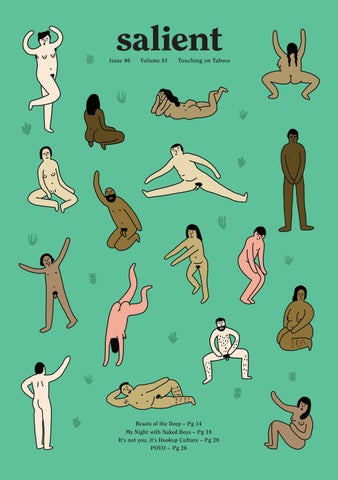
Issue #6
Volume 81
Touching on Taboos
Beasts of the Deep – Pg 14 My Night with Naked Boys – Pg 18 It's not you, it's Hookup Culture – Pg 20 POVO – Pg 26
CONTENTS EDITOR'S LETTER 3 NEWS Featured News 4 News 6 Political Round-Up 9 Opinion 10 *News* 12 LETTERS & NOTICES 14 FEATURES The New Drug on the Block 16 How To Survive a Zombie Apocalypse 20 Funny Business 26 POEM 19 CENTREFOLD 24 COLUMNS Presidential Address 30 VUWSA 30 Super Science Trends 31 Te Ara Tauira 32 UniQ: The Queer Agenda 32 In Our Environment 33 SWAT 34 Ask the Advocate 34 The "F" Word 35 PSC: One Ocean 35 REVIEWS Art 36 Film 37 Podcast 38 Television 39 Music 40 Books 42 Theatre 43 Food 44 ENTERTAINMENT Horoscope 45 Distractions 46
2
EDITOR'S LETTER TOUCHING ON TABOO I was sitting with Daniel our feature writer, trying to come up with things that were taboo. “Nothing’s taboo anymore,” he said. “Sex isn’t taboo, drugs aren’t really taboo either (except for meth and I really don’t want to go there)... I don’t really know what to write about.”
for it but, SJW, 3rd wave feminism, “woke”, you get the idea), we’re actively tryna eradicate the taboos around sex and drugs, and when you exist within that this culture it seems like those taboos are already gone. A lot of the time, we’re writing about taboos to try and challenge the ones that we think shouldn’t be there. We’re wading in the soft blurry lines between what’s taboo and what’s not, and tryna nudge popular opinion towards the latter.
But as it turns out, there’s just as much taboo as there ever was. Taboo is hard to recognise sometimes because it’s not a set of rules written down. We know something’s taboo from a gut feeling we get, a sense of unease and discomfort.. So writing about taboo imposes a double whammy — first you gotta recognise that it’s there, and secondly you gotta go there.
Ella’s column about her experience with chlamydia is a great example. The taboo surrounding sexually transmitted infections harms people because it prevents people from seeking treatment, creates a sense of shame about something that’s outside people’s control, and makes it hard to communicate clearly with sexual partners. By speaking openly about her own experience, she’s lessening the taboo.
I know that we’ve left a lot of the bigger taboos untouched — pedophilia, cannibalism, and all the taboos surrounding death, dirt, and disease. That’s all good, we can’t cover everything all at once. We live in a world full of prescribed social rules, there are soo many unwritten understandings around what’s an okay way to behave and what’s not. We follow these rules without thinking or even being aware of it most of the time.
All our writers have different takes on taboo, which is pretty legit for a term that relies on our intuition to define it. Ngai Tauira’s column about tapu is really interesting, because while the word “taboo” comes from “tapu”, the two have very different meanings today, and it’s worth reflecting on why that may be.
For example. It’s taboo to lick a supermarket clerk. Taboo to pat a lecturer on the head. Taboo to show menstrual blood in public. Taboo to wear shoes to bed. Taboo to cry in public. Etc. etc. etc.
Take care,
I think Daniel had trouble thinking up of taboos because in the current social climate we exist in (you know the one, I couldn’t think of the definitive term
LOUISE LIN Editor
3
The News MONDAY, APRIL 16, 2018
PGSA CHALLENGES STUDY SHOWING NO SIGNIFICANT EFFECTS FELT BY REMOVAL OF POST-GRAD ALLOWANCE CALUM STEELE A recently released report by the Motu Research Institute has shed new light on the Government’s removal of student allowances for postgraduate study and how this has affected New Zealanders. The report outlines the 2013 decision by the Government to remove allowances for students going into postgraduate study, other than honours degrees, and details the observable effects this has had. Prior to 2013, eligible postgraduate students could apply to receive up to $240 a week under the allowance. The 2013 budget scrapped this measure leaving postgraduates with only the $173 (now raised to $229.23) weekly loan, which must be paid back. The report says that there has been a negligible impact on students going on to further study, and that the only noticeable effect has been the increased likelihood of students taking out student loans. The report also concludes that the removal of postgraduate student allowances has had no drastic impact upon the total number of students who entered postgraduate study, the pre-entry wages of students, student loan borrowing for compulsory fees, or the amount of paid work students performed while they were studying. While Dr Isabelle Sinn’s report states that few adverse effects have been felt, the Postgraduate Students’ Association (PGSA) of Victoria University’s position is that the change has had a deleterious effect on students in numerous ways. When asked for comment on the report, the PGSA said that the 2013 decision “has made the prospect of postgraduate study more difficult for students across New Zealand, including at VUW”.
“Domestic Masters enrolments have been particularly affected, although the decline in financial support of those seeking higher degrees has deterred many from continuing study, and has burdened those who have continued studying with significantly increased student loans. From the PGSA’s experience it is clear that a significant number of postgraduate students are forced to work long hours alongside their study in order to survive, and as living costs continue to increase, postgraduate study is becoming more precarious.” Special mention is given by the PGSA to students who come from vulnerable circumstances, such as those of limited means or those with children, whereby this change has likely dissuaded many of them from pursuing postgraduate study. According to the PSGA, the removal of allowances has been a contributing factor in driving Kiwis abroad in search of higher wages to be able to pay off the student debts they have been forced to take out. Dr Sinn does note in her report that there may be policy effects that were not picked up by their methodology. The Tertiary Education Union (TEU) said in a press release on 6 April 2018 that they were urging the Government to keep their campaign pledge to reintroduce the student allowance for postgraduate study, with a link on their website directing people to a petition started by the New Zealand Union of Students. Labour had promised to reintroduce the student allowance as a campaign pledge but no start date has yet been announced by the Government.
Krishna Price Hike
from Export Golds to Lion Reds”. There is still strong support for the Krishna plates however, with others declaring that Krishna is still “such a steal” for “such fantastic food”. You are still able to get $5 Krishna plates if you use Krishna money: $20 for four tokens, or $50 for 10.
EMMA SIDNAM Students at Victoria are reeling after The Lab’s noodles increased in price on 1 April from $6 to $7, due to supplier costs and rental fee rises. Krishna Food has also announced price hikes, with their infamous $5 meals increasing to $6 a plate from 5 April. According to the manager, this is due to an increase in expenses. Cheap feeds for poor students have been a strong advertising point for food on campus, and Krishna meals have been $5 for over 10 years. Third year students that spoke to Salient have reacted to the increased cost with heavy hearts. One student woefully said “it’s certainly a bitter pill to swallow as I’ll have to subtract the extra dollar from my weekly alcohol budget. . . I’ll have to downgrade 4
THE NEWS
MONDAY 16 APRIL 2018
Sexual Violence Court Pilot
A
POPPY DONOGHUE process without completely moving to an inquisitorial model. Chief District Judge Jan-Marie Doogue said in a recent radio interview that the processing times in the pilot courts has halved, from 18-24 months to nine months. She added she believed lawyers were treating complainants more respectfully in the pilot courts, while still robustly defending their clients. In the Auckland and Whangarei district courts, the pilot is now entering its second year. If the two-year pilot is successful, the specialist courts are likely to be rolled out across the country. A specialist sexual violence court was one of the recommendations made by the Law Commission in the 2015 report on the judicial responses to sexual violence. The Law Commission report also recommended offering alternative, less traumatic ways for complainants to give evidence and cross examine it, and acknowledged the significant under-reporting of sexual violence. Judge Doogie has previously said that these other recommendations could not be included in the pilot, as they require law changes to be able to be implemented. She said this is up to parliamentarians to change. So far, no Government action has been taken.
new study backed by the Law Foundation is set to assess whether the new processes being trialled in the sexual violence court pilot are making it less traumatising for complainants to give evidence. The sexual violence court is a list of cases within the district court that covers serious sexual violence allegations where the defendant denies the charges and elects a jury trial. The sexual violence court is not a separate court to the district court, rather it involves using different processes for dealing with sexual violence cases. The study is set to review at least 10 cases from the pilot courts. The study will compare procedures used in adult acquaintance rape cases in the pilot courts, with a group of similar cases in nonspecialist courts. The sexual violence court differs from other courts as judges take a more intensive and proactive role. Judges receive specialist training in sexual violence offending, which includes further educating judges on the barriers sexual violence complainants face in reporting sexual violence. The aim of the pilot is to reduce case processing time and reforming the process of sexual violence cases. This process reform includes giving judges more control over the cross-examination
Otago Law Dean Steps Down HARRY CLATMORE It is alleged that older students supervising the camp told the younger students it was tradition to participate in these activities. A student that participated in the 2014 camp told the NZ Herald that Henaghan was present at a talent show which involved girls stripping down to their underwear. Alexandra Mills told RNZ that she also attended the 2014 camp. She said there was drinking and party games that involved nudity, but that everyone appeared to enjoy themselves and she had not heard of any complaints regarding the camp. Mills also noted that Henaghan was present at the talent show. “The dean was just a passive bystander in the audience watching it. So there was nothing really he could have done. If anything people went a bit further to try to be funny . . . or shock the dean." Henaghan has long been a popular member of staff among students and alumni, his entertaining personality along with his relentless campaigning for his school and students rights made him a drawcard for many students to study law at Otago University. He infamously protected two students’ rights to “make love” after being requested to identify two students seen fornicating after a wine and cheese night, and made a cameo in the cultclassic student film Scarfies. Apart from his job as Dean, he is an internationally respected expert on family law, especially law relating to children, and law regarding the human genome.
Mark Henaghan, the Dean of the University of Otago’s Faculty of Law, has stepped down after 19 years in the position and nearly fifty years at the University of Otago. Henaghan announced in February that he would step down from his role as Dean at the end of 2018, accepting a new professorship at the University of Auckland in order to be closer to family. Henaghan planned to remain in his position at Otago University until the end of 2018, however he has decided to step down early, a move which comes in the wake of outcry over student law camps which he attended. Parents raised concerns last year, with more concerns being brought to the University of Otago this year, in the wake of the Russell Mcveagh sexual misconduct scandal involving Victoria University law students. Otago University decided this year to cancel their annual law camp after revelations came out about drunken behaviour, nudity, and jelly wrestling Henaghan has said in a press statement that his decision was “not related to student law camps”. He said rather that “he wanted to allow a decent amount of time for my successor Professor Jessica Palmer to learn the ropes and enable her to lead the strategic planning for next year and into the future''. Complaints described an atmosphere of social pressure at the camps, where some students felt uncomfortable amid excessive drinking and games that involved nudity. 5
THE NEWS
MONDAY 16 APRIL 2018
Weir House Playground Replaced SASHA BEATTIE
The public playground behind Weir House is in the process of being replaced, with expectations that this will be complete by the end of April. The old playground equipment had passed its use-by date, and needed updating to comply with the Council’s “asset management planning, play spaces policy, [and] suburban reserves management plans,” as well as with New Zealand playground standards, according to City Councillor Fleur Fitzsimons. The upgrade has been on the Council playground renewals programme for a number of years, and cost $85,000. The old playground set was sentimental for a lot of ex-Weir House residents, being the site of much late-night stress smoking and drunken debauchery. One ex-resident told Salient the upgrade was a “crock of shit,” and that “a good swing before going to drink at the fountain was a part of going to Weir”. Another told us he “got a smiley burnt into [his] arm on the slide”.
The new playground will have the swing set and slide, with the addition of more contemporary equipment. Jo Nicoll, Night Manager at Weir, said she’s seen a lot happen in the playground over the years she’s been working nights that she wishes she could unsee, but did not disclose any details to Salient. “If i told you then i would lose the trust of my residents who know what happens in the dark stays in the dark between those involved to have a giggle over in years to come and myself who will keep for consideration should i pen the "memoirs of a residential Night Manager" when i retire [sic],” Nicoll said in an email to Salient. A media representative from the Wellington City Council said there have been no noise complaints about the playground over the last year, but “if your story causes more students to want to drink there, it’d be cool if you suggest they give some consideration to the neighbours. And that they don’t piss in the fountain :)”.
Vape Legalisation Bill
Wagner said that there was a public appetite to legalise these products. She noted that vaping “provides the physical sensations and rituals that smokers find hard to give up and is significantly cheaper,” and called e-cigarettes a “tool” that can help those most addicted to nicotine to quit smoking. While the research around the effectiveness of e-cigarette products in aiding smoking cessation is still developing, Wagner said that there is no evidence that e-cigarettes provide a gateway for smokers to cigarettes or that non-smokers take up e-cigarettes. She added that “we still want to have a safeguard because nicotine is still an addictive substance”. A former employee of The Vape Shop, an e-cigarette retailer in Wellington, told Salient that he advocated for clear and honest sales and information around the products. He expressed concern that many vape retailers are currently “operating in a legal grey area”, which undermines consumers and employees of such retailers. The Bill would also outlaw vaping in public spaces such as parliament grounds to “help preserve cultural norms around the undesirability of smoking”. Wagner confirmed that “legislated smoke free areas are intended to have cleaner air and therefore should be free of any smoking or vaping”. Any vaping by Parliament employees or press gallery journalists would therefore be banned under the new Bill. The proposed Bill is currently at the the member’s bill stage and is awaiting first reading in Parliament.
ANGUS SHAW E-cigarettes are proposed to be legalized under a new Bill currently in Parliament. The Smoke-free Environments (Regulation of Electronic Cigarettes) Amendment Bill is a Members Bill introduced by the Honorable Nicky Wagner. While much of the public is not aware that the sale of e-cigarettes and e-nicotine products are not currently legal, prosecutions are extremely rare. The Bill would amend the Smoke-free Environments Act, and aims to introduce similar consumer protections around vaping as there are currently around tobacco products. Under the Bill, the sale of and supply of e-cigarettes to people under 18 would be illegal, advertising would be limited to in-store for e-cigarette retailers, and vaping would be prohibited in legislated smoke-free areas in the same way smoking is currently. National List MP Nicky Wagner, the author of the Bill, encouraged e-cigarettes as a “better alternative to ordinary cigarettes for long-term, more ingrained smokers, and are significantly less harmful than smoking tobacco”. She told Salient that while smoking rates continue to decline, smokers need to be open to alternatives to cigarettes. 6
THE NEWS
MONDAY 16 APRIL 2018
TRUMP'S AME RICA The Worst F**king Attorneys
F
TORI BRIGHT Attorney General Rod Rosenstein, based partially on suggestion from the team of Special Counsel Robert Mueller. Mueller’s office is also behind the ongoing investigation into the interference from Russian entities into the election of President Trump. The raid has angered President Trump who has publicly referred to the search as a “disgrace” and “an attack on our country”. Such a reaction has brought on new speculation that the President could move to fire Robert Mueller, thus impeding the probe into Russian meddling. The White House reported to the press on 10 April that President Trump “certainly believes that he has the power" to fire Mueller, seeing the recommendation of the raid as a sign the probe had "gone too far". Under Justice Department regulations, only Rod Rosenstein has the authority to remove the special counsel from his position. Senate Democratic Leader Charles Schumer has called upon Majority Senate Leader Mitch McConnell to bring legislation to the Congress floor that would “protect the special counsel from political interference,” so to avoid a constitutional crisis if Mueller were to be fired. However, McConnell has stated he sees no reason for Congress to act. "I think he will be allowed to finish the job. He should be allowed to finish the job he was assigned," said McConnell, while refusing to entertain any legislative action that will ensure the investigation can continue unimpeded.
ederal Agents of the FBI carried out a raid on the home and office of Michael Cohen on 9 April. The personal lawyer to President Donald Trump has been in the spotlight recently after admitting to making a payment of $130,000 to Stephanie Clifford, a porn star professionally known as Stormy Daniels. The payment was a part of a non-disclosure agreement that sought to prevent Daniels from going public during the 2016 Presidential Election, on the details of an affair she allegedly had with Donald Trump in 2006 and 2007. Daniels took to the media with the story regardless, while President Trump has denied any knowledge of the NDA. When questioned on the payments Trump responded “You’ll have to ask Michael Cohen” — bringing into question the legal validity of the document purportedly signed by Donald Trump himself. A government watchdog group has since filed a federal complaint, which argues that “because the funds were paid for the purpose of influencing the 2016 presidential election”, campaign finance laws may have been violated. The FBI raid on Michael Cohen was allowed under a broad search warrant, that allows for the seizure of any documents concerning the $130,000 payment. The agents may also seize banking records, and correspondence between President Trump and his lawyer, should the communications pertain to conspiracy to commit a crime. The raid was personally approved by Deputy
QUEER COVERAGE: Local, National, and International LGBTQIA+ News JOHNNY O’HAGAN BREBNER, UNIQ COMMUNICATIONS Births Deaths and Marriages Amendment Bill Submissions Submissions from the first round of select committees on the Births Deaths and Marriages Amendment Bill have been made public, with the second round having taken place last week. Submissions made by VUWSA, Community Law, Young Labour, and Rainbow Wellington called for the Act to be amended to only require self-identification as a criteria for changing gender markers on birth certificates. The current system requires the Family Court to assess whether applicants have taken “significant steps to live as their gender”. Submissions can be found on the Parliament Website.
end of her weightlifting career. Nigel Owens condemns Israel Folau’s Gay Comments Prominent rugby referee Nigel Owens has condemned recent comments by Wallabies Fullback Israel Folau suggesting that gay people would go to hell “unless they repent of their sins [sic]”. Owens, a gay man and popular figure in world rugby, addressed Folau’s social media comments in a column in Wales Online, saying such rhetoric “could be enough to push [struggling] people over the edge”. “...you are entitled to your opinion but one should understand what that opinion can do to young and vulnerable people's lives in particular ones… dealing with their sexuality.” On Tuesday 10 April Rugby Australia and Warratah’s leadership announced intentions to address the issue with Folau.
Laurel Hubbard injured at Commonwealth Games Trans weightlifter Laurel Hubbard has been injured while competing at the Commonwealth Games. Hubbard, a favourite to win gold, injured her left elbow and has withdrawn from the competition. Hubbard had been the centre of some controversy as a trans woman competing in the women’s category, however she received backing from many including the Commonwealth Games Federation CE, David Grevemberg. The gold was subsequently taken by Samoa’s Feagaiga Stowers. Unfortunately, Hubbard has said her injury will likely mean the
Alaska Rejects Bathroom Bill 53% of residents in Anchorage, Alaska, have rejected a “bathroom bill” proposed by the conservative non-profit, Alaska Family Action. The Bill would have required trans people to use the bathroom corresponding to the gender marker on their birth certificates. There was strong opposition from trans activists in the state, with activist Lillian Lennon describing the Bill as a threat to trans people’s safety and security. The trans rights “No on Prop 1” campaign raised in excess of USD $820k to fight the bill through online fundraising. 7
Politics MONDAY, APRIL 16, 2018
THE BIZARRE STORY OF DAVE BUCKS A Salient Investigation ANGUS SHAW with ACT on Campus at Victoria. In an email I asked if I could redeem the Dave Bucks at any retailer, after all I did have — by my own estimation — over two million dollars of the currency. I asked if I could “use them to “pay good teachers” as the currency claims. No reply. I continued with the questions: “the notes replace Queen Elizabeth II on the $20 note with David Seymour, is this a subtle nod to ACT advocating New Zealand becoming a republic? Or possibly that David Seymour intends to install as himself as monarch? Can you comment on that?” Again ACT on Campus chose not to reply.
A few months ago my friend showed me a Snapchat she had received of David Seymour’s head pasted onto a magazine cover. This wasn’t Photoshop however — she told me she cut out the picture of Seymour’s stiff beaming face from something called “Dave Bucks”. Hearing that the ACT Party leader had his own currency, I decided to investigate with all the journalistic rigor that I could muster on student journalist pay. Salient was able to obtain a large stack of Dave Bucks, which are modified twenty dollar notes with the Queen replaced by Seymour awkwardly grinning. In place of the usual text about the note being legal tender, the Dave Bucks say “ACT WILL PAY GOOD TEACHERS TWENTY THOUSAND DOLLARS”. In the 2017 election The ACT Party campaigned on a policy of creating performance targets for teachers, promising to deliver higher salaries for well performing teachers. The ACT Party website states, “We will enable schools to opt out of union contracts. This will mean they gain the flexibility to recognise great teachers by paying them more and rewarding their achievement.” ACT promised an average pay increase of $17,700 per teacher.
Unable to be advised by the ACT Party on any practical use for the Dave Bucks, I ventured to find out what became of the remaining notes left in the NZEI offices. A source within the NZEI offices told me that the wheelbarrow full of stacks of notes eventually was placed in the conference room, where it became somewhat of a defacto rubbish bin. She said the stunt was an ACT party “Libertarian shit idea”, adding that teachers already dislike National performance standards — linking pay scale to performance would undermine an already underpaid profession.
A New Zealand Herald article from September 2017 revealed that the mock currency was created as part of an election campaign stunt, delivered to the NZEI Te Riu Roa (a teachers’ union) offices. Seymour personally carted a wheelbarrow full of over a billion dollars of the fake currency into the offices.
My source revealed that at some point later David Seymour contacted NZEI to ask about getting his wheelbarrow back. It is unclear however if this was before or after election results were finalised. Months later one NZEI staff member allegedly enquired about taking the wheelbarrow home to use in their garden, however I was unable to ascertain if this request was approved. Dave Bucks became somewhat of an inside joke at the NZEI, being used in leaving cards. Seymour’s image was pasted onto numerous different pieces of media, including his head being placed on a Union brochure to create the fabled “Union Delegate Dave”. Salient was however unable obtain an image of this document. I was told that as of April of 2018, supplies of the currency were running low.
It appears however, that NZEI had caught word of the stunt in advance and preemptively cleared the 13th floor of their offices, which meant the ACT Party leader was greeted by a singular staff member, who to his surprise accepted the offer. The wheelbarrow was then placed in the corner of an office where it remained for several months. So what became of the billion dollars worth of Dave Bucks after the campaign stunt went awry? To find out I contacted David Seymour in the most reliable way to reach him, via Snapchat. I asked David where I could go about redeeming the “Dave Bucks”. He replied suprisingly quickly, telling me “sadly they are not widely accepted”. After asking what I was meant to do with them now, he simply replied “frame them”. A later selfie from David revealed that I was indeed talking with the real ACT Party leader.
Salient is in possession of the apparent last remaining stack of Dave Bucks. If you are a retailer who accepts Dave Bucks or you have any suggestions for the use of two million dollars of David Seymour currency, please contact Salient at editor@salient.org.nz.
After failing to get a substantial response from Seymour himself, I attempted to get in touch
8
POLITICS
MONDAY 16 APRIL 2018
CHATTING WITH MARAMA LAUREN SPRING Salient TV gets to know our new Green Party Co-Leader. Here’s the serious interview. Head to Facebook for Marama’s hot takes on Weet-Bix, E-Bikes, and Shortland St.
do it, I should do it, and that’s what I try and remember every day. L: How can you bring your connection with the community into Parliament when it’s something that’s abstracted from the community?
Lauren: Can you go through your life up to this point? What’s been the most formative and what you’re most proud of ?
M: I’m heartened by some of our next crop of politicians that have come in, across the parliament lines actually, where they maintained these connections. The challenge is keeping these connections. This is a little bubble of an elitist way of living that almost no other ordinary New Zealander lives. I find it important to keep reaching into those communities who are on the front lines of the issues we’re trying to fix up, and if we are not connected to the very people who are right at the forefront of these issues which are Green Party priorities, then we are irrelevant, then we lose our sense of reality.
Marama: Gosh, I guess the most relevant thing in my background is I was born into two teenage parents, young Māori parents, who had been displaced from their land, their language, and their culture. They were learning as they grew older that they had a political analysis about the injustice and what had happened through the colonization process. They helped me to have a sense of injustice very early on, and that’s been an ever-present factor in my whole life. They were very involved in the tino rangatiratanga movement and activism, they were very involved in the Māori urban 70s uprising where a lot of young Māori people were starting to speak out.
My priority is to go where politicians don’t normally go. That’s why I was the one through the election that’s standing outside the Work and Income offices in the lines for three hours with people just waiting to get a little bit of help, and did that consistently through the election. That’s why I am the person who will stand with the Tamaki Glen Innes community, when they are fighting against state housing sell offs and no other politicians will turn up.
I did some pretty ordinary things, went to school, university, was a young mum. Through university I started to come into contact with different environmental, social justice, and tino rangitiratanga movements. Then I had a 10 year career at the Human Rights Commission, that was really influential, it really helped me analyse everything from a human rights angle. I grew somewhat of a profile long before I came into politics. That was how the Green Party came across me, particularly Metiria Turei. I noticed when we were at rallies and public events, we were saying the same things. It was a natural alignment to come into the Green Party; the party’s values and visions aligned with my own. Making sure people are looked after. Making sure the distribution of power is fair and just, and looking after our environment for the future to come. To be able to continue my life’s work is an incredible privilege.
L: There’s been whisperings currently that Greens are maybe becoming increasingly irrelevant in this government at the moment. What are you going to do to fight to stay relevant? M: The first term for any smaller parties in any MMP government in their first term around the world, have faced the same risk of being invisible and being eaten up basically by the larger parties, and so we have a clear job to stay independent and unique in our voice. People need to understand that we are the most progressive political party in Parliament right now and without us people will not be able to continue to hold government to account, and also that we are effective in working with our coalition partners to achieve real change.
L: Just picking up on that topic of cultural displacement, justice and injustice: how do you take that grief and difficulty that came with colonisation of what Māori people have lost and translate that into a very uncaring political system?
L: When you want to be a little bit tender to yourself, or do something nice for yourself, are there certain shows, films, or music that you go to? M: Totally. My dog, my children, my husband, my family are my sanctuary and I hold that very dearly and protectively. They are my space where I get to be grounded. Do the dishes, do the laundry, and take our dog for a walk in the bush is probably the top of my list of heaven. And those are just ordinary things, but those are things I don’t get to do often.
M: That continues today. With any power analysis you have to understand class analysis as well. Daily, people are getting in contact with me about how much of a hard time they’re having just to try and get by. They’re trying their hardest to support themselves and their families. Maybe it’s people trying to raise a child with a disability, who can’t work, because they’re constantly having to attend to education problems…. That’s hard for me to hold, but it’s important for me to understand, because that’s what keeps driving me to pull the levers that will make change for everybody.
Because this job is all consuming it’s also important to keep things in perspective and not take yourself too seriously, and having a real good joke and cry, and understand that actually you are just as dispensable as every other human on this planet.
L: It’s so incredible having someone like you in Parliament representing people and you obviously genuinely care about these issues which can be exhausting at times…
L: Cool thank you. Actually speaking of movies, have you seen Black Panther?
M: Oh look I’m here because I have my own fortune and privilege, which is that I have a support network and a family network who support me to do this often horrendous job. But what I know is that there is so many people who need us to represent them. If I can
M: Actually that’s my next priority, we even tried to get there last weekend. Our next family outing is to Black Panther, I can’t wait.
9
POLITICS
PRIME MINISTER'S POST CABINET PRESS CONFERENCE Salient Chief News Reporter Angus Shaw went to the Prime Minister’s Post Cabinet Press Conference on Monday 9 April: mostly budget stuff, but also the Northcote by-election and the rebuilding of Middlemore hospital. Prime Minister Jacinda Ardern and Finance Minister Grant Robertson spoke this week about the 2018 budget, with the Prime Minister stating that “work is underway across Government to transition to planning to build a stronger, fairer, and more sustainable economy”. She was surprised by the lacking state of many public services, particularly health and education, after opening the books from the previous National Government. “From the beginning we knew it would be bad, but we didn’t know it would be this bad.” Ardern stressed that it was not a problem that could be solved in just one budget. Grant Robertson announced that the Government will reach the 20% debt repayment target two years later than proposed under National. One journalist questioned why the Government did not simply change the budget responsibility rules if public services were in such a crisis as suggested. Robertson replied that the Government needs to balance rebuilding the economy with keeping the books in shape. Of particular note in the Government's budget plans was the rebuilding of the Middlemore hospital in Auckland, which Ardern described as “A building that's rotting around its patients”. The Northcote by-election was announced for 9 June 2018, coming in the wake of National MP Jonathan Coleman’s resignation, who left his seat to take a job in the private health sector. Ardern said she wasn’t resigned to a National victory, despite the seat traditionally being a stronghold for National.
POLITICAL ROUND UP Marama Davidson’s Landslide CoLeadership Victory Marama Davidson won a landslide victory for Co-leader of the Green Party in an announcement on 8 April. The Green List MP won a monumental victory against fellow candidate Julie Anne Genter at 110 votes to 34. She fills the vacant female Co-leader seat that was left behind by Metiria Turei, who resigned from politics at the end of last year after details of her benefit fraud became public. In her victory speech, Davidson thanked the party for their continued faith in her. She also stated that she wanted the party to shift focus to the less fortunate
communities in New Zealand. "In order to be a genuine and relevant voice for modern Aotearoa, we need to reflect its diverse reality. We need more members from all backgrounds and communities." Davidson says her number one priority as Co-leader will be to not let the Greens fall beneath the radar in the coalition Government. Not holding a ministerial portfolio, Davidson says she will be able to focus on the party without being limited by involvement in executive decision making. Eugenie Sage’s EPA Meeting Green MP and Associate Health Minister Eugenie Sage has altered her recollection about allegations of ministerial interference. In March, Sage was accused of interfering with the business of the Environmental Protection Authority (EPA), an independent body from the Government. She denied that she acted unprofessionally with EPA bosses regarding concerns about their chief scientist. Sage met with EPA chief executive Allan Freeth to discuss the scientist, referring to the ongoing trust issues which were also raised at the Ministry for the Environment. On 5 April 2018, Sage changed her story, saying that it was a lapse in memory that failed her recollection of the meeting. She retracted her entire story, saying that she did not meet with the chief executive or discuss the controversial chief scientist. "I was relying on my memory, and when we checked it was actually a meeting with the Ministry for the Environment — not with the EPA, so when I raised that (Dr Rowarth's behaviour) it was with the chief executive of the MfE." It is the second time in a manner of weeks that members of the executive interfering with independent bodies have come to light. Two weeks ago, Clare Curran — Minister of Broadcasting, Communications and Digital Media and Government Digital Services, was accused of interfering with state broadcaster Radio New Zealand. Government Announces Plan to Address NZ Transportation Issues The Government is in the process of planning a transport safety overhaul, with a focus on making highways safer throughout provincial areas of New Zealand. On the 3 April 2018, the Government announced a proposal for a fuel tax of between 9 and 12 cents per litre for motorists around the country. They say the increase in costs will go towards major increases in safety aspects of highways in New Zealand. Local roads and existing highways would also receive major increases in funding. The proposal sparked heated debate in Parliament, with National saying that it would affect many of their constituencies, which have been neglected by the Government’s policy. 10
MONDAY 16 APRIL 2018 Labour policy documents showed that over the next 10 years Labour plans to spend 4.6 billion per year on transport, 650 million dollars more than National’s policy. In 2017, National also considered raising duty on fuel to fund nine new highways if it returned to power. Minister for Housing, Urban Development and Transport Phil Twyford said that National would also need to increase taxation if it was to pay for any upgrades. “To now suggest a National government wouldn’t have raised this duty is fantasy.” -Thomas Campbell
THE PARTY LINE Prime Minister Jacinda Ardern recently said in an interview with The Guardian that she expects New Zealand will become a republic in her lifetime. Is this something your Party would prioritize in coming years? Why/why not? YOUNG GREENS I think there’s a need for nationwide discussion around who we are as a nation, and what that means. I would support a process that looks at making Aotearoa a Republic, and creating a constitution that puts Te Tiriti O Waitangi at the heart. Whether or not our country is ready for that discussion is another question — but at the moment it’s not a priority for our Party. -Max Tweedie ACT ON CAMPUS ACT on campus does not see any immediate need for a change to the current system. We recognise New Zealand as an independent country and having a figure head does not take away from our ability to govern independently. It would be a significant cost to leave the monarchy and we believe there are more important issues to focus on such as ensuring people’s individual liberties are not compromised, the housing crisis, and superannuation among other issues affecting our generation. -James Allan VICNATS No. The Young Nats believe there are bigger issues on the table to address. - Grahame Woods VICLABOUR Jacinda Ardern has stated that this will not be a priority of the current government. We are prioritizing health and education which have been severely neglected for nine years.
News
*
*
DEBATABLY MORE FACTUAL THAN FOX NEWS
A USEFUL POST SHOCKS THE SOCIAL NETWORK CLASS FACEBOOK GROUP 2: CONGRESSIONAL USERS BOOGALOO SHANTI MATHIAS A class Facebook group was used productively in what has been described as a “shock move” by members. Research conducted by Salient shows that 15% of posts in class Facebook groups could be answered by Google, 59% could be answered by looking at Blackboard, and 25.99 % are otherwise irrelevant to the course. ENGL 115: Literature and Power has a Facebook group creatively titled ENGL 115 PEEPSSSSsss!!!. In an unprecedented move on 10 April 2018, the group was graced by a useful post. ENGL 115 PEEPSSSSsss!!!’s dire trajectory changed when the most recent post was not Charina Smith’s “MLA is what i need but i haven’t started the essay, what do i do??”, but Hamin Park’s “Hey guys, I found these useful websites about how to analyse power differentials in literature, if you need a jumping off point for the assignment ��”. Ralph Ryan, who lectures for ENGL 115, said “I don’t want to know [about the class Facebook group]. I’m just told to tell the class reps that it’s one of their responsibilities”. “I was definitely surprised,” said Zakan Boyd, one of the class reps for ENGL 115. “[The post] has cleared my acne, restored my grades, and has brought some semblance of meaning to the class rep position”.
TORI BRIGHT
A sequel to the 2010 blockbuster The Social Network appears to be in the works, as footage from the project depicting Facebook CEO Mark Zuckerberg facing his first Congressional hearing was leaked this week. The scene indicates the upcoming film will reference 2018 events where the social media platform was found complicit in allowing personal data of almost 100 million users to be sold. The accounts were targeted to aid the election of Donald Trump in 2016. Inside sources reveal directors are reluctant to include a opening title card revealing the film is based on a true story, “as the timeline we live in today is just fucking unbelievable”. The apparent decision to utilise the talents of the real Mark Zuckerberg has drawn criticism. Twitter user @elonmusk has warned that casting the controversial figure has a unique set of dangers. “Our understanding of [Artificial Intelligence] is limited,” he tweeted, adding, “Replacing Eisenberg with a cyborg distracts from the film’s efforts to shed light on FBs wrongdoings. #deletefacebook”. Other comments on the video read, “his attempts to portray real human emotion is just… wrong,” and “it’s amazing how far technology has advanced, but I think we’re still a long way away from this being anywhere near believable”.
DOIN' IT FOR THE RETWEETS: NZ POLICE'S RAINBOW CAR ANGUS SHAW farms that can get you likes for about $9 per 1000… but they are a complete waste of money”. For reference Buzzoid, a website that provides Instagram likes, offers 5000 likes for $39.99 USD ($54.76 NZD). While presumably these are bots, this would amount to a saving of almost $9940 for the police and could be spent on other community services. Fake bot accounts also probably have a higher opinion of the police. However in our investigation Salient neglected to enquire about the cost of getting this many likes on a controversial post such as this, considering the NZ Police force’s troubling history with the LGBTQIA+ community. It is unclear if this would cost $2.50 per like. The “Rainbow Car” will not be pressed into service as a regular police vehicle in the hopes that homophobic criminals will continue to feel comfortable being arrested.
The New Zealand Police have paid $10K to have rainbow stripes and lettering painted on a police vehicle. The “Rainbow Car” was seen at Auckland and Wellington Pride festivals earlier this year as part of a PR stunt designed to attract more LGBTQIA+ recruits into the police force. The police have revealed that the $10,000 was spent out of the recruitment marketing budget to have the car painted and detailed. The cost of the car was justified by the amount of social media likes garnered by the car. A post of the Rainbow Car on the official NZ Police Instagram received 4,176 likes, amounting to roughly $2.50 per like. Salient contacted Socialites, a social media management company, to enquire about how much it would cost for an Instagram post like this to get this many likes. A representative for Socialites responded, saying, “We quote on time and skill for the job, which ranges depending on the scope of work and business objectives. However, there are like-bots/click11
*NEWS*
MONDAY 16 APRIL 2018
NATIONAL URGES GOVT TO BE MORE AMBITIOUS WITH CHILD POVERTY LEGISLATION
TINDER USAGE BOOMS AS COLD SNAP HITS NZ SASHA BEATTIE According to the application’s parent company IAC, as of mid-April Tinder usage in New Zealand has gone up by 43%. With temperatures in Wellington dropping below 10°C, cuffing season has slapped the capital like a limp dick, and to stay warm many Victoria University students have resorted to fucking strangers. Students said while they’re happy to brave the weather to get laid, they are concerned about the temperature of the host’s bed. “I usually get them to send me a picture of their electric blanket with a current timestamp before I agree to go over,” said Lu Dylan, fifth year law student at Victoria. Dylan lives in Aro Valley, and said re-downloading Tinder was “abhorrent, but inevitable”. “My flat isn’t insulated and the windows in my room don’t shut properly. Last winter I often woke up to a light covering of dew on my duvet. Sometimes you have to pretend you enjoy someone’s company to stay warm — it’s just about survival.” One particularly temperature adverse student told Salient that they asked potential hookups to send pictures of their hot water bottles and oil heaters rather than nudes. “It’s only practical, I have class in the morning.” Another student told Salient that having a heatpump in the flat was “a real panty-dropper”. He said he always gets more matches heading into winter, adding, “heating is included in my rent — thank fucking god or else I’d be pretty much celibate”. IAC expects that Tinder’s popularity will continue to grow as students’ standards drop with the temperature. If you have any information about Wellington landlords offering student renters a year’s subscription for Tinder Plus in place of installing adequate insulation, email news@salient.org.nz
ANGUS SHAW The National Party has urged the current Government to put forward more innovative policy with regards to child poverty in New Zealand. In a press release, a spokesperson for the National Party stated “no copying,” referring to the fact that leaving child poverty mostly untouched had been National policy for their nine years in power. On 21 March 2018, National lodged three Supplementary Order Papers (SOPs), designed to “target” child poverty. In its current form the Bill simply codifies the “actions” National was “already taking” to reduce child poverty. The press release declaimed “If the current Government wants to introduce their own legislation paying lip service to reducing child poverty while continuing to maintain current wealth inequality, they are just going come up with their own ideas”. Currently 290,000 (or 27%) of children in New Zealand live in poverty, with a further 80,000 living in severe poverty. These statistics have mostly remained stable during the nine year tenure of the previous National Government, from 2008 to 2017. “Statistics like this really highlight consistency as one of the key values of the National party,” said new National Party leader Simon Bridges. “We want to ensure data and evidence is a cornerstone of solving the problem of solving child poverty. Labour has a habit of throwing money at a problem. National prides itself on being the party of fiscal responsibility and its just not fiscally responsible to spend money on children struggling in poverty when they aren’t even old enough to vote National.” Young Nats approved the Nat’s new policy announcement, however said to Salient “Huh, what's poverty?”
PAKEHA NEW ZEALANDERS DEFENCE OF RACISM LIMITED TO GOOGLING WORD “RACISM” JOHNNY RAPID White people across the country are confident that exactly 16 seconds of googling the term “racism” outweighs the lived experience of thousands, and the weight of several entire academic fields. In a country which just released promotional rugby material based around the Taranaki Land Wars, Kiwi director Taika Waititi’s recent comments that New Zealand is “racist as fuck” has revealed that a swathe of the population has no interest in a structural analysis of racial discrimination. A statistical analysis of all Stuff, New Zealand Herald, and Radio New Zealand Facebook posts since Waititi’s tweet has demonstrated that approximately 77% of the comments section was a copy of the first result to come up under “racism definition” on Google. Another 10% was using mental gymnastics to explain how “actually” Waititi was the racist; another 5% used “bootstraps” rhetoric; the remainder was a mix of racist slurs and, inexplicably, homophobia. Regular Stuff article comments contributor, Brian MacCartney from Winton, rose above the pack however. Happy to spend another 30 seconds on Google, he provided important statistics about the incarceration rate of Māori in New Zealand. “Maori [sic] make up 50% of the prison population here but
only 12% of the general population for God’s sakes! If they stopped feeling sorry for themselves and asking for handouts maybe they would get somewhere.” Renowned intellectual Duncan Garner weighed in too, only to be rebuked by almost everyone in the immediate vicinity and hopefully also everyone he knows and loves. Unfortunately, reports are inconclusive on the latter. When asked for comment, Waititi attempted to answer but only managed a prolonged groan before laying facedown on his desk.
UPDATES ON KYLIE JENNER'S BABY Stormi Webster has been alive for approximately the same amount of time that Kim Kardashian was married to Kris Humphries, though reports say the amount of screaming involved in the two instances are roughly comparable. The official Salient position on Kylie Jenner’s baby continues to be one of unqualified contempt. 12
LETTERS Hey salient, do olives belong on a margarita pizza?
LETTER OF THE WEEK
Lachlan Akers
Dear Salient,
It's the same socially anxious people, the same uninformed, the same people who are passionate about the thing but can't articulate much about it beyond the echo chambers from which those passions formed, it's the same fragile rich kids, the same fragile white kids, the same general disdain for non-Euro non-American accents, the same notion that chess is nerdy, the same extroverts who stand too uncomfortably close and need to shut up, the same fatphobia, the same general appraisal for Love Actually, the same stomach knots, the same “but where are you really from's”, the same people sitting alone in libraries with earphones watching sitcoms on their laptops, the same unbearable elevator silences, the same tiptoeing around indigeneity, the same heteronormative nightlife, the same having to tell them NO I don't have a twin! But it's OKAY that you confused me with that other brown girl - I get it! We must look the same haha! Haha!
Just need to give a public BIG UPS to KnowYourStuffNZ for recognising that communication, transparency, and informing users is the way forward for drug policy — thanks for straight up keeping my friends safe at festivals, and plz keep fighting for realistic approaches to combating dodgy cunts, your work is appreciated. Luv, Stoned & Stoked Send us letters to editor@salient.org.nz otherwise we are just over here playing with ourselves. Your feedback and opinions are valid (maybe). *Letter of the Week wins a double day pass to Zealandia
I have a question: how can I stand up for what I know is right in a new country where no one knows who I am? Am I jeopardizing people liking me? Why do I care what you think of me? It's the same dilemma of contest between being okay with not being liked and being the social equivalent of a donation box. Evra Ali
NOTICES VIC BOOKS 2018 BOOK CLUB The next book on the Vic Books Book Club list is Things Fall Apart by Chinua Achebe. The book club session is on May 2nd at Vic Books Pipitea at 5:30pm. If you have read, or are keen to read, this book and would like to review it, please get in touch at books@salient.org.nz VICTORIA DEVELOPMENT SOCIETY: SUSTAINABLE FASHION FORUM A FREE event discussing the social and environmental impact of the fashion industry, hosted by the Victoria Development Society. We'll be discussing waste, gender politics, garment care, textile recycling and more with a panel of experts from local ethical brands and sustainable textile initiatives. In the belief that fashion shouldn't come at the cost of people or our planet, we're asking: how we can create a more sustainable fashion future? 5.30pm Weds 18th April in COLT122 (VILP Speaker Event!)
INFORMATION SESSION FOR JAPANESE SCHOLARSHIPS The Embassy of Japan is holding an information session about all expenses paid undergraduate or post-graduate scholarships (MEXT Scholarship) to universities in Japan. Flights to and from Japan, university fees, and a monthly stipend of up to 145000JPY (roughly $1800NZ) are funded by the Japanese Government. People in all fields of study may apply and knowledge of the Japanese language while helpful is not essential. New Zealand, Cook Islands or Niue Citizens are eligible to apply. Come to AM103 at 12:501:50 on May 2nd for more information!
INTERNATIONAL DANCE DAY Free public dance workshops, performances and films. Brought to you by YouthDance Education Trust. Fantastic celebration of dance, everyone welcome! Learn a new dance, with a wide range of workshops from Cuban salsa to Scottish ceilidh. Performances by local groups reflect the rich diversity of dance in Wellington. Plus, a collection of short dance films from top NZ choreographers. Sunday 29 April, 10.45am – 4pm Te Papa, Wellington http://www.internationaldanceday.org.nz
ENVIROWEEK Are you passionate about the environment, climate action and sustainability in our everyday lives? Sign up to volunteer in a range of roles of Sustainability Week 2018 - we're planning events, activities and more on the theme of 'Change your Habits, Change the World!' Email vicdevelopmentsociety@gmail. com for more info!
WE’RE LOOKING FOR RA STORIES! Have you been in a crisis situation in a hall? How has your RA dealt with it? If you’re an RA, how prepared have you been for crisis situations? The good the bad and the ugly, send your stories to editor@salient.org.nz, anonymity guaranteed.
13
THE STRANGE HISTORY OF TENTACLE PORN
BEASTS OF THE DEEP NAVNEETH NAIR
CW: Tentacle porn, rape. There comes a time in every hapless student’s life when you chance upon the spectacle of one bodily orifice or another being filled by a slimy, big ass, monster tentacle. They say this event shapes an individual, that the image burns into their subconscious. They say that the mind, conservative and fearful of the floodgates that may rapture, suppresses all thought and memory of the event. I speak of course of Tentacle Erotica. “Tentacle Porn, what’s that about?” I blurted the question out over dinner with my flatmate (who refuses to be named). It had been gestating in my mind for a solid fistful of minutes. “That’s good shit” he replied. I couldn’t tell if he was joking (he insists he was) or whether I was just being dismissive of a perfectly valid fetish. I traced tentacle erotica back to Japan in the Edo period, a simpler time and place, where erotica could be printed on wooden blocks and still be called a literary masterpiece. These “shunga” novels were enjoyed by everybody and their mothers.The first human-octopus intercourse (which I hereby dub tentacourse) can be seen in the 1814 novel, Dream of the Fisherman’s Wife. The artist, Katsushika Hokusai, is the same dude who would go on to paint the renowned Great wave off Kanagawa, so I guess you could say he had an affinity for the sea. The prints of Fisherman’s Wife depict a woman getting jiggy with two octopuses. I went deeper, seeking analysis of this legendary work. Scholarly papers indicate that Westerners interpret the intercourse as rape, whereas Japanese at the time deemed it consensual. The novel follows the legend of the female abalone diver, Tamatori. The story is as follows: Tamatori steals a jewel from the dragon king; she tries to get away, but the dragon king and his sea-homies pursue her; this pursuit leads to consensual sex between Tamatori and the octopuses. This seemed unconvincing to me. I would never stop in the middle of a heist to allow two octopuses to fuck me. However, the dialogue shows mutual enjoyment, so apparently octopuses are irresistible. What do I know? But this was like 100 years ago. Why is tentacle porn still going so hard? The answer, apparently, is censorship. Article 175 of Japan’s criminal code forbids “indecent material” from being distributed, with the proviso that most porn must be at least a little censored. This usually means chucking a digital mosaic over a penis. The father of contemporary tentacle porn, Toshio Maeda, cites censorship as the reason animators started focussing on tentacle penetration. They couldn’t draw penises, so they decided to draw
tentacles instead, all to get around that pesky article 175. Maeda notes that it was illegal to show humans getting down in bed. Thus, he created a creature with tentacles, not penises, just tentacles. The justification being that the tentacles were not phallic, but rather a part of the creature. As another slap in the face of censorship, he claimed that the creatures don’t have genders, and as such the work is neither obscene or illegal. It also showed that Toshio Maeda put a lot of thought into the subject. Japanese people get a shit rap for being the inventors of tentacle porn. That dubious honour is actually somewhat attributable to America. Before the Meiji Restoration in 1868, Japanese were a lot looser when it came to nudity and sexuality. Expressions of sexuality were not considered taboo. However, after the Meiji Restoration, Japan began to censor erotica, due to concerns that America and the rest of the Western world would think of Japan as a nation of sick fucks. This was only reinforced after the Second World War, when the Allied forces occupied Japan. The US lifted censorship laws and controls on freedom of speech, but only where it benefited them. The US had only acted to suppress any anti-American sentiment and free up access to American media in Japan. In reality, while most censorship laws were abolished, both press censorship and article 175 of the penal code survived. “Indecent material” was prohibited, be it pornography or anti-American propaganda. Like that tough kid who always gives you swirlies, America made sure that the Japanese would only have their eyes and ears filled with good ol’ American media. This meant that the Japanese were exposed to all the depravity and monster sex of American B-movies. Specifically in 1970, Roger Corman’s The Dunwich Horror was the first film to feature aggressive sexual assault by a tentacled monster. Sam Raimi’s The Evil Dead followed in 1981, featuring an extremely non-consensual “moment” between a helpless university student and a group of “demonically possessed trees”. In contemporary tentacle porn, the Japanese seem to have opted for the approach of these American B-movies and their inclination towards sexual assault. In 1986 Mecha Horror Guyver Out of Control, tentacle porn took on its recognisable form — Japanese anime. The genre appears to stick to animated features; few live action films have been made since the 1990s. Probably due to complex ethical issues involving octopus rights.
The next couple of decades saw a proliferation of animated features, from Urotsukidoji in 1986, to Demon Beast Resurrection in 1995. Japanese weren’t the only fans of this material. The tenta-course filled films flew off video store shelves in the United States and the rest of the Western world. Tentacle porn remains popular today, with animators continuing to animate and viewers continuing to, uh, do the things that viewers do. Indeed, the internet has only helped the videos reach a global audience. If I were to say the number of people that actually enjoy watching the stuff has dwindled over the years, I would be hella ignorant. One search for tentacle porn pulled up a top 20 list (number one being Tentacle and Witches) and several porn streaming sites with free movies at the click of a button, including my personal nightmare, Anime Tentacle Porn with 6 Dicks. It could be said that some fans of tentacle porn watch because they find the idea ridiculous in the vein of a black comedy. It could also be said that some watch for the entertainment of being horrified. My visit to the subreddit r/tentai informs me otherwise. There is an enthusiastic community that derives sexual pleasure from seeing tentacle penetration, and 135 of them were online at the same time as me. While the origin of tentacle porn was a showcase of consensual sex between Tamatori and her eight-legged lovers, the principle has since faded. Contemporary tentacle erotica mostly sees its female characters trapped in different environments as a set-up for graphic scenes of rape by tentacle monsters. Storylines generally range from invasion by tentacle monsters, to enslavement of women, or a male character turning into a tentacled monster of insatiable lust. While there is contemporary work featuring consensual tentacourse, finding it is a near impossible. I had hoped that by the end of this research, I would be able to ascertain whether tentacle porn really is “good shit”. The truth is, I hadn’t seen tentacle porn since glimpsing it on the internet when I was 13. I felt an inquiry of this nature demanded that I watch at least a short clip. I grew up watching anime, and even today I can enjoy the stuff. (I keep my head down about it, lest I have a massive WEEB target painted on my back). Having said that, tentacle porn is a fucking hard watch. Obviously it’s not my cup of tea. I see the claims of consensual sex, but the clips I skipped through clearly weren’t. I understand, there are people who enjoy the stuff. But is it “good shit”? That’s a no from me dawg.
16
*NEWS*
BLACK IS THE NEW BLACK Fuck the fact that it’s still a taboo to talk about the violence that happens in our communities. In our halls, our jobs, our clubs, and our classes. Fuck that shit so hard. It’s still not taboo to get with someone who’s off their face. And it’s not taboo to make someone feel unsafe and uncomfortable. It’s not taboo to take advantage of someone who’s asleep, or reluctant, or too young, or under pressure. It should be. That shit should be taboo. But instead, we embrace those things — that’s what happens at Uni right? It’s part of our culture.
This is your opportunity to break the taboo that is openly being a survivor of sexual assault, or an ally to those out and those who are still silent. Wear black and be proud. Take up space. Be confrontational. You are valued and your actions have meaning. Together, by wearing black on Thursdays, we are breaking the taboo of surviving sexual assault and harassment. Thank you to those of you who wear black on Thursdays, welcome to those who are yet to start.
Instead it’s the survivors we push into the dark. For way too long we have left so many of our students unsupported and anonymous.
Beth - champion of the March on Midland (you might have seen her on TV - her mum’s real proud) - wears casual black because unlike her TV persona, she’s a casual lady. Beth likes to wear loose black, so that she can kick ass whenever called for. Channel Beth next Thursday - get chill yet kickass while backing our survivors. Black might be a mourning colour, and too right are we mourning the fact our friends and neighbours still face harassment and assault, but Ace from UniQ’s smile lights up this look. The way you dress should always make you feel strong and self-assured - like Ace, make your Thursdays in Black looks make you grin.
Tagifano, from the Pasifika Students Council, is beyond beautiful in her black look. She’s classy and colourful - while still letting you know what side she’s on. Tagifano shows you don’t have to cut all colour from your wardrobe on Thursdays - instead, you can highlight your personality with stunning statement pieces that shine even brighter against the black.
He dances up to the stage in a dressing gown and pink high heels. He turns his back to the audience, turns his head back to look at us, grins. The robes come off. The woman sitting in front of me hollers into her friend’s ear, “I can see his penis!”
fucking". He opens the show in typical Hugo swagger, same opening puns, same crowd warming exercises that I've seen in everything he MCs; the repetition almost feels like nostalgic familiarity. The audience whoop and cheer as each of the three boys remove their robes. Samuel is a self-described twink, a drag queen, and writing a sociology thesis on Grindr. Luke is a dad, with a family from a military background. We know he is a dad because he wears a scungy dressing gown, and he clowns and pulls ridiculous faces throughout the whole show. Donald, works at the museum as an educator, dances on stage with pink makeup, nails, and a Scottish accent.
Wellington has just hosted its first ever Naked Boys Reading event. It's exactly as it sounds: naked boys, on a stage, reading literature. Drag king Hugo Grrl, the MC, has been running Naked Girl Readings for the last three years, showcasing “the radical notion that women could have both a body and a brain". Hugo explains his decision to run the event with boys. Men's bodies are objectified too, he says; they are portrayed by the media to be constantly “fighting and 18
My Night with Naked Boys As much as we hate to admit it, we as a society are still uneasy about nudity. Hugo tells me that during the show, we laugh because we are uncomfortable. He says it’s strange for us to see the male figure naked, fragile, feminine. It's true that the discomfort is part of the attraction. If nudity weren't taboo, then Naked Reading would be the equivalent of a well-rehearsed book club. At the same time, the show actively challenges the discomfort we feel around nudity. After we stare at their bodies for a couple of hours, we are inevitably a little more used to them than what we were. We end up paying attention to the words, not the penises.
friends. When the game was suggested, he had half imagined an orgy would ensue. Instead, the party simmered down. “It went from ‘oh my god we’re all naked’ to ‘oh cool, we’re all naked’... it starts becoming normal so quickly. You’re aware of everyone’s bodies just doing body things. Naked bodies are only sexy when they’re doing sexy things.” Such an event helped him understand that while our society strongly links nudity and sex, the connection is not an intrinsic one. Dancing around a fire at Beltane wearing only body paint was another experience that changed his understanding of nudity. Beltane is a pagan ritual celebrating the beginning of summer, with tens of thousands of people attending. “The purpose of our nakedness was so different from sex, we were all naked together because we were channelling the primal energies and spirits.”
I meet up with a couple of the boys in a cafe after the show. Samuel greets me by offering to share his chamomile tea, and showing me his new pink sparkly phone case. Donald shows us the ripped calluses on his hand from gardening. “Matches my nail polish,” he says.
Attending Kiwiburn, a week long Burning Man style festival, helped normalize nudity for Samuel. "We would just hang out with mates all day and then [take off our clothes and] go swimming in the river," he said. "It was joyful and freeing… you let go of perceptions of how people see you." He said that some of his friends didn't want to come to the show because they didn't want to see him naked. "The ones who haven't had the festival experience."
Donald notes the difference between having a naked man on stage from a naked woman. “Men’s bodies are a lot more functional. They’re not viewed to be bought the same way that women’s are, and they’re not used to sell things… what was important and unique about Naked Boys Reading was the subject matter, adding to conversations about masculinity.” Both Donald and Samuel believe nudity is tied with vulnerability. “We are built to have hang ups about our body and how we look,” says Samuel. When someone sees you naked, says Donald, you are showing them all your scars and “weird body flabby bits”. They both mention that usually the only people who see us naked are people we have a really strong emotional connection to: our parents, siblings, and lovers.
None of Donald’s workmates came to the show. I asked him why he thought that might be. “It’s almost like you become too vulnerable… if you know what kind of emotional things [someone you’re professional with] is going through, you’ll have to take that into account when you interact with them, you can’t just tell them to get the job done, make all those meetings.” He continues, “it’s really not okay to be vulnerable with each other, especially as a man… the socialization of men means they know how to hurt each other; they’re really bad at knowing how to show love to each other… that’s a real shame, because being emotionally vulnerable with other people opens us to be empathetic”.
Samuel said getting naked was “a bit scary… but no more so than for a regular show". "Once I was on stage, I was fine. Like, I'm doing it…. On stage, I held the balance of power... I was the one choosing to take my clothes off." Donald tells me that he feels lucky in that he is comfortable with his body. "Growing up, I was bullied for things like the colour of my hair, which made me very determined to love myself and how I was.” Taking his clothes off on stage didn't bother him, as he is used to stripping down in theatre changing rooms acting as a teenager, going skinny dipping, and as a longstanding fan of Hugo’s shows, he knew what to expect.
Both Donald and Samuel mention that another effect of nudity is removing the symbolism and signalling that clothing brings about. "There’s so much judgement about what people wear, but if you’re naked you can’t send that communication out," says Donald. “The thing that becomes important is the eye contact and the conversation.” I ask Samuel if he thinks we should get rid of the nudity taboo. "Yes," he says. "I don’t see much benefit in being prudish. It makes sex more enjoyable… it’s something really freeing.”
He tells me about a time at university when he ended up playing strip Werewolf with his “geeky gamer” 19
I don’t remember his last name. His first name was Kyle: the perfect name for a faceless memory from your early 20s. In most respects, he was attractive, with a nice smile and deep set blue eyes. I first met him in a bar on Courtenay Place. I don’t quite remember what he wore, but I do remember the way his shirt hung on his shoulders. His hair was wiry and auburn, brushed backwards from the temples. We both knew all too well that we were here on a Friday night with the same intentions. Whether tempted by our desire to de-stress from a week’s worth of assignments or something else — neither of us cared. Preoccupied by our own lives, we did not bother to dive in too deep to the thought process of the other. The contract remained simple and clear cut. Firstly, our exchange of words would remain fair and few. Secondly, neither of us ought to owe the other anything. And lastly, when it was all over, we would both return to our own lives. Done. Is dating on brink of extinction? Are millennials responsible for dehumanizing this age-old practice into something that is based purely on face value? Whether we have or have not heralded the dawn of some sort of sexual Armageddon, one cannot deny that something has irrevocably changed within the dating sphere. The general consensus seems to be that casual sex has become too easy. Rather than working towards intimacy by fostering an “organic” relationship, our sex-crazed tendencies are seen as a
barrier towards making meaningful connections. The rifles are being geared, pointing to Generation Y as the ones to blame. We are seen as nothing more than hormonal, diseased sociopaths, speeding towards a lonely future. We’re romantically impoverished, weary of commitment — and a bit broken. But I can’t help but ask... says who? And why?
It's Not You, It's Hookup Culture
Hookup culture has been deemed socially corrosive, and ultimately toxic to all women, who seemingly have little choice but to participate. However, what people fail to see is that it may actually achieve the complete opposite. It instead, acts as a positive force in female progress — a force that is being harnessed and driven by women themselves.
many others, believes that independence is one of the greatest pleasures of being a woman today . When once we drowned in the days of chastity belts and “traditional” dating, women today are, comparatively, no longer so restricted. We are given the time and opportunity to nurture ourselves into whoever we want to be. Or so we like to believe.
Amy, a fourth-year law student, believes women of the 21st century are currently navigating uncharted territory, in both the private and public spheres. As Amy puts it, “everywhere that you turn now, you see girls absolutely smashing it. Being intelligent, career driven, and young, we do not have the time to be tied down by someone else’s agenda”. Amy, alongside
The problems we see in hook-up culture today is because of the ingrained sexism in our social psyche. Second year law and sociology student Jay believes that millennial girls are consistently stifled by double standards, slut shaming, and prejudice. When asked her opinion on the progress of women in relation to hookup culture, Jay explains that “it definitely gives
It's Not You, It's Hookup Culture women the opportunity to understand their sexuality, and the chance to explore their own bodies — but it just as easily takes that away from them”. We cannot deny that hookup culture is sexist. It is sexist for the same reason that TV shows, workplace environments, and other socio-political institutions are sexist. Because women have grown up in a society that actively sexualizes their bodies, it is understandably difficult to disentangle our sexual autonomy from historically sexist and heteronormative views of sex and romance. Women are often belittled if they choose to challenge the sexualisaton that has been ingrained into them for years.
architecture student Noel disagrees, arguing that the 21st century has welcomed a new wave of romance that is more organic and meaningful than that of past generations. Noel explains that “romance in the traditional sense is dwindling, but it’s because the whole loving yourself movement has become so large. If someone comes with too much baggage, naturally I’m going to turn to the whole there’s more fish in the sea mode. The generation before us may have seen that as weak, not being able to resolve a difference. But I think it just means that you’re not compatible, and you shouldn’t change any part of yourself to fit someone else. It’s not weak, it’s being certain about
But how is hookup culture affecting millennials in the long term? The claims are a monotonous mantra, painting an image of a generation alienated from emotion, numbed as we supposedly are by our fixation on illusions on screens. We dodge vulnerability like bullets in a warzone, and avoid the bonding feelings that spring forth from oxytocin. Romance is dead. It died with hookup culture. Modern music teaches us to seek “pussy, dope, and cars”.
yourself”. Millennial men and women have never doubted that they would accomplish their life goals, and the unwillingness to settle for less than we deserve is more pronounced than ever, especially with regards to our love lives... why should we waste our precious time and energy, unless we meet someone that we really connect with? Millennials are used to the idea of being able to “curate” experiences, and perhaps that is why so many young men and women are interested in hookup culture. We’re able to test the waters, and to test it with ease. Older generations felt rushed to find someone to share their life with — however, the same pressure doesn’t exist today. Today, women are more self-sufficient and independent. As engineering student Tom puts it, “while young, we just want to have fun and grow as individuals. We no longer need to secure a marriage by 18. As we age, most of us will begin to settle down as we realise what we like in person”.
But before we dive in to the romance debate, let’s appreciate a few things first. The average age for couples to marry from the 1950s to the 1970s was 23 for men, and 20 for women, but this demographic also suffered the highest failure rate, with 44 percent of all marriages ending in divorce. Nearly half of millennials have been a bystander to the crash, burn, and heartache of their parents. This is often believed to breed a pessimistic mentality towards romance amongst millennials. However, second year 22
It's Not You, It's Hookup Culture The hopeless romantic in us all can’t help but worry that maybe the rosy-hued romance we all seem to yearn for is becoming obsolete. We have traded in first dates at Drive Ins for yelling over one another at a bar. We can’t deny that this change doesn’t measure up to the fairy-tale. So, in all good clichéd tendencies, can we really exclaim “chivalry is dead”? If opening doors and adhering to the cheesy tropes associated with courting women is gone — has romance vanished along with it? However, second year law student, Atanas, plainly denies this claim that we are discarding every tradition love has ever known. Atanas goes on to say that even though “the idea of chivalry may be dead, we’re seeing the development of new romances which are equally as exciting and endearing”. The thing is, the concept of chivalry is entrenched in an already archaic patriarchal system, and so, should we really bemoan its “loss”? Would it not be demeaning for women to continue that under our current feminist wave? As a woman, I still identify as a “princess” in this quest of life. But that does not mean I am going to passively wait around for my knight in shining armor to sweep me off my feet. If anything, the very quest to define myself and my life is my modern-day “knight in shining armor”.
the ambiguity of the whole thing? It takes a toll on self-worth when we begin incessantly over-analysing every aspect of ourselves. Rather than drowning Generation Y in constant repetitive outbursts of our “disaffected” ways, I implore previous generations to take a different route. Give us time and space to navigate this murky age. Never has a generation had to bear so much weight with so little support. For the first time, young men and women have discovered a sexual freedom unencumbered by the conventions of marriage, and other such restrictive norms. But that’s not how the story ends, and we need to allow millennials to discover and describe this new phase of intimacy on their own terms.
What makes this debate so challenging is that there is not — and never has been — a definitive recipe for romance, and never has that been more true than in today’s new age of intimacy. First year Otago student, Harry, does not believe that millennials are romantically impoverished. On the contrary, it is quite possible that we are overwhelmed by the sheer level of romance that we are exposed to. It is possible that the excessive dosage of romantic comedies, Nicholas Sparks, and publicized celebrity couples, has distorted our understanding of what “love” is, what it means to both “be loved”, and to reciprocate this love. We cannot replicate meticulously-constructed movie romances in reality, and we are never given an answer as to whether our picture-perfect couple are able to keep the sparks going after the credits come rolling in. More than anything, millennials are just a bit confused. Everything we do is open to scrutiny. We are in a new and untested age, and we don’t know what this new culture is going to produce. It is a unique, mindboggling time, that is crying out for open-mindedness and sensitivity — which necessitates the the demise of prejudice and double standards. Sexual liberation is fundamental to the progress of women, but it is also a complex process. As human beings, we all crave intimacy, romantic or otherwise. Hookup culture is disheartening for the same reason life is. What happens when we begin obsessing over 23
Salman Abbasnejad, That Couple, Dig
igital Illustration, 380 x 270mm, 2018
POVO Short for poverty.
But of course, I didn’t say any of this at the time. I was meek. I knew my place. But I wondered if she knew just how Antoinette-esque she was being.
Up until I reached university, I had never heard the word “povo” before. Indeed, I had lived in my community, in the apparently mistaken belief that we were normal. We are normal — let me emphasise that. We didn’t have the most. But compared to others a short walk away, we were well and truly wealthy. But when I reached university, I found another norm.
Gangs, the most common demarcation of all things povo, and, like it or not, a permanent part of many communities in New Zealand, tattoo the faces of prospects looking for protection in prison, to guarantee loyalty. It’s vaguely religious; through circumstances beyond their control, they have to “bear their cross”. Except it's not a cross, or a bible quote even. It’s a fist or a dog or a skeleton hand pulling the finger on a cheek. Hard to miss. Especially when someone you went to school with sports a face tattoo, the ink fresh under his bagged eyes.
I walked into my hostel dining room to hear someone debating the election results. Catching the end of a sentence, I heard him say, “…we have to have something for the povos to moan about”. What was povo? I had to ask one of my friends. She explained what this short, clean, and tidy four letter abbreviation stood for. You know. Beneficiaries. Addiction. Domestic violence. Youth suicide. Malnutrition and unemployment. Crime and gang violence. Child poverty and child mortality. All very messy, anguish ridden topics. Not topics about which conversation easily flows, aside from uncomfortable conjecture. Not topics about which a lot of accountability is taken. But worry no longer. These can all be collated in four letters. Povo. Wash your hands of collective guilt. We can all be Pontius Pilate.
A few hundred metres from my house is Cyprus Street, full of new subdivisions. But mortgage payments are a hell of a thing, and my neighbours don’t stay for long. A few days later I read on Stuff that a HeadHunters MC pad got raided. Police seized meth, guns, and ammunition. What do we call a 9mm sitting in the same 100m radius as our kids? Povo. Two hours drive from New Plymouth there are two quiet towns. Both have been the site of renewed gang activity. HeadHunters MC quietly settling in one, Rebels MC clashing with Black Power in the other. One of these unassuming towns made the news after an altercation between Black Power and the Rebels. One has not. Far worse events are transpiring there. Somewhere in the backblocks of South Taranaki, something is going on. Something is “cooking up”.
I wondered if the individual who offered comment on “the povos” from his privileged place in a University Hostel had ever been in a “povo” situation before. Like living in a suburb where talking to the Police was taboo, or where three of his friends had committed suicide in the space of a year, or where someone just down the road was shot over a rent dispute, or where one of his mates had to hide and change his name on all social media for fear of gang retaliation.
Drive two and a half hours north from these towns, back through New Plymouth, to a town that was recently the scene of three shootings, a ram raid, and a burnt-out car dumped in a school. There’s a street in that town, famously called the “not-pot highway”. You know, because that’s where you go to buy “not-pot” — synthetics in another word. All this activity was the result of Highway 61 MC’s and Black Power’s efforts to take sole control of the “not-pot highway”.
Being povo means that your margin for error is much smaller, and the consequences of your mistakes far greater. The pillar is closer to the post, the fire situated next to the frying pan. In 2015 I was “lazy” and “didn’t challenge myself” according to a friend because I, like the rest of the great unwashed, was working several minimum wage jobs at home. Still stuck in the flat circle of povo, incapable of achieving something more than what I already knew. Not in a position to be able to apply for an internship as she was doing, lacking the skill to apply myself beyond roadworking. And I was one of the lucky ones — I didn’t have to leave work to attend obligatory drug and alcohol counselling stemming from a firearm offence, and consequently lose my job. I didn’t do six months on my first, relatively minor offence, despite the fact I was the primary caregiver for my daughter. My friends were firmly rutted into the flat circle of povo. If you called them lazy they’d laugh in your faces.
It would be akin to something out of Sons of Anarchy, or Breaking Bad. But the end results are not so dramatic. They are miserable and predictable. What do we call the situation, where access to meth and synthetics is easier than weed? Povo. We’ll make a dope fiend of you yet. Two minutes drive from my house there’s a decile one primary school. Sometimes I volunteer with the 27
POVO Red Cross Breakfast programme there. If there’s ever a world Weetbix cup, these kids would be the top contenders.
Forever Povo. In New Plymouth my friend has a warrant out for his arrest. I won’t say who he is and I won’t say what he did. That’s wrong. He’ll keep moving. A few minutes, hours, or days from a pivotal moment in his life. He’ll be caught (they always get caught), and depending on what mood the Judge is in, and how many other broken, former Weetbix eating champions they’ve had through the court, and how many offenders haven’t turned up to parole meetings, and how many subsequent warrants he’s had to issue, my friend will be looking at anything from home detention to 4-6 months.
Think about that again. Funny, right? Hunger is pretty funny. This school is in a rough area, a rarity in New Plymouth where rampant realtors and subdivisions terraform the neighbourhoods every 5 years or so. But here, the school stands a vestibule, a living and breathing monument to that word. Povo. These kids — little champions. They read and write above their age level (who can say they read Jules Verne at age 9?), they excel at any sport they play, and can answer any question quick wittily. Kids say the darndest things. They say things like, “our hot water comes on again today”. Or, “Mum couldn’t get the WINZ quote so we don’t got a fridge yet”. The six o’clock arrival is accompanied by steaming breath, steaming milo, and barely concealed bruises. Empty bags, empty lunchboxes, and empty hopes. Open sores, closed mouths, and frowns that nothing can change.
You see, I know the Judge will not have a face tattoo. I know the Judge will be a “he”. I know he will never have been a Weetbix eating champ. I’ve never known a Judge who knew they couldn’t talk to Police for fear of the brothers paying him a visit. I doubt any Judge has ever looked upon a gang member as anything more than a criminal in his dock, rather than a friend, or father, or victim of his own, tragically predictable, miserable circumstances. I won’t lie and say my friend will turn his life around. Prison will simply compound his problems. He will upskill inside, network with all the wrong people, and come out as another candidate in the revolving door interview for drug dealing. PFFP. Povo Forever, Forever Povo. Maybe he’ll come out as HFFH. Or AFFA (Angels Forever, Forever Angels). Or maybe he’ll have a fist, or a dog, or a skeleton hand pulling the finger on his cheek. Being povo gives him these options.
“Come on Casey, I just want to see that smile!” Casey won’t smile. What does Casey have to smile about? Casey is povo. Casey is just another child among a majority whose futures will be incredibly difficult and completely stunted unless we do something. Unless we understand the implications behind that word. Povo.
We didn’t care enough to take an interest in his younger years. He was povo then, he’s povo now. He will be povo forever. For now, we will punish him through arrogant indifference. An offence of Antoinette proportions. For later, he will live as a gang member, and in the ink on his face he will carry all that being povo entails.
I lied earlier. There are primary school Weetbix eating champions all around the country. They’re in your town, they’re in your neighbourhood. You call them povo. And the gang altercations mentioned, they’re nothing new. Nothing special to Taranaki. In fact, they’re happening where you live, and will keep happening, following the $20 bil brick road as filling the glass pipe becomes more and more lucrative. “HFFH” is embroidered on HeadHunters patches. It stands for “HeadHunters Forever, Forever HeadHunters”. This is poetic and unerringly appropriate of all things povo. Police made arrests after the ram raid that sparked the conflict between 61 and Black Power. The youngest among them was 22, the same age or not much older than most of the Victoria demographic. Someone else will take his place, someone else who started out much like Casey. Not a villain, not a bad person. Just a Weetbix eating champion with a stunted future. PFFP. Povo Forever, 28
Checklist of Citizenship ge freezer 1. Amount of tarakihi in the gara rtland Street 2. Evidence of cameo role on Sho 3. Your parent’s divorce papers
was ALSO Asian in 2014 about a bad driver who 4. A Facebook status you posted 5. ALSO a woman
ut applying for Maori scholarships 6. A humorous conversation abo bton Quay ut the homeless people down Lam 7. A humorous conversation abo ut dogs 8. A humorous conversation abo se on a child at work fear that arose when you saw a brui 9. The time stamp from your genuine wrapped your oregano 10. The tin foil in the garbage that of Do-Bros on a nightly basis 11. Evidence of your tolerability gies 12. Cheap mince and frozen veg - Gabbi Jones
submit poems to poetry@salient.org.nz
Columns
PRESIDENTIAL ADDRESS
VUWSA
MARLON DRAKE
ELLA HUGHES
DISCLAIMER: If this hits home for you, or if you disagree, I’m keen to hear from you! We only grow by learning, and we only learn by talking to each other. How do you take a topic like “taboo”, and accurately explain yourself in 300 words? I don’t know, but let’s give it a go. I’m just going to speak from personal experience as a cis straight male about something becoming increasingly taboo: masculinity. The toxic aspects of masculinity (e.g. lad culture, alpha-male bullshit, pretty awful stats around domestic and sexual violence) are being recognized and called out. This move towards breaking down toxic masculinity is fantastic, and an important step towards a society where everyone is valued and respected. With a new generation of people telling the old school thinkers to get the fuck out, I reckon we need to start discussing what “being a man” can look like. Many believe that concepts of masculinity and femininity are irrelevant, outdated, and need to go. I can completely see how there is merit in those arguments, but also know that the idea of masculinity and femininity still form a large part of many people’s identities, mine included. So as we break down masculinity and move on from the patriarchal version of it, we need to make sure we reclaim and redefine what it means. By encouraging positive views of masculinity it means those individuals that mistreat others no longer can rely on the a false idea of what it means to “be a man”. Hopefully this encourages a better understanding of themselves, but more importantly, allows them to then show respect towards others and themselves. It’s up to us, as those who identify as men, to ensure that this happens by realizing that no, masculinity as a whole isn’t under attack, and being a guy is cool. Instead we should use the current discourse to really think about the bits worth keeping that we hold central to our identity, and let go of all the rest.
Hey — I’m Ella, your Wellbeing and Sustainability Officer, and I have had chlamydia. STIs are still one of the ultimate taboo subjects, and I’m pretty tired of it team. I slept with a friend of a friend who told me he was clean when neither of us had a condom. Turned out he wasn’t. Yeah, he’s a bit of a numpty — shouldn’t have said yeah when he didn’t know, but we all make mistakes right? When I got checked it was so chill guys. Like what — I just take a pill and it’s gone! Why the shame?? I have sex and enjoy it — forgive me if sometimes that has the odd consequence. I told the dude and he got it gone too. When I slept with someone before I got it gone, I told them my last tryst had been without a wrap — they checked and got it gone too. Easy peasy. And I get it, there’s some STIs that maybe one pill won’t get rid of. But you know what — you can live a healthy, sex-filled lifestyle in a safe way with herpes and HIV too. It might take a few more pills and more regular GP visits, as well as some really brave honesty with sexual partners, but it’s totally possible. Maybe in 2018 it’s worth re-evaluating the way we shame people into staying silent about STIs. We can’t work at eradicating the issue if we don’t give each other the confidence and support to loudly yell “I had chlamydia!” I mean really — over 30% of sexually active New Zealanders have genital herpes. HIV is being diagnosed increasingly in New Zealand, and it doesn’t just affect our queer community — so pull your heads out of your arses hetero-folk. We all deserve respect and to lead good lives. For me, a good life involves healthy, consensual sex, and I’m sure for others it does too. Let’s not force people out of life's orgy just because one risk resulted in a lil herpes.
30
This week’s Salient theme is “taboo”. Fortunately, there’s quite a substantial intersection between “things which are philosophical” and “things which are taboo”. So in honour of the theme, here are some very counterintuitive philosophical arguments with (potentially) taboo conclusions. Note: all of these are real arguments that have been made by real philosophers.
Why we all lead horrendously immoral lives 1. There is only a small moral difference between killing someone and letting someone die when you could easily have saved their life 2. People in rich countries can easily save the lives of people in poor countries by donating money to charity 3. Therefore, most people in rich countries are the moral equivalent of mass-murderers
Why killing Cecil the lion was the right thing to do 1. We should, morally, care about the welfare of animals 2. During a predator’s lifetime, that predator kills hundreds of smaller animals in extremely painful ways 3. Therefore, the person who killed Cecil the lion did a great moral good, and deserves praise rather than blame Why genocide is not wrong 1. When we say that something is morally wrong, we mean that it is objectively morally wrong 2. There are no objective moral facts or objective moral reasons 3. Therefore, nothing is morally wrong 4. Therefore, genocide is not wrong
Why the enforcement of borders is immoral 1. If I use force to stop a starving person from reaching a market where they can work to feed themselves, I have effectively killed that person 2. By using borders to prevent poor people from entering rich countries, we are doing something analogous to the situation in (1) 3. Therefore, the enforcement of borders is immoral Why no one has a right to own their property 1. A person has a right to own a piece of property if and only if that property was initially acquired justly, and all transactions after that initial acquisition were legitimate 2. But for any piece of property today, it is likely that it or the pieces used to build it were historically acquired through some act of war, conquest, or colonisation, which are not legitimate acquisitions 3. Therefore, most people today do not have a right to own their property
Why infanticide is morally permissible 1. There is no morally significant difference between a late-term foetus and a newborn baby 2. The abortion of late-term foetuses is morally permissible 3. Therefore, infanticide is morally permissible 31
Columns
NT: TE ARA TAUIRA
ACCESS DENIED
KAHU KUTIA
GEORGIE STEEL
Tapu And Noa
“Invisible City”, a piece of sculpture situated on Lambton Quay, has two aluminium walls with giant, raised braille dots that contain a hidden message. Created by Anton Parsons in collaboration with author Peter Beatson, the poem written in braille is an epitaph for death of Beatson’s guide dog, and the momentous adjustment that is returning to life without a guide that is able to react to the visual world around them.
Remember when you were younger and you got a growling for sitting on a table? Your cousin, or your classmate, looks at you with an all knowing look and says “that’s tapu”. To this day the idea of cutting my nails or hair at night makes me feel uneasy. Again, I was told it was tapu, and that tapu must be respected. The western word taboo originates in the word tapu, a word harvested by pākehā adventurers in our Pacific waters. But they are not the same thing. Often when we think of the word tapu we imagine a set of restrictions and rules. An invisible police officer who will punish us if we break these rules. Outsiders who are critical of Te Ao Māori will call tapu “sexist” when it means that women must sit at the back, that we generally do not speak on the pae of the marae, when we cannot enter the cemetery while bleeding or pregnant.
The art has a message, but only one that the smallest minority of people can read, those who can read visual braille. This poses the question: why there is no plaque with the actual, regular sized braille in front of the piece, so that all braille readers can interact with it? The piece meant to deny the viewer access, however loses sight of the fact that many blind people are continually denied access to art, media, and greater society, and cannot interact with the art that speaks of their own experience.
Tapu is not a rule book. When we navigate tapu we are navigating safeties and risks in our environment. Tapu is balanced with noa. It is about the sacred, respect, and balance. Noa is the mundane, the plain, the everyday state of the world. Tapu is the bleeding woman, and when she stops, she is noa. Tapu may be those in positions of mana or power.
Invisible City The word made flesh can bleed. Am I bound or freed? Embracing visual silence alone I breed a virtual skin of signs across the void but when the fault line ruptures the word made flesh will bleed. By the unseen quay I plant this graven seed betrayed by the wind my sonic charts destroyed tethered sign to skin I am both bound and freed. - Peter Beatson
To whakanoa is to settle a space and make it safe – to use kai or karakia or waiata to settle our minds and our wairua after it has been charged. When we enter a pōhiri it is a tapu space because it is a ritual of encounter. Historically, this encounter could be one of danger. Thus, we whakanoa by singing together and eating together. Everyday we interact with tapu and noa; we engage in a conversation, whether we know it or not.
32
FROM THE ARCHIVES MAX NICHOL
Growing up, hearing or seeing a swear word felt like a rare and slightly dangerous treat. Occasionally the humble “shit” might infiltrate the six o’clock news, injecting some unexpected excitement into current affairs. The more brutish “fuck” was seldom heard before 8.30pm, but all bets were off during Saturday night features. According to schoolyard chat, two uncensored uses of the word fuck were allowed per movie on broadcast TV, a yarn I was never able to substantiate but seemed to ring true. Maybe I just got older, but it feels like these rules have loosened recently. Swearing in print or TV seems more common and less jarring. It’s a trend that would suggest that, for better or worse, the arbitrary limitation of certain basically harmless words is declining in relevance. Still, no doubt there is a decent proportion of the country clutching their pearls at this degradation of polite society. After all, it wasn’t always like this. Once upon a time, media of all kinds in New Zealand were subjected to more rigorous restrictions. In the decades after the Second World War, the good citizens of New Zealand needed protecting on two fronts. At the same time that Reds Under the Bed were disseminating communist propaganda, the sexed-up pop culture of the United States was rotting the minds and morals of New Zealand’s youth. The Censor’s Office banned and redacted liberally, to maintain the moral integrity of God’s Own Country. Furthermore, commercial printers were legally liable for any seditious, defamatory, or obscene content they printed on behalf of their clients. Printers exercised caution, often refusing to print sections or entire issues of publications to avoid a costly scandal. The case of the 1969 issue of Cappicade, Victoria’s annual graduation magazine, demonstrates how even the vaguest, most obscure reference to obscenities risked drawing the ire of the Censor. Salient reported that Wellington printers Organ Brothers refused to print sections of Cappicade after receiving legal advice that they were “possibly libelous or obscene”. David Smith, the editor, accused the printers of contravening their contract, having essentially printed
a magazine with gaping holes throughout. Salient, in its tireless commitment to the tenets of freedom of speech and challenging journalism, published one of the offending pieces:
Take some time and a piece of paper if you need to. The astute reader will note that solving this cunning riddle produces the word ‘fuck’ (though flck is technically also valid), which I think we can all agree is a Jolly Good Jape and A Bit of Fun. Salient itself has frequently been subjected to censorship and interference in its eighty years. Sometimes there has been a storm in a teacup made over something as harmless as the 1969 Cappicade riddle — the coerced retraction of a clearly fictional satirical interview with our Chancellor in 2016 springs to mind. Others have been more serious. Roger Steele, Salient editor in 1974, wrote in the seventh issue of that year that: “About politicians there are so many things that need to be said but cannot. In New Zealand the gap between what is being preached and what is being practised is widening every day, largely because the press, especially the radical press, cannot touch it for fear of lawsuits.” Was New Zealand ever some kind of dystopian police state? Probably not. But it’s worth reflecting on these moments in our history when the press has been challenged and restricted. We are fortunate in New Zealand to have a relatively free press. It’s not perfect, but make no mistake – there’s good journalism being done every day in this country. Plus we get to do swears now, which is pretty fucking hype. 33
Columns
MAURI ORA
POSTGRAD INFORMER
CATHERINE NELSON
JORDAN ANDERSON
Dealing with pressure and the impacts on your health As young people we get a message to “be more resilient”. The reality is that it difficult to bounce back when your assignment grades aren’t what you expected, you are not eating or sleeping well, when you have multiple commitments. When the pressure is on it is common to ignore how we are feeling in our body. Instead we put the things that support our health and wellbeing on hold and push through to finish study tasks and other obligations without taking breaks. Stress activates hormones in your body that trigger the flight or fight response as your body prepares to act quickly. Everyone experiences stress, it’s a natural response. Some stress is fine and can benefit our health and enhance motivation, but when the stress response is activated day after day it can put your health at risk. Ongoing stress impacts your health and can contribute to serious diseases. Look out for the signs that you might be experiencing chronic stress: frequent colds and infections, headaches, back, and shoulder pain, nausea and upset stomach, diarrhea, constipation, chest pain, high blood pressure, increased heart and respiratory rates, irritability and difficulty sleeping, overeating, alcohol and other drug use, and social withdrawal. The patterns you develop at university will go with you in to the workplace. Now is a great time to develop skills and practice managing stress. If it’s challenging to unravel the source of stress, ask for help. Here are some tips on how to stay well: • Optimise your time – chunk things down into small tasks, reduce distractions, and take breaks. • Connect with others through a common interest like a club or study topic. • Eat a balanced diet, get regular sleep, and exercise. • Notice what you’re good at, list your strengths. • Money – work out a budget, apply to the student hardship fund if needed, find part time work. Sometimes, our biggest source of pressure comes from what we tell ourselves. Be kind to yourself.
It is April! After an unusually long Wellington summer, it is finally starting to get chilly and the days are getting shorter. Soon, much of the postgraduate populace will be arriving at uni in the dark and leaving in the dark as well. The winter months can cause us to hunker down and lose some balance in our lives. In my experience, it is important to find stuff you like to do outside of your research to create a balance in your life. In particular, I would encourage all postgraduates to look for opportunities to meet their colleagues, and contribute your time to causes outside of your research. I know that many postgrads feel guilty doing any activity that isn’t directly related to their research, but your own wellbeing and fortitude are important to the quality of that research. There are plenty of opportunities to volunteer in a multitude of fields across our city (just ask Volunteer Wellington), and there are also lots of events around the university designed to help you make friends with your colleagues and network within the University. A quick and easy option to get started on both your philanthropic and social journeys is to attend the annual PGSA Charity Quiz Night! With opportunities to meet new friends AND give to a good cause, this event could start you on a great path. This year, we will be contributing to the relief effort in the Kingdom of Tonga in the wake of the devastation brought by Cyclone Gita. Come along to The Hunter Lounge at 5pm on Tuesday 8 May and get involved! It will be $5 per person for teams of up to six. If you don’t have a team, feel free to come along and we will find you one! There will be lots of prizes, lots of laughs, and it is a great opportunity to get out of the office and do something a bit different. Looking forward to seeing you there! Jordan Anderson PGSA President
34
Rosemary McLeod, a delightful columnist for Stuff, recently wrote: “The talking-point tattoo is a tricky thing. A waitress will have a whole arm sleeve done, but you feel it would be rude to ask what it means. You shouldn't stare at it, but why else is it exposed?” I’ve got a couple tattoos. 35, I’m pretty sure. Some people love them, some people think they’re shit. Some people on the internet have described them as “feminazi tattoos”, but those people are fascists. Most people want to know what they mean. Which is fine, in theory. In reality, if you’re assuming I have a story to accompany every tattoo, you’re asking me to present an on-the-spot seminar about 35 things that are important enough to me to have on my body forever. While I firmly believe that my tattoos are none of your fucking business, I tried to write down the tattoos I have that mean something, and I guess I proved my own point because by number 11 I was fucking exhausted, so here’s the highlight reel: 1. I have “SUZY CATO” in a love heart on my shoulder. Suzy is a heroine, a goddess among mere mortals. Do you remember that episode of Suzy’s World where she recreated the human digestive system and for the grand finale it produced a shit?? Iconic. 2. After old mate Winnie announced that Jacinda would be our next Prime Minister, I got tipsy and tattooed “LET’S DO THIS” on my left foot. 3. One of my best friends and I have matching “NO WORRIES” tattoos, mine is on my left knee. The joke is we worry about everything. 4. On the other knee is “DO IT TOMORROW”. I got that one to procrastinate writing an essay that was two weeks overdue. 5. I have the Venus symbol on my shin, below “STRONG FEMALE LEAD”. On the other shin there’s a crown, below “IS IT TIME TO DIE YET”, an upside down cross, and “DOG BLESS”. I essentially copied this second one off an Instagram account before I realised how fucking bad it is to do that. Moving on. 6. The first stick and poke I did on myself is a lil dog just above my left knee. He gets fat when my leg is straight, and long when it’s bent. Originally he was meant to have a speech bubble saying “THE FUCK ARE YOU LOOKING AT, KAREN?” but I rethought that one at the last minute. 7. There’s a lil plant on the side of my right calf.
A friend of mine came to a party at my old flat and said her tattoo gun was in the car if I wanted one. I wasn’t overly sober and said yes. I regret nothing. 8. I have “ME” in a lil candy love heart on my left shoulder. It’s mostly ironic. 9. On my left forearm there’s a mermaid with her titties out pulling the fingers, with the inscription “MERMAIDS HATE MISOGYNY” (ask any mermaid, I’m sure they’ll agree) because it’s imperative that everyone who meets me is immediately aware that I am a rabid SJW. 10. I got my very first tattoo on my right foot. There’s a girl with long hair holding a coffee cup, adorned with cherry blossoms and a card with the Queen of Hearts on it, and she’s in front of this Native American symbol for choices and change. It took three and a half hours and it hurt like a motherfucker. I got it when I was 17; it’s your classic “I’m feeling emotional about finishing high school so I’m gonna get a melodramatic tattoo” gag. But instead of getting an infinity symbol on my wrist and being done with it, I did the absolute most. The coffee cup is about my first job, the cherry blossoms are about my first overseas trip, and the Queen of Hearts is about my first relationship. The Native American symbol I decided on long before I even heard the phrase “cultural appropriation”. Moving on. 11. My most recent tattoo is just below my sternum. It’s a portrait a friend of mine drew for me. She moved to Australia, and I got it to feel close to her during a time where I was struggling with my mental health and missing her guidance dearly. 12. I have Matisse’s Le Platane on my right thigh. It’s beautiful, that’s all there is to it. 13. I have two stick and poke wine glasses on my left ankle, crossed at the stem. I just fucking love wine okay? 14. When I was in South Africa, a friend of mine made me a single line drawing of an elephant, so I got it tattooed on my right elbow that same week. 15. I have “CUNT” tattooed on my right ass cheek. Because fuck you, that’s why. My tattoos document the last six years of my life, in a disjointed kinda narrative, so forgive me if I’m unwilling to relay that to you as I serve you your halfstrength decaf dirty chai latte, Rosemary. Love you, xoxo
35
ART HOW TO STRETCH SPACE REVIEW: JANE WALLACE
MEANWHILE is an artist-run initiative on Willis Street, Te Whanganui-a-Tara, and is facilitated by Laura Duffy, Sean Burn, Dilohana Lekamge, Jordana Bragg, and Simon Gennard. Laura, Sean, and Dilohana generously talked to me about what MEANWHILE is and will become.
too— our interaction with it must always be from the street, so the MEANWHILE window gallery has a different audience than who would visit their upstairs space, as everyone that walks past and glances in the window involuntarily involves themselves. MEANWHILE are really good at stretching the space they have been given. The soundtrack to a previous window exhibition fills the stairwell, expanding beyond the square metres that their rent pays for. The institution is always so solid and certain, and MEANWHILE is not.
The ability to be constantly changing is how I best understand the philosophy of MEANWHILE. MEANWHILE was conceived in the interim, in a period between leases in a space on Victoria Street. Then, MEANWHILE moved, to its current Willis Street premises. Parallel to this, MEANWHILE has an online gallery platform, hosting exhibitions that exist in a digital format, and archiving their past exhibitions. And now, a window gallery has been opened as well, an extension of their upstairs Willis location, reiterating how energising it is to be in a state of flux.
There is a real emphasis on ensuring that it is a gallery that is safe and inclusive. This is not an abstract objective, but something that they explain includes a formalised process of contracts between artists, volunteers, and facilitators, so that everyone is really clear on what is expected of them, and what they can expect. A specific safe space policy and message of vision has also been mapped out, so that even as the group of facilitators, and people working with MEANWHILE varies, there is no inconsistency or miscommunication that arises because of this. It is a space that can be passed on and on and on, to different locations and people, but in these flows and surges is where places emerge for underrepresented works, discussions, and artists to do their freaky shit.
In the window at the moment there is a water cooler— the ultimate emblem of workplace banality. It is accompanied by an illuminated sign that reads “welcome to the real world”, and a possibly artificial pot plant. Here, the sarcastic, weary, and exhausting attitude embedded in that phrase, and in the concept of the workplace, has been given a physical form. This installment is part of Gwyn Easterbrook-Smith and Elisabeth Pointon’s show Human Resources, which interrogates unpaid but emotionally and physically demanding expectations of femmes in the workplace.
Human Resources in on at MEANWHILE until 21 April, and their online space is active all the time, http://meanwhile.gallery/
The window gallery disrupts its surrounding environment. It is neighboured by stagnant shop fronts, while the gallery is continuously reactivated through MEANWHILE’s changing programme. However, the current Human Resources also cynically reflects what many people walking past the window space, during lunch breaks or on their way home, are simultaneously experiencing first-hand. In this way, the gallery space sprawls into the urban environment
36
THE OLD: HUMAN CENTIPEDE (2009)
FILM TABOO (THINGS) IN FILMS REVIEW: EMMA MAGUIRE
The Human Centipede is a terrible film. I got very drunk over Easter and watched it. A maniacal guy kidnaps three people and sews them together into a human centipede. He then tortures them for 92 minutes until they die. I’d wonder where this director gets his film ideas from, but I’d prefer never to think about this director ever again. Our evil dude lives alone in a house with lino floors. At least he’s forward planning? Blood’s probably pretty hard to get out of the carpet. At fortyfive minutes into the film, he’s already captured his victims and sewn them into the centipede. Where on earth could we go from here? At fifty-two minutes in, I take a foray into this film’s Wikipedia article. Apparently the writers consulted with a doctor, and the film is “100% medically accurate”. One wonders where one goes to get a medical degree in human centipedes. I begin to feel incredibly sorry for these actors. What could someone could be persuaded by to take on such a thing? There are shitty roles, and there are shitty roles, and I think we crossed the line the moment that one of these women had to pretend to be choking on fecal matter. The condition of the centipede begins to degrade mere minutes after its construction. One of the people in it gets septicemia. That’s probably because her mouth was literally stapled to someone’s ass, but hey, I’m not a centipede scientist. At this point I’ve had about six standard drinks. The earth is swaying below me. Standing up is an impossibility. The centipede (which I mispelled frequently in my notes as “centipedge”) has escaped. Then everyone dies in an epic, bloody shootout. Relatable. I try to go on to watch the sequel — because why not, at this point — and find out it’s banned in New Zealand. What a disappointment.
THE NEW: THE NEON DEMON (2016)
Nicholas Winding Refn’s newest oeuvre is quite the taboo buffet. The Neon Demon is beautifully shot, amazingly edited, and has far more cannibalism than I’m comfortable with. Aspiring model Jesse (Elle Fanning) has moved to Los Angeles to become a star. She’s taken under the wing of makeup artist Ruby (Jena Malone) who helps to introduce her to the world of professional modelling. Jesse is hired by a prestigious agency and starts taking roles off more experienced models, who quickly grow jealous of her youth and beauty. Much, much exposition happens, then Jesse gets killed by the older models. They also bathe in her blood. It’s one of those art films. The Neon Demon is absolutely beautiful. It’s full of glitz and glamour, and Refn really knows his way around the use of lighting and colour on screen. It’s visually flawless. It sure is a shame that the film is let down by its story. There’s just little parts of the film that don’t make sense. It’s like Refn was trying for an allegory, and not quite pushing hard enough. Yes, this film is a metaphor for the brutality of the fashion industry (the “eat you alive” mentality, so to speak), but it doesn’t quite telegraph that enough. It’s almost as though Refn was hoping for an allegory and got sidetracked by the appeal of torture porn. The lesbian necrophilia was, uh, certainly a choice? Truly, truly baffling.
37
TELEVISION WILD WILD COUNTRY REVIEW: CONALL AIRD
It has become apparent that pop culture is in no way scared to retread the same cult tales in order to satisfy viewers. There seems to be no slowing down of stories about Charles Manson or Scientology. Netflix’s documentary series Wild Wild Country has an advantage over most documentaries (which mostly serve to expand a viewer’s already held knowledge about a topic) in that its subject matter introduces an incredible, and mostly forgotten, story in recent American history. The 6-part series recounts the events leading up to and taking place during the founding of the Rajneeshpuram commune in Oregon in the 1980s, headed by controversial religious guru Baghwan Shree Rajneesh. After clashing horns too many times with the Government of India, Rajneesh and his followers decided to build a new home in America, making the most of uninhabited farm land. A giant dam, an electricity station, an airport, and 10,000 seat mediation centre were all created on the land that would become Rajneeshpuram, and upon it being ready, Rajneesh and his followers relocated there. The cult that ultimately came about from these events reflected what many would consider to be key elements of some the most well-known cults; paranoia, control, eccentricity, and an unwavering vision. If this were simply a retelling of a spiritual movement clashing with conservative townsfolk, the series may still have worked. But it is the themes of sexual exploration, religious freedoms, vigilantism, criminal prosecution, immigration fraud, and biological warfare, that create a confronting and fascinating story which ignited a cultural conversation. One of the main strengths about Wild Wild Country is its even-handedness and intelligence in chronicling the events brought about by both Rajneeshpuram members and the townspeople living in the small town of Antelope, Oregon, where the commune was established. With filmmakers Maclain Way and Chapman Way interviewing all those involved, Rajneesh’s followers, the townspeople, and law
enforcement officials, not one perspective or concern is spared and viewers are left with a fully realised picture of what occurred. Yet even with such a full picture, you would not be alone in still having a hazy perspective of the story. The fact that this is likely to be the first time you see or hear about Rajneeshpuram makes it all the more complicated — viewers are going in with fresh minds and no preconceived ideas about who may be the heroes and who may be the villains. It is quite intriguing to see the completely different experiences one could have of Wild Wild Country. Depending on what you take away from the series, and who you are and what you believe, you are challenged with the complication question of: who and what do you support? Do you side with blind religious devotion or devotion to your country? Much like those involved in the Rajneeshpuram events, it comes down to what beliefs you hold, and those beliefs will determine who you assign fault to. For a tale that seems so distant from current society, the series proves to be enveloping and appropriately handled and paced. Rather than just telling viewers the story of an obscure cult, Wild Wild Country draws you in for the long run, and it proves to be a both a marathon, and a sprint.
38
MUSIC WOMAD INTERVIEWER: FINN HOLLAND
The common responses I get at the mention of WOMAD are, “isn’t that just a weird hippie festival?”, and “I don’t know any bands on the lineup”. Firstly, since when were weird hippie festivals a bad thing? Secondly, yes, but that is exactly the point. WOMAD is a festival that traverses the globe, and is a celebration of world music, being the World of Music and Dance. Or World of Music, Art, and Dance, I can never remember. You go to WOMAD to hear and see music that you had no idea existed, to discover new bands, and most importantly, to boogie. Taking place over a Friday night and all day and night Saturday and Sunday, it showcases dozens of gems in performance and dance culture, as well as presenting you with the best festival kitchen in all New Zealand, one that will make eating five meals a day completely justifiable.
far the chillest festival I’ve ever had the pleasure of attending. Tired? Just lie down on the grass for a bit, there’s always a couple of areas where not much is going on. Thirsty? Hungry? I feel like I’ve already covered this adequately. Every single person at WOMAD is catered to, even the 65+ who have special elevated seating areas, though as Daymé Arocena pointed out, “my grandmother is 70, and she dances. A lot”.
While many artists fly into New Zealand the day of their concert and fly out immediately afterwards (looking at you Migos), WOMAD is a festival where artists can form relationships with their audience over the length of the festival. Daymé Arocena for example played on both the Friday and Sunday evenings, taught Cuban cooking at a stage dedicated to Taste the World and did an artist meet and greet in between. Kamasi Washington finished his set and wandered into the food village where he told me he was having a “lovely time” before continuing on his way among the “beautiful people”. He seemed to get the idea that WOMAD is a very fluid experience. You dip in out (though mostly in) at liberty, based on what takes your fancy. Often I’d find myself going in the direction of one stage to see a particular artist, but getting distracted on the way by some enticing smell or interesting sounds and would end up at another stage with some Hungarian fried puff bread. It was a far cry from the temporal stress and social politics of crammed and conflicting schedules at other festivals (I’m looking at you Laneway. With death in my eyes). It is by 39
BOOK A CLOCKWORK ORANGE BY ANTHONY BURGESS BOOK#2 OF THE VIC BOOKS 2018 BOOK CLUB REVIEW: ALEX FEINSON
Each month, the Salient books team are going to review the books on the program for the Vic Books 2018 Book Club. The second book on this list is the 1962 dark dystopian satire A Clockwork Orange by Anthony Burgess.
violence”. The reader is referenced as “my brothers” and you’re drawn in even further into the world that you often feel like the fifth member of the gang. This absorption into the story meant there were moments when reading this book where I wanted to be sick, as I felt like I was in the room with them. But because it could generate this type of physical response, I respected and enjoyed the novel even more.
The novel is set in England in a dystopian future and follows Alex (not me I promise!), a teen delinquent who drinks, fights, steals, and kills with his gang of thugs, but is then is caught and sent to prison where he undergoes a new alternative treatment to reform his wicked ways.
I was, and still am, still challenged by the events in the novel for its confronting amplification of violence, but I believe Burgess requires this from us. We need to be confronted and shocked by the book in order to then separate ourselves from this fictional world to see his satire at work. We are shocked at the violence on a surface level, but then shocked that this violence is, or could be, ringing true to our lives already.
It is quite serendipitous that this review coincided with the “Taboo” issue, as its depiction of extreme violence has made A Clockwork Orange a controversial novel since its publication. It has been so controversial that it was banned in some places in America and Britain in the 1970s, even resulting in some cases of booksellers being arrested for stocking it.
A Clockwork Orange is a novel that absolutely surprised me, as I did not expect to enjoy it as much as I did. This book is strange and completely batshit crazy, but incredibly fascinating and compelling. I loved it from the very first page.
But that reaction is arguably the very point Burgess is trying to make. He challenged the idea of taboos in society, and pushed the boundaries of what is deemed appropriate for production and consumption in literature and popular culture when it comes to these controversial topics such as youth, sex, addiction, crime, justice, morals, and politics.
So grab your horrowshow droogs, get a shlapa for your litso, put on some white platties, get a glass of moloko, put on a Ludwig Van album, and check this book out.
The novel is written in an interesting style, as it uses an invented language, Nadsat, which is a hybrid of Russian, medieval English, childhood phrases, and rhyming slang that Burgess created for all of the teenage characters to speak in. From the outset, it feels nonsensical and comical, but within a matter of pages you’re fluent. As a reader, you’re fully immersed in the narrative, as you are constantly thinking and translating what is on the page in front of you. But this immersion into the language and culture of Alex and his droogs (friends) means full immersion into their extremely violent rampages, called the “ultra40
PODCAST THE 9TH FLOOR REVIEW: HANNAH PATTERSON
Cliche as it may sound, understanding our past — where we have been and come from — is imperative to understanding who we are now. If you are looking to get a bit more perspective and insight into New Zealand’s political history then Radio New Zealand’s podcast The 9th Floor might just be the thing for you. I can’t say the series transformed me into a fully enlightened being, but it did really make me think. The series is made up of five long-form interviews with the former New Zealand Prime Ministers from 1989 — 2008: Geoffrey Palmer, Mike Moore, Jim Bolger, Jenny Shipley, and Helen Clark.
Punch, was less complimentary and expressed his disappointment with the series for lacking in content that he felt was truly reflective and meaningful. I can see where Nunweek is coming from, the interviews vary greatly from person to person: some, like Moore, are more reflective and regretful, others like Shipley seem more on the defense. But all in all the series is still a rewarding listen, because even an inability to admit when you are wrong says something interesting about a leader. Listening to The 9th Floor felt like much more than just a pastime to me; it felt like a vital activity. This series breaths new light into New Zealand history (something not often embraced), and it does so in a really accessible way. The interviewees are not perfect, sometimes they’re not even honest, but the series itself gives an insight into politics that feels real, and that is something quite rare.
The interviews were conducted by the consistently great Guyon Espiner (what? I’m not biased) in April last year. He does well at giving the interviewees the space to tell their stories, while still challenging and questioning when necessary. The interviews aren’t a political grilling but more a conversation, a chance for leading figures to reflect on their time spent in power and the choices they made. It feels both interesting and important to learn how our country, laws, culture, and beliefs have been shaped by the person standing behind the wheel. But it’s not just the politics that matter, in fact, it is really the individual not the politician that is on display. It is easy for nation leaders to become symbolic figures, representing a particular period or political party. It is easy for their personality to be lauded or trashed. It is much harder to see and understand the human underneath, and this is what The 9th Floor does so excellently. The interviews give you a real sense of who these individuals are and what motivated them as leaders, without the gloss of any election or political campaigns. However, the series has not been without criticism, receiving mixed reviews across different outlets. In an article for The Spinoff Duncan Greive declared it “easily the best piece of New Zealand broadcasting to date”. Joe Nunweek, writing for The Pantograph 41
THEATRE TRÖLL BY TRICK OF THE LIGHT REVIEW: EMILIE HOPE
Think Coraline, Stranger Things, and Wreck It Ralph, smashed into a late nineties internet tale with Icelandic monsters: that was Tröll.
Trick of the Light Theatre is an award-winning company made of two Victoria University Theatre and English Department alum – sigh! My dream! The script was clever at weaving together plot points and metaphors, and the theatrical and tech elements were eye-catching. Trick of the Light is known for shadow puppetry and puppetry in general; this show had only one puppet, the baby troll, but it used shadows effectively to display the house and street where the story takes place — Otto walking through the streets, as well as shadow depictions of Otto’s parents. There were other cool green projections reminiscent of the nineties computer screens, dial up internet (yup, I remember dial up, do you?), and old computer games.
Tröll follows Otto (Ralph McCubbin Howell), a twelve year old boy in love with the internet because he can choose his own name, be thirteen, and actually like the stuff he likes and not feel ashamed of it. Otto lives with his parents, his sister (Hannah Smith), and his Icelandic grandmother, Amma. Strange noises are heard from the walls of his house, which develop into a troll, which becomes bigger when Otto doesn’t take care of it. Meanwhile, Amma feeds him stories of Iceland and their monsters. “But how could there be a troll in New Zealand?” asks Otto. “These cables are like ropes for trolls to climb,” says Amma.
I loved the idea of depression manifesting in a mythical Nordic creature like a troll, but I do wonder if the internet references are accessible to tweens today. They are certainly accessible to adults. I was dissatisfied with the ending. The play finishes with Otto’s sister, now an adult in present time, narrating her trip to their old house. During the whole play, she didn’t have much of a personality, so I wasn’t very engaged when she took control of the stage.
As Otto isolates himself more, the troll in the wall grows bigger, and suddenly the internet is not a fun place full of friends who also want to discuss questions about the dark ages, but “dicks” (people, not the anatomy) who are, as we know, trolls. The kids at school start to tease him, and he’s embarrassed about having Boudica as his idol, and his chain-smoking Amma is dying of lung cancer. The troll is a metaphor for depression: a thing that grows in the dark, looming at the edges of the mind, and can only be turned to stone and killed by exposure to sunlight. Otto’s mother catches him in the computer room one morning, asking if he’d stayed there all night. There is a beautiful moment captured by McCubbin Howell’s lyrical words where the troll has taken his tongue and he can’t speak, until suddenly all his words pour out of him and he tells his mother everything. This is a very familiar moment, when you feel like you should tell someone but you either don’t know how or are too afraid to do so, but speaking about it is always the first step.
42
FOOD FEELING GOOD ABOUT PETAI RECIPE: SHARIFF BURKE
The cold and dark weather on our doorstep could signal to some of us that we should start taking care of ourselves better. As a believer in the idea of food as medicine, eating well this winter can ensure that we make it through alright, both mentally and physically. Hence, as I seek now to channel the instincts of care with which my grandmother nourished me on to you, it would be remiss of me not to share with you a secret herb that brightened our days.
that it prevents the occurrence of anaemia and help with diabetes and high blood pressure. On top of that, petai contains a combination of specific vitamins such as B6 and B12 which can help with nicotine withdrawal. And the list goes on. While I am not suggesting that this bitter bean is a silver bullet to your woes, I am suggesting that more than placebo, it will help you out somewhere along the line. These stinky bitter beans are readily available in the freezer section of Moore Wilson’s wholesale. With nutrients locked in from the freezing process, it is best to put it back in the freezer when not in use, as it is likely to spoil quickly. I recommended having some raw before a Tinder date. If not, partially cooking it greatly reduces its intensity on the tongue. A good way to do that would be to throw in a handful of them midway through cooking an Asian stir fry or fried rice dish.
Looking back through the veil of nostalgia, lunch and dinner with grandma always contained of a plate fresh of local herbs, or ulam . This variety of fresh herbs would typically be eaten raw, or sometimes dipped into a tangy sambal. I mostly kept an open mind (and mouth) about these bitter herbs, however there was one particular herb I just could not accept. It was the petai. Known scientifically as parkia speciosa, or kato to Thais and kupang to Filipinos, the humble petai is found all across South East Asia. Petai looks like a broad bean; green and the size of your big toe nail. Appetising to folks who love fresh greens, the ecstasy though quickly fades. “It smells like shit,” young me exclaimed, pushing her feeding hand away.
As I sit at my kitchen table struggling to market myself as a desirable product for sale in my CV, I am reminded that maybe I too suffer the same fate as the Petai. Potentially beneficially in ways you would never imagine, yet side-lined by its unfamiliarity and strangeness.
“It tastes like arse too,” my grandmother replied with a smile.
Parkia speciosa, $4.74 — Moore Wilson’s Supermarket
Since then, I have come to appreciate the wonders of petai, or as the British in typical flourishing nomenclature have called “stink beans”. Petai contains tryptophan, a kind of protein which the body changes into serotonin. Yes, one of petai’s main benefits is to help with depression, and works to relax and stabilise you. Petai is said to be a great cure for hangovers, by enhancing blood glucose levels. Petai is also very good for your bowels (I can back this up anecdotally, great stories). Being high in potassium and essential fatty acids, it is said to help with cardiovascular health. We are also told 43
Television
44
SUDUKU
CROSSWORD: DON’T SHARE THIS ONE WITH YOUR NAN
FUN
LITERAL MURDER
WORDFIND: CRYPTIDS
V G L N M F G W C V O W E
N U W I T C H C R A F T K
J U E D V E T J O M H O I
N W N N K E I N R P N O E
A U D U J R D K Y I E F Y
M G I O B B A Y L R R G L
H V G H X P P K E E I I L
T G O L O C H N E S S B H
O R U L U T U H C N R N N
M A N E A T I N G T R E E
W U Z H W A C K Q P G R J
ACROSS 3/7 Basement must be big to house this ultimate pleasure dome. (3, 7) 5 A certain Morty wished for porn of this sort to have “more mainstream appeal”. (6) 8 Suffix: abnormal love of. (6) 9 Prefix: Sexual Fixation on animals. (3) 12 Not all Catholic Priests are these. (10) 14 Like 1D, Kellogg suggested the application of this acid on the clitoris, for women. (8) 18 Jeez, they get off to some weird shit… Must be a sexual __________. (7) 19/17 Earliest record of the English word Taboo, was in 1777 when this explorer went to Tonga. (5, 4) 20 Arabic for Forbidden. (5)
DOWN 1 Cornflake Kellogg man suggested castration if you did this, as a man. (4) 2 You’d kill to know what human tasted like. (8) 3 Capital Punishment, common in places where being 18A is illegal. (7) 4 Prefix: Sexual attraction to corpses. (5) 6 Tongan word for Taboo. (4) 10 Fornication in da bible times. (8) 11 Sure, you’re the husband, but someone else’s seed is in your wife. (7) 15 _______ Killing: homicide of a relative, after a taboo act has been suspected of being carried out by them. (6) 16/13 Japanese 2D who got away with it in ’81. (5)
LAST WEEK'S ANSWERS
WORDS BIGFOOT CHUTULU HELLHOUND JERSEY DEVIL KRAKEN LOCHNESS MANEATING TREE MOTHMAN SELKIE SIREN VAMPIRE WENDIGO WITCHCRAFT YETI
45
Pisces (Feb 19 - March 20) Orphanages can be flammable. Be wary.
Aries (March 21 - Apr 19) Don't be surprised if you bump into an old foe today, Aries. This chance encounter could be your end. Bring a gun.
Taurus (Apr 20 - May 20) This is your lucky day! After tripping over your shoelaces and stumbling into traffic, you will fall down a manhole where you will find 10 cents. Spend it wisely.
Libra (Sep 23 - Oct 22) The old saying "there ain't no party like a Libra party" will be challenged this week. But you will show them that there is no smoke without fire.
Scorpio (Oct 23 - Nov 21) Chlorine. Wear a gasmask.
Sagittarius (Nov 22 - Dec 21) You will finally discover what lies behind the door you have always been too paralysed by fear to open.
Gemini (May 21 - June 20) The court will find you guilty
P AY / /
Virgo (Aug 23 - Sep 22) Don't be alarmed if you awaken to find yourself in a test chamber. Follow the instructions and you will get cake.
Cancer (June 21 - July 22) You may have been feeling inadequate recently. Don't worry, you're right.
Capricorn (Dec 22 - Jan 19) You will come to appreciate apricots.
Leo (July 23 - Aug 22) Leo, you must move quickly. The time of the ritual draws near.
Aquarius (Jan 20 - Feb 18) ¡Esto es un desastre!
START YOUR ADVENTURE FOR JUST A $99 DEPOSIT NO INTEREST, NO FEES, NO CATCH //
STA TRAVEL VIC UNI Kelburn Parade
04 499 5032 victoriauni@statravel.com
Terms and conditions apply, ask instore for details.
Editor Louise Lin Designer/Illustrator Ruby Ash News Editor Sasha Beattie Sub Editor Sally Harper Distributor Danica Soich Chief News Reporter Angus Shaw Feature Writers Satvika Iyer Kate Green Daniel Smith Section Editors Conall Aird & George Bulleid (TV) Josh Ellery (Music) Alex Feinson (Books) Hannah Patterson (Podcast) Emma Maguire (Film) Jane Wallace (Arts) Tom Hall (Food) James Brown (Poetry) Centrefold PINKY FANG @pinksfang
News Writers Patrick Hayes Vita Molyneux Tharisheka Mohan Shanti Mathias Thomas Campbell Olivia Philip Abigail Magginity Riley Adams-Winch Dani Mountain Tori Bright Damon Dice Jesse Jones Contributors Kathleen Williams, James Allan, Max Tweedie, Gabbi Jones, Marlon Drake, Geo Robrigado, Gus Mitchell, Nohorua Parata, Apollon, Danica Soich, Winter Jones, Erica Schouten, Ruby Govan Gaffney, Georgia Gifford, Liberty Soanes, @lauralives, Liam Kennedy, James Hurle, Lily McElhone, Nathan Hotter, Puck, Joanna Li, Anton Huggard FM Station Managers Kii Small & Jazz Kane TV Producers Elise Lanigan & Lauren Spring Social Media fb.com/salientmagazine T: @salientmagazine I: @salientgram S: salientmag
Contact editor@salient.org.nz designer@salient.org.nz www.salient.org.nz Level 2, Student Union Building, Victoria University PO Box 600, Wellington Printed By Inkwise Advertising Kate Valintine advertising@vuwsa.org.nz 04 463 6982 About Us Salient is employed by, but editorially independent from, the Victoria University Students’ Association (VUWSA). Salient is a proud member of the Aotearoa Student Press Association. Complaints People with a complaint against the magazine should complain in writing to the editor at editor@salient.org.nz and then, if not satisfied with the response, to VUWSA. Contributor of the Week Sasha Beattie Read Salient online at salient. org.nz
LARRIKINS
Horoscope by Lily McElhone, Sudoku by Nathan Hotter, Crossword by Puck, WordďŹ nd by Joanna Li, Larrikins by Anton Huggard