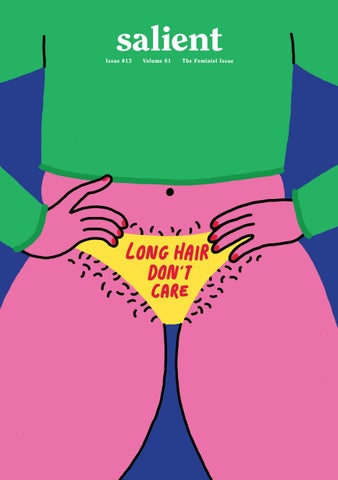
Issue #13
Volume 81
The Feminist Issue
EDITOR'S LETTER 3 NEWS News 4 Politics 8 Opinion 9 *News* 10 Informative Distraction 12 LETTERS & NOTICES 13 FEATURES WTFeminism 15 Set Side by Side, We Intersect 16 It Could Be Better 22 Of Nips and Strip Clubs 26 CENTREFOLD 24 POEM 31 COLUMNS Presidential Address 32 VUWSA 32 Super Science Trends 33 UniQ: The Queer Agenda 34 The “F” Word 34 SWAT 35 PSC: One Ocean 35 REVIEWS Podcast 36 Books 38 Films 39 TV 40 Music 41 Art 42 Theatre 43 Food 44 ENTERTAINMENT Horoscope 45 Distractions 46
Editor's Letter The Feminist Issue not sorry), there is nothing more wholesome to us, personally, than when we see women supporting one another. When we fight back against that stereotype that women can’t work together (like, clearly you have not seen Ocean’s Eight) by doing exactly that. Whether we are standing side by side in protests, or simply giving drunk compliments of unreserved admiration in nightclub bathrooms, we women tend to be wonderful at sticking out for each other. Which is what this week is all about. It’s about celebrating and supporting women, in all of our differences. Because us women have gone through a lot of shit, some of us more than others, and that’s important. Because there are things that aren’t going to change any time soon, and if we want to make a difference, we’ve got to start leaning on each other. We’ve got to start taking on extra weight when we have the lighter load, and sharing the platform when we’ve had our opportunities to speak. We’ve got to share our stories, and listen to those of others. And, if others have stories they are not yet ready to tell, we need to let them know that we are here to listen when they are.
Hi, we’re Kushali and Ruby, and welcome to the Feminist Issue (one of many, hahahaha… ha). More importantly, happy Women’s Week, everybody. And girl, we have a great week ahead of us — we at the Victoria University Feminist Organisation have been working hard to make sure there is no shortage of activities and opportunities to celebrate women this week, whether you are one or not. We’ve got a movie night, a sexual violence discussion panel, tea sessions (serving both the literal and the metaphorical), and more! Writing this editor’s piece, we struggled a lot with how to tackle a topic as multifaceted as feminism, while also drawing attention to Women’s Week. We were wary going in — because our brand of feminism focuses on intersectionality, whereas the very notion of “Women’s Week” suggests an exclusivity that isn’t really us. Sure, we love women, and are using this week to celebrate them, but we also love all of y’all, and think you’re the bee’s knees. Which you should too, just FYI.
Full disclosure: Not everybody is a feminist, and not everybody sees feminism as a good thing. Feminism is a movement, full of a vast variety of opinions and values, some of which directly contradict each other. We think feminism is great, but ultimately, the label doesn’t matter. It’s our choices that define us. We’re not here to segregate or polarize, we’re here to celebrate. This is Women’s Week after all, and that means each and every one of you wonderful ladies, not just the ones that we share our feminist views with.
Not to mention that, although this is indeed Women’s Week, the very concept of “woman” differs from person to person — after all, gender itself is a social construct, and “woman” is just one blip on a vast spectrum. Unfortunately, although we know that, there are a lot institutions in place that have yet to quite come to terms with that, and as a result, even the intangibility of gender does not stop most women from having uniquely shitty experiences on a day-today basis. So, you go, women. Nice work, dealing with that bullshit. You’re doing great, sweetie.
Until we brainwash you, that is. But all in good time. - Kushali Tuinder & Ruby Govan Gaffney
Speaking of women (and in this issue, you’re probably going to find that we do that a lot, sorry 3
The News MONDAY 16 JULY 2018
School of Classics, Art History & Religion is Under Threat TAYLOR GALMICHE Mossis said. VUW’s School of Art History, Classics and Religious Studies Students and alumni have written ardent submissions in (SACR) faces threats of dissolution for the 2019 school year. response to the proposal. Hanahiva Rose, an Honours student, The change proposal is found in a consultation document wrote “As a Māori and Tahitian woman, the potential removal sent out last May. The proposal states that enrolment in the of Peter Brunt, specialist in Pacific Art History, sends a blunt schools has declined over the past four years, while costs have message: Victoria University does not value the taonga of this been steadily increasing. region.” The first round of changes will come into effect on 1 January Cuts in the arts at tertiary institutions have been a motif 2019. It is likely that one long-term senior lecturer and four of 2018. Earlier this year, Auckland University announced it administrators will lose their positions across the whole School would shut down three libraries, including the Elam Fine Arts of Art History, Classics and Religious Studies. Art History itself Library. The university claimed its primary reason for shutting will lose its sole administrator. the libraries was to cut costs. Furthermore, the Programme would temporarily become Kirsty believes that these sort of cuts are the result of a a unit within the School of History, Philosophy, Politics and government whose dedication International Relations (HPPI). to the arts perhaps wasn’t that A representative of Victoria strong. “We’re inheriting the noted that not each Programme legacy of that,” Baker said. has had a decline in enrolment. Similar to the UoA, VUW’s When Salient asked about reasoning for dissolving VUW’s target Equivalent Fullthe school is to cut costs. time Student (EFTS) ratio for The document states: “The the SACR, Vic replied, “these Programme’s current academic guidelines are commercially staff:EFTS ratio falls below the sensitive and not publically University target and significant available”. cost savings are required in Courtney Johnson, director the short-term to provide a of The Dowse Art Museum, is Postgraduate research theses in the Art History library sustainable financial base to dismayed to see Victoria put explore and solidify options for the future.” forward a proposal that appears to be to be entirely motivated The proposal notes that the number of students taking by cost-cutting. Art History in Year 13 appears to have a key influence on “Today’s graduates are emerging into an environment university enrolment. where visual literacy, criticality, and the need to be able to In her submission, Milly Mitchell-Anyon notes “the neglect communicate fluidly over a range of ever-shifting modes and from secondary schooling will not be resolved by further platforms, will be crucial to their ability to survive and thrive in neglect at a tertiary level”. employment and in their engagement with the world around The consultation document makes it clear that if numbers them,” she said in her submission. don’t improve in 2019, “additional reductions in staffing will “Art history can equip them for this world and Victoria’s Art need to be made”. Students and faculty have pointed out this History department, properly invested in, could be a leader in goal would be harder to achieve in a transitional period. doing so.” “We won’t be a part of SACR anymore. We won’t be a Kirsty Baker, an art history doctoral student, created the part of HPPI. The visibility of the discipline will be tenuous and @support.vuw.arthistory protest ‘gram in hopes of raising temporary at a time we needs its strength in order to encourage awareness and motivating action. The ‘gram’s bio reads: students to study with us,” Baker said. “Thank you so much for all of your support, submissions in Though busy with their resistance, students of the Art History response to the change proposal are now closed.” Programme continue to make their mark on the community. “I wanted to do something other than bemoan the fact that In the past two weeks the Programme has collaborated with art history is an undervalued as a discipline,” Baker said. City Gallery on “What is New Zealand Art?” and have also On another hand, Paul Morris, a professor of Religious worked with the Adam Art Gallery, Joy Public Art Gallery, Studies, thinks the proposal will benefit the school of Religious and The Dowse on a symposium on feminist art history, mana Studies. If the proposal passes, the school will become a wāhine, and queer practice, No Common Ground. programme within the School of Social and Cultural Studies “It's really strange to be trying to defend the importance (SACS). of the discipline while you’re actively involved in public “It is vital that Victoria students continue to have the programmes where art history is the core,” said Baker. opportunity to critically and systematically examine why and The outcome document will be published during the week the ways this intersects with our understandings of politics, of July 23. culture, society, gender, politics, environment, and morality,” 4
NEWS
MONDAY 16 JULY 2018
International Student Fights Against Power Tripping Property Manager LOUISE LIN
A fine slip received by the international student
that breached the Tenancy Act. The bond that the student paid had also not been lodged. He is currently working with VUWSA’s Advocacy Services to get his bond lodged and his fines returned, and highly recommends other students in the same situation to do the same, saying “they will help you out.” Marlon Drake, VUWSA president, said “these cases are more common than many people realise,” and that targeting “international students, who have an even lesser understanding and often struggle with confidence in negotiating due to language barriers, is pretty despicable”. Since the student has spoken out, he noticed a dramatic change in his property manager’s behaviour. He has not received any more fines or threatening messages, from him, and has been friendly when they cross paths in the common area. He encourages fellow international students to stand up for themselves, and to understand and exercise their rights. He has no plans to move out of his boarding house. The landlord couldn’t be reached for comment.
An international student has said that his renting situation has improved after speaking to the media about fines in his boarding house. The student, who has asked not to be named, spoke to the Dominion Post after being charged for supposedly not wiping down a bench. When he sent an email to his live-in property manager with photo evidence of the clean bench, the property manager responded by threatening him with eviction. “You come across as argumentative and self-important,” the email said. “THIS IS A WARNING — SETTLE DOWN OR MOVE OUT!” The student, who has been fined 15-20 times, said that he felt bullied and threatened by the property manager’s behaviour. He believes that the boarding house targets vulnerable young international students, who aren’t aware of New Zealand law. Robert Frazer, the property manager, has defended the fine, saying that young people would not clean otherwise. After going to Tenancy Services, the student was told that it’s illegal for fines to be charged as part of a tenancy agreement, and there were several other aspects of his tenancy agreement
Gender Pay Ratios at Universities SALIENT STAFF male: 165 women and 149 men (53% female). This is the only instance within the information obtained where there are more women employed than men in one of a universities’ top three pay bands. AUT has 1207 female, 820 male, and nine gender diverse employees on permanent contracts. The University of Auckland declined comment, stating that “the university does not use pay bands”, which is a bit of a fob off if you ask me. What they did tell us was that 58% of UoA’s 10,981 staff are female. Auckland Uni also has four times as many staff as Victoria. Out of the eight Vice-Chancellors of universities in New Zealand, only two are female: Jan Thomas of Massey and Harlene Hayne of Otago. The gender pay gap continues to exist in the very breeding grounds of progress and democracy. In her research report, Empirical evidence of the gender pay gap in New Zealand, Professor Gail Pacheco suggests these gaps are driven by hardto-measure factors, such as conscious and subconscious bias, or a willingness to negotiate a salary. Movements, such as the government’s promise to ensure that half of all directors on state sector boards and committees are women by 2021, hope to set a new standard for gender equality and representation.
We asked several universities around New Zealand how many men and women are in their three highest pay bands. Here’s what we found. Otago University did the worst of the lot. 59% of their 7,920 employees were female or gender diverse. However, out of their eight most highly paid staff (whose salaries range from $229,249 to $330,063), only one is female. 12.5% — that’s not great. However, the university did point out that their ViceChancellor, who is female, is not included in this data. Victoria University, in comparison, came out with pretty balanced gender pay ratios. We have one male employee in the $550,000 to $559,999 pay band (cough *Grant* cough), one female and one male employee in the $302,000 to $413,000 pay band, and four female and four male employees in the $229,000 to $317,000 pay band. Out of the 2559 people employed by the University, 56% are female. Auckland University of Technology (AUT) has 60% female or gender diverse employees. However, only 25 women are employed in the highest pay band ($134,144 to $173,600), compared to 32 men (44% female). This trend continues in the next pay band ($122,309 to $142,035): 28 women and 43 men (39% female). The third highest pay band ($92,734 to $122,096) sees a higher number of female employees than 5
NEWS
MONDAY 16 JULY 2018
Sexual Harassment Scandal Brings Down a Million-Dollar Student Campaign to End Sexual Violence SINEAD GILL — CRITIC MAGAZINE ACC says that NZUSA has completed a robust investigation and they are “satisfied that the matter has been appropriately handled”. They are planning to continue working with NZUSA across tertiary campuses, though what exactly that will look like hasn’t been determined yet. Around $500,000 of the $1.4M contract was spent before it was suspended. Despite this, many former field reporters said they no longer feel that NZUSA is capable of effectively running the programme. “I have lost trust in NZUSA to make any progress on ending sexual violence,” said Sarah. “It worked out to be a colossal waste of money,” Leigh said. “I had a conversation with one of my then-supervisors who said that they were also disappointed in the lack of organisation and clarity of the roles, the team above the field officers also seemed to me to be confused and without direction.” Hannah said the failure was evidence of “deeper issue of [dishonesty] and mismanagement” within NZUSA and that “this happened because they misuse funding and treat staff like crap.” “They hired us after they got ACC funding, but they didn't have a project in mind or any plans. So we were just there and made to work on other projects while being paid with ACC funding. We finally had a two day training where everything was supposed to become clear, but what was clear was the people who were managing us had no clue what was going either.” Leigh said when she raised concerns to Executive Director Alistair Shaw he was “unprofessional and unwilling to engage with questions or concerns that I had in terms of not knowing what I needed to do or my responsibilities”. Sarah said it felt like “a slap in the face” to hear they plan to restart the nationwide Thursdays in Black program, three months after getting rid of all the field officers who were working on it. “NZUSA has already proved that they are in internal disarray, and achieved nothing in the 5 months of employment of all these people (up to 7 months when you include our notice period pay out). So it worked out to be a colossal waste of money. Universities have lost faith in NZUSA to do anything and the chances of them actually working 'on the ground' is nil.” Jonathan said it was “disappointing” that some of the field officers felt this way. “Allegations against one person, no matter how serious, are not reason enough to lose faith in the huge amount of time, energy, and skill students everywhere are putting in.” he said. ‘We acknowledge that it will take time to recover from the difficult period we have had, however I hope that this does not detract from what we have achieved, including through Thursdays in Black. The fact is, it is by working together that we have made such a big difference.” Without the money, it appears that NZUSA is in no position to put their weight behind the few national campaigns that currently exist. “That’s the most upsetting part right?” Sarah said. “There was this multimillion dollar project to work with all universities and polytechs to work on responses and prevention to sexual violence. Now all of that is lost."
Last year, the New Zealand Union of Students’ Associations was celebrating a $1 .4 million dollar contract with ACC to combat sexual violence. The deal was quietly cancelled due to a sexual harassment scandal within the very organisation meant to fight it. Sinead Gill investigates. Thursdays in Black is an NZUSA campaign that bills itself as “a national student/whānau movement towards a world without rape and sexual violence”. Last year, they released the report “In Our Own Words” which explored over 1,400 tertiary students’ experiences with sexual violence. During the release, NZUSA outlined a three-year plan of sexual violence prevention programmes and campaigns, which would be funded by a $1.4 million dollar ACC contract signed that same month. The massive contract more than doubled NZUSA’s financial capacity and allowed them to hire 13 "field reporters" nationwide to run the campaign. But then the dick pic happened. Some time late in 2017, a high level staff member within NZUSA allegedly sent a dick pic to multiple members within their sexual violence prevention team. In the immediate aftermath, all three members of the sexual violence prevention team resigned. Their resignations were accepted immediately and they were not required to complete their two weeks notice. James Funnell, ACC spokesperson, says that this came to their attention in late December, and that they were referred to the NZUSA president to “investigate and provide feedback”. In late January, ACC and NZUSA agreed to suspend the $1.4 million contract, with ACC citing “allegations of sexual harassment and poor employment practices”. With the funding gone, as February rolled around, the 13 field reporters – all tertiary students – were made redundant. In the redundancy notices, NZUSA President Jonathan Gee said that the ACC contract had been cancelled “due to staff departures”. He did not acknowledge that those departures were in response to internal sexual harassment. Leigh Fletcher, one of the laid off field reporters, said “It horrifies and angers me. I would expect that [an organisation involved with] this sort of project would be much more upfront and openly speak out against that sort of behaviour.” Sarah*, another former field reporter based in Canterbury, says that at no point were they told what was happening to their team. She said the first they heard about the sexual harassment was when Stuff broke the story in May. “It’s pretty horrific to learn that you and 12 other students lost your jobs because someone was sexually harassing staff. Especially when our jobs were focused on preventing sexual violence.” “The worst part is that many of the field officers are survivors [of sexual violence] and had been very keen to be a part of the solution.” Jonathan Gee said he was unable to comment as it was an employment matter, but said the allegations of sexual harassment was “absolutely unacceptable… we take any allegation of sexual harassment extremely seriously”. Is the whole thing fucked? 6
NEWS
MONDAY 16 JULY 2018
Student Loan Cap Extended
S
PATRICK HAYES
tudents with long undergraduate courses have welcomed the increase in student loan allocations from 7 EFTS to 10 EFTS, announced by the Labour government last week. The change comes as students pursue longer degrees, which have up until recently not been covered by government loaned money. Among those affected by this change are students of long-term degrees such as medical, dentistry, and veterinary students. This loan cap extension also helps students completing their postgraduate study. “It’s relieving to know that the years of campaigning have proved fruitful, and that my postgrad peers will now be able to complete their degree without the added burden of financial difficulties,” said Matias Alvarez, an Auckland University student of the Bachelor of Medicine and Surgery (MBChB).“Medical school is demanding enough without the uncertainty of how you will pay for your final years, so it’s in our best interest to allow students to focus on their workload.”
Jibi Kunnethedam, president of the New Zealand Medical Students’ Association, said that the news came as a “huge relief” for medical students. Chayce Glass, of Tumuaki o Te Oranga (President of Māori Medical Students’ Association), says lifting the EFTS cap would benefit Māori, Pacific, and rural students. ““The previous cap was making it extremely difficult for post-graduate tauira Māori to complete their medical degrees”. “This doesn’t just benefit students, but also benefits the health and wellbeing of New Zealand. Allowing our future doctors, vets, and dentists to finish their studies is a no-brainer,” said the National President of NZUSA, Jonathan Gee. Education Minister, Chris Hipkins, says that “it is anticipated that around 100 people in 2019 will potentially benefit from this policy change, rising to around 130 people in 2022.” Some people thought the change was long overdue. “About bloody time lol” said Selena Sun, a medical student at Auckland University.
Editors Part Way With Craccum
Sexual Harrassment in Film Industry Big Surprise There
LOUISE LIN
TAYLOR GALMICHE The Screen Women’s Action Group (SWAG) has released a survey on sexual harassment within the New Zealand screen industry. The results are all-too familiar in the wake of the #MeToo movement. Within the New Zealand screen industry, 32%% of the 474 women anonymously surveyed said that they had been sexually harassed in the workplace within the last ten years. 45% of those admitted that a senior from their company or project was responsible for the harassment. Another 32% of responses claimed to have witnessed sexual harassment in the workplace in the last ten years. 23% of those who experienced or witnessed this sexual harassment “kept quiet”. Patricia Watson, the executive director of Women in Film and Television New Zealand (WIFT NZ), notes that “sexual harassment is endemic in society and no-one knows whether the screen industry is better or worse than others. There are no easy solutions, but education and awareness can help”. “We all need to adopt a Zero Tolerance stand. Say NO to sexual harassment,” said Watson. Lucy Holyoake, of the Emerging Women Filmmakers Network, said “as a young person hoping to work in the industry, witnessing the conversation beginning in NZ around sexual harassment in the screen industry is so important”. This past weekend, WIFT NZ delivered a practical workshop in direct response to the results of the survey. Debbi Tohill, Executive Director of RPE (Rape Prevention Education) presented the two-hour intensive course.
The co-editors of Craccum, Auckland University’s student magazine, have resigned from their positions in early July, citing personal reasons for the resignation. The positions of Craccum editor are appointed via student body election and editors are non voting members of the Auckland University Students’ Association (AUSA). As part of their contracts, Craccum editors are not allowed to criticize their student association, unlike the other student magazines around New Zealand, who have editorial independence. The editors were underpaid for the hours they worked. AUSA president Anna Cusack said that an interim editor will be appointed in the meantime, and the next edition of Craccum will go out as usual. “Many applications” have been received for the interim position. Cusack said that they are “aware that choosing the Craccum editors through an annual election is a unique system and the Board is reviewing the process”. Anis Azizi, the International Students’ Officer, has also resigned, which makes five resignations out of the 18 student association members so far this year. 7
Politics MONDAY 16 JULY 2018
Political Round Up Government Replacing Maritime Surveillance Aircraft The Ministry of Defence has announced that they will be putting aside 2.3 billion dollars to purchase new aircraft. On the 10th July, Defence Minister Ron Mark made the announcement that four Boeing P-8A Poseidon maritime patrol aircraft will be purchased from the United States Department of Defence. These aircraft will replace the aging P-3K2 Orion turboprop aircraft which have a use-by date of 2025, two years before the Boeings take up operational service. Mark stated that the purchase “enables New Zealand to continue to deploy in a wide range of airborne maritime situations independently when required,” said Ron Mark. The roles and responsibilities of the new aircraft include: engaging in maritime surveillance and disaster response, search and rescue deployment covering vast areas of the South Pacific Ocean, and environmental and marine resource monitoring. Phil Twyford Fined for a Phone Call at the Wrong Place at the Wrong Time The Minister of Housing and Urban Development Phil Twyford has been fined $500 by the Civil Aviation Authority (CAA) for making a phone call while an aircraft was taxiing. In a statement, CAA Director Graeme Harris said that the minister had been sent an infringement notice, but reiterated that his actions did not pose a significant security threat to people on board the aircraft. “Mr Twyford stopped using his phone before the aircraft took off so his actions did not pose a significant risk to the flight.” Twyford has unreservedly apologised, saying that he accepts the findings of those investigating the incident, citing the irony that he broke the rule being Transport Minister. The incident came to light after National MP Judith Collins received information from a member of public. Twyford has offered his resignation to the Prime Minister, who rejected the resignation, instead stripping him of his Civil Aviation responsibilities. In 2014, former Transport Minister Gerry Brownlee was fined $2000 by the CAA for bypassing security when boarding a domestic flight.
The Opportunities Party is No More Tycoon Gareth Morgan’s The Opportunities Party (TOP) will not seek seats in the 2020 general election. The tycoon announced on 8 July that his party will lapse its registration with the electoral commission and not seek reelection for an indefinite period. The Party was formed in 2016 to contest the 2017 election. Gareth Morgan acknowledged that he was proud of the policy manifesto created by the party. TOP had numerous areas of focus in its policy manifesto; these included a heavy focus on universal tax reform on wages and for more tax to be paid on owners of assets. When it came to the election day, it was shown that it had struggled to engage with the New Zealand public, with 2.4% votes won on election day. Logie’s portfolio as the Parliamentary Under-Secretary on Domestic and Sexual Violence Issues holds the first dedicated role to sexual violence reparation in NZ Parliament’s history. - Thomas Campbell
The Party Line
Every day, women testify to sexual harassment and assault in the workplace. What political action is needed to break up this pervasive culture? VICNATS The Young Nats are thankful that due to the changing workplace culture and the success of international campaigns, an increasing amount of women are reporting workplace sexual abuse. Despite this there is still a large amount of ground to cover before any form of sexual abuse can be a distant memory. The previous National Government continually worked at this issue including in Budget 2017 where we allocated more than $45 million to create a 24/7 sexual assault helpline and to provide additional crisis support. However more work has to be done and with the current Government’s record of defining a sexual assault as a “non-violent assault” after a prison guard was attacked in her workplace, the Young Nats have no faith that this will happen. - Grahame Wood
ACT ON CAMPUS There is only so much that legislation can achieve when it comes to sexual harassment and assault in the workplace. I dispute
8
the idea that one political action will stop all cases of workplace harassment. Employees are protected under employment law and harassment and assault should not be tolerated. Women and men who fall victim to workplace harassment/ assault need to feel confident that they will be listened to when reporting the incident. While there have been too many high profile reports of sexual harassment and assault (Russell McVeagh), I am not convinced that this qualifies as a “culture”. Majority of employees and employers are good individuals with very few spoiling an otherwise healthy workforce. We just need to ensure that everyone understands that workplace harassment/assault will not be tolerated and that it’s important to report it. - James Allan
VICLABOUR There is so much political action that needs to be done, Labour and the Greens have long stood up for those affected by sexual assault.This Govt is starting by looking at an integrated and responsive family and sexual violence system, more accessible support people in workplace and education institutions, training for bar staff and other workplaces as well as financially supporting other amazing NGOs that do so much in this area already. For the first time we also have a person in the Executive focused on family and sexual violence, Jan Logie. (We also need less National PMs that think it's okay harass young women in cafes.) Locally, Vic Labour has committed to reducing sexual assault and sexual violence in our city – our Chair and many other members work with Wellington Rape Crisis, SAPN, and the #Don'tGuessTheYes campaign. You’ll see us regularly volunteering for these organizations with other grassroots movements, and pushing for progressive action to be taken at higher levels. - Teri O’Neill
Opinion MONDAY 16 JULY 2018
This Time Around, Alcohol Isn't to Blame MELISSA HARWARD & HELEN O’CONNOR
D
reading this, may be thinking “I can stand up for myself,” I hope you are never in a situation where you have to find out.
ame Margaret Bazley famously transformed the NZ Police from a cover-up organisation to one with a speak up culture. She came out again with swinging fists in her recent Russell McVeagh investigation. The report has a number of sad findings and some positive recommendations. If adopted by all law firms, the infamously toxic culture in New Zealand’s legal profession would be vastly improved.
The alleged harassment and assault of these young women happened at Christmas parties. There was alcohol provided (we don’t know if the host responsibility rules were adhered to, as Dame Margaret made no findings). These women knew what their bosses had done to them was wrong and went to a trusted person on their team to deal with it. Unfortunately, that person was not supported and the complaints didn’t receive the attention they deserved. Questioning the sobriety of those involved is to undermine their experience, rather than address the culprit and his actions. Drunkenness does not excuse sexual assault. Drunkenness does not mean you’re “up for it”.
However, in several instances, the report connects inappropriate behaviour with alcohol consumption. This is bullshit. People drink alcohol all the time, and they manage to control themselves. The recommendation by Dame Margaret that the firm maintain tight control over the availability of alcohol isn’t so distant from the ideas that fuel victim-blaming. An employer should be concerned with alcohol consumption at work premises for health and safety reasons. There are laws that require responsible host policies and adequate food provisions while serving alcohol. We do not believe that Dame Margaret, while investigating the firm, became suddenly sidetracked by host responsibility rules.
Drunkenness does not excuse sexual assault. Drunkenness does not mean you’re “up for it”.
Despite the positive recommendations in the report and the resources that can be used in the future, our reading was somewhat tainted by the attribution of alcohol consumption to totally unacceptable behaviour. We think that the investigation put too much weight on factors in the firm’s culture, which could justify the behaviour of the senior lawyers at the centre of this. We eagerly await the findings of Dame Silvia Cartwright into the New Zealand Law Society’s failings on this issue. Ultimately for a culture to change it requires effort from everyone. Not just in policies, but in attitudes.
The real issue, which is addressed in the report, is the inherent power imbalance. A young person entering a place they want to eventually work wants to make a good impression on their colleagues. They strive to impress the senior staff who make the hiring decisions. People in power can very easily take advantage of the willingness of young people. Saying no doesn’t always seem like the right thing to do. While you,
- Melissa Harward and Helen O’Connor are the presidents of the Feminist Law Society and welcome new members. 9
News
*
*
TELLING IT LIKE IT ISN'T
A Whale of a Scheme SHANTI MATHIAS Details have emerged of the publicity deal signed between “the Wellington Whale” and the Wellington City Council. In preparation for backlash against various changes, including shifting the main fireworks display to align with Matariki and reworking the public transport system, the whale was seen as an option for “good publicity” for the city council, said spokesperson Krystal Beach. “We are delighted that we came to an agreement to brighten Wellington in the depths of winter,” she said. In return for its presence in the harbour for a minimum of seven days, the whale was compensated with ten metric tonnes of assorted zooplankton, and two tonnes of krill. The agreement, which was signed on June 21, also included a clause left open for possible future collaboration, such as a biannual visit. The whale had to tour a range of locations on the Wellington waterfront from the ferry terminal to Evans Bay, and be visible to the public for at least 90 minutes a day. Other than these stipulations, its time was its own.
“Everyone is proud of the diversity of Wellington, it is one of our city’s strengths,” said Mayor Justin Lester. “I hope this is just the beginning of more collaborations with rare wildlife. This is just one of the things that make this place absolutely, positively Wellington.” Commenting on its time in the city, the whale said “I don’t get my ego stroked enough while roaming the Southern Ocean, attempting to stay in water cool enough for my survival, and finding enough sustenance. This week was a delightful break from my normal existence; now I can return to worrying about threats to my existence instead of the glossiness of my tail”. Not everyone was charmed by the whale. “It was such a diva, very fussy about the species of zooplankton. Pteropods weren’t good enough for it; no, it had to be copepods. Not worth it. Personally, I’m looking forward to celebrating the end of the contract with some nice fireworks,” said a low level council worker.
RIP Ilott Cafe
O
KII SMALL
hit to feed their benevolent souls for $4.90. Some students n July 5th 2018, the beloved deep-fried palace that and beloved alumni refuse to search for an alternative option we know as Ilott Cafe closed their doors for the last on campus and have begun a petition time, to the screams and tears of for the movement, ‘#reviveRevive’. The many students. The cafe, formerly known petition has near 2000 supporters and as Revive, Hangover Heaven, and “Fuck is growing in size, along with the BMI of Yes Cafe” was the hub for all students The Ilott Cafe is its supporters. with a craving for fried chicken, chips, currently closed while Devon Sanson, stating that he refuses and luke-warm Asian food. we refresh this space. to purchase a “$50 noodle salad from There has been wide speculation When we have selected The Lab”, has signed the petition out of around the closure of Ilott; including a new food operator we sheer passion for Revive. Darcy Ash, a rumours of lease expiration, health 45-year-old nurse from Taranaki was warnings, and an unacceptable amount will communicate this to stunned as petition for her cat’s heart of undergraduate happiness. Local students and staff. surgery was stuck at 150 signatures. student, Marcus McNab responded with We apologise for “At least the kids are fighting for what “No, are you serious bro?” which was any inconvenience. they love. I can only hope they’ll sign to subsequently followed by several hours save Mr. Ming as well.” of hysterical screaming and crying. We can only assume that those who “Where else am I supposed to get deepwill not miss the Ilott Cafe are buried fried goodness and a Fanta? Vic Books somewhere in their vegetarian noodle salad and sugar won’t sell anything without a vegetable, let alone an inch of free vegan honey latte in ultimate bliss. Buried next to salt,” he added. Concerns grow as students search for their next fast-food Mr. Ming. 10
NEWS
Auto-Play Support Group Created SHANTI MATHIAS With the new trimester beginning, lecturers at VUW have begun a support group to deal with one of their chief sources of psychological trauma: the revelations derived from YouTube autoplay. Leanne Shaw, psychology lecturer and founding member of the group, said “many a lecturer has suffered a revelation of their personal interests through neglecting to switch off the autoplay button. Unfortunately, I am one of them. I thought a collective space to process these traumas and offer solace to the suffering”. She said that it was beyond her responsibility to talk about the individual events, but a quick survey of students who showed up to class uncovered the rumours that Shaw had played a CareBears compilation video. The video was set to “Rainbow Connection” because of course — it started playing after she showed a video in her child psychology course. More worrying was the “How to Defuse a Bomb” video that autoplayed during an architecture lecture, as well as a “what is the purpose of law” video during a 400 level law course. “It’s a far reaching issue,” said Shaw. “The circle of a new video loading while a lecturer doesn’t notice is terrifying for all involved.” She did not say whether the support group would include a demonstration of how to disable autoplay on YouTube.
MONDAY 16 JULY 2018
Scarlett Johansson's Not-So-Honourable Legacy TAYLOR GALMICHE Avalon Studios in Auckland is producing a live-action adaptation of Mulan. Scarlett Johansson's request to play “every single goddam character” in the one hour forty-minute musical has yet to be confirmed by Avalon Studios. The studio has confirmed that Johannsson will play the lead role of strong-as-a-great-typhoon, mysterious-as-the-dark-sideof-the-moon Mulan. Johannsson expressed hesitations about accepting this role. “Sometimes I feel like directors use me to fill a sexy-girl quota,” Johannsson admitted with raspy disdain. One Chinese actress agrees that Johannsson is filling the sexy girl quota but feels there are other quotas to be considered. “Sure, sure, she’s hot. Her croaky voice is hot. But how many more times can they expect us to stand by and watch white counterparts snatch away minority roles?” “It's Ghost in the Shell all over again. Before we know it she’ll be playing the role of a trans man. Where’s the line?”
Updates on Kylie Jenner's Baby This month all of the fucks not given to Kylie Jenner's baby were given to baby Neve. Salient still gives absolutely no fucks about Kylie Jenner's baby.
YHA 101
Join at yha.co.nz, use the code VUWSA18, SAVE $10
5 Reasons why staying at YHA is your BEST option 1. It’s cheap - beds from $29 2. Clean, comfortable, quality facilities (and free wifi*) 3. Private ensuite for shy types, shared dorms for more social travellers. 4. Central locations, you can walk to the pub! 5. $10 off membership, then keep saving 10% on direct bookings at YHA.co.nz *2GB of Free WiFi per day at all YHA Managed hostels
www.yha.co.nz
Week in Tweets A WHALE OF A TIME(LINE) “who called it ‘a whale in Wellington Harbour’ and not “What We Do In The Shallows”?” - @fauxparse, 7/7/18 “People will change their mind about the Wellington whale after they discover it was what ate Happy Feet.” - @spat106, 6/7/18 “you might think this whale news is great now but just wait three weeks and someone will unearth proof that the whale used to be racist on twitter.” - @em_ma_maguire, 6/7/18 “Imagine if AirNZ were serving whale burgers in business class” - @dairymanNZ, 5/7/18 “In Wellington at last. The drive was long and hard. But I know it will be worth it when I complete my mission: killing the whale.” - @HaydenDonnell, 6/7/18 ILLUSTRIOUS EPHEMERA On the Wellington whale - “i’m pleased to announce the wellington whale will be curating the dominion post quiz tomorrow.” - @MorganGodfrey, 5/7/18
On Air New Zealand’s new vegan burger option offered on certain international flights (and the palaver that ensued afterwards) - “You, dumb: Air NZ should offer vegetarian options. Me, a high cleric of the punditocracy: no! Meat only! Our ecologically irresponsible way of life must be promoted on metal skybirds powered by dinosaur blood!” - @ kilbrniesanders, 4/7/18 On Scarlett Johansson taking on an acting role as a (real) trans man in a biopic - “I do not think Scarlett Johansson is an evil person or has ill-intent, but I do feel that if she doesn’t start hiring some career consultants moving forward we are 100% going to see her play Nelson Mandela in a biopic.” - @ Party_Harderson, 5/7/18 On the Fourth of July - “We can't afford fireworks this year but Chad's gonna light the alley couch on fire around 9:30 tomorrow night if you want to see a couch on fire.” - @ loneblockbuster, 4/8/18 On the Baby Trump blimp scheduled to fly over London during the President’s upcoming visit - “What are the odds Trump tells the pilot on Air Force One to do a "Top Gun" Fly-by and sever the tethers on the Baby Trump Blimp as they come into London?” - @DennisDMZ, 7/7/18
Quiz
World Facts
1. After the Court of Appeal upheld the decisions of other courts in an ongoing legal dispute, who has been ruled eligible for extradition to the United States?
1. One of the largest pyramids in the world is an outdoor and fishing gear megastore in Memphis, Tennessee.
3. After entering on 23rd June, how many people were rescued after being trapped in a cave in Thailand, by flooding? a) 9 b) 11 c) 13 d) 15 4. The English football team did what against Colombia for the first time in their history, despite participating in every FIFA World Cup since 1950?
3. The first university, the University of Al Quaraouiyine in Morocco, was established in 859 AD. 4. With over 3,700 aircraft, the US Navy is the world’s second-largest air force, after the actual US Air Force. 5. Margaret Ann Neve was the first female supercentenarian at 110 years old, living within the 18th, 19th, and 20th centuries.
5. What is the name of Wellington's newest whale?
6. Out of 500 McDonald's restaurants, only 2 in America continue to serve McPizza.
World Facts by Courtney Powell, Week in Tweets by Emma Maguire & Quiz by Alister Hughes
7. Gravesites in Germany are leased out for a number of years and once the lease is up, the headstone and body
8. The suburb of Houten in the Netherlands is built for cyclists and pedestrians, with no actual roads inside the town. 9. Since 1978, it has been required by law in Switzerland for any residential buildings to have a nuclear fallout shelter. 10. The Philippines and the Vatican City are the only countries in the world where divorce is illegal.
Quiz Answers 1. Kim Dotcom 2. Serving a ‘meat-substitute’ vegetarian burger instead of a regular beef burger. 3. 13 4. Won a penalty shoot out 5. Tyler Matariki the Wellington Whale
2. Air New Zealand have come under fire from politicians, the public, and primary industries like Beef and Lamb NZ after doing what on their flight from Los Angeles to Auckland?
2. The creator of the Pringles can died in 2008 and had his ashes buried in a Pringles can.
are removed and a new body can be buried there.
Letters
Dear Editor, Speaking of opinion, I should say that this word means SO much to me. In fact, this word means a lot to ALL women (especially women of my country) who fight for their opinions to be heard and to be acknowledged. I do not want to go deep into this topic because there are many suppressed emotions that bringing them to the surface is just painful. Best, Anonymous Dear Salient, I'm just letting you know that I took an offence at the spicy as fuck hot take on Rupi Kaur being too generous, and I shouted my complaint into the void as advised. Yours faithfuly, Still Offended
Notices Join the Victoria University Students’ Association and the Victoria Feminist Law Society for a drink this Thursday at the Reclaim the Night Pub Crawl. July 19 6:30pm, meet at the Hunter Lounge. For more details look for the event on Facebook.
Send your letters to editor@salient.org.nz Dear Salient, Your Eye on Exec is a VUWSA must watch, but you're a oneeyed old mag till I see a Vic Watch. Revive closure news is now dead on arrival. Grieving its departure a stark reminder that we students had no knowledge, say or sway over what eateries at Vic get to stay. Keep an eye on Vic and we'll read not grieve. Missing eyes too easily permit a cost cutting, cafe busting, dare devil Vic. Yours with a blind fury, NB
Send your notices to editor@salient.org.nz
WHAT IS YOUR PASSION? Is it languages, cultures and literature, the creative arts, cultural anthropology, history in practice or international relations and political science? Find out where your passion can take you at Victoria’s Faculty of Humanities and Social Sciences Postgraduate Information Evening. When:
5pm, Wednesday 25 July
Where: Maclaurin Lecture Theatre 103 (expo to be held in the Te Toki a Rata foyer) RSVP:
Email fhss-enquiries@vuw.ac.nz with ‘Postgraduate’ in the subject line by Monday 23 July
victoria.ac.nz/fhss-postgrad-evening
14
WTFeminism What’s the point? Who’s it for? Who can be a feminist? Wikipedia says: “Feminism is a range of political movements, ideologies, and social movements that share a common goal: to define, establish, and achieve political, economic, personal, and social equality of sexes.”
Eco-Feminism: Feminism about the environment, focused on a understanding of ecology — who knew that was a thing?! Cool!
There are at least 7 sub categories of the feminist ideology:
When asked if he was a feminist by NewsHub in August 2018, Acting PM Winston Peters said he “didn’t know”.
Now, what are our members of Parliament saying?
Liberal Feminism: Has a strong focus on legal and political rights for women, with the intention of making them equal to those of men.
Former acting PM Bill English said “I wouldn't describe myself as a feminist. I don't quite know what that means”.
Intersectional Feminism: Kinda the same as liberal feminism, but broadens the need for legal, political, social, cultural etc, rights for everyone, regardless of gender, class, race, sexuality etc.
Naturally, PM Jacinda Ardern said “Yes, I am a feminist. And I know what one is”. Paula Bennett has said she’s a feminist “most days”, but sometimes when she’s busy she doesn’t think about being a feminist.
Radical Feminism: The definition varies but usually there’s a lot of irl political action. Focus a lot on gender relations. Radical feminists get a bad reputation, due to groups like “trans exclusionary radical feminists” and occasionally being anti-sex work, imo there’s a mass difference between trying to squash male supremacy and trying to exclude other minority groups from a movement about equality.
Feminism is an ideology, but it’s also about action. The ideology stems from beliefs of wanting to break down and undo the harm of oppressive social and institutional systems like racism, sexism, classism, and transphobia etc. But belief is one thing, and action another. Action is all about the actual undoing of this harm: working with feminist organizations, speaking with your peers about privilege, working on self education and campaigning.
Western Feminism: Eurocentric. “White female” focused feminism. Often lacks considerations of real life experiences by women of colour, gender minorities, and other oppressed groups.
Let’s be real, we already know the basics of feminism. We just need to start putting them in place. Feminism is a chance to be better, make the world better. Sounds like a good idea to me.
Marxist and Socialist Feminism: Feminism with a bit of conceptual Karl on the side. Okay, so I didn’t read the chapters on Marx in first year sociology, but Dr. Google says “Marxist feminism is feminism focused on investigating and explaining the ways in which women are oppressed through systems of capitalism and private property.”
By Kate Aschoff 15
Set side by side, we intersect Photography by Anna Higgins
‘Set side by side, we intersect’ explores intersectional narratives of gender as a means of dismantling patriarchal ideals of femininity.
Right: Crotch
We are forever bombarded with imagery that bares no relation to the reality of women’s lives. Faced with an inaccurate depiction of what it is to be feminine, unattainable ideals are prescribed through the same homogenised lens. This series enables alternative narratives to emerge, repositioning the gaze.
Left: Period undies Top-right: Amys breast Bottom-right: Hair
18
Left: Perfume bottle Right: Nude
20
21
setting up NGOs, and running for office. They could not own land, simply because they were women. We also offered fellowships to Egypt, where according to the USAID survey 2015, 75% of married men thought that women should undergo female genital mutilation. Nepal was another country that we worked with, where 1 in 10 girls are married before they are 15, and though this is illegal, police action is rare. In comparison, the women of New Zealand are lucky. Here we live in a country where we can own land, where child marriage is punished, and where female genital mutilation is illegal. We’ve got it pretty good here in New Zealand really, I mean that’s case in point right there that “it could be worse”.
It could be worse, right? Women in NZ can vote, we’re not married off at 12, and genital mutilation isn’t a rite of passage. So what the hell are feminists in NZ complaining about?
Tara Ó Súilleabháin investigates. My journey advocating for women’s rights started only a couple of years ago while volunteering for JERA International, a human rights organisation in Melbourne. I spent three months with a team of about 10 as the events coordinator for an Australian Awards fellowship, providing training to 15 female Sri Lankan fellows. I was in charge of arranging all meals, accommodation and transport, assisting other volunteers with booking meetings, as well as attending all of the training myself, so I was with the women every day and spent a lot of time talking to them about human rights in Sri Lanka.
I’ll admit it wasn’t, and still sometimes isn’t, an easy transition from working with women who lack what Kiwis would consider such basic rights, to begin questioning gendered language, the period tax, and the wage gap in New Zealand. One of the first things I did when I joined the feminist organization was ask my co-president Hannah to recommend some books that would help me understand the types of women’s rights issues that we face in western countries like New Zealand. Those books, along with taking HIST112 Islands and Peoples: Aotearoa New Zealand in World History (which I highly recommend), taught
Equality for women in Sri Lanka is a completely different ball game to equality for women in New Zealand. Sri Lankan women lack the right to land ownership independant of a husband or other male relative. It didn’t matter that some of the fellows had doctorate degrees, were lecturing at universities, 22
me that women’s rights advocacy has never been well received. I’m sure almost all Kiwis today would agree that women should have the right to vote, but while we celebrate the suffragettes in 2018, they were not popular in the 1890s, and for any women reading this you may be surprised to know that it wasn’t just men who struggled with the idea of women getting the vote. The only reason we shake our heads at women not being allowed to vote in Saudi Arabia until 2015, is because we’ve been doing it since 1893. The suffragettes could have sat back and said “it could be worse”, but instead they stepped forward and said “it could be better”.
month. Why would that product be taxed as a luxury item? Does that really make sense to us? Here’s a radical idea. Maybe most of us don’t question the period tax because we’ve been socially conditioned to think that it’s normal. From the moment we’re born, we are being socially conditioned by everything around us, from our families and upbringing, to the media and the government. Once we are able to recognise the personal experiences that make up our own social conditioning, we can begin to question and critically analyse our opinions, morals, and values. Don’t be put off by the idea that you might be wrong, no one is exempt from social conditioning. Focus on the self-awareness and knowledge that you’ll gain.
Kiwis on the whole are sympathetic to women’s land rights in Sri Lanka, but the reaction I receive when I bring up the period tax in NZ is far less supportive. What if NZ society’s response to the period tax isn’t actually all that different to Sri Lanka’s response to the idea of women owning property? What if the difference isn’t in the issues, but in what our society perceives to be important, equal, and right? Do we believe that it’s fair for feminine hygiene products to be taxed as a luxury item? Think about this issue on its own, don’t compare it to anything else. Imagine that 50% of the population requires a product to absorb blood that freely flows from them for 5 days once a
We got here by asking “why can’t women own property” and “why can’t women vote” over a hundred years ago. I hope that when you shake your head at women’s land rights in Sri Lanka that you start to recognise that women’s rights activists in both countries are fighting the same sorts of battles. Get angry for Sri Lankan women, know that they are suffering a huge injustice. Acknowledge that it could be worse in New Zealand, but understand that it’s always important to fight for what could be better. 23
of nips and strip clubs
Of Nips and Strip Clubs When I first met Lucie, she was making plaster castings of people's nipples. She used the stuff that dentists use to mould people's teeth, because it held its shape the best. She told me it was for her art. The castings came out white, and very delicate at the edges. You could see every little crevice of skin, the lumps and bumps that made each nipple unique. She had no nipples of her own.
Hence, stripping. It was fun. I enjoyed the dancing and the heels and the pretty outfits. I felt more empowered to express my sexuality, in this world where I was expected to desire and be desired. The compliments were very flattering. The UV lights you up something special. Jessica, the head girl, was short, and pimply, and her hair was dry from too much bleach. But under those lights, she was a goddess.
She had been a stripper for four years, and after her cancer, she went back to it. "Everyone would be staring at my boobs," she said. "They couldn't figure it out.... I just loved to see the confusion. And some of them would get it, if they've had friends or family who have had cancer, and would be like really shocked to see a survivor. But they would hand over their money straight away. 'Here you deserve this take it', they would say. 'Thank you! I will!’"
But the job was problematic, and contradictory. The work is an ego boost, right? People compliment you. They say you're hot. You feel good. They give you money because of how hot you are. You feel even better. What then, the next day? The next day when someone says you're ugly, when you get no tips, when no-one's buying them lappies?
I was interested in a stripper with a double mastectomy, because it seemed to subvert the sexual objectification that takes place in the strip club. Lucie with her "funny boobs" challenges our model of female sexuality, by positioning the cancer survivor as a sexual being. Her boobs remind the audience that she has a history, and is no mere object.
You feel... You can't take the compliments and ignore the insults, it doesn’t work like that. When feeling good, and getting paid, is dependent on someone else's opinion of your looks, that makes you doubly vulnerable.
Her boobs remind the audience that she has a history, and is no mere object.
It sounded feminist, and delightfully groundbreaking. She, a cancer survivor, could show the world she is still sexually desirable. Stripping was a way to own her sexuality, to gain confidence in her body, and for her to be clear about her boundaries and practice asserting them fully.
Lucie mentioned that a lot of strippers have mental health issues. She was saying it in a positive context, as in, the work can be very good for people with mental health issues, because it gives them rapid income and time to relax and recover. At the place I worked, Jessica reckoned that around 60% of the girls had anxiety.
She loves stripping. She encouraged me to get into it. You become more confident, she said. The hours are flexible. It is a really good way to pay your bills through uni. A lot of the girls are uni students.
It’s impossible to make presumptions about which came first, the mental health or the work. But, every time I’ve worked a job where my income is uncertain, I’ve felt anxious. When I was selling subscriptions for a charity on commission and my daily pay depended on how many sign-ups I got, I felt stressed and pressured. With stripping, what you’re selling is yourself. If not your body, then your charm and desirability. So the anxiety of making a sale combines with the anxiety of self-image. Sticky.
Here I hesitated. I've stripped a little, back in the day. Age 20, fresh into my Anthropology degree, I was reading a lot of feminist pro-sex work literature. I felt very proud that I could see past common social perceptions. I could see that the stigma of sex work was arbitrarily held, and part of a set of cultural values and ideals which I did not need to subscribe to. Not needing to subscribe to these values, I could then break taboo, become the vanguard of creating the new normal. Besides, existing within a world where the female sexual body is highly prized, might as well use that to my advantage right?
“You're often alone in a room with a guy,” Lucie said to me. “A lot of girls when they're new are like ‘what if they try to do something with me’. Well — they're gonna try and push the boundaries. A lot of 27
Of Nips and Strip Clubs the new strippers get harassed a little bit by nasty clients because they'll come in seeking the new girls because they know they haven't quite established those boundaries yet. The key is having really strong boundaries, and saying ‘you're not allowed to do that. You do that again and I'll break your fucking finger. Don't think I won't’. Usually I say that while holding their finger quite tightly and bending it slightly."
$26 and I had the second-highest earnings that night), that I couldn’t play the music I wanted, and watching a different girl each week lie down on the floor of the change room crying, and worrying that someday that would be me next. Don’t get me wrong, I’m very happy that sex work is legal. I think the 2003 Prostitution Reform Act, which decriminalized sex work in New Zealand, was one of the best things that happened to us. If our freedom to make choices about our life and our bodies were taken away, we would suffer. And I might even go back. It’s a fascinating world with interesting people, and every job has its ups and downs right? We live in an imperfect world, and we can choose which imperfections we’d rather bear. But it just sucks that we live in a society where we reward wealth with “hot girls” and “hot girls” with wealth.
She laughs. It made sex sound like war. I wished for a world where we don’t need to threaten violence to have our boundaries respected. You’re getting around $50 for a 10 minute dance, because you’re a girl and look good and feel good and that’s worth something. Men are sitting there, mesmerized by your body. But you are dependent on men for income. The clients, and the club. The club makes the rules, the fines, the shifts. You get fined. For showing up late, for missing a stage slot, taking too long a break, for causing trouble. You can come out of a night in debt.
Lucie had tried to set up a stripping tour of New Zealand, to raise money for breast cancer. However, no one was on board. The brothel owner told her it was a “stupid idea” and no money could be made for it. When she went to charities, she was told it was too risqué. I guess it’s too early for the world to accept a combination of philanthropy and sex work. Which is a shame, because the tour would have done – well, something – to remove the association between stripping and immorality.
It made sex sound like war.
Lucie told me that some of the new girls felt disgusted at letting strange men touch them. “What they've been finding disgusting”, she said, “was that sometimes their bodies were kind of reacting, enjoying the experience.” I never found the touch disgusting. At times, it could be quite comforting. But I feel shy and embarrassed writing that I’m okay with letting a stranger touch my boobs — it’s not something I’m supposed to be okay with. It’s interesting that arousal from the hands of a stranger is sought after and celebrated by men, and something that women can barely admit to themselves. Social conditioning, right?
As we were wrapping up, I asked to feel Lucie’s boobs. She said yes. I give one a tentative prod and she grabs my hands and puts them right in there. They were kind of bouncy, like balloons. “Yeah, like a kid's toy,” she said. “They're foobs, fake boobs. People are like 'you have beautiful breasts’. I can go completely braless and still have perfect shape, never have nips showing.” She told me the boob implants glowed in the dark.
Lucie quit stripping eventually, because the hours were too long. 10-12 hours in stiletto heels. “Not conducive to efficient staff,” she said. “The girls were constantly exhausted.” She suggested split shifts to senior management. It’s up to them if they take it on board. I quit after being told that I had to work Thursdays (no-one comes in on Thursdays, one Thursday I made
I loved that Lucie was so positive, that she could transform her illness into something good. Perfect breasts are still a good thing. *All names used are pseudonyms
By River Salter 28
Adam Art Gallery Te Pātaka Toi – your gallery on Kelburn campus
The earth looks upon us Ko Papatūānuku te matua o te tangata Ngahuia Harrison, Ana Iti, Nova Paul, Raukura Turei 7.7.18– 23.9.18
FREE ENTRY Tuesday–Sunday, 11am–5pm The gallery is located beside the Student Union building on Kelburn campus adamartgallery.org.nz
Ngahuia Harrison, Said with salt in her eye, 2011, digital print, 630 x 790mm courtesy of the artist
ENGR 111: INTRODUCTION TO
SYSTEMS Learn about the role of energy systems in sustainability, the development trends of different technologies, and the various ways those technologies influence industry, government and society. You’ll also gain practical skills in energy generation and utilisation, and in modelling renewable energy systems for different contexts.Â
ENROL NOW FOR TRIMESTER 2
victoria.ac.nz/ENGR111
The ‘Elusive’ Female Orgasm Every guy tells me 'I'll get you there' but then leaves as I'm on the edge. - Emilie Hope
submit poems to poetry@salient.org.nz
Columns
PRESIDENTIAL ADDRESS
VUWSA
RHIANNA MORAR (GUEST)
ELLA HUGHES
Mana wahine isn’t a title, a reward or a gift. It is a concept. A state of being. You look up to those mana wāhine with great pride. Your mum is mana wahine. But what happens when she isn’t? Growing up without a mum, or a woman you see as mana wahine is difficult. It’s hard.
It’s finally women’s week — our designated time to acknowledge the value of women in our community. While we still have a way to go till we can walk home at night without keys jammed between our knuckles, it is important to celebrate how far we have come. We should celebrate the women that fought and died for our vote; that argued for equal access to education, and those that made the most of it. Celebrate women who stepped up and claimed their identities and made Pride happen; who forgot about fear and named their abusers.
Other people can be mana wahine too. Your secondary school teacher, your lecturer, your mates, or even your mates mum. Sometimes you might feel alone. Take some time to think about all the mana wāhine in your life and how lucky the world is to have them.
But on weeks as rare as this one, we should also celebrate women closer to home, whose achievements won’t be in history books, but whose contributions are just as significant — because they carry household burdens and their backs don’t break.
It’s hard to see yourself as mana wahine, especially if you don’t know what it looks like. Write a list. I know you’ve crushed some goals out there. Even if it’s composting your veg scraps (S/O to my flat mates) or saving your mate from unwanted attention in town (legit all of my friends EVER). Here are some things I’ve done that have made me feel mana wahine: • • • • •
I celebrate my mum during women’s week, and maybe you should too — or your nan, your aunt, your sister, your teacher, whoever got you here and made you keep going.
The first in my whānau to attend university Got out of a toxic relationship Punched a guy in the club (x2) Got into law school Marched against sexual violence
Times get tough and my mum gets tougher, and I couldn’t be more grateful that she did it with generosity and empathy. When we first emigrated here, my dad got into a car accident, which took him pretty well out of action for 6 years. My mum, a teacher aid, stepped up to the plate — primary caregiver (to three kids and a grown man) and primary earner. When she realised her and her colleagues weren’t being paid their worth she made it a union battle, and you know what, she bloody won it too. She went to University here and became the first in her family to graduate. She always pushes for me and my sisters to be sure of our voices and our value. Her impact on my character is more impactful than any historical freedom fighter, and all the women who raised us deserve that acknowledgement. Our lives would be terrible and different without the vote — but we wouldn’t be individuals built up and supported to use our freedoms without those women.
We have some strong wāhine at VUWSA. All of whom channel mana wahine in their own way and I guarantee you do too.
32
From Her Heart and From Her Hands
Mileva Marić (1875-1948) E might equal mc2, but in the interest of real equality we should acknowledge Albert Einstein’s first wife Mileva Marić, who shared classes with him at the Polytechnic Institute of Zurich. She was the second woman ever to complete a physics degree there, scoring a grade point average near equal to Einstein (4.7 to his 4.6). Marić and Einstein married in 1903 and worked on applied and theoretical physics together, leaving historians to debate how much she contributed to Einstein’s work. Einstein would write that he loved working with Marić, who would keep him focused and prevent him “meandering”. After their divorce in 1919, he made a point to give her a portion of his Nobel Prize money. Regardless of where the exact credit lies, I highlight Marić and Einstein’s relationship because it shows that science is a labour of collaboration, not always the work of a single great man, working alone and waiting for inspiration.
For this issue, I’m addressing the most unfortunate science trend of them all: the erasure of women’s contributions. So to help rectify this, here are a few of my favourite lesser known ladies of science. Maria Sybilla Merian (1647-1717) Considered by David Attenborough to be one of the leading contributors to entomology (the study of insects), Maria Sybilla Merian was a German-born painter and naturalist who, in 1699, became the first person to self-fund their own scientific expedition. Travelling to Suriname in South America, Merian observed and painted the native insects and plants, making a point to learn their names in the indigenous languages. She published her detailed observations and gorgeous colour paintings in a two-volume book, Metamorphosis insectorum Surinamensium, which was heavily referenced by the father of taxonomy, Carl Linnaeus.
Lynn Conway (b. 1938) Conway’s contributions to the development of microchip technology and increasing miniaturization of transistors have only having recently been acknowledged, due to having undergone a gender transition halfway through her career. Recruited by IBM in 1964, Conway helped to develop their supercomputers but was fired when IBM bosses wouldn’t employ her while transitioning. After her transition, she re-entered the workforce in “stealth mode”, using her IBM experience to become a computer architect for Memorex in 1973, then went on to coauthor a definitive textbook on very-largescale integration (VSLI) systems in 1979, which helped burgeoning electrical engineers make huge leaps in transistor miniaturization, enabling greater computer processing power from smaller microchips. Today, Conway (80) is happily married, and working to encourage quuer youth to pursue careers in STEM.
Wang Zhenyi (1768-1797) Growing up in the twilight of the Qing Dynasty of feudal China, Zhenyi educated herself by poring through her grandfather’s entire library before studying mathematics under her father. Her most famous contributions were to astronomy, where she used her mathematical knowledge to write papers explaining the equinoxes, the planet’s rotations, and the lunar eclipse, the latter of which was thought to be a supernatural occurrence. She also authored math textbooks, practiced martial arts and archery, and wrote politically-charged poetry criticising the upper classes for ignoring the plight of impoverished rural farmers. She died at age 29, leaving us to wonder what we’re doing with our lives.
33
Columns
UNIQ: THE QUEER AGENDA
THE "F" WORD
ERIN PAGE
KUSHALI TUINDER
Throughout my life I’ve got to know so many fantastic women.. From my great-grandmother who was a nurse during World War II, to my sister who is currently a joinery apprentice in a male-dominated workplace, I have — and continue to be — inspired by the women in my life. I chose to write about the following two women’s work — Audre Lorde in the 20th century, and Edith “Edie” Windsor in the 20th and 21st centuries — as they both stood out to me for the lasting positive effects they had in the LGBTQIA+ community. Audre Lorde (1934-1992): Lorde was an American writer and poet who identified strongly as a black feminist lesbian. Her works focussed on topics including civil rights, feminism (particularly black feminism), socioeconomic issues, lesbianism, and exploring black female identity. Lorde held the main tenets of feminism were interrelated (what we know today as intersectionality). Her messages of empowerment to black women and the breaking down of feminism into race and culture helped build the black feminist movement and black lesbian feminism. She authored 18 books, three being published posthumously. Edith “Edie” Windsor (1929-2017): When her wife, Thea Spyer, died in 2009 (leaving her entire estate to Windsor), Windsor sought to claim the federal estate tax exemption for surviving spouses, only to learn that same-sex marriages were not covered under Section 3 of the Defense of Marriage Act (DOMA), and was compelled to pay US $363,053 in federal estate taxes by the Internal Revenue Service. In 2010 Windsor filed a federal lawsuit for a refund because DOMA singled out legally married same-sex couples “without justification”. In 2012 Judge Barbara S. Jones ruled Section 3 of DOMA was unconstitutional, and ordered a refund plus interest. Later in 2012 the U.S. Second Circuit Court of Appeals affirmed it being unconstitutional. In June 2013, after hearing oral arguments earlier in March, issued a 5-4 decision also affirming it was unconstitutional, thus overturning Section 3 of DOMA. Windsor was also an activist in the LGBTQIA+ community, joining many organisations over the years.
Periods are part of the female reproductive system. They are vital for the beautiful and natural miracle of life to occur, however they have consistently been a taboo topic within our society. It is dangerous when topics become taboo, as it halts much needed conversations, and creates a stigma. So how do we avoid this stigma and disgust people feel over something so important? We must start the discourse by actually talking about menstruation. Does this mean we must force menstruation into everyone’s faces, so we have no choice but to talk about it? In May earlier this year, the University of Otago Students Magazine Critic published a menstruation issue with a close-up, cartoon image of a menstruating woman’s vagina. The night of the release of the issue, all copies were removed by University campus watch staff. There are claims that there was public backlash against the issue because it was “objectionable” and young children may see it. Because one of the natural processes that lead to their existence is so offensive, right? The illustrator of the image, Saskia Rushton-Green, hoped some people would “find it empowering”. The removal of the issue is not only disrespectful to the team that worked hard to produce the issue, but it is detrimental to anyone who menstruates, as it encourages the social stigma around female menstruation. It begs the question as to whether Victoria University staff would respond any differently if Salient released a similar issue. The more we are exposed to forbidden things, the more we can start talking about them to remove the taboo.
34
Columns
SWAT
PSC: ONE OCEAN
ALEXANDER WALKER
BRIAR TURNBULL
University! A place where we make lifelong friends, where we have the happiest time of our lives!
Feminism in 300 words I was 17 when I first encountered the F word. I realised my need to prioritise doing winged eyeliner over eating breakfast in the morning was called “necessitating female beauty standards”, that traced back to the big bad patriarchy. Now, at 22, having gained some understanding of critical thinking and awareness my positionality in the world, my priorities in feminism have shifted slightly. I’m not here to tell you what feminism is or how to be a feminist. Full disclaimer: I’ve had my learners for 4 years — I can’t tell anyone what to do.
Or — university: a place where we have a whole lot of acquaintances in lectures that we may awkwardly nod to when walking through the Hub. A place were we have to weigh up the risk vs reward of saying hi to someone we know, in case they have tragically forgotten your entire existence. Often, a friend made in a lecture will remain a friend from a lecture. It’s not like in high school, where friends were just… friends. Instead, it’s “Kelly from History!”, or “Morgan from English!” It’s wonderful people who you only share time with in the context of a lecture/tutorial.
But I will try share with you some visions of my feminist priorities.
It doesn’t have to be like this. There’s an ancient and arcane way of moving past this state of friendship purgatory; it’s an art that I’ve honed from my days at both Auckland and Victoria Universities. The trick is simple — moving your friendship beyond the lecture hall or tutorial room. There is plenty of opportunities for this around campus. A simple “Hey, do you want to get a hot chocolate after this?” can work wonders. Eventually, you may want to take your friendship to a context OUTSIDE of university, and this is always a good sign that you’ve broken past that sinister acquaintance barrier.
My mother, a strong Samoan woman, has always taught me: if I eat in front of others, I better have enough to share with those around me; it just isn’t right to eat while others go hungry. Read: if I have privilege, I must use it to the benefit of those who do not share in it. We all have different stories to tell about how we experience the world. Some of us have more privilege and opportunities than others. Women, people of colour, LGBTQIA+, disabled bodies, and the working class tend to have less so. Shout out to y’all surviving in this economy.
It’s important to realise that you might not click with someone. This is completely fine and healthy. We’re all very different individuals and sometimes our wavelengths just aren’t going to align in the right way. Don’t be afraid to recognise this and seek out friendships that will truly enrich your university experience. They say that 15% of people meet their future spouses at university, but an even greater percentage will meet lifelong best friends. So get amongst it!
I’m often told (by men) that I can’t change the world (wow shocker). Like sure but I’m still going to try make the world a better place… Where would I be without others sharing their privilege with me to get me where I am? What can I do to share my privilege with the less advantaged? If equality isn’t for everyone who is it for? Think about that. Or don’t. I’m not your mum. I’m just here using the privilege of this platform, to ask you to think.
35
PODCAST MELODY THOMAS INTERVIEW: HANNAH PATTERSON willing to talk to me about their intimate lives are that much more open about it to start with. That said, a lot of the time I do go onto the street and ask people questions — I’ve spoken with people about their earliest sexual memories and the ways their parents talked to them about sex, I even hit town on a weekend and interrupted a bunch of dates and every time I’m amazed by the fact that people are willing to go there with me. It’s like they’ve been waiting for permission, that’s how it feels.
BANG! is a Radio New Zealand podcast about sex, relationships, and intimacy. In light of the release of Season 2, I sat down and had a chat with producer and presenter of BANG!, Melody Thomas. For those who haven’t heard of it, how would you describe BANG!? It’s a podcast about sex and relationships and intimacy. I use a mix of talking to people about their experiences — which is where I get the real joy from, having people open up to me in a really amazing way — and a little bit of talking to “experts”, so academics or sex therapists who put things into context and talk about the wider picture.
Has making this podcast changed your own outlook on sex and intimacy? I was always someone who liked to talk about this stuff, which is why I got into it in the first place. But it’s definitely opened me up to a ton of sexual experiences I had no idea about before! I’m also hugely unfazed when it comes to talking about sex now. Like, I knew talking about this would break down taboo, but I didn’t expect to be able to talk to my family members about their sex lives — which is where I’m at now. I don’t have that visceral gag reflex anymore, I just find it all very interesting.
I’ve often felt that in New Zealand, talking about sex and sexuality openly is definitely taboo. You’ve spoken about it being something that people think is “dirty” or wrong to talk about. Have you found it hard getting people to open up? Weirdly, no. I really expected to find that. I think I’ve got a slightly biased sample, in that people who are 36
Podcast Yes and no. Obviously it would be a huge omission for the Me Too movement not to be part of the series — it’s been incredibly important for so many men and women, me included. But I am a woman who has lived in this world for 33 years, so one thing the movement didn’t do was surprise me. Issues around consent, coercion, and the ways people experience the world differently based on gender and sexuality were always going to be a part of BANG!
Are there any topics in Season 2 that you’re particularly excited for? I’m excited for the first one because I just finished it and it’s really fresh in my mind. I went into it thinking let’s hear some stories about how people lost their virginity and how they felt about it, and ended up coming out with a real question mark over whether the concept of virginity was even valid. The thing about that was that it doesn’t tie up neatly, I don’t have an answer, which as a storyteller, you can want sometimes.
Are there any other episodes you are particularly excited for?
I think what I got from it was that maybe it’s a meaningless concept, so there is no answer?
There’s going to be a frequently asked questions one which will be fun. I’m answering some of the questions that have mostly come back to me from listeners but also some of the questions people get all the time that they actually would rather not – things like asking a lesbian “how do lesbians have sex?” or “who’s the man in your relationship?”, or someone in a wheelchair how they have sex… that kind of thing. I figure if we answer some of those questions once and for all in the podcast then anyone who relates can just send people a link the next time they ask!
Yeah, and why do we hold onto it when it can cause so much anxiety for people, or make them feel really bad? Another episode I’m excited about is the one on masculinity. I’m also really nervous about it, because it’s not as relatable to my personal experience, I don’t have a natural understanding. But that’s also why I’m doing it. It feels like there’s a current rejection of the model of masculinity that we’ve accepted for so long, and a lot of men are genuinely confused or afraid about who they can be and where their place is. It feels like a lot of that anger gets misdirected, and I’m keen to understand that.
I’ve also interviewed Māori academic Ngahuia Te Awekotuku about what sex and sexuality looked like in the Māori world before Pākehā arrived, which is fascinating and something I had no clue about before starting the podcast — that one is really important.
I find that really interesting because I’ve always thought that breaking down the stereotypical idea of masculinity would be a liberating thing.
So how do you go about answering the questions? Just depending on the question — whether it’s something an academic or expert would best answer or something I just need to talk to a “real person” about based on their experiences. It’s tricky as well, because you don’t want to rope in one lesbian to be the advocate for all queer sex, ever. I’m just taking it case by case at the moment.
Yeah, same. And I think in a lot of cases it can be, but one of the “experts” I talked to — this psychologist and researcher Zac Seidler — talks about how we might have broken down some of the ideas of traditional masculinity but we haven’t really offered up a bunch of other options. And in that place is a void, where men are kinda lost and confused. He thinks we need to give men other options in order for that to feel liberating or empowering for them.
Do you have any thoughts on podcasts as a medium?
I also talked to James Nokise, who is a comedian and activist, and he talks about how we can’t just say “men are the problem, you guys need to figure this out for yourself” — because even though men do hold a certain amount of privilege, in many cases they are also vulnerable, and if we don’t help them then everybody suffers. It’s kind of a tough pill to swallow, but as he also points out the answer needs to be societal. This can’t fall on any one group’s shoulders.
I just love podcasts. I think partly my love for it is a reaction against how I feel about media. Especially working inside media I see this trend towards giving people what they want and making sure it is easily digestible and happens within 3 minutes. I love that with podcasts you can hit play and learn about something that you never thought you even wanted to learn about. You spend half an hour or even an hour inside that so there’s time for the story to unfold. I think maybe people are feeling a bit of a lack of connection with other people generally in the world at the moment, and it’s a really nice way to feel like you really hear and empathise with someone else.
In between Seasons 1 and 2 there was the Me Too movement, has that changed anything for you going into Season 2? 37
BOOKS SEX AT DAWN CACILDA JETHÁ & CHRISTOPHER RYAN REVIEW: LAURA SOMERSET
I thought I was every bit the sex-positive, feminist Wellingtonian stereotype up until I started this book in my dentist’s office and he happened to ask me what I was reading. A more-uncomfortable-than-necessary conversation ensued, which was only cut short by him putting his hand inside my mouth. Considering what we had just been discussing, that was similarly uncomfortable. After a long day of navigating academic texts, nonfiction can be an unappealing section of the library to approach in your free time. You know what’s not unappealing though? Sex. I issued Sex at Dawn from the library with the air of superiority of someone who is more sexually liberated than their fellow librarygoers in the nearby Public Policy section. Sex at Dawn brings together archaeology, sociology, and all the other -ologies to paint a picture of how prehistoric humans used to get it on. It argues that monogamous sexual relationships were popularised by the advent of agriculture and the formation of structured societies which relied on a gendered power imbalance to function. This stands in stark contrast to traditional scientific understanding that humans evolved to prefer monogamy, down to a biological level. In many ways, Sex at Dawn reads as if someone tried to convince their girlfriend to consider an open relationship, and then conducted an extensive research project on why it’s a good idea after she refused. Listen, I’m here for polyamory and open relationships. That’s not my issue. Where I feel betrayed by this book, though, is how it calls itself an account of the prehistoric origins of sexuality. A more accurate description would be that it’s a book about nonmonogamy, which uses prehistory to makes its case. And so, initially expecting just to learn some kooky sex facts that I could whip out during dry conversations, my brain is now jammed with 300 pages about why relationships are doomed. What am I supposed to do with that? What do I tell my boyfriend? Once I regained my trust in this book though, I
began to appreciate it for its critique of the sanctity of science. In essence, it argues that science is entwined with the cultural circumstances under which it is conducted, and that conceptions of human sexuality have been intrinsically shaped by this bias. Many of the foremost thinkers on sexuality arose from the Victorian era, arguably one of the most sexually repressive times in history (turns out Darwin was kind of a prude). As a result of these cultural prejudices, scientists developed a very particular understanding of why humans have sex. Women are generally painted as the submissive receptors of sex from men, who want nothing more than for their genes to flood the population. Monogamy is believed to be evolution’s way of ensuring that women don’t sleep around, and men don’t accidentally raise a kid that has a different baby-daddy. What if we let women do what they want, though? What if we broadened our interpretations of a familial unit, though? Would our species collapse into heathenism, or were scientists mistaken about the purpose of sexuality? Sex at Dawn examines a number of prehistoric societal arrangements that didn’t rely on single-partner relationship dynamics, where people had a lot more sex with a lot more people. These relationships defy the traditional narrative that humans are naturally monogamous. Whether or not you buy into the case put forward by Sex at Dawn, it’ll certainly make you rethink the reasons behind your next Netflix and chill session. All in all, did I learn much about sex from this book? Not really. Did I learn to question the scientific presumptions that influence public thought and government policy on sexuality? Yeah. Did I read a lot about monkey genitalia? Also yeah.
38
FILMS WINTER WARMERS ABOUT TIME REVIEW: MEG DOUGHTY
HOME ALONE
From the English joy that brought you Love Actually, snuggle yourselves down for the masterpiece that is About Time. Usually the phrase “you’ll laugh, you’ll cry!” is a stink cliche that tells you nothing about the actual content or flavour of the film. However, you will genuinely laugh and cry because Domhnall Gleeson (yes, Brendan’s baby boy), national treasure Bill Nighy, and love of my life Rachel McAdams are acting angels sent down by the Film Gods to deliver the most quintessentially human performances possibly ever. The quirky sci-fi facet of About Time (I’ll let you guess what it is), is not twee or flashy, but used to phenomenal effect to study the catapulting of characters through the spectacularly messy business of life. Gleeson’s character, the protagonist Tim, is aided by his Papa (Nighy) and his family, who you will one hundred percent wish adopted you. But even a loving family cannot deal with the pressures of dating; Tim must go at this alone with the help (?) of his newfound skill. Unlike the other namby pamby fluff films of yesteryear, About Time does not gloss over or bedazzle the difficult things in life. For once the audience gets the guts and glory of life with children, complicated relationships, and essentially being a human adult, all with great soundtrack choices such as Jimmy Fontana’s absolute banger, Il Mondo. So step aside Love Actually and every fairytale ever, because shit’s about to get realistic, and (once you stop happy/sad sobbing) you are going to love it.
In times of cold wintry blasts, being alone can either mean you are lurched up in blankets feeling warm and snuggly, or dredged up in your bed with an empty wine glass. It could also mean neither of these options, because I don’t know your life. But for Kevin McCallister, he spends his nights ingeniously setting up delightful machinations and traps for people trying to rob his house. You should know the plot to this movie by now. A large wealthy family forgets one of their children on route to an extravagant overseas trip, leaving the child to fend for himself and guard the house from infiltrators. Honestly, this film’s premise could be passed for many types of house infiltration horrors if it was not a children’s comedy. Then again, you don’t watch this movie for it’s unlikely premise, you watch for the funnies. The movie is filled with gleeful hubris and buffoonery. The traps themselves are wonderfully set up to be ludicrous, brilliant, and hilarious all at once. But the comedic gold really comes from the execution of reactions between Kevin (played by Macaulay Culkin) and the robbers Harry and Marv (played by Joe Pesci and Daniel Stern respectively). You just have to see it and enjoy; the actors’ facials really heighten the experience. Home Alone is one of those movies you can just go to with a spoon and an ice-cream tub (yes even in winter) and just let go. Let go of all the pressure of assignments, relationships, work, and life. It is comfort food for the soul. So, if you need a winter warmer, Home Alone is an excellent choice.
REVIEW: STEPHEN HUGHES
39
TELEVISION GOOD GIRLS SEASON 1 REVIEW: NAVNEETH NAIR
Good Girls follows three frustrated American mothers as they “break bad” by robbing a grocery store in order to make ends meet. This robbery is complicated by the store’s connection to a Detroit gang and their money laundering syndicate, leading the women further down lives of crime.
Good Girls has strong emotional arcs as well as moments of genuine comedy and absurdity. However, it struggles in weaving these differing tones together. While some jokes are well written and situational, many are just witty observations or sarcastic comments. While these comments and observations lend themselves to the characters’ quirky personalities, there are instances where the characters leap to dramatic outbursts and heartfelt interactions only seconds after making jokes about needing more mimosas. This may have been done in the interest of showcasing actual human interactions but it can be jarring when a character set up to be pathetically laughable is suddenly drunk and forcing himself onto one of the women before returning to his weaselly brand of comedy. The show tries to mix these different tones together in ways that shows such as Breaking Bad and Desperate Housewives have done, but struggles because it leans so hard into comedic quips and gags, as opposed to small character-driven moments of comedy which flow into moments of vulnerability.
The strength of Good Girls lies in its cast. Christina Hendricks plays a housewife spurred to take charge of the household and clean up her husband’s (Matthew Lillard) mess after he binds them in significant debt and fails to keep his dick in his pants. Mae Whitman plays her broke sister who faces the problem of losing custody of her genderqueer child Sadie. Retta plays a waitress who that she is unable to afford the medication required for her ill daughter. The moments of comedy and banter between the friends as they complain about their coworkers, deal with bullet holes in their mini-van, and find injured gangsters in their children’s beds are genuinely funny and absurd. The cast’s chemistry and power is most apparent in the show’s well developed characters. Most of the characters sympathetic and lovable despite taking very immoral and heinous actions, due to the deftly carried out script.
Despite these slight tonal problems and minor pacing issues, Good Girls was a genuinely enjoyable watch. Available to stream on Netflix right now, if you’re looking for an entertaining show about suburban mothers being badasses and consistently getting themselves stuck in shit-sand, Good Girls is for you.
The show ramps up the stakes as often as it can. The protagonist’s decisions multiply their problems, forcing them to gravitate further away from their “good” suburban selves. The issue with raising the stakes as often and incrementally as the show does is that the narrative slows down and meanders towards the second half of the season. The writers clearly had an ending in mind, however the show does hinder itself by putting the characters in a multiple episode limbo where pressing problems are uncharacteristically swept aside to deal with sub-plot lines. Perhaps the writers prefer to set these problems up for future seasons, but it does come at a cost to the show’s overall pacing.
40
MUSIC CHRIS DAVE AND THE DRUMHEDZ REVIEW: DANIEL SMITH
5 BAGS OF POPCORN
2 SODAS
Despite having a name that sounds like it was concocted by a 12-year-old idiot, Chris Dave and the Drumhedz was a musical experience that shook me to the core. I walked out into the Courtenay Place evening feeling as if I had just witnessed Miles Davis touring Bitches Brew, or Sun Ra and his Arkestra, or Herbie Hancock.
and fucks up everything you thought you knew about beats and bandleading. He does this while staying in a pocket so tight you would have trouble slipping a 20 cent piece into it. The band is at times smoother than gelato and at others faster than “Through the Fire and Flames” played on Guitar Hero on expert level. At times I could swear that the man I was watching drum had four arms. Being a witness to such a performance is both exhilarating and terrifying. Terrifying because I could literally feel my face melting into my lap at every passing second. Exhilarating because duh.
Chris “Daddy” Dave is on that level. A master of his craft. A genius of sound. Before the show starts there is a heat in the air that is felt more in the bones than in flesh. People already know they are about to get their minds slayed. Two crowd members can’t handle it and begin frantically making out as if they are strapped into a nosediving 747 and want to get in a final facefuck before their lips are melted into their skulls.
Every band member shredded to the point that they could shred no more. It was the first time in my life I had involuntary leapt out of my seat to give a standing ovation. The Drumhedz earned it. With these words I wish to grab you by your ears and get in your face, baring my teeth, bad breath projecting hard into your olfactory senses as I implore you, GO AND WATCH SOME FUCKING JAZZ.
Suddenly the lights dim, and a myriad of overlapping vocal audio fills the room. Onto the stage the musicians walk. Four men, oozing cool like a third degree burn oozes pus, sit at their instruments. The keyboardist, Bobby Sparks, who with bandana, hooped earring, and gold bangles and looking like some kind of jazz pirate, stands surrounded by his keys with a bottle of Glenmore whisky on the case. Chris Dave sits at his batshit drum set, deconstructed cymbals spiral alongside him. No other percussionist has ever looked worthier of calling their stool a throne.
But please remember to bring a spare face. It is highly likely that yours will be melted off.
The band erupts. To call it a cacophony does not do the group justice. Sure, each member flails at their instruments, pushing it to the absolute limits of their craft, but cacophony insinuates an uncontrollable mess, and The Drumhedz are nothing if not in control. The guitarist, Isaiah Sharky, incredibly has the ability to scat a vocal melody of the exact guitar line as he plays it. The bassist, Nicholas McKnight, works within a constantly moving time signatures while managing to keep funky, sleazy, and cool all lined up in a row. The boss man, Chris “Daddy” Dave thrashes, bashes, 41
ART NO COMMON GROUND REVIEW: JANE WALLACE
Hard to Handle Feminism is something that is necessarily impossible to isolate from other matrices of power, but also something that can subsume indigenous modes of being, and methods of resistance, into a narrative that is too general, and thus, reductive. With this in mind, I want to think about a common theme that emerged at the recent No Common Ground symposium, coorganised by the Adam Art Gallery Te Pātaka Toi, The Dowse Art Museum, and Enjoy Public Art Gallery— the use of materiality to escape conventional frameworks of interpretation. No Common Ground explored histories of queer practice, mana wahine, and feminist art, so in my discussion of materials, I don’t want to assume that these are aesthetics of feminist art, but acknowledge that these are more widely used to resist institutional narratives.
water, and oil pigments, and then the murky and translucent cylindrical forms are held by nylon line. The specificity of Lynn’s medium, created for this work, means that it is not confined by expectations. It can slip between states. So, maybe mobility is the only thing we have. This kind of contingency of materials can also be seen in the work of Mata Aho Collective, who contributed to a panel at No Common Ground. They use Māori textile techniques and collaboration to produce large scale woven works. Kiko Moana, which was presented at Documenta 14, gets its vivid blue colour from tarpaulin, the kind that would be used to cover a car in a garage or for a hāngi pit. The familiarity of blue tarpaulin in Aotearoa, distinctly outside an art space, and its foreign-ness within it, means that Kiko Moana lets its viewers find their own way in.
Something about innovative materiality can make an artwork hard to handle. Whereas media like painting, photography, and traditional sculpture carry the weight of historical connotations with them, new materials can elude this. What does it mean to be hard to handle though? Something that is slippery and challenging. This is the other part of being hard to handle; a perception that the ideas contained within the physical form of an artwork are too difficult for a public audience. Categorising something as “hard to handle” from an institutional standpoint is dangerous, as it is a way of avoiding responsibility for not creating space for narratives that are not normative and Pākehā.
Embodied Knowledges is on at The Dowse until 28 October. The earth looks upon us / Ko Papatūānuku te matua o te tangata is on at Adam Art Gallery Te Pātaka Toi until 23 September. Margins and Satellites is on at Enjoy Public Art Gallery until 4 August.
Materiality is mobile, too. Pieces of detritus come together, snaking along a floor, objects that were meant to be ephemeral, made permanent but still somehow in flux, maintaining an ability to be rearranged, to become invisible, and to disperse. In Embodied Knowledges, currently on at The Dowse, Vivian Lynn’s Lamella Lamina (1983) installation combines architectural tracing paper and residue from Lynn’s methods of processing that involved asphalt, 42
THEATRE BENEATH SKIN AND BONE BATS THEATRE REVIEW: KATE ASCHOFF
This tale is one of glowing tussocks and toi toi, Māori legend, tikanga, and karaoke. It takes the audience from their seats and into a tale about whānau and the secrets we keep to protect one another. Trae Te Wiki (25) is joined by her younger sister Tial (22) onstage. Together they make up the cast of two, which somehow feels like more than two people. I am heartened to see young Māori wāhine showing off their talents in theatre; the Te Wiki sisters presented this story with a fresh sense of vulnerability that is often lacking in younger actors, living and breathing the story they had signed up to tell. They made the story their own — and with Trae Te Wiki as the writer, I’m guessing some of it may have been. I was excited to see Neenah Dekkers-Reihana’s name on the bill. Based here in Pōneke, Neenah has acted in The Candle Wasters web series Happy Playland and Bright Summer Night, both sponsored by TVNZ, and presented her own original piece This is What it Looks Like, about the depths of depression at Bats Theatre in 2017. You could say I’m a fan. Rather than acting, this time she shines her talents from the director’s chair, bringing some beautiful moments to the stage.
The live music on the side supported the action on stage and either had you laughing or on the edge of tears. Large lighting screens showed active silhouettes of the past, and real leaves scattered around the stage gave off the most wonderful crunch and smell whenever an actor stepped on them. Taking an old Māori tale and setting it in 2018 was a powerful demonstration of how so much meaning has been lost due to colonisation. I thoroughly enjoyed seeing these young Māori women tell their own stories of whakapapa. I believe strongly in the importance of minorities having access to spaces to tell their own stories. These three are a strong team and I hope they get to present this piece to more audiences as time goes on. I want to see more from young people in the New Zealand theatre scene. Shakespeare can move over for the next 500 years, it’s time for our stories to be heard.
The ultimate kiwi new years camping experience. Sunflowers, Woodfire pizzas, VIP area, winery, live NZ music to be announced. Visit facebook.com/woodlandscamping or www.eventfinda.co.nz/2018/woodlands-camping/gisborne to buy tickets
FOOD RECIPES FROM THE SUFFRAGE COOKBOOK REVIEW: TOM HALL
One of the coolest pieces of historical propaganda I have ever come across is the Suffrage Cook Book. Way back when asking for the vote was controversial, Mrs L.O Kleber and her band of mostly female contributors put together a set of recipes which occasionally dipped into some savage irony. Part of the struggle in their fight for women’s rights was putting up with chauvinists who claimed that they were abandoning their families by protesting. Publishing an exhaustive cookbook which dipped into criticism of the patriarchy was quite a clap back to their critics. Flicking through
the text, you’ll find great jokes, quotes from political leaders, and cooking tips from a range of the women in the movement. It’s also a flashback to the type of food people used to eat in 1915. Tortoise soup, sand cakes, hermits, and peanut butter broth all sound like fantastic fare for a marching suffragette. For those of you who are interested, the Suffrage Cook Book can be found on Project Gutenberg online.
Pie For a Suffragist’s Doubting Husband
Five Oz. Childhood Fondant
1 qt. Milk of Human Kindness 8 reasons: War White Slavery Child Labor 8,000,000 Working Women Bad Roads Poisonous Water Impure Food
1 oz. Kindness 1 oz. Sunshine 1 oz. Pure food 1 oz. Recreation 1 oz. Rest
Mix the crust with tact and velvet gloves, using no sarcasm, especially with the upper crust. Upper crusts must be handled with extreme care for they quickly sour if manipulated roughly.
(I found this one profoundly wholesome, and I’m sure it works for stressed out students too. Make sure to convert it to grams when you’re making this with your scales at home.)
This week I have included some excerpts of the cook book for your reading pleasure.
This should be on hand in every household where children gladden the hearth. Wherever possible distribute it among the little children of the poor.
44
Horoscope Brutally honest & highly accurate readings from the stars above.
Aries (March 21 - Apr 19) New trimester, new you — yeah right.
Libra (Sep 23 - Oct 22) No better way to beat the cold than curling up with your friends on the couch watching Netflix for 12 hours straight in a cocoon of blankets, until someone farts.
Taurus (Apr 20 - May 20) Separate your personal life from your professional life, like Trump separates kids from their families.
Scorpio (Oct 23 - Nov 21) Stop letting your fears run your life and start living every day like your last. When you can feel the fear and do it anyway, nothing can stop you!
Gemini (May 21 - June 20) A new trimester means you’ll surely get your shit together and do your readings… at least for the first week that is.
Sagittarius (Nov 22 - Dec 21) Back-to-uni blues hitting you full force? Take a moment to appreciate all the good things in your life, like your friends, family, and the Salient horoscopes ;).
Cancer (June 21 - July 22) Rest in peace, flats with no insulation.
Capricorn (Dec 22 - Jan 19) Time to chuck out that soggy salad in the bottom of your fridge from the last time you said you’re going to start your diet, be honest with yourself.
Leo (July 23 - Aug 22) Back to uni really just means you’re back to drinking cheap booze instead of stealing from your parents liquor cabinet.
Aquarius (Jan 20 - Feb 18) If you’re still mourning the holidays and are craving some adventure, go look for Mittens the wandering Wellington cat! His bold personality will be all the inspiration you need to start the new trimester right.
Virgo (Aug 23 - Sep 22) Re-O Week can still be fun when you stick to your limits! It’s never a good time being that person with alcohol poisoning at the hospital (but always a hell of a lot of fun in the ambulance ride there).
Pisces (Feb 19 - March 20) If you’re feeling bad about tri 1 grades, just remember they will never be as bad as David Seymour's dancing career.
EXPERIENCE MORE OF WHAT YOU LOVE. B R EA DC RUM B S
A different way to discover.
Distractions BOGGLE
D
CROSSWORD
O N
U S
Note: words must be at least three letters long, and cannot be proper nouns, abbreviations or contractions. Eh: 20 Wow: 23 Wtf: 27
SUDOKU
FUN
LITERAL MURDER
ACROSS 8 It's just a gala (4) 9/14 Pranks spoil flora possibly after march is over (cryptic) (5,5) 10 On reflection, she fell in love with Narcissus (4) 11 Item of clothing you could wear on top (1-5) 10 An Aunty Donna webseries (6) 11 Worms should munch, in this 7A. (7) 12 Across-the-body tennis stroke (8) 13 Where big companies (and a former PM) like to keep their money (8) 15. Legendary NZ mountaineer, Graeme ______ (6) 15 Legendary NZ mountaineer, Graeme ______ (6) 17 Home that's typically 31 Across (7) 19 Types of rock that you might find near Mt Kilauea, for example (7) 22 Hitchcock film that caused much shower terror (6) 24 Crooked hustlers show no mercy (cryptic) (8) 26 Winter solstice, a.k.a. the ______ day (8) 28 Archimedes' bathtime exclamation (6) 30 German band (und Sängerin!) behind 80's hit "99 Luftballons" (4) 31 Out in the country? It's hard to say (5) 33 Give out when time goes back (cryptic) (4)
DOWN 1 Deep fish (cryptic) (4) 2 A retired gentleman might play with this in his basement (5,3) 3 It gets under the skin, well, just the epidermis (6) 4 This needs to be solved (7) 5 Locally brewed Led Zep song (5,3) 6 Sarah Huckabee-Sanders didn't get any service here (3,3) 7 Fine, it's a bad hint (cryptic) (4) 14 See 9 Across 16 Legs crossed, he's fifth in line to the throne (5) 18 Area of maths describes maths of area (8) 20 Made bigger it was great in the end (cryptic) (8) 21 Ferry that provides a quick path to Picton (7) 23 Cabinet minister almost sounds up-todate (cryptic) (6) 25 MT was all about 1 Down but not this (6) 27 Command keeps canine companion close (4) 29 Jenner matriarch lowers bar for first crossword (4)
The People to Blame Guest Editors Kushali Tuinder & Ruby Gocan Gaffney Editor Louise Lin Designer/Illustrator Ruby Ash News Editor Taylor Galmiche Sub Editor Sally Harper Distributor Danica Soich Chief News Reporter Angus Shaw Feature Writers Anna Higgins Tara Ó Súilleabháin River Salter News Writers Patrick Hayes, Thomas Campbell, Melissa Harward, Helen O’Connor, Shanti Mathias, Kii Small, Courtney Powell, Emma Maguire, Alister Hughes
Section Editors Laura Somerset (Books) Emma Maguire (Film) Navneeth Nair (TV) Jane Wallace (Art) Tom Hall (Food) Centrefold Egle Zvirblyte @egle_zvirblyter www.eglezvirblyte.com Contributors Grahame Woods, James Allan, Kate Aschoff, Ashley Parker, Rhianna Morar, Ella Hughes, Gus Mitchell, Erin Page, Alexander Walker, Briar Turnbull, Meg Doughty, Stephen Hughes, Daniel Smith, Kate Aschoff, Joanna Li, Scurryfunge, Nathan Hotter, Anton Huggard, Zoe Gillett, Emilie Hope FM Station Managers Kii Small & Jazz Kane TV Producers Elise Lanigan & Lauren Spring Social Media fb.com/salientmagazine T: @salientmagazine I: @salientgram S: salientmag
Contact editor@salient.org.nz designer@salient.org.nz www.salient.org.nz Level 2, Student Union Building, Victoria University PO Box 600, Wellington Printed By Inkwise Advertising Josephine Dawson advertising@vuwsa.org.nz 04 463 6982 About Us Salient is employed by, but editorially independent from, the Victoria University Students’ Association (VUWSA). Salient is a proud member of the Aotearoa Student Press Association. Complaints People with a complaint against the magazine should complain in writing to the editor at editor@salient.org.nz and then, if not satisfied with the response, to VUWSA. Contributor of the Week Tom Hall Read Salient online at salient.org.nz
LARRIKINS
Horoscope by Ashley Parker, Boggle by Joanna Li, Sudoku by Nathan Hotter, Crossword by Scurryfunge, Larrikins by Anton Huggard, Horoscope illustration by Zoe Gillett
47
re
-set
2
01
16-20 July 8
Tues 17
Zero Carbon Bill Submission Drive
w/ Green Party co-leader James Shaw 2pm-3:30pm, the Hunter Lounge
Indoor Cinema
6:30pm-9pm, The Hub
Wed 18
Market Day
10am-4pm, The Hub
Food Trucks
11am-3pm, Tim Beaglehole Courtyard
Quiz Night w/ Jerome Chandrahasen
6:30pm, The Hunter Lounge
Thu 19 Fri 20
Reclaim the Night
Pub Crawl, 6:30pm, The Hunter Lounge
Song Bingo w/ Dakota
6:30pm, The Hunter Lounge
Jump Jam
8pm, The Hunter Lounge