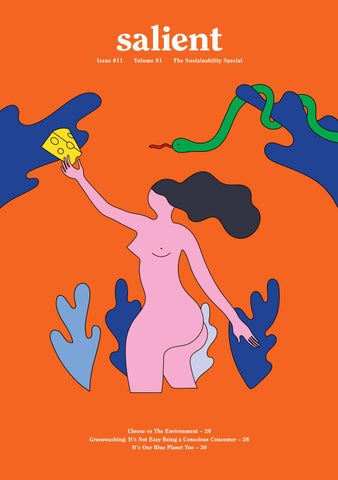
Issue #11
Volume 81
The Sustainability Special
Cheese vs The Environment – 20 Greenwashing: It’s Not Easy Being a Conscious Consumer – 26 It’s Our Blue Planet Too – 30
CONTENTS EDITOR'S LETTER 3 NEWS News 4 Politics 7 Opinion 8 *News* 12 LETTERS & NOTICES 14 FEATURES Interview with Bill McKibben 14 A taxonomy of the Wellington thrift stores I’ve spent my Studylink on. 18 Cheese vs the Environment: the Vegan Take on Climate Change 20 Make a Change With Your Fridge 22 Make a Change With Your Closet 23 Greenwashing: It’s Not Easy Being a Conscious Consumer 26 It’s Our Blue Planet Too 30 CENTREFOLD 24 POEM 29 COLUMNS VUWSA 32 NT: Te Ara Tauira 32 Super Science Trends 33 SWAT 34 The “F” Word 34 In Our Environment 35 REVIEWS Television 37 Books 38 Music 39 Art 40 Theatre 41 Films 42 Podcast 43 Food 44 ENTERTAINMENT Horoscope 45 Distractions 46
EDITOR'S LETTER THE SUSTAINABILITY SPECIAL are just social issues. They’re a symptom of the type of society we live in. The planet doesn’t care if sea levels rise, or if our air becomes unbreathable – we’re the ones who will suffer, and the ones who won’t be able to inhabit it anymore. All the better for the planet, since we’re the problem in the first place.
I think the reason that it can be hard to care about sustainability is that the planet seems fucked, and we’re all really scared. We’ve been living with this burden for our whole lives, right? We’re the generation that was taught science in primary school by learning about plastic pollution, animal extinction, and how to explain carbon cycles to our climate-denying uncle. If you tuned out during those classes then I won’t judge you, because I did too. It’s so much easier to be apathetic about the state of our Earth than to get involved in the business of trying to fix it, because it’s paralysing to consider where to start.
Let’s be part of the next great social movement. Let’s show our kids photos of how we stood up and we marched alongside the people that we loved, and we refused to be complacent. The photos will be shot on film, and we’ll have to explain to them how film photography made an illogical and inconvenient comeback in 2018, but our children are going to overlook this embarrassing aspect of alty student culture. No matter what happens, they’re going to be so grateful that we did our very best.
On the flip side though, it’s so easy to care too much. How do you stop yourself from being consumed with the task of trying to fix every environmental sin? How do you prevent your life from becoming a montage of the times when the barista accidentally made your coffee in a plastic cup instead of your KeepCup and you started crying, sitting alone in the middle of a busy Auckland strip mall at 1am, because you felt guilty about exploiting the planet for your bougie flat white habit?
If you’re at this university it means you have access to an incredible amount of knowledge, and knowledge is an immensely powerful tool for change. It also might mean you have time to think deeply about what a sustainable future looks like, and to fight for it to be a reality. As students, we need to form alliances and we need to speak out; we need to support each other to be the best that we can be, and we need to be on the front lines of environmental justice.
During this Sustainability Week, I hope the weight of the task that we’re saddled with can be shared more evenly; that if you’re on the forefront of environmental change, you feel comforted in the knowledge that you’re not doing it alone; but that if you didn’t before, you now feel empowered to stand up for sustainability in your studies, during election time, in the supermarket, and in conversations with the people around you.
In the words of climate activist Bill McKibben, who we interviewed this week: “Very few people on earth get to say: ‘I am doing, right now, the most important thing I could possibly be doing.’”
Love, Laura and Beau
All of the great social movements had their roots in universities, and fundamentally, environmental issues
3
The News MONDAY 28 MAY 2018
Otago Students Protest, Following Critic Cover Debacle LOUISE LIN Otago University students are set to host a protest on Friday 26 May following the removal of hundreds of Critic magazines from stands last Monday. The cover of the magazine showed a cartoon of a person menstruating, in line with the week’s theme of “periods”. The theme was suggested by the Otago Women’s+ Group in line with their Period Week events. The magazines were removed from stands around the university following on order of the University Procter Dave Scott, following complaints from the Dunedin Hospital and Dunedin Public Library. A statement from the University said that the Proctor assumed, “rightly or wrongly”, that copies of the magazine needed to be removed from all public areas, which included the university “as the University is also a public place, where non-students regularly pass through.” The removal of the magazines has been criticized as “censorship” by Joel MacManus, Critic editor, as well as many prominent member of public. The response to the magazines’ removal has been widespread, with coverage from mainstream news outlets around New Zealand, and several open letters written to Otago University, including from former Critic editors. The proctor has since apologised. A spokesperson from Otago University has said that the removal of the magazines was not
censorship, but a “mistake” and was an “incorrect assumption by staff ”. The Women’s+ Club has said that the aim of Period Week was to destigmatise and challenge the taboo of menstruation, and by destroying the magazines, “the University has played into the stigma that we are aiming to dispell.” They added that “the media (and in previous Critic covers) constantly depicts bodies that are naked and/or sexualized, and this has never been deemed a cause for censorship.” Many students have been outraged by the removal of the magazines, putting up hundreds of posters depicting the magazine cover with “censored” written across the front. However, the posters have also since been removed. A spokesperson from the University of Otago has said that they have no evidence that Property Services or Campus Watch were removing any posters. Since the proctor’s apology, the aim of the protest has shifted to encompass wider concerns around student voice being heard on campus. Sinead Gill, co-founder of the Women’s+ Group, said, “the problem isn’t this one specific incident. The issue is that [the university] felt empowered to do this.” Laura Cairns, Women’s+ Group president, said “Time and time again the university has silenced us and ignored us… this is just the straw that broke the camel’s back”.
Eye On Exec
M
LOUISE LIN best with VUWSA. CanDo is a group that represents the disabled student community within Vic. Lilli said that CanDo had five exec members, most of whom were extremely busy. Lilli said that they are working towards hosting a fortnightly social event. UniQ represents the queer student community on campus. They have alternating games night and discussion nights every week, and they invited the VUWSA exec to come along. The Exec discussed whether or not they should sign a letter in support of the Zero Carbon Act, which the University of Canterbury Student Association had suggested. The Zero Carbon Act is an Act developed by the group Generation Zero, which commits New Zealand to zero carbon by 2050. Some members of the Exec felt as if they didn’t know enough about the act to support it. Beth said she “trusts UCSA”. Marlon moved to support the open letter for the Zero Carbon Act. Three people abstained from the vote, which Connor pointed out was their most contentious vote yet. Joseph disagreed, saying that the Chat in the Hat was the most contentious. VUWSA moved to appoint Camilla Belich to be a member of the VUWSA Trust.
arlon went to submit at the Wellington 10 year plan twice: once about community building and combating sexual violence with Beth, which he said was “all Beth, really”, and once with the Living Wage movement. VUWSA had a catch-up with PGSA last Monday night. There was wine and cheese involved. Marlon sat on stage for Graduation. His hands were sore from clapping. He learnt proper clapping technique: four claps at the end of the round of applause. He said he “didn’t nearly fall asleep, don’t report that”. Paddy has been writing a memo about government policies about sexual harassment and assault, which Grant Robertson will take to cabinet. The Exec discussed having a “Meal in May” potluck to fundraise for Kaibosh. They decided instead of having a public dinner, to have a potluck at Beth and Ella’s house. Marlon submitted the Rental Tenancies Act submission, which had been crowdsourced from students. He almost sent out a bunch of student emails along with the submissions, but was reminded just in time not to. He also asked us not to report this. Lilli Street, CanDo co-president, and Erin Page, UniQ president, came along to the meeting as guests. They introduced themselves and their rep groups, and discussed how they could work together 4
NEWS
MONDAY 28 MAY 2018
POLITICIANS' POTLUCK (WITH MARLON AND BETH) ALISTER HUGHES of implementation. Hughes was in favour of a Rental WoF being introduced immediately, and Eagle thought it was definitely a matter of urgency. Bishop thought it was a good idea but felt it was important to wait until there was a larger supply of housing. VUWSA are strong supporters of the Rental WoF. Drake described it as wanting homes that are warm, dry, and “more than just liveable; they need to be reflective of the fact that it’s 2018. There are homes that haven’t been changed since the 1940s and it’s not acceptable”. Drake described the passage of the Healthy Homes Guarantee Act in late 2017 year as “a really good first step”. Equally, the Residential Tenancies (Prohibiting Letting Fees) Amendment Bill — which would ban the excessive letting fees that landlords currently impose on renters — is up to the Select Committee Stage. VUWSA are submitting on 23 May, and are “claiming [the Bill’s progress] as a win,” having spent the early part of this year lobbying against letting fees. Drake is hopeful that progress for student renters will be made. He said that the potluck showed that our MPs do recognise that there is an issue, and are willing to come to a student level to talk about it, because, as Drake put it, “what is more student than a potluck and a bottle of cheap wine”.
On Monday 14 May VUWSA President Marlon Drake hosted a potluck dinner at his flat. On the guest list were VUWSA Welfare Vice President Bethany Paterson, National MP Chris Bishop, Greens MP Gareth Hughes, and Labour MP Paul Eagle. The goal was to sit down and discuss some of the key issues facing Victoria University students as they navigate the Wellington rental market. The dinner made national news, after being filmed by Newshub. In Drake’s words, “students are paying ridiculous prices for absolute shit flats and it’s really not acceptable”. Students are forced to balance study, work, stress, and financial pressure, while getting sick and staying sick from living in cold, damp flats. According to Drake, the cost of living in Wellington is unmanageable for students, and “a big part of that is cost of rent”. Drake also raised how — even if students manage to find an affordable place to live — they face other issues like letting fees, poor quality housing, and an inability to access tenancy services to deal with landlords who facilitate things like rent bidding, or ignore issues raised about their property. Drake says that the potluck dinner was very positive. The MPs agreed that there are issues with student housing, and recognised the need for progress. They supported initiatives like a Rental Warrant of Fitness (WoF) that would guarantee a minimum standard of housing, but there was some division over the timeframe
GDPR, and Why European Law Affects You SHANTI MATHIAS On 25 May, the European Union’s new data privacy laws, or General Data Protection Regulation (GDPR), took effect. It’s an unusual piece of legislation, because it applies to all EU citizens and all the companies that process their data. Its incredibly broad terms mean that it has undoubtedly already affected New Zealanders. Simon Johnson, in a statement to students, said that while Victoria isn’t changing how they use students’ personal information, the University’s Privacy Notice has been updated in light of the new law. GDPR is an update to previous EU data protection laws from 1995, which were out of date, particularly as they didn’t consider things like location tracking or genetic information. The legislation focuses on the individual’s right to their own data. It means that you need to specifically and explicitly agree to everything a company does with your data, and anything that can be used to identify you; the company can’t tick boxes for you. For instance, it means that receiving email newsletters is something you opt into, rather than out of. The regulations apply to any company that processes personal data, or outsources that processing. In order to comply, most major companies are significantly revising their privacy policies. The definitions of personal data are astonishingly broad: obviously banks and social media companies have to comply, but any company that might have a contact form or an email newsletter that EU citizens use will have to as well. While EU citizens will be most affected, it is generally easier (and better for public relations) for companies to make the changes across the board. This legislation predates the Cambridge Analytica fiasco at
Facebook earlier this year, where 87 million Facebook users had their information sold to third parties through an app. Facebook is taking the opportunity to further advertise how they prioritise data protection, and how users have a right to know all of the information Facebook has about them. If something similar happened this week, involving the data of EU citizens, Facebook would have to pay a fine of 20 million euros, or 4% of its annual global turnover, whichever was greater. GDPR works against companies, because of the stringent regulations that they must comply with. The laws apply to companies with EU clients, even if most of the clients are out of the EU. Many companies will have slightly different versions of their rules for EU and non-EU citizens, for instance Facebook has changed its terms of service for people outside the EU and North America, to read that their agreement is no longer with Facebook Ireland, but Facebook Inc. However, they are largely still complying with GDPR globally. Moving the information merely makes them less liable to potential fines from action taken with non-EU citizens. Previously, because Ireland is in the EU and Facebook has a subsidiary there, the information of users — regardless of their citizenship or location — would have been subject to the laws. GDPR empowers individuals to know who has their data and what they’re doing with it. The regulations are so broad that they are able to affect citizens in countries far beyond the EU bloc. It remains to be seen how much individuals will exercise the rights that the legislation gives them, but at the very least, you’ll be receiving fewer corporate emails.
5
NEWS
MONDAY 28 MAY 2018
TRUMP'S AME RICA Where the News is Made Up, and the Laws Don't Matter. TORI BRIGHT Back in June 2016, a Russian lawyer met with Donald Trump’s closest advisors, promising “dirt” on then-Presidential candidate Hillary Clinton. The lawyer, Natalia Veselnitskaya, spoke with senior members of Trump’s campaign just six days after the meeting was proposed. The meeting took place at Trump Tower NYC, and the audience included Donald Trump Jr. and top campaign advisor Paul Manafort. Russia went on to intentionally spread propaganda via a state enforced social media campaign throughout the election, intending to sow political discord within the United States and bolster Donald Trump’s chances of winning the Presidential Election. Such activity was confirmed in January 2017 by US intelligence, including the FBI, CIA, and NSA. Meanwhile, a Special Counsel led by former FBI Director Robert Mueller has been tasked with determining any culpability from the Trump campaign in the conspiracy to defraud the 2016 Presidential Election. The Trump Tower meeting has remained a focal point in this ongoing investigation. On May 20 2018, the New York Times reported that just three months prior to the 2016 election, a second Trump Tower meeting had taken place. On 3 August 2016 Donald Trump Jr. met with George Nadar — representing Mohammed bin Zayed Al Nahyan and Mohammad bin Salman, respective crown princes to the United Arab Emirates and Saudi Arabia. Also present at the meeting was Joel Zamel, who came with “a multimillion-dollar proposal for a social media manipulation effort to help elect Mr. Trump”.
Just as Donald Trump Jr. replied “I love it!” to Natalia Veselnitskaya, in response to receiving potentially damaging information on Hillary Clinton, he was equally amenable to meeting with George Nadar. The meeting was planned primarily to discuss efforts to assist in the election of Donald Trump, and communication between the Trump Administration and foreign agents has continued deep into Trump’s presidency. An investigation conducted by the Associated Press, and resulting correspondence, revealed that Nader maintained access to the highest level of US Government and conveyed messages from the princes of the two Gulf countries to President Donald Trump. Foreign interference in an American election is illegal under federal election laws. We don't yet know whether or not Zamel’s social media campaign took place, and we don’t yet know if Trump had prior knowledge of the similar campaign out of Russia. However, Trump and his campaign advisors did know of the desire from these foreign nations to secure his election, and they did not report this activity to US intelligence. A Senate intelligence committee released a report on 16 May reaffirming assertions Russia was successful in their attempts to influence the 2016 election. Committee Vice-President and Democratic Senator Mark Warner stated on 20 May — “I don’t understand what the President doesn’t get about the law that says if you have a foreign nation interfere in an American election, that’s illegal”.
How Did Prehistoric Plankton Die? Scientists Check the Orbit-uaries GUS MITCHELL has never been shown before in truly ancient ecosystems,” says Professor Crampton. “There’s a strong debate in science about the impact on extinction and evolution of environmental change versus interactions between species (such as competition for food). With this study we can provide evidence of the impact of environmental changes on life on Earth.” Crampton noted that the next step in this research would be to determine what specific events on Earth occurred to cause the extinction events as a result of the changes in planetary orbit. “We also want to look more closely at what happens after a species becomes extinct. We know that when a species becomes extinct, a new species will evolve to take the place of the extinct species in an ecosystem, but we don’t know how long that takes.” Plankton are a vital part of the ocean’s food chain, and the world’s ecosystem overall. Plant-like phytoplankton play a role in Earth’s carbon cycle, absorbing carbon dioxide from the atmosphere and producing the oxygen we breathe in the same manner and scale as forests. Studies of plankton populations can serve as an indicator of the environmental health of the planet.
A research team at Victoria University has uncovered a link demonstrating how Earth’s orbit and motion had an effect on the evolution of life. Their approach brings together techniques from geology, biology, and astronomy to give scientists a better picture of the history of life on our planet. Professor James Crampton and his research team in the School of Geography, Environment and Earth Sciences traced the evolution and extinction rates of an extinct species of plankton called graptoloids, which once lived in Earth’s oceans between 480 and 430 million years ago. The history of the graptoloids are one such record of how life could have been affected by changes in the position of Earth’s axis and its distance from the sun. It is mathematically impossible for astronomers to calculate changes in the planet’s orbit further back than 50 million years due to chaos theory, but the effects of those orbital changes can be reflected in the development of life on Earth and examined in fossil records. During the time the graptoloids were alive — 450 million years ago — Earth had undergone a mass extinction event, when large sums of the planet’s biodiversity suddenly died off. “[T]he relationship between these orbital changes and extinction 6
Politics MONDAY 28 MAY 2018
POLITICAL ROUND UP Budget 2018 – Grant Robertson The first Budget of the Labour-NZ First Government was delivered on 17 May by Finance Minister Grant Robertson. The Budget this year had a broad focus on promoting a strong economy, and on practical and informed decision-making made by the Government for New Zealanders. Treasury predicted a forecast surplus of over $3.7 billion dollars for the 2018/19 financial year, which is up $600 million from last year. Robertson stated this outlook from the Treasury shows that Government is managing its expenditure very carefully, with extra money set aside for public services and to pay various debts. “Our plan will ensure productive, sustainable, and inclusive growth. Our job as a responsible Government is to look 30 years ahead – not just three. We are planning for what New Zealanders will need,” said Robertson. A brief list of forecasts made by Treasury are as follows: “Economic growth is expected to average about 3 per cent per year over the next five years. The unemployment rate is expected to drop to 4.1 per cent, which would be the lowest rate in 10 years. Real wages are expected to grow each year, with average annual earnings rising to $71,000 by June 2022. Inflation is expected to remain steady and stable at around 2 per cent.” David Clark on Fixing the Health System Neglected hospitals and the healthcare system are getting major boosts as a result of the 2018 Budget. Health Minister David Clark has said that the Government is committed to an overhaul of the healthcare system in New Zealand, and as a result has allotted $750 million to fix DHB infrastructure around the country. In addition to this, another $100 million will be going towards DHB balance sheets, which will boost executives’ confidence in successful planning and desired investments. National Spokesperson for Health Michael Woodhouse has hit back at this allocation of spending by Labour, saying that Labour is putting considerably less money into the health sector than what National had done during their time in Government. "It beggars belief that Labour set expectations so high for this Budget and not only have they not delivered on their
promises, but they are delivering less than National would have if we were in Government.” Dr Clark challenged this, saying that DHBs have been “starved of funding in recent years,” and are forecast to receive over two billion dollars of operational funding. More to Help Sexual Assault Survivors People who have experienced sexual assault and violence are getting increased funding for ACC abuse assessment and treatment as a result of the 2018 Budget. Minister for ACC Iain Lees-Galloway, and Under-Secretary on Domestic and Sexual Violence Issues Jan Logie, have initiated a nationwide programme to target sexual and family violence. It was announced in the Budget that $7.5 million would be allocated to sexual assault services, funded by three different Government ministries. The new and improved services would deliver targeted medical treatment, forensic services, and referrals. Both Lees-Galloway and Logie has expressed confidence in this initiative, and said that the ministries will continue their work in supporting these victims and their efforts to prevent sexual violence in New Zealand. “I’m pleased that these crucial services are receiving the first significant funding increase from central government since 2008. It has been long overdue,” said Logie. Logie’s portfolio as the Parliamentary Under-Secretary on Domestic and Sexual Violence Issues holds the first dedicated role to sexual violence reparation in NZ Parliament’s history. - Thomas Campbell
THE PARTY LINE Who's going to win Dancing with the Stars? Why? VICNATS The Young Nats have no opinion on who should win. We're too busy holding the Ardern-Peters Government to account.
- Grahame Woods.
VICLABOUR David. Because he finally knows what hard work is. ACT ON CAMPUS David is doing fantastic and is improving week on week, so continue texting 3333 so he can keep gracing our screens every 7
Sunday night. Hopefully the platform it gives him allows him to continue to highlight the inefficiency of the current government. He has the potential to win and with the public’s support that is a real possibility… although just quietly, it’s gonna be Suzy Cato. - James Allan
GREENS AT VIC We thought we might just discuss the Budget a bit.
Just like David Seymour's rumba, this government’s Budget just isn't enough. When Jacinda and Grant should be getting Aotearoa moving with a quickstep, they're half-heartedly waltzing around the big issues. Labour’s “transformational” Budget commits to spending a smaller proportion of GDP than National did for most of their three terms. New Zealand needs real change — when we needed a breath of fresh air like Sam Hayes’ rumba, we just got another one of Zac Franich’s (who?) forgettable dances. Like David Seymour’s reliance on “ACT on Campus” spending their evenings texting *3333, the small injection of cash into our struggling and underfunded health system is no more than life support. Marama Fox’s strong rebound in recent weeks comes as Labour’s Māori caucus fails to secure any more than a measly $9 million year for Māori development. It’s no surprise Sam Hayes can spend so much time rehearsing, because there’s really no new changes in the Budget to report. Our services and our people are crying out for help, but this Budget simply danced straight past them. After nine years of neglect, fiscal “discipline” and astounding surpluses are simply irresponsible, much like having Dai Henwood host live TV. David Seymour may have had the lowest score so far (just 14!), but Labour’s Budget is even less impressive. The Government has continued to keep the same harmful & ineffective benefit sanctions, many of which they promised to remove, and failed to make any necessary increases to benefit levels. Nonetheless, we’re always pleased to see Suzy Cato’s wholesome dance pieces, much like we’re pleased to see the largest funding increase for DOC in 16 years, the $100m kickstart to the Green Investment Fund, and new funding for home insulation to help our most vulnerable stay warm and dry. For the record, we’re backing Suzy Cato and Marama Fox. - Lachlan Patterson
Opinion MONDAY 28 MAY 2018
SURPRISE, SURPRISE ANOTHER US SCHOOL MASSACRE CALUM STEELE
vitriolic gob on a stick. Lahren conducted an Instagram live stream on Tuesday 24 May blasting those calling for tighter gun control as wanting to leave “perfectly sane Americans defenseless” — an interesting position to take, as last time I checked, no one was calling for the elimination of firearms.
CW: Discussion of violence A few weeks ago, I wrote an article in Salient in relation to the #neveragain movement sweeping the United States, after a tragic high school massacre claimed the lives of 17 children. I wrote then about how I remain sceptical that any changes would be made to gun laws in the States, and took a wild guess that children would continue to be killed — not by the boredom of maths — but by their fellow students. Surprise surprise, it happened again.
Lahren would appear to represent all that is wrong with the American gun lobby, viewing any attempt to simply curtail the serial arming of American society as a covert attempt by “the loony left” and “big government” to strip them of their rights. Depending on the degree of paranoia experienced by these gun nuts they also seem to variously believe that it is a government plot to enslave them.
On 18 May, 17 year old high school student Dimitrios Pagourtzis walked into his school wearing a black trenchcoat and t-shirt with “born to kill” emblazoned on it. He was armed with both a shotgun and .38 revolver which he used to deadly effect, opening fire on students, injuring 10 and eventually killing 10 others.
Once again, the knee-jerk response to the Santa Fe attack from people like Lt. Governor Dan Patrick is arguably even more frightening than the prospect of further massacres, wherein Patrick resurrected Trump’s previous, ill-conceived remarks about arming teachers. As I said in my previous piece on #neveragain, this is the epitome of a stupid idea. It will in no way, shape or form, bring any benefits in terms of student safety, and could very well endanger them more. The Chief of the Houston Police Department summed up my feelings on the matter quite nicely in a Facebook post stating:
According to the Huffington Post, the first to be executed was a girl who had repeatedly spurned Pagourtzis’ advances. He entered her art classroom in the morning and fired a shotgun at her. After this, so this sad tale goes, he began taunting various students with the threat of them being next. In the next 30-odd minutes he had killed a further nine students, and seriously injured a police officer. This was a methodical and calculated massacre. Some of the survivors allege he made a point of letting those he “liked” live so they could “tell his story” — a rather chilling thing to hear when your classmates are lying dead and/or dying around you.
“I know some have strong feelings about gun rights but I want you to know I’ve hit rock bottom and I am not interested in your views as it pertains to this issue. Please do not post anything about guns aren’t the problem and there’s little we can do.”
As with most US high school shootings — of which there have been 22 this year alone — it appears in this case the guns were legally owned by a parent, and had been spirited away by the son as he set about his murderous deed. This presents a problem for authorities in their efforts to stop children getting their hands on their parent’s guns — never mind the ones readily available to children themselves — as any move to clamp down on guns inevitably draws the same shrill response from the pro-gun lobby. Take blonde darling of the far-right, Tomi Lahren — a particularly
It would seem to me that guns and the laws — or rather the lack thereof — that surround them are most certainly the problem. On top of this, the marginalized issue of mental health seems to be one of the utmost relevance as well. After all, I have yet to hear anyone make the argument that Pagoutzis or Nikolas Cruz — the Florida shooter — were entirely compos mentis and had all cylinders firing. Or at least, I struggle to imagine these individuals as entirely sane. But what do I know? I’m just a hack. 8
Opinion MONDAY 28 MAY 2018
SUITING UP FOR THE NEW ARISTOCRACY TE PAEA HOORI
designer who has made a name for herself heading two French fashion houses, that is.
The last time there was a royal wedding I could not have cared less. You knew the gown was going to be lacy and conservative; you knew the church was going to be Westminster Abbey; you knew the ceremony was going to be riddled with polite nods to archaic traditions. However, when I found out that my third favourite Suits character was getting married (if your number one isn’t Donna or Jessica you’re wrong) to the “party boy prince” — as Women’s Day would have him known — you best believe I was gonna be tuning in.
My eager anticipation to know “who” Meghan had chosen to wear on her big day had me refreshing my browser constantly like I was waiting for Kendrick Lamar tickets to drop. Her choice was completely unconventional as a royal-to-be, but a little familiar as a pop icon. An American A-lister, getting married at an internationally anticipated wedding, in a Givenchy gown, in front of dramatic white rose floral installations and a crowd of stars? The tabloids may be churning out side-by-side comparison pieces between Meghan and Kate, but her nuptials had me thinking of a “royal” family of the American variety. Kim Kardashian’s Givenchy wedding gown may have been designed back when Riccardo Tisci was running the show — but Kim and Meghan’s shared affiliations with the brand, and overlapping guest lists, are not to be ignored.
As a designer, people have often made the well-intended mistake of thinking I give a shit about royal fashions. But if I’m being real with you, I find the neverending parade of full-sleeve knee-length dresses just about as boring and irrelevant as the monarchy itself. I get that you can’t have a royal “lady” (just saying the word made me vom a little) prancing around in a Balmain mini-skirt, but give me something at least a little contemporary.
We live in an era where Beyoncé is good friends with former President Barack Obama; the current President of the United States owes his prominence to a reality TV show; the Queen of England just endorsed the marriage of her grandson to a television starlet. The line between politics and entertainment has never been finer — if it still exists at all.
And that they did — my fashion prayers were answered in the form of one Ms Meghan Markle. With a penchant for sleek tailoring and well accessorised styling, Meghan’s outfits actually look like they belong in this century. Now I promise I won’t spend this whole piece acting like I’m on E’s Fashion Police. Truly, my emotional investment in this event was as political as it was sartorial. It felt like I was sitting down to watch one giant metaphor for the Boston Tea Party — just with less boats, and way more celebrities. The collision of cultures was jarring and brilliant: you had English noble-born seated near American pop-culture icons, and just when you weren’t sure who was going to win this cultural attack on the Brits — the French arrived.
Once upon a time British royalty married other nations’ royalty to maintain and bolster power — but this is a new age of aristocracy. Marrying a prince is a fairytale from another era, and capitalism and the American Dream would have us mere mortals think that we all have a shot at fame and fortune. I’m happy Meghan has helped welcome the Windsors to the 21st-century — beyond her taste for contemporary clothing, the ceremony was full of total mic-drop moments, and it was lit seeing black culture represented so prominently. But it doesn’t matter how you dress it — royalty or celebrity — if you think we’re through with class systems, well you’re just not looking close enough.
In this case, the French infantry came in the form of one beautifully designed Givenchy wedding gown. Now to be fair, it was the creation of Clare Waight Keller, who is a UK designer. A UK
9
Opinion MONDAY 28 MAY 2018
DRAFT REPORT RELEASED The proposed path for a low carbon emissions transition of our economy has been set – what does it actually mean? PROF ALAN BRENT CHAIR IN SUSTAINABLE ENERGY SYSTEMS place to encourage an inclusive transition, which basically means we cannot undermine the needs of the poor to get the rich to do better.
The Productivity Commission of the Government launched its “Low Emissions Economy – Draft report” on 27 April. The report can fundamentally influence the policy directions of the country, and your life. The work behind it is commendable, and the importance for us as a society to do our part to combat climate change cannot be overstated, but the report still lacks concrete actions, although such actions, supposedly, will be the work the upcoming climate change commission. We need more rigorous debate and clarity on the way forward.
But look at the briefing info that the public is provided with. Is all this just political jargon as usual? Yes, our agriculture sector is vital to our response. But do we risk influencing one of our key exports? What should our farmers change to, given global shifts? We are not going to provide meat and dairy products to China in the future; they are making other plans with, for example, synthetic protein – and yes, that is real. And our farmers are just used to doing the same old thing year after year. We need multiple economic benefits from our land (and other) resources. What about biofuel production alongside food, feed, and fibre?
The report makes it clear that the transition to a low carbon emissions economy will be a long, uncertain, and challenging journey. It suggests that New Zealand can make the transition at costs similar to those that other developed countries may occur. However, the sooner we begin to reduce carbon emissions, the less disruptive the transition will be — or so their “modelling” suggests. I believe they are right.
Yes, we should shift to Electrical Vehicles, but does that mean we will restrict – or ban – the import of those “cheap” Japanese second hand cars? Ouch, I have one. WOFs will have to include a carbon emissions testing and pricing (aka tax), for us to make the switch to EVs. But it will have to be introduced gradually to allow the second-hand market to catch up.
According to the report, three key drivers will set New Zealand on a path to achieving its mitigation goals: reducing the carbon emissions intensity in agriculture, mainly from those farted gases from cows and sheep; switching from petrol and diesel to electric vehicles where feasible, since our electricity is mainly derived from renewable resources; and planting trees, since they absorb carbon from the atmosphere. The latter, however, will only buy us time, and we need disruptive technologies to emerge, like different feed for dairy, hydrogen and biofuels for heavy transport and aviation, fast and in-road charging of electric vehicles, and so on. I think we need more rigorous analyses to prioritise these technologies for New Zealand, which they do acknowledge.
Forestry and fast-growing biomass is certainly something we should consider, but we need to be careful to enter global markets that will demand our resources. You open the door to export biomass then, well, you are not exporting biomass, but the nutrients from our soils, our (pristine) water, and the opportunity for socio-economic development to meet local needs. These are some, not all, of the issues that we need to challenge/ discuss/question. We need integrated (systems) thinking, because if you do something on the one end, what are the implications elsewhere? You cannot think about these issues in isolation. An example is tariff structures that allow for prosumers, or consumers that also produce electricity for the grid. The more wealthy can afford it, but it means the poor need to (potentially) pay higher electricity prices to maintain the grid infrastructure.
The report then suggests that to help the private sector and civil society to plan and take long-term decisions with confidence, a stable and credible policy environment is needed. That is great and they provide very high-level focus areas: • • • •
Getting carbon emissions pricing (basically a new tax) right, to send the right signals to motivate investment in lowemissions technologies and processes; Harnessing the full potential of innovation and supporting investment in low-emissions activities and technologies; Creating laws and institutions that endure over time and act as a commitment device for future Governments; Ensuring other supportive regulations and policies are in
We all need to work together to resolve these complex issue in an effective trialogue. Are you going to have your say? The Productivity Commission welcomes input from all stakeholders on their website, by 8 June. 11
News
*
*
AT THIS POINT DO YOU REALLY NEED ME TO CLARIFY THAT WE MADE THIS SHIT UP
ROYAL WEDDING REACTIONS ON THE STREETS OF LONDON SHANTI MATHIAS still riding the high. “I love reading all the media coverage of the event,” said Matthew Moonstone, who would’ve liked to have seen the anti-homeless spikes around London removed but thought that having the Royal Wedding in his backyard was a nice consolation prize. “Nothing gives me more joy than reading analyses of the sermon and the ceremony in old papers I find in the park, then bringing it back to the alley, where I explain the symbolism of the flowers in the train to everyone as we share a single cold can of baked beans.” As he described the scene, Moonstone’s eyes filled with warmth. “There’s something transcendental about a wedding, isn’t there?” mused Elaine Sapphire, who is “definitely not friends” with Moonstone and Opal. “It’s like, who cares that I’m hungry and tired and homeless? Meghan is hot. And how savage was it that Harry invited his ex?”
On 19 May 2018, Meghan Markle wed Prince Harry, and the world rejoiced. There’s nothing — as it turns out — more relatable than seeing rich and successful people celebrate their happy heteronormativity. “Yeah, I think that Meg’s dress — yeah, I call her Meg — was beautiful. Really took my mind off the fact that I haven’t showered in months,” said Jenny Opal, one of the thousands of homeless in London. “Of course I watched the parade. Some people came and lined up days before, but I’ve been here for years. Living my life, getting ready. Waiting for this moment.” Opal said that nothing could have prepared her for the first glimpse of the joyous couple. “Best moment of my life, best moment of their lives.” The wedding was last week, but Opal and some of her friends are
"DRAIN THE SWAMP!" NO SERIOUSLY, DONALD, PEOPLE ARE FALLING IN VAN WYLDE
18 months after being elected on a campaign that vowed to “drain the swamp”, US President Donald Trump appears to have faltered on this promise as a sinkhole forms on the front lawn of the White House. The sinkhole first appeared on Sunday 20 May, and appears to be growing significantly. A spokesman for The National Park Service — who are monitoring the sinkhole — told Salient “It appears that by filling his cabinet with his billionaire cronies, interfering with the Russia investigation, and pandering to Republican lobbyists, President Trump has in fact enlarged the swamp”. When asked about the sinkhole on his front lawn, President Trump responded in a series of tweets. He first dismissed the
sinkhole hole as fake news. “Just read a story on Fake News CNN about a hole in my lawn. Wrong! My golf courses have the best lawns in the country. Nobody has better lawns than me. I understand lawns better than anybody.” When the President was notified they were referring to the White House lawn, he took to Twitter once more: “I have not been to the White House since my inauguration, as I prefer Mar-a-Lago. I’m told the “sinkhole” is in fact illegals trying to dig through to our country and take American jobs. Sad!” It appears that the sinkhole will be unable to fixed for a significant period of time, as Trump fired the head gardener after it was revealed they also tended to the FBI gardens where the Russia investigation was taking place. Mr Trump condemned the gardener in a final tweet. “Lazy John the gardener, the worst gardener in history, was fired for incompetence. Not for helping the FBI Witch Hunt. In which, by the way, there was NO COLLUSION.”
UPDATES ON KYLIE JENNER'S BABY It has dawned on the Salient office that at just under four months old, Stormi Webster has undoubtedly worn baby clothes with a larger combined value than Salient sees in funding per annum. Once more, a little louder for those in the back: Salient (very) actively does not give a single fuck about Kylie Jenner’s baby. 12
*NEWS*
MONDAY 28 MAY 2018
On 14 May 2018, Prime Minister Jacinda Ardern released an open letter to Deputy Prime Minister Winston Peters, regarding her upcoming maternity leave. After months of reconnaissance and seduction of Arden’s intern by reporter Liam Powell, Salient presents the first draft of said letter.
Rt Hon Sir (if you play your cards right, punk) Winston Peters Deputy Dog Prime Minister Executive Wing PARLIAMENT BUILDINGS Dearest WinstonWinnieDaddyWinston House Rulez Working arrangements during forthcoming period of great national loss absence of Prime Minister As you know, I'm outta here like a bald man I intend to take a leave of absence this year for a period of six weeks. Thank you for begging agreeing to be Acting Grand Poobah Prime Minister during this time. The arrangements during this time will be the same as they would during any other period in which I am away and you are sober Acting Prime Minister, but as there has been disturbingly rabid criticism of some public interest in this particular period, I am setting the arrangements out in a letter, to be published on the Beehive website and tattooed on Ron Mark's forehead for your easy reference. A colouring-in version is to be made available for Chris Hipkins, but only give him the crayons if he uses his manners like a big boy. As Acting Prime Minister, you will exercise the super rad functions and powers of the Prime Minister, in consultation with me where appropriate, particularly where matters of significant political, strategic, or public interest, or national security arise. I will continue to receive Cabinet and Cabinet committee papers. You will not fuck up manage the day-to-day business of the government, including: • chairing Cabinet and the Cabinet committees usually chaired by me (Appointments and Honours Committee, Cabinet Business Committee and Cabinet Priorities Committee). You are under no obligation to end with the customary "Meeting Arderned", so feel free to add your own personal touch. Agendas for the meetings will be managed between my office and the Cabinet Office in the usual way; • tagging me in funny and relevant memes; • hiding from engaging with and avoiding directing officials from the Department of the Prime Minister and Cabinet; • recording Dancing with the Stars on the Beehive Skybox (any spoilers leaked will result in immediate termination of your contract); • overseeing the government’s policy programme to turn New Zealand into a Marxist Republic; • feeding Clarke at least twice a day. He likes fish, and be sure to put out a small bowl of Steinlager Pure every morning; • deflecting answering questions directed at the Prime Minister in the House and responding to media inquiries, Official Information Act requests, and other general shit swallowing correspondence; and • coming up with excuses to get out of attending official engagements. Under NO circumstances are you to: • raise the voting age to 65; • put down more than 5% of the Budget at the races; or • appoint yourself as Governor General. My Chief of Staff, Mike Munro, and staff in the Office of the Prime Minister will watch you like hawks support you in your role as Acting Prime Minister, as will officials in the Department of the Prime Minister and Cabinet, including the Cabinet Office. More importantly, the key to the Prime Ministerial Liquor Cabinet is taped to the bottom of the bust of Sir Richard Seddon. I trust you will leave my best bottle - you know, the one that caused Muldoon to call a snap election - for my return. Thank you again for your support, Yours somewhat sincerely, Her Awesomeness the Rt Hon Jacinda Ardern Prime Minister (and don't you forget it) Cc:
Mike Munro, Chief of Staff, Office of the Prime Minister Aunty Helen Andrew Kibblewhite, Chief Executive, DPMC Michael Webster, Cabinet Secretary Cameron Slater (lol just kidding)
13
BILL MCKIBBEN INTERVIEW BY LAURA SOMERSET
Bill McKibben lays claim to a number of accolades: he founded 350.org, the first global grassroots climate movement, he won a Gandhi Peace Award for his work in environmentalism, he wrote The End of Nature, the seminal book on climate change, and he was once arrested for protesting outside a gas station, so girls are probably super into him. The real reason I wanted to speak to McKibben, though, is because a new species of woodland gnat was recently named after him. And so, I present to you, ten minutes with the namesake of “Megophthalmidia mckibbeni�.
14
How does the way that students and young people engage with the climate movement today compare with other historic movements?
I don’t always succeed, and one of the issues is that with most problems we face, you can rest confident that eventually you’ll win. The problem with climate change is that it’s a timed test, and if we don’t win fast then we can’t ever win. And that scares me a lot. So that’s one of the things that keeps me going. And the other thing that keeps me going is this emergence of a really strong world-wide movement, especially in places where people have done nothing to cause the problem. So, if people in Bangladesh and Pakistan and the Pacific Islands can work super hard on this, then so can I.
Obviously the climate movement has been led by young people, but of course it’s hard, because there are so many other crucial things going on right now. Every single day the most important thing that’s happening in the world is climate change. But every single day there’s something else a little more dramatic happening. So, there’s never a day when the most dramatic thing on the front page of the newspaper is likely to be climate change. This is especially true in America, where Trump is wrecking every form of civilised existence. Young people are having to be expected to take on immigration and healthcare, and we’re in the middle of this amazing Me Too movement, and so on and so forth. So, I worry sometimes that it’s hard to keep focused on the deepest, underlying problems all the time. But the good thing, too, is that the same people who care about those things are also working hard on the climate.
That’s so true in terms of Indigenous peoples, too — I saw that you did some work on the Keystone Pipeline protest. It feels so inequitable how climate change affects the people who did the least to contribute to it. Right! One of the best things that’s happened in the last 10 years is the powerful emergence of Indigenous organisers at the very forefront of all this work. And I think that’s important for many reasons, but it’s really good to have the oldest wisdom traditions on the planet meshing with the newest wisdom. You know, the messages coming out of ceremonies and sacred sites matching the ones coming out of supercomputers and satellites. That’s powerful.
I was trying so hard not to ask a question about Trump, but it’s only been two minutes and he’s already been brought up. America right now is a very odd place. Trump is a grotesque buffoon, and it’s extremely difficult to concentrate on anything else. On climate change though, he’s not that much worse than most of the other leaders of the world who aren’t doing much either.
How do we address some of the fundamental inequalities in the climate action movement, when it takes a significant amount of time and money to educate yourself and to make informed decisions that impact the environment?
Do you know much about New Zealand’s climate action movement?
I think the real leadership of the climate movement around the world comes mostly from people in frontline communities. If you have a lot of money and time, chances are you’re part of the problem, not part of the solution. The biggest source of carbon on the planet is rich white people – that’s just what I find. 350.org works in every country on earth except for North Korea – and maybe now we’ll get there. Almost everybody who does this work is poor, black, brown, Asian, young, because that’s what almost the whole world is composed of. So that’s the most exciting part of it all.
People in New Zealand are doing such a good job. I first came here 10 years ago, and each time I’ve come back since there are more and more great movements. When I was last here, 5 years ago, I was in Dunedin, and the fight against offshore exploration was just beginning. People were thinking that they couldn’t possibly win, and that the oil industry was too powerful. And I said “no, I think you’re quite capable of doing this – people love the ocean here, and they’ll defend it”. So, it doesn’t surprise me at all to see what’s really a world-victory taking place [government’s ban on offshore oil exploration]. One wishes that one could then say: “time to rest on your laurels; no need to do anything else for a few years.” Sadly, climate change is proceeding so fast that we need other things happening too.
I’m in the middle of a report for my Environmental Studies degree, but I can’t find enough evidence to back it all up. Can you give me permission to cite you every time my lecturer points out that I haven’t referenced something? Absolutely. And if you really have trouble, email me.
There are so many important areas of environmentalism that you could get involved in, so how do you find time to prioritise yourself and to prevent burn-out?
(If you’re reading this, Cliff, please give me an A)
15
LETTERS Dear salient, I'm unsure whether this has already been written about, but I could not hold in the joy and wonder I felt from the new fish tank that's been installed at the Maori Ora Student Heath clinic in Kelburn. I'm genuinely impressed at how VUW doesn't fuck around when it comes to the display of aquatic life on campus. This isn't your typical domestic dish bowl, it's a miniature aquarium. This shit is made to be the center of attention. Its raised up on a pedestal so its vaguely in the periphery of everyone who walks in the room. Its the type of shit that Chinese Byo restaurants invest in, to show how fresh their lobsters are in display windows to lure customers inside. I'm assuming the motivations for this commercial level aquatic display is to distract potential University Doners from the faces of sad, unwell students, with the faces of equally sad and unwell tropical fish. I really respect the controversial but necessary move by the University to value the well being of fish on campus equally with the well being of students; no matter what the cost. But all sarcasm aside, I've read that exposing patients to nature and greenery increases their recovery rate and boosts wellness. I am assuming the placement of a fish tank was considered somewhere along theses line. What a creative strategy for the University to try and improve wellness on campus. I have however also read that this study was proven to be effective with a poster / painting of nature and greenery in hospitals. But fuck posters, our University needs a fish tank that costs hundreds of dollars of upfront and maintenance costs. I hope you're as excited about these fish as much as I am. Thanks, Ben
Dear Salient, I appreciated your editorial about filling the gaps in our conversation. As a survivor of childhood sexual abuse, it is heartening to see open conversations about sexual assault. However, most of those conversations are about experiences that are materially different from mine. Trauma is not a competition, and no one's experience is invalid, but this absence leaves me feeling that the stigma has not yet been lessened for abuse survivors. I'm sure its not easy to find people to talk about it, but I want to say to everyone else who is a survivor that you're not alone, and uni is tough but so are you. Love, Anonymous. LETTER OF THE WEEK* Kia ora Salient, I just wrote an email to the makers of the doco Let's Talk About Sex, as I had some thoughts after seeing the film. I had read and have since reread your review from a couple of weeks back, where your reviewer Emma Maguire gave the film 4.5 out of 5 stars. The film was pretty off in a lot of ways, and it was disappointing to see your reviewer acknowledge but ultimately excuse both the homophobia expressed by Julia Sloane's (the interviewer) parents, and Sloane's past revelations of being a racist. A brief look at her Instagram and it's pretty obvious what she's doing. She clearly needs to recover from the whole using-the-worst-possibleslur-on-national-TV incident, and is using this film and a heavy performance of allyship with the LGBTQIA community to do this. A bunch of pictures on her Insta are of her posing with queer folk at parades, captioned #pride #letstalkaboutsex - like she is using her performed allyship to promote this film, which, by the way, was funded out of her own pocket. Cheers Matilda
Response: The fish tank is on a month’s free trial with no obligation to enter into a lease. We are currently asking students for their feedback on the fish tank at our Survey Terminal, which students pass by after their appointment. The fish tank is one of the ideas suggested by the working group which was established to find ways to make the Kelburn waiting room a more comfortable space for students. Kevin Rowlatt, General Manager of Student Health Dear Kii, I do not know you, and I would hesitate to say that I understand how you feel. But I do understand the stigma. I'm a male victim of sexual assault. For me the stigma arose from the different reactions within the group of people I knew to experiencing the exact some assault. Some men just "shake it off " or shrug their shoulders. "Mate, they were drunk." It makes it difficult to speak out, it's makes people skeptical of you, and made me feel alone. I had to stand up and say: "the fact is this is how I feel, I felt disgusting, I was angry, and still am confused." No matter how other people react, how I felt and how I reacted should not be belittled. I personally feel that the stigma in sexual assault against men is, in part, to do with the way some men just don't react at all. In saying all this, this is my experience. I am no expert and I know I hold a more masculine perspective. But thank you Kii. Cheers for the platform, Annoymous
Author’s response: I entirely agree with the viewpoint expressed in the letter. I knew about the problematic aspects of the piece, and I did mention them, however briefly, in my review. It was a hard film to review - because I didn't realise who the narrator was until the film actually started, and felt uncomfortable with her presence within the film once I realised who she was. Personally, I found the film to be fascinating, and in hindsight I probably should have commented more on the problematic aspects of it in my review, but I was more interested in the unique people that were shown in the piece, rather than the narrator herself. In all, reviewing is a balancing act. I'm a comedy reviewer, it's part of my schtick not to delve too deep into the deeper nature of most films, but maybe I should have. There are other reviewers within my team who probably would have taken a stronger critical eye - I didn't see this film at a screening, didn't sit through a Q&A or anything, and ultimately, it was the thoughts of a person watching a screener in her room at 2am, trying to make jokes about an odd piece of media.
Dear Editor, Thanks for the FISH every Monday. My husband and I, are international students and we are very competitive. So, doing ‘Salient’ crossword puzzle is our new competition which makes us FIght a lot. Also, each time we read Salient, we get a huge culture Shock! We always look forward to the FISH, however, if my letter wins, I can get some chips and have the ‘FISH and chips’ with my husband in Zealandia. FISH and chips, please :(
Send us letters to editor@salient.org.nz otherwise we are just over here playing with ourselves. Your feedback and opinions are valid (maybe). *Letter of the Week wins a double day pass to Zealandia
16
Hi Salient! I just wanted to commend Beth, Paddy, Rhianna, Simran, and Ella for their bravery to share their story on sexual assault. I also want to commend Kii for sharing his story, because I feel like it is a lot less common for men/males to have a space to share their stories. I was reading the stories in the hub and couldn't help but feel an immense amount of pride for each of them. By sharing their stories, they are helping to break the stigma around talking about sexual harassment and sexual assault. I hope that their bravery will help to encourage others to not only feel like they can also tell their story, but raise awareness around sexual assault and rape culture. Much love, #MeToo
NOTICES APPLICATIONS ARE OPEN NOW FOR THESE GRADUATE PROGRAMMES! • Policy Graduate Programme – Ministry of Education • Start Me Up Engineer – ASB Bank • Junior Solicitor – Gifford Devine • Graduate Accountant – Leech & Partners Ltd • Engineering Graduate Programme – Air NZ • IT Graduate Programme – Assurity Consulting To find out more about these programmes (plus many more!), go to: www.victoria. ac.nz/careerhub
GREEN DRINKS Victoria University, in collaboration with The Sustainability Society, will be hosting a Green Drinks event at the Southern Cross Bar and Restaurant venue in Te Aro on the 26th of July. It will be an informal discussion around the importance of an integrated systems approach for sustainability – Perspectives from different parts of the world. All are welcome.
Earn an extra $100 after you complete your first 5 deliveries in Wellington. Sign up as an Uber Eats delivery partner and you can earn money connecting people with the local food they love.
SIGN UP NOW T.UBER.COM/EATSWELLINGTON New delivery partners only. First 5 deliveries must start and finish within the Wellington area by 30 August 2018 to qualify.
KRAFT EXHIBITION KRAFT | A select group of students from the Design and Architecture School present KRAFT | Celebrate with us on our opening night at 5.30pm 31st May with refreshments. The Exhibition will run from 31st May to 7th June at Te Aro Campus on Vivian Street. The work is a poetic interpretation of contemporary furniture processes and material tenancies: DRAW / CUT / FOLD / CARVE / CAST / MOLD / PRINT. The students aim to emulate the design powerhouse Moooi and seduce the world with quirky and innovative designs.
A taxonomy of the Wellington thrift stores I’ve spent my studylink on.
Laura Somerset
Say what you want about environmentalists, but when it comes to thrift shopping we know our shit. Buying your clothes second-hand saves so many resources it’s unreal, making it a rare ethical lifestyle choice that’s still actually enjoyable (I miss cheese so much you guys).
Thrift
Ziggurat
For me, Thrift is king. Hear me out: you’re not going to walk out of here with a Lonely shirt for $10, but the tradeoff you make for its mid-range pricing is its impeccable curation. When I was in high school I waited until 3 hours before my leavers’ ball started to go shopping for a dress, and Thrift pulled through for me. The selection always has me drooling and honestly, the prices are cheaper than Glassons anyway.
What the fuck? I can’t afford any of these things. Tangent & Company
If you’re a dude and feel personally victimised by this article then I’m here for you now. With a weirdly specific selection of men’s clothing almost exclusively from the 70s, it’s certainly a step up from Rebel Sport (no hate).
Newtown (Anywhere)
Paper Bag Princess
You, too, can contribute to the ongoing gentrification of Newtown by frequenting one of its abundant charity stores. Go in with an open mind: will you find a blazer to distract everyone at your job interview from the fact that you have zero qualifications? Probably not. Will you find a pastel-pink cowgirl jacket with electric-blue fringing? Also no, because I already bought it last week.
This store is under appreciated. Pretty much everything is under $20, making it the cheapest Cuba Street thrift shop, and a lot of the stock is on par with its more spenny neighbouring stores. Paper Bag Princess donates to a bunch of charities and has a big focus on sustainability, so in conclusion I would like them to sponsor me.
Spacesuit
Recycle Boutique
Ethical dilemma: Spacesuit sells rad clothes, but they’re also all imported, so it’s time for me to be a killjoy and point out that imported clothes are significantly less kind on the environment (air pollution, thumbs down). All the clothes you buy from retail stores are imported anyway though, so I guess this is the lesser of two evils. If you’re looking to expand the LA 90s grunge section of your wardrobe, this is the place.
Ok, this is controversial, but Recycle Boutique is a bit hit and miss — its prices and the quality of its clothes vary a lot, but you can definitely find garments that hit a sweet middle ground. Sometimes the huge selection can be overwhelming, so you have to be prepared to COMMIT. If you spend under an hour of your fleeting youth in here, you’re doing it wrong.
Aunty Dana’s Op Shop
Special Mention: charity stores in rich suburbs
Aunty Dana’s is run out of the Anarchist Centre on Abel Smith Street and raises money for Gender Minorities Aotearoa — you should already be sold. The clothes deliberately aren’t separated by gender, so if you wanna buy a dress and you don’t have a vagina then that’s chill. I support you. Aunty Dana’s supports you.
The moment you figure out that the highest quality clothes for the cheapest prices can be found at the Karori Salvation Army Store is when you know it’s time to switch over to second-hand clothing for good. There are too many pre-loved turtlenecks in this world to waste your time on expensive and resource-intensive fast fashion. Stay fresh. 19
CHEESE VS THE ENVIRONMENT THE VEGAN TAKE ON CLIMATE CHANGE BRI LEE
Cheese vs The Environment Since I can remember I have always cared about the environment. This dedication probably came from my growing up on a patch of land with a small flock of sheep surrounded by native bush. Like many other New Zealanders, my weekends as a kid were spent riding my bike around the neighbourhood, enjoying the fresh air and beauty of the countryside. I was introduced to the effect humans had on the environment when my intermediate school started teaching the effects of climate change. I knew that I had to recycle whenever I could, and as I grew older I started to eliminate the amount of plastics I used in my everyday life. I bought metal straws and drink bottles, and am currently the proud owner of two KeepCups. Though these were awesome steps, it never really seemed like enough. I continued to read article after article and watched documentary after documentary, each showing the drastic and downright scary examples of polar ice melts, and rising sea levels. It seemed to me that the world really didn’t stand a chance against how we were treating it. I got angry. I got really angry. It was unfair that we had to be the generation to clean up everyone else’s mess. We were already growing up in a destroyed housing market, with little to no job prospects, and student loans weighing us down. To find out that the world that we knew wouldn’t be around for the next generation made me simultaneously scared and furious. But out of this anger came determination: I was going to do everything I could to make sure I wasn’t contributing to the destruction of our planet. This was when I came across the documentary Cowspiracy. I know, I know… It has been highly debated and ridiculed within the last year or so, but at the time it opened my eyes to the fact that, in simply changing my diet and the items I chose to purchase, I could live a “modern” life that contributed the least amount of harm to the planet. So, as I spiraled helplessly into the world of environmental heartache, I found out that animal agriculture was a leading cause of deforestation, greenhouse gases, and ocean acidification. These big three environmental issues are also linked to animal extinction and Indigenous peoples’ loss of land, depletion of food resources for impoverished communities, and horrendous welfare issues, connected to not only the creatures being slaughtered but also the workers within those industries. As I came across fact after fact, I started tallying up the real destruction this industry was causing our planet. It turned out that animal agriculture contributes up to 18% of global greenhouse gases, consumes up to 33% of all freshwater in the world, and is responsible for 91% of rainforest deforestation. I’d pretty much decided to change my purchasing habits to veganism or a “plant based” lifestyle, but it wasn’t until I read that we would likely see fishless
oceans by the year 2048 that I knew I had to really stick with the change. Our agricultural based industries were actively destroying the oceans I’d grown up with, polluting freshwater lakes I’d swam in as a child, and devastating communities along the way. Soon, all I saw was the destruction animal agriculture was causing. Maui dolphins were being killed as bycatch for fish and chips, and run off pollution was causing illness within our communities. Not to mention the dark truth of our colonial past: the fact that the land we use for grazing in New Zealand was stolen to begin with. So when I was shown that in changing the way I eat I could actually make a real and symbolic stand against the effects these industries had on our country, I practically jumped towards the lifestyle change. Since adopting these practices, however, I often have people ask me how just one person can really make a difference. Nothing will really change, will it? I see it like this: given that these industries and corporations are run by supply and demand, with each purchase we make, we vote for how we want the world to be. In a culture where protests are harder to support due to our incessant need to work and study just to get by, changing how we eat is an everyday act of defiance towards those who are destroying our environment for economic gain. The cool thing is that you don’t even need to go all in. If you just start limiting your meat and dairy consumption to a few things a day or week, or if you choose to “go vegan” in every way apart from cheese, then great. Each time you decide not to purchase animal products, you vote for the world you want to live in, the world you want our next generation to live in. Not to mention you’re no longer contributing to the death of millions of animals, as well as gaining an array of potential health benefits, such as reducing the risk of heart disease, stroke and type 2 diabetes. Personally, I’ve found living a vegan lifestyle pretty easy. I took it slow at first, gradually eliminating animals products from my diet, swapping out everyday items such as makeup or leather shoes for plant based and cruelty free alternatives. I had been vegetarian on and off for years previously, so swapping out dairy and eggs for plant based versions was undoubtedly easier than someone who goes vegan overnight. I was really lucky when it came to how my family or friends interacted with my change of lifestyle. My family were accepting from the start, and try their hardest to provide lots of options for me when I go back home. Though I may miss the convenience that comes with eating animal products, being vegan has broadened my palate, advanced my baking skills, and introduced me to a community who are both passionate and supportive. Knowing that I am taking a stand against environmental destruction and animal cruelty with every meal makes each day a little better than before. 21
MAKE A CHANGE WITH YOUR FRIDGE By Beau Jangles Every year, New Zealanders throw out the same amount of food that could feed the entire Vic student body for almost 12 years. Not only is this disastrous for our pockets, costing up to an extra $600 a year for an average Kiwi household, but it also significantly harms our environment — and us, by extension. While the thought of eating a brown banana or a stale bread crust might not seem appealing to you, remember that unless you are composting that nutritious resource, there really is no throwing “away”. Once food waste leaves your flat it gets trucked away to a rubbish pit, where it sits in airtight piles with no exposure to oxygen. This provides the ideal conditions to generate greenhouse gases, because the processes which create methane require an oxygen-free environment. As you might have guessed, the gases produced by landfills are then released into the atmosphere and contribute to accelerating climate change. When it rains, landfills then leach highly toxic liquids into our waterways. In Wellington, for example, leachate from the Southern Landfill ends up in Taputeranga Marine Reserve. And finally, to top it all off, when food gets thrown away it wastes all of the resources that went into growing it, transporting it, and cooking it. So what can we do about it? PLAN! Don’t go grocery shopping when you’re hungry or when you don’t have a shopping list. Plan out your meals each week so you know exactly what you’ll need, or at least bring a list if you’re not on that level of organisation yet. Not only will this cut down on how much food ends up thrown out, but it’ll also save you a huge amount of money each year. PROPER STORAGE! Storing fresh fruit and veggies in the fridge will expand their lifespan dramatically. Also, by using
cloth or hessian veggie bags rather than plastic packaging, you can stop them from suffocating and going off. If you’re ever in doubt, just freeze it – you can freeze almost all food, and even liquids like milk. GET CREATIVE WITH LEFTOVERS! Sharing is caring on all fronts here. If you’ve got more than you need, invite your mates around for dinner! Cook up that leftover rice and those sad-looking vegetables in a stir fry. Fruit can be turned into baked treats, and potato peels can be converted into fancy pre-dinner fried snacks. Fun for the whole flat. COMPOST! Put a food scraps bucket right next to your ordinary household rubbish so it’s handy and unavoidable. You’ll be more likely to think twice before chucking food into the bin, and you’ll also be more aware of what you’re throwing away! Plus, what better way to get some much needed study break sunshine then to get a compost started in your garden. It’s actually a lot easier than it sounds. VOLUNTEER! In Wellington, charities like Kaibosh and The Free Store run services which redistribute unsold café food to people in need. This tackles an important gap in the food distribution chain, where food is overabundant in some communities and severely lacking in others.
MAKE A CHANGE WITH YOUR CLOSET By Melanie Child (founder of NZ fashion label Melanie Child) The fashion industry is one of the largest and most polluting sectors in the world, second only to oil. It’s estimated that 80 billion garments are produced each year, which is 400% more than what we produced 20 years ago. This is due to the “fast fashion” industry. Fast fashion is a term referring to our current throw-away fashion culture, where trends move ultra-fast, while prices and quality are forced down to keep up with them. In NZ alone, roughly 105 million kilograms of textile waste are sent to our landfills each year. Bring into the equation the fact that up to 95% of textiles can actually be recycled and diverted from the waste stream, and it is clear that there is something very wrong with our current fashion system. The environmental impact of textile waste doesn’t only lie in our landfills however. Manufacturing just one pair of jeans and a tshirt uses nearly 10,000 litres of water. Toxic chemicals and dyes from the manufacturing process are discharged into rivers, waterways, and soil, causing irreparable harm to plant, animal, and human life around the globe. There is also a human price to fast fashion. The tragic collapse of the Rana Plaza factory in Bangladesh in 2013, which killed 1,135 people, is one of the most recent examples of the horrific conditions garment workers in developing countries are subjected to, all to quench our thirst for cheap, disposable clothing. So what can we do about it? While the largest vessel for change ultimately lies in the hands of the clothing label giants and retailers themselves, these are some things we consumers can do to support waste reduction and conscious consumption.
- Purchase quality garments made from natural or organic fabrics: Organic cotton, bamboo, hemp, merino, and wool are some great options. Certified organic fabric is free from toxic chemicals, dyes, and pesticides, making it safer for workers to produce it, and less detrimental to the local environment. Natural fibres are also biodegradable once the garment has reached the end of its life. However, the higher price tag attached to “sustainable fashion” is not always accessible, especially to students. - Shop second-hand: A less expensive but similarly sustainable option is choosing second-hand clothing whenever possible. Second-hand clothing saves resources that would have gone into creating something new, like electricity, water, and dyes. It also prevents clothing from going to the landfill and contributing carbon emissions to the atmosphere as it breaks down. - Support local designers and brands: This benefits the local economy by creating more jobs, reduces the number of garments that are imported using high-polluting transportation, and can help to reduce waste being sent to the landfill. This is because New Zealand’s manufacturing regulation is stricter than in many of the countries that garment production is outsourced to, and tends to produce garments that can last longer. - Reduce, reuse, recycle: Reduce garment waste by following the steps above, and by choosing quality over quantity when you go shopping. Reuse garments by upcycling them – you can customise tired-looking clothing with patches, embroidery, or by finding other ideas online. You can also reuse clothes by organising swaps with friends. Finally, recycle where possible: donate clothes to second-hand stores, drop them at a textile recycling plants, or even use your old t-shirts as cleaning rags!
26
GREENWASHING IT'S NOT EASY BEING A CONSCIOUS CONSUMER
MICHAEL THOMSON You stride into Countdown, armed with dual reusable tote bags in your hands and an irrepressible love of the planet in your heart. You’re still a little twitchy from all the fair-trade Peoples Coffee flowing through your veins, which is just as well because you’re going to need caffeine-addled reflexes to polish off your list and still make it to your post-punk band practice on time. As you reach for a packet of Greggs rubbed thyme, your eyes are drawn to an attractive packet made from 100% recycled unbleached board. The “ECO” labelling ensnares and beguiles your trendy Newtown heartstrings. Later that evening, as you prepare a (vegan) mushroom risotto, you open the packet to find with dismay that beneath the seductive recycled cardboard box, your thyme is sealed in a plastic zip-lock bag. It suddenly strikes you that the Greggs herbs in your pantry are bagged in paper, despite the lack of eco-friendly fanfare. You weep gently into your risotto and reflect on how easily you’re wooed by the colour green. Scenes like this are commonplace in a market saturated with eco-branding. Most of us care about the environment, but it’s not always easy to make informed ethical choices on the fly. To make the best of our limited time and information, we take mental shortcuts by drawing on common symbols and features of eco-friendly products to make educated guesses. Marketers are not unaware of these daily snapdecisions that we make. Their paychecks depend on their ability to circumvent our rationality and tap directly into our most primal subconscious associations. That’s why a drink with a dramatic effect on the world’s obesity epidemic (Coca-Cola) is marketed to us by hyper-attractive twenty-something-year-olds “opening happiness” in their swimwear, rather than by a nutritionist extolling its wondrous health benefits.
The language and symbols matter profoundly – they make us feel things beneath the scrutiny of our consciousness. Marketing that exaggerates a company’s ecocredentials is popularly known as “greenwashing”. One notorious example from the 1980s saw American oil giant Chevron run an advertising campaign featuring grizzly bears hibernating through oil drilling in winter and waking up to find untouched verdant pasturelands in summer. Chevron were rewarded for their efforts by a 10 percent hike in sales among those who saw the commercials, and a 22 percent rise among previously averse “socially conscious” consumers. A poll of Californians two years later found Chevron was the oil company trusted most to look after the environment. To make the point clear: the commercials successfully convinced the public of Chevron’s environmental credentials using vague depictions of oil’s peaceful coexistence with nature, despite presenting no evidence of existing or new initiatives to rein in their catastrophic environmental footprint. The crux of greenwashing is hiring a marketing team to paint your product as “sustainable”, rather than hiring someone to ensure that it legitimately is. If you’re a commerce student reading this with admiration and you’re keen to get your piece of the organic, vegan pie, here’s my top tips for wooing the environmentalists: (i) Use vague fluffy-sounding language. Who doesn’t love a good proclamation of “natural!” or “eco-friendly!” Many of these terms are loosely regulated in New Zealand, so no need to worry about running into trouble. Better yet, try couching your claims in half-truths, by drawing attention to irrelevant eco-friendly features of your product and away from the real issues. As Ecostore founder Malcolm Rand 27
Greenwashing: It's Not Easy Being a Conscious Consumer once quipped, “Nuclear waste is biodegradable – it just takes half a million years to decompose”. (ii) Style yourself an eco-label that gives the impression of a third-party endorsement. You’re in good company here – 32 percent of “green” products surveyed by environmental marketing agency TerraChoice in 2010 were rocking an unsubstantiated logo. But be careful not to get caught! In 2012, Dole Bananas were issued with a compliance notice warning they were in breach of the Fair Trading Act in relation to their “Ethical Choice” marketing scheme. This prestigious Nobel Prize of conscious consumerism was bestowed upon Dole Bananas by Dole Bananas with no clear criteria on what exactly was ethical about the ethical choice (better luck next time, Dole). (iii) Frolicking animals. Everyone loves a good frolicking animal. (iv) Remember that time you decked out your riverpolluting factory with energy-efficient bulbs? Better let the world know your company is now socially woke. No need to restructure your supply chain or anything, that sounds difficult. At this point of the article, the Newtownites are tugging their dungaree straps in despair. “This is impossible,” you mutter despondently to your risotto. “I don’t have time to research every single company! How is anyone supposed to be a conscious consumer if there is a whole industry employed to subvert our better judgement!” Excellent question. For starters, we can trust well-recognised environmental certifications, such as Environmental Choice, carboNZero, Forest Stewardship Council, and Energy Star. These certifications are awarded externally against transparent criteria and can take the guesswork out of ethical consumerism. Another big plus to the eco-karma of food products in particular is the label “Product of New Zealand”, meaning the ingredients were grown locally and hence skipped a hefty dose of jet fuel emissions. The phrase “Made in New Zealand”, by contrast, means ingredients may have been grown overseas, but were processed domestically. By looking closer at details like these, we reward ethical businesses with our patronage and abstain from supporting those that breach our trust with greenwashing. Of course, the most effective counter to greenwashing is changing the structures of business that make it more attractive to sacrifice sustainability for the sake of profit. Many business leaders are sympathetic to environmental causes but find it difficult to uphold a responsibility to mitigate them when pressed with more concrete and institutionalised demands, such as the return-on-investment imperative from their shareholders. Business models need to have sustainability at the core of their design, because we
cannot have a healthy economy if our ecosystem, which provides us with all of our resources, can no longer support us. At a governmental level, greenwashing is tackled with regulations and enforcement. The Advertising Standards Authority sets self-regulatory codes for advertisers to uphold voluntarily, while the Commerce Commission are responsible for investigating breaches of the Fair Trading Act, which prohibits businesses from using substantiated claims and false representation in their marketing. These bodies rely upon an active base of consumers taking the time to make complaints. These regulatory mechanisms are valuable, but they fail to address a fundamental issue: that businesses currently have more incentive to “green” their marketing campaigns than to “green” their business models. This will only change when the government sets robust regulations that prevent businesses from talking the talk without walking the walk, and removes barriers which stop them from genuinely committing to sustainability. Fortunately there is hope on the horizon: The upcoming Zero Carbon Bill for example, to be introduced to Parliament this October, means New Zealand is commiting to becoming carbonneutral by 2050. The Bill makes Government legally obligated to design its policy in ways that enable New Zealanders to reduce their carbon footprints, in particular breaking down barriers for businesses to do so. Investors will be encouraged to place their money in low-carbon projects not out of the goodness of their hearts, but because they can see there is no money to be made in the sunset years of dirty industry. Contacting your local MPs, submitting during public consultations, and advocating for policies that create structural change is far more effective way in combatting greenwashing than subjecting yourself to hours of research into each brand’s business practices. It may even help to redeem the honour you lost that one time when you forgot your supermarket tote bags five weeks in a row. So next time you find yourself in the aisles of Countdown seduced by the tender image of dolphins cavorting happily across a sea of blue-dyed plastic wrapping, I hope you’ll find the will to pause, check for that Environmental Choice logo, and give it a second thought. You are joined by millions of conscious consumers worldwide who collectively reward and punish businesses for how authentically they uphold environmental values. And remember, while we can all certainly do better in our personal lives, individual decisions are ultimately made within a context. By supporting structural policy change, we can ensure the incentives guiding countless decisions every day do not give undue preference to the profit motives of private entities with resources to burn.
28
Time Zones When you Skype him, you sneakily sip wine before he has brushed the sleep away from his teeth. It tastes bitter, like a misplaced good morning. When you crawl into bed, aching from Wednesday, the southern hemisphere slips out the other side into a Thursday you have yet to meet, eyes butterfly bright, while yours finally flap shut with relief. You briefly feel the brush of his breath, and the warmth of his absent shape, and you rise with habit and follow his shadow to the bathroom, despite the darkness and you whisper goodnight into your toothbrush and spit it violently away and watch the water drain into the plughole in the same predictable direction as it always goes.
- Sara Hirsch
submit poems to poetry@salient.org.nz 29
It's Our Blue Planet Too Scientists estimate that by the year 2050 there will be more plastic in the ocean than fish.
oceans to become more acidified, which is causing the bleaching and destruction of the world’s coral reef ecosystems. 27% of our coral reefs are already destroyed.
I’m sure that by now, you will have heard this statistic — maybe on the news, or on Facebook. Perhaps you thought for a moment: “well, that’s sad, but I don’t even like fish. I don’t swim in the ocean. How does this affect my life?”
Marine Debris and Micro-Plastic Pollution Plastic pollution in our waters has reached an unprecedented level. There have been micro-plastic particles found across every ocean habitat, from the poles, to the deep sea, to the tropics. The larger plastics are choking and killing thousands of marine animals, while plastic particles in their blood is poisoning them. Plastics are now travelling up the food chain and are being found in the food we eat, too. Taking steps to cut single use plastics out of your life is a massive step towards combating these problems.
The ocean is so far removed from our daily lives that it’s hard to fathom how important it is to our existence. Over the years, we have fought for our terrestrial environments because we see the problem right in front of us. However, in our society we tend to see the ocean as an enormous expanse of water, where the world beneath the waves is alien and, at times, incredibly hostile. Would we become more receptive to caring about ocean issues if we changed the way society as a whole viewed the ocean? If it became known as a nurturing living environment, rather than a place where terrifying creatures lurk?
Overfishing and Exploitation/ Governance of the High Seas Our oceans are being exploited. Industrial-scale fishing methods are destroying habitats, draining our oceans of fish, affecting ecosystem development, and causing small scale fisheries — often from vulnerable communities — to suffer. Unsafe fishing methods used for large scale fishing, and the lack of regulation in ungoverned expanses of ocean that don’t have a national jurisdiction, leads to a staggering amount of bycatch, which is when unwanted species like whale sharks, dolphins, turtles, and other large animals are caught in nets and then thrown back into the sea to die. Until there is effective international legislation and governance of these high sea areas, illegal fishing practices will continue with little resistance.
I have been connected to the ocean my entire life, whether this be through SCUBA diving, volunteering at our local aquarium, or binging all of the ocean related David Attenborough documentaries. I am constantly thinking about it, so much that it has become a major part of my identity, and I would be lost without the purpose that fighting for it gives me. But I realise this is not the case for the vast majority of people in the world. The great Dr Sylvia Earle says “oceans are our life support system”. 97% of the water we need to survive in the world comes from the oceans, and most of the oxygen generation in the atmosphere is done by microbes in the ocean. The ocean is a main driver of climate and weather, and as a result, helps stabilise our global temperatures. If there was no ocean, or the ocean became so unhealthy it couldn’t recuperate, then there would be no hope for any life on this planet.
The Need for Marine Protected Areas (species/ habitat loss) In the last 40-50 years, half of all marine species have disappeared. Marine Protected Areas have been created to help preserve biodiversity. However, out of all the Marine Protected Areas around the world, only 10% are considered no-take reserves, while in other sites designated as Marine Protected Areas might ban only some human activities, such as oil exploration. Within New Zealand, there are 34 no-take reserves, which accounts for only 0.3% of our total marine environment. There are currently no protected areas in New Zealand’s deep seas, leaving deep sea marine animals unprotected.
We owe oceans our existence, and we need to give a damn. By now, maybe you’re wondering what some of the issues with the ocean are. What follows is a short selection; some issues you might be aware of, and others might be new to you. Ocean Acidification and Climate Change The climate is getting warmer and more unpredictable because the atmosphere is overloaded with greenhouse gases. In response, sea levels are rising and the ocean is absorbing a lot of heat to try and cool down the atmosphere. This is leading our
I encourage you to keep reading about these issues, to form opinions for yourself, and to think about both small and collective things you could do to create change. All actions make a difference. 31
Columns
VUWSA
NT: TE ARA TAUIRA
SIMRAN RUGHANI
RUBEN TOA KEARNEY-PARATA
Reduce, reuse, recycle! From primary school the 3Rs were drilled into our brains in an effort to make us more sustainable. But what if I told you there’s another R we can add to the list? That’s right — refuse. Refusing to consume unsustainable goods is a simple yet powerful tool towards an environmentally-friendly future. This applies to anything we purchase, but particularly to plastic objects and packaging. Refuse - Bring a KeepCup – you’ll get 50c off at Vic Books as an added bonus (insert: joke about money spent on coffee consumption) - Borrow a plate or a mug from Plastic Diets on Wednesdays (in the Hub) and get a lil’ extra for your buck at Krishna food - Carry a recyclable bag with you - Say no to plastic straws Reduce - Cycle/walk/carpool/bus/train to campus - Print double-sided - Turn the lights off when you’re not in a room - Choose products with less plastic packaging - Unplug appliances that aren’t in use - Reduce food waste Reuse - Bring food from home in reusable containers, rather than buying plastic wrapped food - Use a reusable water bottle Recycle - Sort your waste in to the right bins and recycle as much as you can - If you can’t recycle your waste, compost it – use the compost bin outside Krishna foods while they’re open 11.30–2.30pm, or set up one at home Other sustainable habits: - Buy local – try the fruit and veg co-op or go to the markets! (Fruit and Veg market outside the Hub on Wednesday’s or the weekend markets in Newtown, Willis St or the waterfront) - Use cold water for washing your clothes Lots of small changes come together to make the world of difference. Let’s look after our planet, starting now. Reduce, reuse, recycle, and refuse!
Kaitiaki: Indigenous Guardians Indigenous peoples are making a call to action. The destruction of Papatūānuku, the undermining of protocol, and the incarceration of Indigenous peoples have each provided a unifying platform for tangata whenua (people of the land) to stand together. Last year in America, ngā iwi taketake gathered with the Standing Rock Sioux Tribe to oppose the Dakota Access Pipeline, and the cultural and environmental impacts of that which threatened their tribal wellbeing, including the desecration of their sacred sites of significance, the pollution of their waterways, and the destruction of their ways of living. They continue in this fight today. In Aotearoa, the age old imperial strategy to divide and conquer iwi well and truly continues to take place. Just the other week, Tauranga Moana uri descended upon the steps of Parliament to protest the government’s Treaty Settlement Process, undertaken with the neighbouring Hauraki collective. They claimed that the process did not legitimise tikanga Māori in its “Western framework”, and that it inevitably leads to inter-iwi conflict. And just last month, a group of rangatahi Māori attended the UN Forum on Indigenous Peoples to highlight the institutional racism that persists in New Zealand’s justice system. The rōpū fought to oppose the government’s proposed expansion of the Waikeria prison — which would result in the further incarceration of Māori peoples. These few examples show that tangata whenua will continue to fight against issues — both local and global — that seek to undermine their peoples and their relations to the land. It’s important we stand in support alongside our Indigenous whānau against the great challenges they face as marginalised peoples in society today. Tiaki ai te taiao, te tikanga, me ngā tangata; ka ora ngā iwi taketake katoa. Protect our planet, our protocols and our peoples for the betterment of all. Nā Ruben Toa Kearney-Parata (Te Āti Awa ki Whakarongotai, Ngāti Raukawa, Ngāti Toa Rangatira) 32
So It’s Come To This: A Flat Earth Column The flat earth “theory” was the subject of one of the earliest scientific wagers, in which a bet is made on the outcome of an experiment. In March of 1870, Oxford dropout and flat Earth creationist John Hampden issued a challenge in the journal Scientific Opinion, stating that he would pay £500 to whoever could prove to him that the world was round. The challenge specifically was to “exhibit, to the satisfaction of any referee, a convex railway, river, canal, or lake”. Basically, demonstrate curvature, you eggheads.
to his beliefs. So much so that he underwent a 15-year long campaign of abuse and libel to slander Wallace, including sending him death threats. It’s about ethics in scientific experimentation, after all.
Hampden’s challenge was taken up by one such egghead, the co-discoverer of the theory of evolution and experienced surveyor Alfred Russel Wallace, who thought it would be easy money. They each appointed a referee and agreed to meet at Bedford River, an artificial canal in Cambridgeshire and a suitably “flat” body of water to their liking. The experiment went like so: Wallace set up a telescope on a bridge that was 13 feet (4m) above the waterline of the canal, then placed another marker 13 feet above the waterline on another bridge six miles down. At the midpoint between each bridge, he fixed up a pole with two discs on it, with the top disc set at 13 feet and the bottom disc set four feet lower for reference.
And this obstinance in the face of evidence continues today, as people from all around (aflat?) the world are reinvigorating this debate. Where the religious, like Hampden, fought against scientists because their research undermined the word of the church, the current generation of flat Earthers base their movement on a broad distrust for institutions. They pride themselves on being independent thinkers, which to them means “believe nothing from actual scientists because they’re all biased” and “do your own research”. Said research has gone to some amusing lengths though. In March of this year, California limousine driver “Mad” Mike Hughes launched himself 1,875 feet in a homemade steam-powered rocket emblazoned with the phrase “Research Flat Earth” to draw attention to the “cause”, with the eventual hope that he’ll get to space to affirm the truth with his own two eyes. This May, a Flat Earth Convention was held in Birmingham, where prominent flat Earth believers offered such hypotheses as Antarctica actually being a 164 ft ice wall that stops the oceans pouring out into space.
If the Earth was flat, the bridge marker, disc, and telescope should all be perfectly level with one another. When observed through the telescope, the disc was slightly higher than the telescope and the bridge marker. Even accounting for light refraction, this demonstrated clear curvature between all three points, despite the flatness of the water on which they appeared parallel to the naked eye. Both referees agreed that Wallace had won the bet, but Hampden refused to accept the results, saying that they proved nothing, and only held more steadfastly
I could sit a flat Earther down and tell them about how Eratosthenes of Cyrene determined the Earth was round in the 3rd century BC by measuring the shadows cast by a vertical pole during the summer solstice, but they’d just ask me who’s been filling my pockets. Flat Earth theorists like to see themselves as rebels against scientific authority, when really, they’re a metastasization of putting social capital on critical thinking without the training to use it responsibly or ethically. We’re both interested in truth, but as for our understanding on what truth is, we’re worlds apart. 33
Columns
SWAT
THE "F" WORD
WINTER JONES
RUBY GOVAN GAFFNEY
Recently, it’s been really cold. It’s been difficult to get out of my toasty bed to brave the freezing gauntlet to the shower when I can see my breath in the air. I’m just not feeling it. We’ve all had days or months where things seem disheartening. Assignments are impending, you’re in a fight with your best friend, you’re feeling moody and chocolate isn’t fixing it. How can we wend our way back to a place where life is good and exciting again?
Houston, we have a problematic fave (PF). He’s brilliant and talented and just released a brutally honest single that is nothing less than a masterpiece and one of the most important music videos of our time. He is a fantastic actor, and he has yet to release a song that I can resist jamming out to whenever it comes up on my Spotify. But he’s also got a history with making rape jokes, which he’s unapologetically defended as “comedy”. His lyrics, witty and puntastic as they may be, are flooded with racism, ableism, and misogyny. Time and time again he has made decisions that I cannot possibly defend, and do not want to. And yet, whenever I see him on my television screen, or hear him in my playlist, or scroll past news about him in my Facebook feed, I can’t help but become engaged. I’m a fan, but as a member of the Victoria University Feminist Organisation, I also feel like a hypocrite. And perhaps I am. The thing about humans, celebrities included, is we are all flawed. We make mistakes. We do things we’re not proud of — sometimes we even do things we are proud of, but for the wrong reasons. We constantly justify our bad behaviours, and the bad behaviours of the people we admire. We’re never going to get an unproblematic fave (except maybe Tom Hanks, but he is the exception to the rule). If we reject art every time an artist does something bad, then eventually we’re going to run out of art completely. Amid my moral dilemma, I’ve been met by the advice that, sometimes, we must separate the person from their art, and simply appreciate the art for what it is. Which is all well and good, but where do we draw the line? I can say that people make mistakes, but the reality is that if a “regular folk” had done the same things my PF has done, I would have cut ties with them long ago. When I began writing this, it was supposed to be an opinion piece, but reading it over, I see that it’s less that and more an indecisive mess. As it turns out, I know nothing, other than that I may or may not be a total hypocrite.
The good news is that though we tend to think about resilience as a trait that some people just have, it’s actually a skill that anyone can learn. There is a famous parable of Thomas Edison — when told that he had failed to invent the lightbulb, he replied “I have not failed. I have just found 10,000 ways that do not work”. This is an example of what psychologists call Cognitive Reframing. Our internal monologue is churning all the time with thoughts and reactions to events in our lives, without us really paying attention to them, and they’re often really negative. “I can’t believe I said that”, “I barely passed, I’m so dumb”. If we can take a deep breath and become aware of them, we can slowly begin to rethink them in a more positive light: “Okay, that was a mistake, I won’t say that next time” “At least I passed — that’s better than failing”. By reframing these thoughts, we can change our interpretation, even if the situation has already been and gone. Setbacks mean a chance to try again, better this time. Failure becomes feedback. We become more forgiving towards ourselves and of other people. It’s not a silver bullet, but by practicing this we can slowly develop resilience towards life’s trials and tribulations.
34
IN OUR DANICA SOICH
The challenge is to reduce cars while maintaining mobility and connecting communities. The starting point is free public transport for everyone, or at least laughably cheap fares that draw from the four billion dollars invested in land transport per annum. We should redesign the way our buses move; there should be big buses that do large, long distance loops round the city and outer suburbs. Within the central city, we need clean light rail that zips nimbly back and forth between short distance destinations and out to peripheral pick up points. Inner city pedalled rickshaws to help people with mobility problems move around the inner city. And of course, keep encouraging cycling.
Remix to ignition; carless cities. The following is written from a completely hypocritical position. I’m going to talk about how cars have massacred cities and we should get rid of them. At the same time, I drove to the library in my smoking heap of a Honda Civic. We’re used to cars the way fish are used to water. We consider our entitlement to a parking space akin to a human right. Transport is our most familiar contributor to climate change. To keep moving, cars guzzle petrol and diesel, spitting out CO2 — 20% of New Zealand’s total emissions. Walking down a busy street, we smell the CO2. We can spot it being farted obstinately from a 4x4. Yet we can’t seem to help putting foot to the pedal. New Zealand has the highest car ownership rates out of any OECD country, owning more vehicles per capita than the likes of Germany and the US. But consider the crappiness of cars in cities.
What we shouldn’t do is implement rush hour charges and congestion fees. These impose a disproportionate burden on the less well-off, who can’t absorb the costs as easily as the rich. The brilliance of privately owned electric cars may not be as bright as professed. They’re great for the environment, but fail to overcome the problem of congestion. We’re still using a very large hunk of metal to move a very small person around.
Roads are divisive strips of tar. Like asphalt rivers, roads split every street into two halves, pushing people to the small banks on either side. Rather than congregating, we tend to march along in lines keeping pace with the traffic. Sprawling infrastructure encourages more cars, and more cars encourages sprawl. A gargantuan city isolates groups on the fringes, particularly the old and poor. Commuters in Auckland spend four weeks each year in traffic, moving nowhere in the oxymoronically dubbed “rush hour” — burning gas, burning happiness. Cars fortify our notoriously low levels of physical activity and the consequential health problems. And we have stifled a large amount of valuable real estate in the form of parking lots, whose elevators stink unwaveringly of urine.
So get rid of the roads, clean out the cars. Then we can think critically about urban infrastructure and design. A city is collision of culture, ideas, innovation, and fun. It is a great melting pot of humanity. Urban design should foster this, rather than allowing cars to drive the development of our cities. Where once there were roads, we could build undercover walkways, green spaces, communal rest areas, playgrounds, public art, outdoor dining, public gardens — spaces that encourage socialising, sharing, and vibrancy. For a start, let’s make Lambton Quay car free. Then we can start to take back the streets.
35
Be inspired TAKE A CREATIVE WRITING WORKSHOP AS PART OF YOUR DEGREE OR TO DEVELOP YOUR WRITING CREW 253 POETRY WORKSHOP Leading poet James Brown will guide you through the art of writing poetry. James is an acclaimed poet with five collections published.
CREW 254 SHORT FICTION WORKSHOP
Pip Adam, one of the most exciting fiction writers in the country, will offer ways to advance your short stories through writing exercises and intensive workshopping.
CREW 255 CHILDREN’S WRITING
Renowned children’s author Eirly Hunter will allow you to explore different forms of writing for the pre-adolescent child and begin to develop your own clear voice.
CREW 352 CREATIVE SCIENCE WRITING
CREW 353 WRITING FOR THEATRE
Learn the craft of writing for the stage with celebrated playwright Gary Henderson. Gary’s work is produced locally and internationally and he is an esteemed teacher.
Whether you’re a Science student or creative writer, work with talented writer Rebecca Priestley to develop your nonfiction writing with a science angle.
APPLY NOW FOR TRIMESTER TWO 2018
Applications close 21 June 2018
To find out more about the creative writing courses offered by the International Institute of Modern Letters at Victoria University, go to victoria.ac.nz/modernletters
TELEVISION THE BIZARRE DOUBLE-TAKE OF ARRESTED DEVELOPMENT SEASON 4 REVIEW: CONALL AIRD & GEORGE BULEID
If you have yet to see the original three seasons of Arrested Development, don’t bother with this review, it’s nearly as unnecessary and shameless as remixing the television oddity that was Season 4. Go and watch the show.
exacerbates the strangeness of the fourth season. Things only get stranger, with Mitch Hurwitz deciding to effectively remix the show’s latest season to better fit within the familiar AD framework. Released at the start of May this year, Season 4 received a (lengthy) rebranding — Arrested Development Season 4: Fateful Consequences. With this remixed series, gone are the bloated, single-focused episodes, now replaced by a more typical AD storytelling format more suited for television syndication.
Cancelled after three seasons in 2006, Arrested Development remains one of the most consistently funny and unique sitcoms to date. Recurring gags delivered by an ensemble cast of very funny people, Arrested Development is a show about a wealthy family who have lost their money, but have not lost their self-important personalities.
Though impossible for Hurwitz to write out some of the wrongs of Season 4, most notably the dragging storylines of George Sr and Lindsey, the remix does provide viewers with a return to a more familiar approach to the series. Putting the story in chronological order means the overall story flows better, bringing the ensemble cast together earlier and more frequently. The remix, along with flowing better, moves at a quicker pace, as quick as that of the first three seasons, with the additional narration of Ron Howard helping tie many scenes together. All in all, Season 4 is likely more satisfying for most under its remixed “Fateful Consequences” label.
With the original release of Season 4 in 2013, show creator Mitch Hurwitz aimed to bring AD fans something different, like a large puzzle that could be arranged and digested in numerous ways. Viewers were not treated to the staple format they had come to know from Seasons 1-3, but instead were provided with messy, overstuffed 30-35-minute episodes focusing on sole characters, despite some characters being rather incapable of shouldering an entire episode on their own. Other causes for the new approach taken with Season 4 resulted from showrunners trying to work around the cast’s acting schedules, a tricky feat seven years after the show’s initial cancellation.
The remix appears to be a lesson about what can occur when showrunners second-guess the execution of their work. With the original Season 4 now hidden in the depths of Netflix, it’s hard to avoid seeing the release of the remixed season as anything other than an insecure move with club sauce. Obvious wrongs are hopefully going to be re-written in Season 5 (released on the 29th of May).
Part of what made the original three seasons so great was the constant interaction between all characters. Some of these interactions are not seen once in Season 4; such as the show’s brilliant take on the disappointed father trope over George Sr’s son-inlaw, Tobias. The most jarring change in Season 4, apart from the overall re-formatted approach to the series, is Michael Bluth’s downfall. Where the sevenyear hiatus has left every other character at a point in their lives that makes thematic sense, Michael’s feels like too harsh a change in direction. Michael was the show’s moral and comedic grounding, often a foil to the ridiculousness and eccentricities of his surrounding characters, and his drastic change in character only 37
BOOKS THE VULGAR WASP PHIL LESTER REVIEW: ALEX FEINSON
I have held out on writing a review of this book so I could fit it into the sustainability issue of Salient, even though I have been dying to review it. As someone who passed Year 11 Science by one credit, I am naturally not a fan of science non-fiction, because I usually have no goddamn idea what anybody is talking about. But with the latest science non-fiction publication from VUP, The Vulgar Wasp, by Victoria University’s own Dr Phil Lester, I was completely surprised and completely enthralled. Lester’s book is the “story of a ruthless invader and ingenious predator”, the Vespula vulgaris, or the common wasp. 99% of us hate them, most of us are probably afraid of them, and some are even allergic and could die from their sting. They attack other insects and birds, destroy crops, and inflict a huge amount of damage to our environment and economy every year. Their ability to invade, adapt, and dominate entirely new ecosystems and environments is frightening. The level of destruction they do is horrifying but undeniably impressive. Their methods to attack and kill their prey have evolved to a diabolical level of efficiency. Wasps are basically the insect public enemy number one. But Lester has also convinced me that these elements make them awe-inspiring and amazing. Lester devotes the first few chapters of the book to the history of the common wasp, how it was transported around the world (as it is native to Europe, and was introduced to New Zealand by humans transporting goods), and how its introduction has altered and impacted New Zealand’s ecosystem and economy.
My favourite chapter of the book was chapter 4, “A cocktail of nastiness”, which discussed the effect wasp stings have on humans. Learning about previous experiments to see how deadly a sting could be, or to see what the most effective cures are, was extremely interesting and even comical at times. Lester also debunked a lot of myths for me about what to do when stung (which is pretty much don’t pee on it) and broke down the probability of death by wasp sting (which is also not that likely, but still… don’t fuck with wasps). The second section of the book focused on the future, and what to do about the wasp problem. Large scale pest control is a mighty task at hand, and Lester’s proposals are incredibly interesting and thought provoking. One of the best things about The Vulgar Wasp is Lester’s sharp wit. The level of sass and sarcasm throughout Lester’s writing made the book completely accessible and consumable. There are even a few laugh out loud moments. Sure, I skimmed some of the more meaty paragraphs when the mathematical and scientific terms dominated and I could not be bothered checking the glossary notes. This is still a scientific book, but these paragraphs were few and far between. Lester’s ultimate strength is that I, Achieved Minus in NCEA Level 1 Science Alex Feinson, could follow along, and even learnt a hell of a lot. His serious yet comical writing made this totally foreign topic accessible, digestible, and interesting. Lester and his wasps have absolutely inspired me to consider reading more science non-fiction books in the future.
Lester also seamlessly intertwines in other information and histories about so many other wasp species, bees, and other insects so I found myself not only learning about the common wasp, but so many other connected subjects that I would have never researched or heard of before.
38
MUSIC MARLON WILLIAMS & JULIA DEANS HUNTER LOUNGE, 20/5/18 REVIEW: JOSH ELLERY
My review of Make Way For Love in an earlier issue of Salient outlined that I am somewhat of a superfan of Marlon Williams, and his shows at the Hunter Lounge presented my first opportunity to catch him live.
My personal highlight came in the encore, as Williams rolled out his infamous version of “Portrait of a Man”. It was utter perfection – Williams and his band navigated the peaks and troughs of the arrangement with vigour and passion, while Williams’ intense vocal performance was out-of-this-world. Williams’ physical performance was, again, equally captivating as he roamed the stage and climbed over into the front of the crowd (directly over myself and my girlfriend, I might add). Quite simply, this rivalled any set-closer I have seen live.
First of all, his choice of support act was nothing less than brilliant – Julia Deans put on a stellar set of downtempo, singer-songwriter numbers with a grittiness to them. I read a review of the show from the night prior which suggested that Deans’ set was not suited to the Hunter Lounge setting, but I couldn’t disagree more. Deans’ set held the audience spellbound, with “Clandestine”, “Chelsea”, “We Light Fire”, and old favourite “A New Dialogue”, all proving to be highlights. Her stage banter was pretty dry but in an endearing way, and it went over well in the crowd setting. Deans’ new album is out now, and it’s a ripper, so make sure you have a listen.
I often attempt to hold back from hyperbole after a visceral musical experience like this one, but in this instance there is simply no point. Marlon Williams is on some kind of roll right now, and I’m just glad to have been in the room to be with him for the ride.
Marlon Williams was simply on another planet though. Williams and his band, the Yarra-Benders, entered the stage and launched into “Come To Me” and “I Know A Jeweller”, two relaxed highlights from the new album. Williams’ charm and charisma were already on display, and these feelings were only amplified as the night went on. Williams’ set was somewhat of a masterclass in taking an audience on a variety of journeys. His phenomenal, Orbison-esque voice was probably even better in a live setting than on record, and his dramatic performances of soft piano ballads like “Beautiful Dress” and “Love Is A Terrible Thing” were heart-wrenching and poignant. In addition, Williams was able to flick the switch into party mode, performing raucous renditions of “Party Boy”, and a variety of well-chosen covers. Of particular note was his sinister performance of “Can I Call You”, in which he pranced around the stage like a seasoned method actor, portraying the jealousy prevalent in the lyrics with ease, and a Nick Cave-esque swagger.
39
ART INTIMACY AND THE ENVIRONMENT REVIEW: JANE WALLACE
Recently, at an artist talk I went to by Ngahuia Harrison (Ngātiwai, Ngāpuhi), in conjunction with her exhibition at Enjoy Public Art Gallery, I huti a Manaia i te ika and his heart was broken, she said now there is not enough kaimoana in the Whangarei Harbour to feed the community, that this, for her people, is real poverty. This understanding, that something that was once abundant is now scarce, is a critical reminder embedded in Harrison’s work. In the video work of this show, I huti a Manaia i te ika, a panoramic scene traces across the horizon of the Whangarei Harbour, where the hills turn into an industrial mass. Working in photography, Harrison offers the philosophies of Ngātiwai as a way to work through dominance of the planet, and towards coexistence.
to this region, and reconciling their Māori, Croatian, and Pākehā ancestry. Indigenous ways of thinking about the land and grassroots methods are the most effective responses to climate concerns. The intimacy in Perry and Harrison’s work is not something we often allow ourselves when grappling with environmental concerns. It is an immensely Western world view to think about complex climate solutions only on a global scale; we are called to think of future generations, resource depletion, and extreme weather events. This large-scale thinking tends to encourage apathy and disillusionment. How can we think about a personal relationship to environment? What do we care for and what would we miss? The fog rolling in the way it did the night before, cold jaw ache of the first swim of the summer, taking the bus from Lower Hutt to the city and looking back at the clear outline of the valley.
Another example where art is used to navigate a relationship to the environment is in Bronte and Ange Perry’s recent exhibition and my heart is soft, also at Enjoy. The exhibition was comprised of a series of panels of Pōhutakawa and swamp Kauri that Bronte had planed down to a flat surface, and then laser cut with proverbs in te reo and verses from the Croatian bible. These were arranged with pieces of basalt rock and other natural elements in the gallery space. Two tāniko, woven by Ange Perry, were suspended from the ceiling. In combining these different elements in and my heart is soft, the viewing experience is immersive, and an emphasis is placed on the importance of the materials chosen. Bronte’s choice to work with swamp Kauri is meaningful. Swamp Kauri is one of the most expensive timbers in the world, and has a long history of illegal acquisition and exportation because of this value. The swamp Kauri that Bronte worked with was purchased second hand, and although it is difficult to know how it was originally obtained, its use in Bronte’s work acknowledges it as taonga, not as a resource that can be used by anyone. Its home is in Northland, and in this way, swamp Kauri provides a physicality to Bronte and Ange Perry’s process of reconnecting 40
THEATRE JOSHUA KINGSFORD: BEAR WITH ME REVIEW: JAMES HURLE
Joshua Kingsford’s Comedy Festival show really bugged me. His gangly frame jaunted onto stage, with all the charm and naivety of a newly-born red haired giraffe. His set was full of light-hearted jokes about being a ginger, his dad’s post retirement life being totally subsumed by The Chase, and bumbling Facebook messenger banter with women he allegedly claims he would never talk to in real life. Yet, despite this innocent and inoffensive persona, I felt as though as there is something decidedly capital “W” White about this show. His jokes were transparently white middle class. Kingsford’s set was laden with observational humor about his life and his experiences, but he described them as if they’re universal. He came across as earnestly believing that he is recounting everyone’s shared experience.
The show had a disjointed feeling. It seemed as though Kingsford was still trying to figure himself out as a stand up, and he wasn’t yet willing to engage with the sensibilities of the young millennial crowd that make up his target audience. I don’t necessarily think the show was bad, just that there was a lot of room for improvement.
I want to be clear; I’m not trying to have a go at anyone here, or be a provocateur for the sake of it. I just feel in a climate where the entertainment industry (and I believe stand up comedy has its place here) is striving so hard to be diverse and to tell the stories of the marginalised, to be a white middle class male comic and to not address the fact that you are, is to presume that your story is still the dominant one. If there was an underlying theme that runs throughout the show, it would be that of Kingsford’s relationship to technology. He lamented that it’s slowly divorcing him from the rest of reality, all the while trying to find common ground with the audience by appealing to the technoholic in them. This, in my opinion, is a fine theme to base a show around, however Kingsford never gave the audience their due, even as he tried to forge this connection with them. Jokes about video games being all about “mushrooms and killing people” felt and fell flat because the audience didn’t buy the simplification. I want to think that this is intentional and that Kingsford just isn’t prepared to take a big swing just yet, not comfortable sharing honest opinions without dumbing them down for an audience. 41
FILMS THE ENVIRONMENT IN FILM BLACKFISH (2013) REVIEW: LAUREN WHITE
PRINCESS MONONOKE (1997)
A slow burning psychological thriller, this documentary follows the lives of various orca whales kept in captivity, and the heart wrenching consequences of keeping these creatures in a space equivalent to an isolated prison cell for years on end. At the heart of this story is Tilikum, an orca whale blamed for the deaths of three people over the span of his traumatic life in various marine parks. It feels like watching and hearing about the haunting tale of a serial killer. In any case, Tilikum — the victim and the perpetrator — is anything but the monster in this film. There’s no need for shaky hand held footage of secret government labs, or brash directors leading a pushy camera crew to the unwitting CEO in question (no shade, Michael Moore). The facts are there. They are accessible and chilling and softly spoken not by any narrator, but through the voices of those who witnessed firsthand the lengths “respectable” corporations like SeaWorld would go to bring in a crowd and keep them there. And therein lies the poignant success of Blackfish. There is no suggestion that the stance of the documentary is conspiratorial. What we have is a collection of truth — a sad, lonely truth about yet another successful assault of mankind on an element of this Earth that did not need disturbing. The cries of infant orcas separated from parents, the self harm they exhibited in captivity, the last moments of whale trainers’ lives caught on camera — this is not an easy film to watch. But it’s a necessary one.
The critically acclaimed Studio Ghibli film Princess Mononoke presents a beautiful and vivid exposé of how men ain’t shit, and how we are fucking over the environment. This masterpiece follows a basic male protagonist, Ashitaka, who deals with a demon plague (and infection), and falls in love with his saviour and true hero of the story, San (who is way too good for him). As the film progresses he is educated about the importance of nature, in a tale of greed, animal cruelty, and environment abuse. As per usual with Studio Ghibli movies, we get cool animated scenery, complex characters, strong female characters, and a well-written and substantial story that appeals to audiences of all types. No spoilers but as with most Ghibli movies (looking at you Grave of the Fireflies), you get a happy ending. Kudos is owed to Miyazaki, who delivers a visually stunning film that serves as a moral allegory around the greed of humans. The storyline gives the audience an introspective view of how our society’s material values around resources and money take precedence over preserving the environment. It offers great insight about the destructive forces of colonization, and reinforces the scarily real threat of climate change, shown through gruesome scenes of a vengeful force ravaging beautiful lands barren. The film expresses the mess that is humanity, in a bundle of Miyazaki styled perfection Take home for the day: SAVE THE ENVIRONMENT. RECYCLE PROPERLY, AND PICK UP YOUR DAMN RUBBISH.
REVIEW: STEPHEN HUGHES
42
PODCAST TERRIBLE, THANKS FOR ASKING REVIEW: HANNAH PATTERSON
Terrible, Thanks for Asking is pretty much how I was feeling on Sunday evening as I sat, laptop perched uneasily on my knee, wallowing in the realisation that I had a podcast article to write in a very small window of time. After briefly reflecting on why exactly I had chosen to squander my weekend away doing pretty much nothing, I decided that now would be an appropriate time to review a podcast dedicated to when things are kind of shit.
McIrney interjects, elaborates and asks questions at times, but the podcast is really about the guests. That’s the best part about it, hearing individuals talk about their experience, tell their story in their own words. This is where podcast as a medium is unbeatable — there’s the intimacy of having someone else literally be, through your earphones, the voice in your head. The lack of visuals makes it impossible to pass judgement based on appearance, there’s an ease to just sitting back and listening. It feels like the right way to hear these stories.
The good news, is that Terrible, Thanks for Asking is a pretty decent podcast. The bad news, is that a lot of sad, difficult, and shitty things had to happen for it to exist. Let me explain. In 2015, Nora McIrney’s husband died from a brain tumour. Her father passed away and she miscarried her second baby in the same week. She found herself alone, stricken with grief and carrying the responsibility of raising a young child as a single mother. When people asked her if she was “okay”, the obvious answer was “of course not”, but she would respond with “I’m fine”. Nora McIrney was tired of small talk, and so her podcast (and her charity, and the book she wrote) was born.
Unfortunately, briefly naming these individuals does not at all do justice to their stories. And Terrible, Thanks for Asking offers so much more than stories; it provides a wonderful insight into these individuals for all they are. McIrney illustrates that people are more than their grief, more than their tragedy, more than the adversity they face — but also recognises how these factors have shaped their lives. Perhaps surprisingly, this podcast has a lightness and a sense of humour in it. McIrney doesn’t tiptoe around topics, or mince words. She laughs easily and encourages you to do the same. Yes, these are predominantly sad stories. The people you hear have hard, awkward, and painful experiences to share, but at the end of it all I don’t find myself feeling low or jaded. Hearing their voices — hearing guests laugh, talk, reminisce, and chat, I am instead left in awe of human resilience.
Each episode of Terrible, Thanks for Asking features a different person with a different story. They are all people who have faced some type of hardship, adversity, pain, or loss. It’s hard to describe the series in a general way because each episode is a unique listening experience. You are welcomed into the world of the interviewee, and it is different each time. There’s Patricia, who in the episode “Witness”, talks about her decision to leave the Mormon church, and in doing so leave her friends, family and life behind. In “Transformation”, you hear the story of Carver and Mimi, their transformation from friends to partners, their journey to healthier lifestyles, Carver’s transition, and Mimi’s recovery from a nearly debilitating accident. There’s Chris, who shares his story of living with a disability in “The Gold and the Broken Bits”, and the unwarranted pity that comes with it.
43
FOOD KUMARA AND PISTACHIO VEGE PATTIES RECIPE: TESSA JACOBSEN-GROCOTT
Ingredients 1 can chickpeas, drained 1 large kumara 2 cups broccoli 1 cup carrots 1 cup cauliflower ½ cup mushrooms ¼ cup pistachios 1 large clove garlic 1 onion 2t ground cumin 2t ground 1t salt 3T olive oil Vegan food has a bad rep. Take a bite of these vege patties and you’ll never make a “go eat a hamburger” joke again. I like to make this recipe in a food processor but you don’t need one. If you don’t have an oven you could also make these in a frying pan — just leave the oil out of the mixture, since you should use it when you fry the patties.
1. Chop the kumara into chunks and boil until soft, then drain and mash (or blend in the processor). Place in a mixing bowl. 2. Preheat oven to 200°C. 3. Finely chop (or blend) vegetables, onion and garlic and add to the bowl. 4. Roughly chop (or blend) the pistachios and add to the bowl. 5. Chop and mash (or blend) the chickpeas till they have as few lumps as possible and add to the bowl. 6. Add remaining ingredients and mix thoroughly. 7. Roll mixture into small balls and place on oven trays lined with baking paper (this mixture should make a few trays worth). 8. Press down each ball with a fork to flatten (this makes them cook slightly faster). 9. Bake for 20 minutes (or until golden brown on top) then flip each patty over and bake for another 20 minutes. Best served with sauces and salad.
HARRYHarry RICKETTS Ricketts Reading ANNA Poetry JACKSON 31.05.18 / 5.30pm HANNAH METTNER Vic Books, Kelburn JAMES BROWN THERESE LLOYD
Celebrate the release of Winter Eyes by Harry Ricketts at this poetry event. Including readings by Anna Jackson, Hannah Mettner, James Brown and Therese Lloyd.
Aries (March 21 - Apr 19) Don’t be caught out by the Chinese finger trap of denim, trust me, tight jeans and Mexican food don’t mix.
Libra (Sep 23 - Oct 22) “A spoonful of sugar makes the medicine go down.” Fuck that, have you tried jelly shots?
Taurus (Apr 20 - May 20) Actions speak louder than words, and buying your daily coffees in disposable cups screams you’re too good to think about the environment.
Scorpio (Oct 23 - Nov 21) No time like the present to take a night, have a face mask, and chill to your favourite TV show.
Sagittarius (Nov 22 - Dec 21) Exam prep procrastination: see if you can steal a Dakota hat, it’s harder than you think.
Gemini (May 21 - June 20) One episode on Netflix is never only one, don’t lie to yourself.
Cancer (June 21 - July 22) Feeling crabby? This week the stars give you permission to treat yo self to the glorious chocolate mud cake from Countdown.
Capricorn (Dec 22 - Jan 19) When financial insecurity and crippling loans get you down, just think of the money you’re gonna earn at that job you’re never gonna get with your generic degree.
Leo (July 23 - Aug 22) Sorry hun, even though you share a star sign with Meghan Markle, you’ll be waiting quite a while for your prince to come.
Aquarius (Jan 20 - Feb 18) Bored in your lecture? Bring a bucket of pegs and put them on as many people around you as possible. Double points if you get one on the lecturer.
Virgo (Aug 23 - Sep 22) In the countdown to exams, remember it’s okay to take a night for yourself every once in a while. Grades are important, but not more than your health. P.S. Don’t cancel your travel plans with your ex.
Pisces (Feb 19 - March 20) No day is ever bad enough to stoop to drinking Double Brown. Have some self-respect.
LARRIKINS
Horoscope by Ashley Parker, Larrikins by Anton Huggard, Sudoku by Nathan Hotter, Crossword by Corey Fuimoano, Boggle by Joanna Li, Horoscope illustration by Zoe Gillett
45
SUDOKU
CROSSWORD: TREE LOVERS ANONYMOUS
FUN
LITERAL MURDER
BOGGLE
I
E H
C N
ACROSS 1 The likes of Al Gore, Mayim Bialik, Moby & Morrissey having dinner together. (5) 3 Mr Burns implores that you see this, of his (4) 5 The upper chamber in a medieval house, ___ energy (5) 7 Linux root folder, or, a common receptacle in public spaces. (3) 10 An Aunty Donna webseries (6) 11 Worms should munch, in this 7A. (7) 13 Tried suing the 2D, Trump posted me here as the boss. Who am I? (6) 6D/16 See 6D for clue. 17/12D Should reduce it, think carbon ___ (9) [split 4 xword into 4, 5] 19/4D Parker, Smith, Groser, Bennett, now me; in charge of climate stuff (5, 4) 20 The 7D; getting sizzled by John Campbell in 2013 (5)
Note: words must be at least three letters long, and cannot be proper nouns, abbreviations or contractions. Eh: 8 Wow: 10 Wtf: 13
46
DOWN 2 Nixon’s little love note of a department to the planet (3) 3 Set of wheels, loved by hippies and ‘Free Candy’ givers (3) 19A/4 See 19A for clue. 6/16A Labour promise: from “City to Airport” (5, 4) 7 Robert; 1913 poet laureate. (7) 8/5 ‘69; festival that took 365,000 feet of film to shoot. (9) [split 4 xword into 4, 5] 9 Disposable vessels? Get this instead you 10A, coffee loving, earth hating fuck. (7) 17A/12 See 17A for clue. 14 Definitely a fruit. (6) 15 Party that ain’t just all about the blunt, contrary to popular belief. (5) 18 Tree; scientifically known as Quercus. (3) LAST WEEK'S ANSWERS ACROSS: 3: SOUND 4: YOUTUBE 7: JUNKIE 10: CHILDREN 12: WURTZ 13: JIZZJAZZ 14: RASCAL 15: BORIS 18: FOO 19: PREFAB 21: SLAV 24: BILL 27: SANDSTORM 28: CLOUD 30: SUNRISE 31: BEASTIE
DOWN: 1: DOBBYN 2: BOYS 5: FIGHTERS 6: DONK 8: VITAS 9: ADIDAS 11: DIZZEE 16: OZIO 17: INTERGALACTIC 20: BASSLINE 21: SPROUT 22: NOONE 23: FUMPA 25: DARUDE 26: BLISS 29: DAVE 21: PINE
THE PEOPLE TO BLAME
Guest Editors Laura Somerset & Beau Jangles Editor Louise Lin Designer/Illustrator Ruby Ash News Editor Sasha Beattie Sub Editor Sally Harper Distributor Danica Soich Chief News Reporter Angus Shaw Feature Writers Michael Thomson Beau Jangles Melanie Child Aimee Clark Laura Somerset Bri Lee Section Editors Conall Aird & George Bulleid (TV) Josh Ellery (Music) Alex Feinson (Books) Hannah Patterson (Podcast) Emma Maguire (Film) Jane Wallace (Arts) Tom Hall (Food) James Brown (Poetry) Emilie Hope (Theatre)
Centrefold Isobel Butler @izybutler News Writers Shanti Mathias, Liam Powell, Van Wylde, Thomas Campbell, Alister Hughes, Tori Bright, Gus Mitchell, Calum Steele, Te Paea Hoori, Prof. Alan Brent Contributors Grahame Woods, James Allan, Lachlan Patterson, Sara Hirsch, Simran Rughani, Ruben Toa Kearney-Parata, Gus Mitchell, Winter Jones, Ruby Govan Gaffney, Danica Soich, James Hurle, Lauren White, Stephen Hughes, Ashley Parker, Anton Huggard, Nathan Hotter, Joanna Li, Tessa JacobsenGrocott, Zoe Gillett FM Station Managers Kii Small & Jazz Kane TV Producers Elise Lanigan & Lauren Spring Social Media fb.com/salientmagazine T: @salientmagazine I: @salientgram S: salientmag
YHA 101
Contact editor@salient.org.nz designer@salient.org.nz www.salient.org.nz Level 2, Student Union Building, Victoria University PO Box 600, Wellington Printed By Inkwise Advertising Josephine Dawson advertising@vuwsa.org.nz 04 463 6982 About Us Salient is employed by, but editorially independent from, the Victoria University Students’ Association (VUWSA). Salient is a proud member of the Aotearoa Student Press Association. Complaints People with a complaint against the magazine should complain in writing to the editor at editor@salient.org.nz and then, if not satisfied with the response, to VUWSA. Contributor of the Week Everyone who shared their stories! Read Salient online at salient.org.nz
Join at yha.co.nz, use the code VUWSA18, SAVE $10
5 Reasons why staying at YHA is your BEST option 1. It’s cheap - beds from $29 2. Clean, comfortable, quality facilities (and free wifi*) 3. Private ensuite for shy types, shared dorms for more social travellers. 4. Central locations, you can walk to the pub! 5. $10 off membership, then keep saving 10% on direct bookings at YHA.co.nz *2GB of Free WiFi per day at all YHA Managed hostels
www.yha.co.nz
$0.00
7172788935453465487310