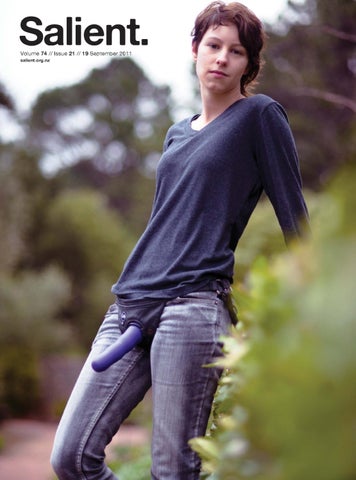
Salient. Volume 74 // Issue 21 // 19 September 2011 salient.org.nz
Salient Vol. 74
Sam Northcott
2
itter! on Tw ! We’re tmagazine n e @sali
Cover Photo By Michelle Ny. The model is Vicky McCrindle. Strap-on courtesy of Dorothy V Dentata.
Like Salient on Facebook ! 19 people can’ 54 t be wrong!
3
The Team
Editors: Elle Hunt and Uther Dean editor@salient.org.nz Designer: Dan Hutchinson designer@salient.org.nz News Editor: Stella Blake-Kelly news@salient.org.nz Chief Reporter: Natalie Powlesland natalie@salient.org.nz Feature Writer: Selina Powell selina@salient.org.nz Feature Writer: Zoe Reid zoe@salient.org.nz Chief Sub-Editor: Carlo Salizzo carlo@salient.org.nz Arts Editor: Louise Burston arts@salient.org.nz
Contributors
Hayley Adams, Auntie Sharon, Stuart Baker, Sara Michele Bishop, Seamus Brady, Rachel Brandon, David Burr, Clare van Boh, Constance Cravings, Ally Garrett, Harry Greenfield, Ryan Hammond, Necia Johnston, Russ Kale, Robyn Kenealey, Sarita Lewis, Callum McDougal, Sam Northcott, Michelle Ny, Stuart Peters, Conrad Reyners, Fairooz Samy, Nicole Skews, Romany Tasker-Poland, Edward Warren, Phillipa Webb and Nicola Wood.
Contributor of the week
Sara Michele Bishop. You are good. We like good things. Ergo we like you.
About Us
Salient is produced by independent student journalists, employed by, but editorially independent from, the Victoria University of Wellington Students’ Association (VUWSA). Salient is a member of, syndicated and supported by the Aotearoa Student Press Association (ASPA). It is printed by APN Print of Tauranga. Opinions expressed are not necessarily representative of those of ASPA, VUWSA, Printcorp, or Valarie Solanas, but we of Salient are proud of our beliefs and take full responsibility for them.
Contact
VUWSA Student Media Centre Level 3, Student Union Building Victoria University PO Box 600, Wellington Phone: 04 463 6766 Email: editor@salient.org.nz
Advertising
Contact: Howard Pauling Phone: 04 463 6982 Email: sales@vuwsa.org.nz
Other
Subscriptions: Too lazy to walk to uni to pick up a copy of your favourite mag? We can post them out to you for a nominal fee. $40 for Vic student, $55 for everyone else. Please send an email containing your contact details with ‘subscription’ in the subject line to editor@salient.org.nz This issue is dedicated to all our best girlfriendzzz! Luv ya bitches! BFFs 4 LYF! Oh-em-gee, did you hear about how Shazza totes pash some fugly random at Estab. I know. I know. Totes. No jokes! What a sluzzer! Oh, hi Shazza! Who was that hot as guy I saw you hooking up with? He was a sweet piece of man meat, wish I’d got me a taste. xox XD
21 The women’s issue
Issue 21 The women’s issue
The Regular Bits Dinocop 2 Guest Editorial 4 The News 7 Eye on Exec
8
Week That Wasn’t
10
Overheard @ Vic 10 Therapy with the Vampire
25
Puzzles 26 Comics
All Over the Place
The Features To Feminists Who Resent Rugby
11
The ‘F’ Word 12 Faces of Feminism? 14 Rape Culture—Hiding in Plain Sight
16
Rubbing One Out 19 It’s Not as Simple as just Boys and Girls
Centre Spread
The Columns VUWSA Prez 5 Laying Down the Law
6
Ask Constance 20 Peas & Queues 20 I Am Offended Because...
21
Lovin’ from the Oven
27
Animal of the Week
27
The Arts Books 22 Music 23 Theatre 24 If you’re looking for Asher and Jezza’s columns, Politics with Paul, Ngai Tauira, Faces to Deface, Failure to Communicate, Bent, The 7th Inning Stretch, Games, Film, Visual Arts, Letters, Notices, Beer will be Beer, Healthy Minds on Campus, or features about things like Paul Henry, the commodification of masculinity, or how misogynist the past was, or even some more news then why not flip this magazine over and read the Men’s issue!
And some advice: If you have to tell people how important you are, you aren’t that important. But don’t worry. Being important is shit anyways. Oh, and also, if all you do is talk about how many unread emails you have then not only are you not as important as you think you are, you are also just a bad correspondent.
salient.org.nz
4
Salient Vol. 74
Guest Editorial. Clare and Necia
Hello and welcome to the Women’s issue, or rather the Women’s half of the Gender issue. We have been waiting all year for the chance to indoctrinate you all with feminist propaganda, so we hope that you make the most of this chance and do your best to become good feminist drones. This is our chance to impress upon you the importance of the Women’s Officer and the Women’s Group, but before we do that, we’d like to extend a big thank you to all of you who made Women’s Fest last week so fabulous (this is us being optimistic, we’re writing this before Women’s Fest, but we’re sure it will be a success anyway). (You know what’s weird? Why don’t those blue things in Avatar have nipples? They are biologically useful, after all. Not just useful for sex. This could actually become an article in its own right about the lack of nipples in the media, but we’re just gonna let you all fill in the blanks there. Back to our regularly scheduled programming.) There have been a couple of murmurings about the importance of the Women’s Officer in this day and age, and we’d just like to stand up and say, yes, it is important we have a Women’s Officer. Like or not—we definitely don’t—women still face considerable discrimination in New Zealand, both in the workplace and, unfortunately, in places of education. We need a Women’s Officer to ensure that women aren’t forgotten and our needs aren’t dismissed here at Victoria. One of VUWSA’s key goals is ensuring equality for all Victoria students and strong representation is the best way to achieve that. As for the Women’s Group, what’s to stop us? If there are enough
women who want to get together and form a group, they have every right to, in the same way as anime geeks have every right to get together and squee about anime. The difference is that in the Women’s Group, we talk about things like equality, empowerment, and what it means to be a woman in the twenty-first century. And sex. We talk about that too. So if you’ve ever thought to yourself, “Isn’t it unfair that men don’t get men’s group?” be the change you want to see. Get out and make one, by all means. We’re not going to stop you—we’ll be too busy sitting round eating pizza and talking about sex.
*
Lots of love, Clare and Necia
Issue 21 The women’s issue
Prez Col The amount of players in a rugby team when you include the reserves
5
Seamus Brady president@vuwsa.org.nz vuwsa.org.nz facebook.com/vuwsa
Seamus Brady
This Monday the University Council will be setting student tuition fees for 2012. It seems likely our fees will be raised by 4 per cent across the board. They say that this is because of Government policy that sees a constant long-term decline in real funding for Universities. That is true and is probably the most important thing to focus on. However it also because of internal decisions made by the University—they understand that you have no choice but to pay your fees and they will continue to increase them by the maximum every year, unless they are stopped. Every member of the University Council knows that Victoria must accept its role as “critic and conscience of society”. In addressing the political issues facing tertiary education in New Zealand, Victoria needs to take this responsibility more seriously. Continuous fee rises should not be done in silence and compliance—particularly when there is a direct correlation between the Government funding of education and rising fees. Students need to speak against this. Importantly, the University should be as well. One of the most common justifications for fee increases is that: the more it costs, the better the education. This is a fallacy. Greater fees do not necessarily equate to quality in education. Some of the best universities in the world have no fees at all for many of their students. Despite the fact that fees have increased every year since the 1990s, there have been cuts to academic programmes being offered at Victoria that have been justified with financial arguments—i.e. ‘we simply don’t have the money to sustain this programme.’ In spite of the fact that fees have increased, class sizes continue to increase, tutorials disappear and resources at the University (such as library resources) are stretched too far. In the Faculty of Architecture and Design students have just found out that space constraints may see the Wind Tunnel removed and destroyed. For these students, this has already had a negative influence on how they interpret quality in their educational experience. They understand that space is an issue but question where their fees are going if they are losing valuable resources just to make room for other needs.
These stories have made many students think that their fees go into an empty hole Students are being expected to pay more for less. We are asked to plug the gap in funding left by the Government’s retrenchment. That is rubbish. The University needs to either secure adequate funding from the Government, or operate within its means. Students come to Victoria for more than just a “student experience”, they come for an academic experience and many of our lecture theatres and resources fall short of what students consider to be quality. To say we would like to increase fees to contribute to the quality of education is a marketing argument. In reality, fees targeted at quality and invested into educational improvements are only likely to be seen and experienced by future students. I urge you to attend the Council meeting today (Monday) at 2pm in the Hunter Building Council Chamber and witness the debate and setting of our fees for next year.
*
salient.org.nz
6
Salient Vol. 74
A game of two halves Conrad Reyners
Last week New Zealand welcomed in the Rugby World Cup. It’s been a long time coming—first bid for by the fifth Labour Government in 2005 and finally implemented by the current National-led Government, it was intended to showcase New Zealand to the world. To an extent it has done that. While opinions on the opening ceremony have been divided, most New Zealanders have warmly embraced this sporting phenomena. But some of them have not. Particularly in the urban enclaves of Wellington, much vitriol has been heaped on the Rugby World Cup. Some of it is clearly justified, and some of it is not. There are two major problems that eventuate when major sporting events such as the Rugby World Cup, or the Olympics take place. The first is the monumental challenge that government faces in order to get things ready in time, and ready to work effectively. The law, and how it is dealt with has an important role to play in this. For example, the restrictive limitations of the Resource Management Act 1991 made things difficult for government when upgrading our stadiums. The Minister for the Rugby World Cup, Murray McCully, even contemplated passing legislation to temporarily over ride the RMA. Thankfully he didn’t need to—but it does demonstrate the pressure that the government was under. The Local Government Act 2002, and the Local Government (Rating) Act 2002 also have an impact. They provides the authority for City Councils to levy rates. Aucklanders alone have contributed over $100 million to the Rugby World Cup. Here’s hoping there is a decent return on their investment. The second problem is more visceral. Along with the revelry, tournaments have a darker side. Public drunkenness, assaults and sexual violence are the unwanted underbelly of major sporting events. Here too, the law has a role to play in ensuring people are protected, managed or have somewhere to turn when its time to right a wrong. Regrettably, over the next six weeks judges can expect to see the criminal law getting a good run-around. I’ve been following how my friends and peers have reacted to the Rugby World Cup, and their differing responses have intrigued me. On the one hand there is a clear appreciation for the opportunities that the RWC can bring. It is after all, an international festival. One where different peoples from around the world come together to
celebrate a shared passion. You don’t need to be a rabid fan of rugby to appreciate the commonweal that major events like this bring. The vast majority of cup goers are well-meaning, tee-totaling families who just want to enjoy a fun, collective experience. But on the other hand there has been an outpouring of pre-emptive vitriol against the Cup. One well read blog, and commenters on the Facebook page of the Wellington Young Feminist’s collective, immediately attacked the World Cup as being a vehicle for sexual violence, gender discrimination and patriarchy. There is undoubtably a serious point here. Sexual violence against women, homosexuals and gender minorities is an abhorrent and unacceptable consequence of many major sporting events. After the opening ceremony in Auckland on 8 September a gay bar owner was Sexual violence assaulted in K Road. This is just against women, the tip of the iceberg. There are homosexuals and likely to have been more incidents, gender minorities and many will go unreported. It’s hard to reconcile these two is an abhorrent points of view, both have valid and unacceptable arguments. Major events should consequence be safe environments where of many major everyone, irrespective of gender, can participate in peace. My sporting events ideal Cup would be one where the coercive power of the law is unnecessary. Squaring the two points of view is difficult. My disquiet comes from way the Rugby World Cup has become instantly polarised. One can be opposed to sexual violence and gender discrimination, and even make the argument that major sporting events contribute to the problem in significant ways. But one can also enjoy a game or two of rugby and still call themselves a feminist. If certain feminist discourses become uniformly entrenched they can become in and of themselves, disempowering. By instantly framing the Rugby World Cup as a battle between the primeval forces of male babarism and the enlightened Amazons of feminism we don’t really get anywhere. This is a problem, because its absolutely vital that we do. Nuanced discussions of gender, violence and rugby are invaluable to a more complete understanding of privilege and partriachy. How we utilise, apply and reform our law is ultimately predicated on the result of that conservation.
*
the news
7
Issue 21 The women’s issue
Edited by Stella Blake-kelly
But it’s one of those As where you didn’t really work that hard so feel a little guilty and will try harder next time Natalie Powlesland
Students have awarded the overall student experience at Victoria an “A,” but that doesn’t mean there isn’t room for improvement. Victoria has recently released the results of its Student Experience Improvement Survey which it conducted in April and May this year. The survey aimed to give the university an opportunity to hear the ‘student voice’ in order to further understand students’ perceptions of the services the university provides. Overall, 80 per cent of survey respondents rated all services and facilities at Victoria as ‘good’ or ‘very good.’ Students identified services that supported studying and living as the best performing and service areas, and services that supported enrolling and getting started as the services which need the most improvement. However, there appears to be a disparity between students in taught courses and those engaged in research-based courses. The survey found “Research students appear to be somewhat dissatisfied with Faculty-based services.” In terms of services and facilities that help students’ studies, the library was the big winner. Both students in taught courses, as well as research students, rated the library as the service that contributes most positively to their studies. Of taught students, 88 per cent were happy with the library resources and 86 per cent were happy with the library services.
Students also rated timely feedback on assignments as one of the most important features in helping their studies. However, alarmingly, only 47 per cent rated the timeliness of this feedback as ‘good’ or ‘very good.’ Communication of information with students was also found to be a particularly troublesome area. Students reported difficulty in finding information or the right person to talk to and generally lack confidence that information will be consistent across sources. Students also believe the University web site is targeted more towards prospective students than current students. The survey also looked at the services provided which enhance student life at Victoria. vicbooks, Student Health Services, and cafes and food on campus were rated the most important in this regard. It was also the cafe and food services on campus which were judged most in need of improvement in this area. Interestingly, in light of VSM, only 5 per cent of students saw services provided by the students’ association as the most important services on campus. The survey results also included the university’s plans to improve in the areas identified by students—including the improvement of online information , research into what first-year students value at university, and the development of computing services. The survey had 4150 respondents, all of whom are current students, and about 22 per cent of the student population at Victoria.
Romany Tasker-Poland
Victoria gets an A from Students
Student computing services were also acknowledged to be of high value to students and their studies. However, 27 per cent of taught students also believed this to be the study-related service which needs the most improvement. The survey found that the timeliness of information was a big issue for students and one that the university is underperforming in. In terms of enrolment, only 64 per cent of students were happy with the timeliness of communication over enrolment details. salient.org.nz
8
Salient Vol. 74
EYE on Exec 12/09/11
Elle Hunt
Last week, the VUWSA exec met for the first time in a long time—over a month and a half. Prez Seamus has not been forthcoming as to why so many meetings have failed to eventuate, dodging your correspondents’ eager questioning with excuses like “There isn’t any business to discuss” (even following VUWSA’s AGM) and “Everyone’s away.” The meeting opened at 5.34pm, with apologies from Queer Officer Tom Reed and Environmental Officer Haley Mortimer. Prez Seamus acknowledged that the last exec meeting was “a very long time ago”, and moved onto the perusal of work reports, compiled from the past two periods. Had I been live-tweeting the discussion, (follow us; @salientmagazine), I’d have broken it down thusly: “Welfare Officer Ta’ase Vaoga grills Vice-Prez (Welfare) Asher Emanuel on his considerable deficit” “Vaoga says that the Pasifika Students Council’s fono at the end of last month was “really successful”” “Prez Seamus says that the National Māori Tertiary Students Association’s AGM was “fun”” “Education Officer Jen Fellows reports that the Undergraduate Review is going well” “Clubs Officer Jeremy ‘Jezza’ Peters announces that ‘Give It A Go Week’ has been cancelled due to lack of interest” “Peters reveals that just two students attended The Hunter Lounge’s screening of The King’s Speech, much to the amusement of all present” Campaigns Officer Josh Van Veen, apologised for not having submitted work reports for either of the past two periods. “That’s because I haven’t done anything of note, and so I’ve probably put in zero hours over the last four weeks,” he explained. Incredibly, no one responded to this, and work reports were passed largely without comment. Seamus then shared some good news: Student Job Search has helped almost 4000 Vic students find work, bringing them just over $8 million in earnings. VUWSA’s levy to SJS is about $22,000, so this is a solid return on its investment. Fellows praised Seamus’ “good work”; Wilson agreed that “snaps for Seamus” were in order; Emanuel clapped. It
was a heartwarming scene until Wilson realised that “snaps” is a quote from Legally Blonde; muttered “I’ve made a huge mistake”; and looked to me for recognition of that very obvious Arrested Development reference. Taking care of business, the exec approved VUWSA’s drafted strategic plan to be attached to election voting (which, as Seamus later explained, will enable students to read and vote on it “referendum styles”). Vice-President (Administration) Daniel Wilson, looking dapper in a new suit, then spoke about VUWSA’s plan for 2012, when membership will be voluntary. Wilson has identified areas where VUWSA could freeze or slow expenditure for the remainder of ’11, to ensure that the association has “big cash reserves left over so we can at least function next year”. He recommended that VUWSA aim to save between $100,000 and $150,000 on top of its current operating surplus of over The exec decided to freeze spending on all $100,000, but pointed out that saving dollars lines that do not affect that students intended VUWSA’s day-to-day to be spent on them in ’11 for use in ’12 presents an operations in a bid to issue of principle. Prez save $150,000. Seamus mentioned that he had discussed making constitutional changes with the VUWSA Trust about funding next year. The exec decided to freeze spending on all lines that do not affect VUWSA’s day-to-day operations in a bid to save $150,000. The exec then moved into committee. Coming out of committee about fifteen minutes later, Vice-President (Education) Bridie Hood recommended that VUWSA contribute a nominal sum towards pizza for ENVIRO 214 and 314’s class functions, which was passed. Seamus followed this up with the welcome news that VUWSA and the University had finalised a policy for responding to students’ grievances “after 18 drafts”. He praised School of Law Dean Tony Smith for his support during the process, “because you don’t really argue with someone like him”. Wilson then suggested that VUWSA put a further $5000 towards the Blues Awards, which recognise sporting excellence among Vic students, from the Cultural Clubs allocation in the association’s budget. The exec expressed reluctance, especially when Wilson let slip that that $5000 would cover the cost of hiring Sevens coach Gordon Tietjens to speak at the event (“So there are lots of savings that can be made,” retorted the Prez). Wilson’s protest that the provision for beverages has been cut was met with a scandalised response from Emanuel and Salient. Seamus recommended that the exec wait until closer to the time to make a decision in case the University decided to contribute more. The meeting closed at 6.22pm.
Issue 21 The women’s issue
Shit Got Real at a Protest Last Week Stella Blake-Kelly Photo by Rachel Brandon
Last Wednesday, a peaceful student protest ended in a stand off between students and security, as protestors tried to deliver a letter to Vice-Chancellor Pat Walsh. In a protest organised by union Unite, 150 to 200 students rallied against a number of changes and cuts being made to university programmes—the same ones which, as previously reported in Salient, saw about 300 students and staff protest in August. Those who addressed the crowd criticised the ongoing cuts to courses and staff, claiming it was adding to the “death of education” at Victoria University. They also said that there had been little consultation or consideration of the academic consequences of the changes— particularly to the International Relations and Politics department. “We are the University, it only exists because we are here. So why don’t we have a say?” said Amanda Thomas, an organiser and post-grad student. Another student criticised the University for “systematically cutting courses and schools, while we continue to pay higher fees.”
9
One lecturer, Megan Mackenzie spoke out saying they “had just as many questions as [students] do.” She also claimed the University’s promises that course pathways could still be continued after the changes were untrue, as staff members are leaving. Following the demonstration, about 80 students entered the Hunter Building to deliver a letter to Pat Walsh, and a baby’s coffin signifying the death of education at Victoria. The crowd armed with chants and placards were met with security guards on the stairwell, leading to a standoff between several students as they were physically prevented from entering the upper level. After about 20 minutes of chanting—including “let us give our letter” and “hands off ” in response to the guards’ handling of the protesters, no one from the University addressed the crowd. Eventually several students pushed past the three guards, leading about 20 students to follow on to the upper level. More chanting proceeded, but soon four police officers arrived and the crowd immediately dispersed. Organisers were questioned, but no charges were laid. Following the events Thomas claimed “there is a really bad culture of intimidation at Victoria, against students and staff speaking out.” She criticised Pat Walsh for “refusing to engage on our concerns.” “We refuse to give up, and we will keep being active until our concerns are heard,” she said.
Green Party Tertiary Education spokesperson, Gareth Hughes, spoke of a consistently underfunded tertiary education sector, leading to “death by a thousand cuts.”
The protest was part of a National Day of Action to raise awareness of education cuts. It saw a group of 60 Auckland University students stage a sit-in at the campus library, resulting in the arrest of two students following smashed windows.
“We’ve got to invest in our education if we want a prosperous economy,” Hughes said.
For photos and video of the protest check out facebook. com/salientmagazine or youtube.com/salienttv salient.org.nz
Salient Vol. 74
y
c Bla Bla Bla
Chicago Sports Bar Sued Over ‘Kiwi-Burger’ Just criticised over decor Edward Warren
Wellington’s Chicago Sports Bar is currently fighting two legal battles, following the release of their ‘Kiwi-Burger’, strategically released in time for the Rugby World Cup. The first, a trademark suit brought by McDonalds, with a claim that the fast-food conglomerate owns the rights to the name ‘Kiwi Burger’, particularly in conjunction with the use of typical New Zealand ingredients fried egg and beetroot. The second, a criminal case brought by the Department of Conservation, charging the popular bar-restaurant with breaching the Preservation of Native Animals Act by ‘illegally catching, slaughtering and slow-roasting New Zealand’s most precious native bird, the Kiwi, in a delicious smoky barbecue marinade, and pulling the meat from which to arrange on a bed of fresh rocket and baby-spinach, accompanied by a fried egg, a slice of beetroot, and a generous dollop of garlic aioli.’ Wellington High Court has found that ‘while mouth-watering, Chicago’s new burger is an atrocious detriment towards attempts at preserving a very gamey, but not unpleasantly so, endangered bird species.’ Chicago has appealed the decision with a claim that ‘if innovative, New Zealand-inspired cuisine is wrong, then [they] don’t want to be right.’ Chicago sports bar is also currently defending itself in the civil action against McDonalds on the grounds that there is ‘literally, literally no more appropriate a name. There is literally kiwi meat in this burger.’ This is not the first time that the two-star establishment has faced legal consequences for their controversial novelty dishes. In 2009 a limited-offer dish, the Real Southern Bloke Breakfast, consisted of an omelette which contained the flesh of Central Otago farmer, Mark Hallett. Chicago Bar won an auction on Trademe for the corpse of Hallett who died on a muster during the previous winter as a result of unprecedented low temperatures and heavy snowfall. The suit was brought on grounds of health and safety concerns but in court Chicago won due to expert witness, local health inspection officer Cameron Cherkov’s evidence that, due to the extreme conditions under which he perished, the body was snap-frozen and perfectly preserved, meaning there was no risk of tainted meat. ‘Which also explains why the flesh of Hallett, or ‘long-pork’ as it is known in the culinary world, was so tender and flavoursome. It was actually a triumph of local cuisine,’ concluded Cherkov in Court.
*
Girl after another girl had compared herself to a DOS computer: “Nah, you’re like a Mac; really pretty but not always with it.” Harpreet Singh Girl 1: “So why do we have to wear shoes again?” Girl 2: “‘Cause gloves don’t go on your feet. Duh.” Tim Newton-Howes Group of official looking visitors strolling around a rowdy library level 5 Visitor: “So let me get this straight, about four of these levels are used for studying and the rest are the children’s play pens?” Mattea McClean In the Theatre Dept Greenroom: “I was brought up as the family dog. We’d go to the beach and my family would throw balls for me.” Andra Leigh Lecturer (explaining an opinion): “...unlike G***** who isn’t focussing on the leture at hand.” Student next to ‘G*****’: “Sorry, but there’s an article on Stuff with the headline ‘Seemingly drunk moose found stuck in tree.’” Lecturer: ‘“Oh! Well then I completely understand!” Benjamin Ogilvie Girl in Kirk Courtyard: “Ohmigod! Those two pigeons are totally pashing!” Haydn Newport Guy in POLS365:“Sometimes I get a linguistic erection. Y’know, thinking about what words do, what words to to each other.” Karl Johnson Boy on level 5 talking to a group of people at his table gleefully: “I booked the big study room for 11 o’clock. You know. The big one with four seats?! Hoo Hoo, how greedy of me!” Pheobe Webster MARK202 text book page 207: “Your penis thinks you should stop smoking.” Khushma K-Master Renee lyons
the week that wasn’t
Email snippets of life at Vic to editor@salient.org.nz with ‘Overheard’ in the subject line, or find Overheard @ Vic on Facebook
10
11
Issue 21 The women’s issue
To Feminists Who Resent Rugby Nicola Wood
I don’t like rugby and prefer to pretend the World Cup (RWC) isn’t happening. Fortunately I live in a part of Wellington where that’s easily done; my neighbours seem to have a similar lack of enthusiasm (I’m pretty sure the sport of choice here’s either tree-hugging or yoga) so it’s like nothing’s changed since the competition began. My aversion to the Cup is rooted in my identification as a feminist. My friends seem to think this makes me—and feminists in general – grinches who want to put a downer on everyone else’s good time to prove a political point. However when I was cajoled in to going down Courtenay Place amidst the festivities I was made to think: what is it that makes me so angry about this? Feminism holds nothing against dancing, cheering, partying or displaying some level of pride for your country. It became apparent that my frustration with rugby began before the Cup, and probably won’t end after the final. The RWC certainly shows the extremely high value New Zealanders place on the game. Along with intense excitement we’re also witnessing a horrible amplification of some of the ugliest aspects of rugby culture. Groups like Women’s Refuge and Rape Crisis have had to increase their resources significantly over the duration of the Cup because statistics show that violence against women and family violence skyrocket after sporting losses. Just last week there was a gay bashing on K Road by a group of fans after a match. Many people feel unsafe.
The Cup’s dominance in the media and the increase in such tragic statistics make it easy to misdirect our anger at the tournament itself. It’s easy to mistakenly think that the event’s caused these problems. The reality is that by doing this we’re failing to acknowledge the real scope or cause of the them. We need to be angry that family violence goes up after the All Blacks lose, but we can’t forget that regardless of whether the Cup is on or the All Blacks are playing, people from small rugby clubs around the country will be violent to their families each weekend if their local team loses. We need to be angry about homophobic violence on K Road, but we can’t think that it only began when the RWC did, or forget that each day young boys go to school scared of the bullying they will face because they don’t fit in to the idealisation of masculinity exemplified by the 1st XV. There are many very seriously problematic attitudes about women, men, and violence tied up in rugby culture. The fanfare around the RWC highlights how powerful rugby’s is in perpetuating these We need to be angry influence ideas, but it doesn’t cause them. about homophobic Rallying against it isn’t going to violence on K Road, change them. In fact, rejecting the World Cup but we can’t think or rugby in general doesn’t get us that it only began any closer to making our country when the RWC did a safer place. If anything such an approach represents missed opportunities to tackle problems as a community. Our country’s obsession with rugby highlights just how influential the sport is. It permeates schools and communities, as well as the hearts and minds of many (especially young) New Zealanders. On one hand this presents a problem: the harmful attitudes I’ve described can spread through many channels. But on the other hand, the power of rugby organisations and sporting figures within communities offers potential for positive social change. We can see people beginning to realise this with the advent of campaigns like ‘Blow the Whistle’ which attempts to tackle family violence by using sporting figures as role models and targeting energy and resources at rugby clubs. I sincerely hope that other feminists who, like I, have been feeling grumpy about the RWC recognise that the tournament’s not the problem: the broader, omnipotent culture is. I hope we realise that a harmful culture doesn’t mean we must reject all aspects of the sport. We can work with its groups; maybe instead of hiding and pretending rugby events aren’t happening, we should try and make the connections needed to start some action. After all, isn’t a principle that the feminist movement and rugby organisations have in common the notion that we can achieve everything better working as a team?
*
salient.org.nz
12
Salient Vol. 74
The‘F’Word Sara Michele Bishop
The year was 1972. Hundreds packed the student union building, men as well as women, students as well as staff to hear Germaine Greer speak at the first National Women’s Liberation Conference. There was cheering, awe, solidarity, determination for the future. At least for Wellington, it was a telling moment of the 1970’s zeitgeist in which lefties across the globe felt the future might finally be in their hands. For feminists in particular, the contraceptive pill had been made available, the Equal Pay Act was beginning to take effect and Women’s Studies was becoming a popular subject in many universities. No one could deny that there was hope. Fast forward nearly forty years and that determination and hope has been replaced with a rise in conservatism and dire political apathy. All of which begs the question; how liberated did those devoted secondwave feminists like Ms. Greer truly get and what is left of their legacy? It seems today that feminism is a highly loaded term and so few women (let alone men!) are willing to associate with it. Ask a random passerby at
Victoria and a feminist is a humourless, hairy, militant, man-hating and nagging woman. Ask a POLS112 class of one hundred and eighty students and a feminist is any of the three women who cautiously raised their hands. There’s no denying that the angry, man-hating stereotype hurts the cause; who wants to associate with hatred and anger? Of course there are a few angry feminists, just like there are a few environmentalists who spend their days smoking joints and growing out their dreads. However, the fact remains that those are just arbitrary stereotypes, stereotypes that conveniently discredit the groups that they have unfortunately Ask a random come to represent. passerby at Something else must be Victoria and at play though; for all a feminist is a the critical-thinking, intellectual young men humourless, and women out there, hairy, militant, one would think some of man-hating and them could see past the nagging woman stereotype. Something else must account for why feminism has lost its momentum and I have a sneaking suspicion it’s not because the struggle is over, although you’d be forgiven for thinking it is if you’ve heard the catchy new phrase ‘post-feminism’. Academically speaking, post feminism describes an era that recognizes the events associated with second-wave feminism. Yet as a term in more general contexts, it’s hashed out every time a company wants to make a hilariously misogynist advertisement (think that burger that will ‘blow you away’), every time someone tries to elicit laughs for his or her ‘sammich’ joke and every time someone derides modern feminists for ‘just taking it too far these days’. Inherent in this idea of post-feminism is that we are literally living in an era after feminism; that there’s no longer a need to fight for our rights because ultimately women have all the rights they’ll need. So when this idea is propagated in common jokes and advertisements,
13
Issue 21 The women’s issue
it’s really no surprise that so many women these days don’t quite know what to make of the dirty ‘f ’ word. Exacerbating that icky stereotype and post-feminism is the ‘uncoolness’ of all politics in the twenty-first century. It’s easy to see politics as the domain of textbooks or old, grey-haired men in suits. The fact that it is riddled with so much jargon and complicated bureaucracy leaves a lot of people feeling isolated, without a voice and ultimately dumping political participation in the ‘uncool’ pile. Except for when there’s been a recession. That’s right, when money’s tight, politics is pulled from the ‘uncool’ pile just a little bit and people begin pining for the brighter times of yesteryear, imaging in their nostalgic haze that progress is to account for all the money issues. This is happening all over the world, in the USA where abstinence-only sex-education seems Germaine Greer to be winning that particular fight, where laws around abortion and rape that protect women are being repealed and where a film featuring a woman climaxing is censored as more offensive than a film where a woman is bisected with a buzz-saw. It’s happening in Europe where female politicians are routinely scrutinized for their appearance while their male counterparts go along their merry, womanizing way. It’s happening in New Zealand where domestic violence continues to increase while few political parties actually want to address it and let’s not start on pay equity. And this is just the West. There are still five countries where a woman’s right to vote is denied or limited and a whole lot more where the words ‘marital rape’ don’t quite make sense. This recent roll-back of women’s liberation paints a very bleak history and certainly refutes any ‘post-feminist’ arguments. So let’s move on to modern feminism and what that entails, because it is not about hate, it is not to blame for any current worldly issues and asserting your rights certainly does not need to be difficult. Granted there’s a whole lot of legislation that needs reevaluation, but a lot of sexism is cultural and we can address it in our day-to-day lives. For starters there’s that good old double standard about sex where lots of it leaves men as studs and women as sluts. Fighting sexism in this case is as easy as replacing ‘Ew what a slut’ with ‘I’m happy for my friends who get a lot, regardless of gender’. So easy! There’s no reason for anyone’s sex life to be quantified by anyone else or society at large (and please don’t send the letters section a whole bunch of lock and key analogies). It’s also important to remember that this goes both ways; calling a woman a slut for having too much sex is as hurtful as calling a woman frigid for choosing not to and both are just as hurtful as questioning a man who doesn’t crave sex every waking hour of every day. This is why feminism is for everyone, men and women; traditional gender roles hurt everyone. More sexism that hurts men as well as women can be found in the social contract that exists around money and gender, essentially painting men as as valuable as their income and women as gold diggers. For instance the
Certainly the greatest hurdle to overcome in defining feminism in the twentyfirst century is escaping the belief that feminism is anti-men expectation that a man pays on a date and in return he can expect some lovin’ to the value of the date he just paid for. Next time you’re on a date and feel like toppling the patriarchy it’s as easy as splitting the bill and having sex when both parties are keen, not just feeling obliged. You can fight sexism by looking at the way news media reports gendered issues. For example, in New Zealand, women currently outdo men in terms of university participation. This is hailed as a victory for women’s liberation or represented as a threat to men, but the reality is women need more qualifications if they want to earn the same salaries and enter the same jobs. Which brings us to yet another easy way to stop sexism and that’s the way we think about family and parenting. Currently in NZ, the domestic purposes benefit is such that a single father has to provide, on top of all the information a single mother would have to, proof that he is the only person able to care for his children. Feminism is often blamed for this and the idea that family courts favor women. Yet that is a misguided belief as it is really just another example of gender oppression that hurts everyone, especially single fathers, by saying that men should be making money while women are in the home. Certainly the greatest hurdle to overcome in defining feminism in the twenty-first century is escaping the belief that feminism is anti-men. Feminism does not seek to take anything from men, nor does it wish men to be discriminated against in the ways women are. Feminism is about seeing all people as intelligent, critical, empathetic human beings who deserve dignity and the responsibility and trust to be held accountable for their actions. It’s about seeing the value in the feminine as well as the masculine and seeing them as complementary; not polar opposites to be ranked and pitted against each other. I’ll finish with the words of the wise Gloria Steinem in saying that feminism ‘means you see the world whole instead of half. It shouldn’t need a name— and someday it won’t’.
*
salient.org.nz
14
Salient Vol. 74
Faces of feminism? Salient lets you decide, kind of. Fairooz Samy
Unsure about your feminist role models? Confused as to who to fall in line behind? Fear not friends! Salient takes a brief look at three (arbitrarily-selected) media-endorsed feminist poster-children so that you won’t have to.
Naomi Wolf
She comes up with (patent pending) “sexual gradualism”, essentially a system aimed at teenage girls that advocates ‘proper’ masturbation techniques for the purpose of prolonging virginity
Wolf’s glamorous wardrobe and luscious movie-star hair was arguably as influential in her rise to media prominence as her Yale education and feminist agenda, which is ironic for the someone whose most famous book is titled, The Beauty Myth: How Images Of Beauty Are Used Against Women. But don’t let that put you off the supposed “face of third-wave feminism.” Instead, be put off by the bewildering, and at times counterproductive remarks she’s made in her capacity as the cause’s latest spokeswoman. They range from, “only 48 per cent of women in the US use contraception regularly” (sourced from a 1984 psychology book called, ahem, Swept Away: Why Women Confuse Love and Sex) to calling for the removal of “Victorian-era” name suppression laws that protect the anonymity of sexual assault victims, or as Wolf refers to them, “sex-crime accusers”. She’s also claimed that the Burka defeats the male gaze when it’s worn as a choice, while simultaneously making the racist comment that Arab women are “as interested in allure, seduction, and pleasure as women anywhere in the world.” Who would have thought? In another book, Promiscuities, she comes up with (patent pending) “sexual gradualism,” essentially a system aimed at teenage girls that advocates ‘proper’ masturbation techniques for the purpose of prolonging virginity. For those who fail under this system, there’s always the option of abortion—at least, “dehumanized” abortion that Wolf, herself a proponent of the procedure, bizarrely defends by arguing that “Sometimes the mother must be able to decide that the fetus, in its full humanity, must die”. This logic, she states, will help the pro-choice movement reclaim the “moral frame around the issue of abortion”. In sporting terms, that’s known as an own-goal. Feminism has become a dialectical process,
so where’s the harm in embracing Wolf ’s eccentric views as just another side to the debate? After all, she’s garnered occasional praise from luminaries like Germaine Greer and Gloria Steinem. Yet, as inextricable as controversy and feminism are, there’s a line between reasoned examination and opposition for opposition’s sake. Wolf seems to muddle that line incrementally each time she’s exposes herself to mainstream media. And let’s not forget the hair.
Joss Whedon Media studies darling and fan-boy idol, Whedon first broke new ground in the television industry with the cult hit Buffy the Vampire Slayer and followed the sensation with Angel, Firefly, and Dollhouse. As a self-proclaimed feminist, Whedon explained that the concept for the series was to turn horror genre conventions on their head to produce the blondest, prettiest, most all-American demon-slayer he could think of. “It was pretty much the blond girl in the
15
Issue 21 The women’s issue
alley in the horror movie who keeps getting killed... She was fun, she had sex, she was vivacious. But then she would get punished for it. Literally, I just had that image, that scene, in my mind, like the trailer for a movie what if the girl goes into that dark alley. And the monster follows her. And she destroys him”. He named his creation Buffy, and as the picture of ‘90s hipness, she and her lesbian sidekick Willow confidently defeated hordes of fanged muscle-men for an impressive seven-season run. But there were cons. Buffy’s first sexual encounter results in the loss of her boyfriend’s soul, and after his departure from the show, she is left Whedon’s Dollhouse scarred and emotionhas garnered the ally ruptured for the most controversy remainder of the series. for its exploitation Faith is consistently punished for her of female bodies as sexual confidence, empty shells, wiped and even Willow and clean of memories and Tara’s much-lauded implanted with new gay relationship sees the former descend personalities into evil and become a season villain. The slayers—all young females with predetermined, inescapable destinies—are governed by an exclusively male council of ‘watchers’ who interfere in the girls’ lives. While an in-depth critique of the show is impossible here, there have been countless studies which engage with the problems of depiction and the reconcilement of purportedly feminist portrayals that carry arguably patriarchal overtones. Whedon’s Dollhouse has garnered the most controversy for its exploitation of female bodies as empty shells, wiped clean of memories and implanted with new personalities each episode to suit the requirements of predominantly male clientele. Though Whedon claims that he merely wished to experiment with the limits of identity and personhood, the fact that none of the characters in the ‘Dollhouse’ (really, Whedon?) give what can be construed as consent for the many violent and sexual acts performed against them has had commentators flooding the internet with outraged protest. Why is this important enough to distract you from your lecture? The success of Buffy heralded in an era of prime time television that featured female lead characters in shows like Tru Calling, Charmed, Roseanne, and Saving Grace. Whether or not their content was any good, Whedon’s influence was to thank for introducing safe-betting executives to the idea that women-centric stories could be popular and financially viable.
Michelle Obama “It’s a bit disconcerting”, said the US First Lady on giving up
her illustrious career in 2007 to help run her husband’s presidential campaign. Fast forward to 2011 and her sacrifice seems to have been well-played, or perhaps not, considering the backlash Barack has faced since the initial euphoria of his election as the anti-Bush. As a positive female role model, Michelle Obama deserves all the commendation she’s received. Salutatorian of her high school senior class, There are rumours she graduated cum laude with a Obama intended to make BA in sociology from Princeton affordable childcare and a J.D. from Harvard. Obama cultivated a healthy interest in and work benefits her activism, advocating for minority patron ‘Issues’ yet, like groups and providing legal aid for Clinton before her, was low-income citizens while still at ‘persuaded’ to tackle a less university. When set loose on the working world, the trail-blazer controversial subject applied her talents as an attorney, a director of a non-profit organization, an associate dean at Chicago University, and a VP for the state’s hospital board, during which time she brought home the proverbial bacon with a salary twice that of her senator husband. Not to mention finding the time and energy to raise two children. Even Simone de Beauvoir’s ghost would high-five such an accomplished lady. Although her feminist credentials seem bona fide already, her case acts as a reminder that powerful women are still bound by rules of political and social conservatism. There are rumours Obama intended to make affordable childcare and work benefits her patron ‘Issues’ yet, like Clinton before her, was ‘persuaded’ to tackle a less controversial subject like childhood obesity, which ticked more of the family-themed boxes and suited her profile as ‘First Mom’. Though she’s overseen the project admirably, the images of the former high-powered businesswoman with the gold-plated resume hoola-hooping her way to social appeasement speaks volumes about the pressures put on high-profile women to conform to traditional gender roles. Be it pop culture phenoms, political leaders, or academic pin-ups, feminism is made visible though media-chosen figures. While emphatically denying the influence of a hypodermic-needle media model, most people- barring considered study in to the subject- formulate an opinion based on the collection of impressions they get of the chosen few. That said, accurately have these three been represented? We’ll let you be the judges of that.
*
salient.org.nz
16
Salient Vol. 74
TRIGGER WARNING contains sexual assault and misogyny
Rape Culture: Hiding in Plain Sight Nicole Skews
When I was 20 I read a book called Cunt: A Declaration of Independence by Inga Musico. I was pretty new to feminism, and formerly of the ‘we’ve had two whole female Prime Ministers so we can’t be doing that badly’ ilk. It sounds cliché but I felt like reading this book woke me up from a really comfortable, ignorant dream. Everything was clearer and harsher after reading this book, but I didn’t regret it at all. The moment that shook me awake was when Musico described her fear, every woman’s fear, of walking alone after dark. She called it a “curfew” which is a word I felt was loaded with oppression and violence. She then stated flat out that this curfew is only for half of the population. And my heart stopped a little. See, when I was reading this segment my inner monologue was following along somewhat indignantly. “Yeah duh,” I thought when Musico described how unsafe it was for ladies to walk the streets at night, that’s just common sense. I suppose on some level I knew that dudes were somewhat freer to walk alone at night than I was. But I had never laid it out in my head like that. Men obviously fear for their personal safety also, but their fear is not as large, as ingrained, and as sexual assault-specific as women’s fears. And men are far less likely to be casually harassed with yells, comments and leers purely from walking around at night time. This was the first glaring gender-based inequality I had ever really seen. And it had been hiding in plain sight all along. Shock horror, but that’s what feminism is about. It’s about confronting the stuff that you always thought was normal. The first wave of feminism now seems like a really easy win—women should be able to vote. Sure. Tick. Second wave? Well that’s a bit more layered, but personal choices; financial and professional independence—that’s also an
It’s about confronting the stuff that you always thought was normal
17
Issue 21 The women’s issue
Victim blaming is a huge part of rape culture easy win. But this third wave, what the hell is that? Is there maybe even a fourth wave? I’m sure multiple people have multiple stances on this, but for me, feminism now is about confronting internalised misogyny. Inequalities hiding in plain sight. And one of the largest parts of that is rape culture. Rape culture is me thinking “yeah, duh” to something telling me that as a woman I cannot walk alone at night. Rape culture is me internalising the acceptance of ‘my lot’ so deeply that it was normal, not offensive, not even really an obvious choice. We have an odd perception of discrimination as being Jim Crow laws, girls not being sent to school simply because they’re girls, queer couples being yelled at in the street. But it’s broader than that, and often far less obvious. Rape culture is the fact that according to statistics by the Ministry of Justice, a quarter of all women you know will experience distressing sexual contact in their lifetime. Men get sexually assaulted and abused also. Men are afraid to walk the streets at night too. Men are not the only people who rape and abuse. But undeniably, women are disproportionately on the receiving end of rape, sexual abuse and harassment. And men are disproportionately the offenders. Women also, much more so than men, are told throughout our lives that our sexual safety is in our own hands. ‘Rape prevention’ tips and commonly held safety beliefs (like not walking alone at night, not wearing revealing clothes and not getting too drunk and flirty if you don’t actually want to sleep with anyone) stem from the incorrect belief that rape is perpetrated by strangers. Rape is overwhelmingly perpetrated by people known to the victim (stats vary between 70 and 90 per cent). The sort of rape women think of when we are walking home with our keys in our fists and our cell-phones out constitutes a minority of sexual assaults. But for some reason it seems like the easiest to digest. If we can think of rapes and sexual assaults as being occasional, committed by some sex-crazed monster in a dark alley, then we can distance ourselves from it. We can keep making excuses like “well she shouldn’t have been that drunk [I’m different from her]”, “She shouldn’t have been wearing that [I’m different from her]”, “He’s a monster [I don’t know any guys like that]”, “What sort of guy would do that? [I’m different from him]”.
Victim blaming is a huge part of rape culture, and the reason why many (if not all) women will be told from multiple sources throughout their lives that they need to be careful ‘what message’ they are giving out with their clothing and behaviour . Even though some opportune dude at a bar is far less likely than a childhood friend, family member or acquaintance to rape her, she will feel responsible for not ‘putting herself in danger’. For doubtful dudes reading this, have a chat to some female friends about their survival strategies. Realising that you have probably never had to pretend to be talking on the phone while a car load of dudes slows down beside you and yells ‘Hey baby want a ride?”, but that every single woman you know will have a mental archive from a lifetime of these experiences, should hopefully clear up any doubts. So why is rape culture so good at making us feel like we don’t know any rapists, or that people who get raped are somehow at fault? Because it’s convenient. We create a myth of how and why rapes happen. We tell ourselves rape is about sex, rather than about power. We tell ourselves if she was really raped, she would have struggled (despite the fact that women often shut down out of shock to protect themselves, which is particularly true of rapes involving someone the victim knew and trusted). We tell ourselves subconsciously that women who refuse sex after ‘leading men on’ were asking for it, because maybe we’re not actually as progressive about gender roles as we think we are. Rape isn’t sex, it’s assault. It isn’t sexy, it’s violence. And rapists aren’t one-off crazies who will get thrown in to jail as soon as the police find them. On average, a rapist who gets away with his assault will go on to rape another five women. And he probably will get away with it because his victim has had a lifetime of being told that she could have avoided that situation entirely. Too often, admitting a sexual assault to herself and others in the face of blaming questions, disbelief, and all of the perceived “baggage” that comes with admitting you’re a rape survivor is just too fucking hard. When women do come forward, the justice system is drawn out, and humiliating—with the added bonus of her sexual history, personality, dress and behaviour often being called in to question. It’s also pertinent to point out that the perception that one short skirt or badly timed retraction of sexual interest can lead a man to be overcome by his sexual urges and rape someone, is offensive to men. It is basically implying that men are one exposed thigh away from rape, which, for most dudes just isn’t true. Rape culture is harmful to everyone.
We need to change the view that a woman cannot express her sexuality through clothing or behaviour without ‘misleading men’
salient.org.nz
18
Salient Vol. 74
When it’s acceptable for a major news website in New Zealand to make the headline of a sexual assault court case where a young women was assaulted and filmed Sex Video Victim Lived Secret Adult Lifestyle. Then we have some work to do, and fast. We need to change the view that a woman cannot express her sexuality through clothing or behaviour without ‘misleading men.’ Newsflash, women are not for the viewing pleasure of men. If some dude happens to enjoy what he sees, that’s good for him, but there is nothing, nothing on this earth that gives him the right to do anything about it. Clothes do not send ‘mixed messages’, certain types of clothes do not increase he likelihood someone will be raped, clothes do not consent—verbal expressions of her desire to have sex with you (and nothing less) is consent. And if she changes her mind, deal with it. Men are not controlled by their cocks, and women are not here on this planet to defend ourselves. When dudes have a laugh with their guy friends about some girl and her moral code, her outfit and her determination to be noticed, but they don’t really mean it, so just like, chill out okay?—they are actually just continuing this cycle of blame and self entitlement that makes up rape culture. Also, statistically chances are they’ve done it in front of someone who has or will rape or sexually assault someone. And they just made him feel like he’s not alone. Women need to stop feeling like getting leered at on the street or followed around by the weird dude from their psych class is ‘just part of life’. Because it’s not part of life for half of the population, and that’s not okay. Women need to wear what they want, when they want, and start asserting that nobody has the right to comment. If some women do
Just stop for a second and think about all of the women you know. One in four of them will have been sexually assaulted want attention because of their awesome new little black dress, I’m pretty sure it’s attention not assault they’re after. Women need to stop thinking that if they get horribly drunk at a party and someone decides to rape them, it is not a consequence of anything other than someone being a rapist. Just stop for a second and think about all of the women you know. One in four of them will have been sexually assaulted. Confronting this stuff is key to turning those statistics around. Confronting this stuff, these harmful deeply held (almost subconscious) beliefs about rape which are harmful to women and men is key to breaking down rape culture and making people feel safer. And guess what? That’s feminism. Probably wasn’t as scary as you or I first thought, huh?
*
ANU G R A d U At e PROGRAmS Higher Degree Research & Graduate Coursework Opportunities ANU is an education intensive research institute, recognised worldwide for its excellence. Our students benefit from a learning environment with more educators and mentors per student. Degree Programs Scholarships Accommodation Childcare www.anu.edu.au
www.anu.edu.au/graduate anu.edu.au/scholarships accom.anu.edu.au/UAS/186.html quicklink.anu.edu.au/5vq1 CRICOS #00120C 160511NZ
Higher Degree Research applications can be made directly to ANU at any time of the year while Graduate Coursework closing dates vary from program to program.
19
Issue 21 The women’s issue
Rubbing One Out Phillipa Webb
Masturbation.
It’s a taboo subject. Even saying it raises eyebrows and uncomfortable silences amongst the majority of us. This topic was raised in my life a couple of weeks ago at a BYO with friends, when during an innocent game of ‘have you ever’ a male friend of ours asked, ‘have you ever masturbated?’ Obviously, the boys drank; openly, and honestly. But us girls shuffled and looked around uncomfortably, until one by one, we began to raise our glasses to our lips. And just like that, the code of masturbation silence had been broken. Our boys were absolutely shocked, and in the way they get excited about girls hooking up, they were most definitely excited at the tantalising thought of us ‘getting off ’ on our finger tips. So, I got thinking, why can’t this be a more open topic of conversation? Why not put the awkwardness aside? Let’s relinquish those feelings of uncomfortable moments when you want to talk to your best friend about that little fingering experience you had last night. Be proud. Tell her you made yourself feel good—because that’s what its all about isn’t it? Well, let’s take a little walk through masturbation history. This unmentionable subject has been a prominent feature in art for centuries, like Gustav Klimt’s 1916 Woman seated with thighs apart. It’s obvious that masturbation is not a new phenomenon, as I’m sure men and women have been exploring down there since the beginning of time. So why all the silence now? Why be all ‘hush hush’ about something that is as natural as leaves on a tree? Here’s the thing boys and girls, the health benefits of ‘flicking ya bean’ or ‘yanking the chain’ are endless. Not only is it a stress release, an aphrodisiac, a confidence booster, safer than sex, and a relaxant, but it feels good. Whoever created us decided to give women the glory of a clitoris, with its primary purpose to give us pleasure. In addition, large proportions of girls cannot orgasm during sex and use masturbation as a tool to explore what feels good, and how to improve their sex lives. So I think it’s fair to say at this point that masturbation is most definitely prevalent in the majority of our lives, but then why the silence? The imbalance between the perception of females and males in society and throughout the media, make it extremely difficult for girls to talk about their self-stimulated sexual encounters as their male counterparts do. I’ve had mixed responses from students around campus, some open to talk about their personal experiences, and others very coy about what they get up to, some girls completely denying that they’ve ever self-stimulated. I admit, it’s a personal thing. However, what needs to change is the stigma that women shouldn’t talk about it, while men joke and share techniques on a regular basis. The solution? Firstly, if you haven’t masturbated, I urge you to give it a go. And if you have, maybe open it up for conversation with your closest friends. The next time you’re at a BYO, bring it up—I assure you that the boys will show a lot more interest towards you and your hands.
If you haven’t masturbated, I urge you to give it a go
Woman seated with thighs apart 1916 Gustav Klimt
*
salient.org.nz
20
Salient Vol. 74
? estion sex qu Got a k s a to Want usly and mo to anony alient? Go r S fo in see it stance.com 15 n d o e c arn ask -e rd a ss, your h s of facele . minute less fame pants
constance cravings
with Auntie Sharon
Hey Constance. I have a very unusual problem but I’m not making any of it up. Sometimes when I am in a very horny mood I like to take my clothes off (as a lot of people do) but then I go outside into my garden. It gets worse. Sometimes I look over the fence to see if anyone is in the street and if I can’t see anyone I sometimes open the gate, tip toe out of it then quickly scurry back into my property. The thing is, I don’t want to be seen, but I get off on the thought of being seen. I’m so worried that I will be caught and friends and family will find out. Help me CC. Nakey-boy **** Oh you sweet thing, what a fun wee fetish you have. It’s not a problem, it’s something fun that gets you off. Don’t stress, enjoy your own quirks! Unless you are being a public menace i.e. forcing your naked self on others when they’re not keen for Nakey-boy, then what you’re doing is harmless, a bit exciting and totally sexy. Unless you are doing it to friends and family, or you happen to live with them and do it while they’re home, I wouldn’t worry about them finding out. Be careful with the street-venturing, because in a residential property no one is going to call the cops, and worst case scenario is your neighbour gets a fright and who the fuck cares because you can be naked in your own damn garden. However, on the street it could be ‘public exposure’ which may get you in trouble but a highly doubt it if you’re not being an aforementioned naked menace. Just generally go with it, if it turns you on and you’re not hurting anyone then good for you, Nakey-boy. Also consider some sneaky public place sex next time you have a sex friend. It sounds like it could be up your alley. x
Dear Constance, I have a perpetual problem with combining love and sex. This has always lead to such morally decrepit behaviour like cheating; I am in a relationship with a beautiful man who I absolutely love, and who loves me but I have an almost overwhelming desire to sleep with other people. I know that an open relationship is out of the question but I’m terrified of potentially ending the relationship. Should I cut my losses and go solo? Or will this desire eventually fade? Frustrated. **** To quote myself (like a boss) on a similar question earlier in the year—have a think about what your priorities are, what the pros and cons of all options are, and I think you’ll find there’s a clear preference somewhere in there. But be prepared for it to not be as clean cut as you’d like, because even in preferences there’s compromise: if you stay monogamous you’re going to have to compromise on your desire to explore, and if you leave him you’re going to have to compromise on having the man you love. What compromise can you live with the most? X
*
I don’t envy those of you about to graduate from university. There’s a recession still meandering on, and worse, there’s a government in power who seem to think that the public service is an evil like no other. That’s bad news for those of you with BAs, who have been sheltered from the real world by the puffed-up salaries and blur of bureaucracy in the public service for many years. You BCA graduates should still be alright—I hear the banks are still making zillions in profits despite the downturn. Funny that. For those a tad scared about being plunged into the workforce, or more accurately, almost certain unemployment, here are a few tips to help you on your way to the salaried world. No shame in moving home There really isn’t. If you’re skint and jobless, make the most of that unconditional love and live rent-free for a while. Hopefully your Mum and Dad haven’t turned your old room into a gym/office/spare room for the grandchildren. Consider the provinces The lure of the city is strong, I know. I like it here too. But come November, there are always more graduates than there are graduate-level jobs. Consider checking out jobs in the provinces—the rent is cheap, and there are still jobs going, especially in summer. Right now there are jobs for a mystery shopper in Paihia, a shepherd in Gore, a dive instructor in Hawke’s Bay, a kayak guide in the Sounds, bar staff near Franz Josef glacier, and a Fudge Cottage sales assistant (does it matter where Fudge Cottage is, really?). Consider leaving—but come back While you might not get your dream job in London anymore, or even a job vaguely related to what you studied, there are still jobs at bars/cafes and plenty of room for Englishspeaking nannies. There are also summer camp jobs in the US which can be a lot of fun (and which you can string along into late summer, then winter camps), the ski-fields in Canada, and work on organic farms everywhere else. Make the most of those working visas before you turn 30. No-one really expects you to have a ‘career’ until you’re 35.
Issue 21 The women’s issue
21
Ally Garrett
Volunteering is good for everyone So you keep getting feedback that you don’t have enough experience, and you’re all like, but how the fuck am I meant to get experience? Volunteering. It’s a good way to get some experience under your belt, meet some people (that’s actually how you get jobs in New Zealand), and figure out what you do and don’t like. Will also prevent Dr Phil and The Little Couple addictions.
In Defence of the Hickey
When all else fails, mention Twitter You know what scares old people? Twitter. If your CV isn’t getting you through the door, try mentioning Twitter in your job application—whether you actually get it/like it yourself or not—and they’ll think they need you. Y’know, to stay hip and connected.
*
Stuart Baker
Good luck job hunters—if you need more specific advice, write to auntiesharon@salient.org.nz.
My girlfriend and I had sex on Saturday morning. This isn’t unusual, and it perhaps isn’t column material, but we’ve almost been together for three years and it’s nice to know that we are—as yet— untouched by the icy fingers of lesbian bed death. Our anniversary is on Halloween, if you’d like to send well wishes, gifts or singing telegrams. It’s hard to believe that it has almost been three years since I did a walk of shame home through Aro Park, clutching a Kristov Orange cask but like sands through the hourglass, so are the days of our lives. And to get back on topic, I’m spending the days of my life having lesbian sex. The Saturday morning sex was good. Great even. It was so great that when I looked in the mirror afterwards I had a thwacking great patch of hickeys on the left side of my neck, all the way up to my ear. I was horrified. I was humiliated. I was also hungry, but that didn’t have anything to do with the blood blisters. I ate an egg sandwich My neck and I are bringing hickeys back. and I went to my rehearsal that afternoon hanging my A hickey is just visible head in shame. Hanging my proof that someone head in shame but slightly to the left in a lackluster has been nibbling on attempt to hide the hickeys. your neck, which is a Predictably, my raspberry mighty fine erogenous neck was met with scorn zone if you ask me. and derision. It was then that my friend Hannah gave me some very sage advice. ‘Ally’ she said, ‘You are going to have own this.’ And then, my friends, it was a new dawn, a new day, a new life. I put my shoulders back, I put my chin up and I displayed my love bites for all the world to see. Or at least, the five people I was at rehearsal with. My neck and I are bringing hickeys back. A hickey is just visible proof that someone has been nibbling on your neck, which is a mighty fine erogenous zone if you ask me. There is nothing shameful or trashy or embarrassing about having your neck slurped on. I don’t believe in judging the merits of a person by whether or not they’re sexually attractive to other people, but knowing what feels good and finding someone to do that with occasionally is kind of a cool thing. If you see someone with a hickey what you should be saying is ‘Congratulations’. From now on I’m giving up on scarves and I’m leaving behind my concealer. I‘m no longer watching complicated YouTube tutorials about cold metal teaspoons or bottle caps or toothpaste. If we can reclaim the word ‘slut’ and we can reclaim needlepoint and sponge cakes then I can reclaim hickeys. I hereby decree that hickeys are in. The only thing that sucks about hickeys is the literal sucking required to get one. Embrace your hickeys. I’m embracing mine with such vigour that I’ve got a new theme song. If you ever want to find me just listen out for the person humming “Hey Hickey, You’re So Fine, You’re So Fine You Blow My Mind, Hey Hickey!”
*
salient.org.nz
22
Salient Vol. 74
Books
Oh the irony
The rise of feminist-hating women Fairooz Samy
“It’s like we have taken the cage away from women and none of us are trying to escape”- Ariel Levy Sex appeal. Physical fitness. Charm. Social skills. Sexual competence. Liveliness. Skills in self preservation. According to senior Sociology research fellow Catherine Hakim, these seven traits make up erotic capital and are the keys to a happy life—if you’re a woman. Hakim’s latest book, Honey Money: The Power of Erotic Capital derides feminism for stigmatising and shaming females who exploit their sexuality and physique to gain power, while simultaneously chiding those who “fail to make the effort”. Hakim’s manifesto claims to be an avant-garde repossession of the patriarchal paradigm by embracing conventional standards of beauty and achieving power through womanly attractiveness. It seems that if you can’t beat the chauvinists, you can always out-sexism them. This is not a lucid, well-evidenced argument about the liberating value of pornography and prostitution—which Hakim supports by reassuring us that pimping is a “win-win arrangement” and underscoring it with a just-trust-me tone. This is a book that asks women to give in. Denouncing the “unfounded” feminist assumption that women may actually prefer equality in domestic duties, salaries, and employment, Hakim’s guiding belief is that “becoming an ‘idle’ full-time housewife is a modern utopian dream for most women”. Consequently, one of her ‘academic’ criticisms is aimed at the European Commission for basing female equality statistics on equal pay, personal incomes, and workplace segregation, which apparently panders to a feminist agenda and denies the agency of women who do not work because their husbands are wealthy. Equating corporate employment with success in life, Hakim makes the broad statement that overweight people are less likely to be successful than the slim. She bases this on studies that show that the latter group is employed in the private sector and the former find themselves relegated to public sector work. She rationalizes that fat people have only themselves to blame for this apparent failure and says nothing about the bigotry that such a study presupposes. At one point, she bizarrely concludes that because all sex workers are attractive, attractive people must therefore gravitate towards professions in the sex industry where they can profit from their erotic capital, the result being that strippers, call girls, and phone
sex operators “acquire a heightened sense of their own value as a person.” She gives no evidence to support this assertion, probably because none can be found. The book is equally as dismissive of men’s capabilities to function as autonomous human beings. Keenly endorsing the scientifically disproven theory that all men constantly crave sex, Hakim’s ‘male-sex deficit’ explains that women’s erotic power is a valuable asset precisely because of an innate male impulse to give in to sexual desire. It’s the caveman rape defense all over again. Following this logic, thirty-something women are at risk of losing influence over their husbands because of “too much time spent raising children” and not enough time in the lingerie store. Unsurprisingly, considering the thought process informing the book, Hakim’s ‘erotic capital’ theory does not apply to holders of xy chromosomes. Hakim doesn’t even Hakim’s guiding do men the courtesy of acknowledging the numerous and damaging belief is that “becoming an ‘idle’ stereotypes around masculine beauty, and glosses over this by implying full-time housewife that beauty is women’s domain, and is a modern utopian the only one where they can be truly victorious. Hakim never adopts a dream for most defeatist stance towards the current women” system of privilege—indeed, everything she writes praises it as a sort of Darwinian motivator. It begs the question- if men can’t escape their insatiable libidos and women must become manipulative she-devils, who wins? Though Hakim’s book came out last month, it’s the result of a thought trend that’s been developing over the past ten years. In her 2006 book, Female Chauvinist Pigs: Women and the Rise of Raunch Culture, Ariel Levy presents her take on the disturbing development. More than simply a reiteration of destructive representations and expectations, Levy details how women have embraced retro-sexism, objectification, and clichéd bawdiness as markers of empowerment. The New Yorker staff writer was compelled to author the book after a survey in The New Statesman confirmed her suspicions, citing that 63 per cent of 15-19 year old British females aspired to become glamour models, with an additional 25 per cent considering professions in the sex industry. This is not to say that Levy aims her criticisms at the industry itself, but at the types of misogynistic implications proffered by an increasingly misdirected culture. The popularity of such programmes as Girls Gone Wild and The Girls Next Door represent an increase in content which depicts females as manipulative, jealous, insecure sex objects who
23
Issue 21 The women’s issue
compete for the attentions of men. Cosmetic breast surgery has increased 700 per cent between 1992-2004, and vagina ‘rejuvenation’ surgery has become frighteningly common. “It isn’t that sex sells, or the sex industry”, Levy says, “It’s that the sex industry has become every industry”. If women really thought of themselves as sexy, intelligent, funny, and empowered, Levy argues, they wouldn’t need to manifest it though avenues that have perpetuated the majority of female repression. She explains that female sexual freedom has become confined to an “incredibly specific form of sexual expression It isn’t that sex [the ultra-consumerist porn-star ideal]”. This form is an inauthentic reproduction of behaviour seen sells, or the sex from porn stars and lap dancers, who perform in industry”, Levy ways that gratify popular male desire by and large says, “It’s that the because it’s their job. Increasingly, the emulation sex industry has of their performance—and the bleaching, waxing, and physical transformation that goes with it—has become every become the standardised method of showing industry” female empowerment. While Levy is adamant that she doesn’t “pity or hate or exalt sex workers”, she maintains that their new place as sexual benchmarks is problematic precisely because of the performative aspect—“they are being paid to impersonate sexual pleasure and power.” None of this seems new, until you consider the scale of the issue. Now more than ever, states the book, women are internalising and colluding in
their own domination, mistaking the gains achieved through feminism as proof that they can’t possibly be manipulated anymore. Essentially, raunch culture has replaced the housewife mentality of the ‘50s. One might ask, where’s the fire? Surely people can see through the sexploitation agenda, and those that disagree should be free to make up their own minds. The issue here is the distortion of choice, as both books make very clear. Feminism, at its core, rails against a patriarchal system that uses sex and gender as a form of dominance and subjugation. In the same way that racism thrived in the manufacturing of slavery, and bigotry allowed for religious persecution, patriarchy privileges maleness—typically white, straight, rich maleness— and punishes those who either don’t fit the criteria, or those who do but incorrectly perform them. It works in tandem with other forms of oppression and social stratification to recreate and revalidate itself. Feminism as a philosophy aims to deconstruct this system so that differences in gender won’t play a role in the distribution of power. It hasn’t always succeeded. Misappropriation and misrepresentation have resulted in man-hating, fanatical connotations which have been impossible to shake. The result of this confusion has been the creation of an environment where erroneous notions become more harmful because they’re promoted by the very people they victimise. This is one radical conclusion. What’s yours?
Music
Fuyuko’s Fables Stuart Peters
Fuyuko’s Fables may have only been playing together for a little over a year, but the lush folk-pop hooks of their self-titled debut EP belie their relatively recent arrival on the Wellington music scene. Formed in early 2010, the band have since consisted of young trio Scott Maynard, Jeremy Hunter and Al Green, and have recently added two new members Matt Maynard and Mike Isaacs .Central to the band’s sound is bassist and primary songwriter Scott Maynard, formerly of fellow Wellington band Tin Soldiers—and when I meet him along with fellow member Jeremy Hunter, Hunter is quick to point this out, although equally clear is that all three members contribute creatively. “Scott writes the bulk of the tunes, you know, basically the song but then we kind of get to play around with it and everyone sort of gets to have their musical say on it, which is cool.” This is a band who thrive on jamming sessions and when asked to elaborate on the songwriting process Maynard is not interested in a formulaic process: “I usually have a couple of songs I’m working on at a time, sometimes I have a basic idea and lyrics and melody, and then just bring it in and everyone kind of fleshes out their parts, and sometimes I like to try and arrange more of it.” The EP itself is a delight, and touches on the Phoenix Foundation and Fleet Foxes en route to Fuyuko’s Fables’ own particular brand of satisfying folk pop.
Aptly titled opening track and standout “Buildings” builds the tension with a long slow introduction built around Maynard’s delicate vocals before dropping into a satisfying mid-tempo groove driven by Al Green’s percussion. The soaring Grizzly Bear-style vocal harmonies that drift in and out are a constant feature and set the tone for the rest of the EP. “Drag ‘em” is a rollicking folk ditty that morphs into an introspective ballad, with Maynard imploring the listener to “whisper to me the secret to life”. Both Maynard and Hunter assure me that the band spent a lot of their early days exploring their vocal abilities and playing around with harmonies, and nowhere is that effort more rewarded than on the effortless second half of “Drag ‘em”. Meanwhile, the faster sections of the song are a taste of just how much fun Fables can be when they suppress their slow-tempo tendencies and jam out. The band describe third track “My Oh” as “the pop song” of the EP and it is undoubtedly the most straightforward and commercially likely slice of New Zealand pop. Maynard’s sunny vocals breeze over a simple up-tempo beat and the track carries more than a hint of the Phoenix Foundation’s melodic sensibilities about it—and I love the Phoenix Foundation. At a little under three and a half minutes it is easily the shortest track on the EP—the others all breaking the five minute mark—and seems destined to become a gig favourite.
*
“My Oh” and its successor were the first two tracks recorded for the EP, but the contrast in tone couldn’t be greater. While “My Oh” is immediate and catchy, “Coffee Shaped Treat” sees the band embrace their psychedelic tendencies and produce a slow burning piece of freak folk that, while respectable, ultimately feels out of place among the other tracks of the album, particularly coming as it does directly after “My Oh”. I’m a sucker for a great title, so closing track “No Such Thing as a Green Fox” instantly caught my attention—and my interest was rewarded. It’s the longest track present, and captures everything good about Fukuyo’s Fables including probably Maynard’s best vocal performance. It’s only apt that it is a final harmony of all three members’ voices that brings the short EP to a close. The EP is available from Fables’ official Bandcamp page (fuyukosfables.bandcamp.com) on a ‘name your price’ basis, and the boys have nothing but praise for the format. “I’m glad we went the ‘pay what you want’ model, at least we get a few dollars coming in. I think it’s very legit, especially for local bands…. There’s a lot more music these days being made just for the sake of it rather than money, which I think is cool.” Limited physical copies will also be available and were in fact being printed as we spoke. Fables are playing with Big River Chain at SFBH on Wednesday21st September to celebrate the release of the EP. Entry is free and the drinks are cheap so there’s really no excuse not to go along and check out what this impressive group can do with an expanded lineup and a live setting.
*
salient.org.nz
24
Salient Vol. 74
Theatre
Monstrously Enjoyable Louise Burston
Encased in the plush, red upholstery of an armchair in the cavernous chamber of Paramount Theatre, its walls kissed by vines of light and lined by masked sentries, I sip a drink and watch two dancers clad in rooster costumes thwack each other with their foot-long phalluses. Who knew a cockfight could be so delightfully entertaining? Earlier in the evening, as I entered the Paramount to experience the treat that is Monster Burlesque and ascended the stairs amidst fairy lights and music, I felt that I was walking into a darker and infinitely sexier world than the one I’d left on Courtenay Place. The atmosphere of the colourfully costumed crowd in the foyer was one of playful anticipation and in my immediate vicinity I spotted a pig, a horse and a rather intimidating green headdress which made me wish I’d donned something a bit more daring than beige heels. Fanciforia Foxglove, a rising star in the world of burlesque with a hip-to-waist ratio that is assured to make your head spin, greeted and entertained me and my partner before ushering us to our seats. A hush crept through the audience and our MC (Gene Alexander) warned us in silken, sultry tones that what we were about to see would arouse and
amaze us. The truth of this claim, as the roosters leave the stage to thunderous applause, is apparent. Although the cinema screen, hidden by a black backdrop, prevents the acts from playing the depth of the stage and there is little in the way of set, this does not detract from the incredible talent and sumptuous costumes on display. Billed as a “late night variety show with fur and teeth”, variety is exactly what we are presented with; from Maria Dabrowska’s incredible contemporary dance routine and an intensely creepy gag about a little girl (Tanya Drewery) and a chicken, which had me gagging a little myself, to the more traditional burlesque of the outrageously divine Venus Starr and Vaune Mason, the performers captivate us with their energy and wonderful showmanship. I hope that Wellington is lucky enough to be graced by such joyous romps more often.
*
Monster Burlesque 8 - 17 September at Paramount Theatre
25 Robyn Kenealey
Issue 21 The women’s issue
salient.org.nz
Salient Vol. 74
Puzzles Blank Terms T
O
Z
Z
E
N
I
Q
T
Y
H
E
O
G
N
O
R
C
O
U
N
E
A
S
U
R
M E
N
E
E
C
O
A
N
R
T
A
O
I
C
X
I
U
T
M
R
E
F
I
H
S
A
N
V
I
K
E
N
I
R
F
I
A
T
W
I
I
H
N A
R
T
L
D
A
A
H
V
T
H
U
S
M
A
E
A
C
E
N
E
S
O
H
A
S
D
T
A
T
C
H
E
R
M
D
O
S
R
I
N
O
W
E
E
I
O
L
S
E
N
A
G
O
I
R
P
A
R
T
E
S
U
O
T
E
B
N
S
R
N
T
O
H
E
T
M
E
R
M
F
I
A
N
A
P
D
N
U
O
M
E
T
I
T
O
M
G
G
U
T
O
U
T
H
M
E
A
I
D
S
O
R
E
K
A
C
N
A
P
K
L
I
T
U
B
answers
26
AFTERMATH BETTER MOUSETRAP BUTTERMILK PANCAKE COUNTERMEASURE EXTERMINATOR GANGSTER MOVIE GUTTERMOUTH INTERMEZZO INTERMISSION MASTERMIND METER MAIDS MONSTER MASH OUTERMOST PETER MCCAFFREY POTTERMORE QUARTER-MILE TERMITE MOUND TERMS OF ENDEARMENT UNDER TERMS WATERMARKING
Sudoku
ACROSS: 1. Rapidly (7) 6. To force (5) 9. Establish (7) 10. Accomplishment (4) 11. Engrossed (4) 13. Repellent (6) 15. Take a chance (6) 16. Digression (7) 17. Barely (4) 20. Test (6) 21. Unkind (4) 22. Deceptive belief (7) 23. Heat (6) 26. Peril (6) 28. Ground (4) 29. Star (4) 30. Bawdy (7) 32. Expel (5) 33. Opposite (7)
CRYPTIC ACROSS: 1. Fast, Henry’s fourth and fifth tavern owner (7) 6. To make someone maim pelicans (5) 9. Twist the seven deadly to have six feet put in (7) 10. Twelve inches of achievement (4) 11. Attentive velociraptor (4) 13. So I do ewe, horrible! (6) 15. Has ardour posed a risk? (6) 16. Aside the tent around Brokeback Lee (7) 17. Fair Juliet the Saint (4) 20. The trial, otherwise transact business! (6) 21. Signify an appellation (4) 22. It is a misconception that Autumn starts aggravating cats yearly (7) 23. The affection for battle ends with some mouth (6) 26. The last end by wrath of a menace (6) 28. Gamelan denotes territory (4) 29. Statue imposes dominion on lives (4) 30. Dirty end of midday meal with sunlight (7) 32. Throw out the casual shirt with the Christmas baby (5) 33. Cancel a decision concerning poetry (7)
CRYPTIC DOWN: 1. Odd mink were key (6) 2. Point out the difference from tort cans (8) 3. Beyond error (6) 4. Reproduce male after having eaten (4) 5. Sick of distilling (3) 7. Journalists are the essence after public relations (5) 8. A lawsuit giant I toil (10) 12. She take one in my Foxx, when I’m in need (5) 14. Identify the back lane for dissent (6) 17. Jay the leopard dies to put you in danger (10) 18. Homosexual in half evoked trip (6) 19. Only iron is an offence (6) 21. Deface the stray dog before I am tardy (8) 24. Creater of the gold Norse with the hammer (6) 25. Inform the fresh prune out of bed (6) 26. The monotous buzz of a medical practitioner on ecstasy (5) 27. Worry the Chinese genitalia (4) 31. A roaring trade (3)
DOWN: 1. Peculiar (6) 2. Distinguish (8) 3. Faraway (6) 4. Companion (4) 5. Unwell (3) 7. Squash (5) 8. Court case (10) 12. Funds (5) 14. Rejection (6) 17. Make vulnerable (10) 18. Journey (6) 19. Crime (6) 21. Disfigure (8) 24. Writer (6) 25. Modernize (6) 26. Low hum (5) 27. Chew (4) 31. Painting (3)
ACROSS: 3. DUSTY 7. FLEXIBLE 8. CROAK 9. ANSWER 11. REPLICA 12. CLUE 15. GREEDY 17. RELAX 18. SHEATHE 21. TORTURE 23. CREEP 24. ADVICE 27. JAIL 30. INITIAL 31. RETURN 33. ANGEL 34. CHARISMA 35. VISIT
DOWN: 1. PLANE 2. HIDE 3. DEGRADE 4. SWIPE 5. BREACH 6. VANQUISH 10. WARRANT 13. BURST 14. MYSTIC 16. REPEAL 19. ACROBAT 20. EXPEL 22. ORNAMENT 25. INFLICT 26. SLIVER 28. PIOUS 29. PRIME 32. EARN
Last week’s wordsearch solution: THE CHESTBURSTER ALIEN
27
Issue 21 The women’s issue
Like Anim al of the Wee ko Faceboo n k!
If You Like Pina Coladas..
horned lizards David burr
Hayley Adams
Everyone has a go-to flavour, and I think mine might be coconut. I love anything coconut scented or flavoured so I was pretty stoked when I stumbled across this gem on stuff.co.nz, kindly given to them by the legendary Alison Holst. I knew it was going to be delicious, and it didn’t disappoint. If you happen to be a bit partial to the delights of coconut or just want to try something a little different, give this a whirl.
Lemon Coconut Loaf
• 1 lemon (both the zest and juice) • 1 cup sugar • 1 large egg
• ¼ cup vegetable oil (I used coconut, just give it a quick zap in the microwave to turn it into a liquid) • ½ cup milk (if you can’t have dairy, you can replace this with coconut or soy milk) • 1 tsp of vanilla extract • 1 ½ cup desiccated coconut
Several species of lizard belonging to the genus Phrynosoma are distributed across the Americas. These lizards, this week’s AOTW, are commonly known as horned lizards. Due to these lizards’ rounded snout and body, they’re often referred to as horny frogs or toads. But don’t let this fool you. The distinctive spines around the lizards head are ‘true horns’, as they have a bony core, whilst the spines along its body are made of modified scales. If a predator, such as a coyote or roadrunner, was looking for an easy meal, these spinesmake it look particularly unappealing, acting as an excellent defence. These lizards feed primarily on ants, eating up to 200 per day. This combined with the fact that female horned lizards can carry up to 40 eggs at a time, results in these lizards being relatively slow. As a result, the lizards have built a particularly strong defence system by combining classic camouflage, their aggressive looking spines and some unique behaviour attributes. When really threatened, the horned lizard restricts blood flow to their head, increasing blood pressure, rupturing the blood vessels round the eyes. This allows them to aim a stream of blood directly at their attacker. Obviously this totally grosses the predator out, allowing the horned lizard to make a swift escape.
*
• 1 cup self raising four • 1 tsp baking powder • ½ tsp salt Preheat oven to 160 degrees Celsius and grease your loaf tin with a small amount of margarine or butter. In a medium bowl, add the lemon juice and zest to the sugar and mix. Then add the egg, oil, milk and vanilla to the sugar and give it a good whisk until it is pale and creamy. In a separate bowl, add the coconut and salt then sift in the flour and baking powder. Make a well in the centre of the dry ingredients and pour in the sugar mixture, stir until just combined and pour into your prepared loaf tin. Bake for 30-45 minutes or until golden and a knife comes out clean when inserted into the middle. The original recipe gave the suggestion of sprinkling a little more coconut on top, I decided not to and it was perfectly fine without it. If you wanted something a little more tropical you could use limes or if you aren’t too much of a fan of citrus you could omit it altogether. Next time I might use pineapple in place of the lemon and invent a kind of ‘90s pina colada loaf, just for the lols.
*
Fact
Animal lion with kill a I could s if I re hand a b y m . to d wante
salient.org.nz
The biggest problem with dealing with gender and identity, is that most of us will never really need to consider it. So why should anyone else?
Zoe Reid
It’s not as simple as just boys and girls.
So, your sex is defined by your genitalia and chromosomes, gender is more socially/culturally defined, and one’s gender identity is what the individual feels they are. Even sex can be hotly debated. Some people have ambiguous genitalia, genitals which aren’t definitively male or female. Some people have chromosomes which do not match their genitalia! Some further redefine sex, citing brain chemistry. It’s all quite messy, and irrelevant to what is estimated at 99 out of 100 people. But that one person in a hundred who earns the badge of ‘different,’ well, that one person is in for a hard life, often from birth. It’s not their fault.
In popularized and scientifically debased usage, sex is what you are biologically; gender is what you become socially; gender identity is your own sense or conviction of maleness or femaleness; and gender role is the cultural stereotype of what is masculine and feminine.
Much like sexuality and race, gender is only a sensitive topic for a minority of people—those directly affected by it. Cisgendered people are born identifying with the sex they are born with, so if your genitals naturally match the gender you think you are, you are cisgendered. As an uncomfortable compromise in this article, I will simply refer to cisgendered or non-cisgendered people, avoiding terms like transsexual or genderqueer as they may offend some non-cisgendered! Even the closest friends and relatives of a non-cisgendered person (someone who wasn’t born identifying with the sexual organs they were born with) can find talking gender a veritible minefield, after the long, intense discussions about how to refer to their nearest and dearest. The complaint I frequently heard during research was that every person not only has a preferred way to refer to their gender, but in many cases they pushed their definitions on everyone else—that is, there is no hard and fast rule, at all, when it comes to how, when and where to ask who is what! Surely, many of you are thinking; gender lines are drawn with males on one side, females on the other, and a hazy gray line in between, just to cover our bases. Well, unfortunately, not at all. John Money, a somewhat controversial expert in the field of gender, writes,
Salient Vol. 74