64
VAMP MAGAZINE – SUMMER / 2026
SUMMER _’26 ISSUE
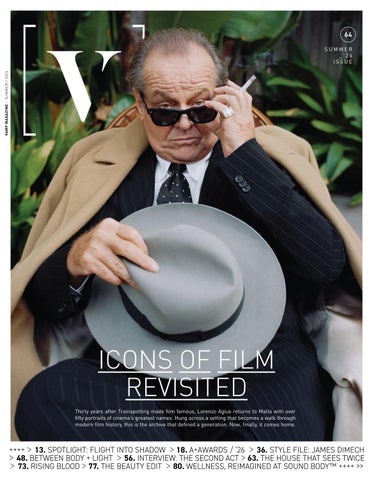
ICONS OF FILM REVISITED Thirty years after Trainspotting made him famous, Lorenzo Agius returns to Malta with over fifty portraits of cinema’s greatest names. Hung across a setting that becomes a walk through modern film history, this is the archive that defined a generation. Now, finally, it comes home.
++++ > 13. SPOTLIGHT: FLIGHT INTO SHADOW > 18. A+AWARDS / ‘26 > 36. STYLE FILE: JAMES DIMECH > 48. BETWEEN BODY + LIGHT > 56. INTERVIEW: THE SECOND ACT > 63. THE HOUSE THAT SEES TWICE > 73. RISING BLOOD > 77. THE BEAUTY EDIT > 80. WELLNESS, REIMAGINED AT SOUND BODY™ ++++ >>
THE BLUE ELEPHANT RESTAURANT experience Royal Thai masterpieces.
BLUE ELEPHANT RESTAURANT Hilton Malta, Portomaso, St. Julians T: 21 383 383
F: www.facebook.com/blueelephantmalta
CONTENTS
026.
ICONS OF FILM REVISITED Lorenzo Agius returns to Malta with fifty unpublished cinema portraits, marking thirty years since Trainspotting made him famous.
010
SUMMER_’26 ISSUE
CONTENTS
“EVERY STORY IS SHAPED BY TRANSFORMATION.”
T
here’s a particular kind of magic that happens when creativity, craft, and curiosity collide, and this issue is built on that spark. Across these pages, you’ll find stories shaped by transformation: photographers reframing icons, architects rethinking how a house can see, and artists distilling emotion into colour, paper, and light. From Lorenzo Agius’s homecoming exhibition, thirty years in the making, to a Mexican house that doubles the boundaries of human vision, this issue celebrates the makers who turn instinct into something you can feel. We travel from Venice, where sunlight becomes an architectural material, to a Mediterranean studio where two painters meet in the space between presence and disappearance. We also follow a stuntman who rebuilt himself as a painter after the fall that ended one career and began another, and a young Maltese sailor charting his own course toward the Olympic dream. Whether it’s the patience of waiting for a portrait’s unguarded moment, the discipline of chasing wind on open water, or the quiet resilience of learning to walk, and create, again, every story here proves that creation isn’t a single act. It’s a practice. As always, our goal is simple: to inspire you. To give you moments of pause, sparks of fascination, and a sense of connection to the people whose work quietly shifts the world around us. Settle in, turn the page, and step into the season’s stories. Enjoy and take care, Enjoy and take care, Kay K x
012. A DIALOGUE IN TIME
074. RISING BLOOD
Kave Home’s curated collection explores the enduring relationship between architecture, furniture, craftsmanship, and lasting, timeless everyday design.
Thirteen-year-old artist Camille Deguara Faure discusses her passion for drawing, character creation, and dreams of becoming an animator.
015. FLIGHT INTO SHADOW
079.THE BEAUTY EDIT
At Venice’s Architecture Biennale, sunlight becomes material — filtered through living mycelium to reimagine shadow as spatial intelligence.
A curated selection of Clarins skincare and makeup, blending age-defying innovation, sensorial formulas, and glow-boosting essentials for radiant skin.
020. A CELEBRATION OF CRAFT AND CREATIVITY
082.WELLNESS, REIMAGINED
Architizer’s 14th Annual A+Awards celebrate a global resurgence of architectural craft, honouring precision, materiality, and human-centred design.
038. STYLEFILE: TEXTURES OF THE SEA Designer James Dimech transforms paper into wearable couture, exploring fragility, craftsmanship, and Maltese identity through folding, weaving and colour.
050. BETWEEN BODY + LIGHT Painters Simone Geraci and Federico Severino explore presence and absence, tracing the human figure and Mediterranean light’s quiet dissolution.
058. THE SECOND ACT Former Hollywood stuntman Joe Watts discusses rebuilding his identity through painting after a career-ending brain injury and fall.
065. 720 DEGREES:THE HOUSE THAT SEES TWICE Architect Fernanda Canales designs an off-grid circular home in Mexico that doubles human vision, merging shelter with landscape.
Sound Body at Hard Rock Hotel Malta unites Body Rock and Rock Spa, redefining fitness, recovery, and lifestyle together.
087.CHASING THE WIND Sailor Matthew Flores discusses discipline, resilience, and his Olympic ambitions, from junior competition to senior international racing success.
Editor Kay Psaila Design / Art Direction FOUNDRY MEDIA GROUP Sales Director Sam: [+356] 7788 0300
Contributors Adrian Vale Brian Grech Charlene Vella Daniel Cross Elias Hart Federico Severino Fernanda Canales James Dimech Joe Watts Josef Pace Lorenzo Agius Matteo Vella Nicholas Rowan Simone Geraci
Reproduction in whole or in part without written permission from the publisher is prohibited. All rights reserved. Dates, information and prices are believed to be correct at the time of going to press but are subject to change and no responsibility is accepted for any errors or omissions. Neither the editor nor the publisher accept responsibility for any material submitted, whether photographic or otherwise. While we endeavor to ensure that the organisations and firms mentioned are reputable. The editor can give no guarantee that they will fulfill their obligations under all circumstances. Copyright 2026
SUMMER_‘26 ISSUE
011
NEWS
KAVE HOME > A D The enduring relationship between architecture, design and the art of living well
>
Some spaces possess a rare quality: they become more compelling with age. Their materials soften, their stories deepen and their architecture settles naturally into the rhythm of everyday life. They resist the urgency of trends, proving that true design is measured not by novelty, but by longevity. The same philosophy defines the objects we choose to inhabit these spaces. The most enduring furniture is never designed for a single season. It evolves thoughtfully, adapting through new materials, finishes
012
SUMMER_’26 ISSUE
and technologies while remaining faithful to the proportions, craftsmanship and purpose that first made it iconic. Rather than reinventing itself, timeless design refines itself.
These are designs that converse effortlessly with both heritage architecture and modern spaces, creating environments that feel authentic today and will remain relevant for years to come.
Design That Evolves Through Time This is the thinking behind A Dialogue in Time—a curated collection by Kave Home that explores the enduring relationship between architecture and design. Each piece has been selected not only for its aesthetic value, but for its ability to transcend changing tastes and continue enriching contemporary interiors.
Where Architecture Meets Everyday Living At the heart of every lasting interior is balance. Architecture provides the framework, while furniture introduces comfort, personality and human connection. Together, they create spaces that are lived in rather than simply admired. >>
NEWS
IALOGUE IN TIME
[“SOME SPACES BECOME MORE COMPELLING WITH AGE — THEIR MATERIALS SOFTEN, THEIR STORIES DEEPEN, AND THEIR ARCHITECTURE SETTLES NATURALLY INTO EVERYDAY LIFE.”]
A beautifully designed chair, sofa or table does more than fulfil a function; it becomes part of the daily rituals that define how we experience home. These are pieces that accompany moments, memories and everyday interactions, becoming woven into the story of a space.
A Conversation Beyond Trends A Dialogue in Time celebrates the enduring conversation between architecture and design. It reminds us that the most iconic pieces are not those that simply capture a moment, but those that continue to inspire across generations.
The Value of Lasting Design In an age of constant reinvention, there is something reassuring about choosing pieces that are built to endure. Investing in timeless design is an investment in quality, sustainability and craftsmanship—objects that retain their character long after passing trends have faded.
Discover the collection in store at Form, Valley Road, Msida, or explore online at www.kavehome.mt.
SUMMER_‘26 ISSUE
013
A Dialogue in Time On architecture, design and permanence.
Form, Valley Road, Msida | kavehome.mt
DESIGN
FLIGHT INTO SHADOW. At the Venice Architecture Biennale, Flight into Shadow turns sunlight into an architectural material: filtered through living mycelium, shaped by an artificial sun, and choreographed into a space where light and relief move together. Conceived by Deggendorf Institute of Technology with HFT Stuttgart and the University of Stuttgart, the installation asks a quiet but urgent question - what if shade wasn’t an afterthought, but the plan itself? >>
SUMMER_‘26 ISSUE
015
DESIGN
[“Shadow not as absence, but as relief,
016
SUMMER_’26 ISSUE
DESIGN
protection, and spatial intelligence.”]
P
resented at the Venice Architecture Biennale 2025, Flight into Shadow challenges the way we experience light in a warming world. Conceived by Deggendorf Institute of Technology in collaboration with HFT Stuttgart and the University of Stuttgart, the installation transforms sunlight from a passive condition into an active architectural force. By inviting the sun indoors and filtering it through living mycelium structures, the project reimagines shadow not as absence, but as relief, protection, and spatial intelligence. In doing so, it offers a poetic yet urgent reflection on how cities might adapt to rising temperatures through material innovation and perceptual design. >>
SUMMER_‘26 ISSUE
017
DESIGN
Flight into Shadow explores how light and shadow can shape our perception of heat, relief, and comfort in heatstressed urban environments. At its core is a bold architectural gesture: inviting the sun indoors to create a controlled solar experience, independent of external weather conditions. Living mycelium structures act as organic filters, forming delicate canopies that soften and scatter light. These structures embody ecological intelligence, allowing shadow to emerge as an active, spatial element, rather than
018
SUMMER_’26 ISSUE
a by-product. Light becomes both subject and medium, revealing the fragile balance between exposure, protection, and perception. Inspired by the Komorebi effect, the fleeting play of sunlight filtering through leaves—the installation translates this natural phenomenon into an immersive architectural experience. What is usually momentary becomes spatial and tangible, capturing nature’s quiet choreography through form, material, and light.
DESIGN
[ “Light becomes both subject and medium, revealing the fragile balance between exposure, protection, and perception.” ]
At the center of the space, a powerful artificial sun composed of individually controlled luminaires generates constantly shifting atmospheres. Visitors move between moments of intense brightness and zones of gentle refuge, experiencing light as a dynamic and living presence. Through a carefully composed choreography, the installation continuously
transforms, unfolding a sequence of moods and scenes over time. Presented during the Venice Architecture Biennale 2025 as part of the Keep Cool! Workshop for Cool Cities, Flight into Shadow is a collaborative project between HFT Stuttgart Interior Architecture, University of Stuttgart (IBK2), and
Deggendorf Institute of Technology. The installation invites visitors to reflect on strategies of adaptation and coexistence in a climate-changing world, proposing shadow, material intelligence, and perception as key tools for shaping more resilient environments. [ V ]
SUMMER_‘26 ISSUE
019
A Celebration of Craft and Creativity
A+AWARDS 020
SUMMER_’26 ISSUE
La Pedrera by Taller Ezequiel Aguilar MartinezAmy Bello
A+AWARDS
A+AWARDS
[“The awards continue to champion both established and emerging designers, with over 60% of entries coming from small studios.”]
Dongmingshan Senyu Hotel by GLA DesignXi Chen
I
n an age defined by digital acceleration, a quiet revolution is taking shape—one that returns to the tactile roots of design. The 14th Annual Architizer A+Awards celebrates this global resurgence of architectural craft, spotlighting projects that fuse innovation with human touch, and precision with poetry. Architizer, has officially opened submissions for its fourteenth edition of the A+Awards, honoring the year’s most remarkable buildings and spaces. The program, which draws entries from over 85 countries, remains the most democratic in the industry, celebrating architectural excellence through both professional juries and public voting. Now in its 14th season, the A+Awards revisits one of architecture’s most enduring values: craft. “The A+Awards showcase the value of precision, materiality, and craftsmanship,” says Saul Kim, Director of Saul Kim Studio. “Architecture’s power resides not just in bold gestures, but in the depth of thought behind every junction, material choice, and spatial experience.” >>
Boulder Park 3D Concrete-Printed Playground by XISUI DesignZhou Sheng
SUMMER_‘26 ISSUE
021
A+AWARDS
[“This year’s shortlist maps the world’s most innovative ar As technology reshapes the design landscape, architects are reexamining their roles in an increasingly automated world. This year’s theme honors those who keep human ingenuity at the center of creation, connecting design to labor, material to place, and buildings to the people who make and inhabit them. These architects are crafting a new era of design defined by care, precision, and empathy.
“This era is marked by a palpable shift towards spaces that embody genuine livability, warmth, and tactile richness,” notes Ismail Seleit, Design Technologist at Foster + Partners. “The A+Awards exemplify an emerging ethos: architecture not as a monumental statement, but as a sensitive response to context, material authenticity, and the rhythms of daily life.”
The A+Awards remain a celebration of accessibility and inclusion, inviting the public to participate through online voting. In collaboration with partners including v2com newswire, AIA New York, Metropolis, and Aesthetica, last year’s program drew hundreds of thousands of votes from over 80 countries, reflecting architecture’s power to resonate across cultures and communities. >>
Fondation de Chine by ColdefyCyrille Weiner
Aquifer Recharge Plant – Cape Flats (MAR) by SALT ArchitectsKarl Rogers
022
SUMMER_’26 ISSUE
Dialogue with Nature—Commune STORE by Atelier GlobalZHIYI
A+AWARDS
chitecture and interiors across more than 85 countries.”]
Ferrocarril de Cuernavaca 780 by HEMAACesar Bejar Studio
SUMMER_‘26 ISSUE
023
A+AWARDS
[ “Architecture not as a monumental statement, but as a sensitive response to context, material authenticity, and the rhythms of daily life.” ]
Paper Island by CobeCobe
This season introduces new categories that emphasize craftsmanship, materiality, and contextual approaches, as well as sustainable practices and the health and well-being of building occupants. Together, they highlight architecture’s capacity to shape a more mindful and responsive built environment. “The Architizer A+Awards remind us that the best architecture is not static but adaptive—responsive to climate, culture, and human needs,” says Kongjian Yu, Founder and Principal Designer at Turenscape.
024
SUMMER_’26 ISSUE
“These projects don’t just solve problems; they spark joy, provoke thought, and reaffirm architecture’s enduring role as a force for connection.” The awards are judged by an esteemed academy of over 250 jurors from across the fields of architecture, art, design, and culture. Among them are Carlo Ratti, Nicole Hollis, Pablo Bofill, Koichi Takada, Carson Chan, Andres Jacque, Avinash Rajagopal, and Lisa Demetrios, each bringing a unique lens to what defines great design today.
A Global Compendium of Design Excellence Complementing the awards, Architizer: The World’s Best Architecture returns as an annual compendium featuring the winning projects. The book, a definitive guide to global design, has previously showcased works by Foster + Partners, MVRDV, Neri & Hu, Olson Kundig, Sanjay Puri Architects, and Studio Gang, cementing its place as an essential reference for architects and design enthusiasts alike. [ V ]
A+AWARDS
QR3D by Park + AssociatesDerek Swalwell
SUMMER_‘26 ISSUE
025
Cate Blanchett as Elizabeth, 1998
ICONS OF FILM
026
SUMMER_’26 ISSUE
ICONS OF FILM
ICONS OF FILM REVISITED VAMP REVISITS LORENZO AGIUS. WE FIRST INTRODUCED YOU TO THE PHOTOGRAPHER WHOSE LENS DEFINED A GENERATION OF CINEMA. NOW, THIRTY YEARS AFTER TRAINSPOTTING MADE HIM FAMOUS, LORENZO RETURNS TO MALTA, THE LAND OF HIS PARENTS, WITH OVER FIFTY UNPUBLISHED PORTRAITS OF CINEMA’S BIGGEST NAMES. HUNG ACROSS A SETTING THAT TRANSFORMS INTO A WALK-THROUGH OF MODERN FILM HISTORY, THIS IS THE WORK YOU HAVEN’T SEEN YET. AND IT WAS CERTAINLY WORTH THE WAIT.
O
ver the course of a career spanning more than thirty years, Lorenzo Agius helped shape the visual memory of contemporary cinema. This June, the internationally acclaimed photographer, born in the UK to Maltese parents, brought his world of film, fame and finely calibrated glamour to Corinthia Palace, Attard, with Icons of Film, an exhibition that opened to coincide with the Mediterrane Film Festival. Set within one of Malta’s most elegant hospitality settings, the exhibition presented a striking selection of over fifty portraits of some of the most recognisable figures in modern cinema. Having opened on 25 June, Icons of Film unfolded across several spaces within Corinthia Palace Malta, from Josephine’s in the hotel lobby to Francesco Mazzei at Villa Corinthia and the public areas leading towards Secret Garden. The result was not a conventional gallery display, but a cinematic encounter woven into the atmosphere of the hotel. Photography, architecture, hospitality and film culture met in a setting that invited visitors to move through Agius’s portraits as though through a sequence of scenes. Agius first became internationally known for his era-defining
publicity images for Danny Boyle’s Trainspotting, released in 1996 and marking its thirtieth anniversary this year. Stark, witty and unforgettable, those black-and-white images did more than promote a film; they entered the bloodstream of popular culture. They helped shape the visual identity of British cinema in the 1990s and announced Agius’s remarkable ability to create photographs that remain lodged in collective memory. Since then, Agius has photographed many of the great figures of contemporary film, music and culture. His sitters include Ewan McGregor, Jude Law, Helena Bonham Carter, Cate Blanchett, Clive Owen, Kate Winslet, Denzel Washington, Angelina Jolie, Brad Pitt, Tom Cruise, Julia Roberts, Will Smith, Madonna and Meryl Streep, among others, all of whom featured in this exhibition. Yet his portraits were never simply an inventory of famous faces. Their power lay in the tension they held: between public image and private presence, theatricality and candour, glamour and vulnerability. This is what made Agius’s work so compelling. Actors are, by profession, masters of transformation. They inhabit roles, carry myths, and allow audiences to project emotion, desire and memory onto them. >> SUMMER_‘26 ISSUE
027
ICONS OF FILM
Hugh Jackman
028
SUMMER_’26 ISSUE
ICONS OF FILM
[ “LORENZO AGIUS CARVED HIS NAME INTO THE VISUAL DNA OF THE 1990S WITH IMAGES THAT FELT LIKE STILLS FROM THE FILM OF A GENERATION.” ] >> >>
Samuel L Jackson, 1990’s
SUMMER_‘26 ISSUE
029
ICONS OF FILM
Agius approached them not merely as celebrities, but as images already charged with cultural meaning. Through his lens, they became at once familiar and newly strange. The face we think we know became a field of performance, wit, distance, seduction or introspection.
The Maltese setting gave the exhibition an added resonance. Icons of Film followed Agius’s first-ever retrospective in Valletta last year and his February 2026 exhibition at Corinthia London, LOOK AT ME: Framing the Iconic,
Brad Pitt,2000
The exhibition’s title, Icons of Film, invited a double reading. These were icons in the contemporary sense: internationally recognised figures whose images circulate across screens, magazines, posters and social media. But they were also icons in a deeper, art-historical sense: images invested with aura, devotion and ritualised attention. The film star, like the sacred image before it, is framed, lit, adored and endlessly reproduced. Agius’s portraits understood this visual economy very well. They did not merely show glamour; they asked how glamour is constructed, how it endures, and why it continues to enchant.
[“THEIR POWER LIES IN THE TENSION THEY HOLD: BETWEEN PUBLIC IMAGE AND PRIVATE PRESENCE, THEATRICALITY AND CANDOUR, GLAMOUR AND VULNERABILITY.”]
For Agius, this Maltese chapter was especially meaningful. “I am genuinely delighted by the way this collaboration has developed with Corinthia Group, first through the London exhibition and now here at Corinthia Palace Malta,” he said. “I am also deeply grateful for the support and collaboration of the Malta Film Commission, which supported the Valletta exhibition last year, and Arts Council Malta. There is a real sense that Malta is embracing my work, and for me that is incredibly moving. Although I have never lived here, Malta has always been part of who I am. Now it feels, in a very real way, like coming home.” That idea of return was central to the exhibition’s emotional charge. Agius’s career has been profoundly international, shaped by London, cinema, magazines and the global machinery of celebrity. Yet his Maltese roots gave the exhibition a particular poignancy. At Corinthia Palace, the original property from which the internationally renowned Corinthia Hotels brand grew, the exhibition drew a subtle parallel between Maltese beginnings and global reach. Both Agius and Corinthia belong to stories that began from Malta, or through Maltese identity, and moved confidently onto an international stage.
Ray Liotta, 2016
presented during the international awards season of the BAFTAs, Oscars and Grammys. The Corinthia Palace Malta exhibition brought that conversation back to Malta, placing Agius’s work in dialogue with the Mediterrane Film Festival and with Malta’s growing role as a meeting place for international film professionals, creatives and audiences.
030
SUMMER_’26 ISSUE
Pierce Brosnan, 2001
In this sense, Icons of Film was not only a celebration of cinema. It was also a celebration of image-making as a form of cultural memory. Agius’s portraits reminded us that cinema does not exist only on screen. It lives in still photographs, posters, press images, magazine spreads and the visual fragments through which generations remember films and their stars. The still image can distil an entire performance, an era, or a mythology into a single charged moment. >>
ICONS OF FILM
Jude Law and Ewan McGregor, 2003
SUMMER_‘26 ISSUE
031
Helena Bonham carter as Frida, 2015
ICONS OF FILM
032
SUMMER_’26 ISSUE
ICONS OF FILM
>> SUMMER_‘26 ISSUE
033
Angelina Jolie, 2005
ICONS OF FILM
034
SUMMER_’26 ISSUE
Jude Law, 2003
ICONS OF FILM
The exhibition also served as a reminder that the world of cinema is sustained by a vast creative ecosystem beyond the camera and the screen: photographers, designers, stylists, publicists and image-makers whose work helps shape how films are seen, remembered and loved.
Jamie Foxx, 2004
Staged during the Mediterrane Film Festival, Icons of Film offered audiences in Malta and visiting guests an opportunity to encounter cinema differently: not as moving image, but as portrait; not as narrative, but as presence. Through Agius’s lens, the familiar became luminous again. These were not only photographs of stars. They were images of cinema’s power to make us look, remember, desire and believe. “As the birthplace of the Corinthia brand, Corinthia Palace Malta has long championed the arts as an integral part of its identity, creating opportunities for guests and visitors to engage with culture in meaningful ways. Presented alongside the launch of the hotel’s newly refurbished rooms, Icons of Film formed part of a broader vision that combines contemporary comfort and style with enriching cultural experiences, further enhancing the sense of place that defines a stay at Corinthia Palace Malta.” The exhibition was supported by Mediterrane Film Festival, Visit Malta and Arts Council Malta, and was made possible with the generous support of ILAB Photo and Mizzi Studio. [ V ]
SUMMER_‘26 ISSUE
035
STYLEFILE
038
SUMMER_’26 ISSUE
DESIGN Photography by Brian Grech
P
eople often believe a fashion collection reaches its destination the moment the final model leaves the runway. For me, that moment is something very different. It is not the end of a creative journey, but the beginning of another.
When Textures of the Sea was presented at Malta Fashion Week, the audience saw finished garments. What they could not see were the months of experimentation, uncertainty and countless decisions that had already shaped each piece long before it reached the catwalk. More surprisingly, they could not know that the collection would continue evolving long after the applause had faded. For years my work became associated with paper folding, where the craftsmanship was immediately visible. This collection challenged that relationship. Before a single garment could be assembled, the paper itself had to be transformed through treatment, testing and repeated experimentation. Much of the craftsmanship became invisible. Weaving, crochet, raffia construction and structural manipulation gradually found their place alongside folding, not as replacements but as natural extensions of the same artistic language. Rather than abandoning paper manipulation, I was allowing it to evolve. Rather than relying on recognisable Maltese symbols, I chose to acknowledge my identity through the dialogue between red and white—the colours of the Maltese flag. Coral, shells, waves and underwater textures became emotional references rather than decorative motifs. Malta Fashion Week did not close the project. It clarified it. Returning to the studio, I began seeing the garments differently. The momentum created by the runway did not disappear; it grew stronger. A collection is never finished. It simply reaches a moment when it is ready to be shared. >>
[“BEFORE A SINGLE GARMENT COULD BE ASSEMBLED, THE PAPER ITSELF HAD TO BE TRANSFORMED THROUGH TREATMENT, TESTING AND REPEATED EXPERIMENTATION. MUCH OF THE CRAFTSMANSHIP BECAME INVISIBLE.”] SUMMER_‘26 ISSUE
039
DESIGN
040
SUMMER_’26 ISSUE
DESIGN
SUMMER_‘26 ISSUE
041
DESIGN
042
SUMMER_’26 ISSUE
DESIGN
SUMMER_‘26 ISSUE
043
DESIGN
044
SUMMER_’26 ISSUE
DESIGN
SUMMER_‘26 ISSUE
045
DESIGN
046
SUMMER_’26 ISSUE
DESIGN
T H E S PA C E T O S AY ‘ I D O ’
ON US
T H E XA R A LO D G E , R A BAT F R E E V E N U E H I R E | S E L E C T E D DAT E S 2 0 2 7 T E R M S A N D C O N D I T I O N S A P P LY SUMMER_‘26 ISSUE
FIND OUT MORE
047
DESIGN
Photo by Oliver Pace 048
SUMMER_’26 ISSUE
DESIGN
Textures of the Sea was never created in isolation. Stylist and art director Linda Boranga helped shape the visual identity of the collection. Hair artists Clinton Attard and Shelley Lane spent weeks preparing sculptural wigs and bespoke hair elements that became an extension of the garments. On the day of the show, Krista Zammit Marmara completed that vision through expressive artistic makeup, allowing fashion, styling, hair and makeup to speak the same visual language. Today, when I look back at the collection, I no longer see only garments. I see conversations, experiments, failures, discoveries, friendships, collaboration and a creative process that continues to teach me long after the runway lights have gone out. The runway is not where a collection ends. Sometimes it is where it finally begins. [ V ]
SUMMER_‘26 ISSUE
049
ART
BETWEEN BODY + LIGHT: A Mediterranean Dialogue. Words: Charlene Vella
T
here is a particular quality of light in the Mediterranean that resists easy definition. It is not simply brightness, nor colour, nor even atmosphere. It is something more elusive: a condition in which forms seem to hover between presence and disappearance, where the visible world is gently undone by its own radiance. It is within this suspended space, between the tangible and the intangible, that the work of Simone Geraci and Federico Severino finds its quiet resonance. At first glance, their practices appear to move in opposite directions. Geraci turns toward the human figure; Severino toward its absence. Yet as one lingers with their work, this distinction begins to dissolve. Both artists are less concerned with what is represented than with how we experience seeing itself. Their paintings invite a slower gaze, one attuned not to narrative or detail, but to sensation, to atmosphere, to the subtle choreography of light. >>
050
SUMMER_’26 ISSUE
[“WHERE GERACI TRACES THE FRAGILITY OF THE HUMAN FORM, SEVERINO DISSOLVES IT INTO LIGHT — TWO ARTISTS, ONE LUMINOUS CONVERSATION.”]
ART
SUMMER_‘26 ISSUE
051
Federico Severino, Atmosfere 2024 pastello ad olio su tela 100 x 80cm
ART
052
SUMMER_’26 ISSUE
ART
Simone Geraci, Nubila 2026 olio su tela, 100 x 120cm
Geraci’s figures emerge from a long lineage of figurative painting, yet they seem to resist its more declarative impulses. His subjects do not perform for the viewer; they retreat from view. Often turned away, glimpsed in profile or from behind, they inhabit a space of introspection that feels both intimate and distant. There is a softness to their presence, as though they are on the verge of dissolving into the light that surrounds them. In this
sense, Geraci’s work does not so much depict the body as it traces its fragility, its impermanence, its quiet withdrawal from the world. Severino, by contrast, begins where the figure disappears. His paintings are composed of atmospheres rather than forms, of surfaces that seem to absorb and diffuse light rather than contain it. At times, they evoke landscapes, horizons,
or architectural traces, but these references remain deliberately unstable. What matters is not what is seen, but what is felt: a sense of openness, of stillness, of suspended time. His work captures something essential to the Mediterranean experience—the way light flattens distances, dissolves edges, and transforms the familiar into something almost abstract.
SUMMER_‘26 ISSUE
053
054
SUMMER_’26 ISSUE
For more information, contact Charlene at charlene.vella@um.edu.mt
Simone Geraci and Federico Severino exhibited their paintings for the first time in Malta in a joint exhibition titled ‘Oltre La Luce / Beyond The Light’ curated by Charlene Vella in collaboration with Galleria Quam held at the Palm Court Lounge, The Phoenicia Malta, throughout the month of April.
This exhibition is perhaps best understood not as a dialogue between two artists, but as an invitation to inhabit a particular way of seeing. It asks us to pause, to look again, and to attune ourselves to those fleeting moments when the world appears most uncertain, most luminous, and most alive.
Seen together, Geraci and Severino offer two complementary meditations on perception. One moves inward, toward the quiet interiority of the human presence; the other outward, toward a world emptied of figures yet full of sensation. Both, however, are united by a shared sensitivity to light as a living force—something that shapes not only what we see, but how we feel.
ART
Federico Severino, Paesaggio di luce con bagliore 2025 olio su tela 65 x 50cm
[“LIGHT FLATTENS DISTANCES, DISSOLVES EDGES, AND TRANSFORMS THE FAMILIAR INTO SOMETHING ALMOST ABSTRACT.”]
Federico Severino, Sospiri Di Rosso e Azzurro 2024, Olio Su Tela 120 x 90cm
ART
Simone Geraci, Oltre, 2026, olio su tela, 80 x 60cm SUMMER_‘26 ISSUE
055
PEOPLE
In 2019, a 25ft fall to concrete ended Joe Wa t t s’ c a re e r a s o n e o f H o l ly w o o d ’s m o s t i n demand stunt performers. Star Wars, Mission: Impossible, Game of Thrones — forty-three credits in three and a half extraordinary years. What nobody expected was what came next. N o t r e t i r e m e n t . N o t b i t t e r n e s s . A p a i n t e r. A m e t h o d o l o g y. A n d a s e c o n d l i f e m o re re m a r k a b l e than the first.
The Second Act. F
or years, Joe Watts lived life at a pace most people could only imagine. As a professional stunt performer, he stepped into the world of Hollywood action, becoming the person behind some of cinema’s most unforgettable moments. From explosive action sequences to physically demanding performances, Joe’s career was built on precision, courage, and an extraordinary understanding of movement. His credits include some of the biggest productions in modern cinema — Mission: Impossible, Solo: A Star Wars Story, Kingsman: The Golden Circle, and Game of Thrones. Then in 2019, a 25ft fall to concrete changed everything. What emerged from that devastating chapter was something nobody saw coming — a painter. VAMP meets Joe Watts to talk about his Hollywood journey, overcoming adversity, and the powerful connection between movement, emotion, and art. Q: What first attracted you to the world of stunts? I started gymnastics when I was two years old so being able to rotate has always been in my blood. I was South East of England Champion and 9th in the UK aged 16, but I retired from competitive gymnastics and took a different route — going to university
058
SUMMER_’26 ISSUE
to study Youth Work. During that time I did a lot of parkour and freerunning with mates, which I now realise was subconsciously preparing my body for falling from height and taking harder impacts.
painting as my reason to escape that reality instead.
Eventually some friends and I were training at gymnastics with stunt performers so often that they encouraged us to commit to the British Stunt Register training programme. The three of us started the process to qualify as professional stunt performers together. I trained for 3.5 years in judo, gymnastics, trampolining, scuba diving, high diving, and rock climbing. I also needed first aid qualifications and proven good personal health. I qualified in December 2015 and it opened so many doors. I finally felt like I’d always been destined to be a stuntman.
I loved it. It is a very creative role which is often overlooked. A stunt team takes the written word of a script and produces it in visual form for the entertainment of the audience. One of the best things was being at work with top actors, then being able to walk down the shops and have no member of the public know otherwise. I could stand out on screen and hide in plain sight the rest of the time.
I met my wife, third-generation awardwinning stuntwoman Tilly Powell, in the process and we had a couple of years performing alongside each other around the world before my accident. Tilly still performs. My father-in-law, uncle-in-law, and most of my friends are involved too and I’m so proud of all of them. At first it was tough to be around people still doing what I could no longer do — but raw emotions like envy and loss only ostracised me. I used
Q: What was it like being part of the unseen team that brings movie action sequences to life?
Stunts regularly pushed me to the extremes of what I thought was possible. With careful planning and consideration I was able to see that things are only impossible until someone works out how to do them — and the film industry is full of people curious enough to try. It seems strange to write it but I genuinely miss being blown up, precision driving at high speed, flying through the air attached to a wire, being in fights that usually result in my death on screen, falling down stairs and dropping from height into cardboard boxes and safety mats. >>
PEOPLE
SUMMER_‘26 ISSUE
059
PEOPLE
I may sound like a thrill-seeker and adrenaline junkie but honestly I’m not. When I qualified as a professional stuntman I was scared of anything that wasn’t gymnastics. I said no to jobs outside my comfort zone and promptly didn’t work much. To change that I trained in boxing and fighting with weapons, practised my reactions, asked established stunt people for tips, and pushed myself constantly. The fear lessened with repetition and a shift in mindset. Then the phone started ringing. By my third year I was on core teams, and jobs were waiting for me to finish the last production before I could start on theirs. Q: Are there moments from your stunt career that stand out as particularly meaningful? So many. In only 3.5 years I accumulated 43 credits across films, TV, commercials, and music videos. Getting great feedback from Steven Spielberg whilst performing reactions for him alone on a small set at 2,000 frames per second on Ready Player One was extraordinary. Being a stormtrooper in three Star Wars films — including in
060
SUMMER_’26 ISSUE
the desert near Abu Dhabi where the hottest day hit 56 degrees Celsius in full stormtrooper armour — was surreal and brilliant in equal measure. Stunt doubling Mark Strong in Kingsman: The Golden Circle. Standing in for Shane Ritchie falling down the stairs as Alfie Moon in the Eastenders Christmas special. Performing in a music video where Robbie Williams boxed himself. I also got to work alongside Dame Helen Mirren, Gerard Butler, Channing Tatum, Salma Hayek, Mackenzie Foy, and my childhood idol Jackie Chan. My Hollywood credits include Star Wars, Jurassic World, Mission: Impossible, Transformers, Game of Thrones, Disney’s The Nutcracker and the Four Realms, Mamma Mia 2, Pokémon: Detective Pikachu, and Ready Player One. It was a brilliant, brief and unparalleled career. Q: How would you describe the journey of rebuilding yourself after your accident? Brutal, treacherous, and never-ending. The darkness went on so long that even now it sometimes feels confusing that I’m out the other side.
A brain injury is complicated. I didn’t know what it meant before I got one. Your brain is building everything you understand of the world. It controls your abilities, memories, movements, passions, and emotions. It creates your understanding of time — the past, present, and future. When you get a brain injury, your brain doesn’t necessarily know it. Whilst everybody else sees that you’ve changed, you only see that others have changed in their approach to you. By some people I felt condemned as if I had created the trauma they were feeling. Others did their best to put on a smile. I still felt ready to take on life like before, and it took me at least the first year to actually contemplate what I had to recover from. It was, and still is at times, very isolating. My brain was telling me that the words I believed I was speaking were coming out — but when I look at videos from that time I see myself repeating words or getting distracted a couple of words in. Before, I felt that was a problem. Now I think it’s an amazing opportunity to think uniquely in your own way. I’ve been through heavy depression, struggled with my mental health, faced
PEOPLE
more fear than I thought could be possible, and completely redesigned myself from the inside out. But I’ve reached beyond my dreams and it’s pretty cool being here. Q: When you could no longer continue as a stunt performer, how did you rediscover who Joe Watts was? If your life was a blank slate — no balance, no speech, minimal abilities, memories, or understanding of life — what would you do? Would you see a clear path out or give up? Would you feel overwhelmed? To redefine yourself and your identity is one of the hardest, yet most satisfying, efforts you will ever put into your selfdevelopment. The results will be with you for life. The process starts with what passions charge your battery. Commit time to them even if you’re scared or anxious. The first time is always the worst — so go into it excited for the next time being easier. Find your passions, then find people who communicate in a style you benefit from. We learn best from the people we have the best rapport with. One of my rehabilitation therapists suggested I get an art studio to help me escape and express myself. I had been colouring in adult colouring books in hospital. I also completed an Art Foundation Diploma when I was 19. Relighting that flame in an art studio was easily one of the best decisions I’ve made. It gave me a purpose. I used painting as my reason to escape reality — a reason to step out of the bubble of hardship into a world with no judgment, only personal expression. It was so freeing. And having a way to still express myself was vital to my recovery. Q: How did painting become your new form of storytelling? I’ve always enjoyed art — excelling at it at school and college. Post-accident, since gymnastics was no longer possible, art was a natural alternative to try. I lost so many memories in my fall but I did remember learning to stencil at art college. Initially I created stencils and spray painted them all over the walls of my studio in acts of rebellion at the situation I was in. I ran out of wall space quickly. >>
SUMMER_‘26 ISSUE
061
PEOPLE
I then spray painted large film murals — Darth Vader from Star Wars on one wall and Pikachu and Raichu from Pokémon on the other. I had issues with dexterity and hand control and couldn’t make the stencils small enough, so the canvas had to become bigger. Hence the 6ft x 4ft wooden boards I now paint on. I am in the process of creating four large paintings based on films I performed on, using spray paint and hand-cut stencils. The titles of each piece are quotes taken from the film or franchise they’re from. So far I have completed Star Wars, Jurassic, and Pokémon. Game of Thrones is next. The Pokémon piece alone contains 65 different hand-cut stencils and took four years to complete. Each painting is a unique design and I look forward to completing my portfolio before I launch as an artist selling prints of my work worldwide. Q: Do you see similarities between performing a stunt and creating a piece of art? Both are creative expression, so yes, there are a lot of similarities. In stunts I learned about adapting, being resilient, designing a sequence then practising to see if it would work, and aiming for the good reactions of stunt coordinators and directors when you perform well. In my paintings I’ve had the opportunity to work on my patience and trust my instincts — but it hasn’t been easy. A lot of negative emotion was invested into my first piece, Star Wars, and it’s reflected by the title: ‘You have controlled your fear, now release your anger.’ By my second piece, Jurassic, I had a lot more appreciation and gratitude for the journey I was on. My Jurassic piece is aptly named ‘You can’t see to the other side until you’re there’ Each art piece is lots of small steps compounded together and takes a minimum of a year, a lot of patience, and following the process. My entire brain injury recovery has needed exactly that. I can only paint when I have the energy because fatigue is a symptom of my brain injury. If I head to my studio for two hours and only achieve one small step, I’m happy — because before I went there was no contribution. The end result will appreciate it. Just keep contributing to the journey. You’ll know when you’ve arrived at the destination. 062
SUMMER_’26 ISSUE
Q: You developed something called The Mountain Method during your recovery. Can you explain it? When creating my paintings I steadily climb a hypothetical mountain of little steps all the way to the top. When I focus on how far there is to go I find it overwhelming. It’s been the same for every area of my recovery. I call the framework The Mountain Method and it works in three steps. Step one is Dreams. Think of a mountain and place your dream at the top. The longer you stay at the bottom — in the valley, the comfort zone — the more overwhelming
and impossible climbing feels. Self-doubt seeps in. So place your dream at the top and forget about it. You’re simply aiming in that direction. Step two is Goals. Consider your route up the mountain and mark it with key goals — signposts on the way up. Focus on the first one. The route isn’t straight; sometimes you may take a path that doesn’t lead anywhere good and you’ll need to adapt. There is often an alternative route. Step three, and the most important, is Steps. Focus on the one step directly in front of you. If it’s too hard, break it down into smaller, easier tasks — little
PEOPLE
baby steps that slowly edge you closer to the summit. And as you climb, make sure you look back and acknowledge the view. See how far you’ve come, because you did that. No one else. That realisation releases good chemicals in your brain and gives gratitude for the moments you thought you would never make it through. The point of the mountain isn’t simply to climb it. Most people climb mountains to check out the view. I’ve had feedback from others struggling with recovery from health issues that The Mountain Method has been transformational in shifting their mindset. Try it out. Q: What do you hope people feel when they experience your artwork? When you come out of a cinema after watching a great film you think, that was good. The more times you watch it, the more you notice all the little details — other characters, deeper storylines. I hope people feel the same way about my paintings. I like viewers to acknowledge the big picture then write their own stories with their eyes as they explore the depth of the image. Every viewer will create a unique story. Each 6ft x 4ft piece is littered with details you won’t see initially. I like that. I like creating a double-take — someone looks once and appreciates it, then looks again and recognises the work that went into creating it slowly over time. Q: If you could speak to the Joe Watts who was starting his stunt career, what would you tell him? When you feel scared of something, it doesn’t mean don’t do it — only that you’ve reached the limit of what you think you can do. Do it anyway. You’ve got this. The skills you learn by putting yourself through the hardship will forever be worth it in the long run. Even if you don’t see it now.
[ “I like creating a double-take — someone looks once and appreciates it, then looks again and recognises the work that went into creating it slowly over time.”]
Love yourself — not in arrogance, just through self-confidence. In order to be the best version of you, you need to fill your own cup up. Be proud of your achievements. Soak in knowledge like a sponge through every person, situation, and conversation. Apply what feels right. Watch your life evolve. Don’t be afraid to fail — failure is the route to growth. You never know when you’re going to need the information. [ V ]
SUMMER_‘26 ISSUE
063
LIVING
064
SUMMER_’26 ISSUE
LIVING
THE HOUSE THAT SEE TWICE
720
In a secluded valley three hours from Mexico City, architect Fernanda Canales has conceived a house that sees twice. House 720 Degrees is not simply a residence, but a geometric instrument, a solar clock, and a spatial experiment that expands the boundaries of perception. Doubling the conventional 360-degree field of vision, the circular home orchestrates a continuous dialogue between interior and exterior, exposure and refuge, landscape and shelter. Designed as an off-the-grid retreat for two families, the project merges ecological intelligence with architectural clarity, creating a dwelling that responds as much to time and climate as it does to human inhabitation. >>
SUMMER_‘26 ISSUE
065
LIVING
066
SUMMER_’26 ISSUE
LIVING
T
here are houses that shelter you from the world. And then there are houses that make you see it differently. House 720 Degrees, conceived by Mexican architect Fernanda Canales in a secluded valley three hours south of Mexico City, belongs emphatically to the second category. It is not simply a residence. It is a geometric instrument, a solar clock, and a spatial experiment that quietly doubles the boundaries of human perception. The name is not metaphor. Where conventional vision spans 360 degrees, this circular home orchestrates a full 720 — an inner world and an outer one, simultaneously held, simultaneously experienced. A house that sees twice. Everything begins with a circle. At the centre of House 720 Degrees is a courtyard —
open, quiet, sky-facing — around which the entire structure organises itself. By day, the house turns outward. Large fold-away windows and framed apertures draw the eye toward a mountain, a volcano, and the vast shifting landscape of the surrounding valley. By night, the house turns inward. The courtyard becomes the world. The circle closes. This duality — outward and inward, exposed and sheltered, open and held — is not an architectural trick. It is the fundamental logic of the building. Canales conceived the house as a response to two apparently contradictory conditions: seclusion and aperture. The valley demands both. Temperatures can vary by 30 degrees Celsius in a single day. Rain dominates half the year. The landscape is extreme, alive, and constantly shifting. The house had to be robust enough to withstand all of it, and porous enough to never lose sight of it.
The result is a structure that functions less like a building and more like a living membrane — stretched between forest and prairie, between dry season and wet, between the stillness of the interior and the wildness just beyond the glass. The project comprises three distinct volumes. The main circular house anchors the composition, its curved walls holding rectangular bedrooms, bathrooms, a kitchen, and circulation spaces that extend outward as terraces toward the courtyard and as gardens toward the landscape beyond. A detached studio and guest room sits apart from the main structure. A rectangular volume with its own patio contains additional bedrooms, storage, and services. The decision to separate the volumes was not purely aesthetic. >>
SUMMER_‘26 ISSUE
067
LIVING
The site’s accentuated topography demanded it, and the division allowed the existing vegetation to remain largely untouched. The house does not impose on its landscape. It negotiates with it. Across two levels — ground floor and open roof terrace — the circular plan creates a continuous spatial experience. Privacy screens, flexible openings, and large glazed panels allow the interior to transform throughout the day, contracting and expanding in response to light, weather, and the needs of the people inside. The curved walls, left deliberately free of fixed programme, become the breathing space of the house — transition zones between one state and another. Designed for two families, with space for extended relatives and guests, the house
068
SUMMER_’26 ISSUE
is generous without being excessive. Every square metre is considered. Every view is intentional. To build something this ambitious in this landscape required a particular kind of restraint. The walls are formed from local soil mixed with concrete, achieving a natural finish that echoes the colours and textures of the valley floor. The house does not contrast with its environment. It emerges from it. Most of the lamps and furniture were produced on site using local materials and local craftsmanship — a decision that ties the building to its place as much as any architectural gesture could. There is no imported glamour here, no surface applied from elsewhere. Everything that covers these walls, that lights these rooms, that furnishes these spaces, came from the land around it.
The palette shifts with the seasons. In the dry months the house reads one way — warm, dusty, ochre. In the wet season it darkens, deepens, and blends more completely into the saturated greens of the surrounding forest. It is, in the truest sense, a living structure. One that adapts, blends, and breathes with its environment rather than resisting it. House 720 Degrees is entirely off the grid — not as a statement of ideology but as a practical response to its location. Solar panels generate the house’s electricity and heat its water. Rainwater is harvested and managed on site. Hydronic radiant floors warm the bedrooms. Every space benefits from natural cross-ventilation, opening to two or three different orientations simultaneously. The priority throughout was durability and ease of maintenance. >>
LIVING
SUMMER_‘26 ISSUE
069
LIVING
070
SUMMER_’26 ISSUE
LIVING
Materials were chosen for their ability to withstand radical weather without painting, cladding, or constant intervention. The house should not demand attention. It should simply endure — quietly, gracefully, for as long as the families who live in it need it to. This ecological intelligence is not bolted on. It is structural. The house was always going to be this way because the landscape demanded it. To build here without responding to the climate, the water, the sun, and the soil would have been to miss the entire point.
To spend time in House 720 Degrees is to become acutely aware of time itself. The sun tracks across the circular form with a precision that no conventional building could replicate. Shadows shift. Light enters from new angles. The mountain appears in the morning and disappears by afternoon. The volcano reveals itself on clear days and vanishes into cloud on others. The courtyard, at the heart of everything, holds all of this together. It is the still point around which the house revolves — literally and figuratively. Whether you are moving through the curved circulation spaces, stepping out onto a terrace, or looking up from
the kitchen toward the open sky, you are always in some form of dialogue with the landscape around you. That is, ultimately, what Fernanda Canales has built here. Not a retreat from the world. A way of seeing it more clearly. A place where the ordinary rhythms of a day — morning light, midday heat, the cool descent of evening — become something worth paying attention to. A house that sees twice. And makes you do the same. [ V ]
SUMMER_‘26 ISSUE
071
Sea
Sea and be seen Where dining never looked so good
ST. PAUL’S BAY WWW.KORAEXPERIENCE.COM
OPEN FOR LUNCH & DINNER
ART
074
SUMMER_’26 ISSUE
ART
RISING BLOOD Some passions begin almost as soon as we can hold a pencil—and for 13-yearold Camille Deguara Faure, art has been part of her life from the very beginning. Whether she’s bringing favourite characters to life or creating entirely new worlds from her imagination, every drawing tells a story. With creativity running through her family and a determination to keep improving, Camille is already making her mark as a young artist with an exciting future ahead. We sat down with her to find out what inspires her, what she dreams of creating, and where she hopes her artistic journey will take her.
Q: When did you first realise that drawing was more than just a hobby and something you truly loved? I’ve always loved art, and I’ve been surrounded by it for as long as I can remember because lots of people in my family are artists. I started drawing when I was very young, even if it was just little scribbles at first. I think I realised it was more than just a hobby when I was around 11 or 12. That’s when I started discovering artists who really inspired me and began practising almost every day. I also started thinking about art as something I’d love to do in the future, not just in my free time. Q: If you could spend a whole day creating art with any artist—past or present—who would you choose and why? I think I would choose Tim Burton. I’ve always loved his unique style and the way he creates such interesting and unforgettable characters. I really enjoy drawing his characters, and his work inspires me a lot. I think it would be amazing to see how he comes up with his ideas and designs. I feel like I would learn so much from him, espe-
cially about creating my own characters and telling stories through art.
imation would help me combine my love of drawing, storytelling, and character design.
Q: Your artwork often includes characters from films and books, as well as your own creations. Which do you enjoy drawing more, and what inspires your original characters?
Q: Every artist has a favourite piece. Which artwork are you most proud of so far, and what makes it special to you?
I honestly enjoy both. Drawing characters from books, films, and TV shows that I love is always fun because I like drawing them in my own style. At the same time, creating my own characters is one of my favourite things to do because I can use my imagination and make them completely unique. I get inspiration from books, movies, TV shows, artists I admire, and sometimes even everyday life. I also enjoy giving my characters their own personalities and stories. Q: Is there a new artistic skill or medium you’d love to learn in the future? I would really love to learn animation. I’ve always been fascinated by animated films and series, and I think it would be amazing to bring my own characters to life. One of my biggest dreams is to create my own animated series or film one day. Learning an-
I think I’d choose a painting I did recently of Tim Burton characters. I spent a lot of time working on it, and I really enjoyed creating it. It was quite challenging, but I’m really proud of how it turned out. Q: What do you do when you’re feeling stuck or don’t know what to draw? Where do you find inspiration? I usually write a list of ideas and then choose the one I feel most excited about. For inspiration, it depends on what I’m in the mood to draw. Sometimes I get ideas from books, films, or things I see every day. Q: If you could design anything in the future—a book cover, a video game, an animated film, or something else—what would be your dream project? >>
SUMMER_‘26 ISSUE
075
ART
076
SUMMER_’26 ISSUE
ART
Probably an animated film or series based on my own characters. I already enjoy making up stories and lore for them, so it would be amazing to bring them to life. Q: Finally, what advice would you give to other young people who love drawing but are afraid to share their artwork with the world? If you’re proud of your art and it makes you happy, don’t be afraid to share it. If people are negative, just ignore them. Be proud of what you create because art takes a lot of time and hard work, and everyone starts somewhere. Q: If you could turn your passion into your dream job, what would you love to do when you grow up, and why? I’d love to be an illustrator or an animator. I also think teaching art could be really fun because I’d enjoy helping other people learn to draw. Q: Imagine one of your drawings came to life for a day—which character would you choose, and what adventure would you go on together? I think I’d choose the Phantom of the Opera. I’d love to explore 19th-century Paris with him and wander around the creepy opera house. I think it would be really exciting. [ V ]
SUMMER_‘26 ISSUE
077
Where statement style meets occasionwear in chic silhouettes and bold, beautiful colour stories for endless styling possibilities.
Discover the standout gowns of the season — bold, romantic, and made for unforgettable moments. From sleek satins to soft chiffons, these are the styles setting the tone for every celebration.
95, Manoel De Vilhena Street, Gzira www.alamango.com.mt +7931 4331
BEAUTY
THE BEAUTY EDIT: BY CLARINS
Summer calls for a beauty routine as effortless as it is effective. This edit, curated with Clarins, brings together protection, definition and glow — from an invisible SPF that doubles as skincare, to a mascara built for customisable drama, to a lip balm that cools on contact. Each formula is designed to work quietly, letting skin (and lashes, and lips) look like themselves, only better.
Clarins Invisible Sun Care Stick SPF50
Clarins Wonder Perfect 5D Mascara
Clarins Cryo Lip Oil Balm
Clarins Invisible Sun Care Stick SPF50 delivers high protection in a practical portable format ideal for daily touch ups and targeted application. Enriched with aloe vera extract and organic argan oil, the formula helps moisturise and protect the skin while leaving an invisible dry touch finish. Perfect for sensitive areas including the eye contour, nose, lips, elbows, and knees, it glides effortlessly onto all skin tones and can be applied over makeup without disturbing it. Found in all leading pharmacies and perfumeries.
Clarins Wonder Perfect 5D Mascara delivers volume, length, curl, definition, and care in one high performance formula designed for beautifully enhanced lashes. Its expert dual fibre brush coats and separates each lash from root to tip, creating customised intensity from natural definition to dramatic volume without clumping or smudging. With long lasting hold and a comfortable flexible texture, lashes appear thicker, longer, and visibly more defined throughout the day. Found in all leading pharmacies and perfumeries.
Clarins Cryo Lip Oil Balm combines the comfort of a nourishing balm with the glossy finish of a lip oil in an innovative cryo plumping formula. Inspired by cryotherapy, it features menthol and field mint essential oil to create an instant cooling sensation while helping lips appear fuller and smoother. Enriched with a plumping peptide, the lightweight formula delivers soft, glossy, baby smooth lips with refreshing hydration and a fresh minty finish ideal for summer days. Found in all leading pharmacies and perfumeries.
SUMMER_‘26 ISSUE
079
There’s no place like our place.
FA M I LY- OW N E D A N D S U S TA I NA BLY GROW N I N T H E R I V E R L A N D, S OU T H AU S T R A L I A .
BEAUTY
[“Customised intensity from natural definition to dramatic volume — without clumping or smudging.”]
Lancaster Sun Perfect UV Air
Clarins Wonder Sculpt Brow Gel
Lancaster Riviera Mists
Lancaster Sun Perfect UV Air combines advanced daily sun protection with skincare benefits in an ultra lightweight formula designed for everyday wear. Created to protect while enhancing the skin’s appearance, it helps defend against sun exposure without compromising comfort or radiance. The breathable texture leaves skin looking smooth, flawless, and naturally luminous, making it ideal for modern outdoor living and daily protection with an invisible finish. Found in all leading pharmacies and perfumeries.
Clarins Wonder Sculpt Brow Gel is a tinted eyebrow gel designed to sculpt, thicken, and define brows with precision and long lasting hold. Its lightweight gel serum texture keeps brows comfortably in place for up to 24 hours without stiffness or flaking. Enriched with skincare ingredients including furcellaria extract, the formula helps care for brows while enhancing their natural shape. The innovative brush delivers precise definition and effortless structure for perfectly groomed brows. Found in all leading pharmacies and perfumeries.
Inspired by the glamour of the French Riviera and the timeless elegance of Monaco, Lancaster Riviera Mists capture the feeling of endless Mediterranean summers. These luminous fragrances blend sun drenched notes with a soft coastal freshness, creating scents that feel warm, radiant, and effortlessly sophisticated. Designed to evoke carefree moments beneath the Mediterranean sun, each mist leaves skin delicately fragranced with a glow inspired by the beauty and luxury of the Côte d’Azur. Found in all leading pharmacies and perfumeries.
“SKIN THAT LOOKS REVITALISED, RADIANT, AND BEAUTIFULLY RENEWED.” SUMMER_‘26 ISSUE
081
WELLNESS
WELLNESS, REIMAGINED AT SOUND BODY™ Redefining fitness, recovery, and lifestyle under one roof, Sound Body™ at Hard Rock Hotel Malta is set to become one of Malta’s largest wellness spaces, with a holistic and fully integrated approach to wellbeing. Designed as a connected system, Sound Body™ ️brings together Body Rock®, focused on performance and training, and Rock Spa®, dedicated to recovery and regeneration, for a complete, modern experience that supports long-term health and overall wellbeing. Spanning an impressive 3,800 square meters, this state-of-the-art facility blends high-performance training, premium recovery, and immersive class experiences, all working in synergy to deliver an outstanding experience.
082
SUMMER_’26 ISSUE
WELLNESS
[ "MORE THAN JUST A FITNESS CENTER, BODY ROCK® IS MALTA’S ULTIMATE FITNESS DESTINATION WHERE MUSIC, MOVEMENT, AND HIGH-PERFORMANCE TRAINING COME TOGETHER TO ELEVATE YOUR WELLNESS EXPERIENCE" ]
A
t the heart of Body Rock® lies an expansive 2,000 square meter Fitness Center floor, thoughtfully designed to accommodate every level of fitness. From an immersive cardio area to generous free weights zones, plate-loaded machines, and resistance training equipment, each element has been curated to support both beginners and professional athletes alike. A dedicated functional training area introduces a dynamic, performance-driven edge for those looking to push their limits. For a more tailored approach, the 240-squaremeter Elite Studio features the advanced Technogym Artis Luxury line, where precision training meets intelligent design.
As the first fitness center in Malta to introduce this exclusive equipment line, Body Rock® offers guests access to a truly premium training experience with the latest innovation in fitness technology. Here, personalized programmes, health assessments, and strength development are enhanced by technology that adapts seamlessly to each individual, optimising results while reducing the risk of injury. This continuous interplay between performance and recovery supports not only immediate results, but a more balanced, sustainable approach to wellbeing. Signature experiences such as Sunrise Yoga bring a unique energy to the programme. Extending beyond training,
Body Rock® unfolds into a broader wellness environment where performance and restoration exist in harmony. Additional facilities such as a fully stocked health bar - offering supplements, superfoods, and fresh seasonal produce and playful pairings - create an experience that is designed to support the body in its entirety. A standout feature of the facility is its integration of advanced Technogym technology across multiple zones. From AIdriven coaching and real-time performance tracking to immersive group cycling and heart-rate-based training systems, every element is designed to deliver measurable results and an engaging user experience.>> SUMMER_‘26 ISSUE
083
WELLNESS
[ "ROCK SPA® BLENDS MUSIC, INDULGENCE, AND MODERN W
084
SUMMER_’26 ISSUE
WELLNESS
ELLNESS. A SANCTUARY OF RELAXATION & REGENERATION" ]
A sprawling 1,800 square meter spa area includes an indoor pool, sauna, steam and salt room, cold plunge, ice fountain, experience showers, hot tub, and relaxation zones, inviting a seamless transition from exertion to recovery. At the center of this ecosystem, the Rock Spa® is dedicated to regeneration and sustained vitality. Encompassing 11 treatment rooms, including two couple’s rooms, a head spa lounge, a meditation dome, a hammam, and high-tech recovery equipment, the spa offers a comprehensive wellness experience. The extensive Rock Spa® menu features a range of signature treatments,
massages, facials, and body treatments, redefining recovery as an essential part of the journey. Enhancing these experiences, Rock Spa® partners with world-renowned skincare brands including Comfort Zone, 111SKIN, KNESKO, and COOLA, delivering results-driven treatments that combine innovation, performance, and holistic wellbeing. Through hydrothermal experiences and targeted therapies, the body’s natural rhythms are supported; enhancing recovery, restoring equilibrium, and
elevating long-term performance. Together, Body Rock® and Rock Spa® create a cohesive lifestyle destination, where fitness meets recovery, and performance meets indulgence. A space where energy, community, and wellbeing come together, supporting a more productive, balanced way of living and a long-term approach to health, setting a new benchmark for wellness in Malta. To enquire about memberships and wellness experiences, please visit hardrockhotelmalta.com for more information or email memberships@hrhmalta.com. [ V ]
SUMMER_‘26 ISSUE
085
[ MOVE BETTER, LIVE BETTER ] Unlock your movement and performance potential at The Movement School Malta. Designed for all abilities and walks of life, our specialised physiotherapy and movement training teaches you to move better and feel better. Whether it is running your first 5K, carrying your children or grandchildren without pain, overcoming surgery or managing a neurological condition we are there for you. Training the brain and body together, building resilience with each movement. High end multidisciplinary care awaits you at The Movement School Malta.
The Movement School Malta, DaVinci Health Birkirkara – +356 2149 1325 – info@tmsmalta.com
PEOPLE
CHASING THE WIND
MATTHEW FLORES IS CHARTING A COURSE TOWARDS THE OLYMPIC DREAM, PROVING THAT DISCIPLINE, RESILIENCE AND RELENTLESS PREPARATION ARE THE TRUE FORCES BEHIND SUCCESS ON THE WATER. jor events so that I am at my best mentally and physically. Before major events I also spend time analysing conditions, reviewing tactics and making sure I am fully prepared both on and off the water.
Q: You started sailing at just eight years old as a hobby. What first attracted you to the sport, and when did you realise you wanted to take it seriously? What first attracted me to sailing was the freedom and excitement of being out on the water. I loved the challenge of controlling the boat and constantly learning something new every time I sailed. At first, it was just a fun hobby, but as I started improving and competing, I realised I wanted to take it more seriously. I began enjoying the competitive side of the sport and pushing myself to improve. Q: You progressed through the Optimist and Laser classes in Malta. How important were those early years in shaping you as a sailor? Those early years were extremely important because they built the foundation of everything I know today. Sailing in the Optimist taught me discipline and time management from very young age. While the Laser class helped me become more physically and mentally resilient, along with building a good knowledge about race strategy and tactics. Competing in Malta also gave me valuable experience from a young age and helped me develop confidence as a sailor. Q: You are currently competing in the Senior European Championships in Split, Croatia. What has the experience been like competing at such a high level? It has been an incredible experience competing against some of the best sailors in Europe. The level is very high, so every race is challenging and pushes me to improve. Being here also motivates me because it shows me the standard I want to reach consistently in the future. Q: What are the biggest challenges young sailors face when transitioning from junior to senior competition?
Q: How has The Movement School helped you develop as an athlete, both physically and mentally?
The transition is difficult because the competition becomes much more intense physically, mentally and tactically. Senior sailors are more experienced and consistent, so small mistakes can make a big difference. Young sailors also need to adapt to balancing training, travelling and personal responsibilities at a much higher level as they grow older. Q: Your main target this season is the Mediterranean Games in late August. What are your expectations and goals heading into the competition? My goal is to perform at my best and represent Malta proudly. I want to stay consistent throughout the event and compete confidently against strong international sailors. At the same time, I see it as an important step in my long-term development towards bigger goals in the future. Q: Sailing is both physically and mentally demanding. How do you prepare yourself before major events? Preparation is very important for me. As I grew in the sport I realised that a proper periodisation plan is needed leading up to ma-
The Movement School has played a huge role in my development as an athlete. Physically, it helped me build a strong foundation of fundamental movement skills essential for the demands of sailing, while also improving my neuromuscular coordination and overall kinetic chain efficiency. This has enhanced my agility, balance and reaction time, allowing me to make quicker and more effective decisions both on and off the water. Q: You became Maltese champion and an international athlete through the support and development you received at The Movement School. What role did the programme play in your success? The programme gave me the structure and support I needed to grow as an athlete. It pushed me to train more professionally while also placing a strong emphasis on injury prevention through teaching proper movement techniques and fundamentals. This allowed me to train safer, smarter and more consistently. Having such a strong support system around me made a huge difference in both my progression and achievements. Q: What specific training methods or support from The Movement School made the biggest difference in your performances? The biggest difference came from the personalised strength and conditioning programmes, mobility work and injury prevention training. >>
SUMMER_‘26 ISSUE
087
21
Get to your hotel with
AIRPORT DIRECT
located right outside the Terminal
TD2 Airport St. Julian’s Pembroke
Cash Payments or Contactless Card Payments are accepted on board
The AIRPORT DIRECT bus offers a comfortable, frequent and quick connection from the Airport to Malta’s main destinations. Our dedicated buses offer comfortable seats, USB charging, free Wi-Fi, and ample space for your luggage. The Airport Direct Bus service is included in your Unlimited Travel Card and hence does not come at any extra cost. Alternatively, you can pay in cash or contactless on board for just €3.00 per passenger (except for TD1 at €3.50). There really is no better connection to your hotel or AirBnB at a better fare.
Scan here for more information
PEOPLE
They helped me improve my endurance and physical performance on the water. The constant support and guidance also helped me stay motivated and focused on my goals. Q: How important is strength, mobility and conditioning in modern sailing? They are extremely important. Modern sailing is very physical, especially in the ILCA class in demanding conditions. Strength and Conditioning help you maintain performance during long races, while mobility helps with movement, balance and preventing injuries. At the highest level, physical preparation can make a huge difference. Q: What motivates you every day to continue pushing towards your Olympic dream? My motivation comes from wanting to keep improving and seeing how far I can go in the sport. Representing Malta at the highest level has always been a dream of mine, and that pushes me to work hard every day. I know success takes time and consistency, so I stay focused on the long-term goal. Q: Who have been the biggest influences or role models in your sailing journey so far?
My coaches, family and teammates have all had a huge influence on my journey. They have supported me through both the highs and the difficult moments, always pushing me to keep improving. I also look up to top international sailors, especially those coming from smaller emerging countries, because they inspire me to keep working hard and prove that it is possible to compete at the highest level, even against the bigger nations. Q: Representing Malta internationally is a proud moment for any athlete. What does it mean to you to compete under the Maltese flag? It means everything to me. Representing Malta is a huge honour and something I am very proud of every time I compete. It motivates me to give my best and hopefully inspire younger athletes to follow their own dreams as well. Q: Looking ahead, where do you see yourself in the next few years, and how realistic do you believe your Olympic ambition is? Over the next few years I want to continue gaining experience at major international events and improving my performances
consistently. The Olympic dream is challenging, but I believe it is realistic with hard work, dedication and the right support around me. I am fully committed to giving everything towards that goal. Q: What advice would you give to young Maltese athletes who dream of competing internationally one day? I would tell them to stay patient, work hard and enjoying the process is the most important part of the journey. There will always be challenges and setbacks, but consistency and dedication are the most important things. If you truly believe in your goals and keep pushing yourself, opportunities will come. Q: Finally, what keeps your passion for sailing alive after all these years on the water? What keeps my passion alive is that every day on the water is different. There is always something new to learn and improve on, which keeps the sport exciting for me. I still love the feeling of competing, challenging myself and being out at sea doing what I enjoy most. [ V ]
SUMMER_‘26 ISSUE
089
SCENTONIQ specialises in delivering premium and niche perfumes to customers in Malta, featuring over thirty exceptional brands from across the world. This unique retail concept is a new shopping experience, merging lifestyle, art, design, and perfumes, all under one roof.
Aventus
EAU DE PARFUM
By Creed A lasting impression of modern boldness. Aventus is a fragrance that stands the test of time. A bold presence that resonates without raising its voice, leaving behind an intentional imprint of character.
Oud For Greatness
EAU DE PARFUM
By INITIO Parfums Privés Embrace your power and greatness to feel unstoppable, conquer, reign and shine. Combining the psychoactive power of Oud with the magical vibration of sacred geometry. Bold and divine, the power of Oud awakens a desire for conquest, where greatness is no longer a dream but a certainty.
100ml | €330
90ml | €320
Athénaïs
EAU DE PARFUM
By Parfums de Marly
TORINO 25
Parfums de Marly unveils Athénaïs, a new creation inspired by the duality of one of the most captivating feminine figures of the18th century, Athénaïs de Montespan. This creation echoes the contrast of her personality, and celebrates a modern and intrepid femininity.
PARFUM
By Xerjoff Capturing the joy of celebration, TORINO 25 begins with exhilarating notes of grapefruit, rhubarb and fresh ginger. Its elegant heart note of suede balances out the energetic opening, with the class and composure of amber and sweet musk at the base.
75ml | €285
50ml | €205
Metal Lavender
EAU DE PARFUM
Thorns Become Roses
By MATIERE PREMIERE A modern lavender. Effortless. Oversized. Comfortable. Easy to wear.
EXTRAIT DE PARFUM
By Nishane
METAL LAVENDER contrasts vibrant, metallic lavandin with a softer, floral lavender. A luminous, enveloping trail built around lavandin grown in the organic fields of Founder and Perfumer Aurélien Guichard, exclusively for MATIERE PREMIERE.
100ml | €250
Citrus Riviera
EAU DE PARFUM
By BDK Parfums Citrus Riviera pays homage to the landscape of Cap d’Antibes, in the south of France. A luminous fragrance, evoking the delicacy of sun-drenched citrus blended with the sensuality of white musks, and reminiscent of the joys of summer shared with loved ones.
Thorns Become Roses reimagines the modern rose through contrast and transformation. Crafted as an Extrait de Parfum, it unfolds from luminous freshness into a refined woody amber signature, balancing strength and softness with remarkable depth.
100ml | €325
100ml | €225
091
Pietà, Malta 178, Marina Str. Pietà, Malta +35620103715 178, Marina Str. +35620102949 +35620103715 +35620102949
Floriana, Malta 31/32, St. Anne Str. Floriana, Malta +35621233715 31/32, St. Anne Str. +35621222949 +35621233715 +35621222949