Spring 2027
THE MASTHEAD
SALEM STATE UNIVERSITY ENGLISH GRADUATE STUDENT NEWSLETTER
SALEM STATE UNIVERSITY ENGLISH GRADUATE PROGRAMS CONTACT INFORMATION Keja Valens kvalens@salemstate.edu 978.542.7050 *On Fulbright, Spring 2027
Scott Nowka
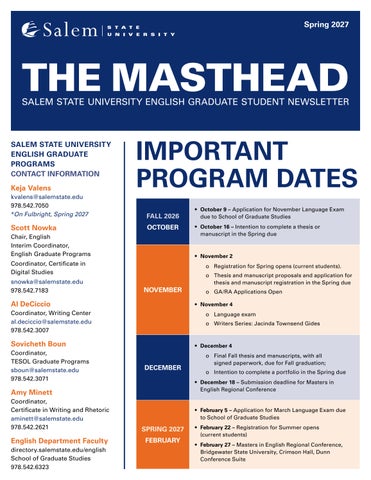
IMPORTANT PROGRAM DATES FALL 2026 OCTOBER
Chair, English Interim Coordinator, English Graduate Programs
o Registration for Spring opens (current students).
NOVEMBER
Al DeCiccio
o GA/RA Applications Open
o Language exam o Writers Series: Jacinda Townsend Gides
Sovicheth Boun
• December 4
DECEMBER
o Final Fall thesis and manuscripts, with all signed paperwork, due for Fall graduation; o Intention to complete a portfolio in the Spring due • December 18 – Submission deadline for Masters in English Regional Conference
Amy Minett Coordinator, Certificate in Writing and Rhetoric aminett@salemstate.edu 978.542.2621
SPRING 2027
English Department Faculty
FEBRUARY
directory.salemstate.edu/english School of Graduate Studies 978.542.6323
o Thesis and manuscript proposals and application for thesis and manuscript registration in the Spring due
• November 4
Coordinator, Writing Center al.deciccio@salemstate.edu 978.542.3007 Coordinator, TESOL Graduate Programs sboun@salemstate.edu 978.542.3071
• October 16 – Intention to complete a thesis or manuscript in the Spring due
• November 2
Coordinator, Certificate in Digital Studies snowka@salemstate.edu 978.542.7183
• October 9 – Application for November Language Exam due to School of Graduate Studies
• February 5 – Application for March Language Exam due to School of Graduate Studies • February 22 – Registration for Summer opens (current students) • February 27 – Masters in English Regional Conference, Bridgewater State University, Crimson Hall, Dunn Conference Suite
IMPORTANT PROGRAM DATES
• March 3 – Language exam
MARCH
• March 15 – Graduation applications due (through Navigator) • April 5 o Intention to complete a thesis or manuscript in the Summer or Fall due
(cont.)
o Fall registration opens (current students) • April 15 – Thesis and manuscript proposals for the Summer and Fall due
APRIL
• April 26 o Final thesis and manuscripts, with all signed paperwork, due for Spring graduation; o Intention to complete a portfolio in the Summer or Fall due; o Intention to complete thesis or manuscript in the Fall due
MAY
SUMMER 2027
• May 5 – Research Day
• June 11 – Application for July Language Exam due to School of Graduate Studies • July 10 – Language exam
COURSE DESCRIPTIONS (SPRING 2027) ENG 701 American Romantic Movement Professor Peter Walker Wednesdays 4:30–6:50 pm, In-person American Romantic Movement studies in depth the literary accomplishments of such major United States writers of the mid-nineteenth century as: Ralph Waldo Emerson (and his influence), Henry David Thoreau, Edgar Allen Poe, Nathaniel Hawthorne, Herman Melville, Walt Whitman, Harriet Beecher Stowe, Louisa May Alcott, and Emily Dickinson, and examines the extent to which they constituted an “American Romantic movement” or, in F. O. Matthiessen’s phrase, an “American Renaissance.”
ENG 778N Assessment in TESOL Professor Sovicheth Boun Wednesdays 4:30–6:50 pm, Blended This course examines the assessment of language and language proficiency for a variety of purposes including documenting the effects of instruction on student learning and using assessment to inform instruction. Students will design performance assessments and indicators for multilingual learners in various TESOL contexts.
Students will also become familiar with a variety of language tests used across TESOL contexts and will design original assessments designed to measure student learning. Field-based assignments are required.
ENG 790 The Bible as Literature Professor Jeannette Lindholm Mondays 4:30–6:50 pm, In-person For centuries the Bible has influenced countless works of literature, art and music (ever wonder about all those biblical allusions?) while remaining an engaging, provocative collection of literary texts in its own right. Throughout this course, we’ll analyze and discuss readings from the Bible in English translation, including the New Revised Standard and King James versions. Readings will represent a wide range of literary genres and include narratives and poetry referenced in various arts and popular culture. Students will have regular opportunities to share their perspectives, write about topics that matter to them, and add their interpretations to those of writers, artists or composers who have used biblical texts in their own work.
COURSE DESCRIPTIONS (SPRING 2027) ENG 817 Contemporary Approaches to the Teaching of Composition Professor Alexandra Kirby Tuesdays 4:30–6:50 pm, Hybrid Synchronous This survey course introduces students to an array of writing pedagogies including process, rhetorical, genre, multimodal, and digital pedagogy, and the theories that inform them. We will learn about how these pedagogies intersect and how we can use them to inform our own teaching practices. We will also learn how to create effective writing assignments— both informal and formal assignments—and ways to assess student writing. Students will engage in hands-on activities during each class to support them in learning and practicing how to teach writing effectively. Special attention will be paid to the teaching of 21st-century literacies.
ENG 818 Poetry Workshop Professor Alexandria Peary Thursdays 4:30–6:50 pm, In-person Along with regular opportunities to receive feedback on your poems, we discuss a range of contemporary and international poetry with an eye toward putting advanced craft techniques into practice. You'll deepen your existing craft techniques and experiment with ones new to you. We study standards like poetic line as well as less conventional possibilities like found writing, meta-writing, embodied writing, "uncreative writing," and genre-switching. Attention is given to the whole writing process, from prewriting to completion, to build imaginative abundance for the shortand long-term (if desired). Students will be presented strategies and opportunities for publication. This course may be repeated for a maximum of nine credits.
ENG 827 Scriptwriting Workshop Professor Brooke Delp Tuesdays 7–9:20 pm, Hybrid Synchronous Ever wondered how a story moves from the page to the screen? This workshop introduces the craft of screenwriting to writers of every background; no film experience needed. We'll read produced screenplays alongside the films made from them, learning how professional writers build character, conflict and momentum through image and action. Weekly exercises sharpen visual storytelling, scene construction and dialogue, while a supportive workshop helps each writer develop an original feature concept from logline through outline. By semester's end, you'll have the polished opening pages of your own feature screenplay and a practical toolkit for continuing it. Required materials: Blake Snyder's Save the Cat and an HBO Max subscription.
ENG 870 Graduate Writing Center Practicum Professor Al DeCiccio Wednesdays 1:40–3:30 pm, In-person In this course, we will examine the ways in which writing interventions can benefit writers by exploring a range of strategies for tutoring writers. We’ll explore everything from what makes a successful writing center session to new media and online tutoring, working with writers in the disciplines, working with multilingual writers, working with graduate student writers and faculty members, and investigating how different identities surface and play out in the Writing Center. In addition to attending and participating in our Wednesday meetings, you will be required to tutor (in person or remotely) in the Mary G. Walsh Writing Center for three hours each week. Your work in the Center will be the basis for the rest of our course. As you read, write, think, discuss, and research, you will always be reflecting on your tutoring sessions, using your experiences in the Center to push back on the texts we read and theorizing how to build new knowledge about writing centers. Anyone interested in working at the Mary G. Walsh Writing Center as a tutor must successfully complete this course. Invitations to tutor will be based on a comprehensive assessment of your work, your professionalism and your enthusiasm for working with others.
ENG 878 Graduate Internship in English Professor Jonathan Fitzgerald (Fitz) By Arrangement
How would you like the chance to join the newsroom of a local publication, assist in putting on a major poetry festival, read manuscripts alongside a literary agent, or manage social media for a local writer? Consider a Graduate Internship! An internship is a great way to gain real-world working experience in professional writing-related fields and earn course credit at the same time. While finding and securing an internship is the student’s responsibility, the English department’s internship coordinator can provide information and resources to help you get there. Reach out to Prof. Fitz (jfitzgerald3@salemstate.edu) to get the process started!
Spring 2027