With special guests Bob Strom, Edward Lundergan, Javier Márquez and Jabari Tovar
Salem State Community Chorus
May 13, 2026
Recital Hall
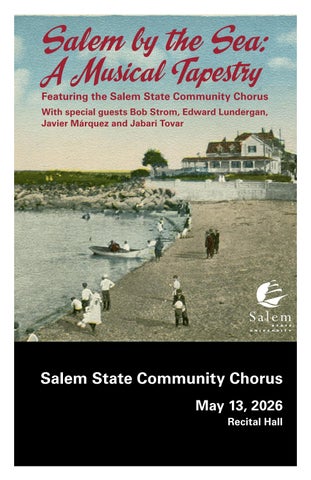
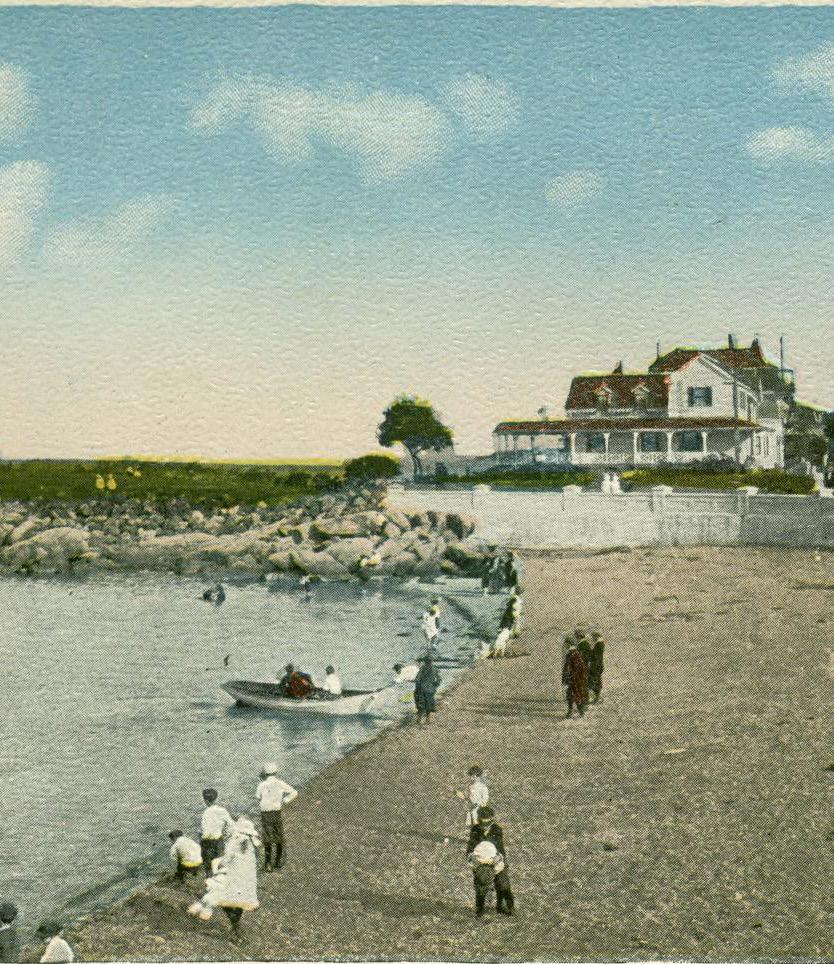
Cover image credit: Nelson Dionne Collection, Salem State Archives
Salem State Land Acknowledgement
The land occupied by Salem State University is part of Naumkeag, a traditional and ancestral homeland of the Pawtucket band of the Massachusett. We acknowledge the genocide and forced removal of the people of Naumkeag and their kin and we recognize the ongoing colonization and dispossession of Indigenous homelands. We respect and honor the Massachusett tribe and the many Indigenous Peoples who continue to care for the land upon which we gather. We recognize our own responsibility to this land we occupy. We commit to continuously learning and sharing its history and that of the Massachusett and other Indigenous People who have been and remain here. We commit to develop and implement initiatives that work toward repairing the injustices continuously being committed on the Indigenous People of this land. We commit to making our own environmental impact on this land as sustainable as possible. We commit to a renewed and ongoing engagement with the Massachusett and all Indigenous People in and around Salem State.
To learn more about Salem State’s Land Acknowledgement please visit salemstate.edu/LandAcknowledgement.
MUSIC
The Salem State University Music and Dance department presents
Salem State Community Chorus
Salem by the Sea: A Musical Tapestry
with special guests Edward Lundergan, Javier Márquez, Bob Strom and Jabari Tovar
Lynn Shane, director
Joe Stroup, piano
Tuesday, May 12, 7 pm (open rehearsal)
Wednesday, May 13, 7 pm
Recital Hall
This performance is presented in conjunction with Salem State University’s Center for Creative and Performing Arts.
DIRECTOR’S WELCOME
Good evening and thank you for joining us for Salem by the Sea: A Musical Tapestry !
Tonight, we share a small sample of the many talented artists and writers who have passed through Salem’s past 400+ years. Our program is not meant to be comprehensive but, rather, a delightful tapestry of sounds to pique your interest and, hopefully, invite you to learn more of the wonderful music history of Salem.
We are joined by several special guests including Salem State alumni Jabari Tovar ‘16 and Javier Márquez ‘08, Salem resident conductor, composer, and chorus member, Dr. Edward Lundergan, and Salem folk musician and historian, Bob Strom. Bob presents frequently in the greater Salem area and has compiled a two-volume music collection titled Old Salem in Ballad and Song and Old Salem at Sea in Ballad and Song . He and his wife Jennifer have recorded two CDs of folk music from Ireland, England, and America called ‘round the Bend and Heading Home .
We invite you to learn more about each of our selected works by exploring the notes found in your program.
ACKNOWLEDGEMENTS
This concert would not be possible without the help of several individuals. Many thank to:
Peter Kvetko, chair, music and dance department and Mary-Jo Grenfell, music program coordinator
Karen Gahagan, director, Center for Creative and Performing Arts
Edward Lundergan and Simon Byrne, assistant chorus directors
Ashley Preston O’Toole, concert host
Shannon Cioffi, reception coordinator
Richard Moore, stage manager
Professor Amy Everitt for the concert photo exhibit, with support from Professor Donna Seger and Archives Librarian Susan Edwards.
SSCC advisory board: Kate Banks, Simon Byrne, Shannon Cioffi, Bridget Conway, Lisa Duffy, Amy Everitt, Hannah Gearan, Ziggy Hartfelder, Kelli Horton Prodanas, Justin Lefler, Carol Lundergan, Cathyann Swindlehurst, Jessi Tassinari, and Becky Young
PROGRAM
Gaelic Song of the Boatman (Fhir a’Bhata) ............................ Sine Nicfhionnlaigh (Jean Finlayson, 19th c) arr. Phillip Lawson
Soloist: Jenn Mahoney
Lyric Translation: O boatman, and no one else
Roll the Old Chariot ........................................................... Traditional Sea Chantey, arr. by Alexander Johnson
Soloist: Hannah Gearan
The Ocean (2026) ........................................................ Music by Edward Lundergan Poem by Nathaniel Hawthorne (1806-1864) Edward Lundergan, conductor
The Ocean has its silent caves, Deep, quiet, and alone; Though there be fury on the waves, Beneath them there is none.
The awful spirits of the deep Hold their communion there; And there are those for whom we weep, The young, the bright, the fair.
Calmly the wearied seamen rest Beneath their own blue sea. The ocean solitudes are blest, For there is purity.
The earth has guilt, the earth has care, Unquiet are its graves; But peaceful sleep is ever there, Beneath the dark blue waves.
The Jumblies (1908)
They went to sea in a Sieve, they did, In a Sieve they went to sea: In spite of all their friends could say, On a winter’s morn, on a stormy day, In a Sieve they went to sea!
And when the Sieve turned round and round, And every one cried, ‘You’ll all be drowned!’ They called aloud, ‘Our Sieve ain’t big, But we don’t care a button! we don’t care a fig!
In a Sieve we’ll go to sea!’
Far and few, far and few,
Are the lands where the Jumblies live; Their heads are green, and their hands are blue, And they went to sea in a Sieve.
And all night long they sailed away; And when the sun went down, They whistled and warbled a moony song To the echoing sound of a coppery gong, In the shade of the mountains brown.
‘O Timballo! How happy we are, When we live in a sieve and a crockery-jar, And all night long in the moonlight pale, We sail away with a pea-green sail, In the shade of the mountains brown!’
Far and few, far and few, Are the lands where the Jumblies live; Their heads are green, and their hands are blue, And they went to sea in a Sieve
Music by Arthur Foote (1853-1937) Poem by Edward Lear (1812-1888)
When Johnny Comes Marching Home (1863)
Patrick Gilmore (1829-1892) arr. Dan Davidson
Simon Byrne and Joe Stroup, piano; Jabari Tovar ‘16, percussion
Parody on “Red, White, and Blue” (1858) ........................ Charlotte Forten Grimké (1837-1914)
My country, oh when wilt thou triumph Over Slavery, that terrible sin?
‘Till freed from the curse, thou can’t never Hope blessings from heaven to win. Oh, when shall each child of our Father Whatever his nation or hue, Be protected throughout the dominions, ‘Neath the folds of the red, white, and blue
If thou, O Columbia, my country, Wert truly the home of the free, How gladly the hearts of the children Would offer their homage to thee! The mandates would make tyrants tremble, If liberty’s form stood in view; And summon brave men to assemble ‘Neath the folds of the red, white and blue.
Should war rage it’s wide desolation, And threaten the land to deform, We’d rally the men of the nation, And laugh at the threatening storm; With freedom, and hope and brave ardor, We’d battle the miscreant crew, And proudly aloft raise our banners, With cheers for the red, white and blue.
The pure crystal nectar bring hither, And a bumper fill up to the brim!
To a wreath that never will wither, And a glory that cannot grow dim; The wreath of the Goddess of Freedom, The glory to justice e’en due; When these shall adorn fair Columbia, We’ll hurrah for the red, white, and blue.
Get Off the Track (1844)
Jesse Hutchinson (1813-1853)
Soloists: Amy Everitt, Reese Graves, Quincy Myles, Patrick Szafran, Becky Young
Bob Strom, guitar
Emancipation Hymn (1863) Manuel Fenollosa (1822-1877)
Long our land in blood had weltered Blood of dearest sons; Long had Hero Spirits faltered, Not at booming guns: Long our pray’r to Heav’n ascended Fraught with bondmen’s groans; Long with victory’s cheers had blended Fettered manhood’s moans!
God hath heard us, and in mercy, gives us bread for stones.
Asking for a Land, for a Land united, We forgot the slave, for our Country blighted, For our falling brave, Left the bondman, chas’d by blood hounds, Scented thro’ the cane, God was with that panting brother; Pray’d we thus in vain!
Salem Willows for Mine (1919)
Bob Strom, bass
Lou Collins and George Hardy arr. Edward Lundergan
The place that I long for, the place that I’m strong for, is sure to be in the race, The boys who will meet you, the girls who will greet you, will all have a smile on their face,
The dear ballroom floor is the place I adore, the waters with nice shady views, The music is grand, makes you dance, understand, it’s the place where you’ll never feel blue.
It’s not very far from old Salem, and from Lynn it’s a half an hour’s ride. You don’t mind the trolly because, oh by golly, your sweetheart sits there by your side.
On moonlight nights, gee, it is dandy, and on Sunday’s it’s simply divine, You can have all your “Coneys” to me they’re all phonys, but Salem Willows for mine.
The Passing of the Hours (2019)
Music by Javier Márquez ‘08 Poem by Ella Higginson (1863-1940)
Javier Márquez, conductor
The hours steal by with still, unasking lipsSo lightly that I cannot hear their tread; And softly touch me with their finger-tips To find if I be dreaming, or be dead.
And yet however still their flight may be, Their ceaseless going weights my heart with tears; These touches will have wrought deep scars on meWhen the light hours have worn to heavy years.
How Deep is the Ocean (1932)
Bridget Conway, soloist
Jabari Tovar ’16, percussion
Irving Berlin (1888-1989) arr. Rosana Eckert
Out of courtesy to fellow audience members and the performers, please silence all electronic devices. Audio or video recording of this concert is prohibited.
The chorus invites you to join them for a post-concert reception in the cafeteria.
Donations are welcome to support the work of the chorus with a goodwill offering after the concert or by referring to the Donation page later in this program book. Be sure to select Music if donating by check or online.
SALEM STATE COMMUNITY CHORUS
Lydia Anderson
Kate Banks
Allison Barkley
Adam Bell
Elizabeth Black
Julie Bonner
Liz Bonventre
Kate Borten
Simon Byrne
Tracy Callahan
Larry Carnahan
Becky Christie
Cynthia Cifrino
Shannon Cioffi
Bridget Conway
Luisiana Cruz
Glenn Davis
Lauren Donadio
Rowan Duffy
Stacey Dupuis
Kaitlyn Duyon
Chapin Dwyer
Samantha Dyer
Heidi Eberhardt
Brian Eiermann
Lindsay Eimert-Proctor
Jenny Eimert-Proctor
Liz Estey
Amy Everitt
Leah Falkowski
Mary Franklin
Pat Franklin
Kaela Garvin
Hannah Gearan
Katie Gilliam
Carol Girard
Megan Gleeson
Linda Goldstein
Thomas Graham
Reese Graves
Joe Gravini
Pamela Gray
Lisa Gray Duffy
Ten Hakim
Noah Hammerschmitt
Kim Harrison
Haley Hart
Ziggy Hartfelder
Molly Herman
Kelli Horton Prodanas
Tricia Houde
TJ Jacobs
Linda Jones
Laura Justice
Sue Kelly
Ellen Kieran
Eric Knudsen
Lisa Koed
Laura Kontoules
Aśia Kopcinski
Krissie Kuleszka
Christopher Lapop Salazar
Justin Lefler
Jocelyn Levin
Carol Lundergan
Edward Lundergan
Jenn Mahoney
Sarah Mancuso
Paul Marquis
Mary McDonough
Deanna Medeiros
Aviva Must
Quincy Myles
Aurelia Nelson
Amy Nickerson
Jim Olivetti
Olivia Park
Laura Pawlyk
Alexa Peters
Caroline Pollard
Ashley Preston O’Toole
Betsy Ramos
Susan Redfield
Andrea Renken
Kate Renney
Meg Rotondo
Mel Ruh
Don Seiffert
Cassidy Smith
Allison Staton
Shelly Sweeney
Cathyann Swindlehurst
Patrick Szafran
Jess Tassinari
Ronnie Traynor
Shannon Walker
Anne Waters
Lydia White
Deb Willwerth
Gretchen Willwerth
Colleen Wood-Bell
Becky Young
PROGRAM NOTES
Salem and the Sea
Gaelic Song of the Boatman (Trad. Gaelic) arr. Phillip Lawson
Fhir a’ Bhàta (“The Boatman”) is a traditional Scots Gaelic folk song from the late 18th century. Although it is difficult to trace the origins of most folk songs, sources indicate that Fhir a’Bhata was composed by Sìne NicFhionnlaigh of Tong on the Isle of Lewis. It was written for her romantic interest, Dòmhnall MacRath, a fisherman from Uig, and expresses her longing and devotion as she watches for his return from sea. Translation of the refrain, “Fhir a’ bhata, na hóro eile” means “O boatman, and no one else”. The song has been recorded by several artists including Capercaillie, Sandy Denny, Isla St Clair, and Niamh Parsons, cementing its place in Celtic folk repertoire as a timeless expression of love, longing, and the human connection to the sea.
Roll the old chariot along (Trad. Sea Chantey) arr. Alexander Johnson
Roll the Old Chariot Along is a traditional 19th-century sea shanty. Sea Chanteys were work songs sung by sailors to coordinate physical labor and boost morale during long, demanding voyages. Roll the old chariot was a “stamp-and-go” chantey, sung while the sailors moved or hauled equipment. Its musical roots include stylistic connections to American hymns and spirituals - namely, the strong rhythm, the emphasis on communal singing, and the call and response structure.
The Ocean (2025) – Edward Lundergan, Nathaniel Hawthorne (1804-1864)
SSCC is once again delighted to feature the work of one of our esteemed choir members, composer, and conductor, Edward Lundergan. Dr. Lundergan holds an M.M. from the University of Michigan and a D.M.A. in Choral Conducting from the University of Texas at Austin. Before retiring, Dr. Lundergan was Director of Choral Activities and Chair of the Music Department at the State University of New York at New Paltz as well as the Artistic Director of Kairos: A Consort of Singers. A native of Salem, MA, Dr. Lundergan and his wife, Carol, have performed regularly with SSCC since 2022. We are delighted to premiere his work, The Ocean , commissioned in honor of Salem’s 400th anniversary. Nathaniel Hawthorne wrote his poem, The Ocean, in 1825, when he was 21, reflecting on the sea’s dual nature—furious waves above, quiet depths below. The poem was possibly influenced by his sea captain father’s loss at sea when Hawthorne was young—it features a theme of contrasts between life’s struggles and death’s peace. The Ocean was published in The Salem Gazette that same year.
The Jumblies (1908) – Arthur Foote (1853-1937), Edward Lear (1812-1888)
Born in Salem, MA in 1853, Arthur Foote was a leading member of a group of prominent 19th c. composers known as “The Boston Six, Second New England School.” As a young man, he studied music at the New England Conservatory and Harvard where he received the first Master of Music degree offered by an American university. His works include numerous symphonic, chamber, organ, and vocal compositions. In addition to composing, Foote was the organist at First Church in Boston, taught at New England Conservatory, and was a founding member and President of the American Guild of Organists (AGO).
The Jumblies is a nonsense poem written and illustrated by Edward Lear and first published in 1872. It is a fun, fictitious story about three “Jumblies” who travel the sea in a sieve with the underlying message of thinking positive and following your dreams. At its heart, The Jumblies is about the joy of imagination and the courage to pursue adventure, even when others think it foolish. Rather than teaching a strict moral lesson, Lear invites readers, especially children, to delight in creativity, curiosity, and the wonderfully ridiculous idea of sailing the sea in a sieve.
A country divided
When Johnny Comes Marching Home (1863) – Patrick Gilmore (1829-1892)
When Johnny Comes Marching Home is a famous American Civil War–era song, closely associated with the Union side, composed in 1863 by Patrick S. Gilmore (pseudonym Louis Lambert). Gilmore, an Irish-born bandleader and composer, led the Salem Brigade Band from 1855-1858 - a prestigious local position that brought him prominence in the region and led the band to high‑profile appearances, such as the 1857 inauguration of President James Buchanan in Washington, D.C. In 1858, Gilmore shifted his focus to Boston, where he led the Boston Brigade Band and later established his own professional ensemble, known as Gilmore’s Band. Patrick S. Gilmore’s pioneering band work helped lay the foundation for later bandleaders such as John Philip Sousa (known as the “March King”) and influenced the development of lighter concert traditions, such as the Boston Pops. Gilmore left such an impression on Salemites that Salem High School gives out an award each year to a graduating student in honor of Gilmore. The Patrick S. Gilmore Band Award recognizes excellent musicianship and dedication to the Salem High School Band and Color Guard program.
A Parody on the Red, White, and Blue (1858) – by Charlotte Forten Grimké (1837-1914)
“It is wrong, it is ignoble to despair; let us labor earnestly and faithfully to acquire knowledge, to break down the barriers of prejudice and oppression. Let us take courage; never ceasing to work.”
– The Journal of Charlotte L. Forten (1854-1864), Salem, MA
Charlotte Forten was a prominent African American abolitionist, poet, and educator. Born into a wealthy and politically active, free Black family in Philadelphia, she became deeply involved in anti-slavery activism at a young age. She attended Salem Normal School from 1854 1856 and was the first African American student to graduate. While in Salem, Forten attended anti-slavery meetings, wrote poetry and essays condemning slavery, and published work in abolitionist newspapers such as The Liberator. Her writings often addressed racial injustice and the hypocrisy of American democracy. After Normal School, Forten taught briefly in Salem Public Schools before bringing her talents to the Sea Islands of Georgia and South Carolina, then Washington DC where she remained the rest of her life. Her Parody on the Red, White, and Blue was written and performed in Faneuil Hall in1858 for the annual commemoration of Crispus Attucks’ death in the Boston Massacre and in protest of the Dred Scott decision. Set to the familiar patriotic tune “Columbia, the Gem of the Ocean,” Forten Grimké’s lyrics sharply expose the contradiction of a nation that celebrates liberty while allowing slavery to continue—an effect deepened by the musical irony itself—infusing a well known patriotic melody with a forceful abolitionist critique.
Get off the track (1844) – Hutchinson Singers (1840-1860 years active)
Get Off the Track! was an abolitionist song written by Jesse Hutchinson and performed in the 1840s by the Hutchinson Family Singers, a popular American vocal group from Lynn and New Hampshire known for combining close harmonies with strong social reform messages. The song was first sung in Salem at the New England Anti-Slavery Convention on April 11,1844 at Salem’s Lyceum Hall. The Hutchinsons were active supporters of several reform movements, including the temperance movement, women’s suffrage, and especially, the abolition of slavery. They performed all over the region and shared platforms with leading reformers such as Frederick Douglass and William Lloyd Garrison. In 1883, they performed for the Women’s suffrage rally at the Tabernacle Church in Salem.
Emancipation Hymn (1863) – Manuel Fenollosa (1822-1878)
Manuel Emilio Fenollosa was a Spanish and American-born reformer and music teacher living in Salem during the 19th century. “As a child, Fenollosa’s home in Salem was bilingual. His house on Chestnut Street was filled with music and with the sounds of talk. Along with the clipped twanging speech of his mother and his playmates the young boy listened to the voluble Spanish of his father and [cousins] the Emilios” [D. Colón]. Fenollosa was active in antislavery circles and contributed poetry and song texts that supported the cause of emancipation. Emancipation Hymn , written in 1863 and dedicated to the Salem Union League, uses elevated, biblical language and a solemn tone to frame emancipation as both a moral duty and an inevitable act of justice.
Sweet memories
Salem Willows for Mine (1919) – by Lou Collins and George Hardy; arr. By Edward Lundergan
A sweet, nostalgic waltz inspired by the Salem Willows of the early 20th century. The Willows, a 35-acre ocean front park with iconic seaside views and delightful mix of food pavilions and arcade amusements, also boasts a rich and lively jazz heritage. On warm summer evenings, the air would fill with music and laughter as visitors strolled along the shore or gathered beneath glowing lights in the Charleshurst Ballroom - now the site of the Willows Casino.The Charleshurst Ballroom hosted several legendary Big Band artists such as Duke Ellington, Count Basie, and Glenn Miller. The Willows continues to offer summer concerts, hosting the Salem Jazz and Soul Festival and the Salem Community Orchestra among other north shore music groups.
The Passing of the Hours (2019) – Javier Márquez ‘08
Poem by Ella Higginson (1861-1940)
Javier Márquez, is a piano and composition 2008 graduate of Salem State University and a 2014 composition graduate of UMass Amherst. A native of the Dominican Republic, Javier discovered the joy of making music at a young age when a friend introduced him to piano. He started composing music and directing choirs in his hometown of Bonao, Dominican Republic, while still in high school. Javier is currently on the music staff at St. Peter’s church in Salem, MA. His compositions have premiered with various groups throughout the region. Ella Higginson was an American poet and writer known for her lyrical and nature inspired works that often reflected the landscapes of the Pacific Northwest. She began publishing in the late 19th century and gained recognition for her poetry collections, short stories, and essays. In addition to her literary output, she was active in literary circles, promoting poetry and mentoring younger writers.
How Deep is the Ocean (1932) by Irving Berlin (1888-1989)
How Deep is the Ocean was composed by Irving Berlin in 1932. It was first popularized in 1932 by Paul Whiteman and His Orchestra (vocals by Jack Fulton) and recorded that same year by artists like Guy Lombardo and Rudy Vallée. Over the decades, the popular jazz classic has been recorded and performed by dozens of major musicians — including The Glenn Miller Orchestra, Bing Crosby, Billie Holiday, Nat King Cole, Ella Fitzgerald, Frank Sinatra, Miles Davis, and many others. Berlin, a Russian-born American composer and lyricist, was one of the most prolific songwriters in American history. His vast repertoire includes such memorable tunes as “White Christmas,” “God Bless America,” and “Alexander’s Ragtime Band”.
“The days of my New England school life have been among the happiest of my life. I have been fortunate enough to receive the instruction of the best and kindest teachers; and the few friends I have made are warm and true. I shall ever look back to these days with gratitude and pleasure .”
— The Journal of Charlotte L. Forten (1854 1864), Salem MA
Dr. Lynn Shane is a conductor and educator with over 25 years of experience teaching singers of all ages and abilities. Her choirs have toured and performed in various festivals throughout the Northeast. She currently teaches public school music where she conducts over 300 young singers. Lynn was an adjunct faculty member at Salem State University where she taught courses in vocal technique, music history, and ensemble singing. She is the founder and music director of the Salem State Community Chorus. She is a graduate of Boston University (DMA), University of Colorado (MM) and the Crane School of Music in Potsdam, NY. Some of her varied singing experiences include solo work with the Hillyer Festival Orchestra, the Salem Philharmonic, the Firehouse Center for the Arts, the Green Mountain Guild in Vermont, and the Palace Theater in New Hampshire, as well as 15 years with the Tanglewood Festival Chorus. She is the founder and former executive director of Boston Singers’ Resource, an online career resource for classical singers, and a proud long-time member of the American Choral Directors’ Association and the National Association of Teachers of Singing.
Joe Stroup is a collaborative pianist, organist, and music director on the North Shore. His experience includes over 25 years of music making with various local artists, churches, and music groups. Offering a range of styles, including pop, musical theater, classical, and light jazz, Joe is a much sought after accompanist and collaborator. He is on the staff of Salem State University, is a member of the Hillyer Festival Orchestra, and has performed with the Orchestra on the Hill and the Cape Ann Symphony. He has music directed or performed in dozens of musical theater shows for various schools and companies including Salem State University, Suffolk University, Marblehead Little Theater, and Stage 284. Since 1986 Joe has been the organist at First Church in Wenham.
Raymond Gonzalez , guitar ensemble, applied classical guitar, applied songwriting
Diane Hastings , applied violin
Max Ignas , applied trumpet, music technology
Sanae Kanda , applied piano, music history, piano class, staff accompanist
Steve Lacey, applied jazz guitar, jazz improv ensemble
Joel LaRue Smith, jazz
Cynthia Napierkowski, university band
Eric Christopher Perry, applied voice, voice class, songwriting
Jay Rinaldi, music technology
Andrew Schiller, applied bass
Lynn Shane, community chorus
Beverly Soll, women in music history
Robb Taylor, music education, woodwind pedagogy
Eileen Yarrison, applied flute
Support Tomorrow’s Artists
The Center for Creative and Performing Arts
Invest in the arts and support the development of a new generation of artists with a gift to the Center for Creative and Performing Arts. Donors at $250 or more receive invitations to donor-exclusive events including back stage tours, cast and director meet and greets, the Lifetime Achievement in the Arts Awards Evening, and other special events.
Gifts of $1,000 (Angel) or more automatically include you in the Sullivan Society, Salem State University's most prestigious giving club.
___Check enclosed payable to: SSU Foundation/Arts Please restrict my gift to (circle one): General Art Creative Writing Dance Music Theatre
Mail gifts to: Karen Gahagan, director Center for the Arts
352 Lafayette Street Salem, MA 01970
Give online at: participate.salemstate.edu/giveCCPA
Party on Marsh Plaza
Saturday June 6, 2026
6–10 pm
Marsh Quad
POMP is back for the eleventh year! Join hundreds of alumni, community members, students, faculty, staff and families to kick off the summer in style. Public and families are welcome! salemstate.edu/pomp
Early Bird Pricing
Available Until May 8!*
• Orange Pass: $35 Includes admission, food and all beverages (21+ for alcohol)
• Blue Pass: $25 Includes admission, food and nonalcoholic beverages
• Superfan Pass (children under 5): Free
*Prices increase after May 8. Visit salemstate.edu/pomp for full ticket pricing details.
Salem State University Alumni and Friends Weekend
June 5-6, 2026 Visit salemstate.edu/ alumniweekend for information on all Alumni and Friends Weekend events.