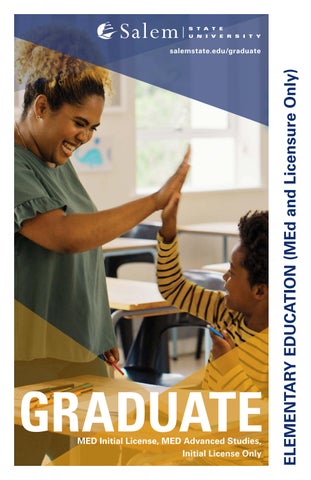
MED Initial License, MED Advanced Studies, Initial License Only
ELEMENTARY EDUCATION (MEd and Licensure Only)
salemstate.edu/graduate
ELEMENTARY EDUCATION PATHWAYS Master of Education in Elementary Education, Initial Licensure This program is designed for those seeking a master’s degree who have not yet been granted their state licensure in elementary education. Master of Education in Elementary Education, Advanced Studies This program is designed for those who already have an initial license or are not seeking a license and are seeking graduate-level expertise in elementary education. Initial Licensure Only, Elementary Education This program is designed for candidates seeking initial licensure in elementary education without earning a master’s degree. Optional Add-On Endorsements Additional coursework is available for students interested in adding licensure endorsements for moderate disabilities (grades PK-8) and/or bilingual education.
PROGRAM FEATURES • All online program, with synchronous and asynchronous coursework. • Cohort model enabling students to work in the same group throughout the academic year. • Students can select full-time (1-2 years) or part-time (3-6 years) plans based on work-life commitments to best meet their needs. • Internationally renowned faculty focused on co-constructing educational experiences contextualized in transformational learning of educational theory, content, pedagogy, and practice. Initial Licensure Programs • Full-year, full-time on-site placement in an elementary classroom that can be completed in an existing or new classroom or in an unpaid on-site placement. Advanced Studies Programs • The program of study includes 12 subject matter knowledge credits that could be applicable to your professional license with DESE approval.
MEd ELEMENTARY EDUCATION INITIAL LICENSURE The coursework provides a strong foundation in theoretical, pedagogical and conceptual knowledge and practice. The majority of the online courses are offered in a synchronous modality, with a few that are asynchronous.
MULTIPLE PATHWAYS EXPERIENTIAL CURRICULUM ONE-YEAR PROGRAM • Beginning in May and completing the program by the following May. • Summer: Stage 1 foundation courses • Fall and Spring: Stage 2 and 3 coursework (methods and seminars) and experiential portion (full-year, full-time on-site placement pre-practicum and practicum) TWO-YEAR PROGRAM • Begin in September or January and complete the program at the end of the second spring term. • First Fall/Spring/Summer: Stage 1 foundation courses • Second Fall and Spring: Stage 2 and 3 coursework (methods and seminars) and experiential portion (full-year, full-time on-site placement pre-practicum and practicum) THREE-YEAR (+) PROGRAM • Begin in September, January or May. • You can take the program slowly, and your full-year experiential/ on-site placement would be your last year. Students who choose to add-on an optional endorsement will extend their program time to completion by at least one semester, depending on pathway chosen.
MEd ELEMENTARY EDUCATION ADVANCED STUDIES The elementary years are about more than classroom instruction. Pursue this program to learn about societal elements that impact elementary schooling and elementary-aged children. The majority of the online courses are offered in a synchronous modality, with a few that are asynchronous.
MULTIPLE PATHWAYS Students can select either full-time or part-time plans to best meet their needs based on work-life commitments. ONE-YEAR PROGRAM Begin in May and complete the program by the following May. TWO-YEAR PROGRAM Begin any semester and end in the spring term following your full year student teaching. SELF-PACED (THREE-YEAR+) PROGRAM Begin any semester and complete the program in three to six years.
LICENSURE ONLY ELEMENTARY EDUCATION Typically, individuals with a master’s degree and many education credits will apply for this program. Elementary school teachers must demonstrate knowledge and excitement about content across the curriculum. Let your passion for learning lead your students to develop the skills they need to be successful learners and people.
CURRICULUM Students admitted to this program will meet with the program coordinator to develop a tailored program of study of 12-27 credits that will fulfill the Massachusetts Department of Elementary and Secondary Education (DESE) license requirements.
FULL-TIME EXPERIENTIAL PLACEMENT (INITIAL LICENSURE PROGRAMS) Candidates must secure or hold a position as a paraprofessional, an instructional aide or a full-time teacher of record in grades 1-6. Teacher candidates may be able to use their current positions to fulfill the full-time experiential placement if the role meets DESE requirements. To assist with your search, we provide a newsletter with current job listings and host an annual job fair each spring.
MTEL EXAMS AND THEIR ROLE IN LICENSURE MTELs are not currently required for admission. The successful completion of the state-accredited initial licensure program in elementary education will lead to an initial license endorsement. To obtain your initial license, students need an endorsement for an initial license from an accrediting institution and passing scores on your MTELs. LICENSURE: INITIAL LICENSURE PROGRAM + MTEL = GETTING YOUR INITIAL LICENSE Successfully completing a licensure program, obtaining an endorsement for licensure, and passing the required MTELs will lead to an initial license.
LICENSURE PROGRAM ENDORSEMENT Successful completion of the initial licensure program at Salem State will lead to an endorsement for licensure.
+ MTEL Pass the required MTEL exams for your licensure area.
= INITIAL LICENSE IN MA To obtain your license in MA, you need to successfully complete a licensure program, and get your endorsement PLUS pass the required MTEL exams.
The required MTELs for elementary education can be found at the MTEL website: www.doe.mass.edu/mtel/testrequire.html. •
Communication and Literacy (often referred to as Reading and Writing, and often taken on the same day)* *Review the MTEL website to determine if you qualify for an exam waiver.
•
Foundations of Reading (Reading (62) will also meet this requirement))
General curriculum, including two subtests, typically taken on different days: •
Subtest 1: Language Arts and History/Social Science (178)
•
Subtest 2: Mathematics, Science, and Technology/Engineering (278)
Visit the MTEL website for information on approved alternatives.
PROFESSIONAL LICENSE ELIGIBILITY To obtain your professional license, you must have taught under your initial license for a minimum of three years, completed a relevant graduate degree and documented 12 credits of graduate-level courses in the subject matter taught. The 12 credits may be included within the graduate degree or taken separately. You may self-select to choose 12 credits of our subject matter courses as part of the MEd Elementary Education Advanced Studies program and apply for preapproval from the Massachusetts Department of Elementary and Secondary Education (DESE) for these courses to count as your 12 SMK credits.
The Commonwealth of Massachusetts may change licensure requirements. Students are advised to contact the state for specific, current licensure requirements. Students may access that information at the Department for Elementary and Secondary Education (DESE).
CAREERS The program is designed to prepare teacher candidates to become successful, culturally responsive and reflective elementary school educators for grades 1-6 in Massachusetts public schools. The US Bureau of Labor Statistics estimate that Massachusetts elementary school teachers earn an average annual salary of $71,309. The Massachusetts Executive Office of Labor and Workforce Development projects 141 average annual job openings due to growth and 573 average annual job openings due to replacements for elementary school teachers.
COST For Massachusetts residents, each credit costs $492.00* which includes tuition and fees. For non-Massachusetts residents, each credit costs $593.50.* The program is 30 credits (excluding prerequisites). For assistance funding your graduate education, options such as financial aid, graduate assistantships, employer reimbursement and tuition remission, and veteran’s benefits may be available. *Tuition and fees subject to change.
ADMISSIONS TRANSCRIPT REQUIREMENTS
LETTERS OF REFERENCE
PERSONAL STATEMENT
MEd Initial License
Bachelor’s degree; Minimum overall UG GPA of 2.90
2
Yes (1)
MEd Advanced Studies
Bachelor’s degree; Minimum overall UG GPA of 2.75
2
Yes (1)
Licensure Only
Bachelor’s degree; Minimum overall UG GPA of 2.90
2
Yes (1)
PROGRAM
References
References are an important supplement to your academic background, so carefully manage your references. Salem State accepts professional (supervisors, etc.) or academic (professors, etc.) references; family/friends are not appropriate sources of references. Letters of recommendation are preferred from (in order of preference) a) professors, b) supervisors in related professions.
PLEASE VISIT SALEMSTATE.EDU/GRADUATE/ADMISSIONS FOR FULL DETAILS.
Apply: salemstate.edu/apply Financial Aid: salemstate.edu/finaid Email: gradadmissions@salemstate.edu Phone: 978.542.6200 For accommodations and access information, visit salemstate.edu/access.