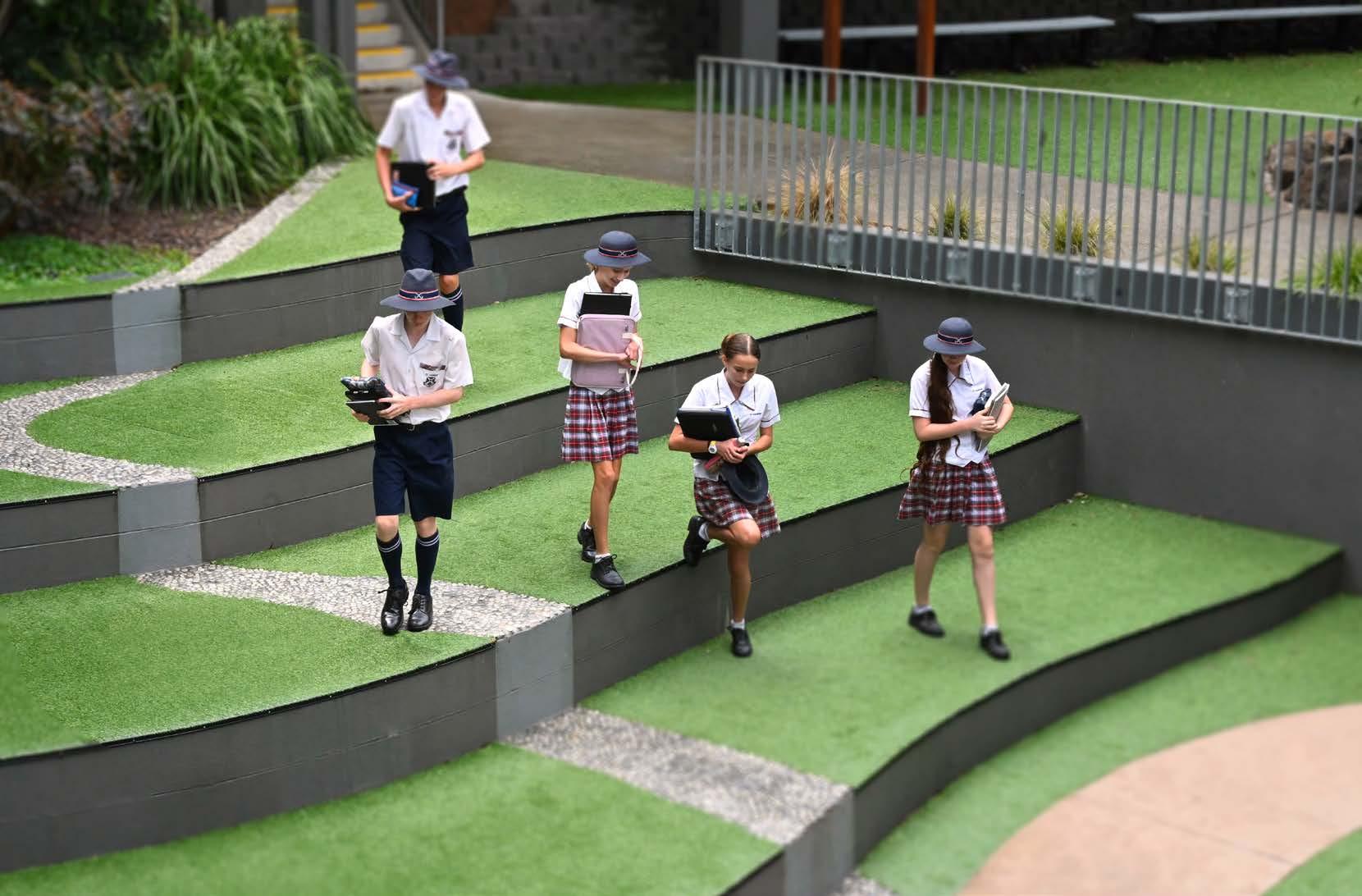
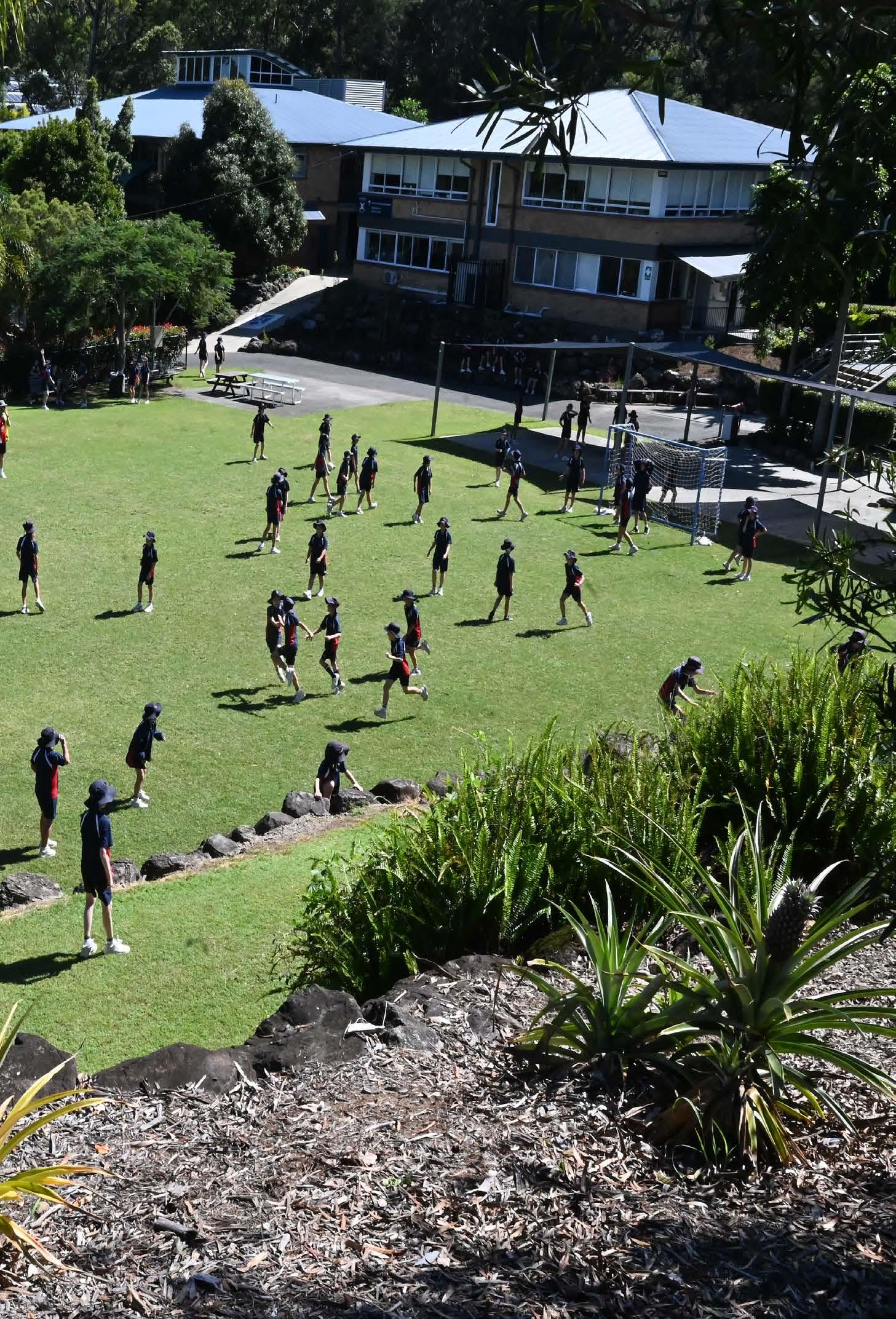
The Middle Years encompasses a period of rapid growth and development for young people. It can be an exciting, yet challenging, time for both the adolescent and their family. The College places great importance on walking alongside families to support and guide children in many areas of their development.
A holistic approach to educating students is used to work with the young people in our care, the aim of which, is to support them to achieve their personal bests. Academic, social, emotional, spiritual and physical dimensions of health are valued, and programs are implemented and targeted towards specific year levels.
Middle Years curriculum encompasses both compulsory core and elective subjects. Both the compulsory and elective subjects are offered in line with Australian and Queensland Government requirements. In Year 7 and 8 (Semester One) the students rotate through a range of elective which provides the opportunity to experience a wide range of elective subjects so that they ascertain their academic strengths in a broader curriculum context.
The introduction of elective subjects in Middle Years allows students to explore subjects not covered in the Primary Years. During the three years of Middle Years, students will begin to diversify their talents and interests; both important for determining the direction of their learning in the Senior Years and beyond. The College encourages all Middle Years students to undertake a wide variety of elective subjects so that they ascertain their academic strengths in a broader curriculum context.
Year 7 students will be offered a range of subjects that gives them a broad ‘taste’ of subjects they may encounter through to Year 12. These rotations will be offered as termbased subjects in The Arts, Technologies and Humanities and Social Science for five lessons a fortnight. This allows for students to experience 12 different electives in their two years of Middle Years schooling.These subjects will be assessed and reported on.
Year 8 students will continue the term-based rotations in the areas of Arts, Technologies and Humanities and Social Science throughout Semester One. In Semester Two, students will choose two electives to study. These subjects will be assessed and reported on. Minimal elective changes will be allowed in Semester Two.
Year 9 students will choose two electives to study in Semester One and Semester Two from all elective subject areas. Students will study a total of four semester-based electives throughout the academic year. These subjects will run for 8 lessons a fortnight, with the possibility of some composite classes being offered with Year 10 students. Languages become electives in Year 9. It is compulsory for students wanting to study a Language in their Senior Years to continue with their Language, they can elect to study a Language for Semester One, Semester Two or the whole year.
CURRICULUM OVERVIEW
COMPULSORY CORE SUBJECTS
All Year 7 to 9 students will study the following compulsory core subjects for the entire year.
• Christian Studies
• English
• Mathematics
• Humanities
• Science
• Health and Physical Education
• Language- German or Japanese (Year 9 - Elective)
• Entrepreneurship – Imagine (Year 8) and Innov8 (Year 9)
ELECTIVE SUBJECTS
Greater elective choices are offered as students move through the Middle Years. The table below outlines the range of electives that may be offered to students as they journey from Year 7 to Year 9.
Key Learning Areas
The Arts
Technologies
Design and Technologies
Dance
Subjects
Drama
Media Arts (Film and TV)
Music
Visual Arts
Design Textiles (Food and Fibre Production)
Industrial Skills (Materials and Technologies Specialisations)
Hospitality (Food Specialisations)
Engineering Principles
Digital Technologies
Health and Physical Education High Performance
Humanities and Social Sciences
Languages
Business and Economics
Futsal, Touch Football, Netball, Soccer, Basketball, Athletics, Fitness, Australian Sports and Rugby 7’s
Business Economics
Legal Studies (Civics and Citizenship)
German Japanese
NB: Decision on Elective offerings will be subject to class size.
YEAR 7 SUBJECT OVERVIEWS
CHRISTIAN STUDIES
Christian Studies will focus on the following units of work:
Unit one: Students will express what it is like to be an adolescent and the changes and pressures people experience during adolescence. They will also investigate the Bible’s message for people during adolescence and consider the impact it can have on their identity and self-esteem. Students will begin this unit by exploring their own identity and Christian beliefs about ‘Human Worth through a ‘scrapbook’
Unit two: This unit is designed to give students some insight into the developments of the Bible, setting it in a historical and literary context. It also prompts and develops their questioning capabilities. Students explore the Bible in a variety of ways designed to give some insight into the developments of the Bible and its literary content. Students also examine the historical development of the Bible and how to use a variety of tools to help understand and read the Bible.
Unit three: In this unit, students will examine their understanding of who God is. Through this examination, they will further develop the concepts of God the Father, Son, and Holy Spirit. Through an examination of how God is described in the bible (Old and New Testaments), the unit will lead to a deeper understanding and awareness of God in the world of the Old Testament Prophets, God in the world of the Early Christians and how God is revealed in our world today.
Unit four: In this unit, students develop an understanding of the concepts of character, ethical stances, and decision-making processes. Students consider their own decision-making skills and the consequences of their actions. Students use these understandings to consider their journey throughout the year and their growth since the start of the year. They take action to use their learnings from this year and this unit to create a product of action to support a Year 6 student in the school through the same transition.
ENGLISH
Students engage with a variety of texts for enjoyment. They listen to, read, view, analyse, interpret, create and perform a range of spoken, written and multimodal texts. Texts include various types of media, online and digital texts, novels, non-fiction, film, poetry and dramatic performances. The features of these texts may be used by students as models for creating their own work.
Literary texts that support and extend students as independent readers are drawn from a range of realistic, fantasy, speculative fiction and historical genres. They involve some challenging sequences of events and/or less predictable characters. These texts explore themes of interpersonal relationships and ethical dilemmas in real-world and fictional settings and represent a variety of perspectives. Informative texts present technical information and content from credible sources about specialised topics. Text structures are more complex, including chapters, headings and subheadings, tables of contents, indexes and glossaries. Language features include successive complex sentences with embedded clauses, unfamiliar technical vocabulary, figurative and rhetorical language, and/or information supported by various types of images and graphics.
Students create a range of texts whose purposes may be aesthetic, imaginative, reflective, informative, persuasive and/or analytical.
HEALTH AND PHYSICAL EDUCATION
Health and Physical Education has both theoretical and practical units that students will participate in. Students will explore physical fitness, its components, benefits, and the role of nutrition. They will develop personal fitness plans and engage in activities, assessments, and reflective journaling to promote lifelong health and well-being. Students will gain an understanding of respectful relationships, effective communication, and conflict resolution. They will learn about the physical, emotional, and social changes during puberty, fostering a positive self-image and healthy lifestyle choices Students will develop skills in touch, athletics, and netball. Focus on teamwork, strategy, and sportsmanship to enhance physical competence and promoting active participation.
HUMANITIES
Students learn Geography, History, Economics, Civics and culture. Learning to value human experiences in the Ancient World, First Nations cultures and theories of the world. They also build skills of inquiry, learning to examine primary and secondary sources to understand how history is studied, the stories and the evidence of life and culture in a different place and time. By the end of Year 7 students describe the historical significance of the ancient past and the histories of early First Nations Peoples of Australia. They identify causes and effects of events, developments and achievements connected to groups and individuals in Australia and other societies from the ancient past. Inquiry and data gathering skills are developed in Water in the world and Place and Liveability units. These focus on the many uses of water, the ways it is perceived and valued, and the hazards associated with environmental processes.
Students examine the distribution of its different forms as a resource, its varying availability in time and across space, and its scarcity. They also explore the ways water connects and changes places as it moves through the environment, and the impact of water-related hazards on human-environment relationships. Place and liveability – focuses on the factors that influence liveability, how it is perceived, and the idea that places provide us with the services and facilities needed to support and enhance our lives. Students examine the distribution of these spaces, and how they are planned and managed by people. They also consider the ways that the liveability of a place is enhanced and how sustainability is managed. Students describe a response or strategy to address a geographical phenomenon or challenge.
LANGUAGES
Students will rotate through both languages in Year 7, giving them the opportunity to explore their own preferences while gaining insight not only into the respective cultures, but also into the differences between learning a European and an Asian language. At the end of the year, they will choose one of the Languages to continue studying for the full duration of Year 8.
Japanese
Japanese language learning will build on the Early Years Learning Framework and each student’s prior learning and/or experiences with language. Students communicate with peers, teachers, known adults and students from their own and other classes. They strengthen and extend their communication and interpersonal skills by interacting with peers in Japanese through play-based and action-related learning. They receive extensive support through modelling, scaffolding and revisiting.
Students experience and imitate the sounds and gestures of Japanese language. They participate in shared listening and viewing of texts that represent Japanese and Japanese-speaking contexts. Spoken, written and multimodal texts may include songs, conversations, picture books, stories, rhyming verse, films, animated cartoons and performances. They learn that language can be represented in different ways, including the English alphabet, students’ home languages and Japanese scripts. They learn that languages and cultures are connected, and that what is familiar to one person can be new to somebody else.
German
Students are beginning their learning of German language, and this may be influenced by prior learning and experiences of language learning. Students use German language to describe their personal worlds and interact and collaborate with teachers and peers within and beyond the classroom. Listening, speaking, reading and viewing, and writing activities are supported by modelling, scaffolding and feedback.
Students access authentic and purpose-developed spoken, written and multimodal resources which may include conversations, audio and video clips, textbooks, advertisements, blogs and magazines. They use their English literacy knowledge of metalanguage to reflect on similarities and differences between German and English language pronunciation, structures and features. They recognise that language choices reflect cultural identity, beliefs and values.
MATHEMATICS
In Mathematics, students study each of the major strands of the Australian Curriculum: number, algebra, measurement, space, statistics and probability. The content covered in Year 7 builds on the student’s previous knowledge of Mathematics from their Junior School studies plus introduces several new concepts. Students will learn in a variety of methods including direct instruction from the teacher, group work and investigations both hands-on and electronic based. Assessment in the Middle Years becomes more formal in terms of examination expectations, preparation and process.
The QCAA provides a detailed achievement standard, indicating that by the end of Year 7, students will have studied specific content. An abridged version of the main descriptors:
• natural numbers as products of prime factors, squares of numbers, square roots of perfect square numbers, addition and subtraction of integers, use of all 4 operations in calculations involving positive fractions and decimals, choosing efficient calculation strategies.
• use algebraic expressions to represent situations, solve linear equations with natural number solutions.
• use knowledge of angle relationships and the sum of angles in a triangle to solve problems, use formulas for the areas of triangles and parallelograms and the volumes of rectangular and triangular prisms to solve problems, describe the relationships between the radius, diameter and circumference of a circle.
• plan and conduct statistical investigations involving discrete and continuous numerical data, using appropriate displays, interpret data in terms of the shape of distribution and summary statistics, identifying possible outliers, measure of central tendency, assign probabilities to outcomes and predict relative frequencies for related events.
SCIENCE
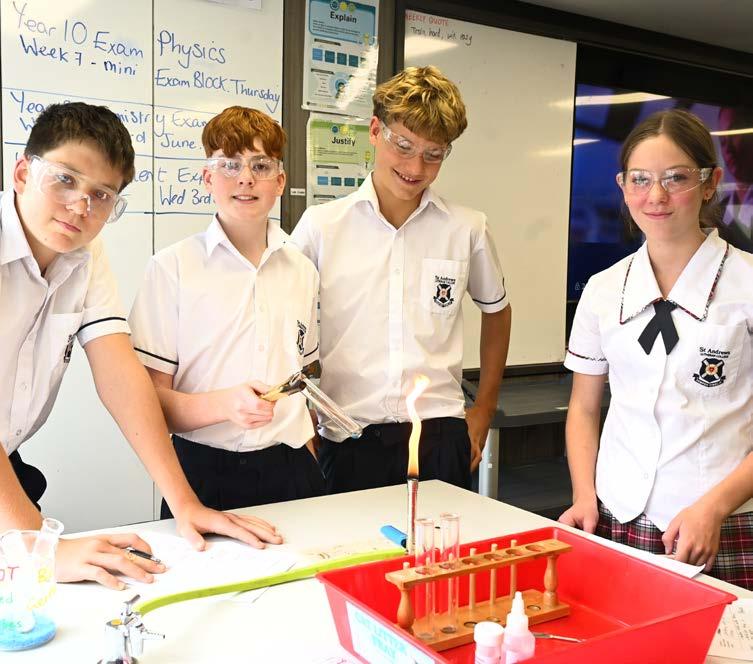
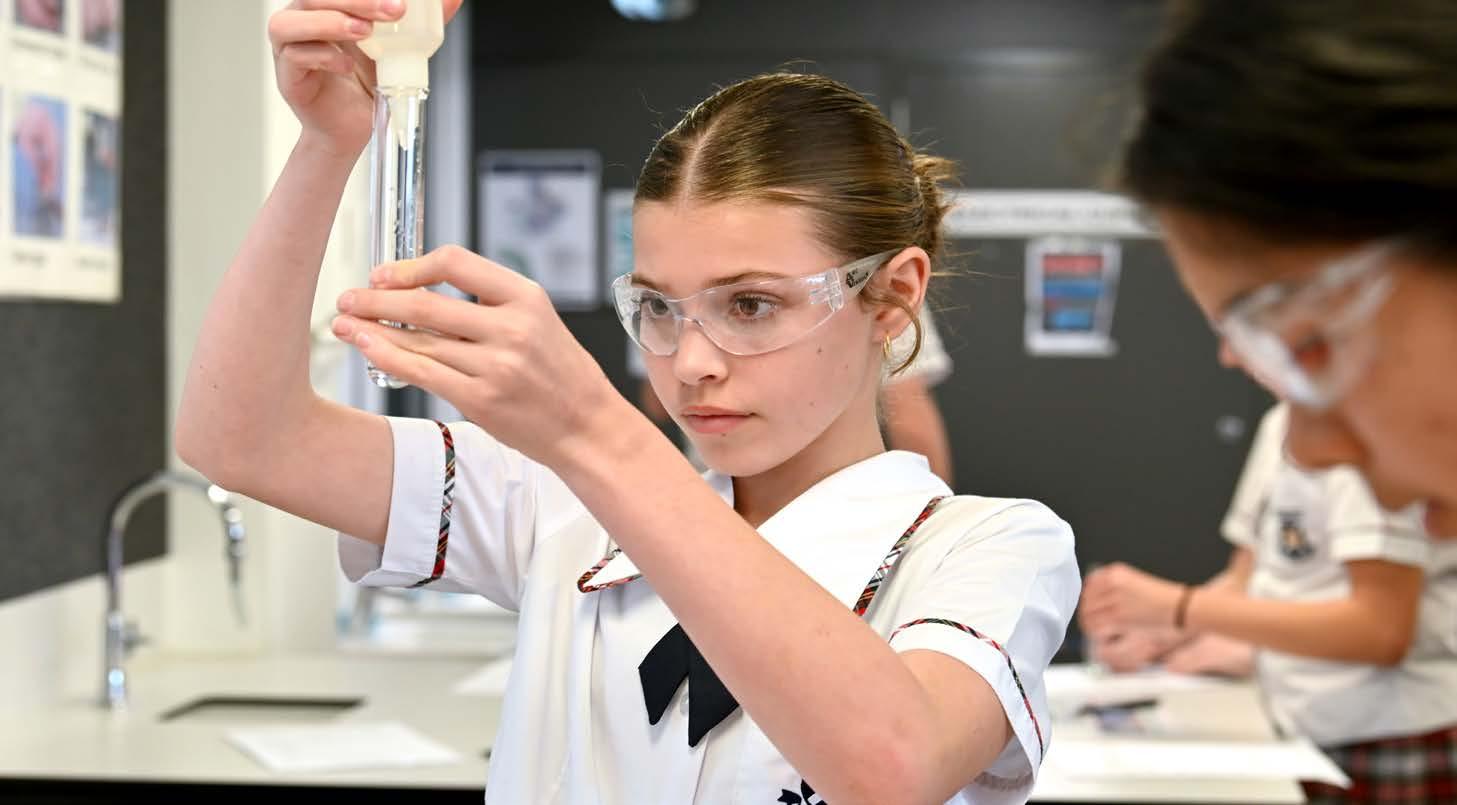
Students explore the diversity of life on Earth and continue to develop their understanding of the role of classification in ordering and organising information. They use and develop models to represent and analyse the flow of energy and matter through ecosystems and explore the impact of changing components within these systems. Students investigate relationships in the Earth-sun-moon system and use models to predict and explain events. They extend their understanding of the particulate nature of matter and explore how interactions of matter and energy at the sub-microscopic scale determine macroscopic properties.
Students consider the effects of multiple forces when explaining changes in an object’s motion. Students make accurate measurements and analyse relationships between system components. They construct and use models to test hypotheses about phenomena at scales that are difficult to study directly and use these observations and other evidence to draw conclusions. Students begin to understand the relationship between science and society and appreciate the need for ethical and cultural considerations when acquiring data.
THE ARTS
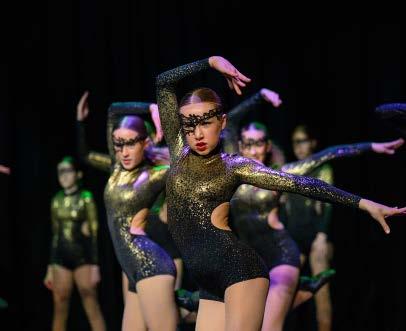
Dance involves students exploring elements, skills and processes through the integrated practices of choreography, performance and appreciation. The body is the instrument of expression and uses combinations of the elements of dance to communicate and express meaning through expressive and purposeful movement. Students engage with different styles of dance and examine dance from diverse viewpoints to build their knowledge and understanding. They are involved in practical workshops, rehearsal and performance experiences as they respond and create work both individually and collaboratively with their peers.
Drama explores the human experience by communicating, creating and sharing stories, experiences, emotions and ideas that reflect what it is to be human. Drama engages students in practical workshop, rehearsal and performance experiences across a range of styles as they make and respond to dramatic works. Like all art forms, Drama has the capacity to engage and inspire, excite their imaginations, and encourage young people to build confidence and reach their creative and expressive potential. Drama enables students to imagine and participate in the exploration of their worlds, individually and collaboratively.
Media Arts explore visual literacy and visual storytelling. Students learn and apply knowledge and skills of language of film (camera shot sizes, angles and movement, symbolism, editing, transitions and effects), the impact that sound/music can have on a film and how to plan a film concept and production. Students work collaboratively and individually to plan and produce short film content.
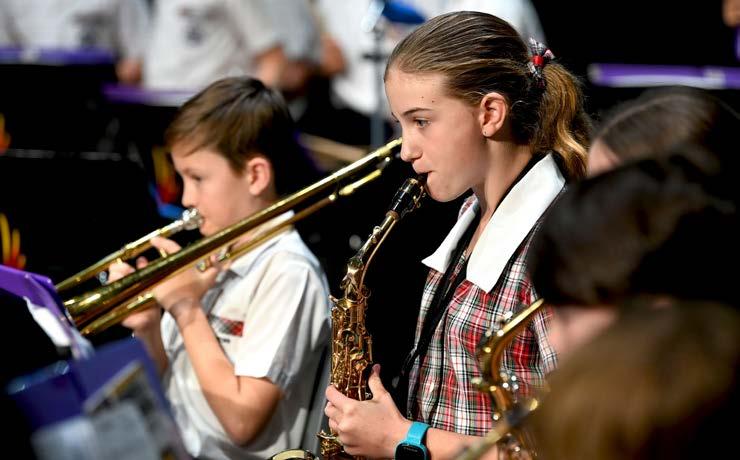
It is almost impossible to not engage with Music at some level in our modern world. It could be the radio on the drive home or in the shops. Much work is done to develop backings to the movies and television we like to watch. In many ways ‘incidental or accidental’ music has become a soundtrack to our own lives. So powerful in that particular tunes invoke the memories of important moments in our lives, for years to come. Music is a unique art form that uses sound and silence as a means of personal expression. It allows for the expression of the intellect, imagination and emotion and the exploration of values.
In an age of change, Music has the means to prepare students for a future of unimagined possibilities; in Music, students develop highly transferable skills and the capacity for flexible thinking and doing. Music prepares students to engage in a multimodal world.
The Visual Arts challenge and change attitudes, and by doing so, transform society. An education in the Visual Arts provides students with a better chance of achieving shifts in our collective consciousness. Visual Artists explore new possibilities and critique existing presumptions and preconceptions about art and life.
Students explore different media, techniques and processes and develop many new skills in the development of their own artwork. They also research the way artists and art movements have shaped our world today. Building cultural knowledge and learning to see the world around us in different ways enables a young person to be empathetic and considerate of all the possibilities. Visual Art also assists with the development of identity and sense of self, developing confidence in communication as well as an ability to work through different viewpoints.
Subject Dance Unit Dancing Through the Decades
Brief overview
This dance rotation caters for all students, male and female, and will explore dance within youth culture from the 1920’s through to today. They extend this knowledge by exploring popular dance in a range of historical, social and cultural contexts. This is a performance-based subject, where students are involved in a variety of teacher-devised and self-choreographed performance opportunities. Dance styles studied include the Charleston, Swing, Rock and Roll, Disco, Hip-Hop and Breakdance
Subject Drama Unit Drama
Brief overview
In this introductory arts rotation, students will engage with the elements of drama through games and workshop activities and apply their understanding to the rehearsal and performance of a short scripted scene.
Subject Media Arts (Film and TV) Unit Stop Motion Animation
Brief overview
Students will create stop-motion films working with small models, miniature green-screens and create settings using everyday objects. In doing so, students will learn the basics of film language and presenting narratives on film.
Subject Music Unit Rock School
Brief overview
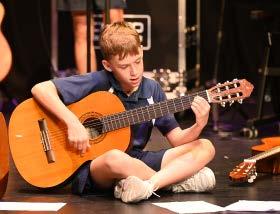
Whilst investigating the development of popular music styles from the 60’s through to today, students will learn to play basic rock band instruments. This includes keyboard, guitar, bass and drumkit. The rotation will finish with ensemble work where the students will form small groups to present a performance.
Subject Visual Art Unit Colour and Line
Brief overview
Students will explore clay, painting and drawing in this introductory course. They will think and work creatively and will complete several artworks individually, while also having the opportunity to work collaboratively on concept ideas and media experiments. Students are introduced to the work of contemporary artists and will keep a visual diary for developmental work and notes. They will wonder why artists make art, why humans need to express themselves, learn new ways of working that comes with the freedom of the studio space, and consider how the skills learnt in the art studio can be used in other areas of their life.
TECHNOLOGIES
Technologies enrich and impact the lives of people and societies globally. Australia needs individuals who are enterprising. Individuals who can make discerning decisions about the development and use of technologies and who can independently and collaboratively develop solutions to complex challenges and contribute to sustainable patterns of living. Technologies can play an important role in transforming, restoring and sustaining societies and natural, managed and constructed environments. The variety of Technologies subjects offered in the Middle Years provide students with the opportunity to experience subjects specific to enhancing the world around us through problem-solving.
Subject Materials and Technologies Specialisations Unit Design and Technologies Skills
Brief overview
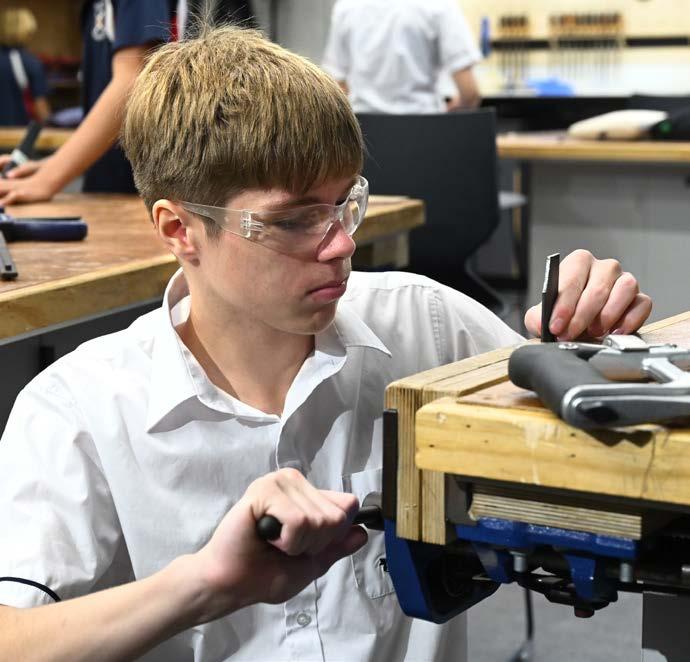
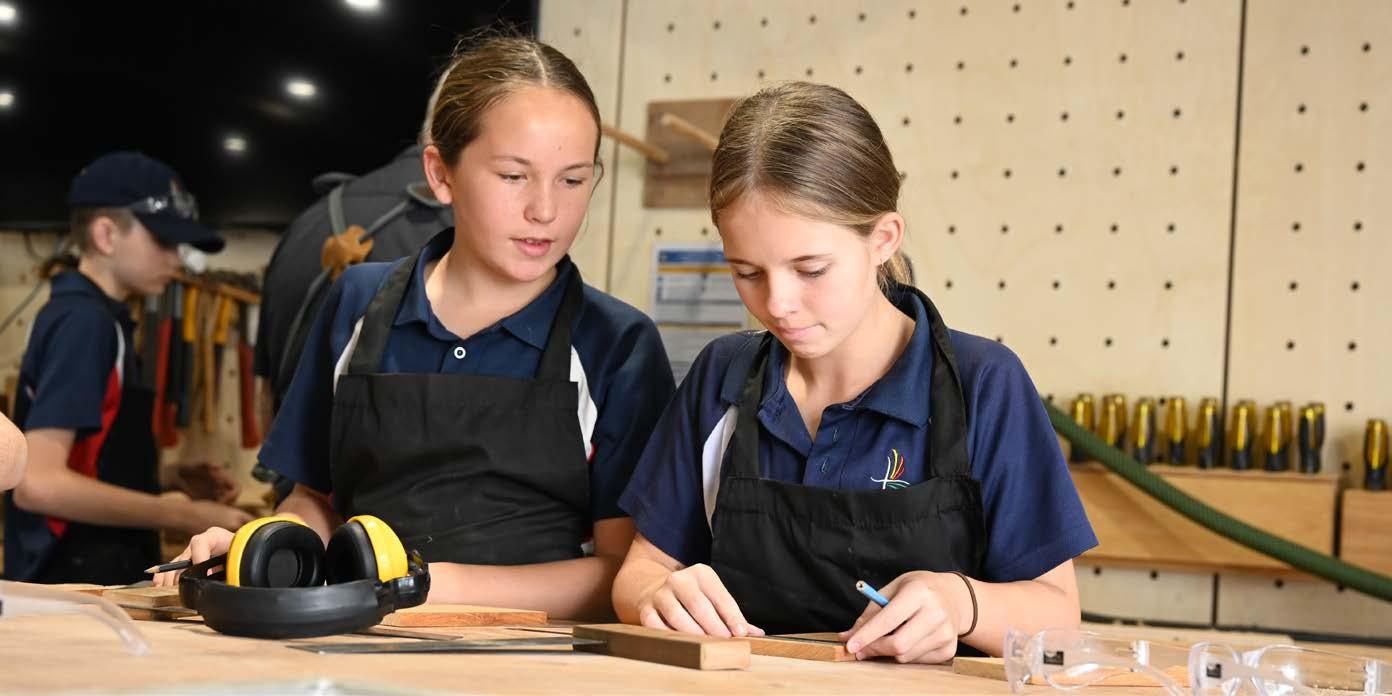
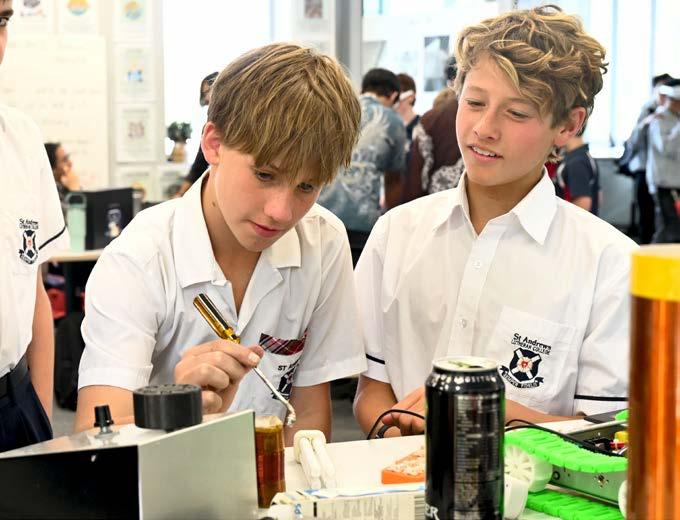
This hands-on, workshop-based subject has students learning practical skills using a variety of hand tools, machines and materials. Students will learn foundation safety practices, interpret drawings and work on projects throughout the term. The skills learnt provide wonderful opportunities for students to later use their knowledge in other Design and Technology electives as well as around the family home.
Subject Textiles Production Unit Introduction to Textiles
Brief overview
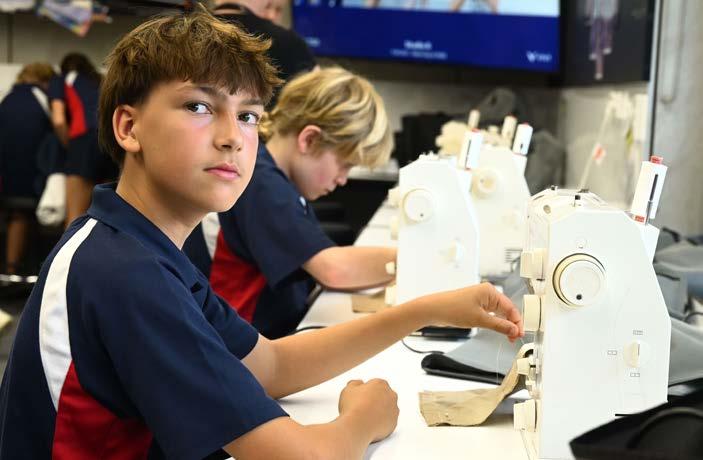
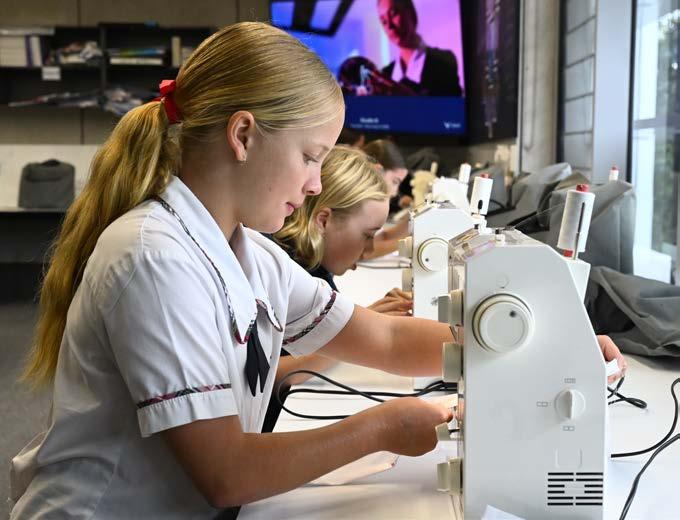
Design textiles is a practical subject which gives students the opportunity to be creative, independent learners and to explore functional and aesthetic aspects of textiles. They will also develop confidence and proficiency in the design, production and evaluation of textile items. Students will design and create a cushion cover which develops their knowledge and understanding of basic sewing construction techniques, such as the construction of seams while following correct textile safety procedures.
Subject Engineering Principles Unit Engineering
Brief overview
Students are introduced to Engineering concepts and particularly the Problem Solving Process (PSP). Students will be given practical problems to solve, designing and making their solution while working through the PSP to do this. Skills such as Project Management and Engineered Solutions are introduced, allowing a foundation of knowledge to be built for students future endeavours in Engineering areas. Using CNC machinery to produce solutions using software such as Fusion 360 for designing is also introduced at a basic level in the subject.
Subject Hospitality Practices Unit Introduction to Hospitality
Brief overview
If you have a passion for creating and eating amazing food and want to learn about selecting and preparing the freshest produce, Hospitality is the subject for you. Hospitality offers a vibrant hands on learning environment though which students may explore and develop essential life skills. This skill will include: the preparation, cooking and presentation of food, problem solving, communication, interpersonal and team building skills, as well as hygiene, health and safety requirements. This is a foundational unit designed to develop students’ skills in food production and procedures in the kitchen. Students will prepare a variety of recipes - Acai bowls, Hamburgers, Cookies, Scrambled eggs, Scones, Muffins and Cupcakes. Students will also work through the design process to create a nutritious smoothie.
Subject Digital Solutions
Unit Introduction to Programming
Brief overview
This elective introduces students to the technical knowledge, process and computational thinking skills, including algorithmic logic to build and program robots. They will design and develop robots to complete specific tasks and then critically evaluate the process. Students are also encouraged to investigate and consider the social and ethical implications of new technologies when making decisions about adopting them. Students will demonstrate their learning through building a portfolio of work.
HUMANITIES AND SOCIAL SCIENCES
Economics and Business provides students with opportunities to develop enterprising behaviours and capabilities that equip them to face challenges in their lifetime. The curriculum fosters individuals who can effectively embrace change; seek innovation; work with others; show initiative, flexibility and leadership; use new technologies; plan, organise and manage risk; and use resources efficiently. The courses will better place students to participate in business activities, while reflecting on the effects of their decisions on themselves, other people and places, now and in the future.
Subject Economics and Business Unit
Introduction to Business
Brief overview
This intensive short course will focus on the reasons business exist and the types of goods and services provided to meet the needs and wants of consumers. Students will look at the characteristics of entrepreneurs and how these influence the success of a business. They will also investigate different types of work and how an income can be earned. Students will investigate the rights and responsibilities of businesses and consumer rights.
Subject Civics and Citizenship Unit Legal Studies
Brief overview
In this subject, students will look at the key features of Australia’s system of government and the principals and features of our legal system including the Australian Constitution, rule of law and the court system. Students will also focus on the characteristics of Australia’s democracy and how values based on freedom, respect, fairness and equality can support social cohesion and democracy within Australian society.
YEAR 8 SUBJECT OVERVIEWS
CHRISTIAN STUDIES
Unit one: This unit aims to develop students’ basic understanding of Jesus as a human and as God, through investigation of what has been said about him from a variety of sources. Students explore what Jesus taught, through examination of various Bible passages, and in particular, parables. Crucial to the unit is research about the world Jesus lived in and the background of the New Testament.
Unit two: In this unit, the students briefly consider the various ‘creation epics’ which help people to understand their world. They consider the implications that these beliefs can have on issues of self-worth, meaning, and purpose in life. Creation, evolution, the Big Bang theory, and indigenous creation epics are all studied. Central to this unit is a careful examination of Genesis 1 and 2 from the Bible. Through this, students examine ‘Who are we?’
This unit then provides opportunities for students to examine and reflect on issues of justice and the role of Christian stewardship in restoring and healing damage and sustaining life and goodness. Students begin to examine ethical issues and develop their own stances. Through this, students examine – ‘Why are we here?’
Unit three: This unit aims to look at how mission work is an active part of Christian life and part of having a love for God. In this unit, students will explore why mission work is important to the church by researching a discussing mission work in the past, present and future. They will see what God is doing first-hand in our local communities, in Australia, and overseas. The unit will also concentrate on the work of the Lutheran Church through ALWS and Indigenous communities.
Unit four: This unit aims to develop students’ basic understanding of God’s Law and Grace. God gives us his law: so that we may grow in knowing what God demands of us, in recognizing our sinful condition, and in knowing how lo live as God’s people. Students explore the commandments and the punishments for sin. God also gives us His Grace – His unconditional love so that we can be free from sin. Both law and grace give us important direction in making decisions throughout our life.
ENGLISH
Students engage with a variety of texts for enjoyment. They listen to, read, view, analyse, interpret, evaluate, create and perform a range of spoken, written and multimodal texts. Texts include various types of media texts including online and digital texts, novels, non-fiction, poetry and dramatic performances. Students develop their understanding of how texts are influenced by context, purpose and audience. They understand how the features of texts may be used as models for creating their own work.
The range of literary texts for Foundation to Year 10 comprises the oral narrative traditions and literature of First Nations Australians, and classic and contemporary literature from wide-ranging Australian and world authors, including texts from and about Asia.
Literary texts that support and extend students in Year 8 as independent readers are drawn from a range of realistic, fantasy, speculative fiction and/or historical genres. They involve intertextual references, some challenging sequences and/or non-stereotypical characters. These texts explore themes of interpersonal relationships and ethical dilemmas in real-world and fictional settings, and/or represent a variety of perspectives. Informative texts present technical information and abstract content from credible sources about specialised topics and concepts. Language features include successive complex sentences with embedded clauses, unfamiliar technical vocabulary, figurative and rhetorical language, and/or information supported by various types of images and graphics.
Students create a range of texts whose purposes may be aesthetic, imaginative, reflective, informative, persuasive and/or analytical; for example, narratives, performances, reports and discussions, literary analyses and reviews for different audiences.
HEALTH AND PHYSICAL EDUCATION
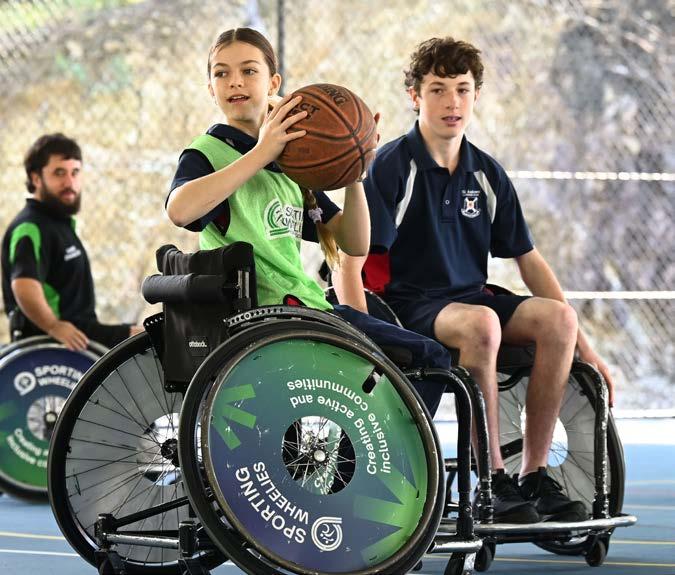
Health and Physical Education has both theoretical and practical units that students will participate in. Students will investigate the importance of fairness and inclusion in sports and discuss barriers, diversity, and strategies to promote equitable participation to foster understanding and advocacy for equal opportunities in physical activities. They will deepen their understanding of healthy and respectful relationships by covering effective communication, empathy, and conflict resolution. This unit will also address the importance of consent and boundaries, promoting well-being. Students will learn about the nutritional requirements and hydration strategies for active individuals. They will explore the impact of diet on performance and recovery by promoting informed and healthy lifestyle choices. The practical focus is on enhancing skills, strategies, and teamwork in a variety of sports including basketball, AFL and cricket. Students will actively participate through structured lessons to develop lifelong fitness and sportsmanship values.
HUMANITIES
The Year 8 curriculum provides a study of History, Geography, Civics and culture. From the end of the ancient period to the beginning of the modern period (c.650–1750 CE). This was when major societies around the world came into contact with each other. Social, economic, religious and political beliefs were often challenged and significantly changed. It was the period when the modern world began to take shape. An overview of the study of the periods that led to the emergence of the modern world requires students to develop an understanding of the context and chronology to the end of the ancient world, particularly in Europe, as well as the broad patterns of historical continuity and change over this time.
By the end of the year, students explain how the interactions of people and environmental processes impact on the characteristics of places. They explain how these places are perceived and valued differently by different people. They describe the effects of human activity or hazards on environments. Students develop geographical and historical questions to inquire about human relationships, interactions and values. They identify a range of appropriate primary and secondary sources and evidence in inquiry.
LANGUAGES
Students will rotate through both languages in Year 7, giving them the opportunity to explore their own preferences while gaining insight not only into the respective cultures, but also into the differences between learning a European and an Asian language. At the end of the year, they will choose one of the Languages to continue studying for the full duration of Year 8.
Japanese
Students are continuing their learning of Japanese language, influenced by prior learning and experiences of language learning. Students communicate with peers, teachers, known adults and students from their own and other classes. They strengthen and extend their communication and interpersonal skills by interacting with peers in Japanese through play-based and action-related learning. They receive extensive support through modelling, scaffolding and revisiting.
Students experience and imitate the sounds and gestures of Japanese language. They participate in shared listening and viewing of texts that represent Japanese and Japanese-speaking contexts. Spoken, written and multimodal texts may include songs, conversations, picture books, stories, rhyming verse, films, animated cartoons and performances. They learn that language can be represented in different ways, including the English alphabet, students’ home languages and Japanese scripts. They learn that languages and cultures are connected, and that what is familiar to one person can be new to somebody else.
German
Students are continuing their learning of German language, and this may be influenced by prior learning and experiences of language learning. Students use German language to describe their personal worlds and interact and collaborate with teachers and peers within and beyond the classroom. Listening, speaking, reading and viewing, and writing activities are supported by modelling, scaffolding and feedback.
Students access authentic and purpose-developed spoken, written and multimodal resources which may include conversations, audio and video clips, textbooks, advertisements, blogs and magazines. They use their English literacy knowledge of metalanguage to reflect on similarities and differences between German and English language pronunciation, structures and features. They recognise that language choices reflect cultural identity, beliefs and values
MATHEMATICS
Students study each of the major strands of the Australian Curriculum: number, algebra, measurement, space, statistics and probability. The content covered in Year 8 builds on the student’s previous knowledge of Mathematics from their Year 7 studies plus introduces several new concepts. Students will learn in a variety of methods including direct instruction from the teacher, group work and investigations both hands-on and electronic based. Assessment in the Middle Years becomes more formal in terms of examination expectations, preparation and process.
The QCAA provides a detailed achievement standard, indicating that by the end of Year 8, students will have studied specific content. An abridged version of the main descriptors:
• irrational numbers, terminating or recurring decimals, exponent laws, solve problems involving the 4 operations with integers and positive rational numbers, solve practical problems involving ratios, percentages and rates in measurement and financial contexts.
• algebraic properties to rearrange, expand and factorise linear expressions, graph and solve linear equations with rational solutions and one-variable inequalities, graphically and algebraically.
• use appropriate metric units for perimeter and area of composite shapes, and volume of right prisms, use Pythagoras’ theorem, use formulas to solve problems involving the area and circumference of circles, 12and 24-hour cycles across multiple time zones, congruency and similarity in shapes.
• conduct statistical investigations, analyse and describe the distribution of data using measures of central tendency and range, determine related probabilities to solve practical problems.
SCIENCE
Students are introduced to cells as microscopic structures that explain macroscopic features of living systems. They connect form and function at an organ level and explore the organisation of a body system in terms of flows of matter between interdependent organs. Students continue to develop a view of Earth as a dynamic system, in which change occurs across a range of timescales. They classify different types of energy and describe the role of energy in causing change in systems, including the role of energy and forces in the geosphere.
Students learn to classify matter at the atomic level and distinguish between chemical and physical change. They understand that chemical reactions also involve energy. Students use experimentation to isolate relationships between components in systems and explain these relationships through increasingly complex representations. They consider the magnitude of properties and events and use appropriate units to describe proportional relationships.
YEAR 8 ELECTIVES
THE ARTS
Subject Performing Arts
Unit
Music Theatre
(NB This is a combined Performing Arts Elective)
Semester offered Semester Two
Brief overview
In this combined Music, Dance and Drama elective, students have the opportunity to audition, rehearse and present a musical to the Junior School. Students can select to audition for a lead role, featured dancer or ensemble. Past productions include: The Jungle Book KIDS, Annie KIDS, Aristocats KIDS, Seussical KIDS, Aladin KIDS, High School Musical Jr and Finding Nemo
Subject Media Arts (Film and TV)
Unit
Film and Television Genres
Semester offered Semester Two
Brief overview
In this unit, student begin to develop analytical skills as they are introduced the basic codes and conventions of both film and television genres. They will then analytically compare differences between genres, before experimenting with production equipment and software in order to produce a short television pilot segment.
Subject Visual Art
Unit
Welcome to the Artist Studio
Semester offered Semester Two
Brief overview
The study of the Visual Arts begins with the development of key skills through experimentation with making, creating, exploring and responding to artworks. The Visual Arts courses allow for students to tailor their creative capacity into the areas they are most passionate about, developing skills, techniques and processes in a variety of media areas including ceramics, painting, drawing, photography and printmaking to name a few. In this course, students are introduced to several different media areas, creating experimental and resolved folios within each media area. They are guided through activities to develop skills and are then given opportunity to create individualised pieces. Students respond to the work of others in both written and electronic ways. They will express themselves in different ways, while finding out that Art is both fun and good for the soul.
TECHNOLOGIES
Subject Engineering Principles
Unit Mechanical Advantage
Semester offered Semester Two
Brief overview
Students study the basics of mechanical advantage in Engineering using simple machines to demonstrate mechanical advantage. Students will then build a machine that uses all of the different types of simple machines to perform functions requiring mechanical advantage. Students will be introduced to advanced manufacturing techniques using CNC technologies to help solve problems building projects that have purpose and show basic Engineering principles.
Subject Materials and Technologies Specialisations (Industrial Skills)
Unit Manufacturing the Future
Semester offered Semester Two
Brief overview
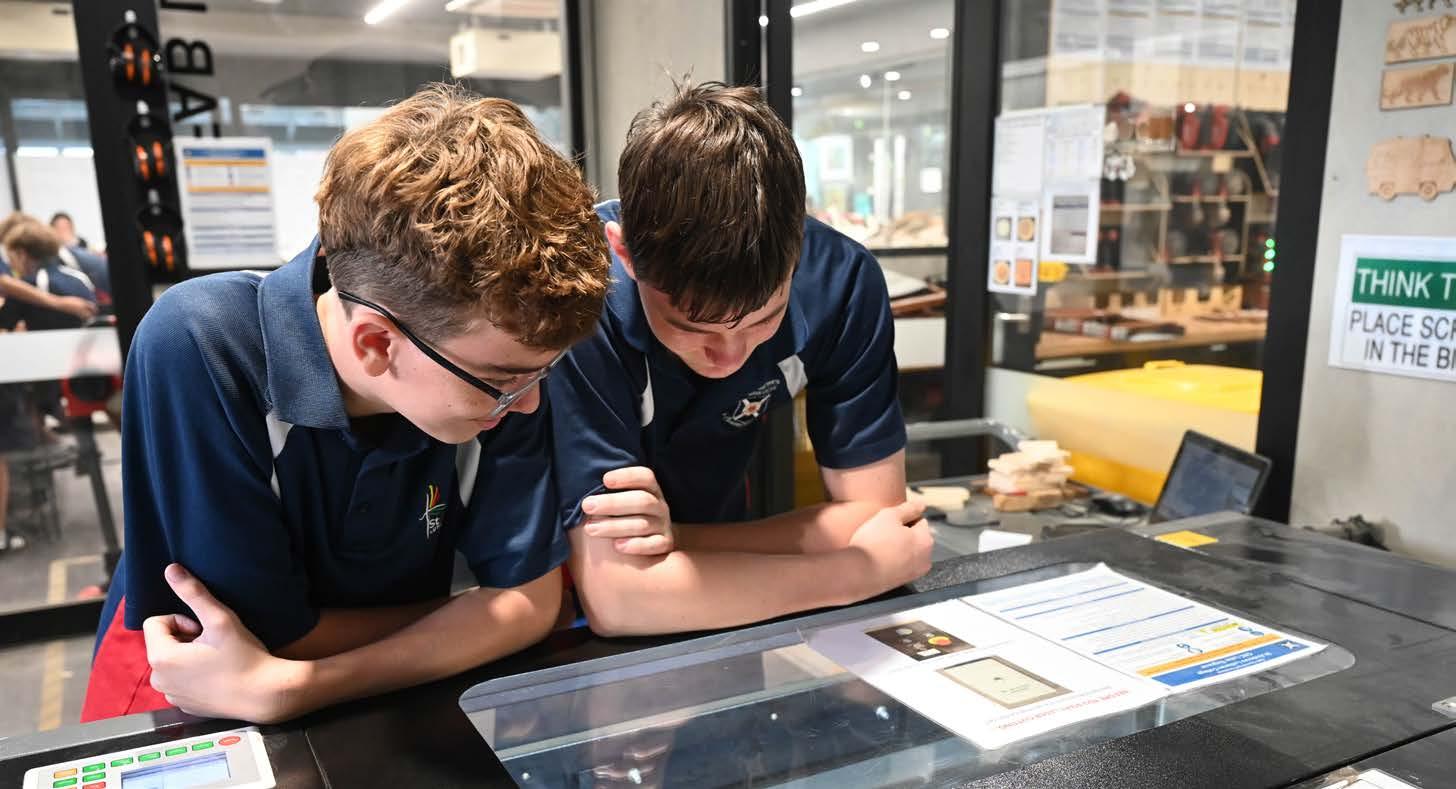
In this subject students focus on developing skills using computer aided design to design projects that can be made using the laser cutter and 3D printers. The focus is for student proficiency in basic additive or subtractive manufactoring while also further developing hand skills.
TECHNOLOGIES
Subject Design Technology Unit Designing the Future- Ideas to Reality
Semester offered Semester Two
Brief overview
Step into the world of innovation. This course immerses students in the dynamic field of Design Technologies, focusing on Materials Technology. Students will explore the entire design process, from identifying real-world problems to developing practical solutions. This course encourages critical and creative thinking. Students will learn to research, ideate, prototype, and evaluate their designs, emphasising sustainability and ethical considerations. Through hands-on projects, students will gain experience working with various materials and tools, understanding their properties and applications.
Subject Textiles Production
Unit Textiles
Semester offered Semester Two
Brief overview
This elective subject develops students’ understanding of the Design Process and how the thoughtful selection of fabrics and materials can enhance the aesthetic, functional and environmental qualities of a product. They will further develop and build skills in practical construction, decorative techniques and sustainable production practices through the creation of a Boomerang Bag made from repurposed materials. Students will demonstrate their learning through a major project, producing a pair of Boxer shorts and creating a design folio.
Subject Hospitality Practices
Semester offered Semester Two
Brief overview
Students will gain a broad range of skills and knowledge to help them make informed decisions about the food they eat. Students will look at the development of Australian cuisine from 1788 to today. The unit provides a glimpse into the diets of early settlers, bush foods, influences of immigration and food trends today. The semester’s assessment will include students choosing a dish from a country of their choice that would be suitable to be served from a food truck.
Subject Digital Solutions
Semester offered Semester Two
Brief overview
This elective prepares students to meet the rapid changes in Information Technology (IT), and to respond to emerging technologies and trends. The course encourages students to use technologies to create interactive games and produce functioning websites. Students will gain experience in the design, development and evaluation of programs. They will explore the rules for good web design whilst creating their own, which will feature their course projects. Students will investigate practices that protect the security and integrity of personal data. This program is a good start for students who wish to continue studying Digital Solutions in their Senior Years. Students will demonstrate their learning through building a portfolio of work.
HUMANITIES AND SOCIAL SCIENCES
PHYSICAL EDUCATION
Subject Economics and Business Unit Going into Business
Semester offered Semester Two
Brief overview
With over two million small businesses in Australia, Going into Business is a real option for everyone - especially kids. While some people are born entrepreneurs, the rest of us can make ourselves successful business people by developing our entrepreneurial skills and traits. In this course students will explore what it takes to be a successful entrepreneur. Students will compete in the ‘My Business Rules’ Competition and create a pop-up business. They will learn to develop a business idea, research, plan the business idea, implement marketing and operations to make sales, and to record the finances of the business.
Subject Civics and Citizenship Unit Legal Studies
Semester offered Semester Two
Brief overview
Students will investigate how different stakeholders hold differing views on issues and how the law responds to these issues. They will examine the way laws develop to address emerging technological and societal changes and how stakeholders can have their opinions heard by lawmakers. There is also a focus on the key features and jurisdictions of Australia’s court system and the role and processes of courts and tribunals.
YEAR 9 SUBJECT OVERVIEW
CHRISTIAN STUDIES
Unit one: This unit considers a variety of forms of suffering and then examines Christian responses to suffering and evil. Information is drawn from a number of written and visual sources. Students also consider underlying concepts relating to self-worth and the value God places on human beings.
Unit two: This unit is a follow-up from Term One in which students investigated the gifts of the Holy Spirit that God has given us. In this unit, students will start to investigate Service Learning endeavours in which they will take part at Googa and think about how Christians respond to adversity. They will gain this knowledge through the movie Invictus, real-life examples, and Biblical scripture. They will partake in practical ways on how to respond to difficult times.
Unit three: Learners will investigate the gifts of the Holy Spirit that God has given us. They will discover ways to practice these gifts and discuss how they can then use them to place their faith into action in their schools or local community. Students will focus also on Christian values of faith, hope, and love (1 Corinthians 13:13) and discover through Micah 6:8, that God wants us to use our gifts and values to serve Him. Students will use this unit as a bridge to Service Learning endeavours as part of their outdoor education camp at Googa.
Unit four: This unit explores what are some of the essentials that we need to know how to live a Christian life. It focuses mainly on rituals – worship, the sacraments, and prayer – what is it and how do we pray? Another important aspect of the Christian life is grace - what is grace, and how does it affect living a positive life? In this unit, we look at aspects of a Christian Life and then explore different religions and compare these. How/ what does society worship?
ENGLISH
Students engage with a variety of texts for enjoyment. They analyse, interpret, evaluate, discuss, create and perform a wide range of texts. Texts include various types of media texts including film, digital and online texts, novels, non-fiction, poetry, dramatic performances and multimodal texts. Themes and issues involve levels of abstraction, higher order reasoning and intertextual references. Students are beginning to develop a critical understanding of how texts, language, and visual and audio features are influenced by context.
The range of literary texts for Foundation to Year 10 comprises the oral narrative traditions and literature of First Nations Australians, and classic and contemporary literature from wide-ranging Australian and world authors, including texts from and about Asia.
Literary texts that support and extend students as independent readers are drawn from a range of genres. They involve complex, challenging plot sequences and/or hybrid structures that may serve multiple purposes. These texts explore themes of human experience and cultural significance, interpersonal relationships, and/or ethical and global dilemmas in real-world and fictional settings. They represent a variety of perspectives. Informative texts represent a synthesis of technical and abstract information (from credible or verifiable sources) about a wide range of specialised topics and concepts. Language features and include successive complex sentences with embedded clauses, a high proportion of unfamiliar and technical vocabulary, figurative and rhetorical language, and/or dense information supported by various types of images and graphics. Students create a range of texts whose purposes may be aesthetic, imaginative, reflective, informative, persuasive, analytical and/or critical.
HEALTH AND PHYSICAL EDUCATION
Health and Physical Education has both theoretical and practical units that students will participate in. Students investigate the factors that shape personal and social identity. They discuss self-awareness, cultural influences, and the impact of relationships to develop a strong sense of self and respect for diversity. Students will learn essential first aid skills and strategies for managing risks in various situations including CPR, injury prevention, and emergency response. This assists in preparing students for their GOOGA experience by promoting safety and preparedness. Students will explore the effects and risks associated with drug and alcohol use and discuss decision-making, peer pressure, and strategies for maintaining a healthy lifestyle to encourage informed choices and resilience. Students will also develop skills and strategies in volleyball, international games, netball and soccer with a focus on teamwork, cultural appreciation, and competitive play by fostering physical competence, active participation, and a global perspective through structured lessons and practical assessments.
HUMANITIES
In Year 9 Humanities students continue to develop specific skills for research in History and Geography. Students have a range of foci, from biomes of the world, their characteristics and significance as a source of food and fibre. Students examine the distribution of biomes as regions, and their contribution to food production and food security. They consider the effects of the alteration of biomes, and the environmental challenges and constraints of expanding sustainable food production in the future. Beyond this they research people, through their choices and actions, are connected to places throughout the world in a wide variety of ways, and how these connections help to make and change places and their environments. The Year 9 curriculum provides a study of the history of the making of the modern world from 1750 to 1918. It was a period of industrialisation and rapid change in the ways people lived, worked and thought. It was an era of nationalism and imperialism, and the colonisation of Australia was part of the expansion of European power.
MATHEMATICS
Mathematics, students study each of the major strands of the Australian Curriculum: number, algebra, measurement, space, statistics and probability. The content covered in Year 9 builds on the student’s previous knowledge of Mathematics from their Year 8 studies plus introduces several new concepts. Students will learn in a variety of methods including direct instruction from the teacher, group work and investigations both hands-on and electronic based. Assessment in Year 9 becomes much more formal in terms of examination expectations, preparation and process, as the end of the year brings students into their Senior Years of studies.
The QCAA provides a detailed achievement standard, indicating that by the end of Year 9, students will have studied specific content. An abridged version of the main descriptors:
• Extend and apply the exponent laws with positive integers to variables, expand binomial products, factorise monic quadratic expressions, calculate the distance between 2 points on the Cartesian plane, determine the gradient and midpoint of a line segment.
• Use linear functions, graph quadratic functions, solve monic quadratic equations and make connections between graphical and algebraic representations.
• Use formulas to calculate surface area and volume of right prisms and cylinders, solve problems involving ratio, similarity and scale in two-dimensional situations, apply Pythagoras’ theorem and use trigonometric ratios to solve problems involving right-angled triangles.
• Use direct proportion, ratio and scale, express small and large numbers in scientific notation, apply enlargement transformation to images of shapes, design and test algorithms based on geometric constructions or theorems.
• Compare distributions of multiple numerical data sets, using summary statistics and the shape of distributions, plus consider the effect of outliers, investigate compound events and represent these in various ways.
SCIENCE
Students consider the operation of systems at a range of scales and how those systems respond to external changes in order to maintain stability. They explore ways in which the human body system responds to changes in the external environment through physiological feedback mechanisms and the reproductive processes that enable a species to respond to a changing environment over time. They are introduced to the notion of the atom as a system of protons, electrons and neutrons, and how this system can change through nuclear decay. They learn that matter can be rearranged through chemical change and that these changes play an important role in many systems.
Students are introduced to the concepts of conservation of matter and energy and begin to develop a more sophisticated view of energy transfer. They explore these concepts as they relate to the global carbon cycle. Students begin to consider how well a sample or model represents the phenomena under study and use a range of evidence to support their conclusions.
YEAR 9 ELECTIVES
LANGUAGE
All students learn a language in Years 7 and 8. Languages are then offered as electives from Year 9 onwards, providing a pathway to Year 12 and beyond. Learning a language opens doors to enriching experiences, embracing new cultures, and forging lifelong connections. Communication involves imagination, creativity, and a broad understanding of ourselves and others.
Studies show that bilingual individuals often have enhanced cognitive abilities, better decision-making skills, and increased confidence. In an interconnected world, knowing a language other than English is an essential asset for future employability. Whether dreaming of global travel, pursuing an international career, or expanding cultural horizons, learning a language is the first step.
Throughout the language learning journey, culture is embedded to enhance the experience of the students. Study Tours to Germany and Japan may be offered to students in Years 9 to 11, every two years
GERMAN
Subject German
Semester offered Semester One, Semester Two or Whole Year
Brief overview
Students will build on their German language skills from Years 7 and 8. While prior study is recommended, students new to German with a passion for learning are welcome.
Students will study traditional festivals, discuss travel plans to German-speaking countries, negotiate plans with friends, and describe rooms and houses in German. Opportunities include becoming a language ambassador, hosting a German student, or joining our study tour to Germany. Engage in national and global language championships, speech contests, Oktoberfest, and film competitions. Immerse in German culture with support from peers and teachers to ensure success.
JAPANESE
Subject Japanese
Semester offered Semester One, Semester Two or Whole Year
Brief overview
Students will build on their Japanese language skills from Years 7 and 8. While prior study is recommended, students new to Japanese with a passion for learning are welcome.
Japanese offers an immersive journey into language and culture. Explore Japan’s captivating aspects and discover how influences shape communication and identity. Delve into Travel (Exchange), Shopping (Excursion), Entertainment (Film festival) and Food (Onigiri action) throughout the year. In 2026, join our Japan trip!
Whether starting fresh or building knowledge, this class is for Japanese enthusiasts. Use Japanese to connect with buddies in Japan and Australia, forming lasting friendships. Opportunities include becoming a language ambassador, hosting a Japanese student, or joining our study tour to Japan. Engage in national and global language championships, speech contests, manga, and film competitions. Immerse in Japanese culture with support from peers and teachers to ensure success.
THE ARTS
Subject Dance Unit It’s Showtime!
Semester offered Semester One
Brief overview
In this elective, students focus on how dance is choreographed and performed for both stage and screen. Students will explore the styles of musical theatre, commercial jazz and contemporary dance. Students will study iconic choreographers including Bob Fosse, Travis Wall and Mia Michaels. They will work collaboratively to create and choreograph a short dance clip for an advertisement. Students will manipulate dance components, choreographic devices and film techniques as they create their response. The theoretical component of this course will aim to educate students on analysing and evaluating professional dance works. Students in this subject will perform at the College’s annual Dance Night.
Subject Dance Unit Story Telling Through Dance
Semester offered Semester Two
Brief overview
In this elective, students develop an understanding of the body as a dancer’s instrument through the examination of the skeletal and muscular systems. They will study and perform the styles of lyrical and contemporary dance and focus on the classical technique of ballet. Students will explore choreographic devices and manipulated dance components to create their own series of work based on well known fairytales that will be performed to a live audience.
Subject Drama Unit Acting for Camera
Semester offered Semester One
Brief overview
In this practical performance elective, students build confidence and skills performing in front of a camera. Students learn about identifying and developing their brand and archetype, making effective slates and self tapes as well as understanding the latest industry expectations around auditioning for Film and TV. Students then work in groups to develop a pilot for an original TV series.
Subject Drama Unit Pantomime Production – Peter Pan
Semester offered Semester Two
Brief overview
In this production based elective, students audition, rehearse and present a pantomime performance to the Junior School. Through this authentic rehearsal and performance process students develop their knowledge and understanding of dramatic conventions, the process of characterisation, stage craft and acting skills as well as the opportunity of experiencing the excitement of performance in front of a large audience.
Subject Media Arts (Film and TV)
Unit
Music Videos and Video Games
Semester offered Semester One
Brief overview
Students will learn about the pre-production, production and post-production stages of filmmaking, as they plan, shoot and edit together a music video to a clip to a famous song. Student will have the opportunity to study one of the newest and most popular forms of media – the video game industry.
Subject Media Arts (Film and TV)
Unit
Narrative Film and Digital Animation
Semester offered Semester Two
Brief overview
Students study the narrative conventions of classic Hollywood film where they have the opportunity to write and produce a short film in groups. Students delve into the world of basic digital animation where they create a short promotional tourism animation that highlights a country and/or culture of their choosing.
Subject Music
Unit Stranger Things
Semester offered Semester One
Brief overview
This elective will explore dark and bright moments in popular music history, and it’s connection to culture over the last 50 years using a range of practical skills. You will use this knowledge to engage in creative tasks that may include preforming, song writing, DJ-ing, production and recording. These tasks will help develop a portfolio of works that celebrates your learning throughout the course.
Subject Music Unit
Film Composer
Semester offered Semester Two
Brief overview
Students will go behind the scenes to investigate the connection between film and score and how this has developed over time, including programmatic music developed in classical eras. This is a project-blended unit, where they will perform a movie/tv song on their chosen instrument and compose scores for a range of scenarios ranging from trailers to commercials and culminating in a score for a Wallace and Gromit film. Collaborative opportunities may arise with the Film and TV elective.
Subject Visual Art
Unit
Soft and Hard Sculpture
Semester offered Semester 1
Brief overview
Feeling hungry? Ever wondered how they make those oversize food sculptures at Krispy Kreme? In this elective, students will learn how to make clay sculptures of food for an art party. They will experiment and explore both realistic and abstract interpretations of food in art, make large scale collaborative food artworks in the style of Claes Oldenburg, using recycled and traditional art media. They will learn how to respond to artworks using Visual Thinking Strategies.
Subject Visual Art
Unit Photography and Design
Semester offered Semester Two
Brief overview
How do artists gather ideas for artworks? How do artists experiment with different media and techniques? How do they turn their drawings into animations and digital art?
All these questions and more will be answered as students learn about and explore different elements of digital photography. With a focus on how to use and exploit the formal elements of art and design in photography, how to use and experiment with photo editing software-Adobe Photoshop, in-camera editing and manipulation of experimental photographic techniques and applications, students will create digital artworks for a variety of contexts and exhibitions.
Subject Visual Art
Unit
Advanced Visual Art
Semester offered Semester One and Two
Brief overview
Students in this elective will explore various ways that artists make and display artwork through both ancient and modern traditions, with opportunities to work with artists to create their own art. From the cave paintings of Australia to the contemporary street art of Banksy and the laneways of Melbourne, humans have been expressing themselves for centuries. It is an innate need to express who we are. With a focus on stencils and spray cans, casting and sculpture, digital art and art on the street, students will express ideas about how they see and exist in the world. This elective can be studied for the whole year as it is a great foundation subject for Year 10, 11 and 12 Visual Art.
TECHNOLOGIES
Subject Materials and technologies Specialisations
Unit Industrial Skills
Semester offered Semester One and Two (repeated)
Brief overview
In this practical subject, students are given the opportunity to develop their skills in the areas of problem solving, designing and manufacturing. Students will further enhance their learning using Fusion 360 as a CAD software package to develop ideas. Production of ideas will utilise and refine hand skills to produce practical items as well as students learning the basics of using machines for 3D printing, Laser Cutting, and CNC Router machining, these machines help significantly in the production process. With a focus on producing quality, students will further develop foundation safety practices, interpret drawings and work on projects throughout the year. The skills learnt in this subject provide wonderful opportunities for students to later use their knowledge in other Industrial Design and Technology Senior subjects.
Subject Design
Semester offered Semester One and Two (repeated)
Brief overview
Students use the knowledge they’ve gained in Years 7 and 8 to solve various design problems. The semester course sees students work on student directed projects. Sketching, laser-cutting technology, sewing machines and 3D printing form essential elements of this elective. The intention of this course is to set a foundation for students interested in studying specialised pathways in Year 10 and beyond.
Subject Engineering Principles
Semester offered Semester One and Two (repeated)
Brief overview
Students will be given a number of practical problems to solve, designing and making their solutions while working through the Problem Solving Process (PSP). The skill of Project Management is refined to enable students to become organised and systematic when developing engineered solutions; this is foundational in preparing students for their Senior Years of Engineering subjects at St Andrews Lutheran College.
Year 9 focuses on extending a students’ knowledge and further developing skills in the areas of CAD (Computer Aided Design) and CAM (Computer Aided Manufacturing), using CNC (Computer Numerically Controlled) machinery to produce engineered solutions using software such as Fusion 360 for designing. Students will further develop their skills and knowledge of engineering concepts producing solutions that will be tested and logged to glean insight from the data collected helping in the decision making process.
Subject Design - Textiles
Semester offered Semester One and Two (repeated)
Brief overview
This elective expands students’ awareness of the Design process. Students will design using mixed materials and learn more advanced techniques of materials manipulation. Students’ refinement of textile construction and decorative techniques will allow them to move on to more student-directed projects with confidence. They will examine how the selection of textiles and materials enhances the overall aesthetics of their design. Students will demonstrate their learning through a major project, producing a Hoodie and the creation of a design folio.
Subject Hospitality Practices
Semester offered Semester One and Two (repeated)
Brief overview
The Year 9 course is designed to support students to gain practical cooking skills, operational skills and food knowledge while completing a variety of tasty recipes suitable for celebrations. The focus of the semester is entertaining. Students will plan and create a child’s birthday party including an invitation, party bag, menu and games. They will also independently design and produce a birthday cake for their chosen party theme.
Subject Digital Solutions
Semester offered Semester One and Two (repeated)
Brief overview
This elective provides an opportunity for students to learn about computer languages and user interfaces through generating digital solutions to problems. The focus is on a digital and visual representation of data through web development. Students create computer programs that respond to user input. They will investigate practices that protect the security and integrity of personal data. Students will demonstrate their learning through building a portfolio of work. This elective may be combined with the Year 10 Digital Solutions class.
PHYSICAL EDUCATION
Subject Physical Education
Unit High Performance Netball and Basketball
Semester offered Semester One
Brief overview
This elective is designed for students who have a level of expertise and genuine interest in developing their skills and attitudes in Netball and Basketball. The purpose of this unit is to improve their own skills, better familiarise themselves with the rules of the games, as well as effective offensive and defensive strategies and training techniques. Students will also incorporate basic coaching, umpiring and/or refereeing qualification and learn how to organise and administer the chosen sport. The unit will also emphasise the important role all players and support personnel have in developing positive team culture.
Subject Physical Education
Unit High Performance Soccer and Futsal
Semester offered Semester One
Brief overview
This elective is designed for students who have a level of expertise and genuine interest in developing their skills and attitudes in Soccer and Futsal. The purpose of this unit is to improve their own skills, better familiarise themselves with the rules of the games, as well as effective offensive and defensive strategies and training techniques. Students will also incorporate basic coaching, umpiring and/or refereeing qualification and learn how to organise and administer the chosen sport. The unit will also emphasise the important role all players and support personnel have in developing positive team culture.
Subject Physical Education
Unit Peak Performance PE
Semester offered Semester Two
Brief overview
In this elective, students will study fitness and conditioning concepts and explore the question: Are athletes born or are they made? Students will participate in a variety of sporting activities as well as generate and analyse performance data. This course will also strengthen knowledge and understanding of functional anatomy and the ability to analyse and justify performance.
Subject Physical Education Unit High Performance Touch and Rugby 7’s
Semester offered Semester Two
Brief overview
This elective is designed for students who have a level of expertise and genuine interest in developing their skills and attitudes in Touch and Rugby 7’s. The purpose of this unit is to improve their own skills, better familiarise themselves with the rules of the games, as well as effective offensive and defensive strategies and training techniques. Students will also incorporate basic coaching, umpiring and/or refereeing qualification and learn how to organise and administer the chosen sport. The unit will also emphasise the important role all players and support personnel have in developing positive team culture.
HUMANITIES AND SOCIAL SCIENCES
Subject Business and Economics
Semester offered Semester One and Two (repeated)
Brief overview
Students explore economics and business in two complementary terms. During Business they examine why businesses seek to create and maintain a competitive advantage, the role of entrepreneurs in creating value, and how individuals and businesses manage consumer and financial risks and rewards. In Economics they investigate the role of Australia’s financial sector and its effect on economic decision-making, the interdependence of consumers, businesses, the financial sector and government, and the reasons Australia trades and its pattern of trade with Asia.
Throughout, students develop the discipline-specific skills of questioning and researching, interpreting and analysing data, evaluating responses using cost–benefit analysis and criteria and communicating reasoned, evidence-based arguments.
Subject Civics and Citizenship Unit Legal Studies
Semester offered Semester One and Two (repeated)
Brief overview
Students will learn how the law works, how to use it to advocate for themselves and those in need. Students will investigate how different stakeholders hold differing views on issues and how the law responds to these issues. They will examine the way laws develop to address emerging technological and societal changes and how stakeholders can have their opinions heard by lawmakers. There is also a focus on the key features and jurisdictions of Australia’s court system and the role and processes of courts and tribunals. Students will also undertake practical experiences such as investigations, mock trials and moot trials.