Year 11 and 12 Course Information and Subject Choices
This course information booklet is a resource to help Year 10 students and their parents make informed choices of subjects as they plan their senior education pathway at St Andrews Lutheran College. The booklet intends to provide you with relevant information about the next stage of your senior schooling, including subject selection, prerequisite subjects, qualifications and tertiary entrance. Please note Year 11 and Year 12 subjects are studied as two year courses.
The courses on offer at St Andrews Lutheran College for senior school students entering Year 11 for the 2027 academic year are outlined in the booklet. The College is committed to supporting student choice and every effort is made to place students into their preferred subjects. Final subject offerings, however, are shaped by a range of factors including: student interest, demand, timetabling and facility considerations.
Where a subject cannot be offered, students will be supported to select an alternative that aligns with their learning goals and future pathways. Please read the information provided here and the other sources referred to in order to make informed decisions.
If you have any questions please do not hesitate to contact me at the College.
Mrs Amanda Tanks
Student
Pathways
Advisor amandat@salc.qld.edu.au
Successfully Choosing Senior Subjects
In order to maximise your performance and reach your goals, you should study subjects that you enjoy and in which you excel. It is a good idea to keep your options open by taking prerequisite subjects. However, if you choose subjects that you find too difficult, or that you are not suited to, you may actually reduce your chances of success. This can impact the ATAR you achieve. We cannot foresee the results students will need to achieve an ATAR for university education. So at this stage, the focus is on encouraging students to select subjects they have had success in and enjoy, as this will enable them to achieve to the best of their ability.
Students, as an overall plan, you are advised to choose subjects:
• you enjoy
• in which you have demonstrated some ability or aptitude
• which help you reach your chosen course and career goals
• which will develop skills, knowledge and attitudes useful throughout your life
However, do NOT choose your subjects for the following reasons:
1. “My friend is taking the subject.” This is NOT a good enough reason to take a subject. Where there is more than one class in a subject, you won’t necessarily be in the same class.
2. “I do/don’t really like the teacher.” Again, not a good enough reason to take or not take a subject. There is no guarantee that you will have a particular teacher.
3. “Someone told me that the subject is fun (or easy, or interesting, really difficult or boring, etc).” It may be these things for someone else. Make up your own mind based on what you enjoy and what you are good at.
4. “Someone told me that I do/don’t need that subject for the course I want to take at university.” Check tertiary prerequisites or see Mrs Amanda Tanks. If you have not yet checked out the prerequisites, do so before making any final decisions.
These are quite general points, so it is wise to look in more detail at the individual course outlines to be found between pages 14 and 48.
CHOOSE VERY CAREFULLY
At St Andrews Lutheran College, the lines of subjects (i.e. groups of subjects that are timetabled at the same time) will be determined to a large extent on student demand so it is essential that students consider carefully and submit their preferences wisely. Once the lines for 2027/2028 are set, subject changes may not be possible. Multiple subject changes in senior subjects will impact on both a student’s ATAR eligibility and QCE eligibility.
Successfully Choosing Senior Subjects
SUGGESTED GUIDELINES
It is very helpful if you have a few career choices in mind before choosing subjects. If you are uncertain about this at present, seek help in trying to choose a course that will keep several career options open to you.
The following resources are available to students and give information on career pathways, subjects and courses needed for careers:
• The College’s designated careers website at www.careerssalc.com
• Tertiary prerequisites, assumed knowledge and recommended study: guides (based on individual tertiary institution requirements can be accessed at the QTAC website – The Queensland Tertiary Admission Centre) at www.qtac.edu.au
• Myfuture https://myfuture.edu.au great interactive resources.
• Your Career https://www.yourcareer.gov.au Search Industries and occupations here. Great Quiz
• The QCAA (Queensland Curriculum and Assessment Authority) website at www.qcaa.qld.edu.au – for details about the new senior assessment and senior subject syllabuses. Also at the QCAA site is MYQCE https://myqce.qcaa.qld.edu.au
• Mrs Amanda Tanks, our Student Pathways Advisor, is available for meetings with students and/or parents.
By checking this information students and parents will become aware of the distinction between:
• Pre-requisite subjects - subjects that a student must complete and achieve the specified result in before they are considered for entry
• Recommended subjects – non-compulsory subjects that institutions suggest students take while at school to give them a better understanding of course content
• Assumed Knowledge – the minimum level of achievement in senior subjects considered necessary for successful first year tertiary study.
In conclusion, make a decision about a combination of subjects that suits your requirements and abilities. Students should choose subjects according to their learning goals and what they enjoy and are good at. They should pay close attention to the prerequisite requirements of the courses they are considering for tertiary study. If you are still not sure which career pathway to take, then make elective choices that will keep your options open.
The Queensland Certificate of Education (QCE)
The Queensland Certificate of Education (QCE) is Queensland’s senior secondary schooling qualification. It is internationally recognised and provides evidence of senior schooling achievements. The flexibility of the QCE means that students can choose from a wide range of learning options to suit their interests and career goals. At St Andrews Lutheran College students will plan their QCE pathway in Year 10 when choosing their senior courses of study.
To receive a QCE, students must achieve the set amount of learning, at the set standard, in a set pattern, while meeting literacy and numeracy requirements (see diagram below). The QCE is issued to eligible students when they meet all the requirements, either at the completion of Year 12, or after they have left school. Students are provided with advice and guidance on how best to attain their QCE points as well as the kind of programs which may be counted towards the QCE.
20 Credits from contributing courses of study, including:
• QCAA- developed subjects or courses
• Vocational Education and Training(VET) qualification
• Non-Queensland studies
• Recognised Studies.
Satisfactory completion, grade of C or better, competency or qualification completion, pass or equivalent.
12 credits from completed Core courses of study and 8 credits from any combination of:
• Core
• Preparatory (Max. 4)
• Complementary (Max.8)
Students must meet literacy and numeracy requirements through one of the available learning options.
The Queensland Certificate of Education (QCE)
20 Credits required
Unit One = 1 Credit
Unit Two = 1 Credit
TO ACHIEVE THE QCE
Unit Three + Four satisfactory standard = 2 Credit (NO Splitting)
Literacy and Numeracy requirements:
Satisfactory completion in Unit One or Unit Two Or
A grade of C or better in a Unit Three and Four pair
Core = 12 credits from subjects completed start to end at a satisfactory level - failed units will not be counted
VET = maximum of 8 credits from a Training Package, no doubling up of points from credit transfers
For further information, please refer to the QCAA link below regarding the QCE senior assessment system. Additionally, College staff can supply relevant information. The College remains committed to supporting students to attain their QCE and will keep students and parents informed of any issues regarding QCE attainment as students work through their courses of study.
Tertiary Entrance – The ATAR (Australian Tertiary Admissions Rank)
The ATAR system which places responsibility for generating a common Year 12 tertiary entrance rank is carried out by the QTAC (Queensland Tertiary Admissions Centre). QTAC will administer this process on behalf of Queensland tertiary institutions.
An ATAR ranks students from 99.5 in steps of 0.5. (ATARs of below 30 will not be reported.) The ATAR provides a fine grained rank, which will help to differentiate students who seek entry to highdemand tertiary courses. The use of an ATAR simplifies administrative processes for Queensland students who wish to apply for interstate courses, as well as interstate students who wish to apply for Queensland courses.
CALCULATING STUDENT ATARS
QTAC will generate student ATARs through a statistical process known as ‘inter-subject scaling’. Under this process, patterns of student results across different subjects are mathematically compared and adjusted to enable students with different combinations of results to be compared in a single rank order. A similar process is used to support ATAR calculations in most other Australian states.
ATARs will be based on five subjects which can be generated by ONE of the following patterns of study:
• Five GENERAL subjects or
• Four GENERAL subjects, plus on APPLIED subject or
• Four GENERAL subjects, plus one vocational education and training qualification at Certificate III, IV or Diploma.
Students will have to satisfactorily complete an English subject to be eligible for an ATAR, but their English result will not be a mandatory inclusion in the calculation of their ATAR.
Please note that at St Andrews Lutheran College, students are required to take seven subjects with the ATAR being calculated from the five best subjects. At St Andrews Lutheran College every student must study an English, Mathematics subject and Religion and Ethics (Christian Studies).
* For more information about the ‘inter-subject scaling’ process, visit: www.qtac.edu.au/student-resources/atar
Prerequisites for Courses
Subjects which are prerequisites for tertiary entrance are listed for each individual course on the subsequent university website.
However, the following general points should be noted.
1. Different institutions have different prerequisites for similar courses.
2. General English (NOT *ESSENTIAL ENGLISH) is a prerequisite or assumed subject for many courses.
3. Maths and Science subjects are most commonly listed as prerequisites.
4. A number of subjects offered at St Andrews Lutheran College have prerequisites of their own. Please take careful note of the prerequisites for particular subjects.
*Note: A student who takes the Essential English course may still be ATAR eligible.
Year 11/12 Subject Information
GENERAL subjects are recognised by the QCAA and contribute to Queensland Certificate of Education (QCE) and may contribute directly to a student’s ATAR used in tertiary entry.
APPLIED subjects are recognised by the QCAA and will contribute to the QCE but may not contribute directly to tertiary entry. Applied subjects on offer at St Andrews Lutheran College are:
ESSENTIAL ENGLISH
ESSENTIAL MATHS
FASHION
HOSPITALITY PRACTICES
INDUSTRIAL TECHNOLOGY
SKILLS
RELIGION AND ETHICS (COMPULSORY)
SPORT AND RECREATION
VISUAL ARTS IN PRACTICE
All subjects are offered dependent on a sufficient number of students choosing them. When making their selections, students are encouraged to seek advice from their subject teachers, Heads of Departments, their learning advisors, and the Director of Student Pathways. Students are asked, when they place their elective preferences online to make reserve selections for electives on offer so the College can best meet the needs of all students. Once initial selections have been made, the College will send out a draft to the students for final confirmation. Some subjects may not be offered if the class size is not viable.
Any students affected will be asked to re-select from the subjects available, and the College will keep students and parents informed if this situation arises. In addition to ENGLISH, MATHEMATICS and RELIGION and ETHICS, all students will study FOUR electives. Senior students also participate in Sport/Fitness and group study sessions on Thursday afternoons.
Via the online preference process, Year 10 students are required to choose SIX subjects in DESCENDING ORDER of preference for study in Year 11. There is NO need to select English, Mathematics or Religion and Ethics as these are compulsory core subjects which every student will study.
Students may not drop subjects in Year 11. Exceptions to this may be made for students requiring learning support, those studying early university studies, and/or those undertaking off campus vocational courses and school-based traineeships and/or students with heavy, high level (State or National) sporting commitments.
Changes of subjects are only permitted during the first two to three weeks of a unit or at the end of a unit of study. Changes of subject study need to be formally requested through a student interview with the Student Pathways Advisor.
Students will not be able to change subjects in Units Three and Four.
Senior Subjects on Offer for Year 11 2027 and Year 12 2028
English
Mathematics
Literature
General English
English and Literature Extension (Year 12)
*Essential English
General Mathematics
Mathematical Methods
Specialist Mathematics (elective – must be studying Mathematical Methods)
*Essential Mathematics
Enterprise Studies
Humanities
Business
Economics
Legal Studies
Science
Creative Arts
Biology Chemistry
Physics
Dance
Drama
Film and TV
Music
Music Extension (Year 12)
*Visual Arts in Practice
Health and PE
Geography
Modern History
Ancient History
Technologies and Innovation and
Industrial
Technology
Skills
Languages
Health
Physical Education
*Sport and Recreation
Digital Solutions
Design
Engineering
*Fashion
*Industrial Technology
Skills
German
Japanese
*Applied subjects
Pathways for Senior Schooling
A pathway is a direction selected for individual learning and selecting an appropriate pathway is vital for student success. Thoughtful consideration needs to be given to the pathway selected to maximise potential and access to particular careers. Where students are uncertain of the ultimate career pathways, the best advice is “keep your options open!” As students deliberate their career pathway options, they should consider the following…
• What career(s) am I interested in?
• What is the pathway necessary toaccess this/these career(s)?
• What are the educational prerequisites for the career(s)?
• Do the subjects I am planning to select contribute to my preparation for this career?
• Beyond my chosen career, what other pathways would be accessible through this/these subject(s)/course(s)?
Students will not be able to change subjects in Units Three and Four
ACADEMIC Six QCAA GENERAL subjects– tertiary entrance to university, TAFE, workplace
BLENDED
WORK READY
Combination of QCAA general and applied subjects – and/or traineeship, certificate course – tertiary entrance to University, TAFE, workplace.
St Andrews, through its partnerships with several registered training organisation (RTO) and local employers, is able to offer students the opportunity to take a traineeship or begin an apprenticeship whilst still studying at school. Normally, a student studies a reduced number of school subjects and attends the work place for one day per week.
Note that students can still be eligible for an ATAR if they undertake a school based traineeship as part of their Year 11 and 12 curriculum. See Mrs Amanda Tanks for more details about traineeships.
Currently, St Andrews’ students are undertaking traineeships, apprenticeships, Certificate and diploma courses in:
Certificate II Automotive Vocational Preparation
Certificate II Electro technology
Certificate III Early Childhood Education and Care
Certificate III in Hospitality
Certificate III Construction
Certificate III Animal Companion Studies
Certificate III Electrical Apprenticeship
Certificate III Sports and Recreation
Certificate III in Screen and Media
Certificate III in Information Digital Media Technology
Certificate III Health Services
Certificate IV Justice and Crime Studies
Diploma in Business
Diploma in Nursing (partial completion)
Diploma in Social Media and Marketing
Diploma of Sport
Planning your Pathway
SET Plan
Career planning meetings Year 11 - Units One + Two Year 12 - Units Three + Four
PLEASE NOTE
Online Subject Choice
Four electives plus two reserve electives
Confirmation of subjects
1. All subjects are dependent on sufficient student numbers enrolling for the subject.
2. If a student is specifically interested in a subject not offered as a ‘class’ at St Andrews, it may be possible for an alternative study method to be considered, for example, Distance Education,TAFE.
See Mrs Amanda Tanks for further details.
3. The subject descriptions provided in this booklet should be treated as a guide only. Some details may alter if syllabuses are updated by the QCAA.
Biology
Description Biology provides opportunities for students to engage with living systems. In Unit One, students develop their understanding of cells and multicellular organisms. In Unit Two, they engage with the concept of maintaining the internal environment. In Unit Three, students study biodiversity and the interconnectedness of life. This knowledge is linked in Unit Four with the concepts of heredity and the continuity of life. Students will learn valuable skills required for the scientific investigation of questions. In addition, they will become citizens who are better informed about the world around them and who have the critical skills to evaluate and make evidence-based decisions about current scientific issues. Students will attend a compulsory ecology camp linked to their assessment at a cost to parents (costs TBC).
Pathways Biology is a General subject suited to students who are interested in pathways beyond school that lead to tertiary studies, vocational education or work. A course of study in Biology can establish a basis for further education and employment in the fields of medicine, forensics, veterinary, food and marine sciences, agriculture, biotechnology, environmental rehabilitation, biosecurity, quarantine, conservation and sustainability.
Course structure Units and assessment
Unit One Cells and multicellular organisms
Topic One: Cells as the basis of life
Topic Two: Exchange of nutrients and wastes
Topic Three: Cellular energy, gas exchange and plant physiology.
Assessment Formative Internal Assessment/s
FIA1 - Data test
FIA2 - Student experiment
BIOLOGY
Unit Two Maintaining the internal environment
Topic One: Homeostasis thermo regulation
Topic Two: Infectious diseases and epidermology
Unit Three Biodiversity and the interconnectedness of life
Topic One: Describing Biodiversity and populations
Summative Internal Assessment 3: Research Investigation (20%)
Summative External Assessment Examination (50%)
Pre-requisites There are no pre-requisites for Biology although students who have completed Year 10 Science will have foundation knowledge that will be further developed in the senior phase.
Business
Description
Pathways
Course structure
Units and assessment
Students investigate the business life cycle from the seed to post-maturity stage and develop skills in examining business data and information. Through exploration, students investigate the implications for strategic development in the areas of finance, human resources, marketing and operations.
Learning in Business integrates an inquiry approach with authentic case studies. Students become critical observers by applying an inquiry process in undertaking investigations of business situations. They use a variety of technological, communication and analytical tools to comprehend, analyse, interpret and synthesise business data and information. Students evaluate strategies using criteria that are flexible, adaptable and underpinned by communication, leadership, creativity and sophistication of thought.
Business is a General subject suited to students who are interested in pathways beyond Year 12 that lead to tertiary studies, vocational education or work. The study of Business provides opportunities for students to pursue entrepreneurial pathways and a wide range of careers in the public, private and not-for-profit sectors. A course of study in Business can establish a basis for further education and employment in the fields of business management, business development, entrepreneurship, business analytics, economics, business law, accounting and finance, international business, marketing, human resources management and business information systems.
There are no pre-requisites for Business although students who have experienced Year 10 Business will have foundation knowledge that will be further developed in the senior phase.
Chemistry
Description Chemistry is the study of materials and their properties and structure. In Unit 1, students study atomic theory, chemical bonding, and the structure and properties of elements and compounds. In Unit 2, students explore intermolecular forces, gases, aqueous solutions, acidity and rates of reaction. In Unit 3, students study equilibrium processes and redox reactions. In Unit 4, students explore organic chemistry, synthesis and design to examine the characteristic chemical properties and chemical reactions displayed by different classes of organic compounds. Students will learn valuable skills required for the scientific investigation of questions. In addition they will become citizens who are better informed about the world around them, and who have the critical skills to evaluate and make evidence-based decisions about current scientific issues
Pathways Chemistry is a General subject suited to students who are interested in pathways beyond school that lead to tertiary studies, vocational education or work. A course of study in chemistry can establish a basis for further education and employment in the fields of medicine, health, pathology, science and technology.
Course structure
Units and assessment
Unit One
Chemical fundamentalsstructure, properties and reactions
Topic One: Properties and structure of atoms
Topic Two: Properties and structure of materials
Topic Three: Chemical reactionsreactions, products and energy change
Topic One: Properties and structure of organic materials
Topic Two: Chemical synthesis and design
Assessment
Summative Internal
Assessment 3: Research Investigation (20%)
Summative External Assessment Examination (50%)
Pre-requisites There are no pre-requisites for Chemistry although students who have completed Year 10 Science will have foundation knowledge that will be further developed in the senior phase.
Dance
Description Dance uses the body as an instrument for expression and communication of ideas. It encourages the holistic development of a person, providing a way of knowing about oneself, others and the world. It is a means by which cultural heritage is preserved and translated through time. Engaging in dance allows students to develop important, lifelong skills. Dance provides opportunities for students to critically examine and reflect on their world through higher order thinking and movement. Through studying Dance as both artist and as audience, students will develop a range of interrelated concepts, understanding and skills in dance as an art form and as a means of social inclusion. Students will study dance in various genres and styles, embracing a variety of cultural, societal and historical viewpoints integrating new technologies in all facets of the subject. Historical, current and emerging dance practices, works and artists are explored in global contexts and Australian contexts, including the dance of Aboriginal peoples and Torres Strait Islander peoples.
Pathways Dance is a General subject suited to students who are interested in pathways beyond school that lead to tertiary studies, vocational education or work. A course of study in Dance can establish a basis for further education and employment in the field of dance, and to broader areas in creative industries and cultural institutions. The demand for creativity in employees is rising in a world of rapid technological change. As more organisations value work-related creativity and diversity, the processes and practices of dance develop transferable 21st century skills essential for many areas of employment. Diverse pathways may include fields such as psychology, social work, counselling, law, journalism and human relations.
Course structure
Units and assessment
Unit One Moving bodies
How does dance communicate meaning for different purposes and in different contexts?
Genres:
• Contemporary, at least one other genre Subject Matter:
• Meaning, purpose and context
• Historical and cultural origins of focus genres
Assessment
Formative Internal assessment/s
FIA1 - Performance
FIA2 -Choreography
DANCE
Unit Two Moving through environments
How does the integration of the environment shape dance to communicate meaning?
Genres:
• Contemporary, at least one other genre Subject Matter:
• Physical dance environments including site specific dance
• Personal viewpoints and influences on genre and style
Assessment
Summative Internal
Assessment 3: Dance work (35%)
Summative External Assessment Examination (25%)
Pre-requisites There are no pre-requisites for Dance although students who have experienced Year 9 and 10 Dance will have foundation knowledge, skills and techniques that will be further developed in the senior phase.
Design
Description The Design subject focuses on the application of design thinking to envisage creative products, services and environments in response to human needs, wants and opportunities. Designing is a complex and sophisticated form of problem-solving that uses divergent and convergent thinking strategies that can be practised and improved. Designers are separated from the constraints of production processes to allow them to appreciate and exploit new innovative ideas.
Pathways
Course structure Units and assessment
Design is a General subject suited to students who are interested in pathways beyond school that lead to tertiary studies, vocational education or work. A course of study in Design can establish a basis for further education and employment in the fields of architecture, digital media design, fashion design, graphic design, industrial design, interior design and landscape architecture.
There are no pre-requisites for Design, although students who have experienced Year 10 Design will have foundation knowledge that will be further developed in the senior phase.
Digital Solutions
Description In Digital Solutions, students learn about algorithms, computer languages and user interfaces through generating digital solutions to problems. They engage with data, information and applications to create digital solutions that filter and present data in timely and efficient ways while understanding the need to encrypt and protect data. They understand computing’s personal, local and global impact, and the issues associated with the ethical integration of technology into our daily lives.
Pathways Digital Solutions is a General subject suited to students who are interested in pathways beyond school that lead to tertiary studies, vocational education or work. A course of study in Digital Solutions can establish a basis for further education and employment in the fields of science, technologies, engineering and mathematics.
Digital Solutions prepares students for a range of careers in a variety of digital contexts. It develops thinking skills that are relevant for digital and non-digital real-world challenges. It prepares them to be successful in a wide range of careers and provides them with skills to engage in and improve the society in which we work and play. Digital Solutions develops the 21st century skills of critical and creative thinking, communication, collaboration and teamwork.
Course structure
Units and assessment
Pre-requisites
Unit One
Creating with code
Topic One: Understanding digital problems
Topic Two: User experience and interfaces
Topic Three: Algorithms and programming techniques
Topic Four: Programmed solutions
Assessment Formative Internal Assessment/s
FIA1 - Creating with code
FIA2 - Examination
DIGITAL SOLUTIONS
Unit Two Application and data solutions
Topic One: Data-driven problems and solution requirements
Topic Two: Data and programming techniques
Topic Three: Prototype data solutions
Assessment Formative Internal Assessment/s
FIA3 - Project - folio
Unit Three Digital Innovation
Topic One: Interactions between users, data and digital systems
Topic Two: Real-world problems and solutions requirements
Summative Internal Assessment 2: Digital solution (25%)
Unit Four Digital Impacts
Topic One: Digital methods for exchanging data
Topic Two: Complex digital data exchange problems and solution requirements
Topic Three: Prototype digital data exchanges
Assessment Summative Internal
Assessment 3: Project- folio (25%)
Summative external assessment: Examination (25%) Digital Solution
There are no pre-requisites for Digital Solutions although students who have experienced Year 10 Digital Solutions will have foundation knowledge that will be developed further in the senior phase
Drama
Description Drama explores the human experience by investigating, communicating and embodying stories, experiences, emotions and ideas that reflect what it is to be human. Drama engages students in imaginative meaning-making processes and involves them using a range of artistic skills as they make and respond to dramatic works.
Pathways The demand for creativity in employees is rising in a world of rapid technological change. As more organisations value work-related creativity and diversity, the processes and practices of Drama develop transferable 21st century skills essential for many areas of employment. These include:
• Arts administration and management, e.g. artist manager, arts administrator, booking agent, tour manager, venue manager, events and festivals manager/producer, arts and cultural advisor/administrator
• Communication, e.g. writer, arts editor, blogger/vlogger
• Creative Industries, e.g. professional performer, actor, director, independent artist, artistic director, costume designer, producer, rehearsal director, theatre technician, stage manager, dialect coach, radio presenter
• Education, e.g. educator in schools, corporate, private studios
• Public relations, e.g. campaign manager, publicist, creative director
• Research, e.g. researcher and academic, journalist/critic
Course structure
Units and assessment
Unit One Share
How does drama promote shared understandings of the human experience?
• Cultural inheritances of storytelling
• Oral history and emerging practices
• A range of linear and non-linear forms
Assessment
Formative Internal Assessment/s
FIA1 - Performance
FIA2 - Projectdramatic concept
Unit Two Reflect
How is drama shaped to reflect lived experience?
• Realism, including MagicalRealism, Australian Gothic
• Associated conventions of styles and texts
Assessment
Formative Internal Assessment/s
FIA3 - Practice-led project (Part A) directional concept
FIA3 - Practice-led project (Part B) performance
FIA4 - Examination
DRAMA
Unit Three Challenge
How can we use drama to challenge our understanding of humanity
• Theatre of SocialComment, including Theatre of the Absurd and Epic theatre
Assessment 3: Project - practice led project (35%)
Summative External Assessment Examination (25%)
Pre-requisites There are no pre-requisites for Drama although students who have experienced Year 10 Drama will have foundation knowledge that will be further developed in the senior phase.
Economics
Description Economics aims to ensure that students understand current issues, make informed judgements and participate effectively in society. Students will develop cognitive skills to comprehend, apply analytical processes and use economic knowledge. They will examine data and information to determine validity, consider economic policies from various perspectives and use analytical tools to investigate and evaluate economic problems. Students will appreciate ideas, viewpoints and values underlying economic issues.
Pathways
Course structure Units and assessment
A course of study in Economics can establish a basis for further education and employment in the fields of economics, econometrics, management, data analytics, business, accounting, finance, actuarial science, law and political science, management, aviation, surveying and spatial sciences.
Common career paths for economics students can include: Economist, Financial risk analyst, Data analyst, Financial planner, Accountant, Economic researcher, Financial consultant, Investment analyst, Actuary and Public sector roles.
ECONOMICS
Unit One Markets and models
Topic One: The basic economic problem
Topic Two: Economic flows
Topic Three: Market forces
Assessment Formative Internal Assessment/s
FIA1 - Examination - combination response
FIA2 - Investigation - research report
Unit Two Modified markets
Topic One: Markets and efficiency
Topic Two: Case options of market measures and strategies
Pre-requisites There are no pre-requisites for Economics, although students who have experienced Year 10 Economics will have foundation knowledge that will be further developed in the senior phase.
Engineering
Description Engineering provides students with an opportunity to experience, first-hand and in a practical way, the exciting and dynamic work of real-world engineers. Students learn transferrable 21st century skills that support their life aspirations, including critical thinking, creative thinking, communication, collaboration and teamwork, personal and social skills, and information and communication technologies (ICT) skills. The study of Engineering inspires students to become adaptable and resilient. They appreciate the engineer’s ability to confidently and purposefully generate solutions that improve the quality of people’s lives in an increasingly complex and dynamic technological world.
Pathways Engineering is a General subject suited to students who are interested in pathways beyond school that lead to tertiary studies, vocational education or work. A course of study in Engineering can establish a basis for further education and employment in the field of engineering, including, but not limited to, civil, mechanical, mechatronic, electrical, aerospace, mining, process, chemical, marine, biomedical, telecommunications, environmental, micronano and systems. The study of engineering will also benefit students wishing to pursue postschool tertiary pathways that lead to careers in architecture, project management, aviation, surveying and spatial sciences.
Course structure
Units and assessment
Unit One
Engineering fundamentals and society
Topic One: Engineering history
Topic Two:The problem-solving process in engineering
Topic Three: Engineering communication
Topic Four: Introduction to Engineering mechanics
Topic Five: Introduction to Engineering materials
Assessment
Formative Internal Assessment/s
FIA1 - Examination
FIA2 - Project folio
Pre-requisites
ENGINEERING
Unit Two Emerging technologies
Topic One: Emerging needs
Topic Two: Emerging processes and machinery
Topic Three: Emerging materials
Topic Four Exploring autonomy
Unit Three Statics of structure and environmental considerations
Topic One: Application of the problemsolving process in Engineering
Topic Two: Civil structures and the environment
Topic Three: Civil structures, materials and forces
Year 11 Physics and Mathematics Methods is a pre-requesite to study Year 11 Engineering. Although students who have experienced Year 10 Engineering will have foundation knowledge that will be further developed in the senior phase. Strong results in Year 10 Mathematics and Physics would be advantageous.
English
Description English focuses on the study of both literary texts and non-literary texts, developing students as independent, innovative and creative learners and thinkers who appreciate the aesthetic use of language, analyse perspectives and evidence and challenge ideas and interpretations through the analysis and creation of varied texts.
Pathways
Course structure
Units and assessment
English is a General subject suited to students who are interested in pathways beyond school that lead to tertiary studies, vocational education or work. A course of study in English promotes open-mindedness, imagination, critical awareness and intellectual flexibility — skills that prepare students for local and global citizenship, and for lifelong learning across a wide range of contexts.
ENGLISH
Unit One Perspectives and texts
• Examining and creating perspectives in texts
• Responding to a variety of nonliterary and literary texts
• Creating responses for public audiences and persuasive texts
Assessment
Formative Internal Assessment 1
Extended response – persuasive speech (25%)
Formation Internal Assessment 2 Extended response – written response of a public audience (25%)
Unit Two Texts and culture
• Examining and shaping representations of culture in texts
• Responding to literary and non-literarytexts, including a focus on Australian texts
Summative Internal Assessment 1: Extended responsewritten response for a public audience (25%)
Unit Four Close study of literary texts
• Engaging with literary texts from diverse times and places
• Responding to literary texts creatively and critically
• Creating imaginative and analytical texts
Pre-requisites
Assessment
Summative Internal Assessment 3: Examinationimaginative written response (25%)
Summative
External Assessment: Examinationanalytical written response (25%)
Employers and all further education courses will require English as a prerequisite. The QCE requires a Sound Achievement in English, English Essential or a Literacy Course.
Essential English (Applied subject)
Description The subject Essential English develops and refines students’ understanding of language, literature and literacy to enable them to interact confidently and effectively with others in everyday, community and social contexts. The subject encourages students to recognise language and texts as relevant in their lives now and in the future and enables them to understand, accept or challenge the values and attitudes in these texts.
Pathways Essential English is an Applied subject suited to students who are interested in pathways beyond Year 12 that lead to tertiary studies, vocational education or work. A course of study in Essential English promotes open-mindedness, imagination, critical awareness and intellectual flexibility — skills that prepare students for local and global citizenship, and for lifelong learning across a wide range of contexts.
Course structure Units and assessment
Unit One
Language that works
• Responding to a variety of texts used in and developed for a work context
• Creating multi modal andwritten texts
Assessment
Formative Internal Assessment/s
FIA1 - Spoken/ signed response
FIA2 - Short response examination
ESSENTIAL ENGLISH
Unit Two Texts and human experiences
• Responding to reflective and nonfiction texts that explore human experiences
• Creating spoken and written texts
Assessment Formative Internal Assessment/s
FIA3 - Spoken/ signed multimodal response
FIA4 - Extended response -creative
Unit Three Language that influences
• Creating and shaping perspectives on community, local and global issues in texts
• Responding to texts that seek to influence audiences
Employers and all further education courses will require English as a prerequisite. The QCE requires a Sound Achievement in English, Essential English or a Literacy Course.
Fashion (Applied subject)
Description Fashion is a dynamic global industry encompassing design, production, merchandising, and sales. Students learn to understand trends, identify market needs, and create innovative products. Through both individual and collaborative learning experiences, they explore practices in fashion to meet client expectations of quality and cost. Applied learning develops 21st-century skills, ensuring adaptability and competence. Career pathways in Fashion Design lead to opportunities in design, personal styling, costume design, production, merchandising, and retail, bridging education and employment.
Pathways
A course of study in Fashion Design can establish a basis for further education and employment in the fields of design, personal styling, costume design, production manufacture, merchandising, and retail
Course structure Units and assessment
Pre-requisites
Unit 1
Historical fashion influences
Students explore the fashion industry through the context of historical fashion influences. They interpret briefs to produce fashion products using practices, skills and processes to an industry standard.
Assessment
FIA1 – Project Students design and produce fashion garment/s inspired by historical fashion influences.
Unit 2 Slow fashion
Students explore the fashion industry through the context of slow fashion and sustainability.
Assessment FIA2 – Product demonstration Students create an awareness campaign for the local community promoting sustainable fashion practices.
FIA3 – Project students design and produce fashion garments that have been upcycled from pre-loved fashion garments
FASHION
Unit 3 Industry trends
In this unit student explore the fashion industry through the context of fashion business and trends.
Assessment
IA1 – Project Students design and produce fashion garments in response to an emerging fashion trend.
IA2 – Product demonstration - Students create a marketing campaign for specific fashion products.
Unit 4 Collections
Students explore the fashion industry by investigating the scope and scale of fashion projects, including clients needs and wants, budget and target markets to design a fashion collection.
Assessment
IA3 – Product demonstration Students design and present a fashion collection for a specific brand, fashion category or other focus.
IA4 – Project Students design and produce fashion garments that are part of a fashion collection.
There are no pre-requisites for Fashion although students who have experienced Year 10 Fashion will have foundation knowledge that will be further developed in the senior phase.
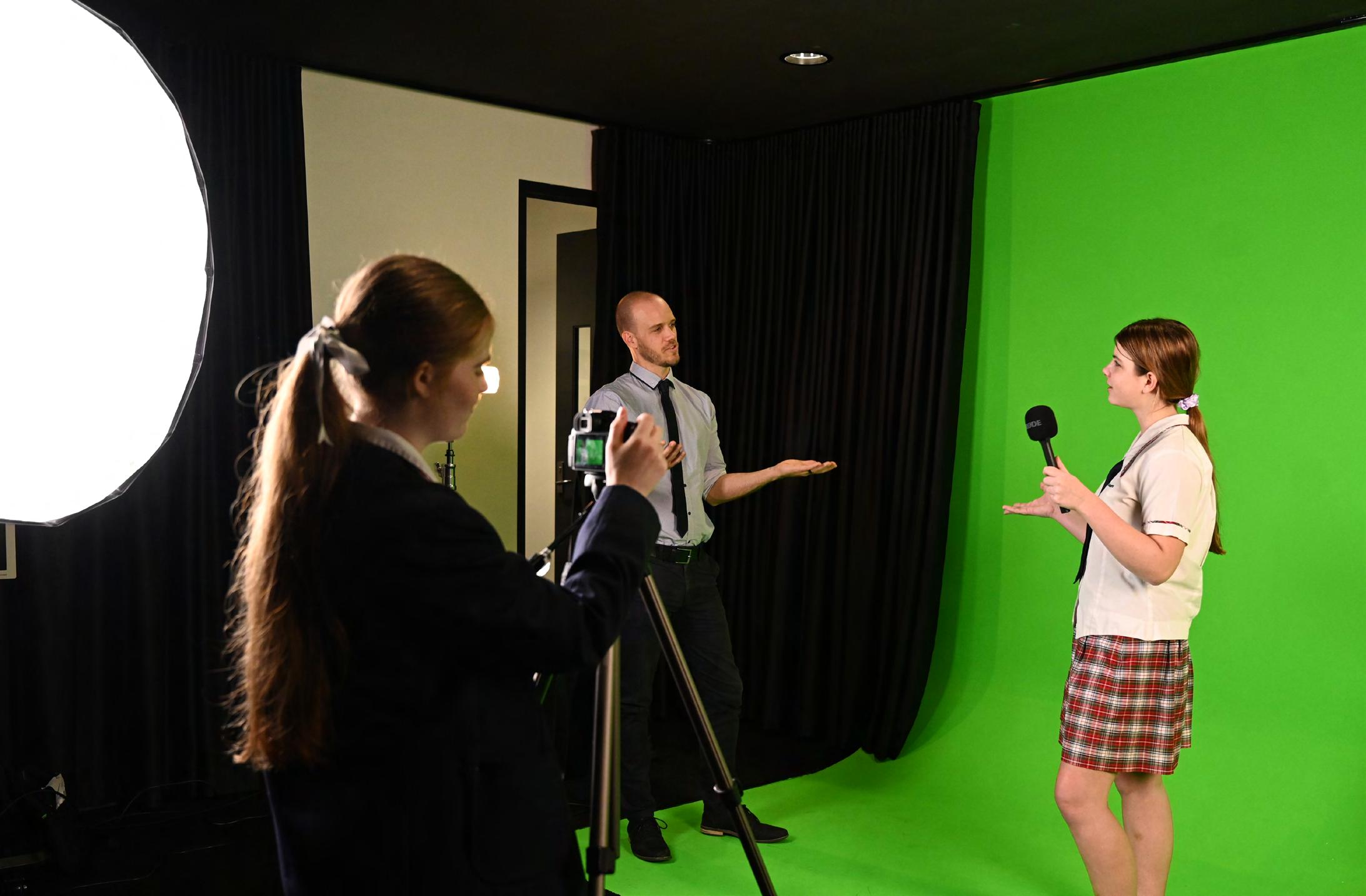
Film, TV and New Media
Description Film, Television and New Media develops students’ knowledge and skills in creative thinking, communication, collaboration, planning, critical analysis, and digital and ethical citizenship. Film, Television and New Media will equip students to reflect on and appreciate Australian and global cultures and make sense of what they see and experience and prepare them for a future of unimagined possibilities with highly transferable and flexible thinking and communication skills.
Pathways The demand for creativity in employees is rising in a world of rapid technological change. As more organisations value work-related creativity and diversity, the processes and practices of Film, Television and New Media develop transferable 21st century skills essential for many areas of employment. These includes
• Advertising, e.g. multimedia campaigns, television and/or social media marketing
• Arts administration and management, e.g. events and festivals marketing/archiving
• Communication, e.g. writer, arts editor, blogger/vlogger
• Design, e.g. multimedia campaigns, audio-visual, graphic
• Education, e.g. educator in schools, corporate, private studios
• Film and television, e.g. production role, production supervisor, director, cinematographer, storyboard artist
• Public relations, e.g. campaign manager, publicist, creative director
Course structure
Units and assessment
Pre-requisites
Unit One Foundation
• Concept: Technologies How are tools and associated processes used to create meaning?
• Concept: Institutions How are institutional practices influenced by social, political and economic factors?
• Concept: Languages How todo signs and symbols, code and conventions create meaning?
Assessment
Formative Internal Assessment/s
FIA1 - Film
Languages Analysis
FIA2 - Genre Film
Trailer Production
FILM AND TELEVISION
Unit Two Story forms
• Concept: Representations How do representations function in story forms?Art as a coded visual language
• Concept: Audiences How does the relationship between story forms and meaning change in different contexts?
• Concept: Languages How are media languages used to construct stories?
Assessment
Formative Internal Assessment/s
FIA3 - Short Film Production
FIA4 - Film Narrative Examination
Unit Three Participation
• Concept: Technologies How do technologies enable or constrain participation?
• Concept: Audiences How do different contaxts and purposes impact the participation of individuals and cultural groups?
• Concept: Institutions How is participation ininstitutional practices influenced by social, political and economic factors?
Assessment Summative Internal Assessment 1: Case study investigation (15%)
Experience in Year 10 Film and TV is essential and it will be further developed in the senior phase.
Geography
Description Geography teaches us about the significance of ‘place’ and ‘space’ in understanding our world. These two themes are foundational to the discipline, with the concepts of environment, interconnection, sustainability, scale and change building on this foundation. By observing and measuring spatial, environmental, economic, political, social and cultural factors, geography provides a way of thinking about contemporary challenges and opportunities.
Pathways Geography is a General subject suited to students who are interested in pathways beyond school that lead to tertiary studies, vocational education or work. A course of study in Geography can establish a basis for further education and employment in the fields of urban and environmental design, planning and management; biological and environmental science; conservation and land management; emergency response and hazard management; oceanography, surveying, global security, economics, business, law, engineering, architecture, information technology, and science. These pathways draw on the skills acquired through understanding and using spatial technologies.
Course structure
Units and assessment
Unit One
Responding to risk and vulnerability in hazard zones
• Natural hazard zones
• Ecological hazard zones
Assessment Formative Internal Assessment/s
FIA1 - Short response combination examination
FIA2 - Data report
Unit Two
GEOGRAPHY
Planning sustainable places
• Responding to challenges facing a place in Australia
There are no pre-requisites for Geography although students who have experienced Year 10 Geography will have foundation knowledge that will be further developed in the senior phase.
German
Description The need to communicate is the foundation for all language development. People use language to achieve their personal communicative needs — to express, exchange, interpret and negotiate meaning, and to understand the world around them. The central goal for additional language acquisition is communication. Students do not simply learn a language — they participate in a range of interactions in which they exchange meaning and become active participants in understanding and constructing written, spoken and visual texts.
The ability to communicate in an additional language such as German is an important 21st century skill. Students develop knowledge, understanding and skills that enable successful participation in a global society. Communication in an additional language expands students’ horizons and opportunities as national and global citizens.
Pathways German is a General subject suited to students who are interested in pathways beyond school that lead to tertiary studies, vocational education or work. A course of study in German can establish a basis for further education and employment in many professions and industries.For example, those which value the knowledge of an additional language and the intercultural understanding it encompasses, such as business, hospitality, law, science, technology, sociology and education.
• Finishing secondary school plans and reflections
• Responsibilities and moving on
Assessment
Summative Internal
Assessment 3: Extended response (30%)
Summative external assessment:
Examination - short response (25%)
Pre-requisites
The pre-requisites for German are that students have studied it in Middle Years and Year 10. This knowledge will be further developed in the senior phase.
Health
Description This subject uses an inquiry and strengths-based approach to investigate sustainable health change at personal, peer, family and community levels. Students explore health topics and investigate issues to develop action strategies through health promotion.
Pathways
Health is a General subject suited to students who are interested in pathways beyond school that lead to tertiary studies, vocational education or work. A course of study in Health can establish a basis for further education and employment in the fields of:
• Health science
• Public health
• Health education
• Allied health
• Nursing
• Medical professions
Course structure Units and assessment
Unit One
Resilience as a personal health resource
• Resilience • Health Frameworks
Unit Two Peers and family resources for healthy living
There are no pre-requisites for Health, although students who have experienced Year 10 Health will have foundation knowledge that will be further developed in the senior phase. An interest in the health industry is advantageous.
Hospitality Practices (Applied subject)
Description The Hospitality Practices syllabus emphasises the food and beverage sector, which includes food and beverage production and service. The syllabus objectives outline the skills the students will have the opportunity to learn:
The skills essential to work effectively in the industry- communication, teamwork, staff attributes, customer expectations, workplace health and safety and sustainable workplace practices.
Demonstrate practices, skills and processes
Students identify and reproduce skills in production tasks.
2. Interpret briefs
Students use knowledge of industry practices and production processes to draw meaning from the brief, specifications and information, and procedures and skills from the hospitality industry.
3. Select practices, skills and procedures
Students choose and use hospitality industry knowledge and skills to develop responses to briefs.
4. Sequence processes
Students use knowledge and understanding of industry practices and production processes to decide on the combination and order of processes.
5. Evaluate skills, procedures and products
Students evaluate skills and procedures to determine their efficiency and effectiveness.
6. Adapt production plans, techniques and procedures
Students make decisions to adapt production plans, techniques and procedures.
Pathways
Course structure
Units and assessment
A course of study in Hospitality Practices can establish a basis for further education and employment in the Hospitality sectors of food and beverage, catering, accommodation and entertainment.
Students can pursue further studies in Hospitality, Event and Tourism or Business management.
HOSPITALITY
Unit Two– Bar and barista basics
Students explore the hospitality industry through the context of casual dining.
Assessments
FIA1 - Project Students plan and deliver a casual dining event.
Students explore the hospitality industry through the context of bar and barista basics, including beverage and food production and service.
Assessment
FIA2 - Product demonstration Students produce and present a menu item suitable for serving in a bar.
FIA3 - Project Students plan and deliver an event using barista and cafe skills
In this unit, students explore the hospitality industry through the context of culinary trends.
Assessment
IA1 - Product demonstration Students produce and present a dessert item that features a native Australian ingredient.
IA2 - Project Students plan and deliver an event incorporating culinary trends.
Students explore the hospitality industry through the context of formal dining, including beverage and food production and service.
Assessment
IA3 - Product demonstration Students produce and present a main course dish suitable for a formal dining menu.
IA4 - Project Students plan and deliver a formal dining event.
Pre-requisites The Year 10 course Introduction to Hospitality, would be an advantage.
Unit One – Casual dining
Unit ThreeCulinary trends
Unit Four – Formal dining
Industrial Technology Skills (Applied subject)
Description The Industrial Technology Skills subject focuses on the underpinning industry practices and production processes required to manufacture products in a variety of industries, which may include building and construction, metal engineering, furnishing and plastics. It provides a unique opportunity for students to experience the challenge and personal satisfaction of undertaking practical work while developing beneficial vocational and life skills.
Through their learning experiences, students learn to meet customer expectations of product quality at a specific price and time. The majority of learning is done through manufacturing tasks that relate to industry, and that promote adaptable, competent, selfmotivated and safe individuals who can work with colleagues to solve problems and complete practical work.
Pathways This course is excellent preparation for students who may have trade aspirations, or may simply enjoy developing practical skills across a variety of materials and tradebased areas. A course of study in Industrial Technology Skills can establish a basis for further education and employment in manufacturing industries, and help students understand the different careers available. With additional training and experience, potential employment opportunities may be found in the industry areas of building and construction, metal engineering, furnishing, industrial graphics (drafting) and plastics.
Course structure Units and assessment
INDUSTRIAL TECHNOLOGY SKILLS (APPLIED)
CORE
RECREATION CONTEXT
Elective courses for study may be drawn from:
• Building and construction
• Furnishing
Unit 1
Furnishing Skills: Furniture making
Assessment:
• Practical demonstration
• Project
• Engineering (metals eg. welding)
• Industrial Graphics
Unit 3
Furnishing Skills: Production in the bespoke
Assessment:
• Practical demonstration
• Project
Engineering Skills: Welding and fabrication
Assessment:
• Practical demonstration
• Project
Unit 4
Engineering Skills: Production in the manufacturing engineering industry
Assessment:
• Practical demonstration
• Project
Assessment In each unit studied students will be assessed by producing a smaller single material product for their practical demonstration, and a larger multi-material product for their project. Alongside these students will keep track of their progress in a construction journal documenting their manufacturing processes and problem solving. They will present their final project and construction journal and the conclusion of the assessment.
Pre-requisites
There are no pre-requisites for this course, however, previous study of Design and Technology subjects in the Middle School and Industrial Technologies in Year 10 would be advantageous.
Japanese
Description The need to communicate is the foundation for all language development. People use language to achieve their personal communicative needs — to express, exchange, interpret and negotiate meaning, and to understand the world around them. The central goal for additional language acquisition is communication. Students do not simply learn a language — they participate in a range of interactions in which they exchange meaning and become active participants in understanding and constructing written, spoken and visual texts.
The ability to communicate in an additional language such as Japanese is an important 21st century skill. Students develop knowledge, understanding and skills that enable successful participation in a global society. Communication in an additional language expands students’ horizons and opportunities as national and global citizens.
Pathways Japanese is a General subject suited to students who are interested in pathways beyond school that lead to tertiary studies, vocational education or work. A course of study in Japanese can establish a basis for further education and employment in many professions and industries. For example, those which value the knowledge of an additional language and the intercultural understanding it encompasses, such as business, hospitality, law, science, technology, sociology and education.
Summative External Assessment: Examination - short response (25%)
Pre-requisites The pre-requisites for Japanese are that students have studied it in Middle Years and Year 10. This knowledge will be further developed in the senior phase.
Legal Studies
Description Legal Studies focuses on the interaction between society and the discipline of law. Students study the legal system and how it regulates activities and aims to protect the rights of individuals, while balancing these with obligations and responsibilities. An understanding of legal processes and concepts enables citizens to be better informed and able to constructively question and contribute to the improvement of laws and legal processes. This is important as the law is dynamic and evolving, based on values, customs and norms that are challenged by technology, society and global influences.
Pathways Legal Studies is a General subject suited to students who are interested in pathways beyond school that lead to tertiary studies, vocational education or work. A course of study in Legal Studies can establish a basis for further education and employment in the fields of law, law enforcement, criminology, justice studies and politics. The knowledge, skills and attitudes Legal Studies students gain are transferable to all discipline areas and post-schooling tertiary pathways. The research and analytical skills this course develops are universally valued in business, health, science and engineering industries.
Course structure Units and assessment
Unit One Beyond reasonable doubt
• Topic One: Legal foundations
• Topic Two: Criminal Investigation process
• Topic Three: Criminal trial process
• Topic Four: Punishment and sentencing
Assessment Formative Internal Assessment/s
FIA1 - Examination - combination response
FIA2 - Investigation - inquiry report
LEGAL STUDIES
Unit Two Balance of probabilities
• Topic One: Civil Law foundations
• Topic Two: Contractual obligation
• Topic Three: Negligence and the duty of care
Assessment Formative Internal Assessment/s
FIA3 - Investigation - argumentative essy
FIA4 - Examination combination response
Unit Three Law governence and change
• Topic One: Governance in Australia
• Topic Two: Law reform within a dynamic society
Unit Four Human rights in legal contexts
• Topic One: Human rights
• Topic Two: The effectiveness of International Law
• Topic Three: Human rights in Australian contexts
Pre-requisites There are no pre-requisites for Legal Studies although students who have experienced Year 10 Legal Studies will have foundation knowledge that will be further developed in the senior phase.
Literature
Description The subject Literature focuses on the study of literary texts, developing students as independent, innovative and creative learners and thinkers who appreciate the aesthetic use of language, analyse perspectives and evidence, and challenge ideas and interpretations through the analysis and creation of varied literary texts.
Pathways
Course structure
Units and assessment
A course of study in Literature promotes open-mindedness, imagination, critical awareness and intellectual flexibility — skills that prepare students for local and global citizenship, and for lifelong learning across a wide range of contexts.
LITERATURE
Unit One
Introduction to literary studies
• Ways literary texts are received and responded to
• How textual choices affect readers
• Creating analytical and imaginative texts
Unit Two
Intertextuality
• Ways literary texts connect with each other – genre, concepts and contexts
• Ways literary texts connect with each other – style and structure
IA2 – Imaginative spoken or multimodal response (25%)
Unit Four Independent explorations
• Dynamic nature of literary interpretation
• Close examination of style, structure and subject matter
• Creating analytical and imaginative texts Assessment Summative Internal
IA3 – Imaginative written response (25%)
EA – Examination –analytical extended response (25%)
Students must be achieving higher than a B in Year 10 English to study Literature in Year 11 and 12. It is essential that student have a passion and commitment for reading.
Mathematics - Essential (Applied Subject)
Description The major areas of study in Essential Mathematics are number, data, location, time, measurement and finance. Students develop their conceptual understanding when they undertake tasks that require them to connect mathematical concepts, operations and relations. They will learn to recognise definitions, rules and facts from everyday mathematics and data, and to calculate using appropriate mathematical processes.
Pathways
Course structure Units and assessment
Essential Mathematics is an Applied subject suited to students who are interested in pathways beyond Year 12 that lead to tertiary studies, vocational education or work. A course of study in Essential Mathematics can establish a basis for further education and employment in the fields of trade, industry, business and community services. Students will learn within a practical context related to general employment and successful participation in society, drawing on the mathematics used by various professional and industry groups.
ESSENTIAL MATHEMATICS
Unit One
Number, data and money
Fundamental
Topic: Calculations
Topic One: Number
Topic Two: Representing data
Topic Three: Managing money
Assessment
Formative Internal Assessment/s
FIA1 – Problemsolving and modelling task
FIA2 – Examination
Unit Two
Data and travel
Fundamental Topic: Calculations
Topic One: Data collection
Topic Two: Graphs
Topic Three: Time and motion
Assessment
Formative Internal Assessment/s
FIA3 – Problemsolving and modelling task
FIA4 – Examination
Unit Three
Measurement scales and chance
Fundamental Topic: Calculations
Topic One: Measurement
Topic Two: Scales, plans and models
Topic Three: Probability and relative frequencies
Assessment
Formative Internal Assessment/s
IA1 – Problemsolving and modelling task
IA2 – Common Internal Assessment (CIA) - Examination
Unit Four
Graphs, data and loans
Fundamental Topic: Calculations
Topic One: Bivariate graphs
Topic Two: Summarising and comparing data
Topic Three: Loans and compound interest Assessment
Formative Internal Assessment/s
IA3 – Problemsolving and modelling task
IA4 – Examination
Pre-requisites
There are no pre-requisites for Essential Mathematics.
Mathematics General
Description The major areas of study in General Mathematics are number, algebra, measurement, geometry, statistics, networks and matrices. The subject further develops key mathematical ideas including rates, percentages, concepts from financial mathematics, linear and nonlinear expressions, sequences, trigonometry and real-world phenomena in statistics. General Mathematics is designed for students to extend their mathematical skills beyond Year 10 but whose future studies or employment pathways do not require calculus (i.e. studying Mathematical Methods).
Pathways
Course structure
Units and assessment
General Mathematics is a General subject suited to students who are interested in pathways beyond school that lead to tertiary studies, vocational education or work. A course of study in General Mathematics can establish a basis for further education and employment in the fields of business, commerce, education, finance, hospitality, IT, social science, tourism and the arts.
GENERAL MATHEMATICS
Unit One
Money, measurement, algebra and linea equations
• Topic One: Consumer arithmetic
• Topic Two: Shape and measurement
• Topic Three: Similarity and scale
• Topic Four: Algebra
• Topic Five: Linear equations and their graphs
Assessment
Formative Internal
Assessment
FAI – Problemsolving and modelling task
FIA2 - Examination
Unit Two
Application of linear equations and trigonometry, matrices and univariate data analysis
• Topic One: Application of linear equations and their graphs
• Topic Two: Application of trigonometry
• Topic Three: Matrices
• Topic Four: Univariate data analysis 1
• Topic Five: Univariate data analysis 2
Assessment
Formative Internal Assessment
FIA3 -Examination
FIA4 - Examination
Unit Three
Bivariate data and time series analysis, sequences and Earth geometry
To be successful in General Mathematics students should have a solid mathematical foundation through achieving satisfactorily (B or above) in Year 10.
Mathematical Methods
Description The major areas of study in Mathematical Methods are algebra, functions, relations and their graphs, calculus and statistics. Topics are developed systematically, with increasing levels of sophistication, complexity and connection, and build on algebra, functions and their graphs, and probability from the P–10 Australian Curriculum. The ability to translate written, numerical, algebraic, symbolic and graphical information from one representation to another is a vital part of learning in Mathematical Methods.
Pathways Mathematical Methods is a General subject suited to students who are interested in pathways beyond school that lead to tertiary studies, vocational education or work. A course of study in Mathematical Methods can establish a basis for further education and employment in the fields of natural and physical sciences (especially physics and chemistry), mathematics and science education, medical and health sciences, engineering, computer science, psychology and business. This subject is recommended for students planning tertiary studies in the areas listed as they contain a high level of mathematics content. Some universities require Mathematical Methods as a prerequisite for entry to such courses.
Course structure
Units and assessment
Pre-requisites
Unit One
Surds, algebra, functions and probability
• Topic One: Surds and quadratic functions
• Topic Two: Binomial expansion and cubic functions
• Topic Three: Functions and relations
• Topic Four: Trigonometric functions
• Topic Five: Probability
Assessment
Formative Internal Assessments
FIA1 - Problemsolving and modelling task
FIA2 - Examination
MATHEMATICAL METHODS
Unit Two
Calculus and futher functions
• Topic One: Exponential functions
• Topic Two: Logarithms and logarithmic functions
• Topic Three: Introduction to differentiatial calculus
• Topic Four: Applications of differentiatial calculuc
• Topic Five: Further differentiation
Assessment
Formative Internal Assessments
FIA3 - Examination
FIA4 - Examination
Unit Three
Futher calculus and introductio to statistics
• Topic One:
Differentiation of exponential and logarithmic functions
• Topic Two: Differentiation of trigonometric functions and differentiation rules
• Topic Three: Further applications of differentiation
• Topic Four
Introduction to integration
• Topic Five
Discrete random variables
Assessment
Summative Internal
Assessment
IA1 Problem-solving and modelling task (20%)
IA2
Examination (15%)
Unit Four
Futher calculus, trigonometry and statistics
• Topic One: Further integration
• Topic Two: Trigonometry
• Topic Three: Continuous random variables and the normal distribution.
• Topic Four: Sampling and propotions
• Topic Five: Interval estimates for propotions
Assessment
Summative Internal
Assessment
IA3
Examination (15%)
Summative External Assessment
Examination (50%)
To be successful in Mathematical Methods students should have a strong mathematical foundation through achieving well (B+ or above) in Year 10.
Specialist Mathematics
Description The major areas of study in Specialist Mathematics are vectors, matrices, real and complex numbers, trigonometry, statistics and calculus. Topics are developed systematically, with increasing levels of sophistication, complexity and connection, building on functions, calculus, statistics from Mathematical Methods, while vectors, complex numbers and matrices are introduced. Functions and calculus are essential for creating models of the physical world. Statistics are used to describe and analyse phenomena involving probability, uncertainty and variation. Matrices, complex numbers and vectors are essential tools for explaining abstract or complex relationships that occur in scientific and technological endeavours.
[Specialist Mathematics is to be undertaken in conjunction with Mathematical Methods.]
Pathways Specialist Mathematics is a General subject suited to students who are interested in pathways beyond school that lead to tertiary studies, vocational education or work. It is recommended for any student considering tertiary level students in Mathematics and is highly useful in the fields of science, computer science, medicine, engineering, finance and economics.
Course structure Units and assessment
Pre-requisites
Unit One
Combinatorics, proof, vectors and matrices
• Topic One: Combinatorics
• Topic Two: Introduction to proof
• Topic Three: Vectors in the plane
• Topic Four: Algebra of vectors in two dimensions
• Topic Five: Matrices
Assessment Formative Internal Assessment/s
FIA1 – Problemsolving and modelling task
FIA2 - Examination
SPECIALIST MATHEMATICS
Unit Two
Complex numbers, further proof, functions and transformations
• Topic One: Complex numbers
• Topic Two: Complex arithmetic and algebra
• Topic Three: Circle and geometric proof
• Topic Four: Trigonometry and functions
• Topic Five: Matrices and transformations
Assessment Formative Internal Assessment/s
FIA3 - Examination
FIA4 - Examination
Unit Three
Further Complex numbers proof, vectors and matrices
• Topic One: Further complex number
• Topic Two: Mathematical induction and trigonometric proofs
• Topic Three: Vectors in two and three dimensions
• Topic Four: Vector calculus
• Topic Five Further matrices
Assessment
Summative Internal
Assessment:
IA1 Problem-solving and modelling task (20%)
IA2: Examination (15%)
Unit Four
Further calculus and statistical inference
• Topic One: Integration techniques
• Topic Two: Applications of integral calculus
• Topic Three: Rates of change and differential equations
• Topic Four
Modelling motion
• Topic Five
Statistical inference
Assessment
Summative Internal
Assessment
IA3: Examination (15%)
Summative External Assessment Examination (50%)
To be successful in Specialist Mathematics students should have a very strong mathematical foundation through achieving well (A-/B+ or above) in Year 10.
[Students studying Specialist Mathematics must also be studying Mathematical Methods.]
Description
Ancient History
Ancient History explores people, societies and civilisations from the earliest human communities to the end of the Middle Ages. Students examine how individuals and groups shaped ancient events and ways of life, developing an appreciation for humanity and the relevance of the past.
The subject illuminates the origins of features that define modern society — social organisation, law, governance and religion — and highlights both how the world has changed and what endures. This gives students a rich context for understanding the connections between past and present across diverse cultures.
Students develop historical thinking by interrogating surviving evidence from ancient sites, societies and events. They learn to question the nature of evidence, explore conflicting perspectives and construct well-reasoned historical arguments through research, source analysis and evaluation.
Historical inquiry is at the heart of the course, with skills and content integrated across four units of study: Investigating the Ancient World, Personalities in their Times, Reconstructing the Ancient World, and People, Power and Authority.
Pathways Ancient History provides students with vauable skills in research, critical thinking,communication, analysis and problem-solving. By studying past societies, cultures and historical evidence, students develop the ability to think independently, evaluate different perspectives and communicate arguments clearly.Thes skills support a wide range or university courses, careers and industries beyond history itself.
Course structure
Units and assessment
Unit One Investigating the Ancient World
• Digging up the Past –Archaeological sites
• Features of Ancient Societies
• Gender roles, family, slavery, weapons and warfare, art and architecture, beliefs and rituals
pre-requisites for History although students who have experienced Year 10 History will have foundation knowledge that will be further developed in the senior phase.
Modern History
Description Modern History is a discipline-based subject where students examine traces of humanity’s recent past so they may form their own views about the Modern World. Through Modern History, students’ curiosity and imagination is invigorated while their appreciation of civilisation is broadened and deepened. Students learn that the past is contestable and tentative. They discover how the past consists of various perspectives and interpretations. Modern History distinguishes itself from other subjects by enabling students to empathise with others and make meaningful connections between the past, present and possible futures.
Modern History has two main aims. First, Modern History seeks to have students gain historical knowledge and understanding about some of the main forces that have contributed to the development of the Modern World. Second, Modern History aims to have students think historically and form a historical consciousness in relation to these same forces.
Pathways Modern History benefits students as it enables them to thrive in a dynamic, globalised and knowledge-based world. Through Modern History, students acquire an intellectual toolkit consisting of 21st century skills. This ensures students of Modern History gain a range of transferable skills that will help them forge their own pathways to personal and professional success, as well as become empathetic and critically-literate citizens who are equipped to embrace a multicultural, pluralistic, inclusive, democratic, compassionate and sustainable future.
Course structure
Units and assessment
Unit One Ideas in the Modern World
• Australian Frontier Wars
• Industrial Revolution
• American Revolution
• French Revolution
• Russian Revolution
• Age of Imperialism
• Meiji Restoration
• Boxer Rebellion
• Arab Spring
• Alternative topic for Unit One
MODERN HISTORY
Unit Two Movements in the Modern World
• Australian Indigenous rights movement
• Independence movement in India
• Environmental Movement since the 1960’s
• Workers’ Movement
• Women’s Movement
• Independence Movement in Vietnam
• African - American civil rights movement
Assessment
Formative Internal Assessment/s
FIA1 - Examination
FIA2 - Investigationindependent source
Pre-requisites
Assessment
Formative Internal Assessment/s
FIA3-Essay
FIA4-ExaminationShort responses to historical sources
Unit Three National Experiences in the Modern World
• Australia
• England
• France
• New Zealnad
• Germany
• United States of America
• Soviet Union
• Japan
• China
• Indonesia
• India
• Israel
• South Korea
Assessment
Summative Internal
Assessment 1: Examination - essay in response to historical Source (25%)
Unit Four International Experiences in the Modern World
• Australian engagement with Asia
• Trade and commerce between nations
• Mass Migrations
• Genocides and ethnic cleansing
• Cold War
• Struggle for peace and the Middle East
• Terrorism and counter-terrorism
Assessment
Summative Internal Assessment 3: Investigation
- Historical essay based on research(25%)
There are no pre-requisites for History although students who have experienced Year 10 History will have foundation knowledge that will be further developed in the senior phase.
Description
Pathways
Course structure
Units and assessment
Music
Pre-requisites
Music is a unique art form that uses sound and silence as a means of personal expression. It allows for the expression of the intellect, imagination and emotion and the exploration of values. Music occupies a significant place in everyday life of all cultures and societies, serving social, cultural, celebratory, political and educational roles.
The study of music combines the development of cognitive, psychomotor and affective domains through making and responding to music. The development of musicianship through making (composition and performance) and responding (musicology) is at the centre of the study of music.
The demand for creativity from employees is rising in a world of rapid technological change. As more organisations value work-related creativity and diversity, the processes and practices of Music develop transferable 21st century skills essential for many areas of employment. Specifically, the study of Music helps develop creative and critical thinking, collaboration, ICT skills, social/personal skills and communication — all of which is sought after in modern workplaces.
Tertiary studies, vocational education or work experience in the area of music can lead to and benefit careers in diverse fields such as:
• arts administration and management
• education
• public relations
• communication
• creative industries
• science and technology
MUSIC
Unit 1 Designs
Through inquiry learning, the following is explored:
How does the treatment and combination of different music elements enable musicians to design music that communicates meaning through performance and composition?
Assessment
Formative internal assessment/s
FIA1 - Performance
FIA2 - Composition
Unit 2 Identities
Through inquiry learning, the following is explored:
How do musicians use their understanding of music elements, concepts and practices to communicate cultural, political, social and personal identities when performing, composing and responding to music?
Assessment
Formative internal assessment/s
FIA3 - Project
FIA4 - Examination
Unit 3 Innovations
Through inquiry learning, the following is explored:
How do musicians incorporate innovative music practices to communicate meaning when performing and composing?
There are no pre-requisites for Music, although students who have experienced any Arts subjects in Year 9 and 10 (including Music), will have foundation knowledge, skills and techniques that will be further developed in the senior phase.
Physics
Description Physics provides opportunities for students to engage with the classical and modern understandings of the universe. In Unit One, students learn about the fundamental concepts of thermodynamics, electricity and nuclear processes. In Unit Two, students learn about the concepts and theories that predict and describe the linear motion of objects. They will explore how scientists explain some phenomena using an understanding of waves. In Unit Three, students engage with the concept of gravitational and electromagnetic fields, and the relevant forces associated with them. Finally, in Unit Four, students study modern physics theories and models that, despite being counter-intuitive, are fundamental to our understanding of many common observable phenomena. Students will learn valuable skills required for the scientific investigation of questions. In addition, they will become citizens who are better informed about the world around them, and who have the critical skills to evaluate and make evidence-based decisions about current scientific issues.
Pathways Physics is a General subject suited to students who are interested in pathways beyond school that lead to tertiary studies, vocational education or work. A course of study in Physics can establish a basis for further education and employment in the fields of science, engineering, medicine and technology.
Course structure
Units and assessment
Unit One
Thermal, nuclear and electrical physics
• Topic One: Heating and processes
• Topic Two: Ionising radiation and nuclear reactions
Summative Internal Assessment 3: Research investigation (20%)
Summative External Assessment Examination (50%)
Pre-requisites There are no pre-requisites for Physics and although students who have experienced Year 10 Physics in Semester Two will have foundation knowledge that will be further developed in the senior phase.
Physical Education
Description
Pathways
Course structure
Units and assessment
Students recognise and explain concepts and principles and demonstrate and apply body and movement concepts to movement sequences and movement strategies. Students gather, analyse and sythesise data to devise strategies to optimise engagement and performance. They evaluate and justify strategies by drawing on informed, reflective decision-making. This subject focuses heavily on sports sciences and will involve 88% Theory and 12% Practical assessment. Possible Physical activities across the course include: Netball, Volleyball, Touch, Futsal, Pickleball or Hockey.
Physical Education is a General subject suited to students who are interested in pathways that lead to tertiary studies, vocational education of work. A course of study in Physical Education can establish a basis for further education and employment in the fields of exercise science, biomechanics, and allied health professions, psychology, teaching, sport journalism, sport marketing and management, sport promotion, sport development and coaching.
PHYSICAL EDUCATION
Unit One Motor learning, functional anatomy, biomechanical and physical activity
• Topic One: Motor learning intergrated with a selected physical activity
• Topic Two: Biomechanics intergrated with a selected physical activity
Assessment Formative Internal Assessment/s
FIA1 - Project - folio
FIA2 - Project - folio
Unit Two Equity and Sports Psychology
• Topic One: Equity - barriers and enablers
Assessment Formative Internal Assessment/s
FIA3 - Investigation - Report
Unit Three Tactical awareness ethics and integrity and physical activity
• Topic One: Tactical awareness integrated with one selected ‘invasion’ or ‘Net court’ physical activity
Unit Four Energy, fitness and training and physical activity
• Topic One: Energy, fitness and training integrated with one selected ‘invasion’ or ‘Net court’ physical activity
Assessment
Summative Internal Assessment 3:
Project- folio (25%)
Summative
External Assessment: Examination (25%)
Pre-requisites There are no pre-requisites for Physical Education, although students who have experienced Year 10 Physical Education will have foundation knowledge that will be further developed in the senior phase.
Sport and Recreation (Applied Subject)
Description In the Sport and Recreation Year 11 and 12 programs for 2025, students will participate in various practical activities to develop their physical abilities and outdoor skills. The curriculum includes Aquathlon races to showcase swimming and running talents. The participation in a skateboarding event and golf competition will provide students with the opportunity to refine their corodination skills. Exploring the stunning Gold Coast region allows students to appreciate nature and outdoor adventures. Fitness training focuses on strength, endurance, and well-being, while camping builds teamwork and self-reliance. Students will attend a compulsory camp linked to assessment at a cost to parents (costs TBC).
Pathways Recreation can make an important contribution to enhancing students’ opportunities regarding employment, enterprise, further study, leisure and lifelong learning. It provides a unique opportunity for students to experience the challenge and fun of active participation in physical activity while developing beneficial vocational and life skills. The skills developed in Recreation may be oriented towards work, personal fitness, as well as general health and wellbeing.
Course structure Units and assessment
Unit One Fitness for Sport and Recreation
1. Project: Training for specificity
2. Performance: Training for fitness
SPORTS AND RECREATION
Unit Two Emerging trends
1. Project: Skateboarding/ surfing Competition
Unit Three Challenge in the Outdoors
1. Project: Camping and Fishing
2. Performance: Aquathlon
Unit Four Event Management
1. Performance: Golf
2. Project: Junior School small games carnival
Schools design assessment instruments from the assessment techniques relevant to this syllabus. The assessment instruments students respond to in Semesters 1 and 2 should support those techniques included in Semesters 3 and 4.
Pre-requisites There are no pre-requisites for Sport and Recreation, although students who have experienced Year 10 Physical Education will have foundation knowledge that will be further developed in the senior phase. An interest in the Sport and Recreation industry is advantageous.
Religion and Ethics (Applied Subject)
COMPULSORY FOR ALL STUDENTS FOR SUCCESSFUL COMPLETION OF YEAR 11 AND 12. STUDENTS WILL RECEIVE 4 POINTS TOWARDS THEIR QCE. THE ST ANDREWS COURSE IS ACCREDITED BY THE QCAA AND COMMENCE IN TERM FOUR TEAR 10.
Description Religion and Ethics(Christian Studies) uses an inquiry-based approach to explore students personal values and life choices and the ways in which these are related to their beliefs. It helps students understand the personal, relational and spiritual perspectives of human experience and enables students to investigate and critically reflect on the role and function of religion and ethics in society. Within this syllabus, the focus is on students gaining knowledge and understanding, on developing the ability to think critically, and to communicate concepts and ideas relevant to their lives and the world in which they live. Learning experiences will be practical and experiential in emphasis. The course of study will recognise the benefits of networking within the community.
Pathways
Course structure Units and assessment
A course of study in Religion and Ethics can establish a basis for further education and employment in any field, as it helps students develop the skills and personal attributes necessary for engaging efficiently, effectively and positively in future life roles. It provides them with opportunities to gain knowledge and understanding of themselves as human beings, to clarify their personal beliefs and ethical values, and to assess their personal choices, vision and goals. It helps students develop an understanding of themselves in the context of their family, their community and the workplace. The focus on citizenship, the sense of community and service, ethical principles, moral understanding and reasoning, and the responsibilities of the individual within the community provide students with skills and attitudes that contribute to lifelong learning, and a basis for engaging with others in diverse settings, including further education and the workforce.
RELIGION AND ETHICS
Unit One Peace
Topic One: Pursuing Peace
Topic Two: The Great Protestors
Assessment
Formative internal assessments
FIA1
Project – Peace
Promotion Project
FIA2
Extended Response – Keeping the peace
Pre-requisites
Unit Two Social Justice
Topic One: Leadership
Topic Two: Head, Hearts and Hands
Assessment Formative internal assessments
FIA3
Extended Response – Social Justice
FIA4
Project – Human Dignity
Unit Three Sacred Story
Topic One: Sacred Story
Topic Two: I am who I am
Assessment
Summative internal assessments
IA1
Investigation – What makes a story sacred?
IA2
Project – Sacred Story
Unit Four
Meaning, Purpose and Expression
Topic One: A meaningful life
Topic Two: Vocation
Assessment Summative internal assessments
IA3
Investigation –Religious and Spiritual diversity
IA4
Project – Meaning and Purpose
This is a compulsory subject. There are no pre-requisites for Religion and Ethics. Students will have experienced Year 10 Religion and Ethics and so will have foundation knowledge that will be further developed in the senior phase of the course.
Description
Visual Art
Pathways
Visual Art prepares students to engage in a multimodal, media-saturated world that is reliant on visual communication. Through the critical thinking and literacy skills essential to both artist and audience, learning in Visual Art empowers young people to be discriminating, and to engage with and make sense of what they see and experience. Visual Art equips students for a future of unimagined possibilities as they develop highly transferable communication skills and the capacity for global thinking. Visual Art encourages students to reflect on and appreciate multiple perspectives and philosophies, and to confidently and creatively contribute and engage in all facets of society to sustain our diverse Australian culture.
Visual Art is a General subject suited to students who are interested in pathways beyond school that lead to tertiary studies, vocational education or work. A course of study in Visual Art can establish a basis for further education and employment in the fields of arts practice, design, craft, and information technologies; broader areas in creative industries and cultural institutions; and diverse fields that use skills inherent in the subject. The processes and practices of Visual Art, such as self-directed learning and creative problem solving, develop transferable 21st century skills that are highly valued in many areas of employment. Organisations increasingly seek employees who demonstrate work-related creativity, collaboration, innovative thinking and diversity.
Course structure
Units and assessment
Pre-requisites
Unit 1
Art as lens Through inquiry learning, the following are explored:
• Concept: lenses to explore the material world
• Contexts: personal and contemporary
• Focus: people, place, objects
• Media: 2D, 3D, and time-based
Assessment
Formative Internal Assessment/s
FIA1InvestigationInquiry report
FIA2 - Project folio
VISUAL ARTS
Unit 2
Art as code
Through inquiry learning, the following are explored:
• Concept: art as a coded visual language
• Contexts: formal and cultural
• Focus: codes, symbols, signs and art conventions
• Media: 2D, 3D and time-based
Assessment
Formative Internal Assessment/s
FIA3 - Project folio
FIA4Examination
Unit 3
Art as knowledge Through inquiry learning, the following are explored:
• Concept: constructing knowledge as artist and audience
• Contexts: contemporary, personal, cultural and/or formal
There are no pre-requisites for Visual Art although students who have experienced Year 9 and 10 Visual Art will have foundation knowledge, skills and techniques that will be further developed in the senior phase.
Visual Arts In Practice
Description The arts are woven into the fabric of community. They have the capacity to engage and inspire students, enriching their lives, stimulating curiosity and imagination, and encouraging them to reach their creative and expressive potential. Arts subjects provide opportunities for students to learn problem-solving processes, design and create art, and use multiple literacies to communicate intention with diverse audiences. In Visual Arts in Practice, students respond to authentic, real-world stimulus (e.g. problems, events, stories, places, objects, the work of artists or artisans), seeing or making new links between art-making purposes and contexts. They explore visual language in combination with media, technologies and skills to make artworks. Throughout the course, students are exposed to art-making modes, selecting from 2D, 3D, digital (static) and time-based and using these in isolation or combination, as well as innovating new ways of working. Media explored include ceramics, printmaking, painting, drawing, photography, film making, sculpture, textile and fibre-based artforms, street art. Students will also have the opportunity to work with artists to extend their practice.
Pathways When making and responding to art, students determine the audience, the reason the artwork will be made and how it will be displayed. Reasons for art-making may include celebration, clarification, decoration, entertainment, information, persuasion, promotion or utility. Learning is connected to relevant industry practice and opportunities, promoting future employment and preparing students as agile, competent, innovative and safe workers who can work collaboratively to solve problems and complete projectbased work in various contexts.
Course structure Units and assessment
Looking Inwards (self) Looking Outwards (others)
Outcomes could include: Project Resolved Work
Outcomes could include: Prototype Resolved Work
Outcomes could include: Design Proposals Resolved Work/s
Outcomes could include: Folio of stylistic experiments Resolved Work/s
Pre-requisites There are no pre-requisites for Visual Art although students who have experienced Year 9 and 10 Visual Art will have foundation knowledge, skills and techniques that will be further developed in the Senior phase. This Applied subject CAN be counted towards the ATAR if it is the only Applied subject the student has selected. Students are able to choose BOTH General Visual Art and Visual Arts in Practice if they wish.
VISUAL ARTS
Unit A Unit B
Unit C
Unit D
Clients Transform and Extend
English and Literature Extension Year 12 2028
Description In English and Literature Extension, students apply different theoretical approaches to analyse and evaluate a variety of literary texts and different ways readers might interpret these texts. They synthesise different interpretations and relevant theoretical approaches to produce written and spoken/signed extended analytical and evaluative texts. The nature of the learning in this subject provides opportunities for students to work independently on intellectually challenging tasks.
Pathways
Course structure
Units and assessment
English and Literature Extension is an Extension subject suited to students who are interested in pathways beyond school that lead to tertiary studies, vocational education or work. A course of study in English and Literature Extension can establish a basis for further education and employment in a range of fields and can lead to a range of careers in areas where understanding social, cultural and textual influences on ways of viewing the world is a key element. It also provides a good introduction to the academic disciplines and fields of study that involve the application of methodologies based on theoretical understandings.
ENGLISH AND LITERATURE EXTENSION
Unit Three Ways of Reading
• Reading and defences
• Complex transformation and defence
Assessment
Summative Internal Assessment 1:
Extended response - reading and defence (20%)
Summative Internal Assessment 2:
Extended response - complex transformation and defence (20%)
Unit Four Emerge
• Extending academic research paper
• Application theory
Assessment
Summative Internal Assessment 3: Extended responseacademic research paper (35%)
Summative External Assessment 4: Examination- theorised exploration of a short text (25%)
Pre-requisites Along with a passion for English Language and Literature, the subject assumes that Units 1 and 2 of the General English have been successfully studied and completed.
Music Extension Year 12 2028
Description The purpose of Music Extension is to provide challenging and rigorous opportunities for students to realise their potential as composers, musicologists or performers. It considers that students with an extended history of music involvement frequently reach a high level of musical sophistication and aspire to specialise. In Music Extension, students follow an individual program of study designed to continue the development of refined musicianship skills. Music Extension encourages students to investigate music concepts and ideas relevant to their specialisation.
Pathways
Course structure
Units and assessment
A course of study in Music Extension can establish a basis for further education and employment in the fields of performing arts and music, such as arts administration and management, communication, education, public relations and science and technology
Students should have opportunitites in Music to experience and respond to the types of assessment they will encounter in Music Extension
The subject assumes that Units 1 and 2 of the Music syllabus (or equivalent) have been studied before commencing this syllabus. ‘Equivalent’ refers to compatible interstate or overseas school Music syllabuses or qualifications. There is no requirement for students to have reached a prescribed level of skill in their chosen specialisation prior to commencing this course. Particularly in the performance specialisation, the program of repertoire should allow students to demonstrate the objectives and be commensurate with their technical capabilities to ensure that the technical demands of repertoire do not prevent students from engaging cognitively, physically.