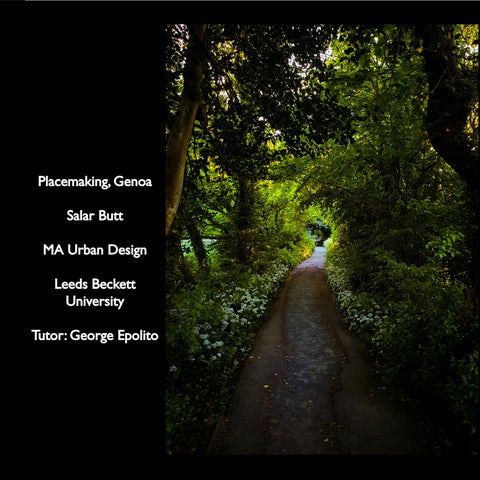
Placemaking, Genoa Salar Butt MA Urban Design Leeds Beckett University Tutor: George Epolito
Contents Synoptic Sheet 3 Introduction 4 Part I: An Extension of Place Non-Place Understanding the Concept of Place and Non Place 6 The Relationship Between People and Places 10 Creating Place out of Non-Place Through Experience and Emotion 11 Part II: Design of Memorial Garden and Non-Places Analysis of Italian Urban Design 13 Metaphysical Painters 17, 21 Masterplan 18 Memorial Places Design 22
Synoptic Sheet
Introduction
The theme of this project is experiences.The design of this module brings together the two design modules that I had done in the first semester; Displace Non-Place, and Place vs Non-Place. The idea of this project is to create a Place out of a Non-Place. To re-evaluate, the concept of a Place is defined as anything or anywhere that has a form of relation with the inhabitant and/or user. A Non-Place is the intermediary between Places; for example, the journey of going from home to a workplace or office is the event of going between two places, and the journey itself is a Non-Place, as we have no relation or definitive sense of belonging in between. Therefore, when journeying abroad, the departing airport is a Non-Place, however, the arriving airport is a Place, as we have a sense of belonging and destination there. My final piece for my project in the first semester explored the concept of memories that emerge in Non-Places, and the emergence of a grey area between Place and Non-Place; that there is a Non-Placical Place and, vice versa, a Placical Non-Place. This occurs through emotion, memory, relationship, and experience. The more accustomed one is to their surroundings, the more they feel a sense of belonging and of Place. This project enabled me to explore the creation of Placical Non-Places, and Non-Placical Places; I wanted to create and promote the experiences that the urban surrounding creates with its inhabitants, as well as explore the definition of edges of space. Additionally, this project enabled me to extend and improve my project based in Genoa, creating a place of both, celebration, and mourning, of the victims of the Morandi Bridge collapse in 2018.
Part I An Extension of Place Non-Place
Understanding the Concept of Place and Non-Place
The understanding of Place is a space with which a person or people have formed a form of relationship with, connecting them either physically or emotionally, and creating a bond through memory or ritual within that space. A Non-Place is, therefore, a space in which people cease to recognise themselves in. This relationship between concept of Place and Non-Place is very interesting, as a space can exist as, both, a Place, and a Non-Place, at the same time; both to separate people, and to the same person. For example, a house may exist as a house to an outsider, but to the inhabitant of the house, it exists as a sanctuary and an archive of memory, safety, and warmth. Moreover, a prison may exist as a prison to an inmate; yet their existence within the prison may damage their sense of self-recognition. A person may enter as themselves and leave as someone else. Therefore, a prison may exist as, both, a Place, and a Non-Place.
My final piece of Place Non-Place explored the relationship between people and their emotional connection with urban space. My example was Newcastle-upon-Tyne. I lived in Newcastle-upon-Tyne for three years, lived in three different locations, and took three individual routes to university. My piece explored how my emotional connection with each route differed through my recognition of the area and the association I had with the space to memories. This, therefore, created an in-between area of Place and Non-Place for me, as these passages were an intermediate between Places (home and university), yet I recognised my surrounding to be more than just massing. As Augé mentions, “the world is more than just totalitarian answers”.
Making Shadows I wanted to create a device that would symbolise the merger of Place, Non-Place, and the grey area in between the two. To do this, I made a shadow-making device out of clear and coloured shards of glass, as well as mirror. The clear glass would allow light to pass through freely, the coloured glass would create a tinted shadow of light, and the mirror would reflect the light in different directions, causing a darker shadow.The shadows would then merge together to form a larger, differently textured shadow.
Shadow Making Device
The Relationship Between People and Places In general, the relationship that people have with urban space is limited to that of interacting with intermediary space between two Places; this intermediary is a Non-Place. However, an emotional connection can be created with Non-Places through one’s experience within a Non-Place. This creates a Placical NonPlace, as the inhabitant associates a general space with a memory, without having attachment or connection to the space. Likewise, a Non-Placical Place can exist through the existence of a space which has familiarity and understanding of existence, but has no connection, associated memory or emotional value to the inhabitant.
An example of a Non-Placical Place, for many, can be Kirkgate Market in Leeds. Whilst it is a landmark and icon within the City Centre, many people may have no connection with the space other than acknowledging its existence. An example of a Placical Non-Place can be the Ring Road of Leeds, which many people may associate with being part of a commute or memorable journey. Whilst it is not a Place, it may hold Placical value.
Creating Place out of Non-Place through Experience and Emotion
“A Non-Place Exists when people cease to recognise themselves in it” Whilst I agree with the concept of Place created by Augé, and the belief of Non-Place being an intermediary between two places, I somewhat disagree with the idea that a Non-Place is space in which people cease to recognise themselves in. My aim is to create Placical Non-Places through memory, experience and emotions within spaces and intermediary spaces. In doing so, I will be disproving this belief of Non-Place made by Augé, proving that a Non-Place can exist with the recognition of oneself within it. My design will incorporate Italian urban design of regular transitions in scale of negative space, and the use of negative space to navigate to and from Places.
Part II Design of Memorial Garden and Non-Places
An analysis of the relationship between positive spaces and negative spaces in Italian urban design; the scale that negative space exists shifts drastically between large public spaces (piazzas) and extremely narrow streets (vias). The narrowness of the streets enables easier navigation in the city through the use of piazzas as checkpoints.
I wanted to use the concept of using piazzas as checkpoints and recognized Places within my design. The design of the area would consist of multiple piazzas to help the inhabitant navigate themselves through the site, and the paths would act as Non-Places, but the pathways would be shaped in the space of a Laggionni geometric floor pattern. I also wanted to use the Non-Places within my site to enhance the user experience. Each path would, therefore, have a unique and individual design to create new experiences and memories for the inhabitant; thus, creating a Placical Non-Place, as the person would remember the emotions regarding walking down the path, but would not necessarily remember the path.
Inspiration of design was taken from the way in which trees and plants curve around a pathway to create a natural archway (right), and from “The House of Lost and Found”; a nocturnal event hosted in Saltwell Park, Newcastle-upon-Tyne, in which visitors would walk along a path which had different pieces of art or attractions. This event, for me, highlighted the significance of experience creating Place, rather than association with one’s surroundings
Metaphysical Painters and Emotion
I took inspiration from metaphysical artists such as Giorgio De Chirico and Carlo Carrá. The concept of a metaphysical painting is to observe more than what can be seen; to contemplate and to understand both the conscious and the unconscious mind. To put simply, the beauty of metaphysical painting is to see and to feel. Di Chirico’s use and manipulation of light and shadow helps to convey messages and feelings across to the viewer that are individual to them, forming a bond and relationship through his artwork. I was inspired by this personal connection made between artist and viewer and wanted to create a connection between the space and the user through memory and emotion. Both the Places and Non-Places in my site would create a form of relationship with the inhabitant of the space through the types of emotions and memories created in the space.
Masterplan
Connections between both sides of the river
Design and floor pattern bleeding into the surroundings and public greenspace which is connected through the design but not through the sense of memorial
Design and floor pattern bleeding into the surroundings
Plenty of open negative space that can be used for any purpose by the public - space belonging to the public
Perspective Image #1 This perspective image was inspired by Giorgio de Chirico and his use of light and shadow to create an ambience within his paintings. The yellow hue is to recreate the atmosphere within Genoa, as the Sun very quickly rises and very quickly sets. Furthermore, the pathways are defined by the use of the Cypress tree, a Mediterranean tree found in Italy.
Metaphysical Painters and Memorial
The concept of memorial and tribute was taken from the Metaphysical Artist, Mario Sironi. His paintings, unlike the dreamlike poeticism of Giorgio de Chirico, Sironi’s artwork is more somber with more solemn expression and a stoic stillness. This level of stillness, like de Chirico and Carrá, make the viewer feel a certain way, however, the use of colour and shadow make the feelings darker and more sober than dreamlike. This feeling of sobriety and mourning is what inspired me to design my piazzas.
Memorial Place Design
I wanted to use the Italian style of urban design in my project by using piazzas as a form of navigation throughout the site. Negative space would regularly transition in size to enable the inhabitants to gain an understanding of location and travelling between Places. Each piazza would have a statue or monument to commemorate a victim of the Ponti Morandi collapse in it, making each piazza unique in its own way and giving the public a sense of understanding within the space. As the site is primarily a garden-style space, trees and treelines would be used to define the edges of each space.
There would be 43 monuments around the piazzas in total to represent the 43 victims of the collapsed bridge. Each white circle in the masterplan represents a monument. Underneath each monument would be a crypt in which the family of the victim could go during summer time as a picnic space and to remember their late family member. This underground crypt would be a private space to the families, using levels to differentiate public and private space.
Perspective Section #1 The relationship with the river and the site. As the river rises and falls seasonally, the pathways bleeding out into the river would appear and vanish., creating vanishing pathways.
Precedents: Cemetery in Borgaretto by Elastico SPA The idea of multiple floors to a cemetery, and the connection and unification of these floors together by a singular piece, in the Borgaretto Cemetery’s case, the trees, intrigued and inspired me to expand the site, not only laterally, but vertically.
The concept for this image is the perspective of being both above and below ground in the site. The design is meant to emulate the atmosphere of a Giorgio di Chirico painting.
Precedents: The mausoleum of the Piaggio Family in the Staglieno Cemetery.
Metaphysical Montage #2 Inspiration for this metaphysical montage was taken from Carlo Carrás painting, The Metaphysical Muse.The painting emanates a static energy, as well as mystery and silence. The emotions created by the piece are of incomprehensibility and absurdity, created by the juxtaposing objects, such as the mannequin and tennis equipment, creating a feeling of paralysis with longing for energy and movement. I wanted to recreate this feeling within the site, creating a feeling of oblivious entrapment within a confined space. The confined space is made of glass, allowing the people within to see their surroundings but unable to interact with it. Additionally, underneath them is rubble with moss and plants growing above it, creating a palimpsest of destruction, with a new layer of opportunity above it.
JMW Turner The Slave Ship Whilst this is not a metaphysical painting, I was still highly moved and inspired by this piece, as the painting shows the dumping of slaves into the sea to drown so that the ship owner can reclaim insurance money. To the unknowing eye, the painting is a beautiful work of art, however, it has a deeper and much darker meaning to it. Similarly, this photomontage symbolises the happily ignorant visitors to the site, whilst underneath them is a darker history of death, destruction and displacement.
Section to show the elevated platform in which rubble from the Ponti Morandi collapse would be visible. This idea would re-enforce the concept of memorial of what happened and the effect that it had on the families of those who were killed, as well as the families who all suffered due to displacement and relocation from their homes.
Section showing the elevated plane with the underground crypt This section shows the relationship between the two spaces as both being Places and monuments to pay tribute to the Ponti Morandi collapse, and those affected by it. Similarly to the piazzas and crypts, there will be various elevated planes located throughout the site.
Perspective Section #2 of the Crypt and Elevated Plane
Inspiration for the statue was taken from the Genoa Staglieno Cemetery, in which beautiful and intricate marble statues are often found to commemorate passed loved ones. Statues for tombs and graves are often related to Catholicism, and show Angels, a Saint, or Santa Maria weeping over one’s grave.
Inspiration for the colour of the walls for the interior of the crypt was taken from the array of pastel coloured facades found in Genoa and which is typical in Mediterranean culture.