The Ultimate Guide to Article Submission Sites for
SEO: Boost Traffic, Backlinks, and Authority
In off-page search engine optimization (SEO), article submission remains one of the most accessible methods to build brand authority, drive targeted referral traffic, and generate high-quality backlinks However, the landscape of off-page SEO has evolved significantly. Publishing low-quality spun content on dead directories no longer yields rankings it risks search engine penalties. To leverage article submission effectively today, you must focus on high-Domain Authority (DA) platforms, Web 2.0 networks, and niche publication hubs. This comprehensive guide covers everything you need to know about article submission sites, how to pick the right platforms, and the exact strategies required to maximize your SEO results
What is Article Submission in SEO?
Article submission is an off-page SEO tactic where you write informative, value-driven content and publish it on third-party websites or article directories. These platforms allow authors to include back links (either dofollow or nofollow), author bios, and links back to their primary domain
When executed correctly, article submission serves a dual purpose:
For Search Engines: It signals relevance and domain trust through external link equity
For Readers: It establishes your expertise (E-E-A-T) and channels interested readers directly to your target landing pages.
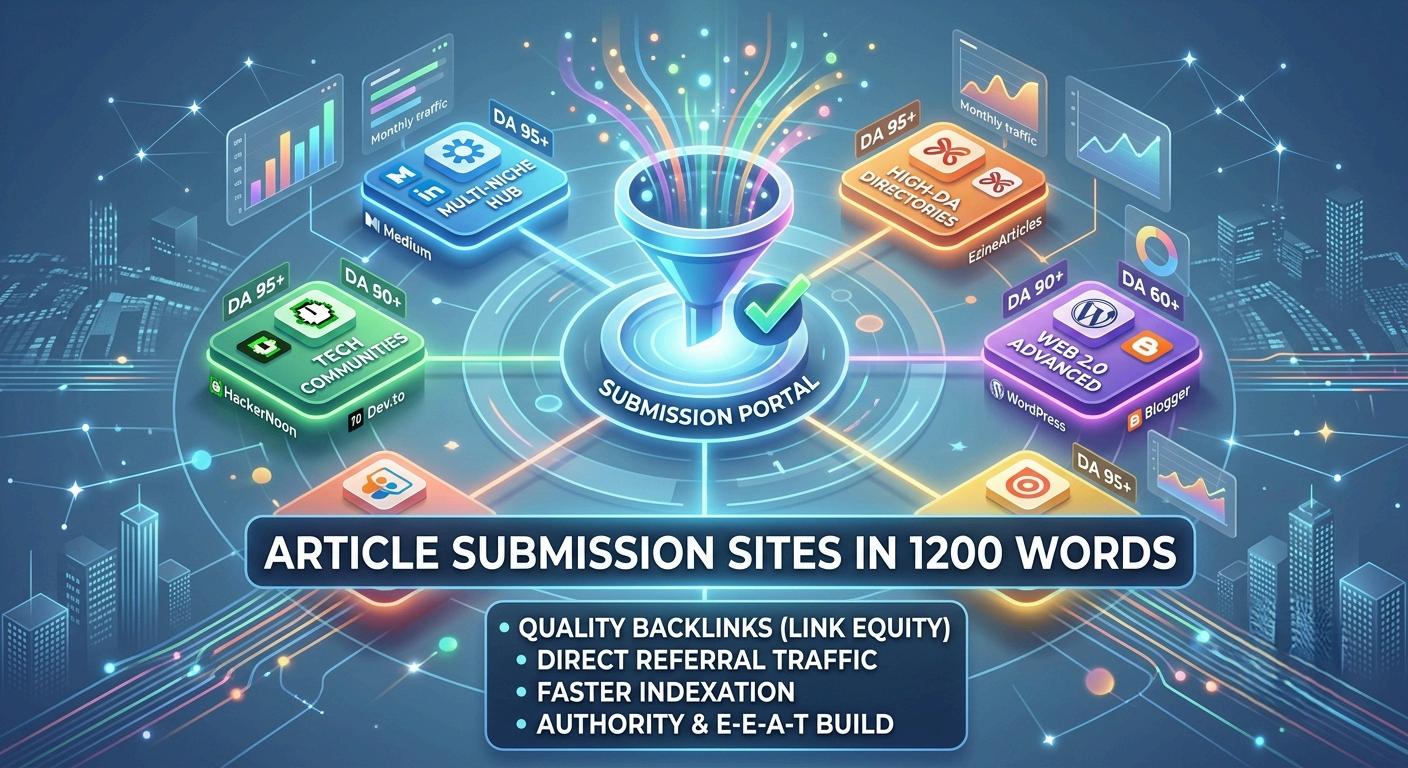
Leveraging high-authority article submission sites is a core off-page SEO strategy that helps businesses expand their digital footprint, build quality backlinks, and drive targeted referral traffic. By publishing unique, value-driven content on platforms like Medium, LinkedIn Pulse, HubPages, and Web 2.0 blogs, content creators can tap into pre-existing, engaged audiences while enhancing their brand’s topical authority To maximize search engine visibility, it is crucial to avoid low-quality directory spam and focus instead on reputable platforms with high domain authority, ensuring that contextual links are placed naturally to foster domain trust and organic ranking growth
Types of Article Submission Platforms
Understanding the different categories of submission platforms helps you build a natural, diversified link profile:
1. Web 2.0 Blogging Platforms
Web 2 0 platforms give you complete control over your content layout, domain structure, and link placement You create a micro-blog on a high-authority domain and publish customized posts.
Examples: WordPress.com, Blogger, Medium, Wix, Tumblr.
2. Publishing & Publishing Community Platforms
These community-driven networks attract millions of monthly visitors Content here can rank independently on Google search engine results pages (SERPs) for competitive keywords.
Examples: Medium.com, HubPages, LinkedIn Articles, Substack.
3. Niche-Specific Directories
Niche directories focus exclusively on specific industries like technology, finance, health, or real estate. Backlinks from niche-relevant sites carry significantly higher topical authority weight with search engine algorithms.
Examples: HackerNoon, Dev.to (Tech), Seeking Alpha (Finance), SelfGrowth (Personal Development)
4. Document and PDF Sharing Platforms
Converting articles into visually appealing PDFs or whitepapers allows you to tap into document-sharing search engines
Examples: SlideShare, Issuu, Scribd, Academia edu
Core SEO Benefits of High DA Article Submissions
1. High-Authority Link Equity
Publishing on platforms with high Domain Authority (DA 70+) transfers link juice to your target website, boosting your domain rating and overall site trust
2. Consistent Referral Traffic
Unlike automated submission scripts that post to empty directories, posting on active platforms like LinkedIn, Medium, or Reddit exposes your brand to engaged readers, generating consistent referral traffic.
3. Accelerated Search Engine Indexation
Search engine bots crawl high-DA authority sites constantly. When you embed links to new pages on your website within fresh submissions, search engines discover and index your new URLs much faster.
4. Enhanced E-E-A-T (Experience, Expertise, Authoritativeness, Trust)
Consistently releasing well-researched pieces under your author profile reinforces your industry presence and positions you as a thought leader in your niche.

Top High-DA Article Submission Sites
The table below highlights top-performing platforms based on Domain Authority, link profile types, and typical approval speed:
Step-by-Step Guide: How to Submit Articles for Maximum SEO Impact
Submitting content without a strategic approach won't move the needle for your search rankings. Follow this systematic process to ensure every article submission produces maximum value
Step 1: Conduct Keyword and Topic Research
Identify secondary keywords and long-tail informational queries related to your primary website content Ensure the topic provides genuine value to readers on the target platform, rather than sounding like a direct sales pitch
Step 2: Draft Unique, High-Quality Content
Never submit duplicate content that already exists on your primary blog Search engines easily spot duplicate syndication and may ignore the links or canonicalize the post back to the higher-authority submission site instead of your domain.
Keep word count between 800 to 1,500 words. Use clear H2 and H3 heading tags.
Incorporate bullet points, short paragraphs, and relevant visual graphics.
Step
3: Implement Strategic
Link Placement
Integrate links naturally within the body text A natural link profile combines multiple anchor types:
Branded Anchors: (e.g., "According to Acme Digital...")
Exact/Partial Match Anchors: (e g , "Read this guide on link building strategies...")
Naked URLs: (e.g., "https://example.com")
Pro-Tip: Aim for a ratio of 1 contextual link to your money page and 1 link to a high-authority non-competing resource (such as Wikipedia, Forbes, or Statista). This makes the link insertion appear completely organic to human moderators and algorithm filters alike.
Step 4: Optimize Author
Profiles
For platforms requiring an author profile (like Medium or EzineArticles), complete 100% of the profile details. Add a headshot, an author bio, social media links, and a link to your primary homepage
Step 5: Index and Promote the Submitted Page
Once published, build tier-2 social signals by sharing your published article on Twitter, LinkedIn, and Facebook This speeds up indexation and signals engagement to search engine crawlers
Critical Mistakes to Avoid
Using Automated Article Spinners: Submitting AI-generated or auto-spun content degrades your brand reputation and leads to algorithmic penalties or instant account bans
Ignoring Platform Guidelines: Every high-authority site maintains strict editorial guidelines regarding self-promotion, word count, and outbound links Always review submission guidelines prior to publishing
Over-Optimizing Anchor Text: Using exact-match keywords for 100% of your anchor text creates an unnatural link footprint that can trigger spam filters
Submitting Only to Low-Quality Directories: Publishing dozens of articles on low-DA sites full of pop-up ads and link schemes harms your SEO One contextual link from a DA 90+ platform outperforms hundreds of spam directory links.
Measuring Article Submission ROI
To evaluate the impact of your article submission campaign, track the following key metrics monthly:
Indexed Backlinks: Use tools like Google Search Console, Ahrefs, or Moz to check if search engines have discovered and indexed your placed links.
Referral Traffic: Monitor Google Analytics under Acquisition > Traffic > Referral to measure sessions and goal conversions originating from your submission URLs.
Target Keyword Rank Shifts: Track your main domain's positions for the target keywords tied to your anchor text placements
Article submission remains a proven off-page SEO strategy when driven by high editorial standards, unique content, and high-authority domain selection By prioritizing top-tier Web 2 0 blogs, interactive publishing hubs, and niche-relevant directories over spammy automated link farms, you can build a clean backlink portfolio, boost referral visits, and establish lasting domain authority.