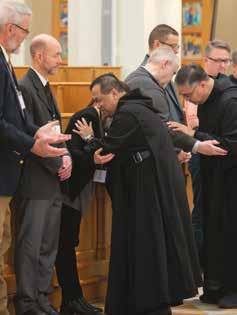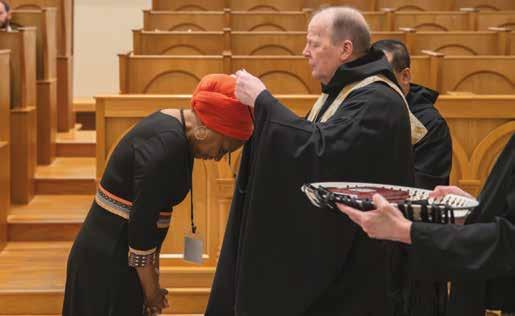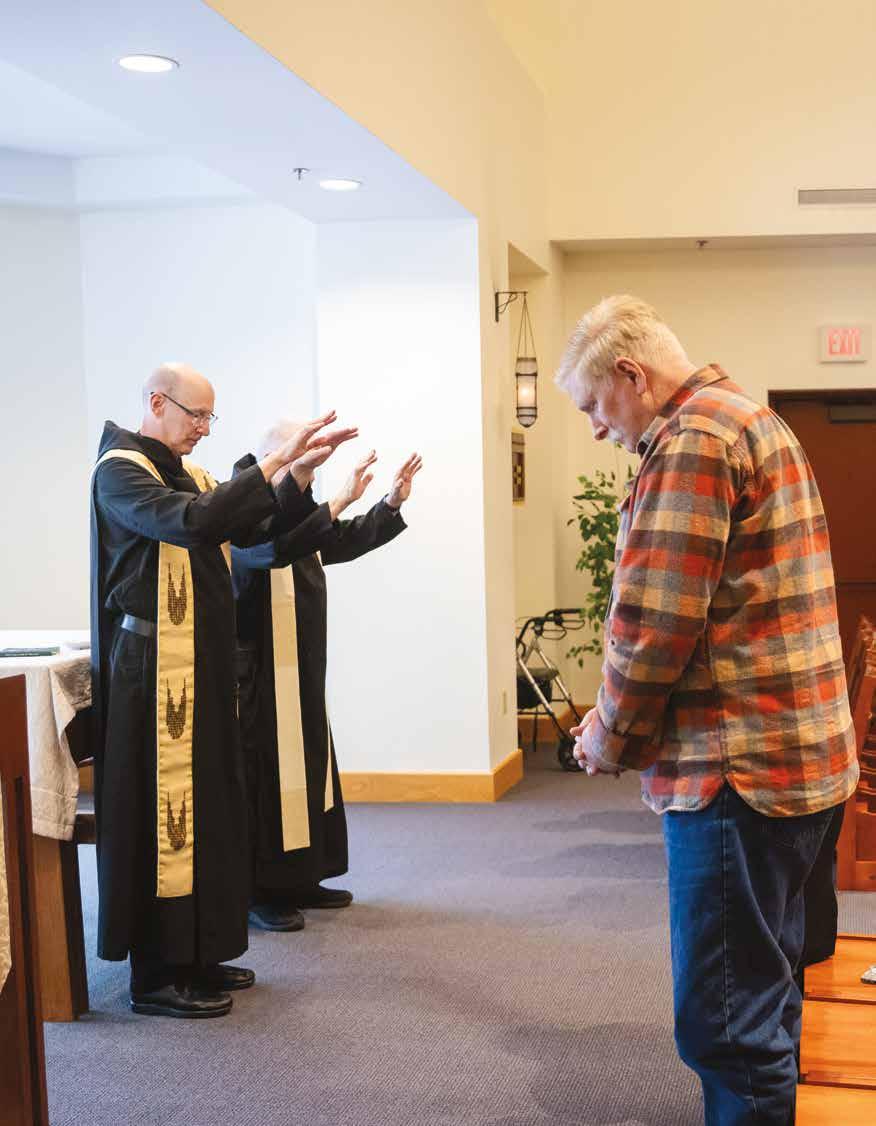

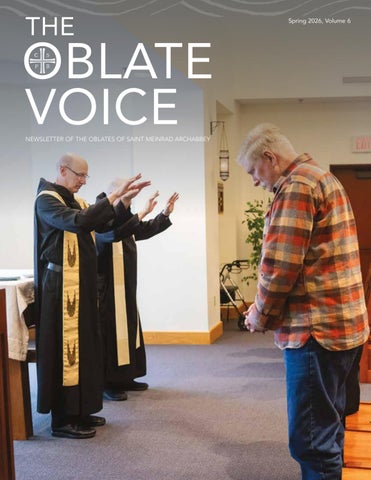


“Never give a hollow greeting of peace or turn away when someone needs your love.”

(The
Rule of St. Benedict, 4:25-26)

Just after Kaci and I made our final oblation last year on March 1, we began discerning a deep sense that we were being called to bring our six-yearold son to Einsiedeln, Switzerland. Our interest began to grow in three areas which included: seeing first-hand the land where St. Meinrad lived and was martyred, to venerate Our Lady the Black Madonna, and to experience the opportunity of praying with the monks at the abbey.
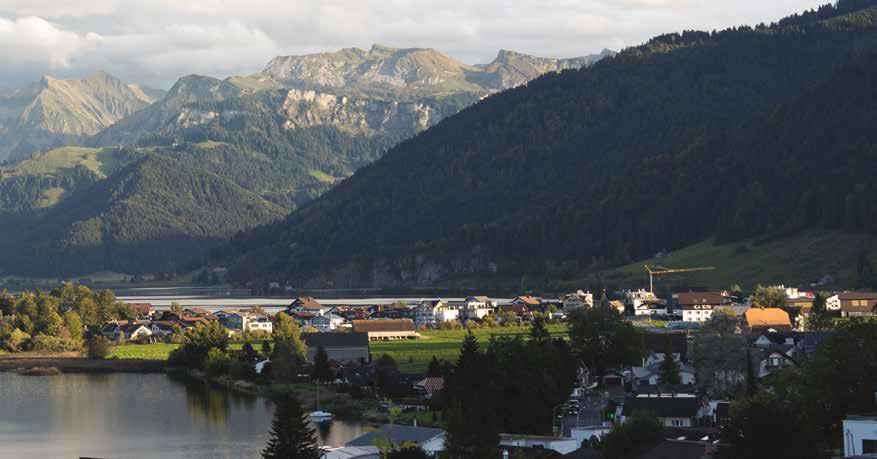
We began searching daily for the most affordable timeframe to make the trip possible, which turned out to be over the week of September 10-16. Having no idea what the Lord had in store for us, we prayerfully booked our flights and a rental house overlooking Lake Sihlsee and the Alps. We then began considering a daily itinerary while we prepared to take our young son out of the country for the first time on an overnight international flight.
detail by St. Konrad of Constance and was also witnessed by many men and women already gathered at the site praying throughout the vigil evening of the scheduled consecration.
The miraculous event was affirmed by papal bull, issued by Pope Leo VIII in 964, just 16 years after. The chapel now sits directly inside the current-day monastery church, which is said to be the very spot where St. Meinrad lived his final years to the day of his martyrdom. When this feast falls on Sundays, the festivities are more solemn, which was the case for this past year. Not only did it fall on a Sunday, but the monastery was also designated as a pilgrimage site for the Jubilee Year of Hope. Given that set of circumstances, the festivities surrounding the feast included a Pontifical High Mass, Pontifical Vespers, and a Eucharistic procession through the ancient town of Einsiedeln during evening Compline.
The Oblate Voice is published three times a year by Saint Meinrad Archabbey. Editor: Krista Hall
Designer: Camryn Stemle
Oblate Director: Fr. Michael Reyes, OSB
Oblate Chaplain: Fr. Joseph Cox, OSB
Content Editor: Diane Frances Walter
Send changes of address and comments to: The Oblate Office, Saint Meinrad Archabbey, 200 Hill Dr., St. Meinrad, IN 47577, 812-357-6817, fax 812-357-6325 or email oblates@saintmeinrad.org www.saintmeinrad.org ©2026, Saint Meinrad Archabbey
We found and translated the monastery’s website and learned that there was a long-standing tradition where the monks celebrate a sacred feast commemorating a miraculous legend from the year 948, known as Grosse Engelweihe (Great Angel Consecration). This feast is celebrated annually on the 14th of September, recounting the night that Jesus Himself, vested as a priest, consecrated the Chapel of Grace with the first Mass and dedicated the chapel under the title Our Lady of Hermits. A stunning account of this legend can be read or listened to on various sites including Einsiedeln Abbey’s website. This legend was documented in great
The pilgrimage quickly took on a deeper revelation that we didn’t anticipate as soon as we began reflecting on this newly found historic event. We were struck that the date aligned with an already significant moment we experienced during the Jubilee Year of Mercy.
We had always known the American Church celebrates the Feast of the Exaltation of the Holy Cross on the 14th of September because on that date in 2016, Our Blessed Lord graciously revealed what our longawaited first child’s name would be. On the feast of the Holy Cross, while
praying during a session of the retreat in daily life, our first son’s name was revealed to be “Benedict.” Being married since 2009, up to that time until the 2016 Jubilee, Kaci and I had been quietly suffering through infertility. After seeking counsel from the Lord and the Catechism about our infertility, we undertook no science or medicine. We simply stayed focused in nourishing our faith and serving the needs of others through numerous outreach opportunities at our local parish in the absence of our family growing.
Then to our surprise, two years later in 2018, we received a call about a boy who was eligible for adoption; and providentially his file name had the nickname listed as “Benedict.” When we received that news, we knew immediately this was the child whom the Good Lord had prepared for us in His great love and mercy. We joyfully accepted him as our cross. As you can imagine, discovering this hidden reality of the miraculous origin of Einsiedeln, matching up with the Feast of the Holy Cross, and the personal events surrounding the revelation and manifestation of our son’s name filled us with immense consolation.
Just before our departure to Einsiedeln on the night of the 9th, we had the providential moment of spending an evening with the monks of Saint Meinrad at the Foundry in Jeffersonville, IN. During which, we had the privilege of Archabbot Kurt Stasiak, OSB, sitting at our table along with some of our friends in the Louisville Oblate Chapter. As the evening closed, he was gracious to impart a blessing upon us and asked the Lord for our protection and for the success of our pilgrimage.
On the 13th, the only Saturday of the trip, we made our way to Etzlpass, which is the place of a 17th-century chapel that was built at the site where St. Meinrad lived for seven years
before he moved to where the abbey is today. This is a special place of prayer and devotion to the saint and many pilgrims trekking along the Camino de Santiago pass. There’s a Gasthaus owned by the monastery and run by a family entrusted to the care of visiting pilgrims, offering food service with plenty of views to be enjoyed as it sits perched overlooking the vast open hills and mountain range.
Since it was the 13th of the month, we prayed the noon devotional prayers of Our Lady of Rosa Mystica inside the chapel. Often known as “Mystical Rose,” they are both synonymous to Mary’s formal title in the Litany of Loreto. We learned about this devotion during morning Mass inside Saint Meinrad’s Monte Cassino Shrine the very morning we began the journey as oblate novices. We felt there was no better place than on the former grounds of our good friend St. Meinrad to give thanks to God for the holy hermit’s life and witness. We joined in union with that inspirational life and asked the Lord to bless the Church with a new abundance of holy men and women willing to leave it all for their deep love for the sacred and desire to know, love, and serve His Son.
Just before Vespers on Saturday afternoon of our trip, a monk noticed us sitting quietly. He came out of the gates to introduce himself and told us his name was Brother Benno. When he said that, it struck me spiritually, since my late father was named Bennio. Though not exactly the same, it was very similar. It was a moment that I felt how God’s messages continue to go out to the world even when we pass from this life. In that short second, I could see that my father may not have known about Einsiedeln, nor had he ever visited Saint Meinrad, but the Lord did win him a brother named Benno and that monk felt the need to greet us and connect with us.
Brother Benno wanted to take the time to make sure we knew how our prayerful presence was felt by him and some of the other monks. He was very joy-filled by us coming there to join in with their prayers. He was so moved that we had made the journey from halfway around the world to be there for their feast, that he made sure to introduce Abbot Urban Federer, OSB, to us, especially to meet Benedict since he bore the name of the great saint.
When the abbot came down, we greeted one another. He quickly made a deal with our son, Benedict, showing him where he would be sitting during the pontifical ceremonies. He promised him that he would keep us in his intentions during his prayers and asked for us to pray for them in exchange. Benedict agreed and shook his hand. Abbot Urban thanked us for coming to the festivities and was uplifted to hear that Americans, especially Benedictine Oblates of Saint Meinrad Archabbey, would be able to take the time to come all this way to join the festivities of their significant historical celebration. It meant a great deal to him, so much so that he expressed his hope for us to share our memories of what we experienced with our fellow monks and oblates and to extend the invitation for others to come next year.
After Vespers, the monks processed to the Chapel of Grace and there the Salve Regina was chanted with their unique tone and then the faithful were blessed with a large relic of the True Cross.
Sunday morning, the Pontifical Mass was celebrated by the Apostolic Nuncio, Archbishop Krebs, and was complete with an orchestra and choir ensemble. The crowds continued to swell throughout the day. There was a short break between Vespers and Compline, and we took time to visit the room of Brother Meinrad, who was a holy and simple monk who lived a life of prayer and service there and has
a cause for beatification currently open. Benedict was very intrigued to view the humble room filled with silence and devotionals. Taking in the moment, we couldn’t help but visualize our own son potentially taking up a small humble cell such as this one day.
We made our way back to the church to finish the last day of the Novena to Our Lady of Einsiedeln. There in front of Jesus and the Black Madonna, Kaci and Benedict placed flowers at the foot of the chapel and we prayerfully acknowledged and accepted Mary as our Blessed Mother just as the last day of the Novena articulates.
Once Compline began, it was well into the evening, and we had been there the entire day, since an hour before morning Mass, so we were digging down deep for the energy necessary for the upcoming procession through the town. It wasn’t long until Our Lord was exposed in a massive ornate monstrance. They opened the oversized center doors and under the canopy, our Blessed Lord led a massive procession out into the square and down into the town. The streetlights were turned off and every window along the road was lit with tea-light candles. The illumination from all the candles was plenty for the faithful to have a chance to see Jesus as He passed. We were astonished as to how many candles there were all along the entire journey. There was a band that played symbolic hymns and anthems while the hundreds and thousands of people lined the street and others looked down from their windows. It wasn’t long before we all had realized that we were basically on an evening date with Our Eucharistic Lord amongst countless believers and onlookers.
It became clear that over the course of the day, we ate with Him in the
Communion, we prayed with Him in the liturgy, and we spent time with His Blessed Mother. People were talking about how we had all gathered there in a small inconspicuous place, out of sight from the problems of the world to spend an evening under the Swiss night sky, and He and His Blessed Mother were fully present with us.
At first glance, this would appear as thousands of years in the making for us to be there, but for the Lord it has only taken two or three days. St. Peter reminds us in his second letter, “One day to the Lord is a thousand years, and a thousand years is one day.” So,
“
It was an extraordinary date with our Lord in a place where Heaven and Earth surely touch.
considering how the consecration event of Jesus honoring His mother as Our Lady of the Hermits took place in the year 948, we can imagine it happening on the evening of the first day of our Lord’s ascension into heaven.
If you continue with the lens of that timeline, you see on the evening of the second day, monks from the abbey traveled to America and established Saint Meinrad Archabbey. Spreading the heralded news of Our Lady of the Hermits in 1854. A few moments later, thousands discovered the peace of this place and began offering vows and oblations, with ours being received in the dawning of the
third day. Given this paralleled perspective, it’s hard to miss the never-failing effort of Our Father’s hand reaching deep into time and space, revealing the depth of His love which never ceases pursuing His children into His heavenly family.
As we continued to walk along, the amount of people taking the time to just get a glance was inspiring. We couldn’t help recounting the Scriptures where the masses surrounded Jesus to see, hear, and touch him. We mapped the procession to be a third of a mile to the west and the same back. So, the procession was over half a mile long, and no one needed a break. There was an altar set up in the square of the town hall, where there was a series of prayers and hymns and a solemn blessing with the Eucharist. Then we processed down another candle-lit road back to the church square. There we prayed additional prayers and hymns, and the abbot blessed the people and the town before returning to the altar inside the church for benediction.
It was an extraordinary date with our Lord in a place where Heaven and Earth surely touch. Just as St. Konrad and the witnesses around him had seen our Lord consecrating and dedicating the Chapel of Grace, we witnessed first-hand our Lord spending an evening with those willing to seek Him through this sacred place He dedicated to His Mother almost 1,100 years ago. We can only pray that you too will come and experience His warmth like so many did that night during the Jubilee Year of Hope. Indeed, Abbot Urban, we will share with our brothers and sisters back home this extraordinary blessing in which Einsiedeln and Heaven have imparted to our little family and so many others. Deo Gratias Grosse Engelweihe!
KEITH JENNINGS Oblate of Milton, Georgia
On Friday, March 4, 2022, I drove from Atlanta, Georgia, to Saint Meinrad for the first time to make my investiture as an oblate. As I approached on State Road 62, I caught my first glimpse of the Archabbey.
I’ll never forget seeing the gold spires rise against the sky, a vertical promise of the Benedictine life I was about to embrace.
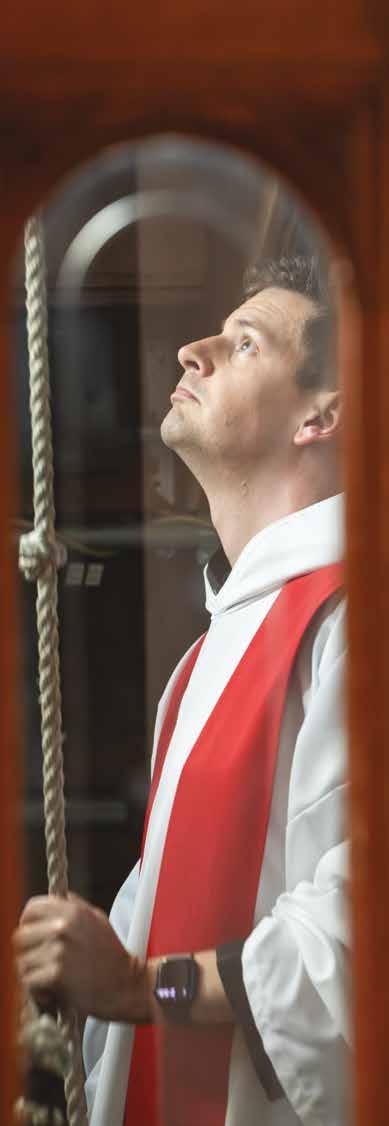
One of the many things I instantly fell in love with on the campus grounds was the ringing of the bells to announce the Liturgy of the Hours. The bell tower is both the voice and the clock of the monastery. It marks the movements of the horarium and establishes a rhythm for which my soul had longed.
At home, there is no bell tower.
I may have carved out 15 minutes for Morning Prayer before getting ready for work, but my wife, who teaches third grade, may need help getting out the door, or the dog needs attention, or a child has a sudden need. Despite my planning, intention, and even my alarms, the undertow of daily life can quickly drag me into its sea of responsibilities.
This isn’t a system failure. These calls to service are an important part of our ministry as oblates. These are not interruptions to our spiritual life. This is our spiritual life.
There’s a quote attributed to Meister Eckhart: “If the only prayer you ever say in your entire life is thank you, it
will be enough.” I remember this when order gives way to disorder, when my carefully constructed horarium dissolves into the holy chaos of family and work life.
The life of an oblate exists in a distinct ecosystem from that of a monastic. Unpredictability is one of our most predictable aspects. We must find our own way to mark the hours, to remember our calling amid the necessary interruptions of the world.
The closest thing I have to a bell tower are the wind chimes my mother gave me, which hang on our backyard shed.
Wind chimes are among the oldest instruments in human history, and they can serve as a fitting symbol of the oblate’s discipleship. Understanding why requires understanding two fundamental approaches to creating order: discriminative systems and generative systems.
Discriminative systems use control to sort and classify things precisely. They rely on exact repetition and careful management. Generative systems, by contrast, let go of control, using simple rules to create endless variations and surprises.
In music, a discriminative system resembles classical performance, where each musician works to play the composer’s piece as precisely as written. A generative system is like ambient electronic music, where the composer creates conditions that produce endless variations—music
that never repeats itself and could theoretically play forever.
Wind chimes are the oldest generative instrument. With only a few tonal tubes, they never play the same melody twice because they are “performed” by wind and weather. Silence is as much a part of their music as sound.
The monastery runs on a discriminative rhythm. The bells ring at fixed hours. The community gathers with reliable regularity. This is the beauty of the vowed life—its steady, unwavering pattern.
At home, oblate life runs on a generative rhythm. Like wind chimes,
our bells ring when conditions allow. Prayer and work are maintained, but they vary by day and hour, by season and circumstance. We cannot control when the wind blows, only ensure that we remain positioned to sing when it does.
One of the many things I love about my wind chimes is how they’ve become a reminder that beauty can emerge from disruption itself. The same wind that scatters my plans creates unexpected music.
When I hear them ringing in the backyard—sometimes in the early morning, sometimes during an afternoon storm, sometimes in the quiet of evening—I think of the bells
at Saint Meinrad. Not as something I’ve lost, but as something translated into the key of lay life.
And I think of my mother, who understood something about generative love when she gave them to me.
Wind chimes are the oblate’s bell tower. They remind us that our vocation isn’t to replicate monastic rhythm but to discover the sacred patterns in our distinct place and time.
They teach us that faithfulness doesn’t always look like precision. For oblates, it looks like staying ready to sing whenever the Spirit moves and the world calls.

BY SIMON, G.A., TRANS., LEONARD J. DOYLE Abbey Editions, 2024
MARK PLAISS Oblate of West Chicago
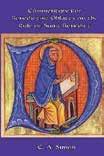

Perhaps on your bookshelf you have Terrence Kardong’s Benedict’s Rule: A Translation and Commentary. Maybe alongside it, RB 1980: The Rule of St. Benedict in Latin and English with Notes. And maybe, just maybe, Georg Holzherr’s The Rule of Benedict: An Invitation to the Christian Life is on that shelf as well.
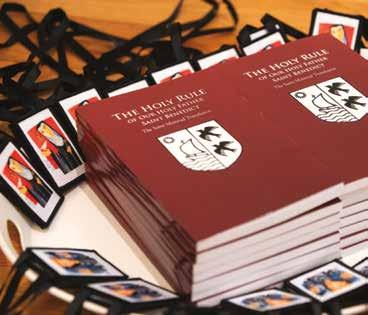
You might consider adding another: Commentary for Benedictine Oblates on the Rule of Saint Benedict. This 452-page book divides The Rule into daily and dated segments. Each segment contains the text of The Rule followed by a commentary, followed by an application. It is this application that pertains to the oblate. For example, in the application for the last chapter of The Rule, Simon writes, “It is good for us Oblates to familiarize ourselves … with various writings, notably those of Cassian” (p. 452). Simon was a priest oblate of St. Wandrille Abbey who died in 1944.
Originally published in French in 1934, the present text was translated into English in 1950 by Leonard J. Doyle, an oblate of St. John’s Abbey. This current text was reissued in 2024.
Check it out.
The brothers should have clothes according to the condition and climate of the place where they live, for in cold regions they will need more, but less in warmer regions. Consequently, the abbot has the power to determine this.
Nevertheless, we believe that it would be enough for each monk in a temperate climate to have a cuculla and a tunic, a heavy tunic in winter, and in summer one that is light or well worn; he should also have a scapular for work, and to cover the feet, footwraps and footwear. (RB 55:1-6)
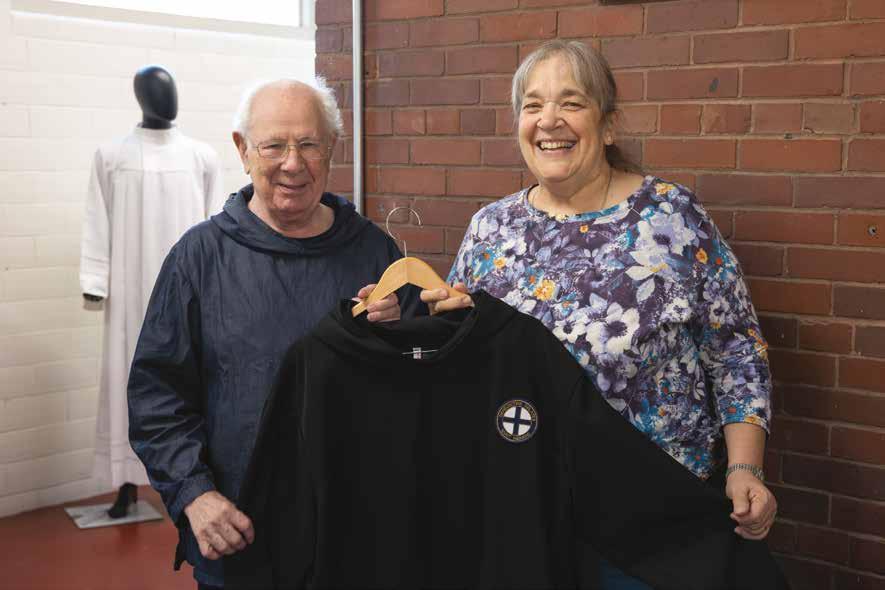
During the morning shift in the Saint Meinrad Tailor Shop, among mannequins in chasubles and big flat tables scattered with patterns and beautiful textiles, Br. Kim Malloy, OSB, wearing a monastic work habit, looks up from an annotated copy of The Rule of Saint Benedict and taps it with his finger.
He clarifies that the habit for monks is a tunic, a base layer. The color black signifies humility, and the belt that monks wear with it signifies chastity.
The scapular that monks wear sits over the habit, looking like a long narrow apron on the front and a long cape in the back; it was originally for Benedictines a utilitarian purpose. It
was a piece of clothing used during manual labor in the fields, or as an apron in the kitchen. That very utilitarian aspect became strongly rooted in the Benedictine charism of hospitality and service unto each other and guests.
“As time went on, the long habit and scapular for monks became a hindrance for manual labor,” Br. Kim explained. “So, the short work habit without an outer scapular for monks developed.”
The work habit is worn at Saint Meinrad as an alternative for the monks for that very reason. When Oblate Director Fr. Michael Reyes, OSB, approached Br. Kim and asked him to make one for oblates, Br. Kim
was more than happy to do so. He was thrilled to learn that Archabbot Kurt had given his blessing for the oblate habit, so he was doubly ready to go to work.
“I would never do anything without permission of the Archabbot,” he explained, “and I really like that our oblates can get a work habit.”
“Oblates at Saint Meinrad are different than oblates at other Benedictine monasteries. Our oblates are Benedictines in the world. Most Benedictine oblates are only contemplative, but ours are sent out. That makes Saint Meinrad different,” Br. Kim said.
He went on to explain that many people get to know Saint Meinrad Archabbey the first time through oblates.
Br. Kim didn’t design the work habit for oblates without help. He’s quick to give most of the credit to tailor Eva Rothgerber, who put together the design when the Tailor Shop was first tasked with the new oblate work habit about a year ago. She based the main design from the work habits already made for the monks, adding an option for pockets and the oblate patch, and making some adjustments to sizing and fit.
There are some other interesting aspects of the monastic dress that Br. Kim shared, including that other Benedictine monasteries have differences in their monastic habits, some with buttons on top, for instance. The long formal cuculla, worn over the monastic habit and scapular on feasts and placed upon a monk at his final vows, differs a little in pleating and appearance for each monastic community.
Those and other minor differences between Benedictine monasteries are a reflection of the history of each
monastery, with abbots making changes according to their interpretation of The Rule, their communal practice of monasticism, and needs such as climate or culture.
As to Saint Meinrad’s oblates, Br. Kim is happy to see a new era where the work habit is an option.
“The oblate [work] habit is great for prayer,” Br. Kim added, “It helps to remind oblates of their connection here.”
REX GEHLBACH Oblate of Troy, Illinois
Archabbot Kurt Stasiak, OSB, mentioned St. Henry in the Foreword to the Benedictine Oblate Novice Companion, 2nd Edition. That was the first time I had heard of St. Henry. After becoming an oblate, I decided to learn more about him.
Henry did not become a saint through one grand accomplishment. Rather, like most oblates, it was through consistently behaving as a Christian day in and day out. For example, in The Chronicon of Thietmar of Merseburg, we read of Henry often stopping at a monastery or cathedral to celebrate a feast day of the Church. He would sometimes stay more than one day in order to converse with an abbot or bishop and to pray. This is similar to how oblates today will journey to a monastery for a retreat or a day of recollection, and how we attend Mass at our local parish on holy days of obligation. Adalbold II of Utrecht wrote of Henry encamped with an army on a wide meadow in order to do battle with Duke
Hermann in the year 1002. While encamped there, he celebrated the Feast of the Apostles.
Adalbold knew Henry and wrote a biography of him. The following is a quote from that book. In 1002, “... he [Henry] held the duchy in the Bavarian kingdom, ruled the people peacefully, increased peace, augmented the resources of the churches, and magnified laws and religious observances.”
Henry was also known to celebrate Marian feast days. A stained-glass window titled “St. Henry Interceding” is found at St. Henry Parish in St. Henry, Ohio. It depicts St. Henry and his wife, St. Cunigunde, kneeling before Mary who is holding the infant Jesus.
The Chronicon of Thietmar also gives some context to Henry’s life. He lived in a time when Christianity was still spreading through a land where pagans also lived. Henry had to protect parts of the empire from
pagans and seek favorable conditions for Christianity to be taught to such people. St. Boniface, also a Benedictine, had brought the Gospel to the Germanic peoples in the eighthcentury, not that far ahead of St. Henry.
Henry came from a religious family. One sister became a nun. Another sister, Gisela of Hungary, was married. Gisela was declared blessed by the Church in 1975. Henry and his brother, Bruno of Augsburg, were tutored by Wolfgang of Regensburg, a German monk, saint, and bishop. Henry was known to quote Scripture often when he spoke. Bruno once supported a rebellion against his brother. When that failed, he went into exile but later reconciled with Henry, an example of Henry’s benevolence. Henry and Bruno were both trained for careers in the Church.
Henry was married to Cunigunde. After his death, she entered a Benedictine monastery. She was poor because she and Henry had given away

vast amounts of their wealth. They had no children, leaving Henry without an heir. Henry referred to Cunigunde as his “serene co-ruler.” For example, when Henry was on campaigns in Italy in 1004 and 102122, Cunigunde was in charge of those campaigns. Cunigunde was canonized in 1200.
The following quote is from Commentary for Benedictine Oblates on the Rule of St. Benedict by G. A. Simon:
“The history of St. Henry, Emperor, is well known. When he asked Richard, Abbot of St. Vannes, to receive him as a monk, the Abbot had him come to Chapter and put this question to him: ‘Will you, following The Rule and following the example of Jesus Christ, be obedient until death?’ Upon the affirmative reply of the ‘postulant,’ the Abbot continued: ‘I hereby receive you as a monk and from this day I charge myself with the care of your soul. For that reason, I want you to do, with the fear of God, everything that I shall order you to do.’ The Emperor having acquiesced once more, the Abbot declared: ‘I want you, therefore, to return and govern the empire which God has entrusted to you, and by your constancy in administering justice to procure in so far as you are able the welfare of the whole state.’ During his life the oblate remained, as much as he could, under the direction of the monks. St. Henry frequently consulted the Abbot Richard [of Verdun].”
Lex orandi, lex credendi.
As we pray, so we believe.
God uses the Church to give us saints to imitate, be inspired by, and ask for intercession. Henry was declared a saint in 1146 by Pope Eugene III. He
was added to the calendar in 1631 as a commemoration.
Through many centuries, the Church has seen it worthwhile to present Henry as an example to the faithful. Pope Eugene III, a Cistercian, was beatified in 1872 by Pope Pius IX. Why does the Church give us St. Henry? To answer that, let’s look not in history books, but instead to the Church, at the Collect prayers the Church has composed for the Mass when St. Henry is remembered. The old prayer (translated from Latin):
O God, who on this day brought blessed Henry, your confessor, from the summit of earthly sovereignty into the eternal kingdom, humbly we implore you, that, as you, going before him with the abundance of your grace, granted him to overcome the enticements of the age, so may you grant us, through imitation of him, to shun the allurements of this world and attain unto you with pure minds.
The prayer from 1871:
O God, who didst this day (July 13) remove blessed Henry, Thy confessor from his earthly throne to an eternal kingdom: we humbly beseech Thee, that as by the assistance of Thy grace, he was proof against all the temptations of the world, so we may follow his example in withstanding all the flatteries of this world, and serve Thee with clean hearts. Through Christ our Lord. Amen. (Source: Father Leonard Goffine)
1962 Roman Catholic Daily Missal:
Collect:
O God, on this day You raised the blessed confessor Henry from earthly royalty to an eternal kingdom. May his example enable us to turn aside from the
enticements of the world and come to You with a pure heart, even as he was strengthened by Your grace to withstand the fascination of worldly attractions. Through our Lord . . .
The Mass Collect prayer for the Memorial of St. Henry as found on a prayer card dated 2016:
O God, whose abundant grace prepared Saint Henry to be raised by you in a wonderful way from the cares of earthly rule to heavenly realms, grant, we pray, through his intercession, that amid the uncertainties of this world we may hasten towards you with minds made pure. Through our Lord Jesus Christ, your Son, who lives and reigns with you in the unity of the Holy Spirit, one God, for ever and ever. Amen.
The Church is teaching us to not neglect our earthly duties but also to not let earthly things draw us away from God. Balance is a very Benedictine thing. We learn through these prayers that Henry was prepared by God’s grace, was raised by God from earthly cares and into heavenly realms. Amid the uncertainties of the world, we hasten to God. This is good news, and good advice, for an oblate. The Holy Rule of St. Benedict 4:21 instructs us to prefer nothing to Christ. Henry had wealth and power, yet he did not allow either to entice him away from God. He became a saint by following RB 4:21. Visiting monasteries and spending time with monks helped Henry to become a saint. Oblates, like ourselves, also visit the monastery and spend time with the monks in order to seek God and become saints.
There are no miracles or prophecies attributed to St. Henry during his lifetime. He left no writings aimed at spiritual direction or inspiration. He was not a great preacher or evangelist

or martyr or mystic. He did not found a religious order. This is precisely why Henry can be a good patron saint for oblates. While he longed to spend more time in the monastery, his duties were in the secular world. His duties and responsibilities took him away from the monks and yet he found the presence of God where he was called to serve.
The fifth duty of an oblate is the Presence of God. Oblates look for the presence of God in everyday life. Henry proves this possible, even with a demanding job or great opposition. The Church wants us all to be saints. Yet most of us are not called to live in monasteries. We are all called to be saints, but not all in the same way. We are not all going to be teachers or leaders or work at the parish. St. Benedict, in The Rule, gives instructions for dealing with the simpler monks. He cares about those souls also. So does Jesus. Simple oblates leading simple lives are important to Jesus. We don’t have to do great things, we just need to
humbly seek God and strive to do His will in our lives. And if, like Henry, we are given great responsibilities, we can trust that God will provide the strength and wisdom to do our best.
Saints like Benedict, Scholastica, Meinrad, and Boniface can certainly inspire us. However, the circumstances of their religious lives differ from our secular lives. Henry took the lessons he learned from the monks and adapted and applied them to his duties in the secular world. This can be an example for the oblate. As our former Oblate Director, Fr. Meinrad Brune, OSB, has said, “Oblates are not mini monks.” Like Henry, we can learn from the monks. Like Henry, we visit the monastery to recharge our spiritual batteries. Like Henry, we attend Mass and receive the sacraments (our fourth duty). Like Henry, we don’t get to stay in a monastery surrounded by fellow Benedictines.
Let us end with a story from St. Henry’s life.
Adalbold tells of how Duke Hermann, who opposed Henry being made king, had entered Strasbourg with an army and had desecrated the church there and taken spoils because the Bishop of Strasbourg supported Henry becoming king. At a later time, when Hermann went into hiding with his men to avoid battle with Henry, some advised Henry to go to Constance to repay Hermann for what he had done to Strasbourg. This is because the Bishop of Constance had supported Hermann. Henry refused to retaliate against Constance because of Strasbourg. Adalbold quotes Henry as saying, “Perhaps, even if I were to lay waste to Constance for Strasbourg, I would not lessen my loss but double it. Moreover, he acquires the kingdom badly who, in obtaining it, neglects the salvation of his soul. God has crowned me not for the violation of churches, but for punishing the violators.”
St. Henry, pray for us.
FR. RAYMOND STUDZINSKI, OSB Saint Meinrad Archabbey
Homily for the Solemnity of St. Meinrad
Genesis 18:1-10
Hebrews 13:1-8
Matthew 10:34-11:1
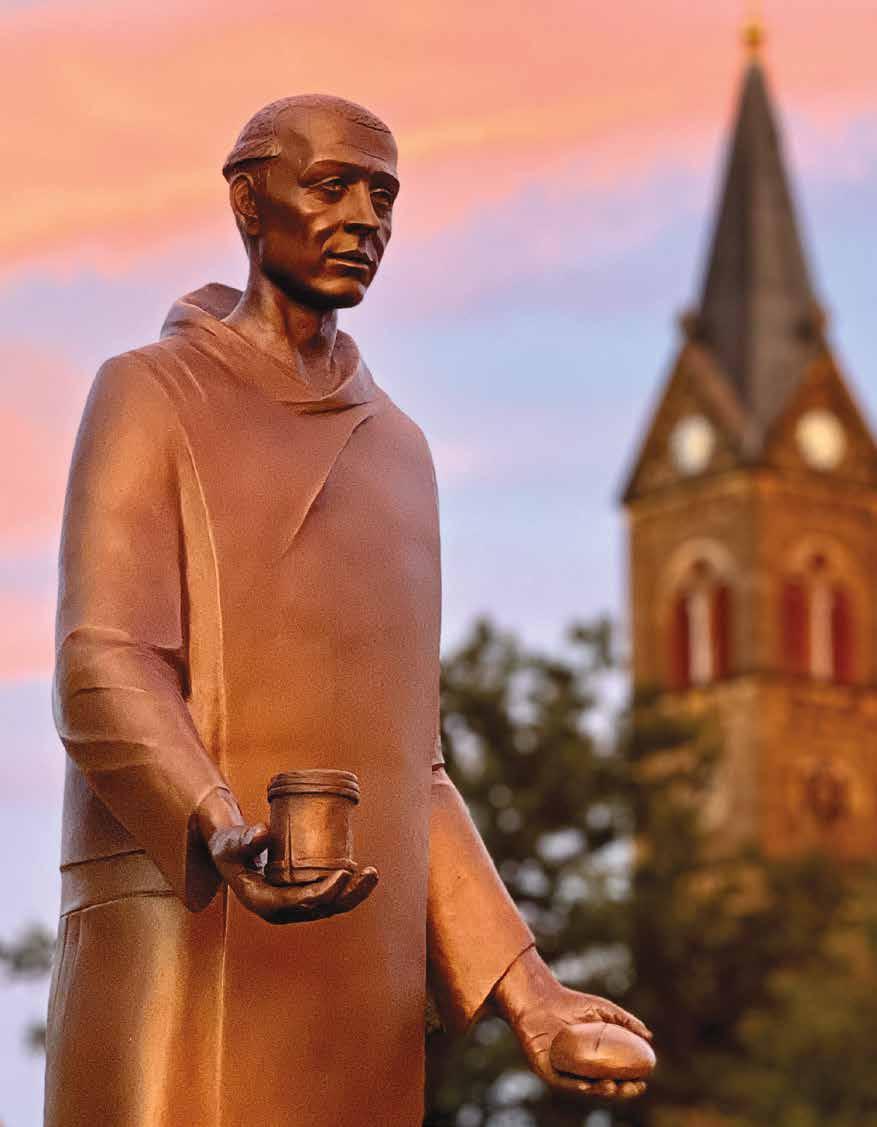
As you may be aware, St. Meinrad is recognized as a martyr of hospitality. I suppose he acquired this title most especially because he received two men who had come to his hermitage to rob and kill him. His inspired foreknowledge of their reason for coming to his hermitage in no way impedes his acting as a generous host, nor does his kindness stop these individuals from carrying out their evil intent. However, as you know, two ravens act as messengers to alert the local people of the crimes these two villains have carried out.
The story of Meinrad and his nefarious visitors triggers in my mind memories of a visit to a religious sister, a sibling of a Saint Meinrad monk, that I made early in my graduate studies in the Bronx. I had been invited to dinner at the apartment she shared with two other religious sisters. When I arrived at the apartment building, I went through all the usual security procedures to enter the building— phoned the apartment, identified myself, and then got buzzed into the building.
I made my way to the apartment and rang the doorbell, and after I identified myself, I heard the main lock open, but then followed over the next several minutes, or so it seemed, the unlocking of a series of deadbolts which seemed to me to be around the whole perimeter of the door. Deadbolts, you may know, are locking mechanisms
that by pushing a metal bolt into the door frame make a door more resilient and so add another level of security. I eventually did make it inside the apartment and had a good visit, but I was struck by how vulnerable these women must feel living in the Bronx.
That experience contrasts sharply with what seems to be the more relaxed atmosphere which Meinrad’s hermitage provided. Two thieves approached, detected only by some chickens, but no alarms went off. Of course, you could comment that if Meinrad lived in the 21st century, there could be the latest in domestic security devices installed such as a SimpliSafe Outdoor Camera system, to mention only one.
But then, maybe not—because the feeling of vulnerability would not be there with Meinrad the same way that it was in those I visited. My friends feared, not unrealistically, some aggressive acts in which they might experience physical and emotional harm. Meinrad, we might say, is dealing with a spiritual vulnerability, a wound that comes from having witnessed and perhaps missed an opportunity to reach out to a neighbor in need. Such spiritual vulnerability or sensitivity allows one to become a most gracious host or hostess. The person who is vulnerable in this sense is able to detect and respond to the pressure that the other is experiencing.

We might go as far as to say that Meinrad or such a disciple has acquired a “holy vulnerability.” Hospitality and vulnerability are deeply interconnected because welcoming others always involves some degree of openness, exposure, and risk—both for the host and for the guest. At its core, hospitality means opening one’s space, time, or resources to another. Allowing someone into one’s home, community, or emotional life means relinquishing complete control and accepting uncertainty about how the guest will behave or what they may need.
Abraham and Sarah in our reading from Genesis remind us that with risk can come promise, as this elderly barren couple are told, they will have a child. Like Abraham, we too must be on the lookout for whoever may cross our path and be in need of hospitality.
Today, those we encounter are legion: the homeless, immigrants, the persecuted, those ill in mind or body, the unemployed, and the list goes on. I think the Gospel today is itself a wakeup call as it presents the radical nature
of the Christian life; we are to open our eyes and see the guests at our doors. Jesus says to us, “Whoever does not take up the cross and follow after me is not worthy of me.”
We are called to radically commit ourselves to a deep personal relationship with the Lord, and that commitment asks us to make, at times, painful choices. “Whoever loves father or mother more than me is not worthy of me.”
We know from attachment theory how important the bond is that we establish with mother and father in early life and that, granted good early life experience, we are empowered from those early life relationships to establish deep, longterm bonds with others. In the Gospel, Jesus directs his disciples to the reward that can come to us, for instance by giving a cup of water to one of the little ones. Disciples in Jesus’ mind are to be caring, hospitable people.
Still, there were and will be dark days for St. Meinrad and us, when we may feel imprisoned by the needs of so
many pressing in upon us and our own sense of powerlessness to do much to ameliorate the situation. That is why God’s words as recorded in the Letter to the Hebrews should be cherished by us as they surely were by St. Meinrad: “I will never forsake you or abandon you.”
In John Bunyan’s classic Pilgrim’s Progress, Christian, our paradigmatic pilgrim, and Faithful his traveling companion, find themselves imprisoned by the Giant Despair. Every way of escape seems blocked and their future looks hopeless until Faithful reminds Christian of something Christian has in his possession.
What he has is God’s promise of deliverance, a promise that becomes the key which unlocks closed doors. Realizing that fact of that promise and what the promise can do, Christian and Faithful, and we, can say with the author to the Letter of the Hebrews: “The Lord is my helper. I will not be afraid. What can anyone do to me?” (13:6)

Whoever loves father or mother more than me is not worthy of me. “ MATTHEW 10:37
Artwork by:
Br. Martin Erspamer, OSB
How shall we, Benedictine Oblates, give drink to the thirsty? Who are those who thirst?
Most communities in the United States are served by local or regional water utilities. These agencies are charged with providing drinking water according to the Safe Drinking Water Act (1974) through the jurisdiction of the Environmental Protection Agency. Whether obtained from reservoirs, lakes, rivers, or groundwater aquifers, the provision of safe, clean, potable water to the general public remains a top priority for all of society.
By contrast, many other places in the world lack the most basic infrastructure for water supply, treatment, and distribution. People living there are still going down to the local river to carry water on their heads back to the village. This water could be loaded with deadly bacteria or other contaminants. Waterborne diseases, such as typhoid, cholera, dysentery, and hepatitis, remain a very real hazard in such communities.
Providing wells, water lines, pumps, and treatment facilities in these areas remains a positive way to help provide
ANGIE MCDONALD Oblate of Huntingburg, Indiana
Part of an ongoing series of reflections on the Spiritual and Corporal Works of Mercy.
that cup of cold water, which is not insignificant. A number of Christian relief agencies specialize in construction and operation of such resources, all made possible through freewill donations of funds.
That’s one way to do it.
Closer to home, there are other things we can do.
In terms of The Rule, this corporal work of mercy falls under the umbrella of hospitality and generosity. St. Benedict directs his monastic community to always welcome strangers and travelers, indeed, to expect them and anticipate their needs (RB 53). The monastery was to always provide a guest house or place for them to stay, also sharing food and drink with their guests, whom they were to welcome as Christ Himself (Matthew 25:31–46).
The community was to put into practice Jesus’ imperative of service: “And whoever gives only a cup of cold water to one of these little ones to drink because he is a disciple—amen, I say to you, he will surely not lose his reward” (Matthew 10:42, NAB).
We can also anticipate the needs of the “stranger and traveler” we may encounter today. First of all, we should expect them to appear. Moreover, we could actively look for opportunities to provide that “cup of cold water” in Jesus’ name.
Always being ready, we won’t be surprised when the needs come our way.
People often experience a thirst that transcends the physical. The thirst for
friendship, for understanding, for compassion, and for mercy may all be included under this heading. Are we willing to slake these kinds of thirst in others?
How shall we become aware of these needs?
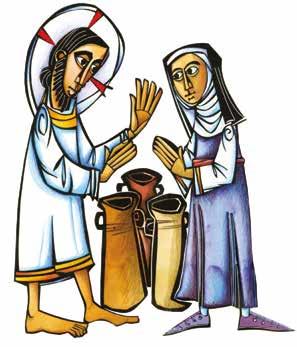
Jesus’ encounter with the woman at the well in John 4 gives us a helpful insight: God Himself desires us to relieve His thirst for us. We see this again as Jesus speaks from the Cross in John 19:28: “I thirst.”
At the well, Jesus makes the first move by asking the woman to give Him a drink. She is intrigued by His request; it just wasn’t done. That alone made her curious. As Jesus talks with her, He awakens within her the recognition of her own thirst for something more.
The Psalmist also cries out:
As the deer longs for streams of water, so my soul longs for you, O God. My soul thirsts for God, the living God. When can I enter and see the face of God? (Psalm 42:2–3)
O God, you are my God— it is you I seek!
For you my body yearns; for you my soul thirsts, In a land parched, lifeless, and without water. (Psalm 63:2)
This is exactly what He is seeking from her: to see that she needs Him, and that He desires to meet that need.
Are we willing to sit down at that well, speak with that woman, encounter her deeper need, and point her to the Source of Living Water, Jesus Christ?
Please say yes!
CHARLOTTE THOMAS & STEVEN J. BORCHERT Oblates of Portage, Michigan
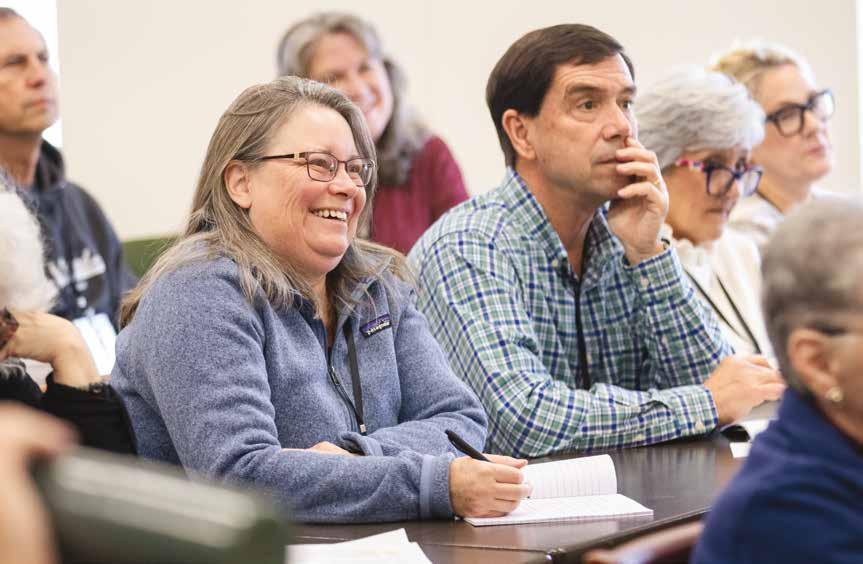
The Portage, Michigan, Oblate Chapter holds a monthly meeting at St. Catherine of Siena Church in Portage. Although a few of the chapter members are parishioners of St. Catherine of Siena, most of the chapter members are parishioners of other Catholic churches in nearby southwestern Michigan, cities including Kalamazoo, Coldwater, Parchment, Decatur, and Grand Rapids.
Four to eight men and women participate in each monthly meeting. Normally, one or more participants in each meeting are either considering becoming a Benedictine Oblate Novice of Saint Meinrad Archabbey or are currently a Benedictine Oblate of Saint John’s Abbey in Collegeville, Minnesota.
With some noteworthy exceptions, the monthly meeting is held on the second Sunday of every month immediately after the St. Catherine of Siena 9 a.m. Mass. One exception to that schedule is the month of May, when the meeting is held on the third Sunday to avoid holding a meeting on Mother’s Day. Prior to the meeting, some chapter members attend the 9 a.m. Mass and sit as a group in a reserved pew. The meeting is held in the Gerald L. Pochyla (GLP) Conference Room, which is a short distance from both the St. Catherine of Siena Main Church and the St. Catherine of Siena Trinity Chapel.
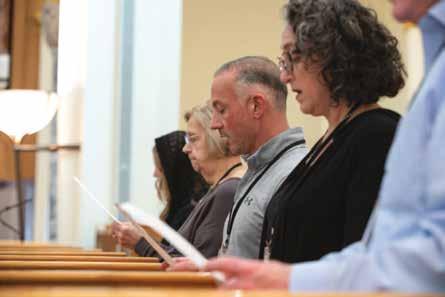
After welcoming any new participants, the attendees pray together the Morning Prayer (Lauds) and Invitatory for that Sunday. Various
Liturgy of the Hours prayer books are used by chapter members for praying Lauds, Vespers, and other prayer times such as Compline. Some use the first edition of the Liturgy of the Hours for Benedictine Oblates of Saint Meinrad, a four-week Psalter book. A few chapter members use the four-volume or one-volume Christian Prayer Liturgy of the Hours four-week Psalter book. As a result, for monthly chapter meetings, the chapter members decided to use the Lauds and Invitatory prayers for that Sunday available online via universalis.com, and a copy of the prayers is given to each attendee.
After praying the Invitatory and Lauds prayers, participants provide personnel updates. The remainder of the chapter meeting focuses on some aspect of Benedictine spirituality. Our chapter has been fortunate that a monk from Saint Meinrad has been able to attend two or three meetings each year and present a talk. When a monk is not available, a passage from a book on Benedictine spirituality is read aloud and discussed. For several meetings, the chapter used The Road to Eternal Life: Reflections on the Prologue of Benedict’s Rule by Michael Casey OCSO (2010). Our chapter is currently using A Life-Giving Way: A Commentary on the Rule of Saint Benedict by Esther de Waal (1995).
Besides personal referrals from the Oblate Office of Saint Meinrad Archabbey, the chapter has tried a variety of approaches to encourage men and women to consider Benedictine spirituality without much success. In the fall of 2024, one of our
chapter members contacted Holy Family Radio, which is a Catholic radio station broadcasting in Western Michigan. The radio station agreed to air an announcement a few times each day. The brief announcement communicates that our chapter meets to pray the Liturgy of the Hours, Morning Prayer, and to discuss Benedictine spirituality. The announcement also provides meeting logistics and a referral to the St. Catherine of Siena website for additional information. It is noteworthy that a few people have responded to this communication tool and participated in some of our chapter meetings.
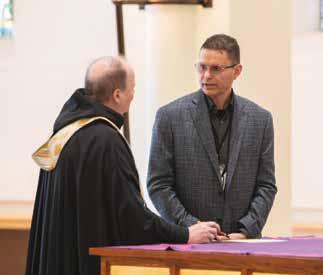
In 2025, our new chapter member, Jennifer Trout, was invested as a novice by Oblate Director Fr. Michael Reyes, OSB, in the St. Catherine of Siena Trinity Chapel, and several chapter members were able to observe the ceremony.
Enjoy a three-or-four day workshop learning the art of twined basketry.
Information and Registration: www.saintmeinrad.org/visit-us/ art-workshops
Email questions to: baskets@saintmeinrad.edu

One oblate of Saint Meinrad submits the following question: In Chapter 6 of The Rule, referring to Psalm 38, St. Benedict says: “Here the Prophet indicates that there are times when good words are to be left unsaid out of esteem for silence.” I struggle with refraining from even good words, especially if I feel called to encourage another. Would you consider explaining this passage further?
An excellent question! Precisely the kind of inquiry this column was devised to address.
Here is the passage from Psalm 38[39]:2-3 that St. Benedict refers to: I have resolved to keep watch over my ways that I may never sin with my tongue.
I was silent and was humbled, and I refrained even from good words.
St. Benedict uses this passage to introduce Chapter 6 on “Restraint of Speech.” In the same chapter he also cites Proverbs 10:19: “In a flood of words you will not avoid sin.” The theme is persistent throughout Scripture. There are too many relevant citations to list, but one prominent example appears in Chapter 3 of the Letter of James, which eloquently describes the immense proclivity and power of the human tongue to commit evil. Also, Jesus himself provides a stern warning on careless speech in Matthew 12:36-37:
I tell you, on the day of judgment people will render an account for every careless word they speak. By your words you will be acquitted, and by your words you will be condemned.
That may sound harsh, but it also seems like an admonition we should take seriously.
Bear with me here. Before addressing the matter of refraining from “even good words,” it’s important to understand the value of silence for both the spiritual life and human communication, and why Scripture and The Rule place such emphasis on “an esteem for silence.”
Surely, we should all listen more than we speak, think before doing so, and then only when necessary—in charitable and helpful fashion. The Letter to the Ephesians states: “No foul language should come out of your mouths, but only such as is good for needed edification, that it may impart grace to those who hear” (Ephesians 4:29). That is the ideal, possible only by God’s grace.
However, an honest examination of conscience (yours truly included!) likely highlights many failures in this regard. We human beings are typically rather careless with our words, and too quick to speak in the moment—especially when emotions are high. Hence, Scripture’s persistent admonitions. We often don’t want to listen. We’d rather speak our minds immediately and forcefully without due reflection— whether verbally or by other means (such as on social media).
Without proper restraint, the tongue is a powerful weapon, and one that is easily deployed. It can inflict great harm. With it we gossip about and slander others. We unfairly judge. We indulge in flattery to gain some favor.
We willfully deceive others or attempt to distort the truth to our advantage. We chatter about trivial matters. We contribute to toxic environments with constant grousing (something St. Benedict detested!). We ridicule or insult others. We boast. We curse. We use profanity. We utter (or shout) harsh words in anger, often saying dreadful things.
The late Fr. Walter Sullivan, OSB, of Saint Meinrad (d. 1958), commented that our speech often betrays a lack of humility, honesty, and charity within our hearts. He wrote:
See how quick we are to excuse our sins; to justify our mistakes, to brag about the things we have done well, to take the center of the stage to prove our cleverness, to interrupt the conversation of others to get our point across, to exaggerate the truth in order to impress someone, or criticize the faults of another to make interesting conversation. How right St. Benedict was to say that “in much talking there is no escape from sin” (Reflections on the Holy Rule).
We’ve all done such things. I know I have. Such speech is hypocritical and displeasing to God because with our tongues “we bless the Lord and Father, and with [them] we curse human beings who are made in the likeness of God” (James 3:9). Harsh words reveal the truth that while we may profess faith in God, we often don’t sincerely live that faith.
Silence, then, is a divine gift—a guardrail of sorts, and a remedy—to help us avoid sinning with our tongues, which we are often prone to do.
But “esteem for silence”—for St. Benedict and Christian spirituality in general—goes beyond simply evading occasions for harmful speech. It also is an essential element of both meaningful human communication and prayerful recollection. The two are related. Each requires listening listening to others and listening to God with the ear of the heart. It is not by accident that the first word in Benedict’s Rule is “listen.” Similarly, Jesus often exhorts his disciples to “listen” to or “hear” what he is saying.
This type of receptivity requires practice. It means not only keeping one’s mouth shut while another is speaking but truly being attentive to the speaker. This, in turn, requires humility—letting go of all other activities and thoughts, preconceived notions, opinions, and possible responses so that one’s full attention is focused on the person speaking. If a response is called for (and sometimes, it is not), then it should only be made after the listener has fully received what the other is saying, reflected upon it, and thoughtfully concluded what is good and necessary to say.
Such conversation is rare today. How often, when another is speaking, are we instead more focused on our phones, TV, or our own internal dialogue? How often do we interrupt someone to emphasize our own point? Or, if we don’t interrupt, how often do we formulate responses in our head to employ when we do have the chance? In such instances, we may hear but are not truly listening. This leads to breakdowns in communication.
Both silence and speech are necessary for meaningful communication. But listening through attentive and receptive silence must come first. The late Fr. Cyprian Smith, OSB, a monk of Ampleforth Abbey in England, had this insightful observation on the topic: Real communication happens when words are like the sounds of wild
nature, emerging from silence, returning to it, but never obliterating it. They do not negate it but rather articulate and express it. That is what real communication is: articulated silence (The Path of Life).
So, the practice of silence is essential for avoiding sin and human communication. Its role in fostering prayerful recollection, self-awareness, and interior stillness in one’s spiritual life should be obvious, so I will not dwell on that here. Suffice it to say that silence (interior as well as exterior) helps us listen with the ears of the heart to God’s “still small voice” within (cf. 1 Kings 19:12).
Okay, thank you for your patience with my long (but necessary) digression. Now, for the real question at hand: what about refraining from “even good words”? Again, the focus is on this phrase from Chapter 6 of The Rule: “there are times when good words are to be left unsaid out of esteem for silence.” Let’s break the sentence down into the following three segments: 1. there are times 2. when good words are to be left unsaid 3. out of esteem for silence
There are times: Here is the key to understanding what Benedict is saying. He’s not advocating absolute silence no matter the circumstance. That would be impossible, not to mention a recipe for dysfunction! There are times and places for everything, including speech.
In the monastery, we daily observe silence at specific times and places: for example, early morning before Mass, late afternoon during the period reserved for lectio divina, and at the evening meal when we listen to some type of reading rather than engage in conversation. Also, spirited or loud conversations in the hallways are always discouraged, lest others nearby be disturbed. Rather, any necessary conversation is to be conducted either
quietly off to the side, or in one of the common areas meant for such interactions. As an analogy, think of the behavioral norms for dining in a restaurant. Loud and boisterous conversations (as joyful as they may be) are discouraged because they infringe on the rights of other diners.
What might this look like in your own life circumstances? When is a good time to speak? Can it wait until a more appropriate time and place? What is my motivation in wanting to address it now? If I say something, is it likely to help or hinder others? Only you can answer these and similar questions. The point is that discernment is a key component of listening (which, as we have said, should always precede speaking).
When good words are to be left unsaid: Many of the points just mentioned apply here as well. I may want to encourage someone (which is good!), but is this the right time and place? For example, would doing so possibly (and unintentionally) hurt someone else present whom I know to be sensitive and might perceive my comment as devaluing his/her own contribution? Or maybe doing so would interrupt the overall flow of a good group conversation? Perhaps a private chat later would be more suitable?
Another example: After Mass, I wish to greet and catch up with some family friends sitting nearby. It is good to make such connections, but there are several others in the vicinity who are obviously engaging in silent recollection for a few moments. A prolonged conversation near them—even about good and joyful things—will likely disturb or distract them. The narthex might be a better location for a friendly reunion. Again, listen with the ear of the heart.
Out of esteem for silence: This phrase has been treated at length higher above.
Proper silence fosters meaningful human communication and listening to God in prayer—both good things we should desire for ourselves and those around us. One final point: In the original Latin, Benedict here uses the term taciturnity, which has a different connotation than mere silence (silentio). Taciturnity refers to restraint of speech—not absolute silence. As we have discussed, it involves discretion and humility, which all tie into the act of receptive listening. In short,
Benedict is advocating for speech only when it is necessary, only for the good, and only in the proper time, manner, and place.
It should be obvious—but must be mentioned—that not all silence is good and helpful. Sometimes, it is even sinful. For example, angrily giving someone “the silent treatment” is far from virtuous. We’ve all experienced how unsettling silent tension can be. That’s not the type of silence Benedict
is talking about. Neither is the silence brought on by oppression and fear. Speaking in the face of injustice, especially on behalf of others who cannot speak for themselves, is not only helpful and virtuous but necessary!
Perhaps the biblical Qoheleth states all the above most wisely and succinctly: [There is] “a time to keep silence, and a time to speak” (Ecclesiastes 3:7).
If you have a question about St. Benedict’s Rule or monastic spirituality and practices for possible treatment in The Oblate Voice’s “Living the Rule,” please email Br. Francis at: brfranciswagner@gmail.com.

STEPHEN DREES Oblate of Las Vegas, NV
In the fall issue of The Oblate Voice, I reflected on Servant of God and fellow Benedictine Oblate Dorothy Day—her life, her work, her cause for sainthood, and my own early journey with her. In this follow-up, I turn to the ways she has continued to shape my vocation since I made my solemn promises at the altar on the Hill at Saint Meinrad. Over the years, she has become both a guide and an intercessor, helping me wrestle with the paradox of being an active contemplative, discern the apostolates I have come to embrace, and rethink the meaning of stability. Through her witness I have also grown in dedication to the spiritual disciplines, discovered new depths in the practice of hospitality, and learned, in her company, how to pray more deeply.
When I first encountered The Rule of St. Benedict, I did not imagine it would become a compass for my life. I
was simply searching for a way to pray more deeply, to anchor myself in the presence of God, and to live my faith with integrity in a noisy and fragmented world. Yet, in the quiet pages of that ancient text, I sensed something both utterly simple and profoundly demanding. “Listen carefully, my son, to the master’s instructions, and attend to them with the ear of your heart” (RB Prologue). Those opening words seemed to speak directly to me.
After taking multiple retreats at the Abbey of Gethsemani (Cistercian/Trappist) and being referred to Saint Meinrad to discern the Benedictines and oblation, I admired monastic life from a distance, but I assumed it was reserved for those called to enclosure, vows, and unremitted contemplation. I was not a monk nor had I ever considered becoming one. I had a monastic heart, but I lived in the world with parish
life, family responsibilities, and professional commitments.
And yet, the desire for a deeper interior life and spiritual rhythm kept tugging at me. I longed for a way to allow prayer to permeate the day, to let the Gospel shape not only what I believed but how I lived each ordinary moment.
I found a kindred spirit in Dorothy Day, whose life and witness had already deeply influenced me and was herself a Benedictine oblate. As cofounder of the Catholic Worker, she opened houses of hospitality for the poor and spoke truth to the issues of her day—war and peace, and the dignity of the person. She had made her profession at St. Procopius Abbey at the height of her active apostolates, offering to live her life according to The Rule of St. Benedict and carrying the stability of the cloister into the instability of her hectic life.
If Dorothy could root her active, messy, demanding life in The Rule, then perhaps I could do the same. I entered into my novitiate, still tentative if I would be able to balance the demands of the world with my vocation. Dorothy’s example showed that it was possible. She had carried the monastery in her heart into the Catholic Worker houses, where she lived the Works of Mercy daily. She once wrote, “We cannot love God unless we love each other, and to love we must know each other. We know Him in the breaking of bread, and we know each other in the breaking of bread, and we are not alone anymore” (The Long Loneliness).
Her oblation was not a retreat from the world but a deeper plunge into it, armed with the quiet strength of the Psalms and the steady rhythm of monastic prayer. That discovery gave me the confidence to bring The Rule into my own daily life and ministry.
Dorothy’s focus on the Works of Mercy has shaped the path of my own apostolates. She insisted, “The mystery of the poor is this: that they are Jesus, and what you do for them you do for him” (Catholic Worker). Her life was a living commentary on Matthew 25. Following her example, I found myself gravitating toward apostolates shaped by the corporal and spiritual Works of Mercy. Homeless ministry became a natural extension of my oblation, a place where I could meet Christ in the poor. Pro-life work, too, has grown from this—to defend the unborn was not only to oppose injustice but to recognize Christ hidden in the most vulnerable. In chaplaincy, I see my daily encounters as works of mercy— comforting the sick, praying with the dying, counseling the doubtful, proclaiming the faith. Writing and speaking have become apostolates. Dorothy, a prolific and talented
writer, encourages me to strive in my own small way to let words written or spoken to become a form of hospitality, opening doors for others to encounter the Gospel and the risen Christ.
How could I possibly seek stability, let alone find it, as a busy business executive who up to that point had lived in five different cities? However, over time, I found that for the oblate, stability is not necessarily about being fixed in one place like the ordained and consecrated monks and nuns, but about rooting myself in Christ. The Rule (RB 58) reminds oblates and monks alike that perseverance is the heart of vocation: “He should not grant them an easy entry; rather, he should test the spirits to see whether they are from God.” For me, stability means allowing prayer to anchor me in the midst of constant movement. Even though my life and apostolates often pull me in many directions, The Rule teaches me that stability for the oblate is less about place than fidelity.
Dorothy’s spiritual disciplines have also reshaped my spiritual life. She went to daily Mass, confessed frequently, prayed the Liturgy of the Hours, and turned often to the saints. She once remarked: “If we lose the Mass, we lose the Eucharist, and if we lose the Eucharist, we lose Christ” (The Duty of Delight). These practices were her foundation; without them, her outward service would have been compromised. Seeing this in her convinced me to partake in these same practices with more intentionality. Frequent Mass for me has become less an obligation and more a lifeline. Confession is a place where mercy meets my many weaknesses and restores and rejuvenates me. Devotion to the Blessed Mother and the saints has grown richer as I realize that Dorothy herself had relied on their
intercession, just as I have come to rely on hers.
Dorothy practiced lectio divina, the slow, prayerful reading of Scripture. I, too, take the Scriptures into my day— not as study, but as companionship. The psalms I pray in the morning often return to me in hospital corridors: “The Lord is close to the brokenhearted; he rescues those whose spirits are crushed” (Ps. 34:18). Over time, I realized I was listening to patients and families with the same ear I brought to lectio—the ear of the heart.
The Divine Office, even when prayed imperfectly in the midst of busy days (which is sometimes the norm), gives structure to my hours. Lauds and/or Vespers on the run; Compline whispered when fatigue has already set in. But even in fragments, the Office creates a constant structure of prayer. Dorothy, too, prayed the Hours, finding in them both discipline and consolation. Ora et Labora—pray and work—is no longer only a motto, but a lived reality. My service to the sick has become an extension of the psalms I pray, and my prayer is infused with the names and stories, fears, and doubts of those entrusted to my spiritual care.
Hospitality, that hallmark of Benedictine life, has come alive through Dorothy’s example. St. Benedict commands: “All guests who present themselves are to be welcomed as Christ, for He will say: ‘I was a stranger and you welcomed me’” (RB 53). Dorothy believed this command applied without exception, and her houses of hospitality embodied it. “Those who cannot see the face of Christ in the poor,” she wrote, “are atheists indeed” (Catholic Worker). I do not run a house of hospitality, but for a decade now I have been part of the Catholic Worker community in Las Vegas, and there, I have actively
engaged in ministry to the poor and homeless, both corporally and spiritually. In chaplaincy, I have come to see that hospitality is not just about food and shelter but also presence: to sit quietly at a patient’s bedside, to listen without judgment, and to remain when others pull away. These are ways of receiving Christ and bringing Christ to others.
There have been times, of course, when this path has felt challenging, if not impossible. The balanced Benedictine counsels are not easily achieved in modern life. Finding the via media—the middle way between the cloister and world, can seem unachievable. Prayer is sometimes, if not often, rushed, ministry exhausting, silence elusive. Stability feels, at times, dry and frustrating. Dorothy knew these struggles intimately. She confessed, “We should live in such a way that our lives wouldn’t make much sense if the gospel were not true” (Loaves and Fishes). She bore fatigue, criticism, and inner darkness, yet persisted, not because she had mastered The Rule but because she trusted God to work through her weakness. Through her witness, I have come to believe that God is not insistent that we be perfect or even succeed—but that we try!
As my relationship with Dorothy has deepened, I turn to her not only as a model for ministry but as an intercessor. I find myself praying to her in times of difficulty. When I face the weariness of ministry, I ask for her prayers. When I wonder if small acts of fidelity matter, I entrust my doubts to her. Intercessory prayer to Dorothy has become natural to me—a way of reminding myself that holiness is not an abstract ideal but a lived reality, embodied in real human beings. Along the way, I have encouraged the Las Vegas Catholic Worker house to conclude Morning Prayer with a
prayer for her canonization, explaining the importance of asking for her intercessions as part of her cause for sainthood. This is now a regular part of the prayer rhythm of the community.
In late June of last year, I faced a harrowing life-threatening medical situation requiring emergency surgery with an outcome that was anything but certain. This happened in the hospital where I also serve as a chaplain. Prior to the procedure beginning, I blessed the surgeon. In addition to praying to Jesus and His Blessed Mother, I prayed directly to Dorothy prior to and during the procedure as did others at the Catholic Worker. Masses were offered for me, and religious sisters, family, and friends were praying for me while I was on the operating table.
During the three-hour procedure, during which I was conscious, I also prayed and meditated on the Divine Mercy—offering my life for the souls of others should the procedure fail. What now seems providential is that the high-risk surgery was ultimately successful, with no residual damage whatsoever. Sixty days later I was climbing the mountains of nearby Utah at 10,000 feet without any problem as if nothing had ever happened.
During this crisis, I had felt the profound presence of Dorothy Day with me. For my fellow oblates who have integrated Dorothy into their prayer life, keep it going! For those who have not yet done so, I encourage you to do so in your personal prayer—but also within your oblate community. And when you feel you have experienced favors or possible miracles from her—reach out to the Dorothy Day Guild and share your story with them. If God wills it, miracles will occur, which may pave the way to canonized sainthood for
her. Servant of God Dorothy Day, pray for us!
Looking back, I see how The Rule and Dorothy’s witness have slowly reshaped me. To be a Benedictine oblate is to live with one foot in the cloister and one foot in the world, carrying the silence of the monastery into the noise of everyday life. Dorothy Day lived this paradox with such beauty and faith that her life continues to inspire me. My oblation does not remove me from the world; it roots me more deeply in it, giving me a rhythm of prayer, a vision of hospitality, and a call to fidelity, albeit imperfect, which sustains my ministry.
As I continue along this path, I give thanks for The Rule that steadies me and for Dorothy Day’s spiritual companionship that inspires me. I pray that, like her, I may be faithful to the simple yet demanding call of the oblate life: to seek God, to listen with the ear of the heart, and to receive every person who comes my way as Christ. PAX+
Just prior to completing the writing of this piece, I spoke with Martha Hennessey, a grandchild of Dorothy Day, who is actively involved in the Catholic Worker and the Dorothy Day Guild, which is actively supporting Day’s cause for sainthood. She had just returned from meetings in Rome about her grandmother’s cause on the 40th anniversary of her death. She describes the experience:
“This past November, Dorothy Day Guild members met with the Roman Postulators at the Dicastery for the Causes of Saints in Rome to review her case. They were very warm, humorous, and affectionate with each other and with us. The spirit of Dorothy was felt in the room and the process for her
cause has deeply affected many people who are engaged in this work. There is hope that she will be declared Venerable by 2027. The Positio, a formal summary of her life and works, is complete and will be presented and reviewed in the Dicastery. We are praying for miracles to further her cause. We also visited the room where her papers are organized and indexed into notebooks. Again, a holy presence was felt there. Many U.S. bishops, when visiting Rome, come to this room to learn more about Dorothy and her cause for sainthood. I was full of gratitude to be able to participate in this pilgrimage of hope with the Dorothy Day Guild.”
Should she be named Venerable, she will need two approved miracles—one to be named a Blessed, and a second
to be named a Saint. Just prior to the visit, Pope Leo XIV spoke about Day to a Jubilee Audience in St. Peter’s Square.
“I would like to remember a small, great American woman, Dorothy Day, who lived in the last century. She had fire inside her. Dorothy Day took a stand. She saw that her country’s development model didn’t create the same opportunities for everyone. She understood that the dream for too many was a nightmare, and that as a Christian, she had to engage with workers, migrants, and those rejected by a killing economy. She wrote and served: it’s important to unite mind, heart, and hands. This is taking a stand. She wrote as a journalist; that is, she thought and made others think. Writing is important. And so is
reading, today more than ever. And then Dorothy served meals, gave clothes, dressed and ate like those she served: she united mind, heart, and hands. In this way, hoping is taking a stand. Dorothy Day touched thousands of people. They have opened homes in many cities, in many neighborhoods: not large service centers, but centers of charity and justice where they can call one another by name, get to know one another, and transform indignation into communion and action. This is what peacemakers are like: they take a stand and bear the consequences, but they move forward. To hope is to take a stand, like Jesus, with Jesus. His fire is our fire. May the Jubilee rekindle it in us and in the entire Church!”
(Pope Leo XIV, Jubilee Audience, 22 November 2025)

Ask Dorothy for Prayers
It is highly encouraged by Fr. Michael Reyes, OSB, oblate director, that oblates and oblate chapters begin asking Servant of God Dorothy Day for intercessory prayers and praying for miracles and her canonization. If you were unable to attend the online Dorothy Day Canonization Conference in September 2025, or would like to view it again, find the video recording at the Dorothy Day Canonization Prayer Network website below.
Get Involved
▪ Watch a recording of Dorothy Day Canonization Conference: dorothydayasaint.org
▪ Report results of Dorothy’s intercession: dorothydayasaint.info/prayer-requests-page.html
▪ Subscribe FREE to the Dorothy Day Guild: www.dorothydayguild.org
▪ Learn about her life and work: www.catholicworker.org
Works Cited
▪ Benedict of Nursia. The Rule of St. Benedict. Translated by Timothy Fry, OSB. Collegeville: Liturgical Press, 1981.
▪ Day, Dorothy. The Long Loneliness. San Francisco: Harper & Row, 1981.
▪ Day, Dorothy. Loaves and Fishes. Maryknoll: Orbis Books, 1997.
▪ Day, Dorothy. The Duty of Delight: The Diaries of Dorothy Day. Edited by Robert Ellsberg. New York: Image, 2008.
▪ Day, Dorothy. Articles in The Catholic Worker (various years).
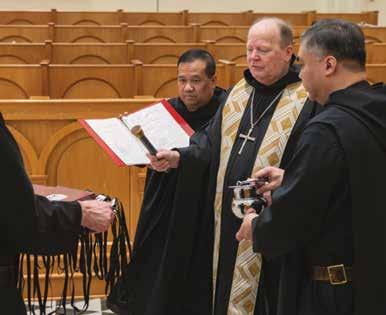
March 1, 2025 Oblate Rites
Final Oblations
Wade “Ansgar” Eckler of Chattanooga, TN
Aaron “Andrew” Rosales of Louisville, KY
Kaci “Frances Xavier Cabrini” Rosales of Louisville, KY
Investitures
Robert Buxton Jr. of Nashville, TN
Donna House of Waddy, KY
Christy Kirchner of Memphis, TN
Melissa Krylowicz of Memphis, TN
Michael Pruitt of Louisa, KY
Bryan Reed of Indianapolis, IN
Joshua Ridgeway of Spring Hill, TN
Michael Riordan of Oakwood, OH
M. Dell Stiner of Memphis, TN
Robert Suarez of Highland, TN
William Toler of Bay Village, OH
Frankie Tucker of Nineveh, IN
Sept. 6, 2025 Oblate Rites
Final Oblations
Elaine “Cunigunde” Ahmed of Mountainlake Terrace, WA
Terry “Theresa” Becker of Louisville, KY
Nathan “Andrew” Cedor of Louisville, KY
Karla “Hildegard” Cedormann of St. Louis, MO
Kelly “Bl. Maria” Gallagher of Huron, OH
Winona “Claire” Hammerstrand of Youth Harris, GA
Scott “Romuald” Kirkpatrick of Huntington, IN
John “Paul” Knight of Henderson, KY
Keith “Nicholas” Mechler of Troy, IL
Marylynn “Rebecca” Meredith of Bloomington, IL
Melissa “Hildegard” Newcomb of Columbus, IN
Joseph “Bl. Martin” Pearson of Cannon, KY
Alfred “Louis IX” Sarno of Dedham, MA
Charles “Benedict” Shackelford of Frankfort, KY
Mary Jane “Teresa” Sheldon of Downs, IL
Raymond “Anselm” Sheldon of Downs, IL
Kathleen “Therese” Shriner of Delphi, IN
Lauren “Mary of Bethany” Trautner of Menomonee Falls, WI
Nick “Peter” Trautner of Menomonee Falls, WI
Bart “Henry” Wall of St. Louis, MO
Investitures
Anthony Brock of Jeffersonville, IN
Jonel “Cat” Cambareri of Madison, NC
Jon Cooley of Nashville, TN
Patrick Coombs of Prospect, KY
Kathleen Deye of Cincinnati, OH
Brandon Dreiman of Evansville, IN
Dylan Fluet of Spencer, IN
Don Jackson of Knoxville, TN
Douglas Jacques of Sierra Vista, AZ
Suzanne Kandret of Johnson City, TN
Jee Yeon Kim of Bloomington, IN
Mary Catherine Kinnevey of Greenfield, IN
Martha Lemond of West Chester, OH
Betty Marcheschi of Newburgh, IN
Kathleen Morrison of Indianapolis, IN
Josephine Olano of Murrieta, CA
Heather Owens of Owensboro, KY
Travis Park of Noblesville, IN
Patricia Ruzicka of Louisville, KY
Jamie Tapley of Dale, IN
John Todd of Indianapolis, IN
Paula Welker of St. Louis, MO
James Wilder of Bedford, IN
Feb. 28, 2026 Oblate Rites
Final Oblations
Amy “Cecilia” Benedict of Hermitage, TN
Robert “Ignatius” Buxton of Nashville, TN
Christopher “Louis Martin” Camp of Owensboro, KY
Travis “Joseph” Dexter of Culver, IN
Randall “Ambrose” Frankart of Springsboro, OH
Molly “Monica” Hardebeck of Brownsburg, IN
Richard “Francis of Assisi” Hoelzel of Spring Hill, TN
David “Joseph” Husk of Beverly, OH
Kody “Benedict” Johnson of Henderson, KY
Thomas “Raphael” Lucero of Pueblo, CO
Benjamin “Paul VI” McCormack of Atlanta, GA
Emily “Therese of Lisieux” McCormack of Atlanta, GA
Bryan “Joseph” Reed of Indianapolis, IN
Joshua “Paul” Ridgeway of Spring Hill, TN
Roberto “Xavier” Suarez of Highland, IN
Chad “Dunstan” Templin of St. Louis, MO
Frankie “Pio of Pietrelcina” Tucker of Nineveh, IN
Investitures
Vivian Janet Bowman of Jeffersonville, IN
John Calvo of Nashville, TN
Andrea Chustak of Mishawaka, IN
Thomas Goetten of Jerseyville, IL
Brenton Ford of Owensboro, KY
Laura Kiefer of Fort Wayne, IN
Gwendolyn King of Greenville, IN
Christopher Marascalco Cummins of Oxford, MS
Jennifer McGuire of Belleville, IL
Paul Miller of Westfield, IN
Rick Miller of South Bend, IN
Manuel Alex Rodriguez of Cincinnati, OH
Laura Tyus of Nashville, TN