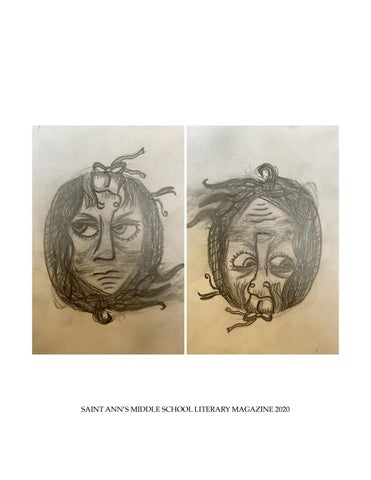
SAINT ANN’S MIDDLE SCHOOL LITERARY MAGAZINE 2020
SAINT ANN’S MIDDLE SCHOOL LITERARY MAGAZINE 2020
STAFF Celeste A., Ezra A., Hannah B., Eleanor B., Amalia B., Cheryl C., Walker C., Becca D., India E., Clementine F., Leo G., Noa G., Ruby G., Mala G., Becca H., Mac M., Mirabelle P., Esme Q., Ramona S., Aiden S., Grover S., Anna Y. HIGH SCHOOL EDITORS Lila H. and Lucy S. FACULTY ADVISORS Alex D. and Liz F.
The staff would like to thank Vince T., Jason A. Betty N., Katie H., Yuri V., Liz L., Dominic C., Margie H., Ramona E., Dolapo D., Asiya W., the Art Department, and the English Department. Very special thanks to Eli F. and Mary Lou K. for their essential help, and to all those who submitted their work to the magazine.
Saint Ann’s School 129 Pierrepont Street Brooklyn, NY 11201
Poems and Stories so (silent the wind blows, Landscape Poem Bud Strawberries Polka Dot Dress The Patterns of the Mind A Memory The man walks over to the lake… Murder of a Murderer Quivers in Fall Mobius Strip West 72nd Street I am stuck in the station The Eagle Little Street Sign on the Corner An unfolding wind… Eclipse Drunken Laughter Ford parks his Bugatti Chiron… C Train Night Haiku Waiter at Peter Luger’s… Ask Me Connected The elephant and the ant The Secret Goldfish Idea The Intruder The linking light of the thinking sky Blessing I am not mad… Mint Oreos Island Ezra Beback climbed out of the subway… Ask Me Lost
Farnel B. Clover D. Hugo K. Louise K. Emma B. Ramona S. Michaela M. S. Maya L. Hektor F.-D. Frankie K. William C. Katherine S.-R. Petra J. Rocco F. Emma B. Hugo K. Leo M. Hannah B. Tobey R. Lyla B. Leo B. Mirabelle P. Naomi D. Cheryl C. Clover D. Lyla B. Zoe N. Boone D. Rhea R. Maisie S. Hannah B. Anaka P. Leo M. Noah K.-L. Lucy M. Rocco F.
1 2 2 3 4 5 6 7 9 9 10 11 14 14 15 16 16 17 19 20 21 23 24 25 26 27 29 30 31 32 33 35 36 37 39 40
The Missing Teddy Bear moonlight falls… Ode to Lovey Memory Christmas Morning Butterfly Fall Leaf Cycle Snow Luna The Human Frailty of Ms. Judith Sconce Ask Me numbing tears and… Buried The Tiger in the Woods Love Blossoms The day The sky is green! Chicken School Morning Fig Tree Hopping Winter Poem I Will Be Sitting Alone Their house lit up from the inside… Enemies August 29 The Rickorys’ Round Table Heat in May Dandelions
Tanner Q. Petra J. Rhea R. George N. Michaela M. S. Lyla B. Anna S.-R. Hugo K. Leo G. Katherine S.-R. Leo M. Phoebe B. Rocco F. Allison S. Cheryl C. Sylvie S. Zoe O. Nigel B. Hannah B. Emma B. Nigel B. Clover D. Chloé P. Petra J. Eland B. Isabel J. Katherine S.-R. Kanayo S. Greta L.
41 43 43 44 45 46 47 47 48 49 52 53 54 54 55 56 56 57 58 59 60 61 62 63 64 64 65 67 69
Art Mac M. Ramona S. Mirabelle P. Sammy S. Katherine S.-R. Katherine S.-R. Carlisle W. Jia M. Sophie P. Levi A. Henry G. Margeurite S. Asha M. Joaquin D. Indigo D.-M. Henry S. Oona G. Rohan J. Nina B. Katherine S.-R. Katherine S.-R. Mateo V. Twyla W. Jia M. Anna C. Arin E. Oona G. Mac M.
Front Cover Frontispiece 2 4 6 13 15 19 21 22 26 30 31 34 36 39 40 44 47 53 55 60 61 62 63 67 68 Back Cover
so (silent the wind blows, so), (cold the wind speaks, so), fast the wind runs so, (fly it fly so high), (the wind fills the sky), that fills the world that fills us all), (that fills me that,) fills my heart) in my world), and my life in Me.) Farnel B. 5th grade
Landscape Poem A billion crows take flight The pear tree takes offense The obedient clouds take on the idea that it’s their duty to soothe the tree with clomping rain But the tree hugged the blurry house instead The pebble took some boots from a store and ran away Clover D. 5th grade
Bud I see a small bud. It Yearns and reaches to be a Flower with mystical colors And swirling shades With pollen lingering on its Neck and bees Of all sorts swooping In and staying for a small vacation Then saying Goodbye and flying away solemnly. But I wonder: when it’s a Flower, will it wish To be a bud? Hugo K. 5th grade
2
Strawberries Ask me how I feel. I am like a small strawberry on a small bush where all the other strawberries have been plucked off by the deadly seasons. Only three others remain. As I love them, They tend to annoy me. There is a little blackberry bush next door. How I wish I could just lean over and whisper to the littlest blackberry and tell her everything I know and talk to her for hours, But we are both tethered here, Bound by the threatening wind. And the scariest thing is that any moment we could simply rot away. Louise K. 6th grade
3
Polka Dot Dress On the first day of school I was glowing like the sun, with my excitement bursting out of me. I twiddled my fingers and my feet wouldn’t sit still, because I was finally becoming a big kid. My whole body was wiggling with anticipation, and Mommy even let me wear my new dress. My dress was white with little polka dots. It had all different colors, like perfect oranges, grapes, lemons and limes. It had a skirt that went down to my knees, and I felt like downy duckling with it on. On the way to school, the crossing guard told me the green matched my eyes perfectly. Did you know you have such beautiful eyes? Yes, I thought, and a more beautiful dress, but I just smiled at her. As we went into the courtyard, I sat in my stroller feeling all tingly. Then it happened all at once. Mommy had a piece of paper, and I brushed against it, and my finger was bleeding. The cut was tiny, a row of scarlet droplets. They glimmered and shimmered like rubies in the sun. I didn’t know why it stung like it did. Such a tiny cut had such a big hurt. Mommy kept saying “shhh, it’s okay,” but the world was swimming around and around. The world was turned wobbly through my tears. I scowled at her, all my sweetness gone sour. I felt like the limes and lemons had soaked into my bones. But then she wiped my tears on the sweater sleeve, and gave my tiny cut a tiny kiss. She started singing, singing my song, and it tasted like snickerdoodles right out of the oven. “Ob la di-Ob la da, life goes on.” I felt okay when I heard Mommy’s cinnamon voice sway, rocking me from side to side. And I didn’t care that Mommy can’t sing because she can sing my song. “Oh, life goes on.” Emma B. 8th grade
4
The Patterns of the Mind the mind has a bus stop. a place to pause momentarily on account of the rough tides that have brought in an orange wind. one might find it appealing to wait for a moment by the bus stop and watch the rain from the muddy windows rather than stand in it. or maybe not. occasionally, the bus is too full of people in red rain jackets who ordered their coffee at the same time to fit too. sometimes it is better to stand in the rain, and imagine that the wind is orange. the mind has a bus stop. Ramona S. 8th grade
5
A Memory Once Once there was a tree Young & spright It danced, its leaves Flowing in the summer wind Turned amber in Autumn & in winter they flaked off, Sashaying in the snow Michaela S. 6th grade
6
The man walks over to the lake, and passes his hand through the water. I see his hair and sword shining in the soft moonlight. He looks up at the sky. It was much clearer than back in the alleyways at the Capital. The stars were brighter, and I know the man sees my soft wonder. I hear him from below, the water sending his words away on the wind like a tale crosses an ocean. “I loved it when I saw the stars above me. They were always the most brilliantly beautiful. Colors of blue, yellow, red and more shone and glittered above my small hands. I remember thinking of them as my own personal mobile, reaching up and giggling. How selfish to think of a brilliant thing as that was all to my own, even at a young age. They sure are beautiful, aren’t they?” I nod, and he smiles. “This world used to be so much easier to live in when I was around your age, you know.” I frown at him, and he smiles. “I’m probably something like 15,” I say. I know that it doesn’t mean anything between us. Nothing but a joke. I turn around and cross my arms. An old willow tree hangs beside me, and the leaves tickle my face. “Grandpa.” I giggle a little, giving away our joke to the world. “Still, it was easier. There was less to worry about. I loved wandering the night just to see the heavens.” He grins. “Is that why you have such big bags under your eyes, Avy?” I turn around and walk over to him. Avy rolls his eyes and sighs. “My name is Sir Avner Hammond, kid.” “I know.” I still worry about his night outings. I don’t think it’s always to see the stars. There was once within the week we met. I had fallen asleep in the inn that Avy had paid for. The bed was softer than the ground, and it was the deepest sleep I’d had in my entire lifetime. But, I woke up in the middle of the night to grab some water, and saw Avy. He was covered in blood. I still don’t know if it was someone else’s or his own, but after that, my sleep was as usual. A faint sound and I’d snap up to see if Avy was okay. I walk over to him, and sit on the bank of the lake. It’s a bit sandy, but that’s not the matter. “Avy, what’s so important about these stars? I get that they’re gorgeous, and you remember them well as a kid. Even a kid like me can see it. But what’s important to you about it?” “Well, besides being my past beautiful mobile, they remind me of gemstones. When I was younger, I thought that gemstones were pieces of fallen stars. If I found a quartz, I’d immediately hold it close, thinking I had yet another piece. Those pieces were dear to me, and whenever I found a friend who I found worthy of my trust, I’d give them a piece of my stars. Not many people have my stars, you see. They’re that important to me. I guess they’re just a major part in my life. My little pieces of stars gave way to many loyal friends.” I look down at the small rough quartz pendant that hung low on my chest. It wasn’t the cleanest, nor was it smoothened like a diamond, but it held bearing in my heart. It was from Avy, after all. “Is that why you gave it to me?” I look toward him. He’s still looking up at the sky, but his answer is firm. “Yes.” I look up at the sky with him. “But you’d trust a little thief kid like me?” “You saved my life all those months ago, James.” He looks towards me, and I look back. “Yeah, but—” “You say this every time, James.” “I tried to take your stuff, Avy.” “Enough with the Avy thing, kid.” I look up at him, then at the stars. They did resemble the quartz hung on my chest. Though it wasn’t the clearest quartz, in the light of the sun or the moon, it’d cast glimmers on the dirt and on my clothing. “I’m sorry Avy.” “What for?” “Because you gave away one of your quartz to me.” “Whatever do you mean?”
7
“Aren’t they important?” I put the little gem in my hand and roll it around between my fingers. It’s a bit sharp, but I don’t care. I find my fingers moving around its surface as I stare down, and gently place it back on my chest, gripping it tightly then letting go. “I told you that they are.” I questioned Avy’s logic sometimes. What did he mean by that? He said they were important, yet gave one to me. I still didn’t know why. He was like the father I never had. He’d kept me safe for so long and didn’t ask for anything back. “Hey, Avy?” I move closer to him. “What is it James?” He’s smiling a little, but there’s still some confusion on his face. “Thank you.” “What for?” “For helping me.” He smiles and he looks down at me. I feel the warmth from his face, and though it’s dark, it’s unmistakable. “I love you Avy.” “Love you too kid.” He holds me closer to him and we watch over the stars as sleep begins to take its hold. Maya L. 7th grade
8
Murder of a Murderer 1964 One fine night, a 57 year-old hunter named Frank returned from the woods to his cabin. He had just killed a rabbit that would soon become his dinner. Frank had a wife named Tasha that he loved very much. They had some dinner, watched a little T.V., and went to bed. As soon as Frank was going to turn off the lamp, he got shot in the leg. Tasha screamed. She quickly dialed 911. When the police got there, they asked her a few questions. One asked if she saw the shadow of the murderer. She said that she saw a short person and tall ears‌. Hektor F. 5th grade
Quivers in Fall The blue water quivers in the brisk autumn breeze as the orange and brown leaf falls in deep Frankie K. 5th grade
9
Mobius Strip Empty world, strange world, abandoned world. An endless tunnel, of time. Never dead but not quite alive... in the middle. Nowhere, but everywhere, in time, but without space. Forest of difference, forest of unity. Where am I? Where are you? “I am in front of you, yet a thousand miles away.� Train of time, train of infinity. William C. 4th grade
10
West 72nd Street As the hours wore on, gradually there appeared on the darkened side of Luriana Everilde’s eyelids the streak of sunlight she knew to be in reality beneath the door. At first all she could see was the inkling in the most left crevice of her vision, but slowly and diagonally it arched upwards, silently interrupted by the crepuscular lacuna of her nose, growing all the while, to complete its crescent across her right eyelid. Stirred, but desiring to savour the final moments of her morning haze, Luriana followed the cobalt and tangerine shapes glide, overlap, and then disappear all together, reincarnated into another colour, another shape, drifting this way, then that, into her fatigue. As she awakened, with her eyes closed the room began to take form: the door under which the sunlight lay painted white, the narrow bottom panel slightly chipped from the time, when the rocking horse was still mounted beside it, Otto, only four, had rammed into it by accident and had broken his collarbone (They say he still has the scar, Luriana thought, but she was still so unconscious that the recollection passed imperceptably). On the bureau, the cheval glass tilted downwards so that she did not have to meet her own eyes’ stare, the venetian blinds hanging still, and the yellow wainscot walls seemed so clear that they enveloped her. It was always like this: never was there a day when Luriana Everilde did not believe it was in her childhood bedroom she was awakening. Suddenly it all came over her, and she opened her eyes just to spite her unconscious for its illusion. Although by now she had occupied this apartment for longer than the eleven years she had lived on Escallonia road, something inside of Luriana refused to succumb to 7E. The light was coming from the corridor; she knew it to be Bernard by the particular sound of the cuffs of his jeans rubbing together as he shuffled up and down, up and down. Luriana’s fingers instinctively began to try to fold back the duvet cover, but they only touched emptiness, and she realized that that was why she had shivered a moment ago--when he had left, Bernard had flung the blanket, if not intentionally, to the foot of the bed. She crossed to the other side of the room to draw the curtains, and, raising her arm taut, she again had the most strange sensation in her right wrist. For a week, it had come and gone, perhaps five, six times daily--that feeling as if her veins were filled with glass. It did not hurt, in fact it only felt like an evanescent chill; It’s nothing, Luriana reminded herself as the light flooded in from the latticed windows, but it was the nothing--the un-feeling--that made it so unsettling. The nimbus clouds coasted low; the brittle branches of the tremendous oak tree towering over all the rooftops trembling at their touch (it was late March). Painfully, she looked away. Bernard would be expecting her. Luriana watched her feet walk down the hallway as if they were not her own, and, as he averted his eyes from methodically cutting up the grapefruit, Bernard caught his wife before she could change, before she could shift into the self other people saw her by. To Luriana Everilde this was the most frightening moment in her life--to be caught, vulnerable, in her spirit, by Bernard Earling. But just as this sent her quivering, the corner of Luriana’s bottom lip curled upwards: He will never be able to fathom what he just witnessed, it is impossible for him to understand anything about me at all. Bernard cast his gooseberry-coloured eyes downwards again, wishing the grapefruit to repossess him, but he found he was unable to hold the knife steady enough to finish cutting around the final triangular segment. It is of no importance, it was simply a moment, she is only Luriana Everilde, he thought, pretending not to notice the voice that dared to ask him why his wife had not changed her last name to his. He placed the blade onto the cutting board, fearing that it would fall if he held it any longer, and used Luriana’s presence as an alibi for his hiatus--“How did you sleep, Luriana, I was just cutting up a grapefruit to avoid reading the headlines in the Times.” As if she could not see the severed pink shell rocking violently back and forth on the kitchen counter. She was taken aback by his question of how she had slept, and had no choice but to clutch the folds of her flannel shirt, almost ashamed. Indeed the words sounded just as strange to him--Bernard was so unaccustomed to expressing any interest in his wife, and asking questions, that the tone remained the same, unchanging so that the sentence assumed the rigid and uncompromising wrought-iron texture of fact. Luriana suddenly seized the formica edge. “That’s the last one, we’ll have to go shopping either today or tomorrow if we don’t want to starve,” her voice two sharp prongs. She did not answer him, and even if she did, never could she tell him of the secret cobalt shapes and her childhood bedroom which her unconscious lived in because she could not accept married life. The overhead fluorescent lighting glared down on them (by the wail of the ambulance, they both formed
11
a mutual understanding that this would perhaps be the last grapefruit they ever ate), and although he blamed it solely on Luriana--he thought her “warped”--Bernard acknowledged that their marriage was, on milder terms, incongruous. Loriana adjusted her grip on the countertop (the fire escape was glazed with rain, they would not be able to go grocery shopping), while her other hand scratched at the vestiges of the tan from their recent vacation in the Caribbean; A February attempt to repair what has always been broken, she scratched as if to remind herself. Centuries ago, it felt like. Just nine days ago, Luriana remembered, she had taken a walk with Josephine Hesper--silence under the cherry blossom tree. Later, when she had asked, Josephine had told her that they didn’t need to speak because sometimes it was almost as if they were the same person. But here she was with Bernard Earling (odious little man with paws for hands, who could hardly cut a grapefruit or ask a question), uncertain whether she would ever be with Josephine again (a petal fell on her shoulder). Luriana sighed. There it was again, her glass wrist. In her pocket, she felt for the poem. Bernard Earling thought it sentimental and stupid that Luriana should carry it with her wherever she went. “You care more about that measly scrap of decayed paper than your own husband!” was the phrase he expostulated most often. It inspired pity, Bernard thought. Why did I ever marry that pathetic woman, Luriana! What a bizarre name--I should have known better! But now he need not shame her, he said to himself, for already she looked so abject, standing there against the peeling floral wallpaper which any day now, he reckoned, would fall to the floor, and so he inclined his chin to glance stiffly at the cutting board, the grains of which were mere wood to him, although Luriana could see so many ever-changing faces in them (he thought it embarrassing, when the rare guest would come over to their meagre apartment, and what would she do, she would stare with that intensity peculiar only to her at the cutting board, at the tiles, for a reason unfathomable to him). Her grip softened; the glass thawed. How many times, Luriana asked herself, have I folded and unfolded? How many times has it creased? She almost saw them there, hovering above the pot of wilting Japanese anemones on the windowsill; her dead parents. Four rectangles whose edges since that year 1997 had rounded to form ovals; dwindling in her pocket each time she opened them to read Come out and climb the garden-path, Luriana Lurilee… (She knew it by heart, of course, but it comforted her to have with her always part of her parents, physically, in that by now nearly-shredded piece of paper.) Since both their deaths in 1997, Luriana Everilde had carried with her, whether in the inner lining of her wool coat, or merely in the palm of her hand, that very poem that had been her mother’s and father’s (Clarence and Iris Everilde--no names were so familiar to her tongue, yet she could not say them out loud). So she held onto her own name, she held onto the poem she had been named after; the name her parents had chosen for her. Bernard had begun to pick at one of the halves of the grapefruit with his fingers, despite the fact that he stood with his lower abdomen pressed against the painted-blue silverware drawer. Luriana could not bear to be in the same space with him any longer, and let her eyes linger once more upon the shadow above the flowers before turning towards the bedroom, restraining her remorse by walking faster and even faster down the narrow hall. (It was late March, on the streets the hyacinths were coming up.) Luriana touched her reflection in the mirror, finger on glass finger to prove to herself that she was real: tomorrow she would be thirty-four. Perhaps Otto would call, and they would chat stiffly about how his cruise had been canceled (The Boys cried for two hours straight, he would proclaim, and she would allow herself to frown at the fact that he called his children that, because he couldn’t see her expression when they were on the phone). Maybe Josephine would call. But most likely, Luriana would go out to Häagen-Dazs and pick up the cake, the chocolate chip cookie-dough ice cream cake she had ordered just two days ago over the landline, fidgeting with the cord--she never did things like that for herself before, never did she voluntarily let herself indulge so explicitly in the tastes of her childhood. Tomorrow at a quarter past two, she thought to herself, I will ride down in the elevator for the first time in a week, and walk six blocks in the rain to Häagen-Dazs. She would hold her umbrella erect, nearly drenching the pointy tips of her boots in the puddles, and every so often, only after pausing to carefully rotate her head and survey the street to make sure no one could be watching, she would jump over one as if she
12
were six. And the essential worker, all alone in the grim white light of the shop, would misspell her name with black sharpie on the box, but she would thank them profusely, walking back in her upright manner, with the red cardboard box in her arms, cradelling it, for at last she had a purpose: she would bring the box home safely. She would stand in the doorway of the building, fumbling for the keys while in the crook of her arm nestling her cake, and a stranger passing by West 72nd street would be moved almost to tears at the sight of Luriana Everilde, in her thin yellow mackintosh, sheets of rain pouring down but not touching her (she was under the doorway, she was turning the key), holding her birthday cake, which she had gotten for herself. Katherine S. 8th grade
13
I am stuck in the station But i utter no explanation Simply for the train I wait I hope that I will not be late I thought the train would come my way But alas; not today Another Q, another B Where oh where is the R for me As longer yet my ballad grows People tramp over the snows Maybe I should join them there And leave the station—Do I dare? I decide I do not The station keeps on growing hot If my train won’t come i fear I will walk to school from here And finally the train arrives Packed, but saving all our lives We all jump uncomfortably Coats are all that we can see Now off the train I shall hop Seeing as this is my stop Into the air so fresh and cool Sadly now im late for school Petra J. 6th grade
The Eagle The eagle fell. She plummeted. The Pain streaked across her left wing. She felt her Eyes shut. Something new but yet… Different. She took A raspy breath And then was still. Rocco F. 5th grade
14
Little Street Sign on the Corner Little street sign on the corner, “Dead end� printed on its front, No traffic current passes through here, This sign invites in no one. But I saw a vine, Climbing up it, Tendrils swirled and curled, Whirling everywhere in sight. This little vine, intricate and inviting, Is mingled with the sign, Its curves and squiggles happily contrasting With the sign’s simple lines. As I passed by the sun hit That little lane, lit up the leaves and ricocheted off the sign. The sun knit the sign and vine, Both golden in its light, And pulled them into each other, Forever intertwined. Emma B. 8th grade
15
An unfolding wind Dancing gently on its toes With the snow falling on the empty streets And only the sound of a Small tip tap on the bare ground Trees frostbitten and shivering in the cold With their leaves the color of a rabbit’s fur Whistling quietly, not wanting to awake the dirt. Hugo K. 5th grade
Eclipse There for a second Then gone Like a Panther pouncing Then slinking away slowly Leo M. 5th grade
16
Drunken Laughter There are lots of stories about when I was little, like the time I broke my mother’s glass bowls that she put peanuts in for parties. Or the time I spilled my father’s martini on his shirt at the Kittenplans’ housewarming dinner. There are many more ashaming anecdotes like this about various members of our family, but this is a different kind of story, one that I could never forget. We were a very normal family, and we lived in a second floor apartment on East 70th Street. There were three bedrooms, so my brother and I got our own and our parents shared the master bedroom. Most of the furniture was older than we were, and it had been picked by my mother and father after their honeymoon. My father was a reporter for the New York Times, and he often wrote the fashion section, as well as captions for the pictures. I used to gawk at the photographs of women in evening gowns and imagine myself standing among them, a glass of champagne balanced in one elegantly painted hand. My mother graduated from an all-women’s college with a degree in English. After she graduated, she wanted to write professionally, or at least find some form of work. For a few years, she was the secretary of some esteemed businessman, until she met my father. At the time, he was a reporter for a smaller newspaper, and one day he came to do a piece on the man my mother worked for. The first person he met at that office was the secretary, my mother, then called Susan Fox. My parents fell in love, and wished to get married. But although my mother loved him, she wanted to keep her job, and she knew that a marriage would prevent her from working. My father interpreted her concern incorrectly, and he reassured her that he could make enough money to support them, and that she would not need to work. My mother was conflicted between these two choices, but after some time, she agreed to marry my father. Two years after their marriage, my brother Mark was born. He was named after my mother’s father, and both my parents adored him. They spoiled him with presents, and my grandparents fussed over his clothes. For a few months, my maternal grandmother moved in and watched Mark’s movements like a hawk. Then she took over for my mother and did everything my mother normally did. After she left, my father would come home early from work to help my mother with him. It was a sacrifice on my father’s part, but to my mother, it was a justification of their marriage. Sometimes my father would sit in his study in a wingback chair with Mark on his lap and a polished silver tray of whiskeys on the table, the two of them surrounded by leather-bound books. When my father finished a drink, he would set the empty glass down on the tray and reach for another. After all the drinks were finished, he would walk Mark around the study and show him the works of famous ancient writers and philosophers. Then he would laugh and quietly muse to himself about how Mark was going to grow up to be a reflection of himself. One day, I woke up to the sun shining in through my grimy window. It illuminated patches of my new floral quilt, creating a criss-cross pattern. I heard a soft knock on my door, and my mother’s dark brown head poked through a crack in the door. She smiled, and I ran out of bed to greet her with a customary hug. She was wearing a simple cotton dress with pleats in the skirt, and she had already donned her jade colored apron and had tied the thin ribbon tightly behind her back. She had no makeup on, but her cheeks were a bright rose color, and I could tell that her hair was freshly rolled from the way it bounced above her shoulders. She smelled like the peonies on the dining table, and like a combination of powdered sugar and butter. After she released me from my hug, she went down the hall and knocked harshly on the door of Mark’s room. He came out with a pout and his eyebrows were scrunched like centipedes. Behind him, our mother was standing with his school uniform draped over her arm. Mark sighed and snatched the uniform from her. My mother laughed at his attitude and joined me in the hall as he slammed the door. She wrapped her arm around me and led me to the kitchen table. My father had already left for work; his work day started at seven-thirty and ended at six. There were three porcelain bowls of porridge set on the table, and the stove was still warm. My mother had been awake since six and she had made my father a cup of black coffee with cream and sugar, as she did every day. Mark emerged from his room, and my mother clucked and rushed over to smooth his rumpled hair. He attended an all boys’ school, and in a year when I turned six, I would go to Spence along with our upstairs
17
neighbor, a girl called Bunny. As soon as my brother sat down, it seemed as if the entirety of his porridge disappeared in one mouthful. He wiped his sticky mouth hastily and patted my head before rushing out the door. My mother stood up abruptly and pushed aside the heavy, beige window curtains that looked out onto the street in front of our building. Mark was lounging at the bus stop, leaning against the pole. My mother sighed, and murmured something about her little boy growing up too fast. Then she walked back and stopped behind me. She raked back my hair with her gentle hands and intertwined the strands. Then she exhaled impatiently and let it fall down my neck. As I finished my breakfast, I spread a finger across my bowl and licked off the remaining warm oats. My mother reached across the table and wiped my mouth and fingers with her embroidered white napkin. The napkin was stained on the upper right corner, and she folded it carefully into a neat rectangle and laid it on the table. Then she picked up all the dishes and placed them delicately in the sink. She squirted soap in and turned on the faucet with a loud whoosh. I listened to her wash the dishes, and despite the warm light streaming through the windows, I found myself almost lulled to sleep by the pitter-patter of the faucet. Suddenly, through the rhythm of the water, I thought I heard the groan of a key in the lock. My father appeared in the doorway, in his suit with his plaid tie loose and askew. His hair was tousled and his circular spectacles were sagging down the bridge of his nose. He shouted that he was home early, and the unfamiliar smell of whiskey clung around him. When he spoke, his words blurred together, masking what he was saying. His arms spread open for a hug, and then, at five years old, I only saw the father that I was glad to have home. As he embraced me, I felt his fingers digging into my back, and that strange scent of alcohol lingered on his breath. Then my mother walked in, and her face was pale and her hands that still held the dish towel were quivering. Calmly, she took my father by the arm before he could protest, and guided him down the hallway into their bedroom, where she closed the door. I heard my mother’s voice rise and fall, and I heard it mingle with my father’s raucous laughter. I listened at the door, and I heard my mother begging, “I can find work, it’s the least I can do.” But my father only responded with another drunken laugh. At some point as I stood there, I heard another key turn in the lock, and I felt the presence of Mark behind me. He and I eavesdropped for what felt like forever, listening in and hoping someone would appear offering us supper. Eventually, I forced myself down the hallway and into my room for bed. I went to bed and I tossed and turned, but the smell of my father’s breath and the memory of him standing in the doorway tossed in my head with me. As I rolled and tugged at my sheets, I heard my mother’s voice pleading through the thin walls. I lay restlessly for what felt like hours. All of a sudden, I heard the creaking of my door. I turned over and feigned sleep, but through my half-closed eyes I glimpsed my mother. She removed her apron and I could see that the pleats in the skirt of her dress were flat and crumpled. Her face was worn and dark circles hung unusually under her green eyes. She smiled in a sort of resigned way and closed the door softly. I have always wondered if she visited Mark, too, but I like to think that she didn’t. I knew that Mark had always been my father’s favorite, and I hoped that I was my mother’s. Through the night, as I attempted to sleep, I heard angry bangs and thuds, and I let myself believe it to be the thunder. When I woke up, there was barely any light coming through my window shades. I lay back and stretched myself out waiting for my mother to come. Eventually, I heard the familiar twisting of the doorknob, but it came much later than usual. Her hair hung limp around her shoulders and although she had her apron, there was a coffee stain on the shoulder of her dress. I noticed a run on the side of one leg of her stockings, and it snaked around awfully, disappearing inside her house shoe. She stood there, her face stone-cold and sullen. Then she painted on a wide, clownish, smile and moved to hug me. I got out of bed and wrapped my arms around her. Even though she patted my head and smoothed my hair, she was stiff and her movements felt false and robotic. She took my hand and led me down the hall. Grudgingly, I followed her. At that moment, I heard the click of a door, and I saw Mark’s face, gaping and confused. The three of us walked down the hall like in a funeral procession. Then, out of the blue, I heard a maniacal laugh and the clinking of a glass. My father sat at the table in my mother’s position, and he was sipping a martini with a drunken smile. My mother sat in his usual place, and Mark and I sat as normal. My mother wiped her hands on her apron, Mark cleared his throat, and I watched, saying nothing. But my father raised his martini and said, “Cheers.”
18
Hannah B. 7th grade
Ford parks his Bugatti Chiron in his garage and stretches his hand against the golden dashboard. He presses a green button that opens his 14-karat silver door. The shiny red paint shimmers as the morning sun reflects its glare onto the car. His black leather jacket brushes against the roaring engine. He turns off his car and strides into his wooden and gold mansion, his 25,000 dollar shoes making a “put put put,� against the concrete. Tobey R. 4th grade
19
C Train People of all colors Slip down spotted grey stairs Late for work, his therapist, her lunch Rip out your Metrocard Is your a one-ride? Slide it down the silver Overused & old Slot - and swipe again Glide through filthy turnstile lazers And hear the orchestra Of rats & rails Screeching in perfect harmony The bugles of a metropolis They announce the arrival Of the only train that stops At Lafayette Avenue And you know it must be yours. So more stairs & steel drum thrumming & heart racing & toddlers whining & old friends laughing Step onto the C train Stand clear of the closing doors, please. Lyla B. 8th grade
20
Night Haiku Dawn, young, immature, Your eyes adjust to the light, The cool morning breeze. Sunset, like you spilled jars of paint across the sky. Goodbye day, goodbye. Leo B. 6th grade
21
22
Waiter at Peter Luger’s has been Pocketing Steak Knives for 17 years! December 16, 2019 Published by the New York Times Bob Brinks, 67, had worked at the world-renowned Peter Luger’s Steakhouse for an impressive 32 years, until this past week. The week before his stealing was discovered, he clutched the title of Year’s Best Waiter. Over 17 long years he had successfully gotten away with stealing more than 200 steak knives. On December 9, 2019, Mr. Brinks’ daughter, Lucinda, found his stash of disturbingly sharp steak knives in his drier machine. After asking her dad about this odd appearance, he immediately admitted that it was his collection (according to Lucinda.) He took pride in the fact that on a monthly basis, he groomed each and every one of them. Following this conversation, Lucinda says she became very afraid. Her dad appeared to be some kind of psychopath killer. She informed Mr. Brinks’ ex-wife (Lucinda’s mother) about this, asking her from the bathroom to, “Please check on him and make sure everything is okay. Like he is not killing people, right? Like seriously. I’m concerned.” When Lucinda did this, she was oblivious to the fact that these knives were stolen. After hearing this Lucinda’s mother, Diane Salton, hurriedly came to Mr. Brinks’ Williamsburg apartment. Lucinda opened the door for her mother and she rushed in. Ms. Salton says she was quite nervous to be barging in, but didn’t want to leave her daughter alone in this unsettling situation. Lucinda felt extremely overwhelmed, so she exited the apartment to get some fresh air. Ms. Salton quickly found the laundry room and opened the knives-filled drier. She says she observed them, shocked by their cleanliness. Looking closer at the handle of one of the steak knives, she saw an etched PL (Peter Luger’s.) Astonished that these were from his workplace of 32 years, she gasped. She then called the police. Mr. Brinks was not the kind of person his piers had perceived him to be. The cops soon arrived and arrested Mr. Brinks. His trial is yet to come, with the date of December 4, 2020, almost one full year from now. Lucinda is extremely devastated about the incident. Bob Brinks has been fired from Peter Luger’s and his plaque of Year’s Best Waiter has come down. The New York Times interviewed Mr. Brinks’ boss, Brian Lakritz. He says, “Bob was one of our best waiters. He had served us well for 32 years. I am utterly shocked that Bob would do such a thing. I am quite disappointed. He knew perfectly well the cost of those knives. As for myself, I can’t believe I didn’t notice. A staff member informed me about the disappearing knives, however it is quite normal for things to disappear at large restaurants. I assumed that the knives were quickly going dull and being thrown out. I would never have predicted Bob’s foul actions. He just doesn’t seem like that kind of guy. He must’ve just snuck them into his bag one at a time, or something. Bob, I’m disappointed.” The New York Times contacted Mr. Brinks, asking him how he got away with taking all these knives. He says that he would, when he felt like it, put two knives into his apron pocket. He would then go to the bathroom and put them underneath his foot in both shoes. He says it was quite uncomfortable, but made him feel indestructible. He endured this pain more than 100 times and ended up with more than 200 knives to store in his drier. It is still unclear why exactly Mr. Brinks did this, as he seemed to have no use for the knives. He would just groom them. Was he bored? The New York Times will do a follow up article about Mr. Brinks when his trial is through. Keep your eyes aware for more odd news stories like this! Mirabelle P. 8th grade
23
Ask Me When the sun begins to set, Ask me what I have done. Ask me What I have accomplished, and the sun Will whisper in my ear. When the moon comes up, Ask me why I am here. Ask me What is my purpose, and the moon Will tell. When the world continues spinning, Ask me the answers. Ask me What to do, and only the world Will know. When the water stops flowing, books stop being Read, the world stops moving, ask me, “What did we do wrong?� Naomi D. 5th grade
24
Connected I like living rooms with a clear view into a conjoined kitchen and dining room, especially my grandparents’ Like bones or organs, rooms are often thought of as separate, but they all have more of a sense of ‘togetherness’ to me To me, my living room, kitchen, and dining room is not a living room, kitchen, and dining room. It is a livingkitchendining room full of as many memories as there are colors splattered across the walls in the short connecting hall Full of as many footprints of emotions that have walked into our lives without warning as there are binders in the 2 copper colored closets stacked between the conjoined rooms Full of as many hugs and kisses as there are cartons of chrysanthemum tea lining the racks of the mini fridge that cover a square spot in the hallway Of as many snores and sleepless nights as there are pots and pans just lying about in the deep crooks of the kitchen cupboards A leg Arm Kidney Or foot No matter how unimportant you think they are, are they not still working together as if they are one? Are each not residing in one whole body and working together even though they aren’t under the same name? That is how I see my living room, kitchen, and dining room. I like being able to hear the herd of jolly conversations running out and into my ears like a runny egg. I love the savory mouth-watering scent of rice and side dishes that spill out like innards, but more like the filling of soft dumplings when you puncture them. They make me feel less lonely. The few scents and noises make me feel as if all of the most jolly scents and noises in the world have come as one to embrace me They create a feeling of warmth throughout my whole being like the way a warm soup does Because I’m happy Because I’m not alone. Cheryl C. 8th grade
25
The elephant and the ant Says the ant to the elephant: “Oh! Giant of the jungle. Your trunk a writhing snake, Your side an endless wall, Your tail a caressing rope, Your ear is a prejudiced fan, cooling only you.” Says the elephant to the ant: “Do not think of yourself as a fool. My age not only gives me Wrinkles, but it makes me very wise. If I were to tell you one important thing in life, it would be I THINK ELEPHANTS ARE BETTER!” Clover D. 5th grade
26
The Secret Goldfish The overcast sky is nefarious, daring anyone to try and face it. But I know better than to be afraid of it. Once my bright green boots are on, I tiptoe out the door. I’m never one to miss any bit of the rain. I’m all alone, since everyone else is sick of it. I gently close the door, because I know Marge is sleeping. She’s taking care of us for now. Whenever a drop of rain lands on the grass, she’s out like a light. I listen for the click that means the door is locked. I’m free. As soon as I step outside, the boom of thunder greets me. I run towards the creek that all sorts of strange knickknacks land in when the rain comes. I almost trip, since my boots are a few sizes too big. They were my sister Betty’s once- I think. I don’t remember her very well. They shipped her off, like me, to somewhere far away. I feel a sharp pain in my gut and I try not to think about Betty anymore. I stare at the ground. A little worm is wriggling around in the dirt. I love worms. I pick him up, and pretend he’s a friend of mine. “What shall we do today?” I ask him. He just tries to burrow into my hand. I smile and softly drop him to the ground. I walk for a minute or two until I reach the creek. The rushing sound of water is familiar to me, like home. I can’t remember home very well, but I remember the feelings. I know it wasn’t as cold and rainy as this. Somewhere watery. Flowy. It was warmer. There were friends everywhere. All my worries were things that would pass by; they weren’t stuck like lice to my head, constantly itching. And the smell. You could always smell the sea. Smell it at school, smell it on the swing-set at the park, smell it reading Stuart Little in your hideout in a tree. Always there, wrapping you in soothing safety. I wish I was safe. Here, all it smells like is dirt and rain all day. I sit on a rock beside the creek, listening to the fishs’ favorite song. I pick up a rock and make a wish. I wish for the war to be over. I wish that Ma were here, ready to wrap me in her loving, strong arms. That Pa could toss me up into the air like he did when I was little. I wish I could go back home. Ma loved to tell me advice. She would say, “Mary, I know how you feel. But we can’t just keep wishing until the world is going to spin the other way round. We have to work hard for our wishes.” But that was back when my wishes were for a piece of chewing gum or a new dress. Not for this war to end. Not for all my siblings, who I can only recall the most faded memories from, probably live dozens of miles away, to come home. I try to skip my rock, but I’m not sure how. It just plops down to the bottom of the creek, never to be found. I hear another thunderclap, and it’s like the sky opened up. Water gushes down my back and chills my spine. I shiver. My hair is soaked. If Marge saw me like this, she would hit me so hard I wouldn’t be able to sit down for a month. I stare at the creek and swallow hard. But I notice something I’ve never seen before. It’s bright orange, and swimming around in the creek. I ate an orange once, and that’s what it looked like. All feathery and plump. But this, no, this is a fish. A fish the color of the setting sun. I tiptoe over to it, as if I’m going to startle it. It doesn’t notice me. I decide I’d rather have a fish than a rainboot and take off my green boot. First of all, I dip my boot into the creek like a bucket so he’ll have some water. Then, in a flash, I scoop him up and plop him into my boot. Now he’s scared. I put my face as close to the water as I can, so close that I can see his shimmery scales. He’s beautiful. I name him Snowbell, after the cat in Stuart Little. He darts around, afraid of my giant face. Like I’m ever going to hurt him. He is the sun in a watery sky. I scoop up the boot and run back up the steep hill to the house. The sky is growing darker and darker; I imagine it’s almost supper time. Water sloshes around in my boot. I open the door as quietly as I can, and sneak Snowbell into the house. I’m not sure where to put him, since Marge has a keen eye for mischief. She’s always peeking inside cabinets and things to make sure we’re not hiding anything. There’s really nowhere I can hide him where he won’t be found. So I put him in the oven, just for the time being. “I’ll be back, Snowbell,” I promise. I flit upstairs and put on some fresh clothes. They feel nice against my skin. Embracing me. They’re warm, dry, and clean, something that’s not very common nowadays. I’m surfeited with staying awake. So I sit down on my bed, and it’s like I’ve never sat on it before. In a millisecond, I’m snoring. I wake up later. I’m not sure how much later, but later enough that the rain has stopped. I’m surfeited
27
with the rain too. It kind of looks like God is drooling on us. Apparently the pretty girl He was staring at walked away. I get up and smell vegetable casserole. Another thing I’m all done with. Like I have a choice. But I lounge downstairs anyway, taking my sweet time. I get to the table, and I observe everybody. Marge is holding a casserole that looks like it’s been chewed on by some old geezer and then spit out along with his dentures. All the other kids are sitting at the table, frowning at me. But Marge has a face of stone. “Mary!” shouts Marge. I jump. “Eat your supper! I worked hard to prepare this just for you.” So I take a poke at it. But something’s fishy when I start chewing. Like, really fishy. I spit it out and notice something orange in my bite. “Marge, is there any fish in this casserole?” I ask. “No. It’s vegetables, and you’ll eat it whether you like it or not.” I poke my casserole for a bit. And you’ll never guess what I found. Two eyes and orange fins.“What’s going on?” I ask. Barb shakes her head. “You’re late,” she says. “Marge wouldn’t let us start without you.” Marge serves us but I don’t touch the casserole. I feel a poke in my rib, and I turn. Charlie. “What’dja do that for?” I ask him. “Where were you?” Charlie says. “Sleeping,” I say. “That’s better than this,” he tells me, and turns back to his casserole. He just stares at it. “Oh, Snowbell!” I cry. The other orphans ask why I’m crying, and so I tell them the whole story about my secret goldfish while Marge is in the loo. While sobbing. They don’t seem to understand. They just laugh. Except for Charlie. “Not so secret anymore,” he says. I’m going to pound him. Lyla B. 8th grade
28
Idea I feel An energy pulsing through My mind and fingers Exploding onto the page In strange symbols We call letters. Just a small seed shooting out of the ground And from the inside, A rushing river, Crashing and splashing harshly through the channels of my mind. Pulsing through my fingers once again. A small seed can transform Into a great, grand idea Zoe N. 4th grade
29
The Intruder As you step into the elevator, you notice. You notice the man with the scarred disfigured face, perhaps from a mishap involving fire, but stare excessively. You ask with your eyes, “What Happened?” to which he aggressively responds: “What are you looking at?” Avoiding embarrassment, you look down. When you do, you see a five-year old child who stares back up at you in turn. You both stare, in a trance, until a concerned mother pulls her child away. “Creep,” she signals, as she turns around. You look up, but only into the face of a tall man who looks down on you with resentment. “I wish I was tall,” you think. “I wish I was average,” He thinks. You begin to rapidly change the position of your eyes. Everything you do is intrusive to someone in some way. You close your eyes, hoping not to see a private act. Your new blindness only enhances the rest of your senses, and you can feel the words on the paper that the man in the corner with the dark sunglasses is reading, and you can tell what app the previously crying toddler is playing with on the phone his mother gave him to have mercy on the rest of the elevator passengers. You are a timid rabbit on a shooting range - you sense everything. You feel through the vibrations in the elevator floor. You hear the near silence, interrupted by a cough, sneeze, or simple fidget. You feel each set of eyes and who they invade, but still don’t dare to follow suit and impose yourself on any innocent being. You want the floor to fall out and send only you tumbling down the shaft, where you can open your eyes and not be afraid of anything or anyone. But why should you pay for it when they take offense? You wish that they would fall down the seemingly endless shaft, and be forced to look into each others eyes for the eternities that they will fall, leaving you to have a peaceful elevator ride which seems like it never ends. Oh, if only you could be in solitude, with no one to make you feel guilt. You wish that this whole reality would curl up in a little ball in the corner as you wish to do and disintegrate into nothingness, and you could wake in an alternate universe: One where you are alone as all your worries slowly slip away. Boone D. 7th grade
30
The linking light of the thinking sky The ocean so clear and the sky still thinking Protected from miseries The soft sun beaming with light of linking The blue of day is slowly blinking Lemonade cool like night The ocean so clear and the sky still thinking The water is warm in need of kinking Relaxation is to dismiss the fright The soft sun beaming with the light of linking The life under constant inking Is unavailable in my light The ocean so clear the sky still thinking The day down be done the sun is sinking The colors swirling together tight The calm sun whispering with the light of linking The ocean so clear and the sky still thinking Rhea R. 5th grade
31
Blessing Blessing the sun may your light radiate through every window forever, may you stay up in the skies around everyone may you continue to be the only aspect that is really the same in everyone’s unique worlds may your rays always glow, and gleam and your fire always burn and may you keep glimmering, while the plants grow everywhere under your warmth and may you always shine on the ones who need it most Maisie S. 5th grade
32
I am not mad. Believe me. I am perfectly sane. I live alone in a grand house on a secluded street and some find me mad for that. No, I am not mad. Only I like the silence where I can paint without interruptions. The mailman knows this, so he waits until I am done painting, at eight o’clock at night, to deliver my mail. But I seldom have any, anyways. There are almost never pristine invitations to balls and parties waiting for me in the mailman’s gloved hand. Sometimes there are parking tickets because I forget to move my rusted car, and it waits for me across the street. I sit on my stool and lift my brush. My elbow creaks and I grimace. My hair has gone gray, and it has been like that for so many years that I don’t believe I can count them. I slowly walk out of my studio, and the floorboards creak, daring me to set my foot down harder with each step, to split the floor in two. I wander towards the kitchen, searching for a radio to play as I work. I hum quietly to myself, and the sound bounces off the walls, replicating again and again. I stop at the table and sit down, for it hurts when I walk too far, or up and down stairs. I curse the vast expanse that is this house, left to me by my deceased father. As I curse it, my father’s voice echoes in my head. I scream for the voice to go away, to leave me alone. The neighbors find me mad for this. They want to haul me off to an asylum. But that would leave this old house alone with its creaks and ailments, and it would be without me to suffer my own creaks and ailments along with it. I sit here now, and I have forgotten what I came for. I sit, staring at my grizzled hands and my knuckles that protrude like grapes, a result of these long days alone, spent holding up a paintbrush to canvas. I hear the jolly tune of an accordion drifting up from the corner. Now I remember what I came for. The music reminded me. I slowly stand up, yet I still feel the blood rush excitedly up into my head. The radio is not far away, and I hobble towards it, wishing for a sturdy cane to support each footfall. I pick it up gingerly, and my arms sag under the weight. Slowly, I walk back to the studio, and instead of daring me to break them, the floorboards seem to threaten to break themselves. I set the radio down and turn it on. It sputters to life and music quietly streams out as I sit down. I begin to lose myself in my work, and I start to hum along with the music. This time, the sound forgets to bounce around, and it keeps itself pleasantly contained. The brush casually sweeps over the canvas, and my arthritic hands ache, but I ignore them. I wipe away a fleck of burnt orange paint from my gray hair. But it still leaves a streak, and to my eyes, the colors clash terribly. I stand up and walk methodically to the sink in the corner of the studio. There is a mirror perched above it, and I glance at my reflection. I turn on the faucet and look at my intently staring eyes, and I notice how my hair dances in a wild crown above my head. My forehead is creased like a letter, the kind that is never left at my door. The water drips into the basin as I study my expression. My eyes are so wild and my lips look so parched that I am momentarily scared by my own reflection. Yes, my expression scares other people, too. They find me mad. But don’t worry, I’m not, I assure you. As I scrutinize my reflection, there is a knock at the door. Has this much time passed for it to be the mailman? I hurry out of the studio, neglecting to turn off the tap. I seem to be a blur of motion, and I forget to listen to the creaking floor. Then I hear a knock. And another one. I let myself think that many people are here to see me. I yell that I am coming, but the knocks persist, growing louder with each one. I reach the door and tug it open, but there is no one there to greet me. But the knocks continue, rising and rising into a cacophony. They overlap and trample each other, and somewhere in the background, I hear the steady plink of water in the basin. Muffled voices enter, and they too rise rapidly. I turn wildly on my doorstep and scream out for them to
33
leave me alone. My voice mingles with the other voices and the knocks, and the steady plinking of water in the basin, and my voice sounds strangely right among them. I cry out again, but it seems I have lost my capacity for speech. I have no real faces to shut the door on, so I shut it on the knocks and the voices. But even after I lock them outside, the steady plinking of water in the basin still remains. Hannah B. 7th grade
34
Mint Oreos the single utmost taste of mint and chocolate is a gift from the gods. the dry, flaky refresher is grabbed from the shelves of the CVS that has been there indefinitely. going to the counter, pulling out of your wallet six dollars, shoving the change into your zippered pocket, and requesting no plastic bag to carry your essentials, hiding it within your jacket to conceal the warmth it brings you. you know you shouldn’t be this joyous for such a trivial treat, but you can’t help it. oreos can do that to someone, you know from experience. throughout the long day, you’ve been daydreaming dipping your delectables into milk and letting it turn soggy to sync your white teeth into, but you know your teeth won’t stay awake for long. the Engravings on the chocolatey cookie feel familiar, as you lightly rub the ridges before you dip. the mint cream looks artificially smooth, the mint color soothing your eyes, experiencing anesthetic that you strive to achieve for yourself. you feel satisfied after just your few first bites, putting this wonder into the bottom of your bag to enjoy in the somewhat near future go, you rush to the bathroom to cleanse your hands of the chocolate you were he but will. You glance at your tainted teeth, but smile as soon as you reach your destination, you will rinse out all the good memories associated with the browned tint. to free yourself from the aftertaste, although do you want to be freed? Anaka P. 8th grade
35
Island Sailing and then You see it High craggy peaks Jagged rocks And ancient trees You feel something, a pulling, Deep in your soul like a caged animal trying to escape You pull in the jib sheet and land the boat Stepping onto the island You feel strange like you’re coming home Leo M. 5th grade
36
Ezra Beback climbed out of the subway and into the early morning sunlight. He took a deep breath, smoothed down the non-existent wrinkles in his ironed suit, and walked into the building. As soon as he walked into the building, he was immediately bombarded by the sounds of the office. People were shouting into their phones, keyboards clacking, and printers whirring. But as soon as he walked in it all seemed to cease. Everyone seemed to be staring at him as he walked to his desk. It was his first day back after his sabbatical. His old secretary had passed away when he was on sabbatical. He had attended her funeral. He mourned her, because she was a very good secretary, but since she was very old, sometimes she didn’t hear what he said. As he walked into his office, a woman was sitting at his desk, with her hands clasped in her lap. She was dainty and looked like she would crumple in a strong breeze. She was a half decent secretary though, and as the day progressed she proved she could get the job done. When the day ended, he hopped on the train and headed home. It was a rainy night, which matched his mood. He couldn’t quite put his finger on it, but he always felt a little lonely and disconsolate.And as he arrived home he faked a smile to his wife, pulled the pill bottle out of his pocket, popped one, and excused himself to bed. The next day was more of the same. He slogged through work, and when the day was finished he started towards home. But halfway there he remembered that he had to stop by the post office to send a letter to his wife’s mother. He sighed, switched trains, and headed over. As he left the station he paused for a minute to enjoy the sunset. Every day when he was going home, he paused and looked at the sunset. It was the one part of the day that he enjoyed. It was a ritual, and it really calmed him to stare at the sun sinking behind the clouds.As he walked into the post office, he bumped into one of the mailmen. The man’s breath came hot and fast against Ezra’s neck. Ezra smelled his cologne. Ezra stared into the man’s piercing blue eyes for a beat. The man then broke into a friendly smile. “Hi!” he said cheerily. “I’m Andre. Can I help you?” Ezra blushed. He remembered this guy. He had talked to him before about the Mets. “Yes, can you please deliver this letter to 374 Yare Street?” Ezra asked, handing him the letter. “Of course!” Andre chirped. He began to walk away. “Hey, would you like to go to the coffee shop sometime to get something to eat? They are doing a special where if you wear a sports jersey you get free drinks,” he asked nervously. “Sure!” Andre replied. “Does Saturday work?” Ezra grinned. “Yeah, that works.” The following day, Ezra headed home with a spring in his step. He popped another pill. The next day, he would meet Andre. The sun cast a shadow in front of him. His shadow seemed to stretch all the way down the block. He smiled, and trotted to his house. Ezra had not felt this good for a very long time. He enjoyed his day at work, and left a little early to get to the coffee shop. He shook the pill bottle and was surprised to see only a couple were left. He popped one, and started walking again. He passed a man who was down on his luck, and handed him a dollar. The man beamed at him. Ezra beamed back. He strolled into the coffee shop. His fingers drummed impatiently on the table as he waited for Andre to come. Minutes ticked by. Ezra was getting impatient. But as he got up to leave, Andre burst through the door, red faced and out of breath. Ezra’s heart leaped. They sat down to lunch. They talked for a long while. People stared at him but he didn’t really care. Time seemed to pass in a blur as they talked. Minutes became hours. It was like the subtle changes from spring to summer. Ezra was vaguely aware that time was passing, but he felt no need to stop it or really to move. He just wanted to stay in this moment forever. They laughed and laughed, until eventually, Andre heaved a sigh and said, “Ah, well, I best be going.” Ezra’s face fell. “But, same time next week?” Ezra sighed in relief. “Yeah!” he said trying to be casual. “I mean, yeah.” The week passed in a blur. Ezra could not wait to see Andre again. He felt that Andre was the only thing that kept him afloat in life. When Saturday rolled around, Ezra raced to the coffee shop. Again, Andre was late. Ezra was dismayed. He waited and waited but he didn’t come. He wouldn’t come. Ezra sat there all night but he never came. Ezra trudged home in the dead of night. He pulled the bottle out of his pocket and with shaking
37
hands, popped one.The next day he went to the post office, desperate to see him. He ran up to the desk. “Excuse me is Andre here?” he said with a note of desperation in his voice. “No, Andre doesn’t work here anymore,” the clerk responded coolly. “Can I help you?” Ezra tore out of the post office with tears in his eyes. He ran home. His wife was there, doing the dishes. Ezra froze. His wife had never really appealed to him but her family had a lot of money, and he fit in if he had a wife. He ran up the stairs and packed a bag. Outside of work, he would spend all of his time scouring the streets of this city to find him. He knew this was crazy. Andre was just a man he had met a couple of weeks ago. They had really hit it off, but that doesn’t warrant tracking him down. He took a deep breath, put down his bag, and went to sleep. Ezra’s life was back to the dull cycle it was before. His life had always felt dull and gray. That’s why he loved sunsets. They were splash of color across a dull gray day. Andre was that streak of color for him. And now that he had seen it, he couldn’t go back to that gray. He was usually a little quiet, but his boss noticed that he was especially quiet today. Especially after those couple weeks of perkiness. Since he was one of the best lawyers at the firm, his boss sympathized with him, and told him to take the rest of the day off. The day was nearly done anyway, but it was a nice gesture. He went to the coffee shop he used to go to with Andre. He sat slowly stirring a coffee. He did not know how long he had been sitting there until then he heard a familiar voice. Andre strode into the coffee shop. At the sight of him all of Ezra’s melancholy evaporated. Until he saw that Andres’s arm was around a girl. She leaned into him laughing at something he said. Ezra ran up to him. “Andre!” He sighed. “I’m so happy I found you.” “Who is this?” the girl next to Andre whispered. “I don’t know honey let’s go,” Andre said and they walked out of the coffee shop. Ezra was distraught. His mind was whirling. He got up and left the coffee shop. As he walked to the subway he saw his shadow. It seemed to have shrunk. Once he was on the train, he broke down into tears. He pulled out the bottle of pills but it was empty. Then, it hit him. It had happened again. Andre was just a hallucination from the pills. The only reason he did the drugs in the first place was to give his life a little color. But he couldn’t stop once he started. He saw his reflection in the mirrored walls of the train and he looked older. The train doors slid open. He wiped his eyes and stepped out into the street. It was overcast, and drizzling. There would be no sunset tonight. Noah K. 7th grade
38
Ask Me When life is hard and all the fires are roaring around town again, ask me. Ask me about the good times when I was young. Because you are young and have no good memories. All your life has been hardships and trials. I know because the hills have told that those times will come again, to torture humankind. I went to the valley where that will happen. I climbed up the mountain where you will die knowing it is a high one and knowing that your children will die in the valley that is soon to come. Ask me about love for you won’t see it until you go to the rows of mountains and valleys that are far away from the ones you know. Ask me then where you are, for I’ll be there with you and I’ll respond, “You’re dead.” Lucy M. 5th grade
39
Lost I run I scream Come back to me! Please come back I‌ I... I need you People turn to look at me Someone asks me where my mother is They look taken aback Come back I yelp in a choked voice Please, I need you. Rocco F. 5th grade
40
The Missing Teddy Bear Arthur had been busy at work when he saw on his watch that it was half past one. This meant it was his lunch break. He let out a happy sigh and packed up his bag. Arthur walked out of the building practically skipping. It was a grey day outside but the city still felt cheerful. He was just around the corner from the sushi place when he noticed something was wrong. The corners of Arthur’s mouth drooped and his eyes bulged out of his head. Suddenly, all alone standing on the sidewalk, Arthur felt his heart lurch. He looked around at the street with people swarming around him like a storm. Arthur bolted back up to his cubicle and was horrified by what he found: His teddy bear was missing from his cubicle. The lines on his forehead creased as his heart began to thud. Was it with him this morning when he had arrived at work? He could not remember. To Arthur, the teddy bear was the one joy in his world. It was a gift from when he was a kid and he had cherished it ever since. When kids made fun of him at school he would go to the bathroom and hug his teddy bear. Those nights when he heard his parents arguing outside his room he would clutch his teddy bear, Hugo, tightly as he fell asleep. Arthur hunted the whole floor he was on. He climbed up the walls to see if someone had put Hugo through one of the missing ceiling panels. Arthur looked through the men’s bathroom and the women’s. But once he felt he had searched the whole entire floor he took a break. Arthur checked his watch. His lunch break had been over for the past hour. He tried to lean back in his uncomfortable chair that he wished would recline. He had a bad headache and his face was stuck in an unpleasant expression. Once work was over Arthur made a sign for Hugo. With a big picture of Hugo in the middle, the sign read:
Missing Teddy Bear: Name: Hugo Wallabee Birthdate: 1994 If found please call 929 555 4098
When Arthur walked out of the building, he did not have that feeling of satisfaction he usually felt after work. His work was not done for the day. Arthur would have to spend the night hanging up flyers and searching the city for Hugo. As he walked down the cold wet streets he felt his stomach turning. There was a strong discomfort Arthur felt when he was without Hugo. Arthur knew there were so many places Hugo could be, yet; he didn’t know where to start. All he wanted was to be home with Hugo. As he carefully hunted for Hugo down the damp streets a horrible thought began to creep up on him. Could he have left Hugo on the subway? Arthur felt the earth cry with him as his tears blended into the rain and his whole body turned sopping wet. Arthur remembered the day he had lost his grandmother’s note when he was ten. The one thing he had at the time to comfort him. He carried it everywhere with him just like he did now with Hugo. When Arthur came home crying with the conclusion that the note was gone forever his brother hugged Arthur so tight he could hardly breathe. “It’s okay,” his brother had said, “we’ll find you something else.” And so his brother bought Arthur Hugo with every last penny he had saved up. Arthur slammed the flyers for Hugo onto the lamp posts and mailboxes. He had almost reached the subway and only had four flyers left. Arthur asked an MTA employee if they had seen Hugo while holding up his flyer. But all the MTA employee did was shrug as he looked at Arthur with narrowed eyes. “Excuse me everybody,” screamed Arthur when he had reached the subway station. Holding up the flyer, he continued, “If any of you guys see Hugo please call me. My phone number is 929 555 4098.” Most people did not even acknowledge Arthur’s presence whilst others’ foreheads wrinkled as they looked up at him. Arthur hopped on the first subway that came. He made speeches on the subway and put his flyers obnoxiously close to other people’s faces. Everybody who looked at Arthur had twisted up faces as if they were trying to identify if he was a crazy person or not. After Arthur had gone through all of the cars in that particular subway, he transferred to to the next. He had gone to four different subways by the time it was three am. Arthur
41
decided it was time to go home. Feeling defeated, he reluctantly walked into his own subway hunched over. Arthur searched through every car and made speeches in every one. His limbs didn’t move as easily anymore and hearing his own voice felt strange. When Arthur had reached the last car of the subway he finally collapsed in a heap onto one of the seats. Arthur looked out the window but the only thing he could see were the blurry train tracks. A homeless man was coughing in one of the seats as a couple kissed across from him. Hugo usually would sit on Arthur’s lap when he rode the subway. “Other people need to sit too,” he would tell Hugo. But thinking about Hugo made Arthur bang his fist on the seat beside him. The couple across, frowning at him, moved to the other side of the car. “This is 23rd street,” said the robotic voice from the loudspeaker. And Arthur walked off the subway with glassy eyes. His parents would be mad that he would be coming back so late. But he did not care. Arthur knew how the night would go. His parents drinking and drinking which led to them fighting as beer bottles were thrown across the small apartment. As Arthur walked out of the subway, he began to feel everything crashing down on him. His angry drunk parents, his empty room with no Hugo. When he arrived, the house was dark. Arthur quietly shut the door and took off his shoes. A disheveled woman came out with some sort of stick that she was using as weapons. “Who’s there,” she said, with no fear in her voice. Slowly, she inched closer jutting out the stick. Arthur turned on the lights. Her nose was bright red and scrunched up as her eyes narrowed. She began to reprimand Arthur about how he was not in time for dinner. But Arthur just stood there not making eye contact with her. Instead he stood and stared at a small picture on the table. It was a photo of a little boy smiling at the camera. Although he was showing his teeth his eyes were very concentrated. “CAN YOU HEAR ME? LISTEN TO YOUR MOTHER. WHY DIDN’T YOU COME HOME IN TIME FOR DINNER?” she said. Arthur looked up at his mom. He opened his mouth, but nothing came out. Tears trickled down his cheeks. “Hugo is missing,” he said softly, the words came out mottled. His mom looked up at him. Her eyes were burning. “Hugo is dead,” she said and let out a sigh. “And it’s your fault.” Arthur was staring at the photo again. On the frame of the picture of the little boy, the name, Hugo Wallabee, was engraved. “Don’t bring my brother into this,” said Arthur, “I was talking about my teddy bear.” Arthur’s Mom walked off after that. But right when she had reached her room, she turned around. “I wish you were more like your brother,” she said, too tired to raise her voice. Arthur walked off to his room. He lay down on his bed he had had since he was a child. He did not fit on it anymore. The sheets were cold and the mattress was hard. Arthur turned and saw the bed across from him. No one had slept in it for years. He began to sob. Tears were flooding down his face. He felt bare and alone in his small room. No brother to comfort him, no teddy bear to squeeze tight. Tanner Q. 7th grade
42
moonlight falls in quiet, narrow beams connecting with the ground, it slips down gentle and sweet, fizzling silently in a silver pool of snow and light falling again again and again alongside the many armed crystals of ice who drift steadily to the streets below laying themselves like bricks that form a glittering white wall shining in the darkness untouched, impeccable in the rosy dawn sunshine melts into the snow weakening the wall finally it breaks through exposing the wet ground beneath warming the cold gold to silver Petra J. 6th grade
Ode to Lovey When I got you I shouted with joy You are there for me There for me when i’m sad Or mad I can cry into you I hope you don’t mind You cuddle me in the night Read my books with me You let me hold you when i’m in pain Dear Lovey, I love you. Rhea R. 5th grade
43
Memory Without memory, we wouldn’t know what We had done that was wrong and We wouldn’t know how to correct it Without memory, our heads would be empty And we would not know what to do if we were bleeding Among the rocks, the artists have carved pictures of nothing because they forgot how to draw Without memory we wouldn’t know we were alive So we wouldn’t live George N. 4th grade
44
Christmas Morning Earlier a phantom appeared Clothed in vermillion and snow Deliberately placed packages Under bows of green Biscuit embedded in his coat A final parcel on the stony ingle With a flourish of soot The door clangs shut In the silver light of dawn Children arise in ecstasy Gentle flakes blanket the panes The fire ablaze Wrapping paper crinkles A ribbon placed so delicately Pine scent wafts through the cabin A sparkle of joy On the hearth Dusted in fizzling embers A lopsided gift fell astray Claws grasp it like a secret Eyes shut in prayer For value and riches The paper sheath torn off Surprise Michaela S. 6th grade
45
Butterfly Lacy, perhaps delicate Flutter into my eyes Ghostly And purple Painted maypole, you flip & run from the wind Land in my hand The strawberries’ envy You shy girl Timid at tea, but not in the garden Perch on your daisy And dance with fireflies Tickle my hair With fragile fingertips Wispy whisper Say “I love you” to night breezes Birds singin’ in the sycamore trees Dream little dreams of you. Lyla B. 8th grade
46
Fall Leaf Cycle Soggy Leaves dress The young tree, Hoping to stick there forever, But alas, they fall to the ground. Next year, they leave their Stain, and New Leaves Blossom. Anna S. 4th grade
Snow The garage is covered in thick snow A few icicles are still dangling overhead. My dad’s footprints are visible in the white The wind slicing at the house’s curtains Only a few more dancers are falling from the sky Nevertheless they are still beautiful. Hugo K. 5th grade
47
Luna Not a poem. Isn’t it a bit ironic that the girl named after the moon was afraid of it? Well, not afraid. Afraid of wolves. So they told her, they told everyone, “it’s the moon”. Because girls like her don’t think of wolves. Shouldn’t think of wolves. But the moon wasn’t scary. Her name was Luna. They called her Luna. They named Ruby after something mysterious Red and bright. A gem (a stone). They named Luna after a stone as well. A grey one, porous. Which does nothing but hang in the sky. They named her after the moon. Therefore after the wolves. As if they wanted her to be a wolf. Just as they wanted so much from her. They could have named her Schoolgirl And it would all have been the same. They named her after the wolves, Because they name her to control her, To tell her what to be. But when she barked, Bit back, Clawed at her dreams, They laughed, And pushed her away, And let her fall. And they kept her dreams for themselves, As if (or because) they were something solid, Tangible. And now she is here, Like the moon, Alone, The water pooling at her feet, Like the moon sitting in space... Leo G. 7th grade
48
The Human Frailty of Ms. Judith Sconce As Ms. Judith Sconce scuttled to Saint Ann’s, her first breath of the school year was illuminated in the chilling, December air (or perhaps this had begun weeks ago, and I had not noticed before, she thought, doubting herself). A vicious gust of wind ruined the part in her hair that she had arranged so very neatly that morning (she would not spot this until her bathroom break, at lunch, for no one would have the courage to confront her except for the mirror), and Judith suddenly realized that for the entire walk, she had unconsciously been unraveling the inner-sewing of her pocket. Her fingertips were unearthed from their previous warmth, which then, they had taken for granted, and she thought it was rather a shame--both that she would have to take her coat to the tailor that Saturday, when she was already flooded with the uncompromising fact that she had forty, unwritten reports, waiting impatiently for her, and that her fingers were rapidly developing something close to frostbite (she estimated)--and so she began to walk faster, and faster, but only in the way that a cockroach could: a brisk scuttle. It was a long scuttle, for Judith lived in Boerum Hill, and as she neared Saint Ann’s, Judith, so that nobody would pay attention to her (as a matter of fact, barely anyone paid much attention to Judith Sconce, besides her students, who ordinarily did not see her in a particularly pleasant light--but Judith liked to at least hope that maybe, maybe someone would, in a year or two--Judith did want to at least try to be a positive person), gradually inclined her head, which, as she reached Montague Street, she protected, with her favourite beige hat (but Judith preferred chapeau). Her right hand commenced its inexorable quivering as Judith snatched the handle of the door, partially because she had been exposed: she felt rather guilty, arriving at the same time as her students (she was often at least twenty minutes early, but today, she had taken care to ensure that her part was perfect--she knew the personalized formula by heart: extreme left of skull, straight line, ending precisely above brain’s cerebellum). As well as guilt, another reason for Judith’s compulsive quivering was because she always feared to be the first to open the door in a long procession of people--the door was heavy, she felt she was portraying the stereotypical woman--weak, for in the eyes of her ex-husband, a man should open a door for a woman, saying, terribly, “Ladies First”-- and she would only embarrass herself again, in front of her students (her students! She was utterly terrified) that were behind her, and would follow her up the grand A-stairs to floor seven (but perhaps they would not walk, and instead take the elevator, she thought, attempting to salvage the ruins of her hope). Judith prided herself on conserving the Earth’s energy, and only once in the past five years at Saint Ann’s had she taken the elevator--and I would have taken the stairs, unless the school nurse had not forced me not to, using the threat of physical violence, because I had had a broken leg, she reminded herself, as she did quite frequently. She did not detect the irony in this remembrance. When she recited this story, her story, to the few people that she thought respected her, Judith, for the sake of gaining pity, told it in a lamented light, though really, she thought of this experience, which, to be candid, was not worthy of being called a “story”, rather fondly. This “story” was the essential thing that the people who knew of it, and had been told of it repeatedly, associated with Judith Sconce, along with her severe, awkward quality that made her look like she was constantly in a state of pain. And Judith was definitely in pain, or at least afraid of it. As she scuttled, once more, down the linoleum corridor, Judith Sconce used all of her limited resources to make herself less vulnerable: she had, in one brusque move, produced her folders and books (marked Ms. Judith Sconce, in a garish hand, across the inner-sides of the covers), and she clutched them to her chest, bearing them in the same way that a knight would bear their silver armor, to protect herself from the anxiety-inducing horror of humanity. She clung tightly. But the people behind her had only been figments of her imagination, she realized (this realization was not at all to her dismay, but still, a concern about her mental health would linger in her mind for the remains of the day), as she turned the corner to find only two of her students waiting, patiently--her least-worst students-and she forced her pale, thin lips into something that might have vaguely seemed to resemble a smile. She was early, her part had not interfered with her time management, although, just a moment ago, she had sworn that she had heard the plangent, ominous, second-bell. “Good m-m-morning, Nathan! Good morning, Ruby…” she stuttered, her voice beginning in a false air of naïve cheerfulness, but by “Ruby”, eventually casting the previous
49
words into a sense of fraud, for each syllable that she timidly let out became more and more encompassed with an odious quality. Judith had her keys prepared in the side pocket of her backpack (her backpack!), but she felt that if she found them too quickly, it might seem suspicious (her students were unaware of her peculiar, anxiety-ridden rituals, and were not at all staring at her, but she truly thought that they were penetrating her fragile body, which was only human, with their eyes, and childrens’ eyes are much more powerful than adults’, was the conclusion that Judith Sconce came to-- ordinarily, her book/folder protection technique was an effective treatment for her paranoia, but today, December 18th, this was obviously not the case for Judith). So, because she felt this way, once Judith’s fingers (which were still quivering profusely) entered the side pocket of her Herschel backpack, they began to act as if they could not feel the chilled metal of the keys, and searched, even though they had already found what they had been looking for, in the dark. Finally, after just a couple seconds, Judith decided that it had been the right amount of time, the realistic amount of time, and so she ordered her fingers to produce the keys, into the light. Ruby, then Nathan, came in, followed by Jasper, Prue “Prue-Prue”, Minda, Sam, Isabella, Jenny (in her bell bottom jeans, she reminded Ms. Judith of her childhood, which caused her to frown, ever-so-slightly), Albert, Sophie, Louise, two boys and one girl whose names Judith could not seem to recall, and Adeline--Adeline Prinsep. Adeline Prinsep evoked in Ms. Judith Sconce an intimidation of sorts that she would not admit to, had never experienced before, and every time Judith thought of this, she pushed it from her mind. I am a science teacher, she told herself, I cannot take an interest in anything besides science. Adeline sat there--there--in the back row, but close to the center, so that Judith’s eyes always returned to her intense glare. Adeline’s presence elevated Judith’s paralysis to the point where she could barely teach class, but it was unclear to her if this state of being was only internal, or if it permeated the seventh-grade science class. Not for the first time, Mrs. Judith Sconce felt frightened and bewildered, and so, as Adeline sat, fists clenched, dark eyes holding much more than her own, Judith could not stop staring, unconsciously trying to make sense of the terrifying world, as she often did (but never finding an answer). How will I write a report for her? Judith would never be able to express Adeline’s spirit, the essential thing, in her own writing, though she wondered if other teachers, who were different from her, would be able to capture her. But how could they capture her? Adeline was so free. Judith was a starer, by nature: wherever she scuttled, she stared, always searching for an entity of interest, so that she would not have to focus on herself, whom she thought was rather insipid. Judith often stared for so long that at some point, to an outside viewer, she seemed as if in a trance (mouth ajar in utter awe, extremities frozen in mid-movement), and she was, by definition. Ms. Judith stared until the thing that she was staring at noticed her, and as soon as she felt their eyes swivel towards her own, pale green ones, Ms. Judith immediately, out of pure instinct, brusquely threw her head to one side as if to point to some explanation as to why her eyeballs had been bulging so severely at the sight of the thing that had now been aroused out of its previous, oblivious comfort. Ms. Judith was unaware of this compulsive propensity of hers, but unfortunately, most other people were, whether they were strangers on the R train for whom Mrs. Judith Sconce evoked a feeling of guilty pleasure (seeing someone who was truly without control, parylized at the sight of a pigeon, or a young woman with a babushka on, or even a Park Slope Food Coop member--identified by their bulging, Coop tote bag, in the classic edition of the organic, non-GMO bushel of carrots--gave them a false sense of power), or colleagues of hers in the science department, who had the opportunity to gather all of her troubles into one of their cherished graduated cylinders, and make an explosion of it behind her back. Ms. Judith Sconce had no choice but to scuttle on in her life, inspiring pity all along the way, and so she attempted to carefully write down the date onto the green chalkboard, which had not been scrubbed in many weeks (this was one of the topics that she allowed herself to use in the little smalltalk she made with her colleagues, the only kind of talk that she ever made), but it only turned into her inexorable scrawl, alarming, to The Assumer, who expected every anxious, dainty woman to have neat handwriting (as a woman must, he would conclude to his fellow comrads of the male sex), for her handwriting seemed to identify in close proximity to
50
that of an infernal creature, sent from perdition to torment the Earth (but isn’t Earth a perdition in itself?, one could argue). Once again, the chalk dust wafted onto her blouse (the blouse that she had knit with such care, the blouse that she had wrapped up in a fine paper last Christmas eve, only to unwrap all of her hard work, the next day, on Christmas morning), and onto her palms; chalk was smeared as well, and so, out of compulsion, Judith rapidly began to wipe her palms onto her acceptable pair of jeans that she had purchased online on Black Friday, less than a month ago, and the white, atrocious stains contrasted the denim’s dark wash. The class was accustomed to this by now. On the first day, they had mocked her for it--Jasper mocked her, Prue mocked her, Minda, Isabella, and Albert had all mocked her--imitating her terrified expression, the way that her hands seemed to have a mind of their own, but now, they were accustomed--perhaps they mock me when they are not in the bio workroom anymore!, Judith agonized, as she often did (Judith liked to spend her spare time on her distresses). So, at last, Judith transformed into her automatic-pilot mode, her torpid state, which gave her the air of the Peanuts’ teacher, and she was at last at the rare state of hers which was the farthest away from her anxieties (but farther, still, from peace), and she appeared to be intellectually numb. Ms. Judith Sconce played poker with herself, betting how long she could stay in this blissful, intellectuallynumb visage, gambling with her mind, which was really thinking about her garden. Her garden, her garden: maybe, this year, her crocuses would not peep their heads out too early, apprehensive in March, when a thin layer of snow would still cover the dirt, their blanket, and chill them, compromising their potential--their tender beauty--later, when Spring came. Perhaps they would be able to wait until late April, and one day, she would scuttle down her steps, and would finally burst into a gallop, or a canter, as she saw them, the warm light sharpening them against the trunk of her willow tree. You need to be there to plant a garden, Judith thought, at last, the sensation that a true smile can induce enveloping her, though she dared not actually smile: yes, Ms. Judith had always been there. She had owned her own house--her own, small, but satisfactory, garden, since she was only twenty-six--and she was forty-one, by now. She had worked at Saint Ann’s School for five years now, teaching the seventh grade chemistry class, and slowly, her sanity had been taken away from her. She had always wished to work at the Brooklyn Botanical Garden, yet had never applied for the job--she had always felt that, before she could offer herself up, she would first have to see her crocuses come out in late April, when strangers would pass by, without knowing who lived in that house, her house, and they would smile, whereas if they had known her, perhaps they would grunt--she was a quite peculiar spectacle to see. The bell rang, again, less ominous, but plangent, still; Judith took her folders, which had been in a sedentary position, in her hands, letting them fall (under her control), in a vertical position, onto the fire-proof, black surface of the desks that ruled all of the science classrooms, to tidy them so that the corners aligned, and so that they would fit neatly inside of her backpack (she had always used this method to organize her papers, her books, and now she organized her folders, so that they would be even, in-place--for her backpack was on the smaller-side, and she had bought this grey one only last year, so she felt inclined to keep it in use for the next decade, leaving her no choice but to use this technique, this ritual, which she took pleasure in, whether it was unconscious, or not). Ms. Judith Sconce made the half-circle zip of her Herschel backpack, and flung it onto one shoulder, not bothering to put it onto the other. She was rather shocked by her brazenness. Perhaps she was feeling so bold because Adeline had not lingered after class, as she often did, and seeing that all of her pupils had left, Judith scuttled to the door, carefully locking it behind her, though she had always wondered why she was supposed to lock it (maybe because of the mercury and arsenic hoarding spots in the metal cabinet? she asked herself, but secretly, she enjoyed the mystery). Ms. Judith Sconce scuttled, once more, down the linoleum corridor, dreaming of the day when she would gallop. Katherine S. 8th grade
51
Ask Me Later some time when the world is Thick with snow Ask me about feelings We all have them People I love have Surrounded me like the snow that surrounds us And all through my life they have been there For good or for bad Ask me of feelings And we will look out the window And know that Under the snow are The first tufts of spring, there but hidden Like the feelings that underlie our every move I will answer not with words but with Another question with feelings Leo M. 5th grade
52
numbing tears and broken breaths of going through the motions it’s harder than you think to pretend and take care uncertain hours trickle into days promises I can’t bear to break Phoebe B. 6th grade
53
Buried Buried under the grins and jokes is a scared person. hiding — hiding from the fear which consumes them hiding from the pain which ruins them hiding from the anger which defeats them buried under everything… is a wrecked soul but why do we bury it? Do we bury it for the sake of us? or for… those we love? Rocco F. 5th grade
The Tiger in the Woods On a hike in the middle of the woods I stand Listening to the chirping of birds and the sound of the rushing water from the nearby river The rustling of the leaves as a hungry tiger approaches The rest of my hiking group runs away quietly while I am now left behind With the tiger And its sharp teeth, With a clear pathway to its stomach That’s the path I take, Against my will. I’m surprised I’m still alive considering where I am, in the stomach of a tiger, just wandering around. Now am I definitely lost forever? Who knows? Allison Sjolund 5th grade
54
Love Blossoms Should I tell them the way I feel? How would I, if I did? Should I tell them that the golden tint of sunlight on their cheeks is just as valuable to me as the whole sun itself? Should I tell them that I love the soft brushes of green in their eyes? Should I tell them that the way snow covers their soft locks of hair in the Winter makes my heart flutter? Should I tell them that it makes me sad when I can’t see the green in their eyes sometimes? Should I tell them that the way they stand tall and high makes me feel strong and tall too? Should I tell them that they seem to purify the air wherever they stand? Should I tell them that they look stunning in mahogany colors? Should I tell them that the way they seem to always hold their arms out and welcome me for a hug warms my heart? That it melts away the pain of the day? Should I tell them that I feel empowered and happy when they care for squirrels at the park? I could, but they’d never notice the way that I look at them fondly. I could, but they’d never reply. I could, but I only see them in the woods by my house, In the roots of my home, And the sheets on which I write. Cheryl C. 8th grade
55
The day The day twists and turns and just as you realize, The day is done Sylvie S. 5th grade The sky is green! One day I found the sky was green. The children stopped dead in their play, For it exploded like a bean. Two limes, a dress, Ma’s soup tureen, Were stolen on this frightful day. One day I found the sky was green. My dog was frightened, scared and mean, But he could sing the green away, And he exploded like a bean. Lighting crashed, leaving a sheen The sun is now purple. Okay? One day I found the sky was green. Cold dust, sweet air, not at all clean. The maid dropped on her foot, a tray. And it exploded like a bean. Cold light, green sky, quite a scene. The squirrels have all run away. One day I found the sky was green. For it exploded like a bean. Zoe O. 6th grade
56
Chicken School Hello, my name is Squawk Buckawk. I go to Seed Academy. It sucks. I mean, seriously, all they do there is suck up seeds and do math. But my parents say it’s a good school. I think not. I only have two friends there and one of them is not a chicken. He’s a fish that’s dressed up as a chicken. I feel very sorry for him ‘cause he got cooked up and served to me. Weird. “So today we are going to learn about seeds,” the teacher says. Classic. A particular kind of seed! A grape seed!” the teacher says. Also a classic. “Mr. Buckawk! Would you like to demon-bawk-strate how to eat a grape seed?” the teacher says, pointing to me. “Sure,” I say quietly. I demonstrate. They laugh. The usual. At lunch, the Quail Squad sits at one table. The Breaded Brainiacs sit at the other. I sit with the Lambchop Losers table. My friend is waiting for me. His name is Fried Chicken. He’s the Quail’s and the Bread’s target. He’s smart and cool. “How was language seeding?” Fried says as he eats a bite of human. “Seedy,” I say as I sit down next to him. Hey, feather necks! Gimme yo lunch money!” the Quail says in a Bucawklyn accent. “O.K.,” Fried says as he socks him in the face. “Ooooooof….” the bully says. “Ha!” I laugh. Lunch ends. “The history of chickens!” my crazy history teacher says. He gobbles until the end of the period. I bust out of school. “Freedom!” I scream as I walk home. “Oh no. Tuesday.” Nigel B. 5th grade
57
Morning A girl’s feet dance along the white-striped crosswalk. A cup of freshly brewed tea is balanced in her small gloved hand. Her backpack swings off of one shoulder, and as she exhales I can see her foggy, white, puffs of breath. The air smells like car exhaust and coffee and resin. The sky is gray and people are wrapped in scarves expecting snow and hail. Two men are having a conversation, rubbing their dry, cracked hands together, and wishing that they were inside. They laugh and one stands up from the old milk carton that he was sitting on. The coffee cart man across the street emerges from his bright yellow cart and he shouts a loud hello to man with the milk carton. The man continues to greet the passerby, and he gives a large smile to those he knows. A group of pigeons waddle by and the man bends down, watching as they eat the crumbs of the donut he has broken. Hannah B. 7th grade
58
Fig Tree There were once many fig trees in the backyard. We used to be little chipmunks, eating figs off the trees, reaching up and plucking them whenever we wanted. Our cheeks puffed up like balloons as we stuffed them with more and more and more. We beamed as they turned jammy in our mouths, and we laughed when we saw scarlet smears across our faces. Our feet were bare, and we didn’t care as we scurried around the gardens. The gardens then were just like us, separate but united. There was once a fence but we took it down, without it we roamed free, exploring the jungle, half flowers, half playground. On our side there was a swing and a slide, a trampoline and room to play. On your side there were foxgloves and bleeding hearts, vy and irises, lavender, and-so, so many roses. In the sweltering summer evenings, we danced under fairy lights, and we were magical past our bedtime. We stained our feet purple picking mulberries, and drak the sweet nectar of honeysuckle. We laughed and we played, we swung on the swing, but what we loved best was devouring figs. Gardens Now. Now we have only one backyard. It stands alone, cut off from its old friend. There is a high wooden wall that is too tall. The wall reaches around the back, and turns into a concrete extension next door. The extension casts a shadow over us, constantly looming, cutting off our wind, sun, and sky. The sun tries hard, but it cannot shine like it used to. The neighbors now never want to see us, so we don’t want to see them. They moved in with too much crashing and banging, which of course they didn’t have to hear. They ripped out the old, and had the new delicately placed instead. Good-bye, fig trees, and gardens. Good-bye honeysuckle bushes. Tea parties and dancing and being fairies, frolicking and roaming together. Good-bye neighbors. You had to move away, an hour’s trip, instead of a minute’s. They ripped out your house and your garden and fig trees. They put concrete over my memories. Was it good-bye to my childhood? Remember. Time is a river, going on and on. Its clear waters keep flowing forward forever. Our memories are the riverbed, guiding us through it, showing it the way into the future. Often my grandmother laughs, and says she cannot remember. I used to wonder where her memories went. Now I think they are still there, just tucked away for later. Maybe the waters of time have turned murky, and she just cannot see the bottom. Then she has glimpses of the riverbed, flashes of the truth, but her lucid time is short. She lives in a haze, she cannot find her way, because what is the present without the past? But if everyone forgets, and misremembers, then has the past even happened? It makes me wonder about the day I will lose my memories. Will everything that I have experienced disappear? Emma B. 8th grade
59
Hopping Hoppity. Hoppity. Hopping. “Hello Mr. Bunny. Dis is bunny war. Will you fight for our nation?” I take the flyer. Hop hop hoppity hop. “Would you like to have this 50% off everything coupon?” I take it. Hoppy hop hoppy. “We’re being attacked by flowers!” Meh. “Smell me!” A flower said. “No.” Nigel B. 5th grade
60
Winter poem Snowflakes frail and fluffy. leaves and coats all puffy, we stay out all day on my merry red sleigh for inside is too warm and stuffy. And then in front of the fire, warmth is my only desire, our boots are still drying, Presents, we’re buying, And we’re beginning to fire. Snowballs are fun But I only threw one Because today is Christmas! Clover D. 5th grade
61
I Will Be Sitting Alone I will be Sitting alone, And you will come to me and ask me, why I sit here alone Under this apple tree. And you will ask me why I want no company, you Will say it in a sweet quiet voice. And I will turn and face the heartbreaking sweet stare you give me, and Say, Every time a leaf falls it hits upon my human heart, and makes a memory I will say that no one is whole without another. And you will smile sadly and say With your eyes only, “how silly,” and take my hand and lead me away like a reluctant child. Chloé P. 5th grade
62
Their house is lit up from the inside, shining from each window with a beautifully warm golden glow. The house’s very soul shines out of it - for this house has a soul. Dear, forever-young dreams dance in these halls, wrapping the house’s inhabitants in a blanket of joy and sweetness. Here, a blissful, hopeful couple toured the halls that they longed to wake up to, reaching out roots and growing flowers made of dreams. Here, they returned with a key to the hidden garden of their future, bringing with them suitcases, furniture, and pots overflowing with dream-flowers. This worn spot at the base of the stairs is where they sat discussing their garden of dreamflowers and the shining colors of every petal. This couch is the same that they collapsed on together, stunned by the news that the tallest flower in the garden was now in their hands. This is the house whose lights went dark as they rushed to the hospital, their cat who was as black as the night filling in the hollows of the windows calling after them. This is the house that lit up again with the new rosy light of the new rosy life that they brought home with them, cradling it in their arms and kissing each velvet finger. This is the house that protected the new rosy life as it grew into a rose identical to the tall dream-flower that they had reached. That is the doorway where the rose stood as it became a bird and flew away, their hands waving like grasses in a breeze. This is the house that they lived their life in, harvesting the fruits of their dreamgarden. Even when they are gone and there is nothing left but invisible flowers and a faint scent of vanilla, aven when there is no house left, the space it took up will always be full of dream-flowers and somehow the house that isn’t there anymore will always be lit up from the inside with golden love and memories. Petra J. 6th grade
63
Enemies Enemy They could be Anyone A Devil or McDonalds Even a Used umbrella An enemy can be A beautiful thing They can grow and multiply Your awareness They can be Your rival At every game, which is fun Imagine that! Eland B. 4th grade
August 29 For 5 hours on wheels, then 20 minutes on water We’re there in Oak Bluffs on the 28th of August. We jump in the chlorine Water of our pool. We fall asleep fast. I shoot up like a cannon. It’s my b-day, August 29. We leave at 6 o’clock that morning To jump off Jaws Bridge, eat cake, and go clamming. I’m 8 years old now. August 29 2018 Isabel J. 4th grade
64
The Rickorys’ Round Table “I’ll have a Sprite,” Hy Rickory answered to the waiter, in her mouse-like attitude, looking quite ruefully up into his dark eyes as she shifted her weight in the wooden chair that had a back of spokes (almost rib-like, Hy thought to herself). But there was no pause. Immediately, before the waiter could express assurance that her beverage would be ordered, Hy’s brother Brently expostulated, “This is a fine, Italian restaurant, Hyacinth--why would you assume that they would serve soft drinks.” Brently never asked questions, for every word he uttered was a fact that only he had knowledge of, and he went on to say that, “As a matter of fact, they do not carry them, and I know from experience.” Brently Rickory was one year less than his sister, but already, he had learned to use his gruff, virile voice to his advantage. Instead of calling Hy by the name that everyone else in The Rickory Family called her, he took pleasure in using her formal name, which she had grown to feel distaste for over the years. When his parents had gotten a divorce--his father, Grigory, moving to Iowa--Brently had accepted the coronet of male privilege and power, and had willingly taken Grigory’s place as an elite member of perdition. Hy and Brently’s mother, Ursula, had never had the courage to change their family name back to Prinderworth, her maiden name, for she was not accustomed to having power of any sort. Though Grigory, the odious little man who had bridged the two families together, was not present, still, the Rickorys stood by their dreadful tradition of having a bi-monthly dinner together. Hy, at age ten, responded to her brother silently, for she had not the power to speak, and so she fingered the red checkered tablecloth in discomfort. Her hand-me-down sweater itched her flesh, but carefully she crossed her ankles and tucked them under her chair, so that they would not get in the way of other people. “Sir,” the waiter addressed Brently, wary of his superiority, “I can assure you that our restaurant does carry carbonated beverages. I will bring one right out for the young miss next to you.” “Fine, Daniel.” Brently had obtained the waiter’s name from his glossy tag that hung, a bit crooked, on his breast pocket. Clearing his throat, Daniel was momentarily resurrected in alacrity. And so, because he had begun with Bently (for if he had commenced with anyone other than him, Brently would have grimaced), and had decided from there to rotate clockwise around the table, next the waiter asked Ursula Rickory what she would like to drink, his eyes darting to and fro as he attempted to let the moment of austerity pass. Apprehending that The Situation would be unpleasant, Hy had chosen to seat herself next to Ursula, who, as her mother, was a figure of succor. “Could I please try a wine that’s…” Ursula, though she was forty-eight, still could not grasp the correct articulation for her taste in wine. But, sensing the restlessness of Jom, and Gertrude’s impatience to order (her niece, Hannabelle, was content), she was forced to go on, in a high-pitched tone of anxiety: “I suppose I’ll try a wine that is...well...dry, but, you know, not too dry.” Ursula may have lacked the articulative sophistication that was, to her at least, innate in her in-laws (Jom and Gertrude were peculiar in that way--many of the words that they used most frequently were obsolete), but in her garb, she thought she was rather dashing, with her fustian skirt that carressed the sidewalk as she scuttled around New York, and her platform shoes, one of her many clothing items salvaged from her teen years. “Well then,” Daniel replied, seemingly enervated by the strength that was stolen from him after his Incident with Brently. “You could taste the Mashabuddilli, fermented in 2008. It has an extremely subtle, fruity flavor...very subtle, if that is what you are worried about...It is not at all cloying.” The waiter paused, and as he did, Ursula nodded her head (a bit too vigorously for Hy’s taste, and she inclined her chin, for she had learnt from her friends that feeling embarrassed about your mother was all-the-rage, nowadays). The manager of the restaurant had encouraged Daniel, multiple times, to broaden his knowledge of wine, so that he could advise his customers with confidence. Daniel had lost his father when he was only a child, so his manager had been able to fill this once-empty spot, and often he would pat Daniel on his back (which had very bad posture). Daniel always smiled when he did that. Because of his respect for his manager (his name was Todd), Daniel was tremendously motivated to learn more about wine. Normally, with the people that he took orders from, Daniel would mention a variety of possible wines, but now, seeing how Ursula, though perhaps slightly affected, was fervent for the Mashabuddilli (fermented in 2008), he immediately jotted his own recommendation onto his note-pad. His neat, feminine handwriting filled only half of the space between the
65
skinny sky-blue lines on the thin pages. Daniel turned his head ever-so-slightly to face Jom Rickory’s, with his beady eyes and sallow disposition, whose hands at once commenced his trade-mark gesticulation, which entailed his pinkie-fingers to circle about, like they had their own, garrulous minds. He was indeed an epicure, knowing of the finest wine to his renown taste, and he ordered this promptly, and in great stride, taking time to pronounce every syllable with immense care. “And I will have the Folllinterennterillekerri! Henceforth, I will always have the Follinterennterillekerri when I go out to dinner! I am certain that you must have that here, for this restaurant was rated with four and a half stars on Yelp!”. Jom’s eyeballs scintillated as he took pleasure in almost alarming the waiter--firstly, with his knowledge of the prized Folllinterennterillekerri, and secondly, with his knowledge of the restaurant’s review on yelp. Ursula, her self-esteem declining at a rapid pace, frowned. It was common that competition occurred between the two sides of the Rickorys, who could be considered, to the trained eye, as antipodes. To comfort herself (for the world felt tremendously menial towards her at the moment), Ursula, in iteration, began to manically smooth down the hem of her cherished, fustian skirt. “So the Folllinterennterillekerri it will be then, Good Sir!” Every once in a while, Daniel was inclined to mock his customers, but he was able to conceal this tendency well, for none of The Rickories were able to detect this hidden contempt. It was almost as if the presence of The Rickorys had intoxicated Daniel, for now he jerked his head to the side, and muttered, “And you?” to Gertrude Rickory, whose entire existence, from Jom’s perspective, could be summarized in one sentence-fragment: “my wife”. It took Jom’s wife a moment to respond to Daniel, for her mind worked rather slowly (she was a woman), Jom thought. In her mind, she tackled the subject of the Folllinterennterillekerri--frankly, it displeased her taste buds, but how to fight Jom, she did not know. She vacillated until she found the courage to proclaim that, “Yes, I will have the same as my husband.” She did not meet Daniel’s eyes, but instead looked down at her plaid shirt, with its smocking, that at this very moment she realized was actually quite hideous (though at the store, she had possessed an ardor that had never entranced her before--the shirt had been 30% off! Every woman loves a bargain, she had thought to herself then, a week before this evening). Finally, it had come to Hannabelle. She would be the last in the lineage of the Rickorys. It took some time for Daniel to turn her attention to him, for she was inextricable then, a child, watching the ceiling-fan revolve in the silver of her spoon. Brently, irritated, for he wanted his mock-tail very badly, exercised his power by [dare I say] clapping his pudgy hands together (his fingers revealed his insecurities smothered deep inside of him, though--his fingernails--bitten until all he could do was simply gnaw on his own, pink flesh, like that of a pig’s). The clapping, perturbing Hannabelle greatly, caused her to shudder, and her eyeballs bulged out of their sockets. Brently, though she rarely saw him, caused Hannabelle true terror, and for the rest of her life, she would suffer from the trama, even after Brently was long gone. Hannabelle’s vision skidded over the strange names that were only foreign symbols to her (she was four!) but at last, she managed to gather her strength, and using the last of her might, she pointed, with gusto, to a fine, Scottish whiskey. Though Jom had only laughed about twenty times in his life of fifty years, this caused him to chuckle. For a time, Jom would be able to love his daughter, but after that, she would become dappled with his misogynistic perspective, and would never be able to cause a pleasant sound to rupture from her father’s mouth again. But for now, he laughed. He laughed, and he laughed. Gertrude stated, inanely, “The apple doesn’t fall far from the tree…” With that, Daniel scampered to his master, Brently broaching the subject of politics, his favorite subject, to the rest of The Rickorys, as they waited, impatiently, for their drinks to arrive at their round table. Hy remembered her sprite, her sprite, which she had proven her younger brother wrong with, and she smiled, as she imagined it effervescing; an ebullition in her hand. Katherine S. 8th grade
66
Heat in May In May the heat Picks up in the wind The heat rising its body And self-destructing in your face. In May the wind And waves of heat Float around in the air like Tiny baseballs. In May the rivers begin to boil. The fish now live in private hot tubs none dare enter. If you do your skin will come off bit by bit by bit. Kanayo S. 4th grade
67
68
Dandelions Old man, The dandelions you blew away Into the breezy air The question you asked, little girl, a plant I’ve never heard of… While you hold your balloon in your tiny grip As you’re walking through the empty galaxy I hear your echoing voice so loud That the harmony is silent I wade into the tall grasses like deep water Up to my jeaned knees I lean up against the tall oak My straw hat covers the sunlight slightly as I sleep. The dandelion foam floats. Greta L. 4th grade
69
SAINT ANN’S MIDDLE SCHOOL LITERARY MAGAZINE 2020