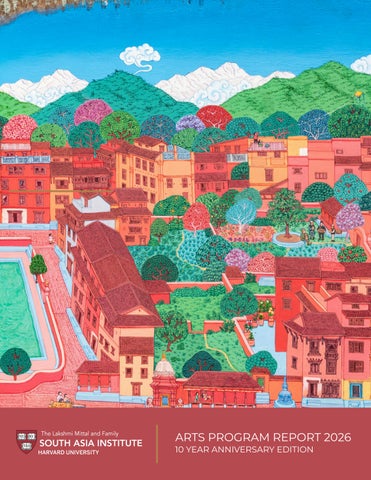
ARTS PROGRAM REPORT 2026 10 YEAR ANNIVERSARY EDITION
Cover Credit: Hitesh Vaidya, Visiting Artist Fellow 2025 Detail of Narrating the City, Thalachen 2024 Acrylic gouache on reclaimed wooden panel 43.5 cm x 30 cm x 2 cm
Arts Program Report July 2025 – June 2026
Contents
06 08 10
LETTER FROM THE CHAIR
REFLECTIONS FROM THE ARTS FACULTY DIRECTOR
PROGRAMS Celebrating 10 Years of the Visiting Artist Fellowship 10 - 95 Visiting Artist Fellowship 96 - 97 The State of Architecture in South Asia 98 - 101 Mapping Color in History 102 - 105 A Space Between Selves 106 - 113 Kathmandu Conversations: Reflections from the VAF Alumni Gathering 114 - 115 Circle of Our Own 116 - 117 South Asian Arts Fellowship 118 - 123
124 126
ARTS FELLOWS
GOVERNANCE
Letter from the Chair
T
en years ago, the Lakshmi Mittal and Family South Asia Institute launched the Visiting Artist Fellowship (VAF) with a simple but ambitious vision: to create a unique opportunity where artists from across South Asia could immerse themselves in research, exchange ideas across disciplines, and engage with Harvard’s extraordinary intellectual community. Since then, the fellowship has welcomed more than four dozen artists whose work has deepened conversations across the University, while contributing to the cultural landscape of South Asia and beyond. As we celebrate this milestone, we are reminded that the program’s greatest achievements are the lasting relationships, collaborations, and ideas that continue to grow long after each fellowship has ended. To commemorate this anniversary, this year’s Arts Report features 10 of 10, highlighting 10 alumni whose diverse practices reflect the remarkable breadth and impact of the Visiting Artist Fellowship. Their stories demonstrate how the fellowship has become a catalyst for new research, creative experimentation, and meaningful dialogue across disciplines. Together, they represent the spirit of curiosity and generosity that has defined the program over the past decade. We also marked this important anniversary by bringing our community together across regions, with a special VAF
alumni exhibition, A Space Between Selves, in Delhi and an alumni gathering in Kathmandu, celebrating the relationships and creative community that have grown around the fellowship over the past 10 years. Over the years, the Arts Program has also expanded beyond the Visiting Artist Fellowship to bring distinguished artists to Harvard for sustained engagement with the University community. Among them, Nilima Sheikh delivered a series of talks, including the Norma Jean Calderwood Lecture at the Harvard Art Museums; Atul Bhalla presented a lecture and had his work featured in Water Stories, an exhibition at the Radcliffe Institute curated by the Faculty Director of the Arts Program, Professor Jinah Kim; and Karachiand London- based artist Naiza Khan joined us for programs that brought her practice into conversation with students, faculty, and the wider Harvard community. These engagements have broadened the Arts Program’s reach, creating opportunities for dialogue with artists at different stages of their careers, while connecting artistic practice with teaching, research, and scholarship across Harvard. The performing arts have also remained an important part of this broader vision. This year, an overflowing crowd helped us welcome musician Bahauddin Dagar for a Dhrupad concert on the rudra veena, presented
The Lakshmi Mittal and Family South Asia Institute, Harvard University
7
with support from the Harvard University Committee on the Arts through Arts Thursdays. Bahauddin also led a master class for students and gave two class lectures on Indian music. We also extended our programming beyond Cambridge with a unique event in New York featuring musician Vijay Iyer, who is our colleague at Harvard and a MacArthur Fellow. Together, these programs underscore our commitment to creating opportunities for audiences to encounter South Asia through sound, performance, artistic traditions, and the visual arts. This year also marked an exciting new chapter in our arts programming. In Fall 2025, we welcomed Nepali artist Hitesh Vaidya as our Visiting Artist Fellow. Through public programs, classes, and conversations across Harvard, Vaidya explored the relationships between voice, oral traditions, storytelling, and cultural continuity, offering new perspectives on how artistic practice preserves and reimagines collective memory. In Spring 2026, we proudly launched the South Asian Arts Fellowship (SAAF), expanding our support to artists, curators, and scholars based in North America whose work engages critically with the visual and material cultures of South Asia. Our inaugural South Asian Arts Fellow, Swapnaa Tamhane, brought an interdisciplinary practice grounded in material research, textile traditions, and collaborative making, enriching our community through public programs and conversations that challenged conventional distinctions between art, craft, and design.
Arts Program Report 2025-2026
Alongside these fellowships, our faculty-led initiatives continued to demonstrate the power of research-driven collaboration. Mapping Color in History, led by Professor Jinah Kim, advanced groundbreaking work on the material history of South Asian art through scientific analysis, and field research, strengthening our understanding of historical pigments and conservation practices. The project’s growing impact is reflected in interest from multiple museums for future collaborations. Meanwhile, the State of Architecture in South Asia project continues to expand with a major conference in Mumbai this year, along with the success of the traveling exhibition, Emergent Practices in South Asia, which bring together architects and researchers to examine how design can respond to climate, community, and the evolving public realm across the region.
ing Artist Fellowship have shown what is possible when artists are given the time, resources, and intellectual community to pursue ambitious ideas. In the years ahead, we remain committed to expanding opportunities for artistic research, strengthening partnerships across South Asia and beyond, and creating new spaces where art can foster dialogue, challenge perspectives, and inspire meaningful change. Thank you for your continued support and partnership in making this work possible. As we celebrate the first decade of the Visiting Artist Fellowship, we look forward with optimism to the next 10 years of championing artists, advancing research, and pushing the boundaries of arts programming at the Mittal Institute. Warm regards,
I would also like to recognize our Arts Program Manager, Sneha Shrestha, whose own artistic practice has been remarkable. Harvard Art Museums acquired a major sculpture by Sneha, and she received the prestigious Foster Prize from the Institute of Contemporary Art, Boston, where her work was recently on view. Her work is also in the permanent collection of the Museum of Fine Arts, Boston. It has been a particular pleasure to see an artist who, through the Institute, contributes so much to nurturing the work and careers of others receive such significant recognition for her own practice. As we celebrate these achievements, we are equally energized by what lies ahead. The first 10 years of the Visit-
DIPTI MATHUR Chair, Arts Council
Reflections from the Arts Faculty Director
W Image credit: Kevin Grady
hen we launched
your gut; good art feels like good art”,
the Visiting Artist
became the compass for this program.
Fellows program in
As we conclude this tenth anniversary,
2015–2016, I was
I find myself thinking less about what
one of its most enthusiastic champi-
this program has been and more about
ons. I believed then, as I do now, that
what it could become. Over ten years,
artists are visionaries. They see things
we have hosted 47 Visiting Artist Fel-
differently, and often more presciently,
lows, 2 Distinguished Artist Fellows,
than the rest of us. I wanted this insti-
and 1 South Asian Arts Fellow—50 art-
tute to be a place where contemporary
ists in all, each of whom has left some-
artistic practice was taken as seriously
thing behind and carried something of
as scholarship—not as an illustration
this place forward. I no longer think of
of South Asia’s past and present, but as
this as simply a program. I think of it
its own form of insight into both.
as a platform, and increasingly, an in-
Yet, in the first year, faced with a stack
stitution in the making.
of applications and with no real back-
We are living through an age in which
ground in contemporary art to guide
images, text, and even music can be
me, I asked my colleague (the critic
generated at the push of a button—an
Benjamin Buchloh) how he approached
age in which “creativity” is increasing-
serving on juries: his advice, “trust
ly something a machine can simulate.
The Lakshmi Mittal and Family South Asia Institute, Harvard University
9
I find myself believing, more than ever,
where former fellows shape the con-
bringing artists here, but strengthen-
that the kind of art this program sup-
versation rather than simply attend it;
ing our footing there, so that the In-
ports matters precisely because it can-
work-in-progress workshops that let
stitute becomes a genuine node in a
not be simulated: art rooted in lived
artists across cohorts brainstorm to-
larger, living network of contemporary
experience, in a particular body, place
gether; and joint exhibitions that bring
practice, connected as much through
and history, wrestling honestly with
past fellows’ work into dialogue across
digital platforms as through physical
the world as it is. Research-based, so-
the years. Where geopolitics makes
residencies.
cially engaged, critically aware practice
in-person gathering difficult, I want us
is not a trend we happened to favor. It
to activate a virtual platform, as we did
is, I think, exactly the kind of human
during the pandemic
act our moment most needs to protect and promote—a reminder that insight, memory, and meaning-making are not the same as output.
Second, more voices, more range.
years, and to the artists—past, present, and not yet met—who will help us see what we can’t yet imagine.
South Asia is diverse, and our fellows should reflect its full breadth—includ-
Warm regards,
ing artists and geographies that have
JINAH KIM Faculty Director, Arts Council George P. Bickford Professor of Indian and South Asian Art
With that in mind, three commitments
historically had less visibility within
will guide the next decade:
American institutions.
First, an alumni network worth the
Third, a stronger presence in the re-
name. Fifty fellows is not just a list—it’s
gion itself. I want this program to
a community waiting to be convened. I
build lasting relationships with artists’
hope to build fellow-curated symposia,
communities in South Asia—not only
Arts Program Report 2025-2026
Here’s to trusting our gut for ten more
A Decade of Art, Reflection, and Community: Celebrating 10 Years of the Visiting Artist Fellowship
F
or ten years, the Mittal Institute’s Visiting Artist Fellowship (VAF) has brought visionary artists from across South Asia to Harvard University, creating a rare space where artistic practice meets academic inquiry. Since its inception, the program has hosted over four dozen fellows from Bangladesh, India, Nepal, Pakistan, Sri Lanka, and beyond, each using the opportunity to research, reflect, and expand the boundaries of their work. As we mark this milestone, we celebrate a decade of creative dialogue, cross-disciplinary learning, and the enduring impact these artists have made within Harvard and throughout the global South Asian arts community.
Meena Sonea Hewett, then Executive Director of the Mittal Institute first conceived the program and turned the idea into reality. The program is led by faculty director Jinah Kim, George P. Bickford Professor of Indian and South Asian Art, Department of History of Art and Architecture, and Professor of South Asian Studies, Department of South Asian Studies, Harvard University, and is coordinated by Sneha Shrestha, Arts Program Manager. Dipti Mathur, based in California, serves as Chair of the Mittal Institute Arts Advisory Council, bringing deep knowledge of contemporary art and thoughtful leadership to the Institute’s arts programming. Radhika Chopra, Founder, No. 3 Clive Road and Member of the Mittal Institute Arts Advisory Council, helps guide our work with her broad understanding of the region’s artistic landscape. Together with the other members of our Arts Advisory Council, they have been steadfast supporters and trusted advisors to our work in the United States and the region, offering thoughtful guidance, leadership, and sustained commitment to advancing our mission across both regions.
The Lakshmi Mittal and Family South Asia Institute, Harvard University
11
“The Arts Program grew out of the belief that the arts are not a peripheral lens on South Asia
but can illuminate the region’s most pressing social and intellectual questions in ways that data and policy alone cannot. It began with the Visiting Artist Fellowship, conceived as a researchcentered opportunity, bringing mid-career visual artists from across South Asia to Harvard for eight weeks to draw on the University’s intellectual community. Through talks, classes, museum and library visits, and informal exchange with students, the Fellowship gave artists a platform to explore how art can address the complex realities facing a region of over two billion people, while giving Harvard’s community a chance to engage with South Asia artists. The program grew from there to include the Distinguished Artist Program, which extended this same spirit of engagement to senior artists nominated by a committee of faculty and curators. The Conservation Science, Training, and Research Program (CoSTAR) broadened the mission further, bridging art history, museology, conservation, and conservation science to
”
help strengthen art conservation practice across South Asia.
Prof. Jinah Kim (left) and VAF 2023-24 Amra Khan discuss Amra’s work at the VAF Art Exhibition Spring 2024.
Arts Program Report 2025-2026
— MEENA SONEA HEWETT
(left to right) VAF 2022-23 Manjot Kaur, Prof. Jinah Kim, VAF 2022-23 Dhara Mehrotra, and Hitesh Hathi at the VAF Art Exhibition Spring 2023..
2016 Program expands to a 10-day residency, allowing deeper engagement
Mapping the Evolution of the VAF Program
Pragati Dalvi (VAF’21) and Bunu Dhugana (VAF’21)
2014 Fellowship concept takes shape during initial planning meeting (Meena
Bunu Dhungana, Confrontations, 2019
Hewett, Tarun Khanna,
2015
Jinah Kim and other faculty members)
First Visiting Artist Fellowship launched as a 4-day residency for emerging artists members
The Lakshmi Mittal Manjot and FamilyKaur, South Hybrid Asia Institute, Harvard Being 3: University
Abhisaika Nayika and the Jerson’s Courser, 2022
13
Cop Shiva, Street Studio, 2012
2018
Dhara Mehrotra, Gossamer V (detail), 2025
Fellowship grows to an 8-week program; dedicated staff join;
2021
Sneha Shrestha, Art
VAF continues
Program Manager
as a full 8-week residency, maintaining immersive experiences
Abir Abdullah, Climate Migrants in Bangladesh, 2018
Masuma Khwaja, The Mutiny Within, 2020
2020 COVID prompts reimagining of the
2019
Fellowship to adapt to
VAF program shifts
new challenges
from emerging to mid-career artists Arts Program Report 2025-2026
2025 10-year milestone, having hosted 47 artists from across South Asia!
The Mittal Institute’s Arts Publications Each year, the Mittal Institute publishes an Arts Report that looks back at the arts program of that respective academic year. To look at our past reports, scan the QR code below.
(left to right) Prof. Vishal Khandelwal, VAF 2024-25 Parul Gupta, Sneha Shrestha, VAF 2024-25 Masuma Halai Khwaja, and VAF 2024-25 Abir Abdullah at the VAF Art Exhibition Spring 2025.
The Lakshmi Mittal and Family South Asia Institute, Harvard University
15
ARTS PROGRAM
REPORT 2023-24
ARTS PROGRAM
ARTS PROGRAM REPORT 2022-23
REPORT 2024-25
2024-2025
ARTS PROGRAM REPORT 2021-22
VAF
VISITING ARTIST FELLOWSHIP
Magazine
2022-2023
ARTS PROGRAM REPORT 2016-20
2023-2024
FEATURING THE MITTAL INSTITUTE'S 2020-21 VISITING ARTIST FELLOWS
Arts 2022.indd 1
2021-2022
2020-2021
1/31/2023 11:07:37 AM
2016-2020
THE LAKSHMI MITTAL AND FAMILY SOUTH ASIA INSTITUTE, HARVARD UNIVERSITY
ARTS COUNCIL INTERIM REPORT 2018–2019
ARTS COUNCIL REPORT 2017–2018
2018-2019 2018-2019
Arts Program Report 2025-2026
1
|
T H E L A K S H M I M I T TA L S O U T H A S I A I N S T I T U T E , H A R V A R D U N I V E R S I T Y
2017-2018
2016-2018
“The fellowship encouraged me to think expansively about
research-driven art and strengthened my commitment to bridging mythology with contemporary ecological concerns. It marked a turning point, giving me the confidence to situate my practice within broader conversations on ecological justice, multispecies kinship, and post humanist imagination.
”
— MANJOT KAUR
Manjot Kaur Spring 2023 VAF | India Q&A with Manjot Kaur Looking back, how did your time as a Visiting Artist Fellow shape your artistic practice or career? Looking back, my time as a Visiting Artist Fellow was pivotal in shaping both my artistic practice and the trajectory of my career. The fellowship provided the intellectual and creative space necessary to begin the research that ultimately developed into Chthonic Beings. At Harvard, I was able to immerse myself in cross disciplinary conversations—drawing from environmental humanities, post humanist theory, mythology, and feminist ecological thought— which became foundational to the project’s conceptual framework.
Engaging with scholars rethinking human–nonhuman relations helped refine my interest in multispecies entanglements and ecological custodianship, directly informing the hybrid mythic figures of Chthonic Beings, rooted in animist traditions, Yoginis, and Yakshinis. Beyond this grounding, access to archives and rare materials profoundly shaped my technique. Being able to study rare books in Harvard’s libraries and request viewings of Indian and Mughal miniatures in person had a lasting impact on my approach to texture, detail, and symbolic composition. The fellowship encouraged me to think expansively about re-
search-driven art and strengthened my commitment to bridging mythology with contemporary ecological concerns. It marked a turning point, giving me the confidence to situate my practice within broader conversations on ecological justice, multispecies kinship, and post humanist imagination. Were there any specific experiences, people, or opportunities during the fellowship that had a lasting impact on you? Yes, several experiences during the fellowship had a lasting impact on me. Meeting Vaishnavi Patil— whose research on the origins and
The Lakshmi Mittal and Family South Asia Institute, Harvard University
17
Manjot Kaur, Spring 2023 VAF
Arts Program Report 2025-2026
Manjot Kaur, The Convocation of Eagles, 2025
The Lakshmi Mittal and Family South Asia Institute, Harvard University
19
Q & A with Manjot Kaur continued
development of the mother goddess in South and Southeast Asia enriched my understanding of regional goddess traditions—was especially influential. We remain in touch and continue to exchange resources that inform each other’s work. Her insights helped shape the mythic and ecological layers of Chthonic Beings. More broadly, the interdisciplinary environment at Harvard, from environmental humanities seminars to conversations on posthumanism and animist knowledge systems, expanded my perspective and continues to guide my artistic and research practice today. How has your work evolved since your fellowship at Harvard? What are you currently working on or excited about in your practice? Since my fellowship at Harvard, my work has evolved toward a more research-intensive, ecologically engaged, and mythologically grounded practice. The ideas I began developing during the fellowship crystallized into my ongoing project Chthonic Beings, which has become a central focus of my artistic trajectory. This body of work imagines hybrid mythic entities—drawing from Yoginis, Yakshinis, animist deities, and other indigenous cosmologies—as guardians of endangered ecosystems. These beings embody multispecies entanglements, ecological memory, and the blurred boundaries between human, nonhuman, and elemental worlds. Chthonic Beings extends the research I initiated at Harvard, deepening my inquiry into post humanist ethics, ecological custodianship, and feminist reimaginings of power. The project combines painting, field research, and theoretical study to explore how myth and fiction can serve as tools for ecological attunement.
Arts Program Report 2025-2026
The hybrid figures function as speculative custodians who converse with threatened flora and fauna, proposing new forms of reciprocity, rewilding, and multispecies governance. Currently, I am expanding the project into larger-scale paintings and site-responsive installations that situate these beings within contemporary ecological crises. I am also excited about integrating archival research, environmental data, and local mythologies from the geographies where I work, allowing Chthonic Beings to evolve as a living, interconnected ecosystem of images, narratives, and ecological imaginaries Whose work is inspiring you right now, and why? Right now, I am deeply inspired by the mythic lineages of Yoginis and Yakshinis, which continue to shape the visual and conceptual language of my Chthonic Beings project. Yoginis—powerful female deities associated with the divine mother goddess—captivate me for their fluid, hybrid forms and their embodiment of feminine power, natural forces, and transformation. Their ability to shift between women, birds, snakes, and other beings challenges passive representations of femininity and opens space for imagining sovereignty, ferocity, and ecological attunement. I am also inspired by Yakshinis, the female nature spirits who guard forests, rivers, caves, and sacred groves. Their role as protectors of natural resources, offering wisdom, abundance, and prosperity, resonates strongly with my interest in multispecies guardianship and ecological reciprocity. In addition to these mythic figures, Vidya Dehejia’s book Yogini Cult and Temples: A Tantric Tradition (often
The Lakshmi Mittal and Family South Asia Institute, Harvard University
21
Arts Program Report 2025-2026
Manjot Kaur, Forest Invoking Kaumari, 2025
Q & A with Manjot Kaur continued
referenced through its reprint by Dahlia Books) has been especially influential. Her research provides historical, iconographic, and philosophical grounding that continues to inform the symbolic structures and imaginative possibilities within my current work. Share one image that captures something meaningful about your practice today. This could be a recent artwork, a studio moment, or you at work. In the painting below, a Chthonic Being emerges through the hybrid form of a Yogini embodying the spirit of the
endangered blackbuck - a graceful and endangered antelope, embodying both vulnerability and strength. She rides a chariot not made of metal or stone, but of living plants, which takes reference from calotropis gigantea, acacia, and wild grasses. These are plants rooted in resilience, survival, and connection to arid landscapes. Held in her hands are the exposed roots of a vast and fragile ecosystem. From these roots unfold scenes of cracked desert soil, a blackbuck pair, a waterbody, grasslands, mangrove trees and acacia trees amongst others—echoing the diverse and fragile
ecologies of Kutch, one of the regions inhabited by Blackbucks. Rather than presiding over nature from above, this Chthonic Being carries the land with her, nurturing and protecting it as an extension of herself. This work reimagines myth as a living force for ecological justice. It challenges human-centered hierarchies and imagines a world where plants, animals, and landscapes are active participants in their own futures. The painting becomes a call to listen—to the roots, to the soil, and to the forgotten voices of the wild.
Manjot Kaur, Custodians of the Grasslands, 2025
The Lakshmi Mittal and Family South Asia Institute, Harvard University
23
Arts Program Report 2025-2026
Manjot Kaur, Arriving on Feathered Shoulders, 2025
“For the first time, I gained significant exposure to the world outside my
own country, which allowed me to blend different cultures and perspectives directly into my creative work. The program was unique because of its highly interactive nature. I had the chance to connect and collaborate with a wide range of people, including professional curators, teachers, and students. Engaging with them across various platforms created a rich exchange of ideas that made my practice much more global and well-rounded.
”
— KOMAL SHAHID KHAN
Komal Shahid Khan Fall 2016 VAF | Pakistan Q&A with Komal Shahid Khan Looking back, how did your time as a Visiting Artist Fellow shape your artistic practice or career? Serving as a Fellow for the Visiting Artist program was a life-changing experience that truly broadened my horizons. For the first time, I gained significant exposure to the world outside my own country, which allowed me to blend different cultures and perspectives directly into my creative work. The program was unique because of its highly interactive nature. I had the chance to connect and collaborate with a wide range of people, including professional curators,
teachers, and students. Engaging with them across various platforms created a rich exchange of ideas that made my practice much more global and well-rounded. Were there any specific experiences, people, or opportunities during the fellowship that had a lasting impact on you? My time as a Fellow was made truly special by the people I met. Working alongside my co-artist, Meenakshi from India, was a highlight; seeing her work in person was a real treat and a great learning experience. Everyone at Mittal Institute, was incredibly welcoming and offered such valuable
guidance throughout my stay. We also had the chance to visit world-class institutions like the Museum of Fine Arts, Boston, and the Fogg Art Museum. Seeing their collections firsthand—especially the incredible historic miniature paintings and Kota drawings—was unforgettable. Documenting these works helped me bridge the gap between history and my own modern practice. How has your work evolved since your fellowship at Harvard? What are you currently working on or excited about in your practice? My work keeps on evolving but I feel I
The Lakshmi Mittal and Family South Asia Institute, Harvard University
25
Komal Shahid Khan, Fall 2016 VAF
Arts Program Report 2025-2026
The Lakshmi Mittal and Family South Asia Institute, Harvard University
Komal Shahid Khan, The Royal Ball, 2025
27
Arts Program Report 2025-2026
Q & A with Komal Shahid Khan continued
have revisited the satirical element in my previous works that I had showcased during my time at Harvard. My recent two series, Ticket to the Unreal and Regal Deception both depict the mockery and are a depiction of the continuous unraveling of themes: the sharp sting of mockery, the unsettling dance of human puppetry, the fleeting spectacle of the circus and its tricks, and the relentless pull of mortal desires. Whose work is inspiring you right now, and why? I’m fascinated by the sculptural forms, intricately painted by the artist Jibran
Shahid from Pakistan who is also my brother ! Apart from this I’m very inspired by my fellow artists and contemporaries like Hooria Khan from Lahore, Pakistan and some other professionals in the field like Sid Patni and Manjit Bawa. Share one image that captures something meaningful about your practice today. This could be a recent artwork, a studio moment, or you at work.
quiet moment of observation, my personal vision finally meets the public’s gaze, creating a deep, wordless connection. Sharing my thoughts through art and seeing people truly resonate with them is a powerful experience. It brings a unique sense of accomplishment and a surge of creative energy. These moments of genuine connection are where all the hard work feels worth it, leaving me with a heart-filled satisfaction.
There is something incredibly moving about seeing viewers lean in close to my work at a gallery in Lahore. In that
Visitors exploring Komal Shahid Khan’s work at a gallery in Lahore. The Lakshmi Mittal and Family South Asia Institute, Harvard University
29
Komal Shahid Khan, Moon Calling, 2025 Arts Program Report 2025-2026
Komal Shahid Khan, The Royal Satire, 2025
The Lakshmi Mittal and Family South Asia Institute, Harvard University
31
Komal Shahid Khan, The Target, 2025
Arts Program Report 2025-2026
“I was inspired by Prof. Allen Sayegh’s course, Mediums:
Making Culture, Art and Technology. Here I was introduced to the writing of Malcolm McCullough, Richard Sennett, D. Pye and Paul Virilio, scholars and architects who developed a critical understanding of mediums, technology, and architecture.
”
— AAMINA NIZAR
Aamina Nizar Fall 2022 VAF | Sri Lanka Q&A with Aamina Nizar Looking back, how did your time as a Visiting Artist Fellow shape your artistic practice or career? As a research based artist, much of my work is grounded in the knowledge and practice of architects and activists. The lectures I attended, the faculty and students I interacted with, as well as the libraries and galleries I visited were transformative in my artistic practice. Both my theory and technique matured after the interactions I had during my fellowship. Were there any specific experiences, people, or opportunities during the fellowship that had alasting impact on you?
The guidance of Prof. Rahul Mehrotra helped shape my fellowship. He encouraged me to attend the class, Contemporary Developing Countries: Entrepreneurial Solutions to Intractable Problems, by Prof. Tarun Khanna and Dr. Satchit Balsari. Their lectures, together with Prof Donna Summers, inspired me to look at art and community engagement in a more impactful way.
Sharbenu De were enlightening as he helped me understand the mediums I used further. We still keep in touch and are friends.
My conversations with Sneha Shreshta were illuminating. She introduced me to apps such as artivive and encouraged me in interesting directions both at Harvard and in Boston.
I was inspired by Prof. Allen Sayegh’s course, Mediums: Making Culture, Art and Technology. Here I was introduced to the writing of Malclom McCullough, Richard Sennet, D. Pye and Paul Virilio, scholars and architects who developed a critical un-
Conversations with Fellow artist
At the Fine Art Library, librarian Jessica Brady introduced me to ‘Aqua Alta’ by Adrian M and Claire B. This pop up book uses augmented reality to tell a captivating story of love and loss. I am now experimenting using this technology in my current projects.
The Lakshmi Mittal and Family South Asia Institute, Harvard University
33
Aamina Nizar, Fall 2022 VAF
Arts Program Report 2025-2026
Q & A with Aamina Nizar continued
derstanding of mediums, technology, and architecture. How has your work evolved since your fellowship at Harvard? What are you currently working on or excited about in your practice? The year after my fellowship, I worked on a series of short films to tell the story of Colombo. This year I hope to continue to tell the story of cities and people through light experiments. I’ve also moved back to painting in my free time. Before I took up photography, I painted, and grounding myself in this medium again helps me reflect on my own skills as a visual artist. Whose work is inspiring you right now, and why? Colin Bowring aka Photon Wizard, is an Oakland based artist who creates immersive experiences using light and form. His work is often in the form of rainbows, created using adjustable mirrors, holographic gyroscopes, water prism and bicycle rim water lenses. He calls his work ‘art science,’ and invites us to reflect on the physical world. I love how he uses physics and upcycled items to create his rainbows. Particularly as other immersive works often employ digital technology. I hope to use some of those techniques, in future installations of Colombo, whereas in the past I’d relied on digital technology. Share one image that captures something meaningful about your practice today. This could be a recent artwork, a studio moment, or you at work. On the right is ‘Light,’ (2018) a photograph of a rainbow, made with light shining through a glass of water. This image was printed on canvas for the ‘Let there be Light,’ group exhibition.
Aamina Nizar, Light, 2018
The Lakshmi Mittal and Family South Asia Institute, Harvard University
35
‘The Colombo Project,’ installation, 2016
Arts Program Report 2025-2026
Q & A with Aamina Nizar continued
On the left is an acrylic painting of the same image. As a photographer/visual artist, understanding light, in a physical and spiritual sense is key to my artistic practice. Across scriptures, God is likened to light. These works are a reminder of creation’s everyday grandeur and the place they occupy as the source of all our artistic expression.
Aamina Nizar, Light Upon Light, 2018
The Lakshmi Mittal and Family South Asia Institute, Harvard University
37
Aamina Nizar, Lanting Hang, 2023
Aamina Nizar, The Colombo Project, 2016
Arts Program Report 2025-2026
The Lakshmi Mittal and Family South Asia Institute, Harvard University
Aamina Nizar, The Colombo Project: Gotagogama, 2022
39
Arts Program Report 2025-2026
“The fellowship served as a vital bridge, enabling me to forge meaningful friendships and connect deeply with a diverse array of artists and their unique practices.
”
— NAJUM NAHAR KEYA
Najmun Nahar Keya Fall 2020 VAF | Bangladesh Q&A with Najmun Keya Looking back, how did your time as a Visiting Artist Fellow shape your artistic practice or career? Receiving the Visiting Artist Fellowship in 2020 was a transformative experience that profoundly impacted my artistic journey. This opportunity not only enhanced my art practice but also reshaped my thought process, encouraging me to think in new and innovative ways. During the pandemic, the fellowship proved invaluable in helping me recover from mental trauma, providing a constructive outlet that kept me engaged with my artistic practice. It offered a nurturing environment that allowed me to explore my creativity more deeply, ultimately
leading to significant growth in my artistic career. Were there any specific experiences, people, or opportunities during the fellowship that had a lasting impact on you? The fellowship served as a vital bridge, enabling me to forge meaningful friendships and connect deeply with a diverse array of artists and their unique practices. The bonds we formed during this time have endured, and I cherish the ongoing relationships with all my fellow participants. Moreover, the guidance I received from esteemed academics, established art-
ists, and curators was invaluable in shaping my artistic journey. Notably, Nora Schultz’s lecture on studio languages, along with insights from Prof. Jinah Kim and Siddhartha Shah, significantly enriched my understanding and approach to my work. How has your work evolved since your fellowship at Harvard? What are you currently working on or excited about in your practice? Since my time at Harvard, my practice has undergone a substantial transformation. I’ve experimented extensively with diverse materials and embraced large-scale work across multiple media—particularly textiles and large-
The Lakshmi Mittal and Family South Asia Institute, Harvard University
41
Najum Nahar Keya, Fall 2020 VAF. Najum is an installation and Najum Nahar Keya, Fall 2020inVAF mixed media artist based Bangladesh.
Arts Program Report 2025-2026
Q & A with Najmun Nahar Keya continued
scale drawing and painting—while pushing the boundaries of scale in my practice. What excites me most now is the intersection of my studio practice with art education. Joining Jagannath University’s painting department has been particularly meaningful, especially given that 70% of our students are female. I’m genuinely excited about creating collaborative projects that amplify these emerging women artists’ voices and foster a supportive creative community. This educational role has become equally important to my creative practice. Whose work is inspiring you right now, and why? Hieronymus Bosch and Pia Camil are my primary inspirations right now. Bosch’s work captivates me— his highly individualistic narratives probe humanity’s deepest desires and fears with remarkable psychological depth. This drives me to create work rooted in my own social reality, translating contemporary concerns into visual language. Pia Camil’s practice energizes me in different ways. Her bold approach to large-scale installation work, particularly her integration of textiles, provides a conceptual and technical blueprint for the ambitious projects I’m developing. Her work demonstrates how these materials can carry meaning on a monumental scale. Share one image that captures something meaningful about your practice today. This could be a recent artwork, a studio moment, or you at work. I love working with gold leaf; it has become a cornerstone of my artistic practice. The traditional techniques I learned at the Tokyo University of the Arts are more than just a method— they are a meditative ritual that brings me a sense of calm and relaxation. The Lakshmi Mittal and Family South Asia Institute, Harvard University
43
Najmun Keya working with gold leaf.
Arts Program Report 2025-2026
Najmun Nahar Keya, Kintsugi Dhaka, 2025
Najmun Nahar Keya, Code 196 and 200, 2024 The Lakshmi Mittal and Family South Asia Institute, Harvard University
45
Najmun Nahar Keya, Between the Sky and the Earth, 2025
Arts Program Report 2025-2026
Najmun Nahar Keya, Symphony of Worlds, 2022–23
The Lakshmi Mittal and Family South Asia Institute, Harvard University
47
Arts Program Report 2025-2026
“Nora Schultz’s class played a particularly transformative
role. Her approach encouraged me to stretch my understanding of what sculpture could be, moving beyond the idea of giving form and solidity to an abstract thought.
”
— SAKSHI GUPTA
Sakshi Gupta Fall 2019 VAF | India Q&A with Sakshi Gupta Looking back, how did your time as a Visiting Artist Fellow shape your artistic practice or career? My time at Harvard made me aware of the boundaries I had unconsciously set for myself—particularly around what I considered a “studio.” Although I had long been gathering scrap and discarded materials from the city, observing my practice from a distance shifted my understanding fundamentally. The studio no longer felt like a single room; the city itself became a porous, ever-changing workspace. When the urban landscape becomes the studio, everything transforms—
scale, material, context, and even intention. I began engaging with my surroundings more directly, creating with and through the environment rather than separate from it. I arrived hoping to refine my methods, but I left with something more expansive: a redefined sense of materiality and an enlarged terrain for making. Were there any specific experiences, people, or opportunities during the fellowship that had a lasting impact on you? My time at Harvard became a period of realignment and renewal — a chance to step back and reconsider my ways of thinking and working as
an artist, and more specifically, as a sculptor. Nora Schultz’s class played a particularly transformative role. Her approach encouraged me to stretch my understanding of what sculpture could be, moving beyond the idea of giving form and solidity to an abstract thought. Through her provocations, I began to explore other sensory dimensions—sound, scent, atmosphere—as equally potent materials capable of carrying meaning and presence. Her guidance nudged me to question ingrained cultural assumptions around sculpture and the tendency to treat it as a fixed, object-based practice. This process often took me out of
The Lakshmi Mittal and Family South Asia Institute, Harvard University
49
Sakshi Gupta, Fall 2019 VAF
Arts Program Report 2025-2026
Sakshi Gupta, Spaces of Being, 2023
Q & A with Sakshi Gupta continued
my familiar terrain; at times it felt disorienting. Yet, that very discomfort opened up a fertile territory — a space where new questions could surface and new ideas could take root. How has your work evolved since your fellowship at Harvard? What are you currently working on or excited about in your practice? Since my fellowship at Harvard, my practice has opened up in quite a natural yet significant way. While I have always engaged with industrial scrap
and discarded materials, my time there sharpened my sensitivity to the quieter, often overlooked things that accumulate around us — objects that most people consider waste or residue. I’ve begun to pay closer attention to these materials, to listen to the small stories they carry, and to allow them to initiate conversations that gradually evolve into works. This shift has expanded my understanding of materiality and deepened the relational aspect of my process — it’s less about transforming a found object and more about responding
to what it already holds. At the moment, I’m working toward my upcoming solo exhibition, which I’m truly excited about. It’s giving me an opportunity to bring these new approaches together and see how they unfold within a larger, cohesive body of work. Whose work is inspiring you right now, and why? I’ve been deeply inspired by Eva Hesse and Cornelia Parker, each of whom resonates with different facets of my current explorations.
The Lakshmi Mittal and Family South Asia Institute, Harvard University
51
Sakshi Gupta, Give Yourselves to the Air, To What You Cannot Hold, 2023
Arts Program Report 2025-2026
The Lakshmi Mittal and Family South Asia Institute, Harvard University
Sakshi Gupta, To Keep Things Whole I, 2023
53
Arts Program Report 2025-2026
Q & A with Sakshi Gupta continued
Hesse’s work, with its fragility, irregularity, and emotional permeability, has been especially moving. The way she allowed materials to sag, droop, age, and behave on their own terms mirrors my growing interest in surrendering control and listening to what discarded or overlooked materials want to become. Her ability to hold tension—between order and entropy, tenderness and unease—feels very close to the existential questioning that runs through my practice. Cornelia Parker, on the other hand, inspires me through her nuanced engagement with transformation and the poetics of recontextualization. I’m drawn to her ability to take acts of compression, rupture, or destruction and reframe them as moments
of suspension and meditation. Her approach affirms my own instinct to treat found and “waste” materials not as static objects but as carriers of histories, possibilities, and quiet narratives. Together, Hesse and Parker remind me that materiality is never just physical—it’s emotional, temporal, and conceptual—and this understanding continues to shape the direction of my work. Share one image that captures something meaningful about your practice today. This could be a recent artwork, a studio moment, or you at work.
intent. I am drawn to materials that occupy an in-between space: no longer useful, not yet forgotten, still carrying traces of movement and meaning. Their lines and tensions speak a language that feels close to my own practice. I see them as propositions— forms that invite response rather than dictate it. Encounters like this remind me that my work begins long before the studio, in the act of noticing, in allowing the city’s fragments to open unexpected pathways for making.
This cluster of wires was found on a roadside in Mumbai—unremarkable at first glance, yet full of sculptural
Cluster of metal wires found on a roadside in Mumbai. The Lakshmi Mittal and Family South Asia Institute, Harvard University
55
Sakshi Gupta, To Roses, and Other Expressly Promising Things I, 2023 Arts Program Report 2025-2026
“Immersing myself in rare Islamic manuscripts, Mughal
paintings, and herbarium collections opened new directions in my understanding of iconography and material culture, bridging research and making in ways that continue to shape my work.
”
— AMRA KHAN
Amra Khan Spring 2024 VAF | Pakistan Q&A with Amra Khan Looking back, how did your time as a Visiting Artist Fellow shape your artistic practice or career? The Visiting Artist Fellowship at the Mittal Institute, became an important catalyst in the ongoing evolution of my practice. It offered the time, space, and intellectual breadth to test and deepen ideas already central to my work particularly around visual culture, faith, and gender. Engaging with Harvard’s libraries, courses, and faculty enriched my approach to research, allowing me to think and make with greater precision and openness. That period of inquiry and exchange sharpened my understanding of how iconography
operates within contemporary visual culture and expanded my capacity to write and reflect critically on my own process. Since the fellowship, my practice has entered a period of renewed energy and expansion. Over the past two years, I have produced and exhibited more prolifically than ever before, bridging art-making, writing, and curatorial work. Recent projects include exhibitions in New York, Philadelphia, and AsiaNow 2025 Paris, with upcoming presentations under the United Nations umbrella and a Curatorial Fellowship with the Lahore Biennale Foundation. The fellowship affirmed my belief
in the fluidity of artistic practice its ability to inhabit multiple forms of research, collaboration, and expression, strengthening my commitment to working within a broader global and intellectual dialogue. Were there any specific experiences, people, or opportunities during the fellowship that had a lasting impact on you? Among the most defining experiences of the fellowship were the moments of access, exchange, and connection that profoundly deepened my practice. The opportunity to work within Harvard’s Fine Arts Library and the archives at the Museum of
The Lakshmi Mittal and Family South Asia Institute, Harvard University
57
Amra Khan, Spring 2024 VAF
Arts Program Report 2025-2026
Amra Khan, Noor-e-Nazar, 2025
Q & A with Amra Khan continued
Fine Arts, Boston, guided by Amanda Steinberg, was transformative. Immersing myself in rare Islamic manuscripts, Mughal paintings, and herbarium collections opened new directions in my understanding of iconography and material culture, bridging research and making in ways that continue to shape my work. Equally significant was the collaboration with Dr. Satchit Balsari on Hum Sab Ek, an exhibition that brought together art, science, and craft. Contributing to a tapestry created by women artisans across
India deepened my appreciation for collective authorship and resilience. My engagement with Boston’s queer archives and cultural spaces further expanded my inquiry into identity, belonging, and representation. These encounters, intellectual, creative, and deeply personal, fostered enduring friendships and affirmed the importance of generosity, dialogue, and shared purpose in sustaining an evolving artistic practice. How has your work evolved since your fellowship at Harvard? What
are you currently working on or excited about in your practice? My practice has expanded both materially and conceptually, moving beyond painting into immersive, tactile, and spatial encounters. What began as two-dimensional explorations of gendered archetypes has grown into installations that merge devotional objects, found materials, and architectural remnants. I have become increasingly drawn to working with salvaged wood, textiles, and cultural symbols, transforming these into altar-like structures that question inti-
The Lakshmi Mittal and Family South Asia Institute, Harvard University
59
Q & A with Amra Khan continued
macy, ritual, and belonging. Most recently, I have been creating large-scale embroidered textiles that revisit ancestral patterns from Jalandhar, reinterpreting them through contemporary gestures of care and remembrance. These works consider how personal and collective histories are preserved or erased through domestic and spiritual labor. Currently, I am developing ‘Where Soft Blades Meet, Beyond the Other Mirror’ a curatorial and research based project under the Lahore Biennale Foundation’s ‘The Thing Is’ fellowship. Expanding from inquiries within my own practice, it examines the barbershop as a site of gendered ritual, care, and visibility in the Pakistani Muslim context. This project marks a new phase in my trajectory, one that bridges making and curating, personal history and collective dialogue, the seen and the unseen. Whose work is inspiring you right now, and why? These days I’m inspired by Nan Goldin’s intimate documentation of underground queer life, her work balances hope, despair, humour, and tenderness. Studying her framing and gaze offers me new ways to see and document. This research will inform and further expand my curatorial project, helping translate private, marginalised histories into visual and experiential forms. Share one image that captures something meaningful about your practice today. This could be a recent artwork, a studio moment, or you at work. This sacred altarpiece (page 60) confronts violence, the demolition of heritage, and the abandonment of cherished objects imbued in
Arts Program Report 2025-2026
Amra Khan, Firouz, 2025
Amra Khan, Out of the Garden, Not One but Three, 2025
The Lakshmi Mittal and Family South Asia Institute, Harvard University
61
Arts Program Report 2025-2026
Q & A with Amra Khan continued
familial memory. Its visual language draws from Abrahamic religions, the cosmos, the spirit world, flora, fauna, and pain. Constructed from wood salvaged from a demolished home in Lahore, the twelve-panel freestanding piece invites viewers to walk around and engage. Front panels depict families amid loss and devastation; back panels reveal gods, monstrous forces, and humanity’s wrath. Inner panels whisper hidden paradises and celestial beings. Vintage South Asian ritual objects, rosaries, incense burners, amulets, express what cannot be spoken, bridging history, faith, and intimate human experience.
Amra Khan, To All the Gods I’ve Loved Before, 2024
The Lakshmi Mittal and Family South Asia Institute, Harvard University
63
Amra Khan, Rani Baytee Raj Karay Gee, 2025
Arts Program Report 2025-2026
“Archives at the Harvard Library and special in-person viewing of ancient manuscripts and artifacts up close at the Harvard Art Museums were also unforgettable highlights of my time at Cambridge.
”
— DHARA MEHROTRA
Dhara Mehrotra Spring 2023 VAF | India Q&A with Dhara Mehrotra Looking back, how did your time as a Visiting Artist Fellow shape your artistic practice or career? My time as a Visiting Artist Fellow was greatly enriching—it gave me the space and support to explore ideas more freely, connect with diverse perspectives, and grow both artistically and personally. It expanded and deepened my engagement with interdisciplinary learning. shaping my practice as more interconnected, reflective, and responsive to both material and ecological contexts. All of which has had a lasting influence on how I think and create today.
Were there any specific experiences, people, or opportunities during the fellowship that had a lasting impact on you? There were many experiences during my time as VAF that I deeply cherish, along with the incredible people I had the privilege to meet. Connecting with the metaLAB group was especially meaningful—it opened a platform to explore art practices rooted in scientific inquiry and data visualization. It was a great honor to meet renowned scholars such as Prof. László Barabási, Prof. Jeffrey Schnapp, Prof. Jinah Kim, Prof. Homi Bhabha, the late Dr. Richard Cash, and many other distinguished academics. Archives at the Harvard Library and special in-person viewing of ancient manuscripts and artifacts up close at
the Harvard Art Museums were also unforgettable highlights of my time at Cambridge. One of the most inspiring outcomes was my association with the PLS Lab at MIT, a connection initiated during the fellowship that has since evolved into an ongoing collaborative project beyond the duration I was there in 2023. How has your work evolved since your fellowship at Harvard? What are you currently working on or excited about in your practice? Since my fellowship at Harvard, I believe my practice has expanded in both scale and depth, evolving through a more intuitive engagement with materials. I continue to weave narratives around clusters and networks, memory and
The Lakshmi Mittal and Family South Asia Institute, Harvard University
65
Dhara Mehrotra, Spring 2023 VAF
Arts Program Report 2025-2026
Dhara Mehrotra, Filamentous: Detail I, 2025
The Lakshmi Mittal and Family South Asia Institute, Harvard University
67
Dhara Mehrotra, Filamentous: installation view, 2025
Arts Program Report 2025-2026
Q & A with Dhara Mehrotra continued
meaning, ecology and interconnected systems, reflecting on ways we experience life. Recent highlight has been, a site-responsive wall installation ‘Filamentous’, for the British Textile Biennial 2025 at Whitaker Museum, Lancashire in the UK. I am equally excited about the possibilities that continue to evolve from the ideas nurtured during this installation. Whose work is inspiring you right now, and why? The ground breaking work by a group of mycologists at SPUN (Amsterdam) has been very inspiring lately. Their initiative to mapping the underground nets of biodiversity across the planet, has been particularly of great interest.
Dhara Mehrotra, Stochastic, 2024
Share one image that captures something meaningful about your practice today. This could be a recent artwork, a studio moment, or you at work. To me the image (page 64) is a reminder of the immersive process of making—an intimate journey of hands-on creation and realization. It reflects the quiet labor of love, the hours spent over days on site or in the studio, devoted to a single evolving task. Each moment contributes to a form that slowly unfolds. No matter how carefully visualized beforehand, the final artwork always asserts its own presence. There is something unique, unforeseen yet deeply connected to the act of making itself, as if it breathes with a life and claims a mind of its own. Dhara Mehrotra, Filamentous IV, 2025
The Lakshmi Mittal and Family South Asia Institute, Harvard University
69
Dhara Mehrotra, Gossamer V, 2025
Arts Program Report 2025-2026
The Lakshmi Mittal and Family South Asia Institute, Harvard University
71
Arts Program Report 2025-2026
Dhara Mehrotra, Continuum XIII, 2024
“Professor Asani significantly enhanced my understanding of ‘Sindhi Sufi literature,’ addressing crucial elements that became significant in my research and profoundly influenced my practice. The interactive sessions with Professor Diana Eck were also invaluable, contributing a refined sense of archiving qualities to my work.
”
— KRUPA MAKHIJA
Krupa Makhija Spring 2019 VAF | India Q&A with Krupa Makhija Looking back, how did your time as a Visiting Artist Fellow shape your artistic practice or career? During my VAF, I initially focused on various aspects of the Partition of British India. My attention was particularly drawn to the projects undertaken by the Mittal Institute concerning the Partition of 1947. However, my research took on new dimensions after I met Prof. Ali Asani and Prof. Jinah Kim. My primary research interest revolved around the Sindhi migrant community and the disappearance of the Sindhi language and ethnicity in India. Initially, I was uncertain, as the Sindhi language and culture had been less studied
and often overlooked. But Prof. Asani significantly enhanced my understanding of Sindhi Sufi literature, addressing crucial elements that became significant in my research and profoundly influenced my practice. The interactive sessions with Prof. Diana Eck were also invaluable, contributing a refined sense of archiving qualities to my work. This fellowship has broadened the scope of my practice, leading me to explore Sindhi Sufi literature, such as Shah jo Risalo by Shah Abdull Latif Bhittai, as well as the Indus project. The Indus is not merely a river; it embodies a legacy intertwined with Sindhi identity. Were there any specific experienc-
es, people, or opportunities during the fellowship that had a lasting impact on you? During my research I had the opportunity to explore the pigment collection at the Harvard Art Museum. For the first time in my life, I encountered such a vast collection of pigments at one place, with each pigment possessing its own unique origin story and journey. This experience was truly inspiring for me and has influenced my artistic practice. I now perceive medium as an essence that carries memories and narratives. I have added indigo into my work, as it has a profound connection to
The Lakshmi Mittal and Family South Asia Institute, Harvard University
73
Krupa Makhija, Spring 2019 VAF
Arts Program Report 2025-2026
Krupa Makhija, In Search of Indus, 2024-25
The Lakshmi Mittal and Family South Asia Institute, Harvard University
75
Q & A with Krupa Makhija continued
the Indus Valley Civilization and the Sindh region, which historically served as a significant hub for its cultivation, production, trade, and traditional applications. The traditions of indigo dyeing and textiles are deeply rooted in Sindh, particularly with the Ajrak, a traditional block-printed textile that prominently features indigo as a primary dye. Indigo has connected me with my roots. How has your work evolved since your fellowship at Harvard? What are you currently working on or excited about in your practice? This fellowship has enabled me to connect personal expression with a more profound understanding of my cultural roots. Upon my return from Harvard, my research primarily concentrated on Sindhi literature. Additionally, I am engaged in the project ‘In Search of Indus,’ which explores
the historical, geographical, and poetic representations of the Sindhu (Indus) river. This project represents my quest for my own origin. The Indus River has played a crucial role for the Sindhi people for centuries. The term ‘Indus’ signifies more than just a river; it embodies a living cultural legacy for both nations (i.e India and Pakistan). Through my endeavors, I aim to pose the question of how such a legacy can be divided? By examining the intertwined narratives of the communities along the river, we can better understand how heritage is maintained, celebrated, and sometimes contested in the context of national identities. Whose work is inspiring you right now, and why? Kara Walker’s work is inspiring me because it fearlessly confronts uncomfortable truths about American
Krupa Makhija visiting Dholavira, Gujarat, India
Arts Program Report 2025-2026
history, race, gender, and violence using a unique and captivating style. Share one image that captures something meaningful about your practice today. This could be a recent artwork, a studio moment, or you at work. This photograph was taken during my recent research trip to Dholavira, an archaeological site at Khadirbet in Kachchh District, in the state of Gujarat in western India. This site contains ruins of an ancient Indus Valley Civilization/ Harappan city. It is one of the five largest Harappan sites and most prominent archaeological sites in India belonging to the Indus Valley Civilization. It is renowned for its exceptional urban planning and highly sophisticated water conservation system.
Krupa Makhija, In Search of Indus, 2024-25
The Lakshmi Mittal and Family South Asia Institute, Harvard University
77
Krupa Makhija, In Search of Indus, 2024-25
Arts Program Report 2025-2026
Krupa Makhija, In Search of Indus, 2024-25
The Lakshmi Mittal and Family South Asia Institute, Harvard University
79
Arts Program Report 2025-2026
“Many writers and philosophers influence me, especially Homi K. Bhabha,
Giorgio Agamben, Michel Foucault, Jorge Luis Borges, and Donna Haraway. Their work expands my understanding of power, history, and the construction of truth. These ideas continually fuel my artistic practice, each influencing different aspects of my research and critical thinking.
”
— IMRAN CHANNA
Imran Channa Spring 2018 VAF | Pakistan Q&A with Imran Channa Looking back, how did your time as a Visiting Artist Fellow shape your artistic practice or career? My fellowship at Harvard profoundly expanded my artistic and intellectual framework. The time felt very short to fully immerse myself in the vast knowledge, physical spaces, and intellectual resources available there. It shifted the way I approach research and artistic inquiry. Although there was so much to explore, I am grateful to have been part of the program and to have gathered valuable research materials that continue to inform my practice. The impact of these resources, along with a clearer sense of direction, can be seen in my current research projects.
Were there any specific experiences, people, or opportunities during the fellowship that had a lasting impact on you? Almost every moment felt significant. Walking across different campuses, engaging with faculty, staff, students, and researchers helped me connect my practice to broader academic conversations. Attending seminars throughout Harvard and exploring rare archival materials in the libraries gave me a deeper understanding of how knowledge and history are constructed. These experiences helped me navigate my artistic research more deeply within academia, especially in relation to my interests in colonialism in South
Asia and beyond. How has your work evolved since your fellowship at Harvard? What are you currently working on or excited about in your practice? I have been investigating the Partition archive, particularly the Life Magazine photographs captured by Margaret Bourke-White. During my fellowship, I had the opportunity to speak with several PhD scholars whose specialization in Partition studies opened new intellectual perspectives for me. Currently, I am working on themes related to the politics of land and landscape, viewed through the histories of colonialism, displacement, and technology.
The Lakshmi Mittal and Family South Asia Institute, Harvard University
81
Imran Channa, Spring 2018 VAF
Arts Program Report 2025-2026
Imran Channa, Enchanted Land XI, 2025
The Lakshmi Mittal and Family South Asia Institute, Harvard University
83
Arts Program Report 2025-2026
Imran Channa, Enchanted Land V, 2025
The Lakshmi Mittal and Family South Asia Institute, Harvard University
85
Arts Program Report 2025-2026
Q & A with Imran Channa continued
Whose work is inspiring you right now, and why? I continue to draw inspiration from thinkers who challenge systems of knowledge. Many writers and philosophers influence me, especially Homi K. Bhabha, Giorgio Agamben, Michel Foucault, Jorge Luis Borges, and Donna Haraway. Their work expands my understanding of power, history, and the construction of truth. These ideas continually fuel my artistic practice, each influencing different aspects of my research and critical thinking.
Share one image that captures something meaningful about your practice today. This could be a recent artwork, a studio moment, or you at work. “Enchanted Land” consists of landscapes that don’t exist yet feel familiar: serene mountains, cascading waterfalls, visions and land promised by politics and faith alike. The idea of a perfect homeland, a paradise, is often a fantasy forged in the crucible of violence. I feed this fantasy to the machine, asking artificial intelligence
to generate visions of heaven: idyllic, lush, and uninhabited. Later, by repainting them with gouache, I reinsert the human hand, blurring the line between machine-made beauty and emotional presence. Each work is accompanied by Morse code statements proclaiming a homeland shaped by religious, political, and moral purity.
Imran Channa, Tangible Fiction: Gathri, 2025
The Lakshmi Mittal and Family South Asia Institute, Harvard University
87
Imran Channa, Enchanted Land I, 2025
Arts Program Report 2025-2026
“Since my fellowship at Harvard, my work has evolved into a more research-driven and culturally reflective practice. I intend to deepen my engagement with traditional art practices, not just as aesthetic references but also as vehicles for contemporary storytelling.
”
— HITESH VAIDYA
Hitesh Vaidya Fall 2025 VAF | Nepal Q&A with Hitesh Vaidya Looking back, how did your time as a Visiting Artist Fellow shape your artistic practice or career? The Visiting Artist fellowship at the Mittal Institute has been a transformative journey to reflect on the research approaches, artistic production, and communal intervention in local communities. It further strengthened my practice beyond studio work into the realms of scholarship, community engagement, and cultural advocacy. Presentations and exhibitions at Harvard allowed me to share my work and receive feedback, strengthening my voice as a Nepali artist in global contexts. It also allowed me to invite and connect
with the relevant individuals, such as Harvard professors, students, and researchers of South Asian arts, Visual arts, and Anthropology, with the possibility of future collaborations. Interactions with fellows, curators, and scholars fostered meaningful exchanges on identity, heritage, and representation. It provided me with the strategies on team building and programming structure to run the community-based Niva Art Space. The multiple visits to museums and galleries such as MFA Boston, Harvard Art Museums, ICA Boston, among others, as well as conversations with its members, illuminated the ideas of conservation, exhibition
design, and programming around arts and artifacts to inform perspectives. The fellowship at Mittal Institute affirmed my commitment to community-centered artmaking. It expanded my toolkit—intellectually, materially, and spiritually—and reinforced my belief that artists must take ownership of their narratives, especially when representing marginalized, grassroots histories. Were there any specific experiences, people, or opportunities during the fellowship that had a lasting impact on you? The experiences from the fellowship deepened my artistic practice
The Lakshmi Mittal and Family South Asia Institute, Harvard University
89
Hitesh Vaidya, Fall 2025 VAF
Arts Program Report 2025-2026
Hitesh Vaidya, Narrating the City, 2023
The Lakshmi Mittal and Family South Asia Institute, Harvard University
91
Arts Program Report 2025-2026
Q & A with Hitesh Vaidya continued
through immersive academic, curatorial, and community engagements. To mention a few, conversations with Prof. Jinah Kim, George P. Bickford Professor of Indian and South Asian Art in the Department of History of Art & Architecture, shaped my understanding of heritage preservation, leading to the idea of an interdisciplinary, accessible art space that I want to build as an adaptable model for documenting, conserving, and sharing cultural materials in under-resourced communities. These dialogues, along with the opportunity for in-person, private viewings of South Asian art within Harvard’s collections and reflections on traditional South Asian practices, helped me reframe my work as a contemporary translation of ancestral visual languages. Equally impactful were my exchanges with community arts leaders like Jasmine Perez, Manager of Community Arts Initiative at MFA Boston, where we discussed strategies for evaluating the impact of arts initiatives, sustaining patron relationships, and fostering creative growth in youth. These insights reinforced my commitment to community-centered artmaking and the responsibilities that come with representing collective narratives. Through classes, exhibitions, and panel discussions, I explored how voice, tradition, and storytelling shape identity and cultural continuity. One such meaningful lecture was ‘Tradition in Everyday Life’ with professor Sarah Craycraft, where we discussed ancestral and contemporary rituals in medicine, music, myths, and beliefs across various cultures. This experience not only expanded my intellectual and creative horizons but also affirmed my role as an artist deeply rooted in community,
The Lakshmi Mittal and Family South Asia Institute, Harvard University
93
Hitesh Vaidya, Narrating the City, Thalachen, 2024
Arts Program Report 2025-2026
Q & A with Hitesh Vaidya continued
heritage, and the pursuit of cultural agency. It also offered critical tools for mapping belief systems, rituals, and oral histories—enabling me to reclaim emic perspectives and embed them meaningfully into my art. How has your work evolved since your fellowship at Harvard? What are you currently working on or excited about in your practice? Since my fellowship at Harvard, my work has evolved into a more research-driven and culturally reflective practice. I intend to deepen my engagement with traditional art practices, not just as aesthetic references but also as vehicles for contemporary storytelling. Exposure to museum ethics, archival systems, and academic discourse has sharpened my ability to frame local narratives within global conversations— bridging native, ancestral knowledge with modern techniques and themes. In my practice today, I actively incorporate community collaboration, oral history, and the lived experiences of the people of the localities I work with. At present, I am planning to do a community-centric project in Thimi municipality in Bhakta-
pur, Nepal. Thimi is a historic city with a legacy as a center for pottery, clay works, and farming traditions. Through Niva Arts Space, I intend to collect visual and written archives of Thimi to map belief systems, rituals, oral histories, and local artistic practices. The outcome of the research and engagement will be visualized through community murals and a public exhibition, inviting local people, local stakeholders, the local government, and audiences from the Nepalese artistic community to share reflections. Whose work is inspiring you right now, and why? As I am exploring community-rooted practices in my hometown of Bhaktapur, the traditional Chitrakar artists, who have generationally continued the legacy of native Paubha painting art form, are a source of inspiration for me. Niva Art Space is in the Thalachen locality, Bhaktapur, a space housing many Chitrakar artists and their studios. Their works include murals in temples, masks for ritual dances, and ceremonial paintings on ceramics and woodblocks, integrating arts into everyday community spaces. Observations and
conversations with the devoted local artists about the knowledge, experiences, and stories that form the crux of their art form inspire me to weave Paubha painting more meaningfully into my art practice. Share one image that captures something meaningful about your practice today. This could be a recent artwork, a studio moment, or you at work. The image (page 95) captures a heartfelt moment from the communal exhibition of my works, ‘Narrating the City,’ held in Bhaktapur in 2024. The works are my paintings of localities around Bhaktapur, which I have retold in a contemporary style through the traditional Paubha painting technique. The elderly person attentively observing the paintings is Krishna Ram Chitrakar, one of the revered Paubha artists of the locality, who belongs to the traditional Paubha painting families himself. This image represents the synthesis of traditional and contemporary arts within community spaces to honor native artistic heritage, grassroots experiences, and the living spirit of the city.
The Lakshmi Mittal and Family South Asia Institute, Harvard University
95
Hitesh Vaidya, Narrating the City, Nyatapola, 2023
Arts Program Report 2025-2026
Visiting Artist Fellowship
H
itesh Vaidya is a visual artist and educator based in Bhaktapur, Nepal, whose practice explores how everyday objects, spaces, and rituals shape collective memory, bridging traditional culture with contemporary life. Drawing on the lived histories of Bhaktapur, Kathmandu, and Patan, he works across painting, moving images, and interventions into existing objects, reanimating overlooked materials to tell layered stories of inheritance, loss, and belonging. Vaidya completed his Bachelor of Fine Arts at Kathmandu University’s Department of Arts in 2019. His work has been featured at major platforms including the Kathmandu Triennale 2022 and the India Art Fair 2024. Through both his artistic and curatorial practice, he examines the relationship between past and present, questioning what we belong to and what belongs to us. As the Mittal Institute’s Visiting Artist Fellow at Harvard University in Fall 2025, Vaidya researched community-rooted contemporary art spaces in Bhaktapur, drawing on participatory art, curatorial practice, and local histories to bridge gallery culture with everyday audiences.
The Lakshmi Mittal and Family South Asia Institute, Harvard University
97
Arts Program Report 2025-2026
Traditional artist, Krishna Ram Chitrakar, observing the communal exhibition.
The State of Architecture in South Asia Emergent Practices in South Asia Traveling Exhibition
B
uilding on its regional journey, the Emergent Practices in South Asia exhibition, part of the State of Architecture in South Asia project, returned in 2026 with a significantly broadened scope, showcasing 78 practices and 128 projects at IFBE, Mumbai. Curated by Devashree Shah, Pranav Thole, and Prof. Rahul Mehrotra, the exhibition continued to foreground architecture’s role in the public realm, examining how practice is evolving amid social, ecological, and institutional transitions. The exhibition was structured across three sections, Reframing South Asian Geographies, Portfolio of Practices, and Patterns of Practice, creating a platform for dialogue among practitioners and highlighting the region’s plural modes of practice. The exhibition represents a comprehensive survey of the South Asian architectural landscape, offering insights into emergent concerns, methodologies, technologies, patronage, and models of practice.
The exhibition’s findings point to this generation’s priorities: the facilitation of essential infrastructures for under-served communities, adaptive reuse and repair, climate-responsive design, and the making of public spaces. What links these practices is less a shared aesthetic than an expanded sense of responsibility for the public realm, with design agency increasingly distributed through collaboration with diverse users and communities with specific local knowledge. In this context, the value of architectural practice is increasingly measured by its capacity to sustain engagement and deliver long-term public benefit under conditions of constraint.
Learn more about the State of Architecture in South Asia project below:
The Lakshmi Mittal and Family South Asia Institute, Harvard University
99
Curators Pranav Thole, Devashree Shah, and Prof. Rahul Mehrotra present at Emergent Practices in South Asia, March 2026. Image courtesy of Rajesh Vora.
The State of Architecture The State of Architecture in South Asia is a multi-year research initiative anchored by the Mittal Institute and the Harvard Graduate School of Design (GSD), supported by the South Asia Graduate School of Design Student Group and the Architecture Foundation, India. The research-education project is led by Rahul Mehrotra, John T. Dunlop Professor in Housing and Urbanization at Harvard GSD, Devashree Shah (M.Arch. ‘23), and Pranav Thole (MAUD ‘23). The project centers the role of architecture in the public realm, foregrounding the agency of architecture which is inadequately emphasized in the professional discourse of the region. It addresses critical questions: does architecture matter in a condition of transitions? What does the practice of architecture in the region mean for the next generation? What are the new forms of patronage for architecture emerging across South Asia? While these questions are broad, common, and defy political boundaries, the physical implications and manifestations of architecture are highly local.
Arts Program Report 2025-2026
View of Emergent Practices in South Asia, March 2026. Image courtesy of Rajesh Vora.
The Lakshmi Mittal and Family South Asia Institute, Harvard University
101
View of Patterns of Practice at Emergent Practices in South Asia, March 2026. Image courtesy of Rajesh Vora and Devashree Shah.
View of Reframing South Asian Geographies at Emergent Practices in South Asia, March 2026. Image courtesy of Pranav Thole.
Arts Program Report 2025-2026
Mapping Color in History A Year of Material Discovery
O
ver the past year, the Mapping Color in HistoryTM (MCH) project, led by Prof. Jinah Kim, has made remarkable strides in uncovering the material history of South Asian art. In 2025, the MCH Mobile Heritage lab examined an extraordinary corpus of Kashmiri-inflected Jaipuri works from 17th and 18th centuries at the Jaipur City Palace Museum. Collaborating with the Himachal State Museum in Shimla in 2026, the MCH India team, led by Prof. Jinah Kim and including Anjali Jain, Research Manager, and Gunjan Thapar, Research Assistant, analyzed the prized Shimla Devi Mahatmya manuscript (ca.1552 CE) using instruments from the Mobile Heritage Lab to unlock the physical secrets of how these folios were created. In collaboration with the National Centre for Biological Sciences (NCBS), and led by Prof. Samira Sheikh (Vanderbilt University) and Prof. Dipti Khera (NYU), the MCH team conducted pigment analysis of a massive cloth map of Gujarat dating to circa 1750 at the Baroda Museum and Picture Gallery. Dr. Celia Chari, Research Associate at the Mittal Institute and MCH-Dogra Art Foundation Conservation Scientist, is working with the Walters Art Museum, Baltimore and the Metropolitan Museum of Art, New York to analyze artworks from South Asia for the MCH database. She also presented a poster on South Asian mineral pigments at the Mineralogical Society of America. To support her explorations, the MCH India team conducted field research at traditional workshops in Sanganer and Jaipur specializing in pigments, indigo, and paper-making. MCH was featured in prominent mainstream platforms like Scroll.in, Livemint, and the ICOM-CC Paintings Group Newsletter, cementing its role as a leader in the material history of South Asian art.
Learn more about the Mapping Color in History project here:
Read the Scroll.in article here:
The Lakshmi Mittal and Family South Asia Institute, Harvard University
103
Prof. Jinah Kim shares insights on Buddhist manuscripts at the walkthrough of the exhibition “Light and the Lotus: Relics of the Awakened One,” led by art historian Prof. Naman P. Ahuja at the Rai Pithora Cultural Complex.
Mapping Color in HistoryTM is a digital research platform led by Jinah Kim, George P. Bickford Professor of Indian & South Asian Art and Professor of South Asian Studies, tthat brings together scientific data drawn from existing and ongoing material analyses of pigments—particularly in Asian painting—to place them in historical perspective. A major component, MCH India, focuses on collaborative research on historical pigments in India to enhance the understanding of the global history of color and pigments. By deploying the MCH Mobile Heritage Lab for site-specific research in museums and archives in India, it collects valuable data on historical pigments and promotes research-based conservation practices. Initially established through the Tata-Mittal Institute grant in late 2019, the lab has expanded through additional faculty research grants from the Mittal Institute.
Arts Program Report 2025-2026
MCH India Research Manager Anjali Jain annotates a digital print of the map to be analyzed at the Baroda Museum and Picture Gallery, pictured above alongside Sindhu Nagaraj, conservator at National Centre for Biological Sciences.
The Lakshmi Mittal and Family South Asia Institute, Harvard University
105
MCH India team with the Mittal Institute staff members at the New Delhi office. L-R: Angarika Datta, Shreya Majumdar, Prof. Jinah Kim, Anjali Jain, Sushma Mehta, Gunjan Thapar.
Prof. Jinah Kim examines an illustrated folio from the Shimla Devi Mahatmya manuscript.
Arts Program Report 2025-2026
MCH team members along with the Museum’s staff examine a selection of folios from the Shimla Devi Mahatmya manuscript of the Himachal State Museum.
Dr. Celia Chari, presents a poster on MCH at the Mineralogical Society of America’s inaugural annual meeting.
A Space Between Selves Exhibition explores identity and cultural hybridity
O
n November 20, 2026, the Mittal Institute and Art Heritage unveiled A Space Between Selves, an exhibition showcasing the work of three former Visiting Artist Fellows: Cop Shiva, Pattabi Raman, and Sunanda Khajuria. The show highlights practices deeply rooted in questions of identity, transformation, and cultural hybridity. The opening drew a crowd of around 50 attendees. The program began with welcome remarks from Tariq Allana, Associate Director of Art Heritage, and Hitesh M. Hathi, Executive Director of the Mittal Institute. A guided walkthrough followed, led by artists Pattabi Raman and Cop Shiva, who offered insight into their creative processes. Writer and critic Trisha Gupta, author of the exhibition essay, also shared reflections on Sunanda Khajuria’s work. The one and half month-long exhibition marked the start of the 10th anniversary celebrations of the Mittal Institute’s Visiting Artist Fellowship (VAF), a program built on the belief that artistic practice thrives through research, cross-cultural exchange, and exposure to new intellectual environments. A Space Between Selves was both a culmination of ongoing artistic exploration and a continuation of dialogues that span regions, disciplines, and modes of inquiry.
Check out the e-catalogue here:
The Lakshmi Mittal and Family South Asia Institute, Harvard University
107
Visitor explores Sunanda Khajuria’s work.
Arts Program Report 2025-2026
Pattabi Raman’s works on display at the exhibition in New Delhi.
The Lakshmi Mittal and Family South Asia Institute, Harvard University
109
Arts Program Report 2025-2026
Visitor explores Sunanda Khajuria’s work.
The Lakshmi Mittal and Family South Asia Institute, Harvard University
111
Arts Program Report 2025-2026
Tariq Allana shares curatorial insights about the exhibition.
The Lakshmi Mittal and Family South Asia Institute, Harvard University
113
(left to right) Hitesh Hathi, Tariq Allana, Cop Shiva, Pattabi Raman, and Trisha Gupta on the opening day of the exhibition.
Cop Shiva talks about his work during the walk through.
Arts Program Report 2025-2026
Kathmandu Conversations: Reflections from the VAF Alumni Gathering To mark the 10th anniversary of the Visiting Artist Fellowship, an informal gathering of past and present artists from Nepal associated with the fellowship and the Institute was convened in Kathmandu. The reunion offered an opportunity to reconnect, share updates, and reflect on the Fellowship’s impact over the past decade, as well as its future possibilities. The Mittal Institute spoke with Sneha Shrestha, Arts Program Manager, about the gathering and what it represents for the fellowship’s growing community.
Sneha, the VAF recently celebrated its 10-year anniversary. What was it like to bring together past fellows in Kathmandu to reflect on the program and reconnect? It was really special to bring everyone together in Kathmandu in such an informal setting. It gave us a chance not only to celebrate 10 years of the VAF, but also to hear directly from artists about where they are now, how their practices have evolved, and what the fellowship has meant to them over time. What stood out to you most about seeing this community of artists come together again?
What stood out was how naturally the artists connected with one another, even though they participated in the fellowship at different times. There was a real interest in supporting each other, sharing opportunities, and finding simple ways to stay connected, from artist talks and group exhibitions to an informal alumni network. What did you take away from hearing artists share how the VAF has influenced their work and careers over the years? I was reminded of how important the research-based nature of the VAF is. Several artists spoke about
access to Harvard faculty, academic conversations, and being treated as peers within that environment as particularly formative experiences. It reinforced the value of giving artists time and space for research and exchange without the expectation of immediately producing new work. How do you think the VAF has helped create new opportunities to connect South Asian arts with academic and cultural institutions around the world? The VAF gives access to an academic and cultural network that can otherwise be difficult to enter. It creates opportunities for artists to engage
The Lakshmi Mittal and Family South Asia Institute, Harvard University
115
with faculty, students, museums, and other institutions while bringing their own knowledge and perspectives into those spaces. Over time, those relationships can continue well beyond the fellowship itself. The gathering highlighted the importance of staying connected
among VAF alumni. Why is building and maintaining this community important for artists? Artists often learn about opportunities and build relationships through one another, so maintaining that network can be incredibly valuable. What I liked about this conversation
in Kathmandu was that the artists were interested in sustainable ways to stay connected, support one another, share information, and create greater visibility for each other’s work.
Saurav Ghimire, Sneha Shreshta, Bunu Dhungana, Sagar Chhetri, Hitesh Vaidya, and Rabindra Shreshta at the informal VAF gathering in Kathmandu.
Arts Program Report 2025-2026
Circle of Our Own Art, Poetry, and the Feminine Divine: Seema Kohli in Conversation with Prof. Diana L. Eck at the Mittal Institute
T
he Mittal Institute recently welcomed multidisciplinary artist Seema Kohli for a special event, “A Circle of Our Own,” which explored the relationship between art, poetry, and the feminine divine in her practice. In conversation with Prof. Diana L. Eck, Kohli offered reflections on the deeply interconnected nature of her creative work, where visual art and poetry emerge in tandem. Describing poetry as an integral part of her process, Kohli framed it as a living dialogue between the artist, the canvas, and the image as it takes shape. As part of the program, she performed one of her poems, evoking the themes of beauty, sensuality, and cosmic feminine energy that animate her work and invite viewers into a more expansive understanding of the feminine divine. The event also built on the Institute’s ongoing engagement with Kohli’s work. In March of the previous year, the Mittal Institute hosted a book talk on Birthing the Goddess: The Feminine and the Idea of Birth, featuring Kohli and scholar Stella Dupuis and moderated by Prof. Diana L. Eck. That earlier conversation brought together artistic and scholarly perspectives to consider how goddess traditions shape cultural and spiritual understandings of femininity. This latest gathering drew members of the Harvard community from across disciplines, including faculty such as Stella Dupuis, Vijay Iyer, Vikram Patel, Satchit Balsari, and Doris Sommer, underscoring the wide-ranging interest in Kohli’s work and the themes it engages.
The Lakshmi Mittal and Family South Asia Institute, Harvard University
117
Seema Kohli, center, with members of the Mittal Institute Arts Program community.
Seema Kohli gives a presentation at the Mittal Institute.
Arts Program Report 2025-2026
Traditional artist, Krishna Ram Chitrakar, observing the communal exhibition.
South Asian Arts Fellowship Art Exhibit Opening and Reception: The Mittal Institute welcomed Swapnaa Tamhane as its inaugural South Asian Arts Fellow
The Mittal Institute launched the South Asian Arts Fellowship (SAAF) in Spring 2026. The fellowship supports artists, curators, and scholars in North America whose work engages critically with the visual and material cultures of South Asia. This four-week residency in Cambridge offers fellows dedicated time to advance their research and creative practice while drawing on Harvard’s exceptional academic, curatorial, and archival resources, including the Harvard Art Museums and Harvard’s many libraries and archives. Selected by Harvard faculty and curators, fellows also present their work publicly and engage with the University’s vibrant intellectual community. Read more about SAAF here:
The Lakshmi Mittal and Family South Asia Institute, Harvard University
119
Swapnaa Tamhane
Arts Program Report 2025-2026
Swapnaa Tamhane Swapnaa Tamhane, this year’s South
Surrey Art Gallery, and the Mead Art
craft, design, and the decorative—
Museum. In 2025, she was shortlisted
categories that were reshaped under
for the Sobey Art Award.
British colonial rule in South Asia. Through pattern, ornament, and rep-
Asian Arts Fellow, is an artist, curator, and writer whose multidisciplinary
Tamhane’s practice is based on long-
etition, she reframes decorative tradi-
practice explores the relationships be-
term investigations of materials and
tions as sites of critical inquiry rather
tween material culture, drawing, and
the social, political, and economic his-
than embellishment. Her projects em-
textile traditions. She received an MFA
tories they embody. Beginning with
phasize the value of skilled labor, in-
in Fibres and Material Practices from
cotton and jute, she examines how
tergenerational knowledge, and mate-
Concordia University, an MA in Con-
these fibers intersect with histories
rial memory, demonstrating how acts
temporary Art from the University of
of trade, labor, and colonialism before
of making can preserve cultural histo-
Manchester, and a BA in Art History
extending this research into hand-
ries while opening space for new ways
from Carleton University. Her work
made paper, archives, and immersive
of thinking about authorship, identity,
has received support from the Social
textile-based installations. Drawing
Sciences and Humanities Research
remains central to her methodology,
Council of Canada, the Canada Coun-
unfolding through embroidery, pencil,
cil for the Arts, and Kulturstiftung des
chalk pastel, fabric, mirrors, and oth-
Bundes. She is the author of SĀR: The
er spatial forms that expand the pos-
Essence of Indian Design (Phaidon Press,
sibilities of mark making. She works
2016) and HERE (Aga Khan Museum,
collaboratively with woodblock carv-
Toronto, 2017). Her work has been
ers, printers, embroiderers, and dyers
presented
ven-
in Kutch, Gujarat, developing projects
ues including Sculpture Park Jaipur,
through ongoing dialogue, shared ex-
SIGHTINGS at LBEAG in Montreal,
pertise, and collective making.
internationally
at
and repair. Read her interview here:
Green Art Gallery in Dubai, the V&A Museum Dundee, and in solo exhibi-
Across her work, Tamhane questions
tions at the Royal Ontario Museum,
inherited distinctions between art,
The Lakshmi Mittal and Family South Asia Institute, Harvard University
121
Swapnaa Tamhane, Achadiya II, III, & IV, 2020-2023 | Image courtesy of National Gallery of Canada
Arts Program Report 2025-2026
Swapnaa Tamhane, Mobile Palace, 2019-21 | Photograph by Dennis Ha
The Lakshmi Mittal and Family South Asia Institute, Harvard University
123
Arts Program Report 2025-2026
Arts Fellows Distinguished Artist Fellows Naiza Khan, Distinguished Artist Fellow, Spring 2025 Nilima Sheikh, Inaugural Distinguished Artist Fellow, Spring 2023
Visiting Artist Fellows
Ishita Chakraborty, Visiting Artist Fellow 2020–2021
Hitesh Vaidya, Visiting Artist Fellow 2025–2026
Sudipta Das, Visiting Artist Fellow 2020–2021
Abir Abdullah, Visiting Artist Fellow 2024–2025
Promotesh Das Pulak, Visiting Artist Fellow 2020–2021
Parul Gupta, Visiting Artist Fellow 2024–2025
Bunu Dhungana, Visiting Artist Fellow 2020–2021
Saurav Ghimire, Visiting Artist Fellow 2024–2025
Ammara Jabbar, Visiting Artist Fellow 2020–2021
Masuma Halai Khwaja, Visiting Artist Fellow 2024–2025
Pragati Jain, Visiting Artist Fellow 2020–2021
Amra Fatima Khan, Visiting Artist Fellow 2023–2024
Sunanda Khajuria, Visiting Artist Fellow 2020–2021
Garima Gupta, Visiting Artist Fellow 2023–2024
Insha Manzoor, Visiting Artist Fellow 2020–2021
Waleed Zafar, Visiting Artist Fellow 2023–2024
Najmun Nahar Keya, Visiting Artist Fellow 2020–2021
Cop Shiva, Visiting Artist Fellow 2023–2024
Maheen Niazi, Visiting Artist Fellow 2020–2021
Dhara Mehrotra, Visiting Artist Fellow 2022–2023
Pattabi Raman, Visiting Artist Fellow 2020–2021
Aamina Nizar, Visiting Artist Fellow 2022–2023
Numair Abbasi, Visiting Artist Fellow 2019–2020
Manjot Kaur, Visiting Artist Fellow 2022–2023
Sagar Chhetri, Visiting Artist Fellow 2019–2020
Sharbendu De, Visiting Artist Fellow 2022–2023
Sakshi Gupta, Visiting Artist Fellow 2019–2020
Mehwish Abid, Visiting Artist Fellow 2021–2022
Suhasini Kejriwal, Visiting Artist Fellow 2019–2020
Bunu Dhungana, Visiting Artist Fellow 2021–2022
Samsul Alam Helal, Visiting Artist Fellow 2018–2019
Pragati Jain, Visiting Artist Fellow 2021–2022
Mahbub Jokhio, Visiting Artist Fellow 2018–2019
Javaria Ahmad, Visiting Artist Fellow 2020–2021
Aman Kaleem, Visiting Artist Fellow 2018–2019
Richi Bhatia, Visiting Artist Fellow 2020–2021
Krupa Makhija, Visiting Artist Fellow 2018–2019
The Lakshmi Mittal and Family South Asia Institute, Harvard University
125
Imran Channa, Visiting Artist Fellow 2017–2018 Faiham Ebna Sharif, Visiting Artist Fellow 2017–2018 Rajyashri Goody, Visiting Artist Fellow 2017–2018 Kabi Raj Lama, Visiting Artist Fellow 2017–2018 Madhu Das, Visiting Artist Fellow 2016–2017 Meenakshi Sengupta, Visiting Artist Fellow 2016–2017 Komal Shahid Khan, Visiting Artist Fellow 2016–2017 Rabindra Shrestha, Visiting Artist Fellow 2016–2017 Ranjit Kandalgaonkar, Visiting Artist Fellow 2015–2016 Basir Mahmood, Visiting Artist Fellow 2015–2016 Paribartana Mohanty, Visiting Artist Fellow 2015–2016 Milan Rai, Visiting Artist Fellow 2015–2016
Distinguished Climate Artist Atul Bhalla, Fall 2023
South Asian Arts Fellow Swapnaa Thamhane, Spring 2026
Arts Program Report 2025-2026
Governance EXECUTIVE COUNCIL Aditya and Megha Mittal (UK) Lakshmi and Usha Mittal (UK) KP Balaraj, MBA ’97 (India), Chair, Advisory Council Sumir Chadha, MBA ’97 (USA), Chair, Advisory Council Dipti Mathur (USA), Chair, Arts Council Diana Eck (USA), Faculty Director, The Lakshmi Mittal and Family South Asia Institute;, Professor of Comparative Religion and Indian Studies, Emerita; Frederic Wertham Research Professor of Law and Psychiatry in Society Tarun Khanna (USA), Jorge Paulo Lemann Professor, Harvard Business School
ADVISORY COUNCIL Chairs: KP Balaraj, MBA ’97 (India) Sumir Chadha, MBA ’97 (USA) Aditya and Megha Mittal (UK) Lakshmi and Usha Mittal (UK) Syed Babar Ali, AMP ’73 (Pakistan) Kushagra Nayan Bajaj (India) Lucinda Bhavsar, MBA ’97 (USA) Kuntala Das and Bharat Das ’08, s/o late Purandar Das (USA) Mark Fuller ’75, MBA ’78, JD ’79, and Jo Froman (USA) Meera Gandhi (USA) Vikram Gandhi, MBA ’89, ExEd ’00 (USA/India) Nandita Prakash Glazer (USA) Mala Haarmann ’91, MBA ’96 (UK) Rajiv Kothari, OPM '14 (USA) Anuradha and Anand Mahindra ’77, MBA ’81 (India) Dipti Mathur (USA) Karen ’82 and Sanjeev Mehra ’82, MBA ’86 (USA) Chandrika and Dalip Pathak (UK) Chandni and Mukesh Prasad ’93 (USA) Sribala Subramanian and Arvind Raghunathan (USA) Rajiv and Anupa Sahney (India) Gaurav ’96 and Falguni Shah (USA) Vimal, MBA ’02 and Punyashree Shah (USA) Parul and Gaurav Swarup, MBA ’80 (India) Tom Varkey, MBA ’97 (USA) Jasvinder Khaira and Monica Vaughan-Khaira (USA) Osman Khalid Waheed ’93 (Pakistan) Arshad Zakaria ’85, MBA ’87 (USA)
Regional Advisory Council Gobind Akoi Rajan Anandan, Managing Director, PeakXV Partners and Surge K P Balaraj, Founder, KPB Family Trust Priya Balaraj, Trustee, KPB Family Trust Atanu Chakraborty, Former Secretary to Government of India, Ministry of Finance Sonjoy Chatterjee, Chairman and CEO, Goldman Sachs India Securities Private Limited Binod Chaudhary, Chairman of CG Corp Global, Chairman of the Chaudhary Group, and Member of the House of Representatives of Nepal Radhika Chopra, Founder of No. 3 Clive Road, and Member of the Mittal Institute Arts Advisory Council Amitabh Kant, Former G20 Sherpa for India, and former CEO of NITI Aayog Dinesh Khara, Former Chairman State Bank of India Manoj Kohli, Chairman MK Knowledge LLP Pankaj Saran, Convenor, NatStrat and Former Deputy National Security Adviser and Ambassador V K Saraswat, Member, NITI Aayog, and Secretary, Defence Research and Development Organization
ARTS COUNCIL Faculty Director: Jinah Kim, George P. Bickford Professor of Indian and South Asian Art and Professor of South Asian Studies, Harvard University (USA); Chair: Dipti Mathur (USA) Arts Program Advisors: Shanay Jhaveri (USA) Meena Sonea Hewett (USA) Archan Basu ’93 and Madeline Jie Wang ’97 (USA) continues The Lakshmi Mittal and Family South Asia Institute, Harvard University
127
Poonam Bhagat (India) Radhika Chopra, MPP ’96 (India) Bharti Malkani (USA) Chandrika Pathak (UK/India) Pinky and Sanjay Reddy (India) Omar Saeed (Pakistan) Sana Rezwan Sait (USA) Nadia and Rajeeb Samdani (Bangladesh) Shilpa Sanger (USA) Gaurav ’96 and Falguni Shah (USA) Osman Khalid Waheed ’93 (Pakistan)
FRIENDS OF THE INSTITUTE Nadeem Elahi, MBA ’01 (Pakistan) Namita Luthra and Anil Shrivastava, AB '90, MBA '96 (USA) Usha and Diaz Neesamoney (USA) Anwarul Quadir Foundation (USA)
INDIA ADVISORY BOARD Aditya and Megha Mittal (UK) Lakshmi and Usha Mittal (UK) Gobind Akoi, GMP ’10 (India) KP Balaraj, MBA ’97 (India) Sumir Chadha, MBA ’97 (USA) Radhika Chopra, MPP ’96 and Rajan Anandan (India)
STEERING COMMITTEE CABINET Chair: Diana Eck, Faculty Director, The Lakshmi Mittal and Family South Asia Institute; Professor of Comparative Religion and Indian Studies, Emerita; Frederic Wertham Research Professor of Law and Psychiatry in Society Tarun Khanna, Jorge Paulo Lemann Professor, Harvard Business School Homi Bhabha, Anne F. Rothenberg Professor of the Humanities, Harvard University Department of English
Asim Khwaja, Sumitomo-FASID Professor of International Finance and Development, Harvard Kennedy School Jinah Kim, George P. Bickford Professor of Indian and South Asian Art, Harvard University Department of History of Art and Architecture Jennifer Leaning, Senior Research Fellow at the FXB Center for Health and Human Rights; Professor of the Practice at Harvard T.H. Chan School of Public Health Rahul Mehrotra, John T. Dunlop Professor in Housing and Urbanization, Harvard Graduate School of Design Venkatesh Murthy, Raymond Leo Erikson Life Sciences Professor of Molecular and Cellular Biology, Harvard University Department of Molecular & Cellular Biology Vikram Patel, The Pershing Square Professor of Global Health, Harvard Medical School Parimal G. Patil, Professor of Religion and Indian Philosophy, Committee on the Study of Religion; Chair of the Department of South Asian Studies, Harvard University
STEERING COMMITTEE MEMBERS Ajay Singh, Senior Associate Dean for Postgraduate Medical Education, Harvard Medical School; Director, Master in Medical Sciences in Clinical Investigation (MMSCI) Program; Senior Associate Dean for Master's Academic Affairs, Office of Graduate Education, Harvard Medical School; Renal Physician, Brigham and Women’s Hospital and the Dana-Farber Cancer Institute Ashutosh Varshney, Sol Goldman Professor of International Studies and the Social Sciences and Professor of Political Science, Brown University; Director, Center for Contemporary South Asia, Brown University Caroline Buckee, Professor of Epidemiology, Harvard T.H. Chan School of Public Health
Jacqueline Bhabha, Professor of the Practice of Health and Human Rights, Harvard T.H. Chan School of Public Health; Jeremiah Smith, Jr. Lecturer in Law, Harvard Law School; Adjunct Lecturer, Harvard Kennedy School
Conor Walsh, Paul A. Maeder Professor of Engineering and Applied Sciences, Harvard John A. Paulson Harvard School of Engineering and Applied Sciences
Martha Chen, Mittal Institute Associate
Daniel Schrag, Sturgis Hooper Professor of Geology, Harvard University Department of Earth and Planetary Sciences
Sheila Jasanoff, Pforzheimer Professor of Science and Technology Studies, Harvard Kennedy School
David Jones, A. Bernard Ackerman Professor of the Culture of Medicine, Harvard Medical School continues
Arts Program Report 2025-2026
Doris Sommer, Ira Jewell Williams, Jr., Professor of Romance Languages and Literatures and in African and African American Studies, Harvard University Department of Romance Languages and Literatures Durba Mitra, Richard B. Wolf Associate Professor of Women, Gender, and Sexuality, Harvard University Committee on Degrees in Studies of Women, Gender, and Sexuality; Carol K. Pforzheimer Assistant Professor, Radcliffe Institute Feyaad Ali, Assistant Professor of Government, Harvard University Department of Government Gautam Nair, Assistant Professor of Public Policy, Harvard University John F. Kennedy School of Government Jukka-Pekka Onnela, Assistant Professor of Biostatistics, Harvard T.H. Chan School of Public Health Kristen A. Stilt, Professor of Law, Harvard Law School Martha Ann Selby, Sangam Professor of South Asian Studies and Comparative Literature and Chair, Harvard University Department of South Asian Studies Mashail Malik, Assistant Professor, Harvard University Department of Government Muhammad H. Zaman, Howard Hughes Medical Institute Professor of Biomedical Engineering and International Health, Boston University Pawan Sinha, Professor of Vision and Computational Neuroscience, Massachusetts Institute of Technology Sanjay Saini, Professor of Radiology, Harvard Medical School
MITTAL INSTITUTE ADMINISTRATION Diana Eck, Faculty Director, The Lakshmi Mittal and Family South Asia Institute;, Professor of Comparative Religion and Indian Studies, Emerita; Frederic Wertham Research Professor of Law and Psychiatry in Society Hitesh M. Hathi, Executive Director Mirela Vaso, Director of Business Operations and Finance
CAMBRIDGE Ahva Davis-Shiva, Senior Financial Associate *Aparna Krishnamurthy, Communications Manager Danielle Wallner, Administrative Coordinator *Hannah Taylor, Scholars Engagement and Administrative Coordinator Kartikeya Bhatotia, Climate Fellow Kellie Nault, Writer/Editor Sneha Shrestha, Arts Program Manager Shubhangi Bhadada, Research Fellow
IN-REGION India Amit Chaudhary, Administrative & HR Coordinator, Harvard Global Research Support Centre India Angarika Datta, Communications and Outreach Manager, Harvard Global Research Support Centre India Anjali Jain, Research Manager, Mapping Color in History
Satchit Balsari, Associate Professor in Emergency Medicine, Harvard Medical School and Beth Israel Deaconess Medical Center
Garima Gupta, Program Manager, Scienspur
Subir Sachdev, Herchel Smith Professor of Physics, Harvard University
Sushma Mehta, Grant and Finance Manager, Harvard Global Research Support Centre India
Swayam Bagaria, Assistant Professor of Hindu Studies, Harvard Divinity School
Yuvika Pharaswal, Program Coordinator, Harvard Global Research Support Centre India
Shreya Majumdar, Program Manager, Harvard Global Research Support Centre India
Pakistan Mariam Chughtai, Head of Pakistan Programs Nepal Pukar Malla, Liaison, Nepal
*New in FY 2025/26 The Lakshmi Mittal and Family South Asia Institute, Harvard University
CGIS South, 4th Floor, 1730 Cambridge Street, Cambridge, MA 02138, USA B- 43, Middle Circle, Connaught Place, New Delhi - 110001, India www.mittalsouthasiainstitute.harvard.edu