

SAIMM Business Breakfast Series
The Next evolution of professional institutes
Professional institutes have played a vital role in the development of the minerals industry for more than a century. Through technical journals, conferences, professional development, mentoring, and communities of practice, they have helped preserve knowledge, develop professionals, and strengthen the standards upon which our industry depends.
As our industry enters an era of artificial intelligence, accelerating technological change, critical minerals, and increasing complexity, I believe we are approaching the next important evolution in the role of professional institutes.
Over the past year, I have had the privilege of engaging with leaders from mining companies, universities, research institutions, regulators, government departments, and professional bodies across Southern Africa. Those conversations have reinforced a simple belief: the future competitiveness of our industry will depend not only on our mineral endowment, but equally on our ability to continually develop the capability our industry requires. That raises an important question: How do our professional institutions continue to evolve to meet the future needs of our industry?
For more than a century, professional institutes have fulfilled three important responsibilities. They have preserved knowledge, connected professionals, and developed capability. These responsibilities remain as relevant today as they were when the SAIMM was established. However, I believe they must now evolve to meet a rapidly changing world.
The SAIMM Journal is perhaps the finest example of knowledge preservation. Few industries anywhere in the world possess more than a century of peer-reviewed technical knowledge preserved within a single professional journal. Every published paper represents knowledge that future generations no longer need to rediscover. Every reviewer strengthens that knowledge, and every author contributes to the capability of the profession. Projects finish, operations close, and people retire, but the knowledge they choose to share remains. That accumulated knowledge has become one of the profession's greatest strategic assets.
Professional institutes have also played an equally important role in connecting people. Conferences, technical committees, Communities of Practice, mentoring programmes, and professional networks enable ideas to move between companies, universities, research institutions, and disciplines in ways that no single organisation could achieve alone. These connections strengthen not only individual professionals, but the profession itself.
The inaugural SAIMM Business Breakfast in June reminded me why this role remains so important. The purpose of the breakfast was never simply to hold another industry event. It was to bring together leaders from across the minerals ecosystem to challenge assumptions and better understand what capability our industry will require in the years ahead.
What encouraged me most was not that everyone agreed. It was that assumptions were challenged, new perspectives emerged, and practical action followed. We were reminded that geology must remain central to our capability discussions. We learned that while mining engineering may primarily face a capability conversion challenge, metallurgy may also face a student attraction challenge. More importantly, conversations quickly translated into action through initiatives such as the Minerals Industry Education Ecosystem South Africa (MEESA), expanded vacation work opportunities led by the Association of Mine Managers South Africa (AMMSA), and industry work to define the capabilities required of the future mine manager and general manager.
For me, this highlighted the next evolution of professional institutes. It is no longer enough simply to preserve knowledge or connect professionals. Professional institutes must also help the industry understand what knowledge, skills, and capabilities will be required in the future, and then work with industry, universities, research institutions, and regulators to help develop them.
The starting point for capability development is understanding what the industry will need in the future. Only then can we align our universities, professional development pathways, research agendas, and knowledge systems to develop those capabilities. Professional institutes have a unique opportunity to help facilitate that alignment by bringing together the voices of industry, academia, and the profession, ensuring that capability development remains relevant to the challenges and opportunities that lie ahead.
In many respects, this becomes the next evolution of professional institutes—not only preserving the profession's knowledge, but helping shape its future capability.
Artificial Intelligence creates an extraordinary opportunity to support this evolution. Imagine a graduate engineer being able to engage with more than a century of technical knowledge contained within the SAIMM Journal. Imagine researchers identifying how technical thinking has evolved across decades, or practitioners exploring similar case studies, processing challenges and mining methods in seconds rather than weeks. The opportunity is not simply to digitise our knowledge. It is to make it intelligent, accessible, and useful.
Knowledge only creates value when it is applied. Capability only creates value when it solves the challenges our industry faces. The next generation should therefore inherit more than an archive. They should inherit the ability to engage with, question, and build upon more than a century of collective professional knowledge, while contributing new knowledge that reflects the challenges of their own generation. For more than 130 years, the SAIMM Journal has preserved the knowledge of our profession. The opportunity before us is to ensure that, in the age of artificial intelligence, it becomes one of the most accessible and useful bodies of mining knowledge in the world. If we achieve that, we will not simply have protected our legacy—we will have transformed it.
That, I believe, is the next evolution of professional institutes: preserving the knowledge of the past, connecting the expertise of the present, and helping build the capabilities the future will require.
Gary Lane President, SAIMM
The Southern African Institute of Mining and Metallurgy
OFFICE BEARERS AND COUNCIL FOR THE 2025/2026 SESSION
President G.R. Lane
President Elect
T.M. Mmola
Senior Vice President
M.H. Solomon
Junior Vice President
S.J. Ntsoelengoe
Incoming Junior Vice President
M.C. Munroe
Immediate Past President
E. Matinde
Honorary Treasurer
W.C. Joughin
Ordinary Members on Council
W. Broodryk M.A. Mello
A.D. Coetzee K. Mosebi
Z. Fakhraei M.J. Mothomogolo
B. Genc S.M. Naik
F. Lake G. Njowa
K.M. Letsoalo S.M. Rupprecht
S.B. Madolo A.T. van Zyl
Co-opted Council Members
K.W. Banda
M.L. Wertz
Past Presidents Serving on Council
N.A. Barcza W.C. Joughin
R.D. Beck C. Musingwini
Z. Botha J.L. Porter
V.G. Duke M.H. Rogers
I.J. Geldenhuys G.L. Smith
R.T. Jones
M.L. Wertz – TP Mining Chairperson
W. Broodryk – TP Metallurgy Chairperson
C.T. Chijara – YPC Chairperson
T.S. Ndlela – YPC Vice Chairperson
Branch Chairpersons
Botswana K. Mosebi
DRC Vacant
Johannesburg A. Hefer
Limpopo M.S. Zulu
Namibia T. Aipanda
Northern Cape Vacant
North West T. Nsimbi
Pretoria P.G.H. Pistorius
Western Cape M.H. Solomon
Zambia N.M. Kazembe
Zimbabwe L. Shamu
Zululand Vacant
PAST PRESIDENTS
*Deceased
* W. Bettel (1894–1895)
* A.F. Crosse (1895–1896)
* W.R. Feldtmann (1896–1897)
* C. Butters (1897–1898)
* J. Loevy (1898–1899)
* J.R. Williams (1899–1903)
* S.H. Pearce (1903–1904)
* W.A. Caldecott (1904–1905)
* W. Cullen (1905–1906)
* E.H. Johnson (1906–1907)
* J. Yates (1907–1908)
* R.G. Bevington (1908–1909)
* A. McA. Johnston (1909–1910)
* J. Moir (1910–1911)
* C.B. Saner (1911–1912)
* W.R. Dowling (1912–1913)
* A. Richardson (1913–1914)
* G.H. Stanley (1914–1915)
* J.E. Thomas (1915–1916)
* J.A. Wilkinson (1916–1917)
* G. Hildick-Smith (1917–1918)
* H.S. Meyer (1918–1919)
* J. Gray (1919–1920)
* J. Chilton (1920–1921)
* F. Wartenweiler (1921–1922)
* G.A. Watermeyer (1922–1923)
* F.W. Watson (1923–1924)
* C.J. Gray (1924–1925)
* H.A. White (1925–1926)
* H.R. Adam (1926–1927)
* Sir Robert Kotze (1927–1928)
* J.A. Woodburn (1928–1929)
* H. Pirow (1929–1930)
* J. Henderson (1930–1931)
* A. King (1931–1932)
* V. Nimmo-Dewar (1932–1933)
* P.N. Lategan (1933–1934)
* E.C. Ranson (1934–1935)
* R.A. Flugge-De-Smidt (1935–1936)
* T.K. Prentice (1936–1937)
* R.S.G. Stokes (1937–1938)
* P.E. Hall (1938–1939)
* E.H.A. Joseph (1939–1940)
* J.H. Dobson (1940–1941)
* Theo Meyer (1941–1942)
* John V. Muller (1942–1943)
* C. Biccard Jeppe (1943–1944)
* P.J. Louis Bok (1944–1945)
* J.T. McIntyre (1945–1946)
* M. Falcon (1946–1947)
* A. Clemens (1947–1948)
* F.G. Hill (1948–1949)
* O.A.E. Jackson (1949–1950)
* W.E. Gooday (1950–1951)
* C.J. Irving (1951–1952)
* D.D. Stitt (1952–1953)
* M.C.G. Meyer (1953–1954)
* L.A. Bushell (1954–1955)
* H. Britten (1955–1956)
* Wm. Bleloch (1956–1957)
* H. Simon (1957–1958)
* M. Barcza (1958–1959)
* R.J. Adamson (1959–1960)
* W.S. Findlay (1960–1961)
* D.G. Maxwell (1961–1962)
* J. de V. Lambrechts (1962–1963)
* J.F. Reid (1963–1964)
* D.M. Jamieson (1964–1965)
* H.E. Cross (1965–1966)
* D. Gordon Jones (1966–1967)
* P. Lambooy (1967–1968)
* R.C.J. Goode (1968–1969)
* J.K.E. Douglas (1969–1970)
* V.C. Robinson (1970–1971)
* D.D. Howat (1971–1972)
* J.P. Hugo (1972–1973)
* P.W.J. van Rensburg (1973–1974)
* R.P. Plewman (1974–1975)
* R.E. Robinson (1975–1976)
* M.D.G. Salamon (1976–1977)
* P.A. Von Wielligh (1977–1978)
* M.G. Atmore (1978–1979)
* D.A. Viljoen (1979–1980)
* P.R. Jochens (1980–1981)
* G.Y. Nisbet (1981–1982)
A.N. Brown (1982–1983)
* R.P. King (1983–1984)
J.D. Austin (1984–1985)
* H.E. James (1985–1986)
H. Wagner (1986–1987)
* B.C. Alberts (1987–1988)
* C.E. Fivaz (1988–1989)
* O.K.H. Steffen (1989–1990)
* H.G. Mosenthal (1990–1991)
R.D. Beck (1991–1992)
* J.P. Hoffman (1992–1993)
* H. Scott-Russell (1993–1994)
J.A. Cruise (1994–1995)
D.A.J. Ross-Watt (1995–1996)
N.A. Barcza (1996–1997)
* R.P. Mohring (1997–1998)
J.R. Dixon (1998–1999)
M.H. Rogers (1999–2000)
L.A. Cramer (2000–2001)
* A.A.B. Douglas (2001–2002)
* S.J. Ramokgopa (2002-2003)
T.R. Stacey (2003–2004)
F.M.G. Egerton (2004–2005)
W.H. van Niekerk (2005–2006)
R.P.H. Willis (2006–2007)
R.G.B. Pickering (2007–2008)
A.M. Garbers-Craig (2008–2009)
J.C. Ngoma (2009–2010)
G.V.R. Landman (2010–2011)
J.N. van der Merwe (2011–2012)
G.L. Smith (2012–2013)
M. Dworzanowski (2013–2014)
J.L. Porter (2014–2015)
R.T. Jones (2015–2016)
C. Musingwini (2016–2017)
S. Ndlovu (2017–2018)
A.S. Macfarlane (2018–2019)
M.I. Mthenjane (2019–2020)
V.G. Duke (2020–2021)
I.J. Geldenhuys (2021–2022)
Z. Botha (2022-2023)
W.C. Joughin (2023-2024)
E. Matinde (2024-2025)
Editorial Board
S.O. Bada
P. den Hoed
I.M. Dikgwatlhe
M. Erwee
B. Genc
A.J. Kinghorn
D.E.P. Klenam
D.F. Malan
D. Morris
P.N. Neingo
S.S. Nyoni
M. Onifade
M. Phasha
P. Pistorius
P. Radcliffe
N. Rampersad
Q.G. Reynolds
I. Robinson
S.M. Rupprecht
Past President’s serving on the Editorial Board
R.D. Beck
R.T. Jones
W.C. Joughin
C. Musingwini
T.R. Stacey
S. Ndlovu*
*International Advisory Board member International Advisory Board members
R. Dimitrakopolous
R. Mitra
A.J.S. Spearing
E. Topal
D. Tudor
F. Uahengo
D. Vogt
Editor/Chairperson of the Editorial Board
R.M.S. Falcon
Typeset and Published by
The Southern African Institute of Mining and Metallurgy
PostNet Suite #212 Private Bag X31
Saxonwold, 2132
E-mail: journal@saimm.co.za
Printed by Camera Press, Johannesburg
Advertising Representative
Barbara Spence
Avenue Advertising
Contents
Building the Future of Our Profession Through Knowledge Sharing by
K. Banda
Metallurgy’s warning signal by
G.R. Lane
THE INSTITUTE, AS A BODY, IS NOT RESPONSIBLE FOR THE STATEMENTS AND OPINIONS ADVANCED IN ANY OF ITS PUBLICATIONS.
Copyright© 2026 by The Southern African Institute of Mining and Metallurgy. All rights reserved. Multiple copying of the contents of this publication or parts thereof without permission is in breach of copyright, but permission is hereby given for the copying of titles and abstracts of papers and names of authors. Permission to copy illustrations and short extracts from the text of individual contributions is usually given upon written application to the Institute, provided that the source (and where appropriate, the copyright) is acknowledged. Apart from any fair dealing for the purposes of review or criticism under The Copyright Act no. 98, 1978, Section 12, of the Republic of South Africa, a single copy of an article may be supplied by a library for the purposes of research or private study. No part of this publication may be reproduced, stored in a retrieval system, or transmitted in any form or by any means without the prior permission of the publishers. Multiple copying of the contents of the publication without permission is always illegal. U.S. Copyright Law applicable to users In the U.S.A. The appearance of the statement of copyright at the bottom of the first page of an article appearing in this journal indicates that the copyright holder consents to the making of copies of the article for personal or internal use. This consent is given on condition that the copier pays the stated fee for each copy of a paper beyond that permitted by Section 107 or 108 of the U.S. Copyright Law. The fee is to be paid through the Copyright Clearance Center, Inc., Operations Center, P.O. Box 765, Schenectady, New York 12301, U.S.A. This consent does not extend to other kinds of copying, such as copying for general distribution, for advertising or promotional purposes, for creating new collective works, or for resale.
Honorary Legal Advisers
M H Attorneys
Auditors
Genesis Chartered Accountants
Secretaries
The Southern African Institute of Mining and Metallurgy 7th Floor, Rosebank Towers, 19 Biermann Avenue, Rosebank, 2196
PostNet Suite #212, Private Bag X31, Saxonwold, 2132 E-mail: journal@saimm.co.za
Telephone (011) 463-7940 . E-mail: barbara@avenue.co.za
ISSN 2225-6253 (print) . ISSN 2411-9717 (online)


PROFESSIONAL TECHNICAL AND SCIENTIFIC PAPERS
Leveraging the integrated operational excellence model to enhance operational efficiency in South African gold mines by L. Xingwana 325
This study examines the application of the integrated operational excellence model to improve operational efficiency in South African gold mining operations. The study identifies key limitations, inefficiencies, and inconsistencies and paves the way for broader adoption of integrated excellence frameworks across South Africa’s mining sector.
A conceptual framework for improving employee training in surface mines through virtual reality and serious game by L. Žujović, A. Cvjetić, V. Kecojević, M. Gomilanović, N. Stanić, D. Bugarin, T. Stanković 335
This paper presents a conceptual framework aimed at enhancing the safety training of employees working in surface mining operations. The proposed solution integrates virtual reality and “serious games”, which allows for a deeper level of engagement in training, helping workers to retain critical safety information while reducing the risks associated with traditional on-site training methods.
Functional Requirements for a Human Cyber-Physical System to Improve Mineworker Safety in Underground Mines by S. Fataar, N.C. Taylor, K. Kruger, A.H Basson
This paper presents a set of functional requirements to guide the development of human cyber-physical systems, which would improve the safety of mine workers in underground mines. The proposed functional requirements serve as a starting point for the development of human cyber-physical systems within complex underground mining environments, but further research supported by real case studies is required.
Comparison of radial basis function and sequential Gaussian simulation: A review on application in mineral resource estimation by J.M. Maponya, I. P. Dikgwatlhe, T. Chauke
This review paper provides a comparative analysis of two mineral resource estimation methods, namely, radial basis function interpolation and sequential Gaussian simulation. Guidelines for selecting estimating techniques are given. The review emphasises that geostatistical techniques must be continuously improved to enhance resource estimation precision for well-informed mining sector decision-making.
Internal stability of coal discard in coal co-disposal facilities by F.O.
Abimaje, S.W. Jacobsz
This study evaluates the internal stability of coal discard material in coal co-disposal facilities. Laboratory seepage tests were conducted. The results confirm the applicability of the widely used empirical Kenney and Lau filter criterion to coal discard. Findings revealed that particle loss increased with higher void ratios, but particle migration remained minimal.This study evaluates the internal stability of coal discard material in coal co-disposal facilities. Laboratory seepage tests were conducted. The results confirm the applicability of the widely used empirical Kenney and Lau filter criterion to coal discard. Findings revealed that particle loss increased with higher void ratios, but particle migration remained minimal.
Challenges of extreme grades in resource estimation: Spatial capping as an alternative to domain capping of outliers
by D. Fourie, P. le Roux, R. Minnitt
This paper introduces a distance-weighted capping method applied within the kriging search ellipse after kriging weight calculation. Validation confirms that the spatially adaptive capping technique mitigates overand under-estimation, particularly in high-grade zones. Results indicate superior performance over conventional domain capping. The study underscores the importance of integrating geological information with advanced geostatistics to optimise grade estimation and mine planning.
Journal Comment


TBuilding the Future of Our Profession Through Knowledge Sharing
he future of South Africa’s minerals industry depends not only on new technologies and investment, but on the competence, professionalism and continuous development of the engineers, scientists and technical specialists who serve it.
As our industry evolves to meet increasingly complex technical, environmental and societal challenges, lifelong learning is no longer optional. It is a professional responsibility. Continuing Professional Development (CPD) exists to ensure that registered professionals remain technically competent, professionally accountable and equipped to make decisions that protect the public while advancing our industry.
While CPD is often viewed through the lens of compliance and registration renewal, its true purpose is much broader. It is about developing better professionals, sharing knowledge, mentoring others and strengthening the engineering community for future generations. This is where the SAIMM Journal plays a vital role.
More Than a Journal
For more than a century, the SAIMM Journal has served as one of the mining and metallurgical industry’s most respected platforms for technical knowledge sharing.
Every published paper captures practical experience, innovative thinking, research findings or lessons learned from real engineering challenges. Every peer review helps ensure that this knowledge meets the highest technical standards before it is shared with the profession.
The Journal is therefore far more than a publication. It is a mechanism through which the collective knowledge of our profession is preserved, challenged and continuously improved.
CPD Through Professional Contribution
An added benefit of contributing to the Journal is that these activities also support members in meeting their CPD requirements.
Under the ECSA CPD Rules, members may claim:
• 2 CPD credits for publishing a peer-reviewed research paper as a single author.
• 1 CPD credit per author for peer-reviewed papers with multiple authors.
• 1 CPD credit for publishing a technical article.
• 1 CPD credit for presenting a paper or poster at a conference or congress. These activities form part of Category 3: Engineering Community of Practice. Registered professionals are required to accumulate a minimum of 25 CPD credits over each five-year renewal cycle while maintaining an appropriate balance across CPD categories.
Rather than viewing these credits simply as a compliance requirement, they should be seen as recognition of meaningful professional contributions that strengthen the engineering community.
The Importance of Peer Review
Behind every quality technical publication is an experienced reviewer who has invested time and expertise to improve the work before publication.
Peer reviewers evaluate technical accuracy, provide constructive feedback, identify knowledge gaps and help ensure that published papers remain relevant, credible and valuable to industry.
Reviewing also benefits the reviewer. It provides early exposure to emerging technologies, encourages critical technical thinking and keeps professionals connected to the latest developments within their field.
Following engagement between the SAIMM CPD Committee and the Publications Committee, the Committees agreed that journal reviewing should be recognised under Category 3B: Engineering Community of Practice (Individual Activities).
Journal Comment (continued)
To encourage greater participation and recognise the contribution reviewers make, SAIMM will recognise journal reviewing at a rate of one CPD credit for every 10 notional hours of active review, aligned with the credit allocation applied to comparable Category 3B professional activities. This provides members with another meaningful opportunity to contribute while building their CPD portfolio.
Every Professional Has Knowledge Worth Sharing
One of the greatest misconceptions is that technical publishing is reserved for researchers or academics. The reality is that every project presents challenges, innovations and lessons that can benefit the wider profession. Whether it is improving plant performance, solving an operational problem, implementing new technology or managing a complex project, these experiences represent valuable knowledge that deserves to be shared.
Likewise, experienced professionals possess decades of practical insight that can help shape the next generation of technical publications through constructive peer review.
Building Capability for the Future
One of the strategic objectives of the SAIMM CPD Committee is to foster a culture of lifelong learning, expand meaningful CPD opportunities and support members throughout every stage of their professional journey.
Encouraging greater participation in the SAIMM Journal directly supports this vision. It strengthens technical capability, promotes professional excellence and ensures that valuable engineering knowledge is shared rather than lost.
As professionals, we each have a responsibility not only to maintain our own competence, but also to contribute to the development of others.
Every paper published preserves valuable knowledge. Every review completed improves the quality of that knowledge. Every contribution helps develop more capable professionals and a stronger minerals industry. That is the true value of CPD, and that is the enduring value of the SAIMM Journal.
K. Banda
SAIMM CPD Committee
President’s Corner

TMetallurgy’s warning signal
he SAIMM Business Breakfast held on 3 June provided an important opportunity to test some of the assumptions underpinning our work on strengthening the minerals industry’s capability ecosystem.
One of the key messages I shared at the breakfast was that the minerals industry does not fundamentally have a people problem. Rather, it has a capability development pipeline problem.
Across many disciplines, universities and training institutions continue to produce graduates. Yet industry leaders increasingly report shortages of technicians, technologists, experienced professionals, technical specialists, and future leaders across multiple levels of work. This suggests that the primary constraint is often not the number of people entering the system, but the effectiveness with which the system converts students and graduates into competent, industry-capable practitioners.
Following the breakfast, I received two important pieces of feedback.
The first was a reminder that any discussion on capability must include geology and the broader geosciences, which remain fundamental to the future of exploration and resource development.
The second piece of feedback challenged one of my assumptions and caused me to reflect on whether we are measuring the right indicators when assessing the long-term health of our professional pipeline.
Professor Kathy Sole from the University of Pretoria highlighted that while the capability pipeline argument may be valid for mining engineering, the situation in metallurgy appears more concerning.
In metallurgy, we may be facing both a capability development challenge and a numbers challenge.
Professor Sole shared data indicating that the total student numbers within one of South Africa’s leading metallurgical engineering departments have declined by almost 70% over the past two decades. More concerningly, the department is expected to produce fewer than ten metallurgical engineering graduates this year.
These trends should concern every organisation that is serious about beneficiation, critical minerals, and South Africa’s long-term industrial competitiveness.
Mining extracts the resource.
Metallurgy converts it into value.
Without metallurgists there is no hydrometallurgical processing, no pyrometallurgical processing, no refining, and ultimately, no meaningful beneficiation.
South Africa often debates beneficiation as though it is primarily a policy, infrastructure, logistics, or energy challenge.
These are all important factors.
However, beneficiation is ultimately a capability challenge.
Mineral resources do not beneficiate themselves.
People do.
What makes the situation particularly concerning is that the challenge extends beyond student numbers alone.
Professor Sole highlighted difficulties attracting students into metallurgy, challenges securing vacation work opportunities, shortages of experienced hydrometallurgical and pyrometallurgical specialists, difficulties recruiting academic staff, and an ageing professional population approaching retirement. This places pressure on both industry capability and the academic pipeline that supports it.
Viewed together, these factors suggest a capability pipeline under increasing pressure.
Interestingly, chemical engineering graduate numbers appear to be growing, raising questions about whether alternative pathways into metallurgy should be explored as part of a broader capability development strategy.
President’s Corner (continued)
I will be engaging further with other universities to better understand whether this trend is isolated or indicative of a broader challenge within the metallurgical engineering pipeline. Initial discussions suggest there may be similar concerns elsewhere, but this is something that requires further validation.
What struck me is that this is not uniquely a South African challenge. Similar concerns are emerging internationally as countries seek to expand critical minerals production and downstream processing capability. Australia, for example, is already questioning whether it can produce sufficient metallurgical capability to support its critical minerals ambitions.
Encouragingly, the ecosystem is beginning to respond.
Through the recently established Minerals Industry Education Ecosystem South Africa (MEESA) forum, universities, industry, and professional bodies are engaging more closely on issues such as workplace exposure, vacation work, graduate development, and future capability requirements. One of the first tangible outcomes has been the commitment by the Association of Mine Managers South Africa (AMMSA) to work with industry to improve vacation training opportunities for mining engineering students, with a target of placing approximately 250 students across the industry this year.
This demonstrates that when industry, universities, and professional bodies align around a shared challenge, practical solutions can emerge quickly. While the challenge remains significant, it illustrates what can be achieved when the ecosystem focuses collectively on removing barriers within the professional development pipeline.
What encouraged me most was not simply the challenge itself, but the fact that it surfaced through engagement across the ecosystem. No single university, company, professional body, or stakeholder could see the full picture in isolation. It is only when the ecosystem comes together that these signals become visible. This is exactly how an effective capability ecosystem should function.
It also made me wonder whether metallurgy is the exception, or whether similar warning signals exist elsewhere in the capability ecosystem that we have simply not yet uncovered.
The feedback reminded me that systems thinking is not about proving that we are right.
It is about learning.
At the business breakfast, I argued that the minerals industry does not have a numbers problem but rather a capability development pipeline problem.
The feedback from Professor Sole did not invalidate that hypothesis. Rather, it highlighted that different professions may be constrained at different points within the same capability development pipeline.
Mining engineering may primarily have a capability conversion challenge.
Metallurgy appears to face both an attraction challenge and a conversion challenge.
Understanding those differences may prove critical if South Africa is serious about beneficiation, critical minerals, and building the capability required to unlock future opportunities.
Metallurgy may be giving us an early warning signal.
The challenge is now visible.
The question is whether we act early enough.
G.R. Lane President, SAIMM

YPC EVENTS SERIES 2026
The role of youth and young professionals in Future Proofing African Mining, Today
professionals in Future Proofing African Mining, Today


• Focus on sustainability and innovation
Package 1:
• Inclusivity and job creation
BACKGROUND AROUND THE THEME
• Aligns to the Mining Indaba theme
Naming Right (P1) (Limited to 1 Sponsor) BACKGROUND AROUND THE THEME
• Focus on sustainability and innovation
• Beyond mining
Package 2:
Delegate Bags (P2) (Limited to 1 Sponsor)
• Inclusivity and job creation
• Aligns to the Mining Indaba theme
Package 1: Naming Right (P1) (Limited to 1 Sponsor)
THE EVENTS FOR THE MONTH:
• Beyond mining
2: Delegate Bags (P2) (Limited to 1 Sponsor)
YPC Student Debate presented by the SAIMM Johannesburg Branch: 27 August 2026, DRA Head Office, Sandton, Johannesburg.
THE EVENTS FOR THE MONTH:
Topic: Does mining provide additional value apart from only extracting resources within communities.
YPC Student Debate presented by the SAIMM Johannesburg Branch: 27 August 2026, DRA Head Office, Sandton, Johannesburg.
Topic: Does mining provide additional value apart from only extracting resources within communities.
Debate Topics: Fostering innovation, infrastructure development and economic growth across various sectors. The Johannesburg Branch in partnership with the Young Professionals Council is proud to present the Student Debate featuring The University of Johannesburg and University of the Witwatersrand. This event will provide a stage for students from The University of Johannesburg and University of the Witwatersrand, within the minerals discipline to present compelling arguments on industry relevant themes.
Young Professionals Conference: 29-30 September 2026, Mintek, Randburg, Johannesburg
Topic: The role of youth and young professionals in Future Proofing African Mining, Today
Debate Topics: Fostering innovation, infrastructure development and economic growth across various sectors. The Johannesburg Branch in partnership with the Young Professionals Council is proud to present the Student Debate featuring The University of Johannesburg and University of the Witwatersrand. This event will provide a stage for students from The University of Johannesburg and University of the Witwatersrand, within the minerals discipline to present compelling arguments on industry relevant themes.
Young Professionals Conference: 29-30 September 2026, Mintek, Randburg, Johannesburg
Topic: The role of youth and young professionals in Future Proofing African Mining, Today
The conference promises to be an engaging and informative event that will explore the latest trends, ideas, and innovations in the minerals industry. This conference offers young professionals the opportunity to network with peers and industry experts, establish professional relationships, and collaborate on future projects. A conference dedicated to young professionals emphasising the importance of empowering young professionals to lead the way in driving innovation and sustainability in the South African minerals industry.
Student Colloquium: 28 October 2026, Mintek, Randburg, Johannesburg.
Topic: Adapting the African Mining industry to changing global trends to ensure long term sustainability.
The conference promises to be an engaging and informative event that will explore the latest trends, ideas, and innovations in the minerals industry. This conference offers young professionals the opportunity to network with peers and industry experts, establish professional relationships, and collaborate on future projects. A conference dedicated to young professionals emphasising the importance of empowering young professionals to lead the way in driving innovation and sustainability in the South African minerals industry.
Student Colloquium: 28 October 2026, Mintek, Randburg, Johannesburg.
The Southern African Institute of Mining and Metallurgy has been organizing and presenting the annual Student Colloquium since 2002, to afford the best final-year mining and metallurgical students an opportunity to present their final year projects to an audience of mining and metallurgical industry experts.
Students are given an opportunity and platform to showcase their best research and innovation that contributes to advancing the mining and minerals industry to greater heights
Topic: Adapting the African Mining industry to changing global trends to ensure long term sustainability. The Southern African Institute of Mining and Metallurgy has been organizing and presenting the annual Student Colloquium since 2002, to afford the best final-year mining and metallurgical students an opportunity to present their final year projects to an audience of mining and metallurgical industry experts.
Students are given an opportunity and platform to showcase their best research and innovation that contributes to advancing the mining and minerals industry to greater heights
FOR FURTHER INFORMATION CONTACT:
Gugu Charlie, Conference and Events Coordinator
E-mail: gugu@saimm.co.za Tel: +27 11 538-0238 Web: www.saimm.co.za
Package
Affiliation: 1 Sibanye Stillwater Beatrix Mine
Correspondence to: L. Xingwana
Email: andreas.xingwana@gmail.com
Dates:
Received: 13 Dec. 2024
Revised: 13 Mar. 2025
Accepted: 13 Apr. 2026
Published: Jun. 2026
How to cite:
Xingwana, L. 2026. Leveraging the Integrated Operational Excellence Model to Enhance Production Efficiency in South African Gold Mines. Journal of the Southern African Institute of Mining and Metallurgy, vol. 126, no. 6, pp. 325 - 334
DOI ID:
https://doi.org/10.17159/2411-9717/3620/2026
ORCiD:
L. Xingwana
https://orcid.org/0009-0001-0367-7952
Leveraging the integrated operational excellence model to enhance operational efficiency in South African gold mines
by L. Xingwana
Abstract
Mining operations face challenges like declining ore grades, rising costs, labour shortages, and aging infrastructure, necessitating increased efficiency. However, achieving operational efficiency in underground mining is complicated by inherent limitations, non-value-adding tasks, and inconsistent methodologies. This study examines the application of the integrated operational excellence model to improve operational efficiency in South African gold mining operations. The research conducted a combined quantitative and qualitative analysis, presenting a framework that illustrates the application of the theory of constraints and Lean Six Sigma in enhancing operational efficiency and excellence within the mining sector over six months in 2018. The study identifies key limitations, inefficiencies, and inconsistencies that impede operational excellence within the integrated operational excellence model. Successful implementation requires a deep understanding of the interdependencies between personnel, processes, and technology. These insights are valuable for mining executives, engineers, and policymakers seeking to modernise operations and improve sustainable productivity. Furthermore, the research paves the way for broader adoption of integrated excellence frameworks across South Africa's mining sector.
Keywords
Operational efficiency, theory of constraints, Lean Six Sigma, operational excellence, South African gold mine
Introduction
The South African gold mining industry faces significant challenges due to volatile market conditions and rising operational costs, necessitating a focus on efficiency improvements to maintain profitability and operational sustainability (Robinson, 2024; De Donno, 2024; Lane et al., 2015). This approach involves strategic investments in workforce development, streamlining processes, and technological advancements during the ore extraction and mineral processing phases. Such measures can bolster profitability even amid market volatility. Furthermore, studies conducted by Lala et al. (2016) and Ebrahimi (2018) suggest that efficiency improvements can mitigate the impact of price fluctuations and contribute to maintaining a competitive edge. However, the path to greater efficiency is often filled with obstacles such as inherent limitations, non-value-adding activities, and inconsistent practices. According to Rajini et al. (2018), these factors can hinder productivity, which is essential for optimising output. Therefore, mining operations should implement a comprehensive strategy, such as the integrated operational excellence model, to navigate these challenges. This approach entails evaluating existing practices, eliminating wasteful processes, and cultivating a culture of continuous improvement through methodologies like the TOC and LSS (Rajini et al., 2018; Ekleş, Ay Türkmen, 2022).
While extensive applied research has examined the implementation and integration of the theory of constraints (TOC) with Lean Six Sigma (LSS) to enhance efficiency and productivity in various sectors, including manufacturing and business services (Mishra, 2023; Gupta et al., 2022; Ekleş, Ay Türkmen, 2022; De Jesus Pacheco, 2015), the mining industry has yet to fully embrace these methodologies (Rajini et al., 2018). This lack of adoption has resulted in a noticeable performance gap. According to Berbner et al. (2022), the mining sector has experienced minimal productivity growth, increasing by only 1% over the past 25 years, while manufacturing and business services have seen increases of 15% and 25%, respectively. Supporting this perspective, Costantini et al. (2022) indicated a 3.5% annual
Leveraging the integrated operational excellence model to enhance operational efficiency
decrease in the Mining Productivity Index over the past decade, which has resulted in a 28% reduction in efficiency for commodity extraction. Conversely, Lazarenko et al. (2021) highlighted that the reduction in mining output, coupled with the increasing demand for essential minerals like copper and lithium, accentuates the necessity for digital transformation, human development, and process optimisation. Specifically, the Driefontein operation in underground gold mining reported a decrease in its mine call factor, a key performance indicator in the industry, from 75% to 70%. This decline has resulted in significant financial difficulties (Schwartz, 2022).
Operational efficiency
Operational efficiency in underground gold mining refers to the effectiveness with which resources, including labour and equipment, are utilised to extract gold from the earth (Fourie, 2016). Enhancing this efficiency can lead to significant benefits, such as reduced operational costs, increased output, and improved safety conditions for workers (Dutta, 2024). According to Hermanus (2017), these levels of operational efficiency in underground gold mining are affected by technological advancements, operational practices, and the geological properties of the mine. Recently, Flores-Castañeda et al. (2024) noted that the industry has seen significant efficiency improvements thanks to the adoption of innovative technologies, including automated drilling systems, real-time data analytics, and advanced ore sorting techniques. These technologies not only enhance the precision of mining operations but also reduce the time and resources required to extract gold from the earth (Lumadi, Nyasha, 2024).
Mining companies are improving operational efficiency through tailored strategies and innovations, exemplified by the following three mines.
Harmony Gold Mining has optimised its operations by prioritising cost control, safety, and technology-driven improvements. The company has collaborated with ETA Operations to enhance underground conditions, resulting in savings of R100 million. They utilise Industry 4.0 tools, such as the internet of things (IoT) and big data analytics, for digital simulations. Harmony has fostered a safety-oriented culture, expanded tailings retreatment, and achieved underground recovered grades exceeding 6 g/t, all while maintaining costs within target ranges (Breytenbach, 2017).
Rio Tinto has implemented automation, AI, and infrastructure upgrades to enhance fuel efficiency, minimise delays, and reduce energy and water consumption in its operations. The company has introduced the AutoHaul™ rail system, copper NuWave™ sorting, safe production system (SPS), AI-driven ore sorting, and strategic restructuring into three divisions to align with energy transition goals and improve capital productivity (Rio Tinto, 2020; Hermanus, 2017)
Anglo American has adopted FutureSmart Mining™ and integrated artificial intelligence to enhance planning and sustainability results. The company has created a unified digital interface called the VOXEL platform, along with AI-driven ore sorting and recovery technologies. Additionally, it has streamlined its portfolio to focus on high-margin sectors such as copper, iron ore, and crop nutrients. The company has also trained over 7,000 employees to become "citizen data scientists." (Anglo American, 2024).
The efficiency of underground gold mining largely depends on the mining method employed. According to Rodovalho et al. (2024) and Copland and Nehring (2016), techniques such as cut-and-fill, room-and-pillar, and sublevel stoping each have distinct advantages
and disadvantages that can impact overall productivity and safety. For instance, cut-and-fill mining allows for selective extraction of ore, which helps minimise waste; however, this method can be more labour-intensive and time-consuming compared to others. In contrast, room-and-pillar mining generally achieves higher production rates but may result in increased ore dilution and lower recovery rates (Rodovalho et al., 2024).
Theory of constraints: improve operational efficiency
The theory of constraints (TOC), developed by Dr. Eliyahu Goldratt in the 1980s, is essential for organisations seeking to improve operational efficiency and achieve sustainable growth, especially in gold mining. Research by Chikwanda and Mntambo (2023) and Dutta (2023), emphasises TOC’s focus on identifying and managing bottlenecks—factors that limit output, such as equipment constraints and labour shortages. Ramasu et al. (2017) noted that implementing TOC enhances a company’s responsiveness to market changes, providing advantages such as reduced costs, improved quality, and increased flexibility. However, challenges in TOC adoption do exist. For example, there is a need for cultural transformation, which may encounter resistance from employees accustomed to traditional methods (Markgraf, 2021). Additionally, the complexity of mining operations, which is influenced by unique geological and market conditions, further complicates the implementation of TOC (Claassen, 2016).
Lean Six Sigma: improve operational efficiency
Lean Six Sigma is a strategic framework that combines Lean and Six Sigma methodologies to enhance operational efficiency, particularly in the underground mining sector (Salah, Rahim, 2019). According to Antony et al. (2017), Lean focuses on eliminating waste in terms of time, materials, and labour, while Six Sigma aims to reduce defects and variability in processes. When these methodologies are integrated, they provide tools that streamline operations, leading to increased profits, reduced costs, and improved collaboration (Antony, 2011). As noted by Kesek et al. (2023), and Salah and Rahim (2019), implementing Lean Six Sigma principles promotes excellence within the mining industry by optimising resource utilisation, decreasing costs, and enhancing safety. Oladipupo et al. (2023) highlight that key tools for optimising operations include DMAIC, value stream mapping, Kaizen events, and root-cause analysis. However, the application of Lean Six Sigma in mining may face several challenges, such as resistance to change, insufficient training and leadership support, difficulties in data collection, and a loss of momentum (Sharma, 2023).
Integration of theory of constraints and Lean Six Sigma
The integration of the TOC with LSS greatly enhances operational efficiency, allowing organisations to more effectively reach their objectives (Mishra, 2023; Ekleş, Ay Türkmen, 2022; Rajini et al., 2018). As highlighted by Sukwadi et al. (2021), this methodology emphasises the identification and removal of bottlenecks, the optimisation of workflows, and the minimisation of waste, which ultimately boosts productivity and reduces costs. In the mining sector, this combination promotes a culture of continuous improvement, encouraging employees to address inefficiencies and assume responsibility for their roles. Furthermore, Rajini et al. (2018) noted that this integration increases agility in a swiftly evolving market, enabling companies to seize new opportunities while fostering sustainable practices. In conclusion, the
Leveraging the integrated operational excellence model to enhance operational efficiency
Table 1
Notable success stories and case studies of the TOC and LSS
Case studies
BHP Billiton's EKATI Diamond Mine
Mining Transportation Optimisation
Rio Tinto Group
amalgamation of TOC and LSS empowers organisations to succeed in a dynamic landscape, ensuring their competitiveness while adhering to principles of sustainability.
Table 1 presents successful case studies illustrating the combination of the theory of constraints with Lean Six Sigma.
Framework of the integrated operational excellence model
Through the analysis of secondary sources, the integrated operational excellence model for enhancing operational efficiency in gold mining can now be constructed.
Materials and methods
This research employed a mixed-methods approach to investigate how the integration of theory of constraints (TOC) and Lean Six Sigma (LSS) enhances operational efficiency in the mining industry. It examined the impact of personnel development, process optimisation, and technology implementation on performance. The study began with a systematic review of integrated TOC and LSS case studies from academic literature to inform the methodology and framework.
Video discussions with executive committee members and fieldwork with improvement team experts, led by Mr. C. Roos and the researcher, respectively, provided crucial insights into improving underground operations through shared experiences and best practices. In 2018, data were collected across three operations over six months using safety audit forms, geotechnical sensors, and employee evaluation templates. Data from safety audits, lost blast reports, employee assessments, and geotechnical reviews were standardised and digitised into the Mineral Resource Management system, facilitating streamlined analysis and reporting, and informing the development of the fishbone diagram and value stream mapping. Building on Rajini et al.'s (2018) model, KPIs (tonnage, quality, costs, and safety) were integrated to align individual objectives with throughput targets, creating a cohesive performance strategy. Monthly progress was tracked using a prioritised ranking system in Microsoft Excel.
Thematic analysis was then used to synthesise qualitative and quantitative data, identifying key patterns and themes.
Notable success stories
BHP Billiton applied LSS at its EKATI mine to reduce inefficiencies and improve throughput. By using TOC principles, they identified bottlenecks and eliminated waste, resulting in significant cost savings and enhanced productivity (Kesek et al., 2023).
A coal mining case study by Hia et al. (2024) reportedly used LSS and TOC to enhance transportation, leading to a 35% increase in vehicle effectiveness and a 17% productivity boost by optimising vehicles and resolving bottlenecks.
Rio Tinto Group implemented Lean principles in aluminium ore mining in 2004 through its "Improving Performance Together" (IPT) Six Sigma initiative, resulting in USD 28 million savings in 2008 (Kesek et al., 2023).
Integration of Lean Six Sigma and theory of constraints
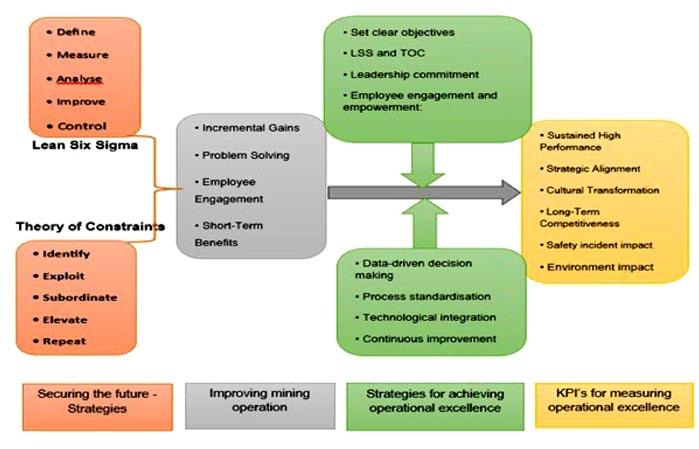
Integrating the theory of constraints (TOC) with Lean Six Sigma (LSS) created a holistic strategy for achieving operational excellence in underground mining. This unified approach facilitated the identification and removal of inefficiencies while also improving process quality, ultimately resulting in enhanced productivity and safety within mining operations.
Figure 1—Theoretical framework of the integrated operational excellence model
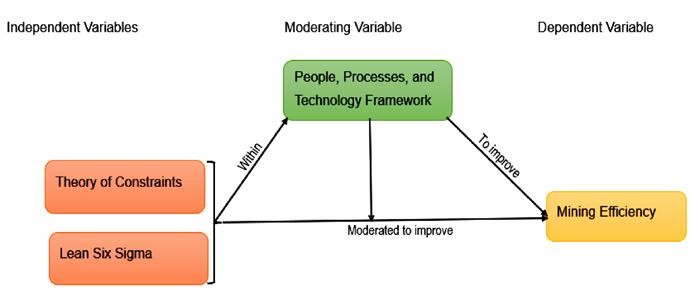
Figure 2—Conceptual framework of operational efficiency
Leveraging the integrated operational excellence model to enhance operational efficiency
Identify constraints
In order to enhance operational efficiency, the initial step involved recognising the limitations within the underground stoping process. A flowchart (Figure 3) that delineates the entire mining operation, from ore extraction to processing, would accomplish this.
Figure 3 shows how mined ore and waste move from extraction to processing or disposal, as detailed in the Mineral Resource Management report. The mine surveyor plays a key role in measuring the amounts of ore and waste rock extracted, overseeing their disposal, and identifying any discrepancies in tonnage. This involves comparing the tonnes available for hoisting with the actual tonnes hoisted, which helps find any excess or shortfall. A flowchart provides a clear overview of how each phase connects, making it easier to spot bottlenecks or areas where resources may be underused. Besides highlighting inefficiencies, flowcharts also focus on important performance indicators like the mine call factor and overall recovery factor. The MCF, which is the ratio of gold accounted for (GAF) to gold called for (GCF), offers vital insights into the efficiency and productivity of mining operations. Additionally, the GAF indicates the amount of gold recovered, based on the London Good Delivery bar, which weighs about 12.4 kg or 400 troy ounces, including the residue sent to slime dams. Consequently, a flowchart helps provide a thorough understanding of how each phase interconnects, making it easier to identify bottlenecks or areas where resources may be underutilised.
Analyse constraints
The improvement team used a systematic problem-solving approach to analyse factors contributing to low MCF and identify obstacles in the Mineral Resource Management system that affect operational efficiency. They used the TOC to break down complex issues and organise contributing factors using a fishbone diagram.
Figure 4 presents the fishbone diagram used for root-cause analysis and problem-solving. This visual tool helps identify and organise potential causes of a problem, clarifying the connections between causes and effects. The team focused on critical areas to enhance operational performance by analysing the root causes of existing challenges. They used a prioritisation matrix to score various factors influencing efficiency on a scale from 1 to 10, highlighting urgent issues that require immediate action as well as those that can be addressed over time. The findings are illustrated in Figure 5, which fosters alignment among team members and encourages collaboration for necessary changes.
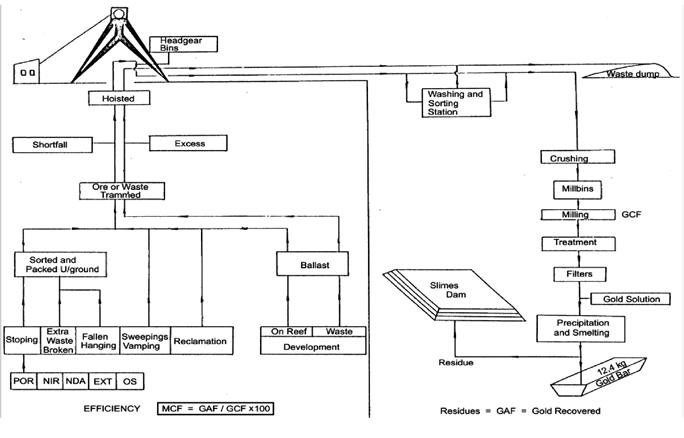
Figure 5 shows a prioritisation matrix, a key tool in the TOC framework. It helps operations focus on significant constraints by evaluating their impact on KPIs like tonnage, quality, costs, and safety, thereby optimising mining operations. The matrix prioritises actions based on importance and urgency, identifying logistical, technological, and regulatory challenges. Addressing these constraints, such as logistical and material handling problems (Table 2), can significantly improve operational efficiency and profitability.
The TOC emphasises the need to maximise operational time, enhance equipment availability, and improve the flow of ore through a planning process that identifies and eliminates bottlenecks. This integrated approach facilitates more efficient resource use and smoother operations, ultimately leading to increased productivity and performance in the mining industry.
Application of Lean Six Sigma
LSS plays a crucial role in underground gold mining, where safety, accuracy, and cost efficiency are top priorities. This methodology provides a systematic approach to continuous improvement, ensuring that operations are optimised while maintaining high standards.
Value stream mapping in underground stope mining
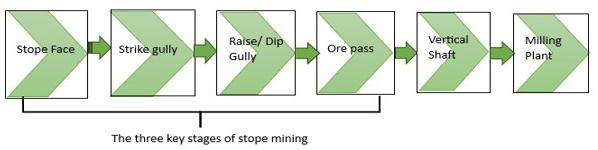
LSS is a highly effective methodology that has found extensive application in various sectors. This is particularly demonstrated through techniques such as value stream mapping (VSM), the 5S methodology, and the DMAIC framework. VSM enables mining operations to clearly visualise the flow of materials and information throughout the production process, as depicted in Figure 6.
Figure 6 emphasises the critical role of value stream mapping (VSM) in the mining phase. VSM enables mining operations to clearly visualise the flow of materials and information
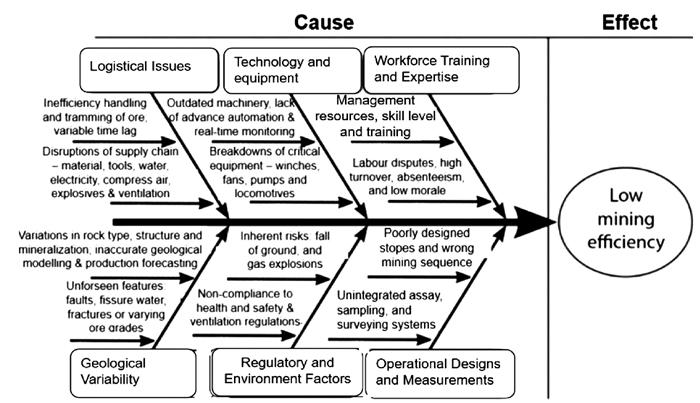
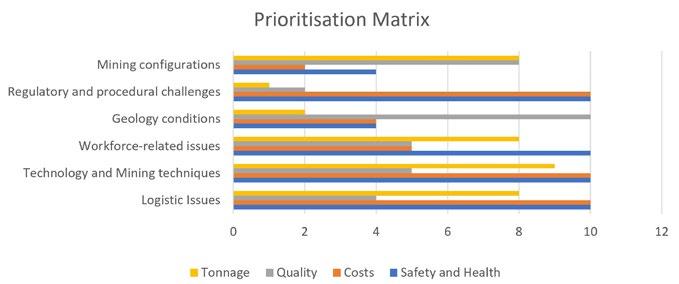
Figure 3—Schematic representation of a detailed ore flowchart of underground gold operations
Figure 4—The fishbone diagram showing cause and effect
Figure 5—Impact of inherent constraints on operational efficiency
Leveraging the integrated operational excellence model to enhance operational efficiency
Table 2
Logistical issues – material handling in the stope
KPI’s Description
Tonnage
Quality (ore grade)
Costs
Safety and health
Fragmented ore removal can disrupt mining operations and reduce output. Inefficient transportation from the stope to the surface may create backlogs, limiting processed tonnage. Additionally, poor extraction methods and equipment failures can hinder access to deposits and extend downtime, negatively impacting future schedules.
Mining operations face logistical challenges that can mix fragmented ore with waste, degrading the quality. Delays in ore removal worsen this issue, complicating processing and reducing recovery rates. Lower ore grades raise production costs and decrease profitability, threatening the project's economic viability.
Operational expenses may rise from logistical challenges in broken ore extraction, resulting in higher overtime, maintenance, and machinery rental costs. Inefficient transportation could lead to more trips or costly methods, further increasing expenses. These factors, along with reduced tonnage and lower ore grades, can significantly impact profit margins and threaten the financial sustainability of the mining operation if production costs rise without a corresponding increase in ore sales revenue.
Logistical challenges can raise workplace accident risks, such as blocked pathways leading to rock falls. Prolonged dust exposure poses respiratory risks, and delays in removal worsen the issue, requiring stricter health protocols. These challenges can also increase worker stress and fatigue, as longer hours under tough conditions negatively impact safety and morale.
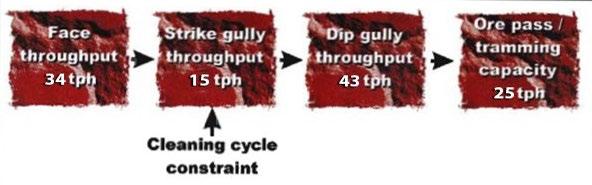
throughout the production process. As a fundamental aspect of LSS methodology, VSM is essential for improving gold extraction and processing. It accomplishes this by identifying inefficiencies, redundancies, and delays, such as the cleaning cycle constraint illustrated in Figure 7.
In Figure 7, the throughput of the strike gully is a critical constraint that sequentially impacts the raise (dip) throughput, which, in turn, significantly affects tramming capacity. Therefore, effective mine planning should prioritise the extraction of additional ore from the strike gully during each shift to minimise the risk of ore lockup. This visual representation not only highlights inefficiencies but also serves as a foundation for developing targeted strategies to streamline operations, ultimately leading to increased productivity and reduced operational costs.
Application of the 5S methodology in underground stope mining
A crucial aspect of LSS in mining is the 5S methodology, which stands for sort, set in order, shine, standardise, and sustain. This technique highlights the importance of maintaining an organised and efficient work environment. In underground mining, where space is often limited and conditions can be hazardous, the implementation of 5S can lead to significant improvements in both safety and efficiency. When tools and materials are easily accessible and workspaces are kept clean and orderly, mining teams can reduce the time spent searching for equipment and minimise the risk of accidents. This concept is illustrated in Figure 8.
Figure 8 indicates the importance of a detailed worksite plan that is displayed in the waiting area to keep workers informed and ensure safe navigation around the site. It is essential to maintain clean gullies and equipment for both safety and operational
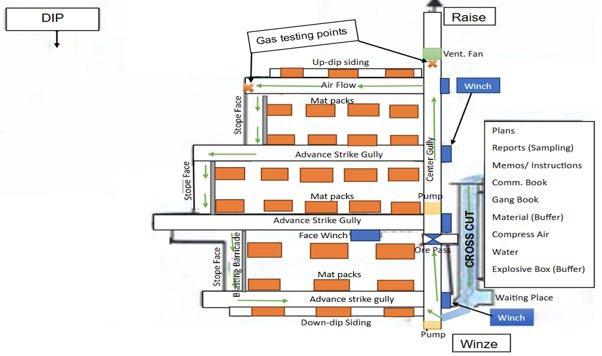
Figure 6—Value stream mapping of the mining process
Figure 7—Cleaning cycle constraint
Figure 8—Underground stope mining
Leveraging the integrated operational excellence model to enhance operational efficiency
Factors
Poor drilling and blasting practices
Inaccurate sampling and assaying
Ore handling and transportation
Accumulation of broken ore and mud
Water management issues
Illegal mining activities
Description
Inefficient drilling and blasting can lead to poor fragmentation, resulting in gold loss and lower MCF.
Errors in sampling and assaying can lead to incorrect estimations of gold in situ, affecting the MCF.
Inefficient ore handling and transportation can result in gold losses during the movement of ore.
Failure to clean out broken ore in stopes and mud in the cross-cut drains can lead to gold losses.
Poor water control can lead to gold being washed away, impacting the MCF.
Unauthorised mining operations can lead to significant gold losses, impacting the MCF.
efficiency in mining. Gullies serve several important purposes: they help remove blasted rock, provide access for miners and materials, enhance air circulation, and prevent the buildup of harmful gases, thereby safeguarding worker health. Additionally, effective water management is crucial, as stagnant water can lead to slips and obstruct the extraction process. Well-maintained gullies boost safety and productivity by facilitating timely blasting and ensuring a steady supply of minerals, ultimately minimising downtime. The next phase, standardisation, will establish clear guidelines for all employees, leading to improved performance and safety. This concept is illustrated in Figure 9.
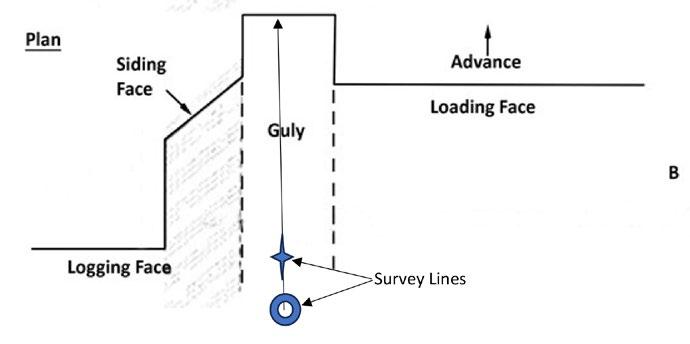
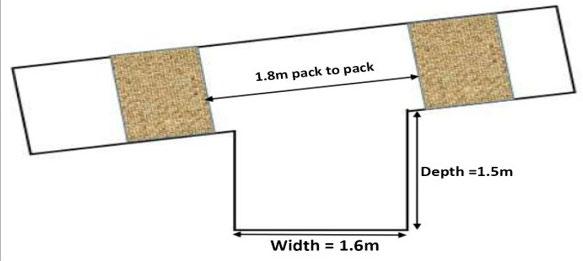
In Figures 9 and 10, the advance strike gully (ASG) is designed for transporting blasted ore, with standardised dimensions for stope faces and gullies. The blasting of the ASG must extend beyond the face in accordance with specific survey line guidelines. Additionally, the 5S approach aims to sustain improvements by ensuring that crew members are well-trained in standard operating procedures and that they receive ongoing training aligned with organisational goals. Regular assessments are conducted to maintain these standards.
DMAIC framework
The DMAIC framework from Six Sigma—define, measure, analyse, improve, and control—offers a structured approach to problemsolving that is particularly useful in the mining sector. Each phase
of DMAIC enables teams to systematically address issues that arise during operations. In the define phase, specific problems are identified. The measure phase focuses on quantifying the extent of these issues, while the analyse phase investigates the root causes, leading to targeted improvements in the improve phase. Finally, the control phase ensures that these improvements are maintained over time, thereby reducing variability and enhancing overall quality in mining processes.
A thorough examination of mine resource management (MRM) reports, collaborative brainstorming sessions, and insights from researchers such as Balci and Kumral (2024), Schwartz (2022), Mhlongo (2021), Xingwana (2016), and Bascetin et al. (2011) have identified key factors contributing to the notably low mine closure factor (MCF) and overall inefficiency of mining operations. A concise summary of these findings is presented in Table 3, which outlines the primary causes.
Several factors lead to a low MCF, including constraints, waste, and inconsistent operational practices, as illustrated in Table 4.
Table 4 outlines the problem statement of the study, focusing on constraints related to operational efficiency, waste generation, and quality control in the mining sector. It identifies the key factors that influence mining efficiency and ore quality while also highlighting opportunities for further research and strategies to enhance mining performance.
Figure 9—Standardisation of stope faces
Figure 10—Standardisation of an advanced strike gully
Table 3
Factors contributing to low MCF
Leveraging the integrated operational excellence model to enhance operational efficiency
Table 4
Analysis of constraints, waste, and quality
Items Description
Constraints
Non-value-adding activities
Inconsistent operational practices
Integrate people, processes, and technology (PPT) framework
Recognising the constraints present in the system, whether they pertain to resources, processes, or technology, allows operations to tackle inefficiencies and enhance their workforce.
The identification of waste levels enables operations to discover areas of underutilisation or even misuse of resources. Lean theories enable the further reduction of waste while improving the overall efficiency of operations.
It is important to continuously monitor quality metrics to ensure that per-annum ore produced meets the targets or expectations of a metallurgical plant and relevant standards. This regular assessment would identify defects that could be improved, leading to higher customer satisfaction and loyalty.
This research employed an empirical model created by Rajini et al. (2018) that effectively aligns individual goals with organisational throughput targets using a system of weighted rankings and iterative goal tracking. This strategy integrates the TOC with LSS, emphasising the interaction among people, processes, and technology. The aim is to enhance operational efficiency and promote operational excellence within the gold mining industry.
➤ People and process (scale): As emphasised by the TOC and LSS, workers are the most important resource of an organisation. They can be supported to use their intelligence to ensure that processes remain effective and that waste is minimised or ideally eliminated. This approach encourages all workers to participate in activities, leading to improved operational performance. The solutions provided by TOC and LSS are highly effective and tailored to meet the specific needs of each situation, addressing issues of ownership and accountability in boosting performance and productivity. Additionally, these approaches highlight the importance of involving people in the optimisation of systems and processes.
➤ People and technology (innovate): In today's industrial environment, the success of an organisation largely depends on its people and technology. By integrating the TOC with LSS, organisations can leverage advanced technology for data analysis and automation, allowing them to quickly identify bottlenecks with ease. This process encourages the workforce to embrace new tools that enhance productivity. Additionally, investing in training helps employees make informed decisions and improves their problem-solving skills.
➤ Process and technology (automate): The integration of technologies with operational processes is crucial for successfully applying the principles of TOC and LSS in mining operations. Automating repetitive tasks allows one to redirect human efforts toward strategic objectives, which increases efficiency and minimises human errors. New technological innovations, such as the internet of things (IoT) and artificial intelligence (AI), enhance computing power and provide real-time information.
This information can be utilised for decision-making and process optimisation.
Integrating technology, optimising processes, and aligning the workforce can significantly enhance output, reduce costs, and promote sustainability. By utilising advanced tools and methodologies, organisations can streamline their operations, leading to better resource use and increased productivity. This comprehensive approach fosters a more agile work environment and supports long-term environmental goals, ultimately creating a more competitive and responsible business model.
Foster continuous improvement
Integrating the TOC with LSS has significantly transformed organisational culture by embedding continuous improvement into daily operations. This collaboration leverages the strengths of both methodologies, enabling employees to proactively identify inefficiencies and enhance processes. As a result, a culture of innovation emerges, encouraging team members to challenge existing practices and explore new solutions for improving productivity. This synergy cultivates a problem-solving workforce that is committed to the company’s success, equipping the organisation with the agility needed to navigate fluctuating commodity markets. In a rapidly changing landscape, the ability to adapt is essential, and these methodologies provide a systematic framework for identifying bottlenecks and optimising resource allocation, which empowers effective responses to market dynamics. This adaptability helps mitigate risks from market fluctuations and enables the company to seize new opportunities, thereby strengthening its competitive edge. The outcomes are evident: sustainable cost reductions and increased productivity. By addressing inefficiencies and prioritising value creation, the organisation has developed a more efficient operational framework that minimises waste and maximises output. These enhancements have not only positively impacted financial performance but also bolstered the company’s reputation as an industry leader. Consequently, the strategic integration of TOC and LSS has positioned the organisation for immediate success while laying a foundation for long-term growth. This dedication to ongoing enhancement keeps the company agile and resilient, prepared to address future challenges.
Leveraging the integrated operational excellence model to enhance operational efficiency
Discussion
This research aims to explore and implement the integrated operational excellence (IOE) model as a strategic framework designed to enhance operational efficiency in South African gold mines. By conducting a thorough analysis of current operational practices and identifying areas of inefficiency, the study seeks to apply continuous improvement methodologies, such as the TOC and LSS. This approach creates a holistic strategy that aligns people, processes, and technology. The primary focus is on optimising resource utilisation, reducing operational costs, increasing throughput, and fostering a culture of excellence across mining operations. Ultimately, the research aspires to provide practical insights and a replicable model that can drive sustainable productivity improvements within the South African gold mining sector.
Integrating the TOC and LSS is essential for improving operational efficiency by streamlining processes and enhancing productivity. TOC focuses on identifying bottlenecks that disrupt workflow, while LSS aims to eliminate waste and reduce variability. Together, they form a comprehensive framework that optimises performance, ensuring effective use of resources and high-quality output. This collaboration enables organisations to pinpoint inefficiencies and implement targeted solutions, creating a more agile production environment. However, successfully implementing this integrated framework comes with challenges. A significant obstacle is resistance to change, which may arise from employees' reluctance to alter established routines or fear of the unknown. Additionally, adequate training is crucial; without proper education on the principles and practices of TOC and LSS, employees may find it difficult to adapt to new processes and technologies. This knowledge gap can lead to misunderstandings and diminish the overall effectiveness of the integration. Therefore, organisations must proactively address these challenges to ensure a smooth transition.
Several factors can facilitate the successful adoption of an integrated approach that combines the TOC and LSS. Strong leadership support is essential; leaders establish the organisation's tone and can inspire a shared vision of operational excellence. When leaders actively promote the integration of TOC and LSS, they create an environment where employees feel empowered to embrace change. As a result, mines employing this model have seen significant reductions in waste and variability, leading to improved operational stability and cost efficiency (Hia et al. 2024; Kesek et al. 2023). A commitment to continuous improvement is also crucial. Organisations that prioritise ongoing development and learning are more adept at adapting to changing market demands and internal challenges. Additionally, fostering a cultural shift toward operational excellence is vital for sustaining the benefits of this integration. Such a cultural transformation promotes a mindset focused on efficiency and quality throughout the organisation. Therefore, by instilling values of collaboration, accountability, and innovation, organisations can build a workforce that is not only skilled in TOC and LSS methodologies but also motivated to pursue excellence in all aspects of their work.
Ultimately, this holistic approach to integrating people, processes, and technology can lead to significant advancements in operational efficiency, positioning organisations for long-term success in a competitive landscape.
Managerial implications
The integrated operational excellence model is a valuable tool for improving operational efficiency in South African gold mines. It encourages managers to take a holistic view of operations, recognising the interconnectedness of various processes within the mining environment. This approach helps identify bottlenecks and inefficiencies, leading to streamlined operations, effective resource allocation, and optimal contributions from each segment of the production chain. The model promotes a culture of continuous improvement, urging managers to regularly assess operational practices and implement innovative strategies to enhance productivity. By utilising data analytics and performance metrics that combine the TOC with LSS, managers can pinpoint areas that need improvement and make informed, data-driven decisions. This methodology not only reduces costs but also allows organisations to respond swiftly to market changes, ultimately increasing profitability in a competitive environment. Additionally, the integration of this model facilitates informed decision-making, which contributes to cost reductions and the ability to adapt quickly to evolving market demands. Moreover, it emphasises the importance of fostering a culture of excellence among employees, which enhances their sense of value and motivation. This, in turn, leads to greater job satisfaction, higher retention rates, and increased willingness to share ideas and engage in problem-solving initiatives.
Conclusion
The quest for operational excellence in underground gold mining involves more than simply adopting various methodologies; it requires the development of an integrated framework that combines the strengths of the TOC and LSS, focusing on the essential elements of people, processes, and technology. TOC emphasises the identification and management of critical constraints that limit performance, while LSS provides a structured approach to reducing waste and improving process variability. The PPT model complements this comprehensive operational excellence strategy by highlighting the interactions between people, processes, and technology. This integrated operational excellence model offers a holistic approach for mining companies to effectively navigate industry complexities, proactively address challenges, and achieve sustainable growth. Organisations can improve operational efficiency and contribute to the mining sector's long-term viability by fostering a culture of collaboration and continuous improvement. However, challenges like employee resistance and process alignment need to be addressed through continuous improvement, staff training, and strong communication channels.
Acknowledgements
I would like to express my gratitude to my former colleagues and the improvement team at the Sibanye Stillwater Beatrix operation in South Africa for their valuable technical discussions. I also appreciate the operations management for their support in providing the necessary resources to facilitate this work. Additionally, I extend my thanks to the anonymous reviewers of the journal, whose insightful feedback was instrumental in refining the final document.
References
Anglo American. 2024. Case Study: Anglo American transforms mining with AI - AIX | AI Expert Network October 25, 2024.
Leveraging the integrated operational excellence model to enhance operational efficiency
Antony, J., Snee, R., Hoerl, R. 2017. Lean Six Sigma: yesterday, today, and tomorrow. International Journal of Quality & Reliability Management, vol. 34, no.4, pp.1073-1093. https://doi. org/10.1108/IJQRM-03-2016-0035
Antony, J. 2011. Six Sigma vs Lean: Some perspectives from leading academics and practitioners. International Journal of Productivity and Performance Management, vol. 60, pp.185–190. DOI: 10.1108/17410401111101494
Balci, M., Kumral, M. 2024. Impacts of grade distribution and economies of scale on cut-off-grade and capacity planning. Mining, Metallurgy & Exploration, vol. 41, pp.1171–1193.
Bascetin, A., Tuylu, S., Nieto, A. 2011. Influence of the ore block model estimation on the determination of the mining cutoff grade policy for sustainable mine production. Environmental Earth Science, vol. 64, pp 1409–1418.
Berbner, J., Lath, V., Maksimainen, J. 2022. Navigating a decade of challenges: Five winning initiatives for mining CEOs. McKinsey & Company, https://www.mckinsey.com/industries/metals-andmining/our-insights/navigating-a-decade-of-challenges-fivewinning-initiatives-for-mining-ceos
Breytenbach, M. 2017. Collaboration with engineering firm yields nigh-R100m cost saving for Harmony. Creamer Media’s Mining Weekly, https://www.engineeringnews.co.za/article/gold-minerachieves-operational-efficiency-improvements-2017-11-17
Chikwanda, H.K., Mntambo, S.I. 2023. The Implementation of the theory of constraints (TOC) in a South African mining environment: A Case Study of a continuously-run Concentrator Plant. Conference: 4th African International Conference on Industrial Engineering and Operations Management DOI: 10.46254/AF04.20230171
Claassen, J.O. 2016. Application of manufacturing management and improvement methodologies in the southern African mining industry. Journal of the Southern African Institute of Mining and Metallurgy, vol. 116, no. 2, pp 139–148. DOI: 10.17159/24119717/2016/v116n2a5
Copland, T., Nehring, T. 2016. Integrated optimization of stope boundary selection and scheduling for sublevel stoping operations. Journal of the Southern African Institute of Mining and Metallurgy, vol. 116, pp. 1135–1142. DOI: 10.17159/24119717/2016/v116n12a7
Costantini, X., Fookes, W., Neise, P., Pujol, F., Sivecas, G., Rubinstein, B. 2022. How mining companies reach the operational excellence gold standard. McKinsey & Company. https://www.mckinsey.com/capabilities/operations/our-insights/ how-mining-companies-reach-the-operational-excellence-goldstandard
De Donno, M.G. 2024. The reasons that push mining operations to act cautiously. Istituto Analisi Relazioni Internazionali. https:// iari.site/2024/05/27/the-reasons-that-push-mining-operationsto-act-cautiously/
Dutta, S.S. 2024. Lean manufacturing and process optimization: Enhancing efficiency in modern production. International
Journal of Scientific Research in Computer Science, Engineering and Information Technology. vol. 10, no.5, pp. 265–273. DOI: 10.32628/CSEIT241051024
Dutta, S.S. 2023. The Theory of Constraints: A framework for enhancing efficiency and promoting growth. American International Journal of Business Management (AIJBM), vol. 6, no. 12, pp. 36–44.
Ebrahimi, A. 2018. How mining operations improve production efficiencies and mine economics. Investing News Network. https://investingnews.com/innspired/how-mining-companiesimprove-production-efficiencies-and-mine-economics/
Ekleş, E., Ay Türkmen, M. 2022. Integrating the theory of constraints and Six Sigma: Process improvement implementation. Istanbul Business Research, vol. 51, no. 1, pp. 123–147. DOI: 10.26650/ibr.2022.51.938481
Flores-Castañeda, R.O., Olaya-Cotera, S., López-Porras, M., Tarmeño-Juscamaita, E., Iparraguirre-Villanueva, O. 2024. Technological advances and trends in the mining industry: A systematic review. Mineral Economics, vol. 38, no. 2, pp. 221–236. DOI: 10.1007/s13563-024-00455-w
Fourie, H. 2016. Improvement in the overall efficiency of mining equipment: A case study. Journal of the Southern African Institute of Mining and Metallurgy. 2016. vol. 116, no. 3, pp. 275–281. DOI: 10.17159/2411-9717/2016/v116n3a9
Gupta, M., Digalwar, A., Gupta, A., Goyal, A. 2022. Integrating Theory of Constraints, Lean and Six Sigma: a framework for development and its application. Production Planning & Control, vol. 35, no. 3, pp. 238–261. DOI: 10.1080/09537287.2022.2071351
Hermanus, M. 2017. Mining redesigned—Innovation and technology needs for the future-A South African perspective. Journal of the Southern African Institute of Mining and Metallurgy, vol. 117, no. 8, pp. 811–818. DOI: 10.17159/24119717/2017/v117n8a12
Hia, S. W., Singgih, M. L., Gurning, R. O. S. 2024. The application of Lean Six Sigma to improve mining transportation overall vehicle effectiveness (MTOVE): a case study in mining company. International Journal of Lean Six Sigma, vol. 16, no. 1, pp. 54–88. DOI: 10.1108/IJLSS-07-2023-0121
Kesek, M., Bogacz, P., Migza, M. 2023. Study on the usefulness of lean management tools and techniques in coal mines in Poland. Energies, vol. 16, no. 21, pp. 1-27. DOI: 10.3390/en16217240
Lala, A., Moyo, M., Rehbach,S., and Sellschop, R. 2016. Productivity in mining operations: Reversing the downward trend. Australasian Institute of Mining and Metallurgy, pp. 46–49. https://search.informit.org/doi/10.3316/ informit.348211411098838
Lane, A., Guzek, J., Van Antwerpen, W. 2015. Tough choices facing the South African mining. industry. Journal of the Southern African Institute of Mining and Metallurgy, vol. 115, no. 6, pp. 471-479.
Leveraging the integrated operational excellence model to enhance operational efficiency
Lazarenko, Y., Garafonova, O., Marhasova, V., Tkalenko, N. 2021. Digital transformation in the mining sector: Exploring Global Technology Trends and Managerial Issues. E3S Web of Conferences. 315. 04006. DOI: 10.1051/e3sconf/202131504006
Markgraf, B. 2021. Limitations of the theory of constraints. Bizfluent.com. Published on 1 Jan 2021, https://bizfluent.com/ limitations-of-the-theory-of-constraints.html?form=MG0AV3
Lumadi, V.W., Nyasha, S. 2024. Technology and growth in the South African mining industry: An assessment of critical success factors and challenges. Journal of the Southern African Institute of Mining and Metallurgy, vol. 124, no. 4, pp. 163–172. DOI: 10.17159/2411-9717/2287/2024
Mishra, M.N. 2023. Integrated Theory of Constraints, Lean and Six Sigma process excellence methodologies: A Study in the Indian manufacturing sector. Authorea DOI: 10.22541/ au.167749764.42473172/v1
Mhlongo, A. 2021. Methodology to quantify apparent losses versus real losses in narrow tabular precious metal ore flows. Master’s Dissertation, Faculty of Engineering and the Built Environment, University of the Witwatersrand, Johannesburg
Oladipupo, O., Adeyinka, A., Durodola, O. 2023. Exploring Lean Six Sigma: A comprehensive review of methodology and its role in business improvement. International Journal of Multidisciplinary Research and Growth Evaluation, vol. 4, no. 6, pp. 939–947. DOI: 10.54660/. IJMRGE.2023.4.6.939-947
Pacheco, D.A . 2015. TOC, Lean, and Six Sigma: The missing link to increase productivity? African Journal of Business Management, vol. 9, no. 12, pp. 513–520. DOI: 10.5897/AJBM2014.7672
Rajini, J., Nagaraju, D., Narayanan, S. 2018. Integration of Lean, Six Sigma, and TOC for productivity improvement of mining industry, International. Journal Productivity and Quality Management, vol. 24, no.3, pp. 424–440. DOI: 10.1504/ IJPQM.2018.092986
Ramasu,T., Sobiyi, K., Akinlabi, E. 2017. Application of TOC in South Africa: A case study in a platinum mine. Proceedings of the 2017 International Conference on Industrial Engineering and
Operations Management (IEOM) Bristol, UK, July pp. 24–25, 2017.
Rio Tinto. 2020. Report: How Rio Tinto improves operational efficiency. Mining Digital. May 17, 2020. https://miningdigital. com/supply-chain-and-operations/report-how-rio-tintoimproves-operational-efficiency
Robinson, I. 2024. Ticking boxes won’t revive the mining industry. Journal of the Southern African Institute of Mining and Metallurgy, vol. 124, no. 2, pp. iv–iv.
Rodovalho, E., El Hajj, T.M., Teodoro, G.C., De Tomi, G., Tenório, J.A.S. 2024. Reducing mining tailings and operational dilution: a new application of the room-and-pillar mining method. Journal of the Southern African Institute of Mining and Metallurgy, vol. 124, no. 8, pp. 483–490. DOI: 10.17159/2411-9717/1696/2024
Salah, S., Rahim, A. 2019. The integration of Six Sigma and Lean: Combining Lean Six Sigma with process improvement. An Integrated Company-Wide Management System, pp 49–93. DOI: 10.1007/978-3-319-99034-7_4
Sharma, C.M. 2023. Implementing Lean Six Sigma and strategies to overcome. Lean Six Sigma Institute. https://www.linkedin.com/ pulse/challenges-being-faced-while-implementing-strategiesovercome-sharma#:~:text=Challenge: %20Resistance%20to%20 change%20and%20a%20cultural,Six%20Sigma%20will%20 lead%20to%20job%20losses
Schwartz, S. 2022. Investigation of the factors that influence the mine call factor with particular reference to illegal mining at Driefontein Ya Rona shaft. Master’s Dissertation. Johannesburg: University of the Witwatersrand.
Sukwadi, R., Felicia, Y., Muafi. 2021. TOC, lean, and six sigma: An integrated model to increase the productivity of the textile industry. Journal of Mechanical Engineering Research and Developments, vol. 44, no. 1, pp. 327–336.
Xingwana, L. 2016. Monitoring ore loss and dilution for mineto-mill integration in deep gold mines: A survey-based investigation. Journal of the Southern African Institute of Mining and Metallurgy, vol. 116, no. 2, pp. 149-160. DOI: 10.17159/2411-9717/2016/v116n2a6 u

Affiliation:
1 Faculty of Mining and Geology, University of Belgrade, Serbia
2 Queen's University, Kingston, ON, Canada
3 Mining and Metallurgy Institute Bor, Serbia
4 Joint Stock Company Elektroprivreda Srbije Branch Kolubara, Serbia
Correspondence to: L. Žujović
Email: lazar.zujovic@rgf.rs
Dates:
Received: 16 Dec 2024
Revised: 25 Jan. 2026
Accepted: 03 Jun. 2026
Published: Jun. 2026
How to cite:
Žujović, L., Cvjetić, A., Kecojević, V., Gomilanović, M., Stanić, N., Bugarin, D., Stanković, T. 2026. A Conceptual Framework for Improving Employee Training in Surface Mines Through Virtual Reality and Serious Game Journal of the Southern African Institute of Mining and Metallurgy, vol. 126, no. 6, pp. 335 - 342
DOI ID:
https://doi.org/10.17159/2411-9717/3621/2026
ORCiD:
L. Žujović
http://orcid.org/0000-0002-6197-1041
A. Cvjetić
http://orcid.org/0000-0002-2404-4679
V. Kecojević
http://orcid.org/0000-0002-6102-4378
M. Gomilanović
http://orcid.org/0000-0002-1209-7423
N. Stanić
http://orcid.org/0000-0002-6620-8563
D. Bugarin
http://orcid.org/0000-0002-9103-4614
T. Stanković
http://orcid.org/0000-0002-2714-7016
A conceptual framework for improving employee training in surface mines through virtual reality and serious game
by L. Žujović1, A. Cvjetić1, V. Kecojević², M. Gomilanović³, N. Stanić⁴, D. Bugarin³, T. Stanković³
Abstract
In addition to unfavourable weather and working conditions, incidents and injuries in the mining industry are not uncommon. Factors such as extreme weather conditions, heavy machinery, and unstable terrain make mining a high-risk occupation. To mitigate these risks, there is a growing need for ongoing improvements in employee safety protocols and training programmes. This paper presents a conceptual framework aimed at enhancing the safety training of employees working in surface mining operations. The proposed solution integrates virtual reality and “serious games” as innovative tools to improve safety awareness and preparedness among mine workers. Specifically, a serious game was developed in two versions: a desktop application and a fully immersive virtual reality experience, both using the Unity3D game engine. These applications are designed to simulate real-life mining environments and address various workplace safety scenarios, offering employees an interactive and engaging way to practice their responses to potential hazards. The use of serious games and virtual reality allows for a deeper level of engagement in training, helping workers to retain critical safety information while reducing the risks associated with traditional on-site training methods.
Keywords Virtual reality, serious games, surface mining, training, safety
Introduction
Many areas of life have been significantly improved with the rapid development of technology and technological achievements. Technology has enabled easier communication, quicker, more precise, and higher quality of information retrieval, as well as the improvement and acceleration of industrial processes. Certainly, one of the most important aspects for any company should be the safety and health of its employees. In this context, technological development has allowed for the creation of tools that contribute to improving employee training and work safety. The majority of research on virtual reality (VR) training in mining considered underground mining operations, and therefore there is room for further improvements in surface mining. Additionally, it was found that the use of serious games is not yet common in this sector. Moreover, modern technology can be added as a supplement to traditional mine safety training.
A conceptual framework for improving employee training in surface mines through virtual reality by incorporating the concept of a serious game, provides a structured approach to miners’ training in high-risk environments. Serious games refer to the use of game-based methods, typically for purposes beyond entertainment, such as education, training, and skill development. When combined with virtual reality (VR), serious games can become powerful tools that not only engage employees, but also help their learning experience by integrating interactive, realistic, and immersive elements. This framework leverages both VR and serious game concepts to improve safety training in surface mining operations. Virtual reality is often viewed as a demanding and modern technology requiring exceptional programming understanding and skills. This is true, as numerous programming languages are at the core of computer systems. However, by using certain software such as Unity3D, plugins, and assets, it is possible to utilise virtual reality in various fields and develop different applications. This paper aims to highlight the potential for virtual reality to be implemented in a way that could help workers, professionals, and companies to incorporate this framework within their own operations. Virtual reality (VR) is a relatively new technology, and it has started to attract significant attention from researchers
A conceptual framework for improving employee training in surface mines
over the past twenty years. Among other aspects, this has been driven by the rapid development of technology, computers, computer graphics, video games, and other. As a result, the use of virtual reality has become more prevalent in science, industry, medicine, and many other fields. Additionally, the availability of VR devices has become more widespread and simpler, making this technology significantly more accessible to the general population. The research and advancements in VR technology occurred towards the end of the 20th century. In this regard, researchers have provided numerous definitions, which may explain why there is still no clear and universally accepted definition of virtual reality. Some of the definitions given by different researchers are:
➤ "Virtual reality represents an interactive experience that is computer-generated" (Pimentel, Teixeira, 1993).
➤ "Virtual reality is a computer-generated, interactive, three-dimensional environment into which a person is immersed" (Levy, Bjelland, 1995).
➤ "Virtual reality is a clone of physical reality" (Von Schweber, 1995).
➤ "Virtual reality is interactive graphics with threedimensional models, combined with displays that create a sense of immersion and manipulation for the user" (Bishop, Fuchs, 1992).
In almost all definitions of virtual reality, the terms "interactive," "computer-generated," and "three-dimensional" dominate. Due to further advancements in VR technology, both hardware and software, there are supplemented definitions, which highlight VR as a growing technology, such as: "Virtual reality is a technology that is constantly evolving, allowing a three-dimensional spatial environment through forms of computer graphics" (Poynton, 2009).
One of the important characteristics and terms describing VR is the aforementioned immersion in the virtual environment. Although this term is one of the features of VR, it is not its only trait. Additionally, technological development, modern 360 degrees cameras, VR headsets, sensors, and other devices have allowed a state where the senses register the illusion as reality. The degree of immersion in the virtual environment depends on the device used to achieve such an experience. Kalawsky (1997a), therefore, provided one of the broader definitions of VR, explaining that VR can enable the repetition of tasks or procedures until the desired level of understanding is achieved. This is almost impossible in real time, and potentially very useful when it comes to work procedures and situations in the mining industry. Repeating certain processes in safe conditions can lead to improved employee training, as well as greater safety and better preparedness when they are at the workplace. The author also emphasises that VR allows for natural and intuitive behaviour within the framework of an artificial but safe environment (Kalawsky, 1997b).
Although VR is evolving rapidly, it has been used in the mining industry, educational institutions, and government agencies for training purposes. As early as 2004, researchers analysed several situations in the mining industry, e.g., mine evacuation in case of danger and stability in mining rooms, using VR (Stothard et al., 2004). The authors concluded that VR could improve employee training to enhance workplace safety and health. Isleyen and Duzgun (2019) considered the use of VR for identifying rock mass collapse issues in underground mining. The authors concluded that VR could improve the training and decision-making process of employees. Australian researchers evaluated employee training using VR in their mining industry. They reported significant improvements in employee safety (Pedram et al., 2014). The
National Institute for Occupational Safety and Health (NIOSH) plays a significant role in improving safety and employee training in the American mining industry. Researchers from this institute developed the software VR Mine, designed to assist in these efforts (Bellanca et al., 2019). Such a framework is designed to improve safety features specific to underground mining operations. Polcar and Horejsi (2015) highlighted that PC workstations are effective platforms for self-guided virtual tours, though they offer nonimmersive virtual reality (VR) experiences that limit full immersion in the virtual environment. Conversely, Van Wyk and De Villiers (2019) argued that these systems are a cost-effective solution for delivering high-resolution design, training, and educational applications. Therefore, this research paper considers both desktop and VR applications. These are just a few examples of why the subject of this paper is the implementation of VR in the field of safety and employee training in the mining industry. Additionally, the results of this research could potentially help professionals and companies to include this form of technology in their systems. Furthermore, there is an intention to highlight the potential application of developed tools in other areas.
It is also valuable to make a difference between gamification and serious games. Gamification is a new trend that explores the incorporation of game elements in non-gaming contexts while serious game is a game form played with the main goal of achieving an intended knowledge. The primary aim of a serious game is not amusement (Sanmugam et al., 2014). In one serious video game, users would be able to display and learn specific situations, measures, and procedures, have the opportunity to make decisions themselves, and test their knowledge. Additionally, the current workforce consists mainly of computer-literate individuals, e.g., millennials, who are familiar with the concept and terms of video games. Armstrong et al. (2016) emphasise that, in general, the enormous potential of using the concept of serious games is reflected in the fact that a significant number of everyday work tasks can be presented in such a way. Iacono et al. (2020) also state that video games increase the connection between employees and their motivation for workplace training. Liang et al. (2019) have developed a serious game for the training needs of mining employees, focusing on increasing hazard perception in underground mining. The authors conclude that, despite limitations, e.g., dizziness from using glasses, the effectiveness of safety training has been significantly improved using VR.
Gürer et al. (2023) developed serious game for safety and health training purposes in educational environments. Researchers concluded that such a game can be a good training tool for underground mine training. Andriamasinoro and Monfort-Climent (2021a) developed serious games (SG) for the complex mining sector in South Africa. The research was proposed to implement an educational tool based on SGs. These games, associated with deliberation steps, would serve as a participatory tool accompanied by the change in the paradigm in small-scale mining sector in African territories (Andriamasinoro, Monfort-Climent, 2021b).
Researchers from the Univeristy of Arizona (UA) identified the need for versatile training materials. Thus, they developed an educational serious game for mine safety (Serious Game Market, 2017a). Also, the National Institute for Occupational Safety and Health (NIOSH) played an important role in this research (Serious Game Market, 2017b).
Dallaqua et al. (2023) stated that the number of scientific publications about serious games has exponentially increased. In their research, they focused on higher education in engineering
A conceptual framework for improving employee training in surface mines
and management. Overall, seriousness and entertainment are two sides of one coin in SGs research, both in development and practice. Researchers added that there is a need for future efforts to formalise the framework classification algorithm (Dallaqua et al., 2023). Altomari et al. (2023) provided a set of guidelines for the creation of serious games. They concluded that serious games have an interdisciplinary approach. Findings by Man et al. (2024) indicate that VR significantly outperforms traditional training methods in enhancing behaviours, skills, and experiences, with key moderating factors such as training context and worker experience influencing outcomes.
The role of creating and using serious games is also present in other areas. For example, authors have created serious games for training employees in the banking sector (Fauziyah, 2019). OsunaAcedo (2021) stated that both serious game and gamification of processes in education has increased the level of motivation and interaction for both instructors and students. Brandl and Schrader (2024a) stated that new concepts seem crucial to adapt serious games to Education 4.0. Researchers added that in order to meet new students’ needs, research has to incorporate new technologies (Brandl, Schrader, 2024b). Göbel (2016) reported that integrating economic and quality data offers potential customers crucial insights into the cost-effectiveness and overall value of serious games.
All the aforementioned shows that the use of VR and serious games is present in many areas. The main goal of this research paper is to create and explain serious games related to selected situations and procedures in surface mining. Thus far, the researchers have developed limited versions of serious games for surface mining. Therefore, this research paper will present the possibilities of using VR technology to improve workplace safety and inspection training in the surface mining industry.
In this research project, the computer applications for desktop PC and VR were developed, which, through the concept of serious video game, will enable employees to interact with the virtual world. Also, certain situations and procedures related to workplace safety in mining will be addressed to train employees.
Methodology
The estimation is that surface mining methods dominate the world’s yearly mineral production (Raja, 2012). It is, therefore, crucial to look at safety training improvements in the surface mining sector.
In surface mining, serious games can simulate various dangerous scenarios such as equipment malfunctions and landslides. Workers can interact with the environment, performing tasks like equipment inspections or emergency evacuations, and receiving real-time feedback on their decisions. This game-based approach makes the training engaging and competitive, pushing workers’ motivation to learn forward. It also ensures that miners are well-prepared for real-life hazards, as the game-based training can be repeated until they have mastered critical situations. For instance, a serious game might present a challenge where miners must safely navigate hazardous terrain in a haul truck, requiring them to respond to various mechanical issues or environmental obstacles.
The safety, health, and training of employees should be of paramount importance for a company's operations. In the previous section, various research examples on virtual reality, employee training, and serious games were noted. In this section, the methodology used in the development of computer applications will be outlined, specifically, the integration of virtual reality and serious games in employee training.
The potential for using virtual reality and serious games in employee training will be highlighted, which could help professionals and companies incorporate such technology into their operations. The training of employees (whether field-based or classroom-based) could be conducted, supplemented, and discussed in training facilities with the help of developed computer applications. Under such conditions, compared to primarily fieldbased training, employees would be completely safe, focused on the training itself, and potentially more motivated to master future work tasks in a virtual and interactive environment.
The developed computer application should:
➤ Display scenarios of surface mines with various machines (hydraulic excavator, transportation system, bucket wheel excavators, dozers).
➤ Allow navigation through the virtual work environment and identify potentially hazardous situations that could threaten employees, the environment, and property.
➤ Present measures that should be taken to eliminate the identified issues.
➤ Be utilised on a Windows-based computer, or with a virtual reality device.
➤ Allow inserting of a new potentially hazardous situation, along with its image, text and voice information.
For all these reasons, the aim of this work is to develop a conceptual framework for creating serious games related to selected situations and measures that should be taken in surface mining (SM), concerning the inspection of various types of equipment and problem detection.
This will involve the potential use of computer applications and virtual reality technology, as well as serious games, to improve the aforementioned areas. The game flow diagram is presented in Figure 1. The diagram emphasises three levels of the game (easy, medium, and hard), with progression to the next level requiring identification of more than 80% of the problems. Problem images will be positioned near or on the machines as green cylinders. Interacting with them will reveal the problem, the measures to be taken, and audio information related to the situation. At the end of the successfully completed course, a test is proposed along with further discussion and questions about the situations encountered during the problem detection on the machines.
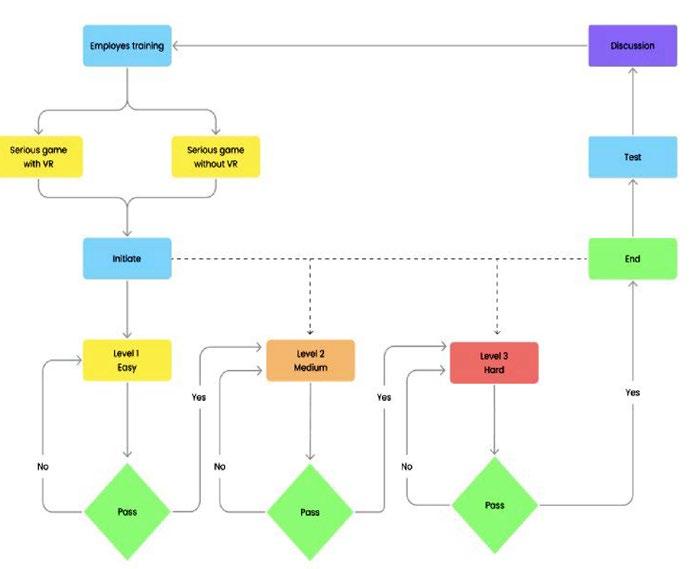
Figure 1—Training Flow Chart
A conceptual framework for improving employee training in surface mines
The inspection of mining equipment depends on the type of equipment. Therefore, multiple machine models will be present simultaneously in the scene (Figure 2).
The applications were developed with Unity3D. Unity3D is a tool for creating video games, virtual reality applications, and other content, and allows for the simulation and manipulation of 2D and 3D objects (Pedram et al., 2014). Unity3D will be utilised for developing two prototype versions of applications separately: VR version and a desktop version. Unity3D is a commercial software that is free for academic and personal use, supporting the development of video games, virtual reality, modeling, and more. It is one of the most popular and high-quality game engines (Pereira, et al., 2023).
Models of mining machines and workers used in this paper are given in Figures 3 to 5 and are placed in the mining scene (Unity AssetStore, 2024). These models were imported from Unity3D Asset Store (Unity AssetStore, 2024).
Given that, in the case of a video game, player movement through the scene is faster than in real-time, and prolonged time spent by the player in identifying problems is not expected, it was organised that each game level will last 11, 12, and 13 minutes for easy, medium, and hard levels, respectively. Various types of mining equipment will be placed within the same virtual surface mine, representing a single unit. At the same time, each machine will be observed separately within the same application. In this way, images with machine problems can be placed on any of the present mining machines.
In this paper, materials and procedures for enhancing employee safety and training are first collected. Collection of images are gathered from one mine in Serbia and from literature (Stothard et al., 2004). By using Unity3D software, along with other additional software tools and 3D models, as well as devices, e.g., virtual reality glasses, and joysticks, computer applications are created. Such serious video games can be used as auxiliary tools to improve workplace safety and employee training.
The developed game proposes three game levels – easy, medium, and hard. As given in Figure 6, each game level consists of different options such as ProblemPrefabs, 3DObjects, timer, audio source, StatsTracker etc. The ProblemPrefab displays real issues that occurred. The number of such images (problems) is 4, 6, and 10, for easy, medium and hard levels, respectively.
Figure 7 provides a closer look at a single ProblemPrefab. It offers options that trainers can insert, revise or remove within a single problem. The trainer can add problem images, title, audio source, and the description of a problem. It can also be revised at any time with Unity3D. In addition, adding a new ProblemPrefab is simplified by copying an existing ProblemPrefab and then changing the information. The buttons – play, pause, and stop are related to voice information.
The setup is the same for the virtual reality version. In order to use the application, this research applied VR headsets. In this research, Oculus Quest 2, a modern VR device developed by Meta, is used (Oculus Quest 2, 2023). The Oculus Quest 2 VR headset is applied as a device for immersion into a virtual world in various search projects (Iqbal, Campbell, 2023; Dyulicheva et al., 2021; Qonita, Dwiyanti, 2023; Pereira et al., 2023). This paper aims to address the use of the VR headsets mentioned for miners’ training. Zujovic et al. (2021) developed a tool for improving mine training for heavy equipment operators (HEO). Researchers applied a 360 degree camera and an Oculus Rift CV1, which is one of the previous versions of Oculus headsets. Valencia Quiceno et al., (2024)
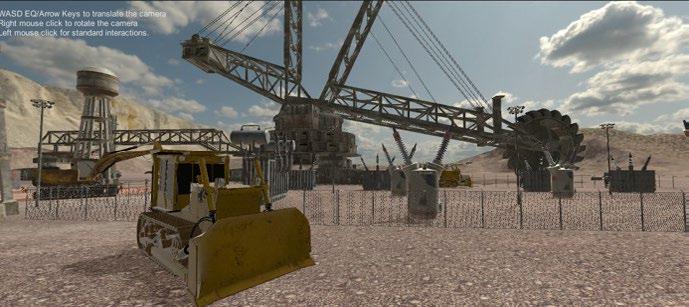
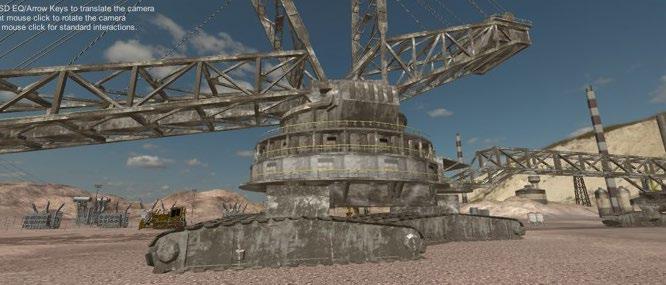
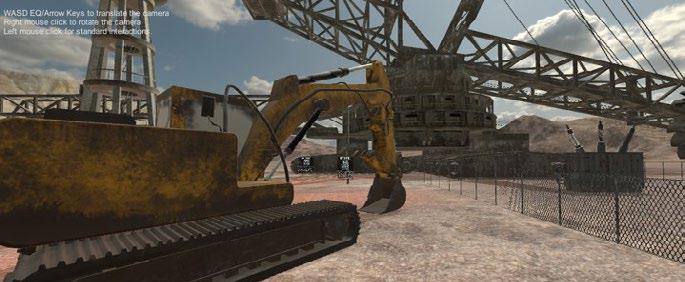
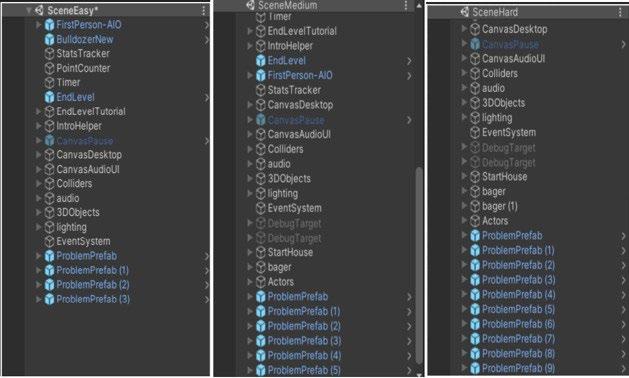
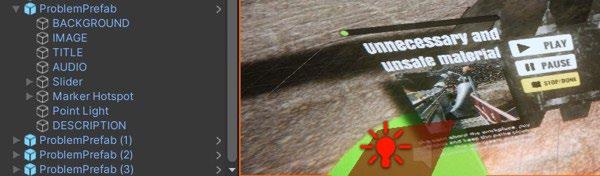
Figure 2—Mining equipment models
Figure 3—Dozer and bucket wheel excavator
Figure 5—Bucket wheel excavator and hydraulic excavator
Figure 6—Game levels - easy, medium, and hard
Figure 7—Single problem settings
Figure 4—Bucket wheel excavator and coal mining landscape
A conceptual framework for improving employee training in surface mines
developed an augmented reality (AR) system for heavy equipment operators (HEO) in surface mining. This research presents a significant step forward in training in mining industry.
Results and discussion
Companies should prioritise the development and maintenance of comprehensive employee training policies and the creation of formalised training plans. However, while procedures and training are essential, they alone cannot eliminate workplace hazards. Instead, effective training should equip employees with the ability to recognise potentially dangerous situations, provide them with guidance on appropriate actions, and ultimately, enable them to perform their duties safely within the work environment. Furthermore, proper training should be discussed in a training room and potentially reduce the likelihood of errors that could lead to workplace injuries. As previously presented in the flowchart in Figure 1, the framework has two different applications: desktop and VR version.
On the main menu screen of the application (Figure 8) a player can add a name and choose which difficulty level will be played.
The game starts and ends in the training room, given in Figures 9 and 10, training room is an object, and the player will have to return to this room to finish the game and to start the knowledge assessment quiz.
The gameplay screenshot is shown in Figures 11 and 12. A trainee will walk through the scene with the goal of finding specific numbers of green marks (hotspots). Each spot will bear various information about the problem. For example, besides the image, one can read text information and use a play button to hear same or other voice information about the problem occurred. As can be seen in Figure 11, a trainee can also observe the number of points gathered, time left (right upper angle) and a mini map for easier scene navigation (left upper angle).
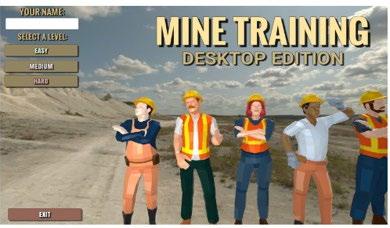
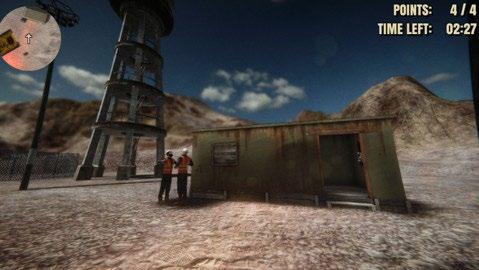
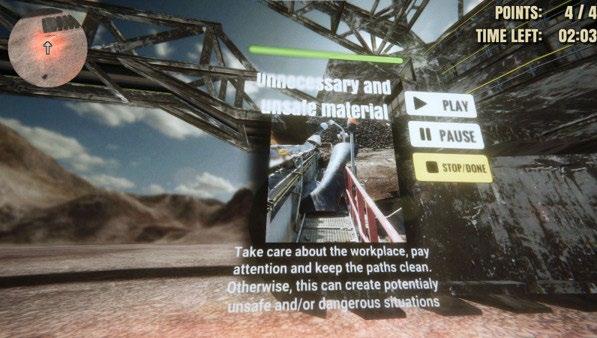
Figure 8—Main menu – desktop and virtual reality versions
Figure 9—Training room
Figure 10—Start and finish level
Figure 11—Hotspot
Figure 12—Gameplay
In this level, you have an opportunity to walk through a mine site. You will look for potential problems on site. Easy training mode has 4 problems that you have to find. Later, there will be s hot quiz. Good luck!
A conceptual framework for improving employee training in surface mines
A trainee will activate an image with the problem descriptions when entering a hotspot (green cylinder) as presented in Figure 11). A pop-up window (Figure 12) will show up so a trainee can see, read, or hear information.
Before the time left comes to an end, he or she has to return to the virtual training room (Figure 13). A trainee will then approach the computer in order to start the knowledge assessment quiz, as can be seen in Figure 9.
Furthermore, in the VR setup, the mini-map and both the number of points and time left are located on virtual watches on the player’s wrists. (Figure 13).
By clicking the “Begin Quiz” button (Figure 14), one will proceed to answer 5 questions related to the conducted training.
A player will answer different questions regarding the situations they observed during the game. New questions can also be added or changed in Unity3D; the number of questions can be changed as well; and sound information about a question(s), if needed, can be added. After the player answers all questions, they will see the results with some statistics (Figure 15). By clicking the “save results” button, the CSV file icon will show up on the desktop screen. The CSV file can be saved so that it tracks the record of players, training points, errors, and time (Figure 16).
The conceptual framework for improving employee training in surface mines through virtual reality, and serious games, represents an advanced approach to improving safety and operational efficiency. The combination of VR and serious games offers a dynamic and engaging method of training that could prepare workers for the complex and potentially dangerous situations they may encounter during their jobs. By simulating mining environments and incorporating game-based learning techniques, miners can develop the skills and knowledge needed to perform their jobs safely and efficiently.
The use of serious games within VR training encourages workers to engage actively in their learning process. The immersive nature of the game, combined with game mechanics like scores
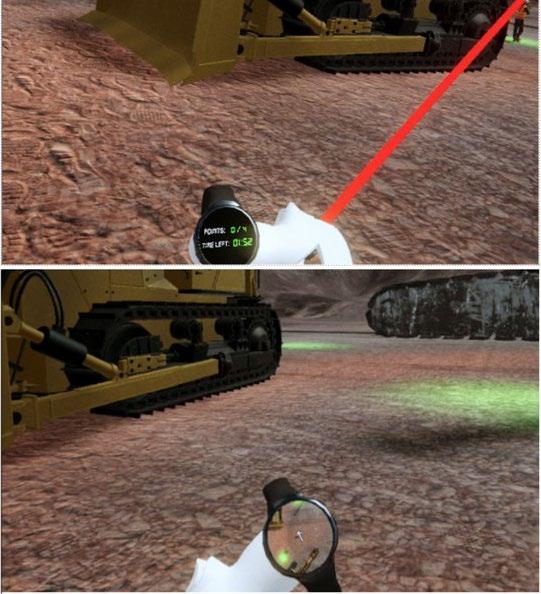
and progress tracking, motivates employees to improve their performance continuously. These aspects of training are more challenging to achieve through traditional training methods. Virtual reality allows the immersive nature of serious games to come to life. The 3D, simulated environments that VR offers make the learning experience feel real and immediate. In the mining industry, VR can simulate the mine site, allowing trainees to move around the site, and respond to possible hazards as they should in
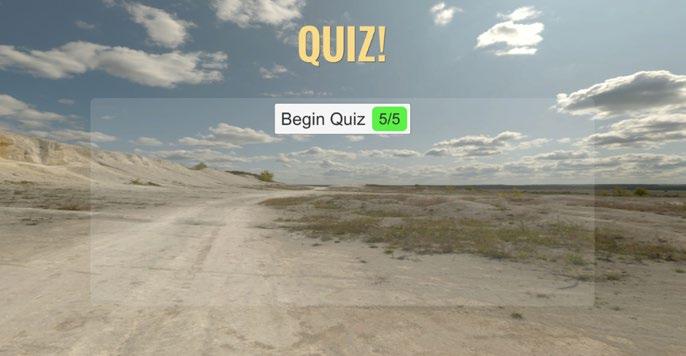


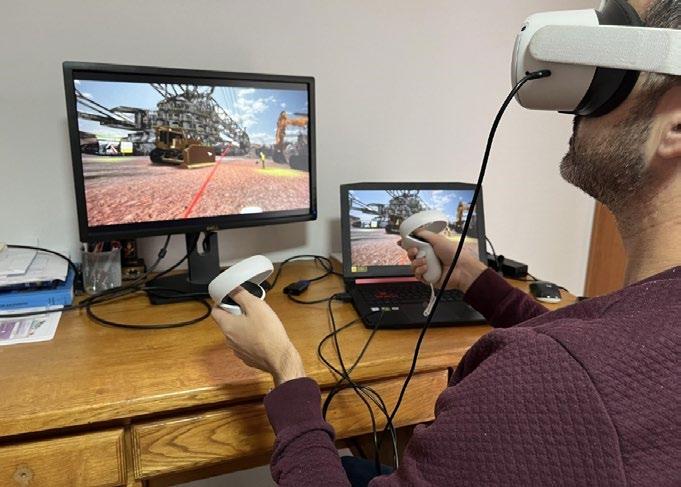
Figure 13—Mini-map, time left, and number of points
Figure 14—Begin quiz
Figure 15—Quiz results
Figure 17—VR gameplay (author’s personal archive)
Figure 16—CSV file
A conceptual framework for improving employee training in surface mines
the real world. The integration of serious game mechanics such as setting goals and providing instant feedback ensures that trainees stay engaged and retain critical information. The Oculus Quest 2 VR headsets (or one with similar characteristics) could be used to train workers by simulating the environment of the specific mine and offering them realistic, game-like challenges that they should overcome (Figure 17).
The game-based approach allows miners to experience and respond to dangerous situations without facing real-world risks. Serious games can simulate conditions, inspecting and/or operating heavy machinery, and provide a safe environment to practice and hone skills. This potentially increases the realism and practical value of the training.
Serious games can be easily adapted to different mining environments and roles. For example, specific games can be created for various job positions within the mine, such as haul truck operators, drillers, or supervisors. Moreover, VR training, when paired with serious games, allows companies to train multiple workers simultaneously and in different locations. This is potentially beneficial in large mining operations. Serious games, combined with the immersive experience of VR, potentially facilitate better memory retention. Gamification elements such as repetitive challenges, levels of difficulty, and immediate feedback help reinforce learning, ensuring that workers can retain important safety protocols.
The framework in this research can serve as a blueprint for using serious games within VR to help improve mine training programmes. It outlines the integration of game mechanics such as challenges, objectives, and feedback into VR simulations. These game-based elements are incorporated to make training more engaging, motivating employees to learn. In the mining context, serious games can replicate real-world scenarios in which workers practice safety procedures and problem-solving skills. This structured approach ensures that VR is not just a passive tool, but an active, engaging medium for training. This framework potentially improves individual learning outcomes and also contributes to a broader organisational commitment to safety and continuous improvement. As VR and serious games continue to evolve, their role in mining safety training is likely to expand, offering more immersive and impactful ways to train and protect workers in this high-risk industry.
Conclusion
There is often an opportunity to introduce new initiatives to improve employee training and safety. It is crucial for professionals, managers, engineers, and employees to continually assess and consider potential improvements in training programmes. In this context, proactive training is of utmost importance for preventing incidents, as opposed to merely reacting to problems that have already occurred or have given rise to significant warning signals. Issues that have already arisen, or those with a high probability of occurring, often require immediate resolution, which, in industrial settings, can be challenging, present additional risks, or even be unfeasible. A well-designed employee training programme aims to improve a) knowledge, b) skills, and c) understanding (KSU). Employees should acquire clear and unequivocal knowledge related to the tasks they are expected to perform.
Outcomes of this research paper can be summarised as:
➤ Developed prototype of a training framework and two versions of training applications for surface mining –
desktop and VR version.
➤ Easy navigation through virtual mining scene to identify problems and gather game points.
➤ Measures that should be taken to eliminate the identified issues.
➤ Additional features - mini-map, quiz.
The serious game applications can potentially serve as an additional support to train heavy equipment operators (HEOs) or other mine workers. The tool used to build applications (serious games) was Unity3D game engine.
In the future, the research recommends developing user guides and tutorials on how to construct new training, add new machines, change, and revise training materials in order to improve the training process. Conducting surveys and obtaining feedback from workers employed in safety roles and other employees, and analysing the collected data is planned as well. A comparison will be made with traditional methods of miners' safety training.
Conflicts of Interest: The authors declare no conflict of interest.
References:
Altomari, L., Altomari, N., Iazzolino, G. 2023. Gamification and Soft Skills Assessment in the Development of a Serious Game: Design and Feasibility Pilot Study. JMIR Serious Games, vol. 11. https://doi.org/10.2196/45436
Andriamasinoro, F., Monfort-Climent, D. 2021. Consideration of Complexity in the Management of Construction and Demolition Waste Flow in French Regions: An Agent-Based Computational Economics Approach. Modelling, vol. 2, pp. 385–405. https://doi.org/10.3390/modelling2030021
Armstrong, M., Landers, R., Collmus, A. 2016. Gamifying Recruitment, Selection, Training, and Performance Management: Game-Thinking in Human Resource Management. https://doi.org/10.4018/978-1-4666-8651-9.ch007
Bellanca, J.L., Orr, T.J., Helfrich, W.J., Macdonald, B., Navoyski, J., Demich, B. 2019. Developing a Virtual Reality Environment for Mining Research. Mining, Metallurgy & Exploration, vol. 36, pp. 597–606. https://doi.org/10.1007/s42461-018-0046-2
Bishop, G., Fuchs, H. 1992. Research Directions in Virtual Environments: Report of an NSF Invitational Workshop. March 23-24, 1992. University of North Carolina at Chapel Hill. COMG Brandl, L.C., Schrader, A. 2024. A Serious Games in Higher Education in the Transforming Process to Education 4.0— Systematized Review. Educ. Sci., vol. 14, 281. https://doi. org/10.3390/educsci14030281
Dallaqua, M.F., Nunes, B., Carvalho, M.M. 2023. Serious Games Research Streams for Social Change: Critical Review and Framing. British Journal of Educational Technology, vol. 55, pp. 460–483. https://doi.org/10.1111/bjet.13404
Dyulicheva, Y., Gaponov, D., Mladenović, R., Kosova, Y. 2021. The Virtual Reality Simulator Development for Dental Students Training: A Pilot Study. International Workshop of Augmented Reality in Education 2021.
Fauziyah, U., Kaburuan, E., Wang, G., Aqsha. 2019. Gamification for Employee Training Platform in Banking Industries, pp. 503-508. 2019 International Conference on Information Management and Technology (ICIMTech) published by IEEE https://www. researchgate.net/publication/335945264_Gamification_for_ Employee_Training_Platform_in_Banking_Industries
A conceptual framework for improving employee training in surface mines
Göbel, S. 2016. Serious Games Application Examples. In: Dörner, R., Göbel, S., Effelsberg, W., Wiemeyer, J. (eds) Serious Games. Springer, Cham. https://doi.org/10.1007/978-3-319-40612-1_12
Gürer, S., Surer, E., Erkayaoğlu, M. 2023. Mining-Virtual: A Comprehensive Virtual Reality-Based Serious Game for Occupational Health and Safety Training in Underground Mines. Safety Science, vol. 166, Article 106226. https://doi. org/10.1016/j.ssci.2023.106226
Iacono, S., Vallarino, M., Vercelli, G.V. 2020. Gamification in Corporate Training to Enhance Engagement: An Approach. International Journal of Emerging Technologies in Learning (iJET), vol. 15, no. 17, pp. 69-84. https://doi.org/10.3991/ijet. v15i17.14207
Ignjatović, D., Subaranovic, T., Đenadic, S. 2021. Machines and Auxiliary Works in Surface Mines. University of Belgrade, Faculty of Mining and Geology. ISBN: 978-86-7352-363-7.
Isleyen, E., Duzgun, H.S. 2019. Use of Virtual Reality in Underground Roof Fall Hazard Assessment and Risk Mitigation. International Journal of Mining Science and Technology, vol. 29, no. 4, pp. 603–607. https://doi. org/10.1016/j.ijmst.2019.06.003
Iqbal, M., Campbell, A. 2023. Real-Time Hand Interaction and Self-Directed Machine Learning Agents in Immersive Learning Environments. https://doi.org/10.1016/j.cexr.2023.100038
Kalawsky, R.S. 1997. Exploiting Virtual Reality Techniques in Education [Online]. Available at: https://openlibrary.org/books/ OL17257804M/Exploiting_virtual_reality_techniques_in_ education_and_training
Levy, J.R., Bjelland, H. 1995. Create Your Own Virtual Reality System. New York: Windcrest McGraw-Hill Inc.
Liang, Z., Zhou, K., Gao, K. 2019. Development of Virtual Reality Serious Game for Underground Rock-Related Hazards Safety Training. IEEE Access, vol. 7, pp. 118639–118649. https://doi. org/10.1109/ACCESS.2019.2934990
Man, S.S., Wen, H., So, B.C.L. 2024. Are Virtual Reality Applications Effective for Construction Safety Training and Education? A Systematic Review and Meta Analysis. Journal of Safety Research, vol. 88, pp. 230–243. https://doi.org/10.1016/j. jsr.2023.11.011
Oculus Quest 2. [Online]: https://www.meta.com/quest/products/ quest-2 [Accessed 15 August 2024].
Pimentel, K., Teixeira, K. 1994. Virtual Reality: Through the New Looking Glass. 2nd ed. New York: McGraw-Hill.
Pedram, S., Perez, P., Palmisano, S. 2014. Evaluating the Influence of Virtual Reality-Based Training on Workers' Competencies
in the Mining Industry. 13th International Conference on Modeling and Applied Simulation, MAS 2014, pp. 60-64.
Pereira, D., Oliveira, V., Vilaça, J.L., Carvalho, V., Duque, D. 2023. Measuring the Precision of the Oculus Quest 2’s Handheld Controllers. Actuators, vol. 12, 257. https://doi.org/10.3390/ act12060257
Polcar, J., Horejsi, P. 2015. Knowledge Acquisition and Cyber Sickness: A Comparison of VR Devices in Virtual Tours. MM Sci J, vol. 2, pp. 613–616.
Poynton, L. 2009. Evaluating the Effectiveness of Virtual Reality Learning in a Mining Context. University of New South Wales, Australia. Master’s Thesis.
Qonita, V.A., Dwiyanti, L. 2023. Election Data Visualization in Virtual Reality Environment Using Oculus Quest 2. 2023 IEEE International Conference on Data and Software Engineering (ICoDSE), Toba, Indonesia, pp. 96-101. https://doi.org/10.1109/ IcoDSE59534.2023.10292000
Raja, V., Ramani, R. 2012. Surface Mining Technology: Progress and Prospects. Procedia Engineering, vol. 46, pp. 9–21. https://doi. org/10.1016/j.proeng.2012.09.440
Sanmugam, M., Mohamed, H., Zaleha, A., Norasykin, Z., Baharuddin, A. 2014. Gamification and Serious Games: The Enigma and the Use in Education. ISQAE 2014 Conference.
Siu, S.S.M., Wen, H., So, B.C.L. 2024. Are Virtual Reality Applications Effective for Construction Safety Training and Education? A Systematic Review and Meta Analysis. Journal of Safety Research, vol. 88, pp. 230–243. https://doi.org/10.1016/j. jsr.2023.11.011
Stothard, P., Galvin, J.M., Fowler, J.C.W. 2004. Development, Demonstration and Implementation of a Virtual Reality Simulation Capability for Coal Mining Operations.
Van Wyk, E., De Villiers, R. 2019. An Evaluation Framework for Virtual Reality Safety Training Systems in the South African Mining Industry. Journal of the Southern African Institute of Mining and Metallurgy, vol. 119, no. 5, pp. 427–436.
Valencia Quiceno, J.D., Kecojevic, V., McBrayer, A, Bogunovic D. 2024. Augmented Reality System for Training of Heavy Equipment Operators in Surface Mining. Mining, Metallurgy & Exploration https://doi.org/10.1007/s42461-024-01047-6
Von Schweber, E. 1995. Virtually Here. PC Magazine. March 14, 1995, pp. 168–198.
Zujovic, L., Kecojevic, V., Bogunovic, D. 2021. Interactive mobile equipment safety task-training in surface mining. Int J Min Sci Technol, vol. 31(4), pp.743-751. https://doi.org/10.1016/j. ijmst.2021.05.011 u
Affiliation:
1 Department of Mechanical and Mechatronic Engineering, Stellenbosch University
Correspondence to:
S. Fataar
Email: sfataar@sun.ac.za
Dates:
Received: 13 Feb. 2025
Revised: 19 May. 2025
Accepted: 3 Jun. 2026
Published: Jun. 2026
How to cite:
Fataa, S., Taylor, N.C., Kruger, K., Basson
A.H. 2026. Functional Requirements for a Human Cyber-Physical System to Improve Mineworker Safety in Underground Mines. Journal of the Southern African Institute of Mining and Metallurgy, vol. 126, no. 6, pp. 343 - 352
DOI ID: https://doi.org/10.17159/2411-9717/3670/2026
ORCiD:
S. Fataar
https://orcid.org/0000-0001-5964-9996
N.C. Taylor
https://orcid.org/0000-0002-1176-9021
K. Kruger
https://orcid.org/0000-0003-0932-2850
A.H Basson
https://orcid.org/0000-0001-7998-330X
Functional Requirements for a Human Cyber-Physical System to Improve Mineworker Safety in Underground Mines
by S. Fataar1, N.C. Taylor1, K. Kruger1, A.H Basson1
Abstract
The mining industry remains heavily reliant on mineworkers, whose working conditions are typically more arduous than in most industries. With recent technological developments in mining and other industries focusing on the digitalisation of workspaces, mineworker safety should be at the forefront of the digital transformation. Underground mines should be viewed – and developed – as human cyber-physical systems, where digital technologies are integrated with human roles to enhance safety and coordination. Contributing to this vision, this paper presents a set of functional requirements to guide the development of human cyber-physical systems that improve the safety of mineworkers in underground mines. The formulation of the functional requirements is informed by an analysis of the current context of underground mines and an exploration of opportunities for improved human-system integration within such environments. The functional requirements are related to the real underground mining context through an illustrative example, which demonstrates how a human cyber-physical system could monitor mineworker and environment states, perform predictive safety analyses, and coordinate operations. The proposed functional requirements serve as a starting point for the development of human cyber-physical systems within complex underground mining environments; however, further research (supported by real case studies) is required to refine and obtain specific target values for the functional requirements, and to formulate accompanying performance requirements.
Keywords Mining, safety, human cyber-physical systems, human-system integration
Introduction
The mining industry remains important globally, especially in South Africa. Mining in South Africa is the historic bedrock of the economy as it contributes over R300 billion to South Africa’s GDP (Goodman et al., 2019). According to the Statista Research Department, in 2021, a total of 458 954 people were employed by the South African mining industry (Statista Research Department, 2023). It is thus evident that human workers in mines are still essential for the industry and, as such, improving the health and safety of mineworkers should be a priority.
Underground mines are complex systems, with many interconnected systems that work together with human workers to extract minerals from the earth. Mining systems are being transformed through an increased adoption of automation and digitalisation technologies, e.g., internet of things (IoT), artificial intelligence, and cloud computing, as driven by the fourth industrial revolution (or Industry 4.0 (I4.0). While these technologies promise benefits regarding the productivity and profitability of mines, they also offer opportunities to improve the safety of mineworkers.
The increased adoption of digital technologies in mining is transforming mines into cyber-physical systems (CPS) – physical systems that are controlled and monitored digitally using computer algorithms (Yilma et al., 2021). More specifically, considering the involvement of human workers in mining operations, underground mines should be viewed, and developed, as human cyber-physical systems (HCPS).
HCPSs aim to integrate both human and non-human elements of the physical system with digital systems. As such, humans can contribute to, and benefit from, the data and intelligence that are encapsulated by the digital system. In an underground mining context, HCPSs can provide advanced monitoring and coordination functions for mining operations. For mineworkers, these HCPS functions can offer greater and more personalised situational awareness, and support both reactive and proactive decision making (Kruger et al., 2023).
Functional requirements for a human cyber-physical system
However, there are barriers to developing HCPSs and realising these promised benefits. As an emerging technology, the definition and scope of the functionality of HCPSs are still broad and vague. As such, even with the increased digitalisation of mines serving as the foundation upon which HCPSs can be developed, it may be difficult for mines to specify a clear starting point and plan for the development of an HCPS within their specific context. Further, the development of an HCPS that maintains digital representations of workers, offering personalised data and functions related to their real-time state and unique attributes, requires the integration of diverse interfaces, data streams, models, and software services.
To guide the development of human cyber-physical systems (HCPS) in underground mining environments, this paper presents a structured set of functional requirements, specifically aimed at enhancing mineworker safety. The primary objective is to define how an HCPS can support real-time monitoring, predictive analysis, and coordinated response to safety risks by integrating data from environmental and personal sensors. The methodology involves a detailed analysis of the roles and tasks of underground mineworkers, combined with the identification of opportunities for advanced human-system integration (HSI) in these environments. A novel contribution of this work is the formulation of functional requirements that are both context-aware and technology-agnostic, enabling their application across a range of underground mining scenarios. These requirements are further grounded through an illustrative example that demonstrates how an HCPS can be operationalised to monitor worker exposure, predict hazardous conditions, and coordinate safety interventions in a realistic mining context.
This paper first presents a brief overview of the related work on the topics of HSI, HCPSs and human-centric mining technology in Section 2. Thereafter, Section 3 provides an overview of the current roles of human workers and the technology used in underground mines, and Section 4 identifies opportunities for HSI in an underground mine. The formulated functional requirements for an HCPS that improves mineworker safety in underground mines are presented in Section 5, followed by a discussion of the implications, limitations, and the way forward in Section 6. The paper concludes with a summary of the key findings and recommendations for future work in Section 7.
Related work
Human-system integration
Dimensions of human-system Integration
As humans continue to play important roles in various complex industrial processes, the way they are integrated with operations and their environment can greatly affect their function. Sparrow et al. (2022) argue that when complex processes have ineffective human integration, the communication channels and logistic structures between humans and other physical entities will not match the requirements of effective I4.0 applications.
The field of HSI considers the broad and diverse integration of humans and systems. However, most relevant to the context of this paper is the aspect of HSI that focusses on the integration of humans with operational, technological systems, which leads to hardware and software developments that enhance operational activities of HCPSs (Defty, 2022).
Defty (2022) developed the representation, communication, and interfacing (RCI) framework that aims to guide the design of systems that improve the integration of human operators with
the surrounding interfacing technology (Defty, 2022). The RCI framework aims to capture both human and machine characteristics and can thus be used in the design of more effective HCPSs that support improved decision-making and productivity. Figure 1, adapted from Defty (2022), visualises the application of the RCI framework to the underground mining context.
Representation, in the context of HCPSs, refers to establishing and maintaining a distinct presence in the cyber system for each entity present in the physical system. Communication refers to the exchange of data/information in the cyber system between the various representations associated with the entities in the physical system. The interfacing dimension of the framework considers the exchange of data between the entities in the physical system and their associated representations in the cyber system.
Ambient intelligence environments
In an ambient intelligence environment (AmIE), intelligent interfaces exist between the physical and cyber layers as supported by computing and embedded networking technology (Sparrow et al., 2021). There are two types of interfaces that can be utilised in an AmIE. The first type of interface is the personal interface. These are interfaces that belong to and are situated on a specific human. Personal interfaces can be customised and optimised to fit the specific user and could be directly accessible by the user's digital representation (Sparrow et al., 2021). The other type of interface is the environmental interface. These interfaces do not belong to a specific human being monitored and gather data from a specific environment instead.
Sparrow et al. (2021) highlight the importance of considering how information is displayed to humans in an AmIE. Interfaces can perform semiotic services – communicating information through different types of signs and symbols. Interfaces can also perform observation services, which capture information that supports the digital representation of human or environment state in near realtime.
The interfaces and services of an AmIE can be leveraged by an HCPS to mirror the state of the physical system/environment in the cyber layer, analyse and interpret the state information and, in turn, affect the operations or conditions of the physical system.
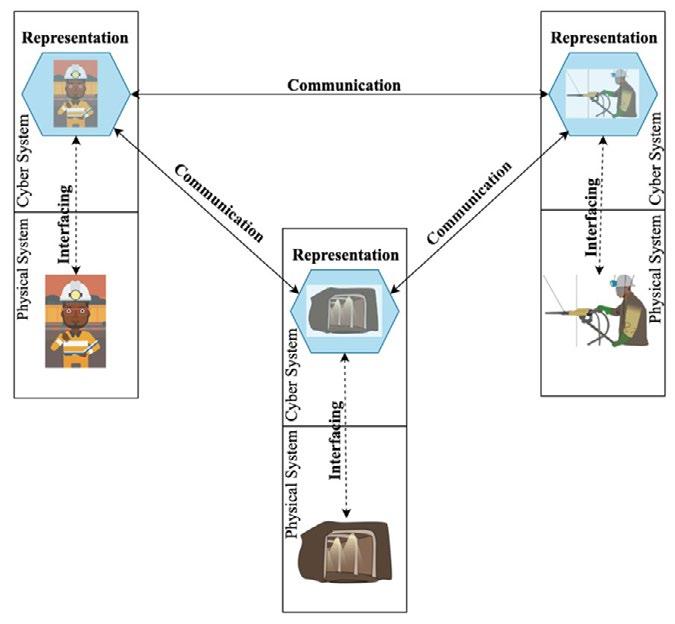
Figure 1—RCI framework applied to underground mines (adapted from Defty, 2022)
Functional requirements for a human cyber-physical system
Human-cyber physical systems
Definition
CPSs, through the coupling of physical and digital systems, is a key enabler for I4.0 systems. Such systems can be developed to display intelligent behaviour, such as self-sensing, self-diagnosis, and connectedness (Sparrow et al., 2022). Most CPSs have humans performing operations and adding to the functionality of the system, leading to HCPSs.
HCPSs consider the holistic integration of humans in systems and are engineered to improve the ability of humans to interact with systems in the cyber and physical layers, while improving human physical, sensory, and cognitive capabilities within the system (Fantini et al., 2020). Humans are thus sensors, decision-makers, and actors at the same time, which provides a new layer to the typical CPS model.
Human properties considered in human cyber-physical systems
Human-centred design, in the context of Industry 4.0, is important when considering sustainable development (Pacaux-Lemoine et al., 2017). When looking at the human aspect in a systems context, human behaviour must be considered. Humans are independent and autonomous, which make them flexible. Compared to a nonhuman entity, such as a computer or controller, a human is much more adaptive due to their intelligence and the use of all their senses.
The specific function humans perform depends on the domain and system goal that they work for (Cimini et al., 2020). Humans perform various functions, including data acquisition using their senses and cognitive abilities. They also have the ability to interpret the system’s properties and behaviours, which allows them to evaluate the system’s characteristics and make decisions that can influence its behaviour.
Human operators in industry 4.0
The human-in-the-Loop (HITL) control model aims to supervise human operator performance during human-machine interaction (Munir et al., 2013). Pacaux-Lemoine et al. (2017) found that, in their specific case, the manufacturing system performed better when the human is in the loop and can cooperate. Adaptive automation is a concept that aims at optimising human-machine cooperation, which effectively allocates labour between humans and automated resources (Romero et al., 2020).
Romero et al. (2020) developed the Operator 4.0 model. The authors show how Operator 4.0 defines workers in I4.0 and compare these operators to operators in the 1st to 3rd industrial revolutions. Operator 4.0 brought rise to other concepts such as Miner 4.0 and Mariner 4.0. Taylor et al. (2023) explored potential solutions to facilitate human-machine interfaces in an I4.0 environment such as Maritime 4.0, and augment human ability by developing a human digital twin (HDT) (Taylor et al., 2023).
The human digital twin concept
A digital twin (DT) is a digital representation of a physical entity, aiming to mirror the real-world entity (Grieves, Vickers, 2016). An HDT is then a concept used to address the increased need for digitising human operators in I4.0 environments (Sparrow et al., 2019). To enable the development of an HDT, Sparrow et al. (2022) created a digital administration shell to provide humans with a digital presence. This digital administration shell enables humans to take part in communication with other digital entities with the
same precision and speed as those digital entities can (Sparrow et al., 2021). The design of the digital administration shell is based on the biography-attributes-schedule-execution (BASE) architecture, which facilitates the interfacing, data processing, and connectivity of the digital administration shell to other I4.0 components (Sparrow et al., 2021).
Shengli (2021) outlined the differences between a DT and an HDT with challenges in developing an HDT lying in the complexity of a human being (Shengli, 2021). Balaji et al. (2023) developed an HDT that simulates a control operator’s behaviour, even in abnormal situations. Wang et al. (2022) investigated HDT-driven HCPS to shift from a technology-driven approach to a more human-centred approach, which resulted in systems where humans and physical systems can share capabilities and intelligence.
Human-centric mining technology
I4.0 has brought about many applications of new technology and sensors in the equipment used in mining operations, with some applications focusing on and being applied to mineworkers. Singh et al. (2022) developed an IoT-enabled helmet, which improves the health and safety monitor. Ananth et al. (2022) developed a smart jacket, which monitors the miner’s pulse rate, position, and the ambient temperature of their environment. Baek and Choi (2019) developed a low-cost proximity warning system for mineworkers using smartphones and beacons.
In the context of the mining industry’s increasing digitisation, novel software technologies have emerged as the driving force behind technological advancements. Software systems often do not have the same limitations in the configuration of physical systems, with software argued to be infinitely modifiable (Lööw, 2022).
Lööw (2022) states that technology interventions in mining should have larger scopes, as opposed to focusing on singular and isolated actions, in order to address a multitude of issues.
To achieve digital transformation in the mining sector, digital systems and technology must be effectively integrated with people (Ulewicz et al., 2022). In the context of I4.0, the modern mine would be an HCPS. Lööw et al. (2019) introduced the concept Mining 4.0, which is an I4.0 vision of mining with mineworkers based on Operator 4.0, called Miner 4.0. Mining 4.0 envisions an augmented miner that has their senses and memory extended using various technological devices. Mining 4.0 describes the benefits of using augmentations on workers, which include improved productivity and safety, reduced physical strain and enhancement of skills.
Kruger et al. (2023) presented an integration platform for smart, integrated mining. The paper addresses the challenges of data integration of systems with humans and non-human resources and operations involved in underground mining. The platform was designed using a holonic systems approach and the BASE architecture for digital administration shells. The platform is composed of many autonomous and cooperative entities that represent the physical resources and processes present in an underground mining context (Kruger et al., 2023).
Underground mining context
This section explores the activities of mineworkers in underground mines, delving into the safety issues they face and the measures in place to boost productivity. Insights from an interview with a miner from a South African underground mine shed light on exposure standards and the technology currently utilised in underground mines. Additionally, the section explores various other technologies
Functional requirements for a human cyber-physical system
employed within the industry and discusses the pace at which these technologies are being adopted across the mining sector.
Factors affecting the safety of underground mineworkers
Underground mineworker tasks
Mineworkers perform various tasks in a mine. The nature of these tasks can vary based on the type of rock mined, or the method used by the mine. Each worker in an underground mine has general tasks that they will perform regardless of the method used or the type of rock mined. These tasks include digging or breaking up ore, driving equipment and machinery, transporting ore, and building supports to prevent the tunnels from caving in. To improve the general safety of underground mineworkers, the factors that influence their safety in performing these tasks should be considered.
Risks for mineworkers in underground mines
There are various factors in an underground mine that affect mineworker safety:
➤ Dust and dangerous gas inhalation. Mineworkers tend to develop diseases or lung cancer due to gas inhalation. It is believed that even 20 years after a mineworker was exposed to this dust, they can still contract lung disease (Maseko, 2021).
➤ Exposure to noise. Over-exposure to excessive noise can lead to tinnitus, concentration problems, or hearing loss (Mining Review Africa, 2020).
➤ Exposure to whole-body vibration. Workers may be exposed to whole-body vibration during their operation of heavy machinery (Mining Review Africa, 2020).
➤ Falls, trips, and injuries due to heavy lifting (Mining Review Africa, 2020).
➤ Thermal stress. Thermal stress is also a safety risk due to the hot and humid conditions that the workers work in, while chemical hazards are a factor due to mineworkers being exposed to harmful chemicals and gases (Mining Review Africa, 2020).
An interview with a miner from a South African underground mine described the health and safety measures that exist in the mine that they work in. Some workers carry gas detection instruments (GDI ), which measure carbon monoxide and methane levels. The levels of these gasses, as well as the airflow measurement, are compared against predefined thresholds. Temperature and humidity are also monitored in underground mine environments.
When the ambient conditions exceed the predefined thresholds, the workplace is considered “not conducive” for mineworkers to work. However, the miner indicated that due to performance requirements, mineworkers often continue working despite the workplace not being conducive. Prolonged exposure to nonconducive conditions is a safety concern; however, this must also be analysed on an individual basis. This is because mineworkers have different levels of fitness and health. For example, some may be on chronic medication, which could make them more likely to collapse due to heat conditions.
Technology in underground mining
The rate of technological changes and improvements tends to be slower in the mining industry compared to other industries, due to high capital costs, long lifespans of equipment, and the cost of upgrading equipment (Bartos, 2007). Development is also slow due to the unique environmental challenges in mining (Lööw, 2022). Furthermore, it is critical for mining technology to consider the
operator in its design. Without consideration of the operator and their use of the technology, the technology will likely not be used as intended and the gains in safety or productivity that a technology may promise may be lost.
The technology currently used in underground mines focuses on automation, collision avoidance, using sensor data to mitigate hazards, as well as improving communication throughout the mine. Where I4.0 technology has been used to improve the business and sustainability of the mine, the general focus has been on machine and equipment monitoring, in order to improve efficiency (Sishi, Telukdarie, 2020). However, there has been less focus on such monitoring for human workers using I4.0 technology, which could improve safety, productivity, and worker satisfaction.
In the interview with the miner, it was stated that currently the instruments, such as the GDI and temperature sensors used, are often disconnected from the wider digital system. This means the data is not automatically transmitted to the control room. Instead, the miner has a declaration book where values and readings are manually recorded. There is also typically little or no data flow between processes, such as blasting or drilling. Moreover, the acquired sensor readings and worker data is typically analysed on a managerial level instead of an operational level. The mineworker stated that in order to use this sensor data to improve safety, analysis needs to occur in near real-time and at an operational level.
Opportunities for improved human-system integration in underground mines
It is expected that the integration of mineworkers with the environment and technology in underground mines can provide benefits to the industry and the workers themselves. It is thus important to explore opportunities for achieving improved HSI in an underground mine. This exploration is guided by the RCI framework, which aims to support an effective and holistic integration of the human element in an HCPS. This section thus identifies the opportunities that arise for improved HSI in each dimension of the RCI framework.
Representation
At an implementation level, the representation of a mineworker in an HCPS can be achieved by creating a dedicated software process, or set of processes, in the cyber system that acts on data and information that are associated with that specific mineworker. These processes can then execute specific tasks and functions, in an automated and highly personalised manner, on behalf of the represented mineworker. Examples of these tasks or functions may include:
➤ Gathering data pertaining to the state or surrounding environment of a mineworker from data sources accessible in the cyber layer, e.g., the ambient temperature in the specific underground mine tunnel that the mineworker is working in.
➤ Monitoring the state or activity of a mineworker and reacting to detected events or conditions, e.g., sending an alert to the control room if the data from a mineworker’s wearable heart rate monitor indicates that they are in distress.
➤ Performing analyses on the mineworker’s data gathered over time, as triggered by specific events or time periods, e.g., performing a “fit for work” analysis prior to starting a new shift using the data on the exposure of the mineworker during their previous shift(s).
Functional requirements for a human cyber-physical system
The tasks or functions listed in the aforementioned can be executed in a manner that is personalised to every individual mineworker. The representation of a mineworker can capture the attributes (e.g., age, medical conditions, etc.) and state (e.g., current activity, time since last break, etc.) specific to the individual. Instead of generalised models, thresholds, and policies, this personalisation would result in tasks, thresholds, and actions that are tailored to individuals. Furthermore, as the representation of a mineworker is maintained over time, the attributes of the mineworker can be updated through the analysis of gathered information. As such, the representation of mineworkers can evolve over time to remain accurate and reliable.
Communication
Communication, within the RCI framework, refers to the exchange of data or information in the cyber layer between the representations of physical entities. Since these representations are implemented by means of one or more software processes, communication can be achieved through the passing of data between these processes – typically by means of a messaging or data sharing mechanism. This exchange of data in the cyber layer poses several opportunities for improved HSI in the underground mine context.
Firstly, the mechanism to exchange data in the cyber layer allows for the enrichment of the representations maintained within this layer. The representation of a mineworker can proactively obtain data on the state of the mineworker (e.g., the temperature of the mine tunnel that the worker is currently working in) from the representations of the physical entities (e.g., sensors or the heating, ventilation and air conditioning (HVAC) system) that capture such data. As such, the tasks or functions delegated to the representations, as discussed in the aforementioned , can be performed with rich data obtained in near real-time.
The communication of data and information between representations is also a key enabler for the coordination of resources, since data pertaining to resource status, future availability, and capability can be shared. This exchange of data is thus needed for the planning and scheduling of future operations but is also essential to achieve the synchronisation of processes and resources during operation in near real-time. Since underground mining often entails integrated processes that employ different resources, as reflected in the blasting process described by Kruger et al. (2023), this coordination function is central to a mine's core operations.
Finally, when the mechanism for communication between representations in the cyber layer also supports discoverability, further opportunities arise. Discoverability, in this context, refers to the ability of the software system to allow representations to be discovered by others. Typically, this is achieved through a service directory or “yellow pages” mechanism, where all the representations in the cyber layer register their details (e.g., address or endpoint for receiving messages), the type of representation (e.g., mineworker or vehicle), and specific attributes or capabilities, etc. This directory can be searched by representations to discover other representations that can be communicated with. Discoverability, in the sense explained here, can allow for dynamic interactions within the cyber layer that may improve the resilience of the system – e.g., if the sensor that usually provides the temperature data to a mineworker representation fails, the data can be obtained from the representation of the HVAC system that also captures this temperature data.
Interfacing
The Interfacing dimension of the framework refers to the exchange of data between the physical entities and their associated cyber representations. This exchange of information is essential to ensure that the cyber layer can maintain accurate and updated representations of the entities in the physical layer. Opportunities for improving HSI in underground mining arise through the exploration of this Interfacing dimension – especially with regard to safety.
The exchange of data between the physical and cyber layers can be enriched using multi-modal technologies, i.e., technologies that generate or interpret different types of signals (e.g., text, audio, video, etc.). In the context of cyber-physical interaction, these technologies can be observation or semiotic technologies, or both. Observation technologies capture information from the physical layer and provide this information to the cyber layer. These technologies employ sensors to capture information, e.g., accelerometers, cameras, or text input from a graphical user interface. Semiotic technologies produce and communicate information, through different types of signs and signals, from the cyber layer to the physical layer, e.g., warning lights, alarm sirens, or text on a graphical user interface.
These observation and semiotic technologies can be deployed either as environmental or personal technologies. As environmental technologies, the observation and semiotic technologies serve a specific environment, e.g., sensors installed in a mine tunnel – providing information to/from all entities present in that environment. In contrast, as personal technologies, these technologies are dedicated to a specific entity like a mineworker, e.g., wearable sensors.
Observation technologies, in both environmental and personal deployments, are essential to maintaining accurate, enriched and updated representations in the cyber layer, which in turn are prerequisites for effective monitoring, decision making and proactive/reactive functions. Semiotic technologies enable the representations in the cyber layer to affect their associated physical entities.
As an example, observation technologies may provide information on a mineworker's location and the gas level measurements in a mine tunnel. As these data streams are gathered, integrated, and monitored by the mineworker's representation, a safety risk to the mineworker is detected. Through semiotic technologies, the mineworker's representation can then alert the mineworker by triggering an alarm and flashing warning lights in the mine tunnel.
Integration with other information systems
To effectively exploit the opportunities for improved HSI in underground mines, the integration with existing information systems that could provide information for, or consume information from, the processes in the cyber layer of an HCPS should be considered. A mining enterprise will typically have several information systems that track and control the complex operations of the mine.
A common example of such an information system is an enterprise resource planning (ERP) system, which processes information and supports various business functions pertaining to resources and operations. However, ERP systems often do not effectively serve the management of shift supervisors and frontline workers (Xue, 2014), which presents a limitation that can be addressed through the implementation and integration of an HCPS.
Functional requirements for a human cyber-physical system
Functional Requirements
Methodology
Through an analysis of the underground mining context and the opportunities for improved HSI in underground mine environments, a set of functional requirements is formulated to guide the development of an HCPS aimed at improving the safety of mineworkers. Using the definition of the systems engineering body of knowledge (SEBoK), a requirement is a “statement that identifies a process, operational, functional, or design characteristic or constraint that is unambiguous, testable or measurable for process acceptability” (SEBoK Editorial Board, 2024). Each system requirement leads to a set of technology-independent functions, which the system must perform.
The proposed overarching function of an HCPS for improving mineworker safety is to maintain accurate digital representations of mineworkers, which gather, integrate, monitor, and analyse data pertaining to individual workers and interact with the digital representations of other entities within the system. Within this scope, a set of functional requirements (FR) is formulated. The FRs aim to define the functionality of the HCPS, specifying the behaviours and actions that the HCPS must perform to meet its purpose.
Functional requirements
FR1. The HCPS is required to acquire data from diverse sources. The HCPS is required to acquire data on, and from, human workers and physical components in the mine. The HCPS must thus obtain data from diverse data sources in the mine, including information systems, sensors, and user interfaces.
FR2. The HCPS must relate data to worker tasks and roles. Once the data is acquired from different data sources, the HCPS must integrate the data by selecting the appropriate data for each worker based on the required task or event. This integration of data is necessary to support effective monitoring and analysis of mineworker tasks.
FR3. The HCPS must monitor various aspects of mineworkers and their environment. The HCPS is required to monitor the location of each worker across the underground, as well as the worker’s exposure, e.g., harmful gases, dust, noise, heat stress, vibrations, and workload. By monitoring these metrics and the location of mineworkers, the exceedance of thresholds can be detected in near real-time, mineworkers can be alerted, and corrective measures can be applied to ensure mineworker safety.
FR4. The HCPS must record the state of the workers and the work environment. In order to maintain accurate and updated representations of the workers and work environment, the HCPS must acquire and integrate data on the current state of the workers and the environment in near real-time. The HCPS must also record this state data to support analysis of past states, actions, and events. As such, this FR also necessitates the storage of data on workers and the environment.
FR5. The HCPS must model the future state of workers. The HCPS is required to model the potential future state of the workers and work environment, which enables the prediction of potentially dangerous situations in the future. This predictive capability supports the proactive coordination of workers and can be achieved through advanced analytics and modelling techniques that integrate data from various sensors, historical records, and domain knowledge.
FR6. The HCPS is required to perform analyses of the data. The data that are gathered and integrated must be analysed within the HCPS. These analyses can be fully automatic, meaning the analyses are performed without external input, or done with external or manual input. The analyses should be framed around the safety of mineworkers, such that the analysis of past activity or event data can be used to inform decisions regarding mineworker safety in the future.
FR7. The HCPS must facilitate the flow of data between internal entities of the HCPS and external information systems. To effectively fulfil the functions of data acquisition, data integration, and coordination, the HCPS must support the bi-directional exchange of data among internal HCPS elements and between the internal HCPS elements and external information systems.
FR8. The HCPS should display user-specific and contextspecific information. The HCPS should be able to display information to mineworkers, who are the primary users of the system, as well as control room operators and other stakeholders. The information, to be displayed on user interfaces, should be organised according to the specific user viewing the information and the context in which they are viewing the information.
FR9. The HCPS should be able to support the coordination of the operations of mineworkers and physical entities. Through the exchange of information with user interfaces and automation control systems, the HCPS should be able to coordinate the operations of human and non-human entities present in the physical layer of the underground mine.
Illustrative example
Context
To illustrate the application of an HCPS in underground mining, we consider a representative scenario based on the Smart Integrated Mining Laboratory (SIMLAB) at Stellenbosch University. This environment replicates a typical underground mine layout, including a main tunnel and two stope tunnels. The physical system includes:
➤ Mineworkers: Individuals performing physically demanding tasks such as drilling, blasting, and loading.
➤ A miner: A supervisory figure responsible for coordinating operations and monitoring safety. The miner is also equipped with a handheld GDI to take frequent measurements of air quality and a rugged tablet device to view and input data.
➤ A control room operator: A supervisory figure responsible for monitoring underground activity via a UI in the aboveground control room.
➤ Sensors: Devices installed in tunnels and stopes to measure temperature, humidity, air velocity, and gas concentrations.
➤ RFID readers: Positioned at tunnel entrances to track worker movement.
➤ WiFi routers: Enable communication between underground devices and the HCPS.
For this example, the HCPS is conceptualised as a single, integrated cyber system that interfaces with all physical components and human actors. The HCPS collects and processes data in near real-time, performs predictive and retrospective analyses, and facilitates coordination and communication across the mine. The system is designed to improve safety, situational awareness, and operational efficiency. Figure 2 shows a schematic of the illustrative example.
Functional requirements for a human cyber-physical system
Human cyber-physical system functions
The HCPS in this scenario is designed to satisfy the functional requirements formulated and discussed in the aforementioned. The section that follows here, describes how the HCPS would perform each of the required functions within the illustrative example.
FR1: Acquire data from diverse sources
The HCPS integrates data from multiple sources, including:
➤ Environmental sensors (temperature, humidity, gas levels).
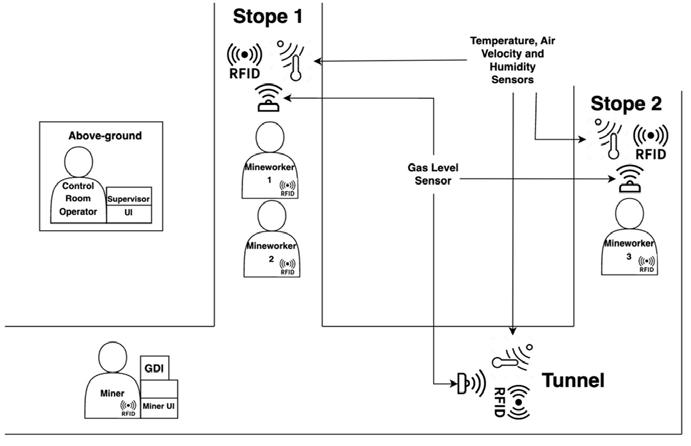
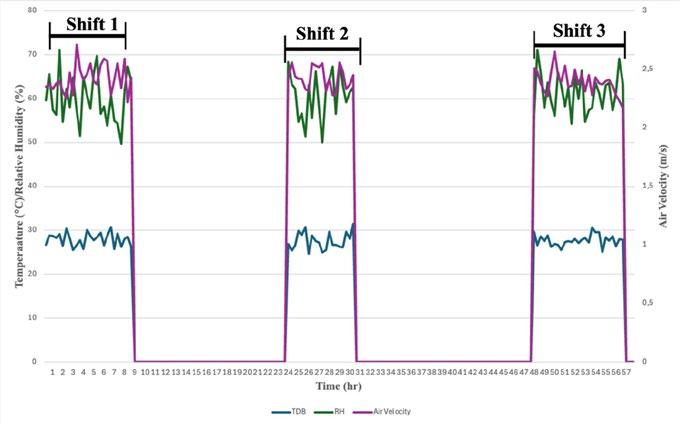
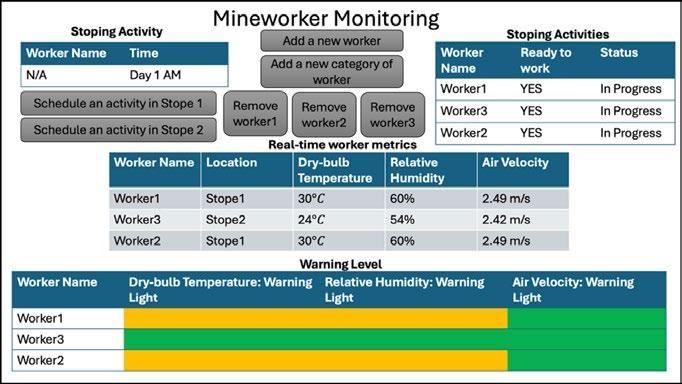
➤ Personal devices (e.g., tablet used by the miner).
➤ RFID systems (for location tracking).
➤ Manual inputs from miner and control room operators. This multi-source integration ensures a comprehensive understanding of the operational context.
FR2: Relate data to worker tasks and roles
Each worker is associated with a digital representation that includes their role, current task, and location. The HCPS maps incoming data to these representations, enabling task- and worker-specific monitoring. For example, a worker performing a drilling operation in a high-temperature zone could be monitored differently than one performing inspections in a well-ventilated tunnel.
FR3: Monitor various aspects of mineworkers and their environment
The system tracks each worker’s location and exposure to environmental hazards. If thresholds are exceeded (e.g., high CO levels or excessive heat), the HCPS triggers alerts and recommends corrective actions, such as evacuation or task reassignment. Figure 3 presents an example of a mineworker’s exposure data over three work shifts, as acquired and monitored by the HCPS in near realtime to assess the mineworker’s safety.
FR4: Record the state of workers and the work environment
The HCPS continuously acquires data from environmental sensors (i.e., temperature, humidity, air velocity, and gas concentration level data) and RFID readers (i.e., identification and location data) to monitor the real-time state of the mine and its workers. This data is stored in a structured database, enabling both immediate decisionmaking and retrospective analysis of past events and conditions.
FR5: Model the future state of workers
Using historical data, real-time sensor data, and predictive models (e.g., for heat stress and harmful gas exposure), the HCPS forecasts potential safety risks. For instance, if a prediction indicates that a worker will exceed safe exposure limits within the next hour, the system can proactively adjust the environment (e.g., increase air flow in the tunnel) or reassign the worker’s tasks and initiate evacuation procedures for the worker.
FR6: Perform analyses of the data
The HCPS executes automated analyses to assess safety risks. These include:
➤ Calculating wet-bulb globe temperature for heat stress (Anderson, De Souza, 2017).
➤ Computing a compressive scale index for harmful gas exposure (Li et al., 2023).
➤ Evaluating cumulative exposure over a shift. The results from these analyses inform decisions about worker shift allocations and safety interventions.
FR7: Facilitate the flow of data between internal and external systems
The HCPS supports bi-directional data exchange with external platforms such as ERP systems and control room dashboards. Internally, the HCPS ensures seamless communication between its data acquisition, analysis, and coordination modules.
Figure 2—Layout of the underground mining scenario (© University of Stellenbosch. Used with permission)
Figure 3—Monitored metrics of a mineworker (© University of Stellenbosch. Used with permission)
Figure 4—Example UI for the miner (© University of Stellenbosch. Used with permission)
Functional requirements for a human cyber-physical system
FR8: Display user-specific and context-specific information
User interfaces are tailored to different stakeholders:
➤ Miners view dashboards showing worker status, environmental conditions, and safety metrics; this is shown in Figure 4.
➤ Control room operators access aggregated data for strategic oversight.
FR9: Support the coordination of operations
The HCPS coordinates both human and automated operations. For example, in the event of a gas leak in an underground tunnel, the HCPS:
➤ Detects the increase in gas levels through the acquisition and monitoring of data from the sensors in the tunnels.
➤ Notifies the affected miners by means of an alert displayed on their UI.
➤ Sends instructions to the miners to coordinate the evacuation process (e.g., specifying the sequence by which different environments should be evacuated based on the proximity to the gas leak).
➤ Notifies the HVAC system to increase ventilation in the affected environments.
➤ Confirms safe re-entry conditions before instructing miners that it is safe for their teams to return to work.
Discussion
The functional requirements formulated in the aforementioned aim to guide the development of an HCPS to improve the safety of mineworkers in underground mines. Specifically, the requirements outline the functionality of the software system to be developed as the cyber layer of the HCPS, which is necessary to unlock the promising capabilities of the technology in underground mining.
The illustrative example introduced in this paper demonstrates how these functional requirements can be realised in a realistic underground mining scenario. The example shows how the HCPS can acquire and integrate data from environmental sensors and RFID systems (FR1), monitor worker location and exposure to hazards such as heat and harmful gases (FR3), and perform automated analyses to assess safety risks (FR6). It also illustrates the HCPS’s ability to model future worker states (FR5), enabling proactive coordination and decision-making.
The functional requirements flow from a consideration of the three dimensions of the RCI framework. FRs 2, 3, 4, 5, and 6 are essential for creating and maintaining representations of mineworkers (and other physical entities), which serve as the key mechanism for implementing the automated and personalised functions of the HCPS. These functions are exemplified in the illustrative example, where the HCPS maintains real-time and historical data on worker exposure and readiness, and uses predictive models to assess future safety risks.
FR 7 points to the essential capability of the HCPS to facilitate the exchange of data and information between the physical entities and their cyber counterparts. This was demonstrated in the example through the bi-directional communication between the HCPS and user interfaces, enabling miners and mineworkers to receive alerts and status updates in real time.
FRs 8 and 9 reflect functions of the HCPS that are realised at the union of the three dimensions of the RCI framework. Only through the implementation of mechanisms that serve each of the RCI dimensions can user-specific and context-specific information be provided and the operations of physical entities be coordinated
effectively. The illustrative example highlights these capabilities, showing how the HCPS coordinates mineworker activities and emergency responses, and displays tailored information to different users based on their roles and context.
Each FR is also tailored to the specific nature of underground mines. The functions to be performed by an HCPS to ensure mineworker safety are derived from a consideration of the typical tasks that mineworkers perform and the safety risks that they face. Furthermore, the increased adoption of technology in underground mining has, and will continue to lead to more and diverse data sources – the proposed FRs aim to leverage these data sources to improve mineworker safety and general situational awareness.
The FRs are thus proposed as a starting point for executives, managers, and engineers in the mining sector to develop implementation strategies for unlocking the benefits of the HCPSs in terms of mineworker safety. As such, the FRs are posed in a sufficiently generalised form such that they can be translated into the specific digital and production contexts of different underground mines. It should be noted that this work represents one of the first attempts at formulating requirements to guide the deployment of HCPSs, an emerging technology, within the complex and sensitive underground mining context. As such, the shortcomings of the presented work must also be acknowledged.
Firstly, since the FRs are generalised, they are not accompanied by specific target values. As such, the FRs would require further refinement and specification to a given application context before they could be used to effectively inform system design and technology selection decisions. Secondly, as the name indicates, the FRs only aim to specify what the HCPS should do and do not provide guidance on how or how well it should perform these functions. The formulation of non-functional or performance requirements will be necessary for the evaluation of system design and technology alternatives.
Both the contributions and shortcomings of the paper point to opportunities that should be explored in future work on the topic. Case studies for the development and deployment of HCPSs for mineworker safety in underground mines should be performed, where the proposed set of FRs could serve as the starting point. Through the detailed design and selection of technology for the HCPS in the specific case study context, the FRs can be further refined, and non-functional requirements can be identified. Such case studies will also demonstrate the benefits of HCPS deployment in real operational environments, as well as explore the mechanisms and challenges for integrating with existing physical and information systems in underground mines.
As a starting point, future work should aim to build on the recent research and development supported by the South African mining sector. Supported by the Real-Time Information Management Systems programme of the Mandela Mining Precinct, Kruger et al. (2023) developed an integration platform that can enable the development of HCPSs in underground mines. This platform applied principles of holonic systems (Koestler, 1967) to manage complexity in its design and utilised the BASE architecture (Sparrow et al., 2022) in its implementation.
Conclusion
With the increasing adoption of digital technology and the key role that human workers continue to perform in mining operations, underground mines should be viewed, and developed, as HCPSs. Specifically, the development of HCPSs promises significant
Functional requirements for a human cyber-physical system
improvements in the safety of mineworkers in underground mines. As a starting point for this development, this paper formulates a set of FRs for HCPSs to improve the safety of mineworkers.
The formulation of the FRs is informed by the analysis of the underground mining context and the exploration of opportunities for improved HSI in underground mine environments. The analysis of the underground mining context focused on the tasks typically performed by mineworkers, the safety risks that mineworkers are exposed to, and adopted and emerging technology. The opportunities for improved HSI in underground mines are explored according to the three dimensions of the RCI framework.
The functional requirements proposed in this paper provide a starting point for developing implementation strategies for HCPSs in underground mines. Future work should focus on the development of relevant case studies, which would serve to refine the FRs, inform the formulation of non-functional requirements, and demonstrate the benefits of HCPSs for mineworker safety in underground mines.
Acknowledgements
This research is supported by the Real Time Information Management Systems programme of the Mandela Mining Precinct.
Credit author statement
SF: Conceptualisation, methodology, writing – original draft preparation, investigation, and visualisation.
KK: Supervision, writing – reviewing and editing, funding, and project administration.
NCT: Supervision, writing – reviewing and editing.
AHB: Supervision, writing – reviewing and editing.
References
Ananth, C., Revathi, B.S., Poonguzhali, I., Anitha, A., Ananth Kumar, T. 2022. Wearable Smart Jacket for Coal Miners Using IoT, in Proceedings of International Conference on Technological Advancements in Computational Sciences, ICTACS 2022, Institute of Electrical and Electronics Engineers Inc. pp. 669–672. DOI: 10.1109/ICTACS56270.2022.9987834.
Anderson, R., De Souza, E. 2017. Heat stress management in underground mines. International Journal of Mining Science and Technology. vol. 27, no. 4, pp. 651–655. DOI: 10.1016/j. ijmst.2017.05.020.
Baek, J., Choi, Y. 2019. Development of a low-cost Proximity Warning System for mine equipment using smartphone and bluetooth beacons, in Mining Goes Digital, London: CRC Press pp. 715–719. DOI: 10.1201/9780429320774-84
Balaji, B., Shahab, M.A., Srinivasan, B., Srinivasan, R. 2023. ACT-R based human digital twin to enhance operators’ performance in process industries. Frontiers in Human Neuroscience. 17. DOI: 10.3389/fnhum.2023.1038060
Bartos, P.J. 2007. Is mining a high-tech industry?: Investigations into innovation and productivity advance. Resources Policy. vol. 32, no. 4, pp.149–158. DOI: 10.1016/J.RESOURPOL.2007.07.001
Cimini, C., Pirola, F., Pinto, R., Cavalieri, S. 2020. A human-in-theloop manufacturing control architecture for the next generation of production systems. Journal of Manufacturing Systems. vol. 54, pp. 258–271. DOI: 10.1016/j.jmsy.2020.01.002
Defty, T.W. 2022. A Holonic Human Cyber-Physical System in Healthcare. MEng (Mechatronic Eng) Thesis. Stellenbosch University.
Fantini, P., Pinzone, M., Taisch, M. 2020. Placing the operator at the centre of Industry 4.0 design: Modelling and assessing human activities within cyber-physical systems. Computers and Industrial Engineering. vol. 139. DOI: 10.1016/j.cie.2018.01.025
Goodman, S., Rajagopaul, A., Cassim, Z. 2019. Putting the shine back into South African mining A path to competitiveness and growth. Available: https://www.mckinsey.com/featured-insights/ middle-east-and-africa/putting-the-shine-back-into-southafrican-mining-a-path-to-competitiveness-and-growth [2024, May 20]
Grieves, M., Vickers, J. 2016. Digital twin: Mitigating unpredictable, undesirable emergent behavior in complex systems, in Transdisciplinary Perspectives on Complex Systems: New Findings and Approaches, Springer International Publishing. pp. 85–113. DOI: 10.1007/978-3-319-38756-7_4
Koestler, A. 1967. The Ghost in the Machine. New York: Macmillan. Kruger, K., Sparrow, D., Defty, T. 2023. An Integration Platform for Smart, Integrated Mining, in Digital Transformation in Mining 2023: Putting Digital Technologies to Work, The Southern African Institute of Mining and Metallurgy, vol.1, 95–106.
Li, S., Chen, X., Peng, G., Han, M., Guo, Q., Hou, J., Gao, B. 2023.[BP1.1] Research on the Evaluation of Air Quality in Underground Coal Mines Based on a Generalized Contrastive Weighted Comprehensive Scale Index Method. Atmosphere. 14(6). DOI: 10.3390/atmos14061021
Lööw, J. 2022. Understanding technology in mining and its effect on the work environment. Mineral Economics. vol. 35, no. 1 pp. 143–154. DOI: 10.1007/s13563-021-00279-y
Lööw, J., Abrahamsson, L., Johansson, J. 2019. [BP2.1]Mining 4.0— the Impact of New Technology from a Work Place Perspective. Mining, Metallurgy and Exploration. vol. 36, no. 4, pp. 701–707. DOI: 10.1007/s42461-019-00104-9
Maseko, R. 2021. Being a Mineworker In a Post-Apartheid South Africa: A Decolonial Perspective, in Decolonising the Human: Reflections from Africa on difference and oppression. pp. 109–129. Accessed 9 Feb 2025. https://doi. org/10.18772/22021036512.9
Mining Review Africa. 2020. Mining health and safety: 7 common risks to protect yourself against. Available: https://www. miningreview.com/health-and-safety/mining-health-safety-7common-risks-to-protect-yourself-against/ [2023, August 30]
Munir, S., Stankovic, J., Lin, S., Stankovic, J.A., Liang, C.-J.M. 2013. Cyber Physical System Challenges for Human-in-the-Loop Control, International Workshop on Feedback Computing. June. San Jose, California. USENIX.
Pacaux-Lemoine, M.P., Trentesaux, D., Zambrano Rey, G., Millot, P. 2017. Designing intelligent manufacturing systems through Human-Machine Cooperation principles: A humancentered approach. Computers and Industrial Engineering. vol. 111, pp. 581–595. DOI: 10.1016/j.cie.2017.05.014
Functional requirements for a human cyber-physical system
Romero, D., Stahre, J., Taisch, M. 2020. The Operator 4.0: Towards socially sustainable factories of the future. Elsevier Ltd. DOI: 10.1016/j.cie.2019.106128
SEBoK Editorial Board. 2024. The Guide to the Systems Engineering Body of Knowledge (SEBoK), v. 2.11, N. Hutchison (Editor in Chief). Hoboken, NJ: The Trustees of the Stevens Institute of Technology. Accessed 9 Feb 2025. www.sebokwiki.org
Shengli, W. 2021. Is Human Digital Twin possible? Computer Methods and Programs in Biomedicine Update. 1:100014. DOI: 10.1016/j.cmpbup.2021.100014
Singh, N., Gunjan, V.K., Chaudhary, G., Kaluri, R., Victor, N., Lakshmanna, K. 2022. IoT enabled HELMET to safeguard the health of mine workers. Computer Communications. vol. 193, pp. 1–9. DOI: 10.1016/j.comcom.2022.06.032
Sishi, M., Telukdarie, A. 2020. Implementation of Industry 4.0 technologies in the mining industry - a case study. International Journal of Mining and Mineral Engineering. vol. 11, no. 1, pp. 1.DOI: 10.1504/IJMME.2020.105852
Sparrow, D., Kruger, K., Basson, A.H. 2019. Human Digital Twin for integrating human workers in Industry 4.0, International Conference on Competitive Manufacturing. January. Stellenbosch, South Africa.
Sparrow, D., Taylor, N., Kruger, K., Basson, A., Bekker, A. 2021. Interfacing with Humans in Factories of the Future: Holonic Interface Services for Ambient Intelligence Environments, in Studies in Computational Intelligence: Service Oriented, Holonic and Multi-Agent Manufacturing Systems for Industry of the Future. vol. 952, pp. 299–312. DOI: 10.1007/978-3-03069373-2_21
Sparrow, D.E., Kruger, K., Basson, A.H. 2022. An architecture to facilitate the integration of human workers in Industry 4.0 environments. International Journal of Production Research. vol. 60, no. 15, pp. 4778–4796. DOI: 10.1080/00207543.2021.1937747
Statista Research Department. 2023. Number of mining employees in South Africa from 2011 to 2022. Available: https:// www.statista.com/statistics/1312267/south-africa-miningemployment/ [2024, June 05].
Taylor, N.C., Kruger, K., Bekker, A. 2023. A human cyber-physical system for human-centered computing in seafaring. Journal of Ambient Intelligence and Humanized Computing. vol. 14, no. 6, pp. 7871–7884. DOI: 10.1007/s12652-023-04598-6
Ulewicz, R., Krstic, B., Ingaldi, , Manuela. 2022. Mining Industry 4.0 – Opportunities and Barriers. Acta Montanistica Slovaca. no. 27, pp. 291–305. DOI: 10.46544/AMS.v27i2.02
Wang, B., Zhou, H., Yang, G., Li, X., Yang, H. 2022. Human Digital Twin (HDT) Driven Human-Cyber-Physical Systems: Key Technologies and Applications. Chinese Journal of Mechanical Engineering (English Edition). vol. 35, no. 1. DOI: 10.1186/ s10033-022-00680-w
Xue, J. 2014. Research on ERP enterprise management information system in the cloud computing model. BioTechnology: An Indian Journal. vol. 10, no. 20, pp. 12556–12562.
Yilma, B.A., Panetto, H., Naudet, Y. 2021. Systemic formalisation of Cyber-Physical-Social System (CPSS): A systematic literature review. Computers in Industry. 129:103458. DOI: 10.1016/j. compind.2021.103458 u

Affiliation:
1 Department of Earth Sciences, Faculty of Science, Engineering and Agriculture, University of Venda, South Africa.
2 Department of Mining, Minerals and Geomatics Engineering, College of Science, Engineering and Technology, University of South Africa, South Africa
Correspondence to:
J.M. Maponya
Email: mapulajulia4@gmail.com
Julia.Maponya@univen.ac.za
Dates:
Received: 09 Apr 2025
Revised: 18 Jun. 2025
Accepted: 23 Mar. 2026
Published: Jun. 2026
How to cite:
Maponya, J.M., Dikgwatlhe, I. P., Chauke, T. 2026. Comparison of radial basis function and sequential Gaussian simulation: A review on application in mineral resource estimation.
Journal of the Southern African Institute of Mining and Metallurgy, vol. 126, no. 6, pp. 353 - 364
DOI ID:
https://doi.org/10.17159/2411-9717/3708/2026
ORCiD:
J.M. Maponya,
https://orcid.org/0000-0002-7912-684X
I. P. Dikgwatlhe
https://orcid.org/0000-0003-4093-2139
T. Chauke
https://orcid.org/0000-0002-8535-0784
Comparison of radial basis function and sequential Gaussian simulation: A review on application in mineral resource estimation
by J.M. Maponya1, I. P. Dikgwatlhe2, T. Chauke2
Abstract
Accurate mineral resource estimation is crucial for optimising mining operations, reducing financial risks, and ensuring efficient resource utilisation. Various spatial modelling techniques have been developed to estimate ore grades and geological continuity, among which radial basis function interpolation and sequential Gaussian simulation are widely used. This review paper provides a comparative analysis of these two methods, examining their theoretical foundations, applications, strengths, and limitations in mineral resource estimation. Radial basis function is a deterministic interpolation method that models spatial relationships based on radial distance functions, making it effective for capturing smooth geological trends. Although kriging techniques have historically dominated the mining sector, new developments have brought to light their shortcomings, especially when handling sparse datasets and grade uncertainty. The paper examined case examples that demonstrate the usefulness of radial basis function and sequential Gaussian simulation in estimating mineral resources, with an emphasis on how they can model grade distributions, measure uncertainty, and maximise financial results. There is a substantial study gap dealing with the comparison of both methods; despite their respective advantages, a head-to-head comparison of radial basis function and sequential Gaussian simulation is still not well-studied. Their relative advantages, computational effectiveness, and compatibility with other geostatistical methods should all be assessed in future research. Guidelines for selecting estimating techniques based on geological conditions and project objectives are given to practitioners. The review emphasises how geostatistical techniques must be continuously improved to improve resource estimation precision and facilitate wellinformed mining sector decision-making.
Keywords
Radial basis function, sequential Gaussian simulation, mineral resource estimation, geostatistics, spatial uncertainty, ore grade modelling
Introduction
Today's mining operations, particularly underground mining, rely heavily on geostatistical methods to estimate mineral resources (Oltingey, 2024). Mineral resource estimation methods are used to estimate the tonnage and grade of a mineral deposit using data from exploration drilling, sampling, and geological interpretation (Rossi, Deutsch, 2014). One of the crucial steps in mine planning and design is estimating ore grade (Balci, Kumral, 2024). In South Africa, several mining operations have experienced financial losses due to inaccurate ore grade estimation (Minnitt, 2017). Ore grade estimation typically relies on limited drillhole data. This is because of the time and financial constraints required to drill, collect, and analyse drillhole cores (Atalay, 2024). The limited drillhole data that are available must be used carefully to accurately estimate the spatial distribution of the target ore grade. This estimation is important for various purposes such as evaluating economic feasibility of the mining project. Furthermore, it assists in making investment decisions for the deposit, short and long term mine planning, and estimating the lifespan of the mine (Blomo et al., 2019, Rossi, Deutsch, 2014).
Modern mining operations, particularly underground mines, rely strongly on geostatistical methods for mineral resource estimation (Oltingey, 2024). Mineral resource estimation refers to the determination of the tonnage and grade of a mineral deposit using information obtained from exploration drilling, sampling, and geological interpretation (Rossi, Deutsch, 2014). Estimating ore grade is a critical step in mine planning and design because it directly influences economic evaluation and operational decisions (Balci, Kumral, 2024). In South Africa, several mining operations have experienced financial losses due to inaccurate ore grade estimation (Minnitt, 2017).
Comparison of radial basis function and sequential Gaussian simulation
Ore grade estimation typically relies on limited drillhole data because of the time and financial constraints associated with drilling, collecting, and analysing drillhole cores (Atalay, 2024). The available data must therefore be used carefully to estimate the spatial distribution of ore grades within the deposit. Reliable estimation supports the evaluation of the economic feasibility of a mining project, informs investment decisions, guides short and long term mine planning, and assists in estimating the expected life of mine (Blomo et al., 2019; Rossi, Deutsch, 2014).
There are several methods that are used to estimate ore grade for block modelling. These methods include geostatistical methods such as kriging and its variant, and implicit methods such as radial basis functions and signed distance functions (Oltingey, 2024). Additionally, machine learning methods are other methods that are used for estimating grade (Kumar et al., 2020). This paper focuses on radial basis function (RBF) interpolation and sequential Gaussian simulation (SGS) and their applications in mineral resource estimation.
Radial basis functions (RBF) are implicit methods that are used to estimate the spatial variability of a variable by fitting a continuous surface over the sample data (Majdisovaa, Skala, 2018). The value in the function depends on the distance from the centre to the input space (Chen and Bakshi, 2009). When standard kriging is not feasible due to the inability to compute an experimental variogram, radial basis functions might be utilised as a substitute technique for estimating mineral resources (Santos, Yamamoto, 2019). To effectively interpolate large drillhole data sets for orebody implicit modelling, it is advisable to optimise the RBF equation's solution using the two-level domain decomposition technique (Zhong, Wang, 2019).
On the other hand, there is sequential Gaussian simulation (SGS), which is a geostatistical method for simulating spatial correlated data values at unsampled locations (Fatemeh, 2013). It is a technique used to generate multiple realisations of a random field, such as a geological deposit, based on a limited set of measurements. Sequential Gaussian simulation achieve a Gaussian transformation of the data and realisations of regular random variables. SGS can be used to map the spatial distribution and uncertainty of metals for geochemical, and it is found to be more effective than traditional kriging methods for this purpose (Fengrui et al., 2012).
As highlighted from the few reviewed studies in the aforementione, RBF and SGS have been extensively used in mineral resource estimation. However, these methodologies are scattered across the literature, with no systematic collection that may be used as a complete reference or knowledge base (Oltingey, 2024). As a result, this paper compiles the scattered knowledge from the literature into a single comprehensive review that can be used as a reference for future research and practical applications.
The primary goal of this paper is to provide a comprehensive review of radial basis function (RBF) interpolation and sequential Gaussian simulation (SGS), with an emphasis on its applications in mineral resource estimates. This is performed by reviewing various research studies. Relevant literature was gathered from trustworthy academic resources such as Google Scholar, ScienceDirect, and Web of Science. A keyword-based search method was used to find relevant studies. This review covers peer-reviewed journal articles, theses, dissertations, and peer-reviewed conference papers published between 2012 and 2024.
The structure of this review paper follows the introduction, methodology, practical applications and comparison of SGS and RBF in resource estimation; this covers the case studies on each
method in the real-world application for resource estimation. Each method is reviewed separately with discussions, which recap the main comparisons between SGS and RBF, emphasising their respective strengths and limitations in resource estimation. Recommendations for practitioners on when to choose SGS or RBF based on the context and objectives of resource estimation projects are provided. Lastly, concluding remarks on the importance of continued research and development in geostatistical methods for resource estimation.
Methods and materials
An extensive literature review was done to identify the most relevant peer-reviewed publications and research dissertations. The scientific research databases such as Google Scholar, Scopus, Science Direct and Web of Science were used to search for publications. One of the most important methods used in searching the publications was the use of keywords. That helped with limiting the search within the scope of interest. Keywords used to search for papers included the following: mineral resource estimation, ore grade estimation, reserve estimation, ore block modelling, sequential Gaussian simulation and radial basis function.
The literature search resulted in 87 publications of journal articles, and students’ dissertation and conference proceedings on mineral resource estimation. To narrow this, RBF and SGS were now included in the search to help find most relevant papers. On student’s dissertation, only master’s and doctoral papers were considered to ensure more relevance. Papers can be written and published in any language, in this case, papers published in English were considered and reviewed. The selected publications were reviewed with particular emphasis on their objectives, methodologies, findings, and conclusions. The publications were limited to 2012 to 2024, because most recent papers were needed for this review. The final research publications, book or textbook chapters, technical reports, and theses that were left after the narrowing were about 30. The publications reviewed in this paper are summarised in Table 1. The majority of the sources come from theses and dissertations of students, making up 5 publications reviewed. This is followed by the journal articles and conference proceedings.
Methodological review
Radial basis function
Alternative forms of radial basis functions are defined as the distance from another point denoted C, known as a centre, and are functions of which the value depends only on the distance from the origin (Majdisovaa, Skala, 2018). For a radial basis function to function, it must define itself in relation to its origin or centre. This is accomplished by factoring in the function's absolute value. The definition of an absolute value is a value devoid of its corresponding sign (positive or negative) (Buhmann, 2003).
The initial multiquadric equations put forward by Hardy (1971) are generalised by radial functions. Yamamoto (2002) states that Equation 1 can be used to express the estimator using multiquadric equations, and Equation 2 provides the constraint condition (Santos, Yamamoto, 2019).
Comparison of radial basis function and sequential Gaussian simulation
Table 1
Summary of the publications obtained from scientific research databases such as Google Scholar, Scopus, Science Direct, and Web of Science.
Source Number (Articles, report, thesis, books) Authors
Scientific Mining Journal 1 Atalay, 2023
Mining, Metallurgy and Exploration Journal
International Journal of Mining, Reclamation and Environment
1 Balci, Kumral, 2024
1 Blom et al., 2019
Book chapter 2 Buhmann, 2003
Nwaila et al., 2024
Conference proceedings
Tenorio, Bandopadhyay, S, 2015
Institute of Geological Survey
Fengrui et al., 2012
2 Chen et al., 2021
2 Chen et al., 2021
Reports 3 Chen et al., 2016
Griffin, 2023
Zhang, 2011
Springer International 2 Gomex-Hernandez, 2023 Hillier, 2023
Thesis 5 Chieundura, 2017
Goncalves, 2021
Gulule, 2016
Kassymkan, 2024
Mabala, 2021
Universal Journal of Geoscience 1 Fatemeh, 2013
Journal of the Chemical, Metallurgical and Mining 1 Krige, 1951
Journal of Emerging Technologies and Innovative Research 1 Kumar et al., 2020
Applied Mathematical Modelling 1 Maidisovaa, Skala, 2028
Jornal of Southern African Institute of Mining and Metallurgy 1 Minnitt, 2017
National Institute of Technology 1 Moharaj, Wangmo, 2014
Arabian Journal of Geoscience 1 Mojezi et al., 2013
REM-International Engineering Journal
1 Santos, Yamamoto, 2019
International Journal of Geo-Engineering 1 Tehernejad et al., 2018
The uncertainty associated with multiquadric interpolation can be calculated by the interpolation variance expression in Equation 3.
The value in the function depends on the distance from the centre to the input space (Chen and Bakshi, 2009). Radial basis function offers simplicity and faster computation without compromising the ability to map input-output data, while also providing greater flexibility. With proper model parameter tuning, it can effectively capture both linear and non-linear relationships (Yu, 2012). It requires adequate input space coverage, and RBF network centres are selected based on the distribution of the input data
rather than the specific prediction task (Soper, 2023).
Sequential Gaussian simulation
Sequential Gaussian simulation (SGS) is a geostatistical method for simulating spatially correlated data values at unsampled locations (Fatemeh et al., 2013). It is a technique used to generate multiple realisations of a random field, such as a geological deposit, based on a limited set of measurements. Sequential Gaussian simulation achieves a Gaussian transformation of the data and realise realisations of regular random variables.
Using values from the surrounding area, a simulated value at a known point is randomly drawn from the conditional cumulative
Comparison of radial basis function and sequential Gaussian simulation
distribution function, which is defined by the kriging mean and variance. The simulated value is dependent on the initial data and earlier simulated values at a new randomly visited point. Up until every point in the grid has been simulated for every realisation, the process is repeated (Deutsch, Journel, 1992). SGS can be used to map the spatial distribution and uncertainty of metals for geochemical anomalies, and it is found to be more effective than traditional kriging methods for this purpose (Fengrui et al., 2012).
SGS reduces estimation smoothing, reproduces histograms, and provides a better representation of local variability. Additionally, it offers more accurate estimates that respect spatial variability and enables the assessment of global uncertainty (Gómez-Hernández, 2023). Using individual simulations can lead to high estimation inaccuracy, and data management issues may arise when many realisations are used. Furthermore, insufficient conditioning data in a simulation can cause significant variation between the realisations (Madsen et al., 2021).
It uses the following Equations 4 to 6 to generate multiple equally probable realisations of a spatially distributed variable, maintaining the statistical properties of the original dataset (Manchuk, Deutsch, 2012).
Normal score transformation:
Kriging estimation:
Conditional simulation:
Difference between radial basis function and sequential Gaussian simulation
Although both methods are used to predict the spatial distribution of ore grades, they differ fundamentally in their objectives and underlying approaches (Fig.1). SGS is a stochastic geostatistical simulation method that generates multiple equally probable realisations of grade distribution, allowing the modelling of local variability and quantification of uncertainty. In contrast, RBF is a deterministic interpolation technique that fits a smooth continuous surface through sampled data points, providing computational efficiency but limited capability in representing uncertainty and high-grade spatial continuity. Figure 2 highlights the conceptual differences between SGS and RBF in terms of variability representation, uncertainty assessment, and interpolation behaviour (Gulule, 2016).
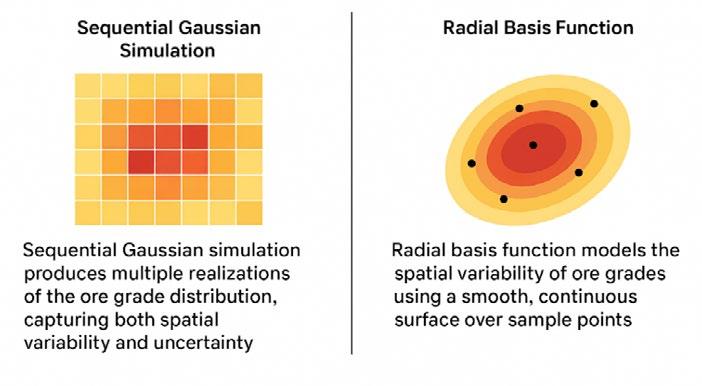
Comparative analysis of radial basis function and sequential Gaussian simulation
Case studies of radial basis function in resource estimation
Radial basis function (RBF) interpolation has developed as an important tool in implicit modelling, providing a flexible and economical method for spatial interpolation and resource estimation. Its capacity to create smooth, continuous grade models from unevenly distributed data makes it ideal for geologically complicated deposits. In mineral resource estimates, RBF is increasingly being used to simulate both geological boundaries and grade distributions, particularly in commercial software such as Leapfrog® Geo. The case studies that follow show how RBF-based methods have been used in a variety of geological settings, including their benefits, limits, and interaction with standard or hybrid modelling workflows.
The research work by Santos and Yamamoto (2019) analysed the use of radial basis functions, particularly the multiquadric equations, or gold resource estimation in the União Luiz and Morro do Carrapato deposits in the Alta Floresta Gold Province, Brazil. The study was motivated by the fact that the main direction of mineral continuity (90° strike) exhibited a pure nugget effect in the experimental variogram, indicating no spatial correlation. Ordinary kriging was not applicable as it usually requires specification of anisotropy ellipsoid through three or more well-defined directions of correlation. To overcome this difficulty, the researchers resorted to an approach known as radial basis function (RBF) interpolation, which does not rely on variogram modelling and yet shares some properties with kriging, such as a weighted average of neighbouring values. This interpolation approach assumed a three-dimensional block model obtained from 62 drill holes with over 9 million blocks each having dimensions of 408 × 120 × 190. Because the gold grades had highly positively skewed distributions, it was necessary to first transform the data onto Gaussian scale, perform interpolation based on multiquadric RBF, and then reverse the initial transformation.
The search was done using anisotropic ellipsoids with an octant-based neighbour selection and having a maximum of 16 surrounding points. Geokrige software was employed for the modelling process. From the findings, it was evident that the gold grades were distributed vertically showing evidence of structural control mineralisation, probably associated with quartz veins in
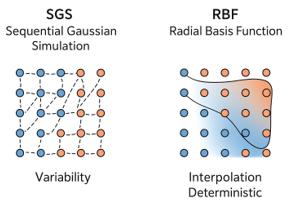
Figure 1—Difference between RBF and SGS (Gulule, 2016)
Figure 2—Conceptual illustration of the key differences between sequential Gaussian simulation (SGS) and radial basis function (RBF) interpolation (Gulule, 2016)
Comparison of radial basis function and sequential Gaussian simulation
Table 2
The findings of the main parameters (Goncalves, 2021)
Parameter
Value/description
Coefficient of variation (CV) 6.85 - Indicates very high variability in gold content, typical for gold deposits.
Maximum gold assay
Upper quartile
85.78 ppm - suggests the presence of native gold, reflecting extreme values in the data.
25% of total samples exceed 0.18 ppm - Indicates a significant portion of low-grade samples.
Main direction variogram Pure nugget effect - reflects a random distribution of gold mineralisation.
Orthogonal direction variogram
Structured variogram (180/85) - however, deemed ineffective for defining anisotropy ellipsoid for kriging.
3D model findings Vertical distribution of gold - suggests structural control over mineralisation.
Estimated gold resource 2.122 tonnes - based on a grade-tonnage curve with a simulated cut-off of 5.0 g/tonne.
granodiorite host rocks. A high coefficient of variation (CV = 6. 85) indicated significant grade variability, including extremely high values potentially linked to native gold. According to the grade-tonnage analysis results, about 2,122 tonnes of gold could be considered as reserves at a 5.0 g/t cut-off grade. The total geological in situ resources were estimated to be 6.4 tonnes. Also, a variance model suggested that increased grade level was proportionally linked with greater uncertainty, thus supporting the common feature of lognormal distribution.
In their view, although effective in such cases where variogrambased geostatistics fail, application of RBF method has certain weaknesses. These weaknesses include the inability to consider spatial correlation at some important directions, low borehole density, skewed data and a need for choosing parameters carefully because, otherwise, it may lead to bias in estimation. The research backs RBFs as an acceptable substitute for the standard geostatistical assumptions that may fail. Nonetheless, it emphasises the need for one to first comprehend some attributes, such as deposit geometry and data behaviour of deposits, before employing these techniques. The study used the radial basis function to create 3D model and grade-tonnage curves (Fig.3), which were used for analysis and estimation of the mineral resource.
Goncalves (2021) studied resource estimation using radial basis function on a sparse dataset. The main objective of the study was to measure and contrast the effectiveness of RBF estimates in scenarios with low data coverage. This required comparing RBF's performance against alternative approaches like ordinary kriging in low data coverage. The modelled stratigraphic unit and geology
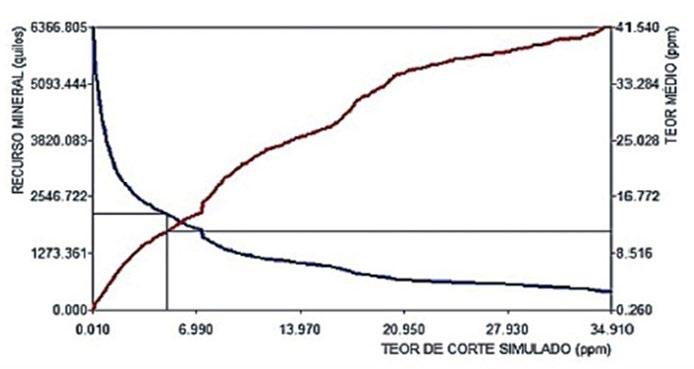
Figure 3—Gold grade-tonnage curve (Santos, Yamamoto, 2019)
aided in visualisation of the geological data.
Exploratory data analysis was used to generate sample composites, domain various populations, and analyse the data (Goncalves, 2021). Normal score transformation, semi-variogram modelling, and geostatistical analysis were performed on the datasets. To guarantee that the estimations were accurate, the best RBF parameters, such as spatial function and degree of polynomial in the drift model, were used. Three distinct estimation methods RBF, ordinary kriging (OK), and inverse distance weighting (IDW) were used to estimate grades into a block model.
The comparison of these methods enables a thorough assessment of the RBF method (Goncalves, 2021). To ensure the dependability of the results, statistical techniques were used to validate the model outputs against the inputs. According to the study, when there is enough data available, RBF and ordinary kriging (OK) produce results that are comparable. This resemblance implies that both approaches work well for updating grade control models in production settings with more data. The results provide credibility to the notion that RBF can be a good substitute for more conventional techniques like inverse distance weighting (Goncalves, 2021).
The results (Table 2) also show that kriging has a drawback, especially when dealing with sparse data. Estimates from kriging can be biased because of the small sample size, which could introduce edge effects. RBF, on the other hand, is not affected by this drawback because it functions as a global estimator, guaranteeing that estimates along domain boundaries are consistently assigned.
Griffin, 2023 examined the current drilling status of the Los Pumas Manganese project in Northern Chile, with an analysis conducted using the radial basis function method. The methodology involved modelling the manganese assay data using Leapfrog Geo and Surpac software. Ordinary kriging was employed on Surpac software using a 2.5% manganese cut-off grade. Wireframes were created using Leapfrog RBF modelling on 2% manganese composites (Griffin, 2023). The drillholes were composite for 1 m intervals to allow the performance of geostatistical analysis and grade estimation. The findings revealed the estimates of 30.3 million tonnes at 6.2% manganese. The mineralisation was predominantly horizontal and extends from surface to a depth of 60 metres (Griffin, 2023). The geological data in the dataset were not fully analysed, which could enhance the understanding of the deposit.
Comparison of radial basis function and sequential Gaussian simulation
Even though using one method is advised, comparison of different geostatistical methods is recommended for better results. Atalay (2023) compared the conditional radial basis function with ordinary kriging to estimate the calorific values of coal in the Türkiye-Thrace region. The main goal was to understand the two methods and assist towards informed decision-making regarding resource management. The investigation involved the use of previous research studies that employed these methods. A total of 128 drillhole data were collected, with a 38.326-metre drilling length. Individual coal seams were about 6.5 metres on average in thickness, and the total thickness of coal taken from these drillings was 876 metres.
After loading the data on Python, the data were composited into 1-metre intervals for both techniques. This was done to ensure that the data are uniform and relevant for analysis. Following this, an experimental variogram was estimated to assist in the kriging equations and RBF. The conditional radial basis function was employed to estimate the caloric values against the ordinary kriging. In contrast to kriging estimates, the results showed that RBF estimates were more in line with the composite estimates. Even though RBF yielded favourable findings, the minimum value that was obtained was 1 kCal/kg less than the composite minimum values. Although slight, this disparity raises the possibility of an RBF technique flaw because estimators are typically supposed to interpolate within the range of observed data. The summary of the results is shown in Figure 4.
Discussion
Radial basis function (RBF) interpolation presents several strengths in resource estimation, particularly in complex geological settings. One of its primary advantages is its flexibility in variogram modelling, as it does not rely on the formulation of an anisotropy ellipsoid or defined variograms. This capability is especially valuable in instances where traditional methods like ordinary kriging are ineffective due to pure nugget effects, as noted in the research by Santos and Yamamoto (2019). Additionally, RBF is adept at handling skewed data distributions, allowing for transformations to a Gaussian scale before interpolation, which enhances the accuracy of grade estimations. Its global estimation characteristic ensures consistency across domain boundaries, making it less susceptible to edge effects that can affect local estimators like kriging, particularly in sparse data scenarios, as demonstrated by Goncalves (2021). However, the application of RBF also carries notable
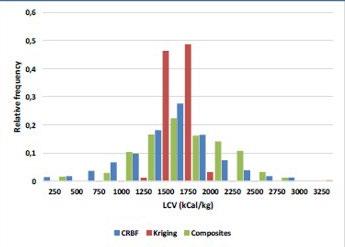
weaknesses. The efficiency of the method depends on the careful selection of parameters such as spatial functions and polynomial degrees in the drift model. Poor choices can result in biased estimates and inadequate representations of geological features. Furthermore, RBF does not account for spatial correlation in critical directions, potentially limiting its effectiveness in capturing the stratigraphic complexities of certain deposits. The performance of RBF can also be influenced by data density, with low-density datasets leading to misrepresentations and a reliance on additional data to validate estimations.
The literature on RBF reveals significant gaps that require future research, particularly in the context of cross-method comparisons, as most studies evaluate RBF in focus on specific geological cases. There is an opportunity to systematically assess RBF's performance across diverse geological contexts and resource types while exploring its computational efficiency in large-scale modelling and conducting sensitivity analyses on parameter variations. Additionally, integrating geological insights into the RBF modelling process through data analysis could lead to improved resource estimations and a deeper understanding of the geological deposits.
Case studies of sequential Gaussian simulation in resource estimation
When planning open pits, grade estimation is crucial because, while over-estimation would unnecessarily raise the stripping ratio, under-estimation might lead to the loss of economic ore during the grade estimation procedure. Typically, grade estimate is done using the kriging method, which has the drawbacks of under-estimating and/or over-estimating because of the smoothing effect.
Conditional simulation is the more effective strategy that can be used to overcome the limitations of the kriging method, and it is applied to many disciplines for estimation and simulation of the process in place. This paper focused mainly on the application of mineral resource estimation.
Monjezi et al. (2013) applied sequential Gaussian simulation to model the spatial distribution of copper grade in the Sungun copper deposit, located in the northwest of Iran. Their study aimed to generate realistic grade realisations that honour the statistical characteristics of the sample data while capturing spatial uncertainty inherent in the deposit. By employing SGS, they were able to produce multiple, equally probable grade models, providing a robust basis for resource estimation and risk assessment in mine planning. This was done to compare sequential Gaussian simulation and ordinary kriging method for grade modelling. One important objective was to improve grade estimation and economic indicators in open-pit mining.
The results showed that conditional simulation is a good way to address the shortcomings of the kriging method. Additionally, it was noted that the grade distribution produced by the conditional simulation is nearly equal to that of the actual exploration data when compared to the kriging method. As a result, conditional simulation greatly increased the total of mineable ore and enhanced the average net present value, which is the mine’s most important economic indicator, by 40%.
The study has several limitations in that it uses moderateresolution data, which may reduce spatial accuracy, and does not account for temporal variations. The weighted overlay method assumes linear relationships, oversimplifying complex geostatistical interactions. Field validation was limited, affecting result reliability. Lastly, the findings are specific to the Sungun deposit and may not be generalised to other regions.
Figure 4—Histograms of RBF, kriging, and composites (Atalay, 2023)
Comparison of radial basis function and sequential Gaussian simulation
Tenorio and Bandopadhyay (2015) studied platinum deposits close to Alaska's Goodnews Bay, applying sophisticated statistical techniques to the difficulties presented by marine placer deposits. The challenges included highly variable and discontinuous mineralisation, sparse and irregular sampling, and a complex deposition process. This entails examining the historical data and geological features gathered from the region since the 1980s, including 470 samples across a huge area of roughly 4000 square kilometres. Using sequential Gaussian simulation was one of the main goals for the analysis. This approach was selected because it can accurately estimate the platinum grades in the sampled locations by representing variables that have a normal distribution. Additionally, the study compared the outcomes of SGS with those of conventional estimating methods, particularly the inverse distance squared (ID²) approach.
The purpose of this comparison was to assess SGS's efficacy and efficiency in generating accurate grade-tonnage estimations for different cut-off grades. To increase the dependability of the estimated resources, the study strengthened the confidence in geological reporting of the platinum deposit by making sure that the sampling's quality, density, and distribution are sufficient.
Sequential Gaussian simulation was used on ISATIS software to assess the platinum deposit. Before employing SGS, the sample grades were normalised using a normal score transform and handled as continuous variables. This stage is essential for ensuring that the data satisfy the SGS method's presumptions. Both methods demonstrated their efficacy in estimating platinum resources by producing comparable distribution maps and grade distributions for various cut-off grades. Sequential Gaussian simulation was found to be more 'grade/tonnage-efficient' for the cut-off range of 400 mg/ m³ to 200 mg/m³. This suggests that this method provides a better balance between the estimated grade and the tonnage of platinum available (Tenorio, Bandopadhyay, 2015).
When compared to the inverse distance squared approach, the conditional simulation method yielded a smoother area versus cut-off curve, demonstrating the benefits of conditional simulation for a resource estimate. The study revealed that the small number of samples limited the ability to predict grades. Areas without samples or with 0 values could not be reliably approximated, even though appropriate grades were projected close to known samples.
The study revealed that SGS does not perform well on sparse sampling, which made it challenging to determine grades with accuracy in areas that were either poorly sampled or unsampled. The region's extremely irregular and varied mineralisation made precise SGS modelling difficult. Furthermore, it showed that if the data deviate greatly from normality, SGS may create mistakes because it requires normal score translation and presupposes a normal distribution of the data. Additionally, the study discovered that it was not possible to forecast grades in locations with zero values or without samples. Although SGS occasionally performed better than the inverse distance squared method, each approach had advantages and disadvantages that demonstrated how difficult it is to estimate resources in maritime placer deposits.
Chen et al. (2016), investigated how the copper ore body differs in Tibet regions with others in China. This was important because it helped with the effective resource management and extraction strategies of the ore body. One of the important goals was the delineation of the copper ore body to establish the ore body's limits and extent, which is essential for planning mining operations and making sure that resources are used effectively (Chen et al.,2016).
A comprehensive dataset comprising 33 exploratory trenches
and 106 drill holes were used for the analysis. Descriptive statistics were used to summarise the copper grade data at the start of the investigation. A normal score transformation is applied to the copper grade data; this transformation is necessary for the efficient application of geostatistical approaches (Chen et al., 2016). To evaluate the spatial continuity of the copper grades, the study computes experimental semi-variograms. These semi-variograms give information about the ore bodies' spatial orientation by displaying their inclination angles and directional trends.
The study used sequential Gaussian simulation on tools such as SGeMS (Stanford Geostatistical Modelling software) and Datamine Studio for visualisations and statistical analyses (Chen et al., 2016). Ten realisations were produced on a 30 m × 30 m x 6 m grid, offering a thorough understanding of the distribution of copper. According to the analysis of the copper grades, the distribution exhibits a lognormal pattern. The semi-variograms revealed that the north ore body trends east-west with a 20-degree inclination, the east copper body is seen to flow north-south with a 75-degree inclination. Furthermore, with an inclination angle of 20 degrees and a tendency angle of 40 degrees, the west ore body advances towards 310 degrees. Planning extraction tactics requires an understanding of these directional tendencies (Chen et al., 2016). The table of results is shown table 3.
The study revealed that, if the data greatly deviates from the normal distribution assumption, bias may be introduced into the normal score transformation process. Even though the experimental semi-variograms offered valuable insights into spatial continuity, it is possible that they misinterpreted directional trends since they do not adequately take into consideration the intricacy of ore body structures. Furthermore, the study recognised that the reliability of the resulting grade estimations may be impacted by inaccuracies in the data, as the use of sequential Gaussian simulation severely depends on the quality and accuracy of the input data.
Gulule (2016) compared ordinary kriging with sequential Gaussian simulations on blast hole data having both high and low grade at the Kayelekera mine. This was coupled by comparing the grade distribution maps and grade tonnage curves from both methods. The data assisted in determining which technique gives accurate and better spatial variability of the data. Sampling from different geological units with different grades was done. The data were plotted, and statistical analysis was done using Hellman and Schofield's MP software. Estimation using sequential Gaussian simulation on micromine was done and compared with estimates on ordinary kriging. Both techniques produced similar results and same estimates, but for the areas with less grade, the profit dropped after reaching the maximum cut-off grade.
Sparse sampling from several geological units may affect the accuracy of grade estimations, especially in locations with low grades. Furthermore, sequential Gaussian simulation and regular kriging both gave findings that were comparable, but they had trouble accounting for profit declines in regions that were below the highest cut-off grade.
Chiwundura (2017) used multiple indicator kriging (MIK), a geostatistical method that helps in understanding the distribution of grades within the deposit and Sequential Gaussian Simulation to estimate the recoverable of the Nickel deposits. This was done together with the assessment of grade uncertainty and comparing it with historical estimates. The comparison was important because it helped with the validation of the new methods and track any changes in estimates over time. Multiple indicator kriging (MIK) was applied to determine the number of resources that
Comparison of radial basis function and sequential Gaussian simulation
could be recovered. Compared to more conventional approaches like ordinary kriging (OK), MIK is a non-linear geostatistical methodology that enables the insertion of several grade thresholds, offering a more detailed understanding of the grade distribution.
Sequential Gaussian simulation was used in conjunction with MIK to create a probabilistic uncertainty model. By creating numerous realisations of the grade distribution, this method samples from the uncertainty distribution and aids in evaluating the uncertainty surrounding the estimations. To comprehend the geographic continuity of the nickel grades, a thorough variography analysis was conducted as part of the study. The selection of the MIK methods over the median indicator approach was influenced by the two primary directions of grade continuity that this study revealed (Chiwundura, 2017).
Data from 172 drill holes served as the basis for both methods, which assessed the eastern and western domains of the Hunters Road western orebody. This large dataset was essential to the proper use of SGS and MIK. Out of the 172 validated boreholes, 15 boreholes did not have assay results because they did not intersect nickel mineralisation. This indicates a significant focus on the quality of data used for resource estimation. At an average grade of 0.57% Ni, the combined mineral resources estimate for the western orebody at a cut-off grade of 0.40% Ni was 32.30 million tonnes (Mt) of contained nickel metal. Both the MIK and SGS approaches were used to produce this estimate.
The SGS results showed that there was little uncertainty in the nickel grades, with a 90% chance that the average true grade would be higher than the cut-off and fall within +/-3% of the predicted block grade. For the western domain, the mean grades calculated by SGS were 0.55% Ni, while for the eastern domain, they were 0.57% Ni. The summarised results are presented in Table 3.
The lack of assay results from 15 boreholes, have impacted the resource estimate's accuracy, especially in regions devoid of nickel mineralisation. Although sequential Gaussian simulation
and multiple indicator kriging offered comprehensive estimates, the study's dependence on historical data may have introduced inconsistencies if previously used methodologies diverged substantially from the present analysis. Furthermore, even though SGS showed low uncertainty in nickel grades, sampling density and data quality may still have an impact on how well both approaches estimate resource variability.
Tahernejad et al. (2018) investigated the iron ore deposit at the Rezvan mine in Iran. Their study focused on incorporating ore grade uncertainty into mine planning to improve decisionmaking and optimise resource extraction. Understanding how grade uncertainty affects strategic mine planning decisions, specifically the net present value (NPV) of mining projects, and comparing the efficacy of sequential Gaussian simulation (SGS) and ordinary kriging (OK) in resource estimate were the main goals. The study used 3,483 powder samples taken from drilling operations in addition to data from 125 vertical exploration boreholes, guaranteeing a reasonably solid dataset for geostatistical modelling.
After analysing the data using descriptive statistics and geostatistical techniques, grade distribution models were created using SGS and OK. The results showed that, in contrast to OK, which tends to smooth grades and understate variability, SGS offered a more accurate depiction of grade variability, better reflecting spatial uncertainty. Because there was less chance of overestimating ore grades, SGS-based mine plans resulted in an enhanced net present value (NPV), proving that integrating grade uncertainty into planning can have a favourable impact on economic outcomes.
Even though SGS enhances uncertainty representation, it was noted that it is computationally more demanding than OK and necessitates more technical know-how and processing time. Another drawback was that the quality and density of the input data had a significant impact on the accuracy of the simulation results; no matter the technique, areas with sparse data or no sampling still carried a high degree of uncertainty. The study also recognised that the interpretation of NPV improvements between the two approaches may be considerably impacted by variations in the economic assumptions such as metal prices, discount rates, and operating expenses. Despite SGS's excellent performance, the authors pointed out that training and adaptation may be necessary for its application in operational mine planning, especially in mines accustomed to traditional estimation techniques.
Sotoudeh et al. (2020) focused on copper deposit and used sequential Gaussian simulation (SGS) to develop a comprehensive geological model for mine planning objectives. The first step was to use experimental algorithms to determine the underground stope layout. The second step involved creating a 3D block model of the study area, which was done by generating 50 realisations of the copper grade distribution using SGS. The last part was the validation of the simulated realisation by producing the histogram and variograms to confirm if they match the original data features.
Probability
The researchers found that the ore reserves of the kriging method were calculated to be 644 535 tonnes and geostatistical simulation produced 799 000 tonnes. According to the findings, a considerable percentage of underground mining limitations using the sequential Gaussian conditional simulation approach yield a higher economic value than ordinary kriging. Thus, the results demonstrate that standard kriging-based underground mine planning can provide misleading outputs, which can lead to erroneous expectations of net present value as well as mine production scheduling.
Table 3
Summary of key results from Nickel deposit (Chiwundura, 2017)
Comparison of radial basis function and sequential Gaussian simulation
This is because traditional kriging methods are based on a single ore model that is supposed to be an actual deposit in the underground deposit being mined. They are unable to assess the uncertainty of the economic and operational repercussions of the stope layout. On the other hand, simulation methods provide an excellent opportunity to describe the distribution of ore grade in each realisation as well as quantify uncertainty.
Geochemical anomalies can also be assessed using sequential Gaussian simulations (Chen et al., 2021). The feasibility of the sequential Gaussian simulations was tested in mapping the geochemical anomalies as an alternative to ordinary kriging. Geostatistical interpolation method, also known as kriging, was applied to estimate the spatial distribution of lead (Pb) concentrations as compared to SGS to generate multiple realisations of lead spatial distribution (Chen et al., 2021). The first step that was taken was transforming the lead data into normal score before applying the SGS method. SGS was able to model the spatial uncertainty of lead geochemistry, but the ordinary kriging underestimated the true variability (Chen et al., 2021). From the findings, it can be concluded that SGS is a recommended powerful tool for spatial distribution and can be incorporated in mineral exploration and planning stage.
Mabala (2021) aimed to model gold deposit by simulating grade distributions within the A1 reef horizon using the TI and the direct sampling multiple point statistics technique (DeeSse), especially in regions with low sampling density. Integrating the uncertainty grade models into grade and tonnage curve computations, together with revenue and metal content estimates, was another important goal of the study. Comparing the outcomes from DeeSse and SGSIM is a crucial goal to assess their efficacy and identify any differences in the estimations generated by these techniques. The Tarkwa mine was the subject of the study. Given that the diamond drill holes in the pit expansion area are arranged roughly 200 metres apart along strike, 100 metres apart across strike, and 3 metres vertically, the dataset in this region is very sparse.
Sequential Gaussian simulation (SGSIM) was performed, and training images (TI) were created using Datamine StudioRM. Ar2Gems was used to run the DeeSse simulations since it was chosen for its capacity to implement the DeeSse method and was free to use for research. The e-type estimate of 50 SGSIM simulations was compared to the TIs to validate them. To show that DeeSse could replicate a greater range of grade values while still being comparable to SGSIM, the findings were additionally verified
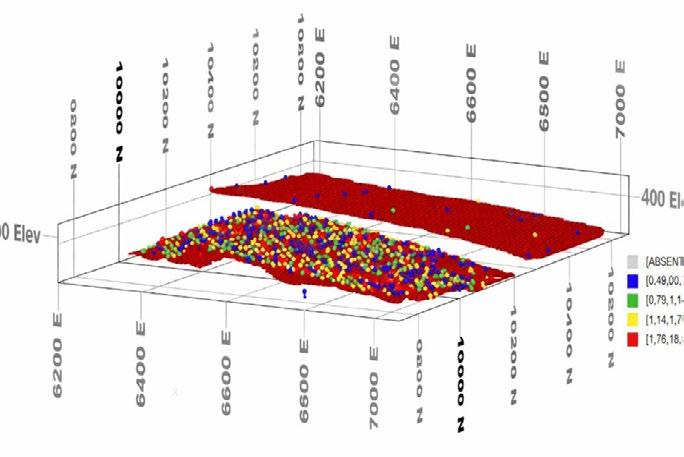
against SGSIM estimates (Fig.5).
DeeSse was found to generate a wider range of grade values, suggesting that it can capture greater data variability. But SGSIM showed higher local variability, which could be useful in some situations. In comparison to ordinary kriging, the study found that DeeSse offered a more reliable approach with higher confidence in the estimates. This was particularly important for resource modelling in places with low data densities. The accuracy of both DeeSse and SGSIM simulations was constrained by the poor sampling density, particularly in the pit extension area. The quality and representativeness of the training images utilised in DeeSse had a significant impact on the outcomes' dependability. Furthermore, DeeSse's performance in zones with less information was unclear even though it was able to capture a greater range of grade variability.
Kassymkan (2024) investigated and contrasted the effectiveness of two geostatistical techniques, simple kriging (SK) and sequential Gaussian simulation (SGS). The study compared both approaches to determine which one could yield more accurate estimates for iron ore grades in mining operations. Another important aspect was to precisely categorise materials as waste or ore. Because it has a direct impact on resource management and economic viability, this classification was essential for making well-informed decisions in mining operations. The investigation started with an initial dataset of 2 230 grade values of iron ore that were gathered from a particular location. A comprehensive exploratory data analysis (EDA) was carried out prior to the application of any estimating approaches. Variogram analysis followed, which aided in choosing the correct parameters for the estimate techniques by revealing how the grade values change with distance.
The software ISATIS.neo, which is specifically made for geostatistical modelling, was used for all studies and simulations. By making it easier to apply kriging and simulation approaches, this program guarantees precise and effective calculations (Kassymkan, 2024). The findings showed that, in comparison to SK, SGS offers estimations that are more accurate and trustworthy. The Q-Q charts make this clear by demonstrating that the points from SGS match the original dataset more closely than those from SK.
According to the results, SGS typically predicted more tonnage at higher cut-off values, whereas SK may produce higher tonnage at lower cut-off values. The findings reveal that, while SGS exhibits a minor advantage, both approaches offer estimates of economic gain and metal quantity that are comparable. The specific characteristics of the mineral deposit and the goals of the study should guide the decision between SGS and SK. Understanding the advantages and disadvantages of each approach can improve the results of resource estimation.
Discussion
SGS continuously offers a more accurate prediction of grade distributions and spatial uncertainty than conventional techniques such as ordinary kriging across a variety of deposits, from copper and platinum to iron and nickel. Especially in well-sampled areas, it improves economic measures like NPV and resource classification accuracy. However, it needs reliable input data, processing power, and specialised knowledge, and its efficacy decreases in areas with sparse data. Even though SGS has drawbacks, incorporating it into mine planning is a major step forward for geostatistical modelling, particularly when paired with other methods like MIK or DeeSse for increased forecast accuracy.
Figure 5—Block models within the TI area and EA (Mabala, 2021)
Comparison of radial basis function and sequential Gaussian simulation
SGS's usefulness in mine planning under uncertainty is limited by the rarity with which current research integrates its results with economic decision-making measures like cut-off grade optimisation or net present value. The issues presented by non-Gaussian, skewed, or zero-inflated datasets are not sufficiently addressed by most methods, which mostly rely on normal score transformation. Furthermore, variogram modelling is still very simple, with little investigation into the effects of model uncertainty on simulation outcomes. Additionally, SGS is not widely used across ambiguous geological borders or domains, and sophisticated validation methods beyond histogram comparison are lacking.
Conclusion
Mineral resource estimation is a problematic task, which involves a lot of uncertainties regarding the non-uniform geological formations and obtained results from the estimates. At the end of each estimation, whether a mineral resource is categorised as an ore or waste, the mining depends on that estimation. That is why it is important to choose the most accurate estimation method because the choice could affect the production and lead to loss of money. As mentioned in the introduction, the most used methods for estimating mineral resources are geostatistical techniques, which have been used to start most of the successful mining companies worldwide.
The finding from the reviewed studies shows that both techniques are powerful for resource estimations on most of the explored minerals. They revealed that the techniques can model mineral resource and calculate mineral reserves. Most papers were published before 2020 because there was limited research on these two methods since then. Not a lot of work has been done on RBF regarding mineral resource estimation as compared to SGS. Even though there is not a lot of work done on RBF, it was shown that it can perform more effectively than ordinary kriging. Most of the studies were comparing the RBF and SGS with ordinary kriging and conclusions were drawn that RBF and SGS perform better.
There is no paper that compared the performance of RBF and SGS in resource estimation, but each one was done individually. The inability of SGS to integrate with economic decision-making tools like net present value and cut-off grade optimisation limits its applicability in mine planning when uncertainty is present. Most of the research only use normal score transformation, which omits important issues with skewed, non-Gaussian, or zero-inflated data. Little consideration is paid to model uncertainty and how it affects simulation outcomes in variogram modelling, which is still very rudimentary. Furthermore, validation techniques hardly ever extend beyond histogram comparisons, and SGS is rarely used across intricate geological limits.
Notably, there is no investigation of spatiotemporal SGS, cosimulation of associated variables, or hybrid models that include AI or machine learning, and no back-analysis using actual production or grade control data. RBF's performance has not been thoroughly examined in a variety of geological settings, and it does not include sensitivity analysis on important factors like spatial functions and polynomial drift. Furthermore, including geological information into the modelling process is frequently overlooked in RBF research.
To increase the robustness and usefulness of both SGS and RBF in mineral resource estimation, future research should concentrate on refining validation methodologies, integrating operational and economic indicators, investigating hybrid models, and carrying out extensive cross-method and sensitivity studies.
Acknowledgements
I would like to sincerely thank the University of South Africa (UNISA) M&D Bursary for their generous financial support throughout my Master of Engineering (MEng) studies. This funding played a crucial role in making it possible for me to pursue my academic goals and complete this research. Without this support, the successful completion of this paper would not have been possible.
CRediT author statement
JM: Writing - original draft preparation, methodology, investigation. IP: Writing - reviewing and editing, supervision. T: Writing - Reviewing and editing, supervision.
References
Atalay, F. 2023. Comparison of Conditioned Radial Basis Function Approach and Kriging: Estimation of Calorific Value in a Coal Field. Scientific Mining Journal, vol. 62, no.2, pp. 93–98. https:// dergipark.org.tr/en/pub/madencilik/issue/78693/1315628
Atalay, F. 2024. Estimation of Fe grade at an ore deposit using extreme gradient boosting trees (XGBoost). Mining, Metallurgy & Exploration, vol. 41, no. 4, pp. 2119–2128. https://link. springer.com/article/10.1007/s42461-024-01010-5
Balci, M., Kumral, M. 2024. Impacts of grade distribution and economies of scale on cut-off grade and capacity planning. Mining, Metallurgy & Exploration, vol. 41, no.3, pp. 1171–1193. https://ui.adsabs.harvard.edu/abs/2024MMExp..41.1171B/ abstract
Blom, M., Pearce, A.R., Stuckey, P.J. 2019. Short-term planning for open pit mines: a review. International Journal of Mining, Reclamation and Environment, vol. 33, no.5, pp. 318–339. https://research.monash.edu/en/publications/short-termplanning-for-open-pit-mines-a-review
Buhmann, M. 2003. Radial Basis Functions: Theory and Implementations. Cambridge: Cambridge University Press.
Chen, F., Chen, S., Peng, G. 2021. Using Sequential Gaussian Simulation to assess geochemical anomaly areas of lead element. In: International Conference on Computer and Computing Technologies in Agriculture. Berlin, Heidelberg: Springer, pp. 69–76.
Chen, F., Chen, S., Peng, G. 2021. Using Sequential Gaussian Simulation to Assess Geochemical Anomaly Areas of Lead Element. Qinghai Institute of Geological Survey, Xining, China, p. 70.
Chen, H. and Bakshi, B.R., 2009. Linear approaches for nonlinear modeling. In: D. Brown, R. Tauler and B. Walczak, eds. Comprehensive Chemometrics: Chemical and Biochemical Data Analysis. vol. 3. Oxford: Elsevier, pp.453–462.
Chen, J.G., Ma, Q.S., Wang, C. 2016. Sequential Gaussian Simulation in the Gangjiang Copper-polymetallic Deposit of Nimu, Tibet, China. Anhui Pacific Mining Co. Ltd., Huaibei 235115, China, p. 4869.
Gómez-Hernández, J.J. 2023. Sequential Gaussian Simulation. In: Encyclopedia of Mathematical Geosciences. Cham: Springer, pp. 1276–1279.
Comparison of radial basis function and sequential Gaussian simulation
Chiwundura, P. 2017. Application of indicator kriging and conditional simulation in assessment of grade uncertainty in Hunters Road magmatic sulphide nickel deposit in Zimbabwe. Doctoral dissertation, University of Zimbabwe.
Fatemeh, S., Peyman, A., Omid, A. 2013. Sequential Gaussian Simulation in the Sungun Cu Porphyry Deposit and Comparing the Stationary Reproduction with Ordinary Kriging. Universal Journal of Geoscience, vol. 1, no.2, pp. 107–113. https://www. researchgate.net/publication/351412321_Sequential_Gaussian_ Simulation_in_the_Sungun_Cu_Porphyry_Deposit_and_ Comparing_the_Stationary_Reproduction_with_Ordinary_ Kriging
Goncalves, R. 2021. Practical implementation of Radial Basis Functions in sparse datasets in resource estimation. Doctoral dissertation, University of the Witwatersrand.
Griffin, K. 2023. Los Pumas Manganese Project Mineral Resource Estimate. Chile: Southern Hemisphere Mining Ltd.
Gulule, E.P. 2016. Comparative analysis of ordinary kriging and sequential Gaussian simulation. Master’s dissertation, University of the Witwatersrand, Johannesburg
Hillier, M. 2023. Radial Basis Functions. In: Encyclopedia of Mathematical Geosciences. Cham: Springer, pp. 1175–1182.
Kassymkan, T. 2024. Comparison of Sequential Gaussian Simulation and simple kriging for grade prediction. Doctoral dissertation, School of Mining and Geosciences, Nazarbayev University.
Krige, D. 1951. A statistical approach to some basic mine valuation problems on the Witwatersrand. Journal of the Chemical, Metallurgical and Mining Society of South Africa, vol. 52, pp. 119–139. https://journals.co.za/doi/pdf/10.10520/ AJA0038223X_4792
Kumar, M., Sailaja, P., Kumar, A., Sai, K., Chiranjeev, M. 2020. Ore Reserve Estimation and Ore Body Modelling. Journal of Emerging Technologies and Innovative Research, vol. 7, no. 4, pp. 1212–1222. https://www.jetir.org/papers/JETIR2004165.pdf
Mabala, M.I. 2021. Application of multiple point statistics and direct sampling simulation for resource and reserve estimation under grade uncertainty. Doctoral dissertation, University of the Witwatersrand.
Majdisovaa, Z., Skala, V. 2018. Radial Basis Function Approximations: Comparison and Applications. Applied Mathematical Modelling, vol. 52, pp. 2–3. https://arxiv.org/ abs/1806.07705
Manchuk, J.G., Deutsch, C.V. 2012. Implementation aspects of sequential Gaussian simulation on irregular points.
Computational Geosciences, vol. 16, no.3, pp. 625–637. https:// link.springer.com/article/10.1007/s10596-012-9274-6
Minnitt, R.C.A. 2017. Poor sampling, grade distribution, and financial outcomes. Journal of the Southern African Institute of Mining and Metallurgy, vol. 117, no.2, pp. 109–117. https://www. saimm.co.za/Journal/v117n02p109.pdf
Moharaj, M.C., Wangmo, Y. 2014. Ore body modelling and comparison of different reserve estimation techniques. Doctoral dissertation, Rourkela: National Institute of Technology.
Monjezi, M., Rajabalizadeh Kashani, M., Ataei, M. 2013. A comparative study between Sequential Gaussian Simulation and kriging method grade modelling in open-pit mining. Arabian Journal of Geosciences, vol. 6, no.1, pp. 123–128. https://www. researchgate.net/publication/251254033_A_comparative_ study_between_sequential_Gaussian_simulation_and_kriging_ method_grade_modeling_in_open-pit_mining
Nwaila, G., Tolmay, L., Burnett, M. 2024. Geostatistics Notes for Practitioners. Boca Raton: CRC Press.
Santos, T.C.D., Yamamoto, J.K. 2019. Ore resource estimation based on radial basis functions: Case study on União Luiz and Morro do Carrapato Gold Deposits. REM-International Engineering Journal, vol. 72, no.3, pp. 493–499. https://www.academia. edu/61298553/Ore_reserve_estimation_using_radial_basis_ functions
Sotoudeh, F., Ataei, M., Kakaie, R., Pourrahimian, Y. 2020. Application of Sequential Gaussian Conditional Simulation to Underground Mine Design Under Grade Uncertainty. Journal of Mining and Environment, vol. 11, no.3, pp. 695–709. https://jme. shahroodut.ac.ir/article_1540.html
Tahernejad, M.M., Khalo Kakaei, R., Ataei, M. 2018. Analysing the effect of ore grade uncertainty in open pit mine planning: A case study of Rezvan iron mine, Iran. International Journal of Geo-Engineering, vol. 52, no.1, pp. 53–60. https://ijmge.ut.ac.ir/ article_66251.html
Tenorio, V.O., Bandopadhyay, S. 2015. Resource Estimation of an Off-Shore Platinum Deposit Using Sequential Gaussian Simulation. 37th International Symposium on the Application of Computers and Operations Research in the Mineral Industry.
Zhang, Y. 2011. Introduction to Geostatistics — Course Notes. Laramie: Department of Geology & Geophysics, University of Wyoming
Zhong, D., Wang, L. 2020. Solution optimization of RBF interpolation for implicit modelling of orebody. IEEE Access, vol. 8, pp. 13781–13791. ➤


Affiliation: 1 University of Pretoria, South Africa.
Correspondence to: F.O. Abimaje
Email: u23902282@tuks.co.za
Dates:
Received: 20 May 2025
Revised: 10 Mar. 2026
Accepted: 27 Mar. 2026
Published: Jun. 2026
How to cite:
Abimaje, F.O., Jacobsz, S.W. 2026. Internal Stability of Coal Discard in Coal Co-Disposal Facilities. Journal of the Southern African Institute of Mining and Metallurgy, vol. 126, no. 6, pp. 365 - 372
DOI ID:
https://doi.org/10.17159/2411-9717/3735/2026
ORCiD:
F. O. Abimaje
https://orcid.org/0009-0003-7174-9764
S.W. Jacobsz
https://orcid.org/0000-0002-7439-2276
Internal Stability of Coal Discard in Coal Co-Disposal Facilities
by F.O. Abimaje1, S.W. Jacobsz1
Abstract
Internal stability is a key consideration in the design and long-term performance of granular filters, as it precludes particle migration and internal erosion. This study evaluates the internal stability of coal discard material in coal co-disposal facilities. Reusing coal discards could reduce mine waste volumes and mitigate associated environmental impacts. However, coal discard material differs from most soils in terms of particle strength and density, with possible implications for hydraulic stability. Laboratory seepage tests were conducted on coal discard material under varying void ratios, subjected to a range of hydraulic gradients, and the results were used to confirm the applicability of the widely used empirical Kenney and Lau filter criterion to coal discard. Findings revealed that particle loss increased with higher void ratios. Nonetheless, particle migration remained minimal, with a maximum particle loss of only 0.2%, suggesting that coal discard exhibits sound internal stability under the tested conditions.
Keywords
Coal discard, co-disposal, internal stability, particle migration, Kenney and Lau, grading curve
Introduction
The disposal of mine waste poses serious environmental and engineering challenges. Traditional methods involve separate disposal of coarse and fine waste streams (waste rock and tailings), leading to increased land use, long-term maintenance, and cost. Co-disposal, a method of disposing of both waste types in a single facility, offers a more efficient and sustainable alternative (Martin et al., 2002; Gowan et al., 2010).
Coal plays a significant role in global energy production, accounting for approximately 38% of worldwide electricity generation (Balat, 2006). Coal is even more vital in South Africa, providing about 72.1% of the country's primary energy needs (Eskom, 2021). The coal mining industry in South Africa generates a significant amount of waste annually, producing over 65 million tonnes of coal discard and tailings from coal beneficiation processes each year (Department of Energy, 2001). Coal discard is a waste by-product of coal mining composed of fine- and coarse-grained particles, rock fragments and silt-sized particles. Coal discard poses significant environmental hazards as it can contribute to acid mine drainage and undergo spontaneous combustion (Fred et al., 2012; Zhang et al., 2024), particularly in South Africa’s arid climate, releasing greenhouse gases and contributing to environmental pollution. Given its abundance, coal discard can be used in coal co-disposal facilities to provide containment to accommodate coal tailings slurry, reducing its environmental impact. Within the containment, coal slurry mixed with coal discard are deposited.
This paper evaluates the internal stability of coal discard placed at a range of void ratios to determine its suitability as a material for the construction of containment walls in coal co-disposal facilities. Coal discard differs from most soils in terms of its low particle strength and density. This study evaluated the internal stability of coal discard using laboratory seepage testing conducted over a range of void ratios and hydraulic gradients. In addition, the applicability of the widely used Kenney and Lau (1985) criterion was examined for this material.
Internal Stability of Coal Discard in Coal Co-Disposal Facilities
Internal stability of granular filters
Internal stability is the ability of a granular material to prevent the loss of its fine particles when acted upon by external forces such as seepage or vibration. Internal instability occurs when fine particles are lost from a matrix of coarse soil under seepage flow or vibration, potentially altering the geotechnical properties of the soil (Zhou et al., 2017). Internal instability can occur as suffosion or suffusion. Suffosion is the migration and loss of fine particles from the soil matrix, resulting in a reduction in the total volume of the soil. On the other hand, suffusion is the redistribution and selective removal of finer fractions from within the coarser fraction without any change in the total volume of the soil (Moffat et al., 2011). While suffusion maintains the total volume of the soil, it affects geotechnical properties such as permeability and strength, thereby diminishing the effectiveness of the soil as a filter material. As a result, internal stability is an important factor to consider when designing granular filters for embankment dams. The internal stability of granular soils is influenced by the particle size distribution (PSD) and the prevailing hydromechanical conditions (Kenney, Lau, 1985; Li, Fannin, 2008; Ke, Takahashi, 2012; Zhou et al., 2017).
The internal stability of granular materials can be evaluated using experimental and analytical methods. The experimental method of evaluating internal stability involves conducting hydraulic tests using suitable permeameter equipment. These tests typically employ a cylindrical tube filled with the soil sample, through which water flows under controlled hydraulic gradients (Kenney, Lau, 1985; Skempton, Brogan, 1994; Moffat, 2003). The test can be conducted with unidirectional downward seepage flow, low surcharge pressures and mild vibration applied by manual tapping (Kenney, Lau, 1985; Lafleur et al., 1989; Honjo et al., 1996). It can also be performed using unidirectional upward flow (Skempton, Brogan, 1994; Liu, 2005; Mao, 2005), or by applying flow in both directions with a surcharge (Moffat, 2003; Li, 2008) or without surcharge and vibration (Andrianatrehina et al., 2016). The assessment of internal stability is based on several criteria, including particle size distribution (PSD) analysis, visual observations during testing, and examination of the overflow water for fine particles (Chang, Zhang, 2013).
Analytical studies on internal stability are based on two criteria, namely empirical and theoretical criteria. The empirical criteria establish a geometric threshold for identifying the onset of internal instability in cohesionless soils. It primarily relies on grain size distribution analysis validated through laboratory testing. Empirical criteria involve criteria established by Kezdi (1979), Sherard (1979), and Kenney and Lau (1985; 1986). These criteria have been well established to evaluate the potential for instability of granular soils by evaluating the PSD curve. The theoretical criteria focus on the pore network using the constriction size distribution (CSD) to evaluate internal stability rather than just the PSD of the soil. The CSD represents the distribution of pore sizes or gaps between particles through which smaller particles or fluids can pass, making it crucial for understanding filtration, retention, and internal erosion processes (Indraratna et al., 2015; Vincens et al., 2015).
While analytical methods provide predictive insight based on soil gradation and pore structure, experimental hydraulic testing remains essential to directly observe particle migration and confirm internal stability under controlled seepage conditions.
During hydraulic testing, internal instability may be identified using three principal indicators:
1. Migration and loss of fine particles: A soil sample is termed unstable if continuous loss of fine particles occurs during testing (Kenney, Lau, 1985; Honjo et al., 1996; Moffat, 2003; Fannin, Moffat, 2006; Wan, Fell, 2008). The percentage or mass of the fine particles lost can be accounted for by either collecting the eroded fines (Lafleur et al., 1989; Skempton, Brogan, 1994; Honjo et al., 1996) or performing a post-test particle size distribution analysis (Kenney, Lau, 1985; Wan, Fell, 2008; Andrianatrehina et al., 2016). There is no benchmark value for classifying an internally unstable soil with respect to the percentage of fine particles lost. The minimum percentage of fines lost, as recorded by Kenney and Lau (1985), was about 7%, the value by Wan and Fell (2008) about 4%, the value by Skempton and Brogan (1994) 5.6%, while 4% was recorded by Chang and Zhang (2013). Andrianatrehina et al. (2016) opted to use a value of 5% for their experimental result, while a boundary of 4% was suggested by Chang and Zhang (2013) and Israr and Aziz (2019) as a benchmark percentage loss for classifying a soil as an unstable soil.
Table 1
Geotechnical properties of coal discard material used in this study
Internal Stability of Coal Discard in Coal Co-Disposal Facilities
2. Variations in permeability: A soil may be considered internally unstable if it exhibits a sustained increase in permeability during hydraulic testing (Liu, 2005). In practice, abrupt rises or trends exceeding expected experimental variability are interpreted as evidence of ongoing particle migration and structural rearrangement.
3. Piping failure: In severe cases, internally unstable soils may exhibit piping, characterised by the formation of continuous erosion channels under relatively low hydraulic gradients compared to theoretical predictions (Skempton, Brogan, 1994). Piping represents an advanced stage of internal erosion rather than a primary diagnostic indicator and is typically preceded by particle migration and permeability changes
This study used the experimental method to assess the internal stability of the coal discard and then confirmed the applicability of the Kenney and Lau (1985; 1986) empirical method for evaluating the particle-size distribution curve of the coal discard, given its effectiveness in analysing widely graded granular materials.
Experimental methodology
Disturbed samples of coarse coal discard were obtained from a TSF in Mpumalanga Province in South Africa. The collected samples were composed of a wide range of particle sizes, ranging from 2 μm to 50 mm. To accommodate the permeameter's dimensional constraints and research requirements, particles larger than 19 mm and finer than 75 μm were removed. This resulted in a sample composed of materials within the size range of 75 μm to 19 mm. This scalping was necessary to prevent clogging, equipment damage, and to maintain consistent hydraulic conditions during testing. The physical properties of the coal discard material are presented in Table 1 and the PSD is presented in Figure 1. The coal discard had a well-graded PSD curve and can be described as a well-graded sandy gravel.
To evaluate the internal stability of the coal discard material under a range of hydraulic gradients and void ratios, a series of laboratory tests were conducted using a rigid wall upward flow permeameter. The permeameter was made from a polycarbonate tube with an internal diameter of 194 mm and an external diameter of 200 mm. It was fabricated in three sections, i.e., the top, middle, and bottom sections. The top and bottom sections, each 300 mm long, had a 40 mm diameter opening at the base to facilitate water inflow and outflow. The middle section measured 240 mm in length. The three parts were joined together using 10 mm diameter tie rods with a rubber gasket between each section to prevent leakage. These dimensions were chosen in accordance with ASTM D 2434, which requires a minimum ratio of 8 to 12 between the maximum particle size and the diameter of the permeameter. The diameter chosen yields a ratio of 10.2, which satisfies the required standard.
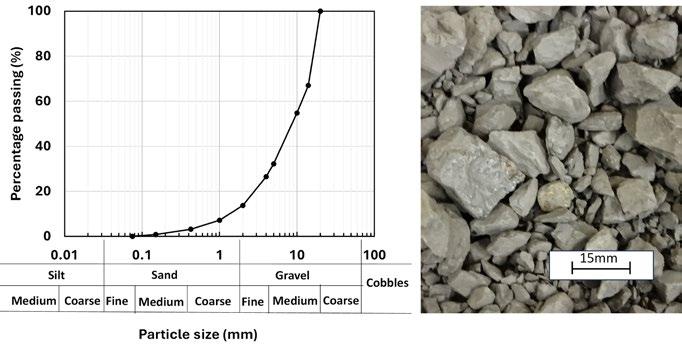
Also, the dimensions were deemed sufficient in line with previous hydraulic studies (Moffat, 2003; Indraratna et al., 2015; Israr, Aziz, 2019) to prevent the potential development of preferential flow paths and boundary effects against the cell wall. Sandy gravel (with particle size ranging from 1 mm to 13.2 mm) was placed in the permeameter's top and bottom sections. The gravel at the top served as a filter, adding approximately 5.7 kPa of surcharge, stabilising the setup, while the gravel at the bottom acted as a filter, facilitating the uniform introduction of water into the discard.
The discard was prepared at three void ratios of 0.5, 0.6, and 0.8, respectively, to represent packing conditions near the minimum, intermediate, and maximum void ratios of the coal discard in the field. The samples were uniformly compacted into the middle section of the permeameter column in five layers of 48 mm, resulting in a total sample height of 240 mm. Pore pressure sensors (T1, T2, and T3, see Figure 2b) were placed at the top, middle, and bottom of the sample to measure pore pressures. Measurements from these sensors indicated minimal variation along the column, confirming uniform flow and validating the applied hydraulic gradients. A non-woven needle-punched geotextile was placed between the bottom gravel filter and the coal discard to prevent the ingress of fine particles into the gravel filter. A wire mesh with a 0.52 mm opening size was placed between the discard and the top gravel to allow for the passage of fines during seepage flow in instances of internal instability.
Water was introduced from a reservoir in which a constant head was maintained, providing upward flow through the permeameter, as shown in Figure 2a. The outflow water was collected in a measuring cylinder, and filter paper was used to collect any washedout fines. The filter paper was replaced at 5-minute intervals until no further particle loss was observed to study temporal trends. Following Kenney and Lau (1985), the permeameter was lightly tapped at the sides during testing using a rubber mallet to introduce vibration to aid the mobilisation of fines. This was done in an effort to ensure conservative results, i.e., without vibration, internal erosion was less likely.
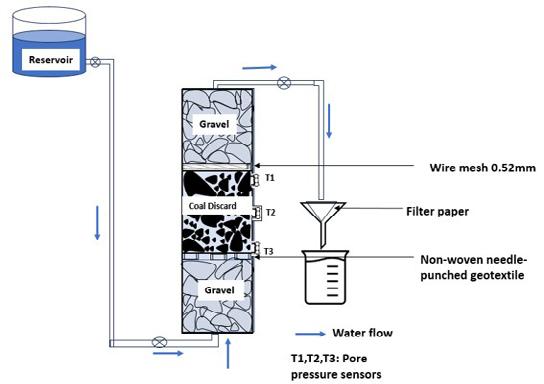
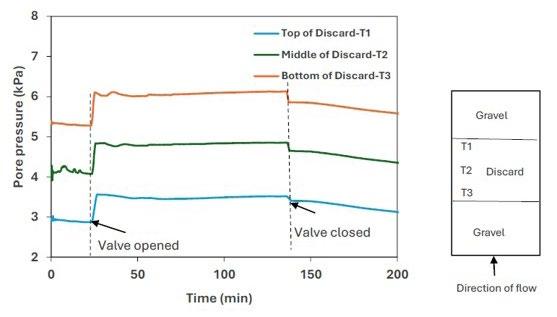
Figure 1—Particle size distribution curve of the coal discard
Figure 2—Experimental set-up: (a) Permeameter set up (b) Pore pressure readings
Internal Stability of Coal Discard in Coal Co-Disposal Facilities
Results and Discussion
A total of 16 seepage tests were conducted, each lasting 100 minutes from initiating steady state flow (i.e., opening of the valve, Figure 2b). These tests studied the effects of varying hydraulic gradients across different void ratios. To maintain consistency in the void ratio tested across hydraulic gradients, a new sample was prepared for each test. Table 2 summarises the tests performed at each void ratio.
Particle migration occurred within the first 20 minutes of each test, except for the test under a hydraulic gradient of 1.24, where particle loss was still observed after 50 minutes.
The cumulative particle loss observed for testing at e = 0.5 is illustrated in Figure 3. Particle loss was only observed at a hydraulic gradient of 1.24, and the particle loss was negligible, amounting to a total loss of only 0.038%. After flow initiation, there was an initial increase in particle loss, followed by stabilisation after the 20-minute mark. This indicates that the sample maintained a stable structure ,which prevented further particle migration.
Figure 4 shows the results of testing conducted on specimens with a void ratio of e = 0.6. No particle migration was observed at lower hydraulic gradients (i = 0.11–0.512). At higher hydraulic gradients of 0.815 and 1.053, some particle loss was detected, indicating the onset of internal instability. At i = 0.815, particle loss occurred gradually before reaching a stable state, whereas at i = 1.053, particle migration was more rapid but stabilised within the first 15 minutes. Importantly, even under these higher hydraulic gradients, the total particle losses remained negligible.
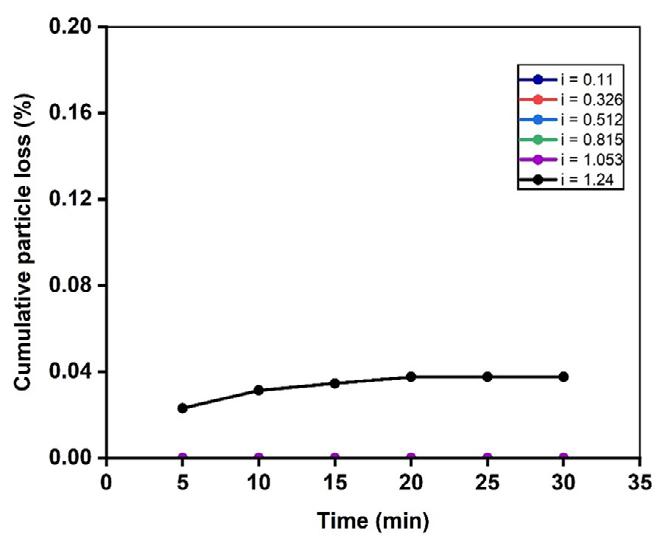
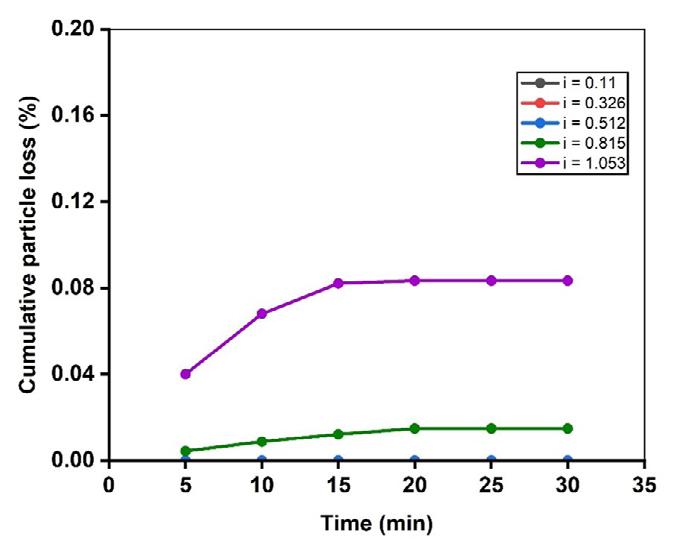
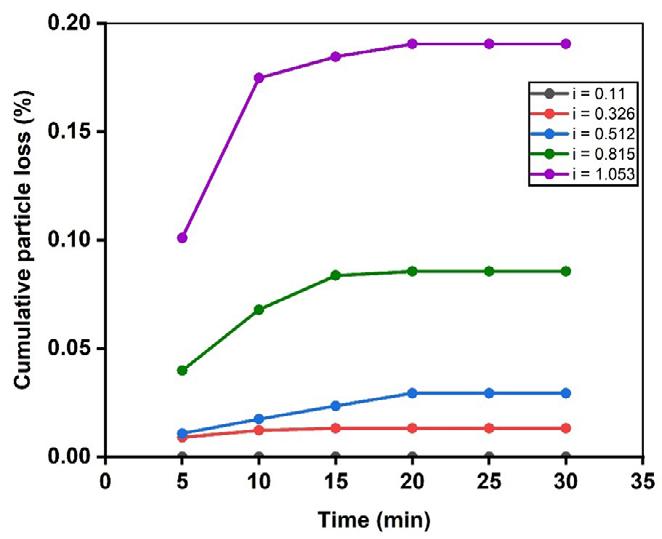
5 shows the results of testing conducted on specimens with a void ratio of e = 0.8. It shows a pattern of particle loss similar to that observed in Figures 3 and 4. At lower hydraulic gradients (i = 0.326 and 0.512), particle migration was minimal and gradual,
Figure
Table 2 Hydraulic test summary
Figure 3—Particle loss at various hydraulic gradients for e = 0.5
Figure 4—Particle loss at various hydraulic gradients for e = 0.6
Figure 5—Particle loss at various hydraulic gradients for e = 0.8
Internal Stability of Coal Discard in Coal Co-Disposal Facilities
stabilising quickly. With increasing gradients, particle movement became more pronounced and occurred at a faster rate before reaching a stable state. For specimens with a void ratio of e = 0.8, some particle loss was detected even at lower gradients, reflecting the looser packing, reduced interparticle friction, and larger pore spaces. However, the total particle losses remained negligible.
The overall trend suggests that the samples tended to stabilise after an initial phase of particle migration. This could be attributed to the removal of loosely bound particles within the sample during the early stages of testing. Once these particles had been lost, the coal discard structure appeared to develop a more stable matrix, preventing further migration of particles. This stabilisation was reflected in the flattening of the curves in each graph (Figures 3, 4, and 5), indicating that no further particle loss occurred beyond the initial migration phase.
Visual comparison of the specimen surface before and after testing (see Figure 6) shows localised exposure of coarse particles and redistribution of fines, suggesting surface-level particle rearrangement during the initial stages of seepage. As testing progressed, the rate of particle migration decreased until stabilisation was achieved. This trend suggests that the early removal of loosely bound fines contributed to the formation of a relatively more stable coarse particle skeleton. Similar trends were reported by Lafleur et al. (1989), who observed that high seepage forces initially wash out finer particles until a stable soil structure is formed.
For the tested conditions, particle migration largely ceased
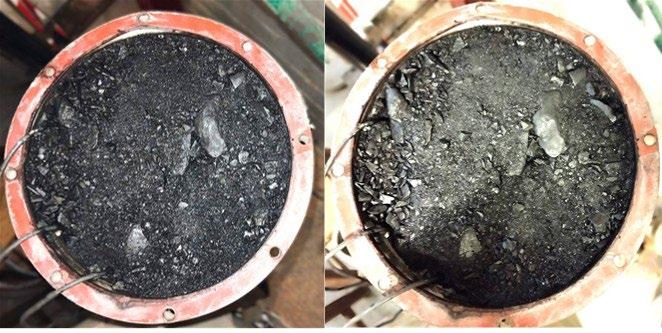
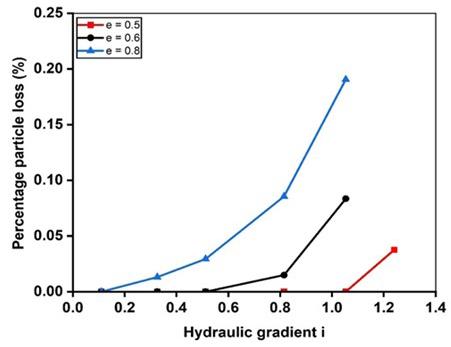
after approximately 20 minutes, indicating that erosion was predominantly confined to the early phase of hydraulic loading. The onset and magnitude of particle loss were governed primarily by the combined influence of hydraulic gradient and void ratio rather than time alone. Higher void ratios exhibited particle migration at lower hydraulic gradients, highlighting the importance of compaction in reducing susceptibility to internal instability (Israr, Aziz, 2019; Indraratna et al., 2015).
Figure 7 demonstrates how an increased hydraulic gradient influences the onset and propagation of particle loss. No particle loss was observed for void ratio e = 0.5 until testing was conducted at a gradient of 1.24. As the void ratio increased, particle migration was observed to initiate at significantly lower hydraulic gradients. For a void ratio of e = 0.6, the migration of particles was observed at hydraulic gradients of 0.815 and 1.053. Also, the migration of particles for a void ratio of 0.8 occurred much earlier at hydraulic gradients of 0.326. The percentage loss also increased as the hydraulic gradient increased for each test. This observation of increased particle loss with hydraulic gradient aligns with the findings of Skempton and Brogan (1994), who stated that internally unstable materials can exhibit instability at very low hydraulic gradients.
Both increased void ratios and higher hydraulic gradients play a crucial role in the internal stability of coal discards. As the void ratio increased, the material became more susceptible to particle migration even at lower hydraulic gradients, reducing its overall stability.
Comparison against empirical predictions
The classical method by Kenney and Lau (1985; 1986) was used to evaluate the coal discard grading curve. Kenney and Lau developed a method for evaluating internal instability based on the H:F ratio, where F is the mass fraction smaller than a given particle size D, and H is the incremental mass fraction measured between particle sizes D and 4D. According to the criterion, F will be less than 20% for what is defined as a widely graded primary fabric and less than 30% for a narrowly graded primary fabric.
Two conditions determine instability:
For loosely packed soils: H⁄F<1.3
For well-compacted soils: H⁄F<1.0
Figure 6—Surface condition of the coal discard specimen (a) before testing and (b) after seepage testing at a hydraulic gradient of e = 0.8 and void ratio i = 1.053
Figure 7—Plot of hydraulic gradient and percentage particle loss
Figure 8—Kenney and Lau H:F analysis
Internal Stability of Coal Discard in Coal Co-Disposal Facilities
The Kenney and Lau method was developed for widely graded sand and gravel. This method has been found to better predict the instability of granular soils for widely graded soils compared to Kezdi and Sherard’s methods (Moffat, 2003; Fannin, Moffat, 2006; Li, Fannin, 2008; Zhou et al., 2017).
A shape curve derived from the particle size distribution was plotted in H:F space (Figure 8) to evaluate its position relative to the Kenney and Lau instability threshold. The curve lies consistently above unity for F < 20%, indicating stability under both loose and well-compacted conditions, as defined by Kenney and Lau (1985; 1986). A minimum H:F value of 1.94 was obtained, exceeding the instability criterion by a substantial margin. The experimental results are consistent with the prediction of the Kenney and Lau criterion for stable behaviour.
However, further testing on materials exhibiting instability would be required to comprehensively validate the criterion for coal discard. The long-term stability of coal discard, including potential particle degradation under prolonged saturation, was not investigated in this study. Previous studies (Eckersly, 1999; Campbell et al., 2016) indicate that coal discard stockpiles containing less than 10% fines (percentage finer than 0.5 mm) are typically free draining. While this suggests favourable drainage characteristics, the relevance to engineered co-disposal containment structures requires further long-term evaluation.
Conclusion and recommendations
The data presented illustrate the combinations of void ratio and hydraulic gradient under which the tested coal discard material remained internally stable. The maximum observed particle loss was 0.2% at a void ratio of 0.8, which is substantially below the 4% benchmark suggested by Chang and Zhang (2013), and Israr and Aziz (2019) for classification of internal instability. The Kenney and Lau analysis of the grading curve also predicted stability for this material, and this prediction was consistent with the experimental observations. However, it should be noted that only a single grading from one coal discard source was evaluated. Therefore, while the empirical assessment aligned with laboratory behaviour for the material tested, broader validation across a wider range of gradations and material types would be required to conclusively establish the general applicability of the Kenney and Lau criterion to coal discard materials.
A set of curves demonstrating percentage particle loss over a range of hydraulic gradients at various void ratios, such as those presented in Figure 7, provides useful experimental data for assessing the internal stability of coal discard materials in potential co-disposal applications. The results indicate that the tested material exhibited stable behaviour within the investigated range of hydraulic gradients and packing conditions. However, these findings are limited to the specific grading and material source evaluated in this study and should not be generalised without further investigation. For practical implementation, material-specific seepage testing is recommended to confirm internal stability under representative field conditions. Field applications should ensure adequate compaction to achieve stable void ratios as well as confirmation that hydraulic gradients remain within the tested range. Higher gradients may lead to excessive particle migration and compromised performance.
Acknowledgements
I gratefully acknowledge and thank my supervisor, Prof. S.W. Jacobsz, for his guidance, and the University of Pretoria
Geotechnical Department for their technical assistance.
CRediT author statement
F.O. Abimaje and S.W. Jacobsz: Conceptualisation and methodology. F.O. Abimaje: Investigation, data curation, writing –original draft preparation and visualisation.
Prof. S.W. Jacobsz: Supervision, writing – reviewing and editing.
University of Pretoria Geotechnical Department: Resources and technical support.
References
Andrianatrehina, L., Souli, H., Rech, J., Taibi, S., Fry, J.J., Ding, L., Fleureau, J. M. 2016. Analysis of the internal stability of coarse granular materials according to various criteria. European Journal of Environmental and Civil Engineering, vol. 20, pp. 936–953.
ASTM International. 1993. Standard test methods for maximum index density and unit weight of soils using a vibratory table. ASTM D4253-93. West Conshohocken, PA: ASTM International, pp. 1–15.
ASTM International. 1991. Standard test method for minimum index density and unit weight of soils and calculation of relative density. ASTM D4254-91. West Conshohocken, PA: ASTM International.
Balat, M. 2006. Electricity from worldwide energy sources. Energy Sources, Part B: Economics, Planning, and Policy, vol. 1, no.4, pp. 395–412.
Campbell, Q., Le Roux, M., Espag, C. 2016. Coal product moisture control using stockpiles. in Litvinenko, V. (ed.) XVIII International Coal Preparation Congress: 28 June–01 July 2016. Saint-Petersburg, Russia. Springer, pp. 747–752.
Chang, D. S., Zhang, L. M. 2013. Extended internal stability criteria for soils under seepage. Soils and Foundations, vol. 53, no.4, pp. 569–583.
Department of Minerals and Energy. 2001. National inventory discard and duff coal: 2001 summary report. Pretoria: Department of Minerals and Energy. Available at: https://www. dmre.gov.za/energy-resources/energy-sources/coal/discards.
Eckersly, J. 1999. Moisture Changes & Stability Problems in Coal Stockpiles, Australian Coal Association Research Program, Project C4057.
Eskom. 2021. About electricity, facts and figures. CO 0007 Revision 16 (August 2021) Available: www.eskom.co.za
Fannin, R., Moffat, R. 2006. Observations on internal stability of cohesionless soils. Geotechnique, vol. 56, no.8, pp. 497–500. 306.
Fred, B. Martin G, C., Hilary D.S. 2012. Chapter 34 Non-engineered fills. In ICE manual of geotechnical engineering. London: Thomas Telford Ltd.
Gowan, M. Lee, M., Williams, D. 2010. Co-disposal techniques that may mitigate risks associated with storage and management of potentially acid generating wastes. In Mine Waste. 2010. Proceedings of the First International Seminar on the Reduction of Risk in the Management of Tailings and Mine Waste. Perth, Australia: Australian Centre for Geomechanics, pp. 389–404.
Honjo, Y. Haque, M., Tsai, K. 1996. Self-filtration behaviour of
Internal Stability of Coal Discard in Coal Co-Disposal Facilities
broadly and gap-graded cohesionless soils. Geofilters’ 96, vol. 96, pp. 227–236.
Indraratna, B. Israr, J., Rujikiatkamjorn, C. 2015. Geometrical method for evaluating the internal instability of granular filters based on constriction size distribution. Journal of Geotechnical and Geoenvironmental Engineering, vol. 141, no.4, p. 04015045. doi: 10.1061/(ASCE) GT.1943-5606.0001306
Israr, J., Aziz, M. 2019. Integrating the role of relative density on assessing internal stability of granular filters using existing geometrical methods. Arabian Journal of Geosciences, vol. 12, no. 17, p. 646. https://doi.org/10.1007/s12517-019-4850-x
Ke, L., Takahashi, A. 2012. Strength reduction of cohesionless soil due to internal erosion induced by one-dimensional upward seepage flow. Soils and Foundations, vol. 52, no. 2, pp. 698–711.
Kenney, T., Lau, D. 1985. Internal stability of granular filters. Canadian Geotechnical Journal, vol. 22, no.2, pp. 215–225.
Kenney, T., Lau, D. 1986. Internal stability of granular filters: Reply. Canadian Geotechnical Journal, vol. 23, no. 3, pp. 420–423.
Kezdi, A. 1979. Soil Physics - Selected Topics, Amsterdam, Elsevier Scientific Publishing Co
Lafleur, J. Mlynarek, J., Rollin, A. L. 1989. Filtration of broadly graded cohesionless soils. Journal of Geotechnical Engineering, vol. 115, no. 2, pp. 1747–1768.
Li, M. 2008. Seepage-induced failure of widely-graded cohesionless soils. University of British Columbia.
Li, M., Fannin, R. J. 2008. Comparison of two criteria for internal stability of granular soil. Canadian Geotechnical Journal, vol, 45, no. 9, pp. 1303–1309.
Liu, J. 2005. Seepage control of earth-rock dams theoretical basis, Engineering experiences and lessons. Beijing, China: China Water & Power Press
Mao, C. 2005. Study on piping and filters: Part I of piping. Rock and
Soil Mechanics, vol. 26, no. 2, pp. 209–215.
Martin, T. Davies, M. Rice, S. Higgs, T., Lighthall, P. 2002. Tailings facilities. London: International Institute for Environment and Development (IIED) Available at: https://pubs.iied.org
Moffat, R. 2003. Experiments on the internal stability of widely graded cohesionless soils. PhD thesis. University of British Columbia. Available at: https://open.library.ubc.ca/soa/cIRcle/ collections/ubctheses/831/items/1.0063322
Moffat, R. Fannin, R. J., Garner, S. J. 2011. Spatial and temporal progression of internal erosion in cohesionless soil. Canadian Geotechnical Journal, vol. 48, no. 3, pp. 399–412.
Sherard, J. 1979. Sinkholes in dams of coarse, broadly graded soils. In Proceedings of the 13th ICOLD Congress. New Delhi, India, pp. 25–35.
Skempton, A., Brogan, J. 1994. Experiments on piping in sandy gravels. Geotechnique, vol. 44, no.3, pp. 449–460.
Vincens, E. Witt, K. J., Homberg, U. 2015. Approaches to determine the constriction size distribution for understanding filtration phenomena in granular materials. Acta Geotechnica, vol. 10, no.3, pp. 291–303. https://doi.org/10.1007/s11440-014-0308-1
Wan, C. F., Fell, R. 2008. Assessing the potential of internal instability and suffusion in embankment dams and their foundations. Journal of Geotechnical and Geoenvironmental Engineering, vol. 134, no. 3, pp. 401–407.
Zhang, W. Zhang, C. Lei, X. Quintero Olaya, S. Zhu, Y. Zhao, Z. Jensen, S., Williams, D.J. 2024. Instrumented column testing on long-term consolidation and desiccation behaviour of coal tailings under natural weather conditions. Acta Geotechnica, vol. 19, pp. 1891–1909.
Zhou, Z.-Q. Ranjith, P. G., Li, S.-C. 2017. Criteria for assessment of internal stability of granular soil. Proceedings of the Institution of Civil Engineers-Geotechnical Engineering, vol. 170, no. 2, pp. 73–83. u



XIX 2026 for Mine Surveying Congress
VENUE: CENTURY CITY, CAPE TOWN
22-24 SEPTEMBER 2026 – CONFERENCE
25 SEPTEMBER 2026 – TECHNICAL VISITS
Hosted by Institute of Mine Surveyors of Southern Africa and the International Society of Mine Surveying.

ABOUT THE CONGRESS
The International Society of Mine Surveyors (ISM) holds its congress every three years, uniting global mine surveying professionals. South Africa will host the XIX ISM Congress in 2026 in Cape Town, focusing on all aspects of mine surveying.
ABOUT THE CONGRESS
What is Mine Surveying?
A specialised field within mining science, mine surveying involves measurements, calculations, and mapping throughout the mining lifecycle, including:
The International Society of Mine Surveyors (ISM) holds its congress every three years, uniting global mine surveying professionals. South Africa will host the XIX ISM Congress in 2026 in Cape Town, focusing on all aspects of mine surveying.
• Planning and controlling mine operations for safety and efficiency.
What is Mine Surveying?
• Evaluating mineral reserves and economic viability.
• Managing mineral rights and mining cartography.
A specialised field within mining science, mine surveying involves measurements, calculations, and mapping throughout the mining lifecycle, including:
• Assessing mining impacts on land and geology.
• Planning and controlling mine operations for safety and efficiency.
• Supporting environmental and rehabilitation efforts.
• Evaluating mineral reserves and economic viability.
• Managing mineral rights and mining cartography.
• Assessing mining impacts on land and geology.
CONGRESS OBJECTIVES AND FOCUS AREAS
• Supporting environmental and rehabilitation efforts.
The 2026 Congress will showcase ISM’s six commissions and feature key topics such as:
• Mineral & Geology Studies – Understanding deposit structure and characteristics.
• Resource Assessment & Economics – Evaluating reserves and feasibility.
CONGRESS OBJECTIVES AND FOCUS AREAS
• Mineral Property Management – Handling acquisitions, sales, and leases.
The 2026 Congress will showcase ISM’s six commissions and feature key topics such as:
• Mineral & Geology Studies – Understanding deposit structure and characteristics.
• Mine Operations – Optimising planning and control.
• Rock & Ground Movements – Studying subsidence and mitigation.
• Resource Assessment & Economics – Evaluating reserves and feasibility.
• Mineral Property Management – Handling acquisitions, sales, and leases.
• Environmental Rehabilitation – Ensuring responsible land restoration.
This global event will foster collaboration, innovation, and knowledge sharing, advancing the mine surveying profession.
• Mine Operations – Optimising planning and control.
• Rock & Ground Movements – Studying subsidence and mitigation.
• Environmental Rehabilitation – Ensuring responsible land restoration.
This global event will foster collaboration, innovation, and knowledge sharing, advancing the mine surveying profession.
ECSA Validated CPD Activity, Credits = 0.1 points per hour attended.SAGC Validated Activity.
FOR FURTHER INFORMATION, CONTACT:
Gugu Charlie, Conference coordinator
E-mail: gugu@saimm.co.za
ECSA Validated CPD Activity, Credits = 0.1 points per hour attended.SAGC Validated Activity.
Tel: +27 11 538 0238, Web: www.saimm.co.za
Gugu Charlie, Conference coordinator
Affiliation:
1 Harmony Central Services South, Harmony Gold Mining Co. LTD, Welkom, South Africa.
2 SRK Consulting South Africa Pty Ltd., South Africa.
3 School of Mining Engineering, University of the Witwatersrand, Johannesburg, South Africa.
Challenges of extreme grades in resource estimation: Spatial capping as an alternative to domain capping of outliers
by D. Fourie¹, P. le Roux², R. Minnitt³
Correspondence to: R. Minnitt
Email: Richard.Minnitt@wits.ac.za
Dates:
Received: 20 May 2025
Revised: 12 May. 2026
Accepted: 05 Jun. 2026
Published: June. 2026
How to cite:
Fourie, D., le Roux, P., Minnitt, R. 2026. Challenges of extreme grades in resource estimation: Spatial capping as an alternative to domain capping of outliers. Journal of the Southern African Institute of Mining and Metallurgy, vol. 126, no. 6, pp. 373 - 384
DOI ID:
https://doi.org/10.17159/2411-9717/3733/2026
ORCiD:
D. Fourie
http://orcid.org/0000-0001-9403-1008
P. le Roux
http://orcid.org/0000-0003-1143-8625
R. Minnitt
http://orcid.org/0000-0002-0267-8152
Abstract
This study proposes that the moving search neighbourhood used in ordinary kriging selects a subset of data surrounding each estimation block, and that this subset represents a local subpopulation of which the distributional parameters can be used to determine local, spatiallyadaptive outlier capping values. This paper introduces a distance-weighted capping method applied within the kriging search ellipse after kriging weight calculation, transitioning from one-dimensional point estimation to two-dimensional block estimation for Witwatersrandtype gold deposits. Accurate ore grade estimation is essential for mine planning and economic evaluation, particularly in deep-level gold mines where extreme grade values (outliers) may distort resource assessments. Traditional capping methods, which apply a uniform threshold to outliers, often fail to account for spatial and geological variability, leading to biased estimates. A high-resolution simulation generates a synthetic ‘ground truth’ orebody, subsampled to mimic real-world data scarcity. A two-parameter lognormal distribution models grade variability, with capping values optimised by minimising the mean squared error between estimated and simulated block grades. Comparative analyses against traditional capping techniques demonstrate that the dynamic method improves regression fit, reduces conditional bias, and aligns more closely with production reconciliation data. Validation using swath plots, QQplots, and mine call factor comparisons confirms that the spatially adaptive capping technique mitigates over- and under-estimation, particularly in high-grade zones. Results indicate superior performance over conventional domain capping, with higher R² values and better alignment with actual production metrics. This approach offers a reproducible, scientifically rigorous framework for resource estimation, reducing reliance on rigid sub-domaining while enhancing decision-making in complex ore bodies. The study underscores the importance of integrating geological information with advanced geostatistics to optimise grade estimation and mine planning.
Keywords
Conditional bias, grade capping, outlier mitigation, geostatistics, resource estimation, kriging, Witwatersrand
Introduction
Accurately assessing ore grades is critical for mine planning and the economic evaluation of mineral deposits, particularly in deep-level gold mines in South Africa, where extreme grade values (outliers) can significantly distort resource estimates. Outliers in grade distributions can lead to overvaluation of lowgrade regions and undervaluation of high-grade zones, negatively impacting the mine call factor (MCF), planning, and decision-making. While capping outliers is a common practice to limit their influence on overall grade estimates, traditional approaches—such as applying a single threshold to values above a fixed percentile—often fail to account for spatial variations and geological context, treating all outliers uniformly regardless of their location within the orebody. This study proposes capping the sample values within the search ellipse after calculating kriging weights as opposed to capping the input sample data used in estimation. Building on the work of Fourie, Morgan, and Minnitt (2019), the research refines capping methods by introducing a distance-weighted regime that considers both the grade and spatial relationship of outliers to estimation points. By balancing the treatment of outliers with geological understanding, this localised, and spatially sensitive approach aims to prevent the overestimation or smearing of extreme grades, ensuring more accurate and reliable resource models. The study highlights how integrating geological insights with advanced capping techniques can mitigate potential biases in grade estimation, enhance resource modelling, and support more informed mine planning and decisionmaking.
Challenges of extreme grades in resource estimation:
Objectives and significance
This study extends the mitigation of grade outliers from a onedimensional point estimation, as developed by Fourie, Morgan, and Minnitt (2019), to a two-dimensional block estimation approach, addressing challenges in Witwatersrand-type deposits in South Africa. Block models are central to resource estimation in these deposits, where extreme grades can distort assessments, leading to inaccurate resource evaluations and flawed mine planning. This targeted approach incorporates distance-based weighting, which reduces the influence of extreme grades depending on their proximity to the point being estimated. By preserving geological context and spatial continuity, this method enhances the accuracy of resource assessments, particularly in heterogeneous ore bodies where grade variability is significant.
In addition to refining the capping process, the study builds on geostatistical best practices, including ordinary kriging, while ensuring compliance with the mineral resource reporting codes emphasising reproducibility and scientific rigor. The incorporation of sub-domaining allows for more nuanced handling of outliers, mitigating risks of over- or under-estimating resources, especially in high-grade zones, where the financial and operational implications are most critical. This localised approach aligns estimation practices with the deposit's geology, offering defendable and adaptable models that reduce the risk of overvaluing extreme grades. Practical implications include improved mine planning, financial forecasting, and risk management, particularly for complex ore bodies like those in South Africa's Witwatersrand Basin. By advancing outlier handling and enhancing the reliability of block models, this research addresses a critical gap in resource estimation, providing a scientifically grounded framework for optimising decision-making and resource management.
Literature review
The following is an overview of the development of robust statistical methods aimed at mitigating the influence of outliers on data analysis, with particular emphasis on geostatistical resource estimation. Outliers, observations inconsistent with the majority of data, can significantly distort variography, kriging weights, and block grade estimates. The review traces the evolution of outlier treatments from foundational robust statistics through to modern geostatistical and machine-learning-assisted approaches, culminating in the positioning of the present study.
The foundational robust statistics regarding outlier-resistant estimation approach was first formalised by Frank Hampel. He introduced the breakdown point, which measures the smallest proportion of outliers that can force an estimator to take arbitrarily large (or infinite) values. Hampel's work established the theoretical ceiling for any robust estimator. These ideas were extended by Peter Huber into regression analysis with M-estimators, which minimise a function of residuals, applying quadratic weighting to small residuals (like least squares) but down-weighting large residuals. Huber also introduced influence functions, quantifying how a single data point can affect an estimator. These contributions underpin later geostatistical robustification, including robust variography.
In the 1980s, robust statistics expanded to include multivariate data and high-breakdown methods. Beckman and Cook (1983) extended Huber's concepts using Mahalanobis distance and influence diagnostics. Rousseeuw and Croux (1993) proposed the median absolute deviation (MAD) and the more efficient Sn and Qn scale estimators. These tools remain foundational for outlier detection in geochemical and assay datasets.
Outliers in geostatistical resource estimation
Barnett and Lewis (1994) emphasised that outliers in mining datasets—particularly gold—can inflate resource estimates by orders of magnitude if not handled appropriately. Traditional methods such as lognormal kriging, disjunctive kriging, and indicator kriging were developed partly to reduce outlier influence, each with limitations.
Indicator kriging (Journel, 1983) transforms continuous grades into binary indicators at multiple thresholds, thereby limiting the influence of extreme values. However, it requires careful threshold selection and can lose information on within-class grade magnitude.
Multigaussian kriging (Verly, 1984) applies a normal score transform to the data, estimates at the Gaussian scale, and back-transforms. While effective for many deposits, it assumes a multivariate Gaussian distribution after transformation—a condition often violated in the presence of extreme outliers.
Top-cut models (Rivoirard et al., 2013) explicitly model the tail of the grade distribution as a separate population (often Pareto or lognormal) above a cutoff. This method preserves total metal while reducing the influence of individual extreme samples. The present study's localised capping shares conceptual similarities but applies capping at the estimation (block) level rather than globally.
Robust variography and kriging
Cressie and Hawkins (1980) developed robust variogram estimators resistant to outliers. Hawkins and Cressie (1984) proposed robust kriging, which uses a weighted combination of robustly estimated sample values. However, robust kriging can be computationally intensive and sensitive to initial parameter choices.
Krige and Magri (1982) demonstrated that logarithmic transformation followed by careful outlier elimination could improve variogram modelling in gold deposits. Journel and Arik (1988) provided early case studies on outlier management in precious metals.
Restricted kriging and post-processing approaches
Pan and Arik (1993) introduced restricted kriging, which imposes constraints on kriging weights to limit the propagation of extreme grades. This method directly influences the estimation equations, unlike the present study's post-weight capping approach, which leaves the kriging system unchanged.
Fourie, Morgan, and Minnitt (2019) proposed a post-processing method that nonlinearly transforms positively skewed data into Gaussian categorical bins, calculating restriction factors that limit the influence of extreme data points in the kriging process. Their 2021 follow-up introduced spatial sub-domaining to apply capping limits specific to an outlier's range of influence rather than a uniform value. The present study extends this work from onedimensional point estimation to two-dimensional block estimation, incorporating distance-weighting within the search ellipse.
Simulation-based calibration of capping
Chiquini and Deutsch (2017) suggested using simulation to calibrate capping levels, estimating the expected metal content in volumes affected by outliers. The present study adopts a similar philosophy but applies it at the block level, using a high-resolution synthetic "ground truth" to optimise capping via mean squared error (MSE) minimisation.
Challenges of extreme grades in resource estimation:
Modern and machine-learning-assisted approaches (2022 – 2025)
Recent literature has seen the integration of machine learning (ML) with geostatistical outlier handling (Anvari et al., 2025; Fouedjio, Arya, 2024; Leung et al., 2021). These recent works confirm that the field is moving toward local, adaptive, and spatially aware outlier treatments—exactly the direction taken by the present study. However, none of the above combine (a) post-kriging-weight capping, (b) block-level optimisation via MSE against synthetic truth, and (c) full reconciliation with production data (mine call factor). This gap defines the contribution of this paper.
Industry compliance and reporting codes
Mineral resource reporting codes (JORC, SAMREC, NI 43101) require that estimation methods be reproducible, defensible, and appropriately handle high-grade outliers. The SAMREC Code (2016) supports this requirement directly: its guidance to Clauses 24 and 35 specifies that any adjustment made to the data for the purpose of a Mineral Resource or Mineral Reserve estimate—including the cutting or capping of grades—must be clearly described in the Public Report. This obligation to disclose and justify capping decisions sits alongside the Code’s overarching principles of Transparency and Competency (Clause 4), which require that a Competent Person provide sufficient information for a reader to understand, and not be misled by, the methods used to derive an estimate.
The present study's localised, distance-weighted capping method explicitly meets these requirements: it provides a reproducible, data-driven optimisation (MSE minimisation), documents the capping basis per block, and preserves geological context through the kriging search ellipse.
In conclusion, the evolution from Hampel's breakdown point to modern ML-assisted spatial capping shows a clear trajectory: outlier treatment must become local, adaptive, and geologically informed. The present study advances this trajectory by integrating distanceweighted capping into the ordinary kriging workflow, with rigorous validation against both synthetic truth and production data. It offers a reproducible, code-compliant alternative to domain capping, particularly suited to high-variance gold deposits such as those of the Witwatersrand Basin.
Research problem and methodology
This article presents a method for resource estimation that refines existing capping techniques by incorporating the identification and mitigation of extreme values within estimated blocks. Highgrade outliers may result in the smearing of high grades within the estimates, leading to overestimation of resources in areas surrounding and informed by, high-grade outliers. This approach minimises their impact, improving estimation accuracy, block classification, and decision-making in resource planning and extraction. The methodology is reproducible, defensible, and aligned with industry standards.
The experiment involves generating a 'ground truth' orebody through a high-resolution simulation of the original sampling data within a defined domain. This simulated orebody is then subsampled, and the estimates derived from these subsamples, using the methodology outlined here, are compared to the ground truth. The workflow starts by addressing high-grade outliers in selected blocks (each block corresponding to a subsample set) through capping. Experimental analysis identifies the optimal capping value based on the grade distribution. While there are various ways to
define distribution shapes, this method uses the two-parameter lognormal distribution for grade modelling (after confirming that the three-parameter threshold is negligible), incorporating Rendu's formula (1979; 1981) to estimate distribution shape parameters from quantiles. Comparisons with historical techniques and mine production data confirm the validity of this approach, providing a systematic and scientifically grounded solution to extreme grade challenges in resource estimation. Additionally, the methodology includes a comparative study of contemporary capping techniques to ensure best practices are followed and to benchmark effectiveness.
The proposed method determines the optimal local capping value by minimising the mean squared error (MSE) in simulated block distributions. The capping quantile is determined by minimising the MSE of the subsample estimates for the simulated orebody. Block values calculated using ordinary kriging with traditional domain-capped data are compared with those derived by local dynamic capping which refines the estimates and reduces the conditional bias. This approach is validated using the mean squared error, swath plots, and mine production reconciliation.
Key steps in the workflow include capping high-grade outliers per block within the search ellipse to reduce their distorting effect, recalculating block values with the capped grades to improve accuracy and evaluating the impact of localised capping on block estimates. An optimal capping value is identified through experimental analysis to reflect the actual grade distribution within the simulated resource. We are then in a position to compare the entire simulated orebody to the estimate derived from the subsampled data set. The ultimate objective is to develop a reproducible approach for localising capping values, improving block classification, and reducing bias in resource estimation workflows. This refined model enhances accuracy and precision of resource models. It aligns with industry standards, providing valuable insights into outlier management in resource estimation and a comprehensive framework for enhancing resource estimation workflows.
Determination of population parameters
The first step in determining the local capping value is to establish the population parameters of the initial dataset distribution. While a three-parameter lognormal distribution is often used for grade data with a lower threshold (Rendu, 1981), analysis of our dataset showed the threshold parameter β (Equation 1) to be effectively zero for the grade ranges of interest (i.e., the distribution is wellapproximated by a standard two-parameter lognormal). Rendu's formula for β is:
where:
➤ m = 50th percentile
➤ qh = nth percentile (e.g., 95th)
➤ ql = (100 - n)th percentile (e.g., 5th)
For our data, β consistently calculated to values < 0.01 cm.g/t across all quantile pairs tested, confirming that the two-parameter model is appropriate. We therefore use the computationally simpler two-parameter lognormal model throughout, with the understanding that β = 0 in all subsequent equations. For deposits requiring a three-parameter model, replace Z with (Z - β) in Equations 2 to 4 and modify Equation 5 to Zh = β+exp(ω+ϕ-1(h)τ)
The shape of the distribution is not a primary factor as one could use the same capping methodology even if the distribution is not lognormal.
Challenges of extreme grades in resource estimation:
Calculation of block parameters
Block parameters are derived using the log mean calculated from the log estimate of samples within the search ellipse (Equation 2), while the log variance (Equation 3) and standard deviation is determined using the population coefficient of variation (CV) and the block mean (Equation 4). These calculations ensure the block parameters reflect the adjusted population distribution, enhancing accuracy in the estimation process.
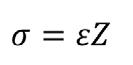
Where
➤ ω = log mean
➤ τ = log standard deviation
➤ ε = coefficient of variation
➤ Z = block mean
➤ σ = standard deviation
A note on the estimation of local block parameters: The block mean Z used in Equation 4 is calculated as the simple arithmetic mean of sample values within the search ellipse. This does not account for spatial clustering of samples (e.g., multiple closelyspaced samples from a high-grade shoot). Sensitivity testing showed that using kriging-weighted means changed capping values by less than 5% for > 90% of blocks. For irregularly sampled datasets, declustering weights (Deutsch, Journel, 1998) should be used.
Calculation of quantile values
The quantile value is calculated using the block parameters to calculate the value at a given quantile Z_(h)_ using Equation 5:
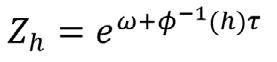
Where
➤ ϕ = normal cumulative distribution function
➤ ω = log mean
➤ τ = log standard deviation
➤ h = quantile fraction
➤ e= Euler’s number (base of natural logarithm,≈2.71828)
Determining capping value from experimental data
Consider a block estimate with thirty-five samples and calculated kriging weights within the search ellipse, as shown in Table 1.
A population coefficient of variation of 1.6 has been calculated for all the samples in the entire domain. The uncapped estimate for the block is the sum-product of the sample values and kriging weights, in this case, 189. From the block sample data, the arithmetic mean is calculated as 498. Using the population coefficient of variation, a standard deviation is calculated as σ = CV × x, which calculates as 1.6 × 498 = 797 (rounded).
For a block with a mean of 498 and standard deviation of 797, the log variance (Equation 3) is:
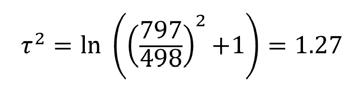
and the log mean (Equation 2) is:

In this case, the 95th percentile is chosen simply as an example capping value for this block (Equation 5):
Consequently, all the sample values in Table 1 larger than 1687 (2500 and 2192) are replaced with 1687, and the new block estimate becomes 177.
Simulation of high-resolution block distributions
The first step was to select a domain with appropriate face sampling values (the initial selected dataset), typically carried out at 5 m intervals on mining faces which have 5 m – 10 m sampling coverage. These data were then used to simulate exactly the same sample distribution, but at a much higher 1 m × 1 m resolution, and for the purposes of this research, the simulated distribution is considered to be the actual truth. A comparison of the cumulative distribution frequency for both the input data and the simulated data are shown in Figure 1, indicating a high degree of correspondence between the two sets of data.
The subsampling methodology involves creating a highresolution, non-conditional simulation using population parameters to generate a synthetic representation of the distribution, which is then treated as the ‘truth’. The block means from this simulation are used as actual values. The simulated data is then subsampled to create an estimation dataset that reflects the sparse data typically collected during mining. The full simulation represents the actual truth, while the subsampled data mimics the limited information available for block modelling. The subsampling process, developed using an initial 1 m 2D-grid simulation, involves the following steps to create a dataset that simulates realistic mining data density:
➤ Stoping data: The full simulation is randomly subsampled to a 2D-grid spacing of 5 m to form the stoping data to be further subsampled.
➤ Unmined voids: Random samples are selected within a 100 m 2D-grid, and all samples within the stoping data closer than 50 m to these coordinates were removed to form the unmined voids.
➤ Exploration drilling data: Random samples were selected within a 40 m 2D-grid, and these samples were retained only where they are within the unmined voids, to form the exploration drilling dataset.
➤ Estimation data: The exploration drilling and stoping datasets are combined to form the final estimation dataset.
Figure 2—A background 10 m × 10 m grid generated from a high density one-metre simulation grid, with irregularly shaped patches of high-density stope sampling that mimics the actual distribution of underground stoping patterns. Individual dots represent model borehole positions
Block values are then estimated from the set of subsamples, and the suggested process for capping outliers is iterated for each block. By comparing the performance of the estimate derived from the low-density dataset against the simulated truth, the accuracy of block estimates can be assessed. This approach bypasses reliance on theoretical variance from the variogram, instead directly measuring the difference between the block estimates and the simulated truth.
Key innovations include the use of high-resolution simulations to evaluate and refine capping techniques and the integration of the
Challenges of extreme grades in resource estimation:
Table 1 Sample values and kriging weights within the search ellipse (Sample values in cm.g/t)
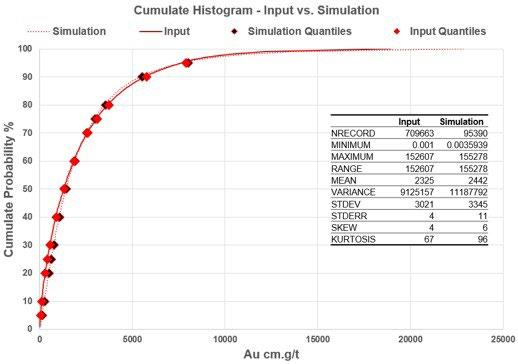
two-parameter lognormal distribution for grade modelling (with confirmation that the three-parameter threshold is negligible). Block-level adjustments improve classification accuracy and reduce bias while addressing challenges posed by extreme grades. The comparative analysis with industry-standard techniques ensures effectiveness and best practices, culminating in a scientifically grounded, systematic approach to resource estimation.
Optimisation of capping value
The capping value is obtained by defining the theoretical quantile value corresponding to the modelled block parameters. It is optimised by iteratively calculating the mean square error (MSE, Equation 6), the latter being the mean of the squared difference between the estimated and simulated block values for all simulated blocks. [6]
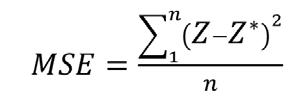
The MSE quantifies the effect of different capping values on
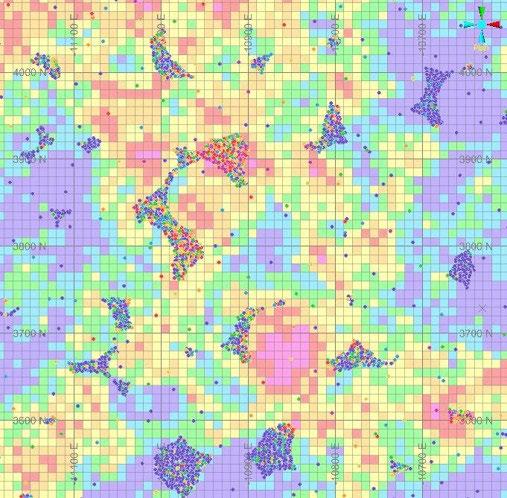
the block estimates, and minimising the MSE of all blocks allows the optimal capping value that best reduces estimation error in the block values to be identified.
The process is to determine the capping value and calculate the block mean of the simulation. The block values for which the outliers have been adjusted are then estimated and the mean squared error is calculated for all blocks. Calculation of the capping value is iterated until the lowest MSE is achieved. By comparing the MSE of all blocks estimated with adjusted capping values with those of the actual values, the stepwise improvement in the MSE can be visualised
Table 2 represents the MSE for capping quantiles comparing the
Figure 1—A cumulative distribution frequency for the original input data and the high-resolution simulated data
Figure 2—A background 10 m × 10 m grid generated from a high density one-metre
Challenges of extreme grades in resource estimation:
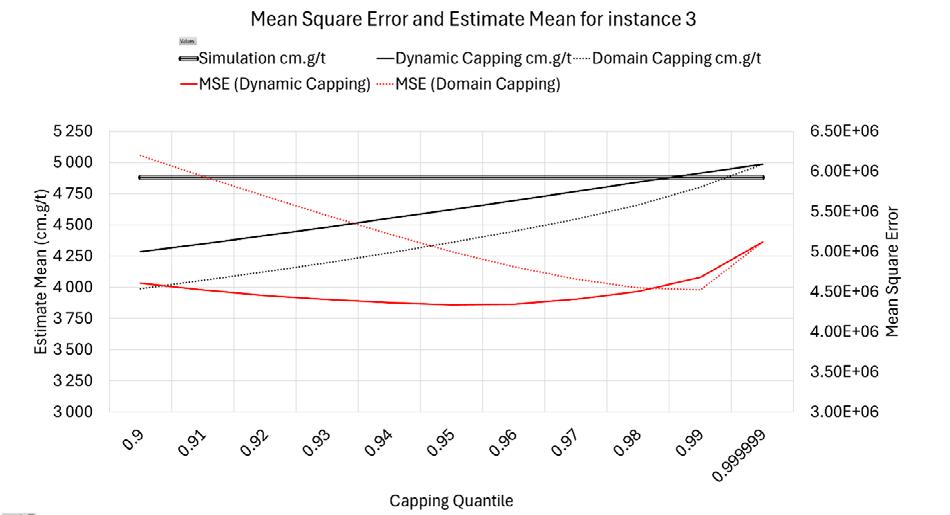
Figure 3—Response of MSE to iterative optimisation[A2.1] of the capping quantile. The full search range (0.90 – 0.99) is shown for completeness. For traditional (global) capping, the MSE minimum falls near the 0.95 quantile, whereas the operating quantile selected for the dynamic method is 0.985 (98.5th percentile), where MSE is minimised under dynamic capping (Figures 4 – 5; Table 2). Figure 5 shows the region of practical interest (0.95 – 0.99), where the dynamic method achieves progressively lower MSE than traditional capping
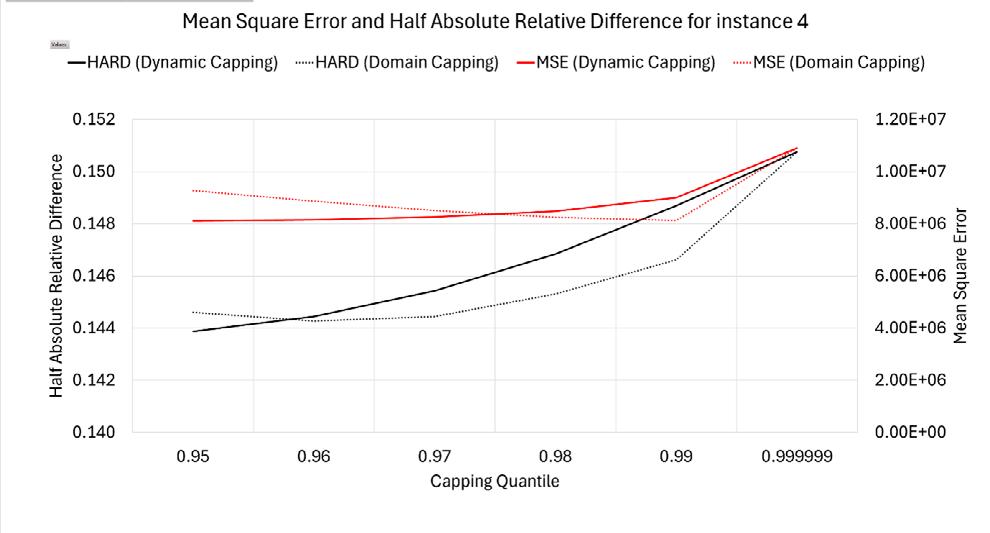
Figure 4—Half absolute relative difference (HARD) and mean squared error (MSE) versus capping quantile. While the full search range (0.95 – 0.99) is presented to show the complete response surface, realistic capping levels for industry application are 0.97 – 0.99. [A5.1]Within this region, dynamic capping consistently outperforms traditional domain capping, with the improvement concentrated at the optimal quantile (0.985) as can be seen in sections D, E, and F.
Table 2
Performance at realistic operating quantiles
Note: Traditional capping at the domain level uses the same quantile threshold for comparison.
traditional (global capping) and search ellipse (dynamic) capping; this is for grade estimated SMUs.
Validation of the dynamic capping method
Once an optimal capping quantile has been identified (via MSE minimisation, as described in the Methodology section), the
Challenges of extreme grades in resource estimation:
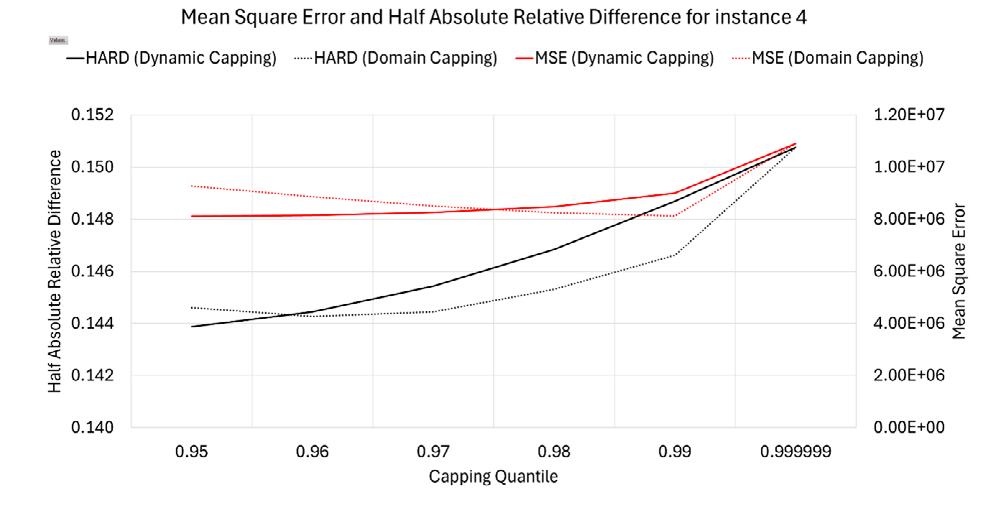
Figure 5—Estimated block mean and MSE versus capping quantile. In the realistic operating range (0.95 – 0.99), dynamic capping produces estimated block means closer to the simulated truth while maintaining lower MSE than traditional capping. The optimal quantile (0.985) balances bias reduction against estimation variance
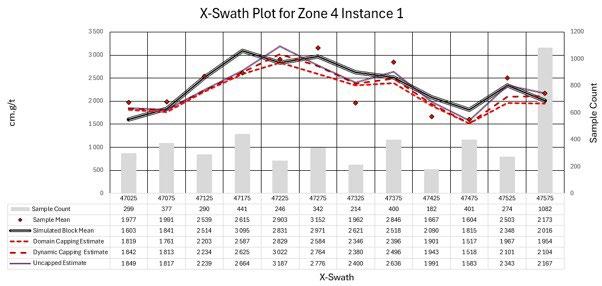
Figure 6—Swath plots of subsampled value of a simulation compared to the block value of the simulation, uncapped estimate and two capping techniques. Dynamic capping results have a closer fit to the simulated block values of the two capping techniques.
Table 3
Standardised mean squared error (SMSE) and relative variance by estimation method
proposed dynamic capping method is validated using multiple complementary metrics. This multi-metric approach addresses the limitation of relying solely on MSE and ensures a comprehensive assessment of estimation performance across different grade ranges and spatial locations.
A. Mean squared error (MSE)
MSE (Equation 6) remains the primary optimisation objective. However, because MSE is sensitive to large errors in high-grade blocks and may mask conditional bias, we supplement it with three additional diagnostics.
B. Standardised mean squared error (SMSE)
SMSE normalises MSE by the variance of true grades: SMSE = MSE / Var(Ztrue)
An SMSE of 1 indicates that the estimation error variance equals the between-block variance. Relative Variance is calculated as the estimation variance divided by the true block variance. A number smaller than 1 would indicate a smoothing of the estimate distribution relative to the true block distribution.
Challenges of extreme grades in resource estimation:
Dynamic capping achieves an SMSE of 0.535, whereas traditional capping (0.544) indicates error inflation, particularly in high-grade zones.
C. Swath plots with quantitative deviation metric Swath plots (Figure 6) are enhanced with a quantitative measure of fit. In addition to the visual comparison, we calculate the mean absolute deviation (MAD) between estimated and true grades along each swath:

Across all east-west swaths, dynamic capping reduced the average MAD from 236 cm.g/t (traditional) to 205 cm.g/t, a 13% improvement. The standard deviation of MAD across swaths also decreased from 146 cm.g/t to 119 cm.g/t, indicating more consistent performance spatially.
D. Reconciliation methods — fairness and identical configuration
The proposed method is compared against four alternative techniques (robust kriging, uncapped kriging, and ordinary kriging with domain capping). To ensure a fair comparison:
➤ The same search ellipse (strike: 76 m, dip: 76 m, 2d estimate) and same minimum/maximum samples (min = 11, max = 30) were used for all methods.
➤ The same estimation dataset (subsampled simulation) was used for all methods.
➤ The same synthetic ‘truth’ (high-resolution simulation) was used to compute MSE, SMSE, and conditional bias.
➤ No additional domain-specific tuning was applied to any comparative method beyond published recommendations.
Results are summarised in Table 5.
Dynamic capping outperforms all comparators on MSE and
Table 4
Simulated MCF
SMSE, and its conditional-bias slope of 0.98 (regression of true grade on estimate, Figure 7) is the closest of all methods to the ideal value of 1.0, indicating that it is the least conditionally biased.
E. Mine call factor (MCF) reconciliation
The shaft call factor (MCF = simulated Au / estimated Au) is summarised in Table 4. Of the four methods tested, dynamic capping produces the most accurate prediction of the expected metal content, with an MCF of 0.994 (closest to 1.0). Robust kriging returns the highest Model Selectivity (0.972), although at a less accurate MCF of 1.111.
➤ (a) y = 1.3062x-414.7463 (R² = 0.7687)
➤ (b) y = 0.9839x+72.7067 (R² = 0.8181)
➤ (c) y = 0.9539x+106.9815 (R² = 0.8063)
➤ (d) y = 1.1768*x-2.1484 (R² = 0.8181)
The slope improvement from 1.31 to 0.98 indicates reduced conditional bias in the dynamic method, with the ideal slope being 1.0
F. QQ plots with numerical goodness of fit
QQ plots (Figure 8) are retained but enhanced with a Cramér–von Mises statistic (W²) to quantify the departure from the 45° line (perfect fit). Lower W² indicates better agreement.
Table 5
Comparative performance metrics (all methods on identical configuration)
Fig. 7)
Challenges of extreme grades in resource estimation:
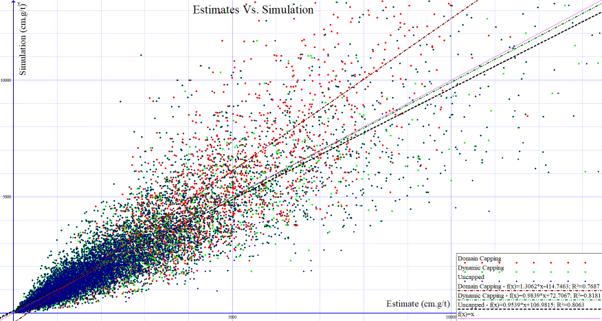
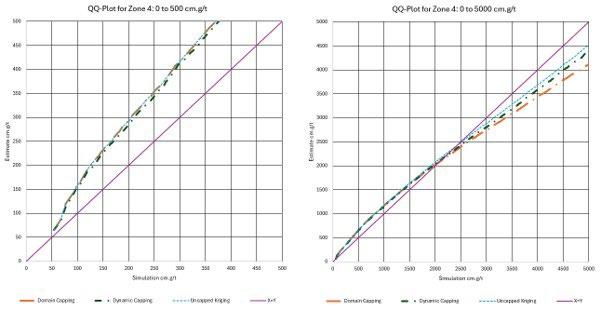
Dynamic capping achieves a significantly better fit in both the common grade range (near the origin) and the tail, confirming that the localised capping is capable of reducing the distortion of the overall distribution.
G. Summary of validation findings
The multi-metric validation (MSE, SMSE, the conditional-bias regression as per Figure 7, swath MAD, MCF, QQ plots with Cramér–von Mises) consistently shows that dynamic capping outperforms traditional domain capping and three other robust methods. Key improvements are:
➤ Reduced conditional bias, with a true-on-estimate regression slope of 0.98 (closest of all methods to the ideal 1.0, as per Figure 7);
➤ Improved SMSE (0.544 vs. 0.535 for traditional capping);
➤ Better MCF alignment (0.994 vs. 1.022);
➤ Consistently lower error across spatial swaths (13% reduction in MAD).
These results confirm that the dynamic capping method provides a more accurate, less biased, and spatially consistent estimate of block grades than existing approaches, particularly in
high-grade zones where economic decisions are most sensitive. An example of a layout of monthly mining faces, and face sample positions is shown in Figure 9, and is typical of the information available for calculating monthly predictions of gold estimates and the mining production profile.
Limitations
While the proposed localised, distance-weighted capping method demonstrates clear improvements over traditional domain capping in both synthetic and production reconciliation tests, several limitations must be acknowledged to guide appropriate application and future research.
Deposit type and grade distribution
The method was developed and tested on Witwatersrand-type
deposits, which typically exhibit approximately lognormal grade distributions with moderate to high coefficients of variation (CV ≈ 1.6 in this study). The two-parameter lognormal model (after confirming the three-parameter threshold is negligible) used for quantile calculation may not generalise to polymetallic deposits with multi-modal grade distributions, base metal porphyries
gold
where
Figure 7—Scatterplot of estimated versus simulated (true) block grades for (a) traditional domain capping, (b) dynamic capping (proposed method), (c) uncapped kriging, and (d) robust kriging. Estimated grades (x-axis) are plotted against simulated true grades (y-axis) following standard regression validation convention. The 1:1 reference line (purple) indicates perfect estimation. Regression lines (solid) are:
Figure 8—A QQ-plot of estimates against simulation value based on the 99th percentile for the range 0 to 500 cm.g/t and for 0 to 5000 cm.g/t
Challenges of extreme grades in resource estimation:
grade distributions are often less skewed, or placer/lateritic deposits with different spatial continuity structures. Users applying this method to other deposit types should first verify that the lognormal assumption (or a suitable alternative distribution) adequately fits their data.
Sensitivity to search ellipse parameters
The performance of dynamic capping depends on the definition of the kriging search ellipse (size, anisotropy, minimum and maximum number of samples). The current study used a fixed ellipse geometry optimised for typical Witwatersrand reef widths (1 m – 2 m true thickness) and strike/extent anisotropy. Too large an ellipse may include samples from different geological populations; too small may yield unstable capping values. Practitioners should perform a sensitivity analysis on ellipse parameters for their specific deposit geometry and sampling density.
Global coefficient of variation assumption
The method calculates local block standard deviation as σ = CV × Z, where CV is a global population coefficient of variation (Equation 4). This assumes that relative variability is constant across the deposit—an expedient, but potentially inaccurate simplification. In deposits where variability changes spatially (e.g., higher CV in high-grade shoots), the global CV may over-smooth high-variability zones or under-cap low-variability zones. A more rigorous approach would use a locally varying CV derived from moving window statistics or from the variogram model.
Use of arithmetic mean for local parameters
The current implementation uses the simple arithmetic mean of samples within the search ellipse to estimate local block parameters, rather than declustered or kriging-weighted means. While sensitivity testing showed this approximation to be acceptable for the relatively regular sampling grid of this study (typical of Witwatersrand stoping operations), users with highly clustered data (e.g., exploration drilling with preferential sampling of high-grade zones) should incorporate declustering weights before applying the method.
Edge effects and domain boundaries
At geological domain boundaries (e.g., reef pinch-outs, fault offsets),
the search ellipse may inadvertently include samples from different grade populations. The current method does not automatically restrict capping to within-domain samples; it relies on the user's prior domain definition. Near boundaries, capping values may be influenced by samples that are spatially proximal but geologically unrelated. Users should ensure that domain definitions are geologically robust and that the search ellipse is truncated at domain boundaries where appropriate.
Computational considerations
Per-block capping recalculation adds computational overhead. For a typical block model with 500,000 blocks and an average of 35 samples per block, the additional operations in production mode (using a pre-optimised capping quantile) required approximately 45 minutes versus 12 minutes for domain capping on a workstation with 32 GB RAM and a 3.5 GHz processor. Real-time or very large models (> 2 million blocks) may require code optimisation or parallelisation.
Validation limitations
The primary validation used a non-conditional high-resolution simulation as synthetic truth. While this provides a controlled environment, it does not capture all complexities of a real orebody. The production reconciliation partially addresses this, but plant and shaft call factors include dilution, gold loss, and sampling errors independent of estimation bias. Future validation should include conditional simulations and multi-mine studies.
Interaction with sub-domaining
The method is designed to reduce reliance on rigid sub-domaining, not eliminate it entirely. In deposits with strong geological boundaries (e.g., fault-bounded high-grade shoots separated by barren zones), sub-domaining remains necessary. The dynamic capping method should be seen as a complement to, not a replacement for, good geological domain modelling.
Methodological transparency: Additional details for reproducibility
To ensure that the proposed method can be independently implemented, verified, and audited (consistent with SAMREC 2016 Clause 23), this section provides expanded details on three previously underspecified components: distance weighting within the capping step, the iterative capping optimisation algorithm, and the interaction with geological sub-domaining.
A. Distance weighting function in capping
After ordinary kriging weights are calculated for all samples within the search ellipse of a target block, the capping value is applied to samples before recalculating the block estimate. The decision of whether to cap a given sample, and by how much, is modulated by its kriging weight:
➤ Determine domain candidate capping quantile Zh using Equations 1 – 4.
➤ Retain kriging weights λi for each sample i in the search ellipse (sum to 1).
➤ Calculate the block's local capping value using Equation 5.
➤ For each sample with raw grade gi:
• If gi ≤ Zh, keep gi unchanged.
• If gi > Zh, compute a distance-weighted capped value:
gi, capped = Zh × (1 - α × wi) + gi × (α × wi) where wi = normalised kriging weight (max
Figure 9—Example of mining face and data available at start of mining
Challenges of extreme grades in resource estimation:
= 1 across the ellipse) and α = capping strength parameter (0.85 after tuning).
➤Recalculate block estimate as Σ λi × gi, capped.
B. Iterative optimisation of capping quantile
The optimal capping quantile is determined by minimising MSE between estimated and simulated true block grades over the range h = 0.90 to 0.99 in steps of 0.005. Convergence (ΔMSE < 0.1%) is typically achieved in 18 – 22 iterations. The optimal h is then used in production mode without re-optimising per block.
C. Interaction with geological sub-domaining
Within each hard geological domain, dynamic capping is applied without further statistical sub-division, unless a domain contains two clearly separated grade populations that cannot be separated by the search ellipse. In such cases, traditional sub-domaining is performed before dynamic capping.
D. Pseudocode for implementation
A Javascript-style pseudocode implementation is provided in the supplementary materials and a functioning implementation for Datamine Studio RM is available from anyone of the authors upon request.
Conclusion and discussion
The newly proposed capping method mitigates much of the uncertainty normally associated with sub-domaining, so that exact spatial domaining of the dataset becomes a less important factor in achieving a robust reserve estimate. In regions with limited data and some spatially constrained outliers, this means that much of the smoothing and grade smearing could be eliminated computationally during the estimation process.
The experimental design is logical and provides a thorough methodology for determining the optimal capping value. However, certain aspects, such as the reliance on specific percentiles for parameter estimation, may benefit from further refinement. By incorporating more flexible approaches to capping value selection, improving sensitivity analysis, and considering additional validation metrics, the methods proposed here could provide a more robust and comprehensive framework for resource estimation. The proposed technique of dynamic capping clearly improves the MSE of the estimated compared to simulated values. As such, it is certainly worth considering as an alternative to conventional domain capping within a high data density environment with highly varying local means.
For guidance on appropriate application contexts and potential sensitivities, readers are encouraged to review the Limitations section. Future work should explore locally varying coefficients of variation, conditional simulation validation, and integration with machine learning methods for automated outlier detection.
References
Anvari, K., Benndorf, J., Gerber, G., Alisch, U. (2025). Hybrid geostatistical and deep learning framework for geochemical characterization in historical mine tailings. Scientific Reports. https://doi.org/10.1038/s41598-025-19441-5
Barnett, V., Lewis, T. 1994. Outliers in statistical data (3rd ed.). Wiley.
Beckman, R.J., Cook, R.D. 1983. Outlier identification in multivariate data. Technometrics, 25(2), 119-149. https://doi.org /10.1080/00401706.1983.10487840
Chiquini, A., Deutsch, C.V. 2017. Simulation approach to calibrate
outlier capping. Retrieved from http://geostatisticslessons.com/ Cressie, N., Hawkins, D.M. 1980. Robust estimation of the variogram. Mathematical Geology, vol. 12, no.2, pp. 115–125. https://doi.org/10.1007/BF01035243
Deutsch, C.V., Journel, A.G. 1998. GSLIB: Geostatistical Software Library and User's Guide (2nd ed.). Oxford University Press. Fourie, A., Morgan, C., Minnitt, R.C.A. 2019. Limiting the influence of extreme grades in ordinary kriged estimates. Journal of the Southern African Institute of Mining and Metallurgy, vol. 119, pp. 391–401. https://doi.org/10.17159/2411-9717/18/090/2019
Fouedjio, F., Arya, E. (2024). Locally varying geostatistical machine learning for spatial prediction. Artificial Intelligence in Geosciences, vol. 5, pp. 100081. https://doi.org/10.1016/j. aiig.2024.100081
Hampel, F.R. 1974. The influence curve and its role in robust estimation. Journal of the American Statistical Association, vol. 69, no. 346, pp. 383–393.
Hawkins, D. M., Cressie, N. 1984. Robust kriging—A proposal. Mathematical Geology, vol. 16, no. 1, pp 3–17. https://doi. org/10.1007/BF01036237
Huber, P.J. 1981. Robust statistics. Wiley.
Journel, A.G. 1983. Non-parametric estimation of spatial distributions. Mathematical Geology, vol. 15, no. 3, pp. 445–468. https://doi.org/10.1007/BF01031292
Journel, A.G., Arik, A. 1988. Dealing with outlier high grade data in precious metals deposits. In Proceedings of Computer Applications in the Mineral Industry, Balkema, pp. 45–72.
Krige, D.G., Magri, E.J. 1982. Studies of the effects of outliers and data transformation on variogram estimates for a base metal and a gold ore body. Mathematical Geology, vol. 14, no. 6, pp. 557–564. https://doi.org/10.1007/BF01033879
Leung, R., Balamurali, M., Melkumyan, A. (2021). Sample truncation strategies for outlier removal in geochemical data: The MCD robust distance approach versus t-SNE ensemble clustering. Mathematical Geosciences, vol. 53, pp. 105–130. https://doi.org/10.1007/s11004-019-09839-z
Pan, G., Arik, A. 1993. Restricted kriging for mixture of grade models. Mathematical Geology, vol. 25, pp. 713–736. https://doi.org/10.1007/BF00893175
Rendu, J.M. 1979. Normal and lognormal estimation. Mathematical Geology, vol. 11, no. 4, pp. 407–422.
Rendu, J.M. 1981. An introduction to geostatistical methods of mineral evaluation (2nd ed.). South African Institute of Mining and Metallurgy.
Rivoirard, J., Demange, C., Freulon, X., Lécureuil, A., Bellot, N. 2013. A top-cut model for deposits with heavy-tailed grade distribution. Mathematical Geosciences, vol. 45, pp. 967-982. https://doi.org/10.1007/s11004-012-9401-x
Rousseeuw, P.J., Croux, C. 1993. Alternatives to the median absolute deviation. Journal of the American Statistical Association, vol. 88, no. 424, pp. 1273-1283. https://doi.org/10.1080/01621459.1993.10476408
SAMREC. 2016. The South African code for the reporting of exploration results, mineral resources and mineral reserves (SAMREC Code). SAMCODES. https://samcode.co.za/
Verly, G. 1984. Estimation of spatial point and block distributions: The multigaussian model (PhD thesis). Stanford University. u

SOUTHERN AFRICAN
SOUTHERN AFRICAN MINE WATER CONFERENCE 2026
LET’S CONNECT
4
5
6
ABOUT THE CONFERENCE
ABOUT THE CONFERENCE
The Southern African Institute of Mining and Metallurgy (SAIMM), in collaboration with the International Mine Water Association (IMWA), the Mine Water Division of the Water Institute of Southern Africa (WISA-MWD) and Mintek, warmly invites you to the Southern African Mine Water Conference 2026, a premier gathering where science, technology and sustainability intersect.
The Southern African Institute of Mining and Metallurgy (SAIMM), in collaboration with the International Mine Water Association (IMWA), the Mine Water Division of the Water Institute of Southern Africa (WISA-MWD) and Mintek, warmly invites you to the Southern African Mine Water Conference 2026, a premier gathering where science, technology and sustainability intersect.
Guided by the theme “Let’s Connect,” this conference is more than an event – it’s a movement to bridge disciplines, foster innovation and build resilient solutions for mine water management. Attendees will explore a wide spectrum of topics, from the complexity of mine water geochemistry to the transformative power of AI-driven modelling and simulation.
Guided by the theme “Let’s Connect,” this conference is more than an event – it’s a movement to bridge disciplines, foster innovation and build resilient solutions for mine water management. Attendees will explore a wide spectrum of topics, from the complexity of mine water geochemistry to the transformative power of AI-driven modelling and simulation.
Discover how mining-influenced water (MIW) can be repurposed through circularity and value recovery and gain insights into the latest advancements in water treatment technologies and microbial processes that are reshaping environmental stewardship.
Discover how mining-influenced water (MIW) can be repurposed through circularity and value recovery and gain insights into the latest advancements in water treatment technologies and microbial processes that are reshaping environmental stewardship.
Whether you are a researcher, engineer, policymaker or industry practitioner, this is your chance to engage with cutting-edge developments, share your expertise and help shape a more connected future for mine water innovation.
Whether you are a researcher, engineer, policymaker or industry practitioner, this is your chance to engage with cutting-edge developments, share your expertise and help shape a more connected future for mine water innovation.
CONFERENCE TOPICS
CONFERENCE TOPICS
Explore cutting-edge developments and share insights on:
Explore cutting-edge developments and share insights on:
• Mine water geochemistry
• Mine water geochemistry
• Utilisation of mining-influenced water (MIW), circularity and recovery of value products
• Modelling and simulation
• Utilisation of mining-influenced water (MIW), circularity and recovery of value products
• Modelling and simulation
• Artificial Intelligence applications
• Artificial Intelligence applications
• Water treatment technologies
• Water treatment technologies
• Microbial processes in mine water systems
• Microbial processes in mine water systems
CALL FOR PAPERS/ PRESENTATIONS
CALL FOR PAPERS/ PRESENTATIONS
Prospective authors are invited to submit short abstracts of not more than 500 words. Abstracts should consist of 4 paragraphs describing the presentation’s relevance, the methods used, the key results and their application as well as implications.
Prospective authors are invited to submit short abstracts of not more than 500 words. Abstracts should consist of 4 paragraphs describing the presentation’s relevance, the methods used, the key results and their application as well as implications.
Authors of accepted abstracts will be required to submit a full paper for peer review and publication in the conference proceedings. A presentation only option will be considered.
Authors of accepted abstracts will be required to submit a full paper for peer review and publication in the conference proceedings. A presentation only option will be considered.
KEY DATES
KEY DATES
21 May 2026 – Submission of abstracts
21 May 2026 – Submission of abstracts 27 June 2026 – Submission of papers
27 June 2026 – Submission of papers
SUBMIT AN ABSTRACT
SUBMIT AN ABSTRACT
+27 11 530 0238 Web: www.saimm.co.za
ECSA and SACNASP Validated CPD Activity Credits = 0.1 per hour attended
In Partnership:
Gugu Charlie, Conferences and Events Coordinator
ECSA and SACNASP Validated CPD Activity Credits = 0.1 per hour attended
Partnership:
NATIONAL & INTERNATIONAL ACTIVITIES
2026
7-8 July 2026 — SANIRE Symposium 2026
Balancing Judgement, Technology, and Sustainability in Rock Engineering Practices
Emperors Palace Convention Centre, Kempton Park
Contact: Gugu Charlie
Tel: 011 538-0238
E-mail: gugu@saimm.co.za
Website: http://www.saimm.co.za
30-31 July 2026 — Critical Minerals 2026 Conference
From Potential To Prosperity – Building Africa’s Critical Minerals Value Chains Through Collaboration, Innovation and Governance
Royal Majestic Hotel, Rosebank, Johannesburg
Contact: Gugu Charlie
Tel: 011 538-0238
E-mail: gugu@saimm.co.za
Website: http://www.saimm.co.za
18-20 August 2026 — CAVING 2026
Ulaanbaatar, Mongolia
Website: https://www.acgcaving.com/
18-21 August 2026 — SAIMM Uranium Conference 2026
Swakopmund Hotel and Entertainment Centre, Swakopmund, Namibia
Contact: Gugu Charlie
Tel: 011 538-0238
E-mail: gugu@saimm.co.za
Website: http://www.saimm.co.za
26-27 August 2026 — ESGS Climate Change in Mining Conference 2026
Climate Change in Mining: Risks, Governance, Sustainability, and Environmental Management Glenburn Lodge, Muldersdrift
Contact: Gugu Charlie
Tel: 011 538-0238
E-mail: gugu@saimm.co.za
Website: http://www.saimm.co.za
22-25 September 2026 — XIX International Society for Mine Surveying Congress 2026
Century City, Cape Town
Contact: Gugu Charlie Tel: 011 538-0238
E-mail: gugu@saimm.co.za
Website: http://www.saimm.co.za
7-11 September 2026 — Electra Mining Africa 2026 Expo Centre, Nasrec, Johannesburg
Contact: Gugu Charlie
Contact: Camielah Jardine
Tel: 011 538-0237
Website: http://www.saimm.co.za
21-24 September 2026 — XIX 2026 International Society for Mine Surveying Congress
Century City, Cape Town
Contact: Gugu Charlie
Tel: 011 538-0238
Website: http://www.saimm.co.za
29-30 September 2026 — 7TH Young Professionals Conference 2026
Mintek, Randburg, Johannesburg
Contact: Gugu Charlie
Tel: 011 538-0238
E-mail: gugu@saimm.co.za
Website: http://www.saimm.co.za
12-16 October 2026 — 19TH South African Geophysical Association Conference 2026
Lagoon Beach Hotel & Spa, Cape Town
Website: https://sagaconference.co.za/
18-22 October 2026 — IMPC 2026 XXXII International Mineral Processing Congress
Empowering a future-fit mineral processing industry
Cape Town, South Africa
Contact: Camielah Jardine
Tel: 011 538-0237
E-mail: camielah@saimm.co.za
Website: http://www.saimm.co.za
4-6 November 2026 — Southern African Mine Water Conference 2026
Let’s Connect
Glenburn Lodge, Muldersdrift
Contact: Gugu Charlie Tel: 011 538-0238
E-mail: gugu@saimm.co.za
Website: http://www.saimm.co.za
11-13 November 2026 — MineSafe 2026 Mine Health and Safety Conference
Engineering Health & Safety For Sustainable Future-Ready Mines
Gallagher Convention Centre, Johannesburg, South Africa
Contact: Gugu Charlie
Tel: 011 538-0238
E-mail: gugu@saimm.co.za
Website: http://www.saimm.co.za
5-9 April 2027 — Hoist and Haul 2027
Century City, Cape Town
Contact: Gugu Charlie
Tel: 011 538-0238
E-mail: gugu@saimm.co.za
Website: http://www.saimm.co.za
Company affiliates
The following organizations have been admitted to the Institute as Company Affiliates
CorporateName
Agreenco Environmental Projects
OPTRON
Wekaba Engineering (Pty) Ltd
Jones & Wagener Pty Ltd
CYMOT (PTY) Ltd
Kelnir Projects (Pty) Ltd
DQS Pty Ltd
M84 Geotech Pty Ltd
Sulzer Pumps (South Africa) (Pty) Ltd
EKATO South Africa
CARBOCRAFT (PTY) LTD
Solenis
Pump and Abrasion Technologies (PTY) Ltd
CIGroup ACE Pty Ltd
Sebotka (Pty) Ltd
Mech-Industries (Pty) Ltd
Anton Paar Southern Africa
Trans-Caledon Tunnel Authority
acQuire Technology Solutions
EHL Consulting Engineers (Pty) Ltd
DDP Specialty Products South Africa (Pty) Ltd
Allied Furnace Consultants
Gravitas Minerals (Pty) Ltd
Mining Projection Concepts (Pty) Ltd
African Pegmatite
Ex Mente Technologies (Pty) Ltd
MLB Investments CC
Micromine Africa (Pty) Ltd
Ingwenya Mineral Processing
Maptek (Pty) Ltd
G H H Mining Machines (Pty) Ltd
OPTRON
Geobrugg Southern Africa (Pty) Ltd
Ivanhoe Mines SA
Weir Minerals Africa
Herrenknecht AG
Becker Mining (Pty) Ltd
Rosond (Pty) Ltd
Sound Mining Solution (Pty) Ltd
Roytec Global (Pty) Ltd
Caledonia Mining South Africa
Elbroc Mining Products (Pty) Ltd
Modular Mining Systems Africa (Pty) Ltd
Paterson & Cooke Consulting Engineers (Pty) Ltd
SENET (Pty) Ltd
Tomra (Pty) Ltd
Ukwazi Mining Solutions (Pty) Ltd
Arcus Gibb (Pty) Ltd
SRK Consulting SA (Pty) Ltd
ZUTARI (Pty) Ltd
Minerals Council of South Africa
Bluhm Burton Engineering Pty Ltd
Hatch (Pty) Ltd
Anglogold Ashanti Ltd
Digby Wells and Associates
AMIRA International Africa (Pty) Ltd
Malvern Panalytical (Pty) Ltd
MineRP Holding (Pty) Ltd
FLSmidth Minerals (Pty) Ltd
Glencore
Murray & Roberts Cementation (Pty) Ltd
Redpath Mining (South Africa) (Pty) Ltd
Sibanye Gold Limited
AECI Mining Chemicals, a division of AECI Mining Ltd
Exxaro Resources Limited
IMS Engineering (Pty) Ltd
Rustenburg Platinum Mines Limited - Union
Impala Platinum Holdings Limited
Mintek
ENGINEERING HEALTH & SAFETY FOR SUSTAINABLE
FUTURE-READY MINES
HYBRID CONFERENCE
11-12 NOVEMBER 2026 — CONFERENCE
13 NOVEMBER 2026 — INDUSTRY AWARDS DAY
GALLAGHER CONVENTION CENTRE, JOHANNESBURG, SOUTH AFRICA




BACKGROUND




Abstract submission – 31 July 2026 I Extended Abstract/Papers submission- 31 August 2026
We are excited to announce our upcoming industry Conference and Industry Awards Day, dedicated to advancing mining safety and health, innovation, and sustainability and recognising the excellent work in creating ZERO HARM future ready mines. This year’s theme, “Engineering Health, Safety for Sustainable Future-Ready Mines”, underscores our collective commitment to achieving zero harm while embracing modernisation, technology, and collaboration as the foundation for safer, future-ready mining operations.
This conference will serve as a vital platform for knowledgesharing and idea exchange among key stakeholders, including mining companies, the Department of Mineral Resources and Energy (DMRE), the Minerals Council South Africa, labour unions, and health and safety practitioners at all levels in the minerals industry.
CONFERENCE THEMES
1. Driving Zero Harm Forward
• Reinforcing the vision of eliminating fatalities.
• Sharing progress, lessons learned, and renewed commitments.
2. Technology in Action
• Case studies of mines implementing breakthrough technologies.
• Practical examples of problems solved through innovation.
3. Future-Ready Mine Design
• Strategies for long-term sustainability and resilience.
• Integrating safety and health into planning and operational frameworks.
4. Engineering Safety Excellence
• Advances in engineering solutions that enhance safety.
• Best practices in design, maintenance, and risk management.
5. Engineering in the Digital Age
• Modernisation and digital transformation in mining operations.
• Leveraging data, automation, and AI for safer outcomes.
6. Technology Advancements and Innovation
• Exploring robotics, wearables, sensors, and predictive analytics.
• Emerging technologies shaping the future of mining safety.
7. Health and Wellbeing in Mining
• Protecting workers’ physical and mental health.
• Occupational health strategies, wellness programs, and medical innovations.
8. Sustainability and Responsible Mining
For further information contact:
Gugu Charlie, Conference Co-ordinators E-mail:gugu@saimm.co.za | Tel: +27 11 538-0238 | Web: www.saimm.co.za
• Environmental stewardship and climate-conscious practices.
• Linking safety with sustainability for long-term industry resilience.
Why Attend?
• Gain insights from global case studies and pioneering projects.
• Network with industry leaders, engineers, and technology innovators.
• Explore practical solutions for building safer, sustainable mines.
• Be part of shaping the future of mining through collaboration and innovation.
Join us as we work together towards Safe Mines, Healthy Lives, and Sustainable Futures!
PARTNERSHIP OPPORTUNITIES
Sponsorship opportunities are available. Companies wishing To partner on this event should contact the Conference Coordinator.
WHO SHOULD ATTEND
The conference should be of value to:
• Safety practitioners
• Mine management
• Mine health and safety officials
• Engineering managers
• Underground production supervisors
• Surface production supervisors
• Environmental scientists
• Minimizing of waste
• Operations manager
• Processing manager
• Contractors (mining)
• Including mining consultants, suppliers and manufacturers
• Education and training • Energy solving projects
• Water solving projects
• Unions
• Academics and students
• DMRE
• Occupational health practitioners
• Leadership and ManagementTechnical and Engineers
CALL FOR PAPERS
Call for papers on the topics of safety, health and environment
Prospective authors are invited to submit titles and abstracts of their presentations in English and not longer than 500 words. Abstracts should be submitted to:
Include Abstract Submission Deadline: 31 July 2026
Extended Abstract/Paper Submission: 31 August 2026
HOIST &HAUL 2027
5-7 APRIL 2027 – CONFERENCE
8-9 APRIL 2027 – TECHNICAL VISIT

CENTURY CITY, CAPE TOWN


ABOUT THE CONGRESS
We are excited to be hosting Hoist & Haul 2027 in beautiful Cape town, South Africa. Mining is a global industry, with mining companies owning mines across the world. The large engineering companies and suppliers who provide design and equipment to the mines also operate internationally. So we hope to welcome delegates and accept technical papers from a wide spectrum of different countries.
As the conference is being held in South Africa, we will also aim to highlight South African achievements in mine shaft hoisting, and technical visits will showcase excellence in current South African mining operations.
Fifty years ago, the world, led by South Africa, was at the dawn of ultradeep mining. BMR hoists were being developed, accepted factors of safety were being challenged and updated on a more rational basis, much deeper single hoist shafts were replacing multiple shaft systems. These were exciting times for hoisting and gave birth to the Hoist and Haul series of conferences, in 1973 in Johannesburg, under the title “Hoisting: Men, Materials and Minerals”.
Similar challenges exist today. Exploration has proved significant ore bodies at depths exceeding 4000 m. However, the cost and time required for extraction using current hoisting technology makes their exploitation unattractive, emphasizing the need for faster, more costefficient hoisting systems.
But a whole new set of challenges has arisen from increasing societal demands for safety, sustainability, energy efficiency and environmental responsibility. And, whilst the world cannot develop and thrive without mining products, these demands are likely to escalate rapidly over the next fifty years.
Mines that have been in operation for fifty years must upgrade and retrofit hoisting system to adapt to changing demands, and planning for new mines must aim to anticipate what will be necessary if they are to be socially acceptable from inception to closure in fifty years’ time.
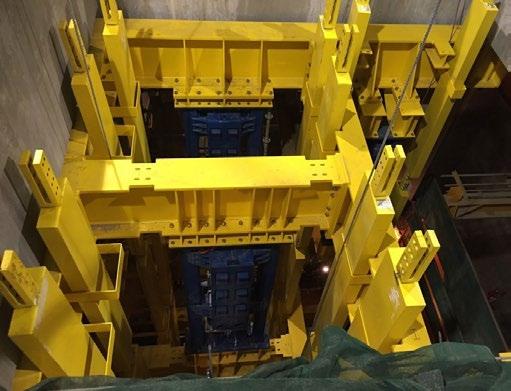
In Partnership with The South African Institution of Mechanical Engineering and The Association of Mine Resident Engineers of South Africa.