Peer Inside
Shea Burke
“Can’t Stop the Drip: A Praise Song, Spring 2021” D. Denenge Duyst-Akpem
Stone. Mineral. Dust. Clay This impossibly brilliant orange ochre is a synesthetic portal. I am teleported by packed grains of earth, clay, slip-slip-slipping, shapeshifting into other dimensions and times. To the Plateau in central Nigeria, land of ancient Nok ceramics, of a soil so dense, so rich it seems carved from the setting sun. VoWlcanic remnants undulate in the distance, a mirage hovering over the landscape. Equatorial sun pierces neon-flame ball against stark white harmattan dust-filled skies. The curved peaks shimmer in the filmy light. This soil contains a multitude of layered histories. Out here on the Plateau, at these former tin mines now filled with crisp cool waters, you can walk into the human-made lake—filled in after mining was complete—that appears crystal blue from a distance, fresh in the chalky heat of day. You walk in at the rocky shoreline to water that is at first shallow before the drop, from the shoreline where your feet melt into the thick clay bottom that grabs your ankles and squishes between your toes with each step. We would smear it over our bodies for homemade mud baths, become one with the landscape. Onward we travel toward eastern plains of the Mangbetu flaring royal hair crowns referenced in hand-built luminescent slate-black surfaces of Magadalena Odundo’s vessels punctuated by anthropomorphic bumps akin to backbone, flowing past herders who smooth their cow’s horns with a gentle dusting of clay, and moving southwest where Himba women adorn their puff-tipped locs with a thick application of red earth, an anointing of beauty. We float up and around again back to Niger, riding Saharan winds across lands traversed by Tuareg and Fulani, to the ancient rock paintings of Tassili N’Ajjer and down and around some thousands of kilometers over sunbaked sands to Mali’s Bandiagara Escarpment where monumental plateaus are sculpted into dwellings, granaries, sites of divination, and burial grounds. Where does the earth end and I begin? There is information contained in the not-knowing. In the knowledge of ways beyond the rigidity of some violence-laden sciences, there is soul-information in the raw mineral, the stones. Of five primary elements, mineral people in Dagara cosmological foundations are the storytellers, the transmitters and keepers of histories
through ritual. Akin to the griot’s hereditary vocation, they travel the information contained in the stone, navigating stories like minerals shifting over time, just as the Akan believe that gold is alive, flowing, breathing within the earth. In Parable of the Sower, Octavia Butler’s dystopian and prophetic novel written in diaristic form through the voice of a 16-year-old hyper-empath, the journey opens in 2024, taking us from Southern California north to freedom. Lauren Oya Olamina—so named for the Yoruba orisa of wind and thunderstorms—begins to write a new path that she calls Earthseed. In answer to one traveler’s question about how she has developed this belief system, Olamina states that this is not something she has created, that the knowledge is gained through observation, and all you need to know is “in this stone”.
for a number of works, in waking life engaging their re-creation, the dream infusing the form. Of Untitled Bisqueware, 2020, installation, they state that the work is, “Put together to resemble a dream of mine; a drawing of the dream is tucked into one of the vessels visible only if you are curious to look deep inside.” Within the installation, the draping of this deep orange hue, an ever-so-faintly molted color, harks to the great Sam Gilliam’s painting off-thewall with his canvases liberated, suspended and draped. Burke’s assemblage becomes monument with secrets hidden inside tautened undulations of color, insistent abstractions claiming space. Here, the vessel grounds the cloth, dyed with root to match, suspended from point to point, floor to wall. They become one entity, one infusion. Carrot. Cinnamon. Beet. Rust. Metal. Fire. Clay.
The stone. The mineral.
Deep purple-blue-tinged greys delineate the lush palette of a full form. Empty, breathing, like the striated double-triangle “wind house” adinkra symbol, its open weave suggesting that no matter the winds of time and change, the king and his people will remain. After a presentation of Odundo’s work, an audience member stood up in the aisle during the Q&A and began dancing, exclaiming in praise to the artist that these were dances her body wanted to make in response to the anthropomorphic movement suggested by the vessels. And as with Odundo’s recent blown glass works whose shadows dance in suspended space, the folded forms of Burke’s clay vessels speak to an action to which we have not born witness; we are in the aftermath, a possible break in the in-between. Perhaps the breath has been sucked out in a vacuum, leaving a crimp, a wrinkle, a drip, speaking to the possibility of what came and what is to come.
The dust: ground fine through time, extraction, manufacture. Otobong Nkanga “takes this dust in” as she performs as part of her monumental exhibition To Dig a Hole That Collapses Again which calls to account histories of colonial destruction and desecration of earth and people and references her visit to Namibia, witnessing the dust that remains, a constantly wind-shifting monument to the mineral riches that once were. Burke’s forms are shapeshifters, traveling time and place, in a variable loop, familiar and not-so-familiar forms recontextualized though a dance with textile, mirroring palette as a kind of conversation between clay and cloth. Like Nkanga’s hovering crystals in museum spaces and photographs presenting remnants of pilfered minerals at the European sites of their present use, these vessels call histories into being, into focus, into question. The stone. The mineral. The dust: dispersed. Even the forms themselves reference a level of instability, a kind of arrested motion. Their sketches dance and rise from the body like Senga Nengudi’s rubber and nylon stretched like skin in pregnancy, the artist’s materials weighted and tacked to create webbed sites of performance. These are sculptural ululations, patterns in texture, a reading the ripples. Burke has written of dreams as the foundation
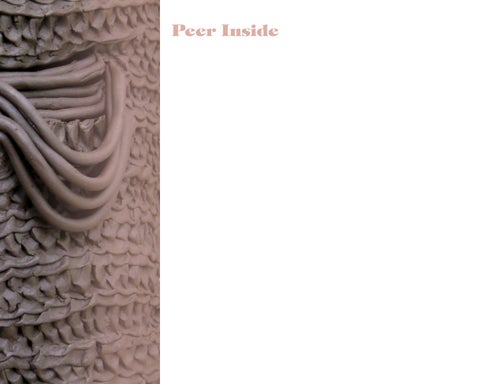
I am drawn to the drip. The Drip The drips, laid one by one thick spaghetti loops firm in their forms with a bit of whimsy, remain poised, static, leaving tension in the viewer from gestures frozen, a breath caught in the chest, time stopped intentionally. Was it a sudden act of collapse over a long time of wear or a gentle falling slowly of woven strand after woven strand, one loosening within the weave, sighing and giving way gently, one after the other until, finally, together, their strength releases and one side curves inward, gravity pressing down as the air
is sucked from within, and then just like that, it is done? The vessels resist their own forms, resist categorization, consenting/allowing gravity as co-creator.
form, a mesh mapping of disparate geographies that speak with a common tongue and common color, through the stroke and the whisper, the breath and the birthing.
Strands like hair recall Octavia Butler’s oankali gene traders in the Xenogenesis, or Lilith’s Brood series, and the ooloi whose grey-stranded bodies reach and stretch toward any sound and movement, lifted gently on whisps of circulated air in their post-World War III alien ship, tentacles ready to activate at any moment, resting in momentary statis, watching and waiting to awaken and seduce.
When I see these vessels, I feel overjoyed. I see histories of Black people making through time and space, objects for travel and ritual and everyday life, for the nomadic and the settled, traversing windswept baked earth, sand cracked trail soil, the swell of deep rich slip, cool sweat, of wrist, palm and fingers, hand and body. Loosely woven clay, basketry, smooth visual repetition masks the incredible sustained effort it takes to mold them. There is haptic healing in the hand-smoothed surface, every inch touched. Action and memory. The mnemonics in process and final form. They hold, conceal, entice with loose weave pattern tiny light portals that suggest secrets.
The drip is firm, secure, heat-hardened, after flirting with collapse in the flames, cooling, cooler, cool on my hand, the side of my face. I want to hold it to my body, my belly, my breast, in the crook of my elbow, against the flesh of my cheek. Let the soft ridges leave indentations on my skin like those in the morning that speak of heavy sleep, the markings on my face of travel to worlds that I think I might remember, saying, yes, I was there once before. The sharper ridges might cut and leave a different kind of mark. I am carried by synesthetic fancies when I see them, imagine them against my body, in the “dip and the sway” of my hips and thighs, as Ntozake Shange wrote in the choreopoem excerpt “somebody walked off with alla my stuff”. Shange came to poetry first through African dance. Burke danced on the clay for the base of one of their vessels, infusing it with the energy of/through their feet, the resonance of the dance now contained within it. You can’t stop the drip. The Pattern Consider the sonic imprint of the word in your mouth, feel its vibration at the top of your nose, its flow from your throat, whispered declaration into the clay, now a vessel against your body. There is the familiar here. Something distant. The pattern is a coded music, a cross-temporal longing for a place I may or may not have known. These vessels rebel, reclaim their breath and agency to sway and cave, to lose control, to set in controlled chaos. These woven textures syncopate. I can feel it in my teeth, hear the sonic frequencies like fractals. These melded strands know each other, know their
Loops and woven patterns, impossibly intertwined, liquid, pliable: these forms resist themselves and in so doing, become. Histories layer in a fresh understanding of what it means to join form and protest, matter-of-fact of-course-I-exist no-doubt-in-my-mind form. The unfamiliarity is in you, not me. I know who I am. I know the ecology of my beingness. The vessels hold within them the challenge, the sacrifice, the suffering, the reclaiming, the jettisoning, the wryness, the rage, the knowing, the reckoning. Of Process and Material Burke’s hand-dyed textile investigations began through a (re)introduction to nature and individual agency via the course “Afro-Futurist Ecologies”. I have born witness to their personal mapping, the intricacy of charting intimacies, warnings, and protections, the revelation of what is hidden and the familial mysteries that still remain. They bring to their work a tender grit and whimsy from an iron core or rare gem. Pressure forms the stone through the repetition of time in Earth’s knowing hand. Their experiments with shadow and trace were enacted through cut-outs of paper and hand-dyed cloth laid in juxtaposition to the vessel compositions, and in the use of actual mirror as well as the mirroring of textile to clay in color. In Afrofuturity, I speak of vessels of liberation where ships, motherships, trains, and music in the spirit of Sun Ra and the Solar Arkestra function as teleportation devices into a liberated future.
And you: you are a vessel, the beauty that is you, the body as portal, and the vessel as portal. The masker becomes vessel for Ancestral spirit in masquerade. These vessel-portals act as vectors for transformation in thinking, ways of seeing, feeling, experiencing a work of art, akin to the Yoruba asé experience, that catalytic life force as defined by African art historian Rowland Abiodun, in relationship to the material, the work of art and the collective. Burke writes that, “The idea of exposing the labor of craft by just not weaving some of it really stuck with me. The un-pinched coil becomes the warp and weft of a vessel showing the time and movements of its creation.” In this, the work becomes commemoration. And then, what happens when one is “socially distanced from touching clay” in the midst of pandemic isolation? How does the process, the clay itself, become disembodied, and yet reveal new points of entry and new resonances? Building, coiling, forming, dyeing, revealing, obscuring: Burke enacts revolutionary statements. Black Object(s): Of Shrouding and Institutional Critique Black subjectivity/ object-ivity/ object-hood/ Black(s) object(s) I think here of Jeanette Winterson’s pivotal Art Objects, art as verb/ action, back to asé. It is essence, invocation, material, and interaction. It is We Insist! Max Roach’s Freedom Now Suite with Coleman Hawkins, Olatunji, and Abbey Lincoln singing, “Whisper, listen, whisper, listen, say we’re free…” Black art takes its space with Black Arts Movement co-founder Amiri Baraka’s self-determination as self-reclamation. This surface conceals and reveals a steely core. Don’t mistake tenderness for weakness. Don’t mistake survival for strength. Don’t mistake silence for acquiescence. No mincing of words, no suffering of fools.
Fuck around and see. I Am Not Your Negro. This (work) is not for you. Untitled (Shrouded), 2021, installation of three vessels of varying sizes draped in cochineal dyed silk is intentionally shrouded, and in such, makes a complete statement and an institutional critique in Burke’s definitive choice to cover the vessels, revealing only parts, directly and through veil. We are back to the mirage where desert figures blur against brilliant sun-smoothed sands; we squint, wondering if what we think we see is real. What is real, especially in these demonstration dances of “Black authenticity”? Here, the (white) gaze is limited, this gaze that takes for granted its proximity and access to and expectation to use at whim all things Black. This shrouding confronts the yawning consumption of Blackness via the promulgated and systematized myth of white supremacy. Burke issues a definitive “No” to this entitlement. Vegetable dyed veils shield, rise up mirroring the clay forms, disappearing the space where one ends and the other begins, a camouflaging within institutional space. Like being shrouded in folds of grandmother’s mumu or the cloaking device for Captain Jean-Luc Picard’s Star Trek Enterprise or Sheree Renee Thomas’ likening of historical Black science fiction writers to dark matter, disappeared and unseen but existing and exerting an undeniable force. This is a hiding in plain sight, a hyper-visibility that is simultaneously an invisibility to those uninitiated, those who have not been trained/allowed/invited into the layered meanings, as with the Akan visual-verbal nexus where symbol connects to proverb connects to architecture, social formation, textile, and beyond. With growth, one becomes aware of these sacred ways via experience, initiation and life. Portrait of the Artist This is a portrait of an artist as trickster and artist as channel. Burke’s forms recall the familiar and then turn the familiar upside down and inside out on itself. They make you question your perception, what is intentional, what is chance, what is real. In Of Water and the Spirit: Ritual, Magic and Initiation in the Life of an African Shaman, Elder Malidoma, in examining the Dagara relation-
ship to science fiction and the otherworldly, writes of how his people of southwestern Burkina Faso do not have a concept for fantasy or lies. The world of the Ancestors and the world of the living are integrated, a seamless flow further solidified through initiation. The closest word is yielbongura, meaning “the thing that knowledge can’t eat”. The Euro-Western academy seeks explanations, definitions, a consumption of “the Other” to fill its yawning need for power in a misguided and colonialist attempt to fill the hole left across legions of generations by its intentionally inflicted dis-ease. Burke and their forms are, as Butler writes: “Trickster, Teacher, Chaos, Clay”. In their painting Space Person (How I see us), the figure is surrounded by reverberating rainbow ripples, deftly skipping and arcing, evading within and through the institution, inhabiting Moten’s undercommons. These vessels and their material family express Legba’s trickster elan, the Yoruba orisa who is carrier of messages, presenter of challenges leading to growth and guide to shape-shifter methodologies. Burke describes the vessels as teachers and living forms. Their works—pencil sketches, pandemic paintings, text messages from disillusioned mentees, piles of “unused” clay strands, Like Clay (Series) risographs of their hand squeezing flesh “touching my body with the love that I have when I touch clay”—all serve as a cross-temporal mapping of influences and gestures with objects as simultaneous signposts and destinations, a mapping of self and communities. As Pauline Oliveros demonstrated with her interactive Environmental Dialogues series and Ana Mendieta conjured in her return to Cuban roots through merging with the land of birth, etched in mud, fire and flower: Burke’s vessels are a cross-temporal conversation with clay as linguistic light-code across cultures and constructions, sculpting space across place and time. Za de doo. Go well, and safe journeys.
Artist Statement Shea Burke
One of the things that is so important to me about ceramics is its longevity—I know when I fade, the material will still hold its form. I am aware of the generations of ancestors who are there to support me when I am working with my hands. My fingers are their fingers. Through making I can preserve what must be remembered. åtogether each coil of the body. Can vessels teach us from their voiceless existence? If so, what will we learn? – The knowledge I have within me is often overlooked because I am Black. The vessels I make courageously exhibit my power, they lead with their vulnerability into battle with prejudice and inequality. They do this so that Black people who share with me the burden of having to be strong can release some of the weight they carry. Each vessel I create is patterned with rhythmic markings. Layer after layer builds when I press into the clay, which becomes a tally of moments passing. The position of my hands and the force with which I move is recorded. While coil-building I shape the vessel as a place to put the things that slip through our fingers. There is comfort in the idea of having a place to store what we struggle to hold onto: memories, traditions, and moments that are eroded by time. The clay remembers my presence with the material. Its body designates a space for my ideas to be preserved. I find inspiration in the silhouettes of functional vessels from West African traditions. I long to liberate them from the museums I have encountered them in. Through learning the shapes that make up the ceramic language of my ancestral homeland, I hope to refill the history, community, and living context that was poured out when they were stolen to be displayed in the museums of imperialist nations. I want there to be as much appreciation for the skill in a Kurumba storage vessel and Nupe palm wine vessel as there is for the Greek amphora and the Chinese teapot. As those we look to for guidance share comfort and wisdom, these vessels are a place to pour worries when we need help.
fig.1
fig.2
fig.3
fig.2-4
Untitled (Bisqueware), 2020 Low-fired vessels, madder-dyed silk, watercolor on paper, found mirror, acrylic paint. Put together to resemble a dream of mine; a drawing of the dream is tucked into one of the vessels visible only if you are curious to look deep inside.
This installation was completed after achieving the orange color of my “unfinished” ceramic work with madder dyed silk.Visible only after walking all the way around the piece is a mirror bordered with the same color. Although disguised by the wash of color, the work is meant to reveal more information if given the time. Walking around for a different perspective, vessels are hidden and revealed. I wanted to provoke thought about how clay body color indicates state, status, and finish within a ceramic context. There is a prevalent idea that without glaze a ceramic piece remains unfinished. This falsehood directly impacts the way artists view cultures and traditions that do not use glaze. My dreams often inform the direction I take my work. In one dream, I remember picking up a glossy high-fired piece only to have it deform in my hands as if it were soft clay. The transposition of material qualities across the orange color in this work carries the same magic. Natural dye fades and changes over time. Eventually the fabric itself will disintegrate, being made of natural fibers, but the ceramic components of this piece will outlive all of us. Unglazed the clay will age, discolor, and absorb parts of its environment. Many unglazed vessels present in museums have a patina of age; absorbing water, food, smoke, and memories of the life they lived. However, the institutional record holds very little serving to make the pain of faded memory seem distant though it’s trauma is fresh.
fig.4
fig.5
fig.6
fig.7
fig.8
fig.9
fig.10
fig.5-11
Untitled (Veiled), MFA Installation, 2021 Ceramic, natural dyed silk, raw clay, gold paper (inside vessel)
fig.11
Imagining giving hoards of strangers an opportunity to view the work without me present, I decided I did not want to provide a clear look at my vessels for the required MFA exhibition. The School of the Art Institute of Chicago benefits greatly from the care its students provide in dressing the wounds of its past harm. I covered my pieces to prevent their exploitation from those unwilling to exchange their beauty for contemplation of the ground on which they sit temporarily arranged.
L: fig.12 R: fig.13
fig.14-15
Vessel (Kurumba Inspired), 2019 Hand-built with my coiling technique, silhouette inspired by grain storage vessels made by women of the Kurumba people who are located in present day Burkina Faso and Mali.
The vessels that inspired me to make this artwork have been said to be portraits crafted to resemble the body of the woman who would own it; the ornament is designed to mimic her personal scarification. The artists who made these vessel portraits are also presumed to be feminine identified. The shared identity of artist and subject feels present to me in the maker’s gaze. The Kurumba vessel in the Art Institute of Chicago appears to me to have representations of nipples and a large belly button below in the center of a cross shape, all surrounded by wavy lines. This vessel-portrait sat in the home of the woman who carried these unique markings herself. The vessel held whatever she needed, like precious textiles or grains to feed her family, protecting the contents from moisture and light. The vessel would become a family heirloom to be passed down to her daughter. Her vessel’s line was broken when it was purchased, pillaged, and/or stolen to be displayed in the AIC. The name of this woman and the woman who beautifully captured her essence were not recorded by the colonizing criminals who put the vessel where it is today and their names are lost to time, even though it has not been a long time.
L: fig.14 R: fig.15
The journey of these objects parallels the journey my African ancestors took to this continent. There are many similar unnamed vessels present in museums throughout the United States, each a personalized object detached from any connection to personhood. This cruel repurposing was applied to human beings; stealing a person from their life, removing their identity to replace it with labor and abuse. I think of these vessels as symbols of the life that was poured out in the process of colonization; The living connection that was lost in their capture, the memories that were scattered for them to become objects consumed by distant eyes. When I see these representations of women trapped behind museum glass, I see a mother, a grandmother. I want her to be free.
fig.16
fig.17
fig.16-18
Body Vessel, Installation, 2019 Ceramic, beet-dyed textile, smaller vessel hidden inside, risograph prints
fig.18
This installation was the result of a swarm of thoughts I was having at the beginning of my journey in this predominantly white institution. I was trying to understand what it means to choose to make something that will exist beyond your life in the way ceramics does. I have always thought of my vessels as children. In making art, I have dedicated my body, my time, and breathed a kind of life into them. Like a parent, I often carry them lovingly on my hip from the kiln to my studio. Being a person born with a womb, the role of nurturing has been socialized into me. I don’t see it as a burden but as a talent to make the world more welcoming to the future I want to see for bodies like mine. This vessel was the one of the first that I made to emerge from the kiln frozen in a state of melted softness. The vessel itself lacks the agency to stand upright, openly displaying its vulnerability.
fig.19
fig.20
Appendix Shea Burke
From Wikipedia: The appendix is a finger-like, blind-ended tube connected to the cecum, from which it develops in the embryo. The cecum is a pouch-like structure of the colon, located at the junction of the small and the large intestines. The appendix is an addition required to be made to a document by its author subsequent to its printing or publication. It comes from the Latin gerundive addendum, plural addenda, “that which is to be added,” from addere (lit. “give toward”). I have decided to add an appendix to this little book because cutting my story out of the work would be like cutting off an appendage with an important function I don’t fully understand. Science tells us that the appendix may be a reservoir for healthy bacteria that can save your life in times of intestinal distress. In my time in graduate school, I worked in ways that caused physical and psychological pain for myself. I feel comfort in pain. I became addicted to the harm I inflicted, as I thought suffering was a necessary component for good artwork. My mental illness twisted art from a practice of joy to one of self-destruction. The repetitive motion of pinching vessels into existence caused wrist pain and numbness up my left arm that forced me to slow down. Delving into histories of oppression caused mental anguish from which I am still recovering. I acknowledge that my work comes from power beyond me, but the nameless, selfless place I stepped into was destructive at times. I swallowed poison rather than finding the fruit. The name-eating destruction of historical erasure and colonialism’s claiming through name-denial is one side of the coin. The positive side of the same coin is the potential of renaming or returning to namedness. It is the rejection of names. For instance, the X for Malcolm. It is the reaching back into lineage that inspired bell hooks to take the name of her grandmother. Creativity lives in the potential to name where our perspective originates. The veneration of suffering is the final remnant of my catholic upbringing that needs to be excised. We find ourselves in a culture that wants us to bleed to access worthiness. I think of the wisdom of Malidoma Patrice Some in Of Water and the Spirit, which I was introduced to by D. Denenge Duyst-Akpem. Elder Malidoma, having survived abuse at the hands of priests in his youth, returned to his tribe to become a spiritual leader. He had to re-learn the language of his childhood
after it was abused out of him. He became a griot, a storyteller, because through his experiences his spirit was reconstructed to tell the story of his people to the outside world. Malidoma became a spiritual leader because his journey gave him sight that could point his people in a direction away from suffering. Delusions are the waking nightmares that draw us towards a path of further suffering, but visions are dreams that come to us to lead our waking life. We must do the work of rejecting delusion and embracing the visions that guide us. My brain still lives in the margins of John Keene’s Counternarratives. The historical fiction called Gloss On A History of Roman Catholics in The Early American Republic, 1790-1825; or the Strange History of Our Lady of Sorrows which was introduced to me by poet Christian Campbell during a poetry class called Poetics of Diaspora which was sadly interrupted by the pandemic. The main story exists in a footnote, as most Black queer people in history do, about a Hatian girl named Carmel who is enslaved at a Catholic boarding school. She has the sight as well; a gift from her mother that puts her body into a trance state where she draws, writes, and speaks truth. Carmel endures the isolation of the “special treatment” of abuse that separates her from the other enslaved people. She manages to find love, secure education for herself, and explore the talents of her burgeoning spirituality that is demonized in the toxic religious space she finds herself in. My name is Shea Burke but the name I had before holds a portion of my story. My mother named me Brianna; in popular trans terminology the name you give up to become your true self is a “deadname.” Brianna is not dead, she still lives inside of me. I was Brianna during my childhood. I would not let anyone touch a syllable. Bre-AH-nah. It was one of the most popular names, especially for Black girls, when I was born in 1995. I have learned that Brianna means “strong”; it was a fitting name because in my younger years I endured a lot of abuse. Brianna had to keep secrets because she was scared of being taken away. Brianna was lied to by her abuser and she thought that she had to endure pain to keep her family in her life. Brianna passed her trauma on to me because she did not understand she was abused, manipulated, and neglected. I feel like I make most of my work for Brianna, I know she deserved better and I would have loved for her to see the things that I make. It’s hard to
love yourself when you experience gendered and racialized trauma. The tragedy of Breonna Taylor last year, a Black woman around my age, being slain in her bed impacted me greatly. I imagine her having bared the same weight of the name, perhaps it led her to the career she had, providing her emotional strength as a healthcare worker. Breonna seemed to be on a great path, finding a healthy relationship, and an apartment of her own. However, this did not secure her safety. As I lay the name to rest for myself, I grieve a loss of innocence and I hope for a future where the need for strength is not placed upon black women and girls. I hope for a future where violent death does not circle the Black community like a hungry vulture waiting to strike. Being a strong Black woman is a skill and a curse. I name myself Shea Bee Burke. Retaining “B. Burke” to acknowledge my past. Shea is my given middle name. I embrace this name because it references a tree with seeds that produce nourishment for African skin and hair. I enjoy that it is a neutral name with hints of femininity. Shea represents healing, protection, and growth in my community. Centering nature in my existence, I honor the bumblebee who’s symbiotic relationship with flowers and role in pollination allows for all to enjoy their fruitful labor. Bees are steady workers with a future focus, collecting for their hive. It is important to note that bees, along with many insects with similar social structures, are of a feminine neutral sex. Each hive has a true female queen whom they protect and male bees that exist only for a short period of time. Bees are gentle creatures with a powerful defensive sting that they only use as a last resort, as their potential to inflict pain is fatal to them. Bees also have a power to sense magnetic fields and use the sun as a fixed reference point. With this internal compass and nature guiding them, they can always find their way home. Bees remind us to follow the steady hum of life, to focus our daily energy on building the healthy structures we need to survive, and to taste the sweetness along the way. I relinquish the maladaptive categories I was assigned of strength and traditional femininity to find my true nature outside of the gender binary. Each person has the potential to create a positive impact on their surroundings when they embrace their true nature. With my new name, I trace my roots and follow my internal compass along a path to happiness.
Credits Photography: Travis Roozée Graphic Design: Yu Wei Copyright © 2021 Shea Burke All rights reserved. SAIC Ceramics 2021