View from the Highlands
Protecting the World’s Oldest Mountains
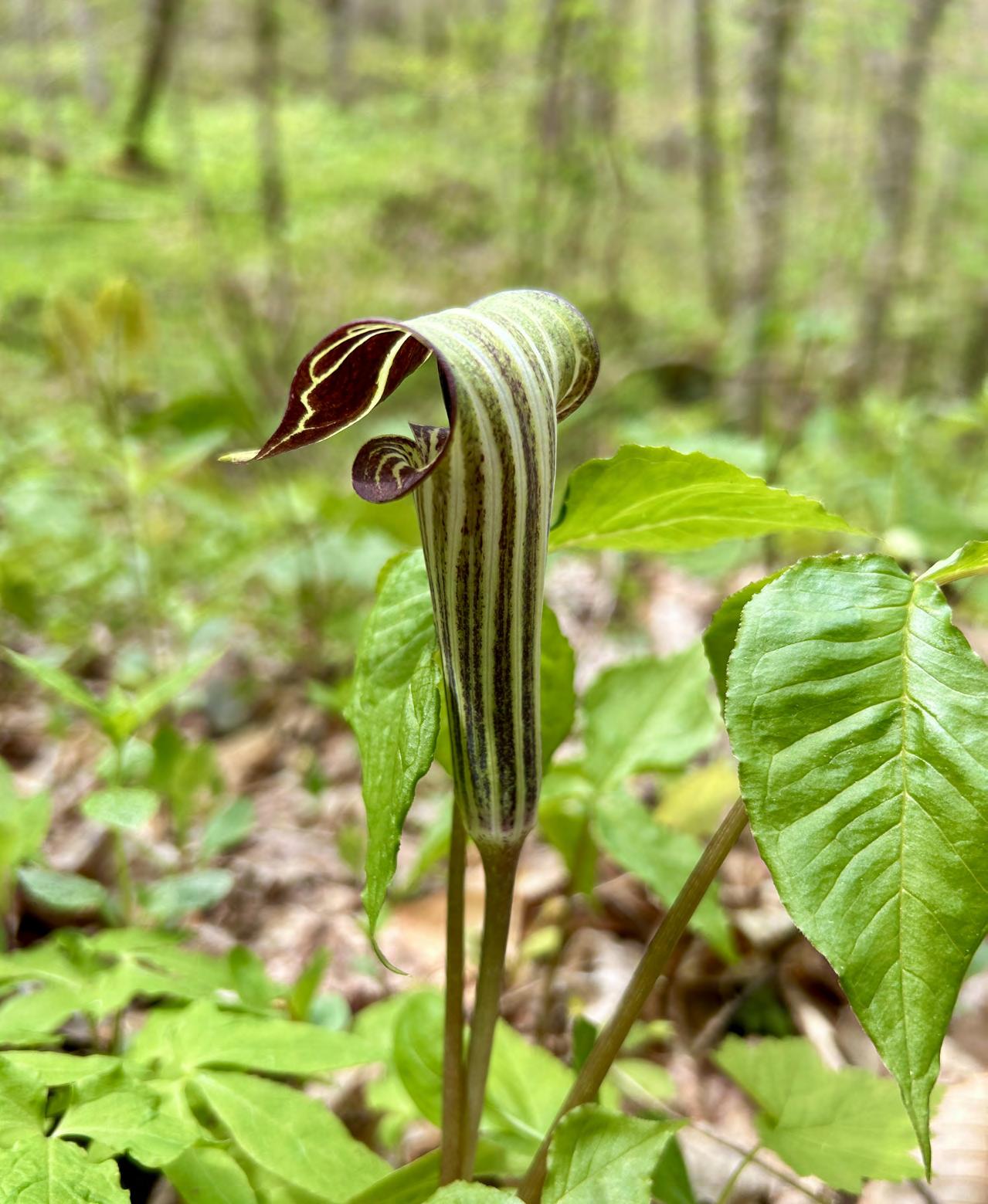
Jack in the Pulpit
Mike Potter, Carolinas Nature Photographers Association (CNPA)
372 Merrimon Avenue Asheville, NC 28801-1222
828.253.0095
sahc@appalachian.org
Board of Trustees
Larry Pender, President Statesville, NC
Janet Garrett, Vice-President A sheville, NC
Pam Kelley, Treasurer Kingsport, TN
Kevin Fitzgerald, Secretary Waynesville, NC
Maria Palamar, At-Large A sheville, NC
Paul Bonesteel A sheville, NC
Kayla Carter Johnson City, TN
Chris Coxen A sheville, NC
Ted Ghiz A sheville, NC
Jeff Hatling Minneapolis, NC
Gary Kauffman Fairview, NC
Erica Malpass Johnson City, TN
John McLendon Pittsboro, NC
Spencer Scheidt A sheville, NC
Jay Leutze Senior Advisor to the Board
Staff
Carl Silverstein E xecutive Director
Kristy Urquhart A ssociate Director
Jess Ashburn VP of Operations
Anna Kuhlman Director of Development
Lisa Fancher Finance Compliance Director
Michelle Pugliese Land Protection Director
Jess Laggis Farmland Protection Director
Hanni Muerdter Conservation Director
Kyle Shute Land Protection Associate
Sarah Sheeran Stewardship Director
Chris Kaase GIS & Stewardship Manager
Mike Szymkowicz Stewardship Manager
Marquette Crockett Roan Stewardship Director
Travis Bordley Roan Stewardship Technician
Cheryl Fowler Membership Director
Angela Shepherd Communications Director
Emma Goldrick Development & Communications Manager
Chris Link Community Farm Manager
Park Greer South Yellow Mtn Preserve Manager
LaKyla Hodges Community Engagement & Education Manager
Erin Goodpaster Outreach Program Manager
Kirin Battaglia Weddings & Events Coordinator
Tim Arrowood IT Manager
Josie Cohen Stewardship Technician
Connor Hovendon Stewardship Technician

Letter from the Director Carl Silverstein
This edition of the View from the Highlands showcases some of SAHC’s recent, impactful land protection and stewardship work. We are both humbled and grateful for your generous support, which enables these conservation efforts to continue.
We hope you join in celebrating and sharing these extraordinary land protection achievements. These stories include: ecologically and culturally significant gems in the Highlands of Roan and the Cane River watershed; planned publicly accessible outdoor recreation sites near Asheville and the Town of Canton; and a historic, multigenerational family farm in Haywood County.
Our land management and stewardship team continues to excel in the long-term preservation and improvement of natural resources – repairing streambanks, managing habitat for biodiversity, restoring high elevation spruce forest, and partnering with leaders in their fields.
Without donors like you, these conservation successes would not be possible. Thank you.
We hope you will join us at SAHC’s upcoming events to celebrate and enjoy the beautiful places you have helped protect. You can find the most up-to-date information about our outreach programs and other events at Appalachian.org, or by following SAHC on social media and subscribing to our e-News.

Protect Steward Connect
The mission of the Southern Appalachian Highlands Conservancy is to conserve the unique plant and animal habitat, clean water, farmland, scenic beauty, and places for all people to enjoy outdoor recreation in the mountains of North Carolina and Tennessee, enduring for future generations. We achieve this through long-term conservation relationships with private landowners and public agencies and owning and managing land. We are committed to creating and supporting equitable, healthy and thriving communities for everyone in our region.
SAHC acknowledges that the land we work to conserve is the current and ancestral land of the Cherokee, Yuchi, Catawba, and Miccosukee people. We hold deep respect for the indigenous stewards who preceded us. We are committed to fostering meaningful connections with indigenous communities, and we recognize that we have a great deal more to learn.
Hawkins Farm pg. 20-27
Cane River Confluence pg. 10-12
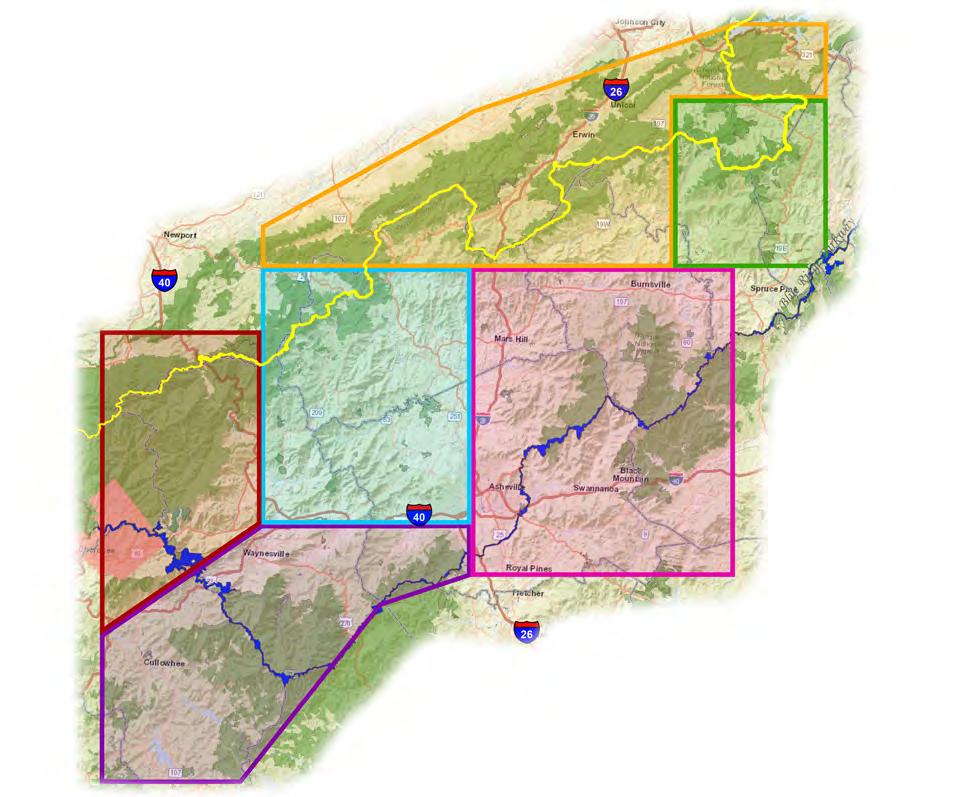
Wiles Creek pg. 4-6 Highlands of Roan
Smoky Mountains
French Broad River Valley
Mountains
Balsam Mountains
Mountain pg. 16-19 Appalachian Trail Countryside
Hominy Creek pg. 13-15
Lightwood
Mountain pg. 7-9
Deaverview
Welcome! VP of Operations – Jess Ashburn
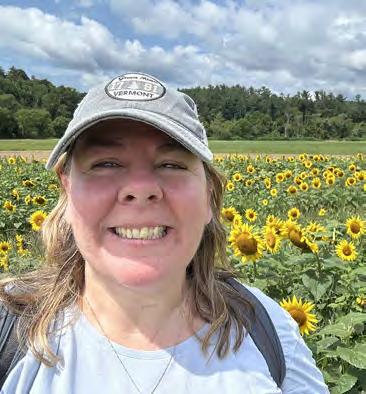
Jess Ashburn brings more than 20 years of experience in the nonprofit space, with a focus on helping mission-driven organizations build the systems and practices that allow people and teams to truly thrive. Her work blends structure and strategy with a deep belief in the power of people and purpose. Jess’s connection to the outdoors started early, growing up in North Florida where she spent her time canoeing, camping, and exploring state and national parks with her family. That early love of nature continues to shape how she shows up today. Now based in Asheville, she enjoys hiking and discovering new outdoor spaces with her two golden retrievers, along with a love for music and art. Jess holds a degree in International Affairs and a Master’s in Finance and Administration from Florida State University. Please join us in welcoming Jess!
Highlands of Roan Conservation Focus Area
Wiles Creek Preserve Addition
48 More Acres Protected in the Heart of the Roan Highlands
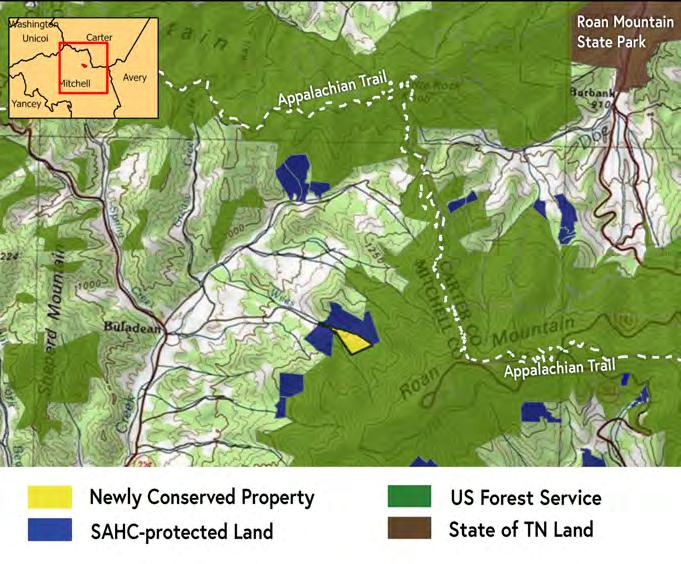
SAHC’s stunning Wiles Creek Preserve in the Highlands of Roan just got a little more spectacular. We recently acquired 48 acres that adjoin and expand the existing preserve, strengthening the protection of natural resources on both properties. Visitors to the Roan High Bluff and hikers along the Appalachian Trail, which passes less than a mile from the preserve, enjoy views directly onto this picturesque tract. SAHC’s acquisition of the land permanently protects pristine water resources as well as exceptional wildlife habitat.
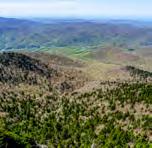
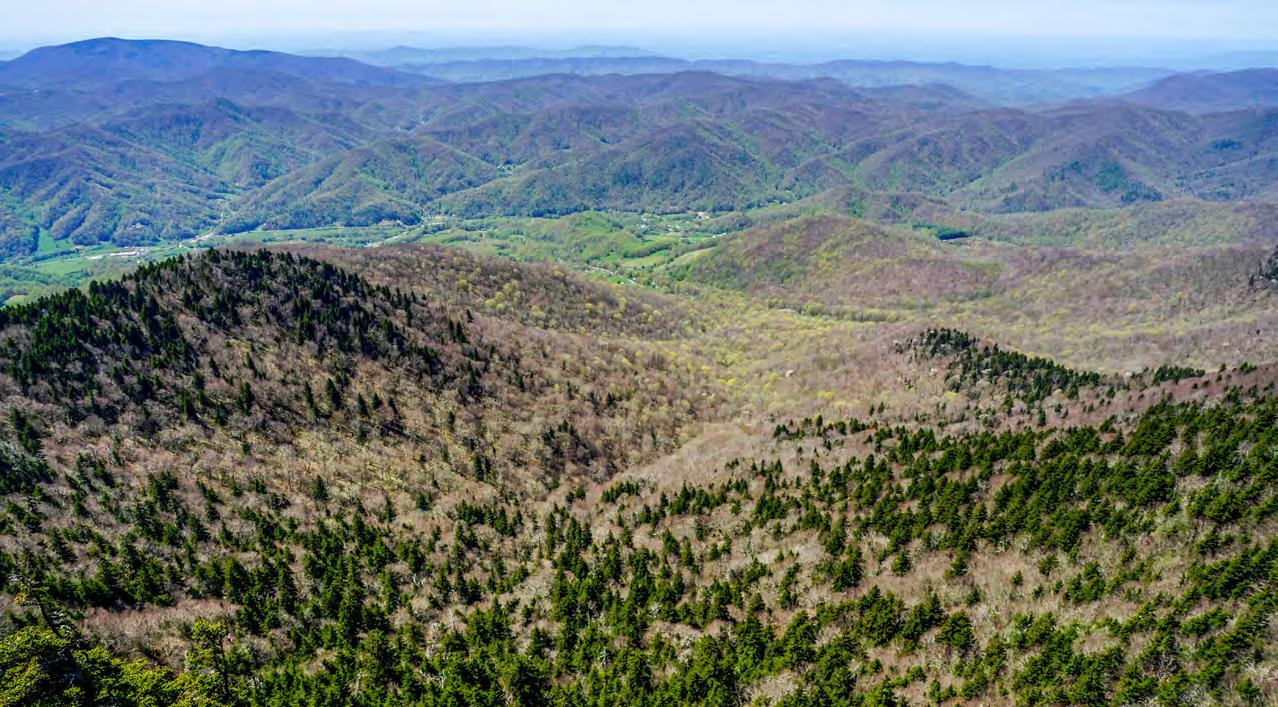
View from Roan High Knob, overlooking SAHC’s Wiles Creek Preserve. Photo by Travis Bordley
“I first visited this property before SAHC acquired the adjoining Wiles Creek Preserve in 2020,” shares Land Protection Director Michelle Pugliese. “It was one of those experiences when you reach the top of your hiking destination and turn around to be awed by the views. We already knew from the maps and natural resource data that we wanted to protect this property. Seeing it in person brought it to life. Now this special land will continue to provide habitat for rare species, and its slopes will remain unspoiled as seen by hikers on the Appalachian Trail.”
The recently acquired tract is surrounded by Pisgah National Forest and other SAHCprotected land. It contains northern hardwood forest and early successional forest that provide high quality habitat for rare species such as the Northern Saw-whet Owl and the Goldenwinged Warbler. Two tributaries of Wiles Creek, a NC Division of Water Resources Trout Stream, flow through the property.
Rising to 4,500 ft in elevation, the property is highly visible from various places within the Highlands of Roan, such as the Appalachian Trail (where it crosses through Iron Mountain Gap and along the northwest side of the Roan Mountain Massif), the Rhododendron Gardens (Roan High Bluff overlook), and NC 226 in the Buladean community.
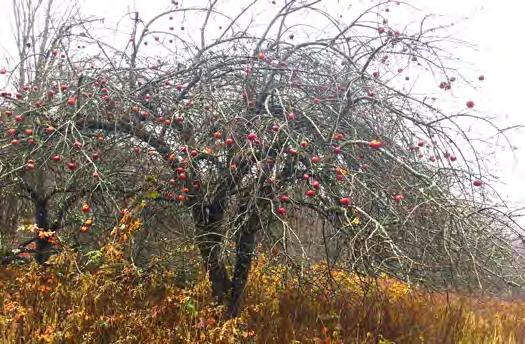
The western portion of the property was historically used for agriculture since the 1940s, including an apple orchard. Remnants of this agricultural use – the open fields, pond, and apple trees – are now important for wildlife. SAHC Board trustee Jeff Hatling has generously offered his time to identify and care for the heritage apple trees on the property.
Ecological Importance
“SAHC’s Wiles Creek Preserve is a microcosm of all the things that make the Roan Highlands so special,” says Roan Stewardship Director Marquette Crockett. “The lower elevations
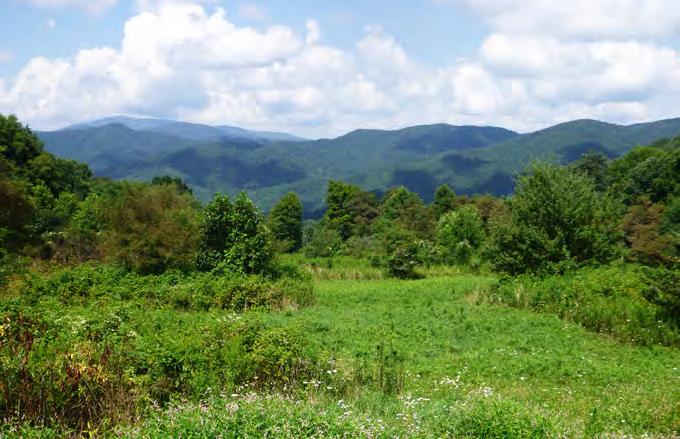
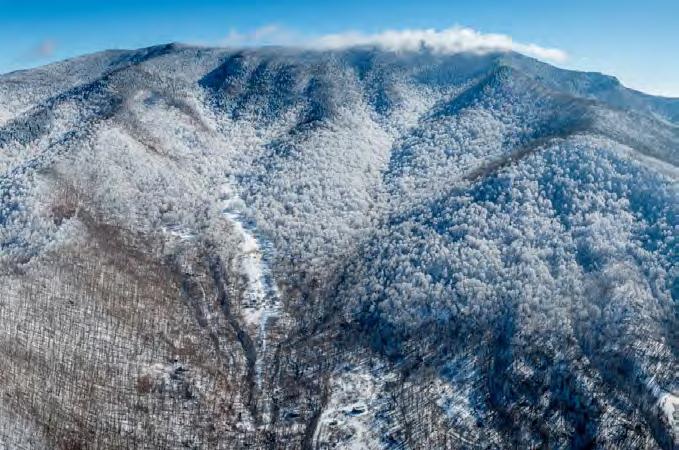
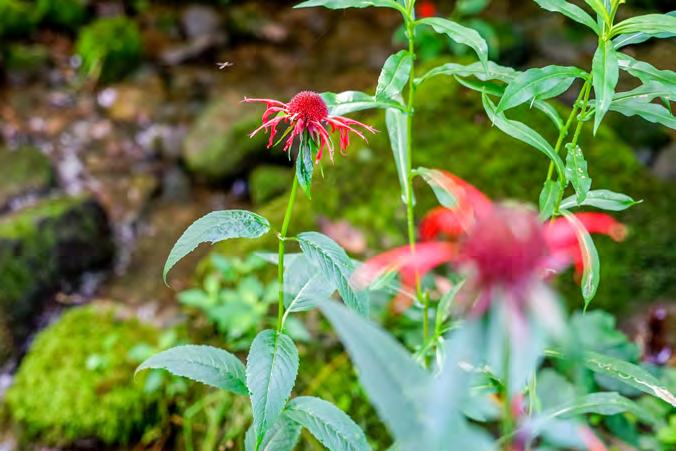
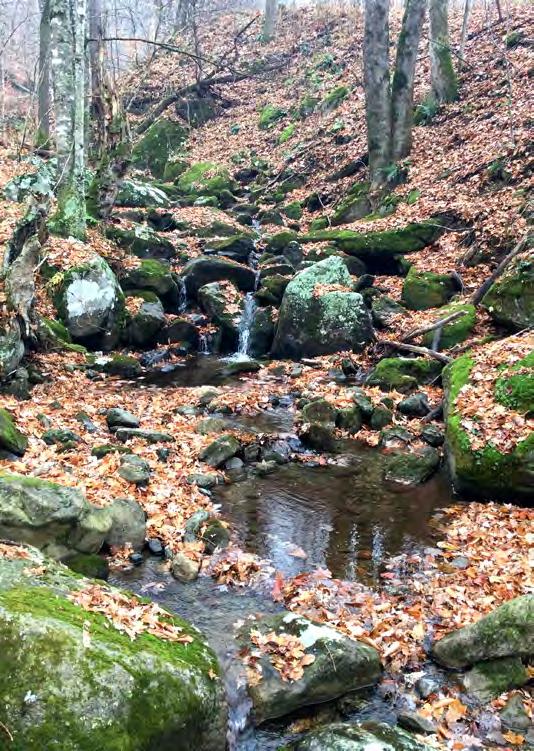
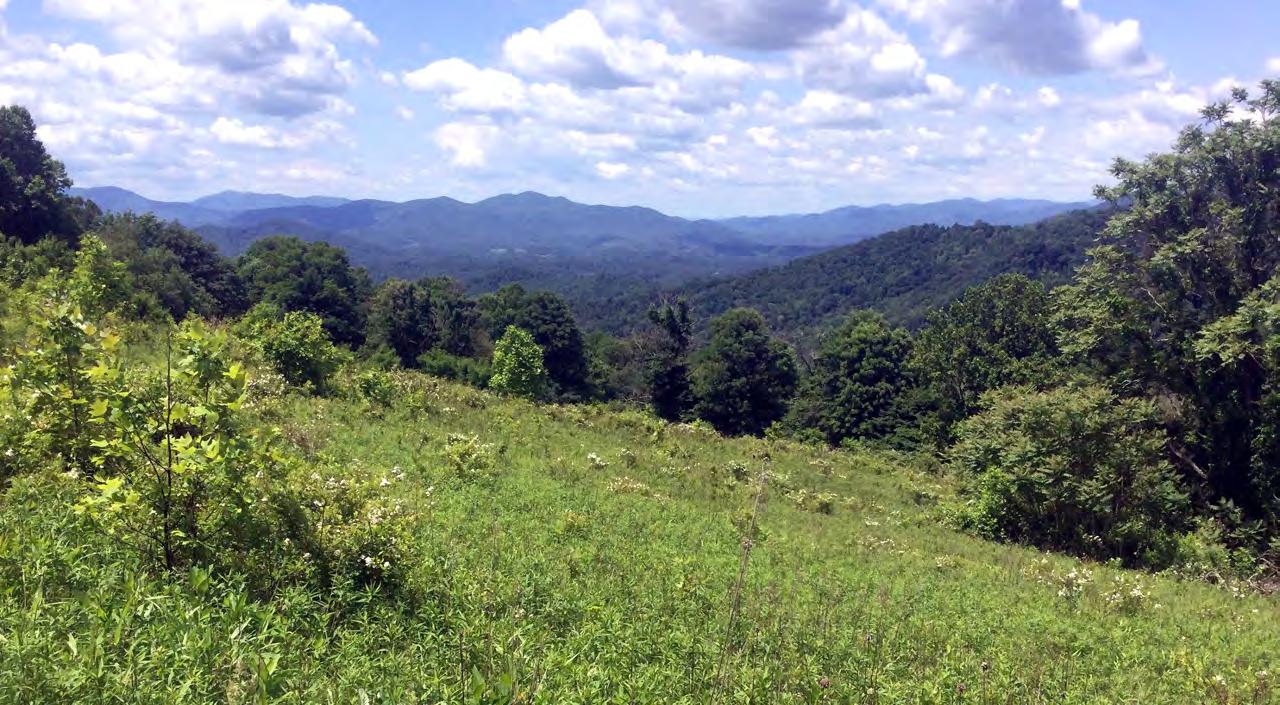
Wiles Creek is beautiful in any season. Top: The open field provides habitat for a variety of birds and other animals. Middle: The new preserve addition and open field are visible near the center of this winter view. Bottom: streams on the property provide pristine water; this red monarda (Bee balm) is a native plant favored by pollinators.
Photo by Travis Bordley
Photo by Travis Bordley
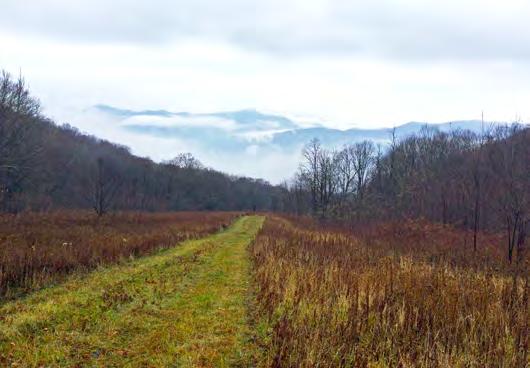
contain open meadows and early successional habitat used by Golden-winged Warbler. As you climb in elevation, the property – which is bisected by a trout stream –contains a high elevation vernal pool and rocky outcrops. The upper slopes transition to sprucefir habitat that connects to national forest land. This space feels very connected to the heart of the Roan. Permanently preserving the land closes a gap in our existing preserve and will make habitat management on the adjoining
land more effective. Fortunately, this property was also relatively untouched by Helene. We’ve seen
“SAHC’s Wiles Creek Preserve is a microcosm of all the things that make the Roan Highlands so special.” – Marquette Crockett, Roan Stewardship Director
some minor stream scouring, but not severe damage.”
“We’re excited about conducting a BioBlitz on Wiles Creek in August, in partnership with MountainTrue,” adds Marquette. “In a previous site visit, we saw
a wide variety of salamanders in seeps and springs on the property, and I’m excited to see what amphibians we find in the pond area. The meadow provides great growing space for native bee balm and black-eyed susan, supporting pollinators and other species. We know Goldenwinged Warbler breed on SAHC’s adjoining preserve. We look forward to surveying for them on the new property.”
Remnants of heritage apple orchards, open fields, and pristine streams support a robust population of birds and wildlife.
Highlands of Roan Conservation Focus Area
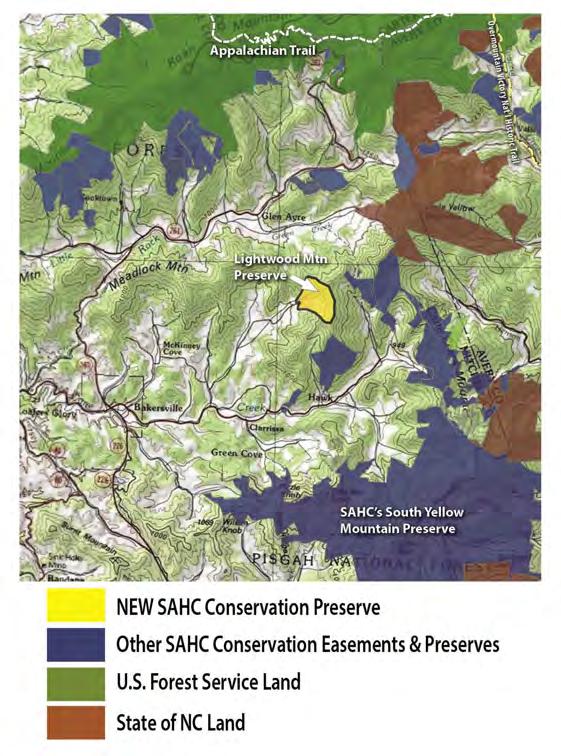
Lightwood Mountain
201 acres in Mitchell County
People will forever cherish legacies created by those who act with integrity and vision. With the generous donation of 201 acres in the Cane Creek township, Steve and Kathie Weaver have left an indelible mark on the southern Appalachian landscape for future generations.
“Thanks to Steve and Kathie’s generosity and passion for conservation, this beautiful land will be protected forever,” says Land Protection Director Michelle Pugliese. “People who have lived in this landscape for generations will continue to enjoy the beauty of the mountain ridges, and wildlife will continue to find refuge in the habitat provided here.”
Kathie and Steve Weaver donated 201 acres in Mitchell County for conservation.
Ecological Importance
The Mitchell County property is located within the Audubon Society’s Roan Mountain Important Bird Area, very near SAHC’s Hawk Spur Preserve and other protected land in the Yellow Mountain State Natural Area. The tract forms a bowl bounded by three high elevation ridgelines: Lightwood Mountain (4,720 feet) to Rock Creek Mountain (4,680 feet) to Rock Creek Gap (4,100 feet). The undeveloped ridgelines are critical for connected wildlife movement corridors. Preservation of the land also helps protect water quality in the Nolichucky River watershed. Six headwater streams originate on the property and flow into Young Cove Creek, a tributary of Cane Creek before it flows into the North Toe River (and subsequently the Nolichucky River).
When Goals Align
instead to retire to Wake County, NC, near other members of Kathie’s family. Recently, they faced a decision about what to do with the land.
research the organization and were inspired and reassured by SAHC’s reputation. When they decided to donate their land for permanent protection, they felt that SAHC was a good fit.
“We appreciated SAHC’s mission goals to protect scenic vistas, watersheds, wildlife habitat, and places for people to enjoy outdoor recreation,” shares Steve. “All four of those principal goals meshed with our goals completely. We were glad to donate the land for conservation; it will be our legacy.”
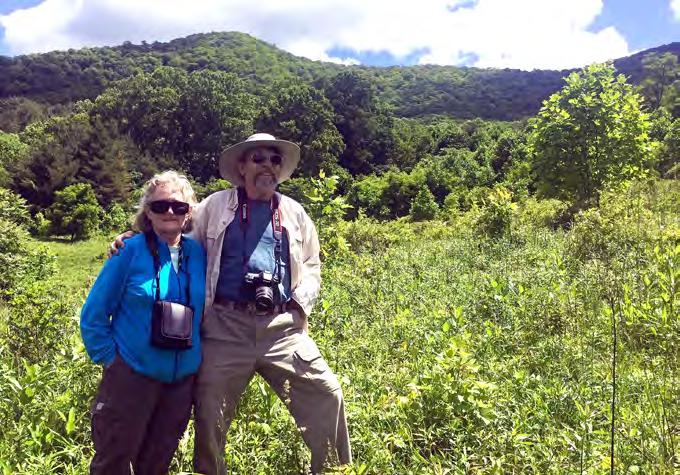
“We were glad to donate the land for conservation. It will be our legacy.” –Kathie and Steve Weaver
Several decades ago, Steve and Kathie Weaver set out to find a place where they would be able to settle to enjoy retirement. About 20 miles north of Mt. Mitchell, they found the perfect tract of land – a large wooded and farm tract which included the top of Lightwood Mountain. However, they eventually decided
“We’d owned this tract for 30 years, and we didn’t just want to sell it,” explains Steve. After Steve’s long career in parks and recreation in North Carolina and Nevada, the couple acutely appreciated the importance of land for public enjoyment and ecological services.
“It’s just a beautiful piece of property, and we wanted it to serve some public benefit.”
The Weavers had learned about Southern Appalachian Highlands Conservancy’s work in the surrounding area, particularly the preservation of the 7,500-acre South Yellow Mountain Preserve donated to SAHC in 2024. They set out to
Memories of the Land
Although they have deep roots in NC, while Steve and Kathie owned the Mitchell County land they lived in Nevada until around 2011. During that time, they returned to NC about once a year and visited the property to hike, enjoy, and manage the land.
“We walked all over the property in our younger days, around the perimeter along the ridgelines,” shares Steve. “There are some beautiful views of Mt. Mitchell from some of the higher elevations. And near the top we found an exploratory mine. It was a small space with hand-dug holes that never produced anything significant, but you can still see mica fragments shining around.”
The Weavers purchased the property from Genevieve (Buchanan) Holder, who had lived there with her husband Clifton Holder in their younger days. The house on the property burned in 1954, and no one has lived on it since. However, open pastures cleared for the farmstead create excellent habitat spaces.
“There were several kinds of heritage apples in the old apple orchard,” recalls Steve. “They were good apples! The bear and deer liked them, too. We would often see claw marks from bears climbing the apple trees. We’ve also spotted large flocks of wild turkey, deer, and a variety of birds. There were close to 50 acres in
pasture when we purchased the property; a neighbor grazed cattle on it for a number of years.”
Reflecting on other interesting tidbits about the land, Steve shares, “There’s a historic mail route that goes along one edge of the property. It was the mail route between Bakersville and Glen Ayre, and you can still see remnants of that trail now, where it went zig-zagging up and over the top of Rock Creek Gap.”
Towards the Future
SAHC plans to own and manage the land as a nature preserve for the long-term.
“We’re excited about continuing
to manage the land for wildlife habitat, and sharing it with others through guided outings in our Connecting People with Land program,” adds Michelle. “The generosity of the Weavers will go a long way in securing this corner of the mountains for the benefit of people, plants, water, and wildlife. We are deeply grateful to them for donating the property for conservation, and to our generous philanthropic leaders and members whose support made it possible to cover the transaction costs of this project. This is such a beautiful property, and a beautiful success story we’re thrilled to share.”
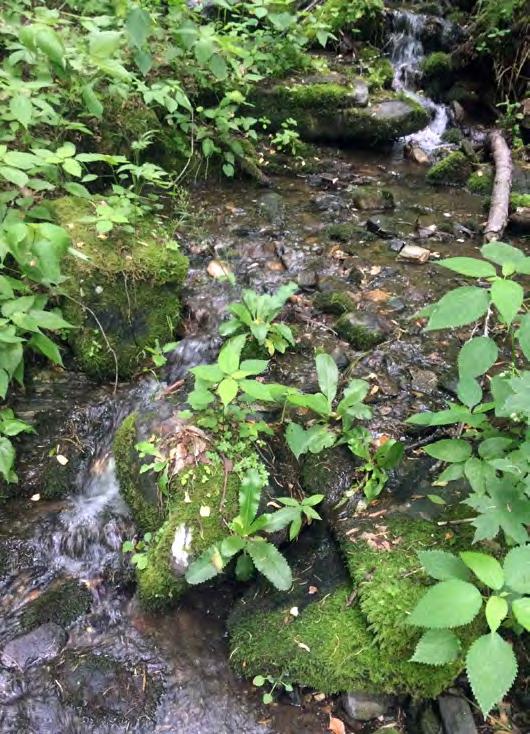
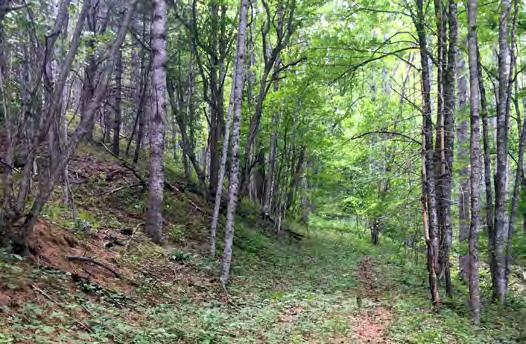
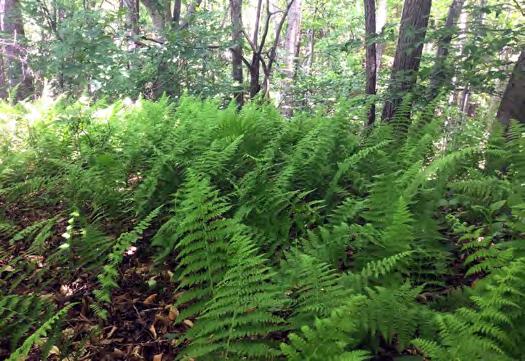
Cascading streams, healthy forests, and lush undergrowth contribute to the natural beauty and ecological importance of the mountain.
Appalachian Trail Countryside Conservation Focus Area
Cane River Confluence
Where the North Toe and Cane Rivers form the Nolichucky
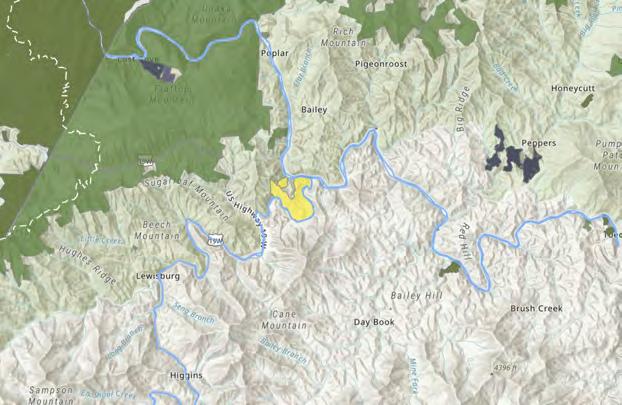
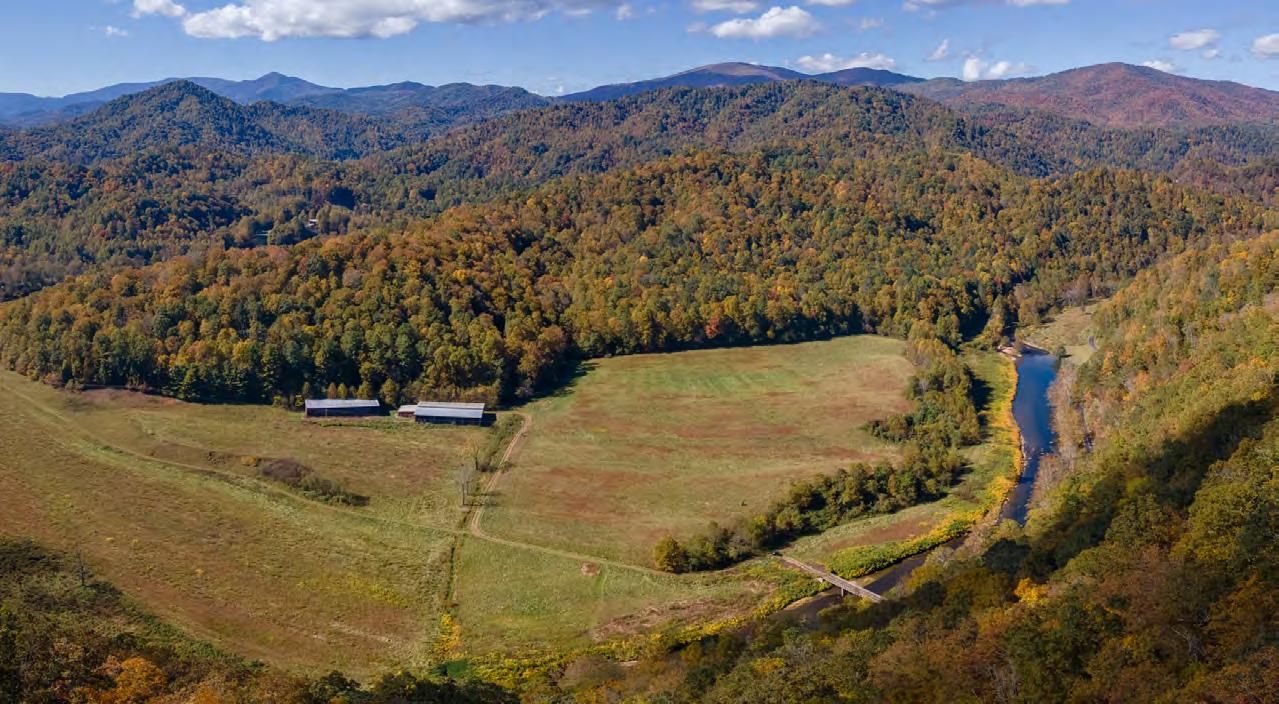
In November 2025, Southern Appalachian Highlands Conservancy purchased 433 acres in Yancey County at the confluence of the Cane River and the North Toe River, where these rivers merge to form the Nolichucky River.
The acquisition permanently protects natural resources, aquatic habitat, and a substantial stand of native river cane. The tract has more than 3 miles of frontage on the Cane and Nolichucky Rivers, which are a US Fish and Wildlife Service Critical Habitat for the endangered Appalachian Elktoe mussel, and which provide exceptional habitat for other rare species.
Aerial image of SAHC’s new Cane River Confluence Preserve.
“SAHC’s new Cane River Confluence preserve showcases extraordinary beauty and critical natural resources,” says Land Protection Director Michelle Pugliese. “The presence of rare and culturally important river cane for Native artisans, as well as vitally important water resources, makes this acquisition a spectacular success story.”
Forested slopes on the property reach just under 3,000 ft in elevations, and more than 90 acres of open pasture spread across the lower elevations of the tract.
Ecological Importance
The property includes and adjoins riparian areas and waterways that provide habitat for federal and state threatened and endangered species, and species of special concern, including the Appalachian elktoe (Alasmidonta raveneliana), wavy-rayed lampmussel (Lampisilis fasciola), blotched chub (Erimystax insignis), and eastern hellbender (Cryptobranchus alleganiensis). A significant stand of river cane, a culturally important native species, thrives on the land. Future expansion of the river cane habitat could assist with stream restoration and help mitigate against future
flooding impacts in the region.
River Cane
“This rare and culturally significant site contains one of the largest remaining stands of river cane, a plant essential to Cherokee cultural practices,” says Dr. Caleb R. Hickman,
of the Eastern Band of
Supervisory Biologist
benefits – buffering floods, filtering agricultural runoff by more than 90%, and providing habitat for rare species like the Swainson’s Warbler and northern long-eared bat. With partners like the University of Georgia, we are studying how traditional harvesting enhances cane regeneration and patch stability over time.”
“SAHC’s acquisition of the land protects culturally significant river cane and important water resources.” – Michelle Pugliese, Land Protection Director
Cherokee Indians (EBCI) Natural Resources Department and Citizen of the Cherokee Nation. “For generations, we have used river cane to make baskets, blowguns, mats, and ceremonial tools. These practices are not just art – they are acts of identity, resilience, and intergenerational teaching. River cane has declined by more than 98% since colonization, and yet it offers powerful ecological
River cane is one of three native bamboo species in the southeastern United States. A dense patch of river cane, called a canebrake, is considered a critically endangered ecosystem. In 2012, river cane was added to the Cherokee Nation’s Culturally Protected Species list.
SAHC’s new Cane River Confluence preserve contains one of the largest remaining canebrakes in North Carolina, and among the largest in the southeastern United States.
Canebrakes help stabilize streambanks; study plots on the property withstood recent major flood events, including flooding from Tropical Storm Helene.
EBCI had permission from the former owners to sustainably harvest river cane from the property, for use in artisan
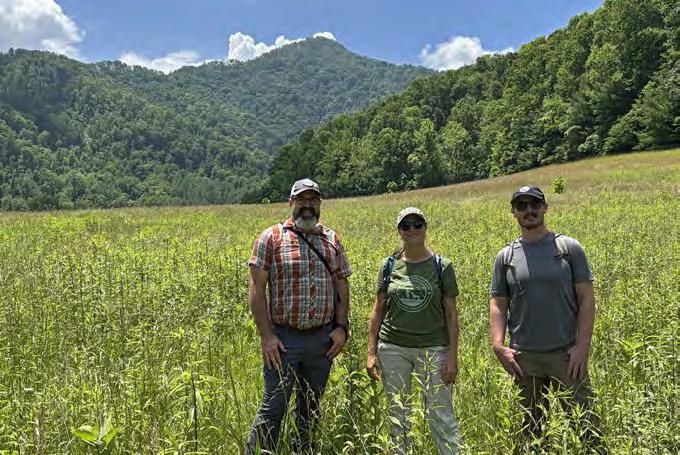
L to R: Damon Hearne (NC Land and Water Fund), Michelle Pugliese & Chris Kaase (SAHC)
crafts. Working with the former landowner, the EBCI Natural Resources program partnered with a University of Georgia PhD student to study the river cane on this property and to evaluate different management strategies and artisan harvesting impacts. SAHC’s purchase of this property will preserve access for the EBCI and its partners to this significant canebrake.
“When we were provided access to this site in 2023, it enabled one of the largest traditional cane harvests in recent memory,” adds Caleb. “Dozens of Cherokee artisans, elders, and youth gathered not only to harvest but to learn, share, and reconnect with a plant and place rooted in ancestral memory. That kind of opportunity is rare, and it matters deeply. SAHC has shown genuine commitment to supporting Cherokee cultural
renewal through land access and stewardship.”
Preserving Land and Water
SAHC plans to own and manage the property for the long term, to preserve the natural and cultural resources of the site. Stewardship and GIS Manager Chris Kaase is currently developing the stewardship land management plan for the property, and building relationships with the EBCI.
“Protecting this land, with its unique combination of natural and cultural resources, is a oncein-a-generation opportunity,” says Land Protection Associate Kyle Shute. “We are so grateful for this opportunity to engage in critical partnerships that allow for the protection and future stewardship of the river cane and unique aquatic habitat and species.”
The purchase was made possible by generous private donations, a temporary (i.e. bridge) loan, grant funding from the NC Land and Water Fund (NCLWF), and a supporting Appalachia Rising grant through Re:Wild.
“The North Carolina Land and Water Fund is excited to support protection of the Cane River Confluence property,” says Will Summer, Executive Director of the NCLWF. “In addition to supporting conservation of riparian bottomlands and buffers, the opportunity for collaboration with the Eastern Band around the exceptional river cane canebrake is very exciting. We have funded many restoration projects that hope to bring river cane back to degraded stream banks, so supporting protection and study of such a robust existing occurrence is a great next step.”
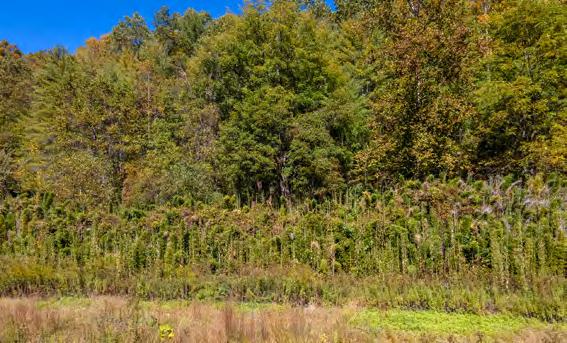
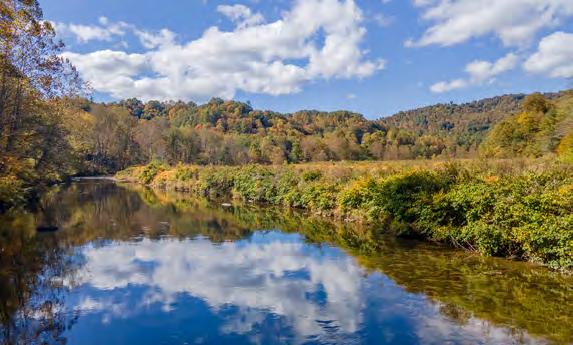
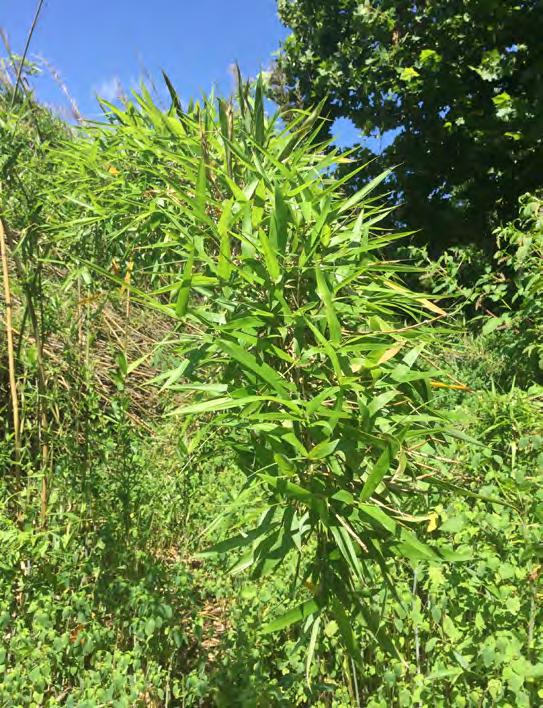
Clockwise: Close-up of river cane stalk; edge of river cane stand; river frontage along the conserved property.
Balsam Mountains Conservation Focus Area
Hominy Creek
Stream Restoration and future expansion of Chestnut Mountain Nature Park
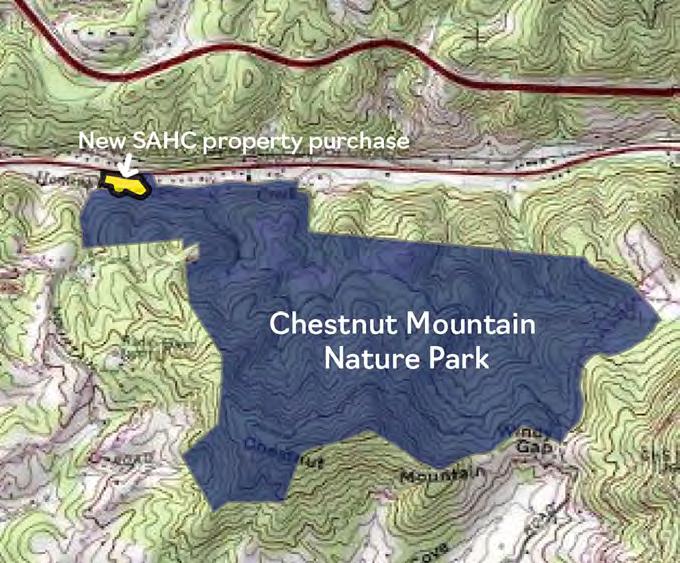
Southern Appalachian Highlands Conservancy recently purchased a 4.16-acre property adjoining Chestnut Mountain Nature Park in order to facilitate future park improvements and conduct a stream restoration project to lessen flooding impacts and strengthen regional resilience for future storm events.
Funding from the NC Flood Resiliency Blueprint program was awarded to support this project.
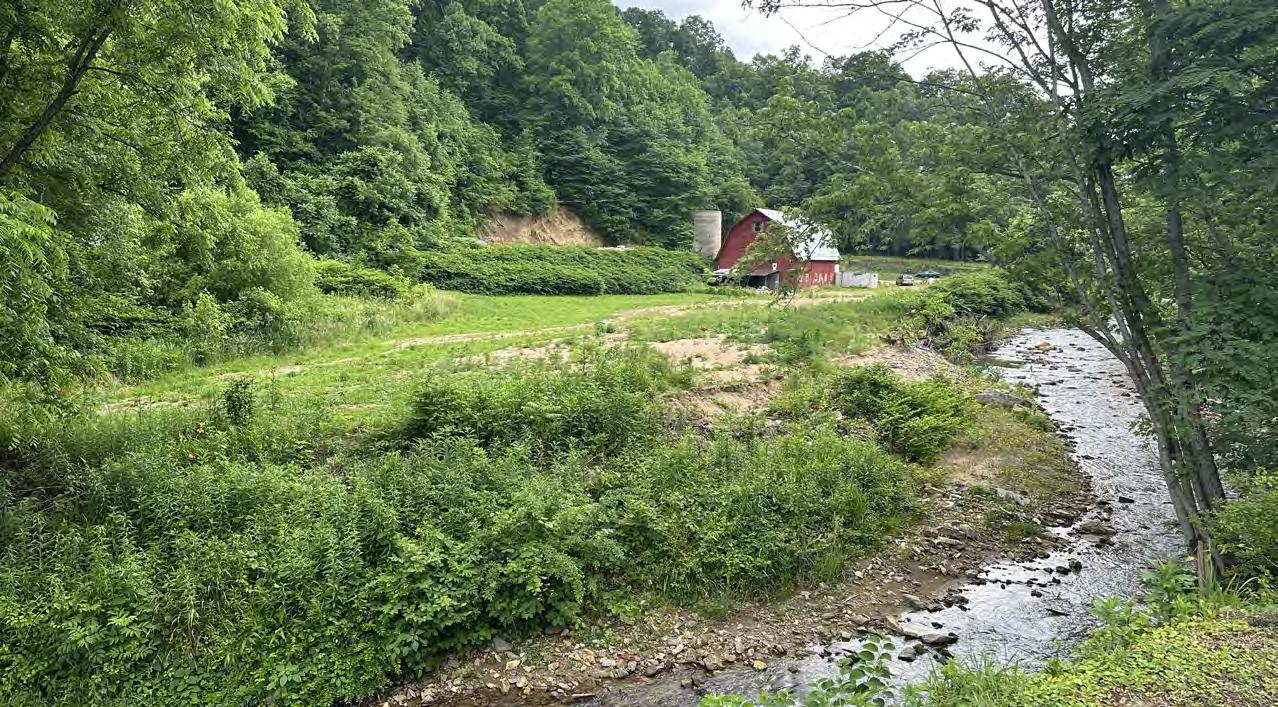
Hominy Creek flows along and on the recently conserved land. SAHC will conduct a stream restoration project here to help mitigate future flooding.
A Win-Win-Win Outcome
“This parcel is just upstream of Chestnut Mountain Nature Park on Hominy Creek, and SAHC’s purchase of the land allows for potential expansion of the park while mitigating future flood damage,” says Conservation Director Hanni Muerdter.
“Hominy Creek has been hit hard by storms over the past 25 years, including by storms Fred and Helene. Flooding from Helene damaged the bridge which provides access into Chestnut Mountain Nature Park. SAHC will conduct a stream restoration project on the recently acquired tract to provide flood storage, which will help protect the adjacent park and other properties downstream.”
valley, this Haywood County stretch of Hominy Creek is consistently one of the hardest areas hit from flood damage. After experiencing major flooding multiple times in the past 25 years, the landowners were ready to sell. They listed the property for
“SAHC’s purchase of the land allows for potential expansion of park while mitigating future flood damage.”
– Hanni Muerdter, Conservation Director
sale on the real estate market, and the Town of Canton reached out to SAHC for assistance in purchasing the land for a park expansion.
The property straddles Hominy Creek with a significant portion of land in the floodplain. As a narrow
“This tract has significant road frontage on Asheville Highway and could have been purchased for commercial storage or development, since development in floodplains can be possible with meeting certain
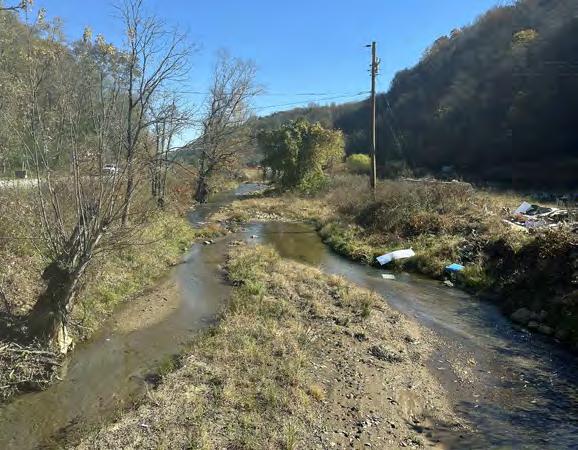
requirements,” says Hanni. “But such development would have likely worsened impacts and damage during future flooding events. The existing floodplain offers an excellent restoration opportunity to mitigate such future flood impacts. We’re excited to work with the landowners and the Town of Canton to help them meet their goals. The landowners wanted to sell, the Town wanted to add more easily accessible areas to the park, and SAHC is proud to help improve flood resiliency in the Hominy Creek area. It’s a wonderful outcome all the way around.”
SAHC plans to transfer the property to the Town of Canton after the stream restoration project is complete. The relatively flat
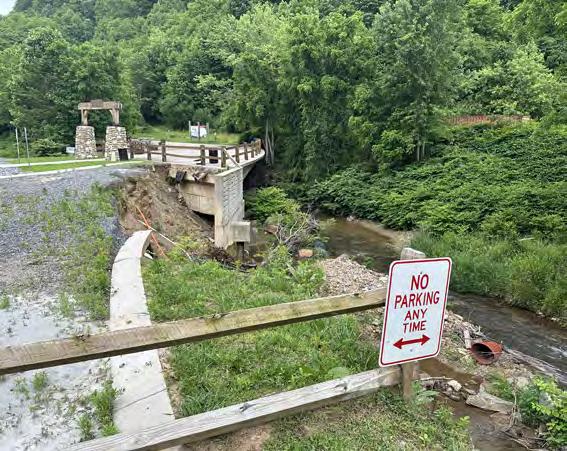
In previous years, successive flooding events left debris piled on the property and damaged the Chestnut Mountain Nature Park access bridge. SAHC’s purchase of the tract will enable us to conduct a stream restoration project to help mitigate future flooding events.
parcel could enable expansion of recreational creekside access and accessible walking trails close to the park’s entrance. Conservation of the land also helps protect the park’s aesthetic appearance from incompatible commercial development.
SAHC’s purchase of the property was made possible by contributions from SAHC donors and members, and a grant from the Mountain Revolving Loan Fund of the Conservation Trust for North Carolina.
Stream Restoration
Hominy Creek is a major tributary of the French Broad River. Brown trout live in the creek, and the stream corridor is an important seasonal migration corridor for the federally endangered gray bat. SAHC is working with Jennings Environmental on the stream restoration plan for the property. This restoration project may include re-routing Hominy Creek farther from Asheville Highway/ US 23 (thus better protecting the public road), benching the floodplain, and implementing nature-based solutions, plantings and stabilization measures in partnership with Haywood Waterways Association. These interventions are projected to provide approximately up to six-acre-feet of additional flood storage capacity and will substantially reduce the risk of future flood damage to Asheville Highway and the entrance to public Chestnut Mountain Nature
Park. As part of the restoration, we removed Helene-related debris, in partnership with Haywood Waterways Association’s debris removal program funded by NC Dept. of Environmental Quality.
“With frontage on Asheville Highway, adjacency to the public Chestnut Mountain Nature Park, and plans for the property to be used as a resilient park addition, this project site will be seen by a lot of people,” adds Hanni. “We look forward to sharing this stream restoration as a model project for future flood resilience planning in our region.”
SAHC was awarded a $470,000 grant from the NC Department of Environmental Quality’s (DEQ) NC Flood Resiliency Blueprint program, to fund this project. The Blueprint program is the largest statewide flood mitigation investment in North Carolina history – a science-based and stakeholder-driven initiative designed to support the planning, evaluation, and implementation of flood resilience strategies.
“Communities throughout our mountains were devastated by Helene, and we know that storms are becoming more intense and more frequent throughout North Carolina,” says DEQ Secretary Reid Wilson. “These Flood Resiliency Blueprint projects will make communities less vulnerable to future flooding in the French Broad River Basin and will help save lives, homes, and businesses. We appreciate the General
Assembly’s strong support of the Flood Resiliency Blueprint.”
A Continuing Partnership
This project is a continuation of SAHC’s partnership with the Town of Canton. In 2020 SAHC purchased the 448-acre Chestnut Mountain property in an ambitious endeavor to pair permanent protection of habitat and water resources with creation of a conservation-friendly, communitycentric space for outdoor recreation. SAHC transferred the property to the Town of Canton in 2022. Located in an important wildlife corridor, the large property includes diverse ecological communities, streams that flow into Hominy Creek, and the top of Chestnut Mountain.
SAHC partnered with the Town of Canton and an excited group of partners and funders to bring this vision to fruition – a nature park in which habitat and water resources are permanently protected by conservation easements, with areas open for people to enjoy, explore, and learn about nature. A space within Chestnut Mountain Nature Park, once slated for development as a motorsports speedway, has become the site of the popular mountain biking skills course Berm Park.
French Broad River Valley Conservation Focus Area
Deaverview Mountain
A Beloved Mountain Overlooking Asheville – Saved!
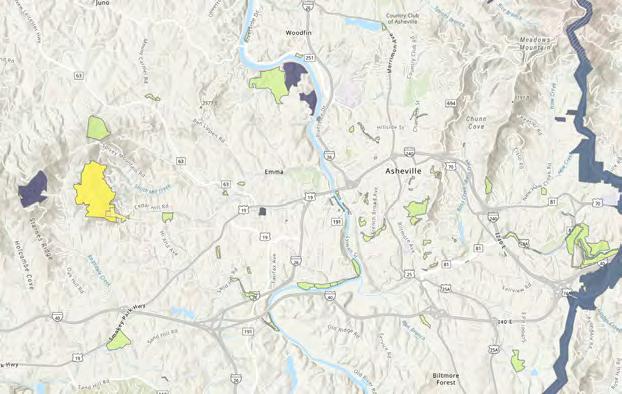
Deaverview Mountain Property
SAHC-Conserved Land
Municipal or Protected Land
After years of partnership efforts, the crest of Deaverview Mountain overlooking Asheville and surrounding areas has been permanently protected! For more than five years, Southern Appalachian Highlands Conservancy has been working on a permanent conservation solution for the land.
In March, Buncombe County Government closed on the purchase of the 342-acre Deaverview Mountain property. The acquisition enables the creation of a new Buncombe County public park on the site, while preserving this significant natural asset in partnership with SAHC.
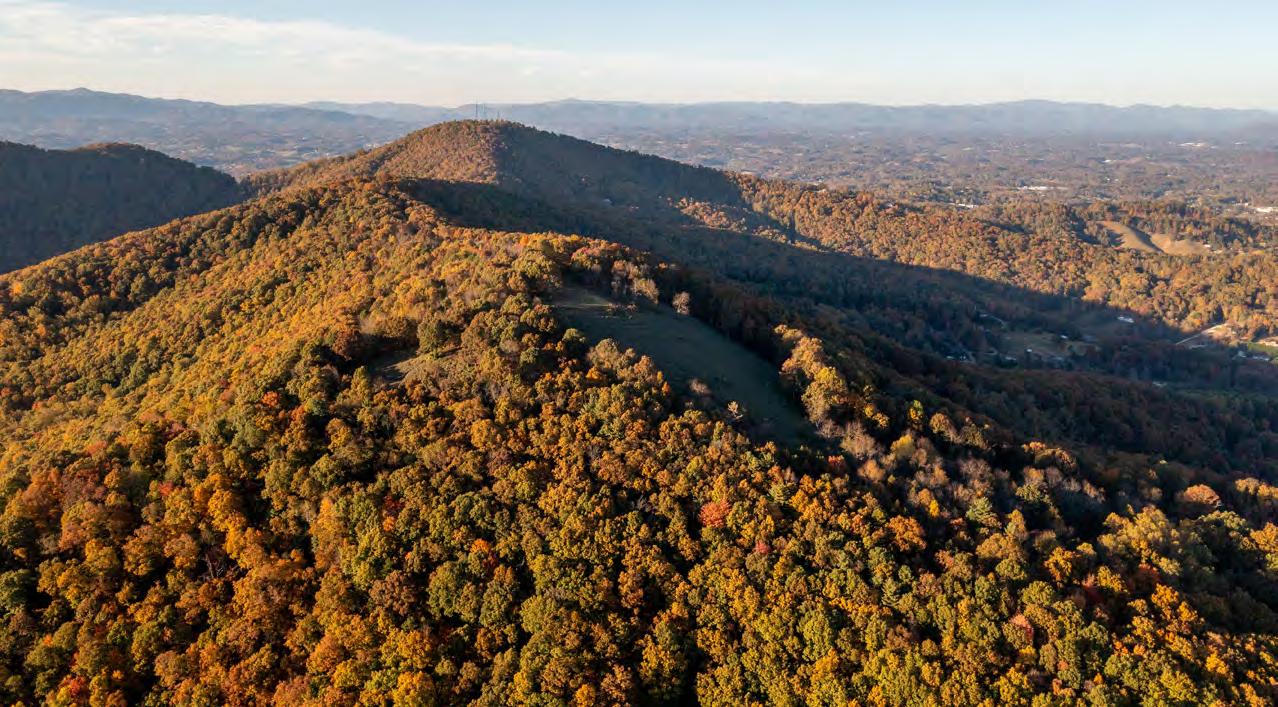
Deaverview Mountain, photo by Gary Hurley (Carolinas Nature Photographers Association/CNPA)
“We’re grateful for this partnership with the County and the opportunity to combine conservation and recreation on this beloved mountain to benefit the people of the county, state, region, and beyond,” said Land Protection Director Michelle Pugliese. “I’m thrilled that now it will be permanently protected and made available for all people to explore and connect with nature for their physical, mental, and emotional health.”
Deaverview Mountain – situated next to but sometimes confused with Spivey Mountain – has long been a beloved place. A few years ago, the Deaverview Mountain property was listed for sale under the subdivision name ‘The View of Asheville.’ The online property listing touted ‘Outstanding views from the property extend[ing] to the horizon line over layers of mountain ridges in all directions.’
Reciprocally, the mountain features prominently in views from downtown Asheville, the Biltmore Estate, Mt. Mitchell, Mt. Pisgah, the Grove Park Inn, the French Broad River, and more.
The seller of the property had an approved 21-estate-lot development plan on file. To take the land off the market and remove the immediate threat of development, a conservation-minded buyer purchased the property in March 2023 and signed a 3-year option agreement with SAHC, providing us time to work out a permanent conservation solution.
Over the next three years, SAHC diligently identified and secured funding sources in partnership with
Buncombe County to enable the property to be purchased and permanently protected.
SAHC assisted Buncombe County in purchasing the land to create a park featuring hiking, passive recreation, and opportunities for outdoor education.
“The proximity of the mountain to existing public transportation infrastructure, the Johnston Elementary School, and local neighborhoods meant that a conservation and recreation outcome could be very desirable for this property,” said Michelle.
Future Park Plans
“We have been talking about protecting Deaverview Mountain for years,” said Executive Director Carl Silverstein. “The ridges surrounding Asheville are dotted with residential subdivisions, but this mountain begs for a different fate. It is part of our collective imagination and history – visible from the Biltmore estate, the airport, and from the Blue Ridge Parkway. It’s the backdrop for Asheville in ‘Land of the Sky’ postcards going back to the 1930s, and needs to remain for people in Buncombe County and the region to enjoy forever.”
“Deaverview Mountain is a treasured part of our community,” said Buncombe County Parks and Recreation Director Allison Dains, “preserved not only for its natural beauty but also as a space for outdoor recreation, environmental education, and connection with nature.
Protecting it as a public park ensures that residents and future generations can experience, learn from, and be inspired by this unique landscape.”
With the closing on the property now complete, Buncombe County Parks & Recreation has issued a Request for Qualifications (RFQ) for the design of the park. The project will be completed in multiple phases, with this first design phase expected to begin this summer. Though the property remains closed to the public
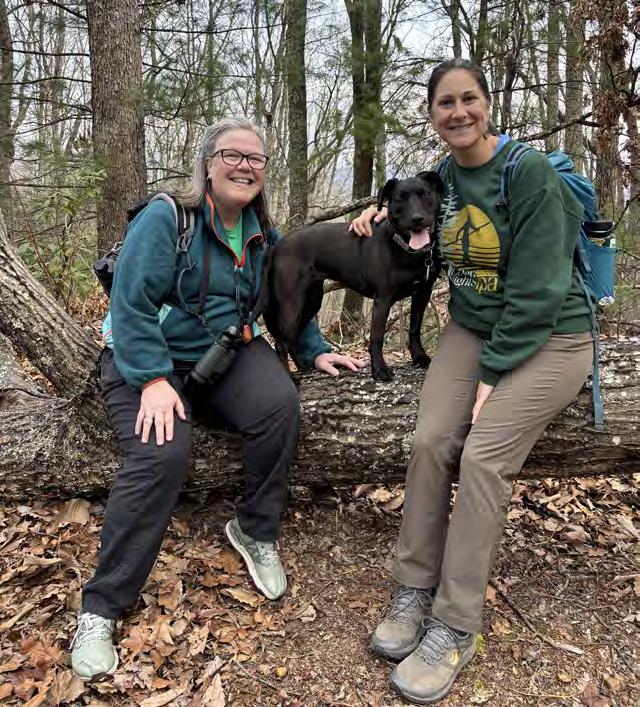
L to R: Buncombe County Parks and Recreation Director Allison Dains, Maya, and SAHC Land Protection Director Michelle Pugliese
Conservation Highlights
• A 3,118 ft mountain peak
• Sixteen (16) headwater streams
• Forested habitat
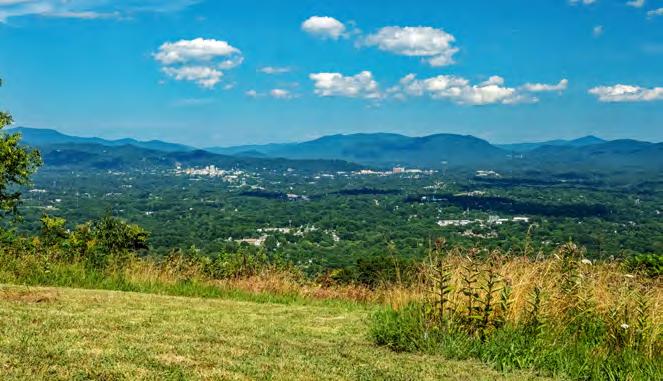
• Scenic beauty and open space with stunning 180° views throughout the French Broad River Valley
at this time, the purchase is a big step toward creating what will be the largest Buncombe County park.
Funding Conservation Success
The purchase of the land was funded primarily through two grants: an Outdoor Recreation Legacy Partnership Program (ORLP) grant awarded to Buncombe County and a North Carolina Land and Water Fund (NCLWF) grant awarded to SAHC.
The Outdoor Recreation Legacy Partnership grant program provides funding to enhance recreation opportunities in rural and urban communities. A program of the Land and Water Conservation Fund (LWCF), Congress established ORLP in 2014 to fill crucial gaps in urban access to recreation. The ORLP is managed by the National Park Service and funded through the LWCF; the program provides matching grants up to 50% of total project costs.
The NC Land and Water Fund is a program of the Division of Land and Water Stewardship within the North Carolina Department of Natural and Cultural Resources.
Since its creation in 1996 by the General Assembly, the NCWLF, formerly known as the Clean Water Management Trust Fund, has conserved well over one-half million acres and protected or restored 3,000 miles of streams and rivers.
“We are thrilled that
many parts of our agency came together to support this exciting project, including the North Carolina Land and Water Fund and the Division of Parks and Recreation through crucial federal funding,” said N.C. Department of Natural and Cultural Resources Secretary Pamela B. Cashwell.
“This new park will be the first large open space accessible to everyone in town, including nearby underserved communities that may not have ready access to a car.”
“We would not have reached this extraordinary position without our partners at the NC Land and Water Fund,” added Michelle.
“The continued support of our state’s elected officials and the Land and Water Fund’s staff and board have been a pivotal key to unlock meaningful conservation across the state. We are grateful for the ongoing vision that makes this fund possible.”
We’re deeply grateful to the Green South Foundation for being a critical partner in conserving Deaverview mountain. SAHC’s work on this project was also supported by a grant from The
View from atop Deaverview Mountain – photo by Courtland White, CNPA
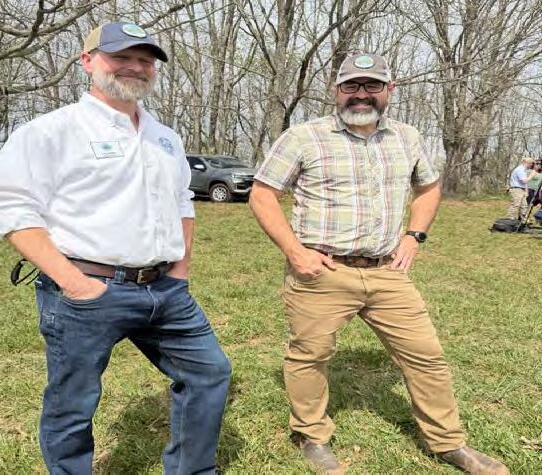
L to R: Will Morgan and Damon Hearne, NC Land and Water Fund

Conservation Alliance and generous donations from The Biltmore Company and SAHC members.
Looking Ahead
Now that the land has been acquired, Buncombe County staff will move forward with design and planning work, and input from the community, all of which will guide the adaptation of amenities that balance recreation and conservation goals.
SAHC will continue to be involved in the long-term protection of the land and water resources on the mountain. Because the land was secured with a NC Land and Water Fund grant, there is a conservation
easement held by the State of NC that permanently protects the conservation values of the mountain (such as the streams and water resources). SAHC will monitor the conservation easement to protect the conservation values of the property in perpetuity.
“As a conservation land trust, Southern Appalachian Highlands Conservancy protects a lot of land situated in remote areas of the Southern Appalachian mountains, in places that very few people will set foot on,” said Senior Advisor to the Board Jay Leutze.
“Sometimes we’re protecting habitat for rare species, and the fragile nature of those species and their habitat means that many of
those places are not appropriate to have a lot of visitation. This project is so unique because the mountain is close to town and a perfect place for the public to come. With the county’s acquisition of this property for a future park, we can take pride in knowing that for generations this will be a favorite place to go. When people come to visit, local folks will say, ‘You can’t leave town until you’ve visited Deaverview Mountain.’ I’ve been fortunate to have enjoyed visiting and caring for this land in the time SAHC had access to it, while we’ve been working on this project. Now, it will be a part of the rich history of people and land in WNC, forever.”
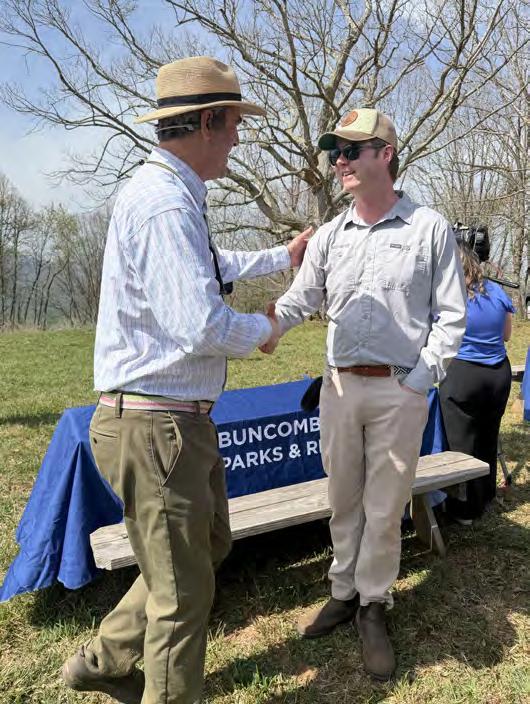
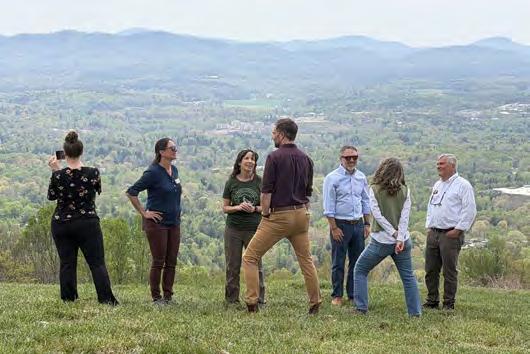
Photos from Buncombe County & SAHC joint press conference announcing the purchase. Clockwise: SAHC Senior Advisor to the Board Jay Leutze greets Chase Pickering, Vice President of Guest Experience - Biltmore; SAHC Executive Director Carl Silverstein speaking at the event (photo courtesy Buncombe County); Buncombe County commissioners, SAHC staff and Board trustees, and other guests take in the view from the top of the mountain.
French Broad River Valley Conservation Focus Area
Hawkins Farm
Preserving a Family Farm in Haywood County
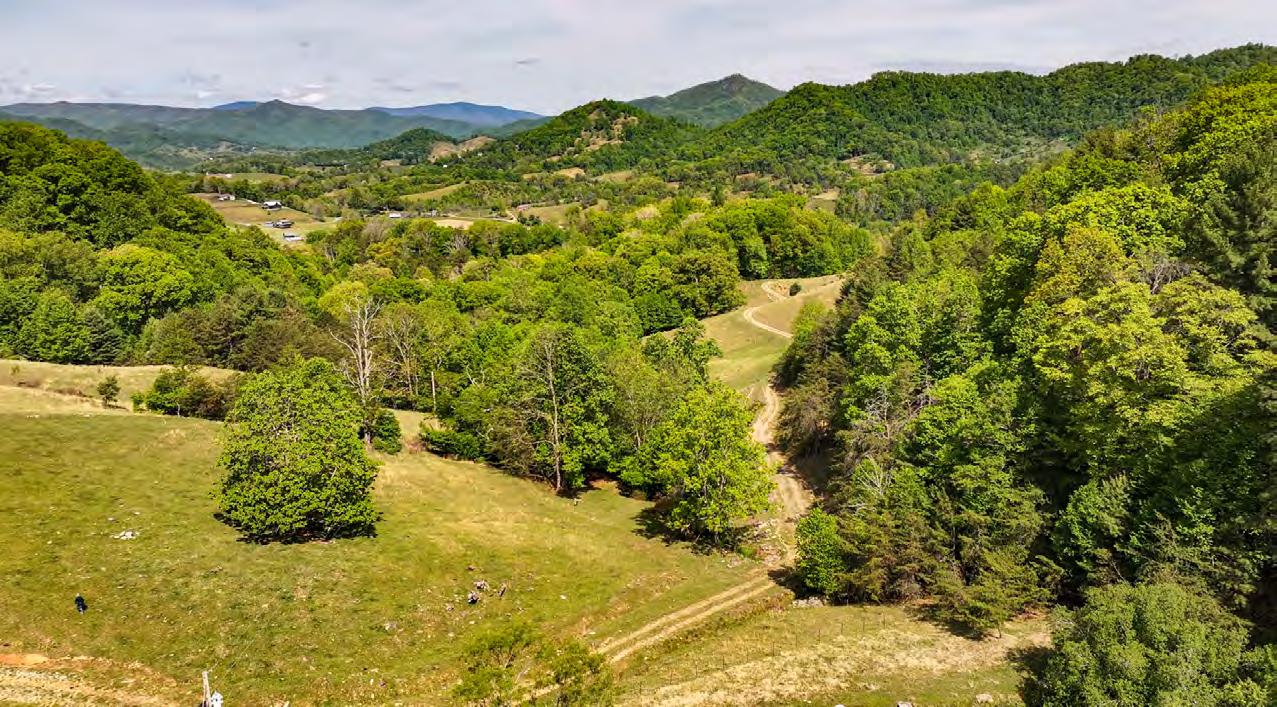
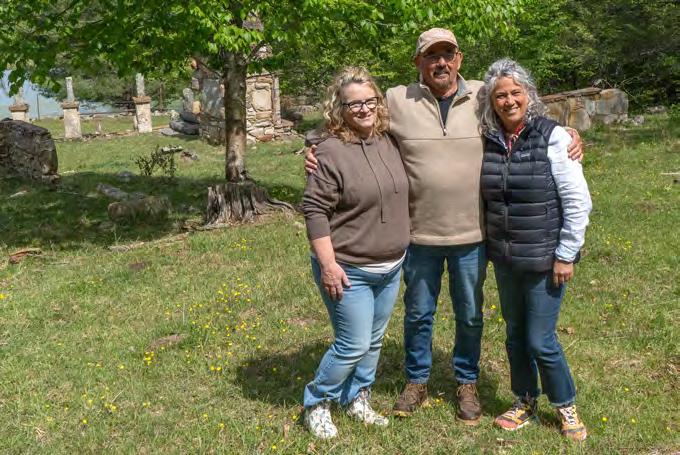
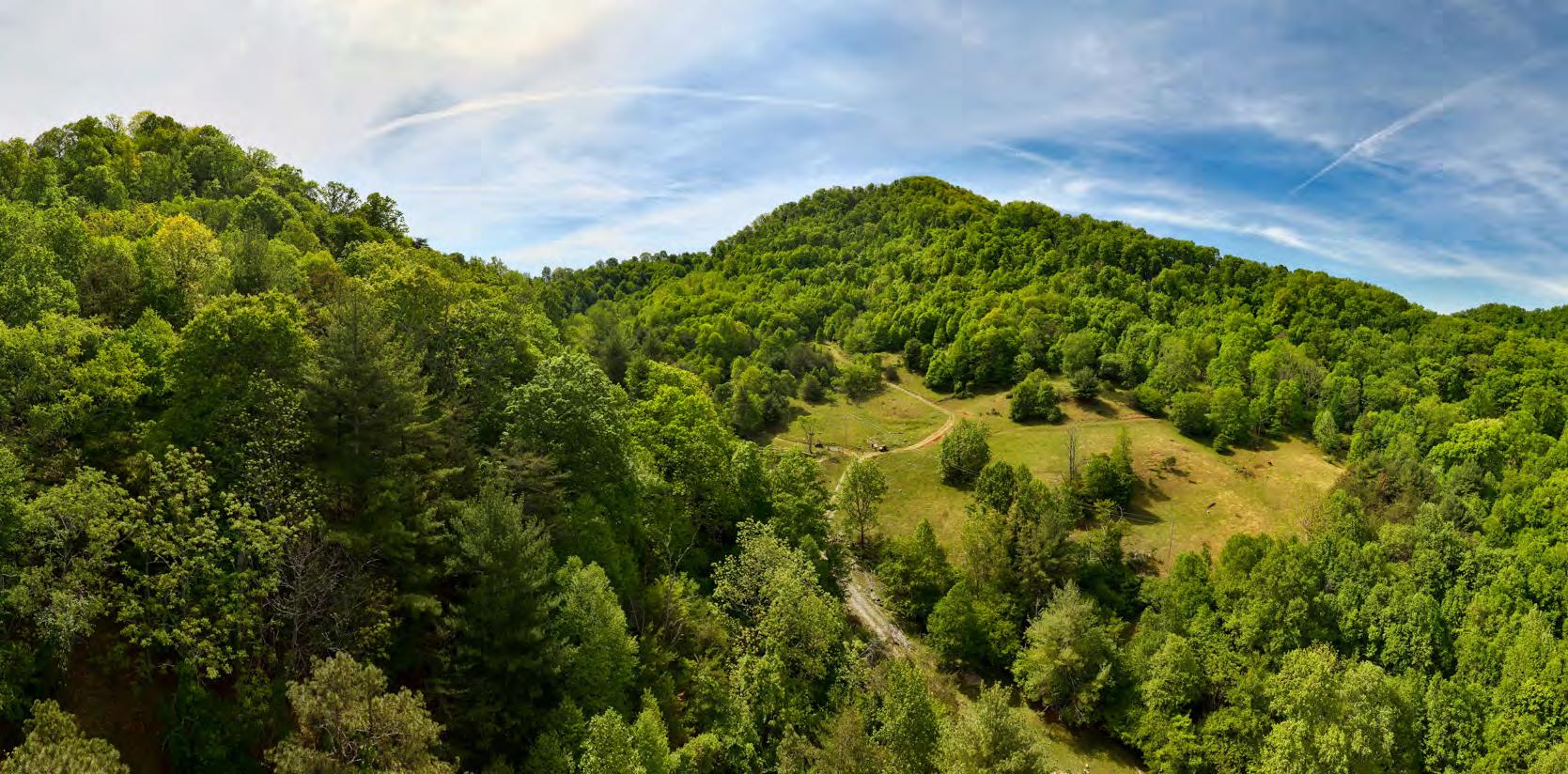
Farm fields and pasture in Upper Crabtree, capped by forested mountain peaks, continue to sustain generations of families whose ancestors farmed here. Wayne Hawkins grew up close to this land. Along with his two brothers, Carroll and Ronnie, he harvested tobacco, picked apples, pulled thistles, and learned to respect the land. His grandparents instilled in them an ethic of hard work and land stewardshipwhich Wayne has passed along to his own daughters, Carla and Nedra. Now, thanks to the family’s commitment, 206 more acres of farmland in Haywood County have been permanently protected.
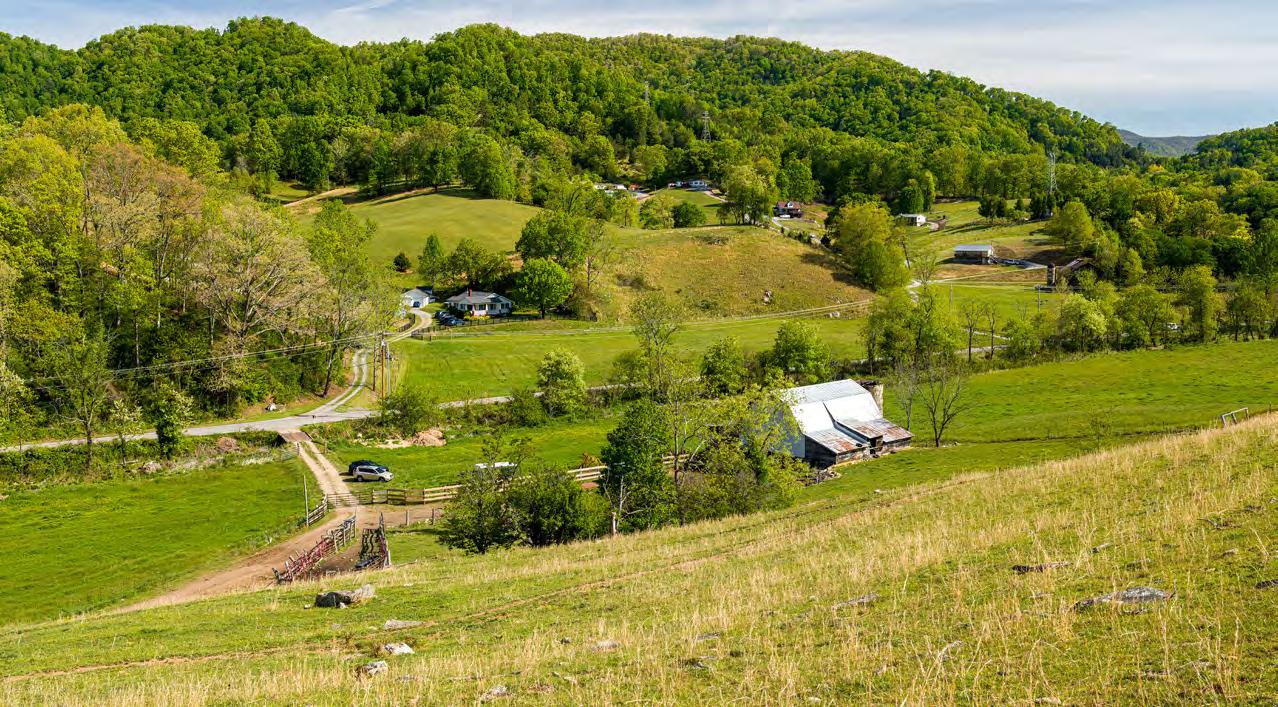
Aerial view over the Hawkins Farm, photo by Gary Hurley Carolinas Nature Photographers Association (CNPA)
Conserving the Land –Solutions for Generational Transitions
“When you turn into Upper Crabtree from NC 209/Rush Fork Road, it feels like coming home,” says SAHC Farmland Protection Director Jess Laggis. “The mountains fade into rolling hills that hug the green bottoms where Crabtree Creek flows along its way to join the Pigeon River. Wayne and his family collectively possess a deep sense of care and love for farmland in WNC –and a commitment to keeping it preserved for future generations. I feel honored that we were able to work with this family to keep this beautiful place farmland forever.”
successes, expands protection of an intact farming community, preserves water quality in Crabtree Creek, and maintains the scenic beauty of the landscape,” continues Jess. “This conservation easement protects a family farm while helping it transfer to the next generation to continue agricultural use in an area threatened by development pressure. Haywood
brothers Ralph ‘Wayne’ Hawkins and Ronald ‘Ronnie’ Henry Hawkins. The brothers recently transferred ownership of the land to Wayne’s two daughters, who were able to buy out Ronnie’s interest in the property through the bargain sale of the conservation easement.
“When we first met the family, the farm was in four parcels; Wayne and Ronnie both owned two tracts,” explains Jess.
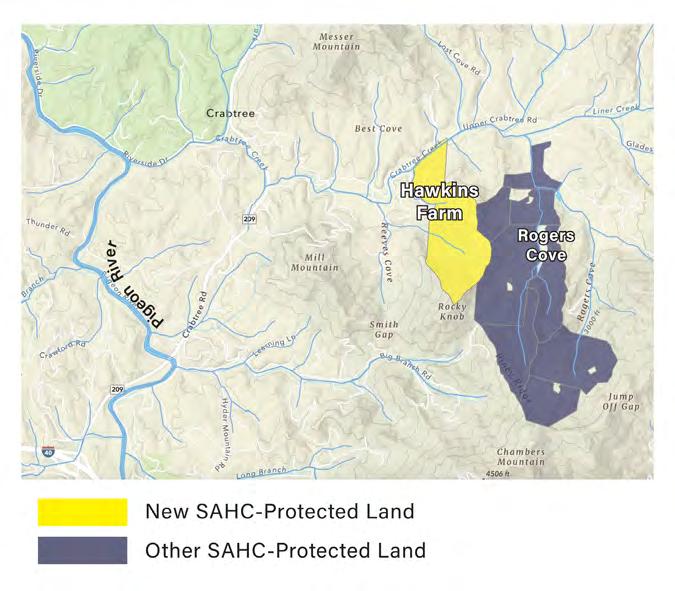
The Hawkins Farm covers expansive pastures, fertile bottomlands for hay production, and mixed hardwood forest. Cattle meander across the open hills and through the shaded edges of the forest, bears cavort along the ridgeline, and a wide variety of birds – from raptors to songbirds – flourish around the farm. At the upper elevations, the Hawkins Farm adjoins other, already-conserved land – connecting to more than 600 acres of SAHC-protected farmland in Rogers Cove.
“Permanent protection of this farm adds to prior conservation
County is experiencing a drastic increase in development pressure after the Pactiv Evergreen Mill closure. Keeping land available for agriculture helps maintain both environmental and social benefits.”
The farmland had been purchased in several pieces by Robert McKinley Hawkins, Sr. and Adeline Lorena Messer Hawkins, the great-grandparents of current 4th-generation owners, Nedra Creson and Carla Melton. Robert and Adeline worked the farm until their deaths, at which time the deed transferred to their grandchildren,
“Unifying the ownership allowed us to maximize conservation and honor the family’s legacy in one easement.
Structuring that process with a deed of trust allowed the farm operators to be the decision-makers for the easement, to obtain title
without incurring debt, ensure Ronnie was paid for his asset, and to prevent division of the farmland as it changed hands between generations. The easement proceeds then canceled the deed of trust.
In a moment when we’re losing farmland at an alarming rate and about a quarter of our farmers are past retirement age (23.6% are aged 65-74 according to the 2022 Ag. census), successfully transitioning farms so that agricultural land stays in the hands of producers is critical to the continued agricultural viability and farming heritage
L to R: Two generations of the farm family - Nedra Creson, Wayne Hawkins, Carla Melton.
Photo by Kim Clayton Lance, CNPA
of our region. For conservationminded landowners like this family, a conservation easement made it possible.”
Current conservation management practices on the farm involve excluding cattle from the main branch of Crabtree Creek and farm road improvements to reduce erosion issues.
“The Crabtree community has one of the highest concentrations of preserved farms in North Carolina, and the Hawkins Farm is the latest effort in strengthening this farming community,” says Evan Davis, Farmland Preservation Division Director for the NC Dept. of Agriculture and Consumer Services. “Building a local network of conserved lands will support farm families and rural communities for
years to come, and we are proud to partner with the family and the Southern Appalachian Highlands Conservancy on this important project.”
Preservation of the Hawkins Farm was made possible through a grant from the NC Agricultural Development and Farmland Preservation Trust Fund, generous contributions from SAHC supporters, donation of a portion of the conservation easement value by the landowners, and a grant from the Pigeon River Fund of The Community Foundation of Western North Carolina.
“Easements like these are complex and involve many partners,” says Tara Schultz, Vice President, Programs for The Community Foundation of Western North
Carolina. “We are pleased the Pigeon River Fund’s $30,000 investment provided the final piece of funding necessary to permanently protect productive farm, forest land, and numerous tributaries on a parcel that adjoins the 600-acre Rogers Cove easements, which the Fund also supported. We are honored to support the work of organizations like SAHC that ensure our region’s natural resources and water quality are protected for future generations.”
Deep Family Roots –Ties to the Land
The Hawkins’ family roots in Haywood County span more than 200 years. In 1800, Joseph and Sarah Vaughn McCracken moved there from Habersham County,
View from a pasture hill on the farm overlooking the bottomlands and barn, and looking across Crabtree Creek and Upper Crabtree Road. Photo by Dennis Oakley, CNPA
Georgia with their daughter Carey, becoming among the first colonists to live in the area. The region was inhabited by the Cherokee people (Ani Yunwiya/ ᎠᏂᏴᏫᏯᎢ or Anigiduwagi/ ᎠᏂᎩᏚᏩᎩ) prior to European colonization. Born during the American Revolutionary War, Joseph and Sarah carried much of the industrious and adventurous spirit of their generation. Of their 13 children, ten remained to raise large families in Haywood County; Wayne’s ancestors connect to four of them.
According to the McCracken family history, Joseph and Sarah McCracken began by purchasing 100 acres of land on upper Crabtree Creek and continued
expanding their holdings around Crabtree Creek. Wayne’s grandparents followed Joseph and Sarah in spirit, returning to the area to purchase tracts of land from various McCracken and Kirkpatrick heirs to assemble their own farm.
“My grandfather, Robert Hawkins, and grandmother, Adeline Messer Hawkins, both grew up on farms in Haywood County,” shares Wayne.
“He grew up in Fines Creek, and she was born in the Crabtree township. They married in 1922 and moved to West Asheville, where my grandfather worked as a machinist. My father, Robert Hawkins, Jr., was born while they lived there. However, since they were both raised on farms, they
wanted to own farmland of their own. They saved and sacrificed in order to purchase land back in Haywood County during the Great Depression. My grandfather went to work at the Champion Mill as a machinist, where he stayed until he retired in 1970 – in addition to working on the farm.”
The eldest of Robert Hawkins, Jr. and Martha Best Hawkins’ three sons, Wayne says that he and his brothers Robert Carroll Hawkins (Private First Class, killed in action in Vietnam in 1969) and Ronnie grew up learning to do things together and sharing everything – including a love for the land. They spent a lot of time on their grandparents’ farm.
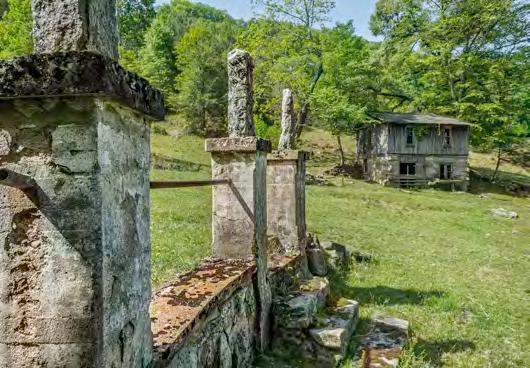
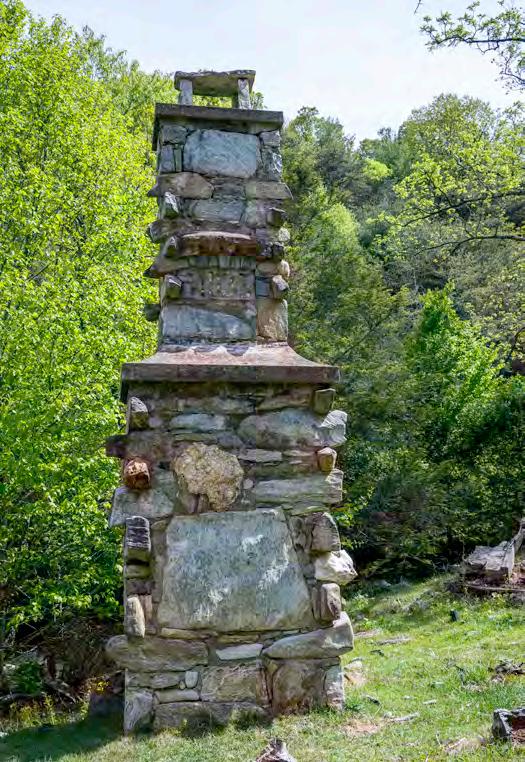
Stone remnants of a house, barn, silo, and more dot the lovely area known by the family as Preacher’s Cove. Photo by Joe Zendegui, CNPA
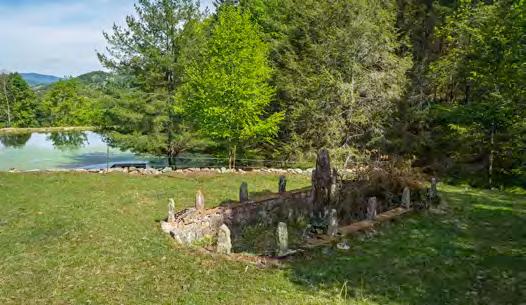
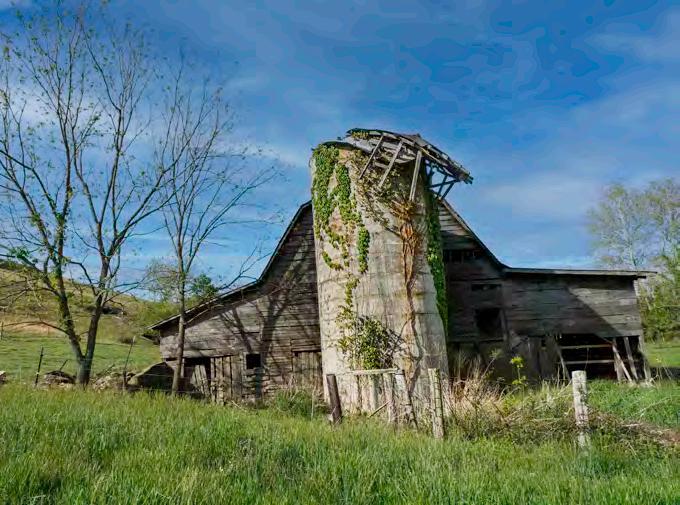
Above: The large farm pond, fenced off from livestock, sits behind an empty rock goldfish pond that “Preacher Pink” built and once used as a baptismal. Below: Porch pillars and stairs to the house (no longer standing) frame a view of an outbuilding. Photos by Woody Eisenberg, CNPA.
“Our father worked as a welder and moved around a good bit of the time, traveling to places where they were building plants and all over the East Coast,” recalls Wayne. “Our mother worked at the post office, so we would catch the school bus to our grandparents’ home each day, where we did chores in the afternoon and then homework. We ate dinner with them – and they were a huge influence on my love for the land and appreciation for farming. We called them Pa and Ma, and most of our neighbors knew them as Pa and Ma Hawkins. About the land, Pa would say, ‘God made this but he only made it one time, and it’s up to you to take care of it.’ He taught us how important the land was, and how to care for it.”
Together, the family raised beef cattle and grew silage corn and tobacco, in addition to a robust vegetable “eating” garden and small livestock such as chickens, ducks, geese, and guinea fowl. Wayne remembers that when he was in the 4-H, they had a program where youth could get 100 chicks to raise. He did, and his grandfather ran electricity to the chicken house to help support them; it was the first chicken house with electricity in Crabtree.
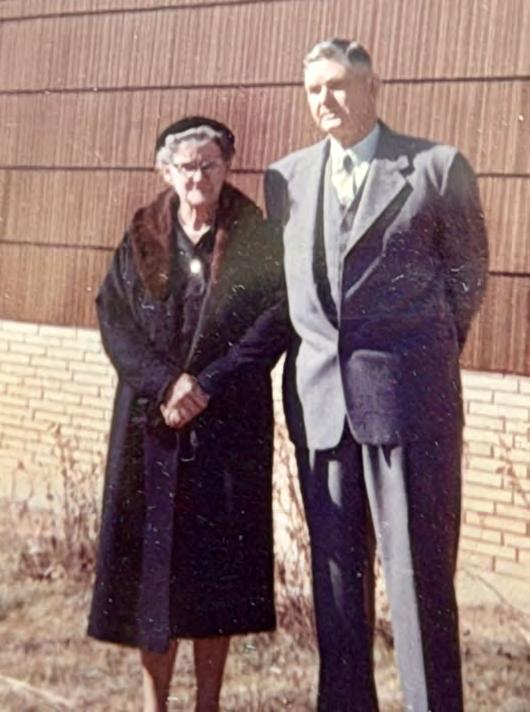
The three boys spent a lot of time with Pa and Ma Hawkins. During the school year, they would also catch the morning bus from their grandparents’ house. Wayne recalls that the kitchen was in the basement, with a wood-fired cooking stove. Each morning when they arrived, his grandmother would have already set three places with full glasses of milk, homemade biscuits, gravy, sausage or bacon, etc.
“Ma was a petite woman, but we never thought of her as small,” shares Wayne. “When she told you to do something,
Large barn near the flat bottomland along Crabtree Creek. Photo by Woody Eisenberg, CNPA
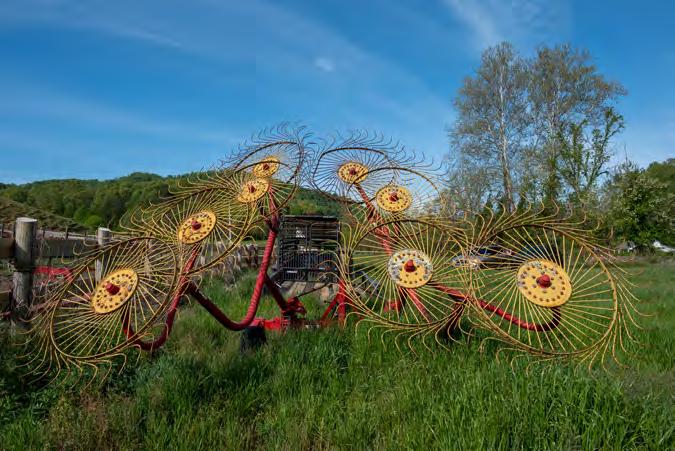
Hay thrasher. Photo by Jenny Woody, CNPA
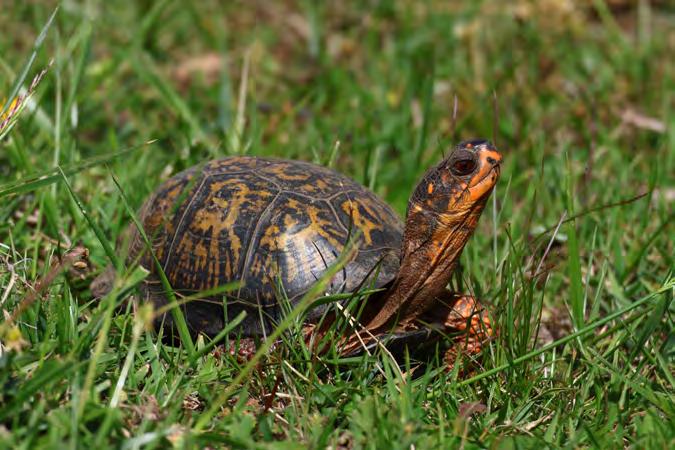
Eastern box turtle spotted near the large pond in Preacher’s Cove. Photo by Paul Bartels, CNPA
you did it. She worked on the farm throughout her life. Pa had to be at work at 7 am at the Champion Mill, so it fell to Ma to feed the cattle in the morning and afternoon. They had a herd of 75 or more cattle. She was a strong, active woman. She grew the vegetable garden, and I often worked alongside her in it. I still have that love of gardening today! They had an allotment of several acres to grow tobacco. When it came time to cut and process the tobacco, they’d hire additional people to help. She’d start in the house in the morning and fix dinner for everyone, then go back into the fields to work, too.”
the history of people who lived and farmed here – not just the Hawkins family. Wayne’s grandparents named features of the farmstead after the people from whom the land was purchased. The flat, bottomland
“I feel honored that we were able to work with this family to keep this beautiful place farmland forever.”
Hawkins purchased from Charlie Kirkpatrick in December 1937. Even farther up, the winding farm road enters the beautiful Preacher Cove, named after Rev. R. Pinkney ‘Pink’ McCracken, who lived on the land with his wife Addie, a sister of Will and Charlie Kirkpatrick. They sold the cove to the Hawkins in 1944.
– Jess Laggis, Farmland Protection Director
Place names across the farm echo
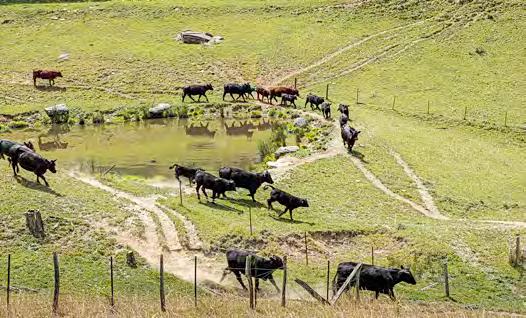
area that stretches along Crabtree Creek is known as the Will Bottom, because they purchased it from Will Kirkpatrick. From there, the farm road winds up and around a large hillside, curving past a man-made pond where cattle gather for water. This small cove is known as the Charlie Cove, which Pa and Ma
Across the stunning Preacher Cove, architectural remnants captivate the imagination. A massive stone chimney bearing the date 1935, sections of stairs, and thick porch pillars stand as vestiges of the past. When Wayne was born, his parents lived in this house (which is no longer standing); he spent the first year of his life here. In front stands an empty stone goldfish
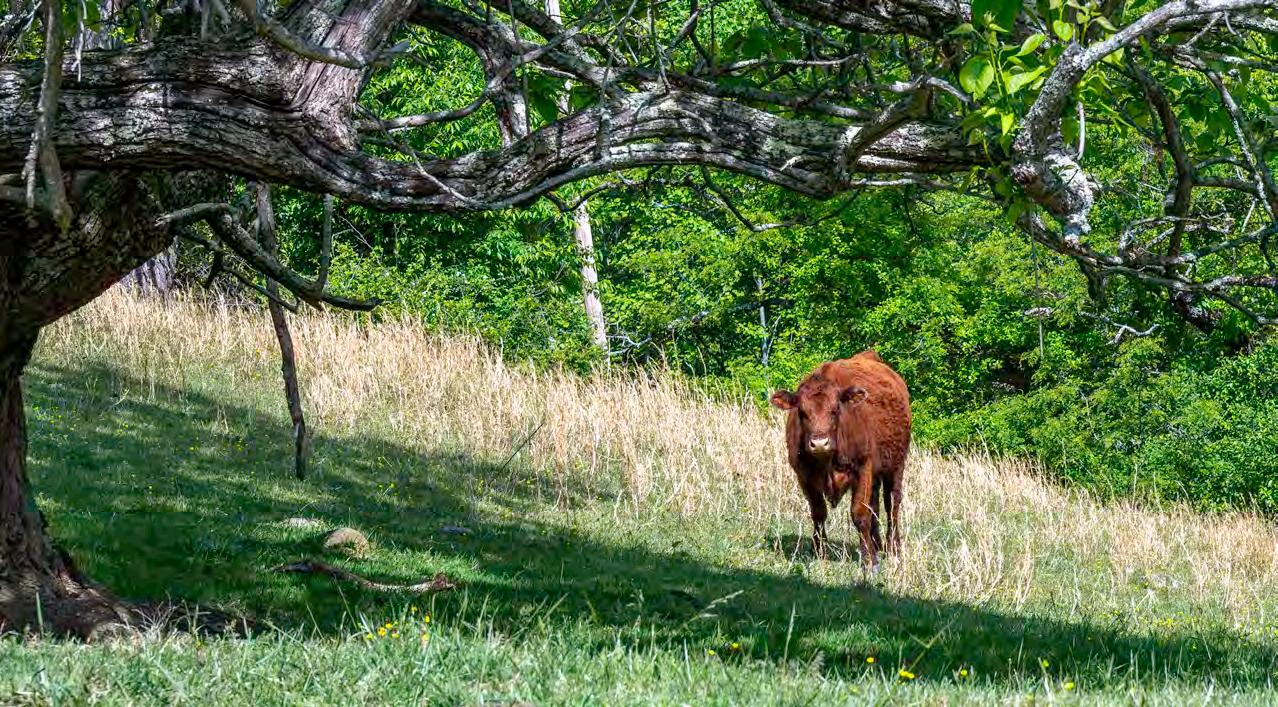
Nedra and her husband Terry raise black and red Salers cattle on the conserved farmland. Photo by Joe Zendegui, CNPA
pond surrounded by decorative vertical stones, which Preacher Pink once used as a baptismal for his congregation. Behind the ruins of the house, Wayne points out the foundation where a tall ‘drive through’ barn once stood. During the tobacco harvest season, they gathered burley tobacco leaves on large pointed sticks; driving into the barn, these were hoisted up and hung to dry.
spreads an open area that once served as the orchard. Wayne recalls often walking here to harvest a variety of heritage apples, as well as persimmons, cherry, and quince.
Continuing the Family Farming Tradition
Wayne graduated from Mars Hill University and went to work at Haywood Community College, where he started teaching and moved up to serve as Chief Financial Officer (CFO). However, he continued to keep cattle on the family farm.
“My grandparents were a huge influence on my love for the land and appreciation for farming. They would have been pleased to see this land conserved.”
– Wayne Hawkins, former landowner
Wayne recalls that his grandparents reserved the fertile bottomland for growing hay and silage; they grew tobacco in small plots around the coves.
At the upper end of the cove
“Pa was big into conservation of the land,” continues Wayne. “He emphasized that you didn’t just use the land – you also had to take care of it. He would have been pleased to see this land conserved.”
“Those were some long days,” Wayne laughs. He raised red Salers cattle, an old breed which originated in France for meat and milk production, prized for their fertility and ability to adapt to rough mountainous soil.
Wayne and his brother Ronnie
Preacher’s Cove sits near the upper elevations of the property. On the other side of the ridgeline, the Hawkins Farm adjoins more than 600 additional acres of SAHC-conserved farmland in Rogers Cove. Photo by Gary Hurley, CNPA
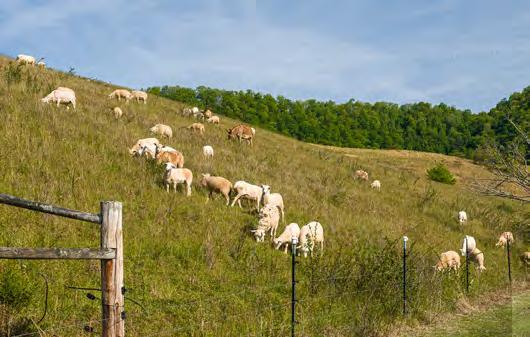
inherited and shared ownership of their grandparents’ farmland together. Ronnie wanted to be a dairy farmer and later moved to Parrottsville, TN, where he owns and operates his farm. Eventually, he offered Wayne the opportunity to buy out his interest in the Haywood County land, to keep it in the family. The conservation easement has enabled them to do that. Sisters Carla and Nedra share in ownership of the 206-acre tract of protected farmland and continue the farming tradition. Nedra and her husband Terry raise black and red Salers cattle on the conserved farmland, and Carla raises sheep on her great-
grandparents’ homestead.
“One thing that made me the proudest was that all of our kids also wanted to conserve the property,” says Carla. “Even the youngest generation wanted it to be conserved; the family is all of a like mind on that. Our greatgrandparents worked hard to acquire this property and make sure their grandchildren had access to it. We can leave this as a legacy.”
“Growing up, I felt a sense of permanence in the land – it was always here and would always be here,” adds Nedra. “I never thought of the possibility of selling it. And now, it is protected – so we
know it will always remain as it is.”
Wayne is thrilled that his children and grandchildren inherited a passion for the land, along with interests in farming.
“I taught both girls how important the farm and land were, and they have passed that on to their own children,” shares Wayne.
“I just can’t say enough about my grandparents, and about the work ethic and love of the land that they instilled in us. We’re all grateful that we were able to permanently protect the land with SAHC, and a fitting ending for the farm to be conserved so it will be there for generations to come.”
Ma and Pa Hawkins, photo courtesy of family members
Carla raises sheep on her grandparents’ farm. Photo by Dennis Oakley, CNPA
Cattle can access the smaller pond in Charlie Cove, but have been fenced out of the creek to protect water quality. Photo by Woody Eisenberg, CNPA
“Our spruce habitat restoration work days this year are part of landscape-level restoration work being conducted by SAHC and federal partners to address the devastating impacts of Tropical Storm Helene,” says Roan Stewardship Director Marquette Crockett. “This work reduces wildfire risk while restoring globally rare habitats. SAHC is expanding conifer forests on our preserve directly adjacent to the heart
Roan Stewardship
It’s the Year of the
Spruce!
This year, we’re expanding on our previous work in spruce-fir habitat restoration, thanks to a grant from the Cornell Lab of Ornithology’s Land Trust Bird Conservation Initiative and support from The Nature Conservancy’s Plant a Billion Trees program.
of red spruce-Fraser fir forests on Pisgah National Forest.”
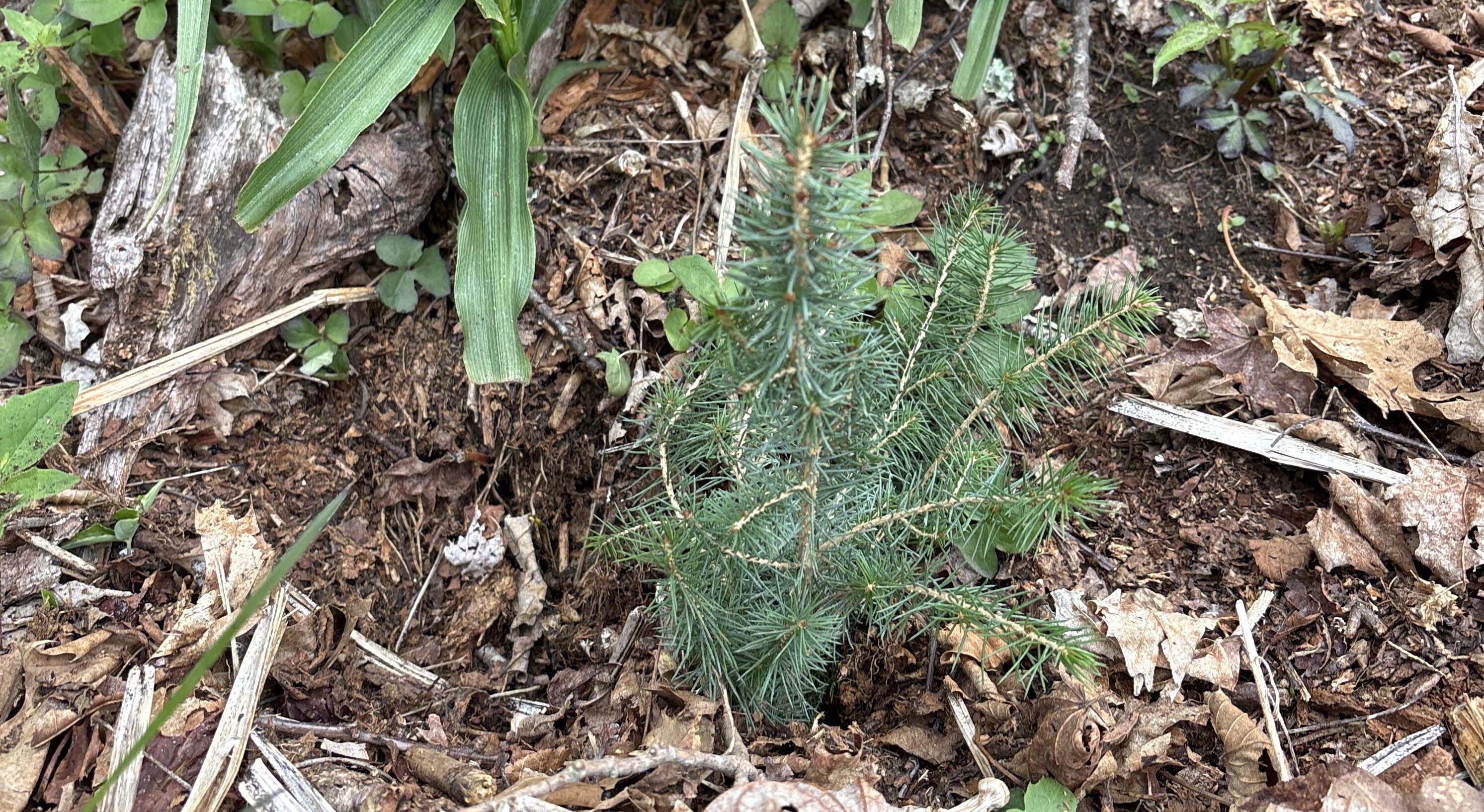
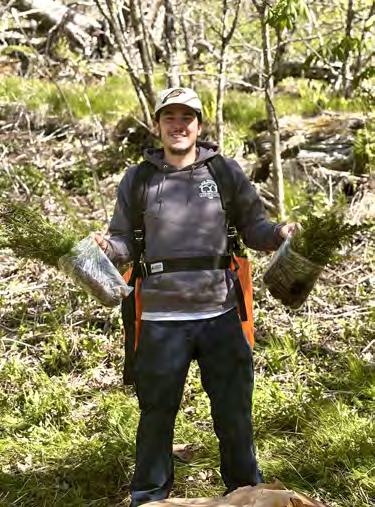
SAHC and our partners at the Appalachian Trail Conservancy and The Nature Conservancy recently planted approximately 7,000 native red spruce seedlings in devastated blow down sites – some on U.S. Forest Service land and others in remote areas on SAHC’s Roan High Preserve.
Why Spruce?
Red spruce-Fraser fir forests once covered as much as 1,500,000 acres in the southern Appalachians; by 1895, this had been reduced to 225,000 acres by logging and fire. The remnants of this great forest persisted only in a few ‘sky islands’ scattered across the highest mountains of the southern Appalachians. During a survey in the 1930s, forester Leon
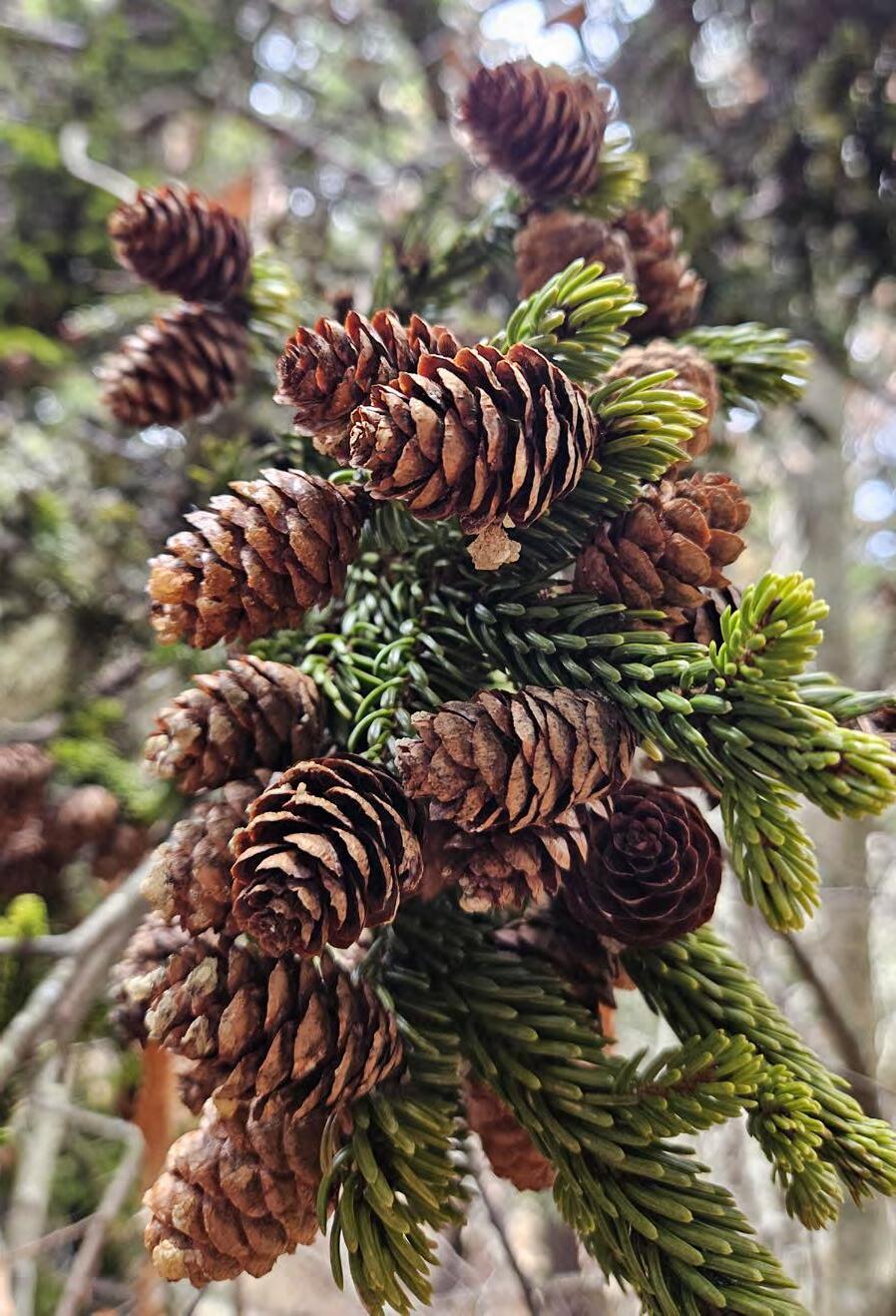
Above: One of thousands of spruce saplings planted for habitat restoration in the Highlands of Roan this year. Left: Mature spruce cones.
Minkler stated that “unaided by man, these cutover and burned areas would take 500-1,000 years to again clothe themselves in spruce or fir.”
Eighty-eight years later, Roan Mountain supported about 2,500 acres of red-spruce and Fraser fir forest – until Helene reduced the forests by another 15-20%.
“Southern Appalachian red spruceFraser fir forests are listed by multiple studies as one of the most endangered ecosystem types in the United States,” explains Marquette. “Not only are they threatened by climate impacts and acid deposition, but they are also under attack by pests like the balsam woolly adelgid. Despite the threats, these forests support multiple federal and state listed rare species, including the federally endangered spruce-fir moss spider and Carolina northern flying squirrel, the rare Weller’s salamander, Appalachian Cottontail, and more. Cold water streams flowing from these forests support Appalachian brook trout and other rare aquatic species.”
SAHC is an active member of the Southern Appalachian Spruce Restoration Initiative (SASRI), working to restore red spruce on high elevation sites throughout our region. By expanding and connecting habitat ‘islands’ of spruce, SASRI partners hope to improve and preserve habitat for rare and endangered species. For the past seven years, SAHC has been putting restoration techniques to work on high elevation preserves in the Roan Highlands.
“This work centers on the ecosystem function of the tree,” continues Marquette. “While we realize that
we do not have the capacity to recreate an entire ecosystem, we can take active steps to support natural regeneration of these areas and provide conifer habitat that many of our rare species depend on for food, shelter, and shade. Unfortunately, because balsam woolly adelgid attacks Fraser fir before it becomes mature, our best chance of getting conifer in the canopy at these sites is red spruce. Expanding spruce conifer habitat may help save species that depend on it, for years to come.”
For example, new research by Jenifer
Mallinoff on Roan Mountain and Grandfather Mountain clearly shows that having more conifer in the transition zone between spruce and hardwoods may be an important key to sustaining at least five rare mammals on our landscape (published in the journal Ecology and Evolution, Oct. 2025).
Spruce habitat benefits multiple rare and declining bird species in the region, including Northern Saw-whet Owl, Hermit Thrush, Blackburnian Warbler, and Red Crossbill. Carolina northern flying squirrels are only found in areas of high spruce density. Spruce and fir trees provide shade in delicate rock outcrop habitat needed by the tiny spruce-fir moss spider.
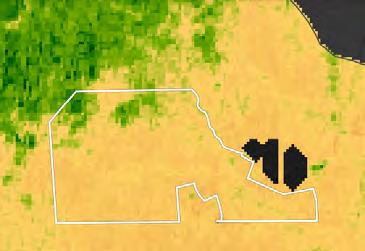
“We have encouraging news to share,” adds Marquette. “When we look at aerial images of the Roan Highlands, we can see the devastating impacts of Helene on spruce-fir forests on Pisgah National Forest. But, we can also see increases in spruce and fir canopy cover on SAHC preserves where active conifer release and planting work has been taking place over the last several years.”
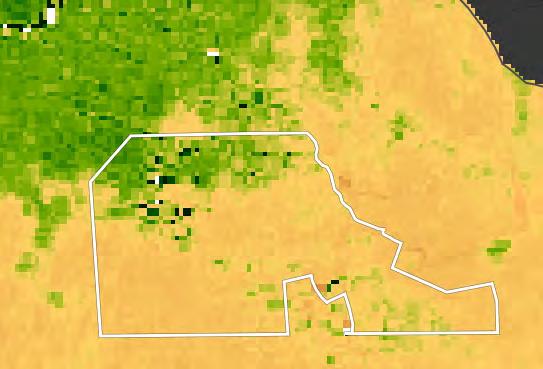
Map imagery above references change of vegetative vigor from February 2019 (left; year of spruce release treatment) and February 2026. The white outline denotes boundary of the Haw Orchard tract in SAHC’s Roan High Preserve. Areas of intensifying dark green indicate vegetative vigor/growth and a loss of green indicates loss of canopy trees. You can see a loss of vigor in the large spruce stand outside the boundary (likely due to Helene), but significant increase in vegetative vigor on SAHC’s preserve, particularly in our project area.
Spruce planting at SAHC’s Roan High Preserve.
Roan Stewardship Volunteers – Thank You!
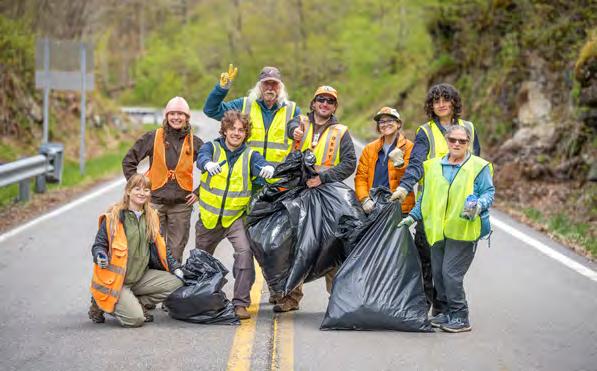
Photo by Travis Bordley
Little Rock Creek Preserve Work Day
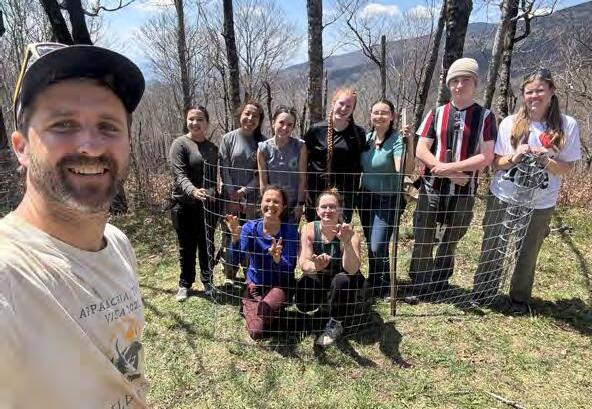
Dr. Laura Boggess, Assistant Professor of Biology at Mars Hill College, continued partnering with SAHC to lead students in hands-on field work activities. An intrepid group of student volunteers placed tree cages to protect red spruce trees in the Highlands of Roan.
“These students have played a pivotal role in promoting the red spruce forest type in the Roan Highlands,” says Roan Technician Travis Bordley.
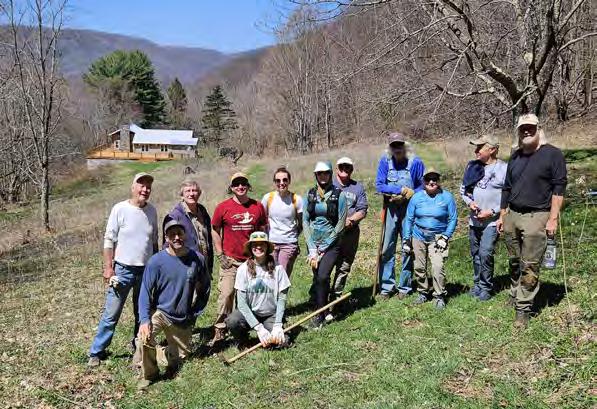
Roan Garlic Mustard Pull
SAHC volunteers partnered with Roan Mountain State Park and the Appalachian Trail Conservancy to remove 287 pounds of Garlic Mustard pulled along Hwy 143 in early May. This annual partnership effort helps remove a highly aggressive, shade-tolerant invasive species along roadways and trails in popular outdoor recreation areas in the Roan Highlands.
Little Cove Creek Preserve Work Day
In early April, a volunteer crew helped out on SAHC’s Little Cove Creek preserve in TN.
“This was a super fun and successful day,” shares Roan Stewardship Director Marquette Crockett. “We welcomed several regular SAHC volunteers, and also some new folks from both TN and the Asheville/Candler area. We all enjoyed a lovely day and spotted lots of wildflowers blooming.”
Get Involved! Grassy Ridge Mow-Off - August 15-16
SAHC’s annual Grassy Ridge Mow-Off is more than just a work day — it’s an incredible way to experience the Highlands of Roan and to share cherished moments with friends. Camp out or come for a day. Join other volunteers as we work to maintain the globally rare grassy and shrub balds found on Grassy Ridge, one of the most beautiful and ecologically significant sites in the Roan Highlands. Info at Appalachian.org/events
Welcome
Roan Seasonal Interns

Austin Bennett
Austin is a student at Appalachian State University pursuing a B.S. in Recreation Management with a minor in Biology and a focus on Parks. He is from Denver, NC, a small town about 30 minutes from Charlotte, and enjoys hiking, cooking, going to the gym, and spending time with family and friends.
“Studying biology and spending time outdoors has developed my current appreciation for the environment,” says Austin. “I’m very passionate about protecting and preserving natural beauty for sustainable uses that provide leisure services for the community. Once I graduate from App State, I hope to build a career in natural resource management. Connecting with people through broader communities has given me a passion to share what I enjoy to do. I’m excited to apply my studies with the SAHC team through hands-on land conservation fieldwork to contribute stewardship for Roan Mountain’s remarkable landscapes and all the diverse life that calls this place home.”
Madison (Maddy) Glenn
Madison grew up in Northern California, where her love of the outdoors began between the Mayacamas Mountains and the coastline of Bodega Bay. She graduated in 2022 from Cal Poly San Luis Obispo with a B.S. in Environmental Earth and Soil Sciences, a concentration in Hydrology, and a minor in Spanish. She then spent a few years in Santa Barbara working as a soil scientist on the restoration and remediation of historic oil and gas fields. Madison is now pursuing her Master of Environmental Management degree at Duke University, focusing on ecosystems ecology and policy. As a Stanback Fellow from the Duke Nicholas School of the Environment, Maddy is helping SAHC develop a land management plan for a newly conserved property in the Roan Highlands. The project will incorporate her background in GIS, environmental consulting, and field work. In her free time, Madison loves climbing, reading, hiking, and volunteering at the Duke Campus Farm, and is very excited to be able to explore the southern Appalachians this summer with SAHC.
Stewardship Intern
Rey Sadoff

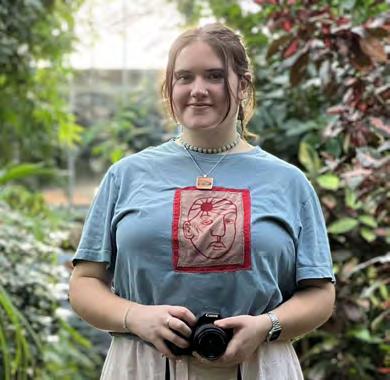
Rey is studying forestry at Warren Wilson College. During the spring semester, Rey provided support to SAHC’s stewardship team for monitoring and management. Rey has spent most of her life in Western North Carolina, growing up next to the South Toe River outside of Burnsville, NC. When she was young, tagging along as her mother attended botany classes made Rey curious about plants and trees and offered the opportunity to explore unique ecosystems. Working on farms, backpacking on the Appalachian trail, and glimpsing a hellbender in its natural habitat deepened her enthusiasm for ecology and prompted her to pursue an undergraduate degree in environmental science.
Rey enjoyed outdoor classes, surrounded by trees and fungi. These classes made her deeply passionate about land use and management as well as conservation, which led her to Southern Appalachian Highlands Conservancy. She looks forward to continuing in conservation work after graduating in May.
For the Birds Cornell Lab of Ornithology visits SAHC
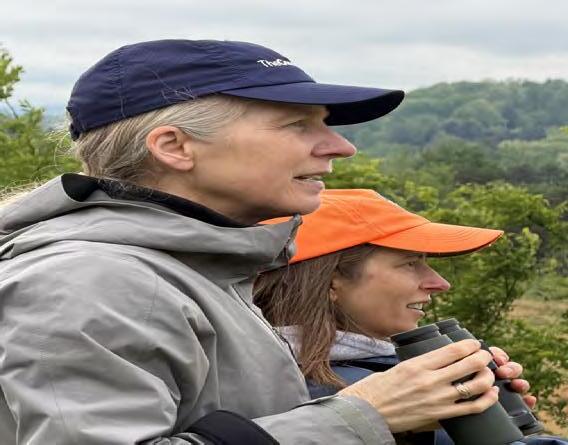
Conserving bird habitat helps save species. That’s one reason the Cornell Lab of Ornithology created the Land Trust Bird Conservation Initiative Small Grant Program. Funding from the program has helped SAHC manage habitat for birds in the Highlands of Roan and at our SAHC Community Farm in Alexander, NC.
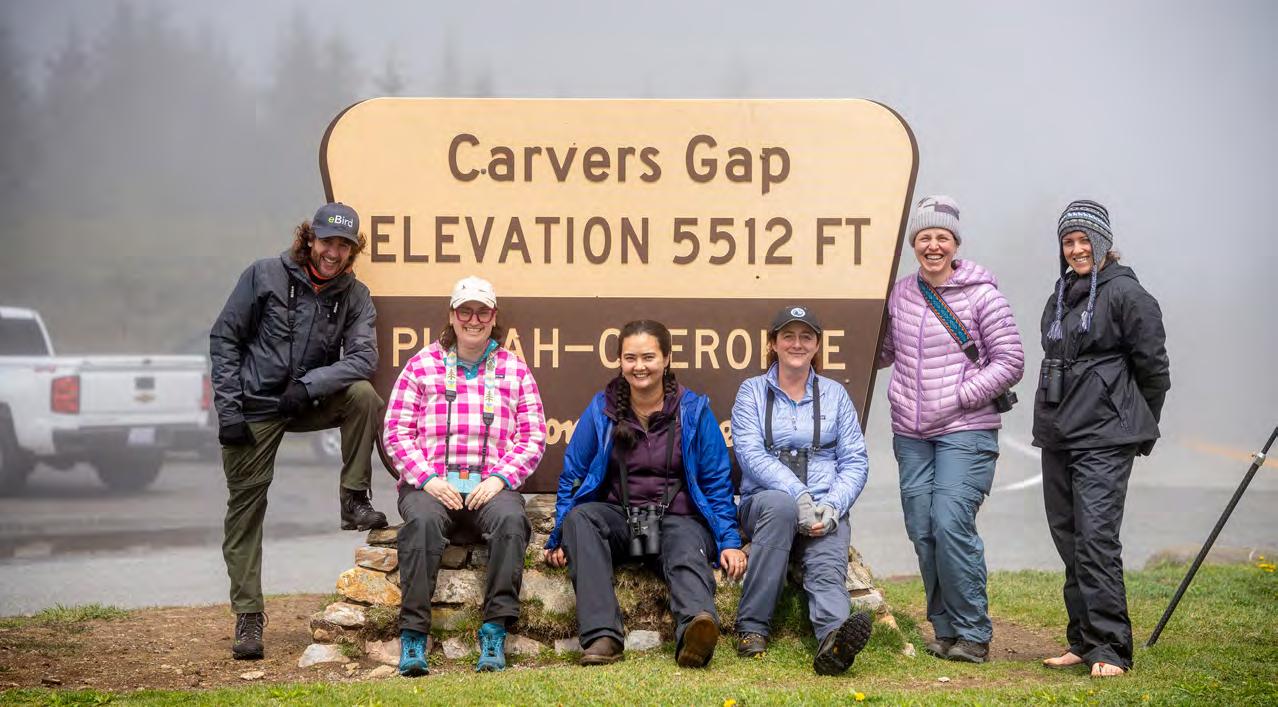
In late April and May, partners from the Cornell Lab visited SAHC to see these project areas and to host part of the team for their Big Day, Cornell’s annual marathon birding and fundraising event.
Land Trust Bird Conservation Small Grant Program
“This grant program provides funding for land trusts to conduct on-the-ground habitat restoration and management activities that support a variety of bird species,” says Roan Stewardship Director Marquette Crockett. “We are so grateful that Cornell
The Cornell Lab of Ornithology’s Team Sapsucker scouts birding locations in the Roan Highlands with Roan Stewardship Director Marquette Crockett. Photo by Travis Bordley
Sara Barker (left, Cornell) and Sarah Sheeran (right, SAHC) spot a Blue Grosbeak in the SAHC Community Farm silvopasture project.
Lab of Ornithology has committed to partner directly with land trusts, enabling stewardship and land protection staff who work in the landscape to advance habitat management and education initiatives that benefit birds.”
Support from the program has enabled us to implement birdfocused habitat management at multiple sites. SAHC’s first small grant project in 2019 included spruce habitat restoration at SAHC’s Roan High Preserve, along with prescribed fire and invasive plant control in the shortleaf pine stand on the SAHC Community Farm. In 2025, SAHC was awarded another small grant for more work in the Highlands of Roan — this time to address the devastating impacts of Tropical Storm Helene on fragile high elevation habitat and reduce wildfire risk.
Program Leader Sara Barker visited SAHC’s Roan Highlands and farm project sites in late April.
“The Roan High Preserve and the spruce-fir forests are spectacular in person, and seeing the damage by Helene on the ground really drives home the need to protect and manage this ecologically significant area,” says Sara. “I’m truly impressed with all the work
Day, a 24-hour birding marathon to find as many birds as possible and raise funds for conservation.
Marquette and Stewardship Director Sarah Sheeran accompanied the Cornell Lab of Ornithology’s Team Sapsucker on scouting visits and birding for the event.
“This event highlighted the importance of conserving habitat in diverse landscapes to support migratory species.” – Sarah Sheeran, Stewardship Director
going on at the SAHC Community Farm and for the opportunities that this demonstration area offers to the community.”
Big Day – Team Sapsucker
Cornell Lab of Ornithology’s Land Trust Bird Conservation Initiative
Following Sara Barker’s visit, the Cornell Lab of Ornithology teamed up with SAHC for their annual Big
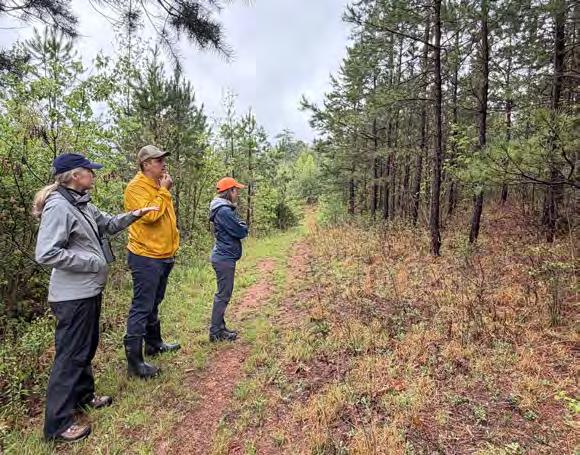
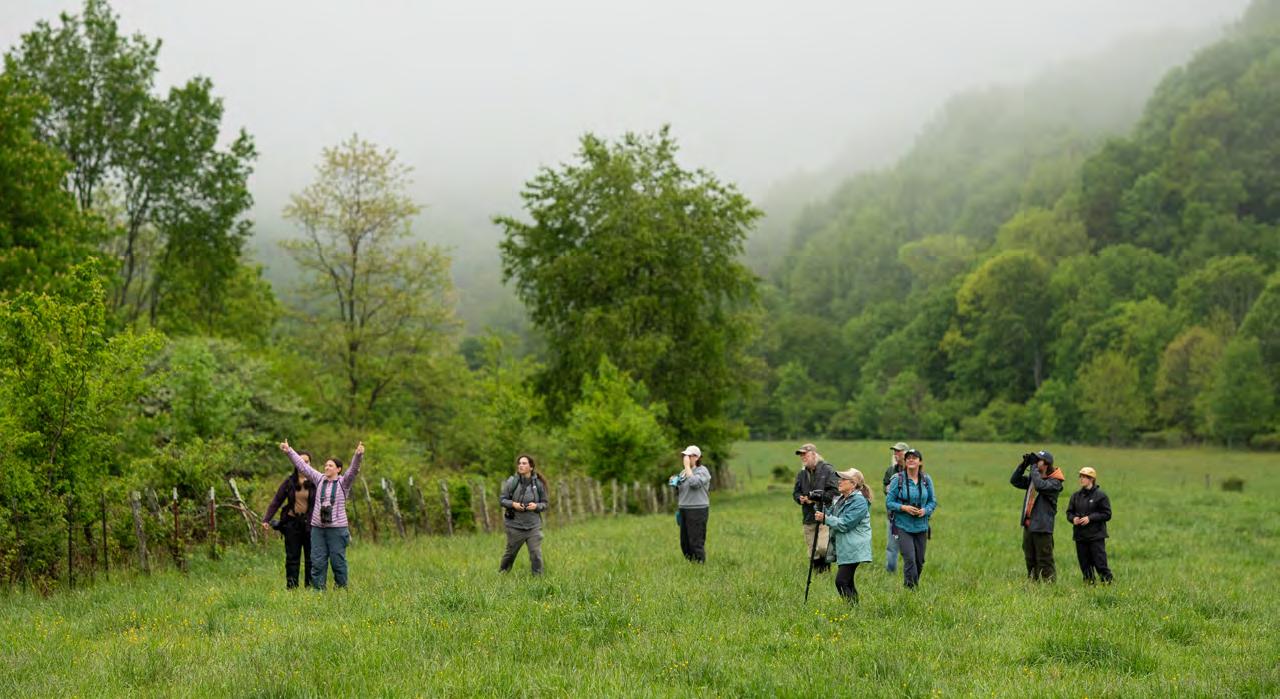
This year, Team Sapsucker divided into two groups – one in the Appalachian-Blue Ridge forests of North Carolina, and the other in the Maya Forest of Guatemala. These regions are considered ‘sister landscapes’ that provide habitat for many of the same neotropical migratory bird species at different points in the year. Together, teams found 306 species – including 25 species that were spotted at both locations.
“The tally highlighted how it takes multiple landscapes to support
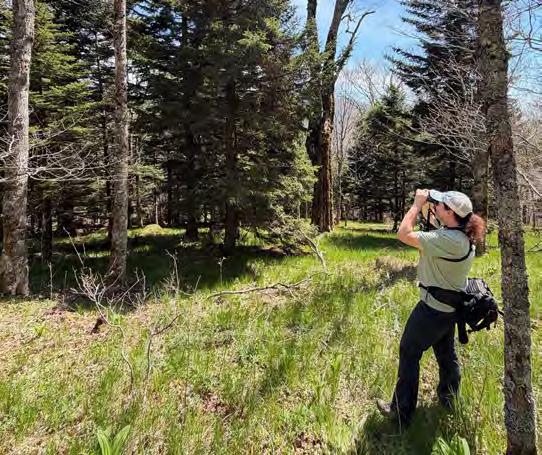
Left: Sara Barker, Chris Link, and Sarah Sheeran discuss habitat management to benefit birds on the SAHC Community Farm, including the shortleaf pine forest project.
Right: Marquette Crockett looks for birds while guiding Sara on a visit to SAHC’s Roan High Preserve.
migratory bird populations,” reports Cornell Communications Manager Kathi Borgmann.
“Team Appalachia scoured forests and fields of the Blue Ridge Mountains looking for colorful warblers and listening for the sweet songs of thrushes and orioles. Just a few weeks earlier, many of these birds had been in Guatemala, building up reserves in preparation for the long flight north. These shared birds rely not only on forests in the United States and Canada, but also on forests in Latin America that are threatened by illegal deforestation, forest fires, and rising temperatures.”
from SAHC (in NC and TN) and the Wildlife Conservation Society (in Guatemala). Both groups enjoyed meeting local birders and building community connections.
“Marquette and Sarah provided invaluable on-the-ground knowledge about birding routes, sites, and species for Team Appalachia,” continues Kathi.
“On the Big Day, Team Appalachia spent 16 hours and 11 minutes birding, tallying 120 species from the lowlands around Asheville (2,100 feet) to the Roan Highlands at 6,286 feet elevation.”
To highlight the value of international conservation partnerships, Team Sapsucker was joined in the field by local experts
In the week leading up to the Big Day, Marquette, Sarah, and other SAHC staff accompanied the Appalachian group of Team Sapsucker on scouting visits around the region, including two public ‘meet-and-greets’ in NC and TN.
During both the scouting visit and Big Day event, the team spotted a Golden-winged Warbler in Hampton Creek Cove State Natural Area – one of several places where SAHC has conducted habitat restoration projects to benefit this declining neotropical migratory songbird. The sightings provided heartfelt moments for celebration.
“I thoroughly enjoyed participating with this skilled, knowledgeable, and dedicated team of birders,” reflects Sarah, after accompanying the team on their Big Day.
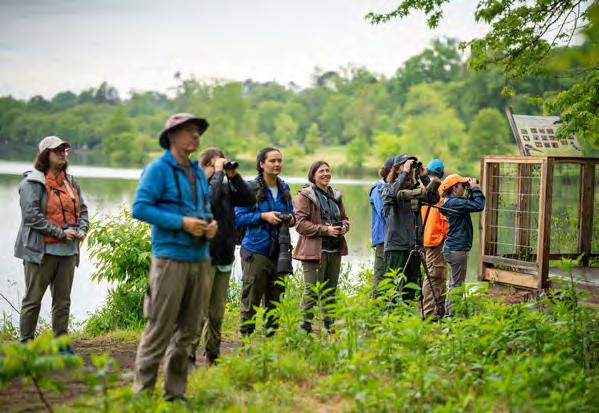
Above: Team Sapsucker-Appalachia met with community members while scouting a birding location at the Beaver Lake Bird Sanctuary in Asheville with Sarah Sheeran. Bottom: The team spotted a Golden-winged Warbler in the Hampton Creek Cove State Natural Area in TN, guided by Marquette Crockett. Photos by Travis Bordley.
Fire and Water Habitat Management
SAHC’s stewardship teams employ a variety of techniques to actively manage habitat and restore land. Across our conservation focus areas, we’ve worked with volunteers to promote stream repair and restoration while professional fire crews have helped manage invasive plant species.
SAHC’s Jenkins Branch Farm in Buncombe County
Streambank repair helps protect water quality, stabilizes land, and benefits wildlife as well as people. However, folks interested in helping improve or restore stream banks often don’t know where to start. In a hands-on workshop at SAHC’s Jenkins Branch
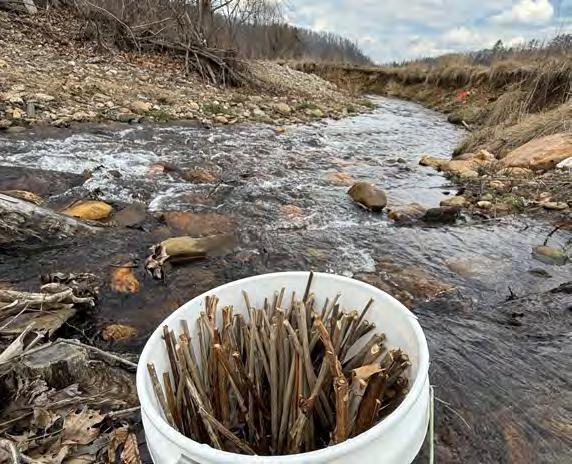
Farm in Alexander, NC, we partnered with local nonprofit Riverlink to share information and practical experience in a streambank repair workshop with livestake planting. Livestaking is a restoration technique where dormant stem cuttings from trees and shrubs are planted directly into the ground. These cuttings root and grow into new plants. Riverlink provided
some of the cuttings, while others were harvested from the SAHC Community Farm nearby.
“It’s great to see people excited about using their hands,” said SAHC Community Farm Manager Chris Link. “This workshop experience left folks feeling confident and enlivened. Engaging learning with a
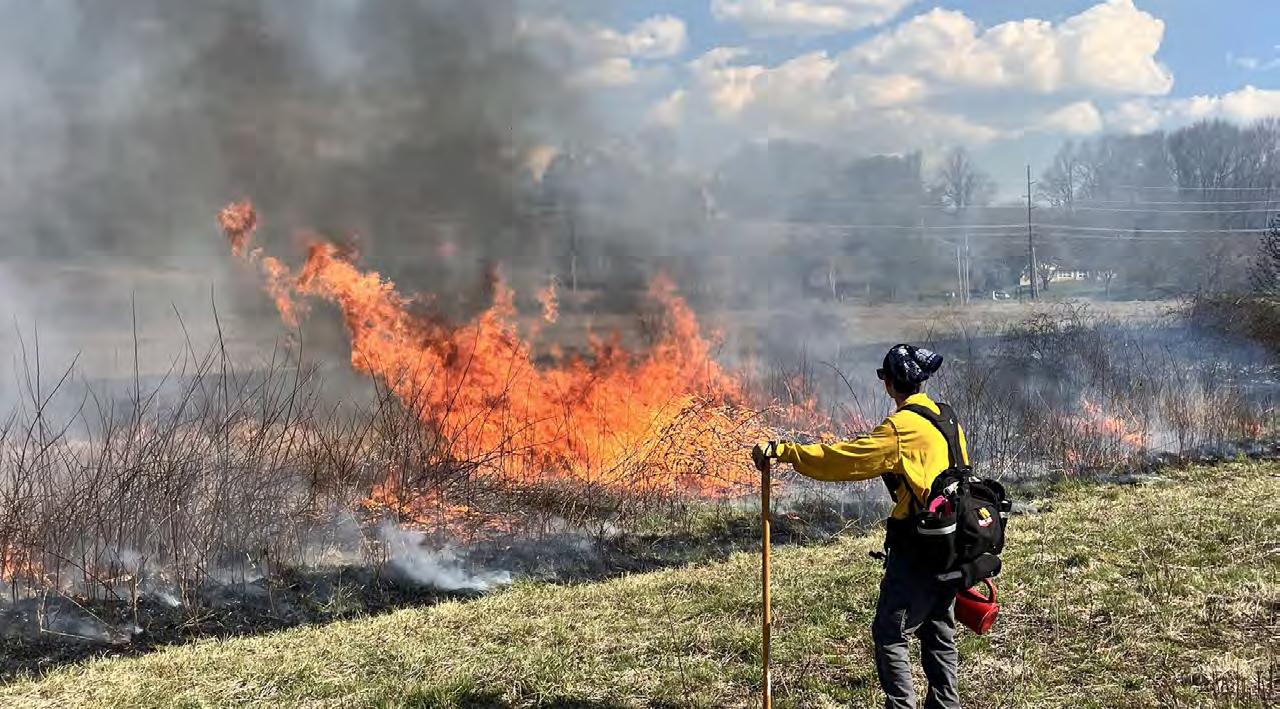
Top: Fire crews used a controlled burn as one of many techniques to manage habitat on SAHC’s Bowditch Bottoms property. Above: Volunteers planted native species livestakes to improve habitat and help prevent erosion on the same property.
hands-on component helps people feel empowered to do this work on their own and share with others.”
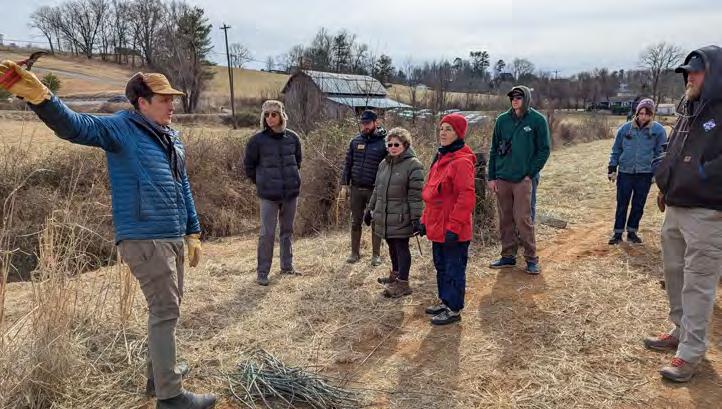
Following an informative ‘class’ session led by Riverlink, the group of approximately 20 volunteers spread out along a section of Jenkins Branch to put their new knowledge into practice. The group planted hundreds of livestake plants within a short period of time.
“This workshop sparked a lot of conversation among participants about how to shift traditional thoughts around managing lawns and erosion,” added Chris. “People were excited about bringing info to their communities and neighbors.”
Bowditch
Bottoms in Yancey County
Last year, SAHC and NCWF joined together in managing invasive plants species on SAHC’s Bowditch Bottoms Preserve in Yancey County through a series of volunteer work days. We’re thrilled to continue this partnership
and enhance habitat for both terrestrial and aquatic wildlife.
“This kind of workshop helps bring the content home. People left feeling empowered to do this work on their own and share with others.”
– Chris Link, SAHC Community Farm Manager
“SAHC and the NCWF are gearing up for another great year at Bowditch Bottoms in Yancey County,” says Luke. “We focused our effort on this work day in planting livestakes along Ayles Creek with species including buttonbush, viburnum, elderberry, and ninebark. In under three hours, we planted nearly a thousand livestakes! These new plants will help control erosion, shade the creek, improve water quality, outcompete invasive plant species, and serve as critical habitat for wildlife.”
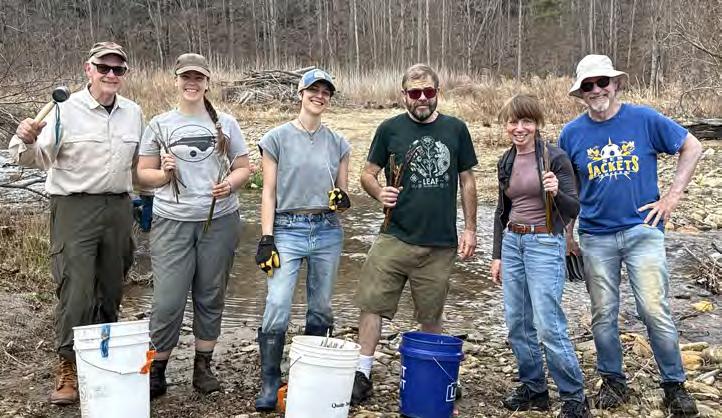
A group of volunteers organized Luke Bennett, Conservation Coordinator for the NC Wildlife Federation (NCWF), planted livestakes along Ayles Creek in areas left bare and susceptible to invasive plant species following Helene.
in land restoration and management. Volunteers used a variety of native species in an effort to control erosion
In March, SAHC Stewardship and GIS Manager Chris Kaase joined professional fire crews at the Bowditch Bottoms property to oversee land management through prescribed fire. The timing for conducting prescribed burns can be tricky, as it depends on a combination of weather and environmental conditions. Controlled
Above: SAHC Community Farm Manager Chris Links gives instructions to volunteers conducting livestake planting along Jenkins Branch. Bottom: Volunteers organized by NCWF’s Luke Bennett planted livestakes to continue habitat management and restoration at Bowditch Bottoms.
burns are most often conducted in the late fall and late winter/ early spring. SAHC contracted with Blue Ridge Resource Conservation and Development (RC&D), the Southern Blue Ridge Prescribed Burn Association, and Black Mountain Field and Forest to conduct the controlled burn at Bowditch Bottoms.
“Managing conserved land presents a variety of challenges and requires consistent planning with a robust mix of tools and strategies,” says Chris. “Fire is just one tool we are using to manage this property that is helping to reduce materials, control invasive plants as well as improve habitat and soil nutrients.”
Over the past year, Chris has directed invasive species management and restoration on the property by working with NCWF volunteers and contracting with EcoForesters to remove and treat invasive plant species. The prescribed burn continues that management work.
The team worked on three “burn units” on the property. One of these was the 6-acre stream and wetland area, which SAHC and partners have been managing for invasive species over the past year.
“Conducting the burn in this area helps clear the way for us to conduct native plantings out there this fall,” adds Chris. “The controlled burn
“This burn continues habitat management on the property, which we have been conducting in partnership with NC Wildlife Resources Commission over the past several years,” explains Josie. “Habitat management on the open areas of this conserved land benefits elk, birds, and a variety of other species. The goal on this property is to retain spaces for early successional habitat and help control invasive plant species.”
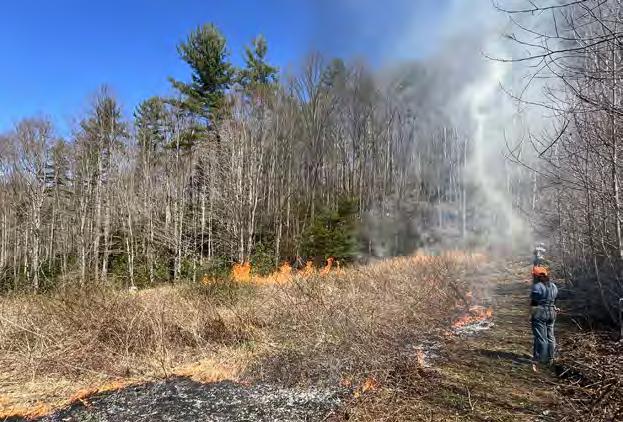
helped consume downed material that had been cut back during previous volunteer work days. Burning also helps clear dense mats of previous seasons’ growth, which can inhibit regenerative growth from native seeds and sprouts.”
“Like many disturbed open areas and farm properties that have grown over, this property has a significant problem with invasive plant species,” continues Chris. “We’ve managed the large open areas here with mowing over the past few years, but the margins, fencelines, and area along the stream have been growing up. Fire provides an effective tool in helping to manage these spaces.”
Stevens Creek in Haywood County
On the edge of the Great Smoky Mountains National Park, Stewardship Technician Josie Cohen joined a professional team from Wildwood Consulting, LLC to conduct a prescribed burn across a total 24 acres on SAHC’s Stevens Creek Preserve in March.
In preparation for the controlled burn, the crew spent several days doing prep work to cut brush lines and dig fire lines to keep the fire contained. On the day of the burn, they blew downed leaves away from the fire lines to reduce fuel and wet the lines to keep the perimeter of the burn area contained.
Afterward, a group of student volunteers from Haywood Community College assisted with follow-up management on the property.
“At Stevens Creek, we are managing for early successional habitat, promoting native forbs, shrubs and grasses that support species including elk, migratory birds and small mammals,” explains Stewardship Director Sarah Sheeran. “We hope that increasing the quality of forage on the property will incentivize elk to stay on SAHC’s Stevens Creek Preserve and minimize negative encounters on nearby private land. This work continues previous habitat management activities that the NC Wildlife Resources Commission conducted on the property, supported by the Rocky Mountain Elk Foundation.”
A fire team helps manage habitat and control invasive plant species on SAHC’s Stephens Creek Preserve adjoining the Great Smoky Mountains National Park. Students from Haywood Community College assisted with a follow-up project on the property.
SAHC Community Farm Conservation
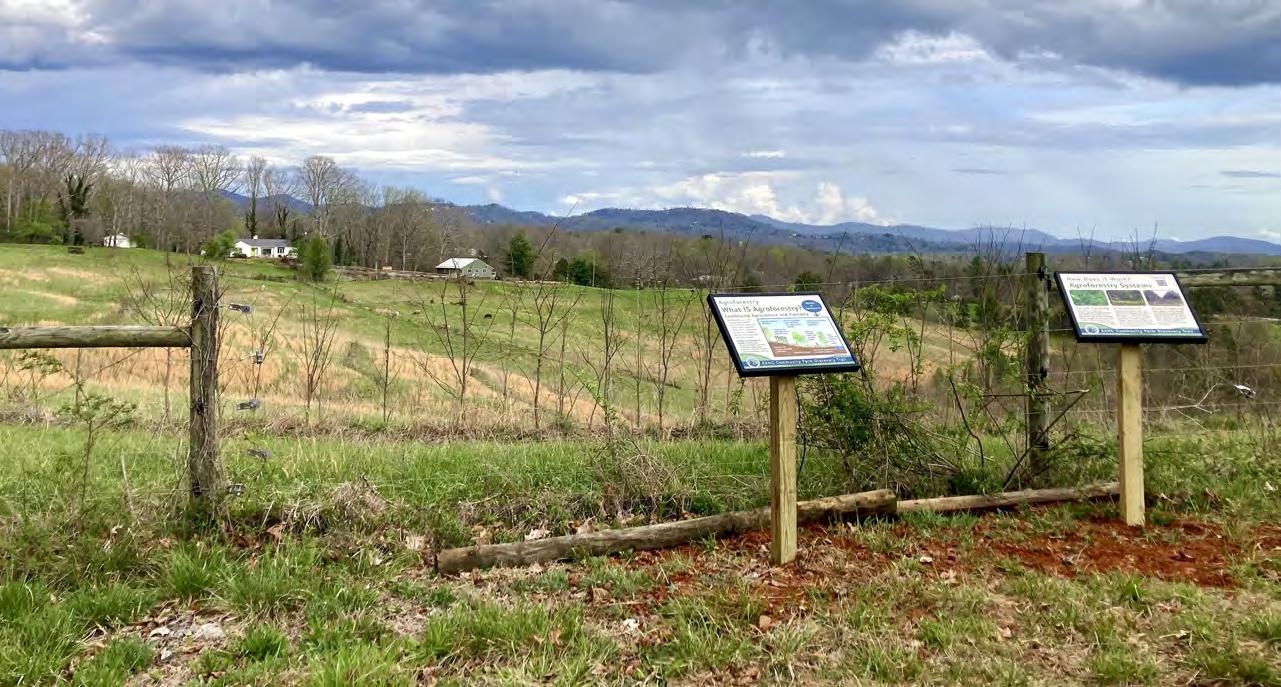
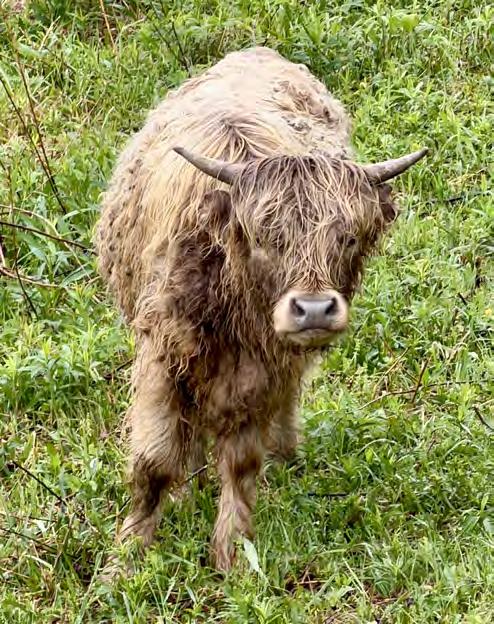
Fiona, the most recent addition to our Highland Coo family, turned one year old this Spring and is doing well. This small family herd of heritage breed cattle currently includes two parents and two daughters.
Discovery Trail Updates
We are expanding and improving the Discovery Trail on the farm – thanks to generous support from the Harold T. Southern Family Foundation and the WNC Futures Fund, as well as assistance from the Carolina Mountain Club. New benches along the trail provide opportunity for hikers to rest if needed, or just soak in the views. Look for more trail updates here in the future!
Interpretive signs highlight SAHC’s silvopasture demonstration project.
The SAHC Community Farm has been blooming with life and bustling with activity this Spring! Our ambassador property for education and community engagement welcomes people of all ages to engage in conservation, including volunteers in the gardens, birders along the trail, local farmers, and more.
Interested in visiting the farm?
Contact Outreach Program Manager Erin Goodpaster at erin@appalachian.org for inquiries about farm hikes and volunteer opportunities.
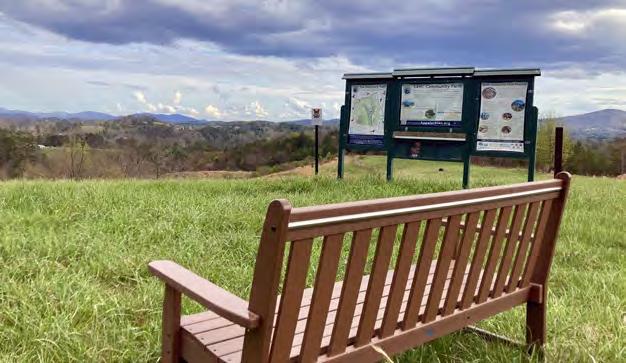
Farm Incubator Program: A
Successful Transition Story!
This year, one of our successful participants in the SAHC Farm Incubator Program – a business incubator for agricultural entrepreneurs – is transitioning to her own farmland, recently purchased just down the road from the SAHC Community Farm in the Alexander Community.
Suzanne Nolter, proprietor of Blazing Star Flowers, has been growing, selling, and teaching folks about flowers on the SAHC Community as a participant in the Farm Incubator Program over the past five years. Suzanne credits the program with helping her build her business and network in the region.
“The infrastructure at the farm (the greenhouses, walk-in cooler, tractor, irrigation water, market barn, value-added-kitchen) have all been incredibly valuable for getting my farm business up and running quickly,” says Suzanne. “These things can be prohibitively expensive in the early years of a farm business without going into heavy debt. The staff at SAHC have been wonderful supporters and allies as I’ve been building my farm business over the last six years.”
As part of our Farm Pathways collaboration with the Organic Growers School and NC Farmlink, SAHC also helps entrepreneurial farms build their networks of connection, access educational resources, and navigate pathways between building their businesses and
securing their own farmland for longterm success.
“My new farm is less than a mile down the road from the SAHC Community Farm,” continues Suzanne. “It was part of the Taylor Sluder Farm. The namesake of our road, Mag Sluder, was the matriarch
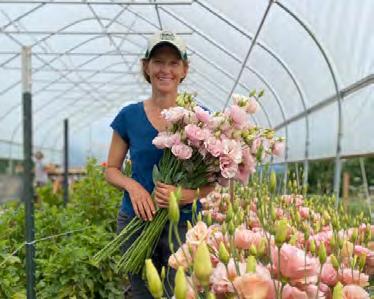
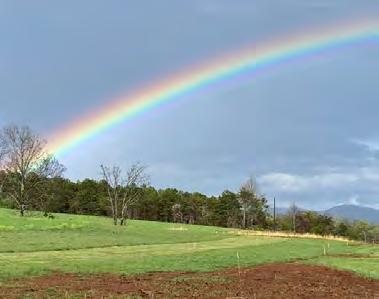
options. In my time at SAHC, I got close to the neighbors here, and it was ultimately through the neighbor network that I was able to connect with someone nearby who was selling land that had been farmed by their family for over 200 years. They were eager to see it continue to be farmed and knew me from the neighborhood. I’m humbled and honored to continue the farming legacy on this farm that has been the heart of this community for so long. It sounds sappy but it’s truly a dream come true.”
This season, Suzanne will continue to grow beautiful flowers on the SAHC Community Farm while she gets production up-and-running on her own land.
“In 2026 I am growing all my flowers to sell this season at SAHC while I am building up infrastructure on the new farm,” explains Suzanne. “In 2027 I plan to fully transition to the new land. The new property does not have utilities, greenhouses or infrastructure, so it is a big lift getting it all off the ground this season. I’m very grateful to be able to grow at SAHC this year so that I don’t have to take a season off from sales while I get the new farm ready.”
of this family. This land has previously grown tobacco, hay and corn. It includes some wonderful old tobacco barns on the property. After looking for land for 5 years, exploring NC Farmlink connections, working with real estate agents, etc, I was getting quite desperate because it is difficult to find ‘flat enough’ farmland for sale that isn’t in a floodplain. I was looking at properties an hour north, south, east, and west of here, with no good
SAHC Community Farm Manager
Chris Link assisted Suzanne in applying for funding resources to improve the infrastructure for her own land.
“I have been fortunate to be awarded a grant from WNC AgOptions this year to help build a heated greenhouse,” adds Suzanne. “I have applied for funding from the U.S. Dept. of Agriculture’s Natural
Suzanne Nolter of Blazing Star Flowers purchased her own farmland in Alexander and is successfully graduating out of SAHC’s Farm Incubator Program.
Interested in purchasing from Blazing Star Flowers? Here’s how!
“This year, you can find our flowers through our Flower CSA, at the Wednesday RAD Farmers Market, and by ordering bulk DIY buckets of loose stems or full service floral design for special events,” says Suzanne. “In the spring we sell plant starts and dahlia tubers at area plant sales, and in the fall, we usually have fresh flowers through Thanksgiving. On the new farm, I hope to expand opportunities for folks to come out and experience the beauty of the land and flowers through workshops and other farm-based experiences.”
For more information, visit BlazingStarFlowers.com.
So, what will happen in the production space that Blazing Star Flowers will vacate on the SAHC Community Farm?
“We’re really excited to have another flower producer coming along in the Farm Incubator Program, who will be able to transition into the growing space Suzanne has been using as she graduates out of the
program,” says Associate Director Kristy Urquhart.


Dylan Rachalle of Daisy Chain Flowers is in the process of expanding her production.
Dylan Rachelle, proprietor of Daisy Chain Flowers, is in her second year as a producer in SAHC’s Farm Incubator Program.
“The program has helped my little farm immensely,” says Dylan. “My main obstacle has been land. Finding
Farm Workshops
This year we have hosted two successful farm workshops: Farm Planning & Design for Climate Resilience and Small Engine Maintenance & Repair. We plan events and workshops throughout the year. Subscribe to SAHC’s email newsletter the e-View, follow us on socials, and/or periodically check our website at Appalachian.org/Events for updates on upcoming events.
land isn’t easy, and having land access and access to community tools and equipment is really helpful. In the program, I appreciate that I’m free to do my own thing and don’t have to fit into any certain ‘box’ as I’m trying things out and honing in on what works for my farm. I’m also excited to dive into early spring production using the high tunnels next spring.”
Excited about future plans, Dylan has already begun expanding her production area on the SAHC Community Farm.
“This year I’m doubling my dahlia production,” says Dylan. “I’m also doing trials of different cut flower varieties to see how they do with florists and customers. By next season, I hope to use more space and add a part-time farm helper as Blazing Star Flowers moves to their forever property. Farming is truly such a rewarding path. It has taught me so much patience, and participating in SAHC’s program has given me the space to fail and get back up again. I’m excited to host future floral design workshops and enable folks in the community to enjoy hands-on time with flowers and create meaningful connections.”
Dylan looks forward to offering opportunities for volunteers who want to get their hands dirty while learning. Want to find out more?
Follow her on Instagram @daisychainflowerfarm, or reach out directly via email to connect and/or reserve a flower CSA at hellodaisychainflowers@gmail.com.
More information at daisychainflowerfarm.square.site
Improving Regional Food Security with the Utopian Seed Project
Our nonprofit partners in the Utopian Seed Project have increased their use of land and infrastructure resources on the SAHC Community Farm to add capacity in their seed selection work. They also plan to host more workshops at the event space on our farm.
“We are so thrilled to partner with the Utopian Seed Project to help strengthen food security in the region,” says Chris Link. “They are using the space here to grow a variety of crops for seed trials, including collards, celery, okra, sweet potatoes, and more. This process takes a long time. You need a whole growing season to select the best plants – to see what different varieties or crossed plants survive best in different conditions, and select those varieties or specific plants within a variety to

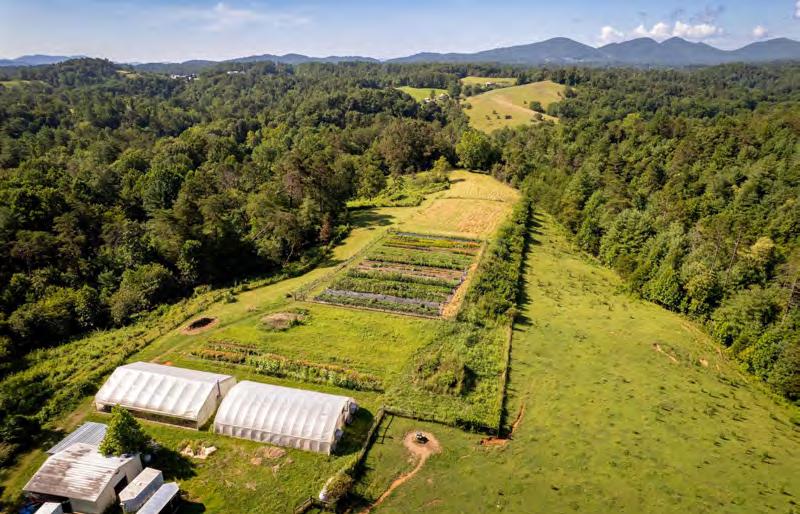
save seeds for future propagation. In the face of more extreme climate changes, we need to develop and select food crops that grow best in the specific area where we live in order to create a more resilient and reliable food source. For example, Utopian Seed Project looks for plants that can survive a torrential amount of rain (such as the downpours
from Helene), but also do well in extreme heat or drought. They collaborate with others in this work, in the Appalachian Growers Seed Collective.”
Learn more at UtopianSeed.org or purchase seeds directly from them at www.utopianseed.org/ store.

Farm Volunteers – Thank You!
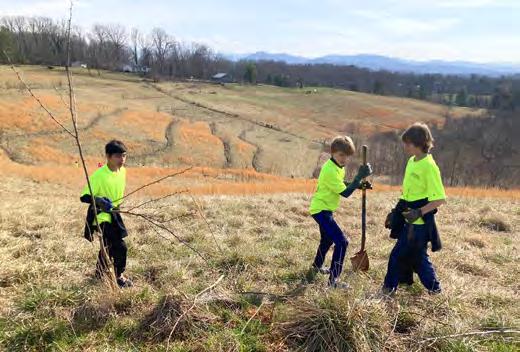
We’re grateful for ongoing support from volunteer groups on the SAHC Community Farm. Youth volunteers from the French Broad River Academy assisted with management activities in the agroforestry area and orchard – planting chestnut and blueberry plants, helping with cover crops, and pruning trees. We also continue to partner with the American Conservation Experience, in managing our short-leaf pine project and controlling invasive species.
SAHC Community Farm work is funded in part by grants from The Community Foundation of Western North Carolina and a cost-share grant from USDA Natural Resources Conservation Service. Thank you!
The Utopian Seed Project (photo credit) uses growing space, greenhouses, and other infrastructure on the SAHC Community Farm.

You’ve had a lifelong connection to the outdoors. Can you share how growing up in Eastern NC shaped your relationship with nature?
“I grew up right on the border of Green and Wilson County NC. Our house was in Green County and our mailbox was in Wilson County. We mainly grew tobacco. It was our main income, but I would say 80 to 90% of the food we ate came from the farm.”
Pender recalls having to walk a quarter mile from their farm in Green County to Wilson County to catch the school bus. The house they lived in was only about two hundred feet from the woods. Their crops were planted in the back while two other sides were surrounded by lush forest. Pender credits his enduring connection to the land to his farm roots.
What do you most enjoy about recreating in Western North Carolina? Do you have any favorite hikes in the SAHC focus areas?
“My favorite thing about Western North Carolina is all the outdoor recreation opportunities. I enjoy
Q&A: SAHC Board President Pender
A Lifetime of Connection to the Land
Hikers, birders, and other outdoor enthusiasts have helped guide the mission of Southern Appalachian Highlands Conservancy. Because of them, we know that when people connect to the outdoors in a tangible way, they derive healthy benefits and better understand the importance of conservation.
Community Engagement and Education Manager LaKyla Hodges interviewed SAHC Board President Larry “Pender” Pender for a Q&A session, to learn more about his background and how he has remained engaged in the outdoors throughout his life.
cycling, hiking, and I’ve recently developed an interest in mountain biking. But my favorite thing to do is ride my motorcycle.”
Pender is a connoisseur of many types of recreation. He and his wife, Tanya Marie, have partnered with SAHC on hiking, biking, horseback riding, and kayaking events. It comes as no surprise that Pender approaches just about any outdoor adventure like an expert.
“Strawberry Gap is my favorite hike. I first went there with Travis [Bordley].”
We’ve shared some memorable adventures, horseback riding and kayaking. What’s your favorite unconventional outdoor activity?
“Horseback riding is unconditionally one of my favorite outdoor activities. On the farm, our family had mules to pull wagons and haul tobacco. Every chance we got, me and my brother and our friends would borrow the mules and go for rides on them.”
Unsurprisingly, Pender’s parents were less excited about these mule rides.
“I remember the first time I rode a mule. I was very young and I fell off
and hit my head. Once I had recovered I realized I wanted to master it. It only made me want to ride more and more.”
Eventually this mule riding developed into an interest in riding horses. Years later while working at New York University and living in the city, he visited his cousin Ed’s home back in Eastern North Carolina. This cousin owned a horse farm.
“He had all types of animals. Horses, chickens, dogs, a cat, guinea fowl, and ducks, but mostly horses. I told Ed that when I retired I wanted to come back and help with the farm.”
After retirement, Pender returned to Eastern NC to care for his mother. It didn’t take long for him to start spending his Fridays at cousin Ed’s horse farm. Pender would clean the stables, feed the horses, and would get to ride whichever horse he wanted.
“I had a favorite horse to ride. I’ve forgotten his name but he was feisty! He wanted to be in control all the time. Eventually we grew a bond and I would ride him about every Friday.”
What inspires you about the outdoors?
“It doesn’t matter what it is, I just enjoy being outdoors. Being outdoors keeps me fit and in shape. All the activities I like doing keep me moving and working, building muscle and endurance. Outdoor recreation is my favorite form of fitness.”
You have a birthday tradition of cycling your age in miles each year. What inspired this tradition?
“While I was living in New York I used to ride a lot. I would do 100 miles almost every weekend. Then I moved back to North Carolina and didn’t ride as much. I was watching the news one day and saw a story about a man in his 80s who cycled his age in miles every year. It inspired me. At that time, I could only go about 8 miles before getting sore. I worked at it for months,
and by the next year, I could ride my age in miles. I want to keep doing it until I can’t anymore.”
Pender sees this tradition as a way to stay motivated.
“When you have a tradition to do every year, you can’t sit around and wait for it to come up. You have to train for it. Doing outdoor activities year round allows me to do that.”
Many people assume outdoor recreation has an age limit. What guidance would you share for continuing to stay active outdoors throughout your life?
“Just get out and enjoy fresh air and sun, go for walks. It will keep you fit. If you want to have a long, healthy, less stressful life, get outdoors as often as you can. Do whatever you like. You don’t have to be a super athlete. Just go at your own pace. You will find it to be very relaxing; it will relieve stress and help you sleep better.”


Pender’s dedication to recreation is inspiring. We invite everyone to think about making your own ‘Pender Challenge.’ Set a goal for your birthday, and give yourself a gift that lasts.
“It’s not about being the fastest or the strongest,” says LaKyla. “It’s about setting a goal, sticking with it, and celebrating another year of life by moving your body. If you decide to take on the Pender Challenge, share it, invite a friend, and see what you’re capable of. Improve your quality of life by building a relationship with the outdoors.”
Youth Education
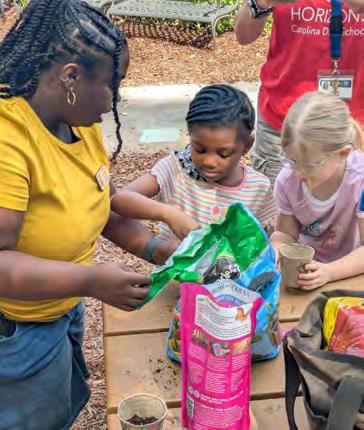
Leading up to Earth Day, LaKyla partnered with the Horizons Program at Carolina Day School to help students connect more deeply with the natural world. Through a hands-on lesson rooted in the rhythms of our mountain landscapes, participants explored the lifecycle and anatomy of plants, gaining a greater understanding of how seeds grow, flourish, and sustain the places we call home.
Beginning with the journey from seed to sprout, students decorated biodegradable pots and planted wildflower seeds of their own. Each pot went home with them, offering an ongoing opportunity to witness growth firsthand, whether on a sunny windowsill or planted directly into the soil. In this way, the experience continues beyond the classroom, nurturing a lasting connection to the land and the living systems that sustain our communities for generations to come.
Pender and wife Tanya Marie on a horseback ride.
Pender was inspired by a personal goal to cycle his age in miles for his birthday.
Members’ Corner
Your Support Makes Conservation Work!
New land conservation projects and inspiring stewardship endeavors are made possible by YOU – generous SAHC members. Your support directly helps protect the places you love in the mountains of NC and TN. Thank you!
Did you know it may be possible for you to double your impact? As a 501c3 nonprofit organization, SAHC is eligible for many employers’ matching gift programs. Does your company match gifts? Are you retired from a company that matches gifts? It’s an easy way to double or even triple your contribution! Check to see if your employer offers a matching gift program.
NEW Member Benefit
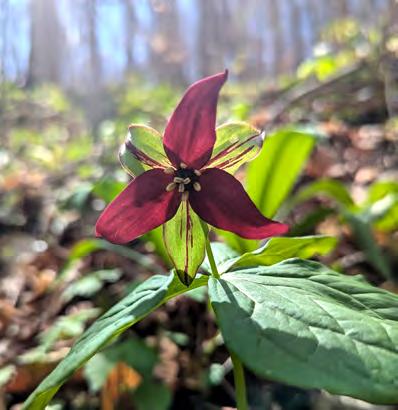
Your support makes a positive impact throughout local communities. As a special ‘thank you,’ Warren Wilson College is offering a discount to SAHC members who enroll in the Mountain Institute for Lifelong Learning at WWC. Explore intensive immersion workshops taught by Warren Wilson College faculty, staff, and local artisans on their beautiful campus just outside of Asheville in the Blue Ridge Mountains. More info and registration at mountaininstitute.warren-wilson.edu –25% discount code for SAHC members is “SAHC”.
Tributes — as of May 5, 2026
Tributes are gifts made to SAHC that celebrate a person, achievement, or special occasion.
In honor of Lauren and Christine Bechtol
Kaitlyn Johnson
In honor of Everett Bowman
Mark and Lindsay Merritt
In honor of Bill and Toni Byers
Scott and Meryl Lawrence
In honor of Corri Capps
Marion Uhalt
In honor of George Carter
Laura and Jane Collins
In honor of Chuck and Lisa Carver
Joseph and Pam Morris
In honor of Dudley Cate
Andrew Cate
Russell Cate
In honor of Russell Cate
Andrew Cate
In honor of Matt, Stephanie, Clay, and Karla Compton
Steve Compton
In honor of Steve Compton
Jonathan Compton
In honor of Dr. Art and Charlotte Ellis
Tom and Jo Brock
In honor of Peter Erickson
Mandy Erickson
In honor of Robert Gault
Ruth G. Wells
In honor of Ivy Givens and Spencer Scheidt
Louise Tual
In honor of Heather and Joshua
Angi West
In honor of Alan and Chrissy Householder
Darrell and Glenda Eastridge
In honor of Lynn Hull
Chad Hull
In honor of Pam Kelley
Reba Barber
In honor of Kim and David
Chet Neufeld
In honor of Nancy Kiplinger
Jonathan Compton
In honor of Sondra Lahtinen and Sharon Peterson
Helen C. Gift
In honor of Jay Leutze
Allan and Betsy Clark
In honor of Bill and Dee Dee Maxwell
Fielding and Julia Lewis
In honor of Hanni Muerdter
Marjorie Warren
In honor of Cathy Robertson
Douglas Day
In honor of Bill Ryan
Lee Ryan and Nancy Aalberg
In honor of
Dr. and Mrs. Waid Shelton
John and Roberta Toole
In honor of Kathy Singleton
Eleanor Lamb
In honor of Jasper and Ellis Tait
Megan Sutton and Andy Tait
A Morning In Charlotte
On a March morning, friends of Southern Appalachian Highlands Conservancy gathered for coffee, conversation, and a shared commitment to the lands and waters of our region at the Community Matters Cafe in Charlotte, a nonprofit that offers life skills programs to students graduating from the Charlotte Rescue Mission.
Guests joined us for this gathering, creating space to connect, ask questions, and hear more about the work ahead. Executive Director Carl Silverstein shared a brief update on current conservation priorities, including efforts to protect special places like Roan Mountain, while also reflecting on the long-term responsibility of caring for the lands we have already protected.
More than anything, the morning was about relationships. Guests talked over coffee, studied maps of protected lands, and shared their own connections to the mountains. Conversations moved easily from favorite hiking spots to future opportunities to get out on the land together.
For many in the room, SAHC has been part of their lives for decades. As longtime member and Gray’s Lily Leadership Circle supporter Tom Janzen shared, “Being part of this work over the years has been deeply meaningful. It is about taking care of places that matter and making sure they are here for the next generation.”
Gatherings like this remind us that
If you would like us to consider hosting an event in your community, please let Director of Development Anna Kuhlman know at Anna@appalachian.org.
Spotlight On: Carolinas Nature Photographers Association
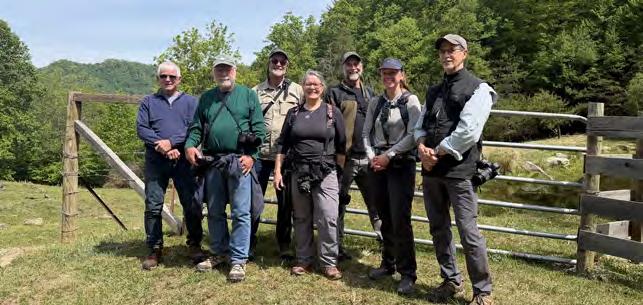
We’re especially grateful to the Conservation Committee of the Carolinas Nature Photographers Association (CNPA) for their long-term partnership with SAHC. These talented photographers generously donate time and expertise to enhance our conservation storytelling efforts. THANK YOU! CNPA photographers recently visited and photographed the Hawkins Farm for the story in this issue (p. 20-27)
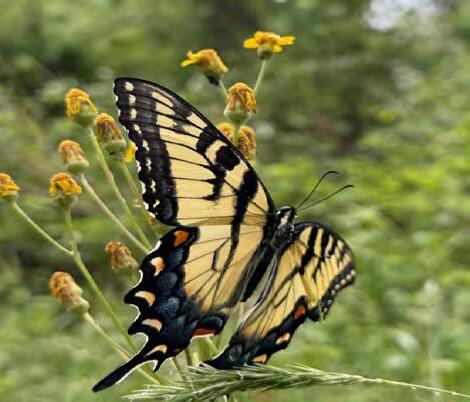
conservation is built on community. We are grateful for the time, insight, and generosity of those who joined us in Charlotte, and we look forward to many more opportunities to connect in the months ahead.
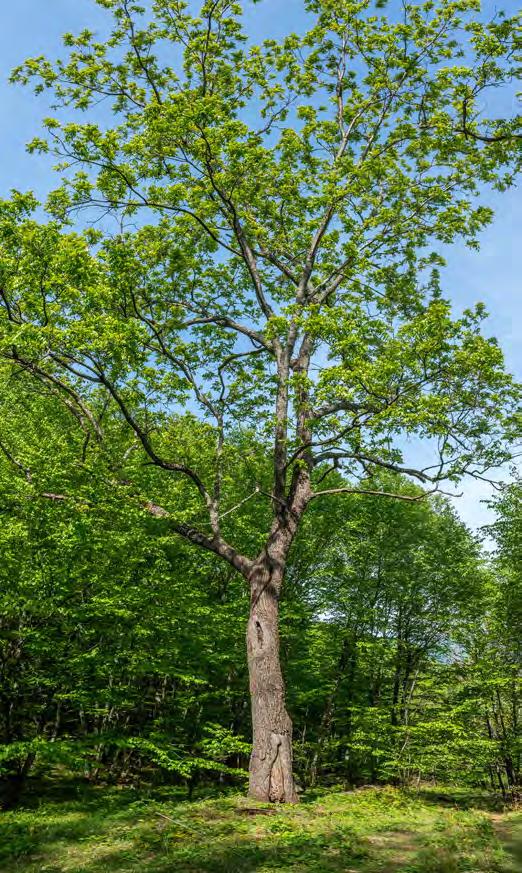
Photo by Kim Lance, CNPA
Memorials as of May 5, 2026
Memorial contributions to SAHC honor the memory of special individuals. You can remember a loved one by making a gift to SAHC to help permanently protect the places they loved.
In memory of Bob Brannon
Aristo Music Associates, Inc.
Mark Ellison
In memory of Harriet Cone
Mountain View Garden Club
In memory of James Cornett
Kristen Cornett
In memory of Jack Dalton
Mike Horak
Anne and Marshall McLaughlin
In memory of Murray Evans
Dee Montie
In memory of Mary B. Gray
Ronald Morgan
In memory of Robert M. Harvey
Mabel S. Harvey
In memory of Miles O. Hayes
Jacqueline Michel
Joy Hayes
Mya Hayes
In memory of Audrey Kaiman
Ben Hole
In memory of Buddy and Anne MacKay
Dana Cozad
In memory of Billy McKinney
Sandy Herndon
In memory of Katherine Ann Overholser
Jo and Ole Helleskov
In memory of Charles Ribelin
Caroline Ribelin
In memory of Stu Ryman
Nancy Ryman
In memory of Lillian and Hugh Smathers
Juliellen E. Sarver
In memory of Vicki Lee Solomon
Michael Solomon
In memory of Sarah “Sallie” Carter Thomason
Kim and Michael Johnson
In memory of Beth P. Thompson-Oaks
Craig Thompson
In memory of Joan W. Worth
Juliellen E. Sarver
In Memoriam: Jack Dalton
Southern Appalachian Highlands Conservancy honors the life of Roy Jackson “Jack” Dalton, Jr., a devoted supporter and friend whose quiet generosity and deep love for the mountains shaped our work for nearly 25 years.
Jack lived with a strong sense of place. He cared deeply for the land and for the community of Spring Creek, where he built his home and spent his days tending gardens, walking the woods, and sharing time with family and friends. He found joy in simple, lasting things: a wellturned bowl, a good hand of bridge, the shade of a black walnut tree, and the rhythm of the seasons.
His connection to this landscape was matched by his kindness toward the people working to protect it. Jack took time to know our staff, often showing up with homemade chocolate cookies made with black walnuts he harvested himself and the sweetest smile. He believed in the work not only because of what it conserved, but because of the people behind it.
Jack’s legacy lives on in the places he loved and helped protect, and in the community he nurtured with such care. We are deeply grateful for his years of support and friendship.
We extend our heartfelt condolences to his wife, Maxine, and to his children, grandchildren, and loved ones.
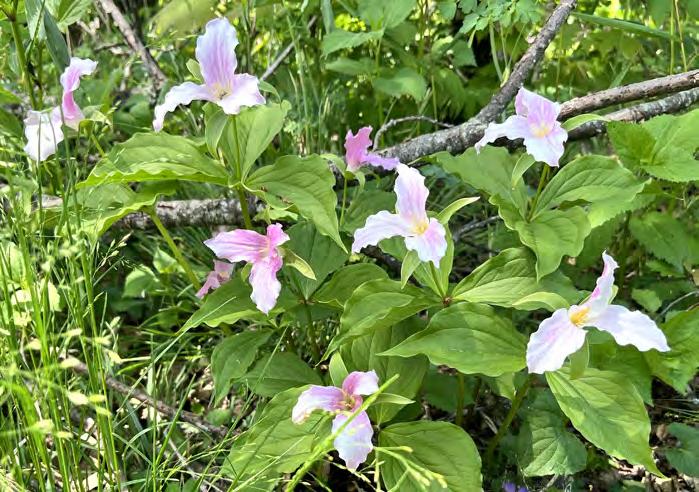
Memorial contributions to SAHC are gifts of flowers in perpetuity. Photo of trilliums blooming on an SAHC preserve this spring, by Stewardship Director Sarah Sheeran.
Corporate Partners
Can You Help Us Open a Door?
Since Hurricane Helene, we’ve seen firsthand how strong this community is –and how much we rely on one another to care for the places we love. As we continue our work to protect land, water, and wildlife across our region, our business partners are navigating a more challenging economic landscape. That’s where we’re asking for your help.
Many of you are connected to businesses through your workplace or relationships. A simple introduction could make a real difference – whether it leads to a sponsorship, matching gifts, in-kind support, or employee engagement.
An introduction doesn’t have to be formal or complicated. Sometimes it’s as simple as pointing us to the right person or making a quick email connection.
If your company – or one you know – might be open to supporting land conservation in western North Carolina and east Tennessee, we’d be grateful for the introduction.
Please reach out to Membership Director Cheryl Fowler at cheryl@appalachian.org.
Welcome - New Max Patch Partners

“Jennings Environmental is pleased to support the mission of SAHC. We are committed to implementing nature-based solutions to restore ecosystem resilience in Western North Carolina. The work of SAHC is essential for protecting and enhancing our natural environment for future generations.”
– Greg Jennings

“I chose to support SAHC because their work directly protects the landscapes I’m fortunate to experience and enjoy so often.
As part of the Outdoor Business Alliance (through Akers Digital’s support and my role on the board) it’s meaningful to invest in an organization that not only preserves this land but also strengthens the outdoor community we’re all part of.”
– Bethany Donovan
Land Trust Day Sponsors - Thank you!



Current Partners
Our Corporate Partners are business supporters who contribute to SAHC at an annual level of $1,000 or more. We’re so grateful that these businesses choose to support land and water conservation in the mountains of NC and TN.
Mt. Mitchell: $25,000+
The Biltmore Company
Witherspoon, Platt & Associates
Waterrock Knob: $15,000+
Mast General Store
Salesforce
Wicked Weed Brewing
Roan Mountain: $10,000+
Highland Brewing Company
Cold Mountain: $5,000+
Hunter Hometown Foundation
Kee Mapping and Surveying
Big Yellow: $2,500+
Ballad Health
Explore Asheville
GE Aerospace
Max Patch: $1,000+
Akers Digital
Altura Architects
Apple, Inc.
B Local AVL & WNC
Coca-Cola Company
Equinox Environmental
French Broad River Garden
Club Foundation
Gartner
Grandfather Mountain
Stewardship Foundation
Jennings Environmental
Jus’ Running
Moni Hill, Artist
New Belgium Brewing Co.
Roberts & Stevens, Attorneys at Law
Shell Oil Company Foundation
Steelcase Foundation
Webb Investment Services


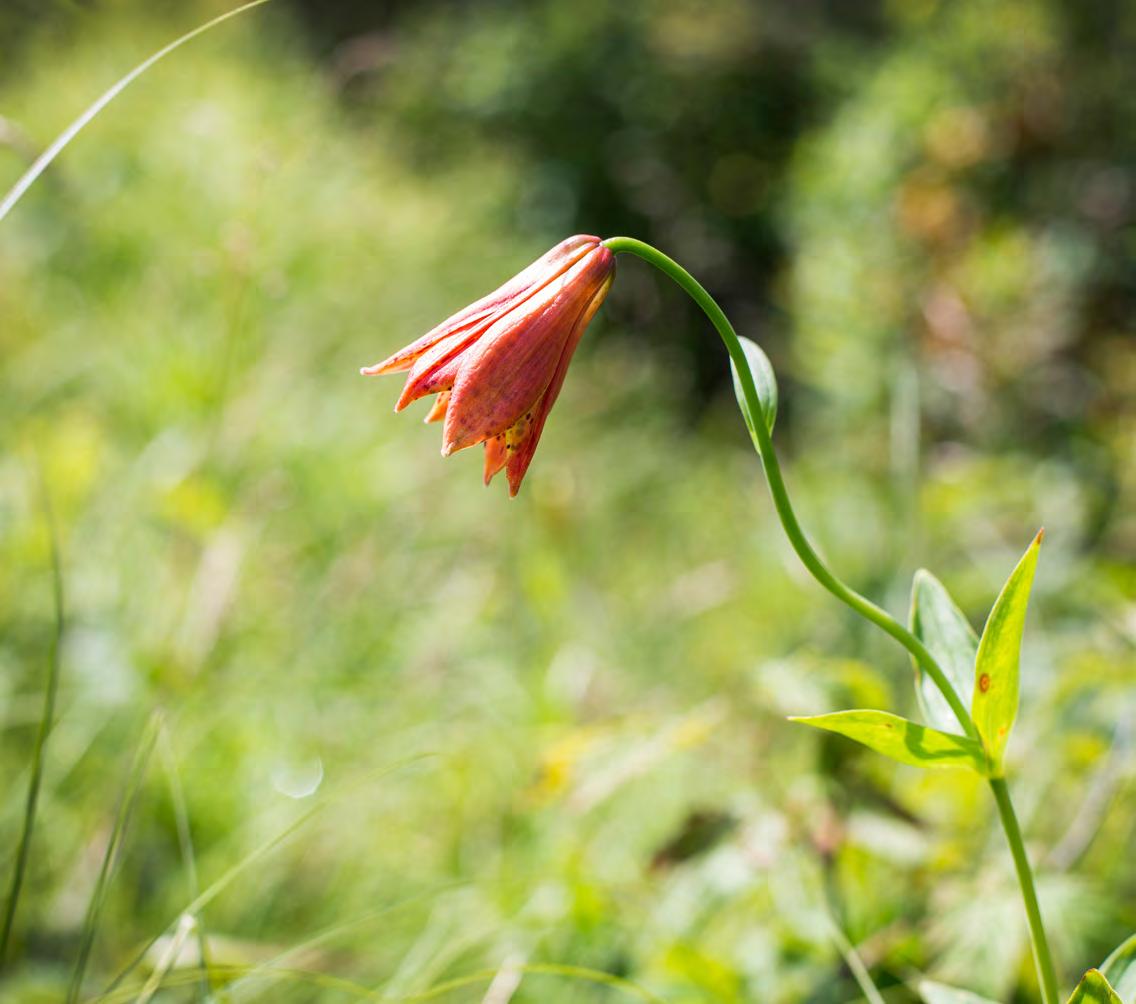
If “Make a Will” is on your to-do list, we can help. Learn how easy it is to make a gift to SAHC through your will. Legacy gifts can provide peace of mind while ensuring that future generations benefit from protected land and water. For more information, contact Anna Kuhlman at anna@ appalachian.org or 828.367.7312
If you have included SAHC in your estate plans, please let us know. We would like to thank you for your generosity and recognize you as a member of our Legacy Society.
Photo by Jorja Smith, CNPA