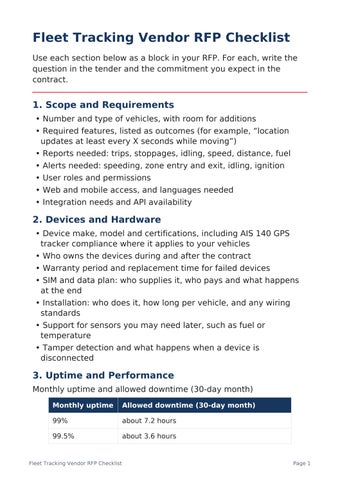
Fleet Tracking Vendor RFP Checklist Use each section below as a block in your RFP. For each, write the question in the tender and the commitment you expect in the contract.
1. Scope and Requirements • Number and type of vehicles, with room for additions • Required features, listed as outcomes (for example, “location updates at least every X seconds while moving”) • Reports needed: trips, stoppages, idling, speed, distance, fuel • Alerts needed: speeding, zone entry and exit, idling, ignition • User roles and permissions • Web and mobile access, and languages needed • Integration needs and API availability
2. Devices and Hardware • Device make, model and certifications, including AIS 140 GPS tracker compliance where it applies to your vehicles • Who owns the devices during and after the contract • Warranty period and replacement time for failed devices • SIM and data plan: who supplies it, who pays and what happens at the end • Installation: who does it, how long per vehicle, and any wiring standards • Support for sensors you may need later, such as fuel or temperature • Tamper detection and what happens when a device is disconnected
3. Uptime and Performance Monthly uptime and allowed downtime (30-day month) Monthly uptime
Allowed downtime (30-day month)
99%
about 7.2 hours
99.5%
about 3.6 hours
Fleet Tracking Vendor RFP Checklist
Page 1
Monthly uptime
Allowed downtime (30-day month)
99.9%
about 43 minutes
Don’t accept “high availability.” Ask for a number, and ask how it’s measured. Pick the level that fits how critical tracking is for you. Then check: • How uptime is measured, and who reports it • Planned maintenance windows, and how much notice you get • How quickly location and events appear after they happen • What happens when a vehicle is out of network (does it store and forward data?) • Service credits or penalties if uptime isn’t met
4. Data: Ownership, Retention, Security and Location • **Ownership.** The contract should say the data belongs to you. • Retention. How long is trip history kept online? Is older data archived, and can you still access it? • Storage location. Where are the servers, and is a backup kept elsewhere? • Export. Can you download your data in common formats (Excel, CSV, PDF) at any time? • Deletion. How, and how quickly, is your data deleted at the end? • Access control. Role-based access, strong logins and audit logs of who viewed what. • Encryption in storage and in transit. For a wider view of what to ask, see our guide to the cybersecurity risks in fleet tracking systems. • Breach handling. How will you be told, how quickly, and who is responsible? • Data protection compliance. Ask how the vendor handles personal data of drivers and employees, and check which data protection rules apply to you, including the DPDP Act.
5. Support and Service Levels • Support hours and channels (phone, email, chat) • Response and resolution times, defined by severity • A named contact and an escalation path Fleet Tracking Vendor RFP Checklist
Page 2
• On-site support for installation and repairs, and in which locations • Training for administrators and users • Spare devices, and how fast they’re replaced “Dedicated support” means nothing unless it’s defined. Ask for the numbers.
6. Pricing and Commercial Terms • Itemised price: hardware, installation, subscription, SIM, support and taxes • How long the quoted prices are valid • Renewal terms, and any cap on price increases • Charges for adding or removing vehicles • Charges for extra features, reports or integrations • Payment schedule linked to milestones, not only to dates For more on what a subscription should include, see our post on what you’re paying for in a GPS tracker subscription.
7. Pilot and Acceptance • A pilot on a defined number of vehicles, with clear success criteria • Acceptance tests: location accuracy, alert delivery, report correctness • A go-live checklist and a list of defects the vendor must fix • Payment tied to acceptance
8. Exit Terms This is the section most tenders leave out, and the one that matters most when things go wrong. • Notice period and termination conditions, including termination for poor performance • Data export: formats, scope (all history), timeline and cost • Return or release of devices, and whether they’re locked to the vendor • Handover support to a new vendor • A defined period of continued access after termination • Written confirmation when your data has been deleted
Fleet Tracking Vendor RFP Checklist
Page 3
9. Vendor Evaluation • Relevant experience and references from similar organisations • Local presence for installation and support • Sample reports and a live demo with realistic data • Relevant certifications and compliance documents • Financial and operational stability
Fleet Tracking Vendor RFP Checklist
Page 4