SafetyFocus Africa's aviation safety promotion magazine - vol 11
Edition
34 Sep '20 - Nov '20
The safety magazine of www.aviassist.org Connecting African professionals to best aviation safety practices - offering business development opportunities for partners
rwandair.com
Indulge in world class comfort With full flat beds in Business Class Airbus A330
Contents
because Access to safety information should not be limited by the bandwidth of your connection
2
Director's message | Safe production It's not about a battle between production and protection
4
Foundation news | Recent developments Your update on the Foundation and its programs
6
6
Safety culture | C is for consistency Avoiding safety challenges from avoidable increase in communication
7
On record | Lessons learned in ground operations Learn from other people's ground handling incidents
10
10
Trainee | diary A look into a week of our trainee Felicien at Wilson Airport, Nairobi
12
4Cs of 21st century training | Positive influence & impact Learn about the secrets to connect with others on your leadership journey
14
Feeding | Cheetahs Stuff for our safety cheetahs to advance their skills and the industry
16
16
Strategic issues | Going beyond compliance only Making a country and its industry meet the standards and excel
20
Info scan | Resources for recovery Resources to help your company (and you!) recover from COVID-19 crisis
22
Causal factors | Lack of restraint A look into a filmed crash of a cargo Boeing 747 - lessons in safety culture
20
27
On record | Go-around and decompression Learn from incidents that have already happened, just not with you....yet
The printing of SafetyFocus is sponsored by:
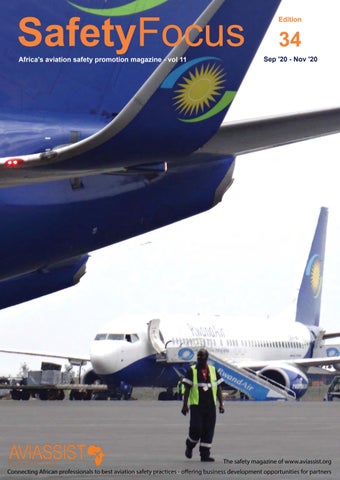
22 Cover photo: The apron of Kigali International Airport serves as a regular location for site visits in the courses at the AviAssist Safety Promotion Centre Rwanda © AviAssist Foundation
(+250) 788 177 000 reservations@rwandair.com
SafetyFocus Magazine
Edition 34 - 2020
Our promise to you ...... Every quarter, we aim to bring you the very best update on best safety practices. From safety management to cabin safety to safety shopping tips. If you ever feel we can improve, let us know. Do you find the contents interesting or boring? Please send your message - rude or polite - to: safetyfocus@aviassist.org After all, it's your magazine.
Follow us on:
Facebook.com/ AviassistFoundation
twitter.com/ AviAssist
Youtube.com/ 1 AviassistFoundation
Safety in African Aviation
SIAA
2020
director's | message
Africa's Aviation Safety Conference As the world struggles to come to grips with the effects of the unprecedented COVID-19 pandemic, so too are we in aviation striving to understand what is a previously unimaginable situation. It almost feels like my life, the world and the aviation industry have all had the ‘reset’ button pressed. And what this 'reset' means is greater safety challenges but also opportunities. One has to ask the question - can the balance between safety and productivity be kept to a proper standard? This is one of the main questions that have been concerning us here at the Foundation. As companies scramble for survival, a lot of effort will be put into productivity. And so safety promotion budgets will come under pressure, perhaps like never before. The emphasis on safety is often suppressed when production pressure intensifies. This makes workers question the validity of the priority on safety and slows progress toward a safer industry. Most organizations realize that what they really want is not a battle between safety and production, but safe production. This means if either of the two wins, they both lose. Sacrificing one for the other cannot be a permanent solution. The current crisis has opened up people’s minds and agendas to internet based training. A wealth of online courses, webinars and events has become available to the aviation professional over the past months. Resources that were always there but which we didn’t have time to explore are now filling up our diaries. In line with this the Foundation has started a series of 12 webinars dealing with the subject of multinational cockpit crew challenges in Africa, beyond its initial target audience of students in the 2nd ATAERA African aviation safety student competition and welcomed professionals from across Africa to hear about solutions for multinational cockpit crew challenges from some of the best experts in the world. Lots of training organisations and companies have set up what you could call ‘emergency remote training’ - putting a camera in front of an instructor and broadcasting it to the world, not realising that many attendees are falling asleep or simply doing something else.
October and November Registration Honesty donation of
Theme of 7th edition:
US$50
"Maturing safety management systems (SMS) & State safety programs (SSP)" We’re not in that business, even if it meant cancelling 9 events scheduled for the remainder of this year. We chose not to simply replace them with a green screen and a camera. We want to invest the time and energy in developing special online events because we realise it is another skill delivering an event online. The board is willing to accept loss of revenue while we stick to our own high standards. So bear with us: we are still here for you and on our way to getting stronger and more surprising than we were before this crisis. We are focussing a lot of our energy on delivering two events this year right to your office (or living room). Firstly we are replacing the 7th edition of our conference that was to be held in Johannesburg, South Africa with a series of four virtual mini-conferences, broadcast from a professional TV studio in the heartland of Dutch TV broadcasting. This first edition of the virtual conference will be accessible for free, thanks to our loyal and generous supporters. The silver lining here is that many more professionals from Africa (and beyond) will be able to join us on this platform than if the conference went ahead as planned. It will also feature a number of social events where you can win great prices, enjoy great stories and some good ol’ stand-up comedy about aviation. Then secondly there will be our first course on continuous airworthiness management. An online edition of a course has made it possible to bring in more guest speakers at no costs at all. This will enrich the event and deepen the learning. During these hard times, we have received notification from the University of Rwanda that our classrooms and experience room are ready for us. From there, we will run an expanded program of safety promotion and research in a mix of classroom and online training. And then of course we have this thing you are holding in your hand right now: the 11th volume of the SafetyFocus magazine. We work hard to keep access to safety promotion affordable since 1995. Let the Foundation help you keep that balance between safety & production. We are here for you.
Tom 2
4 afternoons Packed with safety promotion live from our studio, straight into your (home)office in
SafetyFocus Magazine
In four afternoons we'll be looking at: • deploying safety data across the region • human factors and crew resource management • ground operations & ground handling safety • Runway safety • prioritising icao standards to achieve a minimum level of safety? • What are core reasons for a low level of compliance?
more information and registration at:
www.aviassist.org
Brought to you by:
Independent | Non-profit | Innovative www.aviassist.org SafetyFocus Magazine
In association with:
exchanging bright ideas for
Safety Sponsors:
Edition 34 - 2020 a sponsor and drive brand awareness? Contact us at siaa@aviassist.org 3 Interested in becoming
SafetyFocus By the AviAssist Foundation
foundation | news
foundation | news
Colophon
SafetyFocus Africa’s safety magazine
Aviassist focus group
new website and logo
AviAssist is an independent, nonprofit organisation. Its mission is to provide effective and affordable support to safety champions. It serves as a catalyst for safety promotion since 1995. It provides safety promotion services for Africa's aviation industry and business development opportunities in Africa's growing markets for true safety promotion partners. Working in Africa for a quarter of a century has equipped AviAssist well to deal with the technical as well complex political, social and cultural issues that play an important role in improving African aviation safety.
Foundation Board Capt. Auke Dros KLM Royal Dutch Airlines Kees Oudendijk Treasurer to the board Bert Kraan Founder & Deputy Director CAA-NL (rtd.) Frank van de Laar Marketing & sales director EMEA Wright Brothers Simulators Hellen Ndichu Safety director Rwandair Ron Louwerse Managing Director Rotterdam The Hague Airport Schiphol Group Ron Schipper Vice-President Africa - KLM (rtd.)
44
The Foundation will launch its new website per the 1st of August. The launch of the new, mobile friendly website coincides with the launch of a new logo. The website helps the Foundation with rolling out the first step in the implementation of its Big Vision: its first AviAssist Safety Promotion Centre.
cross cultural training trial More and more African airlines have to deal with more and more nationalities in their cockpits. Clashes between some aspects of national cultures have been implicated in several major accidents and feature in many incidents. The Foundation is mapping the training needs for a new course on this topic. “Initially, we will start with a trial course of 4 sessions of one hour,” Foundation instructor Capt. David de Jong explained. “This will take place after the European summer and will help us map any Instructor Capt David de Jong training needs in this field. Intercultural research by Dutch social psychologist Geert Hofstede will form the basis of that trial course”.
online airworthiness The Foundation’s first continuing airworthiness is going online. As a result of travel limitations caused by the Corona pandemic, it will be the first course that the Foundation is developing in an online version too. The course will be free to attend with a limited number of places being available. One of the advantages is that professionals can attend without travel costs. The course will be spread over 4 half days and will see a faculty of 4 experts instructing. It will be designed to equip participants with the fundamental knowledge and skills necessary to manage continuing airworthiness within an airline or independent CAMO. The programme will include a number of case studies and activities to facilitate practical understanding and competence development.
Rotterdam, the Netherlands The Foundation's new logo was designed by
Eveline Beukers as part of the work on the new website
The Foundation's Focus Groupis a new small, but demographically diverse group of professionals in Africa whose reactions are sought as part of both training needs assessments and the Foundation’s course development process. It will assist the Foundation in further tailoring of its services to the demands in the African aviation industry. The Focus Group consists of 10 outstanding Safety Cheetahs: professionals who contribute passionately to making commercial aviation the safest form of transportation also in Africa.
Winners second student safet y competition from eleven different aviation universities had the opportunity to enter the competition. The students' plans were also informed by a series of 12 webinars by leading experts from across the globe.
New treasurer appointed The AviAssist board has appointed Kees Ouwendijk as its new treasurer to the board from August 2020. Ouwendijk will succeed Jan van der Hoeven, who has held the position for the Board treasurer Kees Oudendijk past two years. “In his role as Treasurer to the Board, Mr. Ouwendijk will ensure financial prudence across the organisation and help ensure the Foundation’s financial sustainability,” Board chairman Ron Louwerse explained. “The Board wishes to thank Jan van der Hoeven for his financial stewardship of the Foundation. Jan truly strengthened the financial oversight by the board over the past two years. We’re confident Kees will take us to the next level and help us confront the challenges of postCOVID recovery and continuation of our growth.” Mr. Ouwendijk commented: “I am very grateful for and even proud of the opportunity to join the Foundation and contribute to the financial well-being of the Foundation. I see this work as a place where several of my passions meet, namely aviation, Africa and working together for the greater benefit of all. It also links up nicely to my daily job as a regional road safety ambassador. “ Next to his position as an unpaid board member with AviAssist, Ouwendijjk works as senior advisor at the Netherlands Vehicle Authority. Ouwendijjk has over 22 years of experience in accountancy ranging from working at accountancy giant KPMG to being finance consultant in Tanzania’s tourism industry. He holds a master’s degree in accountancy from the University of Amsterdam as well as a private pilot license. SafetyFocus Magazine
Amsterdam, the Netherlands The winners of the ATAERA-AviAssist student
competition Lars van Pelt and Seth Ligthard
A team of the Aviation Academy of the Amsterdam University of Applied Science won the second edition of the ATAERA – AviAssist African Aviation Safety Student Competition. The competition is a unique opportunity for aviation students to develop critical problem-solving skills, learn to think more creatively and get a chance to test their knowledge in new, real-world situations. It also led to the students establishing contacts around the world. Despite the COVID 19 pandemic, students
A team of four judges selected the winner from among the entries. “This year the teams were competing to come up with the best plan to address multinational cockpit crew challenges in African airlines”, chair of the judges, Karina Mesarosova commented. Mesarosova is adjunct professor with Embry-Riddle University Worldwide. “It was an honour to be asked to judge the ATAERA student competition. The standard of student work was incredibly high, and selecting the winner was a difficult decision.” The COVID-pandemic unfortunately made it impossible for the winners to present their plan at the 34th conference of European Association of Aviation Psychology as was planned.
4 virtual mini-conference in oc tober- November The Foundation will transform its 7th Safety in African aviation conference into a series of 4 mini-conferences online. “The virtual conference will take the form of a talk show from a professional TV studio in the Netherlands, “ AviAssist Foundation director Tom Kok explains. “It will be produced in partnership with corporate Friend of AviAssist TEASAS and a TV recording studio in the Netherlands. Presenters from all over the world will be connected into the studio via an internet link and can then present to the participants from all over Africa. Participants will be able to put questions to the speakers and can attend a number of virtual break away rooms. In those rooms, professionals can spend some time in a smaller group with a subject matter expert and discuss a central thesis. The virtual conference will also feature a number of social events where you can win SafetyFocus Magazine
great prices, enjoy great stories and some good ol’ stand-up comedy about aviation. With these elements, we also want to add a social & fun element to the virtual conference, something that normally creates the family feel at our regular conferences.
Editor & design - Tom Kok editor@aviassist.org Felicien Izaturwanaho Trainee editorial review board Adrian Young To70 aviation Hans van Dijkhuizen AviAssist Foundation Capt. Ed Pooley Flight Safety Foundation European Advisory Committee Marie Kai Penial Air Advertising sales Let AviAssist help you organise the African market & support the work of the Foundation while bringing your brand to 45 African countries and beyond. Starting at less than € 11 per country. Contact us: safetyfocus@aviassist.org SafetyFocus is distributed for free to 2 professionals per organisation in the aviation industry and government departments involved in or relevant to aviation in 45 African countries. Subscriptions Stay up-to-date on best practices and subscribe to SafetyFocus. Africa’s quarterly safety magazine right on your doorstep every quarter for a whole year. In this issue, SafetyFocus reproduced articles with kind permission of CASA Australia's FlightSafety Australia, Aerospace Magazine from the Royal Aeronautical Society, Eurocontrol's Hindsight and Aerosafety World of the Flight Safety Foundation.
Participants to the conference will have to register to access the event. Participants will be asked to make a voluntary payment of US$ 50 for access to all sessions. “This is because we realise that it is not so much a matter of professionals in our industry in Africa not HAVING funds to pay but the lack of facilities to pay that contribution. The sessions will also be recorded and can then be seen by others after the conference,” Kok summarizes. Edition 34 - 2020
5
on | ground
SAFETY | culture lessons learned
C is for consistency Thoughts on what makes a realistic (and respected) safety policy
R
Tom Dombroski is senior manager corporate safety at American Airlines
amp safety briefings are an important piece of a broader topic: Safety Culture. At the foundation of a good safety culture is clear, consistent communication on safety from all levels of an organisation’s leadership. In addition to communication regarding safety, senior leadership must recognise that “safety first” is not just a catchy slogan. The importance of safety and following policies and procedures every time a task is completed cannot only be brought up when something has gone wrong. A good safety culture foundation requires consistent communication. This communication starts when a new team member is hired, continues throughout initial training, recurrent training and, of course, through regular ramp safety briefings. When safety is truly a priority for senior leadership it will be recognised at all levels of the organisation as a priority. Safety will then be a topic that is discussed on a regular basis at nearly all meetings, regardless of the leadership level within the organisation. Having a good safety culture requires more than just having a safety manual or safety policies, and more than occasional communication. It also requires all levels of leadership to recognise team members when safe actions are observed and thank them for following the proper procedure. This positive reinforcement encourages additional safe behaviour from the team member in the future. Just as important, it requires all levels of leadership to discuss unsafe actions in a professional, respectful manner. It is critical that the team member understands the “why” behind the policy or procedure that was not followed properly and also realises that the leader cares about tasks being completed in a safe manner. Ignoring these unsafe actions is also known as tacit approval. Tacit approval of unsafe behaviours encourages more unsafe behaviour, not just from the team member who performed the unsafe action, but from every team member who saw the unsafe action go unaddressed by the leader.
Making safety a priority Conversely, if safety is not a priority for senior leadership, that will become apparent to the team members as well. If leaders only take the time to communicate the importance of operational metrics such as on time performance or mishandled baggage rates, those areas are where the focus of the team will be. To be clear, operational performance is critical to the success of any airline or ground handling company. We are all aware of what a competitive industry we work in. However, those operational metrics do not matter if someone sustains a serious injury or an aircraft is damaged while cutting procedural corners to achieve these other operational goals. A leadership team that is engaged in a positive safety culture is also engaged in their operation. This allows leaders to receive feedback from team members and, just as importantly, follow up on that feedback. Team members will quickly lose faith that safety matters if there is no follow-up on concerns that have been brought to their leader’s attention. Listening and having professional, respectful conversations form a collaborative effort between leaders and team members that is very powerful. Safety should never be about blaming leadership or frontline team members, but always about improving the workplace for all. At American Airlines we are promoting the use of the phrase “It is okay to S.T.O.P.” We are encouraging team members that if something does not look or feel right, it is okay to Stop Think Observe and only then Proceed. Also, we are stressing that asking for help early in a challenging situation is not only okay, but encouraged! Ramp safety briefings are an important part of communicating that message and these briefings give our leaders a chance to demonstrate that we must have a “safety is our top priority” attitude from all at American Airlines. While ramp safety briefings are a critical part of handling aircraft, we must remember that safety is a multi-faceted subject and it requires engagement and commitment from every level of an organisation.
TOWING THE LINE? A B787 was being towed on to stand. During the tow the tug driver initially didn’t appear to understand the “brakes off” hand signal of a hand moved from a clenched fist to spread fingers. An additional thumbs up had to be given from the flight deck to convince him that he was clear to start towing. The tow to the stand started, although the centre line was not clearly visible because of a covering of snow melt (a salt and brine mixture) over the entire ramp area. The tow in line to this particular gate was a moderate curve followed by approximately 40 feet of straight line. Because the line was somewhat effaced, the driver had gone wide of the curve and upon his correction increased the towing angle of the aircraft, but with only slight aircraft forward motion. Although the driver never exceeded the maximum towing angle, without enough forward motion a strain was being put on the main wheels 1 and 5, to the extent that they started to oppose each other in the vertical plane. However, not at any point was there a threat of damage to the aircraft. During this manoeuvre the driver was being guided by an accomplice, who was at the head of the stand and using wands to direct his progress. At the point where the transition from the curve to the straight line began, the pushback driver started to beckon his colleague. It appeared that he was now not confident in himself to continue the tow through being off the line and not where he had expected to be. Before the second handler approached the tug, several movements of levers inside the tug were made whilst the driver awaited his colleague. It now became apparent that the driver wanted his colleague to take over the tow and was ready to get out of the tug. The driver then lifted his foot off the brake pedal and both the tug and aircraft moved backwards from their intended direction. The driver applied his foot to the pedal, stopping the motion; he then again made several lever movements in the cab.
At this point the second ramp agent appeared at the door of the tug, whereupon the driver jumped out of the cab, again removing his foot from the brake pedal. Once again the aircraft and tug started to roll backwards until the substitute driver managed to get inside the cab and apply the brakes, correct the manoeuvre, and finish the tow at the correct stop mark. The aircraft had rolled back approximately five to six feet when there had been no driver in control. It happened very quickly and took the flight deck by surprise, especially when they witnessed the first driver departing the vehicle. Overall, it would appear that insufficient training had been given to the original driver; it was quite clear that he was not comfortable with the tractor once he had strayed from the line. It was also evident that he had no comprehension of standard industry hand signals; further, not knowing how to apply the brakes and not understanding the consequences of departing a vehicle without the brakes applied when attached to an aircraft are very basic lessons that need to be understood by anyone in charge of a pushback. DEALING WITH A DISCONNECT Here, an A321 became detached from the tug during pushback. The crew were told by the pushback operative that he was ready for pushback. The crew were also told that the chocks were still in place but that he would remove them; the crew signified that they were still ready. Pushback clearance was received from ATC, cockpit checks were carried out and then clearance (“cleared to push, face east”) was passed to the pushback operative. The driver asked the flight crew to release the parking brake, which they did. There followed a garbled exclamation of surprise from the headset operative, since the aircraft was moving back at a speed that would be normal for a Mototok-enabled pushback. Over the next few seconds, the operative made it clear that the aircraft and the tug were not as connected as they should have been, and that in
fact they were moving further apart by the second, and that it would be necessary to use the aircraft brakes to stop the aircraft. The crew obliged. The park brake was set, the tug was reattached, and the push back continued as normal. The pushback operative had become slightly flustered when he had called “ready”, but had then noticed the chocks. This seemed to have been the main cause of the incident. When the crew passed the clearance on to him, he asked for the aircraft brakes to be released before the aircraft had been lifted. When it was lifted, the aircraft then slipped from the Mototok. The aircraft had moved approximately 15 feet before being brought to a halt. WATERWORKS Finally, from towing to taking on water. In this instance, an Airbus 321 suffered an incident with potable water. This was uplifted from a vehicle which was being sterilised at the time. Measures that had been put in place to ensure that the water vehicle was not used appear to have been ignored: the driver’s wheel had a cover over it, saying that it was not to be utilised; and the driver was meant to complete a dip test before every upload. The driver was actually seen on CCTV using this vehicle, which should not have been in service. It appears that despite an Ops message to the effect that the water was not to be used and that it needed to be drained from the vehicle, the CCS did not receive same. Unaware of the request, the CCS did not take action and the flight departed with the contaminated water uploaded: around 25% had been taken, since the aircraft’s tank was about 75% full from the previous leg. Medlink was contacted for advice: they stated that any adverse reactions would become quickly apparent on the flight. Fortunately, there were no reports of illness. A full investigation followed and the water truck’s driver was suspended from duty.
Republished with kind permission from Ground Handling International - the Mark Allen Group 6
SafetyFocus Magazine
SafetyFocus Magazine
Edition 34 - 2020
7
We care about your safety. Royal Schiphol Group already knows it for over 100 years: safety is aviation’s main condition. That is why we work very hard at all our airports to ensure our passengers, visitors and employees a safe environment. We will never stop doing this, because a safe environment is never finished. Therefore, we are a proud partner of the AviAssist Foundation in making the aviation industry even safer.
8
SafetyFocus Magazine
SafetyFocus Magazine
Edition 34 - 2020
9
trainee | diary Felicien Izaturwanaho Delivering 4 courses for the region 3-7 November 2019 Wilson Airport, Nairobi, Kenya
Name: What: When: Where:
Greeti
ngs fr om N airobi
Monday: Safarilink’s safety officer Gregory Ochieng picked the AviAssist team up from the Aeroclub of East Africa where we stayed. We made a short trip to the AMREF International University, the venue for the mental health in aviation course. The two-day course focused on addressing mental health issues of people working in the aviation industry. This subject is close to my heart as I came to the Foundation Visiting AMREF facilities evening before course with team as a graduate in psychology. Participants learnt about situational awareness, brain functioning and general mental health concerns. They also learnt about the requirements of pilot licensing. I assisted instructor Eric with course management ranging from time management to ensuring availability of breakfast and lunch. It required me to get out of my comfort zone to help maintain the course dynamics.
or Eric with ting instruct
Assis
moderating
group work
Tuesday: We learned about psychological problems and common mental health problems in people working in the aviation industry. The participants practiced a number of exercises such as the Digit Span exercise. This exercise is used in the course to help participants understand how critical it is for pilots to have a fresh working memory, which is one among six cognitive skills crucial for the pilot performance. Participants also learnt about different psychological interventions they could apply to support their aircrews and peers, including Safe Zone, Benchmark of Succes and Peer Support. I assisted Erik to demonstrate how to carry out psychological interviews and positioning a clinical setting. The participants were divided into two groups and each group practiced a role play. One of the group members had to play the role of psychotherapist, another one of the client/patient.
The dynamic formula that drives business performance
Wednesday: We had a day off today. In a one-to-one session with Tom Kok I practiced my presentation skills. This was to get me ready for my presentation at the conference of the International Society for Traumatic Stress Studies in Boston, the USA, where I was going after Nairobi. In the afternoon, we visited the Karen Blixen museum at the foot of the N’gong hills. The house has a fantastic view of the N’gong hills. It was fascinating to learn a little about life in Kenya in early 1900s and about coffee growing.
Find out more at: willistowerswatson.com/solutions/aerospace-and-space Day off - visiting Karen
g Weekend - flyin
th director Tom
a Cessna 172 wi
Global Aerospace: Talent, technical expertise and innovation
Blixen house
Thursday: Today we started the two-day crew recourse management (CRM) course. I felt quite privileged to attend this course. Fellow course participants were from the aviation industry of Kenya. Instructor Erik started with a bit of history of this training. He explained how the aviation industry started to recognize the significant contribution of human error to incidents and accidents from the 1970s. This recognition was a key step in the development of CRM courses. CRM is designed to diminish human error and enhance human effectiveness in the cockpit environment. It focuses on critical skills, including situational awareness, team work, leadership, communication, adaptability, problem-solving and decision making. It is applied to both national and multination cockpit crews as an error management training tool. My objective was to understand how human factors/crew resource management issues play a role in the aircrew pairing.
Friday: Day two of the CRM course. I learnt that CRM help air crew recognize variations between what is happening and what should be happening. That is often the first sign that a human error is occurring. Also, I learnt about appropriate communication techniques between for directors/inspectors and their staff. And that it is vital for management and inspectors to comprehend that questioning their authority is not a problem, and that subordinates should learn ways to question instructions. I would recommend this vibrant course to commercial airlines in the African aviation industry. The course exercise I liked Proud part best was called the “Vikings attack”. The group has to figure out where the Viking attack of the win ning team started, where the warriors of the Viking attack conquered the opponent and a time period in the Vikin g exercise of occurrence of the attack. Each person is given a number of pieces of the mission. Then members of the group have to work together to accomplish the mission. The Viking attack highlights how CRM is an effective utilization of all available resources to achieve safety and efficiency.
1010
SafetyFocus Magazine
willistowerswatson.com SafetyFocus Magazine FPS986
Edition 34 - 2020
11
4Cs for | safety promotion
A million reason$ to fly ATR. The 4Cs are Critical thinking, Communication, Collaboration and Creativity. The 4 C’s that underpin good safety promotion.
How to have positive influence and impact leadership coach and author cathering stothart reveals the secrets to connecting with others
No one tells you how to be a leader. Most of us pick it up as we go along, perhaps learning from role models and experience, or from books and training courses-if we are lucky. It can be a hitandmiss affair. And in truth, there is no single best way to be a leader- we must lead from who we are, from our own strengths and values. Whatever your leadership style, one thing is constant you can't lead other people if they don't want to follow you, so how you influence them is a critical success factor. Many organisations are trans-national, with leaders needing to interact both face to face and virtually with people in other parts of the world, who speak different languages and have different cultural expectations. They are often from diverse backgrounds, working in matrix structures and multifunctional teams, and all this adds to the complex task of communicating with them and gaining their commitment. THREE TRICKY TRAPS 1. Our impact on other people is often different from what we intended. We judge other people by their behaviour - what they do and say. When you are a leader, every communication, however minor it appears, is important, as you create the culture by how you behave. People will observe what you do and say (or what you fail to do and say) and will judge you on this. You might have a positive intention, but if the way you come across has a negative impact onthem, you will not have the influence or achieve the results you want. 2. Picking up accurate cues about other people's thoughts and feelings is difficult. We don't usually know what they are thinking or feeling unless they tell us. We sometimes project our own thoughts and feelings on to them and assume they see things the way we do. This means that we don't always respond in the best way to manage the relationship with them. 12
3. When misunderstandings occur, our emotions kick in quickly outside our conscious control and can derail the interaction. Steve Peters calls this our "inner chimp" - our flight or fight response activates before we can make a more considered response and conflict may escalate. TOP TIPS FOR POSITIVE INFLUENCE AND IMPACT The good news is that we can learn to behave in more emotionally-intelligent ways to get on better with other people and have the impact we want. Here are my top tips: 1. Take time to build rapport, even with people you know well. Make eye contact, smile, ask them how they are and what's been happening. Pay attention to the answer and look for common ground on which you can build connections. 2. Keep your intention in mind - what do you want to achieve? And what behaviour (what you do and say) will give you the best chance of reaching your goal? You may want to get something done quickly, which is a positive intention, but if you come across as impatient and demanding, people are less likely to go along with you. 3. Monitor how people react to youwhat impact are you having on them? Bear in mind that "the meaning of a communication is the response it gets". If they don't react as you expect, check out their understanding -observe their response and listen to what they say. Find out their perspective by asking open questions ("what are your thoughts on this?" ,"how do you feel about this?"). Avoid questions beginning with "why", as this can make people defensive. 4. When disagreements arise, look for common ground and areas on which you can agree. Use inclusive language ("we") and switch from the past or present to the future ("how can we take this forward?", "what are the next
steps?", "would you be willing to...?"). 5. Be mindful of your own emotions and of what is happening in your bodytension in your jaw and shoulders, faster heart rate, shorter shallower breaths- are all signs that your body is preparing for flight or fight. Take a deep breath, count to 10, and move away while you gather your thoughts. If you notice that you are feeling frustrated or irritated, take steps to manage your feelings so they don't come out in your behaviour- pause, take time out, change your speed and tone of voice, slow down your gestures, say something positive 6. Communicate positive emotions enthusiasm, cheerfulness, likingthrough your words, tone of voice and body language. People will pick up on this and when their positive emotions are engaged, you will get their commitment (they do it because they want to), rather than just their compliance (they do it because you have told them to). Brian Cox is an engaging presenter because he communicates his emotions, his sense of awe and enthusiasm, and this elicits similar emotions in us. 7. Never forget to take account of how people feel. How do you want them (and you) to feel at the end of the conversation? Bored, nervous, angry, confused? Or curious, confident, relaxed, clear? Remind yourself of how you want them to feel and check that your behaviour fits with that purpose. The best communicators make other people feel good. Finally, remember that if you can match the impact of your behaviour to your intention, you are more likely to achieve the influence and the outcomes you want.
That’s why we’re
the Regional Leader.
#ATRLeads
ABOUT THE AUTHOR
Catherine Stothart MSc, CFCIPD, is a Leadership Coach and the author of How to Get On with Anyone: Gain the Confidence and Charisma to Communicate with any Personality Type, published by Pearson SafetyFocus Magazine
Choosing ATR’s solutions generates $1 million of savings annually, per aircraft, compared to their direct competitors. This explains the vast success of the program and its leadership in terms of orders, deliveries, backlog, operator base, investor’s opinion and residual value retention. SafetyFocus Magazine
atr-aircraft.com
Edition 34 - 2020
13
feeding | cheetahs
Feeding | cheetahs
original product
Human Factors for Aviation Maintenance covers the aspects of psychology, performance, and communications which are important for individuals and teams working in an aviation maintenance environment. Included in this manual is a detailed description of the the MEDA model (Maintenance Error Decision Aid) developed by The Boeing Company. The book is fully compliant as EASA Part 66 module 9 for the B1 and B2 license and has been given approvals by numerous EASA based civil aviation authorities.
Great read
Covers all aspects of aircraft accident investigations. Includes new information on the investigation of inflight fires, electrical circuitry, and composite structure failure. Explains the investigation procedures required by the NTSB and ICAO. Covers basic investigation techniques, aeronautical and structural knowledge useful to investigators. Also covers analysis, investigation management and report
The fascinating and thrilling account of commercial pilot Ernest Gann's from the early days between the wars. Every chapter tells the tale of a real incident from which Gann just escapes with his life and the lessons learned. Available from webshops such as www.loot.co.za
You can purchase this book from www. actechbooks.com
ES MATTER O D E SIZ
writing.
FAb free|online course
, fun, enture nce. v d a f 's life o xperie A pilot ning f rom e olicy r a rash P and le a No C ology and e v a H We echn f rom s the t in flying la p in s n ex r o w, in a n fuct huma s point of vie rous way ot mo the pil ble,hu a d n a t s under 14
Experts from the Faculty of Aerospace Engineering of Delft University of Technology will help you explore and discover the fundamentals of flight, in three blocks on the majestic edX platform. First, you will explore the history of flight including ballooning and obtain a basic understanding of aircraft. Topics include stability, navigation, propulsion and the structure of aircraft. Block two examines the principles of aerodynamics. You will learn for instance how the shape of a wing impacts the amount of lift generated. Block three covers flight mechanics, including various flight phases, such as descending, climbing or cruise, and the most optimal flying conditions for each phase. https://www.edx.org/course/introduction-toaeronautical-engineering-2
SafetyFocus Magazine
eral ’ Fed book s e t a and d St nite ration h al U l a d i c inist auti offic ts an This ion Admic aeron for pilo ight t l Avia ides bas ssentia ork in fl ure) e v w o e t (fut g a pr wled iators th roduces ctrum o n k spe r av t int othe ations. I e broad g f rom ing, rt r ope ors to the rangin ion mak ry, airpo t a s o avia owledg s, deci er the re. It is c h n o i t n k of dynam ls, wea and m matio r aero t contro OTAMs he info aft and d r t N h l c , l an r s g i a i a n fl for te an e Exam tio a e r c e op eferen opera wledg r key ssary to AA Kno t’s f ree! Whc i nece ss the F t. And… t.ly/2Css i a s b p e / to tical T ttps: / h c : a r e r P it he Get SafetyFocus Magazine
Edition 34 - 2020
Safety Management Systems (SMS) are just as relevant for small organisations, such as rural and regional airports, as it is for the large metropolitan airports, and can be scaled to suit the size and complexity of the organisation. In this booklet, the Civil Aviation Safety Authority of Australia provides helpful guidance to smaller airports in setting up their SMS
15
Strategic | issues
Strategic | issues USOAP audit, to support CMA activities, or to facilitate an ICVM, can and should also be used by the State’s own Civil Aviation Authority as a matter of routine to inform its own safety management decisions and actions. ICAO’s Critical Elements
Beyond
compliance BY r ay elg y
Effective safety management requires assuring and maintaining compliance with international standards and national regulations
Compliance - the International Picture Ray Elgy has over 40 years of experience in airlines and regulatory authorities, He has held senior management positions and has supported ICAO audits in Europe and the Middle East and is a director at TEASAS
T
he year 2020 will be remembered for many things, not least of which will be the devastating impact that the Coronavirus Covid-19 pandemic has had on our personal, social, commercial and financial lives. With regard to the aerospace and tourism sectors, the effects of the pandemic will be felt for many months, and possibly years to come. But these sectors are known for their innovation and resilience, and we will see new business models emerging that will enable aviation businesses to flourish. This recovery effort will demand a great deal by way of resources, and of course these resources may have themselves been depleted as a result of the financial pressures brought about by Covid-19. At the same time, it is absolutely critical that the industry keeps its focus on the management of safety. New business models will be of little value if they don’t also deliver safe operations. Compliance with regulations is the bedrock upon which effective safety management systems function. However, on its own just complying does not ensure the best levels of safety performance. So, how can we best manage our regulatory compliance efficiently so as to release resources to develop and operate the aviation sector and enable it to flourish?
16
Let’s start at the top, with the global standards of the International Civil Aviation Organisation (ICAO), since compliance with the ICAO’s Standards and Recommended Practices (SARPs) is fundamental to the international nature of aviation. The techniques and tools used to manage compliance with these SARPs can also be used as an efficient means to manage and maintain compliance with regional and national regulations. ICAO’s Universal Safety Oversight Audit Programme (USOAP) involves the comprehensive audit and checking of compliance of a State’s complete aviation system. USOAP audits focus on validating the State’s national Aviation Regulatory framework and the State’s capability of performing safety oversight of its aviation sector. Once a level of compliance has been established, ICAO moves to a “Continuous Monitoring Approach” (CMA). CMA enables information about the level of safety oversight provided by an ICAO Member State to be collected more regularly. This information is provided primarily by States themselves but may also be obtained from relevant international and national stakeholders. Using this approach, audits are supplemented with an ongoing process of gathering safety information. This allows stakeholders in international civil aviation to base their operational and commercial decisions on the latest information available. The CMA provides a continuous picture of a State’s effective implementation of Standards.
ICAO conducts audits and other monitoring activities to establish the safety oversight capabilities of Member States by assessing the extent to which they have implemented 8 Critical Elements (CEs) in each of the 8 audit areas (see figure 1 to the right) through Protocol Questions (PQs). These CEs are shown in Figure 2 below and enable the audit team to verify the status of the State’s implementation of Safety-related SARPs, together with the associated procedures and guidance material. The CEs cover the establishment of the safety regulatory system, and how it has been implemented. It is, therefore, a very comprehensive assessment of the compliance of the total aviation safety regulation system of the State. The need to keep track of all the changes in ICAO regulations, and transcribing them into national or (regional) regulations, can place a great demand upon a State’s resources. It is not unusual for States to have a backlog in implementing those changes, especially where they do not have a coherent and efficient system in place that facilitates the tracking. ICAO Contracting States are subject to an ICAO USOAP Audit every 8-10 years. The preparation for an ICAO audit and associated monitoring activities requires a great deal of effort. After all, there are 8 Critical Elements that covering each of 8 separate areas of audit. Far more effort will be required when States have been struggling to maintain their aviation regulatory framework. Support is required from the specialists in each of the audit areas in order to provide answers to the
It is also worth noting here that ICAO also undertakes “ICAO Coordinated Validation Missions” (ICVMs). An ICVM is not an audit, but a follow up on-site activity to validate progress made by member States in resolving safety oversight deficiencies identified during a previous USOAP audit. The key point here is that all of these data and information, and the tools used, whether required by ICAO in advance of a full SafetyFocus Magazine
Figure 2 - The eight critical elements of a state's safety oversight system SafetyFocus Magazine
PQs. that A State must complete the Eight ICAO audit areas Compliance Checklist (CC) and PQs in preparation for an SOAP audits focus on validating a audit. But there is great benefit State’s capability of performing safety to be had from continuously oversight of its industry. The eight audit maintaining compliance. After areas are assessed individually to ensure all, depending upon the scope of whether the State effectively and consistthe State’s aviation sector, there ently implements the critical elements of a may be over over 1000 PQs to safety oversight system. answer. These PQs are also being The eight audit areas of a member state’s frequently updated to reflect the aviation system that the programme monilatest ICAO provisions. This will tors are: ensure that the State is always 1. Primary Aviation Legislation and associprepared for an assessment by ated civil aviation regulations ICAO, and indeed by any other 2. Civil Aviation Organizational structure State (e.g. as part of the negotia3. Personnel Licensing activities tions for Bilateral Aviation Safety 4. Aircraft Operations Agreements etc.), and enables 5. Airworthiness of civil aircraft the State to use the information 6. Aerodromes created to monitor and improve 7. Air Navigation Services upon its compliance and safety 8. Accident and Serious incident investiperformance. It is also of great gations importance to maintain good control over compliance with Figure 1 the ICAO’s SARPs so that if, as a result of any changes in the State’s regulations or procedures etc. a change is introduced that results in The scores of Effective Implementation of compliance not being assured, a DifferStates can be found on the ICAO website. ence may be filed with the ICAO and There are many reasons why States may notified to all other States. This is a key fall short in their level of compliance. element in the management of safe interThese very from legal, financial and ornational operations. ganisational reasons, to a lack of technical resources. Some of those reasons are The need to manage and maintain easy to solve, others require much more compliance does not need be a burden. time, e.g. changes to the legislative system. The handling of that task of maintaining In general, it will take a State 2 years of compliance can become an integral part preparation time to ensure a good level of the State’s safety regulatory system with of Effective Implementation for a USOAP an effective management and information Audit. tool . Indeed, with the right application, and ideally one that is linked directly to Preparing for an ICAO Audit, or related ICAO’s on-line framework, the State’s legactivity islature, manuals, policies, procedures and Having explored the key elements of the work-instructions can be kept up-to-date ICAO’s USOAP activities, (e.g. 8 areas of as a matter of routine. audit, the 8 critical elements and the protocol questions etc.), it’s useful to consider Protocol Questions how to plan for, and support the audit or PQs are now the primary tool used by assessment itself. Clearly there’s a period ICAO to assess a State’s safety oversight of planning, when the audit or assessment capabilities for each CE, and facilitate activity is scheduled into the calendar. the standardization of USOAP CMA In developing its audit programme, the activities. Answers to the PQs are clasICAO will take into account each State’s sified either as “Satisfactory” or “Not safety information, including the previSatisfactory” (N/S), and the percentage of ous EI score, progress on corrective action “Satisfactory” PQs is reflected in the Effec- plans (CAPs), and information from the tive Implementation (EI) score . PQs must continuous monitoring activities etc. In be answered using an evidence-based addition, any Significant Safety Concerns approach, with very specific and relevant (SSCs) will be taken into account. Here references to all the applicable regulations, again, it’s beneficial to keep the ICAO fully policies, procedures and processes, as well up-to-date on changes and developments as acceptable means of compliance and so that their decisions are based on the latguidance material. Lack of evidence, or est, relevant information. There then follack of sufficient evidence (i.e. N/S) results lows a period of off-site activity, when the in a finding being generated against that State completes a State Aviation Activity specific PQ.
U
Edition 34 - 2020
17
Strategic | issues Questionnaire, (SAAQ) and prepares (or ideally just checks and updates) its responses to the ICAO PQs. The responses must be loaded into the ICAO on-line framework (OLF) after having been checked and verified within the State. The uploading of these data can be a very cumbersome and burdensome task. However, there are tools available to complete this important job easily and accurately. Uploading these data enables the ICAO audit team members to plan their on-site activities in more detail, but note that all PQs are assessed during the audit. The compliance checklist is also completed at this time. The duration of the on-site audit activity will depend on the nature of the visit (i.e. full audit, ICVM etc.) and the nature, extent and complexity of the State’s aviation sector. The onsite audit is followed by the issue of a draft report, which includes all of the findings, and which the State has the opportunity to comment upon. These comments will be taken into account by ICAO before publishing the final report. Protocol questions must be answered using an evidence based approach
The State is then responsible for developing a very detailed CAP and submitting this to the ICAO for agreement. Timely completion of the CAP is also the responsibility of the State and any deviation from the agreed timescales must be reported to the ICAO, along with an explanation for the delay and a proposed new completion date. In accordance with the USOAP CMA Memorandum of Understanding (MOU) and by means of the OLF, all States are obliged to: • Continuously update their SAAQ and CCs/Electronic Filing of Differences (EFOD); • Continuously update their CAPs and PQ status (self–assessment) together with all relevant evidence; and • Provide timely responses to Mandatory Information Requests (MIRs) issued by ICAO. All of this activity must in any case be undertaken with regard to the State’s own national (and, where applicable, regional) requirements, which of course are developed and derived from, and support the SARPs. Therefore, it makes complete sense to treat maintenance of the compliance with the ICAO’s SARPs as part of the overall state’s aviation safety management activities. Ideally, all staff contributing to the responses to the PQs should be provided with some training on the method and approach to be taken. Time invested here will bring advantages later on. There is a very complex system of linkages between PQs, regulations, policies and procedures etcetera. Each of these elements is subject to change. This makes it vital to have a robust system in place that guarantees that each and every change is tracked. In turn, all related PQs, requirements and documents etc. must be updated to ensure that compliance is maintained and that the regulatory framework remains cohesive.
1818
Pulling it all together The ICAO requires the State to appoint a national coordinator. She/he will facilitate the audit process, and ensure proper communication and coordination with the Contracting State., In the world of the CMA, these are identified as National Continuous Monitoring Coordinators (NCMC). These are normally, but not always appointed from within the State’s Aviation Authority. The NCMC serves as focal point between the ICAO’s Safety Oversight Audit Section and the State concerning safety oversight matters, and plays an active role during the three phases of the audit process: pre-audit, on-site and post-audit. The NCMC is responsible for managing the overall audit and monitoring activities and liaising with the ICAO, but accountability for the State’s compliance with the SARPs, and for the State’s safety performance, remains with the Director General of Civil Aviation (DGCA). All of which leads to the State Safety Programme. The Bigger Picture ICAO’s Annex 19 to the Chicago Convention introduced the requirement for States to develop and implement a State Safety Programme (SSP) in order to achieve an Acceptable Level of Safety Performance (ALosP) in civil aviation. The SSP provides a framework that allows the State’s safety oversight authority and service providers to interact more effectively in the resolution of safety concerns. The SSP comprises four main components, the same components that can be found in a Safety Management System: 1. State Safety Policy and Objectives 2. State Safety Risk Management 3. State Safety Assurance, and 4. State Safety Promotion The management of compliance with SARPs and National regulations, and the timely and effective resolution of safety concerns are key ingredients of the SSP. Conclusion In times of challenge and significant change, it is of vital importance to maintain attention and focus on aviation safety performance. The ICAO USOAP audit, and supporting CMA and ICVM activities, provide an excellent and proven framework effectively to manage compliance with the SARPs. This framework, and the tools used to facilitate its implementation, should ideally be used to develop, manage and maintain compliance with the State’s own national regulations. Indeed, the adoption of this coherent approach will facilitate easier continuous management of compliance, enables the creation of efficient action plans to implement the State Safety Programme, and helps significantly to minimise the administrative burden. The use of modern technology, and a coherent “no silos” approach, will greatly assist the NCMC, and will ensure that all regulations, policies, procedures and associated publications are kept fully up to date, eliminate inconsistencies, and provide clarity. And in a world steeped in safety regulation, the clarity of requirements is something to be treasured.
Improve your aviation regulatory competencies with virtual courses by the UK CAA experts CAA International provides best-in-class training solutions that are developed by UK CAA regulators; those working at the forefront of aviation regulation. This ensures our courses help you meet – and often exceed – the most up-to-date international regulations (EASA and ICAO Standards and Recommended Practices). As part of our commitment to supporting your learning and development in a COVID-19 environment, we are pleased to inform you that several of our training courses are being delivered virtually. This means you will still get the high-quality training and face-to-face access to our UK CAA instructors, but from the safety and convenience of your remote working location. Some of our upcoming dates are: • Introduction to Safety: 13 August 2020 • AOC Accountable Manager: 2 September 2020 • EASA Part 145 Maintenance Organisation: 8-9 September 2020 • Safety Management Systems - Principles and Applications: 8-9 September 2020 • Introduction to Compliance Monitoring (Auditing): 14-17 September 2020
To book now or for more information, please visit www.caainternational.com/training or contact us: +44 (0) 330 022 4401 or training@caainternational.com
www.caainternational.com Part of the UK CAA International Group
SafetyFocus Magazine
• Aerodrome Operations: 21-25 September 2020 • Risk Monitoring and Safety Performance: 21-22 September 2020 • Introduction to International Air Law: 22 September 2020 • Barrier Modelling in Aviation: 28 September 2020 • EASA Part M Continuing Airworthiness: 30 September - 1 October 2020 • Security Management Systems: 10-11 November 2020
SafetyFocus Magazine
Edition 34 - 2020
Together for better aviation 19
info | scan
info | scan ally resumes. Pandemic: Non-Medical Operational Safety Aspects, Supplemental Materials is a roadmap that outlines safety-related considerations for professionals in different segments of the industry. It is intended to help safety and operational personnel navigate the pandemic’s impact and to help inform decision-making. It includes hyperlinks to punch lists that can be downloaded and used for tracking progress in accomplishing various tasks. The punch lists also can be downloaded below. Version 2 of the Roadmap is now available. ICAO The work of the ICAO Council’s Aviation Recovery Task Force (CART) is aimed at providing practical, aligned guidance to governments and industry operators in order to restart the international air transport sector and recover from the impacts of COVID-19 on a coordinated global basis. The CART’s work on its recovery Report and the accompanying ‘Take-Off ’ guidance for international aviation, has kept the health, safety, and security of the travelling public as its primary focus.
Resources to
recover A
s the world struggles with the tragic and unprecedented COVID-19 pandemic, we in aviation are seeing a previously unimaginable impact on our industry. And there are many components of our industry that may need support and that includes safety professionals. In these difficult times, it is important to remember that there is so much more to aviation than just major airlines. The big rhinos of aviation sometimes forget about the smaller animals vital to their survival. Airports, air navigation service providers, airframe manufacturers, caterers and many others are critical to the aviation industry. The entire aviation industry cannot be healthy until all parts of it are healthy. It is not a value chain; it is an ecosystem. We need healthy airports and healthy air navigation service providers as well as healthy airlines. That point is lost at the best of times. These are the very worst of times. Airlines around the world are queuing outside their government’s treasury, cap in hand, demanding help. For some, that is relief from charges, including overflight charges and airport charges; for some it is a waiver from taxes, including fuel tax and departure and passenger handling charges. For some, it is a grant; for some a loan without conditions, or interest. Notwithstanding the ecosystem of interdependencies in aviation, it is the airlines that get the publicity. No one goes into air traffic control, or airports, for the glamour. So the airlines are now demanding relief on their terms. But in doing that, they are 20
The CART recommendations and guidelines are continuously reviewed and updated based on the latest medical and operational advice, and are intended to harmonize and not replace the COVID-19 recovery roadmaps currently established by States, Regions, or industry groups.
denying the reality of the entire industry ecosystem. To stretch the analogy, if we kill the little birds that plucks the fleas from the rhinoceros, we actually risk the rhinos. Good regulators will want to save the entire ecosystem, not just the big rhinos. So it’s important for safety to not just look at what can be done for the IATA airlines but also look at what can be done for those hundreds of smaller operators out there in Africa seeking to perform in line with the best safety standards. We find many of our safety cheetahs in those smaller companies and organisations. And we have to support and cherish them too. Because in Africa, distances are big and aviation is often the only realistic opportunity to bridge those large distances. So here are some resources for all you aviators out there, individuals and smaller operators to assist to help you cope with this crisis and restart your life, your companies, our industry. Passenger’s role & hygiene etiquette Our partner, the Flight Safety Foundation, has developed tools for use by safety and aviation professionals in their work and personnel lives as you navigate the current environment. The Foundation developed New Norms in Air Travel Hygiene Etiquette: The Passenger’s Role in Sustaining a Healthy Environment by distilling advice from multiple sources into a single set of processes. Those processes may contribute to lowering the risk of COVID-19 infection for everyone involved as air travel graduSafetyFocus Magazine
Mental health in aviation Our industry works well because of the efforts of all the people involved. It is important to the industry’s future for all of us to be as healthy mentally, physically and emotionally as possible. The topic of mental health in aviation has finally started to get some of the attention it really needs. An Aviation Professional’s Guide to Wellbeing was developed by Flight Safety Foundation members, academic researchers and aviation professionals from across the industry. The Foundation published this document as part of its broader effort to help the industry cope with the personal and professional impacts of the COVID-19 pandemic.
with managing complex tasks, reducing injury, increasing resilience and dealing with stress. A May 2016 study published in the International Journal of Aviation Psychology concluded that mindfulness does have a positive impact on the physiological stress response and the subjective mental demands of challenging tasks in a military helicopter unit during a period of high workload when flying. Airbus A300 captain Carl Eisen is one of the champions of mindfulness and meditation With more than 10,000 hours of experience in the cockpit, Eisen initially kept the transformational effect of his meditation practice in his own life, personal and professional to himself. And he might have continued as a “closet meditator” if Andreas Lubitz had not crashed a Germanwings airplane into the Alps in March 2015. “I thought if I can’t talk about this openly, we are not going to make any progress for pilots’ mental health. If I have to become the poster child, I will.” But Eisen discovered no one wanted to talk about it. “The letters I wrote about my own experience” —letters he sent to his airline and union— “they wouldn’t even respond to me.” Eisen continued his own studies with the UCLA Semel Institute’s Mindful Awareness Research Center (MARC), and a certified mindfulness teacher. He started mindfulaviator.com, an online resource that demystifies meditation and makes it accessible to airline pilots. He connected with Matt McNeil, a commercial pilot and mental health professional who started an organization called Lift Affect to offer mental health services to pilots. Eisen says doors need to open. A recent study indicates that 13.5 percent of the 130,000 pilots surveyed meet the threshold for depression. “That study should have been a wake-up call; the Germanwings flight should have been a wake-up call. The approach the airlines are taking is very old fashioned. When we deal with pilots, when they finally do come forward, they wait until their ass is on fire. They wait until they’re on the roadside bleeding out before they come for help. I was one of those guys, too.”
There are also calls for growing the use of mindfulness and meditation in aviation, perhaps even more so in these times of unprecedented crisis and job insecurity in our industry. Outside aviation, many large and medium-sized businesses have incorporated mindfulness into their business and training systems. Corporate mindfulness programs abound, offering employees
Notes 1. CASA Australia, It’s all in the mind!, May 2019, <www.flightsafetyaustralia. com/2019/05/its-all-in-the-mind/> 2. More information on pilot mental health visit <www.liftaffect.com> 3. More information on mindfulness in aviation can be found at <www. mindfulaviator.com> or via <www.african99s.com> and for a course <www. udemy.com/course/mindfulnesstraining/
SafetyFocus Magazine
Edition 34 - 2020
21
Causal | factors
Causal | factors ‘Special Cargo Load’ The supplemental cargo flight had begun in Châteauroux, France. The freighter was flown from Châteauroux to Camp Bastion, Afghanistan, where 207,500 lb (94,122 kg) of cargo was loaded. The flight then continued to Bagram to refuel. The ultimate destination was Dubai, United Arab Emirates. Among the cargo loaded at Camp Bastion were five “mine-resistant ambushprotected vehicles” (MRAPs). The vehicle that broke free weighed 24,000 lb (12 tons, or 10,886 kg) and was loaded in the aft section of the main cargo deck, behind three 36,000-lb (18-ton, or 16,330kg) MRAPs and another 12-ton vehicle (Figure 1). All of the vehicles were loaded facing forward. “These vehicles were considered a ‘special cargo load’ because they could not be placed in unit load devices (ULDs) and restrained in the airplane using the locking capabilities of the airplane’s main deck cargo handling system,” the report said. The investigation revealed that National
Lack of
Restraint BY MA R K L AC AG N I N A
The weight shift alone did not cause the flight crew to lose control of the Boeing 747 freighter when a military vehicle being carried as cargo tore free of its tie-down straps in the aft cargo hold on initial climb from Bagram Air Base in Afghanistan.
tigation of the April 29, 2013, accident concluded that the probable cause was the air cargo airline’s “inadequate procedures for restraining special cargo loads, which resulted in the loadmaster’s improper restraint of the cargo.”
The airplane actually was rendered uncontrollable when the unrestrained vehicle smashed through the aft pressure bulkhead and destroyed components of the hydraulic systems and horizontal stabilizer drive. The 747 pitched up, stalled, rolled into a rapid descent and exploded when it struck the ground in a nose-down and nearly wings-level attitude. All seven crewmembers were killed in the crash, which was captured on the dashboardmounted video camera of a vehicle travelling nearby. The U.S. National Transportation Safety Board (NTSB) inves-
In its final report, NTSB said a factor that contributed to the accident was inadequate oversight of the operator, National Airlines, by the U.S. Federal Aviation Administration (FAA). The investigation revealed that the vehicle that broke free of its restraints was one of five that National Airlines, a civilian cargo company working under contract to the U.S. Department of Defense (DoD), had attempted to transport on the flight, despite manufacturers’ guidance that they should be carried only one at a time.
22
© Airteamimages
SafetyFocus Magazine
This did not comply with the operator’s loading procedures, which indicated that 46 tie-down straps should be used for the 18-ton vehicles and 32 for the 12-ton vehicles. This is a moot point, however, because investigators found that National Airlines’ loading procedures, themselves, were inadequate and that its cargo operations manual did not contain safety- critical loading information provided by the airplane manufacturer and the manufacturer of the main deck cargo handling system. The airline’s cargo operations manual “contained incorrect and unsafe methods for restraining cargo that cannot be contained in ULDs,” the report said. “The procedures did not correctly specify which components in the cargo system (such as available seat tracks) were available for use as tie-down attach points, did not define individual tie-down allowable loads and did not describe the effect of
required manufacturers’ weight and balance manuals, he could have determined that the intended load of five vehicles could not be properly secured in the airplane,” the report said. “At most, only one [MRAP] could be transported.” New to MRAPs The captain of the 747-400BCF (Boeing Con- verted Freighter) was 34 and had about 6,000 flight hours, including 440 hours as pilot-in- command (PIC) of 747-400s. He was employed by National Airlines in 2004. He initially flew as a Douglas DC-8 captain and upgraded to the 747 in 2012. “The National Airlines check airman who gave the captain his most recent proficiency check described him as well prepared, dedicated and excellent in his training,” the report said. The first officer, 33, had 1,100 flight hours, including 451 hours as PIC and 209 hours as second-in-command of 747400s. He joined National Airlines in 2009 as a DC-8 first officer and upgraded to the 747-400 in 2012. “Two National Airlines captains who had flown with the first officer stated that his monitoring skills were great and that he had good flying skills for his low pilot
Airlines did not have adequate procedures for securing special cargo loads and that neither the loadmaster assigned to the flight nor the pilots had previously transported heavy-vehicle special cargo.
republished from aerosafety world with kind permission from flight safety foundation
26 straps. Each strap was rated at 5,000 lb (2,268 kg).
Under the loadmaster’s direction, the MRAPs were chained to floating pallets and lashed to the center of the main cargo hold with tie-down straps. Each of the smaller vehicles was secured with 24 tie- down straps, the larger vehicles with SafetyFocus Magazine SafetyFocus Magazine
measured strap angle on the capability of the attach fittings.” National Airlines’ chief loadmaster had developed the loading procedures “without any coordination with the flight operations or safety personnel,” and had developed a loadmaster training course without coordination with the airline’s director of training. “Had the chief loadmaster consulted the Edition Edition34 34- -2020 2020
time,” the report said. The loadmaster, 36, worked as a groundandling supervisor and trainer for a truck- ing company before being hired by National Airlines in 2010. The report noted that neither the pilots nor the loadmaster had any previous experience in transporting MRAPs. “National Airlines did not provide the accident loadmaster any special tie- down instructions or strapping plans for secur23
23
8 - 9 - 15 - 16 December 2020
Causal | factors ing the MRAP vehicles on the main deck of the accident airplane,” the report said. ‘You Call, We Haul’ National Airlines, based in Orlando, Florida, U.S., was a subsidiary of National Air Cargo, based in Dubai. The airline operated three 747-400 freighters and one 757 passenger airplane. All of the 747s were flown overseas in support of DoD contract missions. The accident aircraft was a 747-400 that had been converted from passenger to freighter configuration in accordance with FAAapproved Boeing Service Bulletin 74700-2004. Although National Airlines previously had transported vehicles similar to MRAPs — with three aboard on one flight — it had not conducted a risk analysis of carrying heavy vehicle special loads on centerline-loaded floating pallets. “The airline’s safety department was not involved in the decision to begin carrying heavy vehicle special cargo loads,” the report said. “When interviewed by investigators, the National Airlines chief loadmaster described the operator’s role as ‘you call, we haul.’” The investigation found that the FAA principal operations inspector (POI) assigned to National Airlines did not detect the deficiencies in the airline’s cargo operations manual and did not conduct a risk analysis when he learned in early 2013 that the airline was carrying heavy loads on pallets.
‘They Always Move’
After the 747 was landed in Bagram, it was refueled, but no additional cargo was loaded. The airplane was on the ground for about 90 minutes. Sporadic comments captured by the cockpit voice recorder (CVR) during this time indicated the crew discovered that some of the MRAPs had moved during the flight from Camp Bastion. The first officer told the captain that one tie-down strap had broken and that all of the straps installed to keep the MRAPs from moving aft in the hold were loose. According to the investigation’s transcript of the CVR recording, the captain said, “I hope instead of just re- placing that strap, I hope [the loadmaster is] beefing the straps up more.” “He’s cinching them all down,” the first
One tim Launch e offer edition
FREE
officer said. The loadmaster later came to the flight deck and was asked by the captain how far the vehicles had moved. “They just moved a couple inches because, you know, it’s nylon,” the loadmaster said. “That’s scary,” the captain said. “Without a lock for those big heavy things … I don’t like that. … Those things are so heavy, you’d think though that they probably wouldn’t hardly move no matter what.” “They always move,” the loadmaster said. “Everything moves. If it’s not strapped.” The report said that although some of the discussion recorded by the CVR was conducted in a “joking manner,” the comments indicated that the flight crewmembers were concerned that the cargo had moved and that they were relying on the loadmaster to know how to correct the problem and safely restrain the cargo. Although the captain was ultimately responsible for ensuring that the cargo was loaded and restrained properly, neither pilot inspected the cargo before initiating the take-off from Runway 03 at 1525 local time.
Thirty-Second Flight
Investigators determined that the tiedown straps on the aft vehicle failed when the airplane was rotated for takeoff. The unrestrained MRAP moved aft, struck the equipment rack on which the CVR and flight data recorder were installed, penetrated the aft bulkhead and disabled the no. 1 and no. 2 hydraulic systems, and the horizontal stabilizer jackscrew. The CVR and flight data recordings ceased at this time. The airplane was 33 ft above the runway when it pitched nose-up and entered a steep climb. It then rolled right and descended rapidly until it struck the ground about 590 ft (180 m) from the departure threshold of the runway. The impact occurred 30 seconds after the freighter lifted off the runway. “The airplane’s steep pitch attitude and subsequent departure from con- trolled flight were consistent with an aerodynamic stall,” the report said. The captain, first officer, loadmaster, two pilots assigned to augment the flight crew, and two mechanics were killed. The 747 was destroyed by the impact
for Afri Limitedcan professiona places a l vailabe s
and post-impact fire. Debris found on Runway 03 included fragments of the airplane’s fuselage skin, a segment of tubing from the no. 2 hydraulic system, a piece of the rack that holds the CVR and flight data recorder, and part of an MRAP antenna.
Co n t i n u i n g AirworthinesS M a n ag e m e n t
No Certification Standards
The report noted that the FAA does not require certification of cargo- handling personnel. “Thus, there are no standardized procedures, training and duty hour limitations and rest requirements for personnel who perform the safety-critical functions of loading and securing cargo,” the report said. The investigation revealed that the loadmaster had been on duty about 21 hours when the accident occurred. However, fatigue was not considered a factor. “Because the procedures and training for the accident loadmaster were so deficient, there is no evidence to suggest that enhanced rest opportunities for the loadmaster could have prevented the accident,” the report said. Nevertheless, the NTSB recommended that the FAA develop certification standards and duty/rest time requirements for personnel responsible for loading and documenting special cargo loads in transport category airplanes. The safety board also recommended that the FAA improve procedural guidance for cargo operators and for inspectors overseeing cargo operations. The report noted that “after the accident, the FAA, National Airlines and the National Air Carrier Association took numerous actions to enhance safety both at National Airlines and across the cargo industry. “Many of these actions are ongoing and directly address operator procedures for, FAA oversight of, and industry knowledge about the proper restraint and aircraft limitation considerations for securing heavy vehicle special cargo loads.” This article is based on U.S. National Transportation Safety Board Aircraft Accident Report NTSB/AAR-15/01, “Steep Climb and Uncontrolled Descent During Takeoff; National Air Cargo, Inc., dba National Airlines; Boeing 747 400 BCF, N949CA, Bagram, Afghanistan; April 29, 2013
ONLINE COURSE
1
Why is it
3
important ?
When it comes to aircraft, securing performance is all about greater aircraft reliability and availability. Continuing Airworthiness is not just the maintenance of aircraft and equipment. It also involves monitoring the performance of products in service. It includes recording service difficulties to assess significance with respect to safety and airworthiness for the specific aircraft/product involved and for similar aircraft/products. Timely response is required where airworthiness is affected.
2
SafetyFocus Magazine
Attend?
This short course is designed for experienced personnel from all parts of the aviation industry. It will be of particular value to manufacturers, suppliers, operators, MRO staff and civil aviation authorities who are concerned with the continuing airworthiness and/or certification of aircraft and their systems. Instructor Jan Dirk Steenbergen spend the first 24 years of his career as an aeronautical and flight engineer with various industry parties, culmunating in his position as deputy technical director at a fixed wing & helicopter operator. From there he joined the Civil Aviation Authority of the Netherlands where his positions included director of airworthiness.
Course objectives
The objective of this 4-day training course is to provide a comprehensive overview of: • How to improve fleet availability, reliability and safety • How to reduce maintenance costs • What new skills, techniques and approaches are required as performance becomes a reality in CAMO oversight.
Originally qualified as an Aircraft Airframe and Power Plant engineer, Instructor Alireza Ahmadi's resume includes positions of production planning & control manager and line maintenance duty manager. He now works as Professor in Operation and Maintenance Engineering at a Swedish technical University and as an IATA instructor.
The course content is based on the international ICAO requirements. The course can help you to develop a performing Continuing Airworthiness Mainteance Organisation, adding value to your operation and optimising your aircraft maintenance budget. It can also assist with streamlining any maintenance that you have outsourced to third parties.
Certificate issued Upon meeting all certification standards
Course topics include: • • • • •
International and national regulations Airworthiness and Continuing Airworthiness concepts Certification of Aircraft Business process modelling in aircraft maintenance Continuous Maintenance management
Brought to you by:
The ASPC-Rwanda is a co-operative effort by:
SafetyFocus Magazine
• • • • •
Maintenance organisation Competent personnel Dispatch reliability Quality systems Safety culture Supported by:
Sponsored by:
Ministry of Infrastructure & Water Management The Netherlands
www.aviassist.org
24
Who should
Edition 34 - 2020
25
on | record
Go-around, thermal runaway & decompression Bringing you news from the world of aviation
The following information provides an awareness of problems that might be avoided in the future. The information is based on final reports by official investigative authorities on aircraft accidents and incidents.
World Airnews is Africa’s oldest and widest-circulating aviation journal now entering its 46th year of publication. Launched in late 2017, the World Airnews e-mag contains all the news stories that missed the monthly deadline as well as 20 pages of special content for subscribers. Topics covered include air shows, exhibitions as well as a full range of airline news.
NO CALL FOR A GO-AROUND
Boeing 737-700. Minor damage. No injuries.
N
For more information go to www.airnews.co.za
ight instrument meteorological conditions prevailed as the 737 neared La Guardia Airport in Flushing, New York, U.S., on Oct. 27, 2016. Visibility was 3 mi (4,828 m) in rain, surface winds were from 120 degrees at 9 kt, and ceilings were broken at 900 ft and overcast at 1,500 ft. The instrument landing system (ILS) approach to Runway 22 was in use. During the approach briefing, the pilots discussed their respective tasks during the landing. In part, they agreed that the captain, the pilot monitoring, would manually deploy the speed brakes after touchdown. (The airplane’s automatic speed brake deployment system had been deactivated according to provisions of the airplane’s minimum equipment list.) “Flight data recorder (FDR) data and postincident flight crew statements indicated that the airplane was stabilized on the approach in accordance with the operator’s procedures until the flare,” said the report by the U.S. National Transportation Safety Board (NTSB). The 737 crossed the runway threshold at 66 ft, and the first officer, the pilot flying, began to flare the airplane for landing after it had traveled about 2,500 ft (762 m) down the wet 7,001-ft (2,134-m) runway. The 737 was 38 ft above the runway, rather than the 20 ft recommended by the airplane operating manual, when the flare was initiated. “Further, the first officer didn’t fully reduce the throttles to idle until about 16 seconds after the flare was initiated,” the report said. “The initiation of the flare at a relatively high
altitude above the runway and the significant delay in the reduction of thrust resulted in the airplane floating down the runway, prompting the captain to tell the first officer to get the airplane on the ground, stating ‘down, down, down, down … three thousand feet remaining.” The airplane touched down at 130 kt and 4,242 ft (1,293 m) beyond the runway threshold, with 2,759 ft (841 m) of runway remaining. “Touchdown zone markers and lights … should have provided the flight crew a visual indication of the airplane’s distance beyond the threshold and prompted either pilot to call for a go-around, but neither did,” the report said. The captain later told investigators that he had considered calling for a go-around before touchdown, but “the moment had slipped past and it was too late … there was little time to verbalize it.” The first officer said that he did not consider a go-around because he did not think the situation was abnormal. The captain deployed the speed brakes about 4.5 seconds after touchdown, by which time the 737 had traveled another 1,250 ft (381 m) down the runway. “Maximum reverse thrust was commanded about 3.5 seconds after the speed brakes were deployed,” the report said. “With fully extended speed brakes and maximum wheel brakes (which were applied at main gear touchdown), the airplane achieved increasingly effective deceleration.” However, the pilots realized that an overrun was inevitable. Forgetting that an engineered material arresting system (EMAS) lay beyond the runway end, the captain applied right rudder to avoid colliding with a road beyond the threshold. He did not inform the first officer that he was assuming control of the airplane. The first officer, feeling the airplane pull hard to the right, applied left rudder in an unsuccessful attempt to correct the drift. Groundspeed was about 35 kt when the 737 ran off the end of the runway and into the right forward corner of the EMAS. The airplane came to a stop off the right side of the arresting system. Damage was minor, and the 39 passengers and nine crewmembers escaped injury.
DAMAGE CAUSES THERMAL RUNAWAY
Boeing 737-700. Minor damage. No injuries.
T
he 737 departed from Calgary (Alberta, Canada) International Airport with 53 passengers and five crewmembers for a scheduled flight to Vancouver, British Columbia, the morning of June 14, 2018. The aircraft was climbing through 9,000 ft when the lower aft cargo fire warning light illuminated. “The flight crew immediately followed the ‘Cargo Fire’ procedures published in the company’s 737NG Quick Reference Handbook (QRH),” said the report by the Transportation Safety Board of Canada. “The ‘Cargo Fire Disch [Discharge]’ switch was activated, and one cargo fire extinguishing bottle was discharged.” The crew declared an emergency and turned back toward Calgary. The aircraft was landed without further incident 10 minutes later and was brought to a stop on a taxiway, where it was inspected by airport rescue and firefighting (ARFF) personnel. “No visual signs of fire were noted, and no hot spots were detected by infrared camera imaging,” the report said. After the inspection, the crew taxied the 737 to the gate. “In accordance with the QRH, the flight crew informed ground personnel not to open any cargo doors until all passengers and crew had exited the aircraft,” the report said. After the passengers and crewmembers deplaned, ARFF and airline ground handling personnel inspected the lower aft baggage compartment and found signs of fire damage on a backpack that had been placed face-down near the cargo door. The fire had caused minor thermal damage to a 24-in (61-cm) by 24-in section of the cargo compartment’s fire-resistant liner, but none of the other baggage had been damaged. The report noted that the passenger who owned the backpack flew frequently for business and was aware of the airline’s policy
republished from Aerosafety world with kind permission from the Flight safety Foundation 26
SafetyFocus Magazine
SafetyFocus Magazine
Edition 34 - 2020
27
flight | Operations
on | record prohibiting the carriage of lithium-ion batteries for e-cigarettes in checked baggage. The policy stated that e-cigarettes were allowed only in carry-on baggage with the lithium batteries carried separately, with any exposed terminals taped over, in protective pouches, plastic bags or in their original packaging, the report said. The airline also prohibited the use of e-cigarettes aboard aircraft “due to the high temperatures they generate.” Investigators found that the passenger had inadvertently placed two spare lithium e-cigarette batteries, still installed in their charger, in the front pocket of his nylon backpack. “One battery in the charger experienced a thermal runaway, and the interior material of the battery was completely burnt out,” the report said. “The thermal runaway was likely caused by external damage. The investigation could not determine if the damage occurred before the battery arrived at the airport or during baggage handling.” The report noted that Canadian Air Transport Security Authority baggage- and cargoscreening procedures are “designed to detect explosive materials that are a threat to aviation safety, rather than batteries and other dangerous goods.” “The proliferation of lithium-ion batteries in personal electronic devices has resulted in an increase in aviation cargo and passenger baggage events involving smoke, fire, extreme heat or explosion,” the report said. “In this occurrence, even though the passenger was aware of the restrictions on lithium-ion batteries, the checked baggage was not identified as containing dangerous goods before being loaded into the cargo hold. When this type of responsibility is shared among passengers, air carriers and security-screening authorities, no one agency or individual is in a position to ensure that the contents of baggage comply with an air carrier’s requirements related to restricted items.”
EXPLOSIVE DECOMPRESSION
T
Beech B1900D. Minor damage. No injuries. he 1900 departed from Sabi, South Africa, with 11 passengers and two pilots the morning of Oct. 22, 2018, for a scheduled flight to Gauteng. About 15 minutes after establishing cruise flight at 20,000 ft, the third window aft on the right
28
side of the fuselage shattered, causing an explosive cabin decompression. “The flight crew immediately carried out an emergency descent to [12,000 ft] and declared a mayday,” said the report by the South African Civil Aviation Authority. “All oxygen masks deployed and operated as required.” ATC cleared the crew to fly directly to Gauteng’s OR Tambo International Airport, where the aircraft was landed without further event. The first two windows on the right side of the fuselage have two panes; the other six windows have a single pane. The report said that the single-pane cabin windows have a lifespan of 43,600 flight hours or 61,700 pressurization cycles. “At the time of the window failure, the [incident] aircraft had flown a total of 26,508.6 airframe hours and [had] completed 32,884 cycles,” the report said.
TOOLS LEFT ON RUNWAY
ATR 72-212A. Substantial damage. No injuries. Maintenance was being performed on Runway 10 at Juanda International Airport in Surabaya, Indonesia, the night of June 11, 2014. About 30 minutes before the runway was reopened at 0500 local time, ARFF personnel conducted a runway readiness check and reported to the airport traffic control tower that the runway was clear except at one area near the midpoint of the runway, where maintenance was being completed. “At 0450 local time, the airport maintenance team reported to the Juanda Tower controller that the runway repair had finished and the runway maintenance team had left the runway,” said the report by the Indonesian National Transportation Safety Committee. “No runway inspection was performed after the runway repair [was] finished.” After the runway was reopened, 11 aircraft landed and one aircraft took off without incident. Shortly after sunrise at about 0600, a flight crew reported foreign objects on the runway. “When the ARFF vehicle arrived [to inspect] the runway, the controller instructed [the ARFF personnel] to wait for three aircraft that were about to land,” the report said. One of the aircraft was the ATR 72, which landed at 0620 and struck a chisel that had been left on the runway. The 4.5-kg (9.9-lb)
chisel punctured eight holes in the aircraft’s lower fuselage. Damage was substantial, but none of the 59 occupants of the aircraft was hurt. The runway was immediately closed, and a subsequent inspection revealed that a jack hammer and a 10-m (33-ft) compressor hose also had been left on the runway.
The AviAssist Foundation would like to give special recognition to our partners & friends. We value their partnership, custom and support as part of our commitment to safety promotion in Africa. Without their continued commitment to safety promotion in Africa, the Foundation's mission of inspiring and promoting professionalism in African aviation safety would simply not be possible.
Ministry of Infrastructure & the Environment The Netherlands
SEVERE TURBULENCE ENCOUNTER
Airbus A319-132. Minor damage. Two serious injuries, one minor injury. The A319 was en route with 93 passengers and five crewmembers from Phoenix, Arizona, U.S., to Denver, Colorado, the morning of April 15, 2012, and was cleared to descend from FL 390 to 17,000 ft over Buena Vista, Colorado. “The seat belt sign was on during the descent, and there were no pilot reports of turbulence in the area,” said the report by the U.S. National Transportation Safety Board (NTSB). “The captain [the pilot monitoring] turned on the weather radar and noted no returns present between the airplane and the airport.” The airplane was descending through 32,000 ft when indicated airspeed rapidly increased. The captain disengaged the autopilot, and the first officer was reducing the A319’s nose-down pitch attitude when an overspeed warning sounded. The A319 then encountered severe turbulence that lasted 10 to 15 seconds. “Two passengers who were not wearing their seat belts were lifted out of their seats and struck the ceiling panels during the encounter,” the report said. One of the passengers sustained minor injuries. Two flight attendants, who were sitting in jump seats in the aft galley without their seat belts on, also were thrown against the ceiling and landed on the floor. Both suffered serious injuries and were tended to by another flight attendant and two medical specialists who were among the passengers. “The captain declared a medical emergency and arranged for emergency personnel to meet the flight on arrival [in Denver],” the report said. “At the gate, paramedics transported the two injured flight attendants and [the injured] passenger to the hospital.” NTSB concluded that the probable cause of the accident was “an inadvertent encounter with mountain wave turbulence.”
SafetyFocus Magazine
Stand
out
from the crowd
Time after time working with non-profits is seen breaking in on official routine, finding fresh channels for service, getting things done that would initially not be possible for pay - Work with the AviAssist Foundation - Be one of the www.friendsofaviassist.org SafetyFocus Magazine
Edition 34 - 2020
29
Our focus on your safety Safety is a pre-condition for our daily operations to any destination. KLM is proud to work hand in hand with the AviAssist Foundation as part of that commitment to your safety - klm.com
30
SafetyFocus Magazine