SafetyFocus Africa's aviation safety promotion magazine - vol 10
Edition
31 Sep '19 - Nov '19
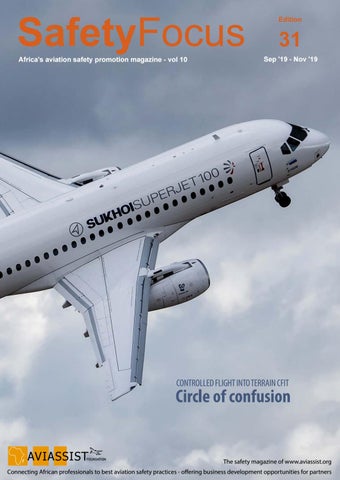
CONTROLLED FLIGHT INTO TERRAIN CFIT
Circle of confusion AVIASSIST
FOUNDATION
The safety magazine of www.aviassist.org
Connecting African professionals to best aviation safety practices - offering business development opportunities for partners
Contents
because Access to safety information should not be limited by the bandwidth of your connection
2
A look at how the Foundation works
4
8
Director's message | Under the bonnet Foundation & safety news | Recent developments Your update on the Foundation and other notable developments
6
4Cs for safety promotion | Psychology hacks Getting control of your mental operating system
8
Business aviation | The next level of safety How one major offshore disaster became a safety regime changer
10 ATR operations | Active monitoring
10
A look at improving active monitoring of primary flight instruments
12 Flight operations | Functional check flights
Addressing safety of first flights after (heavy) maintenance
16
Infoscan | A free resource kit on human factors
Learn more about CASA Australia's new toolkit and how to access it
18 On record | E-cigarettes and aircraft loading
12
Learn about the hazards of e-cigarettes and incorrect loading
20 Controlled Flight Into Terrain | Circle of confusion
How an unguided Superjet departed from its intended flight path
24 Safety management systems | Swiss cheese & bowties
20
Gain an insight into the work of flight operations officers- dispatchers
26 Understanding TCAS | What you see and what you get
About Traffic Collision Avoidance Systems and their proper interpretation
The printing of SafetyFocus is sponsored by:
24 Cover photo: A Sukhoi Superjet RRJ-95B during flight tests, photographed at the MAKS International Aviation and Space Show in Moscow ŠPavel Bukhanov/Flickr
SafetyFocus Magazine
Edition 31 - 2019
Our promise to you ...... Every quarter, we aim to bring you the very best update on best safety practices. From aeronautical information services to ground operations safety to safety shopping tips. If you ever feel we can improve, let us know. Do you find the contents interesting or boring? Please send your message - rude or polite - to: safetyfocus@aviassist.org After all, it's your magazine.
Follow us on:
Facebook.com/ AviassistFoundation
twitter.com/ AviAssist
Youtube.com/ 1 AviassistFoundation
director's | message
Under the bonnet Languages are full of expressions and metaphors. Often, such expressions are difficult to understand when you first move to a different country. You'll find many expressions and proverbs that are hard to understand at first because they have a different meaning than what you would initially think. I was privileged to move to Zambia and had to learn the typical Zambia expressions. Then when I moved to the United Kingdom, I once again had to learn the typical English expressions. And now I get to experience that learning curve again, this time as a result of our student assistant & trainee program. Working with our student assistants and our trainee Felicien means I am required to look carefully at the expressions I use and, when I use new expressions, explain them to our aviation talent under development. This links directly to the context of our work and the importance of relating our content to that context - something I spoke about in my last Director's remarks. So Felicien, here is one for you. Let me provide you with a metaphor and then relate it to the work of the Foundation. Let me give you ‘a look under the bonnet’. The bonnet is the hinged metal canopy covering the engine of a car. Taking a look under the bonnet is a metaphor for looking at how something works inside. Let's look at how the Foundation works on the inside. All our work is aimed at providing effective and affordable safety support to African aviation professionals. An important part of our work relates to bringing courses and events for which there are currently no commercially feasible alternatives in the country or sub-regions where the events are held. The Foundation’s high quality, cost-effective and crucial safety courses address curricula that are topical and often required under national regulations. We energise and equip your staff to play their part in safety promotion in your organisation through our events and programs. We like to think we work on a dual track approach. On the one track, we support training organisations in offering such training courses in safety & adjacent domains. Almost a quarter of a century of experience in Africa has taught us that our industry cannot afford waiting with safety capacity building until only certified courses can be offered. Every journey starts with a single step. Capacity building does not start with a giant leap. It starts with small steps. You cannot start a university if you haven't got good primary and secondary education. On the other track, we are keen to support training organisations in Africa in seeking accreditation of the courses we may help them build. In due time, that may become easier as the
influence of the work of the Association of African Aviation Training Organisations (AATO) increases and harmonisation of accreditation across Africa becomes a reality. That is why we feel privileged to assist the AATO in making its Roadmap. Our work alongside renowned Civil Aviation Authorities, airports, airlines, air traffic control organisation and aircraft manufacturers from across the world means that we can ensure that our work is based on industry priorities and follows international standards. We make regular visits to the International Civil Aviation Organization ICAO, both in Nairobi and to the headquarters in Montreal. Our course designs follow international standards from ICAO as well as leading regulators from and leading industry associations. Our practising volunteer facilitators, instructors and experts come from organisations and companies that are supervised by European aviation safety oversight bodies. Our course design process is continuously being updated and strengthened. It follows of a very common six-step approach. We are currently using that process for a new introductory aviation maintenance course that we aim to prototype next year. The idea here is that we work with the stakeholders in Rwanda to provide input in creating an aviation engineering degree course at the University of Rwanda. Next year, we also hope to add a weight and balance/ loadmaster course. Again, based on its safety significance, a demand from the region and a shortage of institutions currently offering it in the region. More and more of our work is captured in quality standards. These standards specify the requirements, specifications and guidelines that are used to make our products and services are fit for purpose and consistent. This time I spoke a little about how we work – what goes on under the bonnet. In the next edition of SafetyFocus, I'll talk about the people are that make our mission possible. And the output of this system for the rest of this year? We still have a number of courses in stock for you. These include : • Flight Data Monitoring • Human Factors • Crew Resource Management • Flight Operations Officer • Aviation Mental Health All these events will take place in November in Nairobi, hosted by Corporate Friend of AviAssist - Safarilink. Make sure you subscribe to our mailing list via our website so you stay up-to-date on upcoming courses and can experience our unique approach yourself!
Tom
2
SafetyFocus Magazine
ICAO Council elections September 2019
The Kingdom of the Netherlands is proud to be a candidate for election to the ICAO Council, the governing body of the International Civil Aviation Organization, for the 2020-2022 triennium. In 1944, the Netherlands was a founding member of ICAO and to this very day remains firmly committed to the important work undertaken within the framework of this specialized United Nations agency. The Kingdom of Netherlands presents its candidature for part II of the ICAO Council in close collaboration with its trusted partners in the Abis group: Austria, Belgium, Croatia, Ireland, Luxembourg, Portugal and Switzerland. The Abis group was established in 1980. Throughout the past forty years, Abis states have been dedicated members of the ICAO Council, with a positive spirit and cooperative approach, forward-looking, open and transparent. Abis is recognized for its integrity and professionalism in representing a group of states that make the largest contribution to the provision of facilities for international civil aviation. As a matter of fact, the Abis group is one of the main contributors to the ICAO budget. The Abis states account for over 9% of all international revenue per tonnekilometres, surpassed only by China and the US, thus reflecting the combined size and importance of their civil aviation industry. Experts from Abis contribute to much of the work undertaken by ICAO panels, committees and study groups. They bring to the table a rich history in aviation and a wealth of experience. Furthermore, Abis members are also actively engaged in a range of collaborative projects to promote capacity building and technical assistance, putting into practice the fundamental principles and objectives of ICAO’s “No Country Left Behind” initiative.
United Nations
ICAO International Civil Aviation Organization
The Abis group firmly supports ICAO’s strategic objectives, focusing on the further development of a safe, sound and sustainable global civil aviation system, enhancing aviation safety and security, improving air navigation capacity and network efficiency and facilitating balanced growth. Rapid growth of air transport poses significant new challenges, particularly in terms of capacity management and the environmental performance of civil aviation. Many of these challenges call for a multi-disciplinary and multi-modal approach, innovative solutions, new designs and important operational improvements. ICAO must show vision and global leadership in addressing them.
SafetyFocus Magazine
Edition 31 - 2019
3
SafetyFocus By the AviAssist Foundation AVIASSIST
FOUNDATION
AviAssist is an independent, nonprofit organisation. Its mission is to provide effective and affordable support to safety champions. It serves as a catalyst for safety promotion. It provides safety promotion services for Africa's aviation industry and business development opportunities in Africa's growing markets for true safety promotion partners. Well over two decades of experience in Africa has equipped AviAssist well to deal with the technical as well complex political, social and cultural issues that play an important role in improving African aviation safety.
Foundation Board Capt. Auke Dros KLM Royal Dutch Airlines
foundation | news
Preparing for ICAO Assembly
a place in history
The Foundation is getting ready for the 40th ICAO Assembly in Montreal in September. The Assembly is the Organization’s sovereign body. It meets at least once every three years and is convened by ICAO’s governing body, the Council.
The Foundation proudly features in a production celebrating 100 years of Flying Dutchmen. The publication is made by the Government of the Netherlands for the upcoming ICAO Assembly. It celebrates the unique aviation expertise available in and from the Netherlands. Next to the AviAssist Foundation, the publication highlights the history of among others KLM Royal Dutch Airlines, the Delft Aerospace University, the International Institute of Air and Space Law of Leiden University and the Netherlands Aerospace Group.
ICAO's 193 Member States and a large number of international organizations are invited to the Assembly, which establishes the worldwide policy of the Organization for the upcoming triennium. The Foundation will be part of the Delegation of the Kingdom of the Netherlands and an important voice on the promotion of safety in African aviation. One of the initiatives for which the priority areas will be determined at the Assembly is the No Country Left Behind (NCLB). Africa has been a major beneficiary of the NLCB initiative since its inception in 2014. Other agenda items at the Assembly will be the ICAO Civil Aviation Training activates and capacity building strategies in aviation. In addition, professional training and higher education activities for the Next Generation of Aviation Professional (NGAP) Programme will be presented.
feasibility study for aviassist safety promotion centre - rwanda academy of the Amsterdam University of Applied Sciences, the Twente Safety Campus and Special Cargo Services together with the Rwandan partners in the ASPCRwanda.
Jan van der Hoeven Treasurer to the board Bert Kraan Founder & Deputy Director CAA-NL (rtd.) Frank van de Laar Marketing & sales director EMEA Wright Brothers Simulators Hellen Ndichu Safety manager Rwandair Ron Louwerse Managing Director Rotterdam The Hague Airport Schiphol Group Ron Schipper Vice-President Africa - KLM (rtd.)
44
The Foundation will be undertaking a feasibility study to define the technical, financial, legal and operational conditions to be met for the next phase of the AviAssist Safety Promotion Centre – Rwanda. “We believe Rwanda represents a valuable strategic location with the potential to become a leading safety promotion service centre in East Africa", Foundation director Kok explained. "This study will provide us with the framework to progress this believe as well as the joint ambitions of the partners. The results of the study will provide the platform for us to progress the development of the ASPC-Rwanda, backed by a strong group of partners and a dedicated host country". The study will be carried out by the Foundation in partnership with the aviation
Funding for the study is coming from the Netherlands Enterprise Agency RVO and the Ministry of Infrastructure and Water Management of the Netherlands. The feasibility study will focus on the priorities for safety promotion in the aviation industry of Rwanda and East Africa in terms of learning, research and creating safety experiences. It will also detail the target groups of professionals for those priorities and map how there needs can best be served. It will also look at what conditions need to be met in terms of facilities, curriculum & experience development, staffing, partnerships and organisational development. In the end, it will provide the conditions that need to be met to achieve a viable and financially selfsustaining ASPC-Rwanda.
SafetyFocus Magazine
foundation & safety | news
Colophon
SafetyFocus CAAi to strengthen aviation safet y oversight in Sierra Leone
Freetown, Sierra Leone The launch of the Safe Fund Project for Sierra Leone with SLCAA and ICAO in May 2019
CAA International (CAAi), the technical cooperation arm of the UK Civil Aviation Authority, is to assist the Sierra Leone Civil Aviation Authority (SLCAA) to strengthen its regulatory oversight capability. Financed by the International Civil Aviation Organisation’s (ICAO) SAFE Fund, CAAi and SLCAA will work on resolving safety-related deficiencies in several areas including, air navigation services, aerodromes and ground aids. The project will also optimise the organisational design of SLCAA to improve its oversight effectiveness. Sierra Leone is currently ranked 43rd out of 46 countries in the Regional Aviation Safety Group for Africa and India Ocean for its effec-
tive implementation of ICAO Standards and Recommended Practices. This project will work to increase effective implementation in the target areas identified, reaching closer to the Abuja safety target of 60%.
Editor & design - Tom Kok editor@aviassist.org
During the launch event held in Freetown, Director General of the SLCAA, Moses Tiffa Baio thanked ICAO and CAAi for its support. Baio went on to say, “…the ICAO’s Safe Fund is essential to the development of the air transport sector in Sierra Leone. At the event, Mattijs Smith, Head of International Development for CAAi said, “it is extremely positive that SLCAA, with the support of ICAO, are investing in safety oversight for Sierra Leone. Aviation is an important factor in economic development. Working together, we can build a stronger regulatory framework that will facilitate the projected growth of air traffic in the years to come for Sierra Leone.”
editorial review board
Maria Rueda, Managing Director at CAAi said, “With an extra 274 million passengers a year predicted for the aviation market in Africa by 2036, Sierra Leone needs a solid, ICAO compliant regulatory framework to oversee a growing air transport sector safety. The project is expected to last 18 weeks.
second aviation incident investigation course completed The Foundation completed the second edition of its aviation incident investigation course in co-operation with the Rwanda Ministry of Infrastructure. The event was hosted by the College of Science and Technology of the University of Rwanda. "It was great to welcome participants came from Uganda, Kenya, Nigeria, Zambia and Rwanda," commented Foundation director Kok “It underlines Rwanda's growing position as a leader in aviation safety promotion."
AviAssist Chairman Frank Klap
Friends of AviAssist are pleased to announce their third AviAssist networking symposium on Tuesday the 19th of November in Amsterdam. SafetyFocus Magazine
Felicien Izaturwanaho Trainee
Adrian Young To70 aviation Hans van Dijkhuizen AviAssist Foundation Emily McGee Editorial assistance Capt. Ed Pooley Flight Safety Foundation European Advisory Committee Advertising sales Let AviAssist help you organise the African market & support the work of the Foundation while bringing your brand to 42 African countries and beyond. Starting at less than € 11 per country. Contact us: safetyfocus@aviassist.org SafetyFocus is distributed for free to 2 professionals per organisation in the aviation industry and government departments involved in or relevant to aviation in 42 African countries. Wider distribution in organisations to mature safety cultures is possible at attractive corporate subscription rates. Subscriptions Stay up-to-date on best practices and subscribe to SafetyFocus.
Kigali, Rwanda Minister of State for Transport Jean de Dieu Uwihanganye opening the Foundation's second incident investigation course
19 november aviassist symposium by friends of aviassist
Woerden, the Netherlands Friends of
Africa’s safety magazine
Africa’s quarterly safety magazine right on your doorstep every quarter for a whole year.
Friends of AviAssist offers aviation enthusiasts and professionals a wonderful opportunity to connect to African aviation and share expertise with colleagues in Africa. It recruits professional volunteers and raises funds to support AviAssist Foundation programs.
In this issue, SafetyFocus reproduced articles with kind permission of CASA Australia's FlightSafety Australia, Eurocontrol's Hindsight and Aerosafety World of the Flight Safety Foundation. We are also grateful to photographer Marco Ferrarin for making available his stunning picture of Doha, Qatar
“We are preparing an interesting line up of speakers from Africa and Europe, shedding light on the progress made on African aviation safety and focus areas for future work,” Friends of AviAssist chairman Frank Klap commented. "We will announce the conference program in the next couple of weeks on our website and through our media messages".
This magazine is printed on Forest Stewardship Council certified paper. This means it meets the highest environmental and social standards.
Edition 31 - 2019
5
4Cs for | safety promotion The 4Cs are Critical thinking, Communication, Collaboration and Creativity. The 4 C’s that underpin good safety promotion.
Psychology hacks “We regard someone as having charisma when we like and are drawn to them. You can create this effect quickly when you first meet someone with three simple (and natural) actions”.
Business author and speaker Mike Clayton suggests ways to get control of your mental operating system (and that of your colleagues). Can we get inside the system that is our psychology, and make changes that give us greater control? The reason I ask is because computer hacking is rarely out of the news now and life hacking is becoming a big thing, too. Well, the answer is yes. Here’s how...
Instant Charisma
We regard someone as having charisma when we like and are drawn to them. You can create this effect quickly when you first meet someone with three simple (and natural) actions. Turn your whole body towards them, smile warmly, and make strong eye contact. The best tip to help with eye contact (especially if you don’t find it easy or comfortable) is to deliberately note the eye colour of everyone you meet.
Project Confidence
When we feel safe and liked, we are at our most confident. So, to feel more confident, act as if the people around you all like and respect you. If you assume everyone will like you, you will feel safer. Another tip is to chew gum. Our ancestors would only eat when they felt safe, so chewing makes us feel safe. Perhaps that’s why Clint Eastwood’s characters were always chewing gum or a cheroot.
Better Answers
Do you ever feel you aren’t getting the whole answer when you ask a question? 6
The best way to get more from an answer is... silence. When the other person stops talking, say nothing. Just look them in the eye and wait patiently. If you need to up the pressure, try raising an eyebrow, as if to say: “and...”
Deeper Learning
A UK-trained doctor once told me that medical schools teach with a simple principle. See one, do one, teach one. The best way to consolidate learning is to teach what you’ve learned. I used to revise for exams by teaching or lecturing an imaginary audience. And I always found that explaining things to friends helped me learn. Even now, if I read something interesting on the way to a training, seminar, or conference session, I try to slip my new knowledge in that day.
Read Attention
This simple technique allows you to read where people’s attention is directed. Look at their feet. Where their feet point, their attention is directed; at least subconsciously. If two people are facing each other talking and you approach, watch their feet. If their feet turn to you, they want you to join them. If only their bodies turn, then go away. If one person moves their feet, and the other just turns their head, then one wants rescuing!
Diffuse Argument
You know how when you are in an argument, you stand opposite the other person and lean in a little. It’s intimidating, and it’s supposed to be. So to diffuse the argument, do the opposite. Stand next to the other person and speak calmly.
Feel Happier
Don’t worry. Be happy. When you’re happy, you smile. But here’s the hack: when you smile, you get happy. Put on a smile and your mood will follow. Some even advocate holding a pencil in your teeth horizontally. It forces your lips back into a grin.
Get Agreement
Often, we cannot help echoing the other person’s body language. So if you want me to agree, nod while you tell me something. If I find myself nodding in response, maybe I’ll be more likely to agree.
Republished from Flight times - inflight magazine of Flybe airlines with kind permission
Mike Clayton managed large and small projects in teams from five to one hundred. Since 2002, he has focused on speaking and training. He delivers practical tools and insights based on his experience of complex change. www.mikeclayton.co.uk
SafetyFocus Magazine
Our focus on your safety Safety is a pre-condition for our daily operations to any destination. KLM is proud to work hand in hand with the AviAssist Foundation as part of that commitment to your safety - klm.com
SafetyFocus Magazine
Edition 31 - 2019
7
Human Factors business | aviation safety || culture
T
he global business aviation accident rate is laudably low. We have a right to be proud of our safety record, right? Yes and no. Business aviation aircraft often are equipped with the latest technology, so today it is much harder to unknowingly drive one aircraft into another, into a hillside or into a thunderstorm. Avionics advances preclude many catastrophic accidents. On another front, business aviation training technology and standards are leading the aviation industry. The knowledge of our aircraft and how they perform is pervasive because of the
excellence of our airframe manufacturers (OEMs) and training vendors. Additionally, the OEMs are developing fly-by-wire systems that are lighter and easier to manufacture and will help prevent bad days caused by poor piloting. Even so, we have substantial room to improve. We still incur injuries and damage aircraft at unacceptable rates. There are three factors we must address to achieve the next level of safety: • Redefine business aviation safety; • Adjust our safety culture; and, • Advance our professionalism.
This article discusses the redefinition of business aviation safety, and future columns will describe how the other two critical elements can be addressed. Why Change? Having no accidents or incidents means my operation is “safe,” right? Maybe, maybe not. You might have been taking inappropriate and unnecessary risks, but skill and luck might have been on your side, so far. In other words, “safe” is a pass-fail descriptor. It does not define how you got there.
The next level of
B y P E T E AG U R
8 12 8 8
SafetyFocus Magazine
Business | aviation
If we remain focused on a pass-fail concept of safety, we will continue to make only incremental improvements to accident rates. An alternative is to change our safety frame of reference to “risk” and reap the rewards of dramatic improvements. Risk identification–assessment–mitigation is like taking a rifle with legacy “iron sights” and mounting a scope on it. The change in target acquisition and accuracy is huge. Our use of fatalities and damaged airframes as our reference points is gross mis-targeting. The scope of our future focus must be much finer: on the risks that have a significant probability of causing injuries and damage. Injuries
© Ian Chikunji | NAC2000 Zambia
For decades, companies, with the help of the U.S. Occupational Safety and Health Administration (OSHA), have addressed the causes of on-the-job injuries. The results have been significant reductions in lost work days and worker’s compensation claims.
SafetyFocus Magazine
Using those same standards, our worker injury performance at the airport is often substandard. Noncompliance with basic OSHA standards is rampant. Floors are slick. Walkways are unmarked, poorly lighted and littered with obstructions. Fall protection is either nonexistent or underused. The threats of injuries in and around the hangar are numerous and often go unchecked; the results are significant injuries and numerous workdays lost. Another imposing threat is the risk of off-duty flight crew injuries. These events are especially challenging because they tend to occur away from home. For instance, every winter, crewmembers suffer disabling injuries while skiing or snowboarding during a trip’s off time. Others become victims of street crimes or suffer from food poisoning. The threats are numerous and often ignored, sometimes with disabling effects. Any of these events could be tragic, embarrassing and expensive for a business aviation operator and its passengers. What about injuries to passengers? Consider the value of the business passengers’ time, the deals they do and the impact they have on the enterprise. The time they save using business aviation creates immeasurable benefits. Yet the negative impact that occurs if they are injured while traveling on your aircraft can have equally negative results. One major threat to passengers is the unsafe use of airstairs with a business aircraft. Presidents and popes have fallen while ascending or descending them. In technical climbing Edition 31 - 2019
(mountain climbing or advanced bouldering with roped protection) a basic rule is to maintain three points of contact at all times to prevent falls. The same should be true for passengers while they transit airstairs. Yet passengers tackle those unfamiliar, and often unstable stairs, with their hands full of bags, overcoats and what not. No wonder they slip, trip and fall so often. What should your crewmembers be doing to mitigate this threat? Aircraft Damage The president of one of the largest aircraft insurance companies says ground handling incidents are the greatest source of aircraft damage claims. Ground handling incidents rarely result in fatalities, and data are not prominently presented by the U.S. Federal Aviation Administration. However, a dinged wing will take your aircraft out of service for weeks, and the costs easily can run into hundreds of thousands of dollars for repairs, diminution of value and loss of use of the aircraft. Even if it is easy to blame the fixed base operator staff member who drove the tug, isn’t the end responsibility yours? It is your duty to assess the risk and mitigate it. From a risk perspective, ground handling events have a high cost and are likely to happen. Even so, very few crews assign someone to directly supervise an aircraft until it is refueled and parked at its final resting place for the night. Stair falls and ramp rash seem outside the traditional realm of flight safety, but they are excellent examples of how the legacy definition of safety is inadequate. Broaden the scope of your focus and tighten your attention to risk, its identification, assessment and mitigation. The results will take your business aviation safety to a dramatically higher level. Next time, we’ll dive into the cultural issues that can either be barriers or boosters to your risk mitigation efforts. Until then, be safe! Pete Agur is chairman and founder of The VanAllen Group, a management consulting firm for business aviation. He holds an airline transport pilot certificate for fixed-wing aircraft, a commercial pilot certificate for helicopters and a private pilot glider rating. He has been an active member of Flight Safety Foundation’s Business Advisory Committee for over 25 years. The AviAssist Foundation is a member of the Safety & Training Committee of the African Business Aviation Association AfBAA.
9
ATR | Operations
active monitoring
T
he importance of active monitoring is one of the growing key messages in our industry. A recent investigation report concluded that one contributing factor related to a CFIT accident during a non-precision approach was the inadequate monitoring of primary flight parameters during the go-around, which may have been worsened by the PM's attention all tunneling on the management of the aircraft flap configuration. A focus on flight path monitoring has been made by the industry in several studies and related safety improvement strategies over the past 25 years. The National Transportation Safety Board determined in a study of air carrier accidents that 84 percent of the 37 reviewed accidents involved inadequate crew monitoring or challenging 1. The International Civil Aviation Organization (ICAO) found inadequate monitoring to be a factor in 50 percent of controlled flight into terrain accidents 2.
Regional operations have a specific operational environment that need to be accounted for, while the categorized risks are the same as for the entire commercial industry; the level of exposure to the identified threats may be higher, given the increased number of cycles per day, as well as, the specific environmental and infrastructural conditions. The importance of active monitoring is one of the recurrent 10
B y K aren garcia
key messages provided during ATR Flight Safety conferences. Presentations such as “Watch your speed in cruise”, “Watch your speed in approach” and “Prevention of loss of control” all emphasized this point. 3 4 In-service experience and feedback from type-rating and recurrent training also highlight that active monitoring is greatly enhanced by the knowledge of automation. For example, our training captains identified the three following scenarios as classical examples where the knowledge of Auto Flight Control System (AFCS) and setting of Flight Management System FMS parameters weakens. 1. Automatic mode reversion of AP/FD into basic mode In case of automatic mode reversion, a triple click warning is triggered; the crew must immediately check the FMA and take appropriate actions. The Flight Mode Annunciator (FMA) lights indicate status of aircraft subsystems.
SafetyFocus Magazine
"
ATR | operations
Stay in the loop by mentally flying the aircraft even when the autopilot or other pilot is flying the aircraft
2. Appropriate navigation source setting Appropriate insertion of navigation source and coupling to prevent inaccurate guidance. 3. Flight plan discontinuities clearance Clearing route discontinuities and undesired waypoints so the FMS flight plan only reflects the anticipated waypoints to be flown. When flying over a waypoint followed by a discontinuity, the AP will revert to the basic lateral mode. In addition, degraded predictions, which are defined beyond the discontinuity, may be generated. The previous scenario occurred on the accident of a cargo aircraft, which, impacted short of the runway during a nonprecision approach; the programming of the FMS without clearance of a flight plan discontinuity generated an unrealistic glideslope for the approach. The crew followed the projected path, inadvertently descended below the minimum approach altitude and subsequently into terrain. The investigation report stated that the "flight crew's failure to properly configure and verify the flight management computer for the profile approach" was a main contributing factor to the accident.
How to improve monitoring? Specific guidance on how to improve monitoring encourage crews to “Stay in the loop by mentally flying the aircraft even when the autopilot or other pilot is flying the aircraft.” 5 Enhance monitoring by knowing what the system is doing (Understand), why it is doing what it does and what it will do next (Anticipate), to either detect and communicate any deviations (Shared Situation Awareness), or take timely corrective actions when things don’t go as expected (Take Over).
"
energy state of the aircraft. When an unexpected high workload is established, if necessary, increasing the time available to asses and treat the situation or reduce and prioritize tasks performed by the crew. Train the monitoring skills, including scenarios to develop, enhance and preserve pilot monitoring skills, by making use of tools, such as EBT training, in service feedback, FFS and LOFT training. Adhere to standard operating procedures, monitor when it matters, and remember to follow ATR Standard Operating Procedures golden rules: 1. Fly, navigate communicate - in that order 2. One head up at all time 3. Know and understand your Flight Mode Annunciator (FMA) at all times 4. When things don't go as expected, take over 5. Use the proper level of automation Karen Garcia is Flight Safety Director - Accident Investigator with aircraft manufacturer ATR in Toulouse.
Notes: 1. NTSB (1994). “Safety Study: A Review of Flight crewInvolved Major Accidents of U.S. Air Carriers, 1978 through 1990.” NTSB/SS-94/01, PB94- 917001. 2. International Civil Aviation Organization. “Safety Analysis: Human Factors and Organizational Issues in Controlled Flight Into Terrain (CFIT) Accidents, 1984–1994.” Montreal, Quebec, Canada: ICAO, 1994. 3. 2016 ATR Flight Safety Conference - Watch your speed in cruise and Watch your speed in approach presentations
Defining what monitoring is and training specific monitoring tasks for Pilot Flying (PF) and Pilot Monitoring (PM) positions. 6 Promoting an atmosphere in which either pilot can challenge the other in spite of his position is essential, as monitoring becomes ineffective when the identified deviations are not pointed out or acted upon. Pilot task allocation can integrate this notion, ensuring that each pilot understands his/ her responsibility for monitoring and the importance of the monitoring task. 7
4. 2018 ATR Flight Safety Conference -Prevent Loss of control in flight presentation
Other monitoring good practices include, being aware of the phases where high workload situations are expected, such as the approach and the moments when there is a change in the
7. Flight Safety Foundation (2014) A Practical Guide for Improving Flight Path Monitoring – Recommendations 2 and 16
SafetyFocus Magazine
Edition 31 - 2019
5. CAA Paper 2013/02 Monitoring Matters - Guidance on the Development of Pilot Monitoring Skills 6. IATA (2016) - Guidance Material for Improving Flight Crew Monitoring
11
Flight | Operations
Functional
C HE C K flights
After heavy maintenance, an aircraft usually must be flown to ensure that it was put back together properly.
BY michael g r Üninge r & M a r k u s Ko hle r
1212
climb the crew noted that pressurization was not taking place and returned to the airport immediately. Further investigation by maintenance personnel found that the bleed air line from the engine to the pressurization system was not properly connected. After this condition was rectified the aircraft was released to service and returned to Spain without further incident. As a matter of policy, the PC-12 AMM does not contain any post-maintenance functional check flight requirement. Aircraft components and systems as well as maintenance activities are designed in such a way that satisfactory completion of the tasks can be determined using ground based tests only. These checks rely heavily on Built-in-Test (BIT) capabilities of the components and systems. Most aircraft manufacturer’s maintenance instructions do not require functional post-maintenance check flights anymore. However,
in this particular case such a check flight would have detected the fault in the pressurization system.
Functional Check Flights
All pilots know that after maintenance some functional problems may occur. It is therefore important to be particularly alert. Such “test flights” need to be given particular attention. Experience shows that the first flight after (heavy) maintenance bears a higher risk of some malfunction. There are numerous stories of inverted flight control cables. In one recent instance the crew of an A320 almost lost control just after take-off due to inverted aileron deflection, after the wiring of the commander’s side-stick had been inverted and was not detected by the maintenance engineers, the flight crew doing the pre-flight checks on ground or the computers. Only the copilot’s side- stick was correctly wired and he successfully took control after lift-off. SafetyFocus Magazine
© Jonathan Rankin/Jetphotos.net
S
urprises after maintenance The first sign of trouble that the pilot detected was an abnormal sense of tiredness. The Pilatus PC-12 aircraft was in a climb to FL240 after he and his co-pilot had picked it up at the manufacturer’s facilities in central Switzerland where it had undergone a scheduled annual inspection. The crew noted that the cabin altitude was at 15,000 feet and climbing and that the differential pressure was abnormally low. The pilot stopped the climb, immediately ordered the oxygen masks to be donned and diverted to Geneva, Switzerland. Maintenance engineers performed various ground checks to determine the cause of the fault in the pressurization system. Several components were replaced. Further ground tests were completed satisfactorily and the aircraft was returned to service. The same crew picked up the aircraft again. When passing 5,000 feet in the
flight | operations
"
Special flights require special treatment
"
“Functional check flights” encompass various types of check flights: post-maintenance check flights to verify proper performance of maintenance, customer acceptance flights, end-oflease flights prior to handover of an aircraft etc. Special attention is required from flight crews during the first flight after maintenance even if the certificate of release to service certifies that all aircraft systems are fully and normally operative.
EASA regulation under development
Today there are no regulations from the European Aviation Safety Agency EASA which specify the training requirements for flight crews who per- form functional check flights. Some European civil aviation authorities have published guidance material on this subject and EASA has recently identified a need for regulatory requirements for check flights. In the proposed regulation which is currently under development - a distinction is made between four types of “flight testing”. Three categories involve experimental, engineering and production test flying, i.e. what is conventionally understood to be performed by “test pilots”. However, in the current version of the future regulation, functional check flying will fall in the fourth category, for which no specific crew training requirements are defined. Operators are left to determine which pilots are capable of performing
the check flights. And, in the absence of clear guidelines and instructions from the manufacturer, they are also left to define the check programs themselves. Manufacturers cannot be required to define check programs to be performed in flight if there is no control over the flying skills that can be presumed to be available in the crew that performs the flights. Testing systems, particularly emergency and protection systems require the aircraft to be operated at or near the limits of its envelope. Such flights involve more risk, which needs to be identified and controlled.
Functional Check Flights Improperly Executed
An Airbus A320 crashed near Perpignan, France, in 2008 while performing low-speed checks at low altitude). The leasing contract required a check flight at the time of re-delivery from the lessee. A few days prior to the accident flight, the aircraft was washed without the required protectors being installed on the angle-of- attack sensors. Water entered the sensors and eventually froze, seizing two of the three sensors almost simultaneously and in the same position. The check plan was developed by an airline based on a manual used by Airbus for customer acceptance flights, which are performed by flight test pilots. The investigation by the French BEA found that the crew adapted the check program in an improvised manner, according to the constraints of the flight plan and ATC. Specifically, the SafetyFocus Magazine Magazine SafetyFocus
Edition31 31- -2019 2019 Edition
“crew decided, without preparation, and in particular without a call-out of the theoretical minimum speeds, to undertake the check of the low speed protections at an altitude of 4,000 feet” according to the BEA report. The crew waited for the triggering of the stall protection devices, which did not trigger properly due to the frozen angle of attack (AOA) sensors, and allowed the speed to decrease to below stall speed. Several triggers and indications would have been available to identify the dangerous condition, but there was neither the time nor the mental preparedness to properly identify the indications and take appropriate action. The crew lost control of the aircraft and all occupants perished when the aircraft impacted the sea. Functional check flights are an unregulated area in operations. They may be specifically required by manufacturer’s maintenance programs following certain types of maintenance to ensure that “everything was put back together” properly, or they are performed by owners/operators on a voluntary basis to make sure aircraft are ready for service in order to reduce the probability of operational irregularities. Given the very specific risks of functional check flights, utmost care must be taken to prepare for such flights. In a commercial operational environment, functional check flights are normally the domain of a technical pilot who is generally a pilot of higher seniority or education. Airlines may even designate dedicated check flight managers.
Proper Planning and Preparation
Functional check flights are not regulated yet. EASA is considering the introduction of relevant rules. The industry advocates the development of industry standards. Today it is up to each organization to develop its own set of procedures and standards to reduce the risks involved in functional check flights.
Such company actions might include the creation of a check flight cell, Internal Safety Investigations, the creation of a check flight manual, the specification of training and currency requirements and of crew requirements, specific training courses for functional check crews, the authorization of each individual flight by both maintenance and flight operations managers. Given the evident risks, no professional should perform functional check flights without proper preparation. We have all heard of the 7-Ps: Proper Prior Planning Prevents Painfully Poor Performance. For Functional Check Flights the 7-Ps are even more applicable. Michael R. Grüninger is Managing Director of Great Circle Services (GCS) Safety Solutions and fellow member with the Foundation in the Safety. & Training Committee of the African Business Aviation Association AfBAA.
This A320 crashed when the crew lost control while performing low-speed checks at low altitude. 13 13
Flying you to 17 destinations across Kenya & Tanzania
Africa’s first registered operator
Proud to work hand in hand with the AviAssist Foundation as part of our commitment to your safety
14
SafetyFocus Magazine
human | factors
Welcome to our classes
in East Africa
nAIROBI, 4-5 November
Nairobi, 7-8 November
Aviation mental health
CREW RESOURCE MANAGEMENT
Key topics: • International best practices • Pilot medical licensing requirements • Common mental health problems among aircrew • Psychological assessment and reporting on: • aptitude • mental health • personality and • neuropsychological tests • Overview of psychology of human factors and air safety and disaster support
CRM focuses on interpersonal communication, leadership and decision making and is used primarily for improving air safety.
US$350 for 2 days Who must attend: • Aviation medical examiners (AMEs) • Medical doctors aspiring AME status • Psychologists • Safety managers • Cabin crew managers • Government safety inspectors • Flight operations manager
Brought to you by:
This course examines the complex threat and error environments common to today’s workplace. It provides best practices to increase flight safety. A recognized standard throughout the industry, CRM training is used by leading operators to improve teamwork within their crews and reduce the frequency of accidents. Course topics include • • • • •
Threat and error management Team resilience CRM integration CRM implementation tools Non-Technical Skills (NTS)
Who must attend? • • • •
Flight and cabin crews Flight operations Safety and quality Government safety inspectors
$350 for 2 days The course is developed and delivered in co-operation with NoTechs from the Netherlands.
Hosted by:
With:
Nairobi, 11- 13 November
human factors in aviation Intended participants: • Safety managers $350 for • Chief Air Traffic Controllers 2 days • Dispatchers • Military Air Traffic Controllers • Pilots & crew chiefs • Ground handling staff & managers • Safety inspectors • Airforce pilots & operational staff Nairobi, 4-5 Nov 2019
flight data monitoring
Course highlights: • FDM & safety management • Towards a succesful FDM program • Fitting out aircraft • FDM technology • Human factors of FDM • Visualisation
Who must attend? • Pilots & trainee pilots • Flight safety officers • Regulators • Aircraft maintenance companies • Airline union representatives • Accident investigators $400 for • Aircrew representatives 2 days • Aviation students The course is developed and delivered by FDM world leader Flight Data Services
Sponsored by:
Safety resources for the African aviation industy since 1995
www.aviassist.org
SafetyFocus Magazine
Edition 31 - 2019
15
info | scan
Free revised resource kit on human factors A review of valuable reports & of resources that can be found with a Google search By FlightSafety Australia
Richard de Crespigny mirrors this. ‘It is essential that everyone in aviation understands human factors. It’s a broad subject that includes the human condition, factors that affect our human performance and human machine interfaces,’ he said while launching the kit at the Avalon Airshow. Revised resource kit on human factors reinforces safety culture By staff writers - Mar 22, 20193324 ‘It’s a highlight of my career to be with the people at CASA to launch their new Human factors for pilots’ kit. It’s a real privilege to suggest this kit. This is truly your guide to your life and resilience.’ These are significant words spoken by Richard de Crespigny, who launched the second edition of CASA’s Safety behaviours: human factors for pilots’ resource kit at the Avalon Airshow earlier this month. He is probably best known as the pilot who safely landed Qantas Flight 32 after an explosion in the engine occurred shortly after take-off. The resource kit has been wholly updated and revised. There are ten booklets covering a range of topics relevant to small operators and individual pilots, a workbook with practical exercises, discussion areas and reference material, and corresponding videos containing interviews with industry experts and practitioners. The kit focuses on key elements of human factors including safety culture, human performance, communication, teamwork, decision making and more. It also includes new topics such as the rapid growth of automation and satellite-based navigation. This edition includes a new series of videos, featuring interviews with aviation industry specialists like Richard de Crespigny, Matt Hall (former RAAF pilot and current Red Bull racing pilot), Louise Kirkwood (Manager Human Factors, Qantas), and Sidney Dekker, who all talk about their own human factors learnings. As Sidney Dekker says, ‘If we don’t understand the human factor, we don’t understand safety in aviation at all.’ 16
What’s in the kit? The resource kit is available in both physical and digital platforms. Each booklet and video have been comprehensively updated to reflect human factors in the aviation industry. The introductory booklet and video discuss the evolution of aviation safety, from a 1950’s focus on technical issues to an approach which emphasises organisational factors, such as the idea that everyone is responsible for safety. The first booklet titled Safety Culture looks in detail at the components and characteristics of a safety culture, and provides advice on how to build it, such as by standardised reporting of incidents, near misses and safety hazards, and establishment of a formal, fair and just management review process. The Human performance booklet looks particularly at challenges such as stress, mental health, diet and wellbeing presented to charter pilots. The module also covers alcohol and other drugs, and looks at fatigue management and the effect fatigue has on performance and the responsibilities of pilots and their organisations to manage fatigue. The video and booklet on Communication covers topics such as being a good listener, and using clear verbal, visual and written language, including aviation English. Tone of voice and verbal cues are also important. There’s discussion of the communication process and why it sometimes fails in flight, as well as humorous and tragic examples of miscommunication in aviation and elsewhere. The module on Teamwork offers tips for effective teamwork in both singlepilot and multi-crew operations. You’ll have the armchair challenge of deciding how to deal with a domineering father of the bride, and, as first officer, with an
arrogant captain. You’ll also go to William Creek in South Australia to look at teamwork in the outback. In the module on Situational awareness, experts describe it as the ability to take information, process it and develop a picture which achieves the desired outcome, while understanding your own limitations and having enough ‘safety power’ to deal with the unexpected. You’ll learn (among other things) about what an amygdala hijack is, and why time management is important in the Decision making Threat and error management gives tips for assessing pilots’ TEM, such as maintenance of effective lookout and the ability to set priorities and mange tasks. Booklet nine on Human information processing discusses common misperceptions and illusions—why they happen, how we can help manage them, and the importance of good planning and prioritisation. It also stresses the importance of relying on instruments at night or in IMC. Finally, the module on Design and automation—new to this edition—discusses in-depth the benefits and shortcomings of automation and cockpit design—more knobs, more stress. Some key themes are the dangers of complacency, the need for pilots to maintain manual flying and computational skills and for organisations to provide them with opportunities to do so. As de Crespigny wrapped up his speech with the resource kit in his hand, he said passionately, ‘Everyone must commit to a lifetime of learning. I recommend this human factors kit as your path through life of continual learning and journey. The kit, produced by CASA, is well suited for flying schools, students, general aviation pilots or simply for anyone who wants to learn and develop these essential skills. There really is something for everyone.’ 'Safety behaviours: human factors for pilots' is out now for free on the CASA website, or can be ordered in print and on USB from the CASA Online Store. Visit: <www.casa.gov.au/safety-management/publication/safety-behaviourshuman-factors-pilots-2nd-edition>
SafetyFocus Magazine
11-15 November ‘19 Nairobi, Kenya
Flight operations officer/dispatch
Course 1
Why is it
2
important ?
Gain fundamental knowledge about aviation operations that you will need to succeed as flight operations officers or that will help you refresh and strengthen your flight operations and aircraft dispatch knowledge. During this 5 days training, you will gain a better understanding of the organization of a flight operations department and gain practical skills for the tasks and responsibilities of flight operations officers.
3
Course objectives
Upon completion of this course you will be able to: • Review regulatory requirements relating to flight operations • Understand the role, goal and composition of operations manuals & (Master) Minimum Equipment Lists • Outline physical principles that determine aircraft performance • Perform weight and balance computations • Describe the main aircraft systems • Work with flight folders and undertake flight planning
That will contribute to better performance of duties and responsibilities at an Airline Operations Center (AOC). The course design is based on ATR’s dispatcher’s course and follows ICAO standards as laid out in Doc 7192 part D3.
Key topics: • Operations (OPS) manuals • Minimum Equipment Lists • Aircraft systems • Aircraft limitation • Weight & balance
Brought to you by:
Hosted by:
Who should Attend?
This is the right course for you if you are: • Flight operations staff • Ab initio staff in an Airline Operations Center (AOC) • New hires as flight operations officers • Flight support managers • Flight crew members
US$550 f or 5 days • • • • •
Meteorology Aircraft performance Payload computations Flight folders Flight planning
Sponsored by:
www.aviassist.org
SafetyFocus Magazine
Edition 31 - 2019
17
on | record
E-cigarettes & aircraft loading The following information provides an awareness of problems that might be avoided in the future. The information is based on final reports by official investigative authorities on aircraft accidents and incidents.
Boeing 737-700. Minor damage. No injuries
T
he 737 departed from Calgary (Alberta, Canada) International Airport with 53 passengers and five crewmembers for a scheduled flight to Vancouver, British Columbia, the morning of June 14, 2018. The aircraft was climbing through 9,000 ft when the lower aft cargo fire warning light illuminated. “The flight crew immediately followed the ‘Cargo Fire’ procedures published in the company’s 737NG Quick Reference Handbook (QRH),” said the report by the Transportation Safety Board of Canada. “The ‘Cargo Fire Disch [Discharge]’ switch was activated, and one cargo fire extinguishing bottle was discharged.” The crew declared an emergency and turned back toward Calgary. The aircraft was landed without further incident 10 minutes later and was brought to a stop on a taxiway, where it was inspected by airport rescue and firefighting (ARFF) personnel. “No visual signs of fire were noted, and no hot spots were detected by infrared camera imaging,” the report said. After the inspection, the crew taxied the 737 to the gate. “In accordance with the QRH, the flight crew informed ground personnel not to open any cargo doors until all passengers and crew had exited the aircraft,” the report said. After the passengers and crewmembers deplaned, ARFF and airline ground handling personnel inspected the lower aft baggage compartment and found signs of fire damage on a backpack that had been placed face-down near the cargo door. The fire had caused minor thermal damage to a 24-in (61-cm) by 24-in section of the cargo compartment’s fire-resistant liner,
but none of the other baggage had been damaged. The report noted that the passenger who owned the backpack flew frequently for business and was aware of the airline’s policy prohibiting the carriage of lithium-ion batteries for e-cigarettes in checked baggage. The policy stated that e-cigarettes were allowed only in carry-on baggage with the lithium batteries carried separately, with any exposed terminals taped over, in protective pouches, plastic bags or in their original packaging, the report said. The airline also prohibited the use of e-cigarettes aboard aircraft “due to the high temperatures they generate.” Investigators found that the passenger had inadvertently placed two spare lithium e-cigarette batteries, still installed in their charger, in the front pocket of his nylon backpack. “One battery in the charger experienced a thermal runaway, and the interior material of the battery was completely burnt out,” the report said. “The thermal runaway was likely caused by external damage. The investigation could not determine if the damage occurred before the battery arrived at the airport or during baggage handling.” The report noted that Canadian Air Transport Security Authority baggage- and cargo-screening procedures are “designed to detect explosive materials that are a threat to aviation safety, rather than batteries and other dangerous goods.” “The proliferation of lithium-ion batteries in personal electronic devices has resulted in an increase in aviation cargo and passenger baggage events involving smoke, fire, extreme heat or explosion,” the report said. “In this occurrence, even though the passenger was aware of the restrictions on lithium-ion batteries, the checked baggage was not identified as containing dangerous goods before being loaded into the cargo hold. When this type of responsibility is shared among passengers, air carriers and security-screening authorities, no one agency or individual is in a position to ensure that the contents of baggage comply with an air carrier’s requirements related to restricted items.”
T
Cessna 208B. Destroyed. Two fatalities. he Caravan departed from Wamena, Papua, Indonesia, for an unscheduled cargo flight under visual flight rules to Kenyam the afternoon of Sept. 9, 2011. “On board the aircraft were two pilots, a manifested load of diesel drums and grocery items, and a non-manifested load of 25 bags of rice weighing 827 lb (375 kg),” said the report by the Indonesian National Transportation Safety Committee (NTSC). After the crew reported that they were passing through 7,300 ft on a climb to 9,500 ft, there were no further radio communications with air traffic control (ATC). The report noted that because of high terrain along the route, the operator had specified a minimum altitude of 11,500 ft between Wamena and Kenyam. The wreckage of the Caravan was found two days later on the side of a mountain near Yahukimo. Investigators found that several EGPWS warnings had been generated as the aircraft descended from 9,840 ft in a left turn, with descent rates reaching 4,400 fpm. The aircraft struck terrain at 9,194 ft. Based on the findings of the investigation, the NTSC concluded that the pilot flying had lost control of the aircraft while maneuvering to avoid terrain or during an inadvertent encounter with instrument meteorological conditions (IMC). The report said that a contributing factor in the accident was the adverse effect on the aircraft’s performance by its loading, which was 619 lb (281 kg) above the maximum takeoff weight and with a center of gravity aft of the aft limit.
?
DID YOU KNOW:
Each year there are a number of aircraft accidents related to weight and balance issues. Such accidents have occurred due to for instance incorrect loading of the aircraft and the use of wrong takeoff weight for performance calculations amongst others.
republished from Aerosafety world with kind permission from the Flight safety Foundation 18
SafetyFocus Magazine
YO_R ADVERT HE_E Q: What is missing here? A: You are Imagine... accessing 42 African markets at unprecedented low cost Reach professionals and decision makers in the aviation industry with the Foundation’s unique network Start your market presence in the second biggest air transport growth market Support the Foundation's mission of providing effective and affordable support to safety champions Combine your marketing with goodwill creation Associate your company with the 20+ years legacy of the AviAssist Foundation
SafetyFocus Magazine SafetyFocus Magazine
Contact us at safetyfocus@aviassist.org for a media pack Edition 31 - 2019
Edition 29 - 2019
19 19
controlled flight | into terrain
The crew ignored several terrain warnings as the unguided Superjet departed from the intended flight path and headed toward a mountain.
Circle of Confusion
BY M A R K L AC AG N I N A
republished from Aerosafety world with kind permission of the flight safety foundation
2020
SafetyFocus Magazine
controlled flight | into terrain
T
© Pavel Bukhanov/Flickr
he flight crew’s lack of familiarity with nearby mountainous terrain, prolonged nonpertinent conversations that distracted them from monitoring the aircraft’s flight path and the pilots’ disregard of several terrain awareness and warning system (TAWS) warnings were factors that contributed to a controlled-flightinto-terrain (CFIT) accident that destroyed a Sukhoi RRJ-95B (Superjet) and killed all 45 occupants the afternoon of May 9, 2012, according to the National Transportation Safety Committee of Indonesia (NTSC). The NTSC’s final report on the accident also cited the absence of minimum vectoring altitudes and a minimum safe altitude warning (MSAW) system for air traffic controllers handling flights in the area of West Java where the accident occurred. “The objective of the MSAW function is to assist in the prevention of CFIT accidents by generating, in a timely manner, a warning of the possible infringement of a minimum safe altitude,” the report said. Demonstration Flight The crew of the newly introduced regional jet was conducting a demonstration tour and making its second flight of the day from Jakarta’s Halim Perdanakusuma International Airport. The pilot-in-command (PIC), the pilot flying, had 10,347 flight hours, including 1,347 hours in type. The 57-year-old pilot had experience in several military fighters and civilian cargo and passenger aircraft. The report noted that he had served as lead test pilot during the certification of the Superjet’s terrain and traffic collision avoidance system (T2CAS), which includes both terrain- and traffic-avoidance equipment. The second-in-command (SIC), 44, had 3,318 flight hours, including 625 hours in
type. He, too, had experience in several military and civilian aircraft. The Superjet departed from Jakarta for the second 30-minute demonstration flight at 1420 local time. Aboard the aircraft were 40 passengers, the two pilots, a navigator, a test flight engineer and a steward. One of the passengers, representing a potential customer for the aircraft, was in the cockpit jump seat. The crew conducted the takeoff from Runway 06, made a right turn at 2,000 ft and, per the flight plan, established the aircraft on the 200-degree radial of the VOR/ DME (VHF omnidirectional radio/distance measuring equipment) located on the airport. The report noted that the radial was not a published airway. The demonstration flight was planned to be conducted under instrument flight rules (IFR) at 10,000 ft southwest of Jakarta and within 50 nm (93 km) of the airport. Unplanned Descent The aircraft was southwest-bound at 10,000 ft when the SIC requested clearance from Jakarta Approach to descend to 6,000 ft. The controller asked the SIC to repeat the request. “The SIC repeated the request for descent to 6,000 feet,” the report said. “Subsequently, the Jakarta Approach controller responded and acknowledged the request by replying, ‘6,000 copied.’ The SIC then said, ‘Descending to 6,000 feet.’” The course flown was different from that of the demonstration flight conducted earlier that day. The aircraft was at 20 nm DME on the 200-degree VOR radial when the crew began the descent; at this point on the previous flight, they had turned left at 10,000 ft to return to the airport and land on Runway 24, © Google the runway on which they had departed. The cockpit voice recording indicated that a passenger, a Sukhoi employee,
N
Halim Perdanakusuma International
Indonesia
The accident occurred 12 minutes after the airplane took off from Jakarta.
Mount Salak
SafetyFocus Magazine
Edition 31 - 2019
21
controlled Flight | into terrain
apparently came to the cockpit and asked the PIC why he had decided to descend. The PIC explained that they were descending in preparation to land on Runway 06, rather than on Runway 24, as during the earlier demonstration flight. He said that the descent was necessary because, otherwise, “the altitude would be too high.” The SIC requested and received clearance from the Jakarta Approach controller to conduct a “right orbit,” or circling right turn, at 6,000 ft. This was the last radio communication between the crew and air traffic control (ATC). Tagged as a Fighter The Jakarta Approach controller’s radar display showed that the aircraft was descending toward a restricted military training area that extends from the ground to 6,000 ft. The training area was not depicted on the navigation chart that the crew was using. The report noted that although the Superjet was in radar contact, ATC authorities had not established minimum vectoring altitudes for the area; the minimum sector altitude was 6,900 ft. Moreover, because the approach facility’s database did not contain the identification code for the new aircraft, the Superjet had been entered manually as a Sukhoi Su-30. Thus, the approach controller believed that he was handling a fighter. “The controller assumed that a military aircraft was eligible to fly in this area [and] approved the aircraft to descend to 6,000 feet,” the report said. The controller’s workload was high; he was handling 13 other aircraft and his “communications were performed continuously, one after another, practically without pause,” the report said. Cloud-Covered Terrain Comments captured by the cockpit voice recorder during the descent indicated that the ground in the area was mostly covered by low cloud. The SIC said, “Dark cloud ahead,” and later remarked that he could occasionally see the ground through the clouds. The crew was using an area navigation chart that included limited terrain 22
information, according to the report. A different instrument chart with pronounced terrain contours and an even more terrain-descriptive visual flight rules navigation chart were available but were not carried aboard the aircraft. The PIC used the autopilot’s heading mode to initiate and continue the turn. He initially selected a heading of 333 degrees and then made three more adjustments before selecting a heading of 150 degrees as the aircraft began tracking northbound. The PIC began discussing features of the aircraft with the jump-seat passenger. He was demonstrating the terrain display provided by the electronic flight information system (EFIS) when he remarked, “But no problem with terrain at this moment.” The passenger said, “Ya, it’s flat.” The report said that these comments likely were based on the EFIS terrain display that appeared during the PIC’s demonstration. At the time, the aircraft was headed northeast, toward the Java Sea, and the display likely did “not indicate any terrain information due to the flat area ahead,” the report said, noting that this might have “affected the PIC’s perception that the whole area surrounding the flight path was flat,” a perception that was reinforced by the passenger’s comment about the flat terrain. Out of Orbit The PIC and the jump-seat passenger were discussing the aircraft’s fuel consumption when the Superjet rolled out on the selected 150-degree heading. The aircraft then continued tracking southeast while the pilots discussed the heading required to return to Jakarta. The aircraft was nearing the point at which it had begun the circling maneuver when the PIC selected a heading of 174 degrees. As the Superjet rolled out on this heading, the PIC told the SIC to request clearance from ATC for a right turn. The SIC asked the PIC if he intended to make another orbit or to return to the airport. The PIC did not reply. The SIC repeated the question twice before the PIC said, “We will make approach.”
Both pilots then were distracted from monitoring the aircraft’s flight path. The PIC became engaged in another nonpertinent conversation with the jump-seat passenger, and the SIC was concentrating on determining the course to return to the airport. “The pilots may not have noticed that the aircraft had exited the orbit and assumed that it was still continuing to turn,” the report said. The pilots then continued their discussion of the heading required to return to the airport and agreed on 020 degrees. The PIC told the SIC to ask Jakarta Approach for clearance to turn to 020 degrees and to descend to 1,600 ft for the VOR/DME approach to the airport. “The PIC’s intention to descend indicated that he was not aware of the mountainous area surrounding the flight path,” the report said. The SIC did not respond to the PIC’s instructions to request clearance to return to the airport. The PIC repeated the instruction: “Just request quickly.” The SIC replied, “OK.” ‘Terrain Ahead, Pull Up’ The PIC then selected a heading of 325 degrees, and the autopilot commanded a right, 20-degree-banked turn. Four seconds later, the TAWS generated a “TERRAIN AHEAD, PULL UP” warning, followed by six “AVOID TERRAIN” warnings. (The report noted that the latter warning is generated when a climb, alone, is not sufficient to avoid terrain and a turn also might be necessary.) The TAWS warnings caused the pilots’ navigation displays to change to the terrain mode. During postaccident simulations conducted by investigators, the displays showed “a solid red cell with black cross-hatches … at a distance of 1 to 3 nm [1.9 km to 5.6 km]” and a flashing red “TERR AHEAD” message, the report said. The SIC apparently was surprised by the terrain warnings. “What is that?” he asked. This question also indicated that he, too, “was not aware of the mountainous area surrounding the flight path,” the report said. The PIC deactivated the TAWS, causing the EFIS terrain displays to vanish, and replied, “May be … SafetyFocus Magazine
controlled flight | into terrain
Sukhoi Superjet 100
© Sergey Kustov/Wikimedia CC-BY-SA-3.0
database.” This statement indicated that the PIC believed that the TAWS warnings had been triggered by a database problem, the report said. There was no communication between the pilots for the next 20 seconds. Shortly after the TAWS was disengaged, the aircraft’s crew alerting system generated an aural “GEAR NOT DOWN” warning. Although this warning is designed as a landing advisory when the landing gear is not extended below 800 ft above ground level, it would have provided an additional indication of the aircraft’s proximity to terrain, the report said. Recorded flight data indicated that the PIC made a brief sidestick input corresponding to a 5-degree nose-up change in the aircraft’s pitch attitude. This caused the autopilot to disengage and the associated chime to sound. The SIC again asked, “What’s that?” The PIC replied, “Autopilot off.” Investigators were not able to determine why the PIC made the sidestick input. “The action of the PIC to manually fly by operating the sidestick to pitch up at 5 degrees could not be an indication of an attempted escape action,” the report said. “The investigation could not determine the reason of the PIC’s action.” The report also noted that at this point, the accident could not have been avoided.
S
ukhoi Civil Aircraft Co., with consultation by Boeing, began the development of the Superjet 100 in 2000. The fly-by-wire regional jet made its first flight in 2008 and entered commercial service in 2011. Two basic models are manufactured: the 75-passenger SSJ100/75 and the 95-passenger SSJ100/95; Sukhoi also offers long-range versions of each. The aircraft are powered by SaM146 turbofan engines produced by PowerJet, a joint venture of France’s Snecma and Russia’s NPO Saturn. Maximum takeoff weights are 85,585 lb (38,821 kg) for the SSJ100/75 and 93,740 lb (42,520 kg) for the SSJ100/95. Maximum landing weights are 77,160 lb (35,000 kg) and 86,860 lb (39,400 kg), respectively. Long-range cruise speed is 0.78 Mach, and maximum altitude is 40,000 ft. Maximum ranges with full payloads are 1,590 nm (2,945 km) for the 75-seat model, 1,570 nm (2,908 km) for the 95-seat model, and 2,460 (4,556 km) and 2,390 nm (4,426 km), respectively, for the long-range versions.
Radar Contact Lost The MSAW system at Jakarta Approach provided no terrain conflict alerts before radar contact with the aircraft was lost. Likely due to his heavy workload, the controller did not notice the disappearance of the aircraft’s radar target until 24 minutes later, the report said. The controller attempted to hail the crew, but there was no reply. The Superjet struck a nearly vertical ridge near the Sources: Sukhoi Civil Aircraft Co. and the National Transportation Safety Committee of Indonesia top of Mount Salak at 6,000 ft and 28 nm (52 km) southwest of the airport. “The terrain information surrounding Mount Salak had not been inserted into the [MSAW] system,” the report said. Investigators also found that although that the CFIT accident might have been avoided up to 24 seconds the system was functioning properly, its aural warning mode had after the first terrain warning if the crew had taken appropriate been disabled. action in response to the warning. The antenna on the aircraft’s emergency locator beacon The NTSC issued several recommendations based on the findhad detached on impact, and no distress signal was transmitings of the accident investigation. Among the recommendations ted. The search for the aircraft was hampered by bad weather. to Indonesian and Russian aviation authorities were to provide Using recorded radar data, a search-and-rescue helicopter adequate training of pilots to respond properly to aircraft systems pilot located the wreckage the next day. warnings and to ensure that all IFR flights are conducted in ac“The wreckage was spread over a wide area,” the report cordance with published minimum safe altitudes. said. “Most of the wreckage —such as the landing gear, engines The committee also recommended that Russion authorities and vertical stabilizer — was found at the bottom of the valley "review the current procedures for the preparation and conduct at approximately 500 m [1,640 ft] below the impact point.” of demonstration flights and, if needed, introduce appropriate The accident occurred at 1432, or 12 minutes after takeoff amendments. from Jakarta and 38 seconds after the first TAWS warning was This article is based on NTSC Aircraft Accident Investigation Report generated. Analysis of recorded flight data showed no evidence KNKT.12.05.09.04, “Sukhoi Civil Aircraft Company Sukhoi RRJ-95B, 97004; of a pre-impact aircraft malfunction. Mount Salak, West Java, Republic of Indonesia; 9 May 2012.” The report is available at <dephub.go.id/knkt/ntsc_aviation/aaic.htm>.
Training Recommended The report said that post-accident flight simulations indicated that the TAWS aboard the Superjet was functioning properly and SafetyFocus Magazine
Edition 31 - 2019
23
Safety | management systems
Safety in mind: Swiss cheese and bowties republished from Flight safety australia with kind permission from the Civil Aviation safety Agency
F
oodstuffs play a prominent role in Professor James Reason’s thinking about safety. In an anecdote up there with Isaac Newton’s apple moment, Reason turned his professional attention to safety in the 1970s after a domestic ‘disaster’ where he absent-mindedly put cat food in his teapot. (The cat and the pot are given equal billing with an airliner and nuclear power station on the cover of Reason’s memoir, A Life in Error.) The model is a metaphor for the way circumstances arise and retreat like the holes in Swiss Emmentaler cheese. It springs from the understanding that there are at least four types of failure required to allow an accident to happen; failures of organisational influences, supervision, preconditions and specific acts. In the case of an aircraft crash, the specific acts would be crew actions, forgetting a checklist item, for example. Supervision might refer to pairing two inexperienced pilots together, or a shy first officer with an overbearing captain; preconditions could include fatigue, or a noisy radio channel with frequent interruptions; and organisational factors could include an airline culture that places great value on on-time departure, thereby creating subtle pressure to get through checklists quickly.
James Reasons Swiss cheese model 24
An early version of the model imagines each of these failure types as a hole in a slice of Swiss cheese. (Reason credits an Australian safety expert, Rob Lee with the Swiss cheese name.) Reason says these holes are not fixed, as in real cheese, but open and close as circumstances change. An accident happens when all four layers have holes through which the series of events reason calls an ‘accident trajectory’ is able to pass. The slices are the layers of defence. In subsequent versions of the model (co-developed with Dante Orlandella), Reason has simplified, and no longer specifically identifies these four failure types as the ‘cheese slices,’ instead the defences can be any action, policy or barrier put in place. The language has changed too with latent failures described as latent conditions since 1997, for example, making the point a condition can exist that is not necessarily a flaw. For the same reason, newer versions of the model do not refer to ‘unsafe decisions’ or managerial failures, but rather to organisational features. Reason now talks of active failures and latent conditions as the two things that cause holes in the cheese defences. James Reason is among the loudest voices in arguing the limitations of his model, which he has come to see as a metaphor, more than a precise description. In a SafetyFocus Magazine
safety | management systems
2005 paper he writes ‘The Swiss cheese model does not provide a detailed accident model or a detailed theory of how the multitude of functions and entities in a complex socio-technical system interact and depend on each other. That does not detract from its value as a means of communication.’ The model, and Reason’s accompanying work on human error and violations, which he finds are related to environment design and organisational policy, plays a useful role in being an easily understandable way of reminding accident investigators and safety managers to look up and out beyond immediate cause, to consider the context of an accident, and put measures in place to stop it happening again.
ures, consequences and consequence-mitigating measures for any incident. A simple bowtie can be drawn on a piece of paper, but software is available for comprehensive and consistent application of the model. For organisations interested in using the bowtie, the United Kingdom Civil Aviation Authority is a good place to start, with extensive information on the bowtie model, including templates covering the ‘significant seven’ air transport hazards.
The three parts Bowtie In the oil and gas industry, a bowtie is not a somewhat antiquated item of male fashion, but a means of accident analysis and prevention. The concept first appeared in print at the University of Queensland in 1979, and came into more widespread use after the Piper Alpha oilrig fire of 1988. What it has in common with the Swiss cheese model is the idea that accidents can be defended against with appropriate measures, put in place before the event. The bowtie also urges us to examine what can be done after the event, to minimise bad consequences. The bowtie consists of three main parts. In the centre is hazard with the top event, which is the activity being analysed (flying an aircraft for example). Categorised un-
der the hazard is the ‘top event’, which is the ‘knot’ in the centre of the bowtie. It is the thing you want to avoid, because it signifies the worst has happened—the hazard has asserted itself. For flying an aircraft one plausible top event might be ‘lose control in flight’. On the left side of the bowtie are the threats. These are things that might contribute to the top event. In our example they could be ‘pilot insufficiently trained’, ‘severe weather’ and ‘wake turbulence from larger aircraft’.
Figure 1 - Slices of holed Swiss cheese forming defenses against hazards in the operation
Rob Lee says the bowtie and Reason’s Swiss cheese are similar, in that both focus on conditions rather than accidents, with the bowtie expanding on the Swiss cheese model by including control of these conditions. This is the foundation of safety management.
Notes: 1. Further reading & a self study course on the Bow Tie, visit <www.caa.co.uk/Safety-Initiatives-and-Resources/Workingwith-industry/Bowtie>
On the right side of the bowtie are the consequences or outcomes. In our example these could include, ‘aircraft departs from assigned altitude’, ‘passengers injured by abrupt manoeuvres’ and ‘aircraft crashes into ground’. With the hazard, top event, threats and consequences defined and set out, it becomes, if not a simple matter, at least a comprehensible one to assign defences to the threats and consequences. A refinement to the model is to add escalation factors, sometimes called defeating factors. These are events or complications that can neutralise defences. If ‘pilot receives accurate weather forecast’ is a defence in our example, the countervailing escalation factor might be ‘internet coverage unreliable at isolated airport’ making the defence less robust. The bowtie method enables hazard analysis to be made visible, and clearly displays the links between threats, preventative measSafetyFocus Magazine
Edition 31 - 2019
Figure 2 - The Bow Tie with hazards in the centre, threats on the left & consequences on the right. The barriers stop the threat from happening, the recovery helps reduce the outcome 25
understanding | TCAS
By X AV I E R B A RR I O L A & DAV I D M A R CO N N E T
What you see on a TCAS traffic display is
not always what you get
republished with kind permission from Eurocontrol's hindsight magazine
I
n the early days of aviation the separation between aircraft was solely achieved by visual means (see-and-avoid). The pilot looked outside in order to detect any hazards (principally other aircraft) and if a threat was detected, they would then undertake an avoidance manoeuvre. Today, pilots still scan the airspace around their aircraft not only when wholly responsible for their own separation but also when separation is provided by air traffic control and see-and-avoid is still applied successfully on countless occasions every day. Admittedly, at the speeds flown by commercial jets the chances of a successful avoidance manoeuvre as a result of visual acquisition can be quite low. With the introduction of Traffic Collission Avoidance Systems or
26
TCAS in the early 1990s, pilots of aircraft equipped with it were given an additional tool which helps them to visually acquire other aircraft. Each TCAS installation comes with a traffic display which depicts the approximate position of nearby aircraft, relative to one's own aircraft. It indicates the relative horizontal position of other aircraft in the vicinity as well as their relative vertical position if they are equipped with altitude reporting transponders (Mode C or Mode S). The primary purpose of the traffic display is to aid a flight crew in the visual acquisition and maintenance of situational awareness in respect of other aircraft. The secondary purpose is to provide a flight crew with confidence in proper system operation and to give them time to anticipate the possibility that they may SafetyFocus Magazine
"
understanding | TCAS
Ever since Wilbur Wright said to his brother Orville “let’s build another one”, the possibility of a collision between two aircraft has been a reality...
"
need to manoeuvre their aircraft in response to a Resolution Advisory. Although, some implementation details vary, all TCAS II traffic displays follow the same principles described in table 1 below. The TCAS traffic display has certain limitations. As TCAS bearing measurement is not very accurate, the position of other aircraft can be off by as much as 30°, however, usually the error is not more than 5°. Due to surveillance errors the target symbol on the display may jump. Pilots can select various ranges of the traffic display and also TCAS surveillance range may be automatically reduced to 5 NM in high density airspace. With a small maximum range selected, pilots may be more likely to see aircraft in their vicinity which do not also appear on their TCAS traffic display. Even if aircraft are detected by TCAS, they may not be displayed, since some installations limit the number of displayed targets or provide relative altitude filtering. The reference for the TCAS traffic display is the aircraft’s own position and, consequently, all targets on the traffic display are shown in relative motion. Combined with the lack of a speed vector on targets, this may make deducing an intruder trajectory problematic, especially if one's own aircraft is manoeuvring horizontally. Moreover, the pilot does not usually have any knowledge of the intent of other aircraft. The two examples on the following page show how situational awareness acquired through the indications on the TCAS traffic display can provide a safety benefit but how they can also be a source of confusion and lead to a reduction in separation.
Example 1 An Airbus 320 was on a departure with early left turn and an initial climb restriction of FL70. Due to the fact that there was a speed limit of 210 knots and the aircraft had a very light gross weight, the climb rate was high – more than 3000 ft/min. On checking in with the departure frequency, the crew got a clearance to continue the climb to FL90. At 5500 feet the crew received a TCAS TA and they could see descending traffic on their TCAS traffic display 3800 feet above in a 1 o’clock relative position, approximately 3 NM away. Assessing that this situation could lead to a 'nuisance' RA or even a conflict, the crew reduced their climb rate and levelled off at FL70, as originally cleared. The pilot monitoring visually identified the conflicting traffic – an MD80 on an arrival downwind leg passing little more than 1000 feet above them. At this moment ATC called the A320 again “… confirm levelling off FL70?” The controller had inadvertently cleared the A320 to a higher level than he SafetyFocus Magazine
Edition 31 - 2019
had intended. By noting and interpreting the information on their TCAS display, the A320 crew was able to identify that the ATC clearance they had received might lead to an RA. Their response helped to prevent escalation of the situation, which could easily have initiated a chain reaction in dense traffic area close to a major airport.
Example 2 A classic example of incorrect use of the TCAS traffic display is a reaction of the B767 crew who observed another aircraft on their traffic display at the same altitude – an MD80 on a crossing track. The B767 was predicted to pass approximately 15 NM behind the MD80. Both aircraft were instructed by ATC to maintain their headings for separation. However, when the MD80 was 20 NM away, the B767 crew, decided (contrary to their ATC instruction) to turn right 20° to avoid the MD80. The B767 misinterpreted their traffic display and believed that the MD80 was coming from the opposite direction. Following the right turn, the MD80 target remained on the left hand side on the B767 TCAS traffic display, still giving the impression that it was coming from the opposite direction. Subsequently, the B767 crew requested a descent clearance. The right turn had brought both aircraft closer together with the horizontal separation dropping to 2 NM at the closest point of approach. Both aircraft received TAs. This case (fully described in ACAS Bulletin no. 6, see notes) clearly illustrates risks associated with using the TCAS traffic display for self-separation manoeuvres1. It is a common misconception that turning away from a displayed intruder decreases separation, a phenomenon otherwise known as confusing increasing relative bearing with increasing separation.
Figure 2 - TCAS provides alerts when intruders enter the Caution and Warning areas.
27
understanding | TCAS Conclusions Whilst the TCAS traffic display is useful in improving situational awareness, self-separation decisions taken based on traffic display information may lead to unintended outcomes. It is sometimes assumed that having display-based situational awareness will allow a pilot to take an appropriate decision which will eliminate a potential threat, but this is not necessarily the case. A perceived threat may in fact be no threat at all and manoeuvring may bring both aircraft closer. For this reason, it is strongly recommended that pilots do not normally manoeuvre their aircraft solely using TCAS traffic display indications. Of course manoeuvring based on visual acquisition may occasionally be justified and any indicated change in vertical speed annunciated as a TCAS Resolution Advisory must be followed. Stanislaw Drozdowski is a Senior ATM Expert at EUROCONTROL HQ in Brussels, working in the area of ground and airborne safety nets. Previously, he worked as a system engineer with Northrop Grumman and as an Air Traffic Controller in Poland and New Zealand. He is currently involved in ACAS X standardisation and validation.
Figure 1 - TCAS traffic cockpit display TCAS TRAFFIC DISPLAY SYMBOLOGY & RESPONSES
Captain Max Butter is working as an airline training captain on A320 and has gained relevant experiences in flight safety, especially in flight data monitoring and investigations for more than 12 years. He studied electrical and industrial engineering. His academic research covers flight data monitoring, safety performance indicators and risk assessment.
Notes: 1. Further reading on TCAS, visit <www.skybrary.aero> and search for 'TCAS' and visit <www. aerosavvy.com/tcas/> 2. ACAS bulletin no. 6, visit <www.skybrary.aero/bookshelf/ books/101.pdf>
TABLE 1- source: Hindsight magazine, Eurocontrol Figure 3 - TCAS control panel
2828
SafetyFocus Magazine
flight | Operations The AviAssist Foundation would like to give special recognition to our partners & friends. We value their partnership, custom and support as part of our commitment to safety promotion in Africa. Without their continued commitment to safety promotion in Africa, the Foundation's mission of inspiring and promoting professionalism in African aviation safety would simply not be possible.
Ministry of Infrastructure & the Environment The Netherlands
Stand
out
from the crowd
Time after time working with non-profits is seen breaking in on official routine, finding fresh channels for service, getting things done that would initially not be possible for pay - Work with the AviAssist Foundation - Be one of the www.friendsofaviassist.org SafetyFocus Magazine
Edition 31 - 2019
29
A million reason$ to fly ATR.
That’s why we’re
the Regional Leader.
#ATRLeads Choosing ATR’s solutions generates $1 million of savings annually, per aircraft, compared to their direct competitors. This explains the vast success of the program and its leadership in terms of orders, deliveries, backlog, operator base, investor’s opinion and residual value retention. 30
atr-aircraft.com
SafetyFocus Magazine