SafetyFocus Africa's aviation safety promotion magazine - vol 10
Edition
30 Jun '19 - Aug '19
COVER STORY: How everyday life objects can turn into real trouble makers
Keeping a tidy cockpit AVIASSIST
FOUNDATION
The safety magazine of www.aviassist.org
Connecting African professionals to best aviation safety practices - offering business development opportunities for partners
Contents
because Access to safety information should not be limited by the bandwidth of your connection
2
Te importance of context when designing a training course
4
8
Foundation & safety news | Recent developments Your update on the Foundation and other notable developments
6
4Cs for safety promotion | Customer care counts Safety champions also have customers - learn about customer care
8
Director's message | Content vs. context
Safety culture | Fire and fury How one major offshore disaster became a safety regime changer
12 Cargo safety | Packing up
12
Industry guidance on risk assessment and lithium batteries
17 Who is who | Safety champions up close
Some of the safety champions in our work - when will we see you?
18 On record | Adrift in the clouds
No damage, no injuries but still an investigation into this B737-400 flight
20 Flight operations | Tidy cockpit
18
Everyday objects in the cockpit turning into real trouble makers
24 Flight operations | Operational control
Gain an insight into the work of flight operations officers- dispatchers
20 The printing of SafetyFocus is sponsored by:
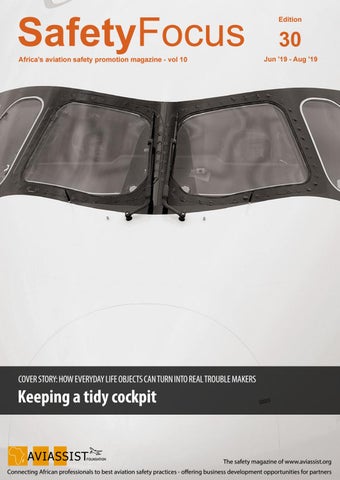
23 Cover photo: An Airbus 350 during its flight test phase, photographed head on before departure from the gate Š Airbus
SafetyFocus Magazine
Edition 30 - 2019
Our promise to you ...... Every quarter, we aim to bring you the very best update on best safety practices. From aeronautical information services to ground operations safety to safety shopping tips. If you ever feel we can improve, let us know. Do you find the contents interesting or boring? Please send your message - rude or polite - to: safetyfocus@aviassist.org After all, it's your magazine.
Follow us on:
Facebook.com/ AviassistFoundation
twitter.com/ AviAssist
Youtube.com/ 1 AviassistFoundation
director's | message
content
VS.
context Every organization in the aviation industry that aims to influence Knowledge, Skills and Attitudes for the benefit of safety faces a challenge when it comes to striking the balance between content and context. Before I get into meeting this challenge, let’s understand the difference between content and context. Content would be the subject matter in a course. Context refers to the components of a course that surround the subject matter. Context helps the professional understand the content of a course and think of ways in which she or he can apply the knowledge, skills and attitude changes in her or his daily work. In an operational domain such as the aviation industry, the tendency is to try and transfer as much content as possible, particularly in training courses. After all, we want the participants in our events to leave our event with as much knowledge as possible. They may have paid for it and are keen to go home with as much knowledge as possible. It seems our industry often aims to provide them with as much subject matter expertise as possible. But which is more important: content or context? To answer that question it is simple: both are important. You have to ask yourself, why are you creating the content? What exactly is the purpose? What sort of outcome are you looking for with the event? With each content piece there needs to be context. Pupils in secondary school spend years staring at math formulas without ever knowing how these formulas apply to the real world. How they are central to disciplines like programming, architecture, engineering, and other fields. The context of math - the when, where, and why to use these formulas - is something which is finally revealed to us adults. This is like studying music theory for 12 years and then sitting down at the piano for your first lesson! Hardly the most efficient way to learn, don’t you think? Hear me out. I’m not saying that professionals shouldn’t learn the four pillars of a Safety Management System, or learn to do performance calculations, or develop other valuable skills. But too often, the focus of our safety promotion is Content with a capital C, with little connection to why it matters.
So… how can we avoid this pitfall in designing safety promotion events? By designing and running events where our learners get prompted to apply the content to real-world situations, or at least situations that simulate the real world. If you help your learners see the real world relevance of the content, you set them up for overall success in the course. Providing context will spark a natural curiosity in people. Coming to safety promotion events should be exciting. Leaners “should be able to ask the questions that matter to them and pursue the answers. They should discover what they are passionate about, what truly sets their hearts and souls on fire. They should discover they can make a difference now”, according to Wright. And for that reason, it is crucial that a course uses the real world backdrop, the real décor, around a learner into account. And with now close to a quarter of a century experience in African aviation safety promotion, we have not become experts on the topic but we are certainly much less unknowing than we were in 1995. We have to work harder in our industry of safety promotion to make sure our courses and events make a good connection to the reference framework of the learners in our course. That reference framework is made up of the educational background of learners in aviation safety promotion events as well as the reality of their daily experience. All our work shall achieve the same international standards of the International Civil Aviation Organization ICAO but to achieve that means we have to take the local context into account. Talk to us on tailoring our work better to the context in which you work. That is why completing one of our after course evaluation forms is not just about being polite or complain the course being too short but also about providing us pointers towards better taking the context of your work into account. Our track record of close to a quarter of a century has equipped the Foundation with intricate knowledge of African aviation safety issues. It also means the content of our courses and events really connects to your context.
Tom 2
SafetyFocus Magazine
Broaden your horizons with aviation courses by the UK CAA experts London Gatwick | Dubai | Hong Kong | Kuala Lumpur | Singapore As part of the UK CAA International Group, CAAi provides best-in-class training solutions that are developed by UK CAA regulators; those working at the forefront of aviation regulation. This ensures our courses help you meet – and often exceed – the most up-to-date international regulations (EASA and ICAO Standards and Recommended Practices). We provide tailored training programmes for National Aviation Authorities and Industry around the globe, as well as a comprehensive portfolio of public access courses covering all aspects of aviation safety regulations, including: ● SMS and Risk Management
● Fatigue Risk Management Systems
● EASA Approvals (Part 21, Part 145, Part 147 & Part M)
● FSTD Operation and Qualification
● Airworthiness
● Accountable Manager (Aerodrome, Airworthiness, AOC)
● Inspector Theory (Flight Operations, Cabin Safety, Dangerous Goods)
● Human Factors in the Aviation Maintenance ● Introduction to International Air Law
To book now or for more information, please visit www.caainternational.com/training or contact us: +44 (0)1293 768700 or training@caainternational.com
www.caainternational.com Part of the UK CAA International Group SafetyFocus Magazine
Edition 30 - 2019
Together for better aviation 3
SafetyFocus By the AviAssist Foundation AVIASSIST
FOUNDATION
AviAssist is an independent, nonprofit organisation. Its mission is to provide effective and affordable support to safety champions. It serves as a catalyst for safety promotion. It provides safety promotion services for Africa's aviation industry and business development opportunities in Africa's growing markets for true safety promotion partners. Well over two decades of experience in Africa has equipped AviAssist well to deal with the technical as well complex political, social and cultural issues that play an important role in improving African aviation safety.
Foundation Board Capt. Auke Dros KLM Royal Dutch Airlines Jan van der Hoeven Treasurer to the board Bert Kraan Founder & Deputy Director CAA-NL (rtd.) Frank van de Laar Marketing & sales director EMEA Wright Brothers Simulators Hellen Ndichu Safety manager Rwandair Ron Louwerse Managing Director Rotterdam The Hague Airport Schiphol Group Ron Schipper Vice-President Africa - KLM (rtd.)
44
foundation | news van de laar joins board Frank van de Laar has been appointed to the Foundation board. Van de Laar has a commercial management background in aviation. He worked more than 12 years for KLM Group as General Manager and Marketing Director and Revenue Manager and in other challenging roles. From there, he founded his own consultancy company that supported commercial activities for a variety of clients, mainly in airline- and travel business but also in the services- and production industry. Currently, he serve as as is marketing and sales director for Europe, the Middle East and Africa (EMEA) at flight simulator manufacturer Wright Brothers in the Netherlands. With his private pilot background and passion for aviation, flying and technology, as well as his role a Simulator Test Pilot for a manufacturer of level-D flight simulators, Frank serves as marketing and sales director for Europe, the Middle East and Africa (EMEA) at flight simulator manufacturer Wright Brothers in the Netherlands.
Safarilink hosting dispatch course Nairobi based premier operator and corporate Friend of AviAssist Safarilink will be hosting the November launch edition of the Foundation's flight operations - dispatch course. The course is developed and delivered with aircraft manufacturer ATR and provides participants with the fundamental aviation background necessary to succeed as a flight operations officer.
fDS supporting trainee program Flight Data Services (FDS) from the United Kingdom is proud to be sponsoring the Foundation’s trainee program. By making available facilities to the program, FDS helps the Foundation to equip trainees and interns with the right tools to learn and contribute to the mandate of the Foundation. “We believe in the importance of investing in African graduates to boost safety promotion capacity”, explained Dave Jesse, CEO of Flight Data Services. “We have run intern programs with Cambridge University students for many years and are happy to support AviAssist in developing youth skills in the same way for tomorrow’s safety professionals in African.”
Marketing intern starts We’re excited to welcome our new intern Melissa Mingo to the team. Melissa currently attends the Hague University of Applied Sciences in the Netherlands where she studies. She is pursuing a bachelor in marketing, media and experience. Melissa works under supervision of the marketing department of Rotterdam The Hague Airport in the Netherlands and is also housed by them. Melissa is looking forward to learning more about what makes a nonprofit organisation tick and how the world of aviation safety promotion works. She will be assisting the Foundation in putting together its marketing plan. She’ll be with us throughout the spring. You can reach our ‘intern on a safety mission’ Melissa on Twitter @InternonS
second safety research competition starting The global aviation university network ATAERA and the Foundation will be running a second student research competition in the latter half of the year. Participating universities include the Aviation Academy of the Amsterdam University of Applied Sciences and the School of Aviation and Transportation Technology of US based Purdue University. “This is a truly amazing and unique competition”, Purdue associate professor Mary Johnson emphasizes. “We appreciate the fantastic educational opportunity afforded to our students to learn from so many aviation experts in the accompanying web based lecture series and learning about applying their skills to a real airport. We are grateful for this new opportunity, also to Amsterdam University that leads and coordinates the competition
so energetically. The ATAERA student competition gives us an opportunity to understand and learn safety ground handling operations safety issues in a very dynamic and interesting way. Being able to be part of this event will contribute to our professional profile and towards our goal of becoming future aviation leaders. “At university, professors ask you questions, but they already know the answer”, student Natália Solčianska from the University of Zilina in Slovakia explained. “In this competition, nobody knows the correct answer and it is up to us to come up with ideas towards a solution. There comes a point where you have done enough theoretical study and you need to start applying your knowledge. This is the opportunity to find out what we are capable of ". SafetyFocus Magazine
foundation | news Universit y of rwanda joins aspc-Rwanda partnership The University of Rwanda (UR) and the AviAssist Foundation have announced a partnership to further expand the scope and impact of the AviAssist Safety Promotion Centre (ASPC) in Rwanda. The partnership will focus on capacity building in aviation safety & engineering skills as well as business and leadership skills at the ASPC in Rwanda. The ASPC-Rwanda aims to become (East) Africa's leading aviation safety resource centre, making Rwanda and States in the East and Southern African ICAO region more selfsufficient at safety promotion. The centre imparts training and safety training that is crucial to support aviation professionals in their role as safety leaders and champions. Other ASPCRwanda partners in Rwanda include RwandAir, Rwanda CAA and UTB University. “We are very pleased to launch this cooperation”, Prof. Philip Cotton, Vice-chancellor of the University of Rwanda commented. “We are exploring the development of aviation related courses in our University. This partnership will help us on our journey to design programs for the current and next generation of aviation professionals that they will need to meet the aviation and aviation safety challenges of the next 15 years. The vision of ASPC fits with our objective to widen our international network
and will give professionals in Rwanda and beyond better access to world class education and practical research capabilities in aviation safety.” “We feel privileged to bring Rwanda’s leading university on board of our ASPC-Rwanda partnership”, says Ron Louwerse, AviAssist board chairman. “It is an unique opportunity to combine our safety promotion experience in Africa with the rich education and research capabilities of the UR and particularly its School of Engineering. This partnership will bring great benefits for the continuous professional development that the Foundation brings to Africa.”
to European & international Affairs department of the Ministry of Justice
The Netherlands Director of Aviation used his farewell reception to increase the awareness on the work of the AviAssist Foundation. Rob Huyser led the directorate of aviation for 6 years from 2013 onwards. At the March event in the Hague, the Netherlands, The executive search for a successor Director of Aviation is still ongoing. SafetyFocus Magazine
Africa’s safety magazine Editor & design - Tom Kok editor@aviassist.org Felicien Izaturwanaho Trainee
editorial review board Hans van Dijkhuizen AviAssist Foundation Adrian Young To70 aviation
Capt. Ed Pooley Flight Safety Foundation European Advisory Committee
Kigali, Rwanda Board chairman Ron Louwerse (Right) and Professor Nelson
Ijumba, Deputy Vice Chancellor of the University of Rwanda exchanging MoUs
November in Nairobi, we respond to that call". The course is designed for pilots, cabin crew and technical crew of airlines, military aviation and all other aviation operations. CRM focuses on interpersonal communication, leadership, and decision making. It supports a Safety Management System (SMS) and teaches participants how to apply Non-Technical Skill (NTS) tools to assess attitudes and behaviors.
excellent PR platform at farewell event in Netherlands
The Hague, the Netherlands Director of Aviation Rob Husyer is switching
SafetyFocus
Emily McGee Editorial assistance
crew resource management (CRM) course to be added to portfolio A recognized standard throughout the industry, Crew resource management (CRM) training is used by leading airlines to improve teamwork within their crews and reduce the frequency of accidents. "The Foundation has been asked at numerous occasions by the industry to look into bringing a CRM course to its customers in Africa," explains Foundation director Tom Kok. "With the launch edition of this course on 6-7
Colophon
"We are obviously very pleased with Mr. Huyser's choice to ask attention for the work of the Foundation", says Foundation director Kok. "A lot of the exposure we need relates to ensuring we continue growing our pool of professional volunteer experts. Mr. Huyser could have chosen a myriad of causes for which he could have raised awareness at his farewell. This choice demonstrates his support beyond his professional duty. It demonstrates that he clearly is dedicated to global aviation safety and is keen to invest in African professionals.” On top of the awareness, the event raised funds for the Friends of AviAssist. "Those funds will be used for among others training in marketing for the Rwanda based trainee of the Foundation", explained Frank Klap, head of the Friends of AviAssist division. Edition 30 - 2019
Advertising sales Let AviAssist help you organise the African market & support the work of the Foundation while bringing your brand to 42 African countries and beyond. Starting at less than € 11 per country. Contact us: safetyfocus@aviassist.org SafetyFocus is distributed for free to 2 professionals per organisation in the aviation industry and government departments involved in or relevant to aviation in 42 African countries. Wider distribution in organisations to mature safety cultures is possible at attractive corporate subscription rates. Subscriptions Stay up-to-date on best practices and subscribe to SafetyFocus. Africa’s quarterly safety magazine right on your doorstep every quarter for a whole year. In this issue, SafetyFocus reproduced articles with kind permission of CASA Australia's FlightSafety Australia, Eurocontrol's Hindsight and Aerosafety World of the Flight Safety Foundation. We are also grateful to photographer Marco Ferrarin for making available his stunning picture of Doha, Qatar
This magazine is printed on Forest Stewardship Council certified paper. This means it meets the highest environmental and social standards. 5
4Cs for | safety promotion The 4Cs are Critical thinking, Communication, Collaboration and Creativity. The 4 C’s that underpin good safety promotion.
Customer care counts Looking after your customers and clients is vital if you want to keep them, says business author and speaker Mike Clayton
Everyone wants happy customers and delighted clients. It’s one way to increase loyalty and boost their spending. But what can you do to achieve the heights of customer care? Well, first of all, you have to care. That may be all I need to say, but I thought I’d go the extra mile, so here are 10 tactics that I regularly use. Listen There’s nothing your clients will enjoy more than a damn good listening-to. One thing everyone finds hard to come by at work is someone who will just listen to them sounding off about their frustrations. They don’t necessarily want answers or help. They just want someone they can trust to speak with in confidence. Try to make that you. Be interested What is everybody’s favorite topic? Themselves and their interests. So take an interest in your customers and whatever they tell you about their business. It’s easy when you cultivate an attitude of curiosity, but as the QI philosophy points out: everything is interesting: “Whatever is not interesting, we are more interested in.” Get to know their business Go beyond interested. The more you get to know your customer’s business (for B2B), the better you will be able to serve them. Learn what they do, and how they do it. Understand the people and what motivates them. Get to know what their values, priorities and pain points are. You’re never above the politics It’s easy to think you can swan around and be immune to the politics of your client’s organization. But you can’t. You’re a part
6
of it now. You may have a different set of obligations and privileges to the staff, but like Heisenberg’s principle, as soon as you start to observe, you have an impact. Pre-think Whenever your customer suggests they want to talk about something, put aside time to think it through in advance. Sometimes you’ll be able to offer a perfect solution. Sometimes you’ll simply have a better understanding of the options. But if you are going to let them use their time in a conversation with you, you’d better make it worth their while. Co-create Look for the chance to customize what you offer, by working together with your client to specify the product or service you’ll offer them. This way it will be theirs as much as yours and your chances of delivering something of lasting value will increase accordingly.
confidence and self respect. If you give concessions away too easily, you’ll devalue your service, and make your client feel bad they didn’t ask for more. Giving hardwon concessions leaves everyone feeling the final deal is fair. Keep them informed Customers trust you when they have confidence in you and they have confidence when they feel in control. Provide the information your clients need to feel in control. easier to work with you than not to Be flexible and adapt yourself to your client’s priorities. Their world revolves around them. So you need to, too. And always follow up on any promises. Get good at diarizing the details, so you keep a reputation for always doing what you say you will do, when you said you’d do it. Check Before you move on, check your questioner has the answer they need. And invite a follow-up question if they seem to need more clarification.
Think outside their box Your customer knows what your customer knows. And what they will ask you for will be based on that knowledge. It’s a box. Don’t accept the walls. Climb out and have a good wander around before Republished from Flight times - inflight magazine of Flybe responding to their request. If you’re airlines with kind permission worth your salt, you should be able to offer more than Mike Clayton managed large they asked for. Not in sales and small projects in teams value terms, but in quality from five to one hundred. of product terms. Since 2002, he has focused Self-respect, confidence, and concessions Your clients will sometimes want you to negotiate. But do so from a position of
on speaking and training. He delivers practical tools and insights based on his experience of complex change. www.mikeclayton.co.uk
SafetyFocus Magazine
Our focus on your safety Safety is a pre-condition for our daily operations to any destination. KLM is proud to work hand in hand with the AviAssist Foundation as part of that commitment to your safety - klm.com
SafetyFocus Magazine
Edition 30 - 2019
7
Human Factors safety || culture
Fire and fury
The destruction of Piper Alpha A regime changer for safety regulation and practice
An oil platform disaster 30 years ago has grim, but abundant, parallels and lessons for aviation safety. The first sign that something was wrong, was when the ceiling fell on Ed Punchard. He was diving coordinator on the Piper Alpha oil platform in the North Sea, east of Scotland, and it was 10 pm on the evening shift of Wednesday 6 July 1988. Punchard was 28, well paid, in love with his job, and fitter than he had ever been. He was also blessed by the location of the diving office—immediately above the dive skid on the lower level of the platform. It would give him a survival advantage over most of the other men on the installation, 167 of whom would soon die. But he didn’t know that yet. No-one knew anything. ‘We found ourselves with all the filing cabinets fallen over, the ceiling down and the lights out,’ he recalls. ‘I helped the diving superintendent into a breathing set and he told me to go and find a way out.’ ‘I made my way up towards the control room. After a couple of flights of stairs, I could go no further—all the routes up were blocked by smoke. By the time I had made my way back down, the diver in the water had been recovered and the dive team was gathered on
the one corner of the platform that was free of smoke. There would have been about 20 of us.’ He remembers the group wondering what to do. ‘There was no obvious way up or down.’ Restless, Punchard noticed a ladder to a small platform and climbed down it to explore. After a few rungs, he found he could see right underneath the platform. Thirty years later he inhales, then adopts a deliberately undramatic tone to describe the view as ‘an alarming sight’. ‘On the other side there was an enormous fire. Anyone who works on a platform knows a fire round the well heads is an extremely dangerous thing. I called up and said, “we’ve got to get off!” There was a rope near where we were standing so we threw it over the side.’ Punchard was first to slide down the 25 metre (80 foot) drop. ‘I reached out with my toe to grab the corner of the spider deck (just above sea level). I pulled the rope in and people came down and followed me. By that time a standby vessel, the Silver Pit, had come close and launched an inflatable fast-rescue craft. It came in, and we climbed down a small ladder and got picked up.’ Punchard was one of the first of the 61 men to escape
republished from Flight safety australia with kind permission from the Civil Aviation safety Agency 8 8 12
SafetyFocus Magazine
Human Factors safety | culture Piper Alpha. But his ordeal was not over. On board the Silver Pit he took part in further rescues, was nearly drowned, nearly burned, and saw at first hand the terrible explosions when the Tartan and Claymore gas ‘riser’ pipelines feeding Piper Alpha ruptured. They fed the fire with 30 tonnes per second of gas pressurised to 1800 psi. Other survivors told equally harrowing stories. One comes from Scottish journalist Stephen McGinty’s definitive account, Fire in the Night.
© REX/Shutterstock
Meanen thought he was going to die. And yet this single thought was to be the spark that ignited a burning will to live. The next 30 seconds were as if a machine had taken over his body. He backed down the steps, squeezed through the bars and began to run across the helideck. When he reached the metal poles that stuck out and supported the safety net, he slowed down, took off his life jacket, stepped out onto the metal poles and looked down into the water 170 feet below. He then threw the jacket over, backtracked, ran and jumped. It was only when his back foot took off and his entire body had left Piper Alpha for the final time that, hanging in the air, in that fraction of a second before gravity took grip, consciousness returned. At that exact second running through his mind was a single sentence: ‘What the f*** have I done?’ He had six seconds to contemplate his actions, and as he fell he burned. Later escapees from the inferno described hearing unearthly groaning and scraping noises as the structure of the platform melted and buckled from the tremendous heat. At 11:50 pm, the accommodation block, where most of the men had gathered to wait for rescue, in accordance with their drills, fell into the sea. All within it died. It had been less than two hours since the first explosion. The operational role of aviation that night was limited. Helicopter rescue was made impossible by frequent explosions and flames which soared to over 500 feet. But the themes of the disaster should be clear to anyone with a realistic understanding of aviation safety. The most sobering lesson is how the disaster was the product not of intentional malice, incompetence or negligence, but of a culture, ‘the way we do things round here’, which disguised and normalised these things. The platform had been anchored to the seabed, but in an organisational, metaphorical sense, it drifted to its destruction.
Communication and procedure
The famous US firefighter Red Adair the firefighters but could not contain the blaze..
SafetyFocus Magazine
© Sipa Press/REX/Shutterstock
was brought in to direct
In fire engineering terms, an oil installation and an aircraft have more similarities than differences. Both involve placing people in hostile environments in close vicinity to large amounts of volatile hydrocarbon fuels. And both rely on redundancy and cross checking for safe operation. These had broken down on Piper Alpha. About the time the shift changed, one of the platform’s two condensate (compressed gas) pumps failed. This was a serious threat to production. Edition Edition30 30- -2018 2019
The night crew turned on the second condensate pump. Unknown to the night shift, a pressure safety valve had been removed from the second condensate pump and a hand tightened flange had been installed in its place. Paperwork outlining these changes was sitting unseen on a manager’s desk. The flange promptly failed under the high pressure, resulting in what survivors remembered as a banshee scream, before the first in a series of explosions.
Design and drift
Engineering risk analyst Marie Elizabeth Pate-Cornell described the platform as being ‘decapitated’ by the first explosion, which damaged the control room and killed or disabled senior staff. This was a consequence of how the platform had evolved in use beyond its design brief. Punchard sums up: ‘Normally the pumps would be switched on manually from the control room. But Piper had been designed to process oil, not to process gas. The wall that protected the control room was only a firewall, not a blast wall. When the explosion happened, there was a high degree of devastation in the control room which meant that it wasn’t possible to switch the pumps on. It was a combination of bad design and lack of analysis.’ Pate-Cornell also noted the closeness of living quarters to the production modules, which led to the rooms filling with smoke, and the poor planning of exits and passageways. This led to early blocking of passageways and made the lifeboats inaccessible. She adds a chilling surmise: ‘The offshore installation manager probably knew this, which may have contributed to his state of panic and his inability to function and give orders.’
Culture: Lord Cullen’s displeasure
A Scottish judge, Lord Cullen, produced the official report into the tragedy. He was scathing about how the offshore oil industry’s culture had both tolerated and created human shortcomings, and about how the systems that were meant to assure safety, had been allowed to decay. ‘Before I got to grips with the inquiry I imagined it would be concerned with hardware,’ Lord Cullen told a commemorative conference in 2013. ‘But I quickly realised that fundamental, and running through everything, was the management of safety, and as I dug down into the background of what happened I discovered it was not just a matter of technical or human failure. As is often the case, such failures are indicators of underlying weaknesses in the management of safety.’ ‘Management shortcomings emerged in a variety of forms,’ Lord Cullen said. ‘There was no clear procedure for shift handovers. The permit to work system was inadequate, but so far as it went, it had been habitually and frequently departed from.’ ‘Training, monitoring and auditing were poor, and the lessons of a previous relevant accident had not been followed through.’ How had such a state of affairs evolved? Lord Cullen recognised the importance of culture and leadership in creating, or destroying, the preconditions 9 9
safety | culture for safe work. ‘No amount of requirements for safety improvements can make up for deficiencies in the way in which safety is actually managed.’
Cultural deficiencies
The originator of the Swiss cheese model of accident causation, Professor James Reason, linked Piper Alpha’s cultural deficiencies with specific deadly practices. These are: • ‘Front-line errors are more likely in organizations that are insufficiently concerned about the working conditions known to promote the slips, lapses and mistakes of both teams and individuals,’ Reason said. • ‘Second, an inability to appreciate the full extent of the operational dangers can lead to the creation of more longer-lasting holes in the defences. These may arise as latent conditions during
maintenance, testing and calibration, or through the provision of inadequate equipment, or by downgrading the importance of training in handling emergencies. • ‘Perhaps the most sinister and farreaching effects of a poor safety culture, however, will be evident in an unwillingness to deal proactively with known deficiencies in the defences indepth. In short, defensive gaps will be worked around and allowed to persist. Lord Cullen’s report made 106 specific recommendations, all of which were accepted by the United Kingdom’s offshore petroleum regulator, (and many of which were adopted by Australia’s offshore regulator).
towards safety case
But his most far reaching recommendation was for the offshore industry to man-
Piper Alpha platform
T
he 380 km stretch of the North Sea between the Orkney Islands and the Norwegian coast looks homogenous and unrelieved to a lay observer. To anyone in the oil industry, however, the waters will be overlaid with an invisible grid dividing them into blocks. At the height of the UK’s oil boom in the 1980s and 1990s, a licence to drill for oil below the waves in some blocks was the gateway to hundreds of millions of pounds a year in revenue. In the upper part of block 17, about halfway between Aberdeen in Scotland and Norway, sits the 30 sq km Piper oilfield. In 1976, US operator Occidental Petroleum started production from one of the largest 10
rigs in the North Sea, Piper Alpha, which was towed to the field where its four legs were anchored to the seafloor. By 1988 Piper Alpha’s 20 wells were pumping 125,000 barrels a day from around 2 km below the seabed. The terminal was connected by pipelines to other platforms nearby and to the Flotta oil terminal on Orkney. Separate gas pipelines were run from Tartan platform via the Piperto the gas compressing platform MCP-01 some 30 miles (48 km) to the northwest. A gas recovery module was added to the rig in 1980 to capitalise on the gas reserves unlocked by oil drilling and to meet new regulations to curb gas flaring. Sources: www.ioshmagazine.com
age risk by presenting safety cases rather than solely through adherence to regulation. A safety case is an argument about how a proposed activity can be done with acceptable safety. In effect, it is the regulator saying, ‘So you say you are safe. Prove it!’ NASA has a useful definition: A risk-informed safety case is a structured argument, supported by a body of evidence, that provides a compelling, comprehensible and valid case that a system is or will be adequately safe for a given application in a given environment. This is accomplished by addressing each of the operational safety objectives that have been negotiated for the system, including articulation of a roadmap for the achievement of safety objectives that are applicable to later phases of the system life cycle. Lord Cullen summarised a safety case as ‘Asking and answering the what-if questions and avoiding making do with preconceptions.’ With 30 years of hindsight Punchard says Piper Alpha was a tipping point. ‘I think it was the moment at which modern systems of health and safety were instigated in a new way that requires corporations and individuals to be much more selfmotivated and self-proving. Oil and gas industry safety analyst Professor Patrick Hudson makes a similar point. ‘Looking back, we can see that safety has undergone a development from an unsystematic, albeit well-meaning collection of processes and standards, to a systematic approach specific to safety. Piper Alpha served as the catalyst for this major change,’ Hudson wrote 10 years after the accident. Hudson also saw in Piper Alpha the need for safety to become a cultural, rather than management imperative. ‘In a managed organisation it is still necessary to check and control externally. In a safety culture it becomes possible to find that people carry out what they know has to be done not because they have to, but because they want to,’ Hudson said. ‘Advanced safety cultures can only be built upon a combination of a top-down commitment to improve and the realisation that the workforce is where that improvement has to take place.’ Punchard elaborates on Hudson’s point when he says the disaster showed the difference between complying with regulations and actively striving for safety. ‘I describe it as the difference between traffic lights and roundabouts. Both do the same thing, but roundabouts require a certain skill level, traffic lights don’t, and there’s a danger in relying on traffic lights and SafetyFocus Magazine
safety | culture an important vitality in skill and selfmotivation.’ The lesson? ‘Don’t instruct your workers in such a way that they zone out, stop thinking. It’s important to keep your workers engaged, skilled and motivated.’
Aftermath
Ed Punchard never went back offshore. Within hours of the blast, he found himself experiencing unexpected emotions, the first of which were feelings of joy and invincibility when the rescue helicopter brought him ashore. A newspaper photographer captured a shot of him grinning broadly as he stepped onto solid ground. Later, in grief and shame, Punchard stole the photo from a press archive. Still later, he returned it when he realised his reaction to the experience had been entirely normal. ‘In the aftermath of Piper Alpha, I, like many of the survivors, suffered with post-traumatic stress disorder,’ he says. ‘Especially for somebody who was a diver and regarded himself as pretty resilient … that sort of thing can take you by surprise. Now when I look back, I can see it was a completely unsurprising thing to
have occurred. None of us were trained to be in what was in effect a combat zone, where you were surrounded by explosions and had to deal with an escape and then a rescue organisation, like the escape, largely coordinated by survivors.’ ‘The reassuring thing is that with some quite simple and now well-established techniques of counselling and recognition of the condition, the vast majority of us recovered very well.’ Punchard says for anyone involved in a traumatic event it’s important to accept a high probability of PTSD, and also to realise that it need not be a lasting condition. ‘There’s no reason to believe you won’t recover but it’s important to take it seriously.’ For Punchard, Piper Alpha was the catalyst to a new life. He moved to Australia and became a successful television and film producer. A diving helmet sits in the corner of his office.
Notes:
1. Cullen, Lord. (1991). The public inquiry into the Piper Alpha disaster: Vol. 1. London: HMSO. Cullen, Lord. (1991). The public inquiry into the Piper Alpha disaster: Vol. 2. London:
HMSO. 2. Hudson, P.T.W. (2001). Safety Management and Safety Culture: The Long, Hard and Winding Road. In: Pearse, W., Callagher, C. and Bluff, L. (eds.) Occupational Health and Safety Management Systems. Crown content, Melbourne, Australia, pp 03–32. 3. McGinty, S. T. (2008). Fire in the night. Pan MacMillan, London. 4. Paté-Cornell, M. (1993). Learning from the Piper Alpha accident: A postmortem analysis of technical and organizational factors. Insurance: Mathematics and Economics, 13(2), 165. doi:10.1016/0167-6687(93)90921b. 5. Punchard, E. and Higgins, S. (1989). Piper Alpha: A survivor’s story. W.H. Allen, London. Reason, J. (1998). Achieving a safe culture: Theory and practice. Work & Stress, 12(3), 293306. 6. An excellent video about the accident and lessons learned: can be found here http://bit.ly/2V9CciI
Safety is priceless
Safe African skies support Africa's economic development
Help us keep it affordable Priceless
Friends of AviAssist work alongside the AviAssist Foundation in support of its programs. We raise funds and help source professional volunteers for deployment in the Foundation’s programs. As a Corporate Friend of AviAssist, your support will impact the AviAssist Foundation’s ability to: • Equip African professionals with the latest best practices & skills • Encourage & support African champions in aviation safety • Improve aviation safety in Africa
Support the Foundation’s mission to provide an effective and affordable way to support African safety champions. Become a Corporate Friend of AviAssist just as Safarilink Friendship comes with interesting benefits - such as an entry in our free advertisement draw....this edition won by corporate Friend of AviAssist Safarilink - thanks for your solidarity in safety Contact Marily Heyster for more information , membership benefits & donations at friends@aviassist.org SafetyFocus Magazine
Edition 30 - 2019
visit us at www.friendsofaviassist.org
11
SafetyFocus Magazine
Industry guidance describes the safest ways of transporting lithium batteries.
B
republished from aerosafety world with kind permission from Flight safety foundation
illions of lithium-ion and lithium-metal batteries1 are shipped by air every year, with that number likely to increase in coming years with worldwide demand.2 The increase in numbers may well be accompanied by an increase in fire risks associated with mishandling of the batteries as they are packed for shipment. An online guidance document, published by the International Air Transport Association (IATA), is aimed at reducing those risks by explaining international requirements for the safe transport by air of dangerous goods and describing methods of complying with the requirements as they relate specifically to lithium batteries. “Lithium batteries are safe to transport, provided that they are designed, tested, manufactured and packaged in accordance with the global transport safety standards,” said IATA's senior vice president for safety and flight operations.
1212
When those safety standards are ignored, however, IATA said in its document, Lithium Batteries Risk Mitigation Guidance for Operators, the results can be catastrophic. The document cited three cargo aircraft that were destroyed by fire since 2006 (see “Battery-Related Aircraft Fires,” p. 16). “It is known that all three aircraft were carrying lithium batteries as cargo,” the document said. “However, the degree to which the lithium batteries were involved in these incidents (i.e., whether they were the cause or aggravated the fire) could not be determined.” The United Nations has declared lithium batteries to be “dangerous goods,” and the International Civil Aviation Organization (ICAO — an agency of the U.N.) has set forth specific requirements for their safe transport in both cargo and passenger airplanes. In the last few years, requirements have been strengthened to limit the number of lithium batteries per package and to require more notices
Packing Up
By L I N DA W E R F E L M A N
Battery: © d_arts; Box: © Yuichiro; Airplane: © hugolacasse |Vectorstock
cargo | safety
SafetyFocus Magazine
cargo | safety As an example, IATA describes how the operator of a passenger airplane might assess the risk of carrying portable electronic devices (PEDs) in the cabin, using this reasoning: Severity level — If a PED catches fire in the cabin, fire extinguishers will be readily available to cabin crew, who will have been trained in their use. Additionally, water, which is necessary to cool lithium batteries involved in an accident, will be at hand. Therefore, on the basis that an abnormal flight operations incident procedure would be applied (firefighting by cabin crew), with few other consequences, it may be appropriate to assign a severity level of 3 ‘moderate.’ Likelihood — Given the propensity for … PEDs to be carried by passengers, it would be reasonable to assume that such an incident might occur at some time, and so the likelihood would be Level C [possible/ remote]. of lithium battery shipments to pilots-incommand, IATA said. Despite these controls, problems persist, the association said. Although some people intentionally ignore the requirements, the “ubiquitous nature” of the batteries “means that people who are completely unaware of the dangerous goods regulations and the requirements for lithium batteries are shipping them as cargo and in mail,” the IATA document added. “Many passengers are similarly oblivious to the potential hazards of lithium batteries. The result is that there are safety risks from lithium batteries in baggage, cargo and mail.”
The risk index would be calculated by pairing the severity (3) and the likelihood (C) to conclude that the risk would be 3C, or “moderate.” The operator’s next step would be to examine preventive controls that would prevent a hazard such as a lithium battery fire from developing into an unsafe event such as an aircraft fire, escalation factors that could weaken the effectiveness of the preventive controls and escalation controls that could block the escalation factors.
IATA’s guidance begins with the recommendation that operators conduct a risk assessment, as described in the ICAO Safety Management Manual, to identify all risks associated with transporting lithium batteries. Senior-level representatives of cargo, safety and flight operations departments should identify all potential hazards and then rate their severity, on a scale of 1 to 5, as well as the likelihood that they will occur, on a scale of A to E. The resulting risk index — ranging from “negligible” to “extreme” — should then be examined to determine shipment tolerability.
In the example, a preventive control might be a prohibition against carrying spare lithium batteries in checked baggage, an escalation factor might be a passenger’s ignorance of the requirement, and an escalation control might be that the operator “has a robust process to ensure that all passengers are made aware of the requirement (e.g., by questioning at check-in).” The guidance material added, “Despite preventive controls being in place, there is always the possibility that an unsafe event (in this case a lithium battery fire) can occur. Consequently, ‘recovery
SafetyFocus Magazine Magazine SafetyFocus
Edition30 30- -2019 2019 Edition
Risk Assessment
measures’ must be considered. … As with preventive controls, recovery measures can also be weakened by escalation factors that need to be controlled.” In the example, a recovery measure might be having halon fire extinguishers and water available to the cabin crew, an escalation factor might be that the fire extinguishers are out of date or that insufficient water is available, and an escalation control might be implementing a process to ensure that aircraft always have current fire extinguishers and adequate water. Awareness The guidance material emphasizes the importance of increasing awareness of lithium battery safety, often through the involvement of battery manufacturers, freight forwarders and postal operators; with warning notices at airport check-in desks; and in videos, social media and other publicity material. Both IATA and ICAO require lithium batteries and other dangerous goods to undergo an “acceptance check” to ensure that they have met shipping requirements — and document and labeling requirements associated with such shipments — and stipulate that operators must take steps to ensure that the goods are not damaged during transport. Among the requirements are provisions specifying that packages must be secured Continued on page 16
13 13
Flying you to 17 destinations across Kenya & Tanzania
Africa’s first registered operator
Proud to work hand in hand with the AviAssist Foundation as part of our commitment to your safety
14
SafetyFocus Magazine
human | factors
Welcome to our classes
in East Africa
Kigali, 15-18 July 2019
Airport engineering for safety Course topics include • Airside geometric designs • Airside pavement engineering • Navigational aids • Engineering for safety • Site visit Who must attend? The course is designed for those who have or should have a role in the effective planning and construction of new airports and airport expansion projects, including: directors, heads, managers, engineers, inspectors, surveyors and specialists of • Aerodrome Operations • Aerodrome Safety & Standards • Airside Operations • Safety & Risk Management • Engineering • Surveying From (but not limited to) : • Aviation Authorities • Airport Operators • Engineering Contractors • City & district planning authorities
$400 for 4 days The course is developed and delivered in co-operation with acclaimed airport development firm NACO from the Netherlands.
Brought to you by:
Nairobi, 9-12 July 2019
Ground Operations safety
Key topics: • Management of ground operations • Airside safety & risk assessment • Audits & certifications $400 for • Load control 4 days • Ground Service Equipment • IATA AHM & IGOM Manuals Kenya, 11-15 Nov 2019
Flight operations - dispatch Course topics include • Aircraft systems • Weight & balance • Aircraft performance & limitations • Aerodromes, route restrictions and aircraft performance • Flight planning • Meteorology Intended participants include: • Ab initio staff in an Airline Operations Center (AOC) • New hires as flight operations officers • Civil Aviation Authority inspectors • Flight crew members • Aviation students
$550 for 5 days
The course is developed and delivered by aircraft manufacturer ATR Aircraft from Toulouse
In co-operation with among others:
Safety resources for the African aviation industy since 1995 SafetyFocus Magazine Edition 30 - 2019
www.aviassist.org
Nairobi, 6-7 Nov 2019
human factors in aviation Intended participants: • Safety managers $300 for • Chief Air Traffic Controllers 2 days • Dispatchers • Military Air Traffic Controllers • Pilots & crew chiefs • Ground handling staff & managers • Safety inspectors • Airforce pilots & operational staff Nairobi, 4-5 Nov 2019
flight data monitoring Course highlights: • FDM & safety management • Towards a succesful FDM program • Fitting out aircraft • FDM technology • Human factors of FDM • Visualisation
Who must attend?
• Pilots & trainee pilots • Flight safety officers • Regulators • Aircraft maintenance companies • Airline union representatives • Accident investigators $400 for • Aircrew representatives 2 days • Aviation students The course is developed and delivered by FDM world leader Flight Data Services
Sponsored by:
15
cargo | safety to prevent movement and must be protected against damage that could result from the shifting of other cargo. IATA’s guidance suggests that operators consider loading lithium batteries in a Class C cargo compartment with a smoke detector or fire detector to warn the flight crew of problems. There also should be an approved built-in extinguishing system that can be controlled from the flight deck; methods of keeping hazardous smoke, flames and extinguishing agent away from crew and passengers; and methods of controlling compartment ventilation to ensure that the extinguishing agent can control the fire, the guidance says. ICAO does not require separation of lithium batteries from other dangerous goods, but the IATA guidance suggested that operators “consider segregating packages of fully regulated lithium batteries from packages of other dangerous goods” with some exceptions. The guidance material also suggested that operators take extra steps to detect the presence of undeclared lithium batteries through “enhanced cargo acceptance processes and training to better detect noncompliant shipments.” Increased scrutiny of the paperwork accompanying cargo shipments is recommended, the guidance says, suggesting that items described as “electrical/electronic equipment” might include lithium batteries. PEDs and Lithium Batteries Because of the proliferation of PEDs, large airplanes could be carrying hundreds of lithium batteries, IATA says, noting recommendations that the devices be in carry-on baggage whenever possible. When this is not possible, steps must be taken to prevent short circuits or other unintentional activation. Spare lithium batteries are prohibited in checked baggage, and must be protected against — that is, they should remain in their original protective packaging or exposed terminals should be covered with nonconductive tape. The guidance material also suggests that operators incorporate into the preflight briefing a request that passengers stow cell phones and other PEDs safely when they are not in use to prevent them from falling into a seat mechanism. The material cites a number of incidents in which cell phones that had fallen into seats were crushed when the seat was moved.
Battery-Related Aircraft Fires
T
hree on-board fires in cargo airplanes in the past nine years have been repeatedly cited as examples of the destruction that can follow when lithium batteries are not properly stored. The first fire broke out in a UPS McDonnell Douglas DC-8, which landed safely in Philadelphia on Feb. 7, 2006, and subsequently was destroyed by a fire that had begun during the descent. All three crewmembers were treated for smoke inhalation. The U.S. National Transportation Safety Board (NTSB) said the fire’s source was unknown but that it probably originated inside one of the airplane’s cargo containers that was loaded with electronic devices with rechargeable lithium batteries (ASW, 4/08, p. 28). 1 The second fire occurred in a UPS Boeing 747 that crashed near Dubai International Airport in the United Arab Emirates (UAE) on Sept. 3, 2010, killing the two flight crewmembers and destroying the airplane (ASW, 11/13, p. 12). The final report on the accident from the UAE General Civil Aviation Authority (GCAA) said that investigators could not determine conclusively how the fire began but that a sizeable number of lithium batteries in the forward cargo deck had not been declared as hazardous material. The report said it was “possible that a lithium type battery or batteries … went into an energetic failure … and auto-ignited, starting a chain reaction which spread to the available combustible material.”2 The third fire occurred July 28, 2011, in an Asiana Airlines Boeing 747 that crashed into the Yellow Sea west of Jeju Island, Republic of Korea, after the crew reported a fire to air traffic control and attempted to divert to Jeju International Airport. Both crewmembers were killed. At press time, the accident investigation by the South Korean Aircraft and Railway Accident Investigation Board (ARAIB) was continuing. — LW Notes 1.
NTSB. Accident Report No. NTSB/AAR-07/07, Inflight Cargo Fire; United Parcel Service Company Flight 1307; McDonnell Douglas DC-8-71F, N748UP; Philadelphia, Pennsylvania; February 7, 2006. Dec. 4, 2007. Available at <www.ntsb.gov>.
2.
GCAA. AAIS Case Reference 13/2010: Uncontained Cargo Fire Leading to Loss of Control Inflight and Uncontrolled Descent Into Terrain — Boeing 747-44AF, N571UP; Dubai, United Arab Emirates; 03 September 2010. July 24, 2013. Available at <gcaa.gov.ae/en>.
3.
ARAIB. Interim Report No. ARAIB/AAR1105, Crash Into the Sea After an In-Flight Fire; Asiana Airlines, B747-400F/HL7604; 130 Km West of Jeju International Airport; July 28, 2011. Sept. 17, 2012. Available at <araib.mltm. go.kr/intro.do?gubn=English>.
Training Appropriate crew training is the greatest mitigating factor in preventing incidents involving lithium batteries, the guidance says, specifying that there are two types of training: • Preventive training, which concentrates on detecting damaged packages and situations in which lithium batteries are not in compliance with requirements; and, • Reactive training on how to respond to an incident involving smoke, fire or fumes.
16
SafetyFocus Magazine
cargo | safety In any cargo fire, “there is always the possibility of undeclared lithium batteries,” the guidance material says. “Flight crew should be trained to respond to an emergency suspected of involving lithium batteries carried as cargo by following the standard operating procedure for smoke or fire events, the most important aspect of which is land as soon as possible. In addition, the material recommends emergency training on the problems of retaining aircraft control if smoke enters the flight deck. In the Future Research has turned up new methods of containing and suppressing fires in cargo compartments, the guidance material says, citing as an example cargo containers built of fire-resistant material. Tests are in progress on other devices, including cargo containers equipped with self-contained fire-suppression systems that activate automatically if smoke or fire is detected, penetrators that automatically pierce the roof of a cargo container to inject fire extinguishant if excess heat is detected, and quickdonning oxygen masks that can be used along with smoke-displacement systems to provide a space of clear air through which
pilots can see both their flight instruments and the view outside the windscreen. Notes 1. Lithium-metal batteries — sometimes called primary batteries — are typically non-rechargeable batteries such as those used in watches, calculators, high-power flashlights and emergency locator beacons. Lithium-ion batteries — also known as secondary batteries — are rechargeable batteries typically used in cell phones, cameras, tablets and laptop computers. 2. IATA. Lithium Batteries Risk Mitigation Guidance for Operators, First edition, effective Jan. 1, 2015–Dec. 31, 2015. Montreal. 2014.
The IATA guidance suggested that operators “consider segregating packages of fully regulated lithium batteries from packages of other dangerous goods.”
Who is who at AViAssist events
G w en ci li ta to r d er sh ip fa w it h S or ot i' s ea L t is t' s A v iA ss a n H ee l (l ef t) A v iA s s is D u d ok v er K a g a b a a n d cl os u re h e p rs C h ri s to n M es se l a t co u M a ri ly va
Mi ni ste r of St at e Jea n de Di eu Uw in ch ar ge of Tr an sp ort To m Ko k fro m th iha ng an ye (le ft) an d e Av op en in g th e av iat iA ss ist Fo un da tio n ion we ek in Ki ga li
n ng th e av ia tiom ed br ea k du ri A we ll de se rv co ur se wi th se ni or pr og rase At the March 2019 AviAs sist m en ta l he al th ily va n M es se l an d co ur board meetin g with (Left to right) m an ag er M arEr ik Le ly fr om N oT ec hs direct or Tom Kok, Jan van der Hoeve n, fa ci lit at or Ron Louwe rse, Bert Kraan , Frank van SafetyFocus Magazine Edition 30 - 2019 de Laar, Ron Schip per & AUke Dros
A vi as si st bo (l ef t) an d T ar d ch ai rm an R on L on ou w at th e E M N eg en m an , fi rs t se er se th e N et he rl ba ss y of th e K in g do mcr et ar y di sc u ss io n an ds to R w an da fo ll of s ab ow Pr om ot io n ou t th e A vi A ss is t S in g af C en tr e (A S PC )- R w an daet y
AviAs sist Head of ARFF traini ng Jan Huizi ng and senior instru ctor Anne Jan Hoeks ema waitin g for trans port at the start of a traini ng day at Ndola Intern ationa l Airpo rt in Zamb ia
17
on | record
Adrift in the clouds
The following information provides an awareness of problems that might be avoided in the future. The information is based on final reports by official investigative authorities on aircraft accidents and incidents.
Boeing 737-4. No damage. No injuries
M
iscommunication and neglect of standard operating procedure (SOP) were among the factors that caused the 737 to stray beyond the confines of a nonprecision approach while descending in instrument meteorological conditions (IMC) to land in Darwin the morning of Dec. 17, 2008, according to the Australian Transport Safety Bureau (ATSB). When the aircraft broke through the clouds about 700 ft above ground level (AGL), the airport traffic controller saw that it was not aligned with the runway and told the flight crew to go around. The crew complied and subsequently landed the aircraft without further incident. The ATSB’s final report on the incident, issued in March 2011, said that the aircraft was inbound on a scheduled passenger flight to Darwin from Denpasar, Indonesia. The estimated time of arrival was 0500 local. There were widespread rain showers in the Darwin area; visibility at the airport was 4,000 m (2 1/2 mi) in moderate rain, and the ceiling was broken at 500 to 700 ft. The 737 was over the Timor Sea, about 200 km (108 nm) northwest of Darwin, when the crew diverted 40 km (22 nm) north of course to avoid thunderstorms. An approach controller subsequently told the crew that when they were clear of the weather, they could expect clearance to fly directly to NASUX, the initial approach fix for the VHF omnidirectional radio (VOR) approach to Runway 11. NASUX is 17.6 km (9.5 nm) northwest of the runway threshold.
The aircraft was almost directly north of the airport when the crew reported that they were clear of the hazardous weather. “The approach controller asked the flight crew if they could accept a clearance to track to NASUX,” the report said. The crew replied that they could intercept the final approach course, 105 degrees, about 12 km (6 nm) from the runway threshold — that is, inside NASUX. “The approach controller then instructed the flight crew to maneuver west of NASUX as required to track direct to NASUX for a straight-in approach to Runway 11 via the Runway 11 VOR approach and to contact the tower when established on final,” the report said. “In response, the flight crew correctly read back the tower frequency and included the phrase ‘straight-in approach Runway 11’ in their transmission [but did not read back] the approach controller’s instruction to track via NASUX for the Runway 11 VOR approach.” The controller repeated the clearance for a “straight-in-approach via NASUX,” but the crew’s reply indicated only that they understood they were cleared for a straight-inapproach. The crew then initiated a descent below 3,000 ft, the initial approach altitude, without clearance. The 737 was nearing 2,000 ft when the controller reminded the crew that the initial approach altitude was 3,000 ft. “The flight crew responded that they were at 2,000 ft to ‘intercept … runway course,’” the report said. The aircraft was 12 km northwest of the airport when the crew requested clearance to descend to 1,500 ft. The controller cleared them to descend to 1,600 ft, the published minimum safe altitude. After leveling at 1,600 ft, the crew turned left 8 km (4 nm) from the runway threshold to track the final approach course, 105 degrees. The 737 was not established on the VOR approach, however. Contrary to company SOP that requires crews to monitor raw data from the approach aids — in this case, the VOR and the distance measuring equipment — the crew was using as their primary means of navigation the electronic flight instrument system’s map mode, which was displaying data provided by the inertial reference system (IRS). Because of drift, or
the tendency for IRS positioning accuracy to deteriorate during long overwater flights, the IRS data were not suitable for an instrument approach. As a result, the aircraft was unknowingly being flown parallel to, and 600 m (1,969 ft) north of the VOR final approach course as the crew continued the descent toward 500 ft, the minimum descent altitude. “In consequence, the aircraft was below the minimum [safe] altitude in IMC without being on an instrument approach, increasing the risk of collision with terrain,” the report said. As the crew complied with the airport traffic controller’s instruction to go around, the aircraft reached a minimum altitude of 513 ft, or about 417 ft AGL, abeam the runway threshold. The crew then conducted the VOR approach via NASUX and landed the 737 on Runway 11. The aircraft was of Indonesian registry, but the report did not specify the nationality of the pilots. Nevertheless, it said, “There was no evidence that language proficiency or comprehension of spoken English were factors in the incident.” Communication, however, was a contributing factor. The crew’s incomplete readbacks of their clearances should have prompted the approach controller to seek correct readbacks, the report said, noting that the absence of challenges to their readbacks “likely confirmed for the flight crew that their erroneous interpretation of the controller’s instructions was, in fact, the controller’s intent.”
?
DID YOU KNOW:
The Initial Approach Fix (IAF) is the point where the initial approach segment of an instrument approach begins. The initial approach fix is usually a designated intersection, VHF omnidirectional range (VOR), non-directional beacon (NDB), or distance measuring equipment (DME) fix. A fix is a geographical position determined by reference to a navigational aid.
republished from Aerosafety world with kind permission from the Flight safety Foundation 18
SafetyFocus Magazine
YO_R ADVERT HE_E Q: What is missing here? A: You are Imagine... accessing 42 African markets at unprecedented low cost Reach professionals and decision makers in the aviation industry with the Foundation’s unique network Start your market presence in the second biggest air transport growth market Support the Foundation's mission of providing effective and affordable support to safety champions Combine your marketing with goodwill creation Associate your company with the 20+ years legacy of the AviAssist Foundation
SafetyFocus Magazine SafetyFocus Magazine
Contact us at safetyfocus@aviassist.org for a media pack Edition 30 - 2019
Edition 29 - 2019
19 19
Flight | Operations
Tidy Co ckpit The "clean cockpit" philosophy
for safe flight
By X AV I E R B A RR I O L A & DAV I D M A R CO N N E T
One would not normally think of everyday life objects, apparently as inoffensive as a pen or a cup of coffee, as being a real threat to the safe operation of a commercial flight. Yet, leaving them unsecured or forgotten in a cockpit could rapidly turn them into real trouble makers‌ republished from safety first with kind permission from airbus 2020
SafetyFocus Magazine
flight | operations
"
Prevention is essential and discipline in the cockpit is paramount
"
At the beginning of 2014, the crew of a cruising A330 and their passengers unintentionally lived a new flying experience at negative g by night…The culprit? A digital camera left between the Captain’s side stick and the seat arm rest that led to inadvertent nose down inputs as the PF seat was adjusted forward. Common sense generally instructs anyone in a cockpit to maintain an orderly environment. However, over the past decade, serious incidents involving unsecured or forgotten items have continued to happen. For the most part, being complacent is not intentional. It just happens.
Common sense generally instructs anyone in a cockpit to maintain an orderly environment. However, over the past decade, serious incidents involving unsecured or forgotten items have continued to happen. For the most part, being complacent is not intentional. It just happens. But in view of the possible consequences, truly the cockpit must remain clean and tidy at all time during flight.
The resulting consequences Investigations into the cited 2014 event showed that the camera had been left unsecured between the Captain’s side stick and the seat arm rest, such that when the pilot moved his seat forward, it pushed the camera forward too, and eventually, the side stick. The aircraft dutifully answered this side stick motion and abruptly pitched its nose down for around 20 seconds, reaching a maximum 15 000 feet a minute descent rate. When the aircraft entered this steep descent, the Captain was alone in the cockpit, in a night environment; therefore these 20 seconds were necessary indeed for him to analyze the situation properly, remove the camera, and eventually recover by pulling the stick back and stabilizing the aircraft at a safe attitude. 4 000 feet were lost in altitude during the dive, after which the flight continued uneventfully, but a few passengers and crew members were injured in the process. This event is just one in too many operational incidents over recent years where a loose item left unsecured or forgotten in the cockpit is involved. The following incident summaries for example, illustrate some common – and preventable – scenarios related to unsecured or forgotten items: • During an aircraft landing, the rollout jerks caused the pilot’s cap to fall off right onto the Park Brake handle because it was hung too loosely. A jump seat rider present in the cockpit at that time was quick to react and while attempting to secure the hat, he inadvertently turned the Park Brake handle and set it ON. This obviously led to a rather abrupt stop and the aircraft tires to burst. Thankfully no one was injured in this event. • On another aircraft in cruise, documentation that had been left on the center pedestal moved and interfered with the rudder trim knob. This resulted in a sudden rudder movement and unexpected aircraft yaw, from which the pilot managed to recover. Again thankfully no one was injured. • An aircraft with moving throttles was approaching the Top SafetyFocus Magazine
Edition 30 - 2019
Of Climb (TOC). At TOC, when thrust reduced, an iPad the Pilot had left on the throttles control module became jammed between the throttles and the fuel levers. When the Pilot removed his iPad, both fuel levers were activated, thus shutting down the two engines. The crew managed to recover the situation safely and no one was injured. Other common situations are regularly heard of: • Coffee cups placed on the glare shield or pedestal: unexpected turbulence or unintentional bumping by the crew causes fluid to be spilled onto the cockpit control panels. Beverage spill onto electronic equipment may not necessarily have an immediate effect on the flight, but at best, it can lead to early and expensive overhaul of the equipment. • Books placed on the glare shield or pedestal: these fall off and may operate some switches or pushbuttons, such as a fuel lever being pushed off, or even de-select a radio frequency. • Forgotten pens, cutlery (during meals) or clipboards: as small as they can be, they can get jammed in the controls – typically the rudder pedals – when they fall on the floor and move during flight. Each one of the above incidents must serve as important reminders of the critical need to ensure that items are properly stowed and secured before AND during flight.
The culprits Establishing an exhaustive list of all potential candidates that may interfere with the controls would be too long and ineffective. These items can include aviation-related items such as portable GPS units, clipboards; non-aviation-related Portable Electronic Devices such as personal cell phones or laptops; and personal items such as clothing or carry-on items. Following are the most common objects that can be found unsecured or forgotten in a cockpit: • iPad • Laptop • Cell phone • Digital camera • Spectacles and sunglasses • Scattered papers • Pen • Clipboards • Meal tray • Coffee or any beverage cup • Pocket calculator • Lighter
21
Flight | Operations PREVENTION: A PLACE FOR EVERYTHING, AND EVERYTHING IN ITS PLACE…
The 2014 event could have resulted in far worse consequences, had the aircraft been at a lower altitude. This was a strong reminder to the flight crew that they should never under-estimate the potential for harm of everyday life objects, when left unsecured! In fact, the solution against such events lies in one word: discipline. To help efficiently curb the number of operational incidents involving a loose item in the cockpit, pilots need to be vigilant and ordered.
This list could be longer, but it gives an idea of the kind of common equipment likely to create hazards when left loose in a cockpit. The aircraft cockpit ergonomics are designed to be as robust as possible against these kind of threats. Where relevant, Airbus has developed modifications to prevent the ingestion of foreign objects into the controls. The flap lever mechanism for instance is protected by a brush covering the lever slot, thus efficiently preventing foreign objects ingress. However, even a perfectly well-designed cockpit can never be fully protected against the malicious behavior of unsecured objects. For this reason, prevention is essential and discipline in the cockpit is paramount. “Prevention is essential and discipline in the cockpit is paramount”
22
First, items that are brought in a cockpit must be put and stowed in their dedicated compartment: • Cups in the cup holders • Headsets not in use, on the hook stowage • Books and paper, if any, in the lateral stowage • Trash in the waste bin in the lateral console • Meal trays on the floor behind the flight crew. The flight attendants should collect the meal trays as soon as possible. • Personal equipment properly secured in the various stowage areas. The Pilot Pocket in particular, is the answer to where to stow valuable items such as a portable GPS or cell phone. • Flight bags should be kept closed after obtaining whatever was necessary. Then, we encourage flight crews to incorporate the following simple checks in their preflight actions in order to ensure their working environmentis well secured for a flight: • Inspect the cockpit for forgotten or misplaced items before take-off and ensure all are properly secured and isolated from other equipment in the cockpit. This also helps assure their availability throughout the flight. • Make sure all your personal items such as hats and jackets, iPads or luggage are
secured. • If necessary, remind jump seat riders not to create distractions and to adopt the same measures and same discipline against unsecured items. And maintain this attitude and level of alertness prior to AND during flight, putting a particular emphasis on the preparation for the approach phase during the approach briefing prior to descent. To efficiently curb the number of incidents related to unsecured or forgotten items, pilots need to be vigilant and adopt a clean and tidy cockpit philosophy from preflight through to landing and arrival at the gate. When entering the cockpit, ask yourself these questions: is all of the luggage secure? How about my own flight bag and my iPad? And just remember: a place for everything, and everything in its place… Xavier Barriola is Director Flight Safety at Airbus and an accident investigator, David Marconnet is a Flight Operations Safety Enhancement Manager with Airbus. Safety first is a free of charge Airbus publication available on iOS & android App Stores and at https://safetyfirst.airbus.com.
?
DID YOU KNOW: Airbus Clean cockpit philosophy is available in FCTM NO-010 GENERAL-Clean cockpit.
SafetyFocus Magazine
Leading the way Innovative web-based flight data analysis service
Flight Data Services provide Flight Data Monitoring (FDM) and Flight Operations Quality Assurance (FOQA) as a full analysis service to aircraft operators globally.
just the software. We provide everything that is needed to set up a flight data analysis program, without expensive upfront costs and resources.
We use the combination of our comprehensive web-based platform POLARIS and our team of in-house experts to provide the information that allows our customers to meet industry regulations and make informed safety and maintenance decisions.
Our reputation and expertise in aviation safety is the reason that our customers trust us with their flight data and the reason why we lead the way in flight data analysis. For more information or to speak to one of our flight data experts please contact info@flightdataservices.com
Our customers benefit from a complete safety service, not
S A F E T Y
¡
E X P E R T I S E
¡
I N N O V A T I O N
UK Office 1600 Parkway, Solent Business Park, Fareham, Hampshire PO15 7AH UK Telephone: +44 (0)1329 223663 US Office 101 North First Avenue, Suite 2325, Phoenix, Arizona 85003, USA Telephone: +1 602 275 1966 www.flightdataservices.com
SafetyFocus Magazine
Edition 30 - 2019
23
Flight | Operations
Kenya Airways' Operations Control Center
© Kenya Airways
at Nairobi/Jomo Kenyatta International Airport
A
bout 21,000 aircraft dispatchers at 47 airlines in the United States have more venues than ever for sharing safety concerns and lessons learned in the course of their daily work. Centralized safety data collection and analysis systems easily enable their perspectives of aviation risks, threats and human factors to be compared with narratives from the flight crew and air traffic controllers involved in a common event during flight operations, whether in commercial air transport or business aviation (see “Voluntary Safety Report by an Aircraft Dispatcher,” p. 27). For example, they can submit safety reports to their airline’s aviation safety action program (ASAP), where an event review committee will study the issues in a confidential setting and follow through with risk mitigations as required. They can present or informally discuss concerns and events in forums such as annual safety meetings of the Airline Dispatchers Federation. The National Business Aviation Association (NBAA), another provider of annual safety conferences for dispatchers, says, “Dispatchers, who are licensed by the FAA [U.S. Federal Aviation Administration], not only have basic scheduling skills, they are well versed in aviation regulations, flight planning, meteorology, aerial navigation, aircraft aerodynamics, air traffic control procedures and other technical aspects of aviation. Companies that operate a fleet of aircraft, fly overseas or have
2424
especially complex travel requirements often employ FAA-licensed dispatchers.” Some dispatchers attend and present issues in the confidential, twice-a-year Infoshare meetings of the FAA’s Aviation Safety Information Analysis and Sharing (ASIAS) program and/or submit reports directly to the U.S. National Aeronautics and Space Administration’s (NASA’s) Aviation Safety Reporting System (ASRS) for screening by analysts and possible addition to its deidentified, searchable public subset — called the full-form online dataset or ASRS Database Online. ASRS also is the repository for all ASAP and FAA Air Traffic Safety Action Program (ATSAP) reports, which are indistinguishable from direct-to-ASRS reports in the public subset. Before ASAP programs were established, ASRS — funded by the FAA and administered by the NASA Ames Research Center — had been the only independent U.S. program to directly receive such reports from dispatchers, said Linda Connell, program director, NASA ASRS. June 2016 marked the beginning of the 10th year since dispatchers — one of several employee groups that voluntarily participate in airline ASAPs or ATSAP — were added to ASRS. The number of dispatch ASAP groups grew from 15 to 47 in that period, and the annual number of ASAP-originated dispatch reports received grew from 205 for the last six months of 2007 to 1,991 for the 11 months ended in November 2015 (Figure 1). SafetyFocus Magazine
flight | operations
Operational Control By wayne r o s enk r an s
Voluntary reports by U.S. aircraft dispatchers highlight miscommunication, task saturation and technical failures.
republished from aerosafety world with kind permission from Flight safety foundation
A scheduler notes movements of the John Deere Flight Department based at Quad City International Airport
Š AviAssist Foundation
in Moline, Illinois
SafetyFocus Magazine
Edition 30 - 2019
25
Flight | Operations
Task Saturation For the aircraft dispatchers and the schedulers–flight coordinators in busi2,500 ness aviation, trip planning requires ASAP 2,006 juggling dozens of work projects, 2,000 1,870 Direct flights and other requests around the 1,480 1,500 clock and possibly around the world, 1,065 said participants in a January NBAA 1,000 730 706 panel discussion1 citing these profes646 543 sionals’ reports of fatigue and task 500 223 saturation, issues also reported by 0 aircraft dispatchers at some airlines. 2007* 2008 2009 2010 2011 2012 2013 2014 2015** Mobile communication technology Year facilitates nonstop communication, ASRS = Aviation Safety Reporting System, U.S. National Aeronautics and Space Administration (NASA); frequent extension of actual work beASAP = aviation safety action program yond designated work hours, and task * Dispatch affiliation was added to the ASRS screening taxonomy in June 2007. saturation that affects fitness for duty, ** The 2015 full-form dataset is complete through November. panelists said. Source: NASA ASRS Whether they accept safety responsibilities for domestic trips, internaFigure 1 tional trips or both, their individual safety considerations include duty-day length (including taking work home), Except for ATSAP, each group represents a distinct aircraft working with flights in many different time zones, recovery operator. time to overcome fatigue, increase of workload because of By comparison, the number of reports sent directly to factors such as congested airports and language issues, reguASRS by dispatchers fluctuated from 18 in the second half lator compliance in the home country and other countries, of 2007 to 50 for all of 2011 to 15 for the first 11 months industry recommendations and best practices, adherence of 2015. ASRS periodically analyzes its database of all to company policies on these issues and individual worker dispatch-related reports — a current total of 9,269 — and behavior, related training, and adjusting staffing to enable has published 502 of these in the full-form online dataset personal time off from duty. on its public website <asrs.arc.nasa.gov>. For context, as The panelists said constant vigilance is required for manof November 2015, ASRS had 599,403 reports from all agers at business aircraft operators to prevent task saturation employee groups, of which 60,671 can be found in the fullby taking notice of these employees’ cases of, and reasons for, form online dataset. work following the worker home, office interruptions, assignment of new tasks, too many tasks and out-of-control requests or changes of priorities. Rescheduling priorities to include adequate rest and taking control of tasks in accordance with company safety goals address these problems, they said, advising conference attendees to “create options for self-reporting [fatigue/task saturation] challenges, without retaliation.” Report intake
Dispatch Reports Received by ASRS, June 2007–November 2015
© Ethiopian Airlines
ASRS Perspectives
Addis Ababa, Ethiopia Pilot trainees in being taught on flight operations skils in the first phase of
About four times a week, based on immediate screening of its report intake, NASA ASRS distributes urgent ASRS Alert Bulletins and non-urgent ASRS For Your Information Bulletins to potentially affected government and industry stakeholders. Dispatchers’ reports,
their training
26
SafetyFocus Magazine
flight | operations Voluntary Safety Report by an Aircraft Dispatcher
A
eroSafety World selected this excerpt of a report by a U.S. aircraft dispatcher as one example of safety concerns, experiences and issues in 2012–2015 after reviewing 179 reports written by dispatchers. To retrieve the full-form report, search the public database of the National Aeronautics and Space Administration’s Aviation Safety Reporting System (ASRS) <asrs.arc.nasa.gov> for the report number shown. An airline’s dispatcher for a Bombardier CRJ-200 described how operational control was disrupted when the captain stopped cooperating with the dispatcher after air traffic control vectors directed the aircraft away from the planned destination, Will Rogers World Airport (OKC), Oklahoma City, and a line of thunderstorms curtailed the flight crew’s options for reaching that airport or for landing nearby prior to exhausting their fuel on board. The dispatcher reported, “The flight pushed with 9,000 lb [4,082 kg] of fuel on board for OKC. Liftoff occurred [almost an hour later]. … The first time I realized there was a problem was when the pilot called me after departure on the ground maintenance radio. He stated that he was approximately 80 nm [148 km] northwest on the west side of a solid line of thunderstorms and that ATC [air traffic control] had vectored him up there. He requested an assessment of his proposed route and the fuel required to fly down the west side of the solid line of thunderstorms and crossing that line near the Nebraska– Kansas border then [flying] direct OKC.” A series of aircraft communications addressing and reporting system (ACARS) messages continued the discussion for a while. The dispatcher told the captain, “I don’t like it,” noting that the current flight path would take the aircraft through thunderstorms while their mutual objective should be to fly around the thunderstorm activity. The dispatcher calculated and communicated the required fuel and consulted with the airline duty manager. He told the captain, “You do not have enough fuel to go around to the south; you may be able to find a hole [gap between storm cells] abeam [Sioux Falls Regional Airport, South Dakota] and go east to [Fort Dodge Regional Airport, Iowa].” The captain “made a brief attempt to get through” and stated his preference for a different route to OKC, however, in the context of being “stuck” to the west of the weather. The dispatcher replied that thunderstorm tops precluded that routing choice and asked whether the fuel on board would suffice. The captain then said, “We are going around the weather over [Wolbach VHF omnidirectional range (VOR)] and planning direct [to] OKC from there.” The dispatcher again consulted the duty manager, then told the captain that no visible holes in the storm system
SafetyFocus Magazine
Edition 30 - 2019
could be detected between the VOR station and OKC, and again questioned the fuel situation. The captain responded with a new plan to fly directly to OKC with a deviation to the west using estimated fuel on aircraft of 1.7 (1,700 lb, 771 kg]. The dispatcher’s report said, “It was now apparent that the crew was not accepting reality. … I recommended to the duty manager that we consider diverting the flight immediately to Denver International Airport [DEN] or Colorado Springs Airport [COS]. Shortly after this last ACARS, the pilot contacted me via radio. He admitted that he would have to go to OKC via [Liberal–Mid-America Regional Airport, Kansas,] and estimated that he would arrive at OKC with minimum fuel of 800 to 1,000 lb [363 kg]. I suggested diverting to DEN or COS but the connection was soon lost.” The dispatcher repeatedly sent the captain ACARS messages urging a diversion to COS but received no responses via radio or ACARS. After a silent period, the pilot replied, “We are now going direct [Liberal] direct OKC. We are [minimum] fuel.” The dispatcher recalled, “It was now obvious that the pilot was making decisions by ignoring input from me. It was also obvious that I had completely lost operational control of the flight. I resigned myself to change to a supporting role exclusively in an attempt to prevent harm to the passengers on board. I also discussed with the duty manager the possibility of declaring an emergency for [the captain]. “I called OKC tower and advised that the flight was approximately 100 [nm, 185 km] to the northwest with a very low fuel situation. I requested that he expeditiously clear them for a straight-in [approach] for the most suitable runway, [with] no unnecessary turns. I also asked him to inform [terminal radar approach control and the air route traffic control center] of the situation. I then sent the following [ACARS message]: ‘What is your current [fuel on board]?’ The captain replied that fuel on board was [2,200 gal, 8,328 l], estimated the fuel quantity on arrival at OKC would be 1,200 gal (estimated 4,542 l) and changed to a fuel-conserving airspeed. The dispatcher calculated the fuel burn for the trip so far, and estimated the ending fuel on board would be “approximately 1,050 lb of fuel, no more than 21 minutes to [engine] flame-out.” The landing at OKC was uneventful, however. “The crew failed to follow my directive to divert to COS,” arguing that their own flight management system calculations showed zero fuel on board for a landing at COS, he said. “Had they followed my directive, they probably would have landed with just under 2,000 lb [907 kg] of fuel — a much larger margin for error.” (ASRS 118043, June 2014). — WR
27
Flight | Operations
U.S. Aircraft Dispatcher–Related Event Anomalies, All ASRS Reports Received, 2015
Event Anomaly Published material/policy issue
Number
Fraction of Total Reports Received
1,603
79.91%
FARs issue
346
17.25%
MEL issue
278
13.86%
Aircraft equipment problem — less severe
210
10.47%
In-flight weather/ turbulence encounter
154
7.68%
Weight and balance
149
7.43%
Clearance issue
107
5.33%
Maintenance issue
86
4.29%
Fuel issue
82
4.09%
ATC issue
41
2.04%
Illness issue
37
1.84%
Track/heading
22
1.10%
Critical aircraft equipment problem
9
0.45%
Hazardous material violation
8
0.40%
Security issue
6
0.30%
Ground conflict — less severe
4
0.20%
Speed deviation
4
0.20%
Smoke/fire/fumes/odor issue
4
0.20%
Wake vortex encounter
3
0.15%
Airspace violation
2
0.10%
Landing without clearance
2
0.10%
Passenger misconduct
2
0.10%
Taxiway excursion
2
0.10%
Runway incursion
2
0.10%
Excursion from assigned altitude
1
0.05%
Altitude overshoot
1
0.05%
In-flight bird/ animal encounter
1
0.05%
In-flight object encounter
1
0.05%
ASRS = Aviation Safety Reporting System, U.S. National Aeronautics and Space Administration (NASA); ATC = air traffic control; FARs = U.S. Federal Aviation Regulations; MEL = minimum equipment list Notes: A total of 2,006 reports was submitted in 2015 by aircraft dispatchers — indirectly through aviation safety action programs of airlines or directly to ASRS. They comprise part of the total ASRS internal screening dataset. Reports from other groups also may be studied by ASRS analysts as dispatch-related event anomalies. Event anomaly categories are not mutually exclusive. Source: NASA ASRS
Table 1
28
however, have led to only one unpublished alert (in 2015) since 2010, Connell said, whereas, “In 2015, 152 messages [reports from other groups] warranted an ASRS Alert Bulletin.” In 2007–2010, by comparison, ASRS had issued dispatch-related ASRS Alert Bulletins on the following subjects: weight and balance issues (as of mid-March, this one had not yet been distributed externally); dispatch computer delays; McDonnell Douglas MD-11 electrical anomalies; Boeing 747 erroneous VNAV (vertical navigation) path indication; Taxiway E weight restriction not charted at Salgado Filho International Airport (Porto Alegre, Brazil); VOR DME-B (VHF omnidirectional radio distance measuring equipment–B) approach at Yampa Valley Regional Airport (Hayden, Colorado, U.S.); performance data availability for de Havilland Canada DHC-8-400 Dash 8; company fuel policies affecting flight safety; Runway 26 displacement at Luis Muñoz Marín International Airport (San Juan, Puerto Rico); a transponder ‘dead zone’ on Taxiway A10 at Sacramento International Airport (California, U.S.); and a pre-departure clearance anomaly involving the WEVIC One RNAV SID (area navigation standard instrument departure procedure) at Salt Lake International Airport (Utah, U.S.).
Qualitative Analysis Government-industry discussions about dispatcher-identified safety issues show that dispatchers primarily report issues affecting critical elements of flight operations, challenges with communication and data systems, workload and task saturation, and maintaining operational control, Connell said (Table 1). Overall, ASRS analysts have cited the following subjects as predominant among 2007–2015 reports by aircraft dispatchers (through November 2015). The weight and balance reports involved software/hardware–associated problems, zero fuel weight miscalculations, passenger count
discrepancies, misloaded cargo, loose cargo and late revisions to “final weights.” Communication breakdown–related reports involved distracting/overloading– type information, departmental miscommunication, system-related undelivered messages, challenging communication coordination issues and equipment shortcomings. Reports about flight planning focused on departmental miscommunication, system-related undelivered messages, challenging communication coordination issues and weather forecasts. Reports related to notices to airmen (NOTAMs) involved layout and presentation, incomplete or outdated information and conflicting information between NOTAM providers. Reports about flight monitoring systems involved a system locking or crashing, failure to identify identical flight numbers, inaccurate minimum equipment list–tracking issues, unintended system restarts and outdated software. In October 2013, ASRS had presented a descriptive analysis of 100 dispatcherreported events/concerns to an airline dispatcher safety symposium using categories that were not mutually exclusive.2 They similarly found that the contributing factors by number of events were communication breakdown, 26; workload, 20; situational awareness problem, 17; time pressure, 16; confusion, 13; and distraction, 12. (Data for this article were provided by Connell; Dennis Doyle, ASRS project manager; and Travis Trotter, ASRS program manager.)
Notes Glenn, Dion; Grady, Gerald; Laux, Debbi; Whitaker, Holly. “Scheduling the Scheduler.” Panel presentation slides presented to the NBAA Schedulers and Dispatchers Conference, Tampa, Florida, U.S. Jan. 22, 2016. Connell, Linda; Doyle, Dennis. “NASA Aviation Safety Reporting System: Dispatcher Reports to ASRS.” Presentation to Enhancing Safety Through Aircraft Dispatchers, the 10th Safety Symposium of the Airline Dispatchers Federation, October 2013.
SafetyFocus Magazine
flight | Operations The AviAssist Foundation would like to give special recognition to our partners & friends. We value their partnership, custom and support as part of our commitment to safety promotion in Africa. Without their continued commitment to safety promotion in Africa, the Foundation's mission of inspiring and promoting professionalism in African aviation safety would simply not be possible.
Ministry of Infrastructure & the Environment The Netherlands
Stand
out
from the crowd
Time after time working with non-profits is seen breaking in on official routine, finding fresh channels for service, getting things done that would initially not be possible for pay - Work with the AviAssist Foundation - Be one of the www.friendsofaviassist.org SafetyFocus Magazine
Edition 30 - 2019
29
A million reason$ to fly ATR.
That’s why we’re
the Regional Leader.
#ATRLeads Choosing ATR’s solutions generates $1 million of savings annually, per aircraft, compared to their direct competitors. This explains the vast success of the program and its leadership in terms of orders, deliveries, backlog, operator base, investor’s opinion and residual value retention. 30
atr-aircraft.com
SafetyFocus Magazine