SafetyFocus Africa's aviation safety promotion magazine - vol 10
Edition
29
Mar '19 - May '19
COVER STORY: learning from others - the railway industry
SHISA KANKO - Point it - Call it AVIASSIST
FOUNDATION
The safety magazine of www.aviassist.org
Connecting African professionals to best aviation safety practices - offering business development opportunities for partners
Contents
because Access to safety information should not be limited by the bandwidth of your connection
2
The flow of information and the maturity of a safety culture
4
Flight operations | The rare go-around Grey areas that can be handled in standard operating procedures
8
Foundation & safety news | Recent developments Your update on the Foundation and other notable developments
6
6
Director's message | Flow
Human factors | Point it, call it, get it right You have a more active brain when you point and call
10 Human factors | One world, one language
8
Using one language isn't without its own problems
12 ATM | GPS approaches - know what do to
Train pilots to deal with messages from GPS receivers
16 CONFERENCE | View to the future
A report from the ICAO & AATO conference in Qatar
18 On record | When lightning strikes
12
Investigations of occurences that have not happened to you (yet)
20 Human factors | Sterile cockpit procedures
When workload requires silence in the cockpit
23 Human factors | Crossing cultures
20
How norms and customs shape safety cultures
27 Infoscan | Compendium of risks & ATM safety Shhhh...
Reviewing valuable reports & resources in the public domain
Our promise to you ...... Every quarter, we aim to bring you the very best update on best safety practices. From aeronautical information services to ground operations safety to safety shopping tips. If you ever feel we can improve, let us know. Do you find the contents interesting or boring? Please send your message - rude or polite - to: safetyfocus@aviassist.org After all, it's your magazine.
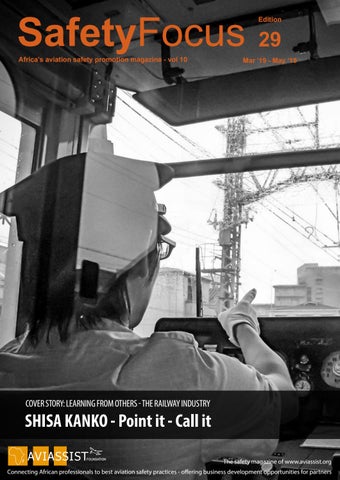
23 Cover photo: Pointing and calling as a risk mitigation measure in use on board a train in Japan. It is common practice in Japan, China and on board the Addis Ababa-Djibouti Railway. Š Flickr - Alan Levine
SafetyFocus Magazine
Edition 29 - 2019
Follow us on:
Facebook.com/ AviassistFoundation
twitter.com/ AviAssist
Youtube.com/ 1 AviassistFoundation
director's | message
Flow Patrick Hudson is one of the world’s leading authorities on the human factor in the management of safety. I found the podcast interview with Patrick Hudson by Australian safety expert Andrew Barrett by chance. Barrett's website "Safety on tap" brings us interviews with interesting and inspiring people with different ideas, perspectives and stories. In his podcast, Hudson praises James Reason and Ron Westrum for providing inspiration for his work. Sometimes, new thinkers on safety and safety culture forget that. It's important not to forget that we all are building on the safety foundations that were built by others before us. I had never heard of Ron Westrum before listening to the 'Safety on tap' podcast. Westrum built the 'Three cultures model' on which most organisational culture 'ladders' are based. The organisational culture 'ladder' model is taught in all courses on Safety Management Systems. Part of the Foundation's work is connection safety policy makers and safety professionals to research that is what this article attempts to do - here we go. Culture can be best understood as "the way we do things around here". Culture forms the context within which people judge how appropriate their behaviour is. An organisation's culture will influence behaviour and performance at work. An organisation's culture has a very big impact on the safety performance of an organisation. 'Safety culture' is a subset of the overall organisational culture. Many companies talk about 'safety culture' when referring to the preference of their employees to comply with rules or act safety or unsafely. Poor safety culture has contributed to many major incidents and personal injuries. Next to the culture, the style of management is even more significant, for example a (unconscious) preference of production over safety, or a tendency to focus on the short-term and being highly reactive. Success normally comes from good leadership, good worker involvement and good communications. And all these three factors relate to flow. Flow of information. Westrum's work found that failures in information flow figure prominently in many major accidents. Information flow is an indication of the maturity of a positive safety culture. In some organisations, information flows well, and brings out prompt and appropriate responses. In others, it is hoarded
for internal, political reasons or it fades away due to bureaucratic barriers. The conditions that create good information flow tend to be those that favour cooperation, creativity and safety. On the other side, conditions that interfere with information flow such as holding on to information for political reasons, also tend to decrease creativity, create conflict, and make the organisation involved less safe. Leaders shape a unit’s culture. Leaders communicate what they feel is important with their symbolic actions, as well as with rewards and punishments. These preferences then become the focus of the organisation’s staff, because rewards, punishments and resources follow the leader’s preferences. Those who align with the preferences will be rewarded, and those who do not may be set aside. There are three typical patterns that relate to information flow. The first pattern, also called the pathological pattern by Westrum, is a preoccupation with personal power, needs, and glory. The second, called the bureaucratic pattern, is a preoccupation with rules, positions, and departmental turf. The third is a concentration on the mission itself, as opposed to a concentration on persons or positions. Westrum calls this third pattern the generative pattern. When bureaucratic organisations need to get information to the right recipient, they are likely to use the standard channels or procedures. These standard channels and procedures are often insufficient in a crisis. By contrast, in the same circumstances many generative organisations would cross departmental lines or use a back channel to get the information to where it was needed. Studies have shown information flow is higher in a generative culture, where managers see themselves as coaches rather than commanders. Next to various courses and initiatives aimed at creating and facilitating (a just) safety culture, the Foundation has brought leadership training on board of its portfolio. This so that we can assist organisations to move to a management style that works best to achieve a mature safety culture. One that is focussed on a good and transparent flow of information. This is just another example of how the Foundation connects research to safety policy makers and safety professionals. Interested to learn more? Please join us in one of our upcoming courses in Eastern Africa later this year. Contact us on training@aviassist.org for more information.
Tom
2
SafetyFocus Magazine
Broaden your horizons with aviation courses by the UK CAA experts London Gatwick | Dubai | Hong Kong | Kuala Lumpur | Singapore As part of the UK CAA International Group, CAAi provides best-in-class training solutions that are developed by UK CAA regulators; those working at the forefront of aviation regulation. This ensures our courses help you meet – and often exceed – the most up-to-date international regulations (EASA and ICAO Standards and Recommended Practices). We provide tailored training programmes for National Aviation Authorities and Industry around the globe, as well as a comprehensive portfolio of public access courses covering all aspects of aviation safety regulations, including: ● SMS and Risk Management
● Fatigue Risk Management Systems
● EASA Approvals (Part 21, Part 145, Part 147 & Part M)
● FSTD Operation and Qualification
● Airworthiness
● Accountable Manager (Aerodrome, Airworthiness, AOC)
● Inspector Theory (Flight Operations, Cabin Safety, Dangerous Goods)
● Human Factors in the Aviation Maintenance ● Introduction to International Air Law
To book now or for more information, please visit www.caainternational.com/training or contact us: +44 (0)1293 768700 or training@caainternational.com
www.caainternational.com Part of the UK CAA International Group SafetyFocus Magazine
Edition 29 - 2019
Together for better aviation 3
SafetyFocus By the AviAssist Foundation AVIASSIST
FOUNDATION
AviAssist is an independent, nonprofit organisation. Our mission is to provide an effective and affordable way to support safety champions It serves as a catalyst for safety promotion & promotes professional excellence in African aviation safety. It provides safety promotion services for Africa's aviation industry and business development opportunities in Africa's growing markets for true safety promotion partners. Well over two decades of experience in Africa has equipped AviAssist well to deal with the technical as well complex political, social and cultural issues that play an important role in improving African aviation safety and in accessing the vast market Africa represents.
Foundation Board
foundation | news Heyster joins foundation
Dubai, United Arab Emirate Marily brings over 20 years of experience in
aviation to the table
The Foundation welcomes Marily Heyster, its new senior program manager, to the office. "Growing up with a grandfather who had been one of the first KLM pilots and was very passionate about aviation and later on studying air and space law at Leiden University, aviation has always been a part of my life. Living and working in Nairobi, Kenya for the ICAO regional office allowed me to combine two passions; Africa and aviation". "I have been involved with the AviAssist foundation for a number of years now and I am excited to be part of (the) ever evolving activities the foundation undertakes to promote aviation safety in Africa" In her new role, Marily initiates new programs and coordinates existing activities while working to build coalitions and partnerships. Marily lives and works from her home office in Dubai.
New boardmember joins
Capt. Auke Dros KLM Royal Dutch Airlines Jan van der Hoeven Treasurer to the board
Ron Louwerse Managing Director Rotterdam The Hague Airport Schiphol Group Ron Schipper Vice-President Africa - KLM (rtd.)
44
Felicien Izaturwanaho has joined the Foundation's in the trial student assistant program. Mr. Izaturwanaho is a graduate in psychology from the University of Rwanda. He was a participant in the launch edition of the aviation mental health course in September last year. The student assistant position supports the back office of the first AviAssist Safety Promotion Centre, expand his aviation & business skills and will prepare him for his future career.
new Chairman at AFBAA Nick Fadugba has been appointed chairman of AfBAA, the African Business Aviation Association. Fadugba's established African Aviation Services in 1990 and has provided consultancy and advisory services to international and African aviation organizations and governments over the years. His track record also includes a stint as secretary general of the African Airlines Association (AFRAA). “My immediate goals are to build on the reputation of AfBAA, make it more relevant to its membership, and ensure its financial sustainability," Fadugba said. "In this regard, I am pleased to confirm that AfBAA will now embrace both the business and general aviation industry throughout Africa, giving it a much wider and deeper footprint on the African continent.� The Foundation is a proud member of the safety & training committee of AfBAA.
Bert Kraan Deputy Director CAA-NL (rtd.) Hellen Ndichu Safety manager Rwandair
student assistant trial started
Rotterdam, the Netherlands Jan van der Hoeven was appointed as the board's treasurer at the November boardmeeting
Jan van der Hoeven has been appointed treasurer to the board. Jan has held various senior financial positions among others with electronic's giant Foxconn over the years and is marketing and sales director for an innovative electric populsion company in the shipping industry. "With Jan's appointment, the Foundation is strengthening its financial discipline," Foundation director Kok says. "We have built our 21 years track record on strong financial discipline and with Jan's appointment, we are ready accommodate the growth the Foundation is currently witnessing."
flight operations - dispatch course Work is well underway for the delivery of the launch edition of the Foundation's first flight operations - dispatch course. The course is developed and delivered with aircraft manufacturer ATR. ATR is already an approved training organisation with a license for the delivery of dispatcher training. The four day course will be hosted by an ATR aircraft operator in East Africa in the second half of 2019. Course topics will include aircraft systems,
weight & balance, aircraft performance & limitations, flight planning and meteorology. SafetyFocus Magazine
foundation & safety | news ATR signs partnership with foundation Aircraft manufacturer ATR from Toulouse, France, entered into a partnership with AviAssist, the reference safety organization in Africa. More than 120 ATR aircraft are operated in 22 African countries by 30 airlines. The number of turboprops in Africa is expected to exceed 350 within the next twenty years. The partnership aims to empower safety champions in Africa and change the face of flight operations training in Eastern Africa. The partners will look at improving the training of flight dispatchers in Africa, with a first flight operations course foreseen for East Africa in the second quarter of 2019. “As the leader in the regional aviation market, it is essential for ATR to share its expertise to improve flight safety in the regions we serve,” ATR safety director Christopher McGregor said at the signing. “ATR recognizes the success of AviAssist in driving safety improvement. Since 2015, ATR has participated in the annual Safety in Africa Aviation Conferences (SiAAC) organized by AviAssist. ATR is also a member of the Conference Committee. We look forward to further strengthening the existing co-operation through training and dedicated safety promotion activities for regional operations. We thank AviAssist for putting their trust in ATR. Working with AviAssist gives us access to a very effective and cost-effective way of delivering our safety promotion in the region. ” The safety promotion will partially be channeled through AviAssist Safety Promotion Centres (ASPCs). ASPCs aim to provide resources and training to safety champions in Africa and connect research with policy
makers and safety professionals. The first ASPC is based in Rwanda. Rwanda has made spectacular progress in safety oversight over the past decade. As a result, Rwanda’s level of Effective Implementation of ICAO’s Critical Elements significantly higher than the world average of 60%. Rwanda’s safety oversight picture is very comparable to the graph of a G7 country like Germany. “We are thrilled to include the expertise, safety dedication and funding of ATR to our work in Africa and our ASPCs”, says Tom Kok, Director of AviAssist. “Through this partnership, ATR continues to strengthen flight safety awareness and accident prevention actions. It demonstrates ATR’s leadership also in safety commitment. ATR aircraft play a crucial role in the development of new routes across the globe and in Africa. In turn, route development is promoted by the African Union with its Single African Air Transport Market (SAATM) initiative. SAATM aims to open up Africa's skies and improve intra-African air connectivity. This partnership enables us to empower ever more safety champions throughout Africa to support SAATM.”
Toulouse, France Christopher McGregor (Right), ATR Head of Flight Safety and Foundation director Kok at the signing at ATR's production facility
Instructors nominated for launch edition airport engineering course
Johannesburg, South Africa & The Hague, the Netherlands Aasif Baapo & Andries Reijneveld have been appointed instructors for the new course
ports need to ensure that each system is flexible enough to accommodate future requirements. Airports need to have the infrastructure in place to provide efficient operations in line with safety and security, allow aircraft to operate efficiently, minimize inconvenience for passengers, and provide fast and reliable baggage systems. The four day course will include geometry (Runway and Aprons – standards and design basis), visual Aids (Runway and Aprons – standards and design basis), pavement, navigation aids and safety.
The joint NACO - Foundation course development team has nominated the instructors for the launch edition of the new 'Airport engineering "Aim of the course is to assist ICAO Contracting for safety' course. States in preparing engineers for a role in airport engineering," senior program manager Marily The course is aimed at increasing airport engiHeyster explained. "We are very pleased with neering capabilities in Africa at the request of the appointment of Baapo and Reijneveld as the ICAO regional office. As air traffic continues instructors given the 20 years of airport engito grow at impressive numbers in Africa, airneering they bring to the table." SafetyFocus Magazine
Edition 29 - 2019
Colophon
SafetyFocus Africa’s safety magazine Editor & design - Tom Kok editor@aviassist.org Felicien Izaturwanaho Student - assistant editorial review board Hans van Dijkhuizen AviAssist Foundation Adrian Young To70 aviation Emily McGee Editorial assistance Capt. Ed Pooley Flight Safety Foundation European Advisory Committee Advertising sales Let AviAssist help you organise the African market & support the work of the Foundation while bringing your brand to 42 African countries and beyond. Starting at less than € 11 per country. Contact us: safetyfocus@aviassist.org SafetyFocus is distributed for free to 2 professionals per organisation in the aviation industry and government departments involved in or relevant to aviation in 42 African countries. Wider distribution in organisations to mature safety cultures is possible at attractive corporate subscription rates. Subscriptions Stay up-to-date on best practices and subscribe to SafetyFocus. Africa’s quarterly safety magazine right on your doorstep every quarter for a whole year. In this issue, SafetyFocus reproduced articles with kind permission of CASA Australia's FlightSafety Australia, Eurocontrol's Hindsight and Aerosafety World of the Flight Safety Foundation. We are also grateful to photographer Marco Ferrarin for making available his stunning picture of Doha, Qatar
This magazine is printed on Forest Stewardship Council certified paper. This means it meets the highest environmental and social standards. 5
flight | operations
The Rare
L
Go-Around BY j ay d o n o gh u e
et’s face it: Go-arounds are inconvenient. They make you late, burn more gas, complicate air traffic situations and often scare the heck out of your passengers, who probably think you did something wrong. Inconvenient, yes, but essential to safe flying. The Flight Safety Foundation’s Approach and Landing Accident Reduction Tool Kit was developed to reduce the risk of this most common form of accident, and one of the key elements of the advice it contains is the warning against unstabilized approaches. Early in the approach, the focus should be on maintaining or regaining a stabilized approach. At the end, however, there is but one remedy if the approach is still unstabilized: go around. Most pilots are aware of this advice and do not dispute its general validity. However, recent studies from Airbus and the U.S. Federal Aviation Administration have shown that although unstabilized approaches are rare — only 3–4 percent of all approaches — only 2–3 percent of the unstablized approaches end in a go-around. The Flight Safety Foundation is participating in an industry effort to understand the problem more fully, but earlier, Rudy Quevedo, then FSF deputy director of technical programs, launched a social network discussion on LinkedIn. “Annually approximately 30 percent of the industry accidents are runway 6
excursions,” Quevedo said. “Many of these excursions are the result of unstable approaches. Statistically, approximately 97 percent of unstable approaches continue to landing, despite policies and procedures that dictate otherwise. The runway excursion accident rate can be dramatically reduced by a higher compliance rate of go-around policies, specifically — the decision to go around when appropriate.” He asked, essentially, why go-arounds are so rare and how that can be changed. The discussion on this topic has been very good. These points have been raised: • Whenever pilots fight through an unstabilized approach to a safe landing, unsafe behavior is reinforced. • Pilots are motivated by pride or company pressure to “get the job done.” • Reduced fuel loads arriving at destinations. • The fatigue issue, which boosts the “need” to get down while diminishing the pilot tools available to achieve the desired outcome. • Inadequate training on stabilized approaches and go-arounds, and on crew resource management, to avoid getting into situations where a go-around is necessary. • Inadequate management response to evidence of high rates of unstabilized approaches and low rates of go-arounds.
• Inadequate management knowledge about the state of operations, i.e., no or poor monitoring programs in place. • Both pilot flying and pilot monitoring must be empowered to call for a go-around. It should go without saying that airline policies do not penalize pilots who do go around. Many real-world situations dirty the water when discussing clear guidelines for when a go-around is crucial. Even though the decision is cast as a binary yes/no, “we will always have some gray area, and the challenge is to define that area so well that it can be handled in standard operating procedures, training in pilot decision making, approach planning, conducting the approach, etc.,” one commenter said. A good example of this is an approach where all of the elements are nailed except for one, and that one is drifting toward the correct numbers. It will be worth following the discussions in global fora on this closely. James A. “Jay” Donoghue was a widely respected and award-winning Washingtonbased aviation journalist for over 35 years, decorated combat helicopter pilot and former editor-in-chief of AeroSafety World and Flight Safety Foundation director of publications. Jay died July 31 at his home in Pylesville, Maryland, 70 years old and having fought brain cancer for two years. SafetyFocus Magazine
Our focus on your safety Safety is a pre-condition for our daily operations to any destination. KLM is proud to work hand in hand with the AviAssist Foundation as part of that commitment to your safety - klm.com
SafetyFocus Magazine
Edition 29 - 2019
7
Shisa kanko Point it Call it Get it right
republished from Flightsafety Australia with kind permission from the Civil Aviation Safety Authority
T
here’s free entertainment on trains in Japan. Ride near the driver’s or conductor’s positions and you can watch them making bold gestures, accompanied by confident and abrupt vocalisations, sometimes ending with the word ‘Yoshi!’—Japanese for ‘OK’. Most travellers file this as one the many ways that Japan can seem an eccentric, inscrutable and exotic society. But this is no mere pantomime; it’s a demonstrably effective safety technique. The technique is called shisa kanko, a Japanese phrase meaning ‘point with finger and call’. It has been described as a practical demonstration of the Buddhist concept of mindfulness. A train driver, using shisa kanko, would not simply glance at a display to perform a required speed check. Rather, they will point at the speedometer, with a call of ‘speed check, 80’—to confirm the action taking place, and audibly confirm the correct speed.
8 8
Station staff also use the method to ensure the platforms and tracks are free of debris or fallen passengers. The platform attendant will point along the track and sweep their arm along the length of the platform—eyes following the hand—before declaring all clear. They do it again as the train departs, ensuring no passengers or bags are caught in the train doors. Pointing and calling is said to have begun in the early 20th century when a steam train driver became concerned about his vision getting worse. Worried that he’d go through a signal by mistake, the driver would call out the signal status to the fireman riding with him. The fireman would confirm it by calling back. By 1913, this practice was encoded in a railway manual and evolved into point and call. Does it work? With the horrible exception of the Amagasaki crash of 2005, which killed 107 people, Japanese railways are notably safe, with one passenger death per 51.4 billion passenger kilometres. The high-
speed Shinkansen network, which is now six lines with trains running at up to 320 km/h (170 kt), has carried more than 10 billion passengers without a single passenger death from derailment or collision. In 1994, the Japanese Railway Technical Research Institute assessed pointing and calling in an experiment that asked volunteers to complete a simple, but variable, task. When no special steps were taken to prevent errors, the volunteers made 2.38 errors per 100 actions. Calling or pointing cut this error rate significantly. But the greatest reduction in error to 0.38 errors per 100 actions happened when the volunteers both pointed and called their actions. This combination reduced mistakes by almost 85 per cent. New York subway train conductors have been using point and call since 1996, when a system executive noticed the practice on a trip to Japan. A New York Metropolitan Transit Authority spokeswoman said that within two years of implementation, incidents of incorrectly berthed trains fell SafetyFocus Magazine
© Toru Yamanaka/AFP/Getty Imager
CAUSALFactors Human | Factors
Human | Factors by 57 per cent. CASA human factors and fatigue specialist, Robert Forsterlee, says pointing and calling improves operator responses by integrating physical and mental activity. ‘Your brain is more active when you point and speak than when you just think it. You are using more areas of your brain. It’s not just a memory thing, it’s a fatigue mediator. You’re making movements and if you do a little bit of exercise that’s refreshing.’ He acknowledges, however, that a cramped aircraft flight deck does not lend itself to the sort of expansive gestures used by Japan’s train drivers and conductors. ‘The most effective is the physical action,’ he says, ‘but a mental only version is better than nothing. That way you’re running an internal dialogue.’ Rail safety consultant Phil Barker says the technique is yet to be adopted on Australian railways. ‘It’s not widely used in Australia, although interestingly, it is used in Indonesia,’ he says. ‘It’s a good technique, but my guess is that Australian rail workers see it as over-the-top, which is a pity.’ Aviation Forsterlee says the argument that pointing and calling may not work in Western cultures has been defied in aviation. ‘Cabin crew have been doing it for years, although they don’t do all they might with it,’ he says. ‘When they stand in the aisle and say, “Your nearest exit may be behind you”, they point to it.’ But Forsterlee wonders if the technique could be expanded into a dialogue with passengers, in an attempt to break the trance of inattention that often surrounds cabin safety briefings. ‘If they asked people in the cabin, “Hey you in seat 26a, where’s your nearest emergency exit?” people might pay attention more. There are little ways to make it more amusing and engaging.’ Flight deck procedures use pointing or calling, but rarely both. They tend to be applied to tasks where accuracy is more important than speed. For example, to change altitude on autopilot the pilot monitoring (PM) enters the new altitude into a flight director and leaves their hand on the altitude selector until the pilot flying (PF) acknowledges. Writing in Aviation Week, James Albright outlined how adopting point and call could improve flight deck crosschecking.
For altitude changes Albright suggests: The PM acknowledges the altitude assignment on the radio while dialling in the new altitude (the ‘point’). While leaving a finger on the altitude selector is desirable, there are times when the PM has other immediate tasks. The PM then announces the new altitude cross-cockpit (the ‘call’). Repeating the altitude between pilots reinforces the correct altitude in the PM’s mind. The PF points to the primary flight display if that shows the primary flight guidance altitude, or to the altitude selector if that is primary to the avionics installation (the ‘point’). In some aircraft, the altitude selector may not accurately reflect the commanded altitude during metric altitude operations, for example. The PF verbalises the new altitude assignment (the ‘call’). While having the PF also announce the altitude can seem to be more cockpit chatter than many crews would like, it gives both pilots another chance to mentally assimilate the instruction. It could, for example, cue the PM that something ‘isn’t right’. Course changes are another example where the near foolproof point and call method should be employed, Albright says. ‘When making an FMS entry, for example, the pilot should announce the actions taken. “We are now going direct to a new point, JFK, which I have inserted before Hartford,” for example. If the navigation software allows a preview of the changes on the FMS or display units, both pilots can confirm the results are correct. But even without this preview, both pilots should point to the resulting course changes to confirm their validity.’
nouncing the intended action, and calling out the correct runway heading once in position. The other pilot should verify each action. Pointing and calling is as applicable to single-pilot operations as it is to unaccompanied train drivers. The combination of pointing and verbalising can help the pilot detect a self-initiated error. ‘When you’re by yourself who keeps you on course?’ asks Forsterlee. ‘You have to be self-directed. But how? Some people will say willpower. But that’s very fallible if you’re tired or distracted. You’ve got to have a line of defence, such as active, ritualistic engagement with the process.’ Forsterlee says pointing and calling could be a particularly useful tool in reducing maintenance error. ‘Settings on torque wrenches, for example, are a common mistake. Often you hear “I was putting the tool back in the shadow box when I noticed the torque at x when it should have been y.” ‘Tour guides often point and call. They’re directing attention to something important. If the Eiffel tower is worth pointing at, so is your tool kit.’ There’s nothing wrong with talking to yourself. You’re just ensuring you’ve covered everything.’
Shisa kanko
An aircraft is most like a train when it is taxiing. Albright says point and call has clear potential in this part of operations. ‘If you adopt the habit of pointing to an action before you get to it, you can double your chances that both pilots will have had a chance to verify the action agrees with the clearance,’ he says. He recommends the pilot steering the aircraft onto an adjoining taxiway should point to its sign and announce the action. ‘I see taxiway alpha,’ the pilot says while pointing to the ‘A’ sign, ‘I will be turning left.’ The other pilot should confirm by pointing to the same sign, ‘I see alpha. It is a left turn.’
Above - A depiction of the Shisa Kando method Below - Adopting point and call to improve flight deck crosschecking
A similar protocol for runway entry should have the pilot in control of the aircraft pointing to a runway sign, an© James Haskel/code7700.com
SafetyFocus Magazine
Edition 29 - 2019
9
Human | Factors
Communication between pilots and air traffic controllers in just one language is not without its own problems
One planet One language
A
ny misunderstandings in pilot-air traffic controller communications have potentially disastrous consequences. Therefore, the accurate use of language and communication is critical in air traffic management (ATM). World common practice and operational and safety reasons have made English the number one language in aviation, but it is not the only one. With regards to operational frequency it is not common to hear two different languages which can create problems if there is a lack of understanding from the recipients of the information. However, communication between pilots and air traffic controllers in just one language is not without its own problems. For-example, there may be problems to resolve around various issues including: regulation, safety and efficiency. Example1: Communication After take-off, the plan’s landing gear lever 1010
got stuck, followed by an engine problem. The pilot asked to make a holding pattern due to technical problems. The quality of ATC radio telephone (RT) communications and English proficiency were so poor that the RT communication took half of the time necessary to solve the technical problem! The communication problem was resolved thanks to a pilot on the jump seat, who spoke the local language. A key factor in reducing aviation safety and operational problems is the use of one language. In accordance with agreed international standards and recommended practices related to the proficiency of the plain language and proper use of the aviation phraseology, English is recommended as language of ATM. Safety and Efficiency In 2008, Eurocontrol’s ATM Incident Reporting (EVAIR) scheme came into action, collecting data from participating
airlines and air navigation systems (SMSs) through Safety Management Systems (SMSs). The largest number of incidents reported to EVAIR is from pilots through the airlines’SMSs. Pilots ‘day to day work experience inevitably means that they have a clear perspective of air traffic controllers’ (ATCOs) knowledge of the English language. In turn, ATCOs are also very aware of the English language expertise of pilots from various airlines. Reports show that language problems are pan-European issues, and in particular the area of air-ground communication, which covers operational and spoken communication. Statistics for 2012 – 2016 show that air-ground communication was one of the causal issues of 34 per cent of all accidents (see figure1). The most frequent language problems are: • Correct application of the ICAO (International Civil Aviation Authority) SafetyFocus Magazine
© William Dennis | AIN Online
BY d r agica s tan o vik
Human | Factors
•
phraseology and proficiency in the plain English language when phraseology is not sufficient; and The use of two languages in a single environment and, consequently, the problem of pilots ‘awareness of the traffic situation.
language reduced general awareness and the possibility of correcting the mistake.
isfy all communication requirements. This should concern both those for whom English is a foreign language but also to those for whom English is a mother tongue. Certainly the content of the courses for these two different categories should be different, but the overall aim should remain – clear and concise communication with ATM. National regulations differs in various states with regard to maintaining and improving the knowledge and proficiency of English. In some states refresher courses, as well as continuous checks, are required by national regulations. While in others there are no more language checks or refresher courses after obtaining the initial license. I believe in the current situation, more work and better harmonization is needed. Author’s notes:
Example 2: awareness The incident involved three aircraft: one had just landed, the second was ready for takeoff and the third was on final approach. The communication with landing aircraft was in the national non-English language –after landing the aircraft stayed on the runway longer than expected but, due to communication being in the national language and not English, the pilots could not know this. The departing traffic communicated with ATC in English and got clearance for take-off - ATC’s mistake. Due to lack of situational awareness, the pilot of the departing traffic accepted the clearance. Take-off was aborted at a speed of 60kts. The third aircraft then had to make a go-around as there were two aircraft on the runway. The pilot of the departing traffic stated that if he had been aware of the communication with the aircraft that had just landed he would have been in a position to warn ATC and correct the mistake. The use of the national
Regulatory issues Through discussions with different air navigation service providers, airlines and the analysis of the ATM incident reports two main regulatory issues have been highlighted: Application of International Standards and Recommended Practices (SARPs) and improvement in training; and the status of the English language as the aviation language in national regulation. The main regulatory priorities should be the establishment of English as the common language for international aviation communication and the full application of ICAO standards for proficiency in English in pronunciation, structure, vocabulary, fluency, comprehension and interaction. The percentage of incidents caused by language in the EVAIR dataDragica Stanovik is manager of the EVAIR base provides support for these recom(EUROCONTROL Voluntary ATM Incimendations and is clear case for English dent Reporting) function. as the sole language for international www.eurocontrol.int/services/eurocontrolaeronautical communication at airports voluntary-atm-incident-reporting and in airspace. There are, however, some political and cultural obstacles that might prevent the use of English as the single language in international ATM. Many countries bestow EVAIR process & data their national language with the same priority level as English in aviation communication, and in some cases have no national regulation that insists on the use of English in ATM. To prevent this escalating, airline associations need to support practices in national policies that promote the sole use of English at airports and in the airspace that are designed for use by international air services. Unfortunately, due to political reasons (which require additional attention) in some areas, it is not possible to improve the situation within Figure 1 EVAIR Statistics for 2012-2016 on contributing factors to ATS incidents the current circumstances and to make plans for the future. One of the possible solutions is that future pilots and air traffic controllers, as a precondition to participation in the selection process, should already possess a high level of English language. Maintaining and upgrading Improvements in training, refresher courses and periodic checks could bring positive results and ensure an appropriate level of English language knowledge. Special attention should be paid to R/T phraseology but also to proficiency in plain language, as phraseology alone cannot sat-
SafetyFocus Magazine SafetyFocus Magazine
Edition29 29- -2019 2019 Edition
The most frequent events that have language as one the causes of accidents are: level bust, call sign confusion, go-around and run-away and taxiway incursion/ excursion. The correct application of the ICAO phraseology and proficiency in a “common” or plain language (when phraseology is not sufficient) is important for ATCOs and pilots whose native language is not English and native speakers. Both groups experience problems, for non-native speakers it is the lack of knowledge in phraseology and plain language, while for native speakers problems arise with the use of non-standard phraseology or local terms and phrases. Pilots ‘awareness Pilots’ situational awareness of the traffic situation and their active participation in traffic has a significant impact on air traffic safety and efficiency. The AVAIR data shows that the use of languages in the same airspace is an everyday occurrence in Europe. It creates safety and air traffic efficiency problems as pilots cannot participate actively in managing the traffic scenario if they cannot understand what is being said. National regulation needs to further support the use of the English language as the sole language in aviation communication – the best solution to safety and efficiency problems.
11 11
air traffic | management
Pilots should train to be familiar with the meaning of messages which GPS receivers generate and with the actions required to be taken
GPS Approaches
Know what you do
BY michael g r u ninge r & C apt. C a r l C. N o r g r en
After changing the route in-flight and tracking along the coast, the pilot requested a clearance direct to BLAED, one of the initial approach points for the RWY 26L GPS approach. GPS signals are part of a the GNSS system. GNSS stands for Global Navigation Satellite System, and is the standard generic term for satellite navigation systems that provide autonomous geo-spatial positioning with global coverage. This term includes e.g. the GPS, GLONASS, Galileo, Beidou and other regional systems. The routing for the RWY 26L GPS approach was approved by ATC. The aircraft however did not track direct to BLAED. Instead it tracked 3.5 to 4 degrees left of the cleared track. The radar controller did not question this tracking discrepancy. The pilot descended and commenced the approach, which was in uncontrolled airspace. Shortly thereafter the aircraft struck a ridge 34 km south-east of the airfield. During the subsequent investigation 12
it became apparent that the pilot had initiated the approach not over BLAED, the initial approach point, but at a point approximately 34 km south-east of the airfield. How could an experienced pilot with more than 14,000 flying hours loose situational awareness and not notice such a gross navigation error? GNSS Approaches GNSS approaches have been established in ever greater numbers in recent years as they offer a number of advantages compared to conventional, ground based approaches. Procedure design is more flexible and new approaches can be set up quickly. They do not require expensive ground navigation installations and hence offer large cost savings. These advantages have led to a rapid increase in the number and the types of GNSS approaches. Flying GNSS approaches however is not as straightforward and easy at it might seem. It requires diligent planning and careful execution by the flight crews in order to maintain awareness and to properly supervise the navigation equipment and the flight guidance system during the approach. A Delicate System GNSS approaches have high navigational accuracy as long as the integrity of the
navigation sensor is assured. For this, onboard GNSS equipment is equipped with Receiver Autonomous Integrity Monitoring (RAM). This function monitors the navigation information received from each satellite and ensures that the required level of accuracy for each phase of flight is achieved. If RAIM detects a satellite which is sending an incorrect signal, then the Fault Detection and Exclusion (FDE) function automatically excludes this satellite from the navigation position fix. This requires a minimum number of satellites available (4 for RAIM, 6 for FDE for most GNSS systems). All GNSS approaches must be treated with the same level of caution as nonprecision approaches. Many believe that a GNSS is a straightforward and reliable solution to navigation. However, error and faults are common in this highly complex system. GNSS systems are delicate and need constant monitoring. Vigilant Monitoring The accident report concluded that the most likely cause for the gross navigation error was that the GPS had insufficient satellites to determine its position and had therefore continued in dead reckoning mode. In this mode the GPS maintains a heading based on the last available groundspeed and track. This could acSafetyFocus Magazine
Š Benalla Aeroclub | benallaaeroclub.com
O
n 28 July 2004, a Piper Aircraft Corporation PA-31T Cheyenne aircraft, registered VH-TNP, with one pilot and five passengers on board, departed Bankstown, NSW on a private flight to Benalla, Vic. The pilot had submitted an instrument flight rules (IFR) flight plan for the flight to Benalla and return.
Air traffic | management count for the divergent track. The dead-reckoning mode would have been annunciated by a "DEAD RECKONING" message on the GPS display as well as a lit MSG annunciator on the instrument panel. In addition the "RAIM NOT AVAILABLE" message would have appeared. These two messages should have made the pilot aware that his GPS was not navigating based on valid satellite signals any longer. When the aircraft was within 2 NM of the final approach fix, the APR annunciation on the GPS should have appeared. Without this annunciation, the GNSS approach may not be commenced. At the FAF, the receiver checks for RAIM and if not available, displays the message "RAIM UNAVAILABLE - EXECUTE MISSED APPROACH". At this point latest, the pilot should have realized that something was wrong and that he could not continue the approach.
The Piper was on its way to Benalla airport in
Š Australian Transport Safety Bureau
Victoria, Australia
The Piper PA-31T Cheyenne collided with terrain 34 km south-east of Benalla
SafetyFocus Magazine
When flying with a GNSS as a primary means of navigation it is of utmost importance that the pilot be familiar with the meaning of the messages which the GPS receiver can generate and that he is familiar with the actions required to be taken. He must know exactly when the GPS receiver is no longer available for navigation and must then revert to alternate means of navigation. Even if the GPS does not generate any messages, it is good airmanship and a standard operating procedure with many operators to crosscheck position information provided by the GNSS with conventional ground-based navigation aids. In the case of the approach into Benalla, the pilot could have crosschecked the position of BLAED if he had followed the standard airway routing and then joined the approach at BLAED. The waypoint BLAED is on radial 221 from Albury VOR. Also it was noted that the navigation database of the GPS was out-of-date. Flying with an out-of-date navigation database is not only poor airmanship, but is a potential hazard to the flight - and illegal. For commercial operators an out-of-date navigation database is an MEL item which requires rectification within a specified timeframe. Without an up-to-date database an aircraft is not air-worthy. High Workload Although many pilots expect the workload associated with safely flying a GNSS approach to be lower than per-forming a conventional approach, this is incorrect. Although the level of automation might be higher, the level of monitoring required to safely per-form a GNSS approach is as high if not even higher than on a conventional non-precision approach. This is reflect-ed in a survey performed by the ATSB in 2007 where pilots perceived the workload on a GNSS approach as being higher than on any other type of approach. GNSS approaches can give pilots a false sense of safety. This must be counteracted with precise monitoring of system messages and cross-checks with alternate navigation sources. In turn the study suggested that pilots considered GNSS approaches to be safer than NDB Edition 29 - 2019
The GNSS approach chart from Benalla airport with the initial approach fix BLAED in the top right corner
approaches, but less safe than all other type of approach. Pilot-Controller Co-operation Another layer of safety which could have prevented this accident would have been a query from ATC regarding the tracking discrepancy. On numerous occasions these discrepancies were realized by the ATC controllers, but the pilot was never confronted with this issue. During the en-route phase, well above MSA, the tracking discrepancies did not pose an imminent danger to the flight. Only when the flight started the approach, did this position error become a threat. At that point the pilot had switched to the local Common Traffic Advisory Frequency (CTAF) and was outside of controlled airspace. GPS = Get Procedures Straight To ensure safe flight operations with GPS receivers including GNSS approaches clear and unambiguous procedures must be established for normal, abnormal and emergency operations. Such procedures must be customized to the aircraft type, the installed navigation equipment and the nature of the operation. Pilots must be trained in the handling of the navigation equipment including the handling of abnormal and emergency situations. This can be very challenging as many different types of GNSS navigation equipment have been installed in aircraft as post-modifications. Such modifications are often not available in the aircraft simulator. This means that GPS abnormal and emergency procedures cannot be simulated and trained in the flight simulator. Especially among business air-craft operators with older aircraft this is an issue. To compensate for this GNSS failures need to be trained on-board the aircraft to the extent this is possible (e.g. by deselecting GPS sensors or individual satellites in flight to generate the respective messages). Only if pilots and operators Get their Procedures Straight can they benefit from the advantages of GNSS approaches without compromising flight safety.
Michael R. GrĂźninger is Managing Director of Great Circle Services (GCS) Safety Solutions. 13
Write to us about your work in African aviation safety or about a safety issue close to your heart. If we publish your story from the editorial review approval, you'll receive
US$ 100 through Western Union. If you don't feel too sure about your writing skills - editorial assistance is available SafetyFocus for African aviation safety professionals by African aviation safety professionals Contact us at safetyfocus@aviassist.org for more information
Articles should be between 450 and 1400 words. If preferred, your identity will be kept confidential. Submissions may be edited for clarity, length and reader focus.
14
SafetyFocus Magazine
human | factors
Welcome to our classes
in East Africa
Kigali, 15-18 July 2019
Airport engineering for safety Course topics include • Airside geometric designs • Airside pavement engineering • Navigational aids • Engineering for safety • Site visit Who must attend? The course is designed for those who have or should have a role in the effective planning and construction of new airports and airport expansion projects, including: directors, heads, managers, engineers, inspectors, surveyors and specialists of • Aerodrome Operations • Aerodrome Safety & Standards • Airside Operations • Safety & Risk Management • Engineering • Surveying From (but not limited to) : • Aviation Authorities • Airport Operators • Engineering Contractors • City & district planning authorities
$350 for 3,5 days The course is developed and delivered in co-operation with acclaimed airport development firm NACO from the Netherlands.
Brought to you by:
Nairobi, 8-11 July 2019
Ground Operations safety
Key topics: • Management of ground operations • Airside safety & risk assessment • Audits & certifications $400 for • Load control 4 days • Ground Service Equipment • IATA AHM & IGOM Manuals Tanzania, 11-14 Nov 2019
Flight operations - dispatch Course topics include • Aircraft systems • Weight & balance • Aircraft performance & limitations • Aerodromes, route restrictions and aircraft performance • Flight planning • Meteorology Intended participants include: • Ab initio staff in an Airline Operations Center (AOC) • New hires as flight operations officers • Civil Aviation Authority inspectors • Flight crew members • Aviation students
$400 for 4 days
The course is developed and delivered by aircraft manufacturer ATR Aircraft from Toulouse
In co-operation with among others:
Safety resources for the African aviation industy since 1995 SafetyFocus Magazine Edition 29 - 2019
www.aviassist.org
Nairobi, 6-7 Nov 2019
human factors in aviation Intended participants: • Safety managers $200 for • Chief Air Traffic Controllers 2 days • Dispatchers • Military Air Traffic Controllers • Pilots & crew chiefs • Ground handling staff & managers • Safety inspectors • Airforce pilots & operational staff Nairobi, 4-5 Nov 2019
flight data monitoring Course highlights: • FDM & safety management • Towards a succesful FDM program • Fitting out aircraft • FDM technology • Human factors of FDM • Visualisation
Who must attend?
• Pilots & trainee pilots • Flight safety officers • Regulators • Aircraft maintenance companies • Airline union representatives • Accident investigators $300 for • Aircrew representatives 2 days • Aviation students The course is developed and delivered by FDM world leader Flight Data Services
Sponsored by:
15
report | review
B Y M a r i ly h eyster
Qatar hosting African
T
he African Aviation Training Organizations (AATO) held its stakeholder meeting on the finalisation of the African Aviation Training Roadmap in Doha at the invitation of the government of Qatar. The meeting was combined with the ICAO Global Aviation Training and TRAINAIR PLUS Symposium. The Foundation was privileged to attend the AATO stakeholders meeting in Doha at invitation of the AATO together with other key aviation training players in Africa. The AATO is addressing important issues on the African continent such as the standardization of course curricula, the harmonization of instructor training and the recognition of certificates. I learned that a lot of the work ICAO does starts with training during my years at the ICAO regional office for East and Southern Africa in Nairobi, Kenya. In addition to its core work ICAO organizes a Global Aviation Training and TRAINAIR PLUS Symposium since 5 years. This event provides a forum where ICAO Member States and training organizations come together to forge new partnership opportunities in aviation training, and at the same time increase their awareness of key near- and long-term capacity-building priorities for global air transport. ICAO’s 5th Global Aviation Training and Trainair Plus Symposium took place in Doha, Qatar in December. The Symposium was opened by Dr. Fang Liu, ICAO’s Secretary General. Hosted by the Qatar Aeronautical College, the event provided participants with an international forum to exchange best practices in aviation training and highlighted the use of effective tools and opportunities offered by ICAO’s TRAINAIR PLUS Programme (TPP). The symposium’s host State of Qatar recently opened a Permanent Office at ICAO in Montreal, further emphasizing Qatar’s role as an active partner in the pursuit of global aviation safety. Sheikh Jabor bin Hamad M. Al Thani, Director General, Qatar Aeronautical College commented: “We are proud and delighted to have hosted the global civil aviation community in Doha, and we are looking forward to contributing to the growth and development of the aviation industry through educating and qualifying the next generation of aviation professionals”.
16 16
the future training roadmap The theme of this year’s Symposium focused on Building Aviation Training Intelligence. This references how, in today’s world of information abundance, data collected through various sources needs to be structured and managed in a coherent and functional way, in order to generate decision-useful information, or ‘intelligence’. In the field of civil aviation training, it is critical to be able to identify the appropriate intelligence that will allow us to provide optimal aviation training solutions for both individuals and groups. The Symposium also explored ways to broaden the management approaches of training centre leaders to practice effective decision-making that will optimize their operations and ensure they build targeted training portfolios that meet needs. Speakers addressed some challenges, solutions and tools to help organizations foster and lead effective change management processes. With hundreds of millions of people joining the global middle-class, the demand for air travel is witnessing an unforeseen upsurge. ICAO has predicted a 100 percent increase in global air travel by the year 2030, creating a need for extensive efforts to bring the entire aviation ecosystem to pace. To ride this strong tailwind of growth and pave the way forward for the sector, the aviation industry has to focus on training a whole new generation of aviation professionals. “Over the next twenty years, this projected growth will require many new skilled personnel such as pilots, maintenance engineers and air traffic controllers,” Dr. Fang Liu stressed. “Attrition dynamics pose risks (...) also to Governments with respect to their safety and security oversight responsibilities under the Chicago Convention,” she remarked. The symposium also explored new means of measuring training effectiveness, and Dr. Liu commented that when developing new training programmes, “new behaviours, improved skills, and increased productivity should be expected as common sense outcomes.”
AATO Secretary General Margareth Kyarwenda (right) with Foundation's Marily Heyster at the AATO meeting
SafetyFocus Magazine SafetyFocus Magazine
© Marco Ferrarin | Flickr.com
A view to
So you want to
INVEST
Human Factors Dangerous Goods Aircraft Marshalling Flight Data Monitoring Incident Investigation Aeronautical Information Safety Management Systems
in staff &
Aviation mental health Aviation English Wildlife Management Ground Operations Safety Airport Rescue & Fire Fighting Aviation Leadership Development Management of Air Navigation Services
safety?
Host an aviassist course in 2019 or 2020 жж Course design follows standards of ICAO and leading regulators жж Final tests & certificates provided жж Train 15 members of staff on-site at your facility for U$ 7.500 in a 4 or 5 day course жж Incredible rates by deploying world-class professional volunteer instructors from leading aviation organisations & airline support for transport жж Track record of 20+ years in Africa жж Courses that connect to educational background of your learners жж One edition per year per course so book early SafetyFocus Magazine
For more information, a brochure with course conditions and an application form contact: events@aviassist.org Edition 19 - 2016
SafetyFocus Magazine SafetyFocus Magazine 18
Edition 29 - 2019
17 SafetyFocus Magazine
on | record
When lightning strikes The following information provides an awareness of problems that might be avoided in the future. The information is based on final reports by official investigative authorities on aircraft accidents and incidents.
turboprops
OVERWEIGHT OVERRUN
Beech King Air 100. Substantial damage. No injuries.
lightning zaps displays
Boeing 787-8. Minor damage. No injuries.
T
he 787 was climbing through 4,000 ft while departing from London for a scheduled passenger flight to Houston the afternoon of Oct. 10, 2014, when a lightning strike disabled three of the five cockpit flight displays. The captain said that the aircraft was flying along the edge of an area of moderate rain showers when a static discharge caused both of his flight displays and the outboard display on the copilot’s panel to fail. The National Transportation Safety Board (NTSB: an independent U.S. government investigative agency responsible for civil transportation accident investigation) report noted that there were no procedures related to a partial loss of flight displays. “After the [flight] crew elected to follow the ‘Loss of All Displays’ checklist, none of the affected displays recovered to an operational state,” the report said. The crew declared an emergency, dumped fuel, returned to London Heathrow Airport and landed the 787 without further incident. An examination of the aircraft revealed minor lightning strike damage on the left side of the nose. “All of the displays did recover normal operation after [maintenance personnel performed] a power cycle to the displays while the aircraft was on the ground,” the report said. “No procedures existed for a power reset of the displays while in flight, which most likely would have resulted in a restoration of the displays.”
T
he pilot told investigators he realized that the King Air exceeded its maximum takeoff weight with full fuel, nine passengers and their baggage. However, there was no record that he calculated the airplane’s actual takeoff weight and balance, or determined its takeoff performance, the NTSB report said. The airplane later was found to be 623 lb (283 kg) over maximum weight when the pilot initiated a takeoff from the 5,500-ft (1,676-m) runway at Jeffersonville, Indiana, U.S., the afternoon of Oct. 30, 2016. A commercial pilot occupied the right front seat and was designated as “safety pilot” for the private flight, but he had received no training in King Airs and was not familiar with the airplane’s systems and operating procedures. The pilot advised him that the takeoff would be “heavy.” The pilot said that he applied full power before releasing the brakes for takeoff. “However, he did not confirm the power settings that he applied when he advanced the throttles,” the report said. He perceived that the airplane was not accelerating normally during the takeoff roll and noticed that the indicated airspeed was only 80 kt halfway down the runway. Nevertheless, he continued the takeoff. “He stated that he heard the other pilot say ‘redline,’ so he decreased the power,” the report said. “At this point, the airplane had reached the last third of the runway, and the pilot pulled back on the control yoke to lift the airplane off the runway, but the stall warning sounded. … Neither the pilot nor the [safety] pilot called out for an aborted takeoff, and when
they recognized the need to abort the takeoff, it was too late to avoid a runway excursion.” The pilot said that he lowered the nose but did not “get on” the brakes or place the propellers in reverse. The King Air ran off the departure end of the runway and struck instrument landing system antennas. The landing gear collapsed, and the propellers struck the ground before the airplane slid to a stop 680 ft (207 m) from the runway. The damage was substantial, but none of the 10 occupants was injured. ed a more serious outcome of the incident.”
HElicopters
MOMENTARY LAPSE OF CONCENTRATION’
Westland Gazelle. Destroyed. One minor injury. The pilot told investigators that he was attempting to land in a confined area on the bank of a canal next to an inn in Abbeyshrule, Ireland, the evening of July 15, 2015, when he had a “momentary lapse of my concentration” while looking at an obstruction and allowed the helicopter to drift too close to the building. The main rotor blades struck the building, which “caused the tail of the helicopter to swing rapidly towards the wall and collide with it,” said that report by the Air Accident Investigation Unit of Ireland. “The tail boom separated from the helicopter, broke apart and came to rest in the canal.” The Gazelle rolled right and struck the canal bank. Neither the pilot nor his passenger was hurt, and they were able to exit from the helicopter through the broken cockpit canopy. However, one person inside the inn sustained minor injuries from debris. “It is the opinion of the investigation that the chosen location was inappropriate and wholly unsuitable for a helicopter landing,” the report said.
republished from Aerosafety world with kind permission from the Flight safety Foundation 18
SafetyFocus Magazine
YO_R ADVERT HE_E Q: What is missing here? A: You are Imagine... accessing 42 African markets at unprecedented low cost Reach professionals and decision makers in the aviation industry with the Foundation’s unique network Start your market presence in the second biggest air transport growth market Support the Foundation's mission of providing effective and affordable support to safety champions Combine your marketing with goodwill creation Associate your company with the 20+ years legacy of the AviAssist Foundation
SafetyFocus Magazine SafetyFocus Magazine
Contact us at safetyfocus@aviassist.org for a media pack Edition 29 - 2019
Edition 29 - 2019
19 19
Human | Factors
Flight deck door authorized personnel only
WB-A330-543
Sterile radio procedures
Shhhh...
When workload requires silence in the cockpit BY B R I A N C aptain w o lfgang s ta r ke
republished from Eurocontrol's hindsight magazine with kind permission
Workload has been a recurrent topic in the aviation community over the last few years, especially as flight crew workload varies a lot, even during routine flights, from low to high and vice versa. These two situations represent specific risks. But it is very personal how to quantify workload. The effects of workload are very individual as well. Problems resulting from high or low workload are normally a product of different factors like personal experience, emotional state, cooperation within the flight deck etc. Beginning from this point of view, I asked myself what have been the events from my personal experience when work-load definitely became an issue. 2020
Taxi During taxi-phase the workload can increase pretty fast, especially during taxiout. Of course, the possibility of stopping always exists while taxiing an aircraft, however this opportunity is hardly ever used. Normally pilots try to expedite taxi whenever they can as a favour to ATC as well as to stay within their schedules. As long as everything happens as predicted and the airport is known to the crews the taxi-phase should not be a problem. But if things change, an unusual re-routing is received, tech-nical problems arise or there is an issue within the cabin workload does increase rapidly. This effect is greater during taxi-phase as there is no auto- pilot allowing the pilot flying to divide his attention. The ideal solution would be to stop the aircraft but no one wants to disturb a major airport operation because of a 'possibly small problem'. Proper communication can ease this issue. On the flight deck side, pilots should clearly state their problem to ATC while Controllers should try not asking pilots to move, depart or expedite when they obviously have a problem. Even soft pressure from controllers’ side on pilots to move, depart or expedite could work counterproductive. It would be better to proactively offer the chance to stop somewhere in the vicinity as soon as the controller becomes aware of any 'possibly prob- lem' on board the aircraft. Hints
for this can be various, typically I would say very slow taxi speed, incorrect or very short communication or uncertainty about the route to follow. The same goes for re-routings. As the Captain normally steers the aircraft (s) he is not able to make notes or study charts while handling the aircraft. The First Officer might be busy with cabin-calls, checklists or other actions. Solutions to this dilemma might be progressive taxi-clearances or a chance to stop for a couple of minutes. It might be disturbing for a controller to have a taxiway blocked due to an aircraft holding there. But the possible effects on safety if an aircraft is blind flying in vicinity of runways might rapidly become dramatic. Departure If you look at the departure-phase of a flight, there is much and more on the “to do” list and it has to be done within a short period of time. Also the engine power is high while airspeed is low, a combination which does not leave too much room for mistakes and little time to correct. During the take-off roll the lack of time leaves only two options, STOP or CONTINUE. A possible exchange of information is therefore limited to really essential information. The same should be true for ATC, deliver important information / instructions or keep quiet. SafetyFocus Magazine
© www.istockphoto.com
B
asically there are four phases of flight where workload is high and errors of flight crews are likely to occur. These four phases are the taxiphase, the take-off and initial departure phase, approach and landing as well as emergency situations. While high workload during emergency situations seems pretty clear to understand, stress during approach, landing and take-off is self-explanatory, the is- sue of high workload during taxi-phase of flight might be unexpected to certain stakeholders. However, sticking to some basic principles most of these phases can be rather relaxed as huge amount of tasks is generated somewhere between ATC and pilots.
Human | Factors About four years ago the Tower-Controller on a major hub in Europe asked a departing Airbus A-321 if he was still able to abort the take-off. The crew just filtered out the words “abort take-off ” and did so. At a speed close to V1, the maximum speed at which a take-off abort can be done, this was a risky manoeuvre in reaction to a question. Once airborne there are a lot of limitations to obey and time to react is very short. While levelling off for example the time from level off to an exceedance of the maximum flap speed can be as little as a few seconds and climb rates can be very high. A common practice amongst pilots is to brief themselves before departure about what to expect and how to handle the different steps during initial part of a flight. A solution to possible problems between controllers and pilots lies in communicating every request to pilots as soon as possible. This should be done at the latest combined with the take-off clearance, allowing pilots to properly prepare themselves for this high workload phase. As soon as gear and flaps are retracted, the after take-off checklist has been read and no immediate level-offs are to be expected, pilot workload reduces rapidly and once past 10,000 feet altitude (FL100) any nonessential request by ATC can be dealt with. To illustrate the problem of very short notice of important restrictions, the following is an incident that happened to me shortly after my upgrade to become a Captain. The whole story ended up in a massive exceedance of the maximum flap speed and a rapid high-G manoeuvre. When on take off and only about 10 knots below V1, we were informed by ATC about a light aircraft flying through our departure route at an altitude of 1,500 feet. The suggestion was to level off at 1,000 feet. Given the fact that our load was only about 30% of the maximum this request meant rotating for lift-off and literally starting the level-off manoeuvre at the same time. When levelling off, power had to be reduced by about 70%, flaps had to be retracted and the gear needed to be raised. At the same time TCAS was starting to provide Traffic Advisories (TAs) and the controller gave us new clearances and instructions. This was a really dangerous situation and if I had had the knowledge earlier, I would have preferred to delay take-off until the VFR traffic had gone. Approach and Landing As flight efficiency becomes more and more important, a high priority is assigned to an optimum, continuous descent. For most jet SafetyFocus Magazine Magazine SafetyFocus
aircraft this means a continuous descent with the engines at idle thrust. While prolonging the descent and approach as well as requests for high speed are taking aircraft to the non-optimum but safe side of the descent planning, reducing track miles to go or advising a required speed reduction takes aircraft above their idledescent profile, effectively facing pilots with additional problems. Due to the limited effectiveness of speed brakes, especially in low speed regime, workload increases quite massively when pilots try to fix this problem in the absence of proper tools for this task. If such a shortened flight path is accompanied by a change of runway or approach, workload of flight crew might exceed a safe value. To understand this, we need to see what needs to be done in order to prepare for an approach. First, the new approach needs to be selected and properly programmed into the Flight Management System (FMS). The route from present position to landing must be checked and closed if needed. Then the approach aids need to be tuned, inbound courses and minima set and, in most aircraft, the approach aids need to be identified. After this is done, the approach must be briefed between the pilots including goaround procedures and missed approach route. The landing performance must be calculated and reference speeds must be set to complete the approach briefing. At complex airports the runway turn-offs as well as initially expected taxi-in routes should be reviewed.
The whole process of re-planning an approach can take up to ten minutes. As the descent phase of a flight is not free of any additional tasks, this can end up in high levels of stress for the flight crew. Not to mention that additional communication with cabin crew might become necessary if the remaining flight time is shortened significantly. This issue can also be found within the European Action Plan on the Prevention of Runway Excursions (EAPPRE 3.3.2, Appendix C). Of course, getting closer to the landing runway, it becomes more and more important to maintain the intended flight path accurately and monitor the aircraft position and energy state. It is obvious that these tasks do increase workload. During the normal operations of taxi, departure and landing, there is one important thing to reduce flight crews’ workload. As flight crews are instructed to maintain sterile flight deck procedures that demand the omission of any non-essential task while taxiing and in flight below Flight level 100, “sterile radio procedures” should be clearly understood by controllers as well. This means refraining from any non-essential communication to an aircraft whilst it is in a high-workload phase. Any instruction, plan or information such as track-miles to go etc. should be given to flight crews on earliest convenience allowing them to pre-plan their actions in good time. Once an aircraft is below 10,000 feet altitude, ATC communication with that aircraft should be limited to important instructions or information only. However, some situations are simply
© AviAssist Foundation
Soroti, Uganda The practice of sterile cockpits is taught in pilot training at schools like the East African Civil Aviation Academy Edition29 29- -2019 2019 Edition
21 21
Human | Factors not foreseeable. Unexpected missed approaches or abnormal emergen- cy conditions can normally not be planned. Abnormal and Emergency Situations On the day before Christmas in 2011 my aircraft was approaching a Ger- man Airport round about midday. The weather was a little windy with moderate icing conditions above 2,500 feet altitude but good visibilities below. Due to the reported winds, the First Officer as pilot flying decided to configure the aircraft a bit earlier than usual for landing. Passing approximately 2,000 feet on approach we recognised that the No. 1 engine was malfunctioning. Our first intent was to notify ATC, perform the required emergency drills and go on landing the aircraft. However, the approach became unstable requiring us to go around and as an immediate consequence we received quite a few radio calls, a frequency-change to departure and another bunch of questions from the controller. Remember! We were flying a single-engine go-around into moderate icing conditions on a turbo-prop aircraft. It took a couple of “stand-by”s and “we'll call you back”s until we were able to sort ourselves out, work through the checklists, get the cabin prepared and all the required tasks.
As a comparison, only about two months ago my aircraft was approaching Vienna runway 34 with the First Officer again acting as pilot flying but this time also on initial line training. From what I judged a completely uneventful approach, he produced a rather hard landing and bounced the aircraft. After I took control and initiated a go around, the controller did exactly nothing at all, He just let us fly the aircraft. After we were through about 1,500/2,000 feet, he queried whether we needed any assistance to which I replied “negative, bounced landing, call you back”. His response was “roger, follow standard missed approach” which left us free to sorting out all the problems. Only after we had cleaned up the aircraft, engaged the autopilot and called the controller back did he instructed us to contact departure for a second approach. Comparing these two situations, I have to say, that the handling of the latter was excellent! He must have guessed correctly that workload in this moment was simply too high to allow any radio communication. This empathy from the controller let us continue undisturbed, delaying non-essential things like information sharing to a later moment when a safe flight-path was assured. More than just this, his first call was questioning our needs; at no time he pressed us or
Sterile cockpit rule
T
he Sterile Cockpit Rule is a Federal Aviation Administration (FAA) regulation requiring aircraft pilots to refrain from non-essential activities in the cockpit during critical phases of flight, normally below 10,000 feet (3,050 m). The FAA imposed the rule in 1981, after reviewing a series of accidents that were caused by flight crews who were distracted from their flying duties by engaging in nonessential conversations and activities during critical parts of the flight.
22
© AviAssist Foundation
One such accident was Eastern Air Lines Flight 212, which crashed just short of the runway at Charlotte/Douglas International Airport in 1974 while conducting an instrument approach in dense fog. The National Transportation Safety Board (NTSB) concluded that a probable cause of the accident was lack of altitude awareness due to distraction from idle chatter among the flight crew during the approach phase of the flight. Similar is the case of Colgan Air Flight 3407 in 2009. Sources: FAA and Wikipedia
disturbed us, although it was rush-hour in Vienna. In any abnormal or unexpected situation, the best ATC response is to let the flight crew fly their aircraft until a safe flight path is assured. A second important piece of advice is not to press or guide a flight crew in any direction. Under possibly extreme workload, the easiest solutions sometimes do not turn up. If flight crews are instructed to do something they do not want, an easy response is simply to say “NO”. However, it is a mistake to rely on the ability of a flight crew to say “NO” at any time. It is better is to ask open questions and at same time separate all other traffic to the maximum possible from this aircraft in distress. Conclusion It is self-explanatory that a controller cannot appreciate all the pressing factors that are building up a high flight crew workload. The same goes with pilots, sometimes there is no workaround a certain request although knowing the controller is being stressed. But whenever one side is recognising the other side suffering from high workload, it is generally true that less is better than more. Empathy with and knowledge about the other side of the ether helps to understand situations without asking and by that supports overall safety. As a rule of thumb the following timeframes should be kept free of any nonessential radio calls i.e. remain sterile. • During take-off from the moment the take-off clearance is issued until passing transition altitude or even better until passing FL100. • While aircraft are approaching an airport, information about the approach to be expected, remaining distance, possible delay, weather, etc. should be given at earliest convenience but no later than passing FL100. • After landing, every radio call should be delayed until the crew is no longer using reverse thrust/reverse pitch. Captain Wolfgang Starke is a Bombardier Dash 8-Q400 line training Captain with the Air Berlin Group. He chairs the Air Traffic Management and Aerodromes Working Group of European Cockpit Association and is an IFALPA representative on ICAO’s Surveillance panel. SafetyFocus Magazine
HUMAN | Factors
B
ecause national cultures exert heavy influences on pilot behavior and operator expectations, cross-cultural differences must be considered in adapting elements of a just culture to helicopter operations around the world, human factors expert Ron Frey says. “Cultures vary, even within countries,” and in developing operational and organizational safety cultures, “you have to put that in the national culture context,” Frey, senior partner with the Human Factor and Incident Investigation
Institute in Ottawa, said in a presentation to the CHC Safety and Quality Summit, held in late March in Vancouver, British Columbia, Canada. A number of operators have implemented safety management systems (SMS) that were originally developed in other countries or other industries, without considering that they might not be effective in their own operating environment, said Frey, also a former chief psychologist for the Royal Canadian Mounted Police.
republished from aerosafety world with kind permission from Flight safety foundation
National norms and customs play a role in
g n i s s o Cr res u t l Cu © Sdecoret | Dreamstime.com
defining aircraft operators’ safety cultures.
SafetyFocus Magazine Magazine SafetyFocus
Edition29 29- -2019 2019 Edition
23 23
human | factors
Clashes between some aspects of national cultures have been implicated in several major accidents, he said, singling out the Jan. 25, 1990, crash of an Avianca Boeing 707 while in a holding pattern awaiting clearance to land at John F. Kennedy International Airport in New York after a flight from Medellín, Colombia. Seventy-three of the 158 people aboard were killed and the airplane was destroyed when it ran out of fuel and struck a wooded hillside.1
Because this reluctance to question authority is common in many cultures and because it runs counter to many of the shared-responsibility concepts of crew resource management, SMS and other elements of a just culture, Frey said, differences inherent in various national cultures have become a risk-management consideration in overseas operations and when hiring pilots from other countries.
The U.S. National Transportation Safety Board (NTSB) said in its final report that the probable cause of the accident was “the failure of the flight crew to adequately manage the airplane’s fuel load, and their failure to communicate an emergency fuel situation to air traffic control [ATC] before fuel exhaustion occurred.” The report also noted a breakdown in communications among flight crewmembers themselves, with the captain unaware of exactly what the first officer was telling ATC. Frey added, “Pilots of the Colombian airliner did not assert themselves enough with air traffic control when communicating that they were running out of fuel. Colombian norms tended to dictate that people avoid directly questioning authority — in this case, the authority of controllers who had asked the Avianca plane to keep holding.”
A first step is understanding the characteristics typical in other national cultures and the differences between various cultures, he said. Some of the relevant general characteristics, which will not apply to every individual, include:
He noted that, more recently, the NTSB cited a similar deferential attitude in its final report on the July 6, 2013, crash of an Asiana Airlines 777 during an approach to San Francisco. Three passengers were killed and 49 other passengers and crewmembers received serious injuries when the 777 collided with a seawall bordering the landing runway. The NTSB’s final report described the complex cockpit relationship between the pilot flying — a trainee captain — and the pilot monitoring — an instructor pilot, also a captain, who had been designated as pilotin-command for the flight from Seoul, South Korea. Both pilots were relatively inexperienced in their roles, and the report said that each believed that the other had the authority to make a go-around decision. The trainee captain’s “deference to authority likely played some role in the fact that he did not initiate a go-around,” the report said.2 Frey added that the “hierarchical” nature of Korean culture results in greater deference toward “elders and superiors, in a way that would be unimaginable in the USA or Canada.” 24
Cultural Priorities
Whether a national culture is oriented toward risk-taking or risk-avoidance. He cited social science research published in 2012 that found the greatest risk-taking tendencies among Ethiopians, Nicaraguans and Vietnamese, and the least risk-taking among Germans.3 Whether people tend to rely on formal procedures or informal means of getting things done. “In some cultures, much is accomplished through informal means,” Frey said, citing England as an example, while others, such as France, “value a bureaucratic approach that sets forth formal procedures.” Whether societies encourage competition between individuals or cooperation. For example, he said that, in the United States, where competition is encouraged, an ideal reward for making a good suggestion would be presented to an individual; in some Asian countries, a more powerful incentive would be a reward to an entire group. Whether people identify strongly with their organization or employer, or are more likely to identify with others in their occupational group. These differences can exist not only among different national cultures but also among regional cultures, Frey said, noting, for example, that if an operator based in Calgary, Alberta, Canada, moved East, into the SafetyFocus Magazine
HUMAN | Factors
offshore helicopter industry, cultural changes would be apparent.
Cultural Dimensions
Frey cited comparative intercultural research by Dutch social psychologist Geert Hofstede that measures and compares national cultures according to six cultural dimensions and examines their influence in the workplace.4 Subsequent research, using survey data from 9,400 male airline pilots in 19 countries, concluded that Hofstede’s findings generally could be applied to work in the commercial aviation environment.5
1
The cultural dimensions include power distance, defined as “the extent to which the less powerful members of organizations and institutions accept and expect that power is distributed unevenly.” Frey said that in societies with a high degree of power distance, people tend to accept “hierarchies in which everyone has a place without the need for justification,” while societies with low power distance have more equal distribution of power and are seen as more democratic. According to Hofstede’s work, countries at the high end of the power distance index include Malaysia and Arabian countries; those at the low end of the index include Denmark and the U.K. In assessing power distance and the other five dimensions, Hofstede emphasizes, in work included on his website, that his descriptions are of central tendencies, while acknowledging that “everybody is unique, yet social control ensures that most people will not deviate too much from the norm.”
2
A second cultural dimension is individualism, defined as “the tendency of individuals to look after themselves and their immediate family as opposed to the collective society.” Individualistic societies emphasize personal achievements and individual rights, with people expected to stand up for themselves, Frey said, while in collectivist societies, people “act predominantly as members of a lifelong and cohesive group.” At the high end of the individualism index are Australia and the United States; at the low end, Singapore and Korea.
3
A third cultural dimension is masculinity, defined as “the tendency within a society to emphasize traditional gender roles and traits.” Values in masculine cultures include competitiveness, assertiveness, materialism, ambition and power, compared with feminine cultures, which SafetyFocus Magazine
value relationships and quality of life, Frey said, adding, “In masculine cultures, the differences between gender roles are more dramatic … than in feminine cultures, where men and women have the same values emphasizing modesty and caring.” Countries at the high end of the masculinity index include Japan and Mexico and at the low end, Sweden and Denmark.
4
Uncertainty-avoidance is the fourth cultural dimension, defined as “the extent to which members of a society feel threatened by uncertain or unknown situations.” Cultures with high uncertainty-avoidance “try to minimize the occurrence of … unknown circumstances and to proceed with careful changes, step-by-step planning, and by implementing rules, laws and regulations,” Frey said. In low uncertainty-avoidance cultures, people are more comfortable with change and more pragmatic, and they try to function with as few rules as possible, he added. At the high end of the uncertainty-avoidance index are Greece and Japan, and at the low end, Singapore and the U.K.
Clashes between some aspects of national cultures have been implicated in several major accidents.
5
Long-term orientation is the fifth cultural dimension and describes a society’s orientation toward time and the value it places on patience. Long-term-oriented societies look to the future with values such as persistence, thriftiness and ability to adapt. Short-termoriented societies relate more to the past and the present, with value assigned to respect for tradition, reciprocation and fulfilling social obligations, Frey said. China and Hong Kong place at the high end of the long-term orientation index, while Zambia and the U.K are at the low end. The sixth cultural dimension is indulgence, or the extent to which a society’s members try to control desires and impulses. An indulgent society tends to “allow relatively free gratification of basic and natural human desires related to enjoying life and having fun,” Frey said, while a restrained society believes gratification should be strictly regulated. The United States and Canada are at the high end of the indulgence scale, and China and Japan score at the low end.
Cultural Dimensions and SMS
These cultural dimensions factor into how an operator’s safety managers will fare in a national culture other than their own, Frey said. As an example, he described how power distance would be a factor for the safety managers if an operator from Austria — a country that scores 11 out of 100 in power distance — wanted
Edition 29 - 2019
25
human | factors
Cultural dimensions factor into how an operator’s safety managers will fare in a national culture other than their own.
to expand operations to Mexico — where the Notes power distance score is 81. Austrian safety management personnel 1. NTSB. Aircraft Accident Report NTSB/AARwould be accustomed to believing that inequali91/04, Avianca, The Airline of Colombia, ties among people should be minimized, that an Boeing 707-321B, HK 2016; Fuel Exhaustion; organizational hierarchy translates into inequalCove Neck, New York; January 25, 1990. April ity, that the salary range is narrow, that subordi30, 1991. nates expect to be consulted, and that the ideal boss would be a “resourceful democrat,” Frey 2. NTSB. Accident Report NTSB/AAR-14/01, said. However, their associates in Mexico may Descent Below Visual Glidepath and Impact With have a number of different beliefs, including that Seawall; Asiana Airlines Flight 214, Boeing 777inequalities among people “are both expected and 200ER, HL7742; San Francisco, California; July 6, desired”; that an organizational hierarchy reflects 2013. June 24, 2014. an “existential inequality”; that the salary range is wide; that, rather than expecting to be included in 3. Vieider, Ferdinand M.; Chmura, Thorsten; decision making, subordinates “expect to be told Martinsson, Peter. Social Science Research what to do”; and that the ideal boss would be “a Center Berlin, Discussion Paper SP II 2012benevolent autocrat or good father.” 401, Risk Attitudes, Development, and Growth: In this situation, an Austrian safety manager Macroeconomic Evidence from Experiments in 30 would be advised to adopt a more authoritarian Countries. November 2012. management style, showing respect and deference to upper level managers; to give explicit instruc4. More information on Hofstede’s work, including tions to those working for him or her; to emphainteractive comparisons of countries’ cultural size deadlines; and not to expect that subordinates dimensions and a personal cultural survey, can would take the initiative. be found at <geert-hofstede.com>. In another example, Frey described the challenges facing safety managers from an operator in 5. Merritt, Ashleigh. “Culture in the Cockpit: Do the United States, which scored 68 out of 100 on Hofstede’s Dimensions Replicate?” Journal of the indulgence-orientation index, if they enter the Cross-Cultural Psychology Volume 31 (May market in China, which scored 24. 2000): 283-301. The U.S. managers would be accustomed to “relatively free gratification of basic and natural human desires, freedom of speech [and] emphasis on personal control,” while Chinese employees would have a “sense of helplessness about personal destiny,” and believe that “freedom of expression is expected to be controlled” and that “gratification needs to be curbed and regulated by strict norms.” U.S. managers would do well to “understand that for employees to be more self-disciplined, they may require stricter conditions to feel good about the work” and to accept that “having Today, however, crews often With increases in the movement a relaxed and collegial atmosphere to of people around the world, there consist of people with different increase safety culture is not a good national origins flying together are many occasions when flight idea in restrictive cultures,” Frey said. on both international and crews comprise individuals from diverse cultural backgrounds. In the past, the predominant cultural issues within an international airline were professional/ occupational and organizational in nature. This was because many airlines operated with crews from a single country of origin and, therefore, there were no cultural issues related to nationality.
26
domestic flights. Such situations have created socio-cultural issues that were not previously found in the cockpit. These new socio-cultural issues add to the complexity of interactions among crewmembers. Sources: www.skybrary.aero & www.cleverism.com
SafetyFocus Magazine
info | scan
Compendium of risks & safety of Air Traffic Management A review of valuable reports & of resources that can be found with a Google search By Patricia Setze & Linda Werfelman
BOOKS
midair collisions; icing, wind shear, inadvertent flight into instrument meteorological conditions and other weather-related issues; hypoxia; the limitations of night vision; visual illusions and spatial disorientation; and controlled flight into terrain. Each chapter examines the nature of the hazard, as well as the conditions under which it is most likely to occur, “the human aspects that make pilots particularly vulnerable” to a particular hazard and the strategies that a pilot could use to mitigate the risk. In addition, each chapter includes a list of resources providing additional information on the subject.
Risk Roundup
by Linda Werfelman
Managing Risk: Best Practices for Pilots
Wilson, Dale; Binnema, Gerald. Newcastle, Washington, U.S.: Aviation Supplies & Academics, 2014. 231 pp. Figures, resources, index. This book — written, the authors say, to help pilot-readers “learn from the mistakes of others [because] you will not live long enough to make them all yourself ” — is a compendium of the risks faced by anyone who flies, from new private pilots to seasoned veterans. The authors — a professor of aviation at Central Washington University in the United States and an aviation safety consultant in British Columbia, Canada — say the book’s title “captures its essence. It documents and describes most of the significant risks associated with flight.” Discussions of those risks include descriptions of related accidents involving aircraft as diverse as a Cessna 172, an Embraer EMB-120 Brasilia and a Boeing 747, and specific risk-mitigation recommendations. The 10 chapters cover runway incursions;
Over the years, most of these risks have been “managed down to remarkably low levels,” the authors say. “Rather than deny the existence of these risks … the key is to acquire a thorough knowledge of them and the strategies necessary to identify, eliminate and/or reduce them to acceptable levels. Because ‘pilot error’ is responsible for the majority of aircraft accidents, and because you can’t treat an illness without first knowing its cause, this book is as much about identifying the internal human limitations of pilot performance as it is about identifying the nature of the external threats to safe flight.”
WEBSITE EUROPEAN ATM SAFETY
Eurocontrol Safety, /www.eurocontrol.int/safety
The Eurocontrol Safety Web site is an easy access point to air traffic management (ATM) safety enhancement programs and publications. Access points include the safety library and links to several key safety programs and their publications. The Safety Library. The library is a collection of documents and materials from several ATM programs. Listed by topic for quick reference and easy access, most are in Adobe Acrobat format and may be read online or printed. Newsletters and posters, guidance and workshop
materials, reports and other documents cover topics such as air-ground communications, safety improvement initiatives, airspace infringement risk analysis, Eurocontrol human factors guidelines, shift work practices, “level busts” (altitude deviations), and more. European Safety Programme (ESP) for ATM. Launched in 2006, the safety plan’s focus is to increase European ATM safety maturity across the European civil aviation conference states to a common minimum level through safety management, safety regulations and relevant technical topics. The ESP library contains downloadable reports, workshop presentations and “just culture” materials. Additional documents, CDs, DVDs and reports, such as Airspace Infringement Risk Analysis, are available in the ESP Portfolio Literature section. Safety Alerts Board. Proactive messages for the ATM community identify safety concerns and best practices. Safety alerts from 2004 to the present are available. Readers may also subscribe for electronic delivery. Human Factors. This section discusses human performance in safety management systems and normal safety operations. The Web site has its own publications lists and human factors newsletter. Eurocontrol Voluntary ATM Incident Reporting (EVAIR). The Eurocontrol Safety Web site does not link directly to the EVAIR section; however, it does link to the latest EVAIR Safety Bulletin. The first voluntary ATM incident data collection scheme organized at a pan-European level, EVAIR receives data from air navigation service providers and airlines with the goal of improving safety by identifying issues and providing quick fixes and timely communication. Additional information about EVAIR may be accessed at https://www.eurocontrol. int/articles/eurocontrol-voluntary-atmincident-reporting-evair Current and previous editions of the very educational safety bulletins are also available online.
republished from Aerosafety world with kind permission from the Flight safety Foundation SafetyFocus Magazine
Edition 29 - 2019
27
Aviation Auditing and Advisory Services • Aviation auditing to international standards - delivered independently • RPAS / Drone Services - certification, risk assessment and training • Aviation tender and pre-tender processes • Aviation document development • General Aviation advisory services • Aircraft inspections
Serving African and global clients
www.22south.com | info@22south.com 22-degrees-south-aviation
Our commitment to you: Increased safety Trusted advice Unmatched dedication 36 Mt. Edison Crescent, Midlands Estate, Centurion South Africa - Phone: +2712 940 9196
Safety is priceless
Safe African skies support Africa's economic development
Help us keep it affordable Priceless
Friends of AviAssist work alongside the AviAssist Foundation in support of its programs. We raise funds and help source professional volunteers for deployment in the Foundation’s programs. As a Corporate Friend of AviAssist, your support will impact the AviAssist Foundation’s ability to: • Equip African professionals with the latest best practices & skills • Encourage & support African champions in aviation safety • Improve aviation safety in Africa
Support the Foundation’s mission to provide an effective and affordable way to support African safety champions. Become a Corporate Friend of AviAssist just as 22 Degrees South Aviation Friendship comes with interesting benefits - such as an entry in our advertisement draw....this edition won by 22 Degrees South Aviation - thanks for your solidarity in safety Contact Marily Heyster for more information , membership benefits & donations at friends@aviassist.org 28
visit us at www.friendsofaviassist.org
SafetyFocus Magazine
flight | Operations The AviAssist Foundation would like to give special recognition to our partners & friends. We value their partnership, custom and support as part of our commitment to safety promotion in Africa. Without their continued commitment to safety promotion in Africa, the Foundation's mission of inspiring and promoting professionalism in African aviation safety would simply not be possible.
Ministry of Infrastructure & the Environment The Netherlands
Stand
out
from the crowd
Time after time working with non-profits is seen breaking in on official routine, finding fresh channels for service, getting things done that would initially not be possible for pay - Work with the AviAssist Foundation - Be one of the www.friendsofaviassist.org SafetyFocus Magazine
Edition 29 - 2019
29
A million reason$ to fly ATR.
That’s why we’re
the Regional Leader.
#ATRLeads Choosing ATR’s solutions generates $1 million of savings annually, per aircraft, compared to their direct competitors. This explains the vast success of the program and its leadership in terms of orders, deliveries, backlog, operator base, investor’s opinion and residual value retention. 30
atr-aircraft.com
SafetyFocus Magazine