NOVEMBER-DECEMBER 2026 | VOLUME XLI NUMBER 6
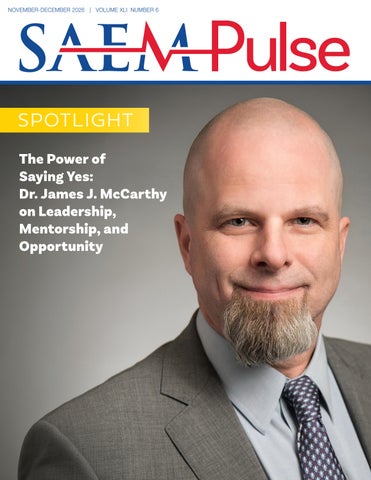
SPOTLIGHT The Power of Saying Yes: Dr. James J. McCarthy on Leadership, Mentorship, and Opportunity
Pulse
2026–2027 SAEM BOARD OF DIRECTORS EXECUTIVE COMMITTEE
Jody A. Vogel, MD, MSc, MSW
Ava E. Pierce, MD
Jeffrey P. Druck, MD
Michelle D. Lall, MD, MHS
Stanford University
UT Southwestern Medical Center
The University of Utah
Emory University School of Medicine
SAEM President
SAEM President-Elect
SAEM Secretary-Treasurer
SAEM Immediate Past President
Board Liaison to: • Bylaws and Governance Committee • SAEM Federal Funding Committee • Coaching Interest Group • Research Directors Interest Group
Board Liaison to: • RAMS (Residents and Medical Students) Board • Clerkship Directors in Emergency Medicine (CDEM) • Committee of Academy Leaders • Nominating Committee • Critical Care Interest group • Quality and Patient Safety Interest Group
Board Liaison to: • Informatics, Digital Health, Emerging Technologies, and AI (IDEA) Academy • Faculty Development Committee • Finance Committee • Emergency Medical Services Interest Group • Tech-Enabled Emergency Medicine (TEEM) Interest Group
Board Liaison to: • Academy for Women in Academic Emergency Medicine (AWAEM) • Fellowship Approval Committee • Behavioral and Psychological Interest Group • Pain Medicine Interest Group
Pooja Agrawal, MD, MPH
Cassandra K. Bradby, MD
Ryan L. LaFollette, MD
Nicholas M. Mohr, MD, MS
Yale Department of Emergency Medicine
East Carolina University
University of Cincinnati
University of Iowa Carver College of Medicine
Member at Large
Member at Large
Member at Large
Board Liaison to: • Academy of Emergency Ultrasound (AEUS) • Academy of Geriatric Emergency Medicine (AGEM) • Membership Committee • Airway Interest Group • Clinical Researchers United Exchange (CRUX) Interest Group
Board Liaison to: • Simulation Academy • Education Committee • Disaster Medicine Interest Group • Evidence-Based Healthcare & Implementation Interest Group
Board Liaison to: • Wilderness and Environmental Medicine Academy (WEMA) • Program Committee • Research Committee • Educational Research Interest Group • Tactical and Law Enforcement Interest Group
Bryn Mumma, MD, MAS
Marquita S. Norman, MD, MBA
Ian B.K. Martin, MD, MBA
University of California, Davis
UT Southwestern Medical Center
Southern Illinois University School of Medicine
Member at Large
Board Liaison to: • Academy of Pediatric Emergency Medicine (APEM) • Awards Committee • Ethics Committee • Neurologic Emergency Medicine Interest Group • Toxicology/Addiction Medicine Interest Group
Member at Large
Board Liaison to: • Academy of Emergency Medicine Pharmacists (AEMP) • Grants Committee • Palliative Medicine Interest Group • Trauma Interest Group
Chair Member
Board Liaison to: • Academy for Diversity & Inclusion in Emergency Medicine (ADIEM) • Wellness Committee • Oncologic Emergencies Interest Group • Vice Chairs Interest Group
CONTACT SAEM: 1111 East Touhy Ave, Suite 540 Des Plaines, IL 60018 www.saem.org
Phone: (847) 257-SAEM (7236) Email: saem@saem.org Monday-Thursday: 8 a.m. to 5 p.m. CT Friday: 8 a.m. to 3 p.m. CT Staff Directory
Member at Large
Board Liaison to: • Academy of Administrators in Academic Emergency Medicine (AAAEM) • Global Emergency Medicine Academy (GEMA) • SAEM Federal Funding Committee • Operations Interest Group • Transmissible Infectious Diseases (TID) Interest Group
Indrani Guzmán Das, MD Resident Member Stanford University
Liaison to: • ED Administration and Clinical Operations Committee • Climate Change and Health Interest Group • Sex and Gender in Emergency Medicine (SGEM) Interest Group • Social Emergency Medicine and Population Health Interest Group
CONTACT THE EDITOR: Stacey Roseen, Managing Editor Email: sroseen@saem.org Submission Instructions & Writer Guidelines
HIGHLIGHTS
Articles displaying the RAMS icon have been identified as being of interest and benefit to residents and medical students.
4
President’s Comments SAEM in Action: Meeting Today's Challenges, Shaping Tomorrow's Future
74
Health Equity & Disparities Equity in Time-Sensitive Emergency Care: Closing Gaps in Care Delivery
138
Toxicology Time Is Calcium: Hydrofluoric Acid Toxicity in the Emergency Department
6
Spotlight The Power of Saying Yes: Dr. James J. McCarthy on Leadership, Mentorship, and Opportunity
78
Caught Between Care and Custody: Human Trafficking, Immigration Enforcement, and the Emergency Department
142
Trainee Toolkit Finding My Stride: Reflections on Pace, Progress, and Medical School
12
Administration & Operations When Does Physician-in-Triage Improve ED Performance?
82
146
16
Ultrasound Roadblocks to Nerve Blocks: Recognizing and Managing Complications
Turning Down the Volume: Reducing Noise in the Emergency Department
Innovation & Technology Beyond the Hype: The TRIAGE Framework for Evaluating Emerging Technologies in Emergency Medicine
Career Development Four Paths, One Goal: Building a Research Career in Emergency Medicine
Medical Education Bridging the Match Gap: Mentoring International Medical Graduates in Emergency Medicine
150
20
86
Wellness When the Shift Comes Home With You: Processing Difficult Cases in Emergency Medicine
90
Asking Nicely: Six Ways to Design Better Surveys in Academic Emergency Medicine
154
Connection From Day One: Building a Peer Mentorship Program in Emergency Medicine
94
Quality Improvement & Patient Safety ECAT: A New National Measure of Emergency Care Access and Timeliness
158
Wilderness Medicine Beyond the First Aid Kit: Menstrual and Reproductive Health on Wilderness Expeditions
162
The Sting Beneath the Surface: Recognizing and Treating Stingray Injuries
24
Recognition Matters: Why Professional Awards Are Worth Pursuing
28
Education & Training Beyond the Numbers: What the 2028 ACGME Procedure Minimums Mean for EM Training
32
98
What Could Go Wrong Before It Does? Using FMEA to Anticipate Risks in Emergency Care
AI in Learner Evaluation: Pearls and Pitfalls for Academic Faculty
36
102
Safe ED Discharge: Is It Time for a Standardized Approach?
Preparing EM Programs for the 2028 Climate Health Competency
40
106
Emergency Medical Services Advancing Paramedicine: A Case for Physician-Led Apprenticeship
Research Delphi or Nominal Group Technique? Choosing the Right Consensus Method for Emergency Medicine Research
44
Ethics In Action The Unrepresented Patient: When No One Can Speak for Them
48 52
Faculty Development Addressing Disruptive Physician Behavior in Emergency Medicine The Silence in the Room
56
Geriatric EM Beyond Code Status: Goals of Care in the ED
60
Global Health Building Emergency Care Capacity in The Gambia: Technology, Training, and Partnership
66
Emergency Medicine Is Global Health — And Global Health Is Not a Place
70
Healing Beyond Borders: Lessons From Emergency Medicine Residents in Rural Nicaragua
110
Risk Management Documentation Pearls & Pitfalls: Making Clinical Reasoning Clear
114
Resident & Student Perspective Beyond the Shift: How Fatherhood Shapes an Emergency Physician
118
Simulation Designing a Medical Escape Room With SimulationBased Learning
166
When the Wilderness Comes to the City
170
Women in Academic EM Building a Sustainable Leadership Career in Academic Emergency Medicine
174
SAEM Foundation SAEM Foundation’s Donors Made 2026 A Year of Progress and Possibility
175 176 180 182
122
SIMposium Spotlight: Bringing Pharmacy Into EM Simulation
183
126
Social EM & Population Health Beyond the Dental Emergency: Connecting Patients to Definitive Care
186
130
The Stories We Have Not Lived: Narrative Medicine in Emergency Medicine Training
134
Making Every Contact Count: Lessons for Rural U.S. Emergency Departments
190
Meet A Few of the 2026 SAEMF Grantees Academic Announcements Briefs and Bulletpoints - SAEM Award Nominations Are Open! Who Will You Recognize? SAEM27 Updates A Day in the Life of an SAEM Medical Student Ambassador SAEM Reports - Hearts Opine: Inside the Inaugural SAEM Hackathon Now Hiring
SAEM Pulse is published bimonthly by the Society for Academic Emergency Medicine, 1111 East Touhy Ave., Ste. 540, Des Plaines, IL 60018. (847) 257-SAEM (7236) Disclaimer: The views and opinions expressed in this publication are those of the authors and do not necessarily reflect the official policies, positions, opinions, or views of the Society for Academic Emergency Medicine or its members. © 2026 Society for Academic Emergency Medicine. All rights reserved. No part of this publication may be reproduced, stored, or transmitted in any form or by any means without prior permission in writing from the copyright holder.
PRESIDENT’S COMMENTS Jody Vogel, MD, MSW, MSc Stanford University 2026–2027 President, SAEM
SAEM in Action: Meeting Today's Challenges, Shaping Tomorrow's Future Academic emergency medicine continues to navigate a period of significant challenge and opportunity. The issues facing our specialty today will shape not only how we educate future emergency physicians, but also how we care for patients, support our workforce, and advance the science of emergency medicine. In these moments, the role of SAEM is clear: to convene experts, advance scholarship, support our members, and help lead thoughtful, evidence-based solutions to the issues that matter most to academic emergency medicine.
SAEM PULSE | NOVEMBER-DECEMBER 2026
One issue that has garnered substantial attention in recent months is the Accreditation Council for Graduate Medical Education's (ACGME) proposed revisions to the Common Program Requirements. These proposed changes have the potential to influence residency training across specialties and may affect the ability of the Emergency Medicine Review Committee to establish specialty-specific training requirements.
4
In response, SAEM worked to engage our community through outreach, education, and a call to action encouraging feedback during the public comment period. The response from our members was remarkable. Educators, program leaders, faculty, and trainees from
across the country dedicated their time and expertise to provide thoughtful input regarding the proposed changes. I am deeply grateful to the many individuals who contributed to this effort. Your engagement reflects the strength of our community and demonstrates the importance of a unified voice on issues that affect emergency medicine education, our learners, and ultimately the patients we serve. SAEM will continue to support efforts that ensure academic emergency medicine remains well positioned to train the next generation of physicians and advance excellence in patient care. Another issue demanding our attention is the ongoing boarding crisis affecting emergency departments nationwide. Persistent health care system crowding and prolonged boarding times have profound consequences for our patients, families, learners, and health care teams. Research has demonstrated associations between prolonged boarding and increased morbidity and mortality, treatment delays, medication errors, diminished patient privacy and dignity, and worse outcomes among vulnerable populations, including pediatric, psychiatric, and older adult patients. Boarding also places substantial
“By supporting the next generation of investigators and fostering innovative research, we help create the evidence that improves patient care, strengthens our specialty, and shapes the future of emergency medicine.”
strain on clinicians and trainees and contributes to burnout, moral distress, and workplace safety concerns. Addressing boarding will require collaboration across institutions, disciplines, and health care systems. As part of our commitment to advancing solutions, SAEM will host a consensus conference on boarding at SAEM27 in San Francisco. This conference will bring together researchers, clinicians, educators, health system leaders, and other stakeholders to examine the evidence, identify critical knowledge gaps, and establish priorities for future research and action. By leveraging the expertise of our members, SAEM is helping to advance the knowledge and collaborative approaches necessary to address one of the most pressing challenges facing emergency care today. While responding to today's challenges, we must also invest in
the future of our specialty. The SAEM Board of Directors recently began developing the society's next strategic plan, guided by a commitment to delivering meaningful value to members throughout every stage of their careers. As we look ahead, we remain focused on strengthening our professional community, supporting research and scholarship, enhancing member engagement, and ensuring that SAEM continues to be the leading home for academic emergency medicine. A critical part of that future is the advancement of emergency medicine science. Through the SAEM Foundation, we are expanding efforts to support investigatorinitiated research and research career development. At a time when research funding remains increasingly challenging, these investments are more important than ever. By supporting the next generation of
investigators and fostering innovative research, we help create the evidence that improves patient care, strengthens our specialty, and shapes the future of emergency medicine. The challenges before us are significant, but so is the collective expertise, dedication, and commitment of the SAEM community. Thank you for all that you do as educators, researchers, clinicians, mentors, and leaders. Together, we will continue to advance academic emergency medicine and improve the care of the patients and communities we serve. ABOUT DR. VOGEL: Jody Vogel, MD, MSW, MSc, is an associate professor and the inaugural vice chair for academic affairs in the Department of Emergency Medicine at Stanford University.
5
SPOTLIGHT The Power of Saying Yes: Dr. James J. McCarthy on Leadership, Mentorship, and Opportunity Since 2018, James (Jamie) McCarthy, MD, has served as executive vice president and chief physician executive for Memorial Hermann Health System and as a member of its executive leadership team. A practicing emergency physician, Dr. McCarthy brings a frontline perspective to organizational decision-making focused on improving patient outcomes and experiences, strengthening physician engagement, and fostering a patient-centered culture. Dr. McCarthy has transformed Memorial Hermann’s physician enterprise into an integrated platform spanning employed, independent, and academically affiliated physicians, value-based care, population health, and quality and patient safety. Under his leadership, the employed physician enterprise has grown from approximately 250 to more than 1,200 providers, and emergency medicine and hospital medicine have been unified under system leadership across 10 hospitals. He has also led the deployment of artificial intelligence (AI)-enabled ambient clinical documentation to more than 520 physicians. During his tenure, the number of Memorial Hermann hospitals ranked among Vizient’s Top 10 has grown from one in 2019 to three in 2026. He also serves as Memorial Hermann’s principal executive contact for its academic partnership with UTHealth Houston. Before assuming his current role, Dr. McCarthy served as professor and chair of the Department of Emergency Medicine at McGovern Medical School at UTHealth Houston and as chief of emergency services at Memorial Hermann-Texas Medical Center, where he previously served as medical director of emergency services and president of the medical staff. Dr. McCarthy served as principal investigator for the U.S. Army Medical Research-funded Mission Connect Mild Traumatic Brain Injury Translational Research Consortium and as an investigator in the Pragmatic, Randomized Optimal Platelet and Plasma Ratios (PROPPR) multicenter trauma resuscitation trial. He was lead author of the American Heart Association’s scientific statement on out-of-hospital cardiac arrest systems of care. He has also led regional and statewide systems of care for cardiac emergencies, including as chair of the Cardiac Care Committee of the Texas Governor’s Emergency Medical Services (EMS) and Trauma Advisory Council.
SAEM PULSE | NOVEMBER-DECEMBER 2026
Dr. McCarthy is president of the Society for Academic Emergency Medicine Foundation (SAEMF) Board of Trustees and was named to Becker’s Hospital Review’s “Chief Medical Officers to Know” list in 2024, 2025, and 2026.
6
He received his medical degree from Loyola University Chicago Stritch School of Medicine and completed his internship and residency in emergency medicine at the University of Chicago. He earned his master’s degree in health care administration from the University of Providence. He is board certified in emergency medicine and emergency medical services. When not at work, he can be found fly fishing in remote locations and adventure traveling with his wife, Suzanne, and their two daughters. In this SAEM Pulse Spotlight interview, Dr. McCarthy reflects on the emergency medicine experiences that shaped his approach to leadership, the lessons learned in moving from academic medicine to health system administration, the importance of mentorship and philanthropy, and the opportunities ahead for academic emergency medicine.
“Emergency medicine taught me to lead with clarity, composure, humility, and empathy.”
in advance. So we focused on what mattered most: continuity of care for patients and trust with the physicians. We communicated early and often and adjusted as we went. We completed the transition without meaningful physician attrition.
Your career has taken you from the emergency department to department chair to the executive leadership of a major health system. Looking back, what experiences in emergency medicine most shaped the leader you are today? Emergency medicine taught me to lead with clarity, composure, humility, and empathy. In the emergency department (ED), no one succeeds alone. The outcome for a critically ill patient depends on nurses, therapists, surgeons, technicians, and staff trusting one another and acting as one team. As medical director and then department chair, my lens widened. Great individual care isn’t enough. Clinicians need the systems, processes, and training that make highquality, coordinated care possible every time. Supporting people and building systems are both part of the same job. I carry both lessons into my role today. I make it a priority to stay connected to the frontline: I listen to physicians and caregivers about what’s getting in their way, I follow through on what we hear, and I keep patients at the center of every decision. I’ve also learned that trust requires transparency. Our physicians, employees, and community deserve to understand the challenges we’re navigating and the reasoning behind our decisions.
Emergency physicians make decisions every day amid uncertainty, competing priorities, and limited resources. How has that training influenced the way you approach leadership at the health system level? Emergency medicine is a discipline of triage. You learn to separate the urgent from the important, act decisively on the best information available, and reassess as the situation evolves. You don’t wait for certainty because the patient can’t. The same instincts apply at the system level. When we decided to bring emergency medicine and hospital medicine in-house across 10 hospitals, replacing multiple outside groups, there was real uncertainty. Would the physicians stay? Could we maintain coverage and quality through the transition? We couldn’t answer every question
The ED also teaches stewardship. Every bed, every hour of a clinician’s time, and every dollar must go where it does the most good. When things don’t go as planned, you debrief honestly and improve. That habit of closing the loop is one of the most valuable things I’ve brought to system leadership.
You have spent much of your career working at the intersection of academic medicine and health system leadership. What do you think each can learn from the other, and where do you see opportunities for stronger partnerships between academic departments and their health systems? As a former department chair at McGovern Medical School and now Memorial Hermann’s principal executive contact for our partnership with UTHealth Houston, I’ve seen it from both sides. Each brings something the other needs. Academic medicine contributes rigor, a culture of inquiry, and a deep commitment to training the next generation; it keeps asking whether there’s a better way. Health systems contribute operational discipline, scale, speed, and accountability for access, affordability, and experience. The strongest partnerships combine academic insight grounded in operational reality with operations continually informed by evidence. That partnership has been built over more than 50 years: Memorial Hermann-Texas Medical Center serves as the primary teaching hospital for McGovern Medical School. Faculty serve as our chiefs of service, we share quality and cost benchmarks, and research is embedded in the care environment. As patients expect care that is more accessible, personalized, and affordable, I see four opportunities to go further together: •A dvancing innovation responsibly, including AI, to improve outcomes, expand access, and give clinicians more time with patients.
continued on Page 9
7
8
SAEM PULSE | NOVEMBER-DECEMBER 2026
“What surprised me most was how far a good idea can travel, and how much more it takes to get it there.”
continued from Page 7
•R ethinking care models so patients receive the right care in the right setting. • I mproving community health through coordinated prevention efforts across Greater Houston. • I nvesting in shared capabilities, including joint ventures, partnerships, and targeted pilots, that strengthen access and quality while lowering the total cost of care.
You went from leading an academic department to helping lead an entire health system and its physician organization. What surprised you most about making that transition, and what did you have to learn — or perhaps unlearn — along the way? What surprised me most was how far a good idea can travel, and how much more it takes to get it there. As chair, I integrated hospital medicine into our emergency medicine department. That model later became the foundation for unifying hospital medicine and emergency medicine across 10 Memorial Hermann hospitals. At the system level, a single decision touches many hospitals, service lines, and communities, so you have to ask who else it affects before you make it. I also had to unlearn being an advocate for one department. As chair, my job was to champion my faculty. Now I have to steward the whole system, which sometimes means making trade-offs that serve patients broadly even when they aren’t what any single group would choose. Leading a physician organization that includes thousands of independent physicians taught me that leadership depends far more on influence, trust, and shared goals than on authority. And I had to learn the business of health care in a new way: finance, payer strategy, and capital allocation. I went back to school midcareer for a master’s in health care administration because I knew clinical credibility alone wouldn’t be enough. Finally, an emergency physician’s instinct is to fix things now. System change takes patience, so I’ve learned to pair urgency with persistence.
You recently began your term as president of the SAEM Foundation Board of Trustees. What drew you to the Foundation’s mission, and what do you hope SAEMF will accomplish during your presidency?
I credit SAEM with accelerating my professional development at every stage of my career: as a junior faculty member, as a department chair, and now as a health system executive. The SAEM Chairs Development Program was pivotal to my growth as a leader, and the annual Association of Academic Chairs of Emergency Medicine (AACEM) Chairs Retreat remains one of the most productive meetings I have ever attended. SAEM invested in me, and the Foundation is how we make that same investment in the next generation. Philanthropy is critical to that work. The Foundation’s grants give young investigators and educators the early support that often launches a career in academic emergency medicine and, ultimately, advances care for our patients. During my presidency, I hope to: •E xpand funding so more promising researchers and educators receive early-career support. •B roaden our donor community, including alumni of past SAEMF grants and industry and health system partners.
SAEMF has long invested in investigators and educators at pivotal points in their careers. As you look at the challenges facing academic emergency medicine today, where do you believe philanthropic investment can make the greatest difference? Academic emergency physicians have always had to balance demanding clinical work with research and education. What has changed is the pressure. Clinical demands are rising, and competition for research funding has intensified, which makes it harder than ever for talented early-career faculty to get started. That is where philanthropy makes the greatest difference: at the moment between a promising idea and a fundable one. I see three areas of particular impact: Protected time. Funding that buys time away from clinical shifts gives investigators and educators the space to do the work. Pilot data. Early grants generate the preliminary results that make larger federal and foundation awards possible. A modest SAEMF investment often leverages many times its value in later funding.
continued on Page 10
9
continued from Page 9
Education scholarship and mentorship. Medical education research has far fewer funding sources than clinical research, yet it shapes how every future emergency physician is trained.
SAEM PULSE | NOVEMBER-DECEMBER 2026
When we invest at these pivotal points, we do more than support individual careers. We keep the best minds in academic emergency medicine and build the evidence that improves care for our patients.
10
This year, SAEMF launched the National Research Scholars Program, a new yearlong, funded research experience designed to introduce medical students to emergency care research and careers as clinicianscientists. Why is reaching future investigators this early so important, and what impact do you hope this program will have on the research pipeline in emergency medicine? Medical school is when students decide not only which specialty to pursue, but what kind of physician they want to be. Many students see emergency medicine as a purely clinical specialty and never meet the investigators who are building its evidence base. If we wait until residency to show them that path, many will have already ruled it out. A funded, yearlong experience changes that. It gives students time to do meaningful research, work alongside experienced mentors, and see firsthand how a question
asked at the bedside can change care for patients everywhere. That experience can shape a career. My hope is that this program will become the first step in a continuum of support. Scholars will carry their experience into residency, compete for SAEMF earlycareer grants as faculty, and eventually mentor the next generation themselves. Over time, I hope it will help build a larger, more diverse community of emergency physician-scientists, which our specialty and our patients need.
Mentorship is woven throughout many of SAEMF’s programs. Who invested in you at important moments in your own career, and how has that shaped the way you think about creating opportunities for those coming behind you? The list is long, but four people stand out. Early in my intern year, Dr. Doug Propp, medical director at Lutheran General, told me, “I can tell by the way you interact with staff and patients that when you’re done with your training, it’s going to be important to you to be proud of the work your hospital does, even when you aren’t there.” I didn’t fully understand it then, but it has shaped many of my career decisions and the way I lead today. Dr. Bob Mulliken, medical director of the emergency department at the University of Chicago during my residency, challenged me on every shift. He shaped how I think about patient care to this day.
Dr. Brent King, my first chair, hired me straight out of residency. He was a true servant leader who measured his own success by the success of his faculty. He also taught me the value of a measured response: giving a difficult situation time and space for the best solution to emerge. Chuck Stokes, then CEO of Memorial Hermann, recruited me into my current role and mentored me through the transition from career academic to health system executive. He, too, led by putting others first. Each of them instilled in me a deep commitment to helping the people I work with become the physicians and leaders they aspire to be. They also showed me the importance of getting out of the way and letting others shine. Today, I try to pay that forward. As medical director and chair, I helped create fellowships in pediatric emergency medicine and EMS to open new paths for young physicians. For nearly a decade, I’ve taught negotiation and conflict management at SAEM’s Leadership Forum, skills I wish someone had taught me earlier.
For residents, fellows, and junior faculty who want to become leaders but may not yet see themselves that way, what experiences or opportunities would you encourage them to seek out early in their careers? Early-career physicians often hear the advice to “learn to say no.” I challenge them to learn to say yes: to the new opportunity, the committee, the project no one else wants. Early in my career, I said yes to a regional cardiac care committee. That led to nearly two decades of work building ST-elevation myocardial infarction (STEMI) and cardiac arrest systems across Texas and, eventually, to national work with the American Heart Association. None of it was in my plan. Leaders don’t develop in silos. Join a hospital quality committee, take on a cross-departmental project, or volunteer to help solve an operational problem. Each one widens your circle of colleagues and deepens your understanding of how the medical school, department, and hospital actually work. Learning that ecosystem and all its complexities will prepare you for leadership better than any book or course. Saying yes doesn’t mean saying yes to everything. Choose opportunities that stretch you and connect you to people outside your usual orbit. And don’t wait for a title. Leadership begins the first time you step up to fix something that matters to patients or colleagues. Many of the best leaders I know didn’t see themselves as leaders until someone else did. You’ve worked across clinical medicine, research and education, EMS, academic leadership, and health system administration. What do you think academic emergency medicine needs to do particularly well over the next decade to remain essential to the larger house of medicine? Emergency medicine sees the entire health system. Care for our sickest patients begins long before they reach the ED door and continues long after they leave it. Over the
next decade, academic emergency medicine must turn that vantage point into leadership. First, we must lead systems of care, not just departments. Much of my career has been spent building regional systems for cardiac arrest, STEMI, stroke, and trauma. Those systems showed that outcomes improve when EMS, emergency physicians, specialists, and hospitals work as one. Our specialty is uniquely positioned to design those systems and hold them accountable. Second, we must be the operational backbone of the hospital. Crowding, boarding, and patient flow are hospitalwide challenges, and emergency medicine should be the source of the solutions. When we integrated hospital medicine into our emergency medicine department, we learned that our specialty’s operational strengths extend well beyond the ED. Third, we must lead the responsible adoption of AI. Deploying ambient documentation to hundreds of our physicians showed me what is possible: less administrative burden and more time with patients. Academic emergency medicine should bring scientific rigor to what comes next, determining which tools truly improve care. Finally, we must stay focused. Emergency physicians are trained to triage. If our specialty applies that discipline to itself and does these few things exceptionally well, it will remain indispensable to the house of medicine and to the patients it serves.
Quick Takes With Dr. Jamie McCarthy First job? Mowing lawns. Favorite way to spend a completely unscheduled day? Fly fishing. A book, podcast, or show you’re recommending right now? A book — The Believer. One thing you always have with you? Pocket knife. A skill you wish you had? Languages. One person, living or historical, you’d invite to dinner? Yvon Chouinard. Something your colleagues might be surprised to learn about you? I’m dyslexic. I started college as a fine arts major. If you hadn’t gone into medicine, what career might you have pursued? Photography.
11
ADMINISTRATION & OPERATIONS
When Does Physician-in-Triage Improve ED Performance? By Nicholas D. Benson, MD, MBA and Dheeraj Duggineni, MD, MBA, on behalf of the SAEM ED Administration and Clinical Operations Committee
SAEM PULSE | NOVEMBER-DECEMBER 2026
At a Glance
12
• Why this matters now: Persistent ED boarding and capacity constraints are prompting departments to reconsider how they allocate physician time. • What you'll learn: Where PiT improves throughput, what the evidence says about patient safety, and how operational conditions influence its value. • Who this is for: ED medical directors, operations leaders, physician administrators, and clinicians involved in patient flow and quality improvement. The presence of a physician in triage (PiT) is an increasingly common operational practice, often credited with improving efficiency and patient safety. As critically high levels of emergency department (ED)
boarding throttle patient throughput and leave sicker, more complex patients in the waiting room, the promise of more accurate triage and earlier workups becomes increasingly appealing.
For departments and providers assessed on process metrics such as door-to-physician time, a PiT doc looks like an easy win. However, the broader effects can be more complex than they first appear. When one academic department added a provider to triage, median length of stay (LOS) and walkout rates dropped substantially. When it instead reassigned a provider from fast track to triage, both gains disappeared. Understanding these tradeoffs can help department leaders weigh the decision to allocate physician hours to PiT. A physician in triage can support the benefits of a split-flow model. A fundamental challenge in ED care assignment design is deciding how
“Staffing a physician in triage is a bet by operations leaders on where a physician-hour produces the most value.” much space to dedicate to low-acuity, low-complexity patients, who often make up a majority of arrivals. The Shortest Processing Time concept from operations engineering highlights the advantage of completing the simplest tasks first: Deferring many short tasks behind one lengthy one drives up average wait times dramatically, while completing the short tasks first brings them down. Preserving care space for many low-acuity patients can leave sicker patients waiting for a bed but improve overall department performance. A systematic review found evidence that streaming improves wait times, LOS, and walkout rates. The Emergency Severity Index (ESI) can help define patient groups for split-flow, but it offers limited precision in determining actual
workup complexity. An analysis of more than 5 million encounters showed that ESI mis-triaged nearly one-third of patients and assigned level 1 or 2 to just two-thirds of those who ultimately required a lifestabilizing intervention. An experienced physician can direct patients into the appropriate care stream, preventing low-acuity areas from becoming bogged down with deceptively complex patients. The benefit of more precise triage has been demonstrated by subdividing ESI 3 patients into high-variability and low-variability streams, leading to improved ED LOS. Whether that requires a physician remains an open question: Machine-learning triage tools have outperformed ESI, and it remains to be seen whether they can deliver the same routing benefit without consuming physician hours.
The throughput benefits of PiT accrue disproportionately to discharged patients, while patient safety benefits remain unproven. Studies of PiT’s effect on ED LOS have shown improvements that are either stronger among or entirely limited to discharged patients. An accurate physician-driven initial workup allows low-acuity patients to be discharged quickly once a care space opens. In the era of extreme boarding, admitted patients aren’t likely to leave for the floor any faster because they were seen by PiT. It is commonly believed that PiT improves safety for complex patients through early identification and treatment. Published evidence for this is thin. One department continued on Page 15
13
SAEM PULSE | NOVEMBER-DECEMBER 2026
“The throughput b discharged patients, w
14
benefits of PiT accrue disproportionately to while patient safety benefits remain unproven.” ADMINISTRATION continued from Page 13
reported lower mortality after adopting PiT, but a retrospective comparison spanning four years is susceptible to confounding. Early physician intervention plausibly improves outcomes for time-sensitive diagnoses, but stroke, trauma, sepsis, and obstetric activation protocols already target high-risk presentations. The design of PiT workflows can drive improvement in departmentspecific priorities. Certain encounters may have different dispositions depending on the time to initial intervention. Patients with sickle cell pain who receive their first analgesia after five hours are less likely to achieve adequate pain control for discharge. Uncomplicated pyelonephritis that progresses to sepsis while a patient waits for antibiotics, or undiagnosed appendicitis that progresses to rupture, can turn a discharge or observation stay into a full admission. This logic is supported by data showing that PiT is associated with a higher proportion of discharges. A streamlined, curated quick list of
orders can help guide PiT practice. Encouraging up-front consults to services that quickly admit, signaling probable admissions to bed management, and ensuring blood cultures are drawn early are all ways PiT can support operational and quality improvement efforts. The effect on patient experience is less settled than the throughput data. Published satisfaction scores generally improve after PiT, likely because door-to-physician time influences those scores, but the risks are real. Patients may not realize they have been seen by a physician because of the rapid nature of a triage encounter. Moving through multiple areas of the department can leave patients feeling as though they’ve progressed through a series of slightly different waiting rooms. Low-acuity patients whose lab results are normal may be continually deprioritized for rooming and ultimately spend less time in a care space. Scripting that clarifies the PiT provider’s credentials and sets expectations can reinforce that the patient has seen a physician. Realtime communication of results and
Pulse Points •M atch staffing to demand. PiT may offer the greatest value during highvolume, bed-constrained periods. •L ook beyond door-to-physician time. Evaluate length of stay, walkout rates, patient experience, and the opportunity cost of physician hours. •D istinguish efficiency from safety. Throughput benefits are better established than improvements in clinical outcomes. •D esign workflows around local priorities. Early orders, timely interventions, and communication can help departments make better use of PiT. •R eassess when conditions change. Direct bedding may be more efficient when ED treatment spaces are available.
progress can improve perceived wait times and help explain a quick discharge. The operational context of each department must drive the decision to implement PiT. Wide variation in patient arrival times and inpatient capacity makes wait times difficult to model and often leaves department leaders with workflows and staffing mismatched to real-time needs. When the pendulum swings and ED beds are available, a multistep triage and split-flow process can stop making sense. Direct bedding has been shown to improve ED LOS and walkout rates when space is available. The economics point in the same direction: A cost-effectiveness analysis of PiT approached feasibility only during high-volume periods. Staffing a physician in triage is a bet by operations leaders on where a physician-hour produces the most value. The evidence supports that bet under specific conditions: a bedconstrained department, a period of high arrival volume, and a workflow built to convert early orders into early intervention and faster throughput. It does not support PiT as a resource-neutral fix, a substitute for inpatient capacity, a proven safety intervention, or a role that necessarily requires a physician. Department leaders should begin with an analysis of their own LOS drivers, staff PiT during the hours that analysis supports, and hold the model to the same standard as any other use of physician time.
ABOUT THE AUTHORS Dr. Benson is a board-certified emergency physician, medical director of the Hospital of the University of Pennsylvania Emergency Department, and assistant professor of clinical emergency medicine at the Perelman School of Medicine. r. Duggineni is a clinical lead D and principal product manager at Qualified Health, where he develops throughput and capacity solutions for health care organizations. He is also a practicing emergency physician at Kaiser Permanente Northern California.
15
ADMINISTRATION & OPERATIONS
Turning Down the Volume: Reducing Noise in the Emergency Department By Spencer Reinke, MD, and Aubrey D. Brown, MD
At a Glance • Why this matters now: ED noise can disrupt communication, increase stress, and affect patients and clinicians.
SAEM PULSE | NOVEMBER-DECEMBER 2026
• What you’ll learn: How to measure noise, identify disruptive sources, and prioritize practical improvements.
16
• Who this is for: Emergency clinicians, trainees, nursing teams, and ED operational leaders. An overhead announcement interrupts sign-out. The receiving clinician asks for the last sentence again, competing with a nearby monitor alarm and the sounds of nursing sign-out happening at the same time. Important information may be lost, and provider stress just went up a notch. Moments like these happen in emergency departments every day.
Our goal is to identify which sounds interfere with care and try to change the systems generating them. But first, we need to understand why noise matters.
Why Noise Matters
High noise levels can seriously hinder clinical communication during critical moments, as illustrated by research in operating rooms.
Among emergency clinicians, higher workplace noise exposure has been associated with poorer sleep and greater psychological distress. For patients, a recent review identified associations with disrupted sleep, anxiety, and delirium. Although much of the evidence on the negative effects of noise comes from outside the ED, the available data suggest that high noise levels can increase clinician and patient stress and negatively affect patient outcomes.
Measuring the Problem
First, some context: World Health Organization (WHO) community noise guidance recommends average levels no higher than 35 decibels (dB) in most patient care areas, while emphasizing that quieter is better. Historical guidance from the Environmental Protection Agency
“We may not be able to eliminate noise from the ED, but we can identify what is most disruptive and take practical steps to reduce it.”
(EPA) recommends 45 dB inside hospitals and other public spaces. These are averaged exposures, not ceilings for every sound. Recommendations for peak noise levels are less well defined, but we know that loud, brief events can add to the impact of average noise levels. Occupational Safety and Health Administration (OSHA) standards provide additional context for high workplace noise exposure, including an 85 dBA eight-hour time-weighted average action level for hearing conservation programs. To quantify noise levels in your clinical environment, use a calibrated sound-level meter that records levels
without recording conversations. Sample patient spaces and workstations across shifts, including handoffs. If possible, capture both average levels and brief loud events (peaks): A loud announcement that interrupts a conversation may disappear within an average. Keep locations and settings consistent when repeating measurements, and, if possible, pair readings with observations of what was happening. At Boston Medical Center (BMC), we monitored noise near clinician workstations and documented average sound levels around 65 dB, with peaks exceeding 80 dB. Our initial meters could not capture true
peaks, so our peak numbers are likely underestimates — something worth checking if you are implementing noise meters. While measuring these levels did not identify the sources of noise, having concrete numbers allowed us to quantify the problem and bring it to leadership's attention. Identifying the sources came next.
Identifying Sources With the People Who Hear Them
At BMC, we identified our greatest noise drivers and possible solutions through a modified Delphi survey.
continued on Page 19
17
18
SAEM PULSE | NOVEMBER-DECEMBER 2026
ADMINISTRATION continued from Page 17
We began by asking providers, nurses, technicians, and unit coordinators to identify the most disruptive sounds in our ED. Staff particularly highlighted overhead pages, equipment alarms, and overlapping nursing and physician shift changes. We then asked for ideas to address these specific sources of noise and organized the responses into a set of possible interventions. We brought those proposals to stakeholder discussions. Facilities and operations helped assess paging changes; the nursing unit council considered the workflow implications of changing handoffs; and quality and patient safety developed a workgroup to collect evidence for monitor alarm adjustments. In the final survey round, staff ranked a shortlist of interventions. The earlier stakeholder discussions helped ensure that all shortlisted interventions were feasible. This is how we narrowed a broad set of ideas toward implementation. Other departments can use a similar modified Delphi approach with a brief survey and small working group. For each proposed change, identify who controls the system and whose work would be affected so that stakeholder discussions include the right people.
Choosing and Sustaining Practical Changes We identified several options that could be tested with limited difficulty:
•P rotect handoffs. Agree on a signout location and use a visual cue to reduce nearby nonessential conversation while preserving urgent interruptions. •R educe avoidable overhead announcements. Identify which announcements are unnecessary or could be communicated through other means. Work with operations and facilities to modify these when possible. •A ddress everyday sources. Limit speakerphone use near patient care and handoff areas. Create a simple process for reporting rattling equipment or noisy doors to the responsible service. Other changes may require broader institutional support. A widespread overhead paging redesign may require substantial facilities and information technology involvement. In a labor and delivery study, replacing overhead pages with smartphone communication reduced transient noise events by approximately twothirds. This supports considering more targeted communication, although its effectiveness should be tested in the ED. Alarm management requires input from multiple stakeholders, including clinicians, nursing, and operations. Review monitoring indications and
Pulse Points •M easure before making changes. Capture average noise levels and brief loud events across different ED locations and shifts.
individualize parameters within approved policies. Studies in different clinical environments have reported reductions in critical monitor alarms through revised defaults, staff education, and individualized settings, without reported increases in adverse events. Environmental changes may include sound-absorbing ceilings or panels and separating workstations from noisy circulation areas. Facilities, infection prevention, and acoustic specialists should assess materials and placement. A Dutch ED study associated a combined program of behavioral, technical, and acoustic changes with less perceived noise disturbance and better staff wellbeing.
Why You Should Do Something
Noisy emergency departments are nearly ubiquitous, and dealing with interruptions and high noise levels has long been written off as simply "part of the job." But growing evidence suggests that noise can have meaningful effects on clinicians and patients — and that some of its sources can be addressed. As EDs become more crowded and boarding times grow longer, addressing modifiable sources of stress and disruption becomes increasingly important. We may not be able to eliminate noise from the ED, but we can identify what is most disruptive and take practical steps to reduce it. Turning down the volume is a good place to start.
ABOUT THE AUTHORS Spencer Reinke is a PGY-3 emergency medicine resident at Boston Medical Center.
•A sk the people experiencing the noise. Frontline staff can identify disruptive sounds that measurements alone cannot explain. •P rotect critical communication. Prioritize reducing avoidable interruptions during handoffs and other information exchanges. •S tart with feasible improvements. Changes to overhead paging, speakerphone use, and noisy equipment may offer practical starting points.
Aubrey D. Brown is a PGY-4 emergency medicine resident at Boston Medical Center.
•E ngage the right stakeholders. Sustainable changes to alarms, communication systems, and physical environments require multidisciplinary input.
19
CAREER DEVELOPMENT
Four Paths, One Goal: Building a Research Career in Emergency Medicine By Karen Cyndari, MD, PhD; Katrina Muraglia, MD; Daniel Nishijima, MD, MAS; and Amanda Irish, MD, MPH, MS
At a Glance
SAEM PULSE | NOVEMBER-DECEMBER 2026
• Why this matters now: Emergency medicine is developing more structured physician-scientist training pathways, but many existing research opportunities remain underrecognized.
20
• What You'll Learn: How four EM researchers navigated mentorship, protected time, funding, and institutional support at different career stages. • Who This Is For: Research-interested medical students, residents, fellows, junior faculty, mentors, and departmental research leaders. A 2024 national survey of emergency medicine residency program directors found that 22 programs offered both a research track and a research fellowship. Two had dedicated physician-scientist training programs (PSTPs), and a third has since joined them. Together, these
findings describe a specialty working to develop the infrastructure needed to support its physician-scientist workforce. The 2024 SAEM Consensus Conference, “Creating and Sustaining Diverse Federally Funded Physician Scientists,” outlined what we should
be building. What follows is smaller and more practical: four of us at different points along the same path, describing what each step required of us and our departments. None of us took the same route, and three of us came up without a formal pathway at all. That is the point. The mechanisms that fund this work already exist at many academic medical centers. What is often missing is someone who knows where to look.
Amanda Irish — The K12 Scholar
“I began my K12 in September 2025. I deleted the announcement and Dr. Cyndari’s suggestion to apply twice, and talked myself out of it a half-dozen times. I didn’t know what translational science was and had no idea how to apply. I didn’t even
“We took four different routes to the same place. Not one of us found it without someone else showing us where to look.”
have a biosketch. Having a colleague’s guidance was essential to getting funded. (Perhaps you heard her announcing my good news in the hotel atrium at SAEM26!) “My award is administered through our university’s Clinical and Translational Science Awards (CTSA) hub. Many academic medical centers have one, and K12/KL2 opportunities may be available to EM faculty. Many of us never apply because the people who know these opportunities exist are in other departments. “The award provides 75% protected time for three years. But more than that, it meant my chair underwrote me before I had proven anything. That investment has been foundational to my development.
“My mentors and collaborators span epidemiology, infectious diseases, veterinary medicine, mathematical modeling, implementation science, and EM. Had I waited for every piece of expertise I needed to exist in one department, I would still be waiting instead of building my research enterprise.”
Katrina Muraglia — From SAEMF Grant to Individual K Award
“I spent most of my training hearing people tell me I couldn’t do EM and research, especially not in basic science. I probably disappointed my PhD advisor, but I didn’t want to do clinical medicine at all if it wasn’t EM! “I found my people where I’d done my undergraduate studies and knew there was an unusual concentration
of EM researchers in basic science. When I matched, I proactively sought mentorship and serendipitously found a mentor — another protégé of the physician-scientist I’d worked with as an undergraduate — who showed me that a basic science career in EM was possible. My residency had flexible elective time that let me begin generating preliminary data in PGY-2. “The SAEM Foundation (SAEMF) Research Training Grant provides 75% protected time for two years and covers most of my research expenses; my department supports the rest. My mentor guided me through the K award application process, so I knew what to expect going in. My research fellowship was a choosecontinued on Page 23
21
22
SAEM PULSE | NOVEMBER-DECEMBER 2026
CAREER DEVELOPMENT continued from Page 21
your-own-adventure, but we now have a structured R38 program offering protected research time during residency.”
Karen Cyndari — From Trainee to PSTP Director “As a trainee, my PSTP gave me the time, mentorship, and resources to generate preliminary data for a career development award (CDA) without sacrificing clinical training experiences.
“What I understand as a PSTP graduate and now director is the obligation to keep paying it forward. While the goal of a PSTP is to support a trainee toward a CDA, the endpoint is bigger: creating a funded research program that enhances the practice of EM while mentoring the next generation toward their own successes. “In 2024, only those 22 programs had the infrastructure to support a PSTP. A full pathway requires an applicant with extensive prior research training, funded mentors, and years of coordinated support. Most departments will never assemble all three. “PSTPs are still worth understanding because their components can be offered individually: longitudinal protected time to build a project early, an experienced mentor (in your department or outside of it!), and
modest seed funding. This is what let me establish the work that became my K08.”
Daniel Nishijima — Building the Newest Program
“I first heard about PSTPs at the 2024 SAEM Consensus Conference. Supporting researchers early in their careers, especially those already showing interest, resonated with me. “Creating our pathway required buy-in from residency leadership, but not significant new funding. The CTSA resources and opportunities for K awards were already in place. Our department has long been committed to research and to developing earlycareer investigators, first under Nate Kuppermann’s leadership and now with Jim Holmes as chair. “That support matters. Getting a research career off the ground is hard, and setbacks are part of the process. Young investigators need a department willing to give them time, mentorship, and room to keep going when a project or application does not work out. “We hope some of our PSTP scholars will join our research faculty, but our broader goal is to help build the EM research workforce. I’ve met many MDPhD and research-focused students excited simply to find an EM program offering continued research training and mentorship during residency.”
What You Can Do
• For trainees: On interview day, ask research leadership what research
Pulse Points •A sk about research tracks, fellowships, protected time, and funded pathways when evaluating residency programs. •E xplore research funding and training opportunities across your institution, not just within emergency medicine. •S eek mentors and collaborators beyond your department to access expertise and support. • Take advantage of existing institutional resources before assuming a new research program must be built. •M entors and research leaders can make opportunities more accessible by identifying promising investigators, encouraging applications, and following up
training the program offers. A research track, a fellowship, and a funded pathway are three different answers, and the third is rare. • For junior faculty: Seek out nearpeers to help you find your footing. Drs. Colin Greineder and Will Sharp started the Basic and Translational Science (BaTS) interest group to do exactly this. Connect with the group. • For mentors: Tell people about these awards and encourage them to apply directly. Then follow up. • For chairs and research leaders: Find out what your institution already funds. Many academic medical centers have a CTSA hub with K12 or KL2 opportunities, and some have a T32 or R38 program in another department. Adding an EM scholar to an existing program may be a far smaller ask than building one from scratch. We took four different routes to the same place. Not one of us found it without someone else showing us where to look.
ABOUT THE AUTHORS Dr. Cyndari is an assistant professor in the Department of Emergency Medicine at the University of Iowa Health Care and director of the Emergency Medicine Physician Scientist Training Pathway. Dr. Muraglia is a clinical instructor and research fellow in the Department of Emergency Medicine at the University of Michigan.
Dr. Nishijima is a professor and vice chair of research in the Department of Emergency Medicine at the University of California, Davis.
Dr. Irish is a clinical assistant professor in the Department of Emergency Medicine at the University of Iowa Health Care.
23
CAREER DEVELOPMENT
Recognition Matters: Why Professional Awards Are Worth Pursuing
SAEM PULSE | NOVEMBER-DECEMBER 2026
By Michelle P. Lin, MD, MPH, MS; Elizabeth Leenellett, MD; Adedamola Ogunniyi, MD; and Laura E. Walker, MD, MBA, on behalf of the SAEM Awards Committee
24
Professional awards do more than recognize a moment of achievement. They shine a light on work that matters, elevate the people doing it, and help define the contributions a profession values.
Sometimes it means encouraging a mentor, trainee, or rising leader to put their accomplishments forward. And when the rules allow it, sometimes it means being willing to nominate yourself.
In medicine, recognition from a professional society can be particularly meaningful. It can strengthen a CV, enhance professional visibility, support career advancement, and bring wider attention to contributions in education, research, leadership, mentorship, service, innovation, and other areas of academic medicine.
All are important because outstanding work cannot be recognized if it never enters the conversation.
But none of that happens without a nomination. Sometimes that means taking the time to nominate a colleague whose work deserves greater recognition.
An Award Says Something Your CV Alone Cannot
against established criteria and determined to be worthy of distinction. That can be especially meaningful when recognition comes from a professional society. Medical societies bring together people who understand the specialty, the work, and what excellence looks like within it. Recognition from that community provides external validation that extends beyond your own institution.
A curriculum vitae documents what you have done: positions held, papers published, presentations given, committees served, programs developed, learners taught, and leadership roles undertaken.
The Association of American Medical Colleges (AAMC) identifies awards as one way academic physicians can gain recognition and professional opportunities, alongside promotions, grants, and positions.
An award adds another dimension. It says that work was evaluated
That is one reason an honors and awards section can be an important part of an academic CV.
“Great work deserves recognition. Sometimes the most important first step is making sure someone puts it forward.”
Recognition Can Have a Ripple Effect
for mentorship, leadership, service, innovation, or advocacy highlights contributions that may be substantial but are not always easily captured by publication counts or job titles.
Professional recognition can strengthen a CV for promotion or advancement and demonstrate a growing reputation beyond your home institution. It may increase your visibility among colleagues who could later become collaborators, sponsors, mentors, or nominators for other opportunities.
That matters because careers in medicine are multidimensional. Professional societies recognize contributions across those dimensions, including clinical care, research, education, leadership, service, innovation, mentorship, and community impact.
An award may recognize work you have already done, but its value can extend well beyond the award itself.
It can also help tell the story of your career. A teaching award reinforces a record of educational excellence. A research award provides another marker of scholarly impact. An award
Look Around: Who Deserves Recognition?
Professional recognition is not only about advancing your own career. Awards provide an opportunity to elevate the people whose work is making a difference.
Think about the colleagues, mentors, trainees, and emerging leaders around you. Who developed a program that changed how your department works? Who is an exceptional teacher or mentor? Who has quietly devoted years to service? Who is doing innovative work that deserves a wider audience? They may never nominate themselves. They may not even realize they are eligible. A thoughtful nomination can do more than lead to an award. It tells someone that their contributions have been seen and valued. And when professional societies recognize those contributions, they help establish what continued on Page 26
25
CAREER DEVELOPMENT continued from Page 25
excellence looks like for the broader community.
But Can You Really Nominate Yourself? If the award guidelines permit it, absolutely.
For many people, self-nomination feels awkward. Medicine has a strong culture of humility and teamwork, and physicians may be more comfortable celebrating a colleague's accomplishments than describing their own. But self-nomination is not the same as declaring yourself the winner. You are simply asking to be considered. The selection committee still decides whether your accomplishments meet the criteria. Your responsibility is to present the evidence clearly and accurately. Self-nomination is hardly unheard of in medicine. Some professional medical organizations explicitly allow it, and some SAEM award programs state that self-nominations are welcomed or encouraged. Not every award does, however. The lesson is simple: Read the eligibility and nomination requirements first.
SAEM PULSE | NOVEMBER-DECEMBER 2026
Don't Wait to Be Discovered
26
One of the biggest misconceptions about professional recognition is that if someone's work is good enough, eventually someone will notice it. Maybe. But careers rarely work quite that neatly. People are busy. A department chair may not know everything a faculty member has accomplished. A former mentor may not realize a colleague is now eligible for an award. People who admire someone's work may simply assume somebody else has submitted the nomination.
So be intentional about recognition. If someone is doing exceptional work, nominate them. Encourage a deserving colleague to pursue an opportunity. Ask a mentor or colleague whether they would be willing to nominate you. And when self-nomination is permitted, consider putting your own accomplishments forward. None of those actions diminishes the significance of an award.
And If the Nomination Doesn't Result in an Award?
There is still value in the process. Preparing a nomination requires taking stock of a body of work: What has been accomplished? Where was the impact? What evidence demonstrates it? What makes those contributions distinctive? For a self-nominee, that reflection can help clarify a professional narrative and prepare for future promotion, leadership, grant, or
award applications. When nominating someone else, the process can provide an opportunity to document and articulate contributions that might otherwise go unnoticed. And awards are rarely a one-time opportunity. This year's nomination may become next year's stronger nomination. Perhaps most importantly, participating in the process helps create a culture in which meaningful work gets recognized. So look at the awards available through your professional societies. Read the criteria. Think about your colleagues, mentors, and trainees. Think about the work you have done, too. Great work deserves recognition. Sometimes the most important first step is making sure someone puts it forward.
ABOUT THE AUTHORS Dr. Lin is chair of the SAEM Awards Committee and an associate professor of emergency medicine at Stanford University.
Dr. Leenellett is a professor, vice chair of faculty affairs, and the W. Brian Gibler, MD, Endowed Chair for Education in Emergency Medicine at the University of Cincinnati, where she chairs the Department of Emergency Medicine Awards Committee. r. Ogunniyi is an associate D program director in the Department of Emergency Medicine at Harbor-UCLA Medical Center and an associate professor at the David Geffen School of Medicine at UCLA. She is co-chair of her department's awards committee. Dr. Walker is an associate professor and vice chair of digital emergency medicine at Mayo Clinic in Rochester, Minnesota. She is president of the SAEM Academy of Women in Academic Emergency Medicine.
27
EDUCATION & TRAINING
Beyond the Numbers: What the 2028 ACGME Procedure Minimums Mean for EM Training By Neelou Weeker, DO; Inna Massaro, DO; Tad Schmitt, MD; Tim Friedmann, MD; McKenna Knych, MD; Leah Bralow, MD; and Emmanuel Oluyinka Idowu, MD, PhD, on behalf of the SAEM Education Committee
SAEM PULSE | NOVEMBER-DECEMBER 2026
At a Glance
28
• Why this matters now: New ACGME procedural requirements taking effect July 1, 2028, will reshape emergency medicine residency training expectations. • What You'll Learn: How the changes affect procedure minimums, pediatric and neonatal care, simulation, ultrasound, and resuscitation leadership. • Who This Is For: EM residents, medical students, residency educators, program directors, and faculty involved in procedural training. The Accreditation Council for Graduate Medical Education (ACGME) recently released new procedural requirements that will
take effect July 1, 2028. While the most noticeable change is a significant increase in the number of required procedures, driven
largely by a doubling of the bedside ultrasound requirement, a closer look reveals important shifts in the skills expected of future emergency physicians. Procedural training will place greater emphasis on caring for patients across the age spectrum, expanding independent orthopedic skills, increasing the use of pointof-care ultrasound (POCUS), and performing more advanced vascular access procedures.
Expansion of Procedural Scope
The current procedural requirements focus primarily on common, highacuity procedures and experiences such as intubation, central lines, chest tubes, procedural sedation,
vaginal deliveries, and pediatric and adult resuscitations (both medical and trauma). The 2028 changes continue to emphasize these "bread and butter" areas, with increases in some requirements, including the total number of intubations, while adding procedures that have become integrated into everyday emergency medicine practice. Newly required procedures and experiences include: • Neonatal and pediatric intubations • Arterial lines • Pediatric vascular access • Intraosseous access • Arthrocentesis • Regional anesthesia •F racture reductions (tracked separately from dislocations) • Paracentesis • Neonatal assessment at delivery These additions acknowledge that emergency physicians are expected to perform a broader range of procedures beyond traditional critical care.
Pediatric and Neonatal Care Receives Greater Attention
One of the most noticeable changes is the increased emphasis on pediatric
and neonatal experiences. Pediatrics is explicitly defined as patients 12 years of age and younger, and neonates as patients 0–28 days old. Rather than treating airway management, procedural sedation, and vascular access as single procedural categories, the new requirements distinguish among neonatal, pediatric, and adult patients. Adult and pediatric procedural sedation now have separate minimums, pediatric vascular access becomes a dedicated requirement, and neonatal assessment and resuscitation are tracked independently. Neonatal assessment at delivery has also been added, rather than requiring only vaginal delivery. These changes highlight an important educational reality: Competence in adult procedures does not automatically translate into competence caring for children, especially neonates, who have distinctly different anatomy and needs. Because pediatric patients may present at any clinical site, residents need to be as prepared to care for critically ill children as they are for adults.
Simulation Caps Apply Per Procedure, Not Globally
The current requirements allow some very rare procedures to be logged entirely through simulation and cap simulation at 30% of required procedures overall — a limit programs can distribute across procedures as they choose. The new guidelines take a different approach, specifying the maximum number of simulated encounters that may count toward graduation for each procedure. Rare procedures, including cricothyrotomy, cardiac pacing, pericardiocentesis, and neonatal intubation, may still be completed entirely through simulation, recognizing that opportunities to perform them in clinical settings are limited. For core and common procedures, however, the new requirements emphasize experience with actual patients.
Leadership Is Now Explicit
Another subtle but important change involves resuscitation. The current continued on Page 31
29
30
SAEM PULSE | NOVEMBER-DECEMBER 2026
EDUCATION & TRAINING continued from Page 29
requirements call for residents to log adult and pediatric resuscitations. The new standards specify that residents should function as the "supervised team leader" during adult medical and trauma resuscitations, emphasizing near-independent leadership rather than participation in care alone.
Ultrasound Continues Its Rise
One of the largest changes is the increase in required ultrasound examinations from 150 to 300, with no simulation credit permitted. This requirement reinforces the central role of POCUS in emergency medicine practice and reflects its increasingly widespread availability. The ACGME also broadened the definition from "ED Bedside Ultrasound" to include both diagnostic and procedural ultrasonography.
Lumbar Puncture Requirements Take a Step Back
While requirements for other procedures have remained the same or increased, the lumbar puncture minimum decreases from 15 to 10. This may reflect the decreased use of lumbar puncture in evaluating potential subarachnoid hemorrhage and a broader decline in the frequency of lumbar punctures performed in emergency departments.
Recognizing Emergency Medicine's Expanded Toolkit
The new requirements also acknowledge emergency medicine's expanding procedural toolkit, particularly in pain management. Adding regional anesthesia ensures residents gain experience performing nerve blocks, although the ACGME does not specify particular types of blocks. The addition of arterial lines also recognizes the increasing provision of critical care in emergency departments. Along with higher intubation requirements, this expanded procedural training is intended to better prepare residents to manage critically ill patients.
Implications for Residency Training
The 2028 procedural requirements reflect the changing scope of emergency medicine practice and the skills expected of graduating residents. Beyond increasing procedure counts, they place greater emphasis on age-specific procedural experience, supervised resuscitation leadership, and the growing role of ultrasound and other procedures in emergency care. For residency programs, one of the most significant challenges will likely be ensuring sufficient pediatric patient exposure to meet intubation and vascular access requirements, along with a potentially greater emphasis on neonatal care in simulation settings.
Ultimately, the changes reinforce the importance of preparing residents not simply to complete required procedures, but to develop the breadth of procedural experience and leadership skills needed for independent emergency medicine practice.
ABOUT THE AUTHORS Dr. Weeker is an assistant professor at the University of California, Davis Health.
Dr. Massaro is affiliated with Virginia Tech Carilion.
Dr. Schmitt is affiliated with the Medical College of Wisconsin.
Dr. Friedmann is an assistant professor at the Icahn School of Medicine at Mount Sinai.
Dr. Knych is an assistant professor at the Medical College of Wisconsin.
Pulse Points
• Expect broader procedural requirements. The 2028 standards add or expand requirements for vascular access, regional anesthesia, orthopedic reductions, and other procedures.
Dr. Bralow is an assistant professor at Yale School of Medicine.
• Age-specific experience matters. Pediatric and neonatal procedures receive greater attention, with separate minimums for several categories. • Simulation rules are changing. Each procedure has its own simulation allowance, and ultrasound examinations must be performed without simulation credit.
r. Idowu is a physician D researcher based in Nigeria.
• Resuscitation leadership counts. Adult medical and trauma resuscitations explicitly require residents to serve as supervised team leaders. • Programs will need to assess clinical opportunities. Pediatric procedural exposure and neonatal training may require particular attention as programs prepare for implementation.
31
EDUCATION & TRAINING
AI in Learner Evaluation: Pearls and Pitfalls for Academic Faculty By Andrew Mittelman, MD; Viral Patel, MD; Caro Auger, MD; Jennifer Esch, PharmD, MBA; Adam Watkins, MD; Kelly Mayo, MD; Simi Jandu, MD; Cody Brevik, MD; and Jenna Thomas, MB, BCh, BAO, MHPE, on behalf of the SAEM Education Committee
At a Glance
SAEM PULSE | NOVEMBER-DECEMBER 2026
• Why this matters now: As AI becomes part of faculty workflows, educators must balance efficiency with accurate, authentic, and responsible learner assessment.
32
• What you'll learn: Four practical pearls and pitfalls for using AI to review bias, refine feedback, maintain transparency, and develop reusable evaluation templates. • Who this is for: Academic emergency medicine faculty responsible for evaluating medical students, residents, and other learners. Learner evaluation is one of the most important and time-consuming responsibilities of academic emergency physicians. Creating meaningful narrative feedback competes with countless other demands on faculty members’ limited nonclinical time. Many
educators have begun turning to generative artificial intelligence (AI) tools such as ChatGPT, Claude, and Gemini to streamline the process. Used thoughtfully, these tools can help identify potentially biased language and synthesize feedback. Used carelessly, they can
distort evaluator intent, diminish authenticity, and compromise learner confidentiality. The key is to think of generative AI as a synthesizer and editor, not the evaluator itself. In this two-part series, we review pearls and pitfalls of incorporating AI into learner evaluation. Part 1 focuses on academic faculty using AI to assist with individual learner evaluations, such as end-of-shift assessments. Part 2 addresses clerkship and residency leaders using AI for block summaries, Clinical Competency Committee (CCC) evaluations, and Standardized Letters of Evaluation (SLOEs).
Minimizing Bias
For as long as medical education has relied on subjective evaluation, it has been vulnerable to bias. Narrative
assessments frequently contain subtle patterns that influence how learners are described. One medical student may be called “confident,” while another demonstrating similar behavior is described as “aggressive.” Words such as caring, pleasant, assertive, or independent may not be distributed equally across demographic groups. AI offers an intriguing second set of eyes. Rather than generating evaluations, AI may be more appropriately used to flag potentially gendered or otherwise biased language in feedback. Importantly, AI does not eliminate bias; it simply changes where bias enters the process. Its recommendations remain influenced by its training data and the prompt provided. Pearl: Use AI as a second reviewer rather than the primary author. Asking an AI model, “Do you notice language that could unintentionally reflect bias?” is often more valuable than asking it to rewrite the evaluation entirely. Pitfall: A polished evaluation is not necessarily a less biased evaluation. Never assume that AI-generated
wording is inherently objective. Always review AI-generated output critically.
Maintaining Evaluator Voice
Although humans are surprisingly poor at reliably identifying AIgenerated text, learners may recognize when feedback does not sound like their teacher. AI-generated writing may lack the quirks, phrasing, and imperfections that make feedback recognizably yours. When learners suspect that evaluations were written primarily by AI, we risk diminishing both the credibility of the assessment and the educational relationship itself. Fortunately, writing and judging are different skills. Faculty may know exactly how a learner performed yet struggle to communicate those observations clearly and concisely. In these situations, AI can serve as an editor rather than an evaluator. A faculty member might provide their own observations and ask AI to improve readability, organize comments into strengths and opportunities for growth, or make constructive feedback more actionable. The educational judgment remains entirely human; AI simply helps
communicate it more effectively. This may be particularly valuable in emergency medicine, where evaluations are often completed at the end of a demanding shift amid competing priorities. Pearl: Write the evaluation first. If time is limited, jot down your unorganized thoughts (“text emesis”), then ask AI to improve the grammar, organization, clarity, or tone without changing your observations. Alternatively, ask AI for suggestions on phrasing or additions, then incorporate them yourself to preserve your unique voice. Pitfall: AI may produce polished language that no longer sounds like you. Review its suggestions carefully to ensure the final evaluation reflects your observations, judgment, and voice.
Modeling Transparency
As educators, we ask our learners to be transparent about when and how they use AI. We should hold ourselves to the same standard. If AI materially contributes to the
continued on Page 34
33
EDUCATION & TRAINING continued from Page 33
preparation of a learner evaluation, its use should be acknowledged according to institutional policies. Modeling transparency reinforces the ethical standards we expect from trainees and helps foster a culture of responsible AI use. Many institutions require authors to disclose AI use in manuscripts, abstracts, and other scholarly work. Yet faculty may use the same tools when preparing evaluations without similar transparency. This potential double standard undermines our credibility as educators. Whether or not formal disclosure is an institutional requirement, faculty should strive to model the professionalism they expect from learners. As supervisors and role models, our own use of AI should reflect the same principles of honesty and accountability that we teach every day. Pearl: Model the behavior you expect from learners. Consider describing AI’s specific role in preparing feedback. For example: “AI was used to organize and edit my observations. The assessment and educational judgments are my own.” Pitfall: Holding yourself to a different standard than your learners undermines the professionalism and accountability you seek to promote.
SAEM PULSE | NOVEMBER-DECEMBER 2026
Leveraging Reusable AI Templates
34
One of AI’s greatest strengths is its ability to support consistency. Rather than crafting a new prompt for every learner evaluation, faculty can create a reusable template that reflects their preferred writing style, teaching philosophy, and institutional expectations. A well-designed template can instruct the model to organize observations into a concise, actionable shift evaluation while preserving the evaluator’s voice and flagging potentially biased language. It can also prompt the evaluator to
address important elements that are easily overlooked. For example, before generating the evaluation, the template might ask whether the learner’s documentation was reviewed and, if so, solicit specific feedback about it. By standardizing both the questions asked and the instructions given to AI, templates can streamline the evaluation process and help faculty produce more complete, consistent feedback. Pearl: Create a reusable AI template that reflects your evaluation style. Consistent prompts can help produce more consistent evaluations. Pitfall: Templates should standardize your workflow, not your feedback. Every evaluation should reflect the individual learner.
Conclusion
Perhaps the most useful framework is to think of AI as an extraordinarily capable editorial assistant. Ask it to organize. Ask it whether your language might contain bias. Ask it to make feedback clearer or more actionable. Then return to your original observations. Does the evaluation accurately represent the learner? Have important nuances disappeared? Is the feedback matched to the learner’s
stage of training? Most importantly, would you be comfortable defending every sentence in front of the learner?
recognize our own limitations, and provide feedback worthy of their growth.
Generative AI has the potential to make one of our most important educational responsibilities faster, clearer, and perhaps even fairer. But efficiency should never be equated with objectivity, nor eloquence with accuracy.
AI may help us write better evaluations, but it cannot relieve us of the responsibility to make better educational judgments.
Outsourcing learner assessment is not the goal. Rather, AI can help us do something distinctly human a little better: observe our learners carefully,
AI Acknowledgment: ChatGPT was used in the preparation of this manuscript for grammatical editing and language refinement, including rephrasing portions of the text. All substantive content generation, initial drafting, and final editorial decisions were the work of the authors.
Pulse Points • Keep educational judgment human. Use AI to organize and refine feedback, not determine learner performance. • Review language for bias. AI can flag potentially biased wording, but its suggestions require critical review. • Preserve your voice. Begin with your own observations and ensure the final feedback reflects your judgment. • Model transparency. Follow institutional disclosure expectations and demonstrate responsible AI use. • Standardize the process, not the assessment. Reusable prompts can improve consistency, but every evaluation should reflect the individual learner.
ABOUT THE AUTHORS Dr. Mittelman is an attending physician at Boston Medical Center and an assistant professor at Boston University Chobanian & Avedisian School of Medicine.
Dr. Esch is a clinical pharmacist specialist in emergency medicine at Aurora BayCare Medical Center in Green Bay, Wisconsin.
Dr. Jandu is an attending physician and member of the educational faculty at UMass Chan Medical School.
Dr. Patel is an attending physician, associate professor of emergency medicine, and associate program director of the emergency medicine residency at UMass Chan Medical School.
Dr. Watkins is an attending physician, assistant professor of emergency medicine, and associate program director of the emergency medicine residency at the University of Arkansas for Medical Sciences in Little Rock, Arkansas.
r. Brevik is an attending physician D and assistant professor at the University of Colorado Anschutz Medical Center and a member of the educational faculty for the Denver Health–University of Colorado Residency in Emergency Medicine.
Dr. Auger is a medical education fellow at Hennepin County Emergency Medicine in Minneapolis, Minnesota.
Dr. Mayo is an attending physician at Boston Medical Center and an assistant professor and emergency medicine clerkship director at Boston University Chobanian & Avedisian School of Medicine.
Dr. Thomas is an assistant professor at Washington University in St. Louis and an assistant program director at the Washington University/BarnesJewish Hospital/St. Louis Children’s Hospital Consortium Program in Emergency Medicine.
35
EDUCATION & TRAINING
Preparing EM Programs for the 2028 Climate Health Competency By Adrian Cois, MD, on behalf of the SAEM Climate Change and Health Interest Group include a new Core requirement in the Patient Care competencies:
SAEM PULSE | NOVEMBER-DECEMBER 2026
At a Glance
36
• Why this matters now: A new ACGME climate health competency takes effect July 1, 2028, requiring EM programs to prepare residents to recognize, manage, and help prevent climate-related health risks. • What You'll Learn: What the requirement covers, where current curricula may fall short, and how a planned SAEM resource hub aims to help programs prepare. • Who This Is For: EM program directors, residency educators, curriculum developers, and faculty involved in resident assessment. When a heat wave settles over a city, when wildfire smoke drifts across state lines, or when a storm cuts power to home oxygen and dialysis, the emergency department is where those patients arrive first. Emergency physicians have
described these clinical implications in detail for years. Until now, though, how residents learn to manage them has been left to individual programs. That is about to change. The 2028 Emergency Medicine Program Requirements, effective July 1, 2028,
4.4.q. Residents must demonstrate competence in recognizing and managing the health impacts of climate change while providing evidence-based guidance on prevention and risk mitigation. The accompanying Specialty Background and Intent lists heat-related illness, respiratory conditions from poor air quality, vector-borne diseases, severe weather injuries, and mental health effects of climate-related disasters. Emergency medicine is one of the first specialties to be subject to a requirement like this, so how we implement it may help inform what other specialties do next.
“The hazards are already in our departments. Our job now is to make sure every graduating resident is ready for them.”
What Programs Will Need to Do
Four features of 4.4.q matter most for program directors. First, it sits in Patient Care. This is not an elective, a wellness topic, or a policy seminar. It is framed around the clinical hazards our patients face and the care we provide. Second, it has two halves. Recognizing and managing heat stroke or a wildfire smoke asthma exacerbation is familiar territory. Providing evidence-based guidance on prevention and risk mitigation is a newer approach. That means the discharge conversation: counseling an older patient on a diuretic and an anticholinergic before the next heat wave, showing a patient with COPD how to use the Air Quality Index, or
reviewing tick prevention after a Lyme diagnosis. Colleagues have outlined how this kind of bedside education fits into emergency care. Third, the list of hazards is illustrative, not exhaustive. The language says the health impacts “may include, but are not limited to,” the five named categories. A program in the Gulf Coast and a program in the Pacific Northwest will reasonably emphasize different hazards. Fourth, residents must demonstrate competence. Programs will need a way to assess and document it, not just a lecture on the schedule.
The Gap
In 2024, my colleagues and I published a scoping review of climate
change curricula in U.S. graduate medical education. Across a decade of literature, we found only 17 relevant articles. Emergency medicine was the focus of nearly a third, more than any other specialty, but most were surveys of program directors or calls to action. Only three reported outcomes, and those relied largely on learner satisfaction rather than objective assessment. At the time, we noted that the ACGME had not included climaterelated competencies in its requirements, so programs may not have perceived a need to address the topic. That is no longer the case.
continued on Page 39
37
SAEM PULSE | NOVEMBER-DECEMBER 2026
“Pro
38
EDUCATION & TRAINING continued from Page 37
Interest has not been the limiting factor either: Most program directors in a national survey considered climate change and sustainability important to EM training. What has been missing is structured, shareable curricula with a way to assess them.
How the SAEM Climate Change and Health Interest Group Is Responding
“What is missing is the explicit mapping to 4.4.q, the prevention layer, and the assessment.”
programs can document what they already do.
The encouraging news for program directors is that you already teach most of this. Heat stroke, asthma, tick-borne illness, crush injury, and post-disaster anxiety are all in your didactic calendar. What is missing is the explicit mapping to 4.4.q, the prevention layer, and the assessment.
• Five hazard modules built to a consistent structure, each pairing clinical management with bedside prevention counseling and a suggested assessment approach.
To help fill that gap, the interest group is building Clinical Hazards of a Changing Climate, a free national resource hub designed around the language of the requirement. It will include:
• A directory of interest group members available to teach a session at your program.
• A crosswalk showing where existing EM didactics already meet 4.4.q, so
• Assessment and documentation tools for clinical competency committees.
• Guidance on adapting content to the hazards most relevant to your region.
ograms will need a way to assess and document it, not just a lecture on the schedule.”
Pulse Points
• Build on existing teaching. Many climate-related conditions are already covered in EM residency curricula.
• Optional content on health care sustainability and quality improvement for programs that want to go further, mapped separately to Systems-Based Practice requirements. The hub will draw on published curricula, open resources such as the ALiEM climate change and emergency medicine series, and the findings of a recent scoping review. We expect to launch in 2027, ahead of the July 2028 effective date.
How You Can Get Involved
If you teach any of these topics, we would like to include your materials. If you are willing to deliver a session at another program, we would like to add you to the teaching directory. And if you are a program director starting to plan for 2028, we would value hearing what would make this resource most useful to you. Join the SAEM Climate Change and Health Interest Group or contact me directly at cois@ohsu.edu. Emergency medicine has an opportunity to show how a new competency can be taught well from the start. The hazards are already in our departments. Our job now is to make sure every graduating resident is ready for them.
• Add prevention counseling. The new competency addresses evidencebased risk mitigation as well as clinical recognition and management. • Plan for assessment. Residents must demonstrate competence, making evaluation an important part of curriculum planning. • Consider regional hazards. Programs can tailor educational emphasis to the climate-related health risks most relevant to their communities. • Contribute to shared resources. SAEM's Climate Change and Health Interest Group is seeking educational materials, volunteer instructors, and input from program directors.
ABOUT THE AUTHORS Dr. Cois is an assistant professor in the Department of Emergency Medicine at Oregon Health & Science University and chair of the SAEM Climate Change and Health Interest Group.
39
EMERGENCY MEDICAL SERVICES
Advancing Paramedicine: A Case for Physician-Led Apprenticeship SAEM PULSE | NOVEMBER-DECEMBER 2026
By Michael DeFilippo, DO, on behalf of the SAEM EMS Interest Group
40
Paramedics provide clinical care when a physician cannot be physically present. As field diagnostics, critical care therapeutics, and resuscitation systems advance, paramedics need opportunities to develop the judgment and skills to use them. For experienced paramedics who want to remain in the field, one possible next step is a defined advancedpractice role within paramedicine. I envision a paramedic who becomes an advanced practice provider (APP) within paramedicine, with expanded responsibility for assessment, diagnostic reasoning, treatment, and disposition. A formal
degree or a structured physicianled apprenticeship could offer two pathways to prepare for that role.
Defining the Advanced Role
The term advanced practice paramedic is used differently across EMS systems. In some, it describes critical care paramedics, community paramedics, or other clinicians with additional specialty education and certification. Here, I am proposing a role analogous to that of physician assistants (PAs) and nurse practitioners (NPs) in hospitals and clinics: a paramedic prepared for an expanded scope and greater responsibility for diagnosis, treatment, and disposition. This
pathway would allow paramedics to develop into advanced practice clinicians within their own profession. That responsibility would encompass evaluating undifferentiated complaints, selecting and interpreting diagnostic studies, developing treatment plans, and determining appropriate disposition with defined physician collaboration. Depending on the role and authorized scope, procedural capabilities could include wound repair, abscess drainage, regional anesthesia, or selected fracture and dislocation reductions. Preparation would address the
“I envision a paramedic who becomes an advanced practice provider (APP) within paramedicine, with expanded responsibility for assessment, diagnostic reasoning, treatment, and disposition.”
full clinical decision: recognizing when an intervention is appropriate, performing it competently, managing complications, and arranging followup or escalation. The National EMS Scope of Practice Model distinguishes education, certification, licensure, and credentialing. It also describes state mechanisms for specialty practice. An expanded role would require alignment across these domains; an apprenticeship or agency credential alone would not confer legal authority in most EMS systems.
Two Routes to the Same Clinical Role
In conversations about prehospital advanced practice, I have heard proposals for PA or NP pathways focused on out-of-hospital care. Those could serve useful purposes. I am interested in a pathway through paramedicine that allows experienced clinicians to advance within their own profession. A degree pathway could combine advanced clinical coursework, supervised rotations, and competency assessment, with additional development in research, education,
and leadership. A physician-led apprenticeship could combine structured coursework, simulation, clinical rotations, and supervised practice over time without requiring a degree for completion. Both would prepare clinicians for the same advanced role and hold them to the same clinical standards. As a paramedic turned physician, I believe degrees are needed in paramedicine. I do not believe every paramedic needs a degree, nor do
continued on Page 43
41
SAEM PULSE | NOVEMBER-DECEMBER 2026
“A Just Culture approac human error, at-risk be behavior while preserving and the ability to pause o
42
EMERGENCY MEDICAL SERVICES continued from Page 41
I believe experienced paramedics need a degree to become advanced practice clinicians through the rigorous pathway described here.
Learning Alongside an EMS Physician
An agency preparing a small number of advanced practice paramedics could arrange sustained, individualized teaching with EMS physicians. The model would draw on the resident-attending apprenticeship familiar to emergency physicians. ACGME requirements connect increasing responsibility with demonstrated ability and appropriate supervision. The paramedic would care for patients alongside the physician in the field, discuss difficult cases, and observe how the physician manages uncertainty. Additional rotations
ch should distinguish ehavior, and reckless firm clinical boundaries or remediate practice.”
could occur with the collaborating physician or through established clinical agreements. Working together over time would allow the physician to assess the paramedic’s reasoning and judgment, including when the clinician recognizes a limit and seeks help. A practical apprenticeship would include: 1. Defined prerequisite experience and transparent selection criteria. 2. Structured foundational coursework paired with case discussion and simulation. 3. Supervised field encounters and rotations matched to the advanced role. 4. Documented assessment of clinical reasoning, procedures, and disposition decisions. 5. Progressive responsibility tied to observed competence. 6. Continued case review and maintenance of competence after credentialing. The curriculum would cover resuscitation and hemodynamic management, airway and ventilation, and complex therapeutics. It would also address minor illness, urgent care medicine, risk stratification, and disposition. The clinician would need to judge what can be managed within the role, what requires further evaluation, and when to escalate care. Those decisions must be explained and reassessed as the patient’s condition changes.
Pulse Points
• Advanced paramedic roles require clearly defined responsibilities, competencies, supervision, and legal authority. • Degree programs and physician-led apprenticeships could offer different educational pathways, but both would need rigorous clinical assessment. • Longitudinal physician mentorship could help develop diagnostic reasoning, procedural judgment, and appropriate escalation decisions. • Progressive responsibility should be based on demonstrated competence, not simply experience or time in training. • Evaluation should include clinical decisions, complications, patient outcomes, and ongoing maintenance of competence.
Structure That Supports Advanced Practice An apprenticeship would need clear educational objectives, adequate clinical exposure, physician availability, consultation expectations, and a documented process for granting responsibility. Common competency domains and periodic review by clinicians outside the teaching relationship would help make assessment more consistent. Programs would also need protected teaching time and reliable access to appropriate patients and rotations. A Just Culture approach should distinguish human error, at-risk behavior, and reckless behavior while preserving firm clinical boundaries and the ability to pause or remediate practice. Evaluation should examine clinical decisions, consultation, complications, and patient outcomes, including whether degree and apprenticeship graduates meet the same expectations. Experienced paramedics should have a way to pursue advanced clinical practice within their own profession. A physician-led apprenticeship could build on their field experience and prepare them for greater clinical responsibility, provided it includes rigorous education, competency assessment, and appropriate oversight. Whether such a pathway can meet the same standards as a degree-based route is a question worth evaluating as medicine advances and paramedics continue caring for patients where physicians cannot always be present. Disclaimer: The views and proposals expressed in this article are those of the author and do not necessarily reflect the positions or policies of the Society for Academic Emergency Medicine (SAEM).
ABOUT THE AUTHORS Dr. DeFilippo is an assistant professor of emergency medicine and public health at WashU Medicine in St. Louis. A paramedic turned physician, he serves as medical director for multiple EMS systems and chairs SAEM's EMS Interest Group.
43
ETHICS IN ACTION
The Unrepresented Patient: When No One Can Speak for Them By Megan Polniak and Cindy Bitter, MD, MA, MPH
SAEM PULSE | NOVEMBER-DECEMBER 2026
At a Glance
44
• Why this matters now: Emergency physicians must sometimes make urgent treatment decisions for patients whose wishes are unknown and who have no available surrogate. • What you'll learn: How presumed consent, capacity assessment, surrogate searches, and ethics consultation inform care for unrepresented patients. • Who this is for: Emergency physicians, residents, medical students, and clinicians involved in complex treatment and end-of-life decisions. Some of the most challenging encounters in medicine involve endof-life decisions when a patient’s wishes are unknown. Unrepresented patients are individuals who lack decision-making capacity, have no advance directive documenting their
wishes, and have no family members or friends able and willing to make decisions on their behalf. In the emergency department (ED), clinicians rely on the concept of presumed consent, which allows them to provide emergency
treatment when patients cannot give informed consent. Physicians also have obligations under the Emergency Medical Treatment and Labor Act (EMTALA) to provide medical screening examinations and necessary stabilizing treatment for emergency medical conditions, including when patients cannot provide consent because of altered mental status. These principles support necessary immediate care but do not resolve questions of consent or surrogate decisionmaking once a patient has been stabilized. States have different laws governing the order of surrogate decision-makers and the requirements when none can be identified. Institutional policies also vary.
“For emergency physicians, presumed consent is an important bridge to immediate stabilization, not a substitute for informed consent or surrogate decision-making for ongoing care.”
Megan participated in an ethics committee consultation at SSM Health Saint Louis University Hospital involving medical decisions for an unrepresented patient. The patient was an 80-year-old man who lived in another state and was reportedly visiting family. He initially presented as somnolent but arousable, answering questions with short, simple responses and oriented only to self. He could not provide the names or contact information of family members, and no previous records were available in the hospital’s electronic health record. In the ED, his physical examination raised concern for bowel obstruction, which imaging
later confirmed was secondary to a malignant mass. He agreed to admission, but over the next several days, his mental status fluctuated. He became increasingly confused and was no longer oriented to self. Veterans Affairs (VA) records from his home state revealed that he was being treated for colon cancer and had previously undergone colectomy and ileostomy. He had no documented psychiatric history, and no recent discussions of goals of care or code status were found in his VA records. Approximately one week after admission, the patient was actively refusing interventions, including
antibiotics, a nasogastric tube, and surgery. Psychiatry was consulted and confirmed that he lacked capacity to make medical decisions. The patient remained unrepresented despite the care team’s unsuccessful efforts to reach family members or other loved ones. His clinical condition continued to deteriorate despite treatment for bowel obstruction. He experienced progressive somnolence, periods of agitation, worsening laboratory values, and concern for ongoing bowel ischemia. When asked whether he wanted to be made comfortable, he nodded yes. continued on Page 47
45
“The ethics committee's d considering his interests,
SAEM PULSE | NOVEMBER-DECEMBER 2026
about whether the final d
46
whether the final decision reflected what he would have wanted.
deliberation provided a structured process for but no process could eliminate the uncertainty
decision reflected what he would have wanted.”
ETHICS IN ACTION continued from Page 45
The ethics committee was consulted to assist with decisionmaking after efforts to identify a surrogate had failed and the opportunity to preserve viable bowel was diminishing. The central question was whether to pursue surgery, transition to hospice, or initiate comfort measures. Surgery could potentially resolve the acute obstruction but would leave the patient with a poor prognosis from advanced metastatic cancer. It would also be invasive and likely require chemical and physical restraints to facilitate postoperative care. Hospice and comfort-focused care presented their own challenges. The patient did not meet criteria for inpatient hospice, preventing transfer to the local VA hospital. He did, however, meet criteria for a skilled nursing facility where he could receive palliative care, although it was
uncertain whether he would remain stable enough for transfer. After considering these options, the ethics committee ultimately decided to make the patient do-notresuscitate/comfort care status. The case illustrates the difficulty of making decisions for unrepresented patients. Despite appropriate efforts to address potentially reversible contributors, the patient’s decision-making capacity had not been restored. The clinical team had exhausted multiple avenues for reaching family members or other potential surrogate decisionmakers. Yet clinicians still lacked an understanding of the patient’s beliefs, prior wishes, and core values. We as clinicians lost the opportunity to learn about this man’s core beliefs and what autonomy, spirituality, and comfort meant to him. The ethics committee’s deliberation provided a structured process for considering his interests, but no process could eliminate the uncertainty about
Pulse Points
• Presumed consent supports necessary emergency care but does not resolve ongoing treatment decisions after stabilization. • Assess decision-making capacity carefully and address potentially reversible causes of impairment. • Make diligent, documented efforts to identify an appropriate surrogate when a patient lacks capacity. • Involve ethics resources when difficult decisions arise without a known surrogate.
For emergency physicians, presumed consent is an important bridge to immediate stabilization, not a substitute for informed consent or surrogate decision-making for ongoing care. When a patient’s decision-making capacity is uncertain, physicians should assess capacity carefully and use a validated approach when appropriate, such as the freely available Aid to Capacity Evaluation (ACE) instrument. Potentially reversible contributors to impaired capacity, ranging from delirium to sepsis, should be identified and treated. When a patient lacks capacity, the care team should make diligent efforts to identify an appropriate surrogate and document those efforts, as was done in this case. When no surrogate can be identified, clinicians and ethics committees must use the available information about the patient and the clinical situation to make decisions guided by beneficence and nonmaleficence, while recognizing the limits of what can be known about the patient’s preferences. The experience of caring for an unrepresented patient reminds us that good ethical decision-making is not simply about choosing what seems medically reasonable. It is also about creating a careful, transparent process for honoring the personhood and values of a patient whose voice is difficult to recover.
ABOUT THE AUTHORS Megan Polniak is a fourth-year medical student at Saint Louis University School of Medicine pursuing a distinction in health care ethics. She previously worked as an emergency department patient care technician. Dr. Bitter is a professor of emergency medicine at Saint Louis University and director of resident research in the Department of Surgery.
• Recognize that a careful, transparent decision-making process cannot always establish what an unrepresented patient would have wanted.
47
FACULTY DEVELOPMENT
SAEM PULSE | NOVEMBER-DECEMBER 2026
Addressing Disruptive Physician Behavior in Emergency Medicine
48
By Annabella Salvador-Kelly, MD; Cassandra Bradby, MD; James Miner, MD; and Nancy Kwon, MD, on behalf of the SAEM Faculty Development Committee
At a Glance • Why this matters now: Disruptive physician behavior can undermine patient safety, team well-being, and emergency department culture. • What You'll Learn: Common contributing factors, organizational prevention strategies, and a tiered framework for addressing disruptive behavior. • Who This Is For: Emergency physicians, residents, faculty, department leaders, and others responsible for maintaining a safe, professional clinical environment.
Imagine this scenario: It’s 3 p.m., the emergency department (ED) is chaotic, and you witness an attending physician shouting at a nurse and a resident, causing the resident to cry. Your heart rate accelerates, and you wish you were elsewhere. Do you recognize this as disruptive physician behavior? Do you intervene or walk away? Disruptive physician behavior (DPB) can significantly affect
patient safety, clinical outcomes, team dynamics, departmental culture, and team member satisfaction. This article explores the nature of DPB, its underlying triggers, and strategies for addressing it within the demanding emergency medicine (EM) environment.
Defining Disruptive Physician Behavior
The American Medical Association (AMA) defines DPB as “a style of interaction by physicians with others, including hospital personnel, patients, and family members, that interferes with patient care or adversely affects the health care team’s ability to work effectively.”
Figure 1: Factors associated with disruptive physician behavior.
DPB can manifest as verbal or physical threats, passive-aggressive behavior, inappropriate outbursts, bullying, dismissive attitudes, breaches of professional boundaries, or noncompliance with policies.
Triggers for Disruptive Physician Behavior DPB rarely stems from a single cause. Instead, it can arise from a combination of situational stressors, interpersonal friction, and intrapersonal factors (Figure 1). DPB often persists unaddressed due to several interrelated factors within health care, including a lack of awareness or leadership training regarding such behavior. Inadequate or nonconfidential reporting mechanisms can lead to underreporting because of fear of retaliation or job loss. Disruptive behavior by individuals in positions of authority can become perceived as a cultural norm, discouraging others from challenging it. The tendency to overlook such behavior among high-revenue-generating physicians, staffing and resource limitations, and concerns about legal and regulatory repercussions can further deter corrective action.
Consequences of Unaddressed Disruptive Physician Behavior
Allowing DPB to continue promotes a culture of fear and intimidation, inhibits collaboration, and undermines
Figure 2: Impacts and risks of unaddressed disruptive physician behavior.
safety. The consequences can affect patients, team members, and institutions (Figure 2). Patient Impact: DPB can contribute to patient dissatisfaction, safety concerns, and adverse events, including preventable medication errors. Team members may hesitate to question physicians' orders, treatments, procedures, or diagnoses or offer alternative perspectives. They may also delay escalating changes in a patient's condition or reporting unexpected events, increasing the potential for clinical errors. Team Member Impact: Exposure to DPB can contribute to burnout, stress, depression, and higher turnover among team members. These effects strain team dynamics, jeopardize patient care, reduce job satisfaction, and create a hostile work environment.
Institutional Impact: Organizations may face increased team member turnover, reputational harm, legal risks associated with malpractice claims and regulatory sanctions, and financial losses from decreased productivity. These consequences undermine a collaborative organizational culture and compromise the delivery of quality care. EM physicians are particularly vulnerable to the pressures associated with DPB because of the high-stakes, high-stress, and unpredictable clinical environment. Managing boarding patients while caring for an influx of new arrivals contributes to the situational stressors associated with DPB. When these stressors compromise a physician's
continued on Page 50
49
FACULTY DEVELOPMENT continued from Page 49
professional identity and ability to help others, they may precipitate disruptive behavior in physicians already at risk.
Addressing Barriers and Promoting Professionalism
Addressing DPB requires a multipronged strategy that includes both proactive and reactive interventions.
Proactive Strategies
Proactive strategies focus on preventing disruptive behavior before it occurs through education, leadership accountability, and organizational policies.
Education and Training
SAEM PULSE | NOVEMBER-DECEMBER 2026
1. Stress First Aid Program: This peer support and self-care program helps individuals and teams recognize stress responses, reduce the risk of psychological injury, and promote resilience and recovery. It focuses on assessing stress levels and applying practical, evidencebased actions to help individuals return to a calmer state. It can also increase awareness of institutional resources and help shift organizational culture toward more open discussions of emotional well-being.
50
2. E motional Intelligence (EI): EI is the ability to perceive, understand, manage, and constructively use one's emotions while recognizing and responding to the emotions of others to build stronger relationships. Core competencies — self-awareness, selfmanagement, social awareness, and relationship management — can be developed throughout adulthood. Professional performance reflects a combination of intelligence quotient (IQ), personality, and emotional intelligence. Unlike IQ and personality, which are considered relatively stable attributes, EI is a skill that can be developed. By investing in EI training, physicians
and health care institutions can encourage collaboration, respect, and professionalism while working to reduce DPB and promote a positive work environment.
Leadership Accountability and Responsibility
1. D evelop an Accessible, Anonymous Reporting System: Establish a reporting system with a feedback mechanism to encourage transparency and address underreporting caused by fear of retaliation. 2. P romote a Culture of Safety: Leaders must take responsibility for systemic safety issues, encourage team members to report DPB without fear of retaliation, and proactively address team member well-being. 3. D ifferentiate Between System Flaws and Types of Behavior: Develop a just culture by clearly distinguishing among system flaws, human error, and disruptive physician behavior. 4. E ncourage Reporting of Near Misses: Near-miss reports provide opportunities for quality improvement and enhanced safety measures while building trust and challenging unrealistic expectations of perfection. 5. E nsure Leadership Engagement and Accountability: Establish leadership practices that support transparency and
open communication. Leaders must take responsibility for addressing and preventing DPB through standardized processes, supporting highly reliable systems, and serving as role models for their teams.
Policies and Procedures
1. E ducate on Appropriate Professional Behavior: Implement an organizational code of conduct that defines acceptable and unacceptable behavior, establishes clear expectations for all team members, and is consistently enforced regardless of position. 2. C reate a Zero-Tolerance Policy for DPB: Establish clear, nonnegotiable boundaries for specific violations, such as harassment, violence, and impairment, with predetermined consequences regardless of an individual's position or tenure within the organization. 3. M odel Desirable Behavior: Physicians, often viewed as team leaders, must model professionalism. 4. Provide Training and Coaching for Leaders: Offer comprehensive leadership education, including coaching, professional development courses, and online modules. 5. I mplement a Tiered Approach to Progressive Discipline: Consistently apply a tiered approach to
“Allowing DPB to continue promotes a culture of fear and intimidation, inhibits collaboration, and undermines safety.” progressive discipline, with comprehensive documentation of interventions, including conversations, coaching, letters of reprimand, performance improvement plans, and other actions.
Reactive Strategies
Reactive strategies address DPB after incidents occur, ranging from education and mentoring to escalating corrective actions. Vanderbilt University Medical Center's Center for Professional Health recommends a tiered pyramid intervention model. Cup of Coffee Intervention (Informal): Recommended for first-time or lowimpact concerns, this conversational approach addresses behavior while building trust and rapport with the physician in a less intimidating setting. Level 1 — Awareness Intervention (Formal Feedback): For emerging patterns of disruptive behavior, this constructive feedback approach provides early intervention, education,
and guidance. The intervention should be formally documented in the physician's file. Level 2 — Guided Intervention by Authority (Clinical Leadership): If DPB persists, clinical leadership, such as the department chair, vice chair, or chief medical officer, becomes involved. More formal measures may include focused professional practice evaluations, written notices, mandatory re-education, or referral to a state physician health program. Level 3 — Disciplinary Intervention (Severe Formal Action): For physicians exhibiting repeated disruptive behavior, showing no improvement, and refusing to cooperate, this level may involve severe disciplinary actions, including restriction or termination of privileges, employment termination, and reporting to entities such as the National Practitioner Data Bank and state licensing boards.
Conclusion
Disruptive physician behavior remains a persistent concern in
Pulse Points
• Recognize contributing factors. Situational stressors, interpersonal conflict, and individual characteristics can all contribute to disruptive behavior. • Create safe reporting pathways. Accessible, confidential reporting processes and protection against retaliation are essential to addressing concerns. • Invest in prevention. Stress management, emotional intelligence training, clear behavioral expectations, and leadership development can support professionalism. • Respond consistently. Use structured interventions appropriate to the severity, frequency, and circumstances of the behavior. • Hold leadership accountable. Leaders must model professional conduct and address disruptive behavior regardless of a physician's position or influence.
health care, posing risks to patients, team members, and institutions. The emergency medicine environment presents unique challenges because of its fast-paced, high-stress, and unpredictable nature. Stressors such as patient boarding, unpredictable patient acuity, abusive patients, and disruptive behavior from consultants can exacerbate the risk of DPB. Addressing this behavior requires clear policies defining acceptable conduct, proactive prevention strategies, and a consistent response that includes progressive disciplinary actions proportionate to the severity and frequency of the behavior.
ABOUT THE AUTHORS Dr. Salvador-Kelly is deputy chief medical officer and senior vice president of medical affairs at Northwell Health and an associate professor of emergency medicine at the Zucker School of Medicine at Hofstra/Northwell. Dr. Bradby is assistant dean for graduate medical education and an associate professor of emergency medicine at the Brody School of Medicine at East Carolina University.
Dr. Miner is chair of the Department of Emergency Medicine and a professor of emergency medicine at the University of Minnesota.
Dr. Kwon is a vice president in the Central Market and Central Market medical director for health equity at Northwell Health's Center for Advancing Healthcare for All. She is also a professor of emergency medicine at the Zucker School of Medicine at Hofstra/Northwell.
51
SAEM PULSE | NOVEMBER-DECEMBER 2026
FACULTY DEVELOPMENT
52
The Silence in the Room By Hannah Mishkin, MD; Kathryn E. Redinger, MD; Penelope C. Lema, MD; Nikki Binz, MD; and Laura Walker, MD
At a Glance • Why this matters now: Women remain underrepresented in academic medicine leadership, and expectations around taking on work can complicate delegation. • What You'll Learn: Why delegation can feel difficult and four practical ways to entrust meaningful work to others. • Who This Is For: Academic emergency medicine faculty, educators, and leaders seeking to strengthen delegation and develop others.
This should be a familiar scenario. There is a task to be done. No one speaks up. There’s a silence, with everyone hoping it won’t land on their list. And then you hear her: “I’ll do it.” It turns out there is evidence behind this familiar scene. Babcock and colleagues have described non-promotable tasks — work that benefits an organization but does little to advance the career of the
“Leadership is not only about what you can accomplish. It is also about what you enable others to accomplish.”
person doing it. Women are not only disproportionately asked to take on this work but are also more likely to volunteer for it. One analysis found that women were 48% more likely than men to volunteer for non-promotable tasks.
for Academic Emergency Medicine (SAEM) Academy for Women in Academic Emergency Medicine (AWAEM) have worked to close this gap through leadership development, mentorship, sponsorship, and community.
Delegation and Leadership
Over the past several years, AWAEM has supported leadership didactics exploring some of these challenges. Our group discussed role congruity theory, proposed by Eagly and Karau, which describes the tension created when expectations associated with women conflict with expectations associated with leadership. Women are traditionally expected to demonstrate communal traits — being supportive, collaborative, and helpful — while leaders have traditionally been associated with more agentic
We have heard the statistics before. Women now make up more than half of medical students, yet their representation decreases as they move through the academic medicine leadership pipeline. According to the AAMC’s most recent State of Women in Academic Medicine report, women represented 45% of full-time medical school faculty in 2023, but only 25% of department chairs and 27% of deans. The reasons are complex, and organizations including the Society
traits, such as assertiveness and decisiveness. Translation? Women leaders may be expected to be kind and supportive while also being firm and decisive — but not too firm or decisive. Think Goldilocks: Somehow, we need to get it just right. In our multiyear workshop series examining women’s leadership, an interesting pattern emerged. Participants repeatedly named empowering, supporting, and collaborating with others among their leadership strengths. Yet delegation and accountability were among their most commonly identified challenges.
continued on Page 55
53
SAEM PULSE | NOVEMBER-DECEMBER 2026
“Del
54
FACULTY DEVELOPMENT continued from Page 53
importantly, done differently is not the same as done wrong.
A Reframe This echoes the literature. Akinola and colleagues found that women had more negative associations with delegation, experienced greater guilt around delegating, and ultimately delegated less than men. Why might this be? Based on our workshop discussions, we suspect delegation may be especially difficult when leadership feels like something that must be continually earned. Handing off meaningful work may feel less like an expression of leadership and more like surrendering proof of our worth or dumping work on others. There may also be fear of scrutiny: If the work falls short, will it reflect on me?
The Obstacles Are Real
For those of us who struggle to delegate, consider a different frame: Delegation is not dumping work. It is entrusting meaningful work to someone else. 1. Creates space for you to focus on work that requires your expertise. 2. Gives someone else an opportunity to demonstrate and develop their skills. 3. Reflects your ability as a leader to develop capacity in others. 4. Builds trust within your team.
How to Start
1. Choose meaningful work, not just the leftovers. 2. Say why you chose them. Name the strength or potential you see.
“It will take longer to explain than to do it myself.”
3. Define success and agree on a check-in point.
These concerns are legitimate. The first handoff often does take more time. The return comes the second and third time. And perhaps most
Leadership is not only about what you can accomplish. It is also about what you enable others to accomplish.
Done well, delegation:
“There’s no one to delegate to.”
“They won’t do it as well.”
Instead, look at what is already on your plate. Pick one meaningful task that someone else could own — and tell them why you chose them.
4. Offer support, then resist quietly taking the work back. The next time there is silence in the room, you don’t have to fill it.
legation is not dumping work. It is entrusting meaningful work to someone else.”
Pulse Points
• Recognize when taking on additional work may limit your ability to focus on responsibilities that require your expertise. • Delegate meaningful opportunities, not just tasks no one else wants. • Explain why you selected someone for an assignment and what strengths you see in them. • Agree on expectations and check-in points, then provide support without taking the work back. • Remember that developing others is part of effective leadership.
ABOUT THE AUTHORS Dr. Mishkin is the emergency medicine residency program director at Reading Hospital, Tower Health, in West Reading, Pennsylvania. Her academic areas of focus include innovation in medical education and administration, equity, and responsible use of artificial intelligence (AI) and faculty development in AI. Dr. Redinger is an associate professor and assistant dean for clinical applications at Western Michigan University Homer Stryker M.D. School of Medicine in Kalamazoo, Michigan. She holds appointments in the departments of medical education and emergency medicine and is involved in curricular development and academic leadership. Her educational innovations have been published in Medical Education and the Western Journal of Emergency Medicine. Dr. Binz is a clinical associate professor in the Department of Emergency Medicine at the University of North Carolina at Chapel Hill, vice chair of education, and director of the education fellowship. She previously served as the emergency medicine residency program director for 10 years, during which more than 100 emergency physicians graduated from the program. Dr. Lema is the inaugural vice chair of faculty affairs for the Department of Emergency Medicine at Columbia University and a professor of emergency medicine at Columbia University Vagelos College of Physicians and Surgeons. She has contributed to the advancement of emergency ultrasound as a subspecialty. Dr. Walker is an assistant professor of emergency medicine at Mayo Clinic. Her work focuses on emergency medicine and hospital operations, health systems, equity, and quality improvement. Her research examines improvements in health care systems and effective management practices within emergency medicine.
55
GERIATRIC EM
Beyond Code Status: Goals of Care in the ED By Sharon Pang, MD, on behalf of the SAEM Academy for Geriatric Emergency Medicine (GEMA)
At a Glance
SAEM PULSE | NOVEMBER-DECEMBER 2026
• Why this matters now: Emergency physicians regularly face timesensitive decisions about invasive treatment for patients with serious illness, making early goals-of-care conversations essential.
56
• What you'll learn: A practical seven-step framework for conducting serious illness conversations and making recommendations aligned with patients' values. • Who this is for: Emergency physicians, residents, medical students, and other clinicians involved in serious illness and end-of-life decisionmaking. As our population ages, we are seeing more seriously ill patients in the emergency department (ED) facing life-and-death situations. While we are taught to have goalsof-care discussions in medical school, is it realistic to have these conversations in the ED? A serious
illness conversation (SIC) addresses a patient’s values, goals, and prognosis in the context of serious, life-limiting illness. These conversations take valuable time. It often feels easier to ask, “Do you want everything done?” and then proceed with care. But is
that what’s best for the patient? Do they understand what “everything” means? Though our care for patients ends in the ED, the actions and procedures we perform can have lasting impacts on their hospital course and illness trajectories. Studies suggest that many older adults prioritize quality of life over life extension. Additionally, outcomes and prognosis for patients who are intubated in the ED can be poor, particularly with increasing age. One study reported an in-hospital mortality rate of approximately 35% among patients who underwent intubation. It is therefore important to have serious illness conversations with patients and their loved ones before invasive procedures, such as intubation, whenever circumstances allow, as these procedures may
“Because these decisions can be life-altering and should incorporate patients' values and priorities, simply confirming code status is not enough.”
significantly affect patients’ lives and ability to function. Because these decisions can be life-altering and should incorporate patients’ values and priorities, simply confirming code status is not enough. Asking, “Do you want us to do CPR and put in a breathing tube?” hands a medical decision to patients and/or families without necessarily providing the information they need to make it. It frames intubation as the default and places the full weight of the choice on patients and families. A brief SIC reverses the order. We learn what matters to the patient first, then use our expertise to recommend treatments that fit. We should aim to prepare patients and families for what
life might look like after an invasive procedure, just as we review discharge instructions with our patients. My goal is to review a practical, concise approach to having these conversations. I hope to empower you to incorporate them into your ED practice, even when time is limited, with a goal of conducting a focused conversation in five minutes or less when appropriate.
A Stepwise Approach to Serious Illness Conversations
The following seven-step approach to serious illness conversations provides a practical framework for the ED: 1. Establish urgency and elicit understanding
2. Share serious news clearly 3. Develop therapeutic alignment 4. Ascertain baseline function 5. Explore the patient’s values and goals 6. Summarize 7. Make a goal-concordant medical recommendation
1. Establish Urgency and Elicit Understanding
It is often necessary to spend some time on this step, as patients and their loved ones may not fully understand the severity of the illness or the importance of this conversation in setting the foundation for future medical decisions. continued on Page 59
57
SAEM PULSE | NOVEMBER-DECEMBER 2026
“We learn what matters to the pa
58
atient first, then use our expertise to recommend treatments that fit.” GERIATRIC EM
continued from Page 57
I start by gauging what the patient and loved ones understand about the situation before diving in.
2. Share Serious News Clearly
As a trainee, I found this step very difficult and would often talk around the news. It helps to give a “warning shot” before delivering serious news, such as “I’m worried” or “I have some difficult news.” This directs their attention, signals what is to come, and prepares them to hear it. When breaking the news, try to use simple words and short sentences, then pause. You can always elaborate when responding to their questions.
3. Develop Therapeutic Alignment
This step often begins when you first enter the room. It is not always about a specific phrase you say, but rather the relationship you build. It may be the smile you offer or a reassuring gesture when a family member is crying. We do not always have time to build an in-depth relationship in the ED, but how we make patients and families feel
matters. When possible, try to sit next to them or offer tissues if they are tearful.
4. Ascertain Baseline Function
Understanding the patient’s baseline function helps establish what daily life looked like before the current illness. Ask what activities the patient could perform independently before today and which abilities are most important to their quality of life.
5. Explore the Patient’s Values and Goals
This is the crux of the conversation. Ask which abilities are so important that the patient might consider life not worth living without them, and whether there are any states they might consider worse than dying. These answers help us understand what matters most to the patient when considering treatment options.
6. Summarize
As with most medical encounters, this is a check-in to make sure you and the patient or loved ones are on the same page. It also helps ensure that you have not misinterpreted important parts of the conversation before moving forward.
Pulse Points
• Go beyond code status. Understand what matters to the patient before discussing specific interventions.
7. Make a Goal-Concordant Medical Recommendation
Finally, this is the step many patients and loved ones are waiting to hear. Unfortunately, it is also the step many clinicians avoid because they feel they are not equipped to make a recommendation. However, this is squarely within our role as emergency medicine physicians. After reviewing these steps and practicing serious illness conversations, I want to empower you to include this final step: Make a medical recommendation based on the information you gather and the patient’s values and goals.
Putting This Approach Into Practice in Your ED
For examples of statements to use at each step, refer to Figure 2 in the article by Ouchi and colleagues. Hospital systems across the United States are beginning to incorporate serious illness conversations into various departments because of their importance in guiding patient care. As with any clinical skill, practice can help us become both more efficient and more effective at conducting these conversations. Even when time is limited, understanding what matters to our patients allows us to make informed recommendations and help guide patients and their loved ones toward care that aligns with their values and goals.
• Establish understanding first. Assess what patients and loved ones know about the illness and its severity. • Communicate clearly and compassionately. Use simple language, brief warning statements, and pauses when sharing serious news. • Explore baseline function and priorities. Ask about important daily abilities, acceptable outcomes, and states the patient would consider unacceptable. • Make a medical recommendation. Use the patient's expressed values and clinical circumstances to guide treatment recommendations rather than placing the full decision-making burden on patients and families.
ABOUT THE AUTHOR Dr. Pang is an attending physician in the emergency department at Cambridge Health Alliance. She recently completed her residency training through the Harvard Affiliated Emergency Medicine Residency.
59
GLOBAL HEALTH
Dr. Nicholas Maxwell, Sarra Baldeh, and Dr. Sadie Watson upgrade Continuing Medical Education Solutions equipment at Ndemban Clinic, Edward Francis Small Teaching Hospital.
SAEM PULSE | NOVEMBER-DECEMBER 2026
Building Emergency Care Capacity in The Gambia: Technology, Training, and Partnership
60
By Sadie Watson, MD; Sarra Baldeh; Dr. Nicholas Maxwell, MD; Dr. Joseph McCue, DO; John George Johnson, MD; Isatou Jasseh, MD; Michael Berardocco; Ousainey Bayo; and Jessica Pelletier, DO
At a Glance • Why this matters now: A 2026 Fulbright-supported project illustrates how accessible technology and international partnerships can address gaps in emergency care education. • What you'll learn: How offline educational resources, hands-on clinical training, and local partnerships can support sustainable emergency care capacity. • Who this is for: Emergency physicians, educators, residents, fellows, and global emergency medicine professionals.
In many parts of the world, expanding emergency care depends not only on building hospitals or recruiting specialists, but also on finding ways to extend the knowledge and resources already available. A 2026 Fulbrightsupported collaboration in The Gambia illustrates how relatively simple technologies, combined with hands-on clinical education and international partnerships, can help
address significant gaps in emergency medical care. The Gambia faces substantial challenges in providing emergency services. The country has no standardized training for prehospital care providers, no physicians formally specialized in emergency medicine, and no emergency medicine residency program. Emergency care is often fragmented, with accident and emergency units separated by specialty. Standardized training in triage and stabilization is limited, and emergency management guidelines are available in only 44.4% of surveyed health care facilities. For patients, reaching appropriate care can also be difficult because of transportation costs, poverty, and delays associated with seeking traditional healing before hospital evaluation. These challenges make technology particularly valuable — not as a replacement for health care professionals, but as a way to extend their reach. The Continuing Medical Education Solutions (CMES) program, developed through Techies Without Borders (TWB), provides one example. At the program’s initial launch at Edward Francis Small Teaching Hospital (EFSTH) in 2023, CMES was designed specifically for an environment where reliable internet and electricity cannot be assumed. Rather than relying on continuous connectivity, small computers loaded with educational resources give clinicians access to medical education offline. The program has since expanded from a single device to four mini-computers serving multiple clinical areas at EFSTH. The technology becomes most valuable when paired with direct clinical training. During the 2026 Fulbright-supported project, residents, nurses, and medical students participated in education addressing conditions that frequently require rapid recognition and treatment. Sessions included hypertensive and diabetic emergencies, shock management, regional anesthesia, and point-of-care ultrasound (POCUS). POCUS training provided hands-on experience in abdominal, cardiac, and
Dr. Joseph McCue teaches the fascial distortion model at Edward Francis Small Teaching Hospital.
“The result is more than a series of lectures or a collection of donated computers. It is an emerging model for expanding emergency care capacity through technology, education, and partnerships.”
lung ultrasound using portable devices — skills that can help clinicians obtain critical information at the bedside without relying on sophisticated diagnostic infrastructure. The project also emphasized sustainability. The team upgraded and repaired existing CMES equipment and trained clinicians and students
to use the system. At EFSTH, devices were prepared for Ethernet connectivity to enable future remote updates. At Ndemban Clinic, a heatdamaged device was replaced with a more durable mini-computer, and 20 students and residents were trained continued on Page 63
61
SAEM PULSE | NOVEMBER-DECEMBER 2026
62
Dr. Jessica Pelletier teaches point-of-care ultrasound at Bansang Hospital.
“Clinicians do not have to wait for an international educator to return or for an internet connection to become available.” GLOBAL HEALTH
and lung POCUS training, many of whom had never used an ultrasound machine before.
to become available. Educational materials remain available locally for repeated, self-directed learning.
to use it. These efforts illustrate an important principle of technology deployment in resource-limited settings: Solutions must be designed around local conditions, including heat, unreliable power, limited internet access, and the need for local users to maintain and apply the technology.
New CMES sites were established at Brikama Hospital and Kanifing General Hospital, while Ocean Clinic in Brikama received additional emergency care education for its nursing staff. At Kanifing, the hospital leadership team participated in implementation discussions, followed by cardiac, lung, and abdominal POCUS training for staff who had not previously received such instruction.
Second, technology provides a foundation for ongoing relationships. International educators can introduce clinical skills, troubleshoot equipment, gather feedback, and work with local leaders to determine how the resources can best serve their institutions.
continued from Page 61
The project also demonstrated how the approach could expand beyond a single institution. During the visit, TWB installed a replacement CMES computer in the accident and emergency unit at Bansang Hospital after a power surge damaged the previous device. Fifteen staff members received introductory heart
This approach expands access to emergency care resources in two ways. First, technology makes medical knowledge more consistently accessible. Clinicians do not have to wait for an international educator to return or for an internet connection
The project also explored the potential for incorporating verified medical artificial intelligence (AI) into the CMES platform. The team interviewed medical students to assess the application’s usefulness and explore how AI might contribute continued on Page 64
63
GLOBAL HEALTH
SAEM PULSE | NOVEMBER-DECEMBER 2026
continued from Page 63
64
to medical education. Carefully designed digital tools could potentially provide clinicians with additional educational and decisionsupport resources, particularly where access to specialists is limited. However, any such application must support, rather than undermine, the quality and safety of clinical decision-making.
A Four-Year Commitment to The Gambia
Techies Without Borders established its partnerships in The Gambia in 2023, when Dr. Jessica Pelletier and TWB colleagues helped introduce the first CMES initiative at EFSTH. Since then, her role has expanded beyond technology deployment to include clinical education, research, quality improvement, stakeholder engagement, and the development of new CMES resources. Her work with colleagues
has contributed to presentations and research examining how offline continuing medical education can improve access to emergency care knowledge in Africa. The Gambia now has three incountry volunteers — Sarra Baldeh, Dr. John George Johnson, and Dr. Isatou Jasseh — who help maintain CMES devices and coordinate educational activities. The 2026 Fulbright project represents an important evolution of that effort. Rather than a shortterm educational mission, the project brought together the University of Missouri, Techies Without Borders, the University of The Gambia, Gambian hospitals, the Ministry of Health, the Medical and Dental Council, and other professional organizations. Dr. Pelletier, Baldeh, Dr. Johnson, and Dr. Jasseh have helped connect these groups around a common objective: creating sustainable pathways for Gambian health care professionals to access education and develop emergency care skills.
In addition to her work with TWB, Dr. Pelletier serves as a director at large of the American Fascial Distortion Model Association (AFDMA). The fascial distortion model (FDM) is a form of osteopathic manual treatment used in acute care settings. This role provided another avenue for introducing practical clinical skills to Gambian providers. During the 2026 visit, an AFDMAsupported FDM course taught by Dr. Pelletier and Dr. Joseph McCue introduced noninvasive approaches to pain management that may be useful where access to medications, procedures, and specialty services is limited. Ten Gambian clinicians completed the introductory course, and participants requested additional training.
Building Capacity, Not Dependency
The scale of the challenge is substantial. The Gambia has approximately 280 physicians serving a population of 2.8 million, and many patients require referrals
abroad for specialized care. This scarcity makes approaches that extend the capabilities of existing health care workers especially important. The project therefore went beyond emergency medicine lectures to introduce additional practical skills, including regional anesthesia and FDM training for pain management. The Fulbright framework added another important dimension: sustainability through institutional partnership. The project connected the University of Missouri-Columbia with Gambian health care leaders while bringing together participants from multiple U.S. institutions. Dr. Sadie Watson, a University of Missouri emergency medicine resident, gained teaching experience in a resource-limited environment, helped expand CMES, and assisted with POCUS training. Dr. Nicholas Maxwell, a medical education and simulation fellow at Hennepin County Medical Center, contributed regional anesthesia and shock management education, while AFDMA supported additional training. The result is more than a series of lectures or a collection of donated computers. It is an emerging model for expanding emergency care capacity through technology, education, and partnerships. Offline digital education addresses connectivity barriers. Small, maintainable computers extend
access to medical knowledge. POCUS and other hands-on training provide opportunities to develop practical diagnostic and treatment skills. Local training enables clinicians and students to continue using the resources after international teams leave. Institutional and governmental engagement, including efforts to obtain continuing professional development credit, may help integrate the program into the existing health care system. The experience in The Gambia demonstrates that technological innovation in global health does not necessarily require expensive or highly complex systems. Sometimes the most useful technology is affordable, resilient, locally accessible, and designed around the realities of the people who will use it. Combined with clinical education and sustained relationships, it can help build an expanding network of knowledge and skills. Ultimately, the goal is not simply to bring more technology to The Gambia. It is to help Gambian health care professionals build the capacity to recognize, evaluate, and treat critically ill patients with the resources available to them. The 2026 Fulbrightsupported project offers an example of how thoughtful technology and international collaboration can expand opportunities for emergency care education while supporting locally sustained capacity.
Pulse Points
• Make education accessible. Offline resources can support continued learning despite unreliable internet connectivity. • Pair technology with practical training. POCUS and other hands-on instruction complement digital educational materials. • Design for local conditions. Durable equipment, maintenance, and technical support matter as much as the technology itself. • Invest in local participation. In-country volunteers, clinicians, and institutional leaders support continuity between international visits. • Build partnerships that last. Institutional engagement and local educational capacity are central to the project's sustainability goals.
ABOUT THE AUTHORS Dr. Watson is a PGY-3 emergency medicine resident at the University of Missouri-Columbia.
Sarra Baldeh serves as the Techies Without Borders liaison to The Gambia.
Dr. Maxwell is a medical education and simulation fellow at Hennepin County Medical Center and director of U.S. partnerships for the Friends of Joseph Ukpo Hospital and Research Institute. Dr. McCue is the physician owner of River Mill Osteopathic, providing osteopathic and integrative direct primary and specialty care in central Maine. He is also a prescriber providing traumainformed addiction and psychiatric care and a director at large of the American Fascial Distortion Model Association. Dr. Johnson is a Techies Without Borders volunteer and house officer at Edward Francis Small Teaching Hospital in The Gambia.
Dr. Jasseh is a Techies Without Borders volunteer and house officer at Edward Francis Small Teaching Hospital in The Gambia.
Michael Berardocco is a social worker, finance professional, and co-founder of APerium BV, which specializes in accounts payable audits and profit recovery. He also co-founded Mamara vzw, an organization focused on reducing maternal and neonatal mortality in The Gambia, and serves as its treasurer and head of medical transport. Ousainey Bayo is a board member and local project coordinator for Mamara South (Gambia). He oversees local operations, government and hospital relations, and the receipt and distribution of medical equipment and supplies. Dr. Pelletier is an emergency medicine associate program director at the University of Missouri-Columbia, medical director for Techies Without Borders, an osteopathic manipulative treatment instructor for the Fascial Distortion Model Academy, and a director at large of the American Fascial Distortion Model Association.
65
GLOBAL HEALTH PERSPECTIVE
Emergency Medicine Is Global Health — And Global Health Is Not a Place By Lisa Bell, MD, on behalf of the SAEM Global Emergency Medicine Academy (GEMA)
SAEM PULSE | NOVEMBER-DECEMBER 2026
At a Glance
66
• Why this matters now: Global health principles are relevant to everyday emergency medicine practice, not just international experiences. • What you'll learn: How humility, adaptability, resource awareness, and community knowledge inform care across different settings. • Who this is for: Emergency medicine trainees, practicing clinicians, educators, and global health professionals. When people talk about global health, they usually talk about experiences abroad. We picture crowded hospitals in low-resource settings, mobile clinics in remote communities, or teams traveling across borders to provide care and
education. These experiences can be transformative. But defining global health by geography risks missing something important: emergency medicine is global health, and the practice of global health is not defined by a place.
At its core, global health asks us to think beyond the individual patient in front of us. What systems shaped their ability to access care? What resources are available, or more importantly, unavailable, to them? How do culture, language, history, and economics influence the way they experience illness and interact with the health care system? How do we earn trust? How do we work with communities rather than simply care for them? None of those questions requires a passport. A resident training at a busy county hospital may not think of themselves as “doing global health.”
“The most meaningful partnerships begin when we recognize that expertise exists on both sides.”
Yet every shift, they may care for patients across language and cultural barriers, navigate limited access to medications and follow-up care, and make clinical decisions when ideal resources are not available. A physician in a rural emergency department may practice without immediate specialty support, arrange transfers over long distances, or adapt care to the resources available in their community. Emergency departments often sit at the intersection of medicine and the larger forces shaping health, making visible the consequences of gaps in access, resources, and systems that might otherwise remain unseen. The same is true of the lessons we often hope to bring home from work abroad. Global health experiences can teach us to be thoughtful about
resource utilization, adapt when the ideal test or treatment is unavailable, and understand that the “best” medical decision on paper may not be the best decision for the patient in front of us. They remind us to listen before assuming we understand what a community needs and to recognize that sustainable change rarely comes from arriving with a predetermined solution. Perhaps most importantly, global health teaches humility. Working in an unfamiliar health care system makes it obvious how much we do not know. We depend on local colleagues to understand how care actually works, what barriers patients face, and which solutions are realistic. The most meaningful partnerships begin when we recognize that
expertise exists on both sides. That lesson should not disappear when we return home. Our patients at home are also experts in their own communities. They understand barriers that may be invisible to us: why a prescription will never be filled, why a followup appointment is unrealistic, or why a recommendation that seems straightforward from the physician’s perspective simply will not work. Practicing with curiosity rather than assumption is as important at home as it is anywhere else in the world. This broader view also changes who gets to participate in global health. Not every trainee can spend weeks or months abroad. Financial constraints, continued on Page 69
67
SAEM PULSE | NOVEMBER-DECEMBER 2026
“E
68
Emergency medicine is global health. And global health is not a place.” GLOBAL HEALTH
continued from Page 67
family responsibilities, clinical schedules, disability, immigration status, and countless other factors can make international travel difficult or impossible. If we equate global health with going somewhere else, we risk excluding people who may already be deeply engaged in its fundamental work. International partnerships remain enormously valuable. Crossing borders can challenge our assumptions, expose us to different models of care, and create opportunities for meaningful collaboration. But the value of those experiences should not be measured simply by how far we traveled. It should be measured by what they teach us. And what we do differently afterward. Maybe that means questioning whether a test will actually change management. Maybe it means asking why a patient keeps returning to the emergency department rather than labeling them “noncompliant.” Maybe it means learning from community partners before designing an intervention, working to improve
access to care, or recognizing when the resources available to us do not match the realities of the people we serve. Emergency medicine puts us at the intersection of illness, inequity, access, resources, and systems every day. Whether we are practicing in an emergency department overseas, a
Pulse Points
• Think beyond geography. Global health principles apply in local, rural, urban, and international emergency care settings. • Recognize resource realities. Effective clinical decisions account for available services, patient circumstances, and barriers to follow-up. • Listen before assuming. Patients and community partners bring essential expertise about their needs and circumstances. • Apply what you learn. The value of international experiences extends to how they inform clinical practice at home. • Broaden participation. Meaningful engagement with global health principles does not always require international travel.
rural hospital, a county trauma center, or the community we call home, that work asks many of the same things of us: adaptability, humility, advocacy, and an understanding of health beyond the walls of the hospital. Emergency medicine is global health. And global health is not a place. The views expressed in this article are those of the author and do not necessarily reflect the views or positions of the Society for Academic Emergency Medicine.
ABOUT THE AUTHOR Dr. Bell is an emergency physician with the Indian Health Service at Whiteriver Indian Hospital and a clinical faculty member at Harbor-UCLA Medical Center, where she completed her emergency medicine residency. Her professional work focuses on global emergency medicine, medical education, capacity building, and care in resource-limited settings.
69
SAEM PULSE | NOVEMBER-DECEMBER 2026
GLOBAL HEALTH
70
Healing Beyond Borders: Lessons From Emergency Medicine Residents in Rural Nicaragua By Josue Reyes, DO and Valori Slane, MD
At a Glance • Why this matters now: Global health principles are relevant to everyday emergency medicine practice, not just international experiences. • What you'll learn: How humility, adaptability, resource awareness, and community knowledge inform care across different settings. • Who this is for: Emergency medicine trainees, practicing clinicians, educators, and global health professionals.
Nicaragua is a nation rich in culture, resilience, and breathtaking landscapes, but access to health care remains a significant challenge in many rural communities. In June 2025, our team of emergency medicine physicians traveled to underserved regions of the country for a seven-day medical mission. During that time, we treated nearly
“Our experience reminded us that global health work involves more than delivering care during a short visit.”
900 individuals, performed 444 pointof-care ultrasound examinations, and built meaningful relationships with local clinicians. Yet the numbers tell only part of the story. What we gained was a renewed understanding of what it means to be a physician.
Delivering Care in ResourceLimited Settings
Our team included emergency medicine residents, attending physicians, and pediatric-trained specialists from multiple training institutions. We traveled to remote villages in Nicaragua where access to health care is often limited. Each day began before sunrise and ended well
past sunset as we established mobile clinics in schools, churches, and local homes. We transformed these spaces into temporary care sites with areas for triage, assessment, diagnostics, treatment, and pharmacy services. Despite limited infrastructure, supply constraints, and language barriers, our team provided care to patients with a wide range of medical needs, from routine infections and chronic hypertension to undiagnosed masses and obstetric concerns. We were touched by the lengths people traveled to receive care, with some walking up to three hours to be evaluated. Although the patient volume was overwhelming at times,
we were equally struck by the warmth and gratitude of the communities we served.
Empowering Diagnosis Through Ultrasound
One of the most valuable tools we brought was point-of-care ultrasound (POCUS). This lightweight, portable technology helped us evaluate patients in settings where conventional imaging was unavailable. Over the course of the mission, we performed 444 POCUS examinations. From evaluating gallbladder disease
continued on Page 73
71
SAEM PULSE | NOVEMBER-DECEMBER 2026
“This trip stripped away some of that noise and
72
brought us back to the essence of medicine.” GLOBAL HEALTH
continued from Page 71
and abdominal pain to assessing intrauterine pregnancies, POCUS became an important diagnostic tool. In one particularly memorable case, we identified a viable intrauterine pregnancy in a woman who had not known she was pregnant. Our ability to evaluate various conditions helped us provide more informed guidance and determine appropriate next steps for care. In many cases, ultrasound also helped us make decisions while working within limited resources.
Collaboration With Local Partners We recognized that meaningful care could not occur in isolation. Throughout the mission, we worked closely with local clinics, health promoters, and community leaders. These partnerships were especially important for patients who needed continued evaluation or treatment after our departure. In one village, we encountered a young girl with findings concerning for osteosarcoma. Through our partnership with local health promoters, we helped coordinate
transportation to Managua, Nicaragua's capital, for further evaluation and treatment. Community leaders also shared local beliefs and practices, helping us better understand the communities we were serving and align our care with local expectations. The experience reinforced the importance of working alongside local health professionals who understand their communities and can help patients navigate ongoing care.
Lessons in Global Health
The mission gave us an opportunity to apply emergency medicine skills in an unfamiliar environment. Rapid assessment, adaptability, triage, and resourcefulness, all essential to our daily work in emergency departments, proved particularly valuable in settings with limited diagnostic and treatment resources. We also gained a deeper appreciation for the importance of local partnerships, cultural understanding, and continuity of care. Our experience reminded us that global health work involves more than delivering care during a short visit. It requires an understanding of the
Pulse Points
• Adapt familiar skills. Triage, rapid assessment, and clinical judgment remain valuable when diagnostic and treatment resources are limited. • Use portable technology thoughtfully. Point-of-care ultrasound can support clinical decisions when conventional imaging is unavailable. • Work with local partners. Local clinicians, health promoters, and community leaders are essential to understanding patient needs and coordinating care. • Consider what happens after the visit. Follow-up and continuity of care are important considerations for short-term medical missions.
communities involved and the health care systems that continue serving patients long after visiting teams leave. For residents interested in global health, experiences like ours can offer a different perspective on familiar clinical skills and the responsibilities that accompany them.
A Personal Reflection
As physicians in training, it is easy to get caught up in the demands of academic medicine. We often lose ourselves in charting, metrics, rapid evaluations, and the unrelenting pressure to perform. This trip stripped away some of that noise and brought us back to the essence of medicine. It reminded us why we chose this path in the first place. The gratitude of a patient, the embrace of a thankful mother, the smile of a child we cared for — these were the moments that reminded us of the tremendous privilege of being physicians. We left Nicaragua physically exhausted, emotionally charged, and spiritually renewed. The patients we met, the stories we heard, and the connections we made will stay with us long after our return to residency. This experience reminded us that medicine is more than a job or a title. It is a calling that transcends borders. We hope our experience encourages other residents to learn more about global health, the value of local partnerships, and the ways emergency medicine training can contribute to care in resource-limited settings.
ABOUT THE AUTHORS Dr. Reyes is a PGY-3 emergency medicine resident at HCA Kendall Emergency Medicine.
Dr. Slane is program director and fellowship director of medical education at HCA Florida Kendall Hospital
• Reflect on the experience. Practicing in an unfamiliar setting can offer residents new perspectives on their training and professional responsibilities.
73
HEALTH EQUITY & DISPARITIES
Equity in Time-Sensitive Emergency Care: Closing Gaps in Care Delivery By Joyce Wahba, MD; Rohit Mukherjee, MD; Hassan Mohamed, MD; Rushabh Shah, MD, MBA; John Riggins Jr, MD, MHA
At a Glance
SAEM PULSE | NOVEMBER-DECEMBER 2026
• Why this matters now: Aggregate time-to-treatment measures can conceal differences in how quickly patients receive emergency care.
74
• What You'll Learn: How to identify disparities, examine care pathways, and integrate equity into quality improvement, clinical systems, and education. • Who This Is For: Emergency physicians, residents, educators, quality and safety leaders, and emergency department administrators.
Introduction
A 62-year-old Spanish-speaking woman presents with fatigue, nausea, and epigastric discomfort. Her myocardial infarction is not recognized until an electrocardiogram (ECG) reveals an anterior ST-elevation myocardial infarction (STEMI). Her door-to-
balloon time will be measured. What may not be measured is why her care was delayed. In emergency medicine, minutes matter. We closely track door-toneedle, door-to-balloon, door-toantibiotics, and time-to-computed tomography (CT) because these measures drive quality improvement.
Yet they are usually reported in aggregate. We may know that a department was fast without knowing whether it was fast for everyone. Among patients with confirmed cardiac chest pain, Hispanic and Latino patients waited 22% longer for clinician evaluation than White patients in the same emergency department (ED). A national STEMI registry similarly found that Black and Hispanic patients had lower odds of meeting several time-to-treatment goals than non-Hispanic White patients. Reviews of acute stroke care have also identified disparities across recognition, treatment, and outcomes. A systematic review found persistent racial, insurance,
and socioeconomic disparities in trauma care and outcomes. After New York implemented a statewide sepsis initiative, three-hour protocol completion improved by 14.0 percentage points for White patients but only 5.3 percentage points for Black patients. Emergency medicine has become very good at measuring speed. The next step is making sure that speed reaches every patient.
1. Measure Equity, Not Just Speed Before we can measure disparities, we have to capture the right data. Race, ethnicity, preferred language, disability, insurance status, housing instability, and other social determinants of health should be documented in consistent, retrievable fields within the electronic health record (EHR). Social information, such as housing and financial strain, may appear only in unstructured notes, and EHR-derived data often do not capture a complete set of relevant social determinants. If the data are not captured accurately, dashboards cannot reliably show who is experiencing delays or whether an intervention is closing the gap.
This work should begin with standardized, patient-centered workflows for collecting demographic and social information, along with clear ownership for keeping it current. Data collection should also lead to action. Asking about housing or transportation without creating a process to address those needs risks turning equity into another checkbox. Departments can then stratify the quality measures they already track, including time-to-ECG, door-to-needle, door-to-balloon, door-to-antibiotics, time-to-CT, trauma activation, transfer acceptance, ED length of stay, leftbefore-treatment-complete, and left-without-being-seen rates. The categories chosen should reflect the local community and the populations most likely to experience gaps in care. The final metric alone is not enough. Teams should map the entire care pathway to determine where a delay begins. A disparity may be introduced during symptom recognition, triage, interpreter access, diagnostic testing, consultation, transfer, or treatment. Looking across the pathway allows interventions to target the process that actually needs to change.
2. Build Equity Into Quality Improvement
Measurement should lead to action. Departments can incorporate an “equity pause” into existing quality and safety reviews, creating space to consider whether factors beyond the patient’s clinical presentation contributed to a delay in care. These may include communication barriers, unmet social needs, bias in clinical decision-making, or breakdowns in coordination across the patient’s care. The purpose is not to assign blame. It is to identify system vulnerabilities that traditional reviews may miss. A systematic review of diagnostic delay among underserved racial and ethnic populations identified barriers that included communication breakdowns, linguistic and cultural barriers, cognitive bias, fragmented care, and administrative obstacles. Once a gap is identified, interdisciplinary teams should involve patients, clinicians, nurses, emergency medical services, operations, informatics, quality leaders, and
continued on Page 77
75
76
SAEM PULSE | NOVEMBER-DECEMBER 2026
HEALTH EQUITY
continued from Page 75
community partners. Together, they can map the workflow, design targeted interventions, and test them iteratively. Success should be defined not only by improving the overall median, but also by narrowing the gap between groups.
3. Design Systems That Work for Every Patient
Standardized protocols reduce unwarranted variation, but they must recognize that serious illness does not present identically in every patient. The goal is not a different standard for different patients. It is a reliable system that meets people where they are while delivering the same high standard of care. This includes rapid access to professional interpreters, accessible communication for patients with disabilities, education on variation in disease presentation, and standardized triage and transfer pathways. It also means examining the evidence behind our protocols. Women, particularly women from underrepresented groups, remain insufficiently represented in clinical research, limiting how confidently findings can be applied across populations. The same standard should apply to artificial intelligence and clinical
decision support. These tools should be validated across patient populations and monitored for differences in false-negative rates, recommendations, and treatment delays. Technology should make care more reliable, not automate existing inequities.
4. Teach Equity as a Core Clinical Competency Education is not separate from operations. Learners absorb what departments choose to measure, discuss, and improve. Equity should therefore be integrated into bedside teaching, simulation, morbidity and mortality conferences, quality improvement projects, and administrative curricula.
Trainees should learn how to interpret stratified data, recognize variation in presentation, identify where bias can enter a workflow, and translate a disparity into a measurable improvement project. This prepares future emergency physicians not only to deliver excellent care at the bedside, but also to build systems that work better for every patient.
Conclusion
Emergency departments already have much of the infrastructure needed to close these gaps: electronic health records, dashboards, case reviews, protocols, and educational programs. The opportunity is to apply an equity lens to each of them.
Pulse Points
• Look beyond averages. Stratify existing time-sensitive quality measures to identify disparities between patient populations. • Find where delays begin. Examine the entire care pathway, from recognition and triage through testing, consultation, transfer, and treatment. • Build equity into existing reviews. Incorporate an equity pause into quality and safety discussions to identify overlooked system vulnerabilities. • Design and evaluate reliable systems. Strengthen communication access, standardized workflows, and the evaluation of clinical decision-support tools across patient populations. • Make equity part of training. Teach residents to interpret stratified data and translate identified gaps into measurable quality improvement projects.
The standard should no longer be only, “Did we meet the time target?” It should also be, “Did we meet it for every patient?” That begins with capturing the right data, stratifying the measures we already use, identifying where delays occur, and redesigning systems around the patients most likely to be left behind. In time-sensitive emergency care, minutes matter. Our responsibility is to make sure they matter equally.
ABOUT THE AUTHORS Dr. Wahba is an emergency medicine physician and health care leadership and administration fellow at NewYork-Presbyterian/Weill Cornell Medical Center. She previously served as a chief resident at Harbor-UCLA Medical Center and a medical education fellow at the University of California, Los Angeles. Dr. Mukherjee is an emergency medicine resident physician at the Hospital of the University of Pennsylvania. He graduated from Rutgers Robert Wood Johnson Medical School with a distinction in leadership and academic health care. His work includes quality measure development, applications of generative artificial intelligence, care navigation, capacity management, and emergency department screening for social determinants of health. Dr. Mohamed is director of quality and patient safety and associate director of informatics for the Columbia University Department of Emergency Medicine. His work focuses on quality improvement, patient safety, clinical operations, data, and the responsible use of technology to improve emergency care. Dr. Shah is assistant medical director of the adult emergency department at Columbia University Irving Medical Center. His work focuses on departmental operations, patient safety, and patient throughput. Dr. Riggins is an associate professor of emergency medicine at Columbia University Vagelos College of Physicians and Surgeons and medical director of the NewYorkPresbyterian Allen Hospital emergency department. He also chairs the emergency department's Community, Equity and Belonging Committee.
77
HEALTH EQUITY & DISPARITIES
Caught Between Care and Custody: Human Trafficking, Immigration Enforcement, and the Emergency Department By Nicole E. Exeni McAmis, MD
At a Glance SAEM PULSE | NOVEMBER-DECEMBER 2026
• Why this matters now: Immigration-related fears may complicate trafficking identification, disclosure, and access to emergency care.
78
• What you'll learn: How to recognize possible trafficking, assess safety, protect privacy, and provide trauma-informed care. • Who this is for: Emergency physicians, residents, medical students, and other emergency care professionals. Emergency departments (EDs) should be places where patients can seek medical care without fear of discrimination or interference. Clinicians are taught to identify and help victims of human trafficking. But what happens when a patient fears that seeking care could expose them to immigration enforcement?
Consider an 18-year-old woman presenting with abdominal pain, accompanied by an older man who answers questions for her. When interviewed privately, she reveals concerns about exploitation and immigration status. She fears disclosing more.
For patients experiencing human trafficking, fear is a primary mechanism of control. For undocumented patients, fear of immigration consequences adds another layer of uncertainty. Even when immigration enforcement is not directly involved, the belief that seeking help could expose them or their family may influence what patients are willing to disclose.
EDs: A Critical Point of Contact
The Victims of Trafficking and Violence Protection Act of 2000 defines severe forms of human trafficking to include sex trafficking involving force, fraud, or coercion, or involving a minor in a commercial sex act; and labor trafficking involving force, fraud, or coercion
for purposes including involuntary servitude, debt bondage, or slavery. Human trafficking frequently goes unrecognized. Many victims interact with the health care system while still being controlled or exploited, making each encounter an important opportunity to recognize coercion, restricted freedom, abuse, untreated medical needs, or another person controlling communication. In one study, 88% of survivors reported seeking medical care during their exploitation, with the ED being the most common point of contact (63.3%). A separate ED screening program found that 69 of 557 patients (12.4%) screened positive for trafficking risk. Of those patients, 56.5% accepted trafficking-specific referrals, and 87% accepted some type of resource referral.
Immigration Fear Is Another Control Tactic
Survivors may fear their trafficker, law enforcement, loss of housing or employment, or retaliation against family members. For undocumented patients, immigration enforcement adds another source of fear.
One study found that 12% of undocumented Latino immigrants presenting to two California EDs reported fear of seeking care due to concerns about immigration discovery and deportation. Another found that undocumented Latino immigrants reported fear of reporting crimes because of immigration concerns. Although these studies were not specific to trafficking, they highlight an important concern: A patient may be physically safe enough to speak but may not feel safe enough to explain why they need help.
What About ICE?
U.S. Immigration and Customs Enforcement’s (ICE) Homeland Security Investigations investigates human trafficking and other transnational crimes. Law enforcement plays an important role in holding traffickers accountable. But immigration enforcement may be a source of fear for immigrant patients. A patient’s immigration status does not change the emergency physician’s obligation to provide appropriate medical care. Under the Emergency Medical Treatment and
Labor Act (EMTALA), covered EDs must provide an appropriate medical screening examination to individuals seeking examination or treatment for a possible emergency medical condition, regardless of their ability to pay. The Health Insurance Portability and Accountability Act (HIPAA) Privacy Rule protects patients’ protected health information and generally does not permit disclosure to law enforcement simply because information is requested. Disclosure may be permitted under specific circumstances outlined in the Privacy Rule, including certain judicial warrants, court orders, subpoenas, and legally authorized administrative requests. An immigration enforcement request does not, by itself, authorize access to a patient’s medical information or nonpublic areas of the hospital. Physicians should understand the distinction between a judicial warrant, which is issued or signed by a judge or magistrate
continued on Page 81
79
SAEM PULSE | NOVEMBER-DECEMBER 2026
“A patient ma not feel sa
80
infectious disease, and mental health concerns.
ay be physically safe enough to speak but may afe enough to explain why they need help.” HEALTH EQUITY
continued from Page 79
and may carry legal authority to compel access or disclosure, and an administrative immigration warrant, which is issued by immigration authorities and does not, by itself, provide the same authority. If law enforcement personnel request patient information or access to patient care areas, follow institutional policy and involve the appropriate hospital leadership, privacy officer, risk management personnel, or legal counsel.
A Step-by-Step Approach to Identification and Response for Emergency Physicians Step 1: Create a Private, Safe Environment Interview the patient privately and use a professional interpreter when needed. Normalize the conversation with phrases such as: • “I ask these questions to better understand your situation and connect you with any resource you might need.” • “You don’t have to answer anything
you’re uncomfortable with, but I am here to listen and help if I can.” Step 2: Assess Safety Ask whether it is safe to talk, whether the patient feels they might be in danger, and whether anyone controls their identification documents, prevents them from leaving a job or living situation, has forced them to work or perform sexual acts, or has threatened to report them to immigration. Step 3: Recognize Red Flags of Human Trafficking Concerning findings include another person speaking for the patient or refusing to allow privacy; fear or unusual submission; inconsistent or scripted histories; physical or sexual abuse; untreated medical or reproductive health concerns; and another person controlling identification documents, money, a phone, or transportation. None of these findings alone establishes trafficking, but they may warrant further assessment. Step 4: Address Medical Needs and Offer Choices Stabilize acute illness and address physical, sexual, reproductive,
Pulse Points
• Recognize patterns of coercion and control rather than relying on a single trafficking indicator. • Create opportunities for private conversations and use professional interpreters when needed. • Address immediate medical needs while respecting patients’ decisions about disclosure and assistance. • Follow institutional procedures when law enforcement requests patient information or access. • Document objectively and connect patients with appropriate resources without pressuring them to accept help.
Trauma-informed care emphasizes safety, transparency, and patient autonomy. Not every patient will want to report, leave, or accept help. Above all, give the patient something the trafficker may have taken away: a choice. Available resources may include the National Human Trafficking Hotline (1-888-373-7888), hospital social workers or case managers, and qualified immigration attorneys or representatives accredited by the U.S. Department of Justice. Step 5: Document Objectively Document patient statements, safety concerns, injuries, medical findings, consultations, and referrals. If law enforcement requests information, document the request and the institutional process followed. Unless clinically relevant, avoid unnecessary documentation of immigration status.
Caring for Patients Caught Between Exploitation and Enforcement
Human trafficking and immigration enforcement may seem like separate issues, but for some patients, they are closely connected. Emergency physicians cannot control what happens after a patient leaves the ED or whether an enforcement action occurs, but they can control how the patient is treated in the ED. The ED should be a place where patients can receive medical care, speak without coercion, and understand that support is available regardless of immigration status.
ABOUT THE AUTHOR Dr. Exeni McAmis is an emergency medicine attending physician with Vituity at St. John’s Regional Medical Center and UCLA West Valley Medical Center. She authored the California American College of Emergency Physicians’ Human Trafficking Guide and developed the Conversations Toolkit for the Emergency Medicine Residents’ Association MobilEM app. She has presented on human trafficking and other emergency medicine topics at national and international conferences.
81
SAEM PULSE | NOVEMBER-DECEMBER 2026
INNOVATION & TECHNOLOGY
82
Beyond the Hype: The TRIAGE Framework for Evaluating Emerging Technologies in Emergency Medicine By Connor Grant, MD
At a Glance • Why this matters now: Emerging technologies require thoughtful evaluation of clinical value, workflow fit, safety, and resources before and after adoption. • What you'll learn: How the six components of the TRIAGE framework can guide technology evaluation and implementation. • Who this is for: Emergency physicians, clinical educators, department leaders, administrators, and multidisciplinary teams involved in technology decisions.
The pace of technological innovation in emergency medicine is accelerating. As emerging technologies move into clinical practice, emergency departments increasingly face decisions about which tools to adopt and how best to implement them. Demonstrating the potential of a new technology is only the beginning. Translating that potential into meaningful clinical impact requires understanding how it
will function within the workflows and constraints of real-world emergency care. This means looking beyond technical performance. A technology must address a meaningful clinical or operational need, demonstrate relevant results, integrate into existing workflows, and provide information or capabilities clinicians can act upon. It must also be deployed with appropriate oversight and deliver enough value to justify the resources required to implement and sustain it. The TRIAGE framework offers clinicians, administrators, and multidisciplinary teams a practical, repeatable approach to these decisions through six key considerations: Target, Results, Integration, Actionability, Governance, and Economics & Evaluation. Together, they provide a structured way to evaluate factors influencing the adoption and implementation of emerging technologies in emergency medicine.
T: Target
The first step is to clearly define the problem a technology is intended to address. What clinical or operational
“Demonstrating the potential of a new technology is only the beginning.”
problem are we trying to solve, and who is affected? Is the goal to reduce documentation burden, improve diagnostic accuracy, decrease wait times, identify highrisk patients earlier, or improve the patient experience? Who are the intended users and stakeholders? Clearly defining the target establishes what success should look like and provides a foundation against which the technology can ultimately be evaluated.
R: Results
Does the technology deliver meaningful results? What evidence demonstrates that it works, and are those outcomes relevant to our setting? Evaluation should consider the quality of available evidence, the
population studied, the outcomes measured, and whether those outcomes translate into meaningful clinical or operational benefits. For emerging technologies, the evidence base may still be evolving. Understanding these limitations and how local performance may differ from published results is essential when deciding how and where to deploy a new tool.
I: Integration
Even an effective technology can fail if it does not fit existing clinical workflows. How will it integrate with the people, processes, infrastructure, and systems already operating within the emergency department (ED)?
continued on Page 85
83
84
SAEM PULSE | NOVEMBER-DECEMBER 2026
HEALTH EQUITY
continued from Page 83
Consider where the technology enters the patient journey, who interacts with it, and what new steps it introduces. Does it integrate with the electronic health record? Does it require additional hardware, training, or technical support? Does it simplify existing work or create additional clicks, interruptions, or cognitive burden? What happens during downtime or when the technology fails?
A: Actionability
The value of a technology ultimately depends on whether it meaningfully influences clinical care or the operational and administrative work that supports it. How will it change what clinicians or teams actually do? Outputs should be understandable, timely, and actionable. If an AI model identifies a patient at increased risk of deterioration, clinicians need to understand what action should follow. Similarly, a new diagnostic technology creates value only if its results meaningfully influence diagnosis, treatment, disposition, or resource utilization. Actionability shifts the focus from what a technology can produce to what it enables clinicians and patients to do differently.
G: Governance
Introducing technology into clinical care also introduces new
responsibilities. Who is accountable for oversight, safety, equity, privacy, and ongoing performance? Governance should establish responsibility for monitoring the technology and processes for identifying errors, bias, unintended consequences, and performance degradation. Data security, patient privacy, transparency, and health equity should be considered before widespread deployment.
Applying TRIAGE: An Ambient AI Scribe
Consider an emergency department evaluating an ambient AI scribe to reduce clinician documentation burden. Demonstrating that the technology can generate an accurate clinical note is only one part of determining its potential value.
E: Economics & Evaluation
Using TRIAGE, the team would first define the specific documentation challenges it hopes to address and the clinicians most affected (Target). It would examine evidence for note quality, time savings, and other meaningful outcomes (Results), while assessing how the technology fits into existing clinical workflows and the electronic health record (Integration).
The true cost of implementation extends beyond a purchase price or licensing fee. Infrastructure, integration, training, maintenance, technical support, and clinician time all contribute to the investment required. These costs should be weighed against potential improvements in efficiency, quality, safety, patient experience, or resource utilization.
The team would consider whether the generated documentation meaningfully reduces clinician workload or allows more time to be directed toward patient care (Actionability). It would also establish expectations for clinician review, accountability for errors, patient privacy, and ongoing oversight (Governance), while weighing implementation and maintenance costs against measurable improvements in efficiency, documentation burden, and clinician experience (Economics & Evaluation).
Governance is not a one-time approval process. Technologies, workflows, and patient populations change, and oversight must evolve with them. What resources does the technology require, what value does it create, and how will we determine whether it continues to deliver that value?
Establishing meaningful metrics before implementation allows teams to reassess performance over time and determine whether a technology should be expanded, modified, or discontinued.
Pulse Points
• Define the problem first. Identify the clinical or operational need, affected stakeholders, and desired outcomes before evaluating a technology. • Look beyond technical performance. Assess the quality and relevance of evidence, including whether published results apply to your ED. • Evaluate workflow fit and actionability. Consider how the technology changes clinical decisions, daily work, and the patient experience. • Establish ongoing oversight. Address accountability, safety, equity, privacy, and performance monitoring throughout implementation. • Measure sustained value. Account for total implementation costs and establish metrics to guide continued use, modification, expansion, or discontinuation.
The challenge for emergency medicine is not simply to identify promising technologies, but to translate them thoughtfully into clinical practice. By asking a consistent set of questions before, during, and after implementation, the TRIAGE framework offers emergency physicians a practical way to move from technological promise to meaningful, measurable impact in the ED.
ABOUT THE AUTHOR Dr. Grant is a clinical instructor and innovation and design fellow in the Department of Emergency Medicine at Stanford University. As part of his fellowship training, he is completing the Stanford Biodesign Faculty Fellowship while pursuing a Master of Business Administration at University College London.
85
MEDICAL EDUCATION
SAEM PULSE | NOVEMBER-DECEMBER 2026
Bridging the Match Gap: Mentoring International Medical Graduates in Emergency Medicine
86
By Abena A. Dickson, MD, MPH; Naz Karim, MD, MPH, MHA; Humphrey G. Medarakini, MD; Ahmed Abdullah, MD; Andre Christie; Jean Claude M. Kasereka, MD; Emmanuel Oluyinka Idowu, MBBS, MSc, MPH, MD, PhD; and Jessica Pelletier, DO, MHPE, on behalf of the SAEM Global Emergency Medicine Acadmy (GEMA)
At a Glance • Why this matters now: International medical graduates face complex application requirements and barriers to entering U.S. emergency medicine residency programs. • What you'll learn: Practical approaches to application timelines, letters of evaluation, mentorship, professional involvement, and program selection. • Who this is for: Residency program directors, clerkship directors, faculty mentors, and international medical graduates pursuing EM training.
Non-U.S. citizen international medical graduates (IMGs) face numerous barriers when applying to emergency medicine (EM) residency programs. Given the recent decline in interest in EM, including a peak in unfilled EM residency positions in 2023, IMGs may continue to apply to the specialty in increasing numbers. Yet few resources exist to guide IMGs through the application process, and many turn to residency program leadership for advice.
“More often than not, what a promising applicant needs most is not another credential, but someone who understands the road well enough to show them how to navigate it.”
In 2020, the Council of Residency Directors in Emergency Medicine Advising Students Committee published recommendations for advising IMGs. However, those recommendations predated recent changes in the specialty’s competitiveness and reported declines in non-U.S. IMG match rates in EM, potentially related in part to visa sponsorship challenges. This article offers practical guidance for residency program directors, associate program directors, clerkship directors, and other mentors to help IMG applicants navigate the process and prepare their strongest applications.
Understanding the Steps to Apply
For non-U.S. IMGs, understanding the application timeline is an important part of preparing a competitive application. Applicants must navigate several interconnected processes, including the United States Medical Licensing Examination (USMLE), Educational Commission for Foreign Medical Graduates (ECFMG) certification requirements, and ResidencyCAS, often while completing clinical or professional responsibilities in their home countries. Missing or misunderstanding one step can delay an otherwise strong application. Mentors can make an enormous difference by helping
applicants understand key deadlines and work backward to determine what must be completed and when. Timelines will inevitably differ, and applicants should be guided according to their individual circumstances rather than a single prescribed schedule. What is essential is understanding which examinations and documents are required for ECFMG certification and ensuring these requirements are completed in time to meet the relevant Match deadlines.
continued on Page 88
87
MEDICAL EDUCATION continued from Page 87
Applicants should also become familiar with ResidencyCAS and its requirements as they prepare their applications. Early, accurate guidance can prevent avoidable administrative barriers from becoming the reason a qualified applicant falls behind.
Letters of Recommendation
The Standardized Letter of Evaluation (SLOE) is considered one of the most important components of an EM residency application and is particularly influential in program directors’ ranking decisions. Unfortunately, several major barriers prevent many non-U.S. IMGs from obtaining SLOEs. Applicants who have already graduated from medical school in their home countries, or whose schools do not participate in Visiting Student Learning Opportunities (VSLO), are ineligible for rotations at many residency programs where they might otherwise obtain SLOEs.
SAEM PULSE | NOVEMBER-DECEMBER 2026
This means non-U.S. IMGs may be expected to obtain a letter of evaluation that is often out of reach.
88
Given these challenges, program directors should consider adjusting SLOE screening filters for nonU.S. IMG applicants and taking a closer look at narrative letters of recommendation obtained through observerships. For applicants who have already completed part or all of an EM residency in their home country, SLOEs written by their home programs may also warrant consideration.
Mentorship and Guidance
It is often difficult for non-U.S. IMG applicants to find clear, reliable answers about the steps they need to take to strengthen their applications for EM residency in the United States. When these applicants reach out for guidance, they should be referred to the Society for Academic Emergency Medicine (SAEM) Global Emergency Medicine Academy
(GEMA). GEMA includes U.S.-based and international EM physicians involved in global health initiatives, many of whom already mentor IMGs and can provide informed guidance.
Knowing What Communities to Join
IMG applicants should be encouraged to join the emergency medicine community long before interview season. Organizations such as SAEM, SAEM’s Residents and Medical Students (RAMS), the American College of Emergency Physicians (ACEP), and the Emergency Medicine Residents’ Association (EMRA) provide opportunities for education, mentorship, research, networking, and meaningful involvement in the specialty.
Local emergency medicine societies are equally valuable. Mentors within an applicant’s local EM society often have international collaborators and colleagues who may be able to facilitate connections that would otherwise be difficult to establish. Importantly, applicants should not approach these communities simply as places to find someone who can help them match. They should be encouraged to get involved by attending meetings, contributing to projects, joining committees and interest groups, pursuing research, teaching, and volunteering. The strongest demonstration of commitment to EM is sustained participation in the specialty’s work. Over time, these communities can
ABOUT THE AUTHORS
“Early, accurate guidance can prevent avoidable administrative barriers from becoming the reason a qualified applicant falls behind.”
provide not only mentorship, but also the professional relationships and sense of belonging that make an unfamiliar application system easier to navigate.
Knowing Which Programs Are IMG-Friendly
Non-U.S. IMGs should focus on residency programs with historically higher match rates for similar applicants. The EMRA Match map and the American Medical Association’s FREIDA database can help applicants investigate IMG representation within individual programs and avoid spending limited time and resources applying to programs that may not consider their applications. Applicants should also review the current residents at programs they are considering, because the percentage of IMGs in a program does not necessarily distinguish between U.S. citizen and non-U.S. citizen applicants.
Conclusions
Non-U.S. IMGs bring diverse clinical experiences, perspectives, and a demonstrated willingness to cross significant geographic and structural barriers in pursuit of emergency medicine training. Yet many of the obstacles they encounter are systemic rather than reflective of their potential as future emergency physicians. Thoughtful mentorship can help bridge that gap. By helping applicants understand the process, obtain meaningful evaluations, identify receptive programs, and become active members of the EM community, program leaders can help talented IMG applicants submit their strongest applications. More often than not, what a promising applicant needs most is not another credential, but someone who understands the road well enough to show them how to navigate it.
Pulse Points
• Start early. Help IMG applicants map examination, certification, and application requirements against relevant deadlines.
Dr. Dickson is a Ghana-trained physician working in emergency care in Ghana and a research intern with the Global Emergency Medicine Division at the Warren Alpert Medical School of Brown University. Dr. Karim is an associate professor of emergency medicine at the Warren Alpert Medical School of Brown University, director of the Brown Global Emergency Medicine Fellowship, and former president of the SAEM Global Emergency Medicine Academy (GEMA). Dr. Medarakini is a Tanzaniantrained emergency physician, lecturer in the Department of Emergency Medicine at Muhimbili University of Health and Allied Sciences (MUHAS), and director of the Emergency Medicine Simulation Center at MUHAS. Dr. Abdullah is an Educational Commission for Foreign Medical Graduates-certified primary care physician from Egypt who has practiced in Egypt and Saudi Arabia. He is a former teaching assistant in the Department of Community Medicine and Public Health. Andre Christie is a fourth-year medical student at Trinity School of Medicine and a Master of Public Health candidate at New York University. He teaches undergraduate science courses at Bronx Community College, is a recipient of the American College of Emergency Physicians Global Emergency Medicine Student Leadership Program, and serves as course director for the American Medical Student Association's Health Without Borders: Public & Global Health Scholars Program. Dr. Kasereka is a physician trained in the Democratic Republic of the Congo who is pursuing emergency medicine residency training at Muhimbili University of Health and Allied Sciences in Tanzania.
r. Idowu is a physician D researcher based in Nigeria.
• Look beyond SLOEs. Consider alternative evidence of clinical experience and performance when traditional SLOEs are difficult to obtain. • Make mentorship accessible. Connect applicants with knowledgeable physicians and professional communities, including GEMA when appropriate. • Encourage meaningful involvement. Research, teaching, committees, and professional activities can help applicants build relationships within emergency medicine. • Guide program selection. Help applicants investigate IMG representation and individual program requirements before applying.
Dr. Pelletier is an associate program director of emergency medicine at the University of Missouri–Columbia and medical director for Techies Without Borders.
89
MEDICAL EDUCATION
Asking Nicely: Six Ways to Design Better Surveys in Academic Emergency Medicine By Eileen Williams, MD and Kelsey Vargas, MD
SAEM PULSE | NOVEMBER-DECEMBER 2026
At a Glance
90
• Why This Matters Now: Surveys inform educational research and program decisions, but design flaws can undermine the usefulness of their findings. • What You'll Learn: Six practical approaches to improving survey questions, response options, length, pretesting, sampling, and distribution. • Who This Is For: Emergency medicine educators, education researchers, fellows, and others who design or use surveys. Surveys are everywhere — in our email, our snail mail, and even our text messages. In academic emergency medicine, surveys can evaluate curricula, assess learning environments, measure burnout,
explore trainee experiences, and examine faculty perceptions. They are quick to distribute, relatively inexpensive, and familiar to nearly every researcher.
Surveys are often dismissed as a waste of time when they are seen as simply a list of questions. But in reality, they are (or should be) so much more. A well-designed survey can be a precision measurement instrument. Just like any research tool, its design determines the quality of the data it produces. A poorly designed survey can introduce systematic error before a single statistical test is performed. In educational research, this problem is particularly important because learners are embedded within programs, institutions, and clinical environments — all of which can influence how they interpret and answer questions. As Groves
and colleagues explain in the Total Survey Error framework, bias may be introduced at any stage, from sampling and question construction to respondent participation. Before sending your next survey, consider these six steps.
“A well-designed survey can be a precision measurement instrument.”
1. Define What You Intend to Measure
The most common mistake in survey design is starting with the questions. Instead, start with the construct. Write an explicit conceptual definition before drafting your first item. For example, what does “ultrasound proficiency” actually mean? Image acquisition? Interpretation? Procedural performance? Clinical decisionmaking? Patient outcomes?
Asking a question such as “Don’t you agree?” can signal a socially desirable response, subtly influencing participants' answers. Avoid ambiguous terminology, and select language appropriate for your target respondent population.
These ideas are related, but they are not the same. Identify the specific research question each item will answer. If you cannot explain why an item is necessary for your study, consider removing it.
Additional pitfalls include doublebarreled questions and vague modifiers. Asking whether a faculty member is “clear and fair” requires respondents to provide one answer to two potentially different judgments. Terms such as “often” or “sometimes” can also obscure the data. When possible, use concrete behavioral anchors (e.g., “three times a week”).
2. Write Questions That Measure — Not Influence — Responses
3. Choose Response Options Deliberately
Once your construct is clear, be deliberate in your phrasing.
As important as the questions are, the answer choices are equally
influential. Match the response format to the construct you are measuring. For Likert-style scales, five to seven response options often provide a reasonable balance between discrimination and cognitive burden. Maintain consistency in the orientation of scale anchors. For example, consistently present agreement scales from “disagree” to “agree” rather than alternating between “disagree–agree” and “agree–disagree” across items. Consider whether a neutral or midpoint response is appropriate. Removing a midpoint does not necessarily create a better measure; it can instead force respondents into an opinion they do not actually hold. continued on Page 92
91
“Pretesting is not a final box to chec written; it is an essential part of the ite MEDICAL EDUCATION continued from Page 91
Most importantly, keep response options balanced. A scale with more opportunities to agree than disagree can systematically influence the distribution of responses.
4. Treat Survey Length as a Validity Issue
Remember that respondent attention is finite. As surveys become longer or more complex, respondents may begin to “satisfice,” using shortcuts rather than carefully considering each response. They may select the first plausible answer, choose the same response throughout a matrix, or simply abandon the survey.
SAEM PULSE | NOVEMBER-DECEMBER 2026
Aim for a survey that can reasonably be completed in approximately 10–15 minutes [author to confirm], balancing the need to obtain specific information with respondents' limited attention spans.
92
Order matters, too. Group questions by topic, begin with general questions, and consider placing sensitive or demographic questions later. Earlier questions can influence responses to later questions through a phenomenon known as a “context effect.” For example, asking respondents to rate their satisfaction with specific aspects of a clinical encounter may influence how they later evaluate the encounter as a whole. Finally, cognitively demanding questions are often best placed early in the survey, when respondents have the highest level of attention.
5. Pretest Before You Go Live
When you write a question, you know exactly what you mean. Your participants, on the other hand,
ck after the survey is erative design process.” do not; they must interpret your words. At times, this can lead to misunderstandings of the central construct. Pretesting is essential to identifying these discrepancies. Start with expert review to assess whether the instrument adequately represents the intended construct. Then conduct cognitive interviews, asking potential respondents to think aloud as they interpret and answer questions. This process can reveal assumptions, confusing terminology, and unintended interpretations that researchers often miss. Finally, conduct a small pilot. Examine response patterns and item performance — then revise and revise again! Pretesting is not a final box to check after the survey is written; it is an essential part of the iterative design process.
6. Remember That Sampling and Fielding Are Part of Measurement
Even a beautifully designed survey can produce misleading results if it never reaches the intended audience, either because you fail to identify potential respondents or because you fail to reach them.
Sampling is the process of deciding who will participate. Define your target population and sampling frame precisely. Consider whether stratification by program, postgraduate year (PGY) level, or other relevant characteristics is necessary. Fielding is what happens after you identify your participants: when, where, and how the survey is distributed; how reminders are handled; and how long it remains open.
3. C ould the wording or response scale influence the answer? 4. I s the survey asking respondents to do more work than necessary? 5. H ave actual respondents tested my questions? 6. W ho is missing from my sample — and why? The goal is not simply to collect more responses. It is to collect interpretable responses that support valid conclusions.
Finally, report your response rate transparently. If the people who respond differ systematically from those who do not, your results may not represent the population you intended to study.
In emergency medicine education research, where surveys are increasingly used to inform decisions about curricula, learning environments, trainees, and faculty, that distinction matters.
Before You Press “Send”
Design the survey before you deploy the survey — and consider this process a science in itself, not just a means to an end.
The next time you design a survey, ask yourself six questions: 1. What exactly am I measuring? 2. D oes every question map to a research question?
Pulse Points
• Define the construct first. Know exactly what you intend to measure before drafting questions. • Avoid leading and double-barreled questions. Use clear language and balanced response options. • Respect respondents' time. Keep surveys focused, and consider how question order may affect responses. • Pretest with intended respondents. Cognitive interviews and pilot testing can identify problems before distribution. • Plan your sample and distribution. Who receives a survey, who responds, and who is missing all affect how findings should be interpreted.
ABOUT THE AUTHORS Dr. Williams is a medical education fellow at the University of Texas Southwestern Medical Center, where she completed her residency training. She also serves as a fellow editorin-training for Academic Emergency Medicine Education and Training. Dr. Vargas is an emergency medicine physician at University Hospitals in Cleveland, Ohio. A former medical education fellow, she serves as director of education for the Emergency Medicine Quality Network at University Hospitals and director of the third-year emergency medicine clerkship at Case Western Reserve University.
93
QUALITY IMPROVEMENT & PATIENT SAFETY
ECAT: A New National Measure of Emergency Care Access and Timeliness By Seth Krupp, MD, on behalf of the SAEM Vice Chairs Interest Group
At a Glance SAEM PULSE | NOVEMBER-DECEMBER 2026
• Why This Matters Now: CMS has finalized ECAT, with voluntary reporting beginning in 2027 and mandatory reporting in 2028.
94
• What you'll learn: The four access and timeliness criteria, how ECAT results will be interpreted, and the measure's potential operational implications. • Who this is for: Emergency physicians, department leaders, quality improvement professionals, and hospital operations teams. For decades, emergency physicians have identified emergency department crowding and boarding as among the greatest threats to patient safety in modern health care. As admitted patients remain in emergency departments while
awaiting inpatient beds, other patients face increasingly long waits for treatment spaces, often requiring emergency physicians to deliver care in hallways and waiting rooms. Although recognition of this problem has become widespread,
national quality measurement has largely focused on isolated aspects of emergency department operations rather than the broader issue of access to emergency care. That is beginning to change. In the 2026 Hospital Outpatient Prospective Payment System (OPPS) Final Rule, the Centers for Medicare & Medicaid Services (CMS) finalized the Emergency Care Access and Timeliness (ECAT) electronic clinical quality measure (eCQM). Voluntary reporting will begin in 2027, followed by mandatory reporting in 2028. ECAT represents one of the first national quality measures specifically designed to quantify emergency care access and patient
“Rather than focusing on a single operational metric, ECAT attempts to capture the cumulative impact of access delays across the emergency care continuum.”
flow across the entire emergency department encounter.
From ECCQ to ECAT: A Measure Years in the Making
The measure was initially developed by the Yale New Haven Health Services Corporation Center for Outcomes Research and Evaluation (Yale CORE) under a CMS Measure & Instrument Development and Support contract. The original measure was known as the Equity of Emergency Care Capacity and Quality (ECCQ) eCQM. Yale CORE sought to create a national measure capable of capturing the real-world consequences of crowding and boarding. The resulting
measure focused on four key access failures: prolonged waits for treatment space placement, leaving before completion of a medical screening examination, boarding after admission decisions, and excessive total emergency department length of stay. During public comment periods, emergency medicine organizations strongly supported the effort. The American College of Emergency Physicians (ACEP) formally endorsed the concept and provided detailed recommendations during measure development, arguing that boarding should be recognized as a hospitalwide systems problem rather than solely an emergency department operational issue.
As the measure matured and moved toward implementation within CMS quality programs, it was renamed Emergency Care Access and Timeliness (ECAT).
Why ECAT Matters
The measure identifies patients who experience one or more of the following events: 1. P rolonged wait for treatment space: The patient waits longer than 60 minutes after arrival in the emergency department to be placed in a treatment room or dedicated treatment area that allows for
continued on Page 97
95
SAEM PULSE | NOVEMBER-DECEMBER 2026
“Emergency physicians have known the consequence
96
es of these delays for years and stand ready to be part of the solution.” QUALITY IMPROVEMENT continued from Page 95
audiovisual privacy during history taking and physical examination. 2. L eaving without evaluation: The patient leaves the emergency department without being evaluated. 3. P rolonged boarding: The patient boards in the emergency department for longer than 240 minutes, measured from the decision-to-admit order to emergency department departure for admitted patients. 4. E xcessive length of stay: The patient's emergency department length of stay exceeds 480 minutes, measured from arrival to the departure timestamp indicating when the patient physically left the emergency department. Rather than focusing on a single operational metric, ECAT attempts to capture the cumulative impact of access delays across the emergency care continuum.
A growing body of evidence has linked emergency department crowding and boarding to increased mortality, treatment delays, medical errors, worse patient experiences, and clinician burnout. The ECAT measure may also provide emergency physician leaders with a powerful new tool. Hospital executives and governing boards often respond most strongly to publicly reported quality metrics, regulatory requirements, and reimbursement incentives. As ECAT data become more visible, conversations about inpatient capacity, boarding reduction initiatives, discharge efficiency, observation management, and hospital throughput may gain greater urgency.
Key Caveats With the ECAT Measure
Several important considerations affect how ECAT results will be reported and interpreted: 1. S tratification: Results will be stratified by pediatric versus adult patients and whether a visit is related to a mental health diagnosis.
Pulse Points
• Prepare for implementation. ECAT voluntary reporting begins in 2027, followed by mandatory reporting in 2028. • Understand the four criteria. ECAT addresses treatment-space delays, patients leaving without evaluation, prolonged boarding, and excessive emergency department length of stay. • Interpret results carefully. Stratification, encounter-level counting, observation exclusions, and case-volume standardization affect how performance is assessed. • Consider systemwide implications. ECAT may strengthen discussions about inpatient capacity, discharge efficiency, boarding, and hospital throughput. • Recognize the limits of measurement. ECAT can quantify access problems but cannot independently resolve staffing and capacity constraints.
2. E ncounter-level counting: A measure "failure" can be counted only once per patient encounter. For example, if a patient waits more than 60 minutes for a treatment space and also boards for more than four hours, the encounter will be counted only once. 3. O bservation stays: Observation stays will not be subject to criteria 3 and 4 (boarding and length of stay). 4. S tandardization: Results will be standardized using z-scores based on emergency department case volume, stratified in increments of 20,000 visits.
Looking Ahead
ACEP has described ECAT as an important step toward accountability for emergency department boarding and access failures. The measure is unlikely to solve crowding on its own. No quality metric can create inpatient beds, increase nurse staffing, or eliminate years of health system capacity constraints. However, establishing a national measure focused specifically on emergency care access and timeliness creates a new opportunity to quantify delays and strengthen discussions about health system accountability. Emergency physicians have known the consequences of these delays for years and stand ready to be part of the solution.
ABOUT THE AUTHOR Dr. Krupp is an emergency physician and vice chair of operations at Henry Ford Hospital in Detroit. His work focuses on emergency department operations, patient flow, boarding, physician performance, and systems-level improvement in emergency care.
97
SAEM PULSE | NOVEMBER-DECEMBER 2026
QUALITY IMPROVEMENT & PATIENT SAFETY
98
What Could Go Wrong Before It Does? Using FMEA to Anticipate Risks in Emergency Care By Kerri A. Reino, CPHQ, CPXP, PMP, SHRM-SCP
At a Glance • Why this matters now: As AI and other technologies become part of emergency care decisions, teams need ways to identify risks that conventional accuracy measures may overlook. • What you'll learn: How FMEA identifies potential failures, prioritizes vulnerabilities, and connects risk assessment to practical safeguards. • Who this is for: Emergency physicians, clinical and operational leaders, quality improvement professionals, informaticists, and teams evaluating technology-supported workflows.
Emergency medicine does not need another checklist applied after a failure. It needs a disciplined way to anticipate how a high-stakes decision can fail before the failure reaches a patient.
The Hidden Pathway Behind One Decision
A decision that appears to occur in a single moment — triaging chest pain, accepting an artificial intelligence
Scoring note: RPN = Severity × Occurrence × Detectability. The table is an illustrative planning exercise, not validated performance data.
(AI) alert, choosing disposition, or discharging a patient to virtual followup — is usually the product of a longer sociotechnical pathway. Data is collected, transferred, interpreted, displayed, discussed, acted upon, and handed off. A defect at any point can change the final decision. Emergency clinicians already compensate for uncertainty, interruptions, crowding, incomplete histories, and competing priorities. New analytics can help, but they also create risks that conventional accuracy measures may not reveal. The National Institute of Standards and Technology AI Risk Management Framework emphasizes that trustworthy AI requires ongoing governance, measurement, and management — not a one-time technical validation.
FMEA Makes Uncertainty Discussable
Failure Modes and Effects Analysis (FMEA) is a prospective riskassessment method used to identify how a process could fail, why the failure might occur, and what consequences could follow. Teams score each failure
Figure 1. A practical FMEA cycle for advanced emergency decision pathways.
mode for severity (S), occurrence (O), and detectability (D), commonly on 1-to-10 scales. Multiplying the scores produces a Risk Priority Number (RPN): RPN = S × O × D.
starting points; each organization should score its own workflow with frontline clinicians, nurses, technicians, informaticists, quality leaders, and patient representatives.
The number is not a prediction of harm and should not be treated as scientific precision. Its value is comparative: It forces a multidisciplinary team to explain why one vulnerability deserves attention before another. A very severe risk should also receive attention even when its total RPN is not the highest.
Turn Failure Modes Into Decision Controls
An Illustrative FMEA for AIEnabled Emergency Decisions
The following example is deliberately operational. Scores are illustrative
The purpose of FMEA is not the spreadsheet. It is the control that follows. A high RPN for automation bias should become a visible requirement for independent clinical assessment. A high score for an unreviewed override should become a secondary-review trigger. Equity drift
continued on Page 101
99
100
SAEM PULSE | NOVEMBER-DECEMBER 2026
Figure 2. Illustrative RPNs help sequence review; severity remains an independent escalation criterion.
QUALITY IMPROVEMENT continued from Page 99
should lead to stratified monitoring and predefined corrective action, not a general promise to revisit fairness later. The Institute for Healthcare Improvement FMEA Tool recommends mapping the process, listing potential failures and effects, scoring risk, and identifying actions. In emergency care, those actions should be assigned to named owners and tested under real operating conditions — including high census, shift changes, limited staffing,
and technology downtime.
Five Questions for the Next Technology or Pathway Review • What information can be missing, delayed, inaccurate, or misunderstood?
• Where could a clinician become over-reliant on — or dismissive of — a recommendation? • Which patients are most likely to be disadvantaged by the workflow? • How will overrides, near misses, workload, and downstream outcomes be monitored? • Who has the authority and
responsibility to intervene when performance changes?
Human Ownership Is the Final Safeguard
The World Health Organization guidance on ethics and governance of AI for health emphasizes human autonomy, transparency, accountability, safety, and equity. FMEA translates those principles into operational questions that can be answered before implementation and revisited after deployment. FMEA gives emergency medicine teams a practical language to anticipate vulnerabilities, build safeguards, and recognize when conditions change.
Pulse Points
• Examine the entire decision pathway. Risks can arise when information is collected, transferred, interpreted, displayed, acted upon, or handed off. • Use FMEA to prioritize vulnerabilities. Consider severity, occurrence, and detectability, while recognizing that a high-severity risk may warrant attention regardless of its total score. • Turn identified risks into specific controls. Independent clinical assessment, secondary review, and stratified monitoring are examples of safeguards discussed in the article. • Test safeguards under real operating conditions. Consider crowding, shift changes, staffing limitations, and technology downtime. • Establish clear accountability. Assign responsibility for monitoring performance and intervening when conditions change.
ABOUT THE AUTHOR Kerri A. Reino is the department administrator for emergency medicine and immediate care at Stony Brook Medicine. She is also a doctoral student in systems science and industrial engineering at Binghamton University’s Watson School of Engineering, where she studies human factors and responsible health AI to advance equity in emergency and cardiac care.
101
QUALITY IMPROVEMENT & PATIENT SAFETY
Safe ED Discharge: Is It Time for a Standardized Approach? By Patrick Grasso, MD; Andrew Mittelman, MD; and Aubrey Brown, MD
At a Glance
SAEM PULSE | NOVEMBER-DECEMBER 2026
• Why this matters now: ED discharge remains a high-volume, variable process with predictable patient safety risks.
102
• What you'll learn: How existing discharge initiatives inform the development of a practical minimum safety standard. • Who this is for: Emergency physicians, residents, nurses, clinical educators, and quality improvement leaders. More than 140 million patients receive care in U.S. emergency departments (EDs) each year, and approximately 80% of patients across all age groups are ultimately discharged home. Despite how familiar we have become with this high-frequency, high-consequence transition, there is surprisingly little
consensus about best practices for preparing patients to leave the ED. Processes vary considerably among institutions, including the degree of staff involvement and the clinical and logistical prerequisites for safe discharge. This variability matters. When done well, discharge can prepare
patients for success in the outpatient setting; when done poorly, it can contribute to preventable harm. As a transition of responsibility from the health care system back to the patient, discharge has important implications for health outcomes, patient satisfaction, and medicolegal proceedings. Patients may leave with confusion about their care plan, diagnostic uncertainty, pending test results, inadequate follow-up, or logistical barriers to care. Safe discharge therefore requires more than making the correct disposition decision or arriving at an accurate diagnosis. It requires a reliable, reproducible process that addresses key safety elements before responsibility for care returns to the patient.
“Safe discharge therefore requires more than making the correct disposition decision or arriving at an accurate diagnosis.”
A Role for Standardization
Emergency medicine has increasingly relied on structured approaches to make common, high-risk processes safer. We use protocols for trauma and resuscitation, procedural sedation, and stroke or sepsis care. We use procedural time-outs and checklists to improve safety, and the rise of the I-PASS model for care transitions highlights efforts to mitigate known risks. Yet we have no similar, widely adopted framework for one of the most consequential handoffs: returning responsibility for care to the patient. Discharge seems particularly well-suited to such an approach. It happens constantly, often while clinicians manage multiple patients with competing priorities. The ways discharge can fail are fairly
predictable. While there is no single metric for evaluating a dischargerelated “failure,” potential measures include preventable return ED visits (“bouncebacks”), adverse events such as post-discharge mortality, loss to follow-up, and suboptimal patient comprehension. Unfortunately, disparities in these outcomes may be exacerbated by factors such as older age, non-English language preference, and lower socioeconomic status.
without the wound supplies needed at home, there are many identifiable ways a discharge can go wrong.
Beyond diagnostic error, common contributors to discharge-related failures include poor communication of the diagnosis or expected course, inadequate return precautions, failure to facilitate follow-up, prescribing errors, unresolved vital sign abnormalities, and premature disposition. Whether a patient leaves with a peripheral IV still in place or
Existing Approaches to Safer Discharge
These predictable failures are exactly where standardization can help. Many do not require complicated clinical solutions. Instead, they may be addressed through a pragmatic approach, perhaps as simple as a checklist, to ensure necessary steps are completed before the patient leaves the department.
Efforts to improve the discharge process are not new. They are well-established in the inpatient setting. For example, the Agency
continued on Page 104
103
QUALITY IMPROVEMENT continued from Page 103
for Healthcare Research and Quality’s Project RED (ReEngineered Discharge), developed at Boston Medical Center, was designed to standardize inpatient discharge and reduce avoidable readmissions and ED visits. It used 12 standardized components addressing medications, follow-up, pending results, patient education, return precautions, assessment of understanding, and communication after discharge. Implementation led to significant reductions in ED visits and overall health care utilization.
SAEM PULSE | NOVEMBER-DECEMBER 2026
Although Project RED provides a useful framework, it was developed primarily for inpatient discharge and is difficult to translate directly to the ED. Its original implementation relied on dedicated discharge educators, longitudinal planning, and post-discharge telephone follow-up. These resources are often unavailable in a busy ED, where a similarly effective approach needs to be simpler and more practical.
104
There are also examples of standardized ED discharge processes that have shown success. Boston Children’s Hospital’s emergency department, for instance, used a quality improvement (QI) approach to facilitate safer discharge. Its standardized bundle included a clinical checklist (“Golden Checklist”), a mandatory physiciannurse huddle, and a scripted discharge review with families. Over a three-year study period, the initiative eliminated preventable discharge-related serious safety events, reduced near misses, and increased checklist completion and vital sign acquisition, all without increasing length of stay. The challenge, however, is not identifying everything that could make discharge safer. It is determining which elements are important enough to establish a minimum safety standard and practical enough to be reliably completed in a busy ED.
“A process that improves documentation without improving care or communication has accomplished little.” What Should an ED Discharge Include?
It is reasonable to expect that patients being discharged should understand their diagnosis, remaining uncertainty, treatment plan, and follow-up, including an appropriate provider or referral and a timeline for when they should be seen. Abnormal vital signs should be addressed, and outstanding test results should have a reliable process for review and communication. Nursing staff
can help ensure medical equipment is removed, screen for additional concerns, and review outstanding clinical tasks. Discharge instructions should describe the specifics of the visit in a way patients can understand, with education tailored to their language and level of health literacy. Return precautions should go beyond simply advising patients to return for “new or worsening symptoms.” Patients should know what to expect, which specific changes should prompt
“The goal is not to make every discharge the same, but to ensure predictable safety risks are addressed before responsibility for care returns to the patient.”
concern, and what to do if they occur. Written instructions can reinforce this conversation but should not replace confirmation that the patient understands the plan. Other logistical considerations include addressing barriers to discharge, such as ensuring medications are sent to the correct pharmacy and patients understand their use, confirming the availability of necessary equipment at home, coordinating transportation when appropriate, and ensuring discharge to a supportive environment capable of meeting the patient’s needs. When these issues arise, involving social work, case management, and unit coordinators or clerks can distribute tasks across the care team and engage the staff best equipped to address logistical barriers, facilitating a more efficient and comprehensive discharge. The emphasis, therefore, is less on identifying every possible component of safe discharge and more on determining the optimal minimum standard and how to implement
it consistently. Whether through a physical checklist, electronic medical record (EMR) prompt, or multidisciplinary huddle, any approach must balance improved outcomes with efficiency and clinician workload.
Standardize the Process
A standardized approach does not require every discharge to look the same. The needs of a healthy patient with an uncomplicated ankle sprain are clearly different from those of an older adult with undifferentiated abdominal pain. Nor should the solution be another series of mandatory EMR checkboxes. A process that improves documentation without improving care or communication has accomplished little. Any useful ED discharge protocol needs to be brief, flexible, and realistic enough to use during routine emergency care. The goal is not to dictate disposition decisions or replace clinical judgment, but to establish a minimum set of issues that should be deliberately addressed before a patient leaves.
Pulse Points
• Safe discharge involves more than an appropriate diagnosis and disposition decision. • A minimum safety process should address patient understanding, followup, pending results, and practical barriers to care. • Specific return precautions and clear communication are essential components of discharge planning. • Multidisciplinary participation can help distribute discharge responsibilities across the care team.
A Role for Emergency Medicine
Emergency medicine has spent decades making care safer by reducing unnecessary variation. Discharge should be no different. With millions of patients leaving our EDs each year, we should not accept a process that varies substantially by institution, clinician, or even shift. We already know many of the elements that matter, but we lack sufficient evidence about practical, reproducible ways to ensure they are consistently implemented. Developing a shared baseline safety process for ED discharge, and determining whether it actually improves patient care, should be a priority for our specialty. The goal is not to make every discharge the same, but to ensure predictable safety risks are addressed before responsibility for care returns to the patient.
ABOUT THE AUTHORS Dr. Grasso is a PGY-2 emergency medicine resident at Boston Medical Center.
Dr. Mittelman is an attending physician at Boston Medical Center and an assistant professor at the Boston University Chobanian & Avedisian School of Medicine.
Dr. Brown is a PGY-4 emergency medicine resident at Boston Medical Center.
• Standardization should support clinical judgment and improve care, not simply create more documentation.
105
SAEM PULSE | NOVEMBER-DECEMBER 2026
RESEARCH
106
Delphi or Nominal Group Technique? Choosing the Right Consensus Method for Emergency Medicine Research By Kelsey Vargas, MD; James Paxton, MD; and Rebecka Hoffman, MD, on behalf of the SAEM Educational Research Interest Group
At a Glance • Why this matters now: Consensus methods can help emergency medicine investigators address questions when empirical evidence is incomplete. • What you'll learn: How Delphi and NGT differ, their strengths and limitations, and when to consider each method. • Who this is for: Emergency medicine researchers, educators, and trainees involved in scholarly projects.
Introduction
Emergency medicine researchers frequently encounter questions that traditional research methods cannot readily answer. What competencies should residents demonstrate before graduation? What should define expertise in a developing area of practice? When evidence is limited or expert judgment is itself the focus, structured consensus methodology may be the next step.
Figure 1: Delphi Versus Nominal Group Technique
Two commonly used approaches are the Delphi method and nominal group technique (NGT). Although sometimes treated as interchangeable, these methods differ in important ways. The simplest distinction is this: Delphi develops consensus through multiple rounds of anonymous rating, whereas NGT develops consensus through structured, interactive discussion.
Delphi: Consensus Through Iteration
A Delphi study brings together a panel of individuals with relevant expertise and asks them to evaluate statements, priorities, competencies, outcomes, or recommendations over multiple rounds. Investigators may begin with a list derived from the literature or use an initial round to generate ideas. In subsequent rounds, panelists rate and/or rank items, and investigators use their responses to refine the list and assess agreement. Investigators define the criteria for consensus in advance.
“A useful way to choose between these methods is to ask what the research question requires most: independent judgment or interactive problem-solving.” A defining feature of Delphi methodology is the relative anonymity among panelists during rating. Participants generally do not know how a specific individual voted. This helps limit the influence of hierarchy, reputation, personality, or dominant voices — an important advantage when a panel includes senior national experts alongside junior faculty, trainees, or other stakeholders.
judgments regarding a defined set of items. Examples include establishing national educational competencies, creating a core outcome set, developing consensus definitions, or prioritizing future research questions. Limitations include the time required to complete several rounds, potential participant attrition, and the risk of poorly justified definitions of expertise or consensus.
Delphi is particularly useful when investigators need a geographically dispersed panel or want independent
continued on Page 109
107
SAEM PULSE | NOVEMBER-DECEMBER 2026
“Consensus measures agree
108
ement, not correctness.” RESEARCH
continued from Page 107
Nominal Group Technique: Consensus Through Discussion
NGT approaches consensus differently. Participants meet in person or virtually for a highly structured session. A typical process begins with a clearly defined question and independent idea generation. Ideas are then shared systematically, discussed and clarified by the group, and finally ranked or voted upon individually. This structure separates NGT from an ordinary committee meeting or focus group. The goal is not simply conversation; the process intentionally creates opportunities for every participant to contribute before group discussion begins. Discussion then allows participants to combine overlapping ideas, clarify terminology, identify disagreements, and refine proposed solutions before ranking them. NGT works especially well when interaction itself adds value. For example, investigators studying
barriers to implementing a new residency curriculum may benefit from having residents, faculty, program leaders, and staff discuss why particular barriers exist and how they interact. NGT can often produce priorities efficiently in a single session.
a new simulation curriculum at one institution? NGT allows stakeholders to explore the reasons behind those barriers in real time. Defining competencies for a new fellowship may favor Delphi; deciding which changes would improve a local residency conference may favor NGT.
Its limitations include smaller groups, scheduling challenges, and the possibility that hierarchy or personality may still influence discussion despite the structured format. Traditionally, NGT has been conducted face-to-face, creating geographic limitations. However, the increased use of virtual platforms has helped reduce this barrier.
For investigators considering a consensus study, Figure 1 provides a quick methodological comparison.
Which Method Fits the Question?
A useful way to choose between these methods is to ask what the research question requires most: independent judgment or interactive problemsolving. If the goal is to obtain judgments from a geographically diverse expert panel while minimizing interpersonal influence, Delphi often fits well. If participants need to explain, debate, combine, or refine ideas together before prioritizing them, NGT may be the better fit. Consider a few emergency medicine examples. Developing national ultrasound research priorities? Delphi allows broad participation and iterative refinement. Identifying barriers to implementing
Cautionary Tales in Consensus Methodology
Whichever method is selected, one principle is essential: Consensus measures agreement, not correctness. A panel of experts agreeing on an item does not establish that the item is scientifically true. Consensus methods are most defensible when empirical evidence is incomplete and investigators transparently describe how participants were selected, how items were generated, how consensus was defined, and how disagreement was handled.
Conclusion
Neither method wins every round. The best choice is the method that most closely matches the research question, the role of interaction, and the type of consensus the investigators need to measure.
ABOUT THE AUTHORS
Pulse Points
Dr. Vargas focuses on medical education research and faculty development. She also serves as director of education for the Emergency Medicine Quality Network of University Hospitals.
• Consider the participants. Delphi can accommodate geographically dispersed panels, while NGT benefits from direct interaction among stakeholders.
Dr. Paxton is a past chair of the SAEM Research Committee and director of clinical research at Detroit Receiving Hospital/ Wayne State University.
• Match the method to the question. Choose Delphi when independent expert judgment matters most; consider NGT when structured discussion can improve the prioritization process.
• Plan for methodological limitations. Delphi requires multiple rounds and may experience attrition; NGT requires coordinated participation and can be influenced by group dynamics. • Define the process before collecting data. Establish participant selection criteria, item-generation procedures, and methods for assessing agreement or priorities. • Interpret findings appropriately. Consensus establishes agreement among participants, not scientific correctness.
Dr. Hoffman is an assistant residency program director for the emergency medicine residency at Yale New Haven Hospital and an assistant professor at Yale University.
109
RISK MANAGEMENT
Documentation Pearls & Pitfalls: Making Clinical Reasoning Clear By John Burton, MD and Inna Massaro, DO
At a Glance
SAEM PULSE | NOVEMBER-DECEMBER 2026
• Why this matters now: Clear, accurate documentation remains essential to patient care, clinical communication, and professional risk management.
110
• What you'll learn: Practical approaches to documenting clinical reasoning, consultations, refusals, and discharge decisions. • Who this is for: Emergency physicians, residents, fellows, and medical students developing sound documentation practices. Emergency department documentation is a clinical communication tool, a record of decision-making, and an important part of professional risk management. The suggestions below combine practical experience with published evidence; not every documentation preference is supported by comparative research.
A Case to Consider
A 58-year-old man with no prior history of chest pain or regular medications presents to the emergency department with chest pain. An electrocardiogram (ECG), chest radiograph, complete blood count, metabolic panel, and two serial troponin measurements
are reassuring. The treating physician considers pulmonary embolism using the PERC rule and evaluates possible acute coronary syndrome using a HEART-based risk assessment. Following the evaluation, the physician plans discharge with a diagnosis of chest pain of unclear etiology. The physician also messages the on-call cardiologist through an institutional platform. The cardiologist replies that the plan sounds reasonable but does not evaluate the patient. The patient receives discharge instructions and leaves the emergency department (ED). What belongs in the medical decision-making (MDM) documentation? What does the
consultant exchange establish? And how can the record be concise without losing the reasoning that matters?
Why We Keep a Medical Record
The medical record supports continuity of care, communicates clinical reasoning to other clinicians, and informs coding, quality review, and medicolegal evaluation. Documentation should make it possible for another clinician to understand what was known, what was considered, what was done, and why.
Liability and Communication
An adverse outcome can lead to scrutiny even when care was appropriate. In a study of malpractice claims involving emergency physicians, greater exposure through years in practice and patient volume was associated with being named in a claim. This does not mean that an adverse outcome alone establishes negligence. Clear communication and trust matter. A landmark study of physicianpatient communication identified differences in communication behaviors between primary care physicians with and without prior malpractice claims; those findings
“Document the substance of the discussion rather than interpersonal frustration.” do not establish that any single communication technique prevents litigation. A useful clinical habit is to explain the plan, acknowledge uncertainty, invite questions, and discuss return precautions directly with patients and families.
Build a Consistent Documentation Practice
• Use a reliable structure, but make each note patient-specific. Standard prompts may improve consideration of diagnoses in some circumstances, although the evidence for diagnostic checklists is mixed. • Record pertinent positives and negatives, the evolving assessment, important reassessments, and the rationale for disposition. Avoid copying examination findings that were not actually assessed.
• Discuss follow-up and return precautions with the patient, and document that discussion accurately. Practical riskmanagement guidance emphasizes clear, contemporaneous records.
Medical Decision-Making: Show Your Reasoning
In the chest-pain case, the note should explain the relevant history, examination, risk assessment, ECG and troponin interpretation, remaining diagnostic uncertainty, and rationale for discharge. Describe the clinically important alternatives considered and why additional testing, observation, or admission was or was not indicated. Do not state that a disease was definitively “ruled out” when the evaluation only lowered its probability. continued on Page 113
111
112
SAEM PULSE | NOVEMBER-DECEMBER 2026
RISK MANAGEMENT continued from Page 111
This matters because serious diagnoses recur in malpractice claims. A review of emergency department and urgent care malpractice claims identified acute myocardial infarction, pulmonary embolism, and aortic emergencies among consequential diagnostic categories. The lesson is not to order every conceivable test; it is to make risk assessment and decision-making understandable. For changing or high-acuity cases, use the ED course to document meaningful times: reassessments, results, clinical changes, consultant discussions, and interventions. A chronological record may clarify why a plan evolved. Complete and sign documentation promptly, consistent with local policy. Avoid using a vague phrase such as “no meningeal signs” as a substitute for a clinically appropriate evaluation when meningitis is a concern. In a prospective study of adults with suspected meningitis, classic Kernig and Brudzinski signs had poor sensitivity; their absence cannot exclude meningitis. Document the findings actually assessed and how they informed the overall evaluation.
Consultations, Written Messages, and Conflict Document who was contacted, when, what information was conveyed, and what recommendation or agreement resulted. In the chest-pain case, a brief reassuring message
from a cardiologist should not be characterized as a formal bedside consultation or as the specialist independently clearing the patient for discharge. Keep chart entries and institutional messages factual and professional. The medical record may become evidence in litigation; communications outside the chart, including phone calls and messages, may also be discoverable depending on the circumstances. A phone conversation may be preferable for nuance or conflict resolution, but it is not automatically protected from discovery. For difficult consultant conversations, use a structured presentation: the clinical question, relevant findings, your assessment, and the requested action. Document the substance of the discussion rather than interpersonal frustration. Shared decision-making remains important for preference-sensitive choices and informed consent. Its effect on malpractice risk is uncertain: a systematic review found insufficient evidence that shared decisionmaking reduces litigation, while legal scholarship describes contextdependent implications. It should be practiced and documented because it supports patient-centered care, not because it guarantees legal protection.
Refusals and Discharge Against Medical Advice
Document the specific recommendation declined: testing, treatment, or disposition. Include the
Pulse Points
• Show your reasoning. Document clinically important findings, diagnostic uncertainty, and the rationale for testing and disposition. • Keep notes patient-specific. Use consistent documentation structures without copying findings that were not assessed. • Clarify consultant involvement. Record what was discussed and recommended without overstating a consultant's role. • Document informed refusals. Include the recommendation declined, relevant risks, alternatives, and follow-up instructions. • Prioritize accuracy over defensiveness. A concise, timely account of clinical decisions is more useful than vague or formulaic language.
patient’s decision-making capacity as relevant, the material risks discussed, alternatives offered, and the follow-up and return precautions provided. A standardized electronic health record (EHR) refusal template can support completeness, but it cannot replace a patient-specific discussion. A patient who declines admission may still accept other appropriate care, including medications, wound care, or follow-up arrangements. Continue to offer treatment and invite the patient to return if symptoms worsen or the patient reconsiders. Finally, avoid telling patients that insurance will refuse payment solely because they leave against medical advice. A study examining this common belief found that such automatic denial was a myth in the cases reviewed; coverage questions still depend on the individual policy and circumstances.
The Bottom Line
Good documentation is neither a transcript of every thought nor a collection of defensive phrases. It is a clear, accurate, timely account of the clinical story: what mattered, what changed, what decisions were made, and what the patient understood. Keep it concise, patient-specific, and clinically honest.
ABOUT THE AUTHORS Dr. Burton has more than 30 years of experience in medicolegal consulting and has reviewed more than 500 cases across more than 12 U.S. states. He has provided expert testimony in depositions and court proceedings involving medical malpractice, criminal and civil matters, and cases involving the U.S. Department of Justice. He is a former chair of the emergency department at Virginia Tech Carilion School of Medicine and currently serves as medical director of patient advocacy and clinical risk management. Dr. Massaro is an assistant professor at Virginia Tech Carilion School of Medicine and assistant program director of the Virginia Tech Carilion Emergency Medicine Residency. She chairs the graduate medical education patient safety and quality improvement subcommittee and has held multiple chair and vice chair leadership appointments across Carilion's emergency department network.
113
RESIDENT & STUDENT PERSPECTIVE
Beyond the Shift: How Fatherhood Shapes an Emergency Physician By Josue Reyes, DO
SAEM PULSE | NOVEMBER-DECEMBER 2026
At a Glance
114
• Why This Matters Now: Parenthood during emergency medicine training brings competing responsibilities, missed milestones, and opportunities for personal and professional growth. • What You'll Learn: How one physician approaches family support, intentional presence, flexibility, and the lessons fatherhood brings to patient care and teaching. • Who This Is For: Emergency medicine residents, medical students considering parenthood during training, and physician parents at any career stage. You just finished a challenging 12-hour shift in the emergency department. Driving home, you reflect on resuscitating critically ill patients, delivering devastating news to families, and making countless
life-altering decisions. You carry the weight of it all on your shoulders. You make it through the door, and before you've had a chance to decompress, small voices shout,
"Papi's home!" Tiny feet race across the living room to give you the biggest hug they can offer. How do you do it? How do you become present in that moment and provide the love they need? For fathers navigating emergency medicine training, these questions carry a different weight.
Find Your Support
My children were born during medical school and residency. Those years were filled with examinations, overnight shifts, extracurricular projects, and countless hours of studying while trying to become the father my children deserved. My wife carried an incredible share of the responsibility at home, often
“I have come to realize that residency is never an individual accomplishment. It is a family achievement.”
allowing me to chase a dream that belonged to our entire family, not just me. Now, as we prepare to welcome our third child, I have come to realize that residency is never an individual accomplishment. It is a family achievement. It is often said that you need a village, but that village does not need to be related by blood. You find your village in those who can lend a helping hand, share your experiences, and offer guidance and mentorship. I encourage you to lean on them when you feel stretched thin. I have found that the more willing you are to open yourself up to support, the more helping hands you will find.
Work-Life Balance
The term "work-life balance" can be misleading because it implies that
work and life exist on opposite sides of a scale. Residency rarely feels balanced.
on days when those activities feel like too much, a deep breath may be enough.
There will always be rotations that require more time than we wish they did. There will be weeks when sleep wins over hobbies and when family dinners become the closest Uber Eats meal.
Remember that we don't have to create a perfect moment. Sometimes, the moment is perfect simply because we are together.
When I am caring for patients, they deserve my complete attention, just as my family deserves that same attention when I am home. Instead of striving for perfect balance, I have learned to pursue intentional presence. Find activities that help you recharge and refocus. A brief jog, a friendly phone call, or cooking with your favorite music playing can help restore your sense of presence. Even
Resilience and Flexibility
Despite our best efforts, no one prepares you for the guilt that accompanies missing milestones and important events. It is easy to feel as though we are failing in one role whenever we are fully committed to the other. I have found that this feeling never completely disappears. What changes is how we respond to it.
continued on Page 117
115
116
SAEM PULSE | NOVEMBER-DECEMBER 2026
“Fatherhood doesn't compete with emergency medicine; it fundamentally shapes the physician you become.”
RESIDENT & STUDENT PERSPECTIVE continued from Page 115
I try to help my children understand why I am away. Even at a young age, children can understand the basics of helping others and caring for people who are sick. I explain that their dad is going to take care of sick kids and adults who need help. This often leaves my children feeling proud and motivates me to do better. Our family has also learned to be flexible. My wife has taken on responsibilities and challenges we could not have anticipated. Celebrating a holiday on its designated date has become less important than finding time to celebrate together. Our children are learning that meaningful moments do not always happen according to a schedule. And as fathers, we discover that special moments are not defined by where we are, but by the people waiting for us after each shift.
Teaching With Compassion
Residency may shape our clinical skills, but our families shape our character. Fatherhood pushes you to become an educator, whether through example or everyday teaching moments. I have learned that being an effective educator requires the same judgment I practice at home: knowing when to be firm and when to be gentle. With residents and medical students, I believe in setting high expectations and holding people accountable. But I have also learned that correction is most effective when it comes with patience, encouragement, and an understanding that everyone is still learning. Fatherhood has taught me that people respond differently to pressure. The goal of teaching is not simply to point out what someone did wrong, but to help them do better the next time. I carry that same philosophy into patient care. Some patients need reassurance, some need firm
Pulse Points • Build your support network. Seek help from family, friends, colleagues, and mentors when competing responsibilities become overwhelming. • Prioritize intentional presence. Focus on being fully engaged with patients at work and loved ones at home rather than expecting perfect work-life balance. • Make room for flexibility. Celebrate milestones and create meaningful family experiences when your schedule allows. • Explain your work to your children. Age-appropriate conversations can help them understand why you are sometimes away.
guidance, and others simply need someone willing to slow down and listen. Being a father reminds me that behind every mistake, question, or moment of fear is a person who deserves to feel supported. I strive to be the kind of physician and educator who challenges people to improve while making them feel safe enough to learn, ask questions, and grow.
Growth in Residency
To every father beginning emergency medicine residency, know that there will be difficult days. You will miss moments you desperately wanted to attend. You will question whether you are giving enough to your family while simultaneously wondering if you are giving enough to your patients. Remember that your children are watching something far greater than your schedule. They are watching perseverance, compassion, and integrity. They are learning what it means to serve others while remaining devoted to the people you love most. Years from now, they may not remember every overnight shift or every holiday you missed. I hope they will remember a father who pursued excellence, loved his family deeply, and answered challenges with humility, resilience, and purpose. Fatherhood doesn't compete with emergency medicine; it fundamentally shapes the physician you become.
ABOUT THE AUTHOR Dr. Reyes is a PGY-3 emergency medicine resident at HCA Kendall Emergency Medicine.
• Carry lessons from fatherhood into medicine. Apply patience, compassion, accountability, and encouragement when teaching learners and caring for patients.
117
SIMULATION
SAEM PULSE | NOVEMBER-DECEMBER 2026
Designing a Medical Escape Room With Simulation-Based Learning
118
By Danier Ong, MD; Marcus Sinewe, MD; and Malhar Desai, DO on behalf of the SAEM Simulation Academy
At a Glance • Why This Matters Now: Simulation educators are exploring accessible ways to make clinical learning more interactive, including the use of generative AI. • What You'll Learn: How one residency program used clinical puzzles, low-cost materials, AI, and structured debriefing to build a medical escape room. • Who This Is For: Simulation educators, emergency medicine faculty, residency program leaders, and trainees interested in simulation-based education.
What happens when you combine emergency medicine, simulation, soccer, medical trivia, and generative AI? You get a medical escape room that challenges residents to think, collaborate, and act under pressure. Malhar Desai, a simulation-trained critical care fellow at Rutgers Robert Wood Johnson Medical School, developed a 60-minute simulation experience in which emergency medicine residents worked together to manage medical emergencies
“Learners had to apply information in context and translate their clinical reasoning into action.” hidden throughout a FIFA World Cup-themed escape room. The activity combined clinical reasoning, procedural skills, teamwork, and problem-solving, demonstrating how simulation-based learning can create an engaging educational experience without a large budget or elaborate technology.
Start With the Learning Objectives The escape room targeted knowledge gaps identified among the program's residents. Each station translated a clinical concept into an interactive challenge. Traditional simulation equipment, including mannequins and task trainers, was combined with inexpensive props such as printed clues, locks, repurposed phones, AI-generated audio, and QR codes. The FIFA World Cup theme provided
a unifying narrative, with each station connecting emergency medicine concepts to its geographic setting. At one station, a mannequin dressed as a Brazilian soccer player presented with fatigue, palpitations, and exercise intolerance. Surrounding the mannequin were a gym bag, soccer ball, journal entries, cardiac studies, and clues about recent travel and an insect bite. Together, the clues pointed learners toward Chagas disease.
German-themed “System Shutdown” station, patient demographics disappeared from a collection of laboratory and urine results. Learners had to reconstruct which data belonged to which patient, highlighting the patient safety challenges of an electronic medical record outage.
Design for Active Learning
At another station, an electrocardiogram (ECG) was cut into puzzle pieces that, once assembled, revealed a Brugada pattern. Shortly afterward, the simulated patient deteriorated into ventricular fibrillation and required immediate resuscitation.
Teams of four to six learners navigated the stations for 45 minutes, followed by a 15-minute debrief. Some puzzles could be solved in parallel, although the overall storyline was linear. Learners divided tasks, communicated findings, interpreted clinical information, and performed procedures on task trainers and mannequins.
The puzzles also taught lessons beyond identifying a diagnosis. In the
continued on Page 121
119
SAEM PULSE | NOVEMBER-DECEMBER 2026
“Wh AI-ge
120
hile AI can accelerate creative work, every enerated element requires educator review, oversight, and clinical validation.” SIMULATION
continued from Page 119
This combination of cognitive and psychomotor tasks moved the experience beyond knowledge recall. Learners had to apply information in context and translate their clinical reasoning into action. The experience was also inexpensive. The escape room cost $150 to build, or $200 including prizes, with most equipment coming from the existing simulation center and inexpensive props supplying the rest. Reflecting on lessons learned, Dr. Desai stressed the importance of beta testing. An eighth station involving Boerhaave syndrome was removed after a walkthrough showed that eight stations were too many for the allotted time. Just as traditional simulation scenarios should be tested for timing, flow, equipment, and realism, escape rooms need beta testing before learners participate.
AI as a Creative Partner
Dr. Desai used commonly available
large language models (LLMs) and generative AI to brainstorm concepts, generate clues, and design playable puzzles. Text-tospeech tools generated voices with accents associated with the countries represented in the escape room, adding a layer of immersion without actors or extensive recording resources. For an educator building an experience from scratch, these tools helped streamline the design process. Ideas could be revised quickly, and materials that might otherwise require substantial time or technical expertise could be generated in minutes. AI also introduced challenges. Dr. Desai used it as a sounding board for ideas but stressed its limitations when developing simulation scenarios. He found that AI-generated content could contain clinical inaccuracies, propose scenarios that were not feasible with available resources, or assume capabilities that did not exist in the simulation environment. While AI can accelerate creative work, every AI-generated element
Pulse Points
• Start with learning objectives. Build challenges around identified educational needs, not simply entertaining puzzles. • Make learners apply knowledge. Combine clinical reasoning, communication, and hands-on skills. • Use existing resources. Repurpose simulation equipment and inexpensive props before investing in new technology. • Test before implementation. Evaluate timing, difficulty, equipment, and transitions with a walkthrough.
requires educator review, oversight, and clinical validation.
Debrief, Reflect, and Learn
After gameplay, learners participated in a 15-minute debrief using a combination of advocacy-inquiry and plus-delta approaches. The discussion addressed clinical pearls, learner reactions, teamwork, and psychological safety. Post-activity feedback was encouraging. Weeks after the activity, one learner contacted Dr. Desai to ask whether Kussmaul breathing could occur in patients without diabetes — an example of how a concept introduced during simulation continued to prompt questions afterward. The escape room demonstrates that simulation-based education need not follow a traditional scenario format. Educators can apply familiar simulation principles in unconventional settings while keeping learning objectives at the center. Dr. Desai's experience offers a practical starting point: build around identified learning needs, use available resources creatively, test the experience before implementation, and make time for reflection.
ABOUT THE AUTHORS Dr. Ong is the assistant dean of simulation at Saint Louis University School of Medicine and a simulation fellow representative with the SAEM Simulation Academy.
Dr. Sinewe is a medical simulation fellow in the Stanford Department of Emergency Medicine and a simulation fellow representative with the SAEM Simulation Academy.
Dr. Desai is a simulation-trained critical care fellow at Rutgers Robert Wood Johnson Medical School.
• Validate AI-generated content. Review clinical accuracy, feasibility, and educational relevance, and preserve time for debriefing.
121
SIMULATION
SIMposium Spotlight: Bringing Pharmacy Into EM Simulation By Marcus Sinewe, MD, Danier Ong, MD, Lisa Lincoln, MD, Tiffany Moadel, MD, and Janice Shin-Kim, MD, on behalf of the SAEM Simulation Academy
At a Glance • Why This Matters Now: As EM pharmacy grows, simulation offers opportunities to prepare learners for interprofessional clinical practice.
SAEM PULSE | NOVEMBER-DECEMBER 2026
• What You'll Learn: How to incorporate pharmacists into simulation scenarios, structure collaborative debriefings, and address common implementation challenges.
122
• Who This Is For: Simulation educators, residency and fellowship leaders, pharmacy faculty, and others developing interprofessional training. Simulation offers an opportunity for emergency medicine (EM) and pharmacy learners to better understand one another’s clinical roles and practice working together before encountering high-stakes situations in the emergency department (ED).
education (IPE) during the SAEM Simulation Academy’s SIMposium lecture series. She highlighted opportunities to integrate EM pharmacists into simulation curricula and the benefits this collaboration can offer learners and clinical teams.
Kimberly Won, PharmD, APh, BCCCP, FCCM, recently discussed the value of interprofessional
EM pharmacy is a young and rapidly growing specialty. Scope, responsibilities, staffing, and visibility
The Identity Gap
can vary widely by institution and department culture. Many learners have encountered pharmacists only in a dispensing role or over the phone rather than as bedside clinicians in the ED. Simulation offers a safe environment to bridge this gap, strengthen interprofessional collaboration, and prepare learners for the clinical teams they may encounter after training.
Why It Matters Now
Dr. Won grounded the case for IPE in three pillars: mandate, evidence, and exposure. 1. Mandate: The 2010 World Health Organization framework for interprofessional education, the Liaison Committee on Medical Education (LCME) standard addressing collaborative team training throughout the
“The key is to give pharmacists meaningful roles that reflect their clinical expertise and align with the learning objectives.” curriculum, and EM training milestones emphasizing interprofessional communication, teamwork, and systems-based, patient-centered care.
pharmacists in clinical practice. Integrating pharmacists into simulation training can help learners better understand their roles and develop collaborative skills.
including advanced cardiovascular life support (ACLS) concepts such as the H’s and T’s, followed by five weeks of simulation.
2. Evidence: EM pharmacists have been shown to improve important measures in emergency care, including time to administration of time-sensitive medications and reductions in medication errors. A residency survey also identified EM pharmacists as essential members of the care team.
Evidence suggests that simulation-based IPE can improve communication, teamwork, medication safety skills, and confidence. However, less is known about its effects on longer-term clinical performance and patient outcomes. These remain important areas for longitudinal research.
• Asynchronous preparation before the session.
3. Exposure: The specialty has grown considerably. The proportion of U.S. hospitals with EM pharmacists reportedly increased from 11% in 2011 to approximately 47% in a more recent assessment.
A Model to Borrow From
As the specialty grows, EM residents may increasingly encounter
The course included two weeks of high-yield resuscitation review,
Dr. Won and her team developed a seven-week EM-focused course pairing second-year pharmacy students with first-year physician assistant (PA) students.
Each session included:
• A 20-minute simulated encounter in teams of three to five learners. • A small-group interprofessional debrief focused on roles and teamwork. • A large-group clinical debrief highlighting key learning points. Pharmacy and PA faculty participated to support collaboration across disciplines.
continued on Page 125
123
124
SAEM PULSE | NOVEMBER-DECEMBER 2026
SIMULATION
continued from Page 123
The curriculum was assessed using pre- and post-course examinations, an EM skills rubric, and the Team Emergency Assessment Measure (TEAM). The reported results were promising: Learners demonstrated significant improvements across all four TEAM domains and the global rating, along with improvements in examination scores, EM skills, and confidence.
Roles That Work in the Simulation Lab Several opportunities emerged for incorporating pharmacists into simulation scenarios.
The key is to give pharmacists meaningful roles that reflect their clinical expertise and align with the learning objectives.
Anticipate the Barriers
Dr. Won acknowledged common challenges to IPE, including conflicting schedules, uneven buy-in, and the temptation to include too many disciplines in a single session. Her advice: Don’t force too many disciplines or learning objectives into one simulation. Run separate scenarios when needed to meet specific goals. A poorly organized session can leave learners with a negative impression of IPE, so thoughtful planning matters as much as the content itself.
Resuscitation is a logical starting point. Pharmacists can provide real-time medication dosing recommendations at the bedside and assist with infusions and medication delivery.
From the Discussion
Communication-focused simulations can also incorporate pharmacists, with scenarios mapped to IPE competencies. Other possibilities include discharge counseling, motivational interviewing, closed-loop communication, and medication error scenarios.
Even EM residents who eventually practice in hospitals without dedicated EM pharmacists can benefit from these experiences. A focused debrief can reinforce medicationrelated knowledge and collaborative approaches they can apply in other practice environments.
During the Q&A, Dr. Won noted that pharmacists participating in simulation scenarios can have their level of involvement adjusted to meet the learning objectives.
Pulse Points
• Start small: Add a pharmacist to one existing case rather than redesigning an entire curriculum. • Partner early: Connect with pharmacy faculty, the pharmacy department, or an EM or critical care pharmacy residency program. • Anchor to objectives: Align the pharmacist's role with relevant LCME standards, EM Milestones, or IPE competencies. • Co-write the script: Shared case development improves clinical authenticity and encourages buy-in. • Pilot, then refine: Test the scenario with fellows or senior residents, debrief the process, and develop a consistent workflow. • Include an IPE prebrief: Prepare learners and facilitators by clarifying roles, expectations, and objectives. • Measure impact: Assess skills, safety-related performance, and team culture, not just learner satisfaction.
She also emphasized the importance of having facilitators from each participating specialty involved in the debrief, with clearly defined responsibilities for addressing content within their respective scopes of practice. Integrating EM pharmacists into simulation doesn’t have to begin with a major curriculum overhaul. Starting with one well-designed scenario, involving pharmacy colleagues early, and refining the approach through experience can help build meaningful interprofessional learning opportunities.
ABOUT THE AUTHORS Dr. Sinewe is a medical simulation fellow in the Stanford University Department of Emergency Medicine and a simulation fellow representative to the SAEM Simulation Academy. He previously served on the faculty at the U.S. Air Force School of Aerospace Medicine while practicing as an active-duty emergency medicine physician. Dr. Ong is an emergency medicine physician, assistant dean of simulation at Saint Louis University School of Medicine, and a simulation fellow representative to the SAEM Simulation Academy. r. Lincoln is an emergency D medicine physician at the University of Rochester Medical Center. She is director of emergency medicine simulation and director of simulation for the MD program at the University of Rochester School of Medicine and Dentistry. Dr. Moadel is an emergency medicine physician, director of the medical simulation fellowship at Northwell Health, and an assistant professor of emergency medicine at the Zucker School of Medicine at Hofstra/Northwell. Dr. Shin-Kim is director of emergency medicine simulation and an assistant professor of emergency medicine at Columbia University Medical Center. She is vice president of education for the SAEM Simulation Academy and cochair of Columbia's Emergency Medicine Faculty Development Committee.
125
SOCIAL EM & POPULATION HEALTH
Beyond the Dental Emergency: Connecting Patients to Definitive Care By Courtney Cummings
At a Glance
SAEM PULSE | NOVEMBER-DECEMBER 2026
• Why This Matters Now: Persistent dental care access barriers, rising costs, and potential Medicaid coverage changes place continued demands on emergency departments.
126
• What You'll Learn: Educational priorities and practical approaches to dental referrals, care coordination, and outpatient access. • Who This Is For: Emergency physicians, residents, educators, social emergency medicine professionals, and health system leaders. Nearly 2 million emergency department (ED) visits occur annually for dental-related conditions. Most — approximately 1.6 million to 1.8 million — involve nontraumatic dental conditions (NTDCs). Yet the vast majority of the more than 5,600 EDs in the United States lack dedicated dental suites, equipment, or dentists on staff.
Although annual ED visits for dental emergencies have declined since 2014, the reported rate of 59.4 visits per 10,000 people reflects a structural gap in the U.S. health care system — one that emergency medicine has absorbed but cannot close on its own. Nationally, dental-related ED visits cost an estimated $3.9 billion in
2022. More recent trends suggest that while visit volume has declined, the average cost per visit has risen 29%. Repeat visits and rising costs per encounter add to the financial burden.
Understanding the Barriers to Dental Care
The factors driving ED visits for NTDCs are multifactorial. A 2022 analysis in JMIR Formative Research found that these visits were concentrated among Medicaid enrollees, uninsured individuals, and residents of dental shortage areas. Each population faces barriers to accessing preventive dental care. A related 2025 study found that ED utilization increased with distance from the nearest dentist, while utilization was lower when a nearby dentist accepted Medicaid.
A 2025 analysis of the financial impact of ED visits for dental conditions in Maryland found that approximately one-quarter of Medicaid patients who visited the ED for chronic dental conditions returned within a year for the same complaint. Many returned within 15 days. Structural barriers to preventive and emergency outpatient dental care contribute to these patterns. During the period examined in the Maryland report, the state’s Medicaid fee-forservice program covered emergency dental services but not routine care such as cleanings, examinations, and diagnostic X-rays. Six of seven state-approved managed care organizations offered additional dental benefits. However, these benefits often came with low annual spending limits or substantial coinsurance costs for nonpregnant adults without disabilities enrolled in Medicaid. The state did not reimburse managed care organizations for these additional benefits. Preventive and restorative dental services are important for managing dental conditions that might otherwise result in repeated ED visits.
“Emergency physicians cannot be expected to replace outpatient dental professionals.”
Recent federal policy changes may create additional challenges. The 2025 federal budget reconciliation law, commonly referred to as the One Big Beautiful Bill Act, is projected to reduce federal Medicaid spending by approximately $1 trillion over the coming decade. These reductions could place additional pressure on optional adult dental benefits. The American Dental Association Health Policy Institute has estimated that reductions in adult dental coverage could increase annual ED costs for NTDCs by $298 million under the conditions modeled. Medicaid also provides dental coverage to millions of children and adolescents. Estimates suggest that changes in coverage could affect
up to 480,000 children annually, potentially increasing reliance on EDs for untreated dental conditions. Although dental-related conditions account for less than 2% of ED visits, access barriers remain consequential. Changes in insurance coverage, outof-pocket costs, and uneven access to outpatient dentistry, particularly in rural communities, may further complicate care. For emergency medicine trainees and faculty, these challenges present opportunities to strengthen education in dental emergencies while considering health system strategies that connect patients with appropriate outpatient services. continued on Page 128
127
SOCIAL EM
continued from Page 127
Strengthening Emergency Medicine Education
The Accreditation Council for Graduate Medical Education (ACGME) Review Committee for Emergency Medicine does not identify dental procedures among its key index procedures. In The Model of the Clinical Practice of Emergency Medicine (EM Model), dental conditions represent a relatively small portion of emergency medicine practice. The model identifies conditions such as gingival and periodontal disease, odontogenic abscesses, and Ludwig angina within its framework for emergency care. Because many patients with dental complaints receive primarily symptomatic treatment in the ED and most are discharged, resident education should emphasize appropriate pain management, antibiotic stewardship, and recognition of conditions requiring urgent intervention.
SAEM PULSE | NOVEMBER-DECEMBER 2026
Educational priorities to consider include: • Local and regional dental nerve blocks • Intraoral incision and drainage techniques • Recognition and management of oral soft tissue infections • Appropriate antibiotic selection and stewardship • Effective pain management strategies
128
These competencies can help emergency physicians provide appropriate acute care while recognizing when definitive dental treatment is necessary.
Addressing Dental Care Through Social Emergency Medicine
Emergency departments have been tasked with addressing a need they were never fully equipped to meet. The EM Model recognizes the role of emergency physicians in evaluating and stabilizing dental emergencies, not providing routine dentistry.
Emergency physicians cannot be expected to replace outpatient dental professionals. However, they can work with health systems, dental providers, and community organizations to identify barriers to care and improve connections to preventive and definitive treatment.
dedicated software, portable equipment, or virtual consultation services.
Several approaches merit consideration.
Improving Discharge Planning and Referrals
Emergency Department Diversion and Teledentistry
Teledentistry may provide an additional pathway for evaluating dental complaints and directing patients to appropriate care. Some telehealth platforms offer programs designed to help redirect dental complaints to outpatient services when clinically appropriate. Hospitals and health systems may integrate teledentistry through
Such programs require attention to clinical triage, local dental availability, patient access to technology, and the ability to arrange necessary in-person treatment.
Community Dental Resource Directories Maintaining an up-to-date, searchable directory of community dentists and clinics that accept Medicaid or offer sliding-scale care can help ED clinicians identify outpatient options. Integrating these resources into the electronic health record (EHR) or existing referral systems may make them more accessible during discharge planning.
“Rather than providing patients with a list of dentists and phone numbers, ED teams can consider active referral processes involving social workers, care coordinators, or EHR-supported referrals.”
Active Referrals and Care Coordination Rather than providing patients with a list of dentists and phone numbers, ED teams can consider active referral processes involving social workers, care coordinators, or EHR-supported referrals. Financial counseling and enrollment assistance may help patients identify affordable dental services, explore public coverage options, or connect with charity care. Warm handoffs, post-discharge navigation, and follow-up tracking may also help address barriers to scheduling and attending appointments. Urgent Dental Appointments Partnerships among EDs, community clinics, federally qualified health centers, and dental schools may create opportunities for expedited appointments. Where capacity allows, reserved appointments within 24 to 48 hours
of ED discharge could provide a more direct pathway to definitive dental treatment.
to connect remotely with licensed dentists using smartphones, tablets, or computers.
Patient Education Discharge instructions should include clear, patient-centered information about the presenting condition, recommended follow-up, and appropriate preventive care.
Currently, teledentistry is used primarily for triage, visual assessment, and determining whether an in-person dental evaluation is needed. Its role in supporting continuity of care depends on the availability of appropriate follow-up services.
Dentists, dental schools, and community-based organizations can also support oral health education for patients, families, and non-dental clinicians. These efforts can reinforce the importance of oral health as part of overall health and well-being.
Expanding Access After Discharge After-Hours Dental Clinics and Virtual Care Dental clinics offering early morning, evening, or other extended hours may help reduce scheduling barriers for working adults and families with school-age children. Outpatient teledentistry consultations may also allow patients
Pulse Points
• Reinforce resident training in dental blocks, oral infections, appropriate antibiotic use, and pain management. • Maintain accessible, regularly updated referral resources for affordable community dental services. • Consider active referrals and care coordination rather than relying solely on discharge instructions. • Explore partnerships with dental clinics, federally qualified health centers, and dental schools for expedited follow-up. • Evaluate teledentistry and extended-hours dental services as potential options for improving access.
Moving Toward More Connected Care Emergency physicians will continue to encounter patients whose dental conditions reflect gaps in access to outpatient care. Although EDs can evaluate urgent symptoms, manage acute complications, and provide appropriate treatment, they cannot independently address the underlying barriers. Strengthening resident education, improving discharge referrals, and developing partnerships with dental professionals and community organizations offer practical ways to respond. The goal is not to make emergency departments responsible for routine dentistry. It is to help patients receive appropriate emergency care and establish more reliable connections to the dental services they need.
ABOUT THE AUTHOR Courtney Cummings is a postbaccalaureate research assistant in the department of emergency medicine at Northwell Health in Manhasset, New York.
129
SOCIAL EM & POPULATION HEALTH
The Stories We Have Not Lived: Narrative Medicine in Emergency Medicine Training By Rae Chang and Elaine Hsiang, MD
At a Glance
SAEM PULSE | NOVEMBER-DECEMBER 2026
• Why This Matters Now: Time-pressured clinical decisions can leave important patient experiences and social circumstances unexplored.
130
• What You'll Learn: How narrative medicine can broaden clinical perspectives and fit into existing emergency medicine training. • Who This Is For: Medical students, residents, educators, and emergency physicians interested in reflective practice and social emergency medicine. Emergency medicine (EM) operates in an environment where clinicians rely on pattern recognition and heuristics to make rapid diagnostic and management decisions. However, the speed, instincts, and skills required can unintentionally reduce complex patient experiences
to the most immediately recognizable clinical problem, leaving social context and lived experience aside. Medical education excels at honing clinical acumen. Students work through hundreds of cases until the differential diagnoses for
chest pain, abdominal pain, and weakness become familiar. We devote far less structured time to the social and lived experiences that shape those presentations. Narrative medicine (NM) offers a parallel form of exposure — not to additional diagnoses, but to lives and experiences that may otherwise remain outside a clinician’s frame of reference. Dr. Rita Charon, an internist and founder of the field of NM, has described narrative competence as the capacity to recognize a patient’s experience and respond with reflective engagement. Reading fiction, memoirs, and illness narratives can help broaden what we might call a social differential, or the range of social, structural, and interpersonal
“Stories cannot tell us who a patient is, but they can expand what we consider possible and remind us how much may remain hidden behind the chief complaint.”
circumstances clinicians consider alongside the medical differential. A patient may leave the emergency department (ED) before their workup is complete because they can’t miss work; a language barrier may be mistaken for “nonadherence”; and substance use, housing instability, or limited access to longitudinal care may contribute to repeated ED visits. While reading cannot replace patient contact, community engagement, or structural change, its value lies in reminding us that widening the social differential is part of the diagnostic work itself. This is where NM and social EM complement one another: Social EM asks clinicians to recognize how social and structural conditions shape
health, while NM offers practice in attending to how those conditions are experienced in individual lives.
in minutes, embedded into existing activities, or pursued more deeply by those who seek it.
But in a specialty defined by time pressure, the practical question is whether there is room for that kind of attention. Early evidence suggests there may be. In a 2026 mixed-methods study incorporating brief patient narratives into an ED workflow, 96% of surveyed clinicians reported improved understanding of patients’ perspectives, and 72% felt the narratives helped them provide emergency care.
Medical School
Integrating NM does not necessarily require another course in an already crowded curriculum. Across EM, narrative practice can be introduced
For medical students, narrative practice can begin with something as simple as a short reading and a few questions. An EM interest group could introduce a brief narrative excerpt and ask: What does the reader know that the clinician in the story does not? What social or structural factors are shaping the person’s choices? What new question might this story prompt us to ask a patient? The goal is not literary analysis or identifying a single “correct” interpretation. It is to practice continued on Page 133
131
SAEM PULSE | NOVEMBER-DECEMBER 2026
“Clinicians spend years reading about diseases th
132
hey may never see; we should also read about lives we have not lived.” SOCIAL EM
continued from Page 131
generating possibilities before settling on an explanation. Existing EM clerkships provide another opportunity. A 2026 pilot curriculum used NM to put traumainformed care principles into practice by incorporating workshops, didactics, close readings, and guided reflection into an EM clerkship.
Residency
Some of the most compelling examples do not look like NM programs at all. At Weill Cornell’s Protected Airway Course, storytelling is embedded alongside procedural airway instruction. Participants pause not for a separate humanities seminar, but within technical training itself, to share and listen to difficult clinical experiences. Around one-third of respondents reported gaining a deeper understanding of another person’s difficult story, and 27% reported gaining knowledge to apply to future airway situations. The model suggests a simple possibility: Narrative reflection can be attached to activities that already exist, whether a simulation, case conference,
procedural course, or residency didactic. Even when programs create dedicated space, the commitment does not need to be extensive. A virtual book club can provide residents with a space to reflect on their professional and personal development and build a support network. In a two-site study, EM residents participated in two workshops involving close reading, reflective writing, and discussion. Although burnout remained present, the intervention group experienced a smaller increase in burnout severity than the control group. Of the 48 participating residents, 24 responded to the relevant survey item, and 83% of those respondents felt NM should become a standard part of EM didactics. For residents seeking more sustained practice, some programs offer longitudinal humanities curricula and tracks for more intensive study.
Beyond Residency
Narrative practice also does not have to live inside a curriculum. EM physicians can read together, write about difficult encounters, or simply make space to hear a colleague’s story. Peer-reviewed journals publish poetry, personal narratives, and other NM pieces that
Pulse Points
• Broaden the differential. Consider social, structural, and interpersonal circumstances alongside clinical findings. • Start with a story. Use brief readings, patient narratives, or reflective writing to explore perspectives beyond your own experience. • Ask different questions. Consider what a patient's story might reveal that the chief complaint does not. • Build on existing training. Incorporate narrative reflection into simulations, case conferences, clerkships, or residency didactics. • Keep the conversation going. Book clubs, humanities programs, and informal discussions offer opportunities for continued reflection.
reflect on the human dimensions of practicing EM, including Academic Emergency Medicine and “Change of Shift” in Annals of Emergency Medicine. NM principles can also inform the development of ED-based programs addressing health equity, such as programs for patients with frequent ED visits that look beyond clinical data to better understand the structural, social, and psychological factors influencing health care utilization. For those who want to go further, programs such as the Johns Hopkins Health Humanities Fellowship within its EM department offer training in NM, bioethics, the history of medicine, and other humanities-based approaches applied to clinical care and social justice. Taken together, these examples spanning EM training suggest that NM can be a flexible practice depending on the time, setting, and resources available. Clinicians spend years reading about diseases they may never see; we should also read about lives we have not lived. Stories cannot tell us who a patient is, but they can expand what we consider possible and remind us how much may remain hidden behind the chief complaint.
ABOUT THE AUTHORS ae Chang is an MD/MPH R candidate at the University of Miami Miller School of Medicine. As an undergraduate at Columbia University, Chang studied narrative medicine, which helped shape their interest in storytelling and reflection in medical education. Dr. Hsiang (she/her) is a clinical assistant professor of emergency medicine and a member of the social emergency medicine faculty at Stanford University.
133
SOCIAL EM & POPULATION HEALTH
Making Every Contact Count: Lessons for Rural U.S. Emergency Departments By Jasmine Wu, on behalf of the SAEM Social EM and Population Health Interest Group
SAEM PULSE | NOVEMBER-DECEMBER 2026
At a Glance
134
• Why This Matters Now: Rural EDs often serve patients with limited access to preventive services, creating opportunities to address health risks during routine encounters. • What you'll learn: How the U.K.'s Making Every Contact Count framework uses brief interventions and what U.S. EDs might adapt. • Who this is for: Emergency physicians, rural ED clinicians, population health professionals, and health system leaders.
Case Vignette:
Two patients, both 50-year-old men with 30-pack-year smoking histories, present to the emergency department (ED) after syncopal episodes. One lives in Tennessee, and the other lives
in Glasgow, Scotland. While awaiting ECG results, the attending physician in Glasgow discusses smoking with the patient and provides a referral card for cessation resources. In rural Tennessee, the patient’s smoking
history is documented in the chart, but no one addresses it. He is also uninsured, disconnected from primary care, and lives 45 minutes from the nearest clinic accepting new uninsured patients. The difference is not their risk profile — it’s where they live. In the United Kingdom, a national framework called Making Every Contact Count (MECC) supports clinicians in incorporating brief health promotion into routine care. As rural EDs increasingly serve as both acute and preventive care access points, MECC offers a standardized framework worth considering in the United States.
“The difference is not their risk profile — it's where they live.”
Making Every Contact Count (MECC)
Introduced in 2012, Making Every Contact Count (MECC) is a United Kingdom health promotion framework designed to incorporate preventive health conversations into routine clinical encounters across health care settings, including EDs. It normalizes health promotion as part of clinical care rather than as a separate program requiring additional workflows. MECC aims to equip clinicians to deliver patient-centered counseling through structured very brief interventions (VBIs) on preventive health topics, including smoking, alcohol use, physical activity, and diet. VBIs may include offering advice, assessing risk, providing education, and referring patients to additional resources to encourage health behavior change.
While evidence evaluating MECC as a national initiative remains limited, research supports the use of brief interventions for selected health behaviors. A large U.K.-based randomized controlled trial involving 1,827 patients reported improved intentions and sustained behavior change at three months following brief counseling on diet, exercise, alcohol, and smoking. Similar findings have been reported for brief nutrition, physical activity, and substance use interventions in various health care settings. Together, these studies suggest that even short conversations during routine clinical encounters may encourage health behavior change.
Why This Matters for Rural U.S. Eds
EDs play an important role in disease prevention and chronic disease care. In 2017, 2 million U.S. adults, particularly those facing multiple
barriers to health care access, reported that the ED was their usual source of preventive care. Within this context, a consistent approach to health promotion across health care settings may be especially valuable. Rural EDs face particular challenges. Rural populations are often older, have more complex medical needs, and experience limited access to other health care resources because of inadequate insurance coverage, clinician shortages, and facility closures. In some rural communities, EDs may be the only readily accessible health care setting for both acute and preventive care. In a recent survey, 95% of EDs offered at least one preventive health service, adapting services to local population needs and prioritizing continued on Page 137
135
SAEM PULSE | NOVEMBER-DECEMBER 2026
“Yet preventive care in national framework guid should e
136
n EDs remains fragmented, with no unifying ding how, when, or why emergency clinicians engage in health promotion.” SOCIAL EM
continued from Page 135
options requiring less time and fewer resources. Yet preventive care in EDs remains fragmented, with no unifying national framework guiding how, when, or why emergency clinicians should engage in health promotion. MECC offers an approach to addressing modifiable risk factors associated with chronic diseases that place a substantial burden on rural communities, including heart disease, diabetes, and obesity. Acute health care encounters may also provide opportunities for preventive counseling, creating potential teachable moments for health behavior change.
Current U.S. ED-Based Health Promotion and Opportunities for Translation
MECC itself faces implementation challenges. A 2017 national U.K. survey found that only 31% of health care professionals had heard of
MECC. Clinicians identified patient needs in 55.9% of encounters but did not deliver interventions in approximately half of those cases. Reported barriers included time constraints, lack of training, and unclear expectations — challenges familiar to U.S. emergency clinicians. U.S. ED-based health promotion initiatives face similar obstacles. More than half of surveyed ED directors identified longer encounters, limited personnel, and increased costs as major concerns. The U.S. feefor-service payment structure can also complicate the integration of preventive services into emergency care. Still, an emergency nurse in rural Minnesota who asks about smoking during triage, or a physician who briefly addresses alcohol use during a laceration repair, is already practicing in the spirit of MECC. Several practical lessons from the MECC framework may apply to U.S. EDs:
Pulse Points
• Brief conversations about smoking, alcohol use, diet, or physical activity may create opportunities for preventive counseling during ED visits. • Clinician training can help make very brief interventions a more consistent part of routine care. • Referral pathways and community resources are important for supporting patients beyond the ED encounter. • Rural EDs should tailor preventive counseling to local health needs, available resources, and clinical workflows. • MECC offers a useful framework for consideration, but evidence supporting the broader initiative remains limited.
1. Train clinicians to deliver brief interventions. Training clinicians to deliver VBIs appears feasible across various health care settings and may help address modifiable risk factors. As emergency physicians increasingly practice and train in lifestyle medicine, preventive health promotion may become a more familiar component of emergency care. Research on exercise prescriptions in the ED also offers an example of this approach. 2. Establish clear referral pathways. Clinical pathways, referral networks, and accessible community resources are important for supporting behavior change after an ED visit. MECC’s implementation resources offer a framework for developing these systems. 3. Adapt interventions to local needs. Health promotion efforts should reflect local population needs and available community resources rather than rely on a one-size-fitsall approach.
Conclusion
The U.K.’s MECC initiative offers a structured approach to incorporating brief health promotion into routine clinical care. Although evidence evaluating MECC as a national initiative remains limited, its emphasis on brief interventions, clinician training, and referral pathways provides useful lessons for U.S. EDs. For rural EDs that often serve as important points of access to health care, adapting elements of this framework may offer a practical opportunity to strengthen preventive counseling and connect patients with community resources.
ABOUT THE AUTHOR Jasmine Wu is a second-year medical student at Mayo Clinic Alix School of Medicine in Rochester, Minnesota, pursuing a career in emergency medicine and medical education. wu.jasmine@mayo.edu
137
TOXICOLOGY
Time Is Calcium: Hydrofluoric Acid Toxicity in the Emergency Department By Jamie Sterr, PharmD; Deepika Sivakumar, PharmD, MS; and Gavin Jones, PharmD, PhD, MHA on behalf of the SAEM Academy of Emergency Medicine Pharmacists
At a Glance
SAEM PULSE | NOVEMBER-DECEMBER 2026
• Why this matters now: Pulmonary edema is reported after naloxone administration, but determining whether naloxone actually caused it is more complicated than temporal association suggests.
138
• What you'll learn: How historical evidence, proposed mechanisms, case reports, observational data, and pharmacovigilance findings inform the causality question. • Who this is for: Emergency physicians, pharmacists, residents, fellows, and other clinicians who manage opioid overdose.
Introduction
Hydrofluoric acid (HF) is a highly caustic weak acid with unique and dangerous properties that produce a different pattern of toxicity than other caustic agents. Commonly found in industrial cleaners, rust
removers, and glass-etching agents, HF can cause significant deep tissue injury, systemic toxicity, and death, even at relatively low concentrations. Although exposures are uncommon, they continue to be reported to U.S. poison centers. In
2024, more than 600 HF exposures were reported, most of which were unintentional and frequently required evaluation in a health care facility. While most cases resulted in minor or moderate outcomes, severe toxicity and death do occur. National Poison Data System (NPDS) data identified fatalities in 6.3% (9/143) of HF exposures reported between 2007 and 2017, while more recent NPDS reports suggest approximately one HF-related death occurs annually. Delayed recognition or inadequate treatment may result in rapid clinical deterioration. Emergency clinicians must maintain a high index of suspicion and initiate early therapy to prevent progression to severe systemic toxicity.
Mechanism of Toxicity
Unlike typical acids, in which injury is primarily mediated by hydrogen ion-induced coagulative necrosis, HF toxicity is driven by both local caustic effects and systemic fluoride toxicity. Fluoride ions readily penetrate deep tissues and bind extracellular and intracellular calcium and magnesium, forming insoluble fluoride salts. Severe localized pain and tissue injury are thought to result from the precipitation of insoluble calcium fluoride (CaF₂). The resulting profound hypocalcemia and hypomagnesemia can lead to neuromuscular excitability, including neuropathic pain, tremor, tetany, and seizures, as well as lifethreatening cardiac effects such as QT prolongation, ventricular dysrhythmias, torsades de pointes, and cardiac arrest. Fluoride toxicity has traditionally been associated with hyperkalemia; however, emerging evidence suggests that hypokalemia may also occur, further emphasizing the need for comprehensive electrolyte monitoring.
“Delayed recognition or inadequate treatment may result in rapid clinical deterioration.”
Clinical Presentation
Patients with HF toxicity often experience pain out of proportion to physical examination findings. Presenting symptoms, symptom onset, and the risk of systemic toxicity depend on product concentration, duration of contact, and route of exposure. A 2023 meta-analysis showed that burns covering more than 2.38% of total body surface area are strongly predictive of systemic toxicity, even with mild symptoms at presentation. Dermal: Exposure to concentrated solutions (greater than 50%) produces immediate pain and tissue destruction, with a high likelihood of systemic absorption. In contrast, erythema and pain after exposure to dilute solutions (less than 20%) may be delayed for up to 24 hours if left untreated. Inhalation: Respiratory symptoms range from mild irritation to rapid, progressive respiratory failure. Patients commonly present with shortness of breath, cough, chest tightness, and upper airway findings
such as stridor, wheezing, rhonchi, and mucosal ulcerations. Lower respiratory tract involvement is less common but may occur in severe exposures. Symptoms may begin immediately or be delayed for 12–36 hours, which can obscure early recognition. Severe cases can deteriorate rapidly and become fatal within hours. Inhalational exposure often occurs alongside ocular injury due to airborne fumes or vapors. Ocular: HF is highly toxic to the eye because it can penetrate deeply into tissues and release fluoride ions. Immediate, copious irrigation is critical and should begin before visual assessment, continuing for at least 15 minutes with a goal pH of 7.0–7.5. Irrigation is the cornerstone of management and can be facilitated by continuous delivery systems and eyelid retraction to ensure adequate exposure. Post-irrigation care typically includes topical antibiotics,
cycloplegics, and corticosteroids, with adjunctive therapies such as ascorbate or citrate in more severe injuries. Rapid initiation of irrigation remains the most important factor influencing visual outcomes. Ingestion: As the most lethal route of exposure, even small ingestions can cause rapid systemic toxicity and death. Patients often present with severe oropharyngeal, chest, and abdominal pain due to caustic injury to the esophagus and stomach. Nausea, vomiting, and hematemesis may occur, reflecting significant mucosal damage. Systemic fluoride absorption can lead to early signs of hypocalcemia and hypomagnesemia, including perioral numbness, muscle cramps, and tetany. As toxicity progresses, patients may develop hypotension, altered mental status, and lifethreatening dysrhythmias.
continued on Page 140
139
“Patients with HF toxicity often experience pain out of proportion to physical examination findings.” TOXICOLOGY
continued from Page 139
Systemic toxicity: Systemic fluoride toxicity can occur through any route of HF exposure and is the primary driver of morbidity and mortality. Weakness or paralysis may occur, and potassium abnormalities can contribute to further clinical instability. Cardiac manifestations are often the most critical, with electrocardiogram (ECG) changes such as QT prolongation and QRS widening progressing to malignant dysrhythmias, most commonly ventricular fibrillation. Patients may also develop metabolic acidosis, hypotension, and altered mental status as toxicity worsens. The clinical course can deteriorate rapidly, although patients who survive the initial 24 hours often have improved outcomes, despite the potential for delayed toxicity.
exposures. Calcium binds free fluoride, forming insoluble calcium fluoride (CaF₂). The gel helps trap fluoride ions and limit further tissue injury. Systemic analgesics may be used as needed; however, calcium administration is paramount and can result in prompt pain reduction. For burns refractory to topical calcium gel, escalation to calcium infiltration or infusion may be considered. The Bier block technique (Figure 1) has been used to treat HF burns refractory to topical gel. Originally developed for regional anesthesia, the technique has been adapted to deliver calcium gluconate in HF burns to prevent further tissue injury. Intradermal injections or intraarterial administration of calcium gluconate may also be considered as second-line options.
SAEM PULSE | NOVEMBER-DECEMBER 2026
140
Management of HF toxicity is highly time-sensitive. Treatment depends on the route and severity of exposure, with particular attention to decontamination, calcium administration, systemic electrolyte abnormalities, and cardiac complications.
Dermal Exposures
Topical calcium gluconate gel is first-line therapy for dermal
Ocular and Inhalational Exposures
Ocular exposures require immediate irrigation with tap water or normal saline. Calcium gluconate eye drops may be considered after irrigation. Patients with inhalational exposure to HF may receive nebulized 2.5%– 5% calcium gluconate solution.
Ingestion
Activated charcoal is unlikely to be effective following HF ingestion. Gastric lavage after nasogastric tube placement may be considered. Initial management focuses on stabilizing the patient and assessing airway, breathing, and circulation. Early airway protection is particularly important when mental status deteriorates or respiratory distress develops. Intravenous access should be prioritized. Laboratory evaluation should include serum calcium, magnesium, and potassium concentrations, along with an arterial blood gas. An ECG should also be obtained to assess for abnormalities such as QT prolongation or peaked T waves.
Management
Immediate decontamination is the most critical first step because it limits ongoing fluoride absorption and is a key determinant of patient outcome. Remove contaminated clothing and irrigate exposed skin with water or 0.9% saline for at least 15–30 minutes.
The supplied graphic was created using ChatGPT and is based on an illustration in Essential Clinical Anesthesia (Cambridge University Press, 2011), Chapter 60, “Upper Extremity Nerve Blocks.”
Figure 1. Bier block technique using a doublecuff tourniquet. The proximal cuff is inflated to 50–100 mm Hg above systolic blood pressure before regional calcium gluconate administration through a dorsal hand vein. Ischemia is maintained for 20–30 minutes before gradual cuff deflation.
Management focuses on rapid correction of electrolyte abnormalities and prevention of dysrhythmias. Systemic therapy includes intravenous calcium, magnesium, and sodium bicarbonate administration. Hemodialysis has been used in severe exposures and in patients who develop acute kidney injury. Venoarterial extracorporeal membrane oxygenation (VA-ECMO)
Table 1. Decontamination, Calcium, and Magnesium Recommendations by Route of Exposure
has also been used in cases involving life-threatening cardiovascular complications.
Conclusion
HF exposure can cause lifethreatening toxicity through any route, even when initial findings appear mild. Clinicians should suspect HF toxicity when patients report pain out of proportion to examination findings after chemical exposure.
Prompt decontamination and calcium-based treatment are central to managing dermal exposures, while ocular exposures require immediate irrigation. Inhalational exposure can progress to acute respiratory distress syndrome, and ingestion carries a particularly high risk of fatal systemic toxicity. Regardless of exposure route, early recognition, appropriate
Pulse Points
• Recognize disproportionate pain. Severe pain with minimal visible injury may indicate HF exposure.
calcium therapy, continuous cardiac monitoring, and serial electrolyte assessment are essential to identifying and managing potentially fatal complications.
ABOUT THE AUTHORS Dr. Sterr is an emergency medicine pharmacist completing a clinical toxicology fellowship at the Wisconsin Poison Center in Milwaukee.
Dr. Sivakumar is an emergency medicine pharmacy specialist at Massachusetts General Hospital in Boston.
• Do not rely on early symptoms alone. Dilute dermal exposures and inhalational exposures may have delayed presentations. • Decontaminate promptly. Immediate removal of contaminated clothing and appropriate irrigation help limit ongoing exposure. • Understand calcium's role. Calcium-based treatment addresses fluoride toxicity, with the route of administration depending on exposure and severity. • Watch for systemic complications. Electrolyte abnormalities and potentially fatal dysrhythmias require close monitoring and timely intervention.
Dr. Jones is director of pharmacy for acute care clinical services at the University of Arkansas for Medical Sciences (UAMS. He was UAMS’ inaugural emergency medicine pharmacist and helped expand the program to provide consistent daily emergency medicine pharmacist coverage.
141
SAEM PULSE | NOVEMBER-DECEMBER 2026
TRAINEE TOOLKIT
142
Finding My Stride: Reflections on Pace, Progress, and Medical School By Sakhi Gautam
At a Glance • Why this matters now: The pressure to excel can make rest feel like lost productivity during medical training. • What you'll learn: How one medical student reconsidered her approach to studying, achievement, and personal well-being. • Who this is for: Medical students, residents, and anyone navigating the demands of medical training.
It was still dark when I stepped onto the treadmill. Looking through the gym’s floor-to-ceiling windows, I could see snow falling lightly, with the city lights in the distance. The clock read 5:02 a.m. The gym was quiet in the way only early mornings can be — no music, no conversations, just the calm beginnings of the day. Outside,
“But I wanted to try a new pace. Not faster, but steadier.”
winter held everything in its chilly grasp. Inside, I pressed “start.”
I didn’t stop. I lowered my hand and kept running.
The belt began to move, slow and mechanical. Reluctantly, I matched its pace.
My pace was unimpressive. I was slow, and each step felt like a negotiation rather than momentum. My legs burned with each stride, and the sweat stung my eyes.
The first mile was a battle. My legs were heavy and my breathing ragged. I kept glancing at the time — had it really only been 30 seconds? To distract myself, I thought about all the things I could be doing. There were prerecorded video lectures to watch, neural pathways to memorize, drug mechanisms of action I had not yet mastered. Stopping would have been reasonable. Some would say productive, even. My hand hovered near the big red button to stop the treadmill. The devil on my shoulder said, “Just get off. Study instead.” The angel said, “Don’t. You got this.”
Somewhere in that second mile, something shifted. Not physically. My pace was still unimpressive. I was still aware of all the responsibilities awaiting me the moment I stepped off the treadmill. But the devil on my shoulder vanished. The need to optimize every minute, to extract productivity from every hour, loosened its grip. I realized how I had been moving through medical school — like this run, but faster. Too fast. From the first week, I had set a relentless pace. Early mornings
led to late nights filled with long study sessions and hours spent on extracurriculars. Constant mental fatigue was the new normal. I told myself it was necessary, that this was what it meant to be a medical student. Even rest felt conditional, something to be earned rather than needed. I had mistaken speed for progress. The treadmill continued its steady rhythm beneath me. There was no audience, no evaluation, no measure of success beyond the simple act of staying on. For the first time in weeks, that felt like enough. I thought about my upcoming 2.5hour exam — how it loomed like the dark clouds before a storm. I was prepared to study relentlessly in the continued on Page 145
143
144
SAEM PULSE | NOVEMBER-DECEMBER 2026
TRAINEE TOOLKIT continued from Page 143
days leading up to it. But I wanted to try a new pace. Not faster, but steadier. I finished the 3-mile run without ceremony. There was no one to critique my efforts. No one to examine my form. No one ranking my time from fastest to slowest. And as the city slowly awoke in the distance, I was left with a quiet certainty that I had made the right choice by staying on. Later that week, I kept the same rhythm. I studied in blocks, stopping at a set hour. I also accepted that I would not understand everything in a single day. When the exam arrived, I approached it steadily, one question at a time. I didn’t feel sharp or brilliant during it. But I did feel composed. When I didn’t know an answer, I didn’t fixate on the question. I moved on, trusting that not every question needed to be answered immediately. My score confirmed what I had already begun to suspect: Slowing down had not set me back. More importantly, I did not feel burned out.
“Even rest felt conditional, something to be earned rather than needed.”
That realization mattered more than any grade. There were always going to be lectures that took a while to understand and concepts that refused to stick.
“I had mistaken speed for progress.”
Pulse Points
• Progress does not always require a faster pace. • Rest and personal well-being deserve attention alongside academic responsibilities. • Setting boundaries around study time can help create a more sustainable routine. • Not knowing everything immediately is part of learning.
But I showed up. I kept moving, one foot in front of the other. I still think about that morning sometimes — the quiet gym, the hesitation, the moment my hand hovered over the stop button. It was not a radical turning point. Ironically, the lesson I needed most in my early medical school days arrived during one of the few moments when I was not being examined, observed, or evaluated. Success exists not only in grades and résumé building, but also on the quiet days when you choose to steadily persevere, especially when no one is watching.
ABOUT THE AUTHOR Sakhi Gautam is a second-year medical student at the University of Minnesota Medical School Twin Cities Campus.
• Perseverance matters even when there is no grade, evaluation, or recognition.
145
ULTRASOUND
Roadblocks to Nerve Blocks: Recognizing and Managing Complications By Madison Nashu, MD, MS; Yusuke Kishimoto, MD; Jenna LaColla, DO, on behalf of the SAEM Academy of Emergency Ultrasound (AEUS)
Local Anesthetic Systemic Toxicity (LAST)
SAEM PULSE | NOVEMBER-DECEMBER 2026
At a Glance
146
• Why This Matters Now: Concern about complications can limit the use of effective, opioid-sparing regional anesthesia in emergency departments. • What You'll Learn: How to recognize, prevent, and manage major complications of ultrasound-guided nerve blocks. • Who This Is For: Emergency physicians, residents, fellows, and clinicians learning or performing regional anesthesia. Nerve blocks are an important tool for pain control in the emergency department (ED), but many clinicians hesitate to use them, often because of limited resources in already overburdened EDs. Another barrier is concern about complications
and uncertainty about how to recognize and manage them. This article reviews the major risks associated with nerve blocks, how to minimize them, and what to do when complications arise.
Local anesthetic systemic toxicity (LAST) is a rare but potentially lifethreatening complication of regional anesthesia. A review of two large administrative databases reports an incidence of LAST of approximately 1.8 per 1,000 nerve blocks. An EDspecific study of 2,735 ultrasoundguided blocks found an overall complication rate of 0.4%, with only one case requiring treatment with intravenous lipid emulsion (ILE). Symptoms range widely in severity, from neurologic symptoms (perioral numbness, tinnitus, altered mental status, and seizures) to cardiovascular effects (hypotension,
blocks, while inadvertent intravascular injection is a major cause of LAST. The risk of bleeding increases in anticoagulated patients, often making older adults who would benefit from ED nerve blocks particularly vulnerable. This 2019 practice advisory stratifies common peripheral nerve and interfascial plane blocks into three bleeding-risk categories based on the block site and its compressibility. arrhythmias, and cardiac arrest), as outlined in this overview of LAST (Table 1). Appropriate post-block monitoring and patient reassessment are necessary. Management guidelines in Table 2 follow the American Society of Regional Anesthesia and Pain Medicine (ASRA) algorithm. These guidelines emphasize rapid recognition, airway support, seizure control, cardiovascular resuscitation, and early lipid administration. Preventing this potentially lifethreatening complication relies on accurate weight-based dosing, using the lowest effective concentration,
ultrasound-guided incremental injection, and post-injection monitoring. You can mitigate these risks by diluting concentrated anesthetic with saline to achieve the desired volume, especially for high-volume fascial plane blocks, and by using available resources to calculate the maximum anesthetic dose before reaching the bedside. In high-risk clinical situations, ensure 20% lipid emulsion is readily available, which may require working with your pharmacy to keep it stocked in the department.
Vessel Injury
Vascular injury is one of the more preventable complications of ED nerve
Multiple lower-risk sites are relatively compressible, including axillary, distal upper-limb, fascia iliaca, adductor canal, popliteal, and ankle blocks. These may be appropriate for many patients receiving anticoagulation, depending on individual risk factors. When considering higher-risk sites, such as interscalene, supraclavicular, or obturator blocks, providers should more carefully weigh the potential for vascular injury and the implications of anticoagulation. It may be best to avoid deep, noncompressible blocks, such as deep cervical plexus, lumbar continued on Page 148
147
ULTRASOUND
continued from Page 147
plexus, or parasacral sciatic blocks, in anticoagulated patients. Preventing inadvertent intravascular injection and vascular injury centers on continuous ultrasound visualization of the needle tip, aspiration during injection, and incremental rather than bolus dosing.
Nerve Injury
Nerves can be damaged in several ways. While performing a block, a provider may unintentionally contact or injure a nerve; this risk increases with forceful needle advancement and larger needle gauges. Furthermore, injecting directly into a nerve can cause damage to the nerve and within the nerve sheath, potentially leading to short- or longterm pain.
SAEM PULSE | NOVEMBER-DECEMBER 2026
To avoid these complications, providers should advance the needle slowly and keep the needle tip in view. Never inject against significant resistance and stop injecting or advancing the needle if the patient reports sharp or severe pain. Brief, unintended contact with a nerve is unlikely to cause significant longterm damage, but continuing to advance or inject after a patient reports distress may have more serious consequences.
148
Some studies show that local anesthetics themselves can also be directly toxic to nerve tissue. However, this risk is less relevant to most ED blocks because it increases with concentration and exposure time, and ED clinicians primarily perform single-shot blocks without catheter placement. Given the relative risk, using the lowest effective concentration is good practice.
“Dropping” the Phrenic Nerve
A major concern with certain upperextremity blocks is temporarily paralyzing the phrenic nerve. It arises from the C3-C5 nerve roots, travels along the anterior scalene muscle, and innervates the diaphragm.
Although it is never the intended target, local anesthetic can spread and block this nerve, causing transient hemidiaphragmatic paresis and reductions in pulmonary function. Risk varies significantly by block. The interscalene block has a near-100% incidence of transient hemidiaphragmatic paresis, whereas the reported incidence is 36.6% for supraclavicular blocks and approximately 3.3% for infaclavicular blocks.
“Never inject against significant resistance and stop injecting or advancing the needle if the patient reports sharp or severe pain.”
Fortunately, unilateral paralysis is usually asymptomatic because the opposite side of the diaphragm compensates. Phrenic nerve paralysis is more concerning in patients with restrictive or obstructive lung disease or existing contralateral phrenic palsy, who may develop dyspnea requiring supplemental oxygen or noninvasive ventilation. Unfortunately, these are often the same patients who may benefit most from regional anesthesia because avoiding sedation can reduce concerns about respiratory depression and airway support. Providers should avoid bilateral neck or shoulder blocks, consider lower anesthetic volumes, favor blocks more distal to the brachial plexus, or choose phrenicsparing techniques when appropriate.
Less Common Concerns
See Table 3 for additional potential complications.
Consenting the Patient
Before performing a block, discuss the anticipated benefits
of targeted, opioid-sparing pain control and alternatives, including systemic analgesia or procedural sedation. Explain the relevant risks outlined above, particularly LAST, neurovascular injury, and, for neck or shoulder blocks, transient breathing changes.
In Summary
Complication concerns are just one of many barriers to providing effective nerve block care in the ED. With
Pulse Points
• Calculate maximum local anesthetic doses before performing a block, and use the lowest effective concentration. • Maintain ultrasound visualization of the needle tip and use incremental injections to reduce procedural risks. • Recognize early neurologic and cardiovascular signs of LAST, and know where to access lipid emulsion and current treatment guidance. • Consider anticoagulation, block-site compressibility, and respiratory reserve when selecting an appropriate block. • Discuss meaningful risks, expected benefits, and alternatives with patients before proceeding.
ultrasound guidance, careful dosing, appropriate patient selection, and a clear management plan, peripheral nerve blocks can be a safe, effective, opioid-sparing option for ED pain control.
ABOUT THE AUTHORS Dr. Nashu is an assistant professor at Yale School of Medicine and an attending physician at Yale New Haven Hospital. She completed an ultrasound fellowship at the University of California, Irvine. Dr. Kishimoto is a clinical ultrasound fellow in the Department of Emergency Medicine at Yale University. He serves as the fellow board member on the Society of Clinical Ultrasound Fellows Board of Directors. r. LaColla is a PGY-2 D emergency medicine resident at Yale New Haven Hospital. She earned a bachelor's degree in biomedical engineering from the University of Tennessee in 2018 and her medical degree from Touro College of Osteopathic Medicine in 2025.
149
WELLNESS
When the Shift Comes Home With You: Processing Difficult Cases in Emergency Medicine By Jennifer Goebel, DO; Jenna Borrelli, DO; Alexandra Scanameo, MD; Shoshanna Melis, MS; and Heidi Levine, DO, MBA of difficult encounters layered onto an already exhausting shift.
SAEM PULSE | NOVEMBER-DECEMBER 2026
At a Glance
150
• Why This Matters Now: Difficult clinical encounters can affect emergency medicine clinicians long after a shift ends, making peer support and departmental culture important considerations. • What You'll Learn: How simple check-ins, individualized support, and leadership practices can help clinicians navigate difficult experiences. • Who This Is For: Emergency physicians, residents, fellows, nurses, physician assistants, educators, and department leaders. Most emergency medicine clinicians have had a shift that followed them home. Maybe it was the child who could not be resuscitated. The unexpected
death of a young patient. The patient who reminded you of someone in your own family. The resuscitation where everything went right but the outcome was still wrong. Or perhaps it was not a single event, but a series
We finish our documentation, sign out our patients, walk out of the department, and go home. But sometimes, part of the shift comes with us. In emergency medicine, exposure to suffering, trauma, death, and uncertainty is part of our work. We are trained to function effectively in those moments — to make rapid decisions, lead teams, communicate with families, and move immediately to the next patient. What we are often less prepared for is what happens afterward.
When the Emergency Is Over
During a critical case, there may be little opportunity to process what is happening emotionally. Our attention is appropriately focused on the patient and the tasks in front of us. Then the resuscitation ends, the room clears, and another patient is waiting. There is rarely a natural pause. Sometimes the emotional response comes later: on the drive home, while trying to sleep, or when talking with our own families. We may replay decisions, question whether something could have been done differently, or simply feel the weight of what we witnessed. Medicine often reinforces the expectation that clinicians should be able to handle these experiences. But being able to perform during a crisis does not mean we are unaffected by it.
The Cases We Carry
Not every difficult case affects every clinician in the same way. A case that one person moves past quickly may stay with another for days. A patient may be the same age as our child, spouse, or parent. A case may resemble a previous experience
or occur during an already stressful period in our lives.
You do not have to pretend it did not affect you.
The cumulative nature of emergency medicine also matters. A clinician may manage a traumatic arrest, deliver devastating news to a family, encounter workplace violence, and care for dozens of additional patients during the same shift. Each event may be manageable individually, but their cumulative effect can be significant.
Sometimes the conversation lasts two minutes. Sometimes it leads to a longer discussion. Sometimes the clinician does not want to talk. The goal is not to force someone to process the experience but to create an environment where support is available and seeking it is normal.
Start With Connection
When clinicians are asked what helps after a difficult case, the answer is often remarkably simple: talking with someone who understands. A colleague can provide something difficult to replicate elsewhere — the understanding that comes from having stood in the same resuscitation bay, made similar decisions, and carried similar responsibilities. Peer support does not require having all the right answers. Often, it begins with a simple question: “How are you doing after that case?” That question communicates something powerful: I saw what happened. I know that was difficult.
Creating Space After Difficult Events
Departments can also examine what happens operationally after particularly challenging cases. Can the clinician step away briefly? Can another team member cover their patients for a few minutes? Is there an opportunity for a brief team check-in? Do staff know what peer support and mental health resources are available? These may seem like small interventions, but they send an important message about organizational culture. A department cannot say that clinician well-being matters while creating an environment in which continued on Page 153
151
SAEM PULSE | NOVEMBER-DECEMBER 2026
“Support should therefore be offered r
152
rather than prescribed.” WELLNESS
continued from Page 151
someone performs CPR on a child and is expected to immediately walk into the next room as though nothing happened. We cannot stop the department every time something difficult occurs. But even within the realities of emergency medicine, we can be more intentional about how we care for one another.
Different People Need Different Things There is no single correct way to process a difficult case.
For some clinicians, talking with a colleague is helpful. Others may want quiet time, physical activity, time with family, reflection, or simply sleep. Some may benefit from structured peer support or professional mental health resources. Support should therefore be offered rather than prescribed. It is also important to recognize when the impact of an experience is not resolving. Persistent sleep disturbances, intrusive memories, avoidance, difficulty concentrating,
increased substance use, or changes in mood and functioning may signal that additional support would be helpful. Creating a culture where clinicians can access appropriate support confidentially and without fear of professional consequences is an important component of clinician wellbeing.
Leaders Set the Tone
Leaders have an important role in shaping how teams respond to difficult clinical events. A department chair, medical director, nurse leader, or senior colleague who checks in after a challenging case signals that emotional impact is something we can acknowledge rather than hide. Leaders can also model vulnerability appropriately. Saying, “That was a hard case,” does not diminish clinical competence. It gives others permission to acknowledge the same thing. Over time, these small interactions can help create psychological safety and a culture in which looking out for one another becomes part of everyday clinical practice.
Before You Leave the Department
Perhaps one of the simplest habits we can build is checking on each other before the shift ends. Think about the colleague who managed the difficult resuscitation. The resident who delivered devastating news for the first time.
Pulse Points
• Check in after difficult cases. A simple, genuine question can open the door to support. • Respect individual responses. Offer opportunities to talk or decompress without requiring participation. • Build in brief recovery opportunities. When staffing and patient care permit, allow clinicians time to step away or connect with colleagues. • Recognize when more support may be needed. Persistent changes in sleep, mood, concentration, or functioning warrant attention. • Make support part of departmental culture. Leaders and colleagues can normalize acknowledging difficult experiences and knowing where to find help.
The nurse who spent an hour with a grieving family. The clinician who seems quieter than usual. Ask the question: “Are you okay?” And then give them enough time to answer honestly. Emergency medicine asks us to be present for people during some of the worst moments of their lives. That privilege comes with an emotional weight that we should neither minimize nor expect clinicians to carry alone. We may not be able to prevent every difficult case from coming home with us. But we can build departments where, when it does, we know someone else is willing to help us carry it.
ABOUT THE AUTHORS Dr. Goebel is director of wellness for the emergency medicine service line and an attending physician in emergency medicine at South Shore University Hospital, Northwell Health, in Bay Shore, New York. Dr. Borrelli is a PGY-3 chief resident in the emergency medicine residency program at South Shore University Hospital, Northwell Health, in Bay Shore, New York.
Dr. Scanameo is a PGY-3 resident in the emergency medicine residency program at South Shore University Hospital, Northwell Health, in Bay Shore, New York.
Shoshanna Melis is a physician assistant at South Shore University Hospital, Northwell Health, in Bay Shore, New York.
Dr. Levine is director of wellness and an attending physician in emergency medicine at South Shore University Hospital, Northwell Health, in Bay Shore, New York.
153
SAEM PULSE | NOVEMBER-DECEMBER 2026
WELLNESS
154
Connection From Day One: Building a Peer Mentorship Program in Emergency Medicine By Jen Goebel, DO; Jessica Sidle; and Charles Filippazzo
At a Glance • Why This Matters Now: New clinicians face demanding transitions, and structured peer mentorship may help foster connection, belonging, and professional support. • What You'll Learn: How one emergency medicine service line developed, evaluated, refined, and expanded a peer mentorship program. • Who This Is For: Emergency medicine faculty, department leaders, wellness professionals, and clinicians involved in onboarding and professional development.
Starting a new job in emergency medicine can be exciting, but it can also be isolating. New clinicians are learning a new department, adapting to unfamiliar workflows, meeting colleagues, and navigating the expectations and culture of a new organization — all while caring for patients in a fast-paced, high-acuity environment. At Northwell Health, our Emergency Medicine Service Line
“The goal was not to create another mandatory meeting. It was to create a connection.” (EMSL) began asking a simple question: Could we do a better job supporting clinicians during this transition? That question led to the development of our EMSL Peerto-Peer Mentorship Program, a structured initiative connecting newly onboarded physicians and advanced care practitioners (ACPs) with experienced colleagues across 18 emergency departments.
From Well-Being Data to Action
The program grew out of a broader effort to better understand the wellbeing of our emergency medicine workforce. In 2024, we conducted a service-line-wide well-being assessment using the validated Mini Z Inclusive Survey. Nearly 650 clinicians and staff across our emergency departments and affiliated urgent care centers participated.
Burnout was common, with approximately 41% of respondents meeting criteria for burnout. Rates varied across occupational groups and were highest among physicians. Significant job-related stress, limited workload control, after-hours documentation, and a chaotic work environment also emerged as areas of concern. Younger clinicians reported higher rates of burnout, highlighting the potential vulnerability of clinicians earlier in their careers. Rather than simply reporting the survey findings, we wanted to use the data to guide action. Emergency medicine is challenging at every career stage, but the first few years in a new organization bring unique pressures. Beyond learning a new clinical environment, clinicians must figure out how an organization works: Who do I call when I have a
problem? How do I become involved in teaching, research, or leadership? Where can I find professional development opportunities? How do I navigate a difficult clinical experience? How do I build a career here rather than simply work shifts here? We believed an experienced colleague could help answer many of those questions.
Building the Program
In 2024, we launched a six-month pilot with 20 physicians and ACPs from across the service line. Newly onboarded clinicians were paired with experienced colleagues, many of whom had participated in institutional leadership development programs. We wanted matching to be more intentional than simply assigning continued on Page 156
155
“Mentorship does not have to be complicat WELLNESS
continued from Page 155
two names from a list. Participants completed an intake form identifying their clinical interests, career goals, preferred communication style, and geographic location. We used this information to create mentor-mentee pairs, considering geographic proximity whenever possible to make in-person connection easier. Pairs were encouraged to meet approximately monthly, either virtually or in person, while maintaining flexibility in how their relationships developed. Conversations ranged from adjusting to a new department and navigating challenging clinical experiences to leadership, education, research, career development, and work-life integration. Optional group events and continuing medical education (CME)-accredited professional development opportunities supplemented the one-on-one relationships. The goal was not to create another mandatory meeting. It was to create a connection.
What We Learned SAEM PULSE | NOVEMBER-DECEMBER 2026
The pilot reinforced how much clinicians value that connection.
156
Before the program, 74% of participants identified support and mentorship as their primary motivation for participating. Commonly reported challenges included balancing work and personal life, managing workload, and stress or burnout. Following the program, 53.9% of respondents reported improved or significantly improved job satisfaction. Nearly 70% rated the peer support they received as good or excellent, and 69.3% said they were likely or very likely
ted to be meaningful.” to recommend the program. More than half reported plans to engage more frequently in professional development. Participant comments brought the numbers to life. One described the value simply as having “a chance to meet someone new.” Another shared that the relationship led to plans for a pediatric emergency medicine podcast. A newer clinician described how a mentor helped guide them through the daunting first months of their career. Mentors also found value in hearing the perspectives of junior colleagues and sharing lessons from their own experiences. These relationships reinforced an important lesson: Mentorship does not have to be complicated to be meaningful.
Learning, Adapting, and Scaling
The pilot also showed us where we could improve. Participants requested additional structure, more frequent check-ins, greater scheduling flexibility, expanded participation, and more opportunities to connect as a group. We used this feedback to refine the program rather than expecting the original model to remain static. What began as a six-month pilot
with 20 participants evolved into a yearlong academic program with 48 participants during the 2025–2026 academic year. Building on that growth, the 2026–2027 program was planned to include 49 participants from across the service line. As the program has expanded, we have continued to adapt while maintaining its core purpose: creating meaningful connections between newly onboarded clinicians and experienced colleagues. Our longer-term goal is to make mentorship part of how we welcome clinicians into emergency medicine — not something they need to seek out only after they begin struggling.
A Model Other Departments Can Use
One of the strengths of peer mentorship is that it does not necessarily require a large financial investment or complicated infrastructure. Departments can begin by identifying the population that would benefit most and recruiting experienced clinicians who genuinely want to mentor. From there, they can thoughtfully match participants, establish reasonable expectations for communication, provide opportunities for group connection, and regularly ask participants what is and is not working. Programs should also remain flexible. A new attending interested in academic medicine may need something very different from an ACP navigating a new health
Pulse Points
• Start with a defined need. Use workforce feedback to identify where peer mentorship could provide meaningful support. • Match intentionally. Consider clinical interests, career goals, communication preferences, and location when pairing mentors and mentees. • Keep participation flexible. Encourage regular contact without imposing unnecessary administrative demands. • Learn from participants. Use feedback to refine meeting expectations, program structure, and opportunities for connection. • Make mentorship part of onboarding. Establish professional relationships early rather than waiting until clinicians encounter difficulties.
system. Mentorship works best when relationships can evolve around individual needs rather than a rigid curriculum. Our experience has also reinforced that mentorship should not be viewed solely as an individual resilience intervention. Connection, belonging, professional development, and organizational support are components of the environment in which clinicians work. Building those connections is part of creating a healthier workplace. Emergency medicine will always be demanding. We cannot eliminate every difficult shift, stressful case, or operational challenge. But we can make sure clinicians do not have to navigate those challenges alone. Sometimes improving well-being begins with something as simple as ensuring that when someone joins our department, there is already a colleague waiting to say: Welcome. I’m here if you need me.
ABOUT THE AUTHORS Dr. Goebel is director of wellness for the Emergency Medicine Service Line at Northwell Health and an emergency medicine attending physician at South Shore University Hospital. She completed Stanford University's Chief Wellness Officer Course and serves as chair-elect of the American College of Emergency Physicians (ACEP) Wellness Section. She has presented nationally on clinician well-being and organizational wellness. Jessica Sidle is a physician assistant at Huntington Hospital, Northwell Health, and co-lead of the Emergency Medicine Service Line Wellness Committee. She leads the service line's Peerto-Peer Mentorship Program and has presented nationally, including at the 2025 American Academy of Physician Associates conference, ACEP Research Forum, and New York State Society of Physician Assistants conference. Charles Filippazzo is a project manager for the Emergency Medicine Service Line at Northwell Health. He supports multidisciplinary projects, operational improvements, team engagement, and clinician wellbeing initiatives. He presented on emergency medicine wellness at the 2025 New York State Society of Physician Assistants conference.
157
WILDERNESS MEDICINE
Beyond the First Aid Kit: Menstrual and Reproductive Health on Wilderness Expeditions By April Oertle, MD
Expect the Unexpected
SAEM PULSE | NOVEMBER-DECEMBER 2026
At a Glance
158
• Why This Matters Now: Menstrual and reproductive health concerns are foreseeable expedition needs that can be overlooked in wilderness medical planning. • What You'll Learn: How to prepare supplies, manage hygiene and waste, consider medical needs before departure, and support privacy on group trips. • Who This Is For: Wilderness medicine clinicians, emergency medicine trainees, expedition leaders, and health care professionals preparing for remote travel. The wilderness first aid kit is often built around trauma, altitude illness, and evacuation. Yet some of the most predictable problems on an expedition are also among the least
openly discussed: menstruation, pregnancy risk, vulvovaginal symptoms, and urinary tract infections.
On a glacier expedition, my period arrived nearly two weeks early. The combination of strenuous travel, cold exposure, disrupted sleep, caloric deficit, and psychological stress may all have contributed to making my usually predictable cycle suddenly unpredictable. I had supplies, but the experience reinforced a simple planning principle: a calendar is not a guarantee. Anyone who menstruates should carry enough preferred products for a full cycle, even when menstruation is not expected during the trip. Managing one's menstrual cycle is personal. A small backup kit can include pads or tampons, familiar
“I had supplies, but the experience reinforced a simple planning principle: a calendar is not a guarantee.”
pain medication when medically appropriate, extra underwear, and an opaque, durable waste bag. The best product is usually the one the wilderness traveler already knows how to use. New menstrual cups, discs, or period underwear should be tested at home during hiking, cycling, or another similar activity. Thick, wet fabric and poorly fitting products can contribute to friction, chafing, and discomfort.
Hygiene and Leave No Trace
Used tampons, pads, applicators, wipes, and toilet paper should be packed out rather than buried or placed in backcountry toilets. A double-bag system, with one bag for clean supplies and another for waste (potentially an opaque one), helps keep supplies organized. Dry tea bags
or crushed aspirin tablets may help with odor in the waste bag. In bear country, used menstrual products should be treated like other scented waste and secured in the designated bear-resistant storage system away from camp. Menstrual blood collected in a menstrual cup may be disposed of in a 6- to 8-inch cathole at least 200 feet from water, camp, and trails, where permitted by local regulations and environmental conditions. In glacier, alpine, desert, or heavily traveled environments, catholes may be inappropriate, and all waste may need to be carried out. Reusable underwear and cloth pads should be washed well away from natural water sources.
Hand hygiene is particularly important when inserting or removing an internal menstrual product. Washing hands with soap and treated water is preferred, although hand sanitizer can also be helpful. Because reusable products require clean water and handling, they may be less practical where water is scarce, frozen, or tightly rationed.
Plan Before Departure
For travelers with dysmenorrhea or heavy menstrual bleeding, the preexpedition visit is an opportunity to discuss a personalized plan. Nonsteroidal anti-inflammatory drugs may help with both pain
continued on Page 161
159
SAEM PULSE | NOVEMBER-DECEMBER 2026
“On group trips, privacy and not an accommodat
160
d dignity should be part of the logistics briefing, tion improvised after a problem occurs.” WILDERNESS MEDICINE continued from Page 159
and blood loss when safe for the individual. Hormonal menstrual suppression is another option, but a new regimen should be started well before departure so the traveler can assess side effects and breakthrough bleeding. A 2024 scoping review suggested that hormonal contraception is generally safe for menstrual suppression during high-altitude travel. Current evidence does not demonstrate an increased risk of acute mountain sickness, although estrogen-containing methods carry a theoretical concern for additive thrombotic risk during prolonged travel, dehydration, immobilization, or extreme altitude. In most cases, continuing a familiar, well-tolerated method is preferable to beginning a new method immediately before departure. Menstrual cup users with an intrauterine device (IUD) should
receive specific counseling. Evidence is evolving, but a possible association exists between cup use and IUD displacement or expulsion. Users should release the cup's seal before removal and avoid pulling on IUD strings. A home pregnancy test is a compact, valuable addition when pregnancy is possible because the result can affect medication choices, risk assessment, and evacuation decisions. Consider bringing a pregnancy test even when pregnancy is not expected. Travelers with a history of clinician-diagnosed, uncomplicated vulvovaginal candidiasis may consider carrying a previously recommended topical antifungal. New, atypical, severe, or persistent symptoms warrant medical evaluation because symptoms of candidiasis overlap with those of other vaginal and vulvar conditions. Similarly, travelers with recurrent urinary tract infections may benefit from a clinician-developed selftreatment plan. When appropriate,
Pulse Points
• Pack for an unexpected cycle. Carry familiar menstrual products and enough supplies even when menstruation is not anticipated. • Plan for waste and hygiene. Know the destination's disposal requirements and ensure access to clean water and appropriate waste storage. • Address medical needs before departure. Discuss menstrual suppression, contraception, recurrent infections, and individualized treatment plans in advance. • Consider the environment. Altitude, water availability, waste restrictions, and expedition duration can affect reproductive health planning. • Make privacy part of preparation. Establish practical, respectful ways for participants to request supplies, assistance, or additional time.
this may include bringing a prescribed antibiotic selected based on the individual's medical history, prior infections, and treatment experience.
Expedition Culture Is a Safety Tool
On group trips, privacy and dignity should be part of the logistics briefing, not an accommodation improvised after a problem occurs. Leaders should explain toileting systems, waste disposal, access to clean water, and how participants can request supplies or additional time without embarrassment. In glacier camps or other environments that rely on a shared dug pit toilet, menstrual blood may be visible. Treating it as ordinary human waste helps prevent ridicule and exclusion within the group. Menstrual and reproductive health planning does not require a separate expedition philosophy. It requires the same approach used for every other foreseeable wilderness concern: anticipate, practice, pack, and create a group culture in which people can speak before a manageable problem becomes an evacuation.
ABOUT THE AUTHOR r. Oertle is a first-year D emergency medicine resident at Creighton University School of Medicine in Phoenix, Arizona, with professional interests in wilderness, prehospital, and expedition medicine, including care in remote and resourcelimited settings.
161
WILDERNESS MEDICINE
The Sting Beneath the Surface: Recognizing and Treating Stingray Injuries By April Oertle, MD
At a Glance
SAEM PULSE | NOVEMBER-DECEMBER 2026
• Why This Matters Now: Stingray injuries can cause intense pain and potentially significant tissue damage despite a small puncture wound.
162
• What You'll Learn: How to recognize, evaluate, and manage stingray envenomation, including hot-water immersion, wound care, imaging, and complications. • Who This Is For: Emergency physicians, residents, medical students, wilderness medicine clinicians, and prehospital professionals. At La Jolla Shores in San Diego, California, my hometown, the treatment scene is almost as familiar as the injury: Beachgoers sit beside the lifeguard station with a foot submerged in a bucket of steaming water. The puncture may be tiny, but the pain is immediate, intense,
and often radiates well beyond the wound. For emergency physicians, that mismatch is the first clue that a stingray injury is more than a simple laceration. Stingrays are generally nonaggressive. Along the Southern California coast, the round stingray
(Urobatis halleri) often rests beneath shallow sand. When a swimmer, surfer, or wader steps on one, the ray reflexively drives its tail upward and forward. One or more flattened, serrated spines can penetrate the foot or ankle. As the spine enters tissue, its sheath ruptures, depositing venom into the wound. Backwardfacing serrations can widen the laceration and leave fragments of spine or sheath behind. The result is three injuries at once: penetrating trauma, local envenomation, and inoculation with marine organisms. Venom contributes to severe pain, vasoconstriction, edema, and tissue injury, while the barb can damage tendons, nerves, vessels, joints,
“Most distal stings remain localized and nonfatal, but location changes everything.”
or deeper structures. Most distal stings remain localized and nonfatal, but location changes everything. Penetration of the chest, abdomen, neck, or eye should be approached as major trauma; an impaled barb may be tamponading a vessel or organ and should not be removed casually. Systemic toxicity is uncommon after a routine distal marine sting, but nausea, vomiting, diaphoresis, weakness, muscle cramping, syncope, hypotension, and dysrhythmias have been described. These findings should broaden the clinician's focus beyond the wound. Consider occult hemorrhage and organ injury, obtain an electrocardiogram (ECG) and targeted laboratory studies when indicated, and place an unstable or symptomatic patient on continuous
monitoring. The mechanism and anatomic trajectory, not simply the puncture's appearance, should determine the urgency of evaluation.
In a prospective La Jolla study of 22 patients, mean pain scores fell from 7.36 to 2.18 after hot-water immersion.
Initial management begins before the patient reaches the emergency department (ED). Remove the patient from the water; assess airway, breathing, circulation, hemorrhage, and wound location; then immerse the affected extremity in nonscalding hot water. A practical target is approximately 42–45°C (108–113°F), or the hottest water the patient can safely tolerate, generally for 30–90 minutes and until pain is controlled. Temperature should be checked carefully, particularly when sensation is impaired. Heat is valuable because stingray venom is thermolabile, but its most visible benefit is analgesia.
Hot water, however, is not definitive wound care. It does not remove a retained spine, repair mechanical injury, or sterilize the puncture. Once pain permits, the wound should be copiously irrigated and gently explored. Visible, superficial debris may be removed, but blind probing near tendons, joints, neurovascular structures, body cavities, or the eye can worsen injury. Tendon function and distal neurovascular status should be documented before and after treatment, and tetanus prophylaxis continued on Page 165
163
SAEM PULSE | NOVEMBER-DECEMBER 2026
“Hot water, however, is not de
164
efinitive wound care.”
WILDERNESS MEDICINE continued from Page 163
updated when indicated. Most punctures are left open or only loosely approximated. Imaging is guided by depth, symptoms, and concern for retained material. Plain radiography is a reasonable first study when the spine has broken, exploration is incomplete, or pain and swelling persist. In a cadaveric foot-andankle study, radiographs had 94% sensitivity and 98% specificity for retained barbs; ultrasound was less accurate, so a negative bedside study should not end the evaluation when suspicion remains high. Deep or truncal penetration warrants traumadirected imaging and early surgical consultation. Antibiotic prophylaxis is not universally necessary for every small, promptly cleaned wound. It deserves consideration with deep punctures, extensive tissue injury, delayed presentation, retained material, proximity to bone, joint, or tendon, or a high-risk host. Established infection requires coverage informed by marine
exposure, local susceptibility, and patient factors. Rapidly progressive pain or swelling, bullae, systemic illness, or hemorrhagic skin changes, especially in a patient with liver disease or immunocompromise, should raise concern for severe Vibrio infection and prompt immediate antibiotics and surgical evaluation.
necrosis, tenosynovitis, or neuropathy. A patient may visit multiple clinicians before a retained barb is recognized; by then, a seemingly minor beach injury may have become a surgical problem. Radiography should be considered when a retained barb is suspected, even if the initial puncture appears minor.
Persistent pain, recurrent swelling, paresthesia, drainage, or delayed healing should trigger a search for retained foreign material, infection,
Prevention remains wonderfully lowtech: Shuffle rather than step through sandy shallows, giving buried rays time to move away. For clinicians, the parallel lesson is equally simple. Treat what is beneath the surface. Start heat early, address the penetrating injury deliberately, and never let a small puncture minimize a potentially complex wound.
Pulse Points
• Look beyond the puncture. Assess the injury's location, depth, and trajectory, particularly when deeper structures may be involved. • Use heat for early pain relief. Hot-water immersion is an important initial treatment but does not replace wound evaluation and care. • Consider retained material. Persistent symptoms or incomplete wound exploration warrant further assessment and potentially imaging. • Recognize infection risks. Marine exposure, wound characteristics, and patient-specific factors should inform antibiotic decisions. • Reevaluate delayed symptoms. Persistent pain, swelling, drainage, or neurologic symptoms may signal a retained barb or other complication.
ABOUT THE AUTHOR r. Oertle is a first-year D emergency medicine resident at Creighton University School of Medicine in Phoenix, Arizona, with professional interests in wilderness, prehospital, and expedition medicine, including care in remote and resourcelimited settings.
165
WILDERNESS MEDICINE
When the Wilderness Comes to the City By Ayesha Khan and Mary Bozsik, MD, on behalf of the SAEM Wilderness and Environmental Medicine Academy (WEMA)
At a Glance
SAEM PULSE | NOVEMBER-DECEMBER 2026
• Why This Matters Now: Environmental hazards and infrastructure disruptions can complicate emergency care, even in well-resourced urban settings.
166
• What You'll Learn: Three wilderness medicine principles that can inform environmental assessment, contingency planning, and safe discharge. • Who This Is For: Emergency physicians, residents, medical students, wilderness medicine clinicians, and disaster preparedness professionals. Picture this: It's mid-July. The sun is beating down on an urban apartment building when, amid the harsh afternoon heat, the power goes out. Air conditioning stops, ceiling fans go still, and on the fifth floor, an older adult begins to develop heat illness. The elevator is out, and emergency medical services (EMS) are already
dealing with a surge in call volume. Although the nearest emergency department (ED) is only two miles away, the distance is functionally much greater. The barrier between this patient and definitive care isn't geographic. It's systemic. Nothing about this scenario sounds like the traditional
image of wilderness medicine. There is no mountain, remote trail, or backcountry rescue. Yet the challenges are familiar: environmental exposure, limited resources, and uncertainty about access to definitive care. Wilderness medicine has spent decades developing a framework for practicing in exactly this kind of uncertainty. Urban emergency medicine (EM) may have more to learn from that framework than we realize. In September 2024, Hurricane Helene washed out roads across western North Carolina and cut off ground access to Blue Ridge Hospital in Spruce Pine. HCA Healthcare contracted two heavylift helicopters, which made 16 runs to keep the hospital supplied. While this disruption was obvious,
“The environment is not just the backdrop to patient care. It is part of the clinical problem.” a quieter failure occurred about 20 miles away, at a damaged bridge near Marion, North Carolina. The bridge carried truck traffic to a Baxter International plant that supplied an estimated 60% of the nation's intravenous (IV) fluid bags. Damage to critical infrastructure, combined with disruptions to manufacturing and distribution, contributed to a nationwide IV fluid shortage that forced EDs across the country to conserve fluids for months. Patients in the storm-affected region and patients in EDs thousands of miles away experienced the consequences of the same hurricane, although the disruptions they faced were different. The January 2025 Los Angeles wildfires illustrate a related point. A Cedars-Sinai study comparing the 90 days following the fires
with the same period in prior years found that, while overall ED volume did not change significantly, the composition of visits did. Emergency department encounters for acute myocardial infarction increased by 46%, encounters for acute pulmonary illness increased by 24%, and encounters involving blood chemistry laboratory abnormalities increased by 118%. The fires did not produce a significant increase in overall ED volume. Instead, they changed the types of illnesses bringing patients to the ED. Neither event looks like wilderness medicine in the traditional sense. But in both cases, the problem wasn't simply the patient's physiology. It was also the infrastructure and environmental conditions that affected patient health and access
to care: a bridge, a supply chain, or poor air quality. These are the kinds of challenges wilderness medicine prepares clinicians to anticipate. In the urban ED, we generally assume that supporting systems will work: the power will be on, ambulances accessible, pharmacies open, and consultants reachable. Wilderness medicine is built on a different set of assumptions: Those systems may not work. Three principles are particularly relevant to urban practice.
1. The Environmental History Should Be Part of the Clinical History Where a patient has been, what they've been exposed to, and what continued on Page 169
167
SAEM PULSE | NOVEMBER-DECEMBER 2026
“The barrier b
168
between this patient and definitive care isn't geographic. It's systemic.” WILDERNESS MEDICINE continued from Page 167
protection they had may be just as important as their presenting symptoms. Following the Los Angeles wildfires, for example, knowing where a patient had spent time and what protection they had from smoke remained clinically relevant long after the visible smoke had cleared. Similar principles apply to heat, flooding, extreme cold, and other environmental exposures. In other words, "Where have you been?" is just as important as "What brings you in today?"
2. C ontingency Planning Should Anticipate Failure of the Primary Plan
Blue Ridge Hospital had to contend with the loss of ground access to Spruce Pine. Wilderness medicine teaches clinicians to identify alternatives before they are needed, rather than after the primary plan has failed. What happens when the ambulance can't reach the patient? When the power goes out? A disaster plan that is simply a larger version of routine operations may encounter its
limits. Wilderness medicine instead asks us to anticipate those failures and build backup options into the original plan.
3. D ischarge Doesn't Mean the Exposure Is Over
Wilderness medicine emphasizes prevention. The safest rescue is the one that never needs to happen. Urban EM needs to share this focus. A patient discharged after treatment for heat illness during a power outage may be returning to the same hot apartment that contributed to the illness. A patient discharged with respiratory symptoms during an ongoing wildfire may be heading back into unhealthy air quality. If the environmental exposure that contributed to the patient's illness is still present, the discharge plan needs to address it. Otherwise, the patient may simply return to the same conditions that brought them to the ED in the first place. Emergency medicine has historically benefited from extensive infrastructure. Emergency physicians can call an ambulance, consult a specialist, and generally expect electricity, water, transportation,
Pulse Points
• Ask about environmental exposures. Consider location, duration, and protective measures when evaluating patients affected by heat, smoke, flooding, or extreme cold. • Plan for unavailable resources. Anticipate disruptions to transportation, electricity, communication, and supplies before they interfere with care. • Consider the environment at discharge. Determine whether patients may return to the conditions that contributed to their illness. • Look beyond the immediate disaster area. Supply chain disruptions can affect EDs far from the original event. • Apply wilderness medicine thinking to urban care. Environmental conditions and resource limitations can influence clinical decisions regardless of geographic setting.
and communication systems to be available. But those assumptions are increasingly vulnerable to disruption. Extreme heat, wildfires, flooding, infrastructure failures, and supply chain disruptions can turn familiar urban environments into settings with challenges that wilderness medicine clinicians already recognize. Hurricane Helene demonstrated how a hospital's supply chain can depend on infrastructure far beyond its immediate community. The Los Angeles wildfires illustrated how environmental events can affect patterns of illness beyond the immediate crisis. Both highlight something wilderness medicine clinicians have understood for years: The environment is not just the backdrop to patient care. It is part of the clinical problem. Wilderness medicine has spent decades preparing clinicians to practice when the systems we normally rely on are unavailable or unreliable. As urban emergency departments face similar disruptions, they may benefit from adopting some of the same mindset. The wilderness isn't always somewhere far away. Sometimes, it is the fifth floor of an apartment building with no working elevator.
ABOUT THE AUTHORS Ayesha Khan is a third-year medical student at the CUNY School of Medicine and a 2026–2027 Fulbright-Fogarty Fellow based in Nepal. Her work focuses on global health, infectious disease, and the health impacts of climate change. Dr. Bozsik is a faculty member in the Department of Emergency Medicine at the Medical College of Wisconsin and co-director of the wilderness medicine program.
169
WOMEN IN ACADEMIC EM
Building a Sustainable Leadership Career in Academic Emergency Medicine By Cassandra Bradby, MD; Leigh Patterson, MD, MAEd; Marquita S. Norman, MD, MBA; and Luan Lawson, MD, MAEd
At a Glance
SAEM PULSE | NOVEMBER-DECEMBER 2026
• Why this matters now: Leadership opportunities bring complex decisions about growth, institutional expectations, and long-term career sustainability.
170
• What You'll Learn: How to recognize career limitations, build supportive relationships, negotiate effectively, and evaluate opportunities for growth. • Who This Is For: Women pursuing or holding leadership roles in academic emergency medicine, particularly early- and midcareer faculty. Leadership careers in academic emergency medicine rarely follow a straight path. For women pursuing these roles, many challenges are less about capability than about recognizing opportunities, navigating organizational culture, developing the right relationships, and knowing
when it is time to stay, grow, negotiate, or move on. There is no single roadmap for leadership in academic emergency medicine, but several lessons can help women approach career decisions intentionally while building careers that are both successful and
sustainable. These insights emerged from a workshop with medical students, residents, and faculty at SAEM26.
Being Valuable Should Not Mean Being Stuck One unexpected career trap for high-performing faculty is becoming indispensable. Successful educators, residency leaders, committee chairs, and institutional contributors may eventually hear, “We can't afford to lose you in this role.” It sounds like a compliment — and often is — but it deserves a follow-up question: Valuable to whom? Organizations naturally value stability. When someone is doing an excellent job, there is an
“Being successful in a position should help create the next opportunity, not become the reason that opportunity is unavailable.”
understandable desire to keep that person exactly where they are. But what benefits an organization in the short term may not support an individual's long-term growth. Being successful in a position should help create the next opportunity, not become the reason that opportunity is unavailable. Ask not only, “Do they still need me here?” but also, “Is this role still helping me become the leader I want to be?”
Growth Often Feels Uncomfortable Emergency physicians manage uncertainty every day, yet when it comes to our careers, that same comfort with uncertainty can disappear.
Leadership transitions may require leaving behind expertise, familiarity, and an established professional
identity. A new role may mean being a novice again, and that discomfort can easily be interpreted as evidence that we are not ready. Many leaders can identify pivotal moments when they accepted opportunities before feeling completely prepared. Those experiences stretched their skills, expanded their networks, and positioned them for opportunities they could not have anticipated. Instead of asking, “Does this feel comfortable?” consider asking, “Does this move me toward the career and life I want?”
Mentors Guide. Sponsors Create Opportunity.
Mentorship is familiar in academic medicine. Sponsorship is equally important but sometimes less visible.
Mentors advise us. They provide perspective, help us process decisions, and offer feedback. Sponsors advocate for us when we are not in the room. They recommend us for positions, nominate us for opportunities, and use their professional capital to increase our visibility. Leadership careers rarely develop in isolation. A strong professional network may include mentors, sponsors, coaches, peers, collaborators, and trusted colleagues — and no single person needs to fill every role. Those relationships should extend beyond one's immediate department or institution. Different people see continued on Page 172
171
WOMEN IN ACADEMIC EM continued from Page 171
different possibilities for us, and a diverse network can provide perspectives and opportunities that may never emerge through formal application processes alone.
Negotiation Is Not Conflict
Career decisions are often presented as binary choices: stay or leave, accept or decline, lead one initiative or another. But sometimes the best answer is neither option initially presented. Effective negotiation begins with curiosity. What does the organization need? What is the leader trying to accomplish? What do you need to continue growing? Where is there flexibility? Understanding those interests can reveal solutions that were not apparent at the beginning of the conversation. Women may hesitate to negotiate because of concerns about appearing difficult, demanding, or ungrateful. But negotiation does not have to be adversarial. At its best, it is collaborative problem-solving — and an essential leadership skill.
SAEM PULSE | NOVEMBER-DECEMBER 2026
Seek Honest Feedback
172
Being passed over for an opportunity is disappointing, and it can be tempting to attribute the decision to institutional politics, organizational culture, or a failure to recognize our contributions. Sometimes those explanations are accurate. Sometimes they are not. Leadership requires enough selfawareness to ask what we might need to do differently.
“Sponsors advocate for us when we are not in the room.”
Trusted mentors, coaches, colleagues, and formal assessments can identify blind spots that are difficult to see ourselves. If missed opportunities form a pattern, ask: What competencies do I need to strengthen? How am I perceived by others? What would make me a stronger candidate next time? Am I pursuing opportunities that align with my strengths and goals? Honest feedback creates options. We can develop new skills, change our approach, pursue a different opportunity, or seek an environment that better recognizes what we bring to the table.
Sometimes Growth Means Leaving
Academic medicine places a high value on loyalty. Our colleagues become friends, our trainees become part of our professional legacy, and our institutions become intertwined with our identities. Considering a departure can feel deeply personal. But staying also has a cost when an environment can no longer support the direction in which we want to grow. Another institution may recognize leadership potential that has not been fully appreciated internally or offer opportunities that simply do not exist in our current environment. Leaving does not erase the work that came before it. The strongest transitions preserve relationships,
maintain bridges, and allow professional networks to continue growing. A career in academic medicine can span decades. The institution that develops you does not necessarily have to be where you spend your entire career.
Invest in Future Options
For early-career faculty, there can be tremendous pressure to move quickly: obtain the title, accept the administrative role, decrease clinical time, and begin climbing the leadership ladder. There is value in ambition, but also in patience. The early years of an academic career are an important time to develop clinical expertise, establish scholarly interests, build credibility, and understand how academic medicine works. When evaluating an opportunity, consider not only what it offers today, but what it makes possible tomorrow. Will it teach a transferable skill? Expand your network? Create scholarly opportunities? Position you for multiple future paths? The goal is not to accomplish everything as quickly as possible. It is to build enough professional flexibility that, when the right opportunity appears, you have choices.
Leadership Is a Journey, Not a Title Leadership development is not defined by obtaining a particular
Pulse Points • Recognize when success becomes a limitation. Being indispensable should not prevent advancement. • Build relationships that open doors. Mentors provide guidance; sponsors advocate for opportunities. • Approach negotiation as problem-solving. Explore shared interests before accepting an either-or choice. • Seek feedback and reassess your environment. Professional growth requires both self-awareness and a setting that supports your goals.
position. It is an ongoing process of learning, self-reflection, relationship building, and intentional decisionmaking. Few careers follow the trajectory we imagine at the beginning. There will be pivots, disappointments, risks, unexpected opportunities, and occasionally a door that opens before we feel ready to walk through it. Academic emergency medicine has a responsibility to create environments in which talented leaders can grow through mentorship, sponsorship, equitable opportunities, and meaningful leadership development. At the same time, we must remain active participants in our own careers: seeking feedback, advocating for what we need, nurturing relationships, taking thoughtful risks, and recognizing when it is time to grow in a new direction. The goal is not simply to become a leader. It is to build a career in which leadership can continue to evolve — and remain meaningful — for decades.
ABOUT THE AUTHORS Dr. Bradby is assistant dean for graduate medical education and associate professor of emergency medicine at ECU Health Medical Center and East Carolina University Brody School of Medicine. Dr. Patterson is chair and associate professor of emergency medicine at ECU Health Medical Center and East Carolina University Brody School of Medicine.
Dr. Norman is associate vice chair for emergency medicine health equity, quality, and safety and associate professor of emergency medicine at UT Southwestern Medical Center.
Dr. Lawson is senior associate dean for medical education and student affairs and professor of emergency medicine at Virginia Commonwealth University.
• Prioritize long-term flexibility. Choose opportunities that develop transferable skills, expand relationships, and preserve future options.
173
SAEM Foundation’s Donors Made 2026 A Year of Progress and Possibility New grants, expanded career-development opportunities, and record demand demonstrate the power of donor support—and the opportunities ahead. Every advancement in emergency medicine (EM) begins with an idea—and someone willing to invest in its potential. In 2026, the SAEM Foundation (SAEMF) continued turning promising ideas into opportunities for research, education, and career development, thanks to the generosity of its donors. This year, more than $1 million in grants supported over 40 researchers, educators, residents, and medical students across SAEMF and jointly sponsored grant programs. These investments are helping equip the next generation of academic emergency medicine leaders while advancing discoveries that could improve emergency care for patients and communities today.
Expanding Opportunities, Investing in the Future Among this year’s exciting developments was the introduction of the SAEMF National Research Scholars Program, creating a new pathway for medical students to spend a full year conducting funded, mentored emergency care research. The program represents an important investment in developing tomorrow’s emergency medicine EM clinician-scientists. SAEMF also introduced new funding opportunities, including the Dr. Gregory L. Henry / RAMS Resident Research Grant and the NAEMSP/SAEMF Innovations in Prehospital Care Pilot Grant in Memory of E. Brooke Lerner, PhD. Thanks to the generosity of Dr. David Wilcox, this year SAEMF also expanded professional development opportunities for RAMS grantees through the Grantee Workshop and Medical Student Ambassador Program—helping emerging investigators build the skills, connections, and confidence to advance their careers. The need for this support has never been clearer. A record 154 research and education grant applications were received for the application cycle that closed August 1st, reflecting both the extraordinary ideas emerging across the specialty and the opportunity to fund even more promising work.
With Gratitude to Our Annual Alliance Donors The SAEM Foundation extends its heartfelt thanks to the hundreds of Annual Alliance donors whose generosity has helped advance research, education, and career development throughout our specialty. Your commitment has made meaningful investments in promising investigators possible, helping turn ideas into discoveries and opportunities into lasting impact. Thank you for being part of the progress! View and celebrate our Annual Alliance donors. 174
Meet A Few of the 2026 SAEMF Grantees Recipient of the 2026 SAEMF Emerging Infectious Disease and Preparedness Grant - $100,000 Mariam O. Fofana, MD, PhD Emory University School of Medicine
“Spatiotemporal Modeling to Estimate the Risk of Exposure to Emerging Pathogens” Watch this video to learn about the project.
Meet Mariam Mariam O. Fofana, MD, PhD, is an emergency physician and epidemiologist whose research focuses on infectious diseases of global health significance. Dr. Fofana’s work emphasizes quantitative epidemiologic methods, including mathematical modeling, to better understand disease dynamics and inform public health responses. Her doctoral research examined the population-level impact of treatment for drug-sensitive and drug-resistant tuberculosis. More recently, she has used cohort data to evaluate immune responses to SARS-CoV-2. Her current work focuses on improving preparedness and response to travel-related and emerging pathogens in the emergency department setting across multiple scales.
Recipient of the 2026 SAEMF Research Large Project Grant - $149,233 Alexander St. John, MD, MS University of Washington
“Targeting VWF Hyperadhesiveness to Improve Organ Perfusion After Trauma” Watch this video to learn about the project.
Meet Alexander Alexander St. John, MD, MS, is a physician-scientist in the Department of Emergency Medicine at the University of Washington School of Medicine. Dr. St. John’s research focuses on improving outcomes for trauma patients by advancing understanding of maladaptive processes following severe injury. His work examines trauma-induced coagulopathy and systemic microvascular obstruction as key drivers of organ dysfunction. His research aims to generate foundational insights that inform the development of new therapeutic strategies to expand clinical approaches for treating these conditions.
Help Make What’s Next Possible As SAEMF looks ahead, the ambition is to do even more: expand grant funding, create new opportunities for investigators and educators, and support innovative approaches to the specialty’s most pressing challenges. But realizing that potential requires continued investment. As the year comes to a close, please consider a charitable gift to the SAEMF. Every contribution, at any level, helps provide the funding, mentorship, and opportunities that will shape the future of emergency medicine.
• By mail. Make checks payable to SAEM Foundation and send them to SAEM Foundation, ATTN: Melissa McMillian, CAE, CNP, 1111 East Touhy Ave, Suite 540, Des Plaines, IL 60018. • By gift of stock. Please email foundation@saem.org to receive stock transfer instructions. • By donor-advised fund. SAEM Foundation’s tax ID is 262371803. • Multiply your impact: Ask your employer if they offer charitable matching gifts.
Make your year-end gift:
To learn more about SAEMF’s grantees, the impact of donor support, and additional ways to give, explore the SAEM Foundation Donor Guide.
• Online. Set up a one-time or automatic gift at saem.org/ donate.
Thank you for believing in the people and possibilities that will shape emergency medicine’s future.
175
ACADEMIC ANNOUNCEMENTS Academic Announcements celebrate the professional achievements and milestones of SAEM members, including new appointments, promotions, retirements, research grants, awards, and other honors. Have news to share? We invite you to submit your academic announcement and help us recognize the accomplishments of SAEM colleagues across the academic emergency medicine community. The next submission deadline is December 1, 2026, for the January–February 2027 issue of SAEM Pulse.
Dr. Rahul Sharma Elected Chair of New York State Board for Medicine
Rahul Sharma, MD, MBA, has been elected chair of the New York State Board for Medicine after serving two years as vice chair. The board advises the New York State Board of Regents and New York State Education Department on physician licensure, medical education, professional Dr. Rahul Sharma standards, workforce needs, and emerging health care issues. Dr. Sharma is the Barbara and Stephen Friedman Endowed Professor and chair of emergency medicine at Weill Cornell Medicine and emergency physician-in-chief at NewYork-Presbyterian–Weill Cornell Medical Center. He also serves as founder and executive director of the Center for Virtual Care and chief and medical director of NewYork-Presbyterian Emergency Medical Services.
Dr. Bernard Chang Becomes First Tenured Faculty Member in Columbia Emergency Medicine
Bernard P. Chang, MD, PhD, has been awarded tenure at Columbia University, becoming the first faculty member in the Department of Emergency Medicine to achieve this distinction. The Tushar Shah and Sara Zion Associate Professor of Emergency Medicine, Dr. Chang has Dr. Bernard P. Chang maintained continuous National Institutes of Health (NIH) funding since 2015, securing more than $10 million in research support. Under his research leadership, the department has risen to a top 10 national ranking in NIH funding.
Dr. Matthew Tanzi Named Assistant Residency Program Director at Stony Brook Medicine
Matthew Tanzi, MD, has been appointed assistant program director of the Emergency Medicine Residency Program at Stony Brook Medicine. He also serves as assistant director of clinical operations for the Division of Emergency Critical Care and leads the department’s quality Dr. Matthew Tanzi assurance and quality improvement program focused on airway interventions and video review.
Johns Hopkins University Announces Emergency Medicine Faculty Promotions Dr. Bhakti Hansoti Promoted to Professor
Bhakti Hansoti, MBChB, MPH, PhD, has been promoted to professor of emergency medicine, infectious diseases, and international health. Dr. Hansoti directs the Center for Global Emergency Care and the International Emergency Medicine and Public Dr. Bhakti Hansoti Health Fellowship and serves as associate director of academic programs at the Johns Hopkins Center for Global Health.
Dr. Michael Ehmann Promoted to Associate Professor
Dr. Michael Ehmann
Dr. Matthew Levy Promoted to Professor
Dr. Matthew Levy
Fellowship.
Matthew Levy, DO, MSc, has been promoted to professor of emergency medicine. Dr. Levy serves as deputy director of operational medicine, senior medical officer for the Johns Hopkins Center for Law Enforcement Medicine, and associate director of the Emergency Medical Services
Dr. Linda Regan Promoted to Professor
Linda Regan, MD, MEd, has been promoted to professor of emergency medicine. Dr. Regan serves as vice chair of education in the Department of Emergency Medicine and director of the Medical Education Fellowship.
Dr. Linda Regan
176
Michael Ehmann, MD, MPH, MS, has been promoted to associate professor of emergency medicine. Dr. Ehmann serves as program director of both the Emergency Medicine Residency and the Combined Emergency Medicine– Anesthesiology Residency at Johns Hopkins University.
Dr. Shan Liu Becomes First Female Professor of Emergency Medicine at Mass General Brigham Shan W. Liu, MD, has been promoted to professor of clinical emergency medicine at Harvard Medical School, becoming the first woman to achieve this rank in emergency medicine at Mass General Brigham. Dr. Liu directs the Massachusetts General Hospital Geriatric Dr. Shan W. Liu Emergency Medicine Division Fellowship and co-leads the Geriatric Emergency Department Guidelines project. An internationally recognized expert in geriatric emergency medicine, she has served as a visiting professor in Italy and China and frequently lectures on fall prevention and emergency care for older adults.
Dr. Matthew Klein Appointed Associate Dean of Student Affairs at Tufts University
Matthew R. Klein, MD, MPH, has been appointed associate dean of student affairs at Tufts University School of Medicine. In this role, he will advise third- and fourth-year medical students throughout their clinical training, career development, and residency application process. Dr. Klein previously Dr. Matthew R. Klein served as a longitudinal mentor and emergency medicine specialty advisor at Brown University and as clerkship director and assistant residency program director at Northwestern University. Academic Announcements continued on Page 178
Columbia University Announces Emergency Medicine Faculty Appointments and Promotions Dr. Monisha Dilip Named Lorna M. Breen Fellowship Director
Dr. Monisha Dilip
Monisha Dilip, MD, has been named director of the Lorna M. Breen Healthcare Administration Fellowship. Dr. Dilip previously served as assistant director of quality and patient safety at Columbia, with scholarly interests spanning operational research, digital health, and quality measurement.
Dr. Christopher Tedeschi Promoted to Professor
Christopher Tedeschi, MD, has been promoted to professor of emergency medicine at Columbia University Vagelos College of Physicians and Surgeons. A nationally recognized leader in wilderness medicine, prehospital care, and disaster Dr. Christopher Tedeschi preparedness, Dr. Tedeschi was inducted into the Virginia Apgar Academy of Medical Educators in 2023.
Dr. Hassan Mohamed Named Associate Director of Clinical Informatics and Analytics
Dr. Hassan Mohamed
Hassan Mohamed, MD, has been appointed associate director of clinical informatics and analytics for the Department of Emergency Medicine. Dr. Mohamed has served as director of quality and patient safety since 2023 and as emergency department stroke medical director, overseeing stroke
center certification across three campuses. He also leads the department’s enterprise-wide transition to datadriven quality improvement.
Dr. John Riggins Promoted to Associate Professor
John Riggins, MD, MHA, has been promoted to associate professor of emergency medicine. Dr. Riggins joined Columbia in 2021 as the inaugural fellow of the Dr. Lorna M. Breen Emergency Medicine Healthcare Administration Fellowship. He serves Dr. John Riggins as medical director of the Allen Hospital emergency department, where he has advanced clinical operations, health equity, and quality improvement. He also chairs the Bridge Builders Board, which promotes community and belonging.
Dr. Penelope Lema Appointed Faculty Director of Mentoring Initiatives
Penelope Lema, MD, has been appointed faculty director of mentoring initiatives and faculty engagement in the Office of Academic Affairs at Columbia University Vagelos College of Physicians and Surgeons. A professor of emergency medicine and nationally recognized Dr. Penelope Lema leader in point-of-care ultrasound education and faculty development, Dr. Lema previously served as the department’s inaugural vice chair of faculty affairs. Her leadership experience also includes serving as president of the New York Chapter of the American College of Emergency Physicians.
177
ACADEMIC ANNOUNCEMENTS continued from Page 177
Dr. Susan Stern Elected to National Academy of Medicine
Susan A. Stern, MD, professor emeritus and founding chair of the Department of Emergency Medicine at the University of Washington School of Medicine, has been elected to the National Academy of Medicine. Dr. Stern is recognized for her pioneering research on the physiology Dr. Susan A. Stern and resuscitation of uncontrolled hemorrhage following traumatic injury. Her investigations of novel resuscitation strategies, including interventions for brain injury and post-injury coagulopathy, have advanced trauma care for civilian and military patients. Election to the academy is among the highest honors in health and medicine.
Dr. Brian Patterson Appointed Senior Director for Health AI at UW Health
Brian Patterson, MD, MPH, has been appointed senior director for health artificial intelligence (AI) at UW Health. He also serves as the inaugural director of health AI at the University of Wisconsin School of Medicine and Public Health. In these roles, Dr. Patterson helps Dr. Brian Patterson guide the responsible development and implementation of AI, informatics, and predictive analytics in patient care, operations, research, and education. He is a tenured associate professor and chief of the Division of Emergency Informatics in the BerbeeWalsh Department of Emergency Medicine.
Dr. Penelope Lema Receives Two Awards for Dr. Jimmy Truong Appointed Vice Chair of Faculty Excellence in Mentoring and Leadership Affairs, Inducted Into Virginia Apgar Academy Penelope Lema, MD, professor of Jimmy Truong, DO, MS, has been appointed vice chair of faculty affairs for the Columbia University Department of Emergency Medicine. In a separate honor, Dr. Truong was inducted into the Virginia Apgar Academy of Medical Educators at Columbia University Vagelos College of Dr. Jimmy Truong Physicians and Surgeons, recognizing his excellence in teaching and sustained commitment to medical education. Dr. Truong joined Columbia in 2017 and completed the American College of Emergency Physicians Teaching Fellowship. His academic interests include medical education, communications, and administration.
emergency medicine at Columbia University, has been honored with two distinguished awards celebrating her contributions to faculty mentorship, leadership, and professional development. She received the 2026 Virginia Kneeland Dr. Penelope Lema Frantz Society for Women Faculty Excellence in Mentoring: Catalyst for Change Award, which recognizes outstanding commitment to mentorship, sponsorship, and advocacy for faculty. Dr. Lema also received the Dr. Lorna M. Breen Leadership Award, honoring her exemplary service and sustained dedication to colleagues at the local, regional, and national levels.
Dr. Lauren Chernick Promoted to Professor, Receives $4.06 Million NIH Grant
Dr. Aimee Moulin Named Inaugural Endowed Chair at UC Davis
Lauren Chernick, MD, MS, has been promoted to professor of pediatrics in emergency medicine at Columbia University. A nationally recognized clinical investigator, Dr. Chernick also received a five-year, $4.06 million National Institute of Allergy and Infectious Dr. Lauren Chernick Diseases R01 grant to study STIckER, a digital tool supporting sexually transmitted infection screening among adolescents and young adults across 13 emergency departments. She is co-founder of ASPIRE!, an interdisciplinary peer mentoring initiative, and was recently elected a fellow of the Society for Pediatric Research.
178
Aimee Moulin, MD, has been named the inaugural Denny and Jeanene Dickenson Endowed Chair in the University of California, Davis, Department of Emergency Medicine. A professor of emergency medicine and psychiatry and co-founder of California Bridge, Dr. Dr. Aimee Moulin Moulin is a nationally recognized leader in addiction medicine. She will use the endowed position to advance evidence-based treatment for substance use disorders through research, education, clinical innovation, and expanded pathways to recovery beginning in the emergency department.
Columbia University Emergency Medicine Faculty Recognized for Excellence in Education and Mentorship Dr. Trudi Cloyd Named Teacher of the Year
Dr. Trudi Cloyd
Trudi Cloyd, MD, associate professor of emergency medicine at Columbia University Vagelos College of Physicians and Surgeons, has been named Teacher of the Year by the Class of 2026. The annual award recognizes one faculty member for exceptional teaching and dedication to medical education.
Dr. Miles Gordon Named Vanneck-Bailey Scholar
Miles P. Gordon, MD, assistant professor of emergency medicine at Columbia University Vagelos College of Physicians and Surgeons has been named a 2026–2027 Vanneck-Bailey Scholar by the Virginia Apgar Academy of Medical Educators. The award supports faculty Dr. Miles P. Gordon developing innovative educational programs that prepare outstanding, compassionate physicians. Dr. Gordon will co-lead implementation of a longitudinal ultrasound curriculum at the Vagelos College of Physicians and Surgeons, integrating ultrasound education from the anatomy laboratory to the bedside.
Dr. Di Coneybeare Inducted Into Virginia Apgar Academy
Di Coneybeare, MD, of the Columbia University Department of Emergency Medicine, has been inducted into the Virginia Apgar Academy of Medical Educators. Academy membership recognizes excellence in teaching and sustained commitment to medical Dr. Di Coneybeare education within the Columbia University Irving Medical Center community.
Dr. Rachel Moresky Receives Core Teaching Award
Dr. Rachel Moresky
Rachel Moresky, MD, MPH, has received the 2026 Core Teaching Award from the Columbia University Mailman School of Public Health. The award recognizes faculty whose inspiring and challenging classroom instruction, teaching, and advising make a lasting impact on students.
SUBMIT YOUR ANNOUNCEMENT! The SAEM Pulse Academic Announcements section publishes academic appointments, promotions, retirements, grant awards, research announcements, published papers, etc. Send your content (50-75 words max) to newsletter@saem.org. The next content deadline is December 1, 2026 for the January–February 2027 issue.
179
BRIEFS & BULLET POINTS FEATURED NEWS SAEM Award Nominations Are Open! Who Will You Recognize? Behind every advancement in academic emergency medicine are individuals whose dedication, innovation, and leadership make a difference. Now is your chance to recognize their contributions — or be recognized for your own! Nominations are open through December 4 for Faculty Awards; Resident, Student & Fellow Awards; and Academy Awards. Selfnominations are welcome! Explore the awards and help celebrate the people whose achievements are shaping our specialty’s future!
Advance Your Career in Academic EM Administration — Apply for the CAEMA! Take the next step in your professional development with SAEM’s Certificate in Academic Emergency Medicine Administration (CAEMA) program! Designed specifically for academic EM administrators, CAEMA builds essential knowledge in residency and fellowship education, medical student programs, research, and more. Gain valuable expertise, demonstrate your proficiency, and earn a certificate that recognizes your commitment to excellence in academic EM administration. Spots are limited and filled on a first-come, first-served basis. Don’t wait! Apply by Dec. 31 to secure your place.
Share Your Expertise With SAEM Pulse Have an idea, perspective, or expertise that could inform and inspire the academic emergency medicine community? SAEM Pulse invites members to contribute timely, engaging articles that advance education, training, and research in emergency care. Share your knowledge, highlight important work, and add your voice to a publication reaching more than 11,000 SAEM members. Review the Submission Instructions & Writer Guidelines and contribute
180
today. Content submissions are due December 1.
M3s: Take the LEAP Toward a Career in Academic EM! Your future in academic emergency medicine starts with the right opportunities, connections, and mentorship. The LEAP Program can help you get there! Sponsored by SAEM's Academy for Diversity and Inclusion in Emergency Medicine (ADIEM), LEAP offers third-year medical students a $1,000 stipend, long-term faculty mentorship, and opportunities for scholarly engagement through SAEM and ADIEM. The program prioritizes applicants who have overcome economic or social challenges or demonstrated a commitment to inclusivity and addressing health disparities. Ready to take the next step toward your future in academic EM? Explore LEAP and Apply by December 1!
SAEM FOUNDATION SAEM Members Make History in the 2026 SAEMF Challenge! SAEM members rose to the challenge and made history! A record-breaking 162 gifts and pledges raised $137,889 during the 2026 SAEM Foundation (SAEMF) Academy, Committee, and Interest Group Challenge. With SAEM’s generous matching contribution, the total reached an impressive $147,889! These funds will support the next generation of emergency medicine researchers and educators working to advance emergency care. Congratulations to Our 2026 Challenge Winners!
Highest Participation
• Academy of Geriatric Emergency Medicine • Bylaws Committee & Finance Committee • Vice Chairs’ Interest Group & Clinical Researchers United Exchange (CRUX)
Most Funds Raised
• Academy for Diversity & Inclusion in Emergency Medicine
• Research Committee • Vice Chairs’ Interest Group & Operations Interest Group To our winning groups: Get ready for a year of well-deserved recognition, including a special celebration at SAEM27! Thank you to everyone who participated! Your generosity and commitment are helping shape the future of emergency medicine research, education, and patient care.
Don’t Miss These SAEMF Funding Opportunities! The SAEM Foundation (SAEMF) is investing in the next generation of emergency medicine researchers, educators, and leaders! Explore these funding opportunities designed to help medical students gain valuable research experience, build professional connections, and advance emergency medicine education.
EMF/SAEMF Medical Student Research Grants in Memory of Dr. Amy H. Kaji Funding: Up to $5,000 per award | Up to four awards Get an early start in emergency medicine research! These grants provide medical students with opportunities to develop research skills, gain hands-on experience, and connect with mentors and peers through the EMF-SAEMF Grantee Workshop. Deadline: December 10, 2026, at 5 p.m. CT Apply Now | Meet the 2026 Grant Recipients
SAEMF National Research Scholars Program Funding: $55,000 stipend | Up to $10,000 in additional allowable expenses
Launch your research career with a full year of dedicated mentorship and discovery! This new program offers medical students 12 months of full-time, mentored emergency care research at an institution outside their home medical school. In addition to the stipend, funding is available for eligible travel, relocation, SAEM Annual Meeting
attendance, and health insurance expenses. Deadline: January 6, 2027, at 5 p.m. CT Apply Now
SAEMF Emergency Medicine Interest Group (EMIG) Grant
Funding: $1,000 per award Bring innovative ideas for emergency medicine education to life! These grants support medical student-led emergency medicine interest groups in developing educational activities, exploring creative teaching approaches, and expanding opportunities for student engagement.
Thanks to a generous endowment established by Dr. David Wilcox, one recipient each year will receive the David E. Wilcox, MD, FACEP Emergency Medicine Interest Group Endowed Grant, ensuring lasting support for medical student education. Deadline: January 31, 2027, at 5 p.m. CT Apply Now | Meet the 2026 Grant Recipients
Help Make More Opportunities Possible!
Every contribution to SAEMF helps support emerging researchers, innovative educators, and the future of emergency care. Donate today!
Essential SAEM Resources for Building Your Academic Emergency Medicine Career Advance your academic emergency medicine career with SAEM’s expert-developed resources. Whether you’re a student, resident, fellow, or faculty member, these guides provide practical tools and insights to help you succeed in education, research, and leadership.
Academic Career Guide
A comprehensive roadmap for building a successful academic EM career, with guidance for aspiring leaders such as department chairs, program directors, and deans.
Competency-Based Medical Education Primer
A clear, practical guide to understanding and implementing CBME in emergency medicine. Includes key principles, program essentials, and real-world examples for educators at any institution.
The Reason for Research
An essential toolkit for medical students, residents, and junior faculty interested in EM research. Offers career planning advice, mentorship insights, and strategies for impactful academic work.
Securing Your First Faculty Position: A Guide for Residents and Fellows
A step-by-step guide to navigating the EM job search—from crafting your CV and acing interviews to setting the stage for long-term career success.
AEUS Narrated Lecture Series
An online ultrasound curriculum for EM trainees. AEUS faculty can manage learners, exams, and results through the portal, while non-members can access lectures on YouTube and Vimeo or join AEUS for full access. Don’t Miss a Moment of SAEM’s Valuable Benefits — Renew Today!
181
SAEM27 UPDATES
Great Ideas Deserve to Be Shared — Bring Your Expertise to SAEM27! Explore the opportunities below to find the submission that best fits your expertise and ideas, and bring your work to SAEM27 in San Francisco, May 18–21, 2027.
Abstracts
Abstracts showcase research that advances the science and practice of emergency medicine through innovation, discovery, and scholarly inquiry. Accepted abstracts are published in an online supplement of Academic Emergency Medicine (AEM) and presented at the SAEM Annual Meeting, giving contributors an opportunity to share their work with the broader emergency medicine community. Select abstracts will also receive special recognition and be featured in SAEM27 Main Stage plenary presentations. Submission Deadline: Jan. 5, 2027 Learn More & Submit Your SAEM27 Abstract Learn More & Submit Your AEMP27 Abstract
Clinical Images
Clinical Images showcase visually compelling diagnostic cases that educate, challenge, and spark discussion. Presentation at the meeting is not required. Selected images with patient consent may also be featured on SAEM social media, and submitters may be encouraged to develop the case into an article for SAEM Pulse. Submission Deadline: Jan. 12, 2027 Learn More & Submit Your Clinical Image
182
Join the People Shaping the Future of Emergency Medicine at SAEM27! SAEM27 brings together the people shaping emergency medicine—and invites you to be one of them. Connect with colleagues, mentors, and future collaborators; discover new research, ideas, and approaches that challenge your thinking; and share your own knowledge and experience. Return home with fresh perspectives, meaningful relationships, and new possibilities to advance your work and the specialty. SAEM27 registration opens Dec. 1, 2026, with early bird registration available through March 10, 2027. Visit the SAEM27 website for updates.
A Day in the Life of an SAEM Medical Student Ambassador By Kiersten Diercks, MD
6:00 a.m.
I see the sun rise in a new city. It's 6:00 a.m., earlier than I would like for a day that isn't supposed to involve rounds. I put on the bright blue jacket that marks my role as a Medical Student Ambassador (MSA) and make my way down to the conference room. The room is already filling. I take a plate from the continental breakfast and sit at a table where I don't know anyone. Within minutes, we are comparing notes: whose school still lectures in person, who has started rotations, who is already sure about emergency medicine. The RAMS president stands up to talk about how we can stay involved in SAEM after this week, and the room goes quiet.
“My job was logistics. What I got was a seat at the table and the sense that I don't have to wait until I'm a physician to have something to say.” There is something different about being at a conference. Back home, medicine feels stuck inside the four walls of the emergency department. Here, it's obvious how much more there is to emergency medicine than what we do in the hospital. The latest research is not words on a page; it
is a person talking on a stage. It is old friends meeting new ones, ideas taking shape, and real advances in the specialty happening over a free lunch in the hotel restaurant.
continued on Page 184
183
A DAY IN THE LIFE continued from Page 183
9:00 a.m.
By 9:00 a.m., I am sitting in a hotel ballroom, listening to experts debate how artificial intelligence will shape the future of emergency medicine. It is a room I would not have entered had I not been assigned to this session as an MSA. The Consensus Conference brings emergency medicine researchers together to discuss a single topic and build a 10-year research agenda around it. It is designed for experienced researchers. As an MSA, my main role is to help with logistics and alert staff to any technical issues. Everything I absorb from being in a room with people who know far more about the topic than I do is an added benefit.
After the opening talk, the discussion moves to the tables. I introduce myself to the faculty at mine, expecting to listen. The organizers introduce me to facilitators and tell me to ask questions. They ask me for my opinion, and instead I find them listening to me. My job was logistics. What I got was a seat at the table and the sense that I don't have to wait until I'm a physician to have something to say.
of programs there were: three years and four, community and academic, one coast and the other. This year is different. My interviews will all be virtual. These few minutes face to face are the closest I will get to feeling what each program is like, and months later, I will think back to them while I build my rank list. Looking back, I am in awe that it was at SAEM I met my program director for the first time.
Noon
5:00 p.m.
The RAMS Residency and Fellowship Fair is loud before I reach the door. The banquet hall is packed with booths, banners, and people leaning in to hear each other. Program directors, residents, and alumni talk over one another about their programs while applicants move from table to table. I remember walking this same floor as a second-year student, overwhelmed by how many kinds
By dinner, my feet ache and my voice is tired, but the table of MSAs brings me back. We trade stories from the day and swap advice on applications. Before dessert, two of us have agreed to share housing during away rotations. I leave dinner with more than a group of new friends from across the country. I now have a support system of medical students entering my chosen specialty.
Be Part of the MSA Action at SAEM27! Medical Student Ambassador Program Offers Mentorship, Networking, and a Behind-the-Scenes Experience Want an inside look at the SAEM Annual Meeting while building connections that could shape your future in academic emergency medicine? Apply to become an SAEM27 Medical Student Ambassador (MSA)! Applications open in early November. Selected medical students will work alongside SAEM leadership and the Program Committee to help bring SAEM27 to life, May 18–21, 2027, at the San Francisco Marriott Marquis. Along the way, they’ll gain hands-on conference experience, explore cutting-edge research, attend educational sessions, and connect with emergency medicine leaders from across the country.
What’s in It for You?
• Free SAEM RAMS membership and waived SAEM27 and Medical Student Symposium registration fees • One-on-one mentorship with an academic emergency medicine faculty member • Networking opportunities with faculty, residents, and medical students nationwide • Access to educational sessions and professional development activities • A letter of recognition from the Program Committee chair to your dean of student affairs • An SAEM-branded athletic jacket to commemorate your experience!
What Will You Do?
MSAs help support conference sessions, assist with audiovisual needs and session transitions, share educational highlights on social media, encourage attendee evaluations, and provide flexible support to the Program Committee throughout the meeting.
Scholarships Available!
Four MSA scholarships are available to help offset travel and conference expenses.
Ready to Get Involved?
If you’re an enthusiastic, dependable, and motivated medical student eager to contribute, connect, and learn, the SAEM27 Medical Student Ambassador Program is your opportunity to experience academic emergency medicine from the inside out. Visit the MSA webpage to apply. Applications open in early November. Deadline is January 12, 2027.
184
The friendships I made as an MSA are something I still cherish. Whether we met in my first year or my third, I am still in touch with my fellow MSAs. I have watched them match into their dream programs across the country, reconnected with them at SAEM and through committee meetings, and met them for coffee when they come through my city. These are friendships I will carry throughout my career.
dressed as coaches leading the final cheers.
7:30 p.m.
11:00 p.m.
After dinner, we all head to the main ballroom for my favorite event of SAEM: dodgeball. It brings out the competitive side of everyone in attendance, and the MSA team is no different. The whole group gathers to watch us face off against the residents from my home program. Across the laminated court set up in the hotel ballroom, their contingent yells and waves hand-painted signs. The residents take the court in matching outfits, with two faculty
The whistle blows, and for the next few minutes, nobody is thinking about research agendas. Faculty cheer for their alma maters. Residents cheer for their programs. Some people cheer for whichever team has the best costumes. It is competitive, chaotic, and loud, and it feels exactly like emergency medicine. As the day winds down, I walk back toward my hotel, still wearing the blue jacket I put on at 6 this morning. Tomorrow will bring another day of learning, networking, and growth. But tonight, I am thinking less about what I accomplished and more about what I am taking with me.
future of our specialty. I think about the MSAs who will be my colleagues for years to come, and a ballroom full of physicians cheering over a game of dodgeball. None of those moments were on my schedule, and all of them showed me something about the culture of emergency medicine. That is what a day in the life of an MSA really looks like. It isn't just the meetings, the sessions, the name badge, or the blue jacket. It is experiencing emergency medicine as a community.
ABOUT THE AUTHORS Dr. Diercks is a first year resident at the University of Cincinnati.
I think about the stranger at breakfast who is now a friend, and the faculty member who asked a medical student what she thought about the
185
SAEM REPORTS COMMITTEES
INTEREST GROUPS
ED Administration and Clinical Operations Committee
Climate Change and Health Interest Group
The ED Administration and Clinical Operations Committee continues to advance several initiatives aligned with the SAEM Board of Directors’ strategic objectives.
Clinical Hazards of a Changing Climate: Contributors Wanted The Climate Change and Health Interest Group is developing a free, national resource hub to help emergency medicine residency programs meet Accreditation Council for Graduate Medical Education (ACGME) Program Requirement 4.4.q, effective July 2028. The hub will feature educational modules addressing heat-related illness, air quality, vectorborne diseases, severe weather injuries, and disasterrelated mental health. Each module will pair clinical management guidance with prevention counseling and assessment tools. Faculty who currently teach these topics are encouraged to share their educational materials. Educators interested in presenting sessions at other residency programs are also invited to participate. To contribute, contact Adrian Cois at cois@ohsu.edu.
• The Publications Subcommittee is developing two white papers, with lead authors selected and collaborating author groups finalized. Several SAEM Pulse articles are also in development to share practical scholarship in emergency department administration and clinical operations. • To support introductory education in emergency department administration and operations, the committee is working with content experts to expand asynchronous educational offerings for junior faculty and trainees. • The committee is also finalizing a consensus conference proposal designed to foster multidisciplinary engagement, build consensus, and support scholarly dissemination.
ACADEMIES Academy of Emergency Medicine Pharmacists (AEMP)
SAEM REPORTS
Recognizing Emergency Medicine Pharmacists In recognition of American Pharmacists Month in October, the Academy of Emergency Medicine Pharmacists (AEMP) extends its appreciation to emergency medicine pharmacists for their dedication to patient care and safety. Their expertise and contributions make a difference for patients and clinical teams every day.
186
Air Quality at the Bedside: SAEM27 Didactic Submitted Interest group members have submitted a didactic proposal for SAEM27 focused on incorporating air quality considerations into everyday emergency care. The proposed session explores the use of the Air Quality Index as a practical counseling tool for patients with asthma and chronic obstructive pulmonary disease (COPD). It also addresses considerations for modifying or suspending outdoor athletic events based on air quality conditions. The interest group thanks Kevin Watkins, Alyssa Valentine, Gayle Kouklis, and Hillary Irons for their collaboration on the proposal. Members interested in contributing to future annual meeting submissions addressing climate-related clinical hazards are encouraged to participate in the group’s planning efforts.
Congratulations to Brett Faine, PharmD, MS AEMP congratulates Brett Faine, PharmD, MS, on his appointment to the editorial board of Academic Emergency Medicine (AEM). Dr. Faine brings an emergency medicine pharmacy perspective to the journal’s editorial work, helping ensure that medicationrelated research and the contributions of emergency medicine pharmacists are represented in academic scholarship.
Get Involved With the Climate Change and Health Interest Group With climate-related clinical hazards included in the ACGME Emergency Medicine Program Requirements, the Climate Change and Health Interest Group is expanding opportunities for member involvement. SAEM members at all career stages, including residents and medical students, are encouraged to contribute to education, scholarship, and curriculum development.
Upcoming Rx Jeopardy Webinar AEMP will host its annual Rx Jeopardy webinar Wednesday, Nov. 18, at 2 p.m. CST. Participants are invited to test their pharmacology knowledge in this engaging, competitive educational event. Additional information is available on the SAEM Webinars page.
Current priorities include developing the Program Requirement 4.4.q resource hub, planning annual meeting programming, and advancing scholarship on approaches to assessing resident competence in climate-related clinical care. To get involved contact Adrian Cois at cois@ohsu.edu.
SAEM REPORTS
Informatics, Data Science, and Artificial Intelligence (IDEA) Academy Hearts Opine: Inside the Inaugural SAEM Hackathon At SAEM26 in Atlanta, the Informatics, Data Science, and Artificial Intelligence (IDEA) Academy launched the inaugural SAEM Hackathon, bringing together students, residents, fellows, attending physicians, data scientists, and innovators to tackle real-world emergency medicine challenges. The winning team, Hearts Opine, combined statistical modeling, random forest prediction models, and agentic artificial intelligence (AI) to develop tools for predicting toxic exposures, patient deterioration, and disposition. The team also proposed the “MedBand,” a wearable triage device designed to use biometric sensors and color-coded indicators to identify potential drug exposures and clinical risks.
Here is their story. The inaugural SAEM Hackathon was a fast-paced, datadriven workshop formatted similarly to Shark Tank. Designed to foster innovation, teamwork, technical literacy, and applied data science skills, the competition challenged interdisciplinary teams to develop informatics-based solutions to clinical problems using
a synthetic dataset of patient encounters released in the months leading up to the event. At the workshop, solutions were stress-tested with the release of a surprise dataset, requiring teams to modify their predictive models and prepare presentations within hours of final judging. An expert panel evaluated teams on innovation, methodology, model performance, adaptation, clinical value, and their final pitch presentations. A call for participants hit our inboxes in March, and by April, we had formed a team and been paired with our faculty mentor, Diane Kuhn, MD, PhD, who provided expertise in data science and strategic planning. We attended virtual workshops in the months leading up to the event to sharpen our skills in informatics thinking, practical applications of agentic AI, enhancing inputs, and creating solutions that meet stakeholder needs within the acute care ecosystem. By May, we were eager to start tackling the dataset. On a fine Monday morning, the challenge and dataset were released. Our task was to triage patients, identify the most likely toxic ingestion, perform risk stratification, and predict disposition for patients seeking care at SAEM Reports continued on Page 188
187
SAEM REPORTS continued from Page 187
a single-site Level II trauma center in the fictional resort town of Saemville. The town hosted the annual Soaking Man music festival, synonymous with novel synthetic drug use. Hospital administration had identified the challenge as a critical need: In previous years, increasing emergency department (ED) visits, intensive care unit (ICU) admissions, and patient deaths associated with the festival had placed significant strain on the fictional hospital system. We began by using agentic AI through Claude to help organize and clean the dataset, identifying erroneous or conflicting entries and determining which patients had actually attended the festival. We also curbsideconsulted our toxicology-trained colleagues to review the dataset and provide insight into hallucinogen classification, toxidrome identification, and deterioration and severity indices. After cleaning the dataset, we tasked Claude with classifying patients into three distinct toxidrome categories using selected vital signs, triage symptoms, and triage note inputs. We provided our AI agent with one of our homegrown models, which used five straightforward triage variables to predict ICU admission at triage, with an area under the receiver operating characteristic curve (AUC) of 0.97. We then asked Claude to use this model to create prediction tools for floor admission and discharge disposition. We allowed it to use four-hour reassessment vital signs to refine its outputs and final disposition data to validate them.
SAEM REPORTS
We were intentionally explicit during prompt engineering, noting that inputs such as four-hour reassessment data and final disposition might not be available during the day-of dataset release. We wanted to ensure these variables were not given undue weight during model development.
188
We were rewarded for our hybrid, human-in-theloop design approach with outputs that performed surprisingly well. Patients were assigned to a specific ingestion category with a key drug classification signature using clustered inputs, with a silhouette score of 0.141. ICU admission rates were predicted for each ingestion class. Our new discharge and floor admission prediction scores also performed well on the competition dataset, with AUCs of 0.955 and 0.885, respectively, compared with our pre-existing ICU prediction model. We then tasked Claude with creating a website that users could interact with in real time, enabling easy entry of key variables for instant prediction scores and disposition guidance. The interface included a drug classifier tab, disposition predictor tab, score reference tab, and drug signature card for bedside reference.
Once we felt we had cracked the case, we began thinking about implementation and pitch strategies. Augmenting the triage and drug classification process with wearable sensor data felt like a natural approach to identifying potentially critically ill patients earlier in the field and potentially reducing unnecessary ED visits. Enter our prototype concept: the “MedBand.” Designed as a festival triage bracelet, the MedBand would use integrated biometric sensors to support drug signature classification. Proposed inputs included heart rate, pulse oximetry, body temperature, and detection of diaphoresis and tremors. These inputs would feed a response matrix that controlled a color-coded LED light rim on the band, visually displaying the predicted drug signature classification and risk of deterioration or ICU admission. The concept called for providing the bracelets to festivalgoers upon arrival, with additional features such as a waterproof shell, extended battery life, and LED lights to enhance the festival experience while providing continuous background safety monitoring. We arrived at the Hackathon having almost no idea what to expect. Were we about to get blown out of the water? Had we missed some glaring issue in our model development that would not stand up to the dataset twist? After brief introductions, the twist was released. We now had to contend with a new synthetic drug that had entered this year’s festival scene. We needed to incorporate the new ingestion into our existing classification models while also risk-stratifying and predicting disposition for this new subset of patients. Two hours later, we had stress-tested our solution against the new dataset and presented our findings.
SAEM REPORTS
Our team, Hearts Opine, proudly represented Maine Medical Center. Our name was an ode to our local semiprofessional soccer team, the Portland Hearts of Pine. We were ecstatic to walk away with the Grand Champions award. Overall, this experience highlighted the importance of taking a multidisciplinary approach to informaticsbased problems, the critical role of human oversight and clear, direct inputs when using AI agents or developing predictive models, and the potential for emerging software and hardware technologies to support frontline clinical practice.
We would recommend this workshop to anyone, across all levels of training and disciplines, looking to develop expertise in data-driven improvement and acute care innovation — or simply to connect with likeminded problem-solvers who want to move emergency medicine forward. Submitted by The Hearts Opine Team: Angelica Rego, MD, Samir Haydar, DO, MPH, Tania Strout, PhD, RN, MS, Andrew Fried, MD, and Keana Reed, MS on behalf of the SAEM Informatics, Digital Health, Emerging Technologies, and Artificial Intelligence (IDEA) Academy
Team Hearts Opine
Dr. Angelica Rego
Dr. Samir Haydar
Dr. Tania Strout
Dr. Andrew Fried
Dr. Keana Reed
189
NOW HIRING POST YOUR OPEN JOBS IN FRONT OF OUR QUALIFIED CANDIDATES! Accepting ads for our “Now Hiring” section! Deadline for the next issue of SAEM Pulse is December 1. For specs and pricing, visit the SAEM Pulse advertising webpage.
EMERGENCY MEDICINE FACULTY ● The University of California, San Francisco, Department of Emergency Medicine is recruiting for full-time faculty at Zuckerberg San Francisco General Hospital and Trauma Center. We seek individuals who meet the following criteria: clinically-oriented emergency medicine faculty with experience (3+ years preferred) fellowship trained or advanced degree (preferred), at the rank of Instructor or above. Rank and series will be commensurate with qualifications. ● The Department of Emergency Medicine provides comprehensive emergency services to a large local and referral population at multiple academic hospitals across the San Francisco Bay Area, including UCSF Hellen Diller Medical Center, Zuckerberg San Francisco General Hospital, and the UCSF Benioff Children’s Hospitals in San Francisco and Oakland. The Department of Emergency Medicine hosts a fully accredited 4-year Emergency Medicine residency program and multiple fellowship programs. There are opportunities for leadership and growth within the Department and UCSF School of Medicine. ● Board certification or Board eligibility in Emergency Medicine is required. All applicants should excel in bedside teaching and have a strong ethic of service to their patients and profession. ● The University of California, San Francisco (UCSF) is one of the nation’s top five medical schools and demonstrates excellence in basic science and clinical research, global health sciences, policy, advocacy, and medical education scholarship. The San Francisco Bay Area is well-known for its great food, mild climate, beautiful scenery, vibrant cultural environment, and its outdoor recreational activities Apply online at: https://aprecruit.ucsf.edu/JPF06231. Applicants’ materials must list current and/or pending qualifications upon submission. ● The salary for this position ranges from $310,500 - $357,500, with the potential for additional incentive pay. Total compensation at the University of California, San Francisco includes your base salary, which is determined by your rank and step at appointment, and negotiated pay for Health Sciences Compensation Plan members. Faculty who are members of the Health Sciences Compensation Plan may also be eligible for additional incentive pay. For additional information, please visit our website: http://emergency.ucsf.edu/ ● As a university employee, you will be required to comply with all applicable University policies and/or collective bargaining agreements, as may be amended from time to time. Federal, state, or local government directives may impose additional requirements. The University of California is an Equal Opportunity Employer. All qualified applicants will receive consideration for employment without regard to race, color, religion, sex, sexual orientation, gender identity, national origin, disability, age, protected veteran status, or other protected status under state or federal law. UCSF is committed to welcoming and serving all people, honoring the dignity of every individual without preference or prejudice, in support of its public mission and in alignment with our PRIDE values and Principles of Community. As a condition of employment, the finalist will be required to disclose if they are subject to any final administrative or judicial decisions within the last seven years determining that they committed any misconduct. “Misconduct” means any violation of the policies or laws governing conduct at the applicant’s previous place of employment, including, but not limited to, violations of policies or laws prohibiting sexual harassment, sexual assault, or other forms of harassment, or discrimination, as defined by the employer. • UC Sexual Violence and Sexual Harassment Policy • UC Anti-Discrimination Policy • APM - 035: Affirmative Action and Nondiscrimination in Employment
190
JOIN OUR TEAM
EMERGENCY MEDICINE OPPORTUNITIES AVAILABLE
Penn State Health Emergency Medicine About Us: Penn State Health is a multi-hospital health system serving patients and communities across central Pennsylvania. We are the only medical facility in Pennsylvania to be accredited as a Level I pediatric trauma center and Level I adult trauma center. The system includes Penn State Health Milton S. Hershey Medical Center, Penn State Health Children’s Hospital and Penn State Cancer Institute based in Hershey, Pa.; Penn State Health Hampden Medical Center in Enola, Pa.; Penn State Health Holy Spirit Medical Center in Camp Hill, Pa.; Penn State Health Lancaster Medical Center in Lancaster, Pa.; Penn State Health St. Joseph Medical Center in Reading, Pa.; Pennsylvania Psychiatric Institute, a specialty provider of inpatient and outpatient behavioral health services, in Harrisburg, Pa.; and 2,450+ physicians and direct care providers at 225 outpatient practices. Additionally, the system jointly operates various healthcare providers, including Penn State Health Rehabilitation Hospital, Hershey Outpatient Surgery Center and Hershey Endoscopy Center. We foster a collaborative environment rich with diversity, share a passion for patient care and have a space for those who share our spark of innovative research interests. Our health system is expanding and we have opportunities in both academic hospital as well community hospital settings.
Benefit highlights include: • Competitive salary with sign-on bonus • Comprehensive benefits and retirement package • Relocation assistance & CME allowance • Attractive neighborhoods in scenic central Pa.
FOR MORE INFORMATION PLEASE CONTACT: Amber Winters, MBA – Penn State Health Physician Recruiter
awinters@pennstatehealth.psu.edu
Penn State Health is an Equal Opportunity Employer and does not discriminate on the basis of any protected class including disability or veteran status. Penn State Health’s policies and objectives are in direct compliance with all federal and state constitutional provisions, laws,regulations, guidelines, and executive orders that prohibit or outlaw discrimination.
191
27
See You in San Francisco, CA May 18-21, 2027 | San Francisco Marriott Marquis