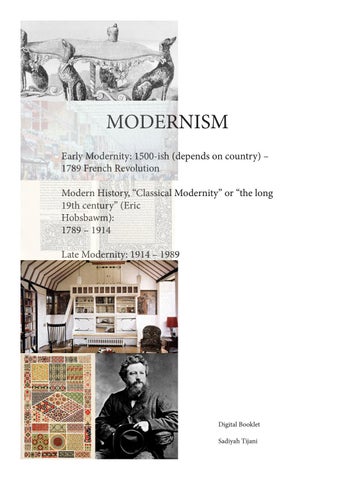
MODERNISM Early Modernity: 1500-ish (depends on country) – 1789 French Revolution Modern History, “Classical Modernity” or “the long 19th century” (Eric Hobsbawm): 1789 – 1914 Late Modernity: 1914 – 1989
Digital Booklet Sadiyah Tijani
Contents Page 1 -Contents Page 2- Contents Page 3-References Page 4-Refernce Page 5-What is Modernism? Page 6-Modernism Pt 2 Page 7-The Pre-Raphaelites Page 8-The Pre-Raphaelites Page 9-Avante Garde Page 10-Avante Garde Page 11-Bahaus Page 12-Bahaus
Page 1
Page 13-Le Corbusier Page 14-Le Corbusier Page 15-Worksheet Page 16-Worksheet Page 17-Initial Ideas Page 18-Mindmap Page 19-Essay plan Page 20-Essay plan Page 21- Health and body culture poster
Page 2
References Front page Colquhoun, A. Modern Architecture (Oxford University Press 2002) Curtis, W. J. R. Modern Architecture since 1900 (Phaidon 1982, 1987, 1996) Fazio, M et al, (2013) A World History of Architecture, Lawrence King Publishing, LondonFrampton, K. Modern Achitecture, A Critical History (Thames and Hudson 1992, 2008) Modernism poster Christopher Wilk,2006,Modernism designing a new world, Accessed 1/10/17 Art Term Modernism, http://www.tate.org.uk/art/art-terms/m/modernism, Accessed 25/11/17 Figure 2 Karen Harvey,2017,Style board inspired by the 1930's, Polyvore, https://www.polyvore. com/1930s_modernism/set?id=139610253, Accessed 25/11/17 Figure 3 1905,Pope St.Pius X Pascendi, location of the photograph is unknown https://www.pinterest. co.uk/pin/469148486155105934/ Accessed 25/11/17 Figure 4 Chandigarh, Published: August 22, 2008, A planned city, City of Justice https://gregoviviasia. wordpress.com/2008/08/22/chandigahr-a-planned-city/ Accessed 25/11/17 The Pre-Raphaelites Dinah Roe, 15/05/14, The Pre-Raphaelites, https://www.bl.uk/romantics-and-victorians/articles/the-pre-raphaelites, Accessed 3/10/17. Essay by Dr. Rebecca Jeffrey Easby,2017, A Beginner's Guide to the Pre-Raphaelites, Edward Burne-Jones, The Adoration of the Magi, 1904, tapestry. https://www.khanacademy.org/humanities/becoming-modern/victorian-art-architecture/pre-raphaelites/ a/a-beginners-guide-to-the-pre-raphaelites, Accessed 25/11/17 The rest of the information was collected directly from the various descriptions around the museum. The sketch was also drawn from a piano in the museum. Bahaus Figure 1 Georg Muche, Haus am Horn, Bauhaus Model House plan http://moodle.bcu.ac.uk/pluginfile.php/1220189/mod_resource/content/1/Werkbund-Weimar%20 wk%203.pdf Figure2 Georg Muche, Haus am Horn, Bauhaus Model House plan, 1923 http://moodle.bcu.ac.uk/pluginfile.php/1220189/mod_resource/content/1/Werkbund-Weimar%20 wk%203.pdf Figure 3 http://moodle.bcu.ac.uk/pluginfile.php/1220189/mod_resource/content/1/Werkbund-Weimar%20 wk%203.pdf Figure 4
Page 3
Bauhaus Manifesto, 1919. Text by Walter Gropius, Frontispiece by Lyonel Feininger (Cathedral of Socialism) http://moodle.bcu.ac.uk/pluginfile.php/1220189/mod_resource/content/1/Werkbund-Weimar%20 wk%203.pdf Accessed 26/11/17 Lyonel Feininger ,2006,Cathedral (Kathedrale) for Program of the State Bauhaus in Weimar (Programm des Staatlichen Bauhauses in Weimar), https://www.moma.org/collection/works/63072 Accessed 26/11/17 Megan Sveiven,2010, The Art Story Modern Institute,2017, Lรกszlรณ Moholy-Nagy http://www.theartstory.org/artist-moholy-nagy-laszlo.htm Accessed 26/11/17 Walter Gropius, Bahaus Dessau,1926, AD Classics: Dessau Bauhaus/Walter Gropius https://www.archdaily.com/87728/ad-classics-dessau-bauhaus-walter-gropius Accessed 26/11/17 Figure (LAMP)R.J. Jucker and W. Wagenfeld, Bauhaus Metalwork Shop, Table Lamp, 1923-24Publication excerpt from The Museum of Modern Art, The Museum of Modern Art, revised 2004, originally published 1999, p. 119 https://www.moma.org/collection/works/4056 Accessed 26/11/17 Bauhaus Model House Interiors, 1923
Corbusier http://ktstudiokt.net/KT_Studio_KT/3356SP07_President_Research_files/presentation_1.pdf 14/10/2017 Usman Sabih,15/01/13,Ronchamp By Le Corbusier,https://www.slideshare.net/uzrman/ronchamp-by-le-corbusier,16/10/17. https://www.google.co.uk/maps/place/Notre+Dame+du+Haut/@47.7125455,6.7059377,11.75z/data=!4m5!3m4!1s0x0:0x3ba181109736225c!8m2!3d47.7044746!4d6.6206766 16/10/17. Andrew Kroll,3/10/10,AD Classics: Ronchamp / Le Corbusier ,http://www.archdaily.com/84988/ad-classics-ronchamp-le-corbusier,16/10/17 Winston, A Le Corbusiers Ronchamp chapel is one of the 20th centurys most important buildings, https://www.dezeen.com/2016/07/24/le-corbusier-notre-dame-du-haut-ronchamp-chapel-france-unesco-world-heritage-list/ 14/10/17
Page 4
Figure 1 Modernism development in the context of architecture. Page 5
Figure 2
Figure 3
By the late 1950’s Modernism was seen as a collection of ideas in connection with the various movemements and styles. It was particulary popular in places like Moscow and Holland . By the 1930’s it stood solidily in the Americam marketplace as beingf a style to identify contempary design. Modernism wasn’t just as international concept, designers of the era moved between NYC,LA and European capitals. Ludwig stated that his work represented a phenomonen emerging across the world. In regards to the church however, Modernism was used to try
to bond the gap between science and modern ideas with historical Christianity.
Page 6
Figure 4
the movement meant individuals wanted to divorce themselves from history, sense of place, tradition and it alienated segmetns of the populaPope Pius produced the vatican tion that had different views. Encyclical in 1097 on the ‘The Doctrine of Modernists’ argu- Corbusier took the backlash with ing that Moernism was to lead his ‘poorly designed concrete structo atheism and the destruction tures that had no beauty and could be found in Modernist production’. of all religions. Throughout this time Modernists still believed architecture based The legacy of Modernism proves controversial and com- on utopism and modern industrialization could solve the pressing plex. Post-Modern designers issues of today and they therefore and architectects treated the concept as a historical phenom- still lobbied for living environonen. The height of these argu- ments that were visibe and material ments contined into the 1970’s expressions of there beliefs. Overall I think Modernism was important especially in the UK where to bring the changes we have in critics argued society today.
The Pre-Raphaelites The Pre-Raphaelites were a collective of Victorian poets, painters, illustrators and designers. The Pre-Raphaelite work incorporated elements of 19th-century realism in its attention to detail and in its close observation of the natural world. Driven by, as Oscar Wilde put it, ‘three things the English public never forgives: youth, power and enthusiasm’, Pre-Raphaelitism found itself paradoxically poised between nostalgia for the past and excitement about the future. 19th-century disagreements over whether their art was forward-thinking or retrogressive set a precedent for current critical debates about the extent to which their work should be considered ‘avant-garde’. This concept of disputed change relates to modernism era of architecture where buildings were critiqued for being ‘too progressive’.
Figure 5 Dante Gabriel Rossetti (1828-82) The Girlhood of Mary Virgin
This was Rossetti’s first major oil painting and the first picture to be exhibited with the mysterious intials , ‘PRB’. It begun in 1848 and was completed in 184 , with the help of both Madox Brown Holmon Hunt. The models for the Virgin Mary and her mother were Rossetti’s sister Christina and their Mother. The picture is (add dicken’s hatred of the group) full of books inscribed wit the coordinal virtue inscribed tot adores tot gaudia(so many sermons, so many joys, symbols of the passion to come) Behind St Anne is a cross entwined with ivy, a crimson cloack. emleematic of the Robe of Christ and a haloed dove, symbolic of the Holy Spirit. In background St Joseph prunes a vine, a symbol of the True Vine and Great sacrfice.
Page 7
Figure 6 William Holman Hunt, Hunts first PRB painting, exhibited at the Royal Academy in 1849 where it hung next tio the Mileais’ Isabella. This was the first image where Hunt followed the Pre-Raphaelite principles, painting the landscape direct from the nature of outdoors,’abjuring altogether brown foliage,smoky clouds and dark corners. In the Autumn of 1848 the brotherhood was formed. With various disputes eventually they formed a group of seven. This motley band of youthful rebels launched sucha an effective attack og the aristic establishment is one of the wonders of English art and history. Through the winter of 1848-49 the Brotherhoos held regular meetings to discuss their ideas, progress of their pictures and occasionally sketch together on a certain subject.
Figure 7 Sir John Evertt Millais Christ in the house of his Parents Exhibited at the Royal academy in 1950 They also drew up lists of ‘Immortals’, hereos of art and literature of whom they particulary admired. (Add description of the image
Figure 8
William Holman Hunt(18261910) The Finding of the Saviour in the Temple 1854-55
I took this in the gallery. The biblical scene brings Hunt’s interest to a family reunion with an obsessive realism to represent the architecture and elders in a Jewish temple. The floor of the temple in the foreground was painted from ‘slabs on the local limestone rock’ but the architectural setting was actually completed in England. The Pre-Raphaelites may appear less than modern. However, in their own time the Pre-Raphaelite Brotherhood accomplished something revolutionary.
Page 8
Figure 9 This is a sketch of the piano that I drew in the gallery. The harpischord-like shape of this piano reflects Burne-Jones’ efforts to reform the grand piano in the late 19th century. It was decorated by Kate Faulkner and shows how Burne-Jones’ work collaboratively as a decorative artist to add pattern and details to objects that would’ve been previously left plain. (Add conclusion
desi be politic Can
14/06/17 80 deaths
Page 9
Who
ign
cal?
‘Grenfell is a testimon y to how design is failing London. London is failing’
will pay? Page 10
Bahaus
Figure
Figure
Figure
This black-and-white woodcut served as a cover design for the Bauhaus manifesto by architect and founder Walter Gropius. He became interested in the concept of the crystal in Architecture and how those forms could form beautiful buildings. The image reflects the aura of medievalism that pervaded the initial phase of the Bauhaus, whose academic system harks back to the training employed by Late Gothic craft guilds. Lyonel Feininger was invited by Gropius in 1919 to head the printmaking workshop, and he retained his connection with the school until it closed, in 1933.
László Moholy-Nagy is arguably one of the greatest influences on post-war art education in the United States. He was a Hungarian painter and photographer as well as a professor in the Bauhaus school. The figure above shows his designs to represent the Bahuas school. A modernist and a restless experimentalist from the outset, the Hungarian-born artist was shaped by Dadaism, Suprematism, Constructivism, and debates about photography. When Walter Gropius invited him to teach at the Bauhaus, in Dessau, Germany, he took over the school’s crucial preliminary course, and gave it a more practical, experimental, and technological bent. He later delved into various fields, from commercial design to theater set design, and also made films and worked as a magazine art director. But his greatest legacy was the version of Bauhaus teaching he brought to the United States, where he established the highly influential Institute of Design in Chicago.
Interested in creating a new form of design found at the intersection of architecture, art, industrial design, typography, graphic design, and interior design, Walter Gropius was inspired to create an institution known as the Bauhaus at Dessau, with an emerging style that would forever influence architecture. Gropius took this as an opportunity to build a school that reflected his hopes for the education that would be had within it’s walls. The style of the Dessau facilities hints at the more futuristic style of Gropius in 1914, also showing similarities to the International style more than the Neo-classic style. The building is made up of the technical school,offices,workshop building, student quarters and dining hall. “Like De Stijl painting, in a sense the Bauhaus was composed of basically related functional elements that produced a cohesive interrelated asymmetric whole.”
Page 11
Figure
Figure
Figure
1922 Peter Keler Cradle
This object, known as the “Bauhaus lamp,” embodies an essential idea—form follows function. The lamp was produced in the Bauhaus metal workshop after its re-organization in 1923. The workshop promoted the use of new materials and favored mass production under a collaborative, rather than individual, approach. Today, the lamp is widely produced by Techno-lumen of Bremen, Germany, and is generally perceived as an icon of modern industrial design. I personally noticed that his designs have been recreated in todays Modern technology. Apple has clearly taken inspiration through the white tints. The minimalisitc colours and materials are clearly present in thir signature laptops and Apple Macs. This shows that in our diverse design driven society, simple colours often prove the most popular.
1923 Breuer Childs chair
This chair holds particular interest simply due to the futuristic concept it presents both in 1922 and 2017. I like the fact that the chair is supported by large circles instead of rockers. This is one of the most iconic examples of Keler’s furniture with the primary colour accents radiatin radiating through again.
Page 12
This design introduces ‘traditionally modern’ materials such as the flat panels on the chair made of plywood. A commonly used material in today’s architecture . Though the materials used represent modernistic thinking the colour scheme still traditionally Bauhaus.
Page 13
Page 14
This section helped me to understand how to reference properly in academic essays. I didn’t understand the right way to organise a reference but to solve this issue I went to Moodle where I was given examples on how they should be structured. Page 15
Page 16
Initial Ideas
Page 17
Essay Mindmap Introduction
SESC Pom- Desccribe the peia. various buildings, Preserving what they Brutalism look like today, how they’ve Queen been Victoria building. preserved and the Definition effects of of human- humaist Architecism. ture in today’s Lasdun’s society. commitment to humanism.
B O D Y P A R T T W O
Mention the questoin. History of Modern Architecture topic. Main Architects that pushed the movement. Manchester Architecture. New Brutalism dominated British housing and Civic building projects in the 1950’s and 1970’s. Discuss how the movements first emerged and developed through it’s period eventually taking a humanist approach. Identify the main Architects associated with the movement , and discuss it’s development in British Architecture, with reference to at least two building schemes.
Conclusion
Conclude in a short paragraph Summarise what was discussed in the essay. Draw everything together. Mention what has helped it’s resurgence.
Page 18
B O D Y P A R T O N E
Desribe each of the points in paragraph style form and detail. (What movements came first and the transition time between them)
History of Brutalism. Post war 1940’s housing. Moving away from alien sensability. Unité d’Habitation revolution. The ‘Brutalist beast’. Brutalist social housing in the modern day.
FIVE PARAGRAPH ESSAY Main ‘response’ to questoing, introductory idea and flagging up topics to be covered.
Topic 1
Introduce-Proof
Discussion-Point
Topic 2
Introduce-Point Introduce-Point
Discussion-Point
Reinstate main arguments and points.
Page 19
Topic 3
Discussion-Point
The main response to the questoin chosen will be going back and forth betweeen traditonal Brutalism and New Brutalism. I want to look at the Post-war era to see how effected civic building and housing projects at that time and show how political disasters do not always have to ruin a country forever. To support this I will do research into Precedent studies of that era and find the most important Architects of that time period to further explain the questoin. I will need to do research into the defintions of Brutalism and New Brutalism to be able to distinguish the different styles and the time periods they were built in. 1. War politics movement and how it impacted that design era, why did architects choose to create design that would react in a certain way to the political climate of that time. What did they do to end the alien sensibility that took over that generation.
2. Origins of the movement in more further depth, who was the defining figure in shaping the movememnt? where did the style originate? How did it become popular amond designers and wealthy clients? What did Architure look like(use Le Corbusier’s Unité d’Habitation in Marseille for example) 3. Precedent Research Two types of ‘Brutalist design’ Le Corbusier’s Unité d’Habitation in Marseille. The Park Hill Estate.(Include drawing) Two types of ‘New Brutalist desigh’ The SESC Pompeia by Marcelo Ferraz. Queen Victoria Building 1880 in Sydney. One type of new Brutalist Design Brutalist University design(Include drawing) Mention the differences and similarties of the buildings throughout the essay as on-going comparisons, constanlty make reference back to them to back up points made. Humainsm How has this ideology helped to create sustainable design? How did it impact the approact to Architecture in thr 21st century. What materials and technology defined the style and what parts make it recognisable when trying to distinguish these buildings today. Pick one main and other supporting Architects in this movement. Mention examples of designs from those people and insert photographs of what they look today. Following these sheets have helped me focus in on my essay questoin, what content is important and how the essay should be oraginsed to make it easier for the reader. I information has helped to decide where and what to research for my questoin and further ask myself what parts of the information I gathered are most relevant to my questoin. Looking back handouts and seminars have also helped to develop my essay writing techniques. Page 20
Health and body culture poster
Page 21