



The firm maintains a diverse, businessoriented practice focused on investment funds, litigation, corporate, real estate, regulatory and compliance, tax and ERISA.
Drawing on the experience and depth of our lawyers in these distinct areas, we can leverage each lawyer’s industryspecific knowledge to help our clients succeed. This collaborative approach brings to the table a collective insight that contributes to sensible, efficient resolutions, and allows us to remain attentive to the cost and time sensitivities that may be involved.
Sadis’s clients include domestic and international entities, financial institutions, hedge funds, private equity funds, venture capital funds, buyout funds, commodity pools, and numerous businesses operating in various industries around the world.


BY PAUL MARINO
SADIS & GOLDBERG

For those of you who live outside of the greater New York Metropolitan area, you may have missed and/or may not have paid attention to one of the strangest story lines of 2026. The “Kokomo” Curse.1 What you ask is the Kokomo Curse, well in April 2026, amid a brutal 12game losing streak, Mets fans began searching for answers—and found one in an unlikely place. Many
pointed back to June 11, 2025, the day Beach Boys icon Brian Wilson passed away, as the moment everything seemed to turn. According to a Reddit user, Franklin Benedict, the Mets’ in-stadium DJ played “Kokomo” that day as a tribute, and the team’s record since—47–70—was offered, halfseriously, as evidence of a lingering curse.2 The theory quickly took on a life of its own, spreading
across social media as fans leaned into the absurdity with jokes about “Met Sounds” and “God Only Knows…what the team was thinking.”3
For me, Kokomo is a song correlated and attributed to the often panned but always enjoyable movie, “Cocktail” staring Tom Cruise and Elizabeth Shue. For those who don’t remember, it was a lighthearted romcom that dealt with a variety of growing pains in any young adult’s life including but not limited to making bad decisions due to the love of money. In any event, the thing about Kokomo is it wasn’t written by nor did Brian Wilson perform on Kokomo (in fact Brian Wilson did not like the song at all)—so playing it on the day he passed was both inaccurate and insulting (like playing Silly Love Songs on a John Lennon tribute day).4
Alas, I digress. If the last few years felt like being stranded in a storm, the industry is now looking for its version of “Kokomo”—a return to smoother waters where deals flow, exits materialize, and capital circulates efficiently—basically Cocktails and Dreams.5
But this is not the same beach lovers paradise as before.
In the pre-2022 era, leverage was abundant, covenant-lite structures were common, and aggressive growth assumptions were rewarded. Today’s deals are more grounded. Credit is a looser but lenders are still not on a covenant lite glide path. Equity checks are larger. Diligence is deeper. And investment committees are asking harder questions.
better but one must remember Coughlin’s law #3—“Anything else is always something better.”6
In other words, there is a belief that there is a better deal out there on both sides of a transaction and as such, transactions are not necessarily a great fit for either party, which tamps down the mania that usually coincides with a hot deal market. Further, many potential sellers have businesses that generate 3, 5, 8, 11mm in EBITDA—that’s a nice paycheck and if you believe Coughlin’s law #3—you’re not in a rush to sell.
As it relates to transactions, what we are seeing a (likely permanent) shift in deal dynamics:
• Auction processes are more selective, with fewer bidders advancing to final rounds.
h On the other hand, higher quality companies are seeing much greater demand.
• Quality assets still command premiums, but the gap between top-tier and average businesses has widened.
h The spread in multiples between companies that are “move in ready” with great curb appeal is the highest its ever been.7
• Proprietary sourcing has regained importance, particularly for firms that can originate off-market opportunities.
both a challenge and an opportunity. Without committed capital, they must work harder to secure financing and equity partners. But in a less frothy market, their agility and creativity become advantages. They are often better positioned to pursue niche deals, structure flexible transactions, and move quickly where larger funds cannot.
There are moments in markets when sentiment shifts before the data confirms it—when dealmakers, lenders, and operators begin to sense a change in rhythm. The private equity landscape in 2026 feels like one of those moments. After a prolonged period of higher interest rates, tighter credit, and valuation recalibration, there’s a cautious but undeniable return of “good vibrations.”
Deal activity, while not roaring back to 2021 levels, has stabilized. The denominator effect that once constrained LP allocations has eased as public markets recovered and portfolios rebalanced. More importantly, private equity firms have adapted. They’ve adjusted underwriting assumptions, embraced operational value creation over financial engineering, and recalibrated exit expectations.
The cost of capital remains higher than the ultralow-rate era, but it is no longer a shock—it is a known input. And markets, above all else, reward certainty. Sponsors are once again able to model with confidence, even if returns are incrementally lower and timelines longer.
healthier private equity environment—one where value must be built, not merely bought.
It’s a growth story that has more growth than story. Management must be strong and the missing ingredient is not know-how but in fact management experience or just deal tenacity.
Possibly my favorite Beach Boys song and one of if not the best of Brian Wilson. It is also the refrain of many sponsors as it relates to the one area that is the great unknown: exits. “God Only Knows” might be the most fitting refrain for sponsors staring at aging portfolios and uncertain liquidity pathways.
The traditional exit routes—strategic sales, sponsor-to-sponsor transactions, and IPOs—have all been impacted:
• Strategic buyers remain active but are more selective, often constrained by their own cost of capital and integration concerns. Right now, strategics are the best opportunity for sellers (be it PE or privately held businesses).
• Secondary buyouts continue, but valuation gaps between buyers and sellers persist—and the discount to face on a portfolio has lessened dramatically—so are you really get a good deal or are you buying a shorter time horizon for an exit? Seems like neither right now.
To some a return to anything but now would be
For independent sponsors, this environment is
What’s emerging is a more disciplined, arguably
• IPO markets have reopened selectively, but not at the scale needed to clear the backlog— however that might change a some of the largest IPO’s in history will debut now (starting w/ Cerebras) through the fall. If the IPO market
rips—which this writer believes it will—you’ll see many unicorns go public along with a large number of PE backed rollup strategies (accounting firms, etc.).
As a result, sponsors are increasingly turning to alternative solutions:
• Continuation funds and GP-led secondaries have become mainstream tools for extending hold periods while providing partial liquidity. With that in mind, a private discussion with LPs will quickly devolve into a discussion about the lack of excitement for these vehicles and there won’t be as most LPs want DPI—not longer hold periods.
• Dividend recapitalizations, once ubiquitous, are now used more cautiously given leverage constraints. This is an area that I believe needs to be reexamined by sponsors and/or private owners. Often just taking some money off the table is a great way to derisk asset allocation for a founder(s) and allow a buyer (private equity/ independent sponsor or strategic to gain access to a business without going “all-in”).
• Minority sales and structured equity are filling gaps where full exits are not feasible. This is actually a growing part of the buyout landscape. Allowing parties put/call positions to either get deeper in and/or get out of a deal are becoming commonplace.
For independent sponsors, exits are even more nuanced. Without the same portfolio diversification as large funds, each investment carries greater weight. Timing becomes critical, and relationships with capital partners can determine whether an exit opportunity is realized or deferred.
In this environment, patience is not just a virtue—it is a strategy but waiting for the perfect exit (for PE or independent sponsors) will lead to disgruntled investors. Never make perfect the enemy of good enough.
“Wouldn’t It Be Nice” captures a sense of longing— for a simpler, more accommodating capital environment.
In many ways, the industry is still adjusting to a world where:
• Interest rates are structurally higher
• Inflation remains a consideration (there are a variety of reasons why inflation is here to stay and some have to do with debt but a lot has to do with demographic shifts)8
• Geopolitical uncertainty influences markets (as I write this article, the Iran conflict is still ongoing (oil is $90-110 a barrel) but I don’t believe geopolitical uncertainty will play a large role in US gdp growth).
The ideal scenario for private equity/independent sponsors would include:
• Lower borrowing costs: this will happen in the next 18-24 months
• Stable economic growth: already in place
• Predictable exit markets: sellers have to have a reckoning as it relates to
But perfection is not required for success. Private equity has historically performed well across cycles
by adapting to prevailing conditions.
Today’s firms are:
• Using less leverage and focusing on operational improvements
• Structuring deals with more equity and creative financing
• Building resilience into portfolio companies
Independent sponsors, in particular, are embracing creativity—using seller financing, earnouts, equity rolls and structured equity to bridge valuation gaps.
The broader economic backdrop—captured by GDP growth—remains a critical factor for private equity.
The U.S. economy in 2026 is characterized by moderate growth. Not a boom, but not a recession either. This “steady surf” creates a workable environment for dealmaking:
• Consumer spending remains resilient (BTW, I’ve given up looking at consumer sentiment index—it’s always a lie because consumers keep on buying)
• Corporate earnings are stable
• Employment levels support economic activity
However, there are undercurrents:
• Interest rate sensitivity continues to impact capital-intensive sectors
• Supply chain dynamics, while improved, are not
fully normalized
• Global economic divergence creates both risks and opportunities
For private equity, GDP growth influences:
• Revenue projections
• Exit valuations
• Availability of leverage
Independent sponsors, often focused on smaller businesses, are particularly sensitive to local economic conditions. Their ability to identify resilient niches—businesses that can perform across cycles—is a key differentiator. Like surfing, success is about timing, balance, and reading the waves.
“Help Me, Rhonda” might as well be the anthem of sponsors seeking capital in a more selective environment. Capital providers—LPs, family offices, credit funds—have become more discerning: prioritize track record and alignment, deal teams (no single shingle), scrutinize underwriting assumptions and demand transparency and communication.
For independent sponsors, securing capital is often the most challenging aspect of the model. Relationships matter more than ever. At the same time, capital providers are looking for opportunities to deploy. Private equity remains an attractive asset class, offering potential for outperformance relative to public markets. The dynamic is not one of scarcity, but of selectivity.
In short, exits have been few and far between, there is angst amongst LPs but there is money still out there. Reminds me of one of Coughlin’s laws: “The luck is gone, the brain is shot, but the liquor we still got.”9
I always liked this song even though it is based upon a disastrous sailing trip (fights, drunkenness and spoiled food—sounds like a party boat leaving City Island in the Bronx). The journey is not without turbulence. “Sloop John B” captures the feeling of navigating uncertain seas—something the industry knows well.
Key challenges include:
• Refinancing risk for portfolio companies with maturing debt
• Valuation mismatches between buyers and sellers
• Regulatory scrutiny in certain sectors
• Technological disruption, particularly from AI
Independent sponsors, with fewer resources, must be particularly strategic. Partnering with experienced operators, leveraging advisory networks, and maintaining disciplined underwriting are essential. The seas may be choppy, but they are navigable.
Despite the challenges, there is a renewed sense of optimism—perhaps even a return to “Fun, Fun, Fun.”
Dealmakers are back in motion. Conversations are happening. Capital is being deployed. The industry is rediscovering its rhythm.
This optimism is grounded in reality:
• The excesses of the past have been tempered
• The lessons of recent years have been absorbed
• The foundation for sustainable growth is stronger
Private equity is, at its core, a long-term business. Cycles come and go, but the ability to create value endures.
For independent sponsors, the opportunity is particularly compelling. As the market evolves, their flexibility, creativity, and entrepreneurial mindset position them well to capture value in overlooked corners of the market.
The current state of private equity, the independent sponsor market, and the broader economy is not defined by a single note, but by a complex composition.
There are moments of “Good Vibrations,” tempered by the uncertainty of “God Only Knows.” There is a search for “Kokomo,” balanced by the reality of navigating “Sloop John B.” There is introspection and optimism in “Fun, Fun, Fun.”
GDP growth provides the rhythm, capital markets set the tempo, and sponsors—both traditional and independent—compose the melody. The result is a new soundtrack for the industry—
one that reflects resilience, adaptation, and the enduring pursuit of value.
And if the past few years have shown anything, it’s this: private equity doesn’t need perfect conditions to succeed. It just needs the ability to listen, adjust, and move in time with the music.
Finally, let’s remember Coughlin’s law #10, “You see, there are two kinds of people in this world: the workers and the hustlers. The hustlers never work
and the workers never hustle..” If you’re either or neither of those two people, just remember Coughlin’s law #1: the golden rule: “he who holds the gold makes the rules.”
Enjoy your summer!
1https://sports.yahoo.com/articles/york-mets-cursed-kokomo-080002173.html?fr=sycsrp_catchall (visited, 5/6/2026)
2 https://www.reddit.com/r/baseball/comments/1sp9jnq/mets_broadcast_call_of_the_final_out_of_the_game/
3 As I write this article, the Mets are struggling with a 13-22 record (.371 baseball)—and with the second highest payroll in the sport could challenge the 1992 Mets as “The Worst Team Money could Buy” (a great book chronicling this season is by John Harper and Bob Klapisch under the title “The Worst Team Money could Buy” https://www.amazon.com/WorstTeam-Money-Could-Buy/dp/0803278225.
4 Silly Love Songs - Wikipedia (visited, May 19, 2026) https://en.wikipedia.org/wiki/Silly_Love_Songs
5 This is the name of the protagonist’s bar in the movie Cocktail; it is also the name of a spoof of Cocktail, Cocktails & Dreams (2015) - Cast & Crew — The Movie Database (TMDB) (visited, May 19th, 2026). https://www.themoviedb.org/ movie/703919-cocktails-dreams/cast
6 https://en.wikiquote.org/wiki/Cocktail_%28film%29
7 Which is why having a pre-QofE is important and making sure all of your legal and other diligence
8 https://www.bis.org/publ/work722.htm (visited, 5/14/2026)
9 Suicide note to Brian Flanagan, reflecting on his life and regrets en.wikiquote.org+1. https://en.wikiquote.org/wiki/ Cocktail_%28film%29
10 “As for the rest of Coughlin's Laws, ignore them. The guy was always full of shit. But I guess you knew that already.”++

PAUL MARINO Partner
Sadis & Goldberg pmarino@sadis.com
Paul Marino is a partner in the Financial Services and Corporate Groups. Paul focuses his practice in matters concerning financial services, corporate law and corporate finance. Paul provides counsel in the areas of private equity funds and mergers and acquisitions for private equity firms and public and private companies and private equity fund and hedge fund formation.
BY PAUL ORIS
CAPITAL

If you are an independent sponsor running a process for a lower-middle-market platform, you are likely fielding term sheets from three or four flavors of capital provider: a senior lender, a unitranche fund, maybe a BDC, and somewhere in the stack, an SBIC. The senior and unitranche conversations probably feel familiar. The SBIC may not.
SBICs — Small Business Investment Companies — are private investment funds licensed by the U.S. Small Business Administration. The program was
created by Congress in 1958 to channel patient capital to American small businesses, and despite being older than most of the firms competing in today’s lower middle market, it has aged into something genuinely useful. Roughly two hundred active SBICs collectively manage tens of billions of dollars in private capital, augmented by SBAguaranteed debentures.
Understanding the structure is worth the time, because it shapes how an SBIC fund behaves at the table — and how it behaves three years later
when something inevitably comes up at a portfolio company.
An SBIC raises a private fund in the conventional way — committed capital from limited partners, ten-year life, general partner who manages the investments. The wrinkle is that the SBA will guarantee debentures issued by the fund up to roughly two times the private commitments, subject to a per-fund cap currently set in the hundreds of millions. Those debentures are ten-year, fixed-rate,
interest-only obligations of the fund, not of the portfolio companies. The SBA charges a fee, and the debenture program has run at zero subsidy to taxpayers since 2000.
The practical effect is that an SBIC has two pools of capital it can deploy: the LP money, which behaves like any other private equity commitment, and the SBA debenture proceeds, which behave like longdated, fixed-cost leverage at the fund level. That structure is what lets a $100 million SBIC invest like a $300 million fund while keeping its check sizes
appropriate to the lower middle market.
Start with senior debt. A senior bank or asset-based lender provides the cheapest money in the stack, but it is secured, heavily covenanted, and not in the business of underwriting real cash-flow risk in the lower middle market. It is a cost of capital, not a partner — you might want it in your structure, but you do not want it carrying the deal.
A credit fund — a private mezzanine fund, a BDC, or a unitranche shop — is funded fundamentally differently. It raises LP capital and, depending on the structure, layers on bank financing, leverage facilities, or rated debt issued by the fund. Its cost of capital is set by what those lenders demand, which moves with rates and credit cycles. Its return profile is calibrated to a credit-style return: current yield plus a modest equity kicker, in the case of mezzanine, or just yield, in the case of senior unitranche.
An SBIC junior capital fund, by contrast, gets fundlevel leverage at a fixed coupon for a decade, and raises LP capital that targets equity-like returns. The math allows — though it does not require — the fund to write checks that combine subordinated debt with a meaningful equity component, at allin costs that compete favorably with what a pure credit fund needs to charge to clear its hurdles.
Credit funds exist because the market needs scaled, yield-oriented lenders, and they do that job well. But for an independent sponsor structuring a platform acquisition, the distinction matters. A credit fund optimizes for contractual yield and
capital efficiency. A junior capital SBIC, properly run, optimizes for total return — which means it cares about the equity outcome, not just the coupon, and is structurally willing to hold smaller, more concentrated positions in companies it actually likes.
A few features of the SBIC structure line up unusually well with the independent sponsor model.
First, the SBIC fund typically writes both the subdebt and the equity check. For a sponsor without a committed fund, that means one diligence process, one set of documents, one capital partner to negotiate with, rather than a syndicate. It compresses time to close, which is often the variable that determines whether a deal happens at all.
Second, the equity participation aligns incentives in a way that pure credit cannot. When the SBIC owns equity alongside the sponsor, it has the same interest in operational performance, the same patience through a rough quarter, and the same reason to be constructive when an add-on opportunity arises. The capital provider becomes a partner rather than a counterparty.
Third — and this is the part that is hardest to put in a deck but matters most — the behavior in the downside case is different. Credit funds are not bad actors when a deal struggles, but their incentives and their loan documents are calibrated to protect yield. An SBIC that owns equity has every reason to work the problem alongside the sponsor. Anyone

who has lived through a covenant trip knows the difference.
Recent academic research is consistent with the experience side. A 2024 study of SBIC performance from vintages 2000 through 2020, conducted by the University of North Carolina’s Institute for Private Capital with MSCI-Burgiss, found that junior debt SBIC funds outperformed comparable non-SBIC mezzanine funds by roughly five percentage points of IRR on average, with about three-quarters of funds beating their peer benchmark. That is not a puff statistic. It reflects a structural advantage, and it explains why the program continues to attract serious managers.
Strip away the theory and the typical SBIC deal in this segment has a recognizable shape.
The target is usually a founder- or family-owned business with $3 to $15 million of EBITDA, margins north of 10 percent, and operations anywhere in the United States. It is profitable, established, and looking for a partner to facilitate the next stage of growth, an ownership transition, or a family wealth transfer. Industries vary widely — business services, niche manufacturing, value-added distribution, healthcare services, food and beverage, industrial and environmental services, and many others — but the common thread is that the underlying business is durable and cash-generative.
Acquisition values cover a wide range — anywhere from roughly $10 million up to $100 million or more in enterprise value, with the SBA’s small-business
size definitions capping the very top end through a formula tied to net income and tangible net worth. Total leverage at close usually sits under four turns of EBITDA. The SBIC typically writes subordinated debt of $5 to $20 million and an equity coinvestment of up to $10 million from the same fund — a total commitment from one capital partner in the $5 to $30 million range. The seller typically rolls 15 to 40 percent of the equity. The sponsor then rolls all or most of the transaction fee, contributes personally meaningful hard dollars of their own, and closes the equity stack with a friends-andfamily raise alongside the SBIC co-invest.
On larger deals, SBICs frequently syndicate. The capacity scales meaningfully — a syndicate of two or three SBICs can deliver $50 million-plus of subordinated debt, with equity co-investment running roughly half the size of the debt check. Broader syndicates ask more of everyone in coordination, but for the right deal the format works and lets a single program of capital scale to meet the deal.
The economics follow conventions familiar to the segment. Closing fees on the deal, add-on fees on bolt-ons, and a management fee tied to EBITDA all sit in market ranges. The independent sponsor’s carry typically lands around 20 percent of equity value, structured around IRR and MOIC hurdles that step up the sponsor’s percentage as performance climbs — though structures with stronger downside protection and properly calibrated hurdles can support a somewhat higher promote. Board representation tracks equity ownership.
All of which is to say: defining a “typical” SBIC deal is itself something of an exercise in caveats.
Deals come in a lot of shapes and sizes, and that flexibility is the SBIC strategy’s defining feature. The reliable test is on the other side of the cap table: if it is a good business surrounded by good people — a credible sponsor, a capable management team — an SBIC will usually find a way to make the capital work for the situation.
It is worth being clear about what an SBIC is not. It is not free money — the SBA leverage carries a real cost, and SBICs are subject to genuine regulatory overhead, including portfolio reporting and smallbusiness size definitions that not every target will satisfy. It is not the right tool for a large LBO of an EBITDA-rich, low-growth target where pure unitranche is cheaper and faster. And it is not, on its own, a substitute for a sophisticated equity partner if the sponsor needs deep operational support that the capital provider cannot offer. What it is, when the deal fits, is a structurally wellaligned source of junior capital paired with equity, behaving with the patience that the structure was designed to enable.
For an independent sponsor evaluating capital partners on a new platform, the useful question is not what kind of fund the firm across the table happens to be. It is: how does your fund’s underlying capital structure shape your behavior across a holding period? The answer reveals more than any term sheet.
The reason an SBIC junior capital fund is a strong fit for many independent sponsor deals is not that it is cheaper or faster, although it can be both. It is that the structure was designed to do exactly what an independent sponsor needs done: provide patient, partnership-oriented capital to a lower-middlemarket business at a stage in its life when patience and partnership are more valuable than financial engineering.
That alignment is the thing worth shopping for. And in the lower middle market, no structure delivers it more cleanly than a well-run SBIC.

President
Founded in 2006 and based in Pittsburgh, PA, Tecum Capital Partners is a multi-strategy investment firm focused on investing in lower middle market companies across the U.S. We are relationship-based investors that seek to partner with and empower experienced management teams, with a track record of success and a desire to execute on well-defined operational and growth initiatives.

David Merwin, CEO, Co-Founder and Partner of Creekstone Capital Group, was recently interviewed regarding his experience as an operator, independent sponsor, and educator within the lower middle market M&A landscape. Through his work at Creekstone, Merwin has focused on building businesses through operational discipline, relationship-driven investing, and long-term strategic thinking.
Throughout the discussion, Merwin emphasized that successful acquisitions are often driven less by financial engineering and more by trust, patience, and credibility. In his view, lower middle market transactions remain highly relationship-oriented, with sellers placing significant importance on alignment, authenticity, and confidence in the longterm stewardship of their businesses. Rather than approaching acquisitions solely as financial transactions, he believes successful operators must invest meaningful time in developing rapport and understanding the people behind the companies.
Merwin also discussed the importance of operational experience in evaluating and managing businesses after acquisition. Having spent years operating companies directly, he believes handson leadership provides a practical perspective that
can be difficult to replicate through purely financial training. While industry expertise remains important, he noted that many of the core challenges of leadership, management, and execution are universal across businesses and sectors.
Another theme throughout the conversation was the importance of discipline and patience within the independent sponsor model. Merwin noted that successful dealmaking often requires a longterm mindset, particularly in situations where relationships and trust develop gradually over time. He also emphasized the importance of maintaining financial discipline and avoiding short-term decision-making driven by external pressure or limited time horizons.
With a relationship-oriented approach to investing and a strong emphasis on operational execution, Creekstone Capital Group continues to pursue opportunities where long-term thinking, strategic flexibility, and hands-on leadership can support sustainable business growth and value creation.
For an in-depth exploration of David Merwin’s business insights, please watch the full video interview at SADIS.com
BY W. SAM CHANDOHA ALLIANCE ADVISORS

For many years, a typical solicitation followed a predictable pattern. Companies would mail proxy materials to all shareholders, wait for approximately 25 percent of the votes to be returned, and then engage a proxy solicitor to launch an outbound telephone campaign to the remaining unvoted registered and NOBO accounts. The introduction of telephone voting by Shareholder Communications Corporation in the 1990s significantly improved this process: call-center agents could reach
ny company with a retail-heavy shareholder base faces the same reality: achieving a majority vote threshold at a shareholder meeting is both difficult and expensive. Shareholder demographics are remarkably consistent across these types of companies: large numbers of retail investors holding relatively small dollar-value positions, dispersed across intermediaries and account types. Whether a shareholder holds shares in street name or is registered makes little difference, the underlying demographic challenge remains the same. Compounding this issue, the NOBO/OBO framework allows a company to identify only roughly half of its street-name shareholders, which significantly limits direct outreach. The result is a persistent pattern of low engagement: a large population of shareholders who do not prioritize voting and often ignore traditional proxy mailings. These issues are not new. However, one structural development has turned what was once a manageable challenge into a more complex and costly undertaking: the dramatic expansion of share ownership across the investing population, especially younger investors.
shareholders at home, walk them through the voting process, and complete a vote in under two minutes. With a call center staffed by 200 agents, a proxy solicitor could contact approximately 20,000 shareholders during a single evening shift.
Today, that model faces substantial headwinds. The widespread adoption of mobile phones, combined with the abandonment of landline service in most households, has reduced the effectiveness of outbound calling. While telephone outreach is still used and continues to generate some votes, it can no longer be relied upon to bridge the gap between votes returned by mail and votes required for approval. Where agents once completed as many as 22 calls per hour, that number has dropped to roughly six to eight, as shareholders increasingly decline to answer calls from unfamiliar numbers or screen heavily against perceived spam. Even when fund groups possess mobile numbers, reachability and connection rates have declined.
The shareholder landscape in 2026 is unrecognizable from the the one that existed from a few years ago. The proliferation of low-cost brokerage platforms, the democratization of retail investing, and the explosive growth of exchange-traded funds have produced a seismic shift in the number of shareholder accounts in the U.S.
Exhibit 1: Estimated Brokerage Accounts by Decade (Top 10 Largest Brokers):
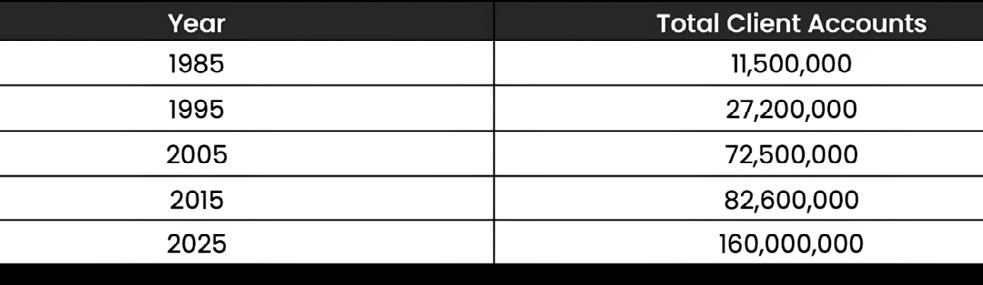
Just looking at Robinhood data alone, in 2016, the firm had an estimated one million funded accounts and in the latest quarter they reported 27.4 million, a twenty-seven-fold increase. Estimating the average number of holdings per brokerage account across the industry is difficult, but according to Charles Schwab, the average number of positions in self-directed accounts within the Schwab system is twelve across six categories of investment. Using only equities, the number is six which means that the number of holdings in brokerage accounts has grown from an estimated 69 million in 1985 to approximately 960 million in 2025, without counting mutual funds or ETF’s. This represents a fourteen-fold increase in the number of discrete shareholder-to-company relationships that the proxy communication system must serve. The cost and complexity implications are staggering, and they are borne overwhelmingly by issuers and, ultimately, their shareholders.
There is no single solution to retail shareholder engagement, and different shareholder segments respond to different approaches. Nonetheless, many proxy solicitation programs have historically leaned on a uniform playbook: mail, remail, and repeated outbound calling. In an environment where landlines are disappearing and digital communication is ubiquitous, that model is increasingly difficult to sustain on its own.
Alliance Advisors has developed a suite of digital tools designed to complement traditional solicitation methods and, in many situations, to extend or enhance their effectiveness. For larger shareholders, outbound telephone outreach
remains a useful tactic. For smaller, harder-to-reach, or historically unresponsive shareholders, targeted digital channels such as text messaging and branded email campaigns provide additional touchpoints that align more closely with how investors communicate today. This hybrid strategy can be more cost-effective and has the potential to generate vote returns even after traditional telephone campaigns have reached diminishing marginal results.
Alliance Advisors was engaged to assist with a large-scale proxy solicitation involving approximately 5,000,000 shareholders. The company had previously retained another proxy solicitor that, after one adjournment and more than 60 days of activity, had achieved only 38 percent of the outstanding shares voted, despite a requirement to reach 50 percent. At that point, the outbound call campaign had largely run its course and was generating minimal daily vote movement.
With 30 days remaining before the deadline, Alliance Advisors was retained with a clear mandate: deploy a broad suite of digital tools to re-engage shareholders and restart vote momentum. The objective was not to abandon traditional methods but to add complementary channels that could more effectively reach shareholders who were not responsive to previous outreach. It is important to note that no single tool operated as a standalone solution or “magic bullet.” Each tactic produced measurable results on its own, but the most meaningful impact came from a coordinated, phased strategy designed to reach different
shareholder segments at different points in the solicitation.
Below, is an overview of each of the digital tools that were used during this engagement to deliver the majority vote needed and a successful outcome
Given widespread reluctance to answer unknown phone calls, Text-to-Vote has emerged as an effective way to capture shareholder attention particularly among younger investors who prefer to transact via mobile devices. This approach allows Alliance Advisors to send shareholders a concise SMS or MMS text message containing an embedded, secure link that directs them to a voting page. Registered and NOBO shareholders can review key information and vote quickly and conveniently from their phones.
In this case study, Text-to-Vote accounted for 33.3 percent of the total votes captured during the solicitation. While the relative contribution of text messaging will vary by shareholder base and data quality, these results indicate that text can be a significant driver of incremental participation when integrated into a broader strategy.

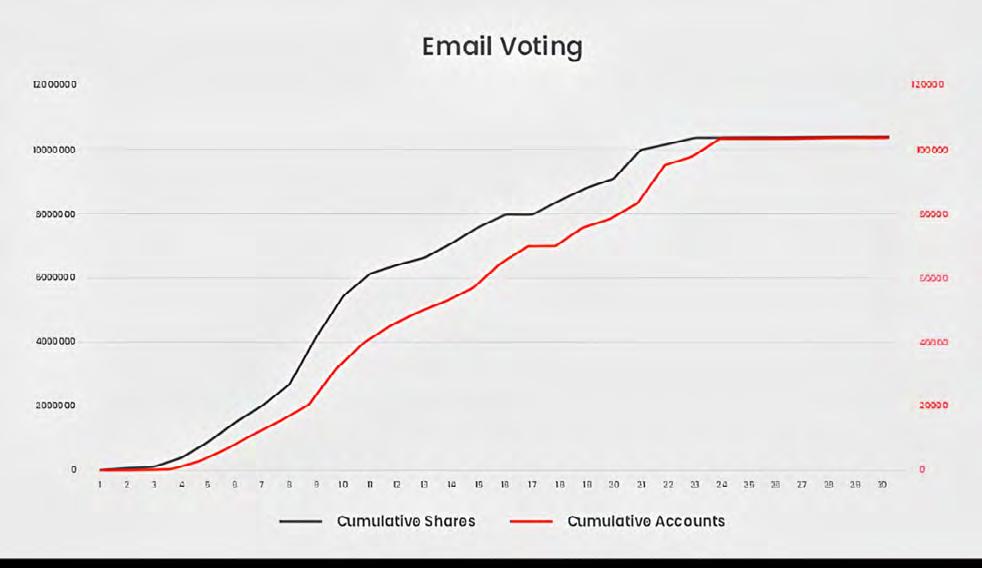
Email voting operates on a similar principle but allows for a more detailed communication than text. Branded email messages are delivered to
registered, OBO, and NOBO shareholders and include direct voting links that enable participation in just a few clicks. Unlike traditional mail, email provides immediate delivery, clear calls to action, and the ability for shareholders to vote without printing, signing, or mailing a proxy card. In the solicitation described above, Email Voting represented 37.9 percent of the total votes captured. For shareholder populations with reliable email coverage, this channel can serve both as a primary method of engagement and as a reinforcement to other outreach, particularly when reminders are sequenced over time.
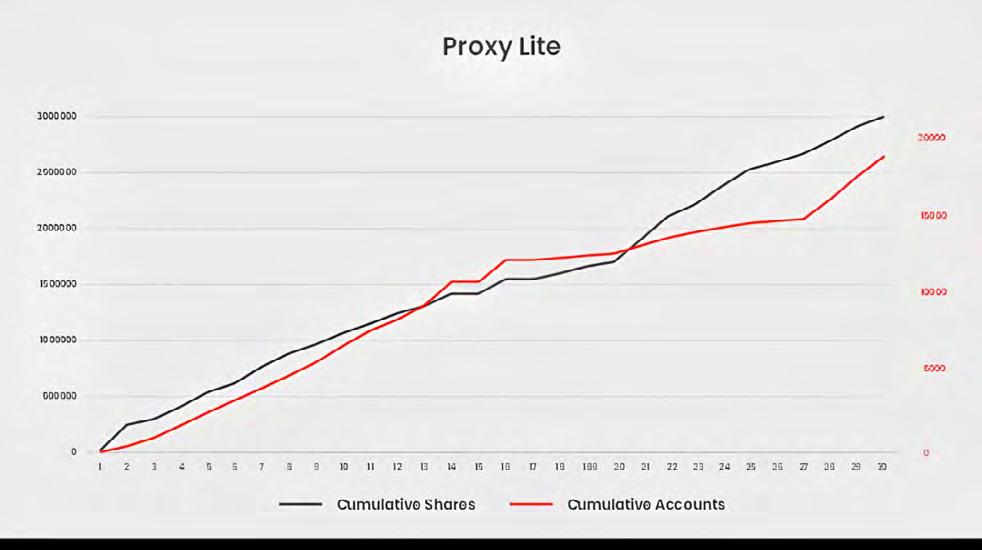
Proxy Lite is designed to address the same core challenge facing traditional outbound calling: shareholders’ reluctance to answer calls from unfamiliar numbers. In this approach, shareholders receive a prerecorded message asking them to call a toll-free number regarding their investment. When they return the call, they are connected to a live agent who can review the proposals and record their vote. If the shareholder answers the initial call, they can press “1” to be routed immediately to an agent.
inverts the dynamic by prompting shareholders to initiate the contact, which can reduce the friction associated with unsolicited calls.
QR Code Mailings are targeted communications sent late in the solicitation cycle to the largest unreachable or still-unvoted shareholders. These mailings emphasize urgency and provide shareholders with two immediate options: scan a QR code to vote electronically or call a live agent to cast their vote. By combining physical mail with digital and telephone options, this approach offers a clear, time-sensitive call to action at a critical stage.
In this campaign, QR Code Mailings represented 18.2 percent of the total votes captured. Although they are more targeted and often more expensive on a per-piece basis than standard mailings, their focus on large, unvoted positions can make them an efficient tool for closing the gap in the final days of a solicitation.
Across all these engagement strategies, a consistent theme emerges, immediacy. Digital tools provide shareholders with the ability to review key information and vote almost instantly, using channels they already rely on in their daily lives. Without simple, fast, and accessible voting options, many shareholder interactions fail to translate into actual votes, especially among those who are neutral or mildly supportive but not motivated to overcome procedural friction.
Alliance Advisors has been deploying digital solicitation tools for more than a decade, but their role in proxy campaigns has changed meaningfully as shareholder communication habits have evolved. In an environment marked by reachability challenges, declining landline usage, and changing expectations around convenience, digital tools have become a central component of many successful solicitation strategies, rather than a peripheral add-on.
Digital channels can deliver votes at every stage of the solicitation cycle, particularly in later phases when traditional methods have been exhausted and timelines are compressed. They can be implemented relatively quickly, scaled efficiently, and configured in a cost-conscious way when integrated with data-driven targeting and clear messaging.
The effective use of these tools is both an art and a science which require a nuanced understanding of shareholder behavior, regulatory obligations, and operational constraints. Alliance Advisors’ experience across numerous corporate and mutual fund solicitations indicates that a well-designed digital program, paired with traditional tactics where appropriate, can help funds meet their voting objectives while managing cost and mitigating execution risk.
In the case study, Proxy Lite accounted for 11.1 percent of the total votes captured. While this channel still relies on voice communication, it


W. SAM CHANDOHA Chief Marketing Officer & Head of Corporate Affairs Alliance Advisors
W. Sam Chandoha is a pioneer in alternative solicitation strategies for retail shareholders. He was the architect of the vote by telephone concept and designed the procedures and operational frameworks that form the basis of today’s industry standard practices. He is Head of Corporate Affairs at Alliance Advisors.
BY TRAVIS TAYLOR, MANUEL KOSER & MAROJE GUERTL
ALTIUS REACH

Private equity has well-rehearsed playbooks for valuing software businesses and services businesses. But an emerging class of hybriddelivery assets, companies that blend service execution with embedded technology, are forcing investors to reconsider the lenses through which they screen, diligence, and price deals.
•
global software spend is forecast at $1.44 trillion in 2026, professional services at $6.74 trillion, and 25-30% of tech PE AUM is already exposed to tech services.
• The hybrid middle is not one category. Techenabled services and software-embedded delivery have different economics, delivery models and diligence questions.
• The core risk is misclassification. A services lens can under-credit leverage and moat; a software lens can overpay for the economics the asset has not earned.
• The diligence test is practical: what is sold, what scales, what still requires people, and does the data exhaust genuinely compound?
The market is increasingly seeing hybrid-delivery assets that are neither clean services nor pure software. Software is increasingly expected to deliver verifiable outcomes beyond mere seat licenses, while service businesses are using proprietary technology to improve delivery leverage exponentially. This investable middle is highly attractive, yet the primary risk for private equity lies in misclassifying these hybrids as their "parent" categories. Diligencing a tech-enabled service through a generic services lens understates its operating leverage and data moat, while viewing software-embedded delivery through a pure SaaS lens risks overpaying for economics the asset has not structurally earned.
While the private equity sector historically relies on clean categorizations to allocate capital, deploy diligence playbooks, and establish valuation benchmarks, the market itself is quietly dismantling a few boundaries. An Altius Reach analysis of current market dynamics examines a
fundamental recalibration: the enterprise software and professional services market boundaries are blurring.
The capital flows at stake are immense. Global professional services spend is forecast to reach $6.74 trillion by 20261, compounding at a steady 5% annually, while software spend accelerates past $1.44 trillion2 at 15 % p.a. Yet, some of the most compelling opportunities no longer sit cleanly within these two pillars. Today, an estimated 25% to 30% of technology-focused private equity Assets under Management (AUM) are already exposed to tech-enabled services. While this highlights the massive scale of the broader parent categories at play, the specific exposure to hybrid models is largely hidden, as funds continue to classify portfolio companies by legacy sector labels rather than their true underlying operating models.
To understand why this hybrid middle is emerging, one must look at the pressures fracturing the economics of both parent archetypes.
Pure-services businesses face a structural ceiling: revenue scales roughly in step with headcount. In a macroeconomic environment where specialized talent is scarce and expensive, the managed services model that thrived at a smaller scale begins to compress margins as the business matures. Furthermore, enterprise clients demand consistency, auditability, and speed that human delivery alone cannot provide. For these businesses, technology is no longer a discretionary productivity layer but a viable path to defensible unit economics
and growth less tightly bound to staffing.
On the software side, specifically pure SaaS, it has encountered a credibility problem. The post2021 market correction exposed a broad category of B2B SaaS businesses boasting high Annual Recurring Revenue (ARR) but shallow workflow depth. Customers were paying for access rather than outcomes, leading to fragile retention when IT budgets tightened. Today, an estimated 40% of IT buyers cite seat reduction as their primary lever to lower SaaS spend.3 The market is shifting from access-based pricing toward outcomeoriented pricing in the agentic AI era, with buyers demanding proof of execution and trusted outputs. This is pushing software companies to wrap their products in service layers and share accountability for results.
The ultimate convergence point is AI. Large Language Models and agentic workflows are the mechanisms that make these hybrid models economically viable at scale. They compress the cost of the "human-in-the-loop" layer –tasks like exception handling, strategic oversight, and quality assurance –without eliminating the human. The hybrid model has always been the structurally correct answer to complex enterprise problems.
AI is simply what finally makes the margin profile work for financial sponsors.
The objection frequently raised in the investment committee is dismissive: “This is just a services business with better internal tooling.” This assumption is worth challenging. While internal productivity
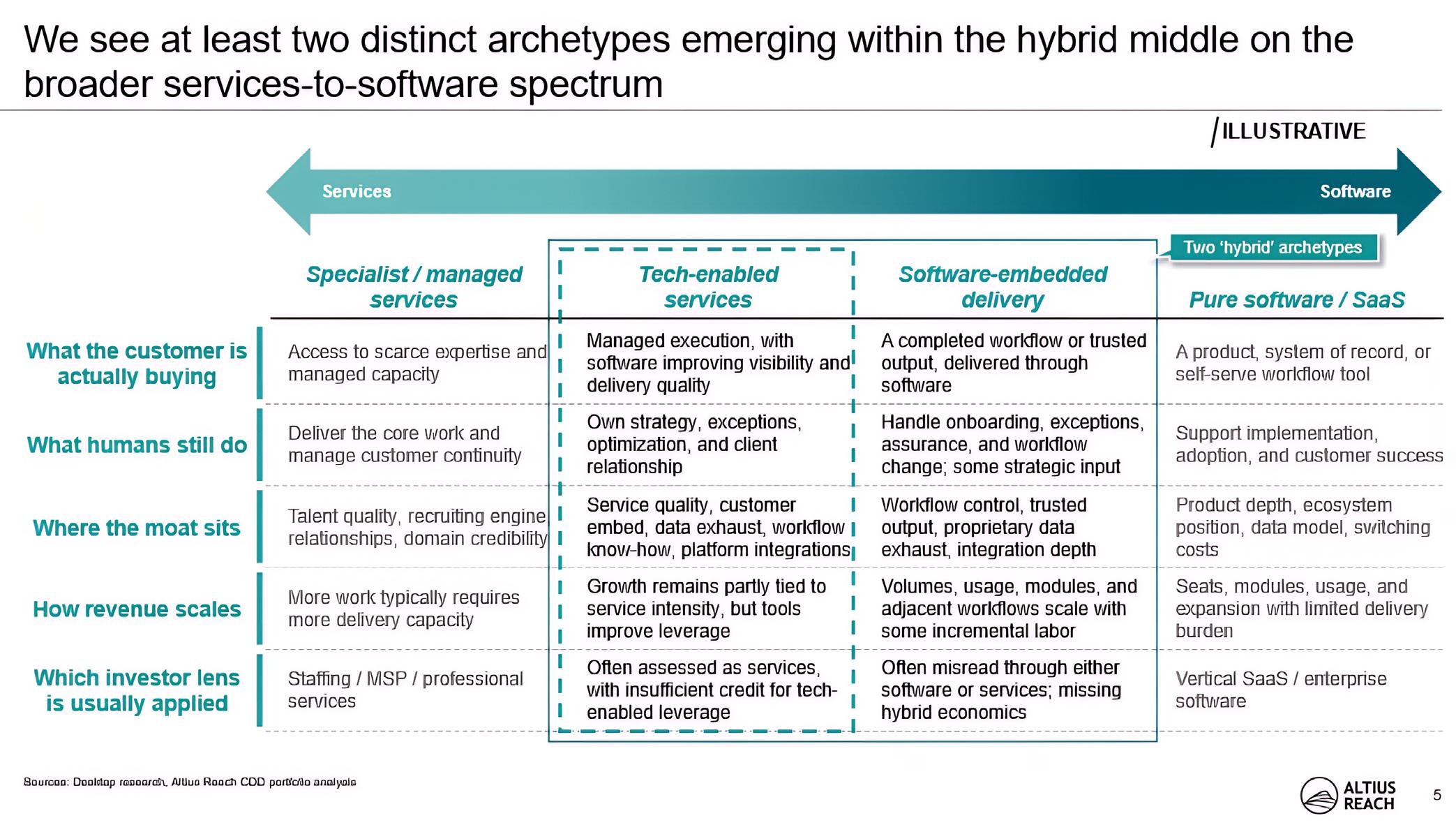
tools rarely justify valuation re-rating, the assets emerging in the hybrid middle are fundamentally different. They sit on a spectrum ranging from service-led models to software-led delivery, and it is useful to think of it in four archetypes.
At one end sit specialist and managed services businesses, where customers buy access to scarce expertise and managed capacity. Humans deliver the core work, growth requires adding delivery capacity in proportion, and the moat lies in talent quality and relationships. These businesses are typically valued on standard EBITDA multiples.
Moving along the spectrum, tech-enabled services retain the managed execution model but introduce software to orchestrate the workflow. Humans still touch delivery, though they are redirected from repeatable tasks toward strategy, exceptions, and optimization. Revenue growth remains partly tied to service intensity, but proprietary tools create meaningful delivery leverage. The moat here lies in service quality, deep customer embedding, and compounding data.
Further along, software-embedded delivery models sell a completed workflow or trusted output delivered through software. Humans sit at the edges, handling onboarding, edge-case exceptions, and assurance. Revenue scales via volume, usage, and adjacent workflows with only marginal additional labor; the moat shifts to workflow control, a trusted output layer, and integration depth.
At the far end sits pure software and SaaS, where customers buy a product or self-serve tool. Humans support implementation and customer success, while revenue scales with seats and modules, with
no delivery burden. The moat is product depth and switching costs, and valuation is based on ARR multiples.
The mispricing risk for investors arises when assets in these middle two zones are evaluated using the frameworks designed for the endpoints of the spectrum.
A pure software lens can be too skeptical in some places and too generous in others. It may be assumed that a narrow product surface, or one supported by services, implies weak defensibility. In many hybrids, however, defensibility comes from where the asset sits in the workflow rather than from standalone product breadth. If customers are switching an embedded process and a trusted output, rather than merely a tool, retention can be stronger than a product-style screen suggests.
A software lens can also overstate AI risk. AI may compress feature-level interfaces quickly, but it is less likely to displace assets that sit at the source of truth, capture proprietary operating data, support regulatory or assurance needs, and become part of how a workflow is executed. In those cases, the hybrid may become more valuable as AI automates repeatable work and increases the importance of trusted verification.
At the same time, a software lens can overpay if it assumes SaaS economics that are not present. Below-SaaS margins are not automatically a sign of a poor asset, but they are not irrelevant either. Investors need to test whether the cost base supports outcome-linked monetization, trusted delivery and a credible path to operating leverage. A business can be workflow-scaled and strong without being pure SaaS.
The services lens creates the opposite error. It may assume customers are buying a service layer that
can be rebid on price, when they are paying for faster throughput, fewer errors, trusted outputs and embedded workflow continuity. It may assume revenue scales with headcount, when software is standardizing routine work and shifting people toward exceptions, assurance and customer success. It may assume the moat is mostly relationship- and talent-based, when the asset may own workflow control points, proprietary operating data and a trusted source-of-truth position.
The direction of travel is meaningful. KPMG forecasts that tech-enabled delivery will more than double its share of outsourced service delivery, rising from 14% to 30% in two years, while traditional labor-led outsourcing is expected to fall from 55% to 37%.4 That shift is not just about efficiency. It is about service businesses moving from labor delivery toward ownership of workflow execution.
Data exhaust is one of the most overused terms in technology investing. It can be a moat, but not by default. Since most businesses collect data, the diligence question is whether the data improves delivery, strengthens trust, and makes the workflow more valuable each time it is used.
Strong exhaust compounds. It is captured from real workflow execution; it improves automation and exception handling; it strengthens accuracy, auditability and trust; it deepens workflow control; and it can unlock adjacency expansion. Weak exhaust is different. It is reporting layered on top of service delivery: descriptive, non-exclusive, widely available and disconnected from actual workflow improvement.
The best hybrids create a reinforcement loop: workflow execution generates structured exhaust; structured exhaust enables better delivery decisions; better delivery decisions deepen trust and workflow share; greater workflow share generates more execution data. That loop is powerful when it is real. It is cosmetic when the data merely decorates a service that remains fundamentally manual and linear.
Success in this converging market requires deploying a hybrid diligence framework that systematically isolates technology leverage from human capital.
The economic profile of an asset always reveals its true nature. To correctly classify a target, investors must step away from what the company calls itself in its CIM and test what is sold, what scales, and what still requires people by asking the following diagnostic questions:
• Are fees tied strictly to FTEs and project scope (Services), or are there recurring service revenues linked to tech-enabled bundles, subscriptions, and transaction volumes (Hybrid)?
• Is the margin structurally constrained by delivery labor (Services), or do margins demonstrably expand as transaction volumes scale and software reduces the exception rate (Hybrid)?
• Does headcount grow broadly in tandem with revenue (Services), or is output per delivery
FTE quantifiably improving over time, allowing revenue to outpace headcount growth (Hybrid)?
• Does capturing more scope require deploying more people (Services), or is expansion driven by software usage, modular adoption, and adjacent workflow penetration (Hybrid)?
If the asset demonstrates economic decoupling, it cannot be priced as a traditional staffing or MSP business. Similarly, if human judgment is still required to guarantee the outcome, it cannot be underwritten with the margin expectations of vertical SaaS.
Those questions lead to different valuation anchors. Specialist and managed services businesses remain labor-scaled and should be evaluated using Services / MSP comps. Tech-enabled services are leverage-improving and should be viewed through a hybrid lens, with credit for tech-enabled leverage. Software-embedded delivery can be workflowscalable and attractive, but it requires a hybrid lens; investors should avoid pure SaaS valuation anchors unless the economics explicitly justify them. Pure software deserves software benchmarking only when the model is product-scaled and the delivery burden is genuinely limited.
For existing portfolios, the immediate priority is to re-map assets by operating model rather than sector label. Some services-labelled assets may have under-credited technology leverage, data exhaust and workflow embed that can be sharpened ahead of exit. Some software-labelled
assets may carry more service intensity than their valuation and exit story imply. Both issues are fixable earlier in the hold period; both are harder to explain during the sales process.
For new diligence, the priority is to surface operating evidence. Investors should test whether the technology used to deliver the service creates real leverage, whether the workflow position creates retention, whether data rights and data use create a compounding advantage, and whether revenue is beginning to decouple from delivery headcount. These are not standard service questions. They are also not standard SaaS questions.
The broader lesson is that some of the most consequential errors in private equity are framing errors. Misclassify a business, and every subsequent step from valuation comps and risk diligence to the value-creation plan is fundamentally flawed.
In a market where hybrid models are proliferating, accurate classification is foundational underwriting work.
The advisory teams best positioned to support investors in this part of the market are those with experience on both sides of the servicesto-software spectrum. Altius Reach was built at that intersection. Its commercial due diligence practice spans technology and software, as well as professional services, with a senior team that combines private equity diligence expertise, operating and delivery model experience, and deep analytics capabilities.
staffing, engineering consulting, digital marketing managed services, identity verification SaaS, and enterprise IT service management software reflect the range of assets in which hybrid dynamics are most likely to appear. The diagnostic focus is correspondingly specific: workflow control, data rights, exception rates, usage economics, delivery leverage, account expansion, service-led retention and technology adoption.
With AI driving the blurring of services and software models, the volume of deal flow fitting neatly into traditional categories will steadily decline. Firms clinging to legacy playbooks will inevitably misprice these assets, either by missing hidden operating
1 The Business Research Company (2024)
leverage or by funding unearned economics. Successfully underwriting these investments requires a dedicated hybrid diligence framework and a team that’s acutely familiar with the nuances.
For more information, contact:
• Travis Taylor, Managing Partner: travis@altiusreach.com
• Manuel Koser, Partner: manuel@altiusreach.com
• Maroje Guertl, Partner: maroje@altiusreach.com
Recent engagements for Altius Reach spanning



BY FRANK BUKOWSKI
GROUP

The 90-day period for designation of new Opportunity Zones has been set. American communities and OZ fund managers shouldn't wait to tell officials about the potential impact of OZ investment on their areas.
with no renewal, as the initiative was set to expire in 2028. Over the years, OZ tax incentives brought a great deal of investment to designated tracts,6 but we also saw what was lacking in the original version, as some OZs failed to attract investment.7
Proponents of Opportunity Zones (OZ) were thrilled by the inclusion of a new OZ initiative1 as part of the One Big Beautiful Bill Act2 (OBBBA). Starting in 2027, new zones will be eligible for OZ tax incentives, which will now be a permanent part of the tax code.
A fresh selection process for OZ 2.0 was welcome news for communities that had been left out when the original Opportunity Zones were chosen. New guidance sheds light on how the selection process will work and shows community leaders and fund managers what they can do to affect the process and advocate for their local communities.
How the original Opportunity Zones were selected and what's different this time
The Opportunity Zones initiative was created as part of the Tax Cuts and Jobs Act of 20173, providing tax incentives for capital gains reinvested in areas designated as Qualified Opportunity Zones (QOZs). State governors could nominate up to 25% of the state's low-income communities (LIC) to be designated as OZs. In addition, up to 5% of tracts4 could be those that did not qualify as LICs so long as they were contiguous to a designated LIC tract5 and had a median income less than 125% of the median income of the adjacent tract. A later rule also designated all LICs in Puerto Rico as QOZs.
The original OZ designations lasted for 10 years,
OZ 2.0 includes a narrower definition for a lowincome community.8 The LIC designation is now limited to census tracts where "the median family income is less than 70% of the metropolitan area's median family income (for non-metropolitan areas, the standard will be the state median family income). This is reduced from 80% in the original OZ definition." A census tract can also qualify if it has a poverty rate at or above 20% and a medium family income less than 125% of the metropolitan area or statewide median family income. In addition to eliminating contiguous tracts, OZ 2.0 also ends the special rules for Puerto Rico.
New QOZ designations will take effect on Jan. 1, 2027, and will be valid for 10 years9, with new zones selected for 2037. New information from the IRS informs stakeholders of exactly how and when the first round of QOZs will be chosen. What IRS guidance says about how new Opportunity Zones will be selected
According to an IRS release10, the Chief Executive Officer (CEO) of each state, the District of Columbia, and U.S. territories will select Opportunity Zones from a list of eligible tracts: "Beginning on July 1, 2026, and lasting a period of 90 days, subject to a single 30-day extension, State CEOs will begin nominating eligible census tracts to be designated as QOZs. Following the nomination process, the Secretary of the Treasury will certify and designate the nominated census tracts as QOZs."
25,332 census tracts have been identified as LICs eligible for nomination. Of these, 8,334 qualify as rural areas (more on the special rules for rural zones later). Revenue Procedure 2026-1411 states that "the number of population census tracts in a State that may be designated as QOZs may not exceed, during any QOZ designation period, 25 percent of the number of LICs in the State." If the number of LICs is not divisible by four, they will round up to the next whole number. In addition, "if a State contains fewer than 100 LICs for a designation period, then a total of 25 LIC tracts may be designated. For example, a State with 24 LICs may nominate all of those 24 LICs."
State CEOs will have 90 days to make their selections using the Treasury Department's online nominating tool and can "make multiple submissions of nominations of eligible population census tracts rather than submitting all nominations at once." Once a list is submitted, it is not final until the end of the 90-day period: CEOs can "modify previously submitted nominations as long as the modifications are received by the end of the 90-day period." If more time is required, "the State CEO may request, and receive, a 30-day extension of this deadline, which would conclude, at the latest, on October 28, 2026."
population greater than 50,000, and any urbanized area contiguous and adjacent to a city or town with a population greater than 50,000."
The enhanced tax incentives should make rural projects more attractive to prospective investors. To take advantage of this increased interest, communities and fund managers need to make sure that their areas are designated as QOZs.
Communities that hope to attract OZ investment should not simply rest on their laurels and hope to be selected. These tracts will last for 10 years, and as we saw with OZ 1.0, communities that fail to achieve OZ designation can miss out on a great deal of economic impact.
One area of emphasis for OZ 2.0 was driving investment to rural areas, which had struggled to attract projects in OZ 1.0.12 The new initiative does this by offering enhanced tax incentives for investments in rural OZs, along with changes to the substantial improvement threshold.13
According to a release on rural zones14, "a rural area means any area other than a city or town with a
The good news is that there's no mystery about who will be making the decisions. Community stakeholders, business leaders, and local public officials can advocate for their areas to the state CEO. And since the list of selected tracts can be updated at any time during the 90-day period, that's 90 full days that can be used to the fullest.
Even if a community doesn't find itself on the current list of eligible tracts, there's no reason to give up hope. As Rev. Proc. 2026-14 explains, "there may be population census tracts that could be eligible for nomination as a QOZ that do not appear on this list. The Secretary will consider a State CEO’s nomination of a population census tract not
listed in the Appendix or Information Resource to the extent that the nomination is accompanied by a detailed analysis, including current data collected at the census tract level, demonstrating the nominated population census tract satisfies the requirements."
should be an easy choice between the two.
Providing this data and analysis to the state CEO could go a long way toward convincing the CEO and Secretary of the Treasury that the community deserves consideration. Another thing communities can do is present specific projects that will come to fruition once OZ 2.0 begins in 2027.
There are plenty of deserving communities in the U.S. that could benefit from OZ investment, many of which will not receive designation. But as we saw with OZ 1.0, some communities that received designation weren't able to attract investment. What's required is not only a need for impact, but a viable project that can create that impact. The OZ fund managers sourcing these projects can do a lot to advocate for their census tracts.
By showing the state CEO a specific project that has been economically evaluated, fund managers can join with community leaders to demonstrate that investment will come, that the project will get off the ground, and that the community will receive the desired benefit if it is allowed to do so. If the state CEO has to choose between two underserved areas, one of which has a viable shovel-ready project, it
Beyond project financials, fund managers can demonstrate the projected impact of a project on the local community. Data on job creation, affordable housing, salaries, infrastructure, and other downstream effects could be the deciding factor. To accurately calculate this impact requires an understanding of the latest metrics, comparable projects, and how impact can affect different communities in different ways.
During the first iteration of Opportunity Zones, JTC made a name for ourselves through social impact reporting.15 Though not required under law, our impact reports were a game-changer for fund managers who wanted to show impact investors that their projects were bringing positives changes to American communities.
In addition to bespoke impact reporting tailored to the unique objectives of each Qualified Opportunity Fund, JTC also works with other types of impact funds, and provides project evaluations for impact sectors like EB-516, allowing us to bring new perspectives on measuring impact to the OZ space. When presenting your project to investors, community stakeholders, or public officials, use the latest data techniques to show you care about the impact that can be created when dedicated fund managers apply themselves to OZ.
JTC Plc (“JTC”) is a global provider of fund, corporate and private client services. JTC administers more than $500 billion in assets and employs more than 2,500 people worldwide. JTC currently administers 72 Opportunity

funds with an approximate AUA of $10 Billion. A leader in specialty financial administration, JTC serves markets characterized by high administrative complexity, elevated transaction security needs and challenging compliance requirements.
JTC does not provide legal, tax or investment or other professional advice and, whilst it may review and report upon such advice received, JTC does not give, accept or endorse and should not be understood to be giving, accepting or endorsing such advice.
1 https://www.jtcgroup.com/news/opportunity-zones-made-permanent-in-the-usa/
2 https://www.congress.gov/bill/119th-congress/house-bill/1/text
3 https://www.congress.gov/115/bills/hr1/BILLS-115hr1enr.pdf
4 https://www.hud.gov/opportunity-zones/updates
5 https://www.novoco.com/resource-centers/opportunity-zones-resource-center/novogradac-opportunity-zonesmapping-tool
6 https://taxpolicycenter.org/briefing-book/what-are-opportunity-zones-and-how-do-they-work
7 https://www.jtcgroup.com/insights/how-to-get-opportunity-zone-investment-to-the-places-that-need-it-most/
8 https://issuu.com/sadisgoldberg/docs/the_earnout_winter_2026?fr=sOWU2NjkwNTE0MjA
9 https://www.brookings.edu/articles/how-did-the-one-big-beautiful-bill-act-change-opportunity-zones/
10 https://www.irs.gov/newsroom/treasury-irs-provide-guidance-to-states-for-nominating-census-tracts-as-qualifiedopportunity-zones-under-the-one-big-beautiful-bill
11 https://www.irs.gov/pub/irs-drop/rp-26-14.pdf
12 https://www.jtcgroup.com/insights/how-opportunity-zones-can-be-used-to-revitalize-rural-communities/
13 https://www.irs.gov/pub/irs-drop/n-25-50.pdf
14 https://www.irs.gov/newsroom/treasury-irs-provide-guidance-for-opportunity-zone-investments-in-rural-areasunder-the-one-big-beautiful-bill
15 https://www.jtcgroup.com/insights/best-practices-in-opportunity-zones-fund-administration-measuring-socialimpact/
16 https://www.jtcgroup.com/services/specialty-services/eb-5/
17 https://www.jtcgroup.com/resources/opportunity-zone-fund-administration-factsheet/


As a leading global fund administrator with c.$500bn in assets under administration, including $54bn+ in real estate funds, we deliver seamless, end-to-end support at every stage of the fund lifecycle. With genuine real estate experience and a global reach, we go far beyond traditional fund administration. Let our expertise unlock the full potential of your real estate investments. Find



BY JOHN MANGANIELLO & MARK AKLIAN
ACCELERATE PARTNERS

Most Private Equity Firms Don’t Have a Technology Problem. They Have a Visibility Problem.
Most private equity firms don’t have a technology problem. They have a visibility problem.
Across portfolios, considerable value sits just
below the surface. It is buried in technology spend, operational inefficiency, and real risk exposure. The sources are familiar: fragmented vendors, inconsistent cybersecurity controls, legacy infrastructure, and contracts that no longer reflect actual usage. Private equity has dealt with these dynamics for years. What has changed is the urgency.
What has shifted is how quickly those gaps now show up in outcomes. AI is accelerating the pace. It is not creating the problem so much as exposing it, and exposing it faster than most firms are prepared to respond.
In many ways, what is happening now mirrors a pattern the industry has already lived through. Over the past several years, firms across private equity and asset management paid millions in fines tied to off-channel communications. The cause was not malicious behavior. It was legitimate work being done in tools that were never governed. Regulators did not accept “the technology moved faster than our policy” as a defense then, and there is no reason to expect they will now. For an SECregistered adviser, the same obligations that drove that enforcement apply directly to AI: books and records requirements under Rule 204-2, the privacy safeguards of Regulation S-P, and the careful handling of material non-public information.
AI is following the same path. Employees are already using it to summarize confidential information memoranda, draft investment memos, analyze data, and streamline internal workflows. The adoption curve is not theoretical. It is operational today. What is missing, in most cases, is a governance model that aligns that activity to a regulated environment.
This is the current operating environment for most firms below the large-cap tier, not a future-state risk. The result is a widening gap between how firms believe technology is being managed and how it is actually being used across the organization and the portfolio. That gap is where both risk and value live.
AI has become the headline. The deeper issue is broader. Across most portfolios, technology decisions are decentralized. Each company runs its own systems. Vendors are selected independently. MSP capabilities vary widely. Security maturity is inconsistent. Spend visibility is limited or absent.
That fragmentation creates four persistent challenges:
• Uncontrolled spend driven by vendor sprawl, overlapping tools, and poorly negotiated contracts
• Technical debt that slows integration and erodes execution speed after close
• Cyber risk that varies significantly from one portfolio company to the next
• Operational drag, as leadership teams spend time managing infrastructure instead of driving growth
These issues are not abstract. They surface clearly at three points in the investment lifecycle:
• During diligence, where visibility is partial and assumptions fill the gaps
• In the first 100 days, where weaknesses in contracts, systems, and controls become operational problems
• At exit, where buyers begin asking questions that require defensible, evidence-based answers
This is where most firms experience what can fairly be called a technology value leak. It is financial
exposure that diligence does not fully capture, and it lands directly on margin and execution speed. AI enters this environment and raises the stakes. It accelerates workflows, increases the volume and movement of data, and introduces new behavioral patterns that existing governance frameworks were never designed to address. Left unstructured, it compounds fragmentation. Structured properly, it becomes a force multiplier.
One of the most common misconceptions in the market is that AI risk is still emerging. It is already here.
In a recent engagement with a middle-market private equity firm, we ran a structured diligence process to assess AI usage, cybersecurity posture, and operational readiness across the management company and its portfolio. The work spanned fifteen sessions and more than twenty-five stakeholders, from managing partners to administrative staff. The picture was remarkably consistent:
• AI usage was already widespread across the firm
• There was zero resistance to adoption at any level
• No approved enterprise-grade platform existed
• Sensitive deal materials were already being processed in ungoverned environments
One principal put it plainly:
“People are using it not compliantly right now.” This is what we refer to as the Day 30 compliance
gap. It is the point at which AI is already embedded in daily workflows, but governance has not yet caught up. The adoption happened first. The controls, where they exist at all, are being retrofitted.
The use cases themselves were strikingly uniform. Regardless of role or seniority, nearly every participant pointed to the same primary application: summarizing long, confidential deal documents. That consistency tells you something useful. The use cases are predictable, repeatable, and largely universal from one firm to the next. They are not the hard part. What varies is how different roles adopt them, and that is where governance has to be precise.
We observed clear behavioral archetypes across the organization:
• Senior partners with strong strategic vision but limited hands-on use
• Risk-focused adopters who lead with compliance concerns
• Associates already operating at production level with AI tools
• Teams that consume AI-generated output without producing it directly
This distinction matters operationally. Governance frameworks, training models, and controls cannot be generic. They must reflect how people actually work, not how systems are drawn on paper.
One concern surfaced repeatedly, and it is worth calling out directly. Several senior leaders raised the risk that junior staff will lean on AI before they have developed the judgment to catch its
errors. A model can produce a polished memo or a clean-looking analysis that is wrong in ways an inexperienced reviewer will not notice. This is a genuine governance issue, not a reason to slow adoption. The answer is to build review checkpoints into AI-assisted workflows, so that human judgment is applied where it matters and the work product is verified before it moves forward.
Risk is only half of the picture. The same workflows that create exposure when ungoverned produce real, measurable value when they are managed correctly.
The clearest example is document-heavy work. Reviewing a lengthy confidential information memorandum, extracting the key points, and producing a first-draft summary is work that traditionally consumed a meaningful share of an analyst’s day. Inside a governed AI environment, that same first pass is completed in minutes. The work still requires human review and judgment, but the starting point arrives far faster, and the time recovered is redirected to higher-value analysis.
The pattern repeats across the firm. Quarterly reporting, investor correspondence, market research, and internal memo drafting all involve repeatable, template-driven effort that AI compresses substantially. Independent research on knowledge work has found that professionals using current AI tools complete more tasks, complete them faster, and produce higherquality output than those working without them. In a private equity context, that translates into
more deals reviewed, faster turnaround inside the diligence window, and senior time spent on judgment rather than production.
The important point for an investment audience is this. That value only materializes reliably inside a governed environment. Productivity gains realized through ungoverned consumer tools come attached to data exposure, no audit trail, and no defensible record. The objective is not to choose between productivity and control. It is to build the structure that allows both.
At the ground level, most AI risk starts with something ordinary. A corporate card.
Employees are subscribing to AI tools individually. These are small-dollar, recurring expenses that often clear approval without scrutiny. The tools are genuinely powerful. They are also designed for personal productivity, not enterprise governance.
That mismatch creates a structural gap. In most consumer AI environments, there is no centralized oversight, no controlled authentication, no defined data retention policy, and no enforceable guarantee that the firm’s data will not be used to train a vendor’s model.
An enterprise-grade environment looks different by design. It runs on single sign-on tied to the firm’s identity provider, enforces multifactor authentication, and applies role-based access control so that sensitive data categories are restricted by function. It is configured for zero data
retention by the underlying model providers, and the no-training commitment is contractual, not assumed. Those controls are the baseline. Without them, a firm has adoption without governance.
From a cybersecurity standpoint, none of this is a new pattern. It is the same behavioral dynamic that drove off-channel communications enforcement: capable people working outside governed systems to get their jobs done.
What is different now is speed and reach. AI compresses workflows. It increases data exposure. It changes how information is processed, stored, and transmitted. At the same time, the threat side is evolving just as quickly. Attackers are using AI offensively, generating convincing spear-phishing campaigns at scale, producing deepfake voice and video to impersonate executives and authorize fraudulent transfers, and shortening the window between a vulnerability becoming known and being exploited.
The implication is straightforward. AI is not a separate risk category that sits alongside cybersecurity. It is an extension of cyber risk, embedded directly into daily operations. Firms that treat it as a standalone initiative, rather than folding it into their broader security and governance model, will struggle to control it.
A consistent theme across engagements is that no existing provider owns this problem end to end.
The result is a structural gap. Closing it does not require another tool. It requires a coordinating layer, and specifically a CISO-led operating model that connects four things usually managed separately: technology usage, cybersecurity controls, compliance requirements, and the actual business workflows.
Without that integration, firms default to reactive behavior. They evaluate tools one at a time. They add controls after problems surface. Then they repeat the entire process at each portfolio company, with no shared standard and no compounding benefit.
The firms getting this right are not approaching AI, cybersecurity, and technology spend as separate problems. They are building a structured, repeatable model for governing technology across the investment lifecycle.
In practice it follows a clear progression.
Assess
Establish a baseline. Map technology usage, the
MSPs manage infrastructure. They do not design governance frameworks or align technology use to regulatory obligations. AI vendors provide capable tools. They are not responsible for how those tools are used inside a regulated private equity environment. Internal teams understand the business well, but rarely have the bandwidth to design, implement, and enforce a fund-level model across the management company and the portfolio.
vendor landscape, cybersecurity posture, and risk exposure across the firm and the portfolio. The output is a clear-eyed inventory of where spend, risk, and unrealized value actually sit, including a prioritized view of use cases and a controls baseline for the firm’s MSP.
Define the governance framework. This covers acceptable use, data handling, retention policy, vendor requirements, and monitoring expectations. The output is a written acceptableuse policy, a defensible retention model, and dataloss-prevention rules a regulator would recognize as proportionate and considered.
Deploy enterprise-grade platforms aligned to those frameworks, with the access controls, integration points, and user models the firm actually needs. The output is a secure, sanctioned environment with single sign-on, role-based access, audit logging, and enforceable no-training terms in place from day one.
Track outcomes at the fund level: adoption, productivity gains, cost impact, and risk posture. This is where the shift becomes real. Technology stops being a series of disconnected decisions and becomes a managed capability with metrics attached.
That same discipline should shape how a firm selects an AI platform in the first place. Before committing, a firm should confirm a short list of non-negotiable requirements. Access to multiple leading models rather than dependence on a single
provider. Enterprise-grade security, including single sign-on, encryption, and zero data retention. The ability to ingest large, complex documents such as hundred-page deal materials. Role-based access control over both data and outputs. Recordkeeping and archiving capability consistent with the firm’s regulatory obligations. And vendor stability with genuine data portability, so the firm is never trapped if a provider is acquired, pivots, or fails. The AI market is moving quickly, and a number of early tools are thin layers built on top of someone else’s model. Underwriting an AI vendor deserves the same rigor a firm would apply to any other investment.
One of the most important and most frequently misunderstood elements of this work is where the value is realized. Most firms assume the benefit sits primarily at the management company level. In practice, the leverage is in the portfolio.
The initial engagement creates a playbook. Governance becomes standardized. Procurement is centralized. Vendor decisions become scalable. Risk posture becomes measurable rather than assumed.
From there the economics compound. One implementation becomes a repeatable model across multiple portfolio companies. That produces portfolio-wide cost savings, consistent operational execution, and a set of metrics tied to technology performance that can be reported to limited partners. Fund-level scale also changes the

negotiating position with vendors, turning a series of small, separate purchases into real leverage.
This is where AI becomes meaningful to the investment thesis. It is not an isolated productivity tool. It is one component of a broader, repeatable value creation system that travels with the fund.
What prompted the development of a structured AI model for private equity? What we saw consistently was that adoption was already happening. The question was never whether firms would use AI. They already were. They were just using it without structure, with no consistent way to govern it across teams or scale it across a portfolio. That gap is what needed to be addressed.
How does structure translate into measurable value at the fund level?
Structure creates repeatability. Without it, every use case is isolated and every benefit is one-off. With it, you can drive consistent outcomes across multiple companies, whether that is cost optimization, productivity improvement, or risk reduction. That is the point at which it becomes meaningful from an investment perspective.
Where is the intersection of AI and private equity heading over the next few years?
Technology governance is going to become an expectation, and not only internally. Buyers, lenders, and limited partners will all expect it. Firms that can demonstrate visibility and control will be
in a stronger position, both operationally and in how they are evaluated.
Mark Aklian, CISO
Can you explain the “$20 problem”?
It is employees using powerful tools without enterprise controls. The tools work well. The environment around them is not governed. That creates exposure, and not because anyone is doing something wrong. The system was simply never designed for this kind of work.
What safeguards are essential before enabling AI across an organization?
Governance comes first. That means defined usage policies, approved platforms, data protection controls, and monitoring. The goal is not to restrict people. It is to make sure the work happens in a controlled environment, so the productivity is real and the record is defensible.
What would you say to firms that believe their current setup is sufficient?
Most setups are sufficient for traditional IT. AI changes how work actually happens. If your controls do not account for that shift, you have blind spots, and blind spots are where risk concentrates.
The next 12 months, or sooner, will create a clear divide in private equity. Firms that build structured models for governing technology across spend, cyber, vendors, and AI will move faster, operate with more consistency, and tell a stronger story at exit. Firms that do not will keep managing complexity
reactively, with less visibility and more friction.
AI is not the decision. It is the forcing function. Within 12 months, or sooner, governed AI will stop being a differentiator and become an expectation, the same way a clean data room or a credible compliance program is simply assumed in diligence today. When a buyer or a limited partner asks a firm to show its AI governance, the firms that can answer clearly will be the ones holding a premium at exit rather than absorbing a discount.
John Manganiello Managing Partner, Accelerate Partners
John Manganiello works with private equity firms and operating partners to drive technology-
enabled value creation across portfolios. His focus spans technology procurement, cybersecurity, cloud, and AI, helping sponsors align technology decisions with fund-level performance, execution speed, and exit readiness.
Mark Aklian Chief Information Security Officer, Accelerate Partners
Mark Aklian leads cybersecurity and AI governance initiatives for private equity firms and their portfolio companies. He brings a practitioner’s perspective on managing risk in regulated environments, with a focus on building defensible, scalable frameworks that enable adoption without increasing exposure.
structured, vendor-neutral technology decisions that improve operational performance, reduce cost, and support value creation from diligence through exit.


Why the Next Wave of Sellers Isn’t the Problem. Preparation Is.

BY BRIAN FRANCO MERITAGE PARTNERS
Most people are still talking about the M&A market in terms of interest rates, valuation multiples, and capital availability. Those factors matter. They always do. But they are not what is slowing deals down right now. What is slowing deals down is much simpler, and much more within a founder’s control. It is preparation. Because while the market continues
to evolve, one thing has not changed. Exit is not an event. It is something you build toward. And most founders, even highly successful ones, have not built for it.
Over the last couple of years, there has been a clear shift in who is coming to market. In the past, many lower middle market transactions were driven by necessity. Founders sold because they had to. Retirement timelines, succession gaps, or operational fatigue forced the decision. That is no longer the dominant pattern. Today, we are seeing more founder-owned businesses in the $5 million to $30 million EBITDA range begin to explore liquidity because they want options, not because they need a solution. The conversations are different. Founders are asking what their business is worth today. They are asking what it would look like to take some money off the table. They are thinking about partnership instead of going it alone. They are starting to consider how to reduce personal risk while still participating in growth. These are not distressed sellers. In most cases, they are running strong, stable businesses. But there is a disconnect that shows up quickly. Wanting optionality is not the same as having it.
Many of the companies entering the market today are performing well. They generate consistent cash flow, have solid client/customer bases, and operate in attractive segments. From the founder’s perspective, the business is valuable, and they are right. But once the process starts, the conversation shifts. It stops being about what the business has done and becomes about how the business
operates. Buyers start asking very practical questions. Who is making the key decisions? Where do the important relationships sit? How dependent is revenue on the founder’s direct involvement? What happens if the owner steps away for a period of time? Who is actually running the business day to day? This is where momentum slows. Because in most founder-led businesses, the answer is clear.
The business still revolves around the founder.
This is something I have seen consistently over the last two decades. A founder builds a strong business and enters a process with a clear expectation of value. The numbers support that expectation. The history supports it. Then diligence begins. The buyer starts to understand how the business really functions, and more specifically, how much of it depends on the founder. At that point, the conversation changes. It is no longer just about whether the business is good. It becomes about what happens if the founder is no longer at the center of it. That question drives the outcome. Because dependency introduces risk, and risk gets priced. It shows up in the structure of the deal. Less cash up front. More earnout. Longer transition commitments. Greater control provisions on the buyer’s side. From the founder’s perspective, this can feel like pushback. In reality, the market is simply recognizing the difference between a business that performs well and a business that can operate independently.
Most deals do not stall because of one obvious

issue. They slow down because of a series of smaller issues that were never addressed. There is no real second layer of leadership. Financial reporting requires explanation instead of standing on its own. Processes exist, but they are informal and undocumented. Key customer relationships are tied to one individual. Decisions still run through the founder. None of these issues necessarily stops a deal on its own. But together, they create hesitation. And hesitation has a cost. It extends timelines, introduces additional diligence, and often leads to changes in structure late in the process. What looks like a market issue from the outside is usually a preparation issue on the inside.
If you simplify most of the friction in today’s deals, it comes back to one thing. Founder dependency. The founder is still the decision-maker, the relationship owner, the revenue driver, and the problem solver. That structure works during growth. It is often the reason the business became successful in the first place. But it becomes a constraint in a transaction. Because buyers are not acquiring the founder’s effort. They are acquiring a business that needs to function without that level of involvement. If they cannot see that clearly, they will structure the deal to protect against it. That is where founders start to feel the gap between how they view the business and how the market values it.
Another factor that consistently comes up is
predictability. Most founders focus on growth. Buyers focus on how repeatable that growth is. They look at how consistent revenue has been. They look at whether performance is driven by systems or by individual effort. They assess how dependent future growth is on the founder’s continued involvement. A business that is growing quickly but unpredictably introduces risk. A business that is steady and predictable, even with more moderate growth, is often viewed as more valuable. This is a shift that many founders do not fully appreciate until they are in the process.
Leadership depth is another area where issues surface. Many founder-led businesses have strong teams, but not a true second layer of management. There are capable people in place, but decisionmaking authority has not been fully transferred. Buyers test this early. They want to understand who can run the business without the founder. They look for people who can make decisions, own outcomes, and lead independently.If everything routes back to one person, the business is seen as limited in its current form. Leadership, in this context, is not just an operational consideration. It is a driver of value.
There is a tendency to attribute slower processes to broader market conditions. Rates are higher. Financing is more selective. Multiples have adjusted. All of that is true. But capital is still available. Strategic buyers are still active. Private equity firms still need to deploy and, in many cases, need to exit existing investments. The market is not the primary
constraint. The constraint is the gap between how businesses are built and what buyers need to see.
There is a subset of founders who move through transactions with far less friction. They experience fewer surprises. Their processes move more efficiently. Outcomes are more predictable. It is not because their businesses are fundamentally different. It is because they prepared earlier. They built leadership beyond themselves. They created systems that allow the business to operate without constant involvement. They established financial discipline well before going to market. They thought about exit long before they needed to. They did not wait until they were ready to sell. They built businesses that were ready all along.
The next phase of the M&A market will be shaped by this shift toward optionality-driven sellers.
These are founders who are not under pressure to transact. They have strong businesses and real choices. That is a positive development. But it also means buyers will continue to be selective. The bar is not just about performance anymore. It is about how the business is built. Deals are not slowing down because something is broken. They are slowing down because expectations have changed. The market is no longer rewarding strong performance alone. It is rewarding structure. It is rewarding independence. It is rewarding businesses that can operate without the founder at the center of everything. That is not something you fix during a transaction. It is something you build over time. Every business will eventually reach a point where exit becomes real. The question is whether that moment creates opportunity or exposes what was never built to transfer.
Written By: Brian T. Franco, Author of Inevitable Exit, Founder & CEO of Meritage Partners
BRIAN FRANCO Founder and CEO
Meritage Partners ("Meritage") is a multifaceted advisory firm specializing in mergers and acquisitions, capital advisory, and strategic exit planning, with a focus on the low to mid markets. Our exceptional team boasts a wide range of expertise from entrepreneurs, investment banking, corporate finance, private equity, law, and accounting, collectively amassing over 130 years of experience. With deep-rooted backgrounds in private equity, encompassing roles as investors and trusted advisors, we have actively contributed to transactions exceeding $2 billion in enterprise value.
BY JASON CHERTIN & MARIE LIANG MCMILLAN LLP

Canada and the United States share one of the most integrated cross-border capital markets in the world. Capital flows freely across the two countries through various types of transactions such as IPOs, private placements, and dual listings; however, the focus of this article will be on cross-border merger and acquisition (“M&A”) transactions.
While recent global economic uncertainty has created a more complex deal environment, crossborder M&A remains a crucial tool for growth, with significant activity especially in sectors like technology and healthcare. For U.S. buyers seeking to purchase Canadian companies, understanding the Canadian regulatory framework and the differences in M&A practices will be essential to ensure a successful transaction.
The M&A regulatory landscape is similar in Canada and the U.S.; however, there are some notable differences. The regulation of M&A activity in Canada operates through federal/provincial corporate laws, provincial securities laws, coordinated through the Canadian Securities Administrators, and any applicable stock exchange rules. To proceed with an M&A transaction, both the Competition Bureau and the federal government must approve the applicable transaction.
The most common structures for public M&A include takeover bids and business combinations effected primarily through plans of arrangement and amalgamations.
A takeover bid, equivalent to a tender offer in the U.S. and governed by National Instrument 62-104 Take-Over Bids and Issuer Bids, is an offer to acquire voting or equity securities of a particular issuer that would give the bidder (and its affiliates and joint actors) beneficial ownership of 20% or more of the outstanding securities of that class of securities.
The bid can be implemented on a negotiated basis or on a hostile basis and requires the bid to be open
for a minimum period of 105 days, although the target’s board of directors can reduce this period to a minimum of 35 days via a press release. All bids must have a mandatory minimum tender condition of over 50% of outstanding shares.
A fundamental regulatory principle underlying the takeover bid regime is the equal treatment of all securityholders. Accordingly, an acquiror must offer identical consideration to all target shareholders, and is prohibited from entering into any side deals or providing collateral benefits that would result in certain shareholders receiving consideration of greater value than that offered to other shareholders.
Business combinations are defined broadly in Multilateral Instrument 61-101 Protection of Minority Security Holders in Special Transactions as an amalgamation, arrangement, consolidation, amendment to a class of equity securities, as a consequence of which the interest of a holder of an equity security may be terminated without their consent. For public business combinations certain securities laws, SEDAR+ public filings, and other regulatory requirements will generally apply. Private M&A transactions may not always be subject to the same regulatory requirements as public transactions and, in addition to business combinations, may be structured as either an asset purchase or a share purchase.
A plan of arrangement is a court-supervised transaction structure under Canadian corporate law, and the most common public M&A structure in Canada. They are often used to manage complex
capital structures or to overcome minority shareholder objections as they allow for greater flexibility and can allow for conditions that may not always be permitted under applicable corporate law (for example, dealing with convertible securities). Shareholder approval by two-thirds majority at a special meeting is required, along with a management information circular.
In a deal point study conducted in July 2024 by Practical Law Canada, more than 95% of the 59 Canadian public M&A transactions valued at over $20 million and surveyed were completed by way of a plan of arrangement.
Amalgamations are the merger of two or more corporations into one entity, similar to Delaware mergers. However unlike in Delaware there is no concept of a surviving corporation in a merger, where one or more constituent corporations merge into a single entity that continues to exist while the other ceases to exist. Instead, two or more corporations continue as a single corporate entity. With amalgamations, shareholder approvals are also required, by two-thirds majority at a special meeting, along with a management information circular, but there is no court approval process involved.
While representations and warranties, conditions precedent, and other core deal mechanics are broadly similar between Canada and the United States, several deal points can differ in meaningful ways:
• Indemnity caps are typically higher in Canada
than in the U.S. since indemnity caps equal to 100% of the purchase price are particularly common in Canada.
• Holdbacks in support of indemnity claims are not common in Canadian deals. In many cases, a vendor would require the purchaser to rely on the vendor’s unsecured covenant to indemnify, sometimes supported by a related party guarantee in appropriate cases.
• General survival periods for representations and warranties are longer in Canada (often 1224 months).
• Canadian transactions typically omit “sandbagging” provisions. However, unlike in the U.S., where the treatment of claims for a breach of representation where there was (or should have been) prior knowledge of future breach differs from state to state, Canada does not have established common law on the treatment of these claims.
The following is a general overview of certain Canadian federal income tax considerations that commonly affect cross-border transactions and the way in which foreign investors do business in Canada.
Foreign investors will generally be liable to pay Canadian corporate income taxes on profits derived from carrying on a business in Canada. However, foreign investors that are entitled to claim benefits afforded by a tax treaty with Canada will generally only be subject to tax on income from business carried on through a “permanent establishment” in Canada.

Foreign corporations may also be liable to pay a 25% federal branch profits tax on after-tax profits in Canada that are not invested in qualifying Canadian assets, subject to a reduction where the foreign corporation is entitled to benefits under a Canadian tax treaty.
A subsidiary incorporated in Canada is generally subject to income tax in Canada on its worldwide income.
Withholding tax on distributions from a Canadian subsidiary
Amounts paid or credited by a Canadian subsidiary to a non-resident parent on account of dividends, certain royalties, and certain interest payments are subject to Canadian withholding tax at a statutory rate of 25%. However, this rate may be reduced by an applicable treaty.
Thin capitalization rules
If a Canadian subsidiary borrows from its nonresident parent corporation or from certain other
specified non-residents, the ability of the subsidiary to deduct interest is subject to the limitations imposed by the Canadian thin capitalization rules. These rules generally preclude a Canadian subsidiary from deducting interest on the portion of its interest-bearing loans from certain specified non-residents that exceed one and a half times its equity. The deduction of certain interest and financing expenses may be further restricted under the so-called “EIFEL” rules in certain circumstances.
Purchasers will generally expect a non-resident vendor of taxable Canadian property to obtain a compliance certificate from the Canada Revenue Agency as evidence that the non-resident vendor has paid the applicable tax on the purchase price. If a compliance certificate is not obtained, the purchaser is generally liable to pay and remit on behalf of the vendor as tax 25% or 50% of the purchase price.
When acquiring shares in a Canadian target, the foreign buyer will generally want to incorporate a Canadian acquisition vehicle so that the full purchase price can be repatriated to the foreign jurisdiction free of Canadian withholding taxes.
Under the Competition Act, the Competition Bureau must receive advance notice of a proposed transaction when two financial thresholds are met to determine if transactions are likely to prevent or lessen competition substantially, similarly to the Hart-Scott-Rodino review in the United States. The financial thresholds are as follows:
• the assets of the company being acquired in Canada, or revenues from sales in, from, or into Canada generated from those assets exceed $93M; and
• the combined assets in Canada or revenues from sales in, from, or into Canada generated from those assets of the parties and their affiliates exceed $400M.
Any acquisition of control of a “Canadian business” by non-Canadians is generally either notifiable or reviewable by the federal government. There are two separate investment review processes: (i) the review of significant investments to ensure transactions are likely to be of “net benefit to Canada” and (ii) a national security review to determine whether the transaction would be “injurious to national security”.
The national security review, similar to a CFIUS review in the U.S., is the predominant form of foreign investment review since national security applies to all Canadian investments regardless of the size of the transaction (unlike the net benefit review). This allows the government to review an investment by a non-Canadian in a Canadian business and, where it sees fit, prohibit the investment, attach conditions or order a post closing divestiture.
Quebec is an important outlier within Canada’s regulatory landscape as the province is governed by the civil law system (compared to the common law system in the rest of the country) as well as French requirements under Bill 96. Therefore U.S. practitioners should flag this nuance early on and engage Quebec counsel if a Quebec-incorporated
entity or Quebec assets are involved in a transaction.
McMillan LLP offers an integrated cross-border advisory practice whether you are pursuing an M&A transaction or any other type of cross-border transaction, and early engagement of Canadian counsel will help you ensure a successful deal outcome. The Canada-U.S. market offers significant opportunity but navigating it well requires counsel who understands laws on both sides of the border.
If you would like to discuss cross-border M&A in
Canada in more detail, please contact any member of McMillan’s Capital Markets Group who would be pleased to assist you. We provide solutions-oriented legal advice through our offices in Vancouver, Calgary, Toronto, Ottawa, and Montréal. For more information, please visit our website at www. mcmillan.ca.
The foregoing provides only an overview and does not constitute legal advice. Readers are cautioned against making any decisions based on this material alone. Rather, specific legal advice should be obtained.
1 This article is intended only to provide a general overview of certain considerations that arise in the context of CanadaUS cross-border M&A transactions. This article does not address all considerations that may be relevant in particular circumstances. No transactions should be executed based on the contents of this article alone.
McMillan is a leading business law firm serving public, private and not-for-profit clients across key industries in Canada, the United States and internationally. With recognized expertise and acknowledged leadership in major business sectors, we provide solutions-oriented legal advice through our offices in Vancouver, Calgary, Toronto, Ottawa and Montréal. Our firm values – respect, teamwork, commitment, client service and professional excellence – are at the heart of McMillan’s commitment to serve our clients, our local communities and the legal profession.



BY MITCHELL TARAS
In today’s environment often defined by elevated interest rates, tightening credit conditions, and heightened scrutiny from traditional bank lenders, middle market companies are increasingly turning to sale leaseback transactions as a strategic source of liquidity. These transactions have gained sig-nificant traction among privately held businesses seeking to unlock trapped equity, strengthen balance sheets, fund expansion, or reduce leverage without diluting ownership and sacrificing operational control of its real estate. The trend is accelerating across manufacturing, logistics, healthcare, retail, and business-services sectors, where real estate is often mission-critical but capital is scarce or expensive.
• A sale leaseback is, is essentially a two part transaction whereby the owner of commercial real property sells the real property to an investor and simultaneously enters into a long term lease to remain in possession as a tenant.
• Properly structured, the arrangement converts an illiquid asset into cash while preserving uninterrupted use of the underlying facility located at the property.
• For many companies, this combination of liquidity and stability is uniquely attractive.
• Sale leaseback transactions offer middle market companies a powerful tool to unlock capital, strengthen balance sheets, and support long term growth.
• With careful legal structuring, particularly around lease terms, risk allocation, and regulatory compliance, these transactions can deliver substantial strategic benefits while preserving operational continuity.
• For businesses navigating today’s capital markets, a well executed sale leaseback can be
a compelling and flexible solution
Unlike raising equity, a sale leaseback does not require giving up ownership stakes or board control. The seller tenant receives immediate cash proceeds, often at valuations higher than what lenders would ascribe for secured financing, while maintaining full operational control of the property through the lease.
Sale leasebacks can improve key financial metrics. The transaction removes real estate debt from the balance sheet, replaces it with a predictable lease obligation, and may enhance return on invested capital. For companies preparing for a refinancing, acquisition, or private equity investment, these improvements can be strategically valuable.
Institutional investors, REITs, and private funds continue to seek stable, long term income streams.
Creditworthy middle market tenants, particularly in industrial, logistics, healthcare, and specialty manufacturing, are in high demand. As a result, cap rates for well underwritten sale leasebacks often compare favorably to traditional financing costs.
In a rising rate environment, traditional mortgage financing becomes more expensive and more restrictive. Sale leasebacks offer an alternative capital source that is not tied to bank underwriting
cycles, covenant packages, or guarantees. The lease payments are fixed and predictable, insulating the tenant from future rate volatility.
Consider a privately held specialty manufacturing company operating out of a facility it has owned for more than 20 years. The company needs approximately $12 million to expand production capacity and upgrade equipment to meet growing customer demand. Traditional lenders may only offer only $7 million in secured financing due to conservative loan to value ratios and existing leverage.
A real estate investment firm, however, values the facility at $18 million based on the company’s strong credit profile and the critical nature of the property. Through a sale leaseback, the company sells the facility for the full $18 million and simultaneously enters into a 15 year triple net lease with 2.5% annual rent escalations.
As a result of the above, the company receives $18 million in cash, exceeding what lenders were willing to provide. In addition, it is able to deploy $12 million toward expansion and retains $6 million for working capital and debt reduction. Most importantly, it continues operating in the same facility without any disruption. The investor obtains a long term, predictable income stream backed by a stable tenant in a specialized industry.
This example reflects the core appeal of sale leasebacks: they unlock capital trapped in real estate while preserving operational continuity.
Because the lease governs the long term relationship between the parties, its structure is central to the economics and risk allocation of the transaction. Several provisions require careful attention:
Most sale leasebacks are triple net (NNN) leases, shifting responsibility for taxes, insurance, maintenance, and capital expenditures to the tenant. This structure maximizes the investor’s passive return and typically results in more favorable pricing for the seller tenant. However, tenants must evaluate long term obligations for roof, structural, and system replacements, which can materially affect operating costs.
Investors generally require an initial term of 10–20 years to ensure income stability. Renewal options, often at predetermined rent escalations, provide the tenant with operational continuity. Counsel should ensure that option mechanics, notice requirements, and rent reset formulas are unambiguous and commercially reasonable.
Annual or periodic rent increases are standard. Fixed escalations (2–3% annually) offer predictability, while CPI based adjustments shift inflation risk. The choice affects valuation, cap rate, and long term affordability for the tenant.
Tenants often seek flexibility to assign the lease in connection with a corporate restructuring, merger, or sale of the operating business. Investors, by contrast, seek to preserve credit quality. Negotiated solutions may include financial thresholds, guaranty requirements, or landlord consent standards tied to objective criteria.
5. Maintenance and Capital Expenditures
NNN leases typically impose broad maintenance obligations on the tenant. Counsel should delineate responsibilities for structural components, environmental conditions, and major system replacements. Clear allocation reduces disputes and protects the tenant from unexpected capital burdens.
Some sale leasebacks include a right of first offer (ROFO) or right of first refusal (ROFR) if the investor later sells the property. These rights can be valuable to tenants seeking long term control

or future repurchase opportunities, but they must be drafted with precision to avoid impairing marketability.
For middle-market companies seeking to optimize their capital structure, sale-leaseback transactions present a compelling opportunity to convert illiquid real estate assets into working capital while maintaining operational control of missioncritical facilities. The success of these transactions hinges on meticulous legal structuring, from negotiating favorable lease terms and allocating risk appropriately between parties, to ensuring compliance with applicable tax, accounting, and regulatory frameworks. When executed thoughtfully, a sale-leaseback can serve not merely as a financing mechanism, but as a strategic catalyst for growth, enabling businesses to redeploy capital toward core operations, reduce leverage, and enhance financial flexibility in an increasingly competitive marketplace.
MITCHELL TARAS Partner
Sadis & Goldberg mtaras@sadis.com
Mitchell Taras practices in the firm’s Real Estate and Corporate groups. He represents clients in a variety of complex real estate transactions, including acquisitions, dispositions, financing, construction, leasing and joint venture negotiations involving apartment buildings, shopping centers, hotels and office buildings. Mitchell has represented both borrowers and lenders in mezzanine lending, securitized loans, and secured and unsecured credit facilities. He has also represented owners in connection with construction contracts and disputes.





September 17 , 2026 th
Chicago, IL
Event Overview
Consist of curated one-on-one meetings and roundtable discussions between lenders, sponsors, and investors.