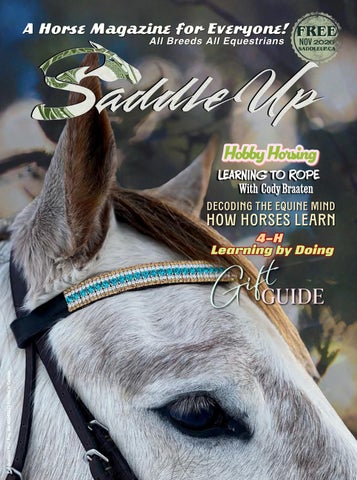
A Horse Magazine for Everyone! FREE All Breeds All Equestrians
NOV 2026
SADDLEUP.CA
Hobby Horsing Learning to Rope With Cody Braaten
DECODING THE EQUINE MIND
HOW HORSES LEARN 4-H Learning by Doing
ft i G
Publications Mail Reg. No. 40045521 Printed in Canada
GUIDE
ONE TELESKID.
EVERY JOB.
From the barn to the pasture, the JCB Teleskid is built to take on the jobs that keep your property running.
For more information and demos, go to:
www.matsquiagrepair.com
OR CALL: 604-826-3281
34856 Harris Rd
Abbotsford, BC
INFO@COPPERPONY.CA • 236-655-7767 WWW.COPPERPONY.CA
@COPPERPONYPOLES
COPPERPONYPOLES
Shop copperpony.ca for gifts riders will appreciate all year long!
E
D R E S SA G
LEWO PO R
KITS
S LE
OBSTAC
ST
L IE S
PROUDLY CANADIAN OWNED & OPERATED
NT
ING BLO
S CK
PP
A
B LE S U
MO U
K
O LS TO
STRUCTURES LTD.
Proudly Serving Western Canada Since 1998
SpanMaster is here for the long haul! This Summer one of our SpanMaster family of clientele was impacted by a BC wildfire. Their riding arena was damaged and in conjunction with their insurance company, we were able to help with a plan to repair their building. New fabric panels and related components are on order and scheduled for install as soon as possible.
SpanMaster has crews and equipment that operate year round, through-out BC. We get calls every year for repairs on buildings that have damage and need repairs or are in need of full replacements, caused by everything from wildfires to floods. Our standard fabrics have up to a 20 Year Warranty, and we will be here to stand behind those warranties, when you really need us. We have been designing, selling, installing and maintaining steel and fabric buildings since 1998, and we have over 2500 building projects located in every part of the province.
Stay tuned for the exciting conclusion in an upcoming issue of Saddle Up!
SpanMaster — Built on Experience. Here When You Need Us.
Agricultural | Equipment Storage | Riding Arena | Hay Storage
Discover the SPANMASTER Experience Today!
Call For Your Free Quote
1-866-935-4888
SpanMaster.ca
info@SpanMaster.ca
E DIT O est. 2000
Also Available Digitally
R ’S N
O TE
Executive Editor & Publisher Tass Co-Editor & Head of Design Ruby Graphic Graphic Production Don Key Office Wrangler Adrian Founder Nancy Roman MAIN OFFICE TOLL FREE 1-866-546-9922 ads@saddleup.ca hello@saddleup.ca SADDLEUP.CA MAILING ADDRESS Saddle Up magazine PO Box 371 Armstrong, BC, Canada V0E 1B0 Published and Printed In Canada Publications Mail Reg. No. 40045521 GST Reg. No. 751444159RT0001 ISSN No. 1701-6002 © All Rights Reserved SUBSCRIPTIONS $29.00 CDN Inlc tax per year $55 US per year (11 issues)
Reproduction of any materials without written permission from the editor is prohibited. Opinions and statements expressed in this publication are not necessarily those of the editor.
8
COVER ART
Photo By Saddle Up Art with Tarp Designs
ISSUE GRAPHICS
By Saddle Up with Tarp Designs
CONTRIBUTORS
Mad Barn Canada, Sloan Hammond, Laureen James, Book Feature: Merlin Ford, Cody Braaten, Patricia Skinner-Porter, Danika McGuinness, HCBC News, Club Hub and BCHBC Stories
04
10
14 22
CONTENTS Decoding the Equine Mind
8
Hobby Horsing at Spruce Meadows
10
The History of Clydesdales
13
Learning to Rope - Part 3
14
Gift Guide
16
4-H: Learning by Doing, Growing for Life
18
The Nose Knows!
21
A Tradition Worth Passing On
22
Equestrian Excellence, 55+ BC Games
24
HCBC News & Club Hub
27
BCHBC News
28
Clubs & Association Listings
29
Business Services
30
Decoding the Equine Mind How Horses Learn By Sloane Hammond
Horses learn from their interactions with us and their environment. Understanding how they learn through observation, habituation, classical conditioning, and operant conditioning helps us train more clearly, avoid creating fear, confusion, or resistance, and make better choices about the tools we use to teach new responses.
Social Learning This type of observational learning the horse gains from their dam, herd mates and rarely people. It involves mimicking the behaviour.
Non-associative Learning (habituation) This type of learning involves systematic exposure to reduce reactions. This type of learning happens when an animal is gradually introduced to new objects or activities (stimulus) while being allowed the distance and/or time to calmly process the new stimulus. Always introduce objects from a distance first, gradually reducing the distance as the horse remains calm. Remember, if the stimulus is to be moving, habituation needs to restart at a distance. We habituate the horses to equipment, care routines, leg and rein aids, and locations such as stables, stalls, trails, and trailers. Habituation is sometimes referred to as desensitization but we must avoid flooding, which is the introduction of a highintensity fear-producing stimulus without the possibility of escape. Flooding induces learned helplessness and is harmful to the training of a horse.
Associative Learning Classical conditioning (Pavlovian) – This type of learning is involved when
giving voice and ridden aids. A voice command or postural change is followed by a leg aid or increase in rein tension. Operant conditioning (Skinnerian) – This type of learning is what trainers commonly rely on for training horses. Trainers use positive and negative reinforcement to encourage desirable behaviour and use positive and negative punishment to reduce the incidence of unwanted behaviours.
Add Something Increase Behaviour Positive Reinforcement - treats, rubs, and wither scratches.
Decrease Behaviour Positive Punishment - block with arm/body, use a sharp “stop or no”, a light crop tap to induce surprise and not pain or fear.
Remove Something Increase Behaviour Negative Reinforcement - release of rein or leg aid.
Decrease Behaviour Negative Punishment - withholding food/treats from pushy horse, rarely used in horse training.
Positive Reinforcement Tools Include: Food Treats Wither Scratches Clicker Training (clicker training utilizes both classical conditioning and operant conditioning) When teaching a new response, remember to reward any approximation of the response to reinforce learning. We gush when children are first learning to walk, talk, or read. Be generous with positive reinforcement. For instance, when teaching the horse to move their shoulders or hips left or right, reward one step sideways at first. When this becomes an easy reward after the second step, then the third. While we now know that horses do transfer learning from one side to the other, it is still easier for the horse to learn if each side is taught and practised separately in the beginning. Avoid drilling the new response since this may cause anticipation, physical or mental fatigue, and ultimately make the horse sour. Ask yourself, “How do I respond after the tenth time I have been asked to take out the garbage or do the dishes?” Three repetitions on the same side are enough. In fact, three repetitions in the same location can create a fairly enduring habit, good or bad. We can, however, utilize location-based anticipation to our advantage when introducing a new transition or movement by executing it in the same location each of the first few times. However, if you execute too many of these location-based attempts you will have a new challenge, as the horse may want to offer this movement every time they pass that location. Negative reinforcement tools commonly used in horse training are painless pressure with immediate release. Repeated light applications of an aid are much more effective than a strong or held aid. It is ineffective to hold pressure without release, as held pressure produces resistance in the horse, ultimately teaching it to endure and making the horse dull to the aids. Positive punishment tools include an arm or body block from the handler, a brief tug on a lead rope, and a light whip tap or shout, to stop unwanted behaviour. As the horse is an extremely sensitive creature, limit the use of this tool, as it can easily increase fear. The stress response produced by fear actually reduces the animal’s ability to learn. The application of these tools must be mild but can be repeated (as in repeated light whip taps, light lead rope tugs, and leg or rein aids). Your horse can feel a fly land on its coat and use a small muscle twitch to remove the fly. Less is always more when training horses. Negative punishment is rarely used with horses. A horse that is aggressive with other horses in the paddock may be removed from that enclosure for safety. We may withhold treats from a horse if it is being too pushy. A word of warning regarding disparaging descriptions of horses or name-calling. Before we label our horses with any of a myriad of common accusatory terms of being “crazy”, “stubborn”, “naughty” or “lazy”, we must remember that these anthropomorphic labels do not solve our training issues in horses any better than in humans. In fact, it interferes with training. It decreases effective decision-making and escalates the use of positive punishment. When tempted to think in these terms, we first need to ask ourselves a few questions.
Understanding Is the horse already schooled in this response/ movement/activity? Have all the steps leading up to this response/ movement/activity been trained? Is the rider’s position in the saddle correct? Are the rider’s leg aids correct and clear? Are the rein aids correct, and is the contact light and consistent?
Discomfort/Pain Is the horse uncomfortable? Assess tack: saddle fit, saddle pad comfort, bridle and bit fit Assess soundness: neck, shoulder, back, leg and hoof pain
Is the rider uncomfortable? Assess clothing comfort and suitability: helmet, boots, gloves, slacks, and shirt Assess pain or restriction: neck, back, arm, leg, foot, and hand pain can alter aids.
Fitness Are the horse and rider flexible and strong enough for this movement? Avoid training new responses/movements/activities when you are not at your best. If you are rushed, hungry, dehydrated, tired, too cold or too hot, just do something easy instead or enjoy grooming your horse. It is better to run away and live to “train” another day. Rome wasn’t built in a day! In some countries horses have to be nine years old before they can compete in Grand Prix-level dressage. The common age of a horse competing in Grand Prix jumping is between ten and twelve. Take your time, train as well as you can the first time, and you will save time in the long run. Just as we are constantly learning how to be in the world, it is our joyful responsibility to help our horses understand how to be in our world.
Sloane Hammond operates Gryphon Hollow Farms and offers Simply Joyful Riding clinics. She has developed A-circuit hunters, national eventers, and jumpers and coached national Young Riders in dressage, eventing, and show jumping. 9
g n i s r o H y b b Ho
s w o d a e M e c u r p At S By Laureen James
The future of the hobby horse is here. It isn’t a toy but a piece of creative sports equipment. It’s imagination and creativity paired with skill, athleticism, and artistry, where speed, grace, and agility abound. In today’s world of sporting events, the hobby horse has become a worldwide movement. Today’s hobby horses can be handcrafted pieces of art or a manufacturer’s vision of precision and performance. Who came up with this idea, you ask? Hobby horsing developed in Finland in the early 2000s, with young enthusiasts gathering online and organizing their own activities and competitions. Finnish championships had been taking place since 2012. The sport was introduced to a wider public through Selma Vilhunen’s 2017 documentary Keppihevosten vallankumous (Hobbyhorse Revolution). Vilhunen became interested in the activity after seeing a video of a hobby horse competition in 2012 and went on to follow participants over several years. The film won two awards at the 2017 Tampere Film Festival in Finland and later received the 2018 Jussi Award for Best Documentary Film. As I walked through Spruce Meadows this summer deciding what I might write about, I came across something I had never seen: young girls ages 8-16 galloping around the Deloitte Ring aboard hobby horses. I actually have a hobby horse that someone in my community fashioned after my miniature horse stallion, Gus. I keep it safely tucked away in the back of my closet as a keepsake of that horse and the community that rallied around us for years. During the Spruce Meadows Masters weekend, I watched the Hobby Horse Challenge on Saturday and Sunday. It seemed odd to see girls prancing, trotting, and galloping around the ring as they jumped higher and higher with each round. First, I watched the 6-11-year-olds, then the 12-16-year-olds. At first, I thought, “Well, it’s cute.” I wondered how long these “riders” would be interested in the sport. Then things got very interesting! I noticed that the jumps were getting pretty high. Then they got higher and higher with each round. The last two kids to go clear in this hobby horse 6-bar had actually run out of height on the standard. The last fence rail was carefully balanced on the top of the standards. Suddenly, I could begin to see how exciting this sport could be. These girls were jumping 4 ft or higher while maintaining the stick of their hobby horses between their legs. I’d like to see Olympians in track and field go for gold with their hands gripping a stick horse.
I have to say, “I’m kind of hooked now.” I started out with mixed feelings about hobby horsing being classed as a sport, but after watching the kids’ live competition, followed by hours of YouTube video research, I have a deep respect for hobby horsing classes. The events and classes include jumping (hunter and jumper), dressage at the Grand Prix level, barrel racing, Western trail, cross-country, and pretty much any equine activity and competition you can think of. I can see that the sport of hobby horsing blends a variety of skills from many other sports. Hobby Horsing Blends a Variety of Skills - Track and Field (Athleticism) Show Jumping: Requires explosive leg strength to clear hurdles (jumps) that can reach beyond 4 feet in height. Verticals, oxers, and combinations. High Jump (Puissance) and 6-bar: Requires hobby horse riders to clear as high a jump as possible. Sprints and Horse Racing: Flat races with multiple riders galloping test cardio, speed, and endurance. Ballet and Dance: Artistic, graceful, and powerful execution. Dressage: Choreographed routines to music using dressage movements like extended trot, collected trot, passage, and piaffe. Competitors mimic sophisticated dressage gaits while maintaining a perfectly balanced and straight torso, requiring high core muscle engagement, while also performing moves like half pass. Gymnastics: The sport of hobby horsing has a lot of gymnastic elements that require flexibility and control over the hobby horse’s stick to avoid dropping an obstacle.
Judging Hobby Horse Competitions Dressage Judging is very serious in the sport of hobby horsing. Hobby horse dressage is scored using a points system adapted directly from traditional equestrian dressage rules. The goals are precision of the test, rider posture, rhythm, and correct execution of transitions. Riding straight lines, using the correct size and shape of circles, and hitting the arena letters precisely are of major importance. Maintaining a clear and distinct tempo at the walk, trot, and canter is essential for a good score. Points are given for the overall impression of turnout, elegance, and harmony of the ride. Points are deducted for forgetting the test or riding the wrong pattern. Scores above 65% are considered a good score.
On Sunday, September 13th, I was excited to watch the second day of competition in hobby horse jumping at the Spruce Meadows Masters. On Saturday, they jumped a 6-bar, the kids and their stick horses were jumping a full course. The winners from each age group, 6-11 and 12-16, would become the 2026 champions.
This Year’s Winners
Veronika Davidson and Ariana Pinches.
Western Trail Based on a 70-point base system, judges add or subtract points for maneuver execution and accuracy and give extra credit for fluency and overall impression. Judges evaluate how safely, cleanly, and smoothly you guide your stick horse through simulated trail obstacles. Deductions are made for faults such as touching or hitting an obstacle, breaking gait, or going off course. Accuracy in navigating gates, bridges, and other trail elements, along with demonstrating distinct transitions between walk, trot, and lope, is important for high scores. Also, keeping control of the hobby horse’s alignment during sidepassing and turns is key. The horse’s head must be maintained at a lowered angle, like you would see in real equine trail classes. To add an element of difficulty, just like in a real trail class, you must ride your hobby horse with both reins and the stick in one hand.
Coaching Believe it or not, there are actual coaches to help hobby horse competitors improve their skill level. Coaches teach about real-life equestrian disciplines and translate that into the world of hobby horsing. Coaches work on conditioning athletes using hurdles, endurance running, and agility drills. The athletes train hard to acquire the fitness levels needed in the varied disciplines. Coaches can be hired through hobby horse clubs and associations. Both inperson and online coaching are available. Hobby Horse Canada and Official Hobby Horse Academy are great places to start researching how to get involved in the hobby horse sport. 11
Ariana Pinches and her Big Ben hobby horse took first place in the 6–11-year-old category. Ian Millar had signed Big Ben during the weekend between his chef d’équipe duties for the Canadian International jumping team. Ariana had her second hobby horse with her during our interview, which she names Trixie. Veronika Davidson, with her fantastic hobby horse Banana, created in the likeness of her favourite pony, Banana Bread, took first place in the 12–16 age category. I marvelled at the stunning hobby horse that was made in Ukraine.
In an interview, Lisa Denyer spoke about LeMieux’s support for the sport of hobby horsing and the equipment the company offers. “LeMieux is one of the fastest-growing equestrian brands in the world and supports the sport of hobby horsing by meeting consumer desires for the same equipment designed and manufactured for equines and equestrians. The LeMieux product line includes leather bridles with bits, hobby horses with Velcro mouths, running martingales, lead shanks, blankets, and saddle pads. Anything you can buy for a horse, we also build for hobby horses.” I also spoke with Cheryl, who was a vendor at the Spruce Meadows Masters and also creates hobby horses. Her company, Wee Spirit, hand-makes hobby horses, halters, and hobby horse stable blankets in a variety of colours and patterns. Cheryl entertained me with a heartfelt story of a young girl who desperately wanted one of the Wee Spirit hobby horses, which retail for just over $100. The girl’s parents promised to return the next year if their daughter saved enough money to buy a hobby horse from Cheryl. The young lady saved all her money and returned the following year. She stood across from Wee Spirit’s hobby horse collection for a long time before deciding on the hobby horse she felt a connection to. I’m impressed by the sport of hobby horsing and how the youth use their imagination, which is often lacking today, to decide on a show name, stable name, breed, and personality, including positive and negative equine behaviours for each individual hobby horse. They purchase their hobby horses based on an invisible connection, the same way real horse owners decide on their equine partner purchases via some feeling of a special connection. Ian Millar took time out of his busy schedule at the 2026 Spruce Meadows Masters to sign Ariana Pinches’ Big Ben hobby horse. I think that speaks volumes about how hobby horsing is considered an international sport that will continue to grow. This is truly an activity deserving of the title of sport!
Sources: Nordisk Film & TV Fond, “Hobbyhorse Revolution Reaches Finnish and World Audience.” https://nordiskfilmogtvfond.com/news/stories/hobbyhorse-revolution-reachesfinnish-and-world-audience Photos were taken by Laureen James and LeMieux photos provided by LeMieux Laureen James, BCom, journalist, and EC/NCCP Coach Certification IOB, is an equine journalist who writes for many publications. She also writes for the pet industry and is a columnist for Unison 50+ News. She has covered rodeos, show jumping, and other related events over the past few years as a journalist and photographer.
The History of Clydesdales in Western Canada Held at Regina for a few years, animals
The dates and circuit for “Class A ” fairs in 1940 was: competing in the amateur classes were required to Brandon - June 30 to July 4; Calgary - July 7 to July Author Merlin Ford grew up in eastern Saskatchewan and has lived in Lloydminster for the past 10 years. He developed an interest in goodhave livestock, horses, and fed “ for at least two months beendraftowned and history at a young age. For nearly 20 years, he designed and maintained 12; - July 14 to July 19; Saskatoon - July websites for livestock breeders and has driven draft horseEdmonton teams at the Ukrainian Cultural Heritage Village in Alberta and Barkerville Historic Town & Parkof in Canada who has never won a first by a resident British Columbia. 21 to July 26; Regina - July 28 to August 2 In 2012, Merlin published Horses, Harness and Homesteads: The History of Draft prizeTo Our or who was Horses in Saskatchewan, followed in 2018 by Harnessed Hearts: The not a member of a firm at the time Sequel to Horses, Harness and Homesteads. He has also written historical articles This same circuit was also used in later years. for The Draft Horse Journal and Percheron News, published by the Percheron the Hefirm winning a first ofprize in that department (Horse, Cattle, Sheep, Horse Association of of America. enjoys sharing his knowledge draft horses and their history through slide-show presentations at archives, seniors’ homes, exhibition held and other venues. Class Divisions / Definitions Here are a couple of excerpts from his newly released book, which explores the in Regina, history of Clydesdales in Western Canada. Saskatoon, Calgary, Edmonton, Grade horses exhibited at shows in past years Brandon, Winnipeg or Toronto between January 1, were often subdivided using some or all of the 1913 and December 31, 1917... categories listed below. Some prize lists specified Regina looks to have been the only show to offer that entries must be sired by a purebred stallion. these classes, which also included awards for Best Agricultural: 1400 to 1600 pounds, and more Clydesdale Stallion and Best Clydesdale Female. Barefoot Classic rangy than a drafter.. “most useful on the farm later years, the class often referred to a slightly First held at the Manitoba Clydesdale Classic in F irst held at the 2003 Mountain View County handling big implements in fours and sixes.” 1996, the Amateur Four-Horse Hitch class is open larger horse (entries not to stand over 16.1 hands). F air at Olds, AB., the Barefoot Classic had beenFarm Chunk: a horse that did not fit into the General Purpose: suitable for plough, wagon, to anyone who has not shown a six-horse hitch in Book by Merlin D. Ford
sug gested by Dale Rosenke. He felt that a class for carriage, bug g y or saddle, weight 1,150 to 1,400 unshod horses would promote the breeding of pounds, and not less than 15.2 hands. good-footed Clydesdales. Heavy Draft: 1600 pounds and over, compact and having a general drafty appearance Borrowed / Provided Wagons Light Draft: same as heavy draft in build and In past years, wagons were sometimes loaned / conformation, but with less scale and substance. provided to exhibitors by local machinery dealers. 1500 to 1600 pounds. (See the photo on page for an example). Six-horse hitch exhibitors often used borrowed
To find out more or purchase Merlin’s new book visit clippityclop.ca or email: clippity.clop1@gmail.com
Learning to Rope With Cody Braaten
e re h T t ar P Par ts one and two covered the fundamentals of building your loop and how to work towards your first catch. Part three is about putting all of this together to rope while on horseback and eventually graduate to roping live cattle.
Moving to Horseback This is where the rubber meets the road and we get to start enjoying our roping! When we are confident in our rope handling and ready to move to horseback, I start first by desensitizing my horse to the rope. This is to ensure that they are comfortable with it and that both myself and my horse are safe throughout the process. After desensitizing them on the ground and in the saddle, I will introduce them to the roping dummy behind the quad. I will use this dummy to teach them the proper positioning and timing that comes with a good roping run. The dummy is a great tool to give your horse confidence in their job. It allows the environment to be controlled and only go as fast as you or your horse are ready for.
14
Introducing Your Horse to the Box The area where most ropers struggle with their horse is in the box. The box acts as a “starting gate” for rope horses and, when done incorrectly, can cause anxiety for your horse. Like all things done with horses, this should be approached quietly and confidently while listening to the signs your horse is giving you.
On days that I am riding or roping the dummy off my horse, I will ride them in and out of the box with no added variables or pressure. This gives them the opportunity to experience the box in a low-pressure situation. I will often finish my riding session in the box and get off them and loosen their cinches while standing in there to make it a happy place for them. When they are ready to rope the dummy out of the box, I will do it as quietly and with as much low pressure as possible. I will put them in the corner of the box, ensuring not to pull them too tightly in, and have the driver of the quad go by the front of the chute with the dummy very slowly. As the dummy goes past slowly, I will start to walk my horse out until we get to position. After I am out of the box, the driver can speed up the dummy if they choose.
Steps to Roping Cattle
Tips to Ensure Success
Desensitize your horse to the rope.
Take your time and don’t rush.
Teach your horse the proper position and timing using a dummy. Introduce your horse to the box with the dummy.
Be calm and patient with your horse.
Pen rope on your horse to introduce them to cattle.
Ask for help where needed.
Start roping slow cattle out of the box.
Take the small wins. Don’t go faster than you or your horse are ready for. Enjoy the process and have fun!
It is important to take your time and keep the box an enjoyable place for your horse to be. Taking the time to build confidence and calmness will take less time than trying to fix box anxiety later on.
Live Cattle Part two talked about the benefits of utilizing a dummy to work on issues in a controlled environment and when to move to cattle. While the dummy can be used to isolate and fix issues, you can’t fully replace the feel, timing, and decision-making that come with making live runs on cattle. When a horse is ready to move to cattle, I often start them by “pen roping” on them. This is where I put a cow loose in the arena and track it around on my horse. It allows my horse to learn to follow them at their pace without the added pressure of the box or rushing to rope the cow before a certain point in the arena. I take my time and allow the horse to build confidence in their new job. After I have introduced them to cattle by pen roping on them, I will reintroduce them to the box in the same way I showed it to them with the dummy. Often, I will “trickle start” them by allowing them to slowly leave the corner of the box as the chute is slowly opened. This will have my horse’s feet moving and giving them forward momentum to ease in behind their cow. This technique will place less pressure on your horse in the early stages of their roping career.
Cattle Selection Whether I am selecting cattle to pen rope or rope out of the chute, I do my best to pick ones that are slower and more seasoned. This will allow less pressure on my horse and require less speed from them. With time, they can graduate to faster cattle.
Photos were taken by Courtney Braaten Cody Braaten has been roping in British Columbia for more than 25 years, beginning in high school rodeo and continuing through college and amateur competition. A two-time BC Rodeo season champion, Cody continues to compete while offering clinics, demonstrations, and online coaching. Follow Cody Braaten Roping Lessons on Facebook, Instagram, and TikTok, or email braatenroping@gmail.com. 15
t f i G
GUIDE Celebrate the holdidays
GIFT resources for you and your four-legged companions!
EQUINE ESSENTIALS Tis the season to shop Equine Essentials (in store & online) for holiday gift giving!
equineessentials.ca
NAG BAGS Gift happier feeding time! Nag Bags’ knotless hay nets— a barn favourite for over 20 years!
nagbags.ca
For the horsewoman who gives so much! GIFT a healthy glow with Back 40 Skincare.
cowgirlsfriend.ca
Happy Shopping! Ultra Kelp It’s as simple as trace minerals. Give your horses and dogs the natural goodness they deserve, every day!
ultrakelp.ca
Give the Gift of Equestrian Roadside Assistance Peace of mind for you, your horse trailer & your horse wherever the road takes you across Canada!
Save 20% go to: usrider.org/ps26
Give a gift, all year!
11 issues only $29 Subscribe today!
4-H By Laureen James
4-H youth learn practical skills, confidence, and leadership through experiential, hands-on activity rather than passive listening, reading, or classroom lectures. The core meaning of “Learning by Doing” in 4-H includes active participation in project tasks – whether raising an animal, building a robot, cooking a meal, growing plants, or public speaking. 4-H uses a structured cycle where youth go through an activity, share and reflect on the outcome, process the results, and share the results while applying what they learn to new challenges.
competed at Sunday’s rodeo event. Megan is proud of what her daughters have accomplished through 4-H. “My youngest, Kenzee, started out in the Cleaver Kids program, which is an introduction to 4-H for 6- to 8-year-olds. At that age, they begin with smaller animal projects like bunnies, chickens, goats, etc. They learn to care for, feed, and be responsible for their animals. My older girls are responsible for their own calves, which they care for, keeping daily records of feed amounts and weight.
The youth in 4-H learn hands-on life skills that connect directly to the 4-H pledge and values – Hands (giving and working) and Head (managing and thinking) – turning knowledge into real-world capability. Adult mentors and volunteers don’t just give young people the answers; they guide, support, and step back so youth can experience, problem-solve, make mistakes safely, and master tasks on their own. (National 4-H Council)
4-H Youth Learning About the Sport of Rodeo In September, I was invited to the Calgary Stampede grounds to watch youth from many 4-H clubs compete at the 2026 Calgary Stampede 4-H Rodeo. The event spanned the entire weekend and began with intermediate, junior, and senior clinics where I watched kids learn skills in goat tying, barrel racing, cow riding, horsemanship, and roping. The clinicians were amazing, explaining and demonstrating the skills for each of the above-mentioned rodeo sports. The kids were having fun learning something new, even if the experience was pushing them a little past their comfort zone. I was impressed by the level of horsemanship the kids displayed. The following day, they applied their freshly learned skills to compete at the Calgary Stampede 4-H Rodeo. Meghan Marshall’s three daughters, Keely (13), Kobie (12), and Kenzee (10), took up to four clinics each on the Saturday and then
Keely and Kenzee Marshall doing 4-H chores
Projects typically last a year. In the fall, they show their steers and then sell them at the sale. I remember the first year they raised and sold a steer—it was hard for them emotionally because of all the time and effort they had put into raising that animal. But they learned a valuable life lesson about feeding the world and how food production in the cattle industry works. Beef 4-H kids use a lot of math calculations to determine if their calf is hitting target weights to attain the finished (sales) weight. Some choose to have a female (heifer) calf, where they learn about breeding and growing an animal to create the foundation of a good production herd. They raise a heifer, and then the heifer is bred and has a calf. The heifer and calf are shown together as a pair. It’s a longer commitment.”
Kids can learn about growing gardens and feeding people using city spaces like balconies and walls instead of large fields. They can learn where food comes from and how to grow plants in unusual places, like rooftops and community gardens. These short programs enable kids to see a bigger picture of society, their place in it, and how they can become a steward for positive, modern, forward-thinking change. The short-term “Urban Sampler” program offers a unique opportunity for city youth to become innovators and leaders in their communities. After experiencing a short-term program that interests an individual, they can continue in Urban 4-H by challenging themselves to a year-long project. Some projects overlap with rural projects, which is fantastic because both rural and urban systems have so much to offer society. Here is a list of some of the year-long projects offered to city youth. 4-H is open to expanding this list if a youth has an interest that can be guided by adult volunteer professionals: small pet, poultry (backyard coops), sewing, urban horticulture, food (baking, growing, cooking), crafts, woodworking, welding, veterinary sciences, small engine, etymology (the study of language and words), engineering, canine training, written communications, public speaking, performing arts, photography, becoming an entrepreneur, archery, mountain biking and cycling, snowmobiling, hydroponic gardening, beekeeping, bats, and birds. Many of these project options can be offered in both rural and urban settings, which shrinks the division between rural and urban communities. That’s cool! Areas like food production and transportation affect all people. Our youth are the future, and 4-H is helping youth become responsible leaders. To get your kid(s) started in 4-H, rural or urban, visit 4-h-canada.ca Their website has all the information about the programs, inclusion, club funding, starting a new club in your area, and anything else you need to know. There are links at the bottom of each page to help you find a club near you (rural and urban), along with a link to adult volunteering opportunities. 4-H programs help youth develop new skills and abilities and confidence so they can take on leadership roles in the community. Hands-on experience—“Learn to do by doing”—is an underpinning of 4-H.
At a 4-H steer show
On the 4-H Canada website, there is a list of short-term and long-term projects that are included in the rural program: field crops, goats, cows, swine, equine, pheasants, beekeeping, poultry, welding, and public speaking. Meghan Marshall said, “Oddly enough, my kids like the public speaking the most.” When I asked what her girls’ favorite 4-H activity was, our conversation took an interesting turn when I asked her if city kids are included in 4-H programs as well. “Yes. There are activities and projects for urban youth as well. 4-H is not just for rural kids.”
Urban 4-H Urban kids can learn more about 4-H opportunities through a program called Intro Clubs. This opportunity gives youth living in cities an opportunity to find out what 4-H is about. The commitment is 4–6 weeks and is designed for kids between the ages of 9 and 15. The programs offer a glimpse into activities and projects that are meaningful to kids living in a more densely populated setting. In Calgary, urban 4-H’ers can learn about how the Calgary Transit System works, and they can also learn about urban agriculture and horticulture.
Cow Riding Clinic with bull rider Chad Besplug 19
Roping Clinic
4-H Canada History Began in 1913 as agricultural youth groups before evolving into a national leadership and personal development movement. The first club was organized in Roland, Manitoba. Clubs continued to spread across other provinces through their local agricultural departments from 1913–1922, including British Columbia, Ontario, Alberta, Saskatchewan, and Nova Scotia. (Wikipedia) In the mid-to-late 1950s, the 4-H program shifted focus from strictly agricultural-based projects to a holistic development of youth based on leadership skills and building well-rounded individuals. (4-H Canada website) Today, 4-H Canada operates across national, provincial, and local levels, engaging thousands of youth members (rural and urban) and adult volunteer leaders through community-based clubs. (The Canadian Encyclopedia) Photos by Laureen James, taken at the 2026 Calgary Stampede 4-H Rodeo. Photos of Meghan Marshall’s three daughters provided by Meghan. Laureen James, BCom, journalist, and EC/NCCP Coach Certification IOB, is an equine journalist who writes for many publications. She also writes for the pet industry and is a columnist for Unison 50+ News. She has covered rodeos, show jumping, and other related events over the past few years as a journalist and photographer.
By Patricia Skinner-Porter
Dog Tip
Of The Month!
Here at Harmony Farm Kennel in Monte Lake, BC, I provide ‘custom care’ dog boarding services to ALL dogs. However, you, as their owner, can be a big and positive part of that mission by supplying your dog with a part of you while you are apart. There are no words to describe the difference a connection makes for your dog! Have you ever heard that if your dog is lost or has gone missing, leave something out where they were last sighted that smells like you? This is true, and, absolutely, it is very effective to put out a direct scent association to draw a dog home. Hard to believe? Well, when you understand that dogs have approximately 40 times the smelling receptors compared to humans, enabling them to smell anywhere from 100,000 to 1 million (!) times more than humans, it’s very simple to understand how much scent rules in your dog’s life. A human brain functions with about 5% dedicated to their sense of smell… imagine a common dog’s brain intake of information being 30% dictated by smells? Generally, male dogs have a keener sense of smell than females, and working scent dogs like a bloodhound or coonhound actually function on a daily basis with up to 100 million times more capacity! Whoa! To put that into perspective, the average dog can pick up the scent of 1 cup of urine within an Olympic-sized swimming pool! Even more impressive is the dog’s incredible skill when used for search and rescue (even with meters of snow or earth covering) and ability to smell emotion and even to detect disease long before any of our modern medical tests. Now that should put an entirely different perspective on simple things like home detergents, cleaning products, air deodorizers, and essential oils, and of course, it will now make total sense as to why your dog loves some types of food while literally turning their nose up at others.
Bottom line, a dog’s nose knows, and they are, in fact, ruled, first and foremost, by their nose. By this same principle, it is very effective when you purposely leave something that smells like you when you leave your dog somewhere else when you go away. It doesn’t matter how long a duration you are apart or whether you leave them with family, a friend, a trainer, or a boarding kennel; be sure to leave them with something that smells like you to maintain their connection with ‘their person.’
If it is too cumbersome to leave an extra article of clothing for your dog, then you can put the pillow part of their bed inside your T-shirt, a pillowcase, or an old sweater. Another simple way of leaving your scent with your dog is to put a few socks inside the zipper section of your dog’s bed. It doesn’t have to be a large article, just something with your scent - dirty laundry is best! Your dog’s anxiety will be substantially less, and their ability to adapt with confidence to new environments will be much easier with your scent alongside. Even better, YOU will worry less about leaving them behind, knowing they have a piece of you to remain ‘connected’ while you’re spending time apart. Patricia Skinner-Porter is the owner/operator of Harmony Farm Kennel & Lamb at Monte Lake, BC. Offering custom care boarding, providing personal care, attention and daily exercise for ALL dog types, breeds and dognalities! Here she shares her vast array of experience with a beneficial monthly tip for you and your pooch to enjoy!
FOR YOUR
The Nose
! s w o Kn
PETS EVERYTHING PETS Princeton, BC 250-295-7381 Quality Foods & Supplies for all your pets! See us on FB HARMONYFARMKENNELANDLAMB.COM Monte Lake, BC 250-375-2528 “Custom Care” Non-dog park boarding welcomes ALL dogs! 21
A Tradition Worth Passing On Art of the Bridle Horse 2026 By Danika McGuinness
Cowboying allows for a slow way of being. Yes, you’re dealing with cattle and horses who have a mind of their own and plans; no matter how well thought out, they sometimes get a little western. But the majority of the days spent cowboying are quiet, peaceful, and methodical. There’s a rhythm. There’s a steadiness. There’s a smoothness. Art of the Bridle Horse is one of the few competitions that offers as close to day-to-day workings as you could achieve in a ranch horse competition, allowing the working cowboy whose horses are refined in a practical manner to get the job done every day. Cowboying is a profession rooted in the handling of cattle, livestock management, and the horsemanship skills developed through years of practical experience. These skills, and the dedication required to master them, are independent of gender. It’s not a fast-paced or performance-driven event. Sliding stops and dizzying spins aren’t practical here for the working cowboy. It’s for those who live it every day and those with a passion for a traditional western lifestyle and low-stress cattle and livestock handling practices.
What Is a Bridle Horse? Based on the traditions of the jáquima (rawhide hackamore) to freno (spade bit), where horsemanship and equine welfare are of the utmost importance. Prioritizing the time it takes to SLOWLY develop the horse’s balance and functional movement. Starting in a bosal, working through into the two-rein, and then straight into the bridle. It respects the horse’s mental and physical ability, with a “mañana” mentality (meaning there’s always tomorrow). A process that is not to be rushed and can take anywhere from 3 to 10 years before a horse has a traditional spade in its mouth. It’s a signal-based method focusing on collection, balance, and rider weight and seat aids. The end result is a highly sensitive horse (bridle horse) that operates with self-carriage, true collection (development of the hind end and whole-body engagement), and extreme responsiveness to micro-cues. The cattle work is slow and methodical. There should be no rushing, no disturbing the herd, and patience is essential.
Top LH photo: Lawson Lancaster & his pony Huckleberry, Youth Rider. Middle photo: Myles Abrahamson & Fritz, Top Horse award.
This year at Art of the Bridle Horse, the competition took place over two days at the Rodeo Fair Grounds in Barriere, BC. The judges were local artist and bridle horse advocate BC’s own Stefanie Travers; Alberta cowboy and clinician, founder of Flattop Horsemanship, Marty Gardner; and California working cowboy, bridle horseman, and founding member of the California Bridlehorse Association, Heather Kornemann. Together, they judged the riders in three different events. 22
The Events
Green Horse - For horses of any age being ridden in a bosal or snaffle, where the horse is new to this type of work.
Izzy Taylor youth rider
Youth - Encouraging youth involvement while building confidence and skills in a safe and encouraging environment.
Combined they also need to show the least amount of disturbance to the herd. Stock Horse - Sorting cattle without disturbing the herd. Ranch Horse - Demonstrating the skills of the horse in a ranch horse pattern. Ranch Roping - Showing the horse’s skills on the end of the rope, either breakaway or hard roping. Although you do have a time limit (to keep the show running efficiently), it is not a time-based event, and you are judged on how you demonstrate the following: Smoothness and efficacy over speed. Prioritize the mental and physical well-being of your horse and the livestock. Display respect for your horse, the livestock, and their teammates/fellow competitors.
The Divisions Izzy Taylor youth rider
Kipton Lancaster - Horsemanship award receiver.
Awards were presented in every division, alongside the special recognitions of Top Cowboy, awarded to Jeff Taylor; Top Cowgirl, awarded to Keeley Durrell; and Top Horse, awarded to Fritz, owned by Myles Abrahamson. But perhaps the most meaningful award among competitors is the Horsemanship Award, awarded to Kipton Lancaster and his horse Jenkins. Rather than focusing on competitive scores or winning a class, this award celebrates the core spirit of the Californio Vaquero System. It was clear to the judges from their first interaction that Kipton, although only 15 years old, has a quiet confidence and a strong desire to be the best horseman he can be. Watching, listening, learning, and improving over the weekend, he showed that this award was well earned. It was even more special to learn that his bay roan gelding Jenkins was one he started all himself. From unhandled to reliable stock horse. His mom Jessica says, “It was totally unexpected, yet the way the judges described Kipton is who he is in everyday life.” That’s the thing with Art of the Bridle Horse. It’s nice for young families to be able to go to an event where everyone in the family can participate together. It’s not just a competition; it’s a gathering of cowboys, bridle horse enthusiasts, and horse people of all ages. The youngest rider was just 5 years old.
(They differ slightly at Art of the Bridle Horse, as they are based on the rider’s ability.) Pro Division - The working cowboy. Advanced - Those who ride at a high level but do not make their living in the industry. Intermediate - Those who continue to develop and refine their horsemanship, stockmanship, and ranch versatility skills. Novice - Designed for riders newer to ranch versatility and stock handling.
This year’s show was a weekend to enjoy the camaraderie, fellowship, and encouragement of each other as we honour our horses, refine our skills, and pave the way for the next generation. We share a collective duty to improve our horsemanship, putting the horse first today so we can pass down a proud, enduring legacy for years to come. Watch for next year’s dates on the BC Bridlehorse events page at bcbridlehorse.ca Photography by Danika McGuinness and Kipton Lancaster photo by Coco Michelle Photography. Danika McGuinness lives in the mountains of the Cariboo with her husband and two boys. Together they manage a small piece of land. Danika is also a leather artisan. To learn more info on Danika’s leather works and written works, please go to jackpinecowboy.com/blog, and for more events, check out Blackcreekranchbc. com 23
Continuing Equestrian Excellence The 55+ BC Games are the province’s largest annual multi-sport event, bringing together more than 2,500 athletes across more than two dozen sports. While the Games celebrate competition, they also promote active living, the enjoyment of sport, connection, and community. This year’s equestrian events took place September 9-12 at the North Thompson Fall Fair & Rodeo Agriplex in Barrière, BC, as part of the Kamloops Games.
Riders competed in five disciplines:
Thank you to the judges, organizers, athletes, and volunteers whose time and efforts helped make the equestrian events possible.
55 +
This year’s judges were Judy Turner, Nancy Meeres Pellikaan, Susan Matthews, Jodie Moore, and Francois Bergeron.
20 26
The Games are open to riders aged 55 and older from all 12 provincial zones, with no qualifying events required, welcoming participants of varying backgrounds and experience. Horse Council British Columbia coordinated registration, stabling, camping, and biosecurity, helping ensure the equestrian portion of the event ran smoothly for participants and spectators alike. Sport Chair Darcey Woods, along with the other discipline chairs, officials, and dedicated volunteers, worked collaboratively to suppor t the successful delivery of the Games.
BC Ga me s
Dressage Western Dressage Driving Trials Ranch Horse Mountain Trail
Holger Christiansen 80 years old from Comox BC, took part in the Mountain Trails class with his PMU mare.
25
Congratulations to the 2026 Equestrian Division Participants in the 55+ BC Games! Leslie Aldridge Kelly Allen Michele Balme Donna Barker Susan Berwick Amanda Blais Heather Blomgren Devon Boucher Pip Breckon Heather Brookes Kim Bryan Ginger Chappell Sharon Chaytor
26
Holger Christensen David Ciriani Caro Clark Elizabeth Corbin Meg Davies Sandy Day Beatrice de Vries Carolyn Dobbs Karen Falloon Anne Fawcett Tammy Friesen Corrie Gerlib Sharon Granberg
Leah Gray Karyn Greenlees Therese Guiguet Kim Hensens Mary (Margo) Hooge Barbara Horton Verna Houghtaling Ken Huber Hildegarde Johnson Sylvia Karl Carol Koebel Priscilla Krause Karen Kunkle
Judy Lane Ginger Langan Leslie Lofthouse Julie Loverin Marjorie MacKay Lisa May Whitehead Kathleen McComb Marie McGivern Pam McGuinness Lynne McPherson Annet Moerman Erica Moser Linda Muren
Margo Murray Joan Niemeier Jennifer Nixon Shelley Ogilvie Stephanie Pearson Linda Poel Debbie Powell Jane Price Kathy Reid Lori Rhodes Karen Ritchey Judy Rochette Kerry Sawyer
Joan Scaife Rhonda Scheiber Delli Skutar Sarah Sleigh Lori Spencer Ron Stolp Patricia Switzer Rosalie Turcotte Gina Walchuk Mary Watts Joanne Weetman Kim Yawney Claudia Zurmuhle
All photos were provided by the 55+ BC Games
Looking Ahead to November As the equestrian community settles into the quieter months of the year, November is an excellent time to plan ahead for 2027 while also recognizing the individuals whose dedication helps British Columbia’s horse industry thrive.
Final Call for 2026 HCBC Award Nominations Time is running out to nominate an outstanding member for the 2026 Horse Council BC Awards. These awards recognize individuals whose commitment, leadership, and volunteer efforts have made a meaningful impact on BC’s equine community. Whether they are mentoring riders, organizing events, advocating for equestrian access, supporting horse welfare, or contributing behind the scenes, these individuals help make our industry stronger.
Award categories include: • Bob James Community Volunteer of the Year • Sport • Recreation • Industry • Sherman Olson Lifetime Achievement Award The Sherman Olson Lifetime Achievement Award is Horse Council BC’s highest honour, recognizing individuals whose lifelong dedication and service have left a lasting legacy within British Columbia’s equine sector. Nominations close November 30, 2026, and each nomination must be supported by five current HCBC members. Nominees must be HCBC members in good standing. Learn more and access nomination forms at: https://hcbc.ca/about-hcbc/hcbc-awards/
Long-Ears Days a Record-Breaking Success!
Renew Your HCBC Membership for 2027 Membership renewals are now open for the 2027 year. Renewing your Horse Council BC membership ensures continued access to valuable member benefits, including personal liability insurance, educational resources, member discounts, and eligibility for various programs and competitions. Your membership also helps HCBC continue its work advocating for equestrians across British Columbia, supporting equine welfare initiatives, promoting safety and education, and advancing opportunities for both recreational and competitive riders. We encourage members to renew early to ensure uninterrupted coverage and benefits for the coming year. Renew online at: https://hcbc.online/ Whether you’re preparing for winter riding, planning your goals for next season, or recognizing those who make a difference in your local equestrian community, November is the perfect time to stay connected and engaged with Horse Council BC.
CONNECT WITH US! Office Hours Monday - Friday 8:30 - 4:30 pm
HCBC.CA 1-800-345-8055
Executive Director administration@hcbc.ca Agriculture & Industry industry@hcbc.ca Membership membership@hcbc.ca Coaching and Education coaching@hcbc.ca Marketing and Communications communication@hcbc.ca
Recreation and Trails recreation@hcbc.ca Competition competition@hcbc.ca Community Development development@hcbc.ca HCBC Bookstore bookstore@hcbc.ca Finance and Grant Funding finance@hcbc.ca
ureess AdVenT pé & Myra with Phillip
This year, Phillippé has competed primarily with junior driver Myra Husoy.
This fall, our club wrapped up its annual Long-Ears Days at the Didsbury Exhibition Grounds. A record number of animals and their humans participated in two days of games, learning, and visiting. We enjoyed driving activities featuring a log pull followed by cones, as well as in-hand and riding activities with plenty of obstacles and games. As always, the pancake event was a blast! If you didn’t know, all ADMC activities are open to short-eared equines, too! You don’t have to have long ears to join, but it sure makes things more fun! Visit albertadonkeyandmule.ca for information about upcoming events and how to join the club. Our website also offers great information on donkey and mule basics, care for long ears, conformation, saddle fit, training, and maturity. Check us out and join the fun!
eam work!
Teamwork makes the dr
ioNs cOngRat UlaT year They wrapped up theon Mo st rve Ha the at competition with second and third place ribbons, with Grandma Sonya bravely navigating.
The Back Country Horsemen of BC
A Recap of Rendezvous 2026 - “Pack to the Future” in 100 Mile Submitted Submitted by by Joy Joy Kessels Kessels -- Northwest Northwest Chapter Chapter
Back Country Horsemen of BC brought the original horsepower to 100 Mile Horsepower Ranch during the annual Provincial gathering “Rendezvous” (RV) in May. Under the theme “Pack to the Future,” more than 200 participants and 100 horses moved into Forest Grove for a weekend of learning, entertainment, and community. Participants travelled from as far away as Terrace, Oliver, Powell River, and Alberta to gather in the Cariboo and take part in trail riding, traditional events, and new ideas with like-minded horsemen.
1. Winning pack race team Charlie and the Chickas
Educational aspects of the event included a packing clinic led by Wes Phillips, equine first aid demonstrated by Courtney Gledstone, a useful knots workshop led by Scott Walker, as well as horsemanship demonstrations and private lessons offered by Bo Price. A cowboy poet’s round table led by Bruce Rolph was well enjoyed, with poems shared, as well as presenting and writing tips and encouragement given. RV days were also packed with activities and friendly competitions! The Ernie Buckle Cowboy Poetry competition Friday evening had 10 poets, judged by Bruce & Lonnie Rolph and a large, respectful audience. Joy Kessels took home the buckle with an original poem, “A Girl’s Best Friend.” The packing competition Saturday afternoon had a great turnout of spectators and competitors, with 5 teams racing for trophy buckles and prizes sponsored by Custom Pack Rigging! “Charlie and the Chickas” came in at the head of the pack by saddling their saddle horse and packing their pack horse with a quality hitch before trotting around a barrel at the end of the arena and back the quickest.
2. Packing workshop with Wes Phillips
Teams got creative, and the event was quite the entertaining show, judged by Brian Harder, Sheila Sowerby, and society founder Jim McCrae! Afterwards, bakers brought the heat and chocolate in a Dutch oven dessert bake-off, won by Charlene Wenzel with her chocolate pudding cake with strawberry sauce, judged by a crowd taste test and ballot! Kids and adults alike also tried their hand at roping practice on a dummy and a toy gun in a western shooting gallery—made by an incredibly talented volunteer, Teresa Carosella. A goal of the event was to bring the nineteen chapters together to strengthen the community and enhance the collaboration across the province-wide society. This was achieved largely by a new idea, a wellattended “social circle,” where each chapter was invited to set up a wall tent and decorate it to represent their area. An afternoon appy hour and nightly campfire in the center brought members together to socialize here often.
3. Barn Dance with the Blue Wranglers
Saturday night also brought togetherness via a thoroughly enjoyed catered dinner and awards night, followed by a barn dance with the Blue Wranglers band under the parachute covering. Congratulations on a welldeserved “Volunteer of the Year” award to Diana Von Ratenberg and the Outstanding Project Award to the NVI Chapter for the Salmon Brewster Rehabilitation Trail Project. RV also saw its first-ever engagement this year; congratulations, Mel and Brad! BCHBC would like to thank our gracious hosts at 100 Mile Horsepower Ranch for the beautiful venue and all the work put in so the weekend ran smoothly for participants and their horses! We greatly appreciate 130 Mile Ranch for supplying the panels for the horse pens and round pen. A heartfelt thank you also to the sponsors: Custom Pack Rigging, Flying U Ranch, Gladiator Sport Fishing, Lou Conron (Artist), Best Western, Yellowhead Helicopters, Cowgirl Up Adventures, and Mount Robson White Water Rafting, as well as many other generous donators. Finally, thank you to the hardworking RV committee! This event is organized and run solely by volunteer members, who put on a great RV 2026! Balance the panniers, and Pack to the Future! See you at Rendezvous next year! Photo one taken by Cole Barker and photos two to four taken by Amanda Goodrick. 28
4. Kid’s Games
clubs & associations 325
We are dedicated to providing therapeutic horseback riding lessons to riders of all abilities in Princeton, BC. Contact us at hoofbeatstra@gmail.com www.hoofbeatstra.ca 250-487-9733
Promoting equine activities and knowledge in the south Cariboo with Shows, Clinics, Gymkhanas and more. President: Danita McLaren E-mail: 100mileoutriders@gmail.com ~ www.100mileoutriders.org
Alberta Donkey and Mule Club Play Days • Clinics • Shows • Trail Rides • Community Events • Knowledge Sharing High Point in Competitive and Recreational Categories
albertadonkeyandmule.ca
BC CARRIAGE DRIVING SOCIETY Pleasure, Combined, Recreation from Minis to Drafts, bccarriagedriving.com BC PAINT HORSE CLUB bcphc.com, Open Show & Competition Program, award sponsorships for local clubs, youth scholarship. maddy.shannon33@gmail.com NORTHERN SADDLE CLUB Smithers BC. Check out our website at northernsaddleclub.com and follow us on Facebook
bctherapeuticriding.com
Promoting therapeutic riding, equine-based therapeutic services, and para-equestrian activities throughout BC through networking, educational programming, and outreach activities. JOIN US!
Canadian Cowboy Challenge A SPORT for the whole Family! Seven Divisions to accommodate all! For more info please call 403-828-2044 or visit www.canadiancowboychallenge.com
t u re Club Fea
VERNON DISTRICT RIDING CLUB (Vernon BC), check out our website at vernonridingclub.com or visit our Facebook & Instagram pages VINTAGE RIDERS EQUESTRIAN CLUB (Fraser Valley BC), English/Western, lectures, clinics, socials, safe and fun, vintageriders@mail.ca, on Facebook WILD ROSE DRAFT HORSE ASSOCIATION www.wrdha.com. Barb Stephenson (Secretary) phone 403-933-5765 (8:00 am to 8:00 pm)
Cowboy School
Building the Next Generation of Horsemen & Horsewomen
The BC Versatility Ranch Horse Association, working alongside other wes tern performance associations, recognizes a desperate need for accessible learning opportunities for young, western riders in British Columbia. There are plenty of youth who want to learn, improve, and become more involved in the western horse world, but opportunities to develop broad, practical horsemanship skills and learn directly from experienced horse people can be difficult to find. This recognition inspired the creation of Cowboy School. Cowboy School will emphasize horse welfare, sportsmanship, leadership, respect, responsibility, and community, helping young people build a stronger connection to agriculture and the western way of life. Bringing knowledgeable horsemen and horsewomen together to pass along skills and traditions and mentor the next generation of youth eager to learn. The BCVRHA hopes to build a bridge between what young riders want to learn and the hands-on experience they need to get there, while bringing youth and their families together. To help make Cowboy School a reality, the BCVRHA is holding a fundraising weekend at Bell Creek Arena in Chilliwack, BC, November 20–22. The weekend will
include a Ryley Wilson Versatility Ranch Horse Clinic, an online auction, and a longtable Cowboy Christmas dinner. Every bit of support helps bring this opportunity to young riders. Visit bcvrha.ca for more information.
business services BEDDING, HOG, FUEL, SHAVINGS REIMERSFARMSERVICE.COM (BC Interior) 1-855-737-0110 or 250-838-0111. Bulk Shavings, Sawdust, Bark Mulch and Hog Fuel. 4x4x4 Shavings Totes
FEED DEALERS ASHCROFT HOME BUILDING CENTRE, Ashcroft 250-453-2281 Otter Co-op Dealer & Pet Foods. You can find us on Facebook
HORSE BLANKET & REPAIR HORSE BLANKET & SADDLE PAD WASHING & REPAIRS, Armstrong Clean used Blankets for sale Town Centre Dry Cleaners 250-546-0104
TRAILER REPAIRS PETERSEN TRAILERS LTD. Langley, 604-533-4209 Service and Repairs. All makes. petersentrailers.ca
TRAILER SALES KITT EQUIPMENT TRAILER SALES Chilliwack, Abbotsford, Kamloops, & Parksville 1-877-823-7199, Horse - Stock - Utility - Dump Flatdecks, Kittequipment.com
STALLIONS & BREEDERS APPALOOSACENTRE.COM 250-963-9779, Real Appaloosas for Today & the Future!
VETERINARIANS CONNECT VETERINARY SERVICES (Okanagan) 250-863-5996 Mobile Equine Dr. Savannah Beavers Dr. Troy Looper connectvetservices.com INTERIOR VETERINARY HEALTH SERVICES (Okanagan) 250-769-4217, Mobile Equine, Brytann Youngberg DVM, VSMT, College of Animal Chiropractors
PET SUPPLIES & BOARDING EVERYTHING PETS
Princeton, BC 250-295-7381 Quality Foods & Supplies for all your pets! See us on FB
HARMONY FARM KENNEL AND LAMB Monte Lake, BC 250-375-2528 “Custom Care” boarding welcomes ALL dogs! Harmonyfarmkennelandlamb.com
MLS® R3132460 & R3132436 6300/6310 & 6311 N Horse Lake Rd, 100 Mile House, BC
BC’s Original Country Stores Abbotsford · Duncan · Kelowna · Nanaimo · Parksville · Saanich Langford · Vernon · Salmon Arm · West Kelowna · buckerfields.ca
WHOLESALE PANELS & GATES
countrywestsupply.com KELOWNA 250 EDWARDS RD 778-692-7240
ARMSTRONG 250-546-9174
CHILLIWACK 1-877-847-3735
Mountain Horseback Guide Training
WildernessTrails.ca
10020 Parkhill Drive, Dawson Creek, BC 250-795-2013 agro@dawsonco-op.com
PROFESSIONAL FARRIER SUPPLY $19.95 Shipping
1-800-563-7862 WWW.PROFARRIERSUPPLY.COM 23 Coles Cres. Mono, ON L9W 5W2
Tel: 250-374-1486 Fax: 250-374-1849 1465 Cariboo Place VETERINARY CLINIC Kamloops, BC Dr. Jennifer Jackson Dr. Jason McGillivray Dr. Colin Mikkelsen V2C 5Z3 Dr. Kerry Dyson Dr. Travis Marfleet Dr. Danielle Gutter
KAMLOOPS LARGE ANIMAL
Shuswapfenceandgatesupply.ca 604-897-0288 Panels - Fencing Wire – Gates Feeders – Treated Posts - and much more!
New Price $1,745,000
• Horse Shavings • Hog Fuel • Bark Mulch • Compost • Available in a variety of load sizes
Ph: 250-503-7432
HALLANO Serving BC’s Interior including South Okanagan lankets
Out B orse Turn H ty li a u Q
Two parcels totaling 320 acres offer a rare opportunity to own a productive Cariboo ranch close to town. The combined holding features fertile fields, extensive farm infrastructure, a family home, a rental cabin, an RV site, and grazing lease potential.
ss North
Acro Shipping
America
CHAMPIONHORSEBLANKETS.COM
ANNUAL ADVERTISING EVERY MONTH TARGET YOUR MARKET FOR AN AFFORDABLE PRICE ADS@SADDLEUP.CA
business services
Danika McGuinness LEATHER WORKER
Specializing in chaps and custom gear unique to you and your horse
JACKPINECOWBOY.COM EMAIL blackcreekranch3@gmail.com PHONE 250 620 3325
Black Creek Ranch Horsef ly, BC
Raising quality, gentle, ranch horses with excellent minds in the mountains of the cariboo BLACKCREEKRANCHBC.COM Standing Major Crown Royal APHA • Foals and Prospects • Paint and Azteca Horses • Ranch raised 6 panel n/n E: blackcreekranch3@gmail.com P: 250 620 3325
GLENN STEWART BALDONNEL BC
Year Round Horsemanship Opportunities
Give the gift of horsemanship! VED ONE & TO YOUR LOHORSE THEIR ARLY CAMPS FOR OUR YERSE RANCH! AT THE HO
Trail-Tested Skincare. Cowgirl Approved. “The Goldrush Serum refreshes and replenishes my skin after a day out in the weather! I've noticed smoother, brighter, happier skin!”
SUMMER CAMPS JULY 7 - 9, 2027 Sign up today!
GLENNSTEWARTACADEMY.COM
cowgirlsfriend.ca 425
INFO@THEHORSERANCH.COM 250 789 3072 THEHORSERANCH.COM
ANNUAL ADVERTISING
Stay Visible All Year Delivered to Your Market Every Month
Summers Creek Ranch Rocky Mountain & Kentucky Mountain Horses Breeding and Sales Foals, Horses, & Semen Available Princeton, BC Email: Summerscreekranch@outlook.com www.summerscreekranch.com
Leather & Stitche s Custom Sewing
theleatherlady95@ gmail.com Box 62 Grindrod BC, V0E 1Y0
“ The Leather Lady” Sherri DeBoer 250.838.07 78
Maximu m E xposur Minimal e C Only $3.2 ost!! 2 a Day
ADS@SADDLEUP.CA Leather Hats, Belts, Moccasins Holsters, Knife Sheaths Upholstery Work & many repairs
Tractor, Armstrong 2026 WINTER PREP Country 1-800-661-3141
Anchored Firm Ventures (Handlers Equipment) Houston 250-845-3333 Countryside Equipment 100 Mile House 250-395-9551
SALES EVENT Handlers Equipment Abbotsford 604-850-3601
Tractor Time, Victoria 250-474-3301
1120 HST WITH LOADER
$199/MONTH* 0% FOR 96 MONTHS*
OR GET A FREE LOADER
FEATURES: •mComfort™ seat •Side by side HST pedals •LED lights for better visibility •Electronic PTO •Fender-mounted joystick
2126 CAB WITH 58” BER58 SNOW BLOWER
$408/MONTH* 0% FOR 96 MONTHS*
OR GET A FREE LOADER
FEATURES: • Side by Side HST pedals • Telescoping stabilizers on lift arms • Fender-mounted joystick • Electronic PTO • HVAC cab option
*Limited time offer. Subject to change. Applicable taxes apply. PDI & delivery extra.