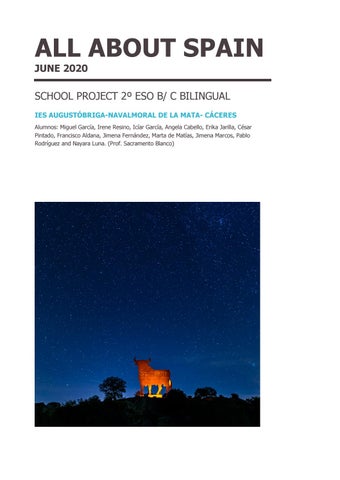
ALL ABOUT SPAIN JUNE 2020
SCHOOL PROJECT 2º ESO B/ C BILINGUAL IES AUGUSTÓBRIGA-NAVALMORAL DE LA MATA- CÁCERES Alumnos: Miguel García, Irene Resino, Icíar García, Angela Cabello, Erika Jarilla, César Pintado, Francisco Aldana, Jimena Fernández, Marta de Matías, Jimena Marcos, Pablo Rodríguez and Nayara Luna. (Prof. Sacramento Blanco)
Miguel García Rodríguez
ALL ABOUT SPAIN
CONTENTS. 1. Introduction. 2. History of Spain: The Discovery of America. 3. Symbols of Spain. 4. Regions of Spain. 5. Sports in Spain. 1. Introduction Now, I'm going to talk about my country, Spain. It is located in the South West of Europe, next to Morocco, Portugal and France. It has 46 million inhabitants and during the last years it has received a lot of people coming from South America and Morocco. It's a very tourist country because there are many beautiful beaches and cities and because of its warm climate. Also, Spain's gastronomy is very famous because Mediterranean diet is considered as one of the healthiest in the World. 2. History of Spain. There have been many different cultures through the story of Spain: Romans, Visigoths, Muslims, Jews and Christians. The borders have changed through centuries but since 1492, with the conquest of the Kingdom of Granada to the Muslims, they have remained similar to the current borders. Discovery of America In the same year,1492, the 12th October, Cristobal Colón arrived to the east of America. He thought he was in the Indies, but it was the beginning of the colonial expansion of Spain. During this period, Spain extended its lands to the actual continents of America and later to Africa, and other European countries did the same.
3. Symbols of Spain. Spain is a Parliamentary Monarchy. Felipe VI is the king, he's the Head of State. He reigns, but he doesn't rule. He belongs to the Borbon's Family, and his father, Juan Carlos, was the previous king. Felipe got married Letizia, the Queen. She doesn't belong to any royal family. She was a journalist. They have two daughters. Leonor and Sofia. Leonor will be the first Queen in the history of Spain, although there are many people who want Spain becomes a Republic.
4. Regions of Spain. Spain is divided into seventeen regions, whose names are: Galicia, Asturias, Cantabria, Basque Country, Navarra, Aragon, Catalonia, Valencian Community, Murcia, Andalucia, Castilla la Mancha, Madrid, Castilla Leรณn, Rioja, Canary Islands, Balearic Islands and the best one, Extremadura. There are two cities, Ceuta and Melilla in the North of Morocco. The capital city is Madrid and other important cities are Barcelona, Bilbao, Valencia and Sevilla.
Other beautiful cities to visit in Spain are Toledo, Granada, Córdoba, Santiago de Compostela, Salamanca, Burgos, Leon and Segovia.
5. Sports in Spain. Spanish people love sports, practicing and watching in television. The most popular sport is football, and Real Madrid and Barcelona are the most important teams with many supporters all over the world. Last years Spanish National Team has won some important title Other popular sports are basketball, handball, tennis, cycling, and running. Warm climate in Spain allow people to practice open air sports. The most famous sport players are Sergio Ramos, Iker Casillas, Andrés Iniesta, Pau and Marc Gasol, Fernando Alonso, Carlos Sainz, Carolina Marín, Marc Márquez, John Rahm, Alejandro Valverde, Garbiñe Muguruza and for me the best one, Rafa Nadal.
ALL ABOUT SPAIN The Spanish flag
The Spanish flag is made up of three red, yellow and red sashs. The central yellow sash is bigger than the others, that's why it's know as “la rojigualda”. This colours have different meanings: – Red represents the blood that was spilled by the Spanish in their conquests and defenses of the homeland. – Yellow represents gold and wealths that were obtained in these conquests. In the yellow area of the flag, there is a shield, the Spanish shield and its parts have differents meanings. The first Spanish falg arrived during the reign of Carlos III, but in 1843 Isabel II installed it as the national Spanish flag. The origin of the flag is because, at he beginning the flag that was established was with a white bottom but many others kingdoms used this color in the bottom and it was very difficult, when a ship arrived, to differentiate between enemies and partners. Carlos III commissioned a man design some flags to solve this problem. He made several designs and then Carlos III chose the final design. Of all the models, he decided to choose the red, yellow and red flag because it is very striking and easy to distinguish. The flag has been developing and having several changes in the shield but it always keeping the same colors, except for the period of the Second Republic.
Shield The Spanish shield is in the central area of the flag and it has several parts with different meanings : –
The crown: it is over the shield and it symbolizes the Spanish monarchy. This part of the shield is called “timbre”. – The two white columns: they are on the sides of the shield. They have around them a red ribbon with a motto that says: “Plus Ultra”. They were incorporated into the shield by Carlos I and symbolize the columns of Hercules, a peninsula near the Strait of Gibraltar and that's why there are also waves below the columns. There is a golden crown on top of each column that symbolizes the Holy Roman Empire, the country's historical past. – The big square in the middle: it is divided into four sections called “quarters” and it represent the medieval kingdoms that there were in Spain. · The first quarter, in the left corner, is the shield of the Kingdom of Castile and it is represented by a castle. · The second quarter, on the right, is the shield of the Kingdom of Leon, represented by a lion with a crown. · The third quarter, below the second, is the shield of the Kingdom of Aragon and it is represented by red and yellow bars. · The last quarter, below the second, is the shield of the Kingdom of Navarre, represented by chains . There is a white area with a small flower under the quarters. This is called “Entado” and it is a pomegranate that represents the Kingdom of Granada. Finally, there are three fleurs de lis in the center that represent the arms of the Anjou branch of the house of Bourbon, current Spanish monarchy. The shield has changed depending on the rulers and the government until obtaining the one we have today.
Paula Suárez Gordo 2ºESO B
ALL ABOUT SPAIN • The Spanish territory Years ago, Spain was called the Peninsula of the Five Kingdoms. It was called like that because there were 5 kingdoms: the kingdom of Portugal, the kingdom of Navarra, the kingdom of Castilla, the kingdom of Aragón and the kingdom of Granada. They were all like at war with each other. In the 1513, the kingdom of Navarra was incorporated to Castilla and at this moment Castilla was the biggest kingdom. They also tried to incorporate Portugal, but they couldn’t do it. In the year 1469 the infamous Catholic Kings, Isabel and Fernando, got married. They were the future queen of Castilla and the future king of Aragón. When they finally got the crown the two kingdoms didn’t become one, they were the same, but they were ruled similarly. In the year 1492, the Catholic Kings conquered Granada and it became a part of Castilla, in this year also became part of Castilla part of South America and the Canary Islands.
The queen Isabel died in the 1504. When the king Fernando died in the 1516, the new king was Carlos, his grandchild. This kid had to rule the kingdom of Castilla and the kingdom of Aragรณn, so they became one kingdom named Spain and he became Carlos I of Spain. Between the years 1516-1790 Spain became the most powerful empire of the time, but from the 1640 and on, it started to fall.
The following kings, after Felipe II, defended the Spanish territory badly so the countries in the empire claimed the independence. Finally, in the year 1898 Spain gave the independence to the last colonies they had left, leaving the Spanish territory reduced to part of the peninsula and two archipelagos near it. In the year 1981, Spain was divided into 17 autonomous communities and two autonomous cities, in the north of Africa, that were added in the 1995.
Irene Resino Nieto 2ยบB
FAUNA IN SPAIN Spain has a large fauna because of its geographic area (between the Atlantic Ocean and the Mediterranean Sea and between Africa, Asia and Europe) and because of the big diversity of habitats, biotopes, climes and different regions. In Spain, you can find species that are extinct in other European places for the shortage of population along the years, the delay of the industrialization, the influence of the African fauna and the number of endemic species in the Balearic Islands and the Canary Islands. In Spain there are many endangered species. They are protected and controlled to know the location and the number of species. Even so, many creatures are endangered because of the human being. Among fauna there are: - Fish: They have fins and gills. They are oviparous, except some sharks that are oviviparous. You can find fishs in Spain principally in the rivers, in the Mediterranean Sea and in the Bay of Bisca and in the Atlantic Ocean. The most renowned fish that live in Spain are: the Europe pike, the tuna, the common carp, the common trout and the rainbow trout, the black sea bass and the sheatfish.
Europe pike
Sheatfish
Common trout
Tunas
- Amphibian: They have metamorphosis and the babies only can live in the water, but when they are adults, they can live in the water and in the earth. They are oviparous. You can find in the rivers, because they need dampness to survive. The most renowned amphibians that live in Spain are: the common salamander, the pyrenean newt, the gallipato, the common toad and the common frog.
Common salamander
Gallipato
Common toad
- Reptiles: They shed their skins when they grow and they are of cold blood. The snakes haven´t legs. Many reptiles are oviparous, but some snakes are oviviparous. They live in trees, in small underground caves or in the ground. The most renowned reptiles that live in Spain are: the chameleon, the bastard snake and the giant lizard of The Iron.
Chamaleon
Bastard snake
Giant lizard of The Iron
- Birds: They are the most common type of animals in Spain. Many birds stay in Spain, because, when they emigrate from the North of Europe to Africa, they find Spain to rest or even they stay here. They have feathers, two wings and a beak. Many birds can fly, but some birds can´t fly such as the chicken and the rooster and the capercallie. They are oviparous. Many birds live in trees, but the birds that can´t fly live in the ground or in chicken coops. The most renowned birds that live in Spain are: the capercallie, the magpie, the common nightingale, the long-tailed, the bearded vulture, the common sparrow, the common swalow, the gray heron, the ringdove, the black vulture and the cuebre eagle.
Capercallie
Bearded vulture
Cuebre eagle
Common sparrow
Gray heron.
Ringdove
- Mammals: They have skin or hair. A lot of mammals walk in four legs and they are viviparous. They live in the ground or in the underground, except the bats that live in caves or in trees. The most renowned mammals that live in Spain are: the grizzly bear, the Asturian wolf, the Iberian lynx and the Hispanic mountain goat.
Grizzly bear
Asturian wolf
Hispanic mountain goat
EXTINCT ANIMALS Some endemic animals of Spain, at present, they are extinct, the majority because of the human being. Here, there are some pictures about some extinct animals:
Canary unicolor oystercatcher
Monk seal
Bucardo
Ă ngela Cabello IĂąigo. 2 C.
THE FOUR TOWERS The four towers are in Madrid, the capital of Spain. The first tower was built in 2007, the name of the tower is Space tower. The second tower was built in 2008, the name of the tower is PwC tower. The third tower was buil in 2009, the name of the tower is Cepsa tower and I was lucky to visit it a couple of years ago because my aunt works there. The fourth tower was built in 2009, the name of the tower is Glass tower.
Cepsa Tower, PwC Tower, Cristal Tower and Space Tower.
The tallest tower is Glass tower whit 249 metres high. It Is one of the most important in Madrid along with the “Pirulí”. In Winter, when it rains on the top floor of the building it is snowing. It´s amazing!
THE FOOD. In Spain the food is very important and is the best. The food is known as a mediterranean diet. The mediterranean diet is made up of vegetables, bread, cereals, olive oil, vinegar and wine. The most popular dishes are: paella, omelette,ham,cocido madrileño,gazpacho, salmorejo,croquetas,callos,migas,… Tourists usually like Spanish food very much, in my opinion we have one of the best meals in the world. My favourite dish is the omelette. The omelette has : eggs, potatoes and onion, but I prefer it without onion.
Spanish Omelette
EASTER. Easter is very important in Spain and begins on Thursday of Easter, since that day was the last dinner. The resurrection of christ was the night of Saturday to the Resurrection Sunday. It is one of the most important dates since the passion, the death and resurrection of Jesus is celebrated. Easter week starts with the end of the carnivals and normally 40 days pass until it arrives, this period is generally called Lent. For Catholic Spaniards this feast is very important since they remember Jesus through processions. Normally it is celebrated in April.
A typical holy procession along the streets during Easter.
Carnival! The carnival is a typical celebration in Spain. Carnival is a costume party, all the people dress up. There are a lot of amusement rides at the fair. There is a big parade with a lot of costumes. In this party the girls come to see who is the queen of the carnival, and the ladies too. These are the ones that open the parade. A lot of carnival groups with super cool costumes take part in the parade People love this party, the people have a great time dancing with their friends, they dance a lot . Carnival gives life to Spain. I love that. These parties make Spain even more beautiful. ERIKA JARILLA PECO 2ยบB
SOMETHING ABOUT SPAIN -1 LA SIESTA: La siesta is the one of the things in the Spanish culture that truly shows us -2 MEDITERRANEAN BEACHES: Spain is truly blessed with the overwhelming Mediterranean Sea on 3 sides and with the sea and the coast come jaw-dropping -3 SPANISH FOOTBALL: It is the most popular sport and needless to say.They have won it all, World Cups,Champion Leagues and what not. LaLiga is their national tournament for which every clubes take part -4 PAELLA: Spanish cuisine is one of the most diverse cuisine in the world thanks to the various diverse regions of Spain -5 BULLFIGHTING: Bullfighting has been in the Spain culture since time immemorial. In the bullfight, 3 matadors fight a bull to death. It has 3 stages - tercio de varas (lances) - tercio de banderillas - tercio de muerte (death stage)
FAMOUS PLACES Main Square of Salamanca
It is a construction from 1729-1756 in the Baroque style, the architect was Alberto de Churriguera. In 1935 it was declared a national monument. Currently, the Plaza Mayor is the center of life in the city, specific musical and scenic activities are held for all audiences.
Main Square of Madrid
It is located in the center of Madrid, it is surrounded by arcades and brick buildings with 3 floors. The construction is in the Spanish Baroque style, highlighting the architects Juan de Herrera and Juan Gรณmez de Mora, to get to the Plaza Mayor, different doors can be used, each with a special charm. It is one of the most visited squares by tourists, it is one of the most beautiful squares in all of Europe.
Square of Obradoiro
It is the monumental center of Santiago de Compostela. Its Galician name derives from the workshops that worked on the construction (1075) of the baroque faรงade of the cathedral that dominates the square and welcomes the thousands of pilgrims who arrive on the Camino de Santiago. The buildings that close the square represent the main poles of life in the Galician capital: religion, university education, care for pilgrims and travelers. It has different architectural styles in more than 700 years of construction.
FRAN ALDANA FDEZ :P
ALL ABOUT SPAIN LAS FALLAS DE VALENCIA The Fallas de Valencia are parties that run from March 15 to 19 with a tradition rooted in the Spanish city of Valencia. Officially they begin the last Sunday of February with the act of the Crida ('proclamation or call').The origin of the Fallas festival dates back to the ancient tradition of the city's carpenters, who on the eve of the feast of their patron Saint Jose, burned old and useless junk that they used in front of their workshops, in the streets. to raise the lamps that illuminated them while they worked in the winter months. For this reason the day of the cremà (moment in which the Fallas monuments burn) always coincides with the 19th, the Feast of Saint José.
SAN FERMÍN One of the most famous activities of the San fermines is the running of the bulls, which consists of a race of men and women along an 849-meter course in front of the 6 bulls and 6 halters that end in the bullring. The running of the bulls takes place every day, between July 7 and 14, and starts at eight in the morning, lasting between two and 3 minutes. Before the running of the bulls, a hymn is sung to the patron to protect them.
JIMENA FERNÁNDEZ MARTÍN
SPAIN Major cities: A. Madrid: is the capital of spain and the most populated. Here you can find the government together with institutions, ministers…there live the Kings of Spain. There is the royal palace. It has a very important museum around the world called the Prado Museum. In El Prado you can find paintings by artists of the stature of Velázquez or Goya, among many others, while in the Reina Sofía you can delight in works by Pablo Picasso, Joan Miró and Salvador Dalí. At the Thyssen you will be able to enjoy the more than 800 works of art that the family of the same name collected over two generations. B. Barcelona: it is the capital of Cataluña, that is a atonomou community. It is located on the shores of the mediterranean sea. It is ranked 15th on the list of the safest cities in the world. There is the holy family, It is one of the most visited monuments. Also is the park Güell, a fascinating public park located in the northern part of the city.
Comentado [1]: an
C. Sevilla: is the quarter city more important. its old town is the bigger of Spain and europe. a series of monuments, starting with the Reales Alcázares, which constitute a group of original palaces from the High Middle Ages where a mix of Islamic, Gothic and Mudejar styles can be observed. there is there is a Naval Museum where you can find models, engravings, sea charts, navigation instruments and historical curiosities.
Comentado [4]: fourth
D. Zaragoza: It is the capital of Aragón and It is located on the banks of the Ebro, Gállego and Huerva rivers, there we can find El pilar,whose full name is Cathedral-Basilica of Our Lady of Pilar. The Ebro river is one of the simbols of Zaragoza and you can do river walks. These walks are especially appetizing in the summer and you can see monuments such as El Pilar, the Puente de Santiago, La Almozara or the Pasarela del Voluntariado, among others. Don´t miss the Aljaferia palace!!
Comentado [2]: autonomous Comentado [3]: Sagrada Familia doesn't need translation
Comentado [5]: the fourth most important city
E. Mรกlaga: It belongs to the autonomous community of Andalusia and is located to the west of the Mediterranean, on the so-called Costa del Sol. Its Cathedral, Acazaba and the Picasso Foundation Casa Natal Museum are places of special interest. F. Palma de mayorca: is the capital of the island Baleares. There are the castel of bellver, the catedral of Mayorca and caves for drach. In Mayorca there is a very important and delicious sweet called Majorcan Ensaimadas.
G. Las palmas de gran canaria: it is the largest and most populous city in the Canary Islands and shares the capital of the autonomous community of the Canary Islands together with Santa Cruz de Tenerife. The beach of the Canteras is the one that attracts the most tourist interest and it is considered by many to be more than just a beach, due to its golden sand and crystalline waters. There you can visit the Cathedral-Basilica of Santa Ana and the oriel City of Martinsicuro. H. Bilbao: It is a municipality belonging to Vizcaya, in the autonomous community of the Basque Country. Bilbao's importance dates back to the 13th century, when it became a commercial spot. There you can see: Guggenheim Museum of Bilbao and the theater Arriaga. I. Valencia: It is the capital of the Valencian Community and is located on the banks of the Turia River, on the Levantine coast and a few kilometers away from the sea. There are: the tower of serranos, the oceanographic; it is very big, is amazing, and beautifull ( I went two times). In Valencia there is Las Fallas.
Statue of Don Quixote and Sancho.
Merida, Roman Theater.
Legend That legend tells the story of a house built for a woman called Elena that was prince Felipe´s lover ( later the King), she was married with a captain that was sent to war in Flandes, he died. She fell into depression and died in the house of the sevent fireplaces. Her corpse was never found. Her father found it in the house and committed suicide. Recently, the skeleton of the woman was found in the hous and many people say that they see a woman with a White gown walking on the roofs with up torch in the hand.
Marta de Matias Corral 2ESO B
FOOD IN SPAIN There are two types of in Spain. -Rural: it is the traditional food style and bring us memories of a country site.
-Coastal: it’s a more modern type of food and brings us the memories of the proximity to the sea.
There is a lot of diversity of culture in the dishes. HISTORY OF FOOD IN SPAIN The style of food in Spain was unknown for many centuries in Europe, it was between the end of the 19th century and the beginning of the 20th century when spanish food began to be known natonally. This was thanks to the “Gatronomic Generation of 27”. GASTRONOMIC GENERATION OF 27 It was created in the early 20th century and lasted until the start of the civil war. They were in charge o presenting the dishes on a printed menu. They made a magazine and it was published in 1929.
Gastronomic generation 27.
NEW SPANISH CUISINE They are recipes that combine popular tradition with artistic creation to create new flavors. Some of its creators are: Ferrรกn Adriรก, Arzak o Berasategui. Some of his creations are:
(you could still be hungry after eating them because the portions are very small). This type of cuisine is divided in two parts:
CLASSIC It’s a traditional style because they are made with food that was very common before.
MODERN It’s a modern style, it uses new techniques and improvement.
TAPAS It is a typical free aperitif in Spain that is served with the drink.
THE END JIMENA MARCOS GONZÁLEZ 2ºC
all about spain Sports in Spain In Spain, there is a lot of sports such as football, judo, cycling, athletics, handball, tennis, volleyball… but the most famous sports in Spain are football and basketball. Football Is the most popular sport in Spain. It is the sport with more people registered. Football was introduced in Spain through immigrant workers, especially The British in the 19 century. It was the english people who played the first matches in 1870. Spain, is one of the best countries in the world at football. The spanish league (La liga Santander) is, for a lot of people, the best league of football in the world. The spanish league has got 20 differents teams like the Real Madrid, the F.C. Barcelona, the Atlético de Madrid, the Sevilla F.C… The spanish team won in 2010 the world cup and in 1964, 2008 and 1012, Spain won the Europe cup.
Pablo Rodríguez 2ºB
Basketball Basketball arrived in Spain in 1921.Eusebio Millán, met the sport in Cuba and brought it to Spain. The popularity of football in the country, made it impossible to be popular. The sport didn’t become popular between the people. A year later, in 1922, Millán created the first national basketball club in Spain: Laietà Basket Club. Basketball in Spain is the same as in other European countries but is very different from how it is played in the NBA (USA), the most important basketball league. The spanish team, won the world cup in 2006 and in 2019 and it won the Europe cup in 2009, 2011 and 2015.
Pablo Rodríguez 2ºB
Fencing It is a combat sport in which, two people try to touch the rival with a sword. It is a olimpic sport. Fencing was created in Spain in the 15th century. It was used to be better with the sword in fight.
Pablo RodrĂguez 2ÂşB