
By Joy Stephenson-Laws, Managing Partner
A SAC perspective on the financial mechanics behind a public health crisis
In The Atlantic this month, Elisabeth Rosenthal described the final weeks of her husband’s life through a medical purgatory she called “barbaric”:
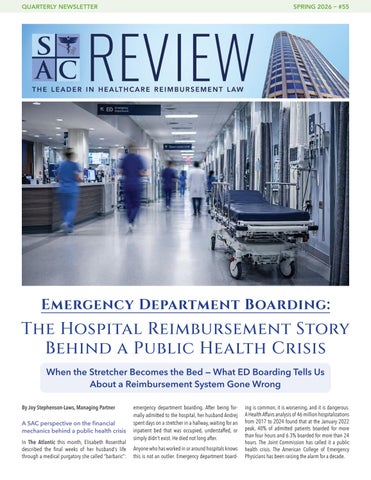
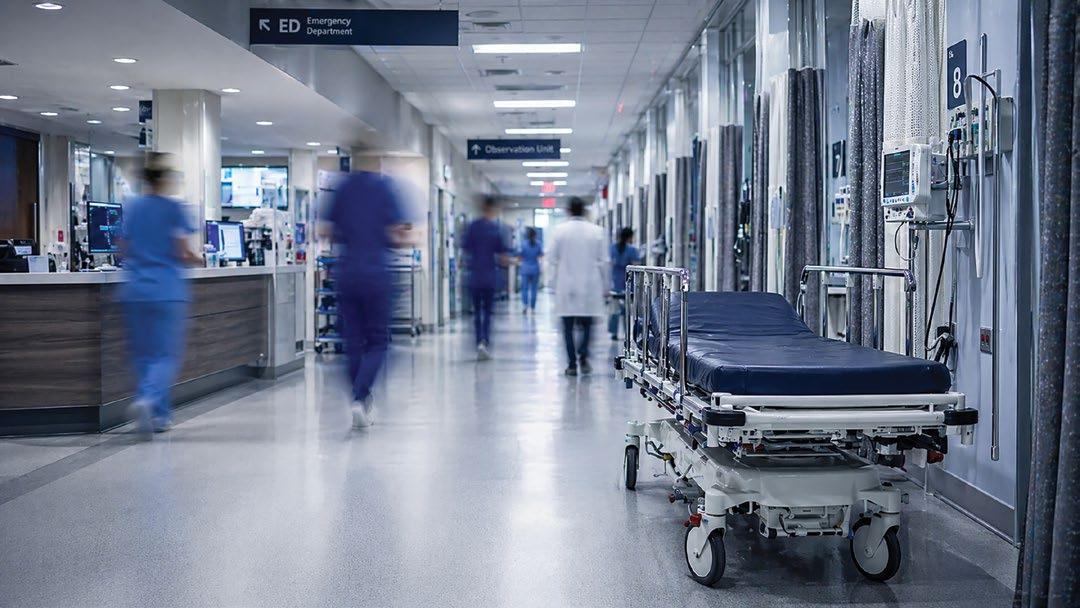
emergency department boarding. After being formally admitted to the hospital, her husband Andrej spent days on a stretcher in a hallway, waiting for an inpatient bed that was occupied, understaffed, or simply didn’t exist. He died not long after.
Anyone who has worked in or around hospitals knows this is not an outlier. Emergency department board-
ing is common, it is worsening, and it is dangerous. A Health Affairs analysis of 46 million hospitalizations from 2017 to 2024 found that at the January 2022 peak, 40% of admitted patients boarded for more than four hours and 6.3% boarded for more than 24 hours. The Joint Commission has called it a public health crisis. The American College of Emergency Physicians has been raising the alarm for a decade.
The natural question is why.
It is not because hospitals are indifferent. It is not because capacity is being deliberately withheld. Emergency department boarding is the visible symptom of a deeper structural problem: the United States has built a hospital reimbursement system that does not pay for the care it requires hospitals to deliver. Over time, that mismatch has quietly reduced the number of staffed beds available — until the system began to fail in plain sight. This is the story behind the stretcher.
The numbers most patients never see
To understand how a capacity problem becomes a structural one, start with how hospitals are paid — specifically, what Medicare actually reimburses relative to the cost of care. The Medicare Payment Advisory Commission — MedPAC, an independent body that advises Congress and has no incentive to overstate hospital distress — found in its March 2026 Report to Congress that hospitals operated on a negative 12.1% margin on Medicare fee-for-service inpatient and outpatient services in fiscal year 2024. MedPAC projects the margin will remain deeply negative in 2026, at approximately negative 10%. Even the commission’s subset of “relatively efficient” hospitals — those that perform well on quality while keeping unit costs low — posted a negative Medicare margin in 2024. That means in fiscal year 2024, for every $100 it cost hospitals to provide Medicare fee-for-service inpatient and outpatient care, Medicare reimbursed roughly $88. For two decades running, Medicare has paid hospitals less than what their care costs. Medicare and Medicaid together pay for at least half of inpatient days at 96% of US hospitals, and at least two-thirds at 80%. So the population that fills hospital beds — older, sicker, often with multiple chronic conditions — is precisely the population whose care is reimbursed below cost. Behavioral health is even worse: AHA reported in its 2024 Costs of Caring analysis that inpatient psychiatric services were paid 34% below cost across all payers in 2023. That figure helps explain why psychiatric patients board in EDs for days at a time. The beds upstream have been closing for thirty years because no payer covers what they cost to operate.
How the cross-subsidy actually works
That gap does not remain contained on a balance sheet. Hospitals have to absorb it somewhere — and in practice, they do so by shifting costs onto the one set of payers that will negotiate: commercial insurers. The RAND Corporation’s most recent price transparency study found that commercial insurers paid an average of 254% of Medicare rates for the same hospital services at the same facilities in 2022. KFF found that hospitals in the top quartile of commercial payer mix had operating margins of 7.5%, compared to 3.3% for hospitals in the bottom quartile.
A hostile reader will see those numbers and conclude that hospitals are gouging private insurers.
The more accurate framing is this: the public payment system has externalized its underpayment onto employer-sponsored health plans. Every dollar Medicare and Medicaid fail to pay is a dollar that has to come from somewhere if a hospital is to keep its lights on, its nurses staffed, and its doors open at 2 a.m. when the ambulance arrives. The cross-subsidy is not a bug in the system — it is the system.
And it is unraveling in two directions at once. Employer health premiums have risen roughly 50% in a decade, fueling political pressure to cut commercial rates. Meanwhile, hospitals serving populations with little commercial insurance — rural, urban safety-net, county systems — never had a meaningful cross-subsidy to begin with. Industry analyses have flagged hundreds of rural hospitals at risk of closure, and the credit rating agencies tell the same story: S&P Global Ratings reported a 3.0-to-1 downgrade-to-upgrade ratio for nonprofit hospitals in the first half of 2024, widening to 4.5-to-1 for the full year — the worst spread in years.
Boarding is not a billing strategy
This financial backdrop leads to a persistent misconception: that hospitals tolerate emergency department boarding because they get paid the same regardless of where a patient is treated. It is true that under Medicare’s diagnosis-related group payment system, the hospital receives a fixed payment per admission based on diagnosis, regardless of where the patient physically lies. So technically, yes, a boarded patient generates the same DRG payment as a patient in a proper bed.
But that framing collapses on the cost side. A 2024 study published in Annals of Emergency Medicine, using time-driven activity-based costing on acute stroke patients at an academic medical center, found that the daily cost of caring for a boarded medical/surgical patient was approximately $1,856, compared to $993 for the same patient in a proper inpatient bed. The study has real limits — single site, single diagnosis, an academic stroke center with traveler-nurse premiums that vary by market — and the absolute dollar figures should be read with that in mind. But the mechanism generalizes. Boarding forces inpatient care into an emergency department workflow designed for rapid turnover, not sustained treatment, while simultaneously blocking access for new patients arriving by ambulance. Boarding does not zero out a Medicare DRG payment, but it erodes whatever margin existed and adds an opportunity cost the DRG never priced. The idea that boarding is a profit center is the inverse of the truth — hospitals that could discharge boarders into staffed inpatient beds tomorrow would do so tomorrow.
The reason boarding happens anyway is more sobering. It happens because the hospital has run out of staffed beds and has nowhere else to put a patient who cannot be discharged. Beds without nurses are furniture. Nurses without reimbursement that covers their wages are a permanent subsidy that hospitals running on thin margins simply cannot sustain.
What this means for hospital leadership
If boarding is not a choice and not a revenue strategy, then it is a constraint — and that constraint is now tightening in ways hospital leaders cannot ignore. For hospital executives, general counsel, and CFOs reading this, three points matter for the road ahead.
First, the regulatory environment is shifting in ways that will measure boarding without addressing its causes. In its CY 2026 Hospital Outpatient Prospective Payment System final rule issued November 21, 2025, CMS adopted a new Emergency Care Access & Timeliness electronic clinical quality measure (ECAT eCQM). Optional reporting begins with the CY 2027 reporting period, replacing the older Median Time from ED Arrival to Departure measure beginning with the CY 2028 reporting period and the CY 2030 payment determination — at which point poor performance begins affecting Medicare reimbursement. The measure flags admitted patients who remain in the ED more than four hours after the decision to admit, total ED stays exceeding eight hours, and excessive arrival-to-treatment times. As ACEP’s president observed, “you cannot fix what you refuse to measure.” That is true. It is also true that penalizing hospitals for a problem driven by chronic underpayment will accelerate, not solve, the capacity contraction. Hospital legal teams should be preparing comments and documenting the staffing and reimbursement constraints driving boarding times at their facilities now — that record will matter when the penalty phase arrives in 2030.
Second, throughput is being constrained from outside the hospital walls — and much of that pressure is litigable. Three patterns recur in our practice. Retrospective inpatient-to-observation downgrades under the two-midnight rule, where Medicare Advantage plans and commercial payers reclassify properly admitted patients weeks after discharge to convert a DRG payment into a far lower observation rate. Prior authorization delays for post-acute placement — skilled nursing, inpatient rehab, long-term acute care — that hold medically-ready patients in inpatient beds for days, which in turn keeps the ED full of admitted patients with nowhere to go. The HHS Office of Inspector General has documented widespread inappropriate denials by Medicare Advantage plans, with post-acute facility stays specifically named as a category in which 13% of prior authorization denials reviewed by OIG met original Medicare coverage rules. OIG has now opened a follow-on investigation focused specifically on MA prior authorization for post-acute placement. And 30-day readmission denials that recharacterize a clinically distinct second admission as a continuation of the first, eliminating payment entirely.
Each of these compresses inpatient throughput. Each shows up downstream as a patient on a stretcher in a hallway. Hospital revenue cycle, utilization man-
Continued on back page