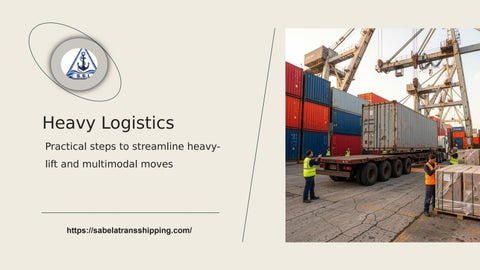
Heavy Logistics Practical steps to streamline heavylift and multimodal moves
https://sabelatransshipping.com/
Heavy-Lift Domain
Heavy lift starts with a single item over 50 tonnes or dimensions beyond standard container limits. Multimodal moves stitch road, rail, sea, barge, and sometimes air into a single, engineered sequence, with bespoke planning for each project. Example: a 300-ton transformer moved 1,200 km using low-bed trucks, a short sea leg, then heavy rail to site, supported by permits, route surveys, lift plans,
Route Constraints
Route restrictions, infrastructure limits, regulatory permits, and handling interfaces drive cost and schedule risk. Examples: axle-load limits force load splitting (permitted 10 tonnes vs cargo 120 tonnes), bridge height clearances trigger detours or temporary removal, and port tidal windows constrain timing to hours. Permit lead times often stretch 4–12 weeks, shaping the plan.
Match Mode to Cargo
Point-to-point flexibility and fastest origin-todestination for last-mile needs. Suitable when access is available and schedules are tight. Higher cost per ton-km and stricter axle-limit constraints make it less economical for large, dense loads. Requires loading interfaces, permits, and careful ro
Lower cost per ton-km for bulk overland transport (typical rail: 0.02–0.06/ton-km vs road 0.10–0.30/tonkm). Best for heavy, dense, long-distance moves with established rail connectivity. Requires compatible loading/unloading interfaces and rail loading gauge compliance; slower door-to-door timing.”
Match the mode to cargo characteristics: use road for flexibility and last mile, rail for bulk overland efficiency.
Six Steps Requireme nt capture
Constraint survey
Mode & economics
Engineerin g interfaces
Permits & schedule
Execution & contingencies
Record weight, dimensions, lift points, tolerances, and timeline.
Scan route, bridges, ports, rails, permits, and seasonal factors.
Evaluate mode mix: cost per tonkm, lead time, availability.
Design lifting points, skids, cradle, transload method.
Secure permits (4–12 weeks), reserve cranes/berth windows, confirm tides.
Staging, onsite supervisors, spare equipment, escalation matrix.
Key KPIs
>85% <48h 95–98% <0.5% 0.08/ton-k
Utilization of specialized assets; target above 85%. Average dwell time at transload/port; target under 48 hours.
On-time delivery rate; target 95–98%. Damage rate per shipment; target under 0.5%. Cost per ton-km benchmark (representative crossmode target).
Pilot Path Select Route
Redesign Route
Permits & Booking
Choose one representative corridor and gather baseline KPI data from the last three jobs.
Apply the six‑step process to redesign the route for cost, time, and risk improvements.
Secure required permits and reserve critical equipment with confirmed windows.
Pilot Shipment
Evaluate Pilot
Scale & Learn
Execute a full‑supervision pilot with real‑time data capture and oversight.
Compare pilot KPIs against baseline and document deviations and lessons.
Scale to additional routes using lessons learned and update risk registers.
Operational Mastery
- Recognize operating constraints and risks unique to heavy-lift and oversize cargo. - Evaluate modal trade-offs (road, rail, sea, barge) using a disciplined decision framework. - Implement the six-step optimization and execution process for multimodal shipments. - Track KPIs—utilization, dwell time, damage rate, and cost per ton-km—to drive continuous improvement.
Thanks!
Do you have any questions? 56/512 B1, Eliza Villa Next to Pinpoint Inn Parambithra Cross Lane, Panampilly Nagar, Kochi, Kerala, India 682036. •
https://sabelatransshipping.com/
CREDITS: This presentation template was created by Slidesgo, including icons, infographics & images by Freepik