Current to 10 Aug 2021
THE
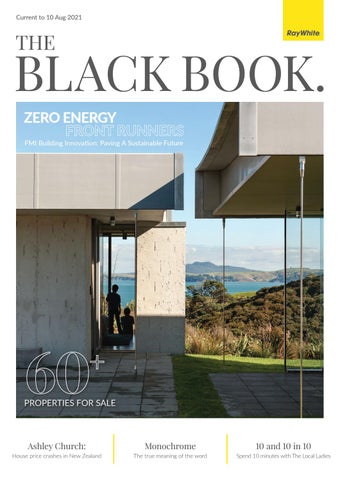
BLACK BOOK. ZERO ENERGY FRONT RUNNERS FMI Building Innovation: Paving A Sustainable Future
60
+
PROPERTIES FOR SALE
Ashley Church:
Monochrome
10 and 10 in 10
House price crashes in New Zealand
The true meaning of the word
Spend 10 minutes with The Local Ladies
R AY W H I T E N OW
Introducing Ray White Now, an insight to provide clarity to all our customers on what is happening in the market now. If you are considering selling we explain how you can take advantage of the current conditions to achieve the best possible sales outcome. The resilience of the New Zealand housing market has never been more evident than over the past three months. Most New Zealanders would be surprised at the level of activity and prices achieved, even though it has operated under restrictive operating conditions. As Australasia’s largest real estate group, we are uniquely placed to provide our clients with the most relevant and timely information and data to assess current market activity and outlook. And as a family-owned and led business with 118 years of experience including operating through two world wars, the great depression and recessions, we know that we can deliver you the highest quality solutions in the current market.
C L I C K H E R E TO R E A D T H E L AT E S T I S S U E N OW
contents.
04 06 08 14 18 20 24
Black Group Realty Ltd. Contents
Selling Principal
Inspire
Franchise Owner
FMI Building Innovation
Sales Manager
Heather Walton 021 432 167 heather.walton@raywhite.com
Mark Bycroft 021 968 946 mark.bycroft@raywhite.com
Jeff Tubman 0274 558 717 jeff.tubman@raywhite.com
Modern Monochrome
Black Group Property Management. 10 and 10 in 10 with The Local Ladies
General Manager
House price crashes in New Zealand
Business Development
Mac Bycroft 021 223 6893 mac.bycroft@raywhite.com
Josh Smith 021 235 8802 josh.smith@raywhite.com
Properties For Sale Ray White Epsom Ray White Matakana & Omaha Ray White Takapuna Black Group Realty Ltd. Licensed (REAA 2008)
The Black Book is subject to copyright in its entirety and the contents may not be reproduced in any form, either in whole or in part, without written permission. Opinions expressed in The Black Book are those of the contributors and not necessarily those of Black Group Realty Ltd or Ray White Epsom. No responsibility is accepted for unsolicited material.
4 |
THE BLACK BOOK.
s n o ti a l tu a r g n o C to our top achievers for 2020/2021 Chairman’s Elite
Top 1% of the Ray White Group
Heather Walton
Richard Thode
Ross Hawkins
Ruoxi Wang
Heather has more than 25 years in the New Zealand property industry. Her name has become synonymous with excellence and high performance. Heather is an industry leader and multiple Ray White franchise owner. She is often imitated but never surpassed and continues to adapt, innovate and lead the industry. Her overwhelming drive is to always put the client first and provide the best possible service.
Richard has devoted many years to a wide cross-section of real estate areas. His significant property market experience in both commercial and residential has included high end developments and building and property construction project management. His unique skills are the foundation that equips him with a competitive real estate advantage and his experience and drive to succeed has resulted in his achieving a string of accolades and industry awards.
Over his 20 year career, Ross has focused on high-end property and has set a number of records in high-end residential, waterfront and lifestyle sales for his key clients. Intially specialising in project marketing and partnering and assisting key clients to develop, create and sell down large-scale developments, both in Auckland City locations and in premium coastal locations around the country, Ross has always run his own projects from start to finish.
Before Ruoxi entered this fast-moving industry, she immersed herself in the intricacies of real estate whilst studying full-time for her law degree. Having graduated with Second Class Honours (first division) from the prestigious law faculty in National University of Singapore, Ruoxi has a sharp eye for detail and exhibits intellectual rigour in her analysis. She will always go the extra mile to ensure that the process of selling or buying your house is stress-free.
021 432 167
021 336 002
0274 720 577
022 683 6391
heather.walton@raywhite.com
richard.thode@raywhite.com
ross.hawkins@raywhite.com
ruoxi.wang@raywhite.com
Alan White Elite
Top 3% of the Ray White Group
Bill Myers
Ken Choong
Maggie Gao
Matt Corin
Ryan Teece
Sue Hatton
We are so proud of our entire group’s performance over the past 12 months. Our Chairman’s Elite and Alan White Elite performers are consistantly setting a high standard of service within the greater Auckland real estate market. If you haven’t achieved the goals set within your own business, contact us for a confidential chat about how Black Group can help you exceed them next year. Mark Bycroft, Franchise Owner
Black Group Realty Ltd. Licensed (REAA 2008)
Ray White Epsom 09 638 8640
Ray White Matakana & Omaha 09 283 3656
Ray White Takapuna 09 488 9191
enquiries.bgr@raywhite.com
inspire. Photo from 402/40 Kitchener Street, Auckland Central. Marketed by Ross Hawkins and Richard Bull.
8 |
THE BLACK BOOK.
Fairview Fabricator: Fairview North Shore - Photo: Simon Devitt
ZERO ENERGY FRONT RUNNERS FMI Building Innovation is paving a sustainable future for New Zealand’s building industry. THE BLACK BOOK.
| 9
Zero Energy homes support decarbonisation, improve the health and wellbeing of Kiwis, and reduce household energy bills. Yet, despite these benefits for consumers and the community more widely, the awareness and uptake of energy-efficiency homes in New Zealand remains very low. FMI Building Innovation, a Kiwi-owned building products company for over 53 years, is on the pursuit of greater education to remove common misconceptions that have prevented the uptake of Zero Energy homes in New Zealand. Managing Director for FMI Building Innovation, Warren Lewis, says one of the most common misconceptions is that the cost to build a Zero Energy home is infeasible to the average Kiwi.
“New Zealanders tend to not factor ongoing home operating costs into their house purchase decisions. In the current housing market climate, they also prefer to spend spare funds on visible improvements such as kitchen renovations rather than long term, but invisible energy-saving investments,” says Lewis. For those unfamiliar with the Zero Energy concept, a Zero Energy home or building produces as much renewable energy from solar panels on its roof as its inhabitants consume in air and water heating, running appliances, and so on. Solar panels combined with highly insulating materials in the building envelope form a house with a desirable carbon-friendly footprint and long-term energy savings. New Zealand’s current housing crisis, and the Government’s strengthening climate policies are influences that FMI believes will accelerate the demand for Zero Energy homes in New Zealand over the next 10 years.
Fairview Fabricator: Fairview North Shore - Photo: Simon Devitt
He explains, “For years there has been an ongoing misconception that the cost to build a Zero Energy home is far greater than a minimum code-built home, and this is simply not true”.
A recent research paper titled ‘The Economics of Zero Energy Building’ FMI Building Innovation published in their company’s publication Fenestration New Zealand, found the initial cost premium for a zero energy house to be about 7%, easily repaid with energy savings over the average 7 to 8 years Kiwis stay in a home.
10 |
THE BLACK BOOK.
For years there has been an ongoing misconception that the cost to build a Zero Energy home is far greater than a minimum code-built home, and this is simply not true.
THE BLACK BOOK.
| 11
Fairview Fabricator: Fairview North Shore - Photo: Simon Devitt
Our modelling of a well-insulated Zero Energy home found a significant 64% reduction in annual energy demand compared to a minimum code-built house.
The Climate Change Commission’s first carbon budget, released on 31 January 2020, requires a 17% reduction in greenhouse gas emissions by 2030 compared to 2018 as well as a 35% energy efficiency improvement in newly built homes compared to today’s performance. “Our modelling of a well-insulated Zero Energy home found a significant 64% reduction in annual energy demand compared to a minimum code-built house. That is nearly double the target set by the Climate Change Commission. The household power bills could be further reduced by drawing energy from the solar panels, and by income from selling surplus energy to the grid,” says Lewis. MBIE’s proposed building code changes released in their 2020 Building for Climate Change consultation document also indicate a need for raising minimum levels of insulation requirements, as an initial step towards making Kiwi homes warmer, drier, healthier, and more energy efficient. FMI’s long-term aspirations for supporting market transformation towards Zero Energy buildings are clearly limitless. Lewis recently announced that the company will build their own Zero Energy test house on site at FMI’s Mt Wellington premises, with construction set to start late this year.
Once built, the test house will act as an educational facility and will be open to the public for inspections. “The time is right for greater investigation and commitment to Zero Energy homes. New Zealand’s relatively weak building code continues to limit the country’s aspirations for healthy housing and a sustainable climate” says Lewis. He continues, “Energy-efficient buildings have a modest but still important role to play given the decades over which installed housing stock endures. We believe zero energy homes offer a worthwhile and achievable step in the right direction.” FMI Building Innovation is no new kid on the block. In 1968, the company began as Fairview Metal Industries (FMI) originating in Timaru New Zealand. 53 years on and the company has grown to over 350 employees with three channel to market brands, Eurowood, Fairview, and Vetro Raccordi and multiple locations across New Zealand. “Innovation has always been hard-wired into the FMI culture. We are always looking forward, pushing boundaries and discovering new ways to deliver better value to our customers, and to New Zealand’s building industry.” n Click Here To Read Fenestration Magazine
12 |
THE BLACK BOOK.
New Zealand’s leading suppliers, manufacturers, and innovators of world-class building solutions. Supplying materials and components to New Zealand’s building and construction industry. CLICK HERE TO VISIT OUR
e: info@fmi.co.nz p: 09 574 2900
WEBSITE
www.fmi.co .nz
Proudly Kiwi owned, FMI Building Innovation is a strong family of interconnected brands offering exceptional building solutions to architects, builders, trade customers, and our very own extensive fabricator network across the country.
VISIT SITE
VISIT SITE
VISIT SITE
14 |
THE BLACK BOOK.
M O D E R N
Monochrome
For many, a monochrome interior means white on white with some black accents. But today’s monochrome goes well beyond that to embrace the true meaning of the word monochrome - one colour. That can mean any colour. Neutral colours do lend themselves to a monochrome background in a room, particularly where space and light are important. But your monochrome space could just as easily be a dramatic collection of charcoal shades or blues in cobalt, royal, navy and sky.
combined with a more varied colour scheme. In a monochrome room, those patterns and textures are important in adding layers of visual interest so the space doesn’t appear too flat or uninteresting.
Some people might be put off by the idea of monochromatic interiors, worrying that the couch will blend into the walls, and the end result will be flat and dull.
If you’re opting to focus on one colour for your one colour, then choosing that colour is an important decision! You might already be committed to a room that’s green, or grey, or pink. But which green, grey or pink?
The key is layering and texture. Once you’ve chosen your colour, work with tints, shades, textiles, and lighting to bring your room to life. Done well, a boldly coloured monochrome space should be dramatic, inviting and relaxing to be in.
Why go monochromatic at all? Simplifying your room down to one colour can create a very relaxing, soothing and uncluttered space to spend time in. By confining your colour choices, it will often draw attention to interesting features in a room, a dramatic light fitting, a decorative ceiling, an amazing view, a contrasting artwork or a bold piece of furniture. Going for a monochrome colour palette is also an opportunity to play around with multiple clashing patterns and textures that might overwhelm your space when
Choose your colour
Spend some time with Resene testpots to see how colours change in different light and in different parts of the room, and to see how different intensities of one colour will work together to give your room the simplicity, drama or depth you’re looking for. Resene colour charts can be a great help when looking for different tints and shades to pair with your main colour choice. They’re laid out so you can see colour graduations. Once you have decided on favourites use Resene testpots to decide the exact combination for your room. Think about whether you want your room to have a warm or cool feel. This might be dependent on how much natural light the room has, whether it faces north or south. And what the room’s main function is. Do you want the room to be cosy and inviting, or cool and uplifting?
THE BLACK BOOK.
| 15
Resene Colour Consultants can help you select shades that will layer well together, but a good rule of thumb is to try and make sure the undertones of your colours are the same. Undertones are the tones that stand out in a colour when it’s hit by the light. It’s another reason why experimenting with Resene testpots first is a good idea. You can also try working with just one colour in eighth, quarter, half, double and triple strengths.
Some combinations to try for a monochrome effect are: Pinks
Resene Glamour Puss with Resene Irresistible and Resene Geronimo
Greens Resene Goblin with Resene Gondwana and Resene Envy Blues Resene Blumine with Resene St Kilda and Resene Billabong Browns Resene Millbrook with Resene Nullarbor and Resene Bronze If you’re opting for a traditional monochrome look of layered whites, with black accents, it is more important to select whites with the same base tones. For example try layers of all warm, yellow-toned whites such as Resene Half Spanish White, Resene Merino or Resene Half Blanc. Or opt for cool whites such as Resene Black White, Resene Alabaster or Resene Poured Milk. There are also ‘in between’ whites - such as Resene Half Titania, Resene Rice Cake or Resene Quarter Wheatfield that can work with either cool or warm whites because they change more with changing light.
16 |
THE BLACK BOOK.
Fun with maths If you’re unsure how or where to start layering the shades of your chosen monochrome colour there are a couple of guidelines that might help: The 60 - 30 - 10 rule. This divides a room up into percentages of colour use. Use your main colour over 60% of the room. This will be what gives the first impression of your monochrome room, so anybody entering it registers it as a blue room, or a red room whatever your colour choice is. Add to that by decorating 30% of your room in your secondary colour (if it’s easier think of it as half as much as your primary colour). In a monochrome room this will be the same colour but, in a shade, or two darker or lighter. Then add highlight touches in an accent shade that is a noticeably darker or lighter shade than your primary colour. When you’re working out percentages, don’t forget to include your furnishings, design features, fittings and even the floor. For complete commitment to the theme you could even opt to use your colour on the ceiling. Just remember that darker shades on the ceiling will make a room feel smaller. That doesn’t have to be bad - just keep it in mind. As an example, in a yellow space you might try walls, rugs, large furniture items, and some cushions in shades in a sunny shade such as Resene Corn as your primary colour. Add fresh touches with paler Resene Quarter Moonbeam and accents in bold Resene Spotlight. This would be a lovely combination in a kid’s bedroom or even a fun kitchen or bathroom.
n
Texture, texture, texture - and light
Top tips
Adding texture and shape to a monochrome room is key to making it inviting and exciting to the eye. Our eyes naturally seek out contrast so without some texture in your room you’re presented with a dense wall of colour that can feel off-putting and inaccessible. Think about adding natural finishes in your furnishings such as cane, wood, brick or even concrete. Plush fabrics such as velvets, fake furs, wool, silks and satins add warmth and inviting luxury. Choose a mix of fabrics for added variety and texture.
When you’re choosing your shade palette for a monochrome room remember that when your shades are more muted or neutral the design becomes more about the furniture or design features of the space. When you go for a bolder more intense shade palette, attention will be drawn more by the colours than the furniture or features.
On the walls and floors, tiles or painted Resene Anaglypta wallpapers break up the colour with interesting shapes. Interesting art works very well in monochrome rooms - either as a focal point in a contrast colour, or by adding texture through shape and form. Great lighting is key in a monochrome room, particularly if you’ve opted for darker shades. Not only will good use of lighting change the tone of your shades in different parts of the room, but it can also be used to spotlight features that may be otherwise lost on the monochrome, and the light fittings themselves can add a dramatic note of contrast. Think about a bold metallic copper light against a room in bold shades of blue, for example.
ore , and m For this z of.co.n e o R e n O er t, click h conten
A commitment to one colour doesn’t mean you can’t add pops of contrast. It might not be monochrome in the strictest sense but the contrast of even just one item, will lend emphasis to your main colour palette. As an example, think about what black contrast does for a white space. Try a citrusy hue such as Resene Clementine Orange against warm greys such as Resene Fuscous Grey and Resene Taupe Grey. Start small. If you’re not sure about a monochrome shade palette, start with a small, less formal room in your house like a kid’s bedroom or an ensuite. Bathrooms can be fun places to play with monochrome but you’ll often get natural contrast from features such as taps, basins, baths and showers. Think how dramatic your white shower cubicle would look against a deep, dark, layered room of Resene Double Foundry and Resene Baltic Sea. Be focused. One of the reasons for creating a monochrome room is for dramatic effect. You want the space to have an impact when you walk into it. For that reason pick one or two rooms in your house to theme around a colour. It creates much more impact than if each room in your house is designed to the same palette. n
THE BLACK BOOK.
| 17
ten and ten, in ten with the Local Ladies
Getting an agent to sit still can be difficult, so we bribe them with coffee to spend ten minutes with us. This week we pulled Cherie Barker and Koralee Wadman from Ray White Epsom aside to ask them ten personal, and ten professional questions.
Personal
What's your coffee order? C: Flat white. K: A strong long black topped up with steamed soy and a sweetener. What song is on repeat on your playlist at the moment? C: It's Raining Men. K: Anyone by Justin Bieber. Which App do you spend the most time on? C: realesdtate.co.nz looking for houses and market research. K: I spend most of my time on Trade Me and browsing Instagram for design inspiration. Where do you think New Zealand's best-kept secret is? C: A beautiful bay called Peach Grove in the Mercury Islands. K: Henderson Bay in the Far North. It's so peaceful with pink sand. Definitely a must on your next trip to the North. How do you start each morning? C: A walk to the coffee machine in my house to make a strong flat white. K: I wake up and make a Nespresso coffee and then go to the gym around 6.30am most days.
18 |
THE BLACK BOOK.
Give us a TV show recommendation to binge-watch on a rainy day? C: Your Honour. K: Emily in Paris! I loved Paris and it makes me want to go back. It's date night - where are you making a reservation for dinner? C: Greenwoods Corner One Tree Grill. K: Ebisu. I love Japanese food as it's so fresh and full of flavour. If you were to win a reality TV show, which one would you have the best shot at winning? C & K: The Block New Zealand, as a team! What was the last book you read? C: The Devil Wears Prada. K: Women Don't Owe You Pretty. Where in the world do you wish you could head to for a holiday? C: Spain, for the beautiful sites, and great food. K: I would like to go to Venice and Capri. The architecture is beautiful.
Koralee
Professional
What was your first job? C: House-keeping when I was 14 for an elderly lady up the road. K: When I moved to Brisbane at 14. I got a part-time job after school in a bakery. I was passionate about baking and still love decorating cakes to this day. What did you want to be when you grew up? C: I always wanted to be a lawyer because of my talent for a good-spirited discussion. K: I wanted to be an artist or dancer when I was younger. I was a great painter and sketcher in High School and also competed in dance competitions for hip hop & cheerleading. Tell us the thing you love the most about working in real estate? C: I love working with people and trying to find a house that fits their individuality. K: I like meeting people and building new relationships every day. I am a social person so I thrive off it. I also have a creative mind so I really enjoy it when I enter someone's home and see their unique interior design style. Give us some advice to pass on to someone thinking about joining the industry? C: Just persevere through the beginning, and keep building relationships. K: You have to enjoy the fast pace of work-life and must enjoy helping people. There is no off button which can get stressful but if you are passionate enough like me then go for it!
Cherie
What would you consider to be your greatest achievement? C: Raising my beautiful children, into unique and smart individuals. K: Getting into the Real Estate world. What motivates you? C: The fulfilment of finding the right house for a client. K: Lifestyle. Share with us your property must-have? C & K: Indoor-outdoor flow, and separate entertainment spaces for the kids and adults. What do you wish you’d known before you started out in your career? C: Nothing really, I've enjoyed all the surprises it has thrown at me. K: It is not always as glamourous as it may seem! What do you hope you’ve achieved in five years time? C & K: Cheermans Elite - as a team! What separates you from other agents? C & K: Our perseverance and determination along with our charismatic and down-toearth personalities! n
THE BLACK BOOK.
| 19
20 |
THE BLACK BOOK.
Everything you need to know about
House Price Crashes
Ashley Church shares his views on the possibility of house prices crashing in New Zealand. If I look back over my various OneRoof articles over the past few years, it’s apparent that a sizeable proportion of them are about the possibility of a housing market crash – or, more accurately, me responding to claims that a crash is imminent by reassuring readers that it isn’t. It’s also worth noting that my public commentary on this topic precedes my time writing for OneRoof and actually goes back around 15 years – so the fact that there has been no crash since I first started countering such claims should give you some confidence that the basis of my argument is reasonably sound. In the interests of full disclosure, however, I should add that there is no universally agreed definition of what a housing market crash would actually look like. When media organisations use that term, they can mean anything from a slowdown in house price inflation, where house prices are still actually going up, to a dramatic drop in the value of Kiwi homes, such as was proposed in 2014 when ex Reserve Bank board member Arthur Grimes proposed deliberately crashing house prices by 40%. For this reason I use my own definition, which is to describe a crash as any drop of 20% or more in the median sale price of homes in a given area which continues for more than six months. Three things to note about my definition. Firstly I’ve picked sale price over value because valuing homes has become an increasingly subjective exercise in an environment in which everyone seems to have a view on what a property is worth. The only accurate indication of real worth is what a home actually sells for, thus my definition. Secondly, I’ve used the term “in any area” because it’s entirely possible for a crash (if one ever happens) to be localised to a region, city, town, or even suburb. The New Zealand property market is actually many markets and, although they’ve all gone generally upward over the past 40 years, they’ve done so at different times and at different rates of growth. Thirdly, I’ve added the caveat that, to be a crash, house prices would need to stay down for more than six months. This is because a one-off event (such as the closure of a large factory) could momentarily shake confidence in a Kiwi community enough to depress house prices for a few weeks or months – but (in my view) that reduction would need to be sustained to qualify it as a crash.
“There is no universally agreed definition of what a housing market crash would actually look like.”
THE BLACK BOOK.
| 21
“There may be a time, in the future, when the market is much weaker than it is right now.”
No doubt some will reject this definition because it doesn’t suit their ideology or the narrative underpinning their agenda – but I think most people will accept it as a reasonable basis upon which to define a crash if one should ever happen, again. I use the word again because a crash meeting that very definition actually happened in the early 1970s. Between 1971 and 1974 we experienced our first property boom and saw house prices more than double in many parts of the country. Then, as now, there were a variety of theories around what caused this dramatic increase - rapid immigration, a shortage of builders and building materials being among the purported culprits. But it’s what happened after that that is particularly interesting. Between 1975 and 1980 these gains were reversed as house prices fell (crashed) by around 38% meaning that house prices, at the end of the decade, were more or less the same as the were at the beginning of the 1970s – and, it’s with this history in the back of my mind that I always assert that, while highly unlikely, another crash is not impossible. So could it happen again? No one really knows. Whenever I’ve commented on the likelihood of a housing market crash it’s always been against the backdrop of what’s happening in the market at any given point in time – and whenever I’ve done that over the past 15 years it’s always been glaringly obvious that the factors which would cause the market to crash simply weren’t present. Indeed, if the property market were to be represented by a clock in which 6pm represented an imminent crash and noon means that there’s no chance of a crash – we’re currently at about 12.05. But that doesn’t mean that this will always be the case and there may be a time, in the future, when the market is much weaker than it is right now and when the possibility of house prices crashing is much greater. But even then, such a crash wouldn’t fix the imagined problems of the market. As was the case in the late 1970s and early 1980s, house prices would eventually recover and the whole cycle would start all over again. n Ashley Church is a property commentator for OneRoof.co.nz. Email him at ashley@nzemail.com
ore , and m For this z of.co.n OneRo click here t, conten
22 |
THE BLACK BOOK.
Auckland Central >
2
3
2
3
2
3
2
3
2
3
2
3
2
3
2
3
2
3
2
3
2
3
2
3
2 3
2 3
2 3
2 3
2
2 3
2 3
2 3
2
2 3
2 3
2 3
2 3
2 3
2
2 3
Coastal & Lifestyle >
2
3
2
3
2
3
2
3
2
3
2
3
2
3
2 3
2 3
2 3
2
2 3
2 3
2 3
North Shore >
2
3
2 3
2
Greater Auckland >
2
3
2
3
2
3
2
3
2
3
2 3
2 3
East & Bays >
2
3
2
3
2
3