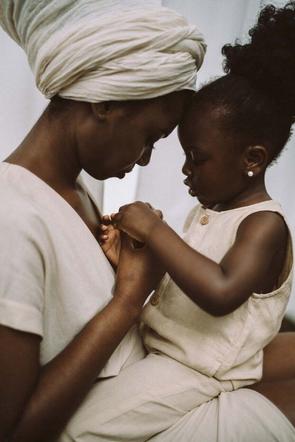
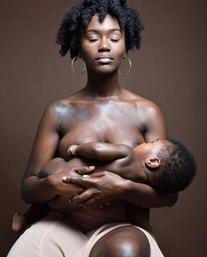
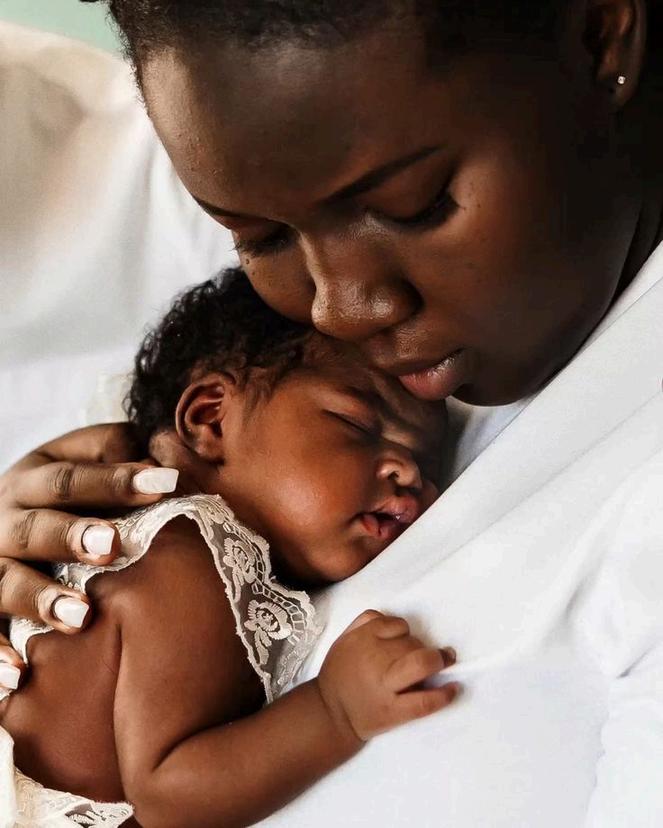
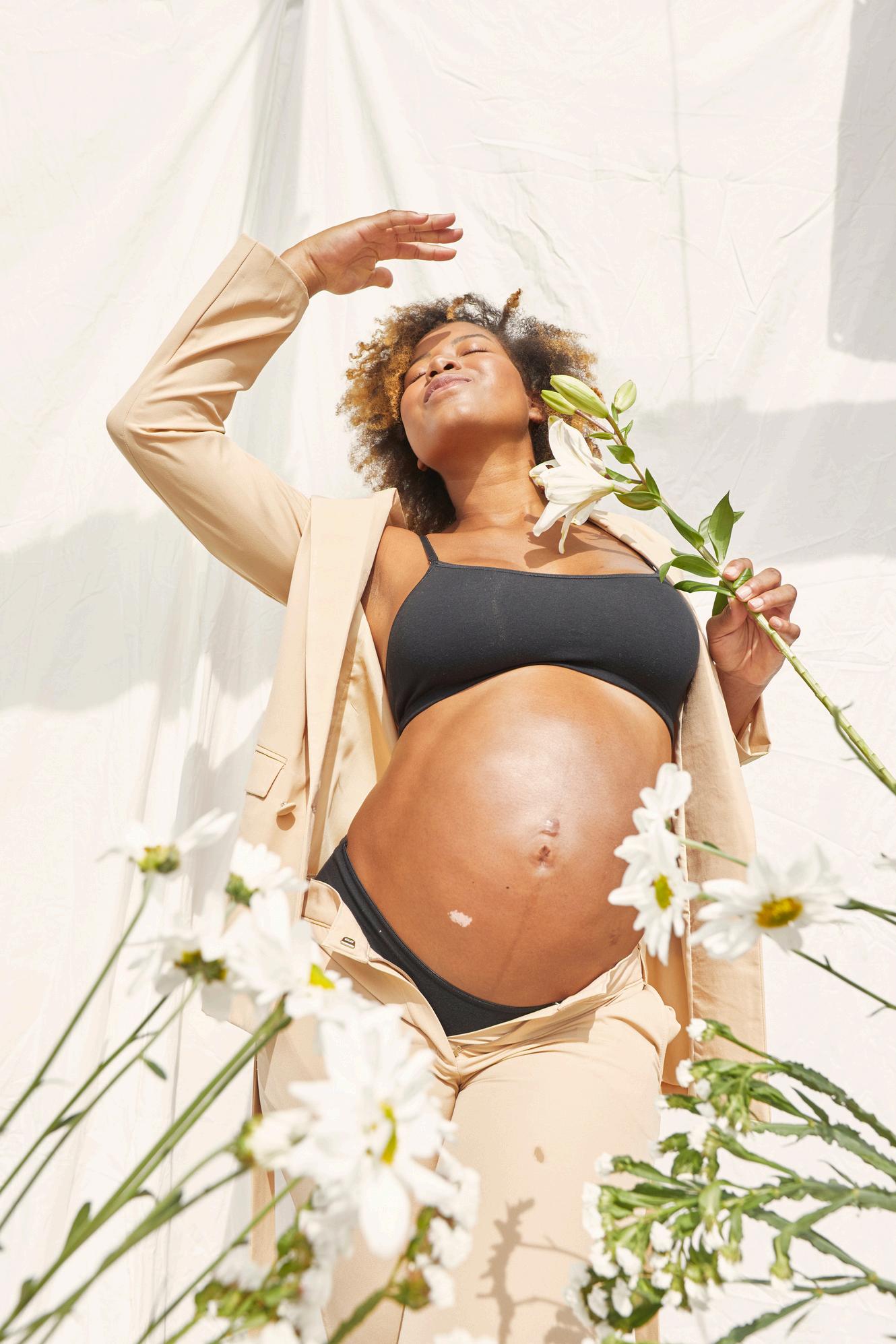
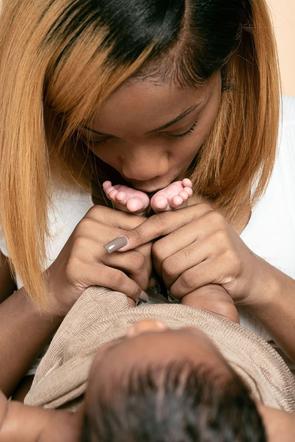
Underlying this beautiful moment, waves of anxiety begin to course through your mother’s veins. Her heart rate quickens, her muscles tense, and her thoughts race 100 miles a minute.
"Can I afford formula if breastfeeding doesn’t work out?"
"What if I don’t make it to my six-week checkup?"
"Will they listen to me if something goes wrong?"
The questions come fast, crashing into her like a tide. Joy and fear sit side by side in her hospital bed, silently ripping her apart as the world continues on around her
This isn’t a story of postpartum anxiety. It’s the deep awareness of the world, carried in the bodies of Black women for generations on end, that has made them believe that the world is not built to keep them or their babies safe.
This story is one that many Black women encounter It is told in hospitals and clinics and is both a celebration of life and a forewarning of the future.
“IT'S THAT COUNTER-NARRATIVE FROM THINKING THAT WE ARE THE SUM OF OUR TRAUMAS. IT IS RECOGNIZING THAT WE ARE MORE THAN OUR TRAUMAS, THAT WE ARE BEAUTIFUL, THAT WE ARE POWERFUL, AND THAT WE ARE RESILIENT. THAT'S WHAT JOY IS TO US.”
- KARINDA ROEBUCK
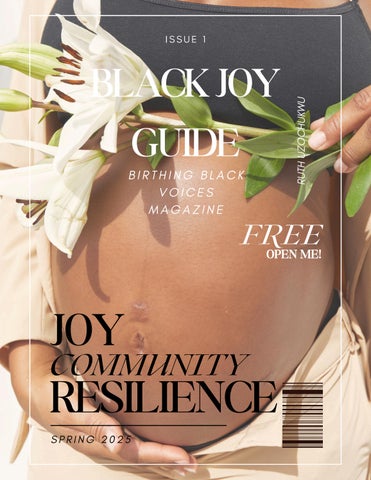
Black Maternal Health is often a field that carries a dark cloud above it–even uttering those three words sets a negative precedent for what is to follow. Although that is currently the case, this magazine, Birthing Black Voices, hopes to rewrite this reductionist narrative to show that the field of Black Maternal Health is as bountiful as a newborn babe. Alongside the jarring statistics, there is also immense beauty to be found as new lives enter the world and communities are built. Within this edition, I highlight the joy that is being nourished and built upon in Black communities by Black Birth Workers and answer the questions: How can a community heal itself and how can joy be established in a system intent on harming Black Women and Birthing People?
The contents of this edition are brought together from the themes of 5 interviews with women who are involved in Birth work, Black advocacy, and Black Maternal health advocacy. Thank you to Venus Standard, Janiya Mitnaul, Ariana Frazier, Karina Roebuck, and Rhonda Lanning for the amazing insights you shared and the amazing work you are doing!
MATERNAL HEALTH AND THE BLACK COMMUNITY
The status of maternal health in the United States is unsettling and frightening. Holding the highest maternal mortality rate–the number of deaths per 100,000 live births that are related to pregnancy or childbirth (WHO)--among developed nations in the West, the U.S. is experiencing a national public health crisis. When we take a look at the maternal mortality rate by demographic, Black women have a 3x higher rate than their White counterparts (CDC).
Systemic racism propagates health disparities, by creating societal, cultural, and environmental conditions that lead to increased cumulative stress, social isolation, and numerous other factors that do impact health directly. These factors–lack of access to childcare and work coverage, lack of insurance, transportation, and distrust of healthcare providers–disproportionately impact Brown and Black communities and contribute to more negative maternal health outcomes (Yapundich et al.).
In North Carolina, 25% of Women of color do not receive prenatal care and lack of access to adequate prenatal care is an indicator of poor maternal health outcomes (Amnesty International). These statistics worsen as we look at disparities between rural and urban areas, as over 20% of North Carolinian counties, the majority rural, do not provide obstetric services.
Despite all these factors, Black and Brown communities are still resilient and hopeful.
“THERE IS ENOUGH WITHIN OUR COMMUNITIES. WE HAVE WHAT WE NEED, WE JUST NEED THE SUPPORT TO IDENTIFY IT”
– KARINDA ROEBUCK
WHAT IS JOY?
Definition: Joy is “the emotion evoked by wellbeing, success, or good fortune or by the prospect of possessing what one desires” (Marian-Webster).
It is unique in its transformational ability and its capacity to rectify what once was and set the stage for what is to come. Black Maternal Health is a field that despite the statistics, is transforming and we see the perseverance of people within it. Blackness is joyful.
HOW CAN WE USE IT AS A TOOL FOR COMMUNITY BUILDING?
1) Joy is a mechanism for resilience, especially for marginalized communities. The beautiful thing about joy is that it extends beyond oneself and has ripple effects within communities. It differs from happiness in that it is centered on wellbeing (Marian-Webster), which is why its place in maternal health is so befitting. Ensuring the wellbeing of Birther and Baby, both in and out of the hospital room, is necessary Choosing to indulge in joy, to create systems that are based on joy, and to support community efforts that generate joy are all acts of resistance in a system that is set on repressing communities. It is a radical thing to be joyful.
2) Joy reflects: One cannot cultivate joy for others without pouring greatly into oneself. Burnout for Black and Brown Healthcare professionals is a looming problem that propagates negative outcomes for their patients (Brooks et al.). Burnout for these professionals is a result of unique factors, most notably structural racism, unsupportive workplace environments, and workplace racism. Amidst these adverse conditions, to generate joy for Black and Brown patients, it becomes necessary for healthcare professionals to prioritize their own well-being and to lean into self-care tactics, not in isolation but through community. In doing so, we must recognize that self-care is not indulgence but rather resistance It is a declaration that we matter, too. Building networks of mutual support and creating spaces where communal healing is prioritized is essential. Through these acts of care for oneself and each other, Black birth workers sustain themselves and transform the system in which they occupy. This work becomes the standard and model for care, and rest and resilience become seen as central to this healing process All of our communities need care, and we can find care for ourselves in our communities.
“BY FINDING MY JOY, THAT IS A SIMPLE ACT OF RESISTANCE”
- KARINDA ROEBUCK
This healing is not solely physical, but also communal and historical. Advocacy for one is advocacy for the whole.
To ensure Joy in birth is to reclaim joy itself, not solely as an emotion, but as a radical act of resistance and hope.
“JOY IS A BUBBLY FEELING IN YOUR CHEST. IT JUST FEELS BRIGHT, WARM, RADIANT, AND REFLECTIVE. YOU'RE EMITTING A LIGHT FROM YOURSELF.” – ARIANA FRAZIER
QUESTIONS FOR THOUGHT
Question 1: What does Joy mean to you? Joy is , , and
Question 2: How can you choose Joy for yourself today? (bonus Write an affirmation for yourself)
Question 3: What does self-care look like for you? What self-care practices do you participate in?
Question 4: How do you show up as your most authentic self?
Question 5: How do you define trust? How is it exemplified in your life/practices?
Question 6: How can our community be a tool for navigating stressors?
About Birthing Black Voices:
Author:
Ruth Uzochukwu
I am a student at UNC-Chapel Hill, majoring in Public Health: Environmental Health Biology and Global Studies: African Global Health and Environment. My passions lie in maternal health advocacy and Public Health concerns for Black and Brown women across the globe. I plan on attending medical school to become an OB/GYN and to open a nonprofit hospital in low-resource areas in West Africa!
Please contact me with any questions, comments, or concerns at:
This project could not have been completed without the immense support of these individuals:
Miriam and Tom Zietlow – Donors
Kylie Seltzer – Fellowship Director
Katherine Stein – Fellowship Advisor
Stephanie Degooyer – Fellowship Faculty Mentor
Venus Standard – Interviewee
Karina Roebuck – Interviewee
Janiya Mitnaul – Interviewee
Ariana Frazier – Interviewee
Rhonda Lanning – Interviewee
Purpose:
This project was born out of a literature review that I conducted in the Fall of my Freshman year. Through a year of research as a Zietlow Civic Engagement Fellow with Carolina Public Humanities, it has since taken on a more expansive view. It originally began with a focus on the extreme disparities in positive obstetric experiences between Black and White Birthing People in North Carolina. It further expanded to encompass the drastic differences in quality of care between rural and urban counties and how these disparities were exacerbated by the increase in hospital closures in rural North Carolinian Counties.
Through the help of many incredible mentors, the focus of this project shifted from these disparities to centering the narratives behind them. I hoped to highlight the joy and hope that is intrinsic to Black maternal health, even amidst adversity. During my fellowship, I listened and I learned. I sat with those who hold life, loss, and legacy in their hands to shape what is now this Magazine.
This is a Joy Guide: a celebration of the hope, resistance, and radiance found in Black maternal health. Despite a landscape that is molded by hardship, joy remains a constant generator of change.
I hope these pages invite you to embrace joy and know it as your own. May you leave with a fuller understanding of its abundance, and move through the world knowing that you are the captain of your joy, and can help it blossom in your community.