RESEARCH HIGHLIGHT S
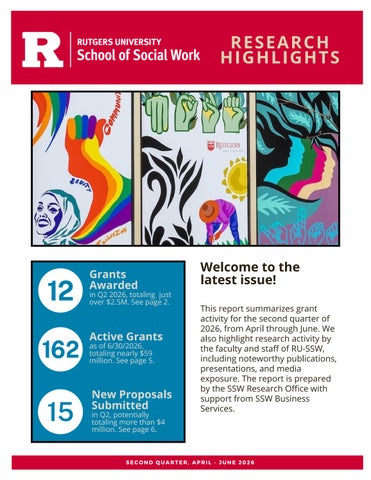
Grants Awarded
in Q2 2026, totaling just over $2.5M. See page 2.
Active Grants as of 6/30/2026, totaling nearly $59 million. See page 5.
New Proposals Submitted in Q2, potentially totaling more than $4 million. See page 6.
Welcome to the latest issue! This report summarizes grant activity for the second quarter of 2026, from April through June. We also highlight research activity by the faculty and staff of RU-SSW, including noteworthy publications, presentations, and media exposure. The report is prepared by the SSW Research Office with support from SSW Business Services.
SECOND QUARTER, APRIL - JUNE 2026
From the Associate Dean for Research...
TABLE OF CONTENTS
Dear Colleagues, Recent changes to the funding landscape have made it more difficult for researchers, particularly early-stage scholars, to successfully compete for the limited dollars available. In response, RUSSW faculty have quickly pivoted to find funding from new and nontraditional sources, including corporations, foundations, and nesting novel research within contracts that provide for outcome evaluation. A group of early-stage scholars successfully competed for coveted data they can use for both primary and pilot studies. In that way, they will be better positioned to compete for larger funding opportunities. I'd like to congratulate faculty selected for the L NJ Health Early-Stage Scholars program, which offers investigators first access to NJHealth survey data to promote analyses for publication in high-impact journals. RUSSW faculty selected were: Rachel John, Michael Park, Durrell Washington, Ashley Jackson, and Grant Victor. They will explore projects including mental health and substance use risk among Asian Indians; the relationship of criminal legal system involvement, family support, and mental health; investigating Asian mental health and care access among Korean Americans; and stress, socioeconomic position, and cooccurring alcohol use and mental distress among New Jersey's immigrant communities. I am excited to promote an increasing range of new opportunities for research funding going forward. Best, Lia Nower
Letter from the Associate Dean for Research................................
1
Grants Awarded..........................
2
Grant Spotlight: Jackie Stanmyre.....................................
4
Active Grants...............................
5
New Proposals Submitted....................................
6
Grant Spotlight: Cory Morton.........................................
6
Research Questions: Patricia Logan-Greene..............................
7
Peer-Reviewed Articles, Books/Chapters, and Scientific Reports.........................................
9
Article Spotlight: Lauren Manley.........................................
10
Article Spotlight: Ryon J. Cobb.............................................
13
National and International Presentations..............................
14
In the News.................................
15
SECOND QUARTER, APRIL - JUNE 2026
| PAGE 1
GRANTS AWARDED 12 new grants were officially awarded in Q2 2026. Woojin Jung (PI), Lucas Marxen (Co-PI, Rutgers University), Tawfiq Ammari (Co-PI, Rutgers University), & Younsung Kim (Co-PI, George Mason University) Developing High-Resolution Hazard Vulnerability Index to Improve Community Resilience in New Jersey Award: $132,560 Funder: New Jersey Sea Grant Consortium Term: 2 years Aim: To develop a High-Resolution Hazard Vulnerability Index for New Jersey's coastal communities which will create fine-scale vulnerability assessments, capture lived experiences during climate events, and inform resilience planning statewide. Jeounghee (Joy) Kim (PI) 2026 New Jersey Childcare Market Rate Study Award: $136,551 Funder: New Jersey Department of Human Services Division of Family Development Term: 13 months Aim: To collect current prices from New Jersey childcare providers in order to measure differences among childcare markets, service needs and gaps, and supply of quality programs accessible to families receiving a childcare subsidy. Jeounghee (Joy) Kim (PI) 2026 New Jersey Childcare Narrow Cost Analysis Study Award: $49,175 Funder: New Jersey Department of Human Services Division of Family Development Term: 13 months Aim: To examine the costs of operating a childcare program that meets standard expectations and identify (1) the gap between the cost and market price of childcare services; and (2) the gap between the cost of childcare services and the state childcare subsidy rate together with parents’ copayments. Cory Morton (PI) & Kristen Powell (Co-PI) Elevating Youth and Family Voice in Continuous Quality Improvement Award: $1,085,568 Funder: New Jersey Department of Children and Families Term: 1 year Aim: To interview youth and families to support the New Jersey Division of Child Protection and Permanency Collaborative Quality Improvement Process.
SOURCES OF AWARDED GRANTS State $1.9M Foundations $449K Other $147K
“Other” grants include a non--profit ($132K) and an internal grant ($15K).
TOTAL GRANTS AWARDED Q2 2026: $2,501,151 School of Social Work Research Office Associate Dean for Research Lia Nower, J.D., Ph.D. Research Development Specialist Cecilia S. Gal, Ed.M., C.A.S. Academic Research Editor Jennifer Perillo, M.B.A. sswresearch@ssw.rutgers.edu We are grateful for the support of Daniela Prelipceanu from SSW Business Services in preparing this report.
SECOND QUARTER, APRIL - JUNE 2026
| PAGE 2
GRANTS AWARDED continued Milady Murrillo (PI) & Theresa McCutcheon (Co-PI) Domestic Violence Liaison Training Award: $155,935 Funder: New Jersey Department of Children and Families Term: 6 months Aim: To develop asynchronous, web-based training, which supports the consistency of implementation of New Jersey’s Domestic Violence Liaison (DVL) program. The program provides on-site case consultation to child welfare professionals as a means to provide individualized support and advocacy for domestic violence victims and their children. Through this award, IFF will ensure that DVL staff and supervisors across New Jersey share a common, evidence-aligned framework for practice. Milady Murrillo (PI) & Theresa McCutcheon (Co-PI) Family Preservation Services Phase 3 Award: $55,000 Funder: New Jersey Department of Children and Families Term: 7 months Aim: To support Family Preservation Services (FPS), an intensive, short-term, in-home crisis intervention program serving families at imminent risk of child abuse, neglect, or out-of-home placement. Building on prior work, this phase updates and aligns existing instructional materials to reflect federal guidelines, revised FPS program manual content, and feedback from the FPS Supervisor Training pilot. IFF will produce updated instructor and participant guides, PowerPoint presentations, asynchronous course content, and LMS-ready files, while also supporting the onboarding instructors to expand statewide training capacity. Milady Murrillo (PI) & Theresa McCutcheon (Co-PI) Connect to Home Award: $57,000 Funder: New Jersey Department of Children and Families Term: 6 months Aim: Connect to Home (CTH) provides stable housing and wraparound support services for young adults aged 18 to 21 who have aged out of the child welfare system and are at risk of homelessness. Under this award, IFF will design and develop two asynchronous training courses targeting the knowledge, skills, and competencies required for effective CTH supervisory and coaching practice. Andrew Peterson (PI) & Kristen Powell (Co-PI) Performance Assessment of New Jersey's Partnership for Success Initiative on Substance Misuse Prevention, Year 3 Award: $125,000 Funder: New Jersey Department of Human Services Division of Mental Health and Addiction Services (DMHAS) Term: 1 year Aim: To evaluate the Partnerships for Success (PFS) grant, including data collection and evaluation, examination of data infrastructure, and suggestions for program performance enhancement. The PFS was awarded to DMHAS to enhance its prevention data infrastructure and information systems capacity, and continue the development of a unified prevention planning and service delivery system within the state of New Jersey. Andrew Peterson (PI), Kristen Powell (Co-PI), & Cory Morton (Co-I) Evaluation Support for Substance Misuse Prevention Coalitions Award: $150,000 Funder: New Jersey Department of Human Services Division of Mental Health and Addiction Services (DMHAS) Term: 1 year Aim: To evaluate the effects of the Strategic Prevention Framework model on 17 regionally based prevention coalitions in New Jersey on intended outcomes at the population or community level of analysis.
SECOND QUARTER, APRIL - JUNE 2026
| PAGE 3
GRANTS AWARDED continued Kristen Powell (PI) & Andrew Peterson (Co-PI) Opioid Overdose Prevention Network Evaluation Award: $90,000 Funder: New Jersey Department of Human Services Division of Mental Health and Addiction Services Term: 1 year Aim: To develop the Provider Performance Management system needed to perform the data management requirements of the Prevent Prescription Drug/Opioid Overdose-Related Death grant, and any subsequent modifications; to develop the method to collect, manage, and analyze Naloxone Training outcomes data; and to provide the qualitative and quantitative analyses and reporting on all aspects of the data collection. Jackie Stanmyre (PI), Sean Norton (Co-PI, Princeton University) & Lia Nower (Co-I) Digital Warning Signs: Using Online Trace Data to Detect and Flag Behavioral Patterns in College-Aged Adults Who Gamble Award: $449,362 Funder: International Center for Responsible Gaming Term: 3 years Aim: To examine the online behavioral patterns of college-aged adults in relation to the initiation and progression of their gambling on regulated and unregulated wagering sites, fantasy sports, prediction market apps (e.g., Kalshi, Polymarket), and trading platforms (e.g., Robinhood) and to then contextualize these findings within a policy framework with implications for future expansion, online casino versus sports wagering populations, regulation, and gambling safeguards. Durrell Washington Invisible Wounds and the Radicalizing Effect of Mistreatment: A Sibling-Centered Study on the Psychosocial Consequences of Juvenile Incarceration Award: $15,000 Funder: Rutgers Research Council Term: 2 years Aim: To examine how the incarceration of a sibling and exposure to systemic mistreatment and institutional betrayal transforms siblings’ understandings of justice, belonging, and care. It seeks to identify both mechanisms of harm and the adaptive, resistant practices siblings use to maintain dignity and relational integrity in the aftermath of incarceration.
GRANT SPOTLIGHT: JACKIE STANMYRE Assistant Research Professor Jackie Stanmyre (PI), along with Sean Norton (Co-PI, Princeton University) and Distinguished Professor Lia Nower (Co-I) received $449,362 from the International Center for Responsible Gaming for their study “Digital Warning Signs: Using Online Trace Data to Detect and Flag Behavioral Patterns in College-Aged Adults Who Gamble.” Worldwide, young adults are likely to attest they are “almost constantly online.” The increasing inclusion of gambling and gambling-like activities in video games and social network platforms, the rise of contest and contract platforms designed to skirt gambling laws, the prevalence of unregulated offshore gambling sites, and the exponential growth in access to legal online wagering places this age group at particularly high risk for gambling-related harms. This research will generate critical insights into the pathways through which users arrive at both regulated and unregulated gambling platforms and inform the public health research and practice communities in their understanding of the online context of gambling.
SECOND QUARTER, APRIL - JUNE 2026
| PAGE 4
ACTIVE GRANTS As of June 30, 2026, SSW faculty and staff oversaw a collective portfolio of 162 active awards, totaling $58,619,916. The state of New Jersey (including grants, contracts, and passthroughs) is the largest source of funding at just over $44 million. The federal government (again including grants, contracts, and passthroughs) is the second largest source of funding at roughly $10 million. Other universities and non-profits fund roughly $1.7 and $1.6 million, respectively. Other funding sources include foundations ($453K), internal Rutgers awards ($99K) and other state/local governments (not New Jersey; $68K).
ACTIVE GRANTS BY SOURCE
SECOND QUARTER, APRIL - JUNE 2026
| PAGE 5
NEW PROPOSALS SUBMITTED In Q2 2026, 15 new grant proposals were submitted for funding, potentially totaling $4.3M. 5 projects were submitted to the state of New Jersey. 5 were submitted to other universities. 2 were submitted to the federal government. 1 was submitted to a foundation. 1 was an internal submission. 1 was submitted to a non-profit. Projects under review include testing a digital therapeutic that targets the co-occurrence of toxic stress and substance use among individuals in recovery, understanding how parents respond to adolescent suicide risk, enabling meaningful connections among older adults, and more.
PROPOSALS UNDER REVIEW: Q2
Other $246K 6% State of NJ $688K 16%
Other universities $2.2M 53%
Federal govt. $1M 25%
“Other” includes proposals submitted to foundations ($150K), non-profits ($81K), and internal submissions ($15K).
GRANT SPOTLIGHT: CORY MORTON Associate Research Professor Cory Morton (PI) and Associate Research Professor Kristen Powell (Co-PI) received $1,085,568 from the New Jersey Department of Children and Families to interview youth and families across New Jersey to support the Office of Quality (OOQ) and Division of Child Protection and Permanency (DCPP)’s Collaborative Quality Improvement Processes (CoQI). Morton, Powell, and colleagues oversee the Youth and Family Interview Team (YaFIT). YaFIT conducts five major activities during each cycle of the CoQI process: recruit interview participants, conduct a selection of qualitative and quantitative interviews, analyze interview transcripts, report findings, and participate in performance review meetings. In the latest cycle, families who experienced a DCPP investigation will be interviewed. With this addition, five service populations will be represented in YaFIT interviews: family/caretakers who used DCPP in-home services; family/caretakers who used DCPP out-of-home services; young adults who received DCPP services; resource parents/kin placements; and family/caretakers who experienced a DCPP investigation. These interviews will help elevate family voice in DCPP’s operations.
SECOND QUARTER, APRIL - JUNE 2026
| PAGE 6
RESEARCH QUESTIONS: PATRICIA LOGAN-GREENE Dr. Patricia Logan-Greene, MSSW, PhD, recently joined RUSSW as Associate Dean for Academic Affairs, bringing a distinguished record of academic leadership, research excellence, and a deep commitment to student success. Here we discuss her research efforts. Please describe your scholarly research trajectory over time. Where did you start, and how did your interests involve? I have always considered myself a violence prevention researcher. In my earlier days, I was mostly focused on understanding the effects of childhood violence in particular, as well as youth violence. I was interested in the system responses to those issues, looking at juvenile probation systems and interventions for at-risk families. Another thread that emerged for me is “the neglect of neglect.” Neglect is by far the most common form of child maltreatment, yet historically it does not get proportional research attention. I worked on a few projects about neglect, including a study funded by the National Institute of Child Health and Human Development, to examine the longitudinal effects of child neglect on adolescent outcomes. Can you talk about your interest in researching gun violence? Around 2018 I started to develop an elective about preventing interpersonal violence for MSW students. One of the topics I knew I wanted to include in that course was gun or firearm violence. So I went looking for literature on what social workers need to know about gun violence—and there was very little. To be clear, there are excellent research projects being done by social workers—including those at Rutgers— in practice areas like community violence interruption and intimate partner violence; but for general social work practitioners or those doing private practice with children and families, there was very little out there.
We also had decades of suicide prevention guidance that didn’t address firearms for a variety of reasons. Although social workers are uniquely positioned to identify firearm-related risks—particularly among the most disadvantaged communities—my work has documented that most receive almost no formal training on firearm safety or risk reduction. As a result, social workers rarely discuss firearms with clients, leaving an opportunity to prevent harm for children and families unrealized. So that became a big trajectory for my research interests. More recently, I have been invited into the field of “targeted violence prevention.” In May of 2022, ten people were killed and three were injured in a shooting at Tops Friendly Market in Buffalo, New York, which is where I lived at the time. It is hard to communicate to those who don't live in the area just how devastating it was. Tops was the only grocery store in a predominantly Black neighborhood—the only place where local residents could purchase food—and it was disrupted for months. The community was truly terrorized. After that incident, I was recruited to study targeted violence prevention. It’s a little tricky to define succinctly, but it is related to politically, racially, ethnically, or other characteristically motivated violence. It includes shootings in sensitive areas like public places, schools, etc. I was able to leverage my work around firearm violence prevention and extend it into this area. So, to summarize my work at this point, my scholarship is grounded on two scientific premises: that 1) childhood adversity and maltreatment threaten well-being in adolescence and the life course; and 2) evidence-based education and clinical tools can equip social workers and allied behavioral health professionals to prevent firearm violence.
SECOND QUARTER, APRIL - JUNE 2026
| PAGE 7
RESEARCH QUESTIONS: PATRICIA LOGAN-GREENE continued What current or recent research projects have you overseen? Given the continued prevalence of firearm violence and its devastating impact on children, families, and communities, my research energies have been focused on how to best mobilize social workers and other behavioral health professionals to engage in prevention. I have worked on multiple projects to develop and test curricular products that can prepare them to do this. At the student level, I am collaborating with the Brady Foundation to develop and test a set of curriculum materials that will be used in required MSW clinical courses, responsive to the stated needs of program leaders. For practitioners, my colleague and I have developed the Social Workers Addressing Firearm Risks (SAFR) training, which showed promising results in a preliminary trial and for which we plan to test nationally. In the field of targeted violence prevention, my colleagues and I conducted the first quantitative analysis of U.S. behavioral health professionals’
readiness to engage in preventing violent extremism and behavioral threat assessment and management. Clinicians overwhelmingly endorsed an ethical obligation to intervene, but we identified substantial gaps and structural inequities in perceived preparedness, indicating a need for targeted capacity-building. Finally, I co-lead the Prevent Gun Violence Grand Challenge in Social Work, which is a national network of social work scholars focused on gun violence across a broad array of populations and problems. We are putting together the first-ever gun violence prevention volume for social work practitioners, researchers, and educators. What outcomes do you hope to see from your research? I am going to do everything I can as an individual with the privilege and opportunity to work in a job like this to help keep kids and their families safe. I don’t pretend I’m going to solve the gun violence problem in our country. No one person can do that, and no one project can do that. Honestly, I would feel like my projects are worthwhile if even one life is saved, or one family is kept intact because of an action that resulted from the trainings or the data that I have collected. How do you foresee that your move to Rutgers will further advance your scholarship? Well, transitioning to the role of Associate Dean for Academic Affairs is my focus in the immediate term. But I do hope to keep my research career going. Rutgers is well-known for its world-class violence prevention program, including the Rutgers Gun Violence Research Center. I am looking forward to meeting those researchers, and hope we can eventually find points of collaboration. More generally I am eager to meet SSW faculty and students and start connecting with the larger Rutgers community.
Photo credit: Kelly Tanski Photography
SECOND QUARTER, APRIL - JUNE 2026
| PAGE 8
PEER-REVIEWED ARTICLES, BOOKS/CHAPTERS, AND SCIENTIFIC REPORTS Addy, M. T., Quillen, C., Luxmikanthan, S., Kornienko, Y. A., Cantor, D., Morin, K. X., Rauschenbach, I., Scala, C., Stein, L., & Yang, J. (2026). Student attitudes & perceptions of learning when completing activities that integrate generative artificial intelligence. Journal on Excellence in College Teaching, 37 (Special issue). https://celt.miamioh.edu/index.php/JECT/article/view/1296 Afkinich, J. L., Franke, N. D., & Harmon-Darrow, C. (2026). Exploring the programmatic landscape: A systematic review of police diversion at arrest. Police Practice and Research, 27(4), 1-23. https://doi.org/10.1080/15614263.2026.2667849 Alexander, L., Alvarez, L.N., Toto, L., Goodwin, J. M., & Morton, C. M. (2026). Applying the Nurtured Heart Approach® to resource parenting: A mixed methods approach. Journal of Public Child Welfare, 1-18. https://doi.org/10.1080/15548732.2026.2660071 Anthony, W. L., & Zhu, Y. (2026). Non-school-related internet use and its relationship with school performance and engagement: A cross-national sudy of middle school students in China and the United States. International Journal of Social Welfare, 35(3), Article e70075. https://doi.org/10.1111/ijsw.70075 Banyard, V., Mitchell, K. J., Engles, L., Mumford, E., & Taylor, B. (2026). Bystanders to gun violence: Exploring perceptions of impact and reactions to helping behaviors in a national sample of adolescents and young adults. Journal of Interpersonal Violence. Advance online publication. doi.org/10.1177/08862605261443243 Brachmann, A., & McMahon, S. (2026). Gender of transgressors committing sexual and intimate partner violence against LGBTQA+ college students. Journal of Interpersonal Violence. Advance online publication. https://doi.org/10.1177/08862605261451875 Christensen, M. C., Kattari, S. K., Korpak, A. K., Gzesh, A., Lacombe-Duncan, A., Morehead, E., Harrop, E., Gardener, H., Crate, H., Leitch, J., Reeder, K. G., Wernick, L. J., Chen, M., Hafen, Q., Polasek, Q., Singh, R. C. B., Luxmikanthan, S., & Ferguson, Z. (2026). Queering and transing social work: Imagining queer and trans futures. Abolitionist Perspectives in Social Work, 4(1). https://doi.org/10.52713/93zhvx25 Cobb, R. J., Thorpe, R. J., & Norris, K. C. (2026). Evaluating the predictive utility of European-based and transethnic polygenic risk scores for kidney function in older Black adults: Insights from the health and retirement study. The Journals of Gerontology: Series A, 81(7). https://doi.org/10.1093/gerona/glag122 Conner, L. R., Henshaw, L., Battle, D., Graham, W., Perez, E., & Watts, E. J. (2026). Indigenous resistance in the academy: Decolonial reflections on integrating tribal and Indigenous knowledge in social work education. Journal of Indigenous Social Development, 14(1), 65-83. https://doi.org/10.55016/c6357p34 Daigneault, I., McMahon, S., Dion, J., Senn, C., Hébert, M., Baril, K., Bergeron, M., Savoie, L., Sanchez, G., Fethi, I., & Paquette, G. (2026). Cumulative effects of sexual prevention messages among a representative sample of women starting university. Journal of College Student Development, 67(3), 368-372. https://dx.doi.org/10.1353/csd.2026.a991706 Dwyer Emory, A., Nepomnyaschy, L., Waller, M. R. & Miller, D. P. (2026). Fathers' economic precarity and mothers' ability to make ends meet. RSF: Russell Sage Foundation Journal of the Social Sciences, 12(2), 140-170. https://doi.org/10.7758/RSF.2026.12.2.06
SECOND QUARTER, APRIL - JUNE 2026
| PAGE 9
PEER-REVIEWED ARTICLES, BOOKS/CHAPTERS, AND SCIENTIFIC REPORTS continued Gale, A., Scott, E. D., Williams, E. D., Lateef, H., Boyd, D., & Washington, D. (2026). Strength-based and culturally grounded approaches to supporting young Black men’s mental health. Social Work in Mental Health, 1-24. https://doi.org/10.1080/15332985.2026.2685539 Goldblatt Hyatt, E. D., Hayes, C. M., Joseph, N., & Vega, V. (2026). Adriana Smith: A reproductive justice response to the dehumanization of Black women under Georgia’s extreme abortion ban. Critical and Radical Social Work. Advance online publication. https://doi.org/10.1332/20498608Y2026D000000131 Greenfield, E. A., Coyle, C., & DeLange Martinez, P. (2026). Research in the United States to strengthen state involvement in age-friendly communities and broader systems change. Public Policy & Aging Report, 36(2), 48-52. https://doi.org/10.1093/ppar/prag011 Horton, D. B., Verma, C., Rege, S., Crystal, S., Gerhard, T., Iizuka, A., Iozzio, M., Koffman, D., Parlett, L. E., Varga, J., Rose, C. D., & Strom, B. L. (2026). Recent antibiotic exposure and response to treatment of juvenile idiopathic arthritis: A retrospective cohort study. Arthritis Research & Therapy. Advance online publication. https://doi.org/10.1186/s13075-026-03842-6 Hubbard, T. L. (2026). Creating a village in higher education: Mentorship, identity, and empowerment for Black women in Ph.D. Programs. In M. Rana & S. G. Bennett (Eds.), Mentoring relationships in academia (pp. 139-151). Springer. https://doi.org/10.1007/978-3-032-15685-3_12
ARTICLE SPOTLIGHT: LAUREN MANLEY PhD candidate Lauren Manley, along with Associate Professor Judith McCoyd, published “Perceived Stress May Mediate the Impact of Negative Life Events on Common Cold Susceptibility: A Causal Mediation Analysis” in the Journal of Health Psychology. Experiencing negative events can harm health, partly by impairing immunity. However, not everyone exposed to adversity experiences illness, raising questions about the mechanisms through which events translate into poorer health. This study investigates whether perceived stress mediates the effects of negative life events on immune-related outcomes, specifically susceptibility to the common cold. Using secondary data from the Pittsburgh Cold Study 3, the authors analyzed 213 healthy adults inoculated with a cold virus who reported recent life events and perceived stress prior to inoculation; cold symptoms were assessed during quarantine. Analyses suggested that perceived stress may mediate the relationship between high cumulative negative life events (7+ events) and increased cold symptom severity and subjective infection criteria. These findings highlight the role of stress appraisal and suggest targeting perceived stress in health interventions.
SECOND QUARTER, APRIL - JUNE 2026
| PAGE 10
PEER-REVIEWED ARTICLES, BOOKS/CHAPTERS, AND SCIENTIFIC REPORTS continued Jung, W., Kim, A. H., Hung, Y., Chear, C., Shah, V., & Ammari, T. (2026). Digital pulse of development: Leveraging social media discourse for poverty analysis. Information Processing & Management, 63(7A). https://doi.org/10.1016/j.ipm.2025.104579 Kang, X., Cruce, A., Moon, D., Williams-Butler, A., Spitzer, B. & Raghavan, R. (2026). Operationalizing current conceptualizations of child well-being through a scoping review of child well-being measures. Social Indicators Research, 183(27). https://doi.org/10.1007/s11205-026-03873-1 King, A., Stanmyre, J. F., & Nower, L. (2026). Gambling’s role in modern sports integrity violations: A commentary on current policies and events. International Journal of Sport Policy and Politics, 1-11. https://doi.org/10.1080/19406940.2026.2685499 Lister, H., Marcello, S., Lister, J. J., Singer, B., O’Kane, T., Hilton, K., Haleva, R., Kim, A. & Steinberg, M. (2026). Building tomorrow’s health psychologists: Data from an integrated primary care internship program serving medically underserved populations. Training and Education in Professional Psychology, 20(2), 134-143. http://doi.org/10.1037/tep0000548 Maglalang, D. D., Yoo, N., Park, M., Nicholson Jr., H., de Leon, C., Okazaki, S. & Chang, D. F. (2026). COVID-19 racial discrimination and substance use among Asian Americans by gender. Journal of Racial and Ethnic Health Disparities. Advance online publication. https://doi.org/10.1007/s40615-026-03028-5 Manley, L. & McCoyd, J. L. M. (2026). Perceived stress may mediate the impact of negative life events on common cold susceptibility: A causal mediation analysis. Journal of Health Psychology. Advance online publication. https://doi.org/10.1177/13591053261454340 McMahon, S., Cusano, J., Hoxmeier, J., Brachmann, A., Elias-Lambert, N., & Mennicke, A. (2026). Bystander intervention to address sexual harassment in academia: Experiences of faculty and staff targets. Journal of Prevention and Health Promotion. Advance online publication. https://doi.org/10.1177/26320770261441790 Mezzapelle, J. L., Russo, L. N., Hines, D. A., Douglas, E. M., Lee, K. A., & Sabina, C. (2026). “It was a living hell”: Black, Latino, and White U.S. men’s experiences of female-perpetrated intimate partner violence victimization. Psychology of Violence. Advance online publication. https://doi.org/10.1037/vio0000689 Mezzapelle, J. L., Douglas, E. M., Hines, D. A., Lee, K. A., Russo, L. N. & Sabina, C. (2026). Legal help-seeking among Black, Latino, and White men who have experienced intimate partner violence victimization. Journal of Family Violence. Advance online publication. https://doi.org/10.1007/s10896-026-01131-z Mitchell, K. J., Banyard, V., Guziewicz, P., & Taylor, B. G. (2026). Measuring exposure to gun violence and risky behavior: Psychometric validation and analysis of the Gun Violence Exposure (Gun-X) Scale. Prevention Science, 27, 555-570. https://doi.org/10.1007/s11121-026-01916-0 Mitchell, K J., O’Brien, J. E., Colburn, D., Banyard, V., & Foster, H.B. (2026). Profiles of childhood adversity, strengths, and wellbeing in adulthood. Child Maltreatment. Advance online publication. https://doi.org/10.1177/10775595261446492
SECOND QUARTER, APRIL - JUNE 2026
| PAGE 11
PEER-REVIEWED ARTICLES, BOOKS/CHAPTERS, AND SCIENTIFIC REPORTS continued
Grants Awarded
Moon, D. J., Ma, R., Spitzer, B., Cruce, A., Jeon, J., Lee, H., Luckenbaugh, S., Kang, X., Williams-Butler, A, & Raghavan, R. (2026). The Adolescent Flourishing Index (AFI): Validity evidence with youth aging out of foster care. Youth, 6(2), 78. https://doi.org/10.3390/youth6020078 Morton, C., Alexander, L., Alvarez, L. N., Toto, L., Addison, S. M., & Thiruvenkadam, N. (2026). Integrating lived experience on interagency coordinating councils: Engaging youth and family voice within a children’s system of care. Children and Youth Services Review, 185. https://doi.org/10.1016/j.childyouth.2026.108945 Pilarz, A. R., Cuesta, L., & Walther, A. K. (2026). The short-term effects of the COVID-19 pandemic on single mothers’ income sources and economic wellbeing: Evidence from Wisconsin. Journal of Family and Economic Issues, 1-21. https://doi.org/10.1007/s10834-026-10094-8 Pilla, D., Park-Taylor, J., Ponterotto, J. G., & Tiderington, E. (2026). Which stereotypes of people experiencing homelessness predict discriminatory intentions? International Journal on Homelessness, 6(2), 1-25. https://doi.org/10.5206/ijoh.2026.2.23016 Pope, N. E., Greenfield, E. A., & Cao, Q. (2026). Advancing programme processes and connections: Older adult leaders’ experiences with age-friendly community implementation in the United States. Ageing and Society. Advance online publication. https://doi.org/10.1017/S0144686X26100737 Russo, L. N., Hines, D. A., Mezzapelle, J. L., Sabina, C., Lee, K. A., & Douglas, E. M. (2026). Barriers to help-seeking among male victims of female-perpetrated intimate partner violence: Insights from Black, Latino, and White men. Psychology of Men & Masculinities. Advance online publication. https://doi.org/10.1037/men0000560 Russo, L. N., Mezzapelle, J. L., Hines, D. A., Douglas, E. M., Lee, K. A., & Sabina, C. (2026). “I’m surprised I survived”: Men’s descriptions of their experiences with intimate partner violence victimization. Victims & Offenders, 1-26. https://doi.org/10.1080/15564886.2026.2650131 Sprang, G., Duncan, M. S., Mennicke, A., Willard, J., Ray, C., Brancato, C. J., Clear, E. R., & Coker, A. L. (2026). Training initiation and completion in a cluster randomized control trial to reduce child sex trafficking in middle schools. Journal of Human Trafficking, 1-18. https://doi.org/10.1080/23322705.2026.2685670 Tian, R., Huang, C.-C., & Mertz, J. (2026). Mindfulness, life skills, and internet time and addiction among highachieving college students in China: The mediating role of self-control. Computers in Human Behavior Reports, 22. https://doi.org/10.1016/j.chbr.2026.101095 Tian, R., Huang, C.-C., Peng, J. F. & Qiu, H. (2026). Mindfulness, emotion regulation, and psychological distress: A cluster randomized trial The with article high-achieving China.to Mindfulness, 17,not 2027-2042. dismantling of controlled Roe v. Wade. argues university that the students time hasincome talk about, around, reproductive justice in social work education as well as how social workers are being discouraged https://doi.org/10.1007/s12671-026-02893-9 from using their professional training and ethical commitment to clients. It also explores approaches for safeguarding professional values and ethical principles during these sociopolitically tumultuous Tiderington, E. (2026). Theorizing positive exits from Permanent Supportive Housing for individuals with complex times. health needs. Housing, Theory, and Society. Advance online publication. https://doi.org/10.1080/14036096.2026.2687410
SECOND QUARTER, APRIL - JUNE 2026
| PAGE 12
PEER-REVIEWED ARTICLES, BOOKS/CHAPTERS, AND SCIENTIFIC REPORTS continued
Grants Awarded
Treitler, P., Miles, J., Stone, E. M., Hermida, R., Samples, H. & Crystal, S. (2026). Opioid use disorder, pharmacotherapy, and overdose among Medicare disability beneficiaries from 2008-2021. American Journal of Preventive Medicine. Advance online publication. https://doi.org/10.1016/j.amepre.2026.108455 Yeh, H. H., Kubiak, S., Comartin, E., Farrell, Z., Hu, Y., Huynh, P., Wisnieski, D., Hedden-Clayton, B., Kheibari, A., Victor, G., Johnson, J. E., Weinstock, L. M., Simon, G. E. & Ahmedani, B. K. (2026). Validation of self‑harm prediction models among formerly incarcerated individuals using health data. Health Justice. Advance online publication. https://doi.org/10.1186/s40352-026-00425-0 Young-Wolff, K. C., Cortez, C. A., Adams, S. R., Padon, A. A., Prochaska, J. J., Brown, Q. L., Soroosh, A., Campbell, C. I., Does, M. B., Ansley, D., Castellanos, C., Asyyed, A. H., Green, A., & Nugent, J. R. (2026). Modes of preconception cannabis use and prevalence of cannabis use disorder. Cannabis (9)2. https://doi.org/10.26828/cannabis/2026/000387
ARTICLE SPOTLIGHT: RYON J. COBB Assistant Professor Ryon J. Cobb published “Evaluating the Predictive Utility of European-Based and Transethnic Polygenic Risk Scores for Kidney Function in Older Black Adults: Insights from the Health and Retirement Study” in the Journal of Gerontology Series A. Black populations in the U.S. experience a disproportionately faster progression of chronic kidney disease than the general population. Polygenic risk scores (PRS) are a promising tool for risk stratification, yet their utility in predicting kidney function across populations remains uncertain. This study, performed by Cobb and colleagues (Roland J. Thorpe Jr. of Johns Hopkins University and Keith C. Norris of the University of California-Los Angeles) evaluates the effectiveness of European and trans-ethnic polygenic risk scores in predicting kidney function among older Black adults from the 2010-2012 Health and Retirement Study. The mean kidney function is approximately 74 mL/min/1.73 m2, with a wide range, indicating significant heterogeneity among older Black adults. Findings suggest that neither the European nor the trans-ethnic PRS demonstrated a significant association with kidney function in demographic-adjusted models among older Black adults. Including behavioral, cardiometabolic, and socioeconomic factors did not change this relationship.
These findings underscore the challenges of applying PRS to predict kidney function among older Black of adults. thethat need more genomic and dismantling Roe v.They Wade.also Theemphasize article argues thefor time has inclusive come to talk about,research not around, reproductive justice in social work education as well as how social workers are being discouraged the significant impact of clinical and sociodemographic factors on kidney function among from using professional training and commitment to precision clients. It also exploresand approaches older Blacktheir adults. These insights are ethical vital for enhancing medicine ensuring for safeguarding professional values and ethical principles during these sociopolitically tumultuous equitable genomic practices. times.
SECOND QUARTER, APRIL - JUNE 2026
| PAGE 13
NATIONAL AND INTERNATIONAL PRESENTATIONS
Anthony, V., & Nower, L. (2026, May 26). An investigation of esports betting: Involvement, risk and gamblingrelated harms [Presentation.] The 19th International Conference on Gambling & Risk Taking, Las Vegas, NV, USA. Behan, D. (2026, June 11-13). What’s on your therapy dashboard? Monitoring your work for effectiveness [Workshop]. Society for the Exploration of Psychotherapy Integration Annual Conference, Los Angeles, CA, USA. Benjamin, R., Hussein, A., Washington, D., & Lamar, M. (2026, June 3). A call to action [Panel]. Rutgers School of Social Work Tenth Annual Challenging Racism Conference, Virtual. Cho, S., Nower, L., Stanmyre, J. F., & Cohen, A. (2026, May 27). Revisiting the legal definition of “gambling” in an era of prediction markets and other gambling-like activities [Presentation.] The 19th International Conference on Gambling & Risk Taking, Las Vegas, NV, USA. DiMeglio, R., Stanmyre, J. F., Nower, L., & van der Maas, M. (2026, May 27). Gambling with your life: Rethinking the notion of Russian roulette as suicide with 20 years of National Violent Death Reporting System data [Presentation]. The 19th International Conference on Gambling & Risk Taking, Las Vegas, NV, USA. Farmer, A. Y. (2026, June 27). School social workers’ perceptions of the challenges to implementing bullying prevention programs [Presentation]. Joint Conference on Social Work, Education, and Social Development, Nairobi, Kenya. Goodwin, J. M. (2026, April 20-22). Sanctuary and support: Identity-affirming care for LGBTQ youth experiencing homelessness in faith-based organizations [Presentation]. Housing Studies Association Annual Conference, Sheffield, United Kingdom. Harmon-Darrow, C. (April 13, 2026). Queer resilience [Panel]. ResilienceCon, Nashville, TN, USA. Harmon-Darrow, C. & Cortese, T. (April 13, 2026). Resilience and vicarious resilience of community mediators [Conference presentation]. ResilienceCon, Nashville, TN, USA. McCoyd, J. L. M. & Zhu, S. Y. (2026, April 15-18). “Do everything”: Maternal sacrifice and perinatal settings [Presentation]. Annual Meeting of the National Association of Perinatal Social Workers, Nashville, TN, USA. Nower, L., Stanmyre, J. F., & DiMeglio, R. (2026, May 26). Identifying high-risk players in online casinos: A machine learning approach [Presentation]. The 19th International Conference on Gambling & Risk Taking, Las Vegas, NV, USA. Stanmyre, J. F., Nower, L., Cohen, A., & DiMeglio, R. (2026, May 27). Guiding gambling policy and problem gambling treatment decisions using ArcGIS StoryMaps [Presentation]. The 19th International Conference on Gambling & Risk Taking, Las Vegas, NV, USA. Willard, J., Luxmikanthan, S., Scott, T. M., & Zuch, M. T. (2026, April 12-14). Down but not out: Centering the voices of LGBTQ+ graduate social work students in a hostile political climate [Poster presentation]. ResilienceCon, Nashville, TN, USA.
SECOND QUARTER, APRIL - JUNE 2026
| PAGE 14
IN THE NEWS
During Q2, RU-SSW faculty were featured in many news outlets: Hawaii News Now quotes Ray Cho in the article “Rutgers: Hawaii is not ready to legalize gambling due to insufficient information”: https://www.hawaiinewsnow.com/2026/05/22/rutgers-hawaii-is-not-ready-legalizegambling-due-not-enough-information/ Also reprinted in: Spectrum News Medical Xpress quotes Stephen Crystal in the article “Recent Medicaid expansions sharply increased access to treatment for opioid use disorder, researchers find”: https://medicalxpress.com/news/2026-04-medicaidexpansions-sharply-access-treatment.html Also reprinted in: Becker’s Behavioral Health, BINJE, Newswise, Patient Daily, ROI-NJ, Stateline, and WRNJ KOSU/NPR quotes Stephen Crystal in the article “Medicaid expansion improved access to opioid addiction treatment in Oklahoma, study says”: https://www.kosu.org/medicaid-expansion-improved-addictiontreatment-access Devdiscourse quotes Laura Cuesta in the article “Strong Mothers, Weak Safety Nets: Poverty Among Single Mothers on the Rise”: https://www.devdiscourse.com/article/other/3873127-strong-mothers-weak-safetynets-poverty-among-single-mothers-on-the-rise Huffpost quotes Ashley Jackson in the article “A New Study Reveals Exactly Which Parents Actually Have 'The Talk' About Police”: https://www.yahoo.com/news/articles/study-reveals-exactly-parents-actually110017269.html Also reprinted in: The Journal of Blacks in Higher Education The New York Times quotes Lia Nower in the op-ed “We're Getting America's Children Hooked on Gambling”: https://www.nytimes.com/2026/06/27/opinion/gambling-addiction-middle-school.html The Boston Globe quotes Lia Nower in the article “Why is Maine leaping into iGaming?”: https://www.bostonglobe.com/2026/06/16/magazine/maine-igaming-law-wabanaki-nations/? s_campaign=8315:varf
SECOND QUARTER, APRIL - JUNE 2026
| PAGE 15
IN THE NEWS continued
The Guardian quotes Lia Nower in the article “Gambling addicts are struggling as Kalshi and Polymarket explode in the US: ‘You could be betting your rent away’”: https://www.theguardian.com/us-news/nginteractive/2026/may/19/kalshi-polymarket-gambling-addiction-sports-betting Fierce Healthcare quotes Lia Nower in the article “‘The next opioid epidemic’: Gambling legalization outpaces public health response to addiction”: https://www.fiercehealthcare.com/providers/next-opioid-epidemicgambling-addiction-grows-legalization-outpaces-public-health NBC News quotes Mark van der Maas in the article “Gambling disorder diagnoses spike in states that legalized sports betting, study shows”: https://www.nbcnews.com/sports/sports-gambling/gambling-disorderincreased-legalized-sports-betting-rcna351785 Also reprinted in: MSN, Newser, Newsmax, and Sports Business Journal
SECOND QUARTER, APRIL - JUNE 2026
| PAGE 16