R U TG E R S ,
A
T HE
S TAT E
U N I V E R S I T Y
A N D
F R I E N D S
O F
N E W
J E R S E Y
R U TG E R S
S CH O O L
PARTNERING for CHANGE
P U B L I C AT I O N
F O R
A L U M N I
O F
T H E
O F
S O C I A L
FALL
2026
WO R K
INTERProfessiONAL
E D U C A T I O N: enriching faculty, student, and community experiences
“There is always light, if only we’re brave enough to see it.
If only we are brave enough to be it.”
AMAN D A
G O R MAN
P h o t o C r e d i t : B y C h a i r m a n o f t h e J o i n t C h i e f s o f S t a f f f r o m W a s h i n g t o n D.C, U n i t e d S t a t e s
t h o u g h t s
FAL L
2026
PARTNERING for CHANGE
C
O
N
T
E
N D
E
T P
24
A
S R
T
M
E
N
T
S
Message from the Dean
5
2026 Convocation Ceremony
6
Faculty Accolades
8
Faculty Voices in the News
10
Policy with Purpose
12
Rutgers Grad Student Brings Peace to End-of-Life Care
16
My Story Didn’t End Where it Could Have
17
From Pre-K to Commencement
22
Class Notes
28
12
F
E
A
T
U
R
E
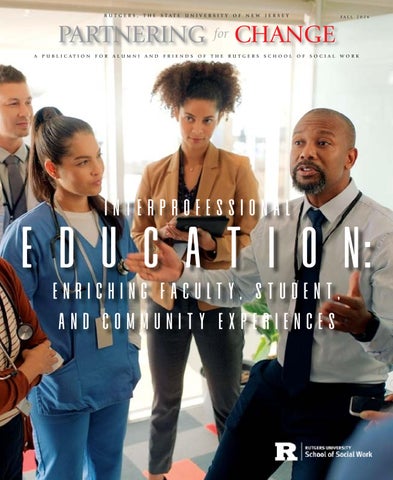
Interprofessional Education: Enriching Faculty, Student, and Community Experiences
22 R U TG E RS , T H E STAT E U N I V E RS I TY O F N E W J E RS E Y / PA RT N E R I N G FO R C H A N G E
3
18
FALL
2026
PARTNERING for CHANGE
Published by the Office of Communications and Office of Development & Alumni Relations at the School of Social Work Rutgers, The State University of New Jersey 120 Albany Street, Tower One, Suite 200 New Brunswick, NJ 08901 848-932-7520
D EA N A ND E DI T OR- I N- CHI E F
GEORGE LEIBOWITZ
D IR EC T O R O F C OM M UNI CAT I ONS AND E DI T OR
LAURIE ZAZENSKI
C O N T RI BUT I NG W RI T E RS
GREG BRUNO MELISSA KVIDAHL REILLY LAURIE ZAZENSKI
PHOT OGRAPHY
PETE BYRON JOHN EMERSON ROY GROETHING JOHN O’BOYLE LAURIE ZAZENSKI
P U B L I CAT I ON DE SI GN
ERIC MILLER + ASSOCIATES
PRI NT I NG
GARRISON PRINTING COMPANY
We welcome your comments and suggestions. Please email us with your feedback or ideas to lzazenski@ssw.rutgers.edu.
M E S S A G E F R O M T H E D E A N
I
Dear School of Social Work Community, t is my pleasure to share the Fall 2026 edition of our alumni magazine with you. In this issue, we explore our commitment to interprofessional education and collaboration. As the challenges facing individuals, families, and communities become increasingly complex, meaningful solutions require professionals from multiple disciplines working together with a shared purpose. Social workers are uniquely positioned to lead these efforts, bringing expertise in person-centered practice, systems thinking, advocacy, and community engagement to collaborative teams across health care, education, behavioral health, government, and beyond. Our feature story highlights the ways interprofessional education is woven throughout the Rutgers School of Social Work experience. From innovative classroom learning and simulation exercises to collaborative research and community-based practice, our faculty are preparing students to thrive in interdisciplinary settings while never losing sight of social work’s unwavering commitment to equity, dignity, and social justice. These experiences not only strengthen professional practice but also improve outcomes for the people and communities we serve. This issue also celebrates the remarkable accomplishments of our faculty, staff, students, alumni, and supporters. You’ll read about our 10th Annual Challenging Racism Conference and Convocation, faculty whose scholarship continues to shape policy and practice, alumni creating meaningful change in public service and end-of-life care, and the inspiring journey of siblings whose lifelong Rutgers connection culminated in graduating from the School of Social Work together. Each story reflects the many ways our community is advancing our mission through compassion and innovation. As we begin a new academic year, we are also looking toward the future. Our School is engaged in a strategic planning process that will help shape the next chapter of Rutgers School of Social Work. Guided by the voices of our faculty, staff, students, alumni, and community partners, this work will strengthen our ability to educate future leaders, advance impactful research, and deepen our engagement with the communities we serve. Collaboration—across disciplines and across our own community—will continue to be essential as we chart this path forward. Thank you for being an important part of the Rutgers School of Social Work family. Your achievements, advocacy, mentorship, and generosity extend the reach of our mission every day. Together, we will continue to prepare collaborative leaders, strengthen communities, and advance social justice for generations to come. In community,
George S. Leibowitz, Ph.D. D EAN AN D D I S T I N G U ISHE D PR O F E SSO R , R U TG E R S SCHO O L O F SO C IA L WO R K R U TG E RS , T H E STAT E U N I V E RS I TY O F N E W J E RS E Y / PA RT N E R I N G FO R C H A N G E
5
S T U D E N T N E W S
Rutgers SCHOOL OF SOCIAL WORK
CELEBRATES CLASS 0F 2026 AT CONVOCATION CEREMONY n Monday, May 18, Rutgers School of Social Work recognized BASW, MSW, DSW, and Ph.D. graduates at its 2026 Convocation ceremony. Hundreds gathered at Jersey Mike’s Arena in New Brunswick to support the 929 graduates who earned a degree from the School of Social Work this year, including 758 MSW grads, 155 BA in Social Work grads, 13 DSW grads, and three Ph.D. grads.
n Outstanding MSW Student Studying in New Brunswick:
Some of the students recognized at the ceremony included:
n Dean’s Honorable Mention for Dissertation of the Year
O
n Mother-daughter duo Michelle Franzoso (mother), a
member of the Intensive Weekend MSW Program Mays Landing cohort, and Jasmine Grant (daughter), who was enrolled in the traditional MSW program in New Brunswick. n Alessa and Joseph Manuola, a sister and brother, who earned their MSW degrees together. n Carol Arroyo, a part-time MSW student studying in New Brunswick, is a mother of three young children who has faced significant health issues as well as accidents that have affected her physical abilities. Despite these challenges and responsibilities, she persevered and successfully earned her MSW with a Certificate in Promoting Child and Adolescent Well-Being. Rutgers School of Social Work Dean and Distinguished Professor George Leibowitz welcomed guests to the ceremony while Provost and Executive Vice Chancellor Jason Geary and Rutgers University–New Brunswick Chancellor Francine Conway shared congratulatory remarks with the Class of 2026. Dr. Michael A. Lindsey, Dean of NYU Silver School of Social Work and an Aspen Institute Fellow, delivered the convocation address. Along with the conferral of the degrees, the School presented the following awards in recognition of the students’ outstanding work: MSW Awards n Outstanding MSW Students in the Clinical Specialization:
Sydney Allison Schair & Karolain L. Guerrero
n Outstanding MSW Student in the Management and Policy
(MAP) Specialization: Shalisa Deanna Alba
n Outstanding MSW Student in the Online Program: Shan
Zhang
n Outstanding MSW Student in the Intensive Weekend
Program: Jennifer Rene Moon
n Outstanding MSW Student in the Blended Program: Tamaris
Nicole Marquez Pimentel
n Outstanding MSW Student Studying in Newark: Joseph
Benjamin Glicksberg
n Outstanding MSW Student Studying in Camden: Shalisa
Deanna Alba
6
Emily Joy Shulman Knopf
BASW Awards n Dean’s Recognition Award for Excellence in the Camden
BASW Program: Alexis Hatfield
n Dean’s Recognition Award for Excellence in the New
Brunswick BASW Program: Cynthia Duchantier
n The Brian C. Wright Social Work Award: Shanice Orozco
Ph.D. Awards n Outstanding Doctoral Dissertation Award: Melanie Yu
Award: Nicole Milano
n Excellence in Faculty Mentoring in the Ph.D. Program
Award: Judith McCoyd
n Ph.D. Professor of the Year: Felix Muchomba
In addition, faculty and staff members were presented with the following awards: n Outstanding Professors in the Clinical Specialization: Mary Beth Ali and Tawanda Hubbard n Outstanding Professors in the Management and Policy (MAP) Specialization: Vivien Anthony and Mark Lamar n Outstanding Professor for Excellence in Inclusion, Intersectionality, Diversity, Equity and Advancement (IIDEA) Teaching: Maxine Davis n Outstanding Professor for Innovative and Creative Teaching: DuWayne Battle and Tawanda Hubbard n Most Supportive Professor: Ryan DiMeglio n Outstanding Lecturers: Frank Greenagel and Adelina Garabet-Mitchell n Outstanding Doctoral Student Teaching in the BASW or MSW Programs: Andrew Kim n Most Supportive Staff Members: Chantaya King and Tatyana Bonds To round out the program, student speaker Karolain Guerrero delivered an inspiring speech. Karolain is a first-generation student and immigrant from the Dominican Republic whose journey is rooted in resilience and a strong commitment to service and community. Raised in Perth Amboy, New Jersey, she has remained deeply connected to the communities that shaped her. At the same time, she earned an MSW degree with a clinical specialization and a certificate in Latinx Initiatives for Service, Training, and Assessment. Dean Leibowitz concluded the ceremony with words of encouragement for the Class of 2026. “We wish you great success, and we know that your impact will be far-reaching from your local communities to the rest of the world,” he said. “We are so very proud of you!” Congratulations, graduates, and welcome to the Rutgers School of Social Work alumni network! n
R U TG E RS , T H E STAT E U N I V E RS I TY O F N E W J E RS E Y / PA RT N E R I N G F O R C H A N G E
R U TG E RS , T H E STAT E U N I V E RS I TY O F N E W J E RS E Y / PA RT N E R I N G FO R C H A N G E
7
FACULTY AC F A C U L T Y N E W S
Work with Adolescents. This group is tasked with updating the Standards, which has not been updated since 2003.
Assistant Professor Qiana L. Brown was elected as the 2026-2027 President-Elect of the College on Problems of Drug Dependence (CPDD). She will be the 2027-2028 President of CPDD and the first Black person to hold this position. CPDD, founded in 1929, has over 1,200 members and is the oldest and largest organization in the United States focused on advancing a scientific approach to addressing problems of substance misuse and substance use disorders. Dr. Brown was also named a 2026 Rutgers Faculty Career Fellow. The fellowship advances faculty development through a structured, cohort-based model that includes an in-person workshop, communities of practice, asynchronous learning, and a culminating project focused on connecting course learning objectives with the National Association of Colleges and Employers Career Readiness Competencies.
Distinguished Research Professor Stephen Crystal won the Rutgers Board of Trustees Award for Excellence in Research. The award honors tenured faculty members who have made distinguished research contributions to their discipline and/or society at large.
Associate Professor Laura Cuesta was appointed as co-lead of the Grand Challenges for Social Work Reduce Extreme Economic Inequality Network. Dr. Cuesta was also appointed as a member of the Society for Social Work and Research (SSWR) Social Policy Committee for the 2026-2029 term.
8
Associate Professor of Professional Practice Tawanda Hubbard authored “Creating a Village in Higher Education: Mentorship, Identity, and Empowerment for Black Women in Ph.D. Programs,” a chapter in Mentoring Relationships in Academia: Narratives from the Margins published by Springer Nature. The chapter chronicles Dr. Hubbard’s journey of selfdiscovery, empowerment, and community building as a Black/African American woman pursuing a second doctorate as a nontraditional Ph.D. student. By sharing her experiences, she offers insights that inform Ph.D. students as they shape their own learning, create a supportive village, and engage with faculty and peers with confidence and authenticity. Dr. Hubbard was also selected to serve on the Task Force for National Association of Social Workers Standards for the Practice of Social
Associate Teaching Professor Amml Hussein was inducted as a full member of the Social Work AI Network (SWAN) at the Constance and Martin Silver Center on Data Science and Social Equity, NYU Silver School of Social Work. She joins Associate Professor Woojin Jung (founding member), Associate Dean for Research, Distinguished Professor and Director, Center for Gambling Studies & Co-Director of the Addiction Counselor Training (ACT) Certificate Program Lia Nower (full member), Associate
R U TG E RS , T H E STAT E U N I V E RS I TY O F N E W J E RS E Y / PA RT N E R I N G F O R C H A N G E
Professor Emily Bosk, and Ph.D. Candidate Andrew Kim (affiliate members). Dean and Distinguished Professor George Leibowitz serves as a founding editorial board member of the center’s journal, Translational Data Science for Social Impact.
CCOLADES F A C U L T Y N E W S
Inequality Research, which provides mentoring and career development opportunities to scholars in the early stages of their research careers who have the potential for leadership. Associate Professor Woojin Jung received the 2026 Excellence Award for the Professor Chin Ok Lee & Ms. Kwanghee Kim Award by the Korean-American Scientists and Engineers Association.
Professor Lenna Nepomnyaschy was invited to participate as a mentor in the National Research Center on Poverty and Economic Mobility Early-Career Mentoring Institute, a weeklong convening at the University of California-Davis Center for Poverty and
Associate Dean for Research, Distinguished Professor and Director, Center for Gambling Studies & Co-Director of the Addiction Counselor Training (ACT) Certificate Program Lia Nower was named to the Prevention and Harm Reduction Advisory group of the National Collegiate Athletic Association (NCAA).
affecting individuals and communities with historically marginalized identities, expand culturally responsive approaches to care, or promote equity in trauma research, training, and service delivery. Professor, Chancellor’s Scholar for Inclusive Excellence in Interpersonal Violence Research & Associate Director of the Center for Research on Ending Violence Chiara Sabina received the Division 56 Outstanding Contributions to Diversity in Trauma Psychology Award. This award recognizes psychologists at any career stage who have made outstanding contributions to advancing diversity, equity, and inclusion within the study and practice of trauma psychology. Nominees may contribute through clinical practice, research and scholarship, basic or applied science, education, advocacy, leadership, or other professional service. Particular consideration is given to contributions that deepen understanding of trauma
R U TG E RS , T H E STAT E U N I V E RS I TY O F N E W J E RS E Y / PA RT N E R I N G FO R C H A N G E
Associate Professor and Ph.D. Program Director Cassandra Simmel received the Chancellor’s Award for Excellence in Mentoring at Rutgers University– New Brunswick. The award, part of the university’s annual Chancellor and Provost Awards for Faculty Excellence, recognizes faculty members whose outstanding mentorship supports the professional growth and success of students, postdoctoral scholars, and earlycareer colleagues. Dr. Simmel was honored among a select group of faculty recognized for exceptional contributions across teaching, research, and service. n
9
FACULTYVOICESINTHENEWS F A C U L T Y N E W S
“We’re currently thinking about gambling the way we thought about cigarettes and alcohol in the mid-20th century, when these substances were treated as benign, many more smoked, and ‘everybody had a bar in their office and no one thought anything about driving drunk or driving their kids around in the car while they were drunk.’”
“When an older adult uses their phone as a shield to substitute or displace real-life social participation, it acts as a major red flag for depression.” Associate Dean for Faculty Development and Professor Chien-Chung Huang quoted in the story “Smartphones Can Increase Seniors’ Risk Of Depression” from U.S. News & World Report
Associate Dean for Research, Distinguished Professor and Director, Center for Gambling Studies & Co-Director of the Addiction Counselor Training (ACT) Certificate Program Lia Nower quoted in the opinion piece “We’re Getting America’s Children Hooked on Gambling” in The New York Times
“As soon as you introduce a new form of gambling or dramatically increase the availability of gambling, you will be increasing the number of people that are experiencing harm because of that gambling.” Associate Professor Mark van der Maas quoted in the story “Gambling disorder diagnoses spike in states that legalized sports betting, study shows” in NBC News
“In our study, we found that those most likely to receive ‘the talk’ were Black, males and youth who’d experienced police contact. We also found that Black mixed-race youth who experienced intrusive police contact —―for instance, they’d been arrested, experienced police violence, or were searched or frisked — had higher odds of receiving ‘the talk.’” Assistant Professor Ashley Jackson quoted in the story “A New Study Reveals Exactly Which Parents Actually Have ‘The Talk’ About Police” from HuffPost
10
“When producers knowingly cast individuals who may be vulnerable, don’t use independent psychological evaluators, don’t provide sufficient mental health support or manipulate situations to elicit distress, it creates a significant potential for harm.” Assistant Professor of Teaching & Director of Online MSW Programs Christine Chapais quoted in the story “It’s time for a reckoning about the mental health of reality TV stars” from The New York Post
“Sustained levels of medication, potentially reducing cravings for illicit drugs and assured protection for a full month may reduce the risk of overdose, particularly for individuals at high risk, such as those treated for prior overdose or in unstable living situations.” Distinguished Research Professor Stephen Crystal quoted in the story “Use of long-acting opioid-addiction treatment increases, but lags other forms” from New Jersey Monitor
R U TG E RS , T H E STAT E U N I V E RS I TY O F N E W J E RS E Y / PA RT N E R I N G F O R C H A N G E
S
F A C U L T Y N E W S
10th ANNUAL CHALLENGING Racism conference
INSPIRES ACTION, REFLECTION, AND HOPE early 600 social work practitioners, educators, and students gathered virtually on June 3 for Rutgers School of Social Work’s 10th Annual Challenging Racism Conference, a milestone event that underscores the School’s enduring commitment to advancing racial justice and equity through education, dialogue, and collective action. Hosted by the Office of Continuing Education, this year’s conference invited participants to move beyond reflection and engage in meaningful efforts to challenge racism in their professional practice, organizations, and communities. “Over the past decade, the Challenging Racism Conference has become a powerful forum for learning, reflection, and collective accountability,” said Dr. Douglas Behan, Director of the Office of Continuing Education. “We are proud to convene scholars, practitioners, and community leaders whose ideas inspire meaningful change and help build a more just future.” The conference has grown into one of the School’s signature events, providing a space for critical conversations about systemic inequities, social justice, and antiracist practice. The 10th anniversary conference built upon that legacy, bringing together nationally recognized scholars, practitioners, and social work leaders for a day of learning, connection, and inspiration. The conference opened with a keynote address from Dr. Debora Ortega, whose presentation Hope, Hopelessness, and Joy: Living into Social Work Values challenged attendees to embrace social work’s core values as a pathway toward transformative change. The conference also featured a keynote presentation from Dr. Ruha Benjamin, whose talk, DEEEEEP UNLEARNING: From Automated Inequality to Abundant Imagination, explored the ways emerging technologies can reinforce inequities while encouraging participants to imagine more just and equitable futures. A highlight of the conference was a thought-provoking panel discussion moderated by Dr. Amml Hussein, Associate Teaching Professor at the School of Social Work. The panel brought together Dr. Ortega and Dr. Benjamin with Rutgers School of Social Work faculty members Dr. Durrell Washington and Mark Lamar for a wide-ranging conversation about anti-
N
racist practice, leadership, and creating meaningful social change. Attendees repeatedly cited the panel as one of the most impactful aspects of the conference. One attendee described it as transformative. “The panel discussion was one of the most profound, intelligent, and transformative conversations about how to make change that I’ve ever been privileged to witness,” the attendee said. “Dr. Ortega brought such an embodied combination of humility and strength, along with her vision of hope, that I nearly wept with gratitude. She has a way of teaching that made me feel like she was speaking directly to me, saying what I needed to hear.” Participants praised the conference for fostering thoughtful dialogue and providing actionable insights that can be applied in practice. “It was a great conference full of critical analysis and constructive ideas for more relevant practice, especially as it relates to social justice,” one attendee shared. Another participant reflected on a discussion about the intersection of social work and systems of control and punishment. “One significant takeaway from the session was the importance of self-education, awareness, and acknowledgment of the carceral aspects of social work,” the attendee said. “It was eyeopening to learn about how these elements can systemically imbalance access to resources and supportive services. Understanding these dynamics is crucial for practitioners to effectively advocate for and support those they serve. This awareness will undoubtedly influence my approach to social work practice moving forward.” In addition to providing participants with new knowledge and practical tools, the conference fostered a sense of community and collective purpose. “These get better every year,” one attendee noted. “The energy around this conference was infectious today. My colleagues felt the same. There was something about the panelists’ energy that gave me hope and strength. I feel better emotionally after having attended.” For many attendees, the conference served as both a source of inspiration and a reminder that meaningful change requires ongoing commitment. A decade after its founding, the Challenging Racism Conference continues to provide a vital forum for courageous conversations, critical reflection, and practical action, equipping professionals with the knowledge, skills, and resolve needed to help build more just and equitable communities. n
R U T G E R S , T H E S T A T E U N I V E R S I T Y O F N E W J E R S E Y / P A R T N E R I N G F O R C H A N G E
11
A L U M N I N E W S
POLICY WITH PURPOSE: how rutgers alum lily antonowicz
is making an impact on capitol hill or Rutgers School of Social Work alum Lily Antonowicz, a career in public policy began with a simple but profound goal: making a meaningful impact. “I was really agonizing over what I was going to do,” she recalled of her undergraduate years. “I just found myself wanting to make an impact in some kind of way and just wasn’t really sure how to best do that.” Encouraged by a mentor to explore social work, Lily discovered a path that would ultimately lead her to Capitol Hill, where she now serves as a legislative assistant in the office of Senator Andy Kim, advising on health and labor policy. While she valued her early experiences in direct practice, Lily quickly recognized the potential to influence change on a broader scale. “I really enjoyed my experience working directly with people, but I wanted to translate that somewhere else,” she said. That realization led her to pursue the Management & Policy (MAP) specialization within Rutgers School of Social Work’s Master of Social Work (MSW) program, where she found the academic and practical foundation necessary for a career in policymaking. “MAP prepared me a lot for my current role,” she said. “There was devoted attention to the macro practice part of social work where we got really deep into the nitty gritty.” A pivotal component of her graduate experience was her practicum placement with the Anti-Poverty Network of New Jersey, where she engaged in advocacy efforts spanning health care access, labor protections, and community organizing during the COVID-19 pandemic. “It was extremely interesting and meaningful to see how they applied intersectionality with everything that we were doing,” she said. “There is very little, if anything, that poverty doesn’t touch in people’s lives.” That experience reinforced a principle that continues to guide her work: “Connecting with the community and having empathy is the number one way that you can influence policy.” Lily began her federal career in a constituent services role in then-Congressman Kim’s district office, bringing a social work perspective to navigating government systems on behalf of New Jersey residents. “I thought, who better to help people with the ins and outs of federal government than a social worker who happens to be from New Jersey and the district he was representing?” she said. Within months, she moved to Washington, D.C., where she advanced into policy work and ultimately followed her office to the Senate. “It’s been a bit of a whirlwind ride within the last couple years,” she said. “But
F
12
the office really believed in the value of social work and having a background from Rutgers.” In her current role, Lily operates in a fast-paced and dynamic environment, where no two days are the same. “There is not a single day that I’m not learning something new in this job,” she said. Her responsibilities include advising on legislative strategy, preparing materials for hearings, engaging with constituent groups, and building coalitions to advance policy priorities. Central to her work is a commitment to ensuring that policy remains grounded in lived experience. “A lot of the work that we do is forming relationships with our community,” she explained. “It’s also building coalitions around policies that we really care about and want to see advanced.” Much of her recent work has focused on caregiving policy, an issue she emphasizes as universally relevant. “There’s not one person that doesn’t require care in some aspect,” she said. “A lot of the work we do lies in humanizing policies so we can try and advance positive solutions.” Lily credits Rutgers with preparing her not only with technical knowledge, but also with the professional skills essential for success in policy environments. “The program teaches social workers to be advocates for themselves,” she said. “That’s something that I apply in real time. Not even just to myself, but in interpersonal meetings and professional situations.” She also recognizes the impact of MAP’s collaborative learning environment, which broadened her perspective and strengthened her ability to navigate complex policy challenges. “It exposed me to a really diverse set of views and people and expanded my thinking,” she said. “It pushed me to think outside the box rather than staying in a narrow lane.” Faculty mentorship also played a critical role in her journey, particularly the influence of Associate Professor of Professional Practice Marla Blunt-Carter. “She was the most amazing professor at Rutgers,” Lily said. “She genuinely helped me figure out what it meant to pursue this path and made me feel like working in Congress was actually possible.” That encouragement helped solidify her confidence in pursuing a nontraditional path for social workers. Reflecting on her career trajectory, Lily encourages current MSW students and recent graduates to pursue ambitious goals and remain persistent. “Shoot for the moon,” she advised. “I remember thinking there’s no way employers are going to understand my background, but you can’t get discouraged.” She also emphasized the importance of continuing to expand awareness of social workers’ role in policymaking. “We’re trying
R U TG E RS , T H E STAT E U N I V E RS I TY O F N E W J E RS E Y / PA RT N E R I N G F O R C H A N G E
to build the understanding of why we fit into policy and why that is so important,” she said. “Social workers are policymakers. Those things are not mutually exclusive. They’re actually quite connected.” Looking ahead, Lily envisions a future where social workers are a consistent presence in legislative offices across the country. “To me, the future looks like every legislative office having a
social worker on their team,” she said. “I want it to be just as common as seeing lawyers in those roles.” Through her work, she continues to demonstrate the value of a social work education in shaping responsive, community-centered policy and serves as a compelling example of the impact Rutgers MSW graduates can make. n
R U T G E R S , T H E S T A T E U N I V E R S I T Y O F N E W J E R S E Y / P A R T N E R I N G F O R C H A N G E
13
C O M M U N I T Y N E W S
rutgers school of social work community comes together in washington, d.c., for young john lewis
prodigy of protest n April 30, more than 120 Rutgers School of Social Work students, faculty, staff, alumni, donors, and community members traveled to Washington, D.C., for an afternoon of reflection and inspiration centered on the life and legacy of civil rights icon and longtime congressman John Lewis. The Rutgers delegation joined leaders from the National Association of Social Workers (NASW), Howard University School of Social Work, and The Catholic University of America to attend Mosaic Theater Company’s acclaimed production of Young John Lewis: Prodigy of Protest. The musical explores Lewis’s formative years between ages 18 and 28, tracing his evolution from a determined young student to one of the most influential leaders of the Civil Rights Movement. Through an energetic blend of music, storytelling, and historical reflection, the production brought to life Lewis’s commitment to nonviolent protest, collective action, and the belief that ordinary people—especially young people—have the power to create extraordinary change. For Rutgers School of Social Work students, the event was designed as more than a theater outing. The School offered the experience free of charge, including round-trip transportation to Washington and a signed copy of John Lewis: A Life by Rutgers historian David Greenberg, allowing students to engage more deeply with Lewis’s story and legacy beyond the stage. The afternoon continued with a panel discussion featuring Greenberg, Mosaic Theater Company Artistic Director Reginald L. Douglas, and Rutgers School of Social Work Associate Professor of Professional Practice Marla Blunt-Carter, LMSW. Together, the panelists explored the ongoing relevance of Lewis’s activism, drawing connections between the Civil Rights Movement and contemporary struggles for racial justice, voting rights, equity, and community empowerment. The experience created a meaningful opportunity for members of the Rutgers School of Social Work community to engage across generations and roles, from current students to alumni,
O
14
faculty, staff, and supporters, while reflecting on the values that define both social work and democratic participation. “This experience underscored the essential connection between social work, civic engagement, and collective action,” said Dean and Distinguished Professor George Leibowitz. “John Lewis’s story reminds us that meaningful change requires courage, persistence, and a willingness to stand up for what is right. Bringing our community together for this shared experience was an opportunity to reflect on our profession’s deep commitment to justice and to inspire the next generation of leaders and changemakers.” The event was made possible in large part through stalwart Rutgers supporter and Mosaic Theater Company board member Leslie Scallet Lieberman, whose commitment helped create this enriching opportunity for students and the broader social work community. By bringing together students, educators, practitioners, donors, and community leaders for a shared experience grounded in history, activism, and hope, Rutgers School of Social Work reinforced its ongoing mission to prepare social workers who are ready to lead, advocate, and advance social change in communities across New Jersey and beyond. n
R U TG E RS , T H E STAT E U N I V E RS I TY O F N E W J E RS E Y / PA RT N E R I N G F O R C H A N G E
A L U M N I N E W S
As a Death Doula, Rutgers Graduate Student Brings peace to end-of-life-care By L I S A
IN TRABAR T OLA
hen you’re born, there are caregivers to help bring you into this world. And when you die, Diana Griebell believes there should be caregivers to help you leave it. Griebell, 57, who graduated in May from Rutgers School of Social Work with a master’s degree in social work and certification in aging and health, has been providing end-of-life care as a certified death doula since 2020. Much like a birth doula — a non-medical professional who offers physical and emotional support to an expectant parent before, during, and shortly after childbirth — a death doula provides that level of care for a person and their family as the end of their life approaches. The goal, said Griebell, who founded Tranquil Transitioning in 2021, is to help a person achieve “a good death” by creating the environment they and their loved ones need to be at peace when their time comes. But while birth doulas have become more commonplace in recent years, hers is a role few are familiar with. That’s because of the stigma surrounding death in our society, said Griebell. “People used to decline and die at home. Little kids would see them. Friends would see them on the couch. It was an everyday occurrence,” she said. “Since health care became more sophisticated, death turned into something closed off and separated. People wanted to shield themselves or young children from death, as if it’s a bad thing. It became isolating for the person dying. When they need people the most, everyone is very uncomfortable. They don’t know what to do and can panic.” Griebell’s introduction to end-of-life care in 2018 was accidental. While accompanying her then-16-year-old daughter to
W
16
a memory care facility where the teenage harpist was providing music therapy for the residents, a staff member asked if they would be comfortable sitting with a woman who was actively dying alone. “I had never seen someone dying before. We all sat down in this woman’s room. My daughter started playing, and something magical happened,” Griebell said. “I saw the staff member holding this woman’s hand and whispering in her ear nice, positive words. All I was doing was sitting observing it all. Something felt so right. It was this beautiful experience. I never thought death could be this way.” It was a “lifechanging” experience for the mother of two from Princeton, New Jersey, who previously worked in insurance and real estate. At her daughter’s suggestion, she researched the certification process for becoming a death doula, a term she hadn’t heard before then. “Many end-of-life doulas have always been very curious about death. Even at a young age, I’ve always found death interesting and fascinating. I used to think I could go into the funeral business,” Griebell said. “But at the same time, I never had the strength or courage to pursue something like that until it naturally came to me.” She completed a three-day intensive training in New York City with the International End-of-Life Doula Association in January of 2020, and the University of Vermont’s eight-week online End-of- Life Care Program with her daughter in May of 2020. Since then, she has assisted about a dozen families, including her own, with the death of a loved one. In 2022, when her father, Forrest Norberg, was nearing the end of his life, the family decided to travel to their cabin in Maine to spend his final days. “I guided my family. It was the most special, intimate moment with me, my sister, and mother while my dad was dying,” she said. “He loved nature. We set his bed
up to look right out at his yard. We brought in snow and pine branches, so he had the scent of nature. We made lavender water, and my mom washed his hands and feet after he passed.” The more she worked with those nearing the end of their lives, the more Griebell wanted to learn about the grieving process and how to better guide people through it. Her desire to bridge holistic and spiritual knowledge with clinical expertise led her to Rutgers to study social work. “There are so many issues from a biopsychosocial perspective,” she said. “The caregivers and families I tend to need a lot of therapy because this can be very traumatic, and I wasn’t able to help them in an additional way.” She started at Rutgers remotely in 2024, but after two online classes decided to switch to in-person so she could work directly with her peers and professors. As a nontraditional student, Griebell said she craved the buzz of campus life and camaraderie of fellow students. During her practicum as a chaplain at Robert Wood Johnson University Hospital’s Spiritual Care Department, she said her experience as a death doula complemented her coursework. She cared for dozens of patients — and their loved ones — who died during emergencies or while on comfort care and hospice. The work reinforced her decision to remain in end-of-life care, either working in hospice, palliative care, or aging health, after graduating. “Diana is an absolute gem, just so thoughtful and intentional,” said Lauren Snedeker, Assistant Professor of Social Work, director of the Aging and Health Certificate and core faculty member at the Hub for Aging Collaboration. “It’s wonderful to see her passion and dedication to age-inclusive social work practice and thinking about ways to ensure folks are living throughout their stages of life with good support as well as thinking about ways to ensure someone has a good death.” n
R U TG E RS , T H E STAT E U N I V E RS I TY O F N E W J E RS E Y / PA RT N E R I N G F O R C H A N G E
S T U D E N T N E W S
‘my story didn’t end where it could have’ After believing a college degree was unattainable, new Rutgers–Camden graduate Gichera Loman plans to pursue a master’s degree. Her success is thanks in large part to a donor-supported Rutgers program for students who have experienced the child welfare system or are at risk for homelessness. By D E B B I E
MYER S
or Gichera Loman, growing up in foster care for years and facing its many challenges made a college education seem unreachable. Today, however, she is the first in her family to earn a college degree, graduating from Rutgers University–Camden with a bachelor’s degree and a double major in health science and psychology. “I honestly never knew I would make it this far,” says Loman, who plans to pursue a master’s in health care management. “There were moments where it felt like life kept stacking obstacles in front of me, but I kept pushing anyway. Looking at graduation now, it doesn’t just feel like finishing school—it feels like proof that my story didn’t end where it could have.” Graduating feels overwhelming “in the best way—almost unreal. There’s a deep sense of pride, but also reflection on everything it took to get here,” she says. After graduating from Cherry Hill High School West in South Jersey, Loman attended Rutgers–Camden where she received the W. W. Smith Charitable Trust Scholarship and participated in Rutgers School of Social Work’s Institute for Families (IFF) Fellows program. Funded completely by private donations, IFF supports Rutgers undergraduates in Camden and New Brunswick who have had lived experience in the child welfare system or are at risk for homelessness. Loman says scholarships and the IFF program played a major role in getting her to this point. Beyond financial help, they provided the encouragement and confidence she needed to thrive and excel. “It was support that lifted a burden and allowed me to stay focused on school when life was already heavy,” she says. “It meant I didn’t have to give up when things got difficult, and it gave me the chance to keep moving forward when I didn’t always have the resources to do it alone.” To learn more about the School of Social Work’s Institute for Families Fellows program and how donors make a difference, visit socialwork.rutgers.edu/iff. n
F
R U T G E R S , T H E S T A T E U N I V E R S I T Y O F N E W J E R S E Y / P A R T N E R I N G F O R C H A N G E
17
F E A T U R E
interpr0fessional education: enriching faculty, student,and community experiences
18
R U TG E RS , T H E STAT E U N I V E RS I TY O F N E W J E RS E Y / PA RT N E R I N G F O R C H A N G E
By
ME L IS S A
KVIDAHL
RE ILLY
t’s often positioned as an ideal: professionals from multiple fields coming together to tackle a problem, each bringing genuine respect for the others’ expertise and an openness to learning. Real-world practice doesn’t always live up to that ideal, but it’s the goal behind Interprofessional Education, or IPE, in which students and practitioners from different professions learn from and with one another to achieve better health outcomes. If you ask Theresa McCutcheon, executive director at the Institute for Families (IFF), IPE prepares social workers and health care providers to better serve people in the real world. “The individuals and families we serve live in a complex, interconnected society, and their overall well being—their health, mental health, concrete needs, and safety—is deeply interconnected,” she said. “We’ve seen firsthand that the best outcomes happen when professionals serve together, honoring and complementing one another’s expertise.” At the School of Social Work, faculty and staff aren’t just creating these kinds of learning opportunities for students, they’re modeling them.
a family scientist who guided the project from early stakeholder engagement though statewide implementation, facilitating input from these various experts and leading the translation into a curriculum and robust training program.
Expanding Doula Support to Medicaid Recipients
Reflecting on the value of this kind of interprofessional work, Swann-Jackson pointed to something more difficult to quantify than a finished curriculum. “I’m referring to credentials that are not immediately apparent on our resumé,” she said. “When you’re sitting in those rooms with people of all different experiences and specialties, you gain a learning that takes place by osmosis and enriches all of us. We expand our minds, think about things differently, and have a greater respect for all the humanity people are bringing to the table.”
I
In an effort to prepare more of New Jersey’s community-based doulas to serve Medicaid recipients, the State’s Maternal and Infant Health Innovation Authority reached out to IFF to create a training program. This collaboration, which began in October 2024, eventually brought together social workers, doulas, OBGYNs, lactation consultants, health care professionals from the New Jersey Departments of Health and Human Services, the Division of Medical Assistance and Health Services, as well as public health faculty from across the state. At the helm of this project was Associate Research Manager Rebecca Swann-Jackson,
The social workers on the team, including IFF Associate Director Milady Murrillo and Ph.D. student Sarah Baig, held specialized roles, synthesizing voices from birth experts, postpartum specialists, and lactation consultants, and ensuring the material reflected the valuable lived expertise of doulas as much as academic research. One priority to emerge from that process was the centering of reproductive justice, a topic the team found underrepresented in existing doula curricula. For a final lens on this content focus, the team engaged SSW faculty member Dr. E. Goldblatt Hyatt. The team also produced a curriculum assessment tool, so the State can determine whether other doula training curricula meet Medicaid reimbursement competencies. “As we move up in our professions, we often get more and more specialized, and that can lead to losing sight of the bigger picture and greater good,” SwannJackson said. “Once we start talking to one another, though, we start to see the overlaps as well as the potential for collaboration.”
Collaborating for Youth Services For Assistant Professor Angela Malorni, interprofessional collaboration isn’t an
R U T G E R S , T H E S T A T E U N I V E R S I T Y O F N E W J E R S E Y / P A R T N E R I N G F O R C H A N G E
For Assistant Professor Angela Malorni, interprofessional collaboration isn’t an abstract concept; it’s the daily practice of her work.
abstract concept; it’s the daily practice of her work. The Youth Action and Research Network, which Malorni co-launched with Shelly Zion of Rowan University’s College of Education and Naomi Fair of the Department of Childhood Studies at Rutgers–Camden, taps into the power of youth participatory action research (YPAR), a methodology that positions young people as co-researchers rather than subjects. The network currently focuses on the Philadelphia and Camden region, drawing together university researchers alongside school districts, climate organizations, job-preparedness groups, and youth civic engagement organizations. Their shared goal? Rethinking youth ecosystems through a racial and social justice lens. “As a social worker, what I’m bringing is both a commitment to anti-oppressive work and a focus on organizational process,” Malorni said. That cross-disciplinary exchange has already reshaped the network’s direction. Conversations with community-based organizations revealed urgent, on-theground concerns, particularly around
19
F E A T U R E
mental health for transient immigrant youth, which pushed the group to prioritize survival and well-being before launching into planned research projects. The network is now preparing an assessment that pairs young people with adult co-researchers from academia and community organizations, intended to shape both a research agenda and a youth leadership pipeline. Malorni’s collaborative instincts extend beyond this project. Her work on youth social media governance brings together experts from the technology, legislative, and public health sectors, and her involvement in a national YPAR network has produced shared measurement tools for social media policymaking and governance built with pediatric researchers, psychologists, and public health scholars. For Malorni, the throughline is clear: young people’s lives are inherently interdisciplinary, and so must be the systems built to support them. “It’s impossible to be an expert in every single sub-issue,” she said, “but to be able to partner with people who are experts in those areas, including young people themselves, is a really powerful thing.”
Training NJ’s Community Health Departments When the Rutgers School of Public Health needed to develop training for community health workers across New Jersey, they turned to social workers with deep roots in the field: IFF Content Supervisor Christine Doman-Wells and Ph.D. student Sarah Baig.
The pair led full-day trainings for county health department staff including health educators, nurses, environmental health staff, and community outreach workers. Doman-Wells’ sessions focused on interpersonal communication, teaching solution-focused questioning and psychologically safe engagement. Baig centered her sessions on healing-centered
20
practice, guiding participants through trauma-informed care principles and the ACE (Adverse Childhood Experiences) framework, much of it new territory for the room. Both trainers noticed a recurring theme: participants often didn’t realize how much their daily work intersected with social work principles, and that gap revealed something important about IPE for social workers. “What gravitates a lot of us into this field is compassion, empathy, and a sense of dignity for all people, and we bring that lens to everything that we do,” Doman-Wells said. “It’s so important to share that lens with folks who have their own area of focus.” The timing mattered, too. Many sessions followed budget cuts and staffing losses at the health departments involved, giving DomanWells and Baig a firsthand look at the strain public health workers face and a deeper appreciation for the importance of community strength. Ultimately, the feedback was overwhelmingly positive. Participants praised the opportunity to discuss conflict resolution, burnout, and deescalation, conversations they rarely have time for otherwise. Several even asked for follow-up trainings for their own teams. “Social work is unique because we are interdisciplinary,” Baig said. “It’s inherent in our education that we learn to understand our role across psychology, sociology, health care, and more. We’re really versatile in that way and can help professionals in their own disciplines, which can often be siloed.”
Supporting Medically Underserved Areas Associate Professor Jamey Lister focuses his research and community partnerships on medically underserved areas, or places where the burden of disease outpaces available care. Since May 2026, he has served as founder and director of the New Jersey Rural Health Resource Center (NJ-RHRC), which
was established to strengthen rural health care delivery through expert technical assistance, collaborative partnerships, and sustainable capacity-building efforts. The center, funded by the Centers for Medicare & Medicaid Services, serves health systems, providers, community organizations, and community members alike. “We prepare and present resources based on what the science says, but also listen and respond to needs identified by rural stakeholders,” Lister said. “It is a collaborative process to ensure that best practices for a range of health conditions have a real-world impact for New Jersey’s rural residents. A lot of times, academic projects sit in the silo and don’t really get used by the health care system. The center’s purpose is to serve as a space to disseminate information by creating trust and partnerships.” Indeed, nearly all of Lister’s projects require interdisciplinary teams. He regularly partners with Rutgers University Behavioral Health Care and the Rutgers Cooperative Extension, alongside state agencies like the Department of Health’s Office of Primary Care and Division of Mental Health and Addiction Services, to expand health care access for medically underserved areas. His role as a social worker on these teams is to serve as the scientific expert leading data-driven planning and implementation efforts to ensure research outcomes are useful for patients and communities. Across these efforts, Lister sees social workers as indispensable, if underrecognized. Social workers make up the largest share of the behavioral health workforce, he noted, but that visibility infrequently translates into leadership. Lister argues that closing this gap requires social work schools to expand IPE efforts and invest in faculty who can bridge research and practice for behavioral health care. This could not only improve social work’s ability to impact underserved communities, but also bring in greater funding while responding to student interest. Unfortunately, he said, this move is sometimes resisted by social workers
R U TG E RS , T H E STAT E U N I V E RS I TY O F N E W J E RS E Y / PA RT N E R I N G F O R C H A N G E
Offering IPE Opportunities to Rutgers Social Work Students As the school’s IPE coordinator, Mary Beth Ali oversees roughly 78 collaborative learning experiences each year, connecting Rutgers social work students with their peers in medicine, nursing, dentistry, pharmacy, and public health. The model is a deliberate departure from the traditional medical hierarchy. “Everyone’s input matters and everyone’s points of view all come together collaboratively,” Ali said.
“We’d present what the science says, but also listen to what their needs are,” said Associate Professor Jamey Lister. “It was a collaborative process to ensure that best practices have a realworld impact. A lot of times, academic projects sit in the silo and don’t really get used by the health care system. My job was to create trust and partnerships between those groups.”
who believe the discipline should focus less on clinical practice research and maintain its original identity commitment to macro social work and the experiences of marginalized populations. With one of the largest schools of social work in the country and a dense local network of potential health care partners, he believes New Jersey is uniquely positioned to lead that shift, if the relationship-building work gets done. “The opportunity is there,” he said. “We just have to prioritize it.”
That philosophy plays out in real-world scenarios. Students role-play cases involving palliative care, HIV disclosure after sexual assault, chronic illness, and neurodivergency. A new simulation launching this fall places students inside a hurricane disaster response, forcing them to define their professional role on the fly with no resources at hand. Some sessions even bring in student actors from Mason Gross School of the Arts to portray patients and family members navigating conditions like stroke-related paralysis, pushing students to grapple with communication barriers in real time. Ali emphasizes that these cases aren’t designed to be solved. They’re designed to be discussed. “We bring a full, robust case to the students so they can lean on one another to formulate the best plan,” she said. “The key is not to solve the problem, but to improve their communication with one another instead of trying to do everything alone.” Rutgers’ IPE program also includes partnerships with Rowan University’s Cooper Medical School, Fairleigh Dickinson University, St. Joseph’s University’s Philadelphia School of Pharmacy, and Monmouth University’s School of Social Work. Ali hopes to deepen that footprint further, working with the school’s curriculum committee to embed more IPE experiences directly into coursework, rather than treating them as a specialized requirement for certain certificate programs or an optional add-on to an already demanding schedule.
“We bring a full, robust case to the students so they can lean on one another to formulate the best plan,” said IPE Coordinator Mary Beth Ali. “The key is not to solve the problem, but to improve their communication with one another instead of trying to do everything alone.”
The payoff, she believes, is resilience. Social work students and graduates often find themselves working solo, for example, in a school where they’re the only social worker on staff. IPE training helps them recognize allies already in the building: the school nurse, the principal, the teachers. “After they participate in these programs, so many students say they didn’t realize what other professions do and how they can lean on and learn from them,” Ali added. “That’s the point. We are better together than we are alone.” n
R U T G E R S , T H E S T A T E U N I V E R S I T Y O F N E W J E R S E Y / P A R T N E R I N G F O R C H A N G E
21
A L U M N I N E W S
FROM PRE-K TO COMMENCEMENT, THESE SIBLINGS HAVE A LIFELONG RUTGERS CONNECTION By R O Y A
J
oe and Alessa Manuola first came to Rutgers for school when they were toddlers. Last May, the brother and sister from Bordentown, New Jersey graduated with their second degree from the university—earning their master’s from the School of
Social Work. “We are very much a Rutgers family,” said Alessa Manuola, 23. The two, who are 18 months apart, went to pre-school at the Rutgers Psychology Child Development Center, which provides early childhood education for ages 1-5. Their mother, Jennifer Manuola, worked there since she was an undergraduate at Rutgers herself. They spent their summers at Rutgers camps, and later returned as counselors. Then, they came to Rutgers for their undergraduate degrees, both studying psychology and graduating in 2024. “Rutgers is as much home to them as our house is, and they’ve spent more time on campus than they have in our backyard,” Jennifer Manuola said. There was never any doubt, the two said, that they would end up at Rutgers. “I always wanted to go to Rutgers because it was a place that was familiar for me,” Joe said. “It was also affordable.” The siblings’ Rutgers story began well before they were born. Their parents, Jennifer and Joe, met in 1993 at Rutgers in their first year of college. Joe graduated in 1997 from Rutgers Business School and Jennifer followed the next year with a bachelor’s degree in English and psychology. The summer before her graduation, Jennifer began working as a part-time student at the Child Development Center. Eventually, she landed a full-time job there teaching kindergarten, a position she held until 2005 when she became the center’s director. Joe and Alessa were first involved in research when they were preschoolers at Rutgers—as subjects in studies. The center, which is run by the Psychology Department in the School of Arts and Sciences at Rutgers-New Brunswick, provides an opportunity for researchers throughout the university to study child development.
22
R AFEI
Estelle Mayhew was one of those researchers. Alessa was part of Mayhew’s research twice—first as an 18-month-old on children’s cognitive and developmental abilities and a few years later in a pilot study on children’s understanding of time. By chance, years later, as an undergrad psychology major, Alessa ended up in two of Mayhew’s classes. “It was a full-circle moment,” Alessa said. The siblings grew up hearing the terms and principles associated with the field of psychology, sparking an interest in the discipline. “Part of the reason I did psychology for my undergrad is because of everything I’ve experienced at a young age through the Child Development Center,” Alessa said. “I would hear my mom and her peers talk about it and I’m like, ‘Oh, that sounds really interesting,’ so I ended up going into it.” For their master’s degrees, they chose social work for different reasons. Alessa felt it offered more opportunities for her career path, and Joe said the field resonated with him. “I’m somebody who likes to see other people get empowered, to get help and build skills and grow from it,” said Joe, 25, who wants to be a therapist. “Also, I like working directly with the population. With psychology, it was more research-orientated, at least what I was looking at.” Alessa added, “Psychology and social work are very connected, but ultimately I chose social work because I felt there was more versatility in the degree.” She wants to work with adolescents or college-age students. “That population, they are at a very important stage in their lives when they’re finding a lot about their identity, who they want to be, what their goals are in life,” Alessa said. “I feel like intervening at that age is really essential for successful outcomes.” They still remember swinging and sliding on the playground of the Child Development Center, and even though they’re finally leaving Rutgers as students, they expect to return. Their younger sister, Aria, 13, was enrolled at the center at 5 weeks old, possibly making her the youngest child ever to enter Rutgers. So, they think Aria follows in her family’s footsteps. “We’ll be back, maybe not as students,” Alessa said, “but Rutgers is still with us.” n
R U TG E RS , T H E STAT E U N I V E RS I TY O F N E W J E RS E Y / PA RT N E R I N G F O R C H A N G E
R U T G E R S , T H E S T A T E U N I V E R S I T Y O F N E W J E R S E Y / P A R T N E R I N G F O R C H A N G E
23
H O N O R R O L L O F D O N O R S
Thank you
to our alumni and friends who made gifts between July 1, 2025, and June 30, 2026. These generous contributions helped create
$100,000 or higher
$250 to $999
Jeffery Dickert, Ph.D. M.S.W.^
Anonymous (1)
Becky and Bill Keane^
Mrs. Kathryn R. Adamiak
Ms. Alison Schwartz^
John T. Ash, III Ph.D. Joan G. Axelrod, Ph.D.
opportunities for Rutgers School of Social
Ms. Jean P. Barnes
Work students and faculty that might not
$25,000 - $99,999
Ms. Sharyl A. Byank
otherwise be possible.
International Center for Responsible
Mr. Sean J. Conlon
Gaming
Mr. Arpan Dasgupta
Please direct any questions to Director of Development, Xenia Ferencevych: xenia.ferencevych@rutgersfoundation.org.
Dr. Rebecca T. Davis $10,000 - $24,999
Lynn Dennis
The Estate of Merry Stokes Bennett,
Lesley C. Ellerbusch, M.S.W.
SSW ‘64
Centene Corporation CVS Health Foundation GlaxoSmithKline Foundation The Horizon Foundation for New Jersey Johnson & Johnson Foundation Microsoft Corp. The Robert Wood Johnson Foundation Many companies and foundations sponsor matching gift programs for their employees’ philanthropic interests. These companies may be willing to double or even triple the value of charitable gifts made by employees or their spouses. Contact your company’s human resources department to find out if it has a matching gift program.
Mrs. Dana Feldman
Arthur J. Falk, Ph.D. and Madonna F. Falk
Xenia Ferencevych
Mrs. Lorri S. Goldberg
Sharon A. Fortin
Virginia Aiken Gormley and The
Mr. Michael Goldstein and Mrs. Jordan
Honorable William Gormley We are grateful to the following entities for so generously providing matching gift funds in support of Rutgers School of Social Work:
Lisa and Michael Coran
Goldstein
William L. Kincaid, M.D., M.P.H.
Lynne M. Healy, Ph.D.
Ms. Nycha Schlegel and Mr. D. William
Dr. Paul A. Herman and Ms. Ruth
Loos
Anne Koenick Mr. David P. Hoff Jewish Community Foundation of
$5,000 - $9,999 The Rita Allen Foundation
Greater Mercer Mrs. Bridget Stillwell Kennedy Kerstin Koenig Mr. Thomas Stanley Larson
$1,000 to $4,999 Anonymous (2)
Mrs. Christine D. Liberati and Mr. Robert J. Liberati
Ms. Ronne E. Bassman-Agins
Ms. Leslie Scallet Lieberman
Ms. Linda Block-Coalter
Dr. Judith L.M. McCoyd
Mr. Allen B. Cohen
Theresa Comprelli McCutcheon
Mrs. Lily E. Freier and Mr. Harris Freier
Ms. Beth I. Mucatel
Ms. Kathleen T. Kovach
Dr. Lenna Nepomnyaschy
Sandy Lanman
The Reverend Raymond David Patch
Dr. Cathryn C. Potter and
Allen Schneider, M.D. and Dona F.
Mr. Christopher Potter
Schneider, Ph.D.
Kathleen J. Pottick,Ph.D.
Mr. Ethan D. Schoolman
Ms. Nellie R. Purefoy
Dr. Cassandra Simmel
Ms. Bonnie Jean Schwebel
Mrs. Lisa H. Stafford
Mr. David J. Stern and Ms. Stephanie
Ms. Janice Svizeny
Raneri Mrs. M. Kathleen Woodward and Mr. Carl R. Woodward III., Esq.
Ms. Catherine M. Twanmoh and Dr.Jeffrey D. Charney Allison Zippay
^ Denotes multi-year major gift donor.
24
R U TG E RS , T H E STAT E U N I V E RS I TY O F N E W J E RS E Y / PA RT N E R I N G FO R C H A N G E
H O N O R R O L L O F D O N O R S
Up to $249
Dr. Neil DeHaan Jr.
Joel Kanter
Mr. David B. Moorehead
Ms. Asena K. Terry
Anonymous (2)
Ms. Nancy B. DeLeon
Mrs. Carol R. Kasabach
Ms. Safiyyah Muhummad
Ms. Lorrie Tietze
Mr. Alvin Ackerman
Nancy J. Des Rault, M.S.W.,
Ms. Cheryl F. Key
Bonnie E. Muir, Esq.
Ms. Paula S. Tsarides
Ms. Joanne C. Angell
L.I.C.S.W.
Chong-Youl Kim, Ph.D.
Mrs. Mary Eileen Nemeth
Ms. Susan G. Uhl
Ms. Vivien Anthony
Loretta DeTitta
Mr. Timothy F. Kinsella
Ms. Karen M. Nevalsky
Mrs. Ruth Z. Valentine
Brandon E. Arias, Esq.
Laura A. DiMarcantonio,
Mrs. Beth S. Knight
Mr. Richard E. Ohlsten
Mrs. Mary Valentino
Mr. Michael M. Knox and
Mrs. Bineke P. Oort
Dr. Judith Velez
Mrs.Barbara J. Bristow
Jill Avaltroni
Ph.D.
Mr. Robert S. Baer
Ms. Mary M. Ditzler
Mr. Michael Park
Ms. Nellie R. Vitale
Mrs. Nancy B. Baldwin
Dr. Richard L. Edwards
Susan Koehler
Mr. Frank T. Picone
Ms. Jennifer A. Vogel
Ms. Victoria Banyard
Ms. Lobna Farouk Elberri
Uri Amir Koren
Ms. Donna M. Pincavage
Ms. Zahara N. Wadud-
Ms. Mary Belasco
Jennie G. Ellis, M.S.W.,
Mrs. Debra Valian Lambert
Ms. Melanie Z. Plasencia
Mr. Scott Lanman and
Ms. Carla R. Powers
Mr. William Waldman
Mr. Tibor Purger
Ms. Corinne D. Warrener
Ms. Tiffany J. Riccardelli
We Help People, LLC
Ms. Carolyn E. Ricketts
Mr. Samuel T. Wells
Mrs. Suzanne M. Bell Ms. Gisela Hoffmann Berkson
L.C.S.W. Ms. Joy S. Epting Dr. Philip B. Feldman
Mrs. Rachel Lanman Latino Action Network
Pinkett
Dr. Joseph A. Bertolino
Ms. Maria C.Ferreira
Mr. Christopher J. Blanos
Mrs. Margaret A. Forrester
Mr. Kevin C. Lee
Mr. Robert M. Ring
Mrs. Judith L. Weinberg
Ms. Barbara G. Bornstein
Ms. Lynn R. Fryer
Mr. Robert J. Lenehan
Ms. Jacqueline E. Rivera
Mrs. Sandi Weisenfeld
Mrs. Gail Bresnahan
Dorothy C. Gaboda, Ph.D.
Ms. Jenina S. Lepard,
Mr. Harry Rosenberg,
Dr. Daniel Weisman
Dr. Peter J. Bridge
Ms. Mary Beth L.
L.C.S.W.
Foundation
Mrs. Denise K. Wilkens
L.C.S.W.
Victoria Williams Brown,
Ms. Diane Lia
Mrs. Alicja Ruszala
Mrs. Lisa K. Butler, L.C.S.W.
Mrs. Marie-Edith Ganthier
Ms. Mariadonna M. Litwak
Dr. Carlton M. Sapp
Ms. Rosalind Campbell
Mr. Peter Ross Gilbert
Mrs. Annette R. Madarasz
Ms. Kristine H. Schmitz
Ms. Nancy A. Yorlano
The Reverend Sally L.
Ms. Maria Fernandez
Lloyd A. Marks and Janice
Lori R. Schlosser, Ph.D.
Dr. Karen A. Zurlo
Mr. Joel D. Brown
Gallimore
Siegel Foundation, Inc.
Mr. Eric D. Schwartz
Ms. Cecilia Candeloro
Ms. Gail M.Goldfinger
Mr. Jerome Steve Marton
Mr. Larry R. Schwartz
Dr. Erin Capone and
Emily A. Greenfield, Ph.D.
Mr. Nicholas J. Masucci
Ms. Rachel H. Schwartz
Ms. Sandra G. Gutierrez
Dr. Raymond Sanchez
Mr. Frederick
Campbell
Mr. Vincenzo Capone Mrs. Jenny Gragg Carson Ms. Krystal E. Aguayo Cartagena Ms. Ellen M. Carter
Giumarra
Ms. Rita A. Hahn
Mayers and Dr. Fontaine
Mr. John M. Hellriegel
H. Fulghum
Ms. Marybel HernandezKelly
Schwarzenbach Walter Scott
Ms. Shaniqua D. McRae
Mr. Thomas R. Sirolli
Ms. Kathleen McGrann
Mr. Stanley C. Slachetka Jr.
Ms. Caitlin Renee Cave
Ms. Ruth L. Honigfeld
Ms. Gail E. McHugh
Roberta I. Sloan, L.C.S.W.
Jeanmarie Maroney
Maurice Hryshko, Esq.
Mr. G. Arthur McKay,
and Dr. Robert Schapire
Chang LLC Dr. Susan P. Chizeck
Tawanda L. Hubbard,
L.C.S.W.
Ms. Gwendolyn H. Smith
Ph.D., D.S.W., M.S.W.,
Sarah McMahon
Ms. Shelby L. Somers
L.C.S.W.
Naomi B. Mendez, M.S.W.
Ms. Lauren N. Sorkin
Mrs. Diane Elaine Clapp
Mrs. Teresa Hunter
Ms. Deborah Meyers
Mr. Richard A. Stagliano
Robin S. Cohen, L.C.S.W.
Yvonne Jerome
Ms. Colleen A. Mielke
Laura Stevens
Mr. Douglas Collingwood
Ms. Lisa Johnson
Mrs. Sharon M. Miklas
Ms. Constance Z. Stober,
Mr. Marcelo Corrales
Mr. Anthony Jones
Mrs. Lynn Ferrante Miller
M.S.W., D.C.S.W.
Mrs. Kathryn A. Cortese
Ms. Rosa D. Jones
Ms. Judith F. Millman
Ms. Ishwari Store
Mrs. Kelly-Jane Cotter
Ms. Cheryl K.
Dr. M. Valerie Mills
Mrs. Jessica L. Suckerman
Corinne Mitchell
Mrs. Theresa K. Tally
Ms. Merle E. Morgenstern
Ms. Shannon N. Taylor
Ms. Mary Alice Cicerale
Mr. Dale C. Davis, Jr.
Jones-Holaday
Lynn D. Dean, L.C.S.W.
Mr. Terence K. Jordan
R U T G E R S , T H E S T A T E U N I V E R S I T Y O F N E W J E R S E Y / P A R T N E R I N G F O R C H A N G E
25
M.S.W.
F A C U L T Y N E W S
WHAT TO
READ & WATCH RUTGERS SCHOOL OF SOCIAL WORK FACULTY AND STAFF SHARE RECOMMENDATIONS TO ADD TO YOUR LIST. Free Food for Millionaires by Min Jin Lee Recommended by Rachel S. John, Assistant Professor and Chancellor-Provost’s Scholar for Inclusive Excellence for Immigrant and Refugee Health This is the debut novel by Min Jin Lee. The story follows Casey Han, the daughter of Korean immigrants, as she pursues the American Dream while coming to terms with the expectations placed upon her by her parents. Through Casey’s story, we see the complexities of navigating a bicultural identity as the U.S.-born child of immigrant parents. The novel also tells the story of her parents and their journey, providing insight into the sacrifices, hopes, and trauma that shaped their expectations for their daughter. I could not put this novel down and I keep thinking about it well after I finished it.
Dark Winds Recommended by Hina Rehman, Senior Program Coordinator Dark Winds is a drama series that depicts the experiences of Navajo tribal police officers in the 1970s. As Indigenous people, the characters offer a compelling and thought-provoking perspective on navigating legal and judicial systems that were not designed to serve their communities, yet within which they must nonetheless operate. As social workers, it is important to recognize the themes of systemic oppression and social injustice woven throughout the series, alongside themes of resistance and the value of community cultural wealth.
26
R U TG E RS , T H E STAT E U N I V E RS I TY O F N E W J E RS E Y / PA RT N E R I N G FO R C H A N G E
F A C U L T Y N E W S
High on the Hog: How African American Cuisine Transformed America Recommended by Jack B. Lewis, Associate Professor of Professional Practice and Director of the Intensive Weekend MSW Program This documentary on Netflix by food writer Stephen Satterfied traces the origins of African American cuisine from Africa to Texas. The information provided in this eight-episode series is fascinating and eye opening. I was proud to learn about the various contributions my ancestors have made over the years that are so overlooked. I highly recommend that people watch this.
This Land (Seasons 1 & 2) Recommended by Christine Chapais, Assistant Professor of Teaching and Director of Online MSW Programs Hosted by Rebecca Nagle, season one follows McGirt v. Oklahoma, the case that affirmed a huge stretch of eastern Oklahoma is still Muscogee reservation land, and season two traces Brackeen v. Haaland, the challenge to the Indian Child Welfare Act. Together, they show how cases like these are being used as part of a broader legal strategy to chip away at tribal sovereignty itself.
Pachinko by Min Jin Lee Recommended by Assistant Professor Michael Park This multigenerational story follows a Korean family living as immigrants in Japan over most of the 20th century, facing discrimination and hardship as they try to build a better life. As someone who studies immigrants and their experiences of discrimination, I found it a moving reminder of the strength behind ordinary people and the hard choices they make for their children.
The Right Time with Bomani Jones Recommended by Matthew Mayo, Senior Program Coordinator, Institute for Families This podcast has been one of my favorite listens for a few years. The show discusses sports at the intersection of current events and pop culture. Being able to discuss all three unapologetically is masterful and refreshing, especially when he dives in deep with guest journalists.
Viral Justice by Ruha Benjamin Recommended by Christine Morales, Assistant Dean for Lecturer Support and Associate Professor of Teaching This summer, I attended the School’s Annual Challenging Racism Conference, where Ruha Benjamin delivered the keynote address. I was deeply moved by her remarks and her contributions during the panel discussion, which motivated me to reread her book, Viral Justice. The book vividly illustrates the impacts of racism on individuals, communities, and systems. While it confronts difficult truths, it also offers inspiring examples of actions and movements that work to restore justice.
R U T G E R S , T H E S T A T E U N I V E R S I T Y O F N E W J E R S E Y / P A R T N E R I N G F O R C H A N G E
27
A L U M N I N E W S
CLASSNOTES Thank you to all of our alumni who have sent us their news and updates. We encourage you to keep us posted with any good news about your job, your life, or your family. Email your news to lzazenski@ssw.rutgers.edu.
Tanoa Bettis, SSW’11 works in behavioral health for the Children’s Hospital of Philadelphia and owns a private practice. Tanoa has enjoyed a rich career full of accomplishments, success as a businesswoman, and many professional connections that have paved the way for her. She credits Rutgers for these achievements and wishes the Class of 2026 the same success. Bernard Bivens, SSW’78 has been working for the City of Philadelphia for 30 years and is presently employed as a behavioral health clinical consultant. He credits his successful and rewarding career in the field of social work to his education at Rutgers. Dr. Charise Breeden-Balaam, SSW’08, a food insecurity expert, has presented her work nationally and internationally this year, including at the NASWNY 1st Annual CE Conference, HERS Leadership Institute 50th Anniversary Conference & Reunion, and 2026 International Social Work Research Conference in Belize. Doreen Chila-Jones, SSW’21 opened her private practice in Maplewood, New Jersey on August 1, 2026. Intersectional Identities, LLC focuses on the individual needs of neurodivergent youth, adolescents, and young adults at the intersection of LGBTQIA+ identities as well as supporting families and adults with children in this population.
28
Most of Susan Chizeck, DC’69, SSW’83’s career was purely based on chance, not design. A Rutgers professor recommended her for a fellowship in Asian studies, and suddenly she was living and studying in Japan. After earning her BA, she worked in the New Jersey state government in child welfare, writing grants and conducting research. Later, she ran a halfway house and joined the Ph.D. program at Rutgers School of Social Work. While earning this degree, she married a Texan and moved to Dallas to begin her career teaching social work and related courses and running an internship program at the University of Texas at Dallas. Susan also joined a professional organization in experiential learning and spoke at conferences across the country, sat on the organization’s board, and edited their peerreviewed journal. After 39 years of teaching courses like social deviance, sociology of health, and writing and critical thinking, as well as working with students learning to be EMTs, she recently retired from her post at UTD. She hopes all current students and recent graduates remain open to opportunity and do the work you love.
Jess Converse, SSW’08 formed a relationship with Hummingbird Church, an organization that legally provides ayahuasca ceremonies as a sacrament, where he was able to provide group EMDR (G-TEP) as a way of preparing individuals for ceremony. After getting an IRB approved, Jess provided surveys before providing G-TEP, two following the ceremonies, and one post-ceremony survey. The control group that received guided mindfulness supported data that showed efficacy for the experimental group that received the G-TEP. Jess’s findings were presented at the 2024 International Conference on Psychedelic Pharmacology and Psychedelic Drug Research. Jess has also recently been providing G-TEP training and consultation for clinicians working with Palestinians impacted by ongoing violence in Gaza.
Sheridan Quarless Kingsberry, SSW’83 (MSW), ‘02 (Ph.D.), was elected President of the International Women’s Club, Inc., Wilmington, Delaware, for a third term. Sheridan retired from the MSW faculty at Delaware State University in 2019 and is an active volunteer in her church and community. Catherine Radeschi, SSW’75 has been working in private practice for the last 30 years. She also volunteered at the Mental Health Association of Monmouth County and served as a practicum consultant for Rutgers School of Social Work for many years. Her focus is on adults with anxiety, depression, and grief issues, and she credits Rutgers for providing a wonderful foundation for her career.
R U TG E RS , T H E STAT E U N I V E RS I TY O F N E W J E RS E Y / PA RT N E R I N G F O R C H A N G E
A L U M N I N E W S
Call for Nominations: Rutgers School of Social Work Outstanding Alumni Award Do you know a fellow Rutgers School of Social Work alum who has made an indelible impact on their community? Have you made a lasting mark yourself? Rutgers School of Social Work’s Alumni Council seeks nominations for its Outstanding Alumni Award. Your nomination gives these outstanding individuals (or yourself) the opportunity to be recognized for their hard work and accomplishments. Nominations for this year’s award are due by October 15, 2026. Amy E. Stein, SSW’99 started a new position as tenure-track assistant professor in the social work program at Saint Joseph’s University in Philadelphia. She specializes in environmental justice and forced displacement of refugees.
Courtney Gardner-Prince, founder of The Art of Ascending, has developed the BCARE Ascension Method™, a behavioral-healthinformed framework designed for parents, therapists, schools, and community providers. Centered on boundaries, connection, awareness, respect, and emotional regulation, the method provides practical tools to strengthen family systems and improve parent-child relationships across home, school, and therapeutic settings. Drawing from over 15 years of experience in social work, crisis intervention, and family support services, Courtney integrates parent coaching, mindfulness, yoga, and family engagement strategies into workshops, trainings, and wellness-based programming throughout New Jersey.
Valerie Vaughn, LC’75, BSW is a self-taught folk musician who studied under Dolores Yorba, Aiko Kono, and Hilda Hidalgo. She has been combining her musical talents with her social work skills for 50 years. In 2024, Valerie was honored by the New Jersey Council on the Arts with a Culture and Heritage Folk Arts Fellowship Award and grant for her songs that describe the history and natural environment of New Jersey. She is also the resident folk singer/ storyteller for the Tuckerton Seaport. This year, Valerie performed at the New Jersey Folk Festival and will publish her second book, Tucker’s Island and Beyond: The Lyrical Tales of New Jersey. It will contain the lyrics, backstories, and access to the recordings of 27 of her most-loved songs. At 73, Valerie is still performing and teaching students, including those who are lesser abled as well as the elderly. Her songs and work are available at youtube.com/@valerievaughn7597, and you can email her at talespinner11@hotmail.com. n
R U T G E R S , T H E S T A T E U N I V E R S I T Y O F N E W J E R S E Y / P A R T N E R I N G F O R C H A N G E R U T G E R S , T H E S T A T E U N I V E R S I T Y O F N E W J E R S E Y / P A R T N E R I N G F O R C H A N G E
Eligibility Criteria n Nominees must have matriculated at Rutgers University and earned either the BASW, MSW, Ph.D, in Social Work, or DSW degrees. n Nominees cannot currently be an employee of Rutgers University or a current member of the Alumni Council. n Self-nominations are accepted and encouraged. n Posthumous nominations are not accepted. n Must be able to attend the Annual Winter Alumni Reception on December 3, 2026 in New Brunswick. Nomination Process Please send an email with the following information only to Dr. Tawanda Hubbard, Alumni Council President, at thubbard@ssw.rutgers.edu Nominator Information n First and Last Name n Email Address n Relationship to the nominee Nominee Information n First and Last Name n Email Address n Occupation n Year of graduation n Degree (BA, MSW, DSW, or Ph.D.) n Campus attended n Description in approximately 500 words of the impact this individual had on Rutgers and the community. Thank you for helping us to recognize our fellow alumni for all their important and noteworthy accomplishments to the field.
29
29
I N M E M O R I A M
I
N
M
E
M
O
R
I
A
M
We extend our deepest sympathy to the loved ones of the deceased alumni and friends listed below whose passing has been shared with the School through June 2026.
Ms. Barbara Baumecker, SSW’76 Ms. Phyllis Black, SSW’83 Mr. Daniel Cooperson, CAS’65, SSW’75 Mr. Thomas Hochreiner, SSW’95 Mr. David Moore, CAS’05, SSW’07 Mrs. Marilyn Schwartz, SSW’67 Ms. Vera Smith-Bey Owens, SSW’94 Mrs. Ann Winn-Mueller, SSW’78 The Reverend E. Zelley, SSW’91
Remembering David Antebi The Rutgers School of Social Work community recently learned of the passing of former faculty member David Antebi, who died in 2024. Dr. Antebi taught courses in community organization and social action within the School’s Administration, Policy, and Planning (APP), now Management and Policy (MAP), Master of Social Work (MSW) specialization. Throughout his time at Rutgers, he inspired students to view social work as both a profession and a vehicle for advancing social justice. “David had a devoted student following and was a strong advocate for social justice actions and initiatives,” said Rutgers School of Social Work Professor Allison Zippay, Ph.D. “He used photography as a social action lens,” she said. “His photographs often hung in the hallways of the School of Social Work when it was located at 536 George Street and focused on images of public collective actions, protests, and social movements. He was an inspiration to his students.”
30
Beyond the classroom, Dr. Antebi’s photography reflected his deep commitment to community engagement and social change. His images documented demonstrations, collective action, and grassroots movements, reinforcing the values he taught and encouraging students to recognize the power of advocacy in advancing equity and justice. Dr. Antebi dedicated his life to social justice, community organizing, education, and the arts. He is remembered by family, friends, colleagues, and former students for his compassion, creativity, and unwavering commitment to making a difference. Rutgers School of Social Work also extends its condolences to his wife, Paula Antebi, SSW’81, and to all who knew and loved him. Dr. Antebi’s legacy lives on through the many students he mentored, the communities he served, and the enduring belief that social work can be a powerful force for positive social change. n
R U TG E RS , T H E STAT E U N I V E RS I TY O F N E W J E RS E Y / PA RT N E R I N G F O R C H A N G E
e n d
“I am no longer accepting the things I cannot change. I am changing the things I cannot accept.” A N G E L A
L .
D AV IS
p a g e
Non-Profit Organization U.S. Postage Rutgers, The State University of New Jersey 120 Albany Street, Tower One, Suite 200 New Brunswick, NJ 08901
PA I D
New Brunswick, New Jersey 08901 Permit No. 157
Visit us on the web: socialwork.rutgers.edu Email us at: lzazenski@ssw.rutgers.edu Follow us on Facebook, X, Instagram, LinkedIn, and YouTube @RutgersSSW