
UNIVERSITY | CAMDEN Honors College

UNIVERSITY | CAMDEN Honors College
Fall 2022
Volume 3 Issue 2
Jochebed Airede, co-editor
Isaiah Dingle, co-editor
Honors College Advisory Board
Lee Ann Westman, Director, Honors College
Brian Everett, Assistant Dean, Honors College
Faculty Advisory Board
Jessica Taylor-Bashshar
Katherine Epstein
Paul Lisicky
Lee Ann Westman
Cover Art: Lauren Carbone, Self-Portrait
Copyright © 2022, The Undergraduate Review Rutgers University-Camden. All rights revert to authors.
The Undergraduate Review is a publication of the Honors College at Rutgers University-Camden. The views expressed in The Undergraduate Review are solely those of the contributors and should not be attributed to the editorial staff, the Honors College, or to Rutgers University.
Editor’s Introduction 3
Nikitha Jeyaprakash
Integrating Composting into America’s Waste Management System
Makayla Malecki 5
The History of PATCO, As Viewed From the Train
Gretchen Purvis 12
The Sexual Suppression of Ancient Roman Women and the Theory of Immaculate Conception
Sophia R. Westfall 34
Federal vs. State Power and the Jim Crow South
Bradley Mahler 45
Quality Improvement (QI) Study: Campus Conditions and Physical Health of Rutgers-Camden
Emma Bogdan, Joseph Lescht, and Shaan Mody 50
Music Rules Over All
Xavier Soto 75
Integrative Assignment
Sandrine Gashema 79
Path to Self-Destruction
Angelina Cheng 92
Traveler
Felix Liu 97
Nikitha Jeyaprakash
The Undergraduate Review is a curation of versatile works by students. This journal highlights the academic and artistic excellence of the student body at Rutgers University-Camden. It serves as the space for students to communicate their ideas and visions to others with the guidance of the staff and faculty of the campus. The existence of the journal serves to capture the multidimensionality of the student body and actively promote curiosity and the growth of knowledge in diverse topics with an aim of broadening each other’s horizons. The Fall 2022 issue contains faculty-approved student contributions spanning across a wide spectrum, including history, social work, prose and poetry.
Angelina Chen’s “Pathway to Self-Destruction” eloquently describes the feeling of paranoia and distrust and makes use of therapeutic counting to set the pace of the prose. Just like Chen’s eloquent descriptions, Felix Liu’s “Traveler” uses extensively descriptive language to bring the character’s encounters and his journey to life. Zoeie Stokes’ “Pretty Lips” delves into the commodification of human bodies and minds and how the value of thoughts are weighed by the physical appearance of their speaker.
On the topic of commodification and suppression, Sophia Westfall’s “Sexual Suppression of Women in the Ancient World” provides a political and religious perspective on the double standards that women throughout history have had to endure because of their commodification throughout time. Bradley Mahler’s “Federal vs. State Power and the Jim Crow South” shows research on the influence of federal and state governments, or the lack thereof, on Jim Crow laws and the era in general. Gretchen Purvis’ “The History of PATCO, As Viewed From the Train” discusses the history and
significance of the PATCO trains on which many from the Rutgers-Camden community rely.
Makayle Malechi looks to the future and discusses the basics and the many benefits of composting and how it can help and be implemented in American society. Sandrine Gashema’s “Integrative Assignment” details the case study of a client and gives us insight into the field of social work. Emma Bogdan, Joseph Lescht, and Shaan Mody’s “Quality Improvement (QI) Study: Campus Conditions and Physical Health of Rutgers-Camden” details the actual conditions of campus areas and how the study was conducted and makes for a very interesting read. Finally, Xavier Soto’s discussion of the significance of music in his own life gives readers the opportunity to reflect on their own thoughts, ideas, and feelings about music.
The community of Rutgers University-Camden includes students with many achievements and recognition. They demonstrate immense potential as they delve deeper into their passions and interests each day. And we, at The Undergraduate Review, wish to provide a medium which encourages the student body to share their work and their interests. Gratitude is also due to the faculty advisors whose knowledge and expertise in their respective fields are of immense help to the editorial team and help to shape the journal into the best version it could be. The goal of The Undergraduate Review is to bring the most promising student submissions to the limelight and motivate others to be brave and innovative in their pursuit of knowledge and their expression of said knowledge as well. As the editorial team, we hope the student submissions from the Rutgers University-Camden community will reflect the diversity in perspectives and fields of study provided in our campus and hope to broaden the horizons of our readers.
Makayla Malecki
In contemporary America, many people lack the knowledge of how waste is managed, specifically food waste. On average, 63 million tons of food waste is generated annually (“Sustainable Management of Food Basics”). Although the large amount of waste is a problem within itself, the manner in which the waste is disposed of and managed is a large issue as well. The habits in which people consume and manage their food are an issue that has no definite solution, but the manner in which a country disposes of food waste is an issue that can be discussed further until a resolution is reached. Although there are many different solutions that can aid in properly maintaining America’s food waste, composting proves to be a solution that is not only cost effective, but beneficial to the environment.
Composting has been used for more than three thousand years. The first documentation of using a compost system dates back to 2350 BC from the Akkadian Empire located in modern day Iraq (Callis). Although the Akkadian Empire was the first civilization to document their use of compost, many cultures implemented composting as part of their daily routine. Early Egyptians, Chinese, and Indian civilizations were some of the most prominent civilizations to use composting for food waste management (Callis). Native Americans were also prominent users of composting and using Earth’s resources to their fullest extent; they even taught the Europeans how to modify their compost skills acquired in Europe to adjust to North American land (Callis). Since composting had been used by almost every group since recorded time, the Earth’s soil was naturally rich with nutrients.
During the 19th and 20th centuries, composting rates declined. There were a variety of factors that contributed to the decline in America's composting such as the government encouraging chemical fertilizers, people moving to cities where it would be hard to maintain a compost, and people not realizing the necessity of natural fertilizers since it had just been widely used prior. Composting began to become more mainstream during the1990s, with more research being conducted about composting and more composting plants being created, especially with the passage of the 1990 Farm Bill. This bill placed an emphasis on waste management, soil conservation, and composting (Blum, 1992).
Composting consists of curating natural waste remnants like food and leaves and placing them in an environment that allows them to decompose into a fertilizer that improves soil and plant health. To compost successfully, natural waste needs to be curated. Natural waste can be things from the environment (leaves, twigs, grass clippings, etc.), paper-based products (newspapers, printer paper, cardboard, etc.), and food waste (coffee grounds, tea bags, and fruit/vegetable scraps). There are some things that notably cannot be composted such as meat, processed food, dairy, bones, and diseased yard waste. These natural waste products are then added together and as they break down, a soil is created that is nutrient dense. In addition to composting creating organic matter that benefits soil and crops, composting can “divert waste from landfill, mitigate groundwater contamination, reduce air pollution and greenhouse gas (GHG) emissions, and generate useful products” (Le, Lu, Ren, He 2013). Considering all the benefits that managing food waste provides, it is evident that even implementing composting as a food waste solution on a small scale would provide great benefit.
Over 97% of the United States’ food waste is sitting in a landfill (Levis et all 2010). This devastating statistic is a result
of the current food waste management system in place. Waste in the United States is primarily extracted from people and then placed into a landfill, with the second option of commercial waste management being plastics, papers, and glass going to a recycling facility in hopes of being recycled. As of April 2021, the United States has “over 3,000 active landfills and 10,000 closed landfills” (Vasarhelyi 2021). According to the United States’ EPA, “Municipal solid waste landfills are the third-largest source of human-related methane emissions in the United States, accounting for approximately 16 percent of these emissions” (Report on the Environment).
The most prominent issue with landfills is the copious amount of methane that is released into the atmosphere, but landfills are hosts to many more problems. In 2018, the United States added 146.1 million tons of waste to landfills, with 24% of the waste being food waste (National Overview). To create the amount of space needed to handle about 150 million tons of waste each year, about 600 acres of land, natural habitat, and wildlife is destroyed per landfill. Considering the large number of landfills in the United States, there are millions of acres of rich land that have been converted to house trash. In addition to destroying land and the wildlife, landfills also pollute and destroy the soil with their linings. Landfills have various linings that can break under the pressure of tons of trash, and when these linings break, leachate, a liquid produced from landfills, is expelled and pollutes the soil and water streams nearby (Vasarhelyi 2021).
Landfills not only harm the environment, but they also harm the people living near them with a “12% increased risk of congenital malformations in children born to families that lived within a mile of a hazardous waste landfill site” (Vasarhelyi 2021). When analyzing landfills, it is evident that they cannot be the sole solution of waste management in the
United States, especially when there are other waste management outlets that can produce better outcomes for the environment and people.
Cities in the United States have already begun to implement composting as part of their waste management. New York and San Francisco are two of the biggest cities in the country, and they have seen immense success with their “food recycling” programs. In 2009, San Francisco became the first city in the United States to make composting or “food recycling” mandatory (Howard 2013). In 2013, it was reported that “78 percent of San Francisco’s waste is now diverted from landfills,” which is an immense amount of waste able to be recycled since the pilot of the program just five years prior (Levitan 2013). The amount of waste that is able to be recycled includes counting the tourists, residents, and businesses who enter San Francisco, which proves that it is possible to manage waste in an environmentally conscious process.
As of 2013, New York City was able to offer compost collection in at least one neighborhood, Staten Island, and have participation rates above 40% (Levitan 2013). Prior to implementing their composting program, New York City paid for “1.2 million tons of food waste in landfills every year at a cost of nearly $80 per ton,” but with the program they have saved $100 million a year composting food waste (Howard 2013). New York City also plans on building plants that turn food waste into biogas which will create “methane that can be burned to generate electricity just like natural gas” (Howard 2013). Through the success and rate of recycling waste being at satisfactory levels, the evidence suggests that more cities and eventually the entire country should adopt composting and “food recycling” as a permanent form of food waste management.
Although composting food waste appears to be a solid solution to help move to more sustainable waste
management, there are a few flaws. People will need to adjust to food recycling and composting the proper materials, which will take time. People may either forget to place the organic waste in the proper bin, or they may place the wrong item in the bin such as a chicken leg. New York’s contamination rate is under 1%, so it is evident that the American people will be able to acclimate to the food recycling compost programs over time (Levitan 2013). Another obstacle this program will face is building facilities that will be able to maintain collection and maintenance of the composting scraps and actual compost. Even though New York has already established that they have been successful with their program, one of the local leaders says “For building a facility we’re talking years. I see that as the biggest stumbling block because right now we have very limited capacity” (Levitan 2013). Acknowledging New York’s roadblock in their program can show flaws in the overall food recycling compost timeframe. Overall, even if the compost facilities take longer to create, it would still be a more sustainable method of food waste management than dumping waste into a landfill.
With the integration of composting into food waste management, the way we dispose of food would look entirely different. At fast food restaurants, there would be multiple bins for disposal: one for recycling, a second for composting food waste, and a third for the plastic cutlery and containers. Adorned on the different bins, there would be bright, visually pleasing infographics educating the public about the importance of sorting food waste. Currently, Americans traditionally place two bins out each one: a blue bin for recycling, and a black bin for trash. With composting becoming a source of waste management, people would add a third green bin for their organic food waste, paper waste, and non-chemically treated yard waste. In addition to this new lifestyle, people would also benefit from the environmental effects. There would be less methane emissions, less new
landfills needing to be created at a rapid rate, and less harm being done to the overall environment.
References
Barton Blum. Agricultural History, Vol. 66, No. 2, History of Agriculture and the Environment (Spring, 1992), pp. 171188.
Callis, S. (n.d.). Another Short History of Composting. Retrieved December 17, 2021, from https://www.compostfoundation.org/Portals/2/Documents /Another%20Short%20History%20of%20Composting-1.pdf
Environmental Protection Agency. (n.d.). National Overview: Facts and Figures on Materials, Wastes and Recycling. EPA. Retrieved December 17, 2021, from https://www.epa.gov/facts-and-figures-about-materialswaste-and-recycling/national-overview-facts-and-figuresmaterials#Landfilling
Environmental Protection Agency. (n.d.). Report on the Environment- Wastes. EPA. Retrieved December 17, 2021, from https://www.epa.gov/report-environment/wastes
Environmental Protection Agency. (n.d.). Sustainable Management of Food Basics. EPA. Retrieved December 17, 2021, from https://www.epa.gov/sustainable-managementfood/sustainable-management-food-basics
Howard, B. C. (2021, May 3). How cities Compost Mountains of food waste. Culture. Retrieved December 17, 2021, from https://www.nationalgeographic.com
10 The Undergraduate Review
Levitan, Dave. (August 8, et al.) “Recycling’s ‘Final Frontier’: The Composting of Food Waste.” Yale E360, https://e360.yale.edu/features/recyclings_final_frontier_the_ composting_of_food_waste
Li, Z., Lu, H., Ren, L., & He, L. (2013, July 20). Experimental and modeling approaches for food waste composting: A Review. Chemosphere. Retrieved December 17, 2021, from https://www.sciencedirect.com
Vasarhelyi, K. (2021, April 15). The hidden damage of landfills. Environmental Center. Retrieved December 17, 2021, from https://www.colorado.edu/ecenter/2021/04/15/hiddendamage-landfills
Gretchen Purvis
When I leave for the train station to go to Rutgers, I hug my mother goodbye and pet our dog. My father already has the car ready by the time that I jump into the passenger seat, and I hurriedly buckle my seatbelt, my bookbag sitting awkwardly and heavily on my lap.
We pull out of the driveway, and drive for about two miles along the road. The telephone poles on the roadside stretch out as far as the eye can see, framing the road; the sun rising or setting is as blinding as it is beautiful.
PATCO’s Ashland train station’s brownish-red sign advertises its existence, as if the underpass to get to the front of the station weren’t obvious enough. The station has several parking lots; a free parking lot on the opposite side of Evesham to the train station itself, and two paid parking lots one behind and one in front of the train station but I park in neither, because one of my parents drops me off and wishes me a good day before I make my way down the stairs and touch my PATCO Freedom card to the ticket gate and go through the turnstiles. The PATCO Freedom card is a plastic card, the same shape and size as a credit card, and it carries a monetary balance to eliminate the need for daily tickets’ purchase convenient for frequent riders. It was introduced in 2008, the first in the region (Haddon Herald).
I take the stairs and emerge onto the platform. The sun gleams on the solar panels in the front and back lots; you can hear the train’s low rumble long before it becomes visible around the curve of the rails, beyond the trees lining the tracks. To get to school, I get on at Ashland and get off at City Hall, so I take the westbound train. I run along the platform as the train glides into the station, slowing down gradually as it reaches the end of the platform.
The car doors open, and I step through into the car, usually sitting on the window seat at the rear of the train car where the side window is joined by a window facing into the next car. The upholstery is the steel-blue and dove-gray of its 2015 interior redesign (Moran). I still remember the green seats with yellow-cream accents from train rides as a young child.
Then the train starts moving as the doors close, and we are off.
The train I take every Monday through Thursday, to and from Rutgers-Camden campus, is the PATCO Speedline, a light rail train system; light rail systems consist of electricallypowered trains which run on fixed paths, with platforms for riders to board and disembark. Light rail systems also have smaller cars than commuter rail systems and are better suited for metropolitan areas (Tehrani 4).
The modern Lindenwold Speedline, known as PATCO, was opened in 1969 (Hepp). The Delaware River Port Authority (DRPA), created in 1951, was put in charge of transport to and from the area; one of the projects DRPA was tasked with was creating what would become the PATCO Speedline (Hepp). They commissioned a series of studies starting in 1956 and concluding in 1960 (Vigrass 11), which culminated in the recommendation of the line that would eventually be built.
The original plans for the PATCO line were to include three lines: Route A, which would run to Moorestown; Route B, which would run to Lindenwold’s Kirkwood Station (renamed just before the station’s opening); and a third, Route C, which would run to Woodbury Heights (“A History”). However, due to budget constraints, only one of the originally proposed three lines were built the second,
Route B: the Kirkwood (Lindenwold) line. The new railroad was established on much older tracks, on the former Pennsylvania and Reading railroads’ right-of-way tracks (Hepp), the same Pennsylvania and Reading railroads whose names are on the Monopoly game board (Harrop) (Jenni). The Pennsylvania and Reading railroads had already established commuter railroads from South Jersey to Philadelphia in the late nineteenth and early twentieth centuries (Hepp); these railroads caused Haddonfield to become an early train suburb (Hepp). However, with the completion of construction on the Benjamin Franklin bridge spanning Camden to Philadelphia, the Pennsylvania and Reading railroads’ ridership began to falter, and the two railroads would eventually merge in 1933 (Hepp).
Their legacy lives on today through the PATCO line. City Hall station, right across from Camden’s City Hall and just one block from Rutgers Camden campus, was originally part of the no longer extant Bridge Line, which was created in 1936 and included PATCO’s 8th & Market stop and ran to the center of Camden (Hepp). The Woodcrest station, between Haddonfield and Collingswood stations, was added in 1980 (“A History”). In 1951, the Locust Street station in Philadelphia was integrated into the Bridge Line system (Hepp); according to The Philadelphia Inquirer, the first farepaying riders boarded that stretch of the Bridge Line system in February 1953 (“First Cash Riders”).
Camden County, in general, is not a particularly easy area to navigate by anything but car. The largely suburban area, despite being heavily concentrated in the areas surrounding Camden and Philadelphia, has very little in the way of public transportation. There used to be a lot more public transportation in the 1950s and 1960s, but the buses and
trains from the 1960s saw a decline in ridership in the 1970s (Dively and Lago 3). Part of this was because the trains and buses already in service were not being replaced, and partly because beginning in the 1940s, bus and train routes had already begun to skip the smallest communities, which only continued to happen more and more as time passed (Morlok 28). The trains that had been in service were old, with high fuel costs, old labor regulations, and their systems suffered from bad management (Dively and Lago, 4). Both of these sets of causes had the combined result that the areas that bus routes served diverged ever more from the county’s population centers.
At the same time as buses and trains began to serve fewer people, the highway building program, which had started in 1956, was nearing completion the smaller communities no longer being serviced by the buses and trains were now equipped with highways (Morlok 27). There was a low intercounty bus route navigability as of the late 1960s (Oross 6). Oross suggests that some of the main reasons for a decline in ridership of public transport include some of the information found above: first, that the increase of highways encourages a shift to cars; next, that the age of the trains and buses makes people less likely to ride on them; thirdly, that the increase in wealth over this time period meant more people were able to afford cars and bought cars; fourthly, that the population outside public transportation increased both people whose jobs were not accessible by transit or people who did not live near public transportation; and fifth, that the public transport became less funded (26). Oross also posits that the decline specifically in bus ridership may be due to cars going over the Walt Whitman bridge and Highway 295 instead (27); this likely goes for trains as well. This information corroborates my findings.
There were other trains before the PATCO Speedline in South Jersey; on July 4, 1854, there opened a train between Camden and Atlantic City (Vigrass 6). By the late 1800s, South Jersey’s trains had more or less consolidated into the West Jersey & Seashore, owned by Pennsylvania Railroads, and the Atlantic City Railroad, owned by the Pennsylvania and Reading Company (Vigrass 6). But the finished construction of the Benjamin Franklin Bridge connecting Camden and Philadelphia in 1926, and the shift to buses that emerged in the 1920s (Vigrass 6), were the start of a quick fall in riders on the West Jersey & Seashore and the Atlantic City Railroad (Vigrass 6). The Great Depression in 1929 led to the merger of the West Jersey & Seashore and the Atlantic City Railroad into the Pennsylvania-Reading Seashore Line (PRSL) in June of 1933 (Vigrass 7). Its service to the suburbs was never particularly frequent; in 1936, its Atlantic CityHaddonfield line consisted of five trains in total each day, including both directions (Vigrass 6). The PRSL carried 2,333 daily commuters in 1936, and by 1953 not even twenty years later those numbers had shrunk to just 984 commuters and 1,121 other riders (Vigrass 6). PRSL’s last passenger train on its Camden-Haddonfield line was on January 15, 1966, ending rail service it had run since 1854 (Vigrass 13).
Perhaps obviously, the more cars there are in an area, the less train and bus riding there will be (Oross 6). The decline in public transportation during the 1970s observed by Dively and Lago (3) was connected to the simultaneously growing highway system that came to fruition in that same time period. During the 1970s, there was a plan to increase the
number of highways in Camden County (Oross 13). In the period between 1960 and 1982, the number of highways increased by half, providing 33,000 miles of highway in New Jersey. This gave the state the most highly used highway system in the country (Dively and Lago 4). Over 90% of travel in New Jersey was done by car (Dively and Lago 4). Changes in car technology in this period increasing the safety at which cars could go fast speeds, such as up to one hundred miles per hour, corresponded to an increase in car use in the suburbs (Morlok 33-34). In 1960, four out of five Camden County residents lived north of Route 544 Evesham Road living on roughly a third of the county’s landmass (Oross 13).
It is against this background that the Lindenwold Speedline PATCO was opened in 1969 (Hepp). Train technology did not undergo much change in the three-and-ahalf decades from 1930 to 1965 (Morlok 30), with the dieselelectric trains and the electric trains which appeared after the Second World War having been modeled on plans from the 1930s (Morlok 30). When the PATCO Speedline opened in 1969, over fifty years ago, it was one of the first train systems to be computer-operated (Hepp), which allowed for more consistency and one less train needed to keep the same schedule (Vigrass 12). PATCO wanted to attract people otherwise driving cars as transportation (Vigrass 4); it seems to have worked, since of the riders in a 1971 survey, 53% had not previously been riding public transportation and 40% alone of all PATCO riders during that period were previously driving cars (Vigrass 4).
Vigrass says that many people who recently moved to the area were interested in living near a PATCO station (6). My own family illustrates that well; my parents moved to South Jersey in 2000 but still worked in Center City. The house they bought happened to be several miles and a short drive away from PATCO’s Ashland station, and they commuted by train,
riding almost the full length of the train from Ashland to 15th/16th & Locust to work in Center City.
They were not alone: 58% of Camden County’s business commuters and 47% of New Jersey’s business commuters working in Center City take PATCO, and 77% of all riders are workers: 88% of those commuting to work are full-time and 4% part-time employees (“25th”). Men constitute 56% of ridership and women 44% ridership (“25th”). Riders skew almost entirely New Jersey residents, rather than Pennsylvania residents a full 95% of riders are residents of New Jersey (“25th”).
Just over half of PATCO’s thirteen stations are in suburban New Jersey; suburbanization, and the trends that pushed its rapid progression after World War Two including racist housing policies would have likely played a role in the placement of the stations. According to 2020 data, Lindenwold Station’s nearby population in 2020 was 30.12% white and 31.17% Black (Census Tract 34007607702). Ashland Station’s nearby population was 55.07% white and 13.33% Black (Census Tract 34007657507). Woodcrest Station’s nearby population was 67.11% white and 7.04% Black (Census Tract 34007603505). The people living near Haddonfield Station were 92.02% white and 0.77% Black (Census Tract 34007606100). The people living near Collingswood Station were 88.14% white and 2.21% Black (Census Tract 34007604400). Westmont Station’s nearby population was 89.06% white and 1.84% Black (Census Tract 340076039013). 7.6% of the people living near Ferry Avenue Station were white and 60.69% were Black (Census Tract 34007601500). The people living next to Broadway Station were 13.37% white and 49.1% Black (Census Tract 34007610400); the people living next to City Hall Station were 12.58% white and 53.97% Black (Census Tract 34007610403).
The people living next to 8th & Market Station were
61.91% white and 5.72% Black (Census Tract 421010005003). The people living next to 9/10th & Locust Station were 60.66% white and 4.39% Black (Census Tract 421010009021). The people living next to 12/13th & Locust Station were 64.36% white and 16.73% Black (Census Tract 421010009011). The people living next to 15/16th & Locust Station were 76.78% white and 3.12% Black (Census Tract 421010008062).
However, in 2020, 63.58% of Camden County residents were white and 19.26% of Camden County residents were Black, 40.66% of Philadelphians were white and 42.13% were Black in 2020 (PolicyMap).
The process of suburbanization, and building the highways that accompanied it, was not colorblind. Suburbanization picked up rapidly after World War Two, as many federal housing agencies such as the PHA, the URA, and FHA focused on ownership postwar, particularly on ownership of suburban houses; Truman’s 1949 announcement of houses for all Americans was focused on suburban houses for white people (Freund 177). The aforementioned housing agencies only codified and legitimized this racism (Freund 5-6); because of these racist housing policies, by 1960, most American suburbs were almost entirely white (4). Because housing agencies had excluded minorities from home owning the FHA’s own policies stated that only by maintaining the uniformity of a neighborhood’s social and racial dynamics would the area’s home values be maintained (Ware 98) minority families were largely excluded from the suburbs and from homeowning in general (Freund 4).
Highways, too, destroyed many Black neighborhoods (Ware 102); they enabled the spread of the majority white
suburbs and were used to segregate neighborhoods (Ware 102). The spread of the highway system also came with urban renewal projects aimed to “remove urban blight” (Ware 103). The urban renewal process was meant to stop white flight, but it disproportionately pushed out lower-income families and minorities and destroyed Black communities (Ware 102).
Camden was not immune to urban displacement; the highway I-95 displaced 1,093 of 1,289 minority families in Camden when the highway was built (Ware 103). Christine Boswell’s parents’ house in Kaighns Point, Camden was torn down in 1959 as part of an industrial development program; less than a decade later, her family was forced out of another house, this time to make room for PATCO’s Speedline to be built (Williams).
In New Jersey, being near PATCO was found to increase the value of a home by 16% in a 1990 study (Heavens); during the 1960s, the same decade that PATCO was built, almost thirty thousand white Camden residents moved to the suburbs (Yant Kinney).
Perhaps most importantly for PATCO, all of its stations have either bus connections and/or parking lots (Hepp). These parking lots are actually quite significant in the context of suburbanization, wherein cars became the dominant means of transportation in New Jersey. Because there was and is this reliance on cars to get around, if a train station has no parking, that lowers and can even limit the train service’s ridership (Oross 6). But the Lindenwold Speedline, known as PATCO, has parking at seven of its stations (“A History”), at all suburban New Jersey stations (Vigrass 4); these parking lots are fully used (Oross 9).
PATCO riders, as of the previous survey, overwhelmingly get to their stations by car: 90% of all riders drove to the
station either parking in one of the lots at the station or being dropped off by someone else and only one out of every ten riders either walked or biked to their station (Vigrass 4). I am one of the nine-in-ten riders; I take the car to and from the station.
The first station I arrive at after getting on at Ashland is Woodcrest, in Cherry Hill Township. Woodcrest Station, like all suburban PATCO stations (Vigrass), is connected to a highway: in the case of Woodcrest, to I-295 and to the New Jersey Turnpike (Vigrass). In fact, Woodcrest was opened in 1980, just two years before I-295 would be completed (Vigrass 20); given how it was built in a suburban area, with parking for 2,600 cars and with ramps leading to the new I295 highway, it is little surprise there was a dramatic increase in the number of people who used PATCO’s Woodcrest Station by 1988: 2,600-2,900 riders and between 1,800 to 2,000 cars (Vigrass 20).
At its beginning, PATCO carried twenty thousand people a day; in the early 2000s, it carried thirty-eight thousand people (Hepp) and a total of eleven million throughout 2019 (Murphy), though those numbers have of course been depressed with the pandemic (Murphy). In the first twenty years, the numbers of PATCO riders in January of each year grew almost exactly ten times, from 84,031 riders in January 1969 to 844,229 riders in January 1989 (Vigrass 56). Because of the volume of riders on PATCO, the train line stops the congestion and pollution of twelve and a half thousand cars each day (“A History”).
Haddonfield Station is below ground not underground, but with bare, gray concrete walls which hold back the earth from falling from above. It’s bright the walls have no ceiling. The station was not always below ground, though; only once PATCO bought the railroad in 1964 (Vigrass 13) were the old PRSL rails torn up and a new, elevated track between Camden and Haddonfield was built for PATCO
(Vigrass 14, 17), though demolition of the previous track would not be allowed for another two years after the purchase of the line (Vigrass 13). Though most of the other suburban stations are above ground, on the elevated tracks, PATCO’s Haddonfield Station is below ground because its residents had DRPA change its plans in order to not separate the town (Wallace).
The way that public transportation was set up reinforced transportations systems’ underfunding. New Jersey was the first state to establish a department of transportation, in 1966 the New Jersey Department of Transportation, or NJDOT for short (Dively and Lago 3). However, its role in local implementation of public transit is limited. Though NJDOT determines which public transportation systems should be built, which to be repaired, and even what kind of public transportation it is in the first place, NJDOT has very little control over much of public transportation and does not coordinate it (Dively and Lago 10). NJDOT does not influence the needs and public transportation services; rather, local and other pressures do (Dively and Lago 10). New Jersey provided an almost fifty-three million dollar increase in annual subsidies to public transportation between 1970 to 1982, but because of accompanying decreases in ridership and fares just over 40% fewer people took bus trips in 1979 than did in 1970 and a cut in federal aid, New Jersey Transit, the bus company that owned many of the buses in the state, was forced to raise fares, which in turn drove away more people from the buses (Dively and Lago 3). In 1979, only about two out of every five dollars in the state budget for the state’s transportation maintenance included money for forms of public transportation, including buses and trains; the rest went to either county and municipal roads or to highways
(Dively and Lago 4-5). Trains need enough people to ride on their systems to be economically viable (Morlok 33).
PATCO was originally planned to have three separate lines (Vigrass 11), but this was gradually whittled down to only the Lindenwold line because that cost a quarter of the $200 million dollars it would otherwise cost to build the three lines (Vigrass 11). In 1975, there was a study which recommended a six-mile branch extension from Lindenwold to Atco and the addition of Woodcrest Station (Vigrass 31); there was also the suggestion to add an extension to Burlington County’s Mt. Holly, thirteen miles northeast of Camden, and an extension seventeen miles south to Gloucester County’s Glassboro (Vigrass 31). The majority of the communities it recommended extending service to had either doubled or tripled in size over the past few years, to over a million people that could be served (Wallace).
But these extensions to the existing railroad remained unbuilt. The proposed extensions to the Lindenwold Speedline did not materialize because of the cost; without a state government willing to fund it, or a federal government willing to give the funds for its construction (Wallace) the contemporary Reagan administration was trying to lower the federal budget deficit by ceasing to fund rail projects (Byrnes) the bond issue for the first stops on the Gloucester and Burlington County extensions to Crescent Boulevard in Pennsauken to the north, and to Morgan Boulevard in Camden to the south failed, and hopes for its construction along with it (Vigrass 31). Renewed discussion in the last decade of a Glassboro-Camden line (“Big Ifs”) has yet to produce any railroad.
City Hall Station in Camden, right across from Camden’s City Hall, is the second of PATCO’s underground stations in
New Jersey. Located at the intersection of Market Street and North 5th Street, the station is one block away from the start of Rutgers Camden campus at Cooper Street. City Hall Station was originally part of the no longer extant Bridge Line, which was created in 1936, included PATCO’s 8th & Market stop, and ran to the center of Camden (Hepp).
I disembark the train here; many of the people ahead of me, who got off train cars nearer the stairs than mine or who are waiting for the eastbound train to come, appear to also be students this is somewhat unusual, as only 3% of PATCO riders are students (“25th”) with heavy backpacks slung over shoulders. We climb up the steps in one large mass, moving in a straggling group along North 5th St. to Rutgers’ Camden campus.
Economic(Dis)investmentandthe“GhostStation”
Were I to continue riding the train, I would cross the Delaware River, and state lines. In between City Hall Station in New Jersey and 8th & Market in Philadelphia, there lies the closed Franklin Square Station at 6/7th & Race Street: the PATCO station disused since 1979 (Vigrass 7).
Franklin Square Station started out as part of the Bridge Line rail system, along with Camden’s Broadway and City Hall stations and Philadelphia’s 8th & Market Station (Vigrass 7). Franklin Square has had a history, from its start, of perennial reopenings, only to be reclosed several years later: after opening in 1936, it had very few riders, like other Bridge Line stops, and was closed after the Second World War. It was reopened in 1953 after the ferries from Camden to Philadelphia stopped service, but closed shortly thereafter (Vigrass 7, 11).
Like the other three former Bridge Line stations, it was eventually bought by PATCO in 1962, with an accompanying reconstruction of the 8th & Market Station (Vigrass 14). The
Franklin Square station was part of PATCO’s line for three years, from 1976 to 1979; compared to other stations in the PATCO system, hardly anyone used it. In January 1979, only 4,256 people used the Franklin Square Station; the numbers are nothing compared to the 139,217 people who used 8th & Market Station or the 108,032 people who used Lindenwold Station in the same time period (Vigrass 56). In 1979, Franklin Square Station was closed for a third time due to low ridership (Vigrass 7).
Currently, Franklin Square Station is again slated for a fourth reopening within its lifetime; there were plans to reopen service there in December 2022 (“‘Ghost’ station”), but due to the pandemic, construction was delayed (Franklin Square). When Franklin Square Station was closed in 1979, the area which it served appears to have been suffering economically, known as Philly’s “Skid Row”; the station’s planned revival comes at the same time that there is “economic development” occurring in Camden and Center City, with an increased amount of people riding PATCO within crowded Center City (“‘Ghost’ station”). It is expected to see usage particularly from Frank-Mall and Old City (“New Station”) and relieve congestion in Center City (“Fix Congestion”). DRPA applied for $22.4 million from the Obama administration in 2015, which would be 80% of the costs to renovate and reopen the station (“Old City”).
There is, however, concern from the nearby Chinatown neighborhood over how Franklin Square will be used and the impact the reopened station might have on the neighborhood (“New Station”); for example, concern over how DRPA will look out for pedestrian and bicyclist safety I-95’s on-ramp is only one block away from the park and how reopening Franklin Square Station will affect the area next to Franklin Square’s playground, which is currently used for schoolchildren (Yeung and Wong). Originally planned to reopen in April 2024 (Franklin Square), the station is now
slated to reopen in summer or fall 2024 (Sharber).
15/16th & Locust is the western end of the line. There are no more PATCO stops after this one; the thirteenth station is the last one. Like Broadway, City Hall, the defunct Franklin Square station, and 8th & Market, 15/16th & Locust Station was originally part of the Bridge Line system. But the station itself was built fairly recently, compared to its former Bridge Line counterparts. The structure for the station had existed since the late 1930s but had never been finished; local politics finally pushed it to completion, and it opened as part of the Bridge Line on February 15, 1953 (Vigrass 11).
There are projects planned to open up or restart public transit service to many areas which have never had any or had lost it decades ago. In Pennsylvania, three counties close to Philadelphia Chester, Berks, and Montgomery Counties are planning on reopening passenger rail to areas such as Reading, Phoenixville, Pottstown, and Norristown for the first time in roughly forty years, connecting these areas to Philadelphia via the city’s 30th Street Station with the creation of a new transit authority (Rizzo); the vote to work together on the railroad was passed at the end of April 2022 (Cooper). Philadelphia’s mayor, along with the Office of Transportation, Infrastructure, and Sustainability (OTIS), released a transportation plan for the next two decades which promises, among other things, new and additional bus networks to better serve the city’s people; an extension of PATCO west into University City; and adding light rail or bus to Roosevelt Boulevard and Delaware Avenue, with a focus on ensuring that the new and improved public transportation
addresses existing racial and economic inequities in Philadelphia’s public transportation (“Equity-driven transit”).
The Glassboro-Camden train line is being considered again; despite a series of setbacks, it has a tentative completion date of late 2027 and would go from the Walter Rand Transportation Center where PATCO’s Broadway Station is located and go all the way to Glassboro, including a stop at Rowan University (Burns).
No stop seems shorter than Woodcrest to Ashland; it only takes a minute to travel between them (“Schedule”). Most people have disembarked by now; I gaze out at the chainlink fence bounding the tracks on the other side of the train car. What is visible along the tracks between Woodcrest and Ashland seems greener, less developed than the other stretches, but this is only an illusion; the trees hide rows and rows of cars and houses, the same as the other stations. I stand up as we go over the overpass crossing Evesham. The train slows down, and I can see the bright lights of traffic below. I grab onto the pole near the door, swaying back and forth as the train slows to a halt.
The doors open, and I step out onto the platform. There are a dozen other people, all making their way to the door. I hold the door for someone behind me. There are a lot of people who look like they could be professionals, commuters to work, in nursing scrubs and suits.
The stairs from the platform to the turnstiles are often dirty so many people use the station each day; there is a little grayish-purple dried puddle in the middle of the flight of stairs. I do not know what it is. I try not to step in it. There is a tile mosaic on the wall overhead: bright reds and green, full of starfish and birds and trees.
When I go through the turnstiles, my parents are waiting
for me before the station. We drive home as I tell them about my day.
Burns, P. Kenneth. "Where is the Glassboro-Camden Line?
An update on a long-awaited South Jersey project." Philadelphia Tribune, The (PA), sec. State And Region, 20 Dec. 2021. NewsBank: Access World News, www.infoweb.newsbank.com
Byrnes, Gregory. “PATCO Vote Angers 2 Counties - Burlco, Gloucester Want Transit Line.” Infoweb-NewsbankCom.proxy.libraries.rutgers.edu, The Philadelphia Inquirer, 18 Sept. 1981.
https://infoweb-newsbankcom.proxy.libraries.rutgers.edu/apps/news/document-view
Cooper, Kenny. “Chester County Approves Schuylkill River Passenger Rail Authority.” whyy.org, Whyy, 2 May 2022. https://whyy.org/articles/chesco-joins-montco-berksapproving-the-schuylkill-river-passenger-rail-authority/
Dively, Dwight., and John R. Lago. Transportation Planning and Land-Use Decision Making in New Jersey. Princeton Urban and Regional Research Center, Woodrow Wilson School of Public and International Affairs, Princeton University, c1982., 1982. "Equity-driven transit - The city’s new plan is a refreshing blend of optimism and realism.." Philadelphia Inquirer, The (PA), sec. Opinion, 2 Mar. 2021, p. A10. NewsBank: Access World News, www.infoweb.newsbank.com/apps/news/document-view Accessed 2 May 2022.
“First Cash Riders Aboard As Locust Subway Opens.”
Newspapers.com, The Philadelphia Inquirer, 16 Feb. 1953, https://www.newspapers.com/clip/71274759/thephiladelphia-inquirer/.
“Fix Congestion in Center City.” Infoweb-NewsbankCom.proxy.libraries.rutgers.edu, The Philadelphia Inquirer, 26 Nov. 2019, https://infoweb-newsbankcom.proxy.libraries.rutgers.edu/apps/news/document-view
Freund, David M. P. Colored Property State Policy and White Racial Politics in Suburban America. University of Chicago Press, 2007, https://doi.org/10.7208/9780226262772.
Haddon Herald. “PATCO Issues New System.”
Infoweb-Newsbank-Com.proxy.libraries.rutgers.edu, Haddon Herald, 27 March 2008, https://infoweb-newsbankcom.proxy.libraries.rutgers.edu/apps/news/document-view
Harrop, Matthew. “The Rise and Fall of an Iconic Railroad: Pennsylvania Center for the Book.” Pabook.libraries.psu.edu, The Rise and Fall of an Iconic Railroad | Pennsylvania Center for the Book, https://pabook.libraries.psu.edu/literary-cultural-heritagemap-pa/feature-articles/rise-and-fall-iconic-railroad
Heavens, Alan J. “SEPTA Rail Lines Boost Home Prices, Study Finds.”
Infoweb-Newsbank-Com.proxy.libraries.rutgers.edu, The Philadelphia Inquirer, 10 Nov. 2013, https://infoweb-newsbankcom.proxy.libraries.rutgers.edu/apps/news/document-view
Hepp, John. “PATCO.” Philadelphiaencyclopedia.org, Encyclopedia of Greater Philadelphia, 11 Mar. 2022,
The Undergraduate Review 29
https://philadelphiaencyclopedia.org/essays/patco/.
Jenni. “Monopoly Railroads: Names, Rules & Best Strategy to Win.” Monopolyland.com, Monopoly Land, 16 Feb. 2022, https://www.monopolyland.com/monopoly-railroads
Moran, Robert. “Six Rebuilt PATCO Cars Are Returning to Service.”
Infoweb-Newsbank-Com.proxy.libraries.rutgers.edu, The Philadelphia Inquirer, 21 May 2015, https://infoweb-newsbankcom.proxy.libraries.rutgers.edu/apps/news/document-view
Morlok, Edward K. The Quality of Intercity Passenger Transportation Service in the Northeast Corridor: 1940 through 1965. Transportation Center, Northwestern University.
Murphy, Darryl C. “Patco Still on Track to Reopen Franklin Square Station despite Pandemic Hit.” Whyy.org, WHYY, 22 Dec. 2020, https://whyy.org/articles/patco-still-on-track-to-reopenfranklin-square-station-despite-pandemic-hit/.
Non, David. “PATCO Station Opens - Late.” Newspapers.com, Courier Post, 1 Feb. 1980, https://www.newspapers.com/clip/71232653/courier-post
Nussbaum, Paul. “Big Ifs in Camden-Glassboro Rail Line.” Infoweb-Newsbank-Com.proxy.libraries.rutgers.edu, The Philadelphia Inquirer, 22 May 2013, https://infoweb-newsbankcom.proxy.libraries.rutgers.edu/apps/news/document-view
Nussbaum, Paul. “DRPA to Ask U.S. to Fund Re-Opening of
30 The Undergraduate Review
‘Ghost’ Station – The $22.4 Million Being Sought Would Allow Revival of the Franklin Square Stop in Old City, Which Closed in 1979.” Infoweb-Newsbank-Com.proxy.libraries.rutgers.edu, The Philadelphia Inquirer, 7 May 2015, https://infoweb-newsbankcom.proxy.libraries.rutgers.edu/apps/news/document-view
PATCO. 25th Anniversary: Join Us in Celebrating Our Silver Streak. PATCO, 1994.
PATCO. “A History of Commitment.” Ridepatco.org, PATCO, http://www.ridepatco.org/about/history.html.
PATCO. “Franklin Square Station Reopening.” www.Ridepatco.org
PATCO, http://www.ridepatco.org/projects/franklinsquare-station.html.
PolicyMap. “Camden County.” rutgers-policymapcom.proxy.rutgers.edu, PolicyMap, https://rutgers-policymapcom.proxy.libraries.rutgers.edu/tables
Preliminary Public Transportation Service Study: Camden County. E. Eugene Oross Associates, 1968.
Riordan, Kevin. “It's Time to Bring Life Back to the 'Ghost' Station.”
Infoweb-Newsbank-Com.proxy.libraries.rutgers.edu, The Philadelphia Inquirer, 30 Sept. 2018, https://infoweb-newsbankcom.proxy.libraries.rutgers.edu/apps/news/document-view
Riordan, Kevin. “Should the Franklin Square station reopen? - Yes: New station would ease traffic, downtown travel.”
Infoweb-Newsbank-Com.proxy.libraries.rutgers.edu, The Philadelphia Inquirer, 22 Nov. 2019, https://infoweb-newsbankcom.proxy.libraries.rutgers.edu/apps/news/document-view
Rizzo, Emily. “Montgomery, Chester, and Berks Counties Consider A New Passenger Rail Authority.” whyy.org, Whyy, 15 Mar. 2022, https://whyy.org/articles/schuylkill-riverpassenger-rail-authority-montco-chesco-berks-infrastructure/
Sharber, Cory. “Patco’s Franklin Square Station to Open Later This Year.” WHYY, 12 Feb. 2024, whyy.org/articles/patco-franklin-square-station-open-2024/. Accessed 25 Mar. 2024.
“Schedule Information.” Ridepatco.org, PATCO, http://www.ridepatco.org/schedules/schedules.asp
Tehrani, Shadi O., et al. “The Color of Health: Residential Segregation, Light Rail Transit Developments, and Gentrification in the United States.” International Journal of Environmental Research and Public Health, vol. 16, no. 19, MDPI, 2019, p. 3683–, https://doi.org/10.3390/ijerph16193683.
Vigrass, J. William. The Lindenwold Hi-Speed Line: The First Twenty Years of the Port Authority Transit Corporation. West Jersey Chapter, National Railway Historical Society, 1990.
Wallace, Andrew. “High-Speed Line: A Wondrous Model Too Expensive To Duplicate.” Infoweb-NewsbankCom.proxy.libraries.rutgers.edu, The Philadelphia Inquirer, 8 Nov. 1981, https://infoweb-newsbankcom.proxy.libraries.rutgers.edu/apps/news/document-view
Ware, Leland. “Plessy’s Legacy: The Government’s Role in the Development and Perpetuation of Segregated Neighborhoods.” RSF: Russell Sage Foundation Journal of the Social Sciences, vol. 7, no. 1, Russell Sage Foundation, 2021, pp. 92–109, https://doi.org/10.7758/RSF.2021.7.1.06.
Williams, Vanessa. “In Camden, An Effort to Resist Gentrification.”
Infoweb-Newsbank-Com.proxy.libraries.rutgers.edu, The Philadelphia Inquirer, 16 Nov. 1986, https://infoweb-newsbankcom.proxy.libraries.rutgers.edu/apps/news/document-view
Yant Kinney, Monica. “Making Camden’s History Just That.” Infoweb-Newsbank-Com.proxy.libraries.rutgers.edu, The Philadelphia Inquirer, 6 Dec. 2005, https://infoweb-newsbankcom.proxy.libraries.rutgers.edu/apps/news/document-view
Yeung, Sarah., and Carol Wong. “No: Questions Still Unanswered, Need Community Input.” Infoweb-NewsbankCom.proxy.libraries.rutgers.edu, The Philadelphia Inquirer, 22 Nov. 2019, https://infoweb-newsbankcom.proxy.libraries.rutgers.edu/apps/news/document-view
Sophia R. Westfall
History is not honest. Nor has it ever been. But it’s in the fragility of its truthfulness that power has been found.
2000 years ago, a Jewish woman, in the little town of Nazareth, squeamishly told her fiancé that she was bearing the son of God. For an angel had come to her and said she, the daughter of Joachim and Anne, would birth the next king. And for the next 2000 years did Mary convince the world of it and Saint became her second name.
However, 63 years prior to the birth of Mary’s son, did a woman by the name of Atia fall asleep in the Roman Temple of Apollo. And there did the serpentine form of Apollo slither to her and conceive with her a child which would bear the name Octavian Caesar. For at the ripe age of thirty-five Octavian wore the crown as the first emperor of Rome, and his mother deemed a religious veneration (Suetonius, 2007).
Yet 708 years prior to the first Emperor of Rome and the birth of the Messiah, did the niece of a cruel Italian King become impregnated with twins. This woman’s name was Rhea Silva. For coincidently, whilst sworn a virgin in devotion to the Goddess Vesta, did the ancient god Ares come to her. And not before long the Italian virgin birthed the soon-to-be founders of Rome. And their names, were Romulus and Remus (“Civitatis Rome”).
Over the course of these few thousand years, at least three infamous women claimed immaculate conception (Gaur et.al). Regardless of its truthfulness, it raises a prominent question: why?
What was the political and social structure of such a society, where women would rather claim divine intervention than be freed by the natural truth? Thus, encouraging an examination of the sexual suppression of women under
Imperial Rome’s rule, and their consequential adaptation to avoid the political and social repercussions.
Yet, to understand the complexity of such examination, one must understand the corresponding history.
Whilst many of the deities in ancient Rome promoted love, devotion, expression, sexuality and fertility, more feminine attributes, Rome was equally hypocritical when it came to the social and political presence of women. In 59 BC Consul Julius Caesar passed the Lex Julia, 15 years prior to his dictatorship and his death in 44 BC. The Lex Julia directly translated from Latin into “the laws of Julian.” It was a judicial decree which addressed adultery and prostitution in ancient Rome. The Lex Julia contained two portions, the latter pertaining to abuses and their consequential punishments, and renamed to the Lex Julia de Adulteriis in 18 AD by Emperor Augustus (Gabba et al.).
Some believe Caesar was influenced by the growing Christian population and was trying to adhere to the Ten Commandments. Others believe he took the opportunity to address the growing concern of prostitution in Rome itself. Regardless, the Lex Julia designated harsh protocols when it came to adultery and prostitution, laws which eventually would extend to the farthest reaches of the Roman Empire. Although one such law declared, “No one who is away on legitimate business of the State may be accused [of adultery]” (“Lex Julia”), thus making Roman Officials, or Senators, untouchable.
Other laws include,
[Chapter 1]Classes excluded from protection: prostitutes, innkeepers, actors……[Chapter 9]An adulterer may not give testimony in courts of law…[Chapter 9] A member of the Senatorial Order may not marry a convicted adulterer…[Chapter 1, 18 AD] the punishment
of adulterors, which punishes with death by the sword not only those who profane the marriage beds of others, but also those who dare to practice their disgraceful lusts with males. (“Lex Julia”)
The Lex Julia, when in court, operated in pater familia stylus. Meaning, only the father, if living, of an accused daughter, could speak on her behalf, and her presence was not allowed in official courts at this time. Men, however, were allowed the presence of an accusator, otherwise known as a prosecutor, to argue on their behalf. Furthermore, “very intense powers were given to the father, such as the legal right to kill his daughter [if caught in the act of adultery]” (Benke).
Additionally, in Title IX, Concerning the Julian Laws on Adultery:
Only men were allowed to bring forth accusations of adultery…The Lex Julia declares that wives have no right to bring criminal accusations for adultery against their husbands, even though they may desire to complain of the violation of the marriage vow, for while the law grants this privilege to men it does not concede it to women. (Roth)
Conclusively speaking, the Lex Julia de adulteriis was not passed in order to protect survivors of rape, or ancient human trafficking, but a way to protect men in the midst of wrong. For the worst punishment a man could face under the ancient Imperium of Rome, that is if caught or accused, was the lowering of status, the ability to divorce, and a fee of 50% of his ownership or treasury. A woman, however, would face death in public court, death by father, or be exiled to a slave island.
Therefore, the Lex Julia not only protected the most esteemed men, by lawfully preventing accusations of the elite completely, but similarly protected even the common man. For women could not accuse an adulterer. Women could not plead rape. Women could not defend themselves. Women were even prohibited from the discussion concerning their punishment.
Women had nothing.
Consequently, in a society where only a demiurge had more power than a king, divine intervention could be an abnormally tempting lie (National Geographic).
Particularly in a judicial system that was specifically designed to protect the dominant population of men. For a little lie could be the difference between life and death.
Yet, these laws extended past the horizons of Italy.
Whilst the Roman Empire controlled the majority of the Middle East since 200 BC, evidently seeing the transition from the Roman Republic to Imperial Rome and eventually to Christian Rome (Lee, 5), it immensely influenced biblical law in the middle east and vice versa. The Old Testament, as in the commandments of Moses, was extremely influential in Rome prior to the 1st century, perhaps even the inspiration for the Lex Julia de Adulteriis. And Rome was equally influential in the middle east past the 1st century, in terms of culture and so forth so much so, that genetic science has found many popular middle eastern genomes spread throughout the European sections of the Roman Empire (Wade).
But was their influence and political dominance in the Empire’s middle eastern territories significant enough to shape the laws pertaining to the sexuality of women in Christianity?
“Thou shalt not commit adultery” (Matt. 5:27–28) is one of the most widely recognized commandments in religious history. Found in the book of Exodus, it is the sixth law for
most Christian based faiths, such as Catholicism and Lutheranism, and is the seventh in the Torah. Yet, it is not until the book of Leviticus that the punishment for such sin is declared as, “... the adulteress must be put to death” (Lev. 20:10-12), or furthermore in Deuteronomy, “If a man happens to meet in a town a virgin pledged to be married and he sleeps with her, you should take both of them to the gate of that town and stone them to death" (Deu. 22: 22-24). Stoning was one of the most common punishments in the middle east whilst under the reign of the Roman Empire; the Pax Romana [Roman Peace] with middle eastern territories remained for over 200 years, as illustrated by the Deewan Institute (Amman). However, the Roman Empire was not declared as a Christian Empire until February of 380 AD, after the emperor signed the Edict of Thessalonica. Prior to its conversion, prostitution was common throughout the Roman states, and was deemed a feasible life and consistent income, even if socially unacceptable. Adultery, however, was not, as seen by the publication of the Lex Julia. Adultery, even if not the first or second or even third commandment, was one of the most widely discussed sins. In the King James Version of the Bible [KJV; 1611 AD] the word harlot is used in 38 different passages, pertaining to 38 different women, with a scale of biblical importance (Sarata). But was the term harlot used, or is currently used, correctly? According to the 1996 Merriam-Webster dictionary of modern English, the word harlot is defined as “a person having sex with another in exchange for money” (“Harlot”), rather synonymous to the definition of a prostitute. However, per the 1st century AD, the biblical definition of a harlot was said to be, “a female (perhaps priestess) devoted to…some heathen idol” (Strong et al., 1). Hence, any practice outside the Christian normality was deem-ably heathen. The middle east was under the Graeco-Roman rule nearly 200 years prior to the Christian influence. And while Graeco-Rome managed
to influence the strict adultery laws in the biblical middle east, and vice versa, ancient Rome’s deities were, undeniably, more influential. Devotions to Atargatis, otherwise known as the Syrian Venus, or Goddess of love and expression, was considered a heathen ideal. Therefore, those who were caught praying to her were named as harlots. Not because they were unclothed for earnings, or bewitching Christian men to sin, but because they had a belief other than the socially, or rather, religiously acceptable one (Drijvers).
Therefore, neither the religion nor government, the two nearly synonymous during this time, were capable of protecting women under Imperial Rome’s rule. Rather, they labeled them as sexually sinister heretics during the smallest inflection of events.
However, many counter the ill reputation of Moses’ Law, and thus neglect the historical relevance of female suppression, by highlighting the Pericope in the Gospel of the New Testament. The Pericope is a story within all modern Bibles that describes a group of men who gather around Jesus, and a young woman in the center of them. The men accuse the woman of adultery, and since she cannot retort, according to both Moses’ law and the Lex Julia, the men insist she be stoned for such acts, “this woman was caught in the very act of committing adultery. Now in the law Moses commanded us to stone such women” (John 7:53). To which Jesus responds, “Let anyone among you who is without sin be the first to throw a stone at her” (John 8:11). To which they realized that they are riddled with sin themselves. And thus, his word became law, declaring women accused of adultery have the ability to defend themselves and be forgiven for such sin. Yet, there is fallacy here. The literary history of this story is questionable. For there is only evidence of the Pericope dating back to the 8th century, which means God’s law, concerning the punishment, or rather forgiveness of adultery, was not culturally enacted until nearly 600 years after
the Bible was written, considering the Bible was equal in law to the Lex Julia. Hence, making this an illegitimate argument (Derrett).
The facts still stand unwaveringly, arguing that ancient Roman politics and its corresponding religious culture were to blame for not only the sexual suppression of women under the rule of the Roman Empire, but the rattling outcome that be divine intervention.
For what if, just what if, there was a way to not only outlive the ancient judicial system, but be respected for something simultaneously deemed sinful? Was a little lie all it took? One simple word could save both a woman and her child from death. And that word would be God.
Driven by the fear of both her religion and government, the legacy of Mother Mary, disregarding the plausibility of her existence, proves the hardships endured by ancient society. For the historical truth is debatable, but the suppressive laws and nature of ancient religion is indisputable. Mary had a choice. Under order of the Lex Julia, she’d either been stoned, like every other fatherless woman, or killed by her father, Joachim, single handedly. But rather, Mary came up with a solution to preserve her life, as well as her child’s, illustrating the means of survival for women under Rome’s rule.
Whether the mother of Christ, Mary, lied, or her existence was even real, she demonstrated a fair representation of women under the influence of the Roman Empire, of all women. She was no different than Atia or even Rhea Silva. While their permanence in reality is questionable, it is their metaphorical existence that shines light on the undeniable truth: the political and social oppression of women under the control of the Roman Empire fueled the adaptive process of survival and thus the concept of immaculate conception.
“Dialogus De Oratoribus.” Wikipedia, Wikimedia Foundation, 14 July 2021, https://en.wikipedia.org/wiki/Dialogus_de_oratoribus. Accessed 12 December 2022.
“Myth.” Encyclopædia Britannica, Encyclopædia Britannica, Inc., https://www.britannica.com/topic/myth Accessed 12 December 2022.
The Holy Bible, Containing the Old and New Testaments, Translated out of the Original Tongues, and with the Former Translations Diligently Compared and Revised: Authorized King James Version. Thomas Nelson, 2017. Accessed 12 December 2022.
“Rhaphanidosis.” Wikipedia, Wikimedia Foundation, 25 Sept. 2021,
https://en.wikipedia.org/wiki/Rhaphanidosis#:~:text=R haphanidosis%20is%20the%20act%20of,fifth%20and%20 fourth%20century%20BC Accessed 12 December 2022.
Bar, Shaul. “Death by Stoning in the Hebrew Bible and in Post-Biblical Traditions.” Old Testament Essays, The Old Testament Society of Southern Africa (OTSSA), http://www.scielo.org.za/scielo.php?script=sci_arttext&p id=S101099192021000300007#:~:text=Stoning%20seems%20to% 20have%20been%20the%20standard%20form%20of%20j udicial,(Deut%2022%3A21) Accessed 12 December 2022.
Jacobs, Annalize. “Maritus v Mulier: The Double Picture in Adultery Laws from Romulus to Augustus.” Fundamina, University of South Africa, http://www.scielo.org.za/scielo.php?script=sci_arttext&p id=S1021545X2015000200004#:~:text=If%20the%20unf
aithful%20husband%20was,of%20half%20of%20his%20p roperty Accessed 12 December 2022.
赵晨燕 . “Taboo Subject Takes Its Toll on Women.” Chinadaily.com.cn, https://www.chinadaily.com.cn/a/201203/09/WS5a29f8 e6a3101a51ddf8e06a_3.html#:~:text=In%20ancient%20C hina%2C%20women%20who,drowning%20and%20being %20buried%20alive Accessed 12 December 2022.
Mitchell, Julia. “Diversity in the Desert: Daily Life in Greek and Roman Egypt (332 B.C.E. – 641 C.E.).” Diversity in the Desert: Daily Life in Greek and Roman Egypt, 332 B.C.E. - 641 C.E. - Literate, https://apps.lib.umich.edu/diversitydesert/literate.html#:~:text=Literacy%20rates%20in%20t he%20ancient,likely%20to%20receive%20an%20educatio n Accessed 12 December 2022.
“This Is How Much Global Literacy Has Changed over 200 Years.” World Economic Forum, https://www.weforum.org/agenda/2022/09/readingwriting-global-literacy-ratechanged/#:~:text=The%20global%20literacy%20rate%20 currently%20stands%20at%2087%25%2C%20up%20fro m,achieved%20a%2099%25%20literacy%20rate Accessed 12 December 2022.
Starr, Mark. “Lex Julia: Chapter 9.” A Worker Looks at History, https://www.marxists.org/archive/starr-mark/workerlooks-history/ch09.htm Accessed 12 December 2022.
Moss, Candida. “Could Women in Ancient Rome Read?” The Daily Beast, The Daily Beast Company, 30 May 2020, https://www.thedailybeast.com/could-women-in-ancientrome-read Accessed 12 December 2022.
“Verses about Harlot.” Bible Verses About Harlot - 38 PassagesKing James Version (KJV), https://sarata.com/bible/verses/about/harlot.html #:~:text=Bible%20Verses%20About%20Harlot%20%2D %2038,%2D%20King%20James%20Version%20(KJV) Accessed 12 December 2022.
“Harlot, Whore, Etc. from the McClintock and Strong Biblical Cyclopedia.” McClintock and Strong Biblical Cyclopedia Online, https://www.biblicalcyclopedia.com/H/harlotwhore-etc.html Accessed 12 December 2022.
“The Editors of Encyclopaedia Britannica.” Encyclopædia Britannica, Encyclopædia Britannica, Inc., https://www.britannica.com/editor/The-Editors-ofEncyclopaedia-Britannica/4419 Accessed 12 December 2022.
Lee, Timothy B. “40 Maps That Explain the Roman Empire.” Vox, Vox, 19 June 2018, https://www.vox.com/world/2018/6/19/17469176/rom an-empire-maps-history-explained Accessed 12 December 2022.
“Many Imperial Romans Had Roots in the Middle East, Genetic History Shows.” Science, https://www.science.org/content/article/many-imperialromans-had-roots-middle-east-genetic-history-shows Accessed 12 December 2022.
“Lex Julia Analysis.” Lex-Julia.htm, https://people.well.com/user/aquarius/lex-julia.htm Accessed 12 December 2022.
Thehistorianshut, et al. “Augustus Was Rumored to Be the Son of Apollo.” The Historian's Hut, 30 Dec. 2019,
https://thehistorianshut.com/2018/12/09/augustus-wasrumored-to-be-the-son-of-apollo/ Accessed 12 December 2022.
“The Gods and Goddesses of Ancient Rome.” National Geographic Society, https://education.nationalgeographic.org/resource/godsand-goddesses-ancient-rome Accessed 12 December 2022.
McElduff, Siobhán. “Adultery.” UnRoman Romans, https://pressbooks.bccampus.ca/unromantest/chapter/a dultery/ Accessed 12 December 2022.
44 The Undergraduate Review
Bradley Mahler
The relationship between the federal government and the states has been debated throughout American history. Debates have ranged from the issue of commerce and trade to the federal government’s enforcement of civil rights. During the Reconstruction era, the federal government exerted its power over the southern states to force compliance with the Reconstruction Amendments and to stand up for African Americans’ rights in the South. The relationship between the states and the federal government began to shift as Reconstruction ended and the Gilded Age began. The courts started to rule against a large federal government, instead placing broad power in the hands of the states. With renewed power, southern states began to implement Jim Crow laws, nullifying any progress made during Reconstruction. The changing relationship between the federal government and the states would lead to a southern society that was reminiscent of the antebellum south.
The end of the Civil War brought the federal government into an extremely powerful position in the negotiations for African Americans’ civil rights. The federal government was seen as the only source that African Americans could turn to so that their newfound rights would not be infringed upon. African Americans from numerous states, including Virginia, appealed to the federal government in 1865 for “equal protection” under the laws of the Commonwealth of Virginia and for suffrage as freemen.1 The petitioning of the federal government shows just how powerful it was in ensuring rights for African Americans that the southern states otherwise would refuse to recognize. The rights included equal protection of the law, voting for African American men, and equal standing in society. The federal government was able to
enforce these rights over the weak governments of the reconstructed south leading to great progress for African American rights.
While African Americans were directly petitioning the government for rights, the voters were also giving the government a mandate to move forward with a strict reconstruction policy. The election of 1866 proved President Andrew Johnson to be unpopular amongst many northerners due to his veto of the Civil Rights bill, and his lack of support for reconstruction. In 1866, voters elected a large Republican majority siding with Congress in the debate over Reconstruction and against President Johnson. The New York Times called the victory a “popular determination to exact from the South guarantees” of citizenship for African Americans and whites and equal rights for all.2 The New York Times, a Republican newspaper, viewed the victory as a sign that the American people of the North wanted a strong federal involvement in reconstructing the South. With a large Republican majority in Congress the fifteenth amendment was passed prohibiting states from denying a person the right to vote based on race, and the federal government strengthened its power over the states.
The enactment of the fifteenth amendment was the pinnacle of the federal government’s power over the states. From there on, the federal government slowly lost any power it had gained directly following the Civil War. A major loss of federal power came in 1876 when the Supreme Court ruled in United States v. Cruikshank that the duty to enforce natural rights was “originally assumed by the states, and remains there.”3 Cruikshank was a case brought by a group of white southerners who were arrested under the Enforcement Act of 1870 for their part in the Colfax Massacre. The Court agreed with the white men in their ruling which disallowed the federal government to enforce any laws that dealt with natural rights not mentioned in the Constitution. The Court’s ruling
in Cruikshank was a direct attack on federal power that was seen as going too far by many in the South. Cruikshank started a trend of Supreme Court rulings that slowly rolled back federal power that was assumed after the Civil War. This power would return to the states for them to enforce as they saw fit.
Another blow to the federal government came in the form of another Supreme Court ruling. In 1883, the Supreme Court consolidated five lower court cases and renamed the cases the Civil Cases. The cases all had to do with African Americans suing private companies for violating their civil rights under the Civil Rights Act of 1875. In their ruling the Court took a narrow interpretation of the fourteenth amendment, the amendment used to pass the Civil Rights Act of 1875. The Court contended that the equal protection of the laws guaranteed under the fourteenth amendment only applied to “state action of a particular character,” not “individual invasion of individual rights.”4 The Court went further, believing that the fourteenth amendment does “not invest Congress with power to legislate upon subjects which are within the domain of State legislation.”5 The Court also believed that Congress did not have the power to pass the law under the thirteenth amendment either because that amendment solely dealt with the abolition of slavery. The Supreme Court in this case effectively narrowed the meanings of the thirteenth and fourteenth amendments to only apply to government actions. The Court also further stripped the federal government’s power to make legislation in the face of states’ rights.
After it was clear that the federal government had no power to effectively enforce any legislation to help African Americans, many turned to leaders in the community for guidance. One African American leader, Booker T. Washington, argued for African Americans to “cast down your bucket where you are” and not force integration with
southern whites.6 The speech by Washington was to a mostly white crowd in a southern state, but his argument resonated with many across the nation because it showed that the newfound situation in the South was hopeless for African Americans. The federal government had little to no power to enforce any legislation, including the Reconstruction Amendments. The power had been left to the individual states by the Supreme Court. The southern states refused to protect the rights of African Americans any further than the bare minimum required by the Reconstruction Amendments, meaning that most public places remained segregated, and almost all African American men were scared away from or disallowed at polling places. The compromise set out by Washington was a last resort to stop violence against African Americans by exhibiting their progress from slavery to the present.7 He called the concept of social equality the “extremest folly” and all progress must be through work.8 Washington realized how far gone the fight for equality was in the South. Now it was just a matter of keeping the peace.
The final showing of waning federal power came in the form of violence against African Americans in the South. Most notably were the lynchings that occurred during the 1890s and 1900s. Throughout this time African Americans were brutally lynched for crimes that were minor or falsified. Lynching did not discriminate between men, women, or children, and was used to prevent a “negro domination” in the South.9 Lynching was a slap in the face to the federal government because they were unable to constitutionally prevent them from occurring without interfering with a state’s right to legal sovereignty over natural rights. The federal government had symbolically lost control of the South allowing Jim Crow laws to go into effect and oppress Africans Americans once again.
The question surrounding the power of the federal government had been around since the end of the
Revolutionary War in 1783. Debates had gone back and forth for decades before the Civil War over the rights of the states and the federal government. The Civil War and Reconstruction increased calls for a stronger federal government to control the states and protect the rights of African Americans in the South. However, as time went on the federal government lost power to the states as the Supreme Court stripped away the implied powers the federal government to enforce laws under the Reconstruction Amendments. The Supreme Court’s rulings in Cruikshank and the Civil Rights Cases dealt a fatal blow to federal efforts to uphold the equal rights of African Americans. The changing relationship between the federal government and the states is one of the underlying causes of Jim Crow and a southern society reminiscent of the antebellum South.
1 “Virginia Blacks Petition for Suffrage,” Proceedings of the Convention of the Colored People of Virginia, (1865): 329.
2 “The People’s Verdict,” New York Times (11 October 1866): 349.
3 United States v. Cruikshank, 92 U.S. 542 (1875).
4,5 Civil Rights Cases, 109 U.S. 3 (1883).
6 Booker T. Washington, “Address by Booker T. Washington at Opening of Atlanta Exposition” (1895), in The Gilded Age and Progressive Era, ed. William A. Link and Susannah J. Link (New Jersey: Wiley-Blackwell, 2012), 211.
7,8 Washington, “Address by Booker T. Washington at Opening of Atlanta Exposition,” 211-212.
9 Ida B. Wells, “Lynch Law in America,” (1900), in The Gilded Age and Progressive Era, ed. William A. Link and Susannah J. Link (New Jersey: Wiley-Blackwell, 2012), 202.
Quality Improvement (QI) Study: Campus Conditions and Physical Health of Rutgers-Camden
Emma
Bogdan, Joseph Lescht, and Shaan Mody
Keywords: Residence Halls, Sanitation, Campus Conditions, Physical Health, Academic Performance, Community Living, Rutgers University, Rutgers-Camden
Abstract:
Objective: At Rutgers University-Camden, students, in addition to balancing their schoolwork, studying, work, and other duties, face difficulties due to the cleanliness, functionality, and safety of Rutgers University’s facilities. Various classroom buildings and residence halls have had infrastructure issues including leaks, mold growth, and other unsafe factors. We suggest that there is a correlation between campus conditions and physical health, academic performance, and execution of faculty/staff duties.
Methods: We generated a survey and disseminated it to both students and faculty over a 4-week course period. The survey utilized a linear Likert scale to objectively compare the collected responses. Data was collected regarding respondent demographics, respondent satisfaction, specific problems, hindrances to academics, and impact on physical health. To further gain clarification, there were parts of the survey where the survey users could write free responses to elaborate on their ratings.
Results: The results of the survey suggest that among students, there is a level of dissatisfaction with the Rutgers-Camden facilities, most notably Armitage Hall, the Campus Center, and the Fine Arts Building. On a Likert scale of 1-10, with 1 being least satisfied and 10 being most satisfied, the average
score for students’ overall experience with Rutgers-Camden facilities was 6.29. Among all students surveyed, 28% report that the conditions of Rutgers-Camden facilities affect their physical health, and 30% report that those conditions affect their academic performance. Students are also dissatisfied with Rutgers-Camden residence hall conditions (most notably in the first-year dormitory). 56% of dorming students report that dormitory conditions affect their physical health, and 46% report that those conditions affect their academic performance. Similarly, the average score for students’ overall experience with Rutgers-Camden residence halls was 5.4. In addition, faculty and staff are dissatisfied with RutgersCamden facilities. Among faculty and staff, 43% report that the conditions of Rutgers-Camden facilities interfere with their faculty/staff duties. Similarly, the average score for faculty and staff overall experience utilizing Rutgers-Camden facilities was 5.6.
Conclusion: Based on the survey results, it is apparent that the poor conditions of the campus serve as an academic distraction and a deterrent from the standard of quality advertised by the university for both students and faculty. Furthermore, conditions present health concerns. Mold present around the campus may cause a variety of health effects; there is “evidence to link indoor exposure to mold with upper respiratory tract symptoms” (CDC, “Basic Facts about Mold and Dampness”). Additionally, insects such as cockroaches in the residence halls can serve as allergen sources and “asthma triggers”' as well as carriers of diseases such as “salmonella typhimurium, entamoeba histolytica, and the poliomyelitis virus” (CDC, “Chapter 4: Disease Vectors and Pests”). Finally, rats in the residence halls serve as vectors for diseases including “plague, murine typhus, leptospirosis, rickettsial pox, and rat-bite fever” (CDC, “Chapter 4: Disease Vectors and Pests”). Upon reflecting on these results, we urge
Rutgers-Camden administrators to grant more consideration to the conditions of University facilities and the negative effects of said conditions on the Rutgers-Camden community. Doing so can largely improve the experience of students, faculty, and staff alike at Rutgers-Camden.
Our initiative aims to support the health and physical safety of the community at large at Rutgers-Camden. Our primary concern focuses on the cleanliness and functionality of the on-campus residence halls, classrooms, offices, and other shared spaces. As students ourselves, we face the brunt of Rutgers-Camden’s lack of commitment to a clean and welldesigned campus. Unsafe living conditions may be in violation of the New Jersey Housing Code, which is used for “determining the fitness of a building for human habitation, use, or occupancy;” we suspect violations of § 5:28-1.3 Water supply § 5:28-1.10 Maintenance (d-f), and § 5:28-1.12
Responsibilities of owners and occupants (c).
We believe that the consequences of this problem may be impacting students' academic performance and physical health, as well as faculty/staff’s ability to perform their duties.
We hope that via our survey and data, we are able to offer a greater awareness of the issues faced by Rutgers-Camden to the student body, as well as make known to our administration the degree to which students are concerned about such issues. Ideally, this would accelerate the process of change and renovation to Rutgers-Camden infrastructure.
Our study was conducted in the form of a survey and we attracted our focus group through various attention-grabbing flyers. They were distributed all across campus so that we
received a wide variety of responses from students living on campus, students commuting, and faculty/staff.
The survey was created on Google Forms and asked users to answer two sets of questions. The first set established the respondent’s student demographic (i.e. dormer/commuter, specific residence hall, grade level, etc.). The second set asked various questions regarding their experiences with the cleanliness and functionality of Rutgers-Camden buildings (both residence halls and campus buildings for dormers, solely campus facilities for non-dormers, and campus facilities for faculty/staff). Refer to Appendix C for the specific questions asked.
The distribution period lasted for approximately 1 month and consisted of door-to-door canvassing and flyer-posting in the Towers, 215 Apartments, 330 Cooper Apartments, and the Campus Center.
The initial survey questions determined the demographics of the study population: 67.3% of survey respondents were students and 32.7% of respondents were staff/faculty members of Rutgers-Camden (Figure 1A). Of the student population, 1.4% were graduate/law students, 9.7% were seniors, 9.7% were juniors, 29.2% were sophomores, and 50.0% were first-year students (Figure 1B). Of the students who filled out the survey, 26.4% of students are commuters, 37.5% reside in the Camden Towers, 22.2% of students live in the 215 Apartments, 9.7% reside in the 330 Cooper Apartments, and 4.2% live in an off-campus residence (Figure 1C).
Next, on-campus housing students were asked to provide an overall rating of their housing experiences. Overall, 42% of respondents answered 5 or below, with an average score of 5.4 (Figure 2A). When the data was partitioned according to
housing type, 44% of respondents from the Towers answered 5 or below, for an average score of 5.37 (Figure 2B); 43.9% of respondents from the 215 Apartments answered 5 or below, for an average score of 5.625 (Figure 2C); and 72% of respondents from the 330 Cooper Apartments answered 5 or below, for an average score of 4.55 (Figure 2D).
Subsequently, the on-campus residents were asked to rate their housing unit according to the general cleanliness. In general, the average overall cleanliness score was 5.12. Moreover, 2 was the most frequent response, and 53%, a majority of respondents, answered with a 5 or below (Figure 3A). When the data were separated according to housing type, residents from the Towers rated the cleanliness as an average of 4.96, with 56% answering with a 5 or below. (Figure 3B)
Additionally, the residents from the 215 Apartments reported an average cleanliness score of 5.625, with 43.75% answering with a 5 or below (Figure 3C). Finally, respondents from 330 Cooper had an average cleanliness score of 4.82, with 63% answering with a 5 or below and the answer choices of 2, 4, and 6 being the most frequent responses (Figure 3D).
Furthermore, survey respondents were asked to share their opinions on general problems they have with housing. Respondents were able to add their own option if they believed that one of their problems was not listed as a question. In general, only 8% reported no problems; around 50% of respondents reported mold or leakage issues; about 40% reported HVAC or animal/bug infestations (Figure 4A). When the data was split according to housing type, all of the Towers respondents reported a problem, with at least 50% of respondents believing there was a problem with cleanliness, mold, leakages, and heating (Figure 4B).
Additionally, for the 215 Apartment residents, only 18.8% reported no problems (Figure 4C). Lastly, of the 330 Cooper
residents, 0% reported no problems, and 81% reported general uncleanliness (Figure 4D).
The next segment of the survey asked residents how the dorming conditions on campus impacted their academic performance and physical health. 46% of students reported that the conditions of the residence halls negatively impact their academic performance (Figure 5A). Moreover, 56% of the residents reported that the conditions of the residence halls impact their health (Figure 5B).
Coupled with surveying on-campus residents, several questions were asked to all students on campus. Initially, students were asked about their overall concerns with Rutgers-Camden’s buildings. Overall personal experience in Rutgers-Camden’s Buildings was scored as a 6.29 (Figure 6A). Moreover, the overall cleanliness of Rutgers facilities was scored as a 6 (Figure 6B). When asked about problems in Rutgers-Camden facilities, a quarter of respondents either reported mold, water/leakage, HVAC issues, or a lack of equipment in facilities (such as not having enough desks); additionally, over a quarter had reported problems with animals/bugs; overall, only 22.9% reported no issues (Figure 6C). When asked where most of these problems occurred, 51.4% of respondents stated that Armitage hall had the most problems (Figure 6D). To view the particular results pertaining to each educational building, refer to Figure 7.
The overall student response to how the aforementioned campus conditions impact their academics and physical health was collected. 30% of students say that the campus conditions impacted their academics (Figure 8A). Armitage hall impacted academics by 14% more than any other building (Figure 8B). Finally, when comparing facilities and physical health, 28.6% reported that they negatively contributed to their health (Figure 8C).
Finally, the survey asked a series of questions to faculty members on campus. Overall, the average rating for personal
experience utilizing Rutgers-Camden facilities for faculty and staff respondents was 5.6 (Figure 9A) which is lower than the student’s average score of 6. The average cleanliness rating of Rutgers-Camden facilities by faculty and staff was 5.8 (Figure 9B). The most commonly reported problems by faculty and staff respondents were general uncleanliness (40% of respondents) inadequately equipped facilities (51.4% of respondents) and faulty air conditioning and heating (48.6% of respondents) (Figure 9C). 75% of faculty and staff respondents reported air conditioning/heating problems in Armitage Hall (Figure 10A). 67% of faculty and respondents reported general uncleanliness, air conditioning/heating problems, and unequipped facilities in the Science Building (Figure 10B). 88% of faculty and staff respondents reported water/leakage problems, air conditioning/heating problems, and unequipped facilities in the Fine Arts Building (Figure 10C). 54.3% of faculty and staff respondents reported that the Rutgers-Camden facilities interfered with their duties (Figure 11A), 86% of faculty and staff respondents reported that the conditions of the Fine Arts Building interfered with their duties (Figure 11B), and 66.7% of faculty and staff reported that the conditions of the Science Building interfered with their duties (Figure 11C). In addition, 60% of faculty and staff respondents noted that they have reported a problem regarding Rutgers-Camden facilities to administration (Figure 12), compared to the 88% of faculty and staff respondents that reported any type of problem across Rutgers-Camden facilities in the survey.
We had various image submissions of the different problems that were recorded in the written submissions of the survey. The first set of images received was from on campus housing infrastructure and primarily concentrated on the Towers and 215 Apartments. The images depict poorly managed air filters, miscellaneous dust collections, unknown “foul-smelling” residue at the bottom of a fridge, ceiling leaks,
56 The Undergraduate Review
pockets of water in walls, mold, rat traps, and yellow-hued bathing/drinking water (Figure 13). Moreover, various submissions were received regarding the campus conditions at Rutgers. The images portray sound panels falling off the walls, a clogged toilet, an unsanitary water bottle filling station, old projectors, unmanaged leaks/spills around campus, and insects (Figure 14).
After conducting our survey over the course of 4 weeks and receiving over 100 submissions, we found significant evidence of Rutgers-Camden’s faulty, unsafe, and unhygienic facilities, and the consequences that follow.
The findings of the survey confirm our hypothesis that the consequences of poor conditions at Rutgers-Camden facilities may be impacting students’ academic performance and physical health. This applies particularly to Armitage Hall and the first-year student Towers, both of which were frequently noted as conducive to poor physical health and academic performance by participants in our survey.
For resident student respondents, the data indicates that the first-year Towers were the least satisfactory of the residence halls. Although 330 Cooper had slightly lower average scores, this is likely attributable to the substantial difference in the number of Towers resident responses (27) and 330 Cooper resident responses (11). The most commonly reported problems in the Towers, according to the data, were general uncleanliness (a majority of Towers residents reported) and issues with air-conditioning and heating (almost half of Towers residents reported). In addition, there are several disparities between the conditions of first-year and upperclassmen residence halls, as reflected by the data. Despite the equal distribution of survey flyers among residence halls, substantially more freshman and sophomore
residents chose to participate in the survey compared to upperclassmen. In addition, over half of 330 Cooper apartment residents reported bug/animal infestation as a problem, while less than half of Towers residents and less than a quarter of 215 apartment residents reported bug/animal infestation. Over 50% of resident student respondents reported that the conditions of Rutgers-Camden residence halls have affected their physical health.
Among all student respondents (resident and nonresident), there is a consensus that Armitage Hall, the Fine Arts Building, and the Campus Center are the most problematic. Among faculty and staff respondents, there is a consensus that Armitage Hall, the Fine Arts Building, and the Science Building are the least ideal. In addition, there is a consensus among faculty that the conditions of facilities, specifically of classrooms and research facilities, hinder their teaching (and thus the learning of the students, as well as their ability to effectively conduct research).
Mold reported by student respondents (Figure 13) may cause a variety of health effects, such as “upper respiratory tract symptoms” (CDC, “Basic Facts about Mold and Dampness”). Additionally, insects such as cockroaches in the residence halls can serve as allergen sources and “asthma triggers” as well as carriers of diseases such as “salmonella typhimurium, entamoeba histolytica, and the poliomyelitis virus” (CDC, “Chapter 4: Disease Vectors and Pests”). Furthermore, rats in the residence halls serve as vectors for diseases including “plague, murine typhus, leptospirosis, rickettsial pox, and rat-bite fever” (CDC, “Chapter 4: Disease Vectors and Pests”). We urge Rutgers-Camden administrators to devote more resources to the conditions of University facilities and reduce the negative effects of said conditions on the Rutgers-Camden community. Doing so can largely improve the experience of students, faculty, and staff alike at Rutgers-Camden.
VI. Appendix A: Figures and Diagrams
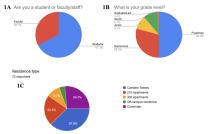
Figure 1. Respondent Demographics: 1A divides the survey users to being students and faculty members. 1B divides the student respondents by grade level. 1C partitions the dormer population into residence types.
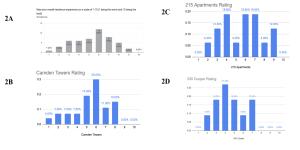
Figure 2. Resident Responses: Overall Ratings: 2A presents the overall rating of the on-campus residency experience. 2B presents the rating of on-campus residency experience for Camden Towers. 2C presents the rating of on-
campus residency experience for the 215 Apartments. 2D presents the rating of on-campus residency experience for 330 Cooper.
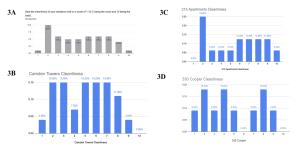
Figure 3. Resident Response: Cleanliness: 3A presents the overall cleanliness rating of on-campus residency. 3B presents the cleanliness rating of the Camden Towers. 3C presents the cleanliness rating of the 215 Apartments. 3D presents the cleanliness rating of 330 Cooper.
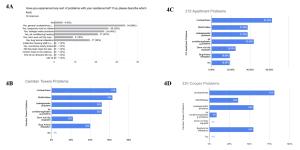
Figure 4. Resident Response: General Problems: Figure 4A presents the problems reported in all Rutgers-Camden residence halls by respondents, and the percentage of student
60 The Undergraduate Review
resident respondents that reported each problem. 4B presents the problems reported in the Camden Towers. 4C presents the problems reported in the 215 Apartments. 4D presents the problems reported in 330 Cooper.
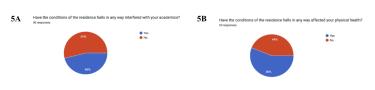
Figure 5. Resident Response: Academics and Physical Health: 5A reports if the conditions of Rutgers-Camden residence halls have interfered with respondents' academics. 5B reports if the conditions of Rutgers-Camden residence halls have interfered with respondents’ physical health.
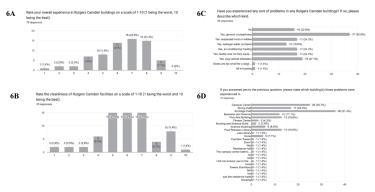
Figure 6. Overall Student Response: Problems with Rutgers-Camden Buildings: 6A presents the overall rating of student respondents’ experiences in Rutgers-Camden facilities. 6B presents the cleanliness rating of student
respondents’ experiences in Rutgers-Camden facilities. 6C presents the problems reported in Rutgers-Camden facilities by student respondents, and the percentage of student resident respondents that reported each problem. 6D presents the location of problems reported by student respondents in 6C.
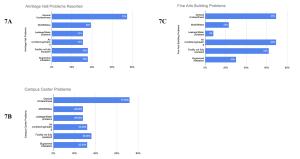
Figure 7. Overall Student Response: Problems reported by Rutgers-Camden Building: Figure 7A presents the problems reported by student respondents in Armitage Hall. Figure 7B presents the problems reported by student respondents in the Campus Center. 7C presents the problems reported by student respondents in the Fine Arts Building.
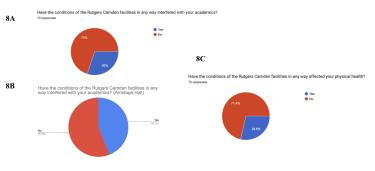
62 The Undergraduate Review
Figure 8. Resident Response: Academics and Physical Health: 8A reports if the conditions of Rutgers-Camden facilities have interfered with student respondents' academics. 8B reports if the conditions of Armitage Hall have interfered with student respondents’ academics. 8C reports if the conditions of Rutgers-Camden facilities have affected student respondents’ physical health.
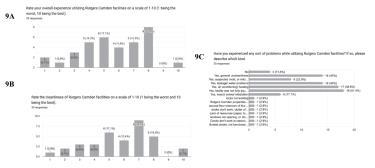
Figure 9. Faculty Responses: Ratings: 9A presents the overall rating of the experience utilizing Rutgers-Camden facilities by faculty and staff respondents. 9B presents the cleanliness rating of Rutgers-Camden facilities by faculty and staff respondents. 9C presents the problems reported in all Rutgers-Camden facilities by faculty and staff respondents, and the percentage of faculty and staff respondents that reported each problem.
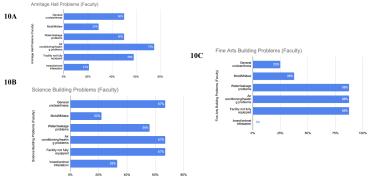
Figure 10. Faculty Responses: Problems: 10A presents the problems reported in Armitage Hall by faculty and staff respondents, and the percentage of faculty and staff respondents that reported each problem. 10B presents the problems reported in the Science Building by faculty and staff respondents, and the percentage of faculty and staff respondents that reported each problem. 10C presents the problems reported in the Fine Arts Building by faculty and staff respondents, and the percentage of faculty and staff respondents that reported each problem.
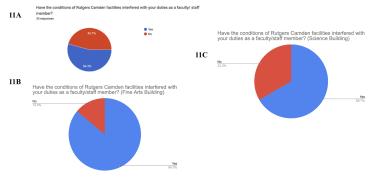
Figure 11. Faculty Responses: Interference with duties: 11A reports if the conditions of Rutgers-Camden facilities
have interfered with faculty and staff respondents' duties. 11B reports if the conditions of the Fine Arts Building have interfered with faculty and staff respondents’ duties. 11C reports if the conditions of the Science Building have interfered with faculty and staff respondents’ duties.
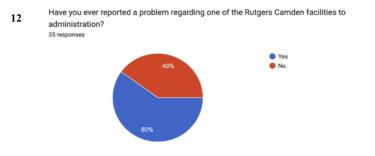
Figure 12. Faculty Responses: Problems Reported to the Administration: Figure 12 reports if faculty and staff respondents have reported a problem with Rutgers-Camden facilities to the administration.
VII. Appendix B: Picture Images Collected around Housing and Campus
Figure 13. Dorming Conditions:
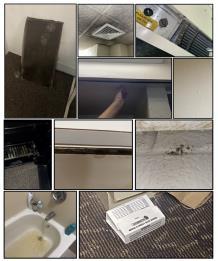
These images depict the dorming conditions through pictures that were submitted by students. The images depict poorly managed air filters, dust, unknown “foul-smelling” residue at the bottom of a fridge, ceiling leaks, pockets of water in walls, mold, rat traps, and yellow-hued bathing and drinking water.
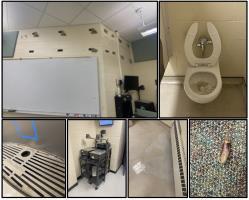
Figure 14. Campus Conditions: These images encapsulate some of the concerns students and faculty have regarding the cleanliness and safety of the campus conditions at RutgersCamden. The top left image portrays how the sound panels fall off the walls during class, and the picture to the right shows a clogged toilet that has remained clogged for days. The bottom images from left to right show an unsanitary water bottle filling station, old projectors, leaks/spills around campus, and insects,
VIII. Appendix C: Survey Questions
Section 1:
i. Are you a student or faculty/staff?
Section 2: Student Questions:
i. What is your grade level?
Section 3: Residence
i. Residence type?
Section 4: Rutgers-Camden Residence Questions
i. Rate your overall residence experience on a scale of 1-10 (1 being the worst and 10 being the best).
ii. Rate the cleanliness of your residence hall on a scale of 1-10 (1 being the worst and 10 being the best). iii. Have you experienced any sort of problems with your residence hall? If so, please describe which kind. iv. Have the conditions of the residence halls in any way interfered with your academics? v. Have the conditions of the residence halls in any way affected your physical health?
i. Rate your overall experience in Rutgers-Camden buildings on a scale of 1-10 (1 being the worst, 10 being the best).
ii. Rate the cleanliness of Rutgers-Camden facilities on a scale of 1-10 (1 being the worst and 10 being the best).
iii. Have you experienced any sort of problems in any Rutgers-Camden buildings? If so, please describe which kind.
iv. If you answered yes to the previous question, please state which building(s) these problems were experienced in.
v. Have the conditions of the Rutgers-Camden facilities in any way interfered with your academics?
vi. Have the conditions of the Rutgers-Camden facilities in any way affected your physical health?
i. Rate your overall experience utilizing RutgersCamden facilities on a scale of 1-10 (1 being the worst, 10 being the best).
ii. Rate the cleanliness of Rutgers-Camden facilities on a scale of 1-10 (1 being the worst and 10 being the
best).
iii. Have you experienced any sort of problems while utilizing Rutgers-Camden facilities? If so, please describe which kind.
iv. If you answered yes to the previous question, please state which building(s) these problems were experienced in.
v. Have the conditions of Rutgers-Camden facilities interfered with your duties as a faculty/staff member?
vi. If you answered yes to the previous question, please briefly elaborate.
vii. Have you ever reported a problem regarding one of the Rutgers-Camden facilities to the administration? viii.
If you answered yes to the previous question, can you share how long it took for the administration to respond and/or address the issue?
■ Survey Question: Have you experienced any sort of problems with your residence hall? If so, please describe which kind.
i. “Yes, countertop is nearly broken”
ii. “Random holes in the wall/ceiling”
iii. “One of our showers did not work for a year”
iv. “330 has been clean but last year when I was in the 215 apartments, one of the students was moving out while we were moving in. The place was giggly, rotten food in the cabinets, stains on so many surfaces and the toilet was clogged so bad my roommate had to reach her hand up the toilet to remove the poop herself. Maintenance sat on their asses and watched us
clean up the girls mess”
■ Survey Question: Have you experienced any sort of problems in any Rutgers-Camden buildings? If so, please describe which kind.
i. “Desks are too small for a large human being like myself.”
ii. “Me and my friend got a rash from the science LH seats because the yellow exposed and broken up into bits and pieces. I have pictures for proof.”
■ Survey Question: Faculty/Staff, have you experienced any sort of problems while utilizing Rutgers-Camden facilities? If so, please describe which kind.
i. “second floor restroom of Nursing Building has had 2 functioning toilet the entire semester. The other two are covered in plastic. It's ridiculous.”
ii. “clocks don't work, clutter of extra furniture in classrooms and hallways, bathrooms frequently out of soap”
iii. “Rutgers-Camden properties are completely shut out to the local community despite being public buildings and in some cases still using Green acres funding.”
■ Survey Question: Have the conditions of Rutgers-Camden facilities interfered with your duties as a faculty/staff member? If you answered yes to the previous question, please briefly elaborate.
i. “Classrooms in Armitage are difficult to teach in due to disrepair (sound baffling) panels were falling off the walls during class), the HVAC system in the Walt Whitman Center
is dated and often breaks, making it difficult to teach and have meetings there.”
ii. “I had to give up a line of research inquiry because I could not provide adequate climate conditions for study organisms; I struggled to find teaching spaces that included sufficient computers for my students to meet my education goals.”
iii. “I was displaced from my office for mold for a semester, some of my belongings were irreparably destroyed, I have taught in classrooms with no operable windows in extreme heat and no AC, I have been insanely hot and insanely cold in my own office”
iii. “Constant construction work in Armitage Hall has disrupted my classes on numerous occasions. On top of that, there are never enough seats in the classrooms and no whiteboards; computers are ancient and take forever to log in; the entire Armitage Hall is still in the 1970s. It's a disgrace. Impoverished.”
iv. “I gave cleanliness an 8 and facilities a 1 because the cleaning crew is very hard working. So are the facilities maintenance personnel. It's not about the people. It's about the profoundly disturbing learning environments. Let me explain.” The Fine Arts and Armitage Hall classrooms are like prison cells because of the poor lighting, detention-style seating, and cinder blocks. The classrooms look like something out of a horror movie. It's not about cleanliness it's about inappropriate dungeon-like classroom environments. They are overly packed with arm-rest chairs from the 1970s that are inadequate for the modern student. The chairs make it hard for students to safely rest their laptops
and handouts. It's impossible accommodate their needs for plugs to charge their electronics. Without rolling tables and chairs we can’t do breakout teams where they can use large print paper to collaborate on projects. I spent four years teaching in Fine Arts and Armitage rooms and every time resulted in more conflicts than the space solved. The haunting lighting, the broken tapped-up windows or rooms without windows, and the inadequate seating became depressing places to learn and work. Put simply, these buildings were worst classrooms that I've used in my 20 years of teaching.”
■ Survey Question: Have you ever reported a problem regarding one of the Rutgers-Camden facilities to the administration? If you answered yes to the previous question, can you share how long it took for the administration to respond and/or address the issue?
i. “the mold was promptly responded to but it took a long time to address, the other things have never been addressed”
ii. “long but don't remember how long because it was awhile ago. don't expect fixes until ask at least a few times”
iii. “Never heard back after four years of complaints.”
iv. “the issue has not been addressed since existed for years. Rutgers administration is hell-bent on turning the campus into a bubble city within Camden. The fact that they're
buildings on Cooper Street are literally falling down is another example of their disrespect for the city's history and community.”
v. “response was quick, less than an hour but that was because water was coming out of the ceiling so there was some urgency. Other issues like light bulbs being changes, cockroaches, other cleanliness issues have taken weeks to resolve
X. References:
i. US Department of Health & Human Services, and USA.gov. “Basic Facts about Mold and Dampness.” Centers for Disease Control and Prevention, Centers for Disease Control and Prevention, 14 Nov. 2022, https://www.cdc.gov/mold/faqs.htm#:~:text =Exposure%20to%20damp%20and% 20moldy,or%20itchy%20eyes%2C%20or%20 skin
ii. U.S. Department of Health & Human Services, and USA.gov. “Chapter 4: Disease Vectors and Pests.” Centers for Disease Control and Prevention, Centers for Disease Control and Prevention, 1 Oct. 2009, https://www.cdc.gov/nceh/publications/boo ks/housing/cha04.htm
iii. NJAC 5 28 - State. https://www.state.nj.us/dca/divisions/codes/codre g/pdf_regs/njac_5_28.pdf
Our group would like to thank and acknowledge the following individuals for their support and contributions towards this project: Lucas Sandig for his assistance in data analysis; Reilly Ziolkowski, Animesh Borad, Angel Kiefner, and Jacob McGinnis for their assistance in the data collection process; Aleece Siner for her consistent guidance and assistance; Lee Ann E. Westman, Ph.D. for her advocacy and for fostering a space to think innovatively and create productively; and The RutgersCamden Honors College.
XII. Conflict of Interest Statement:
The authors declare that the article content was composed in the absence of any commercial or financial relationships that could be construed as a potential conflict of interest.
Xavier Soto
Music is a form of art, communication, and medicine. From instrumentals alone to adding vocals, it is arguably one of the best forms of art. While other forms of art like sculptures, architecture, film, pictures and drawing are more common than music, music is probably the most emotional form for most people. Along with that music is known throughout the world making it a universal language and can be used to communicate with people. This language can also dramatically change someone's mood from being sad to happy or vice versa. Sometimes music is used to not change emotions but to help cope and be a form of therapy a form of art that is one of a kind and known throughout the world. There are many languages in the world such as English, Spanish, Russian, Chinese, Japanese, French, German, etc , but there's one language that all those languages can understand: music. While sometimes the vocals of the song can't be understood by everyone, the instrumental of a song can be understood by everyone. For example a fast-paced instrumental can be seen as hype, dance or uplifting music, while a slow-paced beat can be seen as sad or chill music. There are a lot of artists that hit the milestone of being globally known even though they speak one language but some of the most common names being BTS, Bad Bunny, Queen, The Beatles and the one and only king of pop Micheal Jackson. Micheal Jackson is a prime example of music being a universal language with his album “Thriller.” It is the bestselling album of all time with two of the most known songs being “Thriller” and “Billie Jean” which can be played for anyone across the world and there's a high chance they know the song. Some of these songs have the power to change someone's emotions even if they don't know the words to the songs.
It is a well-known fact that music can change someone's mood by producing chemicals like dopamine and serotonin. In a article on entitled “How Can Music Affect Your Mood and Reduce Stress,” the author writes, “research also showed though, that whilst music can influence our mood, our mood can also influence the music that we choose to listen to.” This means that the music we listen to can put us in a mood or can take us out of a mood. An example of this is how people use music to work out and get them pumped in the gym. If you go to any music streaming service, there are countless gym playlists and even in the gym they play music to get people in the mood to work out. A similar technique is used in movies to set a mood for the audience and add more power and emotions into sense. Another example of this is in real life they play music during the walk out of sports, a prime example is the NFL and sometimes in high school games. One example is a common song used in these arenas: “We Will Rock You” by Queen. While music can be used to change moods it also can help people overcome depression and sadness.
When therapy is mentioned the first thing people think is someone talking to a therapist but that's not the only form of therapy that is available. One form I want to talk about is music therapy. According to an article from the Cleveland Clinic, “Music therapy is an evidence-based treatment that helps with a variety of disorders including cardiac conditions, depression, autism, substance abuse and Alzheimer’s disease.” The article describes the many benefits of music, some being lowering blood pressure, improving memory, enhanced communication and social skills through experiencing music with others, self-reflection, observing your thoughts and emotions, reducing muscle tension, self-regulation, developing healthy coping skills to manage your thoughts and emotions, increasing motivation, managing pain, and increasing joy.
There are many artists who talk about mental health and loneliness in their songs like Kurt Cobain, Mac Miller, XXXTentacion, Juice World, Kid Cudi, Frank Ocean, Tyler the creator, Kendrick Lamar, Kanye West, 2Pac and many more. According to many fans some of these artists have helped them go through tough times and even saved their lives. From my own experience, music helped me a lot when I was younger living in the projects of Bayonne New Jersey and listening to rap artists who talked about their lives and being from the projects. Their music made me feel like I wasn't the only one in the world and continued to help me through life in many ways making me feel like I wasn't alone and helping me be one with my emotions. This is a common thing for many people, but in my life, it was really relevant.
As a child to a single mom of three, my mom was sometimes too busy working to raise us so she taught us how to do things ourselves so we won't rely on others But sadly, I used that same logic with my emotions. A small kid with no one to turn to discovered music, and with that the rap genre and many artists that talked about their childhood and situations that matched mine. From their experience with gang violence, substance abuse, PTSD, survivor's guilt and more, it made me feel like I wasn't the only one going through these problems and helped me overcome some of these problems. As I got older I used music to learn and better myself, too, because I saw that without a father some of these artists became people I would look up to and take traits from to make me the man I am today. Without music in my life, I don’t know how I would've turned out, and I think many people in the world feel the same. In fact, the world without music would be an entirely different place than we are used to.
Silence is something everyone is familiar with, whether it's complete silence or enough to just hear what's going on in the world 24/7, it is something we all have become accustomed
to and to avoid it we invented headphones and earbuds to drown out the silence. An article about music concludes, “The world would be a very quiet place. Our life without melodies and harmonies would be totally empty.” I completely agree with this statement. More than we know music is involved in our lives from music being in our phones so we can listen, in movies/shows to set the tone of what's happening, in gyms and elevators to fill in the blank noise. Music is also used to bring people together in forms of concerts, fan groups, music taste and sometimes with deep connections. Some people can argue that music is not the best form of art and that's where I would come to disagree. Music plays a big part in everyone's lives. This form of art can be only an instrument or added vocals, making it sad or happy. From therapy to just listening to music to vibe out and pass time, music has many reasons as to why people listen to it. While many forms of art are more appreciated, music has an ability to touch someone's soul and change their life, this is why music is the best form of art.
Starling, Louisa. “How Does Music Affect Your Mood and Reduce Stress.” PPL PRS, 29 Nov. 2022, https://pplprs.co.uk/health-wellbeing/music-reduce-stress/.
“Music Therapy: What Is It, Types & Treatment.” Cleveland Clinic, https://my.clevelandclinic.org/health/treatments/8817music-therapy.
Dey, Arnab. “Life without Music.” You Are Being Redirected..., 26 Jan. 2016, https://thehimalayantimes.com/opinion/lifewithout-music.
78 The Undergraduate Review
Sandrine Gashema
My client, XOA is a 10-year-old Hispanic female born on June 28, 2012, in New Jersey. My client has four siblings, two full sisters and two maternal-half-sisters. While her mother is still in her life, her father is not due to being incarcerated for abuse upon the client and her family. As far as home life, XOA and her sisters were living at home but were placed in resource care following their removal from their mother and XOA’s biological father when she was five years old. Since then, the client has spent time in different resource care homes, DCP&P placements, and stays in the hospital.
When the client was five, a caseworker for the Department of Child Protection and Permanency’s contacted CPC and requested evaluations of XOA and her sisters. The client and her siblings were removed from their biological mother because of concerns of domestic violence, physical abuse, sexual abuse, and neglect. Her biological father was charged with physically abusing XOA and her siblings and her biological mother was charged with endangering the welfare of the children and failure to keep them safe. Because of the reported exposure to domestic violence and abuse, DCP&P requested mental health evaluations of XOA and her siblings to provide recommendations for services as appropriate.
Following removal from her biological mother, the client was placed with a family friend but struggled behaviorally and was then hospitalized and placed in a New Jersey mentor home while her sisters stayed together in a relative's home. The goal was changed to adoption and the client’s mother’s termination of parental rights was processed and a preadoptive placement was found for her in 2019. An identified surrender was implemented by her mother to the foster
parents and the youth moved in with them but was removed from the home a few months later when XOA revealed the adoptive father was sexually abusing her. She was moved back to the NJ mentor home she was initially in, began therapeutic visitations with her biological mother due to the identified surrender failing which resulted in her mother’s parental rights being reinstated and reunification was put into place. She was then placed in another pre-adoptive home in 2021 but began to display aggressive behaviors and attempted to flee, resulting in the family asking for her removal from the home. She was then hospitalized until she was placed in the current group home she now resides in while the reunification of XOA and her mother is being determined by the court.
The client now lives at a Children’s Residential Home for youth aged 5 to 14 experiencing mental health issues. The estimated duration of the program is typically six to nine months. She attends a behavioral school with the rest of the youth that live in the group home. The school she attends provides behavioral education and regular education for youth her age and older. She is taking the regular classes such as Math, English, Science, Typing, Social Studies along with in-home tutoring with a tutor that comes once a week. While her grades are good and the client is talented, at times, XOA has difficulty with iReady, which is an online program for reading and mathematics that helps the tutor monitor her progress with different academic topics and determines where she is doing well and where she needs further improvement.
The client has multiple presenting problems, and they are as follows, Attention Deficit Hyperactivity Disorder, Oppositional Defiant Disorder, Flight Risk, Judgment, and a History of Post-Traumatic Stress Disorder.
As far as her ADHD and impulsivity, XOA struggles with impulse control. She struggles to apply the knowledge of skills to control her impulses, which can lead to aggressive and agitated behavior. When dysregulated, she presents herself as very impulsive and does not have the executive functioning skills to keep herself safe, which may result in putting herself in harm’s way.
The client has also been exposed to complex trauma. As stated earlier, she has a history of being moved several times to several resource care homes which plays a role in her extreme dysregulation. In addition, she has a history of complex trauma with physical abuse and sexual abuse from her parents and pre-adoptive parent, Mr. D.
The client also has a history of running away so she is considered flight risk meaning any planned or unplanned wandering and/or impulsive running. As stated, XOA ran away from her pre-adoptive home as well as a foster home after. Prior to that, XOA threatened and attempted to flee from her treatment home several times, however, safety measures in the home to prevent that did not give her an opportunity to carry that out. Lastly, XOA exhibits poor judgment. When the client has reached a dysregulated and dissociative state, she is not able to assess safety risk, meaning she engages in harmful behaviors and puts herself in situations that can cause harm to herself.
Two problems-for-work I wanted to target were the client’s history of trauma as well as her difficulty coping with the symptoms of her ODD. While she does recognize her symptoms and her trouble with coping with her ODD, when she is dysregulated, XOA has a challenging time assessing the skills needed to keep her out of harm’s way and from acting out. However, her awareness of her difficulty coping with the symptoms will allow her to better acknowledge them and be able to reset herself when she recognizes her symptoms.
Observation of Client or Client System
XOA’s relationship with not only her mother, but the rest of her family along with the topic of her trauma is always a touchy subject for her. When I first met XOA and the therapists told me a little bit about her, I initiated a conversation by just greeting myself and asking basic questions to just get to know her a bit, but I did not want to dig too deep because I hadn’t known of her triggers, being that this was only our first meeting. I noticed she was more open to talking about her sisters than she was with her mother. She told me everything about her sisters; from their names to their ages and other things about them such as what schools they go to, where they work, what they like to do etc. But when it came to her mother, it was like she shut down. She would not say bad things about her mother, but, for instance, she had a visit with her mother that day and was excited about what she told me about, but it was also obvious it was not something she really wanted to dig deeper in with me just yet. When I noticed that, I decided to not attempt to get her to talk about her father because I knew that was even more of a touchy subject for her than the topic of her mother and my relationship with her was not at that point yet; I still needed to build a rapport with her.
While XOA values her relationship with her mother, there were some things that I did notice she was holding against her as I got to know her more. She loved her mom like any child would, but I also noticed she still did not fully trust her mother because of their past. For example, prior to a family therapy session with XOA and her mother, XOA was informed what the therapy session would be about: her family tree. I noticed before she was told this, she was excited for the session, she even told me herself. But once she was told what the session was about, she shut down. When XOA shuts
down, she begins to exhibit very childlike behavior. This means she will begin to talk like a baby, crawl on the floor, and even sort of pout and throw a tantrum. When prompted to apply coping skills to help her calm down, she responded “I don’t like doing things that help me calm down, it’s boring.” She no longer wanted to talk to her mother, and she began to shut her out. In addition, there were times when her mother would come to visit her, XOA would have a family session with her, and then she would get upset and not want to speak or say goodbye to her mother. When I would ask her why she did not say bye to mom, she responded, “she made me mad, so I didn’t want to. I don’t care, she doesn’t care either.” Based on that response, I knew her relationship with her mom still needed some work.
Additionally, XOA constantly puts negative labels on herself. During groups, the youth would make positive affirmations about one another, and when complimented, she would reject and dismiss them. Instead, she says statements about herself such as “I’m not special” “I’m ugly” “I’m not kindhearted” “my hair is ugly” “I’m beautiful? Sike” and other comments like those.
Case Theories:
Based on the aforementioned observations, there are two hypotheses that were formed for the maintenance of the problems-for-work to move forward with the case formulation and treatment plan. The first one being: Because of growing up in an abusive, unstable and seemingly chaotic environment, XOA’s history of trauma makes it difficult for her to express herself to not only her mother but any older adults. There are some questions about her relationship with her mother and sisters that she can answer, but when asked about her father or previous history with resource care
homes, she redirects the conversation. Within this, XOA uses defense mechanisms to build a wall around her and shield her from reality. Defense mechanisms are created to “protect ourselves against conflicting feelings we have about a situation, so that we can avoid facing up to the conflicts” (Payne, 2014, p. 107). In XOA’s case, she represses her feelings towards her past trauma, meaning that she will take unwanted feelings she has towards her trauma, store them away, and will not bring them back out. Payne states that “many repressed thoughts are dynamic, in the sense they cause us to act out even if we are unaware of them” (2014, p. 106). Her trauma makes it difficult to discuss tough topics about her past and instead of talking about it, she will either redirect the conversation to a place she is more comfortable with or begin to become aggressive because her frustration and anger makes her feel there is no other way to express them. This hypothesis ties into the idea of psychodynamic theory, whose central assumption is that present behavior arises from past experiences, particularly relationships. To achieve change in the client’s present behavior, the client and the social worker must engage in a long-term process where they’ll examine events, issues, emotions, and relationships in the client’s past (Payne, 2014, p. 101).
XOA also exhibits the defense mechanism of regression. Payne defines regression as “the stage when people who have progressed through the later stages of development fall back on behavior associated with earlier stages under some present stress” (2014, p. 107). XOA is knowledgeable about coping skills to manage her trauma. However, when asked about difficult topics, instead of applying those skills, she will begin to exhibit childlike behavior such as crawling on the floor, speaking like a baby, and pouting. In addition to that, XOA loves her mother and highly values her relationship with her. However, when certain topics are addressed, for example regarding her troubling childhood, XOA will begin to regress.
Instead of sessions and visits with her mother going smoothly, she will begin to ignore her mother, and at times, will hit, kick, and scream at her. While regressing can hinder her progress, I take it as an opportunity to learn her vulnerabilities. This can help XOA to experience emotions and reactions to important events in their life experience, both negative and positive (Payne, 2014, p. 114).
The second hypothesis is: Due to my client’s previous unstable living conditions, she struggles to control her impulses and behavior, leading her to be agitated and unable to assess right from wrong. XOA has been in the foster care system since she was five years old and has a history of multiple resource home placements. Prior to that, XOA’s early childhood experiences included inconsistent and emotionally unavailable parent figures. So, for XOA, it’s likely that appropriate feelings/needs expression were ignored or rejected, leading to her developing a poor frustration tolerance. Because of the lack of a stable environment, XOA gets triggered when prompted by authority figures which causes her to be aggressive and exhibit agitated behavior. This second hypothesis ties into cognitive behavioral therapy and its different principles and techniques. CBT, also known as Cognitive Behavioral Therapy, focuses on “how to manage and change people’s behavior to resolve social problems that affect them” (Payne, 2014, p. 150). A few main practice ideas of cognitive behavioral therapy that will be most helpful to XOA are reinforcement, modelling, and assertiveness training. Assertiveness training enables clients to practice behaviors so that they can gain confidence in these behaviors, thus improving their overall social confidence (Payne, 2014, p. 151). Those behaviors that are practiced to gain confidence are then strengthened and encouraged through reinforcement. Within modelling, clients can observe
and understand useful behaviors from their peers or trusting adults and then exhibit the behaviors themselves.
CBT will also be used to combat XOA’s cognitive distortions. Cognitive distortions can fall into multiple categories, and they are defined as “negative thoughts that are not based in fact” (Bosk, 2022). The two cognitive distortions that XOA often uses are labeling and minimizing. Labeling is when you think of yourself or others in simple negative terms, for example when XOA labels herself as fat, ugly and stupid. Minimizing is ignoring positive things or a situation or not giving yourself credit. XOA often does this when she is complimented or congratulated on something that she has done well. She will get upset and explain how she does not like it when people say good things about her or about something she has done well, especially when she is in an agitated state. CBT will allow me to work with XOA to restructure those cognitive distortions. I will be helping XOA to “identify dysfunctional or negative views of herself, and then to learn how to challenge these thoughts rationally and develop alternatives or arguments against them in an organized way” (Payne, 2014, p. 180). Within cognitive restructuring, social workers often assign therapeutic homework assignments for clients to do outside of direct practice to change behaviors. In the case of XOA, homework to combat her automatic thoughts and apply more positive affirmations to herself would be assigned.
XOA has had a very troubling early childhood and adolescence. She was removed from her biological mother and father at just five years old due to physical and sexual abuse within the home. These traumatic events have made it difficult for XOA to express herself and control her impulses. Instead, she uses defense mechanisms like repression and
regression to avoid confronting her past. To a certain extent XOA can verbalize her feelings, but when it comes to difficult topics, she redirects the conversation or begins to act out. When the emotions get too overwhelming for her, XOA will become aggressive and agitated. She is very friendly to authority figures and her peers but will become very confrontational when compromise arises. She will also begin to throw things, hit authority figures/verbally threaten them, scream, or attempt to run. The children’s residential home she now resides in has strict restrictions to prevent any youth from fleeing, therefore XOA will go to her room instead and lock the door, even though there are rules set for youth to not have any locked doors. To reset herself, she likes to talk about things she enjoys. For example, going to dance class, her good grades in school, her favorite music artist, “Bad Bunny,” or a fun activity she created to do such as a play or art project. Her troubling youth has also caused XOA to negatively label herself. She will refer to herself as, “fat, stupid, ugly” and say that “no one loves or cares about her.” Her history of unstable living conditions, lack of relationship with her biological family, and history of abuse leads XOA to exhibit a negative self-image.
It was essential to implement practice theories from both psychodynamic theory and cognitive behavioral therapy when creating XOA’s treatment plan. To begin with, I intend on adding at least one additional individual session with XOA and family-therapy session with her and her mother per week, particularly art-based. XOA is incredibly talented and has made it clear she loves to draw, paint, and participate in any activities and projects that are art-based. When tackling issues of her past trauma, I believe it will make it easier for her to open up to not only me, but to her mother, when she is
engaged in an activity that she is interested in and can calm her down.
From a psychodynamic theory perspective, it is necessary to tackle XOA’s use of the defense mechanisms, repression, and regression. By identifying the defense mechanisms she uses, it will allow me to take notes on the topics she steers away from. I can use transference to uncover those unconscious thoughts and feelings about her past trauma within her relationships, especially with her mother. Transference refers to when clients “transfer unconscious feelings about their parents onto the therapist, behaving as though the therapist were that parent” (Payne, 2014, p. 108).
Like her mother, I am an authority figure and a woman therefore I can stimulate transference in my sessions with her by getting her to act out conflicts arising from her early relationship difficulties with her parents, thereby revealing the source of present behavioral difficulties and her challenges with expressing herself properly (Payne, 2014, 108).
Cognitive behavioral therapy will constitute most of her treatment plan. To combat her behavior and challenges with impulse control as well as her cognitive distortions, I believe assertiveness training, modelling and reinforcement will work best for XOA’s case. Assertiveness training and reinforcement will help to build the client’s confidence. During my time at the residential home, XOA and I have built a great relationship. As the Social Learning Theory states, “most learning is gained by people seeing behavior going on around them and thinking about what they see” (Payne, 2014, p. 156). Through modelling, the more time I spend with her during our sessions, the more she will begin to learn the behaviors she should and should not be using. She also has her mother, therapist, and other authority figures as good examples of appropriate behaviors she should be utilizing. As far as her cognitive distortions are concerned, I
believe thought records with XOA would be the best solution. Thought records help to understand one’s automatic thoughts and they include the situation, emotion/feeling, negative automatic thought, evidence that does and does not support that thought and an alternative thought (Bosk, 2022). Actively creating thought records with the client will help to target those distortions and restructure them. I will also work with XOA to identify coping skills she can use in times of distress or agitation.
Positionality is defined as “one’s social location and worldview, which influences how one responds to power differentials in various contexts” (Peña et. al, 2015, p. 32). As social workers, it is important to understand positionality, as it affects the way we approach different individuals or groups we may work with or encounter. We all possess numerous identifications, and our positionality is built upon those identifications. In XOA’s case, she is a 10-year-old Hispanic female with different mental health disorders. Her age, gender, race, past experiences, and mental health diagnoses all have an influence on the way she sees the world. Her unstable household and relationship with her parents, along with all the trauma she obtained after being put into the system all impacted her behavior and future relationships. As a social worker, it is my job to address these issues of structure and how they impacted who she is today, but it is also imperative to let XOA know that while these structural barriers are inevitable, I am here with her to find ways around these issues.
XOA’s positionality impacts her presenting problems and problems-for-work. XOA has not only been diagnosed with different mental health disorders, but she is also a person of
color and comes from a lower-class environment. Since I am an African American woman who is also from a lower-class background, my positionality allows me to relate to XOA in that area. Just like her, I know what it is like to not get the best education or live in an area that is of a lower socioeconomic class at such an early age. However, I lack the understanding of her experiences. In other words, I don’t know what it is like to go through what she has experienced, so it was important for me to not only approach her from a different angle, but to do further research in order to understand “human difference in terms of cultural practices, gender identity and expression, racial/ethnic identification, social class, citizenship, sexual orientation, ability status, age, livelihood, education, and other forms of identification” (Finn, 2016, p. 26).
One mistake I made with XOA during the semester was not being more aware of using my phone around her. One day, I came in and XOA was excited to show me a funny video, but she said she wanted to show me the video on my phone. I was hesitant because there are restrictions on the use of phones for the youth, even under supervision. I told her I cannot let her, but we could watch it later on the laptop the group home provides for the kids to use for their entertainment. That day we were going on an outing, and she asked me to sit next to her in the van, which I did. I was on my phone next to her, and without my knowledge, she saw me on my personal Facebook. She instantly reacted and began asking me personal questions about my Facebook name, the picture I had up, if I am friends with her mother, etc. She is still a kid, and I am more than aware that kids lack boundaries, so I was completely at fault. I should have been more cautious of my surroundings and not have even been on my phone, since then I have not made that mistake.
Bosk, E. (2022). Cognitive Behavioral Therapy. Rutgers Canvas. https://rutgers.instructure.com/courses/202712/pages/ module-7-lectures?module_item_id=6819310
Bosk, E. (2022, October 22). Cognitive Restructuring. Rutgers Canvas.
https://rutgers.instructure.com/courses/202712/pages/ module-7-lectures?module_item_id=6819310
Finn, J. L. (2016). Just practice: A social justice approach to social work (3rd edition). Oxford University Press. ISBN10: 9780190657079
Payne, M. (2021). Modern social work theory (5th edition). Oxford University Press. ISBN10:0197568084
Angelina Cheng
Breathe in for four seconds. Hold for two. Breathe out for six. Repeat.
My therapist instructed me to do this technique when I was feeling overwhelmed, something that I had been feeling a lot lately.
I peered over the bridge, onto the Delaware River, and imagined myself falling in, enveloped by darkness. I imagined myself struggling to breathe, sinking deeper into nothingness, until I hit the bottom and joined the rest of the forgotten knick-knacks hidden in the sandy floor.
But I didn’t have to imagine myself drowning because that’s how I felt every waking moment of the day. Two years, two months, two days later and I was still drowning. My pleas for help morphing into air bubbles that would never reach the surface.
I continued to stare out over the bridge as GRLwood screamed into my ears, a piercing scream that no one could hear but me.
It was a reflection of my own muted screams.
A couple walked past me and all I saw was his face staring back at me, daring me to jump.
He was always taunting me. In school, at home, on the street.
Everywhere I went, he followed. 426. 426. 426. 426.
I went back to what I was doing and I began to recount that night for the umpteenth time. A broken record on repeat.
It was ironic how my memory had deteriorated over the past two years, and I was constantly unable to recount my days, yet I remembered that night like it happened yesterday.
A sea of “what ifs” hit me and I played out a million scenarios in my head.
I liked to imagine that night never happened and that we were still best friends to this day.
That, at any moment now, he would FaceTime me and say some stupid shit about the way I looked right then.
If he were here now, he definitely would have mocked my tear-stained face before pulling me into an embrace that closed me off from the rest of the unforgiving world.
I shook the thought from my mind and continued walking down the never-ending path. It couldn’t have been more than thirty minutes, but it felt like an eternity.
My lanyard brushed against my leg and I felt his hand caressing my thigh.
He slowly moved higher up until I quickly stuffed my keys back into my pocket.
426. 426. 426. 426.
As I was walking, I saw a soccer team practicing below me and I recalled my own athletic days. I loved soccer and everything about it. I loved maneuvering back and forth between opponents, defending my territory. My only focus was transporting the leather sphere to safety.
I continued to watch them until I saw him again.
He was waving at me from the bleachers, but not in a welcoming way. It was done more in a type of sarcasm, something I had once loved about him, as he was rarely serious about anything. Even about our friendship sometimes.
My eyesight was terrible, but I swore I could see him smirking at me.
As the band GRLwood continued to pierce my ringing ears, I decided to follow suit.
I screamed as loud as my lungs would allow, until I was gasping for air.
My screams were muted by the commotion of the busy highway, which still housed a myriad of cars despite it being ten o’clock at night on a Tuesday.
Satisfied, I continued on my never-ending path to salvation.
I peered over the bridge again and saw a Ferris wheel adorned with neon lights, flashing blue, purple, red, and green, as it rotated endlessly. I studied the way the lights morphed into the different colors, providing a sense of comfort, like the way a rotating crib mobile would relax a baby in distress. I moved on to the buildings around it and noticed a Wells Fargo straight ahead.
I instantly thought back to my sophomore year of high school when I confessed my feelings to him behind that godforsaken bank of which I’ve been a member for three years. His blank stare pierced my gaze as I poured my heart out to him, only for him to crush it beneath his neatly trimmed fingernails.
I remember crying on the nearby bus stop bench for hours until I walked back home, defeated just for him to reciprocate my words to me through text. And I ate it up.
I pictured him taunting me again, but this time on the Ferris wheel, reminding me of the never-ending cycle of our toxic relationship.
I studied his bony cheeks, high up on his face, and his chiseled, stubble-riddled jaw.
The way his glasses fell on the bridge of his nose, his chocolate brown eyes enlarged through them as he gave me that same piercing gaze that always used to provide me with a sense of comfort. But now, all it did was cause me to shudder with uneasiness.
I shook the image from my pounding head and moved on.
As I reached the center of the bridge, I noticed that there was a stretch of darkness ahead, void of any light.
I was instantly back in Van Cortlandt Park, strolling closer to the abandoned bridge, my fingers intertwined with his.
The long-deserted bridge was surrounded by trees and overgrown weeds, a plethora of shadows that provided a sort
of separation from the rest of the park; it was near-impossible to see anyone who might have been there.
We reached our destination and he slowly turned to face me.
426. 426. 426. 426.
At this point, my strolling broke into a sprint, and I escaped the dark stretch before it could swallow me whole.
But I didn’t stop running.
I was determined to escape this makeshift hell I put myself in and I picked up my pace until the city lights formed a blur around me.
I could hear laughing behind me, daring me to stop running and face the consequences of doing so.
I tried to breathe the way my therapist had told me to, but panic had knotted in my chest, and I was unable to calm myself down enough to do so.
My lungs began to ache, but I didn’t care. I welcomed the burning sensation as a sort of punishment for not running sooner.
But the pain was soon too great, and I had to stop and catch my breath.
Ironically enough, I was now in the second stretch of darkness of the bridge, and I was transported back to the park.
This time I was frozen, unable to move.
He began toward me, and I no longer felt that comforting feeling he had always provided me.
I was glued in place as fear began to take over and my mind was imploded with a billion racing thoughts. Was it all in my head? He surely wouldn’t hurt me. Maybe I’m just being dramatic. He loves me too much to hurt me.
No matter what I told myself, however, I couldn’t shake that uneasy feeling that had morphed into fear.
The closer he got, the more I begged myself to move but I couldn’t and I began to panic.
426. 426. 426. 426.
This time, I ignored the pain and broke into a run again. Thankfully, the end of the bridge began to appear within view, and I breathed a sigh of relief.
As I reached closer, I noticed a cop at the very end, gripping the gate to the entrance.
When I finally reached the end, the cop greeted me with a melancholy look and, as I got off the bridge, she began to close the gate behind me.
I turned around and there he was, unable to follow me as the only thing separating us was the iron gate.
He scowled and began to turn back towards the bridge. Breathe in for four seconds. Hold for two. Breathe out for six. Repeat.
Traveler Felix Liu
There was warmth hovering above, as my body lay flat upon the hard ground. No matter the strength that was gathered, my right arm could only raise itself merely a short distance. Flakes and flakes of snow fell down from the darkened skies slowly, similar to the embers of fires that attempt to seep through the debris. Head weakly raised to see clearly my hand, but not the figures ahead. Yet, I could hear their faint wails and cries from, which nonetheless sounded close rather than afar; sheer horror is what they expressed. It was then I could barely see tall men approaching. Many ran at first sight of this armed group, disappearing away from the bright flares into the dark wilderness. But for those who couldn’t flee, either too old, too slow, or too wounded; suddenly struck and slain with such brutality. Then, one of the tall men began to approach me, a soul weakened by the destruction around, trying desperately to retreat with little success. His face alongside his body was scarred by the scene of war, but with his eyes I could see signs of pity; eyes of a father. With a slight hesitancy, perhaps this man could not at first bring himself to slay a child, simply wanted to return home to his own. Despite this, he turned back and brought out a long blade, shining its bronze makeup and engraved decorations. As swiftly as it was drawn, the sword was about to be swung toward me. A loud echo of my screams rang through the valley for miles and miles.
As I rose up into the cool air of the coming autumn, sounds of an intense breathing made itself known in the otherwise quiet cottage. My soul felt alone in what it was witnessing; my body, its vessel, was found within a tight trance. Panicking by the memories and flashbacks, I notice it being frozen, still from the terror that it relived with such vividness. Eventually, I tame myself in a slow and calm
manner, with deep breaths turning into brief sighs. Once more falling into a deep slumber, tears ran down to the woolen sheets.
By the time the Sun properly arose over a fair morning, I had already prepared my worn clothes and possessions, expecting the long path towards the destination. One where a wise Sage dwelled with great knowledge and spirituality. One who could help me.
“Are you certain you would be fine on your way?” asked the host from the cottage. He seemed to carry a concerned look, having heard the panic last night.
“Of course,” I replied, attempting a reassuring smile that disguised my face.
“You don’t have to continue on if you feel overwhelmed. But very well, young one. May your long journey finally put to rest that longing of yours.”
“Thank you.”
That longing of mine; I kept pondering it as I trekked on, with this path crossing through the fields to then winding around the hills. Perhaps it should have been forgotten alongside the other memories that dimmed over the nine years of life. Yet, it has never ceased to exist, always a companion who never leaves for its own journey. It liked to manifest as a memory, a nightmare, and a terror. Perhaps unwilling to leave until I, an exhausted lad who saw far too much for one single life, could finally find what it seeks: a peculiar peace. One that can convince it to move onto the winds. The winds that blew passed towards the yellow setting sun, far away.
It was noon when I stood before these grand cliffs, relieved after the many days that saw only the trees stepping aside from the sandy line following the water. There, bored into a cliff of reddish rock, an entrance had presented itself as if it was into another world. Faded figures adorned its mouth, as they all gather around a grand “leader” in the top middle,
who recited the knowledge enlightened to all who hear. But I myself heard a different voice whispering from within, inviting me to come hither into the grotto and to be welcomed by him.
As the descent began, there was a lone sound of thunder that rang from the distant clouds down into the stone interior. I once more felt my body slip into a trance, blinding me with the visions of dark forces ahead. Yet, this time, my heart had with a soft manner sought to guide me back into reality. “There,” it comforted, “there is a light down into the core. No darkness shall reach us at all in this sanctuary.” And so I went down, walking with hard steps to find, at the center, someone in meditation on top of a humble pedestal.
The old man opened his aged eyes upon sensing a close presence. There, he saw me and the things I had gathered and carried throughout, showing the many years I had traveled. Those expressions seemed to display his curiosity, as if he could see beyond these improvised clothes to find instead something great. The Sage warmly greeted me shortly after, mysteriously knowledgeable for who I was and what I sought here. And then, he shifted to give me a chance to become freed from this peculiar question of mine, for which there was a slight glimmer of hope.
Yet, those eyes suddenly widened as the words flowed into his ear as part of a whistle. That longing of mine struck with such a force that it froze him in place, uncertain in how to proceed with such a daunting task. He had just heard from me about the nightmare from many nights ago, where I saw my late father, a kind and caring figure, attempting to kill his own son during a raid on a rival village. “Why are good people capable of doing horrid things?”
Resigned, the Sage acknowledged, in a frank manner, his failure to find the answer to that peculiar question. And soon after, I, saddened with the inability to be unchained from this pondering, walked slowly away towards the sunlight above.
By the time the view was now of a long path by a large river, I set my eyes on the places ahead. There was a renewed need to continue on, as the Sun, setting once more, shone in all its yellow rays.
100 The Undergraduate Review
By Zoie Stokes
The aesthetics are what always mattered
Not the contents
Who I was when you placed your two eyes over my body
Scanning me from top to bottom
How I look has always been more important than what I say My intellect is just an afterthought
The words out of my mouth were a mere side effect of my pretty lips
The words have no weight if you’re beautiful
Beyond vanity, no one cared enough to listen
Only listening long enough, so hopefully, the conversation is worth it
Hopefully, I let you touch my pretty lips
Only then were the words out of my mouth worth hearing
My words only have value because they come from my body, not my brain
It is not the words I say but the pretty lips that speak them
I wish I could rip my pretty lips off my mouth
But then, no one would hear me scream
I wish I could trade my pretty lips for respect
We trade women for cattle,
Yet my vanity is not a commodity to be given away
Rather a curse
But this curse is different
This curse has pretty lips
And those pretty lips suck all of the meaning out of anything I could ever say
The only time I say something meaningful is when my body is in exchange
I wish my lips weren’t pretty
I wish my words were listened to
Janelle Boakye
Lauren Carbone is a photography major and is a transfer student from RCSJ; she started attending Rutgers UniversityCamden in Fall 2021 and graduated in May of 2023. Carbone started pursuing art at the young age of 5, adding that she always enjoyed coloringand drawing. She started takingimages with an iPhone at the age of 12, eventually getting her Sony Camera at the age of 20.
Carbone states that the inspiration behind her artwork is findingthebeautyof the worldaroundher, thedifferentevents and places you can visit in your life and capturing said moments.Somesubjectsthatinspireherareplaceswithhistory and meaning that some might or might not know about, in addition to the different views in everyday life. Her favorite part of photography, as an artform, is capturing memories of places and experiencesto hold on forever and to share with the world.
Carbone’splansforthefutureincludegettingafull-timejob working in relation to photography, and exploring places she wants to visit in her free time. In addition to her own small business of taking headshots and other photos for events, she holds a retail job at Staples and gets experience printing and designing different products for customers.
Although she loves all her works, she is sometimes left unsatisfied with certain aspects when they do not live up to her visions. Carbone is happy nonetheless; she firmly believed that not getting the exact image or edit every time will help her improve in the art and helps in teaching herself how to achieve a certain proximity to perfection.
102 The Undergraduate Review
Emma Bogdan is a Biology major with minors in Chemistry and Health Sciences. Currently, she is working for Thomas Jefferson University Hospital as an MRI Technologist Assistant, as well as for the Philadelphia Eagles as a Fan Ambassador, after completing a summer of volunteering as a Clinical Research Assistant at Cooper University Hospital. After graduation, she plans to pursue a Doctorate in Medicine. By submitting this study, Emma hopes that it will have a lasting impact on student health and wellness on campus.
Angelina Cheng studies English and Childhood studies, hoping to complete her Master’s in Teaching before graduating. Angelina currently works around the Camden school district with Rutgers Ignite and LEAP Academy with grades pre-k and 4th-8th. In addition to working in education, she also works at the Rutgers food pantry. Outside of work, Angelina is on the e-board as secretary of SAGA and WSA, where she wants to help support women’s and LGBT+ rights. Through her writing, Angelina hopes to spread awareness to readers about heavy topics surrounding violence and trauma as well as their effects on mental health.
Sandrine Gashema is a Rutgers University Camden alumna. She graduated summa cum laude with a Bachelor’s in Social Work in May 2022. She currently attends Rutgers University New Brunswick through their 100% online Advanced Standing Program to receive her Master’s Degree in Social Work. Sandrine started off as a teacher’s assistant at a daycare while attending Rutgers full time. She currently works with autistic children at Bancroft School as a One-to-One Paraprofessional. She hopes to use her experience, as well as her educational background to become a School Social
Worker for youth with mental health challenges. Sandrine hopes this paper will shed light on the mental and behavioral challenges youth face and the theories social workers can use in the intervention and treatment process.
Joseph Lescht is a third-year Honors College student double-majoring in Political Science and Philosophy with a minor in Legal Studies. He is a member of the Pi Sigma Alpha Political Science Honor Society, a University Senator, and the Program Director of WCCR Student Radio. He has served as a legislative intern in the New Jersey Assembly and as a Melon Foundation intern for the Paul Robeson House Museum. After graduation, Joseph intends to pursue a legal career, with fields of interest including labor, artificial intelligence, constitutional law, and entertainment law.
Felix Liu is a Rutgers-Camden alumni who graduated Magna Cum Laude, earning a Bachelor of Arts in both Graphic Design and Global Studies. He previously helped lead two organizations on campus. He currently volunteers for Back on My Feet, composing materials for the needs of the organization. In his free time, he likes to explore around the Philadelphia region, taking landscape photos along the way.
Bradley Mahler is a history and political science major at Rutgers Camden. He always had a passion for history and the issues surrounding the country throughout time. Mahler believes that history is the best method of learning and growing. By being a better historian, we can create a better environment to foster change in our society. Writing about historical timelines creates an image that allows historians and readers to visualize the extent to which one action can create massive change, for better or for worse. Mahler is happy to show this in his work on federal and state power during Jim Crow. By learning about previous histories, he believes that
we can prevent similar tragedies from occurring in our lifetime.
Makayla Malecki is a student at Rutgers University-Camden majoring in Marketing and Management with a concentration in Human Resources. Throughout her life, Makayla has always had an interest in the environment and creating ecofriendly solutions. She hopes this paper will help educate about alternatives to the current waste management practices, and inspire her readers to be more thoughtful about their consumption habits.
Shaan Mody is an undergraduate student at Rutgers University-Camden’s Honors College, majoring in Biology with minors in Chemistry and Health Sciences. He is also a candidate in the prestigious 3+4 BS-DO Program with Rowan-Virtua School of Osteopathic Medicine (RowanVirtua SOM). Shaan is dedicated to academic excellence and research-driven accomplishments. One of Shaan's significant roles is that of lead researcher, working with the office of the chancellor at Rutgers University-Camden. His research revolved around the campus infrastructure's impact on residential students' and campus faculty's physical and mental health. By conducting a comprehensive university-wide survey, he aimed to shed light on critical campus conditions. He hopes his work will lead to meaningful improvements that enhance the overall campus experience. Already, this paper has led to major infrastructure changes to Rutgers Camden’s housing, classrooms, and student spaces. Currently, his research aims to raise awareness and improve menstrual product accessibility on campus, contributing to a more equitable and supportive environment for all. Through his research, service, and leadership, Shaan is poised to make a significant impact on campus conditions, fostering positive change that benefits the entire university community. His
dedication to improving campus life underscores his passion for creating a better environment for students and faculty alike.
Gretchen Purvis currently studies English, with a minor in German; she hopes to eventually receive a PhD in English literature. As a commuter student, riding the PATCO SpeedLine to and from campus, she became interested in researching PATCO’s construction and how station locations were chosen. Gretchen hopes that her essay will draw attention to how systems such as public transportation can be used both to connect and to divide people, and to provoke thought on what public transportation’s future might look like.
Xavier Soto is a music technology major. He grew up in impoverished conditions in the United States, raised by a single mother of three in various projects and low-income neighborhoods. Without a father figure, Soto matured quickly, striving to become the man he wished his father had been. This journey led him to discover the world of music, which provided an escape from his harsh reality, allowing him to inhabit a world of my own creation. His family had low expectations for his future, assuming he would follow in his father's footsteps and become a criminal. By the age of seven, Soto was told he would end up in jail or on the streets. Around this time, Soto’s family fled a gang war by moving out of the projects, only to find themselves in a homeless shelter, later in many other rough and impoverished neighborhoods. Soto’s mother endured an abusive relationship to keep a roof over her children’s heads, which sadly led her to neglect her children. Despite irregular school attendance, Soto excelled academically, scoring high on tests and eventually taking honors classes. However, Soto doubted that education would lead him anywhere, as few people from
his background graduated from high school, let alone attended college. Nonetheless, Soto pursued his education in hopes of a brighter future and to be able to tell his story to help kids in similar situations to realize there is hope.
Zoie Stokes is a Rutgers University Camden alumna. She graduated magna cum laude earning her Bachelor of Arts in English, with a minor Philosophy in May 2023. She currently attends Widener University Delaware Law School as a firstyear law student. Zoie began her career while studying fulltime at Rutgers Camden, first by using her resources at Rutgers Camden to collaborate with faculty on various writing projects. Currently, she is in her first year of law school and is her class’s representative for the Student Bar Association. She hopes to use this experience, as well as her educational background to develop her legal writing skills, while also making time for her creative writing endeavors. Her interest in the duality of artistry inspires her to strive to balance not only creativity but academia. She hopes this poem helps showcase the duality of women in their many endeavors.
Sophia R. Westfall is currently studying English and Digital Studies at Rutgers Camden, with a minor in both art and writing. Additionally, she is a writing consultant for the WDL and a member of the Honors College. She is an aspiring young writer and two-time award winner for the Young Writers Short Story Contest, as well as the Editorial Director for Spoon University. In addition to working as a Specialist at Apple, her chapbook, The Long Lost Legacy, is currently featured on Dreame. With a background in classical Latin and an extraordinary love for ancient history, she has gone on to translate a plethora of historical texts and write translation analyses. Sophia has spent the last few years studying religious history, examining the parallels between religious mythology
108 The Undergraduate Review and its concurrent history. In her free time, she enjoys writing, as she is finishing her first published novel for an expected book series. In Sophia’s research paper The Sexual Suppression of Ancient Roman Women she explores the historical explanation for the mysterious and often debated concept of immaculate conception.