Fall 2020
Volume 1 Issue 2
William Huang, co-editor
Kaitlin McGee, co-editor
Honors College Advisory Board
Lee Ann Westman, Director, Honors College
Brian Everett, Assistant Dean, Honors College
Faculty Advisory Board
Ross Allen
Margaret Betz
Nathan Fried
Nicole Karapanagiotis
Timothy Martin
Tracie Paulson
Nancy Raftery
Greg Salyer
Lorrin Thomas
Copyright © 2020, The Undergraduate Review
Rutgers University-Camden
All rights revert to authors.
The Undergraduate Review is a publication of the Honors College at the Rutgers University-Camden. The views expressed in The Undergraduate Review are solely those of the contributors and should not be attributed to the editorial staff, the Honors College, or to Rutgers University.
The Valley of Literary Ashes
Burke Donnelly 6
don’t look at me
Jochebed Airede 18
I Dreamt Last Night of the Three Weird Sisters: Fate as Depicted Through Textiles
Amanda Clapcich 23
Environmental Proposal: Implementing Manmade Mangroves Along Cape May’s Coastline
Andrew Bové 41
Teenage Pregnancy and Poverty
Mavis Amegah-Dorr 45
Management of a Cover-up: The Secrecy Behind the 1954 Guatemalan Coup
R. Dillon 51
Nutrient-Exercise Timing: A Treatment Method for Type 2 Diabetes Mellitus and Obesity
Joshua Paulos 68
Our Collective Role in the Global Pandemic
Gelsey Garcia 83
The Blame Game: Analysis of the COVID-19 Pandemic in a Religious Context
Jose Zarazua 90
Editors’ Introduction
Kaitlin McGee and William Huang
The Honors College at Rutgers University-Camden is delighted to introduce its second edition of The Undergraduate Review for the Fall of 2020 an academic journal by the students, for the students. The Undergraduate Review provides an exciting platform for the students to publish their academic and creative work and to get noticed by thousands of their fellow campus members as well as the staff and faculty at Rutgers University-Camden.
Facing the challenges of a global pandemic head on, The Undergraduate Review’s editorial team and its faculty advisors worked for several months to include the best possible student submissions. Their work is not only highly regarded by the respective faculty but also represents the diversity of student research and creative work at Rutgers UniversityCamden. Although the Camden campus may be empty, this edition is a testament to the resiliency and hard work of our student body in the face of an unprecedented international event.
The second edition of the journal includes work across all disciplines. Considering the timeliness of this edition, we have featured two works in response to the COVID-19 pandemic. Gelsey Garcia responds to Mylan Engel Jr.’s article “The Commonsense Case for Ethical Vegetarianism” through contextualizing it with the pandemic in her persuasive essay “Our Collective Role in the Global Pandemic.” In this piece she argues for vegetarianism through present-day examples and scientific research on climate change. Jose Zarazua’s paper “The Blame Game: Analysis of the COVID-19 Pandemic in a Religious Context” unbiasedly analyzes religious arguments which identify alternative causes of the COVID-19 pandemic.
Among the cohort are two poems: “don’t look at me” by Jochebed P. Airede and “The Valley of Literary Ashes” by Burke Donnelly. Airede’s poem vividly explores the emotional repercussions of an abusive relationship on the victim. Donnelly’s poetry collection masterfully replicates the styles of American poets while maintaining his own unique voice.
Additionally, there are two natural sciences papers included among the work. Joshua Paulos’ literature review looks at nutrient-exercise timing and proves its effectiveness in treating type 2 diabetes mellitus and obesity in “NutrientExercise Timing: A Treatment Method for Type 2 Diabetes Mellitus and Obesity.” Andrew Bové’s environmental proposal “Implementing Manmade Mangroves Along Cape May’s Coastline” effectively argues for planting mangroves along the Cape May shoreline to prevent beach erosion. Among the articles are three analysis papers and one persuasive essay. Mavis Amegah-Dorr’s present-day analysis “Teenage Pregnancy and Poverty” discusses the role of teenage pregnancy as both a cause and a consequence of poverty in Ghana. R. Dillon’s historical analysis “Management of a Cover-Up: The Secrecy Behind the 1954 Guatemalan Coup” explores US attempts to hide their involvement in the 1954 Guatemalan Coup as well as their possible motivations for doing so.
Amanda Clapcich’s literary analysis “I Dreamt Last Night of the Three Weird Sisters: Fate as Depicted Through Textiles” examines spinning as a metaphor for fate in various historical texts and literary traditions across Europe. Manreet Kaur’s persuasive essay “Take Two: Immigrants” provides an emotional plea for the acceptance of immigrants in the United States through an analysis of the way immigrants have been treated historically and the treatment of immigrants in mass media. Mary Hutchings’ work, “The Detriment of the
Death Penalty,” examines arguments related to the death penalty and invites us to consider the damage it is doing.
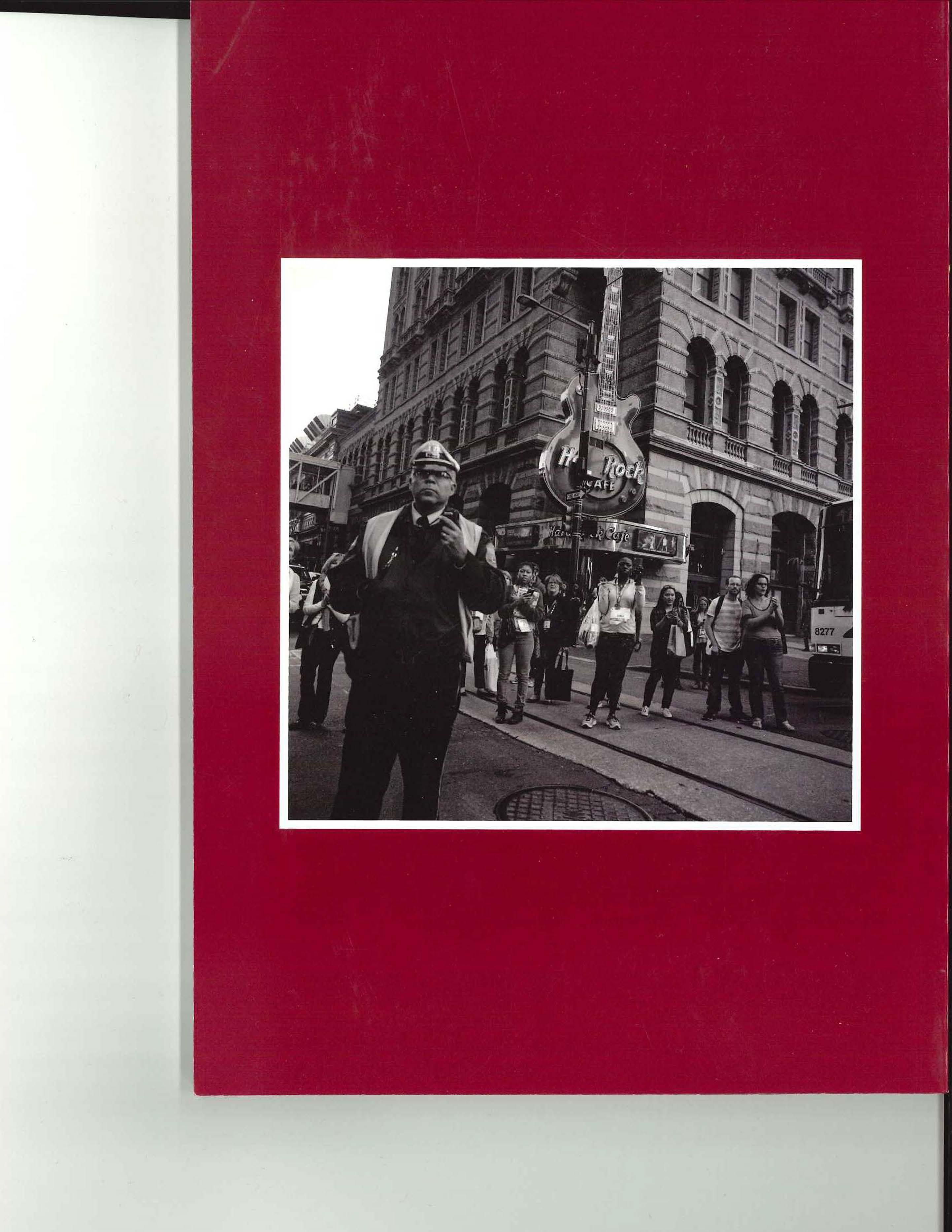
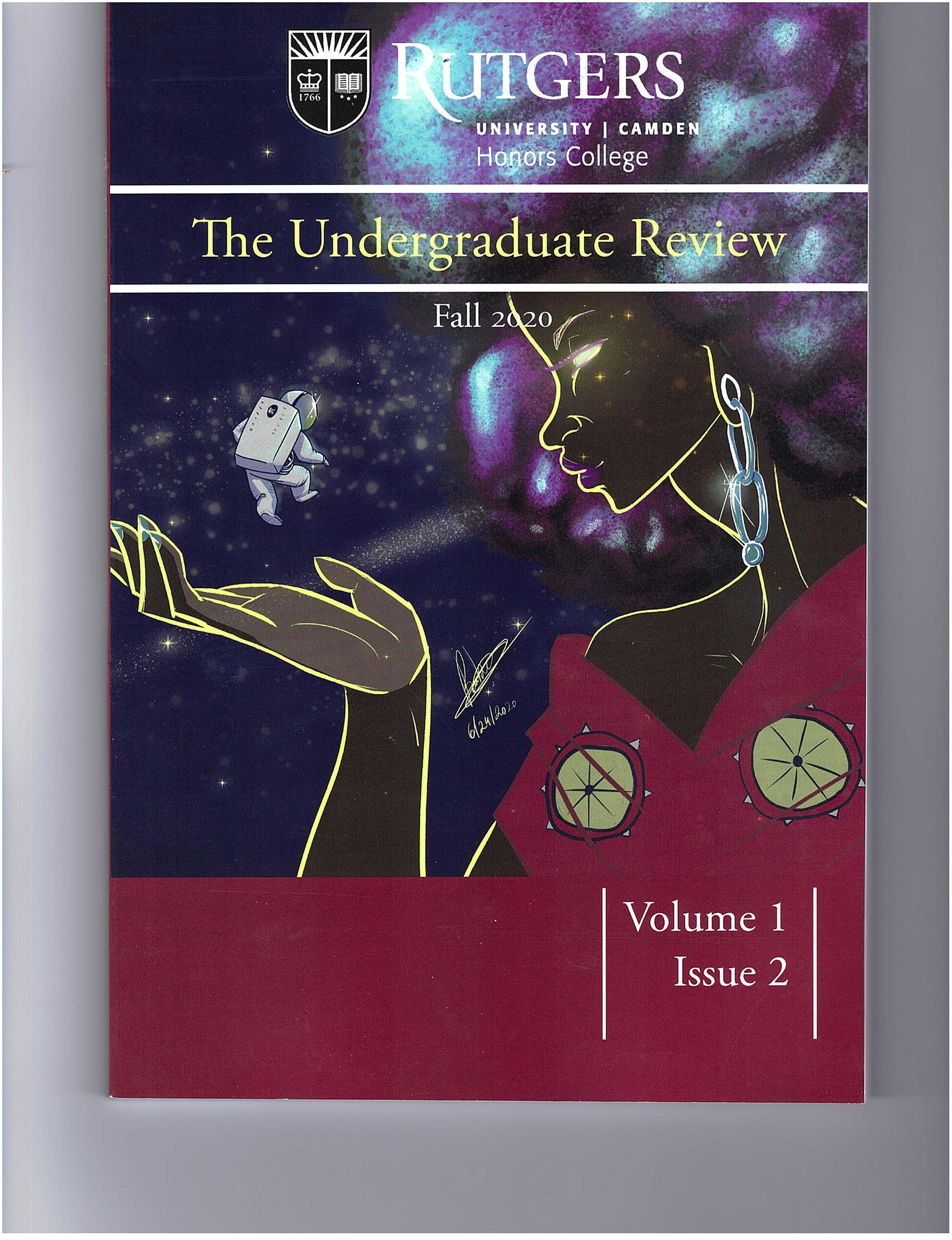
On the front cover of the journal is the artwork “Find Me” by Rabia Danyaro. The art depicts what Danyaro describes as a Afrofuturistic theme of hope. On the back cover is Austin Cuttino’s photograph “Onlookers” which he describes as viewers who were watching protests after the 2016 election. He points out that “the subject of the photo is the viewer.” More detailed explanations of the artwork and biographies of their creators can be found at the end of the journal.
Rutgers University–Camden is home to award-winning, innovative, creative, and distinguished undergraduate students. We thank all the students who have taken the time to submit their work and have revised them upon our request. We would like to give special appreciation to our faculty advisors who have made the second edition of this journal possible: Dr. Lee Ann Westman, director of the Honors College and Brian Everett, assistant dean of the Honors College. As a reader, we hope that you enjoy every article and gain a little insight in our family of Rutgers UniversityCamden. This journal is a testament to the ambition and drive of our student body, whose accomplishments cannot be undermined even by a global health crisis. Get noticed; be remembered.
The Valley of Literary Ashes
Burke Donnelly
Walking upon a valley, I see the monuments of our wordsmiths fallen; I buckle in the embrace of their mountainous hue. I am no giant as were they,
The Rough Whit, The Solemn Dickinson, The Tanyard Twain, The Disjointed Modernist’s Frost, Hemingway, The Glitz of Fitzgerald.
Who am I to venture on, “Do I Dare?”
As J. Alfred Prufrock would lament on, To speak, or even to breathe in the presence of such greats?
I shall in the very least, I suppose, try to inscribe my place and define the ghostly faces I see here…
The Rough
The enormous presence of this first monument, it is of its own material yet intertwined with all that below and above; the great omnipotence!
This American, One of the Rough, See!
Fleshy Soul… Unabashed Body…
Sensual- Eating, Drinking, Breeding.
There he’s singing of one’s self, “Of All Selves!” He exclaimed A tremendous exorcism, He wanted to be in and spoke out of my mouth.
Omnipotent Equality both Man and Female!
For sure this life teeming in front of me, Is one of life immense in passion, pulse and power, Walter Lee beat your chest to the bone! A chorus behind, All dead and alive, I hear America Sing too!
The carpenter and the tools, clanging; The boatman sending off and sailing; The mother tending to the child; The bride arranging; The chauffeur tending to… “BOY” the exclaimer.
I see now, this Rough amongst the dead is deathless. Alive in the fibers of the earth, His body is shed and life embraced. He pleasures himself here between heaven and hell, Naked as a giant stallion, fresh and responsive, Now afoot with eternal vision.
He resides in the leaves of grass, On the mountains, through the wind, of the skies and below. West, East, North, and South, The Rough Whit, The American Spirit, A Rugged Individual,
Under the Soles and Stars of this Earth.
O Solemn Emily
The second grave, seemingly lying in the shadow. So small, as if, just a light in some small window far away. What seems left, Just a letter And the sender left blank.
Bobolinks perch themselves, Surrounding the grave. A choir singing, Bringing a light, As if I could kneel and be healed.
And on the outside, in this nature It seems right and in place. Though moving closer, Dividing the grass as with a comb, The dark of night begins to fall. Wild Nights and here, Pain has an Element of blank.
I am numb and in looking deep, I see pearls and weeds Below in the sea of Emily
And with that, I felt a cleavage in my brain.
Now I am at her gates, Will her society accept me? Will her quiet, porcelain soul let me in?
I like this look of agony,
8 The Undergraduate Review
As I agree, I feel it’s true. The pain of being one who rose to requirement, Dropping the playthings of her life.
She must feel as nobody, And much madness would be in its divinest sense seeing this Though Demur, You’re straightaway dangerous, And handled with a chain.
So, to the solemn, and the forgotten, I claim, I am nobody too! I shall leave a letter here With the sender too, Left blank. And take a swig Of a liquor never brewed.
The third was found upon a flowing river and the truth that I saw is the truth, mainly.
A boy, rough around the edges stands here and says, “Witches don’ lay in this place, A five-cent piece lay on a hanging branch to keep them away. It ain’t no lie, it be difficult to be here. The uncivilized nature of that man sleeping wit dos hogs Causes the tankard to stink up a mighty heap. Guess it be that or the drink that gets him riled and angry, He is the devil, not me!
And I see some people over the river, The civilized folk, I see them paying to their god
Or praying.
I don’t know witch, When I see the gold exchanged, Wrist to Wrist.
I think on it a minute, Must it take them to heaven? A reason for doing it? But that ain’t no place for me, Like that man, my place is with dogs. I ain’t need neither, those civilized or my pa, I got my big friend Jim and raft.”
The ghostly boy went to the bank, And before him the frats of life will befall him. Come-By-Nights who swoop in the day, Ancient and unknown family quarrels, Fighting to fight because that’s been what they done, Ignorant adolescent boys playing. All for him to see life on the river, Ain’t no picnic.
I hope in the end, but I know the joke’s on me, This free-spirited boy will grow and be free on the river.
Lo, that ain’t no life for he, So his place will stay in the tanyard, With the river pushing him in the wrong direction.
The scattered plots D O T D O T … (DOT) the field of these bearers of broken claims, their lots left to pick up the pieces dropped and shattered.
A land of waste before me,
The graves as apparitions of their faces crowded.
Petals on a wet, black bough.
Insecurity begets me entering here, What will those around me (even the dead) think of my passage?
I shall so so so, Tight Tip of the Toe as I go about this place.
I must be more than humble, Eunuched, I should be! As I am no attending lord nor anything more than being able to ask…
“may I go?”
I would say, I have learned Amongst the dust of my kicked-up heels, That one must have a mind of winter, To regard the frost and the boughs Of the pine-trees crusted with snow.
That in this place, Death and Destruction = Birth and Reincarnation To say that I, myself, Am nothing and I may behold as the listener this: Nothing that is not there and the nothing that is.
I am a mere being, With a mind to find a place. Where one may say, A palm rests at the end of this.
This thing stands on the edge of space and Silence surrounds for The gold-feathered bird here sings, A song unknown to human meaning or feeling.
It is as much to say,
Watching Just as simply, A red wheelbarrow.
The magnanimously forgiving creation, To bear whatever load. Its age worn With rain scars and there just resting by the white chickens.
The chaotic nature of a place
Untamed and left with a broken machine of the yesteryear, Plows ahead to a new future, formed by the hands of these apparitions.
To them I join and say, “Godspeed, Con te partirò a peponi!”
A bridge connects this barren land with its ancestral heritage and beyond this, a road split infinitely and indiscriminately forward.
And so a marriage was had, With this man. Not of his love, For her life along with four of his children Were given back to the state of nature.
It was one of The joining of
Rhythmic traditionalism and chaotic, Reassembled modernism.
The path this creates is seen that, The only way round is through.
A mirage in the distance, A mended wall built Yet decimated.
Man’s claim of this earth, “This is my border not yours!”
Nature smiles back, And in its most eloquent rays Destroyed this claim in every way.
But men continue to compile stones Defiling this truth, “No nature! Good fences make good neighbors!”
The inevitability of man’s departure, Is as true as saying, Nothing Gold Can Stay.
Summer, shiny and new, Melting away. The dust of snow, Changing spirits. Then nature springs anew, Falling in time are the leaves and Winter ringing in the gloomy blues. An indefinite cycle of life’s rules.
Oh life, and with that nature, You seem so true!
The plains wide and open; The mountains carved, ascending so high; The oceans are as deep as the mind. And silence is your answer, To the co-existive nature, That seems to elude us.
“Out, out” I exclaim! Out of this constructed world, Deconstructed nature.
Weighing and Defining our worth, As easy to say, What is life?
A check in the end? A hand given, Doing a man’s work, Though a child at heart.
I proclaim this is not the only way, Let us look down the road less traveled. And let us look at a man’s work,
Digging up the earth, sinking under his fingernails. We assume no emotion emerges, The senseless burial of a child or The man as the boy burying his childhood playthings.
Yet it can be seen, His worth, in his words:
“Three foggy mornings and one rainy day Will rot the best birch fences a man can build.”
No manic emotion could ever convey, Such a silent understanding of Human and Earth.
Hill’s beyond this pass, shaded in gray, The Hemingway’s
It is hard to discern what I see ahead, am I reading a thing definitely, something that is clear? Strange and ambiguous it seems ahead and always under the gaze of these Hemingway Mountains.
Walking I find,
A cafe situated next to a train station, Somewhere on a coast near Barcelona.
Found under a well-lighted place, I see a man and woman, With cervezas and dos Anis del Toro’s, Though it seems only one with a bulging, bloated belly. Respectively the latter, Discussing some things.
I hear talk of white elephants, But this is not the place, Where those grace our presence. Nor it seems will they, For more than just a detour.
A life of antiquity, Flitting about from here to there, Luggage cluttered with the stamps of nations here and there. Life without a care.
Yet something seems amiss, As the woman is drinking with the belly kicking, A strain of the mundane.
Like the man in the café, Old and respected, While wobbling and correcting. Looking to spend hours there, Well past closing.
Though it seemed to only bother one of the waiters, The one who has someone to go home to. To love, cherish and hold onto. The other is fine, letting time slip away, Like the sinking of the old man’s drink. For he knows, he will want Another clean, well-lighted place After they both exit.
A Shining Star, Great Gatsby! I See Such Beauty in the glimmering Glitz of Fitzgerald!
From atop the Hemingway’s, A green light is beckoning me to the end of the ash heaps behind. I look back once more, the past though is no more; So, when I see, a jaded feeling overtakes and blinds me to press on.
A euphoria overtakes me, Such a dream, being American! I have climbed so high, Being high I’m clearly not grounded. But upon the broken backs and Bootlegged sacks of money brought in.
The green light in the eye of beauty, Resting so delicately, As if balancing some-thing upon a chin.
There is a lightness in the air, As if an open windows breeze,
May sweep away the cares of life.
“Where sh-shall we go?”
“Let the wind guide.” American beauty speaks.
A porcelain smile,
For they fear the barbarians at the gates, Common-folks,
The minorities who make up the majority. And behind the smile, Lies a lethal incentive, For anyone not made up of their substance. The question-and-answer session is over in seconds. And this was to anyone who attempted to go from west to east, Or even rise as a phoenix from the ash heaps.
No, the American Dream is a fool’s errand, Living off the backs of others.
For a plunge is taken, By so many to achieve. Yet falling from the height of a mountain, Your body will be left broken and jagged, Lying face down in a swimming pool. Getting run down by someone not caring too move. You will give everything and, in the end, Just some scraps of greenly lit printed paper. And this descent is almost inevitable, If not born privileged, As if in East-Egg. Where those few are given, The green light to defend And blind the many, With pride, greed, lust, envy, gluttony, wrath, and slothful tendencies.
don’t look at me Jochebed P. Airede
don’t look at me, don’t touch me,
i wonder why you only see me like this.
wonder why your eyes only sight the tease and sensual promise of my smile.
don’t look at me, don’t touch me. you’re making me ashamed; making me think that i’ve been calling to you in a dirty way. don’t look at me, don’t touch me. this isn’t fair.
i’ve begun to blame myself for your uncomelier stare.
i don’t ask for you to notice me; (I never ask for you to notice me) but you always do,
18 The Undergraduate Review
your eyes following my every fluid move, rotten-toothed smile sending shivers down my spine. don’t look at me, don’t you dare touch me. i have nowhere to turn; nothing to help spurn your ‘affection.’ because They are on your side. They are always on your side. your age (my age), your status (my status), your gender (my gender) –everything is in your favour. Everything. don’t look at me; and don’t you dare touch me. i am exhausted. gosh, i’m exhausted. i’ve been since i was thirteen, since i seemed old enough to be legally coveted.
since every smile i threw, every curve i knew, became something to be thirsted after.
since every dress that clung to my swelling form became something to question, something to abhor.
because i didn’t want you to notice me, i never wanted you to notice me – but that’s stopped mattering, hasn’t it? just this once, i would like to disappear. just this once, i would like to fade into the background. just this once.
i don’t know what else to do about you. i don’t know how else to handle you, and what you think of me. because you always have to think of what to do to me and how to have me –
but you never consider the joy of just knowing me.
you never bother to know me. you never bother to wonder about the spools of knowledge
in my head; the thread of ideas bouncing about uncontrolled, unrestrained, beneath the skin and coils of my scalp. how come you never bother like a brother would?
for i know you would never let anyone treat your sister like you treat me –but i wonder, why you never see it that way. i take a break now, and take a glance in the proverbial waters. i’ve to speak to myself too, for that’s as equally important as lamenting you. i take a moment to realign and remind myself
to cradle my treasure-filled spools like i would a baby; to appreciate the precious jewels of intellect lining their crevices, like crystals down a mine shaft; to see myself the way my God sees me, as more than a pretty object to play with one day, when you feel some type of way, then trash the next. i tell myself every day. i tell myself. so, again, to you: don’t look at me, don’t touch me. don’t lookat me, don’t touchme. don’t look at me, and don’t you daretouch me.
22 The Undergraduate Review
Amanda Clapcich
Fate has long occupied a central role in humanity’s imagination, belief, and sense of self. It is fascinating, mystifying, and often frustrating. Fate, fortune, destiny: all seem to be apportioned arbitrarily, sometimes unfairly. To many Indo-European cultures, this pointed to a divine agency predetermining their longevity and prosperity. Specifically, they pointed to supernatural women meting out fate at the birth of every child, often determined through spinning and weaving. This tripartite imagery that of otherworldly women controlling the destiny of Man through the production of textiles has worked its way into the imaginations of the general population as well as those in academia. It would be reasonable, then, to assume that there is a vast amount of textual references representing these three core images, however there is only a small body of evidence linking all three. Simply because there is an absence of historical evidence for it in no way means that it is absent from history. The persistence of this metaphor alone merits its consideration, and the imagery of textile arts is so well suited to the metaphysical idea of fate that it is no large logical leap to connect all three.
In order to fully grasp the idea of spinning or weaving as metaphor for fate, a basic understanding of their functions and terminology is important as the “metaphor fate-as weaving...operates predominantly in relation to the making of textile, that is it focuses on the process rather than on the finished product” (Bek-Pedersen, Fate and Weaving, 32). The simpler of the two commonly referenced methods, spinning, is the making of threads from a raw material, often flax or wool. Spinning “creates order out of chaos by structuring and organizing the random fibres into coherent threads and, once
it has been spun, it is very difficult to unmake a thread” (32). Prior to starting the spinning process, the spinner must decide what type of thread they wish to make; some fibers lend themselves better to some types of thread or yarn. The thread produced is dictated heavily by the type of fiber fed into the spindle: fine fibers can make very thin, fine yarn; coarser fibers can make thicker, more robust yarn; longer fibers can make smoother yarn. To a large degree, “the end result is partly apparent from the very nature of the raw material” (3233). These unspun fibers “constitute a mass of potential waiting to be turned into whatever they are supposed to become almost like an unborn child whose life is waiting to be lived” (32).
A more complicated form of textile art is weaving, of which there are several types that require different looms, different techniques, and produce different results. All of these types of weaving tablet, tapestry, and cloth work within the fate-as-textile metaphor; however, for the sake of simplicity this paper will just address cloth weaving (33). Cloth weaving utilizes an upright, or warp-weighted, loom. This type of loom was used in “Scandinavia during the Viking period and into the Middle Ages; in some remote areas even up until the nineteenth century” (34). Woven cloth is composed of fibers going in two directions, vertically and horizontally, called the warp and the weft. The vertical fibers, the warp, are attached to the loom itself as well as sticks called heddles. The heddles “allow the weaver to lift one set of warp threads away from the rest so that the weft can be passed through” (34). It is the weft that is actively woven, though it is in the warp the pattern emerges. “The order in which the warp threads are drawn through the heddles forms the basis of the pattern on the finished cloth…The pattern laid down in the warp, in fact, significantly limits the options for what the weaver can do with the weft because, once the warp has been set up, it cannot be changed” (34-5). Any mistakes made
in setting up the warp threads will carry through into the finished textile, however to some degree the weft can be altered to correct mistakes made along the way. Before the warp is established, there is an immense amount of choice and numerous options at the weaver’s disposal. After the warp is established and threaded through the heddles, however, far fewer options are available. A warp cannot be blank, it cannot contain no pattern at all. The warp pattern may be very simple and plain, resulting in an equally simple weft, but it cannot be entirely absent of pattern. Essentially,
this means that the basic structure of the pattern is already laid out in the warp alone, but it cannot be seen and therefore seems not to exist at all. Until weaving begins, it is all in the mind of the weaver and in the, as yet uninterpreted, threading of the heddles. The weaver has made a decision regarding the pattern, but the effects of that decision cannot yet be detected. Even so, its impact on the finished result is immense (35).
Once the warp is set in place, the options for each pattern are immediately limited, but not restricted to a single choice. It is these choices overlaid onto the warp laid out by the weaver that result in the final woven design.
The Indo-European concept of fate and destiny is not how modern Western cultures conceptualize it, and it is “rare that two separate cultures have the exact same idea about what is covered by their roughly equivalent terms” (25). Fate in a modern, Western sense is more that of belief, or the idea that one’s decisions, good or bad, can be blamed on fate, leaving the doer absolved of responsibility. It is often viewed in direct opposition to the concept of free will and personal choice; this is the belief of determinism. In many IndoEuropean mythologies Old Norse, Greek, Roman, Celtic
are simply a few fate is more subtle than that. For these cultures, fate is concerned with what happens, not when or why, simply that the event occurs. It is not that one cannot choose; it is instead what one chooses that is their fate. The difference is almost nominal, yet critical. A determinist view of fate would say that the choice is already made and laid out, the doer functions “merely as a puppet in the hands of some greater power” (27). This is also referred to as fatalism.
A compatibilist view, one more in keeping with these Indo-European mythologies, says that “one can have choices, and with them responsibility, as well as being subject to fate” (26). It is essentially the difference of passive submission to and active acceptance of what fate may bring. “Moral responsibility is the opposite of fatalism and no one can read the Greek dramas in their entirety without feeling that whatever outside forces are at work, whatever the inheritance may be, still after all man is a free agent and makes his choice for weal or woe” (Leach 387). This active acceptance is seen throughout the Old Norse sagas and Greek epics:
[The] outcome of a battle, the moment of death, are fated to occur when they do occur. Yet the heart of the warrior remains independent of fate, his bravery enables him to face death rejoicing in the fame that is certain to survive him (Winterbourne 119).
In these mythologies, fate is part of the ideas surrounding a person’s reputation and integrity; Heraclitus writes that “A man’s character is his destiny” (Leach 381). Fate “is presented as a process of actualization, as an interplay between what one is given to work with and what one does with it…fate [is] something that comes from deep inside of people and is lived out as an integrated part of the individual’s personality” (Bek-
Pedersen, Fate and Weaving, 37). It is this integration that allows for personal responsibility instead of passive surrender.
[Fate] does not provide the individual with easy solutions or with someone or something other than themselves to blame for what they do; instead, it makes demands on them and provides plenty of opportunity for them to reflect on what they do and what their actions say about them (32).
There are basic truths encoded in each person, and it is these truths that inform the decisions each person will make in their lifetime. These basic truths are not so limiting, however, as to completely remove choice, as one would expect with determinism. Rather, it simply makes one “predisposed to lean towards certain types of choices” (Bek-Pedersen, Fate and Weaving, 28). This fate is merely one’s “own self recoiling upon him for good or evil” (Leach 381). Through choices, these basic truths are revealed and become actualized. These truths are at the core of all beings, and indicate that “what is true is true, whether past or future, whether you know about it or not whether you are willing to admit it to yourself or not” (Bek-Pedersen, Fate and Weaving, 28). In this manner, fate “comes to be regarded as an invitation to action, a challenge to live up to, even a potential to fulfill” (Bek-Pedersen, Fate and Weaving, 28) and “anything bordering on patient and unquestioning submission to the fixed and unalterable decrees of fate” (Leach 401) is diametrically opposed to these cultures’ thoughts on destiny. The third aspect of this tripartite imagery surrounding fate are those that wield fate itself. They are the Old Norse Norns, the Greek Moirai, the Roman Parcae, the Celtic Matres, and the Hittite Gulses, to name a few (West 380) Though they may go by different names, this concept of divine women
spinning fate is found “over such a large part of the IndoEuropean area, which makes it likely that it goes back to the deepest level of Indo-European" (380). References to these women are found across these cultures and throughout their literature. The Greeks called their spinning women the Moirai, whose individual names expressed their individual aspects: “Klotho ‘Spinner’, Lachesis ‘Apportioner’, and Atropos ‘Inflexible’” (381). They were depicted as spinners, “one carries a distaff, the second a spindle and the eldest scissors” (Mencej 71).
In Homer’s works, the Moirai are thrice pictured as spinning a person’s fate. (Dietrich 86) In The Odyssey, 7.196, “Alcinous says that once Odysseus has been brought home to Ithaca, he will experience whatever Aisa and the Spinners spun for him with their flax at his birth” (West 380). In The Iliad, 24.209, Hecuba says that at the birth of her son, Hector, Moira spun his fate: that he should be “devoured by dogs far from his parents'' (Dietrich 86). Again, in The Iliad, 20.127, Hera offers to save Achilles once, but “afterwards he may suffer whatever Aisa spun for him at birth” (86). The same expressions and ideas are “used with Aisa or Moira as the subject: both words mean ‘share, portion’, and the goddess is at the same time the personification of what is allotted to one in life and the agent that allots it” (West 380-1). It is apparent that the common thread running throughout these passages is the fate of each is spun at the moment of their birth. It is also interesting that Homer uses Moira and Aisa interchangeably in his works, though “Aisa had no place in popular belief as an independent figure honored by cult and tended to be assimilated in later literature to the usage of the impersonal Moira” (Dietrich 87). In fact, “an examination…reveals that apart from the two instances in which Aisa is said to spin a fate, the word nowhere possesses personal force” (87). The use of Aisa in Greek literature more often than not implies an impersonal force, that is, not one wielded by any one
individual or group of individuals, but rather by a force of nature. While there is evidence of cults in honor of the Moirai, there is still “no evidence to suggest that these figures were connected in popular belief with the spinning of a general fate for men'' (88). The language used in Homer indicates no particular deity responsible for this spinning of fate.
What, then, should be made of the clearly formulaic use of the act of spinning referenced in Homer? These usages “suggest that the Homeric poets might well have taken over from early belief the image of spinning and applied it to their idea of the workings of fate. That is to say, that here we have perhaps a kind of syncretism between Homeric and popular belief” (88). If in Greek popular belief there existed the idea of a woman who spun particular experiences in the life of a person, Homer and the other Greek poets may very well have echoed this belief, and there is in fact some evidence of a magical association with spinning and weaving.
Pliny writes that “in Italy women were forbidden to spin as they walked on the high roads; nor were they allowed to carry spindles openly” (91). This reflects a belief in “homeopathic magic: the twirling of the spindle was thought to turn the corn ripening on the fields, or even the unborn baby in the womb” as well as a number of customs found throughout Europe “which involve the winding of thread on a spindle as a symbolic rite at the time of sowing; often, too, the motion alone of spinning a variety of objects was believed to induce or promote fertility of the fields” (91). There was magic associated with the material being spun, often wool or flax. Wool was used extensively in many Greek rites, often in connection to the fertility of the fields as well as in the home, both in its raw form as well as spun. Flax, while not as widely used as wool due to its later introduction to Greece as well as its relative cost, was also believed to have special powers and was frequently used for medicinal purposes and as a cure for
infertility (92). Though there is limited evidence in Greek practices for these rituals, “what evidence there is from other sources describes a ritual spinning at the birth of a person, which was originally perhaps thought to facilitate birth or ensure fertility” (93). It is these rituals surrounding birth and fertility where Homer’s involvement of Moira becomes apparent. Within popular belief and within the associated cult, Moira was closely connected with birth, so closely in fact that Moira may have originally been a deity of birth. On the occasion of a birth, Moira is said to have appeared; often Moira brings luck or gifts for the infant, though in some tales her presence had a more sinister implication (94-5). In a variant of the Meleager myth, “the Moirae visited Althaia seven days after her son’s birth and told her that he would live until a brand then on the fire should have burned away” (95). In this version of popular belief, the Moirai mark out a person’s death at the moment of their birth, aligning with the images found in Homeric poetry. Thus, while there did not exist in Greek popular belief a fully formed concept of a divine being spinning a general fate as Homer may lead one to believe, there does exist evidence that the Greeks possessed knowledge of a popular rite of spinning at the time of birth that in some way was believed to have exerted influence over the life of that person. It is this popular belief that Homer likely would have drawn from, integrating it with his understanding of the workings of fate to bring about the commonly recognized depiction of the Moirai.
This depiction is seen in later works such as Plato’s Republic:
…there is another band, three in number, each sitting upon her throne: these are the Fates, daughters of Necessity, who are clothed in white robes and have chaplets upon their heads, Lachesis and Clotho and Atropos, who
accompany with their voices the harmony of the sirens Lachesis singing of the past, Clotho of the present, Atropos of the future; Clotho from time to time assisting with a touch of her right hand the revolution of the outer circle of the whorl or spindle, and Atropos with her left hand touching and guiding the inner ones, and Lachesis laying hold of either in turn, first with one hand and then with the other. (Plato 617c-d)
Plato provides the most detailed and commonly recognized depiction of the Moirai, and one most akin to the Old Norse concept of the Norns as well. There is the same “relation to past, present and future the Norns have, though the Greek proper names do not themselves express it. Kotho spins, Lachesis allots, Atropos, the unturnable, cuts the thread” (Grimm 414). This is a far more developed portrayal of the Moirai than seen in Homeric poetry, which stands to reason if Homer truly originated the modern concept of the Moirai from his syncretism of popular ancient Greek beliefs.
Rome, as with many things, likely borrowed their Fates from the Greeks. Their corresponding divinities are called the Parcae, their name marking them as goddesses who attend at birth. Individually, their names are Nōna, Decima, and Morta (381). Their names suggest time or numbers, and their traditional interpretation “refers to times of pregnancy, with the result that one of these ‘fates’ will preside over an individual’s birth: Nōna (from nōnus ‘a ninth’) for a mature birth, Decima ‘a tenth’ for a postmature birth, or Morta (from mors ‘death’) for a stillbirth” (Bauschatz 10). Similar to their Greek cousins, the Parcae spin the threads of fate. Latin poet Catullus writes,
In the meantime, with shaking bodies and infirm gesture the Parcae began to intone their truth-
naming chant… their hands pursued their neverending toil, as is the custom. The left hand bore the distaff wrapped in soft wool, the right hand lightly withdrawing the threads with upturned fingers shaped them, then twisting them with the prone thumb it turned the balanced spindle with a well-polished whirl. And then with a pluck of their tooth the work was always made even, and the bitten wool-shreds adhered to their dried lips, which shreds at first had stood out from the fine thread… receive what the sisters make known to you on this happy day, a truth-naming oracle! But run, you spindles, drawing the thread which the fates follow, run, spindles! (Catallus 64.306-327)
Catullus provides one of the most complete and recognizable depictions portrayals of women spinning fate. He wrote his epyllion right before the turn of the first millennium, nearly 300 years after Plato penned his Republic. Very likely the syncretism begun by Homer and developed by Plato came into its full form by this time and thus filtered into Catallus’ work.
In Nordic mythology, the mistresses of fate sit at the foot of Yggdrasil by the well of Urð. Individually, they are known as Urðr, Verðandi, and Skuld. Collectively, they are the Norns. Like the Moirai, they “give both good and ill” as well as “attend the birth of children and shape their lives” (382). The Norns “represent a powerful, continuing, regenerative force in the universe” (Bauschatz 7). Wyrd is the Old Norse concept of fate and is significant in its etymology as well as being “at least by association, if not inherently, notionally feminine” (Pollack 646). “It is related to German werden, ‘become’, ‘come about’. But in Latin the same verb means ‘to turn’, uertere; and in Vedic the middle form vártate has both
senses, ‘turns’ or ‘comes about’, ‘turns out’ in such and such way…” (West 383). This same word is also the etymological source of the Middle High German word wirtel, meaning distaff wheel, or spindle (Bauschatz 21). There is a very close semantic relationship between these concepts; the connection between “turning and eventuating is surely relevant to the image of the goddesses’ spindle that spins round as it twists the loose wool into a firm thread” (383). This turning, revolving motion also can be seen in the well of Urð that the Nornir maintain and in the names of the Norns themselves.
The parent root of the names Urðr and Verðandi is the verb verða, a derivative of the Indo-European root *uert-, which “denotes the kind of motion common to ‘turn, spin, rotate’” and is of the same linguistic parentage as Wyrd, discussed previously (Bauschatz 13). The motion inherent in the root “probably represents some kind of change of location or reorientation in space. Its meaning develops logically from ‘turn (from one place or position to another)’ > ‘turn (in to)’> ‘become’…Additionally, the motion of ‘turning’ or ‘changing position’ found in *uert- implies revolution or motion about an axis” (Bauschatz 13-4). The motion about an axis implies a return to the starting point, a complete revolution. Semantically, then, Verðandi comes to mean “that which is in process of ‘turning’ or ‘becoming’” and Urðr meaning “that which has ‘turned’ or ‘become’” (14). Skuld stands slightly apart from her sisters, with a meaning akin to “what is, of necessity” or that which is felt to be obligatory (12), but together the three represent “the total range of verbal action” (14). It is here we see spinning is woven directly into the very fabric of the Norns; it is in their actions, their language, and their very being.
The imagery of weaving, of laying down strata to build a continually evolving work, is seen in the relationship between the Norns, the well of Urð, and Yggdrasil. The well, true to
its linguistic roots, is the well of past and present action. The roots of Yggdrasil extend down into the well;
As the Norns daily bring their nurture to the tree, they express the power of this sequence of pattern of the past up and out into and upon the world of men; as these ‘past’ events sustain and feed the tree, they bring into being the events of the here and now; as ‘present-day’ events occur, they fall from the tree back into the well and join themselves into the ever-increasing complexities of the past, restructuring it, reinterpreting it, continually expressing more and more about the interrelations of all actions. (21)
This continual growing and stratification of past and present suggests the act of weaving; the “level-versus-perpendicular order clearly suggests the warp and woof [weft] of a loom with the daily saying of the ørlög [often translated as fate, but more accurately defined as laws set in regard to all that happens with respect to all that has happened already] moving among the actions like a shuttle whose weaving unfolds the pattern of events” (21).
As with the Moirai, apart from etymological and semantic significance, there are few clear-cut references to the Nornir as spinners or weavers. In Prose Edda’s Voluspa 20, the three maidens are named and their roles laid out:
Thence come the maidens mighty in wisdom, Three from the dwelling down ‘neath the tree; Urðr is one named, Verðandi the next, On the wood they scored, and Skuld the third. Laws they made there, and life allotted
To the sons of men, and set their fates, (Bellows 9)
This role is further solidified in Snorri Sturlson’s Poetic Edda in the Gylfaginning:
A hall stands there, fair, under the ash by the well, and out of that hall come three maids, who are called thus: Urðr, Verðandi, Skuld; these maids determine the period of men's lives: we call them Norns; but there are many norns: those who come to each child that is born, to appoint his life; these are of the race of the gods.
(Sturlson 28-9)
These two passages clearly establish the Norns as three women of the race of the gods who make laws and set fate in place. Conspicuously absent, however, is any mention of spinning or weaving. In fact, “of all the appearances of nornir and related beings in the Poetic Edda, Snorra Edda [Prose Edda], and skaldic poetry there is one mention of weaving valkyrjur [Valkyries] (Darraðarljóð), one of spinning women (Vǫlundarkviða), and one of nornir working with threads (Helgakviða Hundingsbana I)” (Bek Pedersen, Just a Yarn, 2). Of these three references, only two involve metaphors for fate and only one directly links the nornir with threads. The Helgakviða Hundingsbane IN details the circumstances of Helgi Hundingbane’s birth, and is the sole text to explicitly mention the Norns and threads:
1 In olden days, when eagles screamed, And holy streams from heaven's crags fell, Was Helgi then, the hero-hearted, Borghild's son, in Bralund born.
2 'Twas night in the dwelling, and Norns there came, Who shaped the life of the lofty one; They bade him most famed of fighters all And best of princes ever to be.
3 Mightily wove they the web of fate, While Bralund's towns were trembling all; And there the golden threads they wove, And in the moon's hall fast they made them.
4 East and west the ends they hid, In the middle the hero should have his land; And Neri's kinswoman northward cast A chain, and bade it firm ever to be. (Bellows 291-2)
Here is a clear reference to the Norns, their hand in the fate of a newborn child, and a clear reference to textiles. While not explicitly named as a female triad, “their number…is to be gathered from the threefold action” (Grimm 408). Different translations also give different nuances to the third stanza in particular, some using “wove” as above, some like Nickel’s translation uses the term “twisted” instead. The verb in the first line of the third stanza is snúa or “turning” and the verb used in the third line of the third stanza is greiðia or “arranging, combing out.” (Bek-Pedersen, Just a Yarn, 3) Looking at these meanings, weaving may not be the most accurate depiction, but spinning does not fully fit either. Weaving fits with greiðia, and the directionality of the cast threads mirrors the vertical and horizontal directionality of a loom, but spinning fits more accurately with snúa. Neither metaphor forms a cohesive picture across the whole of the poem. “The text specifically mentions three threads, to the east, west, and north too many for spinning and too few for weaving” (4). Bek-Pedersen suggests that “the nornir are playing three separate strands together into one, which fits
with both of the verbs” (4). Plying is quite different from weaving and spinning, though it still falls within the textile arts and still presents the Norns as participating in creating fate and threads simultaneously.
Apart from these more common sources of fate-weaving goddesses, there are also instances found in other parts of the world, though with fewer textual references available. In early Irish writings, the hymn of Fer Fio Macc Fabri begins, “I call on the seven daughters of the sea/ who fashion the threads of the sons of long life” (West 384). Though here it is seven goddesses, there still remains evidence of a group of women spinning life and fate. Similarly, in Lithuanian mythology, a verpeya [spinneress] “begins to spin the thread of the newborn on the sky, and each thread ends in a star; when a man is dying, his thread snaps, and the star turns pale and drops” (Grimm 722). This seems to echo some of the imagery in Helgakviða Hundingsbana I, where the Norns were said to have hung the threads they spun for Helgi’s life and hung them “in the moon’s hall” (Bellows 292). The Latvian Láimas appear in scores of folk songs; they too come to a newborn child’s cradle and set the child’s fate in motion. One particular stanza from these folk songs mentions spinning imagery:
Laima, Laima for the boy who is born to the world! For him Laima twisted the flaxen thread, steeping it in silver. (384)
This same textile imagery is also found throughout Slavic folklore. While a figure of fairytale but not known in folk belief, Baba Yaga is said to reside in a hut that continually spins around its vertical axis. The hut rests on a bird’s foot, often with a spindle as its heel. Inside her hut, Baba Yaga spins long threads of silk, and often “carries the implements used for the fabrication of cloth which relate to divination
through the ‘spinning of fate’ practiced by her and her sisters” (Mencej 57). From the Ohrid area of Macedonia comes a legend of the fates, called narečnice, “depicted as three women sitting in front of the fireplace and spinning the thread of life: the first and the second one spin, and the third one cuts the thread with her scissors after the three of them jointly have made their prediction” (73). Similar motifs are found in countless other folk beliefs and mythologies, all with similar aspects and language surrounding the spinners.
The traditional domestic activities of weaving and spinning as well as the product of these activities have taken on great symbolic meaning in relation to the core aspects of human experiences birth, fate, and death. Fate “has so much to do with men’s notions about birth, and more especially those about death” (Grimm 856). Though there is a dearth of evidence tying together a divine triad, the setting of fate at birth, and textiles, “the wealth of legend that grew up around this belief would make mockery of any attempt to regard it as a mere figure of speech” (Dietrich 93). Indo-European ideas of fate and destiny are perfectly positioned to be translated into spinning and weaving; fate “as that inescapable truth that already exists within a person before they act, can be likened to the pattern that is present in the warp already before weaving commences” (Bek-Pedersen, Fate and Weaving, 36). In this framework, choice is never absent, but our choices are also not limitless, “they are, instead, concrete expressions of who we are and we can only be ourselves” (36). Like the warp of a loom, fate is not all-determining or predestining. There exists choice in the weft, and it is in those decisions, though limited, that one is able to manifest their fate and inner truths.
Bauschatz,Paul C. “Urth’s Well.” The Well and the Tree: World and Time in Early Germanic Culture. The University of Massachusetts Press, Amherst, 1982, pp. 11-27. https://pdfs.semanticscholar.org/ad81/65f27a8340a6280aa03dbba2754 3e50a13a3.pdf
Bek-Pedersen, Karen. “Are the Spinning ‘Nornir’ Just a Yarn?” Viking and Medieval Scandinavia, vol. 3, 2007, pp. 1–10. JSTOR, www.jstor.org/stable/45019132.
Bek-Pedersen, Karen. “Fate and Weaving: Justification of a Metaphor.” Viking and Medieval Scandinavia, vol. 5, 2009, pp. 23–39. JSTOR, www.jstor.org/stable/45019118.
Bellows, Henry Adams, translator. The Poetic Edda. New York: American-Scandinavian Foundation, 1926. https://www.sacredtexts.com/neu/poe/poe03.htm
Catullus, Gaius Valerius. The Carmina of Gaius Valerius Catullus. Trans. LeonardC.Smithers.R.F.BurtonandL.C.Smithers,London,1894. http://data.perseus.org/citations/urn:cts:latinLit:phi0472.phi001.perseu s-eng2:64
Dietrich, B. C. “The Spinning of Fate in Homer.” Phoenix,vol.16,no.2, 1962,pp.86–101 JSTOR,www.jstor.org/stable/1086943.
Grimm,Jacob. Teutonic Mythology.TranslatedbyJamesStevenStallybrass, GeorgeBellandSons,London,1882.4Vols.
Leach, Abby. “Fatalism of the Greeks.” The American Journal of Philology, vol. 36, no. 4, 1915, pp. 373–401. JSTOR, www.jstor.org/stable/289626.
Mencej, Mirjam. “Connecting Threads.” Folklore (Estonia)., vol. 48, 2011,pp55-84.www.folklore.ee/folklore/vol48/mencej.pdf.
Plato. Republic. Trans. Benjamin Jowett. The Internet Classics Archive. WebAtomicandMassachusettsInstituteofTechnology,13Sept.2009.
https://www.gutenberg.org/files/55201/55201-h/55201h.htm#stpage617A
Pollack S. “Engendering Wyrd: Notional Gender Encoded in the Old English Poetic and Philosophical Vocabulary ” Neophilologus. 2006;90(4):643-661.
Sturlson, Snorri. Prose Edda. Translated by Arthur Gilchrist Brodeur, SacredTexts.com,sacredtexts.com/neu/pre/pre04.htm
West, Morris L. Indo-European Poetry and Myth. Oxford University Press, 2007.
http://mundusgraece.weebly.com/uploads/3/7/0/9/37095511/indoeu ropean-poetry-andmyth.pdf
Winterbourne, Anthony. When the Norns Have Spoken: Time and Fate in Germanic Paganism. Madison, Teaneck: Fairleigh Dickinson University Press,2004.
40 The Undergraduate Review
Andrew Bové
During World War II the New Jersey coastline, particularly the coastline of Cape May County, was a hotspot of activity for German ships torpedoing U.S. ships that were heading to and from the Delaware Bay and its ports. As a result, the U.S. Army Corps of Engineers decided to dig a 3mile-long canal that stretches from the Delaware Bay to the Atlantic Ocean. This canal would serve to protect those US vessels traveling to and from the Delaware Bay. This is not the only major reshaping the Cape May Coastline has seen over the years, but it might be one of the most damaging. The canal, in conjunction with the older jetties, have been largely instrumentational in the serious deterioration of the Cape May beaches over the last 70 plus years (Fox 2009). Former Army Corps project manager, Dwight Pakan, stated:
It’s obvious from aerial photographs that the north jetty creates a severe offset that interferes with the river of sand that flows offshore. The sand gets trapped at the north jetty and impedes the natural drift southward toward beaches in Cape May City, the Cove, the Meadows, the Lighthouse beach and Cape May Point. (Fox 2009)
There are several possible solutions for this problem. The current solution is to award a multi-million-dollar contract to a dredging company every few years. That company then dredges beach sand and fills in the eroded areas of the Cape May beaches. This is not only costly, but also can be
destructive to the various species of marine life and wildlife that make their homes in the areas being dredged. Alternatives to that costly and temporary solution are that Cape May County could fill in the canal, or they could remove the old north jetty. Although these solutions seem like viable alternatives, they both carry serious opposition from the local population, as well as serious costs in the case of filling in the canal.
I am proposing an alternative solution that I believe will not only help save our beaches from eroding but will also help us in the years to come with rising sea levels. My solution for the erosion of the Cape May beaches, and the proposal that I am asking for your consideration in funding, is to build and implement manmade mangroves along the Cape May shorelines. Mangroves are incredible resources where they grow naturally in tropical and subtropical climates that are not far from the equator. However, mangroves are unable to withstand freezing temperatures. This is why I am proposing to create a manmade mangrove.
I would like to create a “sectional mangrove” barrier constructed from bamboo and recycled plastic. The bamboo would simulate the roots and body of the mangrove, and the recycled plastic would assist in the necessary modifications that would need to be made to the bamboo in order for it to more resemble and function as an actual mangrove. The barrier would be semi-movable, inasmuch as a mangrove root is moveable. The actual size of the sections would vary, but a general size would be approximately 3 to 6 feet above the water’s surface and 12 feet deep/wide. The sections would connect similarly to the way that sound reducing walls along a busy highway connect. A complete span of connected barriers would run for approximately 1000 feet. This would not have
to be done along the entire coastline. I would place these manmade forests strategically along the Cape May coastline at intervals of 1 forest every half of a mile. In total there would be roughly 5 of these 1000 feet long manmade mangrove barrier forests. Natural mangroves would obviously be ideal, however that is not possible in the climate of Cape May, New Jersey.
I believe that these manmade mangrove forests will not only cause the end of beach erosion in Cape May, but I also believe they will bring back beach area to sizes not seen since prior to the construction of the Cape May canal. The socioeconomic consequences of a larger beach for Cape May would be tremendously positive (Van der Stocken 2019). However, this is not the only positive outcome produced by the mangroves now populating the Cape May coastline. In addition to restoring the beach area, my solution will also provide shelter and support for threatened and endangered species. The fishing industry is one of the largest contributors to the economy of Cape May, and the new mangroves would be a sanctuary, mating area, and hatchery for all types of marine life (Fang Wang 2019). The manmade mangroves would also help to mitigate the disaster caused by hurricanes and other seasonal storms that frequently batter our coastline. Hurricane Sandy caused $65 billion in damage, and the New Jersey coastal towns were some of the hardest hit areas. In a study in Central America on the effects of whether mangroves can help decrease the effects of hurricanes on economic activity, it was found that coastal lowlands not protected by mangroves saw a drop of up to 24%. However, in the areas protected by 1 or more kilometers of mangrove belts, the effects were completely mitigated (del Valle 2020).
With your support, I believe that we can stop and reverse the beach erosion occurring in Cape May through the construction of my proposed manmade mangrove forests. However, if that positive outcome from their construction is
not enough, then look at the secondary and tertiary results of my proposal. I believe that these manmade mangroves will: a. stop and reverse beach erosion; b. provide shelter and support for marine life, therefore positively contributing to the fishing industry; c. help protect the coastline from frequent storms and hurricanes that can case extensive damage to our beaches, town and economy. I hope that you choose to move forward with this proposal, so that we can truly see the amazing value these manmade mangroves would bring to our Cape May beaches.
Fan Wang, Shaoliang Zhang, Huping Hou, Yongjun Yan, Yunlong Gong. “AssessingtheChangesofEcosystemServicesintheNansiLake Wetland,China.” Water.2019;11(4).Doi:10.3390/w11040788
Tom Van der Stocken, Dustin Carroll, Dimitris Menemelis, Marc Simard, Nico Koedam. “Global-scale Dispersal and Connectivity in Mangroves.” Proceedings of the National Academy of Sciences. Jan 2019; 116(3)915-922;DOI:10.1073/pnas.1812470116
Alejandro del Valle, Mathilda Eriksson, Oscar A. Ishizawa, Juan Jose Miranda. “Mangroves Protect Coastal Economic Activity from Hurricanes.” Proceedings of the National Academy of Sciences. Jan 2020; 117(1)265-270;DOI:10.1073/pnas.1911617116
Other Sources
Fox, Karen. (2009 January). “Rebuilding a Beach: Cape May’s History with Beach Replenishment.” Cape May Magazine. Retrieved from https://www.capemay.com/Editorial/january09/beachreplenishment.html
Mavis Amegah-Dorr
Teenage pregnancy is one of the major causes of poverty among women in Ghana. Poverty has become a global crisis where many people are unable to afford basic human needs like food, shelter, healthcare, and education. There are numerous variations in the society that leads to the generational cycle of poverty in Ghana. However, the cause of poverty among most women in Ghana results from teenage pregnancy. Unplanned pregnancy among young girls consequently induces dropping out of school, stigmatization, and substandard quality of life for both mother and child.
In Ghana, unmarried girls are forced to abandon their education because of the stigma and ridicule that follows their pregnancy. Many schools or vocational institutes require pregnant girls to drop out of school; this requirement serves as a deterrent to students. These girls are coerced into isolation by the mockery of society. There is a large population of women who are poor in most third world countries like Ghana because they have very little to no formal education. While most of these women cannot afford to go to school, the few that can drop out due to pregnancy.
School dropouts who later get the opportunity to continue their education after childbirth eventually quit going to school because of the shame and stigma attached to a young unmarried girl with a child; families of such girls entice them into early marriages. Due to inadequate or the lack of fundamental education, most women are not able to pursue higher education. Without education, they cannot acquire necessary skills and qualifications to thrive in the competitive job markets for leadership positions in government, business or careers that could eventually cause their economic situation to experience upward social mobility. For example, a woman
who dropped out of school due to teenage pregnancy now hawks on the streets with her five children. She is unable to get a decent job because of her low level of education, her economic situation does not improve, and she continues to live in poverty with her children. On the other hand, she could have gone back to school after childbirth to obtain a higher education or learn a vocation that could increase her chances of getting a decent job with a good salary to improve and sustain her quality of life. Either way, continuing with her education can cause an elevation in her social mobility and economic growth, instead of being stagnant in the cycle of poverty. Using a student’s pregnancy as a deterrent to others may create an awareness of teenage pregnancy and enforce the consequences of being pregnant while in school. However, this action eventually contributes to the underlying causes of the prevalent poverty rates among women in Ghanaian society.
Ghanaian Girls who drop out of school due to pregnancy become vulnerable to early marriages or conceive more children. To restore their image and respect, families and some religious groups entice pregnant girls to marry the men who impregnated them. In some situations, girls who refuse such marriages are abandoned by their family. Those who agree to such marriages eventually run away from their spouse due to the domestic violence at home and the mistreatment by the spouse’s family. Escaping from such abuse often renders these girls homeless, so they end up on the streets, become squatters or live in the slums. In a desperate attempt to survive extreme poverty, some women rely on other men for financial support. Most men who financially support these women tend to exploit them sexually. Poor women with very little to no education tend to have more children in Ghana because they are more vulnerable to men who exploit women for sex and housekeeping needs. These men often lure unsuspecting women with the promise of a better life;
instead, these women are only left with more children to care for. According to Thomas Malthus’s “An Essay on the Principle of Population,” assistance given to poor people by the government encourages them to have more children which cause human population and poverty to increase. Malthus states “Politicians argued that government aid allowed those who could not support children to have them anyway and increase the population, and therefore poverty, even further” (552). For people in third world countries like Ghana, this claim may not necessarily be true. Some developing countries like Ghana lack social welfare systems that support the old, needy, children, and disabled people in the country. In the United States, there are welfare systems that provide money, food, housing, medical, and social services to poor and low-income households. However, in Ghana, such welfare systems by the government do not exist. One must rely on family, friends, and religious organizations for support.
Pregnancy is a part of a woman and should not be used to hinder women from achieving their fullest potential and contributing to the social and economic growth of the country. Teenage mothers and women who dropped out of school because of pregnancy should be equipped with the appropriate resources and empowered with the necessary education to increase their chances at a better-quality life; this will curb the high rate of poverty among women in Ghana and other parts of the world. In Garrett Hardin’s “Lifeboat Ethics: The Case against Helping the Poor,” he suggests that developed and affluent countries should stop assisting underdeveloped ones because it only encourages them to reproduce and increase. Hardin states, “Food banks, international aid programs, and unrestricted immigration do not solve this problem, he insisted; they merely allow the number of people who suffer from it to increase” (583). In a country like Ghana, poverty results in a rapid increase in population,
despite the high infant mortality rate. A significant number of women with no formal education rely on the misconception that finding a good man will improve their quality of life; this false hope consequently leads these poor women into having more children.
Many people from developed countries believe that food is the solution to poverty in most third world countries, but that may not be necessarily true. There is an abundance of food in many third world countries like Ghana. Instead, the inadequate transportation system to transport these foods to be supplied to the rest of the country is what contributes to the shortage and inflated cost of food. Also, the lack of food preservation facilities in these countries leads to the scarcity of food because a huge amount of food harvested from small-scale farmers rots and go to waste. Some international aid programs provide immunizations to children in developing countries; however, that only helps a handful of children. Many others eventually perish, and the recurring cycle of poverty continues. Such aids do not target the cause of poverty; Garrett Hardin further argues “We must ask if such [programs would] do more good than harm, not momentarily but also in the long run” (587). Teenage pregnancy is a cause, and a consequence of poverty among women in most third world countries and yet is the most overlooked regarding aid and support. Curbing the high population rate in developing countries means women should be empowered and equipped with better options to attain a quality standard of living instead of depending on men for financial benefits. Necessary resources, education, and skills to improve their standard of living and quality of life should be made accessible to all. Also, for international aids to be effective and efficient in combating the global poverty crises, it must be tailored to meet the needs of the specific population it intends to support.
There are various measures worldwide used to prevent teenage pregnancy like sex education and abstinence. For abstinence and sex education to be effective in eradicating or curbing the rate of teenage pregnancy in many developing countries like Ghana, some misconceptions about teenagers who indulge in sexual activities must first be eradicated. Most people assume that all teenage pregnancies are a result of a romantic or sexual relationship. According to an article by Yurieff Kaya, “Students are told to abstain from sex until marriage and are not taught about different contraceptive methods” (Kaya). Not all teenage girls get pregnant out of courtship, most of them are victims because of their extreme financial situations. The high rates of teenage pregnancy in Ghana is a result of poverty and inadequate sex and birth control education. These girls fall victim to various schemes by perpetrators who pretend to offer them financial help. Teaching students’ abstinence is applaudable, but all women and girls should have access to comprehensive sex education to equip them with the knowledge and resources to prevent unplanned pregnancies. Comprehensive education on birth control measures should be accessible to all women because potential victims of teenage pregnancy may all not be in the classrooms to benefit from such knowledge; there are many who still roam the villages uneducated. According to an article by Amy Yee, “Nearly 120 million girls do not attend primary school, and 15 million girls under 18 marry each year, often under duress, ending their schooling and putting them at risk for domestic violence and health complications” (337). Marriage should not be the solution to pregnant teenagers; Instead, they should be provided with the necessary resources and encouragement to continue their education after childbirth. The society must be educated on the benefits of equally investing in educating both men and women because it takes both for a nation to prosper.
To eradicate poverty effectively and efficiently, there is a pressing need to invest in long term solutions that will break the cycle of poverty. Teenage pregnancy is both a cause and a consequence of poverty, so it is essential to educate and empower women and girls to end poverty among women in third world countries like Ghana.
References
Hardin, Garrett. “Lifeboat Ethics: The Case against Helping the Poor.” Reading the World: Ideas That Matter, edited by Michael Austin, Norton, 2015,582-593.
Malthus, Thomas. “An Essay on the Principle of Population.” Reading theWorld:IdeasThatMatter,editedbyMichaelAustin,Norton,2015,552559.
Yee, Amy. “Girls’ Rights: Can the movement achieve lasting change?” CQResearcher,April17,2015,AccessedonMay27,2017,337-360 Retrievedfrom http://library.cqpress.com.camdencc.idm.oclc.org/
Yurieff, Kaya. “Is sex education working to prevent teen pregnancy?” CQResearcher, July 14, 2014, accessed on May 27, 2017, Retrieved from http://library.cqpress.com.camdencc.idm.oclc.org/cqresearcher/docum ent.php?id=cqr_ht_teen_sex_2014&type=hitlist&num=2
50 The Undergraduate Review
R. Dillon
The full details of the 1954 CIA-sponsored Guatemalan coup have never been fully released, despite the CIA gradually declassifying documents related to the operation. The coup, nicknamed PBSUCCESS internally in the agency, has been researched and disputed multiple times over by historians eager to understand the intricacies of the operation. It is not possible to understand these complexities; many of those key individuals in the coup have long since passed away, declassified documents released, but sanitized, eliminate information that may be pertinent to understanding, and discussion of past CIA actions no longer reaches the news cycle as it once had in the previous century. There are limitations that historians have had to work around, but the in-depth work of many of these historians have added to the bigger picture of the coup. While it is not possible to know every gritty detail of what became of the deposition operation against the Arbenz administration, it is imperative to discuss a key piece of the coup: the tactics the U.S. employed against Guatemala.
The world of 1954 was one filled with a fear of communism amid the Cold War This fear, according to the United States government, was exacerbated by the actions Jacobo Árbenz Guzmán, the democratically elected president of Guatemala. A reformer at heart,1 Arbenz sought to make his country “economically independent” and he “emphasized the need to modernize the country’s physical infrastructure.”2 However, it was Arbenz’s ambitions of agrarian reform that
1 Piero Gleijeses, Shattered Hope: The Guatemalan Revolution and the United States,1944-1954 (Princeton:PrincetonUniversityPress,1991),p.135.
2 Ibid., pp.135.
waved the red flag of communism at the United States, so to speak.
The United States, and further, the State Department and the CIA, knew of the control and authority they had over the hemisphere, and how to assert that authority in their foreign diplomatic relations. Asking whether or not the United States had the legal authority to intervene in the politics of another country would lead to endless debates. It has been stated that several of their controversial actions, such as its interception of British ships on a trade route, were illegal.3 The issue of legality is not unimportant; it becomes important when put into the context of a cover-up. It is now understood that the State Department did in fact stage this coup, but how exactly did U.S. officials manage to cover up their operations in Guatemala, and why did they feel the need to? The former question is much easier to begin to answer, the latter not so much. The United States employed the use of covert, psychological, and reactionary operations to facilitate coup operations and the subsequent cover-up of their involvement. Interpretations of the coup are presented in very different manners in the books written about the situation. Bitter Fruit authors Stephen Schlesinger and Steven Kinzer approached the subject through a narrative lens with the actions of the United Fruit Company (UFCo) serving as a primary focus of the authors’ argument as to the motives of the coup. Both had great knowledge in Latin American history with Schlesinger having monitored the 1990 Guatemalan election. Historian and author Richard Immerman of The CIA in Guatemala takes a scholarly approach, almost scientific in his tracings of the coup. As the title suggests, his main arguments concern the direct actions of the State Department in the country and the actions of the Arbenz administration. Piero
3 Richard H. Immerman, The CIA in Guatemala: The Foreign Policy of Intervention (Austin:UniversityofTexasPress,1982),p.159.
Gleijeses, professor of foreign policy and author of Shattered Hope, takes a similar approach; the main difference is that while Immerman has a United States perspective of the situation, Gleijeses takes a Guatemalan perspective. He mixes narrative threads as he had direct access to key Guatemalan players, many of whom he was able to interview, and he took a scholarly approach as he delved into American newspapers and State Department archives. Finally, Nick Cullather’s Secret History offers a perspective from inside the CIA’s classified documents archive. His approach would not fit into the scholarly or the narrative, but rather a concise display of the information. Cullather’s account of the coup offers the most insights as to the covert aspects of the coup, a helpful resource to tackle a question such as presented.
The covert aspects of the coup were the specific steps that were taken by the State Department to distance themselves from any wrongdoing, and usually involved the planting of evidence and the shifting of responsibility to blame the communists. This distancing also frequently occurred hand in hand; the overlap of tactics to achieve this goal was constant. In particular, this planting of evidence is a crucial piece to the distancing aspects of the cover-up, and it did not involve simply placing evidence, but twisting any evidence found naturally to fit under the Cold War ethos of the time. A major example of this is PBHISTORY, in which Frank Wisner, Deputy Director of Plans during the time of the coup, sought to seize any documents that would “conclusively prove the Communist nature of the Arbenz regime.”4 The confiscation of documents and subsequent report is echoed in CIA in Guatemala: “Such programmed testimony…totally exonerated the United States from any charges of complicity and left no room for any interpretation regarding the extent
4 NickCullather, Secret History: The CIA’s Classified Account of Its Operations inGuatemala,1952-1954 (Stanford:StanfordUniversityPress,1999),p. 106.
The question again arises: why did the United States find it necessary to invest so much time and effort in a cover-up if they believed they were “saving” the hemisphere from being overtaken by communism? A potential answer could be that they knew their actions were wrong, and either did not care or
5 Immerman, CIAinGuatemala,p.181.
6 Cullather, SecretHistory,p.107.
7 DOC #0000135807. Central Intelligence Agency, Provocation Plans (UnitedStates:1June1954),p.1.
8 Ibid., pp.2.
54 The Undergraduate Review of Communist threat in Guatemala.”5 It appears as though PBHISTORY was to be used to convince the United States side of the coup that is, the lower level governmental workers who were unaware of United States intervention that their hands were clean. The documents found during PBHISTORY were to produce pamphlets passed out to the National Security Council, and while there are senior members of the government within the council, many did not take part in PBSUCCESS. These seizures of documents worked internally for the United States, as it was enough to convince the council of the communist threat in Guatemala.6 Further unclassified CIA documents find plans dated to occur before the coup itself that directly suggests provocation events to be used to imply Soviet intervention. Dated June 1, 1954, and sent to the “Chief/Project,” though a name is either not specified or is redacted, outwardly stated for these events to “divert responsibility further away from the United States government or, on the contrary, provide justification for United States of even international (Pan American) intervention.”7 As the document continues, it talks of Soviet bombs exploding under the Honduras president’s car, Guatemalan air force insignia flown over Honduras, and falsified cables from the Soviets to Mexico as a suggested provocation.8
rather wish to serve their interests.9 The full motives of United States officials cannot be known.
Under the Eisenhower administration, covert operations were the preferred tactic of intervention. While it is known that many covert actions occurred in the planning years of the coup, it was the necessity to cover up the actions that drew attention. This was not just seen through PBHISTORY and the falsified story of the coup, but also in taming reactions towards the deposition. In a sanitized document dated July 26, 1954, nearly a month after the coup, a memorandum that appears to have been released internally in the C.I.A. details actions taken to “counteract unfavorable world reaction to overthrow of Arbenz Regime in Guatemala.”10 The overarching question of why the United States felt it necessary to cover their actions looms over the document. Drawn to attention is that the document goes country by country and expresses plans to be undertaken in each to quell
9 Stephen Schlesinger and Stephen Kinzer, Bitter Fruit: The Story of the American Coup in Guatemala (Garden City: Doubleday and Co., 1982), p. 229. Government officials looked at Guatemala through a bananacolored lens and sought to save their capitalist interests that they found in UFCo. While this may have been the case for the United States to originally keep a watchful eye on the country, the years after the coup saw the collapse of UFCo and its merger with Del Monte. The undefined “alliance” between the United States and the United Fruit company can be seen as the catalyst for its “watchful waiting” policy of the Central American country, and its further export interests that the companyhelpedlobbyforandfacilitate.However,itsdirectconnection to the invasion itself appears to be overstated, as the United States’ more prominent interest in Guatemala was preserving an antiCommunist government. See pp. 11-13, 53-54, and 75 for more on the relationship between the United States and UFCo, and the beginnings of the agrarian reform that “threatened” the initial interests of the UnitedStates.
10 DOC #000920218. Central Intelligence Agency, Report on Actions Taken to Counteract Unfavorable World Reaction to Overthrow of Arbenz Regime inGuatemala. (UnitedStates:26July1954),p.1.
any dissenting opinion of the coup. For Thailand, it is suggested that “materials for use in anti-communist indoctrination school as case study…;” this is a particularly insidious suggestion, as it targets the children of the country rather than officials who can act towards the United States, the implication here being to program the children of the country to think as the United States does, whether or not that thinking is right or just.11 Thailand has had several coups in its history, and the government is set up very similarly to Guatemala in that it is run by a military junta. The secretive establishment of an anti-communist indoctrination school shows the power the United States had and was willing to use, regardless of the population living in these countries.
Even more fascinating, and perhaps more telling about the motives of the United States, is the plan suggested for Iran, a country in which the United States had already staged a successful coup. The only plan suggested is for Tehran to send a press reaction assessment, but it is the actual cable back from Tehran that carries interesting information. “Tehran replied that little interest was shown, that general assumption was that the United States was responsible for the revolt and the feeling was that the U.S. had a definite right to protect itself in such a vital area.”12 First, Iran makes it known that they rightfully assumed that the U.S. was behind the Guatemalan situation, and it may be safe to assume that as the U.S. had done the same thing to their country a year prior that they should recognize the signs of U.S. intervention. However, it is the second half of the quote that draws even further attention, as Iran then states that the U.S. was justified in their actions. After the U.S. ousted Mosaddegh, they then placed an American-sympathetic leader into power who would be willing to overlook certain issues. Including Iran in
11 Ibid., pp.2
12 Ibid., pp.3.
the memo about reducing negative reaction gives the U.S. the appearance of an arrogant imperialist, but is also an example given by the United States that their coups were successful in the long-term, and that they occurred through its covert actions within the countries they intervened in.
The crux of the issue as it stands here is that United States officials believed themselves successful in their intervention, and with the Eisenhower administration’s leaning to covert actions as its preferred method of interference, the State Department felt justified in its intervention. America believed itself the authority of the hemisphere and would, therefore, justify any negative aspects in the name of restraining communism.
While it was the covertness of PBSUCCESS that defined the coup from start to finish, further technical aspects explain how the coup succeeded, and how the United States managed its image in the years after. This was the psychological aspect of the coup, a key piece in that it guaranteed the success of PBSUCCESS on the Guatemalan side. In short, the U.S. used psychological warfare to manipulate the American press and the Guatemalan public. A memorandum dated in the middle of the invasion states this goal outright: “The entire effort is thus more dependent upon psychological impact rather than actual military strength, although it is upon the ability of the Castillo Armas effort to create and maintain for a short time the impressionof very substantial military strength that the success of this particular effort primarily depends.”13 This meant that for the invasion itself, it was believed that the façade of strength would be enough. Guatemala, despite dealing with the challenge of an arms embargo, had one of the strongest armies in the region, with officers that were very loyal to Arbenz. This façade was to convince the
13 Department of State, Foreign Relations of the United States, 1952-1954, The American Republics, Volume IV, Allen Dulles. (Washington: EisenhowerLibrary,20June1954),p.1.
Guatemalans that Castillo Armas’s forces were much larger than they truly were. Further, Guatemalans also needed to be convinced that the United States could give support to Castillo Armas’s forces.14 Estimates of Armas’s forces show that he did not have enough men to oust Arbenz by military force alone, and Allen Dulles, the Director of the C.I.A, predicted that without the months before the coup fabricating the size and power of Armas’s forces, the invasion may not have succeeded.15 This was the process; its goal was to prove to the Guatemalan army that they would not stand a chance against Armas, and rebel against Arbenz themselves.
Thus began the many months of psychological warfare on the Guatemalan people. Nearly a year before the coup, however, there were suggested plans on the types of psychological warfare that could occur in Guatemalan, with plans including the dropping of “propaganda materials designed to incite discontentment throughout Guatemala” and to have rumors spread throughout the levels of Guatemalan society. Rumors included that Soviet officers would be sent to Guatemalan officers to check on their “ideology,” for enlisted soldiers, a rumor of poisoned supplies was to be spread, and towards the PGT, “a letter from a Communist European front will ostensibly be mailed to FORTUNY [sic], telling him that GUTIERREZ [sic] has been reporting to Moscow about the activities of FORTUNY and that unless GUTIERREZ can be silenced, FORTUNY may be purged.”16
Further psychological materials were supplied to the Guatemalans by opposition forces. It was common for pamphlets and visual materials to be dropped despite rates of
14 Immerman, CIAinGuatemala,p.162.
15 Ibid., pp.162.
16 DOC #0000914820. Central Intelligence Agency, A Suggested Plan for Psychological Warfare Operations in Connections with Over-all Guatemalan Operations. (UnitedStates:2August1953),p.1-3.
58 The Undergraduate Review
illiteracy in the country.17 Cullather quotes George Tranger, the Chief of Station in Guatemala, who states that the goal of these psychological materials was to “‘intensify antiCommunist, anti-government sentiment and create a disposition to act; and create dissension, confusion and FEAR in the enemy camp.’”18 Castillo Armas was never meant to come into direct conflict with the Guatemalan military forces, as the psychological warfare was to break down the existing members of Guatemalan society, and force them to rise against themselves the so-called communists rather than the invading force that was going by the moniker “The Liberator.”19 It was easy to spread rumors through the military; it would be safe to assume that their literacy was higher than that of the common Guatemalan. However, the common Guatemalan had access to an important piece of propaganda: the radio.20 Operation SHERWOOD took advantage of this fact, and the radio stations began to be filled with antiCommunist and anti-Arbenz propaganda. “La Voz de la Liberación,” the Voice of the Liberation, was broadcast through Guatemala, “announcing amid popular American songs that the hours of the ‘traitor Jacobo’ were numbered.”21 A document containing psychological materials to be used as support in Guatemala stated the topics they sought to control. Subset D. contains information on discrediting the government and intellectuals “who have fallen for the Communist line” and “warning intellectuals who may be used
17 DOC #0000914007. Central Intelligence Agency, Materials for Psychological Warfare Support – Guatemala. (United States: 26 Jan 1954), p. 1.
18 Cullather, SecretHistory,p.66.
19 Ibid., pp.70;SchlesingerandKinzer, BitterFruit,p.170.
20 SchlesingerandKinzer, BitterFruit,p.168.
21 Gleijeses, ShatteredHope, p.295.
While it is difficult to surmise whether all of these plans were put into effect, the fact that many were even suggested is valuable for debate. On the surface, it is obvious that the main points of the document are to divide the officers, soldiers, and political leaders in Guatemala, which would, in turn, sow further disloyalties towards Arbenz. It is the façade that would lead to a successful coup, and so if the officers believe that they are outmatched and outnumbered, the State Department believed a mutiny would be impending. However, it is worthwhile to point out that these tactics were used to blame the communists for the coup, and therefore distance the appearance of United States intervention. If the United States believed the communists to be bad and that they were spreading ideology to the country, would there not be evidence of communist “tampering?” If the threat of communism had reached a pinnacle where the United States felt justified in deposing a democratically elected president, would it not have been easier then to search out communism evidence before resorting to an invasion two years in the making? In short, if there truly was a threat of Soviet communism, why did the United States have to plant evidence and use psychological warfare tactics to convince the
22 CIA, MaterialsforPsychologicalWarfareSupport – Guatemala, p.11.
23 Ibid., pp. 13-14. This is not to say that radio broadcasts were the decisive turning pointin the invasion,and it wouldeven beincorrect to overstate its influence as Cullather reasserts that “only one Guatemalan in 50 owned a radio,” but it still held power: “radio, nonetheless, becameacentralfeatureoftheoperationalplan.AlthoughGuatemalans were ‘not habituated’ to radio, an analyst observed, they ‘probably consider it an authoritative source, and they may give wide word-ofmouth circulation to interesting rumors’ contained in broadcasts.” See Cullather, SecretHistory, pp.41.
Undergraduate Review by Communists.”22 Further program suggestions are to play the music of Russian composers, the poetry of Latin American students and teachers, and to broadcast religious appeals.23
Guatemalans that the threat was there? Yes, it was clear that Arbenz was moderate to left leaning, and the PGT was a communist party. It is also true that it was Arbenz’s Decree 900 that signified a communist threat in the hemisphere, but these actions are nowhere in the suggested plans of the State Department nor do they make up the essence of rumors to be spread. If these actions were not communist enough for the C.I.A to use as propaganda in Guatemala and internationally, then why did they see the threat at all? Again, these questions rarely have readily available answers, but, while rhetorical, are important to the continuous analysis of PBSUCCESS.
It was not only in Guatemala that psychological tactics were used; the American press received a certain level of influence, even though it was not to the extent as was done in Guatemala. The goal was for the United States to wipe their hands clean of the operation, and to do so, they needed the United States public, and beyond, internationally, on the same wavelength. The press was to portray the United States as the victims of a communist aggressor, with Guatemala being the antagonist. The New York Times became vociferous reporters of anti-Communism at this point in the Cold War. What was spoken of in Congress and what was coming out of the White House would then be echoed back to the public. Gleijeses points out an example of shifting public opinion from as early as June 1951:
Secretary of State Acheson testified… “The Guatemalan situation is a very troublesome one…The Communists…have gotten into the Government and they are causing a great deal of concern to us.”…Three days later, a New York Times editorial concluded: “It is time to register a sense of deep disappointment and disillusionment over the trend of Guatemalan politics in the two months since Colonel Arbenz
62 The Undergraduate Review became President…the Communist trend, far from being reversed, has been strengthened.”24
Other headlines from between 1950 through 1954 show the animosity towards the smaller country: “Guatemala Is ‘Halfway to Poland’” in the Washington Post in February 1950, “Red Front Tightens Grip on Guatemala” in the Washington Post in February 1952. The need to control how the press viewed the Guatemalan situation proved easy under the Cold War ethos of the time. “Newspaper and broadcast media…accepted the official view of the Communist nature of the Guatemalan regime.”25
In an essay, Gregory F. Treverton, former chairman of the National Security Council, makes a connection between the secrecy of the coup and the nature of the plan itself: “Not every covert action exposé, however, has made for controversy…some stayed in the tabloids or were relegated to the back pages of the major dailies. They did not produce political controversies to which the American government felt any need to respond.”26 The message here is clear. Should United States officials have thought their operations warranted a direct press response, they would have done so themselves. They did not believe their actions to be controversial; in fact, they believed them justified in the face of the Cold War. This does not take away from international response however, as it is here that the shift into the reactionary tactics of the United States starts to become apparent. In its own country, the government is an authority figure in the eyes of the press and the public, and what it
24 Gleijeses, ShatteredHope, p.226.
25 Cullather, SecretHistory,p.56.
26 Treverton, Gregory F. "Covert Action: From "Covert" to Overt." Daedalus 116, no. 2 (1987): 95-123. Accessed May 1, 2020. www.jstor.org/stable/20025098.
chose to give a platform to was important in the influencing of opinion. Outside of its borders, the diplomacy increased in complexity.
The United States, as a country, was born on principles of imperialist expansion and intervention. Where it saw fit to intervene in the affairs of others, even in actions deemed just in hindsight, it did so, or at the very least considered it. The years of the coup, the United States acted as the authority figure not over just its own people, but over the whole hemisphere and in the international forums. It asserted its imperial authority wherever it could to push their antiCommunist agenda. The term “reactionary” here is to be somewhat redefined from its dictionary definition. Here, the term is used to signify the actions of the United States against threats to its covert operations and negative reaction towards the previous operation. Policy changes towards a foreign body are notable examples of this concept. “Until the spring of 1952, Truman’s policy toward Arbenz was similar to that adopted toward Arévalo in the late 1940s. Diplomatic pressure was accompanied by the denial of economic aid.”27 This is the last piece as to how the United States managed to continue covering up its operations in Guatemala; it used its international authority to silence dissenting decisions. This diplomacy is captured constantly through the multiple secondary sources referenced, even though the long-term motives of the State Department’s actions were not yet known this being the coup itself, not the instability of the region in the subsequent years.
The documents that precede the invasion event by mere weeks are often the most transparent towards this concept of reactionary tactics. A sanitized document dated May 29, 1954, illustrates how the United States was handling both the invasion effort and the curbing of negative opinion towards
27 Gleijeses, ShatteredHope, p.227.
the country. The document details what a potential conference would look like with the OAS, and the “factors considered important.” The author of the document is redacted, though it is clear that it is neither Wisner nor J.C. King, as they are mentioned in the third person in the remarks section.28 It has multiple handwritten notes in the margins, both editing and redacting pieces. Most important is a quote that occurs on the very first page: “It is possible that Guatemala could produce ‘evidence’ of US intervention, a step that would not only embarrass the US but would be damaging to US prestige and influence in Latin America.”
29 The State Department expressly states that should a meeting occur, their cover could be blown, which would be devastating to coup efforts that were to occur less than a month later. Further, placing the word “’evidence’” in quotes within the document is a subtle shifting of blame, as it discredits any information the Guatemalans may be able to present and distances the United States. Additionally, it isolates Guatemala from its neighbors with the threat of United States intervention, a fear that was spread through multiple psychological and reactionary support. Documentation such as this is prevalent throughout the PBSUCCESS case files within the C.I.A. archives, and its tactics are the culmination of years of preparation for the coup.
Documentation such as this is not the only example of how the United States uses its authority to shift blame away from themselves. For Immerman, the Caracas conference
28 The author may be Tracy Barnes as he worked almost directly with Wisner, and it appears as though it may not be Colonel Albert Haney, whoiscitedasoftendislikingKing,andthetoneoftheremarkdoesnot holdanegativevoice.
29 DOC #0000923079. Central Intelligence Agency, Factors we consider important concerning a consultative meeting of the American States on Guatemala [sic]. (UnitedStates:29May1954),p.1.
stands as the major example of the overarching authority exerted by the U.S., as it is one of the prime examples of the shifting of blame through pushing a different agenda. “The State Department planned its Caracas strategy…carefully… advisers wanted to avoid the appearance [of a showdown]. They feared that other nations might interpret the resolution as a means of bullying Guatemala…” [emphasis added].30 The explanation of the State Department’s actions is not always as clear as it is here, but Immerman lays out the details plainly. The tactics of the State Department often intermingled; psychological propaganda, covert action, and reactionary tactics frequently looked similar to each other. Caracas was the pinnacle of all three. In terms of reactionary, the United States asserted its authority in the Organization of American States (OAS) to get their anti-Communist proposal to the top of the bill. With the propaganda and psychological aspect being the need to explain that the United States was against Communism, not Guatemala, the assertion here being that if Guatemala felt indicted by the United States, then there truly were communists in the government, and justified intervention, thus leading into the covert, the coup itself. These tactics, paired together, allowed the United States to maintain diplomacy with the rest of the world while asserting its authority against Guatemala and allowed for a “successful” coup.
The questions that have arisen over the course of discussion stand as they were presented: how did the United States government manage to cover up its operations in Guatemala, and what were its motives behind the cover-up? Why did U.S. officials find it necessary to cover up their actions? Under the guise of anti-Communism, intervention could have been justified through the OAS and the United Nations, and yet, actions were taken to convince these
30 Immerman, CIAinGuatemala,p.145-146.
organizations that communism was present. Documents showed that a lot of this evidence may have been planted, that the United States influenced those it came into contact with that belief as they did rather than look for the truth.
The technical aspects of the coup are understood, and as more documents are reviewed and released with redactions, the underlying motives may come through. The Cold War colored much of how the world was understood between the late 1940s to the early 1990s, and the United States both believed in the Red Scare and played into the fear of communism. Guatemala was an easy target; its October Revolution of 1944 introduced a decade of reform that culminated in a deposition that collapsed the stability of the country for nearly thirty-six years after. As Arbenz stated in his resignation speech, he had long tried to convince the world of Guatemala’s innocence: “My Government has been called Communist in nature. We have used every means to convince world reactionaries that what US Government circles say is untrue.”
31 U.S. officials had indicted them on the crime of spreading communism, and the punishment was American intervention and the instability of a country in the middle of moderate reforms.
The question remains: why? Why did the United States see Guatemala as such a threat when the number of communists that existed in the government has been overstated and were not in control of the Guatemalan government?32 The actions of the United States increased the culture of fear that spread through Latin America, a region which in recent years has been called out on human rights abuses. One particular example is former dictator of Guatemala Efrain Rios Montt, a man who spread further fear through his actions that intensified a civil war that lasted over three decades and was
31 Juan Jacobo Árbenz Guzmán, “Arbenz Resignation Speech.” (Speech, Guatemala,27June1954).
32 Cullather, SecretHistory, p.24;Gleijeses, ShatteredHope, p.365.
indicted on the crime of genocide against the indigenous peoples of Guatemala.
The answers to the questions posed throughout are not definitive, but a contemplation of the issues that arose in the years after the coup is incredibly important. The United States, whether or not they were truly justified in their actions and whether or not they were honest in their motive being the pursuit of anti-Communism in the western hemisphere, destabilized a country in the Central American region through covert actions, psychological warfare, and reactionary tactics. “The Guatemalan intervention shaped the attitude and stratagems of an older generation of radicals, for whom this experience signaled the necessity of armed struggle and an end to illusions about peaceful, legal, and reformist methods.”
33 For Guatemala, the future still looks uncertain, but the recent years of indictment on dictators in the region carry hope. For the United States, the future is certain; their justification for their actions is enough.
33 Cullather, SecretHistory, p.112-113.
Joshua Paulos
Introduction
Consistent exercise training is a method to treat and prevent type 2 DM and obesity due to increasing insulin sensitivity1. Insulin resistance is a crucial generator of metabolic disorders like type 2 DM1 . Despite exercising to boost insulin sensitivity and lipid metabolism, each individual may respond differently to exercise. The type of nutrient intake and its timing throughout the day can alter metabolism during and after exercise1. A common nutritional approach is the intake of food high in glucose (e.g., carbohydrates and proteins) before, during, and after exercising to provide energy. An exercise session's timing corresponding with mealtime appears to be a factor in moderating the glycemic response to exercise, resulting in additional evidence for nutrient consumption timing being more vital than the daily amount of food ingested2 . Physical activity promotes enhanced glycemic control through acute reactions and chronic transformations in local musculature2 . These metabolic responses are mediated by the intensity, frequency, duration, and type of physical activity performed2 . The workout schedule and nutrient intake are the most impactful when coordinating strategies to achieve the ideal results for insulin sensitivity and lipid metabolism in patients with type 2 DM and obesity.
Circadian clocks are known to direct functions throughout the body based on daily cycles. As a result, circadian rhythm plays a role in the process and schedule of metabolic pathways that manufacture glucose and secrete insulin3. An organism can be in one of two states: 1) active and seeking nourishment or 2) resting and fasting4 These two phases are
characterized by a molecular process that generates a rhythm of approximately 24 hours located in the suprachiasmatic nuclei (SCN) of the hypothalamus4. Glycemic stability is viewed as an example of the circadian control of the energy metabolism process4. Once peripheral organs receive information from the SCN, coordination of daily glucose uptake fluctuations, insulin release, and insulin sensitivity occur5
Circadian disruption increases the risk of developing type 2 demonstrating that circadian rhythm disruption can induce flawed glycemic control in healthy subjects6. Within these studies, insulin sensitivity and beta-cell responsiveness to glucose were diminished at dinner time in contrast to breakfast6. Additionally, there are indications that a diurnal rhythm of hepatic glucose production (HGP) contributes to morning (i.e., fasting) hyperglycemia in patients with type 2 DM6. The elevated HGP prior to breakfast could result from an extended nocturnal fast and possibly an outcome of circadian clock regulation of HGP supported by rodent studies6. Thus, nutrient-exercise timing becomes a potential therapeutic strategy to counteract the circadian disruption. AMP-activated protein kinase (AMPK) is a heterotrimeric protein kinase that is one of the several metabolic sensors that transmits indicators reliant on energy to the mammalian clock3. Amplification of AMPK activity occurs in response to cellular ATP deficiency, especially in the liver during to extended fasting3. Additionally, glucose deprivation can cause the circadian period of SCN neurons to be altered, which can activate AMPK3. Further, AMPK and circadian clocks are known to affect regulatory elements of metabolism. The connection between AMPK and the circadian system indicates that treatment protocols that improve glycemic homeostasis by activating AMPK require a scheduled approach. Given these relationships, it’s possible that timing exercise and nutrition intake could supplement the treatment
type 2 DM or facilitate prevention in patients with prediabetes.
Insulin and Glucose work together to provide cells with the energy it needs via various metabolic pathways. Glucose is the most abundant monosaccharide in the human bloodstream. It is an important energy source for mammalian cells, and it is either consumed or synthesized by the body. The islets of Langerhans, also known as the pancreatic islets, are sections of the pancreas that house its endocrine cells. The beta cells of the pancreatic islets release a peptide hormone called insulin7. In a normal well-fed state, the digestion of carbohydrates leads to a rise in blood glucose which triggers an insulin response to control blood glucose concentration8. Insulin binds to a glycoprotein receptor on the cell membrane, assisting in managing normal glycemic levels by promoting cellular glucose uptake. Insulin is the primary hormone regulating the metabolism of carbohydrates, lipids, and proteins7. Insulin secretion occurs in two phases, the initial rapid phase, accompanied by a sustained period with reduced intensity.
Mechanism of Insulin Secretion, Glucose Uptake, and Lipid Metabolism
Elevated levels of glucose initiate the first step of insulin secretion7. High levels of glucose alert the pancreas to release insulin into the bloodstream. Glucose is a highly polar substance, which means the cell membrane's hydrophobic tails reject it; therefore, it enters cells by glucose transporter proteins (GLUT). Insulin facilitates diffusion of glucose in muscle tissue and adipose tissue by regulating the GLUT 4 glucose transporter7. Insulin stimulates lipid metabolism in
The Undergraduate Review
adipose tissue and muscle tissue7. When glucose and insulin levels decrease amidst the fasting period, the breakdown of lipid triglycerides in adipose tissue cells works to mobilize stored energy7 .
AMPK is a critical regulator of energy metabolism in muscle9. AMPK stimulates the usage of glucose and lipid stores along with the modification of macromolecules by autophagy10. In adipocytes and myocytes, AMPK regulates glucose’s cellular utilization by impacting the Rab guanosine triphosphatase-activating proteins (GAPs) TBC1D1 and TBC1D4 (AS160)11. AS160 has a significant role in insulinstimulated glucose intake to the adipocytes and myocytes12 . TBC1D1 is an important AMPK substrate in muscle tissue, justifying AMPK as a crucial factor of activity-regulated glucose metabolism in muscle tissue12. AMPK stimulates glucose usage by phosphorylating targets involved in the trafficking of glucose transporters to increase glucose uptake into cells10. Additionally, AMPK phosphorylates hormonesensitive lipase (HSL) and adipocyte triglyceride lipase (ATGL), which drives cells to use their lipid stores10. In obesity prevention and management, beta-oxidation of lipid stores is pivotal to prevent the build-up of free fatty acids that reduce insulin sensitivity.
There are two main types of diabetes mellitus; the less common type 1 diabetes mellitus is an autoimmune disease that causes the immune system to target the insulin-producing beta cells from the pancreas. There is a metabolic dysregulation in the more common type 2 DM involving impaired uptake and glucose utilization. In a healthy individual, blood glucose levels are regulated primarily by insulin, produced by the pancreatic beta-cells. Type 2 DM is characterized by hyperglycemia, insulin resistance, deterioration in insulin production, and pancreatic beta-cell
failure13 . Various environmental, genetic, and behavioral factors can be attributed to the development of type 2 DM13 . Type 2 diabetes mellitus can be caused, in part, by obesity which leads to impaired glucose tolerance and insulin resistance. When increased insulin concentrations are needed to sustain normal blood glucose levels (i.e., fasting – 70 – 99 mg/dL and postprandial - < 140 mg/dL), this indicates the development of insulin resistance14. In this case, beta-cells are no longer able to secrete enough insulin to combat the rise in blood glucose levels. The most meaningful pathophysiological event leading to type 2 diabetes mellitus is the insulin resistance of target tissues, including skeletal muscle and adipose tissue14 . A preponderance of patients diagnosed with type 2 DM are overweight and have increased adipose tissue13. Greater body mass index (BMI), waist circumference, and waist-to-hip ratio are correlated with insulin resistance in patients7. The heightened quantity of free fatty acids cultivates insulin resistance at the cellular level and boosts hepatic VLDL (very low-density lipoprotein) production7. Therefore, calculated nutrient intake and exercise timing can significantly elevate insulin sensitivity and enhance lipid metabolism substantially when glucose levels are depleted.
Insulin resistance is acquired when a standard or elevated amount of insulin is produced and leads to insulin sensitivity impairment of glucose uptake at the cellular level7. Insulin resistance coupled with beta-cell failure and reduced insulin availability contributes to the hyperglycemia observed in type 2 DM15. Insulin resistance often manifests at post-receptor defects in insulin signaling, such as inadequate insulin receptor deficits and irregularities in GLUT 4 function7 . Adipose tissue produces adipokines which modulate glucose homeostasis7. The most commonly discussed adipokines are Tumor Necrosis Factor (TNF)-alpha, leptin, adiponectin, and
resistin. TNF-alpha intensifies serine phosphorylation of IRS1 and suppresses GLUT 4 expression, which contributes to insulin resistance7. In addition to obesity, a sedentary lifestyle is another crucial factor in the onset of insulin resistance and type 2 DM16. One of the adjustable factors of type 2 DM is a sedentary lifestyle; the importance of fitness training to improve insulin signaling and glucose metabolism is highly beneficial and cannot be overemphasized16. Increased lipid metabolism is imperative in obesity management and insulin resistance within the body. When patients exercise before a carbohydrate-rich meal, this assists in the beta-oxidation processes due to the bloodstream’s lack of glucose. Insulin resistance is a leading cause of fatalities in western societies; however, nutritional changes associated with increased physical activity are the primary strategy for preventing insulin resistance9 .
Numerous variables can impact the risk of developing obesity and type 2 DM, ranging from societal to environmental influences that are eventually moderated by elevated energy consumption levels juxtaposed to energy expenditure17. Over several decades, patterns of nutrient consumption, often outside of a patient's control, are responsible for elevated calorie intake. The United States food supply is immense in fat and has been for many years. A nutrient inventory with tremendous amounts of sugar, fat, and energy density leads to a rise in voluntary energy intake resulting in weight gain17. A study with greater than 120,000 participants lacking chronic ailments and comorbidities demonstrated weight gain associated with intensified use of high-fat and sugar products, such as sugar-sweetened beverages and processed meats17. In comparison, subjects whose diet consisted of reduced sugar and fat such as fruits, vegetables, and whole grains observed results inversely related
to weight gain17. Positive dietary consumption changes are necessary, but incorporating exercise into the treatment of obesity and type 2 DM is vital.
It is well known that dietary regulation and physical activity are staples of type 2 DM management and avoidance18. Throughout a workout session, the repeated skeletal muscle contraction enhances glucose transport and insulin sensitivity in healthy subjects in one study18. In these healthy individuals, a brief fitness routine (7 days) elevated insulin-moderated glucose and GLUT 4 protein removal throughout the entire body18. In middle-aged insulin-resistant participants, limited physical activity (7 days) demonstrated increased insulin-moderated glycemic elimination throughout the body18. Literature documentation reinforces physical activity's function in improving the treatment outcomes in patients presenting with insulin sensitivity. Additionally, acute exercise intensifies GLUT 4 translocation to the sarcolemma membrane of striated muscle fiber cells7. Furthermore, lengthened physical activity raises GLUT 4 mRNA expression and enhances insulin sensitivity by heightening post-receptor insulin signaling7 .
Physical activity exerts significant modifications to glycemic quantities in patients diagnosed with type 2 DM. The Nurses’ Health Study states that every two hours of diurnal standing or walking correlated to a 12% diminishment in the threat of being diagnosed with obesity and type 2 DM17. Additionally, one hour of brisk walking daily substantiated a 34% decrease in the risk of obesity and type 2 DM17. In a separate study, when training exceeded 150 minutes, HBA1c was reduced by 0.89%19. When exercising training was combined with dietary changes, HBA1c showed a reduction of 1.1%19. Physical activity assists in weight management, blood glucose regulation, and heightened oral glucose insulin sensitivity (OGIS). Medical care that enhances
insulin signaling and glucose uptake delivers significant clinical advantages in treating type 2 DM and obesity.
When patients incorporate a fitness routine weekly, it reduces the occurrence of type 2 DM and is vital in regulating blood glucose for patients with existing type 2 DM2. In some cases, the availability of fitness equipment is inadequate, or the ability to devote time to physical activity is not feasible. As a result, it is critical to determine what exercise and nutrient combinations have the most significant benefit in preventing metabolic disorders. Increasing evidence demonstrates that restricting carbohydrate consumption during physical activity can activate exercise training-induced conformations in myocytes to promote oxidative energy turnover and fatty acid (FA) transport9. The relationship between dietary consumption and training is essential to regulating intramyocellular lipid (IMCL) metabolism. Recent studies substantiate the significant inhibition of IMCL degradation in subjects consuming carbohydrates ahead of exercise and throughout the exercise session compared to participants who completed physical activity during a fasting period9. Additionally, energy output from FFA oxidation is stimulated by working out in the fasted state9. Exercise training is a strategic method to lower peak glucose to activate fat oxidation, which combats the increased levels of fat present for individuals suffering from type 2 DM and obesity.
Exercise training before carbohydrate consumption demonstrates beneficial effects in insulin sensitivity and lipid metabolism in subjects classified as obese1. During a 6-week research training program, lipid utilization enhancement was discovered and maintained before versus after carbohydrate ingestion1. OGIS elevation was documented in subjects who completed a workout before food consumption compared to
after food consumption. Exercise training prior to carbohydrate intake improved the remodeling of phospholipids and raised levels of energy awareness such as AMPK and GLUT 4 in exercising skeletal muscle1. This research study suggests that fitness training ahead of eating can enhance its adaptive reaction without elevating the workout's volume, intensity, or effort. Lipid metabolism is an essential mechanism with connections to training-induced alterations to crucial facets of metabolic wellness, such as the improvement of OGIS. Therefore, regulating the training responsiveness of lipid metabolism for individuals affected by type 2 DM and obesity requires nutrient exercise timing. In a study concentrating on carbohydrate consumption, researchers scrutinized dinner as a time-related dietary response to obesity20. The research observations showed that subjects eating carbohydrates exclusively at dinner after 180 days had satiety (satisfied feeling of being full) scores that were 13.7% higher than baseline20. The experimental group demonstrated more significant decline in body mass index (BMI) and improved average body fat percentage compared with the control group20. These data demonstrate that the timing of nutrient intake, especially carbohydrates that are rich in energy, can be adjusted to help manage obesity. Consuming carbohydrates closer to bedtime, which for most individuals is the most extensive fasting period in the day, should assist in the breakdown of lipid stores throughout the day and the morning prior to exercising.
A significant cause of insulin resistance is a high energydense diet9. Eating a high-fat diet (HFD) can swiftly damage glycemic tolerance and insulin sensitivity. Fitness training in the fasted phase noticeably drives energy usage through lipid metabolism. A 6-week study was conducted from these observations that investigated whether exercising in a fasted
phase is more potent than physical activity in the well-fed phase. The study aimed to recover data on glucose tolerance and insulin sensitivity throughout the body amidst an HFD9 . In total, twenty-seven healthy volunteers received an HFD for six weeks, and ten of those volunteers carried out endurance exercise sessions over four days weekly in the fasted phase. Then researchers placed another ten subjects in a carbohydrate well-fed group (CHO), which consumed carbohydrates before and during the training session. The remaining seven volunteers were the control group who did not exercise. In the fasted state, body weight remained stable, and muscle GLUT 4 protein expression increased compared to the control group and CHO9. Only training in fasted state elevated AMPK phosphorylation and whole-body glucose tolerance9 .
On the contrary, CHO's physical activity was unsuccessful in providing a beneficial impact on glycemic homeostasis and insulin sensitivity9. This study demonstrates that a fitness routine in the fasted phase is more significant in altering muscle tissue and improving glycemic tolerance than well-fed phase physical activity. These treatment-induced conformations to myocytes could eventually be responsible for improvements in insulin sensitivity at the cellular level. Furthermore, AMPK demonstrates implications in exerciserelated alterations in myocytes. Numerous studies have shown that even limited physical activity in the fasted phase enhances muscle AMPK activity in a superior manner compared to an equivalent fitness routine and considerable consumption of carbohydrates.9 Amplification of GLUT 4 in skeletal muscle tissue can contribute to enhancements of OGIS ensuing physical activity before as opposed to after nutrient provision. Nutrient-exercise timing is imperative for reducing insulin resistance before the progression of obesity and type 2 DM.
Conclusion
The benefits of nutrient-exercise timing start with the improvements in lipid metabolism and insulin sensitivity. These two factors need significant enhancement in people suffering from type 2 DM and obesity. Physical activity and correctly timed nutrient consumption can have functional changes in insulin-signaling regulation. Exercise activates alternative molecular signals that address defects linked to insulin signaling in skeletal muscle, adipose tissue, the pancreas, and the liver. The repeated muscle contractions that occur throughout physical activities have shown improvement in glucose transport and insulin sensitivity in insulin-resistant patients. Future exercise training studies focusing on aspects of metabolic control should account for nutrient-exercise timing. Exercise and proper diet are critical for the management and prevention of type 2 DM and obesity. More strategic timing of training and appropriate nutrient intake is essential to prevent and combat type 2 DM and obesity.
Glossary & Abbreviations:
Adipocytes – a cell specialized for the storage of fat found in connective tissue.
Adipose Tissue – a specialized connective tissue consisting of lipid-rich cells called adipocytes.
AMPK - AMP-activated protein kinase
ATGL - Adipocyte triglyceride lipase
BMI - Body Mass Index; a weight-to-height ratio, calculated by dividing a patient’s weight in kilograms by the square of the patient’s height in meters and used as an indicator of obesity and underweight.
CHO - carbohydrate fed group
DM - Diabetes Mellitus
FA - fatty acid
Fasted state/phase/period – completely digested and absorbed last meal, and insulin levels are low or at baseline.
General 3-4 hours after a meal.
Well-fed state/phase/period – occurs after a meal when the body is digesting the food and absorbing the nutrients (catabolism exceeds anabolism).
GLUT - Glucose Transporter Proteins
GLUT 4 - Glucose Transporter type 4; insulin-regulated, primarily in adipose tissues and striated muscle. Permits the facilitated diffusion of circulating glucose down its concentration gradient into muscle and fat cells. Plays a key role in regulating whole-body glucose homeostasis.
HFD - high-fat diet
HGP - Hepatic Glucose Production
HSL - Hormone-sensitive lipase
Hyperglycemia lab values – 180 – 200 mg/dL
IMCL - intramyocellular lipid
Muscle tissue – a specialized tissue found in animals that functions by contracting, thereby applying forces to different parts of the body. It consists of fibers of muscle cells connected in sheets and fibers.
Myocytes – type of cell found in some types of muscle tissue. Develop from myoblasts to form muscles in a process known as myogenesis.
Normal fasting blood glucose values – 70 – 99 mg/dL
Normal postprandial blood glucose lab values – 120 –140 mg/dL
OGIS - Oral Glucose Insulin Sensitivity
Postprandial – occurring after a meal
RabGAP - Rab Guanosine Triphosphatases-activating proteins
RabGAP TBC1D4 (AS160) - Involved in insulin stimulation
RabGAP TBC1D1 - Regulates exercise-mediated glucose uptake into muscle. Implicated in obesity in humans and mice.
Satiety - the satisfying feeling of being full
SCN - Suprachiasmatic Nuclei
TNF - Tumor Necrosis Factor
Type 1 DM – Type 1 Diabetes Mellitus
Type 2 DM – Type 2 Diabetes Mellitus
VLDL - very-low-density lipoprotein; assembled in the liver from triglycerides, cholesterol, and apolipoproteins.
Waist circumference – a gauge of abdominal obesity, obtained by measuring the abdomen at the level of the superior iliac crest with a tape measure
Waist-to-hip ratio (WHR) – calculates the ratio of a patient’s weight to their height, measures the ratio of the patient’s waist circumference to their hip circumference to determine how much fat is stored patient’s waist, hips, and buttocks.
References:
1. Edinburgh, R. M. et al. Lipid Metabolism Links NutrientExercise Timing to Insulin Sensitivity in Men Classified as Overweight or Obese. J Clin Endocrinol Metab 105, 660–676 (2020).
2. Teo, S. Y. M., Kanaley, J. A., Guelfi, K. J., Marston, K. J. & Fairchild, T. J. The Effect of Exercise Timing on Glycemic Control: A Randomized Clinical Trial. Medicine & Science in Sports & Exercise 52, 323–334 (2020).
3. Jordan, S. D. & Lamia, K. A. AMPK at the crossroads of circadian clocks and metabolism. Mol Cell Endocrinol 366, 163–169 (2013).
4. Kalsbeek, A., la Fleur, S. & Fliers, E. Circadian control of glucose metabolism. Mol Metab 3, 372–383 (2014).
5. Zhong, L.-X. et al. Circadian misalignment alters insulin sensitivity during the light phase and shifts glucose tolerance rhythms in female mice. PLOS ONE 14, e0225813 (2019).
6. Qian, J. & Scheer, F. A. Circadian system and glucose metabolism: implications for physiology and disease. Trends Endocrinol Metab 27, 282–293 (2016).
7. Wilcox, G. Insulin and Insulin Resistance. Clin Biochem Rev 26, 19–39 (2005).
8. Sonksen, P. & Sonksen, J. Insulin: understanding its action in health and disease. Br J Anaesth 85, 69–79 (2000).
9. Van Proeyen, K. et al. Training in the fasted state improves glucose tolerance during fat-rich diet. J Physiol 588, 4289–4302 (2010).
10.Herzig, S. & Shaw, R. J. AMPK: guardian of metabolism and mitochondrial homeostasis. Nature Reviews Molecular Cell Biology 19, 121–135 (2018).
11.Mihaylova, M. M. & Shaw, R. J. The AMPK signalling pathway coordinates cell growth, autophagy and metabolism. Nature Cell Biology 13, 1016–1023 (2011).
12.Stöckli, J. et al. The RabGAP TBC1D1 Plays a Central Role in Exercise-Regulated Glucose Metabolism in Skeletal Muscle. Diabetes 64, 1914–1922 (2015).
13.Olokoba, A. B., Obateru, O. A. & Olokoba, L. B. Type 2 Diabetes Mellitus: A Review of Current Trends. Oman Med J 27, 269–273 (2012).
14.Saini, V. Molecular mechanisms of insulin resistance in type 2 diabetes mellitus. WJD 1, 68 (2010).
15.Aronoff, S. L., Berkowitz, K., Shreiner, B. & Want, L. Glucose Metabolism and Regulation: Beyond Insulin and Glucagon. Diabetes Spectrum 17, 183–190 (2004).
16.Ndisang, J. F., Vannacci, A. & Rastogi, S. Insulin Resistance, Type 1 and Type 2 Diabetes, and Related Complications 2017. Journal of Diabetes Research 2017, 1–3 (2017).
17.Hill, J. O. et al. Scientific Statement: Socioecological Determinants of Prediabetes and Type 2 Diabetes. Diabetes Care 36, 2430–2439 (2013).
18. O’Gorman, D. J. et al. Exercise training increases insulinstimulated glucose disposal and GLUT4 (SLC2A4) protein content in patients with type 2 diabetes. Diabetologia 49, 2983–2992 (2006).
19.Teo, S. Y. M. et al. Exercise Timing in Type 2 Diabetes Mellitus: A Systematic Review. Medicine & Science in Sports & Exercise 50, 2387–2397 (2018).
20.Sofer, S., Stark, A. H. & Madar, Z. Nutrition Targeting by Food Timing: Time-Related Dietary Approaches to Combat Obesity and Metabolic Syndrome1234. Adv Nutr 6, 214–223 (2015).
Gelsey Garcia
When it comes to creating a virus that will kill thousands of people and leave millions sick throughout the world, the issue is not if it will emerge, but when. In recent news, scientists have made the link between the emergence of COVID-19 to a food market in Wuhan, China.1 Globally, this issue has been in the headlines of numerous reports and has sparked the conversation of reconsidering the food choices we make. Nearly all of the viruses that make humans sick originate from animals the novel coronavirus is one of them. To illustrate, the virus that causes influenza comes from birds and pigs, Ebola is likely to have originated from bats, and evidence suggests that COVID-19 is likely to have originated from a bat to a pangolin before infecting a human.2 In many cultures, the consumption of wildlife and livestock domesticated animals is normalized and strongly encouraged by signifying wealth status and claiming unsubstantiated health benefits.3 Despite the evidence copious scientific research that suggests that this phenomenon is the source of various environmental issues, such as climate change through the rise of greenhouse gas emissions and our current pandemic why do we continue to follow this trend?
First, we need to take a closer look at humanity’s use and abuse of wild and domestic animals. We can take the COVID-19 pandemic as a prime example in the discussion of humanity’s treatment of animals. Although viruses are good at jumping between species, it is rare for a virus this deadly to make the journey all the way to humans. In order for this virus to make its way to humans, it must have interacted with each host (e.g., bat, pangolin, human) at some point.4 Wet markets make it possible for this type of interaction to occur effortlessly. In these markets, live animals are routinely slaughtered and sold for consumption.5 The conditions in
which these markets operate are essentially petri dishes for infectious diseases. Wildlife and livestock domesticated, viruscarrying animals are stacked in cages, one-on-top of another, allowing for their excrements to cross-contaminate with other wildlife animals.6 Subsequently, humans that buy and consume these animals then become infected with the virus. This creates a domino effect due to the highly infectious rate of these viruses, thus the mortality rate in humans increases as a result. Evidently, these types of environments make it fairly easy for a dangerous virus, such as COVID-19, to spread and wreak havoc. In fact, we saw this happen back in the early 2000s with SARS,7 however, it was not at the same magnitude as COVID-19.
In Mylan Engel Jr.'s The Commonsense Case for Ethical Vegetarianism, Engel addresses anthropocentrism in the way humans eat. In Western society, our diets typically consist of meat, but we rarely consider the origin of our food sources. Engel uses facts that we already know to further prove his point. Engel makes the argument that just as it would be morally wrong to groundlessly harm your pet dog, it would be morally wrong to harm any sentient being regardless of its relationship to you, because both beings are capable of experiencing pain and suffering. In fact, this commonsense, moral argument extends to the livestock animals we slaughter for our benefit. As a society, we are notorious for having a bad track record when it comes to our treatment of wildlife and livestock animals. Animal agriculture is a breeding ground for diseases like COVID-19 and many others to occur.
The process is the same throughout the world, animals are overcrowded in these football-size factories and are placed snout-to-snout on top of one another surrounded by their wastes. In the motive of profits and greed through overproduction, the practices found in these animal factories are unethical. From overcrowding animals, which causes stress that cripples their immune system, lack of sunlight,
overproduction of ammonia from their decomposing wastes that negatively affects their lung health, to the lack of oxygen that is available to them. These factors contribute to the perfect environment for these super strains of influenza viruses to emerge.
Wet markets offer a plethora of wildlife animals from all around the world for consumption.8 The more animals that are confined in one area, the more likely resistant bacteria and viruses are breeding in these conditions. In China, wildlife trading is a cultural norm and each wildlife animal has the potential to carry deadly viruses. In fact, more than 70% of new infectious diseases are said to have originated from animals.9 Historically, these wet markets emerged out of desperation when people had to survive and were unable to afford popular food options, such as pork and beef. Small farmers opted to catch wildlife animals in order to sustain themselves.10 This activity was later encouraged by the Chinese government due to its demand and success in sustaining the people physically and economically.11 The Chinese government then made this type of activity legal by claiming wildlife animals as resources owned by the state and protected those who participated in wildlife farming.12 This language suggests that wildlife animals are natural resources that were put on this Earth for human benefit only. As Engel refutes, this anthropocentric viewpoint is not a good enough, moral reason to support this practice. Consequently, these small farms slowly turned into industrial-sized operations. Given our current circumstance, we can see that having this anthropocentric view has clearly had detrimental effects to our health, economy, and environment. Furthermore, it is important to note that the Chinese public is unanimously calling for a permanent ban on wildlife markets and trade.13
You may be asking, why do we continue to allow these practices to occur? As Engel explores, the answer simply revolves around money. Although this pandemic is likely to
have emerged from these wet markets, it is not solely a Chinese issue this is a global issue. In fact, there are wet markets throughout the globe outside of Asia. Similar practices such as those observed in the wet market overseas are found in factories right in our backyards in the United States. We have seen that our consumption of animals is directly linked to the spread of deadly diseases, yet as a society we continue to feed in these habits. There needs to be an immense cultural shift away from animal agriculture. As a society, we need to accept the facts and understand the consequences of our actions whenever we make the decision to consume wildlife and livestock domesticated animals. We have seen how easily viruses can spread from host to host as a result of our consumption of animals. These viruses have the potential to wipe out all of humanity if we gave it the chance with our lethargic efforts to combat it.
This pandemic is not the first nor will it be the last if we continue to make irresponsible choices. Scientists are reasonably worried that the next pandemic could likely emerge from our farms in the United States. Mutations among viruses happen often, however these mutations vary and could potentially be more deadly than what we have already seen. Moreover, for a virus to survive it needs to find a host in order to replicate. Eventually, when the host dies a new one is needed in order for the mutations to occur consistently. This is why factory farming in the United States is the best design we have for the next pandemic to emerge. Factory farms increase the chances of potential deadly viruses to replicate and mutate due to the easy access of more hosts. These hosts will then increase the likelihood of a mutated virus to survive at an exponential rate. In addition, this process is multiplied through the trading of live animals by shipping them from cities and states throughout the United States and even internationally.14 Through this cyclic process, viruses are exposed to other viruses with similar genetic code,
which then share and exchange their genetic components to co-infect a single cell and form a chimeric offspring that will be the culprit of the next pandemic.15 In fact, we have already seen this process take place in 2009 with the emergence of the H1N1 virus. The H1N1 virus was able to evolve in Mexico City due to the transportation of pigs across the border from the United States to Mexico.16 This catastrophe led to the death of hundreds of thousands of people by the time a vaccine was able to be developed. The probability of another pandemic increases as we continue to expand the pool of viruses through factory farming.
Truthfully, we are not well equipped to deal with problems on the microbe-level. Scientifically speaking, not only is there a lack of funding, but there is a lack of knowledge in this area. Collectively, we know substantially more than what we knew years ago, but there is still a lot more information that is both unclear and unfathomable. As we move forward, we have to be more conscious of the food choices we make in order to avoid disasters like the one we are facing. In effect, these disasters have the potential to compromise our health, collapse economic systems and drive us further into a recession with the ability to destroy the environment by accelerating climate change.
With this in mind, you may be wondering why we do not take these harmful risks seriously. In fact, there are logical explanations to address this, none of which are justifiable. One of the main issues is corporate greed and money interests that are placed in these industries. The pharmaceutical industry provides antibiotics, by the truckload, to the animal farming industry to prepare these animals. After these animals have been injected with these drugs, they are plumped and ready for slaughter. These two industries have a stranglehold over our political system, which allows for these practices to continue, despite the insurmountable data suggesting we need to halt this type of activity.
Ultimately, the only reason why Ebola, H1N1, SARS, COVID-19 and future deadly viruses have the potential they do is because we allow it to happen. We allow for the crosscontamination to happen through the practice of wet markets and factory farming. We allow for the exponential spread of the virus by consuming wildlife and livestock animals. We allow the pharmaceutical and animal agriculture industry to have weight and corrupt our government with greed through our decision to buy wildlife and livestock animals and their byproducts. We allow for innocent people to die, immunocompromised people to live in fear, essential workers to risk their lives through our consumption of animals. Lastly, we allow for our home, the environment, to suffer from increasing greenhouse gas emissions through animal agriculture. As Engel says, even though we are not physically slaughtering animals we are still morally culpable, because we are the consumers and the slaughterhouse workers are doing it to satisfy the demand. If we made the decision to stop eating wildlife and livestock animals, we would dramatically reduce these effects if not completely eradicate them.
References
1 Cyranoski, David. “Mystery Deepens over Animal Source of Coronavirus.” Nature News, Nature Publishing Group, 26 Feb. 2020, www.nature.com/articles/d41586-020-00548w?fbclid=IwAR1TaU8leMGzeMUzV0uZVIOBskJC2Zh4P7hixJfBEvw nsouHZGZnF4QTz_
2 Ibid., and Gorman, James. “How Do Bats Live With So Many Viruses?” The New York Times, The New York Times, 28 Jan. 2020, www.nytimes.com/2020/01/28/science/bats-coronavirus-Wuhan.html.
3 “Why 'Wet Markets' Persisted In China Despite Disease And Hygiene Concerns.” NPR, 22Jan.2020, www.npr.org/2020/01/22/798644707/why-wet-markets-persisted-inchina-despite-disease-and-hygiene-concerns.
4 Cyranoski, David. “Mystery Deepens over Animal Source of Coronavirus.” Nature News, Nature Publishing Group, 26 Feb. 2020, www.nature.com/articles/d41586-020-00548w?fbclid=IwAR1TaU8leMGzeMUzV0uZVIOBskJC2Zh4P7hixJfBEvw nsouHZGZnF4QTz_
5 Ibid.
6 Gorman, “How Do Bats Live With So Many Viruses?” www.nytimes.com/2020/01/28/science/bats-coronavirus-Wuhan.html.
7 “Why 'Wet Markets' Persisted In China Despite Disease And Hygiene Concerns.” NPR, NPR, 22 Jan. 2020, www.npr.org/2020/01/22/798644707/why-wetmarkets-persisted-in-china-despite-disease-and-hygiene-concerns.
8 “Chinese Citizens Call for Permanent Ban on Wildlife Markets.” WildAid,31Jan.2020, wildaid.org/chinese-citizens-call-for-permanent-ban-on-wildlifemarkets/.
9 Ibid.
10 Barth, Brian. “The Surprising History of the Wildlife Trade That May HaveSparkedthe Coronavirus.” MotherJones,29Mar.2020, www.motherjones.com/food/2020/03/the-surprising-history-of-thewildlife-trade-that-may-have-sparked-the-coronavirus/.
11 Ibid.
12 Ibid.
13 “Chinese Citizens Call for Permanent Ban on Wildlife Markets.” WildAid,31Jan.2020, wildaid.org/chinese-citizens-call-for-permanent-ban-on-wildlifemarkets/.
14 Sigal, Samuel. “The Meat We Eat Is a Pandemic Risk, Too.” Vox, Vox,22Apr.2020, www.vox.com/future-perfect/2020/4/22/21228158/coronaviruspandemic-risk-factory-farming-meat.
15 Ibid.
16 Ibid.
Jose Zarazua
The coronavirus disease outbreak, COVID-19, has turned into a global health epidemic, and has had a significant effect on how we view our Earth and our everyday lives. Where outbreaks, plagues, or illnesses occur, who is to blame in all of this is questioned. Some religious people prefer to point their fingers to a variety of groups. Many concerns and hypotheses have emerged. The blame game began with the advent of the outbreak of coronavirus disease. While scientists and medical experts have already given solid evidence about what caused this outbreak, it is still interesting to take into account the arguments put forward by some people to blame groups of people and forces of nature. In this paper, I will analyze the problem of evil and its connection with certain groups that have been blamed for the cause of COVID-19. Some pointed their fingers at the LGBTQIA+ community, nature, and themselves for the coronavirus outbreak, and that is what my paper is going to explore.
For centuries, the problem of evil has been a prominent field of debate in theological and philosophical studies. Before understanding the arguments put forward by many in this paper, it is necessary to start on the basis on which many of them base their claims. In this case, many have classified the COVID-19 pandemic as an evil, and this is why we need to know what researchers have concluded in recent studies to see what the problem of evil is and how it is related to many of the claims put forward. William Leonard Rowe, who was a professor of philosophy at Purdue University, employed in his studies the foundation for the problem of evil. In chapter
seven of his study Philosophy of Religion: An Introduction, he identifies in the beginning:
The existence of evil in the world has been felt for centuries to be a problem for theism. It seems difficult to believe that a world with such a vast amount of evil as our world contains could be the creation of, and under the sovereign control of, a supremely good, omnipotent, omniscient being. The problem has confronted the human intellect for centuries and every major theologian has attempted to offer a solution to it.1
Rowe notes that the problem of evil has been a subject of theology that has been discussed and that many have offered solutions to the logical problem of evil. These solutions may also be referred to as defenses against the evil problem. The logical form of the problem of evil means that there are contradictions that exist in theism. The two points of emphasis are as follows:
1. God exists and is omnipotent, omniscient and wholly good.
2. Evil Exists.
These two statements are inconsistent because they contradict each other.2 As stated, many have proposed solutions to the problem, such as the "free will" defense championed by Donal O'Mathuna. O'Mathuna is a Senior Professor of Ethics, Decision-Making & Evidence at the School of Nursing & Human Sciences at Dublin City University,
1 Rowe, William L. Philosophy of Religion: An Introduction. Belmont, CA: Thomson.Wadsworth,2007,p.112
2 Rowe,William.p.113
Ireland, and Chair of the Academy of Fellows at the Center for Bioethics and Human Dignity in Chicago. In his recent study Christian Theology and Disasters: Where is God in All This?, he reports that the free will defense is the strongest solution the problem of evil, and how it coincides with other natural disasters that happened in Christian theology in his study.
Many have argued that this pandemic is God's judgment, but O’Mathúna and others say it goes against the first statement in the logical problem of evil, and the object to blame is "free will defense." He argues that “God was justified in creating a world in which humans have real moral freedom… [and] if God intervened every time we could be hurt, much pain and suffering could be avoided, but our free will would be an illusion.”3 He argues that God has allowed free will to exist because there would be no freedom in not allowing it. So, the disasters and the horrible things that happen are not God's judgment, but the result of the free will defense. God was given the trade-off between a world of free will and evil, or a world without evil, but without freedom. In Christian theology, "God is personal and seeks loving relationships with humans,”4 so God chose a world of free will and evil.
O'Mathúna notes that other disasters have occurred in the Christian Bible, but that was also the result of God's decision to allow free will in the world to not restrict people's freedom. However, many have refrained from accepting this as the reason for the COVID-19 pandemic but have decided that this is God's judgment. The overall structure of the following section of this essay will outline some of the claims made by those who believe that this is God's judgment and wrath.
3 O’Mathúna, Dónal P., Vilius Dranseika, and Bert Gordijn. Disasters: Core Concepts and Ethical Theories. Cham: Springer International Publishing,2018.p.32
4 O’Mathúna, Dónal P. p.33
The following part of this paper goes on to describe in more detail the claims made by religious individuals and others to blame the COVID-19 pandemic for something other than the free will defense. Some religious conservative figures have adopted the argument that members of the LGBTQIA+ community are to blame for the COVID-19 pandemic. More notably, Rabbi Meir Mazuz and Pastor Steven Andrew have been at the forefront of this claim. Rabbi Mazuz said that Pride is, “a parade against nature, and when someone goes against nature, the one who created nature takes revenge on him.” He further argued that nations are who support LGBT+ equality are the only nations being impacted by the COVID-19 pandemic. That this is why “Arab countries that don’t have this evil inclination.”5 The World Health Organization currently reports that there are cases of COVID-19 in nations where they support this “evil inclination” and that individuals ought to refrain from using such rhetoric. Also, many people from the Anti-Defamation League have pushed back on Rabbi Mazuz’s comments, stating, “We harshly condemn his statements and urge him to apologize.” Furthermore, Pastor Steven Andrew has said that, “God’s love shows it is urgent to repent, because the Bible teaches homosexuals lose their souls and God destroys LGBT societies. Obeying God protects the USA from diseases, such as the coronavirus.” These arguments put forward by both religious figures are not original and O'Mathúna argues that they are not valid. When diseases and natural events occur, there is always a finger pointing to those
5 Marr,Rhuaridh. “Religious Conservatives Are Blaming Gay People for Coronavirus.” Metro Weekly, March 24, 2020. https://www.metroweekly.com/2020/03/religious-conservatives-areblaming-gay-people-for-coronavirus/.
of the LGBT community. Why is it? It is because homosexuality and transsexuality are often condemned by religious conservatives, so it is a natural instinct to blame them for the wrath of God on the unnatural. O'Mathúna warns us not to condemn a specific community, as it goes against God being an omnipotent, omniscient, and inherently good being.
Now moving on to consider another argument that others have made to be the reason for the COVID-19 pandemic. Some have blamed nature or Mother Nature for being the entity to blame for the destruction this virus has caused. According to the United Nation’s Environmental Chief, Inger Anderson, “Nature is sending us a message with the coronavirus pandemic and the ongoing climate crisis.” He further elaborated that “humanity was placing too many pressures on the natural world with damaging consequences.”6 Damian Carrington, a writer covering this story, points out in his article that scientists have been warning the human population to take care of the climate since 2007. The results of not doing so would include more infectious infections and viruses. He also argues that the human race needs to look closely at the problem of climate change and think about what we have done. Professor Andrew Cunningham, a member of the London Zoological Society, is another person interviewed in this post. Professor Cunningham points out that this is a moment in history where we have been given the opportunity to change. So, we
6 Carrington, Damian. “Coronavirus: 'Nature Is Sending Us a Message', Says UN Environment Chief.” The Guardian. Guardian News and Media, March 25, 2020. https://www.theguardian.com/world/2020/mar/25/coronavirusnature-is-sending-us-a-message-says-un-environment-chief
have got to take it. However, he is skeptical of change because of people’s natural instinct to just forget what happened and move on.
Another piece to this argument includes a video titled A Letter from the Virus. This video is told in a first-person point of view, told by the Coronavirus. The Coronavirus points out that the human race has exploited the resources offered by nature to us. That a variety of warnings have been sent to the human race in the form of hurricanes, tornadoes, floods and pandemics, but nothing has succeeded. So, nature sent Coronavirus to "pause" the world and to show what harm we have done.7 This video supports the United Nations Environment Chief's statement that this virus was nature’s response to make us focus on the issue of climate change.
There are similarities between the attitudes expressed by O’Mathúna in his study and those described by Carrington and the film A Letter from the Virus. In his research, O'Mathúna argues that nature holds the claim that God permits free will so that human beings may have freedom but suffer, but makes the statement that “increasingly, however, the distinction between natural disasters and manmade (or technological) disasters is becoming less tenable to hold making the free will theodicy more relevant to disasters in general.”8 O’Mathúna believes that the true being to blame in natural disasters is the human race as a whole.
The statement that the entire human race should be blamed, and not a single person or group of people, is made
7 Films For Action, April 12, 2020. https://www.filmsforaction.org/watch/a-letter-from-the-virus-listen/.
8 O’Mathúna, Dónal P., Vilius Dranseika, and Bert Gordijn. Disasters: Core Concepts and Ethical Theories. Cham: Springer International Publishing,2018,p.33
The Undergraduate Review 95
by Parmarth Niketan, a spiritual YouTube content creator, which is the same argument made by O'Mathúna. In her video, she makes it plain that she does not believe that this is the punishment or wrath of God. Instead that the law of nature is to blame because of what we have "planted "9 These seeds we have planted are" abuse, abuse of the earth, abuse of one another " then that's what grows. This is the same stance that O'Mathúna takes:
Tragedies like an earthquake have natural causes, of course, but their unequal impact is not due to nature; it stems from the things people do with each other, to each other, against each other. The tragedy is largely the work of our own hands. We shape the planet with massive, cruel, and lasting injustice.10
It is not the work of God, but our very own. That is the position that a lot of people have assumed, and that is who is at fault in this blame game. Niketan says this is our own fault, because we have not prepared for the coronavirus outbreak. We were too busy making weapons instead of investing the money in seeking a vaccine or research into the virus. The law of nature withstands the free will defense, as it implies that the human race is the one that is to blame for any bad that occurs, and that God has no direct involvement in the disasters that occur. Thus, the nature/definition of God remains unchanged, and we should point the finger to ourselves.
9 Is Coronavirus God's Punishment? Youtube. Youtube, 2020. https://www.youtube.com/watch?v=Y0xrbi-8zQ4. 10 O’Mathúna, p. 38
This paper set out to examine the arguments made by some religious individuals that the coronavirus, COVID-19, was caused by members of the LGBTQIA+ community, by nature, and by ourselves. The most convincing statement was that the COVID-19 pandemic was the product of what humans metaphorically plant into the earth the degradation of each other and ourselves. In this blame game, academics and advocates point the finger at reflection in the mirror since God is not capable of evil. That is because it goes against the nature of God. One of the more significant findings to emerge from this analysis is that those who use blame strategies are always attempting to promote a specific agenda, whether that is a political or a moral one. This may be in the form of helping to promote climate change initiatives or even restricting the rights of a certain group of people. The present study has gone some way towards improving our understanding of the pandemic of Coronavirus disease in the field of theology, more precisely the problem of evil and the free will defense.
Carrington, Damian. “Coronavirus: 'Nature Is Sending Us a Message', Says UN Environment Chief.” The Guardian. Guardian News and Media, March 25, 2020. https://www.theguardian.com/world/2020/mar/25/coronavirusnature-is-sending-us-a-message-says-un-environment-chief
Films For Action, April 12, 2020. https://www.filmsforaction.org/watch/a-letter-from-the-virus-listen/. IsCoronavirusGod'sPunishment?Youtube.Youtube,2020. https://www.youtube.com/watch?v=Y0xrbi-8zQ4
Marr, Rhuaridh. “Religious Conservatives Are Blaming Gay People for Coronavirus.” Metro Weekly, March 24, 2020.
https://www.metroweekly.com/2020/03/religious-conservatives-areblaming-gay-people-for-coronavirus/.
O’Mathúna, Dónal P., Vilius Dranseika, and Bert Gordijn. Disasters: Core Concepts and Ethical Theories. Cham: Springer International Publishing, 2018.
Rowe, William L. Philosophy of Religion: An Introduction. Belmont, CA: Thomson-Wadsworth,2007.
98 The Undergraduate Review
Mary Hutchings
The death penalty dates as far back as ancient Egypt, and has been a part of history in a majority of countries (“History of the…”). This practice is brimming with history from all over the world, from ancient China and Egypt to modern day United States. The United States specifically has a substantial history of the death penalty, with incidents such as the Salem Witch Trials. Present day, the death penalty is still available in many states, though it is not often used. Despite its longstanding existence as an acceptable punishment, many people are opposing the death penalty today. The modern-day court system is leading society to see the negative effects. The death penalty is an ineffective method of deterring crime, displayed by the exorbitant cost, lack of statistical crime reduction, and inability to rehabilitate.
The exorbitant cost of the death penalty exhibits one way that this mode of punishment is inefficient. States that support and enforce capital punishment spend a large portion of their corrections budget on this policy. Though a majority of individuals believe that execution must be more cost effective than a lengthy prison sentence, on average “the death penalty costs more than a life sentence” (Sween 2014). Many law enforcement experts believe the death penalty to be an “ineffective program when so many other areas of need are being short changed” (Dieter 2009). Maintaining a system with 3,300 inmates on death row, many of whom may never actually be executed, is “becoming increasingly expensive and harder to justify” (Dieter 2009). There are other, more effective programs that could use the budget that is currently allocated for the death penalty. A substantial reason why capital punishment has become so costly is because the trial process is extensive. Legal costs create an issue in capital punishment, especially in states where the death penalty is
sentenced but executions never actually occur (“Costs” 2014). Pretrial costs include pretrial detention and security, forensic evidence, and mental health tests on the defendant (“Costs” 2014). Selecting a jury for a death penalty case is significantly more time consuming and extensive because the individuals chosen need to be as unbiased as possible. After trial, incarceration and appeals account for many expenditures. Incarceration of an inmate on death row typically is solitary confinement in a high security area (“Costs” 2014). Appeals are the final component of a death penalty case, and can be filed all the way up until the moment of execution. Many more appeals occur on these kinds of cases than others, and are paid at taxpayers’ expense (“Costs” 2014). As a specific example of the cost inefficiency of capital punishment, California still has the death penalty legally in effect. In fact, Los Angeles County in 2009 sentenced the “same number of people to death as Texas” but has carried out only 3% of those executions (Dieter 2009). Due to keeping inmates on death row without executions, California has spent a ludicrous amount on incarceration. Capital punishment does not make financial sense, whether or not a state chooses to carry out executions or just use the sentence.
Another issue with the death penalty is that there is not a proven decrease in crime rates with the use of this policy. A number of areas that consistently use the death penalty tend to have more violent crimes than areas without it. Keeping that in mind, “Estimating the Impact of the Death Penalty on Murder” explains that many studies on the correlation between the death penalty and its deterrence of crime have a bias. In some of these studies, justified shootings by police officers are often considered “immediate executions,” thus exaggerating the deterrent effect of the death penalty on crime (Donohue 2009, p. 287). There are other faults in these studies that overstate or understate the deterrence of crime after executions. A community with high-abortion rates may
100 The Undergraduate Review
display a decrease in crime, falsely attributed to the death penalty, when the true cause is a decreasing population. Conversely, a low-abortion community may exhibit an increase in crime due to increasing population, but instead can appear that death penalty is not effective. When properly adjusted to acknowledge these factors, most studies display a “small and statistically insignificant” deterrence in violent crime (Donohue 2009, p. 288). The argument of deterrence is not so much about preventing the person on death row from murdering another person, but preventing others from committing similar murders. One flaw in using capital punishment to deter violent crime is that many violent crimes are “not planned and, therefore, not deterred by the threat of harsh penalties” (Steele & Wilcox 2003, p. 305). The criminal justice system could use “other punishments such as life without parole” to provide deterrence without the cost and risk of executing an innocent person (“Deterrence” 2019). Fluctuations in crime rates can be attributed to many different factors, and no noteworthy decreases have been found from capital punishment.
Most importantly, the death penalty robs inmates of the chance to be rehabilitated. If the death penalty is enforced, it presents multiple moral issues. Not only do executions create the possibility of ending an innocent person’s life by mistake of legal process, but it negates any chance of rehabilitation of that death row inmate. With the concept of rehabilitation of inmates in mind, “executions may be viewed as destroying the potential for such human transformations” (Steele 2003, p. 290). In executing an inmate, society loses the potential that could have come from that person. Rehabilitation in the criminal justice system is intended “to return the offender as a productive member of society, not to permanently remove them” (Shanhe 2007, p. 85). This does not mean that the death row inmate should be released from incarceration someday. Being a productive member of society can include
102 The Undergraduate Review in prison programs, like speaking to groups of troubled juveniles about the dangers of their lifestyle. While this may seem small, it does allow the inmate to serve others. The death penalty also creates too much room for error in executing an innocent individual. For example, 21-year-old Troy Farris was involved in a drug deal that occurred just outside of Fort Worth, Texas, and was convicted of the murder of deputy sheriff, Clark Rosenbalm, Jr (Bonner 2000). The investigation of this crime was incredibly suspect; the scene was trampled by investigators and on-lookers, an investigator flushed marijuana that could have been evidence, 63 photographs of the sheriff’s patrol car disappeared, and “plaster casts taken of tire tracks” also disappeared (Bonner 2000). Clearly, the investigation was unreliable, and Farris was likely wrongly executed on January 13, 1999 (Bonner 2000). This situation is just one of many that shows the danger and finality of executing an individual who could be innocent. Death penalty supporters claim that executions are a means of justice for the most heinous crimes. George Brauchler, Esq. claimed that “for the worst of the worst murderers sometimes, justice is death” (Brauchler 2019). However, this view more closely resembles vengeance than justice. Not only does it resemble vengeance, but there is a finality in the death penalty that supporters cannot deny. Though they may claim it provides justice for victims, there is always a chance that a wrongly convicted individual can be executed. The criminal justice system is intended to do justice, and capital punishment takes away any chance to correct mistakes of the legal system.
The death penalty is a flawed policy for the modern-day United States. It is problematic because of the exorbitant cost, displayed through the legal costs of trial as well as the expenses of holding an inmate in solitary. Another issue is the tendency for statistics to show no deterrence of crime. Finally, capital punishment takes away the ability for
rehabilitation. Society loses the potential that an individual has when he or she is executed, even if it just has potential benefits within the prison system. Courts cannot sentence offenders to death without acknowledging the moral ambiguity of it. While the offender committed a heinous crime, there is doubt among many that the death penalty is a proper punishment for it. The death penalty more closely resembles vengeance than punishment, and a policy as morally questionable as this cannot be a rule of law.
Bonner, Raymond, and Sara Rimer. “A Closer Look at Five CasesThat Resulted in Executions of Texas Inmates.” The New York Times, The New York Times, 14 May 2000, archive.nytimes.com/www.nytimes.com/library/politics/camp/051400 wh-bush-cases.html
Brauchler, George. “George Brauchler, JD Biography.” Should the Death Penalty Be Allowed? ProCon.org, 2019, deathpenalty.procon.org/view.source.php?sourceID=015043.
“Costs.” Death Penalty Information Center, 17 Dec. 2014, deathpenaltyinfo.org/policy-issues/costs.
“Deterrence.” Death Penalty Information Center, 3 Jan. 2019, deathpenaltyinfo.org/policy-issues/deterrence.
Dieter, Richard C. “Smart on Crime: Reconsidering the Death Penalty in a Time of Economic Crisis.” Death Penalty Information Center, Oct. 2009, files.deathpenaltyinfo.org/documents/pdf/CostsRptFinal.f1560295688. pdf.
Donohue, J. J., & Wolfers, J. (2009). “Estimating the Impact of the Death Penalty on Murder. “American Law & Economics Review, 11(1), 249–309.
Reggio, Michael. “History of the Death Penalty.” PBS, Public BroadcastingService,
www.pbs.org/wgbh/frontline/article/history-of-the-death-penalty/ ShanheJiang,Lambert,E.G.,&JinWang.(2007).CapitalPunishment View in China and the United States. International Journal of Offender Therapy & Comparative Criminology, 51(1), 84–97. https://doi.org/10.1177/0306624X06294138
Steele,T.,&Wilcox,N.(2003). “AViewFromtheInside:TheRoleof Redemption, Deterrence, and Masculinity on Inmate Support for the Death Penalty.” Crime & Delinquency, 49(2), 285. https://doi.org/10.1177/0011128702251064
104 The Undergraduate Review
Manreet Kaur
Immigrants are important to this country’s past, present and future. From the beginning of our nation,immigrants people who were foreign to this land were the ones who helped in many important phases in this country’s inception. The pilgrims were the first of the immigrants to come to this land. Then came the many that entered from Ellis Island from the early 1900s, many of whom were Irish, Italian, Polish and Russian.1 There is a good chance that if you are a white American, then your ancestors were the first of the many immigrants who had come to this land for the opportunities it promised. They were the hard-working masses, the working class that worked inthe factories during the industrial boom in America.
19th-century industrial growth “transformed American society. It produced a new class of wealthy industrialists and a prosperous middle class. It also produced a vastly expanded blue collar working class. The labor force that made industrialization possible was made up of millions of newly arrived immigrants and even larger numbers of migrants from rural areas. American society became more diverse than ever before.” (Industrial America). They came for opportunities and economic growth, and provide for their children: “Many came to the U. S. because it was perceived as the land of economic opportunity. Others came seeking personal freedom or relief from political and religious persecution. With hope for a brighter future, nearly 12 million immigrants arrived in the United States between 1870 and 1900” (Industrial America). That sentiment among immigrants has not changed today. They want nothing but the best for their children and their futures, like many others do.
Trump has famously said “We have people coming into the country, or trying to come in and we’re stopping a lot of them but we’re taking people out of the country. You wouldn’t believe how bad these people are. These aren’t people. These are animals.” (Lind, 2018) This isa blatant and racist lie because most of “them” helped to shape and build this nation to what it is today. Immigrants are the reason we have railroads, skyscrapers, and many other things.2 Some newer invention also made by immigrants are flash drives, Atm’s, Radios, YouTube, Basketball, Jeans, pens, contraceptive pills, airplane and so many more. Although, arguably the most important contribution to the modern world is the phone specifically iPhones, which were made by Steve Jobs who was the child of a Syrian refugee.
Steve Jobs’ success goes even further back to Alexander Graham Bell, another immigrant who invented thetelephone. There are so many different aspects of American culture which was built upon the work and inventions of thousands upon thousands of immigrants and the stereotypes that immigrants are nothing but freeloaders is highly untrue. The contributions that immigrants made to the creation of this country make them worthy of being in the nation that was built up by them.
It has to be put into perspective that being an “immigrant” does not have the same meaning today that it had in the past. While there was still much discrimination against 19th-century immigrants from Europe, they did not face generations of discrimination. For example, many of those earlier immigrants were from Ireland and they were also treated harshly and discriminated against. “Ill will toward Irish immigrants because of their poor living conditions, and their willingness to work for low wages was often exacerbated by religious conflict. Centuries of tension between Protestants and Catholics found their way into United States cities and verbal attacks often led to mob violence...Protestants burned
106 The Undergraduate Review
down St. Mary’s Catholic Church in New York City in 1831, while in 1844, riots in Philadelphia left thirteen dead.”(Religious Conflict and Discrimination). But European immigrants do not face widespread discrimination anymore while newer immigrants still do. Many people, when imagining an immigrant today, think of someone from Mexico or people from the Middle East and they focus on their darker skin or religion. Furthermore, “immigration enforcement has disproportionately targeted Mexicans and Central Americans. Theracial bias can be found at both the federal and local levels, where local police are becoming increasingly involved in locating unauthorized immigrants.”(Institutional Racism in Enforcing Immigration Law).
Another aspect to remember is that a number of immigrants are fleeing from circumstances or events that they did not cause An example would be Syrian refugees, who are legally able to seek asylum within the United States. “A ‘refugee’ is any person who is outside his or her country of nationality...is unable or unwilling to return to that country becauseof persecution or well-founded fear of persecution on account of race, religion, nationality, political opinion, or membership in a particular social group”(“Asylum Law and Procedure,” 2014). That is exactly what is happening actively, even now, to the Syrian population. The situation is so dire that some people send their children away from them on dangerous boat rides to safer places (even with the high chance of drowning out at sea).3 There is a legitimate urgency among the Syrian refugees because of their circumstances. People rightfully seeking asylum from horrible circumstances are turned away because of our 45,000 refugee cap (now down to 30,000). Thousands are turned away in theirtime of need because of United States’ policies.
This is similar to World War II and what happened to the Jewish people and how the United States helped too late:
Violence against Jews and their property was on the rise. During Kristallnacht in 1938, synagogues, businesses, and homes were burned and thousands of Jews were interned for varying periods of time in concentration camps...In July 1938, delegates from 32 nations met in...to discuss how to respond to the refugee crisis...most said that they were unable to increase their country’s immigration quotas, citing the worldwide economic depression. The representatives spoke...not about people but about “numbers” and “quotas.” In the end, only one country, the Dominican Republic, officially agreed to accept refugees from Europe. ( Facing History and Ourselves).
We did not help the Jewish people because of what we already knew butbecause our own nation was attacked during in Pearl Harbor Although the truth of what was done by Nazi Germany was only apparent after we had acted, there were many events happening in Europe that the United States overlooked and refused to help with, such as the many killingsand humiliating things done to the Jewish people even before the concentration camps were revealed.
Many of the negative stereotypes about immigrants are intensified and projected many times in the media. The way that the media portrays any kind of negative stereotype is something that is seen in many facets such as the news, movies, television shows, etc. Farris and Mohamed point out:
Recent research shows that U.S. media often show immigrants the way that the Trump
108 The Undergraduate Review
administration sees them: as males in detention facilities and in Border Patrol’s custody. That influences Americans’ attitudes toward those migrants. The current emphasis on showing children has offered a sympathetic portrayal of immigrant families that may be less common, according to our data. (Farris/Mohamed, June 27)
Most media has an agenda. Sometimes it is a good one, for example, some movies have morals and are supposed to help people, mostly children, find out what is right and what is wrong. But often the media, including the news media, shows immigrants as dark-skinned criminals who needto be detained and it very clearly pushes an anti-immigrant sentiment. Most immigrants are the opposite of hardened criminals and are mostly made up of families striving to make a living for their families. Some immigrants report that they teach their children to work harder: “Jai Ghose, a junior math major said that while growing up his parents especially emphasized the importance of working hard because they were immigrants...‘We have to work this much harder to get this.’ They did not have the same support structures [as other Americans].’...a new immigrant coming to America has to entirely start over in a country where they...don’t know many people and may not even know thelanguage but have to find a way to support their families anyway” (Perception of immigrants, Green). As I have stated before, most immigrants are just people who want the best for their own families and children. They are hard-working people who have to move to a strange land to makeends meet and they take this risk for many reasons. They can be fleeing a war zone, leaving to make a better future for their kids or simply because they want to live here
How immigrants are looked at and have been looked at throughout the years in this country is wrong. We have history to show proof of that. Throughout this essay, I have been showing the many reasons immigrants have a rightful place in our society today. Many of those things include, showing the many modern and pivotal inventions and ideas many immigrants throughout history have given to the United States to bring it to the technological stage it is at right now. However, I should not have to name off the merits of immigrants to show that they areworth letting into the United States. Many immigrants are people fleeing or just trying to live their lives and they deserve to live here.
Works cited
“America and the Holocaust.” Facing History and Ourselves,FacingHistory and Ourselves, 14 Apr. 2012, www.facinghistory.org/defyingnazis/america-and-holocaust.
“Asylum Law and Procedure.” Human Rights First, Human RightsFirst , 11 June 2014, www.humanrightsfirst.org/asylum/asylum-law-andprocedure.
Farris, Emily, and Heather Silber Mohamed. “The News Media Usually Show Immigrants as Dangerous Criminals. That's Changed - for Now, at Least.” The Washington Post, WP Company, 27 June 2018, www.washingtonpost.com/news/monkey-cage/wp/2018/06/27/thenews-media-usually-show-im migrants-as-dangerous-criminals-thatschanged-for-now-at-least/?noredirect=on&utm_term=.c35e8b96aee8.
Green, Lydia. “Negative Media Stereotypes Harm Perception of Immigrants.” The Tartan, The Tartan, 3 Apr. 2007, thetartan.org/2017/4/3/forum/immigrants.
“Industrial America - American Memory Timeline- Classroom Presentation|Teacher Resources.” Planning D-Day (April 2003) - Library of Congress Information Bulletin,Victor,2014, www.loc.gov/teachers/classroommaterials/presentationsandactivities/p resentations/timeline/riseind/.
110 The Undergraduate Review
“Immigration to the United States - American Memory TimelineClassroom Presentation Teacher Resources.” Planning D-Day (April 2003) - Library of Congress Information Bulletin, Victor, 2008, www.loc.gov/teachers/classroommaterials/presentationsandactivities/p resentations/timeline/riseind/immgnts/.
Lind, Dara. “Trump on Deported Immigrants: ‘They're Not People. They're Animals.".”
Vox.com, Vox Media, 17 May 2018, www.vox.com/2018/5/16/17362870/trump-immigrants-animals-ms13-illegal.
Provine, Doris Marie. Institutional Racism in Enforcing Immigration Law, doi:10.3897/bdj.4.e7720.figure2f.
“U.S. Immigration Statistics: Immigration Station at Ellis Island, NY. .” Annual Reports of theCommissioner General of Immigration, 27 Oct. 2017.
Notes
1 “U.S. ImmigrationStatistics:ImmigrationStationatEllisIsland,NY. .” Annual Reports of the Commissioner General of Immigration, 27 Oct. 2017.
2 Herron, Antwan. “12 Things Immigrants Made That Americans Use Every Day.” Wear Your Voice, 17 Feb. 2017, wearyourvoicemag.com/more/politics/12-things-immigrants-made.
3 Bond, Kate. “A Syrian Boy Who Risked His Life to Cross the Sea.” UNHCR, UNHCR, 17 Apr. 2014, www.unhcr.org/news/latest/2014/4/534fc8b46/syrian-boy-risked-lifecross-sea.html.
Front Cover
Rabia Danyaro, “Find Me”
Rabia Danyaro was a Rutgers University-Camden transfer student who graduated in 2021 studying Intermedia and Electronic Arts with a minor in Digital Studies. Rabia has been drawing since she was a school aged child growing up in Nigeria. While at Rutgers, she joined the Art Students League and the Animation Alliance. Ultimately, she figured out that she wants to create art for video games and has been taking inspiration from her home country during her college years. In her free time, Rabia enjoys drawing to North and West African music.
"Find Me" is a digital painting featuring a giant, ethereal African woman greeting a tiny astronaut in outer space. Rabia has a growing interest in Afrofuturistic themes and fantasy which inspired her to illustrate space travel and meeting a powerful celestial being with big nebulous hair. Although it was tempting to illustrate the woman as an intimidating figure, Rabia decided to draw her with a welcoming gesture implying that venturing deep into the unknown may not always be so frightening.
Back Cover
Austin Cuttino, “Onlookers”
Austin J. Cuttino is a visual artist whose focus is on traditional black and white film photography. His introduction to photography started with film processing in the darkroom and is somewhere he often finds himself returning to. It is the unique look that film renders on a scene that draws him to it. Austin received his Bachelor’s degree from Rutgers University
Camden in studio art and digital studies. He has a prior degree in commercial photography from Antonelli Institute. Recently, Austin has exhibited work at Kean University as part of its Come Together exhibition, as well as contributed to V Magazine and Gigi Hadid’s The Gigi Journal Part II. “Onlookers” was taken in the Fall of 2016 during a march outside the Philadelphia Hardrock Cafe. At first, I wanted to focus on the emotions of the marchers; It was right after the 2016 presidential election, and people wanted to express their disdain publicly. At some point I looked over and saw the crowd of onlookers watching the marchers and I took the photo. I love this photo because the subject of the photo is the viewer. The crowd is looking at you
Jochebed Airede is an international student from Nigeria, who has had a passion for reading since she begged her sister to read to her at the age of 5. Soon, under the tutelage of greats like Enid Blyton and Roald Dahl, she began her own creative writing journey, penning long stories about embattled heroines and their ever-loyal group of friends. And the older she grew, so too did her understanding of fiction as a novel spin on fact. Soon, her works began to mirror the realities that she faced as a young Nigerian girl in ever-changing contexts. Her featured poem, “don’t look at me,” reflects the distress caused to young women by a culture that prizes them as sexual, rather than merely human, beings; this is heightened in a nation where sex is viewed as an economic transaction, and women’s bodies the currency. With her multiple interests in English and Women’s Studies, Jochebed is excited to see what other intersections exist between the worlds of literature and minority rights, through undergraduate research and her observation of real-world events.
Mavis Amegah-Dorr graduated summa cum laude from Rutgers University-Camden, with a BA in political science and a minor in gender studies. She is currently pursuing her MPA at Cornell Institute of Public Affairs (CIPA) with a concentration in international development. She grew up in Abeka Lapaz, a small urban city in Ghana, West Africa. There, the dreadful cycle of illiteracy and poverty pervaded generations, most notably among women and children. The Teenage Pregnancy and Poverty essay stems from her personal experiences growing up and has become the inspiration for her career path. Mavis has made it her life’s mission to bring awareness to the issue discussed in this essay and aspires to join the global efforts to end the feminization of poverty
worldwide by focusing on education and development among women and children.
Andrew Bové is biology major, and a senior undergraduate student at Rutgers Camden. In addition to his coursework, he is also conducting research with assistant professor Xingyun Qi PhD in the areas of plant stomatal development and cell biology. Upon graduating with a BS in biology in May 2022, Andrew plans to attend either medical school or the Rutgers University-Camden graduate biology program. In addition to his academic interests, Andrew is also a combat veteran of the United States Marine Corps. He hopes to serve the veteran community as a physician, in order to treat their medical needs and also advocate for them as a fellow veteran. Andrew was born and raised in Cape May, NJ. Most importantly, he is the father of an amazing 7-year-old son, Avery. Avery is beginning 2nd grade in September 2021, and hopes to become a paleontologist. Avery and Andrew currently live in Cape May, NJ with their two dogs: Arya (a 4-year-old Boston Terrier) and Zoë (a 1-year-old French Bulldog).
Amanda Clapcich has always been passionate about mythology, writing, depictions of women in history, and overly complicated extended metaphors, and was thrilled to combine all of these into a single piece. She is honored to be given the opportunity to share her work beyond the classroom, and hopefully spark a similar passion in others through her research
R. Dillon is passionate about writing historically, and considers it a privilege to tell the stories of the minority who do not have the voice to do so. Medieval and ancient histories are often forgotten, the lives of those who lived centuries ago often overlooked, and Dillon considers it a duty as a writer to tell their stories and allow them a place in history. They use
writing as an opportunity to tell those forgotten stories, at any means necessary, so that others may learn from those who came previously.
Burke Donnelly considers that a want for both understanding and exploration as a driving force in his life, and the factors that have brought him to where he is today. Donnelly uses writing to explore these wants and found not only an anchor to steady himself internally, but also a foundation from to stand on. Even though he finds it difficult to look back and remember all of those unique and personal stepping stones that have brought me to this moment, he finds that his writing substitutes and fills the void for such a lack of remembrance. So to this end, he asks readers to let his writing, including all of its grammatically correct *and* incorrect syntax, provide a review and preview of the life that he has lived and the things that he has learned. From every fault, and failure, to every strength and success, everyone explores their own perfectly unique life. The most important thing that Donnelly has learned and can give back is thisnever shy or shirk away from those errors, for they present an opportunity to explore yourself more deeply and never tirelessly entertain your successes, for this prevents you from further understanding.
Gelsey Garcia is a passionate, intersectional environmentalist who graduated in May 2021 from the College of Arts & Sciences at Rutgers University-Camden where she earned a Bachelor of Science degree in chemistry and a minor in philosophy. During her senior year, she independently researched the impact of fast fashion on environmental issues, such as plastic pollution in various water sources through the release of synthetic polymers (polyethylene terephthalate, polyamides, and acrylonitrile) during the washing process for the Department of Chemistry at Rutgers
University-Camden under the mentorship of Dr. Georgia Arbuckle-Keil. She plans on pursuing a career as an environmental law attorney and wants to build a bridge between chemistry and ethics to find innovative solutions to various environmental issues. Garnering inspiration from her environmental ethics course, Garcia hopes that this paper will encourage readers to reflect on their anthropocentric ways and take the necessary steps towards developing a more sustainable lifestyle because the future of our planet depends on it.
Mary Hutchings studied criminal justice both in class and independently throughout her college career. As she learned more, she developed a strong interest in incarceration reform. She chose to use her writing skills from her English major to voice her opinion on incarceration issues. In the past two years, Hutchings researched and wrote several essays arguing for or against criminal justice policies. Next fall, she will be attending law school, where she hopes to pursue criminal law. She looks forward to a career spent helping others through the system.
Manreet Kaur has always been interested in politics, policies, and humanitarian projects. Problem solving is her passion as well, and she can’t help but see the world through a more simplified lens. She sometimes thinks that if only so-and-so would use their money or influence to help this situation, or if we all came together to change this policy, things could be better. However, she knows issues, especially systematic issues, run much deeper than that and cannot be easily fixed. This piece was created because of her interest in humanitarian issues as well as her own personal convictions of wanting to help people. In the future Kaur hopes to further push people to get more involved in politics and in their community to help, and she sees this essay as a starting point.
Joshua Paulos graduated from Rutgers University-Camden with a Bachelor of Science in biology with minors in chemistry and computer science. He is currently pursuing a Master’s Degree in biomedical science at Rutgers School of Graduate Studies at Robert Wood Johnson Medical School. He is of Jamaican and Ethiopian descent, raised in Camden, NJ, and later moved to Pennsauken, NJ. The thesis paper, Nutrient-Exercise Timing: A Treatment Method for Type 2 Diabetes Mellitus and Obesity, originated from his career goals and passion for medicine and public health. The prevention and management of several chronic metabolic diseases (e.g. Type 2 Diabetes Mellitus) requires healthy lifestyle choices. However, the social determinants of health can become obstacles in this pursuit. The social determinants of health are non-medical factors that influence health outcomes, such as food insecurity, housing, and work conditions. Joshua has seen the social determinants of health firsthand as a Medical Scribe at an Endocrine Clinic. He aspires to become a physician who addresses health disparities in underserved communities through advocacy, research, and community service.
Jose Zarazua is a senior undergraduate student at Rutgers University-Camden, where he is double majoring in political science and philosophy and minoring in legal studies, international politics, and religion. He is currently serving their second term as President of the Political Science Society and were elected as the first President of the BETA MU Chapter of the Tri-Alpha Honor Society, an Honor Society for First Generation Students. Zarazua serves also as Vice President of the Student Governing Association, with the goal of further educating the student body about campus resources and advocating for student concerns. He intends to attend law school to further his understanding of the law, and
he hopes to serve the public in the future. Zarazua hopes to draw attention to the "Blame Game" that has been happening since the rise of the COVID-19 pandemic, as well as what has been said in the religious arena. Although some have weaponized religion and provided a hurtful explanation for why the Coronavirus has impacted the world, other religions have provided an alternative explanation that points the finger at the reflection in the mirror. This piece aims to offer another perspective on the COVID-19 pandemic, and he hopes that we can understand this virus in a new light.