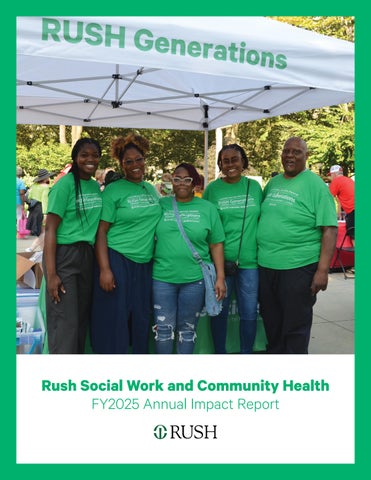
Rush Social Work and Community Health FY2025 Annual Impact Report
a
b
Social care is healthcare. Rush Social Work and Community Health (SWaCH) works alongside Rush’s clinical teams, patients and communities to remove the barriers that stand between people and the care they need. We create innovative social care programs, connect people to essential support and advocate for policies that expand access to care and advance health equity. From one-on-one support to nationwide advocacy, our work is rooted in the belief that everyone deserves a chance to be healthy. The impact is real and measurable. In fiscal year 2025, visits to Rush emergency departments by people who had received any SWaCH services dropped by more than 50% compared to the previous year — a powerful reflection of what’s possible through coordinated, systemwide collaboration. Connecting people to the right care at the right time truly makes a difference. The following pages share data from fiscal year 2025 (July 1, 2024 to June 30, 2025) as well as data that reflects SWaCH’s work and impact over time, showing how consistent, community-based care and advocacy drive meaningful, lasting outcomes that help people live their healthiest lives. The following pages contain snapshots of SWaCH’s work. For more detailed information about our programs and services, visit engage.rush.edu/swach-2025 or scan here:
Support Rush Social Work and Community Health If you’re interested in helping SWaCH care for patients and community members, expand access to social care for everyone and make a real difference in our neighborhoods and nationwide, contact Michelle Boardman, senior director of development, at (312) 942-6884 or michelle_a_boardman@rush.edu.
1
Connecting care, community and change SWaCH removes barriers to health through direct care, community partnerships and efforts to improve the systems that shape access to care. We work alongside patients, caregivers and community members while strengthening the workforce, programs and partnerships that help people live healthier lives. Together, these efforts improve outcomes today and build a stronger foundation for health in the future. The programs shown here represent the full scope of SWaCH’s work; the pages that follow highlight selected programs and initiatives.
2
Health promotion and disease prevention among Rush patients and West Side community members through evidence-based interventions
Rush Generations Health Legacy Program Evidence-based workshops Lectures and classes Support groups
Care for high-risk patients, encompassing complex care management and social care, to prevent adverse health outcomes and high acute-care utilization. Patients include people who are homebound, their caregivers and people experiencing homelessness.
Rush@Home Center to Transform Health and Housing Rush Primary Care Connect
Mental health care for Rush patients, staff and students
Outpatient Psychotherapy Clinic Rush Wellness Legacy Mental Health Fellowship
Systems change at Rush and beyond, innovating social care programs, processes and community partnerships to better serve priority populations and advance health equity. Priorities include older adults, caregivers and birth equity.
Community Practice Social Care Caring for Caregivers (C4C) Social determinants of health screening Center for Excellence in Aging
Workforce development, including interprofessional education, training and fellowships that build a highquality, culturally responsive social care workforce
Center for Health and Social Care Integration CATCH-ON E4 Center
Policy advocacy that aims to improve social care reimbursement, reduce social risk factors in areas such as housing and aging, build coalitions in the field and promote investment in the social care workforce
Social care reimbursement Housing Mental health
Research and development focused on social care, aging and mental health to foster the creation of new models for improving service delivery
Social care Aging Mental health
3
Where we work SWaCH’s work is rooted in Chicago and extends to communities and organizations across the country. Every day, SWaCH clinicians and social care professionals provide direct support to individuals, families and caregivers through mental health services, health education, care navigation and complex care management. We partner with healthcare providers, community organizations and policymakers to strengthen social care services, advance health equity and address emerging challenges in health and healthcare. We also share knowledge, train professionals and develop evidence-based models of care that can be adapted and scaled to other settings. Together, these efforts help improve health and well-being both locally and nationwide. These maps illustrate the breadth of SWaCH’s work, from the communities we serve in and around Chicago to a growing network of partners across the United States.
4
In the region
In our neighborhoods
5
Health Promotion and Disease Prevention Through workshops, screenings and community programs, we give people the tools to take charge of their health. Our offerings are built around the communities we serve, shaped by trusted partnerships and grounded in approaches that are proven to work.
Reaching communities at scale We’re partnering with more community organizations than ever to make health education accessible to everyone. In FY25, SWaCH: offered 53 evidence-based workshops at Rush and in the community began 40 new community partnerships to reach people in their neighborhoods
Engagement over time 594
FY25
FY24
FY23
Number of participants
6 Health Promotion and Disease Prevention
671
376
FY22
Participation in Rush’s health promotion programs shows growing community engagement and trust. While we saw a small dip in FY25, the number of people joining us to take charge of their health is up by more than 78% since FY22.
710
Health Promotion and Disease Prevention
Education and empowerment SWaCH health education programs like “Take Charge of Your Diabetes” and “Walk With Ease” help participants build skills, confidence and lasting healthy habits.
In FY25, Rush Generations expanded health education and engagement for older adults by: welcoming 443 new members screening 349 people at community events for health concerns
Turning knowledge into lasting lifestyle changes The Health Legacy Program provides culturally responsive, community-centered support that helps people make sustainable lifestyle changes for themselves and their families. Participants report positive effects on their food choices, physical activity and commitment to following through on their goals.
In FY25, the program: delivered 4 workshops trained 10 community health workers to lead education and support
Among those who completed SWaCH workshops in FY25:
90% felt encouraged to make at least one lifestyle change to improve wellness
89% felt more confident managing their health 88% reported feeling more connected to others
7
Care for people with complex needs People managing serious health and social challenges often don’t have a straightforward path to accessing care. The SWaCH team helps fill critical gaps, showing up in living rooms, shelters and community spaces to make sure the most vulnerable people in our community get consistent, connected care.
Bringing care directly to patients Rush@Home delivers coordinated primary and social care to people who are homebound and unable to get to office visits. SWaCH’s social workers and a community health worker team up with primary care providers at Rush to build trusted relationships and address medical and social needs in the environment where patients are most comfortable — their own homes. Social workers also link patients who need additional support to other SWaCH programs, such as the Legacy Mental Health Fellowship that offers in-home psychotherapy for West Side residents.
In FY25, Rush@Home: delivered 2,469 medical provider visits averaged 102 social care visits each month reduced hospital readmissions at Rush by 36% inspired 84% of patients surveyed to say they’d recommend the program to friends and family
“ I love how the staff interacts with me and treats me as a person.” Rush@Home patient
8 Care for people with complex needs
608
723
811
FY23
FY24
FY25
Number of Rush@Home patients
Care for people with complex needs
Health and housing support that restores stability and dignity The Center to Transform Health and Housing provides integrated health and social care for people experiencing homelessness. Through outreach and partnerships, the team makes connections to care, resources and harm reduction services that improve people’s health and create pathways toward stability.
In FY25, the center: delivered 1,500+ medical and social care encounters averaged 68 social care encounters each month distributed 300 harm reduction kits
9
ons
FY23
Expanding access to care
FY24
608
The SWaCH Outpatient Psychotherapy Clinic provides mental health services to Rush patients and community members. Our psychotherapists are also part of interdisciplinary teams that care for patients who have intersecting medical complexities. Our clinicians approach care through a social work lens, addressing the social and emotional challenges that can arise in the context of mental healthcare. The clinic also offers an LGBTQIA+ psychotherapy group led by staff who share and understand those identities, a perinatal psychotherapy group in Spanish and a monthly support group for parents of school-aged children on Chicago’s West Side. Finally, the clinic houses the Legacy Mental Health Fellowship, which supports emerging minority social work clinicians who want to reduce health disparities and improve mental health access for residents of Chicago’s West Side. Clinicians from this program are making a significant impact by treating patients at Rush, partnering with the Institute for NonViolence Chicago and the MAAFA Redemption Project, and delivering in-home psychotherapy through Rush@Home.
Innocent Orokoh, Legacy Mental Health Fellow (center), with colleagues from the MAAFA Redemption Project
FY25
ons
Mental health is crucial to every part of our lives and well-being. SWaCH delivers high-quality, trauma-informed support for Rush patients, staff, students and community members, with the goal of expanding access and integrating mental and behavioral healthcare across many different settings. 723
FY24
ons
Mental health support
12000 10000 8000
10,583
11,283
11,730
6000 4000
The number of outpatient 2000 0 psychotherapy sessions provided is up more than 10% since FY23
FY23
FY24
Number of sessions
10 Mental health support
FY25
In FY25, the clinical team: helped its patients make an average of 64% fewer Rush emergency department visits contributed to a 56% reduction in its patients’ readmissions to Rush hospitals supported its patients in keeping more appointments at Rush, reducing no-shows by 21%
Mental health support
Supporting those who care for others Working in healthcare requires extraordinary dedication — but that intensity can take a significant toll, leading to burnout and mental health challenges. The SWaCH Outpatient Psychotherapy Clinic partners with Rush Wellness to promote emotional well-being and help increase workplace satisfaction for Rush employees, students and house staff through free psychotherapy services grounded in a person-centered approach.
FY24
For urgent situations, our Wellness Pager is staffed 24/7 by clinicians who connect people with resources, Rush Wellness appointments or higher levels of care if needed. As part of a research study aiming to improve overall workplace wellness, clinical leaders from Rush Wellness also provided coaching for managers across Rush with low staff engagement scores.
2,400
FY23
3,149
FY24
3,566
FY25
The number of Rush Wellness clients has grown by more than 48% since FY23.
In FY25, SWaCH psychotherapists with Rush Wellness: 1.0
delivered 6,964 0.8 wellness sessions 0.6 0.4 responded to 106 0.2 Wellness Pager consults 0.0 to support staff
Number of clients
11
Systems change One-on-one mental health and social care matters profoundly, but so does changing the systems that create barriers to care in the first place. We work to create new models of care and build partnerships that reflect the real needs of our communities.
Easing the burden on caregivers Caring for Caregivers (C4C) is a proven quality improvement model for healthcare that provides family caregivers with comprehensive, personalized support to manage stress and protect their own health. By including family caregivers in the care delivery process, healthcare systems can enhance patient care, reduce hospitalizations and reduce healthcare providers’ workload. Recognized with the Innovations for Older Adults Award at the 2024 Chicago Innovation Awards, C4C was piloted at Rush and is now being adopted at hospitals nationwide.
Our Caring for Caregivers team with the Innovations for Older Adults Award
In FY25, C4C: served 180 caregivers screened 127 caregivers for anxiety and depression
Between FY22 and FY25, depression and anxiety symptoms reported by caregivers participating in C4C decreased measurably, as did overall caregiver burden.
Moderate Symptoms
10
Probable Anxiety Disorder
8
Mild Symptoms
5
10
Moderate
5
Mild
4.8
3.0
6.2
3.4
17.5
15.6
Initial PHQ-9
Follow-up PHQ-9
Initial GAD-7
Follow-up GAD-7
Initial BSFC
Follow-up BSFC
Depression Symptoms
Anxiety Symptoms
Caregiver Burden
Assessment tools: Patient Health Questionnaire (PHQ-9), Generalized Anxiety Disorder-7 (GAD-7), Burden Scale for Family Caregivers (BSFC)
12 Systems change
Systems change
Advancing health equity on Chicago’s West Side The Community Practice Social Care team provides community-based clinical care management to at-risk individuals and families, helping them stay engaged in their healthcare and addressing challenges such as mental health concerns, trauma or abuse. The team also supports Rush’s systemwide efforts to screen people for the social determinants of health (e.g., access to nutritious food, stable housing and reliable transportation), integrate screening information into their electronic health records and connect them to resources that fill the gaps.
“ The staff is wonderful and knowledgeable about their job! They go out and find information if they do not have the answer at the time.”
In FY25, the Community Practice Social Care team: provided 4,374 social care encounters helped its patients make an average of 66% fewer Rush emergency department visits inspired 88% of patients to report high satisfaction with the quality of services they received helped Rush complete 214,041 social determinants of health screenings and provide 3,626 referrals to resources
Rush patient and West Side resident
Turning research into better care The Rush Center for Excellence in Aging (CEA) is a collaboration between SWaCH and the Rush University Department of Psychiatry and Behavioral Sciences. The CEA applies lessons learned from research to clinical and community settings, improving how health professionals deliver care to older adults. In FY25, the CEA: served 179 patients through the Hospital Elder Life Program (HELP) that prevents delirium and functional decline in older adults who are hospitalized certified 165 clinicians in behavioral health for older adults delivered webinars on older adult behavioral health to 7,872 professionals
13
Workforce development/Policy advocacy The mental and behavioral health field depends on skilled professionals and the thoughtful policies that sustain their efforts. We invest in those who do this essential work, from training and supporting them to making sure their voices reach the places where decisions get made.
Training leaders and advancing change When social care and healthcare teams work together, patients experience fewer barriers, smoother care transitions and better outcomes. The Center for Health and Social Care Integration (CHaSCI) strengthens this integration by providing practical, evidence-based tools and championing policies that recognize social care as essential to health and help organizations embed social care into everyday practice. In FY25, CHaSCI and its Coalition for Social Work and Health helped reintroduce federal legislation broadening coverage for social work services beyond mental and behavioral health diagnosis and treatment. SWaCH team members visited Capitol Hill to advocate for the Integrating Social Workers Across Health Care Settings Act, which would expand Medicare coverage to include the full range of services provided by clinical social workers.
In FY25, CHaSCI: delivered 9 professional trainings totaling 56 hours of instruction trained 182 social care professionals in best practices hosted 6 webinars and grand rounds engaged 424 webinar attendees nationwide made direct contact with 126 policymakers
14 Workforce development/Policy advocacy
Research and evaluation
Research and evaluation Research at SWaCH turns real-world experience into knowledge that improves care and promotes health equity. By studying what works and sharing those insights as widely as we can, we strengthen social care practice, inform policy and improve care delivery nationwide.
In FY25, the SWaCH team: published 9 research papers in professional journals including Health & Social Work, Cognitive and Behavioral Practice, INQUIRY: Journal of Healthcare Provision and Public Health and the Journal of the American Geriatrics Society presented 28 talks at 11 conferences:
The Society for Social Work and Research (SSWR) Seattle, WA Chicago Chronic Care Network (C3EN) Chicago, IL
Camden Coalition of Health Care Providers and the National Center for Complex Health and Social Needs Pittsburgh, PA
National Association of Social Workers Chicago, IL
American Physician Group San Diego, CA
National Council on Aging Arlington, VA
American Society on Aging Orlando, FL
USAging Tampa, FL
National Association of Social Workers Illinois, Nevada, and North Dakota Chapters International Association for Social Work with Groups Michigan Health & Hospital Association Online
15
Moving forward together: SWaCH FY26 priorities The work highlighted in these pages shows what’s possible when we work consistently, creatively and with deep commitment to the communities we serve. As we look ahead to FY26, we’ll carry that momentum forward. Our priorities center on delivering high-quality care, investing in our team and continuing to shape the policies and systems that make equitable, sustainable care accessible to everyone. In FY26, SWaCH will continue strategic work in our four priority areas:
Quality and innovation • Create a culture of learning within the department by providing transparency to staff on program performance and encouraging input from all levels of the department. • Engage research with local hospital partners to define processes and benefits of the professional partnership between social workers and community health workers.
Efficiency and essentialism • Adjust meeting frequency and length to prioritize the purpose and promote action. • Provide training for staff on best practices for essentialism and time management.
Team culture and development • Develop community agreements for the department that promote a culture of inclusivity and belonging. • Establish a DEI work group for ongoing implementation and accountability of equitable practices.
Financial stability • Expand the use of social care billing across the department. • Advocate for fair pay for social care providers across the health system.
16
Rush Social Work and Community Health (SWaCH) 710 S. Paulina St., Suite 426 Chicago, IL 60612 rush.edu/swach