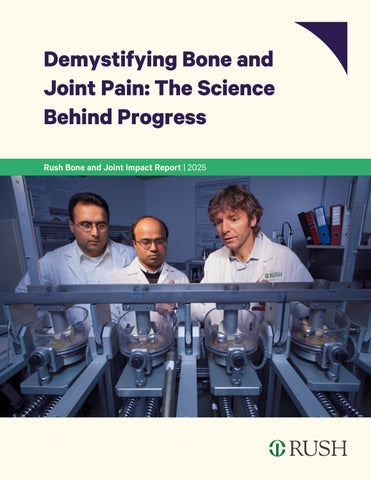
Demystifying Bone and Joint Pain: The Science Behind Progress Rush Bone and Joint Impact Report|2025
Your impact on the future of orthopedic medicine
2025 Report to Donors
Message from theActing Chair The Department of Orthopaedic Surgery at Rush University System for Health is united by a mission tohelp people lead their healthiest and most active ves. li From treating torn ACLs and worn-out hips to complex spine issues, we combinegroundbreaking researchwith compassionate care and exceptionaltraining. Our faculty are more thanexcellent clinicians. They are also leading researchers . Surgeons and scientists work side by side to demystify pain and develop pioneering solutions that reshape the future of care. Our commitment to this integrated approach has led to some of the most transformative breakthroughs in orthopedic medicine over the last 60 years . It has alsoearned us recognition as the top orthopedic practice in Illinois for the 11th year in a row by U.S. News& World Report. You make these developments possible. Philanthropy accelerates scientific discovery and ensures our department remains at the forefront of orthopedic medicine. Your support fuelsthe innovativework happening in the following pages. Itchanges lives and equips the next generation ofexperts to carry forward ourlegacy of providing innovative,patient-centered care. Thank you for your support.Thank you for believing in us and our approach. It matters now more than ever.
Brian J. Cole, MD, MBA Acting Chair, Department of Orthopaedic Surgery The Dr. Ralph and Marian C. Falk Professor of Biochemistry 2
Teamwork Makes the Dream Work: How collaborationleads to better bone and joint health Working with scientists and experts across fields exposes even the most accomplished clinician researcher to new perspectives and unconventional approaches. It can spark breakthroughs and renewed momentum on stalled research projects. Adam Yanke, MD, co-director of the Rush Cartilage Restoration Center,knows this firsthand. Tibial tubercle osteotomies, or TTOs, help alleviate stiffness, pain and instability in the knee. During the procedure, a piece of the shin bone is shifted to a new position tostabilize the knee.While patients report less The figure above shows the differences in surface pain and stiffness, TTOs are the only reshaping and height between knees with instability compared with “healthy” knees.The red indicates increased height, aligning surgeries in orthopedics that have no meaning that instead of a groove, the shape is more of preoperative measurements to indicate the need for a bump. The groove keeps the patella aligned so it glides smoothly. With increased height, the patella the procedure. Dr. Yanke and his collaborators doesn't have a stable area to sit in,causing it to shift developed the first measurements to guide treatment out of placewhen you straighten or bend your knee. decisions around TTOsusing standard 2D approach— For this pioneering study, the teamused 3D modelsof X-rays, CT scans and MRIs. patients’ knees to build the shape model . They Statistical shape modeling, or SSM,opened the door aggregated and organized points to calculate shape to a better method. SSM has been used by scientists averages for those with and without instability. They to characterize orthopedic conditions with abnormal then generated knee shapes representing the bone shape. Surgeons have started applying SSM to averages of these groups. The SSM can morph and address clinical questions. change between thetwo shape averages, revealingthe drastic differences between patient groups. This Catherine Yuh, PhD , assistant professor in the with pre -operative Department of Orthopaedic Surgery, asked Dr. Yanke approach can help surgeons planning and lead to guidelines to help them make if he had tried using SSM. Dr. Yuh showed Dr. Yanke informed decisions about techniques . statistical shape models of patients with patellar instability and those without . “Does this mean anything “This takes us leaps and bounds beyond where to you?”she asked. we’ve been for the last 15 to 20 years,” Dr. Yanke said. “We’re starting to applyit in the shoulder, hip and “It meant everything!” Dr. Yanke recalled. “It was other areas. It’s a much more holistic approach.” everything wehad been trying to figure out , at once.” 3
Healing Joints, Changing Lives Rush’s pioneering work earns national recognition Rush has been at the forefront of bone and joint research and care for decades, influencing and improving orthopedic medicine around the world. We break through barriers with trailblazing, collaborative research. Through innovative care and curiosity, our clinician -researchers, trainees and basic scientists demystify pain and find better solutions for those living with musculoskeletal conditions.One of those solutions, 25 years in the making, has revolutionized the field’s approach to restoring and repairi ng joints with cartilage defects. Osteochondral allograft transplantation , or OCA, tripled in the last 15 years.It represents one type of uses donor cartilage to repair damaged areas of the nearly 300,000 cartilage restoration procedures cartilage. Surgeons remove the damaged area and performed annually in the U.S. match the donor specimen to the size and shape of the “When I finished my training in 1997, there were few defect. This graft naturally integrates with the patient’s solutions available to treat patients with articular bone to form a new cartilage surface, decreasing pain cartilage or meniscal deficiency,” Dr. Cole said. “While and swelling. we had early exposure to cell -based cartilage Brian J. Cole, MD, MBA, FAAOS , and his colleagues transplantation and other commonly performed have studied every aspect of the procedurefrom under procedures, the orthopedic community did not have a the microscope to the operating room. Because of theirfirm understanding of outcomes, leading to research, asurgery that was once performed atonly a unpredictable results.” few academic centers has now become the field’s Rush’s decades-long commitment to this work has leading and most reliable method for joint restoration. shown near-universal benefits for patients, whether The number of procedures performed has more than they are professional athletes or have active lifestyles.
4
With 85% of patients enjoying significant pain relief for more than 10 years, the OCA is an important intervention to delay knee replacements, especially for people who want to remain active.
Life beyond pain: Brian’sstory Brian Hall, of Valparaiso, Indiana, was no stranger to knee pain. As a high school athlete, he had his first arthroscopic knee surgery at 14. As time went on, Brian’s activities increased as he enjoyed life as a husband and father. He took up running, long bike rides, walks with his dog and extreme hiking — including five hikes in the Grand Canyon. His knee pain persisted and worsened into his 50s, eventually affecting every aspect of his life. He was told a knee replacement was his only option. But when he saw Adam Yanke, MD, PhD, associate professor of orthopedic surgery and one of Dr. Cole’s research partners, Dr. Yanke recommended the OCA. Brian’s cartilage damage was relatively localized. Within two weeks of surgery,Brian was out of pain for the first time since he could remember. He’s since hiked the Grand Canyon for a sixth time.
Shoulder Surgeons Receive Prestigious Charles S. Neer Award The tradition of leading-edge scientific discovery continues through patient-centered studies like one co-led by Grant E. Garrigues, MD, andGregory Nicholson, MD. Their clinical trial comparing surgeon -directed home physical therapy to outpatient therapy after a shoulder replacement is charting new territory in an evolving area — and capturing the attention of their peers.
Rewarding progress in treating knee conditions In recognition of this pioneering research, the Orthopaedic Research and Education Foundation awarded its prestigious Clinical Research Award to the entire research team, including Dr. Cole ; Dr. Yanke; Jorge A. Chahla, MD, PhD; Susanna G. Chubinskaya, PhD; and Ron Gilat, MD. One of the most respected awards in orthopedics globally, it recognizes outstanding clinical research related to musculoskeletal disease or injury. “This award reflects the hard work of countless individuals, including more than 100 researchers from Rush,” Dr. Cole said. “One of the most rewarding things for me is knowing that, as they build their careers, they take the knowledge from this research wi th them, providing pain relief to patients around the world. ” 5
Drs. Garrigues and Nicholson and their research team were presented with the Neer Award for Clinical Research at the 2024 Annual Meeting of the American Shoulder and Elbow Surgeons Foundation . Named for Charles S. Neer, a pioneer in the field, hetaward recognizes outstanding clinical and basic science that contributes to the understanding, care and prevention ofshoulder injuries.
The Impact of Opportunity: Rush’s Sports Medicine Research Assistant Program The Division of Sports Medicine Research Assistant Program offers aspiring surgeons a year-long research assistantship. Research assistants take a one -year hiatus from the classroom to work with Rush faculty on multiple projectsacross clinical, biomechanical, anatomic and imaging studies. They shadow surgeons in the clinic and the operating room,gaining the full experience of life as an orthopedic physician-scientist. This highly competitive program is aspringboard for early-career clinicians like Zachary Oppenheim,Edouard Augustin and Kofi Acheampong. They have published their work, participated in academic conferences and gained greater exposure to the field of sports medicine, which willset them apart from their peers when they begin to apply for residency. Philanthropy makes these opportunities possible. Because of our donor community, dozens of trainees have launched successful careers as orthopedic surgeon-scientists. It is special to be in a circumstance where we have all the materials necessary to conduct research,that we aren’t limited by any external means, and that we are able to truly see the answers that we think will provide patients with the best treatment and achieve the best possible outcomes.Thank you for the generous donations that make all this research possible. Zachary Oppenheim, M1 University of Missouri-Columbia School of Medicine
This fellowship broadened my mindset, skill set, and network of passionate and compassionate people in the field. I look forward to growing as a researcher and in my relationships with each of the people I connected with in the years to come. I'm very grat eful to every donor who has contributed to these fellowships. It has opened doors for me that I've yet to see.You’ve had a profound impact on my career, without a doubt. Edouard Augustin, M4 City University of New York School of Medicine
Without this support, I simply would not have been able to dedicate myself fully to this year of research and mentorship. It makes a difference not onlyin patients’ lives through the discoveries that you're helping to make possible, but on students like me who might otherwise only be able to dream of entering this field. Thank you for opening the doors for this first-generation immigrant from Ghanato become an orthopedic surgeon. Kofi Acheampong, M4 University of Chicago Pritzker School of Medicine 6
Feeling Renewed Joy Louise Clay finds revived love for sports, life and caring for her patients following care at Rush When Louise Clay, MD , met Brian Cole, MD, MBA , acting chairperson of the Department of Orthopaedic Surgery and the Dr. Ralph and Marian C. Falk Professor of Biochemistry at Rush, she sought help for her knee. She didn’t expect to gain renewed inspiration for the care she provides to her patients, as well. hope that I could gain back the joy in doing what I love. Louise is a radiation oncologist based in Charleston, I left there thinking, ‘I want every single one of my South Carolina. She recently retired from full -time patients to feel like Dr. Cole made me feel.’” practice and has been able to more fully pursue the As Louise faced a high workload and short staffing at things she loves: running, swimming, skiing, biking, traveling and spending quality time with her friends, work, this renewed sense of passion for her profession came at the right time. sisters and many nieces and nephews. In 2016, hip problems began to threaten her active “I appreciated the safety, quality, routine and system in lifestyle. At the time, she had a labral tear and receivedplace at Rush,” she said. “I just had an amazing an arthroscopy to repair it. In 2021, her meniscus tore,experience.” and she again had an arthroscopy. After five months, it By February 2022, Louise was skiing in Utah and began failed. running again. “At that point, I was searching for answers,” she said. “I Inspired by the care she received, Louise donated to didn’t understand what happened. I was worried I Dr. Cole’s Live Active Fund in 2023, which supports would never run again, much less anything else.” research and educational opportunities in the She eventually came across information about Dr. ColeDepartment of Orthopaedic Surgery. Louise recently and his work. After a few calls and emails, a member ofhad an opportunity to tour the department’s labs and the scheduling team helped her get an appointment. was impressed by how closely research is tied to clinical care and how quickly clinical questions are “Dr. Cole just turned my world around,” Louise said. “He brought to the lab for investigation. She also attends was an angel in disguise.” virtual presentations conducted by Dr. Cole’s research Dr. Cole examined Louise’s X -ray and MRI and team to learn about trainees’ projects. recommended she get a meniscus revision surgery, but “I wanted to support all the things they’re doing at in contrast to the care Louise received previously, he Rush,” she said. “I had such a wonderful experience, explained in detail what needed to be done to restore and I wanted to give back as I could. I hope other her mobility and ease her pain. people have similar experiences, and I want Dr. Cole “I left that appointment and felt so much better,” she and his team to continue researching and learn ing new said. “I had clarity, understood everything and had things to help people like me. ” 7
Researchers at the Field Museum scan a mummified individual displayed in theInside Ancient Egypt exhibition. Credit: © The Field Museum 2024, photo by Morgan Clark
What Can the Past Tell Us About the Present? A local partnership aims to spur global insight and curiosity -related disorders and pain . The ability to move freely and live without chronic painof life of people with spine is fundamental to human dignity. Yet for millions of This work reflects a broader commitment to honoring Americans, persistent back pain undermines their diverse health needsacross our community and giving capacity to work, care for othersand participate fully everyone the chance to lead their healthiest life. Dr. in daily life. Samartzis often engages with unconventional partners Researchers and clinicians at Rush are advancing to foster public interest in science and spark curiosity spinal care studies that aim not only to treat pain but among younger generations. to address the systemic factors that contribute to it The “Mummies Reborn” initiative marries the through theInternational Spine Research & Innovation technical expertise of orthopedic scientists at Rush Initiativeat Rush, or ISRII. with the historical knowledge of anthropologists and Led by Dino Samartzis, DSc , professor of orthopedic archaeologists at the Field Museum. Together, they surgery at Rush, ISRII is one of the largest and most are conducting one of the most extensive studies on a comprehensive centers of its kind in the world . Its collection of Egyptian mummies worldwide. Through innovative and impactful research improve s the quality full-body CT imaging, they will examine the musculo 8
d .noitib kr
skeletal structures of the mummies for signs of diseases that exist today. Some of these individuals — young and old, male and female — lived over 5,000 years ago, offering an unprecedented window into the history and development of human health. “This project is more than a study,” Dr. Samartzis said. “It’s a celebration of science, history and collaboration. By revisiting the past and bringing together clinicians and scientists from so many fields, we can better understand our present and future. ” In an increasingly interconnected world, collaboration across departments and disciplines is the key to unlocking new discoveries that can improve human health.
Field Museum researchers analyze composite scans of a mummified individual . Credit: © The Field Museum 2024, photo by Bella Koscal
“You need to collaborate to make an impact,” Dr. Samartzis said. “We all bring different perspectives to the public about musculoskeletal disease andinspire the work, which can only strengthen the science.” young minds to continue to seek answers and engage with the scientific process. ” For Mummies Reborn, Dr. Samartzis is not only working with colleagues at the Field Museum, but also Sharing findings with the public is an important — and other orthopedic specialists, dentists, imaging experts often overlooked — aspect of the scientific process. and neurologists. Efforts like these make science more relatable and show how it affects us in our everyday lives — and Endowed funds are another critical aspect of throughout human history. collaboration. This project with the Field Museum was made possible with funds from the Charles Bush Joseph, MD, Endowment for Sports Medicine Research, established by a community of patients to honor sports medicine physician Charles Bush Joseph, MD . Passionate about training the next Scan the QR code below to learn more about the generation of orthopedic experts and keeping Rush at findings made to date at the Field Museum. the leadingedge of the field, Dr. Bush -Joseph deploys funds to projects that can lead to a difference in care. As this research yields results,Dr. Samartzis envisions opportunities with the Field Museum to share their research findings beyond the scientific community, specifically through educational exhibitions and programming. “My hope is that we can develop a long-term educational program at the Field Museum to educate 9
Rehab 2.0: Powered by Brainwaves and Bold Ideas Inside Rush’s groundbreaking study that’s bringing neuroscience to orthopedics At Rush, orthopedic surgeons do more than repair joints. They restore lives. Whether helping a weekend warrior return to the trail or a professional athlete get back on the field, the goal is the same: reduce pain, improve mobility and help people do what they love. But healing isn’t just physical. Our neurological health matters, too. “Pain, fear and anxiety have a huge impact on the rehabilitation process,” explained Brian Forsythe, MD, the Tim and Keli Walbert Endowed Chair in Orthopedic Surgery. “They delay muscle activation, limit range of motion and restrain overall movement.”
In neurofeedback training, individuals use their brains to control an avatar and perform different exercises on a screen.
These feelings cause you to adapt your movements, interfering with the brain’s signals, slowing recovery Defenders returned to their preinjury performance and increasing the risk of reinjury. Fear and anxiety can level after two years, while midfielders scored more lead to arthrogenic muscle inhibition, which makes it goals by their third year post -ACL reconstruction. hard to contract muscles involved in movement, and Forwards, though, whose roles demand explosive even a clinical fear of movement, called kinesiophobia. movement and agility, experienced decreases in goals While we don’t yet fully understand the roles fear and scored, minutes played and shots on goal into year anxiety play in the rehabilitation process , Dr. Forsythe four. and his colleagues are changing that. “On the one hand, these findings may reflect To generate a baseline understanding of how accelerated rehab protocols and possibly improved psychological factors like kinesiophobia might affect surgical techniques,” Dr. Forsythe said. “At the same recovery, Dr. Forsythe and his collaborators conducted time, they suggest physical healing alone is not an analysis of return-to-play and performance metrics enough.” for Major League Soccerplayers recovering from ACL That insight is driving a new direction in rehabilitation injuries. to accelerate recovery. Dr. Forsythe and his team are The team’s study revealed that despite faster return building on this study by exploring how to-play times over the last decade, many athletes neurofeedback visualization technology can help struggled to reach their pre -injury performance levels . retrain the brain, expedite muscle reactivation and 10
The Walberts’ investment in our orthopedic research program has allowed me to assemble a team of researchers and experts who can execute a complex study like this one.”
decrease arthrogenic muscleinhibition. Enhancing rehabilitationusing technology Five years ago, Dr. Forsythe was introduced to a neuroscience-based visualization tool used by elite athletes to improve performance. He immediately wondered if this tech nology could support a more efficient rehab process and promote healing.
— Dr. Forsythe
How philanthropy puts us on the path to progress Private support is essential to advance orthopedic medicine. Funding from the National Institutes of Health has led to tremendous strides in orthopedic care, but only 2% to 3% of its budget funds research into musculoskeletal diseases , whilehalf of Americans experience them. Philanthropy fills the gap.
“When I met the developers of the technology five years ago, they didn't have a rehab platform,” he recalled. “The technology is a cool device in sports performance, but as a clinician -scientist who takes care of recreational and professional athletes when they get hurt, I saw an even greater need fo r this technology in the rehab process.”
Gifts like those fromTim and Keli Walbertkeep Rush at the forefront of innovation and care. Their recent, historic investment in the department will advance In collaboration with colleagues across the opportunities for early-career orthopedic researchers department, the Rush Motion Analysis Lab and Midwest Orthopaedics at Rush physical therapy clinics,and fund discoveries to bring pain relief to millions of Dr. Forsythe recently launched a randomized control Americans. The gift established four endowed funds, trial to determine if the neurofeedback visualization including the Tim and Keli Walbert Endowed Chairin training makes a measurable difference for patients. Orthopedic Surgery, which honors Dr. Forsythe’s groundbreaking research to find better treatment The complex studytook over a year toplan. options for bone and joint pain, includin g the “There are a lot of moving parts to conduct a study like neurofeedback visualization training study. this one,” Dr. Forsythe said. “It requires a high level of organization, strategy and enthusiasm to execute it.” “The Walberts’ investment in our orthopedic research program has allowed me to assemble a team of Patients who have undergone an ACL reconstruction, researchers and experts who can execute a complex femoroacetabular impingement surgery, hip labral study like this one,” Dr. Forsythe said. repair, or a total hip or knee replacement are eligible to enroll in the study. They will be randomly assigned to Because studies like the neurofeedback visualization either the study or control group. The study group will trial inform and influence orthopedic practice participate in neurofeedback visualizationtraining for nationally and internationally, philanthropic gifts have a ripple effect, reaching patients beyond Chicago. It eight weeks following their surgery alongside a allows the team to build on their findings and apply standard physical therapy regimen. In the Motion Analysis Lab, the team will learn how well patients’ them to other areas, like shoulder surgeries, where -based therapy muscles are contracting, how strongthey are and how there is a great need for more evidence protocols. much energy they generate. “If we can adapt this technology for rehab, we could “The translational nature of this researchwill make a make a profound impact on the recovery process and profound difference, touching thousands, if not even decrease the odds of reinjury,” Dr. Forsythe said. millions, of lives,” Dr. Forsythe said. 11
Rush Researchers Put Microplastics Under the Microscope Rush’s unique expertise is driving breakthroughs in understanding how microplastics — from implants and pollution— shape our health
For decades, plastics have played an integral role in theallows us to design implants that function better and success of joint replacements, allowing them to work last longer.” better and last longer than ever before. But artificial Rush has been a pioneer in orthopedic medicine for 60 joints break down over time, leaving microplastics in years in part because researchers have access to our bodies. state-of-the-art technology that can measure wear on implant parts and identify nanoparticles in tissues. Through the Robbins and Jacobs Family Biocompatibility and Implant Pathology Lab oratory, Philanthropy has made that access possible. Rush researchers have been collecting implants — With this equipment,Robin Pourzal, PhD, director of over 10,000 across four decades— to study how they implant materials analysis, and his team can conduct wear down, where the particles go and howimmune our increasingly complex experiments analyzing the cells react to them. The program involves the retrieval breakdown of metal and microplastics. Add to that a of failed implants from revision surger ies and strong collaboration with the Motion Analysis Lab in successful implants postmortem. Tremendous insights the Department of Orthopaedic Surgery , and the team have come out of the lab, contributing to the evolutioncan also map which movements and motions cause of the plastics used in joint replacements, increasing implants to wear and how fast. device longevity and improving safety . “We are one of the only places in the world that can do “Our laboratory’s purpose is to understand why some these holistic studies,” Dr. Pourzal said. “We can implants fail,” said Joshua Jacobs, MD , Grainger conduct a wear analysis to see how an artificial implant Director, Rush Arthritis and Orthopaedics Institute . “If breaks down over time and then study the tissues we understand why they fail, we can devise strategies surrounding the implant to see how the cell s respond. to improve their performance. Through our With our partners in the Motion Analysis Lab, we can postmortem retrieval program, we also learn why someobserve how patients move with their implants and implants are successful for decades. This knowledge how those movements affect wear.” 12
Taken together, these intricate studies are reshaping he raised awareness of Rush’s ability to study standards of care in real time, from rehab regimens to nanoparticles because of an infrared spectrometer. surgical angles and diagnostic tools to keep us active Since then, he has been approached by colleagues at and moving as we age. Even with these clinical Rush and across Chicago to launch new studies of improvements, technological advancements are microplastics using this machine. One project aims to happening at breakneck speeds. Rush must continue generate a better understanding of how these to integrate these new technologies and build up tissueparticles affect our gut health. Another reflectsthe retrieval banks to stay at the forefront of microplastics overlap between the environment and our health. research in orthopedics. The team’s studies have also “Colleagues at a peer institution in Chicago found plastic and metal particles in the lymph nodes, approached us about using infrared spectroscopy to liver, heart and bone marrow, raising important look at how well shellfish in Lake Michigan filter questions about the long -term impact of microplastics microplastics,” Dr. Pourzal explained. “It’s a pretty cool on our overall health. application of the technology.” “There are solutions to all these problems, but they are Less than six months later, a generous gift from Dr. unfortunately costly and take time, research and the Jacobs and the Robbins family, who named the lab, will to actually look,” Dr. Pourzal said. provided a critical technology upgrade for the lab. The Thanks to two key philanthropic investments in the new equipment supports wear assessments on department over the last year, Rush is a step closer to irregularly shaped implant parts, unlocking new more scientific discoveries that will improve our joint avenues of research for Dr. Pourzal and his team. health — and by extension, our physical, mental and “This advanced equipment has opened the door to emotional well -being. entirely new lines of inquiry that weren’t possible In December 2024, the Rush Bone and Joint Advisory before,” Dr. Pourzal said. “For example, we’re now able Council hosted “Microplastics Under the Microscope” to partner with our shoulder surgeons to study to raise awareness of the impact of plastic pollution shoulder replacements from all angles and determine and implants on our health. A panel of environmental what postoperative therapies will reduce wear and health and orthopedic experts from Rush and th e maximize mobility.” Alliance for the Great Lakes was driven by council As a result of this investment and the department’s member Theresann Seeger , a crucial philanthropic unique technological capabilities, Dr. Pourzal was partner to orthopedics. Seeger saw similarities in the recently awarded a research grant from the Swiss work being done by Rush and the Alliance to examine National Science Foundationto measure the wear rate what it means to have plastics in our bodies,whether of different manufacturers’ implant components, they come from the environment or implants. determine how they wear and investigate what “This work is important because, as a society, we are happens to those particles. losing focus on the damage that overuse of single -use “We know how to study the breakdown of plastics in and plastic products in general is causing in our the body,” he said. “We know how to study where they environment as well as on our health,” Seeger said. come from and where they go. People want to partner “Becoming more conscious is a first step towar d with us, within Rush, in Chicago and internationally, changing our habits.” and it’s going to make a tremendous difference for Dr. Pourzal was one of the experts on the panel, where patients in the longterm.” 13
From the Front Desk to the Forefront A 20-year career in orthopedic research recognized and honored WhenAnne DeBenedetti, MSc, started working at the impact on patients and outcomes and recovery.” front desk of Midwest Orthopaedics at Rush in 2005, it Of course, there’s always more to the story. wasn’t with any grand ambitions. At 20 years old, she moved from Arizona to Chicago to spend time with herInspiration andeducation grandfather and applied for an administrative assistant DeBenedetti’s father,Clifford DeBenedetti, MD, grew position. up in Chicago. After being diagnosed at 14 with early Fast forward 20 years: DeBenedetti, the Walbert onset osteoarthritis, he moved to Tucson , Arizona, for Endowed Faculty Scholar in Joint Reconstruction the dry heat and became a pediatrician with a Research, is director of research for adult subspecialty in rheumatology and a clinical focus on reconstruction in the Department of Orthopaedic juvenile rheumatoid arthritis . Surgery at Rush University Medical Center, a role created specifically for her to lead and expand the joint “I’ll never forget that my dad was trying to help children who had similar challenges that he did at a young age,” reconstruction research program. She oversees a portfolio of more than 40 active studies across faculty, DeBenedetti said. “He’s my ‘why.’ I want to help people like my dad.” fellows, residents and research personnel. “Long story short: I love what I do and never knew this Dr. DeBenedetti never pushed his daughter toward a was the route that I would go,” she said. “It’s taken mecareer in medicine, but he and his wife, who holds a a long time to get to this position. In the 20 years I’ve master’s degree in early childhood education, have been here, the changes we’ve made have had a huge always encouraged their children to pursue education. 14
After DeBenedetti spent her first year -and-a-half at from the front desk to the clinic to the lab. Midwest Orthopaedics working for Brian Cole, MD, “It takes a village,” she said. “I definitely don’t do MBA, in sports medicine, her father’s history nudged anything by myself. I respect and appreciate all the her toward adult reconstruction, which has meant people who collaborate to make these things come to working for Craig J. Della Valle, MD, for the past 17 fruition.” years. From the start, the orthopedic surgeon treated As her role has evolved and her responsibilities have her as integral to the practice and encouraged opportunities to learn more, including her pursuit of a grown, DeBenedetti has found herself cultivating the master ofscience, which she earned in clinical research next generation of that orthopedic village, guiding medical students through immersive research from Rush in 2022. experiences that integrate clinical, translational and “He is my biggest mentor at Rush,” DeBenedetti said. device-focused studies. "His passion, leadership and support are why I’ve “I don’t take mentoring lightly,” she said. “At the end of worked here for 20 years.” the day, we are developing the field’s future doctors For Della Valle, the respect is mutual . “Anne is the and surgeons.” ultimate success story,” he said. “She excelled in her DeBenedetti is still building upon her successes, too. career and looked for a new challenge.” “I worked hard to get where I am,” she said. “I love what I do. I love school. Whether it’s a PhD or something else, “When you go to medical school and become a doctor,education is in my future. I think there’s always room to you can help people,”Dr. Della Valle said. “But you can grow. I don’t think we’re ever done learning.” only help so many people, even throughout an entire As an endowed faculty scholar, DeBenedetti will career. When you’re doing research that changes the continue her work with Dr. Della Valle to address practice patterns of other physicians, your impact is challenging questions about how to reduce opioid larger.Anne’s a big part of that. usage after orthopedic surgery; minimize “We would not be able to do the volume and quality ofcomplications and treat infections following studies that we do without Anne.” arthroplasty; analyze trends in surgical outcomes; and more. Endowment funding gives researchers greater DeBenedetti’s research focuses on advancing joint opportunities to advance discovery, improve patient reconstruction through randomized controlled trials, outcomes and train future leaders in musculoskeletal clinical trials involving devices, medications and medicine. postoperative protocols, all aimed at improving patient outcomes. She also collaborates with the impla nt “Especially today, to know that I have that security retrieval lab at Rush, which houses a large inventory ofthanks to Tim and Keli Walbert ’s generosity, I feel retrieved implants, fluids and tissue samples used to really fortunate,”she said. investigate the causes of failures in joint replacement surgery. DeBenedetti takes pride in fostering collaboration with institutional and nat ional partners, as well as industry stakeholders and regulatory bodies, carrying forward the lessons she has learned about the importance of every role in the research process —
‘It takes a village’
15
To make a gift, arrange a tour of Rush’s bone and joint laboratories or learn more about how you can support research that transforms orthopedic care aroundthe world, contact: Nick Martorano Associate Director of Development nick_martorano@rush.edu |(312)942-5426
Learn how your gift helps transcend boundaries by scanning the QR code:
16
Rush University System for Health aims to eliminate the boundaries in health care preventing you from living your healthiest life. As a supporter of bone and joint research at Rush , you are a critical partner in achievingour broader philanthropic vision.